AILET 2026 LLM Question Paper with Answer Key PDF is available for download. NLU Delhi has conducted AILET 2026 on December 14, 2025. The question paper comprises a total of 100 questions divided among three sections.
AILET 2026 LLM Question Paper with Answer Key PDFs – Memory Based
| AILET 2026 LLM Question Paper with Answer Key PDF | Download | Check Solution |
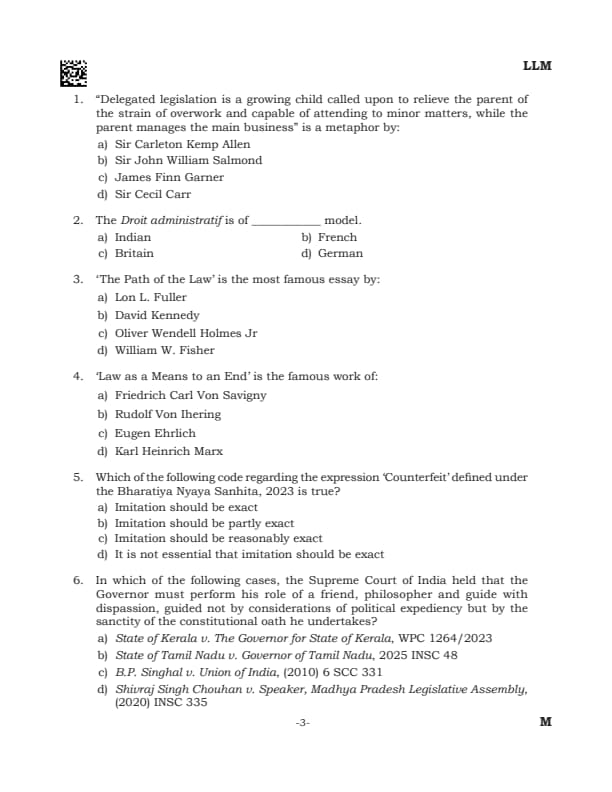
“Delegated legislation is a growing child called upon to relieve the parent of the strain of overwork and capable of attending to minor matters, while the parent manages the main business” is a metaphor by:
View Solution
Step 1: Understanding the statement.
The statement explains the concept of delegated legislation using a metaphor of a parent and a growing child. It highlights how delegated legislation helps the legislature by handling minor and technical matters, reducing the burden on the main law-making body.
Step 2: Identifying the author.
This metaphor is a well-known description used in administrative law to explain the importance and role of delegated legislation in modern governance.
Step 3: Analyzing the options.
Sir Cecil Carr is credited with this metaphor, emphasizing the supportive role of delegated legislation. Other jurists listed are associated with different legal concepts but not this specific analogy.
Step 4: Conclusion.
Hence, the correct answer is (D) Sir Cecil Carr.
Quick Tip: Metaphors in administrative law are often used to simplify complex legal concepts—remember Sir Cecil Carr’s “parent and child” analogy for delegated legislation.
The Droit administratif is of model.
View Solution
Step 1: Understanding Droit administratif.
Droit administratif refers to a specialized system of administrative law governing public administration and disputes involving the state.
Step 2: Identifying its origin.
This system developed in France and is administered through separate administrative courts such as the Conseil d'État.
Step 3: Conclusion.
Therefore, the correct answer is (B) French.
Quick Tip: Droit administratif is a hallmark of the French administrative law system and differs from the common law approach.
‘The Path of the Law’ is the most famous essay by:
View Solution
Step 1: Understanding the essay.
‘The Path of the Law’ is a landmark legal essay that explains law from a practical and realist perspective, focusing on how judges actually decide cases.
Step 2: Identifying the author.
The essay was written by Oliver Wendell Holmes Jr., a prominent jurist and Associate Justice of the U.S. Supreme Court.
Step 3: Conclusion.
Thus, the correct answer is (C) Oliver Wendell Holmes Jr.
Quick Tip: Oliver Wendell Holmes Jr. is closely associated with legal realism—remember him for “The Path of the Law.”
‘Law as a Means to an End’ is the famous work of:
View Solution
Step 1: Understanding the concept.
The phrase “Law as a Means to an End” reflects the idea that law serves social purposes and is an instrument for achieving societal goals.
Step 2: Identifying the jurist.
This theory was propounded by Rudolf Von Ihering, who emphasized the functional and purpose-driven nature of law.
Step 3: Conclusion.
Hence, the correct answer is (B) Rudolf Von Ihering.
Quick Tip: Rudolf Von Ihering viewed law as a tool to achieve social objectives—always link him with purposive jurisprudence.
Which of the following code regarding the expression ‘Counterfeit’ defined under the Bharatiya Nyaya Sanhita, 2023 is true?
View Solution
Step 1: Understanding the term ‘Counterfeit’.
Under the Bharatiya Nyaya Sanhita, 2023, the expression ‘counterfeit’ does not require an absolutely identical imitation. The focus is on deceptive similarity rather than exact duplication.
Step 2: Legal interpretation.
The law recognizes that counterfeiting may involve variations, and even an inexact imitation can mislead an ordinary person into believing it to be genuine.
Step 3: Analysis of options.
Options (A), (B), and (C) incorrectly insist on degrees of exactness. The statute clearly states that exact imitation is not mandatory for an act to qualify as counterfeiting.
Step 4: Conclusion.
Therefore, the correct answer is (D) It is not essential that imitation should be exact.
Quick Tip: In criminal law, counterfeiting focuses on the intention to deceive, not on producing an exact replica.
In which of the following cases, the Supreme Court of India held that the Governor must perform his role of a friend, philosopher and guide with dispassion, guided not by considerations of political expediency but by the sanctity of the constitutional oath he undertakes?
View Solution
Step 1: Understanding the constitutional role of the Governor.
The Governor is a constitutional authority expected to act impartially, independently, and in accordance with the Constitution, rather than political considerations.
Step 2: Judicial observation.
In {State of Tamil Nadu v. Governor of Tamil Nadu, the Supreme Court emphasized that the Governor must act as a friend, philosopher, and guide, guided solely by constitutional morality and the oath of office.
Step 3: Elimination of other options.
Other cases deal with different constitutional issues such as removal of Governors or legislative procedures, but do not specifically contain this observation regarding the Governor’s conduct.
Step 4: Conclusion.
Hence, the correct answer is (B) State of Tamil Nadu v. Governor of Tamil Nadu, 2025 INSC 48.
Quick Tip: For questions on constitutional offices, always link judicial observations with the case that directly discusses the conduct and duties of that authority.
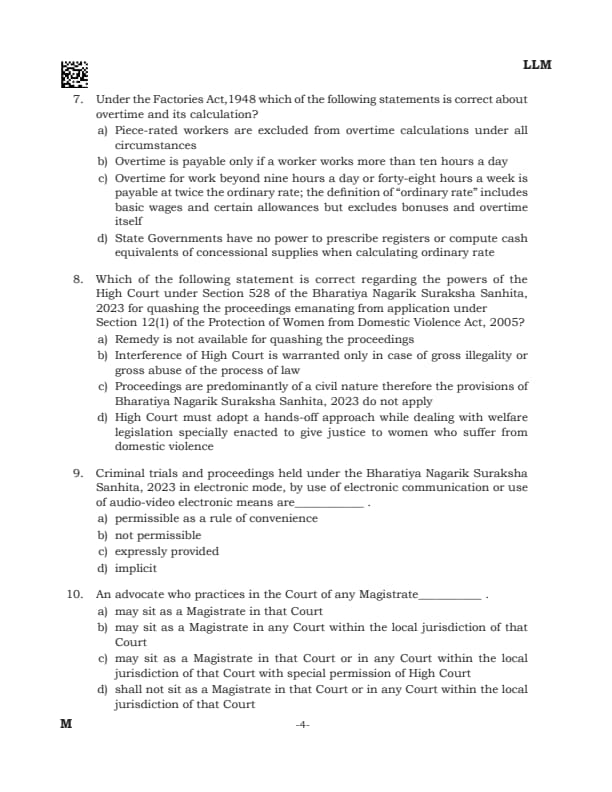
Under the Factories Act, 1948 which of the following statements is correct about overtime and its calculation?
View Solution
Step 1: Understanding overtime under the Factories Act.
Section 59 of the Factories Act, 1948 provides that when a worker works for more than nine hours in a day or more than forty-eight hours in a week, he is entitled to overtime wages.
Step 2: Rate of overtime wages.
The Act clearly states that overtime wages shall be paid at twice the ordinary rate of wages. The “ordinary rate” includes basic wages and certain allowances but specifically excludes bonuses and overtime wages.
Step 3: Examination of incorrect options.
Option (A) is incorrect because piece-rated workers are also entitled to overtime. Option (B) is incorrect as the threshold is nine hours, not ten hours. Option (D) is incorrect because State Governments do have the power to prescribe registers and determine cash equivalents of concessional supplies.
Step 4: Conclusion.
Therefore, option (C) correctly states the law relating to overtime and its calculation under the Factories Act, 1948.
Quick Tip: Always remember: overtime under the Factories Act starts beyond 9 hours a day or 48 hours a week and is paid at double the ordinary rate.
Which of the following statement is correct regarding the powers of the High Court under Section 528 of the Bharatiya Nagarik Suraksha Sanhita, 2023 for quashing the proceedings emanating from application under Section 12(1) of the Protection of Women from Domestic Violence Act, 2005?
View Solution
Step 1: Scope of Section 528 BNSS, 2023.
Section 528 of the Bharatiya Nagarik Suraksha Sanhita, 2023 confers inherent powers on the High Court, similar to Section 482 of the Code of Criminal Procedure, to prevent abuse of process and to secure the ends of justice.
Step 2: Nature of proceedings under the Domestic Violence Act.
Proceedings under Section 12(1) of the Protection of Women from Domestic Violence Act, 2005 are quasi-civil in nature, but they are governed by criminal procedural law for enforcement and remedies.
Step 3: Limits on High Court interference.
The High Court may quash such proceedings only in exceptional cases where there is gross illegality, lack of jurisdiction, or a clear abuse of the process of law. Routine interference is discouraged.
Step 4: Conclusion.
Hence, the correct statement is (B), as High Court intervention is justified only in cases of gross illegality or abuse of the legal process.
Quick Tip: Inherent powers of the High Court are extraordinary in nature and must be exercised sparingly, especially in welfare legislations like the Domestic Violence Act.
Criminal trials and proceedings held under the Bharatiya Nagarik Suraksha Sanhita, 2023 in electronic mode, by use of electronic communication or use of audio-video electronic means are .
View Solution
Step 1: Understanding the statutory framework.
The Bharatiya Nagarik Suraksha Sanhita, 2023 has introduced modern procedural reforms to align criminal justice administration with technological advancements.
Step 2: Provision for electronic mode.
The Sanhita explicitly provides for conducting criminal trials and proceedings through electronic communication, including audio-video electronic means. This is not merely a matter of convenience but a statutory mandate.
Step 3: Analysis of options.
Option (A) is incorrect because electronic proceedings are not based solely on convenience. Option (B) is incorrect as the statute permits such proceedings. Option (D) is incorrect because the provision is explicit, not implied.
Step 4: Conclusion.
Hence, the correct answer is (C) expressly provided.
Quick Tip: Whenever a procedural reform is clearly written in the statute, it is said to be “expressly provided” and not merely implied.
An advocate who practices in the Court of any Magistrate .
View Solution
Step 1: Understanding the rule of disqualification.
The law seeks to ensure impartiality and avoid conflict of interest in judicial proceedings. An advocate practicing in a particular court is closely connected with that court’s functioning.
Step 2: Statutory prohibition.
The criminal procedural law expressly bars an advocate from acting as a Magistrate in the same court or within its local jurisdiction where he practices, to maintain judicial neutrality and public confidence.
Step 3: Examination of options.
Options (A), (B), and (C) incorrectly permit such appointment in varying degrees. The law imposes an absolute prohibition without exception.
Step 4: Conclusion.
Therefore, the correct answer is (D) shall not sit as a Magistrate in that Court or in any Court within the local jurisdiction of that Court.
Quick Tip: Conflict of interest rules strictly prohibit advocates from exercising judicial powers in courts where they regularly practice.
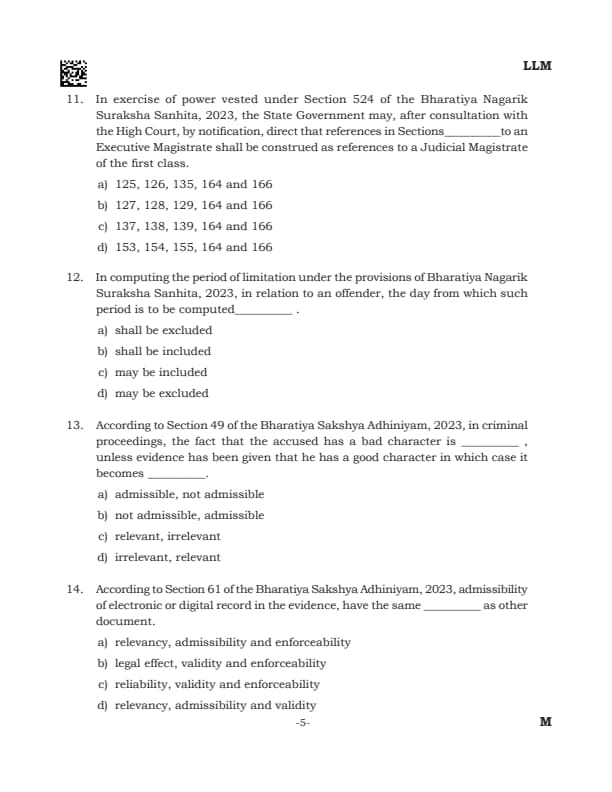
In exercise of power vested under Section 524 of the Bharatiya Nagarik Suraksha Sanhita, 2023, the State Government may, after consultation with the High Court, by notification, direct that references in Sections to an Executive Magistrate shall be construed as references to a Judicial Magistrate of the first class.
View Solution
Step 1: Scope of Section 524 BNSS, 2023.
Section 524 authorises the State Government, after consultation with the High Court, to notify that references to an Executive Magistrate in specified sections shall be read as references to a Judicial Magistrate of the first class.
Step 2: Statutory enumeration.
The provision expressly lists Sections 127, 128, 129, 164 and 166 for which such substitution is permissible.
Step 3: Elimination of other options.
Options (A), (C), and (D) contain section numbers not included in the express list under Section 524.
Step 4: Conclusion.
Accordingly, the correct option is (B) 127, 128, 129, 164 and 166.
Quick Tip: For substitution clauses, rely strictly on the sections expressly named in the enabling provision.
In computing the period of limitation under the provisions of Bharatiya Nagarik Suraksha Sanhita, 2023, in relation to an offender, the day from which such period is to be computed .
View Solution
Step 1: Rule for computation of limitation.
The Bharatiya Nagarik Suraksha Sanhita, 2023 lays down clear rules for computing periods of limitation in criminal matters.
Step 2: Exclusion of the starting day.
The law mandates that the day from which the limitation period begins must be excluded while calculating the total period. This principle ensures uniformity and fairness in computation.
Step 3: Analysis of options.
Options (B), (C), and (D) are incorrect because the statute uses mandatory language, leaving no discretion regarding inclusion or exclusion.
Step 4: Conclusion.
Hence, the correct answer is (A) shall be excluded.
Quick Tip: In limitation law, the starting day is generally excluded unless the statute clearly provides otherwise.
According to Section 49 of the Bharatiya Sakshya Adhiniyam, 2023, in criminal proceedings, the fact that the accused has a bad character is , unless evidence has been given that he has a good character in which case it becomes .
View Solution
Step 1: General rule regarding character evidence.
Section 49 of the Bharatiya Sakshya Adhiniyam, 2023 governs the admissibility and relevance of character evidence in criminal proceedings.
Step 2: Position of bad character.
As a general rule, the bad character of the accused is irrelevant and cannot be used against him to establish guilt.
Step 3: Exception when good character is pleaded.
If the accused introduces evidence of good character, the prosecution is permitted to rebut it, thereby making bad character relevant.
Step 4: Conclusion.
Therefore, the correct answer is (D) irrelevant, relevant.
Quick Tip: In criminal trials, character evidence works like a shield for the accused, not a sword for the prosecution—unless the accused raises it first.
According to Section 61 of the Bharatiya Sakshya Adhiniyam, 2023, admissibility of electronic or digital record in the evidence, have the same as other document.
View Solution
Step 1: Understanding Section 61 of Bharatiya Sakshya Adhiniyam, 2023.
Section 61 deals with the treatment of electronic or digital records as evidence. It brings electronic records at par with traditional documentary evidence under the law.
Step 2: Legal status of electronic records.
The provision expressly states that electronic or digital records shall have the same legal effect, validity, and enforceability as any other document, provided they satisfy the conditions prescribed by law.
Step 3: Analysis of options.
Options (A), (C), and (D) are incorrect because the statute does not use terms like relevancy or reliability in this context. The exact statutory language refers to legal effect, validity, and enforceability.
Step 4: Conclusion.
Hence, the correct answer is (B) legal effect, validity and enforceability.
Quick Tip: Under the Bharatiya Sakshya Adhiniyam, electronic records are legally equal to paper documents in terms of effect, validity, and enforceability.
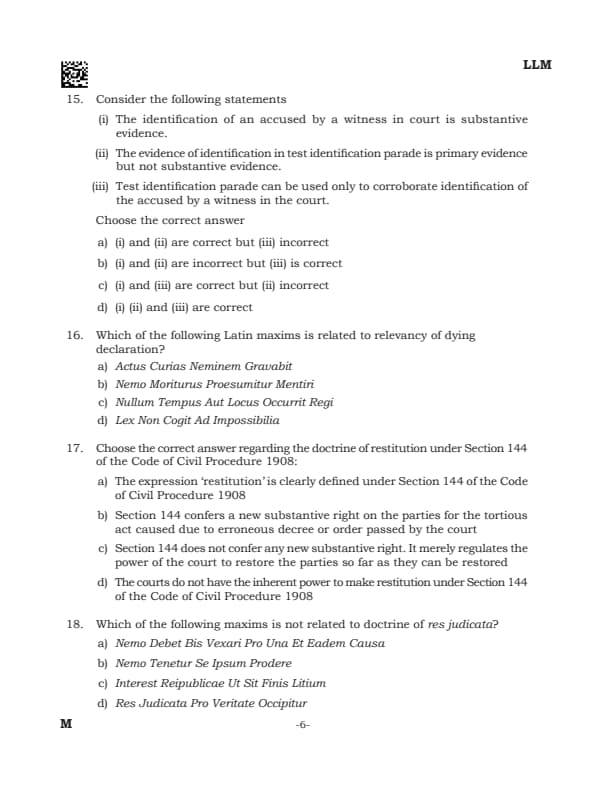
Consider the following statements:
(i) The identification of an accused by a witness in court is substantive evidence.
(ii) The evidence of identification in test identification parade is primary evidence but not substantive evidence.
(iii) Test identification parade can be used only to corroborate identification of the accused by a witness in the court.
Choose the correct answer.
View Solution
Step 1: Identification of accused in court.
It is a settled principle of criminal jurisprudence that identification of an accused by a witness for the first time in court constitutes substantive evidence. Such identification directly connects the accused with the offence during trial. Hence, statement (i) is correct.
Step 2: Nature of Test Identification Parade evidence.
Evidence relating to identification in a Test Identification Parade (TIP) is not substantive evidence of guilt. However, it is treated as primary evidence of identification in the sense that it records the witness’s first opportunity to identify the accused during investigation. Therefore, statement (ii) is correct.
Step 3: Purpose of Test Identification Parade.
The sole purpose of conducting a Test Identification Parade is to corroborate the identification of the accused made by the witness in court. TIP evidence cannot by itself form the basis of conviction. Hence, statement (iii) is also correct.
Step 4: Conclusion.
Since all three statements correctly reflect the settled position of law on identification evidence, the correct answer is (D).
Quick Tip: In criminal trials, in-court identification is substantive evidence, while TIP serves as primary but corroborative evidence.
Which of the following Latin maxims is related to relevancy of dying declaration?
View Solution
Step 1: Understanding dying declaration.
A dying declaration is considered relevant because it is made by a person who believes death is imminent and therefore is presumed to speak the truth.
Step 2: Meaning of the maxim.
The maxim {Nemo Moriturus Praesumitur Mentiri means “a man will not meet his maker with a lie in his mouth.”
Step 3: Application of the maxim.
This principle forms the foundation for accepting dying declarations as reliable and relevant evidence in criminal proceedings.
Step 4: Conclusion.
Hence, the correct answer is (B) Nemo Moriturus Praesumitur Mentiri.
Quick Tip: Dying declarations are admissible because the law presumes that a person on the verge of death does not lie.
Choose the correct answer regarding the doctrine of restitution under Section 144 of the Code of Civil Procedure, 1908:
View Solution
Step 1: Understanding the doctrine of restitution.
The doctrine of restitution is based on the principle that no party should suffer because of an act of the court. When a decree or order is varied, reversed, or set aside, the court should restore the parties to the position they would have occupied but for such decree or order.
Step 2: Nature of Section 144 CPC.
Section 144 of the Code of Civil Procedure, 1908 does not create any new substantive right in favour of the parties. It only recognizes and regulates the procedural power of the court to grant restitution.
Step 3: Examination of incorrect options.
Option (A) is incorrect because the term ‘restitution’ is not expressly defined in Section 144. Option (B) is incorrect as the right to restitution is not a tortious or new substantive right. Option (D) is incorrect because courts do possess inherent power to grant restitution even apart from Section 144.
Step 4: Conclusion.
Therefore, the correct statement is (C), which correctly reflects the legal position regarding restitution under Section 144 CPC.
Quick Tip: Restitution under Section 144 CPC is procedural in nature and is rooted in the inherent powers of the court to do complete justice.
Which of the following maxims is not related to the doctrine of res judicata?
View Solution
Step 1: Understanding res judicata.
The doctrine of res judicata aims to prevent multiplicity of litigation and ensures finality of judicial decisions. It is based on public policy and judicial efficiency.
Step 2: Maxims related to res judicata.
Maxims such as {Nemo Debet Bis Vexari Pro Una Et Eadem Causa, {Interest Reipublicae Ut Sit Finis Litium, and {Res Judicata Pro Veritate Accipitur directly support the principle of res judicata.
Step 3: Identifying the unrelated maxim.
The maxim {Nemo Tenetur Se Ipsum Prodere means that no person is bound to incriminate himself. This principle relates to criminal jurisprudence and the right against self-incrimination, not res judicata.
Step 4: Conclusion.
Hence, the correct answer is (B) Nemo Tenetur Se Ipsum Prodere.
Quick Tip: Res judicata maxims focus on finality of litigation, while self-incrimination maxims belong to criminal law principles.
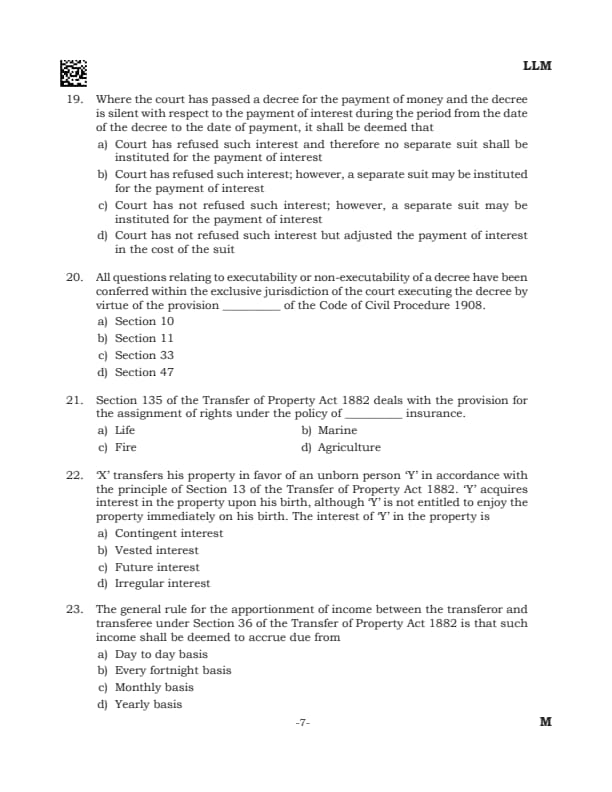
Where the court has passed a decree for the payment of money and the decree is silent with respect to the payment of interest during the period from the date of the decree to the date of payment, it shall be deemed that
View Solution
Step 1: Understanding post-decree interest.
Under Section 34 of the Code of Civil Procedure, 1908, the court has discretion to award interest from the date of the decree till realization.
Step 2: Effect of silence in the decree.
If the decree is silent regarding post-decree interest, the law presumes that the court has consciously refused to grant such interest.
Step 3: Bar on separate suit.
Since the refusal is deemed to be part of the decree itself, no separate suit for recovery of such interest is maintainable.
Step 4: Conclusion.
Hence, the correct answer is (A).
Quick Tip: Silence of a money decree on post-decree interest amounts to refusal, and a separate suit for such interest is barred.
All questions relating to executability or non-executability of a decree have been conferred within the exclusive jurisdiction of the court executing the decree by virtue of the provision of of the Code of Civil Procedure, 1908.
View Solution
Step 1: Scope of Section 47 CPC.
Section 47 of the Code of Civil Procedure, 1908 mandates that all questions arising between the parties relating to the execution, discharge, or satisfaction of the decree shall be determined by the executing court.
Step 2: Exclusive jurisdiction.
This provision bars the institution of a separate suit for issues connected with executability or non-executability of a decree.
Step 3: Conclusion.
Therefore, the correct answer is (D) Section 47.
Quick Tip: Execution-related disputes must always be raised before the executing court under Section 47 CPC.
Section 135 of the Transfer of Property Act, 1882 deals with the provision for the assignment of rights under the policy of insurance.
View Solution
Step 1: Scope of Section 135 of the Transfer of Property Act, 1882.
Section 135 of the Transfer of Property Act specifically deals with the assignment of rights under certain insurance policies.
Step 2: Type of insurance covered.
The provision expressly applies to fire insurance policies and recognizes the transfer of rights under such policies by way of assignment.
Step 3: Exclusion of other types of insurance.
Life insurance and marine insurance are governed by separate principles and statutes, and are not covered under Section 135 of the Transfer of Property Act.
Step 4: Conclusion.
Therefore, the correct answer is (C) Fire.
Quick Tip: Section 135 TPA applies to assignment of rights under fire insurance policies.
‘X’ transfers his property in favor of an unborn person ‘Y’ in accordance with the principle of Section 13 of the Transfer of Property Act, 1882. ‘Y’ acquires interest in the property upon his birth, although ‘Y’ is not entitled to enjoy the property immediately on his birth. The interest of ‘Y’ in the property is
View Solution
Step 1: Understanding Section 13 of the Transfer of Property Act.
Section 13 allows transfer of property for the benefit of an unborn person, provided the whole of the remaining interest is transferred.
Step 2: Nature of interest on birth.
When the unborn person is born alive, the interest created in his favour takes effect immediately, even if the enjoyment of the property is postponed.
Step 3: Distinction between vested and contingent interest.
A vested interest is not dependent on a condition precedent; only enjoyment may be deferred. In contrast, a contingent interest depends on fulfillment of a condition.
Step 4: Conclusion.
Since ‘Y’ acquires a present right on birth though enjoyment is postponed, the interest is vested interest.
Quick Tip: Postponement of enjoyment does not make an interest contingent—if the right exists, the interest is vested.
The general rule for the apportionment of income between the transferor and transferee under Section 36 of the Transfer of Property Act, 1882 is that such income shall be deemed to accrue due from
View Solution
Step 1: Understanding Section 36 TPA.
Section 36 of the Transfer of Property Act deals with apportionment of benefits such as rents, annuities, and other periodical payments upon transfer of property.
Step 2: Statutory rule of apportionment.
The section clearly provides that such income shall be deemed to accrue from day to day and shall be apportioned accordingly between the transferor and transferee.
Step 3: Conclusion.
Therefore, the correct answer is (A) Day to day basis.
Quick Tip: Under Section 36 TPA, income follows time—apportionment is always on a day-to-day basis.
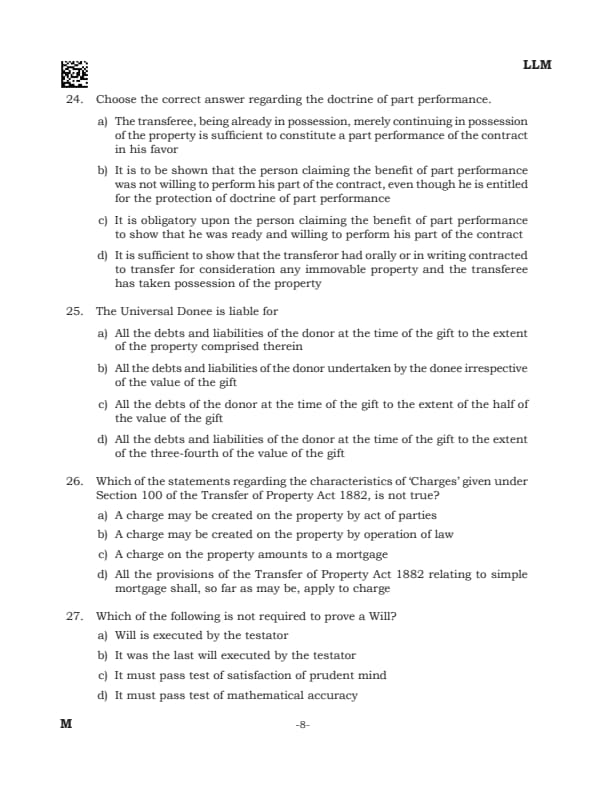
Choose the correct answer regarding the doctrine of part performance.
View Solution
Step 1: Doctrine of part performance.
The doctrine of part performance under Section 53A of the Transfer of Property Act protects a transferee who has acted on a contract relating to immovable property.
Step 2: Essential requirement.
A mandatory condition for invoking Section 53A is that the transferee must prove that he has performed or is willing to perform his part of the contract.
Step 3: Evaluation of options.
Mere continuation of possession is insufficient. Lack of willingness defeats the claim. Readiness and willingness are indispensable.
Step 4: Conclusion.
Hence, option (C) correctly states the law.
Quick Tip: Readiness and willingness to perform the contract is the backbone of the doctrine of part performance.
The Universal Donee is liable for
View Solution
Step 1: Meaning of Universal Donee.
A universal donee is one who receives the whole property of the donor by way of gift.
Step 2: Liability under Section 128 TPA.
Section 128 of the Transfer of Property Act provides that a universal donee is liable for all debts and liabilities of the donor existing at the time of the gift.
Step 3: Extent of liability.
Such liability is limited only to the extent of the property received by the donee and not beyond it.
Step 4: Conclusion.
Therefore, the correct answer is (A).
Quick Tip: A universal donee steps into the shoes of the donor—but liability is capped by the value of the gifted property.
Which of the statements regarding the characteristics of ‘Charges’ given under Section 100 of the Transfer of Property Act, 1882, is not true?
View Solution
Step 1: Meaning of charge under Section 100 TPA.
A charge is a security created over immovable property for payment of money, without transferring any interest in the property.
Step 2: Modes of creation.
A charge may arise either by act of parties or by operation of law, which makes options (A) and (B) correct.
Step 3: Distinction between charge and mortgage.
A charge does not amount to a mortgage because, unlike a mortgage, it does not involve transfer of interest in the property.
Step 4: Applicability of mortgage provisions.
Section 100 expressly provides that provisions relating to simple mortgage apply to charges so far as may be, making option (D) correct.
Step 5: Conclusion.
Thus, the incorrect statement is (C).
Quick Tip: Remember: every mortgage is a charge, but every charge is not a mortgage.
Which of the following is not required to prove a Will?
View Solution
Step 1: Proof of a Will.
To prove a Will, it must be shown that it was duly executed by the testator and represents his last testamentary intention.
Step 2: Mental capacity.
The Will must satisfy the test of a prudent and sound disposing mind of the testator at the time of execution.
Step 3: Irrelevant requirement.
There is no legal requirement that a Will must satisfy any test of mathematical accuracy.
Step 4: Conclusion.
Hence, the correct answer is (D).
Quick Tip: For a valid Will, mental capacity matters—not numerical precision.
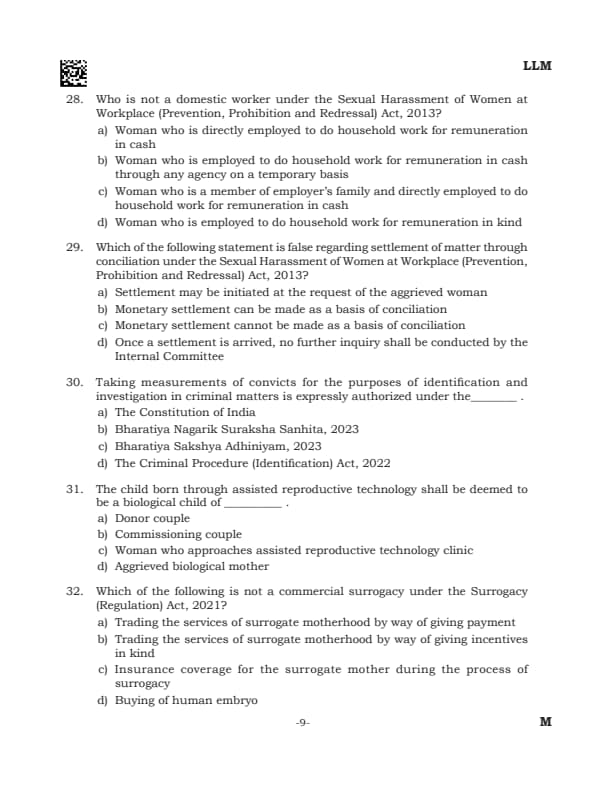
Who is not a domestic worker under the Sexual Harassment of Women at Workplace (Prevention, Prohibition and Redressal) Act, 2013?
View Solution
Step 1: Definition of domestic worker.
Under the Act, a domestic worker means a woman employed for household work for remuneration, whether directly or through an agency.
Step 2: Inclusion under the Act.
Employment may be temporary, permanent, part-time, and remuneration may be in cash or kind.
Step 3: Exclusion.
A woman who is a member of the employer’s family does not fall within the definition of a domestic worker under the Act.
Step 4: Conclusion.
Therefore, option (C) is the correct answer.
Quick Tip: Domestic workers under POSH Act exclude members of the employer’s family.
Which of the following statement is false regarding settlement of matter through conciliation under the Sexual Harassment of Women at Workplace (Prevention, Prohibition and Redressal) Act, 2013?
View Solution
Step 1: Conciliation under POSH Act.
Conciliation can be initiated only at the request of the aggrieved woman before the inquiry begins.
Step 2: Statutory restriction.
The Act clearly prohibits monetary settlement as the basis of conciliation.
Step 3: Effect of settlement.
Once conciliation is arrived at, no further inquiry shall be conducted by the Internal Committee.
Step 4: Conclusion.
Thus, the false statement is (B).
Quick Tip: Under the POSH Act, conciliation cannot be based on monetary compensation.
Taking measurements of convicts for the purposes of identification and investigation in criminal matters is expressly authorized under the .
View Solution
Step 1: Purpose of taking measurements.
Taking measurements such as fingerprints, palm prints, photographs, and other biometric data is essential for effective identification and investigation in criminal matters.
Step 2: Statutory authorization.
The Criminal Procedure (Identification) Act, 2022 expressly authorizes the taking, collection, storage, and analysis of such measurements of convicts and other specified persons.
Step 3: Exclusion of other options.
Neither the Constitution nor the Bharatiya Nagarik Suraksha Sanhita or Bharatiya Sakshya Adhiniyam specifically and expressly provides this authorization in the manner done by the 2022 Act.
Step 4: Conclusion.
Hence, the correct answer is (D) The Criminal Procedure (Identification) Act, 2022.
Quick Tip: Always link “measurements for identification” with the Criminal Procedure (Identification) Act, 2022.
The child born through assisted reproductive technology shall be deemed to be a biological child of .
View Solution
Step 1: Legal framework of ART.
The Assisted Reproductive Technology (Regulation) Act recognizes the legal status of children born through assisted reproductive techniques.
Step 2: Status of the child.
The law clearly provides that a child born through assisted reproductive technology shall be deemed to be the biological child of the commissioning couple.
Step 3: Effect of the provision.
This ensures legitimacy, inheritance rights, and parental responsibility vest in the commissioning couple and not in the donor.
Step 4: Conclusion.
Therefore, the correct answer is (B) Commissioning couple.
Quick Tip: Under ART law, parental status always vests in the commissioning couple, not the donor.
Which of the following is not a commercial surrogacy under the Surrogacy (Regulation) Act, 2021?
View Solution
Step 1: Meaning of commercial surrogacy.
Commercial surrogacy involves providing surrogacy services in exchange for monetary benefit or other material incentives.
Step 2: Permissible support under the Act.
The Surrogacy (Regulation) Act, 2021 permits altruistic surrogacy and allows medical expenses and insurance coverage for the surrogate mother.
Step 3: Identification of the exception.
Insurance coverage is a statutory safeguard for the surrogate mother and does not amount to commercial consideration.
Step 4: Conclusion.
Hence, the correct answer is (C) Insurance coverage for the surrogate mother during the process of surrogacy.
Quick Tip: Under the Surrogacy Act, insurance and medical expenses are allowed—but any profit or incentive makes it commercial.
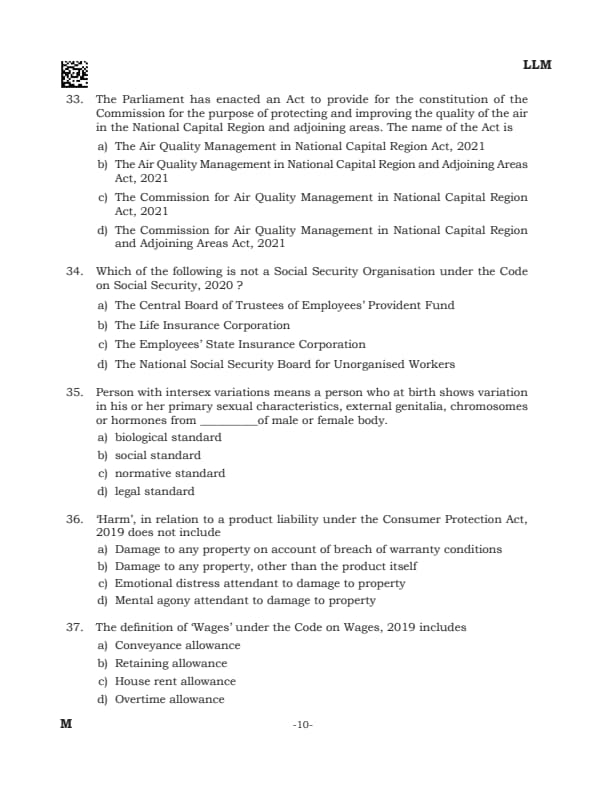
The Parliament has enacted an Act to provide for the constitution of the Commission for the purpose of protecting and improving the quality of the air in the National Capital Region and adjoining areas. The name of the Act is
View Solution
Step 1: Purpose of the legislation.
The Act was enacted to establish a statutory Commission for addressing air pollution issues specifically in the National Capital Region (NCR) and its adjoining areas.
Step 2: Exact statutory title.
The official name of the legislation clearly includes both the constitution of the Commission and its jurisdiction over the NCR and adjoining areas.
Step 3: Elimination of incorrect options.
Options (A), (B), and (C) either omit the reference to the Commission or do not fully mention “adjoining areas,” making them inaccurate.
Step 4: Conclusion.
Hence, the correct answer is (D) The Commission for Air Quality Management in National Capital Region and Adjoining Areas Act, 2021.
Quick Tip: Always remember that the Act’s title begins with “Commission for Air Quality Management” and includes “NCR and Adjoining Areas.”
Which of the following is not a Social Security Organisation under the Code on Social Security, 2020?
View Solution
Step 1: Meaning of Social Security Organisations.
The Code on Social Security, 2020 defines and recognizes specific statutory bodies responsible for administering social security schemes.
Step 2: Organisations included under the Code.
The Employees’ Provident Fund Organisation, Employees’ State Insurance Corporation, and National Social Security Board are expressly provided under the Code.
Step 3: Exclusion of LIC.
The Life Insurance Corporation is a statutory corporation engaged in insurance business and is not classified as a Social Security Organisation under the Code.
Step 4: Conclusion.
Therefore, the correct answer is (B) The Life Insurance Corporation.
Quick Tip: LIC provides insurance services but is not a social security body under the Code on Social Security, 2020.
Person with intersex variations means a person who at birth shows variation in his or her primary sexual characteristics, external genitalia, chromosomes or hormones from of male or female body.
View Solution
Step 1: Source of the definition.
The definition of a “person with intersex variations” is provided under the Transgender Persons (Protection of Rights) Act, 2019.
Step 2: Meaning of the expression used in the statute.
The statute uses the phrase “variation from the normative standard of male or female body”, indicating deviation from generally accepted biological norms.
Step 3: Distinction from other standards.
The law does not rely on social, legal, or purely biological standards in isolation, but specifically refers to a normative standard, which reflects accepted biological norms.
Step 4: Conclusion.
Therefore, the correct answer is (C) normative standard.
Quick Tip: The Transgender Persons Act uses the term “normative standard”, not biological or social standard.
‘Harm’, in relation to a product liability under the Consumer Protection Act, 2019 does not include
View Solution
Step 1: Definition of ‘harm’ under the Consumer Protection Act, 2019.
Section 2(22) of the Consumer Protection Act, 2019 defines “harm” in the context of product liability. It includes damage to property other than the product itself, personal injury, illness, or death, and also includes mental agony or emotional distress resulting from such harm.
Step 2: Meaning of damage due to breach of warranty.
Damage to property merely arising out of breach of warranty conditions is treated as a contractual issue and does not fall within the statutory definition of “harm” for product liability purposes.
Step 3: Inclusion of emotional distress and mental agony.
The Act expressly includes mental agony or emotional distress arising out of damage to property within the ambit of “harm”. Hence, options (C) and (D) are included and cannot be the correct answer.
Step 4: Conclusion.
Since damage to property on account of breach of warranty conditions is excluded from the statutory definition of “harm”, the correct answer is (A).
Quick Tip: Under product liability, breach of warranty claims are contractual and not treated as “harm”.
The definition of ‘Wages’ under the Code on Wages, 2019 includes
View Solution
Step 1: Definition of wages.
The Code on Wages, 2019 provides an inclusive–exclusive definition of wages.
Step 2: Included component.
Retaining allowance is expressly included within the definition of wages.
Step 3: Excluded components.
House rent allowance, overtime allowance, and conveyance allowance are specifically excluded from wages.
Step 4: Conclusion.
Hence, the correct answer is (B) Retaining allowance.
Quick Tip: Remember: retaining allowance is included in wages, while HRA and overtime are excluded.
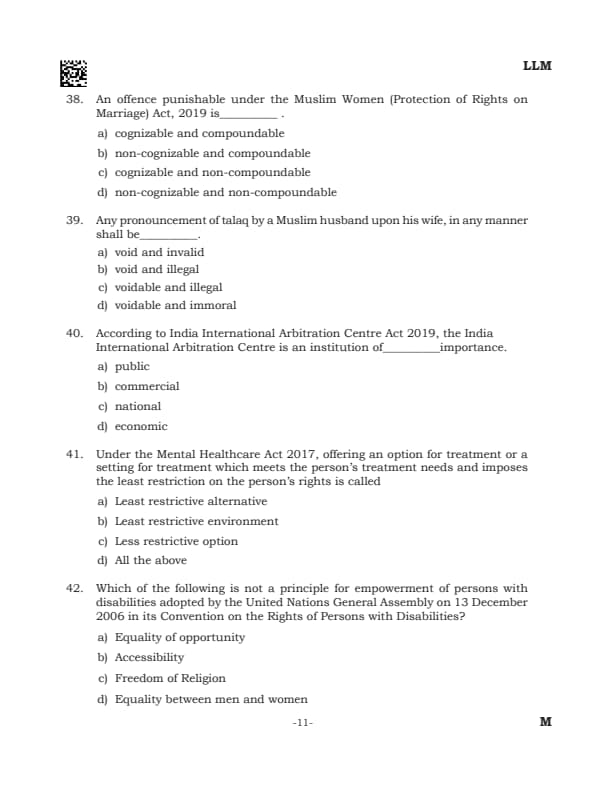
An offence punishable under the Muslim Women (Protection of Rights on Marriage) Act, 2019 is .
View Solution
Step 1: Nature of the offence.
The Act criminalises the pronouncement of talaq in any form and prescribes punishment for the husband.
Step 2: Cognizability.
The offence is made cognizable, enabling police action subject to statutory safeguards.
Step 3: Compoundability.
The offence is compoundable at the instance of the married Muslim woman, with the permission of the Magistrate.
Step 4: Conclusion.
Therefore, the offence is cognizable and compoundable.
Quick Tip: Triple talaq offence is cognizable but can be compounded at the wife’s request.
Any pronouncement of talaq by a Muslim husband upon his wife, in any manner shall be .
View Solution
Step 1: Statutory declaration.
The Muslim Women (Protection of Rights on Marriage) Act, 2019 declares any form of talaq pronounced by the husband to be legally ineffective.
Step 2: Legal consequence.
Such pronouncement has no legal effect on the marital status and is also treated as an offence under the Act.
Step 3: Conclusion.
Hence, any pronouncement of talaq is void and illegal.
Quick Tip: Triple talaq has no legal effect and is also a criminal offence.
According to India International Arbitration Centre Act, 2019, the India International Arbitration Centre is an institution of importance.
View Solution
Step 1: Understanding the Act.
The India International Arbitration Centre Act, 2019 was enacted to establish an independent and autonomous arbitration institution in India.
Step 2: Statutory description.
The Act expressly declares the India International Arbitration Centre to be an institution of national importance, highlighting its significance in strengthening arbitration in India.
Step 3: Elimination of incorrect options.
The statute does not describe the Centre as an institution of public, commercial, or economic importance in explicit terms.
Step 4: Conclusion.
Hence, the correct answer is (C) national.
Quick Tip: If a statute expressly uses the phrase “institution of national importance,” always select “national.”
Under the Mental Healthcare Act, 2017, offering an option for treatment or a setting for treatment which meets the person’s treatment needs and imposes the least restriction on the person’s rights is called
View Solution
Step 1: Principle under Mental Healthcare Act.
The Mental Healthcare Act, 2017 is based on a rights-based approach ensuring dignity, autonomy, and minimal restriction on persons with mental illness.
Step 2: Terminology used in the Act.
The Act uses expressions such as least restrictive alternative, least restrictive environment, and less restrictive option to convey the same underlying principle.
Step 3: Purpose of the principle.
All these terms emphasize providing treatment that satisfies medical needs while imposing minimum restriction on personal liberty and rights.
Step 4: Conclusion.
Therefore, the correct answer is (D) All the above.
Quick Tip: Mental Healthcare Act consistently focuses on “least restriction” — different terms, same principle.
Which of the following is not a principle for empowerment of persons with disabilities adopted by the United Nations General Assembly on 13 December 2006 in its Convention on the Rights of Persons with Disabilities?
View Solution
Step 1: Understanding the UN Convention.
The Convention on the Rights of Persons with Disabilities (CRPD), 2006 lays down core principles aimed at empowerment and inclusion of persons with disabilities.
Step 2: Principles included.
The Convention expressly includes equality of opportunity, accessibility, and equality between men and women as guiding principles.
Step 3: Identifying the incorrect option.
Freedom of religion, though a fundamental human right, is not specifically listed as a principle for empowerment under the CRPD.
Step 4: Conclusion.
Thus, the correct answer is (C) Freedom of Religion.
Quick Tip: CRPD principles focus on equality, accessibility, and inclusion—not general civil liberties.
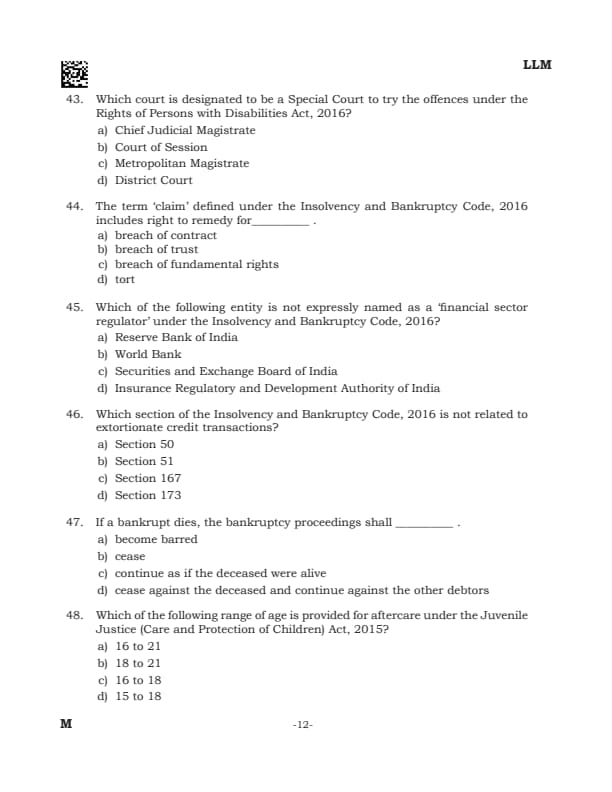
Which court is designated to be a Special Court to try the offences under the Rights of Persons with Disabilities Act, 2016?
View Solution
Step 1: Relevant provision.
Section 84 of the Rights of Persons with Disabilities Act, 2016 empowers the State Government to designate a Special Court for trial of offences under the Act.
Step 2: Designation of Special Court.
The Act clearly provides that the Court of Session shall be designated as the Special Court for this purpose.
Step 3: Conclusion.
Hence, the correct answer is (B) Court of Session.
Quick Tip: Offences under the RPwD Act, 2016 are tried by a designated Sessions Court.
The term ‘claim’ defined under the Insolvency and Bankruptcy Code, 2016 includes right to remedy for .
View Solution
Step 1: Definition of claim.
Section 3(6) of the Insolvency and Bankruptcy Code, 2016 defines a ‘claim’ as a right to payment or a right to remedy for breach of contract, if such breach gives rise to a right to payment.
Step 2: Scope of the definition.
The definition expressly includes contractual breaches but does not extend to constitutional remedies or general tortious claims unless they result in a right to payment under contract.
Step 3: Conclusion.
Therefore, the correct answer is (A) breach of contract.
Quick Tip: Under IBC, a “claim” always revolves around a right to payment—most commonly arising from contracts.
Which of the following entity is not expressly named as a ‘financial sector regulator’ under the Insolvency and Bankruptcy Code, 2016?
View Solution
Step 1: Meaning of financial sector regulator.
Section 3(18) of the Insolvency and Bankruptcy Code, 2016 defines ‘financial sector regulator’.
Step 2: Regulators included.
The definition expressly includes RBI, SEBI, IRDAI, and the Pension Fund Regulatory and Development Authority.
Step 3: Exclusion.
The World Bank is an international financial institution and is not a statutory regulator under Indian law.
Step 4: Conclusion.
Hence, the correct answer is (B) World Bank.
Quick Tip: Only Indian statutory regulators are recognised as financial sector regulators under the IBC.
Which section of the Insolvency and Bankruptcy Code, 2016 is not related to extortionate credit transactions?
View Solution
Step 1: Extortionate credit transactions.
Sections 50 and 51 of the Insolvency and Bankruptcy Code, 2016 specifically deal with extortionate credit transactions in corporate and individual insolvency processes.
Step 2: Other related provisions.
Section 167 appears in the context of avoidance transactions in individual insolvency.
Step 3: Identification of unrelated provision.
Section 173 does not deal with extortionate credit transactions and relates to a different procedural aspect of insolvency law.
Step 4: Conclusion.
Therefore, the correct answer is (D) Section 173.
Quick Tip: Always remember: extortionate credit transactions are governed mainly by Sections 50 and 51 of the IBC.
If a bankrupt dies, the bankruptcy proceedings shall .
View Solution
Step 1: Relevant provision under Insolvency and Bankruptcy Code, 2016.
The Insolvency and Bankruptcy Code, 2016 specifically provides that the death of the bankrupt does not abate or terminate the bankruptcy proceedings.
Step 2: Legal effect of death of the bankrupt.
The proceedings continue against the estate of the deceased bankrupt, and the resolution or distribution process is carried forward as if the bankrupt were still alive.
Step 3: Purpose of the provision.
This ensures that creditors’ rights are not defeated merely because of the death of the debtor.
Step 4: Conclusion.
Therefore, the correct answer is (C) continue as if the deceased were alive.
Quick Tip: Under the IBC, death of the debtor does not halt insolvency or bankruptcy proceedings.
Which of the following range of age is provided for aftercare under the Juvenile Justice (Care and Protection of Children) Act, 2015?
View Solution
Step 1: Meaning of aftercare.
Aftercare refers to support provided to children who have completed institutional care and are transitioning into independent adulthood.
Step 2: Statutory age limit.
The Juvenile Justice (Care and Protection of Children) Act, 2015 provides that aftercare services may be extended to persons who have attained the age of 18 years and up to the age of 21 years.
Step 3: Objective of aftercare.
The purpose is to facilitate rehabilitation, social reintegration, education, and employment support during early adulthood.
Step 4: Conclusion.
Hence, the correct answer is (B) 18 to 21.
Quick Tip: Under the JJ Act, aftercare support bridges the gap between childhood care and adult independence (18–21 years).
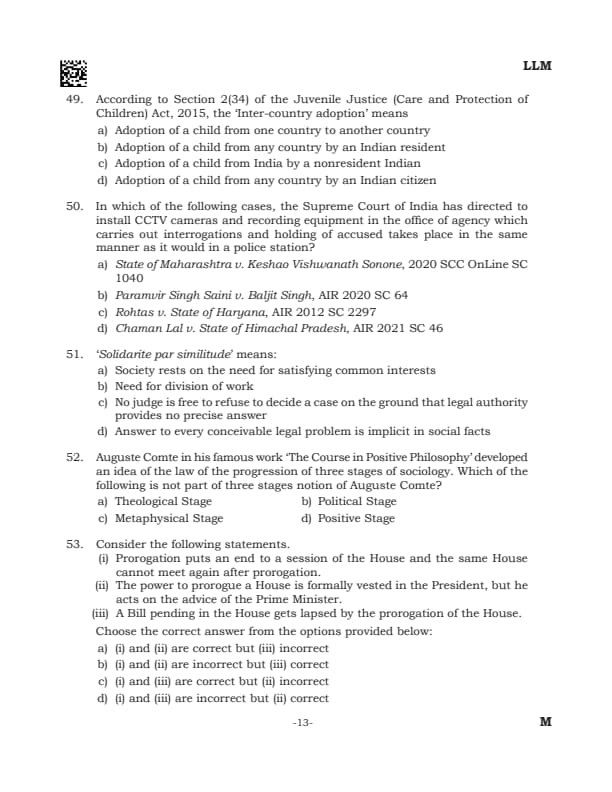
According to Section 2(34) of the Juvenile Justice (Care and Protection of Children) Act, 2015, the ‘inter-country adoption’ means
View Solution
Step 1: Statutory definition.
Section 2(34) of the Juvenile Justice (Care and Protection of Children) Act, 2015 defines “inter-country adoption” with reference to adoption of an Indian child by persons residing outside India.
Step 2: Scope of the definition.
The provision covers adoption of a child from India by a Non-Resident Indian (and also by foreign nationals as per the scheme of the Act and Adoption Regulations).
Step 3: Evaluation of options.
Option (A) is too generic and not aligned with the statutory wording. Options (B) and (D) incorrectly focus on Indian residents or citizens. Option (C) correctly reflects the statutory concept.
Step 4: Conclusion.
Hence, the correct answer is (C) Adoption of a child from India by a nonresident Indian.
Quick Tip: Inter-country adoption under the JJ Act focuses on adoption of Indian children by persons residing outside India.
In which of the following cases, the Supreme Court of India has directed to install CCTV cameras and recording equipment in the office of agency which carries out interrogations and holding of accused takes place in the same manner as it would in a police station?
View Solution
Step 1: Issue before the Court.
The Supreme Court examined custodial safeguards and prevention of custodial violence during interrogation and detention.
Step 2: Judicial directions.
In {Paramvir Singh Saini v. Baljit Singh, the Court directed installation of CCTV cameras with audio-video recording in all police stations and also in offices of agencies where interrogation and detention occur in a manner similar to police stations.
Step 3: Purpose of the directions.
The directions aim to ensure transparency, accountability, and protection of human rights of accused persons.
Step 4: Conclusion.
Therefore, the correct answer is (B) Paramvir Singh Saini v. Baljit Singh.
Quick Tip: CCTV installation in police stations and interrogation centres flows from the landmark decision in Paramvir Singh Saini.
‘Solidarite par similitude’ means:
View Solution
Step 1: Origin of the concept.
The expression “solidarité par similitude” is associated with Émile Durkheim’s theory of social solidarity.
Step 2: Meaning of the term.
It refers to mechanical solidarity, where social cohesion arises from similarity of beliefs, values, and common interests among members of society.
Step 3: Distinction from division of labour.
Division of labour corresponds to “solidarité par division du travail” (organic solidarity), not solidarite par similitude.
Step 4: Conclusion.
Hence, the correct answer is (A) Society rests on the need for satisfying common interests.
Quick Tip: Solidarité par similitude = mechanical solidarity based on similarity and shared values.
Auguste Comte in his famous work ‘The Course in Positive Philosophy’ developed an idea of the law of the progression of three stages of sociology. Which of the following is not part of three stages notion of Auguste Comte?
View Solution
Step 1: Understanding Comte’s Law of Three Stages.
Auguste Comte proposed that human thought and society evolve through three definite stages: theological, metaphysical, and positive.
Step 2: Identifying the stages.
The theological stage explains phenomena through supernatural forces, the metaphysical stage through abstract ideas, and the positive stage through scientific reasoning and observation.
Step 3: Eliminating the incorrect option.
Political stage does not form part of Comte’s theory of the three stages.
Step 4: Conclusion.
Hence, the correct answer is (B) Political Stage.
Quick Tip: Comte’s three stages are always: Theological → Metaphysical → Positive.
Consider the following statements:
(i) Prorogation puts an end to a session of the House and the same House cannot meet again after prorogation.
(ii) The power to prorogue a House is formally vested in the President, but he acts on the advice of the Prime Minister.
(iii) A Bill pending in the House gets lapsed by the prorogation of the House.
Choose the correct answer from the options provided below:
View Solution
Step 1: Examination of statement (i).
Prorogation certainly puts an end to a session of the House, but it does not mean that the House cannot meet again. The same House can meet again in a new session after prorogation. Hence, statement (i) is incorrect.
Step 2: Examination of statement (ii).
Under Article 85 of the Constitution, the power to prorogue Parliament is vested in the President. However, the President exercises this power on the aid and advice of the Council of Ministers headed by the Prime Minister. Therefore, statement (ii) is correct.
Step 3: Examination of statement (iii).
A Bill pending in the House does not lapse on prorogation. Lapsing of Bills occurs only on the dissolution of the Lok Sabha, not on prorogation. Hence, statement (iii) is incorrect.
Step 4: Conclusion.
Since statements (i) and (iii) are incorrect and statement (ii) is correct, the correct answer is (D).
Quick Tip: Remember the distinction clearly: \textbf{Prorogation ends a session, dissolution ends the House}. Bills lapse only on dissolution.
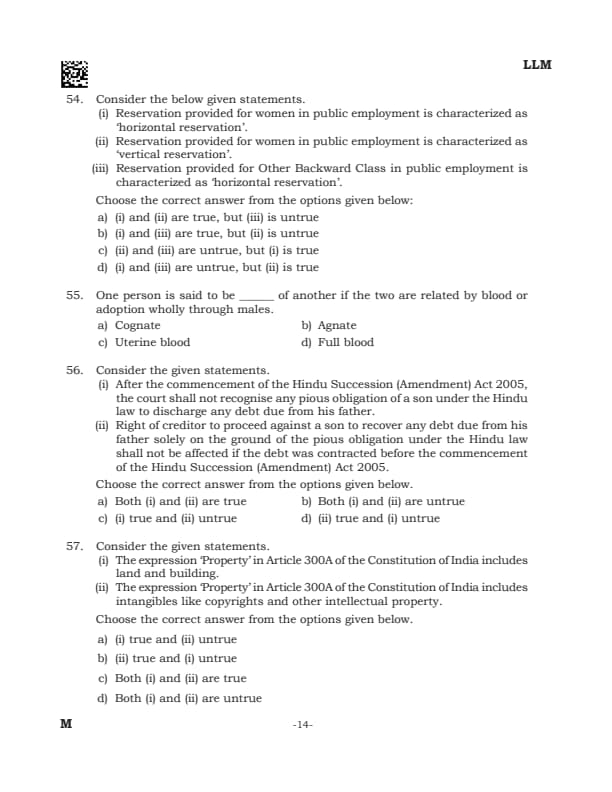
Consider the below given statements:
(i) Reservation provided for women in public employment is characterized as ‘horizontal reservation’.
(ii) Reservation provided for women in public employment is characterized as ‘vertical reservation’.
(iii) Reservation provided for Other Backward Class in public employment is characterized as ‘horizontal reservation’.
Choose the correct answer from the options given below:
View Solution
Step 1: Horizontal reservation.
Reservation for women cuts across all categories and is therefore classified as horizontal reservation.
Step 2: Vertical reservation.
Vertical reservation applies to socially and educationally backward classes such as SC, ST, and OBC. Hence, women reservation is not vertical.
Step 3: Reservation for OBC.
Reservation for OBC is vertical, not horizontal. Therefore, statement (iii) is incorrect.
Step 4: Conclusion.
Only statement (i) is true. Hence, the correct answer is (C).
Quick Tip: Women = horizontal reservation; SC/ST/OBC = vertical reservation.
One person is said to be of another if the two are related by blood or adoption wholly through males.
View Solution
Step 1: Meaning of agnate.
An agnate is a person who is related to another wholly through male lineage, either by blood or adoption.
Step 2: Distinction from cognate.
Cognates are related through one or more females, whereas agnates are related exclusively through males.
Step 3: Conclusion.
Therefore, the correct answer is (B) Agnate.
Quick Tip: Agnate = relation only through males; Cognate = relation through females.
Consider the given statements:
(i) After the commencement of the Hindu Succession (Amendment) Act, 2005, the court shall not recognise any pious obligation of a son under the Hindu law to discharge any debt due from his father.
(ii) Right of creditor to proceed against a son to recover any debt due from his father solely on the ground of the pious obligation under the Hindu law shall not be affected if the debt was contracted before the commencement of the Hindu Succession (Amendment) Act, 2005.
Choose the correct answer from the options given below.
View Solution
Step 1: Effect of the Hindu Succession (Amendment) Act, 2005.
The Hindu Succession (Amendment) Act, 2005 inserted Section 6(4), which provides that after the commencement of the Amendment, no court shall recognise any right to proceed against a son on the basis of the pious obligation under Hindu law. Therefore, statement (i) is correct.
Step 2: Protection of pre-amendment debts.
The proviso to Section 6(4) expressly saves the rights of creditors in respect of debts contracted before the commencement of the 2005 Amendment. Hence, the right of a creditor to proceed against a son on the basis of pious obligation is not affected in respect of such pre-amendment debts. Therefore, statement (ii) is also correct.
Step 3: Harmonious reading of the provision.
While the doctrine of pious obligation has been abolished prospectively, the legislature has consciously preserved creditors’ rights relating to debts incurred prior to the amendment.
Step 4: Conclusion.
Both statements (i) and (ii) correctly reflect the statutory position. Hence, option (A) is the correct answer.
Quick Tip: Section 6(4) HSA (2005) abolishes pious obligation prospectively but saves creditors’ rights for pre-2005 debts.
Consider the given statements:
(i) The expression ‘Property’ in Article 300A of the Constitution of India includes land and building.
(ii) The expression ‘Property’ in Article 300A of the Constitution of India includes intangibles like copyrights and other intellectual property.
Choose the correct answer from the options given below.
View Solution
Step 1: Scope of Article 300A.
Article 300A protects the right to property as a constitutional right and uses the term “property” in a broad and comprehensive sense.
Step 2: Inclusion of tangible property.
The term clearly includes tangible immovable property such as land and buildings. Hence, statement (i) is true.
Step 3: Inclusion of intangible property.
Judicial interpretation has consistently held that “property” under Article 300A also includes intangible property such as copyrights, patents, and other intellectual property rights. Therefore, statement (ii) is also true.
Step 4: Conclusion.
Both statements are correct. Hence, option (C) is the correct answer.
Quick Tip: Article 300A protects both tangible and intangible property—physical assets and intellectual property alike.
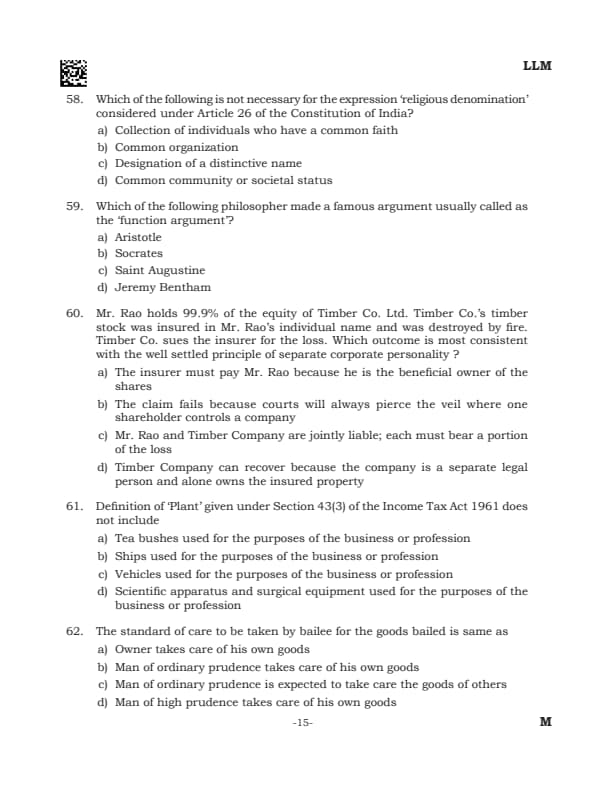
Which of the following is not necessary for the expression ‘religious denomination’ considered under Article 26 of the Constitution of India?
View Solution
Step 1: Meaning of religious denomination.
The Supreme Court has consistently held that a religious denomination under Article 26 must satisfy three essential conditions.
Step 2: Essential requirements.
These are: (i) a collection of individuals having a common faith, (ii) a common organisation, and (iii) a distinctive name.
Step 3: Identification of the non-essential element.
Common community or societal status is not a requirement for a group to be recognised as a religious denomination.
Step 4: Conclusion.
Hence, the correct answer is (D).
Quick Tip: For Article 26, remember the “three Ds”: Doctrine (faith), Discipline (organisation), and Designation (name).
Which of the following philosopher made a famous argument usually called as the ‘function argument’?
View Solution
Step 1: Understanding the function argument.
The “function argument” seeks to identify the proper function (telos) of a thing in order to understand its nature and excellence.
Step 2: Philosophical origin.
This argument is central to Aristotle’s ethical philosophy, particularly in his work {Nicomachean Ethics.
Step 3: Application of the argument.
Aristotle used the function argument to explain that the good life for humans is one that fulfils the distinctive human function, i.e., rational activity.
Step 4: Conclusion.
Therefore, the correct answer is (A) Aristotle.
Quick Tip: Function (telos) + excellence = Aristotle’s ethical reasoning.
Mr. Rao holds 99.9% of the equity of Timber Co. Ltd. Timber Co.’s timber stock was insured in Mr. Rao’s individual name and was destroyed by fire. Timber Co. sues the insurer for the loss. Which outcome is most consistent with the well-settled principle of separate corporate personality?
View Solution
Step 1: Doctrine of separate corporate personality.
Under the well-settled principle laid down in {Salomon v. Salomon \& Co. Ltd., a company is a legal person separate and distinct from its shareholders, even if a single shareholder holds almost the entire share capital.
Step 2: Ownership of the property.
The timber stock belonged to Timber Co. Ltd. and not to Mr. Rao personally. Shareholding does not confer ownership of the company’s assets upon the shareholder.
Step 3: Effect of insurance taken in individual name.
Although the insurance policy was taken in Mr. Rao’s individual name, the loss suffered is that of the company, which is the true owner of the timber stock. The principle of separate corporate personality prevents treating company property as shareholder property.
Step 4: Rejection of veil piercing.
Mere dominance or near-total shareholding does not justify lifting or piercing the corporate veil. Courts pierce the veil only in exceptional circumstances such as fraud or sham, which are absent here.
Step 5: Conclusion.
Applying the doctrine of separate corporate personality, Timber Co. Ltd., being the owner of the destroyed timber stock, is entitled to recover. Therefore, the correct answer is (D).
Quick Tip: Even a 99.9% shareholder does not own company property—company and shareholder are legally distinct.
Definition of ‘Plant’ given under Section 43(3) of the Income Tax Act, 1961 does not include
View Solution
Step 1: Scope of ‘plant’ under Section 43(3).
Section 43(3) of the Income Tax Act, 1961 defines “plant” inclusively to cover ships, vehicles, books, scientific apparatus, and surgical equipment used for business or profession.
Step 2: Statutory exclusion.
The definition expressly excludes tea bushes and livestock, even if they are used for business or professional purposes.
Step 3: Conclusion.
Therefore, tea bushes do not fall within the definition of “plant” under Section 43(3). Hence, option (A) is correct.
Quick Tip: Under Income Tax law, tea bushes are expressly excluded from the definition of “plant.”
The standard of care to be taken by a bailee for the goods bailed is same as
View Solution
Step 1: Relevant provision.
Section 151 of the Indian Contract Act, 1872 lays down the standard of care required from a bailee.
Step 2: Degree of care.
A bailee must take as much care of the goods bailed as a man of ordinary prudence would take of his own goods of the same bulk, quality, and value.
Step 3: Conclusion.
Thus, the correct standard is that of a man of ordinary prudence caring for his own goods. Hence, option (B) is correct.
Quick Tip: Bailee’s duty = ordinary prudence, not extraordinary care.
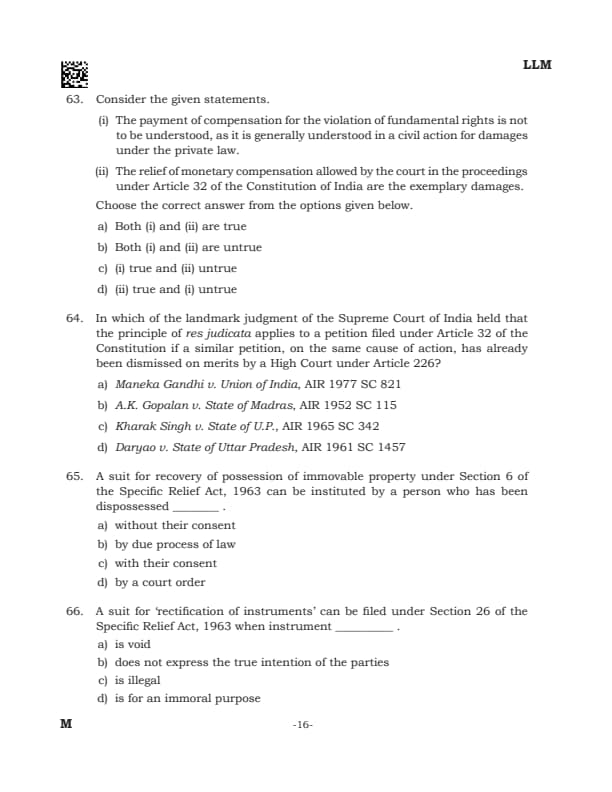
Consider the given statements:
(i) The payment of compensation for the violation of fundamental rights is not to be understood as it is generally understood in a civil action for damages under private law.
(ii) The relief of monetary compensation allowed by the court in proceedings under Article 32 of the Constitution of India are exemplary damages.
Choose the correct answer from the options given below.
View Solution
Step 1: Nature of compensation for violation of fundamental rights.
The Supreme Court has consistently held that compensation awarded for violation of fundamental rights under Articles 32 and 226 is a public law remedy. It is distinct from compensation in private law actions for tort or breach of contract. Hence, statement (i) is correct.
Step 2: Character of monetary compensation under Article 32.
In constitutional jurisprudence, monetary compensation awarded for infringement of fundamental rights is often described as exemplary or public law damages. Such compensation serves not only a compensatory purpose but also a deterrent function against abuse of power by the State. Therefore, statement (ii) is also correct.
Step 3: Conclusion.
Since both statements correctly reflect the settled legal position, the correct answer is (A).
Quick Tip: Compensation for violation of fundamental rights is a public law remedy and is often treated as exemplary damages.
In which of the landmark judgment of the Supreme Court of India held that the principle of res judicata applies to a petition filed under Article 32 of the Constitution if a similar petition, on the same cause of action, has already been dismissed on merits by a High Court under Article 226?
View Solution
Step 1: Issue before the Court.
The Supreme Court examined whether a writ petition under Article 32 is maintainable when a similar petition under Article 226 has already been decided on merits.
Step 2: Ruling in Daryao’s case.
In {Daryao v. State of Uttar Pradesh, the Court held that the principle of res judicata applies to writ petitions to prevent abuse of process and multiplicity of proceedings.
Step 3: Conclusion.
Accordingly, if a High Court has dismissed a petition on merits under Article 226, a subsequent petition under Article 32 on the same cause of action is barred. Hence, option (D) is correct.
Quick Tip: Res judicata applies even to writ petitions—Daryao is the key case.
A suit for recovery of possession of immovable property under Section 6 of the Specific Relief Act, 1963 can be instituted by a person who has been dispossessed .
View Solution
Step 1: Scope of Section 6, Specific Relief Act.
Section 6 provides a summary remedy to restore possession to a person who has been dispossessed otherwise than in due course of law.
Step 2: Nature of dispossession.
The remedy is available only when dispossession is without the consent of the person and not pursuant to lawful authority.
Step 3: Conclusion.
Therefore, the correct answer is (A) without their consent.
Quick Tip: Section 6 protects possession, not title—focus on unlawful dispossession.
A suit for ‘rectification of instruments’ can be filed under Section 26 of the Specific Relief Act, 1963 when instrument .
View Solution
Step 1: Object of rectification.
Rectification is granted to correct a written instrument so that it reflects the real intention of the parties.
Step 2: Statutory requirement.
Section 26 allows rectification when, due to fraud or mutual mistake, the instrument fails to express the true intention of the parties.
Step 3: Conclusion.
Hence, the correct answer is (B) does not express the true intention of the parties.
Quick Tip: Rectification corrects expression, not the legality, of a contract.
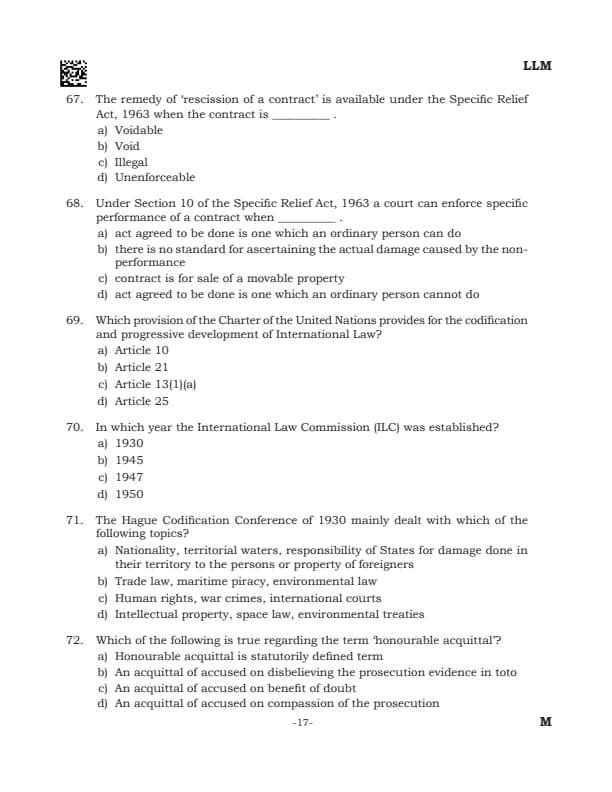
The remedy of ‘rescission of a contract’ is available under the Specific Relief Act, 1963 when the contract is .
View Solution
Step 1: Meaning of rescission.
Rescission is the cancellation of a contract, restoring the parties to their original position.
Step 2: Applicability under the Act.
Under the Specific Relief Act, rescission is granted when a contract is voidable at the option of the aggrieved party.
Step 3: Conclusion.
Therefore, the correct answer is (A) Voidable.
Quick Tip: Rescission applies to voidable contracts—not void ones.
Under Section 10 of the Specific Relief Act, 1963 a court can enforce specific performance of a contract when .
View Solution
Step 1: Principle of specific performance.
Specific performance is granted when compensation in money is not an adequate relief.
Step 2: Statutory condition.
Section 10 provides that specific performance may be enforced where there exists no standard for determining actual damages from breach.
Step 3: Conclusion.
Thus, the correct answer is (B) there is no standard for ascertaining the actual damage caused by the non-performance.
Quick Tip: Specific performance is preferred when monetary compensation is inadequate.
Which provision of the Charter of the United Nations provides for the codification and progressive development of International Law?
View Solution
Step 1: Relevant UN Charter provision.
Article 13(1)(a) of the United Nations Charter mandates the General Assembly to initiate studies and make recommendations for encouraging the progressive development of international law and its codification.
Step 2: Exclusion of other provisions.
Articles 10, 21, and 25 relate to general powers, internal procedure, and binding nature of Security Council decisions respectively, not codification of international law.
Step 3: Conclusion.
Therefore, the correct answer is (C) Article 13(1)(a).
Quick Tip: Codification + progressive development of International Law = Article 13(1)(a) UN Charter.
In which year the International Law Commission (ILC) was established?
View Solution
Step 1: Establishment of the ILC.
The International Law Commission was established by the United Nations General Assembly under Resolution 174 (II).
Step 2: Year of establishment.
The Commission was formally established in the year 1947 to promote codification and progressive development of international law.
Step 3: Conclusion.
Hence, the correct answer is (C) 1947.
Quick Tip: ILC = UN body created in 1947 for codification of International Law.
The Hague Codification Conference of 1930 mainly dealt with which of the following topics?
View Solution
Step 1: Purpose of the Hague Conference.
The Hague Codification Conference of 1930 was convened under the League of Nations to codify specific areas of international law.
Step 2: Subjects discussed.
The Conference primarily dealt with nationality laws, territorial waters, and State responsibility for injuries to foreigners.
Step 3: Conclusion.
Therefore, the correct answer is (A).
Quick Tip: Hague Conference 1930 = Nationality, Territorial Waters, State Responsibility.
Which of the following is true regarding the term ‘honourable acquittal’?
View Solution
Step 1: Meaning of honourable acquittal.
The term “honourable acquittal” is a judicially evolved concept and not a statutory expression.
Step 2: Judicial interpretation.
An honourable acquittal occurs when the court completely disbelieves the prosecution case and finds the accused to be wholly innocent.
Step 3: Distinction from benefit of doubt.
Acquittal on benefit of doubt does not amount to honourable acquittal.
Step 4: Conclusion.
Hence, the correct answer is (B).
Quick Tip: Honourable acquittal = total rejection of prosecution case, not mere benefit of doubt.
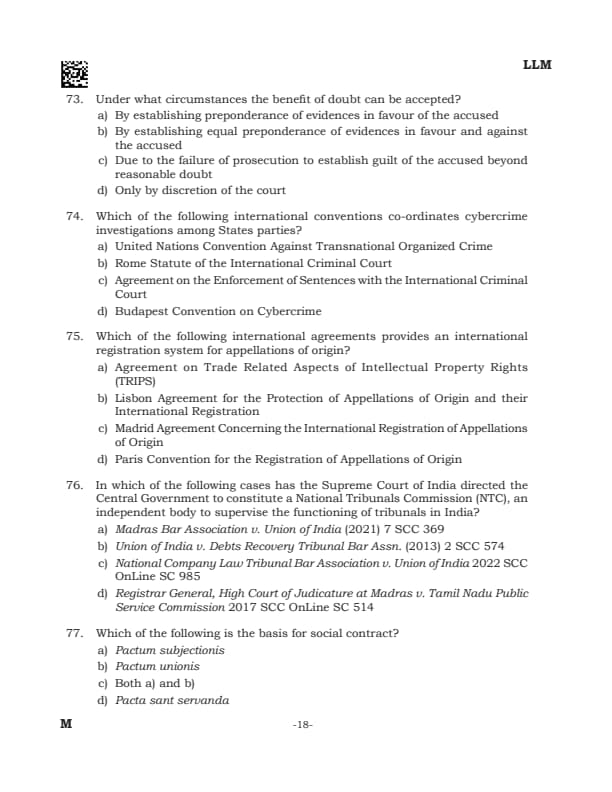
Under what circumstances the benefit of doubt can be accepted?
View Solution
Step 1: Standard of proof in criminal cases.
In criminal jurisprudence, the prosecution is required to prove the guilt of the accused beyond reasonable doubt.
Step 2: Concept of benefit of doubt.
When the prosecution fails to meet this standard and reasonable doubt persists regarding the guilt of the accused, the benefit of such doubt must go to the accused.
Step 3: Rejection of other options.
Preponderance of probabilities or equal balance of evidence applies to civil cases, not criminal trials. Benefit of doubt is not a matter of pure discretion but a rule of law.
Step 4: Conclusion.
Hence, the correct answer is (C).
Quick Tip: Benefit of doubt flows from the prosecution’s failure to prove guilt beyond reasonable doubt.
Which of the following international conventions co-ordinates cybercrime investigations among States parties?
View Solution
Step 1: Nature of cybercrime cooperation.
Cybercrime often involves cross-border elements requiring international cooperation in investigation and prosecution.
Step 2: Role of the Budapest Convention.
The Budapest Convention on Cybercrime (2001) is the first international treaty specifically designed to harmonize national laws and facilitate cooperation among States in cybercrime investigations.
Step 3: Elimination of other options.
The UNTOC and ICC instruments deal with organized crime and international crimes, not specifically cybercrime coordination.
Step 4: Conclusion.
Therefore, the correct answer is (D) Budapest Convention on Cybercrime.
Quick Tip: Cybercrime + international cooperation = Budapest Convention.
Which of the following international agreements provides an international registration system for appellations of origin?
View Solution
Step 1: Meaning of appellations of origin.
Appellations of origin identify products whose qualities or characteristics are essentially due to their geographical origin.
Step 2: International registration mechanism.
The Lisbon Agreement establishes a system for the international registration and protection of appellations of origin administered by WIPO.
Step 3: Distinction from other agreements.
TRIPS provides minimum standards of protection but does not create a registration system, while Paris and Madrid agreements serve different IP purposes.
Step 4: Conclusion.
Hence, the correct answer is (B).
Quick Tip: International registration of appellations of origin = Lisbon Agreement.
In which of the following cases has the Supreme Court of India directed the Central Government to constitute a National Tribunals Commission (NTC), an independent body to supervise the functioning of tribunals in India?
View Solution
Step 1: Issue before the Court.
The Supreme Court examined the independence, administration, and functioning of tribunals and the need for an institutional mechanism to oversee them.
Step 2: Direction to constitute NTC.
In {Madras Bar Association v. Union of India (2021), the Court directed the Central Government to constitute a National Tribunals Commission as an independent supervisory body.
Step 3: Conclusion.
Hence, the correct answer is (A).
Quick Tip: National Tribunals Commission = Madras Bar Association (2021).
Which of the following is the basis for social contract?
View Solution
Step 1: Social contract theory.
Social contract theory explains the origin of political authority through agreements among individuals.
Step 2: Two foundational pacts.
{Pactum unionis refers to individuals uniting to form a society, while {pactum subjectionis refers to submission to a common authority.
Step 3: Conclusion.
Both pacts together form the basis of the social contract. Hence, option (C) is correct.
Quick Tip: Social contract = union + submission (two pacts).
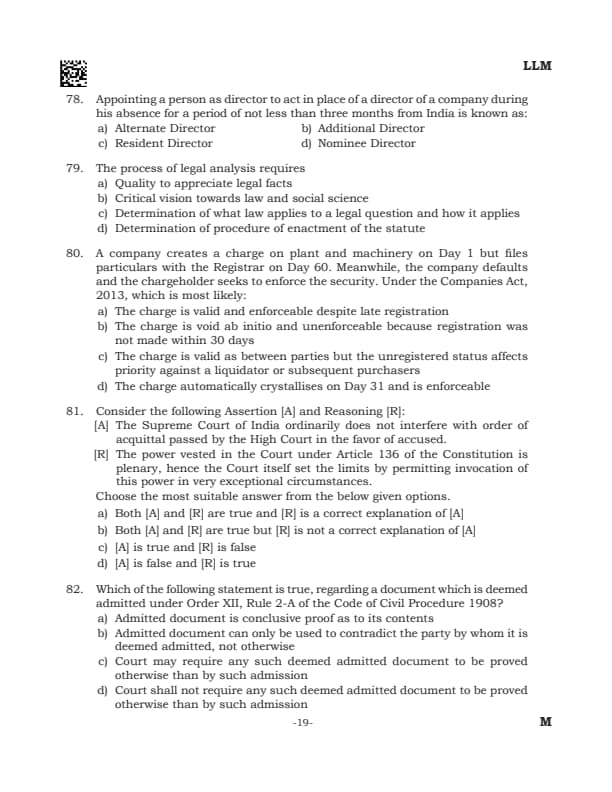
Appointing a person as director to act in place of a director of a company during his absence for a period of not less than three months from India is known as:
View Solution
Step 1: Statutory provision.
Section 161(2) of the Companies Act, 2013 provides for appointment of an alternate director.
Step 2: Condition for appointment.
An alternate director is appointed when an original director is absent from India for not less than three months.
Step 3: Conclusion.
Therefore, the correct answer is (A) Alternate Director.
Quick Tip: Absent director (3+ months) = Alternate Director.
The process of legal analysis requires
View Solution
Step 1: Meaning of legal analysis.
Legal analysis involves identifying legal issues, relevant rules, and applying them to facts.
Step 2: Core requirement.
The essence of legal analysis is determining the applicable law and understanding its application to the given facts.
Step 3: Conclusion.
Hence, the correct answer is (C).
Quick Tip: Legal analysis = identify law + apply it to facts.
A company creates a charge on plant and machinery on Day 1 but files particulars with the Registrar on Day 60. Meanwhile, the company defaults and the chargeholder seeks to enforce the security. Under the Companies Act, 2013, which is most likely?
View Solution
Step 1: Registration of charges.
Section 77 of the Companies Act, 2013 requires registration of charges, with provision for delayed registration subject to consequences.
Step 2: Effect of non-registration.
An unregistered charge remains valid between the company and the chargeholder but is void against the liquidator and creditors.
Step 3: Conclusion.
Therefore, option (C) correctly states the legal position.
Quick Tip: Unregistered charge = valid inter se, weak against liquidator/creditors.
Consider the following Assertion [A] and Reasoning [R]:
[A] The Supreme Court of India ordinarily does not interfere with order of acquittal passed by the High Court in the favor of accused.
[R] The power vested in the Court under Article 136 of the Constitution is plenary, hence the Court itself set the limits by permitting invocation of this power in very exceptional circumstances.
Choose the most suitable answer from the below given options.
View Solution
Step 1: Validity of the Assertion [A].
It is a settled principle of criminal jurisprudence that the Supreme Court ordinarily does not interfere with an order of acquittal, especially when the High Court has appreciated evidence and recorded a finding in favour of the accused. Hence, Assertion [A] is true.
Step 2: Validity of the Reason [R].
Article 136 of the Constitution confers plenary and discretionary powers on the Supreme Court. The Court has, through judicial discipline, restricted the exercise of this power to exceptional cases involving grave miscarriage of justice. Therefore, Reason [R] is also true.
Step 3: Link between [A] and [R].
The self-imposed restraint by the Supreme Court under Article 136 directly explains why it ordinarily refrains from interfering with acquittal orders. Thus, [R] correctly explains [A].
Step 4: Conclusion.
Accordingly, the correct answer is (A).
Quick Tip: Article 136 powers are vast, but the Supreme Court exercises them sparingly, especially against acquittals.
Which of the following statement is true, regarding a document which is deemed admitted under Order XII, Rule 2-A of the Code of Civil Procedure, 1908?
View Solution
Step 1: Understanding Order XII CPC.
Order XII of the Code of Civil Procedure deals with admissions, including deemed admissions when a party fails to deny documents properly.
Step 2: Effect of deemed admission.
A deemed admission dispenses with formal proof of the document, but it does not make the document conclusive proof of its contents.
Step 3: Discretion of the Court.
Order XII, Rule 2-A expressly empowers the Court to require proof of the document notwithstanding such admission, if the interests of justice so demand.
Step 4: Conclusion.
Therefore, the correct answer is (C).
Quick Tip: Even a deemed admission does not take away the court’s power to demand proof.
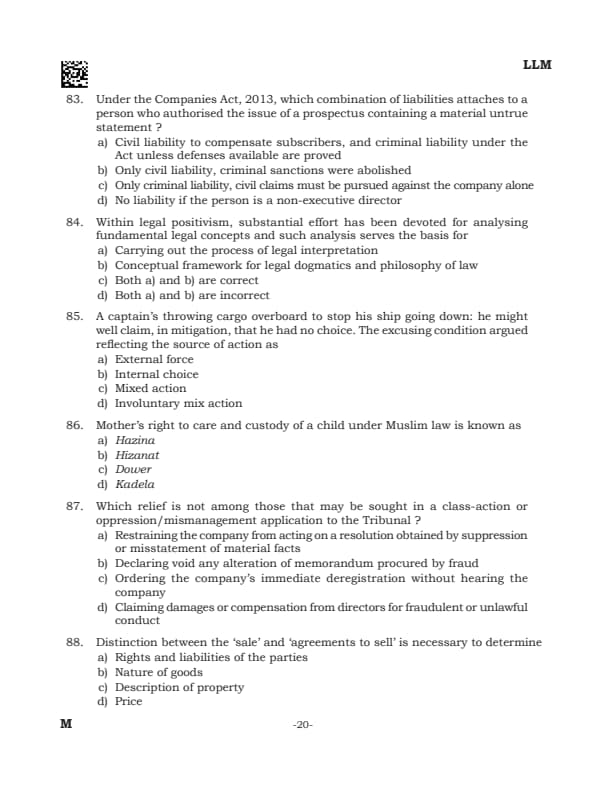
Under the Companies Act, 2013, which combination of liabilities attaches to a person who authorised the issue of a prospectus containing a material untrue statement?
View Solution
Step 1: Civil liability for misstatement.
Section 35 of the Companies Act, 2013 provides that persons who authorised the issue of a prospectus containing an untrue statement are liable to compensate investors for loss or damage, subject to statutory defenses.
Step 2: Criminal liability.
Section 34 imposes criminal liability for issuing a prospectus with material misstatements, unless the accused proves the availability of statutory defenses.
Step 3: Conclusion.
Thus, both civil and criminal liabilities attach, unless defenses are successfully established. Hence, option (A) is correct.
Quick Tip: Misstatement in prospectus = civil + criminal liability (Sections 34 & 35).
Within legal positivism, substantial effort has been devoted for analysing fundamental legal concepts and such analysis serves the basis for
View Solution
Step 1: Nature of legal positivism.
Legal positivism, particularly analytical jurisprudence, focuses on the clarification and analysis of fundamental legal concepts such as law, rights, duties, and sovereignty.
Step 2: Role in interpretation and theory.
This conceptual analysis aids both the process of legal interpretation and the development of a coherent conceptual framework for legal dogmatics and philosophy of law.
Step 3: Conclusion.
Therefore, both statements are correct. Hence, option (C) is the correct answer.
Quick Tip: Analytical jurisprudence clarifies concepts—useful for both interpretation and legal theory.
A captain’s throwing cargo overboard to stop his ship going down: he might well claim, in mitigation, that he had no choice. The excusing condition argued reflecting the source of action as
View Solution
Step 1: Nature of the act.
The captain’s act of throwing cargo overboard is compelled by circumstances of necessity to save the ship and lives.
Step 2: Source of action.
Although the act is consciously performed, the compelling reason arises from external circumstances, not free internal choice.
Step 3: Conclusion.
Hence, the excusing condition reflects action caused by external force. Therefore, option (A) is correct.
Quick Tip: Necessity-based acts are attributed to external compulsion, not free internal choice.
Mother’s right to care and custody of a child under Muslim law is known as
View Solution
Step 1: Concept under Muslim law.
Under Muslim personal law, the right of custody of a minor child, particularly during tender years, is primarily vested in the mother.
Step 2: Meaning of Hizanat.
The term Hizanat specifically denotes the mother’s right to custody, care, and upbringing of the child, subject to the welfare of the minor.
Step 3: Distinction from other terms.
Dower relates to marital obligation, while the other options do not denote custody rights under Muslim law.
Step 4: Conclusion.
Hence, the correct answer is (B) Hizanat.
Quick Tip: In Muslim law, custody of a minor with the mother is called Hizanat.
Which relief is not among those that may be sought in a class-action or oppression/mismanagement application to the Tribunal?
View Solution
Step 1: Powers of the Tribunal.
Under the Companies Act, 2013, the Tribunal is empowered to grant wide remedial reliefs in cases of oppression, mismanagement, and class actions.
Step 2: Principles of natural justice.
Any drastic action such as deregistration cannot be ordered without granting an opportunity of hearing to the company, as it would violate principles of natural justice.
Step 3: Validity of other reliefs.
Restraining resolutions obtained by fraud, declaring fraudulent alterations void, and awarding compensation against directors are recognized remedies.
Step 4: Conclusion.
Therefore, option (C) is not a permissible relief.
Quick Tip: Even in oppression cases, natural justice cannot be bypassed.
Distinction between the ‘sale’ and ‘agreement to sell’ is necessary to determine
View Solution
Step 1: Sale and agreement to sell.
Under the Sale of Goods Act, 1930, a sale results in immediate transfer of ownership, whereas an agreement to sell contemplates a future transfer.
Step 2: Legal consequences.
The distinction determines when ownership passes, who bears the risk, and what remedies are available upon breach.
Step 3: Importance of the distinction.
These factors directly affect the rights and liabilities of the buyer and seller.
Step 4: Conclusion.
Thus, the correct answer is (A) Rights and liabilities of the parties.
Quick Tip: Sale vs agreement to sell mainly decides who bears risk and responsibility.
The ‘right to development’ and ‘right to a healthy environment’ have been considered as
View Solution
Step 1: Classification of human rights.
Human rights are commonly classified into generations based on their nature and historical development.
Step 2: Nature of the rights mentioned.
The right to development and the right to a healthy environment are collective rights that emphasize solidarity, sustainable development, and shared responsibilities of States.
Step 3: Identification of the generation.
Such collective and solidarity-based rights fall within the category of third generation rights.
Step 4: Conclusion.
Hence, the correct answer is (C) Third generation rights.
Quick Tip: Solidarity rights like environment and development belong to the third generation.
The expression ‘Capital asset’ given under Section 2(14) of the Income Tax Act, 1961, does not include:
View Solution
Step 1: Meaning of capital asset.
Section 2(14) defines “capital asset” broadly but expressly excludes certain categories.
Step 2: Stock-in-trade exclusion.
Raw materials held for business or profession constitute stock-in-trade and are specifically excluded from the definition of capital asset.
Step 3: Inclusion of other items.
Securities held by FIIs, precious stones embedded in apparel, and urban agricultural land are included within the scope of capital assets.
Step 4: Conclusion.
Therefore, the correct answer is (A).
Quick Tip: Stock-in-trade is excluded from “capital asset” under the Income Tax Act.
The provision regarding the appointment of income-tax authorities is given under of the Income Tax Act, 1961.
View Solution
Step 1: Scheme of Chapter XIII of the Income Tax Act, 1961.
Chapter XIII of the Income Tax Act, 1961 deals with income-tax authorities, their appointment, control, and powers.
Step 2: Distinction between Sections 116 and 117.
Section 116 only enumerates the various income-tax authorities, whereas Section 117 specifically deals with the appointment of income-tax authorities by the Central Government.
Step 3: Identification of the correct provision.
Since the question specifically asks about the provision regarding appointment, the correct section is Section 117.
Step 4: Conclusion.
Therefore, the correct answer is (C) Section 117.
Quick Tip: Section 116 lists income-tax authorities; Section 117 deals with their appointment.
For the purposes of Section 13A of the Income Tax Act, 1961, the word ‘Political party’ means a political party registered under .
View Solution
Step 1: Understanding Section 13A.
Section 13A of the Income Tax Act grants exemption to the income of political parties subject to statutory conditions.
Step 2: Meaning of ‘political party’.
For this purpose, the Act adopts the definition of a political party as one registered under Section 29A of the Representation of the People Act, 1951.
Step 3: Conclusion.
Hence, the correct answer is (D) Section 29A of the Representation of the People Act, 1951.
Quick Tip: Tax exemption for political parties applies only to those registered under Section 29A, RPA 1951.
‘Ex-debito justitiae’ means
View Solution
Step 1: Meaning of the expression.
The Latin maxim “ex debito justitiae” literally means “from a debt of justice.”
Step 2: Legal implication.
It signifies an action or relief that must be granted as a matter of right to do justice, rather than as a matter of discretion.
Step 3: Conclusion.
Therefore, the correct answer is (B).
Quick Tip: Ex debito justitiae = relief granted as a matter of justice, not discretion.
In which of the following cases, the concept of curative petition was evolved by the Supreme Court of India?
View Solution
Step 1: Background of the concept.
The Supreme Court considered whether there should be any remedy after dismissal of a review petition to prevent miscarriage of justice.
Step 2: Ruling of the Court.
In {Rupa Ashok Hurra v. Ashok Hurra, the Court evolved the concept of a curative petition as a final constitutional safeguard.
Step 3: Conclusion.
Hence, the correct answer is (D).
Quick Tip: Curative petition was introduced in Rupa Ashok Hurra (2002).
Which of the following statement regarding the application of Bharatiya Nyaya Sanhita, 2023 is not true?
View Solution
Step 1: Extra-territorial application.
The Bharatiya Nyaya Sanhita, 2023 extends to offences committed outside India in certain circumstances, including cyber offences targeting computer resources located in India.
Step 2: Inclusion of citizens and extra-territorial acts.
The Sanhita applies to Indian citizens committing offences abroad and also to acts committed outside India which would be punishable if committed within India.
Step 3: Identification of incorrect statement.
Option (B) contradicts the express extra-territorial application provided under the Sanhita and is therefore not true.
Step 4: Conclusion.
Hence, the correct answer is (B).
Quick Tip: BNS, 2023 applies extra-territorially, especially for cyber offences targeting India.
Which of the following communication does not come within the meaning of ‘Electronic communication’ as defined under the Bharatiya Nagrik Suraksha Sanhita, 2023?
View Solution
Step 1: Definition under BNSS, 2023.
The Bharatiya Nagrik Suraksha Sanhita, 2023 defines “electronic communication” as transmission of content through electronic devices or electronic form as may be specified by notification \emph{by the Central Government.
Step 2: Authority to notify.
The statutory definition clearly vests the power of specification only in the Central Government and not in respective State Governments.
Step 3: Identification of incorrect option.
Option (A) refers to notification by “respective governments”, which is inconsistent with the definition under the Sanhita.
Step 4: Conclusion.
Hence, option (A) does not fall within the meaning of “electronic communication”.
Quick Tip: Under BNSS, only the Central Government can notify modes of electronic communication.
Which of the following is not an act included in the exclusive rights of performers under Section 38A(1) of the Copyright Act, 1957?
View Solution
Step 1: Understanding Section 38A(1) of the Copyright Act, 1957.
Section 38A(1) grants performers certain exclusive rights in relation to their performances, subject to the provisions of the Act.
Step 2: Rights expressly conferred on performers.
The exclusive rights of performers include broadcasting the performance, communicating it to the public, and selling or renting copies of recordings made of the performance.
Step 3: Recording of performance.
The right to make the first sound or visual recording of a performance primarily vests in the producer. A performer’s consent is required, but the act of making the recording itself is not an exclusive right of the performer under Section 38A(1).
Step 4: Conclusion.
Since making a sound or visual recording of the performance is not an exclusive right of the performer under Section 38A(1), option (A) is the correct answer.
Quick Tip: Performers control exploitation of performances, but recording rights primarily vest in the producer.
Which of the following statement is not true regarding the object of the National Green Tribunal Act, 2010?
View Solution
Step 1: Objects of the NGT Act, 2010.
The National Green Tribunal Act, 2010 was enacted for effective and expeditious disposal of cases relating to environmental protection and conservation.
Step 2: True objects under the Act.
The Act aims at enforcement of environmental rights, compensation for damages, and fulfillment of international environmental obligations such as the Stockholm Declaration, 1972.
Step 3: Identification of incorrect statement.
Article 39 relates to economic and social principles and is not specifically connected with environmental protection, unlike Articles 48A and 51A(g).
Step 4: Conclusion.
Hence, option (B) is not a true object of the NGT Act, 2010.
Quick Tip: NGT Act is linked to Articles 21, 48A and 51A(g), not Article 39.
What must be shown before the court to obtain an injunction to stop nuisance?
View Solution
Step 1: Nature of injunction in nuisance cases.
An injunction is an equitable relief granted by courts to prevent continuing or threatened nuisance. The court does not grant such relief lightly.
Step 2: Requirement of serious injury.
For an injunction to be granted, the plaintiff must establish that the injury complained of is serious, substantial, and of a permanent or continuing nature. Mere inconvenience is not sufficient.
Step 3: Conclusion.
Therefore, what must be shown is the gravity and permanent character of the injury. Hence, option (D) is correct.
Quick Tip: In nuisance cases, injunction depends on seriousness and permanence of injury, not mere inconvenience.
Match the following:
I. Chief Election Commissioner \hfill A. Elected by Rajya Sabha
II. Deputy Chairman of Rajya Sabha \hfill B. Elected by Members of Lok Sabha
III. Speaker of Lok Sabha \hfill C. Appointed by the President
IV. Chairman of Public Accounts Committee \hfill D. Appointed by the Speaker of Lok Sabha
View Solution
Step 1: Chief Election Commissioner.
The Chief Election Commissioner is appointed by the President of India under Article 324 of the Constitution. Hence, I–C is correct.
Step 2: Deputy Chairman of Rajya Sabha.
The Deputy Chairman of the Rajya Sabha is elected by the members of the Rajya Sabha from amongst themselves. Hence, II–A is correct.
Step 3: Speaker of Lok Sabha.
The Speaker of the Lok Sabha is elected by the members of the Lok Sabha. Hence, III–B is correct.
Step 4: Chairman of Public Accounts Committee.
The Chairman of the Public Accounts Committee is appointed by the Speaker of the Lok Sabha. Hence, IV–D is correct.
Step 5: Conclusion.
The correct matching is I-C, II-A, III-B, IV-D. Therefore, option (A) is the correct answer.
Quick Tip: Remember: CEC—President, Speaker—Lok Sabha members, Deputy Chairman—Rajya Sabha members, PAC Chair—Speaker.


Comments