




AILET UG is a 150-question, 150-mark undergraduate law entrance exam conducted in 120 minutes. The paper consists of three sections—English Language, Current Affairs & General Knowledge, and Logical Reasoning. In the AILET UG exam, 1 mark is awarded for every correct answer, 0.25 marks are deducted for every incorrect answer, and no marks for unattempted questions.
- The AILET UG paper is conducted in offline pen-and-paper mode, with candidates marking answers on an OMR sheet.
- The paper has 150 MCQs divided across three sections: English Language, Current Affairs & GK, and Logical Reasoning.
- AILET reasoning (Logical Reasoning) is considered the highest-weighted UG section at 70 marks in the exam.
- Logical Reasoning's 70 marks are divided into Critical/Verbal Reasoning (35–40 marks), Legal Reasoning (15–20 marks), and Analytical Reasoning (10–15 marks).
- English Language, constituting 50 marks, is the second-largest section, while Current Affairs & GK is the third-highest in weightage with 30 marks.
- The exam is conducted in English medium and follows a +1/-0.25 marking scheme.
Related Links:
- AILET 2027: Notification, Exam Date, Registration, Pattern, Syllabus & Cutoff
- AILET Syllabus 2027: 3 Sections, 150 Marks, Section-wise Topics and PDF Download
- AILET LLM 2027 Syllabus: Important Topics, Preparation Tips & Books

Key Summary
- AILET has a total of 150 marks for the UG paper, scored using a +1/-0.25 marking scheme.
- The AILET exam syllabus for UG covers three sections: English Language, Current Affairs & GK, and Logical Reasoning.
- AILET reasoning (Logical Reasoning) is the highest-weighted UG section at 70 marks, embedding legal-principle-based questions directly within it rather than testing them separately.
- AILET UG score tie-breakers are decided by Logical Reasoning score first.
AILET Exam Pattern 2027: Overview
The AILET is an offline, OMR-based exam, conducted in English only for admissions to BA LL.B. (Hons.) UG program at NLU Delhi.
- AILET total marks differ sharply by programme. 150 questions of 1 mark each in UG and runs in the same 120-minute window.
- The AILET UG paper carries a structured 3-section format, with negative marking applicable.
| Feature | BA LL.B. (Hons.) – UG |
|---|---|
| Mode | Offline (Pen-and-paper / OMR-based) |
| Duration | 120 minutes |
| Total Questions | 150 MCQs |
| Total Marks | 150 |
| Medium | English |
| Marking Scheme | +1 correct, -0.25 incorrect, 0 unattempted |
| Sections | 3 Sections |
| Tie-Breaker | 1. Higher Logical Reasoning marks 2. Senior age 3. Computerised draw |
Ques. What is the AILET total marks?
Ans. AILET UG is scored out of 150 marks across 150 questions; AILET PG is scored out of 100 marks across 100 questions.
Ques. What is the AILET exam full form?
Ans. AILET stands for All India Law Entrance Test, conducted by National Law University (NLU), Delhi.
Also Check:
AILET Exam Pattern 2027: What's New?
The AILET 2027 pattern stays unchanged from recent cycles, with NLU Delhi maintaining the three-section UG structure introduced in prior years.
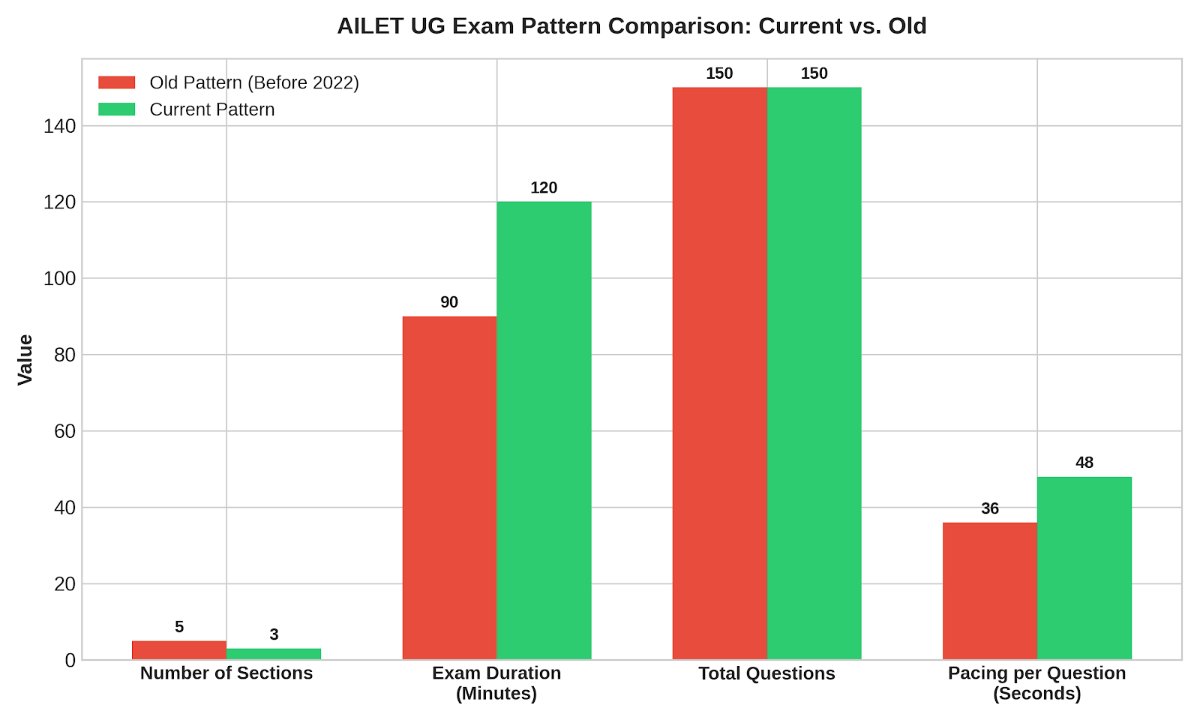
- The AILET UG paper has shifted from a 5-section, 90-minute exam before 2022 to a 3-section, 120-minute exam.
- AILET UG has dropped Elementary Mathematics entirely and merged Legal Aptitude into Logical Reasoning, while the total number of questions remains 150.
- Candidates now get roughly 48 seconds per question in the UG paper, up from about 36 seconds under the before 2022 pattern, even though the question count hasn't changed.
| Feature | Current AILET UG Pattern | Old AILET UG Pattern (Before 2022) |
|---|---|---|
| Number of Sections | 3 (English, GK/Current Affairs, Logical Reasoning) | 5 (English, GK, Logical Reasoning, Legal Aptitude, Elementary Mathematics) |
| Exam Duration | 120 Minutes (+30 minutes) | 90 Minutes |
| Total Questions | 150 MCQs (redistributed) | 150 MCQs |
| Pacing | ~48 seconds per question | ~36 seconds per question |
Ques. Has the AILET syllabus changed for 2027?
Ans. The core structure stays the same as recent cycles: three UG sections and a single PG paper, with Elementary Mathematics and standalone Legal Aptitude having been permanently removed in an earlier reform.
Check Out: AILET Mock Test 2027: Attempt Free Online Mock Test, Sectional and Topic-wise Tests
AILET Marking Scheme 2027
The AILET marking scheme applies as follows:
- +1 for a correct answer,
- -0.25 for an incorrect one, and
- 0 for a question left unattempted.
Four wrong answers in AILET cost exactly 1 full mark (0.25 × 4), the same negative-marking ratio used in CLAT, so candidates who have prepared using the CLAT marking scheme can carry that same risk calculation directly into AILET.
Unlike AILET UG, which uses Logical Reasoning scores as a tie-breaker, AILET PG resolves ties based on age first, followed by a computerised draw.
| Outcome | UG & PG Marking |
|---|---|
| Correct Answer | +1.00 mark |
| Incorrect Answer | -0.25 marks |
| Unattempted Question | 0.00 marks |
Ques. What is the AILET marking scheme?
Ans. +1 mark for every correct answer and -0.25 marks for every incorrect one, applied identically across both the UG and PG papers.
Ques. How does the AILET marking scheme compare to the CLAT marking scheme?
Ans. Both use the same +1/-0.25 structure, so preparation strategy around negative marking transfers directly between the two exams.
Also Check: AILET 2027 Subject-Wise Preparation Strategy to Score 120+
AILET Section-wise Exam Pattern 2027
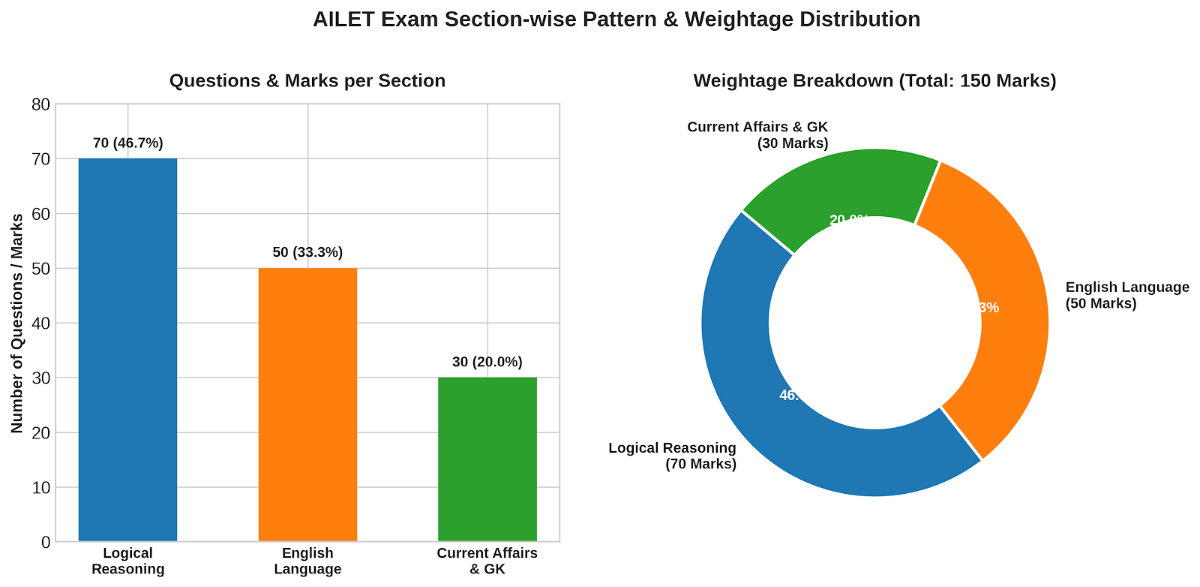
The AILET UG paper runs 150 questions across three sections, with Logical Reasoning carrying nearly half the total weightage.
- Section C (Logical Reasoning) alone accounts for 70 of 150 marks, making it closer to half the paper than any single section in CLAT.
- English Language, constituting 50 marks, is the second-largest section and is suggested to take 30–35 of the 120 minutes, while Current Affairs & GK is the fastest section to clear, with just 10–15 minutes suggested for 30 marks.
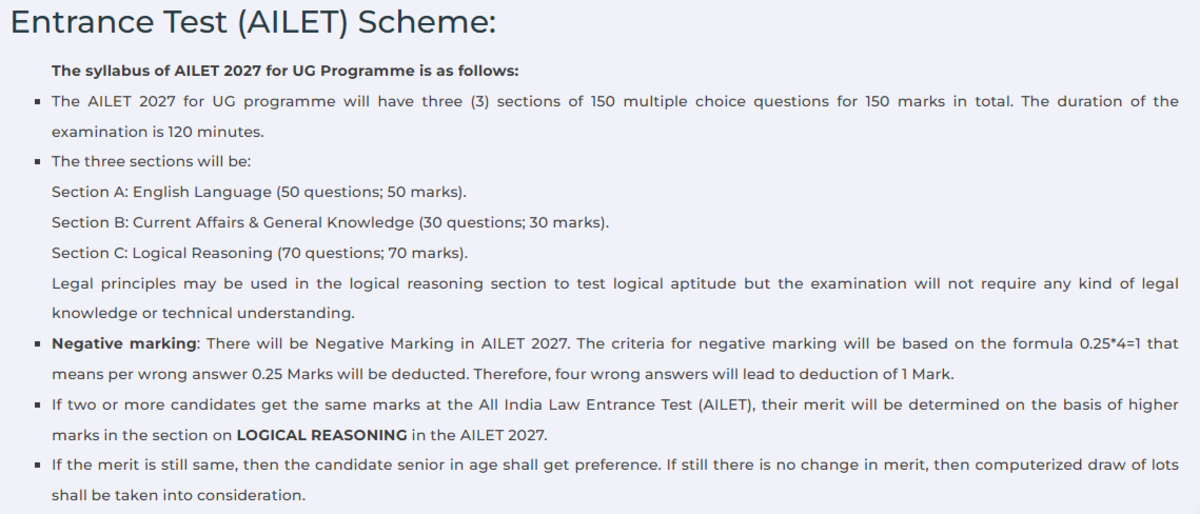
Source: Official National Law University Delhi Website
| Section | Number of Questions | Total Marks |
|---|---|---|
| Section A: English Language | 50 MCQs | 50 Marks |
| Section B: Current Affairs & GK | 30 MCQs | 30 Marks |
| Section C: Logical Reasoning | 70 MCQs | 70 Marks |
| Total | 150 MCQs | 150 Marks |
Ques. How many sections does AILET UG have?
Ans. Three sections: English Language, Current Affairs & GK, and Logical Reasoning, after the removal of the earlier standalone Legal Aptitude and Elementary Mathematics sections.
AILET Year Wise Question Papers
AILET Subjects-wise Weightage 2027
AILET UG focuses on Logical Reasoning, while PG focuses mainly on Constitutional Law and Jurisprudence as the main component of the syllabus:
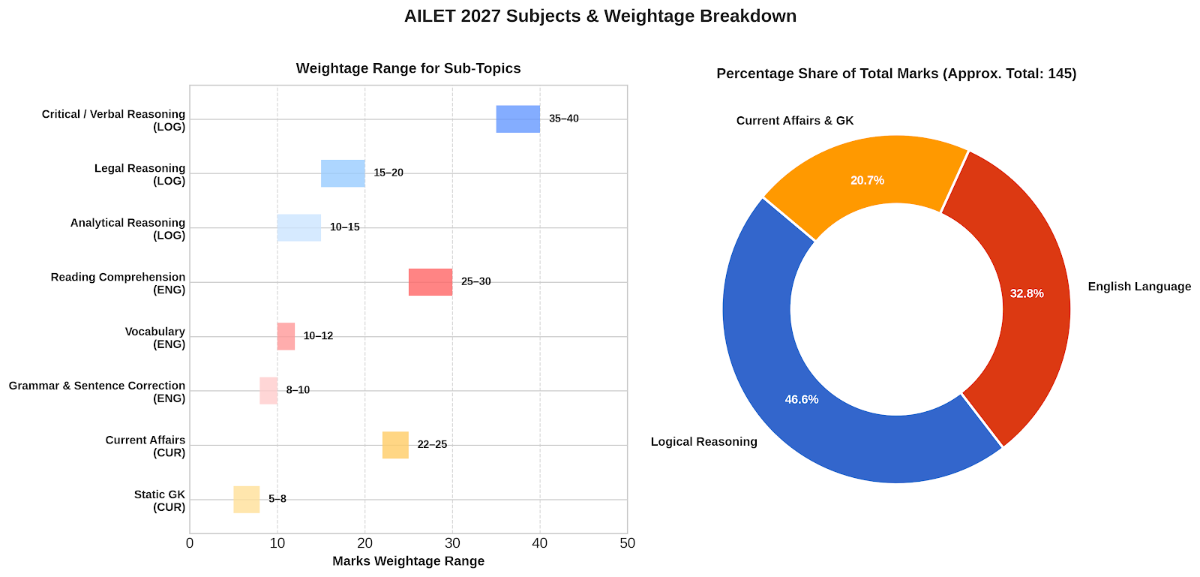
- Logical Reasoning's 70 marks are divided into Critical/Verbal Reasoning (35–40 marks), Legal Reasoning (15–20 marks), and Analytical Reasoning (10–15 marks). This means Critical Reasoning alone carries more weight than the entire Current Affairs & GK section.
- Within English, Reading Comprehension (25–30 marks) carries more weight than Vocabulary and Grammar combined, showing that AILET UG places more emphasis on comprehension speed than rote grammar rules.
- Current Affairs accounts for 22–25 of the 30 marks in its section, while Static GK makes up a smaller portion and is asked less frequently. Static GK questions are usually linked to topics that have already been in the news rather than asked in isolation.
| Section | Sub-Topic | Approx. Weightage | Key Areas to Focus On |
|---|---|---|---|
| Logical Reasoning | Critical / Verbal Reasoning | 35–40 Marks | Assumptions, strengthen/weaken arguments, flaws, conclusions |
| Legal Reasoning | 15–20 Marks | Torts, Contracts, Criminal Law, Constitutional Law and their principle-based application | |
| Analytical Reasoning | 10–15 Marks | Logic puzzles, blood relations, coding-decoding, directions, syllogisms | |
| English Language | Reading Comprehension | 25–30 Marks | Central themes, tone, arguments, passage structure |
| Vocabulary | 10–12 Marks | Synonyms, antonyms, contextual usage, idioms | |
| Grammar & Sentence Correction | 8–10 Marks | Error spotting, sentence rearrangement, phrase replacement | |
| Current Affairs & GK | Current Affairs | 22–25 Marks | National/international events, SC rulings, legislation, summits |
| Static GK | 5–8 Marks | Indian Polity, Modern History, Geography, General Science |
Ques. What is the AILET logical reasoning weightage?
Ans. Logical Reasoning carries 70 of 150 marks in AILET UG. It is the single highest-weighted section, split across critical, legal, and analytical reasoning.
Ques. What is the AILET PG syllabus?
Ans. It covers core law branches — Constitutional Law, Jurisprudence, Criminal Law, Law of Contracts & Torts, International Law, and Family Law/IPR/Environmental Law, with Constitutional Law and Jurisprudence carrying the highest weightage.
Also Check:
What Types of Questions Are Asked in the AILET Exam?
Every AILET question is a single-correct MCQ, but the format has shifted from short one-liners to dense, passage-based testing for UG.
- AILET UG's English section now requires a reading speed of roughly 300 words per minute to clear its comprehension passages. It is a shift from the shorter, standalone questions the section used to carry.
- The exam’s Logical Reasoning section embeds legal principles directly into its questions without requiring prior legal knowledge. Candidates are given a legal rule and a set of facts, then they must apply logic to solve the question and not any memorised law to reach the answer.
Check Out:
AILET Exam Pattern vs CLAT Exam Pattern 2027
AILET and CLAT are both law entrance exams with similar timing, but they differ in structure, section count, and their difficulty levels.
- CLAT spreads its 120 questions across five sections, including a dedicated Legal Reasoning and Quantitative Techniques component. However, AILET contains 150 questions in just three sections, with Logical Reasoning alone carrying nearly half the paper.
- AILET's English section leans more toward vocabulary, tone, and direct inference questions, while CLAT's English stays almost entirely comprehension- and speed-oriented.
- AILET has no separate Legal Reasoning section or Data Interpretation component at all. Legal reasoning is merged into Logical Reasoning, and quantitative skills aren't tested in AILET UG as in CLAT.
| Comparison Point | CLAT | AILET |
|---|---|---|
| Number of Questions | 120 | 150 |
| Exam Duration | 120 minutes | 120 minutes |
| Overall Focus | Speed + comprehension + passage-based application | Logical reasoning + accuracy + analytical application |
| Primary Challenge | Managing time across multiple passage-heavy sections | Handling a high volume of questions, especially Logical Reasoning |
| Sections | English, Current Affairs/GK, Legal Reasoning, Logical Reasoning, Quantitative Techniques | English, Current Affairs & GK, Logical Reasoning |
| Logical Reasoning Weightage | Lower, distributed across Analytical & Critical Reasoning | 70 questions — the most heavily weighted section |
| Legal Reasoning | Dedicated section | No separate section; folded into Logical Reasoning |
| Data Interpretation | Present within the quantitative component | Not tested |
| English Approach | Comprehension/passage-based, speed-oriented | More vocabulary, tone, inference, and direct questions |
| GK Approach | Current Affairs dominates; less Static GK | Mix of Current Affairs and Static GK |
Ques. Is AILET similar to the CLAT exam pattern?
Ans. Both run 120 minutes with similar negative marking, but AILET has three sections against CLAT's five, and weights Logical Reasoning far more heavily while dropping Data Interpretation and a standalone Legal Reasoning section entirely.
Also Check: AILET 2026 vs CLAT 2026: Exam Pattern, Difficulty and Which Score Gets NLU Delhi Admission
The video discusses the key differences between AILET and CLAT. CLAT preparation provides a strong base for AILET, but AILET requires additional focus on Logical Reasoning, direct vocabulary/GK questions, option elimination and accuracy.
AILET 2027 Preparation Tips
The undergraduate paper is a reading-and-logic test across just three sections, so focus needs to be systematic rather than spread thin.
- Master reading for English: Practice speed-reading opinion pieces to push your pace past 300 words per minute, focusing on central theme, tone shifts, and structural conclusions rather than reading every line closely.
- Treat legal scenarios as pure logic, not legal knowledge: Since legal aptitude is now tested inside Logical Reasoning, practice applying given legal principles strictly as stated.
- Prioritise Critical Reasoning daily: It forms nearly half of the reasoning section, so dedicate consistent daily time to assumption, strengthen/weaken, and syllogism-style questions.
- Keep a running current-affairs timeline: Track major national and international news across the relevant 12-month window, with particular attention to legislative bills, constitutional amendments, and legal appointments.
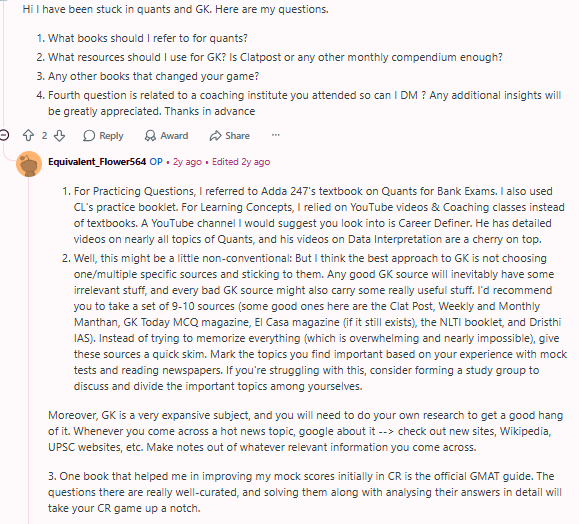
Candidates on Reddit consistently treat CLAT preparation as a foundation for AILET, but flag specific gaps that need dedicated, separate practice.
- Quants Strategy: Learn concepts using YouTube channels like Career Definer (especially for Data Interpretation) and practice problems from online sources or booklets.
- GK Strategy: Instead of memorizing a single source, skim 9–10 sources, focus on topics highlighted by mock tests, and do independent research on hot news topics.
- Critical Reasoning Booster: Solve and thoroughly analyze questions from the official GMAT Guide to significantly improve mock scores.
Source: Reddit
AILET Exam Pattern FAQs
Ques. What is AILET?
Ans. AILET, the All India Law Entrance Test, is the exam conducted by National Law University (NLU), Delhi for its BA LL.B. (Hons.) and LL.M. admissions.
Ques. What is the AILET exam syllabus?
Ans. AILET UG covers English Language, Current Affairs & GK, and Logical Reasoning. AILET PG covers core branches of law including Constitutional Law, Jurisprudence, Criminal Law, Contracts, Torts, and International Law.
Ques. What is the AILET date for 2027?
Ans. The exact AILET date is announced by NLU Delhi through its official admission notification closer to the exam cycle; candidates should confirm scheduling on the official website.
Ques. What is the AILET form last date?
Ans. The form last date is published as part of NLU Delhi's official admission notification for the cycle and should be confirmed on the AILET official website rather than assumed from previous years.
Ques. What is the AILET expected cutoff?
Ans. Cutoffs vary by category and paper difficulty each year, so there's no single fixed figure — candidates should compare against recent official cutoff releases rather than a projected number.
Ques. What is the AILET official website used for?
Ans. It is the source for the official notification, registration details, syllabus, fees, admit card, exam date, results, and cutoff data released by NLU Delhi each cycle.



Comments