




MICA Ahmedabad does not release the detailed MICAT syllabus on the website. The MICAT 2027 exam has three sections: Psychometric Test, Descriptive Test and Aptitude Test. The Aptitude Test is further classified into Verbal Ability, Quantitative Ability & DI, General Awareness, and Divergent & Convergent Thinking.
You can download the MICAT Syllabus 2027 PDF by clicking on the following link below:
- MICAT Psychometric Test syllabus (Section A) asks questions based on personality traits. There is no marking for this section, but you must attempt all the questions. It is treated as a qualifier for the subsequent sections of the MICAT exam.
- MICAT Descriptive test syllabus (Section B) includes creative writing and communication skills. There are no fixed topics to prepare. Based on trends, the descriptive test covers social issues and current affairs, so reading and writing practice is a must.
- MICAT Aptitude Test syllabus (Section C) includes verbal ability, arithmetic, modern maths, logical ability, current affairs, and marketing topics.
- According to MICAT subject-wise weightage, Section B asks 4 descriptive questions, which have nearly 50% weightage of the MICAT paper. Section C has 70 questions split into four sections.
- Important topics for MICAT 2027 are Visual Reasoning, RCs, Arithmetic, Current Affairs and Descriptive Writing. For Section A, no marks are awarded or deducted, so attempt all questions that test your personality traits.
The MICAT 2027 question paper is expected to have around 224 questions. The duration of the MICAT exam is expected to be 135 minutes. MICAT I will be held in December 2026, and MICAT II will be held in February 2027.
Related Articles:
- MICAT Question Paper with Solutions, Download PDF, Check Pattern
- MICAT Exam Pattern 2027: Section-wise Pattern, Marking Scheme, Exam Duration, Syllabus and Important Topics
Key Summary of MICAT Syllabus 2027
- Unlike CAT or XAT, MICA does not release a detailed MICAT exam syllabus.
- MICA releases a sample question paper, which shows the exact style of psychometric, descriptive, reasoning, verbal, quantitative and general-awareness questions.
- The MICA demo test is made available about two days before the exam, which helps you understand the real MICAT exam pattern.
- In the Psychometric and Descriptive Sections, there is no negative marking. In Section C, 0.25 marks will be deducted for every wrong answer and +1 mark for each correct response.
- The MICAT 2027 question paper is expected to have around 224 questions, both Objective and Subjective types of questions.
What is MICAT Syllabus 2027?
The syllabus for MICAT 2027 tests creativity, analytical ability, and written communication across sections. The MICAT syllabus 2027 is outlined in the table below. Check out the key focus areas of each topic of assessment:
| MICAT Section-wise Topics | What it Tests | Question Type |
|---|---|---|
| Psychometric Test | Personality traits and behaviour | Qualifying only (MCQ) |
| Descriptive Test | Argument-based, storytelling, essay writing | Subjective |
| Aptitude Test | Divergent & Convergent Thinking, Verbal Ability, Quantitative Ability and Data Interpretation, General Awareness | Objective |
Related Article: MICAT Exam Date: Registration Process, Admit Card, and Admission Schedule
Ques. Is MICAT harder than CAT?
Ans. CAT is considered tougher than MICAT in terms of core quantitative and analytical aptitude. MICAT is unique because it tests creative thinking, psychology, and descriptive writing rather than speed and advanced maths.
MICAT Syllabus 2027: Psychometric Test
The MICAT Psychometric syllabus evaluates your personality traits, behavioural patterns, and consistency rather than academic knowledge. It asks 150 questions based on past-year analysis.
This section is not used for your final score calculation but is a qualifier for your next rounds. No marks are awarded or deducted, so attempt all the questions.
The key topics of MICAT 2027 syllabus for psychometric test are:
| Key Topics of MICAT Psychometric Test | |
|---|---|
| Personality Factors and Traits | Behavioral Patterns |
| Life and Career Goals | Situational Judgments |
Related Article: MICAT Paper Analysis: All 3 Phases, Moderate Difficulty, Section-Wise and Expected Cutoff
Ques. Is MICAT enough for MICA?
Ans. No, MICAT is not enough on its own for admission to MICA; you must also have a valid score from CAT/XAT/ GMAT. Taking at least one of CAT, XAT, or GMAT is a mandatory eligibility requirement for MICA.
MICAT Syllabus 2027: Descriptive Test
MICAT descriptive test syllabus is assessed based on creative writing skills. It includes writing essays, storytelling, and expressing opinions on a range of subjects. It asks 4 questions from this section.
Key Tip to Master the Descriptive Test:
- Use random images or picture sets from newspapers and magazines to create short, meaningful stories.
- Read editorials, opinion articles, and feature stories regularly to improve vocabulary and understand effective writing structures.
| Key Topics of MICAT Descriptive Test | Description | Evaluation Criteria |
|---|---|---|
| Essay Writing | Write a structured essay on the given topic | Topics come from current affairs, social issues, marketing and communications themes, and opinion-based statements |
| Topic Generation | Generate as many unique topics or ideas as possible on a given subject | Creative breadth, originality, and diversity of ideas generated within the allotted time |
| Story Writing | Create a coherent story incorporating a set of given images | Story Writing Criteria |
| Descriptive Question | Structured written response to an analytical or situational prompt | Analytical thinking, communication clarity, depth of response |
On discussion forums such as Reddit, a user shared some tips for essay writing that will help to impress the interviewers. You have to give meaning to the word/phrase provided in this section. The phrase may not have any real meaning; it can just be a collection of words. Once you give a meaning, make a map of what its real-world applications can be, how organisations can benefit from it and what its merits and demerits are. Make sure to make connections in your brain before attempting this section.
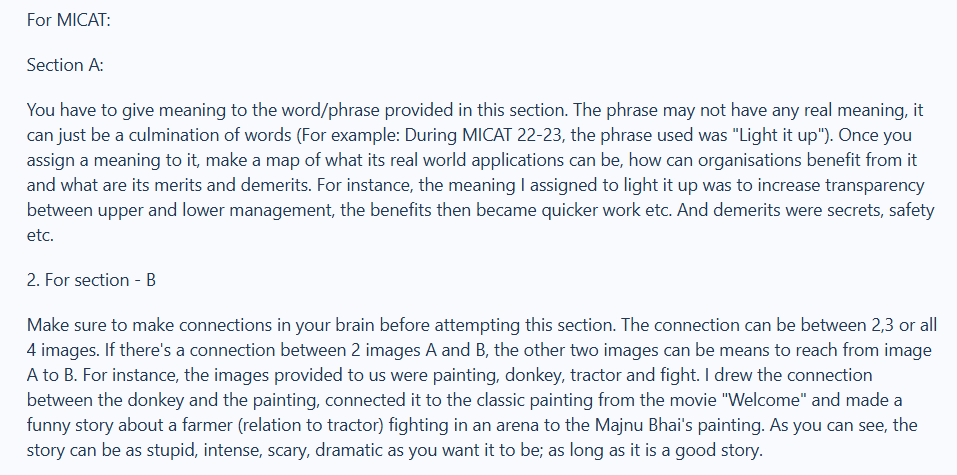
Source: Reddit
Ques. How many sections are there in MICAT 2027?
Ans. MICAT 2027 has 3 sections: Section A (Psychometric Test, 150 questions), Section B (Descriptive Test, 4 questions), and Section C (Aptitude Test, 70 questions). The total exam duration is 135 minutes.
MICAT Syllabus 2027: General Aptitude
MICAT general aptitude syllabus covers Verbal Ability, Quantitative Ability & Data Interpretation, Divergent & Convergent Thinking and General Awareness. The topic-wise MICAT 2027 syllabus for General Aptitude is discussed below.
MICAT 2027 Syllabus for Verbal Ability
Verbal Ability is one of the four sub-sections in Section C. It tests English language, reading comprehension, vocabulary, and grammar.
Tip: Time management matters, so practice RCs by reading magazines or newspapers.
| Key Topics of MICAT Verbal Ability | |
|---|---|
| Reading Comprehension | Vocabulary |
| Grammar | Sentence Completion |
| Para Jumbles | Analogies |
MICAT 2027 Syllabus for Quantitative Ability & Data Interpretation
Quantitative Ability & DI sub-section tests mathematical ability up to Class 12 level. This section is less difficult than CAT Quant, but DI sets can be complex.
Tip: Focus on speed and accuracy over advanced concepts.
| Key Topics of MICAT Quantitative Ability & Data Interpretation | |
|---|---|
| Arithmetic | Data Interpretation (Charts and graphs) |
| Algebra | Number System |
| Geometry & Mensuration | Permutation, Combination, Probability, and Statistics |
MICAT 2027 Syllabus for Divergent & Convergent Thinking
Divergent and Convergent Thinking (DCT) sub-section is the most distinctive part of MICAT. It tests creative thinking (divergent) and logical-visual reasoning (convergent).
Tip: Prepare using MICAT past papers and the official sample questions PDF, as CAT or XAT logical reasoning material does not cover the syllabus.
| Key Topics of MICAT Divergent and Convergent Thinking | |
|---|---|
| Visual Reasoning | Logical Reasoning |
| Divergent Thinking (Idea generation tasks, finding connections between unrelated concepts ) | Spatial Reasoning (3D figure visualization, object rotation, etc.) |
MICAT 2027 Syllabus for General Awareness
General Awareness sub-section is unique to MICAT among management entrance tests. It tests marketing, advertising, branding, and media knowledge alongside standard current affairs.
Tip: Students who prepare only GK often underperform in this section. Allocate specific time to the marketing and communications focus areas.
| Key Topics of MICAT General Awareness | |
|---|---|
| Marketing, Advertising & Branding | Media & Entertainment |
| Current Affairs | Business & Economy |
| Science & Technology | Sports, Books, Awards & Personalities |
Ques. How do I prepare for MICAT?
Ans. To crack the MICAT exam for MICA admissions, you need a balanced preparation strategy with a heavy focus on psychometric profiling, creative/descriptive writing, and divergent-convergent thinking.
MICAT Exam Pattern 2027
Each section in the MICAT exam has a different weightage and number of questions. MICAT exam pattern is designed in a way that the exact number of questions may vary slightly every year.
| Section | Expected No. of Questions | Sectional Time (Minute) |
|---|---|---|
| Section A: Psychometric Test (Objective) | 150 | 30 |
| Section B: Descriptive Test (Subjective) | 4 | 25 |
| Section C: Aptitude Test (Objective) | 80 | 80 |
| Total | 224 | 135 |
MICAT 2027 Marking Scheme
- In the Psychometric and Descriptive Sections, there is no negative marking.
- For all subjects in Section C, 0.25 marks will be deducted for every wrong answer.
- The MICAT exam consists of both Objective and Subjective types of questions.
Also Read: MICAT Exam Centres - Check Test Cities of MICA Ahmedabad Exam
MICAT Subject- Wise Weightage 2027: Based on Trends
MICA does not publish official section-wise weightage percentages. The table below reflects the marks structure from past paper analysis. Use it to allocate study time across sections.
MICAT Subject- Wise Weightage for Psychometric Test
As per MICAT 2027 exam pattern, section A does not contribute marks to the final score. You must clear it for the rest of your MICAT to be evaluated. It assesses your personality traits, behavioural tendencies, and situational judgment.
| Component | Focus Area | No. of Questions (Approx) |
|---|---|---|
| Psychometric Assessment | Personality factors, traits, behavioural patterns, situational judgement and life goals | 150 |
MICAT Subject-wise Weightage for Descriptive Test
MICAT Section B tests your creative writing and communication skills. This section is evaluated for final merit and is a key differentiator between high scorers.
| Component | Focus Area | No. of Questions (Approx) |
|---|---|---|
| Descriptive Test | Argumentative, narrative-based, image-based, and word-based creative writing | 4 |
MICAT Subject-wise Weightage for Aptitude Test
MICAT Syllabus 2027 for the Aptitude Test assesses your reasoning and verbal ability. Section-wise important topics for the MICAT Aptitude Test, based on trends, are discussed below.
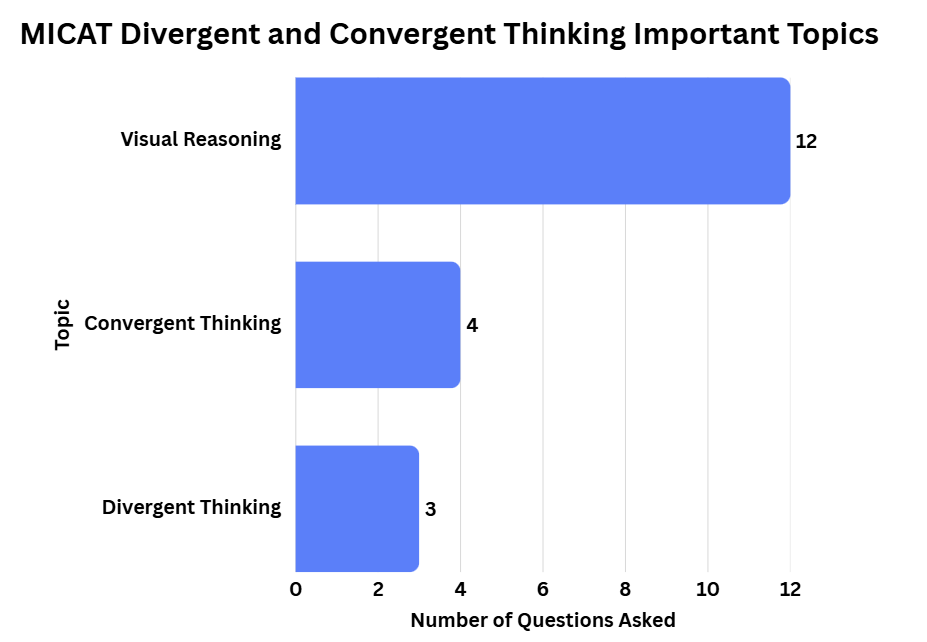
MICAT Divergent and Convergent Thinking Important Topics
| Topics | Subtopics | Number of Questions Asked |
|---|---|---|
| Visual Reasoning | Pattern completion, mirror images, water images, figure series, embedded figures, paper folding and cutting, cube and dice problems, rotation of figures | 10- 12 |
| Convergent Thinking | Analogies, Word Association, Syllogism, coding-decoding | 2- 4 |
| Divergent Thinking | Idea generation tasks, finding connections between unrelated concepts, unusual uses of common objects, lateral thinking scenarios, perspective-based questions | 2- 3 |
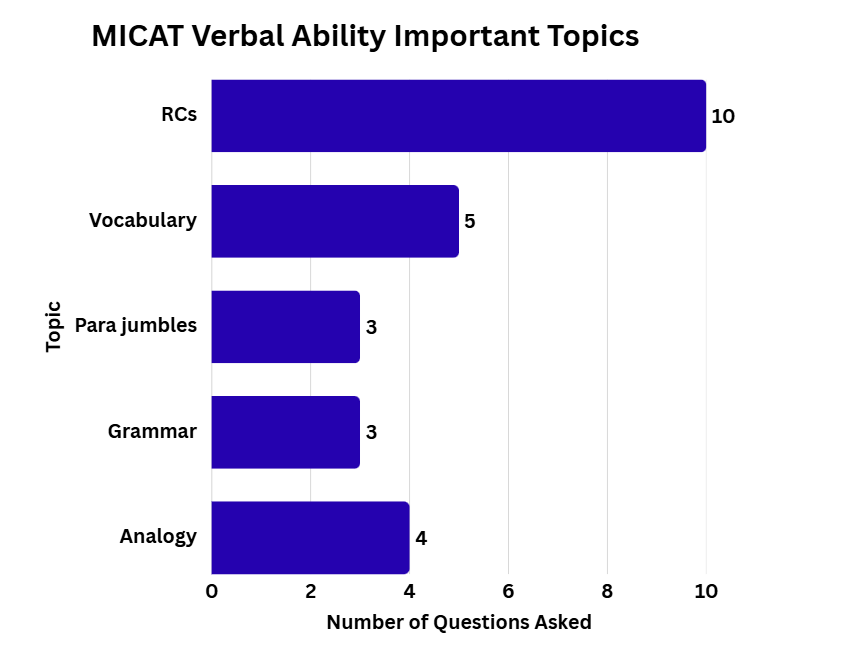
MICAT Verbal Ability Important Topics
| Topics | Subtopics | Number of Questions Asked |
|---|---|---|
| Reading Comprehension (2- 3 passages) | Passages from literature, social commentary, marketing, advertising, and current affairs | 5- 10 |
| Vocabulary | Synonyms, antonyms, fill in the blanks, one-word substitution, word usage in context | 3- 5 |
| Para jumbles | Sentence Completion to form a logically coherent paragraph | 2- 3 |
| Grammar | Error spotting, sentence correction, subject-verb agreement, tenses, articles, prepositions | 2- 3 |
| Analogies | Identify the word pair sharing the same relationship as the given pair | 2- 4 |
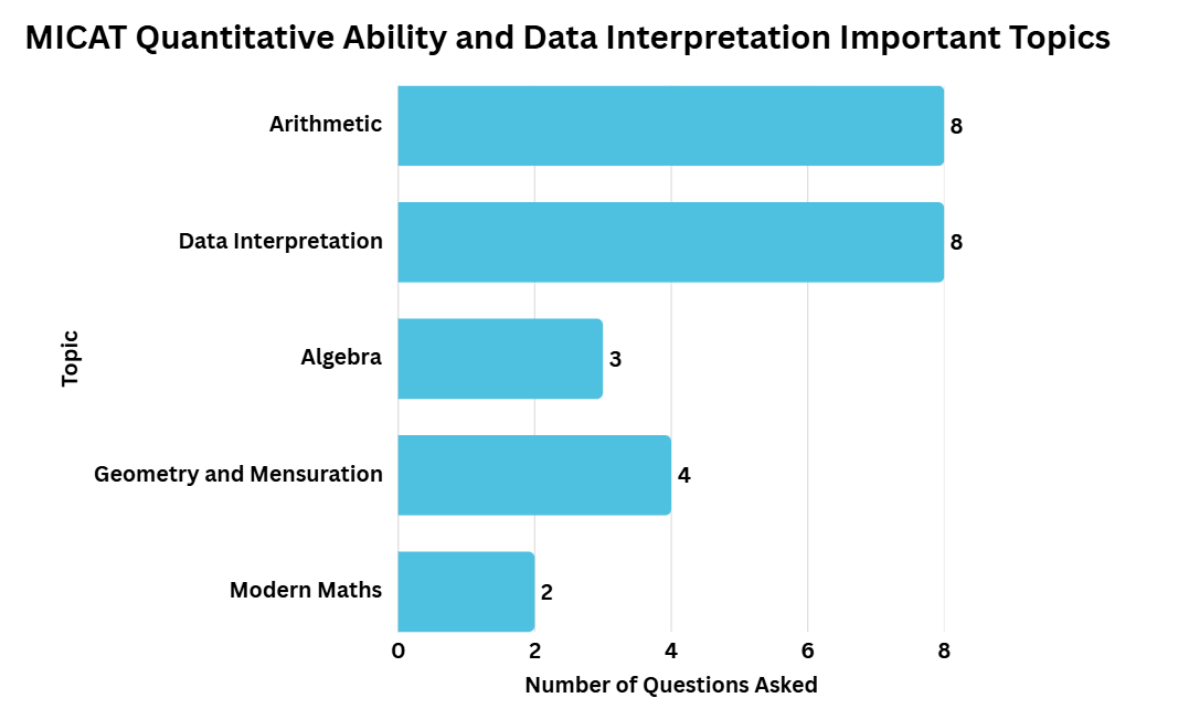
MICAT Quantitative Ability and Data Interpretation Important Topics
| Topics | Key Topics | Number of Questions Asked |
|---|---|---|
| Arithmetic | Percentages, Profit and Loss, Simple and Compound Interest, Ratio and Proportion, Time and Work, Time, Speed and Distance, Averages, Mixtures and Alligations | 5- 8 |
| Data Interpretation | Bar charts, line graphs, pie charts, tables, mixed DI sets (bar + table, pie + caselet), and data comparison sets. | 4- 8 |
| Algebra | Linear and quadratic equations, inequalities, Arithmetic and Geometric Progressions | 1- 3 |
| Geometry and Mensuration | Triangles, circles, areas and volumes of 2D and 3D figures, coordinate geometry basics | 2- 4 |
| Modern Maths | Counting methods, arrangements, combinations, basic probability | 1- 2 |
MICAT General Awareness Important Topics
| Topics | Key Topics | Number of Questions Asked |
|---|---|---|
| Current Affairs, Business & Economy, Marketing, Advertising, Media & Entertainment | Campaigns, film and TV awards, National and international news, corporate news, Tech innovations, Major tournaments, Prizes and Awards | 10 |
Ques. What are the eligibility criteria for MICAT?
Ans. To be eligible for MICAT, candidates must hold a bachelor's degree in any discipline and have a valid score from CAT/XAT/ GMAT. There is no maximum or minimum age limit for MICAT.
Best Books to Prepare for MICAT 2027
The books that align well with the MICAT syllabus 2027 are tabulated below. Follow these books to crack the MICAT exam.
| Section | Book Name | Author / Publisher | Why This Book |
|---|---|---|---|
| Verbal Ability | Word Power Made Easy | Norman Lewis | Builds vocabulary rapidly using the root-word method; covers synonyms and antonyms |
| High School English Grammar and Composition | Wren & Martin (S. Chand) | Comprehensive grammar reference for error-spotting and sentence correction questions | |
| Quantitative Ability | Quantitative Aptitude for Competitive Examinations | R.S. Aggarwal (S. Chand) | Covers all arithmetic and algebra topics tested in MICAT’s QA sub-section |
| How to Prepare for Data Interpretation for CAT | Arun Sharma | DI practice with mixed chart types at the right difficulty level for MICAT | |
| General Awareness: Marketing | Marketing Management | Philip Kotler & Kevin Lane Keller | Core marketing concepts: 4Ps, STP, branding form the backbone of MICAT’s GA marketing questions |
| General Awareness: Current Affairs | The Hindu, Economic Times, and Campaign India (daily reading) | - | Current affairs and marketing or media news; essential for MICAT’s GA section |
| Divergent and Convergent Theory | MICAT Sample Questions PDF + Previous Year Papers | - | Only source that accurately represents DCT question types; start here before any other material |
| Descriptive Test | WAT preparation guides for MBA admissions; essay writing practice books | - | Builds essay structure, argument development, and language quality for Section B |
Related Article: MICAT Selection Process: GE/PI Shortlist, Answer Key, Merit List, Cutoff
Ques. How many phases will MICAT 2027 be held in?
Ans. MICAT 2027 will be held in 3 phases: Phase I in December 2026, Phase II in February 2027, and Phase III in March 2027. The best score across all the phases you appeared in is counted for merit list preparation.
MICAT 2027 Preparation Tips Based on Syllabus
MICAT preparation requires a different approach from standard MBA entrance test prep. Creativity, reading habits, and media awareness matter as much as analytical ability in this exam.
MICAT Verbal Ability
- Read quality English editorial content daily. The Hindu and Guardian editorials build comprehension and vocabulary together.
- Build vocabulary with Norman Lewis. Aim for 10-15 new words per day.
- Practice para jumbles and sentence correction from CAT VA material; the difficulty maps well to MICAT.
- Increase your RC reading speed through intense daily practice. Section C’s 80-minute window demands efficient reading under a clock.
MICAT Quantitative Ability & Data Interpretation
- Focus on percentages, ratios, and time-speed-distance as they appear most frequently in MICAT’s QA sub-section.
- Practice DI with mixed data sets (bar + table, pie + caselet) because questions often combine chart types in one set.
- You do not need CAT-level Quant preparation for MICAT. Class 12 proficiency with strong calculation speed is the target.
- Solve 20- 25 QA and DI questions daily t increase speed.
MICAT General Awareness
- Follow advertising and marketing news alongside standard GK. Campaign India is the best MICAT-specific GA source.
- Focus on monthly current affairs and supplement it with marketing and media news from the past 12 months.
- Revise current affairs intensively in the final two weeks before the exam.
MICAT Divergent & Convergent Thinking
- Start DCT preparation with the official MICAT Sample Questions PDF on mica.ac.in as no other material provides an authentic question type.
- Practice visual reasoning puzzles daily: pattern completion, mirror images, and figure series from puzzle apps or books.
- For divergent thinking, practice timed brainstorming: set 5 minutes and generate as many ideas as possible on a random topic.
MICAT Descriptive Test (Section B)
- Write one essay per week on current affairs and marketing or communications themes.
- Practice story writing with random image sets.
- For topic generation, focus on originality over volume. MICA evaluators value creative and unexpected connections above a simple list.
- Read fiction and non-fiction widely to improve narrative style and language depth in your descriptive responses.
- Do not neglect Section B; it contributes 50% of the scored marks and directly determines GE-PI shortlisting.
MICAT Sample Papers
| MICAT Previous Years’ Sample Papers | Download Links |
|---|---|
| MICAT SAMPLE TEST 1 | Check Here |
| MICAT SAMPLE TEST 2 | Check Here |
| MICAT SAMPLE TEST 3 | Check Here |
| MICAT SAMPLE TEST 4 | Check Here |
| MICAT SAMPLE TEST 5 | Check Here |
| MICAT 2011-13 | Check Here |
| MICAT 2008-10 | Check Here |
| MICAT 2013-15 | Check Here |
| MICAT 2016-17 | Check Here |
MICAT Syllabus 2027 FAQs
Ques. Does MICA release an official syllabus PDF for MICAT?
Ans. No. MICA does not publish a standalone section-wise syllabus PDF. The official resources are the MICAT Sample Questions PDF and the Information Brochure on mica.ac.in. The Sample Questions document is the most useful as it contains representative questions from each section. Use it alongside past MICAT papers as your primary preparation reference.
Ques. Which section has the highest weightage in MICAT?
Ans. The Descriptive Test (Section B) carries 50% of the MICAT score. Among Section C sub-sections, Verbal Ability, DCT, and QA&DI each carry approximately 20 marks, while General Awareness carries approximately 10 marks. Despite fewer marks, GA’s marketing and branding focus makes it a differentiating factor among high-scoring students.
Ques. Is the Psychometric Test in MICAT scored?
Ans. No. The Psychometric Test (Section A) is mandatory but not scored. You cannot skip it so complete it before moving to Sections B and C. MICA uses responses for personality and creativity profiling, which may inform the GE-PI stage discussions. Answer each statement honestly and instinctively.
Ques. What is the Divergent and Convergent Thinking (DCT) section in MICAT?
Ans. DCT is the most distinctive sub-section in MICAT. Convergent thinking questions involve logical and visual reasoning. Divergent thinking questions ask you to generate ideas or find unusual connections between concepts. Standard CAT or XAT LR material covers the convergent component but misses the visual and divergent elements entirely. Use MICAT past papers and the official sample questions PDF specifically for DCT practice.
Ques. What topics are most important in the MICAT General Awareness section?
Ans. Marketing, advertising, and branding knowledge is the most critical GA area in MICAT. This includes famous campaigns, brand taglines, advertising agencies, and marketing concepts like the 4Ps and STP. MICAT’s GA section has a much stronger marketing and communications angle than the GK sections in other management entrance tests.
Ques. What is the negative marking scheme for MICAT 2026?
Ans. Negative marking applies only to Section C (Objective Test). Each wrong answer deducts 0.25 marks. Section A (Psychometric) and Section B (Descriptive) have no negative marking. In Section C, avoid guessing randomly, as a wrong answer costs one-quarter of the mark a correct answer earns. Attempt a question only when you can eliminate at least two options with reasonable confidence.
Ques. Does a CAT score replace MICAT for MICA admission?
Ans. No. A valid CAT, XAT, GMAT, or GRE score is required only to register for MICAT. MICA typically sets a minimum qualifying exam percentile cutoff and then uses the MICAT score alongside GE-PI performance for merit ranking and final admission offers. Both your qualifying exam score and MICAT score matter in the overall selection process.



Comments