




Mudra Institute of Communications, Ahmedabad (MICA) conducts the MICAT exam for admission to its PGDM-C and PGDM programmes. It does not release the detailed MICAT paper pattern or syllabus on the website. The MICAT exam pattern 2027 is based on previous years' papers.
MICAT is conducted in an online CBT mode. As per MICAT 2027 exam pattern, the test paper comprises three sections with sectional time limits. The total duration of MICAT 2027 is 135 minutes (2 hours 15 minutes).
- MICAT paper pattern is divided into Psychometric Test (Section A), Descriptive Test (Section B) and Aptitude Test (Section C). Section C is divided into subsections: Divergent & Convergent Thinking, Verbal Ability, Quantitative Ability, and General Awareness.
- Based on previous years' MICAT exam pattern, Section A comprises 150 questions, Section B asks 4 descriptive questions, and Section C has 70 questions.
- As per MICAT marking scheme, in Section C you get +1 mark for each correct answer, and negative marking of 0.25. Section B has no negative marking. Section A is treated as a qualifier only and has no impact on final merit score calculation.
- MICAT question paper format includes both objective and subjective questions.
- Important topics for MICAT 2027 are Visual Reasoning, RCs, Arithmetic, Current Affairs and Descriptive Writing. For Section A, no marks are awarded or deducted, so attempt all questions that test your personality traits.
Related Articles:
- MICAT Syllabus: Subject-Wise Topics, Weightage and PDF Download
- MICAT Question Paper with Solutions, Download PDF, Check Pattern
MICAT Exam Pattern 2027: Highlights
MICAT Section A and Section C are objective, while Section B is subjective. The MICAT question paper assesses candidates' analytical ability and written communication skills. Check out the MICAT exam pattern 2027 based on previous admission cycles.
| Particular | Key Details of MICAT 2027 Exam Pattern |
|---|---|
| Exam Mode | Computer-Based Test (CBT) |
| Total Sections | Three SectionsSection A: Psychometric Test Section B: Descriptive Test Section C: Aptitude Test
|
| Total Questions (approx.) | 224 (Subjective + Objective) |
| Duration | 135 minutes (2 hours 15 minutes)
|
| Negative Marking |
|
| Final Score Calculation | Sections B and C (Section A marks are not counted; used as a qualifier) |
Related Article: MICAT Application Form: Exam Dates, and How to fill Form, Fees
Ques. Is MICAT conducted online or offline?
Ans. MICAT is conducted in an online computer-based test (CBT) mode at designated test centres. MICA also provides a demo test accessible 2 days before the exam. Use it to get familiar with the interface before your actual attempt.
MICAT Exam Pattern 2027: Section-wise Pattern and Duration
The MICAT 2027 exam pattern for each section is tabulated below. To score well, understand the section-wise MICAT paper pattern, as it differs slightly from other MBA entrance exams.
| Sections | Subjects | Questions per section (expected) | Duration |
|---|---|---|---|
| Section A | Psychometric Test | 150 | 30 minutes |
| Section B | Descriptive Test | 4 | 25 minutes |
| Section C | Aptitude Test (Divergent & Convergent Thinking, Verbal Ability, Quantitative Ability and Data Interpretation, General Awareness) | 70 | 80 minutes |
| Total | - | 224 | 135 minutes |
Related Article: MICAT Exam Date: Registration Process, Admit Card, and Admission Schedule
Ques. How many questions are in Section C of MICAT 2027?
Ans. MICAT Section C has 70 questions in total: 20 in Divergent-Convergent Reasoning, 20 in Verbal Ability, 20 in Quantitative Ability & Data Interpretation, and 10 in General Awareness. Each correct answer earns 1 mark, giving a maximum of 70 marks from this section.
MICAT Exam Pattern 2027: Marking Scheme
The MICAT marking scheme differs significantly across sections and shapes your preparation strategy:
- Section A (Psychometric Test): It is used as a qualifier only. No marks are awarded or deducted, so answer all questions.
- Section B (Descriptive Test): No negative marking. This section tests your writing skills. Scores are assigned based on the quality of responses.
- Section C (Aptitude Test):
- +1 mark for every correct answer
- -0.25 marks for every incorrect answer
- 0 marks for unattempted questions
| Section | MICAT Marking Scheme | ||
|---|---|---|---|
| Correct Answer | Incorrect Answer | Unattempted | |
| Psychometric Test | No marks awarded (Treated as qualifier round) | No penalty | 0 |
| Descriptive Test | Subjective Marking | No penalty | 0 |
| Aptitude Test | +1 mark | -0.25 marks (per wrong answer) | 0 |
Note: Only Sections B and C contribute to the MICAT score used in the selection process (after clearing the Psychometric qualifier and meeting CAT/XAT/GMAT cut-offs).
Related Article: MICAT Eligibility Criteria: Qualification & Age Limit
Ques. Is MICAT harder than CAT?
Ans. CAT is considered tougher than MICAT in terms of core quantitative and analytical aptitude. MICAT is unique because it tests creative thinking, psychology, and descriptive writing rather than speed and advanced maths.
MICAT Exam Pattern 2027: Duration and Question Types
As per MICAT Exam pattern, the total time allotted to complete the test is 135 minutes (2 hours 15 minutes). However, because the exam has sectional time limits, free navigation between sections is restricted.
MICAT has three distinct question types across sections. They are situational, descriptive and MCQ-based questions.
Tip: Candidates are advised to work on their speed and accuracy to attempt more questions correctly.
| Sections | Sectional Time | Question Types | MICAT exam duration (total) |
|---|---|---|---|
| Psychometric Test | 30 minutes | Forced-choice statements about preferences and behaviour. No right or wrong answers; honesty and consistency matter | 135 minutes (2 hours 15 minutes) |
| Descriptive Test | 25 minutes | Essay, short story, image-based writing, and creative prompts. Evaluated holistically on creativity, clarity, and originality. | |
| Aptitude Test | 80 minutes | Covers verbal skills, quantitative reasoning, general awareness and creative reasoning questions |
Also Read: MICAT Exam Centres - Check Test Cities of MICA Ahmedabad Exam
Ques. What is the MICA entrance exam?
Ans. The MICAT (MICA Admission Test) is a specialized, computer-based entrance examination conducted by MICA Ahmedabad. It is an exclusive gateway for admission to its flagship management and creative programs, including the PGDM, PGDM-C (Communications), and FPM.
MICAT Exam Pattern 2027: Important Topics Based on Trends
MICAT exam pattern covers distinct skill areas across its three sections. Section C is the core merit-scoring component and tests four specific sub-areas. Below is the subject-wise breakdown with important topics based on trends.
MICAT Section A: Psychometric Test
As per MICAT 2027 exam pattern, section A does not contribute marks to the final score. You must clear it for the rest of your MICAT to be evaluated. It assesses your personality traits, behavioural tendencies, and situational judgment.
| Component | Focus Area | No. of Questions (Approx) |
|---|---|---|
| Psychometric Assessment | Personality factors, traits, behavioural patterns, situational judgement and life goals | 150 |
MICAT Section B: Descriptive Test
MICAT Section B has 4 descriptive questions. It tests your creative writing and communication skills. This section is evaluated for final merit and is a key differentiator between high scorers.
| Component | Focus Area | No. of Questions (Approx) |
|---|---|---|
| Descriptive Test | Argumentative, narrative-based, image-based, and word-based creative writing | 4 |
MICAT Section C: Aptitude Test
MICAT Section C is the actual scoring section, which tests your reasoning and verbal ability. It is further classified into four subsections, as follows:
- Divergent & Convergent Thinking
- Verbal Ability
- Quantitative Ability and Data Interpretation
- General Awareness
Section-wise important topics for the MICAT Aptitude Test, based on trends, are discussed below.
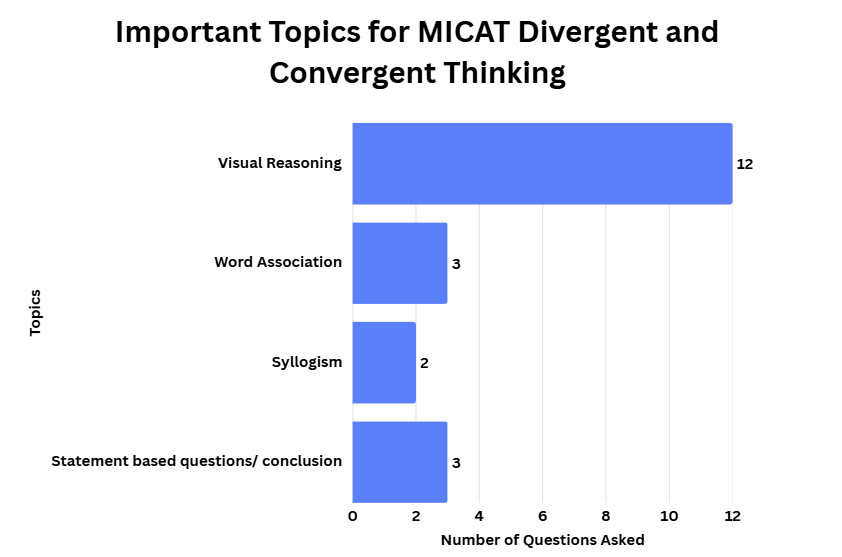
Important Topics for MICAT Divergent and Convergent Thinking
Based on trends, Divergent and Convergent Thinking ask around 20 questions for 20 marks. It tests candidates' word association, statement-based questions and reasoning skills.
| Topics | Number of Questions Asked |
|---|---|
| Visual Reasoning (odd one out, series, paper folding, analogies) | 10- 12 |
| Word Association | 2- 3 |
| Syllogism | 2 |
| Statement based questions/ conclusion | 2- 3 |
Important Topics for MICAT Verbal Ability
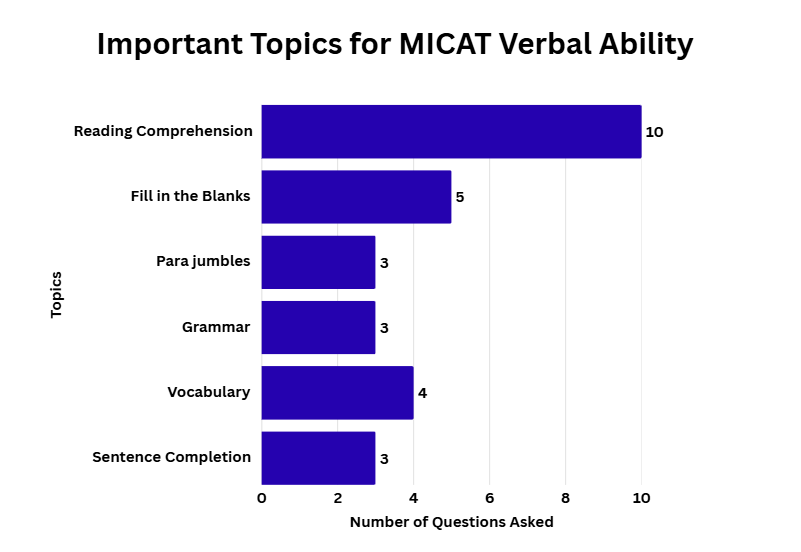
According to previous years' MICAT exam pattern, Verbal Ability ask approximately 20 questions for 20 marks. It assesses candidates' language, reading comprehension, and grammar skills.
| Topics | Number of Questions Asked |
|---|---|
| Reading Comprehension (2- 3 passages) | 5- 10 |
| Fill in the Blanks | 3- 5 |
| Para jumbles | 2- 3 |
| Grammar | 1- 3 |
| Vocabulary | 2- 4 |
| Sentence Completion | 1- 3 |
Important Topics for MICAT Quantitative Ability and Data Interpretation
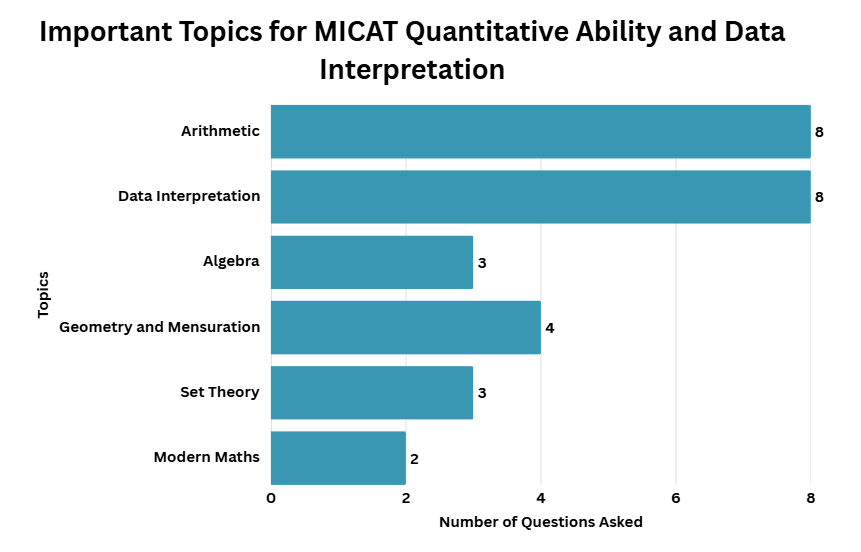
MICAT Quantitative Ability and Data Interpretation ask around 20 questions for 20 marks. It covers arithmetic, algebra, percentages, and data interpretation questions. Focus more on conceptual clarity rather than advanced mathematics.
| Topics | Number of Questions Asked |
|---|---|
| Arithmetic | 5- 8 |
| Data Interpretation (Tables, Bar / Line Graphs) | 4- 8 |
| Algebra | 1- 3 |
| Geometry and Mensuration | 2- 4 |
| Set Theory | 1- 3 |
| Modern Maths | 1- 2 |
Important Topics for MICAT General Awareness
MICAT General Awareness ask 10 questions for 10 marks. It covers current affairs, business news, marketing, advertising, and media industry events.
| Topics | Number of Questions Asked |
|---|---|
| Current Affairs, Business & Economy, Marketing, Advertising, Media & Entertainment | 10 |
Ques. How do I prepare for MICAT?
Ans. To crack the MICAT exam for MICA admissions, you need a balanced preparation strategy with a heavy focus on psychometric profiling, creative/descriptive writing, and divergent-convergent thinking.
MICAT Exam Pattern 2027: Last 5 Years Difficulty Trends
Based on the last 5 years' MICAT paper pattern, the difficulty level has remained moderate to difficult. Check out the MICAT exam pattern in the table below:
| Year | Overall Difficulty | Divergent & Convergent Thinking | Verbal Ability | Quantitative Ability and Data Interpretation | General Awareness | Descriptive Test |
|---|---|---|---|---|---|---|
| 2026 | Moderate | Moderate | Moderate to Difficult | Moderate (Lengthy) | Easy to Moderate | Moderate |
| 2025 | Moderate to Difficult | Moderate | Moderate to Difficult | Moderate to Difficult | Moderate | Moderate |
| 2024 | Moderate to Difficult | Tough | Moderate | Moderate to Difficult | Easy to Moderate | Moderate |
| 2023 | Moderate | Moderate | Moderate | Moderate to Difficult | Easy to Moderate | Moderate |
| 2022 | Moderate to Difficult | Moderate | Moderate to Difficult | Moderate to Difficult | Easy to Moderate | Moderate |
Also Check: MICAT Paper Analysis: All 3 Phases, Moderate Difficulty, Section-Wise and Expected Cutoff
Ques. Is MICAT enough for MICA?
Ans. No, MICAT is not enough on its own for admission to MICA; you must also have a valid score from CAT/XAT/ GMAT. Taking at least one of CAT, XAT, or GMAT is a mandatory eligibility requirement for MICA.
How MICAT Exam Pattern 2027 Affects Selection Process?
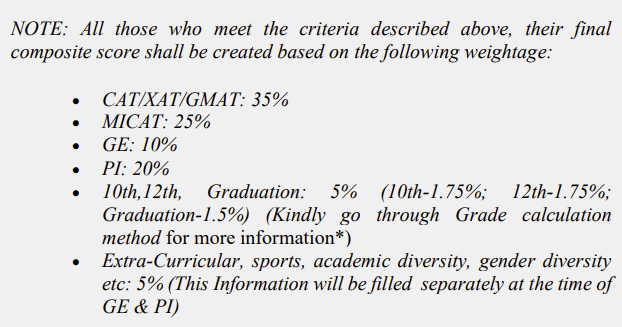
While all three sections are part of the MICAT selection process, the marks obtained in the Psychometric Test are not considered for calculating the MICAT score. Candidates must qualify in the Psychometric Test so that their Aptitude Test and Descriptive Test performance is evaluated. Their final score calculation is done based on the following parameters:
| Parameters | Weightages (%) |
|---|---|
| CAT/ XAT/ GMAT | 30 |
| MICAT score (Section B+C) | 25 |
| GE + PI | 10+ 20= 30 |
| Academic Performance | 5 |
| ExtraCuriiculur/ Diversity | 5 |
Source: mica.ac.in
Related Article: MICAT Selection Process: GE/PI Shortlist, Answer Key, Merit List, Cutoff
Ques. What are the eligibility criteria for MICAT?
Ans. To be eligible for MICAT, candidates must hold a bachelor's degree in any discipline and have a valid score from CAT/XAT/ GMAT. There is no maximum or minimum age limit for MICAT.
How to Prepare Based on MICAT Exam Pattern 2027
MICAT combination of psychometric assessment, descriptive writing, and aptitude testing demands a strategy different from standard MBA entrance exams. The following tips are directly derived from the exam pattern.
- Prioritise Section B (Descriptive) in your preparation: Section B separates high scorers. Practice writing concise essays, creative stories, and image-based responses within time.
- Build Divergent-Convergent Reasoning skills: Practice thinking puzzles, word-association games, and alternate-use exercises regularly.
- Focus on your General Awareness: MICAT’s General Awareness section asks questions from media and marketing news. Follow industry publications like AdAge India and Economic Times Brand Equity.
- Treat Section A (Psychometric) as a qualifier, not a performance test: Answer honestly and consistently. You cannot study for psychometric tests as they test personality traits.
- Avoid random guessing in Section C: The -0.25 penalty applies to every wrong MCQ in Section C. Skip questions where you are not confident, especially in GA and VA, where guessing does not work.
- Practice the exam interface before each phase: MICA opens a demo test 2 days before the exam. Practice the demo test to familiarise yourself with the exam question pattern.
- Master sectional time management: MICAT has strict sectional timers (30 min for Psychometric, 25 min for Descriptive, 80 min for Aptitude). Practice full mocks under exact timings to master speed with accuracy.
MICAT Exam Pattern 2027 FAQs
Ques. How many sections are there in MICAT 2027?
Ans. MICAT 2027 has 3 sections: Section A (Psychometric Test, 150 questions), Section B (Descriptive Test, 4 questions), and Section C (Aptitude Test, 70 questions). The total exam duration is 135 minutes.
Ques. Is there negative marking in MICAT 2027?
Ans. Yes, as per MICAT marking scheme, 0.25 marks are deducted for every wrong answer in Section C. Section A (Psychometric) and Section B (Descriptive) carry no negative marking, so you can attempt all questions in those sections freely.
Ques. What is the total duration of MICAT 2027?
Ans. The total duration of MICAT 2027 is 135 minutes (2 hours 15 minutes). Section A takes 30 minutes, Section B takes 25 minutes, and Section C takes 80 minutes, with separate time limits for each part.
Ques. How many phases was MICAT 2027 held in?
Ans. MICAT 2027 will be held in 3 phases: Phase I in December 2026, Phase II in February 2027, and Phase III in March 2027. The best score across all the phases you appeared in is counted for merit list preparation.
Ques. What is the marking scheme for Section C in MICAT 2027?
Ans. In MICAT Section C, you earn +1 mark for each correct answer and lose 0.25 marks for each wrong answer. Unattempted questions carry 0 marks. This applies uniformly to all four sub-sections: DCR, VA, QADI, and GA.
Ques. What types of questions appear in MICAT Section B?
Ans. MICAT Section B has 4 descriptive questions in 25 minutes. Types include essay writing, short story creation, image-based writing, and word-prompt creative writing. The section is evaluated holistically on creativity, clarity, and communication.
Ques. What is Divergent-Convergent Reasoning (DCR) in MICAT?
Ans. DCR is MICAT’s most unique section. It tests creative and lateral thinking. You are expected to think beyond conventional answers (diverge) and then select the most fitting option (converge). Questions may involve word associations, alternate uses, visual patterns, and lateral reasoning scenarios.



Comments