




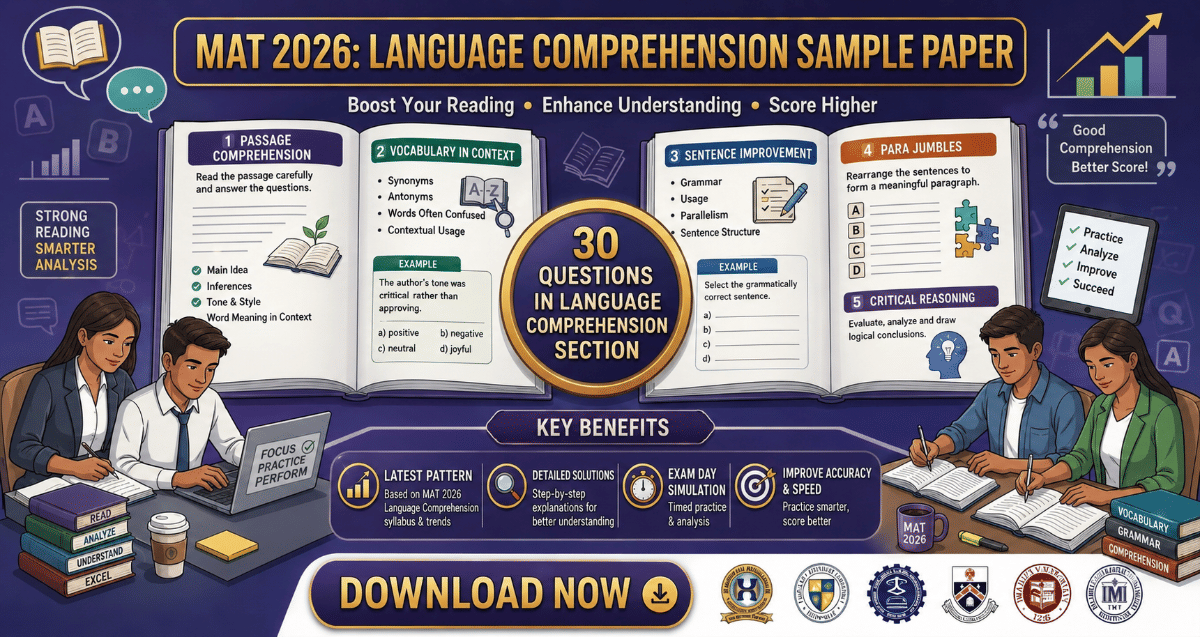
MAT Language Comprehension Sample Papers 2026 are designed to give aspirants a realistic feel of the question types, passage styles, and verbal reasoning demands they will actually face in this section of the exam.
- The papers cover all key areas, including Reading Comprehension, Para Jumbles, Fill in the Blanks, Sentence Correction, Vocabulary, and Grammar Usage, in line with previous year MAT trends and the AIMA-prescribed syllabus.
- Students preparing for MAT 2026 can use these Language Comprehension sample papers to read passages faster without losing accuracy, identify which question types take up the most time, and get genuinely comfortable with the kind of vocabulary and grammar questions the actual paper tends to include.
MAT Language Comprehension Sample Paper 2026 PDF Download
| MAT Language Comprehension Sample Paper | Direct Link |
|---|---|
| MAT Language Comprehension Sample Paper 1 | Download PDF |
| MAT Language Comprehension Sample Paper 2 | Download PDF |
| MAT Language Comprehension Sample Paper 3 | Download PDF |
| MAT Language Comprehension Sample Paper 4 | Download PDF |
| MAT Language Comprehension Sample Paper 5 | Download PDF |
| MAT Language Comprehension Sample Paper 6 | Download PDF |
| MAT Language Comprehension Sample Paper 7 | Download PDF |
| MAT Language Comprehension Sample Paper 8 | Download PDF |
| MAT Language Comprehension Sample Paper 9 | Download PDF |
| MAT Language Comprehension Sample Paper 10 | Download PDF |
| MAT Language Comprehension Sample Paper 11 | Download PDF |
| MAT Language Comprehension Sample Paper 12 | Download PDF |
| MAT Language Comprehension Sample Paper 13 | Download PDF |
| MAT Language Comprehension Sample Paper 14 | Download PDF |
| MAT Language Comprehension Sample Paper 15 | Download PDF |
| MAT Language Comprehension Sample Paper 16 | Download PDF |
| MAT Language Comprehension Sample Paper 17 | Download PDF |
| MAT Language Comprehension Sample Paper 18 | Download PDF |
| MAT Language Comprehension Sample Paper 19 | Download PDF |
| MAT Language Comprehension Sample Paper 20 | Download PDF |
Related Articles:
- MAT Language Comprehension Syllabus: Topic-wise Breakdown
- MAT Data Analysis & Sufficiency Mock Tests with Solutions
- MAT Data Analysis & Sufficiency Previous Year Questions (PYQs)
Why Should You Solve MAT Language Comprehension Sample Papers?
Many students start MAT preparation thinking Language Comprehension will be their strongest section because they read English regularly. That confidence is often misplaced. The section does not just test whether you understand English. It tests how precisely you read, how well you can spot logical errors in sentences, and whether you can work through dense RC passages quickly under exam pressure.
Language Comprehension in MAT is also the section where students tend to lose easy marks. The questions are not particularly hard, but small reading errors, choosing an answer that feels right rather than one that is actually correct, and spending too long on a single RC passage all quietly reduce the score. Solving sample papers regularly is the best way to fix those habits before the actual exam.
Here are some real benefits you get from solving MAT Language Comprehension sample papers regularly:
- Better understanding of question pattern: In most MAT sessions, this section has 4 to 5 RC passages with 3 to 4 questions each, along with individual questions on vocabulary, grammar, and sentence arrangement. Practising sample papers makes this structure familiar, so you already know what to expect when you sit for the actual exam.
- Helps in time management: RC passages are the biggest time consumer in this section. A long passage on an unfamiliar topic can easily take 7 to 9 minutes if you read it fully before attempting the questions. Sample paper practice teaches you to scan the questions first, go back to the passage with a purpose, and move on quickly from questions that are taking too long. That skill only comes from repeated timed practice.
- Identifies important chapters: After working through a few papers, it becomes clear which topics show up consistently. RC and vocabulary together account for the bulk of this section across MAT sessions. Para Jumbles and Fill in the Blanks appear regularly. Sentence Correction and Grammar-based questions are fewer but still worth preparing. That understanding helps you spend your study time where it matters most.
- Improves accuracy: Language Comprehension carries 0.25 negative marking per wrong answer, and the risk here is different from a quant section. Wrong answers in this section often come from reading too fast, assuming what a passage says rather than checking, or confusing similar-looking vocabulary options. Practising with sample papers builds the habit of going back to the text before marking an answer rather than relying on what feels right in the moment.
- Builds exam confidence: Many PG entrance aspirants who are strong in quant find the verbal sections unpredictable and hard to prepare for systematically. Solving 10 to 12 full-length section-wise papers changes that. Students who have worked through enough papers go into the exam knowing exactly what kind of passages and questions to expect, and that makes a real difference on the day.
MAT 2026 Language Comprehension: Exam Pattern and Marking Scheme
According to the MAT 2026 exam pattern released by AIMA, the Language Comprehension section has 30 MCQs, all carrying equal marks. Whether you are appearing for the PBT on May 31 or the CBT on June 14, the section structure stays the same.
| Detail | Specifics |
|---|---|
| Number of Questions | 30 |
| Marks per Question | 1 |
| Negative Marking | 0.25 per wrong answer |
| Total Marks | 30 |
| Sectional Time Limit | None (overall 120 minutes for all 5 sections) |
| Counts for Percentile | Yes |
There is no sectional timer in MAT, so you decide how much time to spend on each section. Most coaching institutes recommend keeping Language Comprehension within 20 to 25 minutes. Vocabulary and grammar standalone questions are generally quicker than RC sets, so attempting those first and coming back to passages is a strategy many students find useful.
MAT 2026 Language Comprehension Sample Papers: Topic-wise Weightage
The sample papers are built by looking at what topics have actually appeared in previous MAT sessions and how many questions each topic has contributed over the years. Reading Comprehension consistently carries the highest share of questions in this section, while Vocabulary and Para Jumbles also hold steady weightage across sessions.
Students should focus on RC first since it contributes the most questions. Building a habit of active reading, where you note the main idea and tone of a passage as you read, makes answering inference and title-based questions much faster. Vocabulary practice alongside is equally important since those questions are quick marks if you have prepared well.
| Unit | Topic | Avg Qs/year | % Weightage | Priority |
|---|---|---|---|---|
| 1 | Reading Comprehension (passages) | 11 | 37% | High |
| 2 | Vocabulary (Synonyms/Antonyms/Idioms/One-word) | 7 | 23% | High |
| 3 | Grammar (Error Spotting/Sentence Correction) | 4 | 13% | High |
| 4 | Fill in the Blanks / Sentence Completion | 4 | 13% | High |
| 5 | Para-jumbles | 2 | 7% | Medium |
| 6 | Summary / Conclusion | 2 | 7% | Medium |
Based on the previous year MAT session analysis.
FAQs
Ques. Are the MAT Language Comprehension sample papers based on the latest syllabus?
Ans. Yes. These sample papers follow the AIMA syllabus and are built around what has actually come in previous MAT sessions. The topics and question types in this section have not changed much over the years, so what you practise here is very much in line with what MAT 2026 will ask.
Ques. Which topics carry the highest weightage in MAT Language Comprehension?
Ans. Reading Comprehension is clearly the biggest part of this section, usually accounting for nearly half the questions. Vocabulary and Para Jumbles follow as the next most important areas. Fill-in-the-blank and Sentence Correction questions also appear regularly and should not be ignored during preparation.
Ques. How many Language Comprehension sample papers should I solve before MAT?
Ans. Aim for at least 12 to 15 section-wise timed attempts alongside regular full-length MAT mock tests. The number matters less than what you do after each paper. Reviewing wrong answers, going back to the passage to see exactly where your reading went off, and checking why a vocabulary option was incorrect makes the real difference in your score.
Ques. How should I approach Reading Comprehension passages in MAT?
Ans. Read the questions before the passage so you know what to look for. Focus on understanding the main idea, the author's tone, and any specific data or argument the questions are likely to ask about. Avoid spending time memorising every detail in the passage. Most RC questions in MAT can be answered by going back to specific lines rather than remembering the full passage.
Ques. Do the MAT Language Comprehension sample papers include solutions?
Ans. Yes, most papers come with detailed step-by-step solutions. Make it a habit to go through solutions even for questions you got right. For RC questions, especially, the explanation often shows you a faster reading approach or points out exactly why a close-looking wrong option was incorrect, and that kind of learning is difficult to get from just checking whether your answer matched.



Comments