




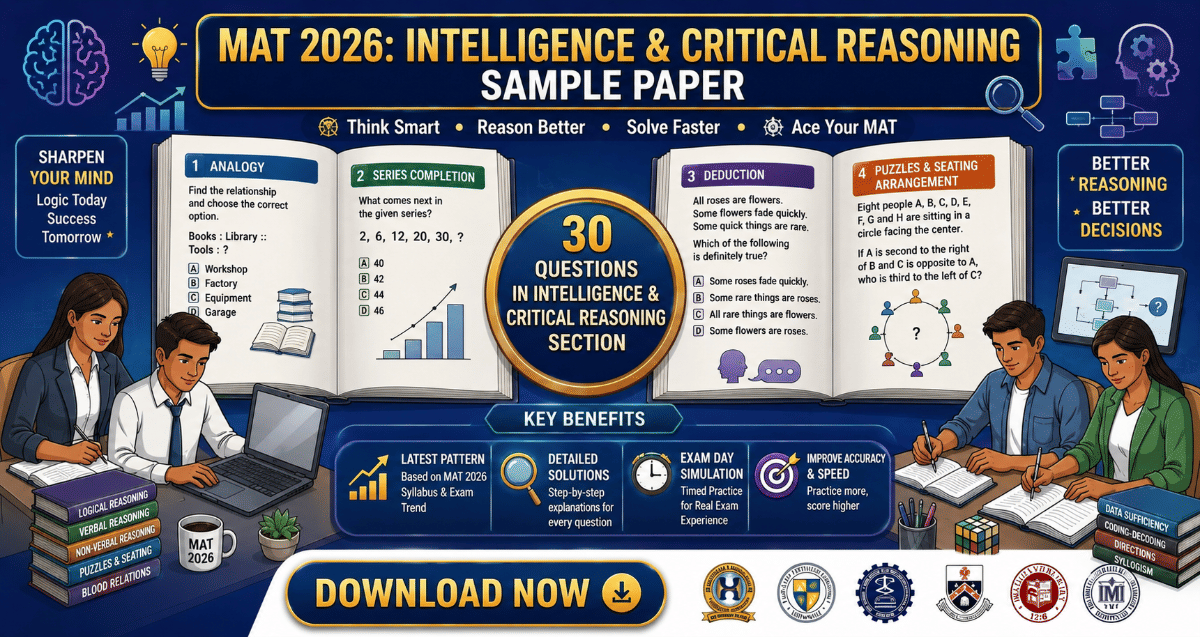
If you want to know what kind of thinking the Intelligence & Critical Reasoning section actually tests, these MAT 2026 sample papers are a good place to start.
- They cover everything this section asks for, including Verbal Reasoning, Analogy, Series Completion, Blood Relations, Coding-Decoding, Arrangements, Critical Reasoning, and Input-Output, and the questions are framed the way they have come in actual MAT sessions, following the AIMA syllabus.
- Students sitting for MAT 2026 can go through these Intelligence & Critical Reasoning sample papers to train their logical thinking, find out which reasoning types slow them down, and get used to working through multi-step problems without losing track under time pressure.
MAT Intelligence & Critical Reasoning Sample Paper 2026 PDF Download
| MAT Intelligence & Critical Reasoning Sample Paper | Direct Link |
|---|---|
| MAT Intelligence & Critical Reasoning Sample Paper 1 | Download PDF |
| MAT Intelligence & Critical Reasoning Sample Paper 2 | Download PDF |
| MAT Intelligence & Critical Reasoning Sample Paper 3 | Download PDF |
| MAT Intelligence & Critical Reasoning Sample Paper 4 | Download PDF |
| MAT Intelligence & Critical Reasoning Sample Paper 5 | Download PDF |
| MAT Intelligence & Critical Reasoning Sample Paper 6 | Download PDF |
| MAT Intelligence & Critical Reasoning Sample Paper 7 | Download PDF |
| MAT Intelligence & Critical Reasoning Sample Paper 8 | Download PDF |
| MAT Intelligence & Critical Reasoning Sample Paper 9 | Download PDF |
| MAT Intelligence & Critical Reasoning Sample Paper 10 | Download PDF |
| MAT Intelligence & Critical Reasoning Sample Paper 11 | Download PDF |
| MAT Intelligence & Critical Reasoning Sample Paper 12 | Download PDF |
| MAT Intelligence & Critical Reasoning Sample Paper 13 | Download PDF |
| MAT Intelligence & Critical Reasoning Sample Paper 14 | Download PDF |
| MAT Intelligence & Critical Reasoning Sample Paper 15 | Download PDF |
| MAT Intelligence & Critical Reasoning Sample Paper 16 | Download PDF |
| MAT Intelligence & Critical Reasoning Sample Paper 17 | Download PDF |
| MAT Intelligence & Critical Reasoning Sample Paper 18 | Download PDF |
| MAT Intelligence & Critical Reasoning Sample Paper 19 | Download PDF |
| MAT Intelligence & Critical Reasoning Sample Paper 20 | Download PDF |
Related Articles:
- MAT Intelligence & Critical Reasoning Syllabus: Topic-wise Breakdown
- MAT Data Analysis & Sufficiency Mock Tests with Solutions
- MAT Data Analysis & Sufficiency Previous Year Questions (PYQs)
Why Should You Solve MAT Intelligence & Critical Reasoning Sample Papers?
Several students enter MAT thinking this section will come naturally because they are good at logic in general. What they find is that exam-style reasoning questions work differently from everyday problem-solving. The questions follow specific formats, and unless you have practised those formats enough to recognise them quickly, even straightforward problems can eat up more time than they should.
Intelligence & Critical Reasoning is also the section where the difficulty gap between easy and hard questions is the widest. A few questions in each session are solvable in under 30 seconds, while others need two to three steps of careful elimination. Students who have not done enough timed practice end up spending equal time on both, which ruins the attempt count. Going through sample papers regularly is what teaches you to tell the two apart.
Here are some real benefits you get from solving MAT Intelligence & Critical Reasoning sample papers regularly:
- Better understanding of question pattern: MAT sessions in this section generally include Verbal Reasoning sets, Analogy and Series questions, Arrangement-based problems, Critical Reasoning passages, and standalone Logical Reasoning questions. Working through sample papers helps you recognise each format quickly, so no question type in the actual exam catches you off guard.
- Helps in time management: Arrangement and Input-Output questions are the ones that take the longest in this section. A seating arrangement with five or six conditions can run to 4 to 6 minutes if you try to solve it completely before looking at the questions. Sample paper practice trains you to set up the arrangement partially, use the questions to guide what you solve, and skip and return when a problem is clearly going to cost too much time.
- Identifies important chapters: A few papers in, you will notice that Verbal Reasoning, Analogies, and Critical Reasoning questions show up in nearly every MAT session. Blood Relations, Coding-Decoding, and Series Completion are consistent as well. Puzzles and Input-Output appear occasionally. That pattern tells you where to spend the most preparation time.
- Improves accuracy: Negative marking in this section is 0.25 per wrong answer, and the risk is specific to reasoning. Wrong answers here often come from solving too quickly and missing a condition, misreading a relationship in Blood Relations, or jumping to a conclusion in Critical Reasoning before reading all the options. Timed practice with sample papers builds the discipline of checking each condition before writing down an answer.
- Builds exam confidence: Students who are stronger in verbal or GK sections often find Intelligence & Critical Reasoning unpredictable because the question types vary so much within the same section. Solving 10 to 12 section-wise papers over the course of preparation removes that unpredictability. Students who have done that work walk into the exam knowing exactly how they will handle each question type rather than deciding on the spot.
MAT 2026 Intelligence & Critical Reasoning: Exam Pattern and Marking Scheme
The Intelligence & Critical Reasoning section in MAT 2026 has 30 MCQs, and every question carries the same marks. This is confirmed in the exam pattern AIMA has published, and the format holds for both the PBT on May 31 and the CBT on June 14.
| Detail | Specifics |
|---|---|
| Number of Questions | 30 |
| Marks per Question | 1 |
| Negative Marking | 0.25 per wrong answer |
| Total Marks | 30 |
| Sectional Time Limit | None (overall 120 minutes for all 5 sections) |
| Counts for Percentile | Yes |
There is no sectional timer in MAT, so you manage your own time across all five sections. A 20 to 25-minute window for this section is what most students find works in practice. Questions on Analogy, Series, and Coding-Decoding do not need much time if you have prepared them well, so knocking those out first frees up more time for Arrangement sets and Critical Reasoning passages that need closer reading and a few steps to solve.
MAT 2026 Intelligence & Critical Reasoning Sample Papers: Topic-wise Weightage
These sample papers are put together by studying what topics have shown up in previous MAT sessions and roughly how many questions each one gets. Verbal Reasoning and Critical Reasoning have consistently been the two biggest contributors in this section. Analogy, Series, and Coding-Decoding are not far behind and have appeared without fail across sessions.
Students should get Verbal Reasoning and Analogy questions right consistently before spending time on harder formats like Arrangements and Input-Output. Those two alone can give you a strong base score in this section. Once the fundamentals are solid, practising Arrangement sets under timed conditions is the next step since those questions have the highest potential for both big scores and big time losses.
| Unit | Topic | Avg Qs/year | % Weightage | Priority |
|---|---|---|---|---|
| 1 | Blood Relations / Family Tree | 6 | 20% | High |
| 2 | Statement-Cause/Effect & Course of Action | 5 | 17% | High |
| 3 | Syllogism / Statement-Conclusion | 4 | 13% | High |
| 4 | Arrangement / Puzzles | 4 | 13% | High |
| 5 | Coding-Decoding | 3 | 10% | Medium |
| 6 | Series (Number/Letter) | 3 | 10% | Medium |
| 7 | Analogy / Odd One Out | 2 | 7% | Medium |
| 8 | Direction Sense | 2 | 7% | Medium |
| 9 | Assertion-Reasoning | 1 | 3% | Low |
Based on the previous year's MAT session analysis.
FAQs
Ques. Are the MAT Intelligence & Critical Reasoning sample papers based on the latest syllabus?
Ans. Yes. These sample papers follow the AIMA syllabus and are built around what has actually appeared in previous MAT sessions. The core reasoning topics in this section have stayed consistent over the years. What changes slightly is the difficulty and framing of questions, and practising recent sample papers is the best way to stay in step with that.
Ques. Which topics carry the highest weightage in MAT Intelligence & Critical Reasoning?
Ans. Blood Relations / Family Tree & Statement-Cause/Effect & Course of Action together account for the largest share of questions across most MAT sessions. Analogy, Series Completion, and Coding-Decoding are also regular and together contribute a good chunk of the section. Arrangement sets appear in smaller numbers but tend to have multiple questions per set, so they carry more weight than the topic count suggests.
Ques. How many Intelligence & Critical Reasoning sample papers should I solve before MAT?
Ans. Working through 12 to 15 section-wise papers alongside full-length mocks is a solid target. What matters most is the review you do after each attempt. When a reasoning question goes wrong, go back and identify exactly which step broke down, whether it was a misread condition, a skipped option, or a wrong assumption. That specific correction is what stops the same mistake from repeating.
Ques. How should I handle Arrangement and Puzzle questions in MAT?
Ans. Do not try to complete the full arrangement before looking at the questions. Read all the conditions, set up a rough structure, and then use the questions to guide which parts you need to solve fully. Many arrangement questions in MAT can be answered from a partial solution. Also, if you have spent more than 4 minutes on a set and are still not close, mark what you can and move on. Coming back with fresh eyes is often faster than pushing through.
Ques. Do the MAT Intelligence & Critical Reasoning sample papers include solutions?
Ans. Yes, detailed solutions come with most papers. For this section, reading the solution method even on questions you got right is especially worth doing. Reasoning questions often have a faster elimination route that is not obvious the first time. Seeing how the solution breaks down each step can show you a cleaner approach that saves 30 to 60 seconds per question over a full paper, and that adds up.



Comments