




The GGSIPU has officially concluded the IPU CET 2026 from April 25 to May 23, 2026. The 9-day entrance exam covered 70-80 papers. The exam spanned multiple weekends, with tests conducted solely on Saturdays and Sundays across 9 dates– April 25, 26, May 2, 3, May 9, 10, May 16, 17, and May 23.
On April 25, 2026, IP University conducted its first exam of 2026 in the Morning & Evening shift exams for 7 courses, namely, M.A Mass Communication and B.Tech. Bio-Technology, Lateral Entry in BS Packaging, M.Sc. Medicinal Chemistry & Drug Design, MCA, B.A Journalism & Mass Communication, & Advanced Diploma in Child Guidance & Counselling, which has been successfully concluded.
- Students who appeared for it reported the overall difficulty of each subject to be moderate.
Similarly, on April 26, 2026, IP University conducted the Morning & Evening shift exam for 6 courses, namely, MOT Neurology, M.A English, BHMCT, B.Sc Packaging Technology, B.Sc Yoga & M.Sc Informatics, which has also been successfully concluded.
- Students who appeared for the exam said that the paper was moderate to tough.
On May 2, IP University conducted the Morning & Evening shift exam for 12 courses, namely, Master of P
rosthetics and Orthotics, M. Tech. CET (Electronics & Communication Engineering) (Regular) and (VLSI Design) (Regular), M. Tech. (Biotechnology) (Regular), M. Tech. (Chemical Engineering) (Regular), Master of Arts (Economics), Master of Science (Yoga), Master of Design (CET), M. Ed Special Education, Lateral Entry to B. Design, Master of Physiotherapy (MPT), Lateral Entry to B. Tech. Programmes for Diploma holders, & Bachelor of Design (through CET), which have been concluded successfully.
- Students who appeared for the exam rated the difficulty level as moderate to tough due to technical complexity.
Similarly, on May 3, 2026, IP University conducted the Morning & Evening shift exam for 6 courses, namely, M.Tech. CET (Computer Science & Engineering) (Regular) and (Information Technology) (Regular), PG Diploma in Bioinformatics, BA in Liberal Arts (Hons./Hons. with Research) major in History, Sociology & Pol Sc, Psychology,) which has also been successfully concluded.
- Students who appeared for the exam reported that the questions were considered moderate, with core technical sections being the most challenging.
On May 9, 2026, IP University conducted the exam for 4 subjects in the Morning and evening shifts, namely, BBA & Allied Programmes, MBA (CET), Bachelor of Science Hons (Nursing), and Bachelor of Commerce (Hons.)
- Students who appeared for the exam said that the questions were moderate to tough. It was not easy to solve without the knowledge of ug-level topics.
Similarly, on May 10, 2026, the IP University conducted exams for 4 subjects, namely, BCA, BMS, B.Ed, & M.Sc Molecular Diagnostics.
- The questions can be categorised under the category of Moderate to Tough, as reported by the students who appeared for the exam.
On May 16, IP University conducted the Morning & Evening shift exam for 8 courses, namely, LE to B.Tech Programmes for B.Sc Graduates, B. MRIT (Bachelor of Medical Radiology and Imaging Technology), M. Tech. (Robotics and AI) (Regular), B.Ed (Special Education), M.Sc (Microbiology), LE to B.Pharm, Bachelor to Radiation Therapy Technology (B.RTT)and B.A. Economics, which has been concluded successfully.
- Students who attended the exam reported it to be moderately tough. Most students found the paper conceptual and application-oriented. M.Tech (Robotics & AI) and LE to B.Tech were relatively tougher due to technical and numerical questions.
On May 17, IP University conducted exams in the morning and evening shift for 6 subjects, namely, M.Sc (Environment Management), Para-Med (BPO/BASLP/BMLS/BPT/BOT), M.Sc in Applied Geoinformatics, Master in Public Health (Field Epidemiology), Master of Education, & B.Sc (EVS).
- Students reported that questions were moderate and well-balanced. Most students found the questions syllabus-oriented and conceptual. While a few technical programs like M.Sc Applied Geoinformatics and Para-Medical were slightly challenging, the majority of students reported the paper as manageable and scoring if they had prepared well.
On May 23, IP University conducted its last exams of the IPU CET in the morning and evening shifts for 3 subjects, namely, B.Sc/M.Sc (Dual Degree) in Physics/Chemistry/Maths, LLB programme for 3 years and B.Pharma
- Students gave the feedback that the paper was overall moderate. Physics and Maths had some lengthy numericals, while Chemistry and Legal Aptitude were scoring. The evening shift exam, on the other hand, was moderate to tough. Chemistry and Biology were easy to moderate and student-friendly, but Physics numericals took time. Overall, a balanced paper; negative marking was the real challenge.
Check: IPU CET 2026 Syllabus and Sectional Weightage
IPU CET 2026 M.A. Mass Communication Paper Analysis
In this section, we discuss the M.A. Mass Communication paper from the IPU CET 2026.
| Sectional Composition | No. of Questions | Exam Analysis | Questions from Sections |
|---|---|---|---|
| Communication Skills (English) | 25 | Easy | Vocabulary (Synonyms/Antonyms), Grammar, Sentence Correction, and Reading Comprehension. |
| Current Affairs | 25 | Moderate | Recent news from 2025-2026, National & International events, Government schemes, and Sports. |
| General Knowledge | 20 | Moderate | Static GK covering Indian History, Constitution, and Socio-Economic issues. |
| Media Literacy & Awareness | 30 | Moderately Difficult | Media Theories, History of Press, Advertising & PR, Digital Media trends, and Media Personalities. |
IPU CET 2026 B.Tech (Biotechnology) Paper Analysis
| Sectional Composition | No. of Questions | Exam Analysis | Questions from Sections |
|---|---|---|---|
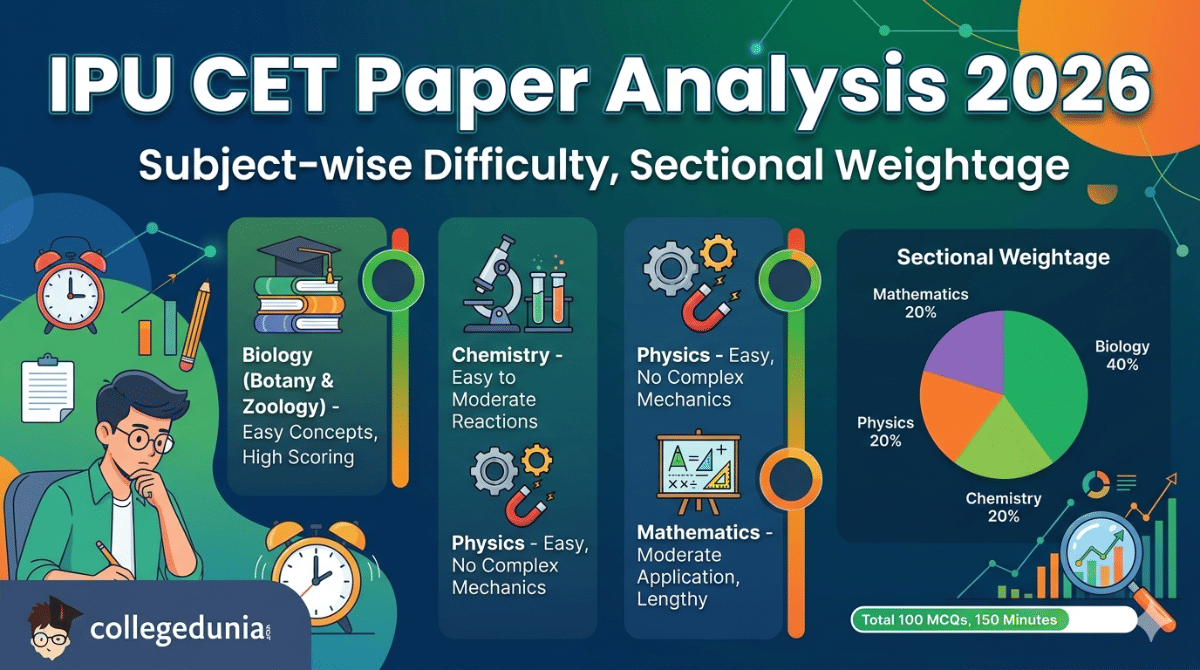
| Biology (Botany & Zoology) | 40 | Easy | Highly conceptual; covered school-level basics. Focus on Genetics, Cell Biology, and Biotechnology applications. |
| Chemistry | 20 | Easy to Moderate | Questions on General Organic Chemistry (GOC) and reactions like Reimer-Tiemann (intermediates). Less focus on complex specific reactions. |
| Physics | 20 | Easy | Mostly basic conceptual questions. Notably, there were no questions from Ray Optics, Mechanics, or Current Electricity. |
| Mathematics | 20 | Moderate | Standard application-based questions covering Algebra, Calculus basics, and Probability. |
IPU CET 2026 LE in BS Packaging Paper Analysis
Based on candidate feedback from the exam held on April 25, 2026, the Lateral Entry in BS Packaging paper was reported to be straightforward and well within the expected syllabus.
| Sectional Composition | No. of Questions | Exam Analysis | Questions from Sections |
|---|---|---|---|
| Applied Science (Physics/Chemistry) | 25 | Easy | Fundamental principles of Physics and Chemistry; basic properties of materials and chemical reactions. |
| Mathematics / Applied Mechanics | 25 | Moderate | Standard mathematical calculations, basic mechanics, and foundational engineering principles for packaging. |
| Packaging Fundamentals | 25 | Easy | Types of packaging materials (paper, plastic, glass), basic design concepts, and industry terminology. |
| General Awareness & Aptitude | 25 | Easy to Moderate | Basic logical reasoning, general industrial awareness, and technical aptitude. |
IPU CET 2026 MSc Medicinal Chemistry & Drug Design Paper Analysis
Based on candidate feedback from the exam conducted on April 25, 2026, this paper was reported as one of the most challenging sessions of the first weekend. Candidates can check the detailed sectional analysis in the table below:
| Sectional Composition | No. of Questions | Exam Analysis | Questions from Sections |
|---|---|---|---|
| Organic Chemistry | 40 | Difficult | Complex reaction mechanisms, name reactions, stereochemistry, and drug synthesis pathways. |
| Medicinal Chemistry | 30 | Difficult & Technical | Structure-Activity Relationship (SAR), drug-receptor interactions, and pharmacological classification of drugs. |
| Inorganic & Physical Chemistry | 20 | Moderate to Difficult | Coordination compounds, chemical kinetics, thermodynamics, and molecular spectroscopy. |
| General Science & Analytical Skills | 10 | Moderate | Analytical techniques (Chromatography, HPLC), basic Biochemistry, and logical reasoning. |
IPU CET 2026 MCA/MCA (SE) (CET)
The MCA and MCA (Software Engineering) entrance exam was conducted in the evening shift on April 25, 2026. Based on initial student feedback, the paper maintained a moderate difficulty level overall, though the Mathematics section proved to be the primary "rank-decider" due to its length.
| Sectional Composition | No. of Questions | Exam Analysis | Questions from Sections |
|---|---|---|---|
| Mathematics | 25 | Moderately Difficult | Algebra, Probability, Calculus, Vectors, and Coordinate Geometry. Calculations were reported as lengthy. |
| Computer Awareness | 25 | Easy to Moderate | Computer Basics, Data Representation, Binary Arithmetic, Operating Systems, and C/C++ programming fundamentals. |
| Logical & Analytical Ability | 25 | Easy | Blood Relations, Coding-Decoding, Series, Puzzles, and Seating Arrangements. Most students found this scoring. |
| English Language & Comprehension | 25 | Easy | Reading Comprehension, Synonyms/Antonyms, Idioms, and Basic Grammar (Sentence Correction). |
IPU CET 2026 B.A. Journalism & Mass Communication
The entrance exam for B.A. (JMC) was conducted in the evening shift on April 25, 2026. Students reported that the paper was generally moderate and focused heavily on real-world awareness rather than just theoretical concepts.
| Sectional Composition | No. of Questions | Exam Analysis | Questions from Sections |
|---|---|---|---|
| English Language & Comprehension | 25 | Easy | Reading Comprehension, Vocabulary, Sentence Completion, and Idioms. |
| General Awareness | 25 | Moderate | Current affairs (2025-26), Indian Constitution, Famous Personalities, and Awards. |
| Reasoning | 25 | Easy to Moderate | Number Series, Blood Relations, Syllogisms, and Critical Reasoning. |
| Media Literacy | 25 | Moderately Difficult | Advertising & PR, History of Radio/TV, Social Media trends, and Print Media terminology. |
IPU CET 2026 Advanced Diploma in Child Guidance and Counselling (ADCGC) Paper Analysis
The paper was tailored to test the psychological and pedagogical aptitude of candidates, with an overall difficulty level of moderate.
| Sectional Composition | No. of Questions | Exam Analysis | Questions from Sections |
|---|---|---|---|
| Child Development & Psychology | 40 | Moderately Difficult | Development stages, learning theories (Piaget, Vygotsky), behavioural issues, and adolescent psychology. |
| Guidance & Counselling | 30 | Moderate | Basic counselling techniques, the role of a counsellor, ethics in guidance, and group therapy concepts. |
| General Awareness & Social Issues | 15 | Easy to Moderate | Recent government policies on child rights (POCSO, NEP 2020), social welfare programs, and current affairs. |
| English Language & Aptitude | 15 | Easy | Basic grammar, comprehension related to social science topics, and logical reasoning. |
IPU CET 2026 Master of Occupational Therapy Paper Analysis
The entrance exam for the Master of Occupational Therapy (Neurology) (CET Code: 108) was conducted during the morning shift on April 26, 2026. The paper was designed to evaluate clinical expertise alongside general aptitude.
| Sectional Composition | No. of Questions | Exam Analysis | Questions from Sections |
|---|---|---|---|
| Occupational Therapy Specialisation | 50 | Moderately Difficult | Anatomy, Biomechanics, OT in Neurological Conditions, Mental Health, and Physical Dysfunction. |
| General Awareness | 20 | Easy to Moderate | Health-related current affairs, static GK, and basic science. |
| English Language & Comprehension | 15 | Easy | Vocabulary (Synonyms/Antonyms), Error Detection, and Reading Comprehension. |
| Reasoning & Aptitude | 15 | Moderate | Logical sequences, analytical reasoning, and basic mental ability. |
IPU CET 2026 M.A. English Paper Analysis
The paper was designed to test the literary depth and linguistic proficiency of the candidates, with an overall difficulty level of moderate to difficult.
| Sectional Composition | No. of Questions | Exam Analysis | Questions from Sections |
|---|---|---|---|
| Literature (British, American, Indian & Post-Colonial) | 50 | Moderately Difficult | Major movements, authors, works, and famous quotes from the Elizabethan era to the Post-Modern period. |
| Literary Criticism & Theory | 15 | Difficult | Key concepts from Structuralism, Post-structuralism, Marxism, and Feminism, including works of major theorists. |
| Language & Philology | 15 | Moderate | History of the English language, phonetics, and basic linguistic terms. |
| General Awareness & Reading Comprehension | 20 | Easy to Moderate | Unseen passages for critical analysis and general awareness of the literary world (awards, current literary news). |
IPU CET 2026 Bachelor of Hotel Management & Catering Technology Paper Analysis
The paper was designed to test the service aptitude and general proficiency of the candidates.
| Sectional Composition | No. of Questions | Exam Analysis | Questions from Sections |
|---|---|---|---|
| English Language & Comprehension | 25 | Easy | Synonyms, Antonyms, Fill in the blanks, Idioms & Phrases, and Reading Comprehension. |
| General Awareness | 25 | Moderate | Current events, basic Science, History, and specifically Indian Tourism and Hospitality news. |
| Logical & Analytical Ability | 25 | Moderate | Series, Coding-Decoding, Blood Relations, Syllogisms, and Data Interpretation. |
| Service Aptitude | 25 | Easy to Moderate | Hospitality industry awareness, etiquette, situational judgment, and customer service scenarios. |
IPU CET 2026 B.Sc Packaging Technology Paper Analysis
The paper was designed to evaluate the technical aptitude and fundamental science knowledge of the candidates, with an overall difficulty level of Easy to Moderate.
| Sectional Composition | No. of Questions | Exam Analysis | Questions from Sections |
|---|---|---|---|
| Applied Science (Physics & Chemistry) | 25 | Easy | Basic properties of matter, chemical bonding, polymers, and thermodynamics relevant to materials. |
| Mathematics | 25 | Moderate | Algebra, Mensuration (area and volume), basic Trigonometry, and Arithmetic Ability. |
| General Awareness & Aptitude | 25 | Easy to Moderate | Environmental awareness, current affairs in science, and logical reasoning (Series, Analogy). |
| Packaging Material & Industry Awareness | 25 | Easy | Basics of paper, plastic, and glass; common packaging symbols, and general industrial knowledge. |
IPU CET 2026 B.Sc Yoga Paper Analysis
The paper was designed to evaluate the candidate's basic scientific knowledge and their specific aptitude for Yoga and health sciences.
| Sectional Composition | No. of Questions | Exam Analysis | Questions from Sections |
|---|---|---|---|
| Human Biology (Anatomy & Physiology) | 25 | Moderate | Skeletal system, muscular system, respiratory system, and basic human biology relevant to Yoga postures. |
| Yoga Awareness | 25 | Easy to Moderate | History of Yoga, famous Yogis, basic Asanas, Pranayama techniques, and common Yoga terminologies. |
| General Awareness | 25 | Easy | Current affairs (2025-26), Sports, Health awards, and general knowledge of Indian heritage. |
| English Language & Comprehension | 25 | Easy | Reading comprehension, basic grammar (Nouns, Verbs, and adjectives), and vocabulary. |
IPU CET M.Sc Bioinformatics Paper Analysis
This paper is known for its interdisciplinary nature, and this year’s version was reported by students as being tough, primarily due to the high weightage of computational logic and molecular biology.
- Students found the Mathematics and Coding-logic questions to be the most challenging part of the paper.
- It required not just biological knowledge but also analytical skills to solve algorithmic problems.
- There was a heavy emphasis on Molecular Biology and Computational Algorithms.
- Many questions centered on how biological data is analyzed and stored in sequence databases.
| Sectional Composition | No. of Questions | Exam Analysis | Questions from Sections |
|---|---|---|---|
| Life Sciences (Biology/Biotech) | 40 | Moderate | Molecular Biology, Biochemistry, Genetics, Microbiology, and Genomics/Proteomics fundamentals. |
| Bioinformatics & Coding Logic | 30 | Difficult | Sequence alignment algorithms, Database search tools (BLAST), Scoring matrices, and C++/Python logic. |
| Chemistry | 15 | Moderate | Organic Chemistry, Biomolecules, and basic Physical Chemistry relevant to drug design. |
| Mathematics & Statistics | 15 | Difficult | Probability, Statistics (Hypothesis testing), Calculus, and Discrete Mathematics. |
IPU CET 2026 Master of Prosthetic and Orthotics
The paper was designed to evaluate the candidate’s foundational knowledge in human anatomy and biomechanics, along with specific aptitude for Prosthetics, Orthotics, and rehabilitation sciences.
| Sectional Composition | No. of Questions | Exam Analysis | Questions from Sections |
|---|---|---|---|
| Anatomy & Physiology | 25 | Moderate | Bones of upper & lower limbs, types of joints, muscle groups involved in gait, effects of amputation on physiology, nervous system basics, and cardiovascular-respiratory response to prosthetic use. |
| Biomechanics & Applied Mechanics | 25 | Moderate to Difficult | Gait cycle phases, ground reaction forces, moment arms, lever systems in orthoses, material stress-strain curves, and centre of gravity shifts in amputees. |
| Prosthetiics & Orthotics | 30 | Moderate | Types of prostheses (upper/lower limb), orthotic devices (KAFO, AFO, etc.), fabrication techniques, gait analysis, and common clinical applications. |
| General Awareness & Rehabilitation Sciences | 20 | Easy to Moderate | Principles of physiotherapy, common assistive devices, the Rights of Persons with Disabilities Act, recent advancements in 3D-printed prosthetics, and important rehabilitation schemes in India. |
IPU CET 2026 M.Tech (ECE & VLSI Design) (Regular)
The paper was designed to evaluate the candidate’s undergraduate-level knowledge in Electronics & Communication Engineering, with emphasis on core concepts relevant to VLSI Design and modern communication systems.
| Sectional Composition | No. of Questions | Exam Analysis | Questions from Sections |
|---|---|---|---|
| Electronics Devices & Circuits | 25 | Moderate to Difficult | BJT & FET biasing, small signal analysis, CMOS inverters, power amplifiers, and frequency response. |
| Digital Electronics & VLSI | 30 | Moderate | K-maps, flip–flops, FSM, VHDL basics, Moore & Mealy machines, stick diagrams, and scaling in VLSI. |
| Analogue & Digital Communication | 20 | Moderate | AM/FM modulation, ASK/PSK/FSK, error control coding, SNY, and satellite & optical communication basics. |
| Engineering & Mathematics & GA | 25 | Easy to Moderate | Laplace & Z-transforms, Fourier series, random variables, control systems stability, and recent tech developments in semiconductors. |
IPU CET Sectional Weightage of Different Programs
The table tabulated below shows the sectional weightage of various other programs offered by IPU:
| Course | Sectional Weightage |
|---|---|
| BBA | English Language & Comprehension (30%) |
| General Awareness (10%) | |
| Logical & Analytical Ability (25%) | |
| Aptitude relating to the Field of Management and Communication Skills (25%) | |
| MBA | English Language & Comprehension (25%) |
| Logical & Analytical Ability (25%) | |
| General Awareness (25%) | |
| Reasoning Ability, including DI (30%) | |
| BCA | Mathematics (30%) |
| English Language & Comprehension (15%) | |
| GK- IT & Science Related (25%) | |
| Computer Awareness (30%) | |
| MCA | Mathematics (25%) |
| Computer Awareness (25%) | |
| English Language & Comprehension (25%) | |
| Logical & Analytical Ability (25%) | |
| LLB | GK (25%) |
| English Language & Comprehension (25%) | |
| Reasoning (25%) | |
| Legal Aptitude: General Legal Awareness & Understanding and Application of Legal Principles (25%) | |
| LLM | General Knowledge, including the English Language (20%) |
| Public International Law, Human Rights Law & Environment Law (30%) | |
| Current Trends in Law (20%) | |
| Jurisprudence, Law of Torts, Criminal Law, Constitutional Law, Commercial Law & Family Law (30%) | |
| B.Ed (The Question Paper shall be set both in English & Hindi) | Mental Ability & Reasoning (40%) |
| Aptitude for Reasoning (20%) | |
| English Comprehension (15%) | |
| General Awareness (25%) | |
| M.Ed | English/Communication Skills (30%) |
| GA & Logical Reasoning (30%) | |
| Teaching Aptitude (40%) | |
| B.Com | Logical Reasoning (25%) |
| GA (15%) | |
| General English (25%) | |
| DI (35%) | |
| B.Sc Nursing | Chemistry (20%) |
| Physics (20%) | |
| Biology (40%) | |
| GA about Health Matters (10%) | |
| English Language & Comprehension (10%) |
FAQs
Ques: What is the difficulty level of the IPU CET BBA examination?
Ans. As per the test takers of the previous year, the exam was of a moderate difficulty level. Candidates have rated the language section easy in comparison to GA or other sections.
Ques: What type of questions are asked in the IPU CET LLB and LLM papers?
Ans: IPU CET Law examination has been dissolved, and now the admission will be granted based on CLAT scores.
Ques: What is the weightage of sections in the IPU CET B.Sc Yoga Paper?
Ans. The weightage of sections in the IPU CET BSc Yoga paper is as follows:
- Yoga Philosophy (25%)
- Human Anatomy & Physiology (25%)
- General English (25%)
- Reasoning Ability (25%)
Ques: What are the maximum marks of IPU CET 2026?
Ans: The maximum marks for the IPU CET 2026 examination are 400. Also, the exam pattern could vary from program to program for which a candidate is planning to appear.
Ques: Will there be any negative marking in IPU CET 2026?
Ans: Yes, one mark will be deducted for every incorrect answer according to the exam pattern of IPU CET 2026. For each correct answer, you will be given +4 marks.
Ques. Do questions repeat in IPU CET? How important are previous year papers?
Ans. Yes, many students report that a good number of questions (or similar concepts) repeat from previous years. Solving the last 5-10 years' question papers is highly recommended for pattern familiarity and time management.
Ques. How should I prepare for IPU CET 2026 in the last few days or weeks?
Ans. Focus on revising NCERT concepts, practicing mock tests daily, and solving previous year papers. For courses like BCA, strengthen aptitude and basic computer knowledge (no deep coding). Make short notes for formulas, current affairs (for GK sections), and vocabulary. Avoid new topics close to the exam—prioritize accuracy over attempting everything.



Comments