




The IGNOU B.Ed Entrance Test 2027 is the only admission route into Indira Gandhi National Open University's two year Bachelor of Education programme offered in ODL mode. IGNOU holds this exam every year through its School of Education in the month of January. The IGNOU B.Ed Entrance Test 2027 notification is expected in January 2027 on the official portal ignou-bed.samarth.edu.in .
- The IGNOU B.Ed Exam Pattern 2027 is offline in OMR mode with 100 MCQs worth 100 marks to be answered in 2 hours.
- The IGNOU B.Ed Entrance Exam 2027 is expected in the last week of March 2027 as the 2026 paper was held on 29 March 2026.
- IGNOU B.Ed Entrance Test 2027 eligibility needs 50% marks in a Bachelor's or Master's degree while B.E./B.Tech holders need 55%.
- IGNOU B.Ed Registration 2027 will carry a ₹1,000 fee for all 6 categories which is payable online at the time of final submission.
- The IGNOU B.Ed Syllabus 2027 is split into Part A with 4 compulsory sections worth 80 marks and Part B with 5 subject options worth 20 marks.
- IGNOU B.Ed Entrance Exam Cutoff is expected between 77-88 marks for General candidates and 70-78 marks for OBC and EWS.
- IGNOU B.Ed Admission 2027 allocates only 50 seats at each Programme Study Centre with selection running on region-wise merit lists.
- The IGNOU B.Ed 2027 Programme Fee is expected to be between ₹55,000-₹60,000 for the complete 2 year course.
Related Articles:
- IGNOU B.Ed Application Form: Apply Link, Last Date, Fees, Documents Required
- IGNOU BEd Entrance Syllabus 2027: Section-wise Topics, Chapter-Wise Weightage and Preparation Tips
- IGNOU BEd Exam Pattern 2027: Section-wise Pattern, Syllabus, Marking Scheme, Total Marks and Preparation Tips
Key Summary
- IGNOU B.Ed Entrance Test 2027 applicants must also be trained in-service elementary teachers or hold an NCTE-recognised face-to-face teaching qualification.
- Each correct answer adds +1 mark with no negative marking and the IGNOU B.Ed question paper is printed in both English and Hindi.
- SC, ST, OBC-NCL and PwD candidates get a 5% relaxation which drops the requirement to 45% and there is no upper age limit.
- The IGNOU B.Ed Result 2027 is expected in June 2027 which is nearly 2 to 2.5 months after the exam with the objection window open for just 5 to 7 days.
- IGNOU B.Ed Counselling 2027 runs offline at Regional Centres on weekends with no TA or DA paid and admission provisional till verification.
IGNOU B.Ed Entrance Test 2027 Highlights
Indira Gandhi National Open University conducts IGNOU B.Ed Entrance Test once each year through its School of Education. IGNOU B.Ed Entrance Test 2027 will have 50 seats at each Programme Study Centre with admission based on region-wise merit lists.
| Particulars | Details |
|---|---|
| Exam Name | IGNOU B.Ed Entrance Test / Exam |
| Conducting Body | Indira Gandhi National Open University (IGNOU) |
| Exam Level | National |
| Exam Frequency | Once a year |
| Application Form | January 2027 (Tentative) |
| Exam Date | March 2027 (Tentative; often last week of March) |
| Admit Card | March 2027 (Tentative) |
| Result | April 2027 (Tentative) |
| Mode of Exam | Offline (Pen & Paper) |
| Duration | 2 hours |
| Total Questions | 100 (MCQs) |
| Total Marks | 100 |
| Marking Scheme | +1 for each correct answer; No negative marking |
| Medium | English and Hindi |
| Exam Pattern |
|
| Eligibility | Bachelor’s or Master’s degree with at least 50% marks (45% for SC/ST/OBC-NCL/PwD) in Sciences / Social Sciences / Commerce / HumanitiesOR Bachelor’s in Engineering/Technology with specialization in Science & Mathematics with 55% marks+ Trained in-service elementary teachers or NCTE-recognized teacher education programme (face-to-face mode) |
| Age Limit | No upper age limit |
| Application Fee | Approx. ₹1,000 (all categories) |
| Programme Duration | Minimum 2 years; Maximum 5 years |
| Programme Fee | Approx. ₹55,000 – ₹60,000 (entire programme) |
| Official Website | ignou.ac.in / ignou-bed.samarth.edu.in |
Ques. How many B.Ed seats are in IGNOU?
Ans. IGNOU B.Ed has 50 seats per Programme Study Centre (PSC). The total number of seats varies by the number of active study centres and their approved intake.
IGNOU B.Ed Entrance Test 2027 Important Dates
The IGNOU B.Ed Entrance Test 2027 dates may follow recent trends with the 2025 and 2026 exams showing a 2–2.5 month gap between exams and results.
- The 2026 IGNOU B.Ed application window was extended from February 27 to March 10 which indicates that similar deadline changes could occur in 2027.
| Event | 2025 | 2026 | 2027 (Expected) |
|---|---|---|---|
| Notification / Application Start | 22 January 2025 | 29 January 2026 | January 2027 |
| Last Date to Apply | 21 February 2025 | 10 March 2026 (extended) | February / Early March 2027 |
| Admit Card Release | 13 March 2025 | 23 March 2026 | March 2027 |
| Entrance Exam Date | 16 March 2025 | 29 March 2026 | Last week of March 2027 |
| Answer Key | Late March 2025 | 20 April 2026 | April 2027 |
| Result Declaration | 16–17 June 2025 | 1 June 2026 | Early–Mid June 2027 |
| Counselling / Admission | June–July 2025 | June–July 2026 | June–July 2027 |
Ques. How many times is IGNOU B.Ed entrance held in a year?
Ans. The IGNOU B.Ed Entrance Test is generally conducted once a year for admission to the January session. For 2026, the entrance test was held on March 29, 2026.
IGNOU B.Ed Entrance Test 2027 Eligibility Criteria
Under the IGNOU B.Ed Entrance Test 2027 eligibility criteria, final year candidates cannot apply if their results are not declared.
- OBC-NCL candidates must submit a recent income certificate showing family income below ₹8 lakh, with only the Central OBC list accepted.
| Criteria | Details |
|---|---|
| Educational Qualification | At least 50% marks either in the Bachelor’s Degree and/or in the Master’s Degree in Sciences / Social Sciences / Commerce / Humanities |
| Engineering / Technology | Bachelor’s in Engineering or Technology with specialization in Science and Mathematics with 55% marks (or any other qualification equivalent thereto) |
| Professional Requirement | Candidates must belong to one of the following categories:• Trained in-service teachers in elementary education• Candidates who have completed a NCTE-recognised teacher education programme through face-to-face mode |
| Relaxation | 5% relaxation in minimum eligibility marks for SC / ST / OBC (Non-Creamy Layer) / PwD candidates (as per Central Government rules) |
| Age Limit | No age bar |
| Result Requirement | Only candidates whose results are declared and who fulfil the eligibility at the time of submitting the entrance form are eligible |
| Reservation | As per Central Government rules (including EWS). Special provisions for Kashmiri Migrants and War Widows as per University rules |
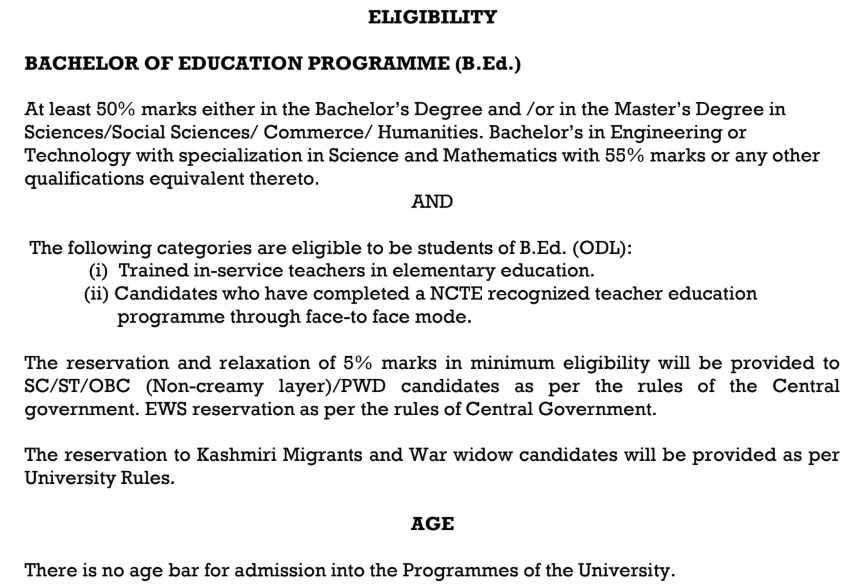
Source: Official IGNOU B.Ed Entrance Test
Ques. Who is eligible for B.Ed. from IGNOU?
Ans. Candidates with at least 50% marks in a Bachelor's or Master's degree in Sciences, Social Sciences, Commerce or Humanities can apply for IGNOU B.Ed. Certain teacher education qualifications and eligibility conditions also apply.
According to a Quora discussion, IGNOU B.Ed admission requires an entrance exam, which is conducted at the all-India level. The discussion highlighted that graduates and postgraduates in Science, Social Science, Commerce, or Humanities can apply, with the B.Ed programme offered through online distance learning.
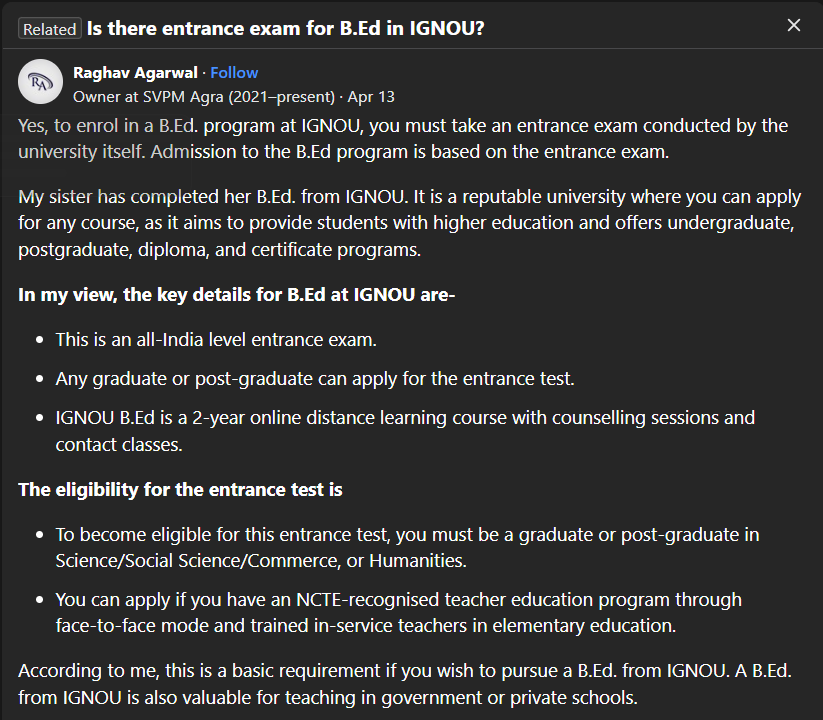
Source: Quora
IGNOU B.Ed Entrance Test 2027: Registration Process and Fee
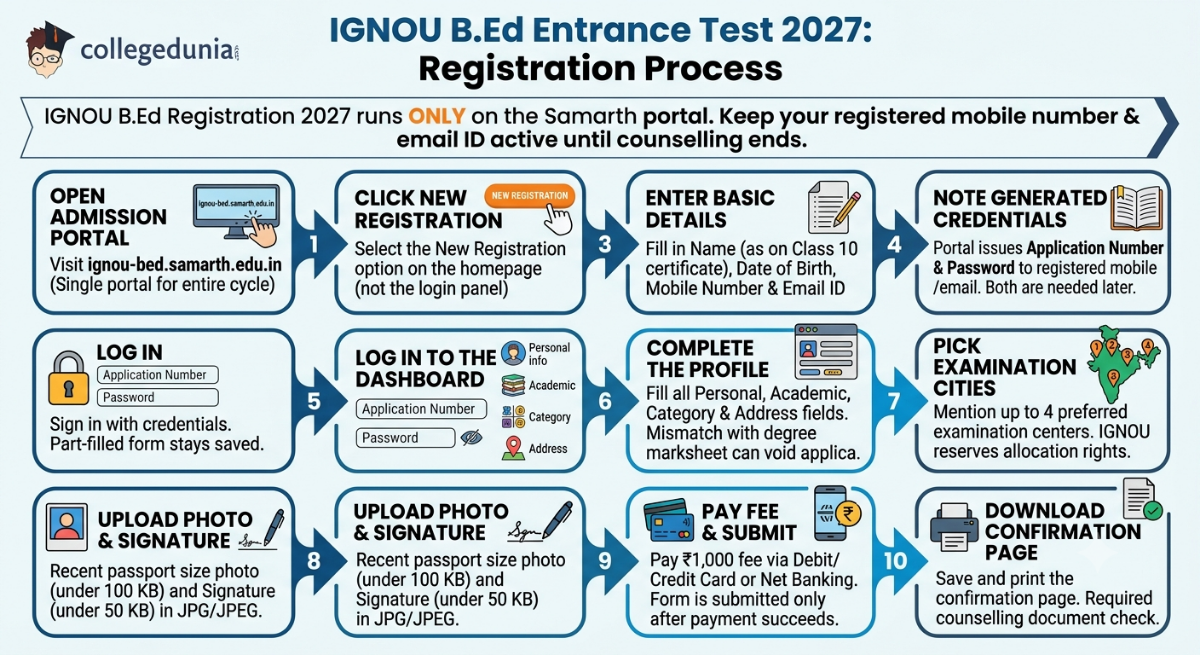
IGNOU B.Ed Registration 2027 runs only on the Samarth portal and the mobile number and email ID entered at signup must stay active until counselling ends.
- Step 1: Open the Admission Portal:
Candidates need to visit ignou-bed.samarth.edu.in, the single portal IGNOU uses for the entire admission cycle.
- Step 2: Click New Registration:
Candidates must select the New Registration option on the homepage instead of the login panel meant for returning users.
- Step 3: Enter the Basic Details:
The candidates will be required to fill in their name as mentioned on their Class 10 certificate, date of birth, mobile number and email ID.
- Step 4: Note the Generated Credentials:
The portal issues an Application Number and password to the registered mobile and email and both are needed at every later stage.
- Step 5: Log In to the Dashboard:
Candidates should sign in with the Application Number and password to open the dashboard where a part filled form stays saved between sessions.
- Step 6: Complete the Profile:
Personal, academic, category and address fields all need filling here and any mismatch with the degree marksheet can void the application later.
- Step 7: Pick the Examination Cities:
The candidate can mention up to 4 examination centers as per his/her choice though IGNOU reserves the right to allocate an examination center without providing any reason.
- Step 8: Upload Photograph and Signature:
A recent passport size photograph under 100 KB and a signature under 50 KB have to go up in JPG or JPEG format.
- Step 9: Pay the Fee and Submit:
The ₹1,000 fee clears through debit card, credit card or net banking and the form is treated as submitted only after payment succeeds.
- Step 10: Download the Confirmation Page:
Candidates must save and print the confirmation page since the counselling document check asks for it alongside the scorecard.
IGNOU B.Ed Entrance Test 2027: Registration Fee
The IGNOU B.Ed Entrance Test 2027 registration fee is fixed at ₹1,000 for all 6 categories, while a late fee may apply whenever the deadline is extended.
| Particulars | Details |
|---|---|
| Registration / Application Fee | ₹1,000 |
| Applicable Categories | All categories (General, OBC, SC, ST, EWS, PwD) |
| Payment Mode | Online only (Debit Card / Credit Card / Net Banking / UPI) |
| Refund Policy | Non-refundable |
| Late Fee (if any) | May be applicable if deadline is extended (as per previous years) |
| When to Pay | At the time of final submission of the online registration form |

IGNOU B.Ed Entrance Test 2027 Exam Pattern
Teaching-Learning & the School and Educational & General Awareness carry 50 marks together in the IGNOU B.Ed Entrance Test 2027.
- In the IGNOU B.Ed exam pattern 2027, there is no negative marking scheme so all 100 questions can be attempted by candidates without losing marks for wrong answers.
- Part B carries 20 marks with candidates choosing one subject from Science, Mathematics, Social Science, English or Hindi.
- The IGNOU B.Ed entrance exam is bilingual in English and Hindi with a 2 hour offline OMR based test format.
| Part | Section / Subject | No. of Questions | Marks |
|---|---|---|---|
| Part A | General English Comprehension | 10 | 10 |
| Logical & Analytical Reasoning | 20 | 20 | |
| Educational & General Awareness | 25 | 25 | |
| Teaching-Learning & the School | 25 | 25 | |
| Part B | Subject Competence (Choose any one) Options: Science / Mathematics / Social Science / English / Hindi | 20 | 20 |
| Total | 100 | 100 |
You can watch the YouTube video "IGNOU B.Ed Exam Pattern & Marking Distribution I Ignou B.Ed Entrance Exam Negative Marking" by English Stadium to understand the IGNOU B.Ed Exam Pattern 2027 in detail. The video covers the 100-mark structure, section-wise marks distribution across Part A and Part B, the 120-minute duration and the no negative marking rule.
IGNOU B.Ed Entrance Test 2027 Syllabus
The IGNOU B.Ed Syllabus 2027 is divided into 4 compulsory sections under Part A and 5 optional subjects under Part B. Educational & General Awareness and Teaching-Learning & the School are the largest sections with 25 questions each in the IGNOU B.Ed Part A Syllabus.
IGNOU B.Ed Entrance Test 2027: Part A Syllabus
Part A is compulsory for all candidates and carries 80 marks through 80 questions in the IGNOU B.Ed Entrance Test 2027.
- The IGNOU B.Ed Part A syllabus covers general aptitude, language skills, reasoning, awareness and teaching-related concepts.
| Section | Topics Covered |
|---|---|
| General English Comprehension | Basic Grammar, Reading Comprehension, Idioms & Phrases, Synonyms & Antonyms, Sentence Improvement, Pair of Words |
| Logical & Analytical Reasoning | Number Series, Letter Series, Coding-Decoding, Analogy, Classification, Blood Relations, Calendar, Syllogism, Direction & Distance, Ranking, Decision Making, Logical Diagrams, Cubes & Dice |
| Educational & General Awareness | History, Geography, Political Science, Social Science, Current Affairs, National Events, Developments in Education, World Organizations, Persons/Places/Awards, Sports |
| Teaching-Learning & the School | Fundamentals & Principles of Education, Learning & Pedagogy, Child-Centred & Progressive Education, Development of Teacher Education in India, Inclusive Education & Teaching Ability, Aptitude & Development of Students, Responsibilities towards Society, Experiments related to School & New Findings |
IGNOU B.Ed Entrance Test 2027: Part B Syllabus
Candidates can choose one subject from the given options usually based on school level or Class 6–10 curriculum knowledge in the IGNOU B.Ed Part B Syllabus.
- The IGNOU B.Ed Part B syllabus is best matched with the candidate’s graduation or academic background for stronger scoring.
| Subject (Choose Any One) | Key Topics Covered |
|---|---|
| Science | Physics, Chemistry, Biology |
| Mathematics | Arithmetic, Number System, Simplification, Algebra, Geometry, Trigonometry |
| Social Science | History, Geography, Economics, Political Science, Social Science, Current Affairs |
| English | Reading Ability, Grammar, Word Usage, English Literature |
| Hindi | Reading Ability, Grammar, Word Usage, Hindi Literature |
Also Check:
- IGNOU BEd Entrance Syllabus 2027: Section-wise Topics, Chapter-Wise Weightage and Preparation Tips
- IGNOU BEd Exam Pattern 2027: Section-wise Pattern, Syllabus, Marking Scheme, Total Marks and Preparation
IGNOU B.Ed Entrance Question Papers PDF
| Year | Question Paper Link |
|---|---|
| 2025 | Check Here |
| 2024 | Check Here |
| 2023 | Check Here |
| 2019 | Check Here |
| 2017 | Check Here |
| 2012 | Check Here |
| 2011 | Check Here |
IGNOU B.Ed Admit Card 2027
The IGNOU B.Ed Admit Card 2027 is expected in the March 2027 as the 2026 hall ticket was released on 23 March which is 6 days before the exam.
- Every IGNOU B.Ed Hall Ticket 2027 carries the exam centre code, reporting time and 2 hour exam slot and none of which can be changed on request.
How to Download IGNOU B.Ed Admit Card 2027?
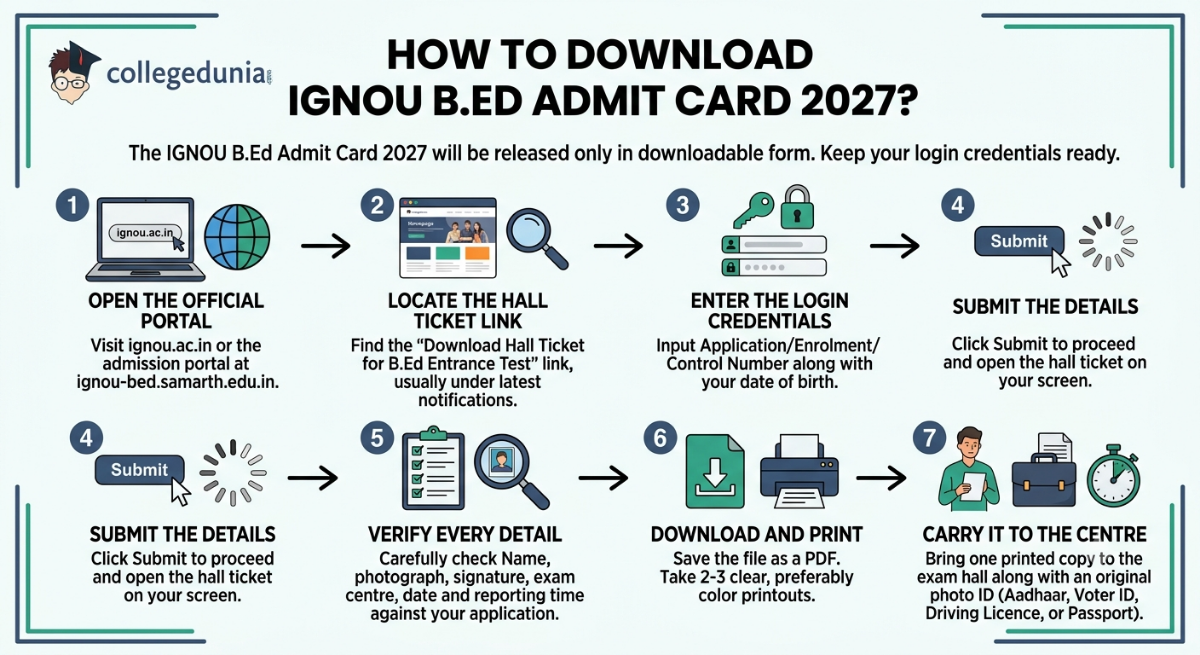
The IGNOU B.Ed Admit Card 2027 will be released only in downloadable form and candidates need their login credentials ready before the link opens.
- Step 1: Open the Official Portal :
Candidates need to visit ignou.ac.in or the dedicated admission portal at ignou-bed.samarth.edu.in.
- Step 2: Locate the Hall Ticket Link :
The homepage carries a Download Hall Ticket link for the B.Ed Entrance Test usually posted under the latest notifications.
- Step 3: Enter the Login Credentials :
Candidates must enter the Application, Enrolment or Control Number along with their date of birth to reach the download page.
- Step 4: Submit the Details :
Candidates should click Submit to open the hall ticket on screen.
- Step 5: Verify Every Detail :
Name, photograph, signature, exam centre, date and reporting time all need checking against the application before download.
- Step 6: Download and Print :
Candidates have to save the PDF and take 2 to 3 clear printouts, preferably in colour.
- Step 7: Carry It to the Centre :
One printed copy must reach the exam hall along with an original photo ID such as Aadhaar, Voter ID, Driving Licence or Passport.
Details Mentioned on IGNOU B.Ed Admit Card 2027
Candidates should check the IGNOU B.Ed Admit Card 2027 after downloading and report any discrepancy to IGNOU immediately.
- Candidates must carry a printed IGNOU B.Ed admit card and a valid original photo ID such as Aadhaar, Passport, Voter ID or Driving Licence.
| Category | Details Mentioned |
|---|---|
| Personal Details |
|
| Application / Roll Details |
|
| Exam Details |
|
| Centre Details |
|
| Other Information |
|
Also Check:
- IGNOU B.Ed Admit Card: Release Date, Download Link, Steps to Download Hall Ticket & Exam Day Guidelines
- IGNOU BEd Scorecard and Rank Card: How to Download
Ques. How to download IGNOU B.Ed. admit card?
Ans. Candidates can download the IGNOU B.Ed Entrance Test admit card by visiting the official IGNOU website and using the B.Ed entrance portal link. They need to log in with their registered details and download or print the hall ticket.
IGNOU B.Ed Entrance Test 2027 Exam Day Rules
Candidates must follow the IGNOU B.Ed Entrance Test 2027 exam day rules as violations may lead to disqualification.
- The instructions printed on the IGNOU B.Ed admit card should be followed for the latest exam day guidelines.
| Category | Rules / Guidelines |
|---|---|
| Reporting & Entry |
|
| Mandatory Documents |
|
| Prohibited Items |
|
| Inside the Exam Hall |
|
| General Conduct |
|
Ques. Will B.Ed. be of 1 year from 2027?
Ans. No, the IGNOU B.Ed programme continues as a two-year programme. Candidates should follow the programme duration specified in the latest IGNOU admission information rather than assuming that B.Ed has become a one-year course.
IGNOU B.Ed Answer Key 2027
The IGNOU B.Ed Answer Key 2027 is expected in April 2027 which is around 3 weeks after the entrance exam and will first appear in provisional form.
- The IGNOU B.Ed Provisional Answer Key 2027 will carry the correct option for all 100 questions covering Part A and the chosen Part B subject.
How to Use the IGNOU B.Ed Answer Key to Calculate Your Score?
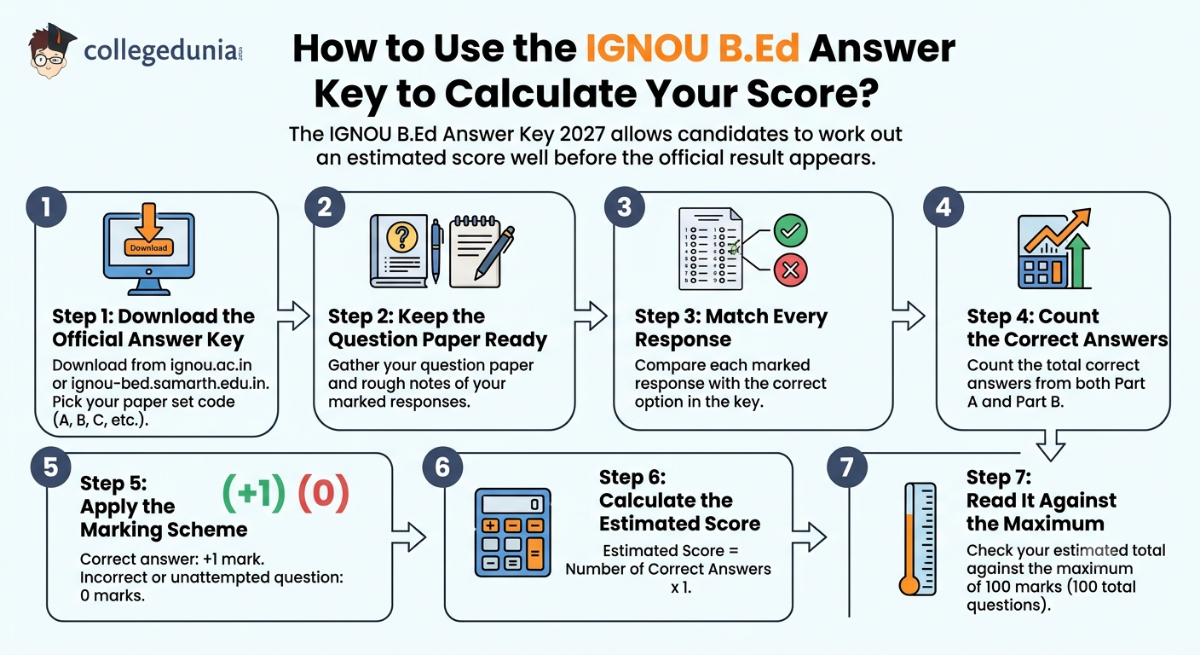
The IGNOU B.Ed Answer Key 2027 allows candidates to work out an estimated score well before the official result appears.
- Step 1: Download the Official Answer Key :
Candidates need to download the official answer key from ignou.ac.in or ignou-bed.samarth.edu.in and pick the paper set code they appeared for.
- Step 2: Keep the Question Paper Ready :
The question paper and any rough notes of marked responses should be kept ready before the comparison starts.
- Step 3: Match Every Response :
Candidates must match every marked response against the correct option printed in the answer key.
- Step 4: Count the Correct Answers :
Candidates have to count the total number of correct answers across both Part A and Part B.
- Step 5: Apply the Marking Scheme :
A correct answer adds +1 mark while an incorrect or unattempted question fetches 0 under the official marking scheme.
- Step 6: Calculate the Estimated Score :
The estimated score works out to the number of correct answers multiplied by 1.
- Step 7: Read It Against the Maximum :
Candidates should read the result against a maximum of 100 marks since the paper carries 100 questions in all.
How to Challenge the IGNOU B.Ed Provisional Answer Key 2027
Candidates can raise objections against the IGNOU B.Ed Provisional Answer Key 2027 if they find an error during the limited challenge window.
- The IGNOU B.Ed answer key objection window usually remains open for around 5–7 days and the challenge process is conducted online.
- The objection fee is refundable only when the expert committee accepts the challenge.
- Objections without supporting documents or payment will not be considered during the IGNOU B.Ed answer key challenge process.
- After reviewing valid challenges, IGNOU releases the Final Answer Key which is used to prepare the final result.
- IGNOU usually does not send individual communication about whether an objection has been accepted or rejected.
| Steps | Description |
|---|---|
| Step 1 | Visit the official website: ignou.ac.in or ignou-bed.samarth.edu.in |
| Step 2 | Log in using Application / Control / Enrolment Number and Date of Birth |
| Step 3 | Click on the link for “Challenge Answer Key” / “Raise Objection on Answer Key” (or the Google form link if provided) |
| Step 4 | Candidates should select the question number(s) they want to challenge |
| Step 5 | Provide a clear reason and upload supporting evidence (e.g., textbook page, NCERT reference, authentic source, or expert opinion) in PDF format |
| Step 6 | Pay the prescribed objection fee online (usually ₹200 to ₹1,000 per question — check the official notification for the exact amount) |
| Step 7 | Submit the challenge before the deadline |
Also Check:
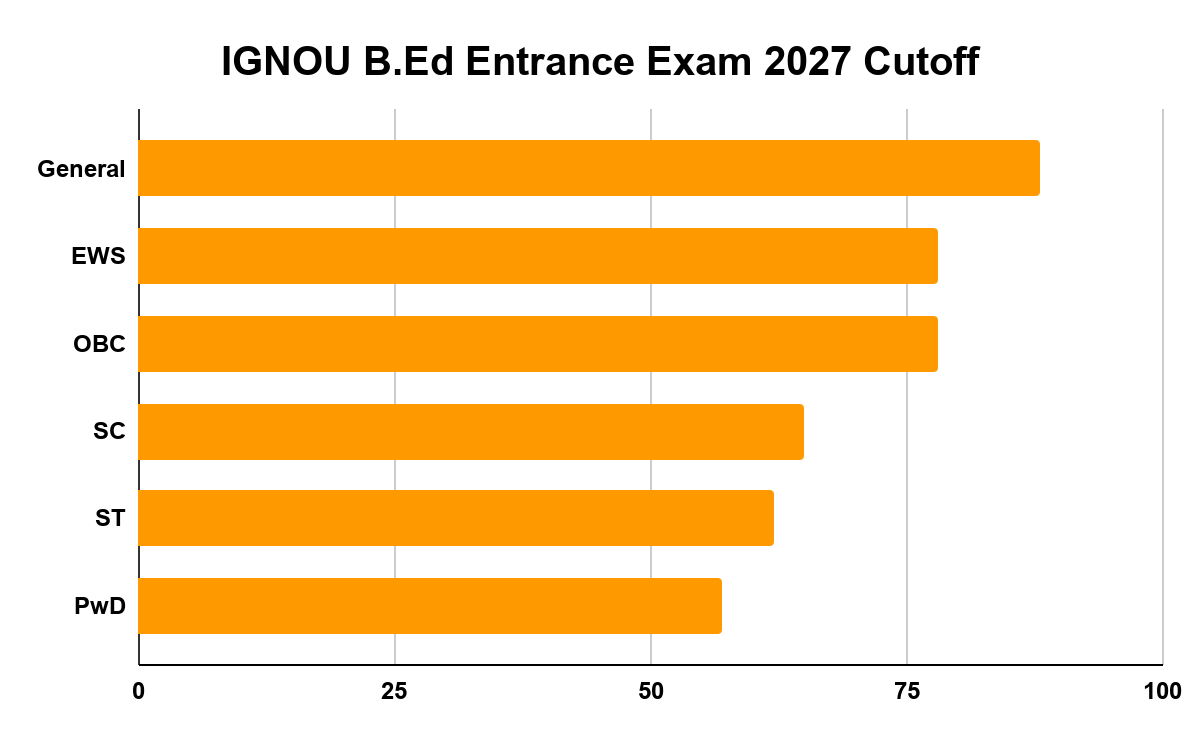
IGNOU B.Ed Entrance Exam 2027 Cutoff
The IGNOU B.Ed Entrance Exam Cutoff is expected to stay highest for the General category at 77 to 88 marks out of 100.
- OBC and EWS candidates has the same range which is 70 to 78 marks while the SC cutoff is between 60 and 65 marks.
- For the PwD category the expected cutoff is between 48 to 57 marks while the ST cutoff is between 57 and 62 marks in IGNOU B.Ed Entrance Exam.
| Category | Expected Cutoff Range (Out of 100) |
|---|---|
| General | 77 - 88 |
| EWS | 70 - 78 |
| OBC | 70 - 78 |
| SC | 60 - 65 |
| ST | 57 - 62 |
| PwD | 48 - 57 |
IGNOU B.Ed Entrance Exam 2027: Counselling Process and Seat Allotment
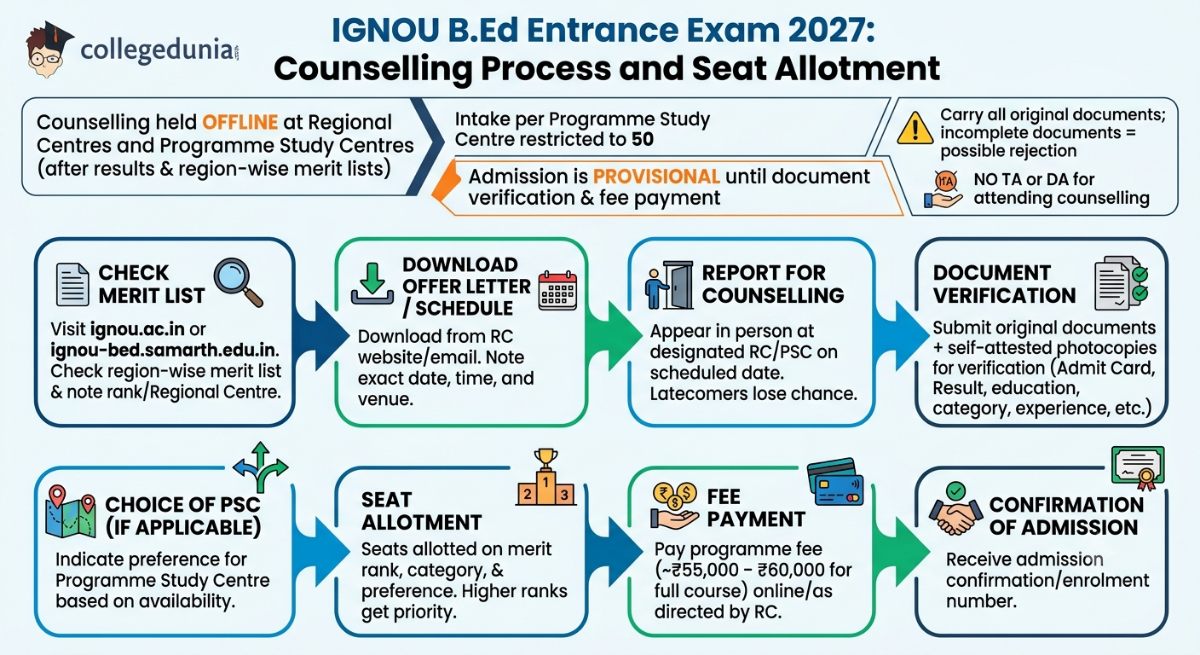
IGNOU B.Ed counselling 2027 is held offline at Regional Centres and Programme Study Centres after results and region-wise merit lists are released.
- The intake capacity at each Programme Study Centre of IGNOU B.Ed is restricted to 50 and admission is provisional till document verification and payment of fees.
- Candidates must carry all original documents to the counselling as incomplete documents may lead to rejection.
- No TA or DA is provided for attending the IGNOU B.Ed counselling process 2027.
- Candidates should follow the instructions in the IGNOU B.Ed offer letter and Regional Centre notice for the 2027 admission process.
| Steps | Description |
|---|---|
| Step 1 | Check Merit List Visit the official portal (ignou.ac.in or ignou-bed.samarth.edu.in) and check the region-wise / cluster-wise merit list. Candidates should note their rank and allotted Regional Centre. |
| Step 2 | Download Offer Letter / Counselling Schedule Download the offer letter or counselling schedule from the Regional Centre website / email. Note the exact date, time, and venue. |
| Step 3 | Report for Counselling Appear in person at the designated Regional Centre / PSC on the scheduled date (usually Saturdays/Sundays). Latecomers or absentees lose their chance. |
| Step 4 | Document Verification Submit original documents + self-attested photocopies for verification (Admit Card, Result, educational certificates, category certificate, experience certificate, etc.). |
| Step 5 | Choice of PSC (if applicable) Indicate preference for Programme Study Centre based on availability. |
| Step 6 | Seat Allotment Seats are allotted on the basis of merit rank, category, and preference. Higher-ranked candidates get priority. |
| Step 7 | Fee Payment Pay the programme fee (approx. ₹55,000 – ₹60,000 for the full course) online or as directed by the Regional Centre to confirm admission. |
| Step 8 | Confirmation of Admission After successful verification and fee payment, receive the admission confirmation/enrolment number. |
Documents Required at IGNOU B.Ed 2027 Counselling
Candidates must carry original documents along with self-attested photocopies for the IGNOU B.Ed 2027 counselling process. Missing or incomplete IGNOU B.Ed counselling documents may lead to rejection of admission.
| Category | Documents Required |
|---|---|
| Entrance Related |
|
| Educational Certificates |
|
| Teacher Education Qualification |
|
| Experience Related (if claiming) |
|
| Practical / Internship Related |
|
| Category / Reservation |
|
| Other Documents |
|
Also Check: Top Colleges in India Accepting IGNOU BEd Entrance Test
IGNOU B.Ed 2027 Programme Fee
The IGNOU B.Ed 2027 programme fee is expected to range from ₹55,000 to ₹60,000 for the complete two year course based on recent years.
- Candidates after getting their admission confirmed at the Regional Centre can pay their IGNOU B.Ed fee online using Credit Card, Debit Card, Net banking or UPI.
- The IGNOU B.Ed fee is paid after counselling and document verification not while submitting the entrance application form.
- The programme fee is non-refundable with slight variations possible after an official fee revision or across Regional Centres.
| Fee Component | Amount (Approximate) | Remarks |
|---|---|---|
| Total Programme Fee | ₹55,000 – ₹60,000 | For the complete 2-year programme |
| Year-wise Breakdown | ≈ ₹27,500 – ₹30,000 per year | Usually payable in two instalments |
| Entrance Exam Application Fee | ₹1,000 | Non-refundable (paid at the time of form submission) |
| University Development Fee | ₹200 – ₹400 | One-time (if applicable) |
| Term-End Examination Fee | ₹200 per theory course₹300 per practical course | Paid separately for each examination cycle |
| Re-registration Fee | ₹200 – ₹300 | Per semester/year (if applicable) |
IGNOU B.Ed Entrance Test 2027: Frequently Asked Questions
Ques. What is a good score in the IGNOU B.Ed entrance exam?
Ans. A score of around 70% or above is generally considered good for the IGNOU B.Ed Entrance Test. The required score can vary by category, region, merit position and seat availability.
Ques. Is IGNOU B.Ed entrance tough?
Ans. The IGNOU B.Ed Entrance Test is generally considered moderate in difficulty. Candidates can improve their performance by preparing General English, Logical and Analytical Reasoning, Educational and General Awareness, Teacher-learning and the School, and Subject-Specific Competence.
Ques. Is the IGNOU B.Ed entrance conducted online or offline?
Ans. The IGNOU B.Ed Entrance Test is conducted offline. IGNOU's official information states that admission is based on the score obtained in the offline entrance test conducted across India.
Ques. Can I do B.Ed. from IGNOU without entrance exam?
Ans. No, admission to the IGNOU B.Ed programme is based on the entrance test conducted by IGNOU. Candidates must qualify through the entrance process and meet the prescribed eligibility requirements for admission.


%20(38).png?h=112&w=263&mode=stretch)






Comments
Found 39 Comments
IGNOU B.Ed. Registration dates are about to begin in January 2026, and the entrance exam in March 2026, and official dates will be uploaded on the IGNOU B.Ed.
You can officially download sample or previous B.Ed entrance exam question papers for IGNOU from the university’s website under the “Previous Year Question Papers / Downloads” section. Visit the IGNOU official site, Student Support / Downloads / Previous Years’ Question Papers, and look for B.Ed entrance papers (e.g., past years like March?2025). These PDFs give you the real format and types of questions to practice for the 2026 exam.
You can check here for the IGNOU B.Ed Entrance Previous Year Question Paper: Download Question Paper with Solutions
You can check here for the IGNOU B.Ed Entrance Previous Year Question Paper: Download Question Paper with Solutions. The sample papers have been designed to develop an understanding of the teaching-learning process at secondary and senior-secondary levels among student-teachers and test the candidates’ knowledge on the subject.
Distance B.ed Course ?
The Indira Gandhi National Open University (IGNOU) offers its Bachelor of Education (B.Ed) program through Open & Distance Learning (ODL) mode. IGNOU B.Ed Entrance Exam is conducted by IGNOU itself for admission to 2-year B.Ed program at various PSCs (Program Study Center) of IGNOU across India. The exam is conducted in 100+ centers across the country.
Candidates must first visit the official website of IGNOU B.Ed entrance page – ignou.ac.in. The exam is conducted online as a computer-based test of 2 hours. The IGNOU B.Ed entrance 2025 question paper comprises 100 questions, each carrying 1 mark. The paper is divided into two parts: Part A and Part B. Part A includes sections like General English Comprehension, Logical & Analytical Reasoning, Educational & General Awareness, and Teaching-Learning & the School. Part B involves selecting one subject from Science, Mathematics, Social Science, English, or Hindi.
You can check here for the IGNOU B.Ed Entrance Previous Year Question Paper: Download Question Paper with Solutions
You can check here for the IGNOU B.Ed Entrance Previous Year Question Paper: Download Question Paper with Solutions
The Indira Gandhi National Open University (IGNOU) conducts its national-level B.Ed Entrance Exam once a year, scheduled for March. The application window opens online between January and February. However, candidates should regularly monitor the official Samarth portal (ignou-bed.samarth.edu.in) for final, confirmed dates and registration schedules.
You can download IGNOU B.Ed entrance exam previous year question papers from the official IGNOU website. You can visit the student zone page and download the previous year's paper for the BED entrance exam. You can also check here for the IGNOU B.Ed Entrance Previous Year Question Paper: Download Question Paper with Solutions.
IGNOU has not released the registration notice for the B.Ed Entrance exam for the academic year 2024. The registration notification is likely to be released in November 2023 by the university.
IGNOU offers its B.Ed program in open distance learning mode. To get admission in this program you must register and take the entrance examination conducted by the university.
The minimum educational qualification requried to apply for IGNOU B.Ed entrance exam is to have an undegraduate degree with at least 50% marks from a recognized university. Along with that you must have completed an NCTE-recognized teacher education program in direct mode.
If you have scored at least 50% marks in aggrgeate in your bachelor’s or master’s degree from IGNOU you are eligible to apply for the B.Ed program of IGNOU. However, it is also further required that you must have completed an NCTE-recognized teacher education program in face to face mode.
There are two parts in the IGNOU B.Ed Entrance exam paper. You can check the complete syllabus for the two parts from IGNOU B.Ed Entrance 2024 Syllabus.
If you have completed your Diploma in Elementary Education program in open distance learning mode you are not eligible to register and take the IGNOU B.Ed Entrance exam. It is important that you have compete your D.El.Ed program in face to face mode.
The total course fee for the B.Ed program offered by IGNOU is INR 55000. In order to get admission in this program, you must regsiter and take IGNOU B.Ed Entrance exam.
Entrance exam kb tk hoga
IGNOU has not released the official dates for IGNOU B.Ed Entrance exam 2024 yet. However, the registration process for IGNOU B.Ed Entrance exam 2023 is expected to begin in November 2023 and the examination be conducted in January 2024.