




The IGNOU BEd Entrance Syllabus comprises four compulsory sections in Part A and any one subject from Part B. IGNOU BEd Syllabus Part A comprises General English Comprehension, Logical & Analytical Reasoning, Educational & General Awareness, and Teaching-Learning. Part B subjects in IGNOU BEd 2026 are Science, Mathematics, Social Science, English, and Hindi.
- The IGNOU BEd General English Comprehension syllabus includes basic grammar, RCS, synonyms, and antonyms.
- IGNOU BEd Logical and Analytical Reasoning includes topics such as number series, coding- decoding, blood relations, and syllogisms.
- Social Sciences and Current Affairs is the base of the IGNOU BEd Educational & General Awareness syllabus.
- IGNOU BEd Teaching Aptitude curriculum tests candidates' classroom management, assessment, teacher ethics & Responsibilities
- Choose a Part B subject in IGNOU BEd Entrance Test based on your academic strengths to score maximum marks.
- Educational & General Awareness and Teaching-Learning & the School have the highest weightage (80%), with 25 questions each. Part B ask 20-mark questions and carries 20% weightage.
Related Article: IGNOU BEd Exam Pattern 2026: Section-wise Pattern, Syllabus, Marking Scheme, Total Marks and Preparation
Key Summary of IGNOU BEd Entrance Exam Syllabus
- The entrance test has 100 MCQs for 100 marks, with +1 mark for each correct answer and no negative marking.
- Current Affairs, GK, Teaching-Learning, Pedagogy, Series, Coding-Decoding, Analogy, Grammar, and Comprehension are the important topics of IGNOU BEd.
- Prioritise high-weightage sections, revise concepts, and practise PYQs and mock tests to score maximum marks.
IGNOU BEd Entrance Syllabus 2026: Highlights
The key highlights of the IGNOU BEd Entrance exam syllabus 2026 are tabulated below.
| Particular | Key Details |
|---|---|
| Total Questions | 100 |
| Total Marks | 100 |
| Sections | 2 |
| Subjects Covered | Part A
|
| Marking Scheme | +1 mark for a correct answerNo negative marking |
| Total Time | 2 hours |
Also Read: IGNOU BEd Application Form: Apply Link, Last Date, Fees, Documents Required
Ques. Does IGNOU release an official topic-wise syllabus PDF every year?
Ans. Candidates often look for a detailed, officially segmented syllabus in a brochure and should go through previous years' analysis for clarity.
- IGNOU releases a syllabus in the brochure.
- Topic-wise distribution is derived from exam trends.
- No separate sub-topic syllabus PDF is available.
IGNOU BEd Entrance Syllabus 2026: Section-wise Weightage
The IGNOU BEd syllabus section-wise weightage is outlined below. It helps you understand the priority sections to start your preparation.
Tip: Focus more on Educational & General Awareness and Teaching-Learning, which together account for 50% of the weightage in IGNOU BEd 2026.
| Parts | Sections | Number of Questions | Weightage (%) |
|---|---|---|---|
| Part A | General English Comprehension | 10 | 10 |
| Logical & Analytical Reasoning | 20 | 20 | |
| Educational & General Awareness | 25 | 25 | |
| Teaching-Learning & the School | 25 | 25 | |
| Part B (Any One) | Subject Competence: Science/ Maths/ Social Science/ English/ Hindi | 20 | 20 |
| Total | - | 100 | 100 |
Ques. Can IGNOU BEd sub-topic weightage change within a section?
Ans. Yes, sub-topic distribution slightly varies each year based on exam trends. Having a balanced preparation across all sub-topics is recommended.
- Total number of questions per section remains unchanged.
- Focus areas or key topics may shift within the section.
- Core sub-topics like learning theories and policies are fixed.
IGNOU BEd Entrance Syllabus 2026: Section-wise Topics
The IGNOU BEd Syllabus tests candidates' teaching mind, logical thinking, educational awareness and subject-specific knowledge. The section-wise IGNOU BEd exam syllabus is described below.
IGNOU BEd Entrance Exam Syllabus 2026: General English Comprehension
IGNOU BEd General English Comprehension carries 10 questions for 10 marks. The questions assess candidates' understanding of the English language and comprehension.
| Part A Section | Sub Topics |
|---|---|
| General English Comprehension |
|
IGNOU BEd Syllabus 2026: Logical & Analytical Reasoning
IGNOU BEd Logical and Analytical Reasoning carries the highest individual weightage in Part A, with 20 questions for 20 marks. It tests candidates’ logical thinking, analytical ability and reasoning skills.
| Part A Section | Sub Topics |
|---|---|
| Logical and Analytical Reasoning |
|
IGNOU BEd Entrance Exam Syllabus 2026: Teaching and Learning and the School
IGNOU BEd Teaching and Learning and the School carries the highest individual weightage in Part A, with 25 questions for 25 marks. It focuses on concepts related to teaching, learning and the school environment.
| Part A Section | Sub Topics |
|---|---|
| Teaching and Learning and the School |
|
IGNOU BEd Syllabus 2026: Educational & General Awareness
IGNOU BEd Educational & General Awareness carries the highest individual weightage in Part A, with 25 questions for 25 marks. It broadly tests candidates' awareness of education-related matters and general awareness.
| Part A Section | Sub Topics |
|---|---|
| Educational & General Awareness |
|
IGNOU BEd Entrance Exam Syllabus 2026: Part B
IGNOU BEd Exam Pattern for Part B includes subject competence. Out of the following subjects, you need to prepare for any one carrying 20 marks based on the school-level curriculum.
| Subjects (Any One) | IGNOU BEd Entrance Exam Syllabus for Part B (Sub Topics) |
|---|---|
| Science |
|
| Maths |
|
| Social Science |
|
| English/ Hindi |
|
Related Article: IGNOU B.Ed Entrance Previous Year Question Paper: Download Question Paper with Solutions
Ques. Does weightage impact the IGNOU BEd preparation strategy?
Ans. Yes, IGNOU BEd preparation is weightage-driven, not equal for all sub-topics. This approach improves accuracy and efficiency. High-weightage sub-topics deserve more time in preparation. Low-weightage topics should be revised, not ignored. NCERT-based sub-topics are scoring and help improve the overall rank.
IGNOU BEd Entrance Syllabus 2026 Important Topics: Based on Trends
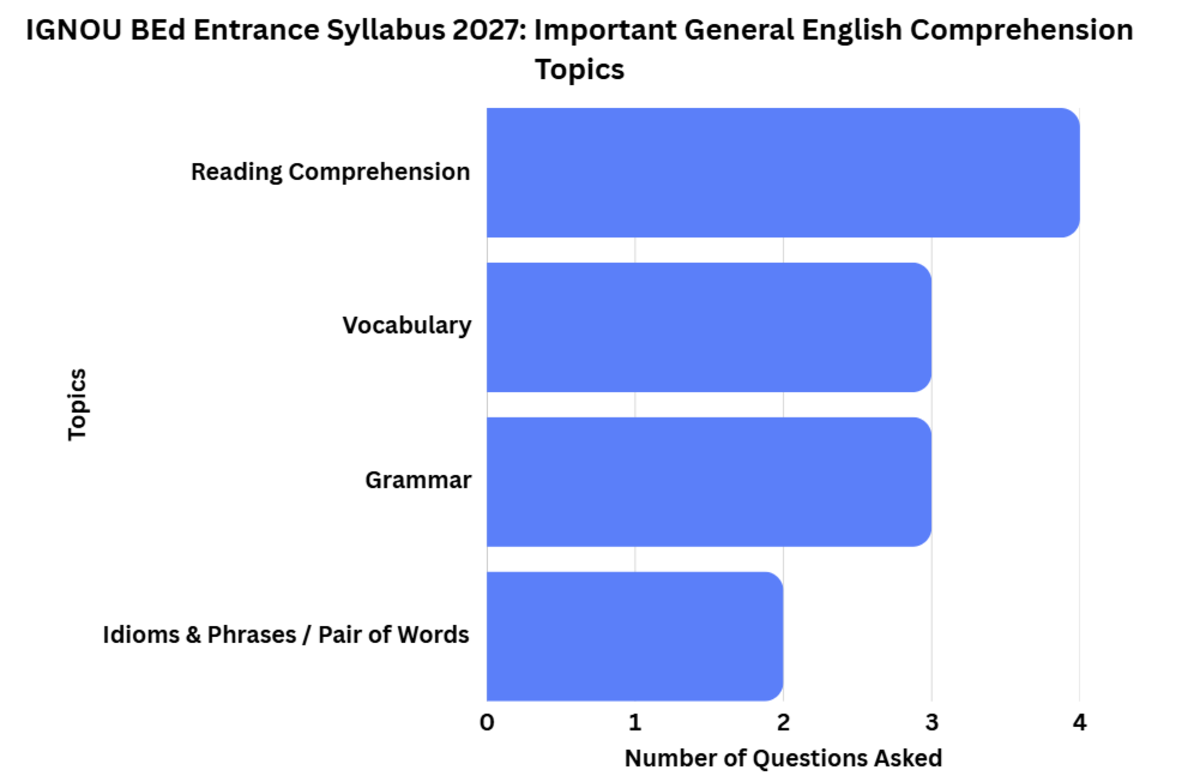
The IGNOU BEd Entrance exam syllabus important topics based on past years' analysis are tabulated below. Do not skip the following topics, as questions are asked every year.
IGNOU BEd Entrance Syllabus 2026: Important General English Comprehension Topics
Tip: Practice reading magazines and newspapers to increase your RC speed, as it accounts for around 4 marks out of 10. Prioritise grammar and vocabulary to score well in this section.
| Topics | Number of Questions Asked |
|---|---|
| Reading Comprehension | 3- 4 |
| Vocabulary (Synonyms / Antonyms) | 2- 3 |
| Grammar (Errors, Correction, Sentence Improvement) | 2- 3 |
| Idioms & Phrases / Pair of Words | 1- 2 |
IGNOU BEd Syllabus 2026: Important Logical & Analytical Reasoning Topics
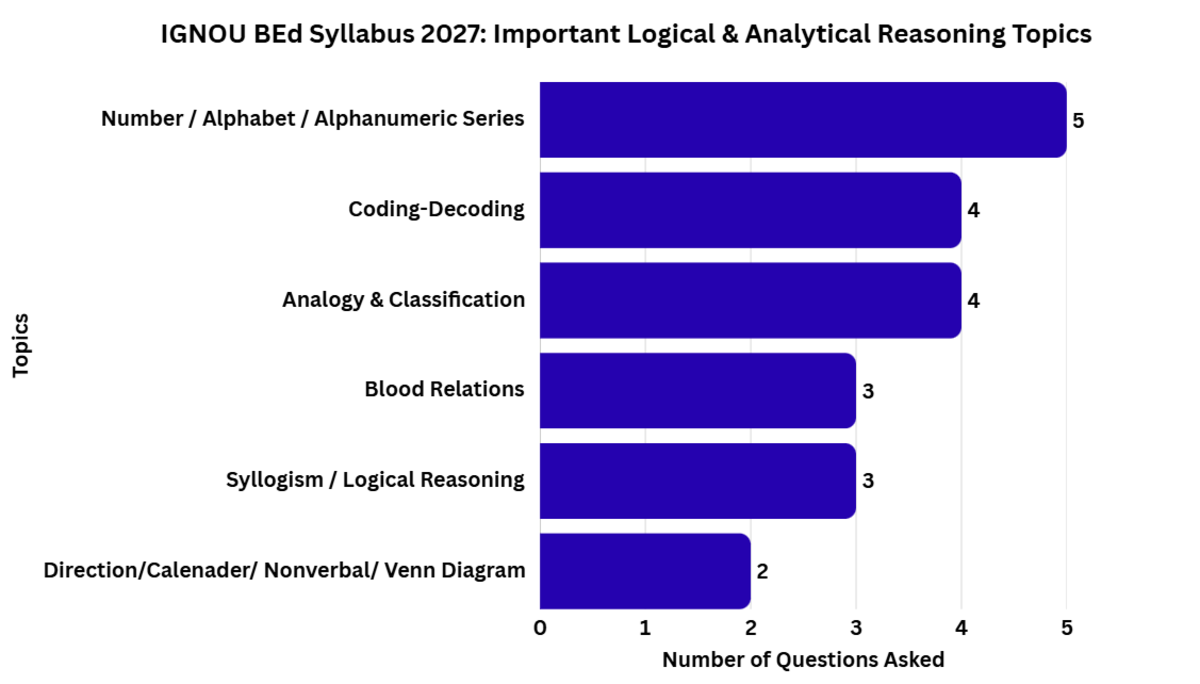
Number Series, Coding and Decoding, Analogy and Classification account for nearly 65% weightage. You can expect 10- 13 questions from these topics.
Tip: Master number/ alphanumeric series, Coding and decoding and analogy through intense practice, then start other topics.
| Topics | Number of Questions Asked |
|---|---|
| Number / Alphabet / Alphanumeric Series | 4- 5 |
| Coding-Decoding | 3- 4 |
| Analogy & Classification | 3- 4 |
| Blood Relations | 2- 3 |
| Syllogism / Logical Reasoning | 2- 3 |
| Direction/Calenader/ Nonverbal/ Venn Diagram | 1- 2 |
IGNOU BEd Entrance Syllabus 2026: Important Teaching and Learning Topics
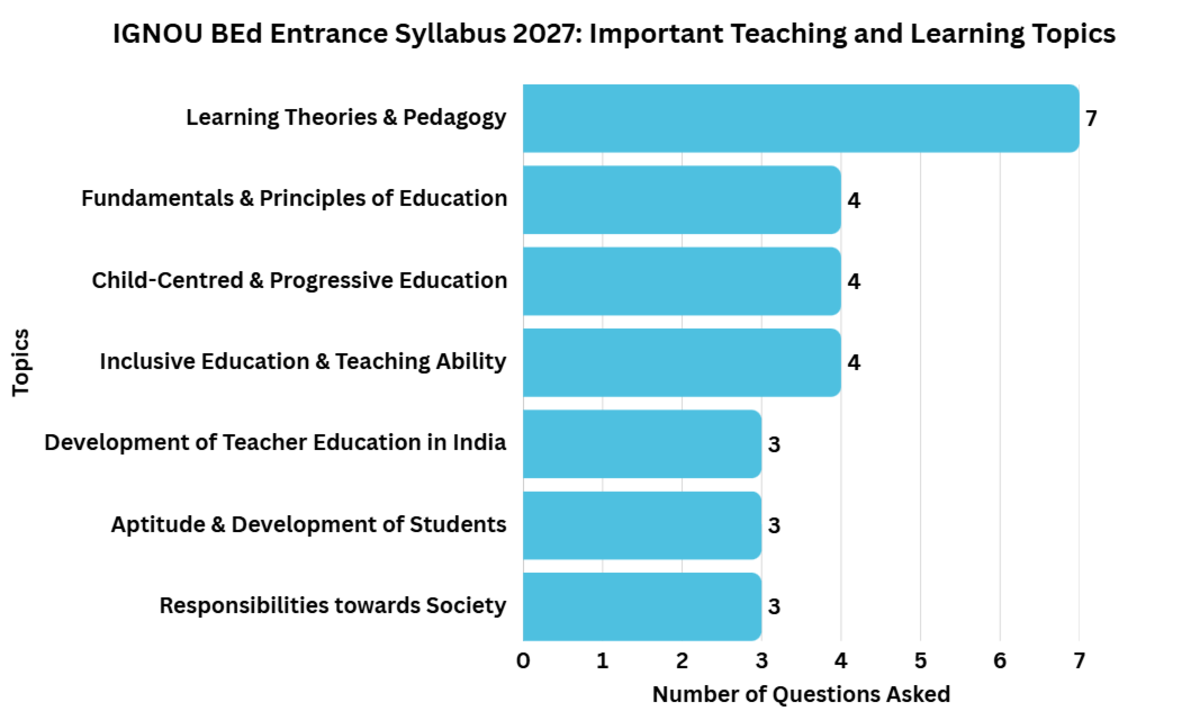
Tip: Focus heavily on learning theories, fundamentals, child-centred education and teaching ability, as you can expect 15 to 19 questions.
| Topics | Number of Questions Asked |
|---|---|
| Learning Theories & Pedagogy | 5- 7 |
| Fundamentals & Principles of Education | 3- 4 |
| Child-Centred & Progressive Education | 3- 4 |
| Inclusive Education & Teaching Ability | 3- 4 |
| Development of Teacher Education in India | 2- 3 |
| Aptitude & Development of Students | 2- 3 |
| Responsibilities towards Society | 2- 3 |
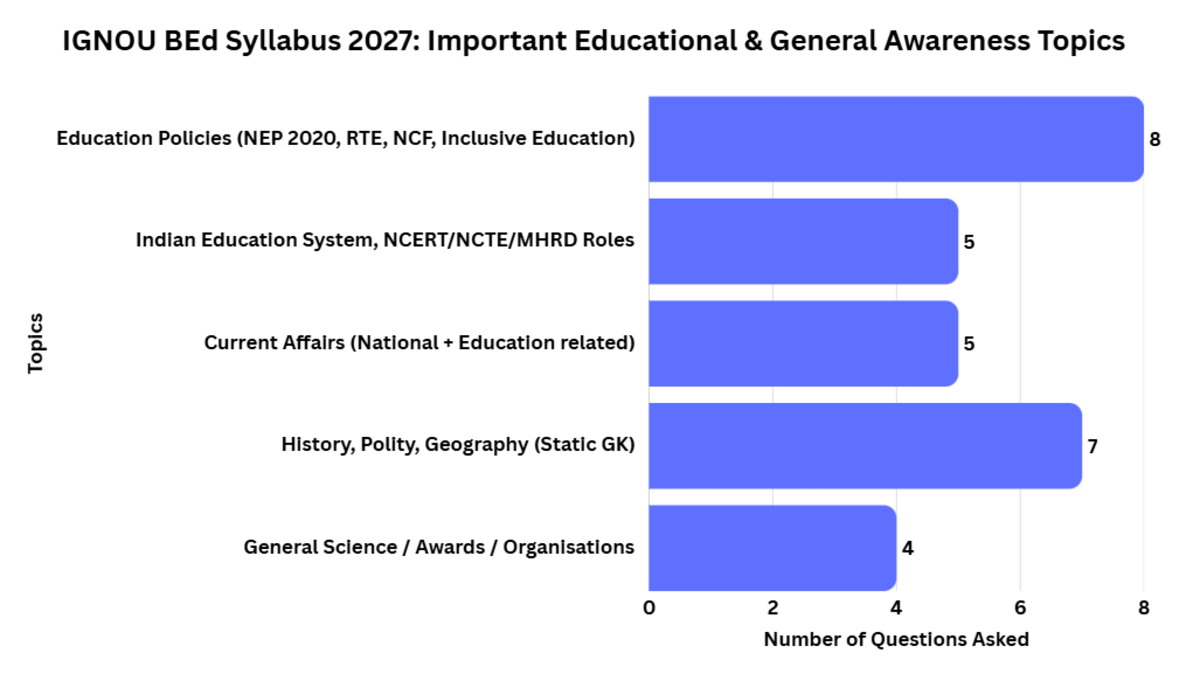
IGNOU BEd Syllabus 2026: Important Educational & General Awareness Topics
Tip: Focus more on recent educational policies and current affairs as these contribute nearly 50% of the section.
| Topics | Number of Questions Asked |
|---|---|
| Education Policies (NEP 2020, RTE, NCF, Inclusive Education) | 6- 8 |
| Indian Education System, NCERT/NCTE/MHRD Roles | 4- 5 |
| Current Affairs (National + Education related) | 3- 5 |
| History, Polity, Geography (Static GK) | 5- 7 |
| General Science / Awards / Organisations | 2- 4 |
IGNOU BEd Entrance Exam Syllabus 2026: Part B
IGNOU BEd Syllabus 2026 Part B covers subject competence of 20 marks.
| Subject | Key Topics | Weightage (%) |
|---|---|---|
| Science | Physics (Mechanics, Optics, Electricity)Chemistry (Basics + Organic)Biology (Cell, Genetics, Ecology) | 20 |
| Mathematics | Arithmetic, Number System, Algebra and Geometry | |
| Social Science | History (Modern India), Polity, Geography Economics | |
| English/Hindi | Grammar Reading VocabularyLiterature basics |
Ques. Which section carries the highest scoring potential in IGNOU BEd?
Ans. Educational & General Awareness and Teaching-Learning together offer the highest scoring opportunity, contributing 50% of the paper.
- Questions are concept-based and predictable based on trends.
- Policies like NEP 2020 are repeatedly asked in previous years papers.
- Strong preparation here can significantly improve your rank.
IGNOU B.Ed Entrance Question Papers PDF
| Year | Question Paper Link |
|---|---|
| IGNOU B.Ed Entrance Question Papers for 2025 | Check Here |
| IGNOU B.Ed Entrance Question Papers for 2024 | Check Here |
| IGNOU B.Ed Entrance Question Papers for 2023 | Check Here |
| IGNOU B.Ed Entrance Question Papers for 2019 | Check Here |
| IGNOU B.Ed Entrance Question Papers for 2017 | Check Here |
| IGNOU B.Ed Entrance Question Papers for 2012 | Check Here |
| IGNOU B.Ed Entrance Question Papers for 2011 | Check Here |
Books to Prepare for IGNOU BEd 2026
Some of the suggested/recommended books for IGNOU BEd 2026 are
| Book/ Author Name | Key Features |
|---|---|
| Upkar's IGNOU BEd Entrance Exam Guide | Objective questions and previous years' solved papers. |
| R. Gupta’s IGNOU BEd Guide | Covers the complete syllabus of IGNOU BEd with practice sets. |
| Arihant BEd Parvesh Pariksha | Chapter breakdowns and practice exercises. |
| Notebook Academy IGNOU BEd Guide | MCQs +PYQs |
According to a Quora post, aspirants can refer to the NCERT guides and other specialized books for IGNOU BEd exam. Some suggested books are Arihant BEd Pariksha, Arihant's 15 Practice Sets for BEd Entrance Exam, R Gupta's IGNOU BEd Entrance Exam Guide, BEd Entrance Guide by Subhkama Publication. Solve the PYQs attached to the Prospectus Form of IGNOU B. Ed. Entrance Examination.
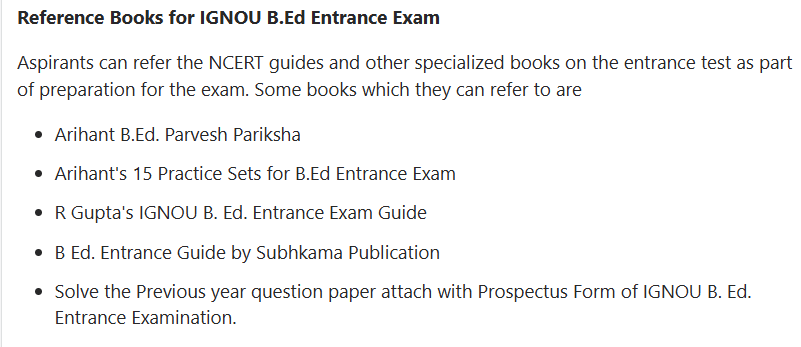
Source: Quora
How to Prepare Based on IGNOU BEd Syllabus 2026
IGNOU BEd Syllabus 2026 syllabus-based preparation strategy helps candidates prioritise high-weightage sections and avoid spending equal time on every topic.
- Prioritise High-Weightage Sections
Start with Educational & General Awareness and Teaching-Learning & the School, as each carries 25 questions. Focus on education-related developments, current affairs, learning and pedagogy, child-centred education, inclusive education, and teacher education.
- Practise Logical & Analytical Reasoning Daily
Allocate regular practice time to number series, coding-decoding, analogy, blood relations, classification, syllogism, and calendar-based questions. Solving MCQs daily can improve both accuracy and speed.
- Strengthen English Comprehension and Grammar
Since General English Comprehension carries 10 questions, focus on reading comprehension, basic grammar, synonyms and antonyms, idioms and phrases, and vocabulary. Regular reading can also improve comprehension speed.
- Choose Part B Subject Strategically
Part B carries 20 questions, so choose a subject based on your academic background and strongest subject area. The options include Science, Mathematics, Social Science, English, and Hindi.
- Use Previous Year Question Papers
Solve IGNOU BEd previous year question papers after completing the major syllabus topics. This helps identify recurring question types, understand the difficulty level, and practise questions within the exam time.
- Take Full-Length Mock Tests
Attempt mock tests regularly after completing the syllabus. Analyse incorrect and unattempted questions after every test and maintain an error log to track weak areas.
- Follow a Revision-Based Study Plan
Divide preparation into concept learning, MCQ practice, revision, and mock tests. Keep the final phase primarily for revision rather than starting completely new topics.
Quick Preparation Strategy
- 40% time: Teaching-Learning & the School and Educational & General Awareness
- 20% time: Logical & Analytical Reasoning
- 10% time: General English Comprehension
- 20% time: Selected Part B subject
- 10% time: Mock tests, PYQs and error analysis
IGNOU BEd Entrance Syllabus 2026 FAQs
Ques. Which is the best book for IGNOU BEd Entrance exam?
Ans. The best all-in-one preparation books recommended for the IGNOU BEd entrance exam are Arihant B.Ed. Parvesh Pariksha, R. Gupta’s IGNOU BEd Entrance Exam Guide, and Upkar's IGNOU BEd Entrance Exam Guide.
Ques. How to crack IGNOU BEd entrance exam?
Ans. To crack the IGNOU BEd entrance exam, you need to understand the 100-question offline test pattern. Covers English comprehension, logical/analytical reasoning, educational and general awareness (including NEP 2020 and NCF 2005), and teaching-learning psychology from Part A. Complete subject-specific content from your graduation background (Science, Mathematics, Social Science, English, or Hindi). Solve previous years' question papers to learn time management and see repeating question trends.
Ques. Which sections carry the highest marks in IGNOU BEd?
Ans. Logical Reasoning and Teaching-Learning Aptitude, total 40 marks combined. These sections are highly predictable and are easy to score with basic practice.
Ques. How should I prepare for the Teaching-Learning Aptitude section in IGNOU BEd?
Ans. Teaching-Learning Aptitude section in IGNOU BEd focuses on concepts related to teaching, learning and the school environment. Focus on student psychology and always chooses student-centric solutions to classroom issues.
Ques. Is the IGNOU B.Ed syllabus more theory-based or application-based?
Ans. The IGNOU syllabus is largely theory-oriented, with limited application-based questions. You should focus more on understanding concepts.
- Learning theories test conceptual understanding among aspirants.
- Education policies focus on awareness and knowledge.
- Reasoning checks logical thinking, not formulas.
Ques. What is the difficulty level of the IGNOU B.Ed Entrance Exam syllabus?
Ans. The exam syllabus is considered easy to moderate, depending on the exam trends and is suitable for all eligible graduates.
- Topics are generally from the school level and are conceptual.
- Reasoning questions are logic-based, not calculation-heavy.
- Consistent preparation using the NCERT and theory books is enough for syllabus coverage.



Comments