




The COMEDK UGET 2027 syllabus covers standard Physics, Chemistry, and Mathematics topics from Classes 11 and 12, with the standard PUC/CBSE curriculum. The COMEDK UGET syllabus 2027 is expected to be released in January or February 2027 alongside the official notification and application form on the COMEDK Official Website, comedk.org.
- Class 11 topics carry around 33% weightage, while Class 12 topics carry around 67% weightage.
- The exam has 180 questions worth 180 marks for 3 hours, with 60 questions in each subject in English only.
- COMEDK releases 3 separate syllabus PDFs, one each for Physics, Chemistry, and Mathematics. The NCERT Class 11 and 12 textbooks cover almost the entire prescribed topic list.
- Based on the previous year’s trends, the COMEDK UGET Physics highest-weightage topics are Mechanics with 20 - 25%, Electrostatics & Current Electricity with 17 - 20%, and Modern Physics with 10 - 13% weightage.
- Organic Chemistry with 30 - 37%, Physical Chemistry with 28 - 33%, and Inorganic Chemistry with 23 - 28% are some of the highest-weightage topics of the COMEDK UGET Chemistry paper.
- The COMEDK UGET Mathematics 2027 high-weightage topics include Calculus with 25 - 30%, Algebra with 20 - 25%, and Coordinate Geometry with 13 - 17% weightage.
Related Links:
- COMEDK UGET Exam Pattern 2027: Check Marking Scheme, Total Marks, Exam Duration
- COMEDK UGET Previous Year Papers: Download Questions with Solutions PDF
Key Summary
- COMEDK UGET syllabus 2027 is expected to stay the same as the 2026 syllabus.
- COMEDK UGET: each subject carries 60 questions and 60 marks, so all three have equal weightage.
- Class 12 topics dominate the paper with roughly two-thirds of the questions.
- Official syllabus PDFs are published at comedk.org along with the exam notification.
- Focus on NCERT for theory, then practise objective questions from standard reference books.
- COMEDK UGET is conducted as a single combined exam with Uni-GAUGE E. Both exams share one application form and one question paper, so students should prepare from a single syllabus.
COMEDK UGET Syllabus 2027: Download Subject-Wise PDF
The COMEDK UGET syllabus 2027 PDF download link for the Physics, Chemistry, and Mathematics papers will be released once the notification is out.
Meanwhile, students must check out the COMEDK UGET 2026 syllabus PDF link provided below, as the syllabus is expected to remain the same.
| Subjects | PDF Download Link |
|---|---|
| Physics | Click Here |
| Chemistry | Click Here |
| Mathematics | Click Here |
How to Download COMEDK UGET Syllabus 2027 PDF?
Follow these steps to download the official syllabus PDFs from the COMEDK website.
- Step 1: Visit the official website of COMEDK - comedk.org
- Step 2: Go to the “Exam Details” tab.
- Step 3: Click on the “About Exam” option.
- Step 4: Go to the “Syllabus - COMEDK UGET” section.
- Step 5: The subject-wise syllabus will be displayed on the screen. Click on the desired subject option.
- Step 6: The PDF containing the syllabus topics in detail for the particular subject will be shown.
- Step 7: Check and download all three PDFs.
Source: COMEDK Official Website, About UGET and Notification
COMEDK UGET Syllabus 2027: What's New?
No major changes are expected in the COMEDK UGET 2027 syllabus compared to the previous year.
- The syllabus is expected to remain based on Class 11 and Class 12 Physics, Chemistry, and Mathematics.
- Class 12 topics are likely to carry higher weightage, contributing around 67% of the questions, while Class 11 topics account for about 33%.
- The exam is expected to continue with 180 multiple-choice questions (MCQs), equally divided among Physics, Chemistry, and Mathematics.
Also Read:
COMEDK UGET Physics Syllabus 2027
Physics carries 60 questions in the paper.
- The COMEDK UGET Physics syllabus has 10 units from Class 11 and 9 units from Class 12.
- Numerical problems dominate, so formula recall alone will not be enough.
COMEDK Physics Syllabus: Class 11 Units
| Unit / Chapter | Topics Covered | Approx. Weightage (%) |
|---|---|---|
| Physical World and Measurement | SI units, significant figures, dimensional analysis and its applications | 2% |
| Kinematics | Motion in a straight line, motion in a plane, vectors, projectile motion, uniform circular motion | 4% |
| Laws of Motion | Newton's laws, momentum, impulse, friction, banking of roads, centripetal force | 4% |
| Work, Energy and Power | Work-energy theorem, potential energy, conservative forces, elastic and inelastic collisions | 4% |
| Motion of System of Particles and Rigid Body | Centre of mass, torque, angular momentum, moment of inertia, radius of gyration | 4% |
| Gravitation | Kepler's laws, universal law of gravitation, escape velocity, orbital velocity | 3% |
| Properties of Bulk Matter | Elasticity, Hooke's law, Pascal's law, viscosity, Bernoulli's theorem, surface tension, calorimetry, heat transfer | 6% |
| Thermodynamics | Zeroth law, first law, second law, isothermal and adiabatic processes | 4% |
| Behaviour of Perfect Gases and Kinetic Theory | Equation of state, kinetic interpretation of temperature, rms speed, degrees of freedom, mean free path | 2% |
| Oscillations and Waves | SHM, simple pendulum, wave motion, superposition, standing waves, beats | 6% |
COMEDK Physics Syllabus: Class 12 Units
Optics, Electrostatics and Magnetism together account for nearly 30% of the Physics section. Students should finish these three units early and revise them at least three times.
| Unit / Chapter | Topics Covered | Approx. Weightage (%) |
|---|---|---|
| Electrostatics | Coulomb's law, electric field, dipole, Gauss's theorem, potential, capacitors, energy stored | 9% |
| Current Electricity | Drift velocity, Ohm's law, resistivity, cells in series and parallel, Kirchhoff's laws, Wheatstone bridge | 8% |
| Magnetic Effects of Current and Magnetism | Biot-Savart law, Ampere's law, force on moving charge, galvanometer, bar magnet, magnetic materials | 9% |
| Electromagnetic Induction and Alternating Currents | Faraday's laws, Lenz's law, self and mutual induction, LCR circuit, resonance, transformer | 8% |
| Electromagnetic Waves | Displacement current, transverse nature, electromagnetic spectrum and uses | 2% |
| Optics | Spherical mirrors, refraction, total internal reflection, lenses, prism, microscopes, telescopes, Huygens' principle, interference, diffraction | 11% |
| Dual Nature of Matter and Radiation | Photoelectric effect, Einstein's equation, matter waves, de Broglie relation | 4% |
| Atoms and Nuclei | Rutherford model, Bohr model, hydrogen spectra, mass defect, binding energy, fission, fusion | 6% |
| Electronic Devices | Energy bands, intrinsic and extrinsic semiconductors, p-n junction, diode as a rectifier | 5% |
Also Read:
COMEDK UGET Chemistry Syllabus 2027
Chemistry carries 60 questions for 60 marks.
- The syllabus has 9 chapters from Class 11 and 10 chapters from Class 12.
- Organic Chemistry dominates the Class 12 portion, so reaction mechanisms need daily practice.
COMEDK Chemistry Syllabus: Class 11 Chapters
| Unit / Chapter | Topics Covered | Approx. Weightage (%) |
|---|---|---|
| Some Basic Concepts of Chemistry | Mole concept, molar mass, empirical and molecular formula, stoichiometry | 5% |
| Structure of Atom | Atomic models, de Broglie relationship, Heisenberg principle, quantum numbers, orbital filling rules | 4% |
| Classification of Elements and Periodicity | Modern periodic law, atomic and ionic radii, ionisation enthalpy, electronegativity | 3% |
| Chemical Bonding and Molecular Structure | Ionic and covalent bonds, VSEPR theory, hybridisation, molecular orbital theory, hydrogen bond | 6% |
| Chemical Thermodynamics | First law, enthalpy, Hess's law, entropy, Gibbs energy, spontaneity | 4% |
| Equilibrium | Equilibrium constant, Le Chatelier's principle, pH, buffer solution, solubility product, common ion effect | 4% |
| Redox Reactions | Oxidation number, balancing redox reactions, applications | 2% |
| Organic Chemistry: Basic Principles and Techniques | IUPAC nomenclature, inductive and electromeric effects, resonance, hyperconjugation, reaction intermediates | 2% |
| Hydrocarbons | Alkanes, alkenes, alkynes, benzene, aromaticity, electrophilic substitution | 3% |
COMEDK Chemistry Syllabus: Class 12 Chapters
COMEDK Chemistry rewards memory more than any other section. Students should build a reaction sheet from day one. Named reactions and conversions appear almost every year.
| Unit / Chapter | Topics Covered | Approx. Weightage (%) |
|---|---|---|
| Solutions | Raoult's law, colligative properties, osmotic pressure, abnormal molecular mass, Van't Hoff factor | 6% |
| Electrochemistry | Nernst equation, standard electrode potential, conductivity, Kohlrausch's law, fuel cells, corrosion | 6% |
| Chemical Kinetics | Rate law, order and molecularity, integrated rate equations, half-life, Arrhenius equation | 6% |
| d and f Block Elements | Transition metal trends, oxidation states, preparation of K2Cr2O7 and KMnO4, lanthanoid contraction | 6% |
| Coordination Compounds | Ligands, coordination number, IUPAC nomenclature, Werner's theory, VBT, CFT, isomerism | 7% |
| Haloalkanes and Haloarenes | Nature of C-X bond, substitution mechanisms, optical rotation, uses and environmental effects | 5% |
| Alcohols, Phenols and Ethers | Preparation and properties, dehydration mechanism, acidic nature of phenol, electrophilic substitution | 7% |
| Aldehydes, Ketones and Carboxylic Acids | Nucleophilic addition mechanism, reactivity of alpha hydrogen, acidic nature of carboxylic acids | 8% |
| Amines | Classification, preparation, properties, identification of amine types, diazonium salts | 5% |
| Biomolecules | Carbohydrates, proteins, enzymes, hormones, vitamins, DNA and RNA | 5% |
Source: COMEDK Official Chemistry Syllabus PDF
Also Read:
COMEDK UGET Mathematics Syllabus 2027
Mathematics carries 60 questions.
- The Class 11 portion has 5 units, and the Class 12 portion has 6 units.
- Calculus is the single largest area in the section. Calculus alone contributes close to a quarter of the Mathematics section.
- Integration and differentiation deserve your longest practice hours. Speed matters here, because 180 questions in 180 minutes leaves one minute per question.
COMEDK Mathematics Syllabus: Class 11 Units
The COMEDK Mathematics Class 11 syllabus units cover Sets, Relations, and Functions, Complex Numbers and Quadratic Equations, and Trigonometric Functions, with 4% weightage each.
| Unit / Chapter | Topics Covered | Approx. Weightage (%) |
|---|---|---|
| Sets, Relations and Functions | Sets and subsets, Venn diagrams, Cartesian product, domain and range, real-valued functions | 4% |
| Trigonometric Functions | Radian measure, unit circle definitions, graphs, sum and difference identities | 4% |
| Complex Numbers and Quadratic Equations | Algebraic properties of complex numbers, Argand plane | 4% |
| Linear Inequalities | Solution of linear inequalities in one variable, number line representation | 1% |
| Permutations and Combinations | Fundamental principle of counting, nPr and nCr, simple applications | 3% |
| Binomial Theorem | Binomial theorem for positive integral indices, Pascal's triangle | 3% |
| Sequence and Series | Arithmetic mean, geometric progression, infinite GP, relation between AM and GM | 3% |
| Straight Lines | Slope, angle between two lines, forms of equation of a line, distance of a point from a line | 3% |
| Conic Sections | Circle, parabola, ellipse, hyperbola, standard equations and properties | 4% |
| Introduction to Three-Dimensional Geometry | Coordinate axes and planes, coordinates of a point, distance between two points | 1% |
| Limits and Derivatives | Intuitive idea of limit, limits of polynomial and trigonometric functions, basic derivatives | 2% |
| Statistics and Probability | Range, mean deviation, variance, standard deviation, axiomatic probability | 2% |
COMEDK Mathematics Syllabus: Class 12 Units
Studying Relations and Functions, Inverse Trigonometric Functions, Matrices, and Determinants topics of COMEDK Class 12 Mathematics syllabus covers around 16% of the weightage.
| Unit / Chapter | Topics Covered | Approx. Weightage (%) |
|---|---|---|
| Relations and Functions | Reflexive, symmetric, transitive and equivalence relations, one-one and onto functions | 3% |
| Inverse Trigonometric Functions | Domain, range, principal value branch, graphs | 3% |
| Matrices | Types of matrices, transpose, symmetric and skew-symmetric matrices, matrix operations, invertible matrices | 5% |
| Determinants | Determinant up to order 3, minors and cofactors, area of a triangle, adjoint and inverse, system of equations | 5% |
| Continuity and Differentiability | Chain rule, derivatives of inverse trigonometric functions, implicit and parametric functions, second-order derivatives | 7% |
| Applications of Derivatives | Rate of change, increasing and decreasing functions, maxima and minima | 6% |
| Integrals | Integration by substitution, by parts and by partial fractions, definite integrals | 8% |
| Applications of the Integrals | Area under simple curves, lines, circles, parabolas and ellipses | 3% |
| Differential Equations | Order and degree, separation of variables, homogeneous and linear differential equations | 5% |
| Vectors | Direction cosines and ratios, types of vectors, dot product, cross product and applications | 5% |
| Three-Dimensional Geometry | Equation of a line, skew lines, shortest distance between two lines, angle between two lines | 6% |
| Linear Programming | Constraints, objective function, graphical method, feasible and optimal solutions | 2% |
| Probability | Conditional probability, multiplication theorem, independent events, Bayes' theorem | 5% |
Also Read:
- COMEDK Rank vs College Predictor for Popular Branches
- COMEDK UGET 2026 May 9 Shift 1 Question Paper: Download Answer Key with Solution PDF
- COMEDK UGET Exam 2026: Rank vs Marks vs College Predictor Tool for Engineering Branches

Source: Reddit
A COMEDK candidate on Reddit was asking whether the COMEDK UGET syllabus is the same as the CBSE Class 11 and 12 syllabus. They want to confirm that no questions are asked from topics outside the prescribed syllabus.
Ans. Yes, the COMEDK UGET syllabus is largely based on the CBSE Class 11 and Class 12 Physics, Chemistry, and Mathematics syllabus. The official COMEDK syllabus does not include any additional topics beyond these classes. However, while the topics remain the same, the difficulty level and application-based nature of the questions may be higher than the CBSE board exams.
COMEDK UGET Syllabus 2027: Chapter-Wise Weightage
COMEDK does not publish official chapter weightage.
- All three subjects carry exactly 60 marks, so you cannot afford to abandon one subject.
- Since there is no negative marking, a calculated guess on a weak topic still has value.
| Subject | High-Weightage Chapters | Questions (Approx) | Marks |
|---|---|---|---|
| Physics | Optics, Electrostatics, Magnetic Effects of Current, Current Electricity, EMI and AC | 27 to 30 | 27 to 30 |
| Oscillations and Waves, Properties of Bulk Matter, Atoms and Nuclei | 10 to 12 | 10 to 12 | |
| Chemistry | Aldehydes and Ketones, Alcohols and Phenols, Coordination Compounds, Amines | 16 to 18 | 16 to 18 |
| Solutions, Electrochemistry, Chemical Kinetics, d and f Block Elements | 14 to 16 | 14 to 16 | |
| Mathematics | Integrals, Continuity and Differentiability, Applications of Derivatives | 12 to 14 | 12 to 14 |
| Three-Dimensional Geometry, Vectors, Matrices, Determinants, Probability | 15 to 17 | 15 to 17 |
To better understand the COMEDK UGET Syllabus 2027, students can also refer to the video linked below, which has been created by Deekhsha Karnataka
Best Books for COMEDK UGET 2027
NCERT textbooks are your primary source, because COMEDK builds its syllabus directly on the CBSE curriculum. Reference books help you practise objective questions once your concepts are clear.
| Subject | Book Name | Author / Publisher | Why This Book |
|---|---|---|---|
| Physics | NCERT Physics Class 11 and 12 | NCERT | Matches the official syllabus unit by unit |
| Concepts of Physics (Volumes 1 and 2) | HC Verma | Builds conceptual clarity with strong problem sets | |
| Understanding Physics Series | DC Pandey | Chapter-wise objective practice at entrance exam level | |
| Chemistry | NCERT Chemistry Class 11 and 12 | NCERT | Covers nearly every prescribed reaction and definition |
| Physical Chemistry | OP Tandon | Detailed numericals on thermodynamics, kinetics and equilibrium | |
| Organic Chemistry | MS Chouhan | Mechanism-focused practice for the heavy Class 12 organic portion | |
| Mathematics | NCERT Mathematics Class 11 and 12 | NCERT | Aligns with the official unit list, including Linear Programming |
| Objective Mathematics | RD Sharma | Large bank of MCQs across all units | |
| Problems in Calculus of One Variable | IA Maron | Deepens calculus practice, the highest-weightage area |
Recommended Books for COMEDK
- Some of the top-most recommended books for the COMEDK Syllabus are tabulated below for your reference.
- Along with the suggested books, you should also study the NCERT books to make concepts clearer.
| Subject | Name of the Books | Authors |
|---|---|---|
| Physics | Physics for Karnataka CET and COMEDK | S. Dasharathi |
| Science for Everyone: Aptitude Test Problems in Physics | S.S. Krotov | |
| Chemistry | 39 Years’ Chapterwise Topicwise Solved Papers | Ranjeet Shahi |
| Chemistry for Karnataka CET and COMEDK | Dr. Sonar Maruti H. | |
| Mathematics | Mathematics for Karnataka CET and COMEDK | M.R. Hanumantharaya |
| Mathematics Book | R.D. Sharma |
Also Check:
COMEDK UGET Exam Pattern 2027
COMEDK UGET 2027 exam pattern for the Physics, Chemistry, and Mathematics subjects is shared below. The exam is conducted for 3 hours, and each subject consists of 60 MCQ questions.
| Particular | Details |
|---|---|
| Exam Mode | Computer-Based Test (CBT) |
| Exam Type | Undergraduate Engineering Entrance Exam |
| Subjects | Physics, Chemistry, Mathematics |
| Total Questions | 180 MCQs |
| Physics Paper Marks | 60 Questions |
| Chemistry Paper Marks | 60 Questions |
| Mathematics Paper Marks | 60 Questions |
| Total Marks | 180 Marks |
| Marks per Correct Answer | +1 Mark |
| Negative Marking | No negative marking |
| Question Type | Multiple Choice Questions |
| Medium | English |
| Duration | 180 Minutes (3 Hours) |
COMEDK UGET Preparation Tips 2027
You get roughly one minute per question in COMEDK. Accuracy and speed matter as much as coverage, so build both into your daily routine.
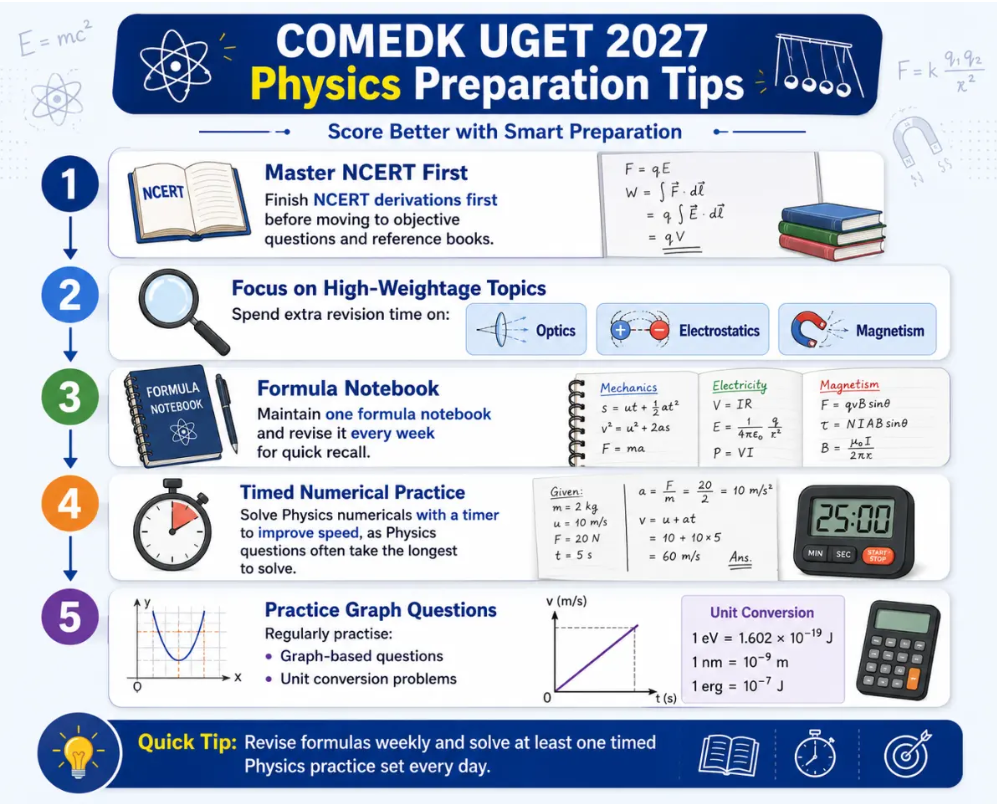
Physics Preparation Tips
- Finish NCERT derivations first, then move to objective practice.
- Give Optics, Electrostatics and Magnetism the largest share of your revision time.
- Maintain a single formula notebook and revise it every week.
- Solve numericals with a timer, since Physics questions consume the most time.
- Practise graph-based and unit-conversion questions, which appear regularly.
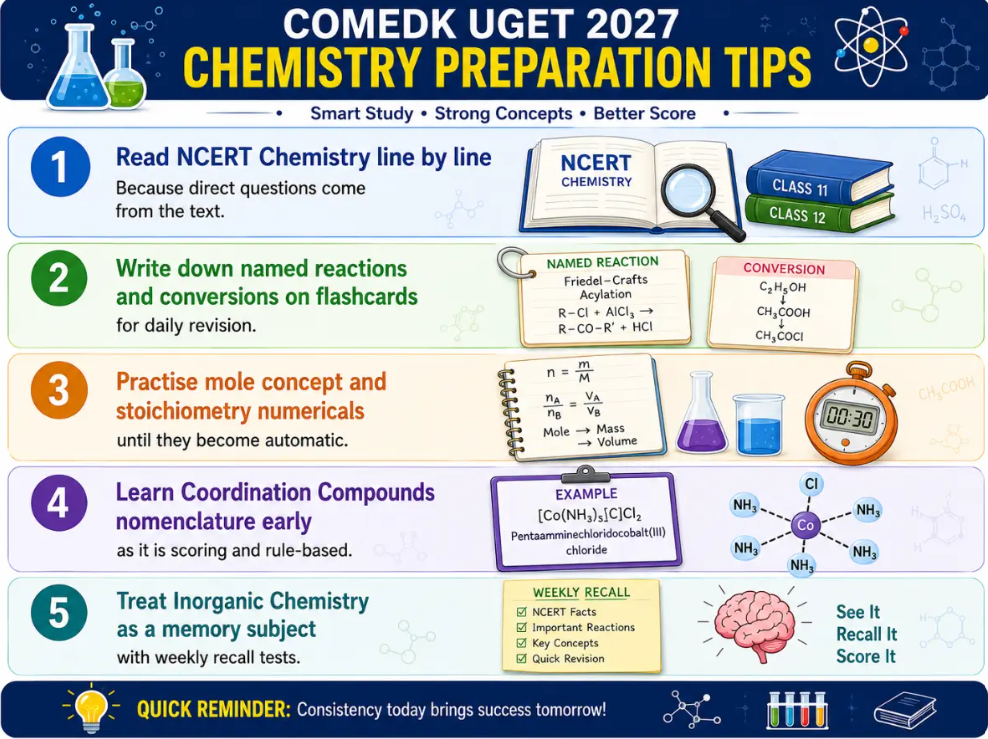
Chemistry Preparation Tips
- Read NCERT Chemistry line by line, because direct questions come from the text.
- Write down named reactions and conversions on flashcards for daily revision.
- Practise mole concept and stoichiometry numericals until they become automatic.
- Learn Coordination Compounds nomenclature early, as it is scoring and rule-based.
- Treat Inorganic Chemistry as a memory subject with weekly recall tests.
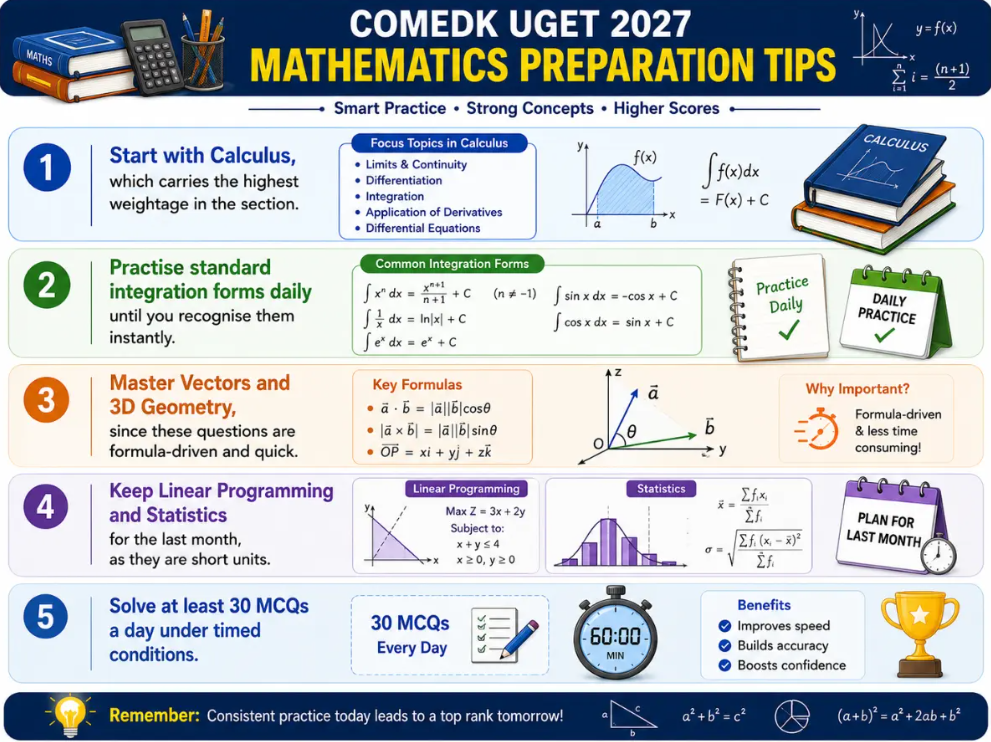
Mathematics Preparation Tips
- Start with Calculus, which carries the highest weightage in the section.
- Practise standard integration forms daily until you recognise them instantly.
- Master Vectors and 3D Geometry, since these questions are formula-driven and quick.
- Keep Linear Programming and Statistics for the last month, as they are short units.
- Solve at least 30 MCQs a day under timed conditions.
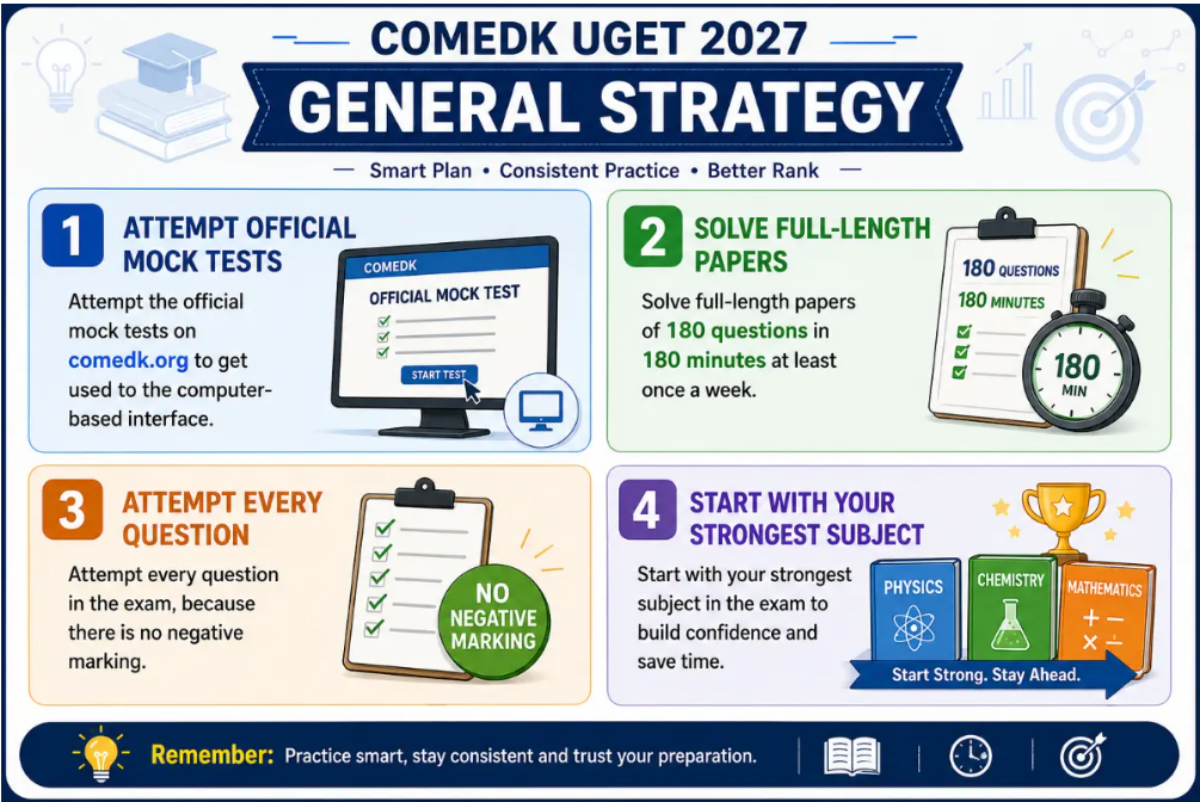
General Strategy
- Attempt the official mock tests on comedk.org to get used to the computer-based interface.
- Solve full-length papers of 180 questions in 180 minutes at least once a week.
- Attempt every question in the exam, because there is no negative marking.
- Start with your strongest subject in the exam to build confidence and save time.
Also Read:



Comments