University of Sydney Placements are first provided through post-program internship support. Students can undertake additional projects or jobs and develop skills and knowledge in specific areas depending on the level of the student's learning program. You will have access to a diverse range of opportunities that will enhance your student experience and employability. As per QS Graduate Employability Rankings, graduates of University of Sydney have been named the most employable in Australia, and 4th globally. The top companies that you can partner with for placement and internships are:
According to a recent report, the average salary of University of Sydney graduates is 98,000 AUD per annum. Executive MBA is the highest paying degree pursued by international students at the university with an average salary of 300,000 AUD. The university also provides projects, internships and abroad travel to gain experience.
Check Out: University of Sydney Placement (Spanish)
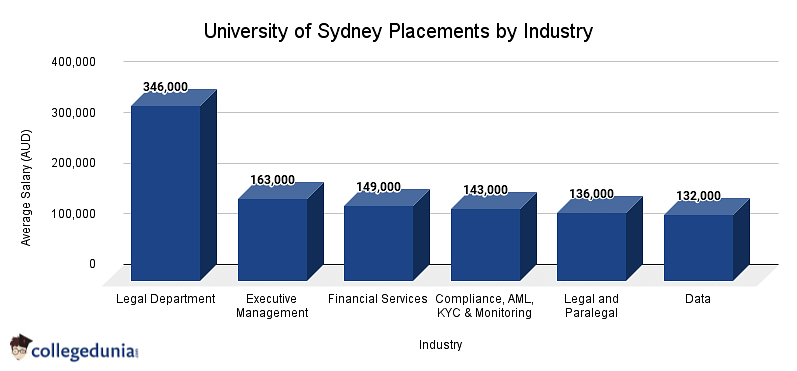
University of Sydney Placements by Industry
The Legal Department is the highest paying sector employing The University of Sydney graduates with an average salary of 346,000 AUD (1.92 crore INR) per annum. Some of the popular industries employing these graduates and their average salary are as follows:
![University of Sydney Placements by industry]()
| Industry |
Average Annual Salary (AUD) |
| Legal Department |
346,000 |
| Executive Management |
163,000 |
| Financial Services |
149,000 |
| Compliance, AML, KYC & Monitoring |
143,000 |
| Legal and Paralegal |
136,000 |
| Data |
132,000 |
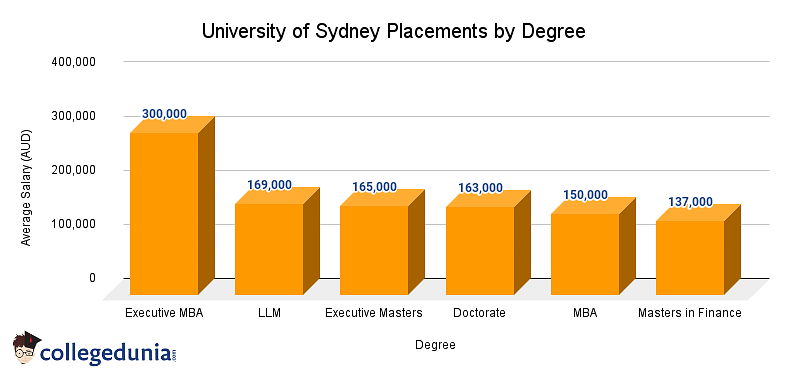
University of Sydney Placements by Degree
Currently, Executive MBA is the highest paying degree pursued by The University of Sydney students. EMBA graduates earn an average salary of 300,000 AUD per annum. Following are some of the highest paying degrees offered by the university:
![University of Sydney Placements by degree]()
| Degree |
Average Annual Salary (AUD) |
| Executive MBA |
300,000 |
| LLM |
169,000 |
| Executive Masters |
165,000 |
| Doctorate |
163,000 |
| MBA |
150,000 |
| Masters in Finance |
137,000 |
University of Sydney Placements: Industry Placement Program
If you are enrolled in business programs at University of Sydney, the Industry Placement Program (IPP) offers the opportunity to work for a leading company as part of the student's research.
The Industry Placement Program offers internships with local companies in Sydney and international companies in USA. All programs have standard tuition fees, and international programs include program fees. The Onsite Internship works at least 3 days a week, 10 weeks during the semester, and hours during the summer vacation. The business school may decide to withdraw the student's application.
Eligibility Criteria for Industry Placement Program
To apply for IPP, students must be enrolled in one of the following business school degrees and have a WAM of 60 (or higher). Students must have completed at least 48 credit points in undergraduate business units or 24 credit points in graduate business units before students can start their research.
| Industry Placement Program |
Degrees |
| USA |
Bachelor of Commerce (including combined degrees), Master of Commerce, Master of Commerce (Extension), Master of Human Resources and Industrial Relations, Master of Professional Accounting or Master of Professional Accounting and Business Performance |
| Local |
Bachelor of Commerce (including combined degrees), Master of Commerce, Master of Commerce (Extension), Master of Human Resources and Industrial Relations, Master of Logistics and Supply Chain Management, Master of Professional Accounting or Master of Professional Accounting and Business Performance |
University of Sydney Local Industry Placement
The Local Industry Placement Program offers students the opportunity to earn 6 credit points for their degree. Students work part-time (unpaid) for 10 weeks during the semester and 6 weeks full-time during the summer vacation. In the internship, students will work on a project where they can apply the knowledge and theory gained while studying.
| Local Industry Placement Program Semester 1, 2025 |
| Placement duration |
Week 2 to Week 12, 210 hours during these weeks
You are required to attend your placement during the mid-semester break, except for public holidays.
|
|
WIL Pop-up
|
Come along to our pop-up to find out more about our Work-Integrated Learning programs and how to apply:
Week 1: Tuesday, 30 July and Thursday, 1 August, 1–4 pm
Week 2: Tuesday, 6 August and Thursday, 8 August, 1–4 pm
Week 3: Tuesday, 13 August, 1–4 pm
Careers Lounge, Basement Level, Abercrombie Building H70
|
|
Application deadlines
|
Applications open from 9 am, 5 August 2024 Sydney local time.
Applications close 12 pm, 15 August 2024 Sydney local time.
|
|
Assessment centers
|
9–26 September 2024 |
|
Compulsory pre-placement training
|
First week of Semester 1, 2025 (TBC). |
University of Sydney's commitment to providing valuable industry placements and producing highly employable graduates contributes to its reputation as one of the top universities in Australia.
FAQs
What is the highest package at University of Sydney?
Executive MBA is the highest paying degree pursued by international students at the university with an average salary of 300,000 AUD (1.67 crore INR). The salary depends on the type of degree and the company that hires you.
Who are the top employers of the University of Sydney?
Students have worked on projects with industry partners such as Accenture, DXC Technology, Ernst and Young, Herbert Smith Freehills, NSW Health, Telstra, Qantas, Westpac and many more. The QS Graduate Employability ranking considered more than 700 universities and surveyed more than 75,000 employers around the world.
What is the average package for University of Sydney MBA?
The University of Sydney MBA program has an average starting salary of AUD 150,000, significantly higher than the national average for MBA graduates. The employment rate for the Sydney MBA program is 85%, indicating a strong demand for the school's graduates.
Is University of Sydney hard to get into for international students?
The University of Sydney acceptance rate is 30%, which makes the USYD admission more competitive for International students. As per the University of Sydney requirements, students need to submit the score of English Language Proficiency test score and additional test scores like GMAT/ GRE.
What is the best paying university in Australia?
The best paying university in Australia is UNSW Sydney with an average of $110,000, next is Southern Cross University with a package of $103,000 and Queensland University of Technology (QUT) with package of $100,000.
Why Sydney is best for international students?
Sydney is a hub of culture and creativity. There are numerous theaters, museums, and festivals that cater to a wide range of interests. You'll have plenty of opportunities to immerse yourself in the arts and cultural experiences. There are also a lot of companies in Sydney.
Which university has the highest employment rate in Australia?
The highest employment rate in Australia belongs to University of Sydney. It ranks #1 in Australia and #4 globally. The next is the University of Melbourne which is 2nd in Australia and 7th in the world.
What is the employability rate at the University of Sydney?
As per the survey, 89 percent of University of Sydney undergraduates were employed in any form of work following graduation, above the national average of 87.2 percent for all Australian universities.
How much is the University of Sydney stipend?
The RTP stipends are valued at $40,109 per annum (2024 rate). The RTP International Scholarship provides a stipend to assist with living costs and overseas health cover as well as tuition fees offsets (i.e. no tuition fees are applicable).
Is MBA high demand in Australia?
The skills that MBA students learn, such as critical thinking, problem-solving, and teamwork, are in high demand by Australian businesses. In addition to the general skills, MBAs learn, many business schools also offer specialisations in specific areas, such as finance, marketing, or strategy.









.png?h=32&w=32&mode=stretch)





Comments