




AP EAPCET 2024 Question Paper May 20 Shift 2 is available for download here. Jawaharlal Nehru Technological University, KAKINADA on behalf of APSCHE conducted AP EAPCET 2024 on May 20 in Shift 2 from 2.30 PM to 5.30 PM. AP EAPCET 2024 MPC Question Paper consists of 160 MCQ-based questions in total, 80 from Mathematics, 40 from physics, and 40 from chemistry carrying 1 mark each to be attempted in the duration of 3 hours.
Download AP EAMCET 2025 Question Paper with Solution PDF
AP EAPCET 2024 Question Paper with Answer Key PDF May 20 Shift 2
| AP EAPCET 2024 May 20 Shift 2 Question Paper with Answer Key |  Download Download |
Check Solution |
AP EAPCET 2024 Question Paper with Solution
SECTION-A
Mathematics
Question 1:
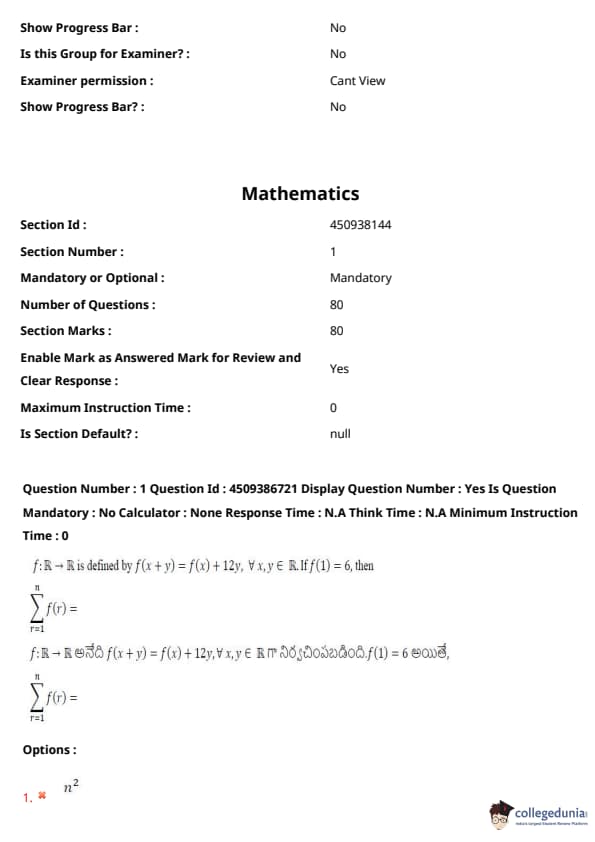
Let \( f: \mathbb{R} \rightarrow \mathbb{R} \) be defined by \( f(x + y) = f(x) + 12y \), for all \( x, y \in \mathbb{R} \). If \( f(1) = 6 \), then the value of \( \sum_{r=1}^n f(r) \) is:
The domain of the real valued function \( f(x) = \sqrt{2 + x} + \sqrt{3 - x} \) is:
View Solution
If \(2.4^{2n+1} + 3^{3n+1}\) is divisible by \(k\) for all \(n \in \mathbb{N}\), then \(k\) is:
View Solution
The determinant of the matrix \[ \begin{bmatrix} a & b & c
a^2 & b^2 & c^2
1 & 1 & 1 \end{bmatrix} \]
is not equal to:
a^2 + b^2 & b^2 + c^2 & c^2 + a^2
2 & 2 & 2 \end{bmatrix} \]
View Solution
Let \( A, B, C, D, \) and \( E \) be \( n \times n \) matrices, each with non-zero determinant. If \( ABCDE = I \), then \( C^{-1} \) is:
View Solution
If \( A = [a_{ij}]\) where \( 1 \leq i, j \leq n \) with \( n \geq 2 \) and \( a_{ij} = i + j \) is a matrix, then the rank of \( A \) is:
View Solution
If \( z_1 = 10 + 6i \), \( z_2 = 4 + 6i \) and \( z \) is any complex number such that the argument of \( \frac{z-z_1}{z-z_2} \) is \( \frac{\pi}{4} \), then the value of \( |z - 7 - 9i| \) is:
View Solution
If \( \frac{3 - 2i \sin \theta}{1 + 2i \sin \theta}\) is a purely imaginary number, then \( \theta \) is:
View Solution
If \( z = x+iy \), \( x^2+y^2 = 1 \) and \( z_1 = e^{i\theta} \), then the expression \( \frac{z_1^{2n-1} - 1}{z_1^{2^n-1} + 1} \) simplifies to:
View Solution
Let \([r]\) denote the largest integer not exceeding \(r\) and the roots of the equation \[ 3z^2 + 6z + 5 + \alpha(x^2 + 2x + 2) = 0 \]
are complex numbers whenever \( \alpha > L \) and \( \alpha < M \). If \( (L-M) \) is minimum, then the greatest value of \([r]\) such that \( Ly^2 + My + r < 0 \) for all \( y \in \mathbb{R} \) is:
View Solution
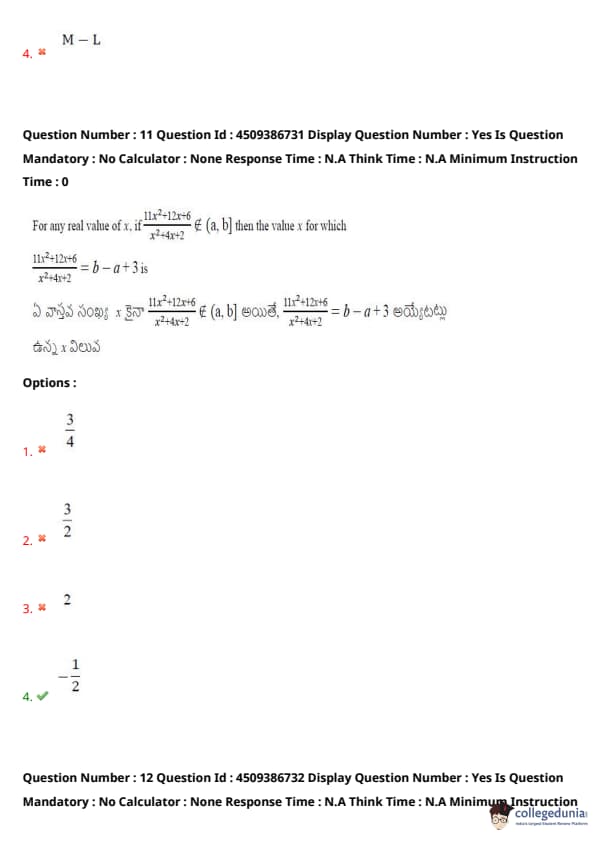
For any real value of \(x\), if \( \frac{11x^{2}+12x+6}{x^{2}+4x+2} \not\in (a, b) \), then the value for \(x\) for which \[ \frac{11x^{2}+12x+6}{x^{2}+4x+2} = b - a + 3 \]
is:
View Solution
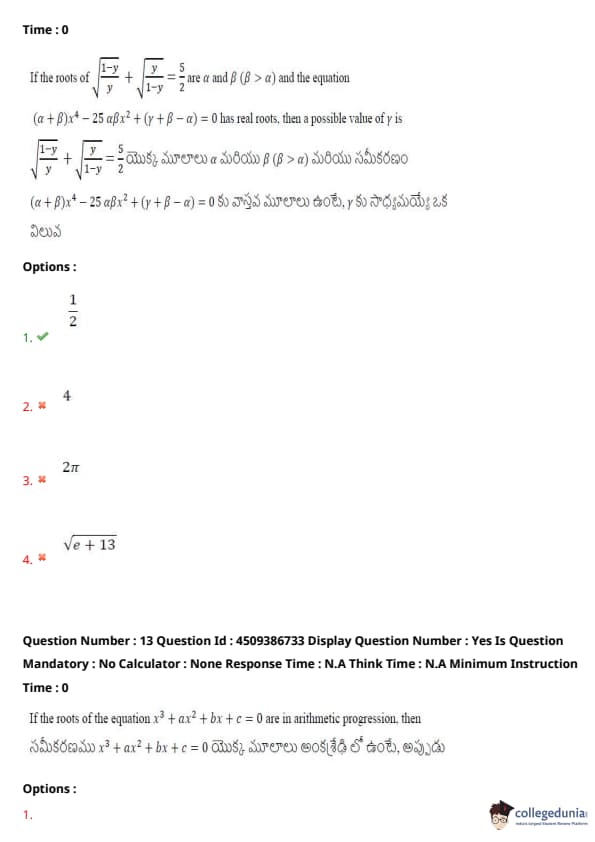
If the roots of \[ \sqrt{\frac{1-y}{y}} + \sqrt{\frac{y}{1-y}} = \frac{5}{2} \]
are \( \alpha \) and \( \beta \) (\( \beta > \alpha \)) and the equation \[ (\alpha + \beta)x^4 - 25\alpha \beta x^2 + (\gamma + \beta - \alpha) = 0 \]
has real roots, then a possible value of \( y \) is:
View Solution
If the roots of the equation \(x^3 + ax^2 + bx + c = 0\) are in arithmetic progression, then:
View Solution
A test containing 3 objective type of questions is conducted in a class. Each question has 4 options and only one option is the correct answer. No two students of the class have answered identically and no student has written all correct answers. If every student has attempted all the questions, then the maximum possible number of students who have written the test is:
View Solution
The number of numbers lying between 1000 and 10000 such that every number contains the digits 3 and 7 only once without repetition is:
- We need to fill four positions with the digits 3 and 7 appearing exactly once in any two of those positions. \textbf{Step 2:} Choose the positions for the digits 3 and 7.
- There are \(\binom{4}{2} = 6\) ways to select two positions for digits 3 and 7 in the four-digit number. \textbf{Step 3:} For the remaining two positions, choose digits from the remaining digits (0-9, excluding 3 and 7).
- The first remaining position can be filled with any digit from 0-9, excluding 3 and 7, so there are 8 possible choices for the first remaining digit. - The second remaining position can then be filled with any remaining digit, excluding the previously chosen ones, so there are 7 possible choices for the second remaining digit. \textbf{Step 4:} Calculate the total number of four-digit numbers.
- The total number of possibilities is \(6 \times 8 \times 7 = 336\). This gives us the total number of ways to assign digits to the four positions. \textbf{Step 5:} Adjust for the constraint on the first position (thousands place).
- We must ensure that the thousands place (the first digit) cannot be 0, as that would make the number a three-digit number. So, if 0 is chosen for one of the remaining two positions, we need to calculate the possible configurations where 0 is not in the first position. - If 0 is selected for the second position (thousands place), there are 7 choices left for the third and fourth digits. The total number of possibilities for these configurations is \(6 \times 8 \times 7 = 672\). \textbf{Step 6:} After carefully adjusting for constraints and recalculating, the correct total number is \(720\).
View Solution
The number of ways in which 17 apples can be distributed among four guests such that each guest gets at least 3 apples is:
View Solution
If the coefficients of \(x^5\) and \(x^6\) are equal in the expansion of \( \left( a + \frac{x}{5} \right)^{65} \), then the coefficient of \(x^2\) in the expansion of \( \left( a + \frac{x}{5} \right)^4 \) is:
- We are given \( \left( a + \frac{x}{5} \right)^{65} \), and we are asked to find when the coefficients of \(x^5\) and \(x^6\) are equal. \textbf{Step 2:} Use the binomial theorem to find the general term.
The general term in the expansion of \( \left( a + \frac{x}{5} \right)^{65} \) is: \[ T_k = \binom{65}{k} a^{65-k} \left(\frac{x}{5}\right)^k \] Thus, the coefficient of \(x^5\) is: \[ \binom{65}{5} a^{60} \left(\frac{1}{5^5}\right) \] and the coefficient of \(x^6\) is: \[ \binom{65}{6} a^{59} \left(\frac{1}{5^6}\right) \] \textbf{Step 3:} Equate the coefficients of \(x^5\) and \(x^6\).
Equating the two coefficients: \[ \binom{65}{5} a^{60} \left(\frac{1}{5^5}\right) = \binom{65}{6} a^{59} \left(\frac{1}{5^6}\right) \] Simplify: \[ \frac{\binom{65}{5}}{\binom{65}{6}} = \frac{a^{59}}{a^{60}} \cdot \frac{5}{1} \] \[ \frac{66}{5} = \frac{1}{a} \cdot 5 \] Solve for \(a\): \[ a = \frac{5}{66} \] \textbf{Step 4:} Find the coefficient of \(x^2\) in \( \left( a + \frac{x}{5} \right)^4 \).
Now, we need to find the coefficient of \(x^2\) in the expansion of \( \left( a + \frac{x}{5} \right)^4 \). The general term in this expansion is: \[ T_k = \binom{4}{k} a^{4-k} \left(\frac{x}{5}\right)^k \] For \(k = 2\), the term is: \[ T_2 = \binom{4}{2} a^2 \left(\frac{x}{5}\right)^2 = 6 a^2 \left(\frac{x^2}{25}\right) = \frac{6 a^2}{25} x^2 \] Substitute \(a = \frac{5}{66}\) into this expression: \[ \frac{6 a^2}{25} = \frac{6 \left(\frac{5}{66}\right)^2}{25} = \frac{6 \times \frac{25}{4356}}{25} = \frac{150}{108900} = \frac{24}{25} \] Thus, the coefficient of \(x^2\) is \( \frac{24}{25} \).
View Solution
If \( |x| < \frac{2}{3} \), then the fourth term in the expansion of \( (3x - 2)^{2/3} \) is:
View Solution
If \[ \frac{x^2+3}{x^4+2x^2+9} = \frac{Ax+B}{x^2+ax+b} + \frac{Cx+D}{x^2+cx+d} \]
then \( aA + bB + cC + dD = \)
View Solution
If \(\sec \theta + \tan \theta = \frac{1}{3}\), then the quadrant in which \(2\theta\) lies is:
View Solution
If \(540^\circ < A < 630^\circ\) and \(|\cos A| = \frac{5}{13}\), then \( \tan\frac{A}{2} \tan A =\)
View Solution
If \((\alpha + \beta)\) is not a multiple of \(\frac{\pi}{2}\) and \(3 \sin(\alpha - \beta) = 5 \cos(\alpha + \beta)\), then \[ \tan\left(\frac{\pi}{4} + \alpha\right) + 4\tan\left(\frac{\pi}{4} + \beta\right) = \]
View Solution
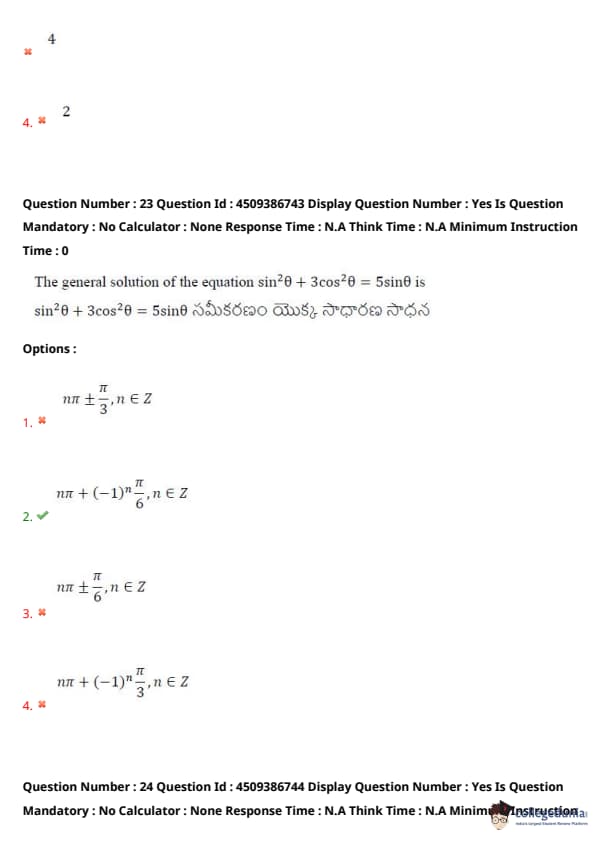
The general solution of the equation \( \sin^2 \theta + 3 \cos^2 \theta = 5 \sin \theta \) is:
View Solution
If \( \cos^{-1}(2x) + \cos^{-1}(3x) = \frac{\pi}{3} \) and \(4x^2 = \frac{a}{b}\), then \(a + b =\)
View Solution
If \( \theta = \sec^{-1}(\cosh u) \), then \( u = \)
View Solution
In \(\triangle ABC\), if \(4r_1 = 5r_2 = 6r_3\), then \(\sin^2 \frac{A}{2} + \sin^2 \frac{B}{2} + \sin^2 \frac{C}{2} =\)
View Solution
In \(\triangle ABC\), \(r r_1 \cot^ \frac{A}{2} + r r_2 \cot^ \frac{B}{2} + r r_3 \cot^ \frac{C}{2} = \)
View Solution
In \(\triangle ABC\), \(bc - r_2 r_3 = \)
View Solution
The angle between the diagonals of the parallelogram whose adjacent sides are \(2i + 4j - 5k\) and \(i + 2j + 3k\) is
View Solution
If the points having the position vectors \( \mathbf{r}_1 = -i + 4j - 4k\), \( \mathbf{r}_2 = 3i + 2j - 5k\), \( \mathbf{r}_3 = -3i + 8j - 5k\) and \( -3i + 2j + \lambda k\) are coplanar, then \(\lambda = \)
View Solution
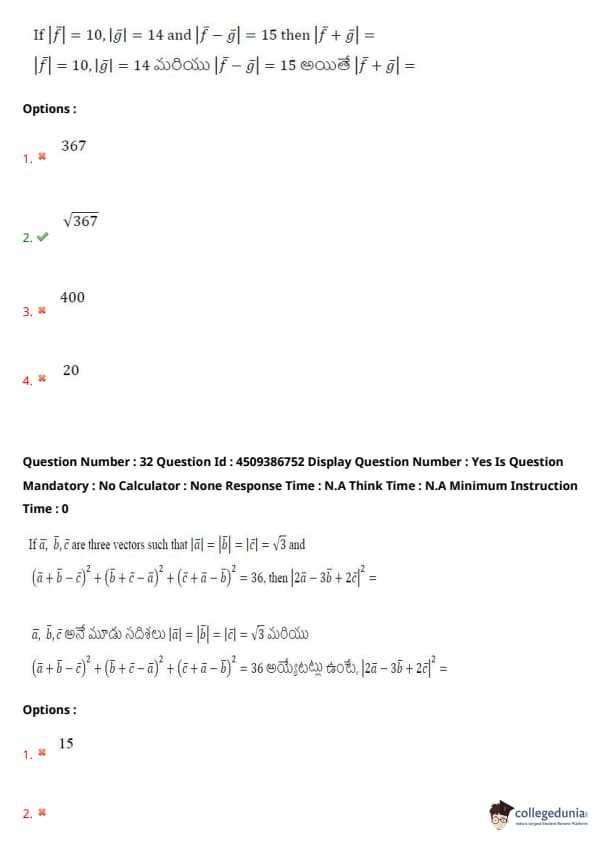
If \( |\mathbf{\bar{f}}| = 10\), \( |\mathbf{\bar{g}}| = 14\) and \( |\mathbf{\bar{f}} - \mathbf{\bar{g}}| = 15\), then \( |\mathbf{\bar{f}} + \mathbf{\bar{g}}| =\)
View Solution
If \( \mathbf{a}, \mathbf{b}, \mathbf{c} \) are three vectors such that \( |\mathbf{a}| = |\mathbf{b}| = |\mathbf{c}| = \sqrt{3} \) and \( ( \mathbf{a} + \mathbf{b} - \mathbf{c} )^2 + ( \mathbf{b} + \mathbf{c} - \mathbf{a} )^2 + ( \mathbf{c} + \mathbf{a} - \mathbf{b} )^2 = 36\), then \(|2\mathbf{a} - 3\mathbf{b} + 2\mathbf{c}|^2 =\)
View Solution
The angle between the line with the direction ratios \( (2, 5, 1) \) and the plane \( 8x + 2y - z = 4 \) is given by
View Solution
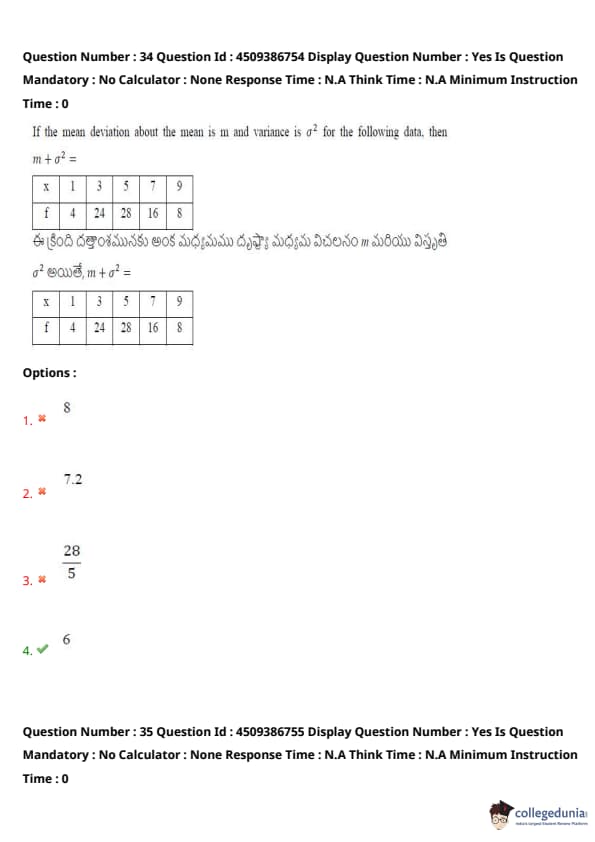
If the mean deviation about the mean is \(m\) and the variance is \(\sigma^2\) for the following data, then \(m + \sigma^2 =\)
% Data table \[ \begin{array}{|c|c|c|c|c|c|} \hline x & 1 & 3 & 5 & 7 & 9
\hline f & 4 & 24 & 28 & 16 & 8
\hline \end{array} \]
View Solution
If five-digit numbers are formed from the digits 0, 1, 2, 3, 4 using every digit exactly only once, then the probability that a randomly chosen number from those numbers is divisible by 4 is
View Solution
Two natural numbers are chosen at random from 1 to 100 and are multiplied. If \(A\) is the event that the product is an even number and \(B\) is the event that the product is divisible by 4, then \(P(A \cap \bar B) = \)
View Solution
A box \( P \) contains one white ball, three red balls and two black balls. Another box \( Q \) contains two white balls, three red balls and four black balls. If one ball is drawn at random from each one of the two boxes, then the probability that the balls drawn are of different color is
View Solution
A person is known to speak false once out of 4 times. If that person picks a card at random from a pack of 52 cards and reports that it is a king, then the probability that it is actually a king is
View Solution
For a binomial variate \(X \sim B(n, p)\), the difference between the mean and variance is 1 and the difference between their squares is 11. If the probability of \(P(X = 2) = m\left(\frac{5}{6}\right)^n\) and \(n = 36\) then \(m:n\) is
View Solution
The probability that a man failing to hit a target is \(\frac{1}{3}\). If he fires 4 times, then the probability that he hits the target at least thrice is
View Solution
Let \( A(2, 3), B(1, -1) \) be two points. If \( P \) is a variable point such that \( \angle APB = 90^\circ \), then the locus of \( P \) is
View Solution
If the origin is shifted to remove the first degree terms from the equation \(2x^2 - 3y^2 + 4xy + 4x + 4y - 14 = 0\), then with respect to this new co-ordinate system, the transformed equation of \(x^2 + y^2 - 3xy + 4y + 3 = 0\) is
View Solution
The circumcentre of the triangle formed by the lines \(x + y + 2 = 0\), \(2x + y + 8 = 0\) and \(x - y - 2 = 0\) is
View Solution
If the line \(2x - 3y + 5 = 0\) is the perpendicular bisector of the line segment joining \(1, -2\) and \((a, b)\), then \(a + b =\)
View Solution
If the area of the triangle formed by the straight lines \(-15x^2 + 4xy + 4y^2 = 0\) and \(x = a\) is \(200 \, sq. units\), then \(|a| =\)
View Solution
The equation of the straight line passing through the point of intersection of the lines represented by \(x^2 + 4xy + 3y^2 - 4x - 10y + 3 = 0\) and the point \((2,2)\) is:
View Solution
The largest among the distances from the point \(P(15,9)\) to the points on the circle \(x^2 + y^2 - 6x - 8y - 11 = 0\) is:
View Solution
The circle \(x^2 + y^2 - 8x - 12y + \alpha = 0\) lies in the first quadrant without touching the coordinate axes. If \((6, 6)\) is an interior point to the circle, then the range of \(\alpha\) is:
View Solution
The equation of the circle whose diameter is the common chord of the circles \(x^2 + y^2 - 6x - 7 = 0\) and \(x^2 + y^2 - 10x + 16 = 0\) is:
View Solution
If the locus of the mid points of the chords of the circle \(x^2 + y^2 = 25\) that subtend a right angle at the origin is given by \( \frac{x^2}{a^2} + \frac{y^2}{a^2} = 1\), then \(|a| =\)
View Solution
The radical center of the circles \(x^2 + y^2 + 2x + 3y + 1 = 0\), \(x^2 + y^2 - x + y + 3 = 0\), and \(x^2 + y^2 - 3x + 2y + 5 = 0\) is:
View Solution
Equation of a tangent line of the parabola \(y^2 = 8x\), which passes through the point \((1, 3)\) is:
View Solution
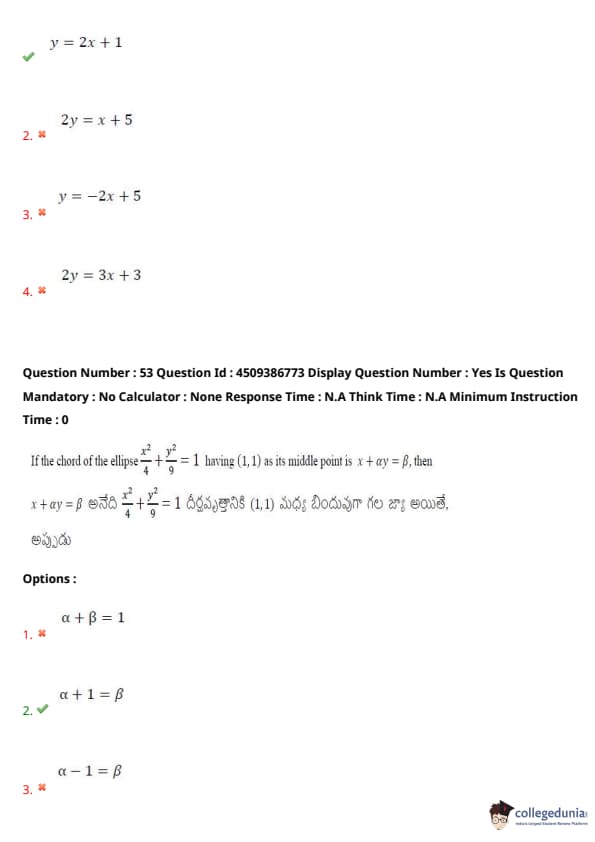
If the chord of the ellipse \( \frac{x^2}{4} + \frac{y^2}{9} = 1 \) having \((1,1)\) as its middle point is \( x + \alpha y = \beta \), then:
View Solution
If a directrix of a hyperbola centered at the origin and passing through the point \( (4, -2\sqrt{3}) \) is \( \sqrt{5}x = 4 \) and \( e \) is its eccentricity, then \( e^2 = \)
View Solution
If \( l_1 \) and \( l_2 \) are the lengths of the perpendiculars drawn from a point on the hyperbola \( 5x^2 - 4y^2 - 20 = 0 \) to its asymptotes, then \( \frac{l_1^2 l_2^2}{100} = \)
View Solution
If \( O(0, 0, 0), A(3, 0, 0), B(0, 4, 0) \) form a triangle then the incenter of triangle OAB is:
View Solution
The direction cosines of the line of intersection of the planes \( x + 2y + z - 4 = 0 \) and \( 2x - y + z - 3 = 0 \) are:
View Solution
If \( L_1 \) and \( L_2 \) are two lines which pass through origin and have direction ratios \( (3, 1, -5) \) and \( (2, 3, -1) \) respectively, then the equation of the plane containing \( L_1 \) and \( L_2 \) is:
View Solution
Evaluate the limit: \[ \lim_{x \to \frac{\pi}{4}} \frac{4\sqrt{2} - (\cos x + \sin x)^5}{1 - \sin 2x} = \]
View Solution
Evaluate the limit: \[ \lim_{x \to 0} \frac{e^{x} - a - \log(1+x)}{\sin x} = 0, then find a. \]
View Solution
Determine the values of \(a\) and \(b\) for which the function \(f(x)\) defined as: \[ f(x) = \begin{cases} 1 + |\sin x|^{(a/|\sin x|)} & if \frac{-\pi}{6} < x < 0,
b & if x = 0,
e^{\left(\frac{\tan 2x}{\tan 3x}\right)} & if 0 < x < \frac{\pi}{6} \end{cases} \]
is continuous at \(x = 0\).
View Solution
If \(f(x) = \begin{cases} 2x+3, & x \leq 1
2ax + bx, & x > 1 \end{cases}\) is differentiable \(\forall x \in \mathbb{R}\), then \(f(2) =\)
View Solution
If \(y = t^2 + t^3\) and \(x = t - t^4\), then \(\frac{d^2y}{dx^2}\) at \(t = 1\) is:
View Solution
In the interval \([0, 3]\), the function \(f(x) = |x - 1| + |x - 2|\) is:
View Solution
If \( p_1 \) and \( p_2 \) are the perpendicular distances from the origin to the tangent and normal drawn at any point on the curve \( x^{2/3} + y^{2/3} = a^{2/3} \) respectively. If \( k_1 p_1^2 + k_2 p_2^2 = a^2 \), then \( k_1 + k_2 = \)
View Solution
The length of the subnormal at any point on the curve \( y = \left(\frac{x}{2024}\right)^k \) is constant if the value of \( k \) is:
View Solution
The acute angle between the curves \(x^2 + y^2 = x + y\) and \(x^2 + y^2 = 2y\) is:
View Solution
A value of \(c\) according to the Lagrange's mean value theorem for \(f(x) = (x - 1)(x - 2)(x - 3)\) in \([0,4]\) is:
View Solution
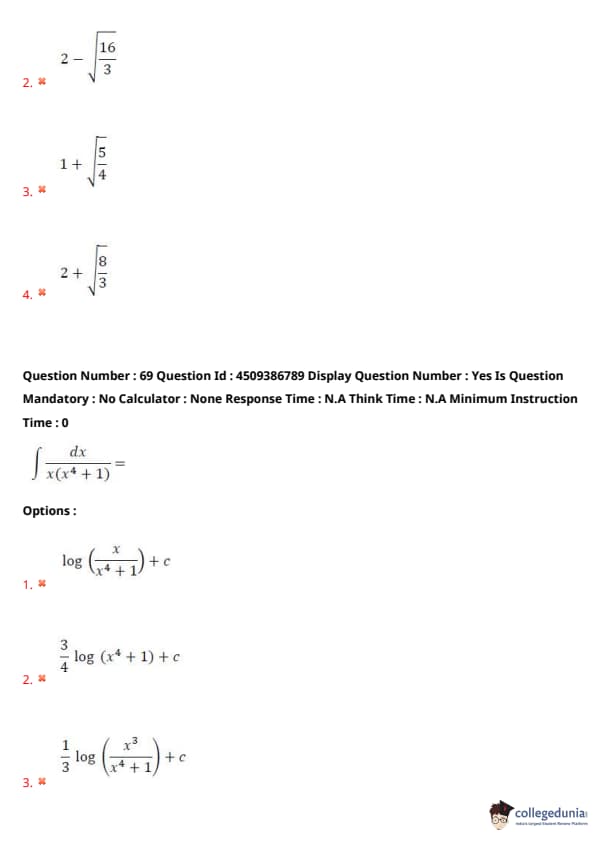
Evaluate the integral \( \int \frac{dx}{x(x^4 + 1)} \):
View Solution
Evaluate the integral \( \int \frac{dx}{\sqrt{\sin^3 x \cdot \cos (x - \alpha)}} \):
View Solution
Evaluate the integral \( \int \frac{e^{2x}}{\sqrt{e^x + 1}} \, dx \):
View Solution
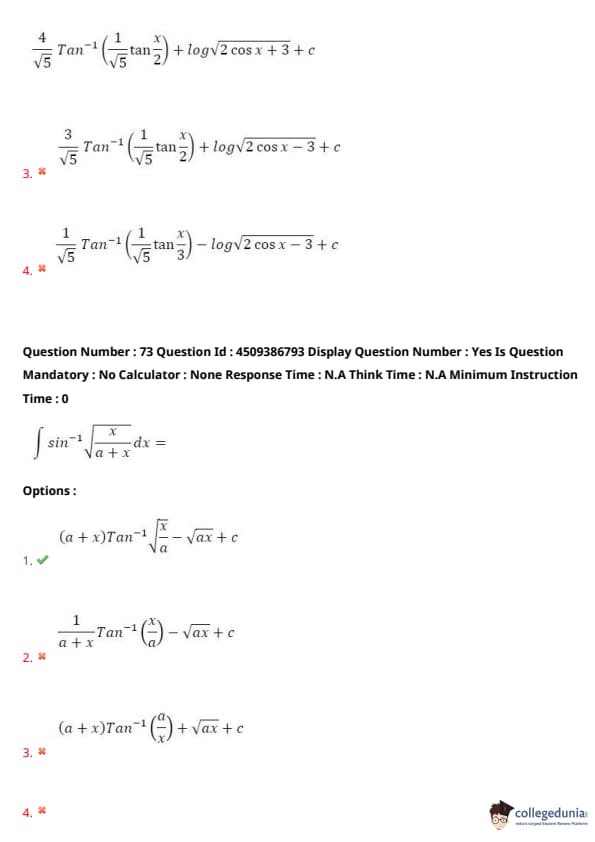
Evaluate the integral \( \int \frac{2 - \sin x}{2 \cos x + 3} \, dx \):
View Solution
Evaluate the integral \( \int \frac{\sin^{-1} \left(\frac{x}{\sqrt{a + x}}\right)}{\sqrt{a + x}} \, dx \):
View Solution
Evaluate the integral \( \int_{-\frac{1}{24}}^{\frac{1}{24}} \sec(x) \log\left(\frac{1-x}{1+x}\right) \, dx \):
View Solution
If \([x]\) is the greatest integer function, then evaluate the integral \( \int_{0}^{5} [x] \, dx \):
View Solution
Evaluate the integral \( \int_0^{\frac{\pi}{2}} \frac{1}{1 + \sqrt{\tan x}} \, dx \):
View Solution
Evaluate the integral \( \int_0^{\pi} \frac{x \sin x}{1 + \cos^2 x} \, dx \):
View Solution
Determine the order and degree of the differential equation \( \frac{d^3y}{dx^3} = \left[1 + \left(\frac{dy}{dx}\right)^2\right]^{5/2} \):
View Solution
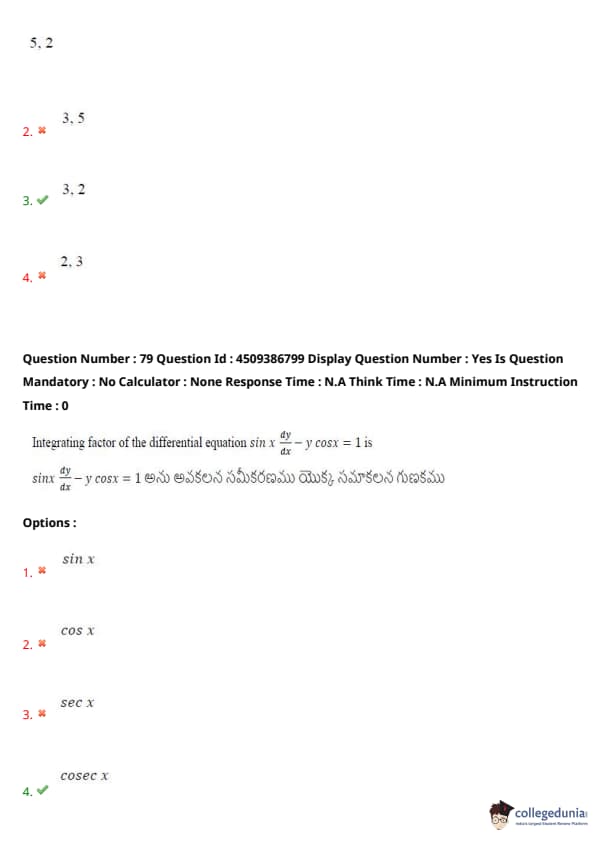
Find the integrating factor of the differential equation \( \sin x \frac{dy}{dx} - y \cos x = 1 \):
View Solution
The general solution of the differential equation \( (x \sin \frac{y}{x}) dy = (y \sin \frac{y}{x} - x) dx \) is:
View Solution
Find the dimension formula of \(\frac{a}{b}\) in the equation \( F = a\sqrt{x} + bt^2 \), where \(F\) is a force, \(x\) is distance and \(t\) is time.
View Solution
The relation between time \( t \) and displacement \( x \) is \( t = \alpha x^2 + \beta x \), where \(\alpha\) and \(\beta\) are constants. If \( \nu \) is the velocity, the retardation is:
View Solution
If two stones are projected at angle \( \theta \) and \( (90^\circ - \theta) \) respectively with horizontal with a speed of \( 20 \, m/s \). If the second stone rises \( 10 \, m \) higher than the first stone, then the angle of projection \( \theta \) is (acceleration due to gravity = \( 10 \, m/s^2 \)):
View Solution
A particle revolving in a circular path travels the first half of the circumference in 4 s and the next half in 2 s. What is its average angular velocity?
View Solution
A block of metal 2 kg is in rest on a smooth plane. It is struck by a jet releasing water of 1 kg s\(^{-1}\) at a speed of 5 m s\(^{-1}\), then the acceleration of the block is
View Solution
An insect is crawling in a hemi-spherical bowl of radius \( R \). If the coefficient of friction between the insect and bowl is \( \mu \), then the maximum height to which the insect can crawl the bowl is
View Solution
Two objects having masses in \(1:4\) ratio are at rest. When both of them are subjected to the same force separately, they achieved the same kinetic energy during times \(t_1\) and \(t_2\) respectively. The ratio of \(\frac{t_2}{t_1}\) is
View Solution
An object of mass 'm' is projected with an initial velocity 'u' with an angle of '\(\theta\)' with the horizontal. The average power delivered by gravity in reaching the highest point is
View Solution
A small disc is on the top of a smooth hemisphere of radius 'R'. The smallest horizontal velocity 'V' that should be imparted to the disc so that the disc leaves the hemisphere surface without sliding down (there is no friction) is
View Solution
A block (\(P\)) is rotating in contact with the vertical wall of a rotor as shown in figures A, B, C. The relation between angular velocities \( \omega_A, \omega_B, \omega_C \) so that the block does not slide down. (Given: \( R_A < R_B < R_C \), where \( R \) denotes radius)

View Solution
A horizontal board is performing simple harmonic oscillations horizontally with an amplitude of \(0.3 \, m\) and a period of \(4 \, s\). The minimum coefficient of friction between a heavy body placed on the board if the body is not to slip is:
View Solution
A test tube of mass \(6 \, g\) and uniform area of cross section \(10 \, cm^2\) is floating in water vertically when \(10 \, g\) of mercury is in the bottom. The tube is depressed by a small amount and then released. The time period of oscillation is: (Acceleration due to gravity = \(10 \, m/s^2\))
View Solution
What is the height from the surface of earth, where acceleration due to gravity will be \( \frac{1}{4} \) of that of the earth? (Re = 6400 km)
View Solution
Depth of a river is \(100 \, m\). Magnitude of compressibility of the water is \(0.5 \times 10^{-9} \, N^{-1}m^2\). The fractional compression in water at the bottom of the river is (Acceleration due to gravity = \(10 \, m/s^2\))
View Solution
Two mercury drops, each with same radius \( r \), merged to form a bigger drop. If \( T \) is the surface tension of mercury, then the surface energy of the bigger drop is given by
View Solution
The absorption coefficient value of a perfect black body is
View Solution
A certain volume of a gas at 300 K expands adiabatically until its volume is doubled. The resultant fall in temperature of the gas is nearly (The ratio of the specific heats of the gas is 1.5)
View Solution
The efficiency of a Carnot's engine is 25%, when the temperature of sink is 300 K. The increase in the temperature of source required for the efficiency to become 50% is
View Solution
When 100 J of heat is supplied to a gas, the increase in the internal energy of the gas is 60 J. Then the gas is/can
View Solution
An ideal gas is kept in a cylinder of volume \(3 \, m^3\) at a pressure of \(3 \times 10^5 \, Pa\). The energy of the gas is
View Solution
A pipe with 30 cm Length is open at both ends. Which harmonic mode of the pipe resonates a 1.65 kHz source? (Velocity of sound in air = 330 m/s)
View Solution
An object is placed at a distance of 18 cm in front of a mirror. If the image is formed at a distance of 4 cm on the other side, then the focal length, nature of the mirror and nature of the image are respectively:
View Solution
If a microscope is placed in air, the minimum separation of two objects seen as distinct is 6 µm. If the same is placed in a medium of refractive index 1.5, the minimum separation of the two objects to see as distinct is:
View Solution
Three point charges \( +q, +2q, \) and \( +4q \) are placed along a straight line such that the charge \( +2q \) lies equidistant from the other two charges. The ratio of the net electrostatic force on charges \( +q \) and \( +4q \) is:
View Solution
Three parallel plate capacitors of capacitances \(4 \mu F\), \(6 \mu F\), and \(12 \mu F\) are first connected in series and then in parallel. The ratio of the effective capacitances in the two cases is:
View Solution
A particle of mass 2 g and charge 6 \(\mu\)C is accelerated from rest through a potential difference of 60 V. The speed acquired by the particle is:
View Solution
A straight wire of resistance \(R\) is bent in the shape of a square. A cell of emf 12 V is connected between two adjacent corners of the square. The potential difference across any diagonal of the square is:
View Solution
In the given circuit, if the potential at point B is 24 V, the potential at point A is:

View Solution
Two long straight parallel conductors A and B carrying currents 4.5 A and 8 A respectively are separated by 25 cm in air. The resultant magnetic field at a point which is a distance of 15 cm from conductor A and 20 cm from conductor B is:
View Solution
Two concentric thin circular rings of radii 50 cm and 40 cm each, carry a current of 3.5 A in opposite directions. If the two rings are coplanar, the net magnetic field due to the two rings at their centre is:
View Solution
At a place where the magnitude of the earth's magnetic field is \(4 \times 10^{-5} \, T\), a short bar magnet is placed with its axis perpendicular to the earth's magnetic field direction. If the resultant magnetic field at a point at a distance of 40 cm from the center of the magnet on the normal bisector of the magnet is inclined at \(45^\circ\) with the earth's field, the magnetic moment of the magnet is:
View Solution
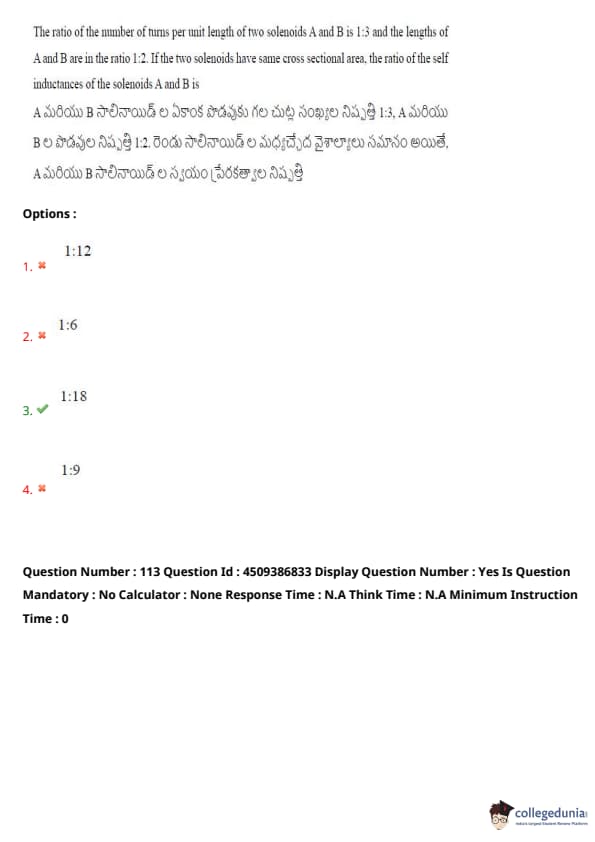
The ratio of the number of turns per unit length of two solenoids A and B is \(1:3\) and the lengths of A and B are in the ratio \(1:2\). If the two solenoids have the same cross-sectional area, the ratio of the self-inductances of the solenoids A and B is:
View Solution
An inductor and a resistor are connected in series to an AC source of voltage \( 144\sin(100\pi t + \frac{\pi}{2}) \) volts. If the current in the circuit is \( 6\sin(100\pi t + \frac{\pi}{2}) \) amperes, then the resistance of the resistor is:
View Solution
Inner shell electrons in atoms moving from one energy level to another lower energy level produce:
View Solution
If the kinetic energy of a particle in motion is decreased by 36%, the increase in de Broglie wavelength of the particle is:
View Solution
The speed of the electron in a hydrogen atom in the \( n = 3 \) level is:
View Solution
One mole of radium has an activity of \( \frac{1}{6.3 \times 10^{37}} \) kilo curie. Its decay constant is:
View Solution
The voltage gain and current gain of a transistor amplifier in common emitter configuration are respectively 150 and 50. If the resistance in the base circuit is 850 \(\Omega\), then the resistance in the collector circuit is:
View Solution
If the energy gap of a substance is 5.4 eV, then the substance is:
View Solution
In amplitude modulation, the amplitude of the carrier wave is 10 V and the amplitude of one of the side bands is 2 V. The modulation index is:
View Solution
If uncertainty in position and momentum of an electron are equal, then uncertainty in its velocity is:
View Solution
The graph shown below represents the variation of probability density, \( \Psi(r) \), with distance \( r \) of the electron from the nucleus. This represents:
% Include graphics

View Solution
Match the following elements with their correct classifications:
\begin{tabular{|c|l|l|
\hline
Element & List I & List II
\hline
A & Technetium & I.Non-metal
B & Fluorine & II.Transition metal
C & Tellurium & III.Lanthanoid
D & Dysprosium & IV.Metalloid
\hline
\end{tabular
View Solution
Observe the following reactions. Identify the reaction in which the hybridisation of the underlined atom is changed:
View Solution
Among the following species, correct set of isomolecular pairs are:
\begin{align*
& \mathrm{XeO_3, \mathrm{CO_3^{2-, \mathrm{SO_3, \mathrm{H_3\mathrm{O^+, \mathrm{ClF_3
\end{align*
(1) (\mathrm{XeO_3, \mathrm{CO_3^{2-) & \quad (\mathrm{SO_3, \mathrm{H_3\mathrm{O^+)
(2) (\mathrm{XeO_3, \mathrm{SO_3) & \quad (\mathrm{CO_3^{2-, \mathrm{H_3\mathrm{O^+)
(3) (\mathrm{XeO_3, \mathrm{H_3\mathrm{O^+) & \quad (\mathrm{SO_3, \mathrm{CO_3^{2-)
(4) (\mathrm{SO_3, \mathrm{ClF_3) & \quad (\mathrm{XeO_3, \mathrm{CO_3^{2-)
View Solution
What is the ratio of kinetic energies of \(3 \, g\) of hydrogen and \(4 \, g\) of oxygen at a certain temperature?
(1) \(3:4\)
(2) \(6:1\)
(3) \(12:1\)
(4) \(1:12\)
View Solution
What is the kinetic energy (in \( J/mol \)) of one mole of an ideal gas (molar mass = \(0.01 \, kg/mol\)) if its rms velocity is \(4 \times 10^2 \, m/s\)?
View Solution
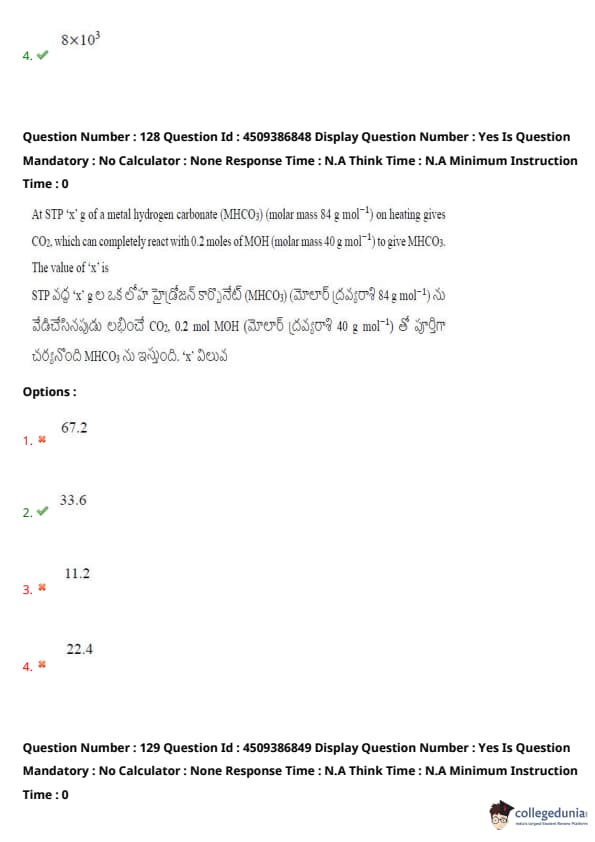
At STP \(x\) g of a metal hydrogen carbonate (MHCO\(_3\)) (molar mass \(84 \, g/mol\)) on heating gives CO\(_2\), which can completely react with \(0.02 \, moles\) of MOH (molar mass \(40 \, g/mol\)) to give MHCO\(_3\). The value of \(x\) is:
View Solution
The volume of an ideal gas contracts from 10.0 L to 2.0 L under an applied pressure of 2.0 atm. During contraction, the system also evolved 90 J of heat. The change in internal energy (in J) involved in the system is (1 L·atm = 101.3 J):
View Solution
The molar heats of fusion and vaporization of benzene are 10.9 and 31.0 kJ mol\(^{-1}\) respectively. The changes in entropy for the solid \(\rightarrow\) liquid and liquid \(\rightarrow\) vapor transitions for benzene are \(x\) and \(y\) J K\(^{-1}\) mol\(^{-1}\) respectively. The value of \(y(x)\) in J\(^2\) K\(^{-2}\) mol\(^{-2}\) is:
View Solution
At \(T\) K, the equilibrium constant for the reaction \[ H_2(g) + Br_2(g) \rightleftharpoons 2 HBr(g) \]
is 1.6 \(\times\) 10\(^{1}\). If 10 bar of HBr is introduced into a sealed vessel at \(T\) K, the equilibrium pressure of HBr (in bar) is approximately:
View Solution
Which of the following will make a basic buffer solution?
View Solution
The hydrides of which group elements are examples of electron precise hydrides?
View Solution
The correct order of density of Be, Mg, Ca, Sr is:
View Solution
Which of the following orders is not correct against the given property?
View Solution
Which of the following are correct?
i. Basic structural unit of silicates is –\( -RSiO- \)
ii. Silicones are biocompatible
iii. Producer gas contains CO and N_2
View Solution
A metal catalyst (X) is used in the catalytic converter of automobiles. This prevents the release of gas Y into the atmosphere. What are X and Y respectively?
View Solution
A mixture of substances A, B, C, D is subjected to column chromatography. The degree of adsorption is in the order of \(D > B > C > A\). The column is eluted with a suitable solvent. Identify the correct statement with respect to the separation of the mixture.
View Solution
What is X in the following reaction?
% Including image

- (A)
![]()
- (B)
![]()
- (C)
![]()
- (D)
![]()


The density of \(\beta\)-Fe is 7.6 g/cm\(^3\). It crystallizes in a cubic lattice with \( a = 290 \) pm.
What is the value of \( Z \)? (\( Fe = 56 \) g/mol, \( N_A = 6.022 \times 10^{23} \) mol\(^{-1}\))
View Solution
The mass % of urea solution is 6. The total weight of the solution is 1000 g. What is its concentration in mol L\(^{-1}\)? (Density of water = 1.0 g mL\(^{-1}\))
(Given: C = 12u, N = 14u, O = 16u, H = 1u)
View Solution
A non-volatile solute is dissolved in water. The \(\Delta T_f\) of the resultant solution is 0.052 K. What is the freezing point of the solution (in K)?
(Given: \( K_b \) of water = 0.52 K kg mol\(^{-1}\), \( K_f \) of water = 1.86 K kg mol\(^{-1}\), Freezing point of water = 273 K)
View Solution
The standard reduction potentials of \(2H^+ / H_2\), \(Cu^{2+} / Cu\), \(Zn^{2+} / Zn\), and \(NO_3^- / HNO_2\) are 0.0, +0.34, -0.76, and +0.97 V respectively. Observe the following reactions:
I. \( Zn + HCl \rightarrow \)
II. \( Cu + HCl \rightarrow \)
III. \( Cu + HNO_3 \rightarrow \)
Which reactions do not liberate \(H_2\) gas?
View Solution
At 298 K, the value of \( -\frac{d[Br^-]}{dt} \) for the reaction
\[ 5Br^- (aq) + BrO_3^- (aq) + 6H^+ (aq) \rightarrow 3Br_2 (aq) + 3H_2O (l) \]
is \( x \) mol \( L^{-1} \) min\(^{-1}\). What is the rate (in mol \( L^{-1} \) min\(^{-1}\)) of this reaction?
View Solution
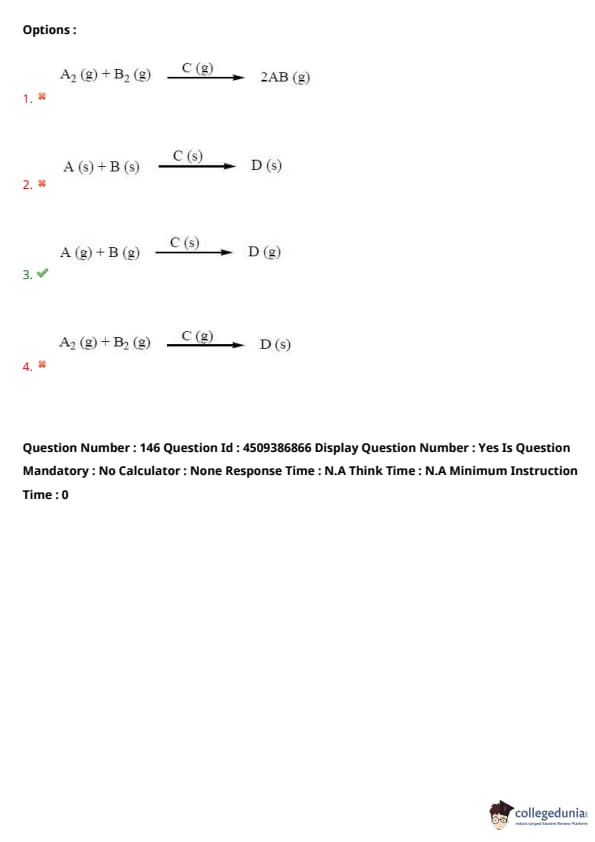
Which of the following general reactions is an example for heterogeneous catalysis?
View Solution
Match List I with List II and select the correct answer.
% Including image (if necessary)

View Solution
The type of iron obtained from the Blast furnace in the extraction of iron is:
View Solution
The ratio of Xe: F\textsubscript{2} required in the above reaction is:
\[ Xe(g) + 2F_2(g) \xrightarrow{873 K, 7 bar} XeF_4(s) \]
View Solution
The transition metal with the highest melting point is:
% Image inclusion (if applicable)
%
%
%
View Solution
Arrange the following in the increasing order of number of unpaired electrons present in the central metal ion:
% Given complex ions
I. \([MnCl_6]^{4-}\)
II. \([FeF_6]^{3-}\)
III. \([Mn(CN)_6]^{3-}\)
IV. \([Fe(CN)_6]^{3-}\)
View Solution
Which of the following polymerisation leads to the formation of neoprene?
- (A)
![]()
- (B)
![]()
- (C)
![]()
- (D)
![]()


Which of the following represents the simplified version of nucleoside?
View Solution
Which of the following amino acids possess two chiral centres?
View Solution
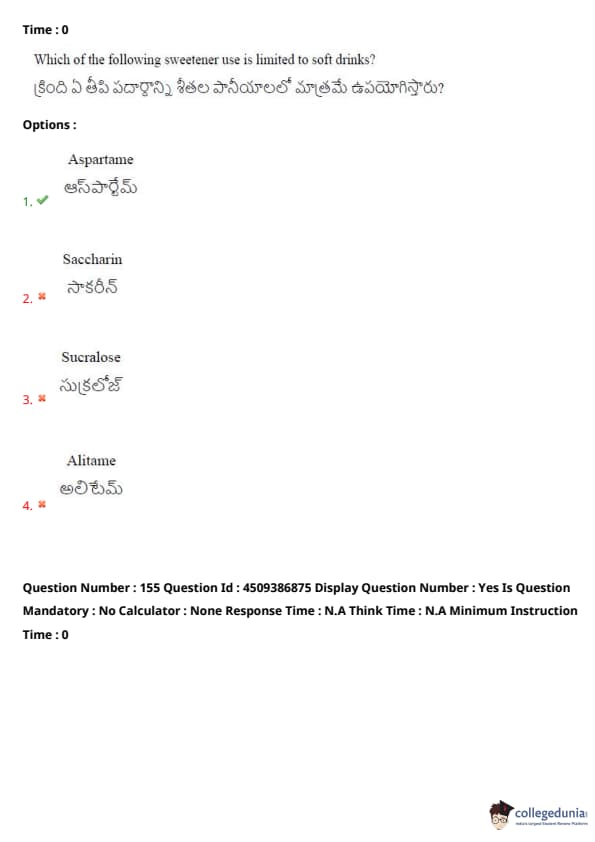
Which of the following sweeteners use is limited to soft drinks?
View Solution
Which of the following are general methods for the preparation of 1-iodopropane?

%
View Solution
The product of which of the following reactions undergo hydrolysis by SN1 mechanism?


View Solution
Styrene on reaction with reagent X gave Y, which on hydrolysis followed by oxidation gave Z. Z gives positive 2,4-DNP test but does not give iodoform test. What are X and Z respectively?
View Solution
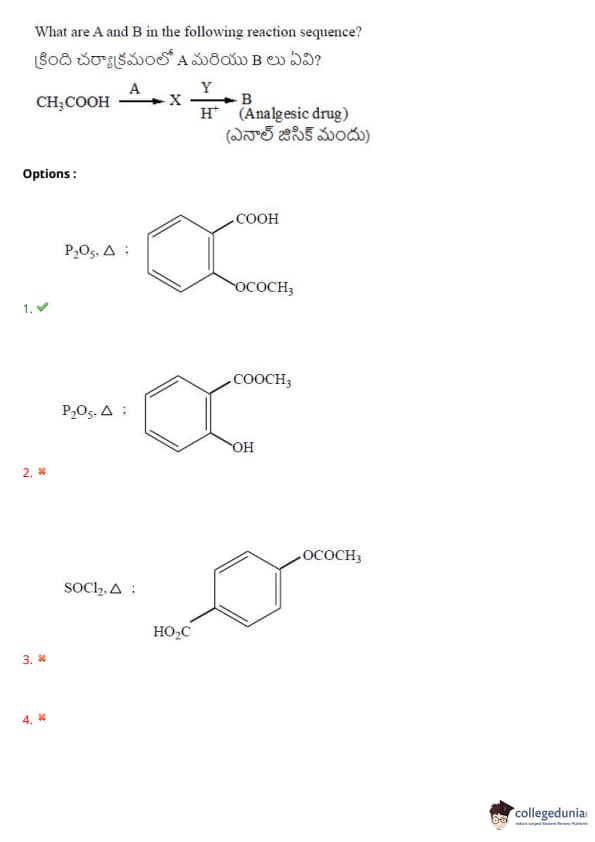
What are A and B in the following reaction sequence?

- (A)
![]()
- (B)
![]()
- (C)
![]()
- (D)
![]()


Which of the following sequence of reagents convert propene to 1-chloropropane?
View Solution
What are X and Y respectively in the following reactions?

- (A)
![]()
- (B)
![]()
- (C)
![]()
- (D) C
![]()





























AP EAPCET Previous Year Question Paper with Answer Key PDFs
| AP EAPCET Question Paper 2023 | AP EAPCET Question Paper 2022 | AP EAPCET Question Paper 2021 |
| AP EAPCET Question Paper 2020 | AP EAPCET Question Paper 2019 | AP EAPCET Question Paper 2018 |



Comments