




AP EAPCET 2024 Question Paper May 19 Shift 2 is available for download here. Jawaharlal Nehru Technological University, KAKINADA on behalf of APSCHE conducted AP EAPCET 2024 on May 19 in Shift 2 from 2.30 PM to 5.30 PM. AP EAPCET 2024 MPC Question Paper consists of 160 MCQ-based questions in total, 80 from Mathematics, 40 from physics, and 40 from chemistry carrying 1 mark each to be attempted in the duration of 3 hours.
Download: AP EAMCET 2025 Question Paper with Solution PDF
AP EAPCET 2024 Question Paper with Answer Key PDF May 19 Shift 2
| AP EAPCET 2024 May 19 Shift 2 Question Paper with Answer Key |  Download Download |
Check Solution |
If a real valued function \( f: [a, \infty) \to [b, \infty) \) is defined by \( f(x) = 2x^2 - 3x + 5 \) and is a bijection, then find the value of \( 3a + 2b \):
View Solution
The domain of the real valued function \( f(x) = \frac{1}{\sqrt{log_{0.5}(2x-3)}} + \sqrt{4 - 9x^2} \) is:
View Solution
Find the sum of the first 10 terms of the sequence \( 2.5 + 5.9 + 8.13 + 11.17 + \cdots \ to \ 10 \ terms =\):
View Solution
Evaluate the following determinant: \( \begin{vmatrix} 1 & 1 & 1
a^2 & {b^2} & {c^2}
{a^3} & {b^3} & {c^3}
\end{vmatrix} \)
View Solution
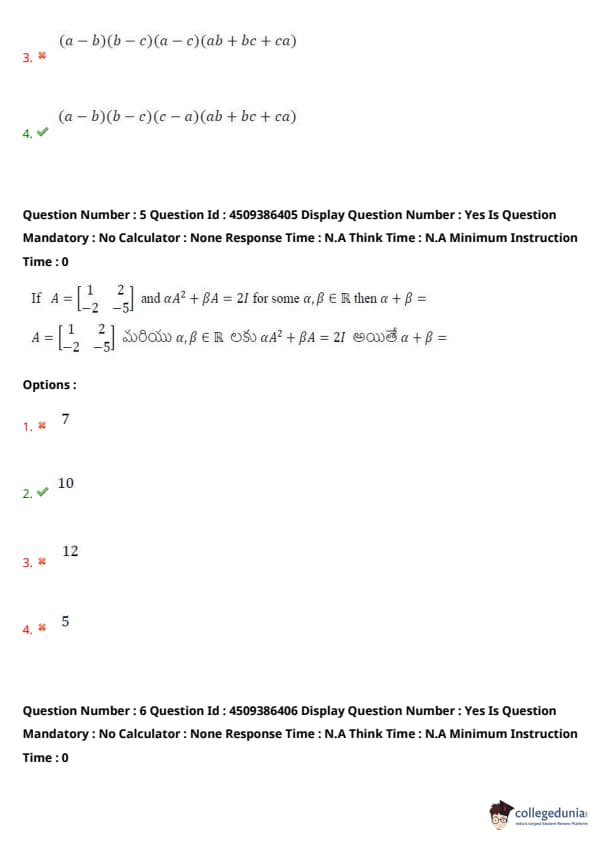
If \( A = \begin{pmatrix} 1 & 2
-2 & -5 \end{pmatrix} \) and \( \alpha^2 + \beta A = 21 \) for some \( \alpha, \beta \in \mathbb{R} \), then find \( \alpha + \beta \):
View Solution
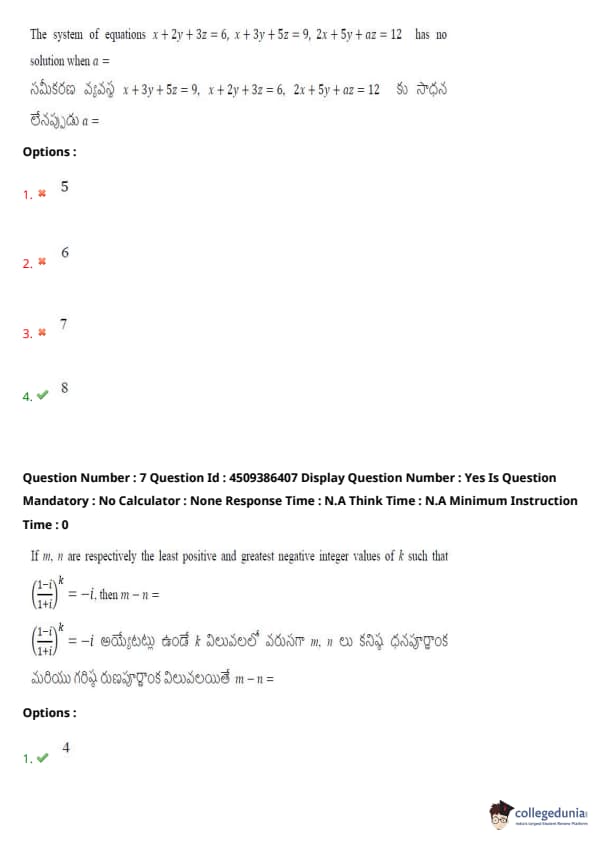
The system of equations \( x + 2y + 3z = 6 \), \( x + 3y + 5z = 9 \), \( 2x + 5y + az = 12 \) has no solution when \( a = \):
View Solution
If \( m, n \) are respectively the least positive and greatest negative integer values of such that \( (\frac{1-i}{1+i})^k = -i\), then \( m - n = \):
View Solution
If a complex number \( z \) is such that \( \frac{z-2i}{z-2} \) and the locus of \( z \) is a closed curve, then the area of the region bounded by that closed curve and lying in the first quadrant is:
View Solution
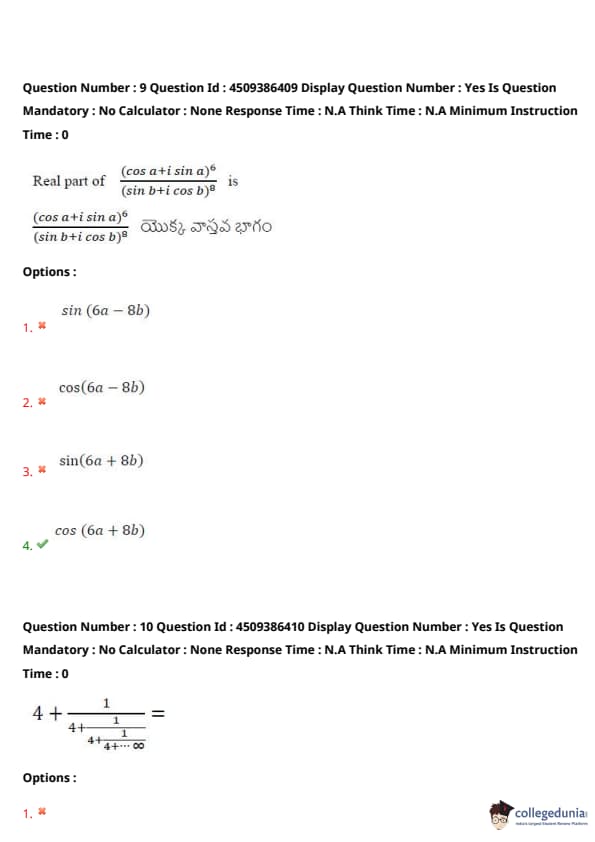
The real part of \( \frac{\left( \cos a + i \sin a \right)^6}{\left( \sin b + i \cos b \right)^8} \) is:
View Solution
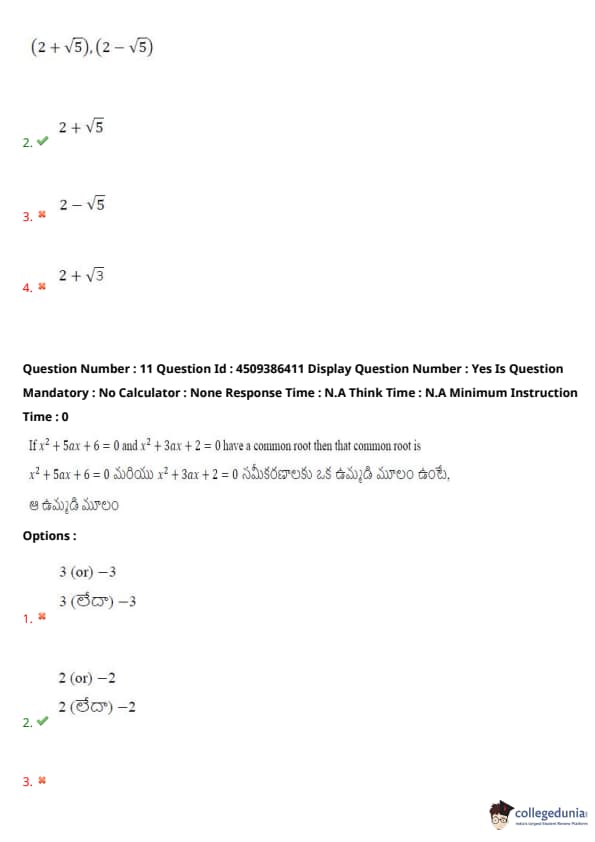
Simplify the expression: \( 4 + \frac{1}{4 + \frac{1}{4 + \frac{1}{4 + \cdots}}} \)
View Solution
If \(x^2 + 5ax + 6 = 0\) and \(x^2 + 3ax + 2 = 0\) have a common root, then that common root is:
View Solution
If \( \alpha, \beta, \gamma \) are roots of the equation \( x^3 + ax^2 + bx + c = 0 \), then \( \alpha^{-1} + \beta^{-1} + \gamma^{-1} \) is:
View Solution
If the roots of the equation \( x^3 - 13x^2 + Kx - 27 = 0 \) are in geometric progression, then \( K = \):
View Solution
If all the letters of the word MASTER are permuted in all possible ways and words (with or without meaning) thus formed are arranged in dictionary order, then the rank of the word MASTER is:
View Solution
If set \( A \) contains 8 elements, then the number of subsets of \( A \) which contain at least 6 elements is:
View Solution
The number of different permutations that can be formed by taking 4 letters at a time from the letters of the word "REPETITION" is:
View Solution
Numerically greatest term in the expansion of \( (5 + 3x)^6 \), when \( x = 1 \), is:
View Solution
The sum of the series \( 1 - \frac{2}{3} + \frac{2.4}{3.6} - \frac{2.4.6}{3.6.9} + \cdots \infty \) is:
View Solution
If \( \frac{1}{x^4 + 1} = \frac{Ax + B}{x^2 + \sqrt{2}x + 1} + \frac{Cx + D}{x^2 - \sqrt{2}x + 1} \), then \( BD - AC = \):
View Solution
The smallest positive value (in degrees) of \( \theta \) for which \( \tan(\theta + 100^\circ) = \tan(\theta + 50^\circ) \tan(\theta - 50^\circ) \) is valid, is:
View Solution
The value of \( 5 \cos \theta + 3 \cos \left( \theta + \frac{\pi}{3} \right) + 3 \) lies between:
View Solution
Statement (S1): \( \sin 55^\circ + \sin 53^\circ - \sin 19^\circ - \sin 17^\circ = \cos 2^\circ \)
Statement (S2): The range of \( \frac{1}{3 - \cos 2x} \) is \( \left[ \frac{1}{4}, \frac{1}{2} \right] \)
Which one of the following is correct?
View Solution
The general solution of \( 4 \cos 2x - 4 \sqrt{3} \sin 2x + \cos 3x - \sqrt{3} \sin 3x + \cos x - \sqrt{3} \sin x = 0 \) is:
View Solution
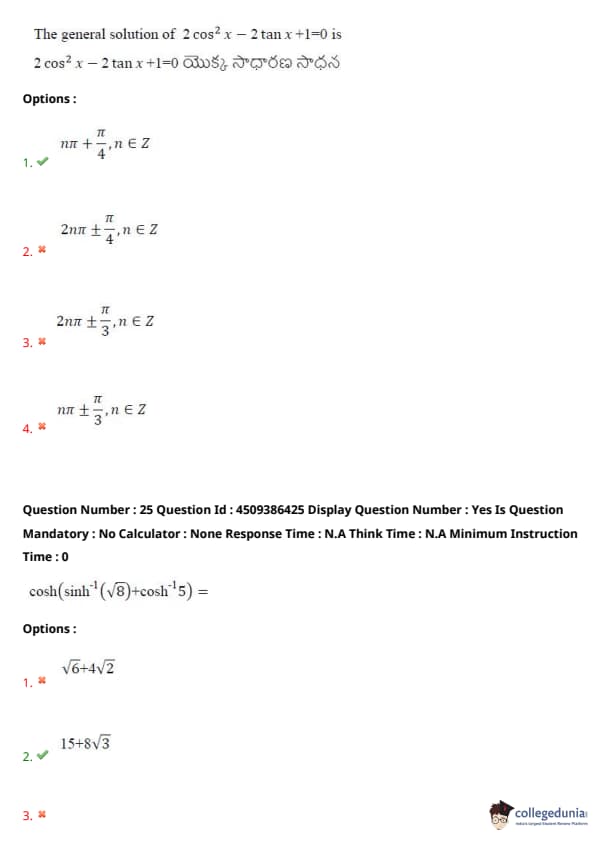
The general solution of \( 2 \cos^2 x - 2 \tan x + 1 = 0 \) is:
View Solution
The value of \( \cosh \left( \sin^{-1} \left( \sqrt{8} \right) + \cosh^{-1} 5 \right) \) is:
View Solution
In a triangle ABC, if \( r_1 = 2r_2 = 3r_3 \), then \(\sin A\): \(\sin B\): \(\sin C\) =
Options:
View Solution
In \(\Delta ABC\) if \(B = 90^\circ\) then \(2(r + R) = \)
View Solution
In a triangle ABC, if \( (a-b)(s-c) = (b-c)(s-a) \), then \( r_1 + r_3 = \):
View Solution
If \( L, M, N \) are the midpoints of the sides \overline{PQ, QR, and RP of triangle \( \Delta PQR \), then \( \overline{QM} + \overline{LN} + \overline{ML} + \overline{RN} - \overline{MN} - \overline{QL} = \):
View Solution
Let \( \vec{a} \times \vec{b} = 7\hat{i} - 5\hat{j} - 4\hat{k} \) and \( \vec{a} = \hat{i} + 3\hat{j} - 2\hat{k} \), if the length of projection of \( \vec{b} \) on \( \vec{a} \) is \( \frac{8}{\sqrt{14}} \), then \( |\vec{b}| \) is:
View Solution
Let ABC be an equilateral triangle of side \(a\). M and N are two points on the sides AB and AC respectively such that \(AN = K \cdot AC\) and \(AB = 3 \cdot AM\). If the vectors \(BN\) and \(CM\) are perpendicular, then \(K = \) ?
View Solution
Let \( \mathbf{a} \) and \( \mathbf{b} \) be two non-collinear vectors of unit modulus. If \( \mathbf{u} = \mathbf{a} - (\mathbf{a} \cdot \mathbf{b})\mathbf{b} \) and \( \mathbf{v} = \mathbf{a} \times \mathbf{b} \), then \( \lVert \mathbf{v} \rVert = \) ?
View Solution
Find the shortest distance between the skew lines \(\vec{r} = (-\hat{i} - 2\hat{j} - 3\hat{k}) + t(3\hat{i} - 2\hat{j} - 2\hat{k})\) and \(\vec{r} = (7\hat{i} + 4\hat{k}) + s(\hat{i} - 2\hat{j} + 2\hat{k})\).
View Solution
If \(m\) and \(M\) denote the mean deviations about mean and about median respectively of the data 20, 5, 15, 2, 7, 3, 11, then the mean deviation about the mean of \(m\) and \(M\) is:
View Solution
If 7 different balls are distributed among 4 different boxes, then the probability that the first box contains 3 balls is:
View Solution
Out of the first 5 consecutive natural numbers, if two different numbers \(x\) and \(y\) are chosen at random, then the probability that \(x^4 - y^4\) is divisible by 5 is:
View Solution
A bag contains 2 white, 3 green, and 5 red balls. If three balls are drawn one after the other without replacement, then the probability that the last ball drawn was red is:
View Solution
There are 2 bags each containing 3 white and 5 black balls and 4 bags each containing 6 white and 4 black balls. If a ball drawn randomly from a bag is found to be black, then the probability that this ball is from the first set of bags is:
View Solution
If two cards are drawn randomly from a pack of 52 playing cards, then the mean of the probability distribution of number of kings is:
View Solution
In a consignment of 15 articles, it is found that 3 are defective. If a sample of 5 articles is chosen at random from it, then the probability of having 2 defective articles is:
View Solution
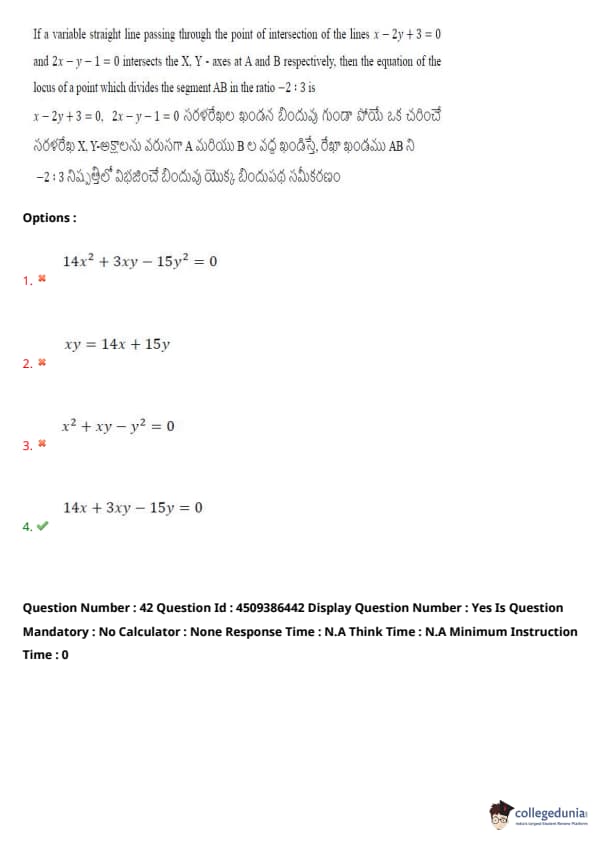
If a variable straight line passing through the point of intersection of the lines \(x - 2y + 3 = 0\) and \(2x - y - 1 = 0\) intersects the X and Y axes at A and B respectively, then the equation of the locus of a point which divides the segment AB in the ratio -2 : 3 is:
View Solution
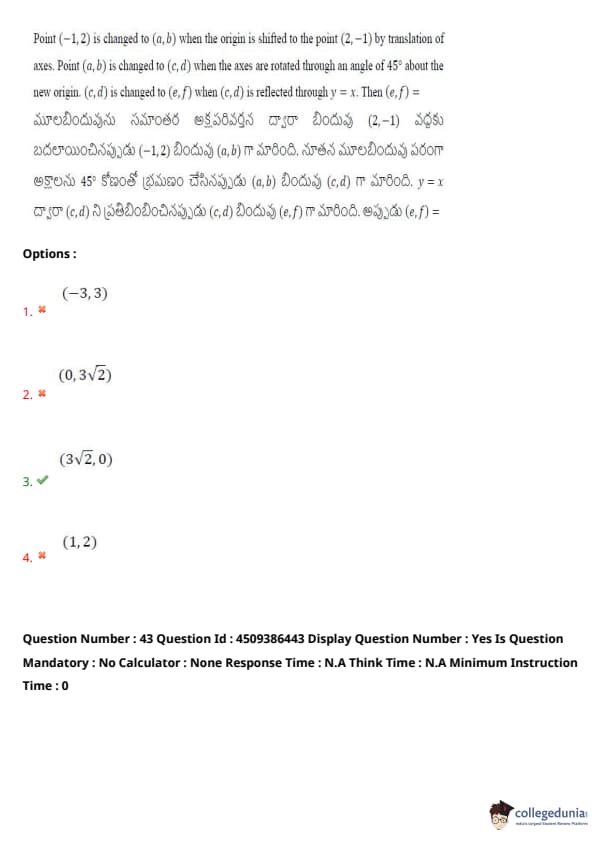
Point (-1, 2) is changed to (a, b) when the origin is shifted to the point (2, -1) by translation of axes. Point (a, b) is changed to (c, d) when the axes are rotated through an angle of 45\(^{\circ}\) about the new origin. (c, d) is changed to (e, f) when (c, d) is reflected through y = x. Then (e, f) = ?
View Solution
The point (a, b) is the foot of the perpendicular drawn from the point (3, 1) to the line x + 3y + 4 = 0. If (p, q) is the image of (a, b) with respect to the line 3x - 4y + 11 = 0, then \(\frac{p}{a} + \frac{q}{b} = \)
View Solution
A ray of light passing through the point (2, 3) reflects on the Y-axis at a point P. If the reflected ray passes through the point (3, 2) and P = (a, b), then 5b = ?
View Solution
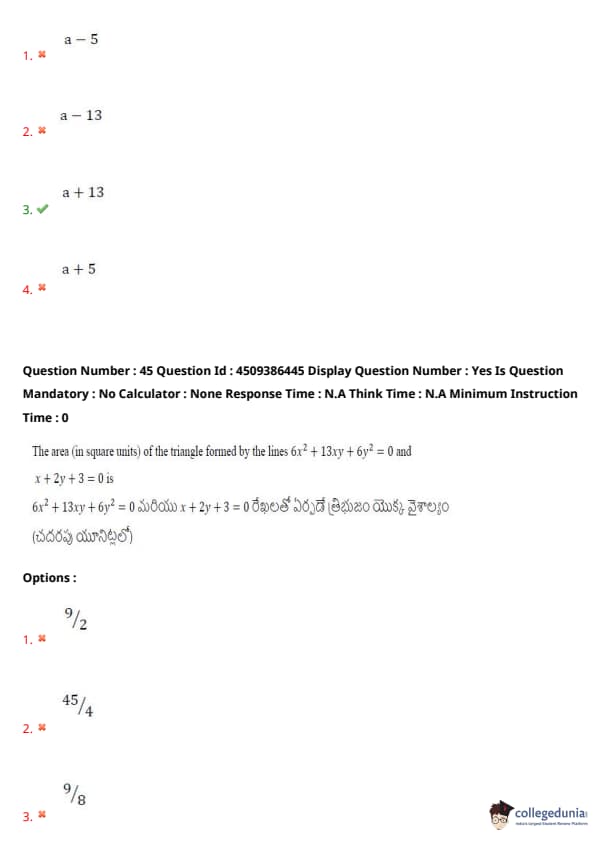
The area (in square units) of the triangle formed by the lines \(6x^2 + 13xy + 6y^2 = 0\) and \(x + 2y + 3 = 0\) is:
View Solution
The angle subtended by the chord \(x + y - 1 = 0\) of the circle \(x^2 + y^2 - 2x + 4y + 4 = 0\) at the origin is:
View Solution
Let P be any point on the circle \(x^2 + y^2 = 25\). Let L be the chord of contact of P with respect to the circle \(x^2 + y^2 = 9\). The locus of the poles of the lines L with respect to the circle \(x^2 + y^2 = 36\) is:
View Solution
If the circles \(S = x^2 + y^2 - 14x + 6y + 33 = 0\) and \(S' = x^2 + y^2 - a^2 = 0\) (\(a \in \mathbb{N}\)) have 4 common tangents, then the possible number of values of \(a\) is:
View Solution
If the area of the circum-circle of the triangle formed by the line \(2x + 5y + a = 0\) and the positive coordinate axes is \(\frac{29\pi}{4}\) sq. units, then \(|a| = \)
View Solution
The circle \(S \equiv x^2 + y^2 - 2x - 4y + 1 = 0\) cuts the y-axis at A, B (OA > OB). If the radical axis of \(S \equiv 0\) and \(S' \equiv x^2 + y^2 - 4x - 2y + 4 = 0\) cuts the y-axis at C, then the ratio in which C divides AB is:
View Solution
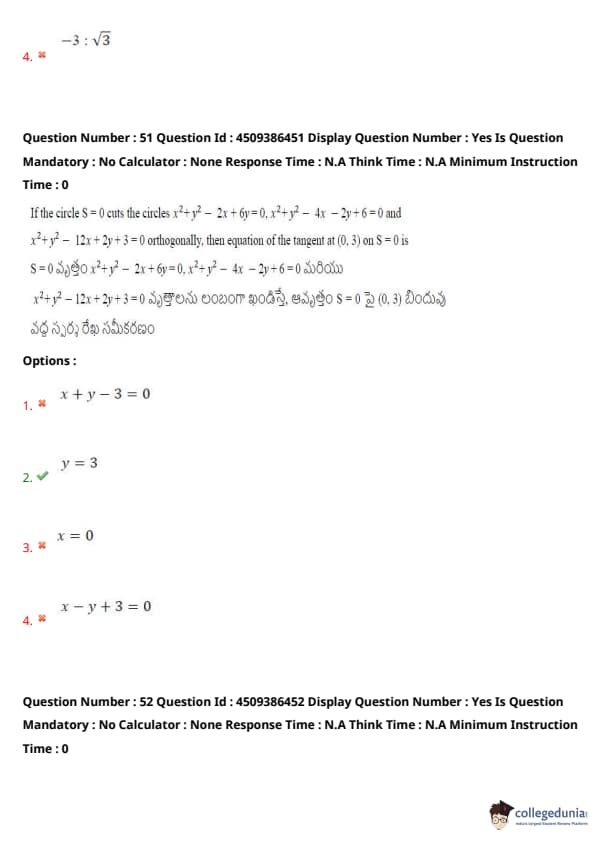
If the circle \(S = 0\) cuts the circles \(x^2 + y^2 - 2x + 6y = 0\), \(x^2 + y^2 - 4x - 2y + 6 = 0\), and \(x^2 + y^2 - 12x + 2y + 3 = 0\) orthogonally, then the equation of the tangent at (0, 3) on \(S = 0\) is:
View Solution
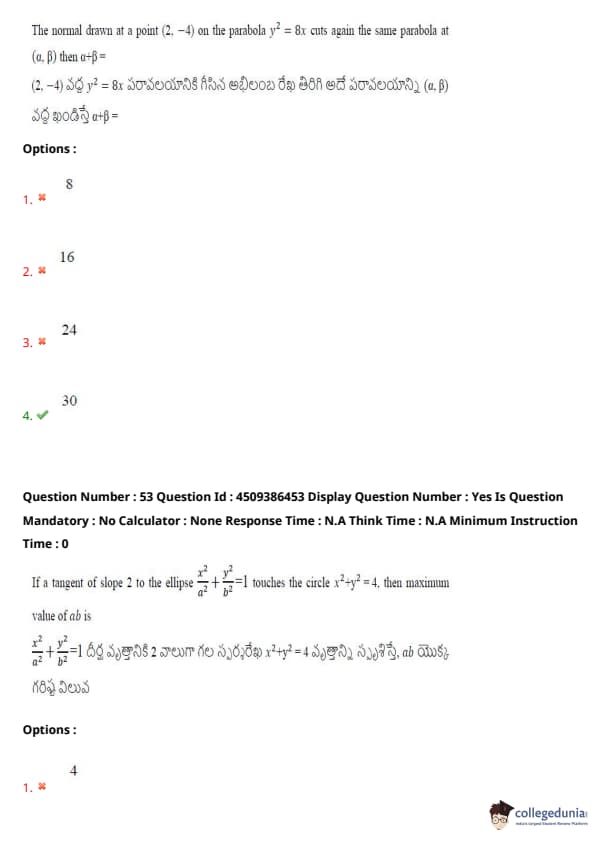
The normal drawn at a point \( (2, -4) \) on the parabola \( y^2 = 8x \) cuts again the same parabola at \( (\alpha, \beta) \). Then \( \alpha + \beta \) is:
View Solution
If a tangent of slope 2 to the ellipse \(\frac{x^2}{a^2} + \frac{y^2}{b^2} = 1\) touches the circle \(x^2 + y^2 = 4\), then the maximum value of \(ab\) is:
View Solution
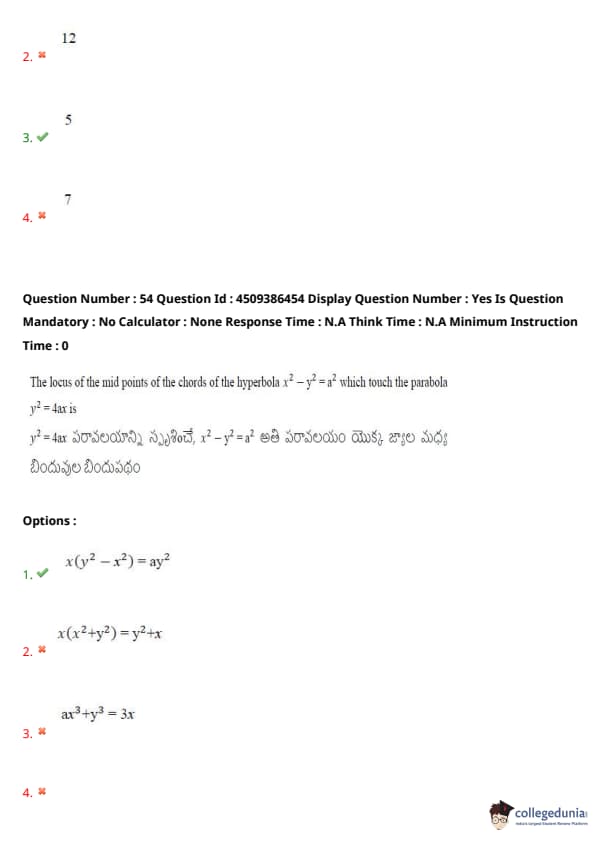
The locus of the midpoints of the chords of the hyperbola \( x^2 - y^2 = a^2 \) which touch the parabola \( y^2 = 4ax \) is:
View Solution
If the product of the eccentricities of the ellipse \( \frac{x^2}{16} + \frac{y^2}{b^2} = 1 \) and the hyperbola \( \frac{x^2}{9} - \frac{y^2}{16} = 1 \) is 1, then the value of \( b^2 \) is:
View Solution
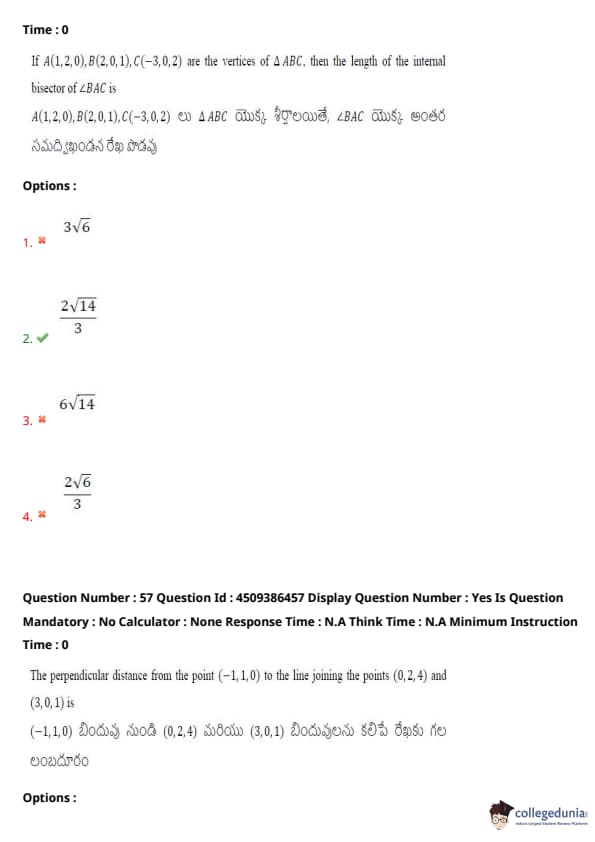
If \( A(1,2,0), B(2,0,1), C(-3,0,2) \) are the vertices of \( \triangle ABC \), then the length of the internal bisector of \( \angle BAC \) is:
View Solution
The perpendicular distance from the point \( (-1,1,0) \) to the line joining the points \( (0,2,4) \) and \( (3,0,1) \) is:
View Solution
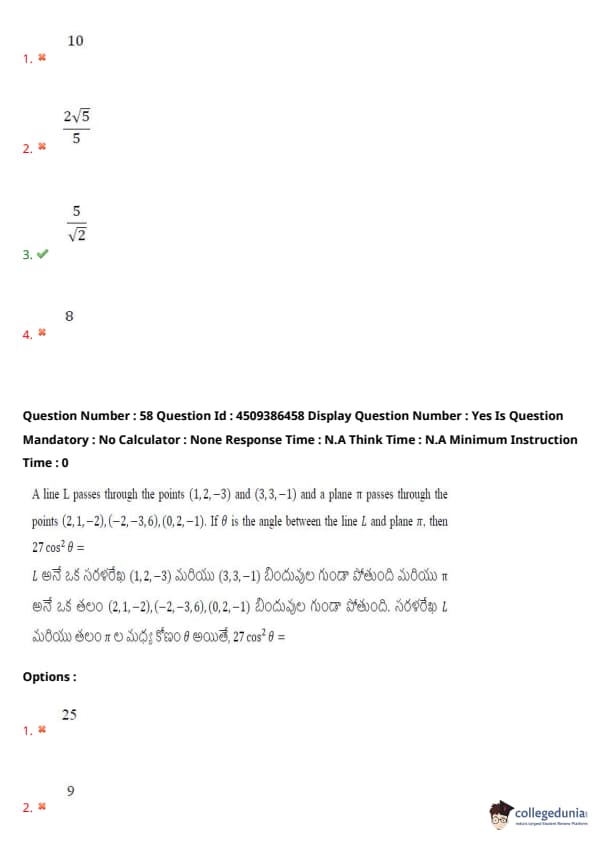
A line \( L \) passes through \( (1,2,-3) \) and \( (3,3,-1) \), and a plane \( \pi \) passes through \( (2,1,-2), (-2,-3,6), (0,2,-1) \). If \( \theta \) is the angle between \( L \) and \( \pi \), then \( 27 \cos^2 \theta = \) ?
View Solution
\( \lim_{x \to 3} \frac{x^3 - 27}{x^2 - 9}. \)
View Solution
If \( f(x) \) is given as:
\( f(x) = \begin{cases} 3ax - 2b, & x > 1
ax + b + 1, & x \(<\) 1
\end{cases
\)
and \( \lim_{x \to 1} f(x) \) exists, then the relation between \( a \) and \( b \) is:
View Solution
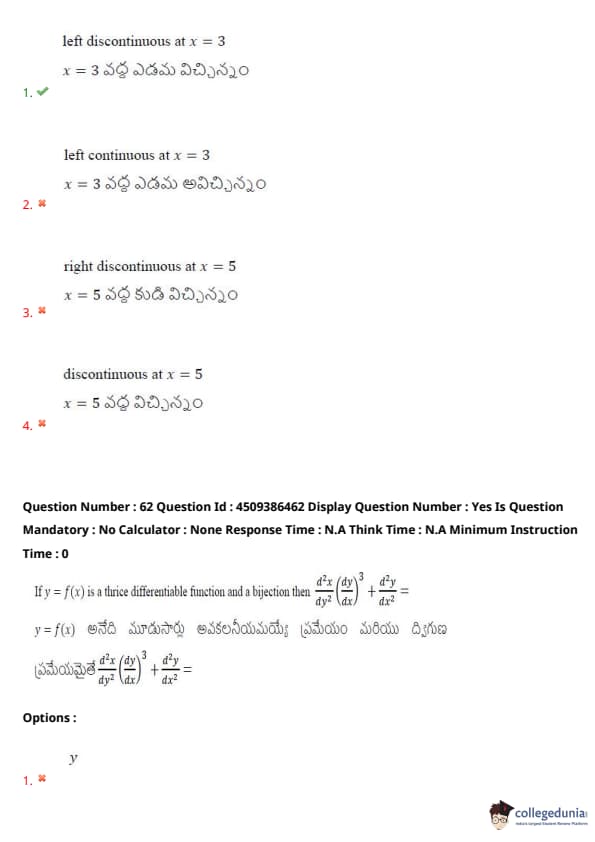
The function \( f(x) \) is given by:
\[ f(x) = \begin{cases} \frac{2}{5 - x}, & x \(<\) 3
5 - x, & x \geq 3 \end{cases} \]
Which of the following is true?
View Solution
If \( y = f(x) \) is a thrice differentiable function and a bijection, then \[ \frac{d^2x}{dy^2} \left(\frac{dy}{dx}\right)^3 + \frac{d^2y}{dx^2} = ? \]
View Solution
If \[ f(x) = \begin{cases} x^\alpha \sin \left(\frac{1}{x}\right), & x \neq 0
0, & x = 0 \end{cases} \]
Which of the following is true?
View Solution
If \[ f(x) = \min \{ x, x^2 \} \]
Which of the following is true?
View Solution
If \[ y = (1 + a + a^2 + \dots)e^{nx} \]
then the relative error in \( y \) is:
View Solution
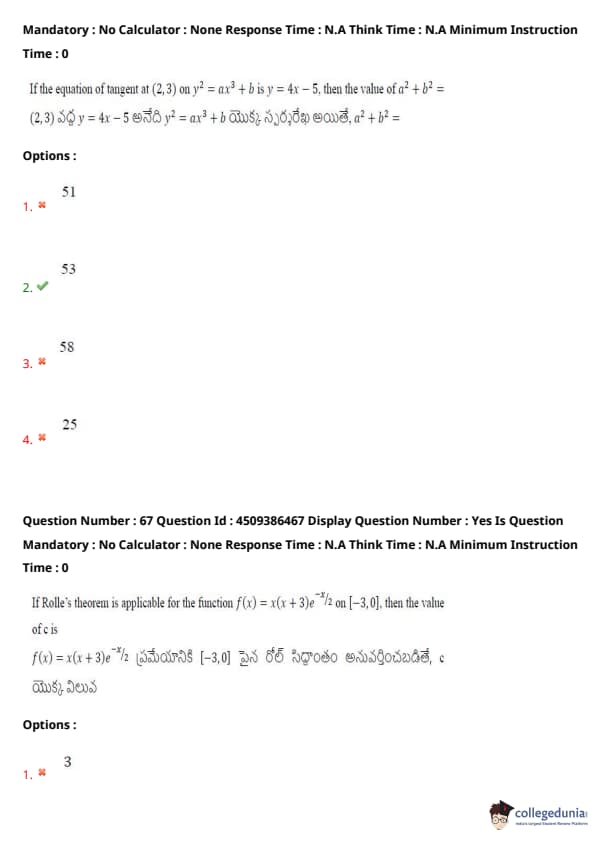
If the equation of the tangent at (2, 3) on \(y^2 = ax^3 + b\) is \(y = 4x - 5\), then the value of \(a^2 + b^2\) is:
View Solution
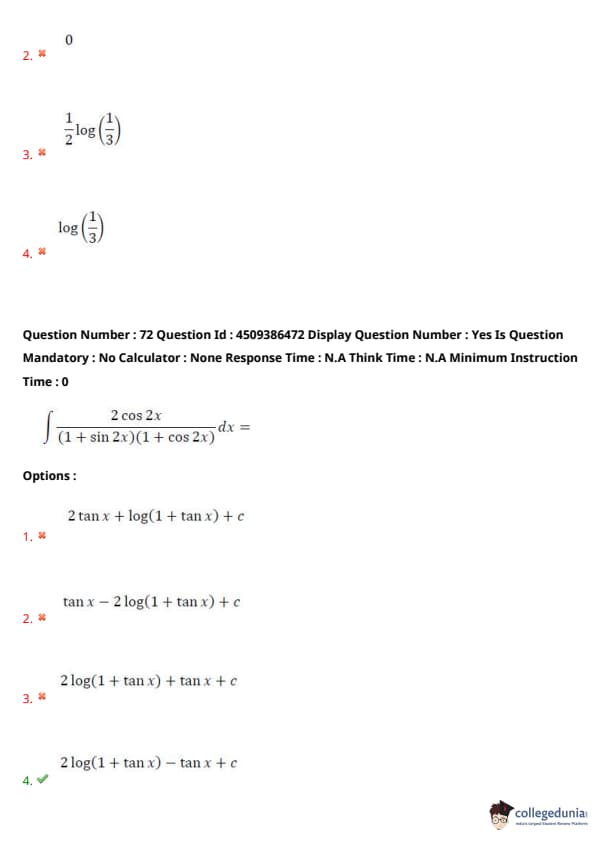
If Rolle's theorem is applicable for the function \(f(x) = x(x+3)e^{-x/2}\) on \([-3, 0]\), then the value of \(c\) is:
View Solution
For all \(x \in [0, 2024]\) assume that \(f(x)\) is differentiable. \(f(0) = -2\) and \(f'(x) \ge 5\). Then the least possible value of \(f(2024)\) is:
View Solution
\(\int\frac{2x^{2}\cos(x^{2})-\sin(x^{2})}{x^{2}}dx=\)
View Solution
If \(\int \frac{\log(1+x^4)}{x^3} dx = f(x) \log(\frac{1}{g(x})) + \tan^{-1}(h(x)) + c\), then \(h(x) [f(x) + f(\frac{1}{x})] = \)
View Solution
Let \(f(x) = \int \frac{x}{(x^2+1)(x^2+3)} dx\). If \(f(3) = \frac{1}{4} \log(\frac{5}{6})\), then \(f(0) = \)
View Solution
\(\int\frac{2\cos 2x}{(1+\sin 2x)(1+\cos 2x)}dx=\)
View Solution
\(\int\left(\frac{x}{x\cos x - \sin x}\right)^2 dx = \)
View Solution
If \(\lim_{n\rightarrow\infty}[(1+\frac{1}{n^{2}})(1+\frac{4}{n^{2}})(1+\frac{9}{n^{2}})\cdots(1+\frac{n^{2}}{n^{2}})]^{\frac{1}{n}}=ae^{b}\), then \(a+b=\)
View Solution
\(\int_{0}^{\pi}x \sin^4 x \cos^6 x dx = \)
View Solution
If \(I_{n}=\int_{0}^{\pi/4}\tan^{n}x~dx,\) then \(I_{13}+I_{11}=\)
View Solution
The area (in square units) of the smaller region lying above the X-axis and bounded between the circle \[ x^2 + y^2 = 2ax \]
and the parabola \[ y^2 = ax \]
View Solution
The difference of the order and degree of the differential equation \[ \left(\frac{d^2y}{dx^2} \right)^{-7/2} - \left(\frac{d^3y}{dx^3} \right)^2 - \left(\frac{d^2y}{dx^2} \right)^{-5/2} - \left(\frac{d^4y}{dx^4} \right) = 0 \]
View Solution
If the differential equation \[ x dy + (y + y^2 x) dx = 0 \]
with condition \( y = 1 \) at \( x = 1 \), then the solution is:
View Solution
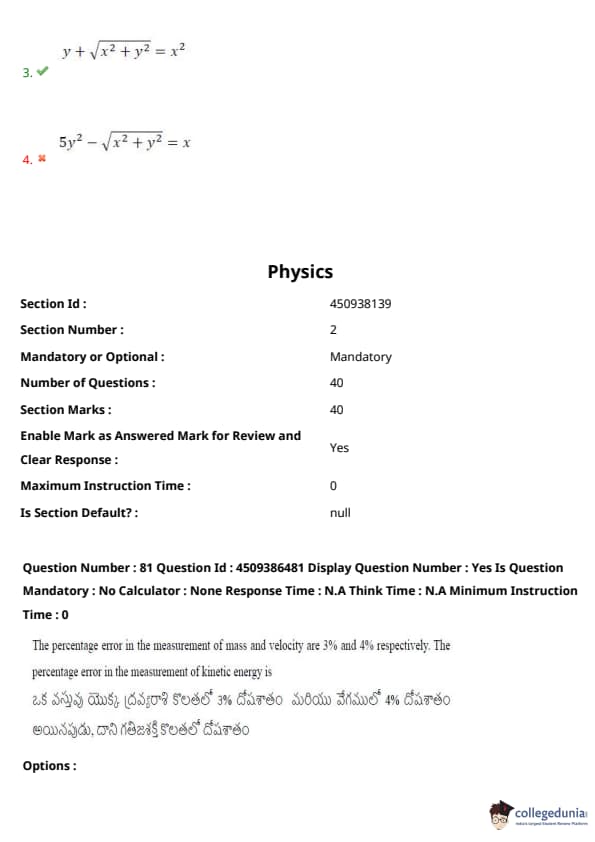
The solution of the differential equation \[ x dy - y dx = \sqrt{x^2 + y^2} dx \]
when \( y(\sqrt{3}) = 1 \) is:
View Solution
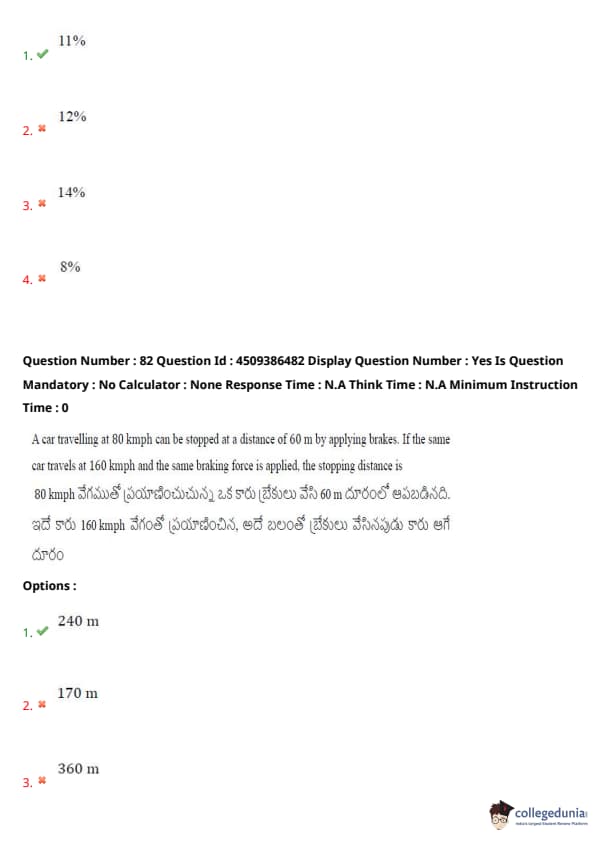
The percentage error in the measurement of mass and velocity are 3% and 4% respectively. The percentage error in the measurement of kinetic energy is:
View Solution
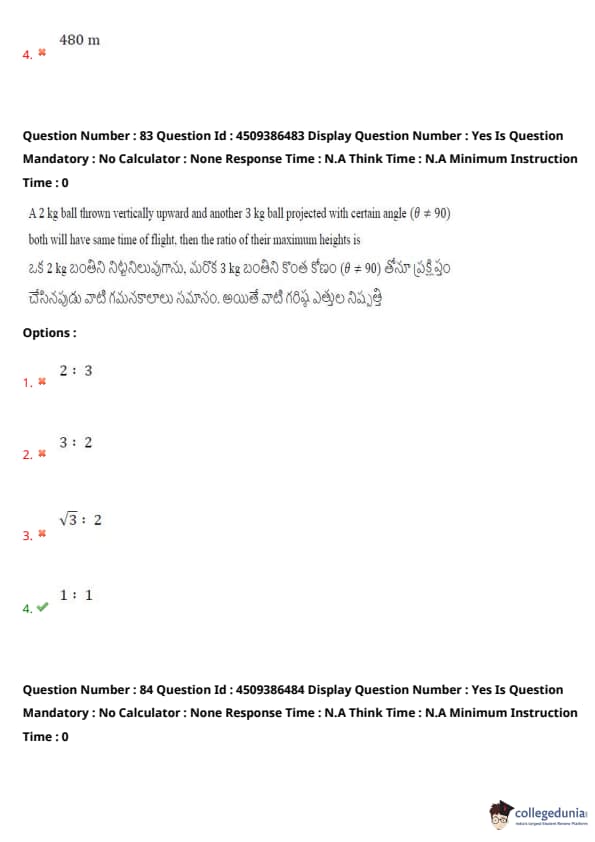
A car travelling at 80 kmph can be stopped at a distance of 60 m by applying brakes. If the same car travels at 160 kmph and the same braking force is applied, the stopping distance is:
View Solution
A 2 kg ball is thrown vertically upward and another 3 kg ball is projected with a certain angle (\( \theta \neq 90^\circ \)). Both will have the same time of flight. The ratio of their maximum heights is:
View Solution
In a sport event a disc is thrown such that it reaches its maximum range of 80 m, the distance travelled in first 3 s is (g = 10ms\(^2\))
View Solution
A block of mass 18.5 kg kept on a smooth horizontal surface is pulled by a rope of 3 m length by a horizontal force of 40 N applied to the other end of the rope. If the linear density of the rope is 0.5 kgm\(^-1\) and initially the block is at rest, the time in which the block moves a distance of 9 m is
View Solution
A block of mass 1.5 kg kept on a rough horizontal surface is given a horizontal velocity of 10 ms\(^{-1}\). If the block comes to rest after travelling a distance of 12.5 m, the coefficient of kinetic friction between the surface and the block is (Acceleration due to gravity = 10 ms\(^{-2}\))
View Solution
A force of \( (6x^2 - 4x + 3) \, N \) acts on a body of mass 0.75 kg and displaces it from \( x = 5 \, m \) to \( x = 2 \, m \). The work done by the force is
View Solution
A ball falls freely from rest on to a hard horizontal floor and repeatedly bounces. If the velocity of the ball just before the first bounce is 7 m/s and the coefficient of restitution is 0.75, the total distance travelled by the ball before it comes to rest (acceleration due to gravity = 10 ms\(^{-2}\)) is
View Solution
A solid cylinder rolls down an inclined plane without slipping. If the translational kinetic energy of the cylinder is 140 J, the total kinetic energy of the cylinder is
View Solution
Two blocks of masses \( m \) and \( 2m \) are connected by a massless string which passes over a fixed frictionless pulley. If the system of blocks is released from rest, the speed of the centre of mass of the system of two blocks after a time of 5.4 s is (Acceleration due to gravity = 10 ms\(^{-2}\))
View Solution
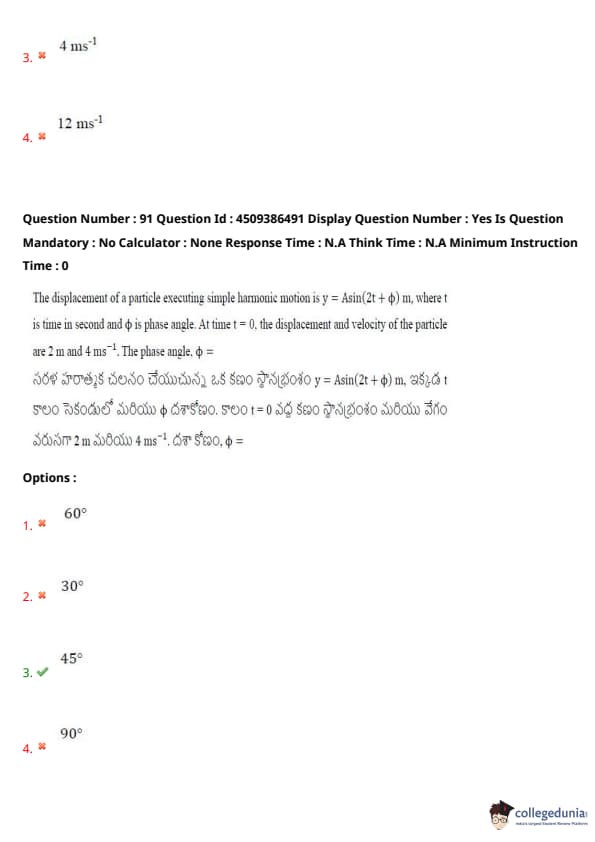
The displacement of a particle executing simple harmonic motion is \( y = A \sin(2\pi t + \phi) \, m \), where \( t \) is time in seconds and \( \phi \) is the phase angle. At time \( t = 0 \), the displacement and velocity of the particle are 2 m and 4 ms\(^{-1}\). The phase angle, \( \phi \) =
View Solution
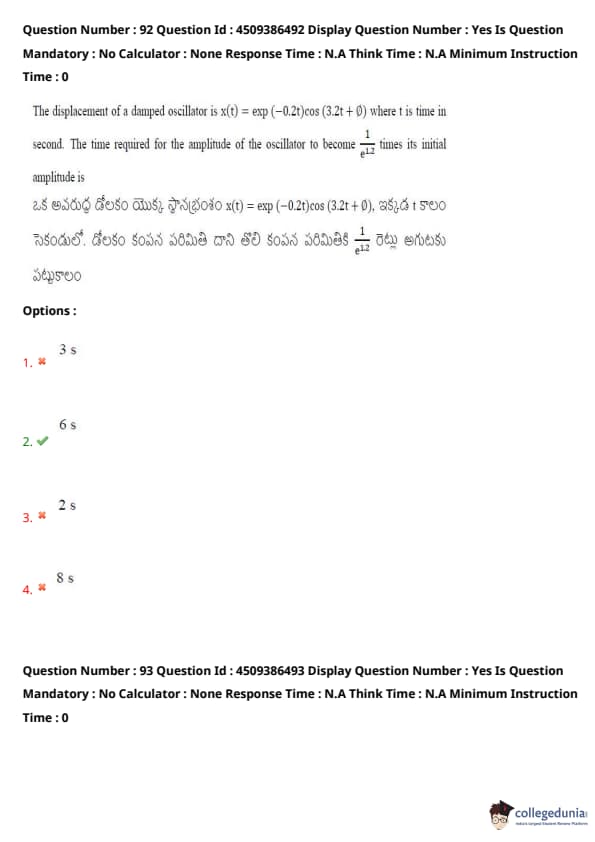
The displacement of a damped oscillator is \( x(t) = \exp(-0.2t) \cos(3.2t + \phi) \), where \( t \) is time in seconds. The time required for the amplitude of the oscillator to become \( \frac{1}{e^{1.2}} \) times its initial amplitude is
View Solution
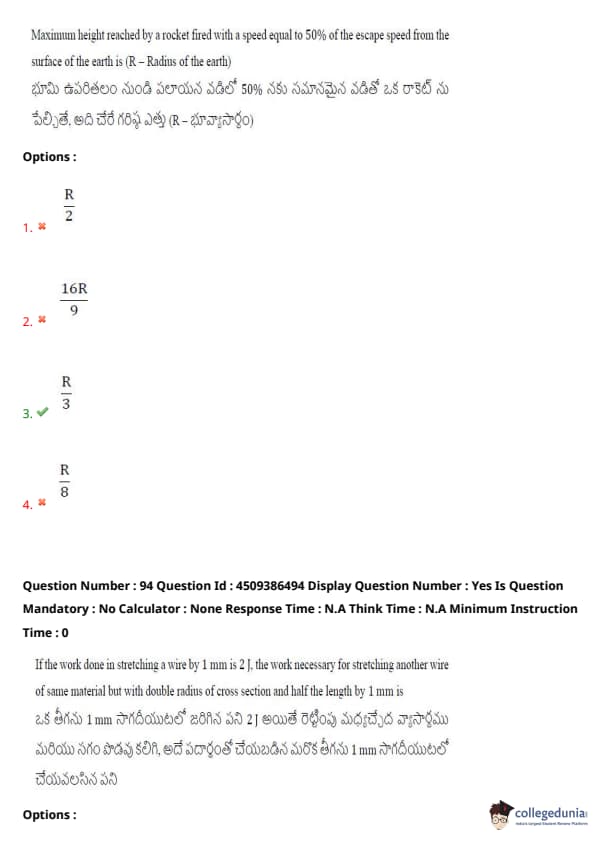
Maximum height reached by a rocket fired with a speed equal to 50% of the escape speed from the surface of the earth is (R – Radius of the earth)
View Solution
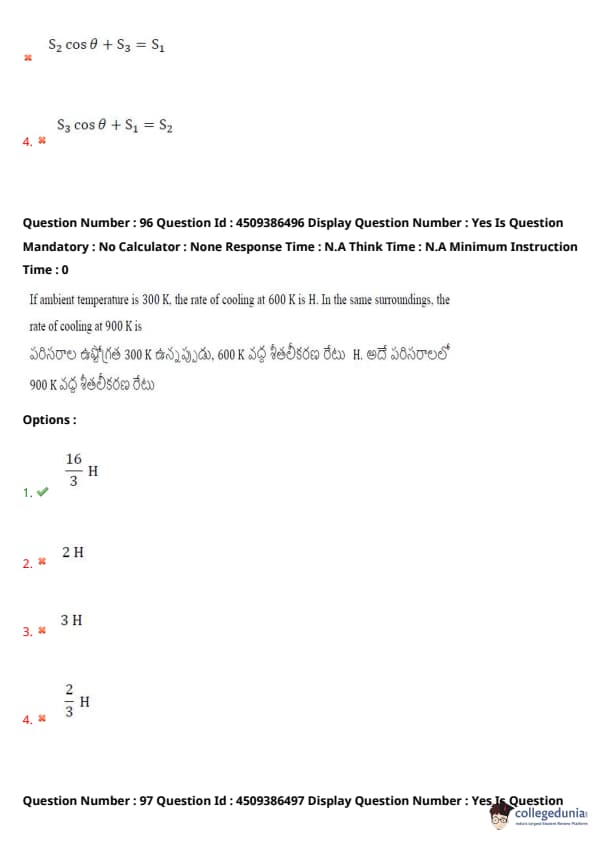
If the work done in stretching a wire by 1 mm is 2 J, the work necessary for stretching another wire of same material but with double radius of cross section and half the length by 1 mm is
View Solution
If \( S_1 \), \( S_2 \), and \( S_3 \) are the tensions at liquid-air, solid-air and solid-liquid interfaces respectively, and \( \theta \) is the angle of contact at the solid-liquid interface, then
View Solution
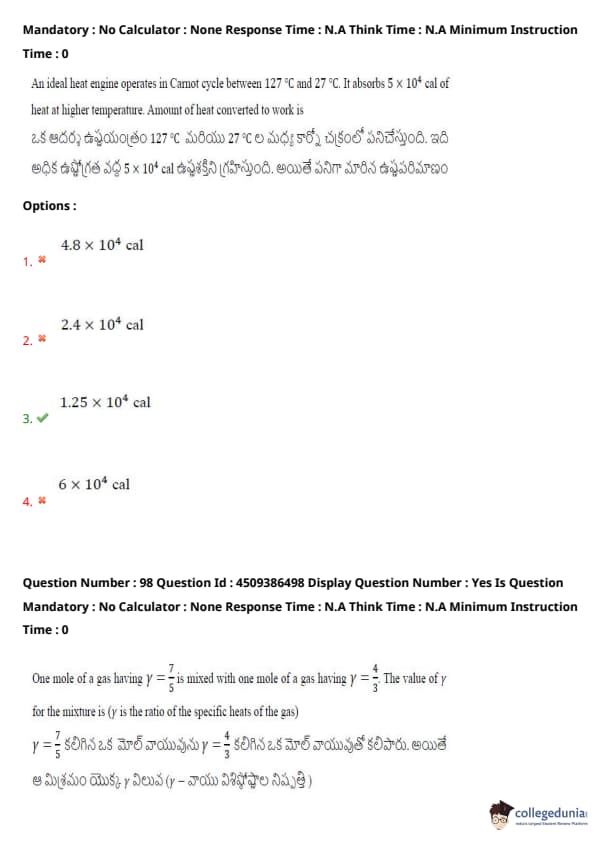
If ambient temperature is 300 K, the rate of cooling at 600 K is H. In the same surroundings, the rate of cooling at 900 K is
View Solution
An ideal heat engine operates in Carnot cycle between 127\(^\circ\)C and 27\(^\circ\)C. It absorbs \( 5 \times 10^4 \) cal of heat at higher temperature. Amount of heat converted to work is
View Solution
One mole of a gas having \( \gamma = \frac{7}{5} \) is mixed with one mole of a gas having \( \gamma = \frac{4}{3} \). The value of \( \gamma \) for the mixture is ( \( \gamma \) is the ratio of the specific heats of the gas)
View Solution
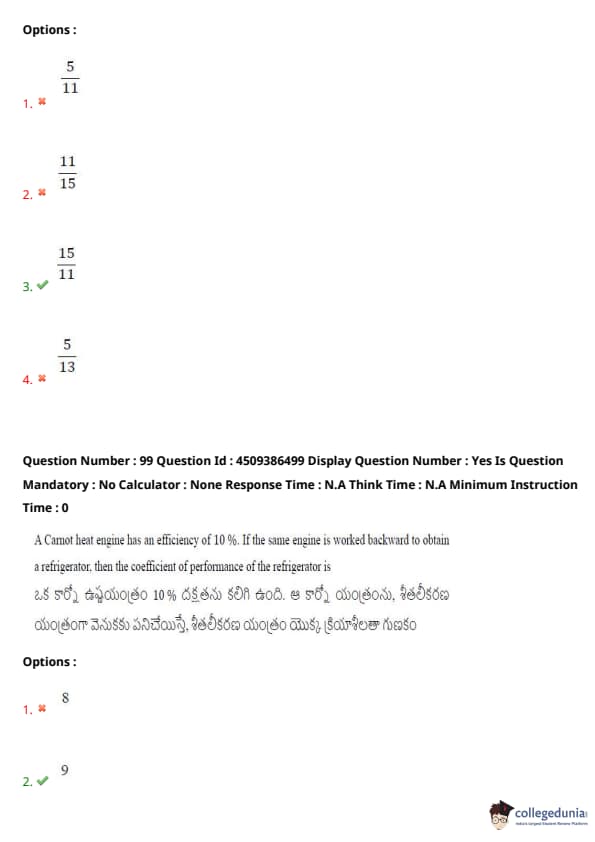
A Carnot heat engine has an efficiency of 10%. If the same engine is worked backward to obtain a refrigerator, then the coefficient of performance of the refrigerator is
View Solution
The rms velocity of a gas molecule of mass \( m \) at a given temperature is proportional to
View Solution
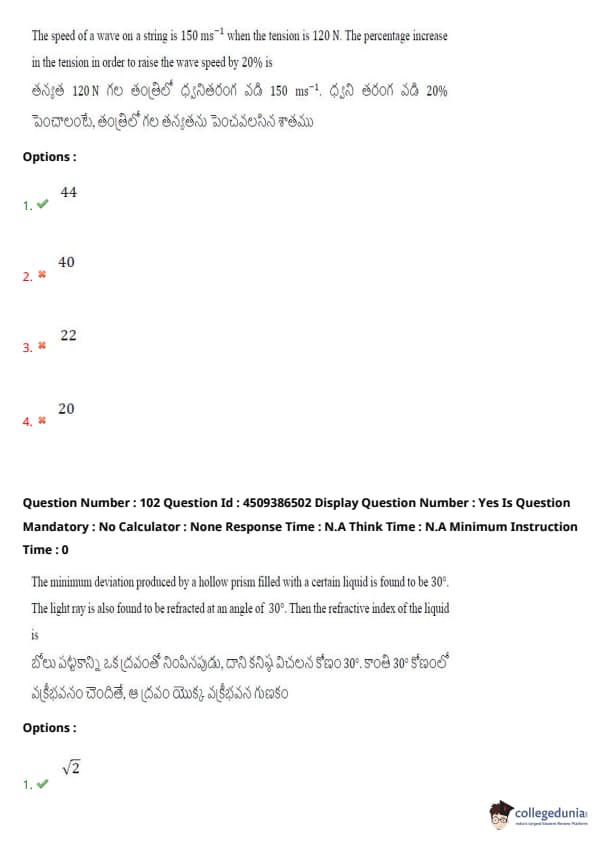
The speed of a wave on a string is 150 ms\(^{-1}\) when the tension is 120 N. The percentage increase in the tension in order to raise the wave speed by 20% is
View Solution
The minimum deviation produced by a hollow prism filled with a certain liquid is found to be 30\(^\circ\). The light ray is also found to be refracted at an angle of 30\(^\circ\). Then the refractive index of the liquid is
View Solution
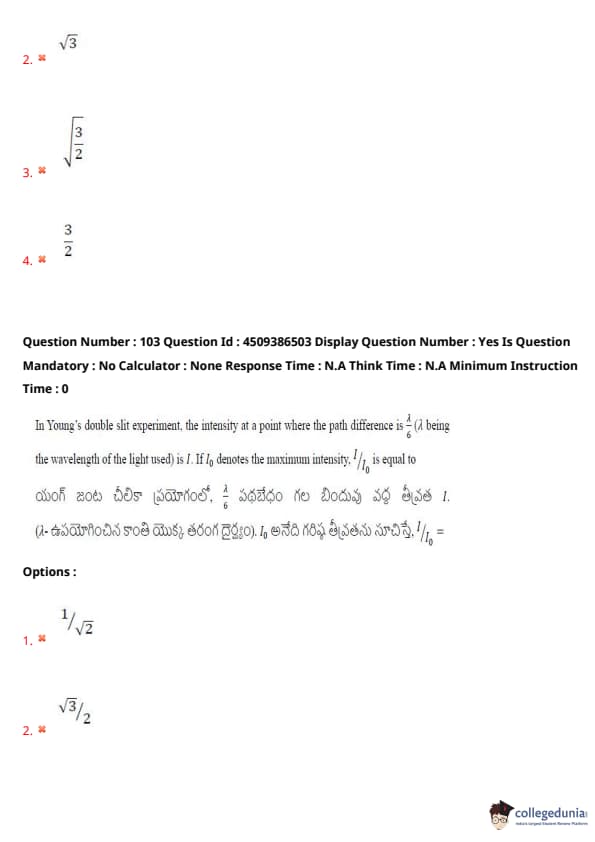
In Young's double slit experiment, the intensity at a point where the path difference is \( \frac{\lambda}{6} \) ( \( \lambda \) being the wavelength of the light used) is \( I \). If \( I_0 \) denotes the maximum intensity, \( \frac{I}{I_0} \) is equal to
View Solution
Two particles of equal mass \( m \) and equal charge \( q \) are separated by a distance of 16 cm. They do not experience any force. The value of \( \frac{q}{m} \) is ______ (if \( G \) is the universal gravitational constant and \( g \) is the acceleration due to gravity).
View Solution
In the following diagram, the work done in moving a point charge from point P to point A, B and C are \( W_A, W_B, W_C \) respectively. Then (A, B, C are points on semicircle and point charge \( q \) is at the centre of semicircle)

View Solution
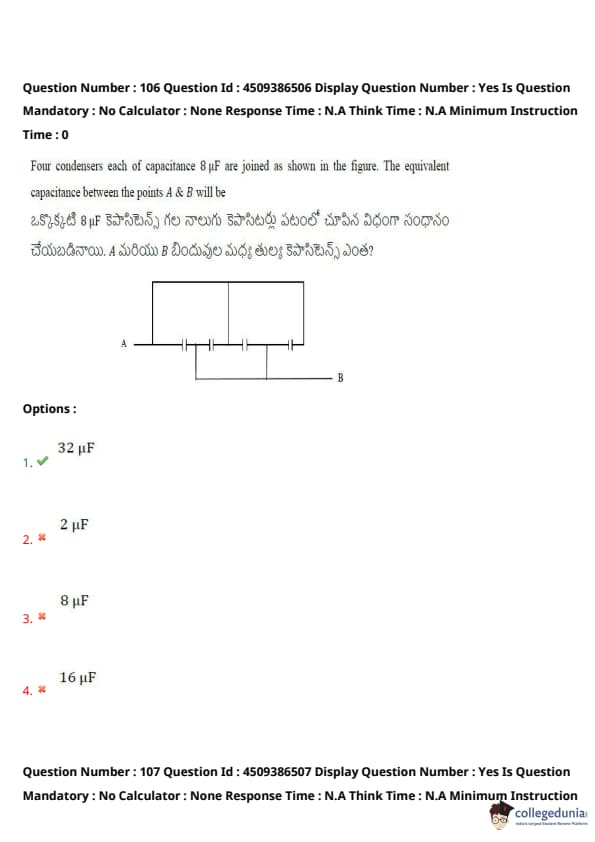
Four condensers each of capacitance 8 \(\mu\)F are joined as shown in the figure. The equivalent capacitance between the points A and B will be

View Solution
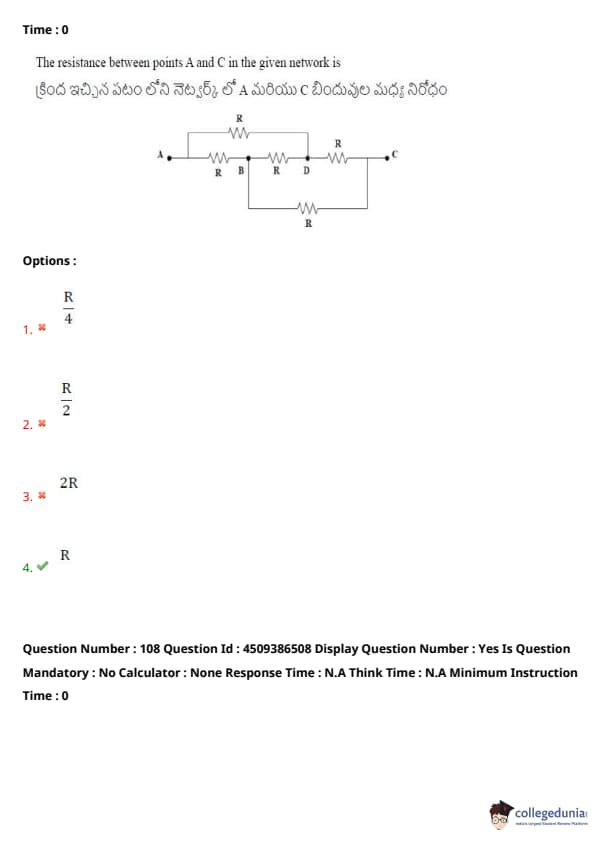
The resistance between points A and C in the given network is

View Solution
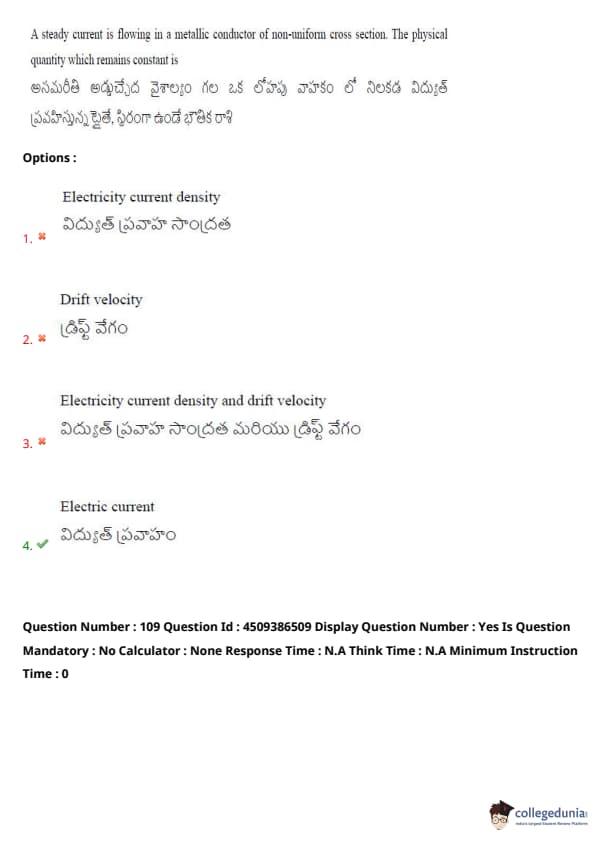
A steady current is flowing in a metallic conductor of non-uniform cross section. The physical quantity which remains constant is
View Solution
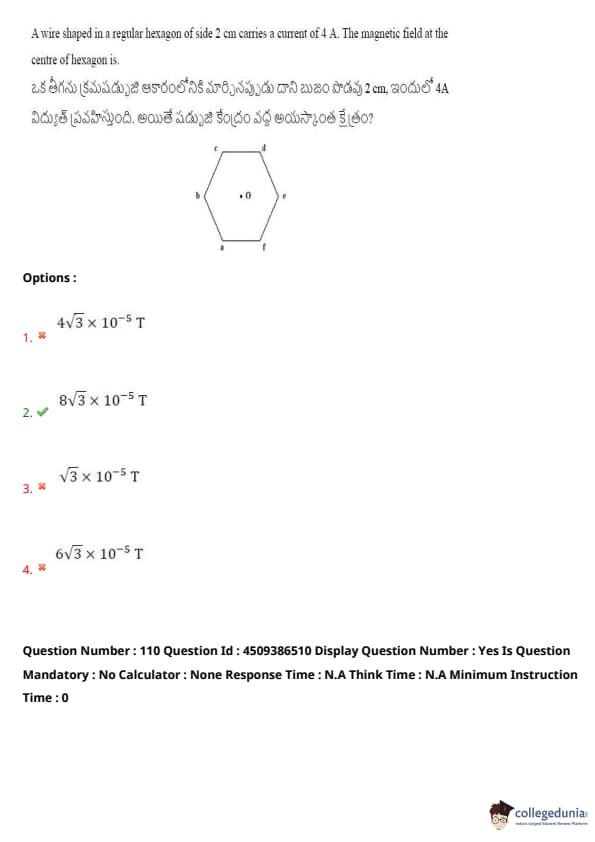
A wire shaped in a regular hexagon of side 2 cm carries a current of 4 A. The magnetic field at the centre of the hexagon is.

View Solution
A tightly wound coil of 200 turns and of radius 20 cm carrying current 5 A. Magnetic field at the centre of the coil is.
View Solution
The domain in ferromagnetic material is in the form of a cube of side 2 \(\mu\)m. Number of atoms in that domain is \(9 \times 10^{10}\) and each atom has a dipole movement of \(9 \times 10^{-24} \, Am^2\). The magnetisation of the domain is (approximately).
View Solution
Magnetic field at a distance \(r\) from z axis is \( B = B_0 r \, kt \) present in the region. \( B_0 \) is constant and \(t\) is time. The magnitude of induced electric field at a distance \(r\) from z-axis is.
View Solution
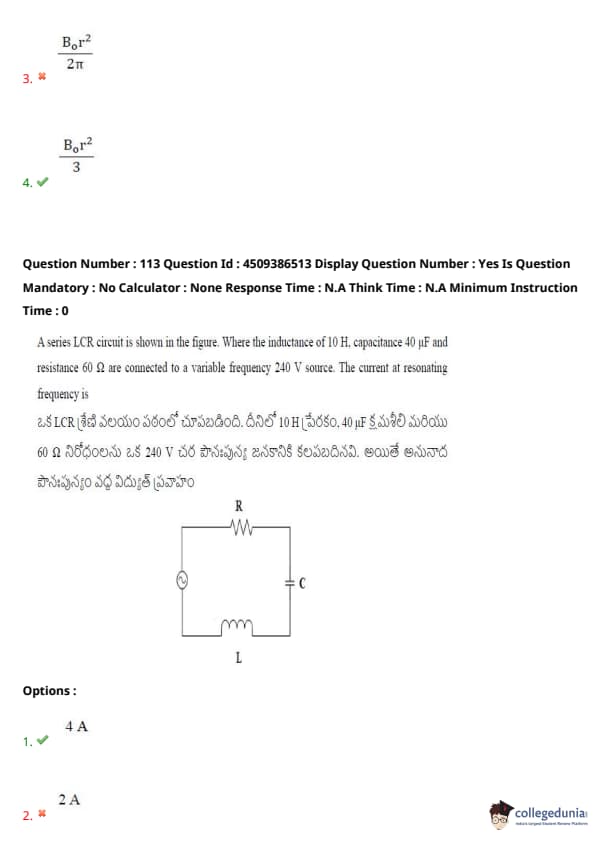
A series LCR circuit is shown in the figure. Where the inductance of 10 H, capacitance 40 \(\mu\)F and resistance 60 Ω are connected to a variable frequency 240 V source. The current at resonating frequency is.

View Solution
An electromagnetic wave travels in a medium with a speed of \( 2 \times 10^8 \, ms^{-1} \). The relative permeability of the medium is 1. Then the relative permittivity is.
View Solution
The longest wavelength of light that can initiate photo electric effect in the metal of work function 9 eV is
View Solution
A hydrogen atom falls from \(n^{th}\) higher energy orbit to first energy orbit (\(n = 1\)). The energy released is equal to 12.75 eV. The \(n^{th}\) orbit is
View Solution
The decrease in each day in the Uranium mass of the material in a Uranium reactor operating at a power of 12 MW is (Energy released in one \(^{92}U\) fission is about 200 MeV)
View Solution
When a signal is applied to the input of a transistor it was found that output signal is phase-shifted by 180\(^\circ\). The transistor configuration is
View Solution
The voltage \( V_o \) in the network shown is

View Solution
A message signal of 3 kHz is used to modulate a carrier signal frequency 1 MHz, using amplitude modulation. The upper side band frequency and band width respectively are
View Solution
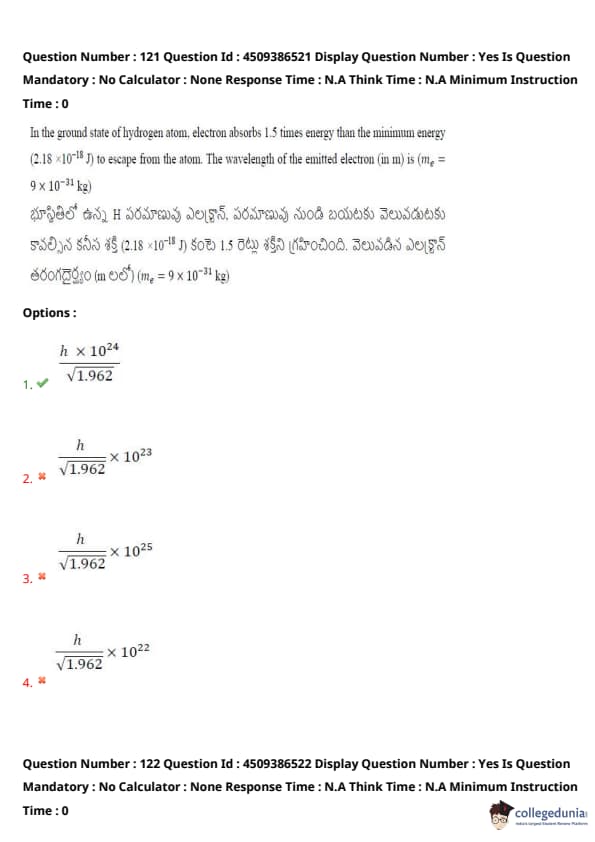
In the ground state of hydrogen atom, electron absorbs 1.5 times energy than the minimum energy \( (2.18 \times 10^{-18} J)\) to escape from the atom. The wavelength of the emitted electron (in m) is \((m_e = 9 \times 10^{-31} kg)\)
View Solution
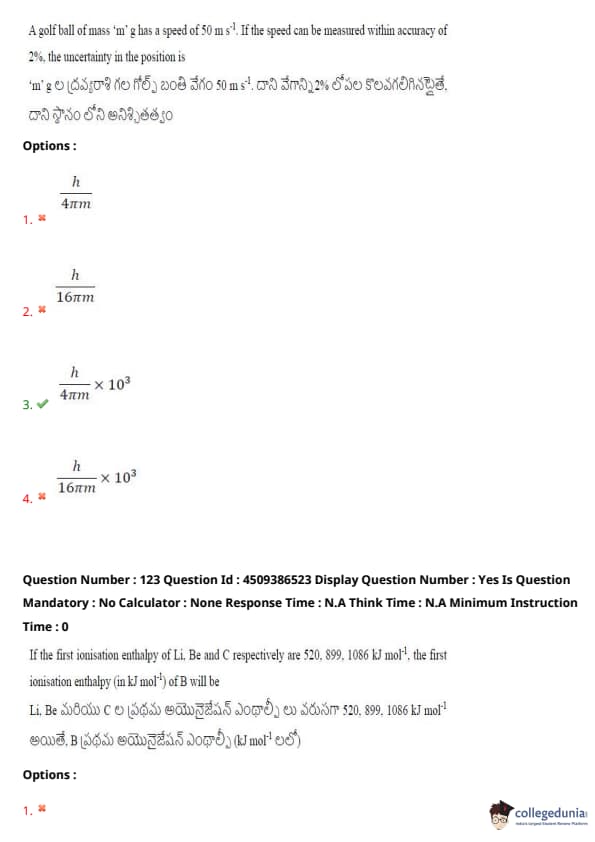
A golf ball of mass ‘m’ has a speed of 50 m/s. If the speed can be measured within accuracy of 2%, the uncertainty in the position is
View Solution
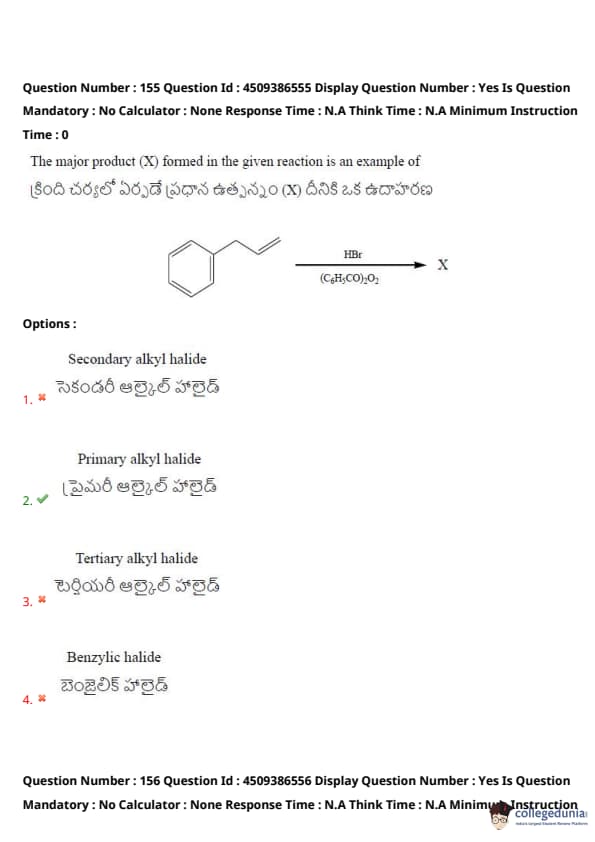
If the first ionisation enthalpy of Li, Be and C respectively are 520, 899, 1086 kJ/mol, the first ionisation enthalpy (in kJ/mol) of B will be
View Solution
In which of the following sets of molecules, the central atoms of molecules have same hybridisation?
View Solution
The correct increasing order of number of lone pair of electrons on the central atom of \(SnCl_2\), \(XeF_2\),\( CIF_3\) and \( SO_3\) is
View Solution
Identify the correct statements from the following:
For an ideal gas, the compressibility factor is 1.0.
The kinetic energy of NO (g) (molar mass = 30 g mol\(^{-1}\)) at T(K) is \( x \) J mol\(^{-1}\). The kinetic energy of N\(_2\)O\(_4\) (g) (molar mass = 92 g mol\(^{-1}\)) at T(K) is \( 2x \) J mol\(^{-1}\).
The rate of diffusion of a gas is inversely proportional to the square root of its density.
View Solution
The following graph is obtained for a gas at different temperatures (T1, T2, T3). What is the correct order of temperature? (x-axis = velocity; y-axis = number of molecules)

View Solution
Observe the following stoichiometric equation
P_4 + 3 \text{OH^- + 3 \text{H_2\text{O \rightarrow \text{PH_3 + 3 \text{OH^-.
What is the conjugate acid of \text{OH^- ?
View Solution
Given below are two statements
Statement - I: For isothermal irreversible change of an ideal gas, \[ q = -w = P_{ext}(V_{final} - V_{initial}) \]
Statement - II: For adiabatic change, \[ \Delta U = W_{adiabatic} \]
The correct answer is:
View Solution
A thermodynamic process (B \(\rightarrow\) E) was completed as shown below. The work done is equal to area under the limits.

- (1)
![]()
- (2)
![]()
- (3)
![]()
- (4)
![]()


View Solution
In a one litre flask, 2 moles of \( A_2 \) was heated to \( T(K) \) and the above equilibrium is reached. The concentrations at equilibrium of \( A_2 \) and \( B_2 \) are \( C_1(A_2) \) and \( C_2(B_2) \) respectively. Now, one mole of \( A_2 \) was added to flask and heated to \( T(K) \) to establish the equilibrium again. The concentrations of \( A_2 \) and \( B_2 \) are \( C_3(A_2) \) and \( C_4(B_2) \) respectively. What is the value of \( C_3(A_2) \) in mol L\(^{-1}\)?

View Solution
What is the conjugate base of chloric acid?
View Solution
The correct statements among the following are:
i. Saline hydrides produce \( H_2 \) gas when reacted with water.
ii. Presently ~77% of the industrial dihydrogen is produced from coal.
iii. Commercially marketed \( H_2 O_2 \) contains 3% \( H_2 O_2 \).
View Solution
The correct order of decomposition temperature of \(MgCO_3\) (X), \(BaCO_3\) (Y), \(CaCO_3\) (Z) is:
View Solution
Identify the correct statements from the following:
View Solution
Which one of the following is used as piezoelectric material?
View Solution
Two statements are given below:
I. In dry cleaning, the solvent \(Cl_2C\) = \(CCl_2\) was earlier used and now it is replaced by liquefied \(CO_2\).
II. In bleaching of paper, \(H_2O_2\) was used earlier and now it is replaced by chlorine gas.
View Solution
Tropolone is an example for which of the following class of compounds?
View Solution
What are X and Y respectively in the following reaction sequence?

- (A)
![]()
- (B)
![]()
- (C)
![]()
- (D)
![]()


View Solution
Some substances are given below
Ag: CO\(_2\) (s); SiO\(_2\) (s); ZnS (s)
SO\(_2\) (s); A/N: HCl (s); H\(_2\)O (s)
The number of molecular solids and network solids in the above list is respectively.
View Solution
The \(\Delta T_b\) value for 0.01 m KCl solution is 0.01 K. What is the Van’t Hoff factor?
(Kb for water = 0.52 K kg mol\(^{-1}\))
View Solution
200 g of 20% w/w urea solution is mixed with 400 g of 40% w/w urea solution. What is the weight percentage (w/w %) of resultant solution?
View Solution
2.644 g of metal (M) was deposited when 8040 coulombs of electricity was passed through molten MF\(_2\) salt. What is the atomic mass of M? (F = 96500 C mol\(^{-1}\))
View Solution
The first order reaction \( A(g) \rightarrow B(g) + 2C(g) \) occurs at 25\(^\circ\)C. After 24 minutes the ratio of the concentration of products to the concentration of the reactant is 1:3. What is the half-life of the reaction (in min)? (log 1.11 = 0.046)
View Solution
Which of the following has maximum coagulating power in the coagulation of positively charged sol?
View Solution
Identify the autocatalytic reaction from the following:
View Solution
The anode and cathode used in electrolytic refining of copper respectively are:
View Solution
The disproportionation products of ortho phosphorous acid are:
View Solution
In neutral medium potassium permanganate oxidizes \( I^- \) to \( X \). Identify \( X \).
View Solution
The spin-only magnetic moments of the complexes \([Mn(CN)_6]^{3-}\) and \([Co(C_2O_4)_3]^{3-}\) are respectively:
View Solution
PHBV is a biodegradable polymer of two monomers X and Y. X and Y respectively are:
View Solution
The carbohydrate which does not react with ammoniacal \( AgNO_3 \) solution is:
View Solution
Identify the amino acid which has:

View Solution
The structure given below represents:

View Solution
The major product (X) formed in the given reaction is an example of:

View Solution
Identify the Swarts reaction from the following:
View Solution
An alcohol X (\( C_4H_{10}O \)) reacts with conc. HCl at room temperature to give Y (\( C_4H_9Cl \)). Reaction of X with Cu at 573 K gave Z. What is Z?
- (1)
![]()
- (2)
![]()
- (3)
![]()
- (4)
![]()


View Solution
What is Y in the following reaction sequence?

- (1)
![]()
- (2)
![]()
- (3)
![]()
- (4)
![]()


View Solution
A carbonyl compound X (\( C_3H_6O \)) on oxidation gave a carboxylic acid Y (\( C_3H_6O_2 \)). Oxime of X is:
- (1)
![]()
- (2)
![]()
- (3)
![]()
- (4)
![]()


View Solution
The correct sequence of reactions involved in the following conversion is:

View Solution

































AP EAPCET Previous Year Question Paper with Answer Key PDFs
| AP EAPCET Question Paper 2023 | AP EAPCET Question Paper 2022 | AP EAPCET Question Paper 2021 |
| AP EAPCET Question Paper 2020 | AP EAPCET Question Paper 2019 | AP EAPCET Question Paper 2018 |



Comments