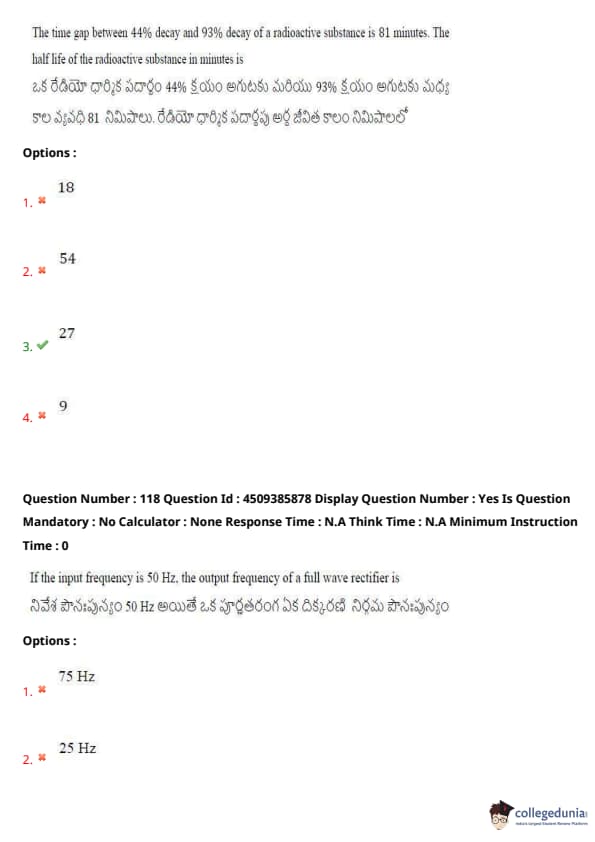
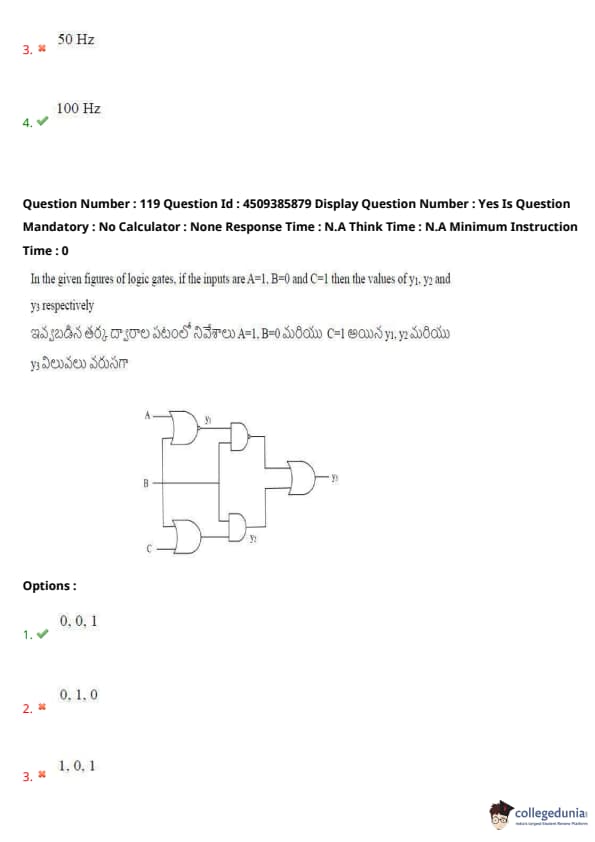
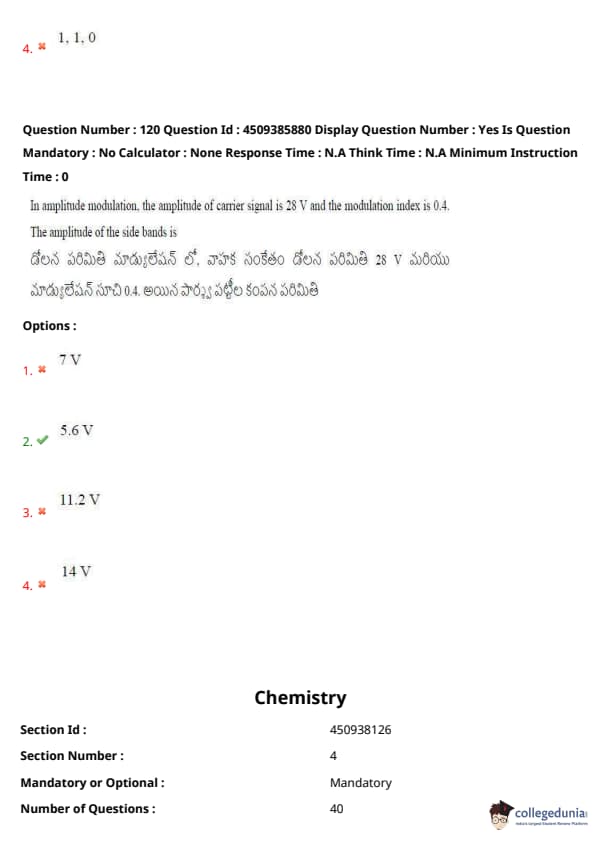
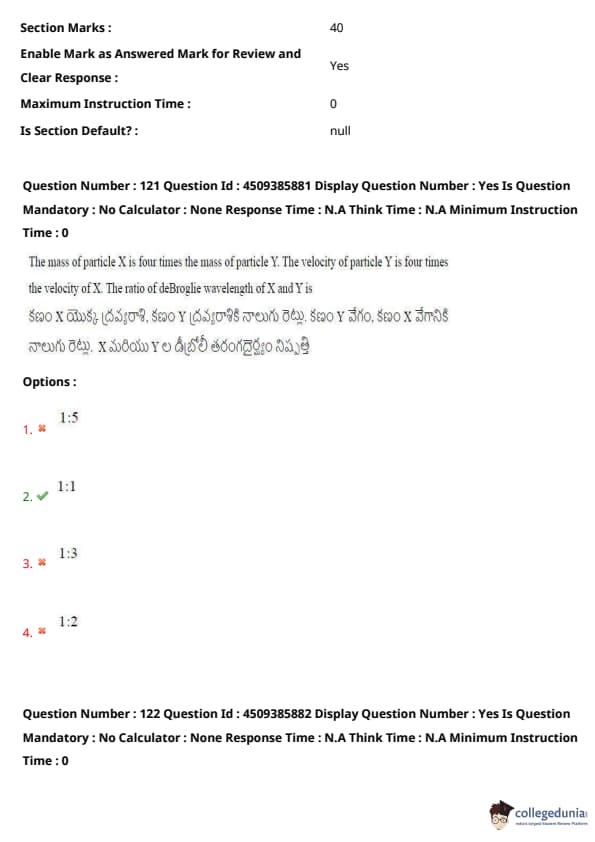
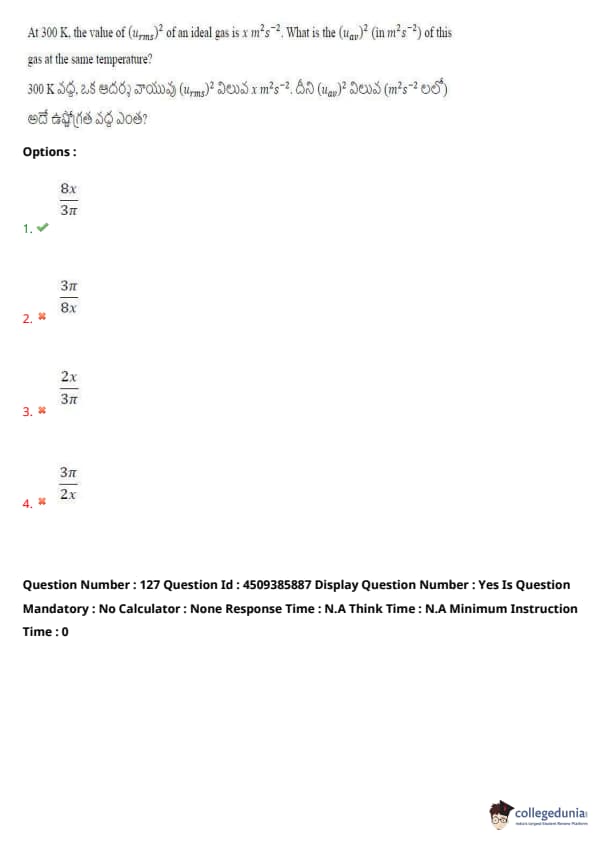
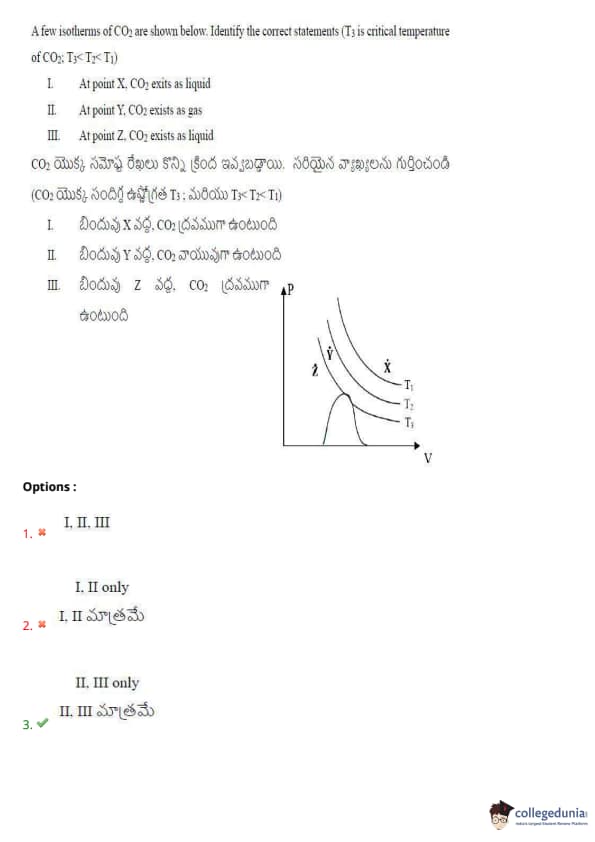
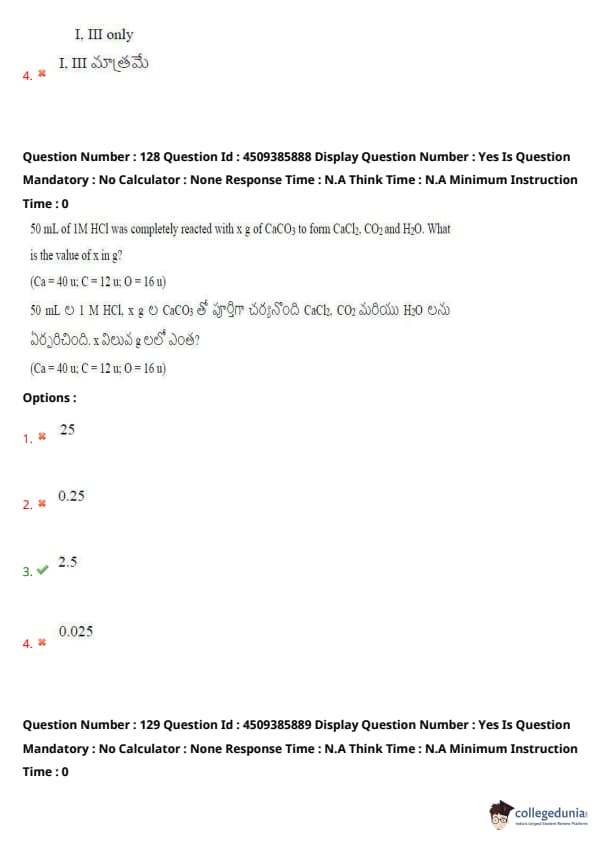
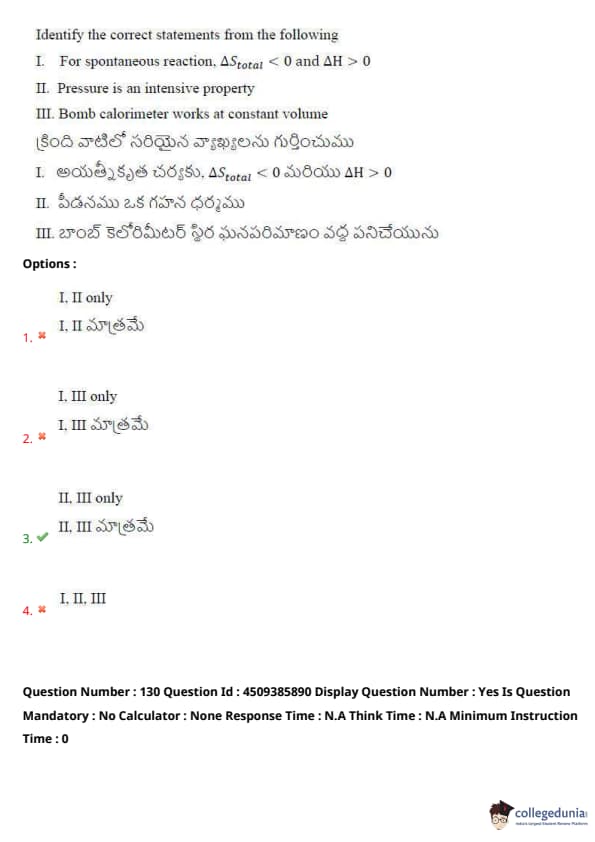
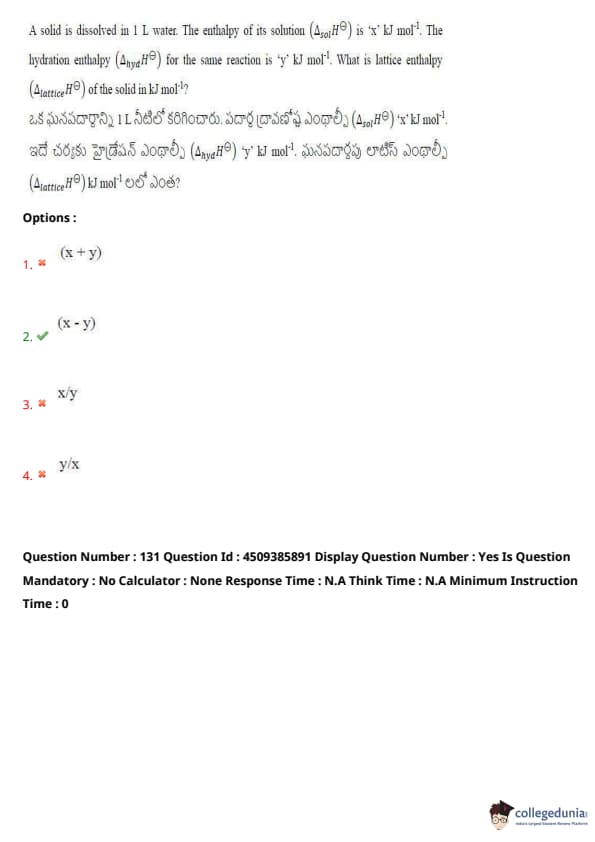
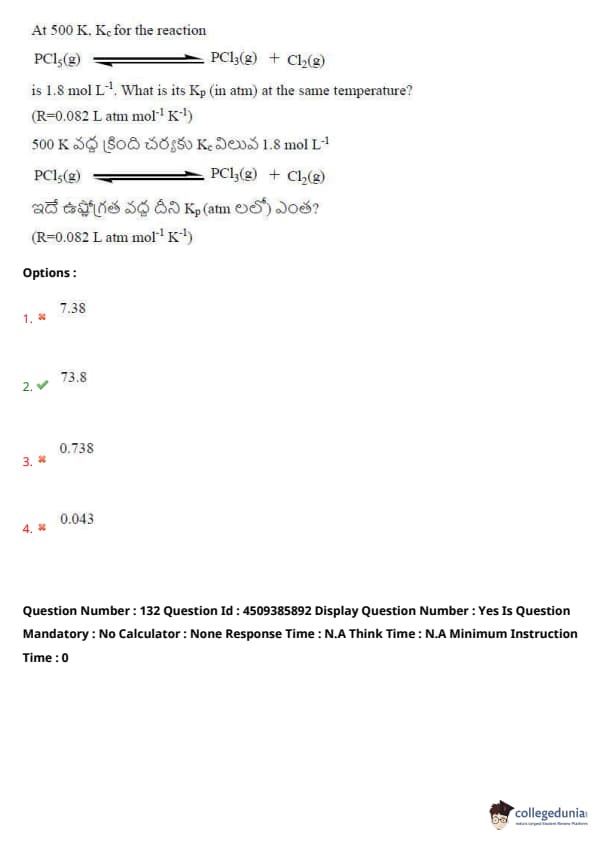
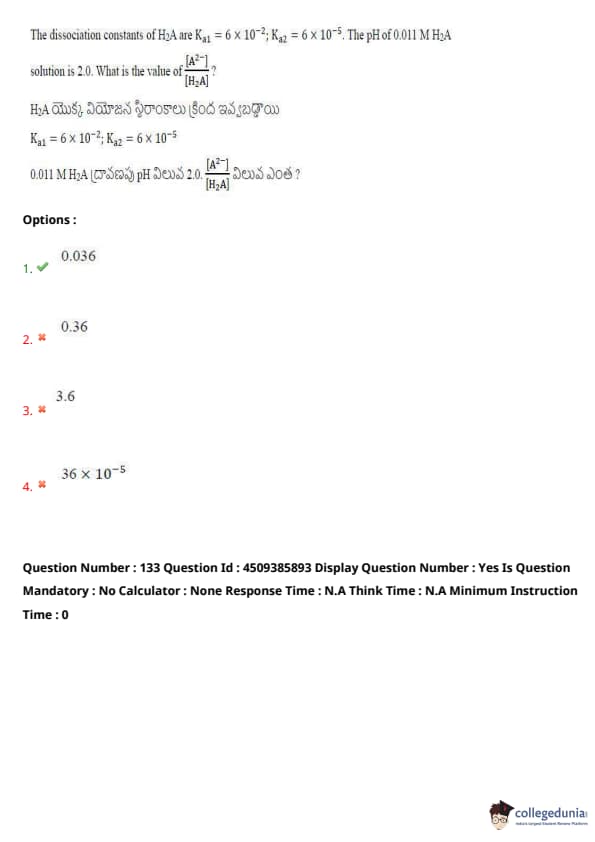
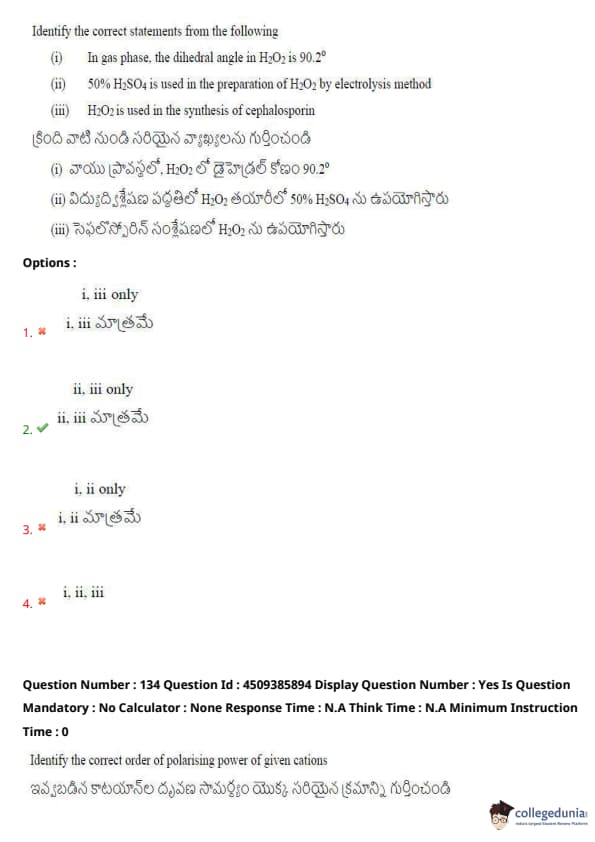
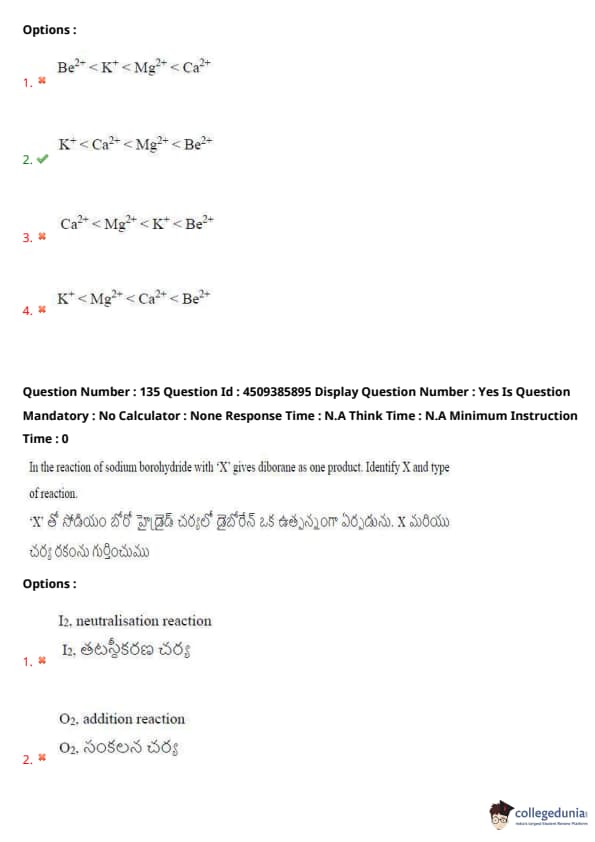
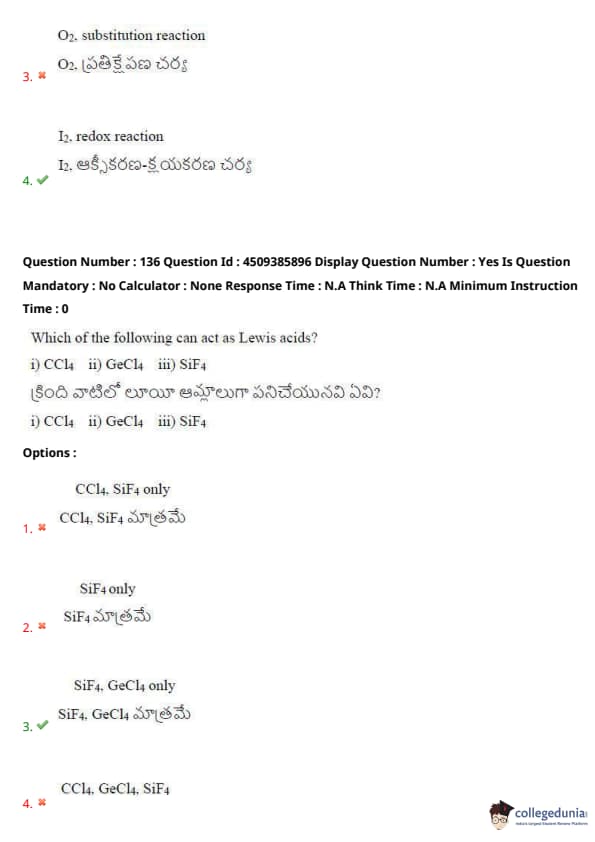
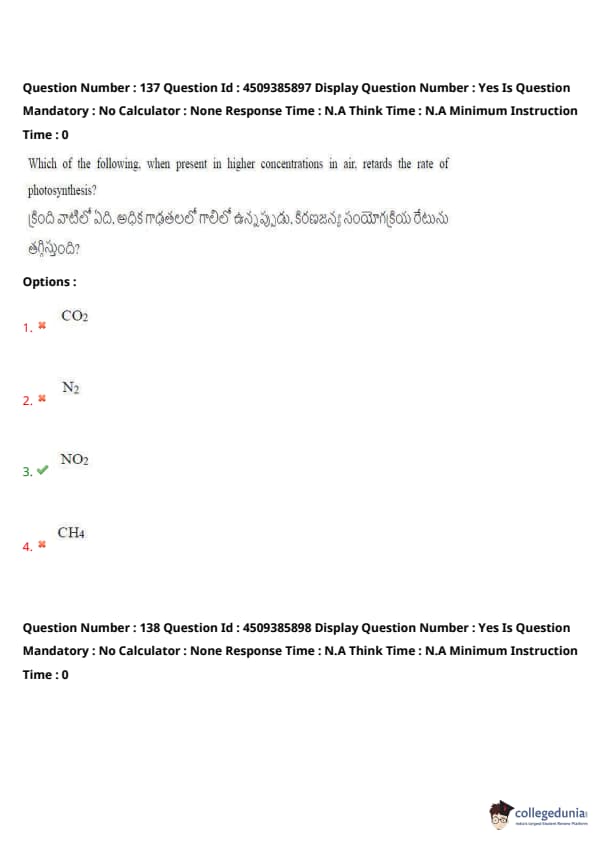
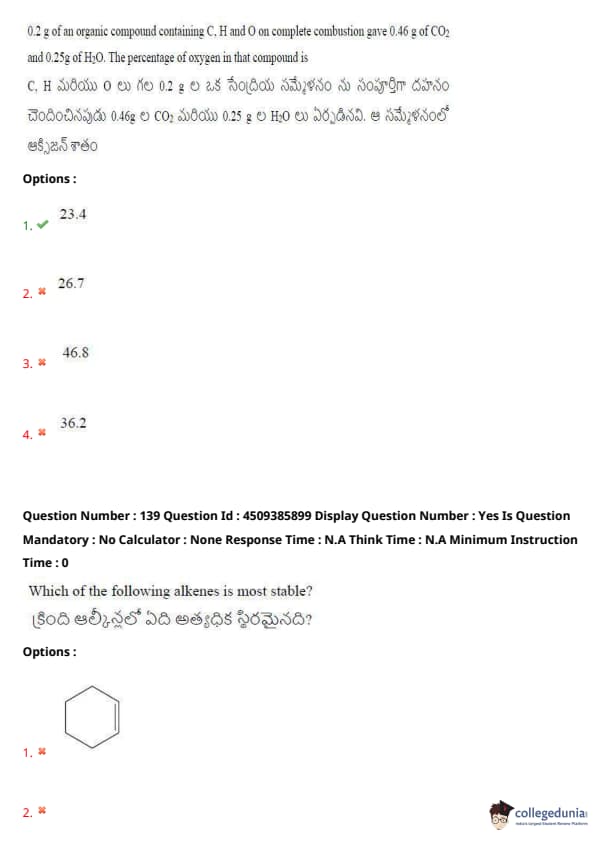
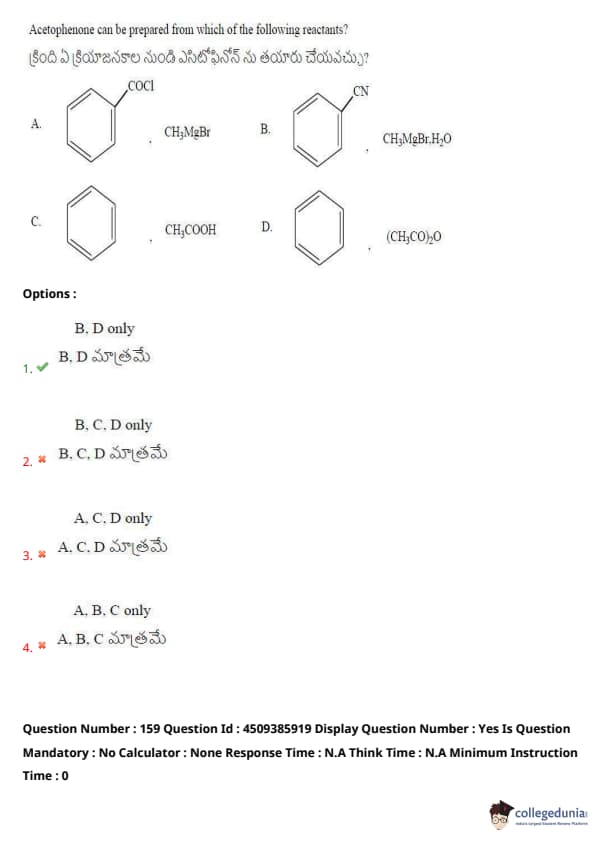
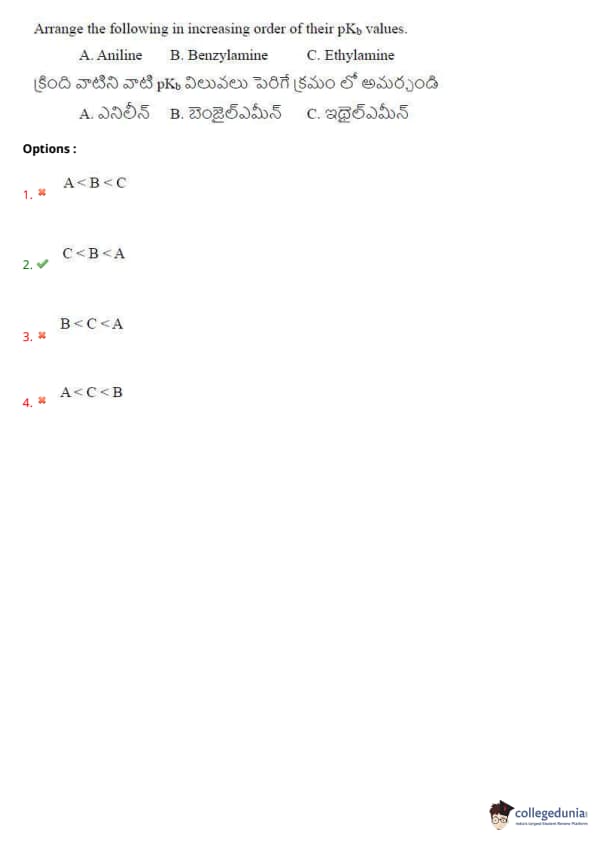
AP EAPCET 2024 Question Paper May 16 Shift 2 is available for download here. Jawaharlal Nehru Technological University, KAKINADA on behalf of APSCHE conducted AP EAPCET 2024 on May 16 in Shift 2 from 2.30 PM to 5.30 PM. AP EAPCET 2024 BiPC Question Paper consists of 160 MCQ-based questions in total, 40 from Botany, 40 from Zoology, 40 from Physics and 40 from chemistry carrying 1 mark each to be attempted in the duration of 3 hours.
Download: AP EAMCET 2025 Question Paper with Solution PDF

AP EAPCET 2024 Question Paper with Answer Key PDF May 16 Shift 2

AP EAPCET 2024 May 16 Shift 2 Question Paper with Answer Key download iconDownload Check Solution

AP EAPCET 2024 Question Paper with Solution

SECTION-A
BIOLOGY

Question 1:

Taxonomic keys are based on

  • (1) Morphological characters
  • (2) Reproductive characters
  • (3) Anatomical characters
  • (4) Contrasting characters
Correct Answer: (4) Contrasting characters View Solution

Question 2:

Name the plant and body showing Cup or saucer shaped ascocarp

  • (1) Penicillium, Perithecium
  • (2) Claviceps, Cleistothecium
  • (3) Neurospora, Apothecium
  • (4) Aspergillus, Ascohecium
Correct Answer: (3) Neurospora, Apothecium
View Solution
Question 3:

Identify wrong matching

  • (1) I and III
  • (2) II and III
  • (3) I and IV
  • (4) II and IV
Correct Answer: (3) I and IV
View Solution

Question 4:

Pyriform gametes with two laterally attached flagella are found in

  • (1) Laminaria and Fucus
  • (2) Sargassum and Volvox
  • (3) Ectocarpus and Chara
  • (4) Fucus and Fumaria
Correct Answer: (1) Laminaria and Fucus
View Solution
Question 5:

Stem tubes, Corn, Rhizome, Cladophyll, Bulbil, Stolon modifications shown by this correct sequence of plants

  • (1) Potato, Ginger, Turmeric, Zaminkand, Dioscorea, Nerium
  • (2) Potato, Zaminkand, Turmeric, Ginger, Agave, Asparagus
  • (3) Potato, Ginger, Zaminkand, Asparagus, Agave, Nerium
  • (4) Potato, Ginger, Zaminkand, Asparagus, Agave, Jasmine
Correct Answer: (3) Potato, Ginger, Zaminkand, Asparagus, Agave, Nerium
View Solution

Question 6:

Match the following list

  • (1) I-B, II-A, III-C, IV-D
  • (2) I-B, II-A, III-C, IV-E
  • (3) I-C, II-A, III-B, IV-E
  • (4) I-C, II-B, III-A, IV-B
Correct Answer: (2) I-B, II-A, III-C, IV-E
View Solution
Question 7:

Assertion [A]: Scale leaves of rhizome of ginger are vegetative propagules.

Reason [R]: Vegetative propagules of flowering plants are capable of giving new offsprings.

  • (1) A and R are correct. R is the correct explanation of A.
    (2) A and R are correct. R is not the correct explanation of A.
    (3) A is correct but R is incorrect.
    (4) A is incorrect but R is correct.
Correct Answer: (4) A is incorrect but R is correct.
View Solution

Question 8:

Choose the correct statements related to plant reproduction

  • (1) I, II, IV
    (2) I, II, III
    (3) II, III, IV
    (4) I, III, IV
Correct Answer: (1) I, II, IV
View Solution

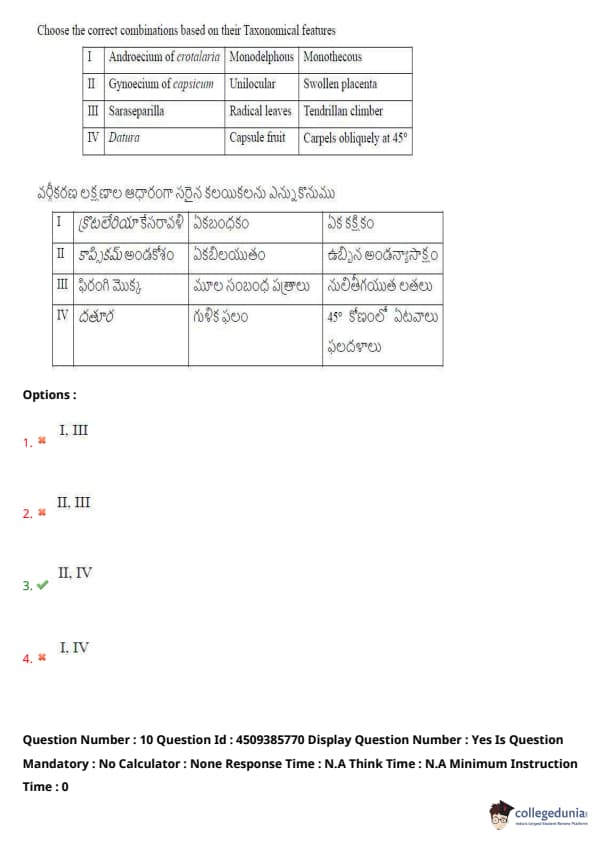
Question 9:

Choose the correct combinations based on their Taxonomical features

  • (1) I, III
    (2) II, III
    (3) II, IV
    (4) I, IV
Correct Answer: (3) II, IV
View Solution

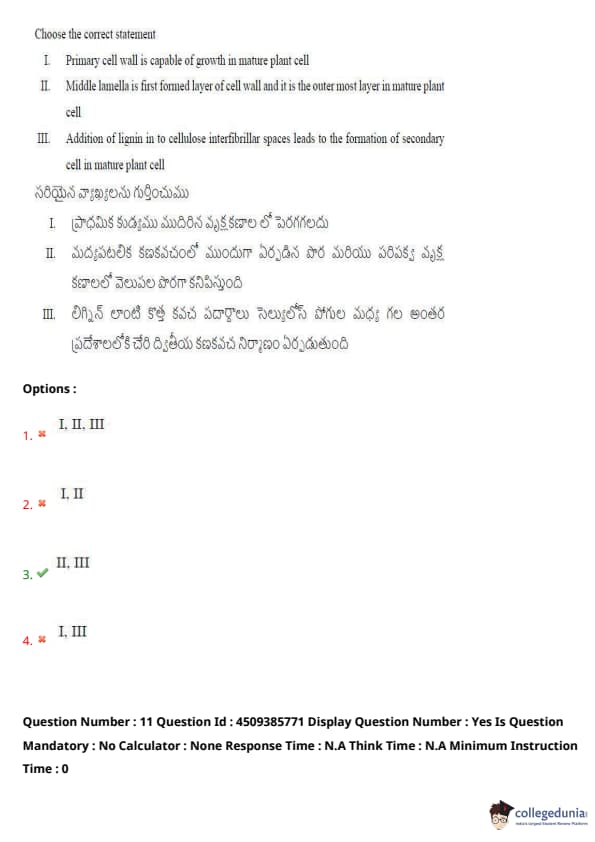
Question 10:

Choose the correct statement:

  • (1) I, II, III
    (2) I, II
    (3) II, III
    (4) I, III
Correct Answer: (3) II, III
View Solution

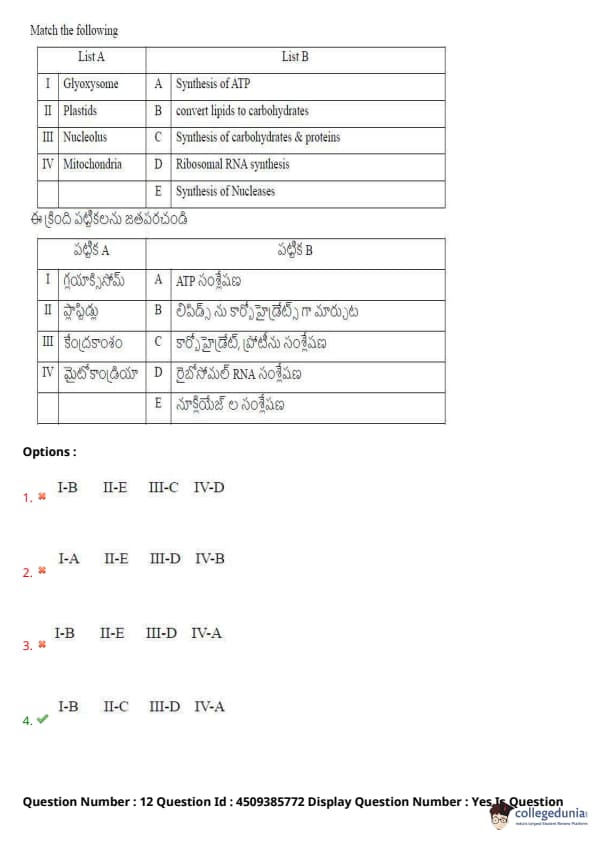
Question 11:

Match the following

  • (1) I-A, II-E, III-C, IV-D
    (2) I-B, II-E, III-D, IV-B
    (3) I-B, II-E, III-A, IV-D
    (4) I-B, II-C, III-D, IV-A
Correct Answer: (4) I-B, II-C, III-D, IV-A
View Solution

Question 12:

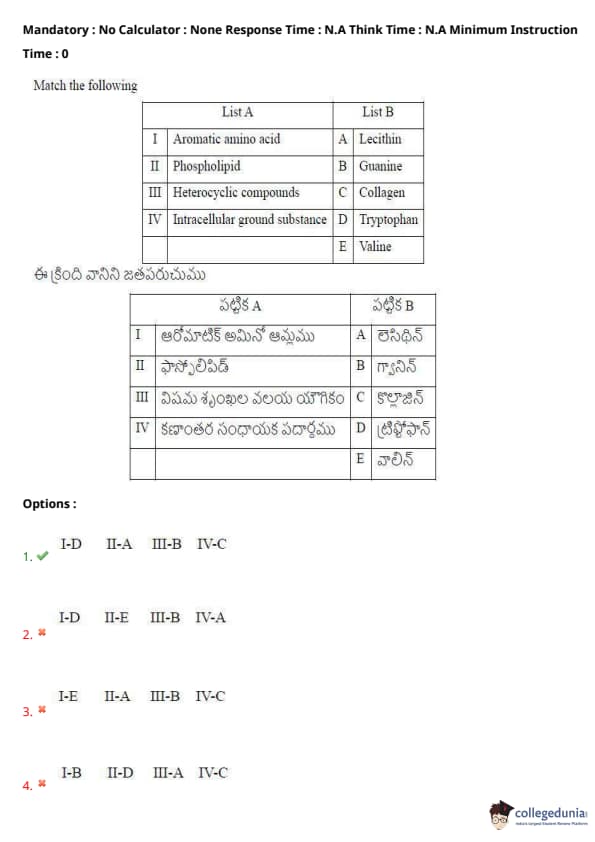
Match the following

  • (1) I-D, II-A, III-B, IV-C
    (2) I-D, II-E, III-B, IV-A
    (3) I-E, II-A, III-B, IV-C
    (4) I-B, II-C, III-A, IV-E
Correct Answer: (1) I-D, II-A, III-B, IV-C
View Solution
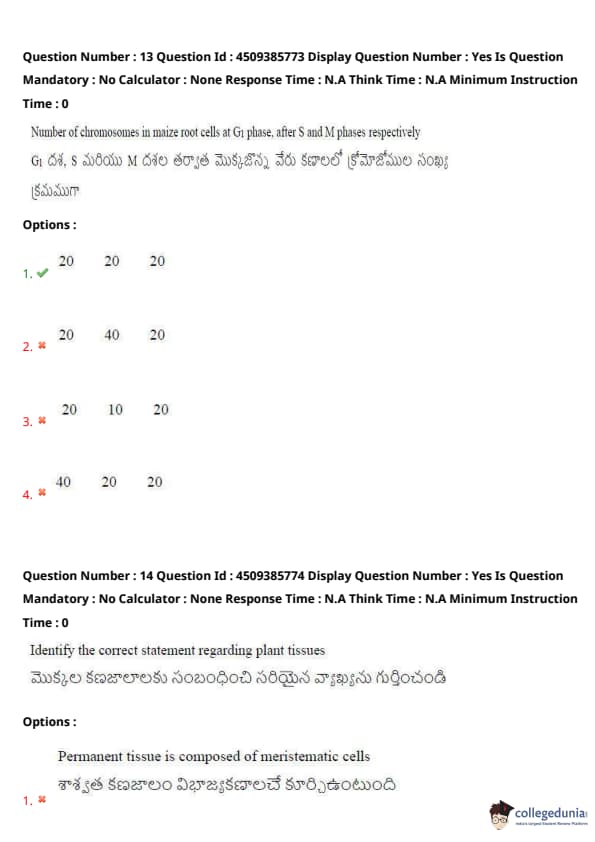
Question 13:

Number of chromosomes in maize root cells at G1 phase, after S and M phases respectively

  • (1) 20, 20, 20
    (2) 20, 40, 20
    (3) 20, 10, 20
    (4) 20, 40, 40
Correct Answer: (1) 20, 20, 20
View Solution

Question 14:

Identify the correct statement regarding plant tissues

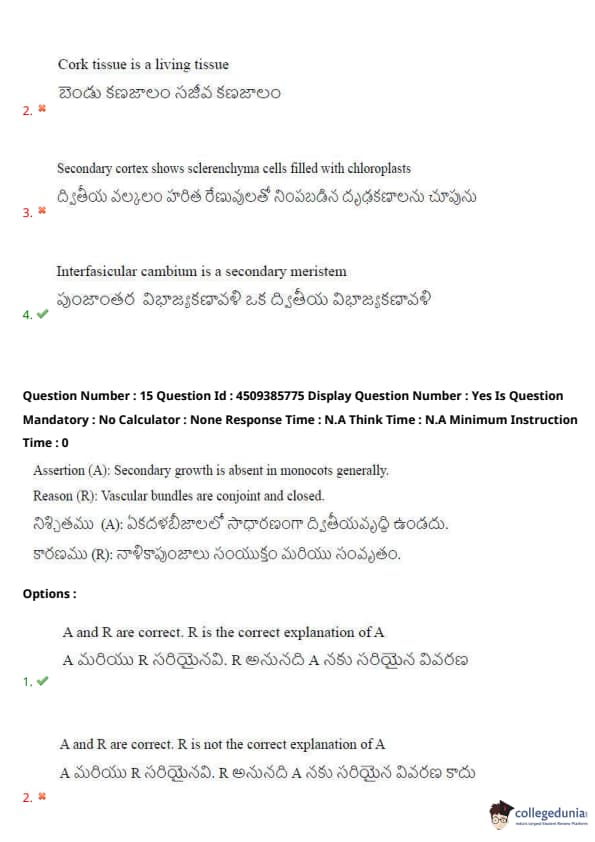
  • (1) Permanent tissue is composed of meristematic cells
    (2) Cork tissue is a living tissue
    (3) Secondary cortex shows sclerenchyma cells filled with chloroplasts
    (4) Interfascicular cambium is a secondary meristem
Correct Answer: (4) Interfascicular cambium is a secondary meristem
View Solution

Question 15:

Assertion (A): Secondary growth is absent in monocots generally.

Reason (R): Vascular bundles are conjoint and closed.

  • (1) A and R are correct. R is the correct explanation of A.
    (2) A and R are correct. R is not the correct explanation of A.
    (3) A is correct but R is incorrect.
    (4) A is incorrect but R is correct.
Correct Answer: (1) A and R are correct. R is the correct explanation of A.
View Solution
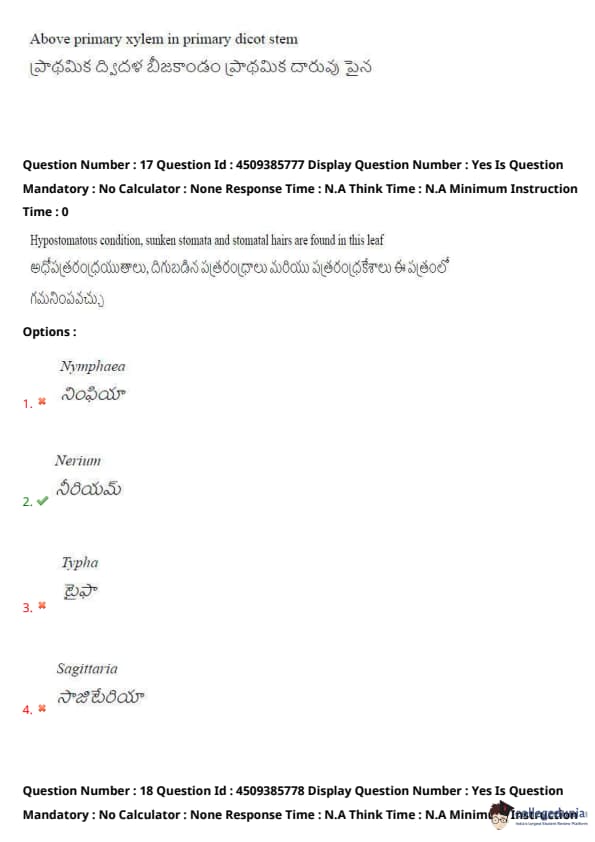
Question 16:

Sclerenchyma tissue is present in this portion of this structure

  • (1) Above secondary phloem in dicot stem
    (2) Above primary phloem in primary dicot stem
    (3) Above secondary xylem in secondary dicot stem
    (4) Above primary xylem in primary dicot stem
Correct Answer: (2) Above primary phloem in primary dicot stem
View Solution

Question 17:

Hypostomatic condition, sunken stomata and stomatal hairs are found in this leaf

  • (1) Nymphaea
    (2) Nerium
    (3) Typha
    (4) Sagittaria
Correct Answer: (2) Nerium
View Solution

Question 18:

Match the following

  • (1) A-I-iv, B-II-iii, C-III-ii, D-IV-i
    (2) A-III-ii, B-II-iii, C-IV-i, D-I-iv
    (3) A-IV-i, B-III-ii, C-II-iii, D-I-iv
    (4) A-III-ii, B-I-ii, C-IV-iii, D-II-iv
Correct Answer: (3) A-IV-i, B-III-ii, C-II-iii, D-I-iv
View Solution

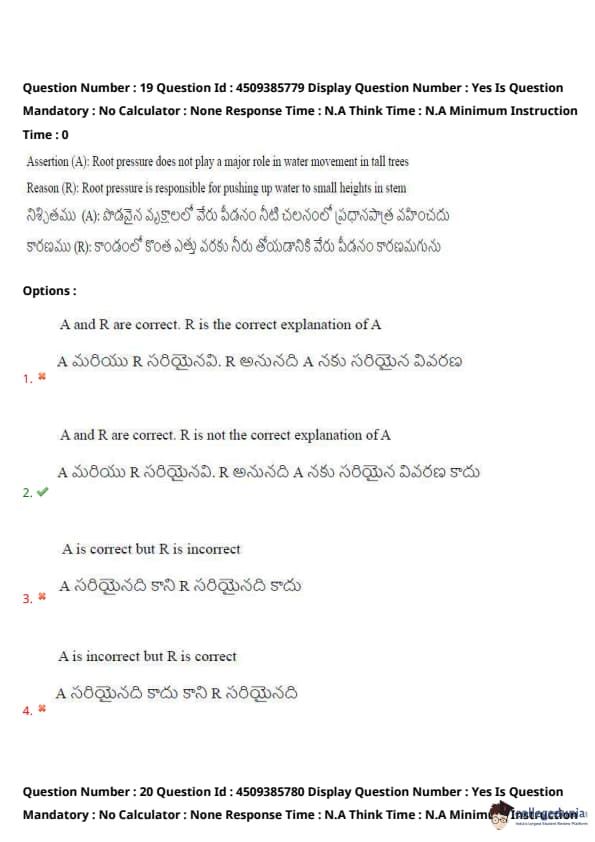
Question 19:

Assertion (A): Root pressure does not play a major role in water movement in tall trees.

Reason (R): Root pressure is responsible for pushing up water to small heights in stem.

  • (1) A and R are correct. R is the correct explanation of A.
    (2) A and R are correct. R is not the correct explanation of A.
    (3) A is correct but R is incorrect.
    (4) A is incorrect but R is correct.
Correct Answer: (2) A and R are correct. R is not the correct explanation of A.
View Solution

Question 20:

Study and match the following Lists

  • (1) A-II, B-I, C-III, D-V
    (2) A-III, B-V, C-II, D-I
    (3) A-V, B-III, C-II, D-I
    (4) A-III, B-V, C-I, D-II
Correct Answer: (4) A-III, B-V, C-I, D-II
View Solution

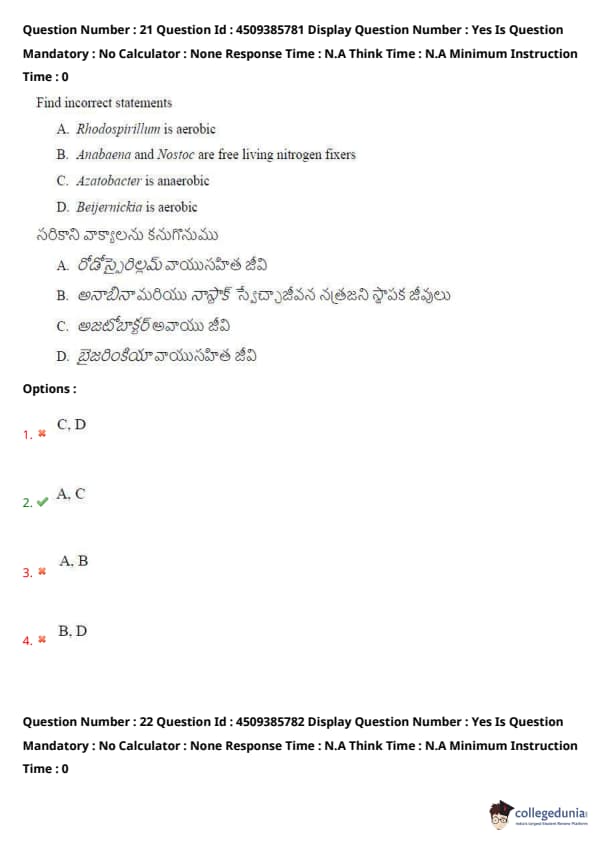
Question 21:

Find incorrect statements

  • (1) C, D
    (2) A, C
    (3) A, B
    (4) B, D
Correct Answer: (2) A, C
View Solution
Question 22:

Study the table and find deficiency symptoms shown in plants

  • (1) A: Stunted growth, B: Chlorosis, C: Necrosis
    (2) A: Chlorosis, B: Necrosis, C: Inhibition of cell division
    (3) A: Delay flowering, B: Stunted growth, C: Chlorosis
    (4) A: Premature leaf fall, B: Necrosis, C: Chlorosis
Correct Answer: (2) A: Chlorosis, B: Necrosis, C: Inhibition of cell division
View Solution

Question 23:

Find out the incorrect statements regarding Enzymes

  • (1) Km: Approximate inverse measure of the affinity of the enzyme for a given substrate.
    (2) Km: Approximate measure of the concentration of substrate at which the reaction rate is half of the maximum rate.
    (3) Enzymes generally function in a broad range of temperature and pH.
    (4) 2.7.1.2 is enzyme code for Glucose-6-Phosphotransferase.
Correct Answer: (2) Km: Approximate measure of the concentration of substrate at which the reaction rate is half of the maximum rate.
View Solution

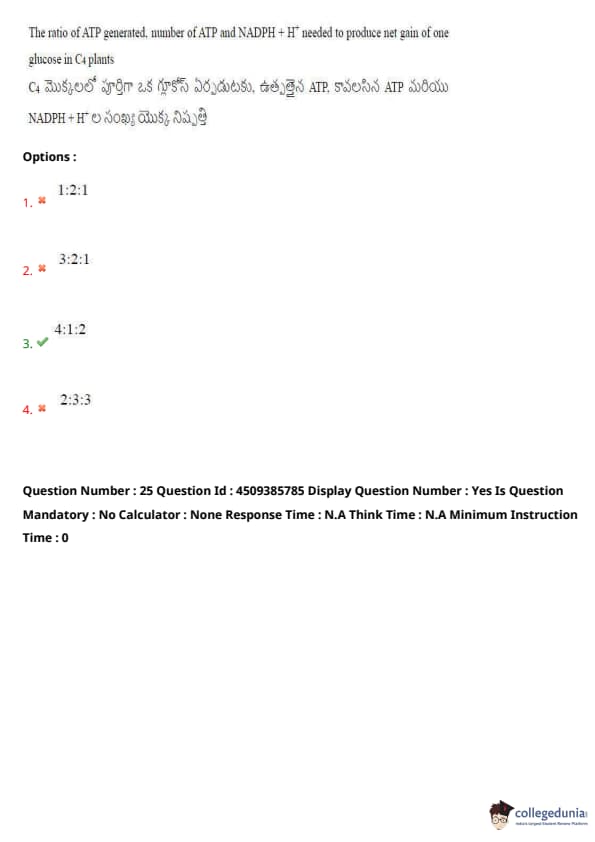
Question 24:

The ratio of ATP generated, number of ATP and NADPH + H\(^+\) needed to produce net gain of one glucose in C\(_4\) plants

  • (1) 1:2:1
    (2) 3:2:1
    (3) 4:1:2
    (4) 2:3:3
Correct Answer: (3) 4:1:2
View Solution

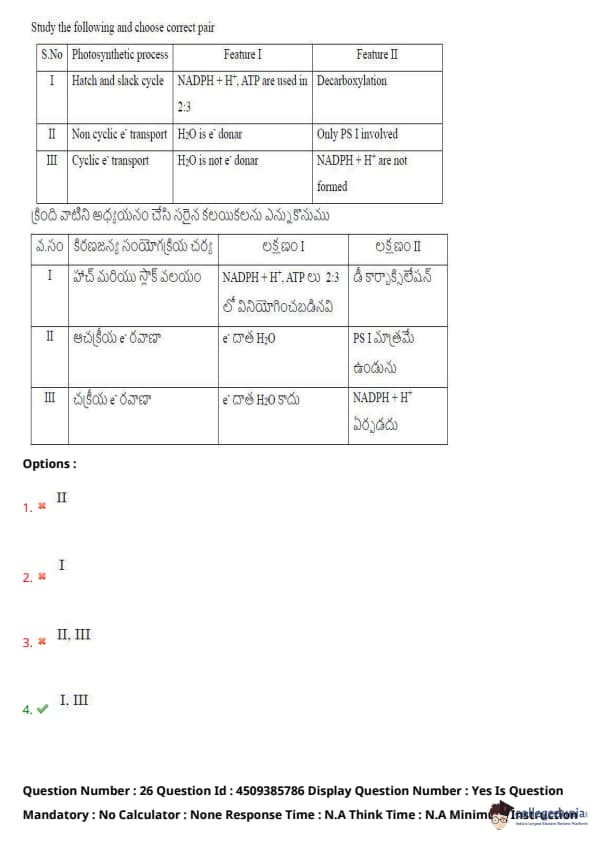
Question 25:

Study the following and choose the correct pair

  • (1) II
    (2) I
    (3) II, III
    (4) I, III
Correct Answer: (4) I, III
View Solution

Question 26:

Plants do not have respiratory organs due to the following reasons

  • (1) II, III, IV
    (2) I, II, III
    (3) I, III, IV
    (4) I, II, IV
Correct Answer: (2) I, II, III
View Solution

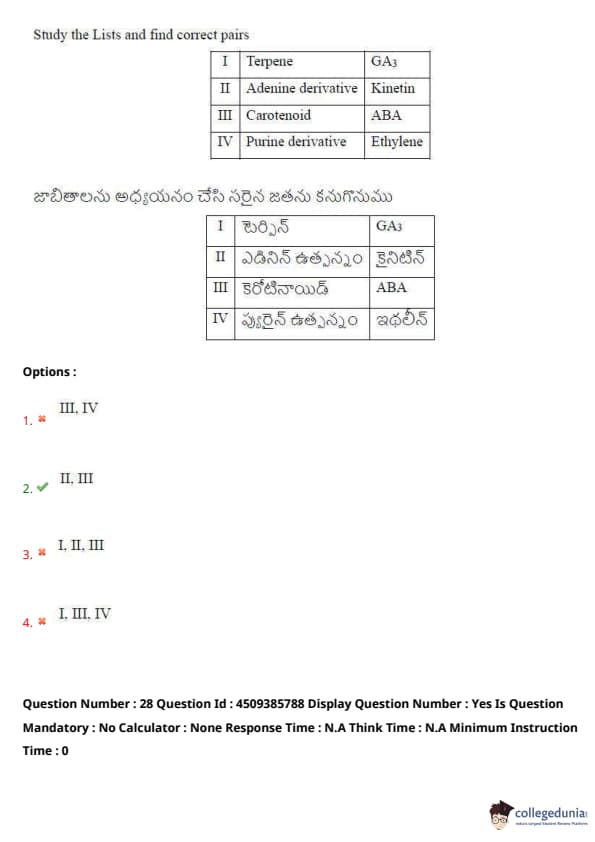
Question 27:

Study the Lists and find correct pairs

  • (1) III, IV
    (2) II, III
    (3) I, II, III
    (4) I, III, IV
Correct Answer: (2) II, III
View Solution

Question 28:

Choose correct combinations

  • (1) I, III
    (2) II, IV
    (3) III, IV
    (4) I, II
Correct Answer: (3) III, IV
View Solution

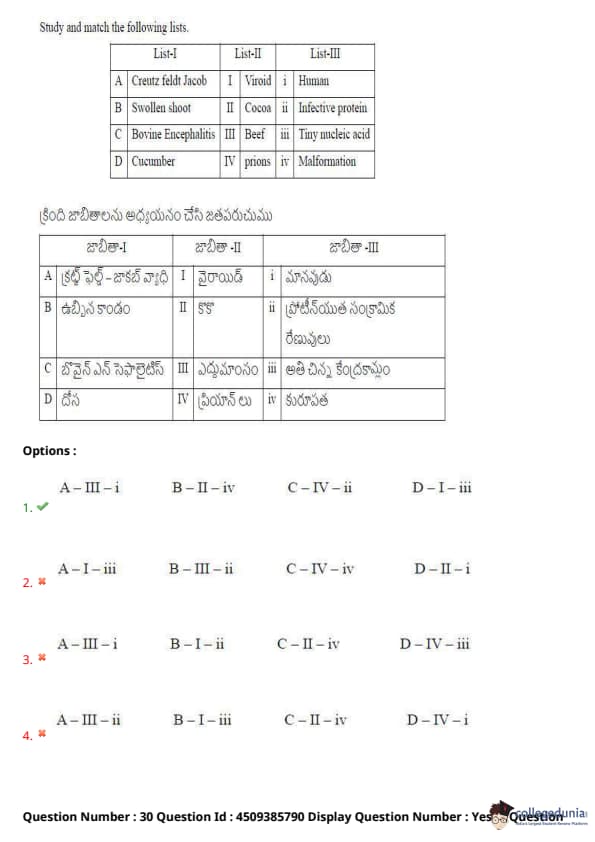
Question 29:

Study and match the following lists

  • (1) A-III, B-II, C-IV, D-I
    (2) A-I-iii, B-III-ii, C-II-i, D-IV-iv
    (3) A-III, B-I-ii, C-IV-i, D-II-iii
    (4) A-II, B-IV-i, C-III-iv, D-I-ii
Correct Answer: (1) A-III, B-II, C-IV, D-I
View Solution

Question 30:

In the progeny of dihybrid cross of pea plant, the phenotype ratio between the proportions of recombinants and parent plants respectively is

  • (1) 2:4
    (2) 4:2
    (3) 3:5
    (4) 5:3
Correct Answer: (3) 3:5
View Solution

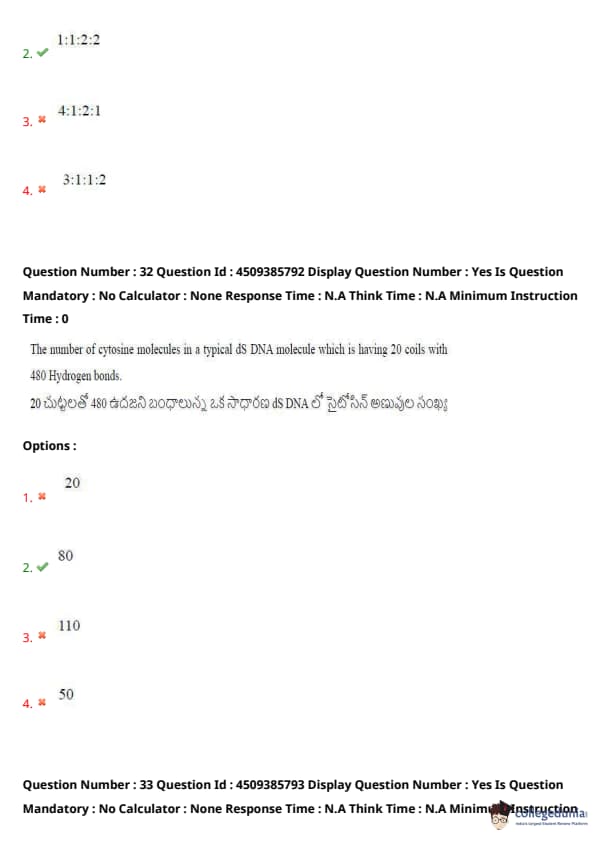
Question 31:

In F2 progeny of dihybrid cross in pea plant the ratio of genotypes YyRR, yyRR, YyRR, Yyrr is

  • (1) 2:3:3:2
    (2) 1:1:2:2
    (3) 4:1:2:1
    (4) 3:1:1:2
Correct Answer: (2) 1:1:2:2
View Solution

Question 32:

The number of cytosine molecules in a typical ds DNA molecule which is having 20 coils with 480 Hydrogen bonds.

  • (1) 20
    (2) 80
    (3) 110
    (4) 50
Correct Answer: (2) 80
View Solution

Question 33:

Assertion (A): Lac mRNA is synthesized in the presence of inducer.

Reason (R): The activity of repressor protein is suppressed by inducer.

  • (1) A and R are correct. R is the correct explanation of A.
    (2) A and R are correct. R is not the correct explanation of A.
    (3) A is correct but R is incorrect.
    (4) A is incorrect but R is correct.
Correct Answer: (1) A and R are correct. R is the correct explanation of A.
View Solution

Question 34:

In Lac Operon Z, Y, a and i indicates the following codes

  • (A) \(\beta\) galactosidase, permease, transacetylase, repressor
  • (B) Inducer, promoter, operator, repressor
  • (C) trp, ara, his, val
  • (D) Promoter, operator, repressor, inducer
Correct Answer: (A) \(\beta\) galactosidase, permease, transacetylase, repressor
View Solution

Question 35:

Assertion (A): DNA fragments are positively charged.

Reason (R): DNA fragments are separated by gel electrophoresis technique.

  • (A) A and R are correct. R is the correct explanation of A.
  • (B) A and R are correct. R is not the correct explanation of A.
  • (C) A is correct but R is incorrect.
  • (D) A is incorrect but R is correct.
Correct Answer: (D) A is incorrect but R is correct.
View Solution

Question 36:

This nutrient is present more in Golden rice when compared to conventional rice.

  • (A) Vitamin C
  • (B) Iron
  • (C) Calcium
  • (D) Beta Carotene
Correct Answer: (D) Beta Carotene
View Solution

Question 37:

Identify the Algae, fungi and bacterium used as SCP in serial.

  • (A) Chlorella, Scenedesmus, Methylophilus
  • (B) Chlorella, Candida, Scenedesmus
  • (C) Spirulina, Candida, Methylophilus
  • (D) Chaetomium, Candida, Brevibacterium
Correct Answer: (C) Spirulina, Candida, Methylophilus
View Solution

Question 38:

Choose the incorrect pair regarding plant tissue culture.

  • (A) I, II
  • (B) III, IV
  • (C) II, III
  • (D) I, IV
Correct Answer: (B) III, IV
View Solution

Question 39:

Assertion (A): Biological control developed for treatment of plant diseases.

Reason (R): Trichoderma are free living fungi common in root ecosystem.

  • (A) A and R are correct. R is the correct explanation of A.
  • (B) A and R are correct. R is not the correct explanation of A.
  • (C) A is correct but R is incorrect.
  • (D) A is incorrect but R is correct.
Correct Answer: (A) A and R are correct. R is the correct explanation of A.
View Solution

Question 40:

Choose the correct pair related to Bioactive compounds.

  • (A) I, II
  • (B) I, IV
  • (C) II, III
  • (D) I, III
Correct Answer: (D) I, III
View Solution

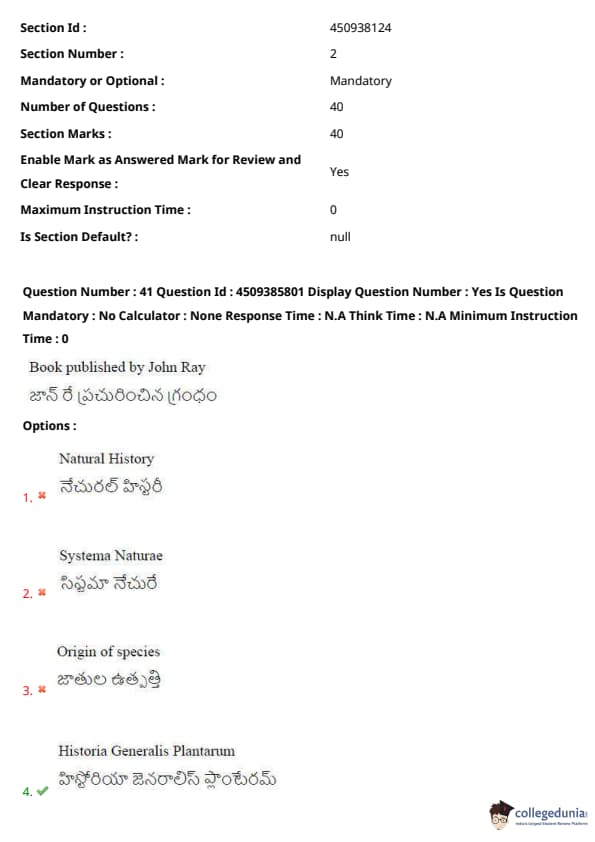
Question 41:

Book published by John Ray.

  • (A) Natural History
  • (B) Systema Naturae
  • (C) Origin of species
  • (D) Historia Generalis Plantarum
Correct Answer: (D) Historia Generalis Plantarum
View Solution

Question 42:

Pick up the ex-situ conservation method.

  • (A) National Parks
  • (B) Sanctuaries
  • (C) Gene Banks
  • (D) Sacred Groves
Correct Answer: (C) Gene Banks
View Solution

Question 43:

In some non chordates, during embryonic development, mesoderm occupies only a part of blastocoel adjoining ectoderm. The unoccupied portion of blastocoel persists as.

  • (A) Haemocoel
  • (B) Schizocoelic coelom
  • (C) Enterocoelic coelom
  • (D) Pseudocoelom
Correct Answer: (D) Pseudocoelom
View Solution

Question 44:

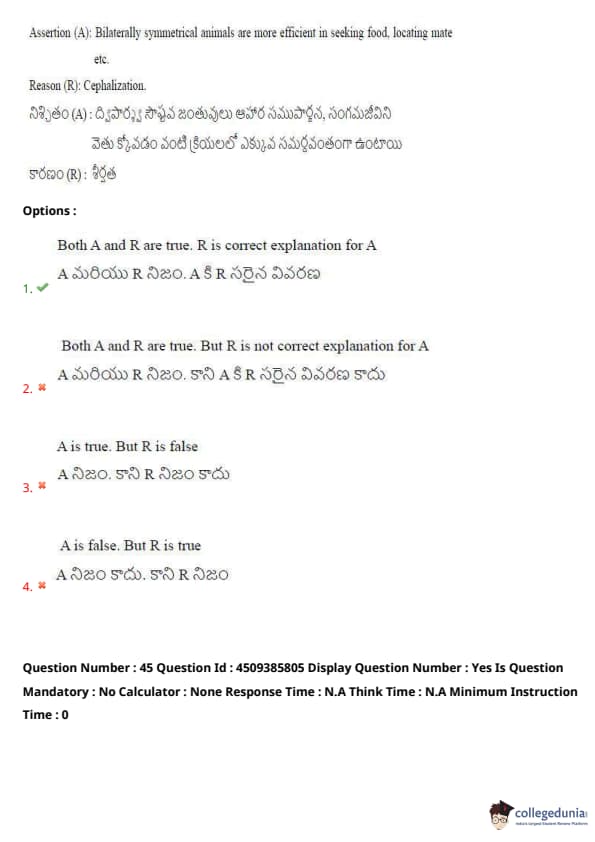
Assertion (A): Bilaterally symmetrical animals are more efficient in seeking food, locating mate etc.

Reason (R): Cephalization.

  • (A) Both A and R are true. R is correct explanation for A
  • (B) Both A and R are true. But R is not correct explanation for A
  • (C) A is true. But R is false
  • (D) A is false. But R is true
Correct Answer: (A) Both A and R are true. R is correct explanation for A
View Solution

Question 45:

Match the following:

  • (A) Mast cells \quad \quad \quad \quad (I) Antibodies
  • (B) Histocytes \quad \quad \quad \quad (II) Serotonin
  • (C) Plasma cells \quad \quad \quad (III) Fibres
  • (D) Adipocytes \quad \quad \quad (IV) Phagocytic cells
Correct Answer: (A-II) Mast cells \(\to\) Serotonin, (B-IV) Histocytes \(\to\) Phagocytic cells, (C-I) Plasma cells \(\to\) Antibodies, (D-V) Adipocytes \(\to\) Storage
View Solution

Question 46:

Statement I: Flame cells in flat worms help in osmoregulation and excretion.

Statement II: In chilopods maxillae are modified into gnathochilarium.

  • (A) Both statements I and II are correct
  • (B) Both statements I and II are false
  • (C) Statement I is correct, but II is false
  • (D) Statement I is false, but II is correct
Correct Answer: (C) Statement I is correct, but II is false
View Solution

Question 47:

Study the following and pick up the correct combinations:

  • (A) I, II
  • (B) II, III
  • (C) III, IV
  • (D) I, IV
Correct Answer: (D) I, IV
View Solution

Question 48:

Skull is monoconclyic in

  • (A) Pisces, amphibians and reptiles
  • (B) Reptiles, birds and mammals
  • (C) Pisces, reptiles and birds
  • (D) Amphibians, reptiles and birds
Correct Answer: (C) Pisces, reptiles and birds
View Solution

Question 49:

Match the following

  • (A) Chelone
  • (B) Draco
  • (C) Bungarus
  • (D) Physs
Correct Answer: A-IV, B-V, C-I, D-III
View Solution

Question 50:

Type of pseudopodia present in Euglypha

  • (A) Lobopodia
  • (B) Reticulopodia
  • (C) Filopodia
  • (D) Axopodia
Correct Answer: (C) Filopodia
View Solution

Question 51:

In binary fission two daughter euglena develop new flagella individually

  • (A) Both the statements I and II are correct
  • (B) Both statements I and II are false
  • (C) Statement I is correct. But II is false
  • (D) Statement I is false. But II is correct
Correct Answer: (B) Both statements I and II are false
View Solution

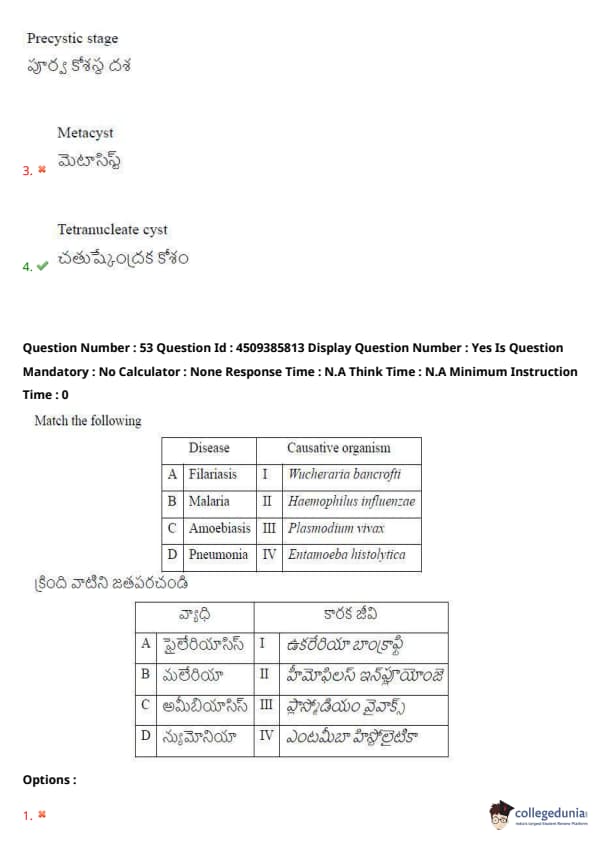
Question 52:

Match the following

  • (A) Filariasis
  • (B) Malaria
  • (C) Amoebiasis
  • (D) Pneumonia
Correct Answer: (A-I), (B-III), (C-IV), (D-II)
View Solution

Question 53:

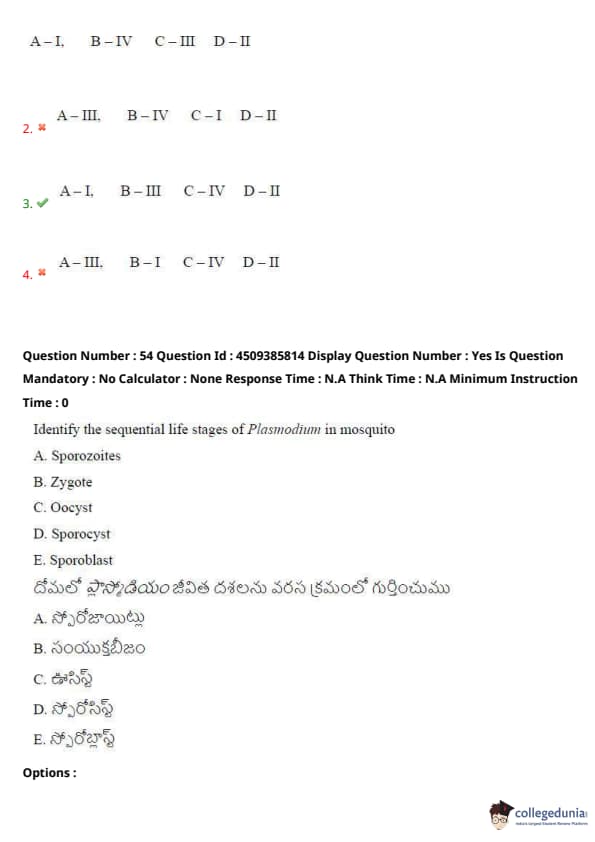
Identify the sequential life stages of Plasmodium in mosquito

  • (A) Sporozoites
  • (B) Zygote
  • (C) Oocyst
  • (D) Sporocyst
  • (E) Sporoblast
Correct Answer: (A, B, C, D, E)
View Solution

Question 54:

The muscles help in the movement of the mandibles of Periplaneta

  • (A) Adductor and abductor muscles
  • (B) Dorso - ventral muscles
  • (C) Alary muscles
  • (D) Dorso - longitudinal muscles
Correct Answer: (A) Adductor and abductor muscles
View Solution

Question 55:

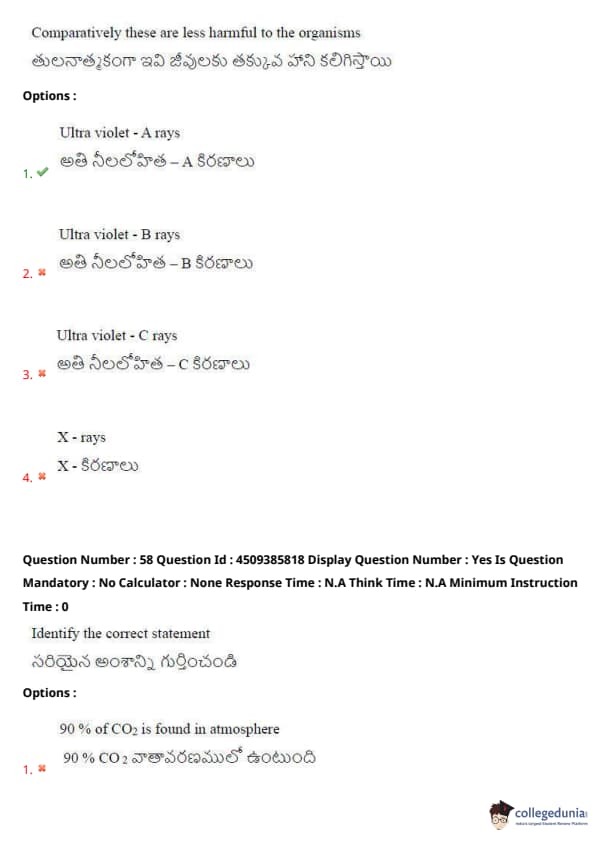
Comparatively these are less harmful to the organisms

  • (A) Ultra violet - A rays
  • (B) Ultra violet - B rays
  • (C) Ultra violet - C rays
  • (D) X-rays
Correct Answer: (A) Ultra violet - A rays
View Solution

Question 56:

Identify the correct statement

  • (A) 90% of CO2 is found in atmosphere
  • (B) 90% of CO2 is found in oceans
  • (C) Nitrogen is very less in living organisms
  • (D) Phosphorus cycle is an example for sedimentary cycle
  • (E) Burning of fossil fuels does not increase CO2 in atmosphere
Correct Answer: (C) Nitrogen is very less in living organisms
View Solution

Question 57:

Match the following

  • (A) Eutrophication \(\) Demand of oxygen
  • (B) Biomagnification \(\) Natural ageing of lake by nutrient enrichment
  • (C) BOD \(\) Increasing pollutant concentration at successive trophic levels in aquatic food chain
  • (D) Cultural eutrophication \(\) Human activity accelerates ageing process of lake
Correct Answer: (A-II), (B-IV), (C-I), (D-III)
View Solution

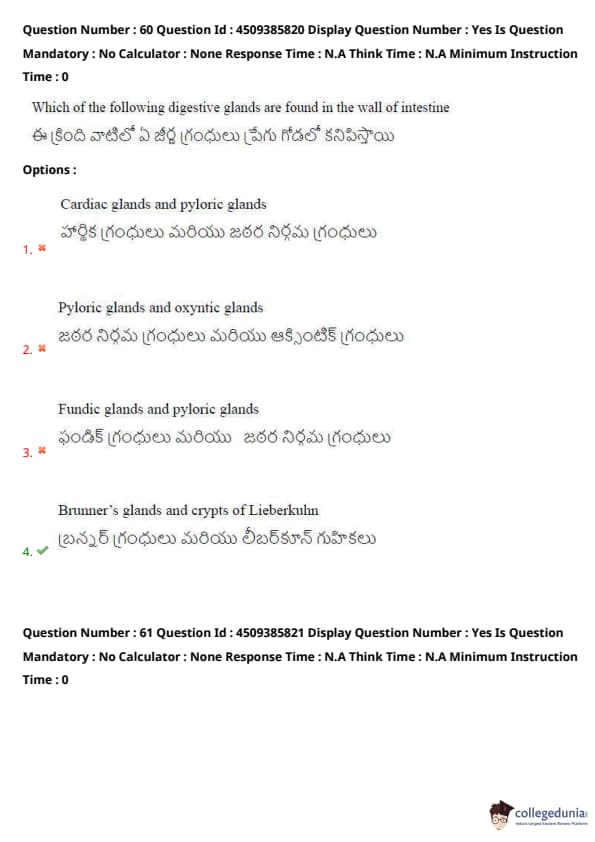
Question 58:

Which of the following digestive glands are found in the wall of intestine?

  • (A) Cardiac glands and pyloric glands
  • (B) Pyloric glands and oxyntic glands
  • (C) Fundic glands and pyloric glands
  • (D) Brunner's glands and crypts of Lieberkhun
Correct Answer: (D) Brunner's glands and crypts of Lieberkhun
View Solution

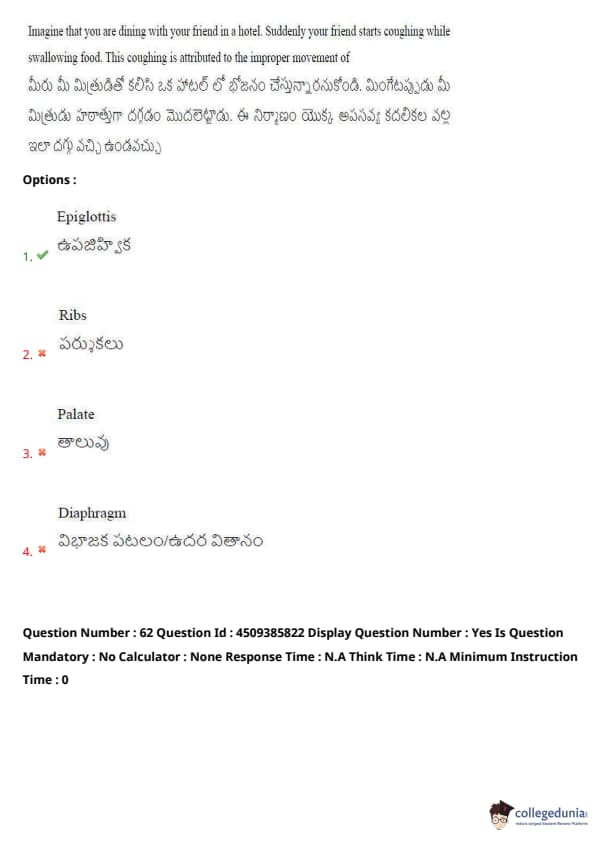
Question 59:

Imagine that you are dining with your friend in a hotel. Suddenly your friend starts coughing while swallowing food. This coughing is attributed to the improper movement of...

  • (A) Epiglottis
  • (B) Ribs
  • (C) Palate
  • (D) Diaphragm
Correct Answer: (A) Epiglottis
View Solution

Question 60:

Identify the correct statements:

  • (A) III and IV
  • (B) I and II
  • (C) III only
  • (D) IV only
Correct Answer: (C) III only
View Solution

Question 61:

Correct sequence of events in the formation of urine

  • (A) Reabsorption → Tubular Secretion → Filtration
  • (B) Filtration → Tubular Secretion → Reabsorption
  • (C) Filtration → Reabsorption → Tubular Secretion
  • (D) Tubular Secretion → Micturition → Reabsorption
Correct Answer: (C) Filtration → Reabsorption → Tubular Secretion
View Solution

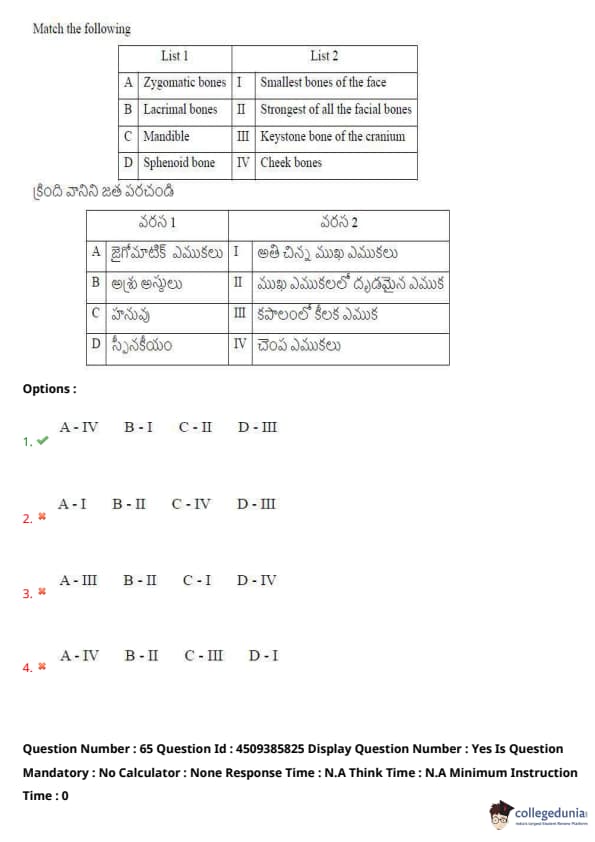
Question 62:

Match the following

  • (A) Zygomatic bones → IV Cheek bones
  • (B) Lacrimal bones → II Smallest bones of the face
  • (C) Mandible → I Strongest of all the facial bones
  • (D) Sphenoid bone → III Keystone bone of the cranium
Correct Answer: (A) IV, (B) I, (C) II, (D) III
View Solution

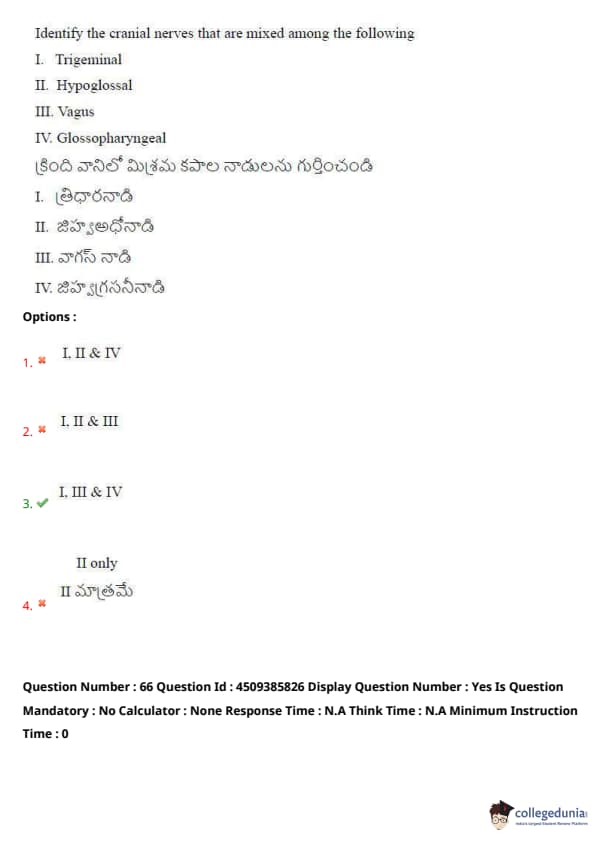
Question 63:

Identify the cranial nerves that are mixed among the following

  • (I) Trigeminal
    (II) Hypoglossal
    (III) Vagus
    (IV) Glossopharyngeal
Correct Answer: (I), (III), (IV)
View Solution

Question 64:

Assertion (A): Thymosin plays a major role in cell-mediated immunity

Reason (R): Thymosin promotes the production of antibodies

  • (A) Both A and R are true. R is the correct explanation of A
  • (B) Both A and R are true. But R is not the correct explanation for A
  • (C) A is true. But R is false
  • (D) A is false. But R is true
Correct Answer: (B) Both A and R are true. But R is not the correct explanation for A
View Solution

Question 65:

Removal of this gland results in the death of an individual

  • (A) Adrenal cortex
  • (B) Testis
  • (C) Thyroid gland
  • (D) Thymus gland
Correct Answer: (A) Adrenal cortex
View Solution

Question 66:

Proteins that help in the destruction of the infected cells are

  • (A) Caspases
  • (B) Lysozymes
  • (C) Colostrum
  • (D) Interferons
Correct Answer: (A) Caspases
View Solution

Question 67:

Proteins that form membrane attack complex are

  • (A) Cytokines
  • (B) Interferons
  • (C) Interleukins
  • (D) Complement proteins
Correct Answer: (D) Complement proteins
View Solution

Question 68:

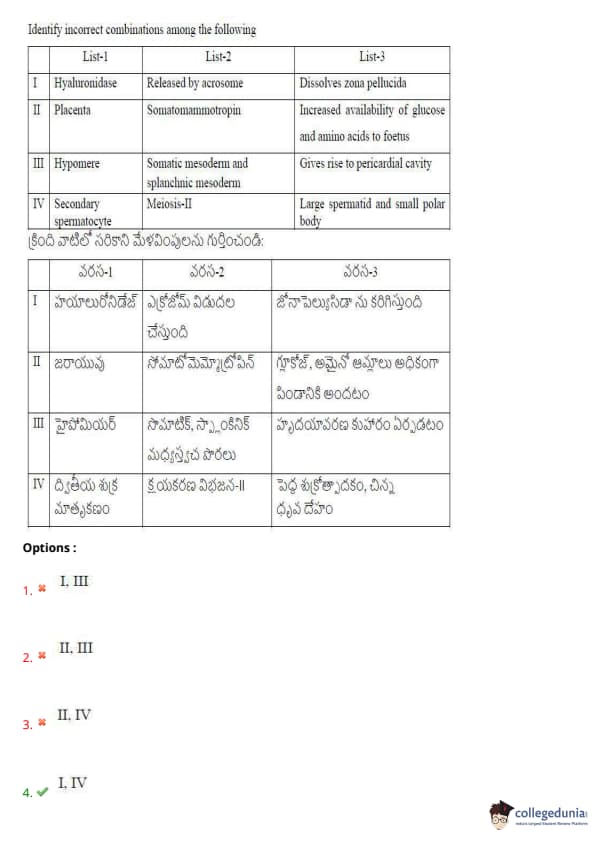
Identify incorrect combinations among the following

  • (A) I & II
  • (B) II & III
  • (C) III & IV
  • (D) IV & II
Correct Answer: (D) IV & II
View Solution

Question 69:

Identify the incorrect statements among the following

  • (A) I & IV
  • (B) II & III
  • (C) III & IV
  • (D) II & IV
Correct Answer: (B) II & III
View Solution

Question 70:

Identify different types of intra uterine devices among the following

  • (A) Lippes loop
  • (B) Vaults
  • (C) Multiload 375
  • (D) LNG-20
  • (E) Diaphragms
Correct Answer: (A) , (C) , (D)
View Solution

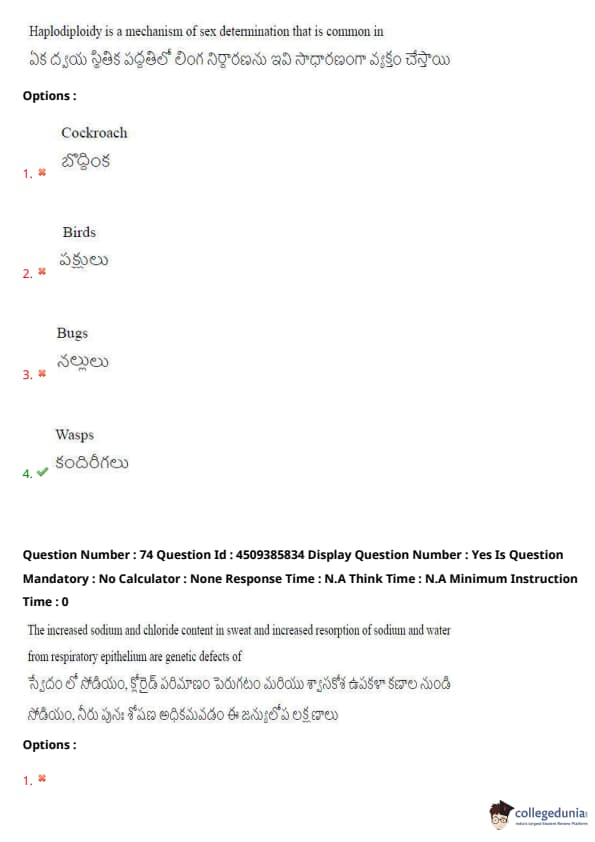
Question 71:

Haplodiploidy is a mechanism of sex determination that is common in

  • (A) Cockroach
  • (B) Birds
  • (C) Bugs
  • (D) Wasps
Correct Answer: (D) Wasps
View Solution

Question 72:

The increased sodium and chloride content in sweat and increased resorption of sodium and water from respiratory epithelium are genetic defects of

  • (A) Chronic myelogenous leukemia
  • (B) Duchenne muscular dystrophy
  • (C) Cystic fibrosis
  • (D) Thalassemia
Correct Answer: (C) Cystic fibrosis
View Solution

Question 73:

The sequencing of whole set of genome containing all the coding and non-coding sequences is referred as

  • (A) Sequence annotation
  • (B) Single nucleotide polymorphism
  • (C) Expressed sequence tags
  • (D) Restriction fragment length polymorphism
Correct Answer: (A) Sequence annotation
View Solution

Question 74:

Assertion (A): The Y Chromosome has no role in the determination of male sex in Drosophila.

Reason (R): In XO males, sperms develop but are non-motile.

  • (A) A and R are true. R is correct explanation for A.
  • (B) A and R are true. But R is not correct explanation for A.
  • (C) A is true. But R is false.
  • (D) A is false. But R is true.
Correct Answer: (B) A and R are true. But R is not correct explanation for A.
View Solution

Question 75:

Cynognathus is an intermediate form between

  • (A) Pisces – Amphibians
  • (B) Amphibia – Reptilia
  • (C) Reptilia – Aves
  • (D) Reptilia – Mammalia
Correct Answer: (D) Reptilia – Mammalia
View Solution

Question 76:

The change in the frequency of a gene that occurs merely by chance and not by selection in small populations is called

  • (A) Hardy – Weinberg law
  • (B) Sewall Wright effect
  • (C) Founder effect
  • (D) Gene flow
Correct Answer: (B) Sewall Wright effect
View Solution

Question 77:

Toxoids are the vaccines against

  • (A) Diphtheria and Tetanus
  • (B) Polio and Rabies
  • (C) Cholera and Plague
  • (D) Rubella and Mumps
Correct Answer: (A) Diphtheria and Tetanus
View Solution

Question 78:

Match the following

  • (A) Omega 3 fatty acids
  • (B) Fish guano
  • (C) Shagreem
  • (D) Isinglass
Correct Answer: A-II, B-I, C-IV, D-V
View Solution

Question 79:

Two resistors of resistances \( (20 \pm 0.2) \, \Omega \) and \( (10 \pm 0.1) \, \Omega \) are connected in series. The equivalent resistance of the combination is:

  • (A) \( 10 \, \Omega \pm 1% \)
  • (B) \( 30 \, \Omega \pm 2% \)
  • (C) \( 30 \, \Omega \pm 1% \)
  • (D) \( 10 \, \Omega \pm 1% \)
Correct Answer: (B) \( 30 \, \Omega \pm 2% \)
View Solution

Question 80:

A man walks up a stationary escalator in 80 s. When this man stands on the moving escalator, he goes up in 20 s. The time taken by the man to walk up on the moving escalator in seconds is:

  • (A) 5
  • (B) 16
  • (C) 36
  • (D) 10
Correct Answer: (B) 16
View Solution

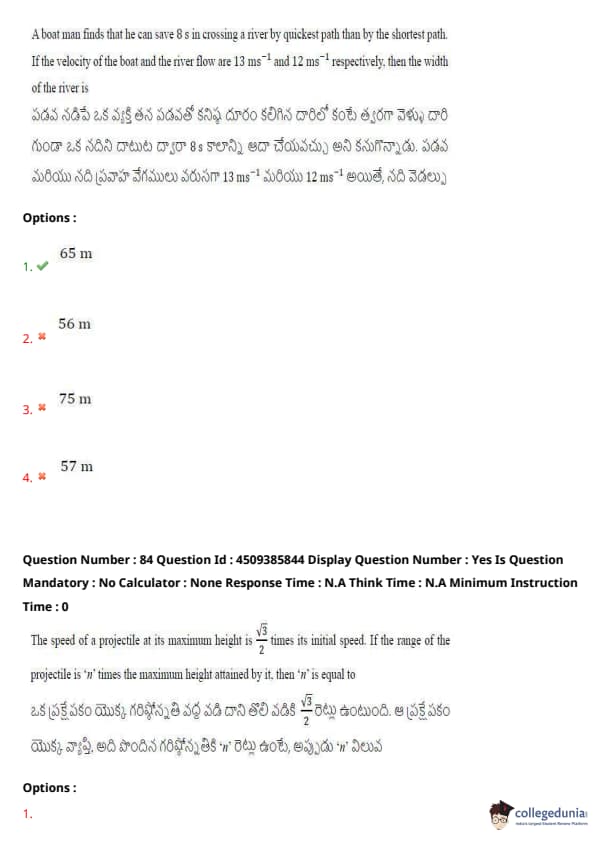
Question 81:

A boat man finds that he can save 8 s in crossing a river by quickest path than by the shortest path. If the velocity of the boat and the river flow are 13 m/s and 12 m/s respectively, then the width of the river is:

  • (A) 65 m
  • (B) 56 m
  • (C) 75 m
  • (D) 57 m
Correct Answer: (A) 65 m
View Solution

Question 82:

The speed of a projectile at its maximum height is \( \frac{\sqrt{3}}{2} \) times its initial speed. If the range of the projectile is \( n \) times the maximum height attained by it, then \( n \) is equal to:

  • (1) \( \frac{4}{3} \)
  • (2) \( 2\sqrt{3} \)
  • (3) \( 4\sqrt{3} \)
  • (4) \( 3/4 \)
Correct Answer: (3) \( 4\sqrt{3} \)
View Solution

Question 83:

A car is moving on a horizontal curved road of radius 50 m. If the friction coefficient between tyres and road is 0.34, the approximate maximum speed of the car will be nearly:

  • (1) \( 3.4 \, ms^{-1} \)
  • (2) \( 22.4 \, ms^{-1} \)
  • (3) \( 13 \, ms^{-1} \)
  • (4) \( 17 \, ms^{-1} \)
Correct Answer: (3) \( 13 \, \text{ms}^{-1} \)
View Solution

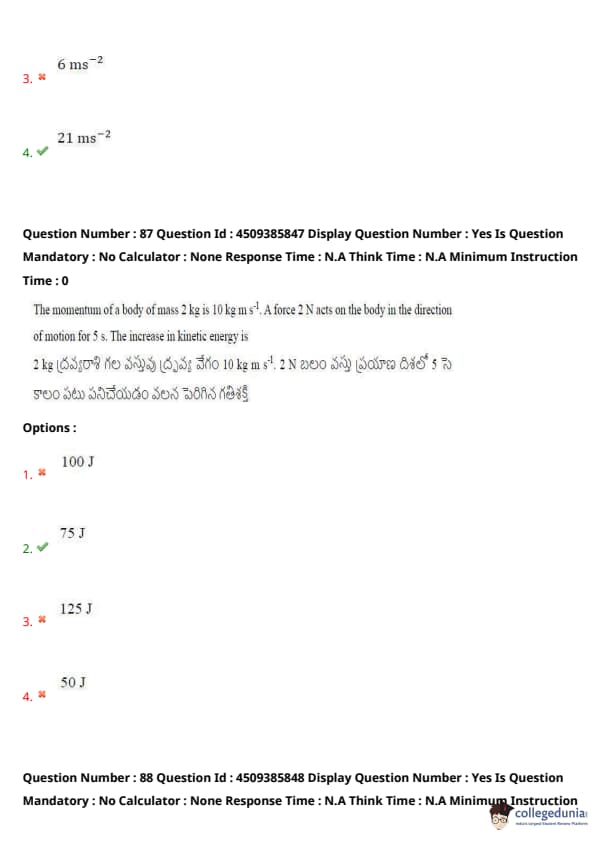
Question 84:

The blocks A and B weighing 100 N and 250 N respectively are placed one over the other as shown in the figure. Block B rests on a smooth surface. The coefficient of static friction between A and B is 0.4. When \( F = 250 \, N \), the acceleration of the upper block is (Take acceleration due to gravity, \( g = 10 \, m/s^2 \)):

  • (1) \( 8.4 \, ms^{-2} \)
  • (2) \( 25 \, ms^{-2} \)
  • (3) \( 6 \, ms^{-2} \)
  • (4) \( 21 \, ms^{-2} \)
Correct Answer: (3) \( 6 \, \text{ms}^{-2} \)
View Solution

Question 85:

The momentum of a body of mass 2 kg is 10 kg m/s. A force 2 N acts on the body in the direction of motion for 5 s. The increase in kinetic energy is:

  • (1) \( 100 \, J \)
  • (2) \( 75 \, J \)
  • (3) \( 125 \, J \)
  • (4) \( 50 \, J \)
Correct Answer: (3) \( 125 \, \text{J} \)
View Solution

Question 86:

Direct solar energy is incident on the horizontal surface at an average rate of 200 W/m². If 20% of this energy can be converted to useful electrical energy, how much area is needed to supply 8 kW?

  • (1) \(1000 \, m^2 \)
  • (2) \(100 \, m^2 \)
  • (3) \(200 \, m^2 \)
  • (4) \(2000 \, m^2 \)
Correct Answer: (3) \(200 \, \text{m}^2\)
View Solution

Question 87:

A motor car is moving at 40 m/s on a circular road of radius 400 m. If its speed is increasing at the rate of 3 m/s², then its acceleration is:

  • (1) \( 3 \, m/s^2 \)
  • (2) \( 2.7 \, m/s^2 \)
  • (3) \( 5 \, m/s^2 \)
  • (4) \( 3.3 \, m/s^2 \)
Correct Answer: (3) \( 5 \, \text{m/s}^2 \)
View Solution

Question 88:

Two objects of masses 2 kg and 5 kg possess velocities \( 10 \hat{i} \, m/s \) and \( 3 \hat{i} + 5 \hat{j} \, m/s \) respectively. Then the velocity of C.M. in m/s is:

  • (1) \( 5 \hat{i} - 25 \hat{j} \)
  • (2) \( 5 \hat{i} + \frac{25}{7} \hat{j} \)
  • (3) \( \frac{5}{7} \hat{i} - 25 \hat{j} \)
  • (4) \( 25 \hat{i} - \frac{5}{7} \hat{j} \)
Correct Answer: (2) \( 5 \hat{i} + \frac{25}{7} \hat{j} \)
View Solution

Question 89:

A simple pendulum with a bob of mass \( m \) and density \( \rho \) and length \( l \) is immersed in a liquid of density \( \sigma \). If it makes small oscillations, then the time period of the pendulum is:

  • (1) \( T = 2\pi \left( \frac{1}{\sqrt{g - \rho}} \right) \)
  • (2) \( T = 2\pi \left( \frac{1}{\sqrt{g(1 - \rho)}} \right) \)
  • (3) \( T = 2\pi \left( \frac{1}{\sqrt{g(\rho - \sigma)}} \right) \)
  • (4) \( T = 2\pi \left( \frac{1}{\sqrt{g(1 - \frac{\rho}{\sigma})}} \right) \)
Correct Answer: (4) \( T = 2\pi \left( \frac{1}{\sqrt{g(1 - \frac{\rho}{\sigma})}} \right) \)
View Solution

Question 90:

The period of oscillation of a particle in simple harmonic motion is 4 s, and its amplitude is 4 cm. Then the distance of the particle in \( \frac{1}{3} \) seconds after passing the mean position is:

  • (1) 1.5 cm
  • (2) 2 cm
  • (3) 2.3 cm
  • (4) 2.5 cm
Correct Answer: (2) 2 cm
View Solution

Question 91:

The depth \( d \) at which the value of acceleration due to gravity becomes \( \frac{1}{n} \) times the value at the surface (radius of Earth \( R \)) is:

  • (1) \( \frac{R}{n} \)
  • (2) \( \frac{R(n - 1)}{n} \)
  • (3) \( \frac{R(n)}{n + 1} \)
  • (4) \( \frac{R}{n^2} \)
Correct Answer: (2) \( \frac{R(n - 1)}{n} \)
View Solution

Question 92:

A block of mass 100 g is attached to the end of a string of unknown material of 50 cm long and cross-sectional area of \(2 \, cm^2\). When the block is whirled horizontally at a constant angular speed of 40 m/s, it moves along a circular path of radius 52 cm. Young's modulus of the material is:

  • (1) \(6.4 \times 10^8 \, dyne cm^{-2}\)
  • (2) \(16.64 \times 10^8 \, dyne cm^{-2}\)
  • (3) \(4 \times 10^8 \, dyne cm^{-2}\)
  • (4) \(8.32 \times 10^8 \, dyne cm^{-2}\)
Correct Answer: (4) \(8.32 \times 10^8 \, \text{dyne cm}^{-2}\)
View Solution

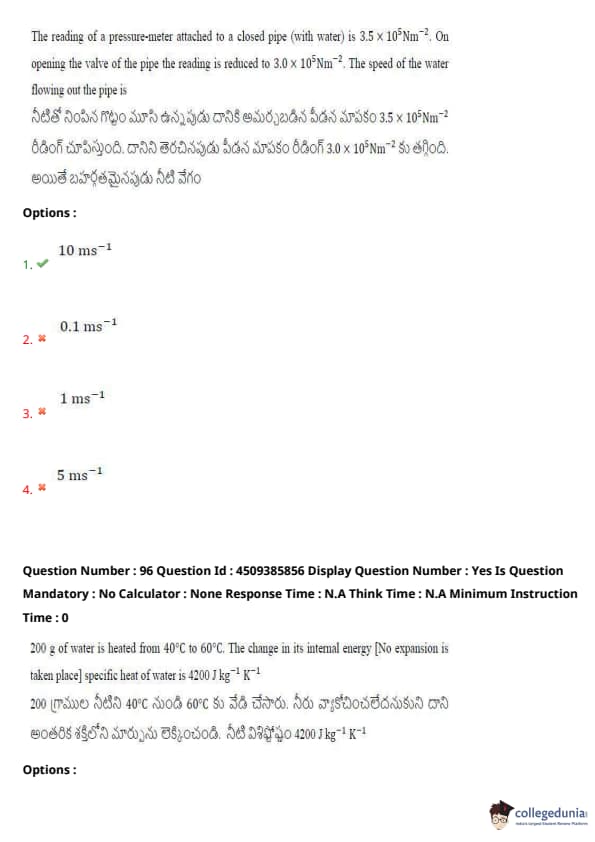
Question 93:

The reading of a pressure-meter attached to a closed pipe (with water) is \(3.5 \times 10^5 \, Nm^{-2}\). On opening the valve of the pipe, the reading is reduced to \(3.0 \times 10^5 \, Nm^{-2}\). The speed of the water flowing out the pipe is:

  • (1) \(10 \, ms^{-1}\)
  • (2) \(0.1 \, ms^{-1}\)
  • (3) \(1 \, ms^{-1}\)
  • (4) \(5 \, ms^{-1}\)
Correct Answer: (1) \(10 \, \text{ms}^{-1}\)
View Solution

Question 94:

200 g of water is heated from 40\degree C to 60\degree C. The change in its internal energy (No expansion is taken place) specific heat of water is 4200 J/kg\degree C:

  • (1) 16.8 kJ
  • (2) 10.8 kJ
  • (3) 8.4 kJ
  • (4) 14.8 kJ
Correct Answer: (1) 16.8 kJ
View Solution

Question 95:

A 25 kW drilling machine is drilled for 4 minutes to bore a hole in an aluminium block of mass \(20 \times 10^3\) kg. If 40% of the work done is utilized to raise the temperature of the block and if the specific heat of aluminium is \(0.9 \, kJ/kg^\circ C\), then the rise in temperature of aluminium block is:

  • (1) 266.3\degree C
  • (2) 66.66\degree C
  • (3) 133.3\degree C
  • (4) 70\degree C
Correct Answer: (3) 133.3\degree C
View Solution

Question 96:

A diatomic gas does a work of \( \frac{Q}{4} \) when a heat of \( Q \) is supplied to it. Then the molar heat capacity of the gas is:

  • (1) \( C = 3R \)
  • (2) \( C = \frac{5}{3}R \)
  • (3) \( C = \frac{10}{3}R \)
  • (4) \( C = \frac{5}{2}R \)
Correct Answer: (3) \( C = \frac{10}{3}R \)
View Solution

Question 97:

Which of the following is incorrect regarding the first law of thermodynamics?

  • (1) It introduces the concept of internal energy
  • (2) It introduces the concept of entropy
  • (3) It is applicable to any cyclic process
  • (4) It is a restatement of the law of conservation of energy
Correct Answer: (2) It introduces the concept of entropy
View Solution

Question 98:

At a given temperature, arrange the gases hydrogen, oxygen, nitrogen in the order of maximum rms speeds:

  • (1) Hydrogen > Nitrogen > Oxygen
  • (2) Nitrogen > Hydrogen > Oxygen
  • (3) Oxygen > Nitrogen > Hydrogen
  • (4) Hydrogen = Nitrogen = Oxygen
Correct Answer: (1) Hydrogen > Nitrogen > Oxygen
View Solution

Question 99:

On a sonometer, the lengths of two wires are in the ratio \( \frac{35}{34} \), diameters are in the ratio \( \frac{4}{1} \), densities are in the ratio 1:2 and the tensions in the string are in the ratio 8:1. If the note of higher pitch has frequency of 350 Hz then find the frequency of the beats produced when sounded together:

  • (1) 20 Hz
  • (2) 7 Hz
  • (3) 5 Hz
  • (4) 10 Hz
Correct Answer: (4) 10 Hz
View Solution

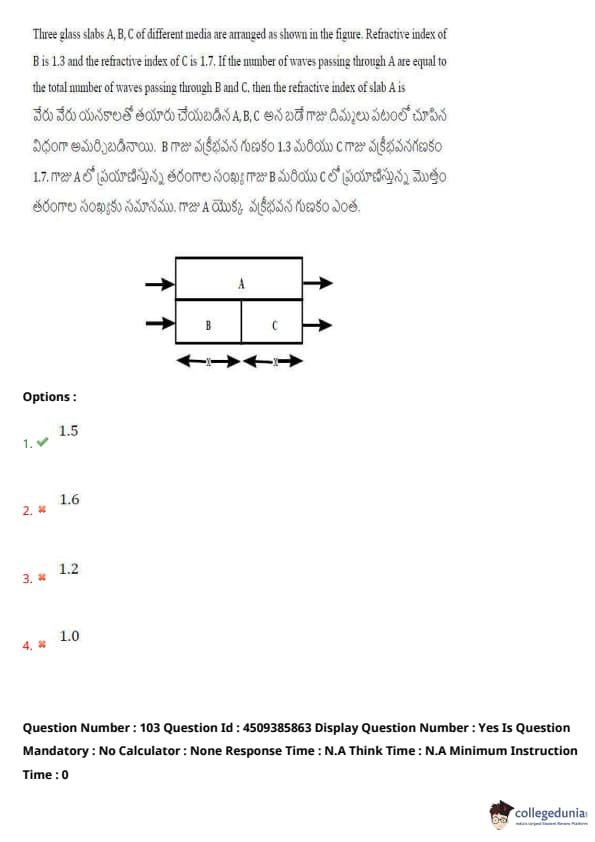
Question 100:

Three glass slabs A, B, C of different media are arranged as shown in the figure. Refractive index of B is 1.3 and the refractive index of C is 1.7. If the number of waves passing through B and C are equal to the total number of waves passing through B and C, then the refractive index of slab A is:

  • (1) 1.5
  • (2) 1.6
  • (3) 1.2
  • (4) 1.0
Correct Answer: (1) 1.5
View Solution

Question 101:

In Young's double slit experiment, the intensity on the screen where the path difference between the two interfering waves is \( \frac{\lambda}{4} \) is \( K \). What will be the intensity at the point where the path difference is \( \frac{\lambda}{4} \)?

  • (1) \( \frac{K}{4} \)
  • (2) \( \frac{K}{2} \)
  • (3) \( K \)
  • (4) Zero
Correct Answer: (2) \( \frac{K}{2} \)
View Solution

Question 102:

Two like charges are separated in air by a certain distance. The air is replaced with a dielectric medium of constant \( K \). Then the repulsive force between them:

  • (1) Decrease by \( K \) times
  • (2) Increase by \( K \) times
  • (3) No change
  • (4) \( K^2 \) times decreases
Correct Answer: (1) Decrease by \( K \) times
View Solution

Question 103:

The resultant capacitance of parallel combination of two capacitors \( C_1 \) and \( C_2 \) is 20 µF. When these capacitors are individually connected to a voltage source of 1V, then the energy stored in \( C_2 \) is 9 times that of \( C_1 \). If these two capacitors are connected in series, the resultant capacitance value is:

  • (1) 1.4 µF
  • (2) 8 µF
  • (3) 18 µF
  • (4) 1.8 µF
Correct Answer: (4) 1.8 µF
View Solution

Question 104:

A unit positive charge is moved from point A to point B by a distance of 20 cm, on an equipotential surface as shown in the figure. The work done to move this charge is:

  • (1) \(2 \, J\)
  • (2) \(0 \, J\)
  • (3) \(0.2 \, J\)
  • (4) \(0.02 \, J\)
Correct Answer: (2) \( 0 \, \text{J} \)
View Solution

Question 105:

A metallic wire of resistance 30 \( \Omega \) is bent in the form of an equilateral triangle. The resistance between any two vertices of the triangle is:

  • (1) \(3.67 \, \Omega\)
  • (2) \(6.36 \, \Omega\)
  • (3) \(3.36 \, \Omega\)
  • (4) \(6.67 \, \Omega\)
Correct Answer: (4) \(6.67 \, \Omega\)
View Solution

Question 106:

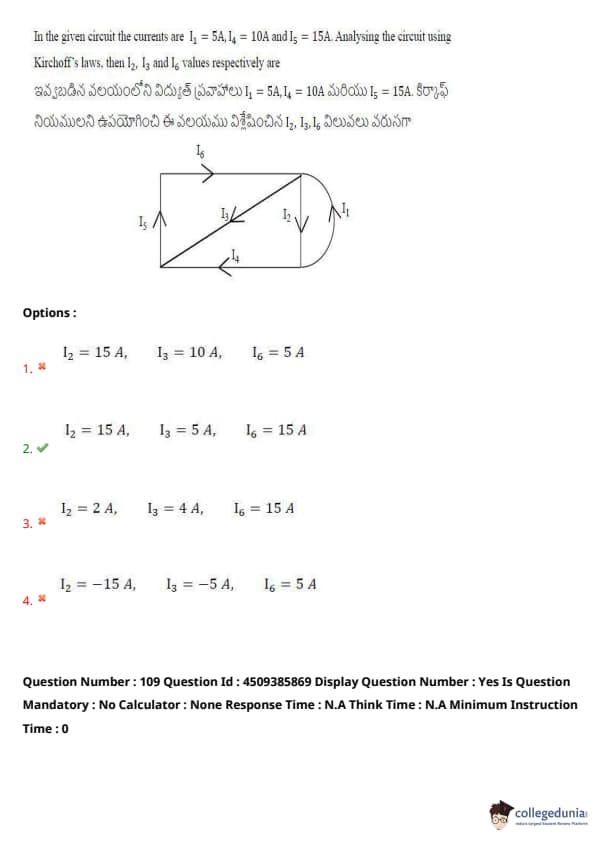
In the given circuit the currents are \( I_1 = 5A \), \( I_4 = 10A \), and \( I_5 = 15A \). Analyzing the circuit using Kirchhoff’s laws, then \( I_2 \), \( I_3 \), and \( I_6 \) values are:

  • (1) \( I_2 = 15 \, A, I_3 = 10 \, A, I_6 = 5 \, A \)
  • (2) \( I_2 = 15 \, A, I_3 = 5 \, A, I_6 = 15 \, A \)
  • (3) \( I_2 = 2 \, A, I_3 = 4 \, A, I_6 = 15 \, A \)
  • (4) \( I_2 = -15 \, A, I_3 = -5 \, A, I_6 = 5 \, A \)
Correct Answer: (2) \( I_2 = 15 \, A, I_3 = 5 \, A, I_6 = 15 \, A \)
View Solution

Question 107:

A conducting rod of length \( l \) and mass \( m \) is placed over a smooth horizontal plane. A magnetic field \( B \) is acting perpendicular to the rod. If a charge \( q \) is suddenly passed through the rod and the rod acquires an initial velocity \( v \) on the plane surface, then the charge \( q \) is:

  • (1) \( \frac{m v}{B l} \)
  • (2) \( \frac{m}{v B l} \)
  • (3) \( \frac{m v}{B l} \)
  • (4) \( \frac{1 B v}{m} \)
Correct Answer: (1) \( \frac{m v}{B l} \)
View Solution

Question 108:

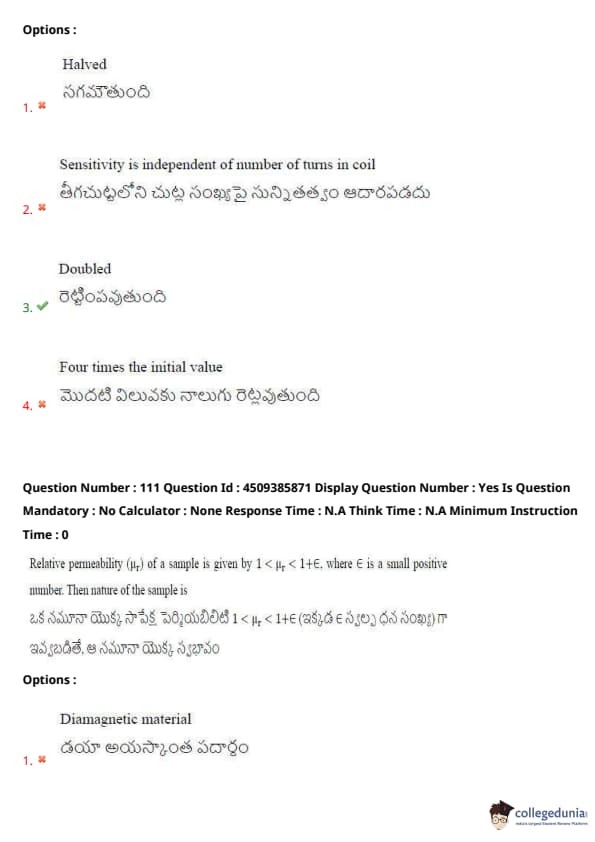
In a Galvanometer, if the number of turns in the coil are doubled, then the electrical current sensitivity will be:

  • (1) Halved
  • (2) Sensitivity is independent of number of turns in coil
  • (3) Doubled
  • (4) Four times the initial value
Correct Answer: (3) Doubled
View Solution

Question 109:

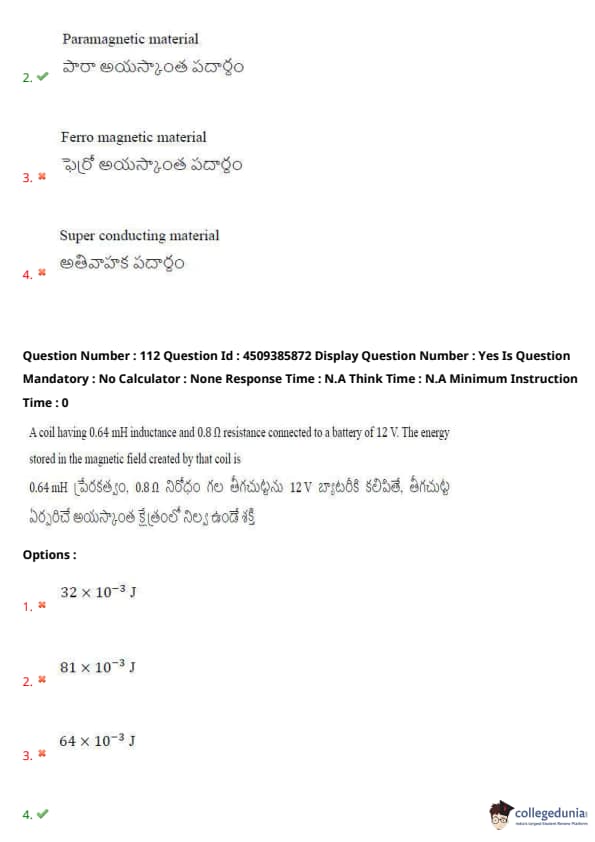
Relative permeability (\(\mu_r\)) of a sample is given by \(1 < \mu_r < 1 + \epsilon\), where \(\epsilon\) is a small positive number. Then the nature of the sample is:

  • (1) Diamagnetic material
  • (2) Paramagnetic material
  • (3) Ferro magnetic material
  • (4) Super conducting material
Correct Answer: (2) Paramagnetic material
View Solution

Question 110:

A coil having 0.64 mH inductance and 0.8 \(\Omega\) resistance connected to a battery of 12 V. The energy stored in the magnetic field created by that coil is:

  • (1) \(32 \times 10^{-3} \, J\)
  • (2) \(81 \times 10^{-3} \, J\)
  • (3) \(64 \times 10^{-3} \, J\)
  • (4) \(72 \times 10^{-3} \, J\)
Correct Answer: (4) \(72 \times 10^{-3} \, \text{J}\)
View Solution

Question 111:

An inductor of inductive reactance 80 \(\Omega\) and a resistor of resistance 60 \(\Omega\) are connected in series to an ac source. The impedance and the power factor of the circuit are respectively:

  • (1) 20 \(\Omega\), 0.4
  • (2) 60 \(\Omega\), 0.6
  • (3) 100 \(\Omega\), 0.4
  • (4) 100 \(\Omega\), 0.6
Correct Answer: (4) 100 \(\Omega\), 0.6
View Solution

Question 112:

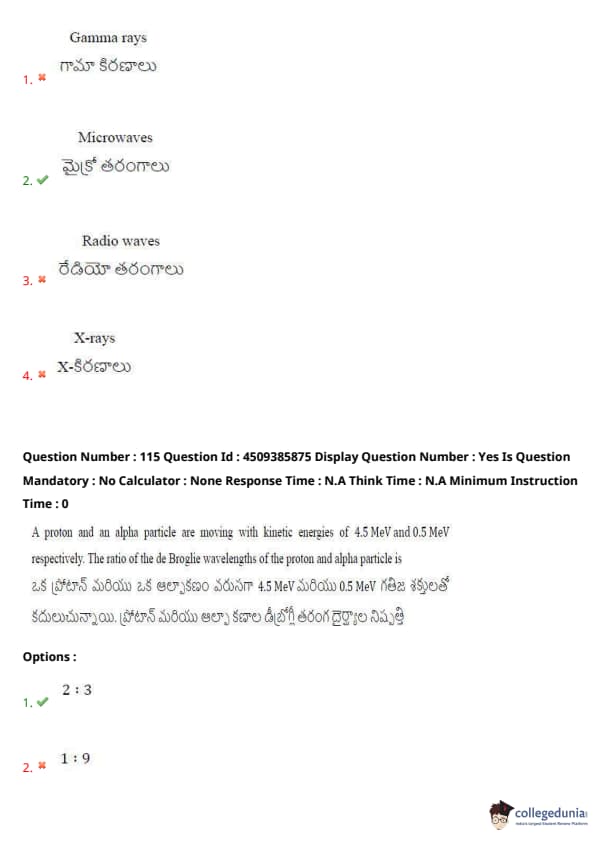
A magnetron valve is used to produce:

  • (1) Gamma rays
  • (2) Microwaves
  • (3) Radio waves
  • (4) X-rays
Correct Answer: (2) Microwaves
View Solution


AP EAPCET Previous Year Question Paper with Answer Key PDFs

Similar B.Tech Exam Question Papers: