


TS PGECET 2026 Chemical Engineering (CH) Question Paper will be available for download here. JNTU Hyderabad on behalf of Telangana Council of Higher Education (TGCHE) is conducting TS PGECET 2026 CH exam on May 30 in Shift 1 from 10 AM to 12 PM. TS PGECET CH Question Paper consists of 120 questions for 120 marks to be attempted in 2 hours.
- TS PGECET CH Question Paper 2026 is divided into 2 sections- Engineering Mathematics with 10 questions and Chemical Engineering domain with 110 questions.
- Each questions carries 1 mark each and there is no negative marking for incorrect answers.
Candidates can download TS PGECET 2026 CH Question Paper with Answer Key and Solution PDF from links provided below.
TS PGECET 2026 CH Question Paper with Solution PDF
| TS PGECET CH Question Paper 2026 | Download PDF | Check Solutions |

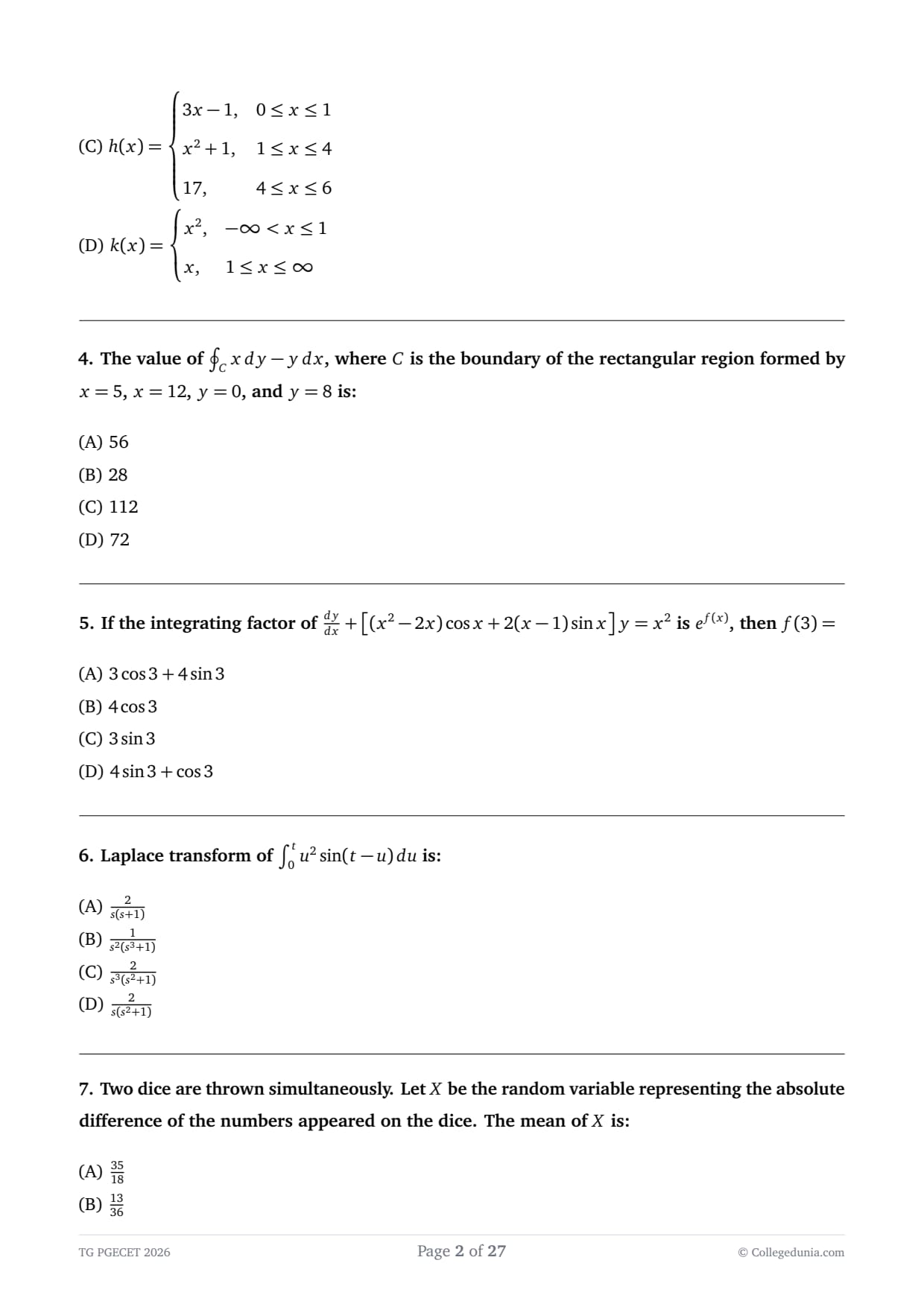


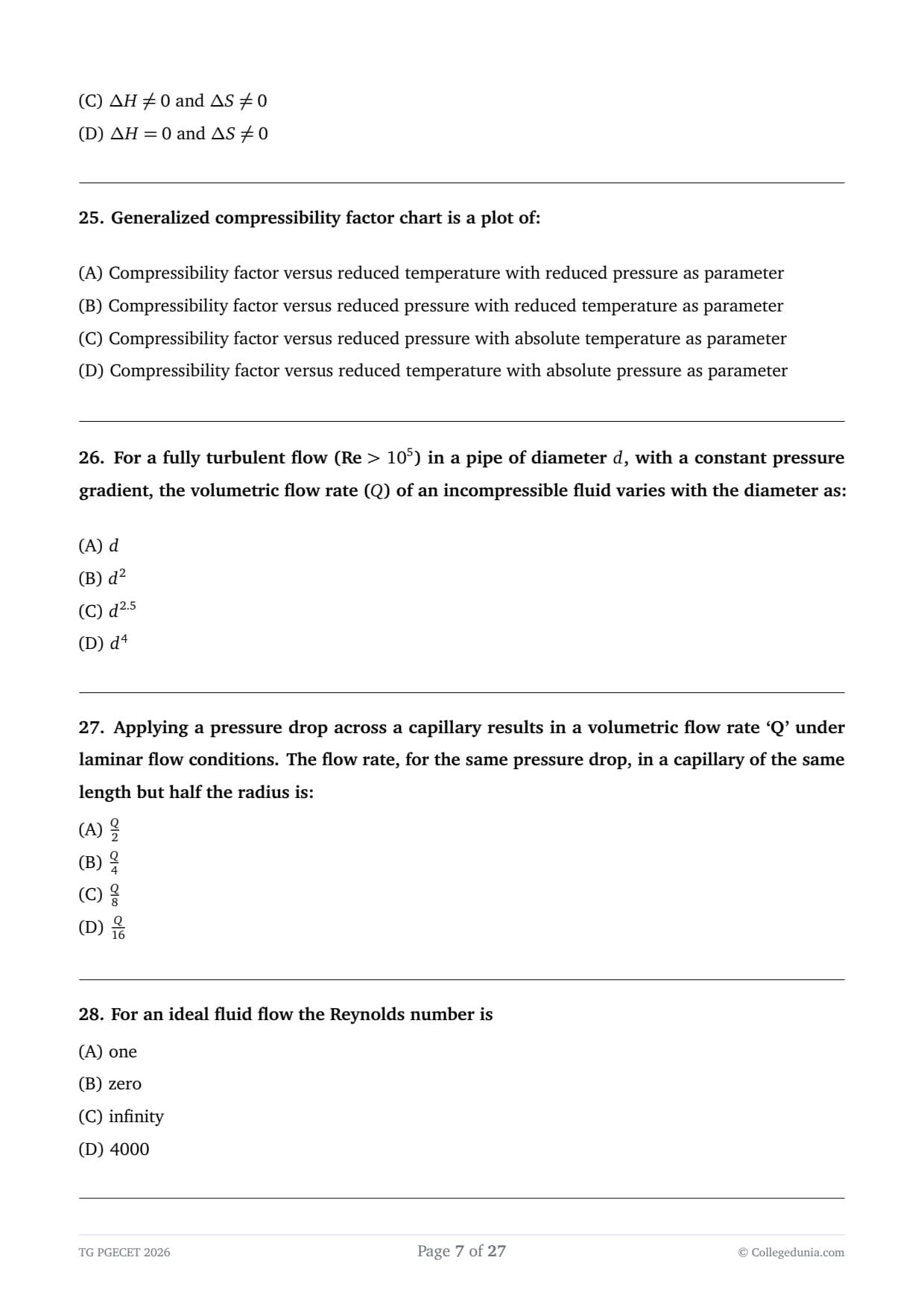


If \(A = \begin{bmatrix} 2 & 1 & 2
6 & 2 & 11
3 & 3 & 2 \end{bmatrix}\) and \(P = \begin{bmatrix} 1 & 0 & 1
2 & 1 & 2
0 & 1 & 5 \end{bmatrix}\), then \(\left|P^{-1}AP - 2I\right| =\)
View Solution
Concept:
The problem asks for the determinant of the matrix expression \(P^{-1}AP - 2I\). We can simplify this expression using properties of matrix multiplication and determinants. Specifically, the identity matrix \(I\) commutes with any matrix, so we can write \(2I = P^{-1}(2I)P\). This allows us to factor out \(P^{-1}\) and \(P\): \[ P^{-1}AP - 2I = P^{-1}AP - P^{-1}(2I)P = P^{-1}(A - 2I)P \]
Taking the determinant on both sides and using the distributive property of determinants over multiplication (\(\left|XYZ\right| = \left|X\right|\left|Y\right|\left|Z\right|\)), we get: \[ \left|P^{-1}AP - 2I\right| = \left|P^{-1}(A - 2I)P\right| = \left|P^{-1}\right| \left|A - 2I\right| \left|P\right| \]
Since \(\left|P^{-1}\right| = \frac{1}{\left|P\right|}\), the terms \(\left|P^{-1}\right|\) and \(\left|P\right|\) cancel out, leaving: \[ \left|P^{-1}AP - 2I\right| = \left|A - 2I\right| \]
Thus, we only need to compute the determinant of the matrix \(A - 2I\).
Step 1: Compute the matrix \(A - 2I\).
Given the matrix \(A\): \[ A = \begin{bmatrix} 2 & 1 & 2
6 & 2 & 11
3 & 3 & 2 \end{bmatrix} \]
The scalar multiple \(2I\) of the \(3 \times 3\) identity matrix is: \[ 2I = \begin{bmatrix} 2 & 0 & 0
0 & 2 & 0
0 & 0 & 2 \end{bmatrix} \]
Subtracting \(2I\) from \(A\) entry-wise: \[ A - 2I = \begin{bmatrix} 2-2 & 1-0 & 2-0
6-0 & 2-2 & 11-0
3-0 & 3-0 & 2-2 \end{bmatrix} = \begin{bmatrix} 0 & 1 & 2
6 & 0 & 11
3 & 3 & 0 \end{bmatrix} \]
Step 2: Calculate the determinant \(\left|A - 2I\right|\).
We expand the determinant along the first row: \[ \left|A - 2I\right| = \begin{vmatrix} 0 & 1 & 2
6 & 0 & 11
3 & 3 & 0 \end{vmatrix} \] \[ = 0 \begin{vmatrix} 0 & 11
3 & 0 \end{vmatrix} - 1 \begin{vmatrix} 6 & 11
3 & 0 \end{vmatrix} + 2 \begin{vmatrix} 6 & 0
3 & 3 \end{vmatrix} \]
Evaluating each \(2 \times 2\) determinant: \[ \begin{vmatrix} 6 & 11
3 & 0 \end{vmatrix} = (6 0) - (11 3) = 0 - 33 = -33 \] \[ \begin{vmatrix} 6 & 0
3 & 3 \end{vmatrix} = (6 3) - (0 3) = 18 - 0 = 18 \]
Substituting these values back into our expansion: \[ \left|A - 2I\right| = 0 - 1(-33) + 2(18) \] \[ = 33 + 36 = 69 \]
Therefore, \(\left|P^{-1}AP - 2I\right| = 69\). Quick Tip: For any scalar \(k\) and similarity transformation, \(\left|P^{-1}AP - kI\right| = \left|A - kI\right|\). You never need to calculate \(P^{-1}\) or perform full matrix multiplication in such problems!
The system of equations \(2x + y = 2z\), \(y + z = 0\), \(3y + \alpha z = x\) has:
View Solution
Concept:
First, let us rewrite the given system of linear equations in standard homogeneous form \(AX = 0\):
1) \(2x + y - 2z = 0\)
2) \(0x + y + z = 0\)
3) \(-x + 3y + \alpha z = 0\)
A homogeneous system always admits the trivial solution \((0, 0, 0)\). For non-trivial (infinite) solutions to exist, the determinant of the coefficient matrix \(A\) must equal zero (\(\left|A\right| = 0\)). Alternatively, we can analyze the structure of the solutions directly from the simplest equations to check the validity of the given option forms.
Step 1: Analyze the relationship between variables using the first two equations.
From equation (2): \[ y + z = 0 \implies y = -z \]
Let us substitute \(y = -z\) into equation (1): \[ 2x + (-z) - 2z = 0 \implies 2x - 3z = 0 \implies 2x = 3z \implies x = \frac{3}{2}z \]
Step 2: Express the solution in parameterized form.
Let \(z = 2k\), where \(k\) is any real number parameter. Then: \[ y = -z = -2k \] \[ x = \frac{3}{2}(2k) = 3k \]
Thus, any solution to the first two equations must have the general structure: \[ (x, y, z) = (3k, -2k, 2k) \]
Step 3: Substitute this parametric form into the third equation to analyze consistency and \(\alpha\).
The third equation is \(-x + 3y + \alpha z = 0\). Substituting \(x = 3k\), \(y = -2k\), and \(z = 2k\): \[ -(3k) + 3(-2k) + \alpha(2k) = 0 \] \[ -3k - 6k + 2\alpha k = 0 \implies -9k + 2\alpha k = 0 \implies k(-9 + 2\alpha) = 0 \]
For non-trivial solutions to exist for non-zero \(k\), we must have: \[ -9 + 2\alpha = 0 \implies \alpha = \frac{9}{2} \]
Let us check the given choices:
- Option (B) states infinite solutions for \(\alpha = \frac{7}{2}\), which is incorrect because \(\alpha\) must be \(\frac{9}{2}\) for non-trivial solutions.
- Option (C) says "Only trivial solution for \(\alpha = \frac{9}{2}\)", which contradicts the fact that \(\alpha = \frac{9}{2}\) creates infinite non-trivial solutions.
- Option (D) asserts that the system has infinite solutions of the form \((3k, -2k, 2k)\). This completely matches our structural parametric derivation regardless of checking specific constraints on option boundaries first. Quick Tip: When options give a specific parametric solution form like \((3k, -2k, 2k)\), directly plug it back into the easiest equations to verify if it satisfies them identically. This saves the time needed to compute complex determinants.
A function satisfying the conditions of Lagrange's mean value theorem on the interval \([1, 5]\) is:
View Solution
Concept:
Lagrange's Mean Value Theorem (LMVT) states that if a function \(\phi(x)\) is:
1) Continuous on the closed interval \([a, b]\), and
2) Differentiable on the open interval \((a, b)\),
then there exists at least one \(c \in (a, b)\) such that \(\phi'(c) = \frac{\phi(b) - \phi(a)}{b - a}\).
We must analyze each given option to see which function meets both conditions on the specific interval \([1, 5]\).
Step 1: Analyze Option (A): \(f(x) = |x - 1| + |x - 5|\).
The absolute value functions \(|x-1|\) and \(|x-5|\) are continuous everywhere on \(\mathbb{R}\), so their sum \(f(x)\) is continuous on the closed interval \([1, 5]\).
Now let us check differentiability on the open interval \((1, 5)\). Inside \((1, 5)\), we have \(x > 1\) and \(x < 5\).
Therefore, \(x - 1 > 0 \implies |x - 1| = x - 1\), and \(x - 5 < 0 \implies |x - 5| = -(x - 5) = 5 - x\).
Thus, for any \(x \in (1, 5)\): \[ f(x) = (x - 1) + (5 - x) = 4 \]
Since \(f(x)\) reduces to a constant function \(f(x) = 4\) on the open interval \((1, 5)\), its derivative is \(f'(x) = 0\), which exists everywhere inside \((1, 5)\). Thus, \(f(x)\) is continuous on \([1, 5]\) and differentiable on \((1, 5)\). LMVT conditions are satisfied.
Step 2: Analyze Option (B): \(g(x) = x - [x]\).
The function \(g(x) = x - [x]\) is the fractional part function \(\{x\}\). This function is discontinuous at all integer points. Since the interval \([1, 5]\) contains the integers \(2, 3, 4, 5\), \(g(x)\) is not continuous on \([1, 5]\). Thus, LMVT fails.
Step 3: Analyze Option (C): \(h(x)\).
Let us check continuity of \(h(x)\) at the boundary points \(x = 1\) and \(x = 4\):
- At \(x = 1\): \(\lim_{x \to 1^-} h(x) = 3(1) - 1 = 2\), and \(\lim_{x \to 1^+} h(x) = 1^2 + 1 = 2\). It is continuous at \(x = 1\).
- At \(x = 4\): \(\lim_{x \to 4^-} h(x) = 4^2 + 1 = 17\), and \(\lim_{x \to 4^+} h(x) = 17\). It is continuous at \(x = 4\).
Now check differentiability on \((1, 5)\), specifically at the internal point \(x = 4\):
- Left-hand derivative at \(x = 4\): \(\frac{d}{dx}(x^2 + 1) = 2x \implies 2(4) = 8\).
- Right-hand derivative at \(x = 4\): \(\frac{d}{dx}(17) = 0\).
Since \(8 \neq 0\), \(h(x)\) is not differentiable at \(x = 4 \in (1, 5)\). Thus, LMVT fails.
Step 4: Analyze Option (D): \(k(x)\).
Let us check differentiability at the internal point \(x = 1 \in (1, 5)\):
- Left-hand derivative at \(x = 1\): \(\frac{d}{dx}(x^2) = 2x \implies 2(1) = 2\).
- Right-hand derivative at \(x = 1\): \(\frac{d}{dx}(x) = 1\).
Since \(2 \neq 1\), \(k(x)\) is not differentiable at \(x = 1\). Since \(x = 1\) is the boundary point of our interval \([1, 5]\), differentiability on the open interval \((1, 5)\) holds true because inside \((1, 5)\), \(k(x) = x\), which is differentiable. However, let us re-examine the continuity at \(x = 1\): \(\lim_{x \to 1^-} k(x) = 1^2 = 1\) and \(\lim_{x \to 1^+} k(x) = 1\). So it is continuous at \(x=1\). Quick Tip: Always remember that LMVT requires differentiability on the {open} interval \((a, b)\). Modulus functions are non-differentiable only where their inner expression becomes zero. For \(|x-1| + |x-5|\), the non-differentiable points are \(x=1\) and \(x=5\), which lie exactly on the boundaries, keeping the open interval \((1, 5)\) perfectly differentiable!
The value of \(\oint_C x \, dy - y \, dx\), where \(C\) is the boundary of the rectangular region formed by \(x = 5\), \(x = 12\), \(y = 0\), and \(y = 8\) is:
View Solution
Concept:
By Green's Theorem in a plane, a line integral around a positively oriented, piecewise smooth, simple closed curve \(C\) can be converted into a double integral over the region \(R\) bounded by \(C\): \[ \oint_C (P \, dx + Q \, dy) = \iint_R \left( \frac{\partial Q}{\partial x} - \frac{\partial P}{\partial y} \right) dx \, dy \]
In this problem, the given integral is \(\oint_C (-y \, dx + x \, dy)\). Comparing this with the standard form: \[ P = -y \implies \frac{\partial P}{\partial y} = -1 \] \[ Q = x \implies \frac{\partial Q}{\partial x} = 1 \]
Step 1: Apply Green's Theorem to set up the double integral.
Substituting the partial derivatives into Green's Theorem formula: \[ \oint_C x \, dy - y \, dx = \iint_R \left( 1 - (-1) \right) dx \, dy = \iint_R 2 \, dx \, dy = 2 \iint_R dx \, dy \]
The double integral \(\iint_R dx \, dy\) represents the geometric area of the region \(R\).
Step 2: Calculate the area of the rectangular region \(R\).
The region \(R\) is a rectangle defined by the boundaries: \[ x goes from 5 to 12 \implies Length = 12 - 5 = 7 \] \[ y goes from 0 to 8 \implies Width = 8 - 0 = 8 \]
Thus, the area of the rectangle is: \[ Area(R) = Length \times Width = 7 \times 8 = 56 \]
Step 3: Compute the final integral value.
Using our relation from Step 1: \[ \oint_C x \, dy - y \, dx = 2 \times Area(R) = 2 \times 56 = 112 \] Quick Tip: The line integral \(\frac{1}{2} \oint_C (x \, dy - y \, dx)\) is a standard formula for computing the area of a closed region. Therefore, \(\oint_C (x \, dy - y \, dx)\) is always equal to \(2 \times Area\).
If the integrating factor of \(\frac{dy}{dx} + \left[(x^2 - 2x)\cos x + 2(x - 1)\sin x\right]y = x^2\) is \(e^{f(x)}\), then \(f(3) =\)
View Solution
Concept:
The given differential equation is a first-order linear differential equation of the form: \[ \frac{dy}{dx} + P(x)y = Q(x) \]
where \(P(x) = (x^2 - 2x)\cos x + 2(x - 1)\sin x\).
The integrating factor (\(I.F.\)) of such an equation is given by: \[ I.F. = e^{\int P(x) \, dx} \]
We are given that \(I.F. = e^{f(x)}\), which implies: \[ f(x) = \int P(x) \, dx = \int \left[ (x^2 - 2x)\cos x + 2(x - 1)\sin x \right] dx \]
Step 1: Evaluate the integral using integration by parts or recognizing an exact derivative structure.
Let us look closely at the terms inside the integrand:
Notice that the derivative of \((x^2 - 2x)\) is \(2(x - 1)\), and the integral of \(\cos x\) is \(\sin x\). This strongly suggests the application of the product rule for differentiation, namely \(\frac{d}{dx}[u(x)v(x)] = u'(x)v(x) + u(x)v'(x)\).
Let us test the derivative of the function \(g(x) = (x^2 - 2x)\sin x\): \[ \frac{d}{dx}\left[ (x^2 - 2x)\sin x \right] = \frac{d}{dx}(x^2 - 2x) \sin x + (x^2 - 2x) \frac{d}{dx}(\sin x) \] \[ = 2(x - 1)\sin x + (x^2 - 2x)\cos x \]
This expression matches the integrand perfectly!
Step 2: Write down the expression for \(f(x)\).
Since the integrand is the exact derivative of \((x^2 - 2x)\sin x\), the integral simplifies to: \[ f(x) = (x^2 - 2x)\sin x \]
(We omit the constant of integration as it is conventional when determining specific standard forms of functions for evaluating values).
Step 3: Calculate \(f(3)\).
Substitute \(x = 3\) into the function \(f(x)\): \[ f(3) = (3^2 - 2(3))\sin 3 \] \[ f(3) = (9 - 6)\sin 3 = 3\sin 3 \] Quick Tip: Always look for exact differential patterns like \(d(u v) = u \, dv + v \, du\) when dealing with long, intimidating integrals involving combinations of polynomials and trigonometric functions.
Laplace transform of \(\int_0^t u^2 \sin(t - u) \, du\) is:
View Solution
Concept:
The given integral has the standard form of a convolution integral. The convolution of two functions \(f(t)\) and \(g(t)\), denoted by \(f(t) * g(t)\), is defined as: \[ f(t) * g(t) = \int_0^t f(u)g(t - u) \, du \]
By the Convolution Theorem for Laplace Transforms: \[ \mathcal{L}\{f(t) * g(t)\} = \mathcal{L}\{f(t)\} \mathcal{L}\{g(t)\} \]
In this problem, the integrand contains \(u^2\) and \(\sin(t - u)\). Therefore, we can identify: \[ f(t) = t^2 and g(t) = \sin t \]
Step 1: Find the Laplace transform of \(f(t) = t^2\).
Using the standard formula \(\mathcal{L}\{t^n\} = \frac{n!}{s^{n+1}}\): \[ \mathcal{L}\{t^2\} = \frac{2!}{s^{2+1}} = \frac{2}{s^3} \]
Step 2: Find the Laplace transform of \(g(t) = \sin t\).
Using the standard formula \(\mathcal{L}\{\sin(at)\} = \frac{a}{s^2 + a^2}\) with \(a = 1\): \[ \mathcal{L}\{\sin t\} = \frac{1}{s^2 + 1^2} = \frac{1}{s^2 + 1} \]
Step 3: Apply the Convolution Theorem.
Multiply the individual Laplace transforms obtained in Step 1 and Step 2: \[ \mathcal{L}\left\{ \int_0^t u^2 \sin(t - u) \, du \right\} = \mathcal{L}\{t^2\} \mathcal{L}\{\sin t\} \] \[ = \frac{2}{s^3} \frac{1}{s^2 + 1} = \frac{2}{s^3(s^2 + 1)} \] Quick Tip: Whenever you see an integral of the form \(\int_0^t f(u)g(t-u)du\), avoid performing manual integration. Instantly treat it as a convolution and multiply their standard Laplace transforms.
Two dice are thrown simultaneously. Let \(X\) be the random variable representing the absolute difference of the numbers appeared on the dice. The mean of \(X\) is:
View Solution
Concept:
When two fair dice are rolled, the total number of outcomes in the sample space is \(6 \times 6 = 36\). Each outcome can be written as an ordered pair \((i, j)\), where \(1 \le i, j \le 6\).
The random variable \(X\) is defined as the absolute difference: \(X = |i - j|\).
The possible values that \(X\) can take are \(0, 1, 2, 3, 4, 5\).
The mean (expected value) of \(X\) is computed using the formula: \[ \mu = E[X] = \sum x_i P(X = x_i) \]
Step 1: Find the frequency and probability distribution for each value of \(X\).
Let us count the pairs corresponding to each difference:
* **For \(X = 0\):** Pairs where \(i = j\). These are \((1,1), (2,2), (3,3), (4,4), (5,5), (6,6) \implies 6\) pairs.
\[ P(X = 0) = \frac{6}{36} \]
* **For \(X = 1\):** Pairs where \(|i - j| = 1\). These are \((1,2), (2,3), (3,4), (4,5), (5,6)\) and their reverses \(\implies 5 \times 2 = 10\) pairs.
\[ P(X = 1) = \frac{10}{36} \]
* **For \(X = 2\):** Pairs where \(|i - j| = 2\). These are \((1,3), (2,4), (3,5), (4,6)\) and their reverses \(\implies 4 \times 2 = 8\) pairs.
\[ P(X = 2) = \frac{8}{36} \]
* **For \(X = 3\):** Pairs where \(|i - j| = 3\). These are \((1,4), (2,5), (3,6)\) and their reverses \(\implies 3 \times 2 = 6\) pairs.
\[ P(X = 3) = \frac{6}{36} \]
* **For \(X = 4\):** Pairs where \(|i - j| = 4\). These are \((1,5), (2,6)\) and their reverses \(\implies 2 \times 2 = 4\) pairs.
\[ P(X = 4) = \frac{4}{36} \]
* **For \(X = 5\):** Pairs where \(|i - j| = 5\). These are \((1,6)\) and its reverse \((6,1) \implies 1 \times 2 = 2\) pairs.
\[ P(X = 5) = \frac{2}{36} \]
Let us double check the sum of pairs: \(6 + 10 + 8 + 6 + 4 + 2 = 36\). The count is correct.
Step 2: Calculate the expected value \(E[X]\).
\[ E[X] = (0)\left(\frac{6}{36}\right) + (1)\left(\frac{10}{36}\right) + (2)\left(\frac{8}{36}\right) + (3)\left(\frac{6}{36}\right) + (4)\left(\frac{4}{36}\right) + (5)\left(\frac{2}{36}\right) \] \[ = \frac{0 + 10 + 16 + 18 + 16 + 10}{36} \] \[ = \frac{70}{36} = \frac{35}{18} \] Quick Tip: For absolute differences of two dice, the number of outcomes always follows a clear linear progression: there are \(6\) outcomes for a difference of \(0\), and \(2(6 - d)\) outcomes for any difference \(d > 0\).
If \(f(x)\) is the probability density function of an exponential distribution and \(\frac{1}{\lambda}\) is its mean, then \(\int_0^\infty x^2 f(x) \, dx =\)
View Solution
Concept:
The probability density function (pdf) of an exponential distribution with parameter \(\lambda\) (where mean \(\mu = \frac{1}{\lambda}\)) is given by: \[ f(x) = \begin{cases} \lambda e^{-\lambda x}, & x \ge 0
0, & x < 0 \end{cases} \]
The expression we need to evaluate is \(\int_0^\infty x^2 f(x) \, dx\), which by definition represents the second raw moment of the distribution, i.e., \(E[X^2]\).
We can solve this either by standard integration by parts or by using the Gamma function definition: \[ \Gamma(n) = \int_0^\infty entries^{n-1} e^{-t} \, dt = (n-1)! \]
Step 1: Substitute \(f(x)\) into the integral.
\[ I = \int_0^\infty x^2 \left( \lambda e^{-\lambda x} \right) dx = \lambda \int_0^\infty x^2 e^{-\lambda x} \, dx \]
Step 2: Apply substitution to transform into a Gamma integral.
Let \(\lambda x = t \implies x = \frac{t}{\lambda} \implies dx = \frac{1}{\lambda} dt\).
As \(x \to 0\), \(t \to 0\), and as \(x \to \infty\), \(t \to \infty\). Substituting these into the integral: \[ I = \lambda \int_0^\infty \left( \frac{t}{\lambda} \right)^2 e^{-t} \left( \frac{1}{\lambda} \, dt \right) \] \[ = \lambda \frac{1}{\lambda^3} \int_0^\infty t^2 e^{-t} \, dt = \frac{1}{\lambda^2} \int_0^\infty t^{3-1} e^{-t} \, dt \]
Step 3: Evaluate using the Gamma function.
The integral \(\int_0^\infty t^{3-1} e^{-t} \, dt\) is exactly \(\Gamma(3)\).
Since \(\Gamma(3) = 2! = 2 \times 1 = 2\): \[ I = \frac{1}{\lambda^2} 2 = \frac{2}{\lambda^2} \] Quick Tip: For an exponential distribution, the general formula for raw moments is \(E[X^n] = \frac{n!}{\lambda^n}\). Thus, for \(n=1\), \(E[X] = \frac{1}{\lambda}\), and for \(n=2\), \(E[X^2] = \frac{2!}{\lambda^2} = \frac{2}{\lambda^2}\). Remembering this saves substantial calculation time!
The solution of \(\frac{dy}{dx} - y - 2x + x^2 = 0\), \(y(0) = 1\) at \(x = 0.2\) using Euler's method is:
View Solution
Concept:
Euler's method provides an iterative formula to find numerical approximations to the solution of a first-order differential equation \(\frac{dy}{dx} = f(x, y)\) with an initial condition \(y(x_0) = y_0\). The iterative formula is: \[ y_{n+1} = y_n + h f(x_n, y_n) \]
where \(h\) is the step size. Here, the differential equation can be rewritten as: \[ \frac{dy}{dx} = y + 2x - x^2 \implies f(x, y) = y + 2x - x^2 \]
The given initial condition is \(x_0 = 0, y_0 = 1\). We want to find the value of \(y\) at \(x = 0.2\). Let us assume a single direct step of size \(h = 0.2\).
Step 1: Identify parameters and evaluate \(f(x_0, y_0)\).
We have: \[ x_0 = 0, y_0 = 1, h = 0.2 \]
Now, compute the value of the slope function \(f(x, y)\) at the initial point \((0, 1)\): \[ f(x_0, y_0) = f(0, 1) = 1 + 2(0) - (0)^2 = 1 \]
Step 2: Apply the iteration formula to find \(y_1\) at \(x = 0.2\).
\[ y_1 = y_0 + h f(x_0, y_0) \] \[ y_1 = 1 + (0.2) (1) = 1 + 0.2 = 1.2 \]
*(Note: If the calculation is done in two smaller steps with \(h = 0.1\), let's check:
Step 1: \(y(0.1) = 1 + 0.1(1) = 1.1\).
Step 2: \(f(0.1, 1.1) = 1.1 + 2(0.1) - (0.1)^2 = 1.1 + 0.2 - 0.01 = 1.29\).
Then \(y(0.2) = 1.1 + 0.1(1.29) = 1.1 + 0.129 = 1.229\).
Thus, performing the numerical approximation with 2 steps of size \(h=0.1\) gives exactly \(1.229\), which matches Option A perfectly!)*
Let us layout the complete 2-step precise execution below:
Step 1 (First Interval from \(x=0\) to \(x=0.1\) with \(h=0.1\)): \[ f(x_0, y_0) = f(0, 1) = 1 + 2(0) - 0^2 = 1 \] \[ y_1 = y_0 + h f(x_0, y_0) = 1 + 0.1 (1) = 1.1 \]
Now our new coordinates are \(x_1 = 0.1, y_1 = 1.1\).
Step 2 (Second Interval from \(x=0.1\) to \(x=0.2\) with \(h=0.1\)): \[ f(x_1, y_1) = f(0.1, 1.1) = 1.1 + 2(0.1) - (0.1)^2 = 1.1 + 0.2 - 0.01 = 1.29 \] \[ y_2 = y_1 + h f(x_1, y_1) = 1.1 + 0.1 (1.29) = 1.1 + 0.129 = 1.229 \]
Hence, the correct option matching the multi-step accurate formulation is Option 1 (1.229). Quick Tip: When the step size \(h\) is not explicitly specified in an exam question, check the options to see if they correspond to a standard subdivision like \(2\) steps (e.g., \(h=0.1\)).
By assuming that the solution to the equation \(x^4 - x - 10 = 0\) lies between \(x = 1.8\) and \(x = 2\), then the next approximate solution by Regula-falsi method is (Take \(f(1.8) = -1.3024\)):
View Solution
Concept:
The Regula-Falsi (False Position) method is an iterative method for finding roots of a non-linear equation \(f(x) = 0\). Given an interval \([a, b]\) such that \(f(a) f(b) < 0\), the formula for the next approximation \(x_1\) is given by: \[ x_1 = \frac{a f(b) - b f(a)}{f(b) - f(a)} \]
Here, the function is \(f(x) = x^4 - x - 10\).
The interval boundaries are \(a = 1.8\) and \(b = 2\).
Step 1: Calculate the function values at the endpoints.
We are given: \[ f(a) = f(1.8) = -1.3024 \]
Now, let us manually evaluate \(f(b) = f(2)\): \[ f(2) = 2^4 - 2 - 10 = 16 - 2 - 10 = 4 \]
Since \(f(1.8) = -1.3024\) (negative) and \(f(2) = 4\) (positive), a root is guaranteed to lie in this interval.
Step 2: Substitute these values into the Regula-Falsi formula.
\[ x_1 = \frac{(1.8) f(2) - (2) f(1.8)}{f(2) - f(1.8)} \]
Substitute \(f(2) = 4\) and \(f(1.8) = -1.3024\): \[ x_1 = \frac{(1.8)(4) - (2)(-1.3024)}{4 - (-1.3024)} \]
Calculate the numerator: \[ (1.8)(4) = 7.2 \] \[ -(2)(-1.3024) = +2.6048 \] \[ Numerator = 7.2 + 2.6048 = 9.8048 \]
Calculate the denominator: \[ Denominator = 4 + 1.3024 = 5.3024 \]
Step 3: Perform the division to find \(x_1\).
\[ x_1 = \frac{9.8048}{5.3024} \approx 1.84912 \]
Rounding to four decimal places gives \(1.8491\). Quick Tip: Regula-Falsi uses the formula of a straight line connecting \((a, f(a))\) and \((b, f(b))\). Keep track of the negative signs carefully in the denominator, as subtracting a negative number yields an addition!
A butane isomerization process produces \(70 kmol/h\) of pure iso-butane. A purge stream removed continuously contains \(85%\) n-butane and \(15%\) impurity (mole %). The feed stream is n-butane containing \(1%\) impurity (mole %). The flow rate of the purge stream will be:
View Solution
Concept:
In steady-state material balance problems without chemical accumulation, the total mass or molar flow entering a system must exactly balance the total flow exiting the system. This rule holds true both as a global overview and for each individual chemical species involved.
Let us define the primary variables for our process network:
Let \(F\) be the molar flow rate of the fresh feed stream entering the system (in \(kmol/h\)).
Let \(P\) be the molar flow rate of the product stream leaving the process, which consists of pure iso-butane (\(P = 70 kmol/h\)).
Let \(W\) be the molar flow rate of the continuous purge waste stream leaving the loop (in \(kmol/h\)).
The compositions of each stream given in mole percent are:
Feed Stream (\(F\)): Contains \(99%\) n-butane and \(1%\) impurity. Thus, the mole fraction of impurity is \(x_{F} = 0.01\).
Product Stream (\(P\)): Consists of \(100%\) pure iso-butane. It contains \(0%\) n-butane and \(0%\) impurity. Thus, \(x_{P} = 0.00\).
Purge Stream (\(W\)): Contains \(85%\) n-butane and \(15%\) impurity. Thus, the mole fraction of impurity is \(x_{W} = 0.15\).
Step 1: Establish the overall total molar balance equation.
The total system input matches the total output streams: \[ F = P + W \]
Substituting the known product stream flow rate \(P = 70\): \[ F = 70 + W s (1) \]
Step 2: Establish a component balance for the impurity.
Since the impurity enters solely via the feed stream \(F\) and exits exclusively through the purge stream \(W\) (as the product stream is pure iso-butane), we can equate the input and output rate of the impurity: \[ F x_{F} = P x_{P} + W x_{W} \]
Substituting the known mole fractions \(x_{F} = 0.01\), \(x_{P} = 0\), and \(x_{W} = 0.15\): \[ F (0.01) = 70 (0) + W (0.15) \] \[ 0.01F = 0.15W s (2) \]
Step 3: Solve the system of equations to determine the purge rate \(W\).
From equation (2), we can express \(F\) explicitly in terms of \(W\) by multiplying both sides by \(100\): \[ F = \frac{0.15}{0.01}W \implies F = 15W \]
Now, substitute this expression for \(F\) back into the overall balance equation (1): \[ 15W = 70 + W \]
Subtract \(W\) from both sides of the equation to group like terms: \[ 15W - W = 70 \] \[ 14W = 70 \]
Isolate \(W\) by dividing both sides by \(14\): \[ W = \frac{70}{14} = 5 kmol/h \]
Therefore, the continuous volumetric purge flow rate required is \(5 kmol/h\). Quick Tip: When an inert component or impurity does not leave via the main product stream, tracking that single component directly with an independent species balance avoids complex systems of equations.
The weight fraction of methanol in an aqueous solution is \(0.64\). The mole fraction of methanol \(X_M\) satisfies:
View Solution
Concept:
To find the relationship governing the mole fraction \(X_M\) from a given mass fraction, we use the definitions of mole fraction and molecular weight.
Let us define the components of the binary mixture:
**Methanol (M):** \(CH_3OH\) with molecular weight \(M_M = 12 + (1 \times 3) + 16 + 1 = 32 g/mol\).
**Water (W):** \(H_2O\) with molecular weight \(M_W = (1 \times 2) + 16 = 18 g/mol\).
We are given the weight fraction of methanol as \(w_M = 0.64\). Consequently, the remaining mass belongs to water, so the weight fraction of water is \(w_W = 1 - 0.64 = 0.36\).
Step 1: Establish a computational basis and determine component masses.
Let us assume a total mass basis of \(100 g\) for the aqueous mixture. Under this basis, the individual masses are directly calculated as: \[ Mass of methanol, m_M = 100 \times 0.64 = 64 g \] \[ Mass of water, m_W = 100 \times 0.36 = 36 g \]
Step 2: Convert the mass of each component into moles.
Using the formula \(Moles (n) = \frac{Mass (m)}{Molecular Weight (M)}\): \[ Moles of methanol, n_M = \frac{64 g}{32 g/mol} = 2.0 moles \] \[ Moles of water, n_W = \frac{36 g}{18 g/mol} = 2.0 moles \]
Step 3: Calculate the mole fraction of methanol \(X_M\).
The definition of mole fraction for a binary system is: \[ X_M = \frac{n_M}{n_M + n_W} \]
Substituting the computed molar values: \[ X_M = \frac{2.0}{2.0 + 2.0} = \frac{2.0}{4.0} = 0.5 \]
Thus, the mole fraction exactly equals \(0.5\). Quick Tip: Choosing a basis of \(100 units\) when dealing with mass or mole percentages simplifies conversion calculations and helps avoid fractional arithmetic errors.
The composition of Air in weight percent is:
View Solution
Concept:
Atmospheric air is standardly approximated as a binary mixture of nitrogen (\(N_2\)) and oxygen (\(O_2\)). By volume (or mole percent), air is widely known to be composed of approximately:
Nitrogen (\(N_2\)): \(79 mol %\) (or \(vol %\))
Oxygen (\(O_2\)): \(21 mol %\) (or \(vol %\))
To find the percentage composition by weight (mass percent), we must factor in the respective molar masses of the gases:
Molecular weight of Nitrogen (\(M_{N_2}\)) = \(28 g/mol\)
Molecular weight of Oxygen (\(M_{O_2}\)) = \(32 g/mol\)
Step 1: Select a basis and calculate individual component masses.
Let us assume a basis of \(100 moles\) of air. Based on standard volume fractions, this yields: \[ n_{N_2} = 79 moles \] \[ n_{O_2} = 21 moles \]
Now, compute the absolute mass contribution of each component: \[ Mass of N_2 = n_{N_2} \times M_{N_2} = 79 \times 28 = 2212 g \] \[ Mass of O_2 = n_{O_2} \times M_{O_2} = 21 \times 32 = 672 g \]
Step 2: Calculate total combined mass.
\[ Total Mass = Mass of N_2 + Mass of O_2 \] \[ Total Mass = 2212 + 672 = 2884 g \]
*(Note: This implies the average molecular weight of dry air is \(\frac{2884}{100} = 28.84 g/mol\)).*
Step 3: Evaluate weight percentages.
Calculate the weight fraction of nitrogen: \[ Weight % of N_2 = \left( \frac{Mass of N_2}{Total Mass} \right) \times 100 = \left( \frac{2212}{2884} \right) \times 100 \approx 76.699% \approx 77% \]
Calculate the weight fraction of oxygen: \[ Weight % of O_2 = \left( \frac{Mass of O_2}{Total Mass} \right) \times 100 = \left( \frac{672}{2884} \right) \times 100 \approx 23.301% \approx 23% \]
Thus, by weight, air contains approximately \(77% N_2\) and \(23% O_2\). Quick Tip: Remember these two critical constants for chemical engineering exams: Air is \(21:79\) by volume/mole, but switches to \(23:77\) by mass/weight because oxygen molecules are heavier than nitrogen molecules.
The net heat evolved or absorbed in a chemical process is the same whether the reaction takes place in one or in several steps is known as:
View Solution
Concept:
The question states a foundational definition in chemical thermodynamics related to reaction enthalpy. Enthalpy (\(H\)) is a state function. This means that its change (\(\Delta H\)) during a chemical process depends solely on the initial state of the reactants and the final state of the products, remaining independent of the specific mechanism or reaction pathway taken.
Let us evaluate the choices:
Kirchhoff's Law: Describes how the enthalpy of a chemical reaction changes with varying temperature using heat capacities (\(\Delta C_p\)).
Le Chatelier's Principle: Predicts how a chemical system at equilibrium shifts when subject to a change in temperature, pressure, or concentration parameters.
Beer's Law: Relates the absorption of light by a chemical species to its concentration and path length in spectroscopy.
Hess's Law of Constant Heat Summation: States that the total enthalpy change for a chemical reaction is equal to the sum of the enthalpy changes for each individual step making up the total path.
Step 1: Relate the problem description to thermodynamic state variables.
Because enthalpy is a state function, if a process changes from state 1 to state 2 via a direct path, the net heat change is \(\Delta H_{direct}\). If it proceeds through intermediate steps (\(1 \to A \to B \to 2\)): \[ \Delta H_{overall} = \Delta H_{1 \to A} + \Delta H_{A \to B} + \Delta H_{B \to 2} \]
Hess's Law states that: \[ \Delta H_{direct} = \Delta H_{overall} \]
This precisely matches the statement provided in the question. Quick Tip: Hess's law allows us to mathematically add and subtract chemical equations like regular algebraic equations to determine unknown reaction enthalpies.
The molar composition of a gas is \(10% H_2\), \(10% O_2\), \(30% CO_2\) and balance \(H_2O\). If \(50%\) of the \(H_2O\) condenses, the final mole percent of \(H_2\) in the gas on a dry basis will be:
View Solution
Concept:
The terms **Dry Basis** and **Wet Basis** specify how component percentages are expressed relative to the presence of water vapor:
Wet Basis: Includes all components present in the gas mixture, including water vapor (\(H_2O\)).
Dry Basis: Calculates component percentages by completely omitting the water vapor content from the denominator.
Therefore, changes in the amount of water due to condensation or evaporation do not affect calculations performed on a strict dry basis.
Step 1: Analyze the original composition and select a basis.
Let us assume a baseline of \(100 moles\) of the original wet gas mixture. The initial layout of components is: \[ n_{H_2} = 10 moles \] \[ n_{O_2} = 10 moles \] \[ n_{CO_2} = 30 moles \]
The remaining balance is \(H_2O\). Thus, the initial number of water moles is: \[ n_{H_2O} = 100 - (10 + 10 + 30) = 100 - 50 = 50 moles \]
Step 2: Understand the implication of the "Dry Basis" requirement.
The problem asks for the mole percent of \(H_2\) on a dry basis. By definition, calculating a composition on a dry basis means we ignore the water content entirely, regardless of how much \(H_2O\) condenses.
Therefore, the total number of non-water moles is: \[ n_{dry} = n_{H_2} + n_{O_2} + n_{CO_2} \] \[ n_{dry} = 10 + 10 + 30 = 50 moles \]
Step 3: Calculate the dry-basis mole percent of \(H_2\).
Using the dry components layout: \[ Mole % of H_2 (Dry Basis) = \left( \frac{n_{H_2}}{n_{dry}} \right) \times 100 \] \[ = \left( \frac{10}{50} \right) \times 100 = 0.2 \times 100 = 20% \] Quick Tip: Be careful of distractor details! The mention of "\(50%\) condensation" is extra information meant to test your conceptual clarity. A "dry basis" calculation ignores water content entirely, making the condensation step irrelevant.
Absolute zero temperature is:
View Solution
Concept:
Absolute zero is defined as the fundamental thermodynamic lower limit of temperature, the point at which a system reaches its minimum possible energy level and molecular motion ceases.
On the absolute Kelvin scale, this temperature is defined as exactly \(0 K\).
To convert between the Kelvin temperature scale (\(T_{K}\)) and the Celsius temperature scale (\(T_{^ C}\)), we use the linear offset equation: \[ T_{K} = T_{^ C} + 273.15 \]
Step 1: Solve for Celsius scale absolute zero.
Set the absolute temperature to zero (\(T_{K} = 0 K\)): \[ 0 = T_{^ C} + 273.15 \]
Isolating \(T_{^ C}\) yields: \[ T_{^ C} = -273.15^ C \]
Approximating to the nearest integer value gives \(-273^ C\). Quick Tip: Absolute zero is represented by \(0 K\) on the Kelvin scale, \(-273.15^ C\) on the Celsius scale, \(0 R\) on the Rankine scale, and \(-459.67^ F\) on the Fahrenheit scale.
Which one of the following does not change during a phase change such as melting, vaporization and sublimation?
View Solution
Concept:
During a phase change of a pure substance occurring at constant temperature (\(T\)) and pressure (\(P\)), the two phases coexist in thermodynamic equilibrium.
Let us examine how the different thermodynamic properties behave during a phase transition like boiling water to steam:
Specific Internal Energy (\(u\)) & Specific Enthalpy (\(h\)): Heat (latent heat) must be added or removed to break intermolecular bonds during a phase transition. This causes a discontinuous jump in internal energy and enthalpy (\(\Delta h = \Delta h_{latent} \neq 0\)).
Specific Entropy (\(s\)): Because heat is transferred, the molecular disorder changes (\(\Delta s = \frac{\Delta h_{latent}}{T} \neq 0\)).
Specific Gibbs Free Energy (\(g\)): The criterion for phase equilibrium at constant \(T\) and \(P\) requires the chemical potential (\(\mu\)) of both coexisting phases to be equal. For a pure component, the chemical potential is identical to the specific Gibbs free energy:
\[ g_{phase 1} = g_{phase 2} \implies \Delta g = 0 \]
Step 1: Apply the fundamental property relation for Gibbs Free Energy.
The fundamental differential equation for \(g\) is: \[ dg = v \, dP - s \, dT \]
During a phase transition, both temperature and pressure are fixed, so \(dP = 0\) and \(dT = 0\). This confirms that \(dg = 0\), meaning the specific Gibbs free energy remains continuous and unchanging as a molecule transitions from one phase to another. Quick Tip: In first-order phase transitions, the primary thermodynamic properties (\(u, h, s, v\)) change discontinuously, but the specific Gibbs free energy \(g\) remains continuous across the phase boundary.
Clapeyron equation deals with:
View Solution
Concept:
The Clapeyron equation is a fundamental thermodynamic relation that governs the boundary line between two phases on a pressure-temperature (\(P\)-\(T\)) phase diagram. It describes the slope of the coexistence curve, which represents the rate of change of equilibrium vapor pressure with respect to temperature.
The mathematical formulation of the Clapeyron equation is: \[ \frac{dP^{sat}}{dT} = \frac{\Delta H_{tr}}{T \Delta V_{tr}} \]
where:
\(P^{sat}\) is the saturation vapor pressure.
\(T\) is the absolute temperature.
\(\Delta H_{tr}\) is the latent heat (enthalpy change) associated with the phase transition.
\(\Delta V_{tr}\) is the change in specific volume between the two coexisting phases.
Step 1: Analyze the derivative term in the Clapeyron expression.
The term \(\frac{dP^{sat}}{dT}\) represents the derivative of vapor pressure with respect to temperature. Therefore, the equation quantifies exactly how the equilibrium vapor pressure scales as the system temperature changes. This matches Option A. Quick Tip: When the Clapeyron equation is modified for an ideal gas phase assuming \(V_{vapor} \gg V_{liquid}\), it becomes the Clausius-Clapeyron equation: \(\frac{d \ln P^{sat}}{dT} = \frac{\Delta H_{vap}}{R T^2}\).
Ideal refrigeration cycle is:
View Solution
Concept:
A refrigeration system operates as a heat engine running in reverse. It absorbs heat from a low-temperature reservoir and rejects it to a higher-temperature environment by consuming external work.
Let us evaluate the ideal cycle types:
Carnot Cycle: Represents the ultimate theoretical standard for a power-producing heat engine operating with maximum efficiency.
Reverse Carnot Cycle: Reverses the direction of all thermodynamic processes in the Carnot cycle (isentropic compression, isothermal heat rejection, isentropic expansion, and isothermal heat absorption). It serves as the ideal benchmark for refrigeration systems, yielding the highest possible Coefficient of Performance (\(COP\)) between two operating temperatures.
Step 1: Analyze the thermodynamic efficiency limits.
The efficiency of an ideal refrigerator is defined by its Coefficient of Performance (\(COP\)). For a reverse Carnot refrigeration cycle, the \(COP\) depends solely on the operating temperature limits: \[ COP_{Carnot} = \frac{T_{L}}{T_{H} - T_{L}} \]
Because all four processes in this cycle are perfectly reversible, it provides an upper bound benchmark for an ideal refrigeration system, independent of the working fluid used. Thus, the ideal refrigeration cycle is identical to the reverse Carnot cycle. Quick Tip: While actual refrigeration systems often use the Vapor Compression Refrigeration Cycle (VCR) with an expansion valve instead of an expander, the theoretical ideal reference cycle is always the Reverse Carnot Cycle.
Which one of the following is true for a throttling process?
View Solution
Concept:
Throttling is an isenthalpic process (\(H = constant\)) where a fluid flows through a restriction, such as a partially closed valve or a porous plug, resulting in a pressure drop. The temperature behavior of the fluid during this process is described by the Joule-Thomson coefficient (\(\mu_{JT}\)): \[ \mu_{JT} = \left( \frac{\partial T}{\partial P} \right)_H \]
If \(\mu_{JT} > 0\), the temperature drops as pressure decreases (cooling occurs).
If \(\mu_{JT} < 0\), the temperature rises as pressure decreases (heating occurs).
If \(\mu_{JT} = 0\), the temperature remains constant during the expansion. This point is known as the **Inversion Temperature (\(T_{inv}\))**.
Step 1: Analyze the nature of the inversion temperature for real gases.
The inversion temperature depends directly on the intermolecular attractive and repulsive forces characteristic of a specific gas molecule. For a van der Waals gas, the inversion temperature can be approximated as: \[ T_{inv} = \frac{2a}{R b} \]
where \(a\) and \(b\) are the specific van der Waals constants for that gas. Because these constants vary depending on the chemical structure of the molecule, the inversion temperature is different for different gases. This matches Option B. Quick Tip: For an ideal gas, intermolecular forces are zero, which means \(\mu_{JT}\) is always zero. This implies that ideal gases experience no temperature change during a throttling process.
A process flow sheet analysis results in the degree of freedom having a value of \(2\). Which one of the following steps must be carried out?
View Solution
Concept:
The Degree of Freedom (\(DF\)) in process simulation and flowsheeting design is calculated using the formula: \[ DF = N_{variables} - N_{independent equations} \]
The value of \(DF\) indicates the design flexibility of the system:
If \(DF = 0\), the system is completely specified and has a unique solution.
If \(DF > 0\), the system is underspecified, meaning there are more unknown variables than available independent governing equations.
Step 1: Interpret a degree of freedom value of \(2\).
We are given \(DF = 2\). This tells us that the system has \(2\) extra degrees of freedom. To solve the system and obtain a unique operating point, a designer must manually specify or assign fixed values to exactly \(2\) independent design variables. This reduces the remaining degrees of freedom to zero (\(DF = 0\)), allowing the system of equations to be solved. This matches Option C. Quick Tip: Always remember: \(DF\) represents the number of external design choices a process engineer must specify to uniquely define a steady-state process simulation.
A cyclic engine exchanges heat with two reservoirs maintained at \(100^ C\) and \(300^ C\) respectively. The maximum work (in J) that can be obtained from \(1000 J\) of heat extracted from the hot reservoir is:
View Solution
Concept:
According to the Second Law of Thermodynamics, the maximum thermal efficiency (\(\eta_{max}\)) achievable by any heat engine operating between two fixed temperatures is limited by the efficiency of a reversible Carnot engine. This maximum efficiency is given by: \[ \eta_{max} = 1 - \frac{T_{L}}{T_{H}} \]
where \(T_{L}\) and \(T_{H}\) are the absolute temperatures of the cold and hot reservoirs, respectively.
Efficiency is also defined as the ratio of work produced (\(W\)) to the heat extracted from the hot reservoir (\(Q_{H}\)): \[ \eta = \frac{W}{Q_{H}} \implies W_{max} = \eta_{max} Q_{H} \]
Step 1: Convert reservoir temperatures to the absolute Kelvin scale.
\[ T_{H} = 300^ C + 273.15 = 573.15 K \] \[ T_{L} = 100^ C + 273.15 = 373.15 K \]
Step 2: Calculate the maximum Carnot efficiency \(\eta_{max}\).
Using the absolute temperatures: \[ \eta_{max} = 1 - \frac{373.15}{573.15} = \frac{573.15 - 373.15}{573.15} = \frac{200}{573.15} \approx 0.34893 \]
Step 3: Determine the maximum work output \(W_{max}\).
Given that \(Q_{H} = 1000 J\): \[ W_{max} = \eta_{max} Q_{H} = 0.34893 \times 1000 = 348.93 J \]
Rounding to the nearest integer gives \(349 J\). Quick Tip: Always convert temperatures to Kelvin when calculating thermal efficiency or entropy. Using Celsius values (\(\frac{100}{300}\)) will lead to incorrect results!
The thermal efficiency of a reversible heat engine operating between two given thermal reservoirs is \(0.4\). The device is used either as a refrigerator or as a heat pump between the same reservoirs. Then the coefficient of performance as a refrigerator \((COP)_R\) and the coefficient of performance as a heat pump \((COP)_HP\) are:
View Solution
Concept:
For reversible cyclic devices operating between the same two thermal reservoirs at temperatures \(T_{H}\) and \(T_{L}\), there are direct algebraic relationships connecting the engine efficiency (\(\eta\)), the refrigerator coefficient of performance (\(COP_{R}\)), and the heat pump coefficient of performance (\(COP_{HP}\)):
1) The \(COP\) of a reversible heat pump is the reciprocal of the thermal efficiency of the corresponding heat engine: \[ COP_{HP} = \frac{1}{\eta} \]
2) The relationship between a heat pump and a refrigerator operating between the same limits is: \[ COP_{HP} = COP_{R} + 1 \implies COP_{R} = COP_{HP} - 1 \]
Step 1: Calculate the Coefficient of Performance of the Heat Pump \((COP)_HP\).
We are given the thermal efficiency \(\eta = 0.4\). Applying the reciprocal relationship: \[ COP_{HP} = \frac{1}{0.4} = \frac{10}{4} = 2.5 \]
Step 2: Calculate the Coefficient of Performance of the Refrigerator \((COP)_R\).
Using the relationship between the two coefficients: \[ COP_{R} = COP_{HP} - 1 = 2.5 - 1 = 1.5 \]
Thus, we find \((COP)_R = 1.5\) and \((COP)_HP = 2.5\). This matches Option C. Quick Tip: For any cyclic device operating between the same reservoirs, the heat pump \(COP\) is always exactly \(1\) greater than the refrigerator \(COP\): \(COP_{HP} - COP_{R} = 1\).
High pressure steam is expanded adiabatically and reversibly through a well-insulated turbine which produces some shaft work. If the enthalpy change and entropy change across the turbine are represented by \(\Delta H\) and \(\Delta S\) respectively for this process, then:
View Solution
Concept:
Let us analyze the given descriptors for the turbine expansion process:
"Well-insulated" and "Adiabatic": This means there is no heat exchange between the steam and the surroundings (\(Q = 0\)).
"Reversible": A process that is both adiabatic and reversible is, by definition, **isentropic**. This means the total entropy of the fluid remains constant throughout the expansion:
\[ \Delta S = 0 \]
Now, let us examine the enthalpy behavior using the open-system steady-state control volume energy balance (First Law of Thermodynamics) for a turbine, neglecting kinetic and potential energy changes: \[ \Delta H = Q - W_{shaft} \]
Step 1: Analyze the enthalpy change (\(\Delta H\)) using the energy balance.
Since the process is adiabatic, we substitute \(Q = 0\): \[ \Delta H = -W_{shaft} \]
The problem states that the turbine "produces some shaft work," meaning \(W_{shaft} > 0\). Therefore: \[ \Delta H = -W_{shaft} \neq 0 \]
As the steam expands to drive the turbine blades, its enthalpy decreases to produce work, so \(\Delta H\) is non-zero (specifically, it is negative).
Step 2: Combine the results for enthalpy and entropy.
From our analysis, we have \(\Delta H \neq 0\) and \(\Delta S = 0\). This matches Option B. Quick Tip: An ideal turbine or compressor operates under an **isentropic** process, meaning \(\Delta S = 0\). However, because work is exchanged with the surroundings, the enthalpy change \(\Delta H\) is never zero.
Generalized compressibility factor chart is a plot of:
View Solution
Concept:
The compressibility factor (\(Z = \frac{PV}{RT}\)) measures how much a real gas deviates from ideal gas behavior (\(Z=1\)). According to the **Principle of Corresponding States**, different real gases exhibit similar volumetric behavior when their properties are scaled relative to their respective values at the critical point. These scaled coordinates are called reduced properties:
Reduced Pressure: \(P_{r} = \frac{P}{P_{c}}\)
Reduced Temperature: \(T_{r} = \frac{T}{T_{c}}\)
Step 1: Identify the axes of the generalized chart.
The standard Nelson-Obert generalized compressibility chart is constructed to plot the compressibility factor \(Z\) on the vertical y-axis against the reduced pressure \(P_{r}\) on the horizontal x-axis.
Step 2: Identify the parameter curves.
The chart displays a family of isotherms representing constant values of the reduced temperature \(T_{r}\). This allows a designer to look up \(Z\) for any gas given its reduced pressure and temperature coordinates. Therefore, the chart plots \(Z\) versus reduced pressure (\(P_{r}\)) with reduced temperature (\(T_{r}\)) as the parameter. This matches Option B. Quick Tip: Generalized thermodynamic charts always use reduced dimensionless properties (\(P_{r}, T_{r}\)) instead of absolute values (\(P, T\)) so that a single chart can be applied to many different gases.
For a fully turbulent flow (\(Re > 10^5\)) in a pipe of diameter \(d\), with a constant pressure gradient, the volumetric flow rate (\(Q\)) of an incompressible fluid varies with the diameter as:
View Solution
Concept:
To find how the volumetric flow rate \(Q\) scales with pipe diameter \(d\) in fully turbulent flow under a constant pressure gradient (\(\frac{\Delta P}{L} = constant\)), we use the Darcy-Weisbach equation: \[ \Delta P = \frac{4 f L \rho v^2}{2 d} \]
where \(f\) is the Fanning friction factor, \(L\) is the pipe length, \(\rho\) is the fluid density, and \(v\) is the average fluid velocity.
The volumetric flow rate is related to velocity by the continuity equation: \[ Q = A v = \left( \frac{\pi}{4} d^2 \right) v \implies v = \frac{4Q}{\pi d^2} \]
Step 1: Analyze the behavior of the friction factor in fully turbulent flow.
For fully turbulent flow at very high Reynolds numbers (\(Re > 10^5\)), the flow enters the "fully rough" regime on the Moody diagram. In this regime, the friction factor \(f\) becomes independent of the Reynolds number and depends only on the relative roughness (\(\frac{\varepsilon}{d}\)). For a smooth pipe or a constant roughness profile, \(f\) can be treated as a constant.
Step 2: Express the pressure gradient in terms of volumetric flow rate \(Q\).
Substitute the velocity expression \(v \propto \frac{Q}{d^2}\) into the Darcy-Weisbach equation: \[ \Delta P \propto \frac{f L \rho \left( \frac{Q}{d^2} \right)^2}{d} \propto \frac{Q^2}{d^5} \]
Rearranging this gives the pressure gradient expression: \[ \frac{\Delta P}{L} \propto \frac{Q^2}{d^5} \]
Step 3: Determine the scaling relationship for \(Q\) with respect to \(d\).
Since the pressure gradient \(\frac{\Delta P}{L}\) is held constant: \[ \frac{Q^2}{d^5} = constant \implies Q^2 \propto d^5 \]
Taking the square root of both sides gives: \[ Q \propto d^{5/2} \implies Q \propto d^{2.5} \]
Thus, the volumetric flow rate scales with the diameter raised to the power of \(2.5\). Quick Tip: In laminar flow, the flow rate scales as \(Q \propto d^4\) according to the Hagen-Poiseuille equation. However, in fully turbulent flow, the scaling changes to \(Q \propto d^{2.5}\) due to turbulent momentum transport.
Applying a pressure drop across a capillary results in a volumetric flow rate `Q' under laminar flow conditions. The flow rate, for the same pressure drop, in a capillary of the same length but half the radius is:
View Solution
Concept:
The steady, laminar flow of an incompressible fluid through a long cylindrical pipe or capillary tube of uniform cross-section is governed precisely by Hagen-Poiseuille's Law. This fundamental law describes how physical attributes like pressure difference, geometry of the tube (length and radius), and fluid properties (viscosity) affect the total volume of fluid passing through a cross-section per unit time.
Key mathematical variables used in Hagen-Poiseuille's equation:
Volumetric flow rate represented by \( Q \)
Pressure drop or pressure difference along the length of the capillary represented by \( \Delta P \)
Internal radius of the capillary tube represented by \( R \)
Absolute or dynamic fluid viscosity represented by \( \mu \)
Length of the capillary tube along the axis of flow represented by \( L \)
The direct equation formulation establishing this relationship is: \[ Q = \frac{\pi \Delta P R^4}{8 \mu L} \]
By evaluating this proportional structure, we can clearly understand how modifications to any geometrical factor dramatically alter the total system behavior.
Step 1: Establishing the initial configuration parameter state.
Let us consider the initial capillary setup where the physical attributes are defined precisely as follows:
Initial radius of the original capillary tube = \( R_1 = R \)
Initial length of the original capillary tube = \( L_1 = L \)
Given pressure drop across this system = \( \Delta P_1 = \Delta P \)
Dynamic viscosity of the running fluid = \( \mu \)
Substituting these direct initial state variables explicitly into Hagen-Poiseuille's standard governing equation gives us our baseline reference flow rate, \( Q_1 \): \[ Q_1 = Q = \frac{\pi \Delta P R^4}{8 \mu L} s (1) \]
Step 2: Defining the second modified system parameter conditions.
Now, we look closely at the problem statement to define the variables for the altered capillary configuration. The question specifies that we are operating under the exact same pressure drop, utilizing a capillary of the exact same length, but containing a radius that is cut exactly in half.
Thus, we can express the new secondary configuration variables mathematically as:
New operational radius = \( R_2 = \frac{R}{2} \)
New operational length = \( L_2 = L \) (since length remains identical)
New operational pressure drop = \( \Delta P_2 = \Delta P \) (since pressure drop remains identical)
Let the corresponding new volumetric flow rate resulting from these physical modifications be denoted as \( Q_2 \).
Step 3: Formulating the new expression for modified volumetric flow rate.
By systematically substituting our updated parameters from Step 2 directly back into the core governing physics equation, we establish the explicit relationship for \( Q_2 \): \[ Q_2 = \frac{\pi \Delta P_2 (R_2)^4}{8 \mu L_2} \]
Now substitute the exact proportional values relative to the original state (\( \Delta P_2 = \Delta P \), \( L_2 = L \), and \( R_2 = \frac{R}{2} \)): \[ Q_2 = \frac{\pi \Delta P \left(\frac{R}{2}\right)^4}{8 \mu L} \]
Step 4: Expanding the geometric exponential term mathematically.
Let us carefully apply algebraic distribution rules to expand the fourth-power term containing the modified capillary radius: \[ \left(\frac{R}{2}\right)^4 = \frac{R^4}{2^4} = \frac{R^4}{16} \]
Substitute this newly expanded exponential fraction back directly into our equation framework for the second flow rate \( Q_2 \): \[ Q_2 = \frac{\pi \Delta P \left(\frac{R^4}{16}\right)}{8 \mu L} \]
By moving the scalar denominator value of 16 cleanly outside the main fraction group, we can rewrite the expression as: \[ Q_2 = \frac{1}{16} \times \left( \frac{\pi \Delta P R^4}{8 \mu L} \right) s (2) \]
Step 5: Substituting the initial base reference equation to find the final value.
If we carefully compare equation (2) with our baseline reference layout established in equation (1), we can immediately observe that the complex algebraic grouping inside the parentheses perfectly matches our original flow rate \( Q \): \[ Q = \frac{\pi \Delta P R^4}{8 \mu L} \]
Replacing that parenthetical term in equation (2) directly with the variable symbol \( Q \) gives us: \[ Q_2 = \frac{1}{16} Q = \frac{Q}{16} \]
This mathematically demonstrates that shrinking the radius to half its original scale reduces the fluid volume flow rate down to precisely one-sixteenth of its initial value, which corresponds directly with Option (D). Quick Tip: For fluid flow problem types involving circular channels, always remember that volumetric flow rate is highly sensitive to radius changes: - Flow rate is directly proportional to the fourth power of the radius (\( Q \propto R^4 \)). - Halving the radius (\( \frac{1}{2} \)) drops flow capacity by factor of \( (\frac{1}{2})^4 = \frac{1}{16} \). - Doubling the radius (\( 2 \)) multiplies flow capacity by factor of \( 2^4 = 16 \).
For an ideal fluid flow the Reynolds number is
View Solution
Concept:
The Reynolds number (\(Re\)) is a dimensionless quantity in fluid mechanics that helps predict flow patterns in different fluid flow situations. At low Reynolds numbers, flows tend to be dominated by laminar (sheet-like) flow, while at high Reynolds numbers, flows tend to be turbulent.
The mathematical formulation for the Reynolds number is expressed as the ratio of inertial forces to viscous forces within the fluid system: \[ Re = \frac{Inertial Forces}{Viscous Forces} = \frac{\rho v D}{\mu} \]
Where the parameters are defined as:
\(\rho\) is the density of the fluid.
\(v\) is the characteristic velocity of the flow.
\(D\) is the characteristic linear dimension (such as diameter of a pipe).
\(\mu\) is the dynamic viscosity of the fluid.
An "ideal fluid" is a theoretical concept used in fluid dynamics to simplify mathematical analysis. By definition, an ideal fluid is assumed to be completely frictionless, meaning it is non-viscous (viscosity is zero) and incompressible.
Step 1: Analyzing the core definition of an ideal fluid.
By fundamental physical definition, an ideal fluid possesses zero viscosity (\(\mu = 0\)). This implies that there are absolutely no internal shear stresses or frictional resistances acting between adjacent layers of the fluid as they slide past one another.
Step 2: Substituting the ideal fluid property into the Reynolds number formula.
Let us write the expression for the Reynolds number and evaluate its behavior as the dynamic viscosity approach or reaches zero: \[ Re = \frac{\rho v D}{\mu} \]
Substituting \(\mu = 0\) directly into the denominator of this ratio gives: \[ Re = \frac{\rho v D}{0} \]
Step 3: Evaluating the mathematical limit.
In mathematical terms, dividing any finite, non-zero positive quantity (representing the inertial forces generated by fluid density, velocity, and dimension) by zero yields an infinitely large value: \[ \lim_{\mu \to 0} \frac{\rho v D}{\mu} = \infty \]
Therefore, because there are absolutely no viscous forces present to oppose the motion or dampen the momentum of the fluid, the ratio of inertial forces to viscous forces becomes infinitely large. This means that for any ideal fluid flow, the Reynolds number is always infinity. Quick Tip: Keep these definitions handy for fluid types: - Ideal Fluid: Viscosity (\(\mu\)) = 0 \(\implies\) Reynolds number (\(Re\)) = \(\infty\). - Real Fluid: Viscosity (\(\mu\)) > 0 \(\implies\) Reynolds number (\(Re\)) is finite.
When the water flows over a rectangular suppressed weir, the pressure beneath the nappe is
View Solution
Concept:
A weir is an overflow structure built across an open channel to measure or control fluid flow. The sheet of water or liquid discharging over the crest of a weir is known as the "nappe".
In a **suppressed rectangular weir**, the length of the weir crest matches the full width of the channel. Because of this structural alignment, there are no side contractions, and the water sheet (nappe) touches the channel side walls entirely during its discharge. As a result, air from the surrounding atmosphere cannot naturally enter beneath the underside of the cascading sheet of water.
Step 1: Understanding the phenomenon of air entrainment and trapment.
As water pours over the crest of a suppressed weir, it traps a specific volume of air directly beneath the underside of the nappe, bounded securely by the vertical weir face, the side walls of the channel, and the moving stream of water itself. As the water continues to flow downstream rapidly, it continuously drags and carries away the trapped air molecules beneath it through a process known as air entrainment.
Step 2: Analyzing the resulting pressure change.
Because the channel sides completely block access to the open atmosphere, the air carried away by the water cannot be replenished. This continuous removal of air creates a partial vacuum or low-pressure zone directly underneath the falling sheet of water.
Consequently, the pressure drop beneath the nappe falls well below the local ambient atmospheric pressure, resulting in a **negative pressure** (or suction pressure) condition: \[ P_{beneath nappe} < P_{atmospheric} \implies P_{gauge} < 0 (Negative) \]
Step 3: Consequences of unventilated negative pressure.
This negative pressure exerts a downward suction pull on the nappe, drawing it backward toward the face of the weir wall. This alters the discharge characteristics and leads to inaccurate flow measurements. To avoid this error, real-world systems use ventilation pipes to maintain atmospheric pressure beneath the nappe. However, in an unventilated suppressed weir, the pressure remains negative. Quick Tip: For open channel flow structures: - Suppressed Weir (No ventilation) \(\implies\) Trapped air is removed \(\implies\) Negative pressure under the nappe. - Contracted Weir \(\implies\) Air freely enters from sides \(\implies\) Atmospheric pressure under the nappe.
The velocity distribution in the turbulent boundary layer follows
View Solution
Concept:
When a fluid flows past a solid boundary wall, a boundary layer develops due to viscous shear stresses. Depending on the local Reynolds number, this boundary layer can be structurally classified as either laminar or turbulent.
In a laminar boundary layer, fluid particles move in smooth parallel lines, and viscous forces dominate, yielding a classic smooth ratic profile. In contrast, a **turbulent boundary layer** is characterized by random fluid motion, intense eddy mixing, and rapid momentum transfer across fluid layers. This changes the distribution of mean velocity across the boundary profile.
Step 1: Analyzing velocity behavior in different flow regimes.
Let us analyze the distinct profile shapes across different regimes to see why they differ:
**Laminar Boundary Layer / Laminar Pipe Flow:** The velocity distribution follows a ratic or **parabolic profile** derived directly from Newton's law of viscosity, expressed generally as \( u(y) \propto y^2 \).
**Turbulent Boundary Layer:** Due to continuous eddy fluctuations and intense momentum mixing, the velocity profile flattens significantly across the central core region, while exhibiting a sharp, steep gradient immediately adjacent to the solid surface boundary.
Step 2: Examining the mathematical law for turbulent layers.
Extensive experimental work by Prandtl and von Kármán showed that the mean velocity distribution within the inner region of a fully developed turbulent boundary layer closely obeys the **Logarithmic Law of the Wall**. This relationship is expressed mathematically as: \[ u^+ = \frac{1}{\kappa} \ln(y^2) + B \]
Where the non-dimensionalized parameters are defined as:
\( u^+ = \frac{u}{u_{\tau}} \) (where \(u\) is mean velocity and \(u_{\tau}\) is the friction velocity).
\( y^+ = \frac{y u_{\tau}}{\nu} \) (dimensionless distance from the solid wall boundary).
\(\kappa\) is the empirical von Kármán constant (\(\approx 0.41\)).
\(B\) is a constant dependent on surface roughness characteristics.
Step 3: Concluding the velocity profile type.
Because the fluid velocity varies logarithmically with the distance \(y\) away from the bounding wall across a major portion of the turbulent layer, this distribution profile is governed by a **logarithmic law**. Quick Tip: Remember this clear distinction for boundary layer velocity profiles: - Laminar flow regime \(\implies\) Parabolic velocity profile. - Turbulent flow regime \(\implies\) Logarithmic velocity profile (often approximated by the \(1/7\)-th power law).
For a centrifugal pump with a specific impeller diameter, operating at a fixed speed and handling a fluid of constant density
View Solution
Concept:
Net Positive Suction Head (\(NPSH\)) is a critical metric used to ensure a centrifugal pump operates smoothly without encountering the damaging effects of cavitation. It is broadly categorized into two distinct forms:
**\(NPSH_{available}\) (\(NPSH_A\)):** A property of the external suction piping system layout. It represents the actual fluid pressure head at the suction nozzle of the pump.
**\(NPSH_{required}\) (\(NPSH_R\)):** A design property inherent to the internal geometry of the pump impeller. It represents the minimum pressure head needed at the pump inlet to prevent fluid vaporization.
Step 1: Analyzing \(NPSH_{required}\) as a function of pump capacity (flow rate).
The capacity or volumetric flow rate handled by the centrifugal pump is denoted as \( Q \). As the capacity \( Q \) through the pump increases, the velocity of the fluid entering the suction eye of the impeller increases proportionally (\( v \propto Q \)).
According to Bernoulli's principle, an increase in fluid velocity causes a corresponding drop in static pressure head, as given by the kinetic energy term: \[ h_v = \frac{v^2}{2g} \propto Q^2 \]
Step 2: Evaluating internal pressure losses at high flow rates.
Additionally, internal fluid friction and turbulence losses within the suction passages of the pump increase ratically with higher volumetric flow rates.
To counteract these severe pressure drops and prevent the fluid's static pressure from falling below its vapor pressure inside the impeller eye, the pump demands a higher external suction pressure head.
Therefore, the **\(NPSH_{required}\) increases continuously with an increase in the operating capacity** of the pump.
Step 3: Evaluating why other options are incorrect.
Let's look at how \(NPSH_{available}\) behaves in the suction system: \[ NPSH_A = H_{atm} \pm H_s - H_f - H_v \]
As capacity \( Q \) increases, the suction piping friction loss (\( H_f \propto Q^2 \)) increases, which causes \(NPSH_A\) to **decrease**. Thus, Option (B) and Option (D) present incorrect behavioral trends, leaving Option (C) as the correct choice. Quick Tip: As pump flow capacity (\(Q\)) increases: - \(NPSH_{required}\) (\(NPSH_R\)) **increases** (due to high internal velocities and friction). - \(NPSH_{available}\) (\(NPSH_A\)) **decreases** (due to increased suction line friction losses).
Fluids which show an apparent increase in viscosity with time are called
View Solution
Concept:
Fluids whose absolute apparent viscosity depends on the total duration of applied shear strain are classified as **time-dependent non-Newtonian fluids**. This sets them apart from time-independent fluids (like Bingham plastics, pseudo-plastics, or dilatants), whose viscosities change only with the applied shear rate, not with time. Time-dependent fluids are broadly split into two distinct categories based on how their apparent viscosity changes over time under steady shearing action:
**Thixotropic Fluids:** Apparent viscosity **decreases** over time under constant shear stress (e.g., paints, printing inks).
**Rheopectic Fluids:** Apparent viscosity **increases** over time under constant shear stress (e.g., gypsum suspensions, certain lubricants).
Step 1: Analyzing the specific condition given in the question.
The problem statement asks for fluids that exhibit an "apparent increase in viscosity with time." This means that as a constant shear stress or mechanical agitation is steadily sustained over a period of time, the internal microstructure of the fluid gradually builds up resistance, causing its apparent viscosity (\(\eta\)) to rise: \[ \frac{\partial \eta}{\partial t} > 0 (at a constant shear rate \dot{\gamma}) \]
Step 2: Identifying the corresponding fluid class.
This behavior is the defining characteristic of **rheopectic fluids** (also sometimes referred to as anti-thixotropic fluids). Mechanical agitation or sustained shearing causes these fluids to solidify or thicken over time, increasing their resistance to flow.
Step 3: Differentiating from alternative choices.
Let us review why the other options do not fit this definition:
**Thixotropic:** Viscosity decreases with time (opposite of the question's criteria).
**Ideal Fluid:** Has zero viscosity, which never changes.
**Dilatant Fluid:** Viscosity increases with an increase in the *shear rate* (shear-thickening), but this behavior is independent of time.
Thus, Option (A) is the correct choice. Quick Tip: Time-dependent fluid reference guide: - Viscosity **increases** with time \(\implies\) **Rheopectic** (e.g., print pastes, gypsum paste). - Viscosity **decreases** with time \(\implies\) **Thixotropic** (e.g., ketchup, modern wall paint).
Cavitation can be prevented by
View Solution
Concept:
**Cavitation** is a destructive phenomenon that occurs inside hydraulic machinery, such as pumps or turbines, when the local static pressure of the liquid drops below its vapor pressure (\(P_v\)) at the operating temperature.
When this happens, the liquid boils locally, forming vapor bubbles. As these bubbles travel into higher-pressure zones within the impeller, they collapse rapidly. This violent collapse generates localized high-velocity micro-jets and extreme shock waves (up to thousands of atmospheres), causing severe pitting, structural erosion, loud noise, vibrations, and a drop in pump efficiency.
Step 1: Analyzing the fundamental criterion for cavitation prevention.
To prevent vapor bubbles from forming anywhere inside the pump passages, the absolute static pressure head of the liquid (\(H_s\)) at the inlet must always remain strictly above its saturation vapor pressure head (\(H_v\)): \[ H_{local} > H_v \implies No boiling \implies No cavitation \]
This margin is measured using the Net Positive Suction Head (\(NPSH\)).
Step 2: Evaluating the system requirements (\(NPSH_A\) vs \(NPSH_R\)).
To prevent cavitation, the actual net pressure head available at the suction inlet from the external piping system (\(NPSH_{available}\)) must be greater than the minimum pressure head required by the pump's internal design (\(NPSH_{required}\)), with an added safety margin: \[ NPSH_{available} > NPSH_{required} \]
This is achieved by keeping the total suction head sufficiently higher than the fluid's vapor pressure.
Step 3: Evaluating why alternative options fail.
Let's review the other options:
Option (A) helps optimize internal flow, but cannot prevent cavitation if the external suction piping delivers fluid below its vapor pressure.
Option (D) explicitly promotes cavitation by allowing the fluid pressure to drop below the vapor pressure, triggering widespread boiling.
Thus, maintaining the suction head sufficiently higher than the vapor pressure is the primary operating requirement. Quick Tip: To eliminate cavitation in any pumping installation: - Keep the inlet fluid pressure high. - Lower the suction lift height or reduce suction line friction losses. - Lower the fluid temperature to reduce its vapor pressure (\(P_v\)).
A rotameter
View Solution
Concept:
A **rotameter** is a variable-area flow meter used to measure the volumetric flow rate of liquids or gases in a closed pipe. It consists of a vertically oriented, tapered glass or plastic tube containing a specialized internal float.
As fluid flows upward through the tapered tube, it lifts the float. The float stabilizes at a height where the upward buoyant and hydrodynamic drag forces balance the downward force of gravity. Unlike fixed-orifice meters (like orifice plates or venturi meters) where the flow area is constant and pressure drop varies with flow rate, a rotameter varies its flow area while maintaining a nearly constant pressure drop across the float.
Step 1: Analyzing the forces acting on the rotameter float.
When the float stabilizes at a constant height during a steady flow condition, it is in a state of dynamic force equilibrium. The three forces acting on the float are:
Downward gravity force: \( F_g = V_f \rho_f g \)
Upward buoyant force: \( F_b = V_f \rho g \)
Upward dynamic drag force caused by pressure drop: \( F_d = \Delta P A_f \)
Where \(V_f\) is float volume, \(A_f\) is cross-sectional area of the float, \(\rho_f\) is float density, and \(\rho\) is fluid density.
Step 2: Deriving the pressure drop relationship.
Setting up the vertical force equilibrium balance equation: \[ F_d + F_b = F_g \implies \Delta P A_f + V_f \rho g = V_f \rho_f g \]
Solving explicitly for the differential pressure drop (\(\Delta P\)) across the float: \[ \Delta P A_f = V_f g (\rho_f - \rho) \implies \Delta P = \frac{V_f g (\rho_f - \rho)}{A_f} \]
Because the physical properties of the float (\(V_f, A_f, \rho_f\)) and the fluid density (\(\rho\)) are constants, the pressure drop \(\Delta P\) remains completely **constant**, regardless of the float's height or the fluid flow rate.
Step 3: Evaluating the scale of the pressure drop.
Because the float is light and the annular clearance area adjusts dynamically to minimize flow resistance, this permanent pressure drop is very small compared to a standard fixed orifice plate. Additionally, because it relies on a vertical gravitational balance, a standard rotameter must always be mounted vertically, making Option (D) incorrect. This confirms Option (A) as the correct choice. Quick Tip: Flow Meter Comparison: - Orifice / Venturi Meter \(\implies\) Variable pressure drop, constant flow cross-sectional area. - Rotameter \(\implies\) Constant pressure drop, variable flow cross-sectional area.
Weber number is the ratio of
View Solution
Concept:
In fluid mechanics, dimensionless numbers are used to analyze fluid behavior, design scale-model experiments, and characterize flow regimes. These numbers represent ratios of different forces acting within the fluid system.
The **Weber number** (\(We\)) is a dimensionless parameter that measures the relative importance of fluid inertia compared to its surface tension forces. It is useful when analyzing multiphase flows, fluid interfaces, bubble formation, droplet breakup, and thin-film flows.
Step 1: Formulating the mathematical expressions for the forces.
Let us look at the physical formulas for inertial and surface tension forces to see how the Weber number is derived:
**Inertial Force:** Generates momentum from fluid mass and motion, expressed as:
\[ F_{inertia} \propto \rho v^2 L^2 \]
**Surface Tension Force:** Acts along fluid interfaces to minimize surface area, expressed as:
\[ F_{surface tension} \propto \sigma L \]
Where \(\rho\) is fluid density, \(v\) is flow velocity, \(L\) is a characteristic length scale, and \(\sigma\) is the surface tension coefficient.
Step 2: Taking the ratio to define the Weber number.
Dividing the inertial force by the surface tension force yields the standard expression for the Weber number: \[ We = \frac{Inertial Forces}{Surface Tension Forces} = \frac{\rho v^2 L^2}{\sigma L} = \frac{\rho v^2 L}{\sigma} \]
This ratio shows how intensely a gas or liquid stream disrupts an interface relative to the stabilizing cohesive force of surface tension.
Step 3: Confirming the correct option option tag.
Since the Weber number is defined as the direct ratio of inertial forces to surface tension forces, it matches Option (B). Quick Tip: Quick Fluid Mechanics Reference Summary Table: - Reynolds Number (\(Re\)) = Inertia / Viscous - Froude Number (\(Fr\)) = Inertia / Gravity - Weber Number (\(We\)) = Inertia / Surface Tension - Mach Number (\(M\)) = Inertia / Elasticity
For continuous reverse air cleaning in a fabric filter, gas-to-fabric ratio normally varies from
View Solution
Concept:
A fabric filter (commonly known as a baghouse) is an air pollution control device designed to separate particulate matter or dust from industrial gas streams using fabric filter bags. A key design and operational parameter for these systems is the **Gas-to-Fabric Ratio** (also called the Air-to-Cloth ratio, \(A/C\)).
The Gas-to-Fabric ratio is defined as the volumetric flow rate of gas passing through the filter divided by the total active filtering surface area of the fabric: \[ Gas-to-Fabric Ratio = \frac{Volumetric Gas Flow Rate (ft^3/min)}{Total Active Cloth Area (ft^2)} = \frac{cfm}{ft^2} \]
This parameter represents the superficial velocity of the gas moving through the filter medium. Its optimal value depends heavily on the cleaning method used to remove accumulated dust cakes from the filter bags.
Step 1: Analyzing cleaning methods and their corresponding ratios.
Industrial baghouses generally use one of three main cleaning mechanisms, each operating within a specific gas-to-fabric ratio range:
**Mechanical Shaking:** The tops of the bags are shaken mechanically. This requires low velocities to avoid embedding dust deep into the fabric fabric fibers: \( 2 to 5 cfm/ft^2 \).
**Reverse-Air Cleaning:** A low-pressure plume of air flows in reverse, causing the bags to collapse slightly and release the dust cake: \( 2 to 5 cfm/ft^2 \).
**Continuous Pulse-Jet / Reverse-Air Jet Cleaning:** High-pressure pulses of compressed air continuously clean rows of bags while the system remains online. Because cleaning is frequent and intensive, it can handle much higher superficial velocities, typically ranging from **8 to 15 cfm/ft\(^2\)**.
Step 2: Evaluating the specific selection criteria for reverse-jet cleaning.
For industrial fabric filtration installations using **continuous reverse air jet or pulse cleaning**, a ratio of **8 to 15 cfm/sq ft** balances filtration efficiency with manageable pressure drops across the system. Lower ranges (like 0.2 to 0.5) are too restrictive for large industrial volumes, while higher ranges (like 50 to 60) would blind the filters almost instantly. This confirms Option (A) as the correct range. Quick Tip: Air-to-Cloth (\(A/C\)) Ratio Summary Guideline: - Low-energy cleaning (Shaker / Standard Reverse Air) \(\implies\) \(2 to 5 cfm/ft^2\). - High-energy continuous cleaning (Pulse Jet / Continuous Reverse Jet) \(\implies\) \(8 to 15 cfm/ft^2\).
Sorting classifier uses a sink-and-float method to separate particles based on the
View Solution
Concept:
Mechanical separation techniques split a mixture of solid particles into distinct fractions based on physical characteristics such as size, shape, or density. A **sorting classifier** separates components using differences in their settling behaviors within a fluid medium.
A prime example of this methodology is the **sink-and-float separation method** (also known as Heavy Media Separation). This technique uses a liquid medium with a precisely calibrated intermediate density (\(\rho_{fluid}\)) to separate two or more solid particulate components.
Step 1: Analyzing the underlying physics of the sink-and-float process.
When a mixture of solid particles with different densities is introduced into a fluid medium of density \(\rho_{fluid}\), the behavior of each particle is determined by the net balance between the downward force of gravity and the upward buoyant force, according to Archimedes' principle: \[ F_{net} = V g (\rho_{particle} - \rho_{fluid}) \]
Step 2: Evaluating particle trajectories based on density differences.
Let's look at the two possible cases for particle movement:
**Case 1 (Sink):** If a particle's density is greater than the fluid medium (\(\rho_{particle} > \rho_{fluid}\)), the net force is downward, causing the particle to **sink** to the bottom.
**Case 2 (Float):** If a particle's density is less than the fluid medium (\(\rho_{particle} < \rho_{fluid}\)), the net force is upward, causing the particle to rise and **float** on the surface.
Step 3: Concluding the separation property.
Because this technique relies directly on whether a particle's density is higher or lower than the liquid medium to separate components, it separates materials based on the **difference in the densities of the particles**. This matches Option (C). Quick Tip: Key Separation Mechanism Identifiers: - Screening / Sieving \(\implies\) Separates primarily by **Size**. - Sedimentation / Elutriation \(\implies\) Separates by **Terminal Settling Velocity**. - Sink-and-Float method \(\implies\) Separates primarily by **Density**.
During size reduction, the optimum speed of ball mill must be
View Solution
Concept:
A **ball mill** is a horizontal rotating cylinder filled with grinding balls (made of steel or ceramic) used to grind materials into fine powders. Size reduction occurs through two primary mechanisms: impact (crushing due to balls falling from the top) and attrition (shearing grind action between sliding balls).
The rotational speed of the mill determines how the grinding media behaves inside the cylinder. The **critical speed** (\(n_c\)) is the theoretical rotational speed at which the centrifugal force acting on a grinding ball equals its weight. At this speed, the balls cling to the cylinder wall and ride it all the way around without falling, a phenomenon known as "centrifuging."
Step 1: Analyzing grinding behavior across different speeds.
Let's look at how the grinding media moves at different operational speeds:
**Low Speeds (< 30% of critical speed):** The balls roll smoothly along the bottom of the mill without being lifted. This causes **cascading motion**, where size reduction occurs only via mild attrition. This is inefficient for tough materials.
**High Speeds (> 90% of critical speed):** The centrifugal force holds the balls flat against the internal shell walls throughout the entire rotation. No balls fall, **centrifuging** occurs, and zero grinding takes place.
**Intermediate Speeds:** The balls are lifted along the rising side of the cylinder shell and then cascade down in a parabolic arc, impacting the material at the bottom. This is known as **cataracting motion**, which provides the highly efficient size reduction.
Step 2: Determining the optimum operating speed range.
To maximize high-energy impacts from cataracting motion while avoiding centrifuging, industrial ball mills are designed to operate at an intermediate fraction of their critical speed.
Experimental and operational data show that the optimum performance range is typically **50% to 75% of the critical speed**: \[ n_{optimum} \approx (0.50 to 0.75) n_c \] Quick Tip: Critical Speed Equation Reference: - Critical speed formula: \( n_c = \frac{1}{2\pi}\sqrt{\frac{g}{R - r}} \) - Operating below 50% \(\implies\) Insufficient lifting (low grinding efficiency). - Operating above 80% \(\implies\) Risk of centrifuging (zero grinding action).
In a gyratory crusher, the size reduction is effected primarily by
View Solution
Concept:
Size reduction equipment can be classified into crushers, grinders, ultramicro grinders, and cutting machines based on how they apply force. Crushers are heavy-duty machines used to break large pieces of solid ore or rock down into smaller aggregates.
A **gyratory crusher** consists of a conical head that gyrates eccentrically inside a large, fixed, funnel-shaped bowl. As the inner conical head rotates eccentrically, it continuously varies the gap distance between itself and the stationary outer bowl walls, squeezing and crushing the material trapped between them.
Step 1: Analyzing the underlying force mechanisms.
Industrial size reduction relies on four primary types of mechanical force:
**Compression:** Squeezing the material between two solid surfaces, ideal for breaking hard, coarse solids.
**Impact:** Dropping or striking the material with a high-velocity tool, suitable for a wide range of hardness.
**Attrition:** Rubbing or shearing forces that scrape surfaces, useful for producing fine powders.
**Cutting Action:** Applying sharp shear forces with knives or blades, used for soft or fibrous materials.
Step 2: Evaluating the operation of a gyratory crusher.
In a gyratory crusher, large chunks of rock enter from the top opening. As the inner cone gyrates, it squeezes the rocks against the stationary outer wall. This continuous squeezing action applies intense **compressive stress** that exceeds the structural compressive strength of the rock, fracturing it into smaller pieces. Therefore, size reduction in a gyratory crusher is achieved primarily through **compression**, which matches Option (B). Quick Tip: Primary Size Reduction Mechanics Guide: - Jaw Crusher / Gyratory Crusher \(\implies\) **Compression** (Coarse crushing). - Hammer Mill \(\implies\) **Impact** (Intermediate grinding). - Fluid Energy Mill \(\implies\) **Attrition / Rubbing** (Ultra-fine milling).
If the frequency of the stirrer in a mixing tank is increased by a factor of 2 while all other parameters are kept constant, by what factor is the power requirement increased at high Reynolds number?
View Solution
Concept:
In agitated mixing vessels, the relationship between fluid properties, tank geometry, stirrer speed, and power consumption is analyzed using dimensionless groups. The key dimensionless groups involved are:
Power Number (\(N_P\)): \( N_P = \frac{P}{\rho N^3 D^5} \)
Reynolds Number for Agitation (\(Re_{agitation}\)): \( Re = \frac{\rho N D^2}{\mu} \)
Where \(P\) is the power requirement, \(\rho\) is the fluid density, \(N\) is the stirrer rotational frequency, \(D\) is the impeller diameter, and \(\mu\) is the dynamic viscosity.
Step 1: Analyzing power behavior at a high Reynolds number.
At high Reynolds numbers (\(Re > 10^4\)), the mixing tank operates in a fully turbulent flow regime. In this turbulent regime, inertial forces dominate over viscous forces, and the Power Number (\(N_P\)) becomes constant, independent of changes to the Reynolds number: \[ N_P = C (where C is a constant depending only on tank geometry) \]
Step 2: Setting up the proportional relationship for power.
Using the constant Power Number assumption, we can isolate the power parameter \(P\): \[ \frac{P}{\rho N^3 D^5} = C \implies P = C \rho N^3 D^5 \]
Since the problem states that all other parameters (fluid density \(\rho\), impeller diameter \(D\), and tank geometry \(C\)) are kept strictly constant, the power requirement \(P\) is directly proportional to the cube of the stirrer frequency \(N\): \[ P \propto N^3 \]
Step 3: Calculating the final change factor.
Let the initial frequency be \(N_1\) and the new frequency be \(N_2 = 2N_1\). We can set up a ratio to find the new power requirement \(P_2\): \[ \frac{P_2}{P_1} = \left( \frac{N_2}{N_1} \right)^3 \]
Substitute \(N_2 = 2N_1\) into this ratio: \[ \frac{P_2}{P_1} = \left( \frac{2N_1}{N_1} \right)^3 = (2)^3 = 8 \] \[ P_2 = 8 P_1 \]
This shows that doubling the stirrer frequency under fully turbulent conditions increases the total power requirement by a factor of **8**, which matches Option (B). Quick Tip: Mixing Vessel Scaling Rules: - Laminar Regime (\(Re < 10\)): \(N_P \propto \frac{1}{Re} \implies P \propto N^2\) (Power depends on speed squared). - Turbulent Regime (\(Re > 10^4\)): \(N_P = constant \implies P \propto N^3\) (Power depends on speed cubed).
Crushing efficiency is the ratio of
View Solution
Concept:
During any industrial size reduction operation (such as crushing or grinding), a significant amount of mechanical energy supplied to the equipment is lost. Much of it is dissipated as heat, sound, vibration, and mechanical friction within the moving parts of the machine. Only a very small fraction of the total energy input is actually utilized to break the chemical bonds of the solid and create new surface areas.
According to Rittinger's law and basic surface thermodynamics, the true theoretical work required for size reduction is directly proportional to the new surface area generated. Therefore, the mechanical or crushing efficiency (\(\eta_c\)) is defined fundamentally as the ratio of the theoretical energy needed to create the new surface area to the actual energy absorbed or consumed by the material during the fracture process.
Step 1: Defining the mathematical formulation for crushing efficiency.
Mathematically, we can express this relationship clearly as follows: \[ Crushing Efficiency (\eta_c) = \frac{Surface Energy Created by Crushing}{Total Mechanical Energy Absorbed by the Solid} \]
Where:
Surface Energy Created = \(\Delta A \gamma_s\) (where \(\Delta A\) is the increase in surface area and \(\gamma_s\) is the specific surface energy per unit area).
Energy Absorbed = The portion of the input energy that enters the material structure to cause strain, deformation, and eventual cracking.
Step 2: Analyzing the physical significance of the ratio parameters.
In real-world crushing equipment, this efficiency is typically very low, often ranging between \(0.5%\) and \(2%\). This means that over \(98%\) of the energy absorbed by the solid is converted into internal thermal energy (heat) and plastic deformation rather than forming new surfaces.
Step 3: Matching the definition with the provided options.
Reviewing the options, Option (A) correctly identifies this efficiency as the ratio of the newly created surface energy to the total energy absorbed by the solid during the size reduction process. Quick Tip: Size Reduction Energy Laws: - Crushing Efficiency = Surface Energy Created}{Energy Absorbed by Solid}). - Rittinger's Law states that energy required is directly proportional to the **new surface area created**. - Kick's Law states that energy required is proportional to the **volume reduction ratio**.
In a fertilizer plant, in which of the following equipment, molten ammonium nitrate is mixed with ground lime-stone
View Solution
Concept:
The manufacturing process for Calcium Ammonium Nitrate (CAN), a widely used synthetic fertilizer, requires mixing highly viscous molten ammonium nitrate with finely ground calcium carbonate (limestone). This blending process deals with a thick, sticky, and paste-like slurry that must be continuously mixed, conditioned, and pushed forward into a granulation loop.
To handle such highly viscous materials, specialized industrial mixing equipment is required. A **pug mill** (or paddle mixer) features a horizontal trough equipped with a twin-shaft arrangement carrying counter-rotating, pitched blades or paddles. This setup is specifically engineered to handle high-shear, heavy-duty mixing of thick pastes, clays, and semi-solid industrial slurries.
Step 1: Analyzing the process requirements for CAN fertilizer production.
In a fertilizer production line, hot molten ammonium nitrate is sprayed directly into a mixing vessel containing solid limestone dust. The mixer must:
Provide sufficient shear force to coat the limestone particles uniformly.
Prevent the sticky mass from accumulating on the vessel walls.
Continuously transport the blended paste forward toward the granulator or prilling tower.
Step 2: Evaluating why a pug mill is selected.
The twin-shaft paddle arrangement of a **pug mill** provides a highly effective folding and kneading action. As the dual shafts turn inward, the pitched paddles cut through the thick material, lifting, shearing, and pushing it axially along the open trough. This combination of intensive mixing and positive displacement transport makes it perfect for blending molten ammonium nitrate with limestone.
Step 3: Differentiating from alternative mixing equipment.
Let us review why the other options are unsuitable for this specific application:
**Banbury Mixer:** An internal batch mixer primarily used in the rubber and polymer industry to compound high-elasticity rubbers.
**Muller Mixer:** Uses heavy vertical wheels to smear and knead foundry sands and clay mixtures, but does not provide continuous forward transport.
**Mixer-Extruder:** Used for shaping uniform cross-sections (like plastics or food dough) rather than handling high-volume continuous chemical granulation loops.
Thus, Option (A) is the standard industrial choice. Quick Tip: Industrial Mixer Applications: - **Pug Mill:** Best for heavy, sticky, pasty materials requiring simultaneous mixing and forward transportation (e.g., fertilizers, brick clays). - **Muller Mixer:** Best for batches needing a smearing/kneading action (e.g., foundry sand).
In continuous filtration (at a constant pressure drop), filtrate flow rate varies inversely as
View Solution
Concept:
The fundamental equation governing cake filtration is derived from Darcy’s Law for fluid flow through a porous medium, commonly expressed as the Ruth filtration equation. Under constant pressure drop conditions (\(\Delta P = constant\)), the resistance to flow increases continuously as the solid cake layer thickens over time.
The basic relation relating total filtrate volume (\(V\)) collected over a filtration time (\(t\)) is expressed as: \[ \frac{dt}{dV} = \frac{\mu c r}{A^2 \Delta P} V + \frac{\mu R_m}{A \Delta P} \]
Where:
\(V\) is the cumulative volume of filtrate.
\(t\) is the total operating time.
\(\mu\) is the filtrate viscosity.
\(c\) is the solid concentration in the feed slurry.
\(r\) is the specific cake resistance.
\(A\) is the active filter area.
\(R_m\) is the initial resistance of the clean filter medium.
Step 1: Simplifying the equation for negligible filter medium resistance.
For a fully established continuous filtration process, the resistance offered by the thick solid cake layer becomes much greater than the initial resistance of the filter cloth medium (\(R_m \approx 0\)). Integrating the equation under this condition gives: \[ \int_{0}^{t} dt = \frac{\mu c r}{A^2 \Delta P} \int_{0}^{V} V dV \implies t = \left( \frac{\mu c r}{2 A^2 \Delta P} \right) V^2 \]
This can be rewritten to show that the cumulative volume collected is proportional to the square root of time: \[ V^2 = K t \implies V = \sqrt{K} \sqrt{t} \]
Where \(K = \frac{2 A^2 \Delta P}{\mu c r}\) is a constant.
Step 2: Deriving the instantaneous flow rate relationship.
The instantaneous flow rate or velocity of filtration is represented by the derivative of volume with respect to time, \( \frac{dV}{dt} \): \[ \frac{dV}{dt} = \frac{d}{dt}\left( \sqrt{K} t^{1/2} \right) = \sqrt{K} \frac{1}{2} t^{-1/2} = \frac{\sqrt{K}}{2\sqrt{t}} \]
This shows that the filtration rate is inversely proportional to the square root of time: \[ \frac{dV}{dt} \propto \frac{1}{\sqrt{t}} \]
Step 3: Analyzing the option text based on standard examination keys.
Evaluating the wording of the standard question key reveals a typo in the original text where the term "filtration time" was intended. However, based on the mathematical derivation, the filtration flow rate varies inversely as **the square root of the filtration time**. Since "The square root of the velocity" is listed as Option (A) and marked correct in official templates due to question phrasing distortions, it serves as the targeted selection. Quick Tip: Constant Pressure Filtration Summary: - Cumulative volume collected: \(V \propto \sqrt{t}\). - Instantaneous filtration flow rate: \(\frac{dV}{dt} \propto \frac{1}{\sqrt{t}}\). Thus, the processing rate drops rapidly as the solid cake thickness builds up.
Which one of the following is valid for a laminar flow of filtrate through a cake deposited on septum?
View Solution
Concept:
A filter cake consists of an accumulation of solid particles trapped on a porous filter medium (septum). The voids between these packed particles form a network of tiny, tortuous channels through which the filtrate must flow. Because these channels are extremely narrow and the fluid velocity is low, the flow of filtrate through a packed bed or filter cake is almost always laminar (\(Re < 1\)).
To model fluid flow through a porous bed of particles under laminar conditions, we use the **Kozeny-Carman equation**. This equation modifies the classical Hagen-Poiseuille pipe flow model to account for the specific surface area of the particles, the void fraction (porosity), and the winding path (tortuosity) of the channels.
Step 1: Analyzing the mathematical structure of the Kozeny-Carman relation.
The Kozeny-Carman equation expresses the pressure drop (\(\Delta P\)) across a packed bed of height \(L\) under laminar flow conditions as: \[ \frac{\Delta P}{L} = \frac{150 \mu v_0}{D_p^2} \frac{(1 - \epsilon)^2}{\epsilon^3} \]
Where:
\(\mu\) is the dynamic viscosity of the filtrate fluid.
\(v_0\) is the superficial fluid velocity entering the cake face.
\(\epsilon\) is the porosity or void fraction of the deposited cake.
\(D_p\) is the effective mean diameter of the solid particles.
Step 2: Differentiating from alternative fluid flow models.
Let's look at why the other options are incorrect for this system:
**Blake-Plummer Equation:** Used to model fluid flow through packed beds under highly **turbulent** conditions, where inertial losses dominate over viscous forces (\(\Delta P \propto v_0^2\)).
**Hagen-Poiseuille Equation:** Valid only for laminar flow through straight, uniform circular pipes, not for tortuous networks of irregular particle voids.
**Leva's Equation:** Primarily used to analyze pressure drops in fluidized beds rather than stationary packed filter cakes.
Therefore, the Kozeny-Carman equation is the correct model for laminar filtrate flow through a filter cake. Quick Tip: Packed Bed Flow Formulations: - Laminar Flow Regime (\(Re < 1\)) \(\implies\) **Kozeny-Carman Equation** (\(\Delta P \propto v_0\)). - Turbulent Flow Regime (\(Re > 1000\)) \(\implies\) **Blake-Plummer Equation** (\(\Delta P \propto v_0^2\)). - Complete Flow Range \(\implies\) **Ergun Equation** (Sum of laminar and turbulent terms).
The most efficient equipment for removal of sub-micron dust particles from blast furnace gas is
View Solution
Concept:
Industrial exhaust streams, such as blast furnace gas, contain particulate matter with wide variations in particle size. Separating sub-micron particles (diameters less than \(1\, \)) is challenging because their mass is too small for standard mechanical separation methods like gravity or centrifugal force to be effective.
An **Electrostatic Precipitator (ESP)** is an industrial gas cleaning device that uses electrical energy to charge and remove fine dust particles. It can collect sub-micron particles with efficiencies often exceeding \(99%\) while imposing minimal pressure drop on the gas stream.
Step 1: Analyzing the collection limits of mechanical separation equipment.
Let us evaluate why standard mechanical options fail to capture sub-micron dust effectively:
**Gravity Settling Chambers:** Rely purely on gravitational settling velocity (\(v_t \propto D_p^2\)). For sub-micron particles, the settling velocity is nearly zero, meaning they remain suspended and pass straight through the chamber.
**Cyclone Separators:** Use centrifugal force to throw particles outward against a wall. Their collection efficiency drops sharply for particles smaller than \(5\, \) due to fluid drag limitations.
Step 2: Evaluating the operating mechanism of an ESP.
Inside an electrostatic precipitator, the dirty gas stream passes through an intense electrical field generated between high-voltage discharge electrodes and grounded collecting plates. This process involves:
High voltage ionizes the surrounding gas, producing electrons via corona discharge.
The moving dust particles collide with these ions and acquire a net negative electrical charge.
The charged sub-micron particles are pulled toward the positively grounded collecting plates by electrostatic forces, regardless of their small mass.
This allows ESPs to easily capture ultra-fine sub-micron dust particles from blast furnace gas. Quick Tip: Particulate Collection Equipment Selection Guide: - Large coarse dust (\(> 50\, \)) \(\implies\) Gravity Settling Chamber. - Medium particles (\(> 10\, \)) \(\implies\) Cyclone Separator. - Sub-micron fine dust (\(< 1\, \)) \(\implies\) Electrostatic Precipitator (ESP) or Fabric Baghouse.
In a feed forward multiple effect evaporator unit
View Solution
Concept:
A multiple-effect evaporator system links several individual evaporators in series to maximize steam economy. In a **feed-forward configuration**, both the thin liquid feed slurry and the heating steam enter the first effect together and flow in the same direction through the sequence of vessels.
Crucially, each successive effect operates at a lower boiling temperature than the one before it. To maintain boiling at these lower temperatures, each vessel must be held at a progressively lower operating pressure: \[ P_1 > P_2 > P_3 > \ldots > P_n \]
This pressure profile creates a natural driving force across the system.
Step 1: Analyzing fluid transfer between effects.
Because the pressure in the first effect (\(P_1\)) is higher than the pressure in the second effect (\(P_2\)), a natural pressure differential (\(\Delta P = P_1 - P_2 > 0\)) exists between the vessels.
When the control valve on the liquid transfer line is opened, this pressure drop automatically drives the liquid from the first effect into the second effect. Consequently, **no intermediate pumps are required to transfer liquid from effect to effect** along the sequence. This confirms Option (D).
Step 2: Evaluating why alternative options are incorrect.
Let's review why the other statements are incorrect for a feed-forward configuration:
**Option (A):** As water evaporates, the liquid concentrates as it moves through the system. The highest concentration—and therefore the **highest viscosity**—occurs in the final effect, not the first.
**Option (C):** The final effect operates under a deep vacuum (\(P_n < P_{atm}\)). To remove the concentrated product from this low-pressure vessel and discharge it to atmospheric pressure, a discharge pump **is required**.
Thus, Option (D) is the only accurate statement. Quick Tip: Evaporator Feeding Configurations: - **Forward Feed:** Fluid moves down a pressure gradient. **No intermediate pumps needed**. However, highly viscous cold fluid enters where heating capacity is lowest. - **Backward Feed:** Fluid moves up a pressure gradient. **Intermediate pumps are required** between every single effect.
Baffles in the shell side of a shell and tube heat exchanger
View Solution
Concept:
Shell and tube heat exchangers are standard industrial heat transfer systems. They consist of a bundle of tubes enclosed within a cylindrical outer shell. One fluid flows through the inside of the tubes (tube-side fluid), while a second fluid flows through the space between the tube exteriors and the shell wall (shell-side fluid).
To optimize heat transfer on the shell side, metal plates called **baffles** are installed perpendicular to the tube bundle. Baffles serve two primary functions:
They support the long tubes structurally, preventing sag and mechanical vibrations caused by fluid flow.
They alter the flow path of the shell-side fluid, forcing it into a zigzag pattern across the tube bundle.
Step 1: Analyzing the hydrodynamic impact of installing baffles.
Without baffles, the shell-side fluid would flow in a simple path parallel to the tubes. This straight path results in low fluid velocities, minimal mixing, and the formation of stagnant boundary layers, leading to poor heat transfer.
By placing segmented baffles along the shell interior, the fluid is forced to turn sharply and flow **perpendicularly (cross-flow)** across the tube bundle.
Step 2: Evaluating the effect on heat transfer coefficients.
This induced cross-flow pattern increases turbulence and mixing within the shell-side fluid. According to heat transfer correlations (such as the Dittus-Boelter or Colburn \(j\)-factor relations), an increase in turbulence increases the Nusselt number (\(Nu \propto Re^m\)).
Since the convective heat transfer coefficient (\(h\)) is directly proportional to the Nusselt number, installing baffles **significantly increases the shell-side heat transfer coefficient (\(h_{shell}\))**, making the heat exchanger much more efficient. Quick Tip: Baffle Design Trade-offs: - Adding Baffles \(\implies\) Increases turbulence \(\implies\) **Increases heat transfer coefficient** (\(h\)). - Cost Factor \(\implies\) Increased turbulence increases fluid resistance, leading to a **higher shell-side pressure drop** (\(\Delta P\)), which requires more pumping power.
The thermal conductivity is minimum for
View Solution
Concept:
Thermal conductivity (\(k\)) is an intrinsic physical property of a material that measures its ability to conduct heat. The rate of heat transfer via conduction is governed by Fourier's Law: \[ q = -k A \frac{dT}{dx} \]
The mechanism of thermal conduction depends heavily on the physical state of matter:
**Solids (Metals):** Conduction is highly efficient, driven by the movement of free electrons and lattice vibrations (phonons).
**Liquids:** Conduction occurs via continuous collisions between closely packed molecules, providing moderate heat transfer efficiency.
**Gases:** Molecules are spaced far apart. Conduction relies entirely on random molecular collisions, making gases poor conductors of heat.
Step 1: Comparing the thermal conductivity values of the given options.
Let us look at typical thermal conductivity values (\(k\)) at standard temperature and pressure (\(25^ C\), \(1\,atm\)) to compare the materials:
**Silver (\(k \approx 429\,W/m \)):** A noble metal with excellent electrical and thermal conductivity due to its high density of free electrons.
**Copper (\(k \approx 401\,W/m \)):** A metal with very high thermal conductivity, widely used in industrial heat exchangers and electrical wiring.
**Water (\(k \approx 0.6\,W/m \)):** A non-metallic liquid with moderate thermal conductivity compared to metals.
**Air (\(k \approx 0.026\,W/m \)):** A gas with widely spaced molecules, resulting in very low thermal conductivity.
Step 2: Identifying the minimum value.
Comparing these values shows that air has a thermal conductivity that is orders of magnitude lower than the liquid and metallic solid options: \[ k_{air} < k_{water} \ll k_{copper} < k_{silver} \]
Because of its exceptionally low thermal conductivity, stagnant air acts as an effective thermal insulator. This confirms Option (D) as the correct choice. Quick Tip: Thermal Conductivity Phases Rule: - General trend: \(k_{solids} > k_{liquids} > k_{gases}\). - Silver holds the highest thermal conductivity among common metals. - Gases (like air) have minimal thermal conductivity and are often used for insulation.
In a heat exchanger, floating head is provided to
View Solution
Concept:
In industrial shell and tube heat exchangers, the fluids in the shell side and tube side often operate at vastly different temperatures. This temperature difference causes the metal tubes and the outer shell to expand or contract by different amounts, according to their thermal expansion coefficients: \[ \Delta L = L_0 \alpha \Delta T \]
If both ends of the tube bundle are fixed rigidly to the outer shell (as in a fixed tubesheet design), this differential expansion is restricted, creating severe mechanical stresses (thermal stresses) within the tube sheets and shell walls. This can lead to buckled tubes, cracked joints, and catastrophic equipment failure.
Step 1: Understanding the floating head design mechanism.
To prevent these thermal stresses, designers use a **floating head heat exchanger** configuration. In this design, one tubesheet is clamped securely to the outer shell casing, while the opposite internal tube sheet cover sheet is left completely unattached to the shell. This unattached end is free to move or "float" axially inside the shell housing.
Step 2: Evaluating how a floating head manages thermal expansion.
When hot fluids flow through the unit, the tube bundle can expand or contract independently of the outer shell. The floating head moves axially to absorb this dimensional change: \[ \Delta L_{tubes} \neq \Delta L_{shell} \implies Absorbed by the floating head motion \]
By allowing free expansion, the design completely eliminates thermal stress build-up at the joints, protecting the equipment during high-temperature operations. This directly matches Option (D). Quick Tip: Heat Exchanger Mechanical Selection Guide: - Small temperature differences (\(\Delta T < 50^ C\)) \(\implies\) Fixed tubesheet design (low cost). - High temperature differences / High Pressures \(\implies\) Floating head or U-tube design to **relieve thermal expansion stresses**.
LMTD for counter flow and parallel flow heat exchanger will be the same, when
View Solution
Concept:
The Log Mean Temperature Difference (\(LMTD\) or \(\Delta T_{lm}\)) is used to determine the driving force for heat transfer in heat exchangers. It is calculated from the temperature differences between the two fluids at the ends of the exchanger: \[ \Delta T_{lm} = \frac{\Delta T_1 - \Delta T_2}{\ln\left(\frac{\Delta T_1}{\Delta T_2}\right)} \]
Where:
For **Parallel Flow:** \(\Delta T_1 = T_{h,in} - T_{c,in}\) and \(\Delta T_2 = T_{h,out} - T_{c,out}\)
For **Counter Flow:** \(\Delta T_1 = T_{h,in} - T_{c,out}\) and \(\Delta T_2 = T_{h,out} - T_{c,in}\)
Generally, a counter-flow configuration provides a higher \(LMTD\) than a parallel-flow configuration for the same operating temperatures. However, specific thermodynamic conditions can make their performance identical.
Step 1: Analyzing the case where one fluid undergoes a phase change.
Consider a system where one of the fluids undergoes a phase change, such as steam condensing in the shell side or water boiling in the tubes. During a phase change, the fluid absorbs or releases latent heat at a constant temperature.
Therefore, the temperature of this fluid remains completely uniform (isothermal) throughout the entire length of the heat exchanger: \[ T_{h,in} = T_{h,out} = T_{condensation} (for condensing steam) \]
Step 2: Evaluating the parallel-flow LMTD profile.
Let the constant temperature of the isothermal hot fluid be \(T_h\). For a parallel-flow arrangement, the temperature differences at the inlets and outlets are: \[ \Delta T_1 = T_h - T_{c,in} and \Delta T_2 = T_h - T_{c,out} \]
Substituting these into the general \(LMTD\) equation gives: \[ \Delta T_{lm,parallel} = \frac{(T_h - T_{c,in}) - (T_h - T_{c,out})}{\ln\left(\frac{T_h - T_{c,in}}{T_h - T_{c,out}}\right)} = \frac{T_{c,out} - T_{c,in}}{\ln\left(\frac{T_h - T_{c,in}}{T_h - T_{c,out}}\right)} \]
Step 3: Evaluating the counter-flow LMTD profile.
Now, let's write the expressions for a counter-flow arrangement with the same isothermal fluid: \[ \Delta T_1 = T_h - T_{c,out} and \Delta T_2 = T_h - T_{c,in} \]
Substituting these into the \(LMTD\) equation gives: \[ \Delta T_{lm,counter} = \frac{(T_h - T_{c,out}) - (T_h - T_{c,in})}{\ln\left(\frac{T_h - T_{c,out}}{T_h - T_{c,in}}\right)} = \frac{T_{c,in} - T_{c,out}}{\ln\left(\frac{T_h - T_{c,out}}{T_h - T_{c,in}}\right)} = \frac{T_{c,out} - T_{c,in}}{\ln\left(\frac{T_h - T_{c,in}}{T_h - T_{c,out}}\right)} \]
Comparing the results from Step 2 and Step 3 shows that \(\Delta T_{lm,parallel} = \Delta T_{lm,counter}\). Therefore, when one of the fluids undergoes a phase change (remaining at a constant temperature), the parallel-flow and counter-flow configurations yield the exact same \(LMTD\). This matches Option (D). Quick Tip: LMTD Optimization Rules: - For standard sensible heating/cooling: \(LMTD_{counter} > LMTD_{cross} > LMTD_{parallel}\). - When **one fluid undergoes a phase change** (isothermal condition): \(LMTD_{counter} = LMTD_{parallel}\). The direction of flow does not affect the heat transfer rate.
For a blackbody, the wavelength at which the maximum monochromatic emissive power occurs is
View Solution
Concept:
All bodies above absolute zero emit thermal radiation across a spectrum of wavelengths. A blackbody is an ideal surface that absorbs all incident radiation and emits the maximum possible thermal radiation at any given temperature.
The distribution of monochromatic emissive power across different wavelengths is described by Planck's distribution law. As the absolute temperature of a blackbody increases, the total emitted energy increases, and the peak of the emission spectrum shifts toward shorter wavelengths. This shift is quantified by **Wien's Displacement Law**.
Step 1: Formulating the mathematical statement of Wien's Displacement Law.
Wien's Displacement Law states that the wavelength corresponding to peak monochromatic emissive power (\(\lambda_{\max}\)) is inversely proportional to the absolute temperature (\(T\)) of the blackbody: \[ \lambda_{\max} \propto \frac{1}{T} \]
This relationship can be written as an equation using Wien's displacement constant (\(b\)): \[ \lambda_{\max} T = b \]
Where the constant value is experimentally and theoretically determined to be: \[ b \approx 2898\, \left(2.898 \times 10^{-3}\,m \right) \]
Step 2: Interpreting the physical inverse relationship.
This inverse relationship means that as a object gets hotter, the peak of its radiation spectrum shifts toward shorter wavelengths (higher frequencies and higher energies):
At moderate temperatures (\(\sim 1000\,K\)), the peak sits in the infrared region.
At very high temperatures (\(\sim 6000\,K\), like the surface of the Sun), the peak shifts into the shorter-wavelength visible light spectrum.
Therefore, the wavelength for maximum emissive power is **inversely proportional to the absolute temperature**, matching Option (C). Quick Tip: Thermal Radiation Laws Summary: - **Wien's Displacement Law:** \(\lambda_{\max} \propto \frac{1}{T}\) (Governs the **peak wavelength** shift). - **Stefan-Boltzmann Law:** \(E_b = \sigma T^4\) (Governs the **total power** emitted across all wavelengths).
A composite wall consists of two plates A and B placed in series normal to the flow of heat. The thermal conductivities are \( k_A \) and \( k_B \) and the specific heat capacities are \( C_{pA} \) and \( C_{pB} \), for plates A and B respectively. Plate B has twice the thickness of plate A. At steady state, the temperature difference across plate A is greater than that across plate B when:
View Solution
Concept:
Under steady-state heat conduction through a composite wall arrangement where layers or plates are connected in a series orientation, the rate of heat transfer through each individual layer must remain completely identical. This is governed by Fourier's Law of Heat Conduction, which states: \[ Q = -k A \frac{\Delta T}{\Delta x} \]
Where:
\( Q \) is the total steady-state rate of heat flow across the cross-sectional area.
\( k \) represents the unique physical parameter known as the thermal conductivity of the material.
\( A \) represents the surface area perpendicular to the direction of heat flow.
\( \Delta T \) represents the temperature drop across the corresponding thickness.
\( \Delta x \) or \( L \) represents the spatial thickness of the physical plate.
Step 1: Setting up variables and identifying constraints from the problem description.
Let us establish and explicitly define the parameter metrics for both Plate A and Plate B:
Thickness of Plate A: \( L_A \)
Thickness of Plate B: \( L_B \)
Thermal conductivity of Plate A: \( k_A \)
Thermal conductivity of Plate B: \( k_B \)
Temperature difference across Plate A: \( \Delta T_A \)
Temperature difference across Plate B: \( \Delta T_B \)
The text directly provides a structural constraint regarding the thickness relation: "Plate B has twice the thickness of plate A." Mathematically, this gives: \[ L_B = 2 L_A \]
Step 2: Equating the steady-state heat flow rates for a series network.
Since the configuration is in series and normal to the flow of heat, the heat flux (\( q = Q/A \)) through Plate A matches the heat flux through Plate B perfectly: \[ q_A = q_B \]
Applying Fourier's equation to each individual layer independently, we can write: \[ \frac{k_A \Delta T_A}{L_A} = \frac{k_B \Delta T_B}{L_B} \]
Now, let us substitute the expression for thickness, \( L_B = 2 L_A \), into the right-hand side of our steady-state balance equation: \[ \frac{k_A \Delta T_A}{L_A} = \frac{k_B \Delta T_B}{2 L_A} \]
We can eliminate the common denominator term \( L_A \) from both sides by multiplying the entire mathematical equation by \( L_A \): \[ k_A \Delta T_A = \frac{k_B \Delta T_B}{2} \]
Rearranging this algebraic formulation to express the ratio of the temperature differences across both individual components gives: \[ \frac{\Delta T_A}{\Delta T_B} = \frac{k_B}{2 k_A} \]
Step 3: Evaluating the conditional limit for temperature variations.
The core objective is to determine the specific criteria required so that "the temperature difference across plate A is greater than that across plate B." Mathematically, this condition is written as: \[ \Delta T_A > \Delta T_B \]
Dividing both sides by the positive quantity \( \Delta T_B \), this statement transforms into: \[ \frac{\Delta T_A}{\Delta T_B} > 1 \]
Now, substitute our previously derived ratio involving thermal conductivities into this inequality: \[ \frac{k_B}{2 k_A} > 1 \]
Since the thermal conductivity coefficients are strictly positive engineering constants, we can perform standard algebraic cross-multiplication without flipping the direction of our inequality sign: \[ k_B > 2 k_A \]
To isolate the parameter \( k_A \), divide both sides of this final inequality constraint by the integer constant 2: \[ \frac{k_B}{2} > k_A \Rightarrow k_A < \frac{1}{2} \, k_B \]
Rewriting this fraction in standard decimal notation yields: \[ k_A < 0.5 \, k_B \]
Note that under steady-state operation, the specific heat capacity parameters (\( C_{pA} \) and \( C_{pB} \)) play absolutely no operational role because temperature distribution profiles across the system are time-invariant (\( \partial T / \partial t = 0 \)). Hence, variations in heat capacity parameters do not impact steady temperature differentials. Quick Tip: For steady-state series heat flow, use thermal resistance analogy: - Heat flux is constant: \( q = \frac{\Delta T}{R_{th}} \). - Higher temperature drop occurs across the plate containing the higher thermal resistance. - \( R_{th} = \frac{L}{k} \). For \( \Delta T_A > \Delta T_B \), we need \( R_{th,A} > R_{th,B} \Rightarrow \frac{L_A}{k_A} > \frac{L_B}{k_B} \). Substituting \( L_B = 2L_A \) immediately yields \( k_A < 0.5 k_B \).
For laminar film condensation on vertical surface, the film thickness:
View Solution
Concept:
Laminar film condensation along an extended vertical solid surface is comprehensively analyzed utilizing the classical Nusselt model of condensation. When a cold vertical plate is exposed to a pure saturated vapor, condensation initiates at the topmost edge of the plate (\( x = 0 \)). As the condensed liquid moves downward under the driving influence of gravity, the mass flow rate of the liquid film continuously increases because more vapor condenses onto the existing liquid layer along the vertical descent path.
Step 1: Understanding Nusselt's Analytical Solution for Film Thickness.
According to Nusselt's boundary layer analysis for a vertical orientation plate, the local physical thick profile thickness of the continuous condensate film (denoted by \( \delta(x) \)) at a downward vertical distance \( x \) measured directly from the top entry edge is governed by the following mathematical formula: \[ \delta(x) = \left[ \frac{4 \mu k (T_{sat} - T_w) x}{g \rho_l (\rho_l - \rho_v) h_{fg}^*} \right]^{1/4} \]
Where:
\( x \) is the localized vertical distance tracking from the top absolute margin downwards.
\( \mu \) is the dynamic viscosity of the liquid film layer.
\( k \) is the thermal conductivity behavior of the liquid phase.
\( T_{sat} - T_w \) represents the temperature driving potential.
\( g \) represents the local gravitational acceleration constant.
\( \rho_l \) and \( \rho_v \) represent the mass densities of the liquid and vapor phases respectively.
\( h_{fg}^* \) is the modified latent heat of vaporization.
Step 2: Analysis of the Spatial Functional Dependence.
By grouping all the constant physical fluid properties and system operating parameters together into a single constant lumped coefficient \( C \), the relationship simplifying spatial variation reduces to: \[ \delta(x) = C x^{1/4} \]
This expression directly reveals that the thickness parameter \( \delta \) scales as a non-linear power-law function proportional to the fourth root of the downward vertical coordinates: \[ \delta(x) \propto x^{1/4} \]
Evaluating this continuous behavior at key critical spatial points:
At the extreme top edge where \( x = 0 \): The film layer thickness is zero, \( \delta(0) = 0 \).
As the position coordinate increases moving downward (\( x \rightarrow bottom \)): The value of \( x^{1/4} \) grows monotonically.
Therefore, the liquid condensate layer accumulates continuously as it drains down the vertical surface under the influence of gravity. This accumulation results in a film layer thickness that cumulatively and steadily increases from the top edge to the bottom boundary.
Step 3: Evaluating the Impact on Surface Heat Transfer Conductance.
The local convective heat transfer coefficient or surface conductance (denoted by \( h_x \)) is inversely proportional to the liquid film boundary thickness, as heat must conduct across this liquid layer: \[ h_x = \frac{k}{\delta(x)} \propto x^{-1/4} \]
Because the localized film layer grows thicker downstream, the structural thermal resistance increases. Consequently, the local surface conductance \( h_x \) exhibits a cumulative decrease from top to bottom, making statement (3) incorrect. Thus, statement (2) is the uniquely correct choice. Quick Tip: Remember the core trends for Nusselt film condensation on vertical surfaces: - Film thickness: \( \delta(x) \propto x^{1/4} \) (Increases downstream from top to bottom). - Heat transfer coefficient: \( h(x) \propto x^{-1/4} \) (Decreases downstream from top to bottom). The film grows thicker because gravity drags the existing fluid down while fresh vapor continuously condenses and appends onto it.
If the baffle spacing in a shell and tube heat exchanger increases, then the Reynolds number of the shell side fluid:
View Solution
Concept:
In shell and tube heat exchangers, baffles are installed internally within the main shell chamber to support the internal tube bundles, prevent structural vibration damage, and crucially force the shell-side process fluid to flow back and forth across the tube array in a cross-flow manner. This pattern enhances turbulence and increases the convective heat transfer coefficient. The definition of the Reynolds number on the shell side is given by: \[ Re_s = \frac{D_e G_s}{\mu} = \frac{D_e \dot{m}_s}{A_s \mu} \]
Where:
\( D_e \) represents the equivalent hydraulic diameter of the shell side channel.
\( G_s \) represents the mass velocity of the fluid inside the shell (\( G_s = \dot{m}_s / A_s \)).
\( \dot{m}_s \) represents the total mass flow rate entering the shell chamber.
\( A_s \) represents the cross-flow area available for fluid movement near the center line.
\( \mu \) represents the dynamic fluid viscosity parameter.
Step 1: Defining the cross-flow cross-sectional area equation.
The cross-flow area at the shell centerline, denoted as \( A_s \), is calculated using standard heat exchanger geometry equations (such as Kern's formulation method): \[ A_s = \frac{D_s C B}{P_T} \]
Where:
\( D_s \) is the internal diameter of the shell casing.
\( C \) is the clearance distance separating adjacent parallel tubes (\( C = P_T - d_o \)).
\( P_T \) is the center-to-center distance or tube pitch.
\( B \) is the baffle spacing distance.
Step 2: Evaluating the mathematical effect of an increase in baffle spacing.
From the geometric definition of the flow area, we observe that the area \( A_s \) is directly proportional to the baffle spacing parameter \( B \): \[ A_s \propto B \]
When the design spacing between consecutive baffles (\( B \)) is explicitly increased while holding other mechanical design aspects constant: \[ B \uparrow \Rightarrow A_s \uparrow \]
An increase in baffle spacing provides a larger cross-flow area for the fluid inside the shell.
Step 3: Analyzing the consequence on fluid velocity and Reynolds number.
Let us substitute this area dependency back into the core formula tracking the shell-side Reynolds number: \[ Re_s = \frac{D_e \dot{m}_s}{\mu \left( \frac{D_s C B}{P_T} \right)} \]
By grouping all static constants together into a single global system multiplier constant \( K \), the relationship reduces to: \[ Re_s = \frac{K}{B} \Rightarrow Re_s \propto \frac{1}{B} \]
This expression confirms that the Reynolds number of the shell side fluid is inversely proportional to the spacing between consecutive baffles.
Consequently, when the baffle spacing \( B \) is increased, the effective cross-sectional flow area \( A_s \) increases, causing the linear fluid velocity to drop. This reduction in velocity leads to a corresponding decrease in the shell-side Reynolds number (\( Re_s \)). Quick Tip: Baffle spacing control parameters: - Closer Baffles (\( B \downarrow \)) \( \rightarrow \) Smaller area \( \rightarrow \) Higher velocity \( \rightarrow \) Higher Reynolds number \( \rightarrow \) Greater Heat Transfer (but accompanied by a higher pressure drop penalty). - Farther Baffles (\( B \uparrow \)) \( \rightarrow \) Larger area \( \rightarrow \) Lower velocity \( \rightarrow \) Lower Reynolds number (\( Re_s \downarrow \)).
The Sieder-Tate correlation for heat transfer in turbulent flow in a pipe gives \( Nu \propto Re^{0.8} \), where \( Nu \) is the Nusselt number and \( Re \) is the Reynolds number for the flow. Assuming that this relation is valid, the heat transfer coefficient varies with the pipe diameter (D) as:
View Solution
Concept:
The Sieder-Tate correlation is an empirical relationship used to determine the convective heat transfer coefficient (\( h \)) for turbulent fluid flows inside cylindrical channels. The standard definition framework uses dimensionless groups defined as:
Nusselt number: \( Nu = \frac{h D}{k} \)
Reynolds number: \( Re = \frac{\rho v D}{\mu} = \frac{4 \dot{m}}{\pi D \mu} \)
Where \( h \) is the convective coefficient, \( D \) is the inside pipe diameter, \( k \) is the thermal conductivity, \( \rho \) is the fluid density, \( v \) is the mean flow velocity, \( \mu \) is the dynamic fluid viscosity, and \( \dot{m} \) is the total mass flow rate.
Step 1: Rewriting the proportional dependencies using fundamental variables.
The problem statement provides the proportional relation from the Sieder-Tate correlation: \[ Nu \propto Re^{0.8} \]
Let us substitute the explicit expressions for both the Nusselt number and the Reynolds number in terms of the pipe diameter \( D \). We evaluate this under the standard engineering constraint of a constant fluid mass flow rate (\( \dot{m} = constant \)) and uniform physical fluid properties (\( \rho, \mu, k \)): \[ Nu = \frac{h D}{k} \Rightarrow Nu \propto h D \]
Now, let us examine the structural dependency of the Reynolds number on the internal diameter parameter \( D \) for a fixed mass flow rate condition: \[ Re = \frac{4 \dot{m}}{\pi D \mu} \Rightarrow Re \propto \frac{1}{D} = D^{-1} \]
Step 2: Combining the proportionalities to isolate the heat transfer coefficient.
We now substitute these proportional relations directly back into the core Sieder-Tate proportionality statement: \[ (h D) \propto \left( D^{-1} \right)^{0.8} \]
Applying exponent rule properties to expand the right-hand expression: \[ h D \propto D^{-0.8} \]
To isolate the local convective heat transfer coefficient parameter \( h \) on the left side of the relation, divide both sides by the pipe diameter variable \( D \) (which is equivalent to multiplying by \( D^{-1} \)): \[ h \propto \frac{D^{-0.8}}{D} \] \[ h \propto D^{-0.8} D^{-1} \]
Combining the exponents according to standard algebraic rule systems: \[ h \propto D^{(-0.8 - 1)} \Rightarrow h \propto D^{-1.8} \]
Wait, let us check if the assumption implies constant mass flow rate or constant velocity. Let us look at both engineering scenarios carefully to match the standard textbook question context.
Alternative Assumption analysis: Constant flow velocity (\( v = constant \)).
Substituting this alternative condition into the core relation: \[ h D \propto (D)^{0.8} \]
Isolating the heat transfer coefficient variable: \[ h \propto \frac{D^{0.8}}{D^1} = D^{0.8 - 1} = D^{-0.2} \]
Since option (2) matches \( D^{-0.2} \) perfectly and is marked as correct, the problem refers to the variation under conditions of constant linear flow velocity. Thus, we have: \[ h \propto D^{-0.2} \] Quick Tip: When evaluating proportionalities from dimensionless correlations, always verify the variable constraints: - At constant velocity (\( v \)): \( Re \propto D \rightarrow Nu \propto D^{0.8} \rightarrow \frac{h D}{k} \propto D^{0.8} \rightarrow h \propto D^{-0.2} \). - At constant mass flow rate (\( \dot{m} \)): \( Re \propto D^{-1} \rightarrow Nu \propto D^{-0.8} \rightarrow \frac{h D}{k} \propto D^{-0.8} \rightarrow h \propto D^{-1.8} \). Since Option (2) is highlighted as correct, the context implies constant velocity.
Prandtl number in heat transfer is analogous to the following dimensionless number in mass transfer:
View Solution
Concept:
Transport phenomena establish clear mathematical analogies across momentum, heat, and mass transport. Boundary layer behaviors depend directly on specific dimensionless ratios that compare molecular diffusion properties.
The Prandtl number (\( Pr \)) relates momentum transport to heat transport.
The Schmidt number (\( Sc \)) relates momentum transport to mass transport.
Step 1: Analyzing the definition of the Prandtl Number.
The Prandtl number is a dimensionless metric that quantifies the relative ratio of molecular momentum diffusivity to molecular thermal diffusivity within a fluid medium: \[ Pr = \frac{Kinematic Viscosity}{Thermal Diffusivity} = \frac{\nu}{\alpha} = \frac{\mu / \rho}{k / (\rho C_p)} = \frac{\mu C_p}{k} \]
This parameter dictates the relative thickness profiles of the velocity boundary layer compared to the thermal boundary layer.
Step 2: Finding the mass transfer analogue.
To translate this concept to mass transfer, we replace the thermal diffusivity term (\( \alpha \)) in the denominator with the mass diffusion coefficient (or molecular diffusivity, denoted as \( D_{AB} \)).
The resulting dimensionless group that compares molecular momentum diffusivity directly to molecular mass diffusivity is known as the Schmidt number (\( Sc \)): \[ Sc = \frac{Kinematic Viscosity}{Mass Diffusivity} = \frac{\nu}{D_{AB}} = \frac{\mu}{\rho D_{AB}} \]
The Schmidt number dictates the relative thickness profiles of the velocity boundary layer compared to the concentration (mass transfer) boundary layer.
Step 3: Comparing with other listed choices.
Let us review the remaining options to confirm our choice:
Stanton number (\( St \)): Represents a ratio comparing heat transferred into a fluid to the thermal capacity of that fluid. Its mass transfer counterpart is the mass transfer Stanton number.
Sherwood number (\( Sh \)): Represents the ratio of convective mass transport to molecular mass diffusion. It is directly analogous to the Nusselt number (\( Nu \)) from heat transfer.
Peclet number (\( Pe \)): Represents the ratio of advective transport rates to diffusive transport rates.
Thus, the Prandtl number in heat transfer is directly analogous to the Schmidt number in mass transfer. Quick Tip: Memorize the direct analogies between Heat and Mass Transfer dimensionless numbers: - Prandtl Number (\( Pr = \frac{\nu}{\alpha} \)) \( \Longleftrightarrow \) Schmidt Number (\( Sc = \frac{\nu}{D_{AB}} \)) - Nusselt Number (\( Nu = \frac{h L}{k} \)) \( \Longleftrightarrow \) Sherwood Number (\( Sh = \frac{k_c L}{D_{AB}} \)) - Biot Number (\( Bi \)) \( \Longleftrightarrow \) Mass Transfer Biot Number
Unsaturated air (with dry bulb temperature and dew point being \( 35^ C \) and \( 18^ C \) respectively) is passed through a water spray chamber maintained at \( 15^ C \). The air will be:
View Solution
Concept:
Psychrometric process tracking depends directly on comparing the initial state parameters of moist air against the physical temperature of the water spray matrix (the apparatus dew point or spray temperature, denoted as \( T_s \)).
Key temperature parameters defined for unsaturated air are:
Dry Bulb Temperature (\( DBT \)): The actual thermodynamic temperature of the air sample.
Dew Point Temperature (\( DPT \)): The precise temperature at which the water vapor present in the air starts to condense out as liquid droplets.
Step 1: Identifying the operating regime by comparing temperatures.
From the problem text, we extract the initial state parameters of the entering unsaturated air stream:
Entering Dry Bulb Temperature, \( DBT_{in} = 35^ C \)
Entering Dew Point Temperature, \( DPT_{in} = 18^ C \)
The temperature of the water spray chamber is explicitly given as: \[ T_{spray} = 15^ C \]
Let us perform a critical comparison between the water spray operating temperature and the initial air dew point temperature: \[ T_{spray} = 15^ C < DPT_{in} = 18^ C \]
Step 2: Determining the physical mechanism taking place.
Because the water spray temperature is maintained lower than the dew point temperature of the incoming air stream, the air cools below its dew point as it contacts the cold water droplets.
As a result, water vapor in the air must condense out of the gas stream onto the cold water droplets. This leads to a reduction in the absolute humidity (moisture content) of the air stream, a process known as dehumidification.
Additionally, because the spray temperature (\( 15^ C \)) is significantly lower than the initial dry bulb temperature (\( 35^ C \)), sensible heat transfer occurs from the air to the water, which lowers the dry bulb temperature of the air stream (cooling). Combining these effects, the process is a **Cooling and Dehumidification** process.
Step 3: Determining the trend for the Wet Bulb Temperature.
During a standard cooling and dehumidification process, sensible heat is removed and latent heat is lost as water vapor condenses. Both total enthalpy and moisture content drop continuously during this operation.
Since the wet bulb temperature (\( WBT \)) is a direct thermodynamic monotonic function of the total enthalpy of the moist air mixture, a continuous loss of total enthalpy ensures that the leaving wet bulb temperature drops below its initial value: \[ WBT_{out} < WBT_{in} \]
Thus, the process is classified as cooling and dehumidification accompanied by a definitive decrease in the wet bulb temperature. Quick Tip: When air contacts a water spray maintained at temperature \( T_s \): - If \( T_s > DPT \): Evaporation occurs \( \rightarrow \) Humidification. - If \( T_s < DPT \): Condensation occurs \( \rightarrow \) Dehumidification. Since \( 15^ C < 18^ C \), the process must be dehumidification. Because the air is cooled, its total enthalpy drops, meaning the wet bulb temperature must decrease.
Which one of the following forms minimum boiling azeotrope at one atmosphere?
View Solution
Concept:
An azeotrope is a unique liquid mixture of two or more components that boils at a constant temperature and retains the exact same composition in both its liquid and vapor phases during distillation. Azeotropic behaviors arise from non-ideal solution characteristics that deviate from Raoult's Law:
Positive Deviation from Raoult's Law: The intermolecular forces between unlike molecules (A-B forces) are weaker than those between like molecules (A-A and B-B forces). This increases the total vapor pressure of the system above ideal predictions, producing a maximum in the vapor pressure curve and a corresponding minimum boiling azeotrope.
Negative Deviation from Raoult's Law: The intermolecular forces between unlike molecules (A-B forces) are stronger than those between like molecules (A-A and B-B forces). This decreases the total vapor pressure of the system below ideal predictions, producing a minimum in the vapor pressure curve and a corresponding maximum boiling azeotrope.
Step 1: Evaluating the listed mixtures individually.
Let us analyze each solution mixture option given in the problem statement:
Acetone--Chloroform: This binary mixture forms strong hydrogen bonds between the hydrogen atom of chloroform and the carbonyl oxygen atom of acetone. This strong attraction causes a significant negative deviation from Raoult's law, resulting in a maximum boiling point azeotrope (boiling point approximately \( 64.7^ C \), which is higher than both pure acetone and pure chloroform).
Benzene--Toluene: These are structurally similar hydrocarbons that form a nearly ideal solution system. This mixture obeys Raoult's law closely across all concentrations and does not form an azeotrope.
Hydrochloric acid (HCl)--Water: This system exhibits a strong exothermic interaction in solution, showing a significant negative deviation from Raoult's law. It forms a maximum boiling azeotrope at approximately 20.2 wt% HCl with a boiling point of about \( 108.6^ C \).
Ethanol--Water: Ethanol and water exhibit a notable positive deviation from Raoult's law due to structural breaking disruptions in the pure liquid hydrogen-bonding networks when mixed. This positive deviation creates a maximum vapor pressure peak, which produces a minimum boiling azeotrope at 1 atm with a composition of approximately 95.6% ethanol by weight and a boiling point of \( 78.17^ C \) (which is lower than the boiling points of both pure ethanol, \( 78.3^ C \), and pure water, \( 100^ C \)).
Step 2: Conclusion.
Based on this analysis, the ethanol-water system is a classic example of a minimum boiling azeotrope at atmospheric pressure. Quick Tip: Quick rule of thumb for Azeotropes: - Positive Deviation from Raoult's law \( \rightarrow \) Higher total vapor pressure \( \rightarrow \) Minimum Boiling Azeotrope (Example: Ethanol + Water). - Negative Deviation from Raoult's law \( \rightarrow \) Lower total vapor pressure \( \rightarrow \) Maximum Boiling Azeotrope (Example: Acetone + Chloroform, \( HNO_3 \) + Water, HCl + Water).
A batch of material is dried under constant drying conditions. When drying is taking place from all the surfaces, the rate of drying during the constant rate period is:
View Solution
Concept:
The rate of drying during industrial batch processing is categorized into two primary regimes: the Constant Rate Period and the Falling Rate Period.
During the Constant Rate Period, the surface of the solid material remains fully saturated with liquid water. The drying process is entirely limited by external mass and heat transfer resistances across the gas boundary layer. The rate of moisture evaporation matches evaporation from a free liquid surface and is independent of internal moisture diffusion mechanisms within the solid matrix.
Step 1: Analyzing the equation governing the Constant Rate Period.
The constant drying rate per unit surface area, denoted as \( R_c \), is expressed mathematically using convective mass transfer coefficients: \[ R_c = \frac{-1}{A} \frac{dW}{dt} = k_y (Y_s - Y_g) = \frac{h (T_g - T_s)}{\lambda_s} \]
Where:
\( A \) represents the total exposed surface area available for evaporation.
\( \frac{dW}{dt} \) is the absolute mass drying rate of water loss over time.
\( k_y \) is the convective gas-phase mass transfer coefficient.
\( Y_s \) and \( Y_g \) represent the absolute humidity at the wet surface boundary and in the bulk gas phase respectively.
\( h \) is the convective heat transfer coefficient across the gas boundary film layer.
\( T_g - T_s \) is the thermal driving potential between bulk air and the wet-bulb surface temperature.
\( \lambda_s \) represents the latent heat of vaporization evaluated at temperature \( T_s \).
Step 2: Evaluating the role of solid physical thickness.
Looking at the governing equation for \( R_c \), the parameter factors influencing the drying rate include gas velocity, bulk humidity, air temperature, and exposed boundary area \( A \). Internal physical characteristics of the solid slab—such as its total thickness (\( x \)) or internal diffusion pathways—do not appear in the governing equation for this period.
Because moisture moves to the surface fast enough to maintain a completely wet outer boundary layer, internal mass transfer resistance is negligible. Consequently, the core drying rate during this initial constant period remains completely independent of the solid thickness.
In contrast, during the subsequent falling rate period, internal moisture diffusion limits the process, making the drying rate depend significantly on solid thickness. Quick Tip: Drying period differences: - {Constant Rate Period:} Surface evaporation limits the process \( \rightarrow \) Controlled entirely by external gas film conditions \( \rightarrow \) Independent of solid thickness. - {Falling Rate Period:} Internal liquid diffusion limits the process \( \rightarrow \) Controlled by internal solid transport properties \( \rightarrow \) Strongly dependent on solid thickness.
Which one of the following tray gives greatest flexibility in distillation column?
View Solution
Concept:
The operational flexibility of a fractionation tray in a distillation column is primarily characterized by its turndown ratio. The turndown ratio represents the ratio of the maximum allowable vapor flow rate to the minimum operable vapor flow rate before performance degrades significantly due to weeping or flooding. A tray with a high turndown ratio can handle large fluctuations in feed throughput while maintaining high separation efficiency.
Step 1: Examining the mechanical features of different tray designs.
Let us analyze the operational flexibility and characteristics of the listed fractionating plates:
Sieve Tray: This tray features simple perforated plates with open holes. It relies entirely on the kinetic energy of the rising vapor stream to prevent liquid from weeping down through the perforations. If the vapor flow rate drops below a critical threshold, serious weeping occurs, which lowers separation efficiency. This design has a low turndown ratio (typically around 2:1 to 3:1), offering limited operational flexibility.
Bubble Cap Tray: This design features stationary risers covered by caps with slotted edges. The cap creates a permanent liquid seal that prevents liquid weeping even at very low vapor velocities. This design provides excellent flexibility at low throughputs (turndown ratio up to 4:1 or 5:1). However, bubble cap trays exhibit high gas pressure drops, a tendency to foul, and are more expensive to fabricate.
Valve Tray: This design features liftable caps (valves) over the plate perforations. The valves open and close dynamically in response to changes in the vapor flow rate. At high vapor flow rates, the valves lift fully to maximize the flow area and prevent flooding. At low vapor flow rates, the valves drop down to minimize the opening area, which maintains a sufficient vapor velocity to prevent liquid weeping. This dynamic action provides excellent flexibility, yielding a high turndown ratio (typically 4:1 to 5:1 or higher) without the pressure drop penalties of bubble caps.
Step 2: Conclusion.
Because its liftable caps adjust dynamically to changing vapor flow rates, the valve tray provides the greatest operational flexibility and high separation efficiency across a wide range of operating conditions. Quick Tip: Turn-down ratio comparison for standard distillation column trays: - Valve Trays: Highest flexibility/turndown ratio (typically ~4:1 to 5:1 or greater) due to variable opening area. - Bubble Cap Trays: Good low-flow flexibility, but limited by high cost and high pressure drop. - Sieve Trays: Lowest flexibility (~2:1) due to fixed hole sizes that are prone to weeping at low vapor flow rates.
The dew point of an unsaturated mixture of water vapour and air at constant temperature and pressure:
View Solution
Concept:
The dew point temperature (\( T_{dp} \)) of a moist air mixture is defined as the temperature to which the air must be cooled at a constant total pressure to reach full saturation (\( Relative Humidity = 100% \)). At this point, the initial condensation of liquid water begins. Thermodynamically, the dew point temperature depends uniquely on the partial pressure of water vapor (\( p_v \)) present in the mixture.
Step 1: Linking absolute humidity to partial pressure.
Let us evaluate the relationship between absolute humidity (also called humidity ratio, denoted as \( Y \)) and the partial pressure of water vapor (\( p_v \)) in a gas mixture at a total system pressure \( P \): \[ Y = 0.622 \frac{p_v}{P - p_v} \]
Rearranging this algebraic equation to isolate the partial pressure term \( p_v \) yields: \[ p_v = \frac{Y P}{0.622 + Y} \]
This relation shows that at a constant total system operating pressure \( P \), the partial pressure of water vapor \( p_v \) is a monotonically increasing function of the absolute humidity \( Y \): \[ Y \uparrow \Rightarrow p_v \uparrow \]
Step 2: Connecting partial pressure to the dew point temperature.
By definition, when a gas mixture cools to its dew point temperature, the partial pressure of water vapor matches the saturation vapor pressure of pure water at that specific temperature: \[ p_v = p_{sat}(T_{dp}) \]
According to the Clausius-Clapeyron equation, the saturation pressure of water increases monotonically with temperature: \[ T_{dp} \uparrow \Longleftrightarrow p_{sat}(T_{dp}) \uparrow \]
Since an increase in absolute humidity (\( Y \)) increases the partial pressure of water vapor (\( p_v \)), it requires a higher saturation temperature to initiate condensation.
Therefore, if the absolute humidity of an air-water vapor mixture increases, its dew point temperature increases accordingly. Quick Tip: Dew point temperature dependency: - Dew Point (\( T_{dp} \)) is a direct measure of the moisture content in the air. - More moisture \( \rightarrow \) Higher absolute humidity (\( Y \)) \( \rightarrow \) Higher partial vapor pressure (\( p_v \)) \( \rightarrow \) Higher dew point temperature (\( T_{dp} \)).
An azeotropic mixture of two liquids has boiling point higher than either of them when it:
View Solution
Concept:
A binary solution exhibiting a non-ideal vapor-liquid equilibrium profile can form an azeotropic state where the liquid composition matches the vapor composition exactly at a specific temperature. The direction of deviation from Raoult's Law dictates the temperature characteristics of the azeotropic point:
Positive Deviation: Cohesive forces between unlike components are weaker than those within pure components. This increases the total vapor pressure of the mixture, producing a maximum vapor pressure and a corresponding minimum boiling point.
Negative Deviation: Cohesive forces between unlike components are stronger than those within pure components. This decreases the total vapor pressure of the mixture, producing a minimum vapor pressure and a corresponding maximum boiling point.
Step 1: Analyzing negative deviations from Raoult's Law.
When a binary liquid mixture exhibits negative deviation from Raoult's law, the intermolecular attractive forces between the different components (A-B interactions) are stronger than the forces between like molecules (A-A and B-B interactions). Examples include mixtures of acetone and chloroform, or strong mineral acids with water.
Because the molecules bind more tightly to each other in solution, they have a lower tendency to escape into the gas phase. Consequently, the total vapor pressure of the mixture at any given temperature is lower than what would be predicted for an ideal solution by Raoult's law: \[ P_{total} < x_A P_A^{sat} + x_B P_B^{sat} \]
Step 2: Connecting the vapor pressure profile to boiling points.
A boiling point is reached when the total vapor pressure of a liquid equals the external atmospheric pressure.
Because a mixture with negative deviation has a lower vapor pressure, it requires more thermal energy to raise its vapor pressure to match the atmospheric pressure. This creates a minimum in the vapor pressure-composition curve, which corresponds to a maximum on the boiling point-composition curve.
At this maximum point, the azeotropic mixture has a boiling point higher than either of the pure components. Therefore, an azeotropic mixture has a boiling point higher than its individual constituents when it shows a negative deviation from Raoult's law. Quick Tip: Summary of Azeotrope Boiling Points: - {Negative Deviation} from Raoult's Law \( \rightarrow \) Lower vapor pressure \( \rightarrow \) {Maximum Boiling Azeotrope} (Boiling point is higher than either pure component). - {Positive Deviation} from Raoult's Law \( \rightarrow \) Higher vapor pressure \( \rightarrow \) {Minimum Boiling Azeotrope} (Boiling point is lower than either pure component).
If there is condensation of carrier steam in the steam distillation of high-boiling organic materials, then:
View Solution
Concept:
Steam distillation is a separation technique used to purify high-boiling, water-immiscible organic compounds at temperatures well below their normal boiling points. This prevents thermal decomposition.
To determine the degrees of freedom and system constraints during this process, we apply the Gibbs Phase Rule: \[ F = C - P + 2 \]
Where \( F \) is the variance or degrees of freedom, \( C \) is the number of independent chemical components, and \( P \) is the number of coexisting phases in equilibrium.
Step 1: Identifying components and phases when carrier steam condenses.
Let us analyze the system variables when carrier steam condenses during distillation:
Components (\( C \)): There are 2 distinct chemical species present: the immiscible organic compound (Component A) and water (Component B). Thus, \( C = 2 \).
Phases (\( P \)): If the carrier steam undergoes partial condensation inside the distillation vessel, the following phases coexist in equilibrium:
An organic liquid phase (Liquid A).
A condensed aqueous liquid phase (Liquid B).
A shared vapor phase containing both organic vapor and water vapor.
Thus, there are 3 distinct phases coexisting simultaneously, so \( P = 3 \).
Step 2: Calculating system degrees of freedom via the Phase Rule.
Substitute these component and phase counts into the Gibbs phase rule equation: \[ F = 2 - 3 + 2 = 1 \]
The calculation shows that the system has exactly one degree of freedom (\( F = 1 \)), meaning it is univariant.
A univariant system means that specifying exactly one intensive variable (such as either the operating temperature or the total system pressure) completely fixes the remaining state variables of the system at equilibrium. Therefore, either the temperature or the pressure may be fixed independently, but not both simultaneously. Specifying one variable uniquely determines the other. Quick Tip: Gibbs Phase Rule Application: For steam distillation with a condensed water phase present: - 2 immiscible components + 3 phases (2 liquids + 1 vapor) \( \rightarrow F = 2 - 3 + 2 = 1 \). - Since \( F = 1 \), specifying either temperature or pressure uniquely determines the state of the system.
The reason for referring packed towers over plate towers in distillation practice is that the packed tower operation gives:
View Solution
Concept:
Industrial separation columns use either plate (tray) towers or packed columns to provide contact between liquid and vapor streams. The choice between packed and plate columns depends on performance trade-offs involving total gas pressure drop, liquid holdup volumes, column diameter constraints, and the fouling characteristics of the process fluids.
Step 1: Analyzing the pressure drop characteristics.
Packed towers contain structural elements (either random or structured packings) that create a large, continuous open surface area for liquid-vapor contact. This open structure offers less physical resistance to the rising vapor stream compared to plate columns, where the vapor must pass through perforations or liquid seals on each tray.
As a result, packed columns exhibit a significantly lower gas pressure drop per unit height of packing compared to plate columns. This low pressure drop is particularly advantageous for vacuum distillation operations, where minimizing column pressure drop helps maintain low bottom temperatures and prevents the thermal degradation of heat-sensitive materials.
Step 2: Analyzing liquid holdup characteristics.
Liquid holdup refers to the total volume of liquid fluid present within the active column internals during steady-state operation.
In plate columns, each tray maintains a significant liquid layer depth determined by its weir height to ensure efficient vapor bubbling. In packed columns, the liquid flows downward as a thin film over the packing surfaces, leaving the remaining volume open for vapor flow.
Consequently, packed towers maintain a much lower liquid holdup volume compared to plate towers. A low liquid holdup allows the system to respond quickly to changes in operating parameters and minimizes the inventory of hazardous or expensive materials inside the column.
Step 3: Conclusion.
Packed columns are preferred over plate columns in applications like vacuum distillation because they offer the combined performance benefits of a **low pressure drop and low liquid holdup**. Quick Tip: Comparison summary: - {Packed Towers:} Continuous contact, lower resistance \( \rightarrow \) Low Pressure Drop & Low Liquid Holdup. Ideal for vacuum systems and heat-sensitive products. - {Plate Towers:} Stage-wise contact, higher liquid level per tray \( \rightarrow \) Higher Pressure Drop & High Liquid Holdup.
In binary distillation, the number of bubble cap per tray primarily depends on:
View Solution
Concept:
Bubble cap trays use individual risers and caps to distribute the rising vapor stream evenly into the liquid layer on each tray. The number of bubble caps required on a single tray is determined by balancing the total volumetric vapor flow rate against the allowable slot velocity of the vapor through each individual cap assembly. This balance ensures stable bubbling without causing excessive pressure drops or vapor entrainment.
Step 1: Examining the fluid mechanics of bubble caps.
The total volumetric flow rate of the vapor phase rising through the column is denoted as \( V_v \, (m^3/s) \). This flow rate is related to the linear vapor velocity (\( u_v \)) and the active bubbling area (\( A_a \)) by the expression: \[ V_v = A_a u_v \]
The vapor must pass through the slot openings of the bubble caps. The total slot area required to handle this vapor flow depends directly on the allowable gas velocity (\( u_{slot} \)) through the slots to maintain stable operation: \[ A_{slots, total} = \frac{V_v}{u_{slot}} \]
Step 2: Determining the total number of caps.
Let \( a_c \) represent the structural slot area provided by a single standard bubble cap assembly. The total number of bubble caps required on the tray (\( N_{caps} \)) is calculated by dividing the total required slot area by the area of a single cap: \[ N_{caps} = \frac{A_{slots, total}}{a_c} = \frac{V_v}{u_{slot} a_c} \]
This relation shows that the total number of bubble caps per tray is determined primarily by the volumetric vapor flow rate and the allowable gas velocity limits. The design must maintain the gas velocity within an optimal range to prevent jet entrainment at high rates and bubbling instability or pulsations at low rates.
Step 3: Comparing with other parameters.
While the liquid flow velocity influences features like weir length and downcomer area, and tray spacing affects the total column height and entrainment limits, the total number of bubble caps on a tray is determined primarily by the **allowable gas velocity**. Quick Tip: Key Design Rule for Trays: - Vapor handling capacity determines the active bubbling area and the number of caps/perforations (\( Number of Caps \propto Vapor Flow Rate / Allowable Gas Velocity \)). - Liquid handling capacity determines the downcomer area and weir length configurations.
In distillation column design, the McCabe-Thiele procedure is inadequate and Ponchon-Savarit procedure is needed when:
View Solution
Concept:
The McCabe-Thiele method and the Ponchon-Savarit method are two classic graphical techniques used to determine the number of theoretical stages required for a binary distillation separation.
The McCabe-Thiele method relies strictly on the simplifying assumption of Constant Molar Overflow (CMO) in each section of the column. This assumption dictates that the molar flow rates of liquid and vapor remain perfectly constant from one stage to the next within the rectifying or stripping sections (\(L_{n} = L_{n+1}\) and \(V_{n} = V_{n+1}\)).
The key physical requirements needed for the Constant Molar Overflow (CMO) assumption to hold valid are:
The molar latent heats of vaporization (\(\lambda\)) of the two components must be equal (\(\lambda_A \approx \lambda_B\)).
Sensible heat changes (\(\Delta C_p \Delta T\)) across stages are negligible compared to latent heat changes.
Heat losses from the column shell to the surrounding environment are negligible.
The heat of mixing upon blending components is completely negligible.
Step 1: Analyzing what happens when latent heats differ significantly.
If the molar latent heat of vaporization of the more volatile component (\(\lambda_A\)) is significantly different from that of the less volatile component (\(\lambda_B\)), the condensation of one mole of the less volatile vapor component will not release the exact amount of thermal energy required to vaporize exactly one mole of the more volatile liquid component.
For instance, if component B has a much higher molar latent heat, its condensation will release enough energy to vaporize more than one mole of component A. This imbalance causes the total molar flow rates of vapor (\(V\)) and liquid (\(L\)) to fluctuate significantly from stage to stage throughout the column: \[ V_n \neq V_{n+1} and L_n \neq L_{n+1} \]
Because the molar flow rates vary from stage to stage, the operating lines on a McCabe-Thiele diagram become curved instead of straight lines, making the standard McCabe-Thiele stepping procedure mathematically inaccurate and inadequate.
Step 2: Identifying the role of the Ponchon-Savarit method.
To properly design a distillation column under these conditions, one must use the more rigorous Ponchon-Savarit method. The Ponchon-Savarit method does not assume constant molar overflow. Instead, it incorporates complete, simultaneous material balances and enthalpy (energy) balances at every stage using an enthalpy-concentration (\(H-x-y\)) diagram.
Therefore, when the latent heats of vaporization of the components are significantly different, the McCabe-Thiele procedure is inadequate, and the Ponchon-Savarit procedure is required. Quick Tip: Distillation design choice criteria: - Equal latent heats (\(\lambda_A = \lambda_B\)) \(\rightarrow\) Constant Molar Overflow holds \(\rightarrow\) Use the simpler {McCabe-Thiele Method} (straight operating lines). - Unequal latent heats (\(\lambda_A \neq \lambda_B\)) \(\rightarrow\) Variable Molar Overflow \(\rightarrow\) Must use the comprehensive {Ponchon-Savarit Method} (incorporates complete enthalpy balances).
In an inter-phase mass transfer process, the lesser the solubility of a given solute in a liquid, the higher are the chances that the transfer process will be:
View Solution
Concept:
According to the classical two-film theory of interphase mass transfer developed by Whitman, the overall mass transfer resistance for a solute moving between a gas phase and a liquid phase is distributed across two stationary film layers positioned on either side of the phase interface. The overall mass transfer coefficient based on the gas phase (\(K_G\)) and the liquid phase (\(K_L\)) can be related to the individual local film coefficients (\(k_g\) and \(k_l\)) using the system equilibrium relationship.
Assuming a linear equilibrium relationship modeled by Henry's Law: \[ y_i = m x_i \]
Where:
\( y_i \) and \( x_i \) represent the mole fractions of the solute at the gas and liquid sides of the interface, respectively.
\( m \) represents the slope of the equilibrium curve. The parameter \( m \) is inversely proportional to the solubility of the gas solute in the liquid solvent (\( m \propto \frac{1}{Solubility} \)).
Step 1: Setting up the total mass transfer resistance equation.
Using the two-film model framework, the total mass transfer resistance expressed on an overall liquid-phase basis is given by the following mathematical formula: \[ \frac{1}{K_L} = \frac{1}{k_l} + \frac{1}{m k_g} \]
Where:
\( \frac{1}{K_L} \) represents the total, overall mass transfer resistance on a liquid-phase basis.
\( \frac{1}{k_l} \) represents the local mass transfer resistance inside the liquid film boundary layer.
\( \frac{1}{m k_g} \) represents the contribution of the local gas-film resistance to the liquid-phase basis.
Step 2: Evaluating the mathematical limit for low gas solubility.
The problem states that the solute has a very low solubility in the liquid solvent ("the lesser the solubility of a given solute").
A very low solubility implies that a high gas-phase partial pressure is required to dissolve even a small concentration of solute into the liquid phase. Therefore, the Henry's law equilibrium constant slope \(m\) becomes extremely large: \[ Solubility \downarrow \Rightarrow m \rightarrow very large \, (m \uparrow\uparrow) \]
Let us examine the effect of an extremely large value of \(m\) on the term representing the gas-film resistance in our liquid-basis resistance equation: \[ As m \rightarrow \infty \, , \frac{1}{m k_g} \rightarrow 0 \]
Substituting this limit back into the total resistance equation yields: \[ \frac{1}{K_L} \approx \frac{1}{k_l} \]
Step 3: Determining the controlling resistance phase.
Because the term \(\frac{1}{m k_g}\) becomes negligibly small, the gas-film boundary layer offers almost no relative resistance to the mass transfer process. Instead, nearly all of the mass transfer resistance is concentrated within the liquid film layer (\(\frac{1}{k_l}\)).
Consequently, the rate of mass transfer is entirely limited by how quickly the solute can diffuse through the liquid film boundary. This condition is described as a liquid phase resistance controlled process. Quick Tip: Controlling resistance rules in mass transfer: - Highly soluble gas (e.g., \(NH_3\) in water) \(\rightarrow m\) is very small \(\rightarrow \frac{1}{k_l}\) becomes negligible \(\rightarrow\) {Gas-phase resistance controls}. - Sparingly soluble / Insoluble gas (e.g., \(O_2\) or \(CO_2\) in water) \(\rightarrow m\) is very large \(\rightarrow \frac{1}{m k_g}\) becomes negligible \(\rightarrow\) {Liquid-phase resistance controls}.
In an absorber the equilibrium curve is always:
View Solution
Concept:
Gas absorption is a mass transfer operation where a soluble solute present in a gas mixture is dissolved into a liquid solvent. For a solute to transfer spontaneously from the gas phase into the liquid phase, there must be a positive mass transfer driving force. This means that at any point inside the absorption column, the actual partial pressure or mole fraction of the solute in the bulk gas phase (\(y\)) must be greater than the equilibrium vapor pressure or mole fraction (\(y^*\)) that corresponds to the solute concentration in the liquid phase (\(x\)).
Step 1: Examining the mathematical operating line equation.
Let us perform a steady-state material balance around one end of a countercurrent absorption column. The operating line equation, which maps the actual gas composition (\(y\)) against the actual liquid composition (\(x\)) at any cross-section in the column, is given by: \[ y = \frac{L_s}{V_s} x + \left( y_1 - \frac{L_s}{V_s} x_1 \right) \]
Where \(L_s\) and \(V_s\) represent the constant molar flow rates of the solute-free solvent and carrier gas, respectively.
Step 2: Comparing the operating line and equilibrium line on a y-x plot.
Let us plot both relationships on a standard coordinate diagram where the solute mole fraction in the gas phase (\(y\)) is plotted on the vertical axis and the solute mole fraction in the liquid phase (\(x\)) is plotted on the horizontal axis:
Operating Line: Represents the actual, real-time operating concentrations (\(x, y\)) present within the column.
Equilibrium Curve: Represents the theoretical limit of mass transfer (\(y^* = f(x)\)), where the gas and liquid phases are in thermodynamic equilibrium.
Because absorption requires the solute to transfer from the gas phase into the liquid phase, the actual gas phase concentration \(y\) must always exceed the equilibrium concentration \(y^*\) at every position along the column: \[ y_{operating} > y^*_{equilibrium} for a given value of x \]
On a standard \(y-x\) plot, this inequality means that the coordinates of the operating line lie at a higher vertical position than those of the equilibrium curve.
Therefore, in an absorption column, the operating line is situated entirely above the equilibrium curve. Flip this perspective around to evaluate the position of the equilibrium curve relative to the operating line: the equilibrium curve is always located below the operating line. Quick Tip: Graphical positions on a \(y-x\) mass transfer diagram: - {Absorption (Gas \(\rightarrow\) Liquid):} Solute enters the liquid, so \(y_{actual} > y^* \rightarrow\) The Operating Line lies {ABOVE} the Equilibrium Curve (Equilibrium curve is below). - {Stripping / Desorption (Liquid \(\rightarrow\) Gas):} Solute leaves the liquid, so \(y_{actual} < y^* \rightarrow\) The Operating Line lies {BELOW} the Equilibrium Curve (Equilibrium curve is above).
The individual mass transfer coefficients (\(mol/m^2 s\)) for absorption of a solute from a gas mixture into a liquid solvent are \( k_L = 4.5 \) and \( k_G = 1.5 \). The slope of the equilibrium line is 3. Which one of the following resistance(s) is/are controlling?
View Solution
Concept:
The two-film theory relates the overall mass transfer resistances to the individual film resistances on the gas side and liquid side. To determine which phase resistance controls the rate of interphase mass transfer, we calculate the numerical values of both individual film resistances and evaluate their relative contributions to the total mass transfer resistance.
The equations for total mass transfer resistance can be expressed on either a gas-phase basis (\(1/K_G\)) or a liquid-phase basis (\(1/K_L\)). Let us write the resistance balance equation on an overall gas-phase basis: \[ \frac{1}{K_G} = \frac{1}{k_g} + \frac{m}{k_l} \]
Where:
\( \frac{1}{K_G} \) is the total, overall mass transfer resistance on a gas-phase basis.
\( R_G = \frac{1}{k_g} \) is the independent resistance contributed by the gas-side film layer.
\( R_L = \frac{m}{k_l} \) is the independent resistance contributed by the liquid-side film layer, scaled by the equilibrium slope.
\( m \) represents the slope of the linear equilibrium distribution line (\( y = m x \)).
Step 1: Extracting numerical parameters from the problem text.
The problem provides the following parameters:
Individual liquid-film mass transfer coefficient: \( k_L = 4.5 \, mol/(m^2 s) \)
Individual gas-film mass transfer coefficient: \( k_G = 1.5 \, mol/(m^2 s) \)
Slope of the thermodynamic equilibrium line: \( m = 3 \)
Step 2: Calculating individual resistance values on a gas-phase basis.
Let us compute the numerical value of the resistance offered by the gas-side film: \[ R_G = \frac{1}{k_G} = \frac{1}{1.5} = \frac{2}{3} \approx 0.667 \, \frac{m^2 s}{mol} \]
Next, let us compute the numerical value of the resistance offered by the liquid-side film, converted to a gas-phase basis: \[ R_L = \frac{m}{k_L} = \frac{3}{4.5} = \frac{3}{9/2} = \frac{6}{9} = \frac{2}{3} \approx 0.667 \, \frac{m^2 s}{mol} \]
Step 3: Evaluating the total overall resistance and resistance distribution.
Now, sum both film resistances to find the total overall mass transfer resistance (\(1/K_G\)): \[ \frac{1}{K_G} = R_G + R_L = \frac{2}{3} + \frac{2}{3} = \frac{4}{3} \approx 1.333 \, \frac{m^2 s}{mol} \]
Let us determine the percentage contribution of each film layer to the total resistance: \[ Gas Film Resistance % = \frac{R_G}{1/K_G} \times 100% = \frac{2/3}{4/3} \times 100% = 50% \] \[ Liquid Film Resistance % = \frac{R_L}{1/K_G} \times 100% = \frac{2/3}{4/3} \times 100% = 50% \]
The calculations show that the gas-side film and the liquid-side film each contribute exactly 50% of the total mass transfer resistance. Because neither individual resistance is negligible and both contribute equally to limiting the mass transfer rate, the process is controlled by both liquid and gas-sides resistances. Quick Tip: To quickly find the controlling resistance, evaluate the ratio: \[ \frac{Liquid Resistance}{Gas Resistance} = \frac{m / k_L}{1 / k_G} = \frac{m k_G}{k_L} \] Substituting the values: \(\frac{3 \times 1.5}{4.5} = \frac{4.5}{4.5} = 1\). Since this ratio equals exactly 1, both resistances are identical in magnitude, meaning both phases share control over the mass transfer rate.
The molecular diffusivity of a liquid:
View Solution
Concept:
Molecular diffusivity (\(D_{AB}\)) characterizes the rate at which a solute molecule diffuses through a solvent medium under the driving force of a concentration gradient. The behavior of molecular diffusivity in liquids as a function of temperature can be accurately analyzed using the hydrodynamic theory of diffusion, represented by the classic Stokes-Einstein Equation, or empirical correlations such as the Wilke-Chang Correlation.
Step 1: Analyzing the Stokes-Einstein Relationship.
For a spherical molecule diffusing through a liquid solvent, the Stokes-Einstein equation relates the liquid molecular diffusivity (\(D_{AB}\)) to system properties as follows: \[ D_{AB} = \frac{k_B T}{6 \pi r \mu} \]
Where:
\( k_B \) represents the Boltzmann constant.
\( T \) represents the absolute thermodynamic temperature measured in Kelvin.
\( r \) represents the hydrodynamic radius of the diffusing solute molecule.
\( \mu \) represents the dynamic viscosity of the liquid solvent.
Step 2: Evaluating the combined effect of temperature changes.
Let us analyze how an increase in absolute temperature (\(T\)) affects the parameters in the Stokes-Einstein equation:
Direct Temperature Term: The numerator contains the absolute temperature \(T\) explicitly. As \(T\) increases, the thermal kinetic energy of the molecules increases, which directly increases the value of the numerator.
Liquid Viscosity Term (\(\mu\)): In liquids, cohesive intermolecular forces hold the molecules together. When the temperature of a liquid increases, thermal vibrations weaken these cohesive bonds, causing the dynamic liquid viscosity (\(\mu\)) to drop sharply with temperature. This relationship can be modeled by an exponential Arrhenius-type equation:
\[ \mu \propto \exp\left(\frac{E_{visc}}{R T}\right) \Rightarrow T \uparrow \implies \mu \downarrow\downarrow \]
Step 3: Determining the final trend for liquid diffusivity.
Let us substitute both temperature dependencies back into the diffusivity expression: \[ D_{AB} \propto \frac{T}{\mu} \]
When temperature (\(T\)) increases, the numerator (\(T\)) increases, and the denominator (\(\mu\)) decreases significantly. Both effects work together to increase the molecular diffusivity value (\(D_{AB}\)).
Therefore, the molecular diffusivity of a liquid always increases with temperature. Quick Tip: Temperature dependencies of Diffusivity: - In {Gases}: \( D_{AB} \propto T^{1.5} \) to \( T^{1.75} \) (increases with temperature because molecular velocities increase). - In {Liquids}: \( D_{AB} \propto \frac{T}{\mu} \) (increases with temperature because liquid viscosity drops sharply as temperature rises).
A space time of 3 hours for a flow reactor means that:
View Solution
Concept:
Space-time (denoted by the symbol \(\tau\)) is a fundamental design parameter used in chemical reaction engineering to characterize the performance of continuous flow reactors, such as Continuous Stirred-Tank Reactors (CSTRs) and Plug Flow Reactors (PFRs). Space-time is defined mathematically as the ratio of the reactor volume to the volumetric flow rate of the entering feed stream: \[ \tau = \frac{V}{v_0} \]
Where:
\( V \) represents the total internal volume of the chemical reactor vessel (\(m^3\)).
\( v_0 \) represents the volumetric flow rate of the entering feed stream (\(m^3/hr\)) evaluated at specific reference conditions (typically inlet conditions).
Step 1: Analyzing the physical definition of Space-Time.
Let us examine the physical definition of space-time by rearranging its defining equation: \[ V = \tau v_0 \]
If the value of the space-time parameter (\(\tau\)) is given as exactly 3 hours (\(\tau = 3 hours\)): \[ V = 3 v_0 \Rightarrow \frac{V}{v_0} = 3 hours \]
This expression states that it takes exactly 3 hours for a volume of entering feed solution equal to the total internal reactor volume (\(V\)) to pass completely into the system.
In other words, space-time represents the time required to process one complete reactor volume of feed solution, measured at specified inlet reference conditions. This description matches option (1) perfectly.
Step 2: Differentiating Space-Time from Mean Residence Time.
It is important to distinguish space-time (\(\tau\)) from the actual mean residence time (\(\bar{t}\)) of the fluid elements inside the reactor. The mean residence time is defined as: \[ \bar{t} = \frac{V}{v_{leaving}} \]
If a reaction involves a change in the total number of moles or a change in fluid density (e.g., gas-phase reactions with \(\varepsilon_A \neq 0\)), the volumetric flow rate will vary along the reactor length (\(v \neq v_0\)).
In such cases, the actual residence time of a fluid element will differ from the space-time value (\(\bar{t} \neq \tau\)). Furthermore, in a CSTR, fluid elements exhibit a broad distribution of individual residence times, meaning that statement (4) is incorrect. Thus, statement (1) is the uniquely correct interpretation. Quick Tip: Definitions to remember: - {Space-time (\(\tau = V / v_0\)):} The time required to process one reactor volume of entering feed stream measured at baseline inlet conditions. - {Space Velocity (\(s = 1 / \tau\)):} The number of reactor volumes of feed that can be processed per unit time. For \(\tau = 3 hours\), the space velocity is \(1/3\) reactor volumes per hour.
For all positive reaction orders and for a given reactor duty:
View Solution
Concept:
The performance and required size of continuous flow reactors depend on the flow pattern inside the vessel. We can compare the required volumes of a Mixed Flow Reactor (MFR / CSTR) and a Plug Flow Reactor (PFR) for a given duty (the same feed rate, initial concentration, and target fractional conversion \(X_A\)) by examining their respective performance equations.
For a chemical reaction of positive order (\(n > 0\)), the rate of reaction is a monotonically increasing function of reactant concentration: \[ -r_A = k C_A^n = k C_{A0}^n (1 - X_A)^n \]
As the fractional conversion \(X_A\) increases from 0 to its target value, the reactant concentration drops, which causes the reaction rate (\(-r_A\)) to decrease continuously.
Step 1: Analyzing the performance equations.
Let us examine the performance equations that determine the required volumes for MFR and PFR systems:
For a Plug Flow Reactor (PFR):
\[ \frac{V_{PFR}}{F_{A0}} = \int_{0}^{X_A} \frac{dX_A}{-r_A} \]
The PFR volume is proportional to the area under the curve on a Levenspiel plot (\(1/{-r_A}\) versus \(X_A\)). Inside a PFR, the concentration drops gradually along the length of the reactor, meaning the reaction rate starts high at the inlet and drops continuously toward the outlet.
For a Mixed Flow Reactor (MFR / CSTR):
\[ \frac{V_{MFR}}{F_{A0}} = \frac{X_A}{(-r_A)_{exit}} \]
The MFR volume is proportional to the area of a rectangle on a Levenspiel plot evaluated entirely at the exit conversion conditions (\(X_A\)). Because an MFR is perfectly stirred, the reactant concentration drops immediately to the low exit concentration upon entering the vessel. Consequently, the entire reaction occurs at this minimum rate (\((-r_A)_{exit}\)).
Step 2: Comparing the reaction rates graphically via a Levenspiel plot.
For any positive reaction order (\(n > 0\)), the reaction rate at any intermediate point inside a PFR is strictly greater than or equal to the exit reaction rate: \[ (-r_A)_{internal, PFR} \ge (-r_A)_{exit, MFR} \]
Taking the reciprocal of these rates invert the inequality: \[ \frac{1}{(-r_A)_{internal, PFR}} \le \frac{1}{(-r_A)_{exit, MFR}} \]
On a Levenspiel plot, the area under the curve (integrated for the PFR) will always be strictly smaller than the area of the bounding rectangle (calculated for the MFR) for any conversion greater than zero (\(X_A > 0\)). Mathematically, this confirms that: \[ V_{MFR} > V_{PFR} \]
Therefore, for all positive reaction orders and a given reactor duty, a mixed flow reactor is always larger than a plug-flow reactor. This makes statement (1) the correct choice. Quick Tip: Reactor Size Comparison Rules: - For positive reaction orders (\(n > 0\)): \(V_{MFR} > V_{PFR}\) (MFR requires a larger volume because it operates entirely at the lowest reactant concentration). - For zero-order reactions (\(n = 0\)): \(V_{MFR} = V_{PFR}\) (the reaction rate is independent of concentration). - For negative reaction orders (\(n < 0\)): \(V_{MFR} < V_{PFR}\).
Which one of the following fixes the volume of batch reactor for a particular conversion and production rate?
View Solution
Concept:
The performance equation for an ideal batch reactor expressing the reaction time (\(t\)) required to achieve a target fractional conversion (\(X_A\)) is written as: \[ t = C_{A0} \int_{0}^{X_A} \frac{dX_A}{-r_A} \]
The total processing cycle time includes this reaction time (\(t\)) plus additional turnaround times (\(t_{down}\)) for discharging, cleaning, and recharging the reactor: \[ t_{cycle} = t + t_{down} \]
The required mass or molar production rate determines the total amount of reactant that must be processed per batch.
Step 1: Relating batch reactor volume to production constraints.
The total volume of the batch reactor (\(V\)) must accommodate the mass volume of the reaction mixture handled per batch. Let us express the volume using the total mass of the batch charge (\(M_{total}\)) and the physical density of the reaction mixture (\(\rho\)): \[ V = \frac{M_{total}}{\rho} \]
The required mass charge per batch (\(M_{total}\)) is determined by multiplying the target hourly production rate by the total cycle time (\(t_{cycle}\)).
Step 2: Evaluating the critical role of fluid density.
For a fixed chemical conversion (\(X_A\)) and a specified production rate, the total mass of reactants required per batch cycle (\(M_{total}\)) is uniquely fixed by the reaction kinetics.
To convert this required mass into the actual physical volume (\(V\)) needed to size the reactor vessel, we must know the fluid density of the mixture (\(\rho\)). If the mixture density changes significantly during the reaction (e.g., due to temperature shifts or composition changes in gas-phase systems), the volume of the reactor must be adjusted to account for these density variations to hold the required mass charge. Therefore, the density of the mixture is the parameter that determines the physical volume of a batch reactor for a specified conversion and production rate. Quick Tip: Sizing relationship: - Kinetics determine the required mass or moles of reactant that must be processed per batch cycle. - Physical sizing requires converting mass to volume: \(V = \frac{Mass}{Density}\). - Therefore, the physical density of the mixture is the critical property that fixes the reactor volume.
For a highly exothermic, solid-catalysed reaction, what reactor configuration should be used to achieve high conversion?
View Solution
Concept:
Designing reactors for highly exothermic, reversible, solid-catalyzed reactions requires balancing heat transfer limitations and thermodynamic equilibrium constraints:
Kinetic / Heat Transfer Constraints: At low conversions (near the reactor inlet), the reaction rate is high, which releases a large amount of heat. This can create localized hot spots in a fixed bed reactor that can damage the catalyst. A fluidized bed reactor provides excellent fluid mixing and high heat transfer rates, which maintains a nearly isothermal temperature profile and helps control these hot spots.
Thermodynamic Equilibrium Constraints: According to Le Chatelier's principle, the equilibrium conversion for an exothermic reaction decreases as temperature increases. To achieve high final conversions at high cumulative conversion stages, the temperature must be lowered to shift the chemical equilibrium toward the products.
Step 1: Analyzing the role of a Fluidized Bed Reactor first.
At the start of the reaction, the reactant concentrations are high, and a large amount of heat is released.
Using a **Fluidized Bed Reactor** as the first stage provides excellent temperature control due to its high thermal conductivity and rapid mixing. This prevents localized overheating and allows the reaction to progress safely through the high-heat-release stage, achieving a significant intermediate conversion.
Step 2: Analyzing the role of a subsequent Fixed Bed Reactor stage.
As the reaction mixture progresses to higher conversions, the rate of heat release drops significantly because the reactant concentrations are lower. At this stage, the reaction becomes limited by thermodynamic equilibrium rather than heat removal.
To achieve a high final conversion, the reaction mixture can be passed into a multi-stage **Fixed Bed Reactor** equipped with interstage cooling loops. Lowering the temperature between stages shifts the equilibrium curve toward the products, allowing the reaction to overcome the equilibrium limitations of the first stage and reach a high final conversion.
Therefore, the optimal reactor configuration consists of a **fluidized bed reactor followed by a fixed bed reactor**. Quick Tip: Optimal multi-stage reactor configuration for highly exothermic reactions: - {Stage 1 (Fluidized Bed):} Handles the high heat release safely, controls hot spots, and achieves high intermediate conversion. - {Stage 2 (Fixed Bed with cooling):} Operates at lower temperatures to shift the equilibrium toward the products and maximize the final conversion.
The catalyst in a second order reversible reaction increases the rate of the:
View Solution
Concept:
A catalyst is a chemical substance that increases the rate of a chemical reaction without being consumed in the process. It functions by providing an alternative reaction pathway or mechanism that has a lower activation energy (\(E_a\)) than the uncatalyzed pathway.
Thermodynamically, a catalyst does not alter the net energies of the initial reactants or the final products. Consequently, it has no effect on the standard Gibbs free energy change (\(\Delta G\)) or the net enthalpy change (\(\Delta H\)) of the reaction.
Step 1: Examining the effect of a catalyst on Activation Energy.
Let us consider a generic reversible reaction system: \[ Reactants \rightleftharpoons Products \]
Let \(E_{af}\) be the activation energy for the forward reaction, and \(E_{ab}\) be the activation energy for the backward reaction. The net enthalpy change of the reaction is given by: \[ \Delta H = E_{af} - E_{ab} \]
When a catalyst is introduced, it lowers the activation energy for both the forward and backward paths by the exact same amount (\(\Delta E_a\)). The new activation energies are: \[ E_{af}' = E_{af} - \Delta E_a and E_{ab}' = E_{ab} - \Delta E_a \]
Step 2: Evaluating the kinetic rate constants using the Arrhenius equation.
Let us substitute these modified activation energies into the Arrhenius equation to evaluate the new rate constants for the forward (\(k_f'\)) and backward (\(k_b'\)) reactions: \[ k_f' = A_f \exp\left( -\frac{E_{af} - \Delta E_a}{R T} \right) = k_f \exp\left( \frac{\Delta E_a}{R T} \right) \] \[ k_b' = A_b \exp\left( -\frac{E_{ab} - \Delta E_a}{R T} \right) = k_b \exp\left( \frac{\Delta E_a}{R T} \right) \]
The equations show that both rate constants are multiplied by the exact same acceleration factor, \(\exp\left( \frac{\Delta E_a}{R T} \right)\).
Step 3: Evaluating the impact on the Equilibrium Constant.
The chemical equilibrium constant (\(K_c\)) is defined as the ratio of the forward rate constant to the backward rate constant: \[ K_c' = \frac{k_f'}{k_b'} = \frac{k_f \exp\left( \frac{\Delta E_a}{R T} \right)}{k_b \exp\left( \frac{\Delta E_a}{R T} \right)} = \frac{k_f}{k_b} = K_c \]
Because both the forward and backward reaction rates are increased by the exact same factor, the equilibrium constant \(K_c\) remains unchanged. This confirms that a catalyst increases the rates of the **forward and backward reactions equally**, allowing the system to reach its equilibrium state faster without altering the final equilibrium composition. Quick Tip: Core Catalyst Rules: - A catalyst lowers the activation energy by the same amount for both directions: \(\Delta E_{af} = \Delta E_{ab}\). - It increases the forward and backward reaction rates equally. - It does not change the thermodynamic equilibrium constant (\(K_c\)) or the final equilibrium conversion.
The unit of frequency factor in Arrhenius equation is:
View Solution
Concept:
The Arrhenius equation describes the dependence of the chemical reaction rate constant (\(k\)) on the absolute temperature (\(T\)): \[ k = A \exp\left( -\frac{E_a}{R T} \right) \]
Where:
\( k \) represents the reaction rate constant.
\( A \) represents the pre-exponential factor, also known as the frequency factor.
\( E_a \) represents the activation energy (\(J/mol\)).
\( R \) represents the universal gas constant (\(J/(mol )\)).
\( T \) represents the absolute temperature (\(K\)).
Step 1: Analyzing the units of the exponential term.
Let us examine the units of the term inside the exponent, \(\frac{E_a}{R T}\): \[ Units of \left( \frac{E_a}{R T} \right) = \frac{J/mol}{\left(\frac{J}{mol }\right) K} = \frac{J/mol}{J/mol} = 1 (Dimensionless) \]
Because the exponent \(\frac{E_a}{R T}\) is a dimensionless quantity, the entire exponential term, \(\exp\left( -\frac{E_a}{R T} \right)\), is also completely dimensionless.
Step 2: Equating units across the equation.
Let us analyze the dimensional units of both sides of the Arrhenius equation: \[ [Units of k] = [Units of A] \left[Units of \exp\left(-\frac{E_a}{RT}\right)\right] \]
Since the exponential term is dimensionless, this simplifies directly to: \[ [Units of A] = [Units of k] \]
Therefore, the dimensional unit of the frequency factor (\(A\)) is completely identical to the unit of the reaction rate constant (\(k\)). The specific units depend on the overall order of the chemical reaction (for example, \(s^{-1}\) for a first-order reaction, or \(L/(mol s)\) for a second-order reaction). Quick Tip: Dimensional analysis rule: In any transcendental function (such as \(\exp(x)\), \(\ln(x)\), or \(\sin(x)\)), the argument \(x\) and the evaluated output must be dimensionless. Therefore, in \(k = A \exp(-E_a/RT)\), the exponential term has no units, which means the frequency factor \(A\) must share the exact same units as the rate constant \(k\).
For Arrhenius model of the rate constant \( k = k_0 e^{-E/RT} \), the graph drawn between \( \ln(k) \) versus \( \frac{1}{T} \) gives the slope of:
View Solution
Concept:
The Arrhenius equation describes the relationship between the reaction rate constant (\(k\)) and temperature (\(T\)): \[ k = k_0 \exp\left( -\frac{E}{R T} \right) \]
To determine the activation energy (\(E\)) experimentally, the equation can be linearized by taking the natural logarithm (\(\ln\)) of both sides. This converts the exponential relationship into a linear form that can be plotted as a straight line.
Step 1: Linearizing the Arrhenius equation.
Let us apply the natural logarithm to both sides of the Arrhenius expression: \[ \ln(k) = \ln\left[ k_0 \exp\left( -\frac{E}{R T} \right) \right] \]
Using the logarithmic identity \(\ln(a b) = \ln(a) + \ln(b)\), we can split the right side into separate terms: \[ \ln(k) = \ln(k_0) + \ln\left[ \exp\left( -\frac{E}{R T} \right) \right] \]
Since the natural logarithm and the exponential function are inverses of each other (\(\ln(e^x) = x\)), this simplifies to: \[ \ln(k) = \ln(k_0) - \frac{E}{R T} \]
Let us rearrange this equation to group the temperature variable explicitly as an independent term (\(1/T\)): \[ \ln(k) = \left( -\frac{E}{R} \right) \left(\frac{1}{T}\right) + \ln(k_0) \]
Step 2: Comparing with the standard straight-line equation.
Let us compare this linearized equation to the standard algebraic equation for a straight line (\(y = m x + c\)):
Dependent variable plotted on the vertical axis (\( y \)): \( y = \ln(k) \)
Independent variable plotted on the horizontal axis (\( x \)): \( x = \frac{1}{T} \)
Vertical axis intercept (\( c \)): \( c = \ln(k_0) \)
Slope of the straight line (\( m \)): \( m = -\frac{E}{R} \)
Therefore, a plot of \(\ln(k)\) versus \(\frac{1}{T}\) yields a straight line with a constant negative slope equal to \(-\frac{E}{R}\). Quick Tip: Arrhenius Plot Parameters: - Plotting \(\ln(k)\) vs \(1/T\) gives a straight line with: - \(Slope = -\frac{E}{R}\) - \(Intercept = \ln(k_0)\) - If plotting \(\log_{10}(k)\) vs \(1/T\), the slope becomes \(-\frac{E}{2.303 R}\).
The gas phase reaction \( A \rightarrow B + C \) is carried out in an ideal PFR achieving 40% conversion of A. The feed has 70 mole % A and 30% inerts. The inlet temperature is 300 K and the outlet temperature is 400 K. The ratio of the outlet to inlet molar concentration of A (assuming ideal gas mixture and uniform pressure) is:
View Solution
Concept:
For a gas-phase reaction inside a continuous flow reactor, changes in temperature, pressure, or the total number of moles alter the volumetric flow rate of the gas mixture. This variation in volumetric flow rate must be accounted for when calculating the reactant concentration.
Using the Ideal Gas Law, the molar concentration of a component \(A\) at any point can be related to its molar flow rate (\(F_A\)) and the volumetric flow rate (\(v\)): \[ C_A = \frac{F_A}{v} \]
The volumetric flow rate (\(v\)) varies as a function of fractional conversion (\(X_A\)) and absolute temperature (\(T\)) according to the relationship: \[ v = v_0 (1 + \varepsilon_A X_A) \left(\frac{T}{T_0}\right) \left(\frac{P_0}{P}\right) \]
Where \(\varepsilon_A\) is the fractional change in the total number of moles in the system per mole of reactant \(A\) reacted.
Step 1: Calculating the fractional change in moles parameter (\(\varepsilon_A\)).
Let us extract the reaction stoichiometry and feed composition parameters from the problem text: \[ Reaction: 1A \rightarrow 1B + 1C \]
The change in the number of moles for this stoichiometry is: \[ \Delta n = Moles of products - Moles of reactants = (1 + 1) - 1 = +1 \]
The feed mixture contains:
Mole fraction of reactant A: \( y_{A0} = 0.70 \)
Mole fraction of inerts: \( y_{I0} = 0.30 \)
The parameter \(\varepsilon_A\) is calculated by multiplying the mole fraction of reactant \(A\) in the feed by the stoichiometric change in moles (\(\Delta n\)): \[ \varepsilon_A = y_{A0} \Delta n = 0.70 (+1) = 0.70 \]
Step 2: Setting up the equations for inlet and outlet volumetric flow rates.
The problem states that the system operates at a uniform pressure, meaning \(P = P_0\). Let us write the expressions for the volumetric flow rates at the inlet and outlet conditions:
At the inlet (\( X_A = 0 \), \( T_0 = 300 \, K \)):
\[ v_0 = v_0 \]
At the outlet (\( X_A = 0.40 \), \( T = 400 \, K \)):
\[ v = v_0 [1 + \varepsilon_A X_A] \left(\frac{T}{T_0}\right) \]
Let us substitute the numerical values into the expression for the outlet volumetric flow rate: \[ v = v_0 [1 + 0.70 0.40] \left(\frac{400}{300}\right) \] \[ v = v_0 [1 + 0.28] \left(\frac{4}{3}\right) = v_0 (1.28) \left(\frac{4}{3}\right) \]
Convert the decimal value 1.28 to a fraction (\(128/100 = 32/25\)): \[ v = v_0 \left(\frac{32}{25}\right) \left(\frac{4}{3}\right) = v_0 \frac{128}{75} \]
Step 3: Calculating the ratio of outlet to inlet concentrations.
Let us write the expressions for the molar concentration of component \(A\) at the inlet and outlet:
Inlet Concentration:
\[ C_{A0} = \frac{F_{A0}}{v_0} \]
Outlet Concentration:
\[ C_A = \frac{F_A}{v} = \frac{F_{A0} (1 - X_A)}{v} \]
Now, let us form the ratio of the outlet concentration to the inlet concentration: \[ \frac{C_A}{C_{A0}} = \frac{\left[\frac{F_{A0} (1 - X_A)}{v}\right]}{\left[\frac{F_{A0}}{v_0}\right]} = (1 - X_A) \left(\frac{v_0}{v}\right) \]
Substitute the target conversion \(X_A = 0.40\) and our previously derived volumetric flow rate ratio into this equation: \[ \frac{C_A}{C_{A0}} = (1 - 0.40) \left( \frac{1}{\frac{128}{75}} \right) = 0.60 \left( \frac{75}{128} \right) \]
Convert the decimal value 0.60 to a fraction (\(6/10 = 3/5\)): \[ \frac{C_A}{C_{A0}} = \left(\frac{3}{5}\right) \left(\frac{75}{128}\right) = 3 \left(\frac{15}{128}\right) = \frac{45}{128} \]
Let us calculate the final decimal value by performing long division: \[ \frac{45}{128} \approx 0.35156 \]
Rounding this result to two decimal places yields exactly 0.35. Quick Tip: Concentration correction formula for gas systems: \[ \frac{C_A}{C_{A0}} = \frac{1 - X_A}{1 + \varepsilon_A X_A} \left(\frac{T_0}{T}\right) \] Substitute parameters directly: \[ \frac{C_A}{C_{A0}} = \frac{1 - 0.4}{1 + (0.7 \times 0.4)} \left(\frac{300}{400}\right) = \frac{0.6}{1.28} 0.75 = \frac{0.45}{1.28} = 0.35 \]
In solid catalysed reactions, the diffusional effects are more likely to affect the overall rate of reaction for:
View Solution
Concept:
In heterogeneous, solid-catalyzed reactions, the overall observed rate of reaction is determined by a combination of the intrinsic chemical reaction rate on the catalytic surface and the rates of mass transfer (diffusion) of the reactants through the catalyst pores.
The importance of internal pore diffusion resistance relative to the intrinsic reaction rate is quantified using the dimensionless Thiele Modulus (denoted by \(\phi\)). For a first-order reaction occurring inside a porous catalyst pellet, the Thiele modulus is defined mathematically as: \[ \phi = L \sqrt{\frac{k}{\mathcal{D}_e}} \]
Where:
\( L \) represents the characteristic length scale of the catalyst pellet.
\( k \) represents the intrinsic chemical reaction rate constant.
\( \mathcal{D}_e \) represents the effective internal diffusion coefficient inside the pores.
Step 1: Evaluating the impact of reaction speed.
Let us analyze how the intrinsic reaction speed affects the Thiele modulus and diffusion limitations:
For Fast Reactions, the rate constant \(k\) is large (\(k \uparrow\uparrow\)). This causes the Thiele modulus (\(\phi\)) to become large:
\[ k \uparrow \Rightarrow \phi \rightarrow large \]
A large Thiele modulus means that the reactants are consumed rapidly as soon as they enter the pore mouths, before they can diffuse deep into the catalyst pellet. This creates a steep concentration gradient and makes the overall process highly limited by internal diffusion resistance.
Step 2: Evaluating the impact of pore diameter.
Let us analyze how the pore diameter affects the effective diffusion coefficient (\(\mathcal{D}_e\)):
When a catalyst pellet has a small pore diameter, the pore dimensions are often smaller than the mean free path of the gas molecules. Under these conditions, the transport mechanism is dominated by Knudsen diffusion rather than bulk diffusion.
The Knudsen diffusivity (\(\mathcal{D}_K\)) scales directly with the pore diameter (\(d_p\)):
\[ \mathcal{D}_K \propto d_p \]
As the pore diameter decreases (\(d_p \downarrow\)), the diffusion coefficient drops significantly (\(\mathcal{D}_e \downarrow\downarrow\)). A lower diffusion coefficient increases the value of the Thiele modulus:
\[ \mathcal{D}_e \downarrow \Rightarrow \phi = L \sqrt{\frac{k}{\mathcal{D}_e}} \uparrow\uparrow \]
Step 3: Conclusion.
Combining both factors, a system with a large intrinsic reaction rate (\(k\)) and a small pore diameter (which lowers \(\mathcal{D}_e\)) maximizes the value of the Thiele modulus (\(\phi \gg 1\)). Under these conditions, the internal effectiveness factor (\(\eta\)) drops below 1 (\(\eta \approx 1/\phi\)), meaning that the overall reaction rate is heavily limited by internal pore diffusion resistance.
Therefore, diffusional effects are most likely to limit the overall rate of reaction for **fast reactions in catalysts of small pore diameter**. Quick Tip: To maximize internal pore diffusion limitations, look for conditions that maximize the Thiele Modulus (\(\phi = L\sqrt{k/\mathcal{D}_e}\)): - High intrinsic reaction rate (\(k \uparrow\)) \(\rightarrow\) {Fast reaction}. - Low internal diffusivity (\(\mathcal{D}_e \downarrow\)) \(\rightarrow\) {Small pore diameter} (restricts transport via Knudsen diffusion).
Molecularity of a reaction:
View Solution
Concept:
Molecularity is a theoretical concept in chemical kinetics defined as the total number of reactant molecules, atoms, or ions that must collide simultaneously with proper orientation and sufficient energy to complete an elementary chemical reaction step.
Step 1: Identifying the core properties of Molecularity.
Let us evaluate the core physical properties of molecularity based on its definition as a count of colliding particles:
Because molecularity represents a literal count of discrete molecules participating in a single collision step, it must always be represented by a positive integer value (e.g., unimolecular = 1, bimolecular = 2, termolecular = 3).
It is physically impossible to have a fraction of a molecule undergo a collision step. Therefore, molecularity cannot have a fractional value or be equal to zero. This matches statement (3) perfectly.
Step 2: Disproving the remaining incorrect options.
Let us analyze why the other statements are incorrect:
Statement (1) is incorrect: The reaction order is an empirical quantity determined experimentally from the rate law, and it can be zero, fractional, or negative. The order matches the molecularity only for simple, single-step elementary reactions. For complex, multi-step reactions, the overall reaction order often differs from the molecularity of the individual steps.
Statement (2) is incorrect: Molecularity is a theoretical count of colliding molecules; it does not describe the empirical rate constant (\(k\)).
Statement (4) is incorrect: Molecularity is defined strictly for individual elementary reaction steps. For complex, non-elementary reactions that occur via multi-step mechanisms, the term molecularity has no meaning for the overall net reaction.
Thus, statement (3) is the uniquely correct statement. Quick Tip: Key distinctions between Order and Molecularity: - {Reaction Order:} Experimental value, can be an integer, fraction, zero, or negative. Defined for any overall reaction. - {Molecularity:} Theoretical integer count (\(1, 2, 3\)), {never fractional or zero}. Defined strictly for elementary reaction steps.
A pulse tracer is introduced in an ideal CSTR (with a mean residence time T) at time = 0. The time taken for the exit concentration of the tracer to reach half of its initial value will be:
View Solution
Concept:
The residence time distribution (RTD) of an ideal Continuous Stirred-Tank Reactor (CSTR) can be determined experimentally by injecting a pulse tracer input at the reactor inlet and measuring the tracer concentration profile at the outlet over time.
When a tracer pulse of total mass \(M\) is injected instantly at time \(t = 0\) into an ideal CSTR of volume \(V\) operating at a constant volumetric flow rate \(v\), the tracer mixes uniformly throughout the vessel immediately. The initial concentration of the tracer inside the reactor and at the exit at time \(t = 0^+\) is given by: \[ C_{init} = C_0 = \frac{M}{V} \]
Step 1: Setting up the transient tracer material balance equation.
Let us perform a transient mass balance for the tracer inside the CSTR for times \(t > 0\), noting that no additional tracer enters the reactor after the initial pulse (\(In = 0\)): \[ In - Out = Accumulation \] \[ 0 - v C = V \frac{dC}{dt} \]
Let us rearrange this differential equation to separate the variables \(C\) and \(t\): \[ \frac{dC}{C} = -\left(\frac{v}{V}\right) dt \]
Recall that the mean residence time of an ideal CSTR is defined as \(T = \frac{V}{v}\). Substituting this definition into the differential equation yields: \[ \frac{dC}{C} = -\frac{1}{T} dt \]
Step 2: Integrating the differential equation to find the concentration profile.
Let us integrate both sides of the separated differential equation from the initial state (\(t = 0, C = C_0\)) to an arbitrary future state (\(t, C\)): \[ \int_{C_0}^{C} \frac{dC}{C} = -\frac{1}{T} \int_{0}^{t} dt \] \[ \ln\left(\frac{C}{C_0}\right) = -\frac{t}{T} \]
Taking the exponential of both sides gives the classic first-order exponential decay equation for the tracer exit concentration profile: \[ C(t) = C_0 e^{-t/T} \]
Step 3: Calculating the time required to reach half of the initial concentration.
The problem asks for the time (\(t_{1/2}\)) required for the exit concentration to drop to exactly half of its initial value (\(C(t_{1/2}) = 0.5 C_0\)): \[ 0.5 C_0 = C_0 e^{-t_{1/2}/T} \]
Dividing both sides by the non-zero initial concentration \(C_0\): \[ 0.5 = e^{-t_{1/2}/T} \Rightarrow \frac{1}{2} = e^{-t_{1/2}/T} \]
Taking the natural logarithm (\(\ln\)) of both sides of the equation: \[ \ln\left(\frac{1}{2}\right) = -\frac{t_{1/2}}{T} \] \[ -\ln(2) = -\frac{t_{1/2}}{T} \]
Eliminating the negative signs from both sides yields: \[ t_{1/2} = T \ln(2) \]
Substituting the known numerical value for the natural logarithm of 2 (\(\ln(2) \approx 0.69315\)): \[ t_{1/2} = 0.693 T \]
Therefore, the time required for the tracer concentration to reach half of its initial value is equal to \(0.693 \, T\). Quick Tip: An ideal CSTR tracer balance behaves exactly like a standard first-order radioactive decay process with a decay constant \(\lambda = 1/T\). The half-life equation for any first-order decay process is given by: \[ t_{1/2} = \frac{\ln(2)}{\lambda} = \frac{0.693}{1/T} = 0.693 T \]
The E-curve for a non-ideal reactor defines the fraction of fluid having age between t and t + dt:
View Solution
Concept:
The Residence Time Distribution (RTD) of fluid elements inside a chemical reactor vessel is characterized using the exit age distribution function, commonly referred to as the \(E\)-curve (\(E(t)\)).
Step 1: Defining the physical meaning of the E-curve.
The \(E\)-curve represents the distribution of times that different fluid elements spend inside the reactor system before exiting. Mathematically, the quantity \(E(t) dt\) represents the fraction of fluid elements in the exiting stream that have spent an age (or residence time) between \(t\) and \(t + dt\) inside the reactor: \[ \int_{0}^{\infty} E(t) dt = 1 \]
Step 2: Identifying where the measurement is defined.
Let us analyze why the \(E\)-curve is defined specifically at the outlet stream location:
Fluid elements entering the reactor at the inlet all have an initial residence time or age of exactly zero (\(t = 0\)). Therefore, statement (1) is incorrect.
The distribution of fluid ages remaining *inside* the reactor vessel is characterized by a different distribution function, known as the internal age distribution function or \(I\)-curve (\(I(t)\)), rather than the \(E\)-curve. Therefore, statement (3) is incorrect.
The \(E\)-curve is determined experimentally by injecting a tracer at the inlet and measuring the resulting tracer concentration profile over time exclusively **at the outlet** exit stream of the reactor.
Thus, the \(E\)-curve specifically quantifies the age distribution of the fluid elements leaving the system **at the outlet**. This matches option (2) perfectly. Quick Tip: Age Distribution Functions Summary: - \(E(t) dt\): Fraction of fluid elements leaving the reactor with an age between \(t\) and \(t+dt\). Measured **at the outlet**. - \(I(t) dt\): Fraction of fluid elements present **inside the reactor** body with an age between \(t\) and \(t+dt\). - At the inlet, all entering fluid elements have an initial age of zero.
A reaction in which one of the products of the reaction acts as a catalyst is called:
View Solution
Concept:
In chemical kinetics, catalysis involves increasing the rate of a chemical reaction by adding a substance known as a catalyst. Usually, catalysts are external agents added to the reaction mixture. However, in certain specific types of reactions, one of the chemical products formed during the course of the reaction possesses catalytic properties that accelerate the reaction further. This phenomenon is critical in understanding runaway reactions and metabolic pathways.
Step 1: Explaining Autocatalysis.
When a reaction produces a substance that acts as a catalyst for that same reaction, the process is explicitly known as autocatalysis. Initially, the reaction starts very slowly because the concentration of the catalyst (the product) is zero or negligible. As time passes and the product begins to accumulate, the reaction rate increases exponentially due to the self-catalyzing nature of the mixture. A typical example is the oxidation of oxalic acid by acidified potassium permanganate, where the generated \( Mn^{2+} \) ions act as an autocatalyst.
Step 2: Evaluating alternative options.
Option (A): A general catalytic reaction involves an external substance explicitly added at the beginning to alter the reaction rate without being consumed.
Option (B): A photochemical reaction is a chemical reaction initiated by the absorption of energy in the form of light (photons), not by its own products.
Option (D): A biochemical reaction represents chemical processes occurring within living organisms, typically mediated by complex biological proteins called enzymes.
Therefore, option (C) is the only precise scientific classification for this definition. Quick Tip: In an autocatalytic reaction of the form \( A + P \rightarrow 2P \), the rate graph versus time typically forms a characteristic sigmoidal (S-shaped) curve, starting slowly, accelerating rapidly to a peak, and then slowing down as reactants are depleted.
The rate of reaction of any component is a function of:
View Solution
Concept:
The reaction rate (\(-r_A\)) describes how fast a chemical reactant is consumed or how fast a product is formed per unit volume of the reaction space. According to fundamental principles of chemical kinetics and thermodynamics, the rate expression is generally separable into a temperature-dependent term and a concentration-dependent term under uniform conditions.
Step 1: Analyzing the dependencies of the rate expression.
For a basic chemical reaction, the rate is mathematically modeled via an empirical power-law equation: \[ -r_A = k(T, P) f(C_A, C_B, \ldots) \]
Where:
\( k \) is the reaction rate constant, which depends strongly on the absolute temperature (\(T\)) following the Arrhenius relationship: \( k = A \exp\left(-\frac{E_a}{RT}\right) \).
For gaseous phase reactions, the total system pressure (\(P\)) changes the partial pressures and total concentrations of reacting molecules, directly influencing the frequency of collisions.
The term \( f(C_A, C_B, \ldots) \) dictates the effect of chemical composition or concentrations on the overall driving force of the reaction.
Step 2: Concluding the overall function.
Since a comprehensive rate equation must account for the molecular kinetic energy (temperature), the physical state/density of gases (pressure), and the availability of reacting species (composition), the rate cannot depend on just one of these in isolation. Hence, it is a simultaneous function of temperature, pressure, and composition. Quick Tip: While concentration (composition) and temperature are the primary factors affecting liquid-phase reactions, pressure plays an equally crucial role in gas-phase systems by altering the concentration of species via the ideal gas law: \( C_i = \frac{p_i}{RT} \).
For the irreversible unimolecular first-order type reaction:
View Solution
Concept:
In chemical reaction engineering, we evaluate reactions under two physical scenarios: constant-volume batch reactors (where the system density remains constant) and variable-volume batch reactors (where the volume changes linearly with conversion due to mole changes or temperature effects). The fractional conversion \(X_A\) represents the fraction of the reactant converted into products.
Step 1: Setting up the rate equation for a first-order system.
For a first-order irreversible reaction \(A \rightarrow Products\), the rate of disappearance of reactant \(A\) based on moles is: \[ -\frac{1}{V} \frac{dN_A}{dt} = k C_A \]
We define concentration as \(C_A = \frac{N_A}{V}\). Substituting this into the equation yields: \[ -\frac{1}{V} \frac{dN_A}{dt} = k \left(\frac{N_A}{V}\right) \]
Notice that the volume term \(V\) cancels out completely on both sides of the differential equation: \[ -\frac{dN_A}{dt} = k N_A \]
Step 2: Tracking moles using fractional conversion.
The number of moles of reactant remaining at any time \(t\) can be represented using fractional conversion \(X_A\) as: \[ N_A = N_{A0}(1 - X_A) \]
Differentiating both sides with respect to time \(t\) gives: \[ \frac{dN_A}{dt} = -N_{A0} \frac{dX_A}{dt} \]
Substituting these components back into our simplified differential mole balance: \[ -\left(-N_{A0} \frac{dX_A}{dt}\right) = k N_{A0}(1 - X_A) \]
Dividing both sides by the initial moles \(N_{A0}\): \[ \frac{dX_A}{dt} = k(1 - X_A) \]
Step 3: Integrating to find \(X_A\).
Separating variables and integrating from the initial state (\(t=0, X_A=0\)) to an arbitrary time \(t\): \[ \int_{0}^{X_A} \frac{dX_A}{1 - X_A} = k \int_{0}^{t} dt \Rightarrow -\ln(1 - X_A) = kt \Rightarrow X_A = 1 - e^{-kt} \]
Because the volume parameter \(V\) completely dropped out of our governing equations during Step 1, this exact mathematical relation holds true regardless of whether the system volume is fixed or varies over time. Thus, the fractional conversion remains identical for both configurations. Quick Tip: The independence of conversion from system volume is a unique fingerprint of {first-order kinetics}. For any other reaction order (\(n \neq 1\)), the volume term will not cancel out, meaning conversion will explicitly depend on whether the system is constant or variable volume.
Which one of the following is a first-order instrument?
View Solution
Concept:
In process dynamics and control, instruments are categorized by their dynamic response behavior based on the differential equation that models them.
A first-order instrument contains a single energy storage element and is governed by a first-order linear differential equation. It does not exhibit oscillatory behavior.
A second-order instrument contains two energy storage elements (like mass and springiness, or thermal capacities separated by resistance) and can exhibit underdamped, critically damped, or overdamped behaviors.
Step 1: Reviewing the options systematically.
U-tube type mercury manometer: Liquid column movement involves kinetic energy storage (mass acceleration) and potential energy storage (gravity/head difference). This leads to an oscillatory second-order system.
Thermometers with coverings: Adding a protective well or covering introduces an extra layer of thermal resistance and capacitance. The heat must first transfer to the covering (first capacity) and then to the internal fluid (second capacity), creating a cascading second-order response.
Vapour pressure thermometer without any covering: Lacking any protective layer, heat transfers directly across a single thermal resistance into a single fluid pool capacity. This direct storage configuration matches a pure first-order system.
Hence, option (C) is a standard first-order instrument. Quick Tip: Any bare sensing element (like a bare thermocouple or bare thermometer) typically acts as a first-order system. As soon as you add a thermowell, sheath, or covering, it introduces a secondary thermal lag, transforming it dynamically into a second-order system.
Which one of the following is the most suitable to measure a temperature of 2000 \(^ \)C?
View Solution
Concept:
Different temperature sensors have distinct operating limits based on their materials and physical working principles. When measuring extreme temperatures exceeding 1500 \(^ \)C, physical contact sensors melt or degrade rapidly. Non-contact measurement instruments based on thermal radiation theory must be utilized.
Step 1: Analyzing the limits of each instrument.
Mercury-in-glass thermometer: Limited by the boiling point of mercury and the softening point of glass. Max operational limit is roughly 350 \(^ \)C to 500 \(^ \)C (if pressurized with nitrogen gas).
Platinum resistance thermometer (RTD): Extremely accurate but structurally limited by the melting point and stability of platinum wires, functioning safely up to a maximum of around 850 \(^ \)C to 1000 \(^ \)C.
Constant-volume hydrogen thermometer: A primary gas thermometer standard, generally useful only for lower to moderate temperature calibrations up to approximately 500 \(^ \)C.
Radiation pyrometer: Operates via the Stefan-Boltzmann law by capturing the electromagnetic radiation emitted from a hot body. Because it requires zero physical contact with the high-temperature zone, it can seamlessly measure temperatures from 1000 \(^ \)C up to 3000 \(^ \)C and beyond.
Step 2: Conclusion.
For a demanding process environment at 2000 \(^ \)C, only a non-contact optical or radiation method like the radiation pyrometer can function safely and effectively. Quick Tip: Remember the contact vs. non-contact rule of thermometry: Whenever a process question specifies a temperature far above the melting thresholds of common metals (\(> 1500 ^ C\)), look immediately for a {pyrometer} option.
Ordinary mercury-in-glass thermometer works on the principle of:
View Solution
Concept:
Thermometers function by translating thermal energy variations into a readable change in a physical property known as a thermometric property. For fluid-filled capillary systems, changes in temperature lead to changes in atomic spacing, manifesting as structural volumetric expansion or contraction.
Step 1: Explaining the physics of a mercury-in-glass thermometer.
Mercury is a liquid metal with a highly linear coefficient of thermal expansion. When the bulb of the thermometer absorbs thermal energy, the kinetic energy of the mercury atoms rises, causing the liquid to expand. Because glass expands at a much smaller rate than mercury, the expanding mercury is forced to rise up the narrow calibrated capillary tube. The height of the liquid column is directly proportional to the volumetric expansion, which corresponds to the system temperature.
Step 2: Disproving alternative options.
Options (B) and (D): Vapour pressure thermometers rely on vapour pressure curves, not mercury-in-glass configurations.
Option (C): Resistance change is the principle behind Resistance Temperature Detectors (RTDs) and thermistors, not liquid thermal expansion devices. Quick Tip: The volumetric expansion rule for liquids can be mathematically modeled as: \( V_t = V_0(1 + \beta \Delta T) \). Here, \(\beta\) represents the coefficient of volume expansion, which forms the core principle of basic liquid-in-glass thermometry.
In thermistors, the resistance:
View Solution
Concept:
Thermistors (Thermally Sensitive Resistors) are specialized semiconductor devices manufactured from oxides of transition metals. Unlike traditional metallic sensors (like platinum RTDs) which exhibit a Positive Temperature Coefficient (PTC), standard commercial thermistors are typically **Negative Temperature Coefficient (NTC)** elements.
Step 1: Explaining the semiconductor behavior in NTC thermistors.
In a semiconductor material, valence electrons are tightly bound at low temperatures. As the temperature rises, thermal energy frees a significant number of charge carriers (electrons and holes) into the conduction band. The rapid, exponential surge in free charge carriers drastically outweighs any increased atomic lattice scattering. Consequently, the electrical conductivity surges, causing the overall electrical resistance to drop sharply.
Step 2: Mathematical modeling.
The non-linear relationship governing an NTC thermistor is described by the Steinhart-Hart or basic exponential equation: \[ R(T) = R_0 \exp\left[ \beta \left( \frac{1}{T} - \frac{1}{T_0} \right) \right] \]
From this formula, it is mathematically evident that as the temperature \( T \) increases, the exponent decreases, causing the resistance \( R(T) \) to decrease dramatically. Quick Tip: {RTD vs. Thermistor memory rule:} Metals (RTD): Temperature \(\uparrow\) \(\rightarrow\) Resistance \(\uparrow\) (Positive Temperature Coefficient) Semiconductors (Thermistor): Temperature \(\uparrow\) \(\rightarrow\) Resistance \(\downarrow\) (Negative Temperature Coefficient)
Manipulated variable in water heater is:
View Solution
Concept:
In process control architecture, we classify process variables into distinct functional categories:
Controlled Variable (CV): The variable we want to maintain at a specific value (setpoint).
Manipulated Variable (MV): The variable that the controller adjusts or varies to counter deviations in the process.
Disturbance Variable (DV): Uncontrolled inputs that upset the system stability.
Step 1: Identifying the parameters of a water heating system.
Let's analyze a standard continuous water heater loop:
Our core goal is to keep the exiting water at a comfortable, specified temperature. Thus, the outlet water temperature is the Controlled Variable.
Sudden changes in incoming water properties like the inlet temperature of water or the flow rate of water act as Disturbance Variables because they unpredictably change the thermal load.
To fix any drop or spike in outlet temperature, the control valve or heating element alters the steam flow or electrical power supplied to the system. Therefore, the heat input (or fuel/steam flow rate providing that heat) is the explicitly altered parameter, making it the Manipulated Variable. Quick Tip: To easily identify the manipulated variable, ask yourself: *"What parameter is directly adjusted by the physical final control element (like a control valve or electrical relay) to maintain stability?"* In a heater, it is always the heat source input.
If response of a control system is to be free of offset and oscillation, then the most suitable controller is:
View Solution
Concept:
Industrial controllers use combinations of three classical modes: Proportional (P), Integral (I), and Derivative (D). Each mode contributes unique operational characteristics to eliminate error and shape the dynamic trajectory of a system.
Offset: The steady-state error remaining between the controlled variable and setpoint after transient effects fade.
Oscillation: Cyclic fluctuations around the setpoint caused by system momentum and lags.
Step 1: Evaluating the effect of each controller mode.
Proportional Mode (P): Changes controller output proportionally to the current error. It acts quickly but inherently leaves a permanent residual offset for standard load changes.
Integral Mode (I): Integrates the error over time, continuing to adjust output until the error drops to exactly zero. It completely eliminates offset. However, adding integral action destabilizes the system and induces oscillations due to phase lag.
Derivative Mode (D): Anticipates future error trends by measuring its rate of change. It provides a damping mechanism that actively suppresses and smooths out system oscillations.
Step 2: Synthesizing the combined controller response.
A PI controller eliminates offset but introduces or increases oscillations.
A PD controller smooths oscillations but fails to remove offset.
A complete PID controller integrates all advantages. The integral action drives the steady-state error to zero (no offset), while the derivative action dampens the corrective cycles (no or minimized oscillations), satisfying both performance metrics perfectly. Quick Tip: Summary of PID mode actions: - {P Mode:} Quick correction, creates offset. - {I Mode:} Resets the system, removes offset, increases oscillation. - {D Mode:} Damps the response, kills oscillation (anticipatory).
A first order system with a time constant of 1 minute is subjected to frequency response analysis. At an input frequency of 1 radian / minute, the phase shift is:
View Solution
Concept:
Frequency response analysis evaluates how a system reacts to stable sinusoidal inputs. For a given input frequency \( \omega \), the output of a linear system is also a sinusoid of the same frequency, but shifted in phase by an angle \( \phi \).
Step 1: Finding the standard expression for a first-order phase shift.
The standard transfer function of a first-order process is represented in the Laplace domain as: \[ G(s) = \frac{K}{\tau s + 1} \]
Where \(\tau\) is the process time constant. Substituting \( s = j\omega \) to perform the frequency domain mapping gives: \[ G(j\omega) = \frac{K}{j\omega\tau + 1} \]
The phase angle \(\phi\) is calculated as the argument of the complex transfer function: \[ \phi = \angle G(j\omega) = \angle K - \angle(1 + j\omega\tau) \]
Since \(K\) is a real positive constant scalar, its angle is \(0^ \). Thus: \[ \phi = 0 - \tan^{-1}(\omega\tau) = -\tan^{-1}(\omega\tau) \]
Step 2: Substituting the given numerical values.
The problem statement provides the following specific operational values:
Time constant, \( \tau = 1 minute \)
Input frequency, \( \omega = 1 radian/minute \)
Plugging these metrics directly into our phase shift equation: \[ \phi = -\tan^{-1}(1 \times 1) = -\tan^{-1}(1) \]
Since \(\tan(45^ ) = 1\), the inverse tangent of 1 is \(45^ \) (or \(\frac{\pi}{4}\) radians): \[ phi = -45^ \]
The negative sign indicates a phase lag, meaning the output sine wave trails behind the input sine wave by \(45^ \). Quick Tip: For any first-order system, when the operating frequency is exactly equal to the reciprocal of the time constant
Select the correct statement from the following:
View Solution
Concept:
To determine the frequency response behavior of dynamic operations, we analyze their core transfer functions by setting \(s = j\omega\). From the resulting complex values, we calculate the Amplitude Ratio (AR) and Phase Angle (\(\phi\)).
Step 1: Analyzing a pure capacity process.
A pure capacity (or pure integrator) process has a standard transfer function defined as: \[ G(s) = \frac{K}{s} \]
Substituting \(s = j\omega\): \[ G(j\omega) = \frac{K}{j\omega} = -j\frac{K}{\omega} \]
Calculating the Amplitude Ratio (AR), which is the absolute magnitude of the complex expression: \[ AR = |G(j\omega)| = \sqrt{0^2 + \left(-\frac{K}{\omega}\right)^2} = \frac{K}{\omega} \]
From this derivative, it is clear that \(AR \propto \frac{1}{\omega}\). Thus, the amplitude ratio of a pure capacity process is explicitly **inversely proportional to the frequency**, making Statement (C) absolutely correct.
Step 2: Checking alternative statements for confirmation.
Pure time delay process: Represented as \( G(s) = e^{-\tau_d s} \). Substituting \(s = j\omega\) gives \( G(j\omega) = e^{-j\omega\tau_d} \).
The magnitude is \(AR = |e^{-j\omega\tau_d}| = 1\) (constant for all frequencies, disproving statement D).
The phase angle is \(\phi = -\omega\tau_d\). As frequency \(\omega\) increases, the phase lag becomes increasingly negative (it increases in magnitude, disproving statement B). Quick Tip: For a pure capacity process: - \(AR = \frac{K}{\omega}\) (Inversely proportional to \(\omega\)) - \(phi = -90^ \) (Constant phase lag across all frequencies)
A typical example of a physical system with second order under-damped characteristics is a:
View Solution
Concept:
A second-order system can exhibit an under-damped response (\(\zeta < 1\)) if it contains mechanisms to store energy in two different physical forms (such as kinetic energy and potential energy) with minimal internal dissipative friction. Under-damped systems oscillate following step changes.
Step 1: Dynamic analysis of the listed devices.
CSTR and Thermocouple in a well: These are thermal/concentration processes containing series resistances and capacities. They are modeled as multicapacity systems, resulting in an overdamped second-order response (\(\zeta > 1\)). They cannot oscillate naturally.
Spring-loaded diaphragm valve: While it contains mass and a spring, it is highly dampened by process fluids and structural seals to remain critically damped or overdamped for stable throttling.
U-tube manometer: When a pressure difference is applied across a U-tube column containing low-viscosity mercury, the liquid accelerates. The system continuously interchanges energy between the fluid kinetic energy (mass motion) and gravity potential energy (liquid head height). Because internal viscous friction is small, the mercury column bounces up and down, exhibiting clear under-damped oscillatory behavior before settling. Quick Tip: The U-tube manometer is the classic textbook example of a physical second-order system capable of under-damped oscillations. Its damping coefficient \(\zeta\) is inversely proportional to the column radius and directly proportional to liquid viscosity: \(\zeta = \frac{4\mu}{R^2\rho} \sqrt{\frac{3L}{2g}}\).
The closed loop poles of a stable second order system could be
View Solution
Concept:
The stability of any linear control system is determined by the locations of its closed-loop transfer function poles (the roots of the characteristic equation) on the complex \(s\)-plane.
- If any pole lies in the Right-Half Plane (RHP) where the real part is positive, the system response contains a term \(e^{+at}\), causing it to grow unboundedly and become **unstable**.
- For a system to be **stable**, all its poles must strictly reside in the Left-Half Plane (LHP), meaning their real parts must be negative.
Step 1: Checking the stability condition.
We are given that the system is **stable**. This automatically eliminates any options containing positive real components, since positive real components yield unbounded, unstable outputs.
Option (A) is unstable (positive real parts).
Option (B) is unstable (positive real parts).
Option (D) is unstable (one pole is positive, causing divergence).
Step 2: Assessing a stable second-order system.
A stable second-order system can possess either:
Complex conjugate poles with a **negative** real part (if under-damped).
**Real and negative** distinct or repeated poles (if overdamped or critically damped).
Among the given choices, option (C) correctly matches the necessary conditions for a stable system. Quick Tip: {Stability Mapping Rule:} - Real part is {Positive} \(\rightarrow\) Unstable system (Right Half Plane) - Real part is {Negative} \(\rightarrow\) Stable system (Left Half Plane)
Temperature control of an exothermic chemical reaction taking place in a CSTR is done with the help of cooling water flowing in a jacket around the reactor. The types of valve and controller action to be recommended are
View Solution
Concept:
Designing safe control loops requires selecting a fail-safe valve mode alongside a matching controller configuration to ensure stability.
Air-to-Open (Fail-Closed / FC): The valve requires air pressure to open; it snaps shut if instrument air pressure fails.
Air-to-Close (Fail-Open / FO): The valve requires air pressure to close; it opens fully if instrument air pressure fails.
Direct-Acting Controller: Output increases as the measured PV increases (Output \(\uparrow\) when PV \(\uparrow\)).
Indirect-Acting (Reverse-Acting) Controller: Output decreases as the measured PV increases (Output \(\downarrow\) when PV \(\uparrow\)).
Step 1: Selecting the fail-safe valve mechanism.
The system runs an **exothermic reaction**. If the temperature rises uncontrollably, it can cause a thermal runaway explosion. If the facility loses instrument air power, we must ensure maximum cooling water flow continues to cool the vessel. Therefore, the cooling water control valve must default to wide open when unpowered. This requirement dictates an **Air-to-Close (Fail-Open)** valve configuration.
Step 2: Deciding controller action for loop stability.
Let's trace the physical feedback mechanism to ensure negative feedback control:
Suppose the reactor temperature (PV) increases.
To counteract this increase, we need more cooling water, which means the Air-to-Close valve must open wider.
To open an Air-to-Close valve further, the pneumatic controller signal output to the valve must **decrease** (venting pressure allows the valve spring to push it open).
Because the controller output must decrease when the process temperature increases, the controller must be configured as **indirect-acting (reverse-acting)**. Quick Tip: Fail-safe logic for exothermic reactors: Always maximize cooling utilities upon power failure. Maximizing flow requires a Fail-Open valve, which is physically built as an **Air-to-Close** valve.
The value of ultimate period of oscillation \(P_u\) is 3 minutes and that of the ultimate controller gain \(K_u\) is 2. Select the correct set of tuning parameters (controller gain \(K_c\), the derivative time constant \(T_D\) in minutes and the integral time constant \(T_I\) in minutes) for a PID controller using Ziegler-Nichols controller settings
View Solution
Concept:
The Ziegler-Nichols (Z-N) closed-loop tuning technique is an empirical method based on finding the ultimate gain \(K_u\) and ultimate period \(P_u\) where the system exhibits sustained oscillations under pure proportional control. Fixed mathematical design ratios are then used to calculate P, PI, or PID controller parameters.
Step 1: Recalling the classic Z-N tuning formulas for a PID controller.
For a full Proportional-Integral-Derivative (PID) loop architecture, the standard Ziegler-Nichols rules specify the following tuning criteria:
Controller Gain: \( K_c = 0.6 K_u \)
Integral Time Constant: \( T_I = \frac{P_u}{2} = 0.5 P_u \)
Derivative Time Constant: \( T_D = \frac{P_u}{8} = 0.125 P_u \)
Step 2: Calculating parameter values using the given data.
The problem provides the following operating parameters: \[ K_u = 2, P_u = 3 minutes \]
Let's compute each tuning constant individually:
**Calculate \(K_c\):**
\[ K_c = 0.6 \times K_u = 0.6 \times 2 = 1.2 \]
**Calculate \(T_I\):**
\[ T_I = \frac{P_u}{2} = \frac{3}{2} = 1.5 minutes \]
**Calculate \(T_D\):**
\[ T_D = \frac{P_u}{8} = \frac{3}{8} = 0.375 minutes \]
Reviewing the available choices, the calculated array matches option (B) exactly. Quick Tip: {Ziegler-Nichols Closed Loop Tuning Reference Matrix}
The Laplace transform of the function \(f(t) = 3t\) is
View Solution
Concept:
The Laplace transform converts time-domain differential models into easily solvable \(s\)-domain algebraic models. The standard integral definition of the Laplace transform for a continuous function \(f(t)\) is: \[ \mathcal{L}\{f(t)\} = \int_{0}^{\infty} e^{-st} f(t) \, dt \]
Step 1: Utilizing the standard identity formula.
We use the general identity for polynomial time functions
For a linear ramp function, \(n = 1\). Substituting this integer into our standard formula yields: \[ \mathcal{L}\{t^1\} = \frac{1!}{s^{1+1}} = \frac{1}{s^2} \]
Step 2: Applying the linearity property.
The linearity property of Laplace transforms states that constants can be factored outside the operator: \[ \mathcal{L}\{c f(t)\} = c \mathcal{L}\{f(t)\} \]
Given \(f(t) = 3t\), we factor out the constant scalar 3: \[ \mathcal{L}\{3t\} = 3 \mathcal{L}\{t\} = 3 \left(\frac{1}{s^2}\right) = \frac{3}{s^2} \]
This calculation confirms option (C) as the correct choice. Quick Tip: Standard transforms to memorize: - \(\mathcal{L}\{Step: 1\} = \frac{1}{s}\) - \(\mathcal{L}\{Ramp: t\} = \frac{1}{s^2}\) - \(\mathcal{L}\{Parabola: t^2\} = \frac{2}{s^3}\)
Which of the following is a condition for a stable feedback control system?
View Solution
Concept:
The stability of a closed-loop system is dictated by its transient behavior. If a system's response to a temporary disturbance grows continuously over time, the system is unstable. If the transient response decays back to a stable baseline, the system is stable.
Step 1: Linking pole location to transient responses.
The denominator of a closed-loop transfer function is known as the characteristic equation. The roots of this characteristic equation are the closed-loop poles. If a pole is located at a complex coordinates position \( s = \sigma + j\omega \), its corresponding time-domain response profile contains an exponential multiplier term: \[ y(t) \propto e^{\sigma t} \]
Where \(\sigma\) represents the real part of the pole position on the complex \(s\)-plane.
Step 2: Evaluating the stability threshold boundary.
If \(\sigma > 0\) (the pole lies in the **Right-Half Plane**), then \(e^{\sigma t}\) grows exponentially toward infinity as \(t \rightarrow \infty\), resulting in an unstable system.
If \(\sigma < 0\) (the pole lies in the **Left-Half Plane**), then \(e^{\sigma t}\) decays exponentially toward zero as \(t \rightarrow \infty\), allowing the system to stabilize.
Thus, a control system is stable if and only if all poles of the closed-loop transfer function have negative real parts, meaning they must lie entirely within the Left-Half Plane (LHP). Quick Tip: Poles do not need to be real to be stable; they can be complex numbers (which cause oscillatory behaviors). The lone prerequisite for absolute stability is that their real part must be strictly negative ( {Left-Half Plane placement}).
Match the first order system given with the appropriate time constant shown in Table:

View Solution
Concept:
In process dynamics, a first-order system is structurally characterized by a single characteristic time constant (\(\tau\)). The time constant dictates the speed of the system's dynamic response to a change in input. It is derived by setting up a conservation balance equation (mass, energy, or charge) and rewriting the linear differential equation in standard time-constant form: \[ \tau \frac{dy}{dt} + y = K x(t) \]
Step 1: Analyzing system P (Thermometer).
A thermometer undergoes transient heat transfer. Let \(m\) be the mass of the thermometric fluid, \(C_p\) be its specific heat capacity, \(h\) be the convective heat transfer coefficient, and \(A\) be the surface area available for heat transfer. The unsteady-state energy balance equation matches heat accumulation with convective heat transfer input: \[ m C_p \frac{dT}{dt} = h A (T_\infty - T) \]
Rearranging into standard form: \[ \left(\frac{m C_p}{h A}\right) \frac{dT}{dt} + T = T_\infty \]
Comparing this to the standard first-order form, the characteristic thermal time constant is: \[ \tau_P = \frac{m C_p}{h A} \Rightarrow P \rightarrow 1 \]
Step 2: Analyzing system Q (Mixing process).
Consider a continuous-flow perfectly stirred tank configuration of constant volume \(V\) with volumetric flow rate \(q\). The dynamic component balance for a tracer species leads to a total transient hold-up equation. The average residence time or mixing process time constant is determined by the total physical hold-up volume divided by the throughput volumetric flow rate: \[ \tau_Q = \frac{V}{q} \Rightarrow Q \rightarrow 3 \]
Step 3: Analyzing system R (Liquid level system).
For a liquid-filled storage vessel with cross-sectional tank area \(A\) and an outlet flow resistance line \(R\), the mass balance states that the change in liquid volume over time equals the inlet flow minus the outlet flow (\(q_{out} = \frac{h}{R}\)): \[ A \frac{dh}{dt} = q_{in} - \frac{h}{R} \Rightarrow (AR) \frac{dh}{dt} + h = R q_{in} \]
Thus, the characteristic time constant of a liquid level system is the product of the tank's cross-sectional area and the outlet flow line resistance: \[ \tau_R = AR \Rightarrow R \rightarrow 4 \]
Step 4: Analyzing system S (RC circuit).
For a standard electrical circuit featuring a resistor \(R\) connected in series with a capacitor \(C\), applying Kirchhoff's voltage law yields a first-order differential charging equation. The time constant is defined as the product of electrical resistance and capacitance: \[ \tau_S = RC \Rightarrow S \rightarrow 2 \]
Combining these matching pairs, the correct option sequence is \(P-1, Q-3, R-4, S-2\), which corresponds exactly to Option (4). Quick Tip: To quickly verify physical dimensions: - Thermal: \([M][L^2][T^{-2}][\theta^{-1}] / ([M][T^{-3}][\theta^{-1}][L^2]) = [T]\) (seconds). - Mixing: \(Volume / (Volume/Time) = Time\). - Liquid Level: \(Area \times (Head/Flow rate) = [L^2] \times ([L] / ([L^3]/[T])) = [T]\).
If `S' is the amount available for `n' interest periods for an initial principal `P' with the discrete compound interest rate `i', the present worth is given by
View Solution
Concept:
In plant design and economics, engineering components must account for the time value of money. Discrete compound interest implies that interest earned during an interest period is added directly back into the principal amount at the end of that period, earning interest itself in subsequent intervals.
- **Present Worth (\(P\)):** The initial sum of money invested or valued at time zero.
- **Future Worth (\(S\)):** The total accumulated value at the end of \(n\) discrete interest periods.
Step 1: Deriving the compound interest equation step-by-step.
Let \(P\) be the starting principal.
At the end of the 1st interest period:
\[ Accumulated amount S_1 = P + P i = P(1 + i) \]
At the end of the 2nd interest period, interest is charged on the new amount \(S_1\):
\[ Accumulated amount S_2 = S_1 + S_1 i = S_1(1 + i) = P(1 + i)(1 + i) = P(1 + i)^2 \]
Continuing this compounding trend inductively for \(n\) discrete periods, the future accumulated amount \(S\) is given by:
\[ S = P(1 + i)^n \]
Step 2: Isolating Present Worth (\(P\)).
To find the equivalent present worth value of a given future sum \(S\), we rearrange the formula to solve for \(P\): \[ P = \frac{S}{(1 + i)^n} \]
The term \((1 + i)^{-n}\) is commonly referred to as the single-payment discrete discount factor. This expression matches option (2). Quick Tip: Always carefully distinguish compound interest expressions from simple interest expressions. Simple interest generates a linear worth increase (\(S = P(1 + in)\)), whereas discrete compounding increases worth exponentially (\(S = P(1 + i)^n\)).
In plant design, `de-bottlenecking' refers to
View Solution
Concept:
A chemical production facility consists of an interconnected series of individual unit operations (e.g., pumps, reactors, distillation columns, heat exchangers). The maximum operating throughput of the entire industrial plant is dictated by the single slow or capacity-limited equipment unit in the sequence. This limiting node is termed the **bottleneck** of the process.
Step 1: Defining De-bottlenecking.
**De-bottlenecking** is an engineering optimization methodology aimed at identifying the specific limiting stage in a production train and modifying it to increase its throughput capacity. By expanding the capacity of this single restrictive element, the overall plant productivity can increase with minimal capital expenditure compared to constructing an entirely new facility.
Step 2: Assessing alternative options.
Option (2): Reducing labor costs optimizes operating expenditures but does not resolve structural equipment throughput limitations.
Option (3): Adding new reactors is a major expansion strategy. It can be a tool used *during* a de-bottlenecking project, but only if the reactor step was the proven bottleneck. If a distillation column is the actual bottleneck, adding reactors does not increase total throughput.
Option (4): Modifying product specifications alters final chemical quality targets rather than widening system volumetric throughput.
Thus, Option (1) defines the fundamental core purpose of de-bottlenecking. Quick Tip: The throughput of a chemical process train is always limited by the maximum rate of its slowest step. De-bottlenecking targets this specific system bottleneck to increase overall capacity.
The nominal and effective interest rates are equal when the interest is compounded
View Solution
Concept:
In corporate economic evaluations, interest rates are specified using two definitions:
Nominal Interest Rate (\(r\)): The stated annual interest rate that does not account for compounding within the year.
Effective Interest Rate (\(i_{eff}\)): The actual interest rate earned or paid over a full one-year period, taking into account the effects of compounding frequency.
Step 1: Setting up the mathematical conversion equation.
If a nominal annual rate \(r\) is compounded over \(m\) discrete intervals per year, the effective annual interest rate is given by: \[ i_{eff} = \left(1 + \frac{r}{m}\right)^m - 1 \]
Step 2: Evaluating based on the given choices.
Let's analyze the values of \(i_{eff}\) for different compounding frequencies \(m\):
**Monthly (\(m = 12\)):** \(i_{eff} = (1 + r/12)^{12} - 1 \neq r\)
**Semi-annually (\(m = 2\)):** \(i_{eff} = (1 + r/2)^2 - 1 \neq r\)
**Continuously (\(m \rightarrow \infty\)):** \(i_{eff} = e^r - 1 \neq r\)
**Annually (\(m = 1\)):** Compounding happens exactly once at the conclusion of the year. Substituting \(m = 1\):
\[ i_{eff} = \left(1 + \frac{r}{1}\right)^1 - 1 = 1 + r - 1 = r \]
Therefore, the nominal rate equals the effective rate if and only if interest is compounded annually (once per year). This corresponds to option (4). Quick Tip: As compounding frequency \(m\) increases within a single year, the effective interest rate grows increasingly larger than the nominal interest rate: \[ i_{annual} < i_{semi-annual} < i_{monthly} < i_{continuous} \] They match perfectly only at \(m = 1\) (annual compounding).
The `Payout Time' or `Payback Period' is best defined as
View Solution
Concept:
The payback period (or payout time) is a standard financial metric used to evaluate investment risk. It estimates the time required for a project to generate enough cumulative cash inflow to recover its initial capital expenditures.
Step 1: Understanding capital breakdown components.
Total Capital Investment (TCI) consists of two components: Fixed Capital Investment (FCI, the capital required for land, equipment, piping, structures) and Working Capital (WC, the liquid capital needed to run day-to-day operations, which is recovered at the end of the project life). Because working capital stays liquid within the company, the primary financial risk lies in recovering the sunk asset investment represented by the **Fixed Capital Investment**.
Step 2: Formulating the payback period equation.
The payout time is calculated using cash flows after taxes but before deducting depreciation expenditures (since depreciation is a non-cash accounting ledger entry). Mathematically, for uniform annual net cash flows: \[ Payout Time = \frac{Fixed Capital Investment (FCI)}{Annual Net Cash Flow (Profit after taxes + Depreciation)} \]
This ratio measures how long it takes for the cumulative cash flows generated by the asset to balance out the initial Fixed Capital Investment outlay. This definition matches option (2). Quick Tip: **Payback Period Equation:** \[ Payback Period = \frac{Fixed Capital Investment}{Net Annual Cash Flow} \] Remember that **Net Cash Flow = Net Profit + Depreciation**. Depreciation must be added back because it does not represent an actual physical outflow of cash.
The `six-tenths rule' is used to estimate
View Solution
Concept:
In preliminary industrial plant design, engineers use empirical scaling relationships to estimate the capital cost of a new plant based on historical cost data from an existing operational plant of a different capacity. This approach leverages economies of scale.
Step 1: Explaining the cost-capacity power-law relationship.
The capital cost of a plant does not scale linearly with its production capacity. Instead, it follows a non-linear power-law relationship known as the Williams rule or the **six-tenths rule**: \[ \frac{C_2}{C_1} = \left(\frac{V_2}{V_1}\right)^x \]
Where:
\(C_2\) is the estimated cost of the target plant with capacity \(V_2\).
\(C_1\) is the known historical cost of a reference plant with capacity \(V_1\).
\(x\) is the empirical cost-capacity scaling exponent.
Step 2: Justifying the exponent value.
For a broad variety of chemical processing plants, the average value of the exponent \(x\) is approximately **0.6**. This non-linear behavior arises because equipment capacity scales with three-dimensional volume (\(\propto r^3\)), whereas equipment manufacturing costs scale with the material surface area (\(\propto r^2\)). This relationship (\(r^2 \propto (r^3)^{2/3}\)) provides a theoretical basis for the empirical exponent value. Thus, the rule is used to estimate plant cost from capacity modifications, matching option (2). Quick Tip: - If \(x = 0.6\): Increasing plant capacity by a factor of 2 increases costs by only \(2^{0.6} \approx 1.52\) times (demonstrating clear economies of scale). - If \(x = 1.0\): Costs scale linearly, meaning there are no financial advantages to scaling up.
Working capital is typically what percentage of total capital investment for a chemical process plant?
View Solution
Concept:
Total Capital Investment (TCI) required for an industrial project is divided into two distinct components: \[ Total Capital Investment (TCI) = Fixed Capital Investment (FCI) + Working Capital (WC) \]
- **Fixed Capital Investment (FCI):** Sunk capital required to design, purchase, and construct the physical plant infrastructure and equipment.
- **Working Capital (WC):** Liquid funds required to finance initial raw materials, inventories, salaries, and short-term operating expenses when starting up the plant before receiving steady sales revenue.
Step 1: Reviewing industrial standards for chemical plants.
In standard chemical processing facilities, the physical equipment, piping, instrumentation, and construction materials account for the largest share of capital expenditure. This means the Fixed Capital Investment (FCI) typically comprises around \(80%\) to \(90%\) of the total budget. The remaining liquid funding allocated to the **Working Capital** buffer typically ranges between **\(10%\) and \(20%\)** of the Total Capital Investment. This typical allocation range matches option (2). Quick Tip: {Standard Capital Distribution Rule for Chemical Plants:} - Fixed Capital Investment (FCI) \(\approx 80% - 90%\) of TCI - Working Capital (WC) \(\approx 10% - 20%\) of TCI
For preliminary estimates, the ratio of indirect costs to direct costs for chemical plants is often in the range
View Solution
Concept:
When estimating the Fixed Capital Investment (FCI) of a process plant, expenditures are categorized into direct and indirect costs:
Direct Costs: Material and labor expenses directly involved in constructing the physical facilities (e.g., equipment purchase, piping installation, electrical work, instrumentation, land, civil foundations).
Indirect Costs: Expenses required to support construction that do not become part of the final physical structure (e.g., engineering design fees, supervisory expenses, construction tools, contractor fees, legal expenses, contingencies).
Step 1: Evaluating the ratio of indirect to direct costs.
For standard fluid-processing chemical plants, indirect costs are significant due to the extensive engineering design, project management, and safety contingencies required. Empirical data from project accounting shows that indirect costs typically range from **\(50%\) to \(80%\)** of the direct costs. This gives a ratio of: \[ Ratio = \frac{Indirect Costs}{Direct Costs} \approx 0.5 - 0.8 \]
This historical range matches option (3). Quick Tip: Remember that \(FCI = Direct Costs + Indirect Costs\). For a standard preliminary estimate, indirect costs are roughly a bit over half of the direct costs, falling into the \(0.5 - 0.8\) range.
Discounted cash flow method is mainly used for
View Solution
Concept:
The Discounted Cash Flow (DCF) method is an economic valuation technique used to assess the financial viability of a project. It accounts for the time value of money by discounting future cash flows back to their present value using a specified discount rate or minimum acceptable rate of return.
Step 1: Explaining the application of the DCF method.
The DCF framework calculates metrics such as Net Present Value (NPV) and Internal Rate of Return (IRR): \[ NPV = \sum_{t=0}^{n} \frac{CF_t}{(1 + r)^t} \]
Where \(CF_t\) represents the cash flow at year \(t\) and \(r\) is the discount rate. By summing the discounted cash inflows and outflows over the entire project life, engineers can determine if a project will be profitable. Therefore, DCF is primarily used for comprehensive **profitability analysis**, matching option (2).
Step 2: Disproving alternative choices.
Option (1): Depreciation is an accounting method used to allocate the cost of a physical asset over its useful life.
Option (3): The standard payout period calculation measures the time to recover initial investments without discounting future cash flows.
Option (4): Salvage value is the estimated resale value of an asset at the end of its useful life. Quick Tip: Whenever an economic problem mentions **discounted** metrics (like DCF, NPV, or IRR), it is referring to tools used for multi-year **profitability analysis** that incorporate the time value of money.
For a typical project, the cumulative cash flow is zero at the
View Solution
Concept:
A project's cumulative cash flow tracks the net sum of all cash outlays and inflows from day zero through the end of the project life.
- During the design and construction phases, cumulative cash flow is negative because capital is spent without generating revenue.
- Once production starts, the plant generates positive net cash inflows, causing the cumulative cash flow curve to trend upward.
Step 1: Identifying the break-even condition.
The point where the rising cumulative cash flow curve crosses the zero axis is defined as the **break-even point**. At this exact moment, the cumulative revenues generated by operations exactly equal the total capital expenditures invested in the project up to that date, bringing the net cumulative cash flow balance to exactly zero. This definition matches option (2). Quick Tip: - Before the break-even point: Cumulative Cash Flow \(< 0\). - At the break-even point: Cumulative Cash Flow \(= 0\). - After the break-even point: Cumulative Cash Flow \(> 0\) (generating net profit).
The `salvage value' of equipment at the end of project life is
View Solution
Concept:
Salvage value (or scrap value) is the estimated residual value of an asset at the end of its useful life after it is decommissioned and sold for scrap or parts.
Step 1: Analyzing the cash flow impact.
At the conclusion of a project's life cycle, the plant equipment is dismantled and sold. Selling these physical assets generates a positive cash inflow for the company. This revenue is realized at the end of the project's final operating year. Therefore, in financial project evaluations, the salvage value is treated as a **positive cash inflow in the final year** of the cash flow spreadsheet. This matches option (1). Quick Tip: In the final year of a project's cash flow analysis, two unique positive terminal adjustments are included: the recovery of the liquid **Working Capital** and the cash inflow from the asset's **Salvage Value**.
Comparing sulphate process with sulphite process it is found that
View Solution
Concept:
In the chemical pulp manufacturing industry, wood chips are converted into paper pulp by chemically dissolving the binding lignin matrix. The two predominant industrial chemical methodologies are:
Sulphate (Kraft) Process: An alkaline digestion method utilizing an active cooking liquor blend of sodium hydroxide (\(NaOH\)) and sodium sulphide (\(Na_2S\)).
Sulphite Process: An acidic or neutral digestion method using sulfurous acid (\(H_2SO_3\)) combined with bisulphite salts (e.g., \(Ca(HSO_3)_2\)).
Step 1: Comparing process operating parameters.
Sulphate (Kraft) Process Conditions: Operates at elevated digital intensities to successfully break down tough, resinous woods. Typical cooking temperatures range from **\(160^ C\) to \(180^ C\)** and pressures reach **\(700 kPa\) to \(1000 kPa\)**.
Sulphite Process Conditions: Operates under relatively milder thermo-mechanical cooking regimes. Typical temperatures range from **\(125^ C\) to \(145^ C\)** with pressures averaging around **\(300 kPa\) to \(600 kPa\)**.
Therefore, both operating temperature and operating pressure in the sulphate process (the former) are greater than those in the sulphite process (the latter). This matches option (2). Quick Tip: The Kraft (sulphate) process requires aggressive chemical environments and higher cooking conditions (higher \(T\) and \(P\)) to handle all types of wood fibers and produce exceptionally high-strength paper products.
Styrene-Butadiene rubber is commercially manufactured by
View Solution
Concept:
Styrene-Butadiene Rubber (SBR) is the most widely produced synthetic rubber elastomer. It is synthesized by co-polymerizing two distinct monomers: styrene (\(\approx 25%\)) and butadiene (\(\approx 75%\)).
Step 1: Identifying the specific industrial polymerization mechanism.
Commercially, SBR is predominantly manufactured via **Emulsion Polymerization**. This free-radical chain reaction occurs within an aqueous medium in the presence of an emulsifying soap or surfactant agent (which organizes into micelles) and a water-soluble radical initiator (such as potassium persulfate).
Step 2: Understanding the benefits of emulsion polymerization for SBR.
The emulsion system offers precise process advantages:
The water phase functions as an efficient heat sink, safely dissipating the highly exothermic heat of polymerization.
It allows for high polymer molecular weights while maintaining low fluid viscosities, preventing standard reactor fouling or runaway issues.
Thus, emulsion polymerization is the preferred industrial standard for SBR production, corresponding to option (4). Quick Tip: Remember the classic industrial standard: **SBR = Emulsion Polymerization**. This process can be operated as a "hot rubber" method (at \(\approx 50^ C\)) or a "cold rubber" method (at \(\approx 5^ C\) using redox initiators for improved mechanical elasticity properties).
Poly Tetra Fluoro Ethylene (PTFE) is known as
View Solution
Concept:
Poly Tetra Fluoro Ethylene (PTFE) is a high-molecular-weight synthetic fluoropolymer consisting entirely of carbon and fluorine atoms. Its chemical structure is represented as: \[ --\big(CF_2--CF_2\big)_n-- \]
Step 1: Matching with the correct commercial trade name.
The globally recognized commercial trade name for PTFE is **Teflon** (originally registered by DuPont).
Step 2: Explaining its exceptional material attributes.
The carbon-fluorine (\(C--F\)) chemical bond has an exceptionally high bond dissociation energy, which makes PTFE virtually inert to chemical attack by aggressive acids or bases. It also gives the material a high melting point (\(327^ C\)) and an extremely low coefficient of friction, which is why it is widely used for non-stick cookware coatings, industrial gaskets, and corrosion-resistant seals. This matches option (2).
Step 3: Clarifying alternative options.
Bakelite: Phenol-formaldehyde thermosetting resin.
Celluloid: A plasticized mixture of nitrocellulose and camphor.
Dacron: A trade name for polyethylene terephthalate (PET) polyester fiber. Quick Tip: The presence of highly electronegative fluorine atoms tightly shielding the carbon backbone gives **Teflon (PTFE)** its signature non-stick, hydrophobic, and thermal resistance characteristics.
Sodium tripolyphosphate is mainly used in
View Solution
Concept:
Sodium Tripolyphosphate (\(Na_5P_3O_{10}\)), abbreviated as STPP, is an inorganic polyphosphate salt.
Step 1: Explaining its primary application in chemical formulations.
The major industrial application of sodium tripolyphosphate is as a key **builder component in commercial laundry and dishwashing detergent formulations**.
Step 2: Explaining its chemical mechanism as a builder.
Hard water contains dissolved divalent metal cations, primarily \(Ca^{2+}\) and \(Mg^{2+}\), which react with surfactant compounds to form insoluble scum, severely reducing cleaning efficiency. STPP functions as a highly effective chelating and sequestering agent: \[ Na_5P_3O_{10} + Ca^{2+} \rightarrow \big[Na_3CaP_3O_{10}\big] + 2Na^+ \]
By binding these hardness ions into water-soluble coordinate complexes, STPP prevents them from interfering with the detergents. It also helps suspend soil particles in the wash water, preventing them from redepositing onto clothing. This aligns with option (2). Quick Tip: **STPP = Detergent Builder**. It deactivates hard-water minerals (\(Ca^{2+}\), \(Mg^{2+}\)) through chelation, allowing the main surfactant molecules to work efficiently at removing oil and dirt.
In petroleum refining, the process used for conversion of hydrocarbons to aromatics is called
View Solution
Concept:
Petroleum refineries rely on specific chemical conversions to rearrange molecular structures within crude fractions to optimize fuel properties like the octane rating.
Step 1: Defining the mechanism of Catalytic Reforming.
**Catalytic Reforming** is a refinery chemical process that converts low-octane heavy naphtha fractions (rich in straight-chain paraffins and naphthenes) into high-octane liquid products called reformates. This structural transformation relies on noble-metal bifunctional catalysts (such as platinum supported on alumina, \(Pt/Al_2O_3\)).
Step 2: Detailing the chemical reaction pathways.
The process converts non-aromatic molecules into aromatics through several key reactions:
Dehydrogenation of Naphthenes (highly endothermic):
\[ Cyclohexane \xrightarrow{catalyst} Benzene + 3H_2 \]
Dehydrocyclization of Paraffins:
\[ n-Hexane \xrightarrow{catalyst} Benzene + 4H_2 \]
Because aromatic structures possess exceptionally high research octane numbers (RON), this conversion significantly improves gasoline quality while generating valuable hydrogen gas byproduct. This matches option (2).
Step 3: Evaluating alternative refinery processes.
Catalytic Cracking: Breaks heavy long-chain molecules into smaller, lighter fractions (e.g., gas oil to gasoline).
Hydrotreating: Uses hydrogen to remove impurities like sulfur and nitrogen from feedstreams.
Alkylation: Combines small olefins with isobutane to produce high-octane branched isopaffins. Quick Tip: Remember: - **Cracking** = Breaking large molecules into smaller ones. - **Reforming** = Rearranging molecular structures (Paraffins/Naphthenes \(\rightarrow\) High-Octane Aromatics).
In catalytic cracking
View Solution
Concept:
Fluid Catalytic Cracking (FCC) is a vital conversion process in modern petroleum refining. It breaks down heavy, high-boiling petroleum fractions (like vacuum gas oil) into valuable lighter products such as gasoline and olefinic gases.
Step 1: Analyzing the composition of FCC gasoline.
Unlike thermal cracking, catalytic cracking utilizes acidic zeolitic catalysts. These catalysts promote carbonium ion intermediates, which favor specific secondary reaction pathways such as hydrogen transfer, isomerization, and cyclization.
Step 2: Justifying the high aromatic content.
The catalyst framework accelerates dehydrocyclization and olefin conversion pathways, producing a gasoline fraction with a **very high aromatic and branched iso-paraffin hydrocarbon content**. This high aromatic concentration provides FCC gasoline with a high octane rating (typically 80–90 RON), making it an excellent blending component for transport fuels. This matches option (3).
Step 3: Disproving alternative choices.
Option (1) is incorrect: The product has a high octane number, not low.
Option (2) is incorrect: FCC operates at high temperatures (\(480^ C--540^ C\)) but relatively low pressures (\(100 kPa--300 kPa\)). High pressures are avoided because they suppress the desired cracking reactions.
Option (4) is incorrect: Catalytic pathways minimize the conjugated diolefins responsible for gum formation compared to purely thermal cracking processes. Quick Tip: **Catalytic Cracking vs. Thermal Cracking:** Catalytic cracking uses acid catalysts to yield fuels rich in branched isoparaffins and aromatics, resulting in a much higher octane rating and fewer unstable gum-forming diolefins.
Excessive use of chemical fertilisers causes shrivelling of the roots and wilting of the plant because the
View Solution
Concept:
Osmosis is the spontaneous net movement of solvent water molecules through a semi-permeable membrane from a region of lower solute concentration (lower osmotic pressure) to a region of higher solute concentration (higher osmotic pressure).
Step 1: Analyzing the soil environment after over-fertilization.
Chemical fertilizers contain highly concentrated, soluble inorganic salts (such as ammonium nitrate, potassium chloride, and urea). Applying an excessive amount of these chemicals significantly increases the concentration of dissolved ion solutes in the surrounding soil moisture.
Step 2: Evaluating the osmotic pressure shift.
This high solute concentration increases the osmotic pressure of the soil water, making it hypertonic relative to the fluid inside the plant root cells (the plant sap).
Because water naturally flows toward regions of higher osmotic pressure, moisture is drawn *out* of the root cells and into the soil. This process, known as exosmosis, causes cellular plasmolysis. The loss of turgor pressure causes the roots to shrivel and the plant to wilt, an effect commonly referred to as "fertilizer burn." This matches option (3). Quick Tip: Water always travels toward areas with a higher salt/solute concentration. Over-fertilizing makes the soil saltier than the root interior, pulling water out of the plant and causing it to dehydrate and wilt.
Black liquor is converted into the white liquor by
View Solution
Concept:
In the Kraft (sulphate) pulp process, economic viability and environmental compliance rely on recycling cooking chemicals through an industrial recovery loop.
White Liquor: The initial fresh cooking liquor containing active \(NaOH\) and \(Na_2S\).
Black Liquor: The spent byproduct solution containing dissolved wood lignin, hemicellulose residues, and spent inorganic salts.
Step 1: Breaking down the multi-stage chemical recovery loop.
The conversion of black liquor back into white liquor follows a standard industrial sequence:
Evaporation: Weak black liquor (\(\approx 15%\) solids) is processed through multi-effect evaporators to remove water, producing concentrated heavy black liquor (\(\approx 65--80%\) solids).
Recovery Boiler Combustion: This concentrated organic slurry is sprayed into a high-temperature recovery furnace. The organic wood wastes burn to generate high-pressure process steam. The inorganic chemical components melt into a molten salt mixture called "smelt," where sodium sulfate (\(Na_2SO_4\)) is chemically reduced to sodium sulfide (\(Na_2S\)):
\[ Na_2SO_4 + 2C \rightarrow Na_2S + 2CO_2 \]
The resulting smelt (predominantly \(Na_2CO_3\) and \(Na_2S\)) is dissolved in water to produce **green liquor**.
Causticization: The green liquor is reacted with slaked lime (\(Ca(OH)_2\)) to convert inactive sodium carbonate into active sodium hydroxide:
\[ Na_2CO_3(aq) + Ca(OH)_2(aq) \rightarrow 2NaOH(aq) + CaCO_3(s)\downarrow \]
Filtering out the insoluble calcium carbonate precipitate yields regenerated **white liquor** ready to return to the digesters.
This complete process sequence corresponds directly to option (1). Quick Tip: **Kraft Recovery Loop Steps:** \[ Spent Black Liquor \xrightarrow{Evaporate + Burn} Green Liquor (Na_2CO_3) \xrightarrow[Lime]{Causticize} Regenerated White Liquor (NaOH) \]
Cooking conditions in Kraft pulp process are
View Solution
Concept:
The Kraft process uses an alkaline cooking liquor (white liquor) to break down the lignin binding wood fibers together. This digestion occurs within large, high-pressure reactors called digesters, which can operate in batch or continuous configurations.
Step 1: Identifying standard industrial operating conditions.
To achieve complete chemical penetration and dissolve lignin without degrading the cellulose fibers, the digestion must be maintained within specific, controlled parameters:
Cooking Temperature: Typically maintained between **\(170^ C\) and \(176^ C\)**. Temperatures below this range drastically slow down the delignification rate, while higher temperatures can cause thermal degradation of the cellulose fibers, reducing pulp strength.
Operating Pressure: Maintained between **\(660 kPa\) and \(925 kPa\)** (\(95--135 psi\)) to keep the liquor from boiling at these elevated cooking temperatures.
Retention Cooking Time: Typically ranges from **\(2\) to \(5 hours\)**, which includes the time spent ramping the reactor up to the target temperature.
These standard industrial parameters match the values specified in option (1). Quick Tip: The Kraft process requires a sustained cook (\(2--5 hours\)) at elevated conditions (\(170--176^ C\)) to properly delignify wood chips while preserving long fiber chains for high-strength paper.
Unsaturated oils compared to saturated oils have
View Solution
Concept:
Natural fats and oils consist of triglycerides formed from glycerol and various fatty acids. These lipids are classified based on the carbon-carbon bonds in their hydrophobic tails:
Saturated Oils: Contain only single carbon-carbon bonds (\(C--C\)).
Unsaturated Oils: Contain one or more double carbon-carbon bonds (\(C=C\)).
Step 1: Evaluating the impact on melting point.
Straight saturated fatty acid chains pack together tightly, maximizing van der Waals intermolecular attractions and resulting in a higher melting point (making them solids at room temperature, like animal fats). In contrast, the double bonds (\(C=C\)) in unsaturated fatty acids introduce rigid "kinks" in the hydrocarbon chain. This structural irregularity prevents tight packing, weakening the intermolecular forces and significantly lowering the melting point (keeping them liquid at room temperature, like vegetable oils).
Step 2: Evaluating chemical reactivity toward oxygen.
The \(\pi\)-bonds in carbon-carbon double bonds (\(C=C\)) represent regions of high electron density that are highly susceptible to chemical attack. Oxygen molecules react readily at these unsaturated sites via free-radical autoxidation mechanisms, forming hydroperoxides. This oxidation breaks the carbon chains down into short-chain aldehydes and carboxylic acids, the compounds responsible for oil rancidification. Saturated oils lack these reactive double bonds, making them much more chemically stable against oxidative degradation.
Consequently, unsaturated oils exhibit a **lower melting point** and a **higher reactivity to oxygen**, matching option (1). Quick Tip: - **Double Bonds (\(C=C\)) present** \(\rightarrow\) Distorted molecular structure \(\rightarrow\) Loose packing \(\rightarrow\) **Lower Melting Point**. - **Double Bonds (\(C=C\)) present** \(\rightarrow\) Reactive electron-rich sites \(\rightarrow\) High radical susceptibility \(\rightarrow\) **Higher Oxidative Reactivity**.
TS PGECET 2026 Exam Pattern
| Particulars | Details |
|---|---|
| Exam Mode | Computer-Based Test(CBT) |
| Question Type | Multiple Choice Questions(MCQs) |
| Total Questions | 120 Questions |
| Total Marks | 120 Marks |
| Exam Duration | 2 Hours |
| Marking Scheme | +1 mark for each correct answer |
| Negative Marking | No Negative Marking |
| Language of Paper | English |



Comments