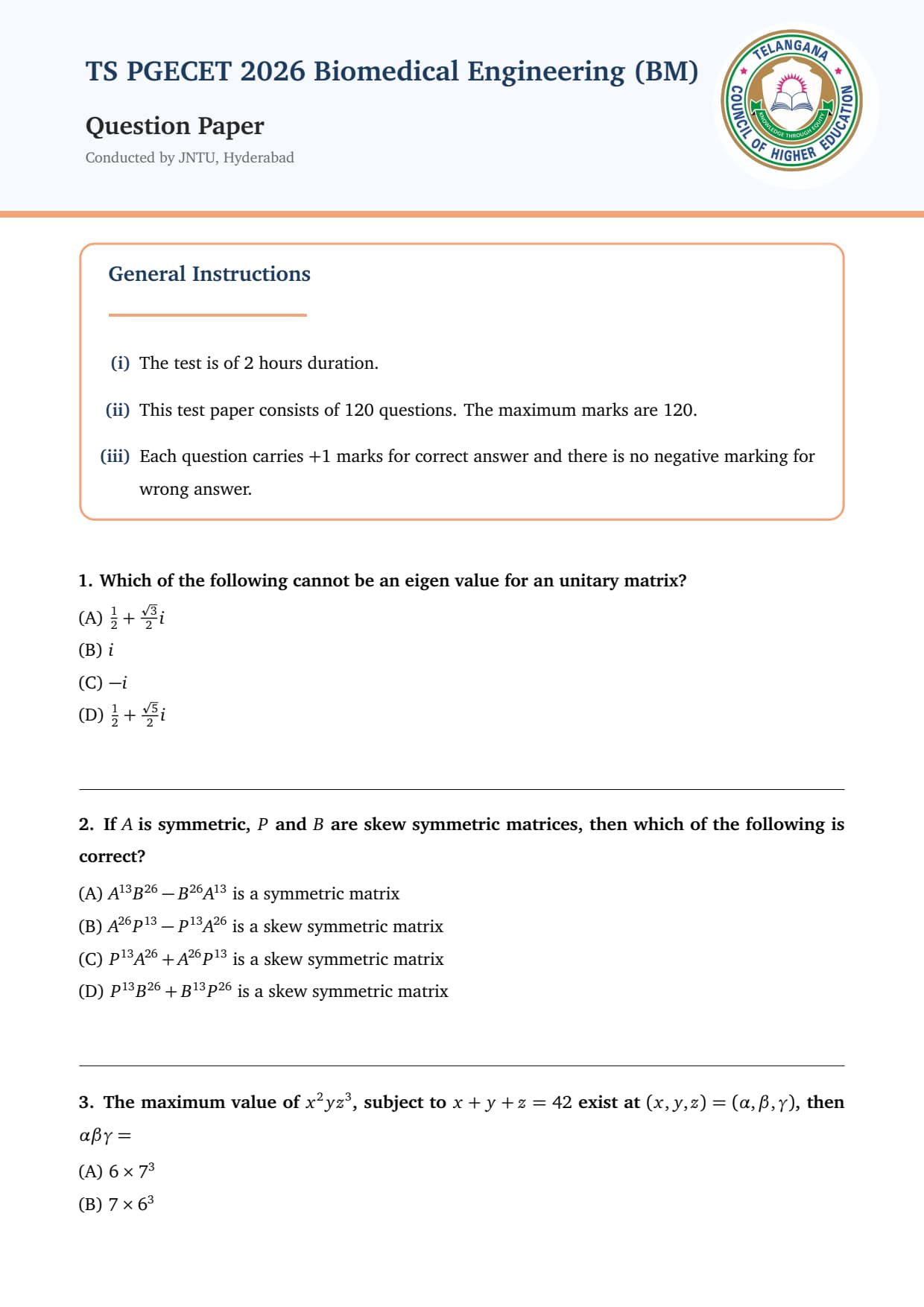
TS PGECET 2026 Biomedical Engineering (BM) Question Paper is available for download here. JNTU Hyderabad on behalf of Telangana Council of Higher Education (TGCHE) conducted TS PGECET 2026 BM exam on May 30 in Shift 2 from 2 PM to 4 PM. TS PGECET BM Question Paper consists of 120 questions for 120 marks to be attempted in 2 hours.
- TS PGECET BM Question Paper 2026 is divided into 2 sections- Engineering Mathematics with 10 questions and Biomedical Engineering domain with 110 questions.
- Each questions carries 1 mark each and there is no negative marking for incorrect answers.
Candidates can download TS PGECET 2026 BM Question Paper with Answer Key and Solution PDF from links provided below.
TS PGECET 2026 BM Question Paper with Solution PDF
Question 1:
Which of the following cannot be an eigen value for an unitary matrix?
- (A) \(\frac{1}{2} + \frac{\sqrt{3}}{2}i\)
- (B) \(i\)
- (C) \(-i\)
- (D) \(\frac{1}{2} + \frac{\sqrt{5}}{2}i\)
Question 2:
If \(A\) is symmetric, \(P\) and \(B\) are skew symmetric matrices, then which of the following is correct?
- (A) \(A^{13}B^{26} - B^{26}A^{13}\) is a symmetric matrix
- (B) \(A^{26}P^{13} - P^{13}A^{26}\) is a skew symmetric matrix
- (C) \(P^{13}A^{26} + A^{26}P^{13}\) is a skew symmetric matrix
- (D) \(P^{13}B^{26} + B^{13}P^{26}\) is a skew symmetric matrix
Question 3:
The maximum value of \(x^2 y z^3\), subject to \(x + y + z = 42\) exist at \((x, y, z) = (\alpha, \beta, \gamma)\), then \(\alpha\beta\gamma =\)
- (A) \(6 \times 7^3\)
- (B) \(7 \times 6^3\)
- (C) \(14 \times 7 \times 21\)
- (D) \(12 \times 6 \times 24\)
Question 4:
The evaluation of the double integral \(\int_{-a}^{a} \int_{0}^{x} \frac{e^y}{(1+e^y)^2} \, dydx =\)
- (A) \(a\)
- (B) \(e^a\)
- (C) \(e^{a^2}\)
- (D) \(0\)
Question 5:
Given below are pair of functions \(f(x)\) and \(g(x)\). Which pair is not linearly independent?
- (A) \(f(x) = \cos x + \sin x\), \(g(x) = -6\cos\frac{x}{3} - 8\cos^3\frac{x}{3}\)
- (B) \(f(x) = -\cos x + \sin x\), \(g(x) = \cos x\)
- (C) \(f(x) = \cos x\), \(g(x) = \cos^3 x - \sin^3 x\)
- (D) \(f(x) = \sin x\), \(g(x) = 6\sin\frac{x}{3} - 8\sin^3\frac{x}{3}\)
Question 6:
The solution of \(\frac{\partial^2 u}{\partial t^2} = 4\frac{\partial^2 u}{\partial x^2}\), \(t > 0\), \(-\infty < x < \infty\) satisfying the conditions \(u(x,0) = x\) and \(\frac{\partial u}{\partial t}(x,0) = 0\) is
- (A) \(x\)
- (B) \(\frac{x^2}{2} + t\)
- (C) \(x + 2t\)
- (D) \(\frac{t^2}{2} + x\)
Question 7:
If \(A\) and \(B\) are independent events and \(P\left(\left(\frac{A}{B}\right) \cup \left(\frac{B}{A}\right)\right) = k - P(A)P(B), then k =\)
- (A) \(P(A) - P(B)\)
- (B) \(\frac{P(A)}{P(B)}\)
- (C) \(P(A)P\left(\frac{B}{A}\right)\)
- (D) \(P(A) + P(B)\)
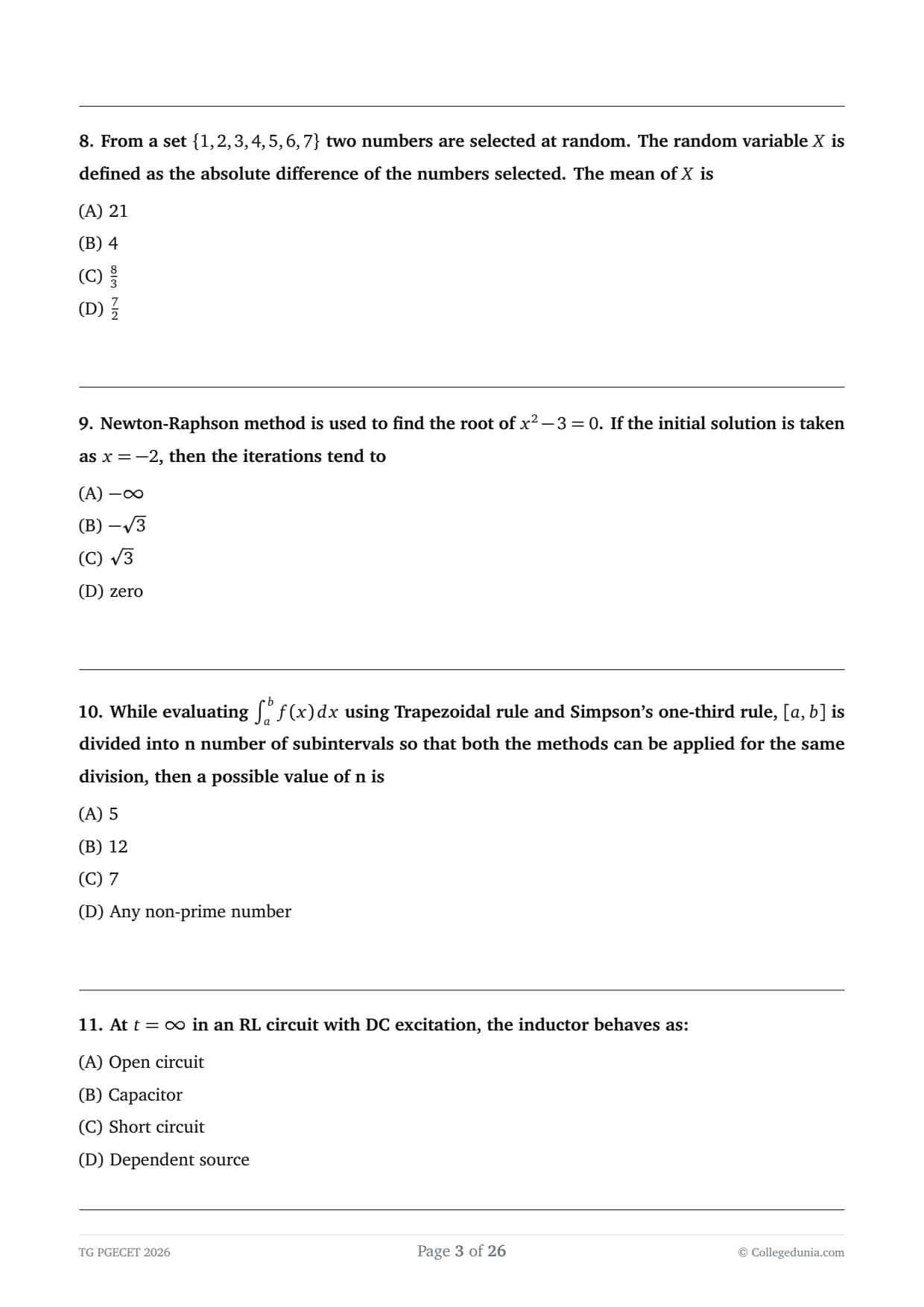
Question 8:
From a set \(\{1,2,3,4,5,6,7\}\) two numbers are selected at random. The random variable \(X\) is defined as the absolute difference of the numbers selected. The mean of \(X\) is
- (A) \(21\)
- (B) \(4\)
- (C) \(\frac{8}{3}\)
- (D) \(\frac{7}{2}\)
Question 9:
Newton-Raphson method is used to find the root of \(x^2 - 3 = 0\). If the initial solution is taken as \(x = -2\), then the iterations tend to
- (A) \(-\infty\)
- (B) \(-\sqrt{3}\)
- (C) \(\sqrt{3}\)
- (D) zero
Question 10:
While evaluating \(\int_{a}^{b} f(x) \, dx\) using Trapezoidal rule and Simpson's one-third rule, \([a,b]\) is divided into n number of subintervals so that both the methods can be applied for the same division, then a possible value of n is
- (A) \(5\)
- (B) \(12\)
- (C) \(7\)
- (D) Any non-prime number
Question 11:
At \( t = \infty \) in an RL circuit with DC excitation, the inductor behaves as:
- (A) Open circuit
- (B) Capacitor
- (C) Short circuit
- (D) Dependent source
Question 12:
In a series RL circuit excited by DC, the current reaches 63.2% of its final value at:
- (A) \( t = RC \)
- (B) \( t = \frac{1}{RC} \)
- (C) \( t = \frac{R}{L} \)
- (D) \( t = \frac{L}{R} \)
Question 13:
If \( L = 1 H \), \( C = 1 F \) and \( R = 1\ \Omega \) in a series RLC circuit, then the circuit is:
- (A) Pure oscillating
- (B) Critically damped
- (C) Overdamped
- (D) Underdamped
Question 14:
In a series RLC circuit with \( R = 10\ \Omega \), \( L = 0.1 H \), \( C = 100\ \), the resonant frequency, Q-factor and bandwidth respectively are:
- (A) \( 50 Hz, 3.14, 15.9 Hz \)
- (B) \( 50 Hz, 2.15, 9 Hz \)
- (C) \( 40 Hz, 2.15, 9 Hz \)
- (D) \( 50 Hz, 3.14, 16 Hz \)
Question 15:
The cut-off frequency of an RC low-pass filter is:
- (A) \( \frac{1}{(2\pi RC)} \)
- (B) \( 2\pi RC \)
- (C) \( \frac{R}{(2\pi C)} \)
- (D) \( \frac{C}{(2\pi R)} \)
Question 16:
If a circuit has unity power factor, then reactive power is:
- (A) Maximum
- (B) Zero
- (C) Minimum
- (D) Inductive
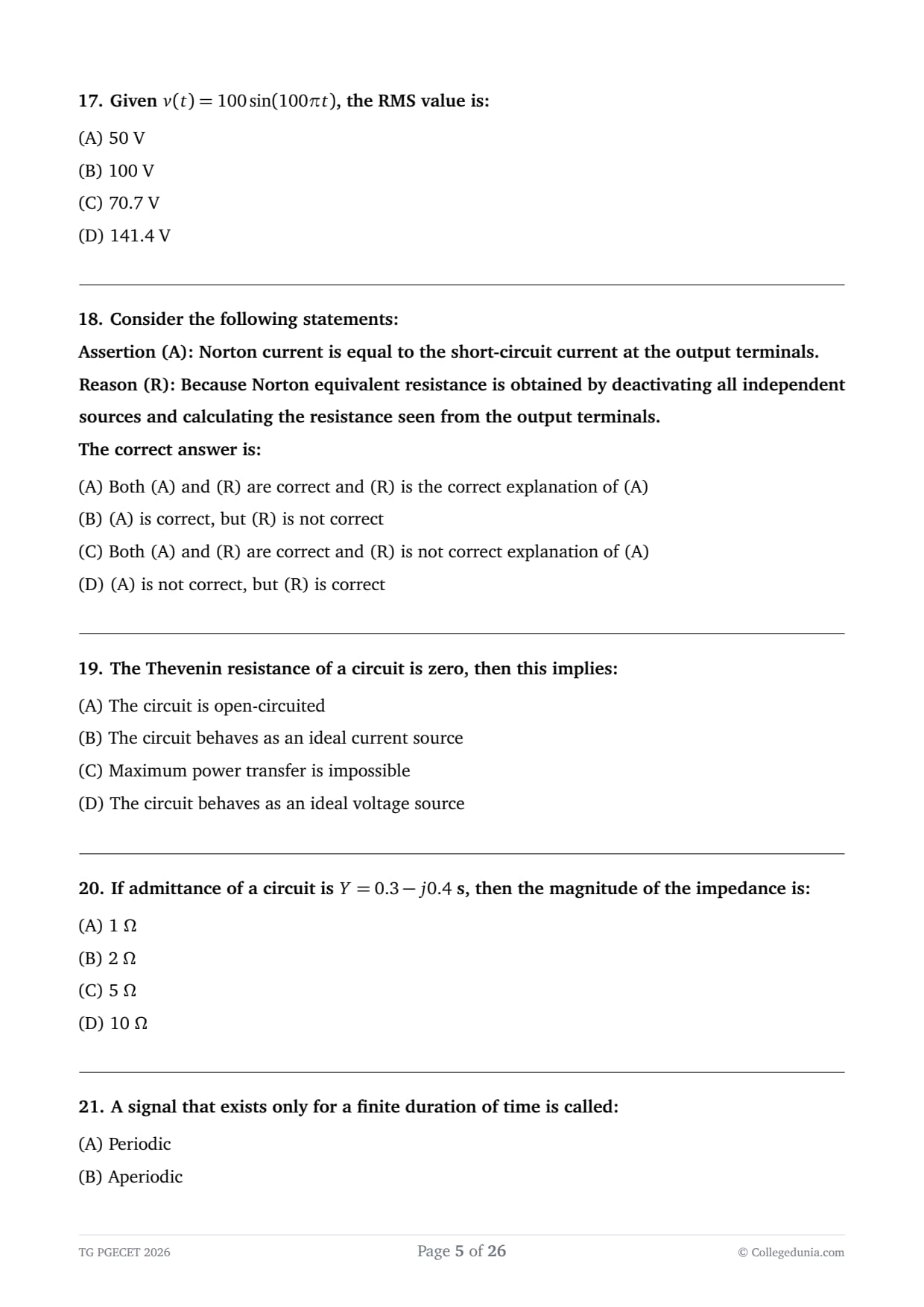
Question 17:
Given \( v(t) = 100 \sin(100\pi t) \), the RMS value is:
- (A) \( 50 V \)
- (B) \( 100 V \)
- (C) \( 70.7 V \)
- (D) \( 141.4 V \)
Question 18:
Consider the following statements:
Assertion (A): Norton current is equal to the short-circuit current at the output terminals.
Reason (R): Because Norton equivalent resistance is obtained by deactivating all independent sources and calculating the resistance seen from the output terminals.
The correct answer is:
- (A) Both (A) and (R) are correct and (R) is the correct explanation of (A)
- (B) (A) is correct, but (R) is not correct
- (C) Both (A) and (R) are correct and (R) is not correct explanation of (A)
- (D) (A) is not correct, but (R) is correct
Question 19:
The Thevenin resistance of a circuit is zero, then this implies:
- (A) The circuit is open-circuited
- (B) The circuit behaves as an ideal current source
- (C) Maximum power transfer is impossible
- (D) The circuit behaves as an ideal voltage source
Question 20:
If admittance of a circuit is \( Y = 0.3 - j0.4 s \), then the magnitude of the impedance is:
- (A) \( 1\ \Omega \)
- (B) \( 2\ \Omega \)
- (C) \( 5\ \Omega \)
- (D) \( 10\ \Omega \)
Question 21:
A signal that exists only for a finite duration of time is called:
- (A) Periodic
- (B) Aperiodic
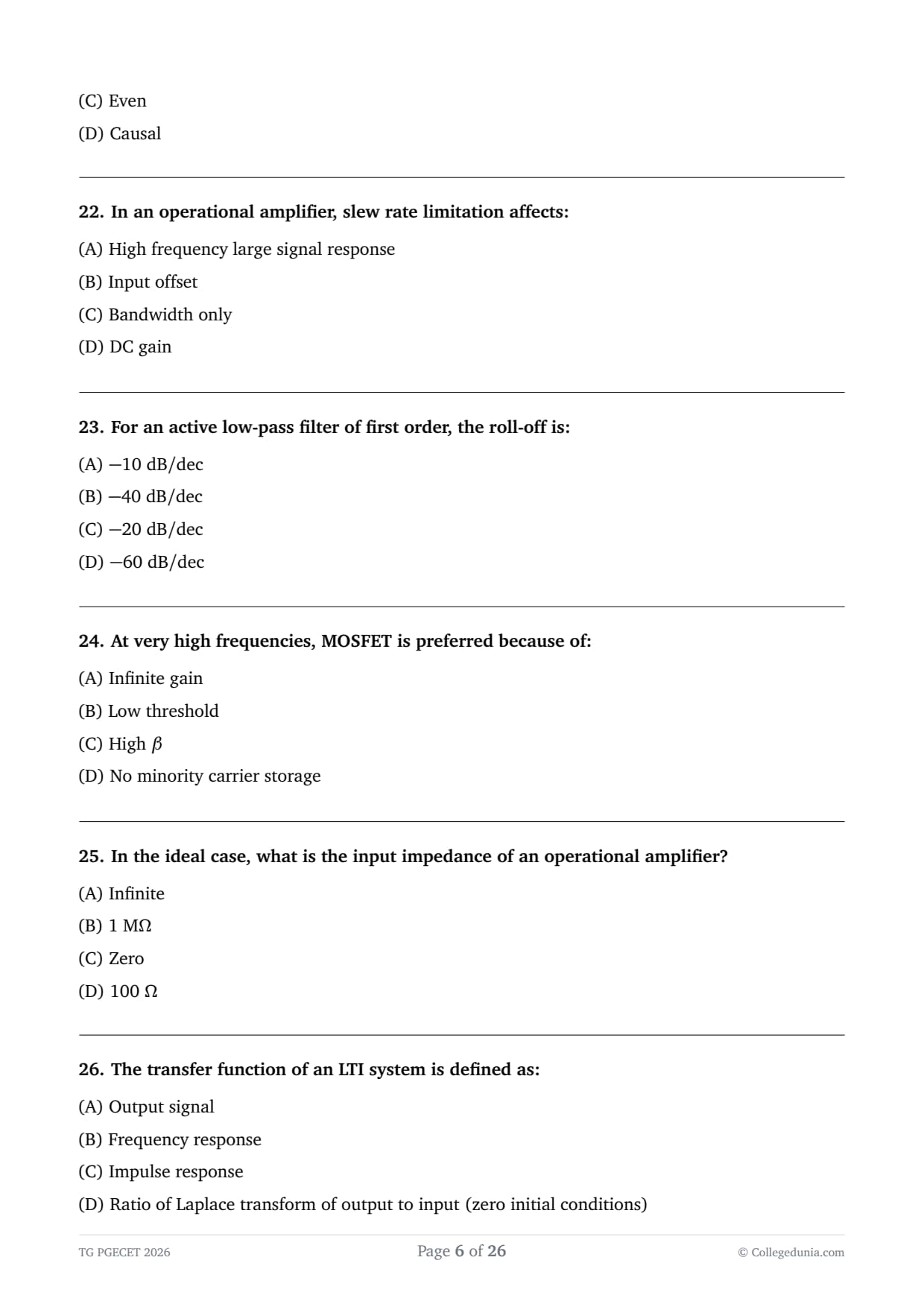
- (C) Even
- (D) Causal
Question 22:
In an operational amplifier, slew rate limitation affects:
- (A) High frequency large signal response
- (B) Input offset
- (C) Bandwidth only
- (D) DC gain
Question 23:
For an active low-pass filter of first order, the roll-off is:
- (A) \( -10 dB/dec \)
- (B) \( -40 dB/dec \)
- (C) \( -20 dB/dec \)
- (D) \( -60 dB/dec \)
Question 24:
At very high frequencies, MOSFET is preferred because of:
- (A) Infinite gain
- (B) Low threshold
- (C) High \(\beta\)
- (D) No minority carrier storage
Question 25:
In the ideal case, what is the input impedance of an operational amplifier?
- (A) Infinite
- (B) \( 1 M\Omega \)
- (C) Zero
- (D) \( 100\ \Omega \)
Question 26:
The transfer function of an LTI system is defined as:
- (A) Output signal
- (B) Frequency response
- (C) Impulse response
- (D) Ratio of Laplace transform of output to input (zero initial conditions)
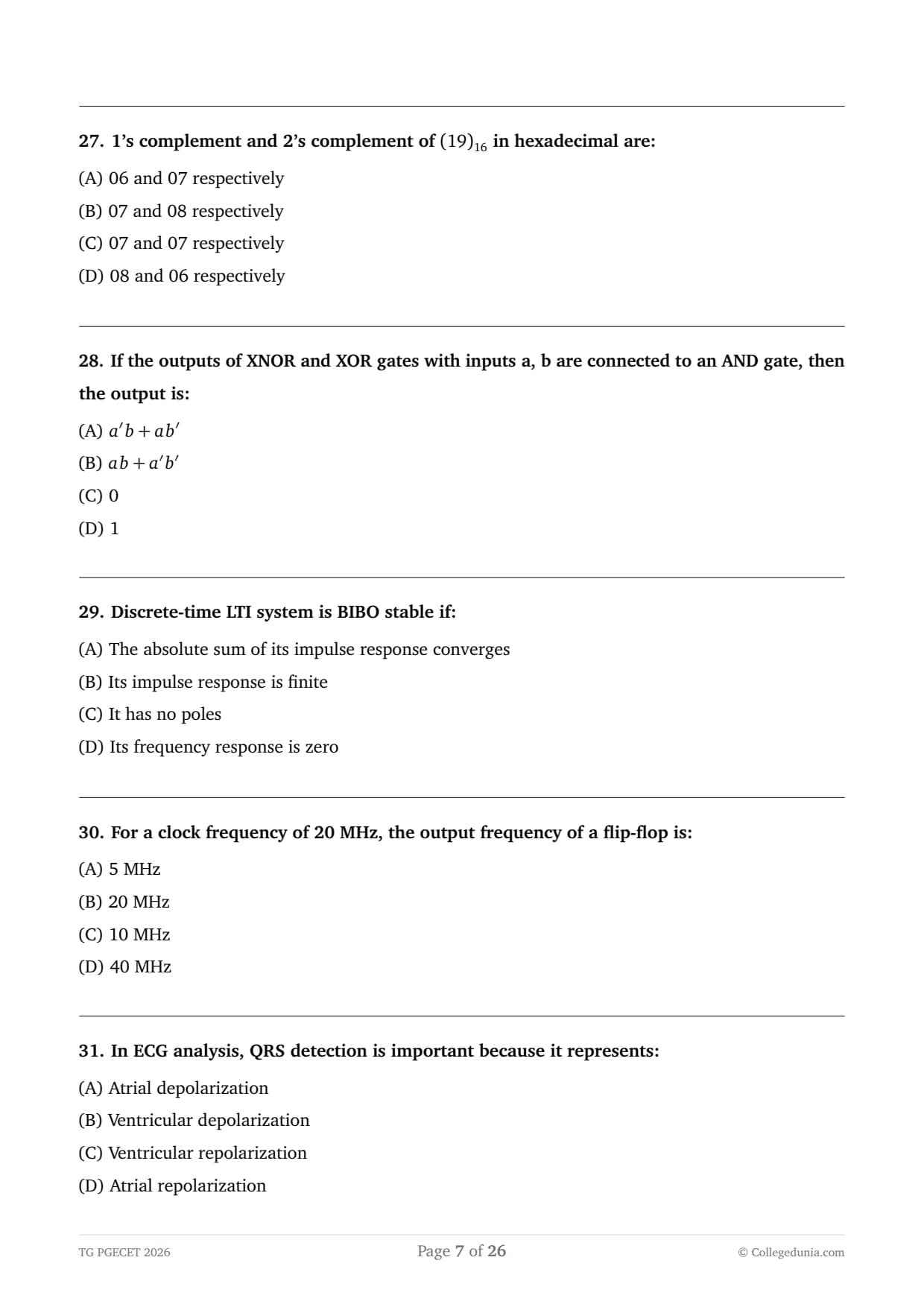
Question 27:
1's complement and 2's complement of \((19)_{16}\) in hexadecimal are:
- (A) \( 06 \) and \( 07 \) respectively
- (B) \( 07 \) and \( 08 \) respectively
- (C) \( 07 \) and \( 07 \) respectively
- (D) \( 08 \) and \( 06 \) respectively
Question 28:
If the outputs of XNOR and XOR gates with inputs a, b are connected to an AND gate, then the output is:
- (A) \(a'b + ab'\)
- (B) \(ab + a'b'\)
- (C) \(0\)
- (D) \(1\)
Question 29:
Discrete-time LTI system is BIBO stable if:
- (A) The absolute sum of its impulse response converges
- (B) Its impulse response is finite
- (C) It has no poles
- (D) Its frequency response is zero
Question 30:
For a clock frequency of 20 MHz, the output frequency of a flip-flop is:
- (A) \(5 MHz\)
- (B) \(20 MHz\)
- (C) \(10 MHz\)
- (D) \(40 MHz\)
Question 31:
In ECG analysis, QRS detection is important because it represents:
- (A) Atrial depolarization
- (B) Ventricular depolarization
- (C) Ventricular repolarization
- (D) Atrial repolarization
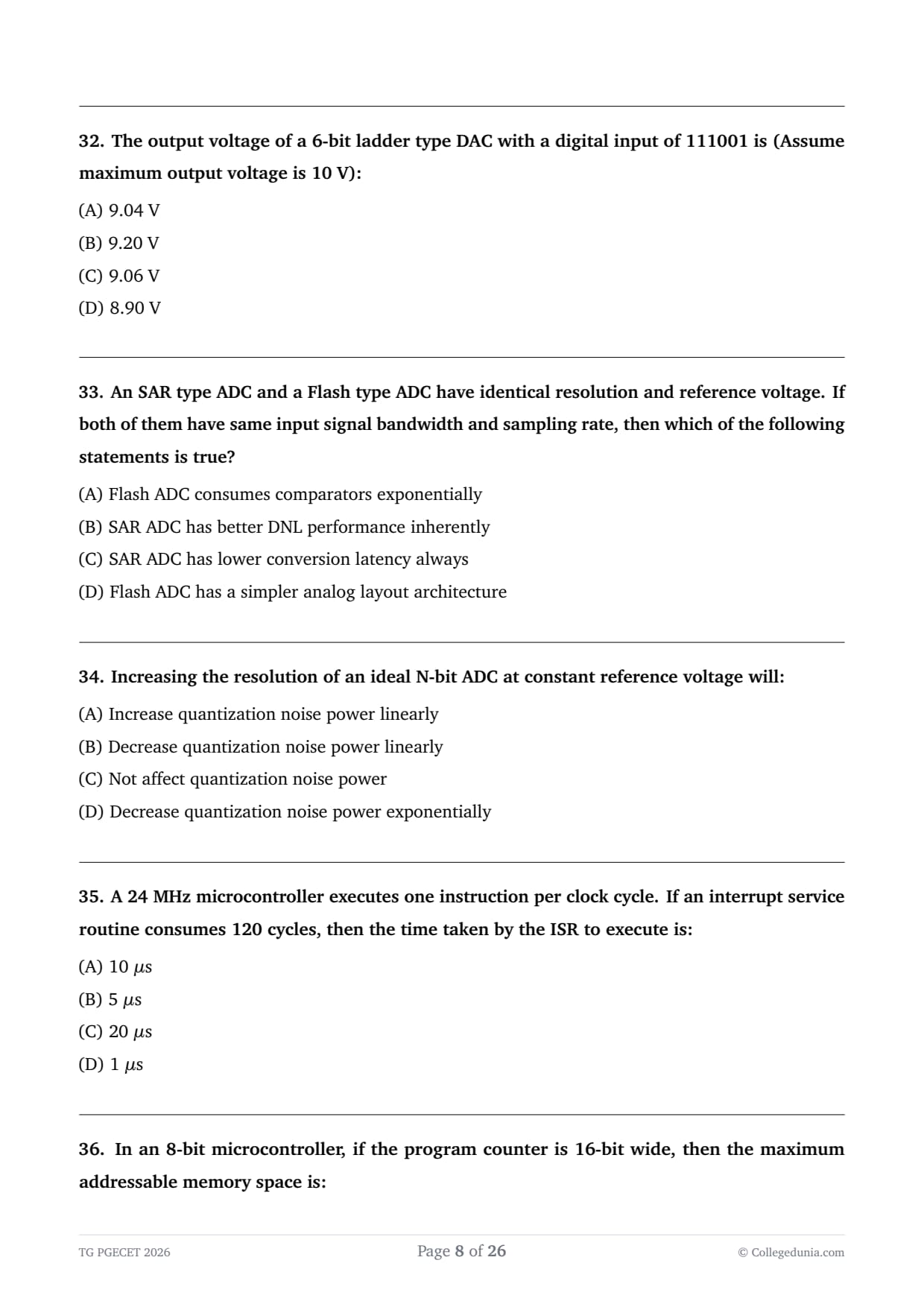
Question 32:
The output voltage of a 6-bit ladder type DAC with a digital input of 111001 is (Assume maximum output voltage is 10 V):
- (A) \(9.04 V\)
- (B) \(9.20 V\)
- (C) \(9.06 V\)
- (D) \(8.90 V\)
Question 33:
An SAR type ADC and a Flash type ADC have identical resolution and reference voltage. If both of them have same input signal bandwidth and sampling rate, then which of the following statements is true?
- (A) Flash ADC consumes comparators exponentially
- (B) SAR ADC has better DNL performance inherently
- (C) SAR ADC has lower conversion latency always
- (D) Flash ADC has a simpler analog layout architecture
Question 34:
Increasing the resolution of an ideal N-bit ADC at constant reference voltage will:
- (A) Increase quantization noise power linearly
- (B) Decrease quantization noise power linearly
- (C) Not affect quantization noise power
- (D) Decrease quantization noise power exponentially
Question 35:
A 24 MHz microcontroller executes one instruction per clock cycle. If an interrupt service routine consumes 120 cycles, then the time taken by the ISR to execute is:
- (A) \(10\ \)
- (B) \(5\ \)
- (C) \(20\ \)
- (D) \(1\ \)
Question 36:
In an 8-bit microcontroller, if the program counter is 16-bit wide, then the maximum addressable memory space is:
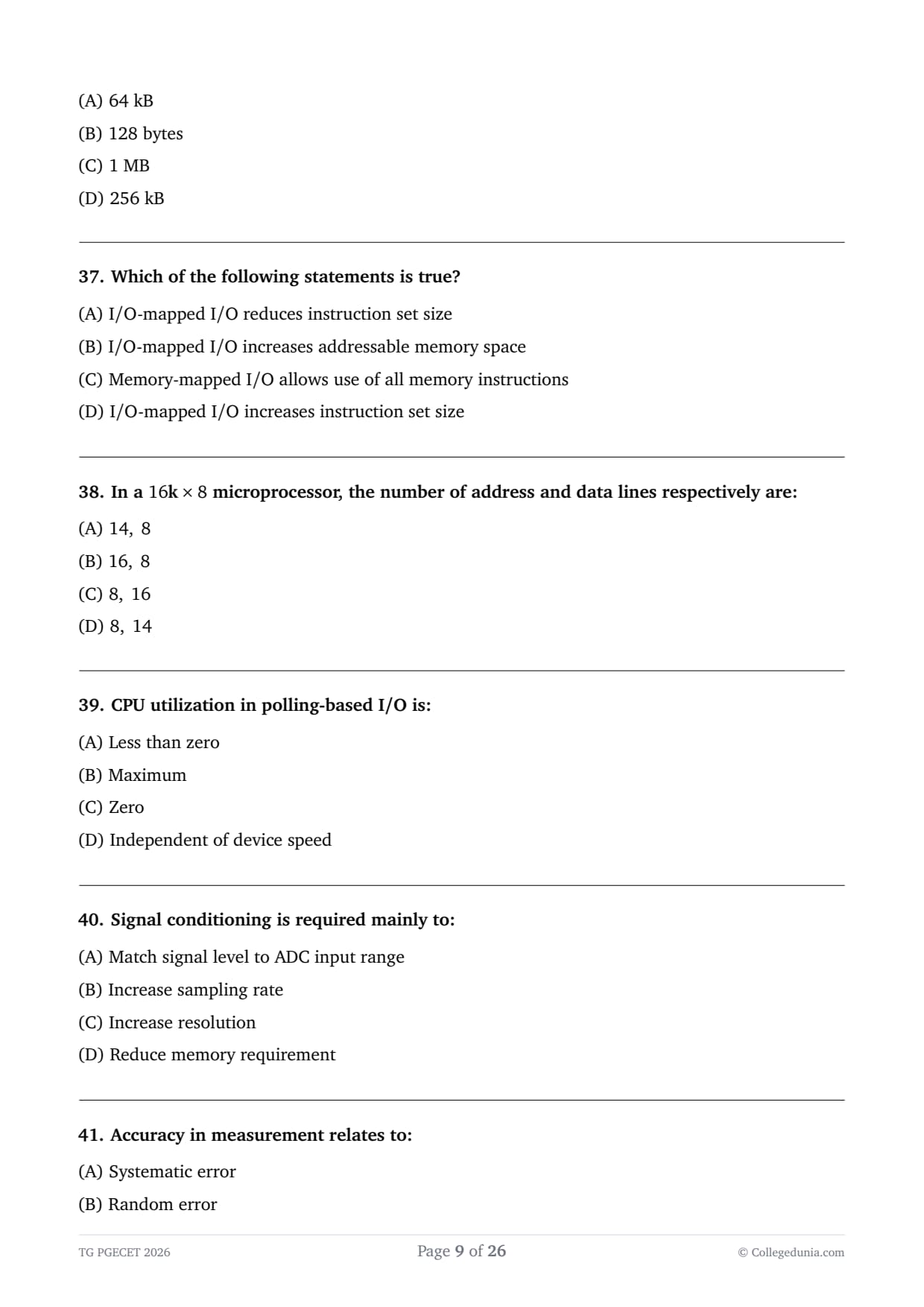
- (A) \(64 kB\)
- (B) \(128 bytes\)
- (C) \(1 MB\)
- (D) \(256 kB\)
Question 37:
Which of the following statements is true?
- (A) I/O-mapped I/O reduces instruction set size
- (B) I/O-mapped I/O increases addressable memory space
- (C) Memory-mapped I/O allows use of all memory instructions
- (D) I/O-mapped I/O increases instruction set size
Question 38:
In a \(16k \times 8\) microprocessor, the number of address and data lines respectively are:
- (A) \(14,\ 8\)
- (B) \(16,\ 8\)
- (C) \(8,\ 16\)
- (D) \(8,\ 14\)
Question 39:
CPU utilization in polling-based I/O is:
- (A) Less than zero
- (B) Maximum
- (C) Zero
- (D) Independent of device speed
Question 40:
Signal conditioning is required mainly to:
- (A) Match signal level to ADC input range
- (B) Increase sampling rate
- (C) Increase resolution
- (D) Reduce memory requirement
Question 41:
Accuracy in measurement relates to:
- (A) Systematic error
- (B) Random error
- (C) Noise
- (D) Resolution
Question 42:
Q factor of a tuned amplifier does not depend on:
- (A) Capacitance
- (B) Gain
- (C) Resistance
- (D) Inductance
Question 43:
Which of the following is satisfied by a linear system?
- (A) Reciprocal property
- (B) Time invariance
- (C) Zero initial condition
- (D) Homogeneity
Question 44:
Transfer function is valid only for:
- (A) Linear time-invariant systems
- (B) Linear time-variant systems
- (C) Non-linear time-invariant systems
- (D) Non-linear time-variant systems
Question 45:
Which of the following statements is true?
- (A) More zeros always improve transient response
- (B) Zero in right hand plane affects steady-state error
- (C) Improper systems are physically unrealizable
- (D) Stability depends on zeros
Question 46:
The spike-and-wave complex of the EEG is detected using:
- (A) HPF
- (B) LPF
- (C) Wiener filter
- (D) Template Matching
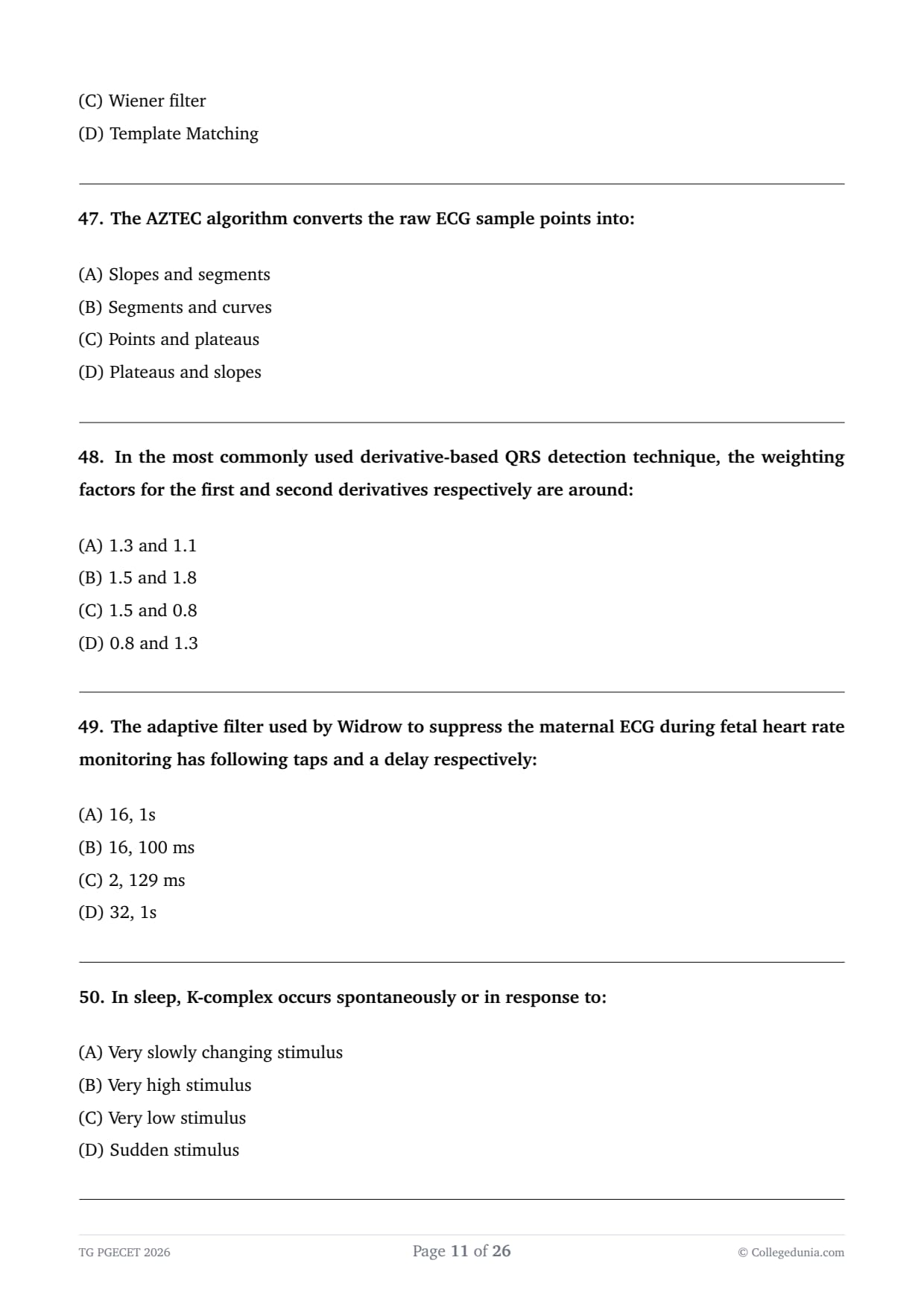
Question 47:
The AZTEC algorithm converts the raw ECG sample points into:
- (A) Slopes and segments
- (B) Segments and curves
- (C) Points and plateaus
- (D) Plateaus and slopes
Question 48:
In the most commonly used derivative-based QRS detection technique, the weighting factors for the first and second derivatives respectively are around:
- (A) 1.3 and 1.1
- (B) 1.5 and 1.8
- (C) 1.5 and 0.8
- (D) 0.8 and 1.3
Question 49:
The adaptive filter used by Widrow to suppress the maternal ECG during fetal heart rate monitoring has following taps and a delay respectively:
- (A) 16, 1s
- (B) 16, 100 ms
- (C) 2, 129 ms
- (D) 32, 1s
Question 50:
In sleep, K-complex occurs spontaneously or in response to:
- (A) Very slowly changing stimulus
- (B) Very high stimulus
- (C) Very low stimulus
- (D) Sudden stimulus
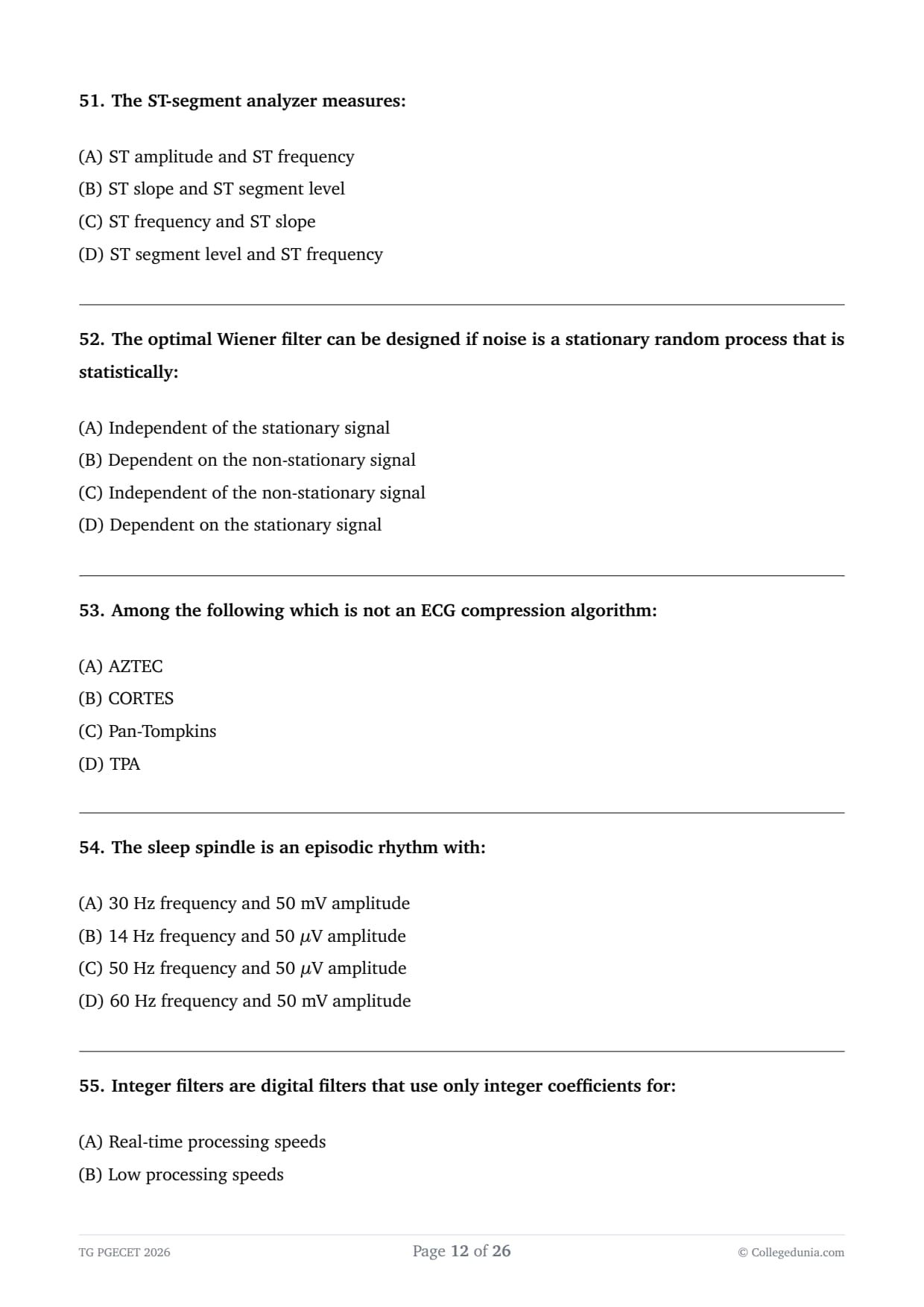
Question 51:
The ST-segment analyzer measures:
- (A) ST amplitude and ST frequency
- (B) ST slope and ST segment level
- (C) ST frequency and ST slope
- (D) ST segment level and ST frequency
Question 52:
The optimal Wiener filter can be designed if noise is a stationary random process that is statistically:
- (A) Independent of the stationary signal
- (B) Dependent on the non-stationary signal
- (C) Independent of the non-stationary signal
- (D) Dependent on the stationary signal
Question 53:
Among the following which is not an ECG compression algorithm:
- (A) AZTEC
- (B) CORTES
- (C) Pan-Tompkins
- (D) TPA
Question 54:
The sleep spindle is an episodic rhythm with:
- (A) 30 Hz frequency and 50 mV amplitude
- (B) 14 Hz frequency and 50 \(\mu\)V amplitude
- (C) 50 Hz frequency and 50 \(\mu\)V amplitude
- (D) 60 Hz frequency and 50 mV amplitude
Question 55:
Integer filters are digital filters that use only integer coefficients for:
- (A) Real-time processing speeds
- (B) Low processing speeds
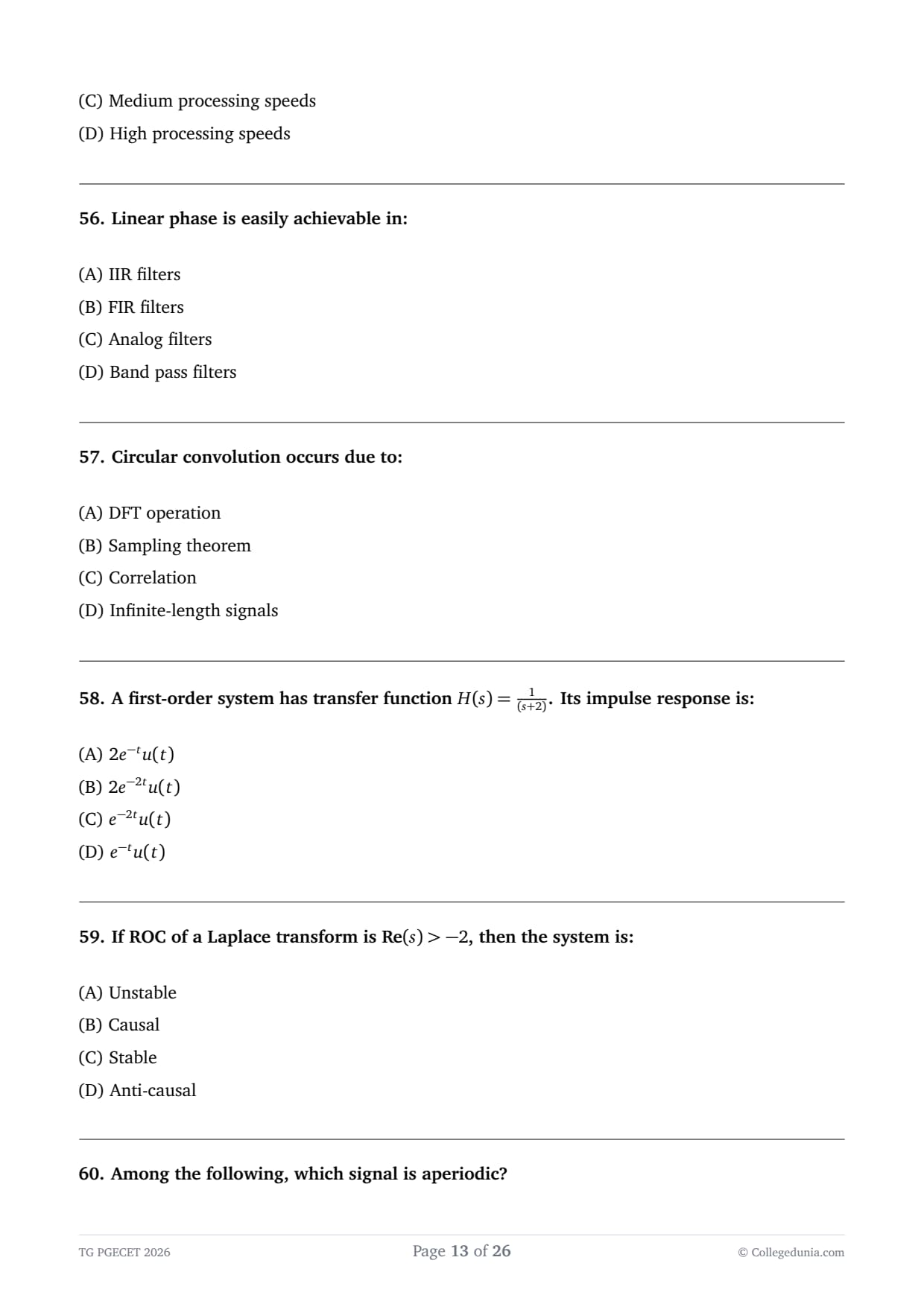
- (C) Medium processing speeds
- (D) High processing speeds
Question 56:
Linear phase is easily achievable in:
- (A) IIR filters
- (B) FIR filters
- (C) Analog filters
- (D) Band pass filters
Question 57:
Circular convolution occurs due to:
- (A) DFT operation
- (B) Sampling theorem
- (C) Correlation
- (D) Infinite-length signals
Question 58:
A first-order system has transfer function \(H(s) = \frac{1}{(s+2)}\). Its impulse response is:
- (A) \(2e^{-t}u(t)\)
- (B) \(2e^{-2t}u(t)\)
- (C) \(e^{-2t}u(t)\)
- (D) \(e^{-t}u(t)\)
Question 59:
If ROC of a Laplace transform is \(Re(s) > -2\), then the system is:
- (A) Unstable
- (B) Causal
- (C) Stable
- (D) Anti-causal
Question 60:
Among the following, which signal is aperiodic?
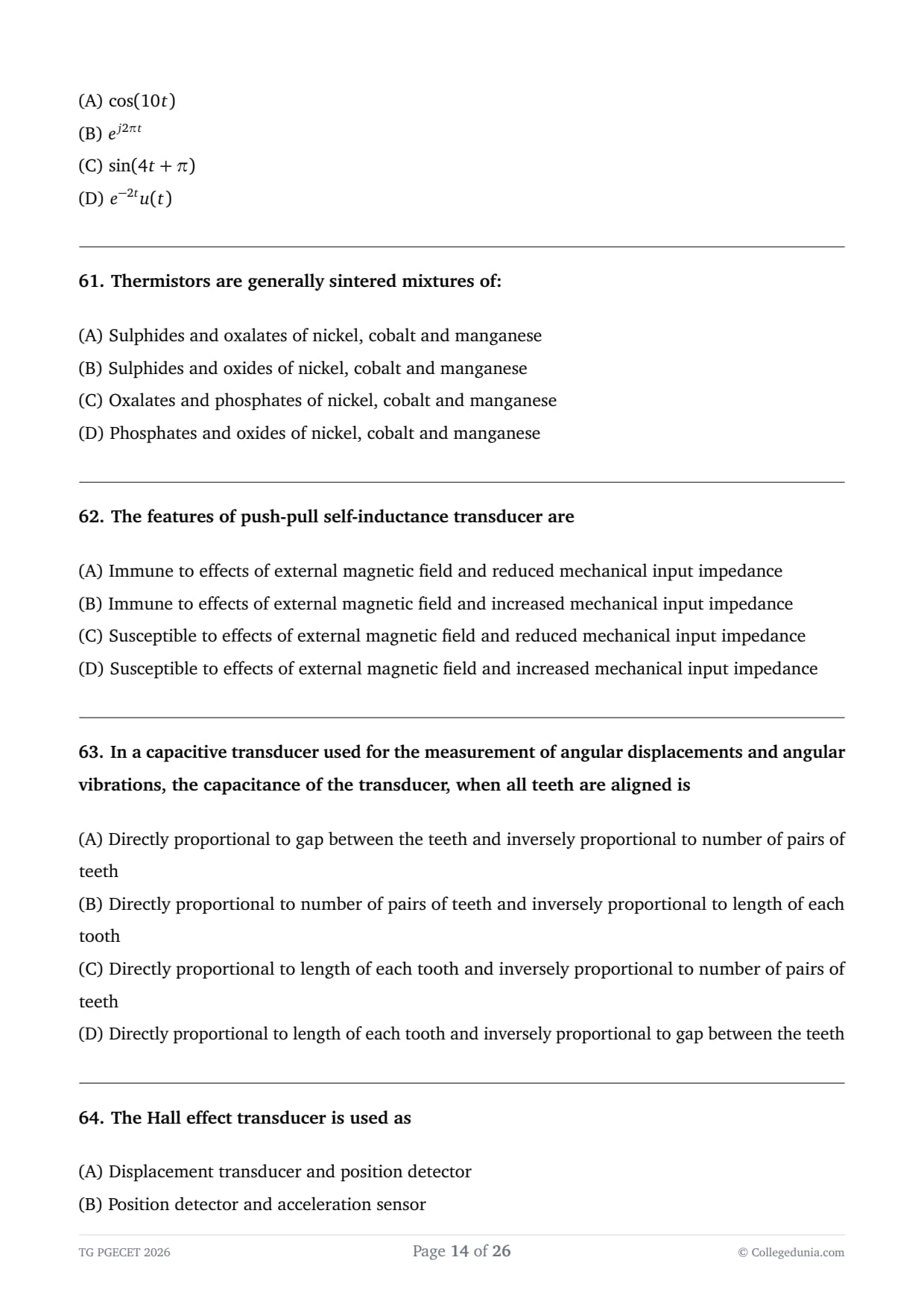
- (A) \(\cos(10t)\)
- (B) \(e^{j2\pi t}\)
- (C) \(\sin(4t + \pi)\)
- (D) \(e^{-2t}u(t)\)
Question 61:
Thermistors are generally sintered mixtures of:
- (A) Sulphides and oxalates of nickel, cobalt and manganese
- (B) Sulphides and oxides of nickel, cobalt and manganese
- (C) Oxalates and phosphates of nickel, cobalt and manganese
- (D) Phosphates and oxides of nickel, cobalt and manganese
Question 62:
The features of push-pull self-inductance transducer are
- (A) Immune to effects of external magnetic field and reduced mechanical input impedance
- (B) Immune to effects of external magnetic field and increased mechanical input impedance
- (C) Susceptible to effects of external magnetic field and reduced mechanical input impedance
- (D) Susceptible to effects of external magnetic field and increased mechanical input impedance
Question 63:
In a capacitive transducer used for the measurement of angular displacements and angular vibrations, the capacitance of the transducer, when all teeth are aligned is
- (A) Directly proportional to gap between the teeth and inversely proportional to number of pairs of teeth
- (B) Directly proportional to number of pairs of teeth and inversely proportional to length of each tooth
- (C) Directly proportional to length of each tooth and inversely proportional to number of pairs of teeth
- (D) Directly proportional to length of each tooth and inversely proportional to gap between the teeth
Question 64:
The Hall effect transducer is used as
- (A) Displacement transducer and position detector
- (B) Position detector and acceleration sensor
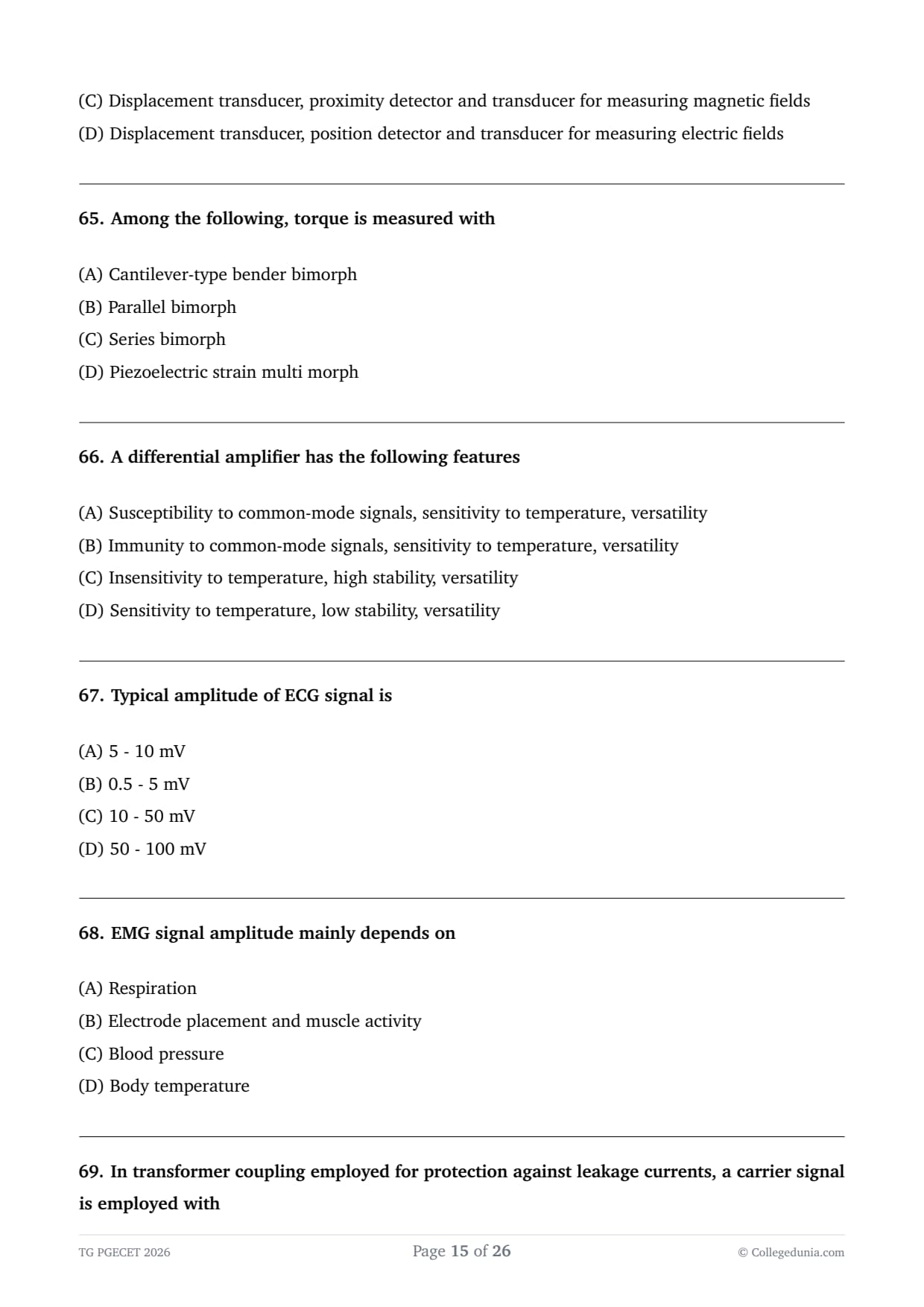
- (C) Displacement transducer, proximity detector and transducer for measuring magnetic fields
- (D) Displacement transducer, position detector and transducer for measuring electric fields
Question 65:
Among the following, torque is measured with
- (A) Cantilever-type bender bimorph
- (B) Parallel bimorph
- (C) Series bimorph
- (D) Piezoelectric strain multi morph
Question 66:
A differential amplifier has the following features
- (A) Susceptibility to common-mode signals, sensitivity to temperature, versatility
- (B) Immunity to common-mode signals, sensitivity to temperature, versatility
- (C) Insensitivity to temperature, high stability, versatility
- (D) Sensitivity to temperature, low stability, versatility
Question 67:
Typical amplitude of ECG signal is
- (A) 5 - 10 mV
- (B) 0.5 - 5 mV
- (C) 10 - 50 mV
- (D) 50 - 100 mV
Question 68:
EMG signal amplitude mainly depends on
- (A) Respiration
- (B) Electrode placement and muscle activity
- (C) Blood pressure
- (D) Body temperature
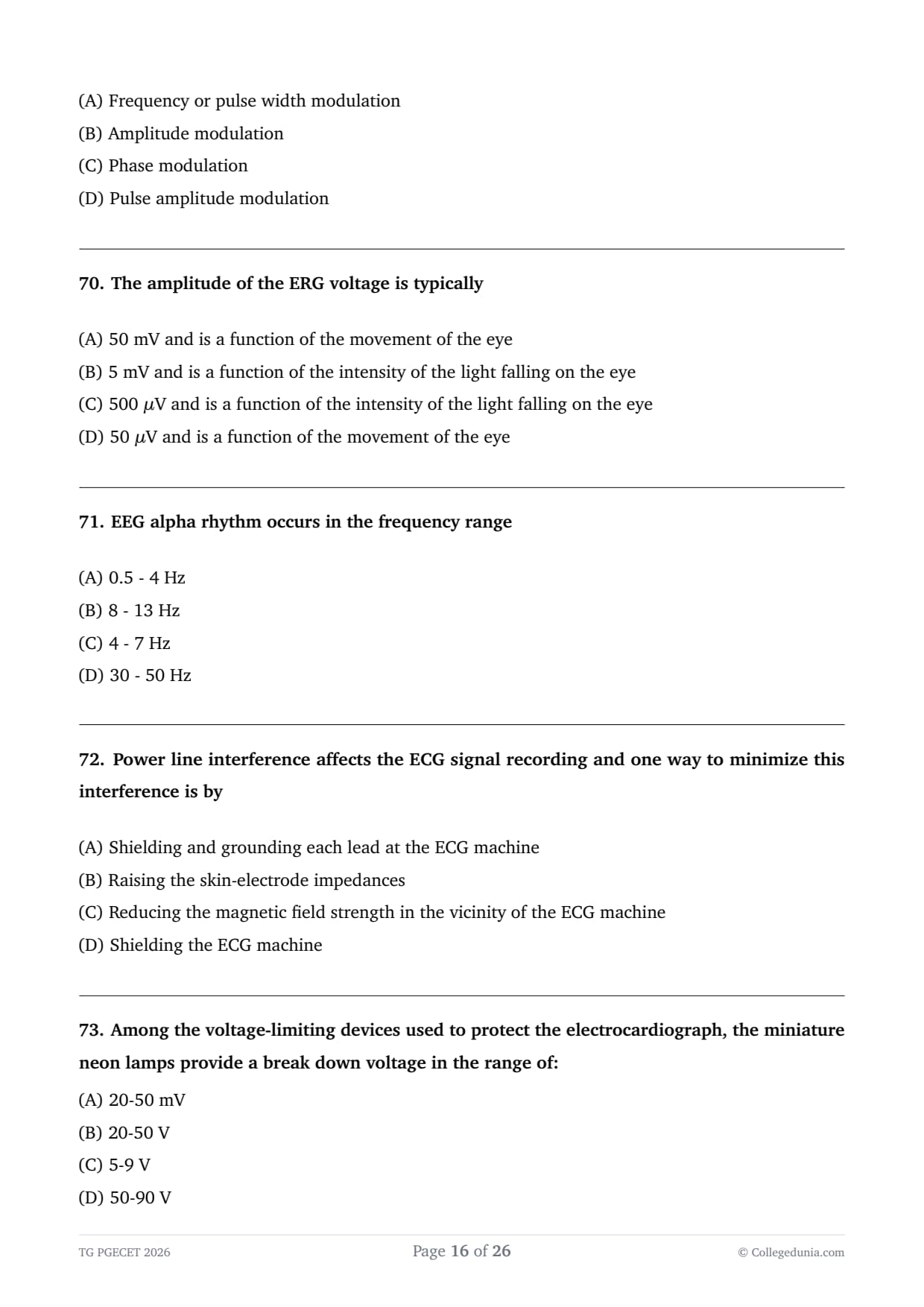
Question 69:
In transformer coupling employed for protection against leakage currents, a carrier signal is employed with
- (A) Frequency or pulse width modulation
- (B) Amplitude modulation
- (C) Phase modulation
- (D) Pulse amplitude modulation
Question 70:
The amplitude of the ERG voltage is typically
- (A) 50 mV and is a function of the movement of the eye
- (B) 5 mV and is a function of the intensity of the light falling on the eye
- (C) 500 \(\mu\)V and is a function of the intensity of the light falling on the eye
- (D) 50 \(\mu\)V and is a function of the movement of the eye
Question 71:
EEG alpha rhythm occurs in the frequency range
- (A) 0.5 - 4 Hz
- (B) 8 - 13 Hz
- (C) 4 - 7 Hz
- (D) 30 - 50 Hz
Question 72:
Power line interference affects the ECG signal recording and one way to minimize this interference is by
- (A) Shielding and grounding each lead at the ECG machine
- (B) Raising the skin-electrode impedances
- (C) Reducing the magnetic field strength in the vicinity of the ECG machine
- (D) Shielding the ECG machine
Question 73:
Among the voltage-limiting devices used to protect the electrocardiograph, the miniature neon lamps provide a break down voltage in the range of:
- (A) \( 20-50 mV \)
- (B) \( 20-50 V \)
- (C) \( 5-9 V \)
- (D) \( 50-90 V \)
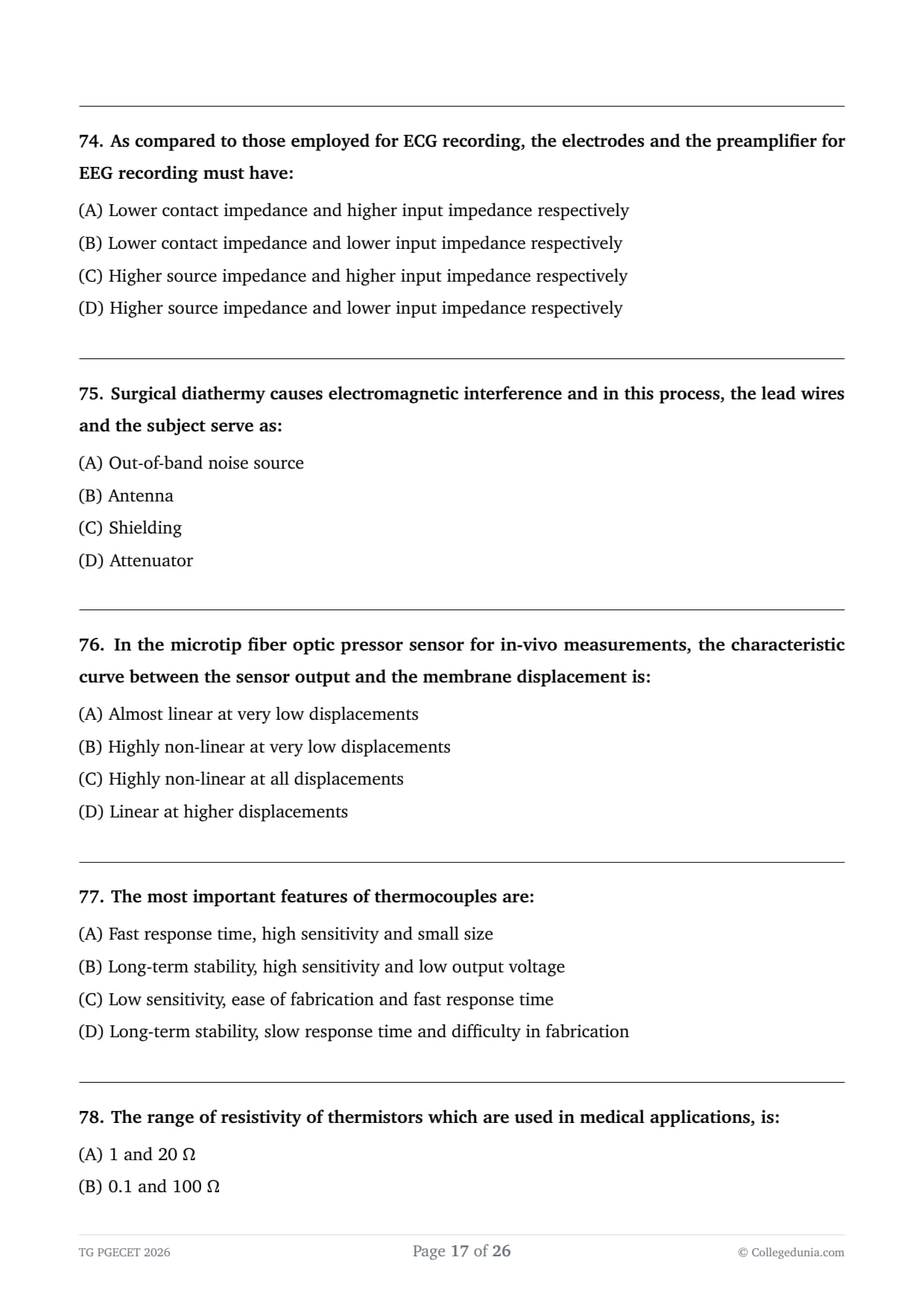
Question 74:
As compared to those employed for ECG recording, the electrodes and the preamplifier for EEG recording must have:
- (A) Lower contact impedance and higher input impedance respectively
- (B) Lower contact impedance and lower input impedance respectively
- (C) Higher source impedance and higher input impedance respectively
- (D) Higher source impedance and lower input impedance respectively
Question 75:
Surgical diathermy causes electromagnetic interference and in this process, the lead wires and the subject serve as:
- (A) Out-of-band noise source
- (B) Antenna
- (C) Shielding
- (D) Attenuator
Question 76:
In the microtip fiber optic pressor sensor for in-vivo measurements, the characteristic curve between the sensor output and the membrane displacement is:
- (A) Almost linear at very low displacements
- (B) Highly non-linear at very low displacements
- (C) Highly non-linear at all displacements
- (D) Linear at higher displacements
Question 77:
The most important features of thermocouples are:
- (A) Fast response time, high sensitivity and small size
- (B) Long-term stability, high sensitivity and low output voltage
- (C) Low sensitivity, ease of fabrication and fast response time
- (D) Long-term stability, slow response time and difficulty in fabrication
Question 78:
The range of resistivity of thermistors which are used in medical applications, is:
- (A) \( 1 and 20 \ \Omega \)
- (B) \( 0.1 and 100 \ \Omega \)
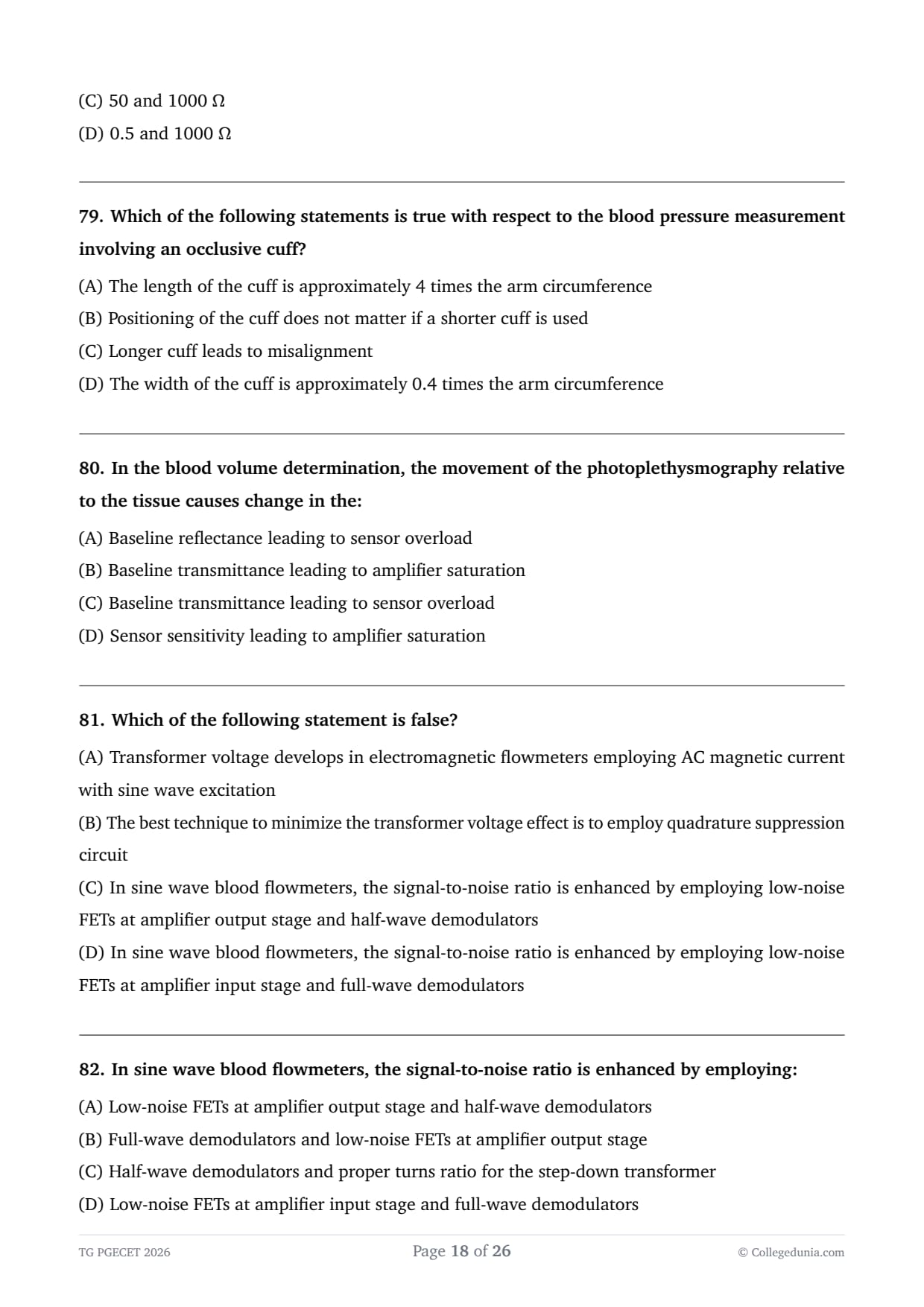
- (C) \( 50 and 1000 \ \Omega \)
- (D) \( 0.5 and 1000 \ \Omega \)
Question 79:
Which of the following statements is true with respect to the blood pressure measurement involving an occlusive cuff?
- (A) The length of the cuff is approximately 4 times the arm circumference
- (B) Positioning of the cuff does not matter if a shorter cuff is used
- (C) Longer cuff leads to misalignment
- (D) The width of the cuff is approximately 0.4 times the arm circumference
Question 80:
In the blood volume determination, the movement of the photoplethysmography relative to the tissue causes change in the:
- (A) Baseline reflectance leading to sensor overload
- (B) Baseline transmittance leading to amplifier saturation
- (C) Baseline transmittance leading to sensor overload
- (D) Sensor sensitivity leading to amplifier saturation
Question 81:
Which of the following statement is false?
- (A) Transformer voltage develops in electromagnetic flowmeters employing AC magnetic current with sine wave excitation
- (B) The best technique to minimize the transformer voltage effect is to employ quadrature suppression circuit
- (C) In sine wave blood flowmeters, the signal-to-noise ratio is enhanced by employing low-noise FETs at amplifier output stage and half-wave demodulators
- (D) In sine wave blood flowmeters, the signal-to-noise ratio is enhanced by employing low-noise FETs at amplifier input stage and full-wave demodulators
Question 82:
In sine wave blood flowmeters, the signal-to-noise ratio is enhanced by employing:
- (A) Low-noise FETs at amplifier output stage and half-wave demodulators
- (B) Full-wave demodulators and low-noise FETs at amplifier output stage
- (C) Half-wave demodulators and proper turns ratio for the step-down transformer
- (D) Low-noise FETs at amplifier input stage and full-wave demodulators
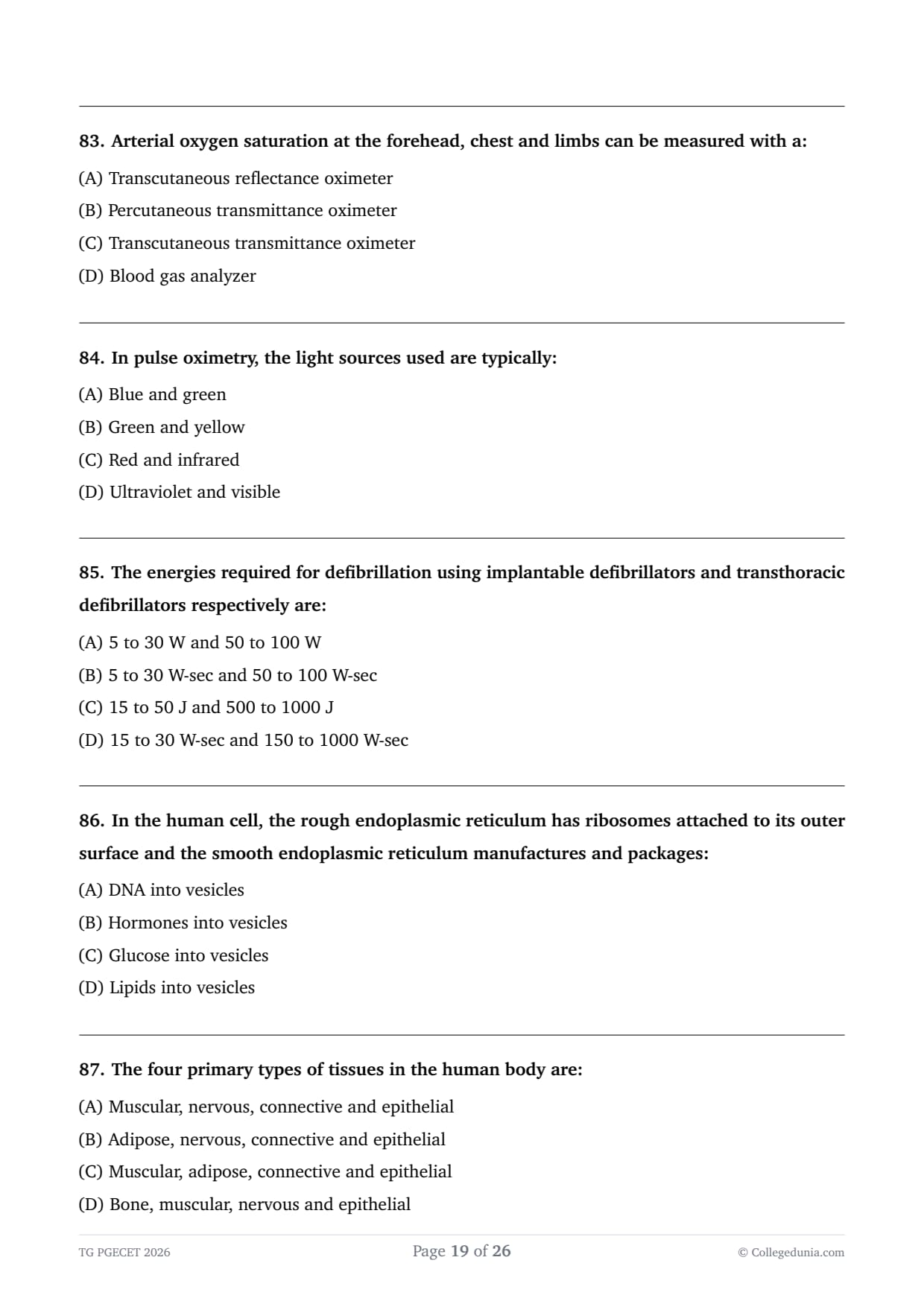
Question 83:
Arterial oxygen saturation at the forehead, chest and limbs can be measured with a:
- (A) Transcutaneous reflectance oximeter
- (B) Percutaneous transmittance oximeter
- (C) Transcutaneous transmittance oximeter
- (D) Blood gas analyzer
Question 84:
In pulse oximetry, the light sources used are typically:
- (A) Blue and green
- (B) Green and yellow
- (C) Red and infrared
- (D) Ultraviolet and visible
Question 85:
The energies required for defibrillation using implantable defibrillators and transthoracic defibrillators respectively are:
- (A) \( 5 to 30 W and 50 to 100 W \)
- (B) \( 5 to 30 W-sec and 50 to 100 W-sec \)
- (C) \( 15 to 50 J and 500 to 1000 J \)
- (D) \( 15 to 30 W-sec and 150 to 1000 W-sec \)
Question 86:
In the human cell, the rough endoplasmic reticulum has ribosomes attached to its outer surface and the smooth endoplasmic reticulum manufactures and packages:
- (A) DNA into vesicles
- (B) Hormones into vesicles
- (C) Glucose into vesicles
- (D) Lipids into vesicles
Question 87:
The four primary types of tissues in the human body are:
- (A) Muscular, nervous, connective and epithelial
- (B) Adipose, nervous, connective and epithelial
- (C) Muscular, adipose, connective and epithelial
- (D) Bone, muscular, nervous and epithelial
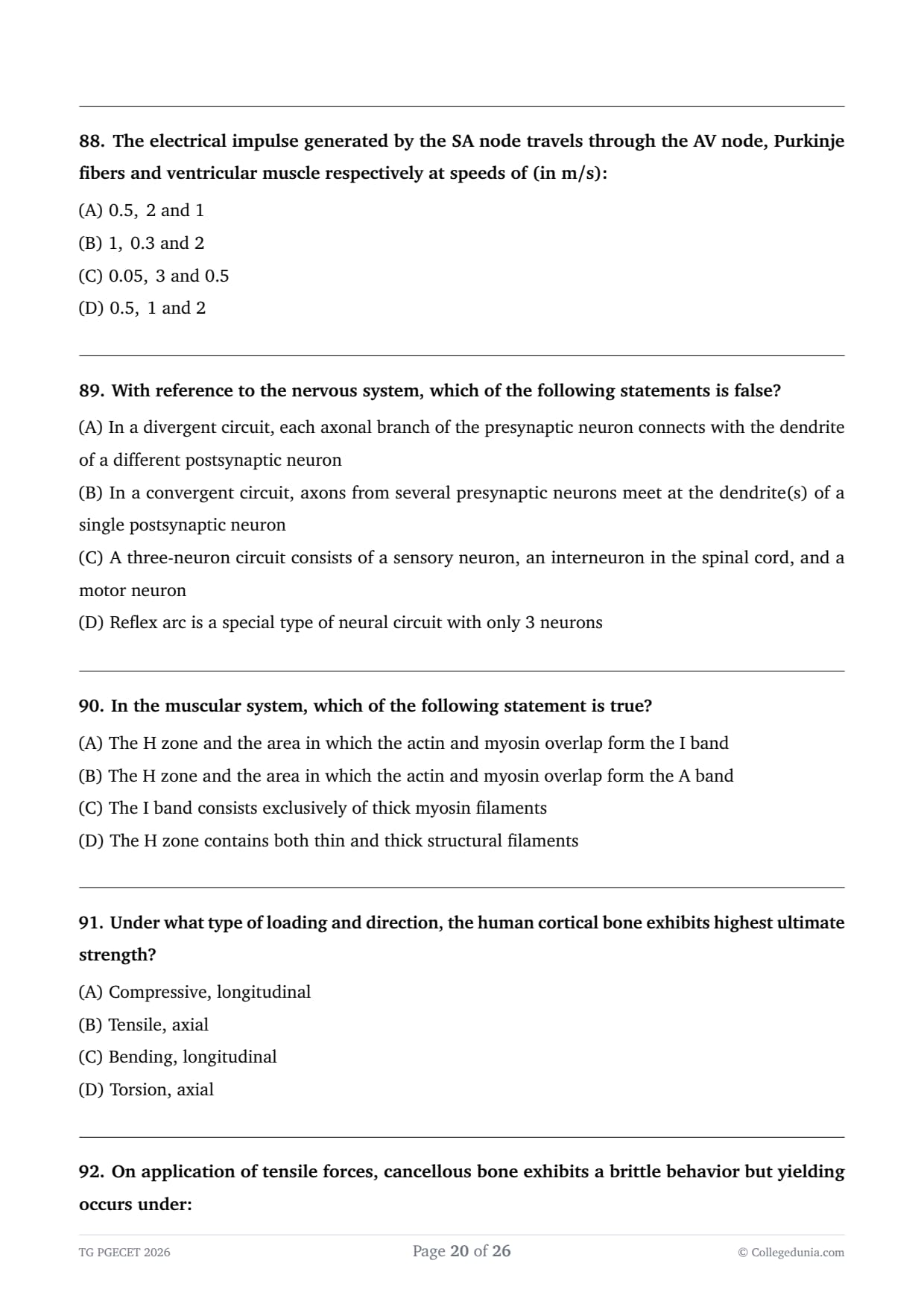
Question 88:
The electrical impulse generated by the SA node travels through the AV node, Purkinje fibers and ventricular muscle respectively at speeds of (in m/s):
- (A) \( 0.5, \ 2 and 1 \)
- (B) \( 1, \ 0.3 and 2 \)
- (C) \( 0.05, \ 3 and 0.5 \)
- (D) \( 0.5, \ 1 and 2 \)
Question 89:
With reference to the nervous system, which of the following statements is false?
- (A) In a divergent circuit, each axonal branch of the presynaptic neuron connects with the dendrite of a different postsynaptic neuron
- (B) In a convergent circuit, axons from several presynaptic neurons meet at the dendrite(s) of a single postsynaptic neuron
- (C) A three-neuron circuit consists of a sensory neuron, an interneuron in the spinal cord, and a motor neuron
- (D) Reflex arc is a special type of neural circuit with only 3 neurons
Question 90:
In the muscular system, which of the following statement is true?
- (A) The H zone and the area in which the actin and myosin overlap form the I band
- (B) The H zone and the area in which the actin and myosin overlap form the A band
- (C) The I band consists exclusively of thick myosin filaments
- (D) The H zone contains both thin and thick structural filaments
Question 91:
Under what type of loading and direction, the human cortical bone exhibits highest ultimate strength?
- (A) Compressive, longitudinal
- (B) Tensile, axial
- (C) Bending, longitudinal
- (D) Torsion, axial
Question 92:
On application of tensile forces, cancellous bone exhibits a brittle behavior but yielding occurs under:
- (A) Longitudinal bending
- (B) Transverse bending
- (C) Compressive loading
- (D) Torsion
Question 93:
In Poiseuille flow, the flow rate is directly proportional to:
- (A) Length of the vessel, pressure, coefficient of viscosity
- (B) Pressure drop, length of the vessel, coefficient of viscosity
- (C) Pressure drop, diameter of the vessel
- (D) Radius of the vessel, coefficient of viscosity
Question 94:
The percentage of body's blood volume that veins hold is:
- (A) \( 40% \)
- (B) \( 60% \)
- (C) \( 50% \)
- (D) \( 30% \)
Question 95:
As their aspect ratio is high, collagen fibers are not effective under:
- (A) Axial tension
- (B) Transverse tension
- (C) Transverse compression
- (D) Axial compression
Question 96:
The ligament connects:
- (A) Two muscles
- (B) Two bones
- (C) Muscle and bone
- (D) Bone and cartilage
Question 97:
Among the viscoelastic models:
- (A) Voigt model behaves as a viscoelastic solid
- (B) Kelvin model behaves as a viscoelastic fluid
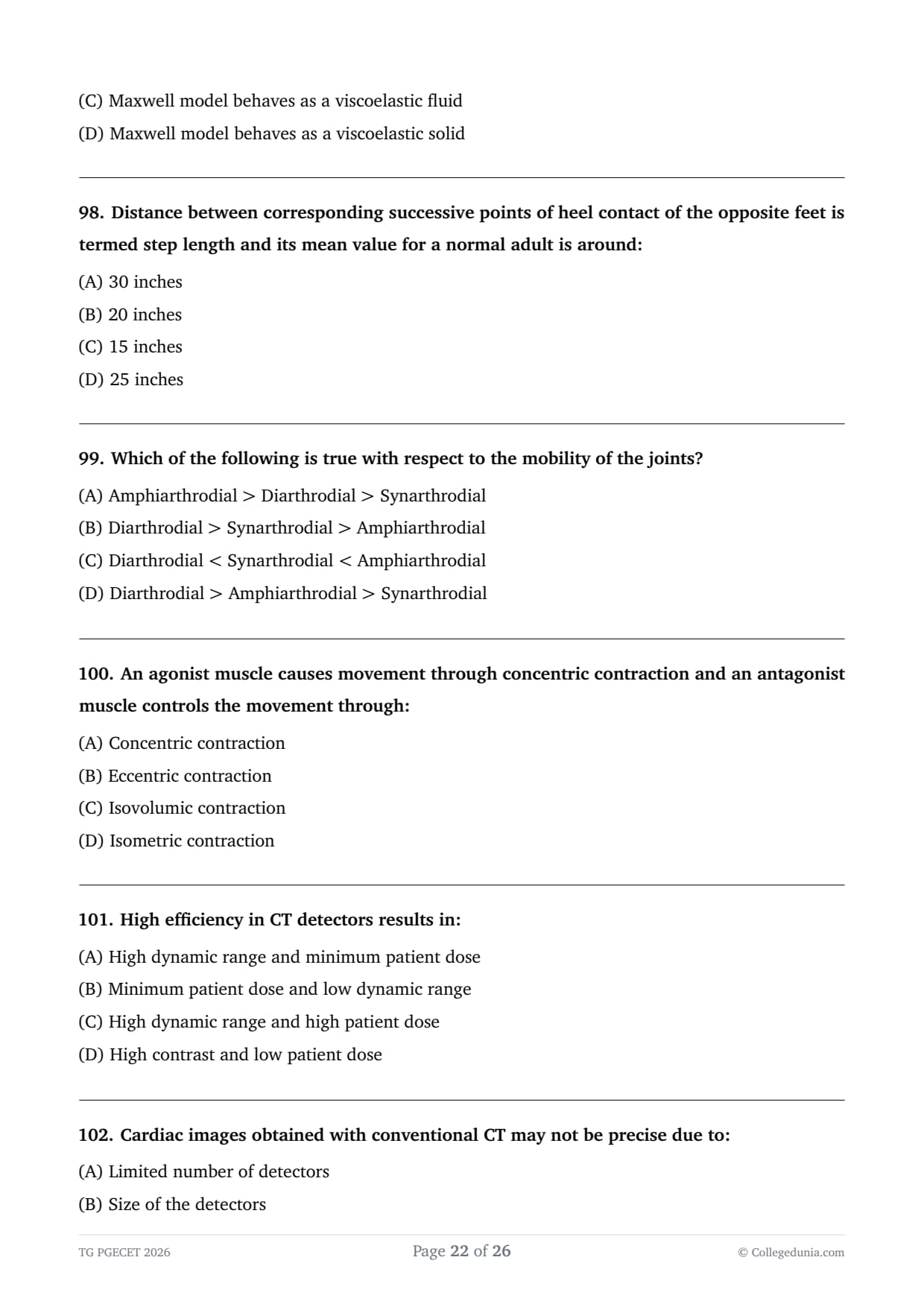
- (C) Maxwell model behaves as a viscoelastic fluid
- (D) Maxwell model behaves as a viscoelastic solid
Question 98:
Distance between corresponding successive points of heel contact of the opposite feet is termed step length and its mean value for a normal adult is around:
- (A) 30 inches
- (B) 20 inches
- (C) 15 inches
- (D) 25 inches
Question 99:
Which of the following is true with respect to the mobility of the joints?
- (A) Amphiarthrodial > Diarthrodial > Synarthrodial
- (B) Diarthrodial > Synarthrodial > Amphiarthrodial
- (C) Diarthrodial < Synarthrodial < Amphiarthrodial
- (D) Diarthrodial > Amphiarthrodial > Synarthrodial
Question 100:
An agonist muscle causes movement through concentric contraction and an antagonist muscle controls the movement through:
- (A) Concentric contraction
- (B) Eccentric contraction
- (C) Isovolumic contraction
- (D) Isometric contraction
Question 101:
High efficiency in CT detectors results in:
- (A) High dynamic range and minimum patient dose
- (B) Minimum patient dose and low dynamic range
- (C) High dynamic range and high patient dose
- (D) High contrast and low patient dose
Question 102:
Cardiac images obtained with conventional CT may not be precise due to:
- (A) Limited number of detectors
- (B) Size of the detectors
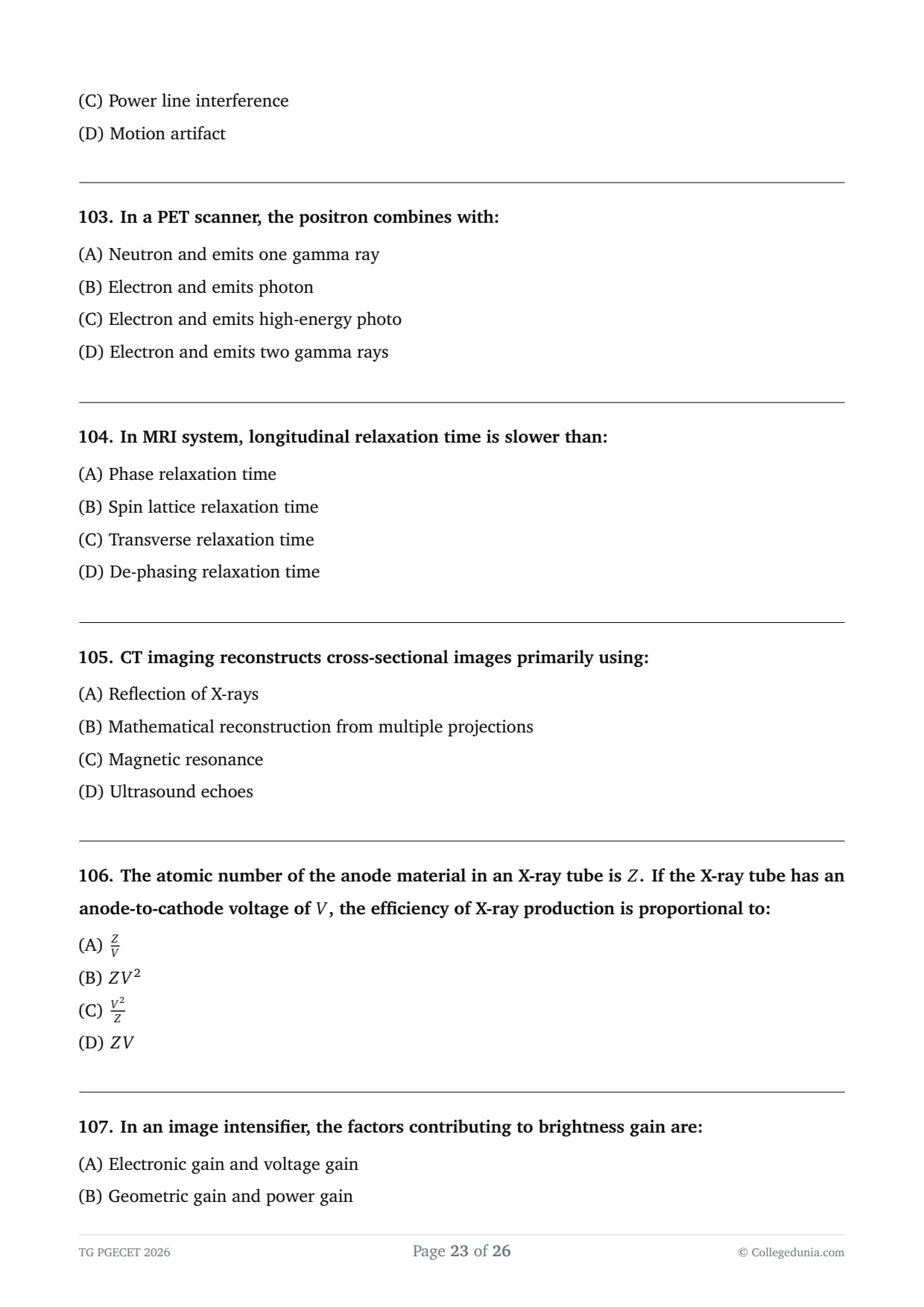
- (C) Power line interference
- (D) Motion artifact
Question 103:
In a PET scanner, the positron combines with:
- (A) Neutron and emits one gamma ray
- (B) Electron and emits photon
- (C) Electron and emits high-energy photo
- (D) Electron and emits two gamma rays
Question 104:
In MRI system, longitudinal relaxation time is slower than:
- (A) Phase relaxation time
- (B) Spin lattice relaxation time
- (C) Transverse relaxation time
- (D) De-phasing relaxation time
Question 105:
CT imaging reconstructs cross-sectional images primarily using:
- (A) Reflection of X-rays
- (B) Mathematical reconstruction from multiple projections
- (C) Magnetic resonance
- (D) Ultrasound echoes
Question 106:
The atomic number of the anode material in an X-ray tube is \( Z \). If the X-ray tube has an anode-to-cathode voltage of \( V \), the efficiency of X-ray production is proportional to:
- (A) \( \frac{Z}{V} \)
- (B) \( ZV^2 \)
- (C) \( \frac{V^2}{Z} \)
- (D) \( ZV \)
Question 107:
In an image intensifier, the factors contributing to brightness gain are:
- (A) Electronic gain and voltage gain
- (B) Geometric gain and power gain
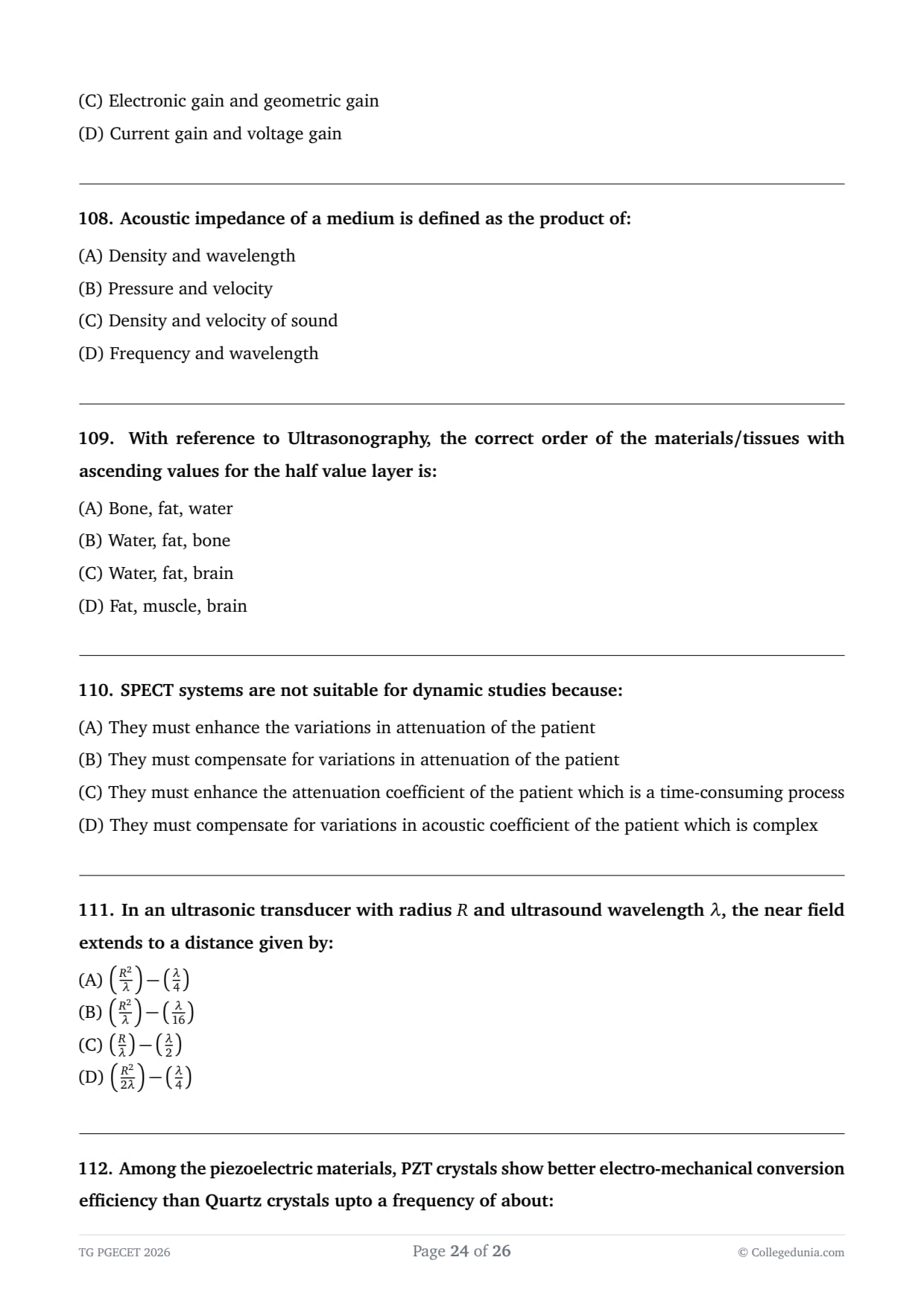
- (C) Electronic gain and geometric gain
- (D) Current gain and voltage gain
Question 108:
Acoustic impedance of a medium is defined as the product of:
- (A) Density and wavelength
- (B) Pressure and velocity
- (C) Density and velocity of sound
- (D) Frequency and wavelength
Question 109:
With reference to Ultrasonography, the correct order of the materials/tissues with ascending values for the half value layer is:
- (A) Bone, fat, water
- (B) Water, fat, bone
- (C) Water, fat, brain
- (D) Fat, muscle, brain
Question 110:
SPECT systems are not suitable for dynamic studies because:
- (A) They must enhance the variations in attenuation of the patient
- (B) They must compensate for variations in attenuation of the patient
- (C) They must enhance the attenuation coefficient of the patient which is a time-consuming process
- (D) They must compensate for variations in acoustic coefficient of the patient which is complex
Question 111:
In an ultrasonic transducer with radius \( R \) and ultrasound wavelength \( \lambda \), the near field extends to a distance given by:
- (A) \( \left(\frac{R^2}{\lambda}\right) - \left(\frac{\lambda}{4}\right) \)
- (B) \( \left(\frac{R^2}{\lambda}\right) - \left(\frac{\lambda}{16}\right) \)
- (C) \( \left(\frac{R}{\lambda}\right) - \left(\frac{\lambda}{2}\right) \)
- (D) \( \left(\frac{R^2}{2\lambda}\right) - \left(\frac{\lambda}{4}\right) \)
Question 112:
Among the piezoelectric materials, PZT crystals show better electro-mechanical conversion efficiency than Quartz crystals upto a frequency of about:
- (A) \( 15 MHz \)
- (B) \( 25 MHz \)
- (C) \( 25 kHz \)
- (D) \( 15 kHz \)
Question 113:
The correct combination of biomaterials and their medical applications are:
- (A) Zirconia - Cochlear replacements, PVC - Intraocular lenses
- (B) Nylon - Artificial heart valves, Zirconia - Cochlear replacements
- (C) Cellulose - Drug delivery, PVC - Facial prostheses
- (D) Gold - Electrodes, PVC - Intraocular lenses
Question 114:
Metals are commonly used as biomaterials mainly because of their:
- (A) High strength and toughness
- (B) High corrosion rate
- (C) Low density
- (D) Optical transparency
Question 115:
Carbonated apatite and brushite are the different atomic phases of calcium phosphate and they are:
- (A) Polymeric biomaterials
- (B) Metallic biomaterials
- (C) Ceramic biomaterials
- (D) Composite biomaterials
Question 116:
For a compound, Agar diffusion test is used to evaluate:
- (A) Mechanical strength
- (B) Thermal conductivity
- (C) Corrosion resistance
- (D) Cytotoxicity
Question 117:
The common characterization technique used to measure Young's modulus of a brittle biomaterial is:
- (A) Compression test
- (B) Dynamic mechanical analysis
- (C) Three- and four-point bend test
- (D) Tensile test
Question 118:
To produce high-resolution images, Transmission Electron Microscope uses a high-energy electron beam of typically:
- (A) \( 5000 - 10000 V \)
- (B) \( 1000 - 300 kV \)
- (C) \( 50 - 80 kV \)
- (D) \( 200 - 1000 kV \)
Question 119:
The capacity of a material to decompose naturally in a biological environment is biodegradability and it is brought by:
- (A) Hormones and enzymes
- (B) Microorganisms and liver
- (C) Hormones and liver
- (D) Microorganisms and enzymes
Question 120:
Which of the following is the first level of biocompatibility testing?
- (A) Secondary test
- (B) In vitro test
- (C) Clinical trial
- (D) In vivo animal model test
TS PGECET 2026 Exam Pattern
| Particulars |
Details |
| Exam Mode |
Computer-Based Test(CBT) |
| Question Type |
Multiple Choice Questions(MCQs) |
| Total Questions |
120 Questions |
| Total Marks |
120 Marks |
| Exam Duration |
2 Hours |
| Marking Scheme |
+1 mark for each correct answer |
| Negative Marking |
No Negative Marking |
| Language of Paper |
English |
TS PGECET 2026 Preparation Strategy













Comments