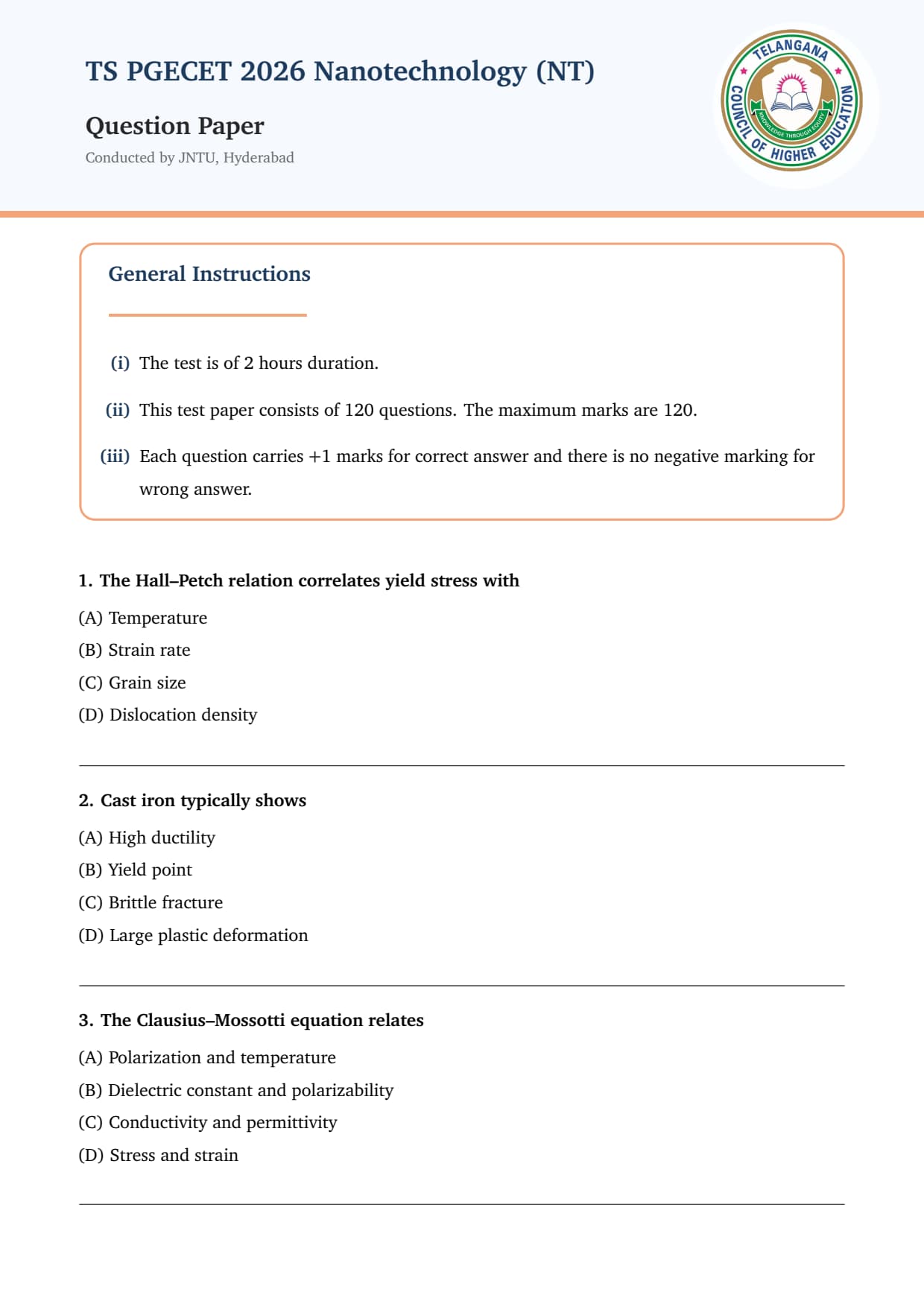
TS PGECET 2026 Nanotechnology (NT) Question Paper is available for download here. JNTU Hyderabad on behalf of Telangana Council of Higher Education (TGCHE) conducted TS PGECET 2026 NT exam on May 31 in Shift 2 from 2 PM to 4 PM. TS PGECET NT Question Paper consists of 120 questions for 120 marks to be attempted in 2 hours.
- TS PGECET NT Question Paper 2026 is divided into 2 sections- Engineering Mathematics with 10 questions and Nanotechnology domain with 110 questions.
- Each questions carries 1 mark each and there is no negative marking for incorrect answers.
Candidates can download TS PGECET 2026 NT Question Paper with Answer Key and Solution PDF from links provided below.
TS PGECET 2026 NT Question Paper with Solution PDF
Question 1:
The Hall–Petch relation correlates yield stress with
- (A) Temperature
- (B) Strain rate
- (C) Grain size
- (D) Dislocation density
Question 2:
Cast iron typically shows
- (A) High ductility
- (B) Yield point
- (C) Brittle fracture
- (D) Large plastic deformation
Question 3:
The Clausius–Mossotti equation relates
- (A) Polarization and temperature
- (B) Dielectric constant and polarizability
- (C) Conductivity and permittivity
- (D) Stress and strain
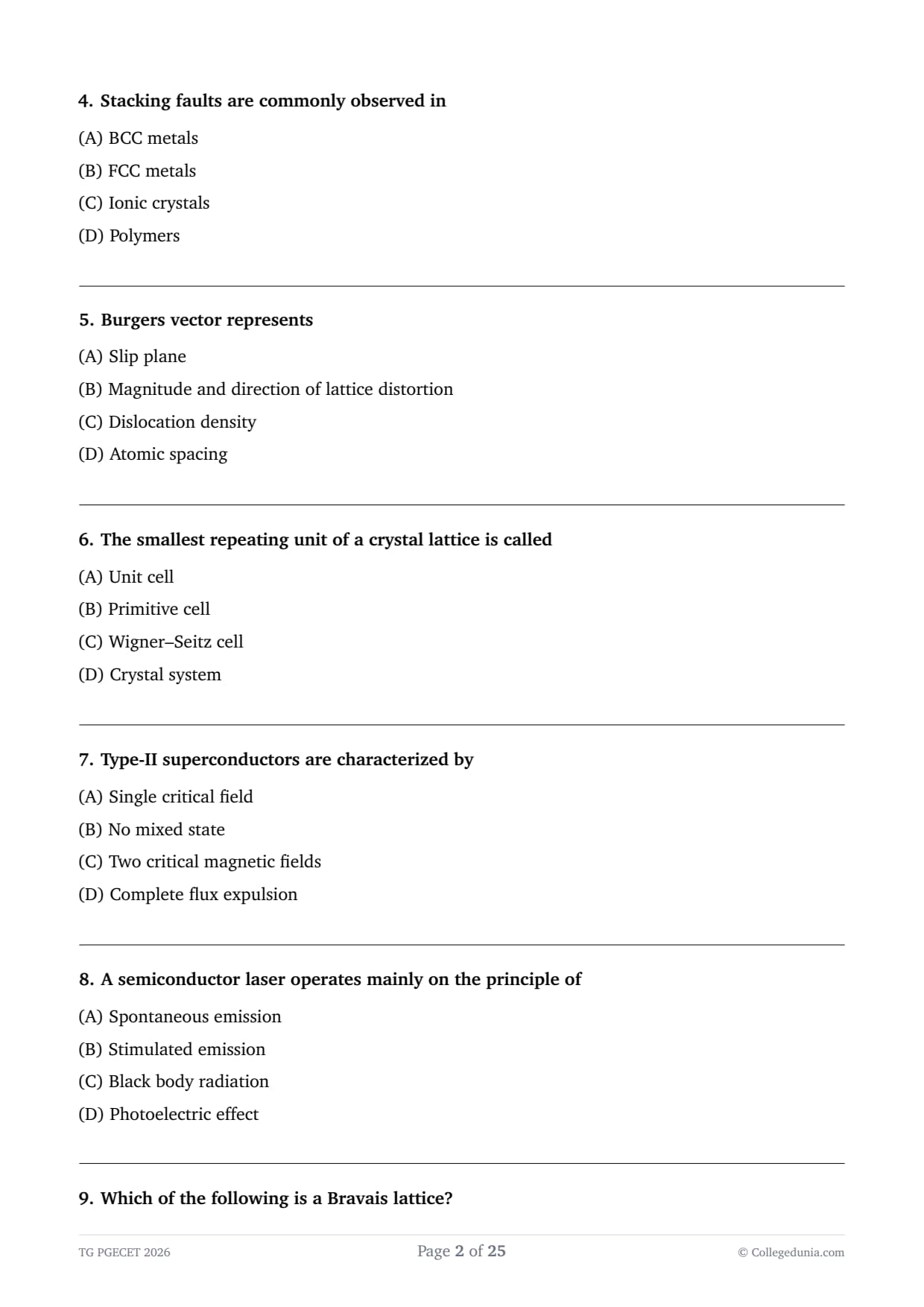
Question 4:
Stacking faults are commonly observed in
- (A) BCC metals
- (B) FCC metals
- (C) Ionic crystals
- (D) Polymers
Question 5:
Burgers vector represents
- (A) Slip plane
- (B) Magnitude and direction of lattice distortion
- (C) Dislocation density
- (D) Atomic spacing
Question 6:
The smallest repeating unit of a crystal lattice is called
- (A) Unit cell
- (B) Primitive cell
- (C) Wigner–Seitz cell
- (D) Crystal system
Question 7:
Type-II superconductors are characterized by
- (A) Single critical field
- (B) No mixed state
- (C) Two critical magnetic fields
- (D) Complete flux expulsion
Question 8:
A semiconductor laser operates mainly on the principle of
- (A) Spontaneous emission
- (B) Stimulated emission
- (C) Black body radiation
- (D) Photoelectric effect
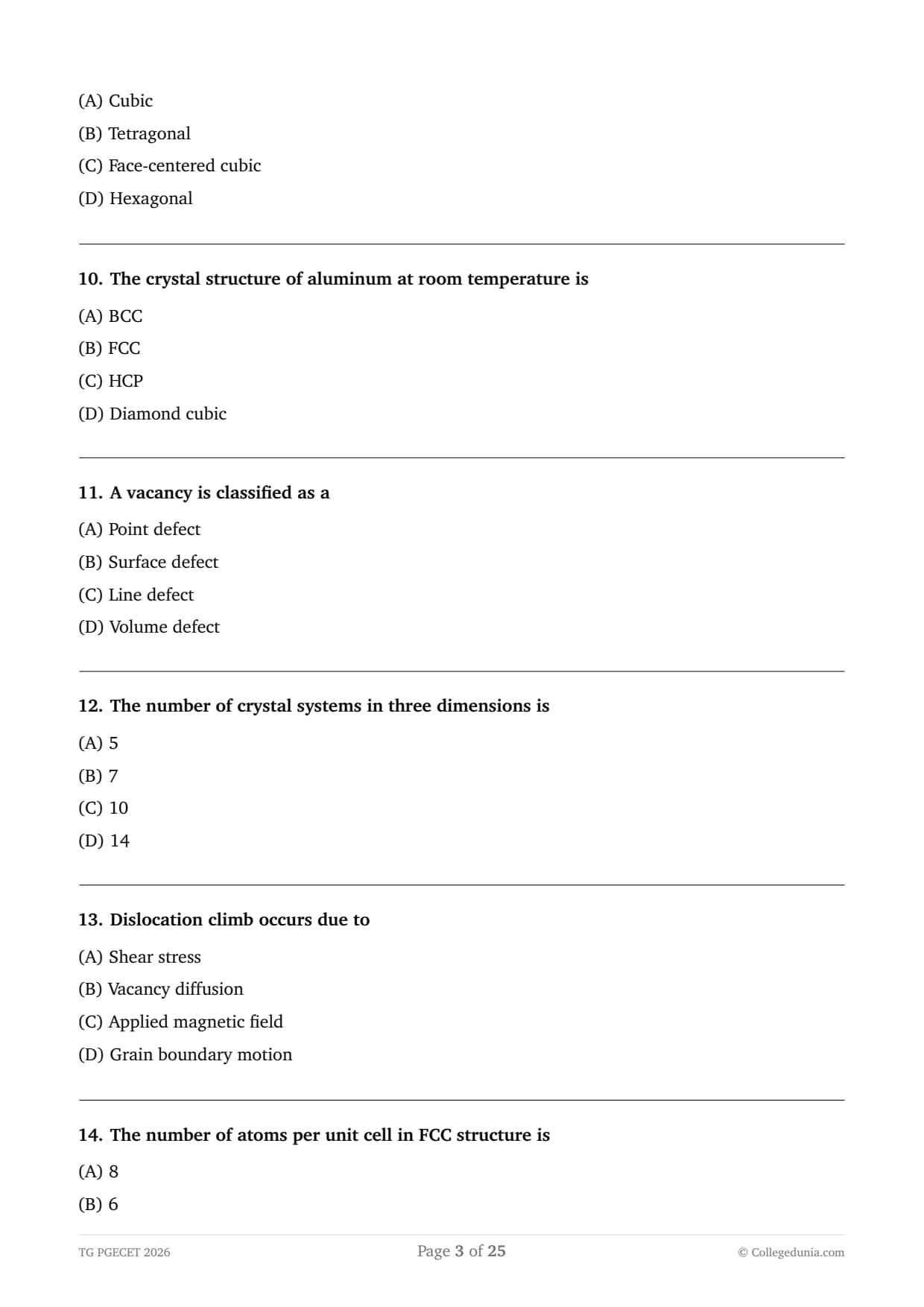
Question 9:
Which of the following is a Bravais lattice?
- (A) Cubic
- (B) Tetragonal
- (C) Face-centered cubic
- (D) Hexagonal
Question 10:
The crystal structure of aluminum at room temperature is
- (A) BCC
- (B) FCC
- (C) HCP
- (D) Diamond cubic
Question 11:
A vacancy is classified as a
- (A) Point defect
- (B) Surface defect
- (C) Line defect
- (D) Volume defect
Question 12:
The number of crystal systems in three dimensions is
- (A) 5
- (B) 7
- (C) 10
- (D) 14
Question 13:
Dislocation climb occurs due to
- (A) Shear stress
- (B) Vacancy diffusion
- (C) Applied magnetic field
- (D) Grain boundary motion
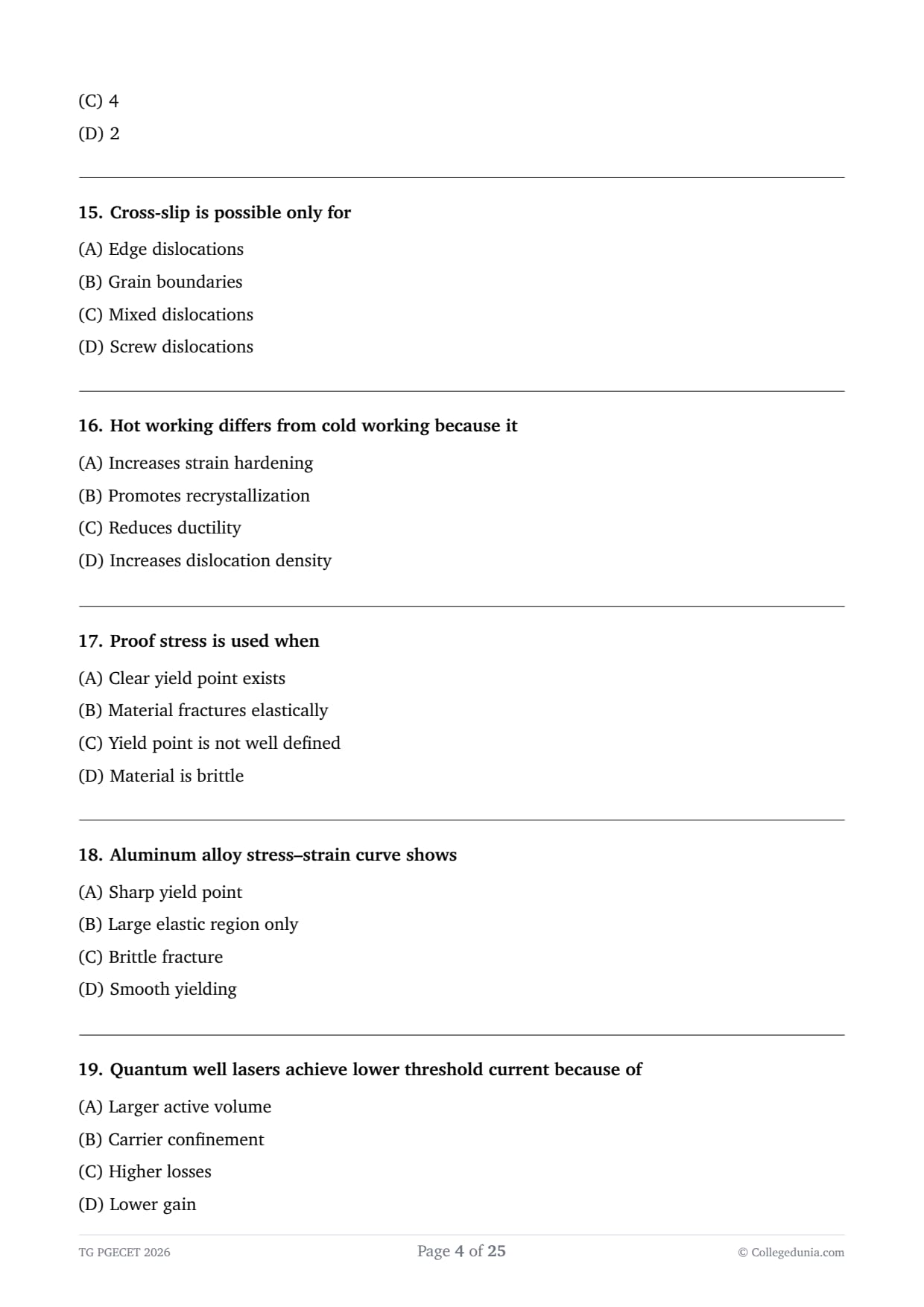
Question 14:
The number of atoms per unit cell in FCC structure is
Question 15:
Cross-slip is possible only for
- (A) Edge dislocations
- (B) Grain boundaries
- (C) Mixed dislocations
- (D) Screw dislocations
Question 16:
Hot working differs from cold working because it
- (A) Increases strain hardening
- (B) Promotes recrystallization
- (C) Reduces ductility
- (D) Increases dislocation density
Question 17:
Proof stress is used when
- (A) Clear yield point exists
- (B) Material fractures elastically
- (C) Yield point is not well defined
- (D) Material is brittle
Question 18:
Aluminum alloy stress–strain curve shows
- (A) Sharp yield point
- (B) Large elastic region only
- (C) Brittle fracture
- (D) Smooth yielding
Question 19:
Quantum well lasers achieve lower threshold current because of
- (A) Larger active volume
- (B) Carrier confinement
- (C) Higher losses
- (D) Lower gain
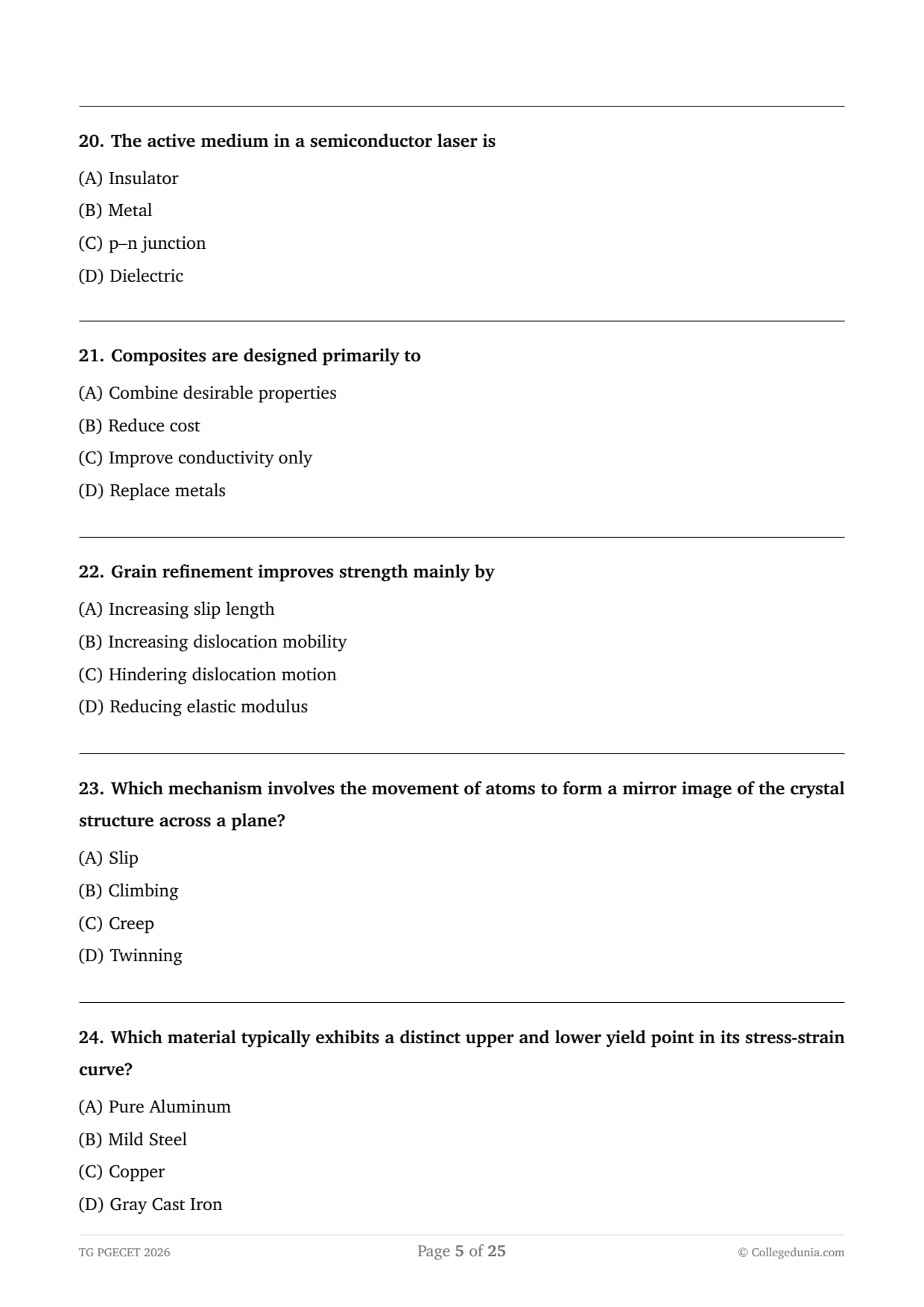
Question 20:
The active medium in a semiconductor laser is
- (A) Insulator
- (B) Metal
- (C) p–n junction
- (D) Dielectric
Question 21:
Composites are designed primarily to
- (A) Combine desirable properties
- (B) Reduce cost
- (C) Improve conductivity only
- (D) Replace metals
Question 22:
Grain refinement improves strength mainly by
- (A) Increasing slip length
- (B) Increasing dislocation mobility
- (C) Hindering dislocation motion
- (D) Reducing elastic modulus
Question 23:
Which mechanism involves the movement of atoms to form a mirror image of the crystal structure across a plane?
- (A) Slip
- (B) Climbing
- (C) Creep
- (D) Twinning
Question 24:
Which material typically exhibits a distinct upper and lower yield point in its stress-strain curve?
- (A) Pure Aluminum
- (B) Mild Steel
- (C) Copper
- (D) Gray Cast Iron
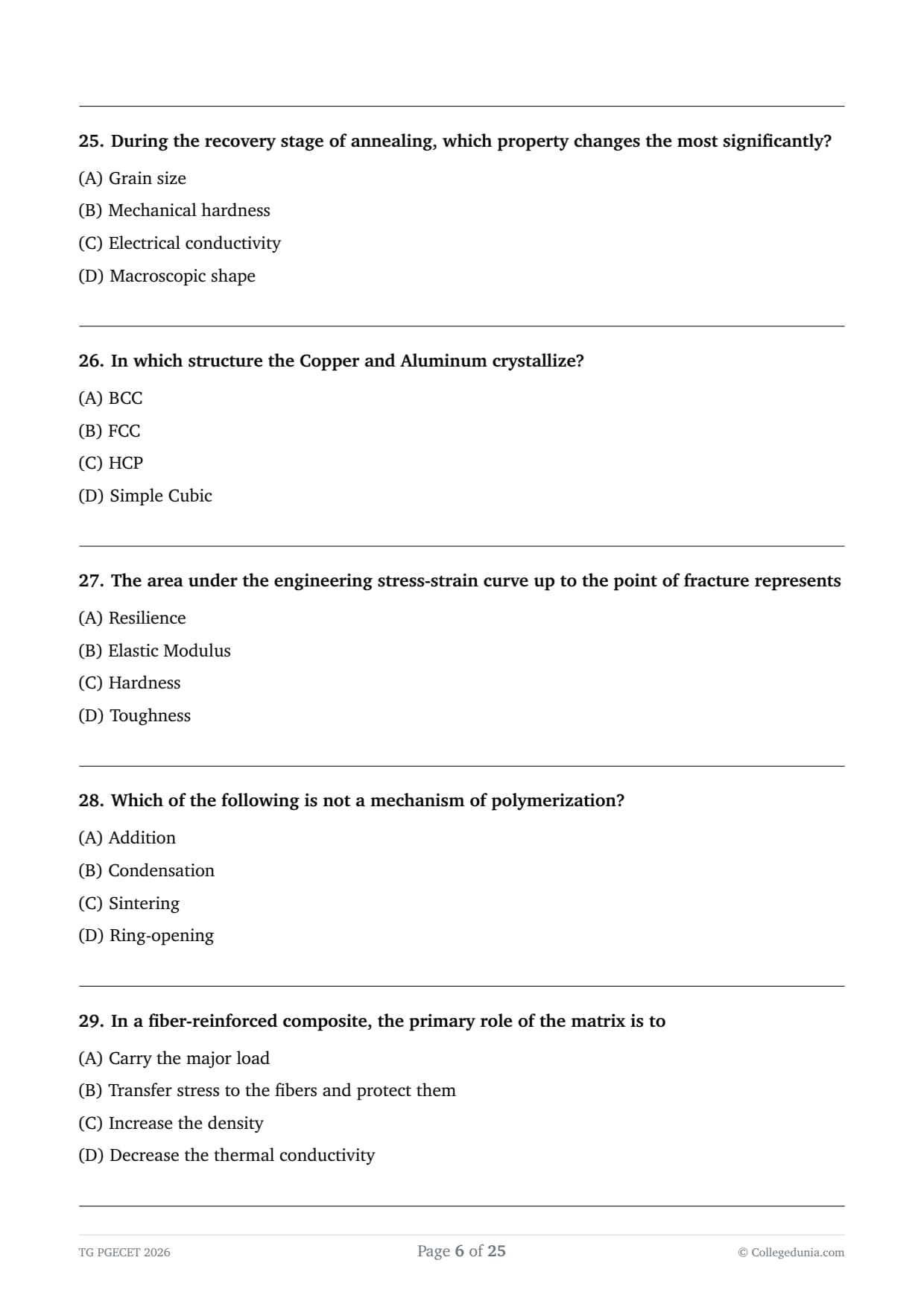
Question 25:
During the recovery stage of annealing, which property changes the most significantly?
- (A) Grain size
- (B) Mechanical hardness
- (C) Electrical conductivity
- (D) Macroscopic shape
Question 26:
In which structure the Copper and Aluminum crystallize?
- (A) BCC
- (B) FCC
- (C) HCP
- (D) Simple Cubic
Question 27:
The area under the engineering stress-strain curve up to the point of fracture represents
- (A) Resilience
- (B) Elastic Modulus
- (C) Hardness
- (D) Toughness
Question 28:
Which of the following is not a mechanism of polymerization?
- (A) Addition
- (B) Condensation
- (C) Sintering
- (D) Ring-opening
Question 29:
In a fiber-reinforced composite, the primary role of the matrix is to
- (A) Carry the major load
- (B) Transfer stress to the fibers and protect them
- (C) Increase the density
- (D) Decrease the thermal conductivity
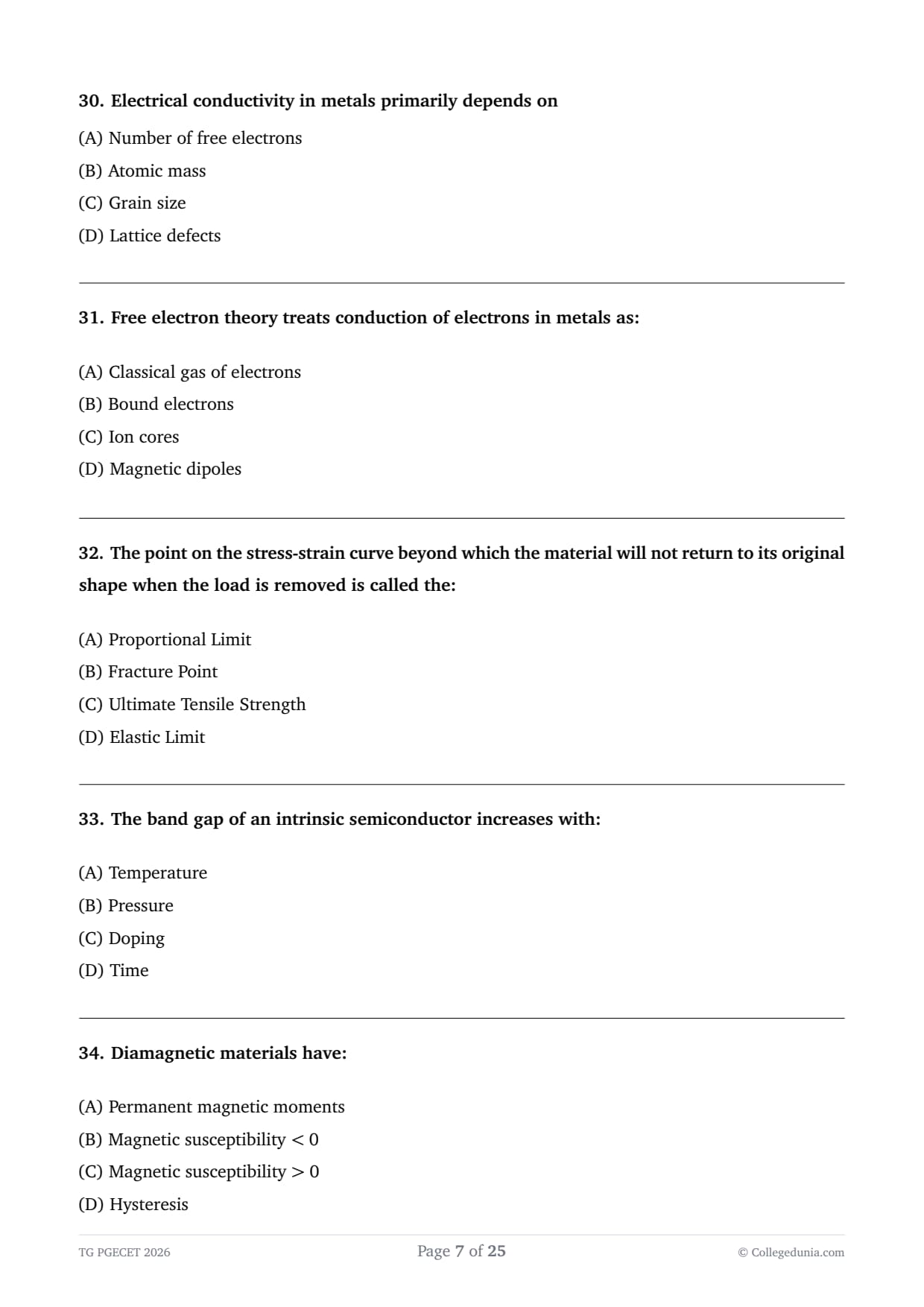
Question 30:
Electrical conductivity in metals primarily depends on
- (A) Number of free electrons
- (B) Atomic mass
- (C) Grain size
- (D) Lattice defects
Question 31:
Free electron theory treats conduction of electrons in metals as:
- (A) Classical gas of electrons
- (B) Bound electrons
- (C) Ion cores
- (D) Magnetic dipoles
Question 32:
The point on the stress-strain curve beyond which the material will not return to its original shape when the load is removed is called the:
- (A) Proportional Limit
- (B) Fracture Point
- (C) Ultimate Tensile Strength
- (D) Elastic Limit
Question 33:
The band gap of an intrinsic semiconductor increases with:
- (A) Temperature
- (B) Pressure
- (C) Doping
- (D) Time
Question 34:
Diamagnetic materials have:
- (A) Permanent magnetic moments
- (B) Magnetic susceptibility \(< 0\)
- (C) Magnetic susceptibility \(> 0\)
- (D) Hysteresis
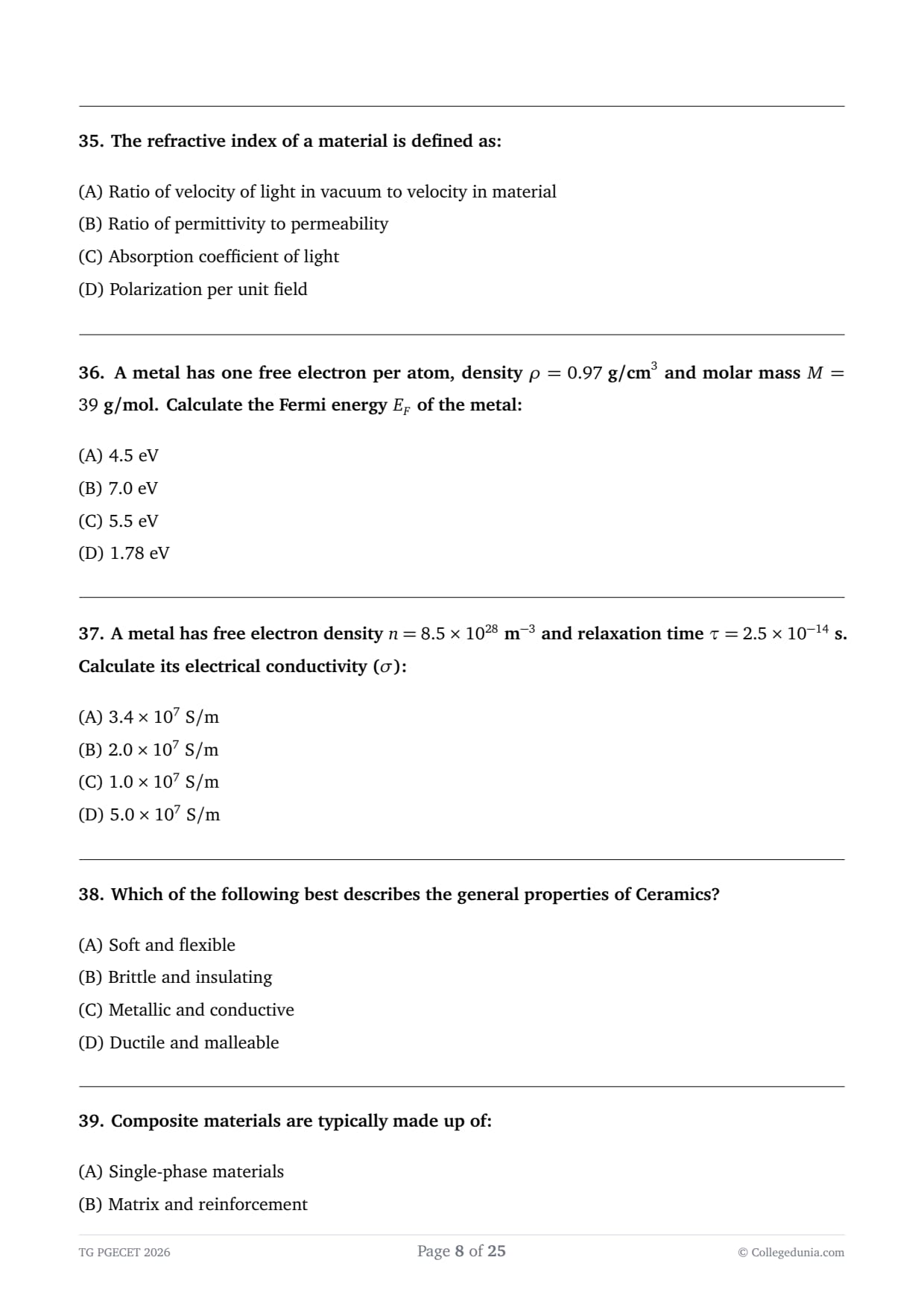
Question 35:
The refractive index of a material is defined as:
- (A) Ratio of velocity of light in vacuum to velocity in material
- (B) Ratio of permittivity to permeability
- (C) Absorption coefficient of light
- (D) Polarization per unit field
Question 36:
A metal has one free electron per atom, density \(\rho = 0.97 g/cm^3\) and molar mass \(M = 39 g/mol\). Calculate the Fermi energy \(E_F\) of the metal:
- (A) \(4.5 eV\)
- (B) \(7.0 eV\)
- (C) \(5.5 eV\)
- (D) \(1.78 eV\)
Question 37:
A metal has free electron density \(n = 8.5 \times 10^{28} m^{-3}\) and relaxation time \(\tau = 2.5 \times 10^{-14} s\). Calculate its electrical conductivity (\(\sigma\)):
- (A) \(3.4 \times 10^7 S/m\)
- (B) \(2.0 \times 10^7 S/m\)
- (C) \(1.0 \times 10^7 S/m\)
- (D) \(5.0 \times 10^7 S/m\)
Question 38:
Which of the following best describes the general properties of Ceramics?
- (A) Soft and flexible
- (B) Brittle and insulating
- (C) Metallic and conductive
- (D) Ductile and malleable
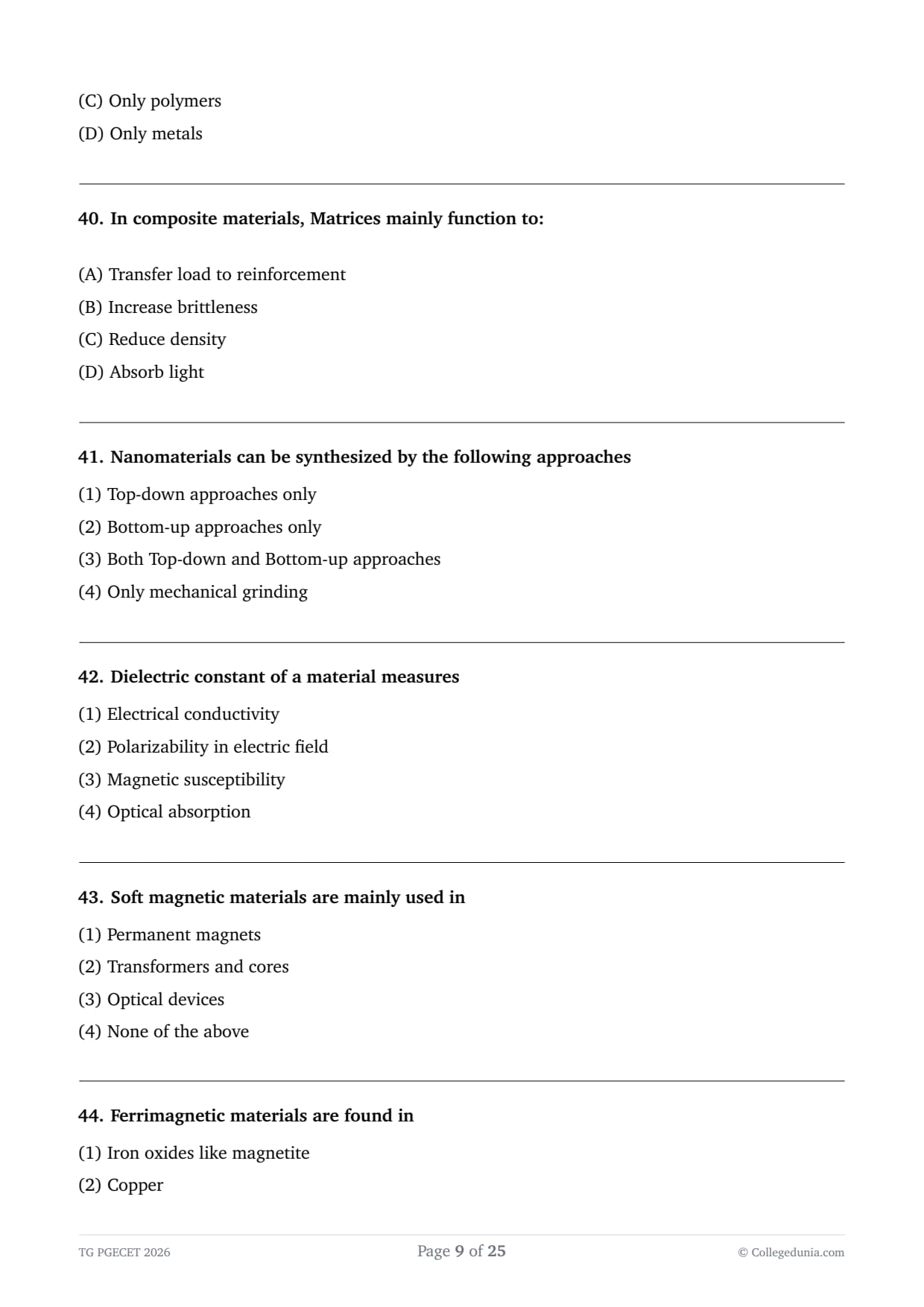
Question 39:
Composite materials are typically made up of:
- (A) Single-phase materials
- (B) Matrix and reinforcement
- (C) Only polymers
- (D) Only metals
Question 40:
In composite materials, Matrices mainly function to:
- (A) Transfer load to reinforcement
- (B) Increase brittleness
- (C) Reduce density
- (D) Absorb light
Question 41:
Nanomaterials can be synthesized by the following approaches
- (1) \( Top-down approaches only \)
- (2) \( Bottom-up approaches only \)
- (3) \( Both Top-down and Bottom-up approaches \)
- (4) \( Only mechanical grinding \)
Question 42:
Dielectric constant of a material measures
- (1) \( Electrical conductivity \)
- (2) \( Polarizability in electric field \)
- (3) \( Magnetic susceptibility \)
- (4) \( Optical absorption \)
Question 43:
Soft magnetic materials are mainly used in
- (1) \( Permanent magnets \)
- (2) \( Transformers and cores \)
- (3) \( Optical devices \)
- (4) \( None of the above \)
Question 44:
Ferrimagnetic materials are found in
- (1) \( Iron oxides like magnetite \)
- (2) \( Copper \)
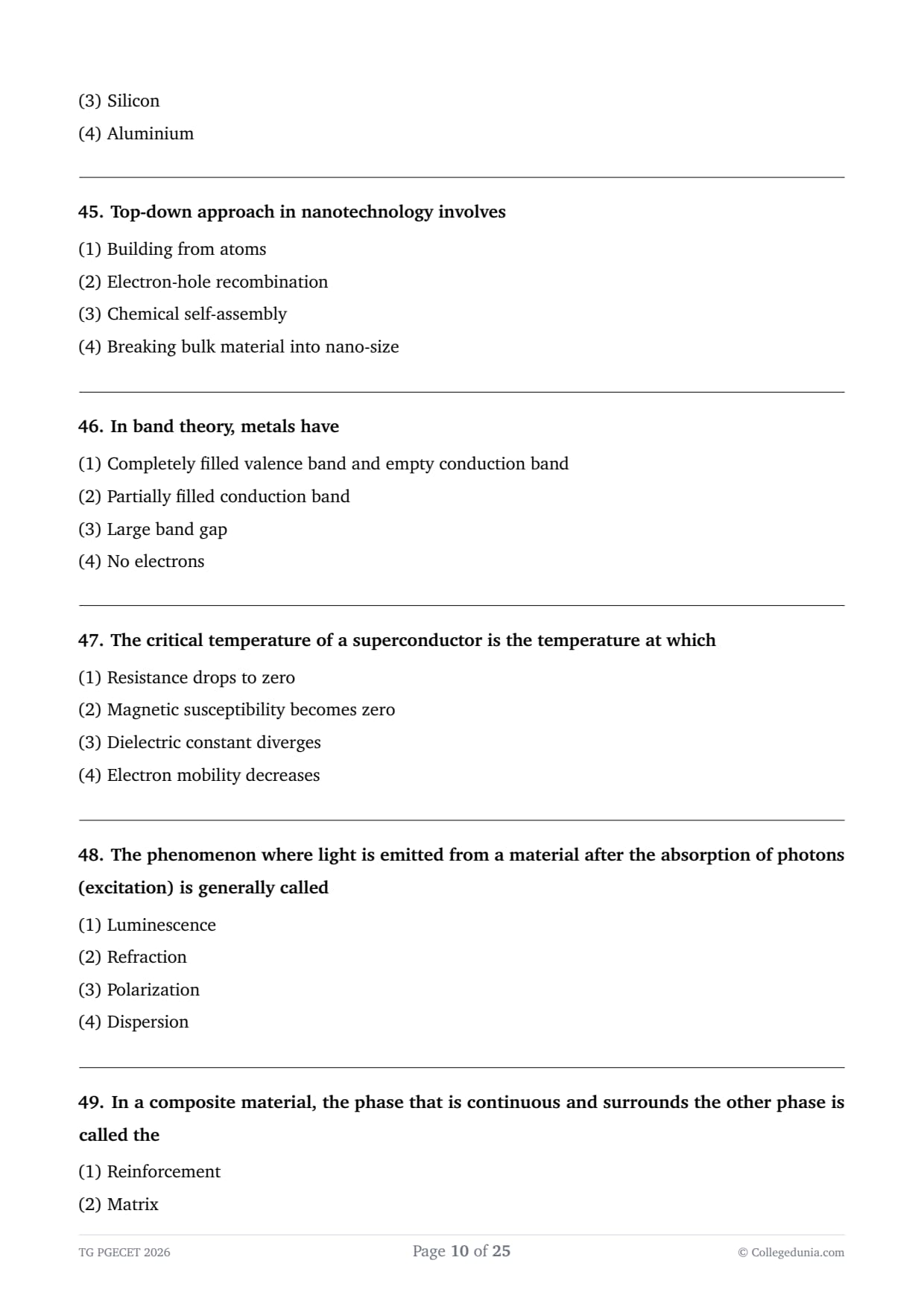
- (3) \( Silicon \)
- (4) \( Aluminium \)
Question 45:
Top-down approach in nanotechnology involves
- (1) \( Building from atoms \)
- (2) \( Electron-hole recombination \)
- (3) \( Chemical self-assembly \)
- (4) \( Breaking bulk material into nano-size \)
Question 46:
In band theory, metals have
- (1) \( Completely filled valence band and empty conduction band \)
- (2) \( Partially filled conduction band \)
- (3) \( Large band gap \)
- (4) \( No electrons \)
Question 47:
The critical temperature of a superconductor is the temperature at which
- (1) \( Resistance drops to zero \)
- (2) \( Magnetic susceptibility becomes zero \)
- (3) \( Dielectric constant diverges \)
- (4) \( Electron mobility decreases \)
Question 48:
The phenomenon where light is emitted from a material after the absorption of photons (excitation) is generally called
- (1) \( Luminescence \)
- (2) \( Refraction \)
- (3) \( Polarization \)
- (4) \( Dispersion \)
Question 49:
In a composite material, the phase that is continuous and surrounds the other phase is called the
- (1) \( Reinforcement \)
- (2) \( Matrix \)
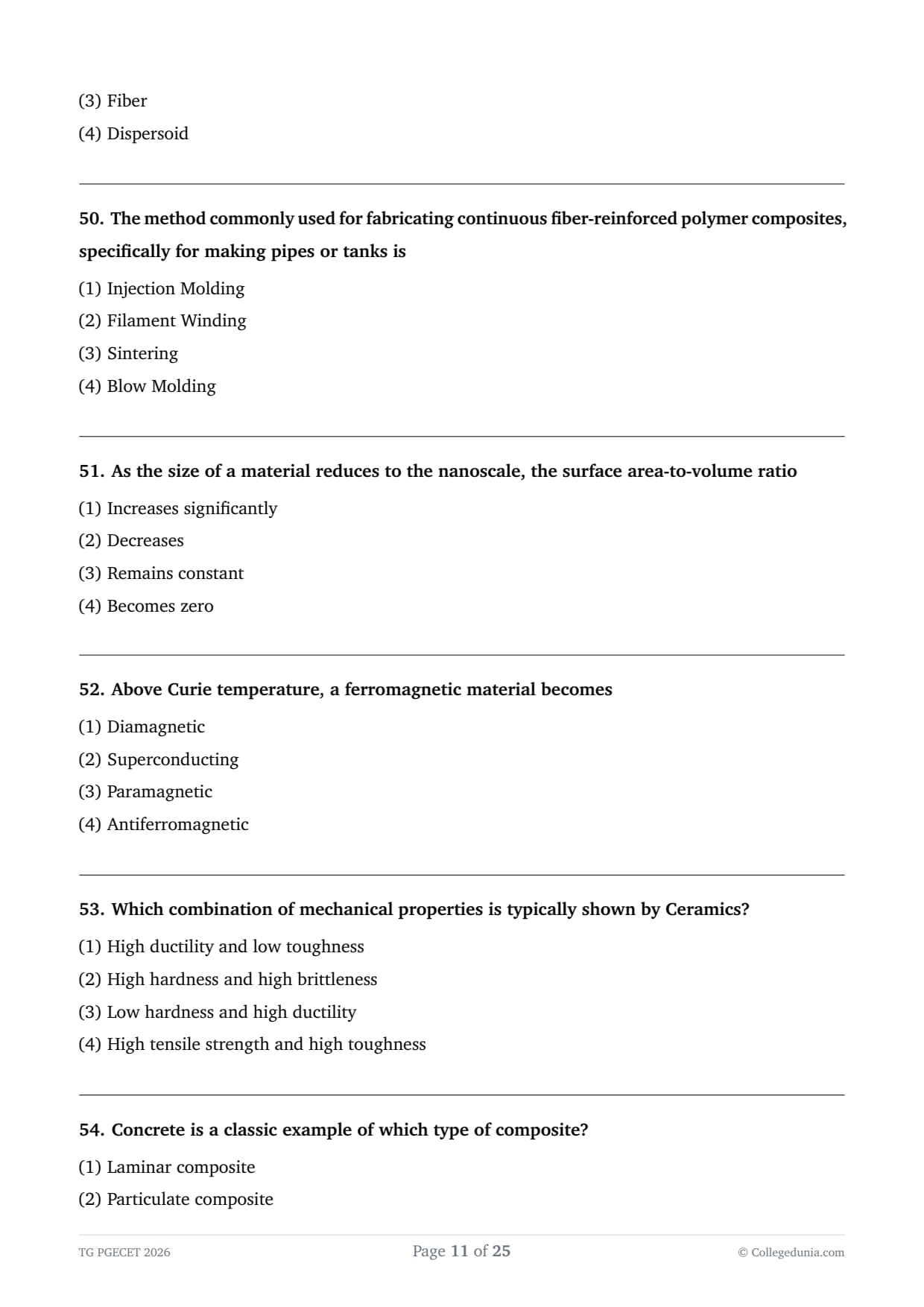
- (3) \( Fiber \)
- (4) \( Dispersoid \)
Question 50:
The method commonly used for fabricating continuous fiber-reinforced polymer composites, specifically for making pipes or tanks is
- (1) \( Injection Molding \)
- (2) \( Filament Winding \)
- (3) \( Sintering \)
- (4) \( Blow Molding \)
Question 51:
As the size of a material reduces to the nanoscale, the surface area-to-volume ratio
- (1) \( Increases significantly \)
- (2) \( Decreases \)
- (3) \( Remains constant \)
- (4) \( Becomes zero \)
Question 52:
Above Curie temperature, a ferromagnetic material becomes
- (1) \( Diamagnetic \)
- (2) \( Superconducting \)
- (3) \( Paramagnetic \)
- (4) \( Antiferromagnetic \)
Question 53:
Which combination of mechanical properties is typically shown by Ceramics?
- (1) \( High ductility and low toughness \)
- (2) \( High hardness and high brittleness \)
- (3) \( Low hardness and high ductility \)
- (4) \( High tensile strength and high toughness \)
Question 54:
Concrete is a classic example of which type of composite?
- (1) \( Laminar composite \)
- (2) \( Particulate composite \)
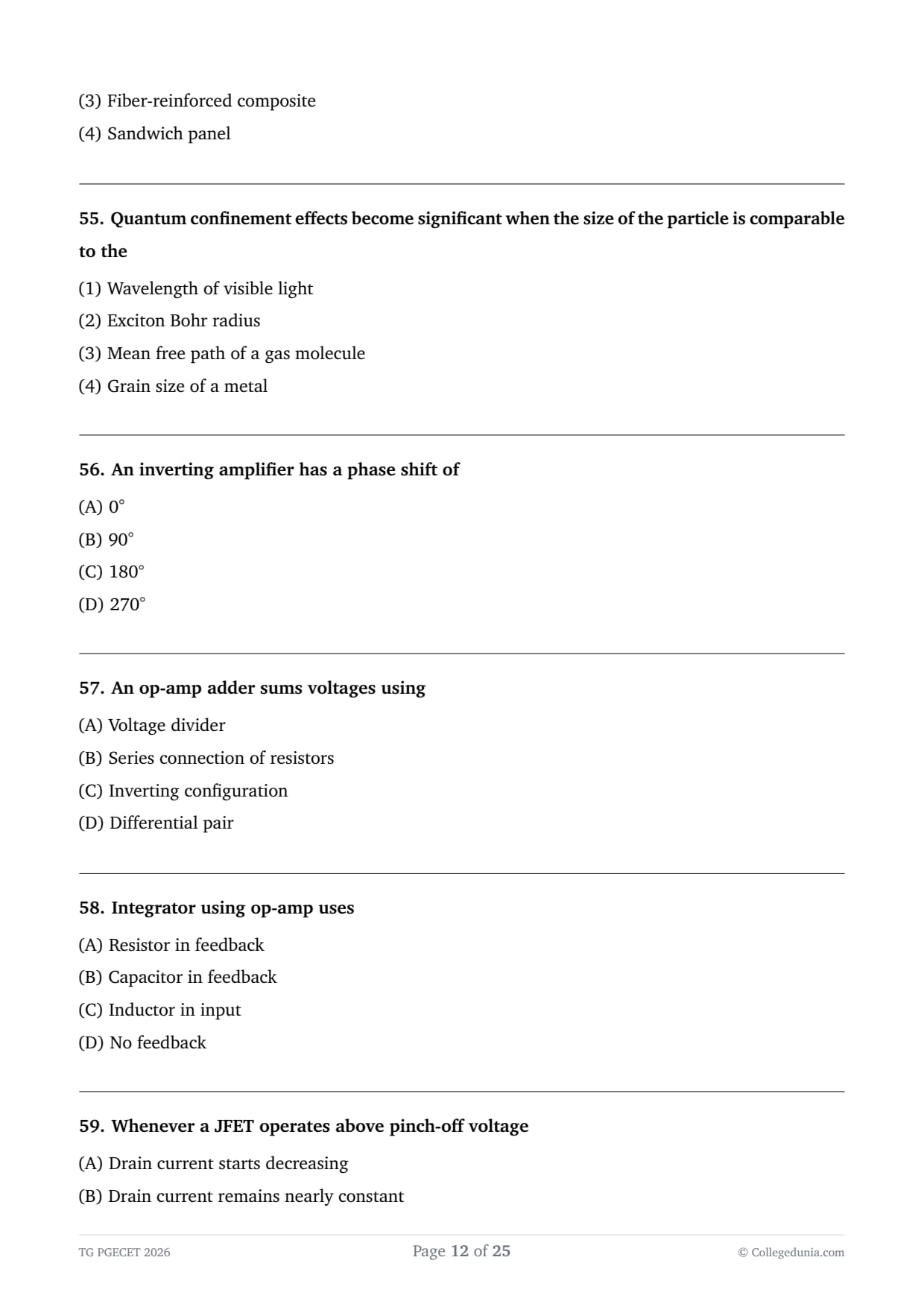
- (3) \( Fiber-reinforced composite \)
- (4) \( Sandwich panel \)
Question 55:
Quantum confinement effects become significant when the size of the particle is comparable to the
- (1) \( Wavelength of visible light \)
- (2) \( Exciton Bohr radius \)
- (3) \( Mean free path of a gas molecule \)
- (4) \( Grain size of a metal \)
Question 56:
An inverting amplifier has a phase shift of
- (A) \(0^\circ\)
- (B) \(90^\circ\)
- (C) \(180^\circ\)
- (D) \(270^\circ\)
Question 57:
An op-amp adder sums voltages using
- (A) Voltage divider
- (B) Series connection of resistors
- (C) Inverting configuration
- (D) Differential pair
Question 58:
Integrator using op-amp uses
- (A) Resistor in feedback
- (B) Capacitor in feedback
- (C) Inductor in input
- (D) No feedback
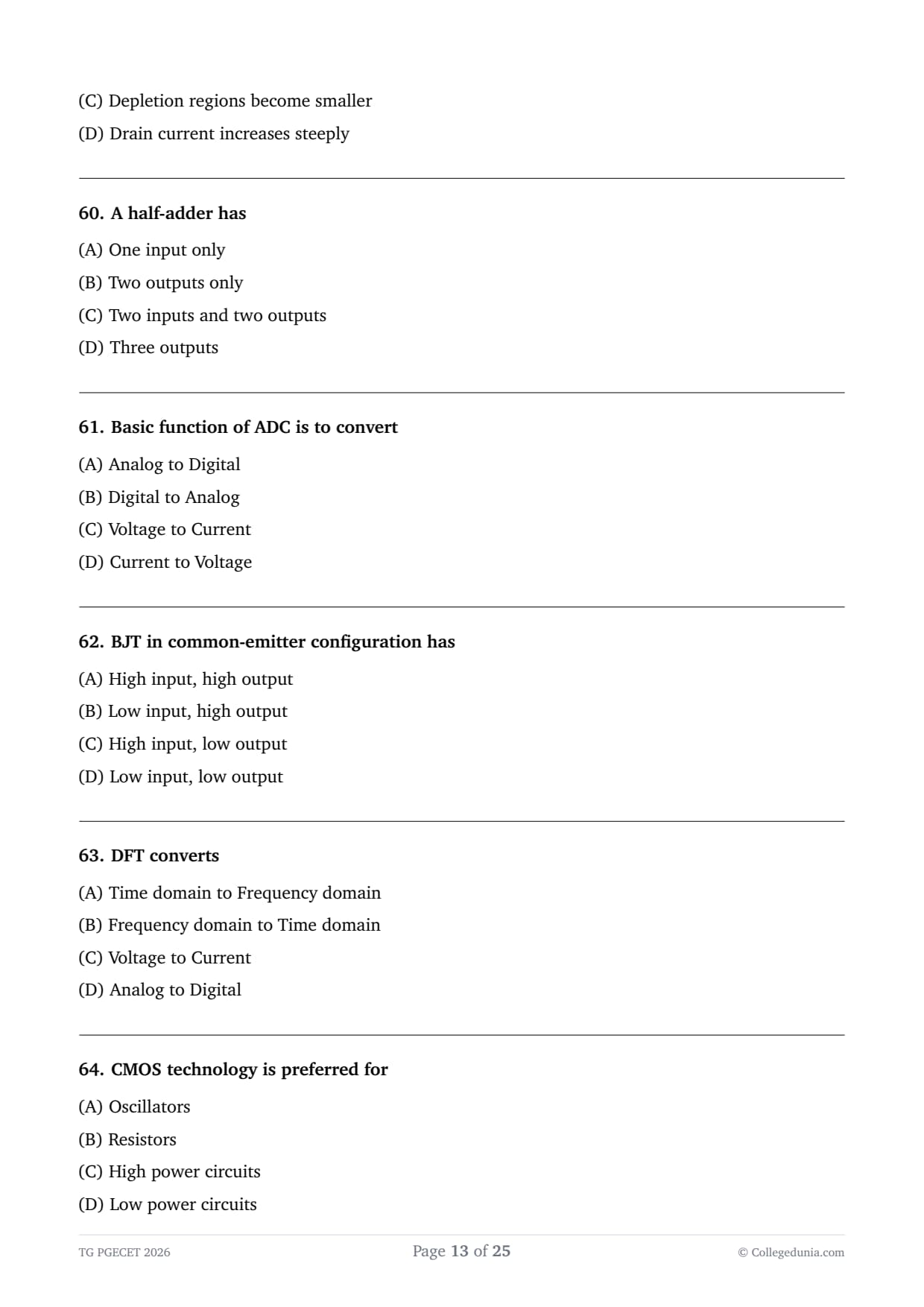
Question 59:
Whenever a JFET operates above pinch-off voltage
- (A) Drain current starts decreasing
- (B) Drain current remains nearly constant
- (C) Depletion regions become smaller
- (D) Drain current increases steeply
Question 60:
A half-adder has
- (A) One input only
- (B) Two outputs only
- (C) Two inputs and two outputs
- (D) Three outputs
Question 61:
Basic function of ADC is to convert
- (A) Analog to Digital
- (B) Digital to Analog
- (C) Voltage to Current
- (D) Current to Voltage
Question 62:
BJT in common-emitter configuration has
- (A) High input, high output
- (B) Low input, high output
- (C) High input, low output
- (D) Low input, low output
Question 63:
DFT converts
- (A) Time domain to Frequency domain
- (B) Frequency domain to Time domain
- (C) Voltage to Current
- (D) Analog to Digital
Question 64:
CMOS technology is preferred for
- (A) Oscillators
- (B) Resistors
- (C) High power circuits
- (D) Low power circuits
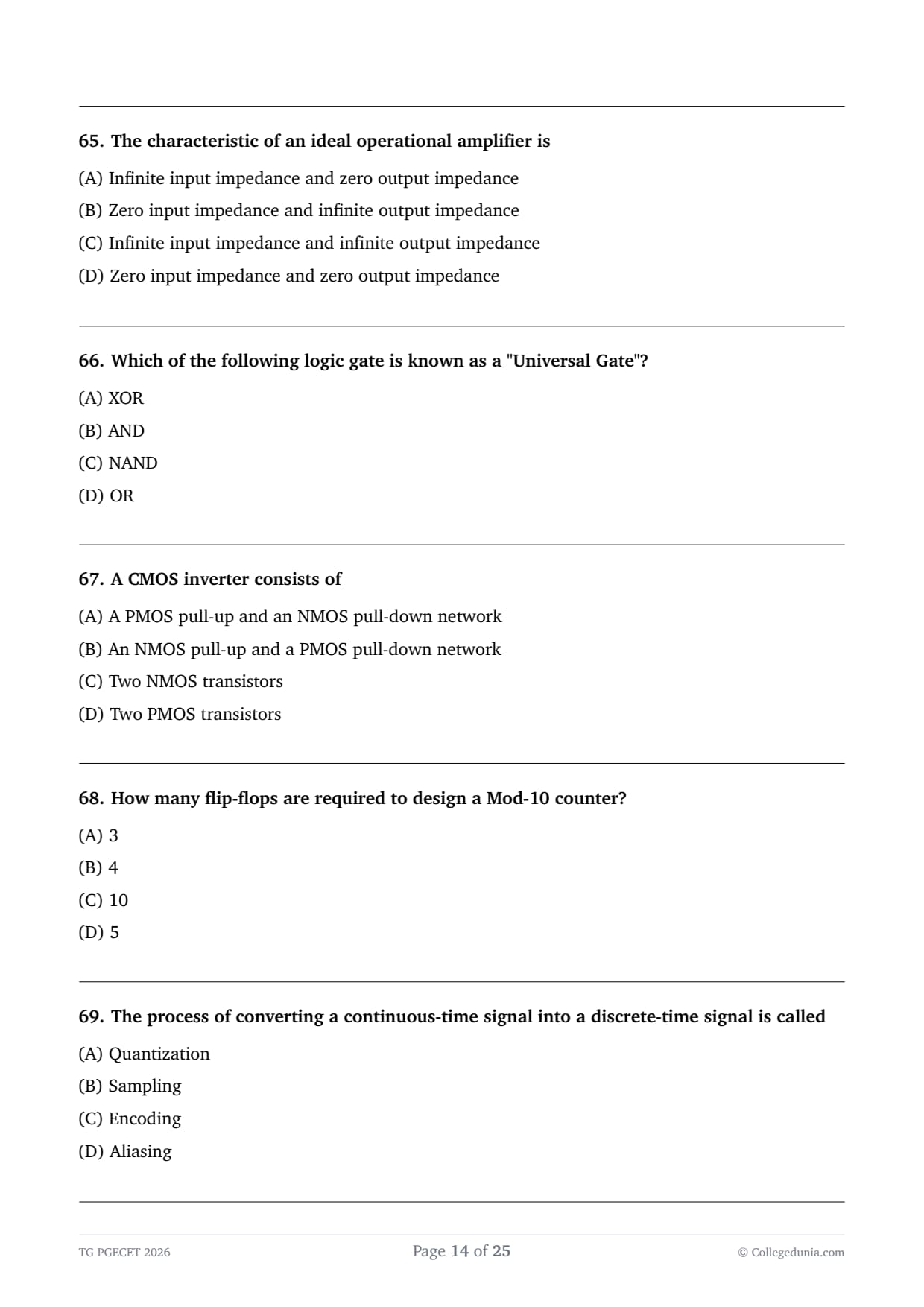
Question 65:
The characteristic of an ideal operational amplifier is
- (A) Infinite input impedance and zero output impedance
- (B) Zero input impedance and infinite output impedance
- (C) Infinite input impedance and infinite output impedance
- (D) Zero input impedance and zero output impedance
Question 66:
Which of the following logic gate is known as a "Universal Gate"?
- (A) XOR
- (B) AND
- (C) NAND
- (D) OR
Question 67:
A CMOS inverter consists of
- (A) A PMOS pull-up and an NMOS pull-down network
- (B) An NMOS pull-up and a PMOS pull-down network
- (C) Two NMOS transistors
- (D) Two PMOS transistors
Question 68:
How many flip-flops are required to design a Mod-10 counter?
Question 69:
The process of converting a continuous-time signal into a discrete-time signal is called
- (A) Quantization
- (B) Sampling
- (C) Encoding
- (D) Aliasing
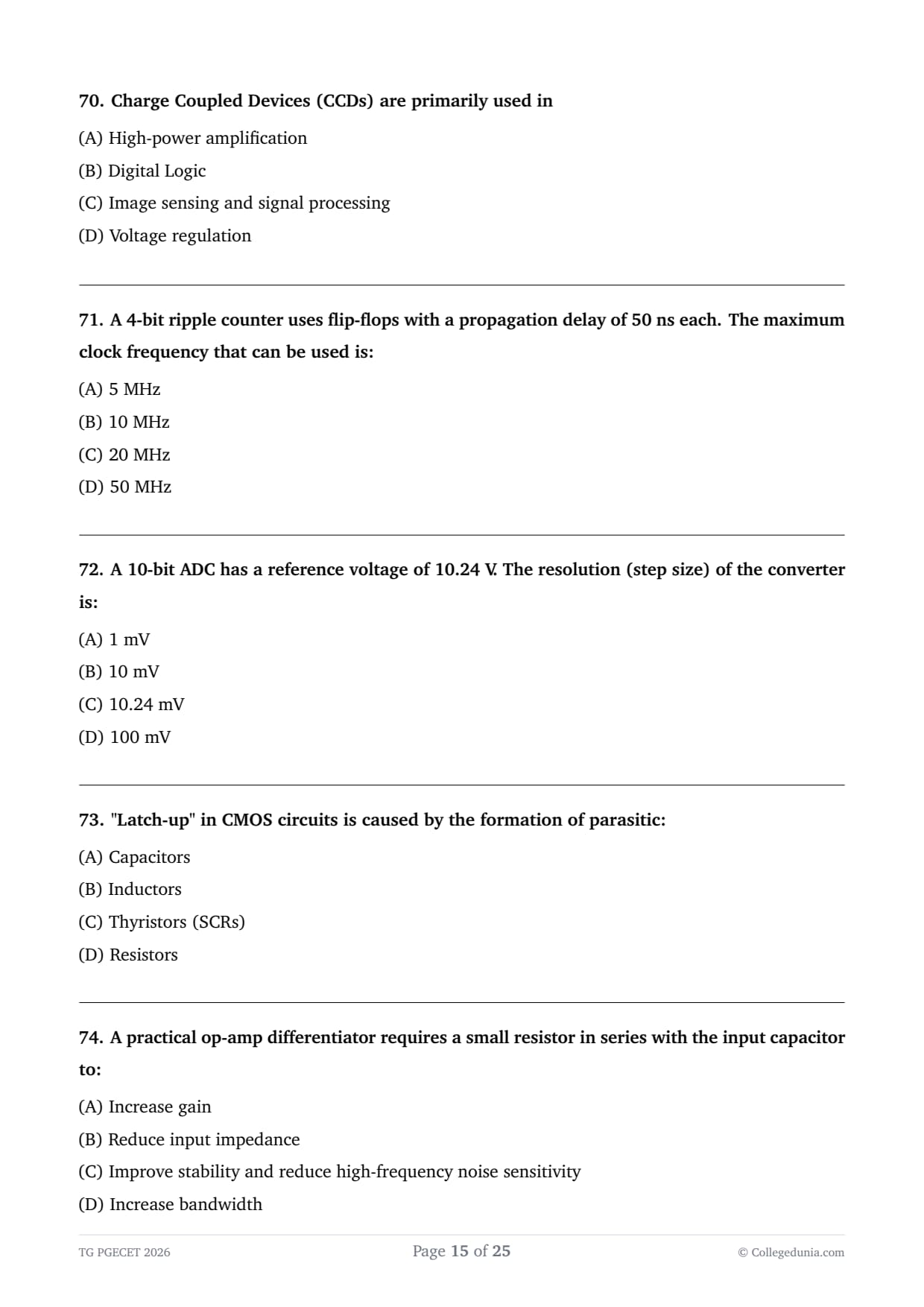
Question 70:
Charge Coupled Devices (CCDs) are primarily used in
- (A) High-power amplification
- (B) Digital Logic
- (C) Image sensing and signal processing
- (D) Voltage regulation
Question 71:
A 4-bit ripple counter uses flip-flops with a propagation delay of 50 ns each. The maximum clock frequency that can be used is:
- (A) \(5 MHz\)
- (B) \(10 MHz\)
- (C) \(20 MHz\)
- (D) \(50 MHz\)
Question 72:
A 10-bit ADC has a reference voltage of 10.24 V. The resolution (step size) of the converter is:
- (A) \(1 mV\)
- (B) \(10 mV\)
- (C) \(10.24 mV\)
- (D) \(100 mV\)
Question 73:
"Latch-up" in CMOS circuits is caused by the formation of parasitic:
- (A) Capacitors
- (B) Inductors
- (C) Thyristors (SCRs)
- (D) Resistors
Question 74:
A practical op-amp differentiator requires a small resistor in series with the input capacitor to:
- (A) Increase gain
- (B) Reduce input impedance
- (C) Improve stability and reduce high-frequency noise sensitivity
- (D) Increase bandwidth
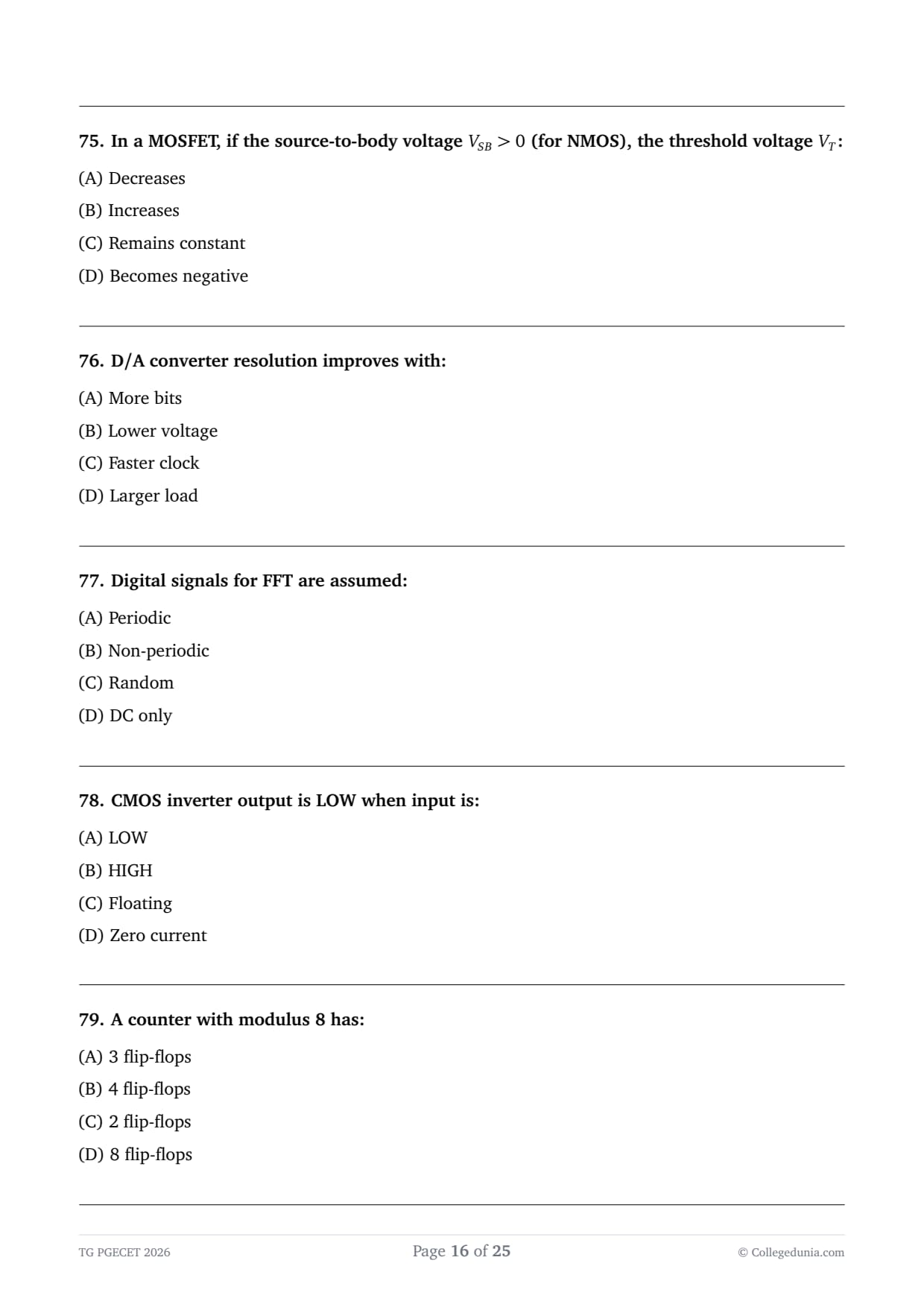
Question 75:
In a MOSFET, if the source-to-body voltage \( V_{SB} > 0 \) (for NMOS), the threshold voltage \( V_T \):
- (A) Decreases
- (B) Increases
- (C) Remains constant
- (D) Becomes negative
Question 76:
D/A converter resolution improves with:
- (A) More bits
- (B) Lower voltage
- (C) Faster clock
- (D) Larger load
Question 77:
Digital signals for FFT are assumed:
- (A) Periodic
- (B) Non-periodic
- (C) Random
- (D) DC only
Question 78:
CMOS inverter output is LOW when input is:
- (A) LOW
- (B) HIGH
- (C) Floating
- (D) Zero current
Question 79:
A counter with modulus 8 has:
- (A) \(3 flip-flops\)
- (B) \(4 flip-flops\)
- (C) \(2 flip-flops\)
- (D) \(8 flip-flops\)
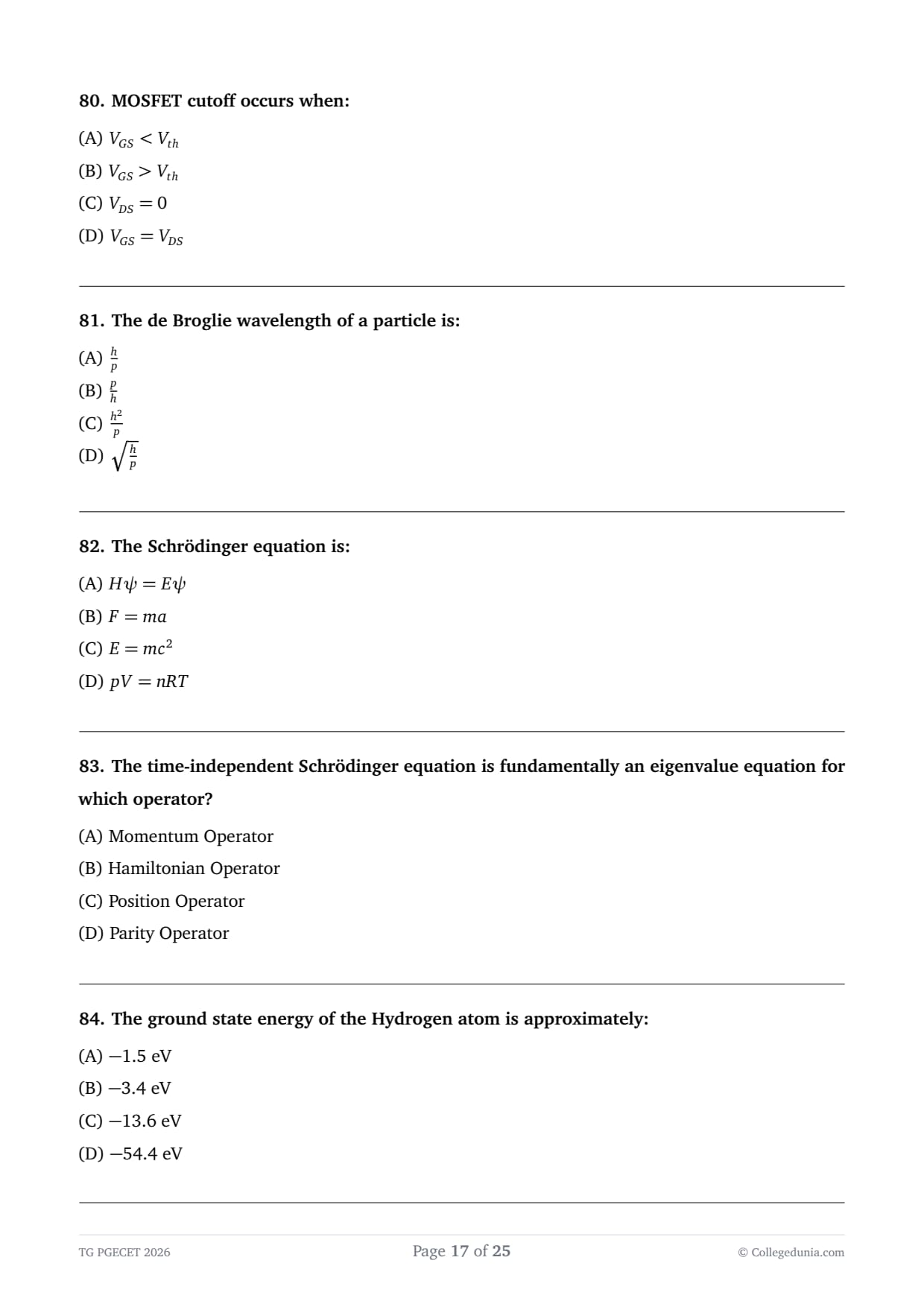
Question 80:
MOSFET cutoff occurs when:
- (A) \(V_{GS} < V_{th}\)
- (B) \(V_{GS} > V_{th}\)
- (C) \(V_{DS} = 0\)
- (D) \(V_{GS} = V_{DS}\)
Question 81:
The de Broglie wavelength of a particle is:
- (A) \(\frac{h}{p}\)
- (B) \(\frac{p}{h}\)
- (C) \(\frac{h^2}{p}\)
- (D) sqrt{frac{h}{p}}
Question 82:
The Schrödinger equation is:
- (A) \(H\psi = E\psi\)
- (B) \(F = ma\)
- (C) \(E = mc^2\)
- (D) \(pV = nRT\)
Question 83:
The time-independent Schrödinger equation is fundamentally an eigenvalue equation for which operator?
- (A) Momentum Operator
- (B) Hamiltonian Operator
- (C) Position Operator
- (D) Parity Operator
Question 84:
The ground state energy of the Hydrogen atom is approximately:
- (A) \(-1.5 eV\)
- (B) \(-3.4 eV\)
- (C) \(-13.6 eV\)
- (D) \(-54.4 eV\)
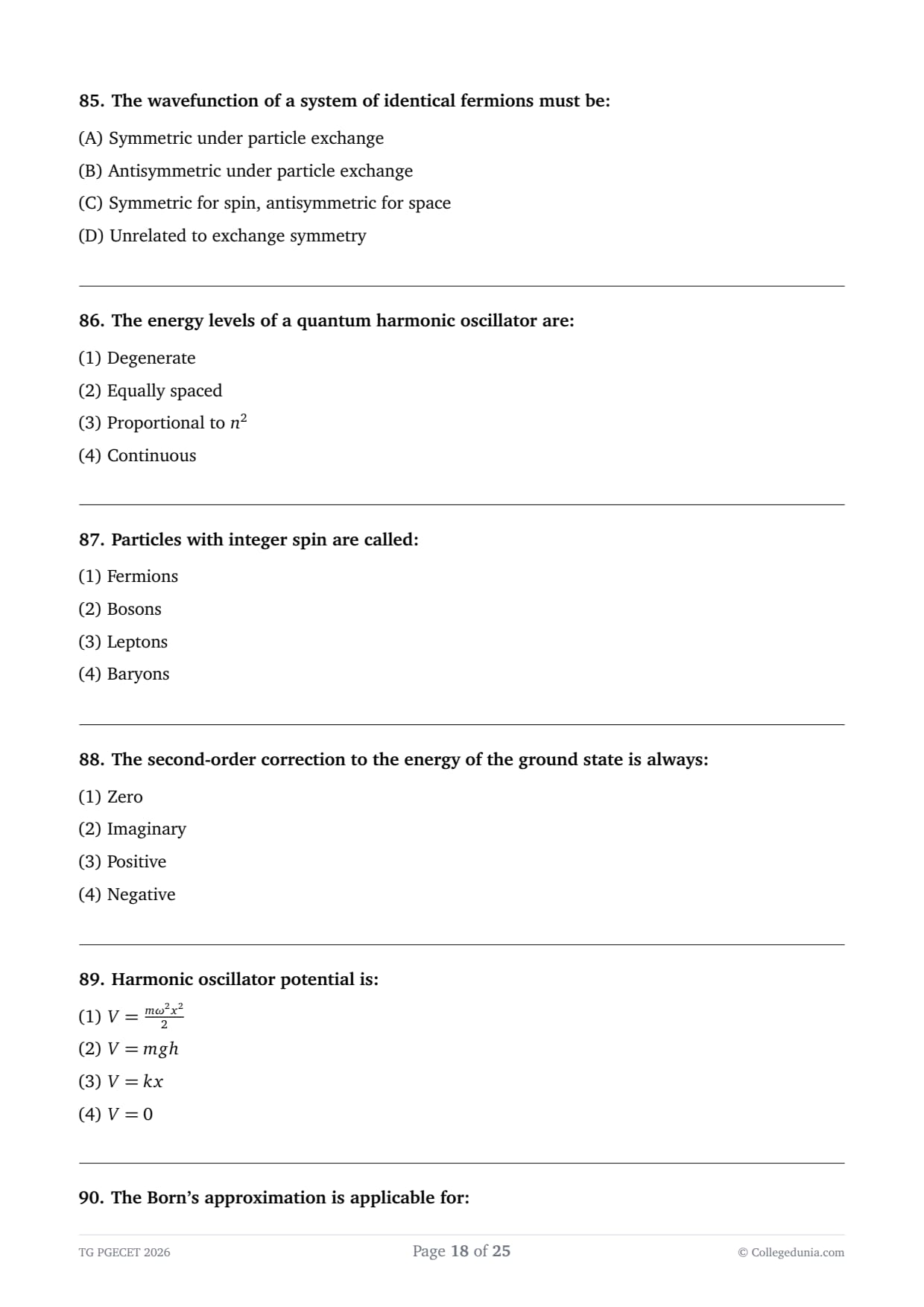
Question 85:
The wavefunction of a system of identical fermions must be:
- (A) Symmetric under particle exchange
- (B) Antisymmetric under particle exchange
- (C) Symmetric for spin, antisymmetric for space
- (D) Unrelated to exchange symmetry
Question 86:
The energy levels of a quantum harmonic oscillator are:
- (1) Degenerate
- (2) Equally spaced
- (3) Proportional to \(n^2\)
- (4) Continuous
Question 87:
Particles with integer spin are called:
- (1) Fermions
- (2) Bosons
- (3) Leptons
- (4) Baryons
Question 88:
The second-order correction to the energy of the ground state is always:
- (1) Zero
- (2) Imaginary
- (3) Positive
- (4) Negative
Question 89:
Harmonic oscillator potential is:
- (1) \(V = \frac{m\omega^2 x^2}{2}\)
- (2) \(V = mgh\)
- (3) \(V = kx\)
- (4) \(V = 0\)
Question 90:
The Born's approximation is applicable for:
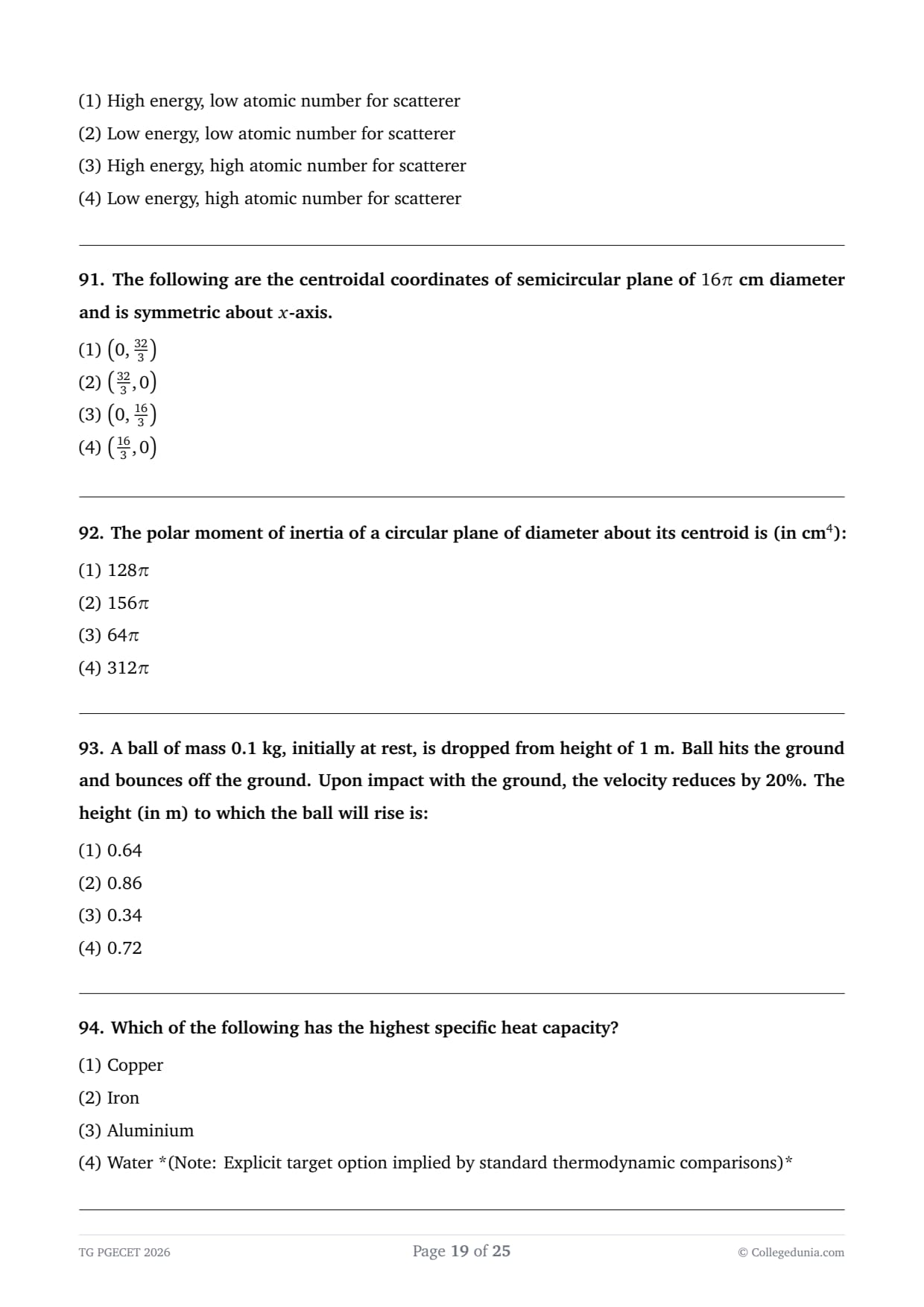
- (1) High energy, low atomic number for scatterer
- (2) Low energy, low atomic number for scatterer
- (3) High energy, high atomic number for scatterer
- (4) Low energy, high atomic number for scatterer
Question 91:
The following are the centroidal coordinates of semicircular plane of \(16\pi\) cm diameter and is symmetric about \(x\)-axis.
- (1) \(\left(0, \frac{32}{3}\right)\)
- (2) \(\left(\frac{32}{3}, 0\right)\)
- (3) \(\left(0, \frac{16}{3}\right)\)
- (4) \(\left(\frac{16}{3}, 0\right)\)
Question 92:
The polar moment of inertia of a circular plane of diameter about its centroid is (in \(cm^4\)):
- (1) \(128\pi\)
- (2) \(156\pi\)
- (3) \(64\pi\)
- (4) \(312\pi\)
Question 93:
A ball of mass 0.1 kg, initially at rest, is dropped from height of 1 m. Ball hits the ground and bounces off the ground. Upon impact with the ground, the velocity reduces by 20%. The height (in m) to which the ball will rise is:
- (1) \(0.64\)
- (2) \(0.86\)
- (3) \(0.34\)
- (4) \(0.72\)
Question 94:
Which of the following has the highest specific heat capacity?
- (1) Copper
- (2) Iron
- (3) Aluminium
- (4) Water *(Note: Explicit target option implied by standard thermodynamic comparisons)*
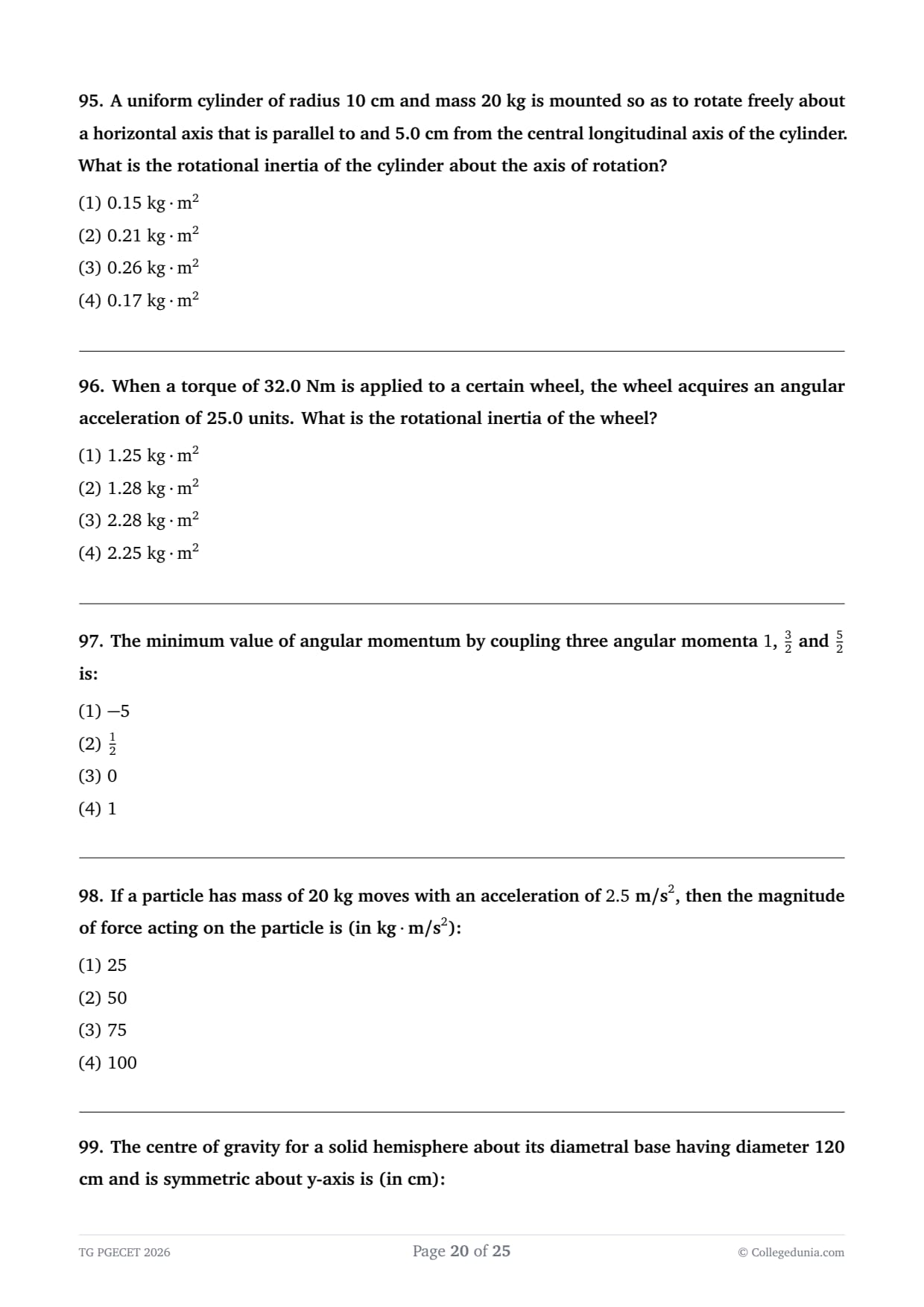
Question 95:
A uniform cylinder of radius 10 cm and mass 20 kg is mounted so as to rotate freely about a horizontal axis that is parallel to and 5.0 cm from the central longitudinal axis of the cylinder. What is the rotational inertia of the cylinder about the axis of rotation?
- (1) \(0.15 kg\)
- (2) \(0.21 kg\)
- (3) \(0.26 kg\)
- (4) \(0.17 kg\)
Question 96:
When a torque of 32.0 Nm is applied to a certain wheel, the wheel acquires an angular acceleration of 25.0 units. What is the rotational inertia of the wheel?
- (1) \(1.25 kg^2\)
- (2) \(1.28 kg^2\)
- (3) \(2.28 kg^2\)
- (4) \(2.25 kg^2\)
Question 97:
The minimum value of angular momentum by coupling three angular momenta \(1\), \(\frac{3}{2}\) and \(\frac{5}{2}\) is:
- (1) \(-5\)
- (2) \(\frac{1}{2}\)
- (3) \(0\)
- (4) \(1\)
Question 98:
If a particle has mass of 20 kg moves with an acceleration of \(2.5 m/s^2\), then the magnitude of force acting on the particle is (in \(kg/s^2\)):
- (1) \(25\)
- (2) \(50\)
- (3) \(75\)
- (4) \(100\)
Question 99:
The centre of gravity for a solid hemisphere about its diametral base having diameter 120 cm and is symmetric about y-axis is (in cm):
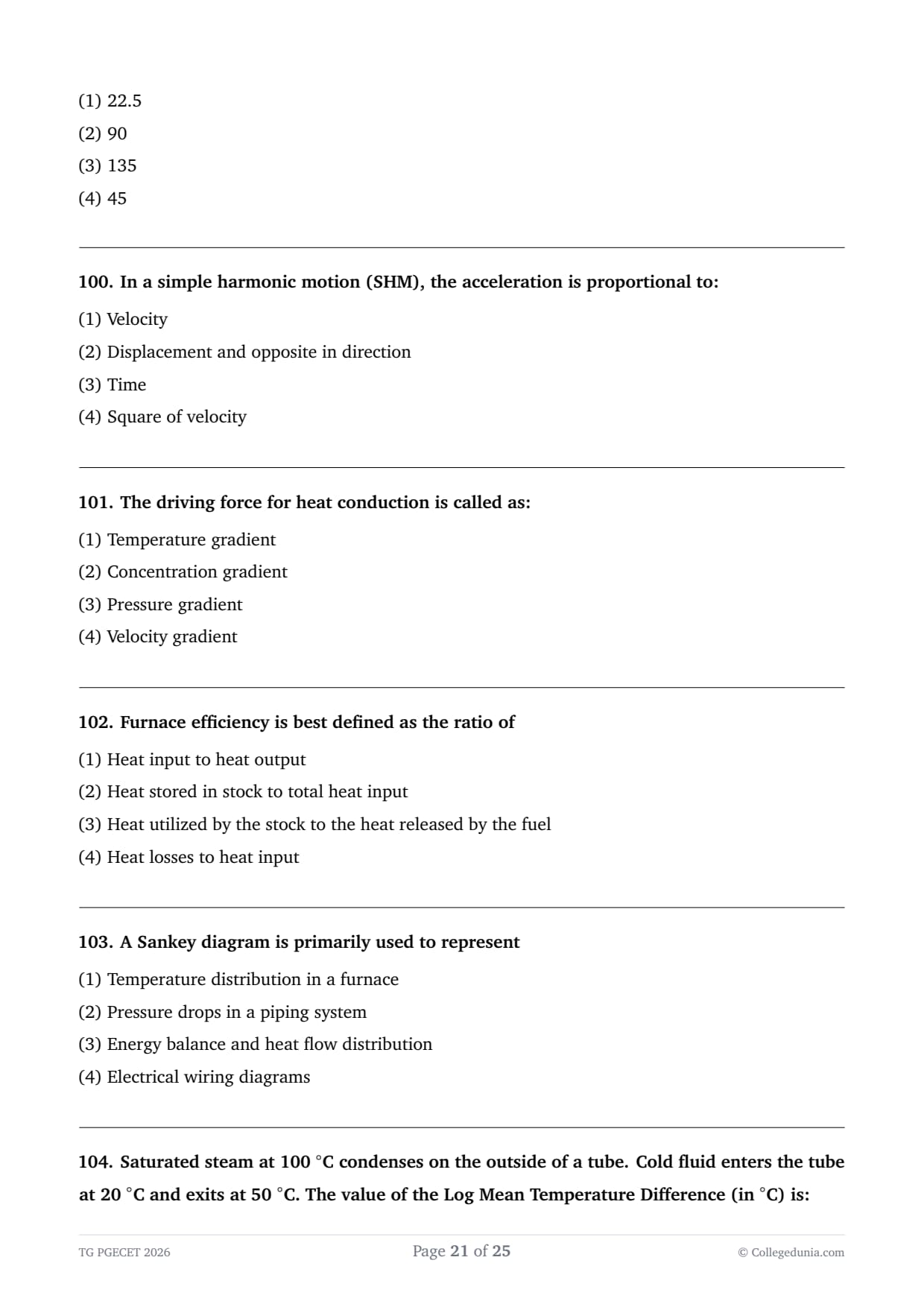
- (1) \(22.5\)
- (2) \(90\)
- (3) \(135\)
- (4) \(45\)
Question 100:
In a simple harmonic motion (SHM), the acceleration is proportional to:
- (1) Velocity
- (2) Displacement and opposite in direction
- (3) Time
- (4) Square of velocity
Question 101:
The driving force for heat conduction is called as:
- (1) Temperature gradient
- (2) Concentration gradient
- (3) Pressure gradient
- (4) Velocity gradient
Question 102:
Furnace efficiency is best defined as the ratio of
- (1) Heat input to heat output
- (2) Heat stored in stock to total heat input
- (3) Heat utilized by the stock to the heat released by the fuel
- (4) Heat losses to heat input
Question 103:
A Sankey diagram is primarily used to represent
- (1) Temperature distribution in a furnace
- (2) Pressure drops in a piping system
- (3) Energy balance and heat flow distribution
- (4) Electrical wiring diagrams
Question 104:
Saturated steam at 100 \(^\circ\)C condenses on the outside of a tube. Cold fluid enters the tube at 20 \(^\circ\)C and exits at 50 \(^\circ\)C. The value of the Log Mean Temperature Difference (in \(^\circ\)C) is:
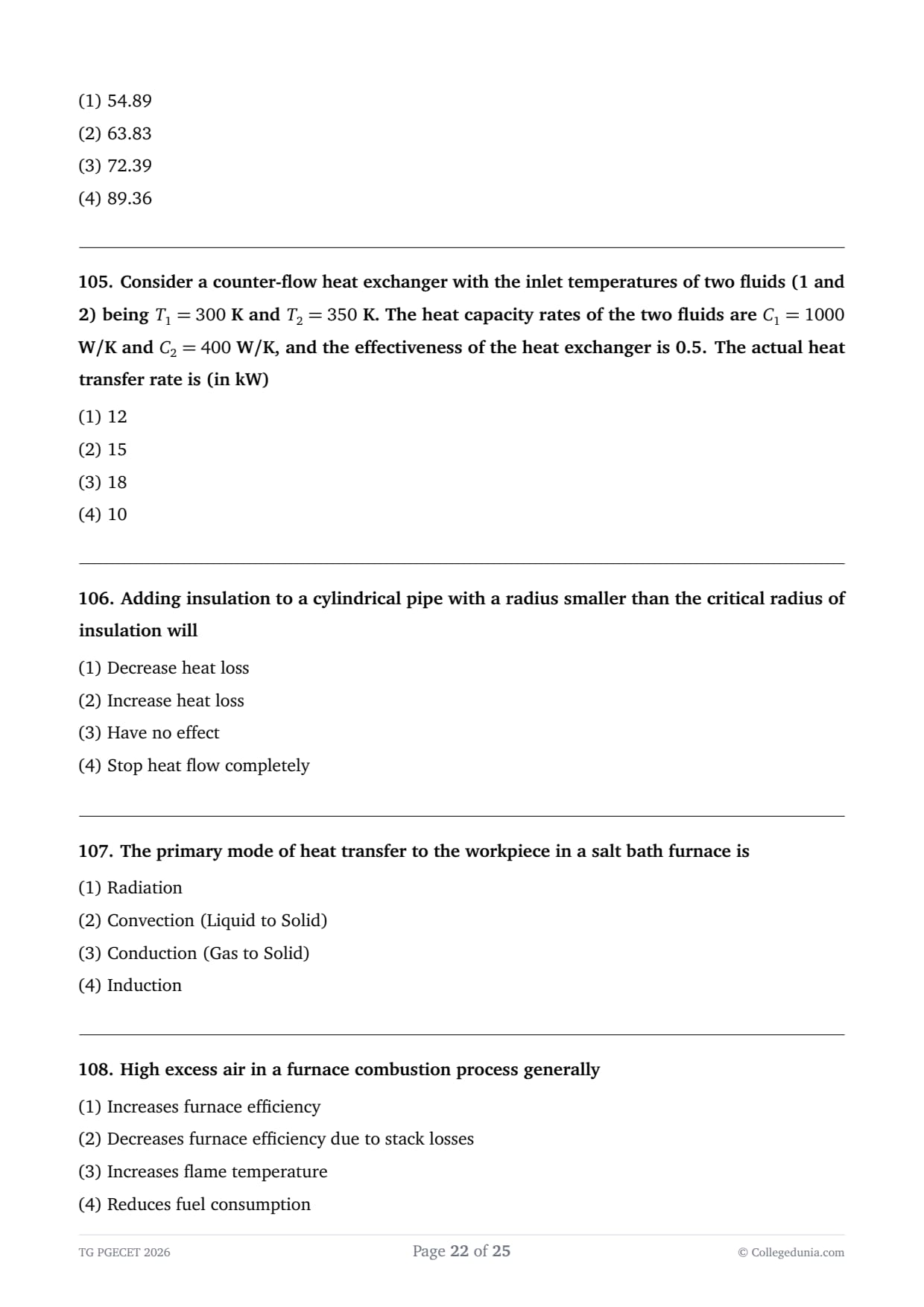
- (1) 54.89
- (2) 63.83
- (3) 72.39
- (4) 89.36
Question 105:
Consider a counter-flow heat exchanger with the inlet temperatures of two fluids (1 and 2) being \(T_1 = 300\) K and \(T_2 = 350\) K. The heat capacity rates of the two fluids are \(C_1 = 1000\) W/K and \(C_2 = 400\) W/K, and the effectiveness of the heat exchanger is 0.5. The actual heat transfer rate is (in kW)
- (1) 12
- (2) 15
- (3) 18
- (4) 10
Question 106:
Adding insulation to a cylindrical pipe with a radius smaller than the critical radius of insulation will
- (1) Decrease heat loss
- (2) Increase heat loss
- (3) Have no effect
- (4) Stop heat flow completely
Question 107:
The primary mode of heat transfer to the workpiece in a salt bath furnace is
- (1) Radiation
- (2) Convection (Liquid to Solid)
- (3) Conduction (Gas to Solid)
- (4) Induction
Question 108:
High excess air in a furnace combustion process generally
- (1) Increases furnace efficiency
- (2) Decreases furnace efficiency due to stack losses
- (3) Increases flame temperature
- (4) Reduces fuel consumption
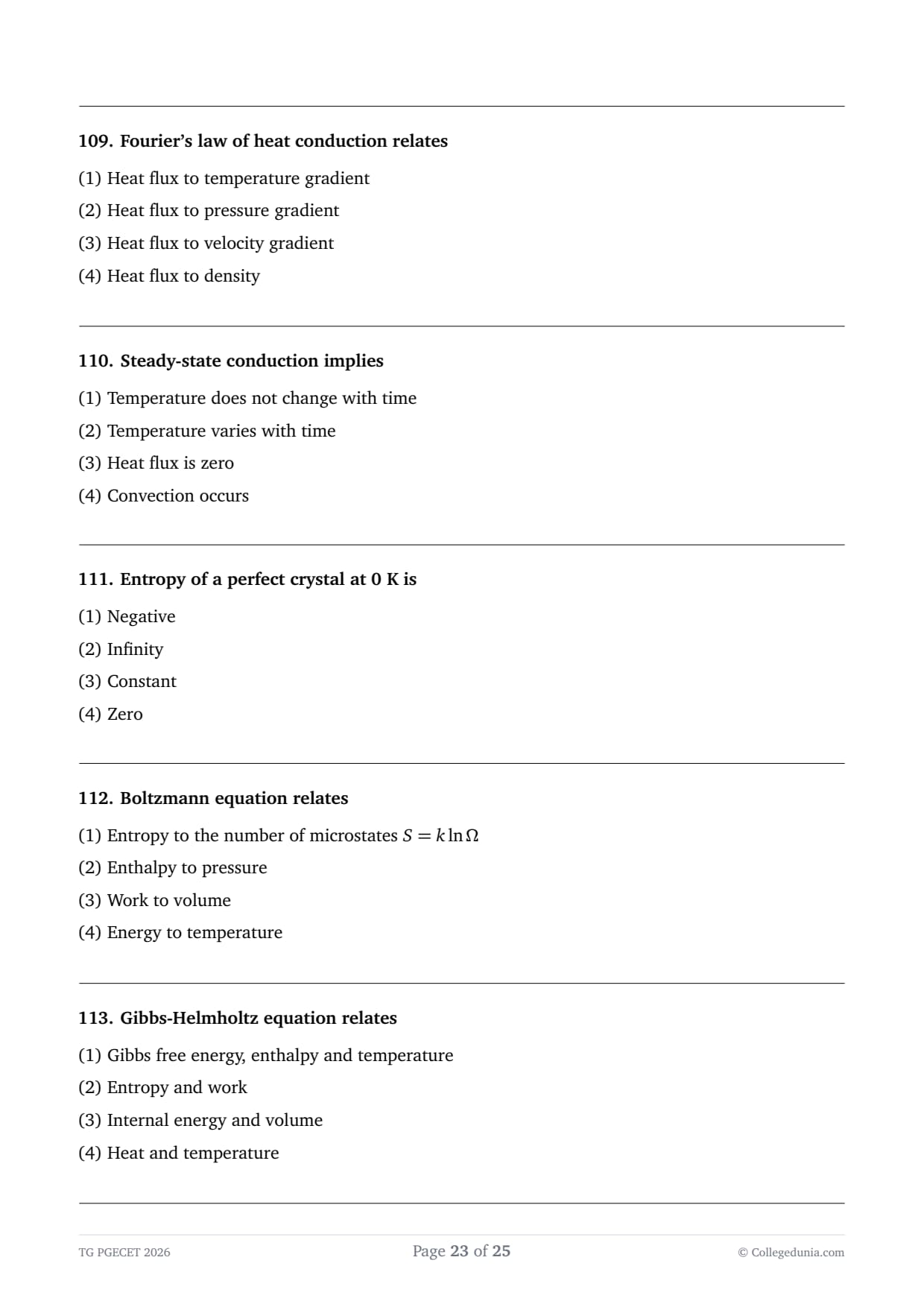
Question 109:
Fourier's law of heat conduction relates
- (1) Heat flux to temperature gradient
- (2) Heat flux to pressure gradient
- (3) Heat flux to velocity gradient
- (4) Heat flux to density
Question 110:
Steady-state conduction implies
- (1) Temperature does not change with time
- (2) Temperature varies with time
- (3) Heat flux is zero
- (4) Convection occurs
Question 111:
Entropy of a perfect crystal at 0 K is
- (1) Negative
- (2) Infinity
- (3) Constant
- (4) Zero
Question 112:
Boltzmann equation relates
- (1) Entropy to the number of microstates \(S = k \ln \Omega\)
- (2) Enthalpy to pressure
- (3) Work to volume
- (4) Energy to temperature
Question 113:
Gibbs-Helmholtz equation relates
- (1) Gibbs free energy, enthalpy and temperature
- (2) Entropy and work
- (3) Internal energy and volume
- (4) Heat and temperature
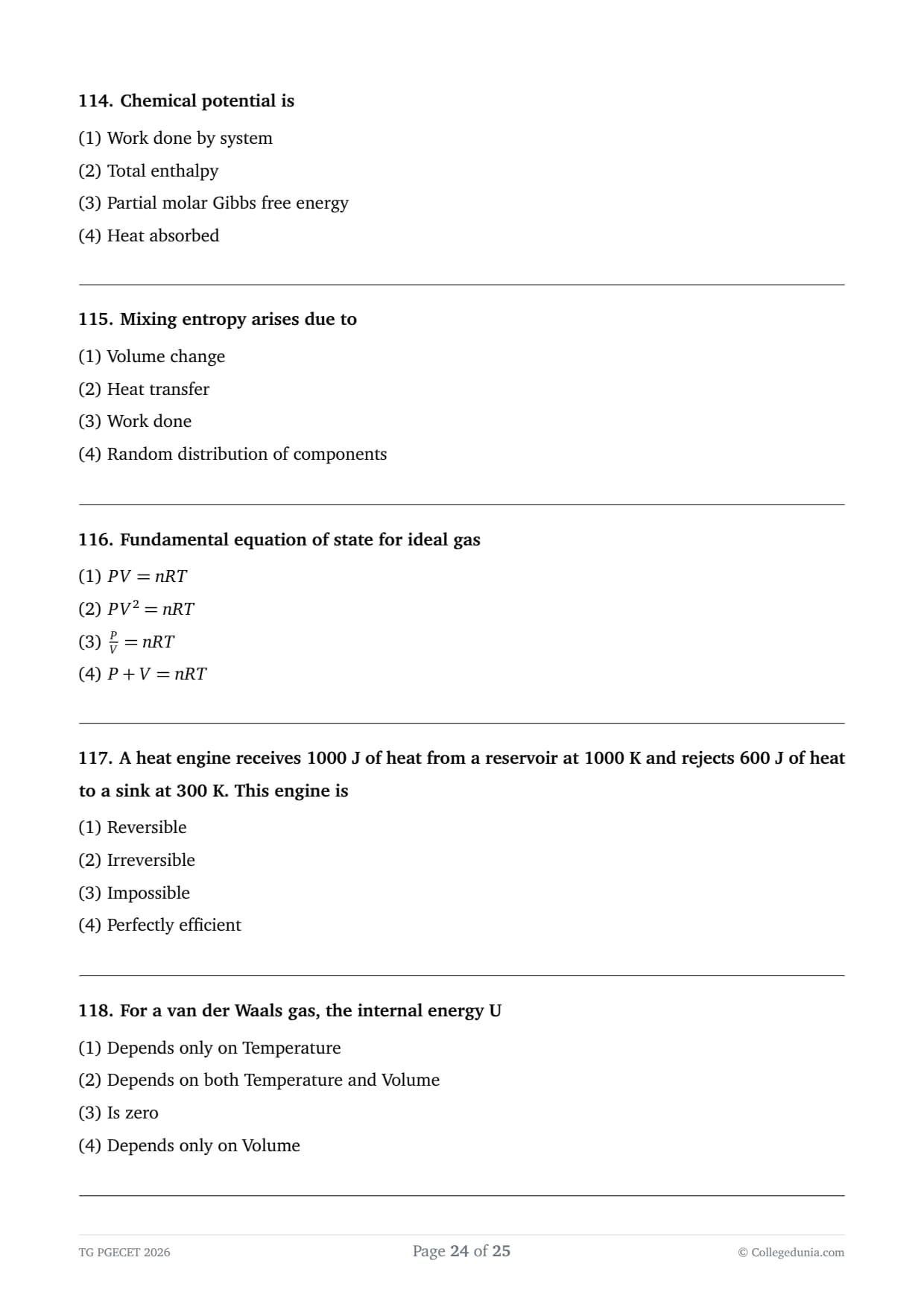
Question 114:
Chemical potential is
- (1) Work done by system
- (2) Total enthalpy
- (3) Partial molar Gibbs free energy
- (4) Heat absorbed
Question 115:
Mixing entropy arises due to
- (1) Volume change
- (2) Heat transfer
- (3) Work done
- (4) Random distribution of components
Question 116:
Fundamental equation of state for ideal gas
- (1) \(PV = nRT\)
- (2) \(PV^2 = nRT\)
- (3) \(\frac{P}{V} = nRT\)
- (4) \(P + V = nRT\)
Question 117:
A heat engine receives 1000 J of heat from a reservoir at 1000 K and rejects 600 J of heat to a sink at 300 K. This engine is
- (1) Reversible
- (2) Irreversible
- (3) Impossible
- (4) Perfectly efficient
Question 118:
For a van der Waals gas, the internal energy U
- (1) Depends only on Temperature
- (2) Depends on both Temperature and Volume
- (3) Is zero
- (4) Depends only on Volume
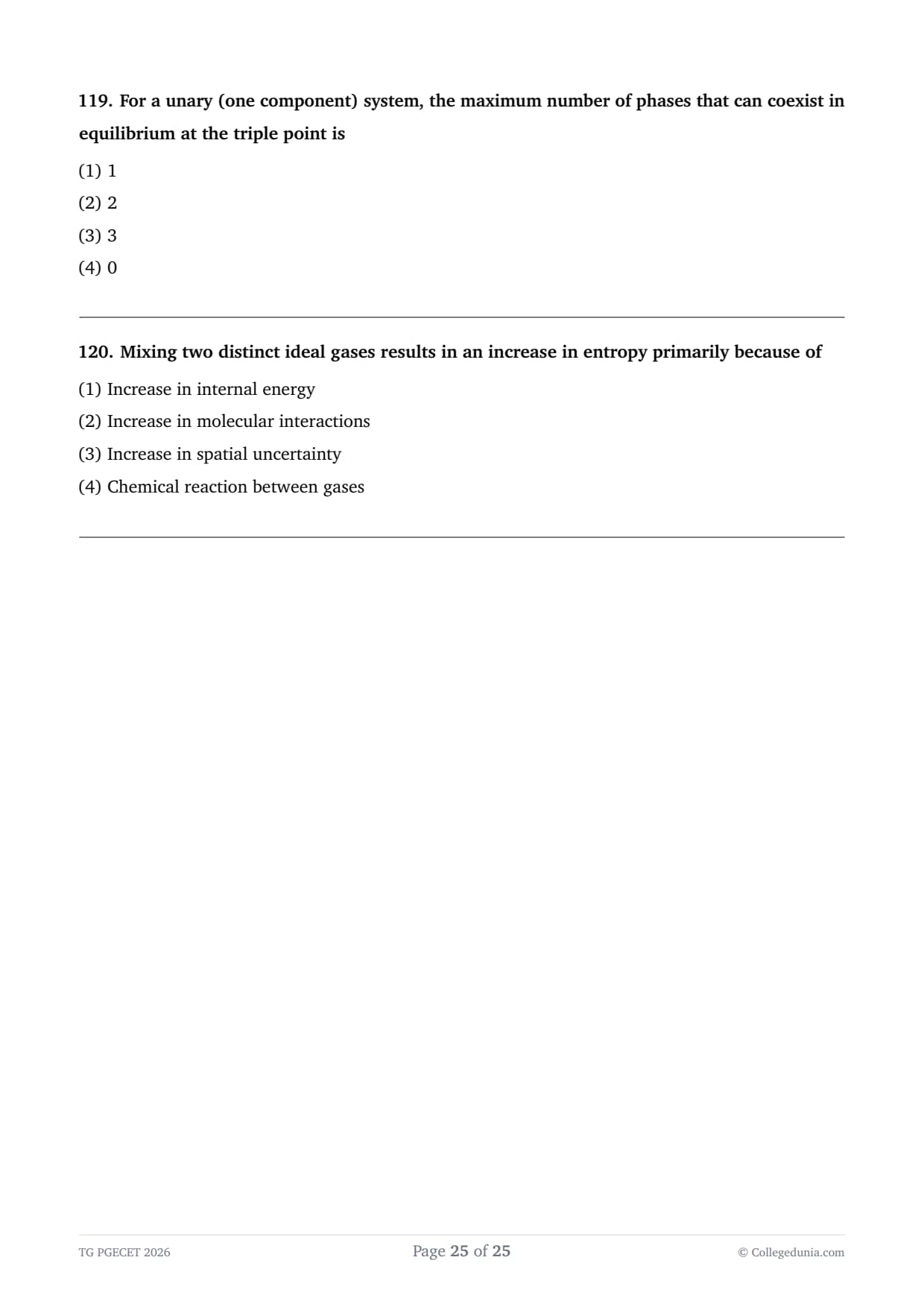
Question 119:
For a unary (one component) system, the maximum number of phases that can coexist in equilibrium at the triple point is
Question 120:
Mixing two distinct ideal gases results in an increase in entropy primarily because of
- (1) Increase in internal energy
- (2) Increase in molecular interactions
- (3) Increase in spatial uncertainty
- (4) Chemical reaction between gases
TS PGECET 2026 Exam Pattern
| Particulars |
Details |
| Exam Mode |
Computer-Based Test(CBT) |
| Question Type |
Multiple Choice Questions(MCQs) |
| Total Questions |
120 Questions |
| Total Marks |
120 Marks |
| Exam Duration |
2 Hours |
| Marking Scheme |
+1 mark for each correct answer |
| Negative Marking |
No Negative Marking |
| Language of Paper |
English |
TS PGECET 2026 Preparation Strategy








Comments