




The CLAT exam pattern consist of 120 multiple type questions and is a two hours paper. The question pattern is divided into five sections: English Language, Current Affairs including GK, Legal Reasoning, Logical Reasoning and Quantitative Techniques.
- According to CLAT 2027 marking scheme, 1 mark is awarded for each correct answer and deducts 0.25 marks for every wrong answer.
- No negative marks is deducted for unattempted questions based on CLAT 2027 marking scheme.
- According to CLAT syllabus, legal rasoning, followed by current affairs including GK has the highest weightage of more than 25% (each), based on previous years analysis.
- Based on 2026 paper pattern, Quantitative Techniques has the lowest weightage around 10% of the paper.
Related Articles:
- CLAT 2027: Notification, Exam Date, Registration, Pattern, Syllabus, & Cutoff
- CLAT Exam Pattern 2026: Check CLAT syllabus, Marking Scheme, Exam Mode, Question Paper
Key Summary
- The CLAT exam is conducted offline in pen and paper mode.
- The CLAT 2027 exam registration is likely to be held around August to last week of October 2026.
- The expected date of CLAT exam 2027 is around December 6, 2026.
CLAT 2027 Marking Scheme at a Glance
The Consortium of NLUs sets the CLAT paper at 120 marks. Every question carries equal value regardless of the section it belongs to. The table below captures the complete marking structure expected for CLAT 2027, based on the pattern followed in CLAT 2025 and 2026.
| Parameter | Details |
|---|---|
| Total Questions | 120 |
| Total Marks | 120 |
| Marks per Correct Answer | +1 |
| Marks Deducted per Wrong Answer | −0.25 |
| Marks for Unattempted Questions | 0 (no penalty) |
| Exam Duration | 2 hours (120 minutes) |
| Mode of Examination | Offline (pen and paper) |
| Question Type | Passage-based MCQs (4 options each) |
| Number of Sections | 5 |
Source: consortiumofnlus.ac.in
Related Articles:
- CLAT Syllabus 2027: Download Free PDF, Check Syllabus, Weightage, Books and Preparation
- CLAT Logical Reasoning Syllabus 2027, Check Important Topics, Рreраrаtiоn Tips аnd Books
- CLAT 2027 English Syllabus- Check Preparation Books, Previous Year Questions, Mock Test
- CLAT GK Syllabus 2027: Download PDF, Books, Notes and Important Topics
- СLАT Legаl Reаsоning Syllаbus 2027, Check Important Topics, Preparation Tips and Books
According to a Reddit post, users discussed that likely that the exam structure may undergo significant changes because most of the committee members are from foreign universities, with only one Indian professor included. In light of this subjects like Quantitative Techniques and Legal Reasoning may no longer be as relevant, and even General Knowledge may not remain a key criterion. Instead, the focus could primarily shift to English and Logical Reasoning as the core components of the examination.
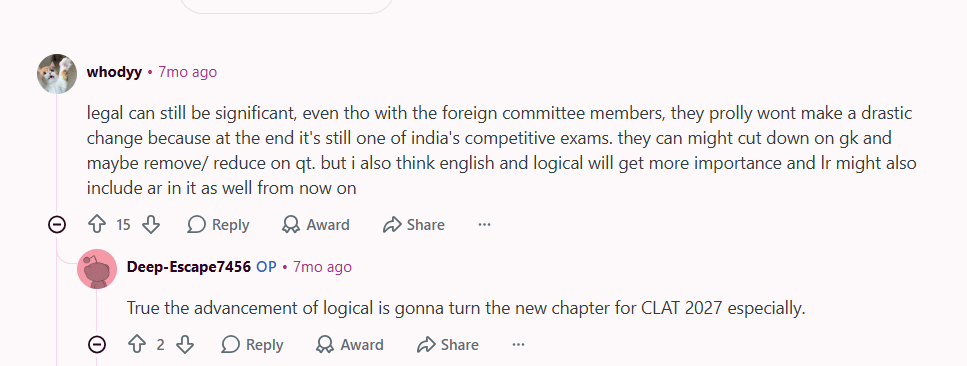
Source: Reddit
Ques. What is the negative marking in CLAT 2027?
Ans. CLAT 2027 deducts 0.25 marks for every incorrect answer. There is no penalty for leaving a question unattempted. The rule applies uniformly across all five sections.
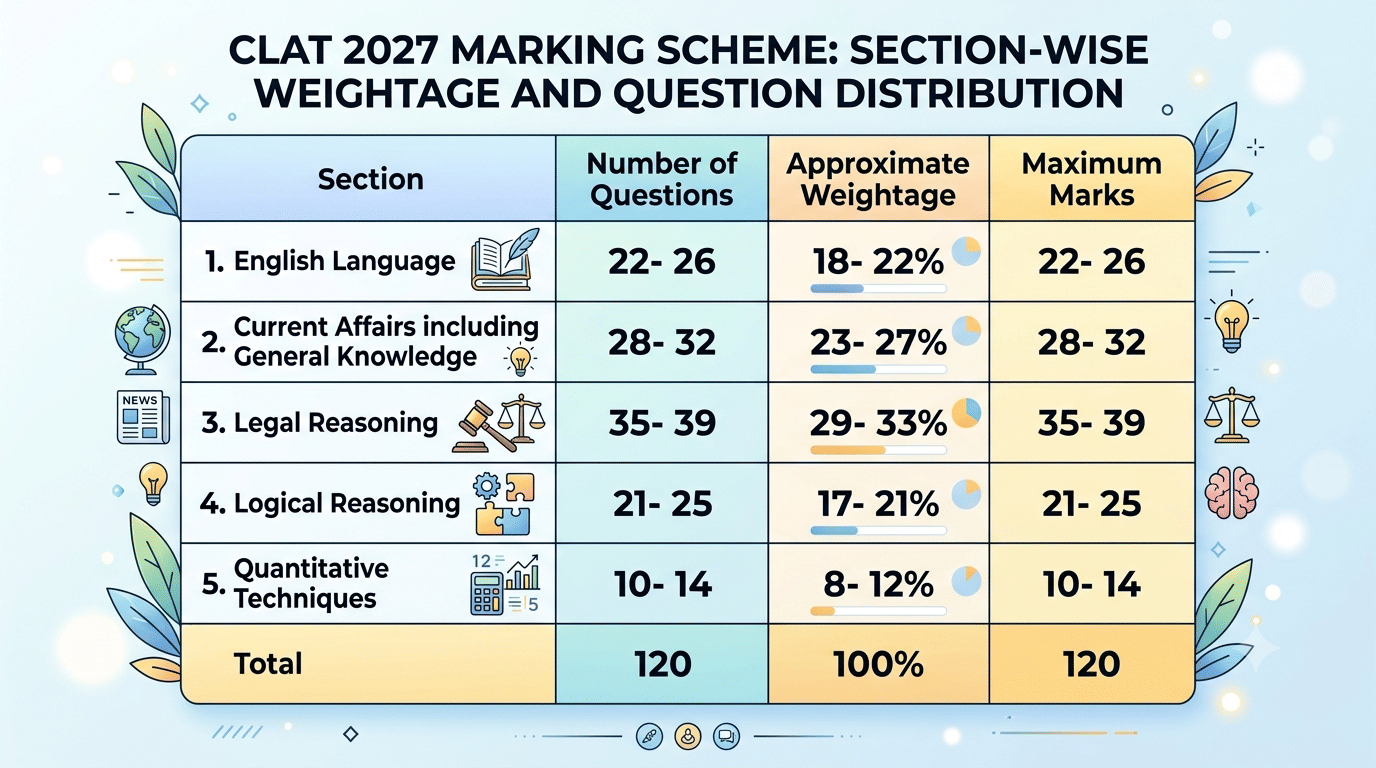
CLAT 2027 Marking Scheme: Section-Wise Weightage and Question Distribution
CLAT 2027 is divided into five sections. Legal Reasoning carries the maximum weightage and is therefore the section where accuracy matters most for your overall score. The Consortium may vary question count slightly between sections, but the total always remains 120.
| Section | Number of Questions | Approximate Weightage | Maximum Marks |
|---|---|---|---|
| English Language | 22- 26 | 18- 22% | 22- 26 |
| Current Affairs including General Knowledge | 28- 32 | 23- 27% | 28- 32 |
| Legal Reasoning | 35- 39 | 29- 33% | 35- 39 |
| Logical Reasoning | 21- 25 | 17- 21% | 21- 25 |
| Quantitative Techniques | 10- 14 | 8- 12% | 10- 14 |
| Total | 120 | 100% | 120 |
Note: The weightage ranges above are based on CLAT 2025 and 2026 papers. Legal Reasoning alone accounts for roughly one-third of your total score.
Related Articles:
- How to Prepare for СLАT 2027: Section-Wise CLAT Preparation Strategy, Last Minute Tips, CLAT Prep Bооks
- CLAT 2026 Question Paper (Available): Download CLAT Previous-Year Question Paper PDF [2026-2016]
Ques. Which section has the highest weightage in CLAT 2027?
Ans. Legal Reasoning carries the highest weightage, with approximately 35- 39 questions out of 120, making up around 29- 33% of the total paper. Current Affairs including General Knowledge is the second-highest section with 28- 32 questions.
CLAT 2027 Marking Scheme: How Negative Marking Works
CLAT 2027 marking scheme applies a uniform 0.25-mark penalty for every incorrect answer. This rule applies across all five sections.
- Leaving a question blank costs 0 marks as there is no deduction for unattempted questions.
- For every 4 wrong answers, you lose the equivalent of one correct answer (4 × 0.25 = 1 mark).
- The real advantage comes from eliminating options because unattempted has no negative marking.
Related Article: CLAT Mock Test 2027: Attempt Free Online Mock Test, Sectional and Topic-wise Tests
Ques. Should you attempt all 120 questions in CLAT 2027?
Ans. Not necessarily. Attempting all questions without sufficient confidence can lower your score. Focus on accuracy: attempt questions where you can eliminate at least one or two options. Students who attempt 85- 95 questions with high accuracy consistently outscore those who attempt all 120 questions with lower accuracy.
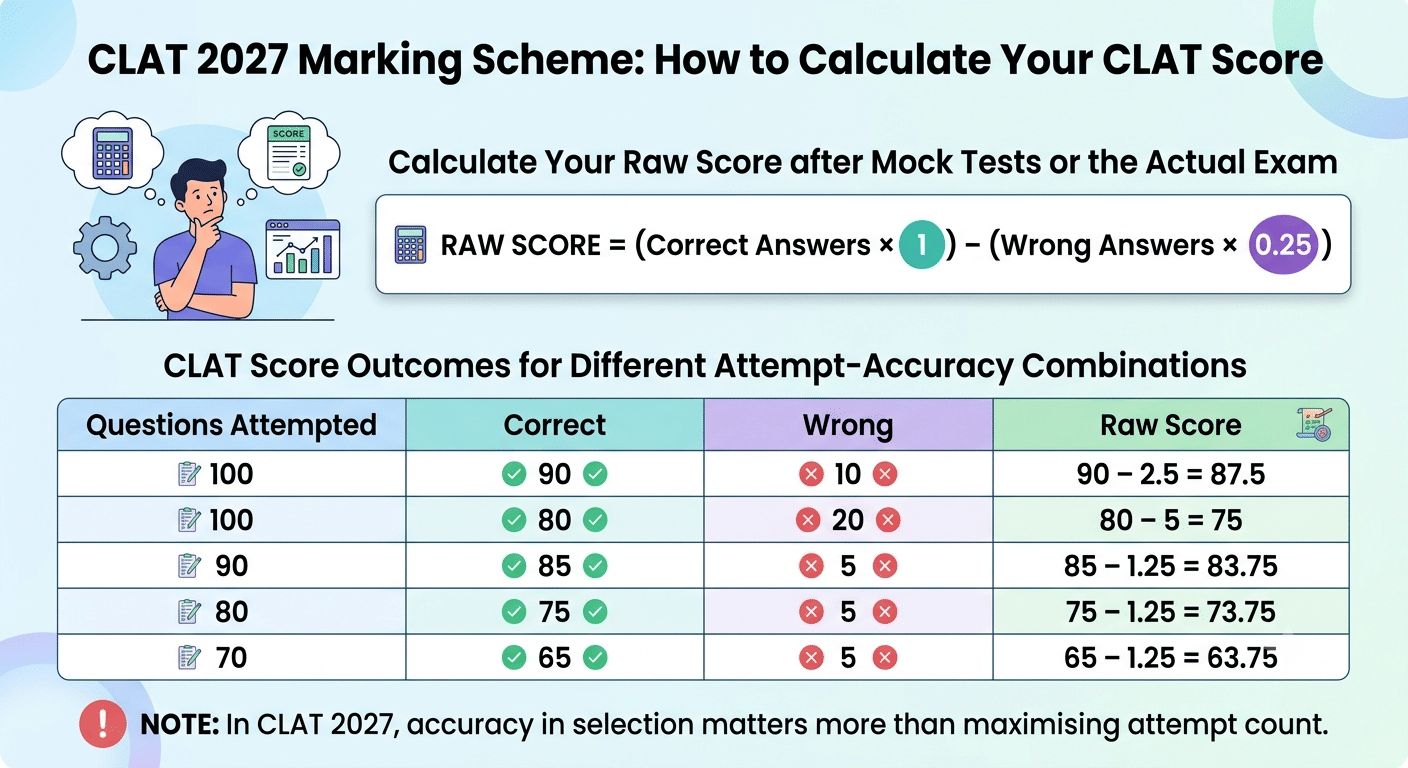
CLAT 2027 Marking Scheme: How to Calculate Your CLAT Score
Use the formula below to calculate your raw score after mock tests or the actual exam.
Raw Score = (Correct Answers × 1) − (Wrong Answers × 0.25)
The table below shows score outcomes for different attempt-accuracy combinations out of 120 questions.
| Questions Attempted | Correct | Wrong | Raw Score |
|---|---|---|---|
| 100 | 90 | 10 | 90 − 2.5 = 87.5 |
| 100 | 80 | 20 | 80 − 5 = 75 |
| 90 | 85 | 5 | 85 − 1.25 = 83.75 |
| 80 | 75 | 5 | 75 − 1.25 = 73.75 |
| 70 | 65 | 5 | 65 − 1.25 = 63.75 |
Note: In CLAT 2027, accuracy in selection matters more than maximising attempt count.
Related Article: CLAT Exam Analysis 2026 (Over): Check Difficulty Level, Section-Wise Analysis & Expected Cutoff
Ques. What is the mode of the CLAT exam 2026?
Ans. CLAT is conducted in offline mode for 2 hours. Both CLAT UG 2026 and CLAT PG 2026 consist of objective-type questions.
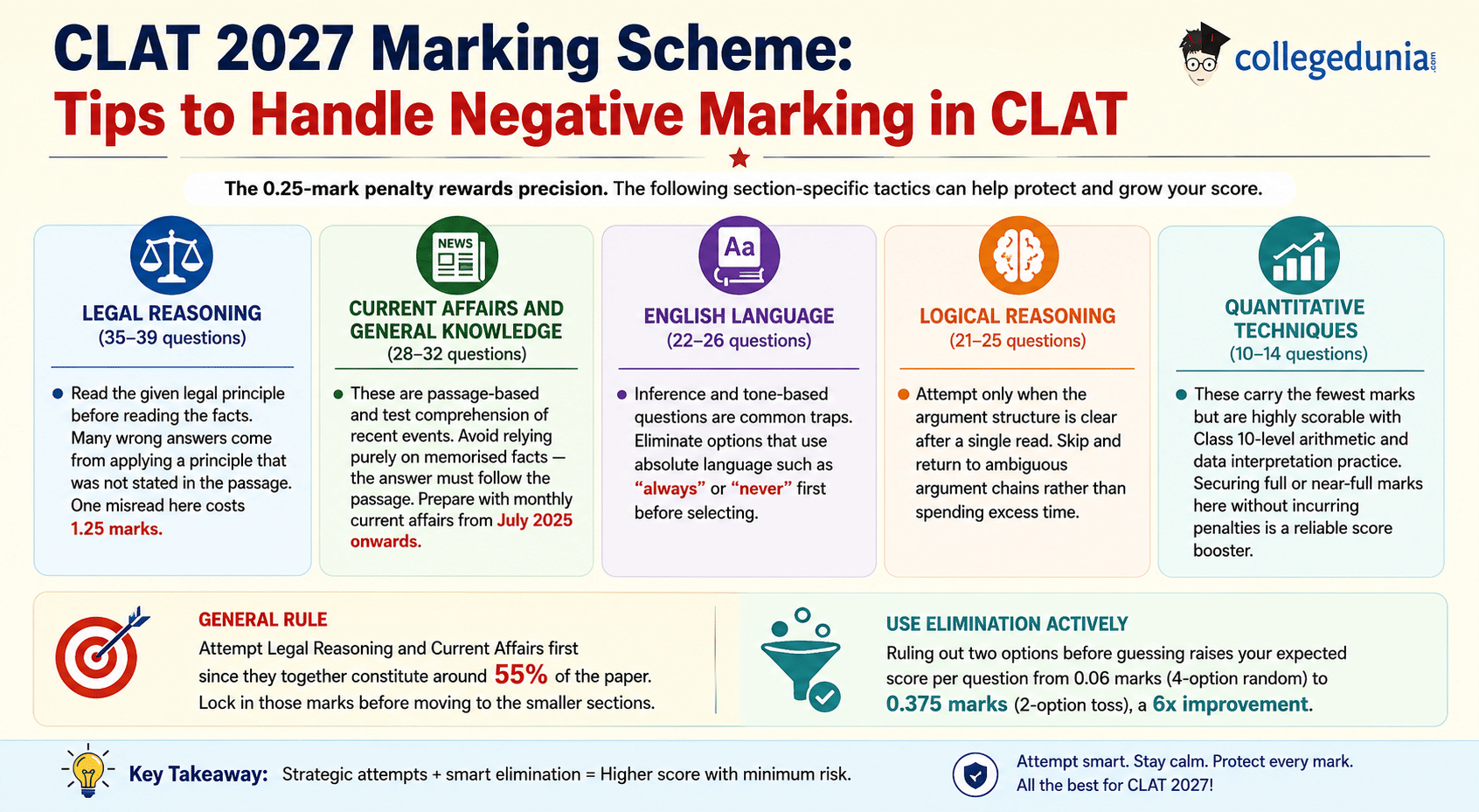
CLAT 2027 Marking Scheme: Tips to Handle Negative Marking in CLAT
The 0.25-mark penalty rewards precision. The following section-specific tactics can help protect and grow your score.
- Legal Reasoning (35- 39 questions): Read the given legal principle before reading the facts. Many wrong answers come from applying a principle that was not stated in the passage. One misread here costs 1.25 marks.
- Current Affairs and General Knowledge (28- 32 questions): These are passage-based and test comprehension of recent events. Avoid relying purely on memorised facts and the answer must follow the passage. Prepare with monthly current affairs from July 2025 onwards.
- English Language (22- 26 questions): Inference and tone-based questions are common traps. Eliminate options that use absolute language such as "always" or "never" first before selecting.
- Logical Reasoning (21- 25 questions): Attempt only when the argument structure is clear after a single read. Skip and return to ambiguous argument chains rather than spending excess time.
- Quantitative Techniques (10- 14 questions): These carry the fewest marks but are highly scorable with Class 10-level arithmetic and data interpretation practice. Securing full or near-full marks here without incurring penalties is a reliable score booster.
- General rule: Attempt Legal Reasoning and Current Affairs first since they together constitute around 55% of the paper. Lock in those marks before moving to the smaller sections.
- Use elimination actively: Ruling out two options before guessing raises your expected score per question from 0.06 marks (4-option random) to 0.375 marks (2-option toss), a 6x improvement.
Related Article: CLAT 2027 Information Bulletin: Direct Download and Key Highlights
CLAT 2027 Marking Scheme FAQs
Ques. What is the total marks for CLAT 2027?
Ans. CLAT 2027 carries a total of 120 marks. There are 120 questions and each correct answer earns 1 mark, so the maximum score you can achieve is 120.
Ques. How is the CLAT 2027 score calculated?
Ans. Your CLAT 2027 score is calculated using the formula: Raw Score = (Number of Correct Answers × 1) − (Number of Wrong Answers × 0.25). Unattempted questions carry no penalty and do not factor into the calculation.
Ques. Does CLAT 2027 have the same marking scheme for all sections?
Ans. Yes. The marking scheme is uniform across all five sections in CLAT 2027. Every correct answer earns +1 mark and every wrong answer costs −0.25 marks, regardless of which section the question belongs to.



Comments