


Candidates scoring 100 or more marks out of 120 in CLAT 2027 are expected to have strong admission chances at top National Law Universities.
- Candidates should attempt 105–115 questions with a high level of accuracy for scoring 100+ marks .
- Legal Reasoning and Current Affairs including General Knowledge are expected to contribute 28–32 questions each which makes them the highest weightage sections in the examination.
- The preparation period of around six months gives candidates enough time to build concepts, improve accuracy and strengthen time management before the examination.
- Regular mock tests from the third month of preparation can help candidates identify weak areas, improve speed and build exam confidence.
Related Links:
- CLAT 2027: Notification, Exam Date, Registration, Pattern, Syllabus, & Cutoff
- CLAT Exam Pattern 2026: Check CLAT syllabus, Marking Scheme, Exam Mode, Question Paper
- CLAT Syllabus 2026: Download Free PDF, Check Syllabus, Weightage, Books and Preparation

Key Summary
- The CLAT 2027 notification is expected in July 2026 while the examination is expected to be conducted in December 2026.
- CLAT 2027 is expected to have 120 questions carrying 120 marks with 1 mark awarded for every correct answer and 0.25 mark deducted for every incorrect response.
CLAT 2027 Exam Pattern and Scoring Basics
Understanding the CLAT 2027 exam pattern is an important first step for candidates targeting a 100+ score.
- CLAT 2027 is expected to follow the comprehension-based pattern with 120 questions to be completed in 120 minutes.
- Every question is expected to be based on a reading passage, and standalone factual questions are unlikely to be asked.
- Candidates targeting 100+ marks should aim to attempt around 105–115 questions with high accuracy.
- Leaving 5–10 doubtful questions is often a better strategy than making random guesses and losing marks because of negative marking.
- Regular mock tests from the third month of preparation can help candidates improve speed, accuracy, and overall exam performance.
| Section | Questions | Max Marks |
|---|---|---|
| English Language | 22–26 | 22–26 |
| Current Affairs including GK | 28–32 | 28–32 |
| Legal Reasoning |
28–32 |
28–32 |
| Logical Reasoning |
22–26 |
22–26 |
| Quantitative Techniques | 10–14 | 10–14 |
| Total | 120 | 120 |
Also Read
CLAT English Syllabus- Check Preparation Books, Previous Year Questions, Mock TestQues. Is it necessary to attempt all 120 questions in CLAT 2027?
Ans. No. It is not necessary to attempt all 120 questions in CLAT 2027. Because of 0.25 negative marking for every incorrect answer, candidates should attempt only those questions they can answer confidently. Attempting around 105–115 questions with high accuracy is generally considered a safer strategy.
Ques. Are all questions in CLAT 2027 passage-based?
Ans. Yes. CLAT 2027 is expected to follow the recent comprehension-based pattern, where questions across English, Current Affairs, Legal Reasoning, Logical Reasoning, and Quantitative Techniques are based on passages. Candidates should focus on improving reading speed, comprehension, and analytical reasoning during preparation.
6-Month Study Plan: Month-by-Month Breakdown
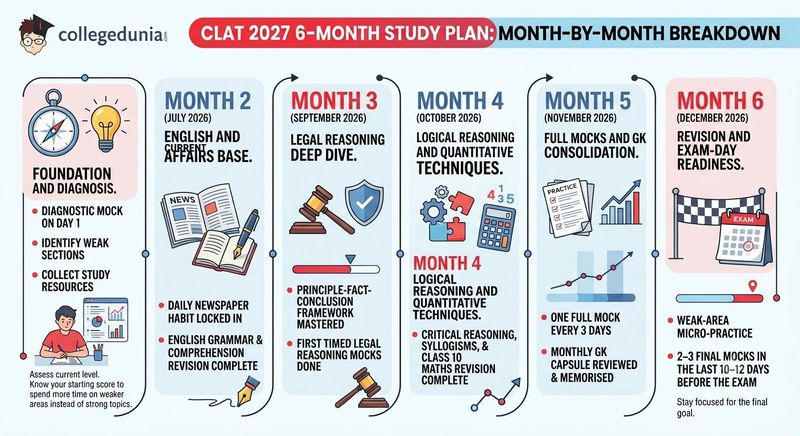
This CLAT 2027 preparation plan begins in July 2026 and continues until the December 2026 examination.
- Each month has a specific preparation goal to help candidates stay focused throughout the six-month study plan.
- The first month should be used to assess the current level of preparation rather than begin intensive revision.
- Candidates should take a full-length mock test on the first day of July before starting their revision.
- The initial mock test helps candidates identify their stronger and weaker sections, making it easier to plan the remaining preparation effectively.
- Knowing the starting score early can help candidates spend more time on weaker areas instead of revising topics they already understand well.
| Month | Period | Focus | Key Milestone |
|---|---|---|---|
| Month 1 | July 2026 | Foundation and Diagnosis |
Diagnostic mock on Day 1; identify weak sections; collect study resources |
| Month 2 | August 2026 | English and Current Affairs Base | Daily newspaper habit locked in; English grammar and comprehension revision complete |
| Month 3 | September 2026 | Legal Reasoning Deep Dive | Principle-fact-conclusion framework mastered; first timed Legal Reasoning mocks done |
| Month 4 | October 2026 | Logical Reasoning and Quantitative Techniques | Critical reasoning, syllogisms and Class 10 maths revision complete |
| Month 5 | November 2026 | Full Mocks and GK Consolidation | One full mock every 3 days; monthly GK capsule reviewed and memorised |
| Month 6 | December 2026 | Revision and Exam-Day Readiness |
Weak-area micro-practice; 2–3 final mocks in the last 10–12 days before the exam |
Also Read
CLAT GK Syllabus: Download PDF, Books, Notes and Important TopicsQues. Should I take a mock test before starting CLAT 2027 preparation?
Ans. Yes. Candidates should take a diagnostic mock test before beginning CLAT 2027 preparation. It helps identify strengths and weak areas, making it easier to create an effective six-month study plan and track improvement over time.
Ques. What should I study in the last month before CLAT 2027?
Ans. In the final month before CLAT 2027, candidates should focus on revision, weak-topic practice, Current Affairs revision, and full-length mock tests. Avoid starting new topics and concentrate on improving accuracy, speed, and exam-day strategy.
Subject-wise Strategy to Score 100+
Each section of CLAT 2027 requires a different preparation strategy to improve overall performance.
- Following a section-wise study plan helps candidates use their preparation time more effectively.
- Legal Reasoning remains one of the highest-weightage sections in CLAT 2027.
- Candidates who spend around 35–40% of their weekly study time on Legal Reasoning during the first 2–3 months of preparation often see better improvement in their scores.
- Building a strong foundation in Legal Reasoning during the early stages of preparation can improve overall performance in the examination.
| Section | Target Score | Key Strategy |
|---|---|---|
| Legal Reasoning |
26–30 out of 28–32 |
Master the principle–fact–application framework; read every passage fully before attempting questions; use CLAT 2021–2026 papers as primary practice material |
| Current Affairs + GK |
26–30 out of 28–32 |
Read one quality newspaper daily; compile monthly GK capsules covering international affairs, landmark judgements, government schemes, and awards |
| Logical Reasoning |
20–24 out of 22–26 |
Focus on critical reasoning, assumptions, inferences, and strengthen/weaken arguments; practise identifying assumptions and conclusions in newspaper editorials |
| English Language |
20–24 out of 22–26 |
Attempt comprehension passages within 6–7 minute time limits; build vocabulary through editorial reading rather than rote word lists |
| Quantitative Techniques |
9–12 out of 10–14 |
Revise Class 10 maths — ratios, percentages, averages, profit-loss, and basic data interpretation; these questions are highly scoreable for all students |
Also Read
СLАT Legаl Reаsоning Syllаbus, Check Important Topics, Preparation Tips and BooksRecommended Daily Study Schedule
Following a daily study routine can help candidates maintain balanced preparation across all CLAT 2027 sections.
- The schedule below is suitable for candidates studying 4–5 hours on weekdays and 6–7 hours on weekends.
- Candidates should maintain a mistake log throughout their preparation.
- Every incorrect answer or guessed question should be noted along with the correct explanation and the concept involved.
- Reviewing the mistake log every week can help candidates identify recurring errors and improve their overall accuracy.
| Time Slot | Activity | Duration |
|---|---|---|
| Morning (6:00–7:00 AM) |
Newspaper reading — mark current affairs, legal news & editorials |
60 min |
| Morning (9:00–11:00 AM) |
Primary section study (focus on Legal Reasoning or Logical Reasoning) |
120 min |
| Afternoon (2:00–3:30 PM) |
Secondary section study (English or Current Affairs consolidation) |
90 min |
| Evening (6:00–7:00 PM) |
Sectional practice / Quant / GK notes update |
60 min |
| Night (9:30–10:00 PM) |
Day review — update mistake log & quick revision |
30 min |
Also Read
CLAT Quantitative Techniques Syllabus- Check Preparation Books, Previous Year Questions, Mock TestQues. Should I read the newspaper every day for CLAT 2027 preparation?
Ans. Yes. Reading a newspaper daily is highly recommended for CLAT 2027 as it improves Current Affairs, Legal Reasoning, vocabulary, and reading comprehension. Candidates should focus on editorials, legal news, and important national and international events.
Ques. How can I improve accuracy in CLAT 2027 mock tests?
Ans. The best way to improve accuracy is to maintain a mistake log after every mock test and sectional practice. Reviewing incorrect answers regularly helps candidates identify recurring mistakes, strengthen weak concepts, and reduce errors in future tests.
Mock Test and Revision Strategy
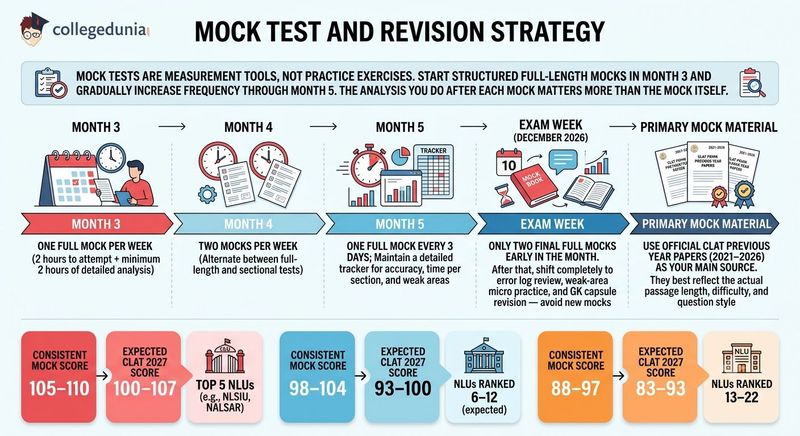
Mock tests are measurement tools, not practice exercises. Start structured full-length mocks in Month 3 and gradually increase frequency through Month 5. The analysis you do after each mock matters more than the mock itself.
- Month 3: One full mock per week — 2 hours to attempt + minimum 2 hours of detailed analysis.
- Month 4: Two mocks per week (alternate between full-length and sectional tests).
- Month 5: One full mock every 3 days; maintain a detailed tracker for accuracy, time per section, and weak areas.
- Exam Week (December 2026): Only two final full mocks early in the month. After that, shift completely to error log review, weak-area micro practice, and GK capsule revision — avoid new mocks.
Primary Mock Material: Use official CLAT previous year papers (2021–2026) as your main source. They best reflect the actual passage length, difficulty, and question style.
| Consistent Mock Score | Expected CLAT 2027 Score | Expected NLU Admission Range |
|---|---|---|
| 105–110 |
100–107 |
Top 5 NLUs (NLSIU, NALSAR, etc.) |
| 98–104 | 93–100 | NLUs ranked 6–12 (expected) |
| 88–97 | 83–93 |
NLUs ranked 13–22 |
Also Read
CLAT LLM Exam Pattern & Syllabus: Marking Scheme, Preparation and BooksQues. Should I take mock tests during the last week before CLAT 2027?
Ans. No. In the final week before CLAT 2027, candidates should avoid taking frequent new mock tests. Instead, focus on reviewing error logs, revising Current Affairs, and practising weak areas to improve accuracy and build confidence before the exam.
CLAT 2027 Preparation: Reddit Discussion
- The discussion focused on preparation tips for CLAT 2027, with candidates seeking guidance on building an effective study strategy for the examination.
- Another Reddit user recommended reading a newspaper daily, strengthening vocabulary and grammar, and covering the entire Mathematics syllabus instead of focusing only on frequently asked topics. The user also advised candidates to prepare comprehensively, as the CLAT exam pattern and question types can change from year to year.

CLAT 2027 Preparation FAQs
Ques. What is the total marks for CLAT 2027?
Ans. CLAT 2027 carries 120 marks across 120 questions. Each correct answer earns +1 mark and each wrong answer attracts a penalty of -0.25 marks. Unattempted questions get 0 marks.
Ques. Is scoring 100+ in CLAT 2027 realistic for a student starting now?
Ans. Yes, scoring 100 or more out of 120 is achievable with six months of consistent, structured preparation. You need roughly 90–94% net accuracy overall. Students who start in July 2026 and follow a disciplined plan with regular mocks from Month 3 onward commonly reach this range.
Ques. Which section should I prioritise for CLAT 2027?
Ans. Legal Reasoning (28–32 questions) and Current Affairs including GK (28–32 questions) are the highest weightage sections. Legal Reasoning is also one of the fastest-improving sections with targeted practice. Allocating 35–40% of your weekly study time to Legal Reasoning in the initial months usually produces the biggest score gains.
Ques. When should I start taking full-length mock tests for CLAT 2027?
Ans. Begin structured full-length mocks in Month 3 (September 2026). Take one diagnostic mock on Day 1 (in July) only to establish a baseline. Regular mock sessions should start after you have built a decent foundation in at least two major sections.
Ques. How many hours of daily study are enough for CLAT 2027?
Ans. 4–5 focused hours on weekdays and 6–7 hours on weekends are sufficient for most students. Remember: quality matters more than quantity. Post-mock analysis and maintaining a daily mistake log drive faster improvement than simply increasing study hours.
Ques. Where can I find the CLAT 2027 official notification?
Ans. The Consortium of NLUs publishes all official notifications at consortiumofnlus.ac.in. The CLAT 2027 notification is expected around July 2026, with the exam tentatively scheduled for December 2026 (likely December 6).



Comments