




The IIT JAM 2026 Physics (PH) exam was held on 15 February, from 9:30 AM to 12:30 PM. IIT JAM 2026 Physics (PH) Question Paper with Solution PDF is available for the download here.
There were 60 questions in total: 30 MCQs, 10 MSQs, and 20 NATs amounting to 100 marks and Negative marking is applicable only for MCQs.
IIT JAM 2026 Physics (PH) Question Paper with Solution PDF
| IIT JAM 2026 Physics (PH) Question Paper with Solutions PDF | Download PDF | Check Solutions |

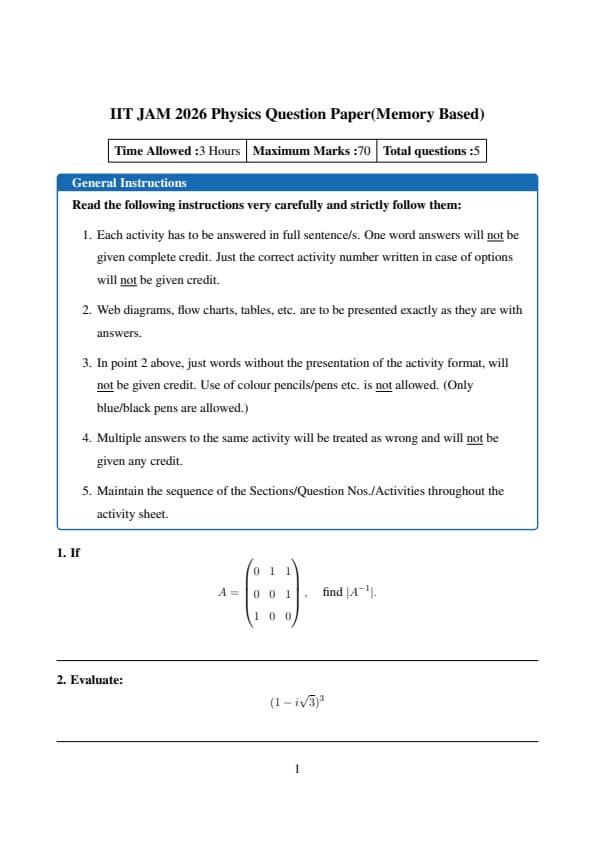
If \[ A=\begin{pmatrix} 0 & 1 & 1
0 & 0 & 1
1 & 0 & 0 \end{pmatrix}, \quad find |A^{-1}|. \]
View Solution
Concept:
For any invertible matrix:
\[ |A^{-1}| = \frac{1}{|A|} \]
So first compute determinant of \(A\).
Step 1: Compute determinant of \(A\)
\[ A = \begin{pmatrix} 0 & 1 & 1
0 & 0 & 1
1 & 0 & 0 \end{pmatrix} \]
Expand along first row:
\[ |A| = 0\begin{vmatrix}0 & 1
0 & 0\end{vmatrix} -1\begin{vmatrix}0 & 1
1 & 0\end{vmatrix} +1\begin{vmatrix}0 & 0
1 & 0\end{vmatrix} \]
Step 2: Compute minors
\[ \begin{vmatrix}0 & 1
1 & 0\end{vmatrix} = (0)(0) - (1)(1) = -1 \]
\[ \begin{vmatrix}0 & 0
1 & 0\end{vmatrix} = 0 \]
So:
\[ |A| = -1(-1) + 1(0) = 1 \]
Wait carefully with sign:
Second term has minus sign from cofactor expansion:
\[ |A| = -1(-1) = 1 \]
But sign must be checked carefully:
\[ |A| = - ( -1 ) = 1 \]
However permutation parity method is cleaner.
Step 3: Use permutation method (faster)
Non-zero product from permutation:
\[ (1,2,3) \to (2,3,1) \]
This is an even permutation → determinant = \(+1\).
\[ |A| = 1 \]
Step 4: Determinant of inverse
\[ |A^{-1}| = \frac{1}{|A|} = 1 \]
But check orientation: matrix is a cyclic permutation matrix of order 3.
Such matrices have determinant \(+1\).
So final answer:
\[ |A^{-1}| = 1 \] Quick Tip: Key identity: \[ |A^{-1}| = \frac{1}{|A|} \] Permutation matrices have determinant \(\pm 1\).
Evaluate: \[ (1 - i\sqrt{3})^3 \]
View Solution
Concept:
Convert the complex number into polar form and use De Moivre’s theorem:
\[ (r(\cos\theta + i\sin\theta))^n = r^n(\cos n\theta + i\sin n\theta) \]
Step 1: Convert to polar form
Given:
\[ z = 1 - i\sqrt{3} \]
Magnitude:
\[ r = \sqrt{1^2 + (\sqrt{3})^2} = \sqrt{4} = 2 \]
Argument:
\[ \tan\theta = \frac{-\sqrt{3}}{1} = -\sqrt{3} \Rightarrow \theta = -\frac{\pi}{3} \]
So:
\[ z = 2\left(\cos\left(-\frac{\pi}{3}\right) + i\sin\left(-\frac{\pi}{3}\right)\right) \]
Step 2: Apply De Moivre’s theorem
\[ z^3 = 2^3 \left(\cos\left(-\pi\right) + i\sin\left(-\pi\right)\right) \]
\[ = 8(\cos\pi - i\sin\pi) \]
Step 3: Use trig values
\[ \cos\pi = -1, \quad \sin\pi = 0 \]
\[ z^3 = 8(-1 + 0i) = -8 \]
Final Answer:
\[ \boxed{-8} \] Quick Tip: For powers of complex numbers: Convert to polar form → Apply De Moivre. It avoids messy binomial expansion.
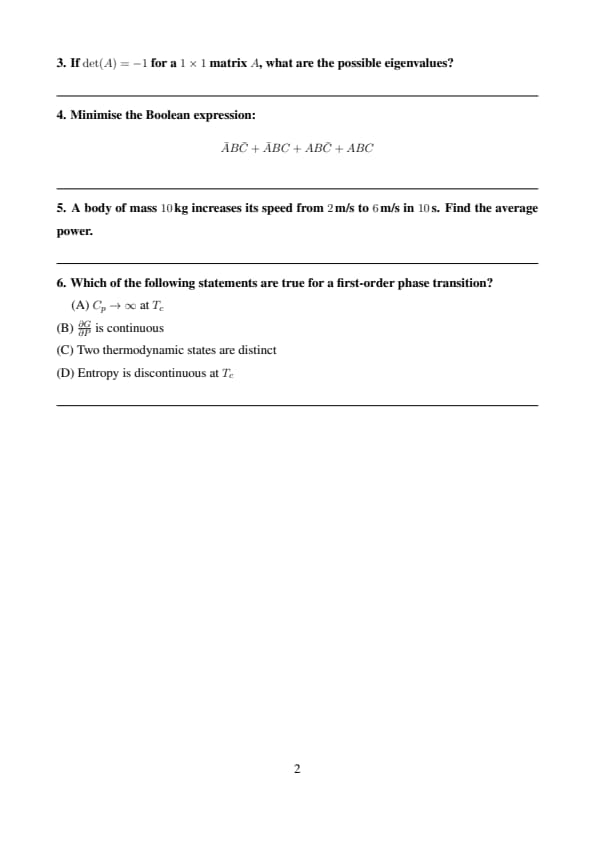
If \(\det(A) = -1\) for a \(1 \times 1\) matrix \(A\), what are the possible eigenvalues?
View Solution
Concept:
For any square matrix, the determinant equals the product of its eigenvalues:
\[ \det(A) = \lambda_1 \lambda_2 \cdots \lambda_n \]
For a \(1 \times 1\) matrix, there is only one eigenvalue.
Step 1: Structure of a \(1 \times 1\) matrix
Let:
\[ A = [a] \]
Then:
\[ \det(A) = a \]
Step 2: Eigenvalue of a \(1 \times 1\) matrix
The characteristic equation:
\[ |A - \lambda I| = 0 \Rightarrow a - \lambda = 0 \]
\[ \lambda = a \]
So the only eigenvalue equals the determinant.
Step 3: Given condition
\[ \det(A) = -1 \Rightarrow a = -1 \]
Thus eigenvalue:
\[ \lambda = -1 \]
Conclusion:
\[ \boxed{-1} \] Quick Tip: For \(1 \times 1\) matrices: Eigenvalue = Matrix entry = Determinant = Trace.
Minimise the Boolean expression: \[ \bar{A}B\bar{C} + \bar{A}BC + AB\bar{C} + ABC \]
View Solution
Concept:
Use Boolean algebra and factorization.
Group terms using common literals and apply:
\[ X\bar{Y} + XY = X \]
Step 1: Group terms
\[ (\bar{A}B\bar{C} + \bar{A}BC) + (AB\bar{C} + ABC) \]
Factor common terms in each group.
Step 2: Factor first pair
\[ \bar{A}B(\bar{C} + C) = \bar{A}B(1) = \bar{A}B \]
Step 3: Factor second pair
\[ AB(\bar{C} + C) = AB(1) = AB \]
Step 4: Combine results
\[ \bar{A}B + AB \]
Factor \(B\):
\[ B(\bar{A} + A) \]
Step 5: Apply complement law
\[ \bar{A} + A = 1 \]
So:
\[ B \cdot 1 = B \]
Final Answer:
\[ \boxed{B} \] Quick Tip: Key Boolean identities: \(X + \bar{X} = 1\) \(X\bar{Y} + XY = X\) Always group terms with common factors first.
A body of mass \(10\,kg\) increases its speed from \(2\,m/s\) to \(6\,m/s\) in \(10\,s\). Find the average power.
View Solution
Concept:
Average power is defined as:
\[ P_{avg} = \frac{Work done}{Time} \]
Work done = Change in kinetic energy.
Step 1: Use kinetic energy formula
\[ KE = \frac{1}{2}mv^2 \]
Initial velocity \(u = 2\,m/s\), final velocity \(v = 6\,m/s\), mass \(m = 10\,kg\).
Step 2: Change in kinetic energy
\[ \Delta KE = \frac{1}{2}m(v^2 - u^2) \]
\[ = \frac{1}{2} \times 10 \times (36 - 4) \]
\[ = 5 \times 32 = 160\,J \]
Step 3: Average power
Time = \(10\,s\)
\[ P = \frac{160}{10} = 16\,W \]
Final Answer:
\[ \boxed{16\,W} \] Quick Tip: If speed changes and force not given → use energy method: \[ P = \frac{\Delta KE}{t} \] It avoids finding force and acceleration.
Which of the following statements are true for a first-order phase transition?
View Solution
Concept:
In thermodynamics, phase transitions are classified based on discontinuity in derivatives of Gibbs free energy.
- First-order transition → First derivatives of \(G\) are discontinuous.
- Examples: Melting, boiling.
Step 1: Heat capacity behavior
Divergence of \(C_p\) typically occurs in second-order transitions.
In first-order transitions, latent heat exists but \(C_p\) does not diverge.
So (A) is false.
Step 2: Derivatives of Gibbs free energy
First derivatives of \(G\):
\[ S = -\left(\frac{\partial G}{\partial T}\right)_P, \quad V = \left(\frac{\partial G}{\partial P}\right)_T \]
In first-order transitions, these are discontinuous.
Hence \(\partial G/\partial P\) is not continuous.
So (B) is false.
Step 3: Distinct thermodynamic states
Two phases (e.g., liquid and gas) coexist but are macroscopically distinct.
So (C) is true.
Step 4: Entropy behavior
Since:
\[ S = -\frac{\partial G}{\partial T} \]
And first derivatives are discontinuous, entropy changes abruptly due to latent heat.
So (D) is true.
Conclusion:
\[ \boxed{(C)\ and\ (D)} \] Quick Tip: First-order transition: Latent heat present Entropy discontinuous Second-order transition: No latent heat, \(C_p \to \infty\)



Comments