




The IIT JAM 2026 Biotechnology (BT) exam, was held on 15 February, from 9:30 AM to 12:30 PM. IIT JAM 2026 Biotechnology (BT) Question Paper with Solution PDF is available for the download here.
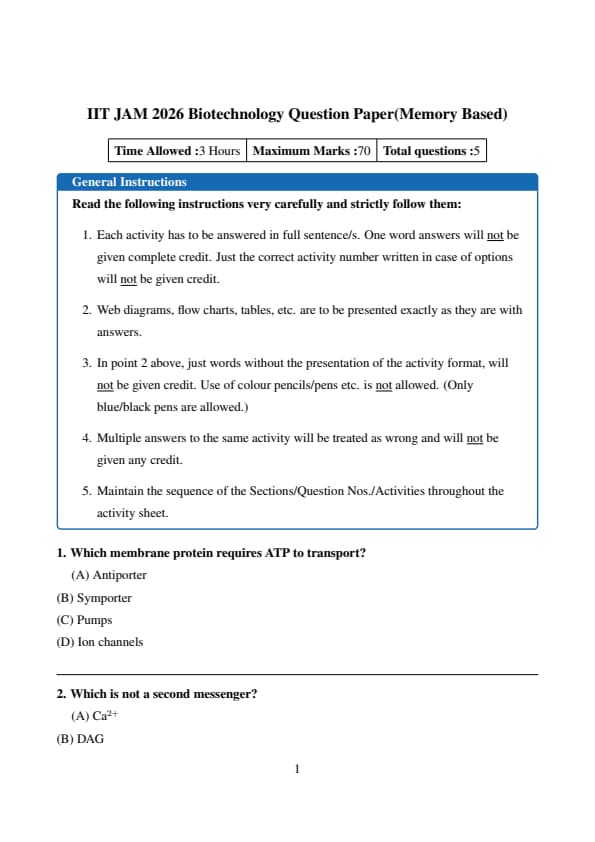
There was 60 questions in total: 30 MCQs, 10 MSQs, and 20 NATs amounting to 100 marks and Negative marking is applicable only for MCQs.
IIT JAM 2026 Biotechnology (BT) Question Paper with Solution PDF – Memory Based
| IIT JAM 2026 Biotechnology (BT) Question Paper with Solutions PDF | Download PDF | Check Solutions |
Which membrane protein requires ATP to transport?
View Solution
Concept:
Membrane transport proteins are classified based on whether they require energy (ATP) or not.
Transport across membranes can be passive (no ATP) or active (requires ATP).
Step 1: Ion channels
Ion channels allow passive diffusion of ions along their concentration gradient.
They do not require ATP.
Step 2: Symporters and antiporters
These are co-transporters involved in secondary active transport.
They use energy indirectly from ion gradients (like Na\(^+\)), not directly from ATP.
Step 3: Pumps
Pumps perform primary active transport.
They directly hydrolyze ATP to move substances against their concentration gradient.
Examples:
- Na\(^+\)/K\(^+\) pump
- Proton pump
- Ca\(^{2+}\) pump
Step 4: Conclusion
Only membrane pumps directly use ATP for transport.
\[ \boxed{Pumps} \] Quick Tip: Primary active transport = Uses ATP directly → Pumps. Secondary active transport = Uses ion gradient → Symporters/Antiporters.
Which is not a second messenger?
View Solution
Concept:
Second messengers are intracellular signaling molecules released in response to extracellular signals (first messengers like hormones). They amplify and transmit signals inside the cell.
Step 1: Common second messengers
Well-known second messengers include:
- cAMP (cyclic AMP)
- DAG (Diacylglycerol)
- IP\(_3\)
- Ca\(^{2+}\)
These molecules activate intracellular pathways.
Step 2: Role of Ca\(^{2+}\)
Calcium ions act as important second messengers in:
- Muscle contraction
- Neurotransmission
- Enzyme activation
Step 3: Role of DAG and cAMP
- DAG activates protein kinase C (PKC).
- cAMP activates protein kinase A (PKA).
Both are classic second messengers.
Step 4: Potassium ion (K\(^+\))
Potassium ions mainly:
- Maintain membrane potential
- Help in nerve impulse transmission
They are not typical second messengers in signal transduction pathways.
Conclusion:
\[ \boxed{K^+} \] Quick Tip: Major second messengers: cAMP, Ca\(^{2+}\), IP\(_3\), DAG. If an ion is mainly structural/electrical (like K\(^+\)), it is usually not a second messenger.
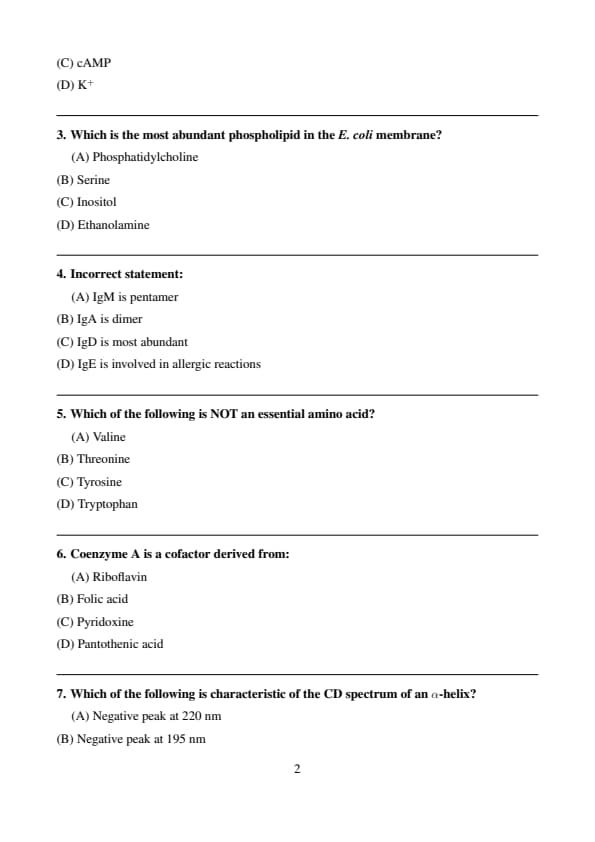
Which is the most abundant phospholipid in the E. coli membrane?
View Solution
Concept:
The bacterial membrane, especially in E. coli, has a distinct phospholipid composition compared to eukaryotic membranes.
Step 1: Major phospholipids in \textit{E. coli
The main phospholipids present are:
- Phosphatidylethanolamine (PE) — most abundant
- Phosphatidylglycerol (PG)
- Cardiolipin (CL)
Step 2: Why phosphatidylethanolamine dominates
Phosphatidylethanolamine contributes:
- Membrane curvature
- Structural integrity
- Proper functioning of membrane proteins
It constitutes about 70–80% of total phospholipids.
Step 3: Eliminating other options
- Phosphatidylcholine is mainly found in eukaryotic membranes.
- Inositol phospholipids are typical in eukaryotic signaling.
- Serine is a precursor but not the dominant lipid.
Conclusion:
\[ \boxed{Phosphatidylethanolamine (Ethanolamine)} \] Quick Tip: Bacteria vs Eukaryotes: E. coli membrane → Phosphatidylethanolamine dominant. Animal cells → Phosphatidylcholine dominant.
Incorrect statement:
View Solution
Concept:
Different classes of immunoglobulins (antibodies) have distinct structures, abundance, and functions in the immune system.
Step 1: IgM structure
IgM exists as a pentamer in its secreted form.
Hence statement (A) is correct.
Step 2: IgA structure
Secretory IgA is typically found as a dimer (especially in mucosal secretions).
So statement (B) is correct.
Step 3: Most abundant immunoglobulin
The most abundant antibody in serum is IgG, not IgD.
IgD is present in very low concentrations and mainly acts as a B-cell receptor.
Hence statement (C) is incorrect.
Step 4: IgE function
IgE is responsible for:
- Allergic reactions
- Type I hypersensitivity
- Defense against parasites
So statement (D) is correct.
Conclusion:
Incorrect statement:
\[ \boxed{IgD is most abundant} \] Quick Tip: Antibody facts: IgG = most abundant IgM = pentamer IgA = dimer (secretions) IgE = allergy mediator
Which of the following is NOT an essential amino acid?
View Solution
Concept:
Amino acids are classified as essential and non-essential based on whether the human body can synthesize them.
- Essential amino acids: Must be obtained from diet.
- Non-essential amino acids: Can be synthesized in the body.
Step 1: Essential amino acids
Some important essential amino acids include:
- Valine
- Threonine
- Tryptophan
- Lysine
- Methionine
- Leucine
- Isoleucine
- Phenylalanine
- Histidine
Step 2: Tyrosine classification
Tyrosine is considered a non-essential (conditionally essential) amino acid because it is synthesized from phenylalanine in the body.
Hence, it does not need to be obtained directly from diet under normal conditions.
Step 3: Check options
- Valine → Essential
- Threonine → Essential
- Tryptophan → Essential
- Tyrosine → Non-essential
Conclusion:
\[ \boxed{Tyrosine} \] Quick Tip: Mnemonic for essential amino acids: \textbf{PVT TIM HALL} Tyrosine is NOT included → it is derived from phenylalanine.
Coenzyme A is a cofactor derived from:
View Solution
Concept:
Coenzymes are organic cofactors derived from vitamins and are essential for enzyme function in metabolism.
Step 1: Structure of Coenzyme A (CoA)
Coenzyme A is a complex molecule composed of:
- Adenosine diphosphate
- Cysteamine group
- Pantothenic acid (Vitamin B\(_5\))
Pantothenic acid forms the core structure.
Step 2: Function of CoA
CoA plays a crucial role in:
- Fatty acid metabolism
- Krebs cycle (acetyl-CoA formation)
- Acyl group transfer reactions
Step 3: Eliminating other options
- Riboflavin → precursor of FAD and FMN
- Folic acid → one-carbon metabolism
- Pyridoxine (Vitamin B\(_6\)) → amino acid metabolism
None of these form Coenzyme A.
Conclusion:
\[ \boxed{Pantothenic acid} \] Quick Tip: Vitamin origins of coenzymes: CoA → Pantothenic acid (B\(_5\)) FAD/FMN → Riboflavin (B\(_2\)) PLP → Pyridoxine (B\(_6\))
Which of the following is characteristic of the CD spectrum of an \(\alpha\)-helix?
View Solution
Concept:
Circular Dichroism (CD) spectroscopy is used to determine protein secondary structure. Different structures (α-helix, β-sheet, random coil) have characteristic CD signals.
Step 1: CD spectrum of \(\alpha\)-helix
An \(\alpha\)-helix typically shows:
- Two negative minima at \(\sim 208\) nm and \(\sim 222\) nm
- One positive peak near \(\sim 190\) nm
Step 2: Interpretation of options
- Negative at 220 nm → matches α-helix signature (near 222 nm).
- Negative at 195 nm → incorrect (positive peak occurs near 190–195 nm).
- Negative at 210 nm → not the main characteristic peak.
- Positive at 195 nm → true generally, but the most diagnostic feature is the strong negative band near 222 nm.
Step 3: Diagnostic feature
The most characteristic hallmark of an \(\alpha\)-helix is:
\[ Strong negative ellipticity near 222 nm \]
Conclusion:
\[ \boxed{Negative peak at 220 nm} \] Quick Tip: CD signatures: \(\alpha\)-helix → Negative at 208 \& 222 nm, positive near 190 nm. β-sheet → Negative ~218 nm, positive ~195 nm.
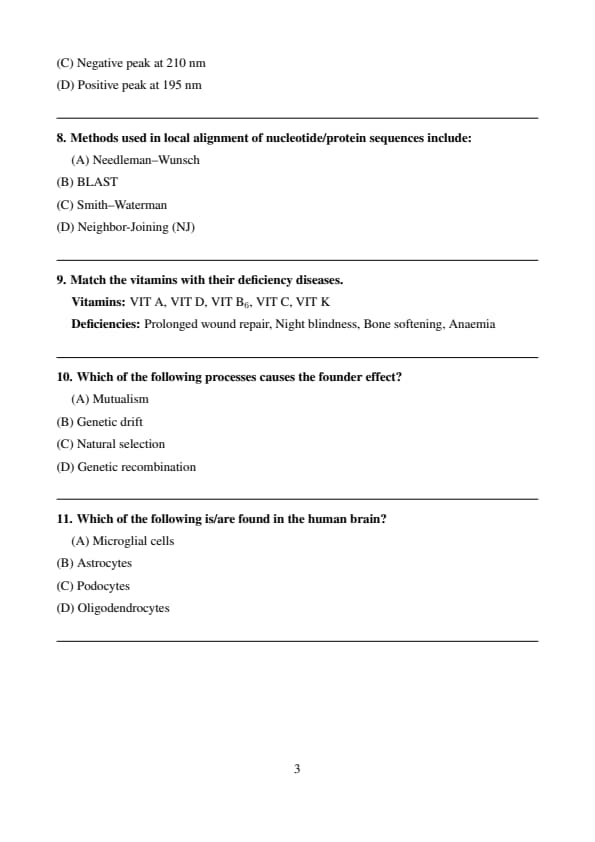
Methods used in local alignment of nucleotide/protein sequences include:
View Solution
Concept:
Sequence alignment methods are classified into:
- Global alignment → aligns entire sequences
- Local alignment → finds best matching subsequences
Step 1: Needleman–Wunsch
This is a global alignment algorithm.
It aligns sequences end-to-end.
Hence not used for local alignment.
Step 2: BLAST
BLAST is a heuristic tool for rapid similarity searches.
It performs local alignment but is not the classical dynamic programming method expected here.
Step 3: Smith–Waterman
Smith–Waterman is the standard dynamic programming algorithm for local alignment.
It identifies high-scoring local regions between sequences.
Step 4: Neighbor-Joining (NJ)
NJ is a phylogenetic tree construction method, not an alignment algorithm.
Conclusion:
\[ \boxed{Smith–Waterman} \] Quick Tip: Alignment algorithms: Needleman–Wunsch → Global alignment Smith–Waterman → Local alignment NJ → Phylogenetic trees
Match the vitamins with their deficiency diseases.
Vitamins:
VIT A, VIT D, VIT B\(_6\), VIT C, VIT K
Deficiencies:
Prolonged wound repair, Night blindness, Bone softening, Anaemia
View Solution
Concept:
Each vitamin has specific physiological roles, and deficiency leads to characteristic diseases.
Step 1: Vitamin A
Role: Vision (retinal pigment rhodopsin).
Deficiency leads to:
\[ Night blindness \]
Step 2: Vitamin D
Role: Calcium absorption and bone mineralization.
Deficiency causes:
\[ Bone softening (Rickets/Osteomalacia) \]
Step 3: Vitamin B\(_6\) (Pyridoxine)
Role: Amino acid metabolism and heme synthesis.
Deficiency results in:
\[ Anaemia \]
Step 4: Vitamin C
Role: Collagen synthesis and wound healing.
Deficiency causes:
\[ Delayed wound healing (Scurvy) \]
Step 5: Vitamin K
Role: Blood clotting factor synthesis.
Deficiency leads to:
\[ Bleeding tendency \]
(Not explicitly listed but important correction.) Quick Tip: Quick vitamin recall: A → Eyes (Night blindness) D → Bones C → Collagen (Wound healing) K → Clotting B\(_6\) → Anaemia
Which of the following processes causes the founder effect?
View Solution
Concept:
The founder effect is an evolutionary phenomenon that occurs when a small group of individuals establishes a new population, carrying only a limited portion of the original genetic variation.
Step 1: Understanding founder effect
When a few individuals colonize a new area:
- Genetic diversity is reduced
- Certain alleles become overrepresented
- Rare traits may become common
This happens due to random sampling.
Step 2: Role of genetic drift
The founder effect is a type of:
\[ Genetic drift \]
Genetic drift refers to random changes in allele frequencies, especially in small populations.
Step 3: Eliminating other options
- Mutualism → Ecological interaction, not evolutionary mechanism.
- Natural selection → Non-random adaptation.
- Genetic recombination → Shuffles genes but does not cause founder effect.
Conclusion:
\[ \boxed{Genetic drift} \] Quick Tip: Founder effect = Small population + Random allele sampling. It is a classic example of \textbf{genetic drift}.
Which of the following is/are found in the human brain?
View Solution
Concept:
The human brain contains neurons and various types of glial cells (neuroglia), which support and protect neurons.
Step 1: Microglial cells
Microglia are immune cells of the central nervous system.
They act as macrophages and are present in the brain.
Hence, correct.
Step 2: Astrocytes
Astrocytes are star-shaped glial cells that:
- Maintain blood-brain barrier
- Provide metabolic support
- Regulate neurotransmitters
They are abundant in the brain.
Correct.
Step 3: Podocytes
Podocytes are specialized cells of the kidney (glomerulus).
They are involved in filtration and not found in the brain.
Incorrect.
Step 4: Oligodendrocytes
Oligodendrocytes produce myelin sheaths around CNS axons.
They are present in the brain and spinal cord.
Correct.
Conclusion:
Cells found in human brain:
\[ Microglia, Astrocytes, Oligodendrocytes \] Quick Tip: CNS glial cells: Astrocytes, Oligodendrocytes, Microglia, Ependymal cells. Podocytes belong to kidney, not brain.



Comments