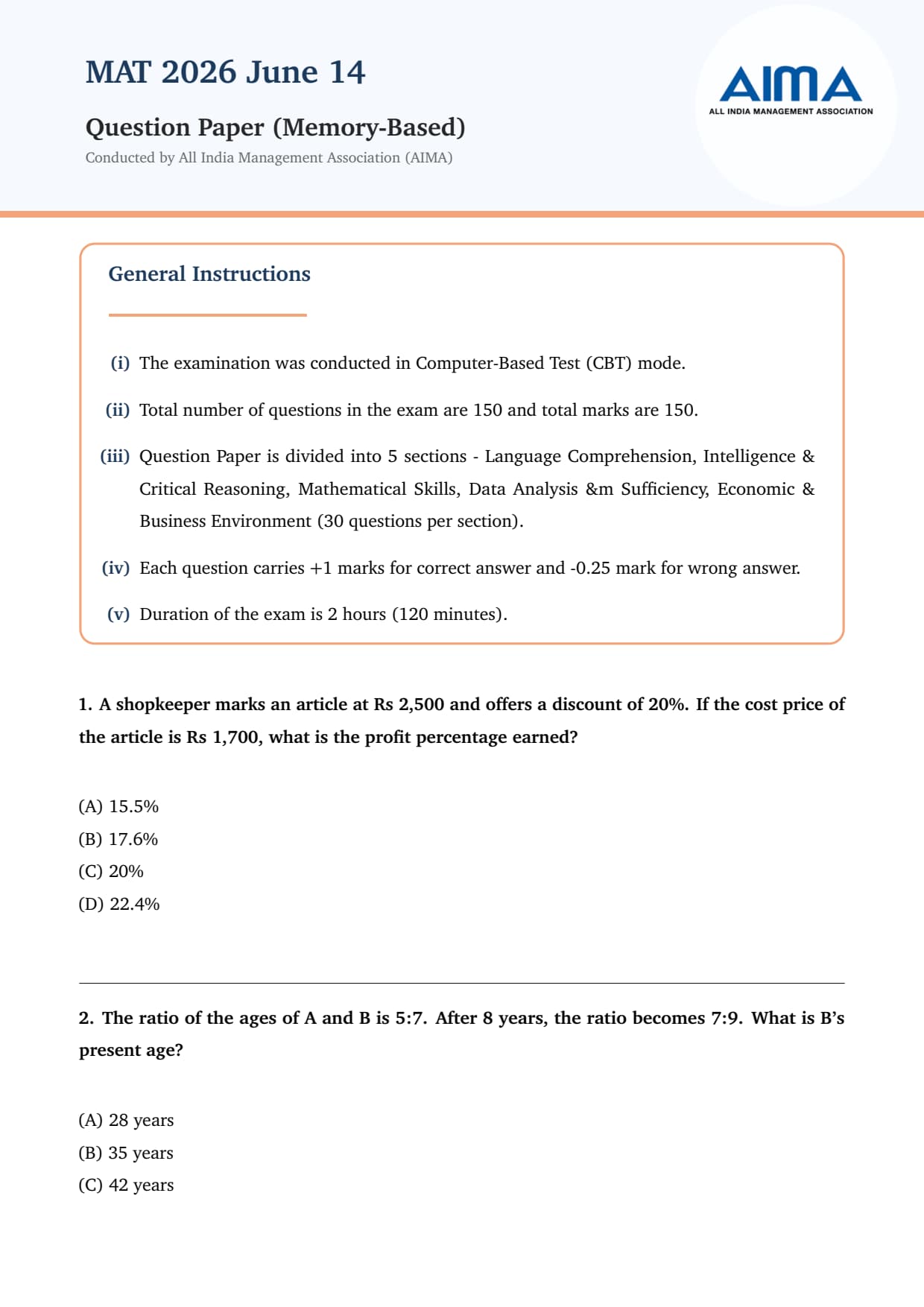
MAT 2026 CBT Question Paper with Solutions is available for download here. All India Management Association (AIMA) conducted MAT 2026 CBT exam on June 14. MAT Question Paper consists of 150 questions for 150 marks to be attempted in 120 minutes.

  • MAT Question Paper 2026 is divided into 5 sections- Language Comprehension, Intelligence & Critical Reasoning, Mathematical Skills, Data Analysis & Sufficiency and Economic & Business Environment each containing 30 questions.
  • According to AIMA MAT exam pattern, each question carries 1 mark and there is negative marking of 0.25 for every incorrect answers.

Candidates can download MAT 2026 CBT Question Paper with Answer Key and Solution PDF from the links provided below.

MAT 2026 CBT Question Paper with Solutions (Memory-Based)

MAT 2026 CBT Question Paper June 14 Download PDF Check Solutions

Question 1:

A shopkeeper marks an article at Rs 2,500 and offers a discount of 20%. If the cost price of the article is Rs 1,700, what is the profit percentage earned?

  • (A) 15.5%
  • (B) 17.6%
  • (C) 20%
  • (D) 22.4%
Correct Answer: (B) 17.6%
View Solution


Step 1: Understanding the Question:

The question is based on the concept of Profit, Loss, and Discount in commercial arithmetic.

The shopkeeper lists an article at a specific price, known as the Marked Price.

A discount is a reduction offered on this Marked Price, which determines the actual Selling Price.

The Cost Price represents the initial investment made by the shopkeeper to acquire the article.

Our goal is to find the net profit percentage, which is the percentage of profit earned relative to the Cost Price.


Step 2: Key Formula or Approach:

We will use the following standard mathematical formulas:

1. Selling Price (\(SP\)) after discount:
\[ SP = MP \times \left(1 - \frac{Discount %}{100}\right) \]

2. Absolute Profit made on the transaction:
\[ Profit = SP - CP \]

3. Profit Percentage calculated on the Cost Price:
\[ Profit % = \left(\frac{Profit}{CP}\right) \times 100% \]


Step 3: Detailed Explanation:
\(\bullet\) Let us write down the given parameters from the question statement.
\(\bullet\) The Marked Price (\(MP\)) of the article is given as Rs 2,500.
\(\bullet\) The Discount percentage (\(D%\)) offered by the shopkeeper is 20%.
\(\bullet\) The Cost Price (\(CP\)) of the article is given as Rs 1,700.
\(\bullet\) First, we compute the Selling Price (\(SP\)) using the marked price and discount percentage:
\[ SP = 2500 \times \left(1 - \frac{20}{100}\right) \]
\[ SP = 2500 \times 0.80 \]
\[ SP = 2000 \]
\(\bullet\) So, the actual Selling Price of the article after the discount is Rs 2,000.
\(\bullet\) Next, we determine the absolute profit earned by subtracting the Cost Price from this Selling Price:
\[ Profit = SP - CP \]
\[ Profit = 2000 - 1700 = 300 \]
\(\bullet\) To find the profit percentage, we express this profit as a percentage of the Cost Price:
\[ Profit % = \left(\frac{300}{1700}\right) \times 100% \]
\[ Profit % = \frac{300}{17}% \approx 17.647% \]
\(\bullet\) On rounding this value to one decimal place, we obtain approximately 17.6%.


Step 4: Final Answer:

The final profit percentage earned by the shopkeeper is approximately 17.6%.

Hence, the correct option is (B).
Quick Tip: Always remember that discount is computed on the Marked Price (\(MP\)), while profit or loss percentage is calculated on the Cost Price (\(CP\)).
To speed up calculations during the exam, use multiplier decimals: a 20% discount is equivalent to multiplying the \(MP\) by 0.8 directly, which yields the \(SP\) instantly.


Question 2:

The ratio of the ages of A and B is 5:7. After 8 years, the ratio becomes 7:9. What is B's present age?

  • (A) 28 years
  • (B) 35 years
  • (C) 42 years
  • (D) 49 years
Correct Answer: (A) 28 years
View Solution


Step 1: Understanding the Question:

This problem belongs to the topic of Ratio and Proportion applied to age-related problems.

We are given the ratio of the present ages of two individuals, A and B, which is 5:7.

We are also given their age ratio after a period of 8 years, which is 7:9.

We need to set up algebraic equations to find the present age of B.


Step 2: Key Formula or Approach:

Let the present ages of A and B be represented as \(5x\) and \(7x\) respectively, where \(x\) is a common ratio constant.

After 8 years, their respective ages will increase by 8 years.

We can formulate the following linear equation representing the ratio of their ages after 8 years:
\[ \frac{5x + 8}{7x + 8} = \frac{7}{9} \]


Step 3: Detailed Explanation:
\(\bullet\) Let the present age of A be \(5x\) years.
\(\bullet\) Let the present age of B be \(7x\) years.
\(\bullet\) After 8 years, A's age will be \(5x + 8\) years, and B's age will be \(7x + 8\) years.
\(\bullet\) According to the given condition, the ratio of these ages is 7:9.
\(\bullet\) Thus, we write the equation:
\[ \frac{5x + 8}{7x + 8} = \frac{7}{9} \]
\(\bullet\) We cross-multiply the terms of the equation to solve for \(x\):
\[ 9 \times (5x + 8) = 7 \times (7x + 8) \]
\[ 45x + 72 = 49x + 56 \]
\(\bullet\) Rearranging the terms to isolate the variable \(x\) on one side:
\[ 72 - 56 = 49x - 45x \]
\[ 16 = 4x \]
\[ x = 4 \]
\(\bullet\) Now that we have found the value of the common ratio constant \(x = 4\), we can find B's present age:
\[ Present age of B = 7x = 7 \times 4 = 28 years \]


Step 4: Final Answer:

The present age of B is 28 years.

Therefore, the correct option is (A).
Quick Tip: Look at the ratio differences: the initial ratio is 5:7 (difference is 2 units) and the final ratio is 7:9 (difference is 2 units).
Since the difference is constant, the increase in each person's ratio is from 5 to 7 (2 units) and 7 to 9 (2 units).
This increase of 2 units corresponds exactly to the 8 years that passed.
Therefore, 2 units = 8 years, which means 1 unit = 4 years.
We can compute B's age directly as \(7 units \times 4 = 28 years\) without setting up equations.


Question 3:

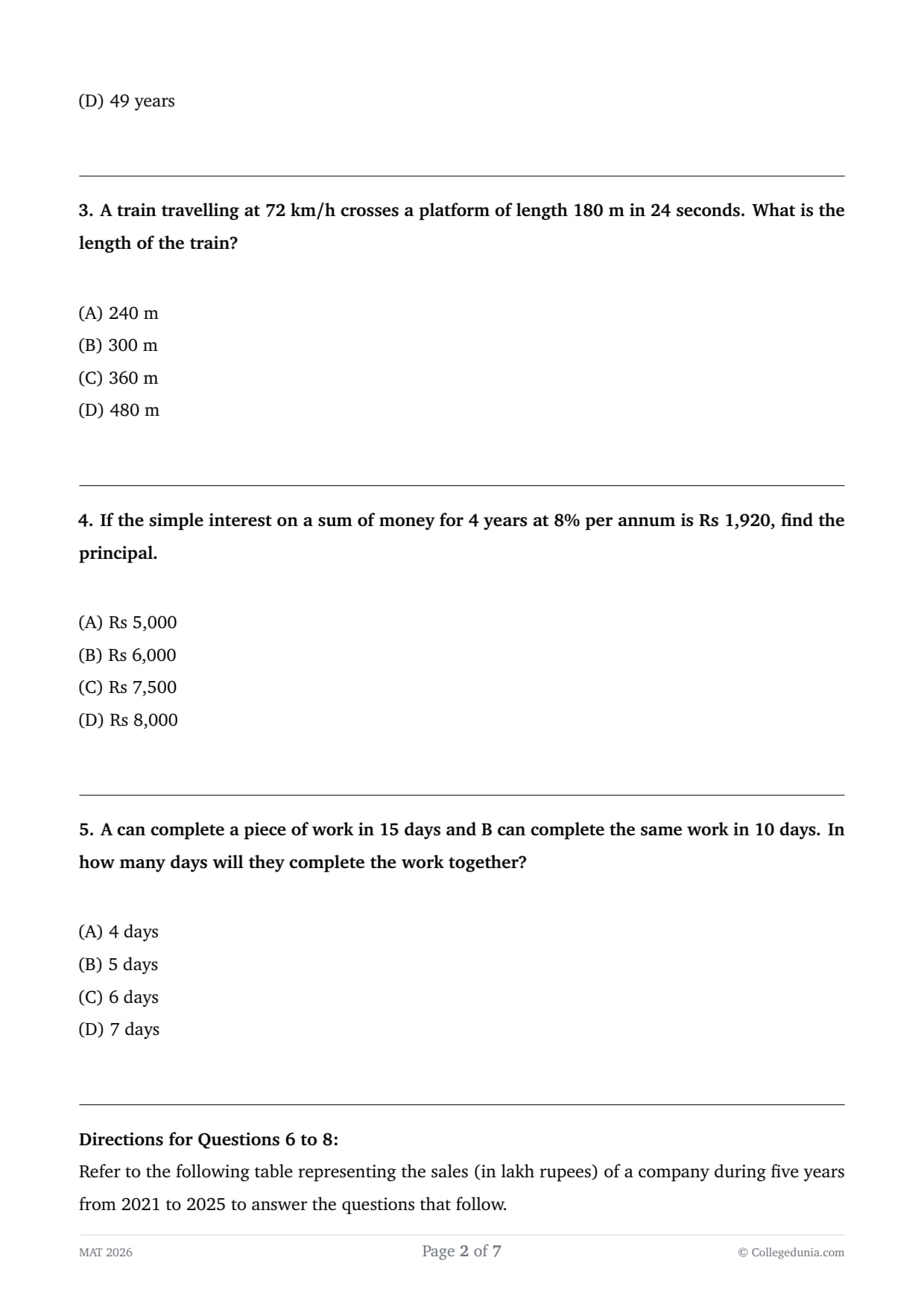
A train travelling at 72 km/h crosses a platform of length 180 m in 24 seconds. What is the length of the train?

  • (A) 240 m
  • (B) 300 m
  • (C) 360 m
  • (D) 480 m
Correct Answer: (B) 300 m
View Solution


Step 1: Understanding the Question:

This problem belongs to the topic of Time, Speed, and Distance, specifically focusing on train-related problems.

When a train crosses a platform, the total distance covered by the train is equal to the sum of the length of the train itself and the length of the platform.

We are given the speed of the train in km/h, the length of the platform in meters, and the time taken to cross the platform in seconds.

Our objective is to determine the length of the train.


Step 2: Key Formula or Approach:

1. Conversion of speed from km/h to m/s:
\[ Speed in m/s = Speed in km/h \times \frac{5}{18} \]

2. Distance formula:
\[ Distance = Speed \times Time \]

3. Total distance when crossing a platform:
\[ Total Distance = Length of Train (L) + Length of Platform (P) \]


Step 3: Detailed Explanation:
\(\bullet\) First, we need to convert the speed of the train from km/h to m/s to match the unit of length (meters) and time (seconds).
\(\bullet\) Given Speed \(= 72 km/h\).
\[ Speed in m/s = 72 \times \frac{5}{18} = 4 \times 5 = 20 m/s \]
\(\bullet\) Let the length of the train be \(L\) meters.
\(\bullet\) The length of the platform is given as \(180 m\).
\(\bullet\) The total distance covered by the train while completely crossing the platform is:
\[ Distance = L + 180 \]
\(\bullet\) The time taken to cover this distance is given as \(24 seconds\).
\(\bullet\) Applying the distance-speed-time relationship:
\[ Distance = Speed \times Time \]
\[ L + 180 = 20 \times 24 \]
\[ L + 180 = 480 \]
\(\bullet\) Solving for the length of the train \(L\):
\[ L = 480 - 180 \]
\[ L = 300 meters \]


Step 4: Final Answer:

The length of the train is 300 meters.

Therefore, the correct option is (B).
Quick Tip: Always convert units first.
A common shortcut to remember is that \(18 km/h = 5 m/s\).
Since \(72 km/h\) is \(4 \times 18 km/h\), the speed is directly \(4 \times 5 = 20 m/s\).
Multiplying this by \(24 seconds\) gives \(480 m\) of total distance.
Subtract the platform's length of \(180 m\) to get the train length of \(300 m\) instantly.


Question 4:

If the simple interest on a sum of money for 4 years at 8% per annum is Rs 1,920, find the principal.

  • (A) Rs 5,000
  • (B) Rs 6,000
  • (C) Rs 7,500
  • (D) Rs 8,000
Correct Answer: (B) Rs 6,000
View Solution


Step 1: Understanding the Question:

The question is based on the concept of Simple Interest in financial mathematics.

Simple interest is calculated on the initial principal amount and remains constant each year if the interest rate and principal do not change.

We are given the total simple interest earned over 4 years at an annual interest rate of 8%.

Our objective is to determine the original sum of money invested, which is the Principal (\(P\)).


Step 2: Key Formula or Approach:

The formula for calculating Simple Interest (\(SI\)) is:
\[ SI = \frac{P \times R \times T}{100} \]

where:
\(\bullet\) \(SI\) is the simple interest earned,
\(\bullet\) \(P\) is the principal amount,
\(\bullet\) \(R\) is the annual rate of interest,
\(\bullet\) \(T\) is the time period in years.


Step 3: Detailed Explanation:
\(\bullet\) Let us identify the values given in the problem statement.
\(\bullet\) Simple Interest (\(SI\)) = Rs 1,920.
\(\bullet\) Rate of Interest (\(R\)) = 8% per annum.
\(\bullet\) Time period (\(T\)) = 4 years.
\(\bullet\) We need to find the Principal (\(P\)).
\(\bullet\) Substituting the known values into the Simple Interest formula:
\[ 1920 = \frac{P \times 8 \times 4}{100} \]
\(\bullet\) Simplifying the right side of the equation:
\[ 1920 = \frac{32P}{100} \]
\(\bullet\) Now, rearrange the equation to solve for \(P\):
\[ 32P = 1920 \times 100 \]
\[ P = \frac{1920 \times 100}{32} \]
\(\bullet\) Simplifying the fraction:

Since \(192 \div 32 = 6\), we have \(1920 \div 32 = 60\).
\[ P = 60 \times 100 \]
\[ P = 6000 \]
\(\bullet\) Thus, the principal amount is Rs 6,000.


Step 4: Final Answer:

The principal sum of money is Rs 6,000.

Therefore, the correct option is (B).
Quick Tip: You can use effective percentage interest to solve this faster.
At 8% per annum for 4 years, the total simple interest accrued is \(8% \times 4 = 32%\) of the principal.
We are given that \(32%\) of the Principal is equal to Rs 1,920.
So, \(1% = 1920 \div 32 = 60\).
The principal (\(100%\)) is \(60 \times 100 = 6000\) instantly.


Question 5:

A can complete a piece of work in 15 days and B can complete the same work in 10 days. In how many days will they complete the work together?

  • (A) 4 days
  • (B) 5 days
  • (C) 6 days
  • (D) 7 days
Correct Answer: (C) 6 days
View Solution


Step 1: Understanding the Question:

This problem belongs to the topic of Time and Work.

We are given the individual times taken by two people, A and B, to complete a specific task.

We need to determine the total time required for both of them to complete the same work when working together.


Step 2: Key Formula or Approach:

We can approach this using two standard methods:

Method 1 (Formula-based):

If A can do a work in \(x\) days and B can do it in \(y\) days, the time taken by both working together is:
\[ Time taken = \frac{x \times y}{x + y} days \]

Method 2 (LCM-based/Efficiency method):

Define the total work as the Least Common Multiple (LCM) of the individual days, calculate their daily efficiencies, and divide the total work by their combined efficiency.


Step 3: Detailed Explanation:
\(\bullet\) Let us write down the given individual times.
\(\bullet\) Time taken by A to complete the work alone (\(x\)) = 15 days.
\(\bullet\) Time taken by B to complete the work alone (\(y\)) = 10 days.
\(\bullet\) Let us apply the LCM method to find the total work and efficiency.
\(\bullet\) The LCM of 15 and 10 is 30. Let us assume the Total Work is 30 units.
\(\bullet\) Efficiency of A (work done by A per day) is:
\[ Efficiency of A = \frac{Total Work}{Days taken by A} = \frac{30}{15} = 2 units/day \]
\(\bullet\) Efficiency of B (work done by B per day) is:
\[ Efficiency of B = \frac{Total Work}{Days taken by B} = \frac{30}{10} = 3 units/day \]
\(\bullet\) Combined efficiency of A and B when working together:
\[ Combined Efficiency = 2 + 3 = 5 units/day \]
\(\bullet\) The total time taken by A and B to complete the work together is:
\[ Time taken = \frac{Total Work}{Combined Efficiency} = \frac{30}{5} = 6 days \]
\(\bullet\) Alternatively, using the formula:
\[ Time taken = \frac{15 \times 10}{15 + 10} = \frac{150}{25} = 6 days \]


Step 4: Final Answer:

Working together, A and B will complete the work in 6 days.

Therefore, the correct option is (C).
Quick Tip: The LCM method is highly effective for complex time-and-work problems.
Always try to use LCM to convert fraction-based work rates into simple whole numbers representing efficiencies.
This minimizes computational errors and speeds up the calculation process.


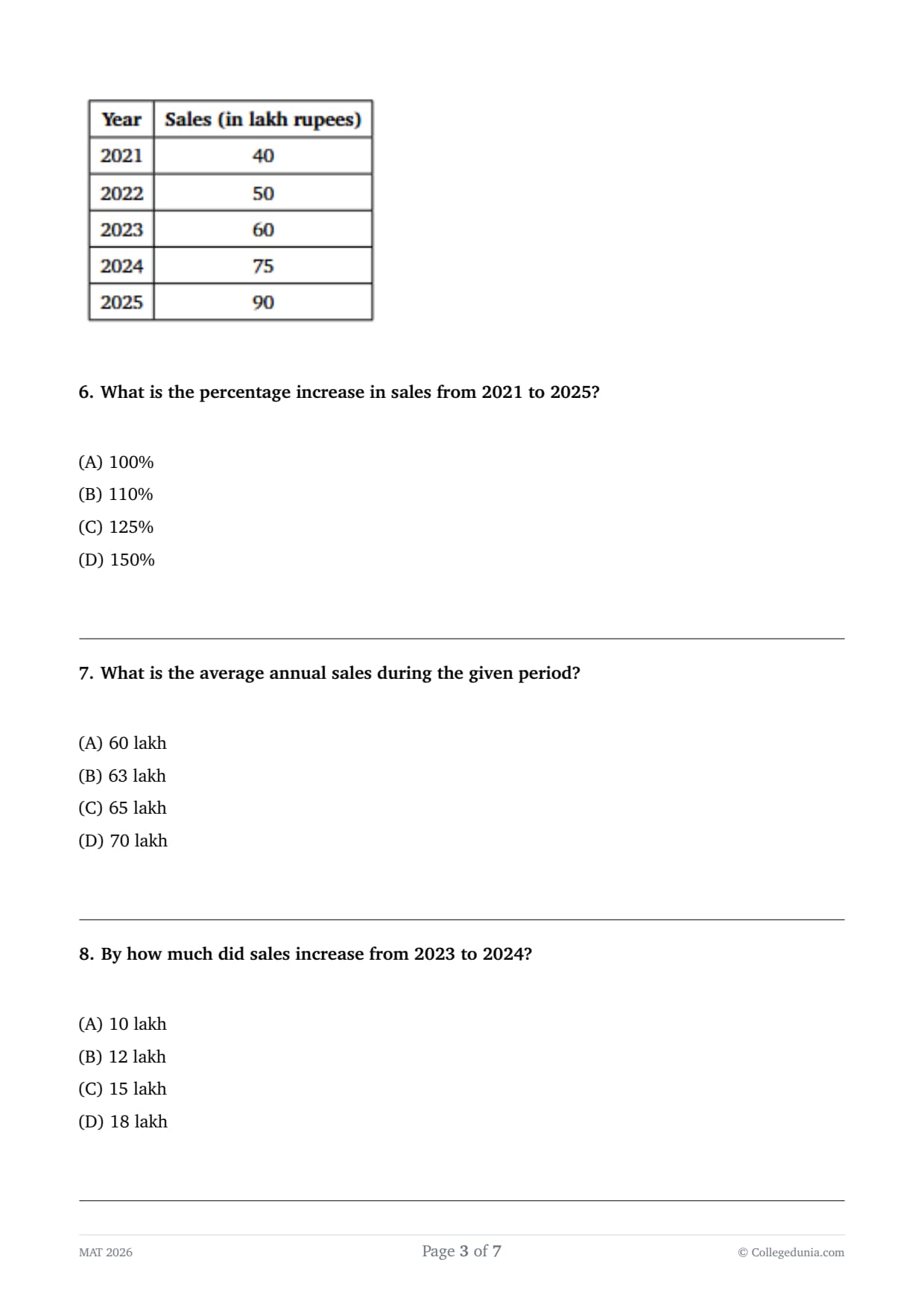
Directions for Question 6 to 8:

Refer to the following table representing the sales (in lakh rupees) of a company during five years from 2021 to 2025 to answer the questions that follow.


6.  What is the percentage increase in sales from 2021 to 2025?

  • (A) 100%
  • (B) 110%
  • (C) 125%
  • (D) 150%
Correct Answer: (C) 125%
View Solution


Step 1: Understanding the Question:

This is a Data Interpretation question involving the calculation of percentage growth over a specified period.

We need to compare the sales data of the starting year (2021) with the final year (2025).

We then compute how much the sales increased in percentage terms relative to the initial value in 2021.


Step 2: Key Formula or Approach:

The percentage increase formula is defined as:
\[ Percentage Increase = \left(\frac{Final Value - Initial Value}{Initial Value}\right) \times 100% \]

Here, the initial value is the sales in the year 2021, and the final value is the sales in the year 2025.


Step 3: Detailed Explanation:
\(\bullet\) Let us find the values of sales for the years 2021 and 2025 from the given data.
\(\bullet\) Sales in the year 2021 \(= 40 lakh rupees\).
\(\bullet\) Sales in the year 2025 \(= 90 lakh rupees\).
\(\bullet\) Next, we find the absolute increase in sales over this period:
\[ Absolute Increase = Sales in 2025 - Sales in 2021 \]
\[ Absolute Increase = 90 - 40 = 50 lakh rupees \]
\(\bullet\) Now, we calculate the percentage increase with respect to the initial sales in 2021:
\[ Percentage Increase = \left(\frac{50}{40}\right) \times 100% \]
\[ Percentage Increase = \frac{5}{4} \times 100% \]
\[ Percentage Increase = 1.25 \times 100% = 125% \]


Step 4: Final Answer:

The percentage increase in sales from 2021 to 2025 is 125%.

Therefore, the correct option is (C).
Quick Tip: A quick way to compute this is by simplifying the ratio of the final value to the initial value:
The ratio of sales in 2025 to 2021 is \(90 : 40 = 9 : 4\).
The increase is \(9 - 4 = 5\) units over an initial value of 4 units.
Since we know that the fraction \(1/4 = 25%\), the fraction \(5/4\) will be \(5 \times 25% = 125%\) directly.


Question 7:

What is the average annual sales during the given period?

  • (A) 60 lakh
  • (B) 63 lakh
  • (C) 65 lakh
  • (D) 70 lakh
Correct Answer: (B) 63 lakh
View Solution


Step 1: Understanding the Question:

This question asks for the arithmetic mean (average) of the annual sales of the company over the entire five-year period from 2021 to 2025.

To find the average, we must sum the sales for all individual years and divide that total by the number of years.


Step 2: Key Formula or Approach:

The formula for the average is given by:
\[ Average = \frac{Sum of all observations}{Number of observations} \]

In this case:
\[ Average Sales = \frac{Total Sales from 2021 to 2025}{Total number of years (5)} \]


Step 3: Detailed Explanation:
\(\bullet\) Let us list the sales values for all the five years given in the table:
\(\bullet\) Sales in 2021 = 40 lakh rupees.
\(\bullet\) Sales in 2022 = 50 lakh rupees.
\(\bullet\) Sales in 2023 = 60 lakh rupees.
\(\bullet\) Sales in 2024 = 75 lakh rupees.
\(\bullet\) Sales in 2025 = 90 lakh rupees.
\(\bullet\) Now, let us calculate the sum of these sales:
\[ Sum = 40 + 50 + 60 + 75 + 90 \]
\[ Sum = 315 lakh rupees \]
\(\bullet\) The total number of years in the given period is 5.
\(\bullet\) Now, calculate the average annual sales:
\[ Average Sales = \frac{315}{5} \]
\[ Average Sales = 63 lakh rupees \]


Step 4: Final Answer:

The average annual sales during the given period is 63 lakh rupees.

Therefore, the correct option is (B).
Quick Tip: To add the numbers quickly, group them:
\((40 + 60) + (50 + 90) + 75 = 100 + 140 + 75 = 240 + 75 = 315\).
Dividing 315 by 5 can be easily done by multiplying 315 by 2 and moving the decimal place:
\(315 \times 2 = 630\), so \(315 \div 5 = 63\).


Question 8:

By how much did sales increase from 2023 to 2024?

  • (A) 10 lakh
  • (B) 12 lakh
  • (C) 15 lakh
  • (D) 18 lakh
Correct Answer: (C) 15 lakh
View Solution


Step 1: Understanding the Question:

The question is a direct data extraction and subtraction problem based on the provided line graph data.

We need to determine the absolute increase in sales from the year 2023 to the year 2024.

This requires identifying the sales values for these two specific years and finding their difference.


Step 2: Key Formula or Approach:

The absolute increase is calculated as:
\[ Absolute Increase = Sales in 2024 - Sales in 2023 \]


Step 3: Detailed Explanation:
\(\bullet\) From the given table, we identify the sales for the specified years.
\(\bullet\) Sales of the company in the year 2023 \(= 60 lakh rupees\).
\(\bullet\) Sales of the company in the year 2024 \(= 75 lakh rupees\).
\(\bullet\) Now, we find the difference between the sales of these two consecutive years:
\[ Increase = 75 - 60 \]
\[ Increase = 15 lakh rupees \]
\(\bullet\) This directly represents the required growth in sales between 2023 and 2024.


Step 4: Final Answer:

The sales increased by 15 lakh rupees from 2023 to 2024.

Therefore, the correct option is (C).
Quick Tip: Double check the axis labels and values on data interpretation graphs to prevent simple observational mistakes.
Keep calculations minimal for such direct observation questions to conserve time for tougher questions.


Question 9:

What is the value of x?
Statement I: x+y=20
Statement II: y=8

  • (A) Statement I alone is sufficient
  • (B) Statement II alone is sufficient
  • (C) Both statements together are sufficient
  • (D) Neither statement is sufficient
Correct Answer: (C) Both statements together are sufficient
View Solution


Step 1: Understanding the Question:

This question is of the Data Sufficiency type.

The main objective is to determine if the given statements (I and II) provide sufficient information to find a unique value for the variable \(x\).

We must analyze each statement individually first, and only combine them if neither is sufficient on its own.


Step 2: Key Formula or Approach:

To find a unique solution for variables in linear algebraic equations, the number of independent equations must be equal to the number of unknown variables.

We have two variables, \(x\) and \(y\). Therefore, we generally require two independent equations to solve for them uniquely.


Step 3: Detailed Explanation:
\(\bullet\) Let us analyze Statement I alone:
\(\bullet\) Statement I gives us the equation: \(x + y = 20\).
\(\bullet\) This is a single equation with two unknown variables, \(x\) and \(y\).
\(\bullet\) It has infinitely many solutions (e.g., if \(y=1\), then \(x=19\); if \(y=10\), then \(x=10\), etc.).
\(\bullet\) Therefore, Statement I alone is not sufficient to determine a unique value for \(x\).
\(\bullet\) Now, let us analyze Statement II alone:
\(\bullet\) Statement II gives us: \(y = 8\).
\(\bullet\) This statement provides the value of \(y\) but gives no information about \(x\) or how \(x\) relates to \(y\).
\(\bullet\) Therefore, Statement II alone is not sufficient to determine the value of \(x\).
\(\bullet\) Now, let us combine both Statement I and Statement II:
\(\bullet\) From Statement I, we have \(x + y = 20\).
\(\bullet\) From Statement II, we have \(y = 8\).
\(\bullet\) Substituting the value of \(y\) from Statement II into the equation from Statement I:
\[ x + 8 = 20 \]
\[ x = 20 - 8 = 12 \]
\(\bullet\) This gives a single, unique value for \(x\), which is 12.
\(\bullet\) Hence, both statements together are sufficient to answer the question, but neither statement alone is sufficient.


Step 4: Final Answer:

Both statements together are sufficient to find the value of \(x\).

Therefore, the correct option is (C).
Quick Tip: In Data Sufficiency, do not spend extra time fully solving the equations once you establish that a unique solution is mathematically guaranteed.
As soon as you see two independent linear equations for two variables, you can confidently conclude they are sufficient together.


Question 10:

Is n an even number?
Statement I: n is divisible by 4.
Statement II: n is divisible by 8.

  • (A) Statement I alone is sufficient
  • (B) Statement II alone is sufficient
  • (C) Either statement alone is sufficient
  • (D) Both statements together are required
Correct Answer: (C) Either statement alone is sufficient
View Solution


Step 1: Understanding the Question:

This is a Data Sufficiency question concerning the properties of integers (Number Theory).

We need to determine if the integer \(n\) is an even number.

An even number is any integer that is completely divisible by 2.

We need to evaluate whether Statement I alone, Statement II alone, or both are sufficient to answer this question with a definite "Yes" or "No".


Step 2: Key Formula or Approach:

An integer \(n\) is even if it can be written in the form \(n = 2k\), where \(k\) is an integer.

If a number is divisible by any multiple of 2 (such as 4, 6, 8, etc.), it must also be divisible by 2 itself.


Step 3: Detailed Explanation:
\(\bullet\) Let us evaluate Statement I alone:
\(\bullet\) Statement I says: \(n\) is divisible by 4.
\(\bullet\) If \(n\) is divisible by 4, we can write \(n = 4k\), where \(k\) is an integer.
\(\bullet\) We can rewrite this as:
\[ n = 2 \times (2k) \]
\(\bullet\) Let \(m = 2k\) (which is also an integer). Then \(n = 2m\).
\(\bullet\) This proves that \(n\) is divisible by 2, meaning \(n\) is definitely an even number.
\(\bullet\) Thus, Statement I alone is sufficient to answer the question with a definite "Yes".
\(\bullet\) Now, let us evaluate Statement II alone:
\(\bullet\) Statement II says: \(n\) is divisible by 8.
\(\bullet\) If \(n\) is divisible by 8, we can write \(n = 8j\), where \(j\) is an integer.
\(\bullet\) We can rewrite this as:
\[ n = 2 \times (4j) \]
\(\bullet\) Let \(p = 4j\) (which is an integer). Then \(n = 2p\).
\(\bullet\) This proves that \(n\) is divisible by 2, meaning \(n\) is definitely an even number.
\(\bullet\) Thus, Statement II alone is also sufficient to answer the question with a definite "Yes".
\(\bullet\) Since each statement alone is independently sufficient to answer the question, the correct choice is that either statement alone is sufficient.


Step 4: Final Answer:

Either statement alone is sufficient to determine that \(n\) is an even number.

Therefore, the correct option is (C).
Quick Tip: If a statement allows you to answer the question with a definite "Yes" or a definite "No", it is considered sufficient.
A common mistake is thinking a statement is insufficient if it yields a "No" answer; as long as the answer is unique and definite, the data is sufficient.


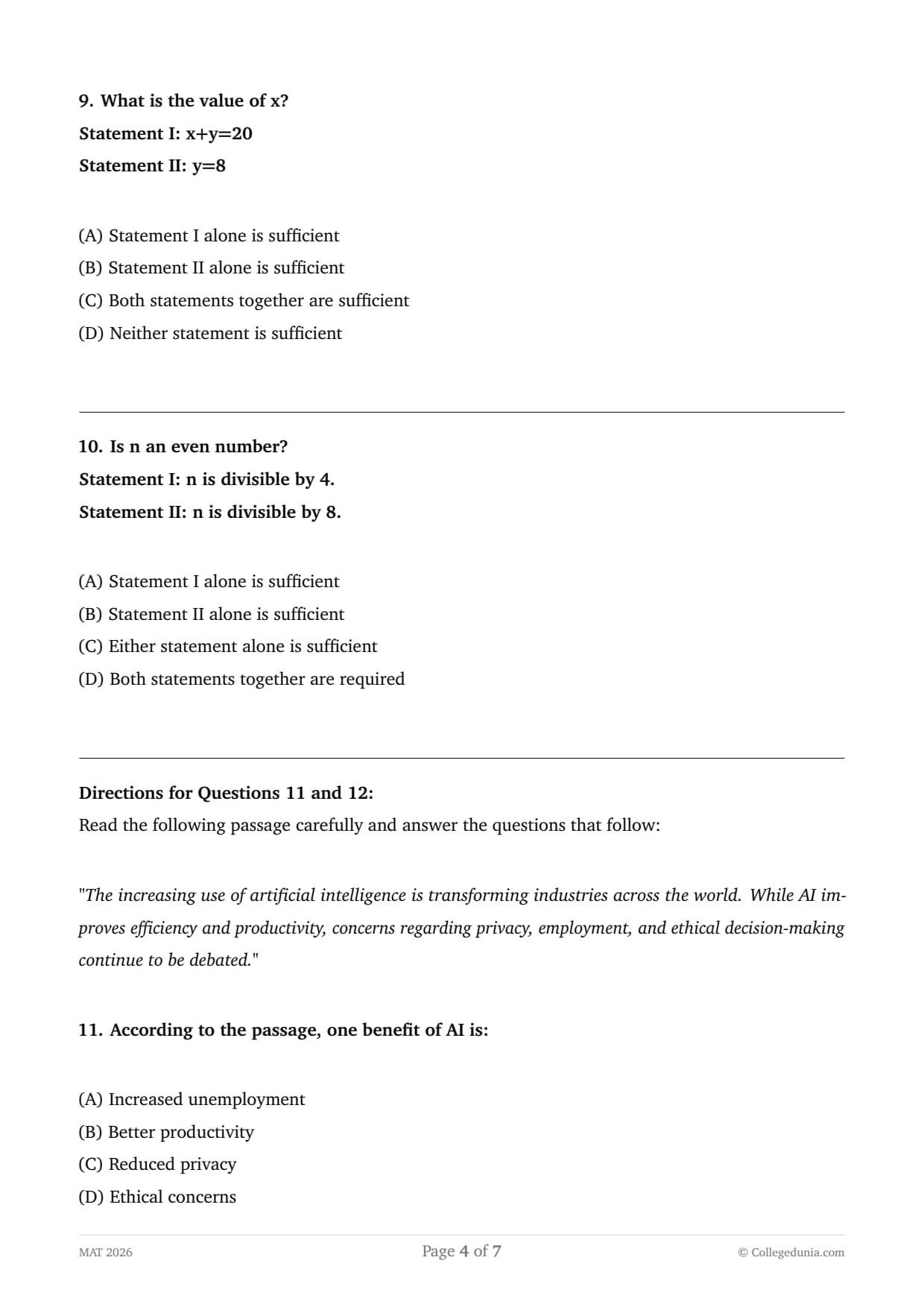
Directions for Question 11 and 12:

Read the following passage carefully and answer the questions that follow:

"The increasing use of artificial intelligence is transforming industries across the world. While AI improves efficiency and productivity, concerns regarding privacy, employment, and ethical decision-making continue to be debated."

11.  According to the passage, one benefit of AI is:

  • (A) Increased unemployment
  • (B) Better productivity
  • (C) Reduced privacy
  • (D) Ethical concerns
Correct Answer: (B) Better productivity
View Solution


Step 1: Understanding the Question:

This is a reading comprehension question that requires identifying a specific detail directly stated in the text.

We need to find which of the given options is described as a "benefit" of Artificial Intelligence (AI) in the passage.


Step 2: Detailed Explanation:
\(\bullet\) Let us carefully read the provided passage to identify the mention of benefits and concerns of AI.
\(\bullet\) The passage states: "While AI improves efficiency and productivity, concerns regarding privacy, employment, and ethical decision-making continue to be debated."
\(\bullet\) From this sentence, we can extract two distinct categories of attributes:

1. Positive impacts/benefits: Improving efficiency and productivity.

2. Negative impacts/concerns: Issues regarding privacy, employment, and ethical decision-making.
\(\bullet\) Now let us analyze the given choices:
\(\bullet\) Option (A) "Increased unemployment" is associated with "employment concerns", which is listed as a concern, not a benefit.
\(\bullet\) Option (B) "Better productivity" directly matches the positive impact "improves... productivity" mentioned in the text.
\(\bullet\) Option (C) "Reduced privacy" is related to "privacy concerns", which is listed as a negative debate point.
\(\bullet\) Option (D) "Ethical concerns" is explicitly listed as a topic of ongoing debate and concern, not a benefit.
\(\bullet\) Therefore, "Better productivity" is the only correct benefit mentioned.


Step 3: Final Answer:

According to the passage, the benefit of AI is better productivity.

Therefore, the correct option is (B).
Quick Tip: In reading comprehension, stick strictly to the information given in the passage.
Do not use external knowledge or make assumptions.
The passage explicitly states that AI improves productivity, making (B) the correct choice.


Question 12:

Which issue related to AI is mentioned in the passage?

  • (A) Climate change
  • (B) Inflation
  • (C) Privacy concerns
  • (D) Population growth
Correct Answer: (C) Privacy concerns
View Solution


Step 1: Understanding the Question:

This reading comprehension question requires us to identify which of the listed issues is explicitly mentioned as a concern or debate topic regarding Artificial Intelligence in the text.


Step 2: Detailed Explanation:
\(\bullet\) Let us examine the second sentence of the passage:

"While AI improves efficiency and productivity, concerns regarding privacy, employment, and ethical decision-making continue to be debated."
\(\bullet\) The text explicitly lists three major areas of concern:

1. Privacy

2. Employment

3. Ethical decision-making
\(\bullet\) Let us compare these points with the options provided:
\(\bullet\) Option (A) "Climate change" is not mentioned anywhere in the passage.
\(\bullet\) Option (B) "Inflation" is an economic term that is not mentioned in the text.
\(\bullet\) Option (C) "Privacy concerns" directly corresponds to the concern regarding "privacy" mentioned in the passage.
\(\bullet\) Option (D) "Population growth" is completely irrelevant to the passage's discussion on AI.
\(\bullet\) Thus, "Privacy concerns" is the only option that is supported by the text.


Step 3: Final Answer:

The issue related to AI mentioned in the passage is privacy concerns.

Therefore, the correct option is (C).
Quick Tip: Eliminate options that are completely outside the scope of the passage.
Even if an option is a real-world issue, if it is not explicitly mentioned in the passage, it is incorrect.


Question 13:

Identify the part containing the error.

(A) Neither of the players

(B) were willing

(C) to accept

(D) the decision.

  • (A) Neither of the players
  • (B) were willing
  • (C) to accept
  • (D) the decision.
Correct Answer: (B) were willing
View Solution


Step 1: Understanding the Question:

This is an English grammar question focusing on spotting grammatical errors in a sentence.

The sentence is divided into four parts, and we need to identify which part contains a grammatical error.

The focus here is on the rules of Subject-Verb Agreement.


Step 2: Detailed Explanation:

\(\bullet\) Let us analyze the grammatical components of the sentence:

"Neither of the players were willing to accept the decision."

\(\bullet\) The subject of the sentence is the pronoun "Neither".

\(\bullet\) The phrase "of the players" is a prepositional phrase that modifies the subject.

\(\bullet\) According to English grammar rules, the pronoun "Neither" is a singular indefinite pronoun.
\(\bullet\) A singular subject must always be followed by a singular verb to maintain subject-verb agreement.

\(\bullet\) In part (B), the auxiliary verb used is "were", which is plural.

\(\bullet\) To correct this error, the plural verb "were" must be replaced with the singular verb "was".
\(\bullet\) Let us verify the other parts:
\(\bullet\) Part (A) "Neither of the players" is grammatically correct.
\(\bullet\) Part (C) "to accept" is a correct use of the infinitive verb form.
\(\bullet\) Part (D) "the decision" is a grammatically correct noun phrase acting as the object.

\(\bullet\) Thus, the error lies in part (B).


Step 3: Final Answer:

The error is in part (B). The correct sentence should be: "Neither of the players was willing to accept the decision."

Therefore, the correct option is (B).
Quick Tip: When a sentence starts with "Neither of" or "Either of" followed by a plural noun, the subject is still singular ("Neither" or "Either").
Ignore the plural noun in the prepositional phrase when deciding the singular/plural form of the verb.


Question 14:

Identify the part containing the error.

(A) She is

(B) one of the best

(C) teacher

(D) in the school.

  • (A) She is
  • (B) one of the best
  • (C) teacher
  • (D) in the school.
Correct Answer: (C) teacher
View Solution


Step 1: Understanding the Question:

This question requires us to identify the part of the sentence that contains a grammatical error.

The sentence is broken down into four options. We need to evaluate the grammatical structure of each part.

The focus of this question is on noun-number usage following specific superlative phrases.


Step 2: Detailed Explanation:
\(\bullet\) Let us analyze the sentence structure:

"She is one of the best teacher in the school."
\(\bullet\) Let us look at the phrase "one of the best".
\(\bullet\) In English grammar, the construction "one of the" is used to refer to a single member out of a plural group.
\(\bullet\) Therefore, the noun that follows "one of the + superlative adjective" must always be in its plural form.
\(\bullet\) For example, we say "one of the best books", "one of the tallest buildings", etc.
\(\bullet\) In part (C), the noun "teacher" is written in its singular form. This is grammatically incorrect.
\(\bullet\) To correct the sentence, "teacher" must be replaced with the plural noun "teachers".
\(\bullet\) Let us check the rest of the sentence:
\(\bullet\) Part (A) "She is" correctly pairs the singular subject with the singular verb.
\(\bullet\) Part (B) "one of the best" is grammatically correct.
\(\bullet\) Part (D) "in the school" is a correct prepositional phrase.
\(\bullet\) Hence, the error is in part (C).


Step 3: Final Answer:

The error is in part (C). The correct sentence should be: "She is one of the best teachers in the school."

Therefore, the correct option is (C).
Quick Tip: Always remember the rule:
"One of + Plural Noun + Singular Verb".
The noun that follows "one of the" must always be plural because you are selecting one person or thing from a larger group.


Question 15:

Choose the correctly spelt word.

  • (A) Accomodation
  • (B) Accommadation
  • (C) Accommodation
  • (D) Acommodation
Correct Answer: (C) Accommodation
View Solution


Step 1: Understanding the Question:

This is a vocabulary question that tests spelling accuracy.

We are given four variations of the word "accommodation", and we must identify the spelling that is correct according to standard English dictionaries.


Step 2: Detailed Explanation:
\(\bullet\) The word in question is a noun referring to a room, group of rooms, or building in which someone may live or stay.
\(\bullet\) It is derived from the Latin verb "accommodare", which means "to fit, adapt, or make suitable".
\(\bullet\) Let us break down the spelling of the word:
\(\bullet\) It starts with the prefix "ac-" followed by the root "-commodate" and the suffix "-ion".
\(\bullet\) A very common spelling mistake in this word is missing one of the double letters.
\(\bullet\) The correct spelling contains a double 'c' and a double 'm'.
\(\bullet\) Thus, the word is spelled as: A - C - C - O - M - M - O - D - A - T - I - O - N.
\(\bullet\) Let us analyze the incorrect options:
\(\bullet\) Option (A) "Accomodation" has only a single 'm', which is incorrect.
\(\bullet\) Option (B) "Accommadation" has an 'a' instead of an 'o' in the middle, and is thus incorrect.
\(\bullet\) Option (D) "Acommodation" has only a single 'c', which is incorrect.
\(\bullet\) Therefore, Option (C) is the only correct spelling.


Step 3: Final Answer:

The correctly spelt word is "Accommodation".

Therefore, the correct option is (C).
Quick Tip: To easily remember the spelling of "accommodation", think of a large hotel that has enough room to "accommodate" two double letters: double 'C' and double 'M'.


Question 16:

Ravi walks 8 km north, then turns right and walks 6 km. He then turns right and walks 8 km. In which direction is he now from his starting point?

  • (A) North
  • (B) East
  • (C) South
  • (D) West
Correct Answer: (B) East
View Solution


Step 1: Understanding the Question:

This is a spatial reasoning question from the topic of Direction Sense.

We need to track the movements of a person named Ravi as he makes several turns and walks specific distances.

At the end of his journey, we must determine his final position's direction relative to his starting position.


Step 2: Detailed Explanation:
\(\bullet\) Let us represent the directions on a standard 2D Cartesian coordinate plane:
\(\bullet\) Let the starting point of Ravi be the origin \(O(0, 0)\).
\(\bullet\) North is along the positive y-axis (\(+y\)).
\(\bullet\) East is along the positive x-axis (\(+x\)).
\(\bullet\) South is along the negative y-axis (\(-y\)).
\(\bullet\) West is along the negative x-axis (\(-x\)).
\(\bullet\) Now, let us trace Ravi's movements step-by-step:

1. First Movement: Ravi walks 8 km North from the starting point \(O(0, 0)\).
\(\bullet\) He travels along the \(+y\) direction to reach point \(A(0, 8)\).

2. Second Movement: He turns right and walks 6 km.
\(\bullet\) A right turn from North points towards East (\(+x\) direction).
\(\bullet\) Walking 6 km East from \(A(0, 8)\) brings him to point \(B(6, 8)\).

3. Third Movement: He turns right again and walks 8 km.
\(\bullet\) A right turn from East points towards South (\(-y\) direction).
\(\bullet\) Walking 8 km South from \(B(6, 8)\) reduces his y-coordinate by 8:
\[ Y_{final} = 8 - 8 = 0 \]
\(\bullet\) Thus, his final position is at point \(C(6, 0)\).
\(\bullet\) Now, let us compare his final position \(C(6, 0)\) with his starting position \(O(0, 0)\).
\(\bullet\) Point \(C(6, 0)\) lies on the positive x-axis relative to the origin, which represents the East direction.
\(\bullet\) Therefore, Ravi is currently in the East direction from his starting point.


Step 3: Final Answer:

Ravi is in the East direction from his starting point.

Therefore, the correct option is (B).
Quick Tip: Notice that Ravi walked 8 km North and then later walked 8 km South.
Since the two vertical movements are equal and opposite, they cancel each other out.
This leaves only his horizontal movement, which was a 6 km walk to the right (East).
Thus, he is directly East of his starting point.


Question 17:

Five friends P, Q, R, S and T are sitting in a row facing north. Q is to the immediate right of P. T is at the extreme left. R sits between Q and S.
Who is sitting at the extreme right?

  • (A) P
  • (B) Q
  • (C) R
  • (D) S
Correct Answer: (D) S
View Solution


Step 1: Understanding the Question:

This is a linear seating arrangement puzzle from Logical Reasoning.

Five individuals (P, Q, R, S, T) are seated in a single row facing North.

Facing North means that the "left" of the row corresponds to our left, and the "right" of the row corresponds to our right.

We need to determine who is sitting at the extreme right position.


Step 2: Detailed Explanation:
\(\bullet\) Let us represent the five positions in the row from left to right as:
\[ Position 1, \quad Position 2, \quad Position 3, \quad Position 4, \quad Position 5 \]
\(\bullet\) Let us apply the given clues step-by-step to place the friends:

1. Clue 1: "T is at the extreme left."
\(\bullet\) This means T must be placed at Position 1.
\(\bullet\) Our row now looks like this:
\[ T, \quad \_, \quad \_, \quad \_, \quad \_ \]

2. Clue 2: "Q is to the immediate right of P."
\(\bullet\) This indicates P and Q must sit next to each other in the order "P - Q". This forms a block: [PQ].

3. Clue 3: "R sits between Q and S."
\(\bullet\) This means R is flanked by Q on one side and S on the other.
\(\bullet\) Since we have the block [PQ], Q is already to the right of P.
\(\bullet\) To place R between Q and S, R must be placed to the immediate right of Q, and S must be placed to the immediate right of R.
\(\bullet\) This gives us a combined sequence: [P - Q - R - S].
\(\bullet\) Now we have a continuous block of 4 people: P, Q, R, S in that specific order.
\(\bullet\) Since T occupies Position 1, the remaining four positions (2, 3, 4, 5) must be filled by this block of 4 people:
\(\bullet\) Position 2 = P
\(\bullet\) Position 3 = Q
\(\bullet\) Position 4 = R
\(\bullet\) Position 5 = S
\(\bullet\) The complete seating arrangement from left to right is:
\[ T, \quad P, \quad Q, \quad R, \quad S \]
\(\bullet\) From this arrangement, we can see that S is sitting at Position 5, which is the extreme right.


Step 3: Final Answer:

S is sitting at the extreme right of the row.

Therefore, the correct option is (D).
Quick Tip: Start arrangements by placing fixed positions first (like "T is at the extreme left").
Create small blocks of adjacent people from the clues (like [PQ] and [QRS]), then merge these blocks to easily find the complete arrangement.


Question 18:

If in a certain code, CAT is written as DBU, then DOG will be written as:

  • (A) EPH
  • (B) EOG
  • (C) FPH
  • (D) EPI
Correct Answer: (A) EPH
View Solution


Step 1: Understanding the Question:

This question belongs to the Coding-Decoding topic of Logical Reasoning.

A word "CAT" is encoded as "DBU" using a specific letter-shifting rule.

We need to decode this rule and apply the exact same transformation to the word "DOG" to find its coded form.


Step 2: Detailed Explanation:
\(\bullet\) Let us analyze how the word "CAT" is transformed into "DBU".
\(\bullet\) We align the letters of the original word with the coded word:
\(\bullet\) C \(\rightarrow\) D
\(\bullet\) A \(\rightarrow\) B
\(\bullet\) T \(\rightarrow\) U
\(\bullet\) Let us look at the alphabetical positions of these letters:
\(\bullet\) The letter 'D' is the immediate next letter after 'C' in the English alphabet (a shift of \(+1\)).
\(\bullet\) The letter 'B' is the immediate next letter after 'A' in the English alphabet (a shift of \(+1\)).
\(\bullet\) The letter 'U' is the immediate next letter after 'T' in the English alphabet (a shift of \(+1\)).
\(\bullet\) This reveals that the coding rule is a uniform shift of \(+1\) for each letter.
\(\bullet\) Now, let us apply this exact \(+1\) shifting rule to each letter of the word "DOG":
\(\bullet\) First letter: D \(+ 1 = \) E
\(\bullet\) Second letter: O \(+ 1 = \) P
\(\bullet\) Third letter: G \(+ 1 = \) H
\(\bullet\) Combining these letters, we get the coded word: "EPH".


Step 3: Final Answer:

The coded form of the word "DOG" is "EPH".

Therefore, the correct option is (A).
Quick Tip: In coding-decoding questions, write down the alphabet positions of letters if the shift is larger.
For simple \(+1\) or \(-1\) shifts, you can directly read the next or previous letters mentally to save time.


Question 19:

Which city hosted the 72nd edition of the Miss World 2025 pageant?

  • (A) Mumbai
  • (B) Hyderabad
  • (C) New Delhi
  • (D) Jaipur
Correct Answer: (C) New Delhi
View Solution


Step 1: Understanding the Question:

This is a current affairs question focusing on international events and awards.

We are asked to identify the host city for the 72nd edition of the Miss World pageant, which took place in 2025.


Step 2: Detailed Explanation:
\(\bullet\) The Miss World pageant is one of the oldest and most recognized international beauty pageants.
\(\bullet\) India has a rich history with the Miss World organization, having produced multiple winners such as Aishwarya Rai, Priyanka Chopra, and Manushi Chhillar.
\(\bullet\) After hosting the 71st Miss World pageant in Mumbai in March 2024, India continued its close partnership with the Miss World organization.
\(\bullet\) For the 72nd edition of the Miss World pageant in 2025, the national capital, New Delhi, was chosen as the primary host city.
\(\bullet\) This event welcomed delegates from over a hundred countries, showcasing India's cultural heritage and promoting tourism.
\(\bullet\) Therefore, New Delhi is the correct host city for the 72nd edition.


Step 3: Final Answer:

The 72nd edition of the Miss World 2025 pageant was hosted by New Delhi.

Therefore, the correct option is (C).
Quick Tip: Keep track of major international pageants, sports events, and summits hosted in India, as they are frequently asked in competitive exams like MAT.


Question 20:

Which country became the first to approve a law allowing assisted dying for terminally ill adults in May 2025?

  • (A) France
  • (B) Australia
  • (C) England and Wales
  • (D) Canada
Correct Answer: (C) England and Wales
View Solution


Step 1: Understanding the Question:

This current affairs question focuses on international laws, social reforms, and significant global legislative developments.

We need to identify the country/region that approved a landmark law in May 2025 legalizing assisted dying for terminally ill adults.


Step 2: Detailed Explanation:
\(\bullet\) Assisted dying has been a subject of intense ethical, legal, and political debate globally for decades.
\(\bullet\) In May 2025, a historic legislative shift occurred when England and Wales approved a law legalizing assisted dying.
\(\bullet\) This landmark legislation allows terminally ill adults who meet strict eligibility criteria (such as having a limited life expectancy of 6 months or less and possessing full mental capacity) to make a voluntary choice to end their lives.
\(\bullet\) The bill underwent extensive debate in the UK Parliament, with significant focus on safeguards to protect vulnerable individuals.
\(\bullet\) While other countries like Canada and parts of Australia already had existing laws, this development represents a major change for the United Kingdom.
\(\bullet\) Therefore, England and Wales is the correct region associated with this legislative milestone in May 2025.


Step 3: Final Answer:

England and Wales approved the landmark law allowing assisted dying for terminally ill adults in May 2025.

Therefore, the correct option is (C).
Quick Tip: When preparing for the General Awareness section, pay close attention to landmark laws and social reforms passed in major nations as they reflect significant global legal precedents.

MAT Exam Pattern 2026

Particulars Details
Conducting body AIMA (All India Management Association).
Modes
  • Paper Based Test (PBT) or
  • Computer Based Test (CBT) or
  • Paper Based Test and Computer Based Test (PBT+CBT)
Sections
  • Language Comprehension
  • Intelligence & Critical Reasoning
  • Mathematical Skills
  • Data Analysis & Sufficiency
  • Economic & Business Environment
Questions 150 MCQs (30 per section).
Total Marks 150
Duration 120 minutes (2 hours).
Sectional Time limit There are no sectional time limits
Marking
  • +1 for correct
  • -0.25 for incorrect (negative marking)

MAT 2026 CBT Exam Analysis