




The Coordinates Exercise 1.2 solutions cover the second practice set of Chapter 1 in the new Ganita Manjari book. These NCERT Solutions Class 9 Maths Chapter 1 Coordinates Exercise 1.2 move from reading a grid to plotting your own points, finding a missing corner, and using the distance idea in real house-planning problems.
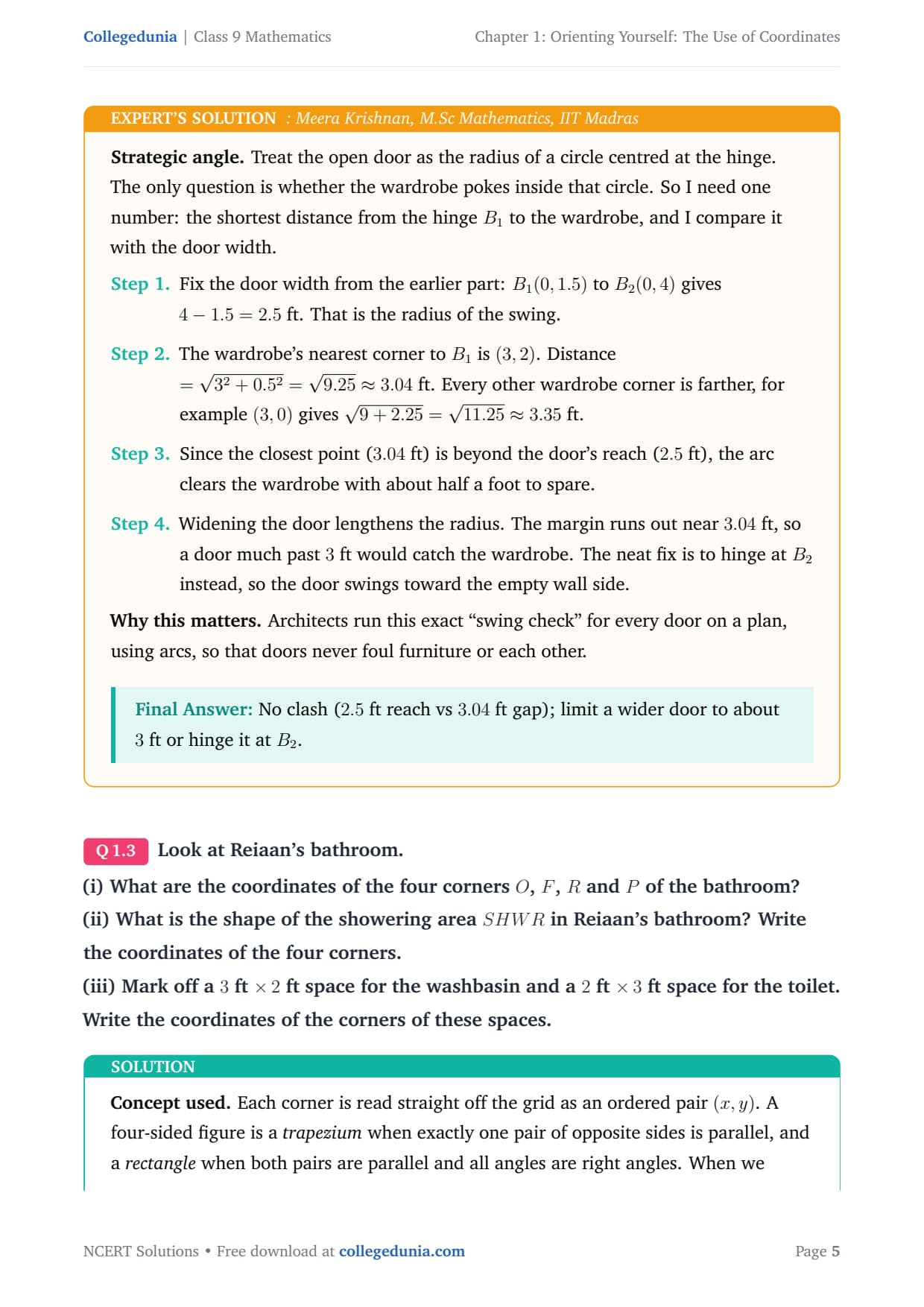
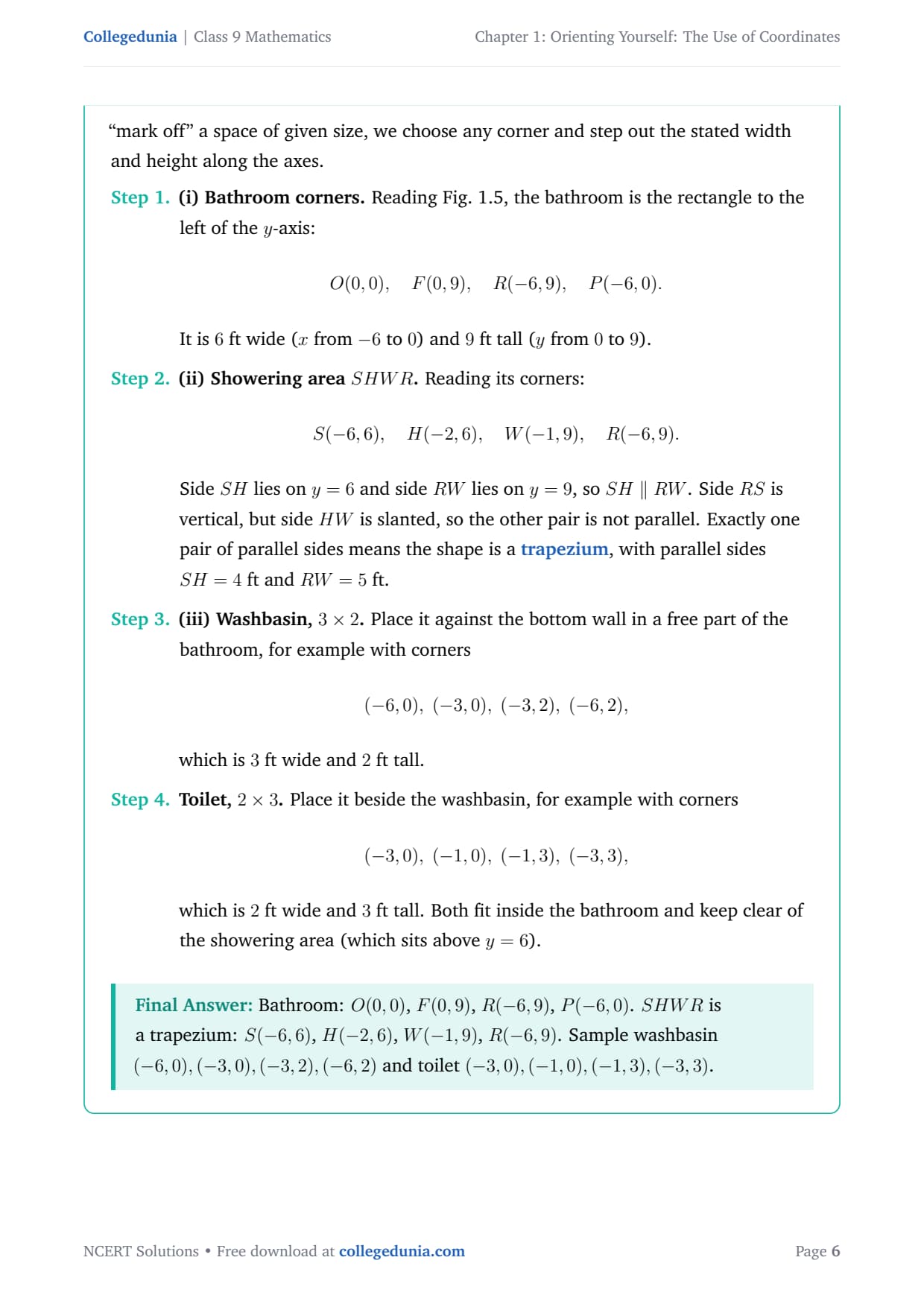
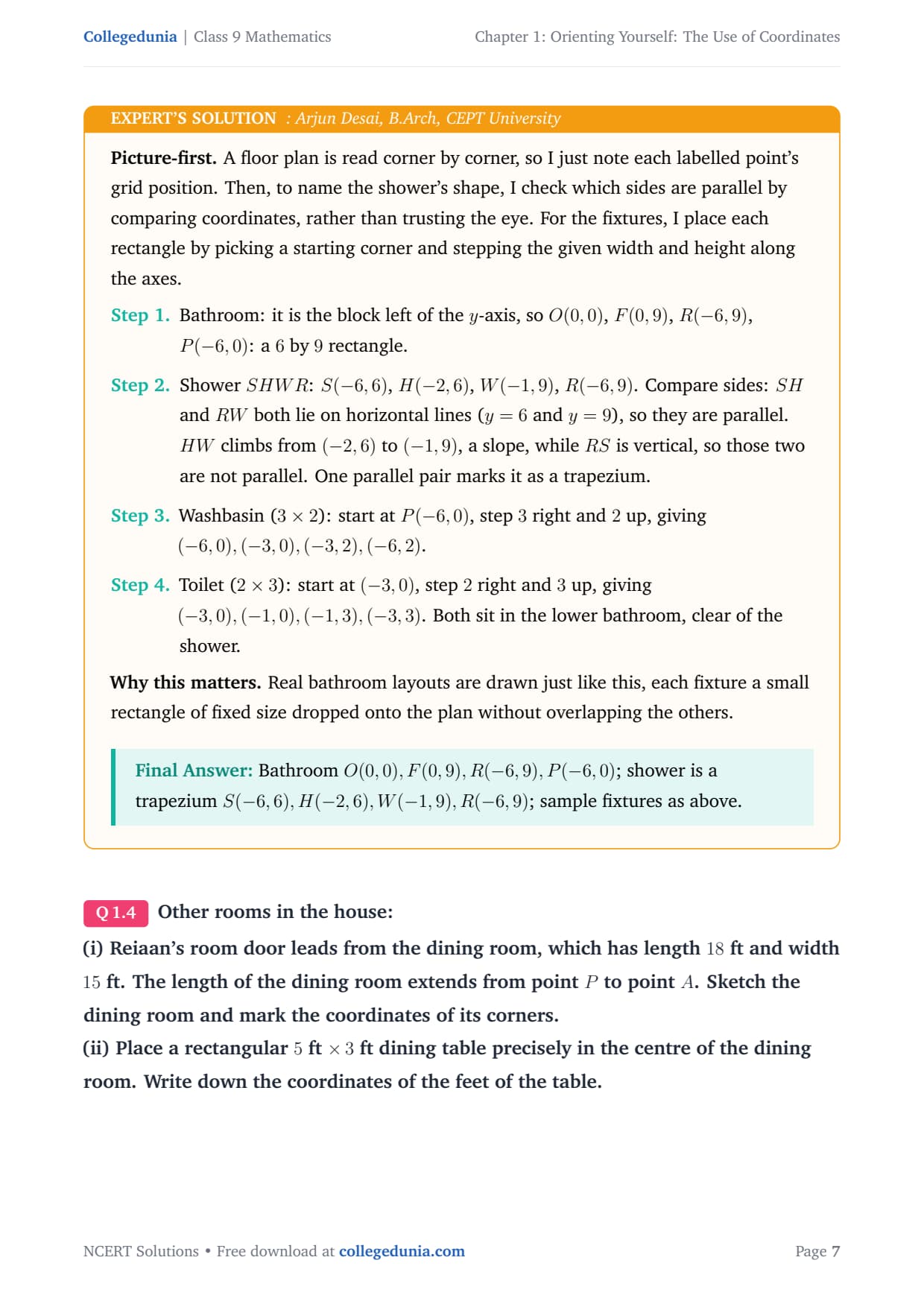
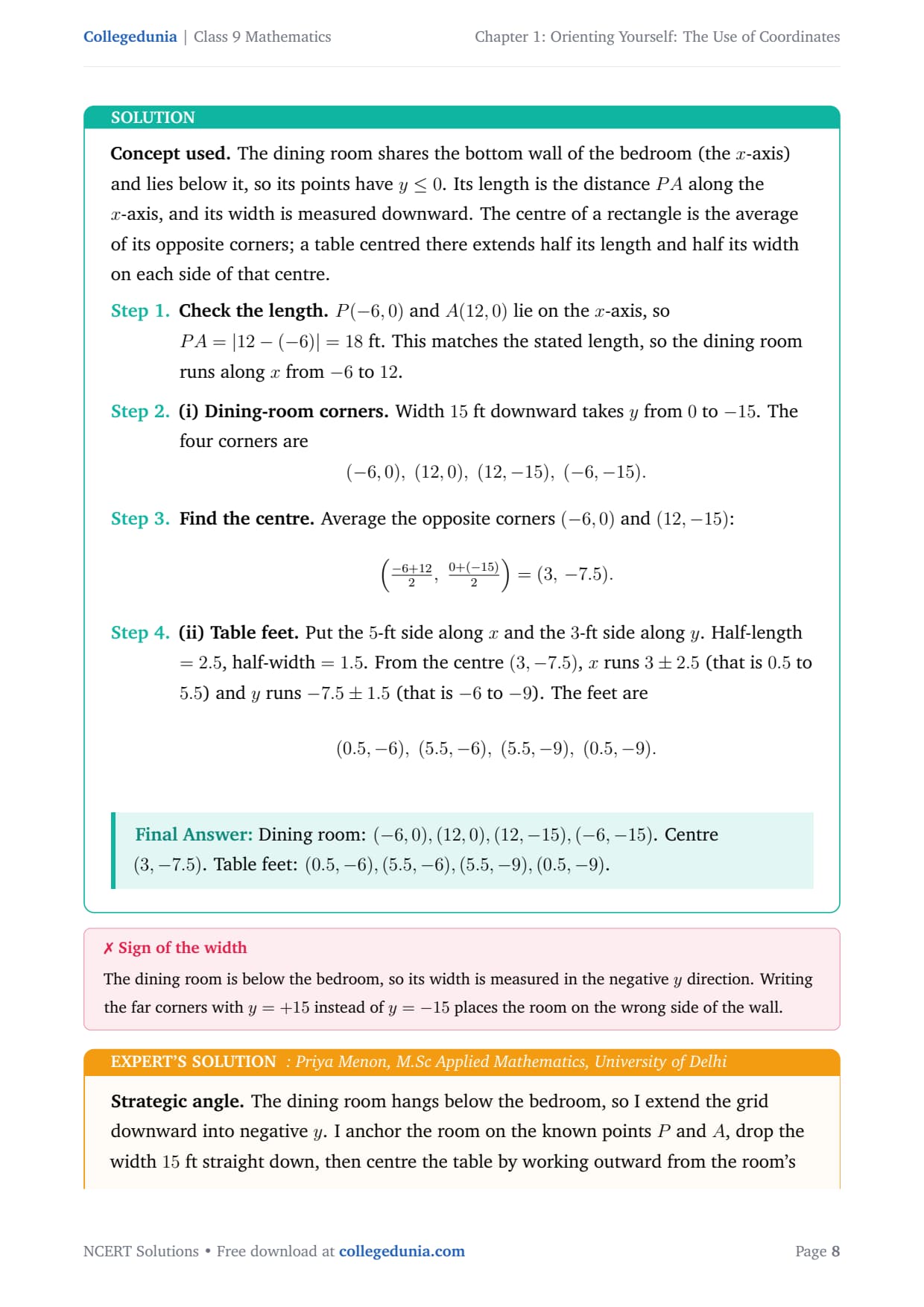
- Questions solved: all four questions, each with clear labelled steps.
- Main skills: plotting points, finding a missing corner, and measuring reach with distance.
- Chapter link: it prepares you for the mixed problems in the End-of-Chapter set.
These solutions are prepared by subject teachers, matched to the current 2026-27 NCERT, and checked step by step so a Class 9 student can follow each line.
What Does Class 9 Maths Chapter 1 Coordinates Exercise 1.2 Cover?
Exercise 1.2 builds on the grid reading from Exercise 1.1. Now you place points yourself and use them to solve small design tasks in Reiaan's house. You complete a rectangle when three corners are given, and you check whether a swinging door can reach a wardrobe. Here the full distance rule appears: the gap between (x1, y1) and (x2, y2) is √(x2-x1)2 + (y2-y1)2. The exercise keeps every task tied to a real object, so the maths always has a clear purpose. You will see how a plan on graph paper can answer a real question about a room. This makes the topic feel useful and easy to remember.
Video Walkthrough
Source: PW Class 9 - NEEV on YouTube
Coordinates Exercise 1.2 Question Breakdown
This exercise has four questions, and each one links a coordinate skill to a part of the house. The list below shows what each question asks.
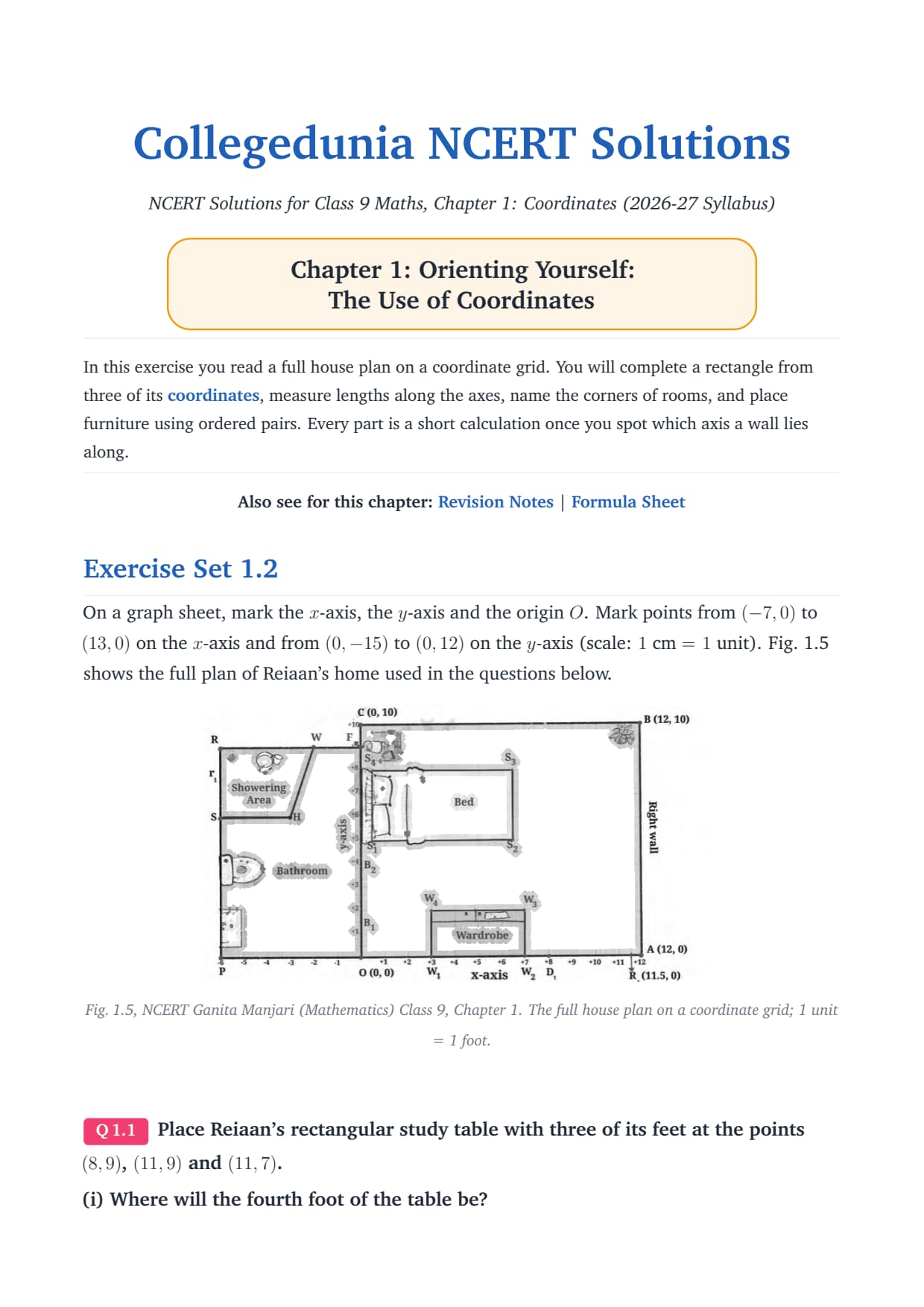
- Question 1: place a study table with three feet given, then find the fourth foot and the table size.
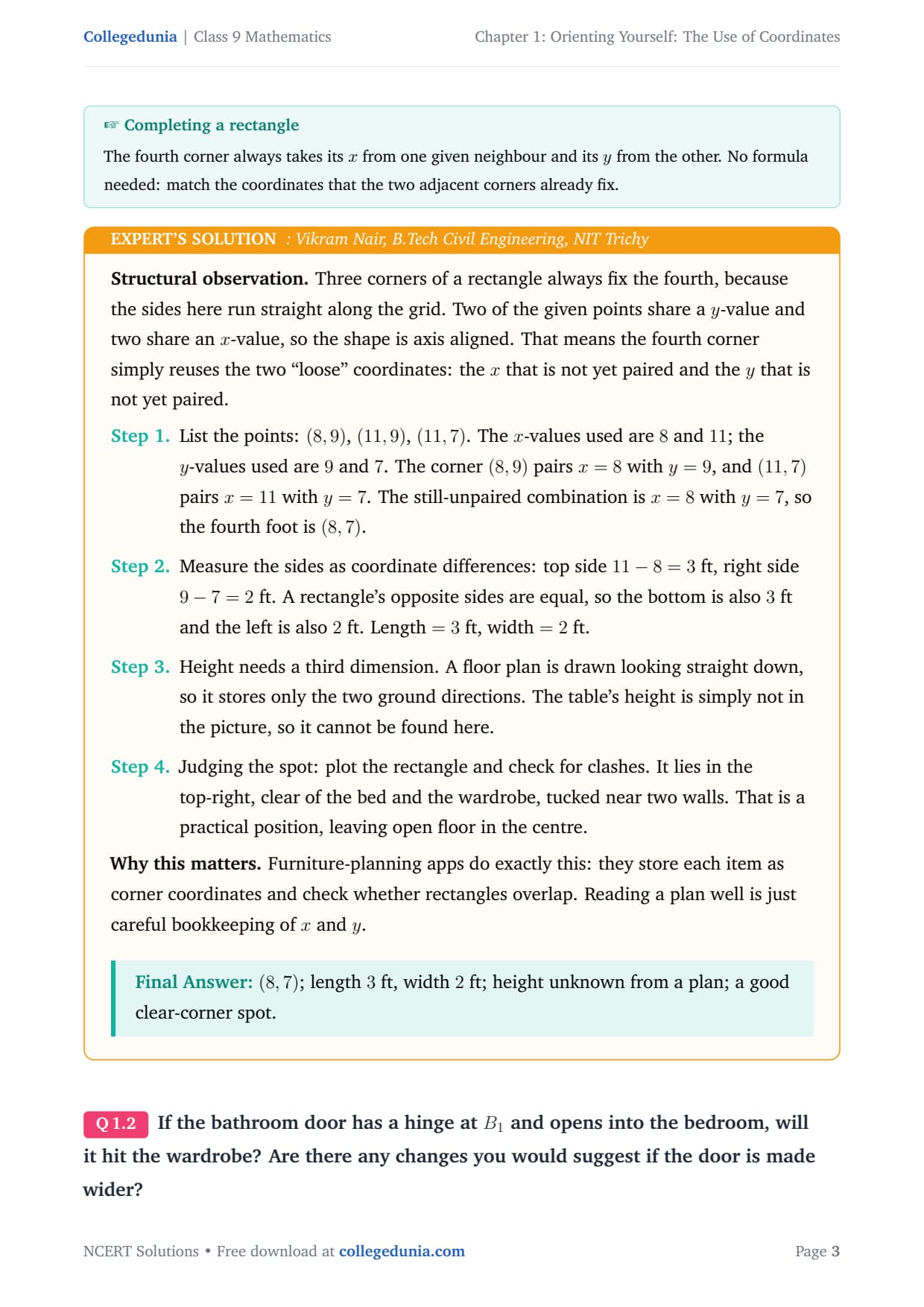
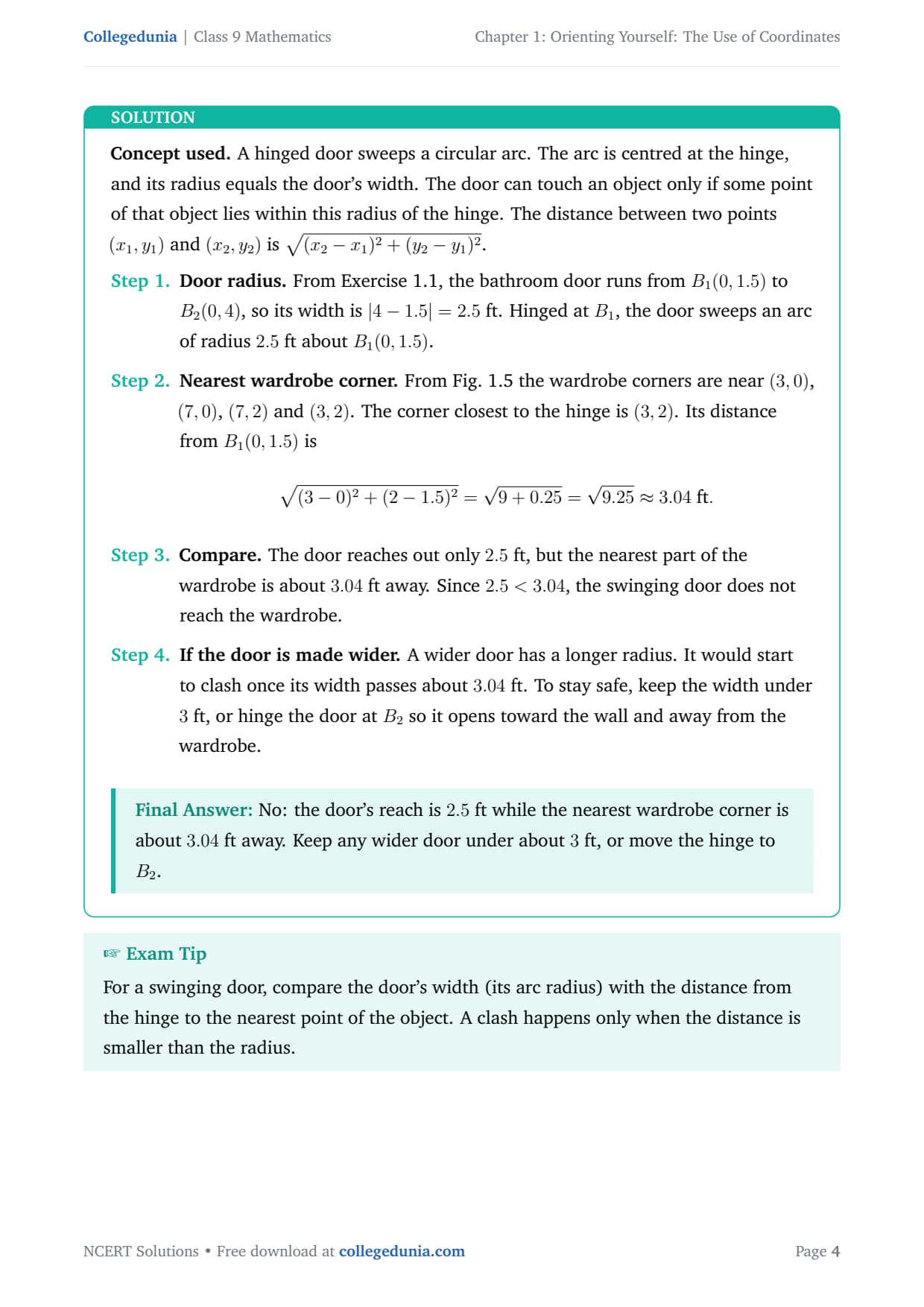
- Question 2: check if the hinged bathroom door hits the wardrobe when it opens.
- Question 3: read the four bathroom corners and mark spaces for the shower, washbasin, and toilet.
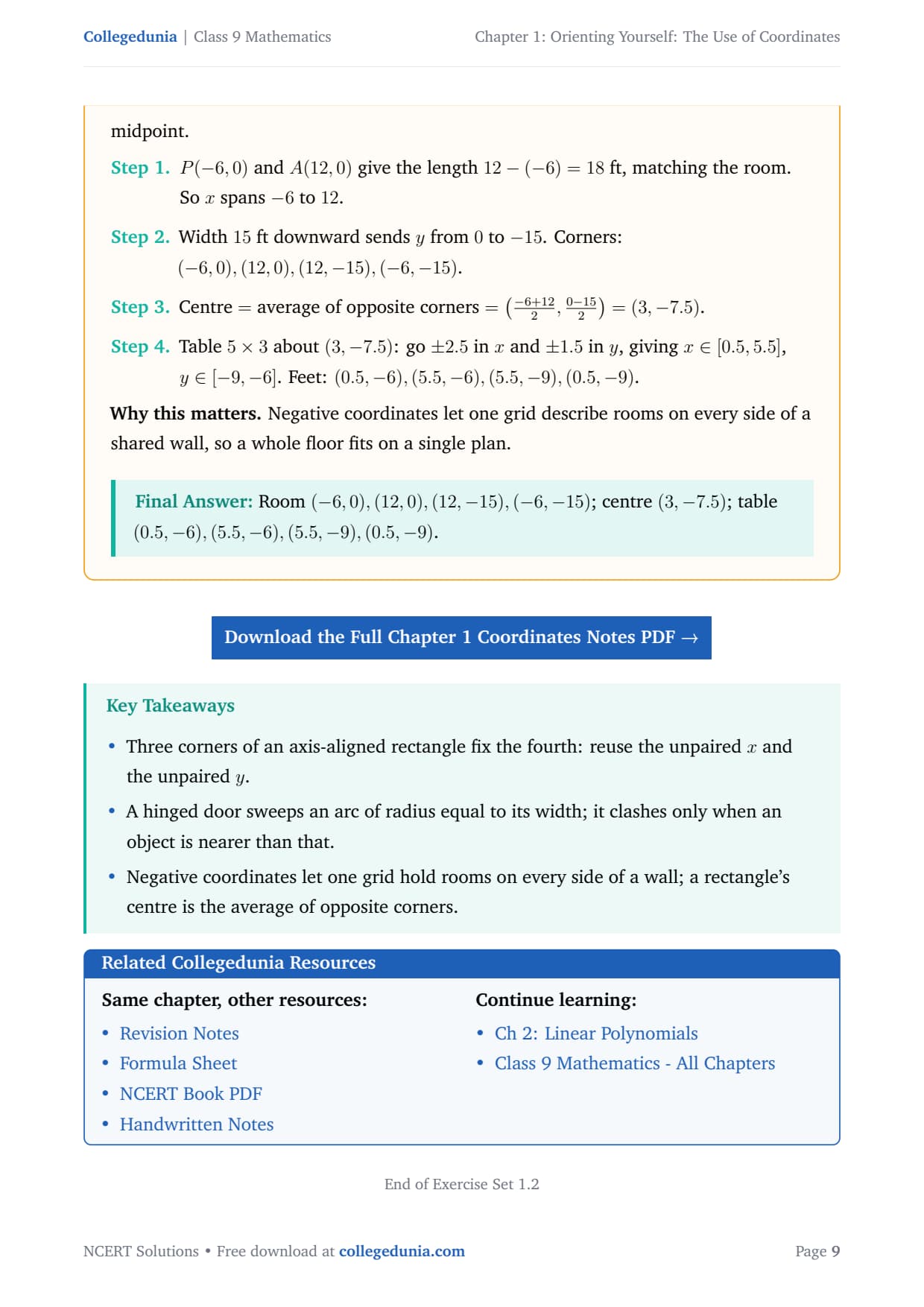
- Question 4: sketch the dining room and place a dining table exactly at its centre.
Sample Solved Question from Exercise 1.2
Here is part (i) of Question 1, solved step by step, so you can see how a missing corner is found.
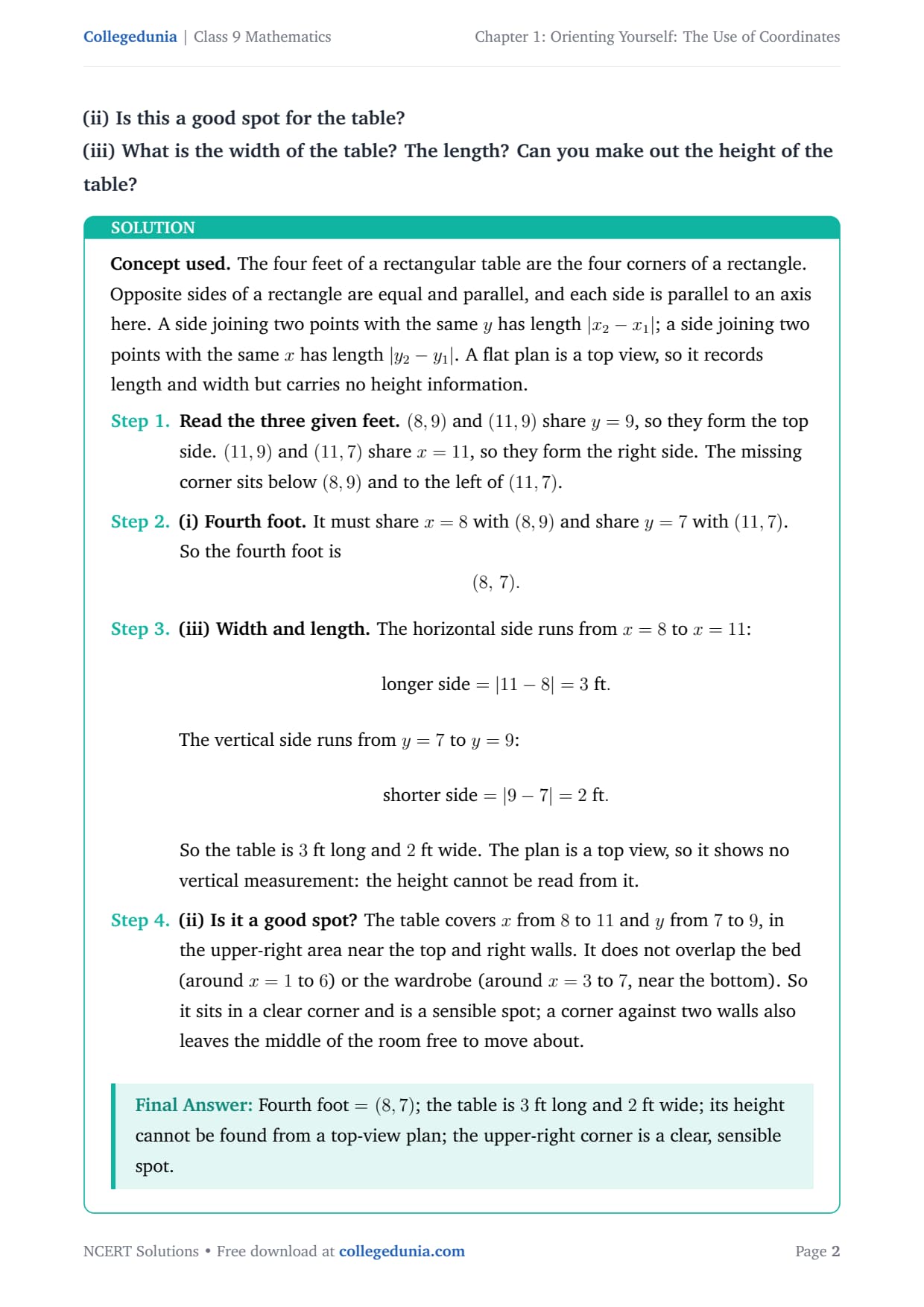
Question: Three feet of a rectangular table are at (8, 9), (11, 9), and (11, 7). Where is the fourth foot?
Step 1. Group the given points. (8, 9) and (11, 9) share y = 9, so they form the top side.
Step 2. (11, 9) and (11, 7) share x = 11, so they form the right side.
Step 3. The fourth foot must line up under (8, 9) and level with (11, 7). So it takes x = 8 and y = 7.
Final answer. The fourth foot of the table is at (8, 7).
How to Use These Coordinates Exercise 1.2 Solutions
Plot each point on graph paper as you read the question. Use the Collegedunia solutions to check your plot and your distance working after your own attempt.
- Draw the rough shape first, then fill in the coordinates you are sure about.
- For the door question, compare the door width with the distance to the nearest corner.
- Recheck every square root, since a missed root is the most common slip here.
More Class 9 Maths Coordinates Solutions
Open the full chapter page or any other exercise of Coordinates from the table below.
| Page | Link |
|---|---|
| Full Chapter | Coordinates Class 9 Maths NCERT Solutions |
| Exercise 1.1 | Coordinates Exercise 1.1 Solutions |
| Exercise 1.2 | Coordinates Exercise 1.2 Solutions |
| End of Chapter | Coordinates End-of-Chapter Solutions |
Coordinates Exercise 1.2 Solutions FAQs
Ques. How many questions are in Class 9 Maths Chapter 1 Exercise 1.2?
Ans. Exercise 1.2 has four questions. The Collegedunia solutions answer all of them with full labelled steps.
Ques. Does Exercise 1.2 use the distance formula?
Ans. Yes. The hinged-door question uses the distance √(x2-x1)2 + (y2-y1)2 to check how far the door can reach.
Ques. Can I download the Coordinates Exercise 1.2 solutions PDF?
Ans. Yes. You can download the Coordinates Exercise 1.2 NCERT Solutions PDF free from this page and revise offline.
Ques. Is Exercise 1.2 harder than Exercise 1.1?
Ans. It is a small step up. You now plot points yourself and use distance, but the numbers stay simple and every task is tied to a clear picture.



Comments