Hindi Content Strategist | M.A. Hindi, 11 Years | Updated on - May 25, 2026
John Keats's opening to Endymion, Book I, in Class 12 English Chapter 9 Flamingo Poetry: A Thing of Beauty carries roughly 8 marks in the CBSE Board exam and is one of the highest-weighted poems in the Flamingo Poetry section. These class 12 english ncert solutions chapter 9 Flamingo Poetry: A Thing of Beauty answer every textbook question in NCERT order.
1 poem · 7 textbook questions solved · Class 12 English Core Chapter 9, 2026-27 NCERT
CBSE Weightage: About 8 marks, usually split as one stanza-based extract (3 marks) and one long-answer on imagery, theme or the fountain image (6 marks)
CUET (UG) Relevance: 1 to 2 questions on the heroic couplet, the catalogue of beauty, and the central thesis in Section IA English
Chapter 9 Flamingo Poetry: A Thing of Beauty NCERT Solutions PDF
These A Thing of Beauty NCERT Solutions are reviewed by Collegedunia's CBSE English educators, mapped to the 2026-27 NCERT Flamingo print, and refined against the last five years of CBSE Board and CUET papers.
The extract is the opening passage of Keats's long poem in heroic couplets, so most CBSE answers turn on locating the image in the correct couplet, identifying the device, and explaining its function in the wider argument that beauty redeems suffering.
Class 12 English NCERT Solutions Chapter 9 Flamingo Poetry: A Thing of Beauty Question-Type Distribution
The poem has seven textbook questions under "Think it out" in the NCERT Flamingo print. Knowing which type each one belongs to tells you exactly how to structure the answer.
Question
Type
What CBSE Wants
Q1. List the things of beauty mentioned in the poem.
How will Collegedunia's NCERT Solutions Help You with the A Thing of Beauty Class 12 Questions
The class 12 english ncert solutions chapter 9 Flamingo Poetry: A Thing of Beauty on this page are built to match how a CBSE examiner reads a poetry answer.
Line-grounded answers: Every solution quotes the exact line from Keats's text, so you learn to anchor your answer in evidence and not in summary.
Two solutions per question: A standard solution (CBSE-pattern) and an expert reading (alternative angle, longer, examiner-grade depth) so you can pick the right register.
Common mistakes flagged: A "Mistake" callout against the typical wrong reading (for example, listing only flowers and forgetting the "mighty dead").
2026-27 NCERT aligned: Page numbers, line numbers, and the seven "Think it out" questions match the current Flamingo print exactly.
A Thing of Beauty Topper Strategy for the Class 12 English Board
Three habits separate a 6/6 answer from a 4/6 answer on this poem.
Quote the opening couplet at least once. "A thing of beauty is a joy for ever; / Its loveliness increases" is the thesis line. Bring it in for almost any theme-based question.
Mix nature and culture when listing. Many students stop at sun, moon, trees. Examiners look for "the grandeur of the dooms / We have imagined for the mighty dead" and "all lovely tales that we have heard or read" to confirm a full reading.
Close with the fountain image. "An endless fountain of immortal drink, / Pouring unto us from the heaven's brink" is the closing image. Returning to it at the end of a long-answer adds structural elegance and earns the last mark.
About John Keats and the A Thing of Beauty Context
John Keats (1795 to 1821) was an English Romantic poet whose short life produced some of the most enduring poetry in the English language. Endymion, from which "A Thing of Beauty" is the opening passage of Book I, was published in 1818 when Keats was twenty-three years old. The extract sets out his Romantic conviction that beauty has redemptive power over suffering, a thesis that runs through almost all his later work, including the great odes.
All NCERT Solutions for Flamingo Poetry: A Thing of Beauty with Step-by-Step Working
Every NCERT textbook question for Class 12 English (Core) Chapter 9 Flamingo Poetry: A Thing of Beauty is listed below with its full Solution and Expert Solution hidden inside collapsible tabs. Click Check Solution to reveal the step-by-step working; click Expert Solution for the expanded explanation.
Think it out
Q 9.1
List the things of beauty mentioned in the poem.
Keats opens the passage with the famous line, ``A thing of beauty is
a joy for ever,'' and then offers a deliberately mixed catalogue of
beautiful things drawn from nature, daily life, and human story.
Reading the poem from line 5 onwards, the list builds in this order:
Key lines
``The sun, the moon, / Trees old and young, sprouting a shady boon /
For simple sheep; and such are daffodils / With the green world they
live in; and clear rills / Are mighty dead.''
The sun and the moon. The two great natural lights
are the first items on the list. They renew themselves every
day and every month, so they fit Keats's argument that beauty
is a joy that returns.
Old and young trees that give shade. The trees offer
``a shady boon'' to the ``simple sheep'', so beauty here is
also useful, not merely decorative.
Daffodils with the green world they live in.
Daffodils are paired with their surroundings; Keats is careful
to praise the whole landscape, not the single flower in
isolation.
Clear rills (small streams) and the cool shelter
their flowing water makes. The streams ``make for themselves
a cooling covert'' against ``the hot season''.
The mid-forest brake rich with musk-rose blooms.
The wild rose bushes in the heart of the forest carry the
season's fresh scent.
The grandeur of the dooms / We have imagined for the
mighty dead. Beauty is not only natural; it includes the
noble stories and tomb-inscriptions we build around great
figures of the past.
All lovely tales we have heard or read. The closing
item in the catalogue is the body of literature itself,
legend, myth, story.
How to read the catalogue
Notice that Keats mixes everyday natural things (sun, moon, sheep,
streams) with grand human things (the dead, lovely tales) on a single
list. Beauty is therefore not a luxury, it is woven into every level
of life.
The poem names the sun, the moon, old and young trees that
shade sheep, daffodils with their green world, clear streams with
their cool shelters, musk-rose blooms in the mid-forest brake, the
grandeur we imagine for the ``mighty dead'', and all lovely tales we
have heard or read.
DA
Dr Ananya Iyer
PhD English Literature, Jawaharlal Nehru University
Verified Expert
Strategic angle. For the boards, an examiner is looking for
both the natural and the human-cultural items on Keats's list;
many students forget the second half. Read the catalogue as two
movements: lines 5 to 9 are natural, lines 10 to 13 are cultural, and
the whole list is held together by the opening claim that ``a thing of
beauty is a joy for ever''.
Lines 5 to 6 open with the celestial pair: ``the sun, the
moon''. These are universal, available to every reader, and
cyclical, so they instantly demonstrate the ``for ever'' of
line 1.
Lines 6 to 7 move down to terrestrial life: ``Trees old and
young, sprouting a shady boon / For simple sheep''. Keats
includes both ancient and recent trees to suggest that beauty
is not the property of one age.
Line 7 names ``daffodils / With the green world they live
in'', deliberately attaching the flower to its setting. The
background is part of the beauty.
Lines 8 to 9 add the ``clear rills'' that make ``a cooling
covert'' against the hot weather, and the ``mid-forest
brake'' ``rich with a sprinkling of fair musk-rose blooms''.
Both items are sensory: cool to touch and rich to smell.
Lines 10 to 12 turn from nature to culture: ``the grandeur
of the dooms / We have imagined for the mighty dead'' refers
to the imagined glory we attach to legendary heroes; ``all
lovely tales that we have heard or read'' generalises this
to all literature.
Line 13 binds the catalogue back to the thesis with ``an
endless fountain of immortal drink''. The list is the proof
that the fountain keeps pouring.
Why this matters. For Keats, beauty is plural. He stacks
items from two different orders (natural and cultural) inside a single
sentence to show that no single domain has a monopoly on it. A short
answer that lists only flowers and sheep misses half the poem.
Items of beauty in the poem: sun, moon, old and young
shade-giving trees, daffodils with their green setting, clear streams
with cool coverts, musk-rose blooms in the mid-forest brake, the
grandeur imagined for the ``mighty dead'', and all lovely tales of
literature.
Q 9.2
List the things that cause suffering and pain.
After his catalogue of beautiful things, Keats turns to the dark
side of human life in lines 2 to 5 and explains exactly what beauty
must work against. The list is short but heavy, and every item is a
named human experience, not an abstraction.
Key lines
``Spite of despondence, of the inhuman dearth / Of noble natures, of
the gloomy days, / Of all the unhealthy and o'er-darkened ways /
Made for our searching''
Despondence. Loss of hope or low spirits. This is
the inward suffering of an individual mind.
The inhuman dearth of noble natures. The shortage of
good, generous, noble people around us. Keats calls this
shortage ``inhuman'', meaning unworthy of human beings.
Gloomy days. Spells of dullness, sadness, or grey
weather, both literal and metaphorical, that weigh on the
spirit.
Unhealthy and o'er-darkened ways made for our
searching. The wrong, unwholesome paths we sometimes choose
as we go through life looking for meaning. Keats's word
``searching'' admits that the suffering is partly the cost
of seeking.
Notice that Keats does not blame fate or god; the four items name
states of mind and habits of behaviour. This makes the
remedy he proposes (a thing of beauty) directly available to the
reader: it counteracts the same inner conditions that produced the
pain.
Keats lists four causes of suffering: despondence, the
inhuman dearth of noble natures, gloomy days, and all the unhealthy
and over-darkened ways we make for ourselves while searching for
meaning.
MA
Mr Arjun Mehra
MA English, Delhi University
Verified Expert
Alternative reading. The four items can be grouped into
two pairs, and reading them this way gives you a much sharper
answer.
The first pair is internal: ``despondence'' and ``the
inhuman dearth / Of noble natures''. One is a private mood;
the other is a social shortage. Together they show that
suffering has both a personal and a communal source.
The second pair is environmental: ``the gloomy days'' and
``the unhealthy and o'er-darkened ways''. One names the
atmosphere around us; the other names the moral paths we
take through it. Together they show that suffering also
comes from the world we walk through and the routes we
choose in it.
The structure is therefore deliberate: two inner causes and
two outer causes, four in total. A beautiful thing acts as a
counterweight to all four.
Keats's diction is also worth marking: ``inhuman'',
``gloomy'', ``unhealthy'', ``o'er-darkened''. All four
adjectives are negations of warmth and light. The thesis
line, ``A thing of beauty is a joy for ever,'' answers each
of them with positive language: ``joy'', ``for ever'',
``loveliness''.
Why this matters. A board answer that names the four items
in two pairs (inner versus outer) lands the marks for both content
and structure. It also matches the way Keats actually built the
sentence: a balanced inventory of darkness that the rest of the poem
sets out to relieve.
Despondence (inner mood), inhuman dearth of noble natures
(social shortage), gloomy days (atmosphere), and unhealthy
o'er-darkened ways we make for our searching (chosen moral paths).
Two inner causes and two outer causes, four in total.
Q 9.3
What does the line, `Therefore are we wreathing a flowery band to bind us to the earth' suggest to you?
The line comes immediately after Keats has listed the kinds of
suffering that crowd our days. He says that beauty ``moves away the
pall / From our dark spirits'' and then concludes: ``Therefore are we
wreathing a flowery band / To bind us to the earth''. The line is the
poem's most compact image of how beauty saves us.
Key lines
`` some shape of beauty moves away the pall / From our dark
spirits. Such the sun, the moon / Therefore are we wreathing
a flowery band / To bind us to the earth''
The ``flowery band'' is made of beautiful things.
Each beautiful thing that Keats has listed (sun, moon, trees,
daffodils, streams, musk-roses, lovely tales) is one flower
in the wreath.
The band binds us to the earth. Without it, despair
might cut our attachment to the world. The wreath is what
keeps us tied to life despite the suffering of the previous
lines.
The verb is ``wreathing'', not ``finding''. We are
actively making the band day by day. We notice and
gather beautiful things; the wreath is a human activity,
not a gift dropped from the sky.
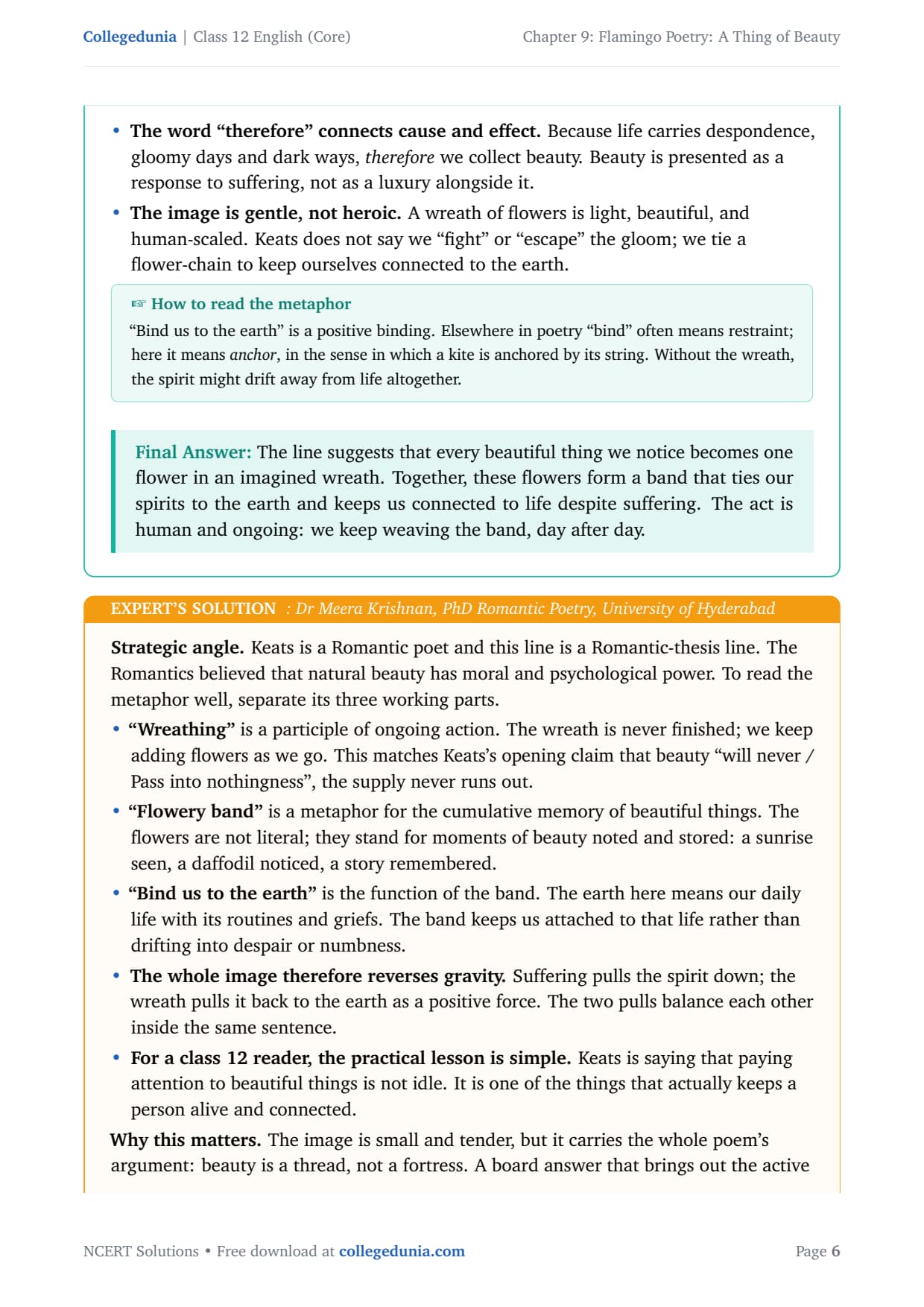
The word ``therefore'' connects cause and effect.
Because life carries despondence, gloomy days and dark ways,
therefore we collect beauty. Beauty is presented as
a response to suffering, not as a luxury alongside it.
The image is gentle, not heroic. A wreath of
flowers is light, beautiful, and human-scaled. Keats does
not say we ``fight'' or ``escape'' the gloom; we tie a
flower-chain to keep ourselves connected to the earth.
How to read the metaphor
``Bind us to the earth'' is a positive binding. Elsewhere in poetry
``bind'' often means restraint; here it means anchor, in the
sense in which a kite is anchored by its string. Without the wreath,
the spirit might drift away from life altogether.
The line suggests that every beautiful thing we notice
becomes one flower in an imagined wreath. Together, these flowers
form a band that ties our spirits to the earth and keeps us connected
to life despite suffering. The act is human and ongoing: we keep
weaving the band, day after day.
DM
Dr Meera Krishnan
PhD Romantic Poetry, University of Hyderabad
Verified Expert
Strategic angle. Keats is a Romantic poet and this line is a
Romantic-thesis line. The Romantics believed that natural beauty has
moral and psychological power. To read the metaphor well, separate
its three working parts.
``Wreathing'' is a participle of ongoing action. The
wreath is never finished; we keep adding flowers as we go.
This matches Keats's opening claim that beauty ``will never
/ Pass into nothingness'', the supply never runs out.
``Flowery band'' is a metaphor for the cumulative
memory of beautiful things. The flowers are not literal;
they stand for moments of beauty noted and stored: a sunrise
seen, a daffodil noticed, a story remembered.
``Bind us to the earth'' is the function of the
band. The earth here means our daily life with its routines
and griefs. The band keeps us attached to that life rather
than drifting into despair or numbness.
The whole image therefore reverses gravity.
Suffering pulls the spirit down; the wreath pulls it back to
the earth as a positive force. The two pulls balance each
other inside the same sentence.
For a class 12 reader, the practical lesson is
simple. Keats is saying that paying attention to beautiful
things is not idle. It is one of the things that actually
keeps a person alive and connected.
Why this matters. The image is small and tender, but it
carries the whole poem's argument: beauty is a thread, not a fortress.
A board answer that brings out the active verb (``wreathing''), the
metaphor (the wreath as memory of beauty), and the function (binding
us to the earth) earns the full marks for this question.
The line suggests that human beings actively weave a wreath
of beautiful experiences (sun, moon, trees, tales) that keeps the
spirit anchored to the world. Beauty is not decoration; it is the
flower-chain that holds us to the earth in the face of despondence
and gloomy days.
Q 9.4
What makes human beings love life in spite of troubles and sufferings?
Keats answers this question in the second half of the poem. He
acknowledges the suffering in lines 2 to 5 (``despondence
gloomy days o'er-darkened ways'') and then immediately offers
the antidote in lines 5 onwards: a beautiful thing lifts the gloom
and keeps us in love with life.
Key lines
`` Yes, in spite of all, / Some shape of beauty moves away the
pall / From our dark spirits.''
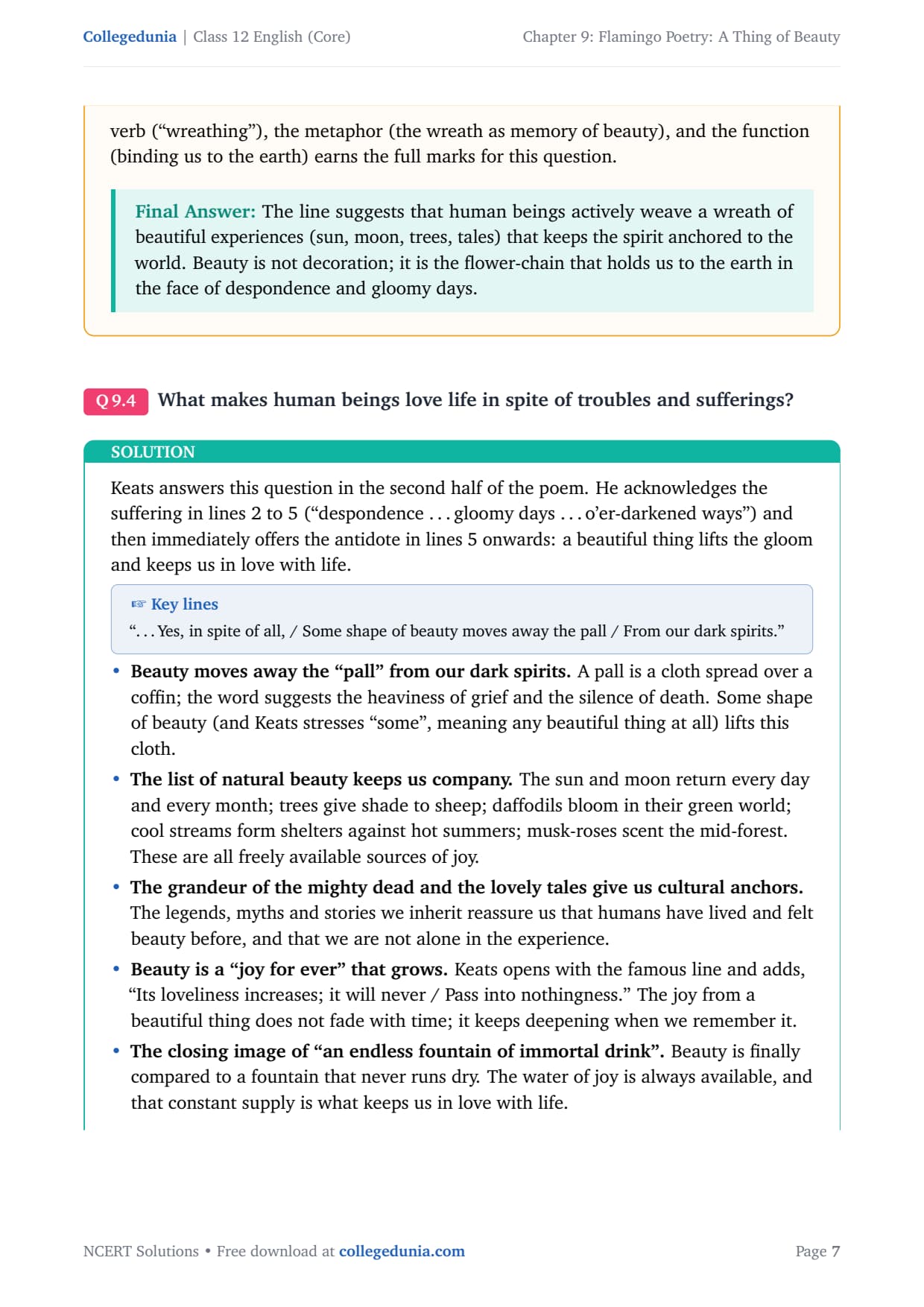
Beauty moves away the ``pall'' from our dark
spirits. A pall is a cloth spread over a coffin; the word
suggests the heaviness of grief and the silence of death.
Some shape of beauty (and Keats stresses ``some'', meaning
any beautiful thing at all) lifts this cloth.
The list of natural beauty keeps us company. The
sun and moon return every day and every month; trees give
shade to sheep; daffodils bloom in their green world; cool
streams form shelters against hot summers; musk-roses
scent the mid-forest. These are all freely available
sources of joy.
The grandeur of the mighty dead and the lovely tales
give us cultural anchors. The legends, myths and stories
we inherit reassure us that humans have lived and felt
beauty before, and that we are not alone in the experience.
Beauty is a ``joy for ever'' that grows. Keats
opens with the famous line and adds, ``Its loveliness
increases; it will never / Pass into nothingness.'' The
joy from a beautiful thing does not fade with time; it
keeps deepening when we remember it.
The closing image of ``an endless fountain of
immortal drink''. Beauty is finally compared to a fountain
that never runs dry. The water of joy is always available,
and that constant supply is what keeps us in love with life.
A strong answer for this question lists both the sources of
beauty and the effect on the human spirit. Begin with the
``pall'' image, walk through two or three concrete items from
Keats's catalogue, and close with the fountain metaphor. Cite at
least two phrases from the poem.
Despite troubles, human beings love life because beautiful
things lift the heaviness of grief. Nature (sun, moon, trees,
daffodils, streams, musk-roses) and culture (the grandeur of the
``mighty dead'' and ``all lovely tales we have heard or read'')
together form a wreath that ties us to the earth and pours an endless
fountain of immortal drink for the spirit.
MK
Mr Karan Sethi
MA English Literature, University of Calcutta
Verified Expert
Strategic angle. Read the question as the poem's own central
argument expressed as a query. Keats's whole purpose in the extract is
to answer exactly this: why, given so much suffering, do we keep
choosing life?
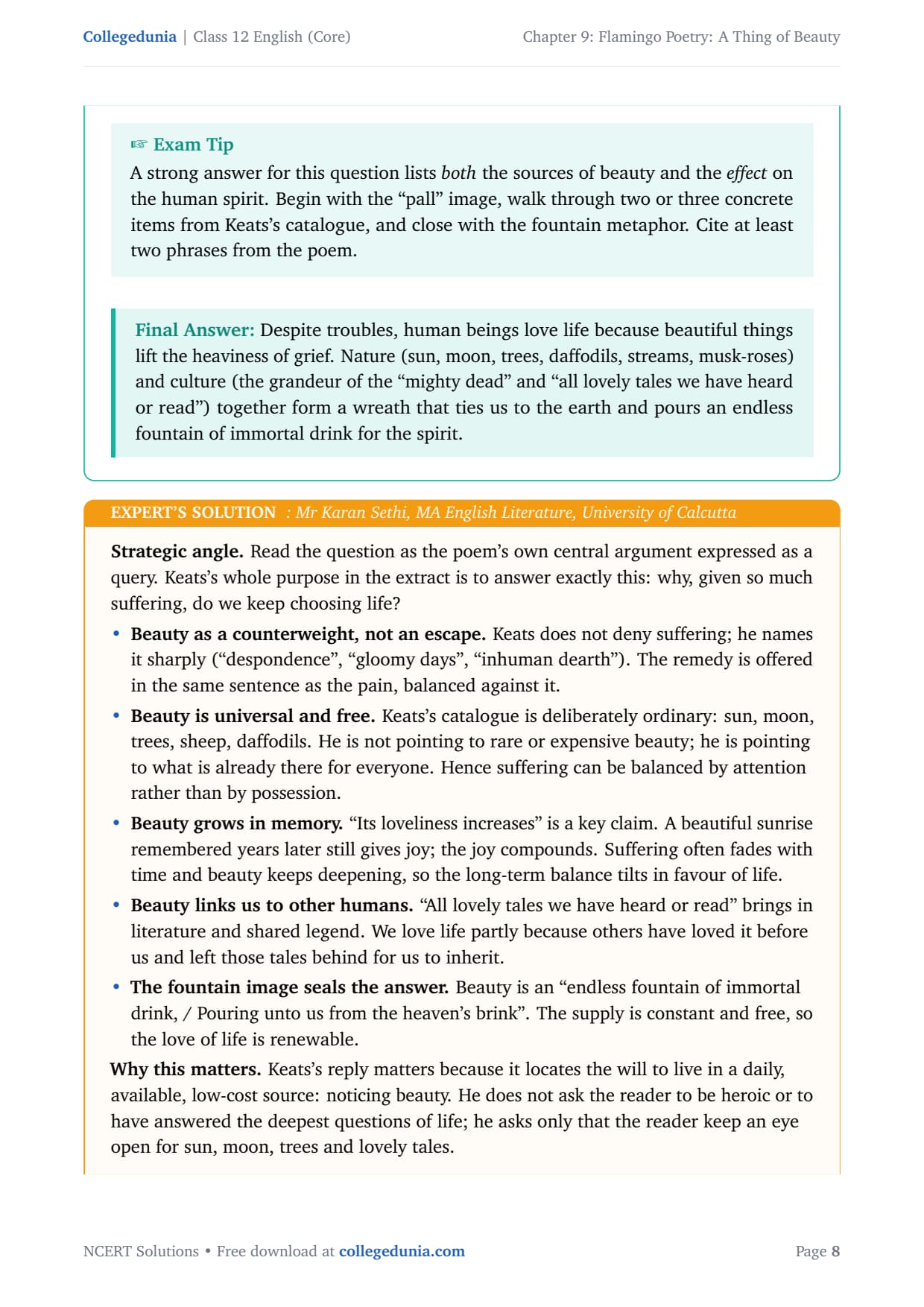
Beauty as a counterweight, not an escape. Keats does
not deny suffering; he names it sharply (``despondence'',
``gloomy days'', ``inhuman dearth''). The remedy is offered
in the same sentence as the pain, balanced against it.
Beauty is universal and free. Keats's catalogue is
deliberately ordinary: sun, moon, trees, sheep, daffodils.
He is not pointing to rare or expensive beauty; he is
pointing to what is already there for everyone. Hence
suffering can be balanced by attention rather than by
possession.
Beauty grows in memory. ``Its loveliness
increases'' is a key claim. A beautiful sunrise remembered
years later still gives joy; the joy compounds. Suffering
often fades with time and beauty keeps deepening, so the
long-term balance tilts in favour of life.
Beauty links us to other humans. ``All lovely tales
we have heard or read'' brings in literature and shared
legend. We love life partly because others have loved it
before us and left those tales behind for us to inherit.
The fountain image seals the answer. Beauty is an
``endless fountain of immortal drink, / Pouring unto us from
the heaven's brink''. The supply is constant and free, so
the love of life is renewable.
Why this matters. Keats's reply matters because it locates
the will to live in a daily, available, low-cost source: noticing
beauty. He does not ask the reader to be heroic or to have answered
the deepest questions of life; he asks only that the reader keep an
eye open for sun, moon, trees and lovely tales.
Human beings love life in spite of suffering because beauty
lifts the heaviness of grief. Natural beauty (sun, moon, trees,
flowers, streams) and cultural beauty (legends, tales) act as a
constant fountain of joy whose loveliness deepens with time. This
balance, suffering on one side and renewable beauty on the other, is
why life remains worth choosing.
Q 9.5
Why is `grandeur' associated with the `mighty dead'?
The phrase appears in lines 10 to 11: ``the grandeur of the dooms /
We have imagined for the mighty dead.'' Keats is here adding a
cultural item to his catalogue of beauty: not only natural things,
but also the noble stories we tell about great figures of the past.
Key lines
`` And such too is the grandeur of the dooms / We have imagined
for the mighty dead; / All lovely tales that we have heard or read.''
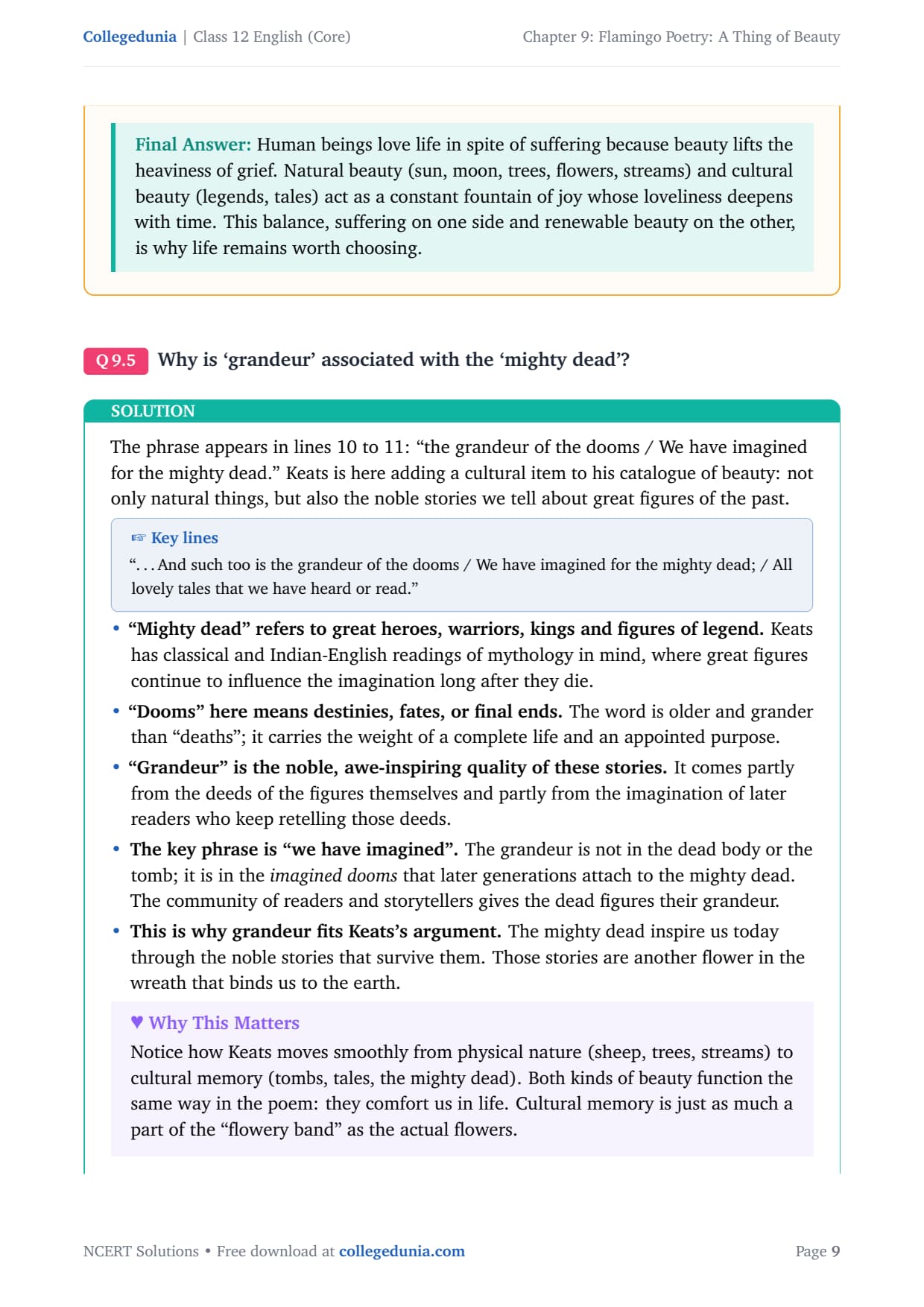
``Mighty dead'' refers to great heroes, warriors,
kings and figures of legend. Keats has classical and
Indian-English readings of mythology in mind, where great
figures continue to influence the imagination long after
they die.
``Dooms'' here means destinies, fates, or final
ends. The word is older and grander than ``deaths''; it
carries the weight of a complete life and an appointed
purpose.
``Grandeur'' is the noble, awe-inspiring quality
of these stories. It comes partly from the deeds of the
figures themselves and partly from the imagination of
later readers who keep retelling those deeds.
The key phrase is ``we have imagined''. The
grandeur is not in the dead body or the tomb; it is in the
imagined dooms that later generations attach to the
mighty dead. The community of readers and storytellers gives
the dead figures their grandeur.
This is why grandeur fits Keats's argument. The
mighty dead inspire us today through the noble stories that
survive them. Those stories are another flower in the
wreath that binds us to the earth.
Notice how Keats moves smoothly from physical nature (sheep, trees,
streams) to cultural memory (tombs, tales, the mighty dead). Both
kinds of beauty function the same way in the poem: they comfort us
in life. Cultural memory is just as much a part of the ``flowery
band'' as the actual flowers.
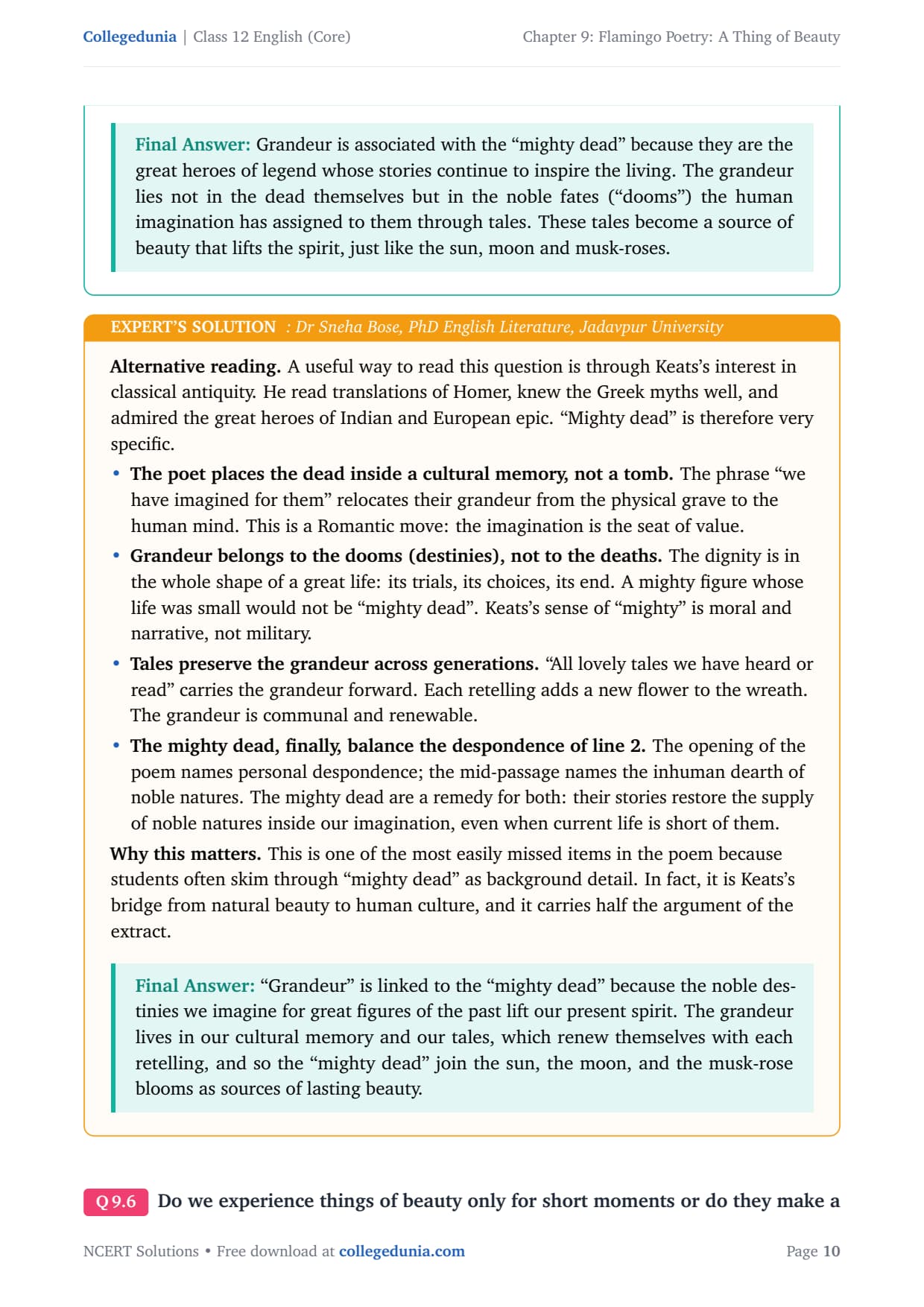
Grandeur is associated with the ``mighty dead'' because
they are the great heroes of legend whose stories continue to inspire
the living. The grandeur lies not in the dead themselves but in the
noble fates (``dooms'') the human imagination has assigned to them
through tales. These tales become a source of beauty that lifts the
spirit, just like the sun, moon and musk-roses.
DS
Dr Sneha Bose
PhD English Literature, Jadavpur University
Verified Expert
Alternative reading. A useful way to read this question is
through Keats's interest in classical antiquity. He read translations
of Homer, knew the Greek myths well, and admired the great heroes of
Indian and European epic. ``Mighty dead'' is therefore very specific.
The poet places the dead inside a cultural memory,
not a tomb. The phrase ``we have imagined for them''
relocates their grandeur from the physical grave to the
human mind. This is a Romantic move: the imagination is the
seat of value.
Grandeur belongs to the dooms (destinies), not to
the deaths. The dignity is in the whole shape of a great
life: its trials, its choices, its end. A mighty figure
whose life was small would not be ``mighty dead''. Keats's
sense of ``mighty'' is moral and narrative, not military.
Tales preserve the grandeur across generations.
``All lovely tales we have heard or read'' carries the
grandeur forward. Each retelling adds a new flower to the
wreath. The grandeur is communal and renewable.
The mighty dead, finally, balance the despondence of
line 2. The opening of the poem names personal despondence;
the mid-passage names the inhuman dearth of noble natures.
The mighty dead are a remedy for both: their stories restore
the supply of noble natures inside our imagination, even
when current life is short of them.
Why this matters. This is one of the most easily missed
items in the poem because students often skim through ``mighty dead''
as background detail. In fact, it is Keats's bridge from natural
beauty to human culture, and it carries half the argument of the
extract.
``Grandeur'' is linked to the ``mighty dead'' because the
noble destinies we imagine for great figures of the past lift our
present spirit. The grandeur lives in our cultural memory and our
tales, which renew themselves with each retelling, and so the
``mighty dead'' join the sun, the moon, and the musk-rose blooms as
sources of lasting beauty.
Q 9.6
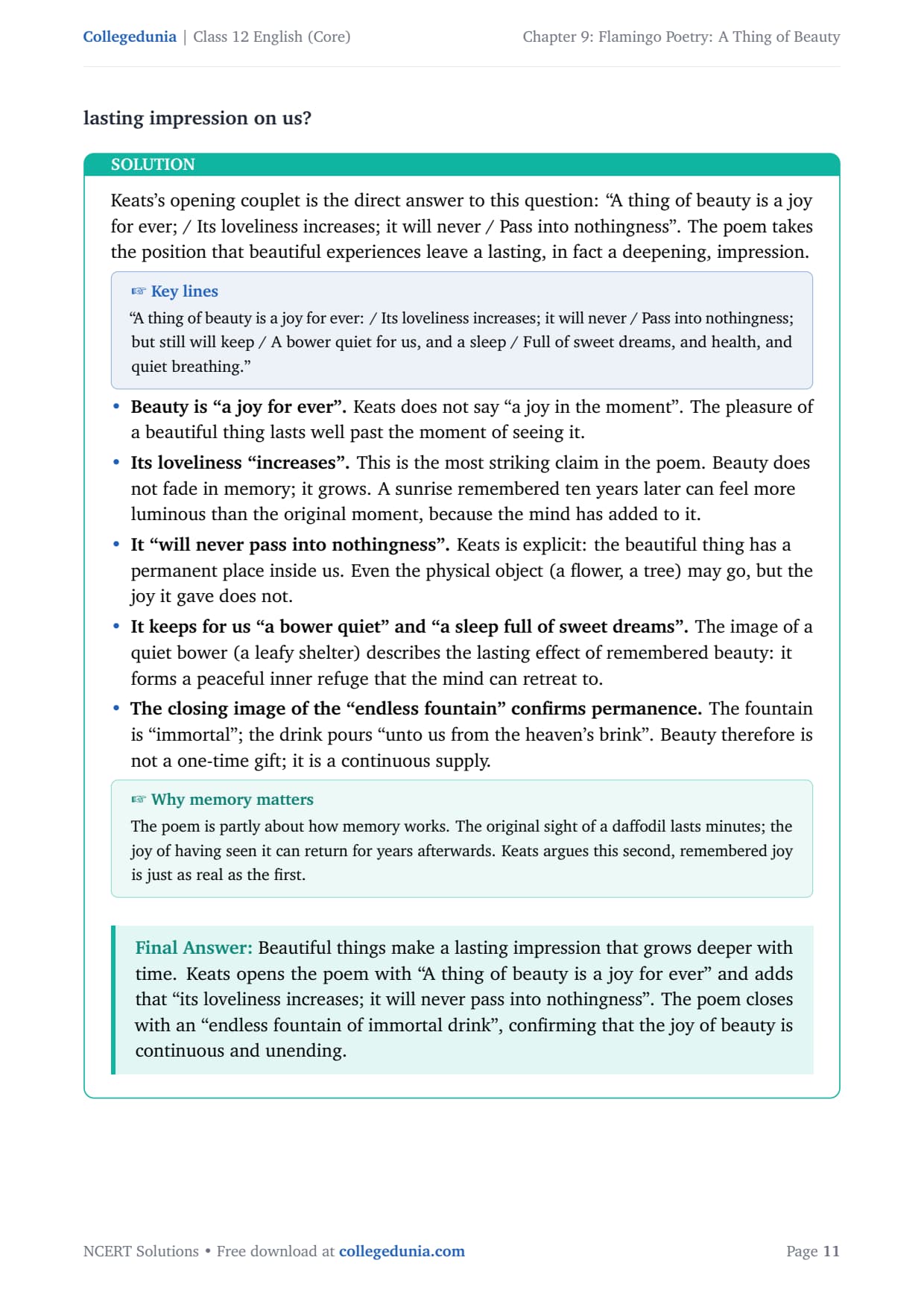
Do we experience things of beauty only for short moments or do they make a lasting impression on us?
Keats's opening couplet is the direct answer to this question:
``A thing of beauty is a joy for ever; / Its loveliness increases;
it will never / Pass into nothingness''. The poem takes the position
that beautiful experiences leave a lasting, in fact a deepening,
impression.
Key lines
``A thing of beauty is a joy for ever: / Its loveliness increases;
it will never / Pass into nothingness; but still will keep / A
bower quiet for us, and a sleep / Full of sweet dreams, and health,
and quiet breathing.''
Beauty is ``a joy for ever''. Keats does not say
``a joy in the moment''. The pleasure of a beautiful thing
lasts well past the moment of seeing it.
Its loveliness ``increases''. This is the most
striking claim in the poem. Beauty does not fade in
memory; it grows. A sunrise remembered ten years later can
feel more luminous than the original moment, because the
mind has added to it.
It ``will never pass into nothingness''. Keats is
explicit: the beautiful thing has a permanent place inside
us. Even the physical object (a flower, a tree) may go,
but the joy it gave does not.
It keeps for us ``a bower quiet'' and ``a sleep
full of sweet dreams''. The image of a quiet bower (a
leafy shelter) describes the lasting effect of remembered
beauty: it forms a peaceful inner refuge that the mind can
retreat to.
The closing image of the ``endless fountain''
confirms permanence. The fountain is ``immortal''; the
drink pours ``unto us from the heaven's brink''. Beauty
therefore is not a one-time gift; it is a continuous
supply.
Why memory matters
The poem is partly about how memory works. The original sight of a
daffodil lasts minutes; the joy of having seen it can return for
years afterwards. Keats argues this second, remembered joy is just
as real as the first.
Beautiful things make a lasting impression that grows
deeper with time. Keats opens the poem with ``A thing of beauty is
a joy for ever'' and adds that ``its loveliness increases; it will
never pass into nothingness''. The poem closes with an ``endless
fountain of immortal drink'', confirming that the joy of beauty is
continuous and unending.
MR
Mr Rohan Acharya
MA English, University of Calcutta
Verified Expert
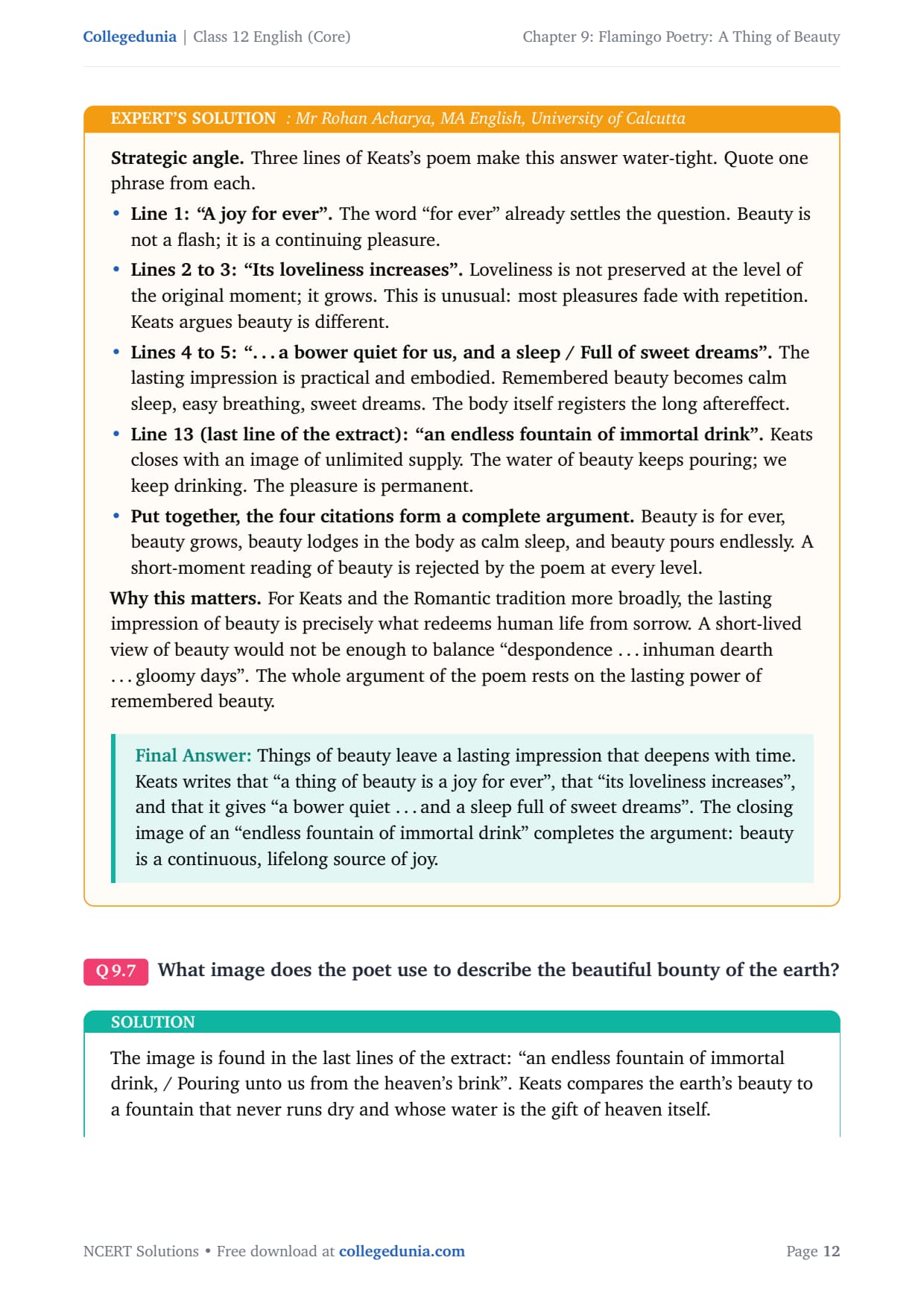
Strategic angle. Three lines of Keats's poem make this
answer water-tight. Quote one phrase from each.
Line 1: ``A joy for ever''. The word ``for ever''
already settles the question. Beauty is not a flash; it is
a continuing pleasure.
Lines 2 to 3: ``Its loveliness increases''.
Loveliness is not preserved at the level of the original
moment; it grows. This is unusual: most pleasures fade with
repetition. Keats argues beauty is different.
Lines 4 to 5: `` a bower quiet for us, and a
sleep / Full of sweet dreams''. The lasting impression is
practical and embodied. Remembered beauty becomes calm
sleep, easy breathing, sweet dreams. The body itself
registers the long aftereffect.
Line 13 (last line of the extract): ``an endless
fountain of immortal drink''. Keats closes with an image
of unlimited supply. The water of beauty keeps pouring; we
keep drinking. The pleasure is permanent.
Put together, the four citations form a complete
argument. Beauty is for ever, beauty grows, beauty lodges
in the body as calm sleep, and beauty pours endlessly. A
short-moment reading of beauty is rejected by the poem at
every level.
Why this matters. For Keats and the Romantic tradition more
broadly, the lasting impression of beauty is precisely what redeems
human life from sorrow. A short-lived view of beauty would not be
enough to balance ``despondence inhuman dearth gloomy
days''. The whole argument of the poem rests on the lasting power
of remembered beauty.
Things of beauty leave a lasting impression that deepens
with time. Keats writes that ``a thing of beauty is a joy for ever'',
that ``its loveliness increases'', and that it gives ``a bower quiet
and a sleep full of sweet dreams''. The closing image of an
``endless fountain of immortal drink'' completes the argument:
beauty is a continuous, lifelong source of joy.
Q 9.7
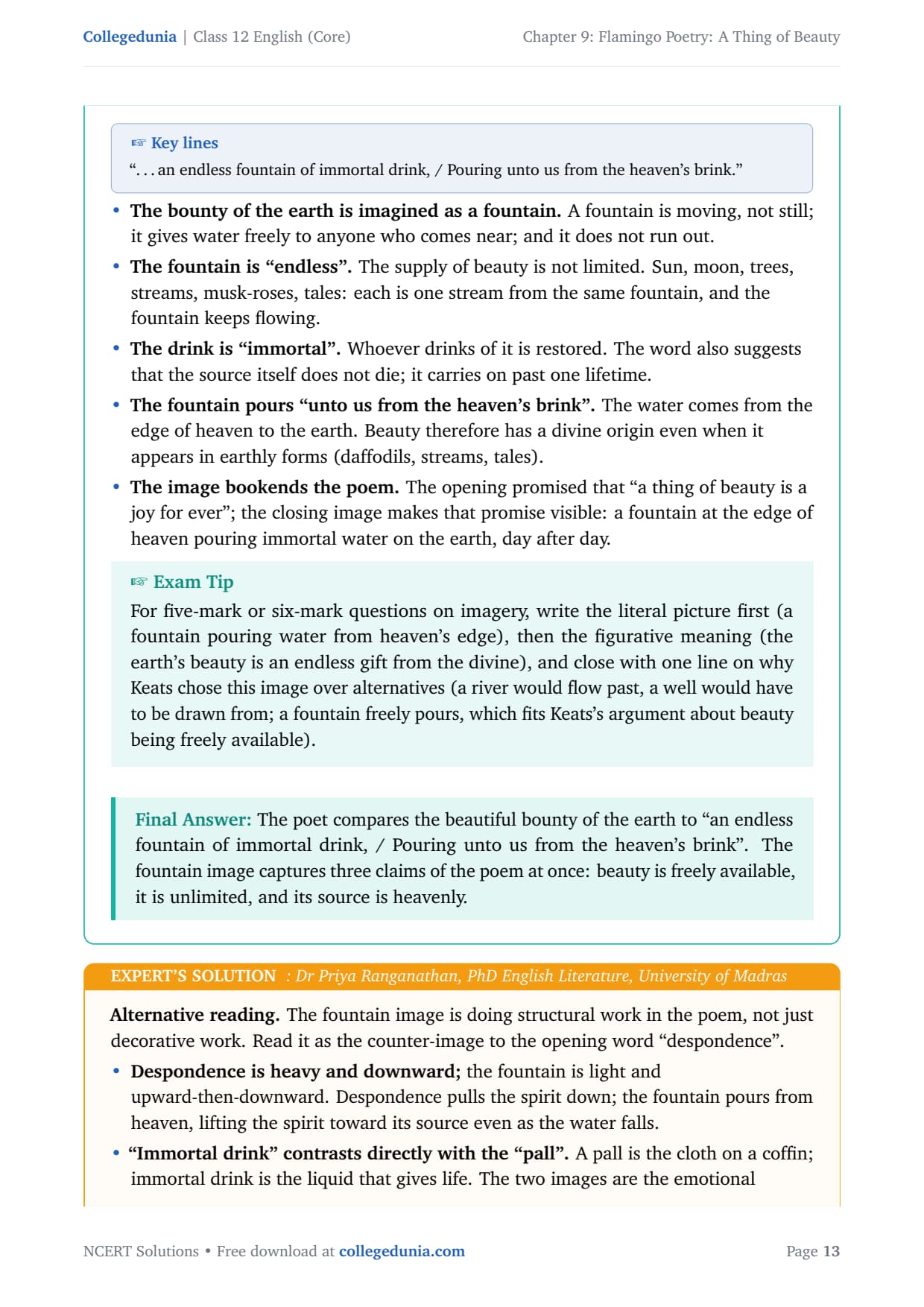
What image does the poet use to describe the beautiful bounty of the earth?
The image is found in the last lines of the extract: ``an endless
fountain of immortal drink, / Pouring unto us from the heaven's
brink''. Keats compares the earth's beauty to a fountain that
never runs dry and whose water is the gift of heaven itself.
Key lines
`` an endless fountain of immortal drink, / Pouring unto us
from the heaven's brink.''
The bounty of the earth is imagined as a fountain.
A fountain is moving, not still; it gives water freely to
anyone who comes near; and it does not run out.
The fountain is ``endless''. The supply of beauty
is not limited. Sun, moon, trees, streams, musk-roses,
tales: each is one stream from the same fountain, and the
fountain keeps flowing.
The drink is ``immortal''. Whoever drinks of it
is restored. The word also suggests that the source itself
does not die; it carries on past one lifetime.
The fountain pours ``unto us from the heaven's
brink''. The water comes from the edge of heaven to the
earth. Beauty therefore has a divine origin even when it
appears in earthly forms (daffodils, streams, tales).
The image bookends the poem. The opening promised
that ``a thing of beauty is a joy for ever''; the closing
image makes that promise visible: a fountain at the edge of
heaven pouring immortal water on the earth, day after day.
For five-mark or six-mark questions on imagery, write the literal
picture first (a fountain pouring water from heaven's edge), then
the figurative meaning (the earth's beauty is an endless gift from
the divine), and close with one line on why Keats chose this image
over alternatives (a river would flow past, a well would have to be
drawn from; a fountain freely pours, which fits Keats's argument
about beauty being freely available).
The poet compares the beautiful bounty of the earth to
``an endless fountain of immortal drink, / Pouring unto us from the
heaven's brink''. The fountain image captures three claims of the
poem at once: beauty is freely available, it is unlimited, and its
source is heavenly.
DP
Dr Priya Ranganathan
PhD English Literature, University of Madras
Verified Expert
Alternative reading. The fountain image is doing structural
work in the poem, not just decorative work. Read it as the
counter-image to the opening word ``despondence''.
Despondence is heavy and downward; the fountain is
light and upward-then-downward. Despondence pulls the
spirit down; the fountain pours from heaven, lifting the
spirit toward its source even as the water falls.
``Immortal drink'' contrasts directly with the
``pall''. A pall is the cloth on a coffin; immortal drink
is the liquid that gives life. The two images are the
emotional opposites of the poem.
``Pouring from the heaven's brink'' suggests
a generous, edge-of-heaven gift. ``Brink'' suggests a
boundary; the water spills over that boundary onto the
earth. The earth therefore receives more than its share,
which is exactly Keats's view of beauty.
The fountain reframes the catalogue. Each item in
the earlier list (sun, moon, trees, daffodils, streams,
musk-roses, mighty dead, tales) is now one jet of the same
fountain. The catalogue does not list disconnected
beautiful things; it shows where the single immortal
water reaches.
The image is also kinetic. ``Pouring'' is a
present participle, like ``wreathing'' earlier in the
poem. Beauty is not a static gift; it is a continuous
action that the heavens are performing on us right now.
Why this matters. A board answer that explains both the
literal picture and the structural function of the fountain image
(opposite of the pall, ongoing pouring, source of the wreath)
earns the full marks. Many students stop at the literal level; the
expert answer reads the image inside the architecture of the whole
poem.
The image is ``an endless fountain of immortal drink, /
Pouring unto us from the heaven's brink''. The earth's beauty is
compared to a heavenly fountain whose water never runs out, whose
source is divine, and whose pouring is continuous. The image bookends
the poem and reverses the heaviness of the opening ``despondence''.
A Thing of Beauty Class 12 English NCERT Solutions FAQs
Ques. How many "Think it out" questions are in A Thing of Beauty Class 12?
Ans. The NCERT Flamingo print carries seven "Think it out" questions for A Thing of Beauty. Our class 12 english ncert solutions chapter 9 Flamingo Poetry: A Thing of Beauty solve all seven in NCERT order with two answers per question.
Ques. What is the central theme of A Thing of Beauty by Keats?
Ans. The central theme is that beauty is a lasting joy that gives us strength against suffering. Keats argues that beautiful things in nature and culture form a "flowery band" that binds us to the earth and pours like an "endless fountain of immortal drink" from heaven's brink.
Ques. What does the fountain image in A Thing of Beauty mean?
Ans. The "endless fountain of immortal drink" at the end of the extract is Keats's image for the beautiful bounty of the earth. The fountain pours continuously from the edge of heaven, so beauty is presented as freely available, unlimited, and divinely sourced.
Ques. Who are the "mighty dead" in A Thing of Beauty?
Ans. The "mighty dead" are great heroes and figures of legend from the past. Keats says that the grandeur lies not in their tombs but in the noble destinies ("dooms") we imagine for them. The tales we tell about them become another flower in the wreath that ties us to the earth.
Ques. Is A Thing of Beauty in the 2026-27 CBSE Class 12 English syllabus?
Ans. Yes. A Thing of Beauty is Chapter 9 in the Flamingo textbook of the 2026-27 CBSE Class 12 English Core syllabus. The full extract and all seven "Think it out" questions are retained in the current print.
Ques. Where can I download the A Thing of Beauty NCERT Solutions PDF?
Ans. The free PDF of these class 12 english ncert solutions chapter 9 Flamingo Poetry: A Thing of Beauty is available on this page. Both the Normal and HD versions are free and match the 2026-27 NCERT Flamingo print.







Comments