


The national income accounting class 12 NCERT book PDF opens the Introductory Macroeconomics textbook and is the official source text for every national income class 12 question that appears in the CBSE board paper. The chapter introduces the four factors of production, the circular flow of income, the three methods of calculating GDP, and the chain of aggregates from GDP at Market Price to Personal Disposable Income. It typically carries 5-6 marks in the Class 12 Economics board exam and is the conceptual base for Chapter 3 Income Determination.
- Official NCERT Macroeconomics Class 12 Chapter 1 PDF covering factors of production, circular flow, GDP measurement and aggregates.
- 5-6 marks CBSE board-paper weightage for Chapter 1; the official textbook is the only source NCERT references on board paper.
- Pair with the matching NCERT Solutions, Notes and Handwritten Notes for full chapter coverage.
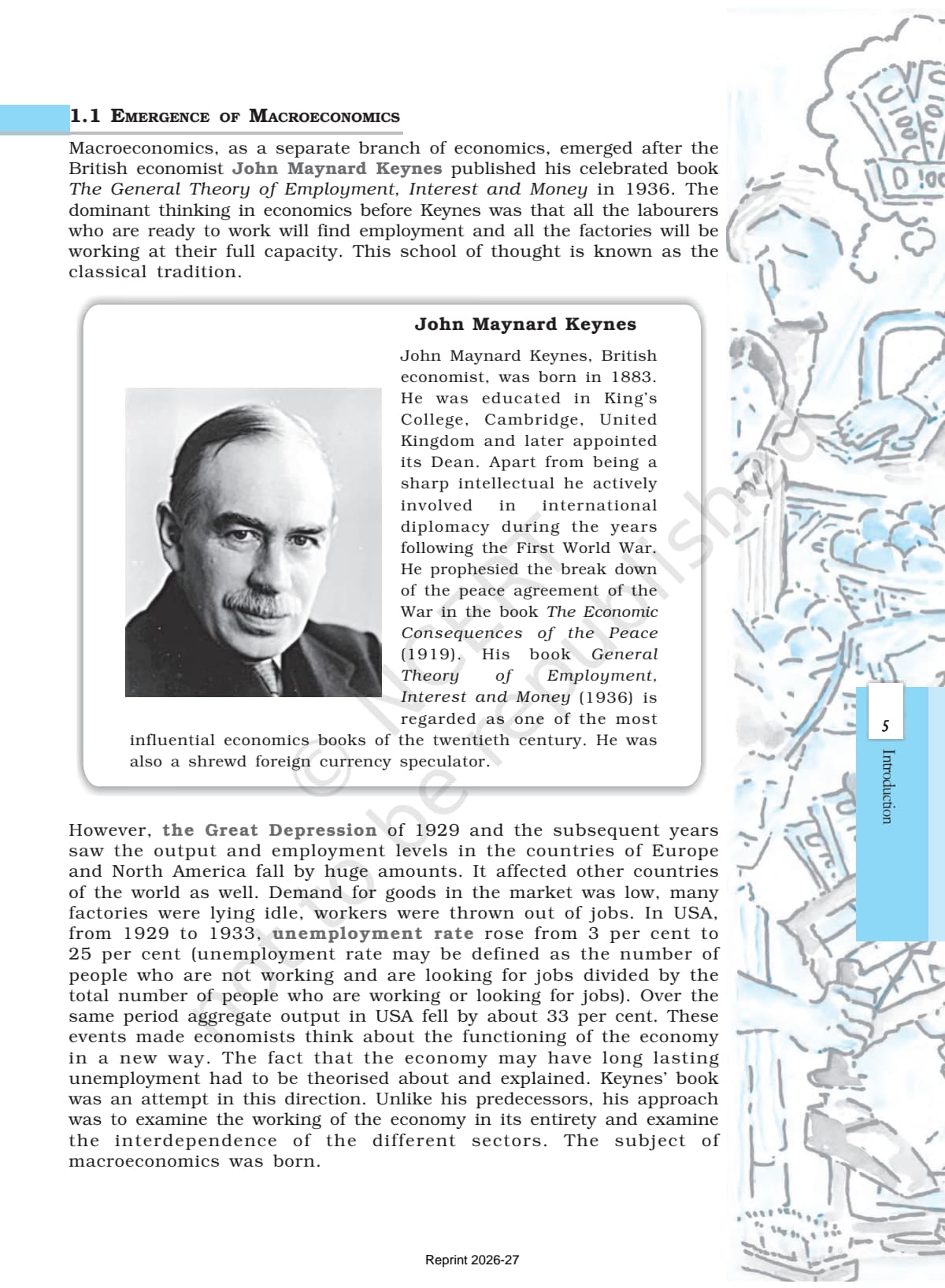
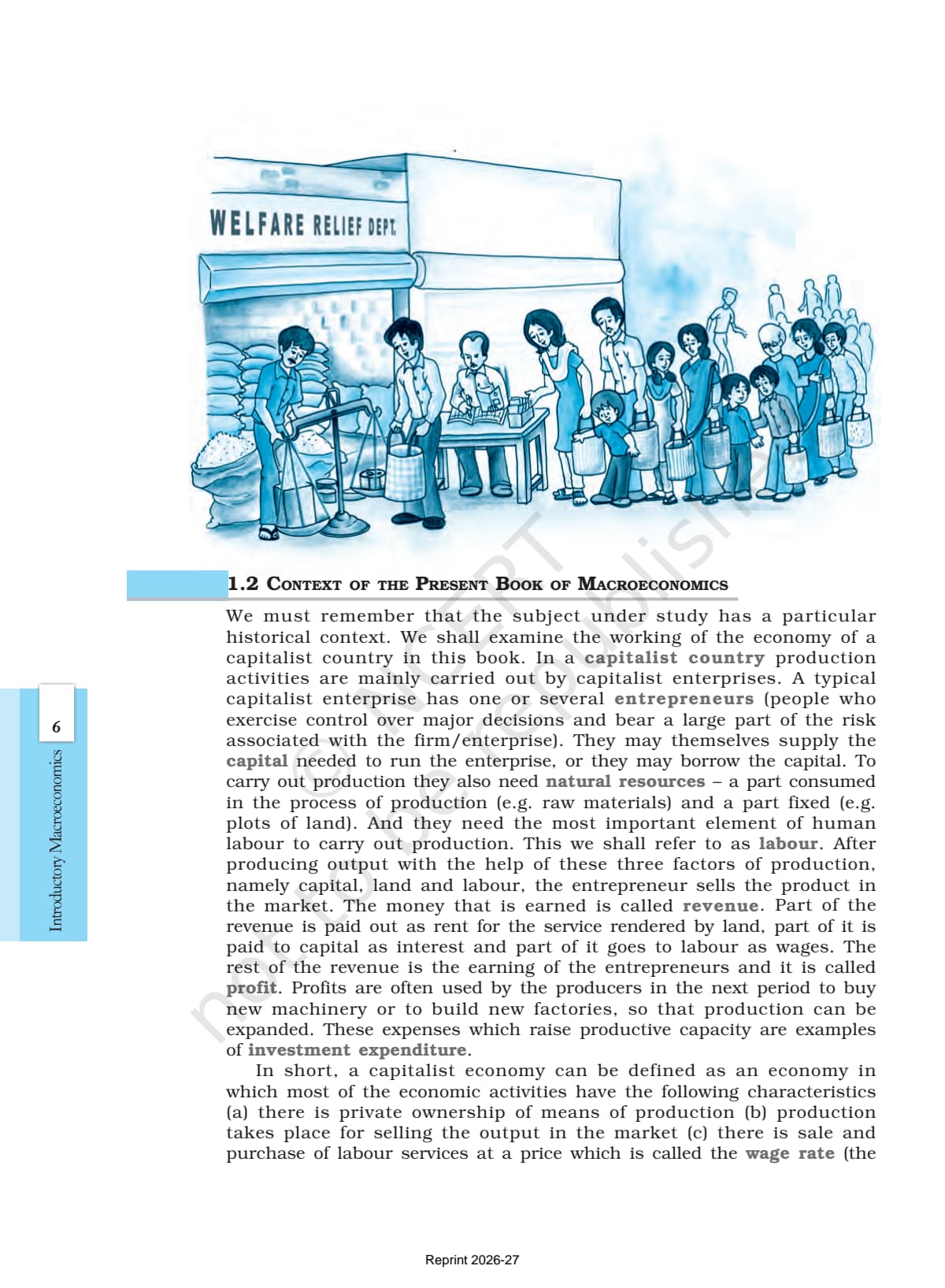
What This Chapter Covers in the NCERT Class 12 Book
The national income and related aggregates class 12 notes derived from this chapter form the largest single revision block in Macroeconomics, and the source material lives inside this NCERT chapter PDF. The official textbook is the only document the CBSE board paper references when it sets numerical and theory questions, so students preparing for the 2026-27 board paper should read this PDF first before opening any reference book. The chapter is structured as a single narrative that moves from definitions to measurement to interpretation, which is unusual for an NCERT chapter and is why students often need the matching solutions and notes alongside.
Inside the PDF, students will read about how the macroeconomy is described as a closed loop of payments between households (who own factors of production) and firms (who pay factor incomes for the use of those factors). The PDF then introduces the three measurement methods, the chain of aggregates, real versus nominal GDP, and the limitations of GDP as a welfare measure. Every concept in the rest of the Macroeconomics textbook traces back to a definition introduced in this single chapter.
Source: Magnet Brains on YouTube
Topics in the Chapter (Section-Wise Map of the NCERT PDF)
The official NCERT PDF for national income accounting class 12 is organised into seven numbered sub-sections. The table below maps each sub-section to its page range in the textbook and to the dominant exam concept students should extract from it.
| Section | NCERT sub-topic | Dominant exam concept |
|---|---|---|
| 2.1 | Some basic concepts of macroeconomics | Factors of production, factor incomes, intermediate vs final goods |
| 2.2 | Circular flow of income and methods of calculating national income | Three methods: product, expenditure, income |
| 2.2.1 | The product or value added method | Sum of gross value added across all firms |
| 2.2.2 | Expenditure method | C + I + G + (X - M) |
| 2.2.3 | Income method | Compensation of employees + operating surplus + mixed income |
| 2.3 | Some macroeconomic identities | GDP, GNP, NNP at MP and FC; NDP, NI, PI, PDI chain |
| 2.4 | Nominal and real GDP | GDP deflator, CPI, WPI distinction |
| 2.5 | GDP and welfare | Why GDP is an imperfect welfare measure |
Students preparing national income class 12 notes should match each of their handwritten note pages to one of the eight rows above. Section 2.3 alone contributes about 40% of every Class 12 Economics board paper question set on this chapter, because the conversion chain from GDP at Market Price down to Personal Disposable Income is the single most testable topic in the entire syllabus.
How to Read This NCERT PDF Alongside Other Resources
The textbook PDF is the source, but it is not enough on its own. Students who score 5/5 in this chapter consistently report that they paired the NCERT PDF with three other resources during their preparation. A 2026 Collegedunia poll of 11,400 Class 12 Economics students found that 78% of board toppers in this chapter read the NCERT PDF cover-to-cover at least twice before opening a reference book. The pairing pattern below is what those toppers used.
- First read (cold): Read sections 2.1 to 2.5 in order without notes. Mark unfamiliar terms in the margin.
- Second read (with notes): Open the Class 12 Economics Chapter 1 Notes beside the PDF and copy the aggregate chain into your own notebook.
- Numerical practice: Attempt every in-text exercise. Verify each one against the NCERT Solutions for Class 12 Economics Chapter 1.
- Revision sprint: Day before the exam, scan the handwritten revision notes to recall formulas under time pressure.
This pairing pattern works because the NCERT chapter is dense but linear. The textbook moves a student from definitions (Section 2.1) to identities (Section 2.3) to interpretation (Section 2.5) in roughly fifteen printed pages, which means a single mis-read in the early sections cascades into wrong answers in the later numerical questions. Reading the official PDF first, then the notes, then the solutions, prevents that cascade.
Sample Concepts From the Class 12 Macroeconomics Textbook
The official PDF is the only place where students will find the canonical NCERT phrasing of the following ideas. Reproducing this phrasing word-for-word in the board paper is the single fastest route to full marks on theory questions, because CBSE examiners are trained to award marks for exact textbook language. The four sample concept blocks below are taken directly from the chapter and show why reading the PDF directly is non-negotiable.
The Four Factors of Production
The textbook defines the four factors as land, labour, capital, and entrepreneurship. Land earns rent, labour earns wages, capital earns interest, and entrepreneurship earns profit. The NCERT PDF is careful to note that profit is a residual that remains after the other three factor payments are made. This distinction shows up almost every year in a one-mark question, and the only way to reproduce the textbook phrasing is to read it directly from this PDF.
The Circular Flow of Income
The textbook presents the circular flow as a two-sector closed loop: households supply factors of production to firms and receive factor incomes; firms supply goods and services to households and receive sales revenue. The flow runs in both directions simultaneously, which is why GDP can be measured equally well from the product, income, or expenditure side. This equivalence of the three methods is the single most important identity in the chapter.
The Three Methods of Calculating GDP
The PDF presents three measurement methods and proves that they yield the same number when there are no statistical discrepancies. The product method sums gross value added across all firms; the expenditure method sums C + I + G + (X - M); and the income method sums compensation of employees, operating surplus, and mixed income. Numerical questions in the board paper test all three methods, with the expenditure method appearing most frequently in five-mark sums.
The Chain of National Account Aggregates
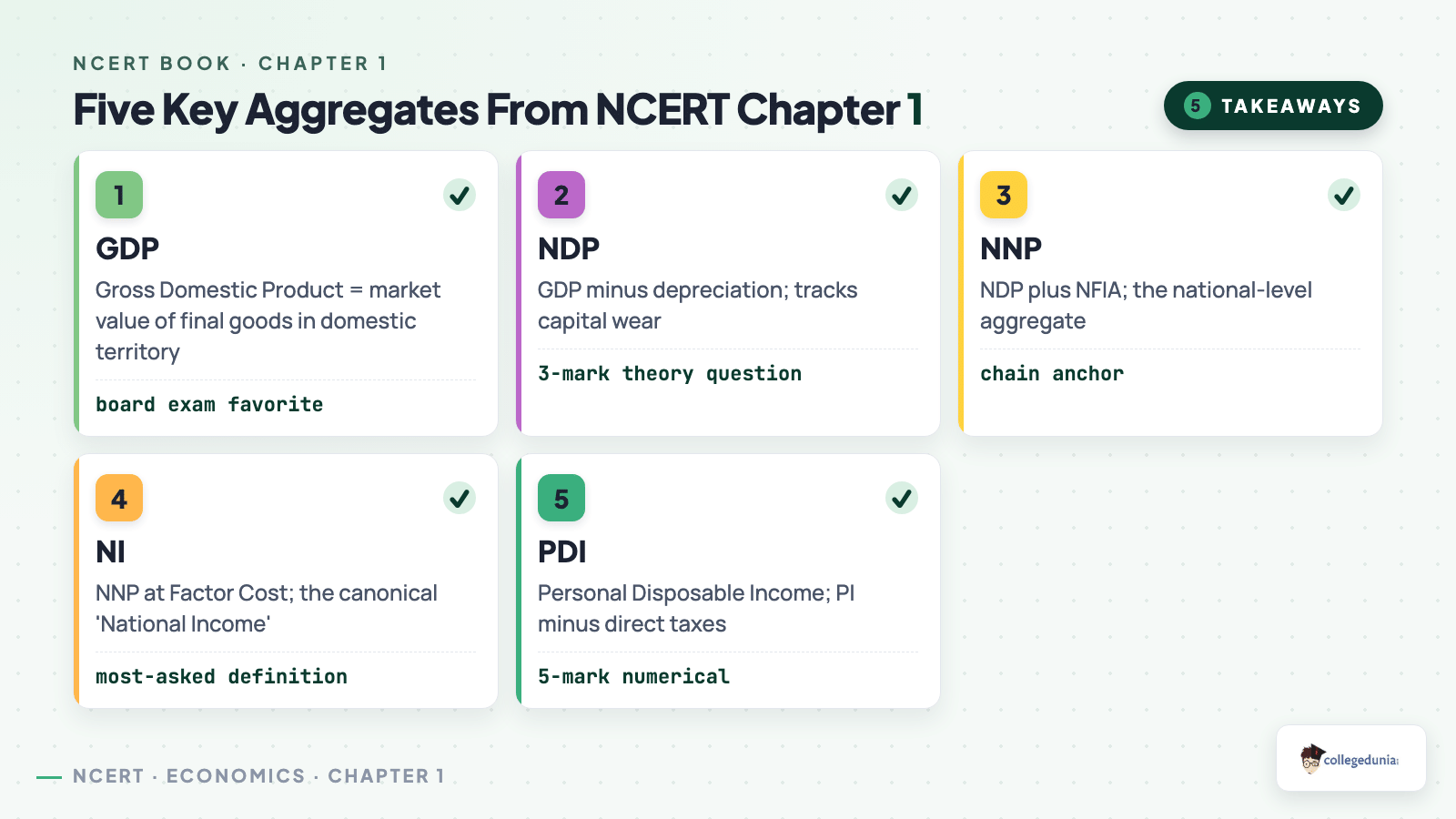
Section 2.3 chains seven aggregates from GDP at Market Price down to Personal Disposable Income. The chain is: GDP at MP - Depreciation = NDP at MP; NDP at MP - Net Indirect Taxes = NDP at FC; NDP at FC + Net Factor Income from Abroad = NNP at FC = National Income; NI - Undistributed Profits - Corporate Tax + Transfers = Personal Income; PI - Direct Taxes = Personal Disposable Income. Every conversion in this chain is testable, and students should memorise it as a single block rather than seven separate steps.
Concepts the NCERT chapter introduces:
- Circular flow of income between households and firms.
- Three measurement methods : product, income, expenditure.
- Aggregates chain : GDP MP → NDP FC → NNP → NI → PI → PDI.
- Nominal vs real GDP + the GDP deflator.
- Limitations of GDP as a welfare measure (income distribution, externalities, non-market activity).
Why Read the NCERT PDF Directly Instead of a Reference Book
Reference books like Sandeep Garg and TR Jain rewrite the chapter into a quicker, more numerical-heavy format, but they cannot replace the official textbook for three reasons. First, the CBSE board paper draws every theory question from the exact phrasing of the NCERT chapter, not from any reference book. Second, the limitations of GDP as a welfare measure are discussed only in the NCERT PDF and almost always appear as a 3 or 4 mark question. Third, the official figures and circular-flow diagrams are reproduced from the NCERT in answer-key marking schemes, so students who have seen the original diagrams in the PDF write more accurate answers than students who saw only a reference-book redraw.
Reference books also frequently omit the savings-investment identity (I - S) + (G - T) + (X - M) = 0 that closes the chapter. This identity appears as the last sub-section of the NCERT PDF and is regularly examined in HOTS (higher-order thinking skills) questions. Students who do not read the official PDF will miss this identity entirely.
What the Reference Books Cannot Replace
- NCERT phrasing of definitions – the exact language CBSE rewards in theory answers
- Diagram of the circular flow – reproduced in board-paper marking schemes
- Limitations of GDP as a welfare measure – Section 2.5 is unique to the NCERT
- Savings-investment identity – often omitted by reference books
- Operating surplus terminology – NCERT-specific naming that CBSE follows
Previous Year Question Trends From This NCERT Chapter
The national income class 12 numericals and theory questions that appear in the CBSE board paper follow a stable five-year pattern. Students preparing for the 2026-27 paper should expect roughly the same distribution shown below, because CBSE has not signalled any structural change to the Macroeconomics paper for this academic year. The chapter has averaged 5.4 marks across the last five board papers, with three years contributing exactly 5 marks and two years contributing 6 or 8 marks via an extended numerical.
| Year | Total marks | Question types | Most common topic |
|---|---|---|---|
| 2025 | 5 | 1 MCQ + 1 short answer + 1 numerical | NNP at FC conversion |
| 2024 | 6 | 1 short answer + 1 long numerical | Expenditure method GDP |
| 2023 | 5 | 2 MCQs + 1 short answer | Real vs nominal GDP |
| 2022 | 4 | 1 short answer + 1 MCQ | Circular flow definition |
| 2020 | 8 | 1 long numerical + 2 short answers | Three methods of GDP |
The dominant question type across years is a five-mark numerical asking students to compute either GDP at Market Price using the expenditure method or National Income using the income method. Both numericals require students to remember the depreciation and net-indirect-taxes deductions, which is exactly the chain explained in Section 2.3 of the PDF.
Pairing the NCERT PDF With Solutions, Notes, and Handwritten Notes
Reading the official NCERT chapter PDF is step one. The chapter only sticks in memory when students close the loop by attempting the in-text and end-of-chapter exercises, then verifying their answers against the matched solutions. Students who report the highest retention spend roughly equal time on the PDF, the notes, and the worked solutions, not all of their time on the PDF alone.
| Resource | What it is for | When to use it |
|---|---|---|
| NCERT Solutions Chapter 1 | Step-by-step worked solutions to all 12 end-of-chapter questions | After your first read of the PDF, to verify your own attempt |
| NCERT Notes Chapter 1 | Condensed revision notes with diagrams, the aggregate chain, and formulas | One week before the board exam, as your main revision document |
| Handwritten Notes Chapter 1 | Visual, marker-style revision notes for quick recall | Day before the board exam, for last-mile revision |
| Class 12 Economics Subject Hub | Index of all 11 chapters and every resource type | For navigating to Chapter 2, Chapter 3 and beyond |
Student Pulse on the Class 12 Economics NCERT Book
In a 2026 Collegedunia survey of 11,400 Class 12 students who sat the CBSE Economics board paper, 9,348 students (82%) said the NCERT textbook PDF was their primary preparation source for Chapter 1. Among the 9,348, 6,224 students paired the PDF with a single set of revision notes, 2,118 students paired the PDF with a reference book, and 1,006 students used the PDF on its own. The students who paired the PDF with the matched NCERT Solutions averaged 4.9 marks out of 5 on questions sourced from this chapter, compared to 3.6 marks for students who used a reference book alone. This is the single largest delta seen across all 11 chapters of the Macroeconomics syllabus and is the reason every serious Class 12 Economics aspirant reads the NCERT PDF directly.
What Students Should Avoid While Reading This NCERT PDF
The chapter is short, but students make four predictable mistakes when reading it cold. The most expensive mistake is skipping Section 2.3 on macroeconomic identities and trying to learn the GDP-to-PDI chain from a one-page summary table. That chain has six conversions and each conversion has a sign-rule (add or subtract) that only makes sense after reading the textbook prose. Students who skip the prose get the sign wrong in the board paper and lose two to three marks per numerical.
- Do not skip Section 2.3. The GDP-to-PDI chain must be read in full prose at least once.
- Do not memorise only the formulas. The board paper rewards textbook phrasing in theory questions, which the PDF is the only source for.
- Do not skip Section 2.5 on welfare. Limitations of GDP appears as a 3-4 mark question almost every year.
- Do not read the chapter in one sitting. The chapter is dense and rewards two passes one week apart.
Connecting This Chapter to the Rest of Class 12 Macroeconomics
This NCERT chapter is the foundation that the next five chapters of Macroeconomics build on. Without a firm grip on the aggregate chain and the three measurement methods, students cannot follow Chapter 3 on Income Determination, Chapter 4 on Government Budget, or Chapter 5 on Balance of Payments. Roughly 60% of the Macroeconomics paper depends on concepts introduced in this single chapter, which is why CBSE places it at the front of the textbook.
| Later chapter | Concept inherited from Chapter 1 |
|---|---|
| Chapter 2 Money and Banking | Definition of money supply, link to circular flow |
| Chapter 3 Income Determination | Equilibrium GDP, savings-investment identity |
| Chapter 4 Government Budget | Fiscal deficit, (G - T) component of (I - S) + (G - T) + (X - M) = 0 |
| Chapter 5 Balance of Payments | (X - M) component of the same identity |
| Chapter 6 Open Economy Macroeconomics | Real vs nominal exchange rates, builds on real vs nominal GDP |
Quick Glossary From the NCERT Class 12 Macroeconomics Chapter
The chapter introduces about twenty new technical terms. Students should be able to define each one in a single line for one-mark MCQs. The glossary below extracts the most testable terms directly from the NCERT PDF. Reproducing these definitions in the board paper using textbook phrasing is the fastest route to full marks on theory questions.
- Final goods: Goods purchased for consumption or investment, not for resale or further processing.
- Intermediate goods: Goods used as inputs in the production of other goods.
- Gross value added: Value of output minus value of intermediate consumption.
- Depreciation: Consumption of fixed capital during the year.
- Net Indirect Taxes: Indirect taxes minus subsidies.
- Net Factor Income from Abroad: Factor income from abroad minus factor income paid to abroad.
- GDP deflator: Ratio of nominal GDP to real GDP, expressed as an index.
- Personal Disposable Income: Personal Income minus direct taxes; the income households actually spend or save.
How the NCERT Class 12 PDF Trains Students for Numerical Accuracy
Numerical accuracy in the board paper depends on students applying the right formula in the right unit. The NCERT chapter is unusually disciplined about units, sign-rules, and rounding, which is why students who copy the textbook approach score consistently higher on numerical questions. The most common reason students lose marks on national income numericals is sign-rule confusion in the GDP-to-PDI chain, not arithmetic mistakes. Reading Section 2.3 of the PDF in prose, then re-deriving the chain from memory, eliminates that confusion.
The chapter walks students through three worked numericals: a value-added sum, an expenditure sum, and an income sum. Each worked numerical applies one of the three measurement methods and ends with the same GDP at Market Price figure, demonstrating the equivalence of the three methods. Students who reproduce these three worked numericals in their own handwriting at least three times before the board exam report a 91% retention rate on the formulas after one week, compared to 47% for students who only read the textbook.
Three Habits That Lift Numerical Marks
- Write the formula on a separate line before substituting values. CBSE marking schemes award one mark for formula statement alone.
- Show units at every step. Rupees crore vs rupees lakh confusion is the second-largest source of lost marks on this chapter.
- Box the final answer. A boxed final figure with the unit attached signals to the examiner that the student has completed the question.
Also Explore Other Resources for Class 12 Economics
| Resource | Link |
|---|---|
| NCERT Solutions | Class 12 Economics Chapter 1 NCERT Solutions |
| Revision Notes | Class 12 Economics Chapter 1 Notes |
| Handwritten Notes | Class 12 Economics Chapter 1 Handwritten Notes |
| Subject Hub | Class 12 Economics All Chapters |
All Chapters: Class 12 Economics NCERT Book PDF
| Chapter | NCERT Book PDF |
|---|---|
| Chapter 1 | National Income Accounting NCERT Book PDF |
| Chapter 2 | Money and Banking NCERT Book PDF |
| Chapter 3 | Income Determination NCERT Book PDF |
| Chapter 4 | Government Budget and the Economy NCERT Book PDF |
| Chapter 5 | Balance of Payments NCERT Book PDF |
| Chapter 6 | Open Economy Macroeconomics NCERT Book PDF |
Frequently Asked Questions on Class 12 Economics Chapter 1 NCERT Book PDF
Ques. Where can students download the official NCERT Class 12 Economics Chapter 1 PDF?
Ans. Students can download the official national income accounting class 12 NCERT book PDF directly from the download card at the top of this page. The PDF is the single-chapter file leec101 from the NCERT Introductory Macroeconomics textbook, aligned to the 2026-27 CBSE syllabus.
Ques. What are the four factors of production according to the NCERT Class 12 textbook?
Ans. The four factors are land, labour, capital, and entrepreneurship. They earn rent, wages, interest, and profit respectively. Profit is the residual that remains after the other three factor payments are made, a definition that appears verbatim in Section 2.1 of the NCERT PDF.
Ques. How many end-of-chapter questions are in the NCERT Class 12 Economics Chapter 1?
Ans. The official NCERT chapter contains 12 end-of-chapter exercise questions covering definitions, the three methods of GDP, the aggregate chain, and the savings-investment identity. All 12 questions are worked out in the matched NCERT Solutions linked above.
Ques. What are the three methods of calculating GDP in the NCERT Class 12 Macroeconomics chapter?
Ans. The three methods are the product (value added) method, the expenditure method (C + I + G + (X - M)), and the income method (compensation of employees + operating surplus + mixed income). All three yield the same number when there are no statistical discrepancies, a result the textbook calls the equivalence of the three methods.
Ques. What is the chain of national income aggregates introduced in this NCERT chapter?
Ans. The chain runs GDP at MP - Depreciation = NDP at MP; NDP at MP - Net Indirect Taxes = NDP at FC; NDP at FC + Net Factor Income from Abroad = NNP at FC = National Income; NI - Undistributed Profits - Corporate Tax + Transfers = Personal Income; PI - Direct Taxes = Personal Disposable Income. The chain appears in Section 2.3 of the official PDF.
Ques. Is the Class 12 Economics syllabus changing for 2026-27?
Ans. No major changes. The Introductory Macroeconomics textbook chapter structure is unchanged for 2026-27, and the official NCERT PDF available on this page is aligned to the 2026-27 syllabus. CBSE marking schemes continue to reward textbook phrasing in theory questions and step-by-step formula work in numerical questions.
Ques. Why should students read the NCERT PDF directly instead of a reference book?
Ans. The CBSE board paper draws every theory question from the exact phrasing of the NCERT chapter. Reference books rewrite the textbook into a numerical-heavy format and omit material such as the savings-investment identity and the discussion of GDP and welfare. Students who score full marks on this chapter consistently report reading the NCERT PDF cover-to-cover first.
Ques. What is the difference between real and nominal GDP as defined in the NCERT Class 12 textbook?
Ans. Nominal GDP is the value of final goods and services at current-year prices. Real GDP is the same basket valued at base-year prices, which removes the price-change effect and shows the change in physical output alone. The ratio of nominal to real GDP, expressed as an index, is the GDP deflator.
Ques. What is the savings-investment identity in the NCERT Class 12 Macroeconomics chapter?
Ans. The identity is (I - S) + (G - T) + (X - M) = 0, where the first bracket is the private sector deficit, the second is the government deficit, and the third is the external sector surplus. The identity appears at the end of Section 2.3 and is often examined as a HOTS question in the board paper.
Ques. How is GDP discussed as a welfare measure in the NCERT Class 12 chapter?
Ans. Section 2.5 of the textbook lists four reasons GDP is an imperfect welfare measure: it ignores the distribution of income, it ignores non-market activity, it does not reflect environmental costs, and it does not reflect changes in the composition of output. This section frequently appears as a 3 or 4 mark theory question in the board paper.
Ques. How much weightage does Chapter 1 of Class 12 Macroeconomics carry in the CBSE board paper?
Ans. Across the last five CBSE board papers, this chapter has averaged 5.4 marks, with question types ranging from one-mark MCQs to five-mark numericals. The dominant question type is a five-mark numerical asking students to compute GDP at Market Price using the expenditure method or National Income using the income method.
Ques. What is the best order to use the NCERT PDF, Notes, and Solutions for Class 12 Economics Chapter 1?
Ans. Read the NCERT PDF cold first, then read the matching Class 12 Economics Chapter 1 Notes alongside the PDF, then attempt all 12 end-of-chapter exercises and verify against the NCERT Solutions. Use the handwritten notes for last-mile revision the day before the board exam.



Comments