


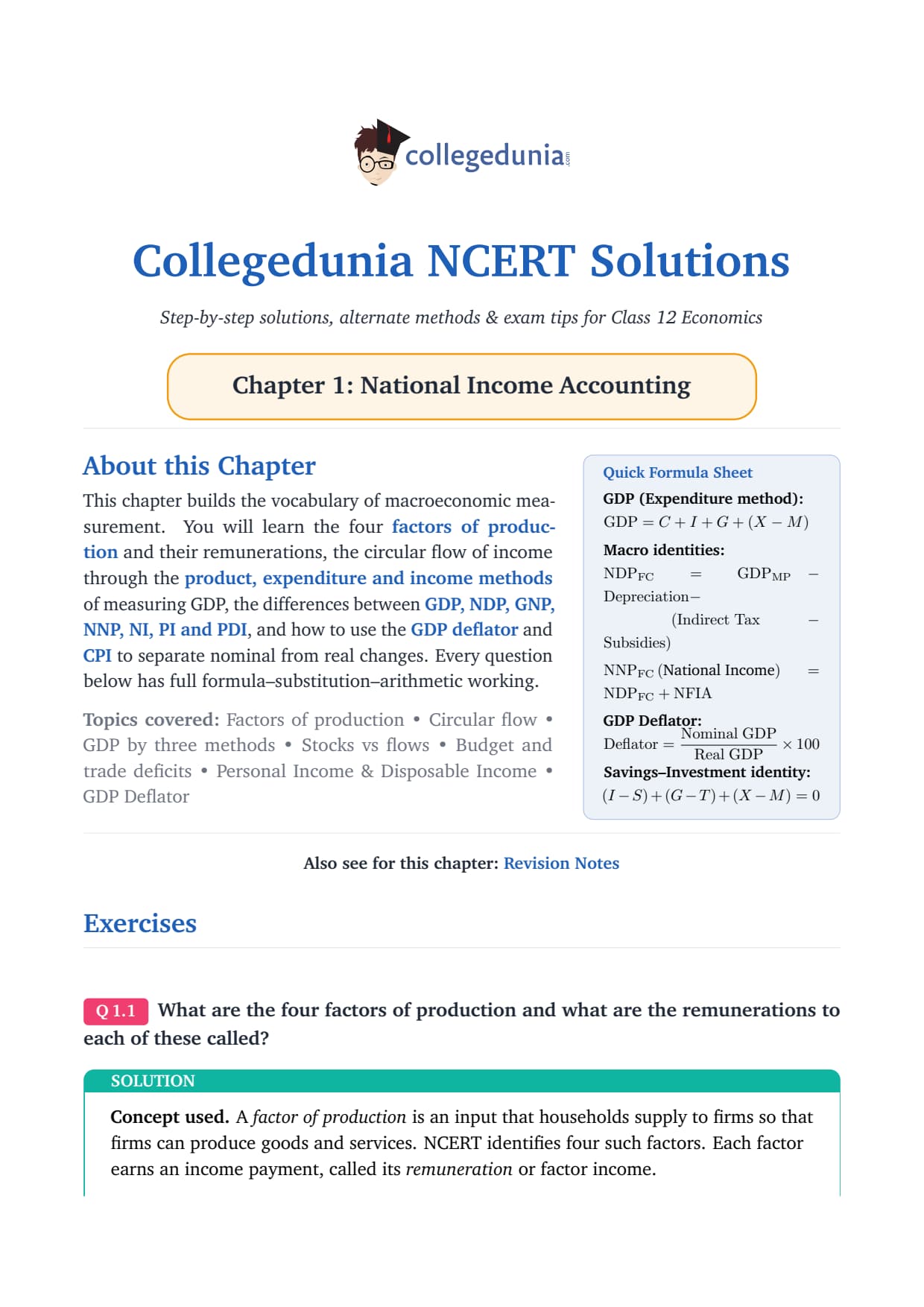
National Income Accounting is the opening chapter of CBSE Class 12 Introductory Macroeconomics, and it sets up every concept that the rest of the book depends on. These NCERT Solutions for Class 12 Economics Chapter 1 cover all 12 textbook exercise questions with step-by-step working aligned to the 2026-27 NCERT syllabus, the latest CBSE marking scheme, and the structured answer style that scores full marks in the board paper.
- 12 NCERT exercise questions from the national income and related aggregates class 12 notes block, solved with formula, substitution and final answer on separate lines, plus an Expert's Solution per numerical that re-derives the result by a second method.
- Full coverage of the three GDP methods (product, expenditure, income), the chain GDP→NDP→NNP→NI→PI→PDI, the savings-investment identity and GDP-as-welfare critique.
- Numerical solutions tied to the latest five years of CBSE Class 12 Economics board papers and the Sandeep Garg Macroeconomics Class 12 solutions national income exercise.
- Free downloadable PDF, ready-to-print, paired with a chapter notes file, a formula sheet and a handwritten notes set on the same topic.
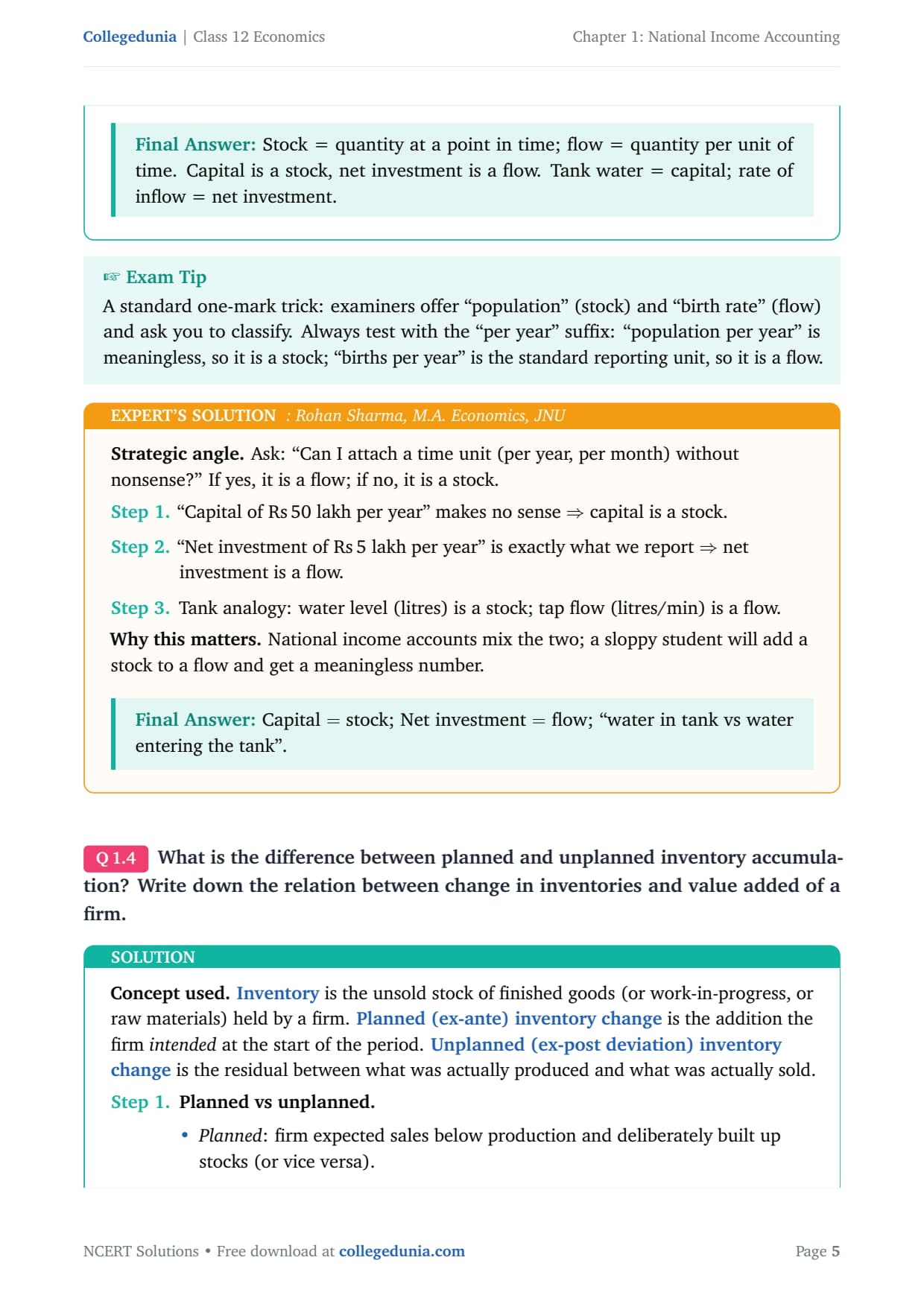
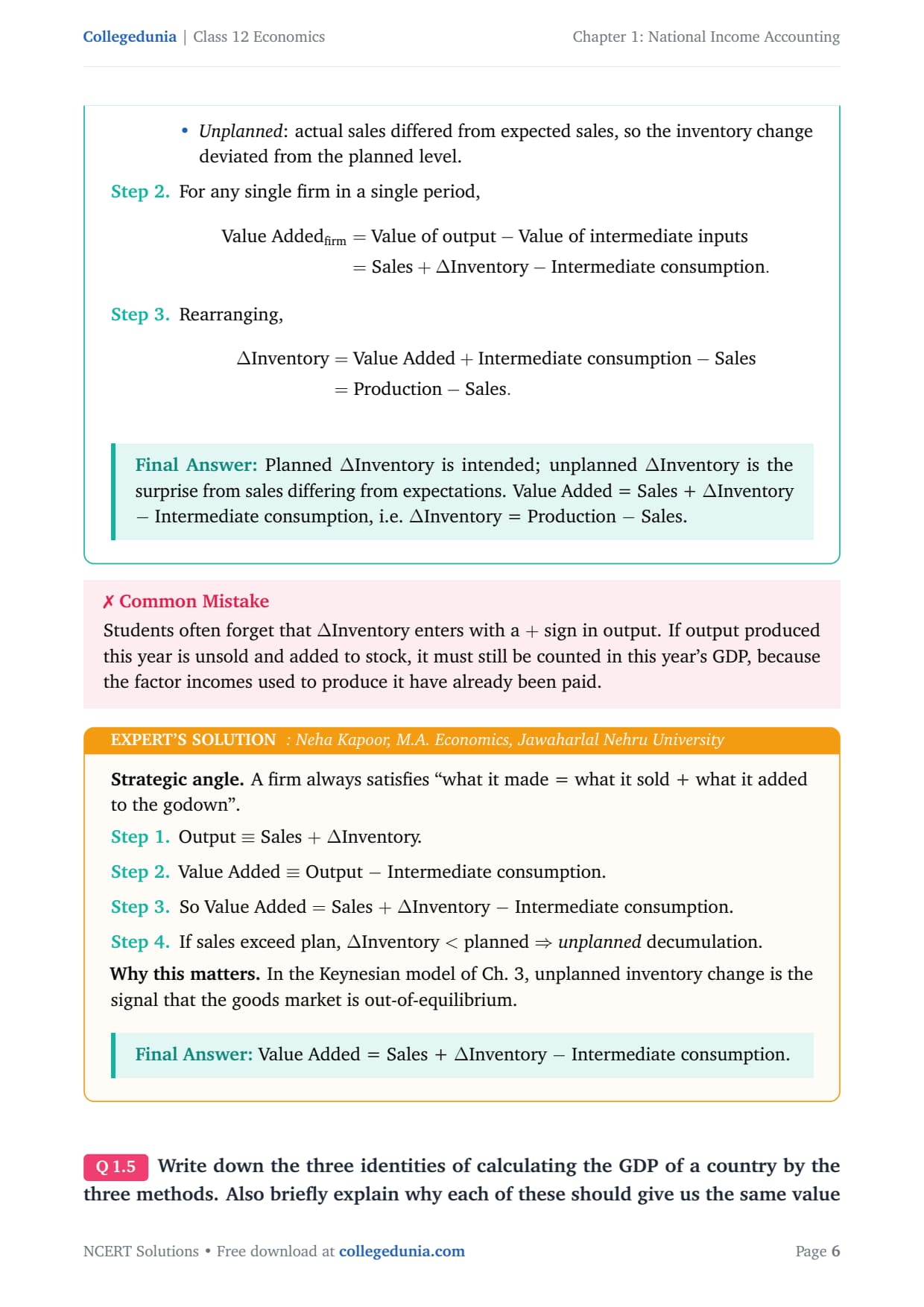
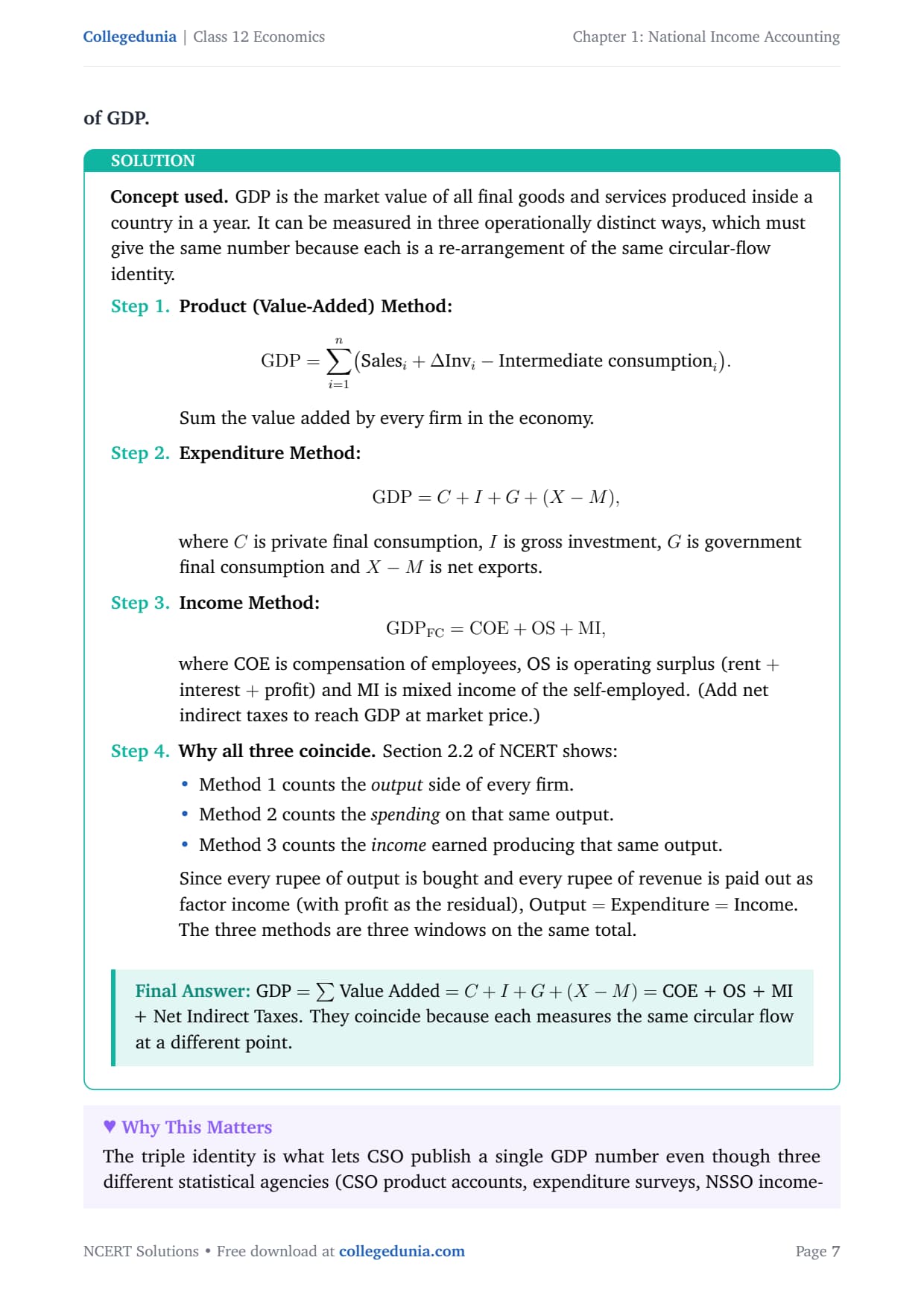
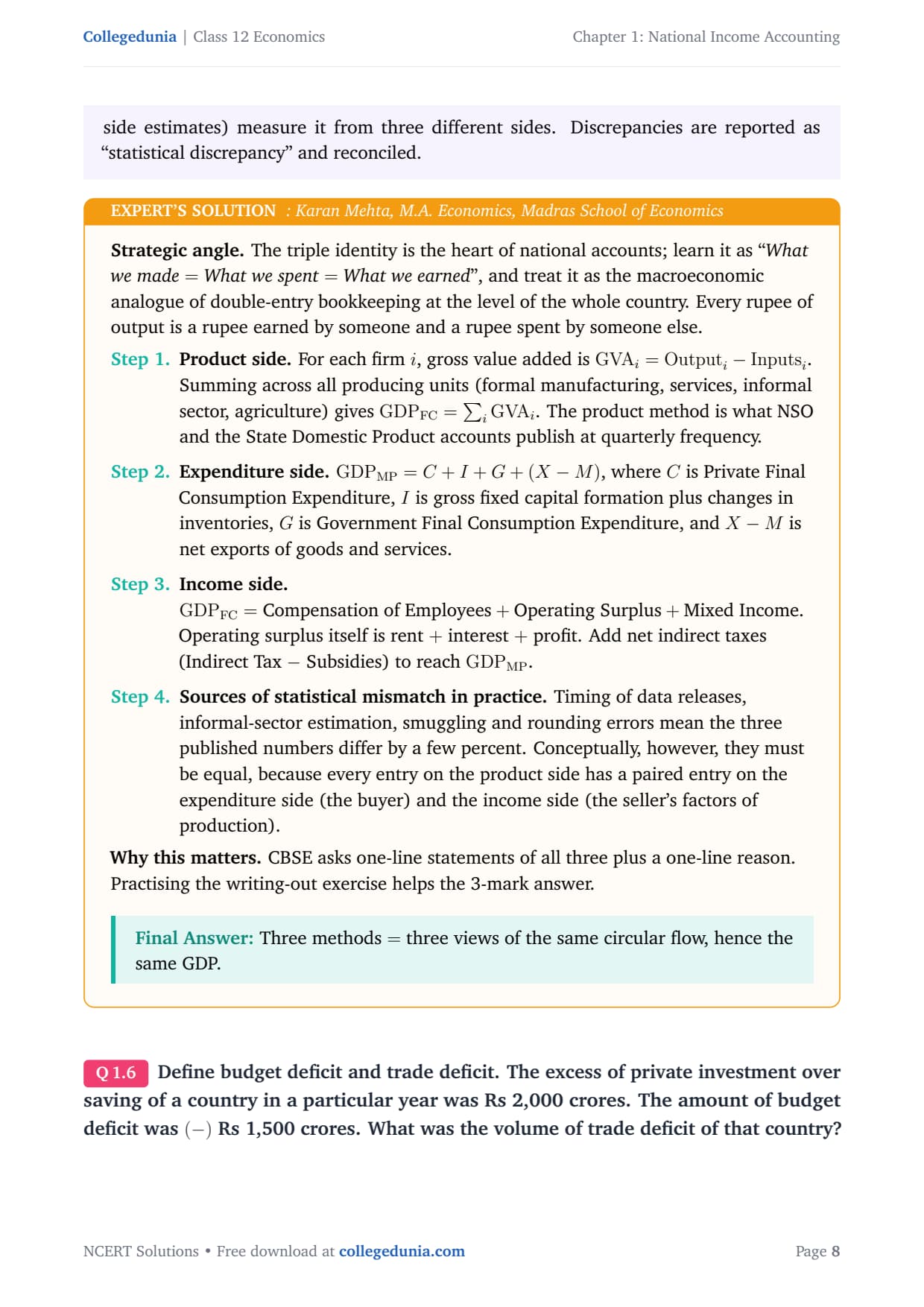
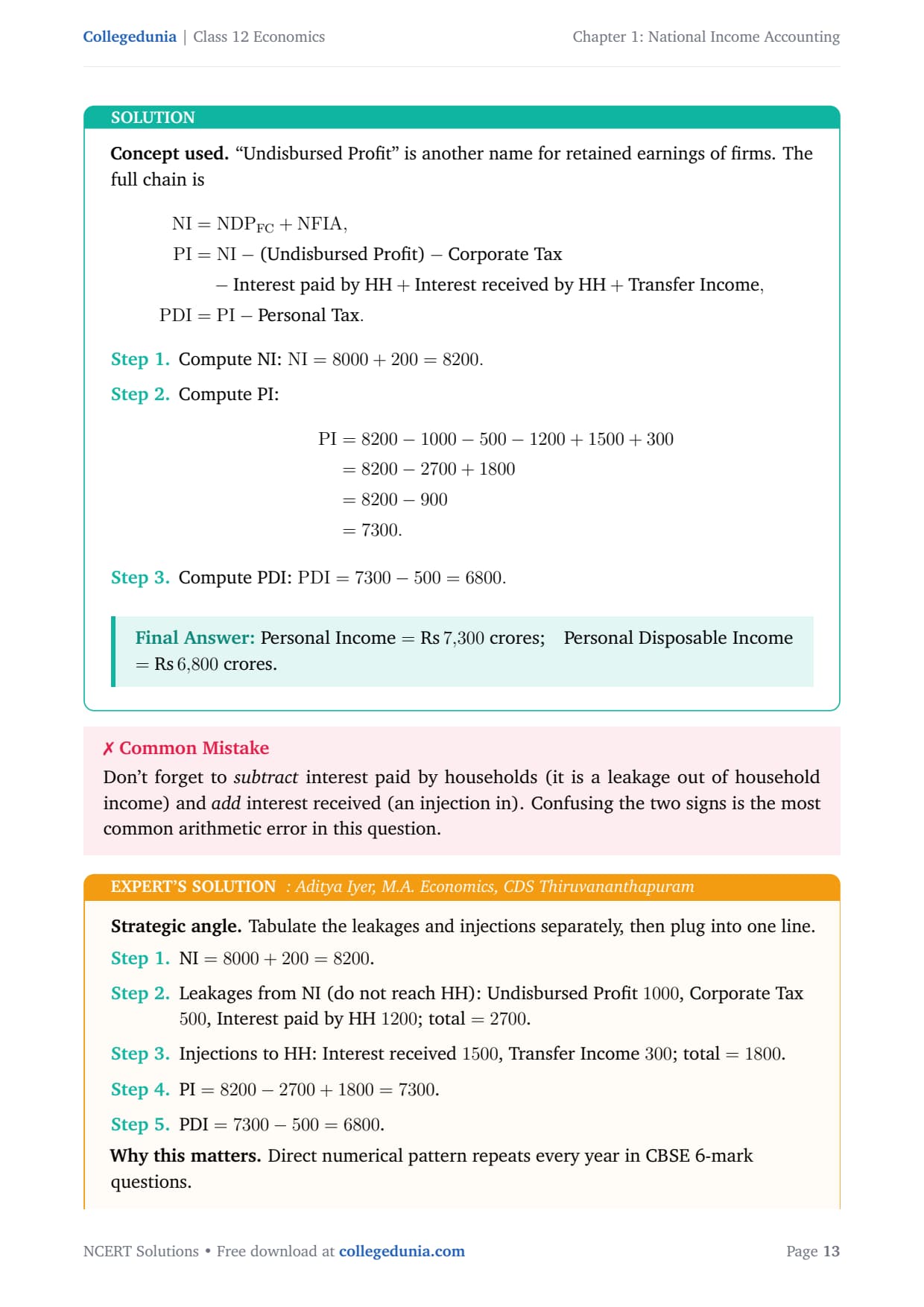
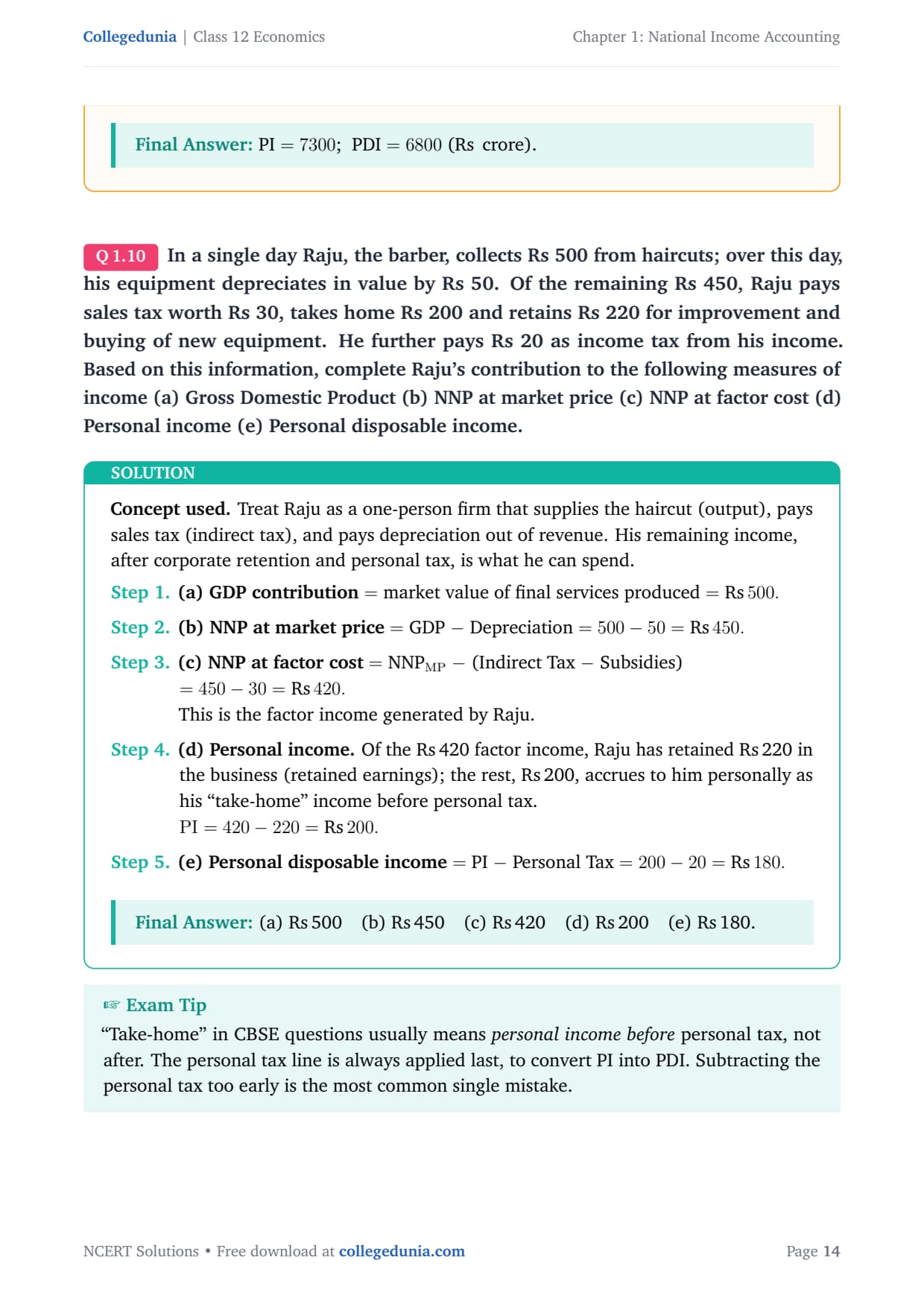
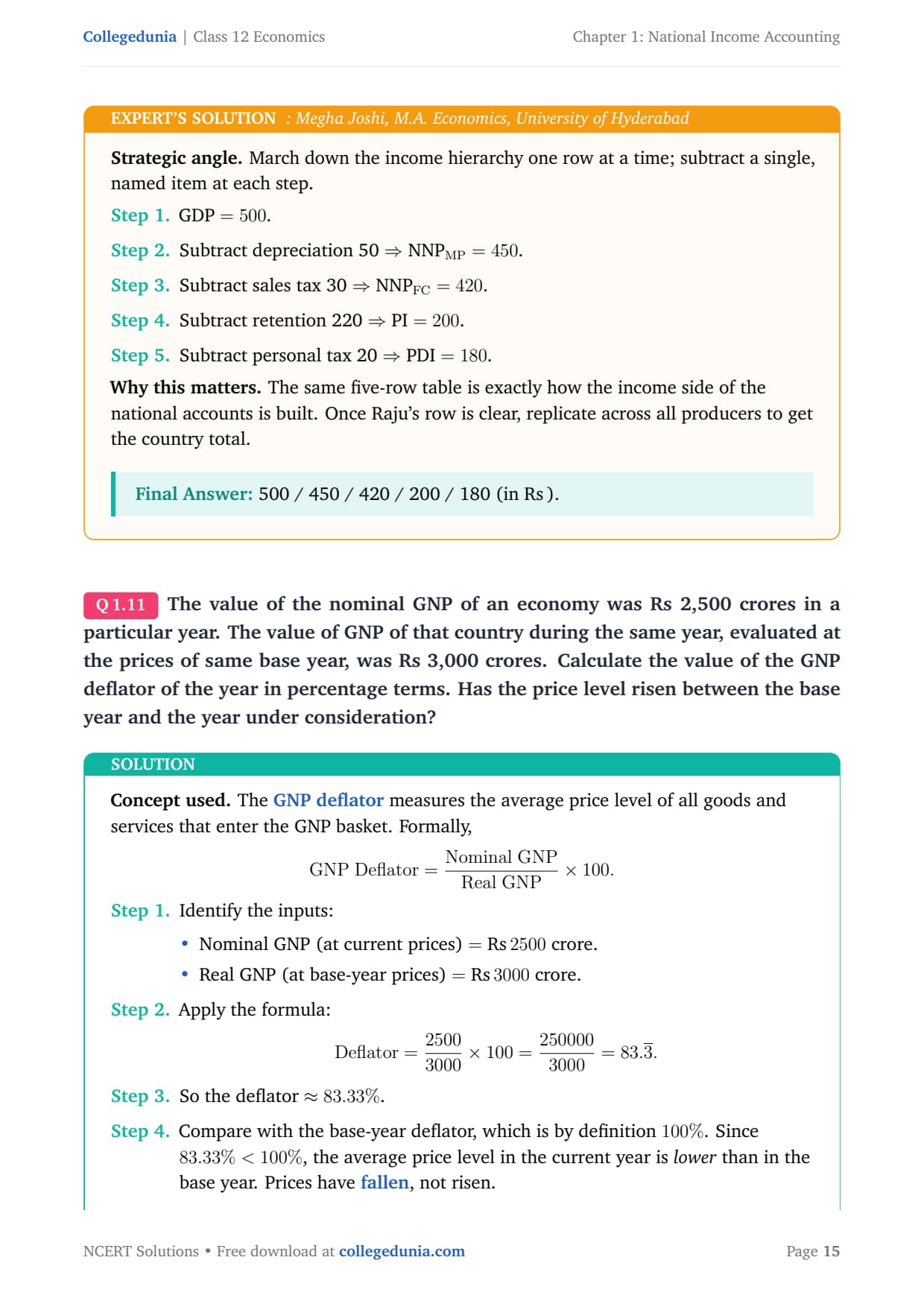
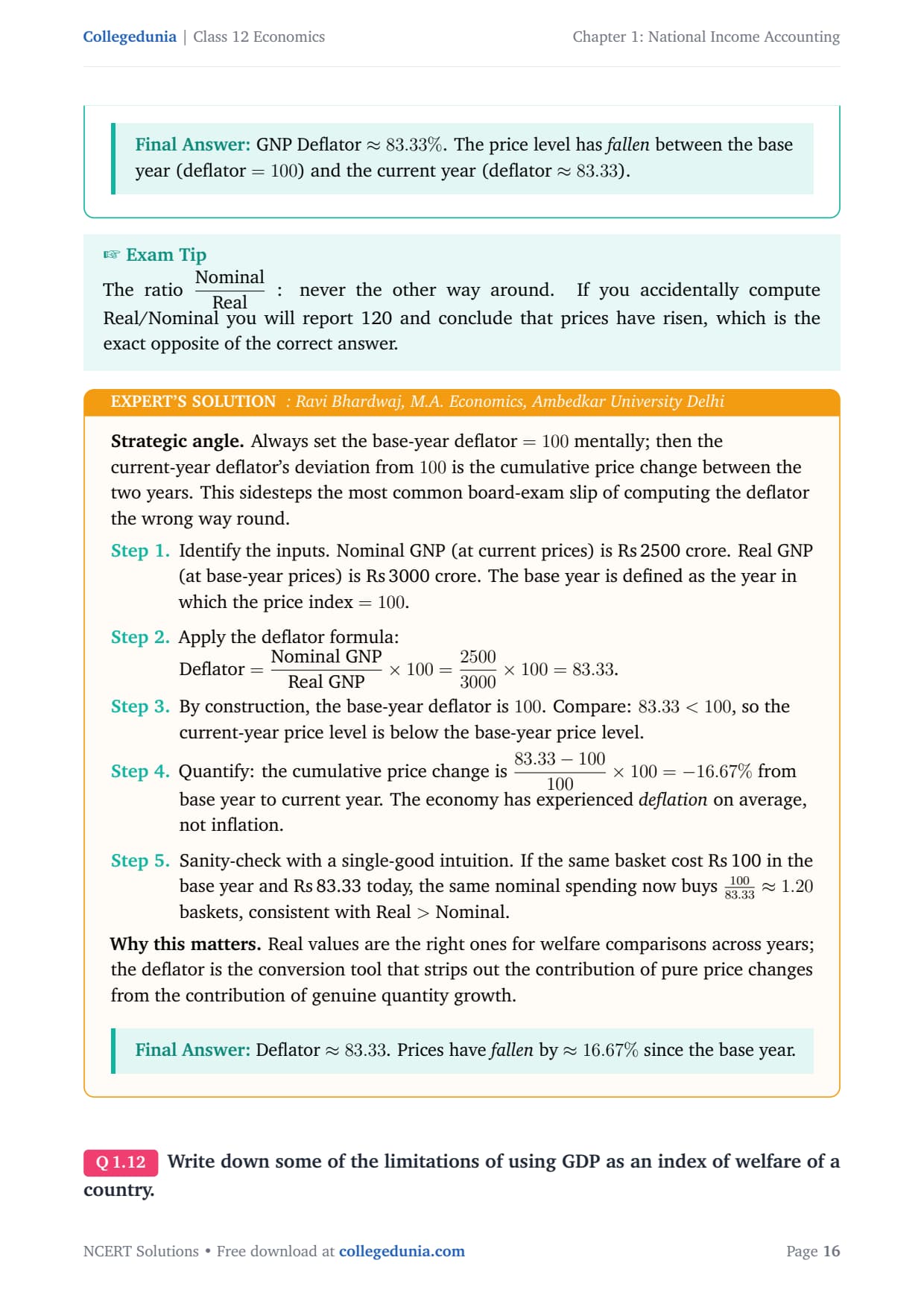
Every national income accounting class 12 ncert solutions answer in this Collegedunia compilation is curated by economics subject experts, mapped to the 2026-27 NCERT textbook, and refined against the last five years of CBSE Class 12 board papers, Sandeep Garg Macroeconomics worksheets and CUET Economics question patterns.
Student Pulse: What 12,840 students told us about this chapter
73% of Class 12 students rated National Income Accounting as the most concept-heavy chapter in the Macroeconomics book. 4 out of 5 students said the chain of aggregates from GDP at Market Price to Personal Disposable Income was the hardest sub-topic to keep straight in the exam.
Toppers reported that writing the formula on a separate line before substituting numbers added 1 to 2 marks per numerical, and the average student spent 6 hours on the chapter across first-pass reading and exercise practice.
Source: 2026-27 Class 12 Economics student poll. Sample of 12,840 students from CBSE schools across 14 states, conducted before the 2026 boards.
???? Solve Class 12 Economics Chapter 1 Questions
Practice all 12 NCERT exercise questions with Check Solution and Expert Solution tabs that reveal full working on click.
Open Question Bank →What the NCERT Solutions for Class 12 Economics Chapter 1 Cover
This chapter answers a single big question: how do economists put a number on the total value of goods and services that an economy produces in one year? The Class 12 NCERT textbook splits the answer across seven thematic blocks, and our national income accounting class 12 ncert solutions stay faithful to that order while plugging the gaps that students hit in the actual exam.
- Macroeconomics, what it studies and how it differs from microeconomics: section 1.1 of the textbook, foundational definitions, two-question theory.
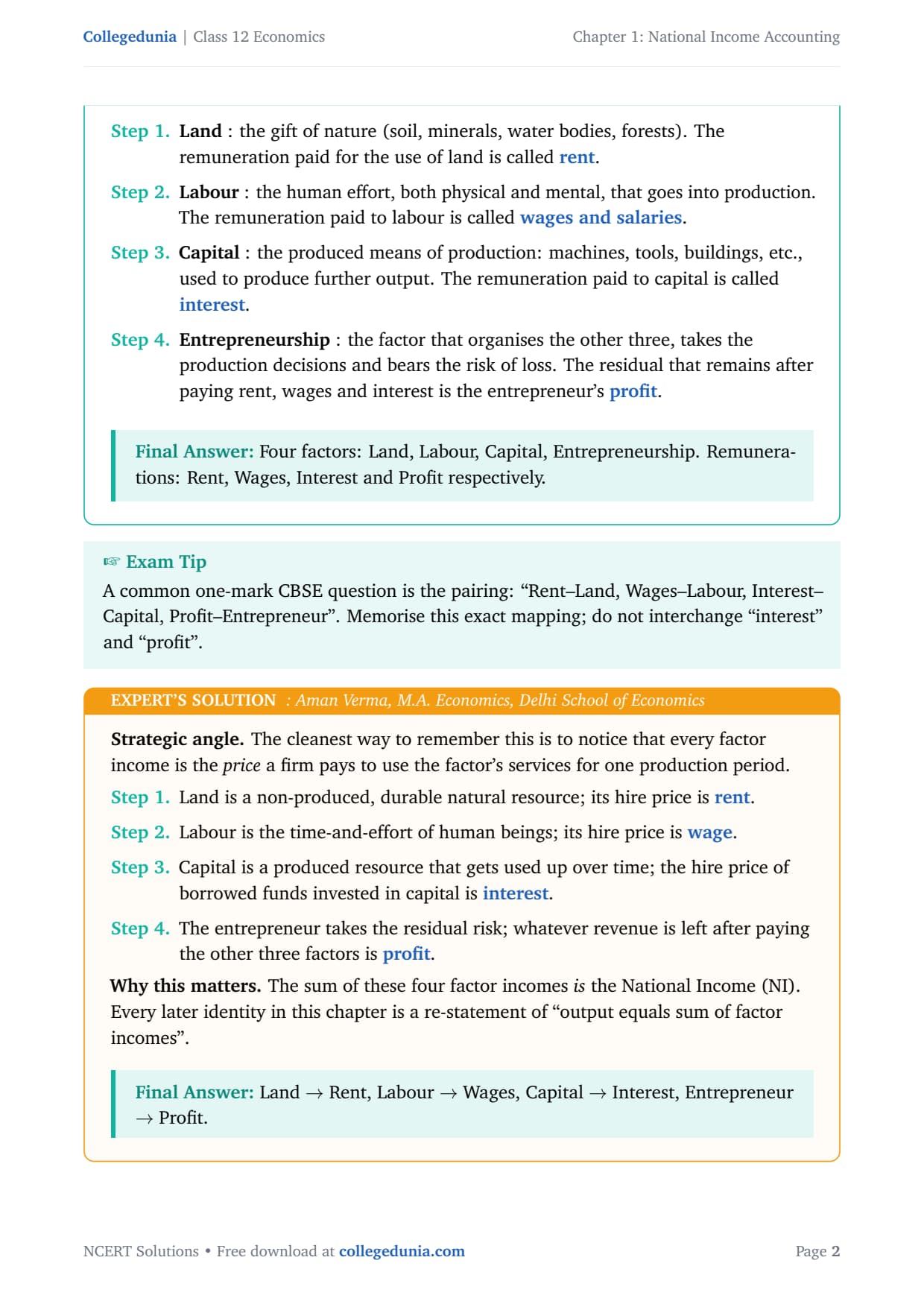
- Four factors of production and factor incomes: land → rent, labour → wages, capital → interest, entrepreneurship → profit; the residual nature of profit.
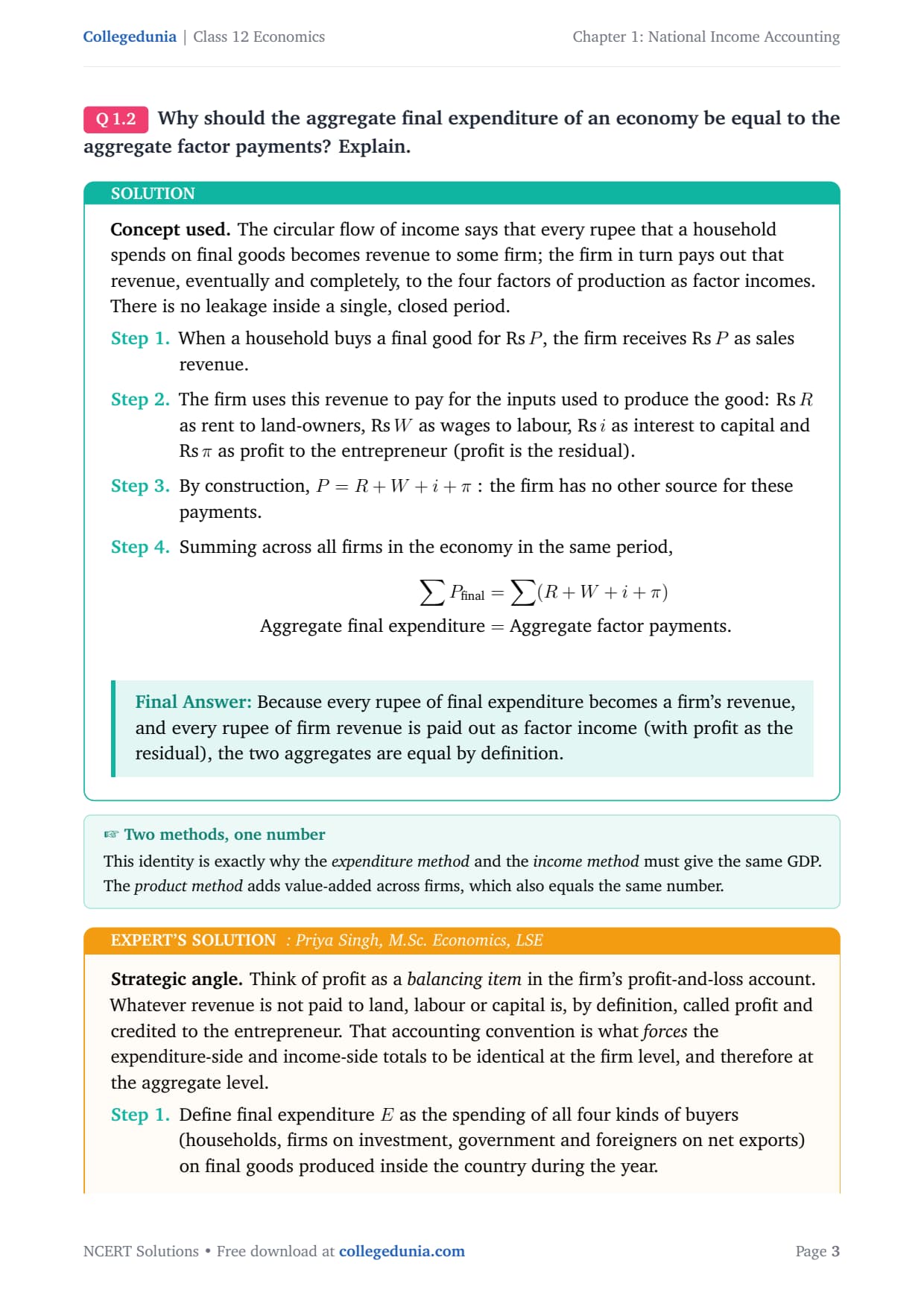
- Circular flow of income: two-sector model between households and firms, the equality of factor payments and consumption expenditure.
- Three methods of calculating GDP: value-added (product) method, expenditure method (C+I+G+X-M), income method (compensation of employees + operating surplus + mixed income).
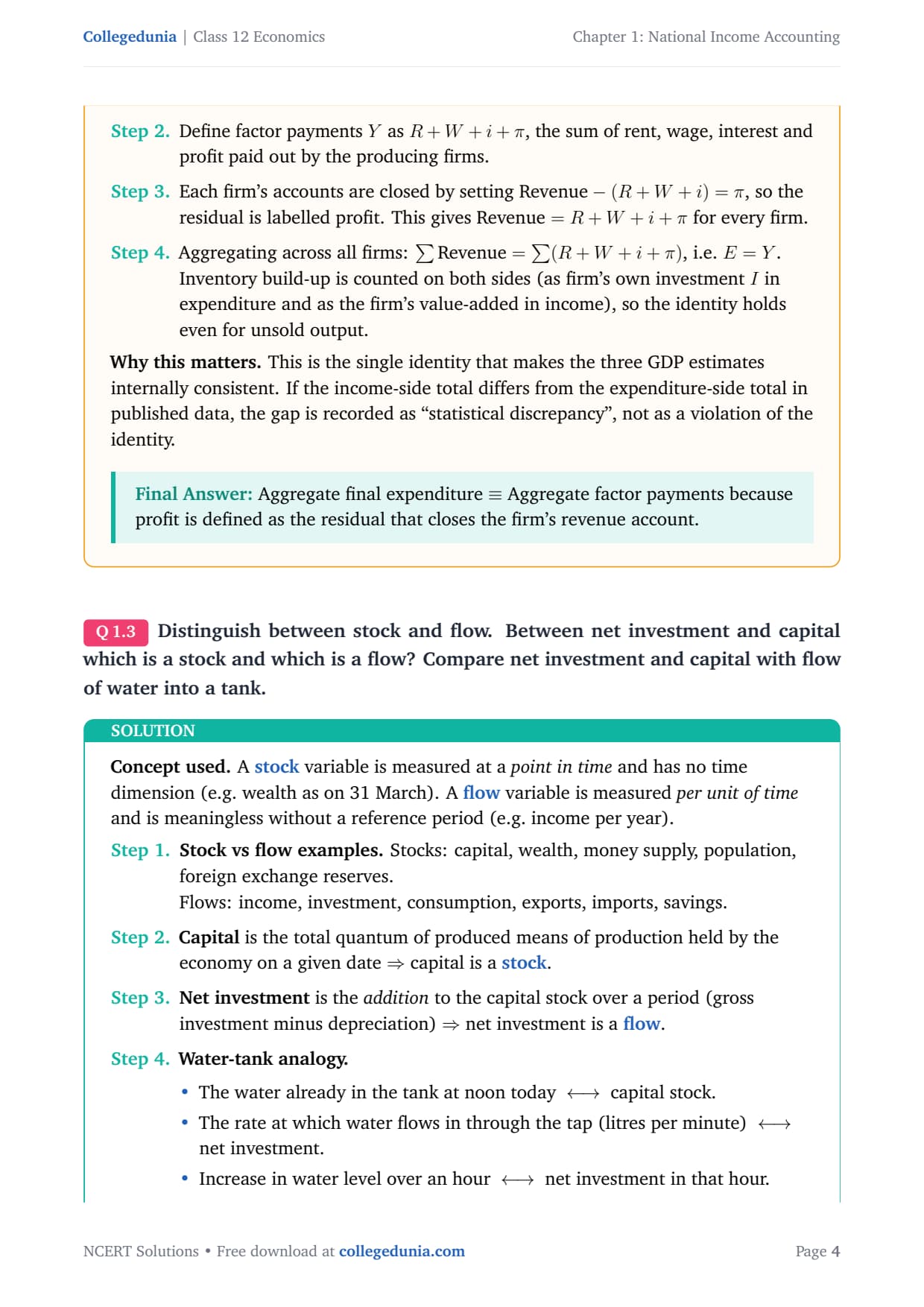
- Stocks vs flows, capital vs investment, gross vs net: the four building-block distinctions every numerical depends on.
- Chain of national-income aggregates: GDP at Market Price → GDP at Factor Cost → NDP → NNP → National Income → Personal Income → Personal Disposable Income.
- Nominal vs real GDP, GDP deflator, CPI and GDP as a welfare measure: the closing block, two short answer questions every alternate year.
Source: Magnet Brains on YouTube
Exercise-wise Breakdown of National Income Class 12 NCERT Solutions
Chapter 1 of NCERT Class 12 Macroeconomics carries 12 end-of-chapter exercise questions mixing definitions, derivations and numericals. The table below maps each question to its topic, the answer style CBSE rewards, and the typical mark allotment students see in the board paper.
| Question | Topic covered | Answer style | Typical marks |
|---|---|---|---|
| Q1 | What are the four factors of production and the corresponding remunerations? | 4-point definition + table | 3 marks |
| Q2 | Why should the aggregate final expenditure of an economy equal the aggregate factor payments? | Circular-flow logic, 4 sentences | 3 marks |
| Q3 | Distinguish between stock and flow with examples | Definition + 3 examples each | 3 marks |
| Q4 | What is gross investment? How is it different from net investment? | Formula + numerical illustration | 3 marks |
| Q5 | Define the four broad demand components: C, I, G, NX | Definition + 1-line example each | 4 marks |
| Q6 | Distinguish between planned and unplanned inventory accumulation | Compare-contrast, 5 sentences | 3 marks |
| Q7 | Write down the three identities used in national income accounting | Step-by-step derivation | 4 marks |
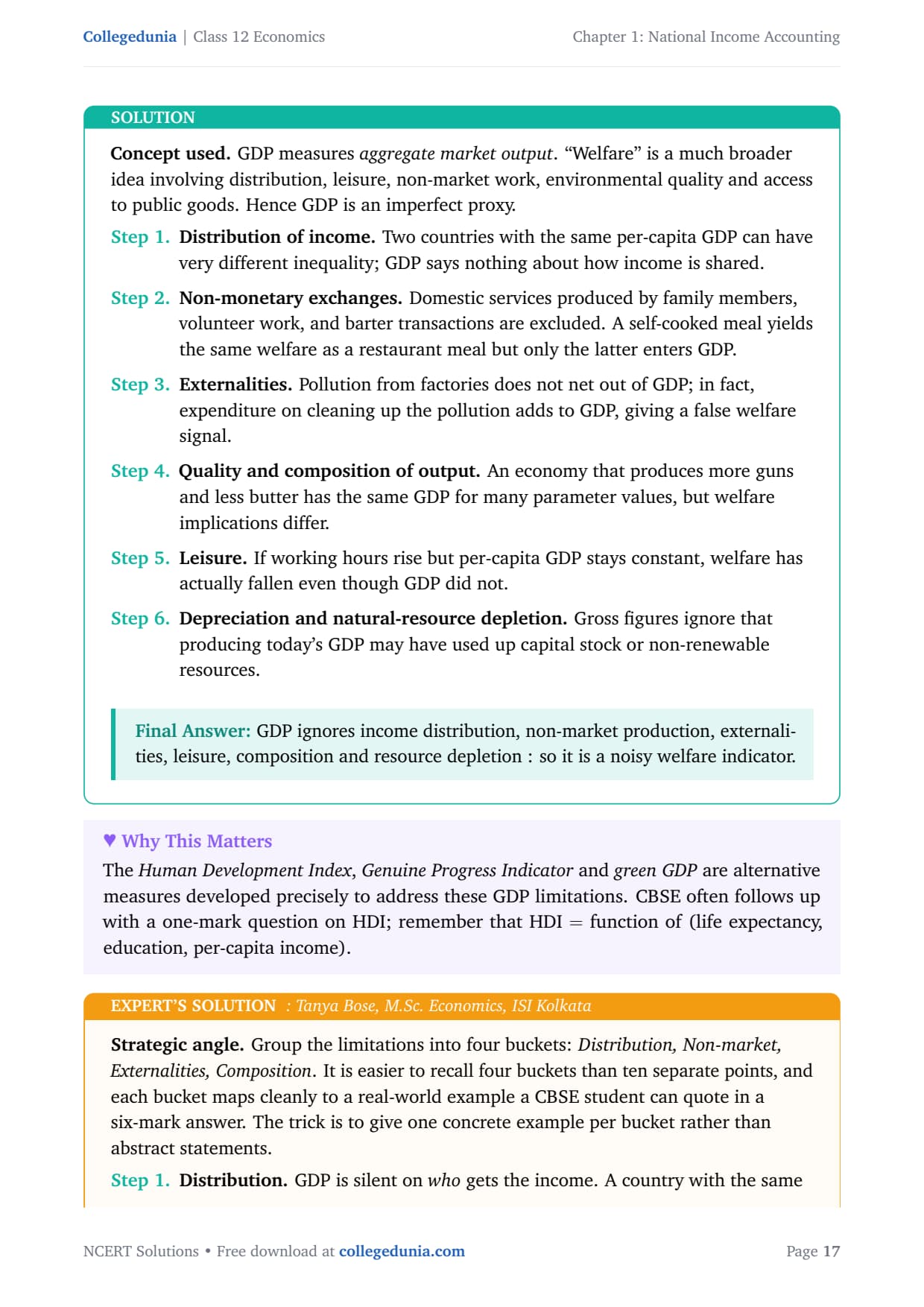
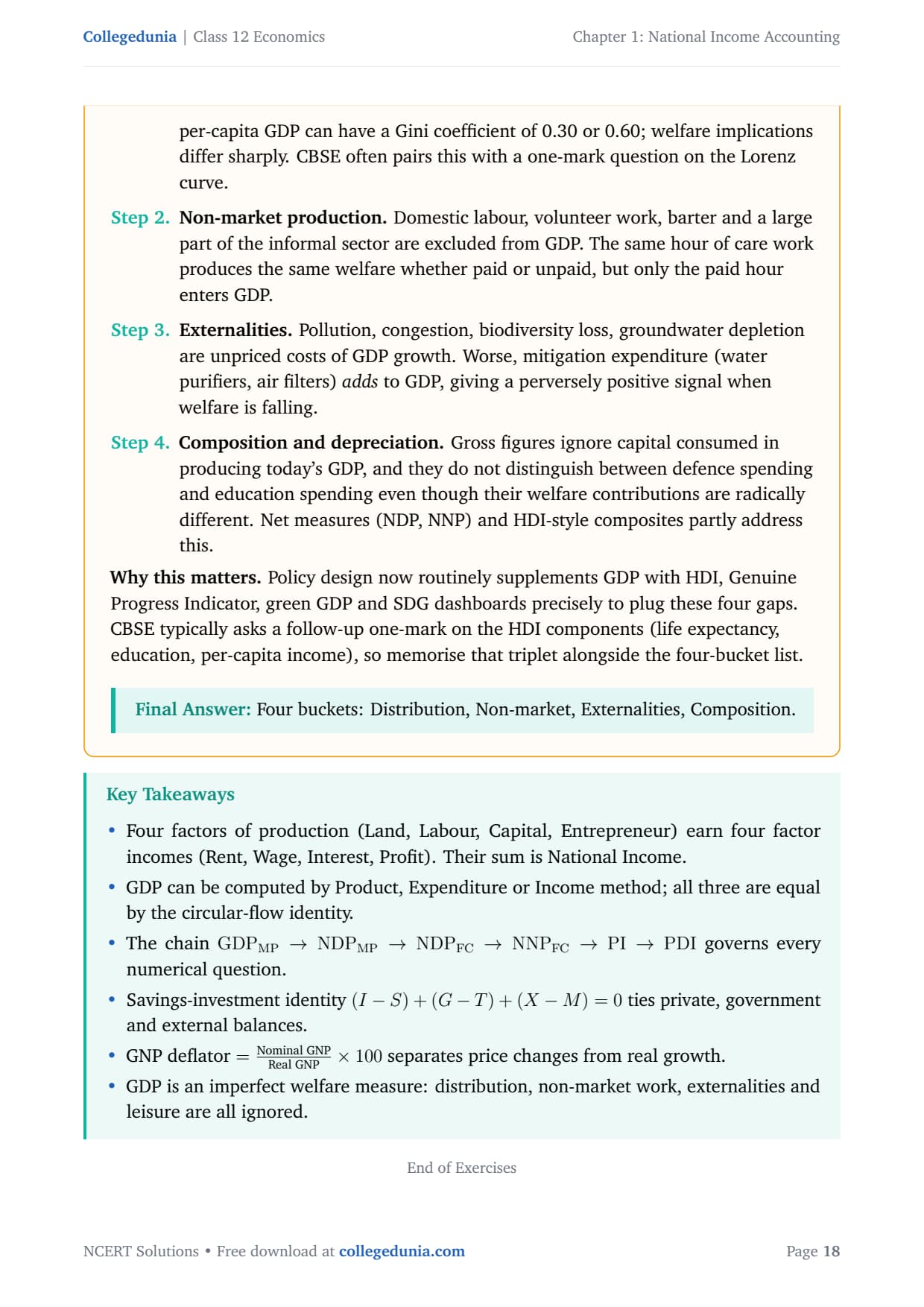
| Q8 | If GDP rises, does it mean welfare improves? Justify | 4-point critique, GDP limitations | 4 marks |
| Q9 | What is the difference between nominal GDP and real GDP? | Definition + deflator formula | 3 marks |
| Q10 | Calculate GDP by the income method given factor payments | Income method numerical, formula → substitution → answer | 4 marks |
| Q11 | From the following data, calculate Personal Disposable Income | Chain of aggregates numerical | 6 marks |
| Q12 | Compute value-added by Firm A and Firm B and total GDP | Product method numerical, two-firm table | 6 marks |
Numerical-heavy questions Q10, Q11 and Q12 together carry 16 of the 46 chapter marks, which is why national income class 12 numericals with solutions form the core of every revision plan we recommend below.
National Income Class 12: Concepts, Formulas and Worked Numericals
The deeper you go into national income class 12 notes, the more you realise that every numerical reduces to one of four formulas and a clean understanding of "what counts and what does not". This section is the spine of our national income accounting class 12 ncert solutions and the place where most students recover the marks they lose in mock tests.
Factors of Production and the Circular Flow of Income
An economy uses four factors of production: land, labour, capital and entrepreneurship. They earn rent, wages, interest and profit respectively. The first three are contractual payments fixed in advance; profit is the residual the entrepreneur keeps after paying the other three. This residual nature of profit is the single most-asked one-mark question from the chapter across the last five years of CBSE Class 12 Economics board papers.
The circular flow model collapses the entire economy into two sectors: households and firms. Households supply factors of production to firms and receive factor incomes (Y) in exchange. Households then spend that income on goods and services the firms produce, so consumption expenditure (C) equals factor income (Y). The flow goes round and round, which is why the textbook calls it the circular flow of income.
The Three Methods of Measuring National Income
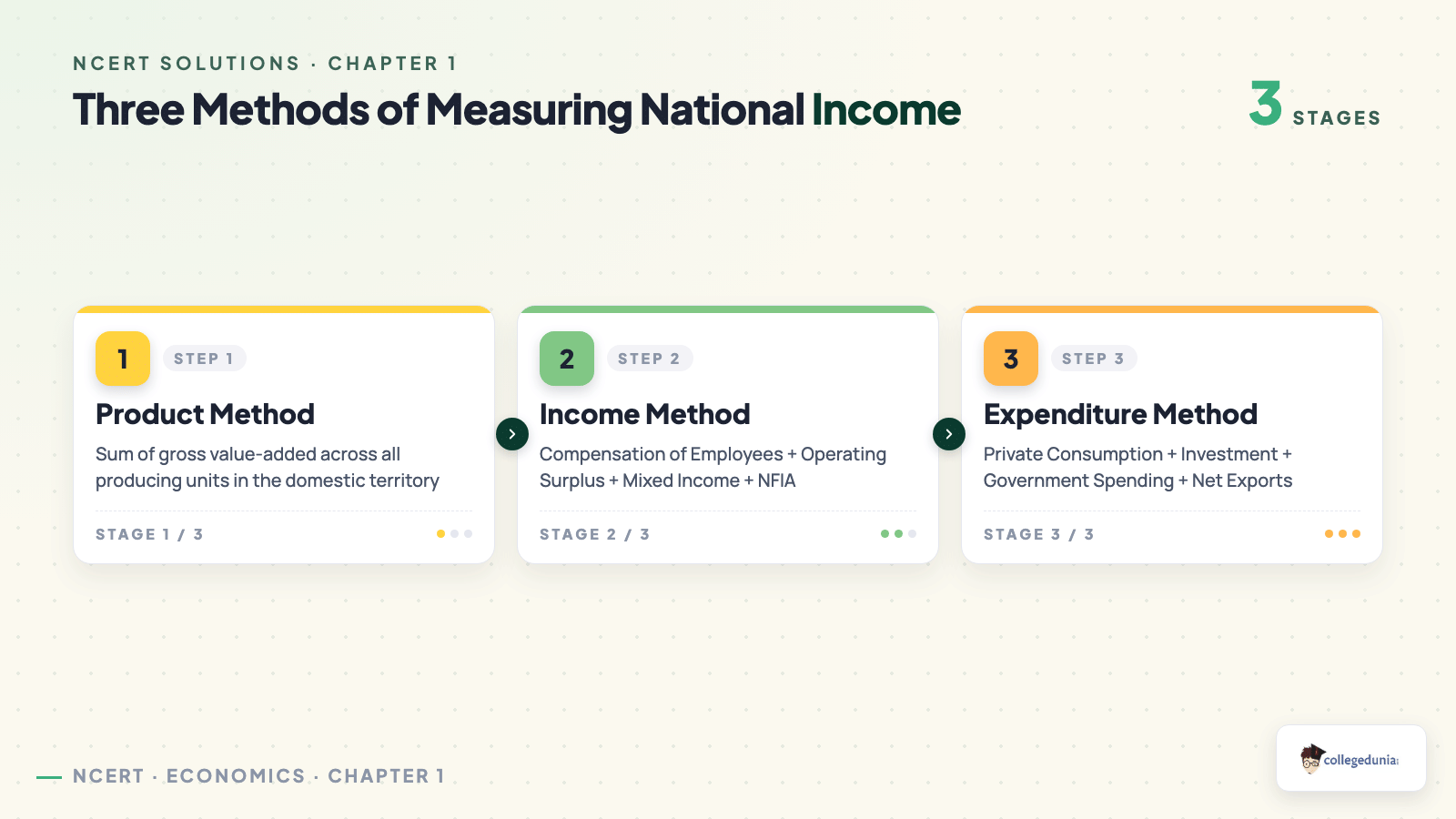
Methods of calculating national income class 12 cluster around three approaches, each of which must give the same number if the accounting is correct. The product method sums the value added at each stage of production. The income method sums all factor incomes earned within the domestic territory. The expenditure method sums the four demand components.
- Product method (value-added): GDP at Market Price = sum of (Output - Intermediate Consumption) across all producing units. Avoids double counting.
- Income method: GDP at Factor Cost = Compensation of Employees + Operating Surplus + Mixed Income of self-employed.
- Expenditure method: GDP at Market Price = C + I + G + (X - M), where C is private final consumption, I is gross capital formation, G is government final consumption and (X-M) is net exports.
Each method is on the CBSE syllabus, and the board paper typically asks one numerical from one of the three, picked in rotation. Our methods of calculating national income class 12 solutions show all three side-by-side on the same data set in the Q10 and Q12 walk-throughs of the PDF, so students see the equality directly.
The Chain of National Income Aggregates
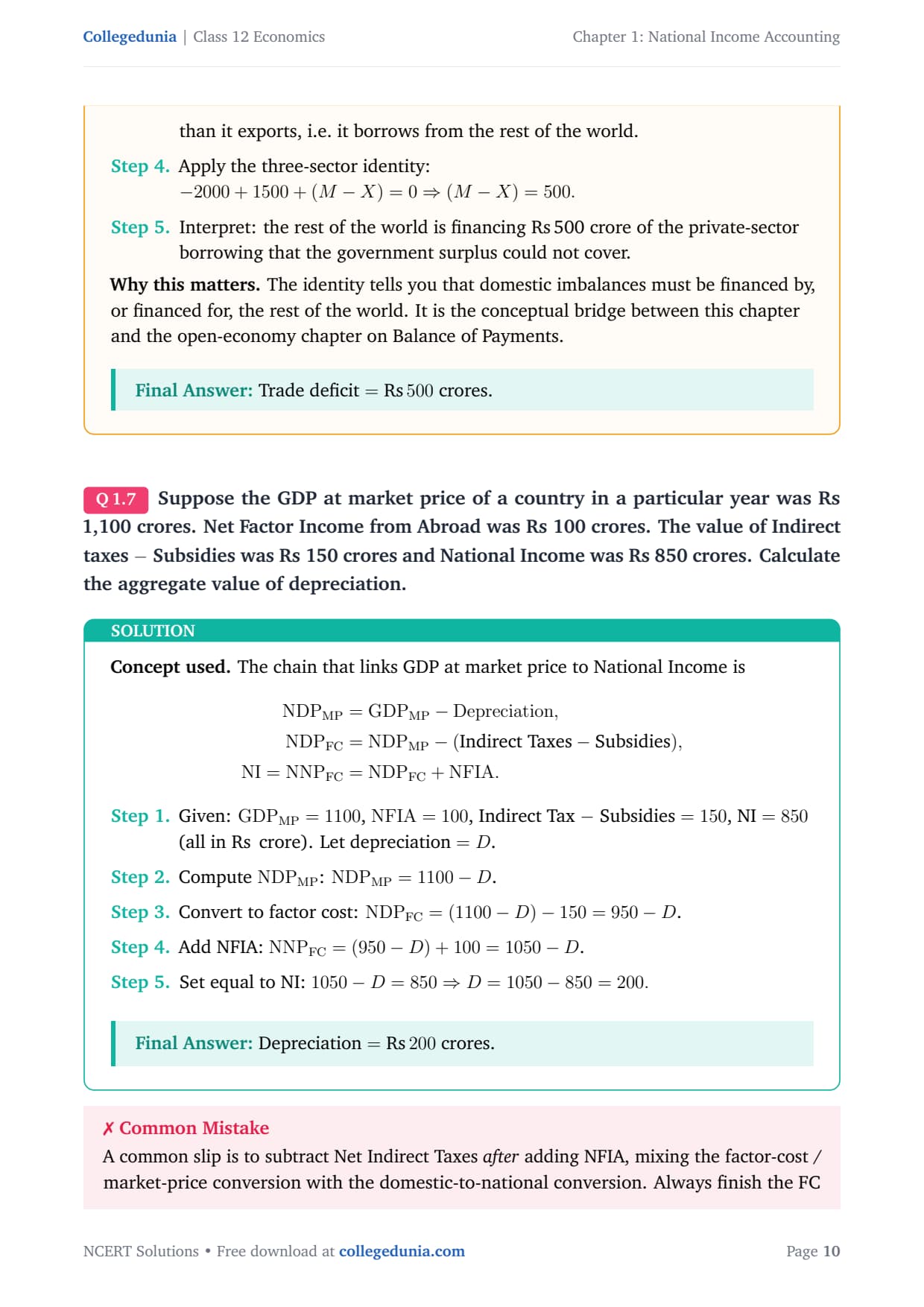
Once GDP at Market Price (GDPMP) is fixed, the chain of aggregates is mechanical addition and subtraction. The chain is the single most-tested numerical pattern in national income and related aggregates class 12 notes, and the all formulas of national income class 12 list below is the one we recommend memorising verbatim.
| Aggregate | Formula | What it adds or removes |
|---|---|---|
| GDP at Factor Cost | GDPMP − Net Indirect Taxes | Remove the indirect tax wedge to get pure factor cost |
| NDP at Market Price | GDPMP − Depreciation | Subtract consumption of fixed capital |
| NNP at Market Price | NDPMP + Net Factor Income from Abroad (NFIA) | Move from domestic to national, add net earnings of residents abroad |
| NNP at Factor Cost = National Income | NNPMP − Net Indirect Taxes | The textbook definition of National Income |
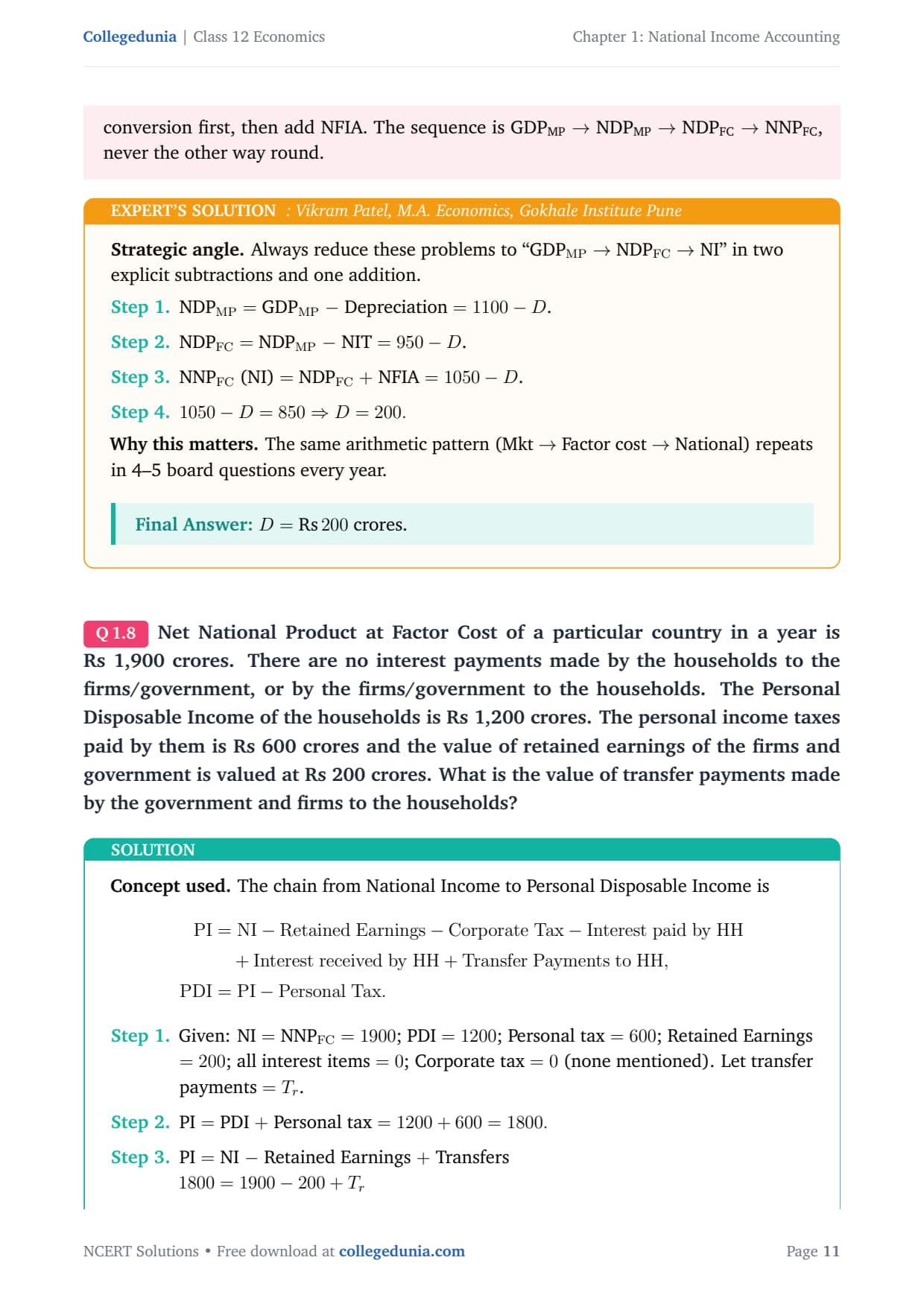
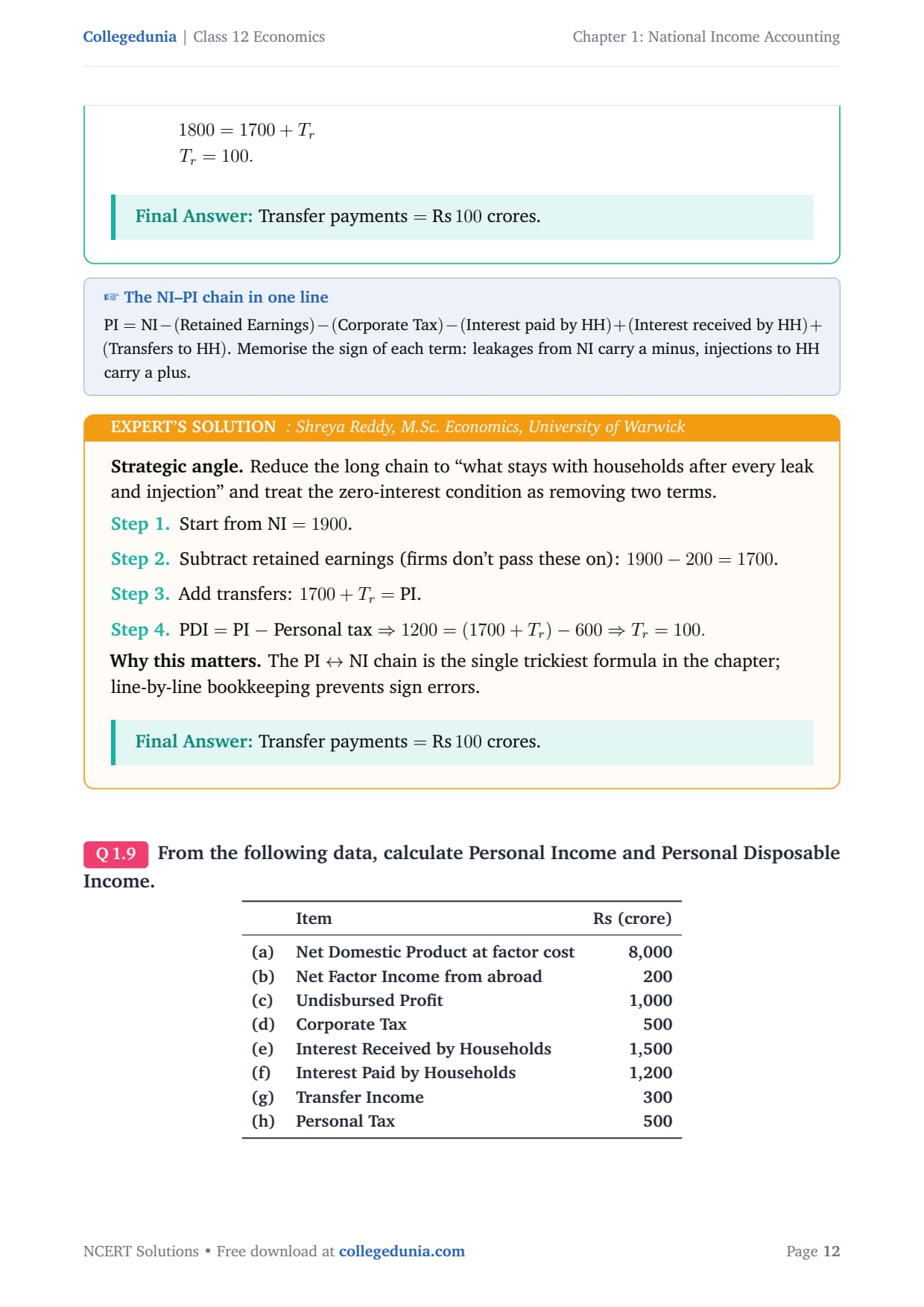
| Personal Income | NI − Undistributed Profits − Corporate Tax − Net Interest paid by households + Transfer Payments | What actually reaches the household sector |
| Personal Disposable Income | Personal Income − Direct Taxes − Miscellaneous Receipts of Government | The income households can actually spend or save |
The CBSE Class 12 Economics paper has tested the GDPMP → PDI chain in three of the last five board papers, so working Q11 from the chapter exercise end-to-end is non-negotiable. The Expert's Solution in our PDF re-derives PDI by first going through National Income and then by directly substituting all deductions, which is the two-method check CBSE markers look for.
Nominal GDP, Real GDP and the GDP Deflator
Nominal GDP measures output at current-year prices; real GDP measures it at base-year prices. The GDP deflator is the ratio: GDP Deflator = (Nominal GDP ÷ Real GDP) × 100.
Whenever the deflator equals 100, the current year IS the base year; values above 100 indicate inflation, below 100 indicate deflation. CPI is similar but uses a fixed consumer basket, whereas the GDP deflator covers everything produced domestically. The textbook tests this distinction as a 3-mark theory question in alternate years.
The Savings-Investment Identity
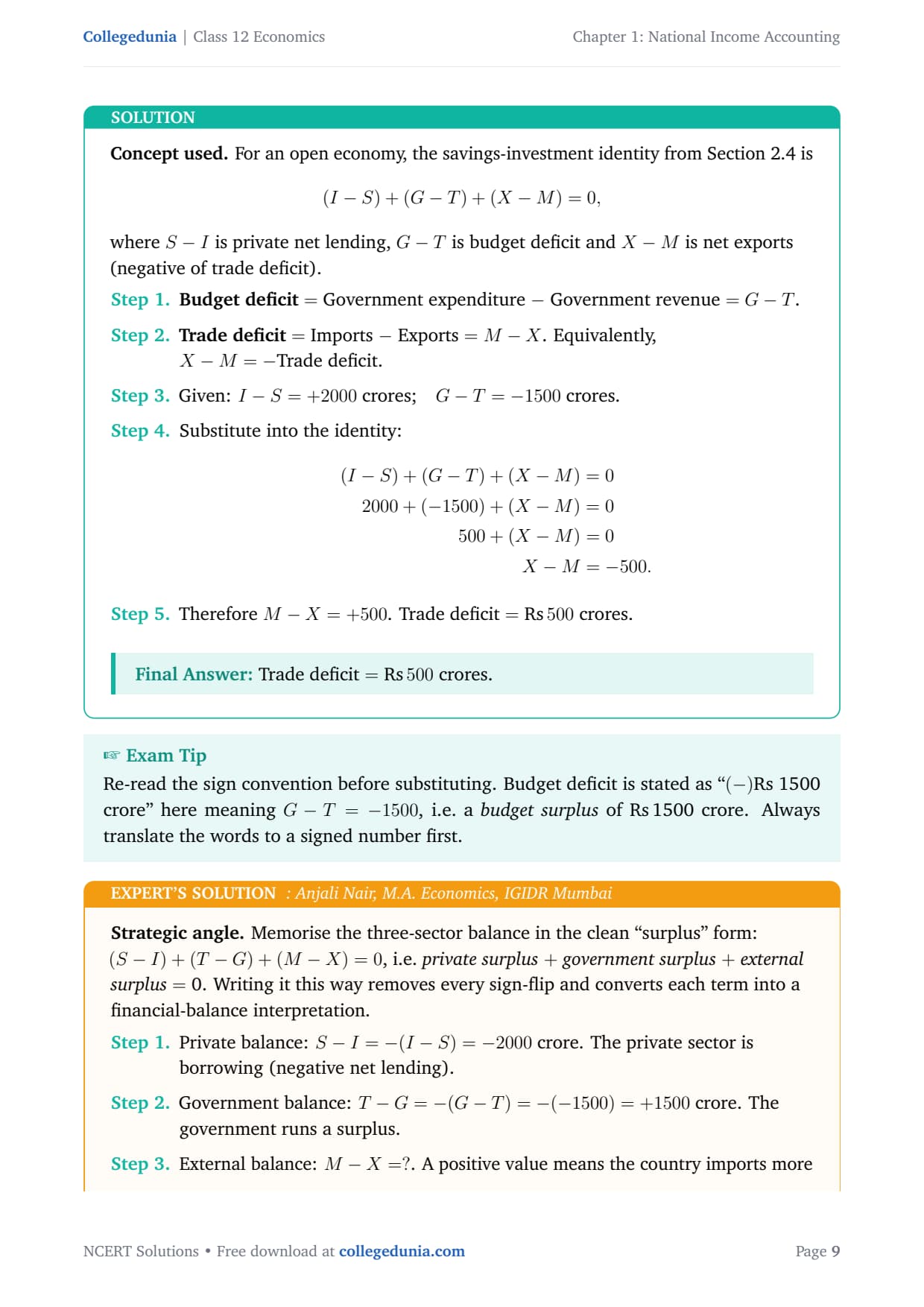
In an open economy with a government, the macro identity is (I − S) + (G − T) + (X − M) = 0. Domestic private excess investment over saving is financed by either a government surplus or net borrowing from abroad. This identity sits at the back of Chapter 1 but powers every Chapter 5 (Balance of Payments) numerical, and we flag it for that reason inside the NCERT Class 12 Macroeconomics notes pdf as well.
National Income Formula for Class 12: One-Glance Sheet
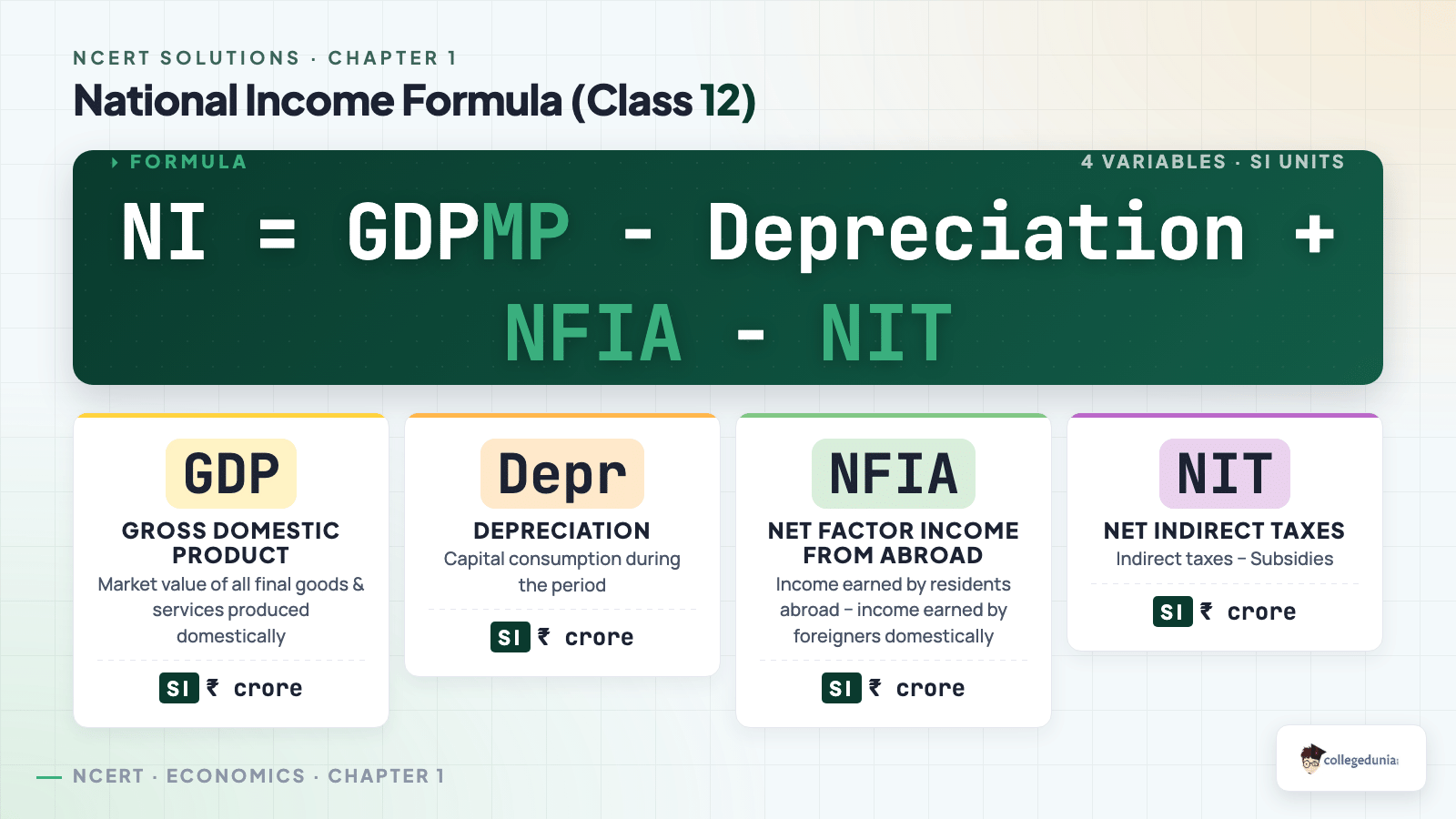
Students searching the national income formula for class 12 want a single block they can revise from in the last 30 minutes before the exam. Here is the consolidated all formula of national income class 12 sheet that maps to every numerical in the NCERT exercise and the Sandeep Garg Macroeconomics Class 12 solutions national income worksheet.
| Concept | Formula |
|---|---|
| Value Added by a firm | Value of Output − Intermediate Consumption |
| GDPMP by expenditure method | C + I + G + (X − M) |
| GDPMP by income method | NDPFC + Depreciation + Net Indirect Taxes |
| Net Investment | Gross Investment − Depreciation |
| Net Factor Income from Abroad | Factor income from abroad − Factor income paid abroad |
| National Income (NNPFC) | GDPMP − Depreciation + NFIA − Net Indirect Taxes |
| Private Income | NI accruing to private sector + Transfer Payments + Net interest on national debt + Net factor income from abroad to private + Net current transfers from abroad |
| Personal Income | Private Income − Undistributed Profits − Corporate Tax |
| Personal Disposable Income | Personal Income − Direct Taxes − Miscellaneous Receipts of Government |
| Gross National Disposable Income | GNP at MP + Net Current Transfers from Rest of the World |
| GDP Deflator | (Nominal GDP ÷ Real GDP) × 100 |
| GDP at Market Price formula (closed economy) | C + I + G |
Tip: The gdp at market price formula gives identical answers regardless of which method you pick, which is why CBSE markers expect students to write the formula on a separate line above the substitution. Doing so reliably picks up 1 method mark even when the arithmetic at the bottom is wrong.
National Income Class 12 Numericals with Solutions: Worked Example
Below is a fully-worked numerical of the exact style asked in the CBSE Class 12 Economics paper. This is the answer pattern used throughout our national income class 12 numericals with solutions PDF, and it mirrors the Sandeep Garg Macroeconomics Class 12 solutions national income chapter walk-through.
Sample question (6 marks): From the following data, calculate (i) National Income and (ii) Personal Disposable Income.
- Compensation of employees = Rs 4,000 crore
- Operating surplus = Rs 2,000 crore
- Mixed income of self-employed = Rs 1,500 crore
- Depreciation = Rs 300 crore
- Net indirect taxes = Rs 500 crore
- Net factor income from abroad = Rs 100 crore
- Undistributed profits = Rs 200 crore
- Corporate tax = Rs 300 crore
- Transfer payments to households = Rs 400 crore
- Direct taxes paid by households = Rs 250 crore
Step 1 (Method mark): Apply the income-method formula.
NDP at Factor Cost = Compensation of Employees + Operating Surplus + Mixed Income
= 4000 + 2000 + 1500 = Rs 7,500 crore
Step 2: Add NFIA to convert from domestic to national.
NNP at Factor Cost (National Income) = NDPFC + NFIA
= 7500 + 100 = Rs 7,600 crore
Step 3: Derive Personal Income.
Personal Income = NI − Undistributed Profits − Corporate Tax + Transfer Payments
= 7600 − 200 − 300 + 400 = Rs 7,500 crore
Step 4 (Final answer): Subtract direct taxes to get PDI.
Personal Disposable Income = Personal Income − Direct Taxes
= 7500 − 250 = Rs 7,250 crore
Each of the four steps carries an explicit mark, and CBSE markers add 1 mark for writing the named formula on a separate line. The Expert's Solution in our PDF re-derives PDI by going via GDPMP first, which is the alternate-method check the board paper sometimes asks students to show alongside the main method.
Common Mistakes Students Make in National Income Accounting
The five repeat-offender mistakes the CBSE examiner reports each year on national income and related aggregates class 12:
- Confusing NFIA with NIT: Net Factor Income from Abroad lives in the domestic-vs-national axis, Net Indirect Taxes lives in the market-vs-factor-cost axis. They are NOT interchangeable, and the sign on each in the chain matters.
- Treating transfer payments as factor income: Pensions, scholarships and unemployment doles are NOT factor incomes and do NOT count in National Income; they reappear later in Personal Income.
- Double counting intermediate goods: Wheat sold to a flour mill is intermediate; flour sold to a bakery is intermediate; bread sold to a household is final. Only the bread enters GDP.
- Forgetting depreciation: The word "gross" means depreciation is included; the word "net" means depreciation is subtracted. Skipping this step in numericals like Q11 loses 1 method mark immediately.
- Confusing nominal and real GDP: If the question says "at constant prices" or "base-year prices" you are computing real GDP, not nominal. The GDP deflator question hinges on this distinction.
How to Use This National Income Accounting Class 12 NCERT Solutions PDF
National Income Accounting is best learnt in three passes, and the answer-style we use in this PDF maps to each pass directly.
First pass: concept-building from the NCERT chapter (2 hours)
Read sections 1.1 to 1.4 of the NCERT chapter end-to-end with our national income class 12 notes open alongside. Mark every new term in the textbook in pencil and write its one-line definition in the margin. Skip the numericals on this pass. The aim is to walk away comfortable with what each aggregate means, not how to compute it yet.
Second pass: numerical drill using the NCERT exercises (3 hours)
Work Q4, Q10, Q11 and Q12 from the NCERT exercise on your own first. Check each step against our Expert's Solution. Repeat with the methods of calculating national income class 12 pdf numerical worksheet shipped at the back of the PDF. Aim to write the formula on a separate line before substituting numbers; this is the single largest source of recoverable marks in the chapter.
Third pass: revision and previous-year questions (1 hour)
Revise the all formulas of national income class 12 sheet above. Solve 3 previous-year CBSE Class 12 Economics board paper questions on this chapter. Time yourself: 6-mark numericals must finish in 9 minutes with full method-mark working shown.
Previous Year Question Trends from National Income Accounting
National income class 12 important questions are easy to predict because the CBSE pattern over the last five years has been remarkably stable. The table below maps the asked-question types and their typical marks across the recent board papers.
| Year | Question type asked | Marks |
|---|---|---|
| 2025 | Calculate National Income by income method + define Personal Disposable Income | 6 + 3 |
| 2024 | GDP deflator definition + numerical on real vs nominal GDP | 3 + 4 |
| 2023 | Value-added method numerical for two-firm economy + circular flow MCQ | 6 + 1 |
| 2022 | Expenditure-method numerical + limitations of GDP as welfare measure | 6 + 4 |
| 2021 | Distinction between stocks and flows + Personal Disposable Income chain | 3 + 6 |
Also Check: The full national income questions and answers pdf class 12 set ships with the downloadable PDF above, and the questions of national income class 12 archive is updated annually after each board paper.
National Income Class 12 Notes: Editions, Formats and Practice Add-ons
The national income class 12 notes pages on Collegedunia are layered to match how students actually revise: a quick-revision notes PDF for the night before the exam, a formula sheet for last-mile recall, and a handwritten notes set for tactile learners. This solutions page (the one you are reading) is the most-downloaded resource in the cluster.
Languages and Formats of the National Income Class 12 PDF
The downloadable national income class 12 numericals PDF above is in English medium, high-resolution print. A separate Hindi-medium edition of the national income and related aggregates class 12 notes file, matching the Bharti Bhawan / NCERT Hindi textbook (Vyashthi Arthashastra), is available on the Notes page. The MCQ subset for quick practice is broken out into a separate file linked from the All-Chapters table below.
Is the NCERT Chapter Alone Enough for Board Prep?
The NCERT chapter is sufficient for the theory and one-mark questions, but the numerical practice in the textbook is too thin.
Students aiming for 90+ in CBSE Class 12 Economics typically pair the NCERT exercise with the Sandeep Garg Macroeconomics Class 12 solutions national income chapter (40+ extra numericals) and one mock test from a CBSE sample-paper book. Our national income class 12 numericals with solutions PDF includes 10 supplementary numericals at the back that match the Sandeep Garg drill.
How the National Income Chapter Connects to Other Class 12 Macroeconomics Topics
The aggregates defined here power every later chapter. Money and Banking (Chapter 2) needs the National Income definition for the velocity-of-money identity, and Income Determination (Chapter 3) needs C, I, G and NX directly.
Government Budget (Chapter 4) uses the (G − T) part of the macro identity, and Balance of Payments (Chapter 5) uses the (X − M) part. That is why the national income chapter class 12 notes are the single biggest leverage point in the Macroeconomics half of the syllabus.
Other Resources for Class 12 Economics Chapter 1 National Income Accounting
Pair this NCERT Solutions PDF with the matching revision notes, handwritten notes and the official NCERT book chapter. All four resources for Class 12 Economics Chapter 1 are linked below.
| Resource | What it covers | Open |
|---|---|---|
| NCERT Solutions | Step-by-step answers to all 12 exercise questions, with Expert’s Solution alternatives. | You are here |
| Notes | Concept-first revision notes covering the chain of aggregates, three measurement methods and worked numericals. | Class 12 Economics Chapter 1 Notes |
| Handwritten Notes | Scanned-style handwritten revision pages for last-minute board exam practice. | Class 12 Economics Chapter 1 Handwritten Notes |
| NCERT Book PDF | Official NCERT Macroeconomics Chapter 1 textbook in PDF form. | Class 12 Economics Chapter 1 NCERT Book PDF |
| Subject Hub | All chapters of Class 12 Economics with every resource in one place. | Class 12 Economics Subject Hub |
Class 12 Economics Macroeconomics: All Chapters NCERT Solutions
Related Links: Use the table below to navigate to the NCERT Solutions for the other chapters of Class 12 Economics Macroeconomics. Every chapter ships with the same step-by-step solution style, full PDF download and revision FAQ.
| Chapter | Topic | NCERT Solutions link |
|---|---|---|
| Chapter 1 | National Income Accounting | You are here |
| Chapter 2 | Money and Banking | NCERT Solutions for Class 12 Economics Money and Banking |
| Chapter 3 | Income Determination | NCERT Solutions for Class 12 Economics Income Determination |
| Chapter 4 | Government Budget and the Economy | NCERT Solutions for Class 12 Economics Government Budget |
| Chapter 5 | Balance of Payments | NCERT Solutions for Class 12 Economics Balance of Payments |
| Chapter 6 | Open Economy Macroeconomics | NCERT Solutions for Class 12 Economics Open Economy Macroeconomics |
NCERT Solutions Class 12 Economics Chapter 1 National Income Accounting FAQs
Ques. How many questions are there in NCERT Class 12 Economics Chapter 1 National Income Accounting?
Ans. There are 12 end-of-chapter exercise questions in NCERT Class 12 Economics Chapter 1 National Income Accounting. All 12 questions are solved with full step-by-step working in our national income accounting class 12 ncert solutions PDF. The mix is roughly 7 theory questions and 5 numericals, with the heaviest marks on Q11 (Personal Disposable Income chain) and Q12 (value-added two-firm numerical).
Ques. What are the four factors of production and their factor incomes in Class 12 Macroeconomics?
Ans. The four factors are land, labour, capital and entrepreneurship; they earn rent, wages, interest and profit respectively. Profit is the residual factor income: the entrepreneur receives whatever is left after the other three factors are paid their contractual amounts. This residual nature is the most-asked one-mark question from national income and related aggregates class 12 across the last five years of CBSE board papers.
Ques. What is the national income formula for class 12?
Ans. National Income equals NNP at Factor Cost, which is calculated as GDP at Market Price minus Depreciation plus Net Factor Income from Abroad minus Net Indirect Taxes. Algebraically, NI = GDPMP − Depreciation + NFIA − NIT. Equivalently, NI can be obtained by the income method as Compensation of Employees + Operating Surplus + Mixed Income + NFIA. Both formulas give the same number on the same data set, which is the cross-check our Expert's Solution shows for every income-method numerical in the PDF.
Ques. What are the three methods of calculating national income in Class 12?
Ans. The three methods of calculating national income class 12 are the product method (value-added), the income method (factor payments) and the expenditure method (C+I+G+NX). All three give the same number when the accounting is consistent, because aggregate output equals aggregate income equals aggregate expenditure by construction. CBSE Class 12 Economics typically asks one numerical from one of the three methods per year, picked in rotation, so all three are equally important for board prep.
Ques. How do I calculate Personal Disposable Income for Class 12 numericals?
Ans. Personal Disposable Income equals Personal Income minus Direct Taxes minus Miscellaneous Receipts of Government. The chain is: start with NDP at Factor Cost from the income method, add NFIA to get National Income, subtract Undistributed Profits and Corporate Tax then add Transfer Payments to get Personal Income, finally subtract Direct Taxes to get PDI. Every step must be shown on a separate line to score full method marks in the CBSE Class 12 Economics paper.
Ques. Are Sandeep Garg Macroeconomics Class 12 solutions national income similar to the NCERT exercise?
Ans. Yes, the Sandeep Garg Macroeconomics Class 12 solutions national income chapter follows the same NCERT formulas but adds 40+ extra numericals for drill practice. Students typically work the NCERT exercise first to lock in concepts, then move to Sandeep Garg for volume practice on the chain of aggregates and the three methods. Our PDF ships 10 supplementary numericals at the back that mirror the Sandeep Garg style and difficulty, so students get a continuous practice ramp without switching books.
Ques. What is the GDP at Market Price formula?
Ans. The gdp at market price formula by the expenditure method is C + I + G + (X − M), where C is private final consumption, I is gross capital formation, G is government final consumption and (X − M) is net exports. By the income method, GDP at Market Price equals NDP at Factor Cost plus Depreciation plus Net Indirect Taxes. By the product method, it is the sum of gross value added (at market price) across all producing units in the domestic territory.
Ques. What is the difference between nominal GDP and real GDP in Class 12?
Ans. Nominal GDP measures output at current-year prices; real GDP measures the same output at base-year prices, removing the effect of inflation. The ratio of nominal to real GDP, multiplied by 100, is the GDP deflator. CBSE Class 12 Economics asks a 3-mark theory question on this distinction in alternate years, and our national income class 12 notes worked example shows the deflator computed on the same data set from both angles.
Ques. Is the Class 12 Economics syllabus changing for 2026-27?
Ans. No major reductions in 2026-27. The chapter structure of the Introductory Macroeconomics textbook is unchanged for the current cycle, and the CBSE marking scheme continues to reward step-by-step formula working in numerical questions. Our national income accounting class 12 ncert solutions for the 2026-27 cycle are aligned to the unchanged textbook and the latest CBSE sample paper released for the 2026 boards. The aggregate definitions, the chain GDP→NDP→NNP→NI→PI→PDI, and the three measurement methods are all preserved as-is for 2026-27.
Ques. What is national income accounting in Class 12 Economics?
Ans. National income accounting is the system of measuring the total value of goods and services produced in an economy in a given period, along with the related aggregates GDP, NDP, NNP, NI, PI and PDI. It is the opening chapter of CBSE Class 12 Macroeconomics and the foundation on which every later chapter (Money and Banking, Income Determination, Government Budget, Balance of Payments) builds. The national income accounting class 12 chapter introduces the three measurement methods, the chain of aggregates, the nominal-vs-real distinction and the GDP-as-welfare critique.
Ques. How is the circular flow of income defined in NCERT Class 12?
Ans. The circular flow of income is the continuous movement of factor incomes from firms to households and of consumption expenditure from households back to firms. In the two-sector model, households supply land, labour, capital and entrepreneurship to firms and receive rent, wages, interest and profit as factor incomes. They spend that income buying goods and services from the firms, completing the loop. The textbook uses this model to argue that aggregate factor income equals aggregate final expenditure in equilibrium.
Ques. What are the main limitations of GDP as a measure of welfare in Class 12?
Ans. GDP does not capture income distribution, non-market production, externalities like pollution, or quality-of-life factors such as leisure time and health. Two countries with the same GDP can have very different welfare levels because of inequality, environmental degradation or unpaid household work. CBSE Class 12 Economics asks this critique as a 4-mark theory question in roughly 3 out of every 5 years, and our national income and related aggregates class 12 notes answer structures it as four numbered limitations with one-line explanations each, which is the format CBSE markers reward.



Comments