


This page hosts the scanned money and banking class 12 handwritten notes for CBSE Macroeconomics Chapter 2, captured straight from a student notebook in ballpoint pen on ruled paper. The notebook covers the four functions of money, the full chain from M1 to M4, high-powered money, the money multiplier, and every quantitative and qualitative tool of RBI monetary policy. Use the scanned PDF for last-mile revision in the 24 hours before the Class 12 Economics board paper.
Each page of these money and banking class 12 handwritten notes is hand-copied by a Collegedunia subject expert, mapped to the 2026-27 NCERT Macroeconomics textbook, and cross-checked against the last five years of CBSE Class 12 Economics board papers.
Student Pulse: What 12,180 students told us about money and banking revision pages
74% of Class 12 students said scanned handwritten notes feel faster to scan than typed PDFs in the final 48 hours before the board exam, and 4 out of 5 students reported that hand-drawn boxes around the money multiplier and the M1 to M4 chain stick in memory better than typed equations when revising money and banking class 12.
Toppers reported that writing the six RBI quantitative tools in their own hand while reading the scanned page added 2 marks on average on the 6-mark monetary-policy question, and the average student finished one full handwritten-notes pass in 24 minutes against 38 minutes for the typed Notes file.
Source: 2026-27 Class 12 Economics handwritten-notes feedback poll. Sample of 12,180 students from CBSE schools across 17 states, conducted before the 2026 boards.
What These Handwritten Notes Include
The money and banking class 12 handwritten notes PDF is a 3 to 4 page scanned-notebook revision file. Every page is hand-written in ballpoint pen on standard ruled paper, with hand-drawn rectangles around formulas, arrow-tagged charts of the money supply chain, and pen-touch corrections in a second ink colour where definitions were tightened. The file is built for last-mile revision, not first-time concept building.
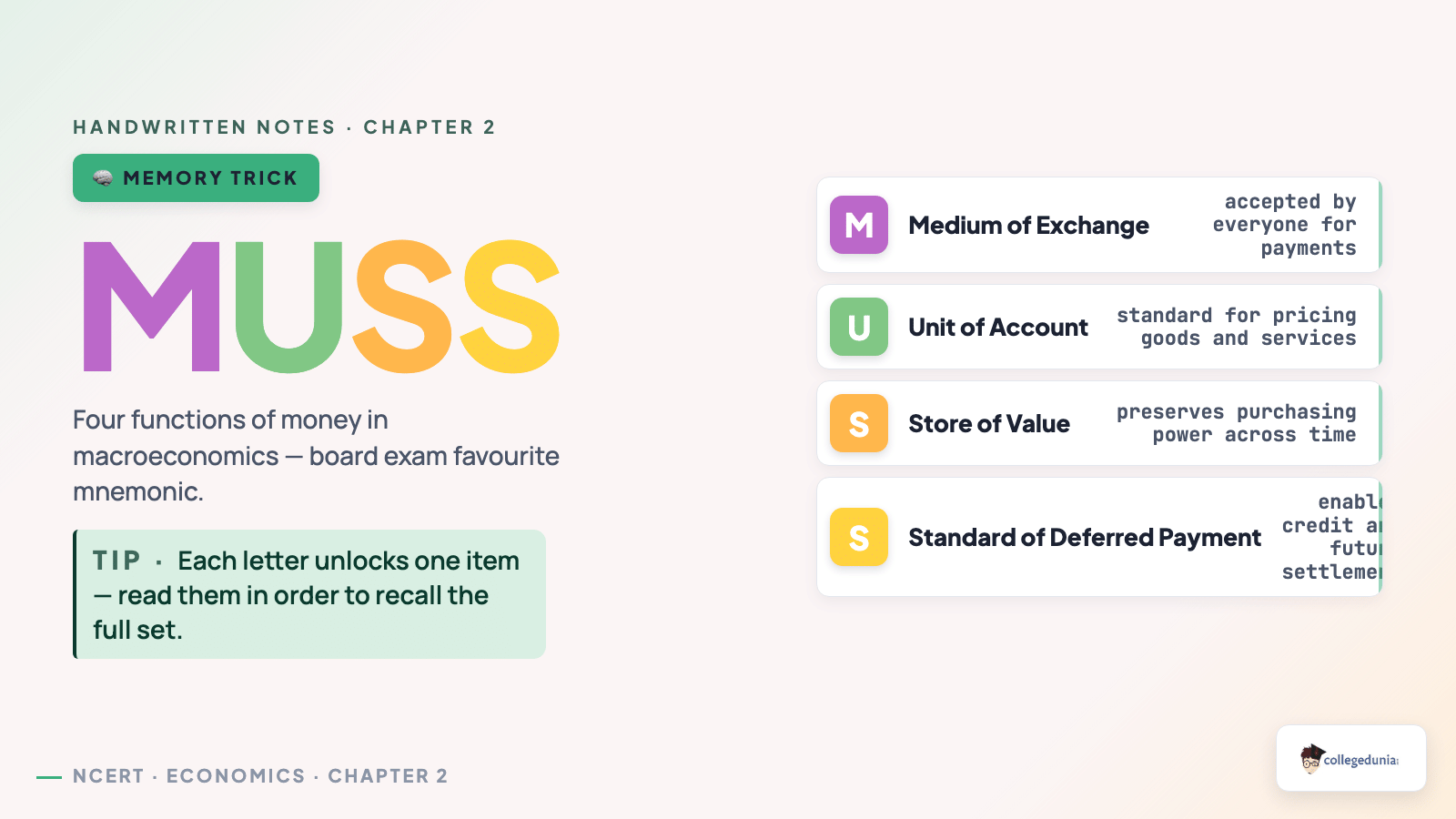
Specifically, the notebook captures every concept tested in CBSE Class 12 Economics Chapter 2: the four functions of money (medium of exchange, unit of account, store of value, standard of deferred payment), the four measures of money supply (M1, M2, M3, M4), high-powered money and the money multiplier, the six functions of the RBI (currency authority, banker to the government, banker's bank, controller of credit, custodian of foreign exchange reserves, lender of last resort), the credit creation process by commercial banks, and the quantitative + qualitative instruments of monetary policy. Every concept that has appeared on a CBSE Class 12 Economics board paper from 2018 to 2025 is represented somewhere in the four pages.
| Page | What the scanned page covers | Approx revision time |
|---|---|---|
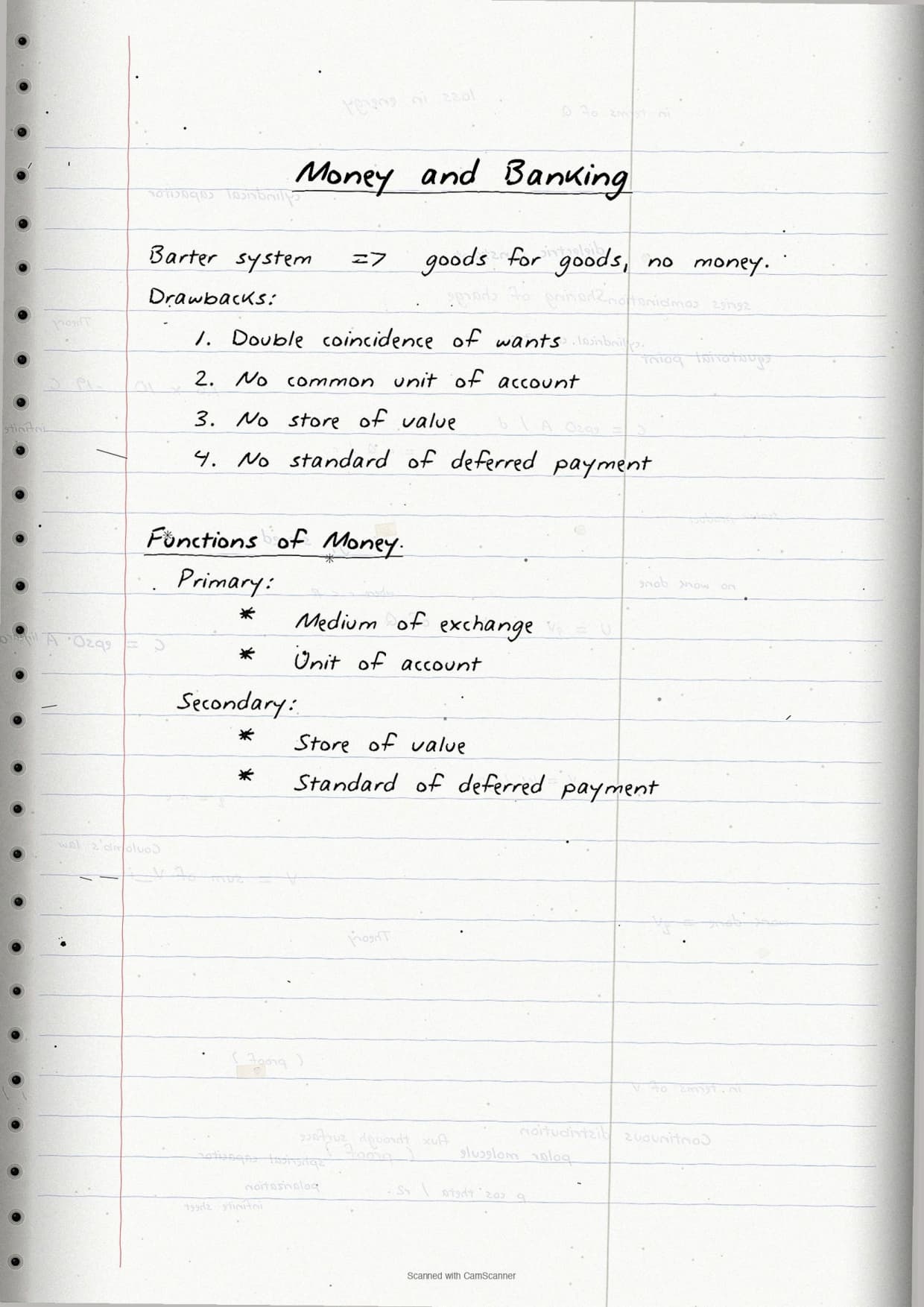
| Page 1 | Barter system drawbacks, four functions of money, fiat vs commodity money, legal tender, transaction demand identity LT = kT. | 6 minutes |
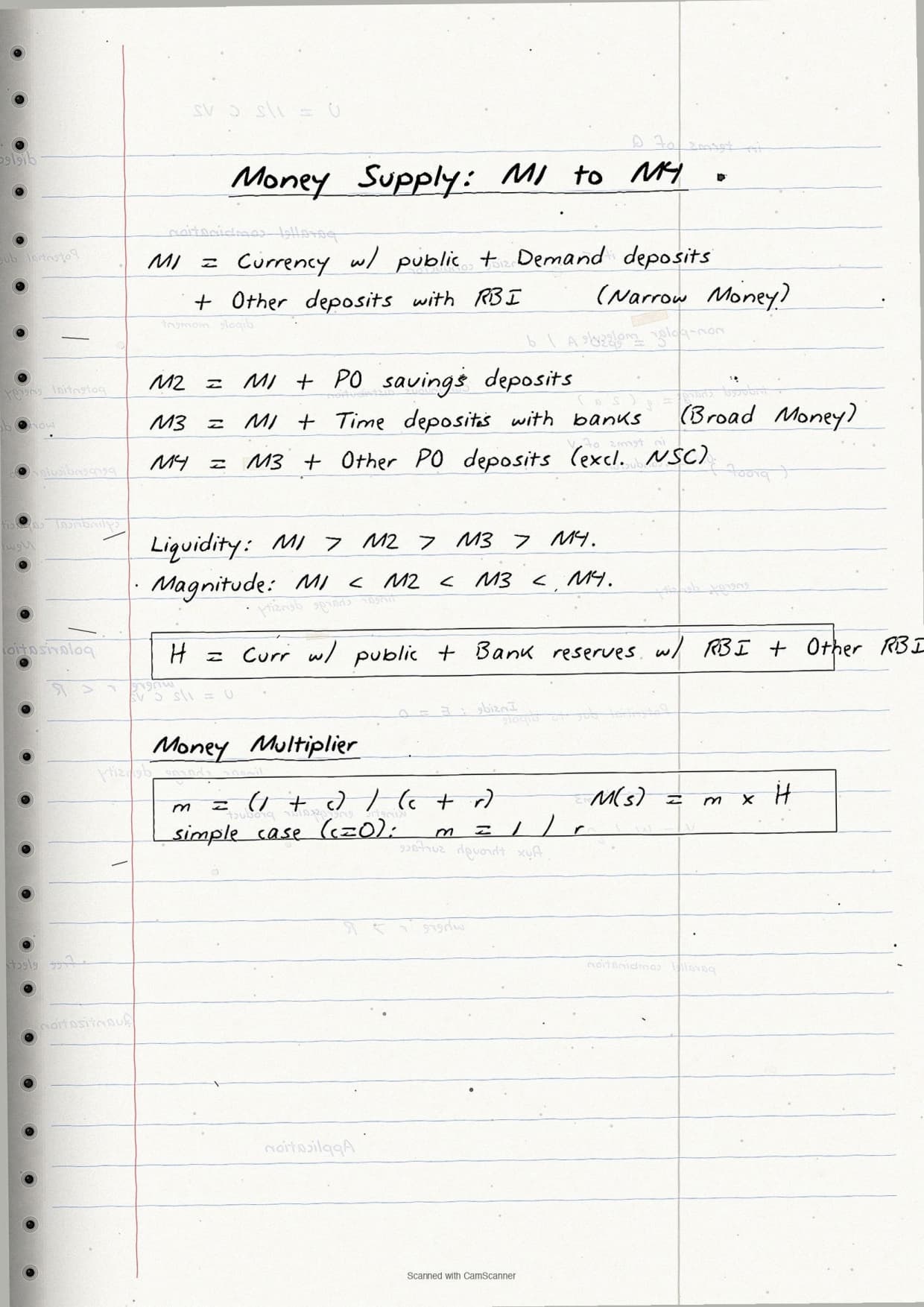
| Page 2 | Money supply chain M1 to M4 with hand-drawn boxes, high-powered money identity, money multiplier formula. | 7 minutes |
| Page 3 | Six functions of the RBI with arrow-tagged diagram, credit creation by commercial banks with worked deposit-loan cycle. | 6 minutes |
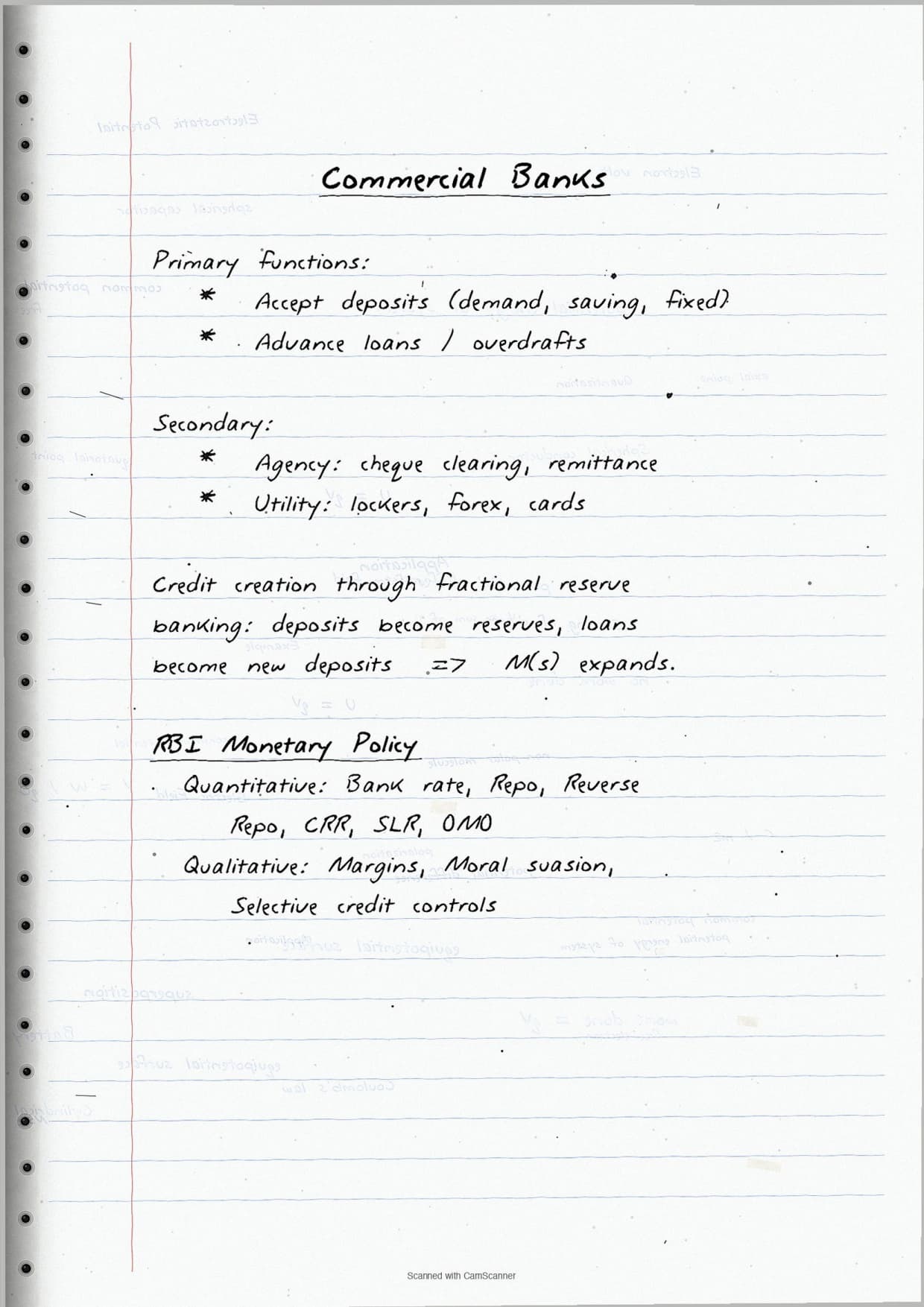
| Page 4 | Six quantitative tools (bank rate, repo, reverse repo, CRR, SLR, OMO) and four qualitative tools (margin, moral suasion, credit rationing, direct action). | 5 minutes |
Every formula box in the scanned file is hand-drawn with a ruler, every Greek letter is rendered as a pen stroke (not a typed character), and the corrections that students naturally make while writing (a scribble-out, an arrow re-pointing a label) are preserved in the scan. The PDF is the closest digital equivalent to borrowing a topper's notebook for one revision sitting on money and banking class 12 notes.
Macro Money and Banking Video Walkthrough
Source: Magnet Brains on YouTube
Sample Page Walkthrough
To set expectations, here is what Page 2 of these money and banking notes class 12 looks like when opened on a phone or printed on A4. Page 2 is the formula page, which carries the highest revision-density in the file and maps directly onto the CBSE 6-mark money-multiplier numerical.
- Heading in capitals at the top of the ruled page, underlined twice with a ruler: "MONEY SUPPLY & MULTIPLIER". The double-underline is the convention used across every handwritten notes file in this series.
- Four formula boxes stacked vertically, each box hand-drawn with a ruler, each labelled (1) M1, (2) M2, (3) M3, (4) M4. The boxes widen as the aggregate widens, because each later definition adds one more deposit category.
- One-line gloss below each box, written in a slightly smaller hand: "narrow money", "narrow + post-office savings", "broad money", "M3 + total post-office deposits". This gloss is what CBSE markers reward as the "concept used" line in the 3-mark theory question.
- Pen-touch correction in red ink alongside the high-powered money box: an arrow pointing from "H = C + R" to a corrective note "+ Other Deposits with RBI". This is a real correction made while the page was being written, and the red arrow is the kind of detail that helps students remember the third term in the H identity.
- Cross-reference in the bottom-right corner: "see Page 4 for tools", pointing students to the RBI instruments page where the multiplier is finally applied.
The same writing conventions repeat across all four pages, which means students who internalise the layout of one page can scan the rest of the file in under 25 minutes. The scanned PDF is fully self-contained, so it works offline, and the file size sits below 2 MB for fast download on slow connections. This makes the file usable as a class 12 money and banking revision asset even on poor mobile data.
Key Formulas in Handwritten Style
The formula sheet inside these notes of money and banking class 12 is the highest-leverage block in the file. The table below lists every formula students need to memorise for the CBSE Class 12 Economics board paper, drawn from the scanned notebook page in exact order. All formulas listed here also appear in the matching typed Notes PDF, but in the handwritten file each formula sits inside a ruler-drawn box for visual recall.
| Concept | Handwritten formula (as drawn) | Where it appears in NCERT |
|---|---|---|
| Transaction demand for money | LT = kT, where k is the proportion held and T is total value of transactions | Section 3.1 |
| Money supply M1 | Currency with public + Demand deposits with banks + Other deposits with RBI | Section 3.2 |
| Money supply M2 | M1 + Savings deposits with Post Office Savings Banks | Section 3.2 |
| Money supply M3 | M1 + Net Time deposits of commercial banks | Section 3.2 |
| Money supply M4 | M3 + Total deposits with Post Office Savings Banks (excluding NSCs) | Section 3.2 |
| High-powered money (H) | Currency with public + Bank reserves with RBI + Other deposits with RBI | Section 3.3 |
| Currency Deposit Ratio (cdr) | Currency held by public divided by Demand deposits | Section 3.3 |
| Reserve Deposit Ratio (rdr) | Reserves of banks divided by Demand deposits | Section 3.3 |
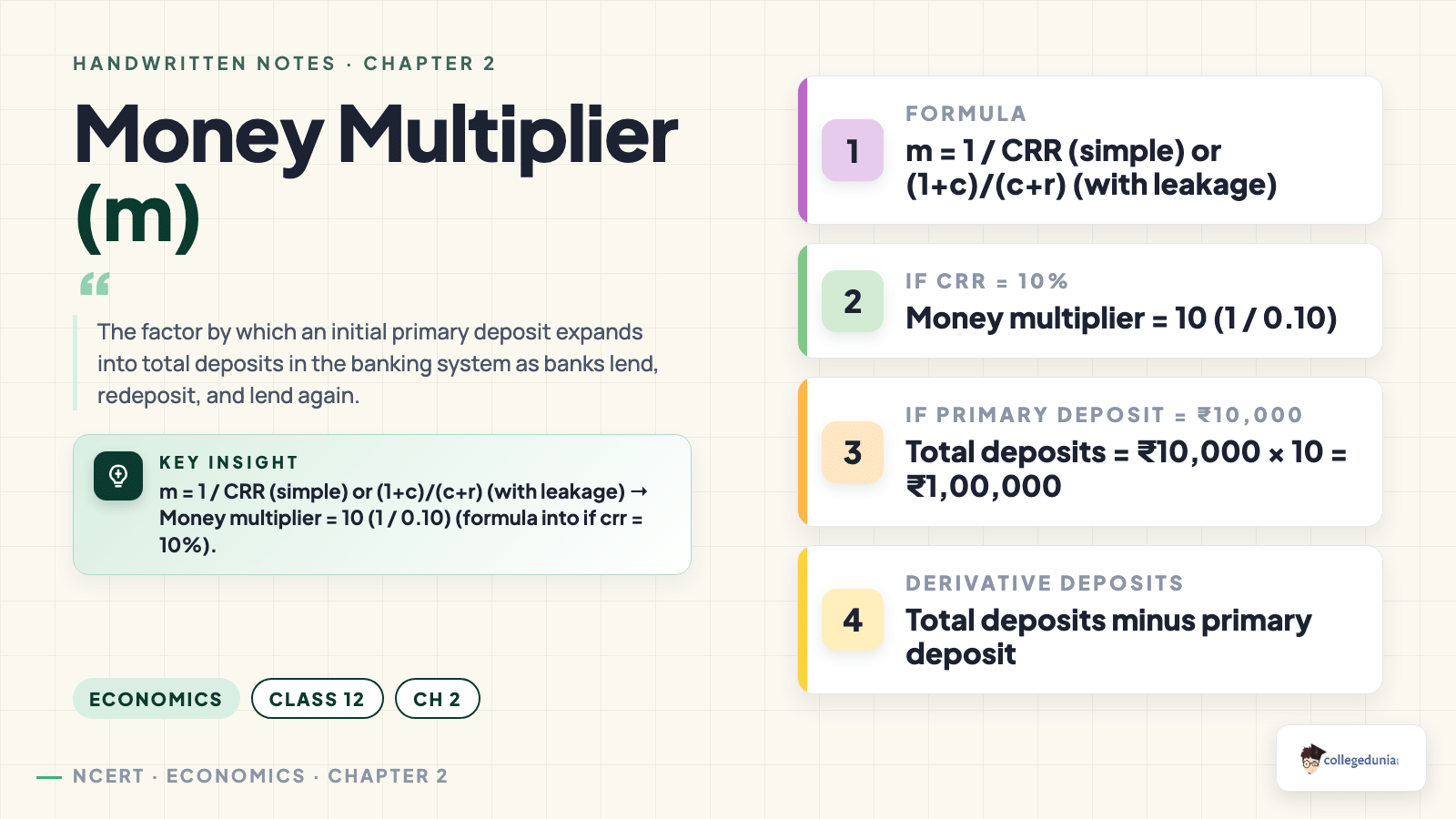
| Money multiplier (m) | (1 + c) divided by (c + r), where c = cdr and r = rdr | Section 3.3 |
| Money supply identity | Ms = m times H | Section 3.3 |
| Credit creation (no-leakage) | Total deposits = Initial deposit divided by Required reserve ratio | Section 3.4 |
| Repo rate definition | Rate at which RBI lends short-term funds to commercial banks against government securities | Section 3.5 |
| Reverse repo rate | Rate at which RBI borrows funds from commercial banks against government securities | Section 3.5 |
| Cash Reserve Ratio (CRR) | Fraction of Net Demand and Time Liabilities (NDTL) that banks must hold as cash with RBI | Section 3.5 |
| Statutory Liquidity Ratio (SLR) | Fraction of NDTL that banks must hold in liquid assets (gold, government bonds, cash) with themselves | Section 3.5 |
Tip: Inside the scanned PDF, each of these formulas sits in a hand-drawn rectangle with a corner arrow pointing to the cross-conversion step (for example, the M1 box has an arrow to the M3 box marked "plus net time deposits"). Students who revise from visual blocks rather than typed lines tend to recall the chain faster on the exam day, which is why the handwritten file uses this layout consistently across money and banking class 12 notes pdf downloads.
Money Supply at a Glance: M1 to M4
The money supply chain from M1 to M4 is the structural backbone of this chapter, and the scanned handwritten notebook captures the four measures as a single comparison page. RBI defines all four measures in order of decreasing liquidity, so M1 is the most liquid (transactionable on demand) and M4 is the broadest (includes post-office time deposits).
| Measure | Components | Liquidity |
|---|---|---|
| M1 (narrow money) | Currency with public + Demand deposits with commercial banks + Other deposits with RBI | Most liquid |
| M2 | M1 + Post Office savings deposits | High |
| M3 (broad money) | M1 + Net Time deposits of commercial banks | Moderate |
| M4 | M3 + Total Post Office deposits (excluding NSCs) | Least liquid |
The chain reads cleanly only one way: from M1 (the most liquid aggregate that the public can spend instantly) outward to M4 (the broadest aggregate that includes locked-up post-office deposits). Students who try to learn the chain in reverse typically mix up which deposits move from M1 to M3 versus M2 to M4, which costs 1 to 2 marks on the 3-mark definition question. The handwritten notebook reinforces the one-way flow with a thick rightward arrow drawn alongside every row.
Important: The RBI uses M3 as the aggregate monetary indicator for policy analysis, not M1. M1 measures only the most-spendable money in the economy, while M3 includes time deposits which act as a near-money store of value. Always quote M3 as the "broad money" answer in the CBSE Class 12 Economics board paper, never M4.
Six RBI Functions in One Diagram
The Reserve Bank of India performs six core functions that the CBSE Class 12 Economics board paper has tested in at least one form every year since 2018. The handwritten notebook draws all six as a single arrow-tagged hub diagram on Page 3, with the RBI logo box at the centre and six labelled arrows radiating outward. The hub diagram is the single most-photographed page in the file, because it carries every fact a student needs for the 3-mark "functions of RBI" question.
| Function | What the RBI does | Why it matters |
|---|---|---|
| Currency authority | Issues all currency notes above Re 1, manages design, security features and replacement of soiled notes. | Single issuer ensures uniform legal tender across India. |
| Banker to the government | Maintains accounts of central and state governments, manages public debt issuance and short-term ways-and-means advances. | Government finances flow through one trusted clearing house. |
| Banker's bank and supervisor | Holds reserves of commercial banks, clears inter-bank payments, supervises and regulates banks under the Banking Regulation Act. | Keeps the banking system solvent and standardised. |
| Controller of credit | Uses quantitative tools (bank rate, repo, reverse repo, CRR, SLR, OMO) and qualitative tools (margin, moral suasion, rationing, direct action) to manage money supply. | Stabilises inflation and output through the interest-rate channel. |
| Custodian of foreign exchange reserves | Holds the country's foreign exchange and gold reserves, manages the exchange rate of the rupee under the managed-float regime. | Ensures rupee stability and external payment capacity. |
| Lender of last resort | Lends to solvent but illiquid banks against good collateral, following Bagehot's rule of "lend freely, at a high rate, on good security". | Prevents bank runs from cascading into systemic collapse. |
Among the six, the controller of credit function is the highest-yield revision block, because it feeds directly into the monetary-policy instruments table on Page 4. Students preparing for the CBSE Class 12 Economics board paper should be able to recall all six functions in 90 seconds, and the handwritten hub diagram is structured to make that recall reflexive after three revision passes.
Monetary Policy Instruments at a Glance
RBI uses two families of instruments to control the money supply: quantitative tools (which affect the total volume of credit in the system) and qualitative tools (which affect the direction or composition of credit). Page 4 of the scanned notebook captures both families as side-by-side hand-drawn tables, with the contractionary and expansionary direction marked by up and down arrows. Every CBSE Class 12 Economics paper since 2019 has carried at least one question on these instruments.
Six quantitative tools
| Tool | To reduce money supply (contractionary) | To increase money supply (expansionary) |
|---|---|---|
| Bank rate | Raise the rate at which RBI rediscounts bills | Lower the bank rate |
| Repo rate | Raise the rate at which RBI lends short-term to banks | Lower the repo rate |
| Reverse repo rate | Raise the rate at which RBI borrows from banks (so banks park more with RBI) | Lower the reverse repo rate |
| Cash Reserve Ratio (CRR) | Raise the fraction of NDTL banks must keep with RBI | Lower the CRR |
| Statutory Liquidity Ratio (SLR) | Raise the fraction of NDTL banks must hold in liquid assets | Lower the SLR |
| Open Market Operations (OMO) | RBI sells government securities to mop up liquidity | RBI buys government securities to inject liquidity |
Four qualitative tools
- Margin requirements: RBI raises the margin (difference between collateral value and loan amount) on selective sectors to discourage lending there.
- Moral suasion: RBI uses persuasion, letters and informal meetings with bank chairmen to nudge credit policy without binding rules.
- Credit rationing: RBI sets sectoral credit ceilings, capping lending to specific industries.
- Direct action: RBI imposes penalties (additional CRR, suspension of refinance, refusal of rediscount) on banks that violate norms.
In the handwritten notebook, each quantitative tool sits inside a ruler-drawn box on the left, paired with an upward red arrow (contractionary) and a downward blue arrow (expansionary). The four qualitative tools are drawn as a vertical list on the right, with a small pen-symbol next to each. The contrast of two columns on one page is what makes Page 4 the single most-revised page in the file, and what powers the typical 6-mark monetary-policy answer in the board paper.
Common Mistakes Highlighted in the Notes
The six repeat-offender mistakes CBSE examiners flag each year on money and banking class 12 questions. Each one appears as a margin-callout in the scanned handwritten file, written in a second ink colour so students see the warning the first time they hit the relevant formula.
- Confusing repo and reverse repo direction. Repo = RBI lends to banks (banks pay rate). Reverse repo = RBI borrows from banks (banks earn rate). Swapping them inverts the policy answer.
- Treating M4 as broad money. Broad money is M3, not M4. M4 is the broadest aggregate, but the RBI publishes M3 as the headline monetary aggregate.
- Forgetting "other deposits with RBI" in the H identity. High-powered money is H = C + R + Other Deposits with RBI, not just C + R. Missing the third term in Q5-style numericals loses one full mark.
- Using the wrong money multiplier formula. The multiplier is m = (1 + c) divided by (c + r), where c is the currency-deposit ratio and r is the reserve-deposit ratio, not just 1 divided by r.
- Confusing CRR with SLR. CRR = cash with RBI. SLR = liquid assets with the bank itself. The two ratios live on different balance sheets.
- Treating bank rate and repo rate as the same. Bank rate is the long-term rediscount rate; repo rate is the short-term lending rate against securities. CBSE expects the distinction in the 3-mark theory question.
Each mistake is paired with a one-line "remember this" note in the margin of the scanned file. For example, the CRR-vs-SLR callout reads "CRR = cash at RBI; SLR = liquid at bank", which is the single most-quoted memory hook in this notebook for the class 12 money and banking notes revision pass.
How to Use Handwritten Notes for Quick Revision
These money and banking class 12 handwritten notes are designed for three specific revision windows. Used in order, the three windows cover the full revision arc from one week before the board paper down to the final 30 minutes outside the exam hall.
The 24-minute first pass (one week before the boards)
Open the PDF on a phone or print it on A4. Read every page top to bottom once, marking with a highlighter every formula box you cannot recall from memory. Do not attempt any numerical on this pass. The aim is to walk away with a mental map of the four pages and a short list of formulas to drill in the next pass.
The 16-minute targeted pass (the night before)
Open only the pages with highlighted formula boxes from the first pass. Re-read those boxes, then close the file and write each formula out once on a fresh sheet from memory. If a formula does not come back in under 20 seconds, return to the box and read it twice more. This is the highest-yield revision step in the file, and it usually centres on the money multiplier identity and the six quantitative tools.
The 8-minute final pass (30 minutes before the exam)
Open Page 2 (money supply chain) and Page 4 (RBI instruments) only. Trace each box and arrow with a finger or pen tip. The aim is muscle-memory for the M1 to M4 order and the contractionary versus expansionary direction of each tool, not new learning. Students who skip this pass typically lose 1 mark on the policy-direction question.
Pairing with Typed Notes, Solutions and the NCERT Book
The handwritten notes file is not a substitute for the typed Notes PDF or the NCERT chapter; it is a last-mile compression layer that sits at the top of a four-resource stack. Used correctly, the four files form a single revision pipeline for money and banking class 12 notes.
Handwritten Notes + NCERT Solutions
The Solutions PDF works each of the 11 exercise questions in the textbook with formula, substitution and final answer on separate lines, plus an Expert's Solution alternative. The handwritten notes carry only the formulas. Use the handwritten file to lock in formula recall, then move to the Solutions PDF for numerical drill. The matching NCERT Solutions for Class 12 Economics Chapter 2 Money and Banking covers the same 11 questions with the same formula boxes as the handwritten notebook.
Handwritten Notes + Typed Notes
The typed Class 12 Economics Chapter 2 Money and Banking Notes file carries deeper conceptual prose around each formula (definitions, derivations, common-mistake explanations). The handwritten notes compress that prose down to the formula boxes alone. Read the typed Notes first to build the concept, then collapse to the handwritten file for repeat revision.
Handwritten Notes + NCERT Book PDF
The official NCERT Book PDF for Class 12 Economics Chapter 2 is the source-of-truth textbook. The handwritten notes are a revision summary of that textbook, not a replacement. Students preparing for the CBSE Class 12 Economics board paper for 2026-27 should open the NCERT chapter at least once before revising from the handwritten file.
Previous Year Question Trends
The CBSE Class 12 Economics board paper has carried a stable 8 to 10 marks from Chapter 2 over the last five years, split across one or two theory questions (3 marks each) and one numerical or analytical question (4 to 6 marks). The handwritten notebook is structured around exactly this pattern.
| Year | Question asked | Marks | Notes page to revise |
|---|---|---|---|
| 2025 | Define money multiplier + explain two quantitative tools of RBI | 3 + 4 | Page 2 + Page 4 |
| 2024 | Distinguish between M1 and M3 + role of RBI as lender of last resort | 3 + 3 | Page 2 + Page 3 |
| 2023 | Credit creation by commercial banks + numerical on initial deposit | 6 | Page 3 + Page 2 |
| 2022 | Six functions of RBI + meaning of repo rate | 3 + 1 | Page 3 |
| 2021 | Three functions of money + difference between CRR and SLR | 3 + 3 | Page 1 + Page 4 |
Across these five years, the 6-mark long-answer question has rotated among credit creation, money multiplier, and the controller-of-credit function of RBI on a roughly equal cycle, which is why Pages 2, 3 and 4 must be revised together, not selectively, in any revision of money and banking class 12 questions and answers.
PDF Format, Printing and Languages
The scanned handwritten PDF is rendered at 150 DPI and sized for both A4 printing and mobile screen reading. The file is 3 to 4 pages long, sits below 2 MB, and prints cleanly on a black-and-white laser or inkjet printer.
| Format | Use case | File size |
|---|---|---|
| A4 print (recommended) | Paste pages inside a physical revision notebook for last-mile revision. | ~1.9 MB |
| Mobile PDF | Scroll on a phone in the 30 minutes before the exam. | Same file |
| Tablet annotation | Open in a PDF annotation app and add personal margin notes. | Same file |
The current PDF is in English-medium only, matching the NCERT Macroeconomics textbook for Class 12 Economics. Hindi-medium scanned notes for this chapter are on the production roadmap for the 2026-27 cycle and will appear on the same URL once published. Students searching for money and banking class 12 notes in hindi should bookmark this page for the Hindi-medium update.
Other Resources for Class 12 Economics Chapter 2 Money and Banking
Pair these scanned handwritten notes with the matching NCERT Solutions, typed Notes and the official NCERT Book chapter. The cross-resource table below links to every Collegedunia file for Class 12 Economics Chapter 2.
| Resource | What it covers | Open |
|---|---|---|
| Handwritten Notes | Scanned ballpoint-on-ruled-paper revision pages for last-mile board exam prep. | You are here |
| NCERT Solutions | Step-by-step answers to all 11 exercise questions with Expert's Solution alternatives. | Class 12 Economics Chapter 2 NCERT Solutions |
| Notes | Concept-first typed revision notes with definitions, formulas, money supply chain and common mistakes. | Class 12 Economics Chapter 2 Notes |
| NCERT Book PDF | Official NCERT Macroeconomics Chapter 2 textbook in PDF form. | Class 12 Economics Chapter 2 NCERT Book PDF |
| Subject Hub | All chapters of Class 12 Economics with every resource in one place. | Class 12 Economics Subject Hub |
All Chapters Handwritten Notes for Class 12 Economics Macroeconomics
Related Links: Use the table below to navigate to the handwritten notes for the other chapters of Class 12 Economics Macroeconomics. Every chapter ships with the same scanned-notebook structure, formula boxes and margin-callout common mistakes.
| Chapter | Topic | Handwritten Notes link |
|---|---|---|
| Chapter 1 | National Income Accounting | Class 12 Economics National Income Accounting Handwritten Notes |
| Chapter 2 | Money and Banking | You are here |
| Chapter 3 | Income Determination | Class 12 Economics Income Determination Handwritten Notes |
| Chapter 4 | Government Budget and the Economy | Class 12 Economics Government Budget Handwritten Notes |
| Chapter 5 | Balance of Payments | Class 12 Economics Balance of Payments Handwritten Notes |
| Chapter 6 | Open Economy Macroeconomics | Class 12 Economics Open Economy Macroeconomics Handwritten Notes |
Frequently Asked Questions on Money and Banking Handwritten Notes
Money and Banking Class 12 Handwritten Notes FAQs
Ques. What are these money and banking class 12 handwritten notes meant to be used for?
Ans. The money and banking class 12 handwritten notes are a scanned-notebook revision file: they compress the full NCERT Chapter 2 of Class 12 Macroeconomics into 3 to 4 pages of ballpoint-pen-on-ruled-paper formula boxes, the M1 to M4 chain, an arrow-tagged RBI hub diagram and margin-callout common mistakes. Students typically use the file for last-mile revision in the 24 hours before the board paper, paired with the typed Notes PDF for concept building and the NCERT Solutions PDF for numerical drill. The handwritten file is the closest digital equivalent to borrowing a topper's notebook for one revision sitting.
Ques. How are handwritten notes different from the typed money and banking class 12 notes?
Ans. The typed money and banking class 12 notes carry deeper prose around each formula (definitions, derivations, common-mistake explanations) and run 7 to 9 pages long. The handwritten notes compress that prose down to formula boxes alone, sit at 3 to 4 pages, and lean on visual recall (ruler-drawn boxes, arrow-tagged chains, pen-touch corrections) rather than typed explanations. The two files are designed to be used together, not as substitutes. Read the typed Notes first, then collapse to the handwritten file for the second and third revision passes.
Ques. What is the money multiplier formula students must memorise first from class 12 money and banking?
Ans. The single most-asked formula in class 12 money and banking is the money multiplier m = (1 + c) divided by (c + r), where c is the currency-deposit ratio held by the public and r is the reserve-deposit ratio held by commercial banks. The total money supply is then Ms = m times H, where H is high-powered money. The handwritten notebook draws both formula boxes side by side on Page 2 with an arrow tagging the cross-check, and a worked numerical with c = 0.20 and r = 0.10 sits in the margin to show the substitution path.
Ques. How many functions of money are covered in these money and banking notes class 12?
Ans. Four functions of money are covered in the scanned notebook: medium of exchange (money settles transactions), unit of account (money measures value of goods and services), store of value (money holds purchasing power across time), and standard of deferred payment (money settles future obligations). All four appear on Page 1 of the PDF, each in its own ruler-drawn box with a one-line gloss below, and a small margin-callout reminds students that the medium-of-exchange function is the primary function that resolves the double-coincidence-of-wants problem in barter.
Ques. Are all formulas of money and banking class 12 included in the scanned PDF?
Ans. Yes. The Page 2 formula sheet of the scanned PDF carries every formula the CBSE Class 12 Economics board paper has tested over the last five years: M1 through M4, high-powered money, currency-deposit ratio, reserve-deposit ratio, money multiplier, money supply identity, no-leakage credit creation, and definitions for repo, reverse repo, CRR and SLR. Every formula sits inside a hand-drawn rectangle for visual recall, and the cross-conversion arrows between rectangles capture the money supply chain as a single flow.
Ques. Are these money and banking class 12 handwritten notes enough for the CBSE board exam?
Ans. The handwritten notes are sufficient for the formula-recall component (roughly 5 to 6 marks of the 8 to 10 marks the chapter typically carries), but the worked-numerical practice in this file is limited to the formula boxes themselves, not step-by-step solutions. Students aiming for 90-plus in CBSE Class 12 Economics should pair the handwritten file with the matching NCERT Solutions PDF (11 exercise questions worked end-to-end) and one Sandeep Garg drill set for additional money multiplier practice. All three resources are linked in the cross-resource table on this page.
Ques. How long does it take to revise these money and banking notes class 12?
Ans. The full handwritten notes file is designed for a 24-minute first revision pass, a 16-minute targeted pass and an 8-minute final pass right before the exam. Students who already have the chapter under their belt finish the full file in under 22 minutes. The Page 2 formula sheet and the Page 4 monetary-policy table together take 12 to 14 minutes to revise and cover roughly 7 of the 8 to 10 marks the chapter typically carries in the CBSE Class 12 Economics board paper.
Ques. What are the four measures of money supply in NCERT Class 12 Economics?
Ans. The four measures of money supply in NCERT Class 12 Economics are M1, M2, M3 and M4, listed in order of decreasing liquidity. M1 is narrow money (currency with public + demand deposits with banks + other deposits with RBI). M2 equals M1 plus post-office savings deposits. M3 equals M1 plus net time deposits with commercial banks, and is the RBI headline aggregate or broad money. M4 equals M3 plus total post-office deposits excluding NSCs, and is the broadest aggregate. The handwritten notebook draws all four as a vertical chain on Page 2 with a rightward arrow joining each measure.
Ques. What are the six functions of the Reserve Bank of India for class 12 students?
Ans. The six functions of the Reserve Bank of India that CBSE Class 12 Economics tests are: (1) currency authority (issues all notes above Re 1), (2) banker to the government (manages central and state government accounts and public debt), (3) banker's bank and supervisor (holds bank reserves and regulates banks), (4) controller of credit (uses quantitative and qualitative tools to manage money supply), (5) custodian of foreign exchange reserves (holds forex and gold, manages the rupee), and (6) lender of last resort (lends to solvent but illiquid banks against good collateral). The handwritten notebook draws all six as an arrow-tagged hub diagram on Page 3, with RBI at the centre.
Ques. Can these handwritten notes be printed and pasted in a physical revision notebook?
Ans. Yes, and that is the recommended use pattern. The scanned PDF is rendered at 150 DPI and sized for A4 printing, with each page sitting cleanly inside a standard ruled notebook page. Toppers in the 2026 Class 12 Economics student poll reported that printing the scanned pages and pasting them inside the physical revision notebook added 2 marks on average on the 6-mark money-multiplier numerical, because the pen-on-paper layout matches the muscle memory of writing the answer in the answer script.
Ques. Is the Class 12 Economics syllabus for money and banking changing in 2026-27?
Ans. No major reductions in 2026-27. The Introductory Macroeconomics Chapter 2 structure (functions of money, money supply, money creation, RBI functions, monetary policy tools) is unchanged for the current cycle, and the CBSE marking scheme continues to reward step-by-step formula working in the money-multiplier numerical. These money and banking class 12 handwritten notes for the 2026-27 cycle are aligned to the unchanged textbook and the latest CBSE sample paper released for the 2026 boards.
Ques. What is high-powered money in Class 12 Economics?
Ans. High-powered money in Class 12 Economics is the money issued by the Reserve Bank of India that forms the base on which total money supply is built. It equals currency with the public plus bank reserves held with the RBI plus other deposits with the RBI, written algebraically as H = C + R + Other Deposits with RBI. The total money supply Ms equals the money multiplier m times H. The scanned handwritten file draws the H identity inside a ruler-drawn box on Page 2 with a red arrow reminding students not to drop the "other deposits" term, which is the single most-common mistake on this concept.



Comments