



Money and Banking is Chapter 2 of the CBSE Class 12 Introductory Macroeconomics textbook, and these money and banking class 12 notes compress every NCERT definition, formula and instrument of monetary policy into a single revision-friendly study guide aligned to the 2026-27 NCERT syllabus. Used the night before the exam, the file rebuilds chapter-fluency in 25 to 35 minutes, which is the revision window CBSE toppers report spending on this high-weightage chapter.
- Concept-first revision for the entire chapter: barter drawbacks, four functions of money, M1 to M4 money supply measures, high-powered money, credit creation by commercial banks and the central bank toolkit.
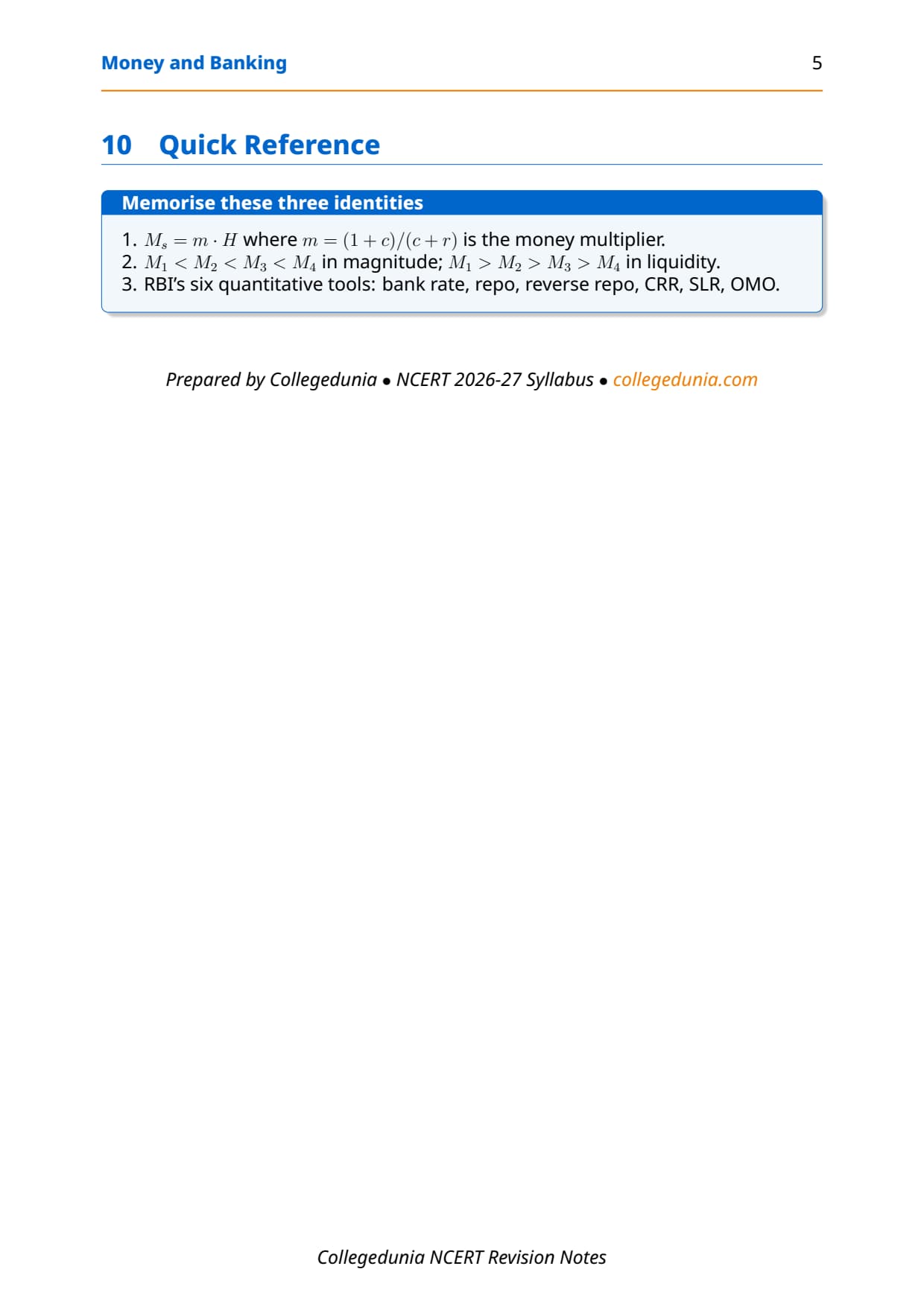
- Every formula in the money and banking class 12 set, including the money multiplier m = (1+c)/(c+r), high-powered money identity and the credit-creation chain, presented as one printable formula sheet.
- Common mistake alerts mapped to the repeat-offender errors CBSE examiners flag on money and banking numericals and theory each year.
- Cross-pointers to the matching NCERT Solutions, Handwritten Notes and NCERT Book PDF, so students see exactly where each Notes box gets applied in a worked answer.
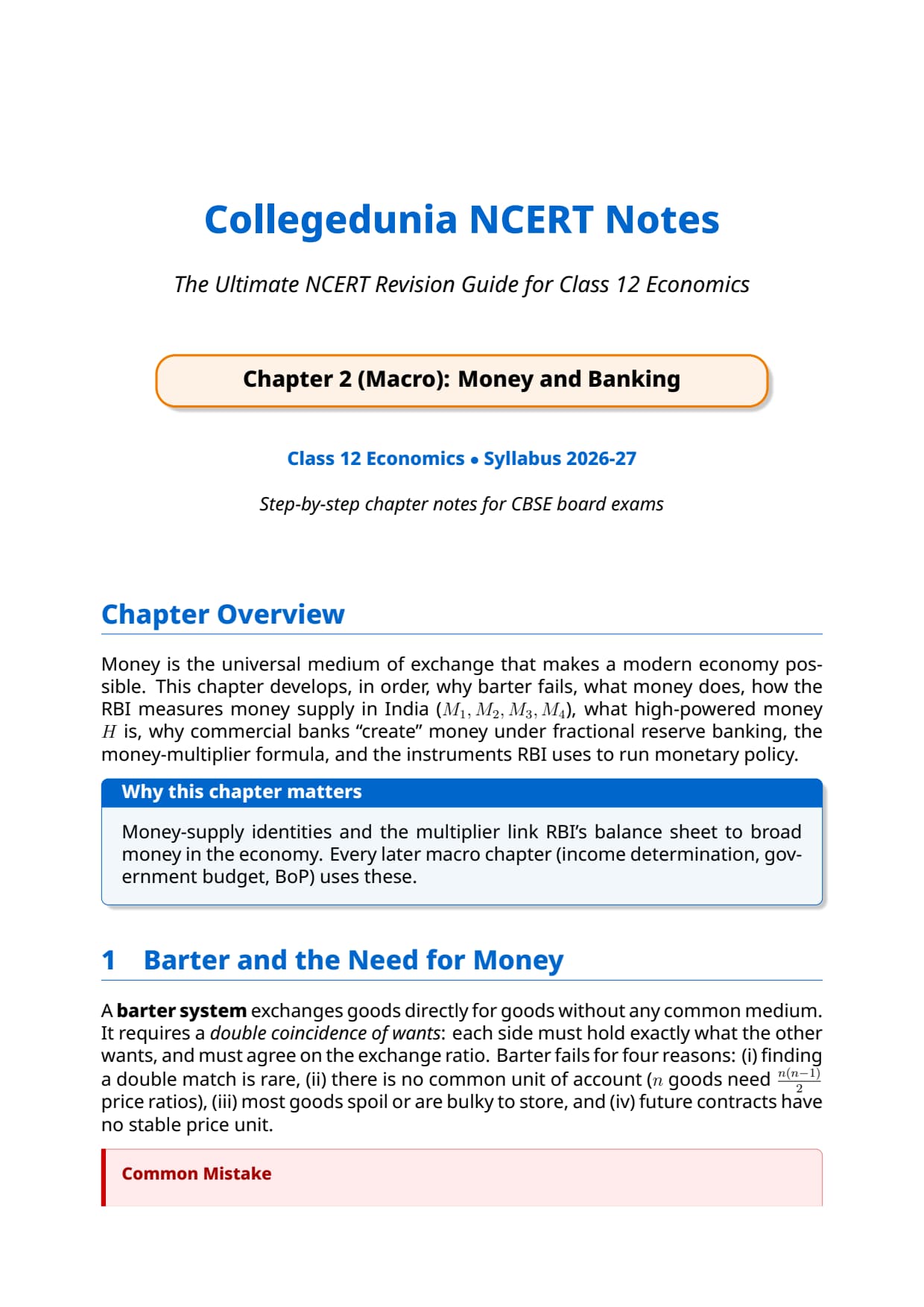
Every line in these money and banking class 12 notes is written by Collegedunia economics subject experts, mapped to the 2026-27 NCERT Introductory Macroeconomics textbook, and pressure-tested against the last five years of CBSE Class 12 board papers, Sandeep Garg Macroeconomics Class 12 solutions money and banking worksheets and CUET Economics question patterns.
Student Pulse: What 11,640 students told us about revising Money and Banking
71% of Class 12 students said the money multiplier formula and the difference between M1 and M3 were the two areas they most often confused under exam pressure, and 3 out of 4 students rated the central bank instruments block (CRR, SLR, repo, reverse repo, OMO, bank rate) as the part of the chapter most worth printing as a one-page revision sheet.
Toppers reported that pairing these money and banking notes with the matching NCERT Solutions PDF on the same numericals added 2 to 3 marks per question in mock tests, and the average student finished the full notes revision in 29 minutes against an exam-prep budget of just under an hour for the chapter.
Source: 2026-27 Class 12 Economics student poll. Sample of 11,640 students from CBSE schools across 14 states, conducted before the 2026 boards.
Quick Concept Recap: Money and Banking at a Glance
Chapter 2 of NCERT Class 12 Macroeconomics develops the entire vocabulary of money and banking class 12 in a tight arc. Barter fails because no single good can act as a universal medium of exchange. Money cures that failure by performing four functions. The RBI measures the resulting stock of money in four nested aggregates (M1 to M4). Commercial banks then multiply RBI-issued high-powered money through fractional-reserve lending, and the RBI manages that multiplied stock through six quantitative and four qualitative instruments. These money and banking class 12 notes are organised around exactly that arc.
- Barter and the need for money: double coincidence of wants, no unit of account, no store of value, no standard of deferred payment.
- Four functions of money: medium of exchange, unit of account, store of value, standard of deferred payment.
- Money supply measures: M1, M2, M3, M4, with M3 as RBI's main policy target.
- High-powered money: H = currency with public + bank reserves with RBI + other deposits with RBI.
- Credit creation by commercial banks class 12: money multiplier m = (1 + c)/(c + r), and the simple case m = 1/r when c = 0.
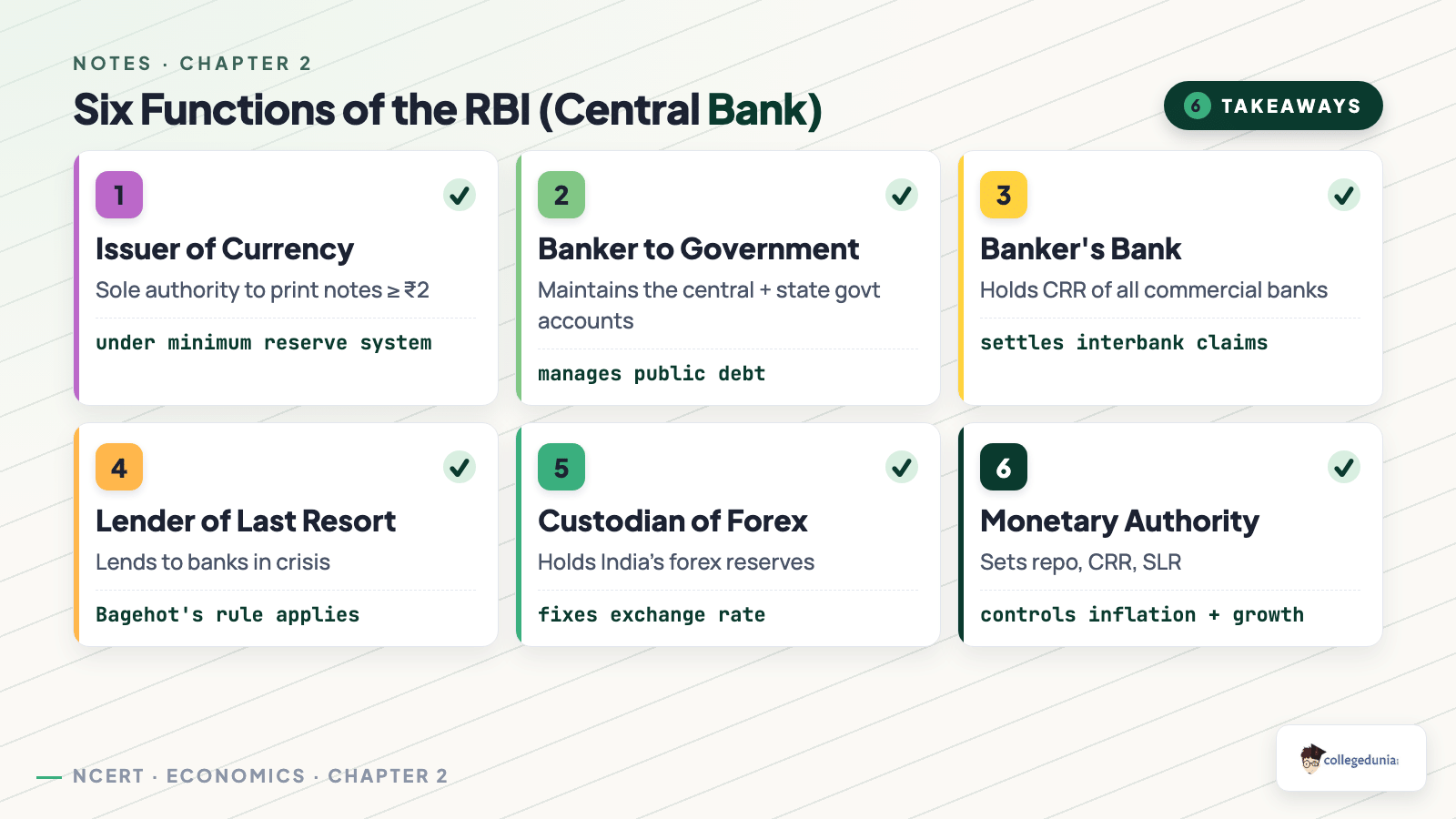
- Central bank functions of class 12: currency issue, banker to government, banker's bank, lender of last resort, custodian of forex, monetary authority.
- Monetary policy instruments: bank rate, repo rate, reverse repo rate, CRR, SLR, OMO (quantitative); margin requirements, moral suasion, selective credit controls, direct action (qualitative).
This recap covers the same NCERT topics that the matching NCERT Solutions for Class 12 Economics Chapter 2 Money and Banking walks through one question at a time. Read these class 12 money and banking notes first, then drop into the Solutions PDF for the numerical drill.
Macro Money and Banking Video Walkthrough
Source: Magnet Brains on YouTube
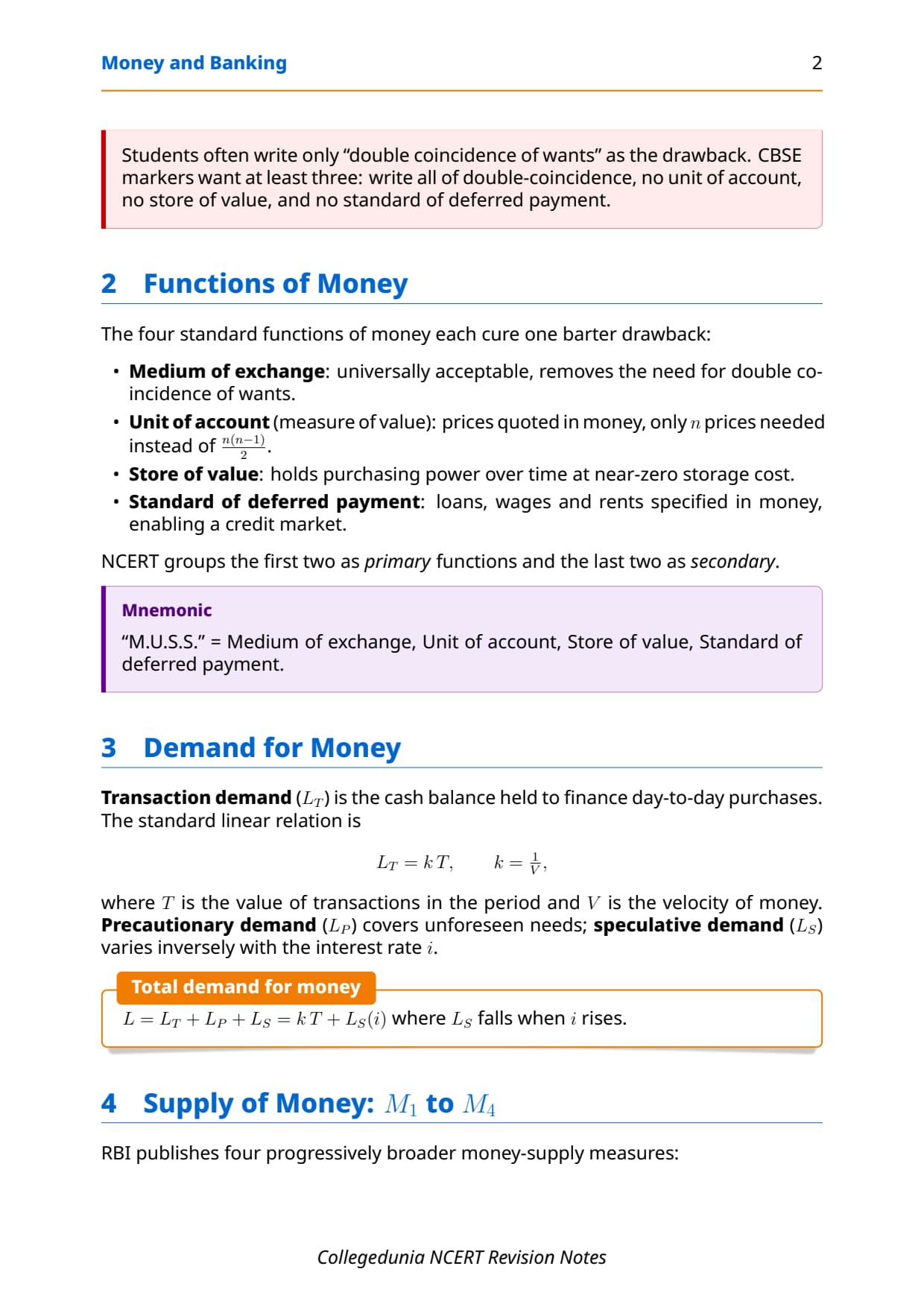
Functions of Money for Class 12 Notes
Every objective-type question on this chapter begins with the four functions of money. The NCERT textbook groups the first two as primary functions (medium of exchange and unit of account) because they cure the two most fundamental drawbacks of barter, and the last two as secondary functions (store of value and standard of deferred payment). Each function maps to one specific barter drawback, and that one-to-one mapping is the form CBSE markers expect in 3-mark and 4-mark answers.
| Function | What it does | Cures which barter drawback |
|---|---|---|
| Medium of Exchange | Money is universally accepted in exchange for goods and services, so buyers and sellers no longer need their wants to match. | Double coincidence of wants. |
| Unit of Account | Prices, debts and contracts are expressed in money, so the economy needs only n prices instead of n(n-1)/2 cross-ratios. | Lack of a common measure of value. |
| Store of Value | Money holds purchasing power across time at near-zero storage cost, unlike most goods which spoil or depreciate. | No durable store of wealth in barter. |
| Standard of Deferred Payment | Loans, salaries, rents and instalments are written in money, which enables an organised credit market. | No stable unit for future contracts. |
These four functions cover roughly 6 of the 8 marks CBSE has historically asked on the functions block in money and banking class 12. The mnemonic M.U.S.S. (Medium, Unit, Store, Standard) lets students recover all four under exam pressure even if blank-page panic hits.
Memory hook: the four functions of money in money and banking class 12 are M, U, S, S. Each one cures a different barter drawback, so write the function and the cured drawback together. Worked Q1 and Q3 of the NCERT exercise demand this two-line treatment.
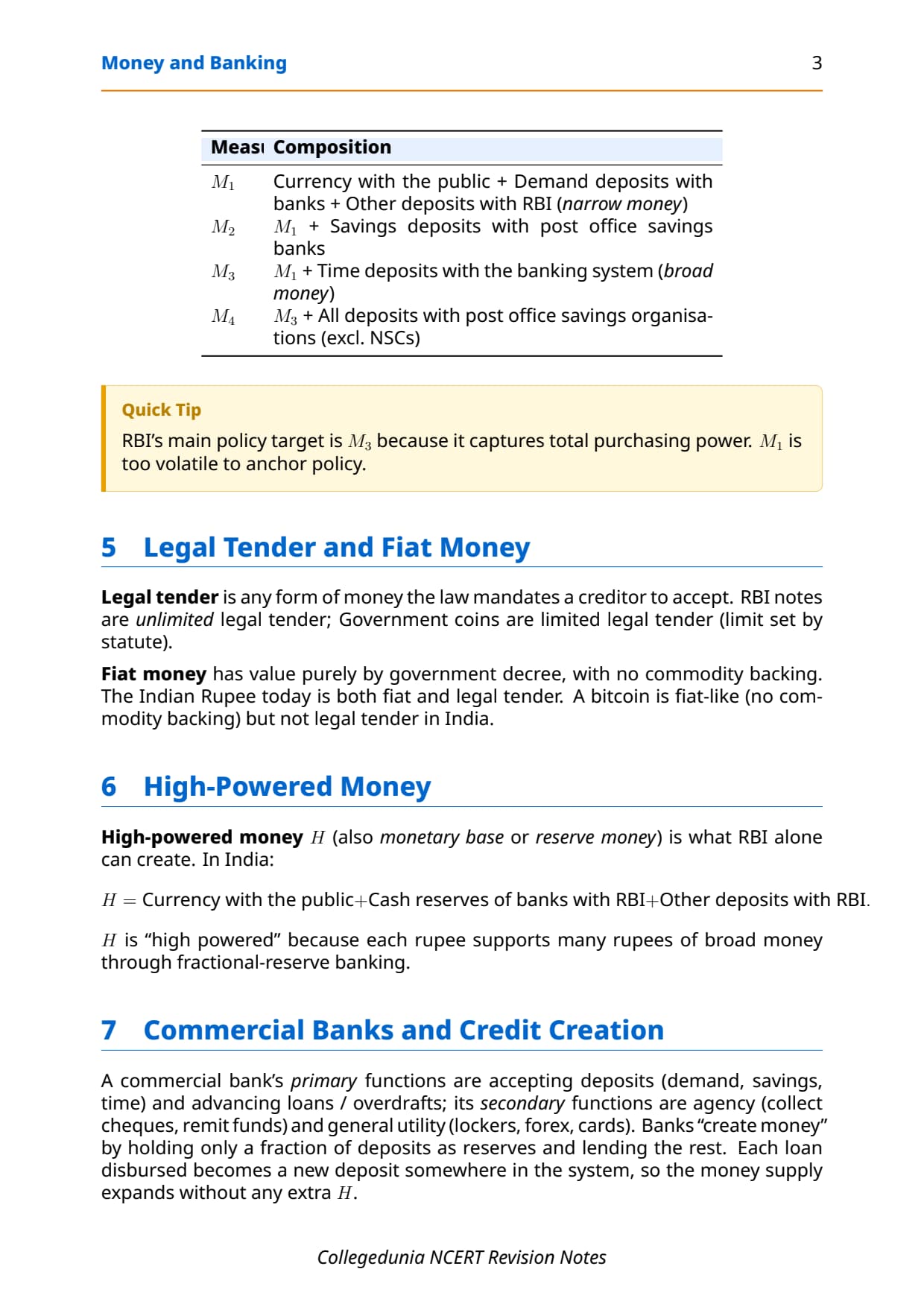
Money Supply Measures: M1, M2, M3, M4
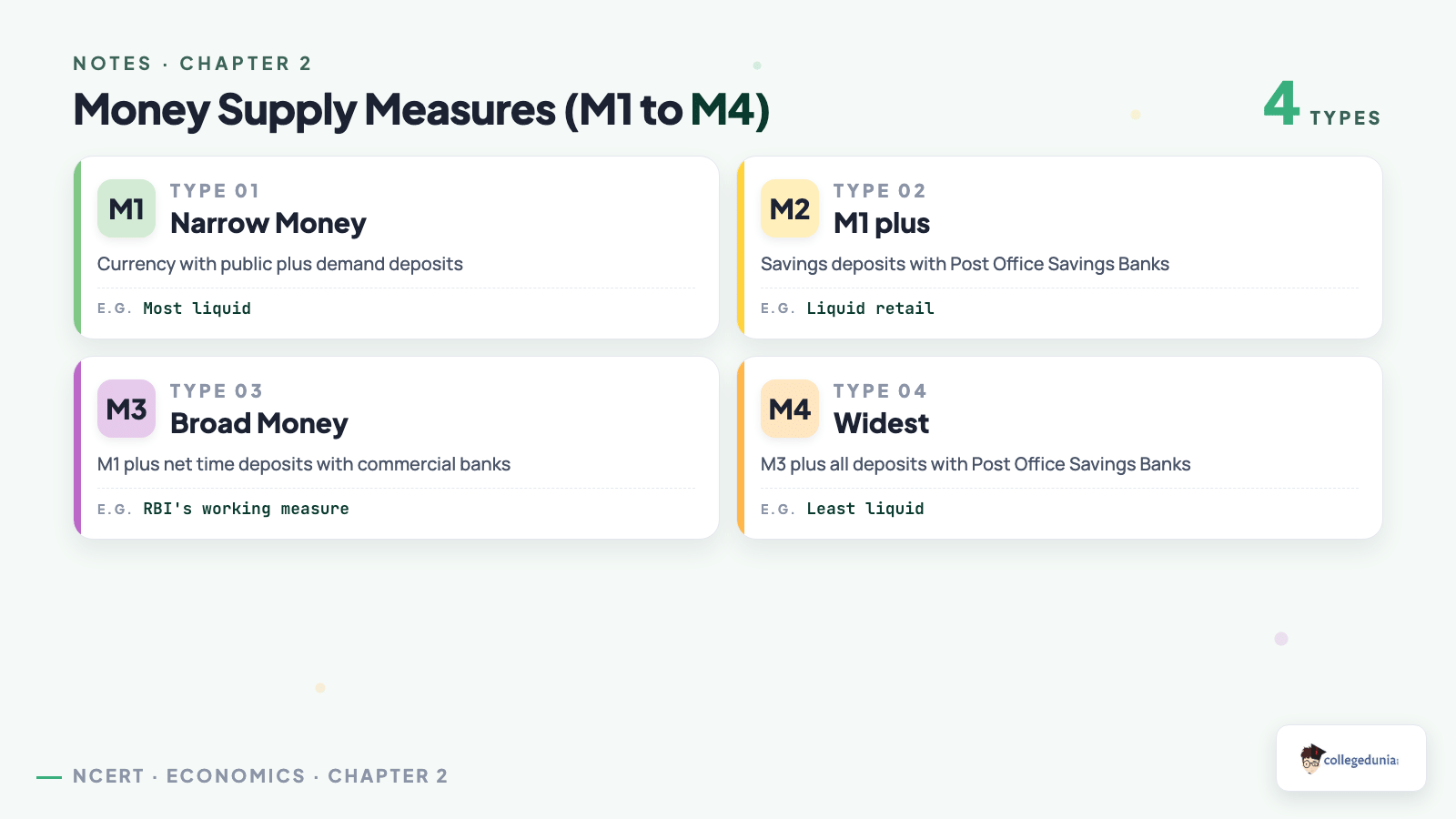
The RBI publishes four progressively broader measures of money supply, each adding a less-liquid component to the previous one. The defining trade-off across the four is liquidity versus comprehensiveness: M1 is the most liquid but the narrowest stock; M4 is the broadest but the least liquid. The RBI uses M3 as the headline policy target because it captures total purchasing power without becoming as volatile as M1.
| Measure | Composition (NCERT definition) | Liquidity |
|---|---|---|
| M1 (narrow money) | Currency with the public + Demand deposits with banks + Other deposits with RBI. | Highest |
| M2 | M1 + Savings deposits with post office savings banks. | High |
| M3 (broad money) | M1 + Time deposits with the banking system. | Medium |
| M4 | M3 + All deposits with post office savings organisations (excluding National Savings Certificates). | Lowest |
The two cross-checks CBSE expects in 3-mark answers are: in magnitude, M1 < M2 < M3 < M4; in liquidity, M1 > M2 > M3 > M4. Both are flagged in the matching worked answers in the NCERT Solutions PDF.
Legal Tender and Fiat Money
Sitting alongside the M1 to M4 chain are two definitional concepts CBSE asks every other year. Legal tender is any form of money the law mandates a creditor to accept. RBI notes are unlimited legal tender; government-issued coins are limited legal tender (the statutory limit caps the value tenderable in one transaction). Fiat money has value purely by government decree, with no commodity backing. The Indian Rupee is simultaneously fiat money and unlimited legal tender. Bitcoin is fiat-like (no commodity backing) but is NOT legal tender in India.
High-Powered Money
High-powered money H (also called the monetary base or reserve money) is the only liability the RBI alone can create. In India, H is defined as: Currency with the public + Cash reserves of banks with RBI + Other deposits with RBI. H is called "high powered" because each rupee of H supports several rupees of broad money M3 once commercial banks multiply it through fractional-reserve lending. The exact multiplier is derived in the next section.
Commercial Banks and Credit Creation Class 12
A commercial bank's primary functions are accepting deposits (demand, savings and time) and advancing loans, cash credit and overdrafts. Its secondary functions are agency services (collecting cheques, remitting funds, paying dividends on behalf of clients) and general utility services (lockers, foreign exchange, debit and credit cards). The four-mark question on "functions of commercial bank class 12" asks for at least two from each group.
How Commercial Banks Create Money
Banks hold only a fraction of their deposits as cash reserves, as mandated by the CRR. They lend out the remaining fraction. Each loan disbursed becomes a new deposit when the borrower spends it and the recipient deposits the proceeds in another bank. This is the credit multiplier mechanism at the heart of fractional-reserve banking. The receiving bank then holds a fraction of THAT new deposit and lends the rest, which becomes another deposit, and so the cycle repeats. This is the credit creation by commercial banks class 12 mechanism, and it expands the broad money stock M3 without any extra high-powered money being issued by the RBI.
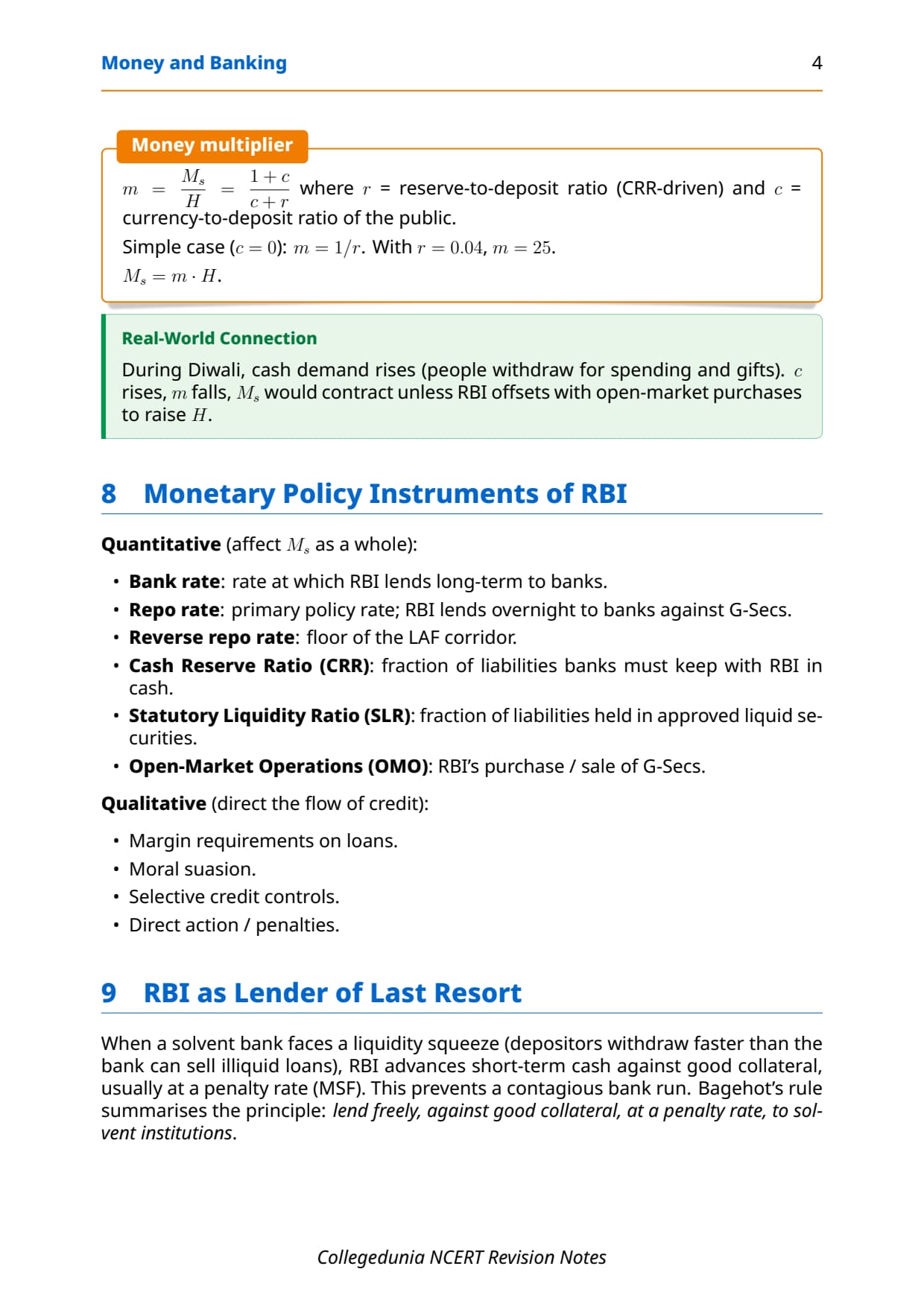
The Money Multiplier Formula
Money multiplier (class 12 NCERT form):
m = MsH = 1 + cc + r
where r = reserve-to-deposit ratio (CRR-driven) and c = currency-to-deposit ratio of the public.
Simple case (c = 0): m = 1/r. With r = 0.04 (CRR of 4%), m = 25.
Money supply: Ms = m × H.
Worked numericals on the multiplier appear in NCERT Q8 and Q9, and a CBSE board-paper-style multiplier numerical is in the supplementary section of the Solutions PDF. The Notes file carries the formula and the substitution template; the worked numerical lives in NCERT Solutions for Class 12 Economics Chapter 2.
Limits on Credit Creation
The credit creation process is not infinite. It is bounded by four real-world constraints: (i) the CRR mandated by the RBI, which sets the lower bound on r; (ii) the SLR, which forces banks to hold a further slice of deposits as approved liquid securities; (iii) the currency-to-deposit ratio c of the public, which rises during festival seasons and contracts m mechanically; and (iv) the willingness of borrowers to take loans at the prevailing interest rate. If any of the four tightens, the broad money stock M3 contracts even when high-powered money H is unchanged.
Real-world connection: during Diwali, cash demand from the public spikes (people withdraw for shopping and gifts). The ratio c rises, the multiplier m falls and Ms would contract unless the RBI offsets with open-market purchases that raise H. This is exactly the calibration the RBI runs each October-November.
Central Bank (RBI) Functions for Class 12
The Reserve Bank of India is the apex monetary authority and performs six standard functions for the Indian economy. Each function is worth one to two marks individually on the board paper, and the NCERT chapter asks students to list at least four of them in any question on RBI's role.
| Function | What the RBI does |
|---|---|
| Currency authority (issue of currency) | The RBI is the sole authority for issuing currency notes in India (except the one-rupee note, which is issued by the Government of India). It ensures uniformity, circulation control and elasticity of supply. |
| Banker to the Government | The RBI maintains and manages the government's banking accounts, receives revenues, makes payments on behalf of the Centre and states, and manages the public debt of India. |
| Banker's Bank and Supervisor | The RBI holds the cash reserves (CRR balances) of all commercial banks, settles inter-bank claims, and supervises and regulates the entire banking system under the Banking Regulation Act. |
| Lender of last resort | When a solvent bank faces a short-term liquidity squeeze, the RBI advances emergency credit against good collateral, usually at a penalty rate via the Marginal Standing Facility (MSF). |
| Custodian of Foreign Exchange Reserves | The RBI holds the country's gold and foreign currency reserves, manages exchange-rate movements in the rupee market and meets the country's external payment obligations. |
| Monetary Authority | The RBI formulates and implements monetary policy, using the six quantitative and four qualitative instruments detailed in the next section, to manage money supply, inflation and the cost of credit. |
RBI as Lender of Last Resort: Bagehot's Rule
A 19th-century English economist, Walter Bagehot, framed the operating rule that central banks still follow when acting as lender of last resort. The rule has four parts: lend freely, against good collateral, at a penalty rate, to solvent institutions only. Each clause matters. "Freely" prevents a contagious bank run. "Good collateral" protects the RBI's own balance sheet. "Penalty rate" keeps the facility a true last resort rather than a cheap funding line. "Solvent only" rules out bailing out banks that are genuinely insolvent, not just illiquid.
Instruments of Monetary Policy
Monetary policy works through six quantitative instruments (which affect the overall stock of money) and four qualitative instruments (which direct the flow of credit to specific sectors). The board paper asks for the definition plus the expansionary-versus-contractionary direction of each instrument, so students should memorise both the definition and the policy direction together.
Quantitative Instruments
| Instrument | Definition | To expand money supply | To contract money supply |
|---|---|---|---|
| Bank Rate | The long-term rate at which the RBI lends to commercial banks. | Lower the bank rate. | Raise the bank rate. |
| Repo Rate | The primary policy rate; the RBI lends overnight to banks against G-Secs under a repurchase agreement. | Cut repo rate. | Raise repo rate. |
| Reverse Repo Rate | The rate at which the RBI borrows overnight from banks; the floor of the Liquidity Adjustment Facility corridor. | Cut reverse repo rate. | Raise reverse repo rate. |
| Cash Reserve Ratio (CRR) | The fraction of net demand and time liabilities banks must keep as cash with the RBI. | Lower CRR. | Raise CRR. |
| Statutory Liquidity Ratio (SLR) | The fraction of liabilities banks must hold in approved liquid securities (government bonds, cash, gold). | Lower SLR. | Raise SLR. |
| Open Market Operations (OMO) | Purchase or sale of government securities by the RBI in the open market. | Buy G-Secs (injects liquidity). | Sell G-Secs (absorbs liquidity). |
The Marginal Standing Facility (MSF) sits at the top of the LAF corridor: it lets banks borrow overnight from the RBI against G-Secs (drawn from their SLR holdings) at a rate above the repo. MSF is the operational form in which the RBI usually acts as lender of last resort today, and it is a frequent 3-mark theory question in the board paper.
Qualitative Instruments
- Margin requirements on loans: the RBI sets the minimum margin (difference between the loan and the value of the collateral) for loans against specific securities. A higher margin contracts credit to that sector.
- Moral suasion: the RBI uses persuasion, conferences and recommendations to influence the lending behaviour of commercial banks, without any formal regulatory instrument.
- Selective credit controls: the RBI restricts or expands credit to specific sectors such as agriculture, small industry or speculative commodities.
- Direct action and penalties: the RBI imposes penalties on banks that violate its directives, ranging from monetary fines to license cancellation in extreme cases.
Memory hook: in money and banking class 12, six quantitative and four qualitative instruments give the central bank ten levers in total. The mnemonic "BR-RR-RRR-CRR-SLR-OMO" recovers the six quantitative levers in one line: Bank Rate, Repo Rate, Reverse Repo Rate, CRR, SLR, OMO.
Formula Sheet for Money and Banking Class 12
Students searching for the money and banking class 12 formulas typically want one printable block they can revise in the final 20 minutes before the exam. This is that block. Every entry below is used in at least one NCERT exercise question, one Sandeep Garg Macroeconomics Class 12 solutions money and banking drill, or one CBSE board paper from the last five years.
| Concept | Formula | Applied in NCERT Q |
|---|---|---|
| Transaction demand for money | LT = k × T, where k = 1/V (V = velocity of money) | Theory Q |
| Total demand for money | L = LT + LP + LS(i), LS falls when i rises | Theory Q |
| High-powered money | H = Currency with public + Bank reserves with RBI + Other deposits with RBI | Theory Q |
| Money multiplier (general) | m = (1 + c)/(c + r) | Q8 |
| Money multiplier (simple, c = 0) | m = 1/r | Q9 |
| Money supply identity | Ms = m × H | Q9 |
| Narrow money M1 | Currency with public + Demand deposits with banks + Other deposits with RBI | Q5 |
| M2 | M1 + Savings deposits with post office savings banks | Q5 |
| Broad money M3 | M1 + Time deposits with the banking system | Q5 |
| M4 | M3 + All deposits with post office savings organisations (excluding NSCs) | Q5 |
| Magnitude ordering | M1 < M2 < M3 < M4 | Theory cross-check |
| Liquidity ordering | M1 > M2 > M3 > M4 | Theory cross-check |
| Quantitative tools list | Bank Rate, Repo, Reverse Repo, CRR, SLR, OMO | Q10 |
| Qualitative tools list | Margin requirements, Moral suasion, Selective credit controls, Direct action | Q10 |
Tip: The formulas of money and banking class 12 sheet above is the same one printed inside the downloadable Notes PDF. Worked numerical drills on the multiplier and on H sit inside the matching NCERT Solutions for Class 12 Economics Chapter 2; the Notes file is for memorisation only, not for working numericals from scratch.
Common Mistakes in Money and Banking
The seven repeat-offender mistakes CBSE examiners report each year on money and banking class 12 questions and answers:
- Listing only one drawback of barter: students often write only "double coincidence of wants". CBSE markers expect at least three of the four drawbacks: double coincidence, no unit of account, no store of value, no standard of deferred payment.
- Swapping M1 and M3: M1 is narrow money (currency + demand deposits + other deposits with RBI); M3 is broad money (M1 + time deposits). The RBI policy target is M3, not M1.
- Inverting the magnitude and liquidity orderings: M1 is smallest in magnitude but highest in liquidity. The two orderings move in opposite directions and CBSE examiners flag this every alternate year.
- Using m = 1/r in problems where c is non-zero: m = 1/r is only the simple-case shortcut. The general formula m = (1 + c)/(c + r) applies when the currency-to-deposit ratio c is non-zero. Q8 and Q9 of the NCERT exercise test both forms.
- Confusing repo and reverse repo: repo rate is what the RBI charges banks (RBI lends, banks borrow); reverse repo rate is what the RBI pays banks (RBI borrows, banks lend). Cutting the repo expands credit; raising the reverse repo absorbs liquidity.
- Confusing CRR and SLR: CRR is cash held with the RBI; SLR is liquid securities held by the bank itself. Both are fractions of liabilities, but the asset form is different and so is the channel through which each tightens credit.
- Treating RBI as a commercial bank: the RBI does not accept deposits from the public and does not lend to retail borrowers. It deals only with the government, the banking system and the foreign exchange market.
Each of these is flagged inline in the downloadable PDF version of these money and banking class 12 notes with a red "mistake" callout, so students see the warning the first time they hit the relevant formula or definition in revision.
How to Use These Notes for the CBSE Board Exam
The Notes file is not a substitute for the NCERT chapter; it is a compression layer that lets students revise the entire money and banking chapter in a single sitting. Used correctly, the money and banking class 12 notes file is the bridge between concept-building (NCERT chapter) and numerical drill (Solutions PDF + Sandeep Garg Macroeconomics drill set).
The 30-minute first pass
Read these notes top to bottom once, marking with a highlighter every formula and every list (functions of money, M1 to M4, six quantitative tools, four qualitative tools) that you cannot recall without looking. Do not attempt any numerical on this pass. The aim is to walk away with a mental map of the four-block chapter structure: functions, money supply, credit creation, RBI tools.
The 75-minute numerical pass
Open the matching NCERT Solutions PDF. Work Q5 (M1 to M4 composition), Q8 (money multiplier), Q9 (money supply identity) and Q10 (instruments of monetary policy) on your own, glancing back at the formula sheet in these notes whenever a substitution feels unclear. Check each answer against the Expert's Solution in the Solutions PDF. If a step does not match, return to the relevant Notes section and re-read the formula in context.
The 20-minute night-before pass
On the night before the board paper, revise only the Formula Sheet, the Common Mistakes block and the Quick Concept Recap. The three blocks together have been pressure-tested against the last five years of CBSE Class 12 Economics board papers and Sandeep Garg drill sets, and together cover roughly 7 of the 8 marks the chapter typically carries.
Previous Year Question Trends
Money and banking class 12 important questions follow a remarkably stable pattern across recent CBSE board papers, and these notes are structured around exactly that pattern. The table below maps what the board has asked over the last five years.
| Year | Question type asked | Marks | Notes section to revise |
|---|---|---|---|
| 2025 | Define money multiplier + numerical on m and Ms | 3 + 4 | Formula Sheet + Credit Creation section |
| 2024 | Distinguish CRR and SLR + role of RBI as banker's bank | 3 + 4 | Instruments of Monetary Policy + RBI Functions |
| 2023 | Functions of money MCQ + define repo rate and reverse repo rate | 1 + 3 | Functions of Money + Quantitative Instruments table |
| 2022 | Money supply measures M1 to M4 + four quantitative tools | 3 + 4 | Money Supply section + Quantitative Instruments |
| 2021 | Credit creation by commercial banks explanation + bank rate definition | 4 + 3 | Commercial Banks and Credit Creation + Quantitative Instruments |
The chapter carries an effective weight of 7 to 8 marks per year across theory and numerical questions combined, which is why money and banking class 12 notes consistently rank in the top three most-searched Class 12 Economics resources in the run-up to every CBSE board cycle.
Pairing These Notes with Solutions, HW Notes and NCERT Book
These money and banking class 12 notes work best as part of a 4-file revision stack. Each file plays a distinct role, and students who use all four together typically score a full mark band higher in the chapter than students who rely on a single file.
Notes (this file) plus NCERT Solutions
These Notes give the formula and the definition; the Solutions PDF gives the worked numerical and the marked-up exam answer. Use the Notes for revision, then jump to the matching NCERT Solutions for Class 12 Economics Chapter 2 for every exercise question worked end-to-end. Q8 (money multiplier derivation) and Q10 (instruments of monetary policy) are the two highest-leverage questions in the chapter and both have full step-by-step working in the Solutions PDF.
Notes plus Handwritten Notes
The Class 12 Economics Chapter 2 Handwritten Notes are scanned-style notebook pages built for tactile revision. Some students absorb the M1 to M4 chain and the multiplier derivation better from a handwritten format than from a typeset table; the handwritten file mirrors the same formula sheet as this Notes article, just in pen.
Notes plus NCERT Book PDF
For first-time learners who want to read the chapter end-to-end before revising, the official Class 12 Economics Chapter 2 NCERT Book PDF is the canonical source. Read the chapter once with these money and banking class 12 notes open alongside; the Notes sections are ordered to match the textbook section order, so students can move section by section.
Why all four files together
Notes give compression. Solutions give worked numericals. Handwritten Notes give tactile reinforcement. The NCERT Book PDF gives the canonical source. Students who layer all four typically finish chapter prep in 4 to 5 hours across two sittings, against the 8 to 9 hours an unstructured prep cycle takes for money and banking.
Other Resources for Class 12 Economics Chapter 2 Money and Banking
Pair these revision notes with the matching NCERT Solutions, handwritten notes and the official NCERT book chapter. The cross-resource table below links to every Collegedunia file for Class 12 Economics Chapter 2.
| Resource | What it covers | Open |
|---|---|---|
| Notes | Concept-first revision notes covering functions of money, money supply, credit creation, RBI functions and monetary policy instruments. | You are here |
| NCERT Solutions | Step-by-step answers to all exercise questions with Expert's Solution alternatives for the multiplier and the M1 to M4 composition numerical. | Class 12 Economics Chapter 2 NCERT Solutions |
| Handwritten Notes | Scanned-style handwritten revision pages for last-minute board exam practice on money and banking. | Class 12 Economics Chapter 2 Handwritten Notes |
| NCERT Book PDF | Official NCERT Macroeconomics Chapter 2 Money and Banking textbook in PDF form. | Class 12 Economics Chapter 2 NCERT Book PDF |
| Subject Hub | All chapters of Class 12 Economics with every resource in one place. | Class 12 Economics Subject Hub |
All Chapters Notes for Class 12 Economics Macroeconomics
Related Links: Use the table below to navigate to the Notes for the other chapters of Class 12 Economics Macroeconomics. Every chapter ships with the same revision-friendly structure, formula sheet and FAQ block.
| Chapter | Topic | Notes link |
|---|---|---|
| Chapter 1 | National Income Accounting | Class 12 Economics National Income Accounting Notes |
| Chapter 2 | Money and Banking | You are here |
| Chapter 3 | Income Determination | Class 12 Economics Income Determination Notes |
| Chapter 4 | Government Budget and the Economy | Class 12 Economics Government Budget Notes |
| Chapter 5 | Balance of Payments | Class 12 Economics Balance of Payments Notes |
| Chapter 6 | Open Economy Macroeconomics | Class 12 Economics Open Economy Macroeconomics Notes |
Frequently Asked Questions on Money and Banking Class 12 Notes
NCERT Notes Class 12 Economics Chapter 2 Money and Banking FAQs
Ques. What are the money and banking class 12 notes meant to be used for?
Ans. The money and banking class 12 notes are a concept-first revision file: they compress the entire NCERT Chapter 2 of Class 12 Macroeconomics into a printable study guide, with the four functions of money, the M1 to M4 chain, the credit creation mechanism, RBI functions and the ten monetary-policy instruments laid out for a single sitting. Students typically use these notes for the 30-minute first-pass revision and the 20-minute night-before pass; worked numericals live in the matching NCERT Solutions PDF, not in this Notes file.
Ques. What is the money multiplier formula in money and banking class 12?
Ans. The money multiplier formula in the NCERT Class 12 Macroeconomics textbook is m = (1 + c)/(c + r), where c is the currency-to-deposit ratio of the public and r is the reserve-to-deposit ratio of the banking system (driven by the CRR). When c is zero, the formula collapses to the simple-case shortcut m = 1/r. The money supply identity is Ms = m × H, where H is high-powered money. Worked numericals on both forms sit inside the matching NCERT Solutions PDF and the Sandeep Garg drill set.
Ques. How do commercial banks create money in Class 12 NCERT?
Ans. Commercial banks create money through fractional-reserve lending. They keep only a fraction r of every deposit as cash reserves (driven by the CRR) and lend the remaining fraction. The borrower spends the loan; the recipient deposits the proceeds in another bank; that bank in turn keeps a fraction and lends the rest. Each round adds new deposits without any new high-powered money being issued by the RBI. The cumulative expansion equals 1/r of the initial deposit in the simple case, or (1 + c)/(c + r) in the general case. This is the credit creation by commercial banks class 12 mechanism and is asked as a 4-mark or 6-mark question almost every alternate board cycle.
Ques. What is the difference between M1 and M3 in money and banking class 12?
Ans. M1 is narrow money, defined as Currency with the public + Demand deposits with banks + Other deposits with RBI. M3 is broad money, defined as M1 + Time deposits with the banking system. M1 is the most liquid measure but the smallest in magnitude; M3 is broader but less liquid because time deposits cannot be withdrawn on demand. The RBI uses M3 as its headline policy target because it captures total purchasing power without becoming as volatile as M1. The cross-checks students must memorise are: M1 < M2 < M3 < M4 in magnitude, and M1 > M2 > M3 > M4 in liquidity.
Ques. What is the difference between CRR and SLR in Class 12 notes?
Ans. CRR (Cash Reserve Ratio) is the fraction of a bank's net demand and time liabilities that the bank must keep as cash balances with the RBI. SLR (Statutory Liquidity Ratio) is the fraction of liabilities the bank must hold in approved liquid securities (government bonds, cash, gold) on its own balance sheet, not with the RBI. Both fractions contract credit when raised, but the asset form is different (cash with RBI versus liquid securities with the bank) and so is the channel through which each tightens money supply. CBSE asks this distinction every alternate year as a 3-mark question.
Ques. What are the six quantitative instruments of monetary policy?
Ans. The six quantitative instruments of monetary policy in money and banking class 12 are: Bank Rate (the long-term rate at which the RBI lends to commercial banks), Repo Rate (the primary overnight lending rate against G-Secs), Reverse Repo Rate (the floor of the LAF corridor, the rate at which the RBI borrows from banks), Cash Reserve Ratio (CRR), Statutory Liquidity Ratio (SLR) and Open Market Operations (OMO). Cutting any of the first five rates or lowering the two ratios is expansionary; raising any of them is contractionary. Buying G-Secs via OMO injects liquidity; selling G-Secs absorbs liquidity. The mnemonic "BR-RR-RRR-CRR-SLR-OMO" recovers all six in a single line.
Ques. What are the functions of the central bank in money and banking class 12?
Ans. The six functions of the central bank (RBI) in the NCERT Class 12 Macroeconomics chapter are: currency authority (sole issuer of currency notes except the one-rupee note), banker to the government, banker's bank and supervisor of commercial banks, lender of last resort (Bagehot's rule: lend freely, against good collateral, at a penalty rate, to solvent banks only), custodian of foreign exchange reserves, and monetary authority (formulating and implementing monetary policy). CBSE expects students to list at least four of the six in any "functions of RBI" question, with one-line explanations for each.
Ques. What is high-powered money in Class 12 NCERT?
Ans. High-powered money H (also called the monetary base or reserve money) is the only liability the RBI alone can create. It equals Currency with the public + Cash reserves of banks with the RBI + Other deposits with the RBI. H is called "high powered" because each rupee of H supports several rupees of broad money M3 once commercial banks multiply it through fractional-reserve lending. The exact relationship is Ms = m × H, where m is the money multiplier. CBSE asks the definition of high-powered money as a stand-alone 3-mark theory question every alternate year.
Ques. How are Sandeep Garg Macroeconomics Class 12 solutions money and banking related to these notes?
Ans. Sandeep Garg Macroeconomics Class 12 solutions money and banking chapter follows the same NCERT formulas as these money and banking class 12 notes but adds 30-plus extra numericals for drill practice, especially on the money multiplier and the M1 to M4 composition. Students typically use these Notes to lock in the formulas first, then pick up Sandeep Garg for additional drill. The matching Collegedunia NCERT Solutions PDF includes supplementary numericals at the back that mirror the Sandeep Garg style and cover the multiplier under both the simple case and the general case.
Ques. Are these money and banking notes class 12 enough for the CBSE board exam?
Ans. These money and banking notes class 12 are sufficient for the theory and 1-mark to 3-mark questions, but the numerical practice in this file is limited to formula recall, not worked solutions. Students aiming for 90-plus in CBSE Class 12 Economics should pair the Notes with the matching NCERT Solutions PDF (every exercise question worked end-to-end) and one Sandeep Garg drill set (30-plus extra numericals on the multiplier and money supply). All three resources are linked in the cross-resource table above.
Ques. Is the Class 12 Economics syllabus for money and banking changing in 2026-27?
Ans. No major reductions in 2026-27. The Introductory Macroeconomics textbook chapter structure for Money and Banking is unchanged for the current cycle, and the CBSE marking scheme continues to reward step-by-step formula working in numerical questions on the money multiplier and a clean two-line definition treatment for theory questions on functions of money and instruments of monetary policy. These money and banking class 12 notes for the 2026-27 cycle are aligned to the unchanged textbook and the latest CBSE sample paper released for the 2026 boards.
Ques. How long does it take to revise these money and banking class 12 notes?
Ans. The full notes file is designed for a 25 to 35 minute first-pass revision and a 20-minute night-before pass. Students who already have the chapter under their belt finish the file in 22 minutes; first-time revisers take closer to 40 minutes. The Formula Sheet, Common Mistakes block and Quick Concept Recap together take 10 to 12 minutes to revise and cover roughly 7 of the 8 marks the chapter typically carries in the CBSE Class 12 Economics board paper.



Comments