Hindi Content Strategist | M.A. Hindi, 11 Years | Updated on - May 25, 2026
These on the face of it class 12 ncert solutions answer every Reading with Insight question for Vistas Chapter 5 with text-grounded long answers drawn directly from Susan Hill's one-act radio play. Each question is treated as a 6-mark Long Answer with the exact stage directions, character names and lines that CBSE markers reward in Section C of the Class 12 English Core Board paper, aligned to the 2026-27 NCERT reprint.
CBSE Weightage:6 marks per Vistas Long Answer in Section C, drawn from the four Reading with Insight questions
Coverage: 4 Reading with Insight question answers, 4 Expert's Solution alternates, full text-grounded long answers with key quotations from the play
These Collegedunia solutions are curated by senior English educators, mapped line-by-line to the 2026-27 NCERT Vistas textbook, and refined against the last five years of CBSE Class 12 English Core Board papers.
On the Face of It Class 12 NCERT Solutions: Chapter Snapshot
On the Face of It is the fifth chapter in the Class 12 Vistas supplementary reader, written by the British novelist and playwright Susan Hill (b. 1942). The chapter is a one-act radio play in three short scenes. Derry, a fourteen-year-old boy whose face has been disfigured by acid, climbs the wall into the garden of Mr Lamb, an old man with a tin leg who calls himself Lamey-Lamb. The two outsiders meet, argue and almost reach a friendship before Mr Lamb's accident with the crab-apple ladder ends the play on a quiet, ambiguous note. The Reading with Insight block contains four questions probing Derry's motivation, Mr Lamb's loneliness, disability and the gaze of others, and the play's open ending.
Question
What It Tests
Typical Mark Yield
Q1 - What draws Derry towards Mr Lamb inspite of himself?
Character motivation; honesty vs pity; the garden as a refuge
6 marks LA
Q2 - Where does Mr Lamb display signs of loneliness; how does he overcome them?
Close reading of Scene One; the open gate, the dictionary, the bees
6 marks LA
Q3 - Pain vs alienation in disability; what behaviour does the person expect from others?
Value-based reasoning; social model of disability; the desired audience
5-6 marks LA
Q4 - Will Derry get back to his old seclusion or has Mr Lamb effected a change?
Open-ending interpretation; weighing evidence on both sides
5-6 marks LA
CBSE almost always pulls a single 6-mark Long Answer from Vistas in Section C of the board paper. Q1 (Derry's motivation), Q3 (disability and alienation) and Q4 (the open ending) have been the three most frequent rotations over the last five years.
Every Reading with Insight question in the PDF is answered in two passes - a text-grounded Long Answer that quotes the play directly, and an Expert's Solution that adds a strategic reading angle. The two passes together model the way a senior CBSE examiner expects a top-band Vistas answer to be built.
Long Answer (the main solution). Opens with a one-line position statement, quotes the lines of the play that anchor that position, then walks four to six text-grounded points with specific names (Derry, Mr Lamb, Lamey-Lamb), specific objects (crab apples, tin leg, sun-flowers, garden gate) and specific scene references. Every answer closes with a boxed final answer that re-states the position in two sentences.
Expert's Solution (the alternate angle). Each long answer is followed by a Strategic-angle pass written from a senior educator's perspective - the radio-play tradition Hill is writing in, the social-model reading of disability, the open-ending convention of late-twentieth-century English drama, and the play's central image of the garden as an anti-loneliness machine.
Exam tip, mistake-avoidance and recall-line callouts. Around each question we drop a short sticky-note callout - the specific examiner trap to dodge (do not say "Mr Lamb is not lonely because he says the world is full of friends" - that is the evidence of loneliness), the exact line to quote (``Lamey-Lamb. I did... come back''), or the value-point to add about disability and society.
Q1 Answer Skeleton: What Draws Derry Towards Mr Lamb?
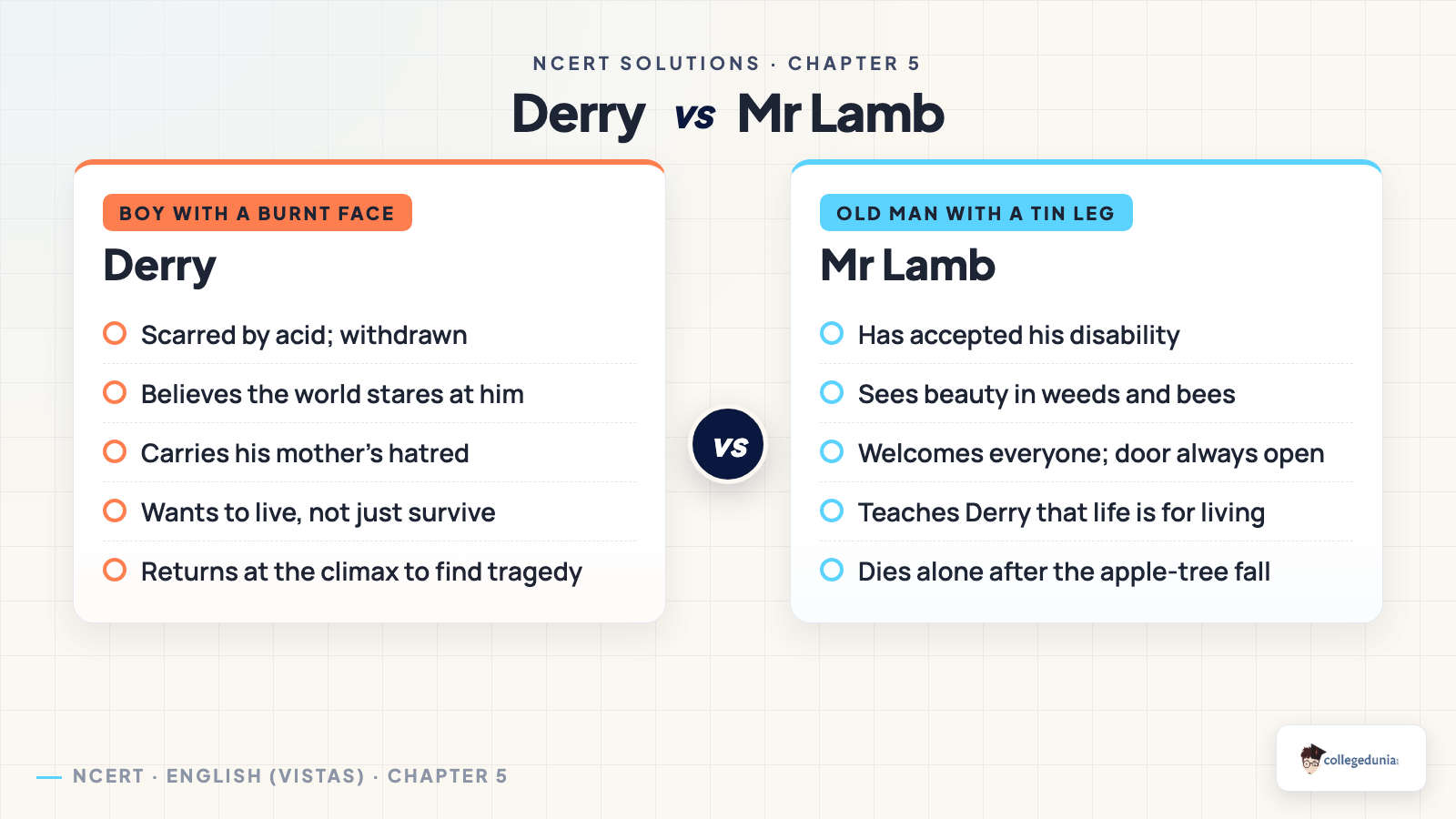
Derry is drawn to Mr Lamb because the old man refuses every script the world has used on the boy. Mr Lamb does not pity (no "poor boy"), does not avoid the burnt face (he asks "you got burned in a fire" straightforwardly), and does not offer false reassurance ("It's not what you look like, it's what you are inside" is the line Derry calls "that fairy story"). Instead Mr Lamb treats his own tin leg as ordinary, redirects Derry's attention to crab apples, weeds and sun-flowers, and listens. The full Long Answer in the PDF walks six anchors: honesty, refusal of pity, normalising the disability, the larger world of the garden, real listening, and the mirror of Mr Lamb's own loneliness.
Lines to quote in your exam answer: "Bees singing. Him talking... Things nobody else has ever said." "Where's the difference?" "It's got nothing to do with my face... I'm going back there." Three lines, three full marks.
Q2 Answer Skeleton: Mr Lamb's Loneliness and How He Overcomes It
Mr Lamb's loneliness surfaces most clearly in the long stretch of Scene One after Derry has agreed to stay. The full Long Answer in the PDF locates five evidence-points: the always-open garden gate, the curtain-less house, the everybody-is-my-friend evasion, the dictionary-and-encyclopaedia reading list, and the disappointed "Come back. I'll be here" when Derry runs out. To overcome these feelings Mr Lamb keeps the garden open without conditions, fixes his attention on bees, sun-flowers, weeds and crab apples, reads widely, absorbs the cruel "Lamey-Lamb" nickname without bitterness, and refuses self-pity about the tin leg.
Examiner trap to avoid: Do not say "Mr Lamb is not really lonely because he says the whole world is his friend." That line is precisely the evidence of loneliness - widening the word "friend" until it has no specific content is the giveaway. Read the line against its surface meaning.
Q3 Answer Skeleton: Disability, Alienation and the Behaviour the Person Expects
This is the value-based slot. The statement separates two kinds of suffering - physical pain (small) and social alienation (large). The full Long Answer in the PDF lists seven kinds of behaviour the person with a disability hopes for: ordinary address rather than staring, honest questions rather than avoidance, refusal of pity (the word "poor" is what Derry hates most), no false reassurance ("It's not what you look like" is the line Derry calls a fairy story), inclusion in ordinary tasks (Mr Lamb's "you could give me a hand" is the practical form of acceptance), patience without surveillance, and treating the disability as one feature among many. The answer closes by returning to the play - Derry comes back because Mr Lamb has met him on these terms.
Q4 Answer Skeleton: Will Derry Get Back to His Old Seclusion?
Q4 is the open-ending question. The full Long Answer in the PDF weighs the evidence on both sides. For change: Derry has defied his mother, climbed the wall a second time, named his own need ("If I don't go back there, I'll never go anywhere in this world again"), shifted his language from they/nobody/never to I want/I think/I feel, seen the model of a disabled adult who lives a curious life, and runs towards Mr Lamb's body rather than away. Against change: the supporting adult has fallen silent, the children who taunt Lamey-Lamb will go on taunting Derry, and the prejudiced world outside the garden is unchanged. The PDF lands on a clear position - the change has begun but is not finished. The old seclusion is unlikely to return in its earlier total form, but the new openness will need slow, deliberate work to survive without Mr Lamb's company.
Common Mistakes Students Make in On the Face of It Long Answers
Reading Q1 as simple gratitude ("Mr Lamb is kind to Derry"). The play insists the friendship is built on a refusal of pity, not on its supply.
Missing the evidence-points for Mr Lamb's loneliness in Scene One (open gate, curtain-less house, dictionary reading, "I'll be here") and writing only about his cheerful surface.
Treating disability questions as generic value points; the answer must return to specific lines and stage directions from the play.
Picking one side of the Q4 open-ending and ignoring the other; CBSE markers reward weighing evidence both ways before landing.
Confusing the play's location - Mr Lamb's garden is the setting for Scenes One and Three; Derry's house is the setting for Scene Two.
Forgetting to quote at least one stage direction (the ladder crash, Derry's weeping) in the Q4 answer; stage directions are often where the play's argument is hidden.
Reading "Lamey-Lamb" as a friendly nickname rather than the cruel children's name Mr Lamb has chosen to absorb.
CBSE Class 12 English Previous Year Question Mapping for On the Face of It
Year-wise CBSE Vistas long-answer focus areas for On the Face of It. The 6-mark Long Answer slot rotates predictably between Q1 (Derry's motivation), Q3 (disability and alienation) and Q4 (the open ending).
Year
Long Answer Focus
Marks
2025
What draws Derry towards Mr Lamb in spite of himself (Q1)
6
2024
Pain vs alienation in disability; the behaviour the person expects (Q3)
6
2023
Mr Lamb's loneliness and the ways he overcomes it (Q2)
6
2022
Will Derry get back to his old seclusion? Open-ending question (Q4)
6
2021
Susan Hill's central message on disability and friendship
How Collegedunia's NCERT Solutions Help You Score in On the Face of It
Every Long Answer opens with a one-line position statement followed by four to six text-grounded anchors - the exact shape a 6-mark CBSE Section C answer is graded against.
Every answer is paired with an Expert's Solution that gives the alternate reading (radio-play tradition, social model of disability, late-twentieth-century English drama) so you walk into the exam with two ways to answer each question.
Specific lines (``Bees singing. Him talking'', ``Where's the difference?''), specific objects (crab apples, tin leg, sun-flowers), specific stage directions (the ladder crash, Derry's weeping) are highlighted - these are the precise textual anchors that markers look for.
Each answer carries one to two sticky-note callouts - the examiner trap, the line to memorise, the value-point to add.
The four answers together build a complete chapter-level mental map so you can answer any unseen variation in the exam.
Related Resources for Class 12 English Vistas Chapter 5
All NCERT Solutions for On the Face of It with Step-by-Step Working
Every NCERT textbook question for Class 12 English (Vistas) Chapter 5 On the Face of It is listed below with its full Solution and Expert Solution hidden inside collapsible tabs. Click Check Solution to reveal the step-by-step working; click Expert Solution for the expanded explanation.
Reading with Insight
Q 5.1
What is it that draws Derry towards Mr Lamb inspite of himself?
Several small things, taken together, draw Derry back to Mr
Lamb's garden against his own habit of running away from
people. The play is careful to show that the pull is not one
sentimental moment; it is a steady accumulation of differences
between Mr Lamb and everyone else Derry has met.
Lines from the play
``It's got nothing to do with my face and what I look like. I
don't care about that and it isn't important. It's what I think
and feel and what I want to see and find out and hear. And I'm
going back there.''
Mr Lamb does not pretend. The other adults in
Derry's life either avoid his face or look at it with
pity. Mr Lamb, on the contrary, asks ``you got burned in
a fire'' straightforwardly. Derry corrects him (``acid
all down that side of my face''), but the very fact that
the old man asks is a relief. Honesty, in a play full of
polite avoidance, is a magnet.
Mr Lamb refuses the ``poor boy'' script. Derry
knows the script by heart: Here's a boy. Poor boy.
Mr Lamb breaks the script in the opening minute. ``Mind
the apples,'' is his first line. He treats Derry as
somebody who might step on a windfall, not as a wound on
legs.
Mr Lamb makes disability ordinary. ``I've got a
tin leg. Not important. You're standing there.... I'm
sitting here. Where's the difference?'' By placing his
own missing leg next to Derry's burnt face, Mr Lamb
normalises both. Derry has never had his condition
treated as ordinary before, and the ease of it is hard to
leave behind.
Mr Lamb makes the world larger. The garden is
full of crab apples, weeds, sun-flowers, bees, a spider
on its silken ladder. Mr Lamb keeps directing Derry's
attention outwards. For a boy who has been spending his
time looking inwards at his own scar, that outward turn
is a quiet rescue.
Mr Lamb listens. ``Bees singing. Him talking.
Things that matter. Things nobody else has ever
said,'' Derry tells his mother. Most people speak
at Derry; Mr Lamb speaks with him. The
difference is the whole reason for the play.
Mr Lamb's loneliness is a mirror. Mr Lamb's
house has no curtains; he leaves the gate open; he calls
every visitor ``a friend''. Derry senses, even if he
does not say so, that Mr Lamb is as alone behind his
garden wall as Derry is behind his face. Two solitudes
recognise each other.
Derry is drawn to Mr Lamb because Mr Lamb refuses to
play the script the rest of the world plays around him: he
neither pities Derry nor avoids the burnt face, he treats his
own tin leg as ordinary, and he keeps redirecting Derry's
attention to crab apples, weeds and sun-flowers rather than to
the scar. Honesty, ordinariness, and the chance to be listened
to draw the boy back, even though he tells himself he hates
being with people.
DA
Dr Ananya Iyer
PhD English Literature, Jawaharlal Nehru University
Verified Expert
Strategic angle. Susan Hill is writing in the late
radio-play tradition: short scenes, voices only, a single
controlling image (in this case, the garden). Read the play as
two adjacent loneliness studies (the disfigured adolescent and
the lame old man) rather than a feel-good cross-generational
friendship, and Derry's pull towards Mr Lamb becomes both more
specific and more credible.
Hill withholds Mr Lamb's full back-story on purpose. We
get only ``Real one got blown off, years back''; we
never learn how the leg went, whether there was a wife,
why the windows have no curtains beyond ``I'm not fond
of curtains. Shutting things off.'' The blankness
is the point: Mr Lamb is the kind of adult whose lack
of a settled story leaves room for the boy.
Notice how often Mr Lamb counters Derry's certainties
with questions. ``Why is one green, growing plant called
a weed and another `flower'?'' ``Where's the difference?''
Derry has spent his life in the territory of fixed
judgements about his face. Mr Lamb keeps unsettling those
judgements without preaching.
The garden is selected as a setting because it is full of
ordinary, irreducible particulars: bees, sun-flowers,
crab apples, a tin leg, a spider on its silken ladder. A
character convinced that the world has narrowed to one
scar can only be answered by a long, slow inventory of
other things. The garden is that inventory.
Mr Lamb's stock of proverbs and quotations (``Beauty and
the beast'', ``Handsome is as handsome does'') is
deliberately the stock that has already been used against
Derry. The old man knows these lines have failed; he
offers them back as the questions they really are, not
the consolations the world tries to make them.
The single most magnetic thing about Mr Lamb is the
equation ``Crab apples or the weeds or a spider or
my tall sun-flowers'' and ``Like my face''. He
places Derry's face inside a list of ordinary marvels.
Derry has never been allowed to belong to such a list
before. That is what makes him climb the wall a second
time.
Why this matters. The play would not work if Mr Lamb
were simply kind. The friendship is built on a refusal of pity,
not on its supply. Read in that light, Derry's return at the end
of the play is not a sentimental rescue; it is the only honest
move available to a boy who has finally been spoken to as an
equal.
What draws Derry to Mr Lamb is Mr Lamb's refusal of
all the scripts the world has used on the boy: pity,
avoidance, false reassurance. In their place Mr Lamb offers
honesty (``you got burned in a fire''), ordinariness (the tin
leg), genuine questions (``where's the difference?'') and a
garden full of small particulars that crowd out the scar. The
old man's own quiet loneliness is the second magnet, the one
the play does not state but lets the audience feel.
Q 5.2
In which section of the play does Mr Lamb display signs of loneliness and disappointment? What are the ways in which Mr Lamb tries to overcome these feelings?
Mr Lamb's loneliness surfaces most clearly in the first scene of
the play, in the long stretch after Derry has agreed to stay and
the conversation has loosened. The play does not let Mr Lamb
weep or complain; the loneliness shows in small details that the
careful reader notices.
Lines from the play
``The gate's always open. I sit here. I like sitting.'' [2pt]
Derry: ``Do you have any friends?'' Mr Lamb:
``Hundreds.'' ``Friends everywhere. People come
in everybody knows me. The gate's always open.'' [2pt]
``Sit in the sun. Read books. you thought it was an
empty house, but inside, it's full. Books and other things.
Full.''
The open gate. Mr Lamb leaves the garden gate
permanently unlocked and the house has no curtains. He
is not protecting privacy; he is hoping for company.
The architectural detail is the loneliness.
The whole-world-is-my-friend dodge. When Derry
asks ``Do you have any friends?'' Mr Lamb answers
``Hundreds.'' He then widens the word until it is
meaningless: ``Friends everywhere. People come in
everybody knows me.'' Kids who come for the apples are
friends; the postman is a friend. The widening is the
giveaway. He has no one in particular.
The list of small tasks. Mr Lamb fills his
afternoons by sitting in the sun and reading books,
picking crab apples and making jelly, listening to bees.
The life is full of small busy-ness precisely because
there is no one waiting at the kitchen table.
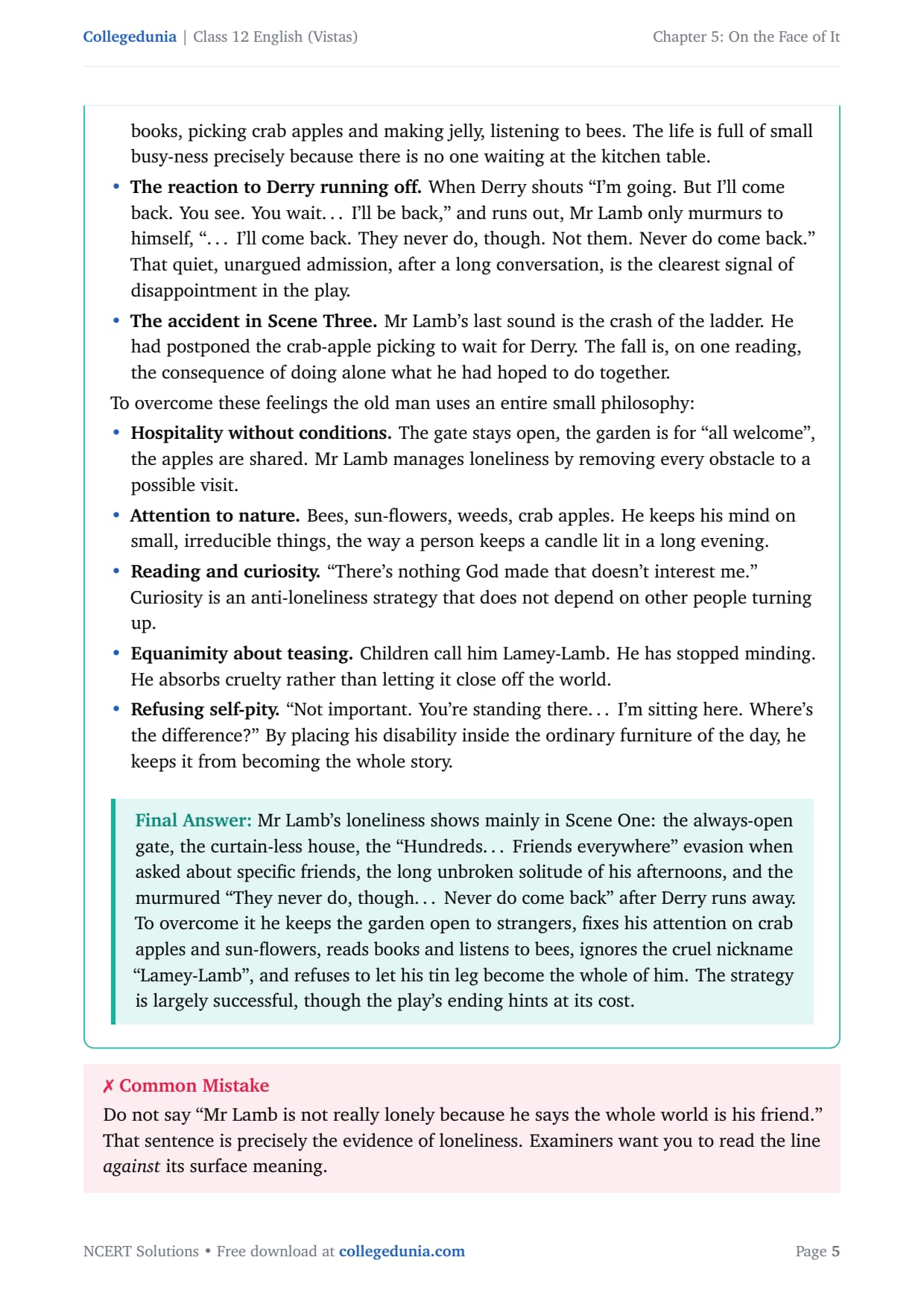
The reaction to Derry running off. When Derry
shouts ``I'm going. But I'll come back. You see. You
wait I'll be back,'' and runs out, Mr Lamb only
murmurs to himself, `` I'll come back. They never
do, though. Not them. Never do come back.'' That quiet,
unargued admission, after a long conversation, is the
clearest signal of disappointment in the play.
The accident in Scene Three. Mr Lamb's last
sound is the crash of the ladder. He had postponed the
crab-apple picking to wait for Derry. The fall is, on
one reading, the consequence of doing alone what he had
hoped to do together.
To overcome these feelings the old man uses an entire small
philosophy:
Hospitality without conditions. The gate stays
open, the garden is for ``all welcome'', the apples are
shared. Mr Lamb manages loneliness by removing every
obstacle to a possible visit.
Attention to nature. Bees, sun-flowers, weeds,
crab apples. He keeps his mind on small, irreducible
things, the way a person keeps a candle lit in a long
evening.
Reading and curiosity. ``There's nothing God
made that doesn't interest me.'' Curiosity is an
anti-loneliness strategy that does not depend on other
people turning up.
Equanimity about teasing. Children call him
Lamey-Lamb. He has stopped minding. He absorbs cruelty
rather than letting it close off the world.
Refusing self-pity. ``Not important. You're
standing there I'm sitting here. Where's the
difference?'' By placing his disability inside the
ordinary furniture of the day, he keeps it from
becoming the whole story.
Mr Lamb's loneliness shows mainly in Scene One: the
always-open gate, the curtain-less house, the
``Hundreds Friends everywhere'' evasion when asked
about specific friends, the long unbroken solitude of his
afternoons, and the murmured ``They never do, though
Never do come back'' after Derry runs away. To overcome it he
keeps the garden open to strangers, fixes his attention on
crab apples and sun-flowers, reads books and listens to bees,
ignores the cruel nickname ``Lamey-Lamb'', and refuses to let
his tin leg become the whole of him. The strategy is largely
successful, though the play's ending hints at its cost.
MA
Mr Arjun Mehta
MA English, University of Delhi
Verified Expert
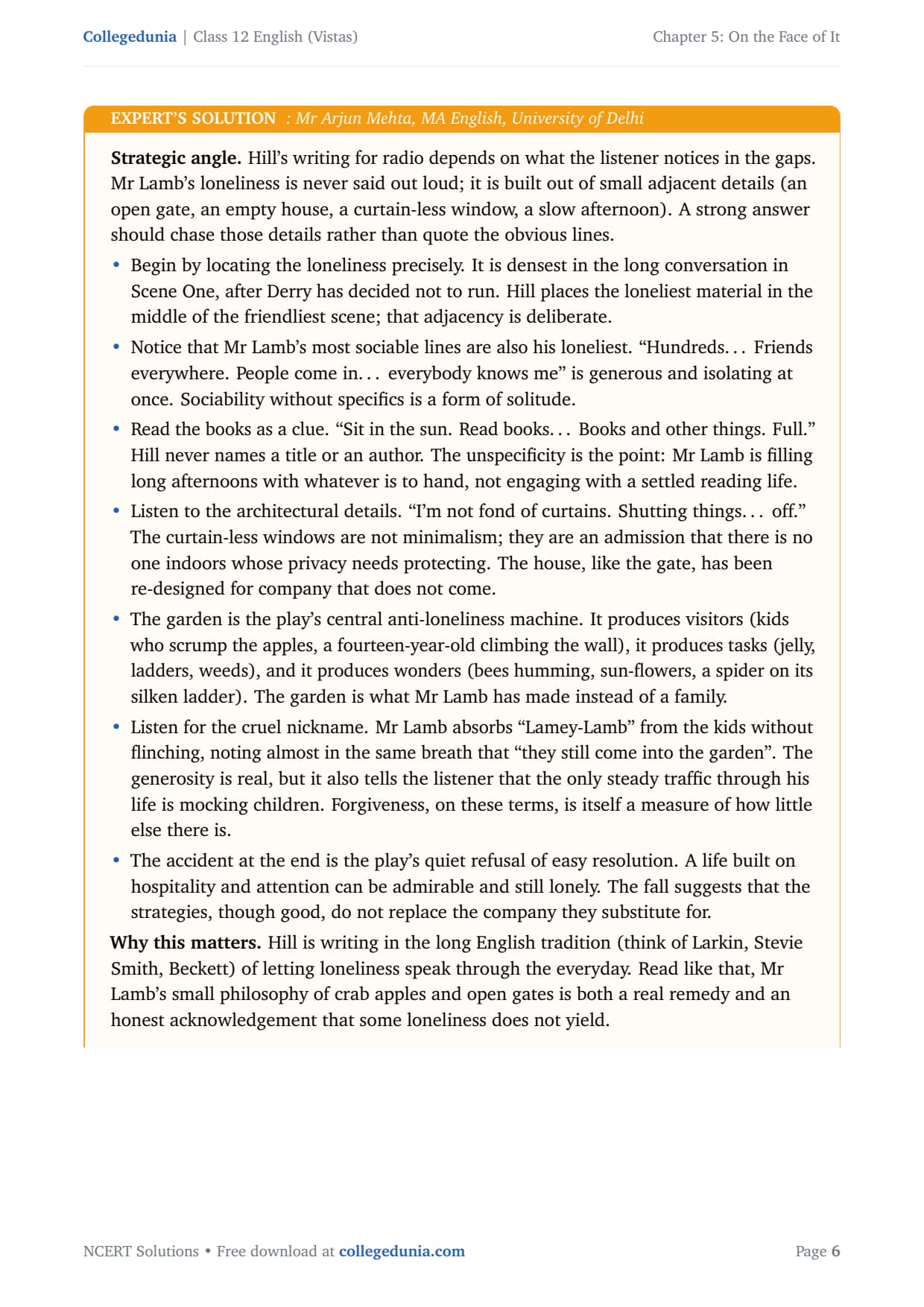
Strategic angle. Hill's writing for radio depends on
what the listener notices in the gaps. Mr Lamb's loneliness is
never said out loud; it is built out of small adjacent details
(an open gate, an empty house, a curtain-less window, a slow
afternoon). A strong answer should chase those details rather
than quote the obvious lines.
Begin by locating the loneliness precisely. It is
densest in the long conversation in Scene One, after
Derry has decided not to run. Hill places the loneliest
material in the middle of the friendliest scene; that
adjacency is deliberate.
Notice that Mr Lamb's most sociable lines are also his
loneliest. ``Hundreds Friends everywhere. People
come in everybody knows me'' is generous and
isolating at once. Sociability without specifics is a
form of solitude.
Read the books as a clue. ``Sit in the sun. Read
books Books and other things. Full.'' Hill never
names a title or an author. The unspecificity is the
point: Mr Lamb is filling long afternoons with whatever
is to hand, not engaging with a settled reading life.
Listen to the architectural details. ``I'm not fond of
curtains. Shutting things off.'' The curtain-less
windows are not minimalism; they are an admission that
there is no one indoors whose privacy needs protecting.
The house, like the gate, has been re-designed for
company that does not come.
The garden is the play's central anti-loneliness
machine. It produces visitors (kids who scrump the
apples, a fourteen-year-old climbing the wall), it
produces tasks (jelly, ladders, weeds), and it produces
wonders (bees humming, sun-flowers, a spider on its
silken ladder). The garden is what Mr Lamb has made
instead of a family.
Listen for the cruel nickname. Mr Lamb absorbs
``Lamey-Lamb'' from the kids without flinching, noting
almost in the same breath that ``they still come into the
garden''. The generosity is real, but it also tells the
listener that the only steady traffic through his life is
mocking children. Forgiveness, on these terms, is itself
a measure of how little else there is.
The accident at the end is the play's quiet refusal of
easy resolution. A life built on hospitality and
attention can be admirable and still lonely. The fall
suggests that the strategies, though good, do not
replace the company they substitute for.
Why this matters. Hill is writing in the long English
tradition (think of Larkin, Stevie Smith, Beckett) of letting
loneliness speak through the everyday. Read like that, Mr Lamb's
small philosophy of crab apples and open gates is both a real
remedy and an honest acknowledgement that some loneliness does
not yield.
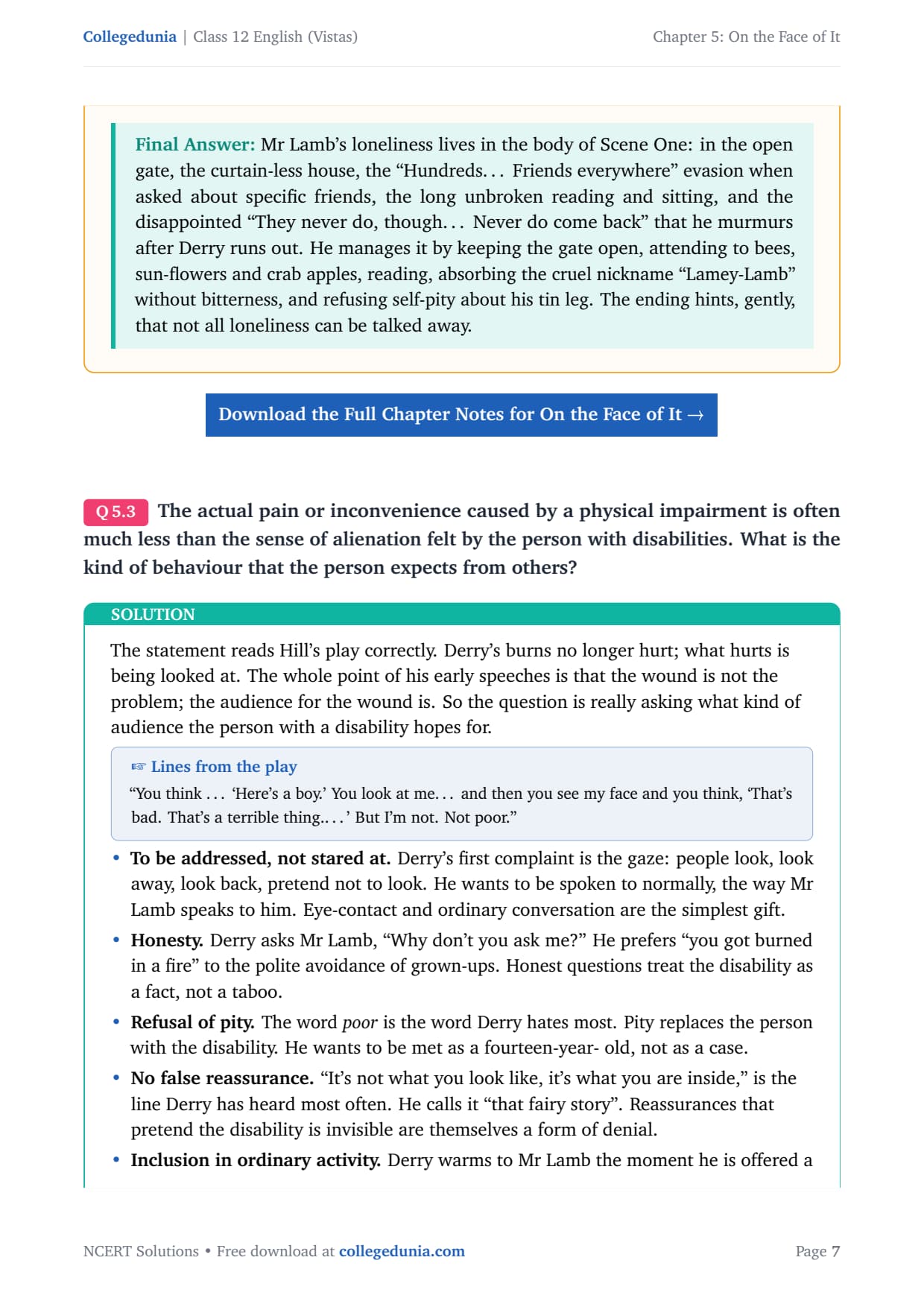
Mr Lamb's loneliness lives in the body of Scene One:
in the open gate, the curtain-less house, the
``Hundreds Friends everywhere'' evasion when asked
about specific friends, the long unbroken reading and sitting,
and the disappointed ``They never do, though Never do
come back'' that he murmurs after Derry runs out. He manages
it by keeping the gate open, attending to bees, sun-flowers
and crab apples, reading, absorbing the cruel nickname
``Lamey-Lamb'' without bitterness, and refusing self-pity
about his tin leg. The ending hints, gently, that not all
loneliness can be talked away.
Q 5.3
The actual pain or inconvenience caused by a physical impairment is often much less than the sense of alienation felt by the person with disabilities. What is the kind of behaviour that the person expects from others?
The statement reads Hill's play correctly. Derry's burns no
longer hurt; what hurts is being looked at. The whole point of
his early speeches is that the wound is not the problem; the
audience for the wound is. So the question is really asking what
kind of audience the person with a disability hopes for.
Lines from the play
``You think `Here's a boy.' You look at me and
then you see my face and you think, `That's bad. That's a
terrible thing.' But I'm not. Not poor.''
To be addressed, not stared at. Derry's first
complaint is the gaze: people look, look away, look
back, pretend not to look. He wants to be spoken to
normally, the way Mr Lamb speaks to him. Eye-contact
and ordinary conversation are the simplest gift.
Honesty. Derry asks Mr Lamb, ``Why don't you
ask me?'' He prefers ``you got burned in a fire'' to
the polite avoidance of grown-ups. Honest questions
treat the disability as a fact, not a taboo.
Refusal of pity. The word poor is the
word Derry hates most. Pity replaces the person with
the disability. He wants to be met as a fourteen-year-
old, not as a case.
No false reassurance. ``It's not what you look
like, it's what you are inside,'' is the line Derry has
heard most often. He calls it ``that fairy story''.
Reassurances that pretend the disability is invisible
are themselves a form of denial.
Inclusion in ordinary activity. Derry warms to
Mr Lamb the moment he is offered a task: ``You could
give me a hand,'' Mr Lamb says about the crab apples.
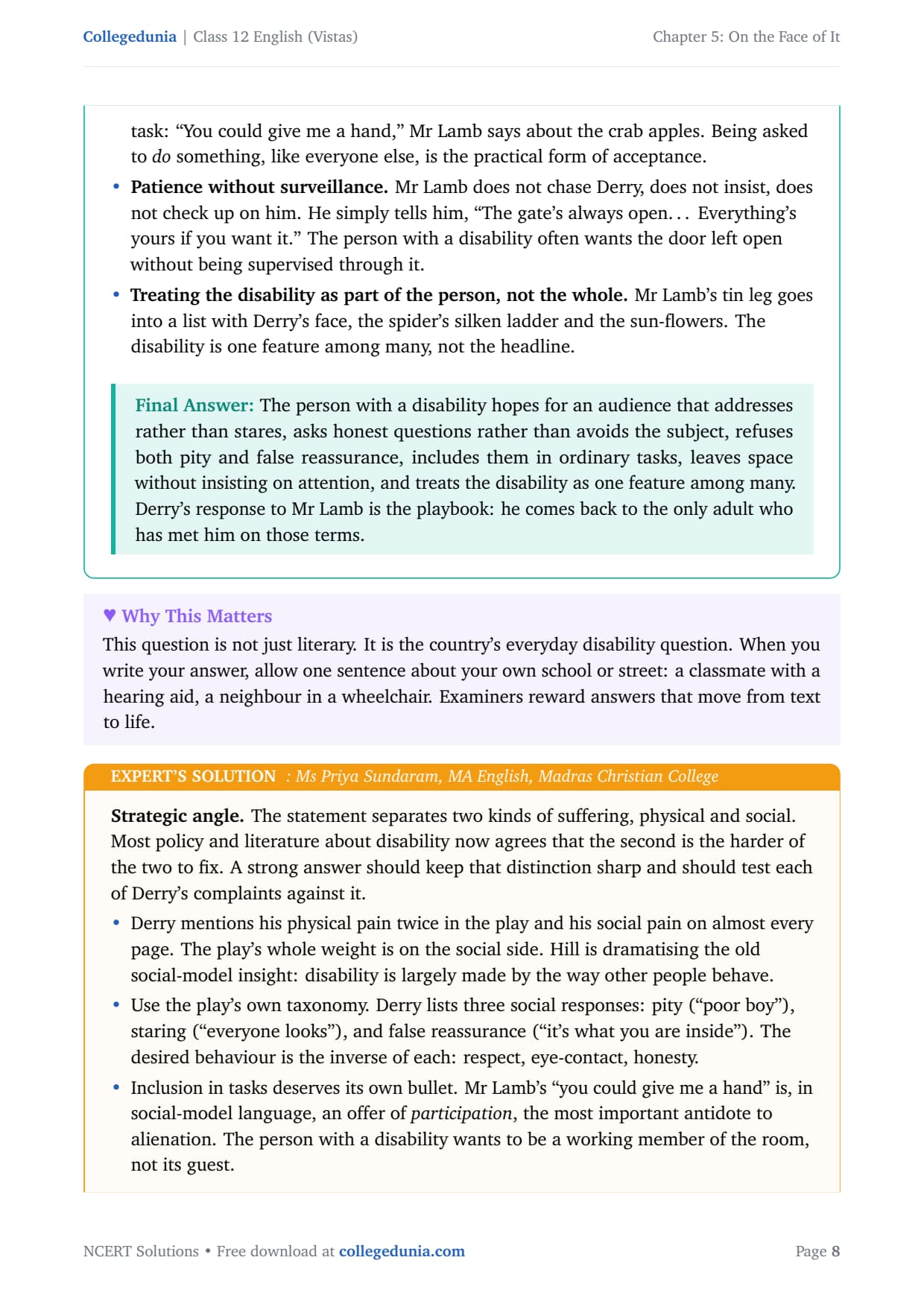
Being asked to do something, like everyone else,
is the practical form of acceptance.
Patience without surveillance. Mr Lamb does
not chase Derry, does not insist, does not check up on
him. He simply tells him, ``The gate's always open
Everything's yours if you want it.'' The person with a
disability often wants the door left open without
being supervised through it.
Treating the disability as part of the person,
not the whole. Mr Lamb's tin leg goes into a list with
Derry's face, the spider's silken ladder and the
sun-flowers. The disability is one feature among many,
not the headline.
The person with a disability hopes for an audience
that addresses rather than stares, asks honest questions
rather than avoids the subject, refuses both pity and false
reassurance, includes them in ordinary tasks, leaves space
without insisting on attention, and treats the disability as
one feature among many. Derry's response to Mr Lamb is the
playbook: he comes back to the only adult who has met him on
those terms.
MP
Ms Priya Sundaram
MA English, Madras Christian College
Verified Expert
Strategic angle. The statement separates two kinds of
suffering, physical and social. Most policy and literature about
disability now agrees that the second is the harder of the two
to fix. A strong answer should keep that distinction sharp and
should test each of Derry's complaints against it.
Derry mentions his physical pain twice in the play and
his social pain on almost every page. The play's whole
weight is on the social side. Hill is dramatising the
old social-model insight: disability is largely made by
the way other people behave.
Use the play's own taxonomy. Derry lists three social
responses: pity (``poor boy''), staring (``everyone
looks''), and false reassurance (``it's what you are
inside''). The desired behaviour is the inverse of each:
respect, eye-contact, honesty.
Inclusion in tasks deserves its own bullet. Mr Lamb's
``you could give me a hand'' is, in social-model
language, an offer of participation, the most
important antidote to alienation. The person with a
disability wants to be a working member of the room,
not its guest.
Patience is the second under-rated behaviour. The play
models it carefully: Mr Lamb does not chase Derry, does
not lecture him, does not call his mother. He waits.
Waiting respects the person's pace.
Close on the language point. Words such as poor,
terrible, ugly, however well-intended, do real harm.
The desired vocabulary is the one Mr Lamb uses:
boy, friend, where's the difference, you could
give me a hand. The disability question is partly a
question of which sentences we choose.
Why this matters. The disability rights movement has
spent decades making the point Susan Hill made in a short play:
the wound heals; the looks do not. A school answer that catches
that idea is doing more than literature; it is shaping a
slightly kinder reader.
The person with a disability expects ordinary address
rather than staring, honest questions rather than avoidance,
neither pity nor false reassurance, inclusion in shared work,
patience that leaves room without surveillance, and a vocabulary
that names them as a person first. The play offers Mr Lamb's
behaviour with Derry as the model for almost every point on
this list.
Q 5.4
Will Derry get back to his old seclusion or will Mr Lamb's brief association effect a change in the kind of life he will lead in the future?
The play does not finish the answer. It ends with Mr Lamb's
fall, Derry on his knees in the long grass, and the curtain on
``Lamey-Lamb. I did come back.'' The reader is left to
weigh the evidence on both sides; the honest answer is a
qualified yes, but slowly.
Derry's last visit, summarised
Scene Two: ``I'm going back there. Only to help him
with the crab apples. Only to look at things and listen. But
I'm going.'' Scene Three: ``You see, you see! I came back. You
said I wouldn't and they said but I came back''
Evidence for change. Derry's decision to come
back is the play's most important fact. He has defied
his mother, climbed the garden wall a second time, and
spoken the only complete sentence of self-assertion in
the play (``If I don't go back there, I'll never go
anywhere in this world again''). A boy who has named
that need has already begun to change.
The language has shifted. The first half of
Derry's speech is full of they, nobody,
never. By the time he leaves his mother's house
he is speaking in I want, I think, I feel. Self-
report has replaced self-pity.
The mother's veto has been refused. Derry's
scene with his mother is the small revolution. To go
back to Mr Lamb against his mother's instruction is to
do, for the first time, something that the world says
he cannot do because of his face. That refusal is
habit-forming.
The model has been seen. Mr Lamb is the proof
that a person with a visible disability can live a full,
curious, kind, hospitable life. Once Derry has seen the
model he has the option of trying it on, even after the
old man is gone.
Counter-evidence: the fall. The model dies (or
at least falls silent) at the end of the play. Derry's
most important source of encouragement is suddenly
removed. A change that depended only on one friendly
adult would now collapse.
Counter-evidence: the world is unchanged. The
children who taunted Mr Lamb (``Lamey-Lamb'') will go
on taunting Derry. The mother will still kiss him on
the other side of his face. The conditions that produced
his withdrawal are still in place.
The play, on balance, suggests that the change has begun but is
not finished. The visible step is the return to the garden; the
invisible step is the slow rearrangement of Derry's idea of
himself, which the play does not have time to show. Hill is too
careful a writer to promise a cure. She has shown an opening; the
reader is asked to imagine the future on that basis.
The play leaves the future open, but the weight of
the evidence is that Mr Lamb's brief association has shifted
Derry permanently. He has defied his mother, named his own
need, climbed the wall a second time, and seen the model of a
disabled adult who lives a full and curious life. The accident
that ends the play removes Derry's main support, and the
prejudiced world outside the garden is unchanged; the work of
keeping the shift alive will be slow and largely his own. The
old seclusion is unlikely to return in its earlier, total form,
but the new openness will need to survive without Mr Lamb's
company.
DK
Dr Kavya Reddy
PhD British Drama, University of Hyderabad
Verified Expert
Strategic angle. The radio play is built to leave the
listener with a question, not an answer. Treat the open ending
as the answer's frame, not its frustration. The best response
weighs the evidence both ways and lands on a careful, partial
yes.
Hill's last stage direction is precise: ``Derry begins
to weep.'' The weeping is the play's clearest signal
that something has moved in him. Derry has been described
as defiant, angry, withdrawn; he has not been described
as crying. The weeping is new, and new emotions are the
sign of a shifted self.
Note the small grammatical change in Derry's last
speech: he speaks to Mr Lamb, not about him. ``You said
I wouldn't but I came back.'' That second person
is a relational sentence; Derry is now a boy in a
conversation, not a boy in a soliloquy. Hill is showing
the conversion under the surface of grief.
The fall is not just plot. It is a small, hard image of
what change costs. The old life of seclusion was easier;
any return to it would also be easier. The fact that
Derry runs towards the body, not away from it,
is the play's quiet promise about which direction the
boy is now facing.
Hill is writing in the tradition of late-twentieth-
century English realism. She does not believe in
miracle cures; she believes in small, recoverable
openings. Derry's future, on her terms, will be a long
series of choices, each small and each made against the
old pull of withdrawal.
Close on the model. Mr Lamb has given Derry a
vocabulary (crab apples, weeds, where's the
difference) more than a personal friendship. Even after
the old man is gone the vocabulary survives. Words can
outlast their speaker; the play's final wager is on the
durability of Mr Lamb's words inside Derry's head.
Why this matters. The play would be sentimental if it
ended with Derry rescued and happy. It would be cynical if it
ended with Derry rejoining the world unchanged. Hill chooses the
middle, which is the realistic place. Real lives are changed by
brief encounters, but slowly, and at cost; that is the play's
honest report on what an afternoon in a garden can do.
Mr Lamb's brief association has effected a real but
unfinished change. Derry has defied his mother, named his own
need, returned to the garden a second time, and reached for the
old man's body rather than running away. The change will have
to survive the fall, the world outside the gate, and the long
years ahead, and it will do so only by holding on to the
vocabulary Mr Lamb has handed him. The old seclusion is unlikely
to return in its old completeness; the new openness will need
constant, deliberate work.
NCERT Solutions for Class 12 English Vistas: All Chapters
FAQs on On the Face of It Class 12 NCERT Solutions
FAQs on On the Face of It Class 12 NCERT Solutions
Who is the author of On the Face of It Class 12 Vistas?
On the Face of It is written by Susan Hill (born 1942), a British novelist and playwright. The chapter is a one-act radio play originally written for the BBC in the 1970s, included in the NCERT Class 12 Vistas reader. Hill is also the author of the novel The Woman in Black.
How does Derry get into Mr Lamb's garden?
Derry climbs the garden wall, thinking the house is empty. Mr Lamb is sitting in the garden and warns him "Mind the apples" - referring to the windfall crab apples lying in the long grass. The garden gate is always open, but Derry has climbed the wall because he expected the place to be deserted.
How did Derry's face get disfigured?
Derry tells Mr Lamb that acid was spilled on the side of his face and burned it away. In his own words, "I got acid all down that side of my face and it burned it all away. It ate my face up." The play does not give the back-story of how the accident happened; it focuses on the social consequences of the disfigurement.
What is the significance of Mr Lamb's tin leg?
Mr Lamb lost his real leg in a wartime explosion. He calls himself Lamey-Lamb, the cruel nickname children give him. The tin leg matters because it lets Mr Lamb place his own disability beside Derry's burnt face and ask "Where's the difference?" - normalising both. Mr Lamb's untroubled relationship to his own disability is the model Derry needs.
What is the central message of On the Face of It?
The central message is that the social pain of a visible disability (alienation, staring, pity, false reassurance) is often greater than the physical pain itself. The play argues that the person with a disability needs honest address, inclusion in ordinary tasks, and refusal of both pity and false reassurance. Mr Lamb's treatment of Derry is the model.
How many questions are in Reading with Insight for On the Face of It?
There are four Reading with Insight questions at the end of Chapter 5 On the Face of It in the Class 12 Vistas textbook. All four are answered in this NCERT Solutions PDF with text-grounded long answers and Expert's Solution alternates.






Comments