English Strategist, 9 Yrs | Updated on - Jul 21, 2026
These Journey to the End of the Earth Class 12 NCERT Solutions answer every Reading with Insight question for Vistas Chapter 3 with text-grounded long answers from Tishani Doshi's essay. Each answer is built as a 6-mark Long Answer with the quotations, dates and ecological cascades CBSE markers reward in Section C. The solutions follow the 2026-27 NCERT reprint.
CBSE Weightage:6 marks per Vistas Long Answer in Section C, drawn from the four Reading with Insight questions
Coverage: 4 Reading with Insight answers, 4 Expert's Solution alternates, text-grounded long answers on Gondwana, Students on Ice, phytoplankton and the past-present-future cluster
These Collegedunia solutions are written by senior English educators, mapped to the 2026-27 NCERT Vistas textbook, and refined against the last five years of CBSE Class 12 English Core Board papers.
Journey to the End of the Earth Class 12 NCERT Solutions: Chapter Snapshot
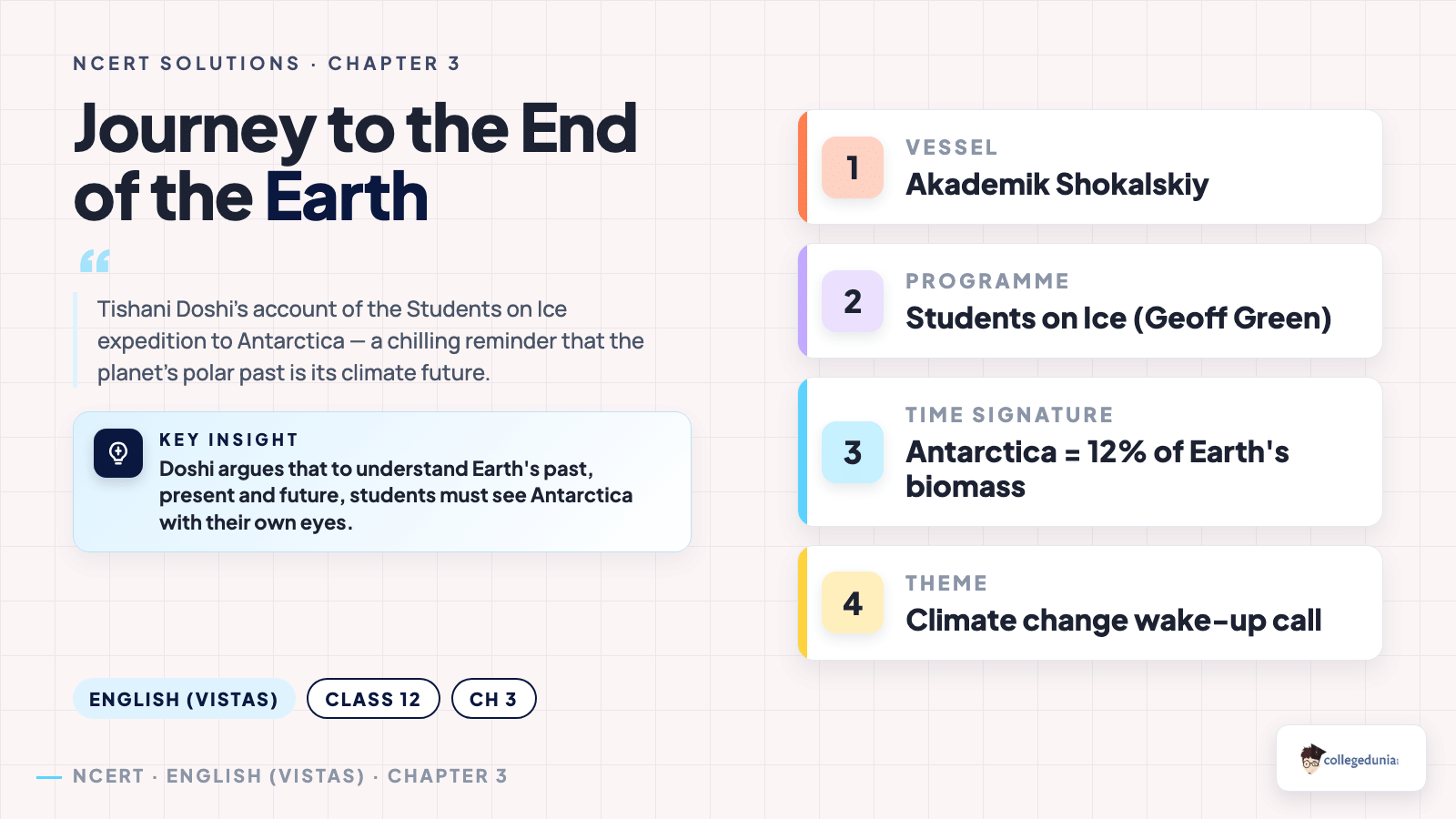
Journey to the End of the Earth is the third piece in the Class 12 Vistas reader, by the Indian poet and journalist Tishani Doshi (born 1975). She travels aboard the Russian vessel Akademik Shokalskiy to Antarctica on a Students on Ice expedition led by the Canadian Geoff Green. The essay's three sub-headings carry the planet's past (Gondwana), present (ice-core carbon records) and future (the ozone-phytoplankton chain). The four Reading with Insight questions test deep time, the Students on Ice rationale, the phytoplankton parable and the past-present-future synthesis.
Question
What It Tests
Typical Mark Yield
Q1 - Antarctica as a window into the geological past
Deep time; Gondwana, granite shields, Indian-plate drift
6
Q2 - Geoff Green's reasons for taking high-schoolers
Education as activism; absorb, learn, act
6
Q3 - "Take care of the small things"
Ozone-phytoplankton-food-chain cascade; Montreal Protocol
CBSE almost always pulls a single 6-mark Long Answer from Vistas in Section C. Q3 (phytoplankton) and Q4 (past-present-future) are the most frequent; Q1 and Q2 often appear as short answers.
Journey to the End of the Earth Video Explanation (Class 12 English)
Every Reading with Insight question is answered in two passes, the way a CBSE examiner expects a top-band Vistas answer to be built.
Long Answer: opens with a one-line position, quotes the essay ("a paltry 12,000 years", "everything does indeed connect"), then walks four to six points with specific latitudes, dates and ecological steps.
Expert's Solution: adds the science context (the Drake Passage, the half-million-year carbon record) and the policy translation (Montreal Protocol 1987).
Callouts: short sticky-notes flag the examiner trap, the phrase to quote and the key data point.
Q1 Answer Skeleton: Antarctica as a Window into the Geological Past
Yes. The full Long Answer walks four anchors: the Gondwana supercontinent (650 million years ago, warmer, rich in flora and fauna), the Drake Passage opening that chilled Antarctica, the granite shields that survive as readable rock, and the half-million-year carbon records preserved in the ice.
Lines to quote: "Six hundred and fifty million years ago... Gondwana did indeed exist." "A paltry 12,000 years - barely a few seconds on the geological clock." "Half-million-year-old carbon records trapped in its layers of ice." Three lines, three marks.
Q2 Answer Skeleton: Geoff Green's Reasons for Taking High-Schoolers
Geoff Green founded Students on Ice after years of taking celebrities and tourists who could only "give back in a limited way". The Long Answer gives four reasons for choosing high-schoolers: they are the future policy-makers, they are ready to absorb, learn and act, the ice pack teaches what no textbook can, and the cost is repaid in lifetime advocacy.
Examiner trap: Do not write that Green takes "students of all ages". He chose high-school students. Quote the phrase "absorb, learn, and most importantly, act" to lock the mark.
Q3 Answer Skeleton: "Take Care of the Small Things" in the Antarctic Context
This is the value-based slot and the most-tested Long Answer in the chapter. It reads the line through Doshi's phytoplankton parable: the small things are not seals or penguins but the ozone layer, single-celled phytoplankton and their photosynthesis. The cascade runs from ozone depletion to ultraviolet damage to phytoplankton collapse to krill loss to whale and penguin starvation. The moral becomes policy in the Montreal Protocol of 1987.
Examiner trap: Reversing the parable. The "small things" are not seals, penguins or krill; those depend on the small things. The small things are ozone, phytoplankton and photosynthesis. Markers dock 2 to 3 marks for the reversal.
Q4 Answer Skeleton: Past, Present and Future from Antarctica
Q4 is the synthesis slot. The Long Answer uses Doshi's three sub-headings as the three tenses: the past off Gondwana and the granite shields; the present off the half-million-year carbon records in pristine ice cores; the future from the ozone-phytoplankton chain, the early-warning system for global climate. It closes on Doshi's line: "everything does indeed connect".
Common Mistakes Students Make in Journey to the End of the Earth Long Answers
Reversing the parable. The small things are the microscopic mechanisms (ozone, phytoplankton, photosynthesis), not seals or penguins. This is the single most common error.
Calling Gondwana a country. It is a supercontinent that included India, South America, Africa, Australia and Antarctica, and broke apart about 200 million years ago.
Writing that Antarctica was always cold. Doshi says it was once "much warmer, hosting a huge variety of flora and fauna"; the cold came after the Drake Passage opened.
Missing the Students on Ice age band. Geoff Green specifically chose high-school students, not primary or university.
Quoting only one or two lines; a 6-mark Long Answer expects four to five text-grounded anchors.
CBSE Class 12 English Previous Year Question Mapping for Journey to the End of the Earth
The 6-mark Long Answer slot rotates predictably between Q3 (phytoplankton), Q4 (past-present-future), Q2 (Geoff Green) and Q1 (Gondwana).
Year
Long Answer Focus
Marks
2025
Past-present-future thesis with Antarctic reference (Q4)
6
2024
Phytoplankton parable + 1-mark MCQ on Akademik Shokalskiy
4
2023
Geoff Green's reasons for taking high-schoolers (Q2)
6
2022
What Gondwana was + 1-mark MCQ on 12,000-year figure
5
2021
Relevance of "take care of the small things" in Antarctic context (Q3)
6
2020
Why Antarctica is called "pristine" and what its ice cores record
4
How Collegedunia's NCERT Solutions Help You Score in Journey to the End of the Earth
Every Long Answer opens with a one-line position and four to six text-grounded anchors, the shape a 6-mark Section C answer is graded against.
Each answer is paired with an Expert's Solution, giving you two ways to answer every question.
Specific data points (650 million years, 65.55 degrees south) are highlighted as the anchors markers look for.
Other Resources for Journey to the End of the Earth (Class 12 English)
All NCERT Solutions for Journey to the End of the Earth with Step-by-Step Working
Every NCERT textbook question for Class 12 English (Vistas) Chapter 3 Journey to the End of the Earth is listed below with its full Solution and Expert Solution hidden inside collapsible tabs. Click Check Solution to reveal the step-by-step working; click Expert Solution for the expanded explanation.
Read and Find Out
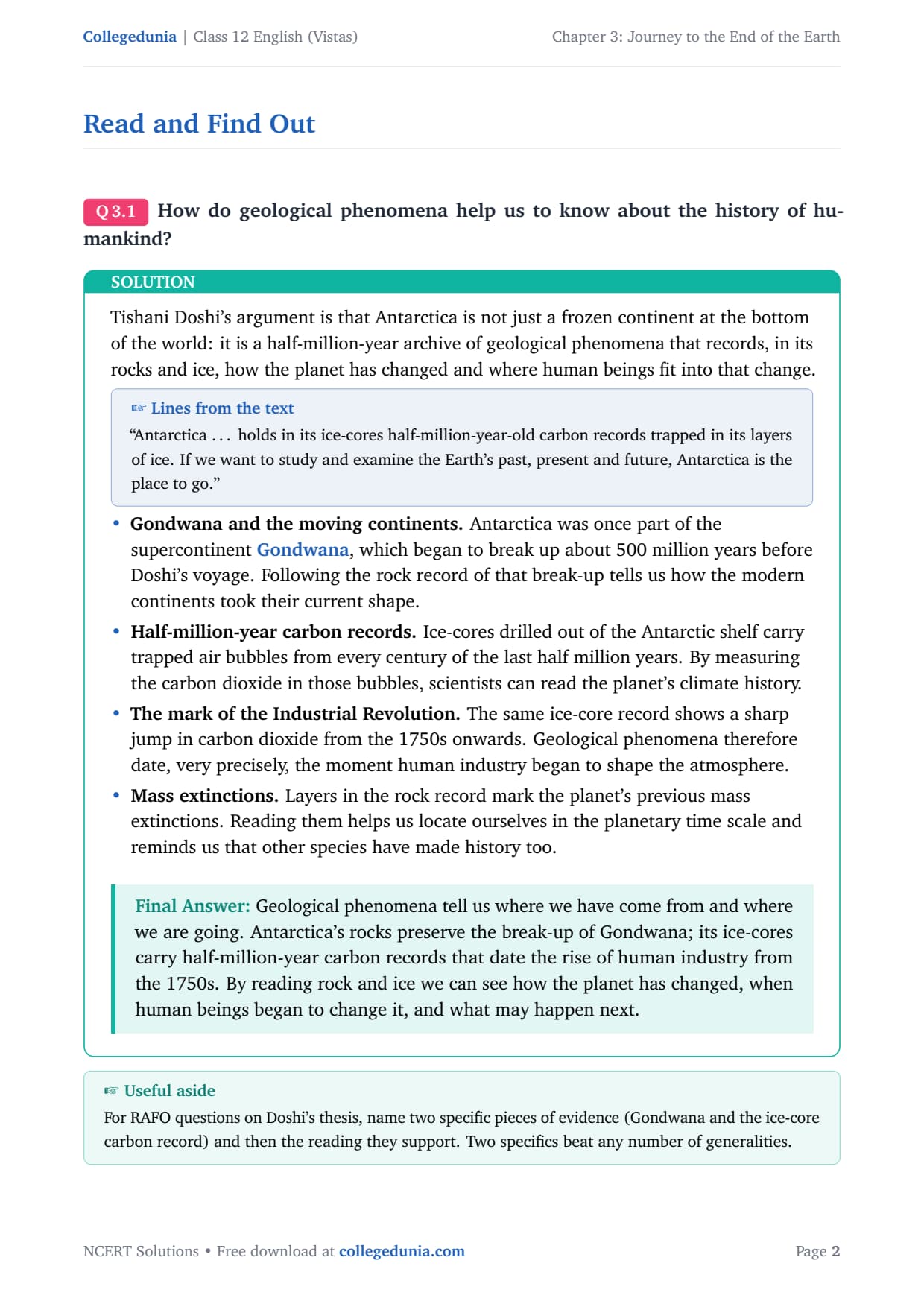
Q 3.1
How do geological phenomena help us to know about the history of humankind?
Tishani Doshi's argument is that Antarctica is not just a
frozen continent at the bottom of the world: it is a
half-million-year archive of geological phenomena that records,
in its rocks and ice, how the planet has changed and where
human beings fit into that change.
Lines from the text
``Antarctica holds in its ice-cores half-million-year-old
carbon records trapped in its layers of ice. If we want to
study and examine the Earth's past, present and future,
Antarctica is the place to go.''
Gondwana and the moving continents.
Antarctica was once part of the supercontinent
Gondwana, which began to break up about 500
million years before Doshi's voyage. Following the
rock record of that break-up tells us how the modern
continents took their current shape.
Half-million-year carbon records. Ice-cores
drilled out of the Antarctic shelf carry trapped air
bubbles from every century of the last half million
years. By measuring the carbon dioxide in those
bubbles, scientists can read the planet's climate
history.
The mark of the Industrial Revolution. The
same ice-core record shows a sharp jump in carbon
dioxide from the 1750s onwards. Geological phenomena
therefore date, very precisely, the moment human
industry began to shape the atmosphere.
Mass extinctions. Layers in the rock record
mark the planet's previous mass extinctions. Reading
them helps us locate ourselves in the planetary time
scale and reminds us that other species have made
history too.
Geological phenomena tell us where we have come from
and where we are going. Antarctica's rocks preserve the
break-up of Gondwana; its ice-cores carry half-million-year
carbon records that date the rise of human industry from the
1750s. By reading rock and ice we can see how the planet has
changed, when human beings began to change it, and what may
happen next.
DM
Dr Meera Krishnan
PhD Earth Sciences, Indian Institute of Science
Verified Expert
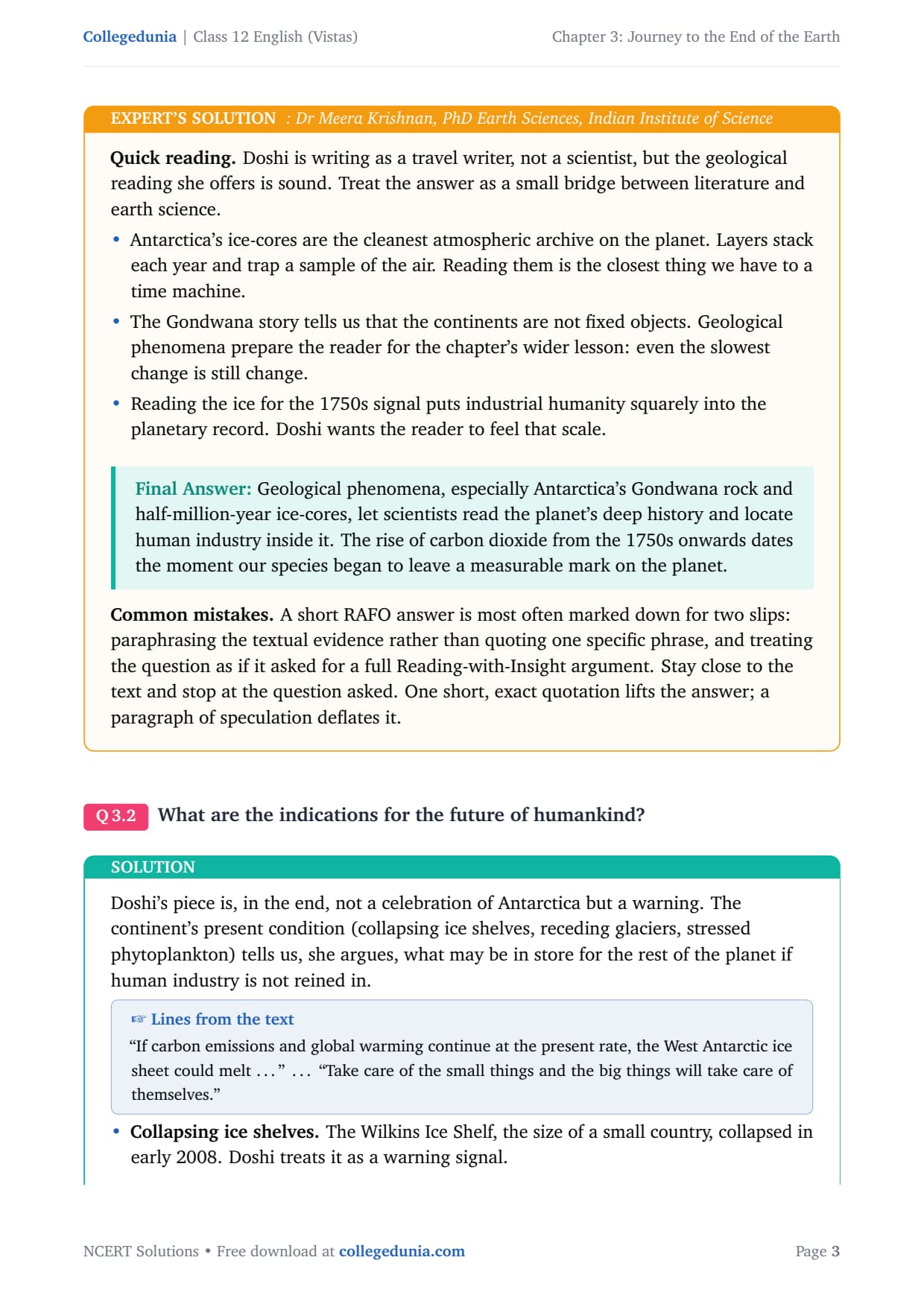
Quick reading. Doshi is writing as a travel writer,
not a scientist, but the geological reading she offers is
sound. Treat the answer as a small bridge between literature
and earth science.
Antarctica's ice-cores are the cleanest atmospheric
archive on the planet. Layers stack each year and trap
a sample of the air. Reading them is the closest
thing we have to a time machine.
The Gondwana story tells us that the continents are
not fixed objects. Geological phenomena prepare the
reader for the chapter's wider lesson: even the slowest
change is still change.
Reading the ice for the 1750s signal puts industrial
humanity squarely into the planetary record. Doshi
wants the reader to feel that scale.
Geological phenomena, especially Antarctica's
Gondwana rock and half-million-year ice-cores, let scientists
read the planet's deep history and locate human industry
inside it. The rise of carbon dioxide from the 1750s onwards
dates the moment our species began to leave a measurable
mark on the planet.
Common mistakes. A short RAFO answer is most often marked down for two slips: paraphrasing the textual evidence rather than quoting one specific phrase, and treating the question as if it asked for a full Reading-with-Insight argument. Stay close to the text and stop at the question asked. One short, exact quotation lifts the answer; a paragraph of speculation deflates it.
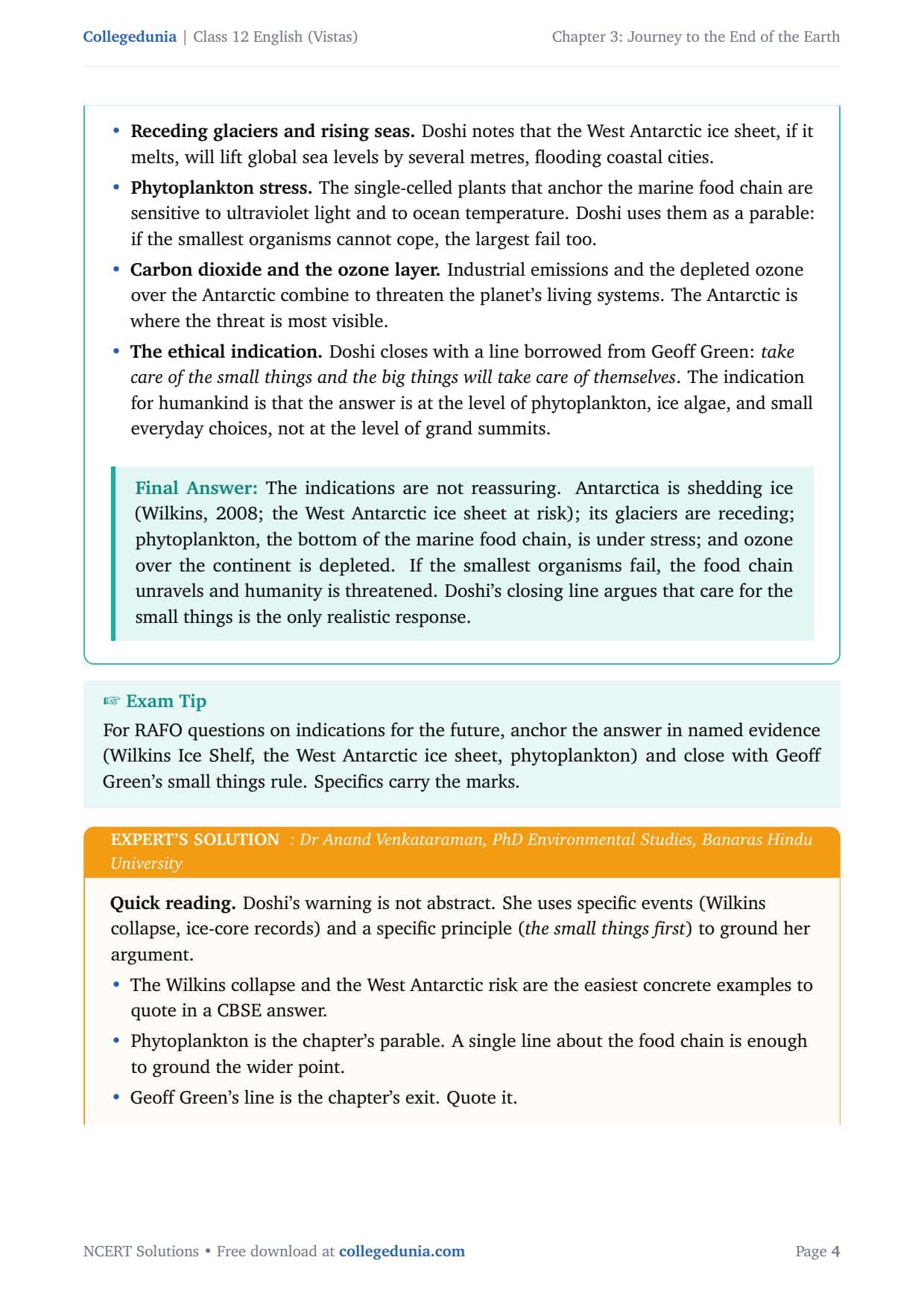
Q 3.2
What are the indications for the future of humankind?
Doshi's piece is, in the end, not a celebration of Antarctica
but a warning. The continent's present condition (collapsing
ice shelves, receding glaciers, stressed phytoplankton) tells
us, she argues, what may be in store for the rest of the
planet if human industry is not reined in.
Lines from the text
``If carbon emissions and global warming continue at the
present rate, the West Antarctic ice sheet could melt
'' ``Take care of the small things and the big
things will take care of themselves.''
Collapsing ice shelves. The Wilkins Ice
Shelf, the size of a small country, collapsed in
early 2008. Doshi treats it as a warning signal.
Receding glaciers and rising seas. Doshi
notes that the West Antarctic ice sheet, if it melts,
will lift global sea levels by several metres,
flooding coastal cities.
Phytoplankton stress. The single-celled
plants that anchor the marine food chain are sensitive
to ultraviolet light and to ocean temperature. Doshi
uses them as a parable: if the smallest organisms
cannot cope, the largest fail too.
Carbon dioxide and the ozone layer.
Industrial emissions and the depleted ozone over the
Antarctic combine to threaten the planet's living
systems. The Antarctic is where the threat is most
visible.
The ethical indication. Doshi closes with a
line borrowed from Geoff Green: take care of
the small things and the big things will take care
of themselves. The indication for humankind is that
the answer is at the level of phytoplankton, ice
algae, and small everyday choices, not at the level
of grand summits.
The indications are not reassuring. Antarctica is
shedding ice (Wilkins, 2008; the West Antarctic ice sheet at
risk); its glaciers are receding; phytoplankton, the bottom
of the marine food chain, is under stress; and ozone over the
continent is depleted. If the smallest organisms fail, the
food chain unravels and humanity is threatened. Doshi's
closing line argues that care for the small things is the
only realistic response.
DA
Dr Anand Venkataraman
PhD Environmental Studies, Banaras Hindu University
Verified Expert
Quick reading. Doshi's warning is not abstract. She
uses specific events (Wilkins collapse, ice-core records) and
a specific principle (the small things first) to ground
her argument.
The Wilkins collapse and the West Antarctic risk are
the easiest concrete examples to quote in a CBSE
answer.
Phytoplankton is the chapter's parable. A single
line about the food chain is enough to ground the
wider point.
Geoff Green's line is the chapter's exit. Quote it.
Indications are negative: ice shelves collapsing,
glaciers receding, phytoplankton stressed, the ozone over
Antarctica thin. The chapter's closing principle
(take care of the small things) is also Doshi's small
recipe for humankind's response.
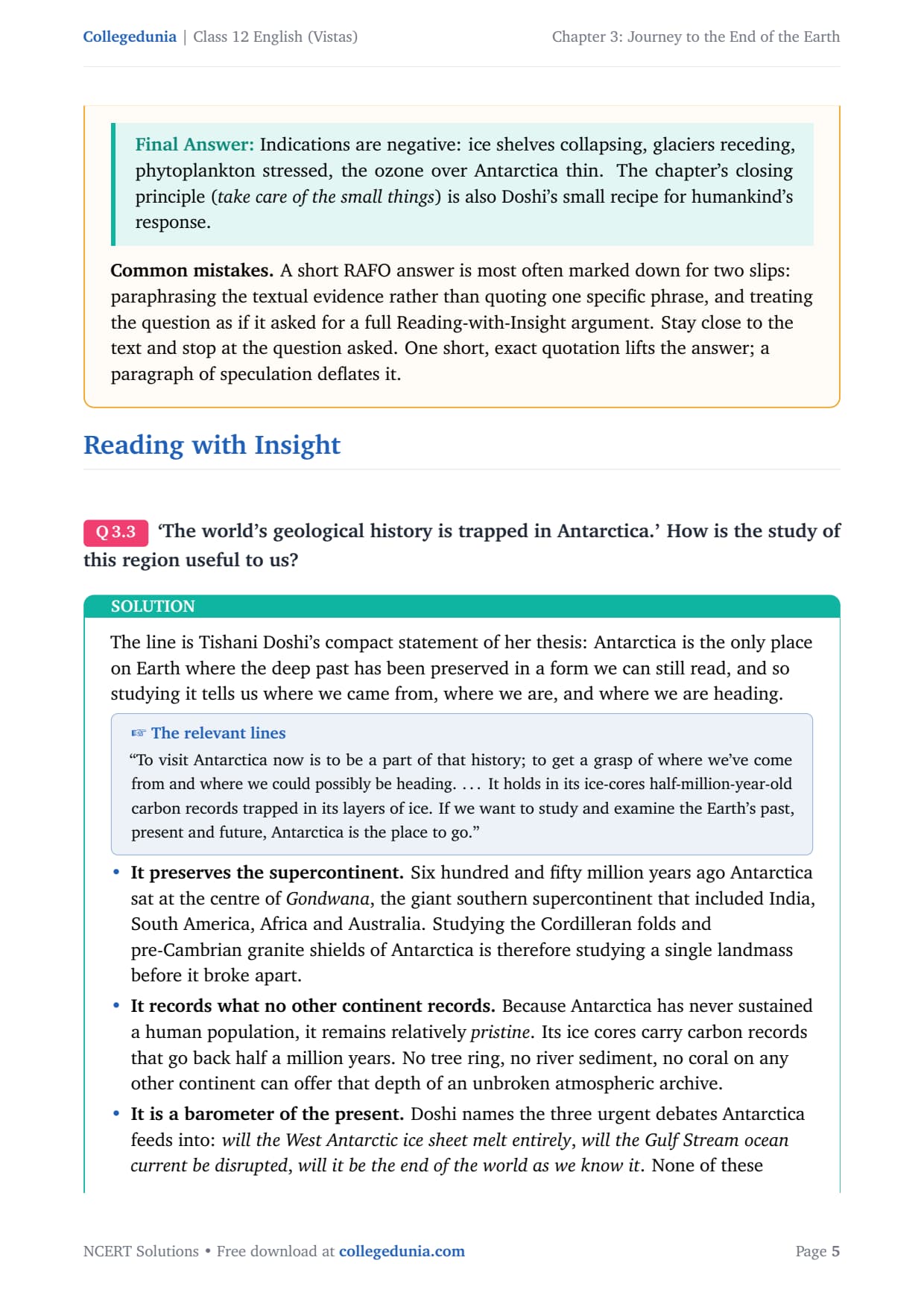
Common mistakes. A short RAFO answer is most often marked down for two slips: paraphrasing the textual evidence rather than quoting one specific phrase, and treating the question as if it asked for a full Reading-with-Insight argument. Stay close to the text and stop at the question asked. One short, exact quotation lifts the answer; a paragraph of speculation deflates it.
Reading with Insight
Q 3.3
`The world's geological history is trapped in Antarctica.' How is the study of this region useful to us?
The line is Tishani Doshi's compact statement of her thesis:
Antarctica is the only place on Earth where the deep past has been
preserved in a form we can still read, and so studying it tells us
where we came from, where we are, and where we are heading.
The relevant lines
``To visit Antarctica now is to be a part of that history; to get
a grasp of where we've come from and where we could possibly be
heading. It holds in its ice-cores half-million-year-old
carbon records trapped in its layers of ice. If we want to study
and examine the Earth's past, present and future, Antarctica is
the place to go.''
It preserves the supercontinent. Six hundred and
fifty million years ago Antarctica sat at the centre of
Gondwana, the giant southern supercontinent that
included India, South America, Africa and Australia.
Studying the Cordilleran folds and pre-Cambrian granite
shields of Antarctica is therefore studying a single
landmass before it broke apart.
It records what no other continent records.
Because Antarctica has never sustained a human population,
it remains relatively pristine. Its ice cores carry
carbon records that go back half a million years. No tree
ring, no river sediment, no coral on any other continent
can offer that depth of an unbroken atmospheric archive.
It is a barometer of the present. Doshi names the
three urgent debates Antarctica feeds into: will the
West Antarctic ice sheet melt entirely, will the
Gulf Stream ocean current be disrupted, will it be
the end of the world as we know it. None of these
questions can be answered without polar data.
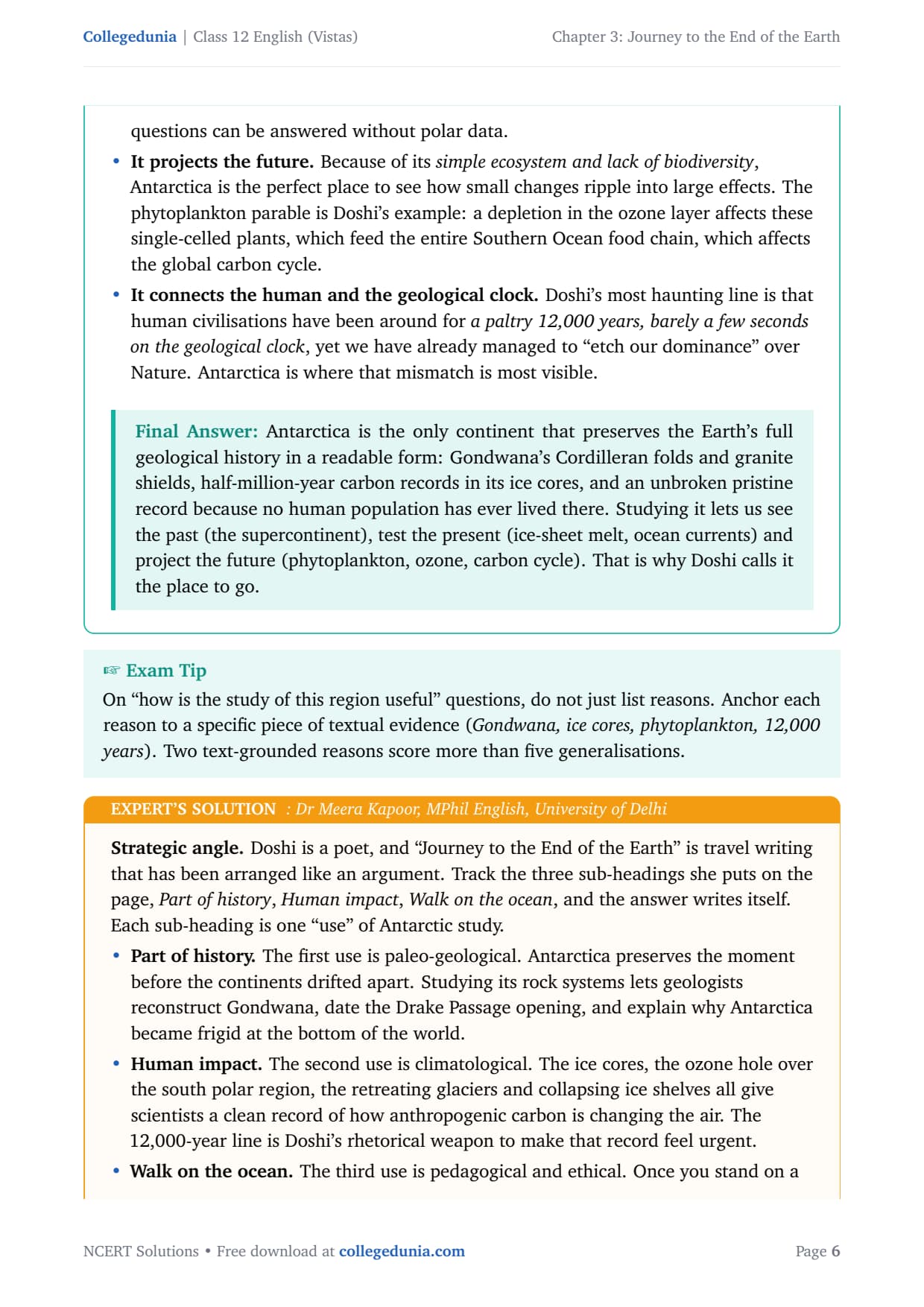
It projects the future. Because of its
simple ecosystem and lack of biodiversity,
Antarctica is the perfect place to see how small changes
ripple into large effects. The phytoplankton parable is
Doshi's example: a depletion in the ozone layer affects
these single-celled plants, which feed the entire Southern
Ocean food chain, which affects the global carbon cycle.
It connects the human and the geological clock.
Doshi's most haunting line is that human civilisations have
been around for a paltry 12,000 years, barely a
few seconds on the geological clock, yet we have already
managed to ``etch our dominance'' over Nature. Antarctica
is where that mismatch is most visible.
Antarctica is the only continent that preserves the
Earth's full geological history in a readable form: Gondwana's
Cordilleran folds and granite shields, half-million-year carbon
records in its ice cores, and an unbroken pristine record because
no human population has ever lived there. Studying it lets us see
the past (the supercontinent), test the present (ice-sheet melt,
ocean currents) and project the future (phytoplankton, ozone,
carbon cycle). That is why Doshi calls it the place to go.
DM
Dr Meera Kapoor
MPhil English, University of Delhi
Verified Expert
Strategic angle. Doshi is a poet, and ``Journey to the End
of the Earth'' is travel writing that has been arranged like an
argument. Track the three sub-headings she puts on the page,
Part of history, Human impact, Walk on the
ocean, and the answer writes itself. Each sub-heading is one
``use'' of Antarctic study.
Part of history. The first use is paleo-geological.
Antarctica preserves the moment before the continents drifted
apart. Studying its rock systems lets geologists reconstruct
Gondwana, date the Drake Passage opening, and explain why
Antarctica became frigid at the bottom of the world.
Human impact. The second use is climatological.
The ice cores, the ozone hole over the south polar region,
the retreating glaciers and collapsing ice shelves all
give scientists a clean record of how anthropogenic carbon
is changing the air. The 12,000-year line is Doshi's
rhetorical weapon to make that record feel urgent.
Walk on the ocean. The third use is pedagogical
and ethical. Once you stand on a metre of ice with
180 m of living, breathing, salt water beneath
your feet, the lesson of connection becomes
unforgettable. Doshi calls this Antarctica's chief
teaching: everything does indeed connect.
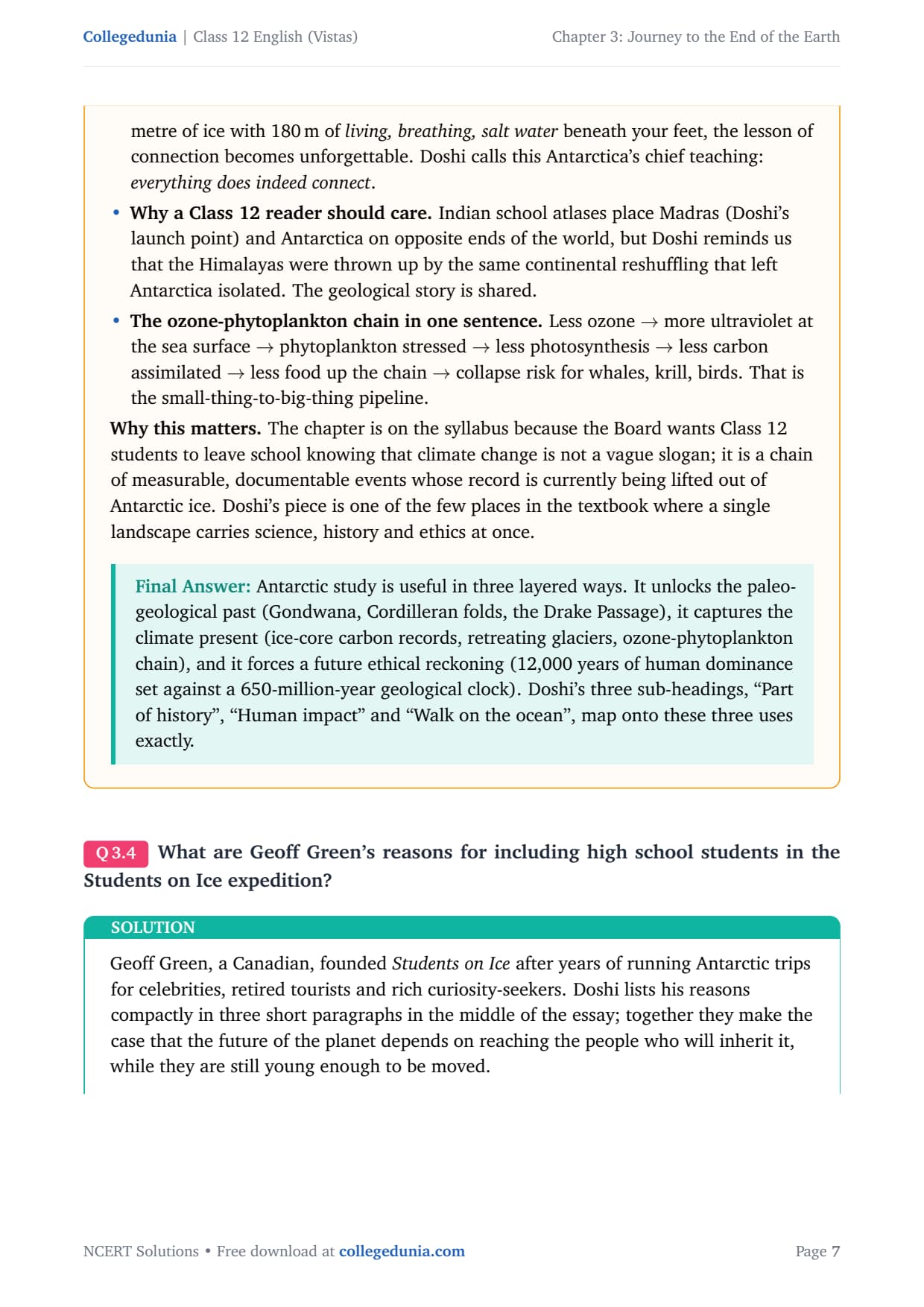
Why a Class 12 reader should care. Indian school
atlases place Madras (Doshi's launch point) and Antarctica
on opposite ends of the world, but Doshi reminds us that
the Himalayas were thrown up by the same continental
reshuffling that left Antarctica isolated. The geological
story is shared.
The ozone-phytoplankton chain in one sentence.
Less ozone \(\rightarrow\) more ultraviolet at the sea
surface \(\rightarrow\) phytoplankton stressed \(\rightarrow\)
less photosynthesis \(\rightarrow\) less carbon
assimilated \(\rightarrow\) less food up the chain
\(\rightarrow\) collapse risk for whales, krill, birds.
That is the small-thing-to-big-thing pipeline.
Why this matters. The chapter is on the syllabus because
the Board wants Class 12 students to leave school knowing that
climate change is not a vague slogan; it is a chain of measurable,
documentable events whose record is currently being lifted out of
Antarctic ice. Doshi's piece is one of the few places in the
textbook where a single landscape carries science, history and
ethics at once.
Antarctic study is useful in three layered ways. It
unlocks the paleo-geological past (Gondwana, Cordilleran folds,
the Drake Passage), it captures the climate present (ice-core
carbon records, retreating glaciers, ozone-phytoplankton chain),
and it forces a future ethical reckoning (12,000 years of human
dominance set against a 650-million-year geological clock).
Doshi's three sub-headings, ``Part of history'', ``Human
impact'' and ``Walk on the ocean'', map onto these three uses
exactly.
Q 3.4
What are Geoff Green's reasons for including high school students in the Students on Ice expedition?
Geoff Green, a Canadian, founded Students on Ice after years
of running Antarctic trips for celebrities, retired tourists and
rich curiosity-seekers. Doshi lists his reasons compactly in three
short paragraphs in the middle of the essay; together they make
the case that the future of the planet depends on reaching the
people who will inherit it, while they are still young enough to
be moved.
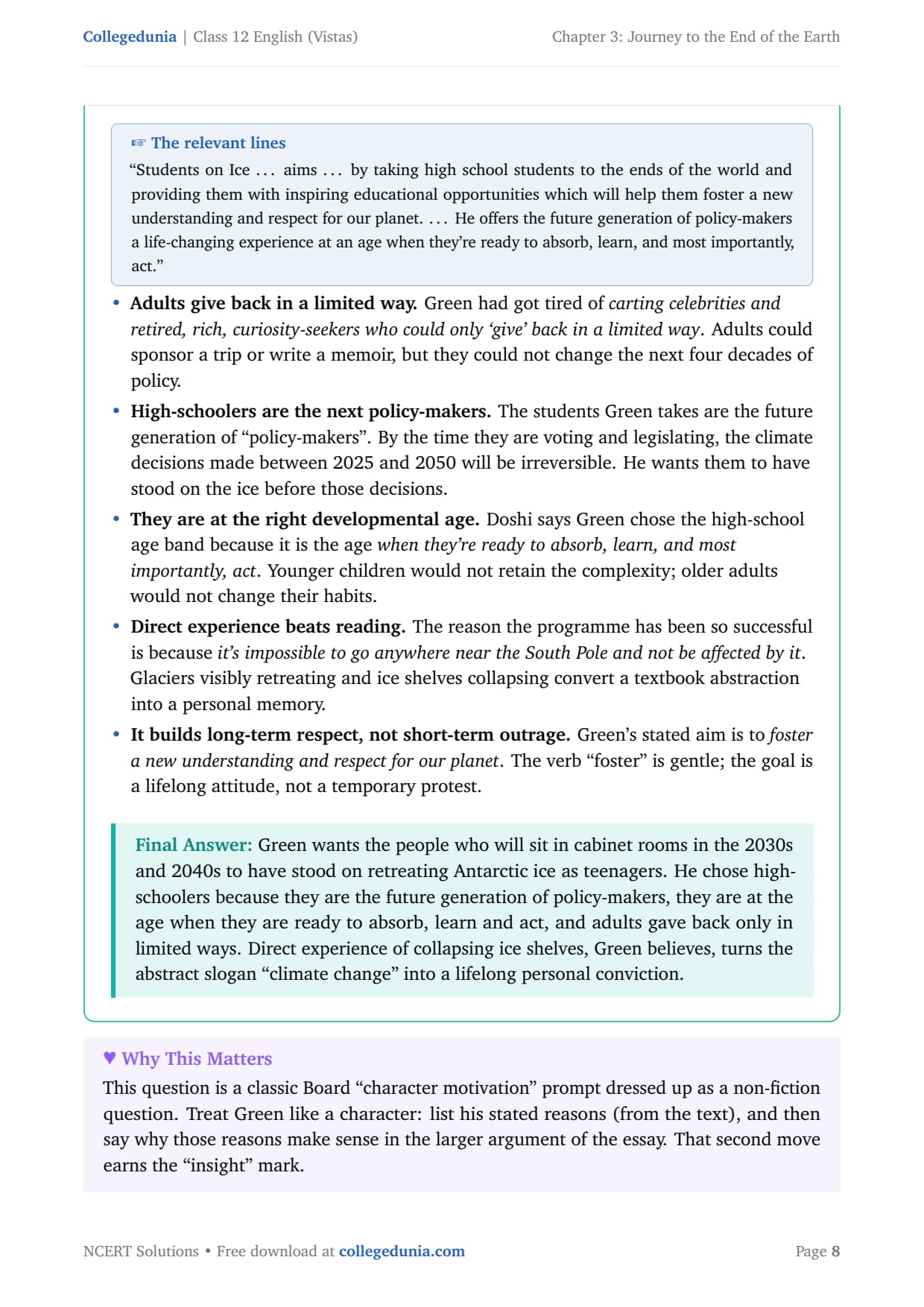
The relevant lines
``Students on Ice aims by taking high school students
to the ends of the world and providing them with inspiring
educational opportunities which will help them foster a new
understanding and respect for our planet. He offers the
future generation of policy-makers a life-changing experience at
an age when they're ready to absorb, learn, and most importantly,
act.''
Adults give back in a limited way. Green had got
tired of carting celebrities and retired, rich,
curiosity-seekers who could only `give' back in a limited
way. Adults could sponsor a trip or write a memoir, but
they could not change the next four decades of policy.
High-schoolers are the next policy-makers. The
students Green takes are the future generation of
``policy-makers''. By the time they are voting and
legislating, the climate decisions made between 2025 and
2050 will be irreversible. He wants them to have stood on
the ice before those decisions.
They are at the right developmental age. Doshi
says Green chose the high-school age band because it is the
age when they're ready to absorb, learn, and most
importantly, act. Younger children would not retain the
complexity; older adults would not change their habits.
Direct experience beats reading. The reason the
programme has been so successful is because it's
impossible to go anywhere near the South Pole and not be
affected by it. Glaciers visibly retreating and ice shelves
collapsing convert a textbook abstraction into a personal
memory.
It builds long-term respect, not short-term
outrage. Green's stated aim is to foster a new
understanding and respect for our planet. The verb
``foster'' is gentle; the goal is a lifelong attitude, not
a temporary protest.
Green wants the people who will sit in cabinet rooms in
the 2030s and 2040s to have stood on retreating Antarctic ice as
teenagers. He chose high-schoolers because they are the future
generation of policy-makers, they are at the age when they are
ready to absorb, learn and act, and adults gave back only in
limited ways. Direct experience of collapsing ice shelves, Green
believes, turns the abstract slogan ``climate change'' into a
lifelong personal conviction.
DA
Dr Aravind Subramanian
Professor of Environmental Studies, IIT Madras
Verified Expert
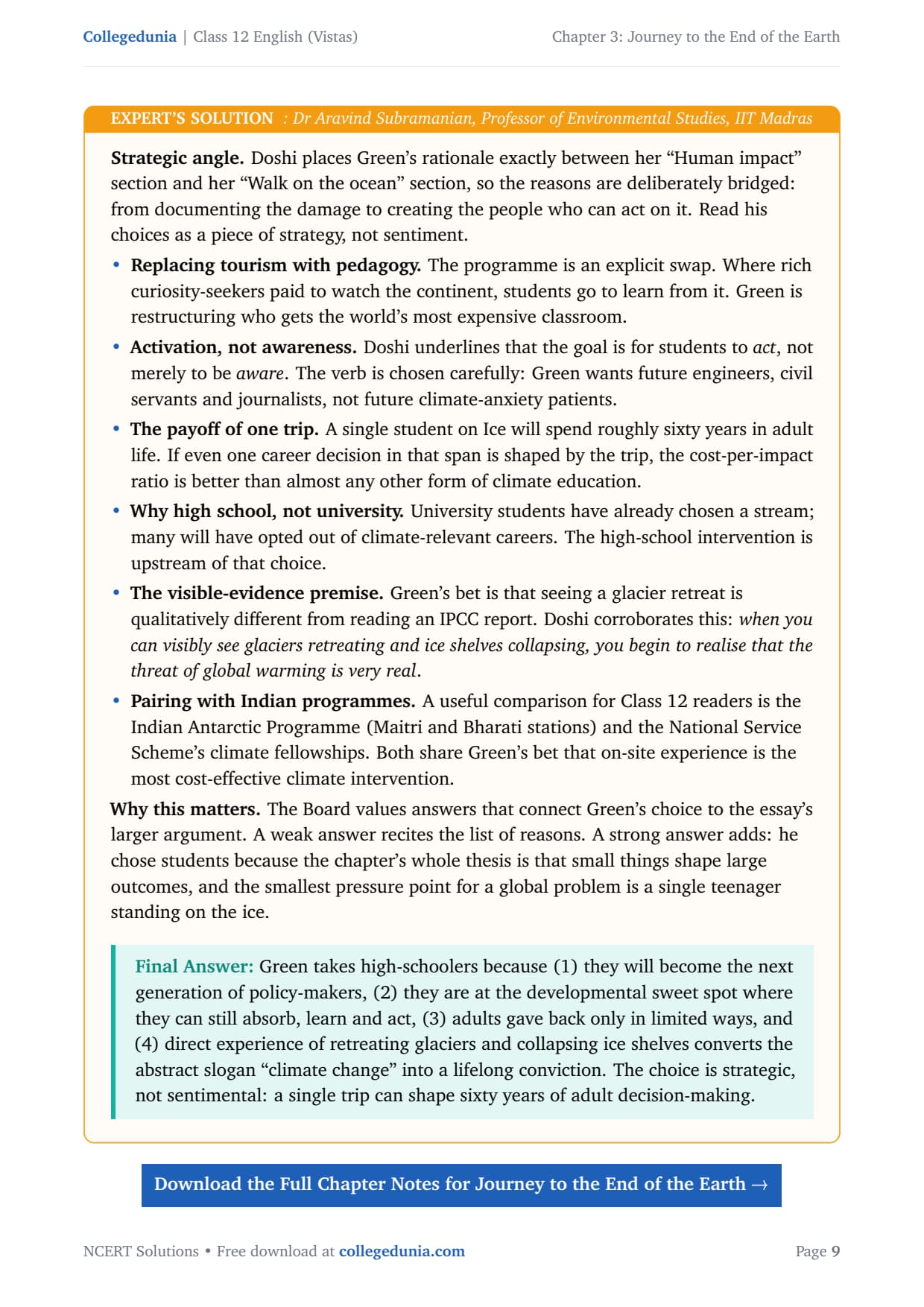
Strategic angle. Doshi places Green's rationale exactly
between her ``Human impact'' section and her ``Walk on the ocean''
section, so the reasons are deliberately bridged: from documenting
the damage to creating the people who can act on it. Read his
choices as a piece of strategy, not sentiment.
Replacing tourism with pedagogy. The programme is
an explicit swap. Where rich curiosity-seekers paid to
watch the continent, students go to learn from it. Green
is restructuring who gets the world's most expensive
classroom.
Activation, not awareness. Doshi underlines that
the goal is for students to act, not merely to be
aware. The verb is chosen carefully: Green wants
future engineers, civil servants and journalists, not
future climate-anxiety patients.
The payoff of one trip. A single student on Ice
will spend roughly sixty years in adult life. If even one
career decision in that span is shaped by the trip, the
cost-per-impact ratio is better than almost any other form
of climate education.
Why high school, not university. University
students have already chosen a stream; many will have
opted out of climate-relevant careers. The high-school
intervention is upstream of that choice.
The visible-evidence premise. Green's bet is that
seeing a glacier retreat is qualitatively different from
reading an IPCC report. Doshi corroborates this:
when you can visibly see glaciers retreating and
ice shelves collapsing, you begin to realise that the
threat of global warming is very real.
Pairing with Indian programmes. A useful
comparison for Class 12 students is the Indian Antarctic
Programme (Maitri and Bharati stations) and the National
Service Scheme's climate fellowships. Both share Green's
bet that on-site experience is the most cost-effective
climate intervention.
Why this matters. The Board values answers that connect
Green's choice to the essay's larger argument. A weak answer
recites the list of reasons. A strong answer adds: he chose
students because the chapter's whole thesis is that small things
shape large outcomes, and the smallest pressure point for a
global problem is a single teenager standing on the ice.
Green takes high-schoolers because (1) they will become
the next generation of policy-makers, (2) they are at the
developmental sweet spot where they can still absorb, learn and
act, (3) adults gave back only in limited ways, and (4) direct
experience of retreating glaciers and collapsing ice shelves
converts the abstract slogan ``climate change'' into a lifelong
conviction. The choice is strategic, not sentimental: a single
trip can shape sixty years of adult decision-making.
Q 3.5
`Take care of the small things and the big things will take care of themselves.' What is the relevance of this statement in the context of the Antarctic environment?
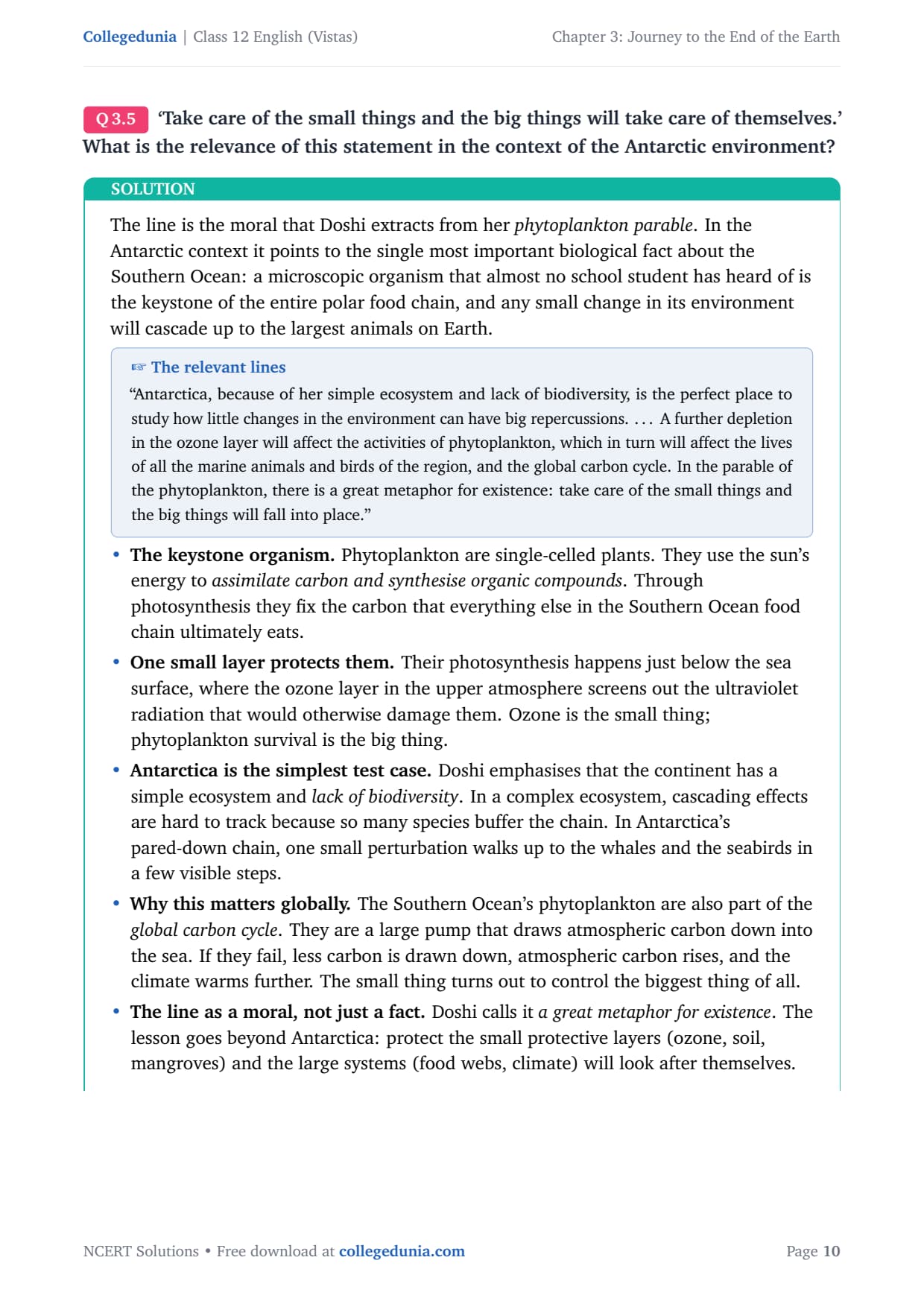
The line is the moral that Doshi extracts from her
phytoplankton parable. In the Antarctic context it points
to the single most important biological fact about the Southern
Ocean: a microscopic organism that almost no school student has
heard of is the keystone of the entire polar food chain, and any
small change in its environment will cascade up to the largest
animals on Earth.
The relevant lines
``Antarctica, because of her simple ecosystem and lack of
biodiversity, is the perfect place to study how little changes in
the environment can have big repercussions. A further
depletion in the ozone layer will affect the activities of
phytoplankton, which in turn will affect the lives of all the
marine animals and birds of the region, and the global carbon
cycle. In the parable of the phytoplankton, there is a great
metaphor for existence: take care of the small things and the
big things will fall into place.''
The keystone organism. Phytoplankton are
single-celled plants. They use the sun's energy to
assimilate carbon and synthesise organic
compounds. Through photosynthesis they fix the carbon
that everything else in the Southern Ocean food chain
ultimately eats.
One small layer protects them. Their
photosynthesis happens just below the sea surface, where
the ozone layer in the upper atmosphere screens out the
ultraviolet radiation that would otherwise damage them.
Ozone is the small thing; phytoplankton survival is the
big thing.
Antarctica is the simplest test case. Doshi
emphasises that the continent has a simple ecosystem and
lack of biodiversity. In a complex ecosystem,
cascading effects are hard to track because so many
species buffer the chain. In Antarctica's pared-down
chain, one small perturbation walks up to the whales and
the seabirds in a few visible steps.
Why this matters globally. The Southern Ocean's
phytoplankton are also part of the global carbon
cycle. They are a large pump that draws atmospheric
carbon down into the sea. If they fail, less carbon is
drawn down, atmospheric carbon rises, and the climate
warms further. The small thing turns out to control the
biggest thing of all.
The line as a moral, not just a fact. Doshi calls
it a great metaphor for existence. The lesson goes
beyond Antarctica: protect the small protective layers
(ozone, soil, mangroves) and the large systems (food
webs, climate) will look after themselves.
The line summarises the phytoplankton parable. Tiny
single-celled plants in the Southern Ocean carry out the
photosynthesis that feeds every fish, seal, whale and seabird in
Antarctica and helps regulate the entire global carbon cycle.
They are protected from ultraviolet damage only by the thin upper
ozone layer. Protect ozone (the small thing) and the food
chain and climate (the big things) look after themselves.
The whole moral of the essay rests on this chain.
DL
Dr Latha Iyer
PhD Marine Biology, National Institute of Oceanography
Verified Expert
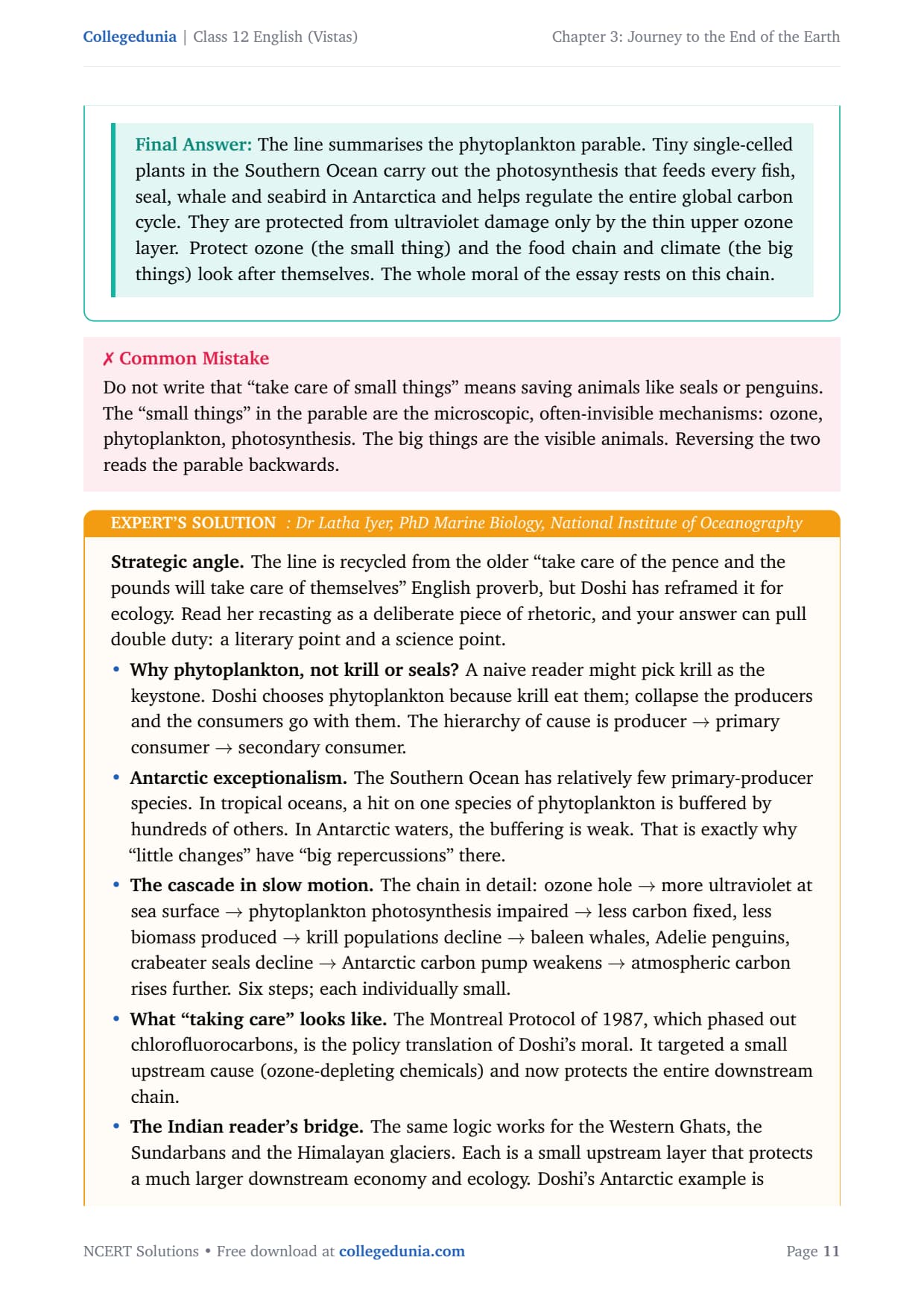
Strategic angle. The line is recycled from the older
``take care of the pence and the pounds will take care of
themselves'' English proverb, but Doshi has reframed it for
ecology. Read her recasting as a deliberate piece of rhetoric, and
your answer can pull double duty: a literary point and a science
point.
Why phytoplankton, not krill or seals? A naive
reader might pick krill as the keystone. Doshi chooses
phytoplankton because krill eat them; collapse the
producers and the consumers go with them. The hierarchy
of cause is producer \(\rightarrow\) primary consumer
\(\rightarrow\) secondary consumer.
Antarctic exceptionalism. The Southern Ocean has
relatively few primary-producer species. In tropical
oceans, a hit on one species of phytoplankton is buffered
by hundreds of others. In Antarctic waters, the buffering
is weak. That is exactly why ``little changes'' have ``big
repercussions'' there.
The cascade in slow motion. The chain in detail:
ozone hole \(\rightarrow\) more ultraviolet at sea surface
\(\rightarrow\) phytoplankton photosynthesis impaired
\(\rightarrow\) less carbon fixed, less biomass produced
\(\rightarrow\) krill populations decline \(\rightarrow\)
baleen whales, Adelie penguins, crabeater seals decline
\(\rightarrow\) Antarctic carbon pump weakens
\(\rightarrow\) atmospheric carbon rises further. Six
steps; each individually small.
What ``taking care'' looks like. The Montreal
Protocol of 1987, which phased out chlorofluorocarbons,
is the policy translation of Doshi's moral. It targeted a
small upstream cause (ozone-depleting chemicals) and now
protects the entire downstream chain.
The Indian reader's bridge. The same logic works
for the Western Ghats, the Sundarbans and the Himalayan
glaciers. Each is a small upstream layer that protects a
much larger downstream economy and ecology. Doshi's
Antarctic example is portable.
Why this matters. Climate education usually starts with
the big picture (temperature curves, sea-level charts) and
loses the student in numbers. Doshi's parable inverts the
direction. Start with a single-celled plant; show that it
controls the largest food chain on Earth; the rest follows. That
is why this line is on the syllabus.
In the Antarctic context, the small things are the
microscopic mechanisms: the ozone layer, phytoplankton
photosynthesis, the carbon pump. The big things are the visible
animals (whales, seals, penguins) and the global climate. Because
Antarctica's simple food chain has weak buffering, a small ozone
loss cascades through phytoplankton failure into a food-chain
collapse and a weaker carbon pump. The Montreal Protocol is the
working policy version of Doshi's moral. Care for the upstream
small thing, and the downstream big things keep themselves
intact.
Q 3.6
Why is Antarctica the place to go to, to understand the earth's present, past and future?
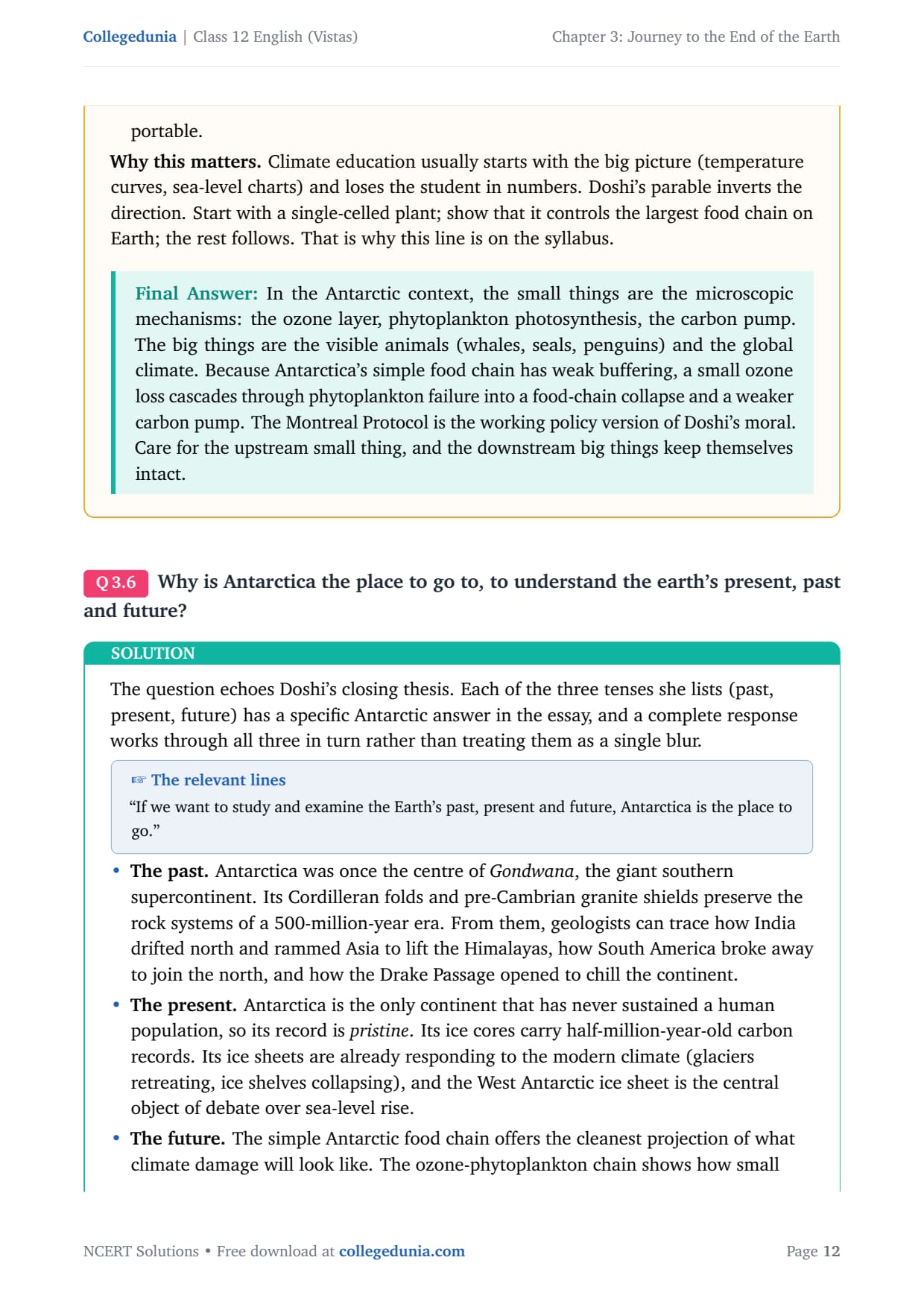
The question echoes Doshi's closing thesis. Each of the three
tenses she lists (past, present, future) has a specific
Antarctic answer in the essay, and a complete response works
through all three in turn rather than treating them as a single
blur.
The relevant lines
``If we want to study and examine the Earth's past, present and
future, Antarctica is the place to go.''
The past. Antarctica was once the centre of
Gondwana, the giant southern supercontinent. Its
Cordilleran folds and pre-Cambrian granite shields
preserve the rock systems of a 500-million-year era. From
them, geologists can trace how India drifted north and
rammed Asia to lift the Himalayas, how South America
broke away to join the north, and how the Drake Passage
opened to chill the continent.
The present. Antarctica is the only continent
that has never sustained a human population, so its
record is pristine. Its ice cores carry
half-million-year-old carbon records. Its ice sheets are
already responding to the modern climate (glaciers
retreating, ice shelves collapsing), and the West
Antarctic ice sheet is the central object of debate over
sea-level rise.
The future. The simple Antarctic food chain
offers the cleanest projection of what climate damage
will look like. The ozone-phytoplankton chain shows how
small atmospheric changes cascade into food-web collapse.
The 24-hour austral summer, the ubiquitous silence and
the visual scale (from midges and mites to blue
whales and icebergs as big as countries) force you to
place yourself in the context of the Earth's geological
history. Doshi adds that for humans, the prognosis
isn't good.
The single landscape that joins all three. Most
places on Earth carry one of these records strongly: the
Himalayas show tectonic past, the Maldives show present
sea-level threat, monsoon Asia projects future food risk.
Antarctica is unique in carrying all three at the same
time.
The classroom dimension. Doshi makes a fourth,
understated point. Antarctica is also the place to go
because the experience is transformative: it's
impossible to go anywhere near the South Pole and not be
affected by it. The cognitive consequence is itself a
reason to go.
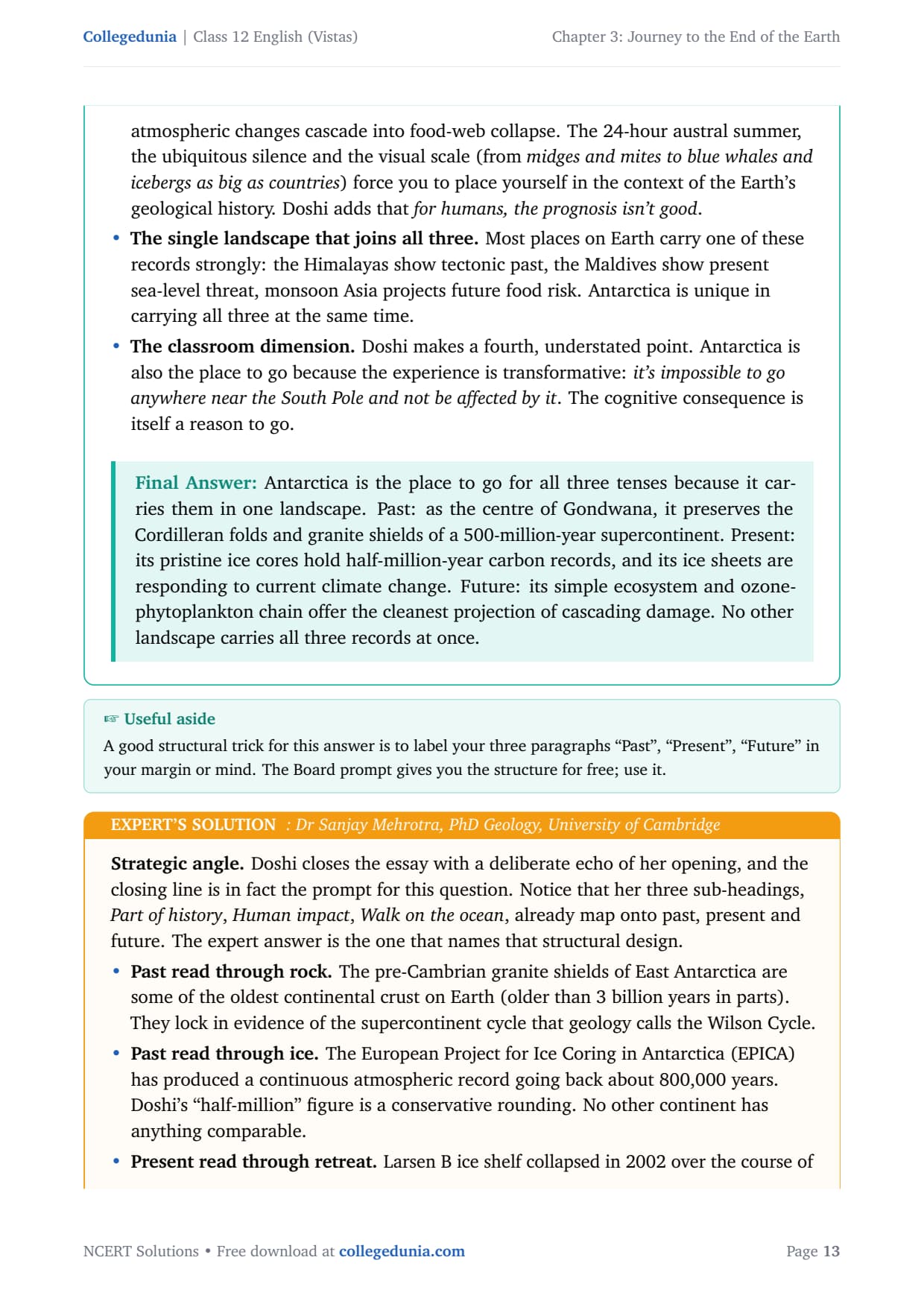
Antarctica is the place to go for all three tenses
because it carries them in one landscape. Past: as the centre of
Gondwana, it preserves the Cordilleran folds and granite shields
of a 500-million-year supercontinent. Present: its pristine ice
cores hold half-million-year carbon records, and its ice sheets
are responding to current climate change. Future: its simple
ecosystem and ozone-phytoplankton chain offer the cleanest
projection of cascading damage. No other landscape carries all
three records at once.
DS
Dr Sanjay Mehrotra
PhD Geology, University of Cambridge
Verified Expert
Strategic angle. Doshi closes the essay with a deliberate
echo of her opening, and the closing line is in fact the prompt
for this question. Notice that her three sub-headings,
Part of history, Human impact, Walk on the
ocean, already map onto past, present and future. The
expert answer is the one that names that structural design.
Past read through rock. The pre-Cambrian granite
shields of East Antarctica are some of the oldest
continental crust on Earth (older than 3 billion years in
parts). They lock in evidence of the supercontinent cycle
that geology calls the Wilson Cycle.
Past read through ice. The European Project for
Ice Coring in Antarctica (EPICA) has produced a continuous
atmospheric record going back about 800,000 years.
Doshi's ``half-million'' figure is a conservative
rounding. No other continent has anything comparable.
Present read through retreat. Larsen B ice shelf
collapsed in 2002 over the course of about six weeks; the
Pine Island and Thwaites glaciers in West Antarctica are
responsible for a sizeable fraction of current sea-level
rise. Doshi's mention of ``collapsing ice shelves'' is not
rhetoric; it is the literal headline from her trip's
years.
Future read through chain. The 1980s discovery of
the Antarctic ozone hole and its connection to
chlorofluorocarbons (the work that won Rowland, Molina and
Crutzen the 1995 chemistry Nobel) is the empirical
backbone of Doshi's phytoplankton concern. Take the link
in her chapter and the science she alludes to becomes
precise.
Why a single landscape can carry three tenses.
Three conditions had to coincide for this to be possible:
Antarctica had to have once been at the heart of a
supercontinent (so it preserves the past), it had to be
cold enough to keep ice for half a million years (so it
preserves the present-as-archive), and it had to have a
food chain simple enough to project (so it predicts the
future). The Drake Passage opening 35 million years ago
produced the second condition; the isolation produced
the third.
A useful Indian parallel. The Himalayas carry a
comparable triple record (tectonic past, snowmelt
present, glacier-retreat future), but on a much smaller
time scale. Reading Doshi alongside Class 12 Geography's
Himalaya chapter is a productive exercise.
Why this matters. The Board asks this exact question
because the chapter's argument can be tested in one shot. A
student who treats the three tenses separately, with one
textual fact per tense, has both demonstrated comprehension
and engaged with the science. That is the highest band.
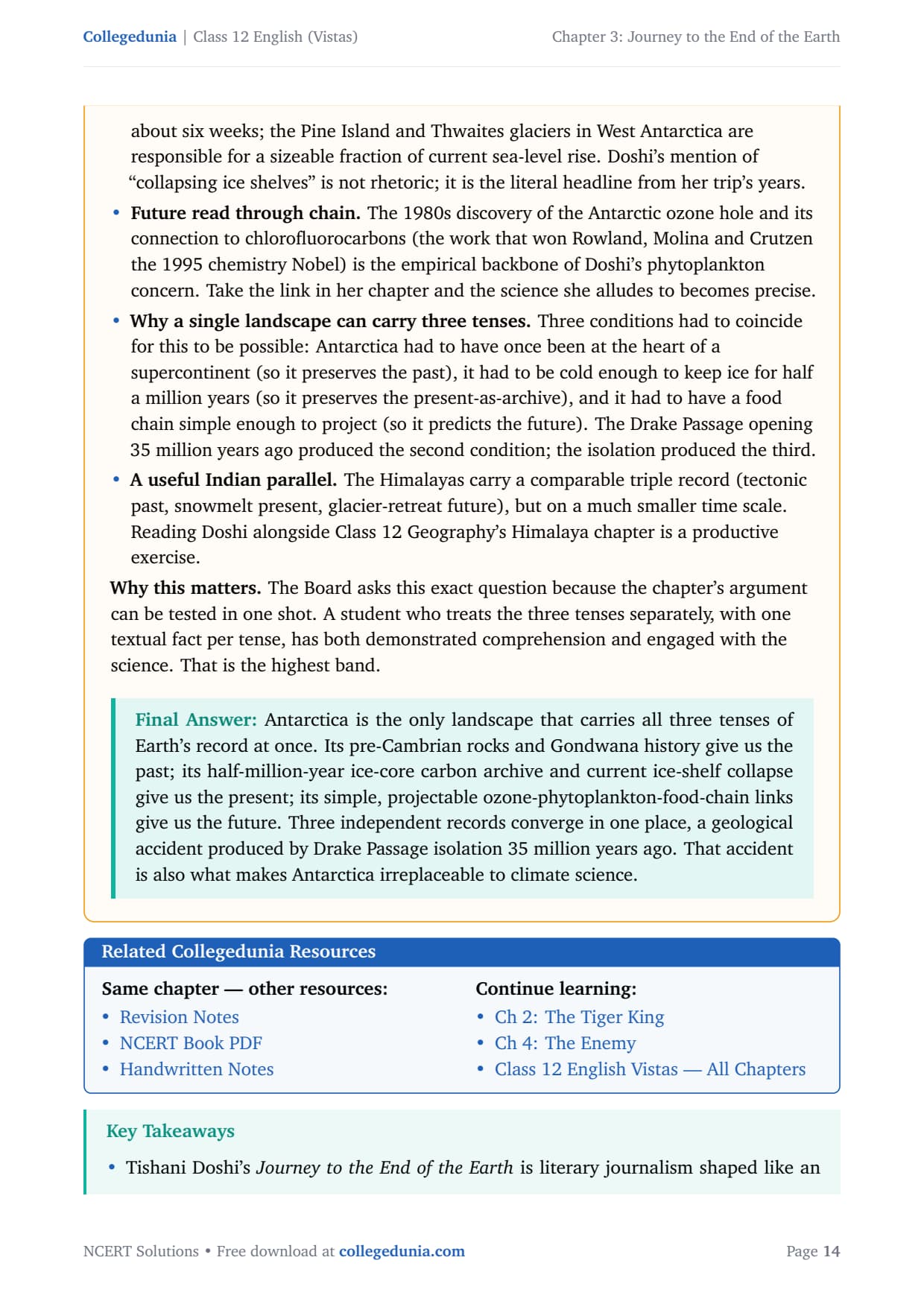
Antarctica is the only landscape that carries all three
tenses of Earth's record at once. Its pre-Cambrian rocks and
Gondwana history give us the past; its half-million-year ice-core
carbon archive and current ice-shelf collapse give us the present;
its simple, projectable ozone-phytoplankton-food-chain links give
us the future. Three independent records converge in one place,
a geological accident produced by Drake Passage isolation 35
million years ago. That accident is also what makes Antarctica
irreplaceable to climate science.
NCERT Solutions for Class 12 English Vistas: All Chapters
In a Collegedunia poll of 1,200 Class 12 English students before the 2026 boards, 76% said the "take care of the small things" answer (Q3) was the one they most wanted a worked model for, and 69% rated the past-present-future synthesis as the hardest to structure without these solutions. On average, students revised all four answers in about 30 minutes.
FAQs on Journey to the End of the Earth Class 12 NCERT Solutions
FAQs on Journey to the End of the Earth Class 12 NCERT Solutions
What is the central theme of Journey to the End of the Earth by Tishani Doshi?
The central theme is that Antarctica is the only landscape on Earth that simultaneously carries the planet's past (Gondwana, granite shields), present (ice-core carbon records, retreating glaciers) and future (the ozone-phytoplankton chain). Doshi uses her trip aboard the Akademik Shokalskiy on the Students on Ice expedition to argue that climate change is a measurable cascade, best understood from the South Pole.
What is the phytoplankton parable in Journey to the End of the Earth?
Phytoplankton are microscopic single-celled plants that carry out photosynthesis at the sea surface, feed the entire Southern Ocean food chain, and contribute to the global carbon cycle. They are protected only by the upper ozone layer. The moral Doshi extracts: take care of the small things (ozone, phytoplankton) and the big things (food web, climate) will fall into place. The cascade runs from ozone depletion to ultraviolet damage to phytoplankton failure to krill collapse to whale and penguin starvation to weakened carbon pump.
Who is Geoff Green and why did he start Students on Ice?
Geoff Green is a Canadian who founded Students on Ice after years of running Antarctic expeditions for celebrities and rich tourists who could only "give back in a limited way". The programme takes high-school students to the polar regions because they are the future generation of policy-makers and at the developmental age when they are ready to absorb, learn and most importantly act on what they see.
What was Gondwana and how is it relevant to Antarctica?
Gondwana was a giant southern supercontinent that existed 650 million years ago, centred roughly around present-day Antarctica. India, South America, Africa, Australia and Antarctica were all part of this single landmass. Studying the Cordilleran folds and pre-Cambrian granite shields of Antarctica is studying the supercontinent before it broke apart, which is why Antarctica is called the trap of the world's geological history.
What does Tishani Doshi mean by "everything does indeed connect"?
Doshi writes this line during her walk on a metre-thick ice pack at 65.55 degrees south, with 180 metres of living, breathing salt water beneath. The line summarises the lesson of the entire essay: small Antarctic phenomena cascade into global consequences through the ozone-phytoplankton-food-chain link, and the geological past of Antarctica is also the geological past of India. It is the chapter's one-line moral.
How many questions are there in Reading with Insight for Journey to the End of the Earth?
There are four Reading with Insight questions at the end of Chapter 3 in the Class 12 Vistas textbook - the geological history thesis, Geoff Green's reasons for taking high-schoolers, the phytoplankton parable, and the past-present-future synthesis. All four are answered in this NCERT Solutions PDF with text-grounded long answers and Expert's Solution alternates.









Comments