Commerce Mentor | B.Com (Hons) Student, SRCC | Updated on - May 25, 2026
These nature and significance of management class 12 ncert solutions cover every Very Short Answer, Short Answer, and Long Answer question from Class 12 Business Studies Chapter 1, mapped to the 2026-27 CBSE syllabus. Each answer is grounded in Harold Koontz's classic definition of management as "the art of getting things done through and with people in formally organised groups" and the Henri Fayol POSDC framework that organises the entire NCERT chapter. This page hosts the free Collegedunia PDF, a section-wise question map, and CBSE marker-style answer templates for the meaning, characteristics, objectives, levels, art-vs-science, profession, and coordination clusters that examiners reuse year after year.
CBSE Weightage: 6 to 10 marks (Unit 1, Principles and Functions of Management) - one Short Answer + one Long Answer almost every session
Question Count: 5 Very Short Answer + 6 Short Answer + 6 Long Answer (17 in total)
Chapter 1 Nature and Significance of Management NCERT Solutions PDF
You can find the complete NCERT Solutions for Nature and Significance of Management, including answers on the meaning and definition of management, the seven characteristics, the three objectives, the importance of management, management as an art and a science, management as a profession, the three levels, the five functions, and coordination as the essence of management, in the article below.
These NCERT Solutions are curated by senior Commerce educators, mapped to the 2026-27 NCERT Business Studies textbook, and refined against the last five years of CBSE Class 12 Business Studies Board papers.
Nature and Significance of Management NCERT Solutions: Section-wise Question Map
The Business Studies Chapter 1 end-of-chapter exercises are split into three sub-sections by mark weightage. The table groups the 17 questions by sub-section so you can target the clusters CBSE tests most heavily.
Sub-section
Question Count
Focus Area
Difficulty
Very Short Answer Type
5
Definition of management, two characteristics, force binding functions (coordination), growth indicators, case-based objectives identification
Easy
Short Answer Type
6
Middle-level manager case (Ritu), features of management as profession, multi-dimensional concept, lack of coordination case (Company X), essence of management discussion, efficiency vs effectiveness case (Ashita and Lakshita)
Medium
Long Answer Type
6
Management as art and science, profession checklist, effective + efficient explanation, continuous interrelated functions, three-level product modification case, plans-not-adhered case (coordination remedy)
Hard
The 6-mark Long Answer in the CBSE Unit 1 section is almost always pulled from the art vs science, profession, or coordination clusters, while the 3-mark Short Answer is drawn from the case-study set. Practising one answer of each format covers the realistic board scenario for this chapter.
Concept Anchor: Management is the process of achieving organisational goals effectively (right task) AND efficiently (minimum cost) through Planning, Organising, Staffing, Directing and Controlling. The conjunction is "and", not "or", a successful enterprise must score on both yardsticks. Mary Parker Follett famously called management "the art of getting things done through others", and the five POSDC functions formalised by James A.F. Stoner are bound together by coordination, the essence that synchronises group effort.
Nature and Significance of Management Video Walkthrough
Definitions of Management You Must Quote in Class 12 Business Studies
CBSE markers reward answers that open with a named author definition. The four definitions below are the ones most commonly cited in CBSE Class 12 Business Studies model answers for Chapter 1.
Author
Definition
When to Use
Harold Koontz
"Management is the art of getting things done through and with people in formally organised groups."
Any 1-mark "Define management" or opening line of a 3-6 mark answer
Mary Parker Follett
"Management is the art of getting things done through others."
Art-vs-Science long answer; the human-element angle
James A.F. Stoner
Management is the process of planning, organising, leading and controlling the work of organisation members to achieve stated organisational goals.
POSDC functions long answer; the process angle
Henri Fayol (Father of Modern Management)
"To manage is to forecast and plan, to organise, to command, to coordinate and to control."
Continuous and interrelated functions discussion; foundation for Chapter 2
What the Class 12 Business Studies Chapter 1 NCERT Solutions PDF Contains
The PDF contains solved answers to every question in the Nature and Significance of Management chapter of the Business Studies textbook, in a CBSE marker-friendly format that stays close to the official 1-mark, 3-4-mark, and 5-6-mark answer-length brackets.
Concept opener on every answer that names and defines the management concept (effectiveness, efficiency, coordination, multi-dimensional, profession features) before the analysis begins.
Textbook-mapped definitions woven into every answer, with the exact NCERT terminology ("essence of management", "effectively and efficiently", "all-pervasive") cited per response.
Step-by-step structure on every long answer so the marker can tick each named feature, characteristic, level or function in turn.
Expert Solution on every question that supplies an alternate angle plus a strategic insight on what the examiner is actually checking.
Common-mistake call-outs after key answers, for example writing "the company is lacking management" instead of the specific "coordination", or treating Ritu as a top-level manager because she heads a region.
How Will Collegedunia's NCERT Solutions Help You with Nature and Significance of Management?
Three question patterns drive over 75% of marks in this chapter. The Collegedunia solutions are written so that these patterns are internalised while you practise, rather than memorised after the fact.
2026-27 NCERT Alignment: Every answer matches the current Business Studies textbook chapter, page references and case-study wording.
Marker-Style Answer Structure: Concept line first, named feature list next, one-line takeaway last, the exact shape a Board examiner expects.
Case-Study Verification: Every case-based answer (Indian Railways solar train, Company X blame game, Ashita-Lakshita bracelets, plan-not-adhered firm) has been mapped to the textbook cue and remedy.
Common-Mistake Inline Notes: Confusing effectiveness with efficiency, calling management a full-fledged profession, advising "stricter controls" when coordination is missing, all flagged at the point of error.
Solved Example: Case-Based Long Answer Walk-Through
The solved example below shows the answer shape a CBSE marker expects for a typical 6-mark case-based long answer. The same structure transfers to every coordination-remedy question in the chapter.
Question (6 marks). A firm plans in advance and has a sound organisation structure with efficient supervisory staff and control system but on several occasions it finds that plans are not being adhered to. It leads to confusion and duplication of work. Advise remedy.
Step 1 (1M), Concept used. The case lists all four other functions of management (planning, organising, staffing and controlling) as already strong, yet execution still fails. The only function left, the binding force that integrates the other four, is coordination, the essence of management.
Step 2 (1M), Diagnosis. Planning is sound, organising is sound, staffing is sound, controlling is sound, but execution is still failing. The missing link is coordination, which deliberately synchronises group effort to provide unity of action across departments.
Step 3 (2M), Remedy steps. (i) Communicate the plan clearly to every department so all are aware of the common goal. (ii) Hold regular inter-departmental meetings to share progress, identify overlaps and resolve conflicts. (iii) Define each role precisely, who does what, by when, with what authority, so duplication is prevented. (iv) Use joint planning and review across departments. (v) Set up coordinating committees or appoint a coordinator to integrate effort.
Step 4 (1M), Four features check. Reinforce that coordination must be (a) deliberate (not accidental), (b) all-pervasive (across every level and function), (c) continuous (every day, not one-off), (d) integrating group effort.
Step 5 (1M), Takeaway. The remedy is to strengthen coordination through clear communication, role definition, joint planning and a coordinating mechanism; without it the four sound functions cannot deliver organisational results.
Important Topics in Nature and Significance of Management
Topic
What CBSE Tests
Mark Weightage
Meaning and definition of management
Effectiveness, efficiency, process definition
1-3
Characteristics of management
Goal-oriented, all-pervasive, multi-dimensional, continuous, group activity, dynamic, intangible
3-4
Objectives of management
Organisational (profit, growth), social (clean environment, employment), personal (pay, recognition)
3-6
Importance of management
Group goals, efficiency, dynamic organisation, personal objectives, society
3-4
Nature of management: art, science, profession
Three features of art, three of science, five of profession, verdict on each
5-6
Levels of management
Top, Middle, Supervisory: who decides, plans, executes
3-6
Functions of management (POSDC)
Planning, Organising, Staffing, Directing, Controlling: continuous and interrelated
3-6
Coordination as essence of management
Four features, why it is the binding force, remedy in lack-of-coordination cases
3-6
Common Mistakes Students Make in Chapter 1
Writing only one yardstick. Students forget that management is effective AND efficient. Always write both, or you forfeit half the mark.
Confusing levels in case studies. A "manager of the northern division" is middle level, not top. A foreman or supervisor is supervisory, not middle.
Labelling management a full-fledged profession. The textbook conclusion is "profession to a large extent", not full-fledged. Restricted entry and compulsory association are the missing tests.
Naming "better planning" as the remedy. When a case says planning is sound but execution fails, the answer is coordination, not better planning.
Listing personal objectives where the case shows none. Only list named objectives that the case explicitly supports; padding with unsupported objectives gets marked down.
Previous Year Question Analysis: Class 12 Business Studies Chapter 1
Across the last five CBSE Class 12 Business Studies board papers, Nature and Significance of Management has been tested through the following dominant question patterns:
Management as art and science (Long Answer). Appeared in 2020, 2022, 2024 papers. Features of art (3) + features of science (3) + synthesis verdict is the marker's checklist.
Coordination essence + case remedy (Long Answer). Appeared in 2019, 2021, 2023 papers. The "inter-departmental blame" cue maps to coordination every time.
Efficiency vs effectiveness case (Short Answer). Appeared in 2020, 2022, 2024 papers. Compute cost per unit + output percentage, then place on 2x2 grid.
Levels of management identification (Short Answer). Appeared in 2021, 2023, 2024 papers. Divisional/regional manager = middle; foreman = supervisory; MD/Board = top.
Three objectives identification (Short Answer with case). Appeared in 2022, 2024 papers. Number cue = organisational; environmental cue = social; employee cue = personal.
Related Resources for Class 12 Business Studies Chapter 1
All NCERT Solutions for Nature and Significance of Management with Step-by-Step Working
Every NCERT textbook question for Class 12 Business Studies Chapter 1 Nature and Significance of Management is listed below with its full Solution and Expert Solution hidden inside collapsible tabs. Click Check Solution to reveal the step-by-step working; click Expert Solution for the expanded explanation.
Very Short Answer Type Questions
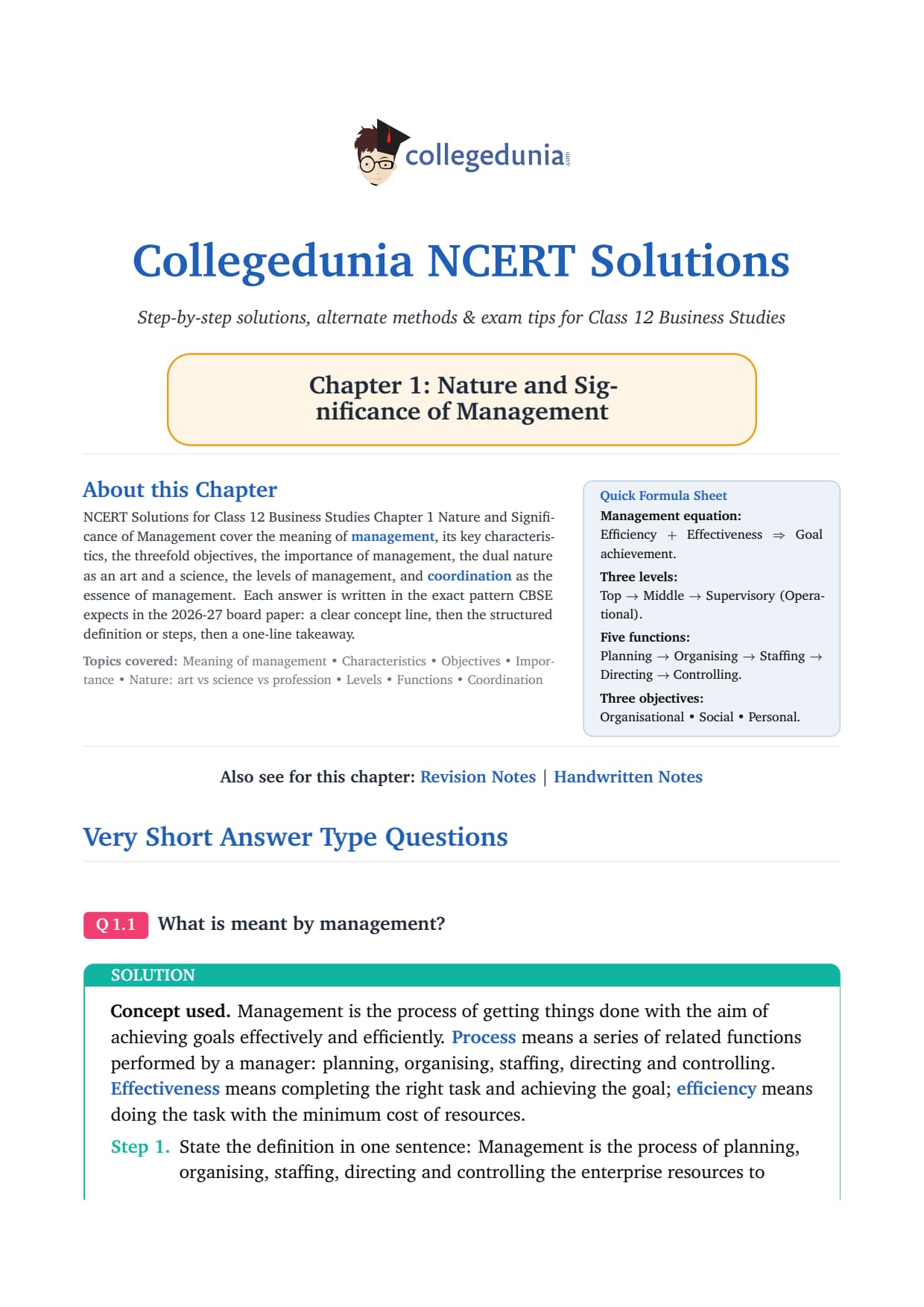
Q 1.1
What is meant by management?
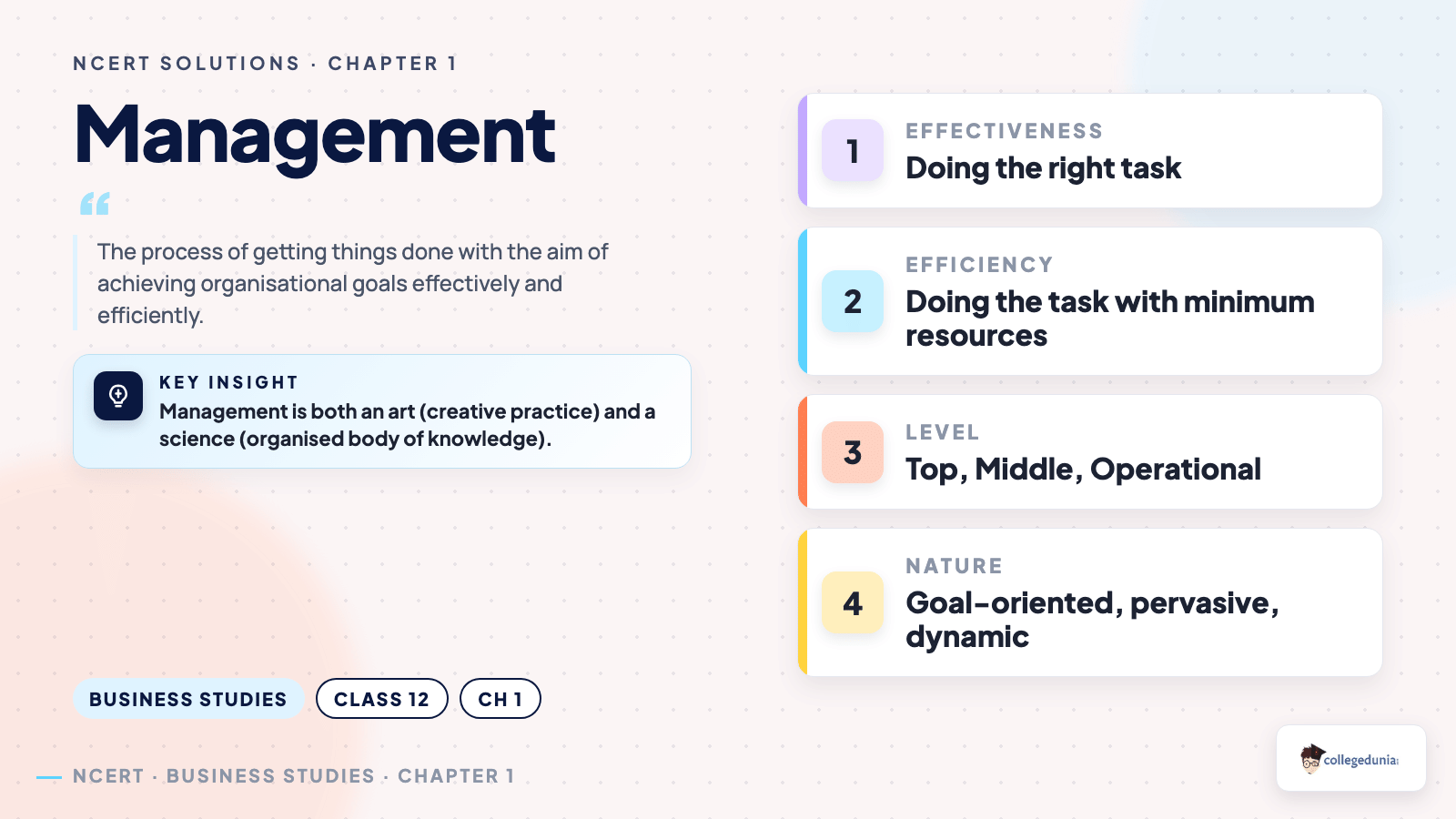
Concept used. Management is the process of getting things done with the aim of achieving
goals effectively and efficiently. Process means a series of related functions performed
by a manager: planning, organising, staffing, directing and controlling. Effectiveness
means completing the right task and achieving the goal; efficiency means doing the task
with the minimum cost of resources.
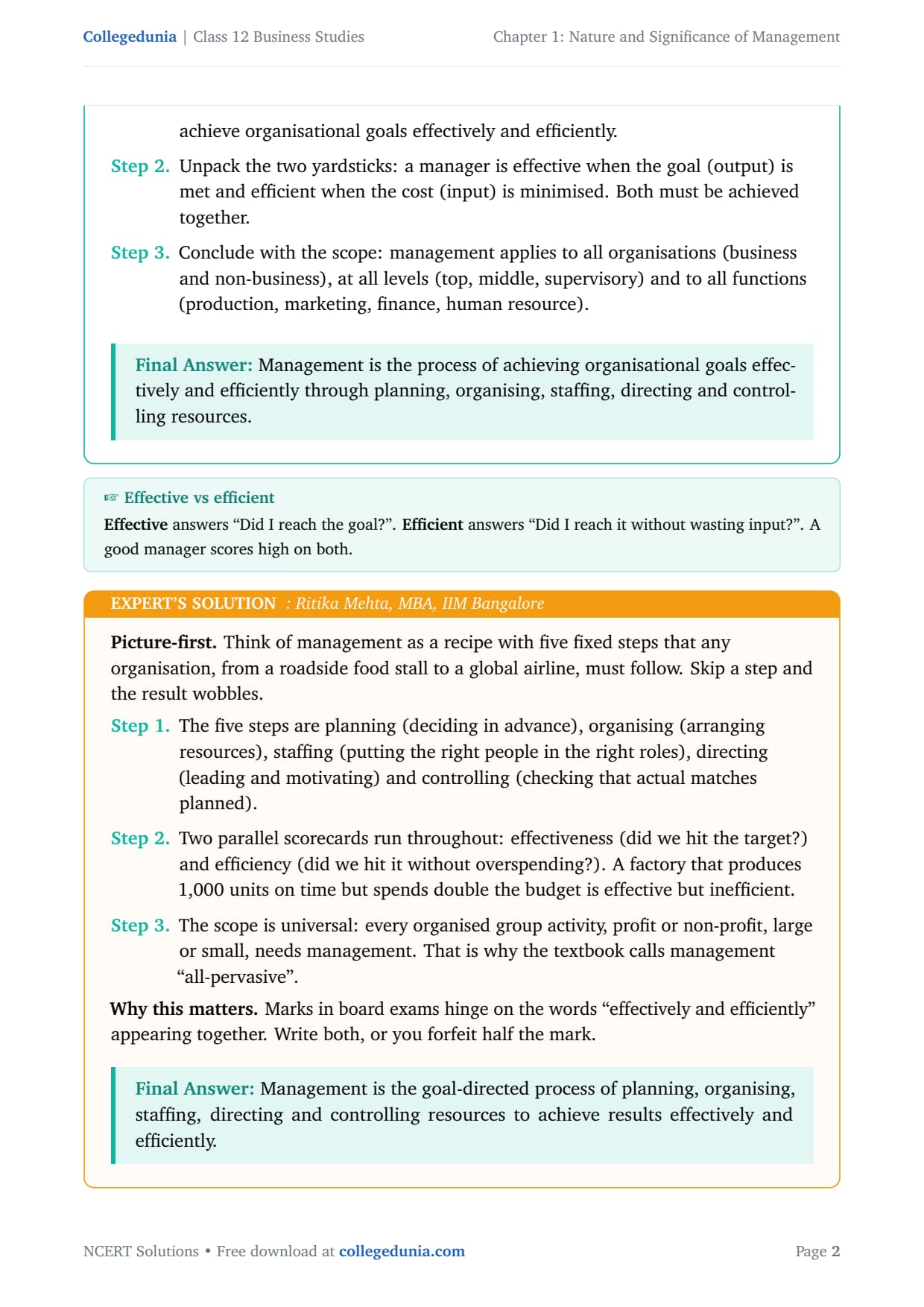
State the definition in one sentence: Management is the process of planning, organising,
staffing, directing and controlling the enterprise resources to achieve organisational
goals effectively and efficiently.
Unpack the two yardsticks: a manager is effective when the goal (output) is met and
efficient when the cost (input) is minimised. Both must be achieved together.
Conclude with the scope: management applies to all organisations (business and non-business),
at all levels (top, middle, supervisory) and to all functions (production, ncert-notes-class-12-business-studies-chapter-10-marketing, finance,
human resource).
Management is the process of achieving organisational goals effectively and efficiently
through planning, organising, staffing, directing and controlling resources.
RM
Ritika Mehta
MBA, IIM Bangalore
Verified Expert
Picture-first. Think of management as a recipe with five fixed steps that any organisation,
from a roadside food stall to a global airline, must follow. Skip a step and the result wobbles.
The five steps are planning (deciding in advance), organising (arranging resources),
staffing (putting the right people in the right roles), directing (leading and motivating)
and controlling (checking that actual matches planned).
Two parallel scorecards run throughout: effectiveness (did we hit the target?) and
efficiency (did we hit it without overspending?). A factory that produces 1,000 units
on time but spends double the budget is effective but inefficient.
The scope is universal: every organised group activity, profit or non-profit, large or
small, needs management. That is why the textbook calls management ``all-pervasive''.
Why this matters. Marks in board exams hinge on the words ``effectively and efficiently''
appearing together. Write both, or you forfeit half the mark.
Management is the goal-directed process of planning, organising, staffing, directing
and controlling resources to achieve results effectively and efficiently.
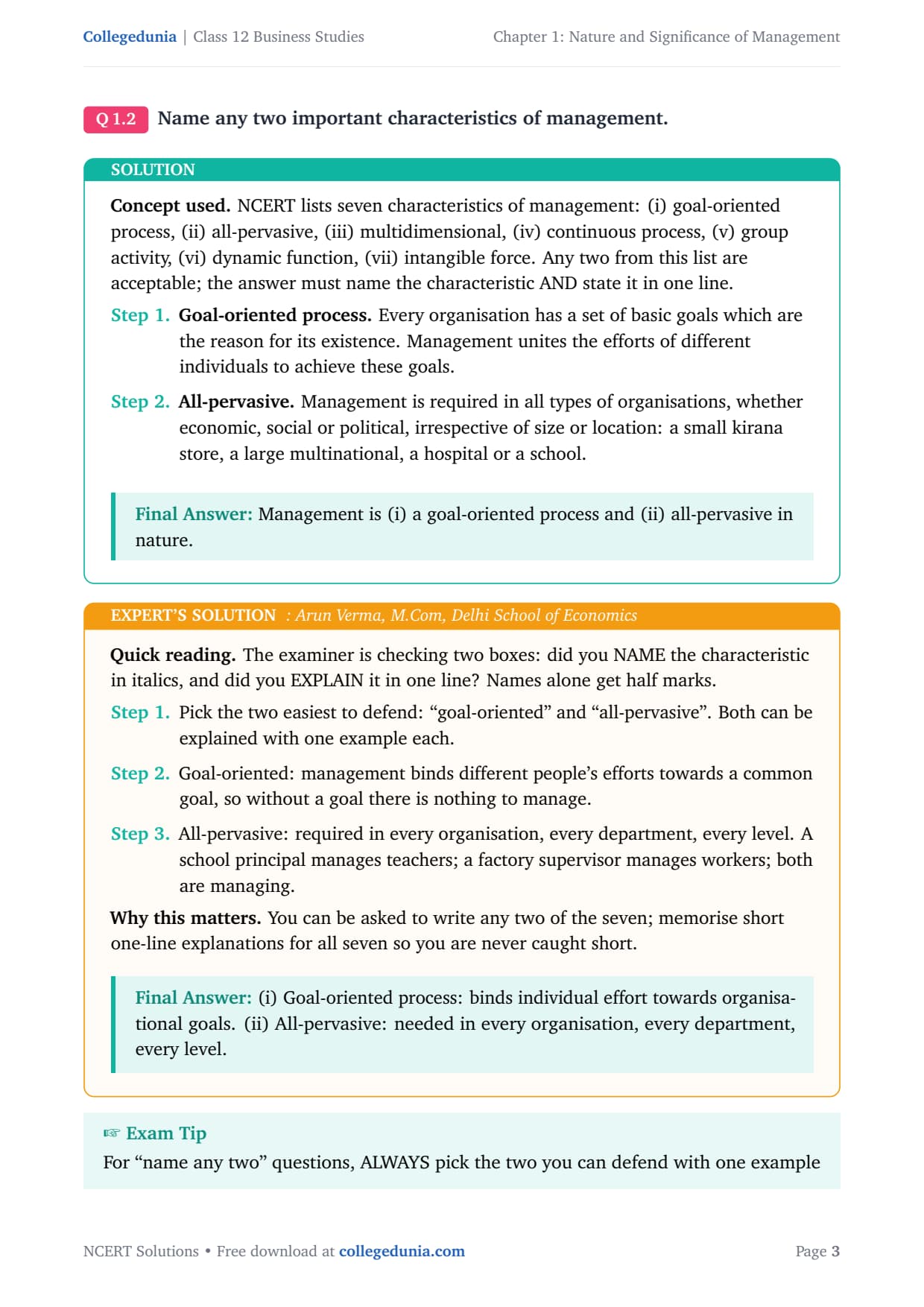
Q 1.2
Name any two important characteristics of management.
Concept used. NCERT lists seven characteristics of management: (i) goal-oriented process,
(ii) all-pervasive, (iii) multidimensional, (iv) continuous process, (v) group activity, (vi) dynamic
function, (vii) intangible force. Any two from this list are acceptable; the answer must name the
characteristic AND state it in one line.
Goal-oriented process. Every organisation has a set of basic goals which are the
reason for its existence. Management unites the efforts of different individuals to achieve
these goals.
All-pervasive. Management is required in all types of organisations, whether
economic, social or political, irrespective of size or location: a small kirana store, a
large multinational, a hospital or a school.
Management is (i) a goal-oriented process and (ii) all-pervasive in nature.
AV
Arun Verma
M.Com, Delhi School of Economics
Verified Expert
Quick reading. The examiner is checking two boxes: did you NAME the characteristic in
italics, and did you EXPLAIN it in one line? Names alone get half marks.
Pick the two easiest to defend: ``goal-oriented'' and ``all-pervasive''. Both can be
explained with one example each.
Goal-oriented: management binds different people's efforts towards a common goal, so
without a goal there is nothing to manage.
All-pervasive: required in every organisation, every department, every level. A school
principal manages teachers; a factory supervisor manages workers; both are managing.
Why this matters. You can be asked to write any two of the seven; memorise short one-line
explanations for all seven so you are never caught short.
(i) Goal-oriented process: binds individual effort towards organisational goals.
(ii) All-pervasive: needed in every organisation, every department, every level.
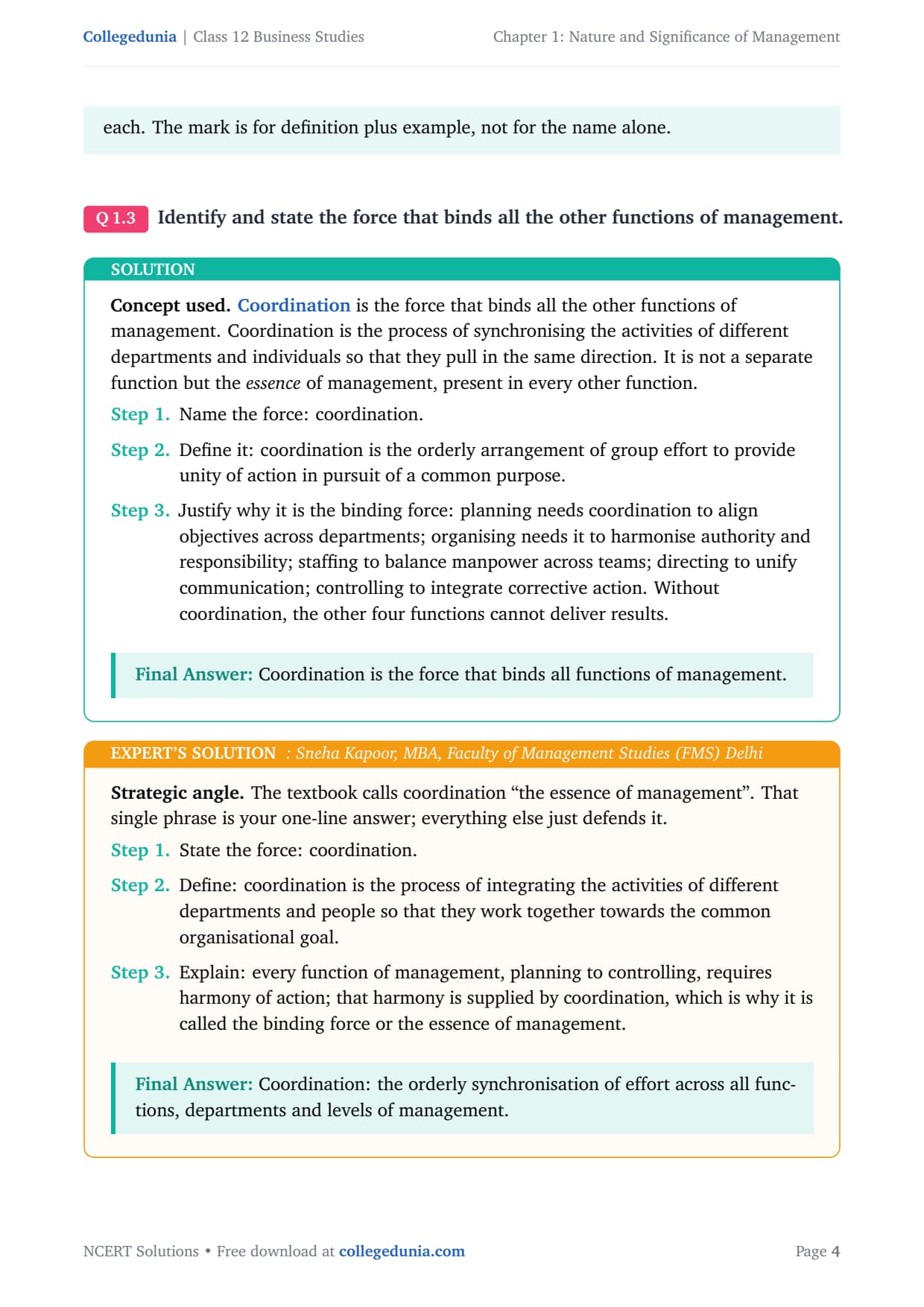
Q 1.3
Identify and state the force that binds all the other functions of management.
Concept used.Coordination is the force that binds all the other functions of
management. Coordination is the process of synchronising the activities of different departments
and individuals so that they pull in the same direction. It is not a separate function but the
essence of management, present in every other function.
Name the force: coordination.
Define it: coordination is the orderly arrangement of group effort to provide unity of
action in pursuit of a common purpose.
Justify why it is the binding force: planning needs coordination to align objectives
across departments; organising needs it to harmonise authority and responsibility; staffing
to balance manpower across teams; directing to unify communication; controlling to integrate
corrective action. Without coordination, the other four functions cannot deliver results.
Coordination is the force that binds all functions of management.
SK
Sneha Kapoor
MBA, Faculty of Management Studies (FMS) Delhi
Verified Expert
Strategic angle. The textbook calls coordination ``the essence of management''. That single
phrase is your one-line answer; everything else just defends it.
State the force: coordination.
Define: coordination is the process of integrating the activities of different departments
and people so that they work together towards the common organisational goal.
Explain: every function of management, planning to controlling, requires harmony of
action; that harmony is supplied by coordination, which is why it is called the binding
force or the essence of management.
Coordination: the orderly synchronisation of effort across all functions, departments
and levels of management.
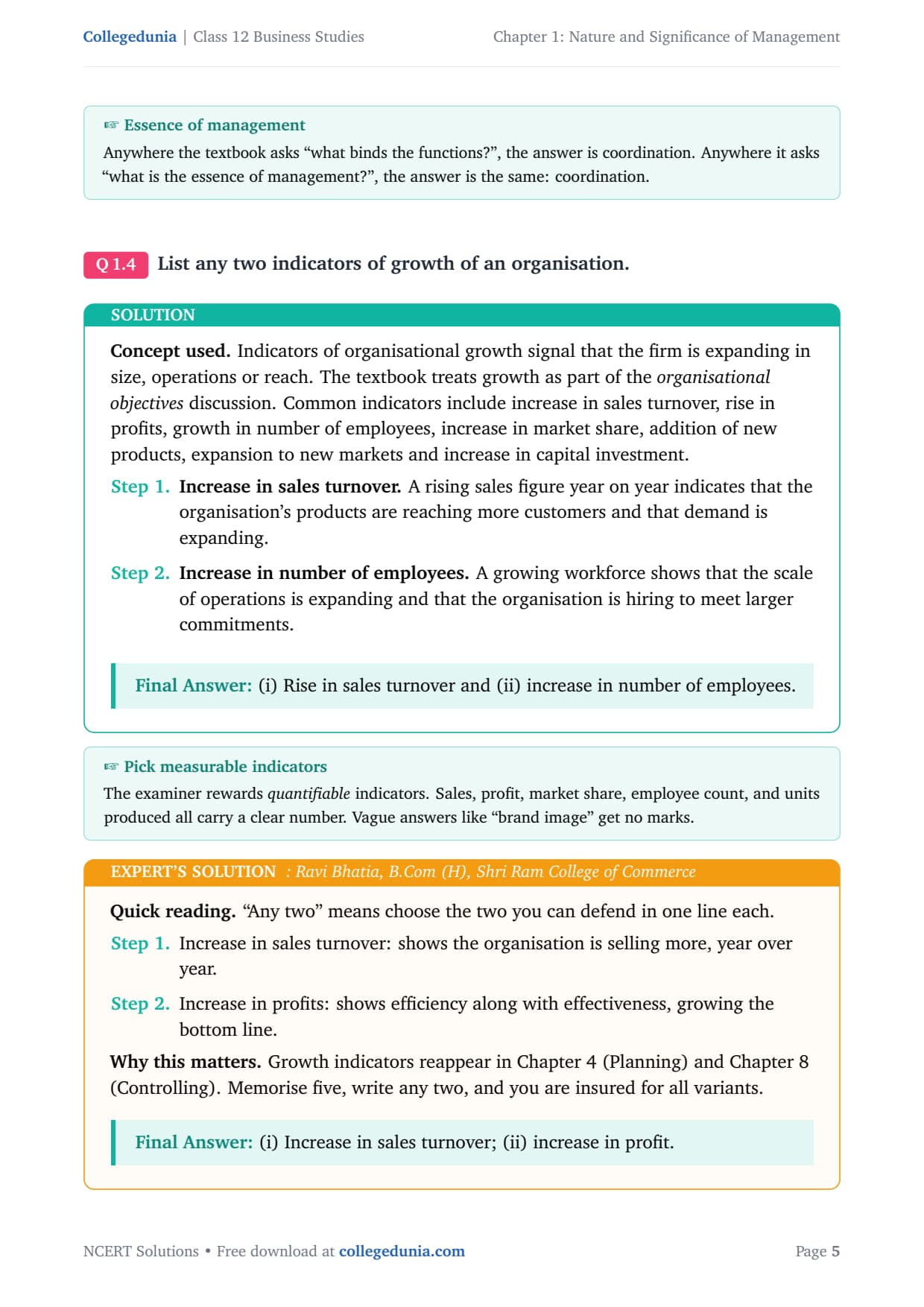
Q 1.4
List any two indicators of growth of an organisation.
Concept used. Indicators of organisational growth signal that the firm is expanding in size,
operations or reach. The textbook treats growth as part of the organisational objectives
discussion. Common indicators include increase in sales turnover, rise in profits, growth in number
of employees, increase in market share, addition of new products, expansion to new markets and
increase in capital investment.
Increase in sales turnover. A rising sales figure year on year indicates that the
organisation's products are reaching more customers and that demand is expanding.
Increase in number of employees. A growing workforce shows that the scale of
operations is expanding and that the organisation is hiring to meet larger commitments.
(i) Rise in sales turnover and (ii) increase in number of employees.
RB
Ravi Bhatia
B.Com (H), Shri Ram College of Commerce
Verified Expert
Quick reading. ``Any two'' means choose the two you can defend in one line each.
Increase in sales turnover: shows the organisation is selling more, year over year.
Increase in profits: shows efficiency along with effectiveness, growing the bottom line.
Why this matters. Growth indicators reappear in Chapter 4 (Planning) and Chapter 8
(Controlling). Memorise five, write any two, and you are insured for all variants.
(i) Increase in sales turnover; (ii) increase in profit.
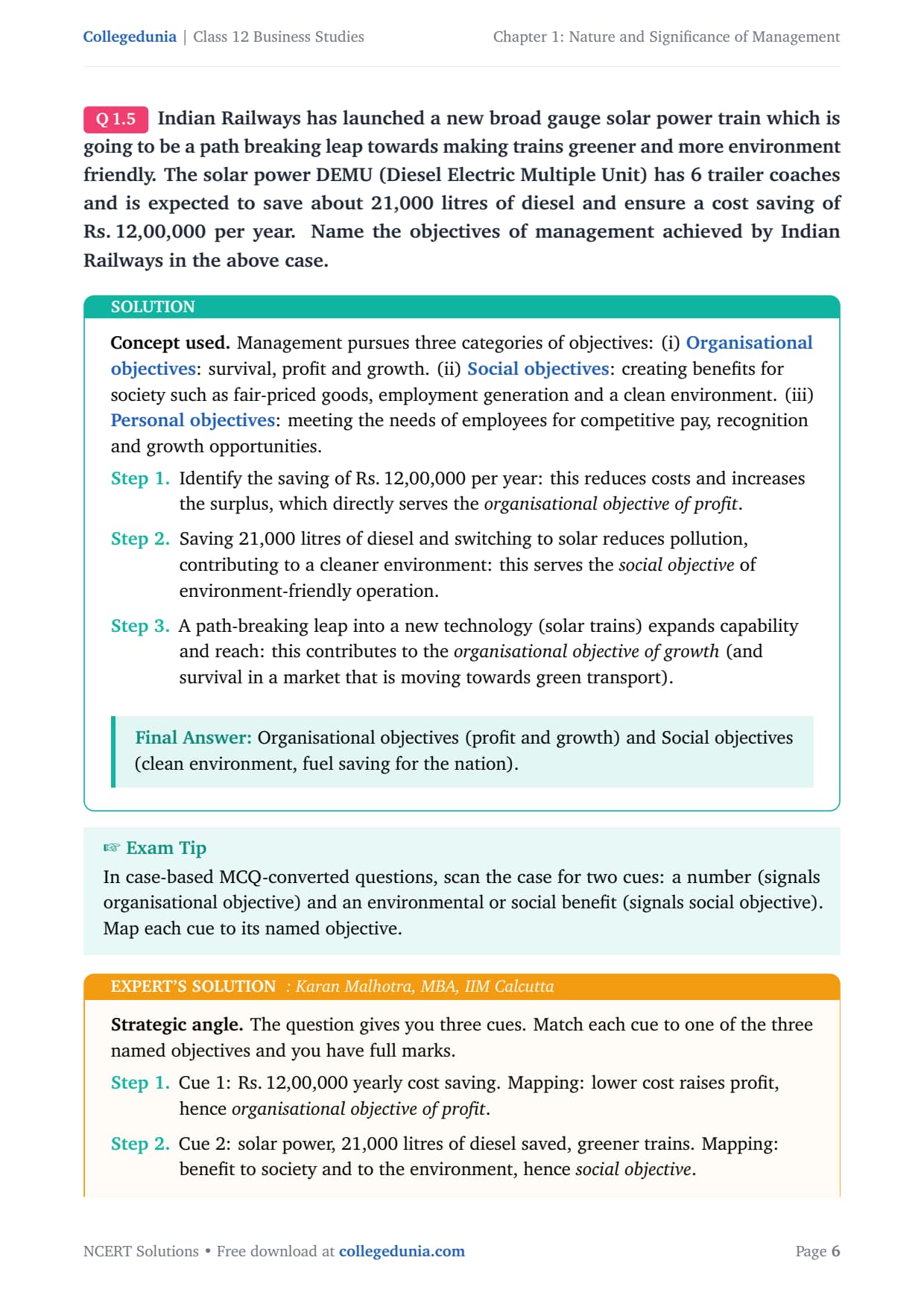
Q 1.5
Indian Railways has launched a new broad gauge solar power train which is going to be a
path breaking leap towards making trains greener and more environment friendly. The solar power
DEMU (Diesel Electric Multiple Unit) has 6 trailer coaches and is expected to save about 21,000
litres of diesel and ensure a cost saving of Rs. 12,00,000 per year. Name the objectives of
management achieved by Indian Railways in the above case.
Concept used. Management pursues three categories of objectives:
(i) Organisational objectives: survival, profit and growth.
(ii) Social objectives: creating benefits for society such as fair-priced goods, employment
generation and a clean environment.
(iii) Personal objectives: meeting the needs of employees for competitive pay, recognition
and growth opportunities.
Identify the saving of Rs. 12,00,000 per year: this reduces costs and increases the surplus,
which directly serves the organisational objective of profit.
Saving 21,000 litres of diesel and switching to solar reduces pollution, contributing to a
cleaner environment: this serves the social objective of environment-friendly operation.
A path-breaking leap into a new technology (solar trains) expands capability and reach: this
contributes to the organisational objective of growth (and survival in a market that
is moving towards green transport).
Organisational objectives (profit and growth) and Social objectives (clean environment,
fuel saving for the nation).
KM
Karan Malhotra
MBA, IIM Calcutta
Verified Expert
Strategic angle. The question gives you three cues. Match each cue to one of the three
named objectives and you have full marks.
Cue 2: solar power, 21,000 litres of diesel saved, greener trains. Mapping: benefit to
society and to the environment, hence social objective.
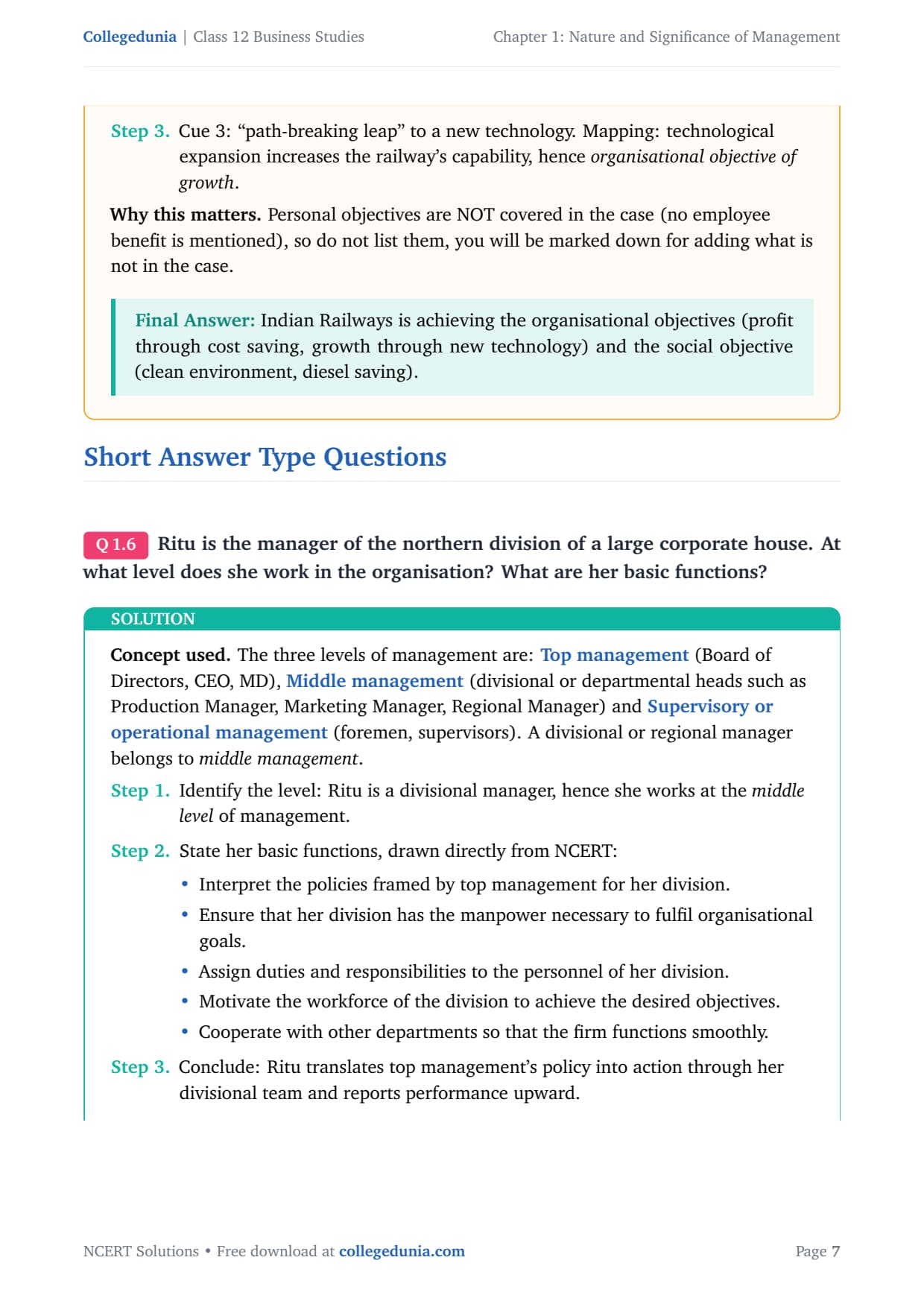
Cue 3: ``path-breaking leap'' to a new technology. Mapping: technological expansion
increases the railway's capability, hence organisational objective of growth.
Why this matters. Personal objectives are NOT covered in the case (no employee benefit is
mentioned), so do not list them, you will be marked down for adding what is not in the case.
Indian Railways is achieving the organisational objectives (profit through cost saving,
growth through new technology) and the social objective (clean environment, diesel saving).
Short Answer Type Questions
Q 1.6
Ritu is the manager of the northern division of a large corporate house. At what level
does she work in the organisation? What are her basic functions?
Concept used. The three levels of management are: Top management (Board of
Directors, CEO, MD), Middle management (divisional or departmental heads such as
Production Manager, Marketing Manager, Regional Manager) and Supervisory or operational
management (foremen, supervisors). A divisional or regional manager belongs to middle
management.
Identify the level: Ritu is a divisional manager, hence she works at the middle
level of management.
State her basic functions, drawn directly from NCERT:
Interpret the policies framed by top management for her division.
Ensure that her division has the manpower necessary to fulfil organisational goals.
Assign duties and responsibilities to the personnel of her division.
Motivate the workforce of the division to achieve the desired objectives.
Cooperate with other departments so that the firm functions smoothly.
Conclude: Ritu translates top management's policy into action through her divisional team
and reports performance upward.
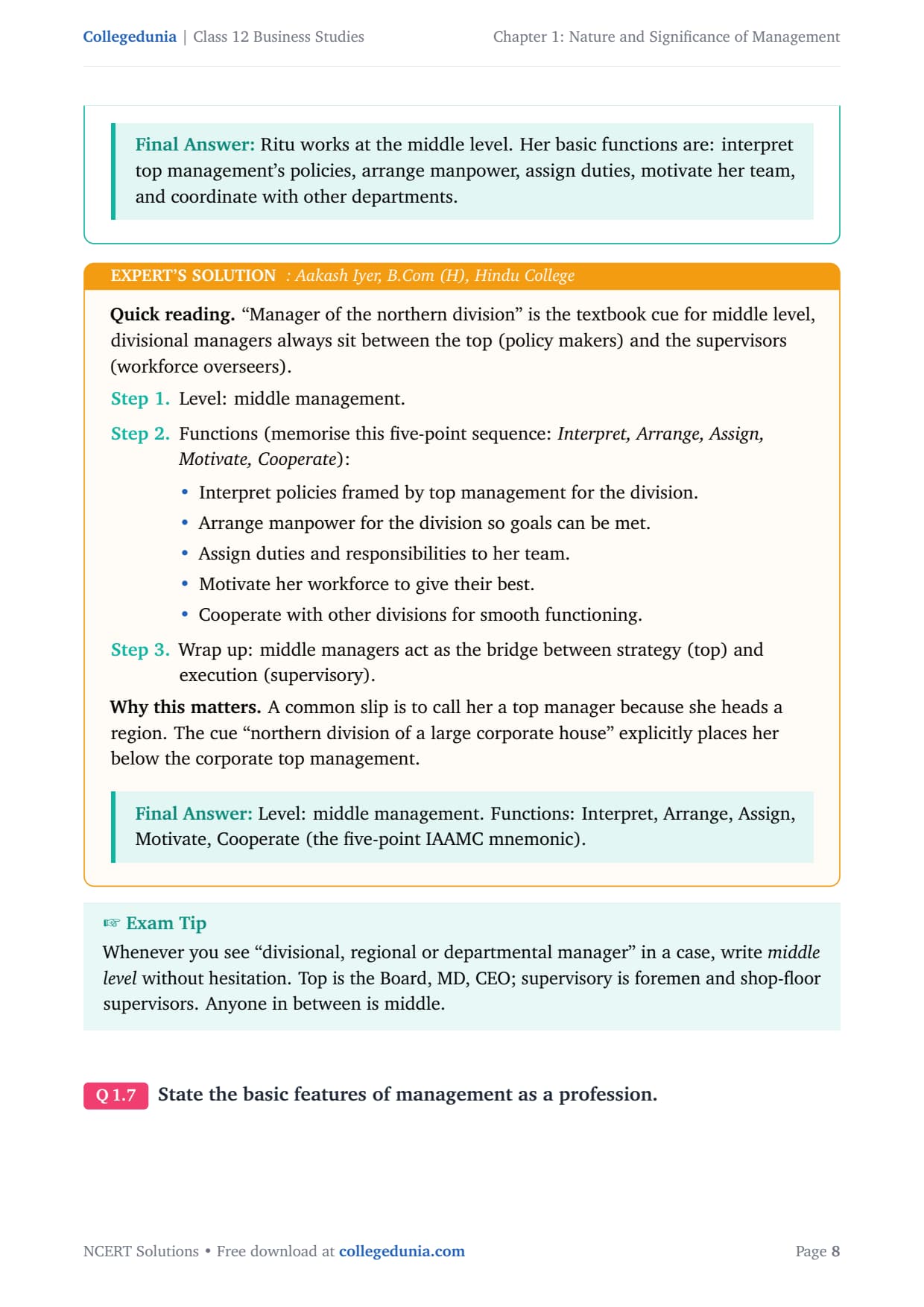
Ritu works at the middle level. Her basic functions are: interpret top management's
policies, arrange manpower, assign duties, motivate her team, and coordinate with other departments.
AI
Aakash Iyer
B.Com (H), Hindu College
Verified Expert
Quick reading. ``Manager of the northern division'' is the textbook cue for middle level,
divisional managers always sit between the top (policy makers) and the supervisors (workforce overseers).
Level: middle management.
Functions (memorise this five-point sequence: Interpret, Arrange, Assign, Motivate,
Cooperate):
Interpret policies framed by top management for the division.
Arrange manpower for the division so goals can be met.
Assign duties and responsibilities to her team.
Motivate her workforce to give their best.
Cooperate with other divisions for smooth functioning.
Wrap up: middle managers act as the bridge between strategy (top) and execution (supervisory).
Why this matters. A common slip is to call her a top manager because she heads a region.
The cue ``northern division of a large corporate house'' explicitly places her below the corporate
top management.
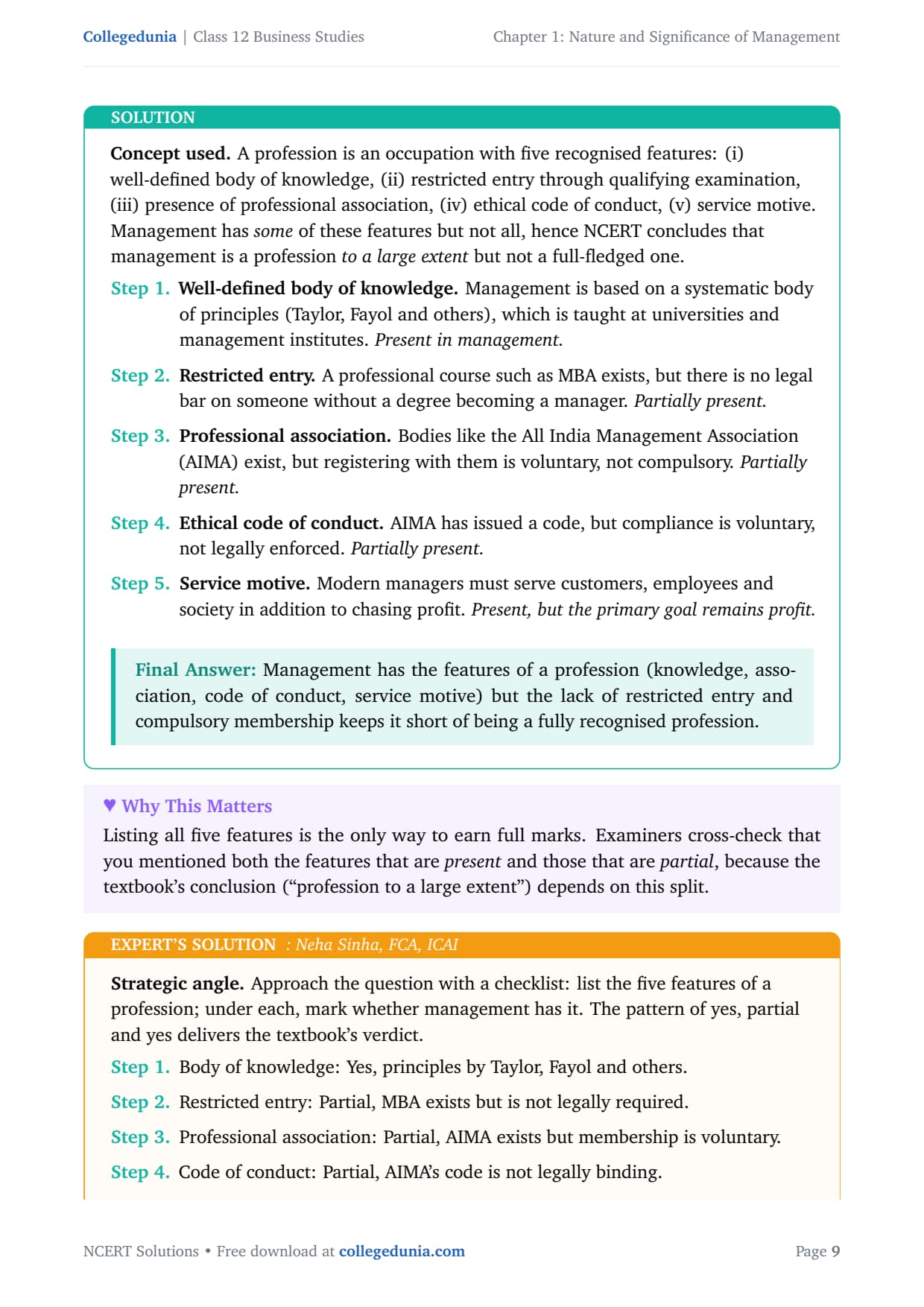
State the basic features of management as a profession.
Concept used. A profession is an occupation with five recognised features:
(i) well-defined body of knowledge, (ii) restricted entry through qualifying examination,
(iii) presence of professional association, (iv) ethical code of conduct,
(v) service motive. Management has some of these features but not all, hence NCERT
concludes that management is a profession to a large extent but not a full-fledged one.
Well-defined body of knowledge. Management is based on a systematic body of
principles (Taylor, Fayol and others), which is taught at universities and management
institutes. Present in management.
Restricted entry. A professional course such as MBA exists, but there is no legal
bar on someone without a degree becoming a manager. Partially present.
Professional association. Bodies like the All India Management Association (AIMA)
exist, but registering with them is voluntary, not compulsory. Partially present.
Ethical code of conduct. AIMA has issued a code, but compliance is voluntary,
not legally enforced. Partially present.
Service motive. Modern managers must serve customers, employees and society in
addition to chasing profit. Present, but the primary goal remains profit.
Management has the features of a profession (knowledge, association, code of conduct,
service motive) but the lack of restricted entry and compulsory membership keeps it short of being
a fully recognised profession.
NS
Neha Sinha
FCA, ICAI
Verified Expert
Strategic angle. Approach the question with a checklist: list the five features of a
profession; under each, mark whether management has it. The pattern of yes, partial and yes
delivers the textbook's verdict.
Body of knowledge: Yes, principles by Taylor, Fayol and others.
Restricted entry: Partial, MBA exists but is not legally required.
Professional association: Partial, AIMA exists but membership is voluntary.
Code of conduct: Partial, AIMA's code is not legally binding.
Service motive: Yes, modern managers must balance profit with stakeholder welfare.
Why this matters. The same five-point checklist appears in the Chapter 1 Long Answer
question 2 (``Do you think management has the characteristics of a full-fledged profession?'').
Learn it once, use it twice.
Management has all five features of a profession in part, hence is a profession to a
large extent but not a full-fledged one.
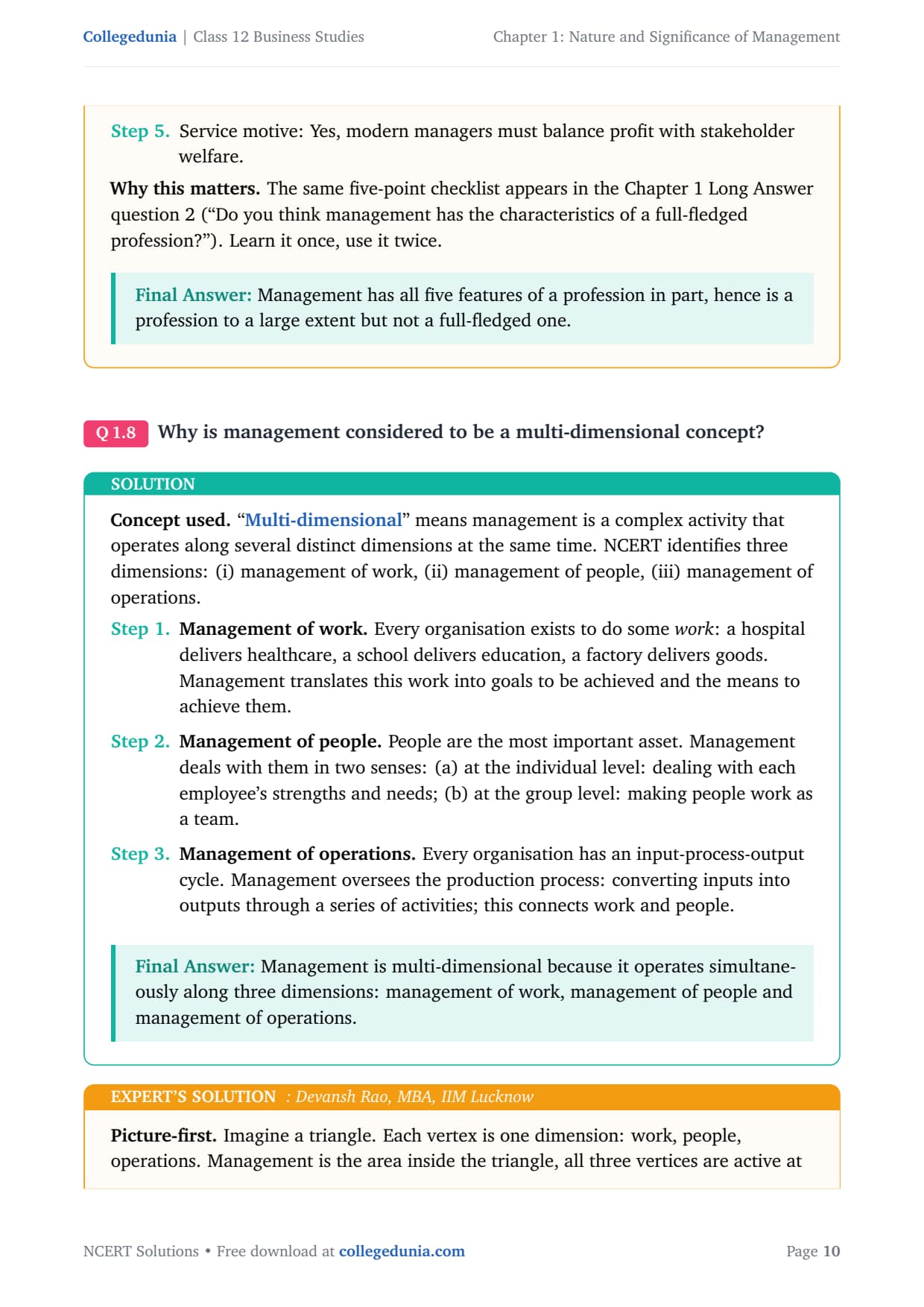
Q 1.8
Why is management considered to be a multi-dimensional concept?
Concept used. ``Multi-dimensional'' means management is a complex activity that
operates along several distinct dimensions at the same time. NCERT identifies three dimensions:
(i) management of work, (ii) management of people, (iii) management of operations.
Management of work. Every organisation exists to do some work: a hospital
delivers healthcare, a school delivers education, a factory delivers goods. Management
translates this work into goals to be achieved and the means to achieve them.
Management of people. People are the most important asset. Management deals with
them in two senses: (a) at the individual level: dealing with each employee's strengths and
needs; (b) at the group level: making people work as a team.
Management of operations. Every organisation has an input-process-output cycle.
Management oversees the production process: converting inputs into outputs through a
series of activities; this connects work and people.
Management is multi-dimensional because it operates simultaneously along three
dimensions: management of work, management of people and management of operations.
DR
Devansh Rao
MBA, IIM Lucknow
Verified Expert
Picture-first. Imagine a triangle. Each vertex is one dimension: work, people,
operations. Management is the area inside the triangle, all three vertices are active at the same
time. Lose any one vertex and the triangle collapses into a line.
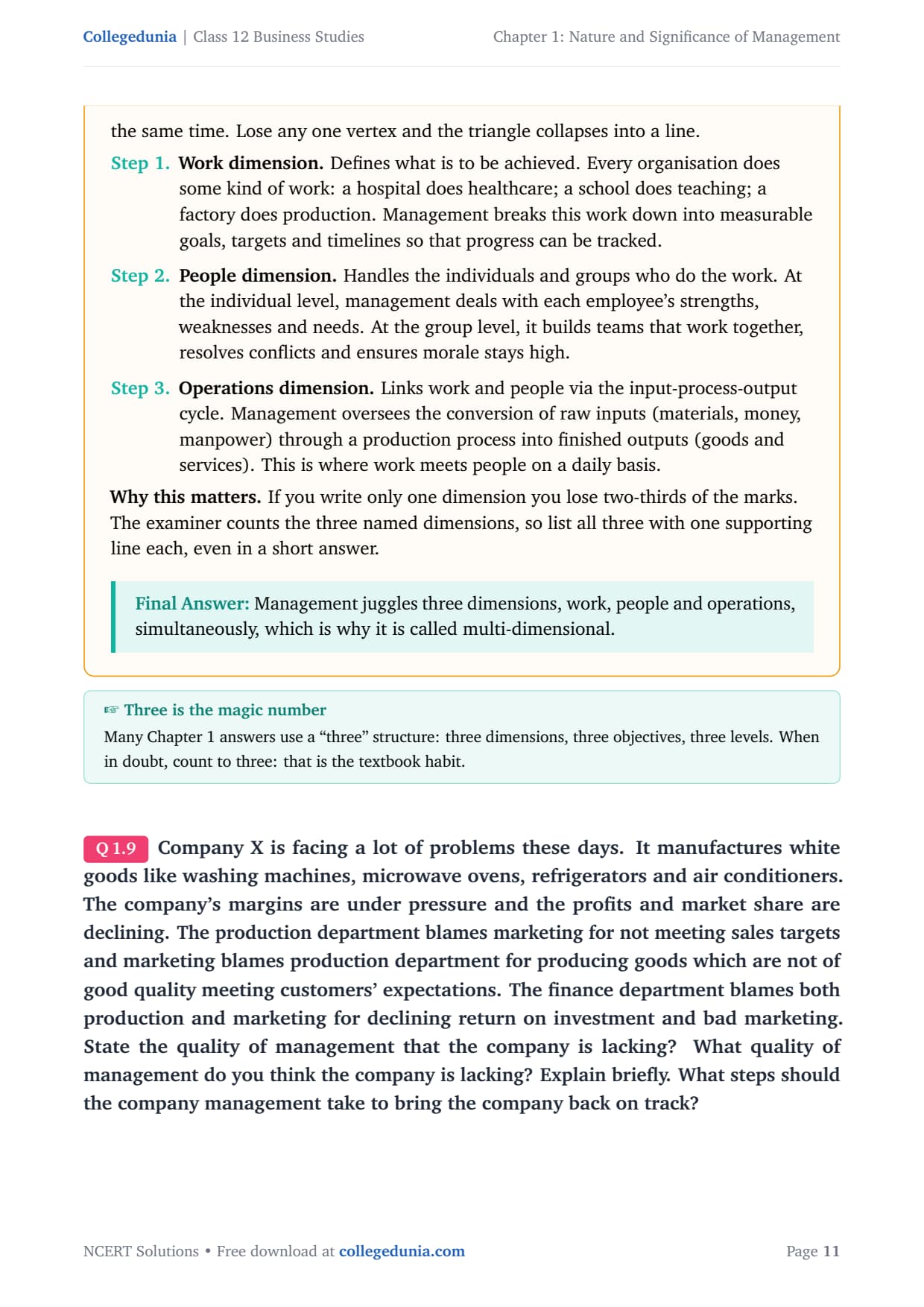
Work dimension. Defines what is to be achieved. Every organisation does some
kind of work: a hospital does healthcare; a school does teaching; a factory does
production. Management breaks this work down into measurable goals, targets and timelines
so that progress can be tracked.
People dimension. Handles the individuals and groups who do the work. At the
individual level, management deals with each employee's strengths, weaknesses and needs.
At the group level, it builds teams that work together, resolves conflicts and ensures
morale stays high.
Operations dimension. Links work and people via the input-process-output cycle.
Management oversees the conversion of raw inputs (materials, money, manpower) through a
production process into finished outputs (goods and services). This is where work meets
people on a daily basis.
Why this matters. If you write only one dimension you lose two-thirds of the marks. The
examiner counts the three named dimensions, so list all three with one supporting line each, even
in a short answer.
Management juggles three dimensions, work, people and operations, simultaneously, which
is why it is called multi-dimensional.
Q 1.9
Company X is facing a lot of problems these days. It manufactures white goods like
washing machines, microwave ovens, refrigerators and air conditioners. The company's margins are
under pressure and the profits and market share are declining. The production department blames
ncert-notes-class-12-business-studies-chapter-10-marketing for not meeting sales targets and ncert-notes-class-12-business-studies-chapter-10-marketing blames production department for producing
goods which are not of good quality meeting customers' expectations. The finance department blames
both production and ncert-notes-class-12-business-studies-chapter-10-marketing for declining return on investment and bad ncert-notes-class-12-business-studies-chapter-10-marketing. State the
quality of management that the company is lacking? What quality of management do you think the
company is lacking? Explain briefly. What steps should the company management take to bring the
company back on track?
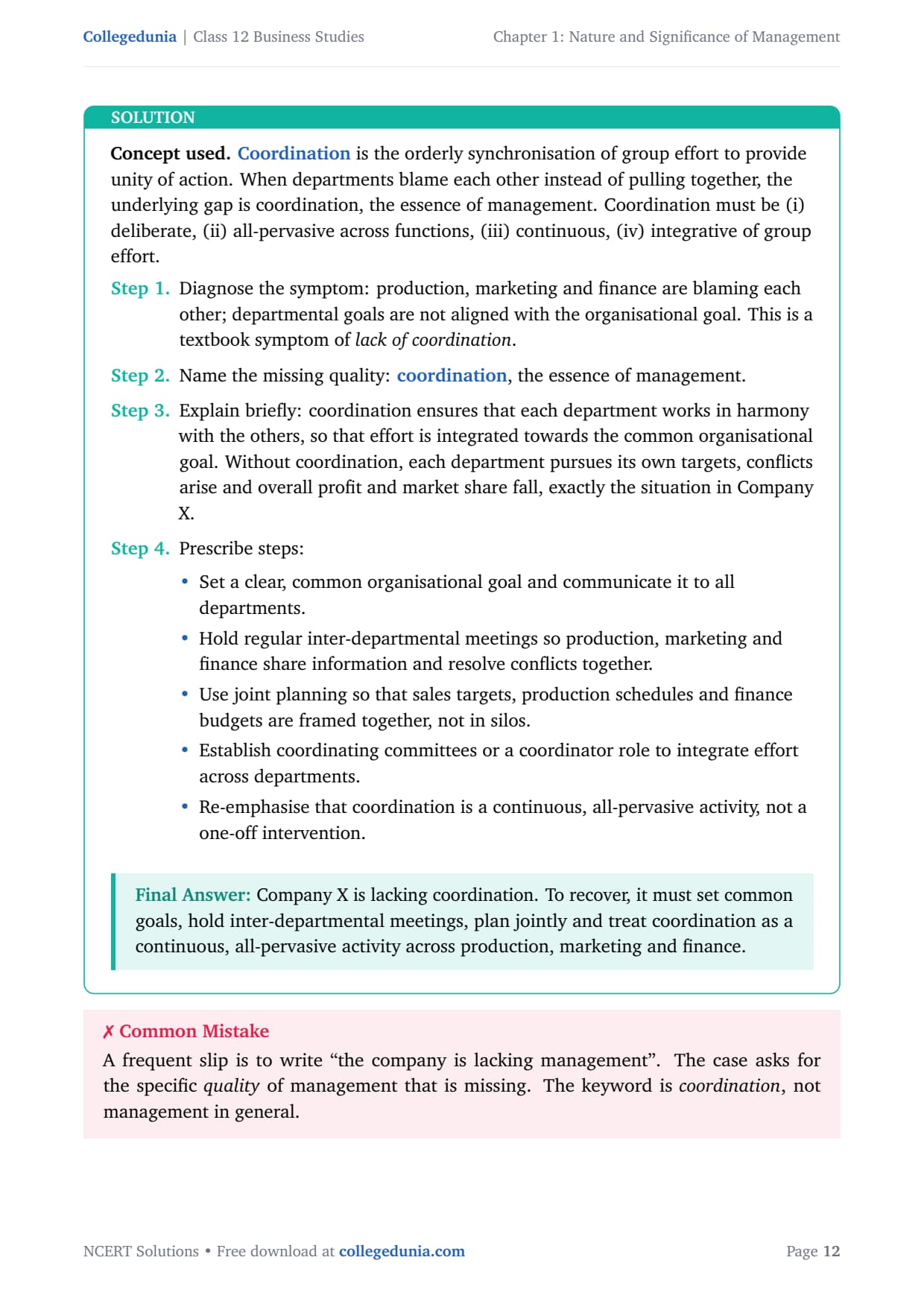
Concept used.Coordination is the orderly synchronisation of group effort to
provide unity of action. When departments blame each other instead of pulling together, the
underlying gap is coordination, the essence of management. Coordination must be (i) deliberate,
(ii) all-pervasive across functions, (iii) continuous, (iv) integrative of group effort.
Diagnose the symptom: production, ncert-notes-class-12-business-studies-chapter-10-marketing and finance are blaming each other; departmental
goals are not aligned with the organisational goal. This is a textbook symptom of
lack of coordination.
Name the missing quality: coordination, the essence of management.
Explain briefly: coordination ensures that each department works in harmony with the others,
so that effort is integrated towards the common organisational goal. Without coordination,
each department pursues its own targets, conflicts arise and overall profit and market share
fall, exactly the situation in Company X.
Prescribe steps:
Set a clear, common organisational goal and communicate it to all departments.
Hold regular inter-departmental meetings so production, ncert-notes-class-12-business-studies-chapter-10-marketing and finance share
information and resolve conflicts together.
Use joint planning so that sales targets, production schedules and finance budgets
are framed together, not in silos.
Establish coordinating committees or a coordinator role to integrate effort across
departments.
Re-emphasise that coordination is a continuous, all-pervasive activity, not a
one-off intervention.
Company X is lacking coordination. To recover, it must set common goals, hold
inter-departmental meetings, plan jointly and treat coordination as a continuous, all-pervasive
activity across production, ncert-notes-class-12-business-studies-chapter-10-marketing and finance.
PJ
Pranav Joshi
MBA, XLRI Jamshedpur
Verified Expert
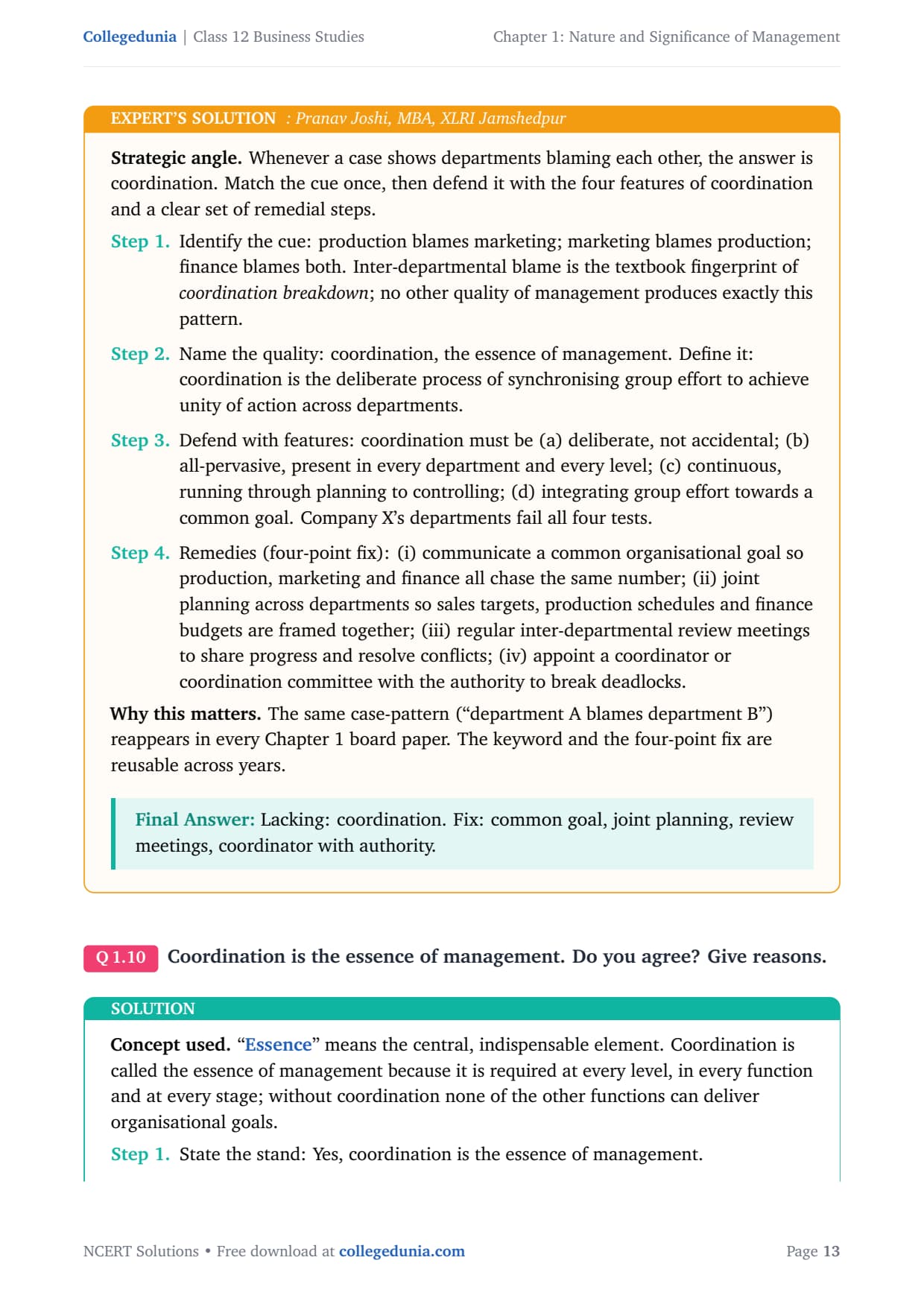
Strategic angle. Whenever a case shows departments blaming each other, the answer is
coordination. Match the cue once, then defend it with the four features of coordination and a
clear set of remedial steps.
Identify the cue: production blames ncert-notes-class-12-business-studies-chapter-10-marketing; ncert-notes-class-12-business-studies-chapter-10-marketing blames production; finance blames
both. Inter-departmental blame is the textbook fingerprint of coordination
breakdown; no other quality of management produces exactly this pattern.
Name the quality: coordination, the essence of management. Define it: coordination is
the deliberate process of synchronising group effort to achieve unity of action across
departments.
Defend with features: coordination must be (a) deliberate, not accidental; (b) all-pervasive,
present in every department and every level; (c) continuous, running through planning to
controlling; (d) integrating group effort towards a common goal. Company X's departments
fail all four tests.
Remedies (four-point fix): (i) communicate a common organisational goal so production,
ncert-notes-class-12-business-studies-chapter-10-marketing and finance all chase the same number; (ii) joint planning across departments
so sales targets, production schedules and finance budgets are framed together; (iii)
regular inter-departmental review meetings to share progress and resolve conflicts;
(iv) appoint a coordinator or coordination committee with the authority to break
deadlocks.
Why this matters. The same case-pattern (``department A blames department B'') reappears
in every Chapter 1 board paper. The keyword and the four-point fix are reusable across years.
Lacking: coordination. Fix: common goal, joint planning, review meetings, coordinator
with authority.
Q 1.10
Coordination is the essence of management. Do you agree? Give reasons.
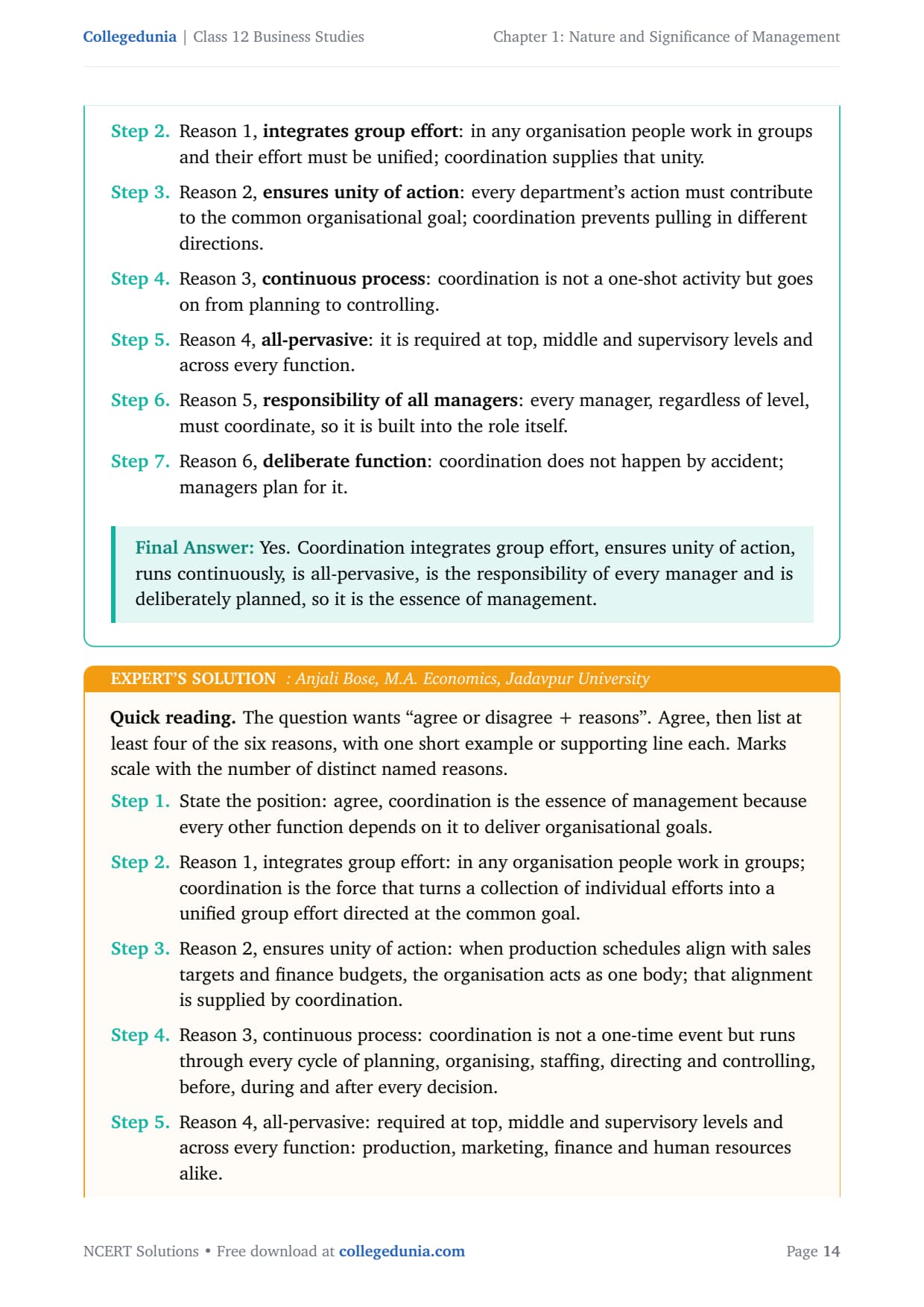
Concept used. ``Essence'' means the central, indispensable element. Coordination
is called the essence of management because it is required at every level, in every function and
at every stage; without coordination none of the other functions can deliver organisational goals.
State the stand: Yes, coordination is the essence of management.
Reason 1, integrates group effort: in any organisation people work in groups and
their effort must be unified; coordination supplies that unity.
Reason 2, ensures unity of action: every department's action must contribute to
the common organisational goal; coordination prevents pulling in different directions.
Reason 3, continuous process: coordination is not a one-shot activity but goes on
from planning to controlling.
Reason 4, all-pervasive: it is required at top, middle and supervisory levels and
across every function.
Reason 5, responsibility of all managers: every manager, regardless of level,
must coordinate, so it is built into the role itself.
Reason 6, deliberate function: coordination does not happen by accident; managers
plan for it.
Yes. Coordination integrates group effort, ensures unity of action, runs continuously,
is all-pervasive, is the responsibility of every manager and is deliberately planned, so it is
the essence of management.
AB
Anjali Bose
M.A. Economics, Jadavpur University
Verified Expert
Quick reading. The question wants ``agree or disagree + reasons''. Agree, then list at
least four of the six reasons, with one short example or supporting line each. Marks scale with
the number of distinct named reasons.
State the position: agree, coordination is the essence of management because every other
function depends on it to deliver organisational goals.
Reason 1, integrates group effort: in any organisation people work in groups; coordination
is the force that turns a collection of individual efforts into a unified group effort
directed at the common goal.
Reason 2, ensures unity of action: when production schedules align with sales targets and
finance budgets, the organisation acts as one body; that alignment is supplied by
coordination.
Reason 3, continuous process: coordination is not a one-time event but runs through every
cycle of planning, organising, staffing, directing and controlling, before, during and
after every decision.
Reason 4, all-pervasive: required at top, middle and supervisory levels and across every
function: production, ncert-notes-class-12-business-studies-chapter-10-marketing, finance and human resources alike.
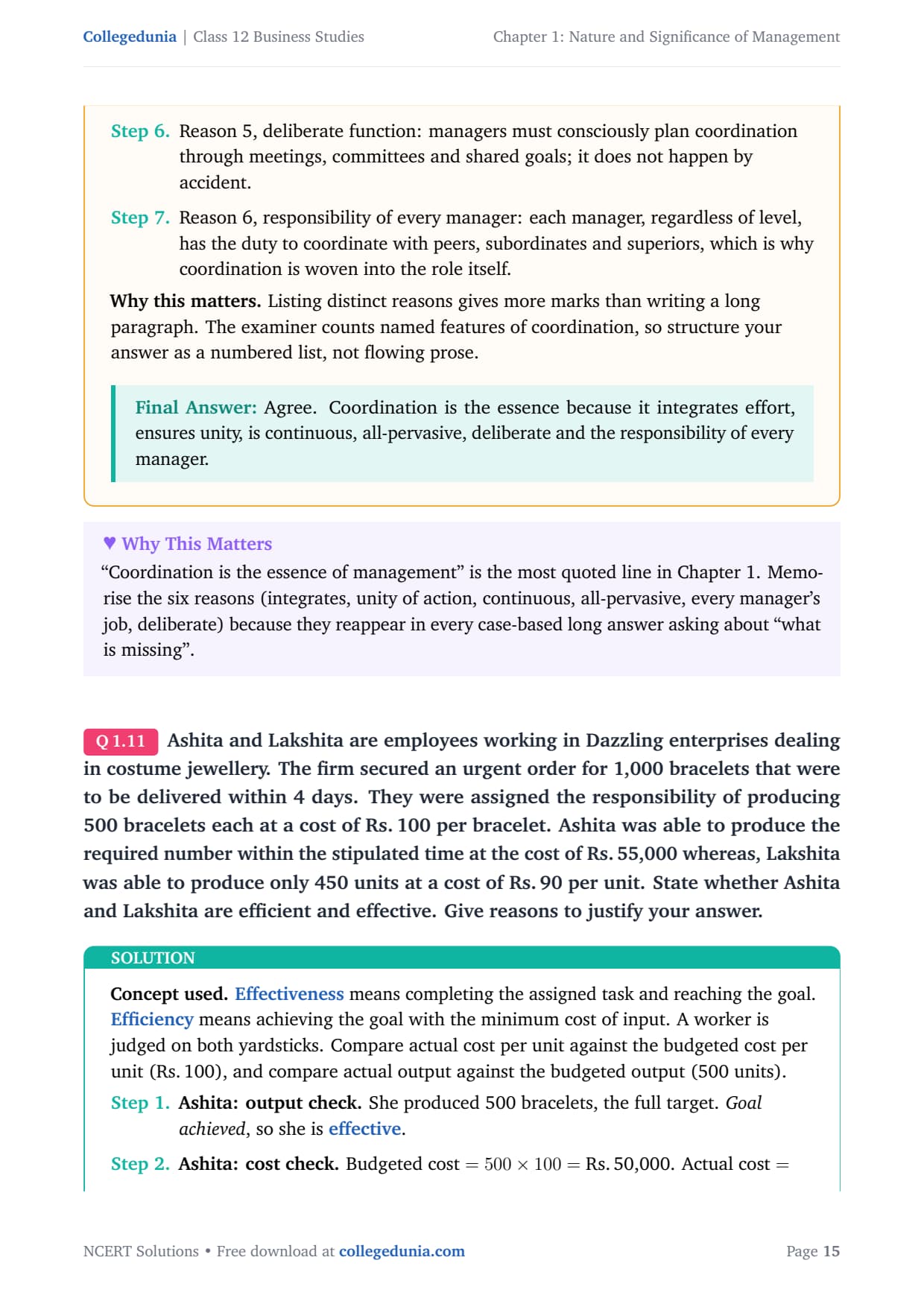
Reason 5, deliberate function: managers must consciously plan coordination through
meetings, committees and shared goals; it does not happen by accident.
Reason 6, responsibility of every manager: each manager, regardless of level, has the
duty to coordinate with peers, subordinates and superiors, which is why coordination is
woven into the role itself.
Why this matters. Listing distinct reasons gives more marks than writing a long
paragraph. The examiner counts named features of coordination, so structure your answer as a
numbered list, not flowing prose.
Agree. Coordination is the essence because it integrates effort, ensures unity, is
continuous, all-pervasive, deliberate and the responsibility of every manager.
Q 1.11
Ashita and Lakshita are employees working in Dazzling enterprises dealing in costume
jewellery. The firm secured an urgent order for 1,000 bracelets that were to be delivered within
4 days. They were assigned the responsibility of producing 500 bracelets each at a cost of
Rs. 100 per bracelet. Ashita was able to produce the required number within the stipulated time
at the cost of Rs. 55,000 whereas, Lakshita was able to produce only 450 units at a cost of
Rs. 90 per unit. State whether Ashita and Lakshita are efficient and effective. Give reasons to
justify your answer.
Concept used.Effectiveness means completing the assigned task and reaching the
goal. Efficiency means achieving the goal with the minimum cost of input. A worker is
judged on both yardsticks. Compare actual cost per unit against the budgeted cost per unit
(Rs. 100), and compare actual output against the budgeted output (500 units).
Ashita: output check. She produced 500 bracelets, the full target. Goal
achieved, so she is effective.
Ashita: cost check. Budgeted cost = 500 × 100 = Rs. 50,000. Actual cost
= Rs. 55,000. Cost per unit = 55,000 / 500 = Rs. 110, which is higher than the
budgeted Rs. 100. Cost exceeded the budget, so Ashita is not efficient.
Lakshita: output check. She produced only 450 bracelets out of 500. Goal
not achieved, so she is not effective.
Lakshita: cost check. Cost per unit = Rs. 90, which is less than the budgeted
Rs. 100. Cost saved per unit, so Lakshita is efficient.
Ashita: effective but not efficient. Lakshita: efficient but not effective.
VS
Vikram Singh
B.Com (H), Lady Shri Ram College for Women
Verified Expert
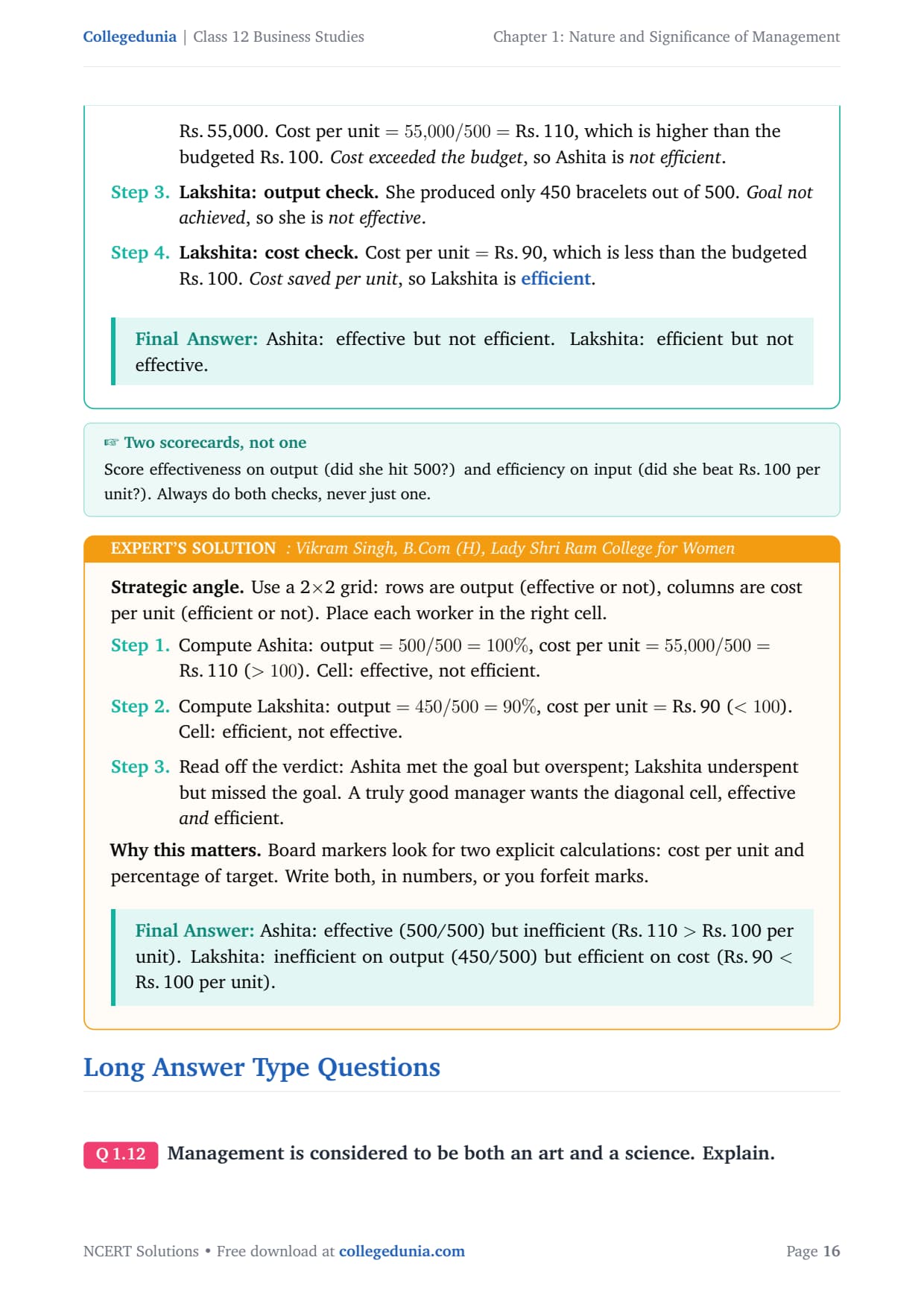
Strategic angle. Use a 2×2 grid: rows are output (effective or not), columns are
cost per unit (efficient or not). Place each worker in the right cell.
Compute Ashita: output = 500/500 = 100%, cost per unit = 55,000/500 = Rs. 110
(> 100). Cell: effective, not efficient.
Compute Lakshita: output = 450/500 = 90%, cost per unit = Rs. 90 (< 100). Cell:
efficient, not effective.
Read off the verdict: Ashita met the goal but overspent; Lakshita underspent but missed
the goal. A truly good manager wants the diagonal cell, effective and efficient.
Why this matters. Board markers look for two explicit calculations: cost per unit and
percentage of target. Write both, in numbers, or you forfeit marks.
Ashita: effective (500/500) but inefficient (Rs. 110 > Rs. 100 per unit). Lakshita:
inefficient on output (450/500) but efficient on cost (Rs. 90 < Rs. 100 per unit).
Long Answer Type Questions
Q 1.12
Management is considered to be both an art and a science. Explain.
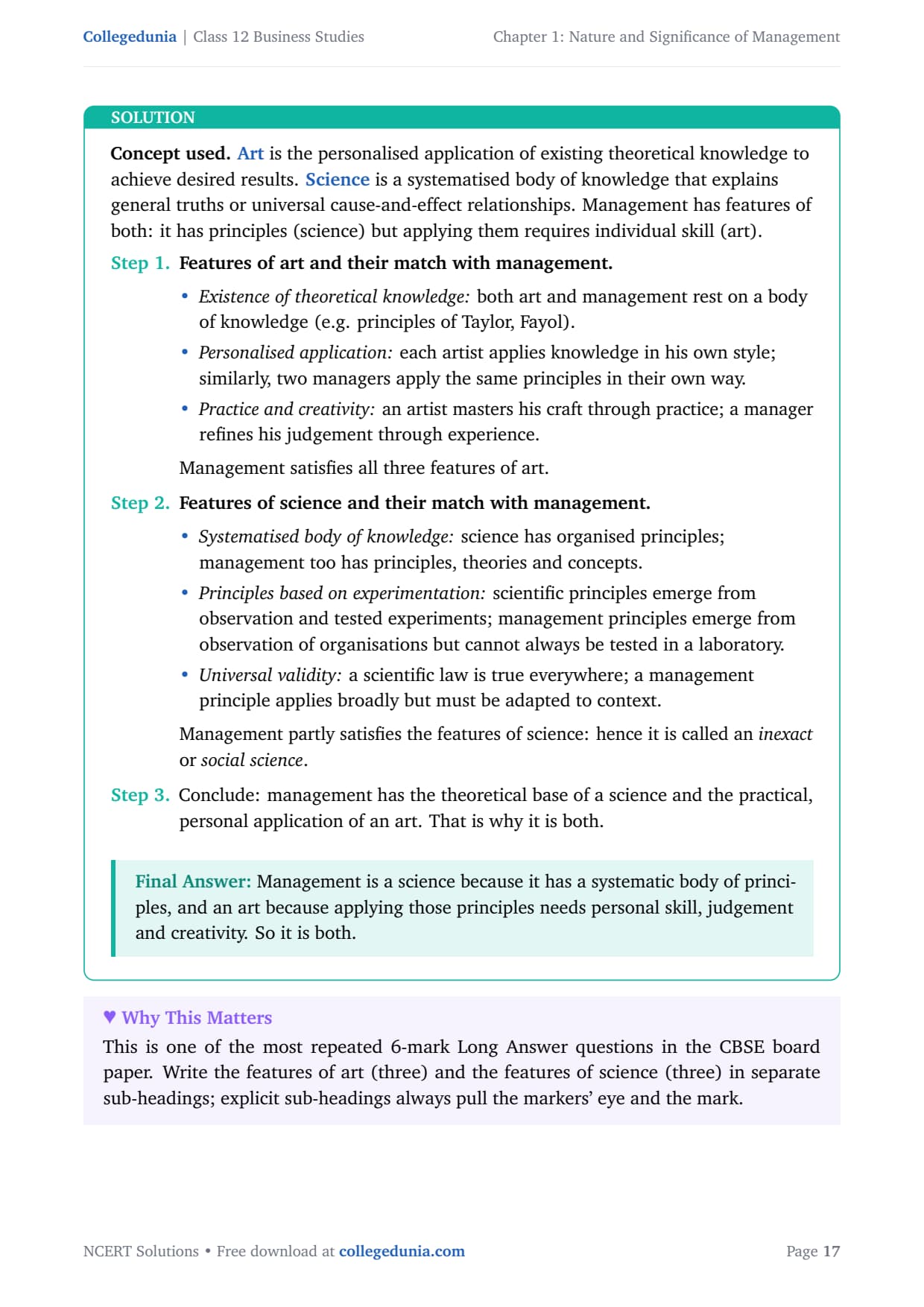
Concept used.Art is the personalised application of existing theoretical
knowledge to achieve desired results. Science is a systematised body of knowledge that
explains general truths or universal cause-and-effect relationships. Management has features of
both: it has principles (science) but applying them requires individual skill (art).
Features of art and their match with management.
Existence of theoretical knowledge: both art and management rest on a body
of knowledge (e.g. principles of Taylor, Fayol).
Personalised application: each artist applies knowledge in his own style;
similarly, two managers apply the same principles in their own way.
Practice and creativity: an artist masters his craft through practice; a
manager refines his judgement through experience.
Management satisfies all three features of art.
Features of science and their match with management.
Systematised body of knowledge: science has organised principles; management
too has principles, theories and concepts.
Principles based on experimentation: scientific principles emerge from
observation and tested experiments; management principles emerge from observation
of organisations but cannot always be tested in a laboratory.
Universal validity: a scientific law is true everywhere; a management
principle applies broadly but must be adapted to context.
Management partly satisfies the features of science: hence it is called an inexact
or social science.
Conclude: management has the theoretical base of a science and the practical, personal
application of an art. That is why it is both.
Management is a science because it has a systematic body of principles, and an art
because applying those principles needs personal skill, judgement and creativity. So it is both.
SK
Suhana Khan
MBA, Indian School of Business (ISB) Hyderabad
Verified Expert
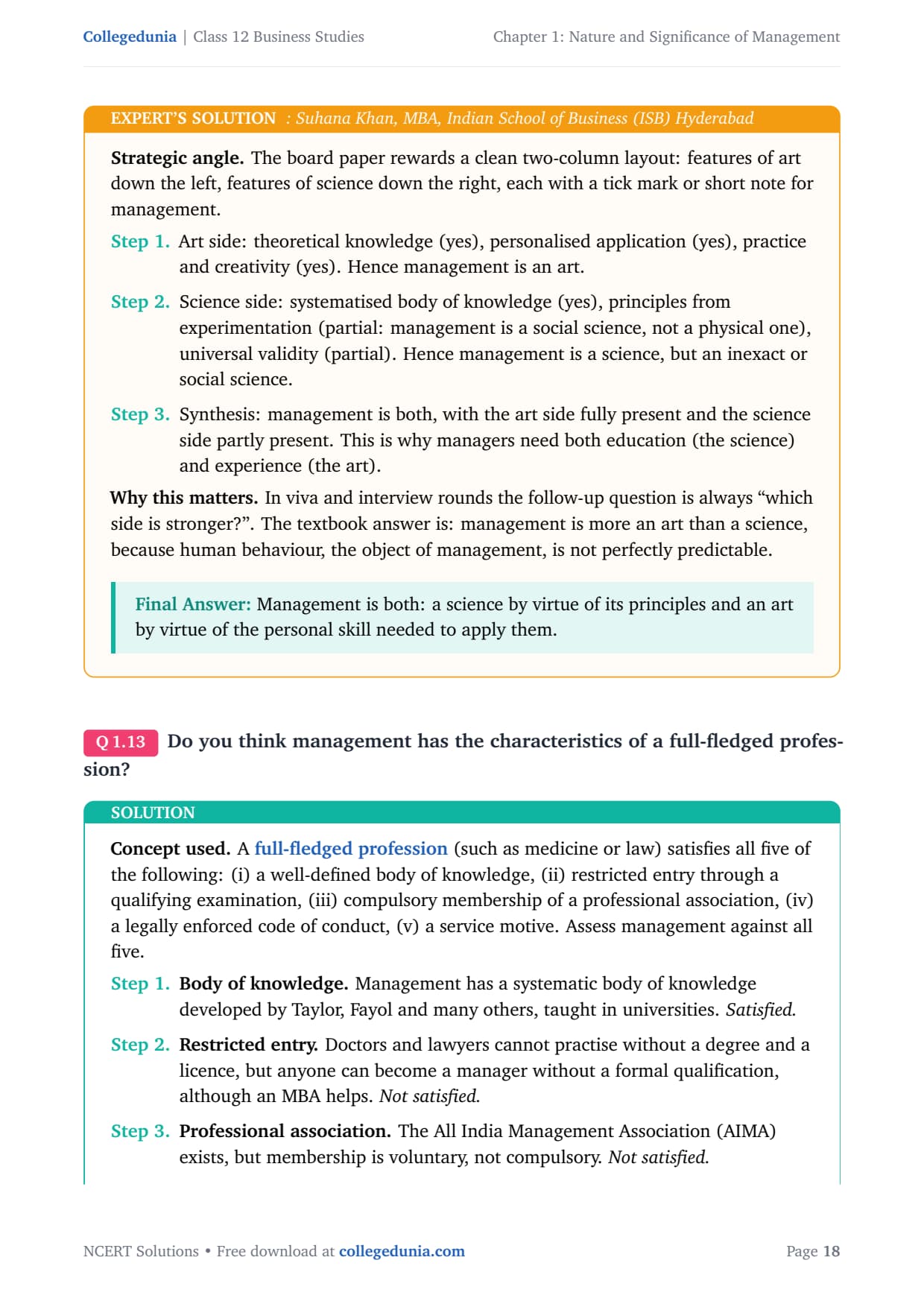
Strategic angle. The board paper rewards a clean two-column layout: features of art down
the left, features of science down the right, each with a tick mark or short note for management.
Art side: theoretical knowledge (yes), personalised application (yes), practice and
creativity (yes). Hence management is an art.
Science side: systematised body of knowledge (yes), principles from experimentation
(partial: management is a social science, not a physical one), universal validity (partial).
Hence management is a science, but an inexact or social science.
Synthesis: management is both, with the art side fully present and the science side
partly present. This is why managers need both education (the science) and experience
(the art).
Why this matters. In viva and interview rounds the follow-up question is always ``which
side is stronger?''. The textbook answer is: management is more an art than a science, because
human behaviour, the object of management, is not perfectly predictable.
Management is both: a science by virtue of its principles and an art by virtue of the
personal skill needed to apply them.
Q 1.13
Do you think management has the characteristics of a full-fledged profession?
Concept used. A full-fledged profession (such as medicine or law) satisfies all
five of the following: (i) a well-defined body of knowledge, (ii) restricted entry through a
qualifying examination, (iii) compulsory membership of a professional association,
(iv) a legally enforced code of conduct, (v) a service motive. Assess management against all five.
Body of knowledge. Management has a systematic body of knowledge developed by
Taylor, Fayol and many others, taught in universities. Satisfied.
Restricted entry. Doctors and lawyers cannot practise without a degree and a
licence, but anyone can become a manager without a formal qualification, although an MBA
helps. Not satisfied.
Professional association. The All India Management Association (AIMA) exists,
but membership is voluntary, not compulsory. Not satisfied.
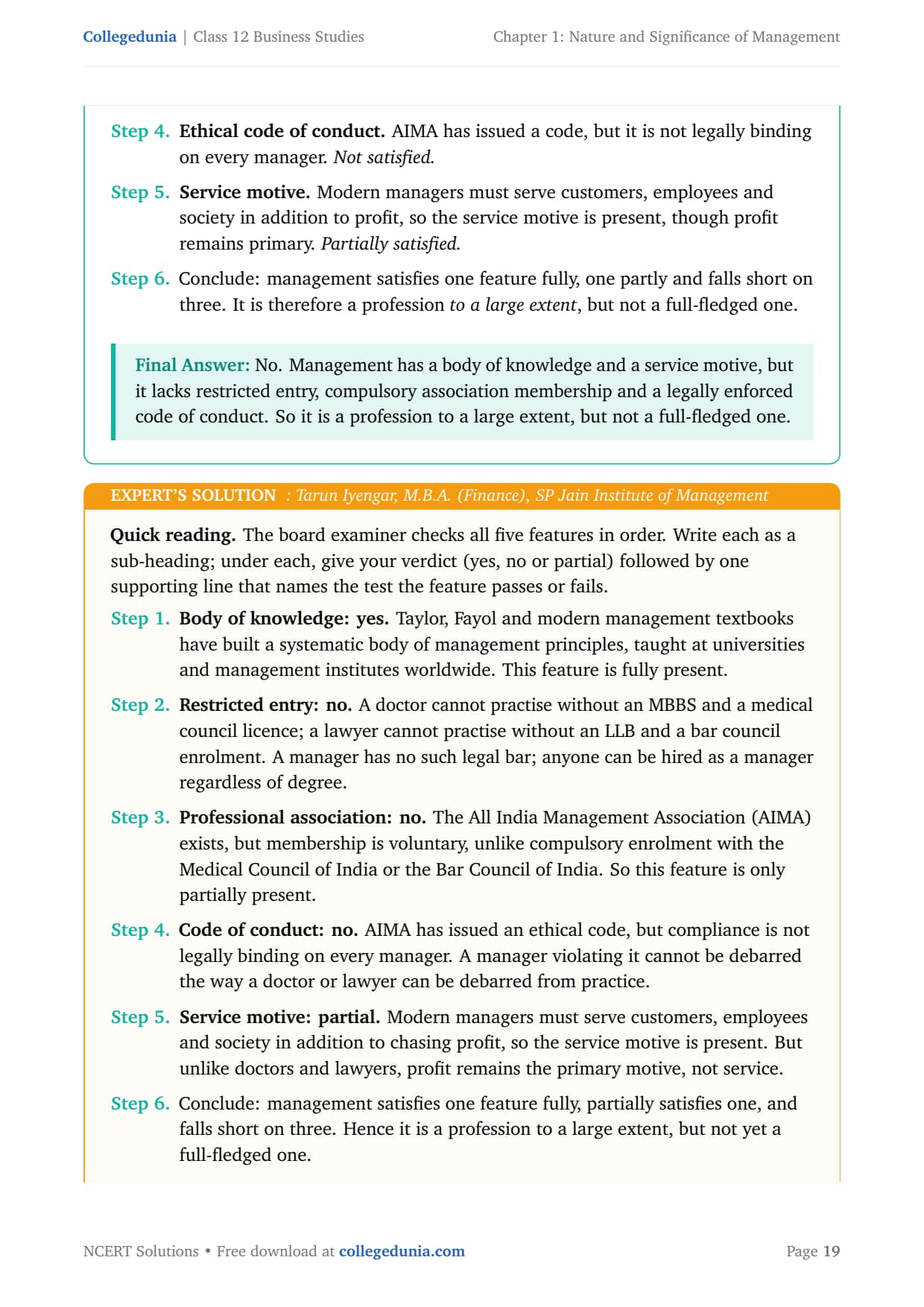
Ethical code of conduct. AIMA has issued a code, but it is not legally binding
on every manager. Not satisfied.
Service motive. Modern managers must serve customers, employees and society in
addition to profit, so the service motive is present, though profit remains primary.
Partially satisfied.
Conclude: management satisfies one feature fully, one partly and falls short on three.
It is therefore a profession to a large extent, but not a full-fledged one.
No. Management has a body of knowledge and a service motive, but it lacks restricted
entry, compulsory association membership and a legally enforced code of conduct. So it is a
profession to a large extent, but not a full-fledged one.
TI
Tarun Iyengar
M.B.A. (Finance), SP Jain Institute of Management
Verified Expert
Quick reading. The board examiner checks all five features in order. Write each as a
sub-heading; under each, give your verdict (yes, no or partial) followed by one supporting line
that names the test the feature passes or fails.
Body of knowledge: yes. Taylor, Fayol and modern management textbooks have built
a systematic body of management principles, taught at universities and management
institutes worldwide. This feature is fully present.
Restricted entry: no. A doctor cannot practise without an MBBS and a medical
council licence; a lawyer cannot practise without an LLB and a bar council enrolment.
A manager has no such legal bar; anyone can be hired as a manager regardless of degree.
Professional association: no. The All India Management Association (AIMA) exists,
but membership is voluntary, unlike compulsory enrolment with the Medical Council of India
or the Bar Council of India. So this feature is only partially present.
Code of conduct: no. AIMA has issued an ethical code, but compliance is not
legally binding on every manager. A manager violating it cannot be debarred the way a
doctor or lawyer can be debarred from practice.
Service motive: partial. Modern managers must serve customers, employees and
society in addition to chasing profit, so the service motive is present. But unlike
doctors and lawyers, profit remains the primary motive, not service.
Conclude: management satisfies one feature fully, partially satisfies one, and falls
short on three. Hence it is a profession to a large extent, but not yet a full-fledged
one.
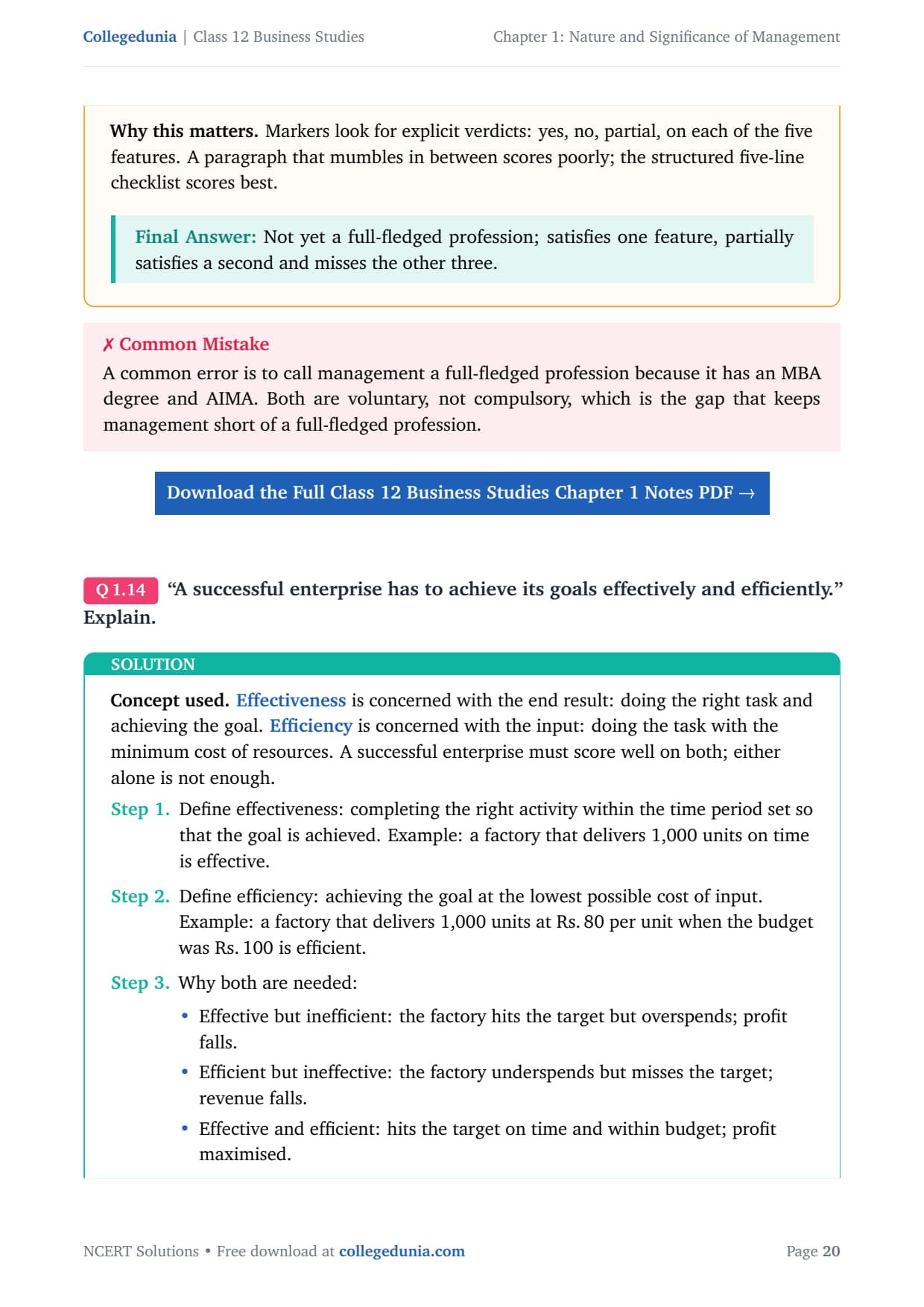
Why this matters. Markers look for explicit verdicts: yes, no, partial, on each of the
five features. A paragraph that mumbles in between scores poorly; the structured five-line
checklist scores best.
Not yet a full-fledged profession; satisfies one feature, partially satisfies a second
and misses the other three.
Q 1.14
``A successful enterprise has to achieve its goals effectively and efficiently.'' Explain.
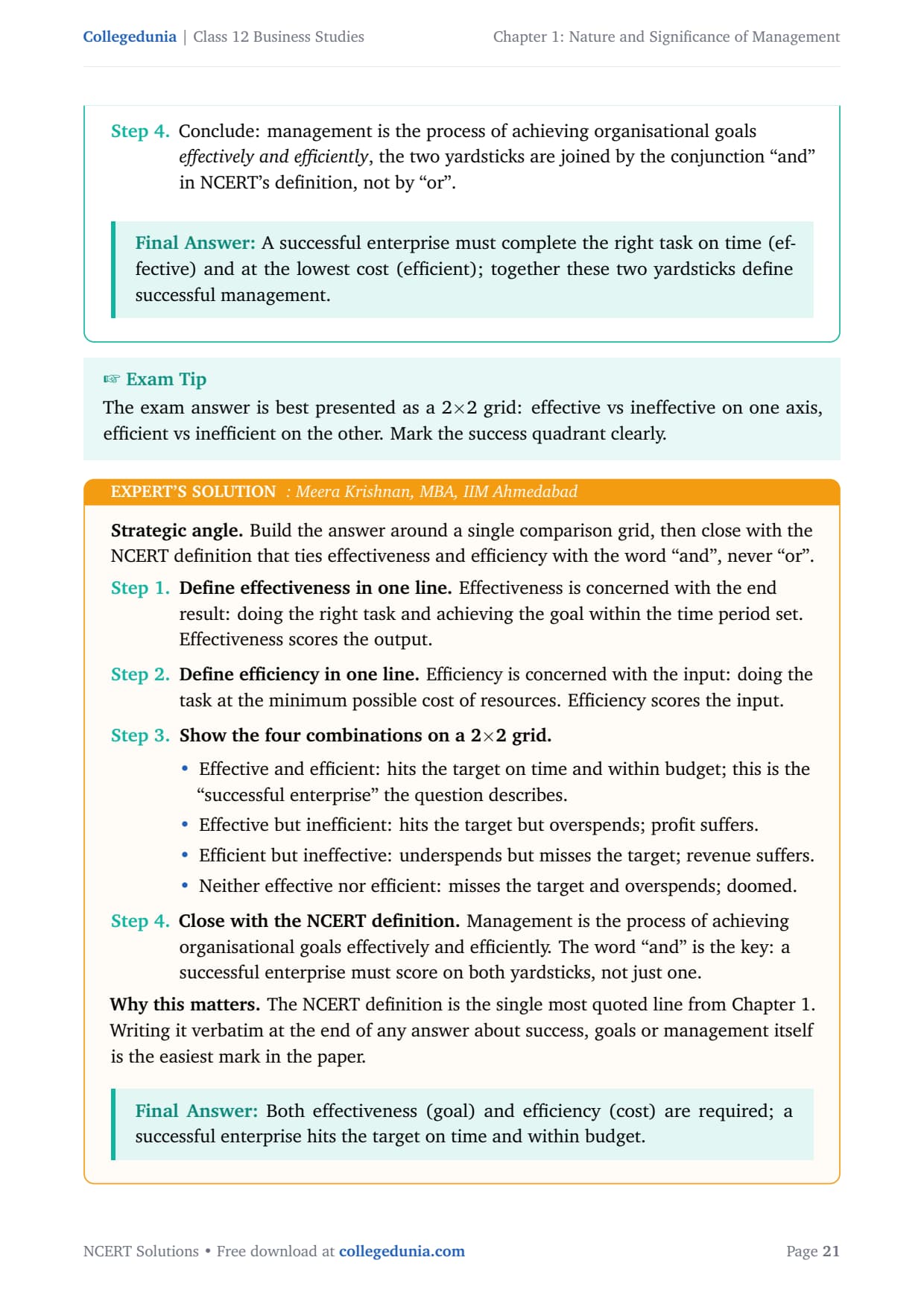
Concept used.Effectiveness is concerned with the end result: doing the right
task and achieving the goal. Efficiency is concerned with the input: doing the task with
the minimum cost of resources. A successful enterprise must score well on both; either alone is
not enough.
Define effectiveness: completing the right activity within the time period set so that
the goal is achieved. Example: a factory that delivers 1,000 units on time is effective.
Define efficiency: achieving the goal at the lowest possible cost of input. Example: a
factory that delivers 1,000 units at Rs. 80 per unit when the budget was Rs. 100 is
efficient.
Why both are needed:
Effective but inefficient: the factory hits the target but overspends; profit falls.
Efficient but ineffective: the factory underspends but misses the target; revenue
falls.
Effective and efficient: hits the target on time and within budget; profit
maximised.
Conclude: management is the process of achieving organisational goals effectively and
efficiently, the two yardsticks are joined by the conjunction ``and'' in NCERT's
definition, not by ``or''.
A successful enterprise must complete the right task on time (effective) and at the
lowest cost (efficient); together these two yardsticks define successful management.
MK
Meera Krishnan
MBA, IIM Ahmedabad
Verified Expert
Strategic angle. Build the answer around a single comparison grid, then close with the
NCERT definition that ties effectiveness and efficiency with the word ``and'', never ``or''.
Define effectiveness in one line. Effectiveness is concerned with the end
result: doing the right task and achieving the goal within the time period set.
Effectiveness scores the output.
Define efficiency in one line. Efficiency is concerned with the input: doing the
task at the minimum possible cost of resources. Efficiency scores the input.
Show the four combinations on a 2×2 grid.
Effective and efficient: hits the target on time and within budget; this is the
``successful enterprise'' the question describes.
Effective but inefficient: hits the target but overspends; profit suffers.
Efficient but ineffective: underspends but misses the target; revenue suffers.
Neither effective nor efficient: misses the target and overspends; doomed.
Close with the NCERT definition. Management is the process of achieving
organisational goals effectively and efficiently. The word ``and'' is the key: a
successful enterprise must score on both yardsticks, not just one.
Why this matters. The NCERT definition is the single most quoted line from Chapter 1.
Writing it verbatim at the end of any answer about success, goals or management itself is the
easiest mark in the paper.
Both effectiveness (goal) and efficiency (cost) are required; a successful enterprise
hits the target on time and within budget.
Q 1.15
Management is a series of continuous interrelated functions. Comment.
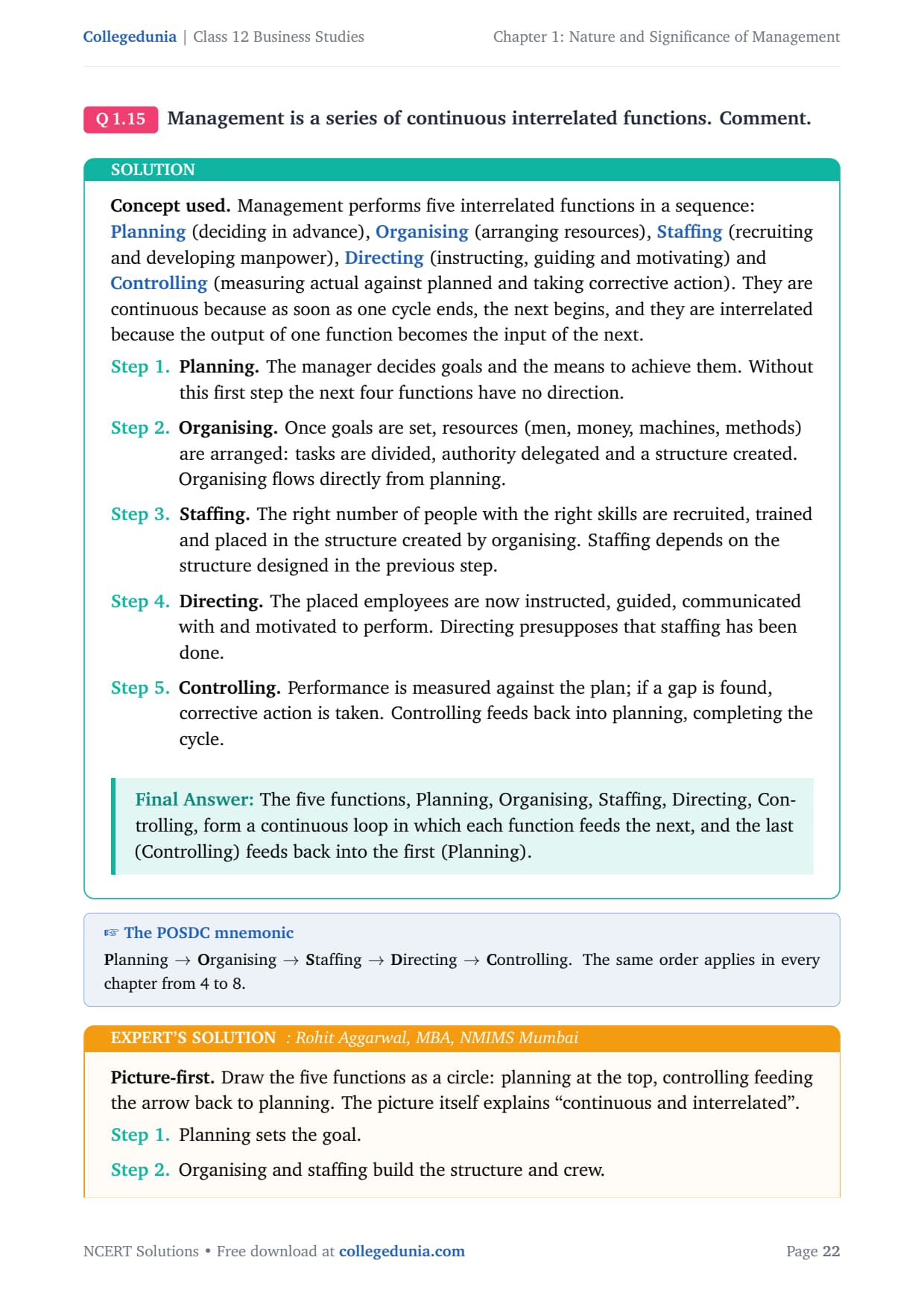
Concept used. Management performs five interrelated functions in a sequence:
Planning (deciding in advance), Organising (arranging resources),
Staffing (recruiting and developing manpower), Directing (instructing,
guiding and motivating) and Controlling (measuring actual against planned and taking
corrective action). They are continuous because as soon as one cycle ends, the next begins, and
they are interrelated because the output of one function becomes the input of the next.
Planning. The manager decides goals and the means to achieve them. Without this
first step the next four functions have no direction.
Organising. Once goals are set, resources (men, money, machines, methods) are
arranged: tasks are divided, authority delegated and a structure created. Organising flows
directly from planning.
Staffing. The right number of people with the right skills are recruited, trained
and placed in the structure created by organising. Staffing depends on the structure
designed in the previous step.
Directing. The placed employees are now instructed, guided, communicated with and
motivated to perform. Directing presupposes that staffing has been done.
Controlling. Performance is measured against the plan; if a gap is found,
corrective action is taken. Controlling feeds back into planning, completing the cycle.
The five functions, Planning, Organising, Staffing, Directing, Controlling, form a
continuous loop in which each function feeds the next, and the last (Controlling) feeds back
into the first (Planning).
RA
Rohit Aggarwal
MBA, NMIMS Mumbai
Verified Expert
Picture-first. Draw the five functions as a circle: planning at the top, controlling
feeding the arrow back to planning. The picture itself explains ``continuous and interrelated''.
Planning sets the goal.
Organising and staffing build the structure and crew.
Directing puts the crew to work.
Controlling checks the result and reports back to planning, closing the loop.
Each output is the next function's input; that is what ``interrelated'' means.
Why this matters. Chapters 4 to 8 dedicate one full chapter to each function in this same
order; understanding the loop here saves time later.
The five POSDC functions form an unbroken loop where controlling feeds back into
planning, so management is a continuous, interrelated series of activities.
Q 1.16
A company wants to modify its existing product in the market due to decreasing sales. You
can imagine any product about which you are familiar. What decisions/steps should each level of
management take to give effect to this decision?
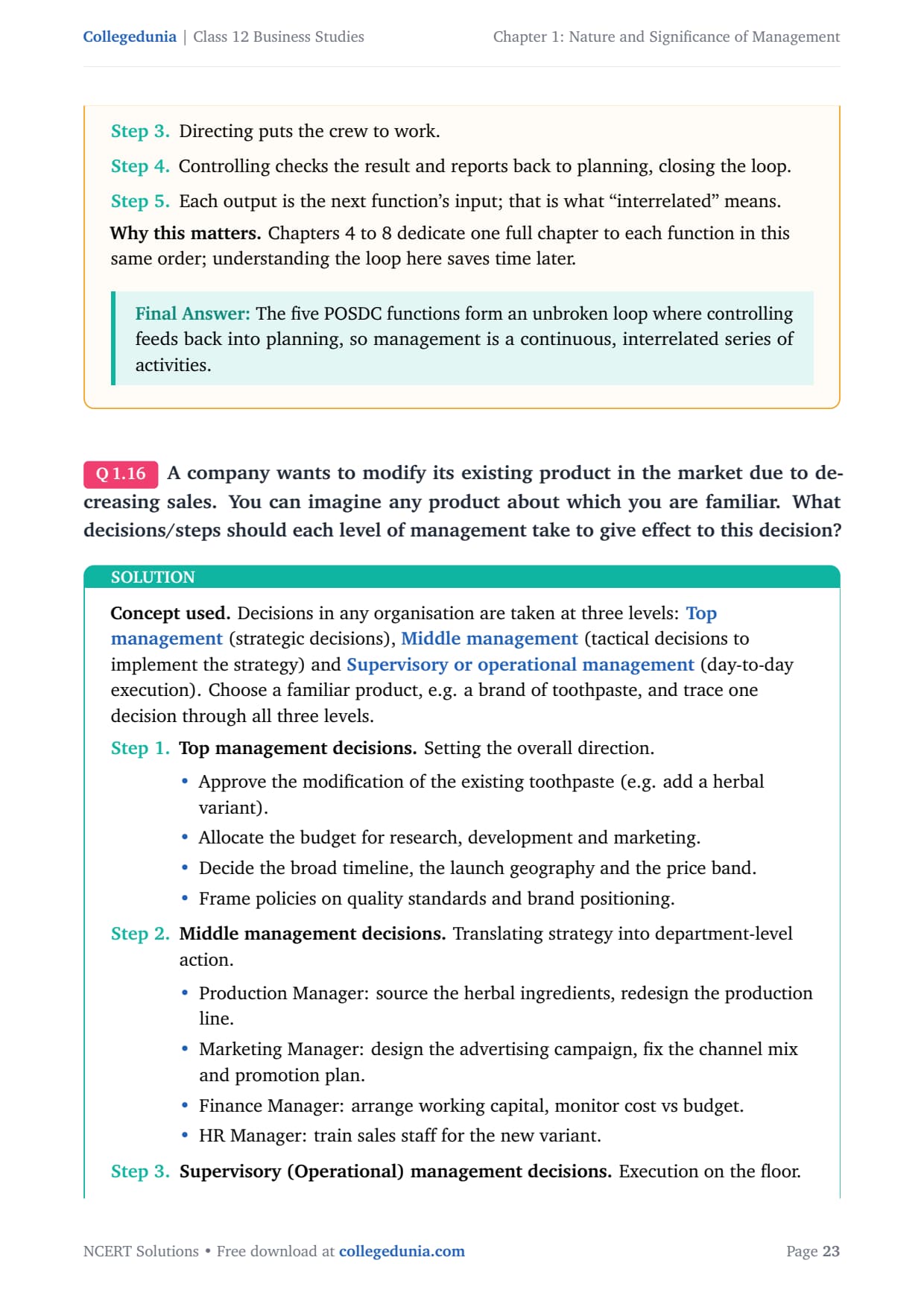
Concept used. Decisions in any organisation are taken at three levels:
Top management (strategic decisions), Middle management (tactical decisions to
implement the strategy) and Supervisory or operational management (day-to-day execution).
Choose a familiar product, e.g. a brand of toothpaste, and trace one decision through all three
levels.
Top management decisions. Setting the overall direction.
Approve the modification of the existing toothpaste (e.g. add a herbal variant).
Allocate the budget for research, development and ncert-notes-class-12-business-studies-chapter-10-marketing.
Decide the broad timeline, the launch geography and the price band.
Frame policies on quality standards and brand positioning.
Middle management decisions. Translating strategy into department-level action.
Production Manager: source the herbal ingredients, redesign the production line.
Marketing Manager: design the advertising campaign, fix the channel mix and
promotion plan.
Finance Manager: arrange working capital, monitor cost vs budget.
HR Manager: train sales staff for the new variant.
Supervisory (Operational) management decisions. Execution on the floor.
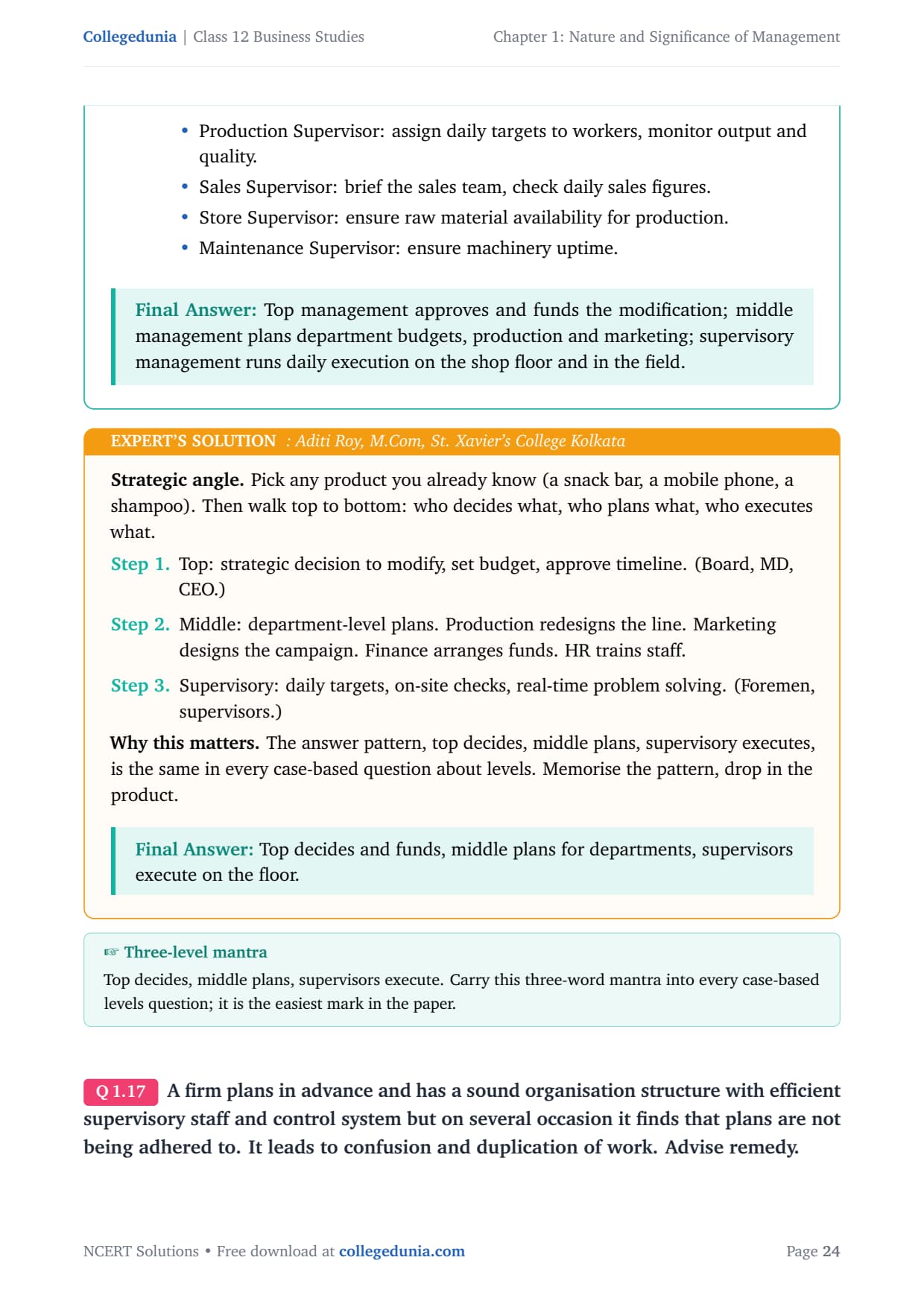
Production Supervisor: assign daily targets to workers, monitor output and quality.
Sales Supervisor: brief the sales team, check daily sales figures.
Store Supervisor: ensure raw material availability for production.
Maintenance Supervisor: ensure machinery uptime.
Top management approves and funds the modification; middle management plans department
budgets, production and ncert-notes-class-12-business-studies-chapter-10-marketing; supervisory management runs daily execution on the shop floor
and in the field.
AR
Aditi Roy
M.Com, St. Xavier's College Kolkata
Verified Expert
Strategic angle. Pick any product you already know (a snack bar, a mobile phone, a
shampoo). Then walk top to bottom: who decides what, who plans what, who executes what.
Top: strategic decision to modify, set budget, approve timeline. (Board, MD, CEO.)
Middle: department-level plans. Production redesigns the line. Marketing designs the
campaign. Finance arranges funds. HR trains staff.
Supervisory: daily targets, on-site checks, real-time problem solving. (Foremen,
supervisors.)
Why this matters. The answer pattern, top decides, middle plans, supervisory executes, is
the same in every case-based question about levels. Memorise the pattern, drop in the product.
Top decides and funds, middle plans for departments, supervisors execute on the floor.
Q 1.17
A firm plans in advance and has a sound organisation structure with efficient supervisory
staff and control system but on several occasion it finds that plans are not being adhered to. It
leads to confusion and duplication of work. Advise remedy.
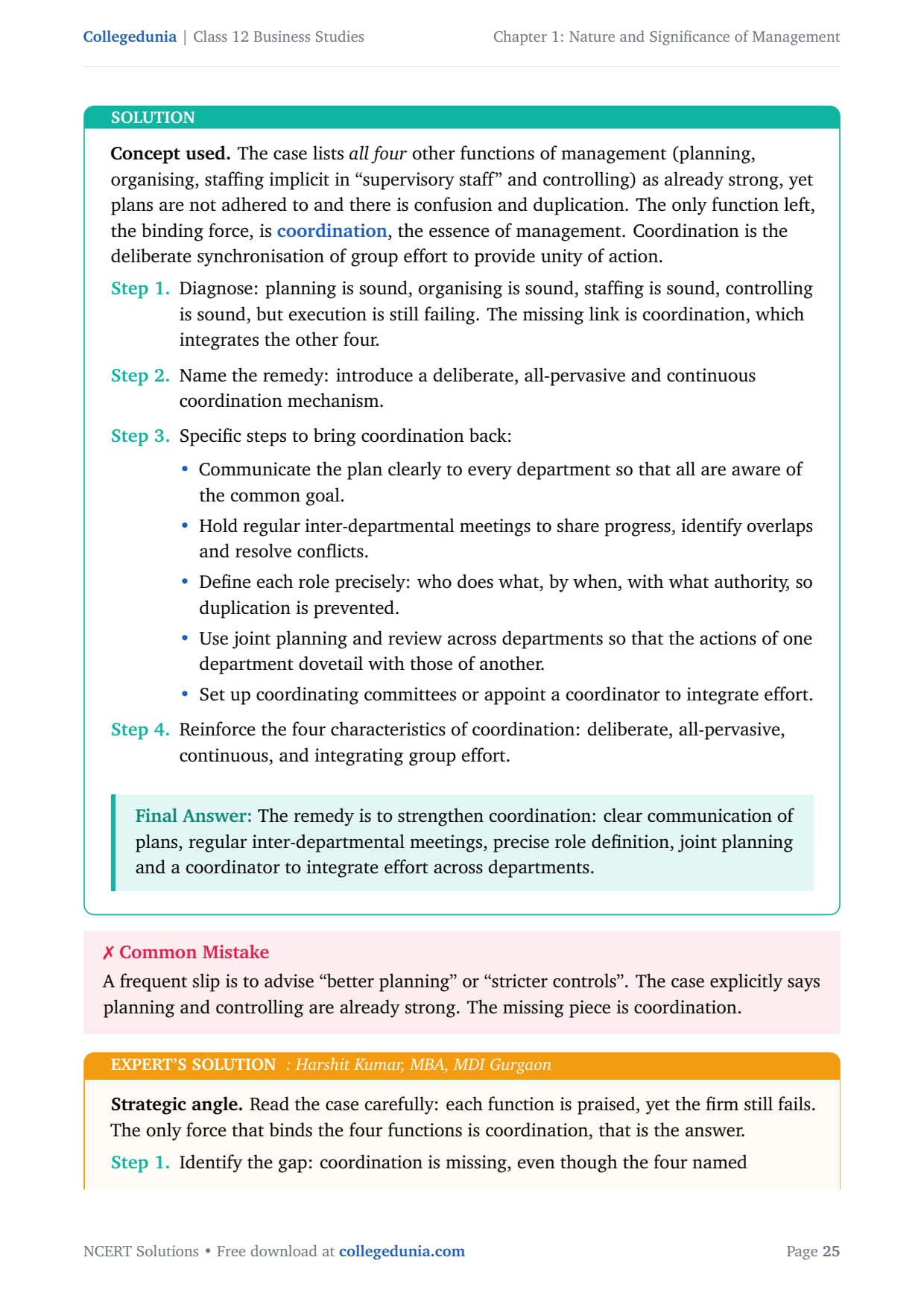
Concept used. The case lists all four other functions of management (planning,
organising, staffing implicit in ``supervisory staff'' and controlling) as already strong, yet plans
are not adhered to and there is confusion and duplication. The only function left, the binding
force, is coordination, the essence of management. Coordination is the deliberate
synchronisation of group effort to provide unity of action.
Diagnose: planning is sound, organising is sound, staffing is sound, controlling is sound,
but execution is still failing. The missing link is coordination, which integrates the
other four.
Name the remedy: introduce a deliberate, all-pervasive and continuous coordination
mechanism.
Specific steps to bring coordination back:
Communicate the plan clearly to every department so that all are aware of the
common goal.
Hold regular inter-departmental meetings to share progress, identify overlaps and
resolve conflicts.
Define each role precisely: who does what, by when, with what authority, so
duplication is prevented.
Use joint planning and review across departments so that the actions of one
department dovetail with those of another.
Set up coordinating committees or appoint a coordinator to integrate effort.
Reinforce the four characteristics of coordination: deliberate, all-pervasive, continuous,
and integrating group effort.
The remedy is to strengthen coordination: clear communication of plans, regular
inter-departmental meetings, precise role definition, joint planning and a coordinator to
integrate effort across departments.
HK
Harshit Kumar
MBA, MDI Gurgaon
Verified Expert
Strategic angle. Read the case carefully: each function is praised, yet the firm still
fails. The only force that binds the four functions is coordination, that is the answer.
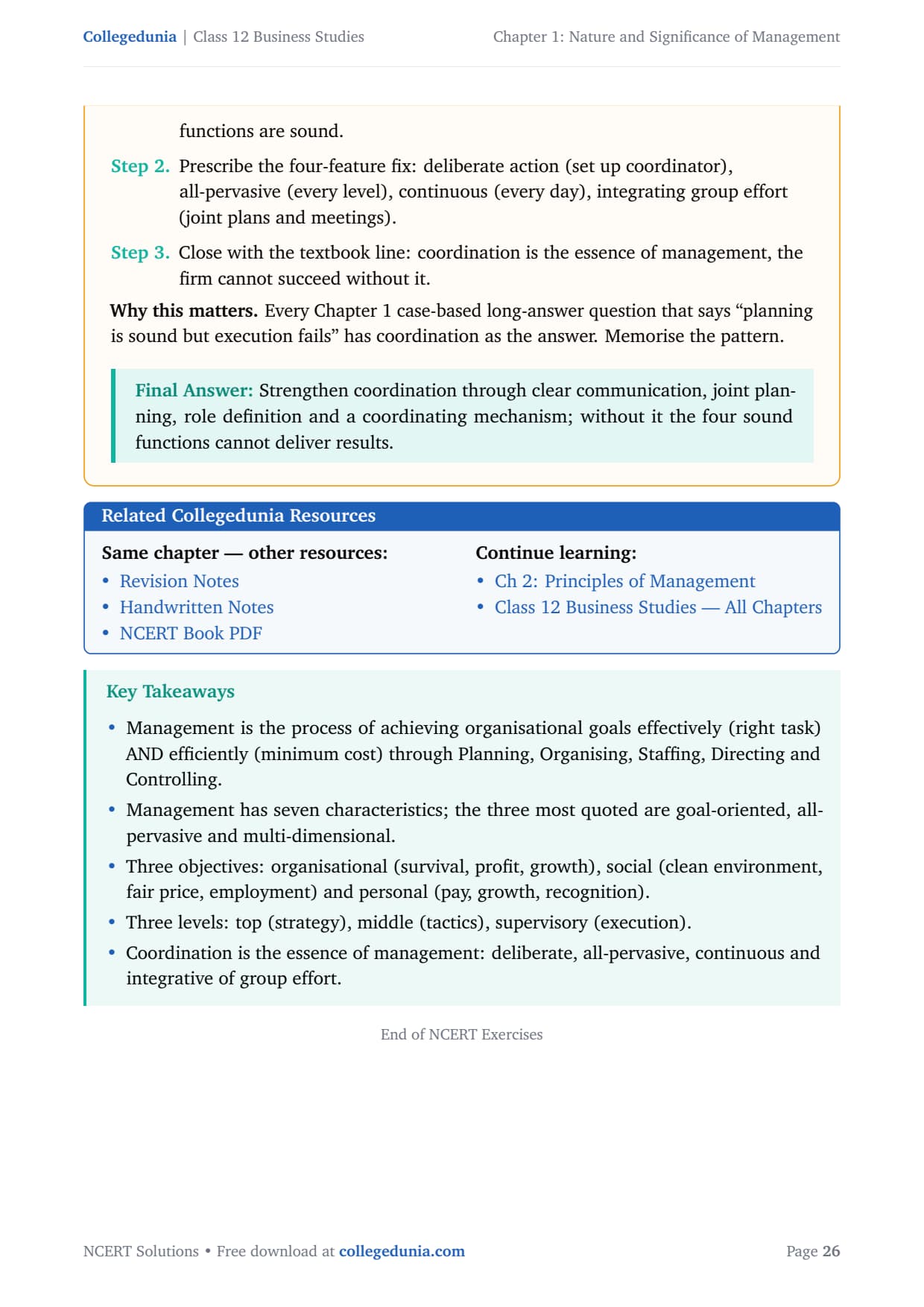
Identify the gap: coordination is missing, even though the four named functions are sound.
Prescribe the four-feature fix: deliberate action (set up coordinator), all-pervasive
(every level), continuous (every day), integrating group effort (joint plans and meetings).
Close with the textbook line: coordination is the essence of management, the firm cannot
succeed without it.
Why this matters. Every Chapter 1 case-based long-answer question that says ``planning
is sound but execution fails'' has coordination as the answer. Memorise the pattern.
Strengthen coordination through clear communication, joint planning, role definition and
a coordinating mechanism; without it the four sound functions cannot deliver results.
NCERT Solutions for Class 12 Business Studies: All Chapters
FAQs on Nature and Significance of Management NCERT Solutions
FAQs on Nature and Significance of Management NCERT Solutions
What is the definition of management in Class 12 NCERT Business Studies Chapter 1?
Harold Koontz defines management as "the art of getting things done through and with people in formally organised groups". The NCERT textbook itself frames management as the process of planning, organising, staffing, directing and controlling enterprise resources to achieve organisational goals effectively (the right task) and efficiently (with minimum cost). Both effectiveness and efficiency are required for a successful enterprise.
Why is coordination called the essence of management?
Mary Parker Follett described coordination as the orderly synchronisation of group effort, and NCERT calls it the essence of management because it integrates group effort, ensures unity of action, runs continuously through every function, is all-pervasive across levels and departments, is the responsibility of every manager, and is a deliberate planned activity. Without coordination, the other four functions of management cannot deliver organisational goals.
Is management an art, a science or a profession?
Management is both an art and a science but only a profession "to a large extent". It has the features of art (theoretical knowledge, personalised application, practice and creativity) and the features of science (systematic body of knowledge, principles, universal validity, though as a social science not a physical science). However, management lacks restricted entry and a compulsory professional association on the All India Management Association (AIMA) being voluntary, so NCERT concludes it is not a full-fledged profession.
What are the three levels of management?
The three levels are: (1) Top management on Board of Directors, CEO, MD on sets policy and overall direction; (2) Middle management on divisional, regional or departmental managers on translates policy into department-level action; (3) Supervisory or operational management on foremen and supervisors on executes day-to-day operations on the shop floor.
What are the five functions of management in Class 12 Business Studies?
The five POSDC functions, formalised by James A.F. Stoner and rooted in Henri Fayol's classical framework, are Planning, Organising, Staffing, Directing and Controlling. They are continuous because Controlling feeds back into Planning, closing the loop, and interrelated because the output of each function becomes the input of the next.
How are effectiveness and efficiency different in management?
Effectiveness is concerned with the end result, doing the right task and achieving the goal. Efficiency is concerned with the input, doing the task at the minimum possible cost of resources. A successful enterprise must score well on both, hitting the target on time (effective) and within budget (efficient).
What are the three objectives of management?
Management pursues three categories of objectives: (1) Organisational objectives on survival, profit and growth; (2) Social objectives on benefits to society such as fair-priced goods, employment generation and clean environment; (3) Personal objectives on meeting employees' needs for competitive pay, recognition and growth opportunities.
Who is called the Father of Modern Management?
Henri Fayol, the French mining engineer and industrialist, is called the Father of Modern Management. His 1916 work classified the manager's role into planning, organising, commanding, coordinating and controlling, which is the direct ancestor of the POSDC framework used in NCERT Class 12 Business Studies Chapter 1 and the 14 principles studied in Chapter 2.






Comments