English Mentor | M.A. English Student, Jadavpur | J/hVSQ
Adrienne Rich's three-stanza meditation on art and patriarchal marriage, in Class 12 English Chapter 11 Flamingo Poetry: Aunt Jennifer's Tigers, carries roughly 8 marks in the CBSE Board exam and closes the Flamingo Poetry section. These class 12 english ncert solutions chapter 11 Flamingo Poetry: Aunt Jennifer's Tigers answer every textbook question in NCERT order.
1 poem · 8 textbook questions solved · Class 12 English Core Chapter 11, 2026-27 NCERT
CBSE Weightage: About 8 marks, usually split as one stanza-based extract (3 marks) and one long-answer on the wedding-band symbol, the contrast between maker and made, or the speaker's attitude (6 marks)
CUET (UG) Relevance: 1 to 2 questions on symbolism, iambic-pentameter couplet form, and the closing image of art outlasting the artist in Section IA English
Chapter 11 Flamingo Poetry: Aunt Jennifer's Tigers NCERT Solutions PDF
These Aunt Jennifer's Tigers NCERT Solutions are reviewed by Collegedunia's CBSE English educators, mapped to the 2026-27 NCERT Flamingo print, and refined against the last five years of CBSE Board and CUET papers.
The poem is tightly metred (three iambic-pentameter quatrains rhymed AA BB CC) and densely symbolic, so most CBSE answers turn on locating the image in the correct stanza, naming the device by its technical name, and tracing the contrast between the fearless embroidered tigers and the timid, weighed-down embroiderer.
Class 12 English NCERT Solutions Chapter 11 Flamingo Poetry: Aunt Jennifer's Tigers Question-Type Distribution
The poem has eight textbook questions under "Think it out" in the NCERT Flamingo print. Knowing which type each one belongs to tells you exactly how to structure the answer.
Question
Type
What CBSE Wants
Q1. How do 'denizens' and 'chivalric' add to our understanding of the tigers?
Diction analysis
Denizens = rightful inhabitants; chivalric = knightly bearing; both build the tigers' dignified fearlessness
Q2. Why are Aunt Jennifer's hands 'fluttering through her wool'?
Imagery / Symbol
The verb flutter; physical and emotional strain; the wedding band as the real weight
Q3. What is suggested by 'massive weight of Uncle's wedding band'?
Symbolism
Marriage as owned, daily, immense psychological weight; possessive Uncle's
Q4. Of what is Aunt Jennifer terrified in the third stanza?
Theme
Three layers: Uncle, the institution of marriage, patriarchy as a system
Q5. What are the 'ordeals'? Meanings of 'ringed'?
Symbol / Wordplay
Three meanings of ringed: the literal band, the metaphor of enclosure, the structural echo
Q6. Why did Aunt create animals so different from her own character?
Theme / Art
Art expresses longing not likeness; embroidery as permitted self-expression
Q7. Interpret the symbols found in the poem.
Symbol catalogue
Six symbols: tigers, colours, men beneath tree, needle and wool, wedding band, embroidered panel
Q8. Do you sympathise with Aunt Jennifer? Attitude of the speaker?
Tone / Speaker
Compassion + admiration + critique of the system, not the woman
Flamingo Poetry Aunt Jennifer S Tigers Video Walkthrough
How will Collegedunia's NCERT Solutions Help You with the Aunt Jennifer's Tigers Class 12 Questions
The class 12 english ncert solutions chapter 11 Flamingo Poetry: Aunt Jennifer's Tigers on this page are built to match how a CBSE examiner reads a poetry answer.
Line-grounded answers: Every solution quotes the exact line from Rich's poem, so you learn to anchor your answer in evidence and not in summary.
Two solutions per question: A standard solution (CBSE-pattern) and an expert reading (alternative angle, longer, examiner-grade depth) so you can pick the right register.
Common mistakes flagged: A "Mistake" callout against the typical wrong reading (for example, reading the wedding band literally or invented details about Uncle).
2026-27 NCERT aligned: Stanza numbers, line numbers, and the eight "Think it out" questions match the current Flamingo print exactly.
Aunt Jennifer's Tigers Topper Strategy for the Class 12 English Board
Three habits separate a 6/6 answer from a 4/6 answer on this poem.
Read the wedding band symbolically. "The massive weight of Uncle's wedding band" is not literally heavy gold; it stands for marriage as ownership. Almost every higher-mark question rewards this reading.
Close with the surviving tigers. "Will go on prancing, proud and unafraid" is the last line; it turns the poem from elegy to small triumph. Bring it in for any thematic long-answer to earn the last mark.
Name the three layers of fear. Aunt Jennifer is afraid of Uncle (individual), of the institution of marriage, and of the patriarchal social order. The three-layer reading wins full marks where "she is afraid of her husband" earns only one.
About Adrienne Rich and the Aunt Jennifer's Tigers Context
Adrienne Rich (1929 to 2012) was an American poet and one of the most influential feminist writers of the twentieth century. She was born in Baltimore, Maryland, and educated at Radcliffe College. Aunt Jennifer's Tigers appears in her 1951 debut collection A Change of World, which was selected by W. H. Auden for the Yale Series of Younger Poets when Rich was only twenty-one. The poem's tight iambic-pentameter quatrains and AA BB CC rhyme carry an early form of the feminist critique that would, in her later books like Diving into the Wreck (1973) and the prose work Of Woman Born (1976), become much more direct.
All NCERT Solutions for Flamingo Poetry: Aunt Jennifer's Tigers with Step-by-Step Working
Every NCERT textbook question for Class 12 English (Core) Chapter 11 Flamingo Poetry: Aunt Jennifer's Tigers is listed below with its full Solution and Expert Solution hidden inside collapsible tabs. Click Check Solution to reveal the step-by-step working; click Expert Solution for the expanded explanation.
Think it out
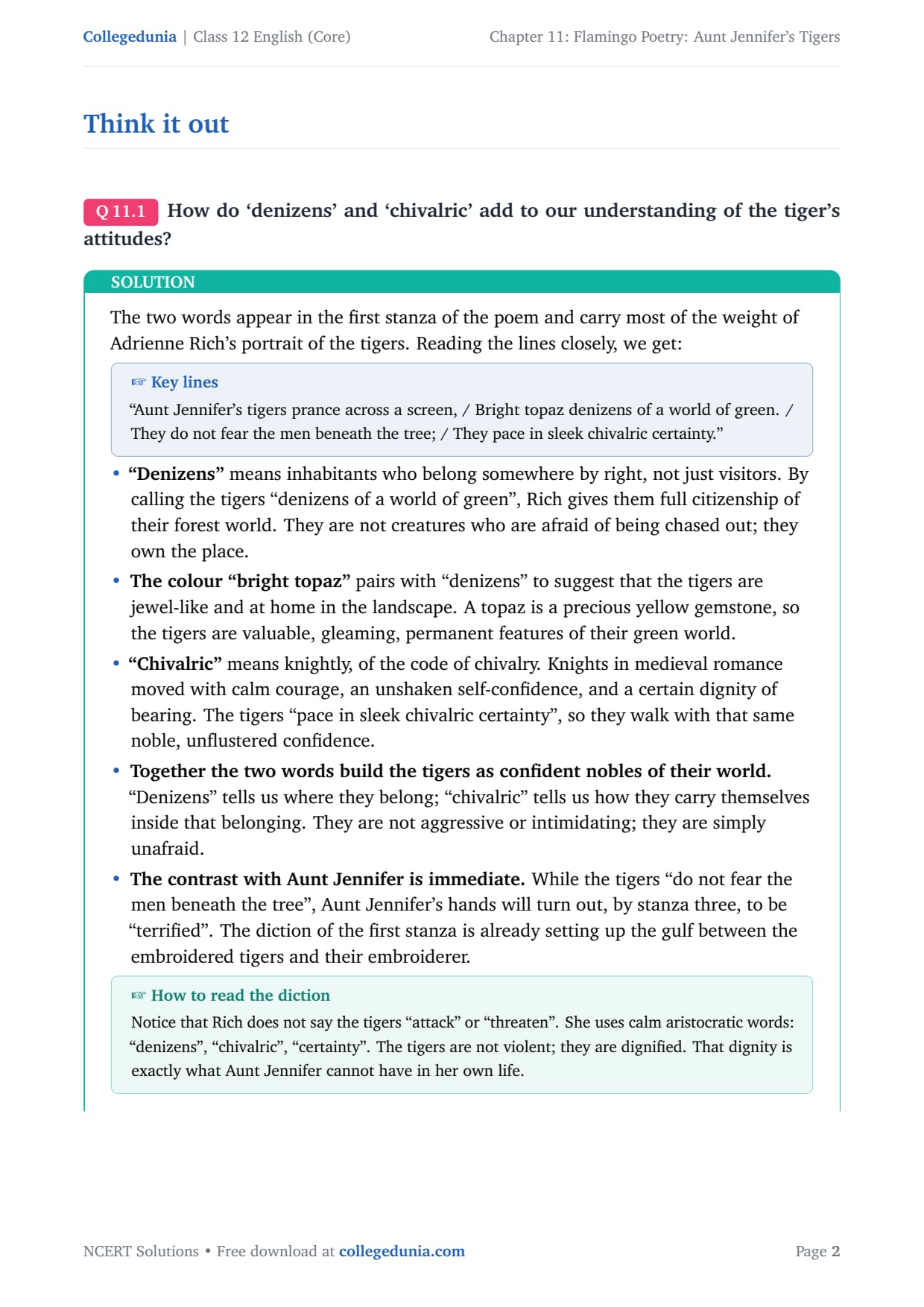
Q 11.1
How do `denizens' and `chivalric' add to our understanding of the tiger's attitudes?
The two words appear in the first stanza of the poem and carry most
of the weight of Adrienne Rich's portrait of the tigers. Reading the
lines closely, we get:
Key lines
``Aunt Jennifer's tigers prance across a screen, / Bright topaz
denizens of a world of green. / They do not fear the men beneath the
tree; / They pace in sleek chivalric certainty.''
``Denizens'' means inhabitants who belong somewhere
by right, not just visitors. By calling the tigers ``denizens
of a world of green'', Rich gives them full citizenship of
their forest world. They are not creatures who are afraid of
being chased out; they own the place.
The colour ``bright topaz'' pairs with ``denizens''
to suggest that the tigers are jewel-like and at home in the
landscape. A topaz is a precious yellow gemstone, so the
tigers are valuable, gleaming, permanent features of their
green world.
``Chivalric'' means knightly, of the code of
chivalry. Knights in medieval romance moved with calm
courage, an unshaken self-confidence, and a certain dignity
of bearing. The tigers ``pace in sleek chivalric certainty'',
so they walk with that same noble, unflustered confidence.
Together the two words build the tigers as confident
nobles of their world. ``Denizens'' tells us where they
belong; ``chivalric'' tells us how they carry themselves
inside that belonging. They are not aggressive or
intimidating; they are simply unafraid.
The contrast with Aunt Jennifer is immediate. While
the tigers ``do not fear the men beneath the tree'', Aunt
Jennifer's hands will turn out, by stanza three, to be
``terrified''. The diction of the first stanza is already
setting up the gulf between the embroidered tigers and their
embroiderer.
How to read the diction
Notice that Rich does not say the tigers ``attack'' or ``threaten''.
She uses calm aristocratic words: ``denizens'', ``chivalric'',
``certainty''. The tigers are not violent; they are dignified. That
dignity is exactly what Aunt Jennifer cannot have in her own life.
``Denizens'' makes the tigers rightful inhabitants of their
green world, and ``chivalric'' gives them the calm, knightly poise of
the medieval code of chivalry. Together the two words present the
tigers as confident, dignified, unafraid creatures who own their
landscape, which sets up the contrast with the frightened, weighed-down
Aunt Jennifer in the next two stanzas.
DA
Dr Ananya Iyer
PhD English Literature, Jawaharlal Nehru University
Verified Expert
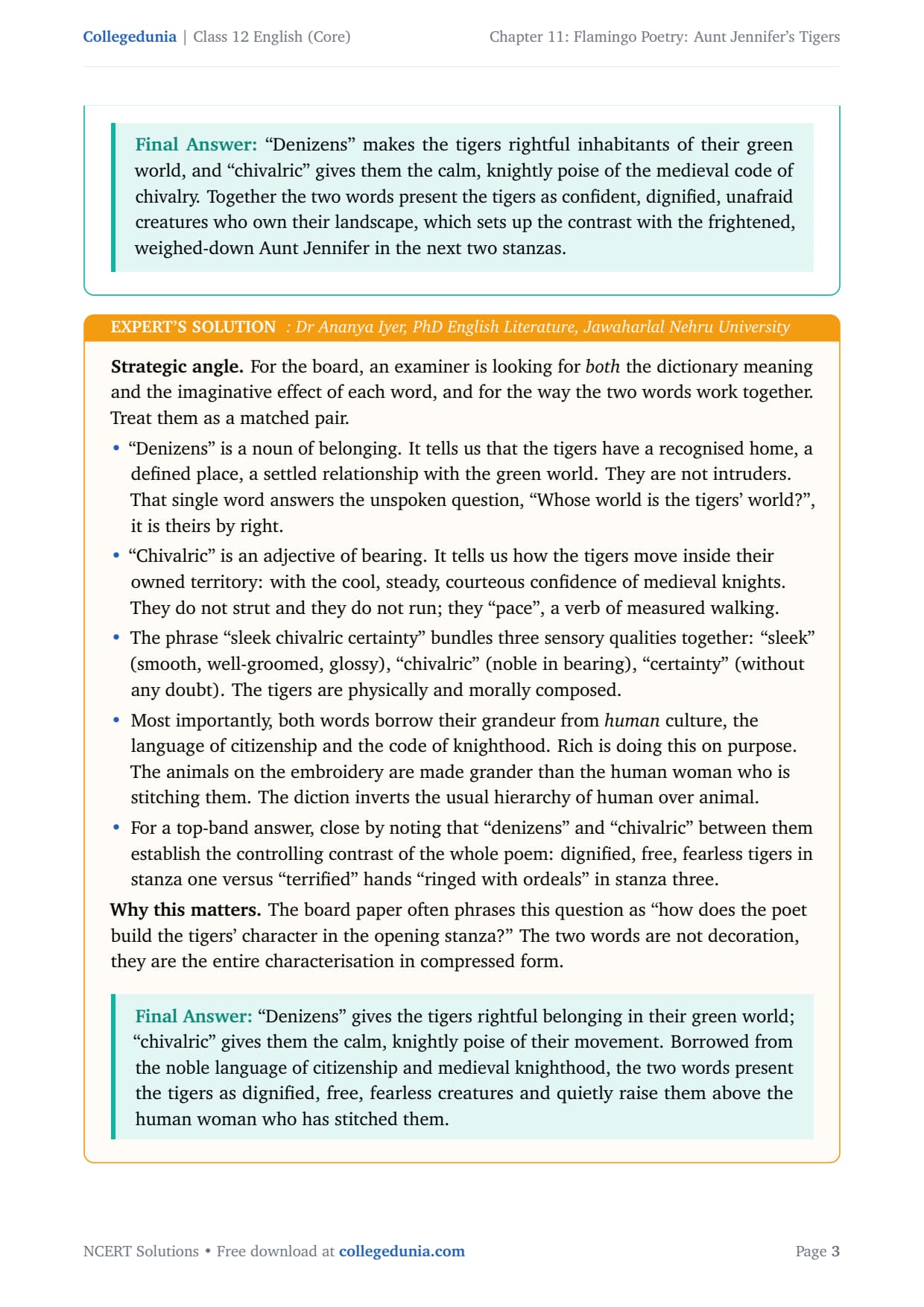
Strategic angle. For the board, an examiner is looking for
both the dictionary meaning and the imaginative effect of each
word, and for the way the two words work together. Treat them as a
matched pair.
``Denizens'' is a noun of belonging. It tells us that the
tigers have a recognised home, a defined place, a settled
relationship with the green world. They are not intruders.
That single word answers the unspoken question, ``Whose
world is the tigers' world?'', it is theirs by right.
``Chivalric'' is an adjective of bearing. It tells us how
the tigers move inside their owned territory: with the cool,
steady, courteous confidence of medieval knights. They do
not strut and they do not run; they ``pace'', a verb of
measured walking.
The phrase ``sleek chivalric certainty'' bundles three
sensory qualities together: ``sleek'' (smooth, well-groomed,
glossy), ``chivalric'' (noble in bearing), ``certainty''
(without any doubt). The tigers are physically and morally
composed.
Most importantly, both words borrow their grandeur from
human culture, the language of citizenship and the
code of knighthood. Rich is doing this on purpose. The
animals on the embroidery are made grander than the human
woman who is stitching them. The diction inverts the usual
hierarchy of human over animal.
For a top-band answer, close by noting that ``denizens''
and ``chivalric'' between them establish the controlling
contrast of the whole poem: dignified, free, fearless tigers
in stanza one versus ``terrified'' hands ``ringed with
ordeals'' in stanza three.
Why this matters. The board paper often phrases this
question as ``how does the poet build the tigers' character in the
opening stanza?'' The two words are not decoration, they are the
entire characterisation in compressed form.
``Denizens'' gives the tigers rightful belonging in their
green world; ``chivalric'' gives them the calm, knightly poise of
their movement. Borrowed from the noble language of citizenship and
medieval knighthood, the two words present the tigers as dignified,
free, fearless creatures and quietly raise them above the human
woman who has stitched them.
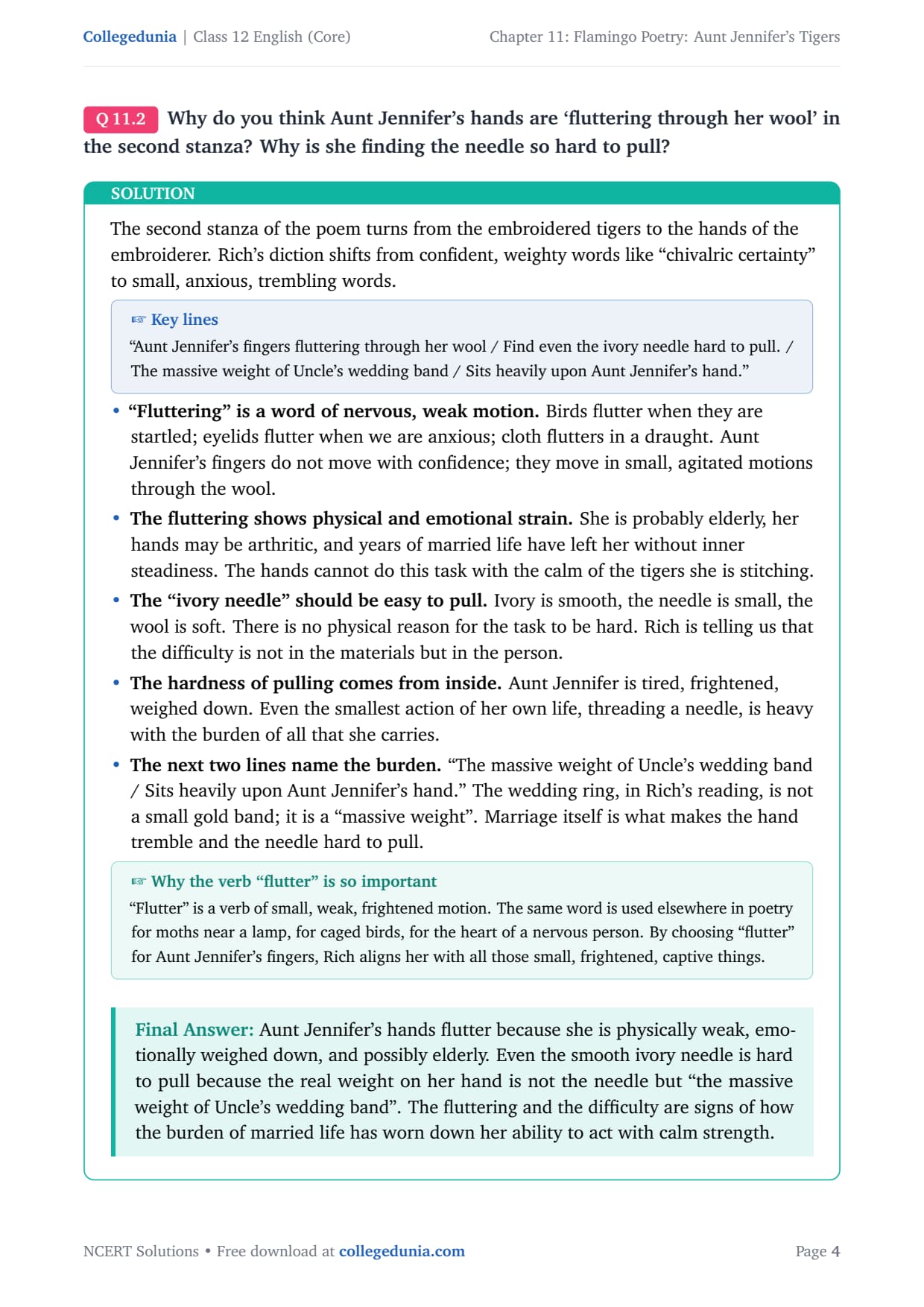
Q 11.2
Why do you think Aunt Jennifer's hands are `fluttering through her wool' in the second stanza? Why is she finding the needle so hard to pull?
The second stanza of the poem turns from the embroidered tigers to
the hands of the embroiderer. Rich's diction shifts from confident,
weighty words like ``chivalric certainty'' to small, anxious,
trembling words.
Key lines
``Aunt Jennifer's fingers fluttering through her wool / Find even
the ivory needle hard to pull. / The massive weight of Uncle's
wedding band / Sits heavily upon Aunt Jennifer's hand.''
``Fluttering'' is a word of nervous, weak motion.
Birds flutter when they are startled; eyelids flutter when
we are anxious; cloth flutters in a draught. Aunt Jennifer's
fingers do not move with confidence; they move in small,
agitated motions through the wool.
The fluttering shows physical and emotional strain.
She is probably elderly, her hands may be arthritic, and
years of married life have left her without inner steadiness.
The hands cannot do this task with the calm of the tigers
she is stitching.
The ``ivory needle'' should be easy to pull. Ivory
is smooth, the needle is small, the wool is soft. There is
no physical reason for the task to be hard. Rich is telling
us that the difficulty is not in the materials but in the
person.
The hardness of pulling comes from inside. Aunt
Jennifer is tired, frightened, weighed down. Even the
smallest action of her own life, threading a needle,
is heavy with the burden of all that she carries.
The next two lines name the burden. ``The massive
weight of Uncle's wedding band / Sits heavily upon Aunt
Jennifer's hand.'' The wedding ring, in Rich's reading, is
not a small gold band; it is a ``massive weight''. Marriage
itself is what makes the hand tremble and the needle hard
to pull.
Why the verb ``flutter'' is so important
``Flutter'' is a verb of small, weak, frightened motion. The same
word is used elsewhere in poetry for moths near a lamp, for caged
birds, for the heart of a nervous person. By choosing ``flutter''
for Aunt Jennifer's fingers, Rich aligns her with all those small,
frightened, captive things.
Aunt Jennifer's hands flutter because she is physically
weak, emotionally weighed down, and possibly elderly. Even the
smooth ivory needle is hard to pull because the real weight on her
hand is not the needle but ``the massive weight of Uncle's wedding
band''. The fluttering and the difficulty are signs of how the
burden of married life has worn down her ability to act with
calm strength.
MA
Mr Arjun Mehra
MA English, Delhi University
Verified Expert
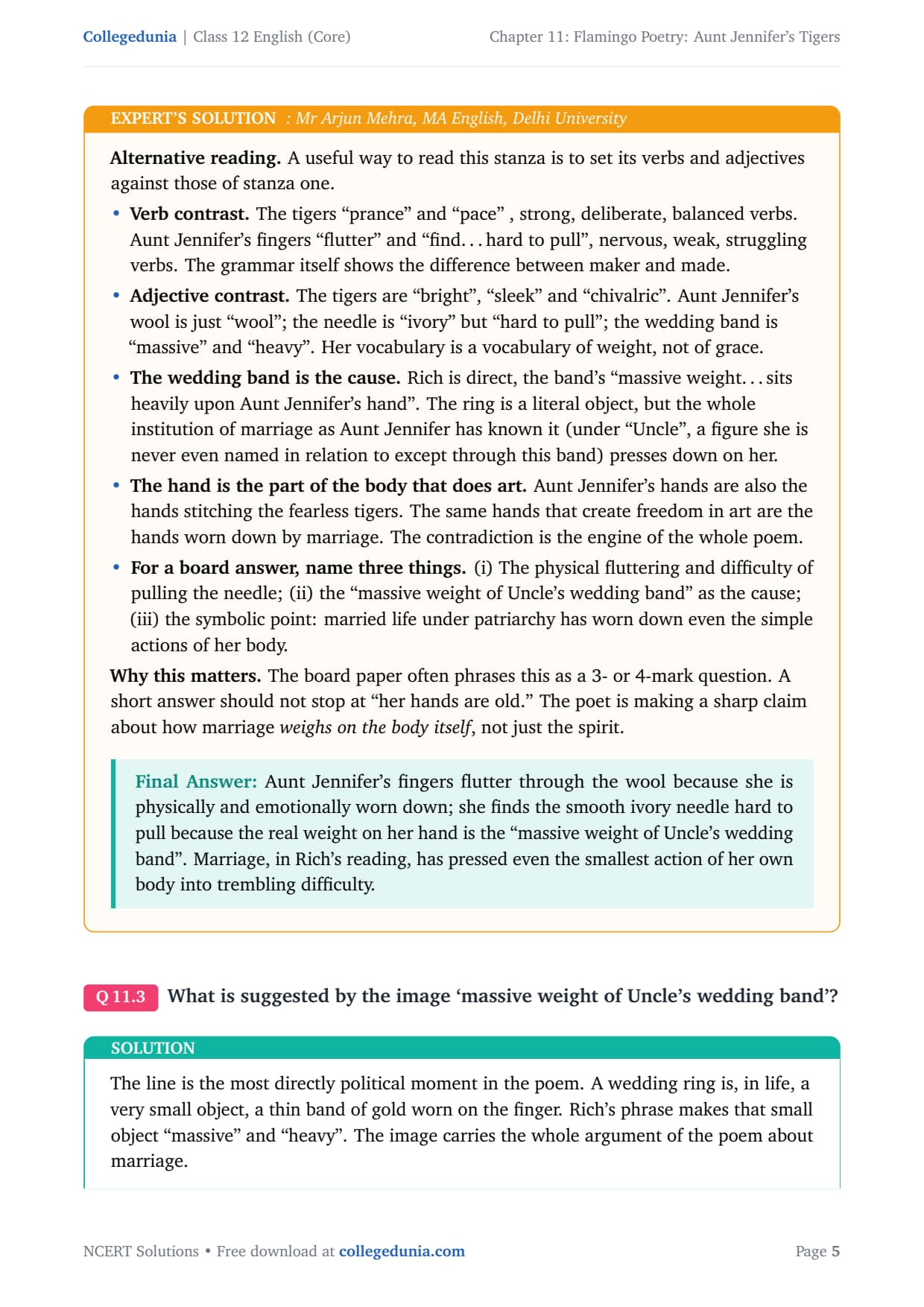
Alternative reading. A useful way to read this stanza is
to set its verbs and adjectives against those of stanza one.
Verb contrast. The tigers ``prance'' and ``pace''
, strong, deliberate, balanced verbs. Aunt Jennifer's
fingers ``flutter'' and ``find hard to pull'',
nervous, weak, struggling verbs. The grammar itself shows
the difference between maker and made.
Adjective contrast. The tigers are ``bright'',
``sleek'' and ``chivalric''. Aunt Jennifer's wool is just
``wool''; the needle is ``ivory'' but ``hard to pull''; the
wedding band is ``massive'' and ``heavy''. Her vocabulary is
a vocabulary of weight, not of grace.
The wedding band is the cause. Rich is direct,
the band's ``massive weight sits heavily upon Aunt
Jennifer's hand''. The ring is a literal object, but the
whole institution of marriage as Aunt Jennifer has known
it (under ``Uncle'', a figure she is never even named in
relation to except through this band) presses down on her.
The hand is the part of the body that does art.
Aunt Jennifer's hands are also the hands stitching the
fearless tigers. The same hands that create freedom in art
are the hands worn down by marriage. The contradiction is
the engine of the whole poem.
For a board answer, name three things. (i) The
physical fluttering and difficulty of pulling the needle;
(ii) the ``massive weight of Uncle's wedding band'' as the
cause; (iii) the symbolic point: married life under
patriarchy has worn down even the simple actions of her
body.
Why this matters. The board paper often phrases this as a
3- or 4-mark question. A short answer should not stop at ``her hands
are old.'' The poet is making a sharp claim about how marriage
weighs on the body itself, not just the spirit.
Aunt Jennifer's fingers flutter through the wool because
she is physically and emotionally worn down; she finds the smooth
ivory needle hard to pull because the real weight on her hand is the
``massive weight of Uncle's wedding band''. Marriage, in Rich's
reading, has pressed even the smallest action of her own body into
trembling difficulty.
Q 11.3
What is suggested by the image `massive weight of Uncle's wedding band'?
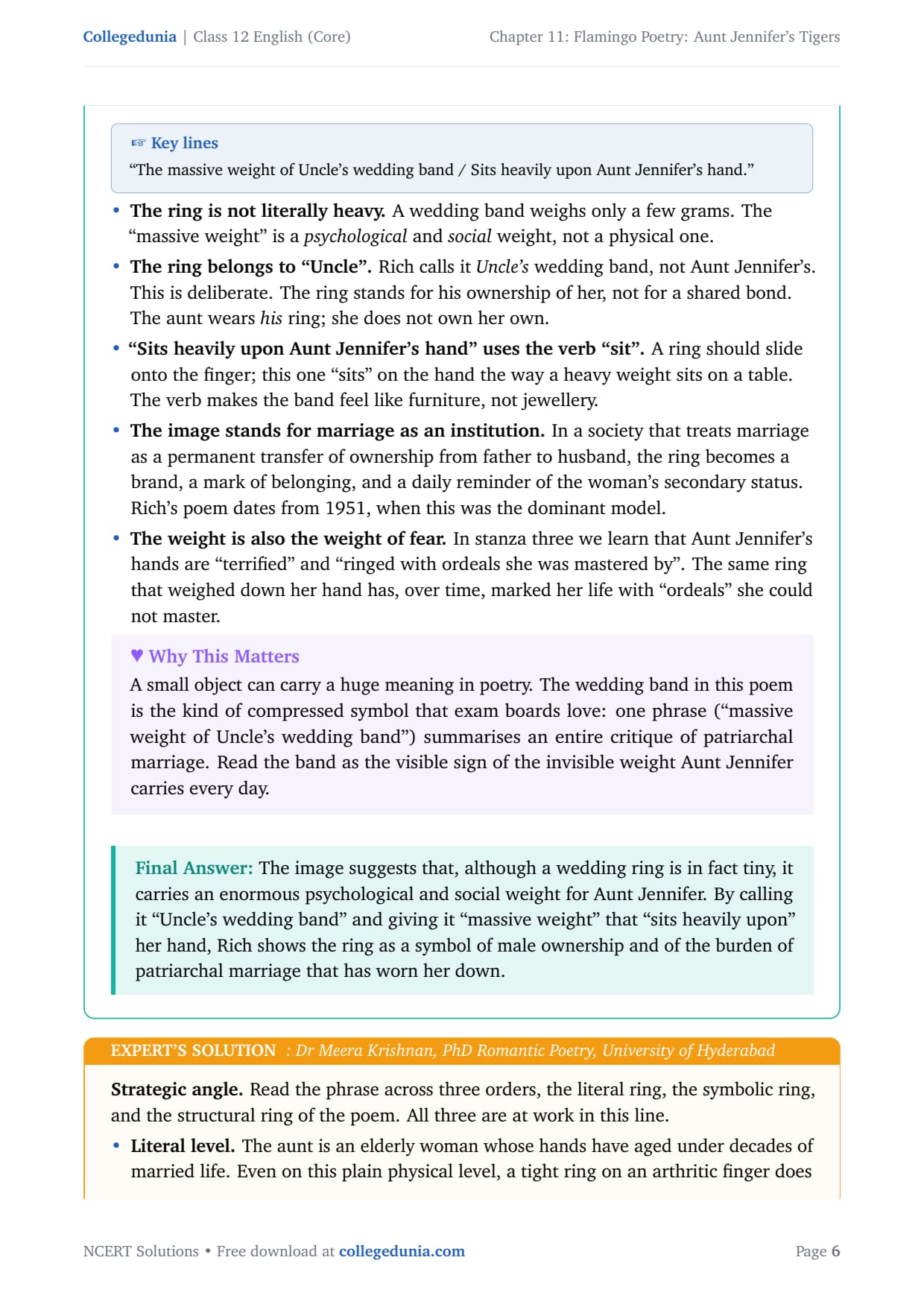
The line is the most directly political moment in the poem. A
wedding ring is, in life, a very small object, a thin band of
gold worn on the finger. Rich's phrase makes that small object
``massive'' and ``heavy''. The image carries the whole argument of
the poem about marriage.
Key lines
``The massive weight of Uncle's wedding band / Sits heavily upon
Aunt Jennifer's hand.''
The ring is not literally heavy. A wedding band
weighs only a few grams. The ``massive weight'' is a
psychological and social weight, not a
physical one.
The ring belongs to ``Uncle''. Rich calls it
Uncle's wedding band, not Aunt Jennifer's. This is
deliberate. The ring stands for his ownership of her, not
for a shared bond. The aunt wears his ring; she
does not own her own.
``Sits heavily upon Aunt Jennifer's hand'' uses the
verb ``sit''. A ring should slide onto the finger; this one
``sits'' on the hand the way a heavy weight sits on a table.
The verb makes the band feel like furniture, not jewellery.
The image stands for marriage as an institution.
In a society that treats marriage as a permanent transfer of
ownership from father to husband, the ring becomes a brand,
a mark of belonging, and a daily reminder of the woman's
secondary status. Rich's poem dates from 1951, when this
was the dominant model.
The weight is also the weight of fear. In stanza
three we learn that Aunt Jennifer's hands are ``terrified''
and ``ringed with ordeals she was mastered by''. The same
ring that weighed down her hand has, over time, marked her
life with ``ordeals'' she could not master.
A small object can carry a huge meaning in poetry. The wedding band
in this poem is the kind of compressed symbol that exam boards love:
one phrase (``massive weight of Uncle's wedding band'') summarises an
entire critique of patriarchal marriage. Read the band as the visible
sign of the invisible weight Aunt Jennifer carries every day.
The image suggests that, although a wedding ring is in
fact tiny, it carries an enormous psychological and social weight
for Aunt Jennifer. By calling it ``Uncle's wedding band'' and giving
it ``massive weight'' that ``sits heavily upon'' her hand, Rich
shows the ring as a symbol of male ownership and of the burden of
patriarchal marriage that has worn her down.
DM
Dr Meera Krishnan
PhD Romantic Poetry, University of Hyderabad
Verified Expert
Strategic angle. Read the phrase across three orders,
the literal ring, the symbolic ring, and the structural ring of the
poem. All three are at work in this line.
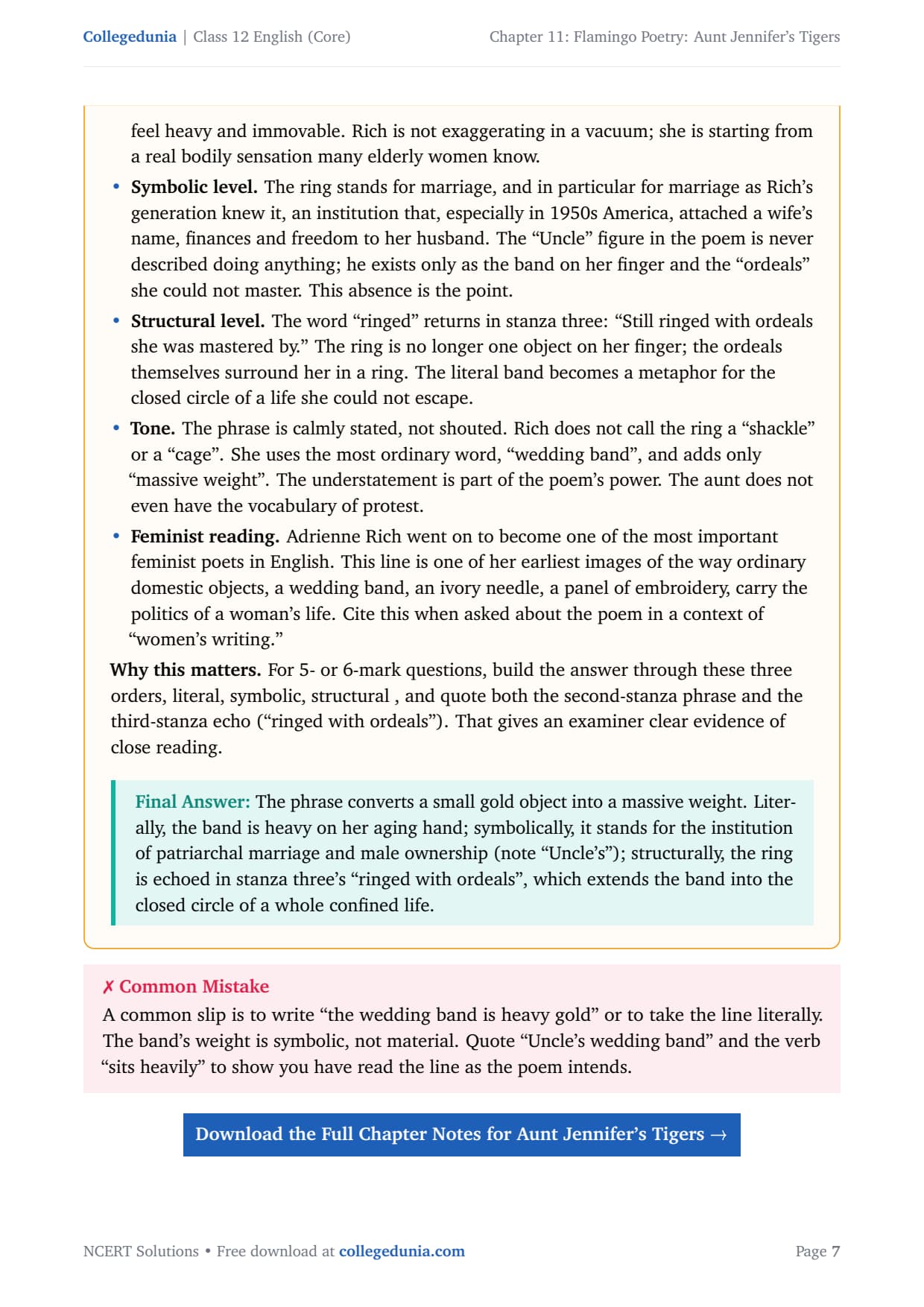
Literal level. The aunt is an elderly woman whose
hands have aged under decades of married life. Even on this
plain physical level, a tight ring on an arthritic finger
does feel heavy and immovable. Rich is not exaggerating in
a vacuum; she is starting from a real bodily sensation many
elderly women know.
Symbolic level. The ring stands for marriage, and
in particular for marriage as Rich's generation knew it,
an institution that, especially in 1950s America, attached
a wife's name, finances and freedom to her husband. The
``Uncle'' figure in the poem is never described doing
anything; he exists only as the band on her finger and the
``ordeals'' she could not master. This absence is the point.
Structural level. The word ``ringed'' returns in
stanza three: ``Still ringed with ordeals she was mastered
by.'' The ring is no longer one object on her finger; the
ordeals themselves surround her in a ring. The literal band
becomes a metaphor for the closed circle of a life she
could not escape.
Tone. The phrase is calmly stated, not shouted.
Rich does not call the ring a ``shackle'' or a ``cage''.
She uses the most ordinary word, ``wedding band'', and
adds only ``massive weight''. The understatement is part
of the poem's power. The aunt does not even have the
vocabulary of protest.
Feminist reading. Adrienne Rich went on to become
one of the most important feminist poets in English. This
line is one of her earliest images of the way ordinary
domestic objects, a wedding band, an ivory needle, a
panel of embroidery, carry the politics of a woman's
life. Cite this when asked about the poem in a context of
``women's writing.''
Why this matters. For 5- or 6-mark questions, build the
answer through these three orders, literal, symbolic, structural
, and quote both the second-stanza phrase and the third-stanza
echo (``ringed with ordeals''). That gives an examiner clear
evidence of close reading.
The phrase converts a small gold object into a massive
weight. Literally, the band is heavy on her aging hand; symbolically,
it stands for the institution of patriarchal marriage and male
ownership (note ``Uncle's''); structurally, the ring is echoed in
stanza three's ``ringed with ordeals'', which extends the band into
the closed circle of a whole confined life.
Q 11.4
Of what or of whom is Aunt Jennifer terrified within in the third stanza?
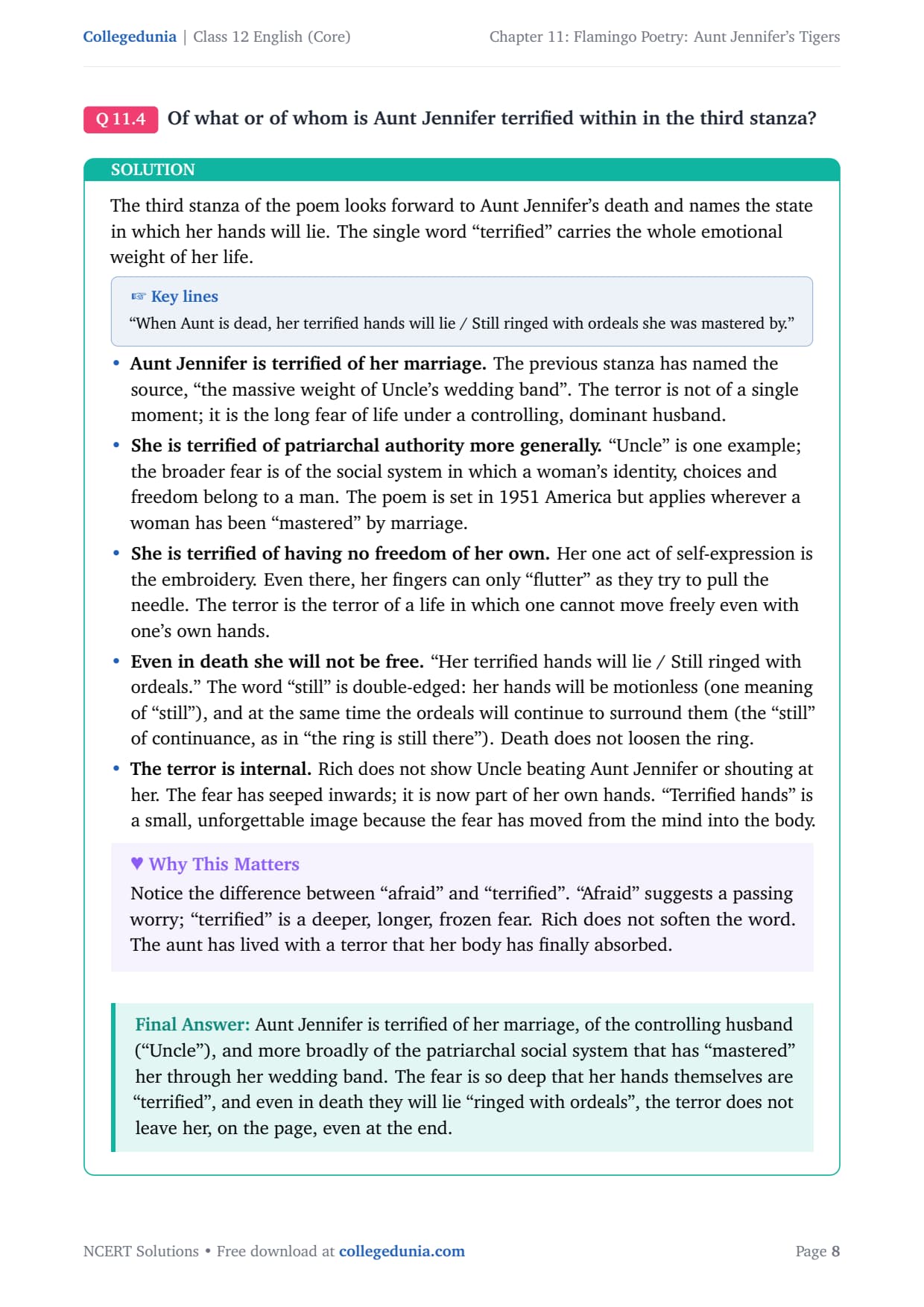
The third stanza of the poem looks forward to Aunt Jennifer's death
and names the state in which her hands will lie. The single word
``terrified'' carries the whole emotional weight of her life.
Key lines
``When Aunt is dead, her terrified hands will lie / Still ringed
with ordeals she was mastered by.''
Aunt Jennifer is terrified of her marriage. The
previous stanza has named the source, ``the massive
weight of Uncle's wedding band''. The terror is not of a
single moment; it is the long fear of life under a
controlling, dominant husband.
She is terrified of patriarchal authority more
generally. ``Uncle'' is one example; the broader fear is of
the social system in which a woman's identity, choices and
freedom belong to a man. The poem is set in 1951 America
but applies wherever a woman has been ``mastered'' by
marriage.
She is terrified of having no freedom of her own.
Her one act of self-expression is the embroidery. Even there,
her fingers can only ``flutter'' as they try to pull the
needle. The terror is the terror of a life in which one
cannot move freely even with one's own hands.
Even in death she will not be free. ``Her terrified
hands will lie / Still ringed with ordeals.'' The word
``still'' is double-edged: her hands will be motionless
(one meaning of ``still''), and at the same time the
ordeals will continue to surround them (the ``still'' of
continuance, as in ``the ring is still there''). Death
does not loosen the ring.
The terror is internal. Rich does not show Uncle
beating Aunt Jennifer or shouting at her. The fear has
seeped inwards; it is now part of her own hands. ``Terrified
hands'' is a small, unforgettable image because the fear has
moved from the mind into the body.
Notice the difference between ``afraid'' and ``terrified''. ``Afraid''
suggests a passing worry; ``terrified'' is a deeper, longer, frozen
fear. Rich does not soften the word. The aunt has lived with a
terror that her body has finally absorbed.
Aunt Jennifer is terrified of her marriage, of the
controlling husband (``Uncle''), and more broadly of the patriarchal
social system that has ``mastered'' her through her wedding band.
The fear is so deep that her hands themselves are ``terrified'', and
even in death they will lie ``ringed with ordeals'', the terror
does not leave her, on the page, even at the end.
MK
Mr Karan Sethi
MA English Literature, University of Calcutta
Verified Expert
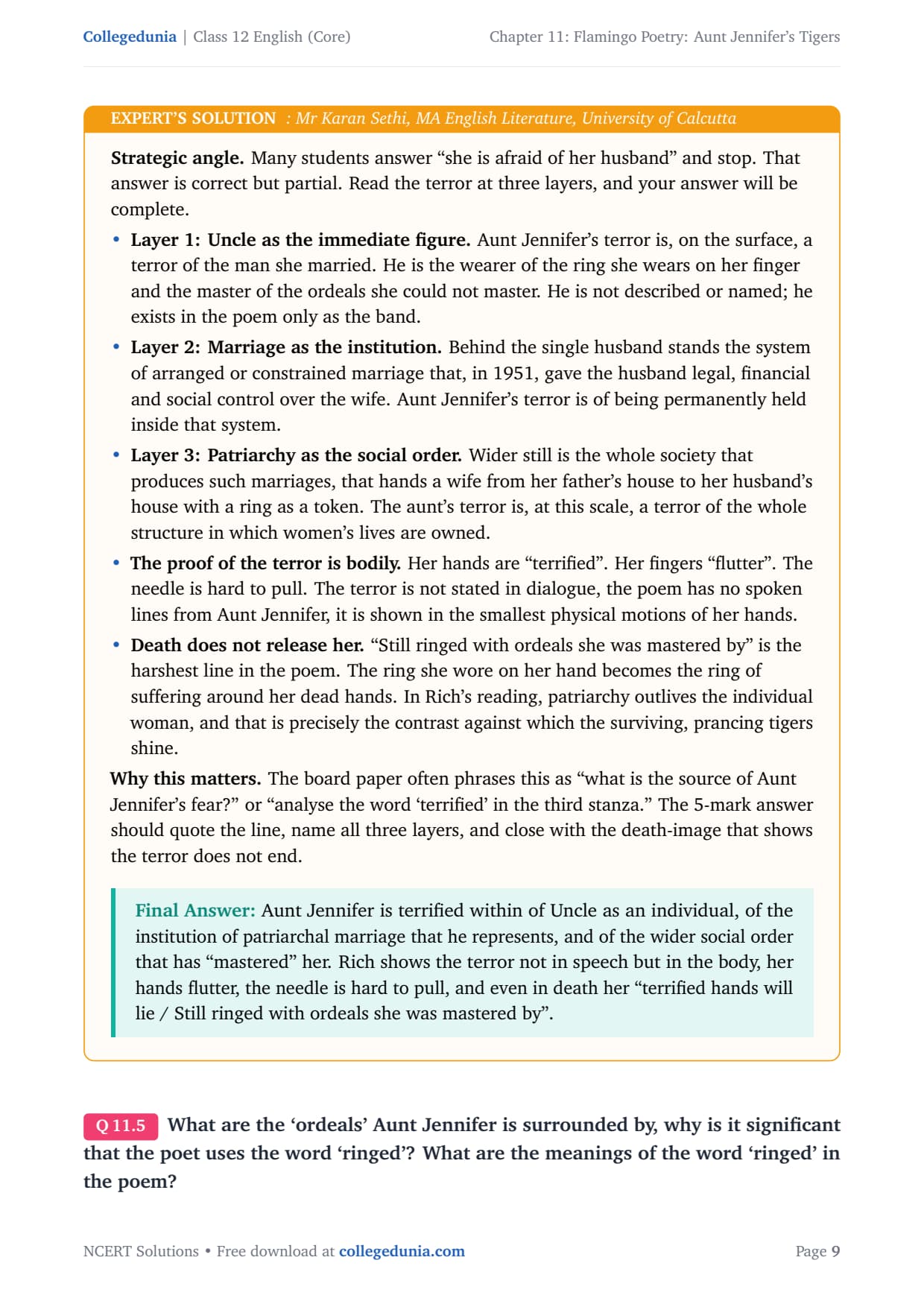
Strategic angle. Many students answer ``she is afraid of
her husband'' and stop. That answer is correct but partial. Read the
terror at three layers, and your answer will be complete.
Layer 1: Uncle as the immediate figure. Aunt
Jennifer's terror is, on the surface, a terror of the man
she married. He is the wearer of the ring she wears on her
finger and the master of the ordeals she could not master.
He is not described or named; he exists in the poem only
as the band.
Layer 2: Marriage as the institution. Behind
the single husband stands the system of arranged or
constrained marriage that, in 1951, gave the husband legal,
financial and social control over the wife. Aunt Jennifer's
terror is of being permanently held inside that system.
Layer 3: Patriarchy as the social order. Wider
still is the whole society that produces such marriages,
that hands a wife from her father's house to her husband's
house with a ring as a token. The aunt's terror is, at this
scale, a terror of the whole structure in which women's
lives are owned.
The proof of the terror is bodily. Her hands are
``terrified''. Her fingers ``flutter''. The needle is hard
to pull. The terror is not stated in dialogue, the poem
has no spoken lines from Aunt Jennifer, it is shown in
the smallest physical motions of her hands.
Death does not release her. ``Still ringed with
ordeals she was mastered by'' is the harshest line in the
poem. The ring she wore on her hand becomes the ring of
suffering around her dead hands. In Rich's reading,
patriarchy outlives the individual woman, and that is
precisely the contrast against which the surviving,
prancing tigers shine.
Why this matters. The board paper often phrases this as
``what is the source of Aunt Jennifer's fear?'' or ``analyse the
word `terrified' in the third stanza.'' The 5-mark answer should
quote the line, name all three layers, and close with the death-image
that shows the terror does not end.
Aunt Jennifer is terrified within of Uncle as an
individual, of the institution of patriarchal marriage that he
represents, and of the wider social order that has ``mastered''
her. Rich shows the terror not in speech but in the body, her
hands flutter, the needle is hard to pull, and even in death her
``terrified hands will lie / Still ringed with ordeals she was
mastered by''.
Q 11.5
What are the `ordeals' Aunt Jennifer is surrounded by, why is it significant that the poet uses the word `ringed'? What are the meanings of the word `ringed' in the poem?
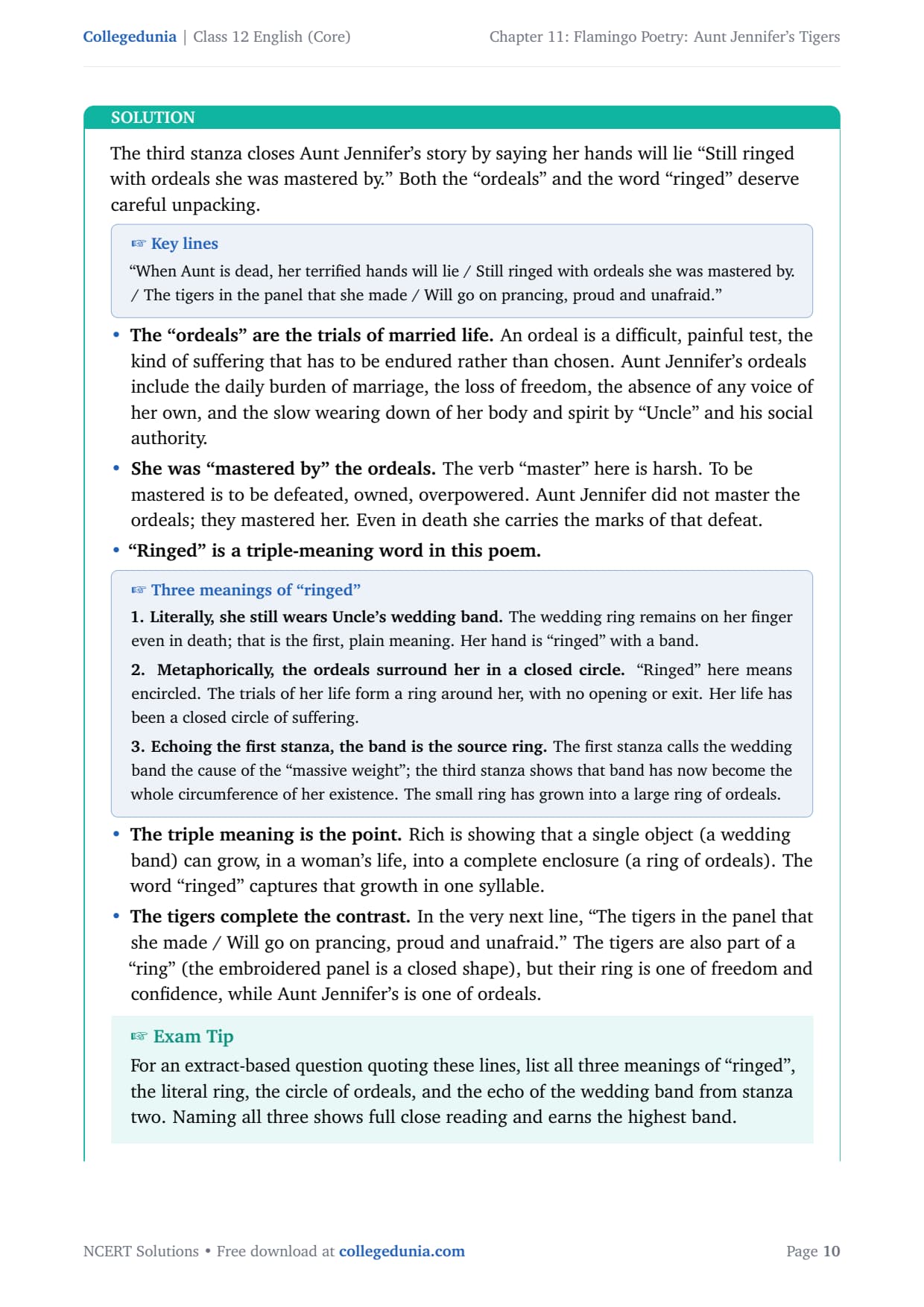
The third stanza closes Aunt Jennifer's story by saying her hands
will lie ``Still ringed with ordeals she was mastered by.'' Both the
``ordeals'' and the word ``ringed'' deserve careful unpacking.
Key lines
``When Aunt is dead, her terrified hands will lie / Still ringed
with ordeals she was mastered by. / The tigers in the panel that
she made / Will go on prancing, proud and unafraid.''
The ``ordeals'' are the trials of married life.
An ordeal is a difficult, painful test, the kind of
suffering that has to be endured rather than chosen.
Aunt Jennifer's ordeals include the daily burden of
marriage, the loss of freedom, the absence of any voice
of her own, and the slow wearing down of her body and
spirit by ``Uncle'' and his social authority.
She was ``mastered by'' the ordeals. The verb
``master'' here is harsh. To be mastered is to be defeated,
owned, overpowered. Aunt Jennifer did not master the
ordeals; they mastered her. Even in death she carries
the marks of that defeat.
``Ringed'' is a triple-meaning word in this poem.
Three meanings of ``ringed''
1. Literally, she still wears Uncle's wedding band. The
wedding ring remains on her finger even in death; that is the
first, plain meaning. Her hand is ``ringed'' with a band. [3pt]
2. Metaphorically, the ordeals surround her in a closed
circle. ``Ringed'' here means encircled. The trials of her life
form a ring around her, with no opening or exit. Her life has been
a closed circle of suffering. [3pt]
3. Echoing the first stanza, the band is the source ring.
The first stanza calls the wedding band the cause of the ``massive
weight''; the third stanza shows that band has now become the whole
circumference of her existence. The small ring has grown into a
large ring of ordeals.
The triple meaning is the point. Rich is showing
that a single object (a wedding band) can grow, in a woman's
life, into a complete enclosure (a ring of ordeals). The
word ``ringed'' captures that growth in one syllable.
The tigers complete the contrast. In the very next
line, ``The tigers in the panel that she made / Will go on
prancing, proud and unafraid.'' The tigers are also part of
a ``ring'' (the embroidered panel is a closed shape), but
their ring is one of freedom and confidence, while Aunt
Jennifer's is one of ordeals.
For an extract-based question quoting these lines, list all three
meanings of ``ringed'', the literal ring, the circle of ordeals,
and the echo of the wedding band from stanza two. Naming all three
shows full close reading and earns the highest band.
The ``ordeals'' are the trials of patriarchal married
life, the loss of freedom, the daily burden of being owned, the
absence of a voice of her own. Aunt Jennifer was ``mastered'' by
these ordeals. ``Ringed'' has three meanings together: literally she
still wears Uncle's wedding band on her finger; metaphorically the
ordeals encircle her in a closed ring with no exit; and structurally
the word echoes the wedding band of stanza two, showing how a
single ring on her finger has grown into the whole circumference of
her life.
DS
Dr Sneha Bose
PhD English Literature, Jadavpur University
Verified Expert
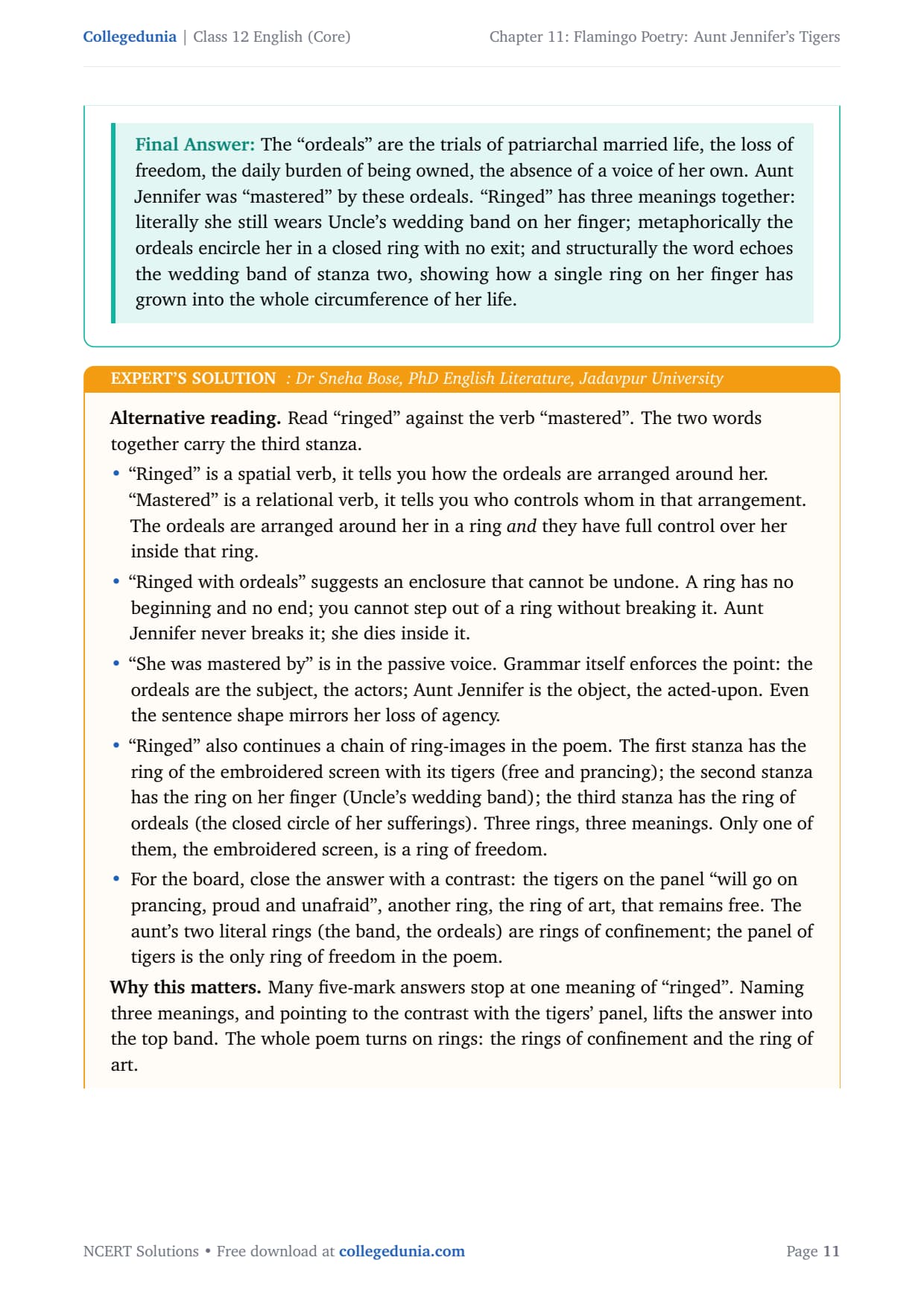
Alternative reading. Read ``ringed'' against the verb
``mastered''. The two words together carry the third stanza.
``Ringed'' is a spatial verb, it tells you how the
ordeals are arranged around her. ``Mastered'' is a
relational verb, it tells you who controls whom in that
arrangement. The ordeals are arranged around her in a ring
and they have full control over her inside that ring.
``Ringed with ordeals'' suggests an enclosure that cannot
be undone. A ring has no beginning and no end; you cannot
step out of a ring without breaking it. Aunt Jennifer
never breaks it; she dies inside it.
``She was mastered by'' is in the passive voice. Grammar
itself enforces the point: the ordeals are the subject, the
actors; Aunt Jennifer is the object, the acted-upon. Even
the sentence shape mirrors her loss of agency.
``Ringed'' also continues a chain of ring-images in the
poem. The first stanza has the ring of the embroidered
screen with its tigers (free and prancing); the second
stanza has the ring on her finger (Uncle's wedding band);
the third stanza has the ring of ordeals (the closed
circle of her sufferings). Three rings, three meanings.
Only one of them, the embroidered screen, is a ring
of freedom.
For the board, close the answer with a contrast: the
tigers on the panel ``will go on prancing, proud and
unafraid'', another ring, the ring of art, that remains
free. The aunt's two literal rings (the band, the ordeals)
are rings of confinement; the panel of tigers is the only
ring of freedom in the poem.
Why this matters. Many five-mark answers stop at one
meaning of ``ringed''. Naming three meanings, and pointing to the
contrast with the tigers' panel, lifts the answer into the top
band. The whole poem turns on rings: the rings of confinement and
the ring of art.
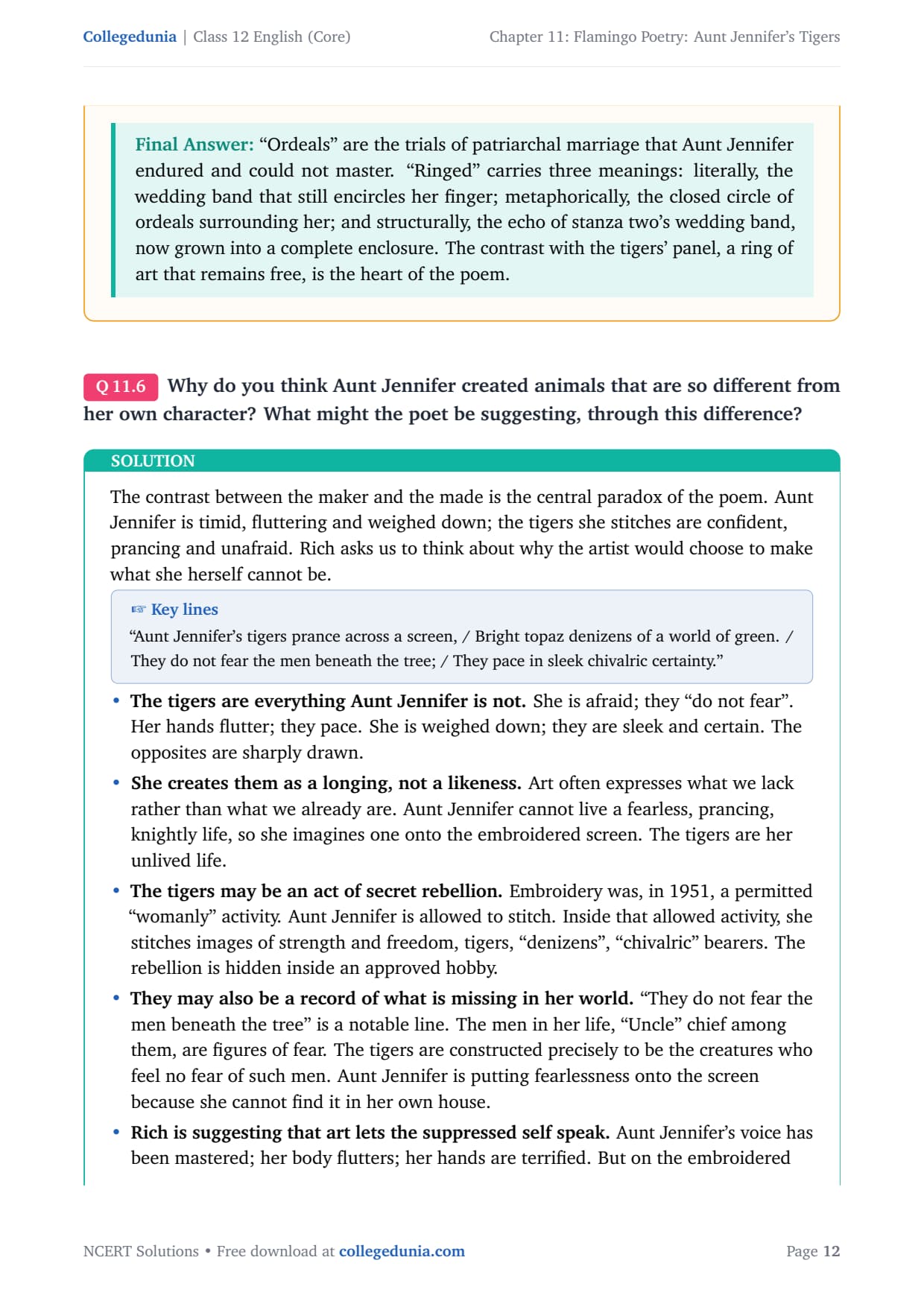
``Ordeals'' are the trials of patriarchal marriage that
Aunt Jennifer endured and could not master. ``Ringed'' carries three
meanings: literally, the wedding band that still encircles her
finger; metaphorically, the closed circle of ordeals surrounding
her; and structurally, the echo of stanza two's wedding band, now
grown into a complete enclosure. The contrast with the tigers'
panel, a ring of art that remains free, is the heart of the
poem.
Q 11.6
Why do you think Aunt Jennifer created animals that are so different from her own character? What might the poet be suggesting, through this difference?
The contrast between the maker and the made is the central paradox
of the poem. Aunt Jennifer is timid, fluttering and weighed down;
the tigers she stitches are confident, prancing and unafraid. Rich
asks us to think about why the artist would choose to make what she
herself cannot be.
Key lines
``Aunt Jennifer's tigers prance across a screen, / Bright topaz
denizens of a world of green. / They do not fear the men beneath
the tree; / They pace in sleek chivalric certainty.''
The tigers are everything Aunt Jennifer is not.
She is afraid; they ``do not fear''. Her hands flutter;
they pace. She is weighed down; they are sleek and certain.
The opposites are sharply drawn.
She creates them as a longing, not a likeness.
Art often expresses what we lack rather than what we
already are. Aunt Jennifer cannot live a fearless,
prancing, knightly life, so she imagines one onto the
embroidered screen. The tigers are her unlived life.
The tigers may be an act of secret rebellion.
Embroidery was, in 1951, a permitted ``womanly'' activity.
Aunt Jennifer is allowed to stitch. Inside that allowed
activity, she stitches images of strength and freedom,
tigers, ``denizens'', ``chivalric'' bearers. The rebellion
is hidden inside an approved hobby.
They may also be a record of what is missing in
her world. ``They do not fear the men beneath the tree''
is a notable line. The men in her life, ``Uncle'' chief
among them, are figures of fear. The tigers are
constructed precisely to be the creatures who feel no fear
of such men. Aunt Jennifer is putting fearlessness onto
the screen because she cannot find it in her own house.
Rich is suggesting that art lets the suppressed
self speak. Aunt Jennifer's voice has been mastered; her
body flutters; her hands are terrified. But on the
embroidered panel, a different voice gets through. The
tigers are her free voice. Through them, Rich is showing
that a confined woman finds, in art, a small but real
opening for self-expression that the rest of her life
denies her.
How to phrase the suggestion for the board
For a 5-mark answer, name three things the difference suggests:
(1) art expresses longing, not likeness; (2) embroidery is the one
permitted form of self-expression open to Aunt Jennifer; (3) the
tigers are her hidden voice, the part of her that is not afraid.
Aunt Jennifer created tigers so unlike herself because art
often expresses what we long to be, not what we are. The fearless,
prancing tigers are her unlived life: the freedom and dignity her
own marriage has denied her. Rich is suggesting that art lets the
suppressed self speak, that embroidery is the one permitted form
of self-expression in which a constrained woman can stitch a
fearless, free voice into existence.
DP
Dr Priya Ranganathan
PhD English Literature, University of Madras
Verified Expert
Alternative reading. The difference can also be read as a
strategy of compensation, and as a hint of Adrienne Rich's later
feminist programme.
Art as compensation. Aunt Jennifer cannot prance
through her own life, so she lets the tigers prance for
her. This is psychological compensation: the artist makes
in the work what she cannot make in her life. The poem
is, among other things, a small case study of this
well-known artistic move.
Choice of subject is itself a statement. Aunt
Jennifer did not embroider tame house-pets, flowers or
children. She chose tigers, predators, the most
confident animals in the forest. The choice is not
accidental; it tells us what she most lacks and most
admires.
Colour and setting also matter. ``Bright topaz''
tigers in ``a world of green'', two strong, vivid
colours. Aunt Jennifer's own world has only ``wool'',
``ivory'' and the ``wedding band''. She paints the
embroidered world in colours her real world does not
have.
The men beneath the tree. ``They do not fear the
men beneath the tree.'' Rich notes that the tigers'
fearlessness is specifically aimed at men, the very
figures who, in the form of ``Uncle'', have mastered
Aunt Jennifer. The aunt is sketching tigers who would
not have been frightened of her own husband.
The wider feminist suggestion. Rich, who became a
major feminist poet, is laying down an early thesis here:
women under patriarchy often have only one outlet for
self-expression, and that outlet is the ``womanly art''
such as embroidery. The poem honours that outlet,
notice that the tigers survive after Aunt Jennifer dies
, while also marking, with great sadness, the cost of
having had to compress an entire self into a needle and
wool.
Why this matters. For a 5- or 6-mark answer, treat the
question as asking about art under constraint. The tigers
are not just the opposite of Aunt Jennifer; they are her one
permitted opening into a freer self, and they outlast her.
The animals are so different because Aunt Jennifer made
them as her unlived self. Art under patriarchy compensates for what
life denies. The tigers' fearlessness towards ``the men beneath the
tree'' is no accident: they are the kind of creatures who would
not have been mastered as she was. Rich is suggesting that
embroidery, the one permitted form of self-expression in such a
woman's life, becomes the place where the free, confident self can
exist, and through the panel, outlast the artist herself.
Q 11.7
Interpret the symbols found in this poem.
The poem is short but densely symbolic. Each of its three stanzas
contributes its own symbol, and the symbols are linked into a
single argument. The clearest way to answer is to take them in
order.
Key lines
``Bright topaz denizens of a world of green The massive weight
of Uncle's wedding band Still ringed with ordeals she was
mastered by. / The tigers in the panel that she made / Will go on
prancing, proud and unafraid.''
Six symbols at a glance
1. The tigers = freedom, fearlessness, dignity, the
unlived self that Aunt Jennifer puts into art. [3pt]
2. Topaz and green colours = vivid, jewel-like life,
contrasted with the colourless wool and ivory of Aunt Jennifer's
own world. [3pt]
3. The men beneath the tree = the male authority figures
the tigers refuse to fear, the very figures (``Uncle'') who have
mastered Aunt Jennifer. [3pt]
4. The ivory needle and the wool = the small permitted
tools of a ``womanly'' art, the only freedom Aunt Jennifer has. [3pt]
5. Uncle's wedding band = patriarchal marriage as a
massive, daily, owned weight on the woman's hand. [3pt]
6. The embroidered panel = art that outlives the artist;
the small, permanent record of the free self that Aunt Jennifer
could not be in life.
The tigers (freedom). ``Prance''; ``do not fear'';
``sleek chivalric certainty''. These are confident verbs and
adjectives. The tigers stand for the part of Aunt Jennifer
that is unafraid, the self she keeps alive only on the
embroidered panel.
Colour (vividness). ``Bright topaz'' on a
background of green. The aunt's own world has only the
pale-yellow wool and the white ``ivory'' needle. The
embroidery's bright colours symbolise the imagined life
that the artist gives her tigers but cannot give herself.
Men beneath the tree (patriarchal authority).
Specifically chosen as the figures the tigers do not fear.
They symbolise the very category of men, husbands,
uncles, masters, under whom Aunt Jennifer has lived.
Ivory needle and wool (permitted self-expression).
Smooth, small, domestic tools. They symbolise the narrow
opening for self-expression that Aunt Jennifer is allowed:
no shouting, no painting, no writing, only needlework.
Yet through that narrow opening, the tigers escape onto
the panel.
Uncle's wedding band (patriarchal marriage).
``Massive weight''; ``sits heavily''. The wedding band
becomes the most concrete symbol of marriage as ownership.
Note that the ring is ``Uncle's'', not theirs, it
belongs to him.
The embroidered panel (art's permanence). ``Will
go on prancing, proud and unafraid.'' Aunt Jennifer dies;
the tigers do not. The panel symbolises the way art
survives the artist. The free self she could not live, she
leaves behind in needlework that outlasts her body.
Notice how the symbols cluster into two columns. Symbols of
freedom: the tigers, the colours, the embroidered panel.
Symbols of confinement: Uncle's wedding band, ``the men
beneath the tree'', the ordeals of stanza three. The poem's
argument is the line that crosses between the two columns: art lets
something free travel out of a confined life.
Six symbols carry the poem. The tigers symbolise
freedom, fearlessness, and the artist's unlived self. The bright
topaz-and-green colours symbolise the vividness of imagined life,
contrasted with the pale wool and ivory of Aunt Jennifer's real
world. The ``men beneath the tree'' symbolise patriarchal authority.
The ivory needle and wool symbolise the narrow opening of
``permitted'' self-expression. Uncle's wedding band symbolises
marriage as owned, daily, massive weight. The embroidered panel
symbolises art that outlives its artist, the free self left
behind in needlework when the body that could not be free has died.
MR
Mr Rohan Acharya
MA English, University of Calcutta
Verified Expert
Strategic angle. Rather than naming six symbols in
isolation, link them into one diagonal argument: art versus
ownership. Two clusters of symbols, one diagonal line of meaning.
Cluster of art / freedom. Tigers, topaz, green,
embroidered panel. All of these are made by Aunt Jennifer's
hands. The cluster says: the artist can imagine freedom
even when she cannot live it.
Cluster of ownership / confinement. Uncle's
wedding band, ``the men beneath the tree'', the ring of
ordeals, the verb ``mastered''. None of these are made by
Aunt Jennifer; they are imposed on her. The cluster says:
the social world has wrapped her hand and her life in
symbols of confinement.
The diagonal line. The needle and the wool sit
between the two clusters. The needle is small, ``ivory'',
``hard to pull'', a domestic object. But the same
needle pulls thread that becomes the tigers. The needle
is the bridge from confinement (a permitted hobby) to
freedom (the prancing tigers on the panel). Read this way,
the needle is the most important symbol in the poem.
Two endings. The aunt's life ends ``ringed with
ordeals''; the tigers ``go on prancing, proud and
unafraid''. The diagonal of meaning closes here. The
artist dies inside the symbols of confinement; the art
survives inside the symbols of freedom. Both can be true
at once, and Rich's quiet anger comes precisely from the
fact that both have to be true at once.
For the board. Treat the symbols as a network, not
a list. Pair each symbol with its opposite (tigers vs
Uncle's band; bright colour vs wool; prancing panel vs
ringed hands). The contrast is the meaning.
Why this matters. Most 6-mark answers list symbols
mechanically. Reading them as two clusters with the needle as the
bridge gives an examiner a clear, argued interpretation rather than
a list of glosses.
The poem's symbols cluster into two opposing groups. The
tigers, the topaz and green colours, and the embroidered panel are
symbols of art and freedom, made by Aunt Jennifer's hands.
Uncle's wedding band, ``the men beneath the tree'' and the ``ring
of ordeals'' are symbols of patriarchal ownership, imposed on
her. The ivory needle and wool sit between the two clusters as the
bridge: the small, permitted domestic tool through which the free
self escapes onto the panel. The aunt dies inside the symbols of
confinement; the tigers go on prancing in the symbols of freedom.
Q 11.8
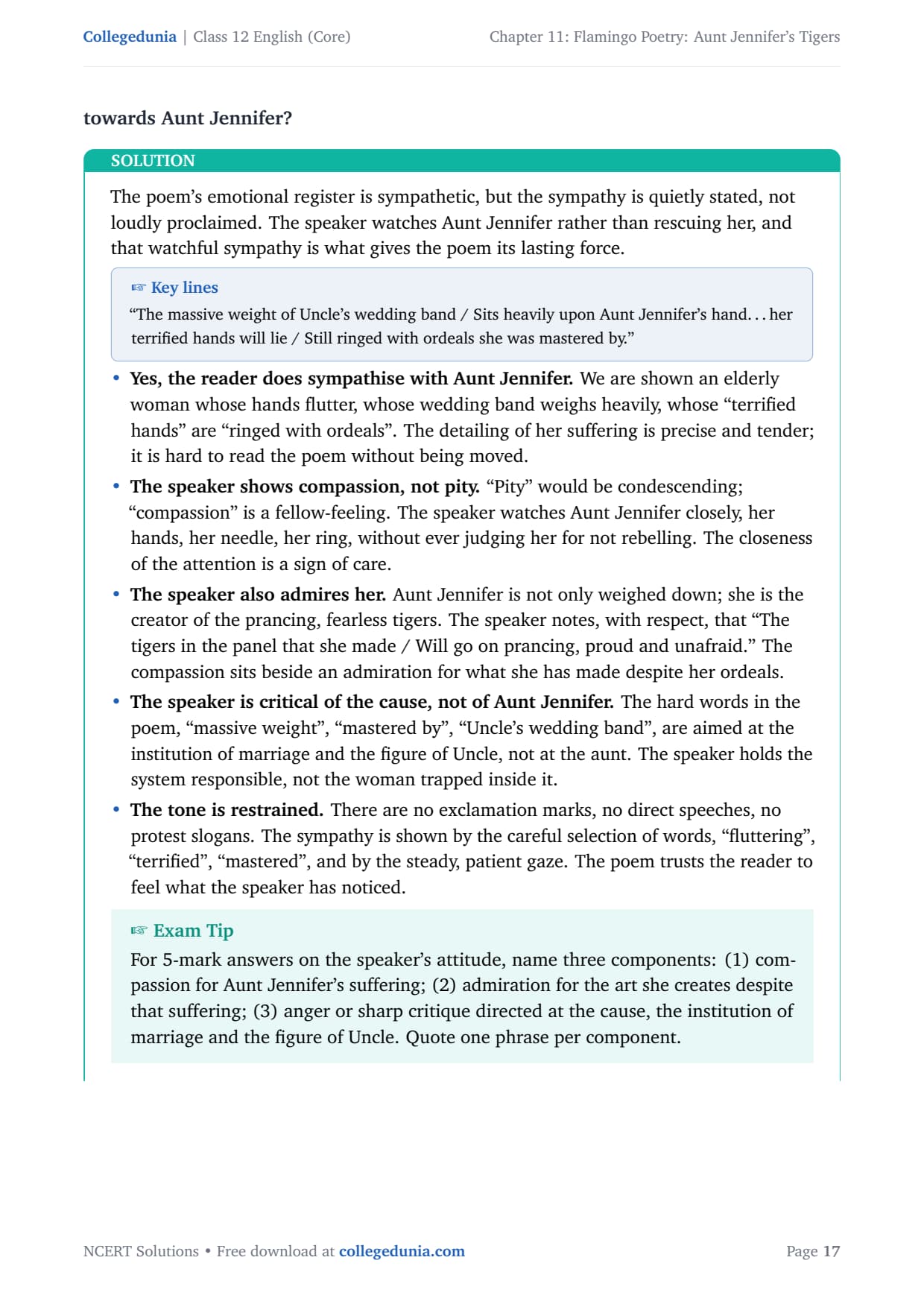
Do you sympathise with Aunt Jennifer? What is the attitude of the speaker towards Aunt Jennifer?
The poem's emotional register is sympathetic, but the sympathy is
quietly stated, not loudly proclaimed. The speaker watches Aunt
Jennifer rather than rescuing her, and that watchful sympathy is
what gives the poem its lasting force.
Key lines
``The massive weight of Uncle's wedding band / Sits heavily upon
Aunt Jennifer's hand her terrified hands will lie / Still
ringed with ordeals she was mastered by.''
Yes, the reader does sympathise with Aunt Jennifer.
We are shown an elderly woman whose hands flutter, whose
wedding band weighs heavily, whose ``terrified hands'' are
``ringed with ordeals''. The detailing of her suffering is
precise and tender; it is hard to read the poem without
being moved.
The speaker shows compassion, not pity. ``Pity''
would be condescending; ``compassion'' is a fellow-feeling.
The speaker watches Aunt Jennifer closely, her hands,
her needle, her ring, without ever judging her for not
rebelling. The closeness of the attention is a sign of
care.
The speaker also admires her. Aunt Jennifer is not
only weighed down; she is the creator of the prancing,
fearless tigers. The speaker notes, with respect, that
``The tigers in the panel that she made / Will go on
prancing, proud and unafraid.'' The compassion sits beside
an admiration for what she has made despite her ordeals.
The speaker is critical of the cause, not of Aunt
Jennifer. The hard words in the poem, ``massive
weight'', ``mastered by'', ``Uncle's wedding band'',
are aimed at the institution of marriage and the figure of
Uncle, not at the aunt. The speaker holds the system
responsible, not the woman trapped inside it.
The tone is restrained. There are no exclamation
marks, no direct speeches, no protest slogans. The
sympathy is shown by the careful selection of words,
``fluttering'', ``terrified'', ``mastered'', and by the
steady, patient gaze. The poem trusts the reader to feel
what the speaker has noticed.
For 5-mark answers on the speaker's attitude, name three components:
(1) compassion for Aunt Jennifer's suffering; (2) admiration for the
art she creates despite that suffering; (3) anger or sharp critique
directed at the cause, the institution of marriage and the figure
of Uncle. Quote one phrase per component.
Yes, we sympathise with Aunt Jennifer because the poem
shows her with precise, tender detail, her fluttering fingers,
her ``terrified hands'', the ``massive weight'' she carries. The
speaker's attitude is one of compassion (close, careful watching),
admiration (for the prancing tigers Aunt Jennifer has stitched
despite her ordeals), and quiet anger (directed at ``Uncle's
wedding band'' and the patriarchal ``ordeals she was mastered by'').
The aunt herself is treated with respect; the social system that
mastered her is the target of the critique.
MT
Ms Tara Bhattacharya
MA English Literature, Presidency University Kolkata
Verified Expert
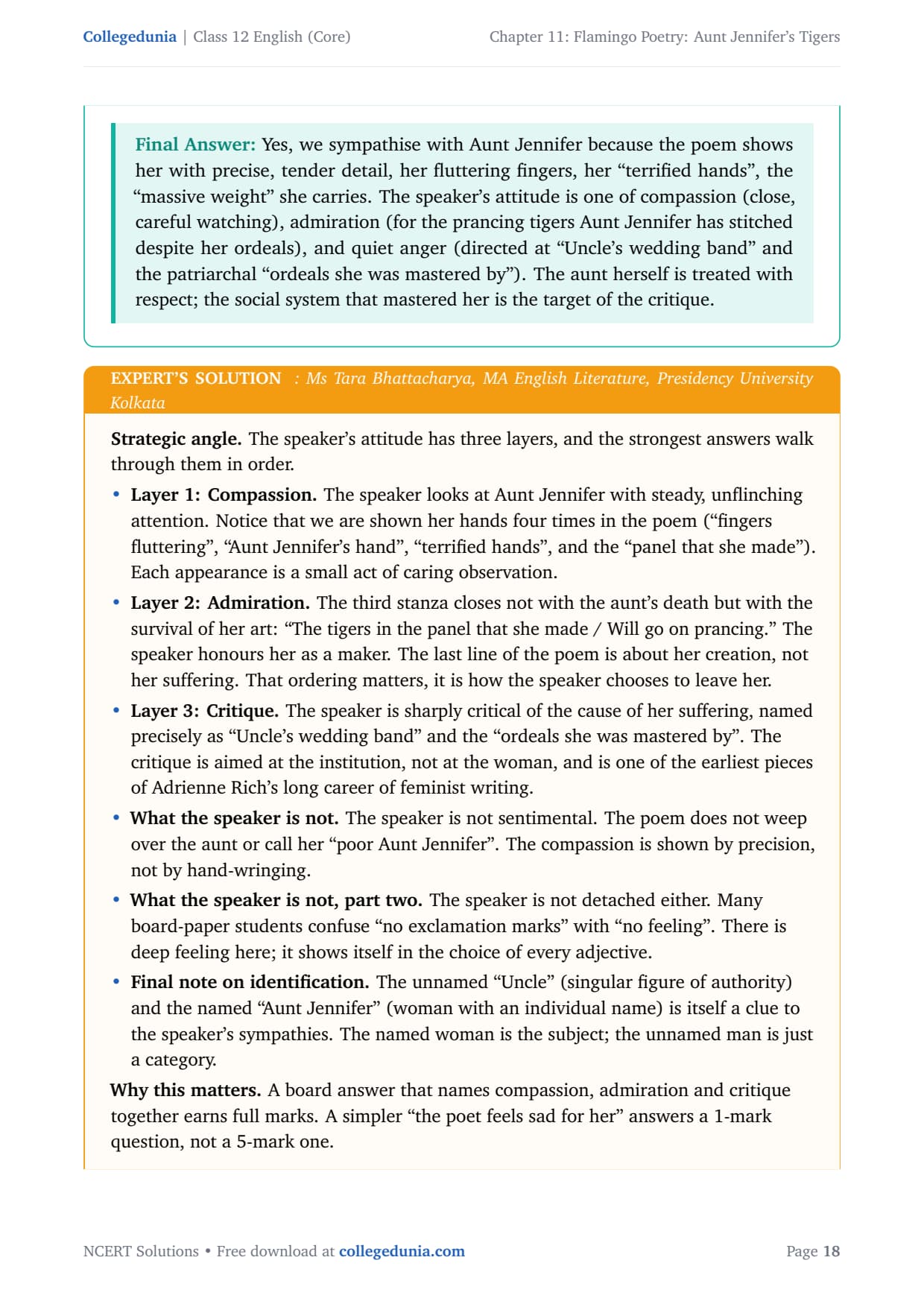
Strategic angle. The speaker's attitude has three layers,
and the strongest answers walk through them in order.
Layer 1: Compassion. The speaker looks at Aunt
Jennifer with steady, unflinching attention. Notice that
we are shown her hands four times in the poem (``fingers
fluttering'', ``Aunt Jennifer's hand'', ``terrified
hands'', and the ``panel that she made''). Each appearance
is a small act of caring observation.
Layer 2: Admiration. The third stanza closes
not with the aunt's death but with the survival of her art:
``The tigers in the panel that she made / Will go on
prancing.'' The speaker honours her as a maker. The last
line of the poem is about her creation, not her suffering.
That ordering matters, it is how the speaker chooses to
leave her.
Layer 3: Critique. The speaker is sharply
critical of the cause of her suffering, named precisely as
``Uncle's wedding band'' and the ``ordeals she was mastered
by''. The critique is aimed at the institution, not at the
woman, and is one of the earliest pieces of Adrienne Rich's
long career of feminist writing.
What the speaker is not. The speaker is not
sentimental. The poem does not weep over the aunt or call
her ``poor Aunt Jennifer''. The compassion is shown by
precision, not by hand-wringing.
What the speaker is not, part two. The speaker
is not detached either. Many board-paper students confuse
``no exclamation marks'' with ``no feeling''. There is
deep feeling here; it shows itself in the choice of every
adjective.
Final note on identification. The unnamed
``Uncle'' (singular figure of authority) and the named
``Aunt Jennifer'' (woman with an individual name) is itself
a clue to the speaker's sympathies. The named woman is the
subject; the unnamed man is just a category.
Why this matters. A board answer that names compassion,
admiration and critique together earns full marks. A simpler
``the poet feels sad for her'' answers a 1-mark question, not a
5-mark one.
Yes, the reader sympathises with Aunt Jennifer because
the poem watches her with such careful, tender attention. The
speaker's attitude has three layers: compassion (the close
observation of her hands, her needle and her fear), admiration
(the deliberate closing on the prancing tigers ``she made''), and
quiet but pointed critique of the cause (Uncle's wedding band, the
``ordeals'' of patriarchal marriage that ``mastered'' her). Aunt
Jennifer is named and respected; the system that confined her is
named and condemned.
More Aunt Jennifer's Tigers English Class 12 Resources
Aunt Jennifer's Tigers Class 12 English NCERT Solutions FAQs
Ques. How many "Think it out" questions are in Aunt Jennifer's Tigers Class 12?
Ans. The NCERT Flamingo print carries eight "Think it out" questions for Aunt Jennifer's Tigers. Our class 12 english ncert solutions chapter 11 Flamingo Poetry: Aunt Jennifer's Tigers solve all eight in NCERT order with two answers per question.
Ques. What is the central theme of Aunt Jennifer's Tigers by Adrienne Rich?
Ans. The central theme is the contrast between patriarchal marriage and the freedom that art makes possible. Aunt Jennifer's life is weighed down by "the massive weight of Uncle's wedding band", but the fearless tigers she embroiders "will go on prancing, proud and unafraid" after her death. Art outlives the artist.
Ques. What does "massive weight of Uncle's wedding band" symbolise?
Ans. A wedding band weighs only a few grams, so the "massive weight" is symbolic. The ring stands for the institution of patriarchal marriage and male ownership; note that the band is "Uncle's", not the aunt's. The whole burden of married life under that system is compressed into the small object she wears on her hand.
Ques. What are the three meanings of "ringed" in the poem?
Ans. First, literally - Aunt Jennifer's finger is still encircled by Uncle's wedding band even in death. Second, metaphorically - the "ordeals" of her life form a closed circle around her with no exit. Third, structurally - the word echoes the wedding band of stanza 2, so the small ring on her finger has grown into the whole circumference of her trapped life.
Ques. Why are the tigers so different from Aunt Jennifer's own character?
Ans. Art expresses what we long to be, not what we are. The fearless, prancing tigers are Aunt Jennifer's unlived self - the dignified, free, "chivalric" life her marriage has denied her. Embroidery is the one permitted form of self-expression in her world, so the tigers are her hidden voice, the part of her that is not afraid.
Ques. Is Aunt Jennifer's Tigers in the 2026-27 CBSE Class 12 English syllabus?
Ans. Yes. Aunt Jennifer's Tigers is Chapter 11 in the Flamingo textbook of the 2026-27 CBSE Class 12 English Core syllabus. The full text and all eight "Think it out" questions are retained in the current print.
Ques. Where can I download the Aunt Jennifer's Tigers NCERT Solutions PDF?
Ans. The free PDF of these class 12 english ncert solutions chapter 11 Flamingo Poetry: Aunt Jennifer's Tigers is available on this page. Both the Normal and HD versions are free and match the 2026-27 NCERT Flamingo print.






Comments