





Open Economy Macroeconomics is the last chapter of the Class 12 Introductory Macroeconomics book. It links the home economy to the rest of the world through the Balance of Payments, the foreign exchange market and the open economy multiplier. This page solves all 10 NCERT exercise questions and gives a free PDF to download.
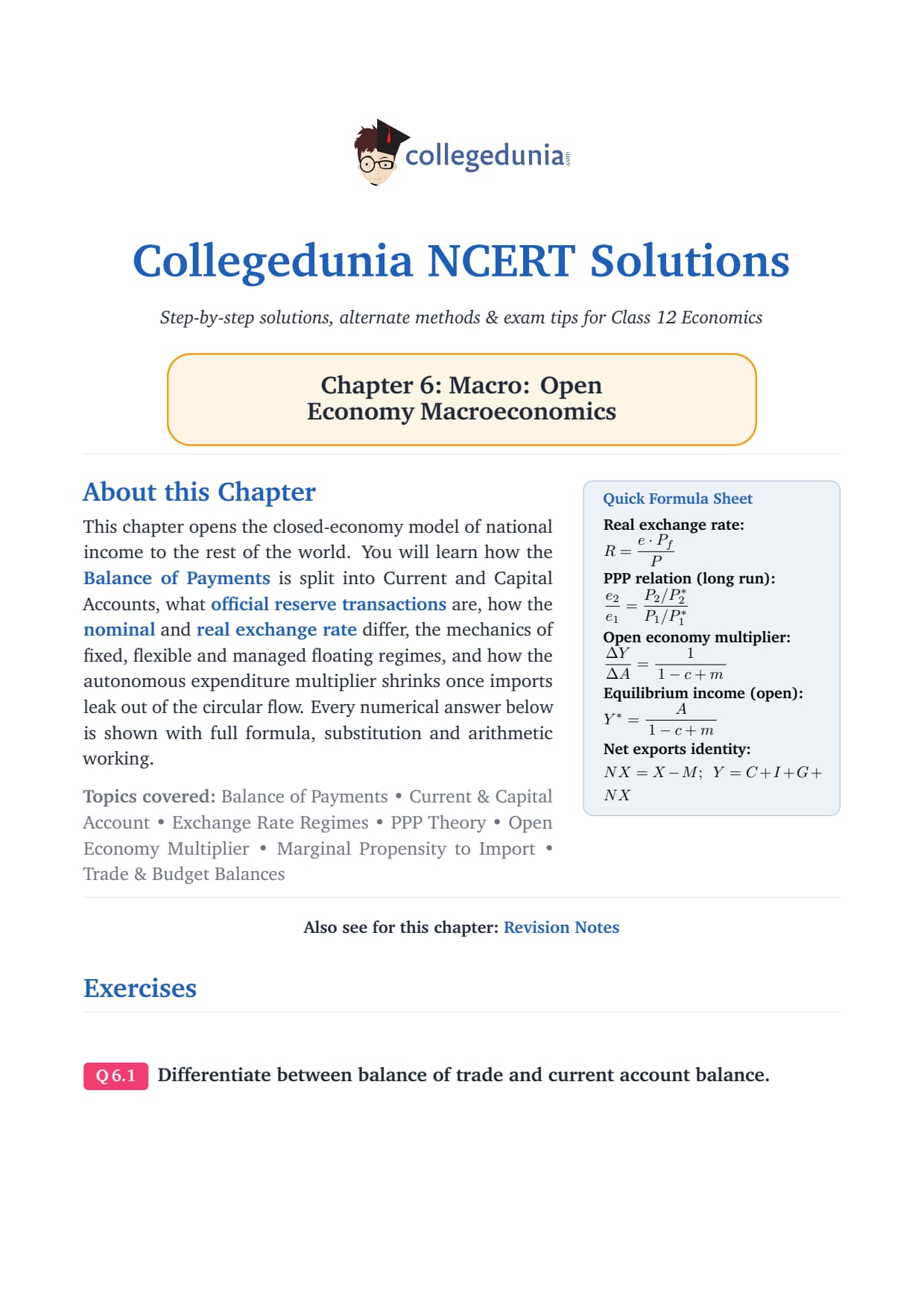
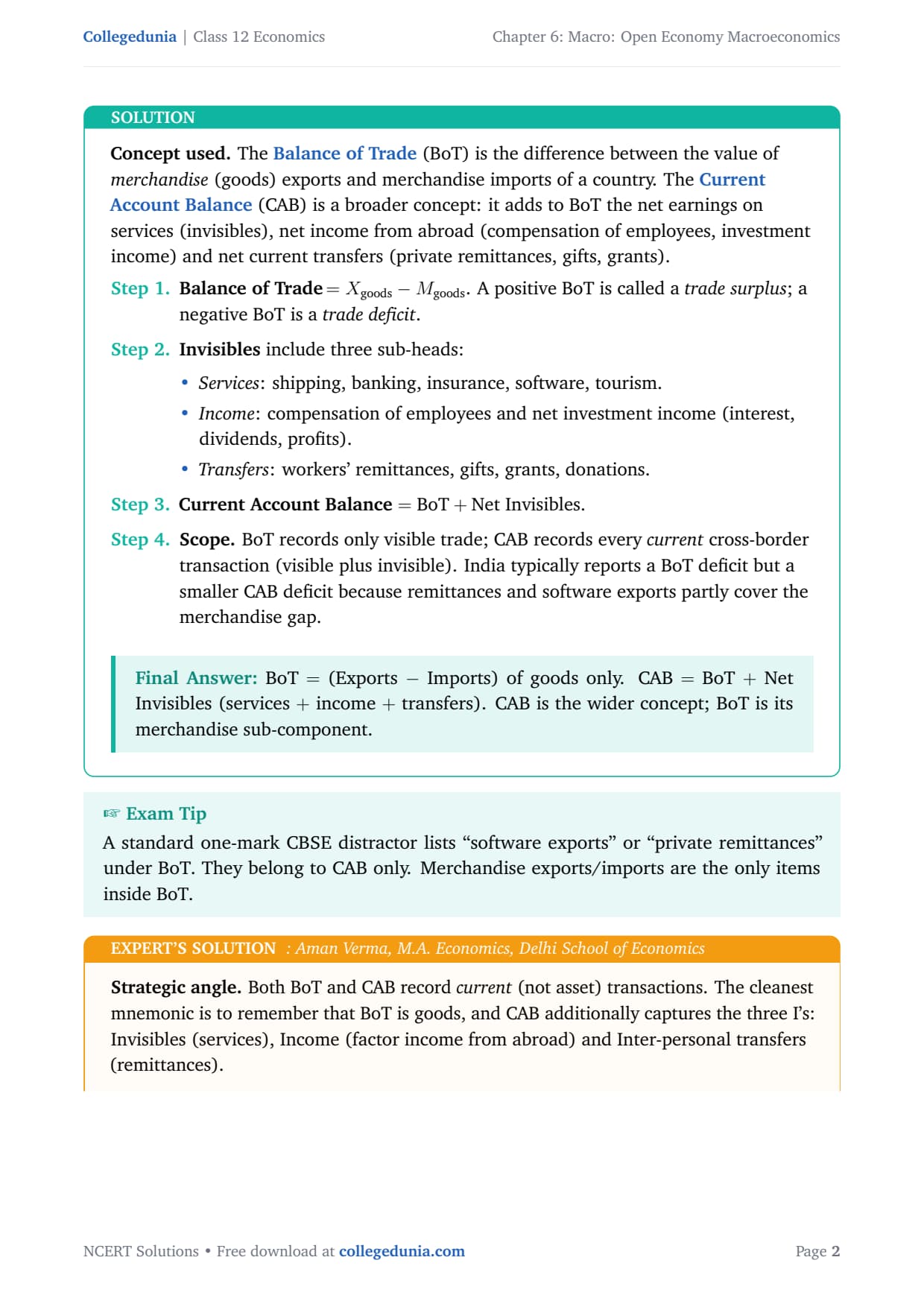
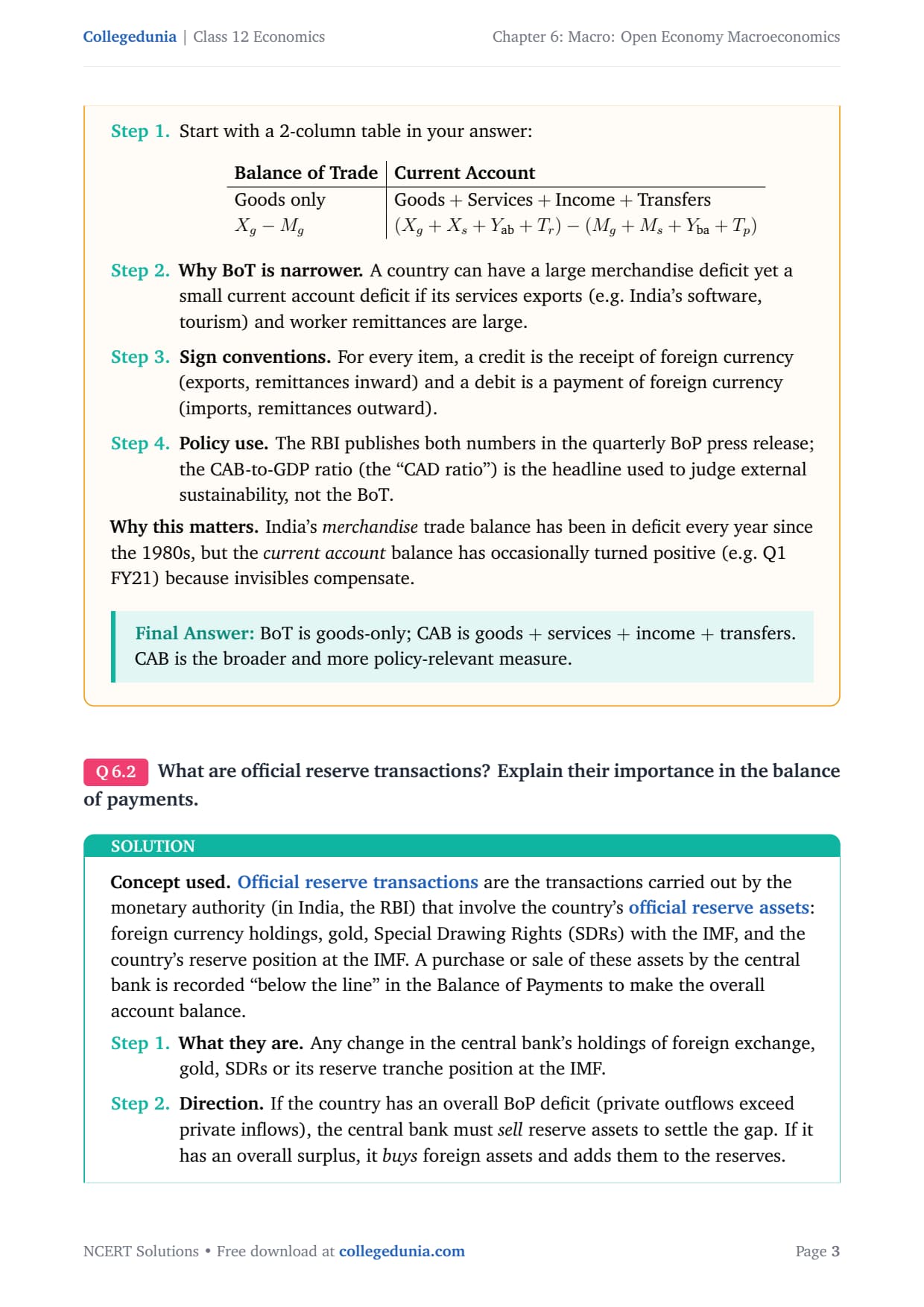
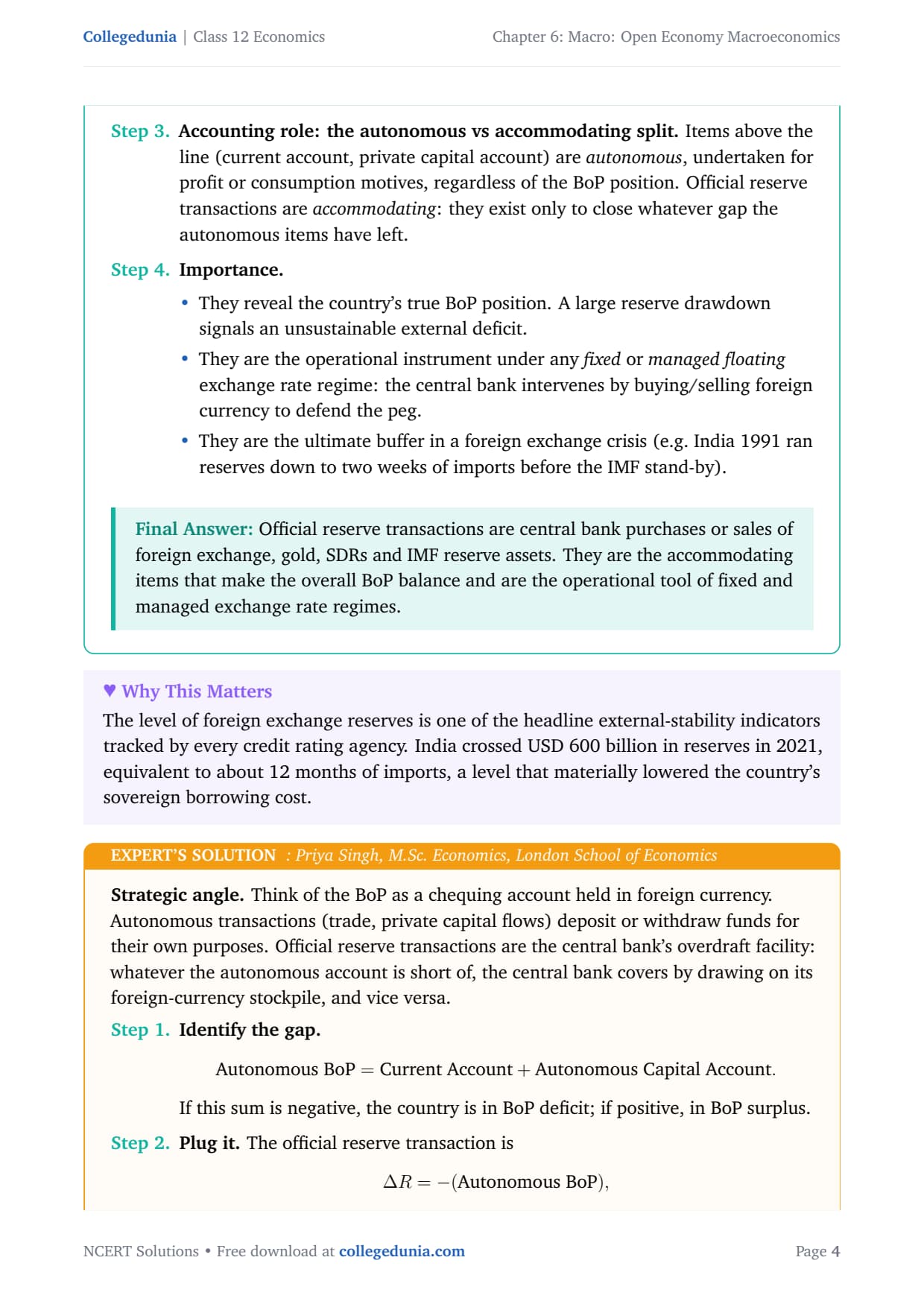
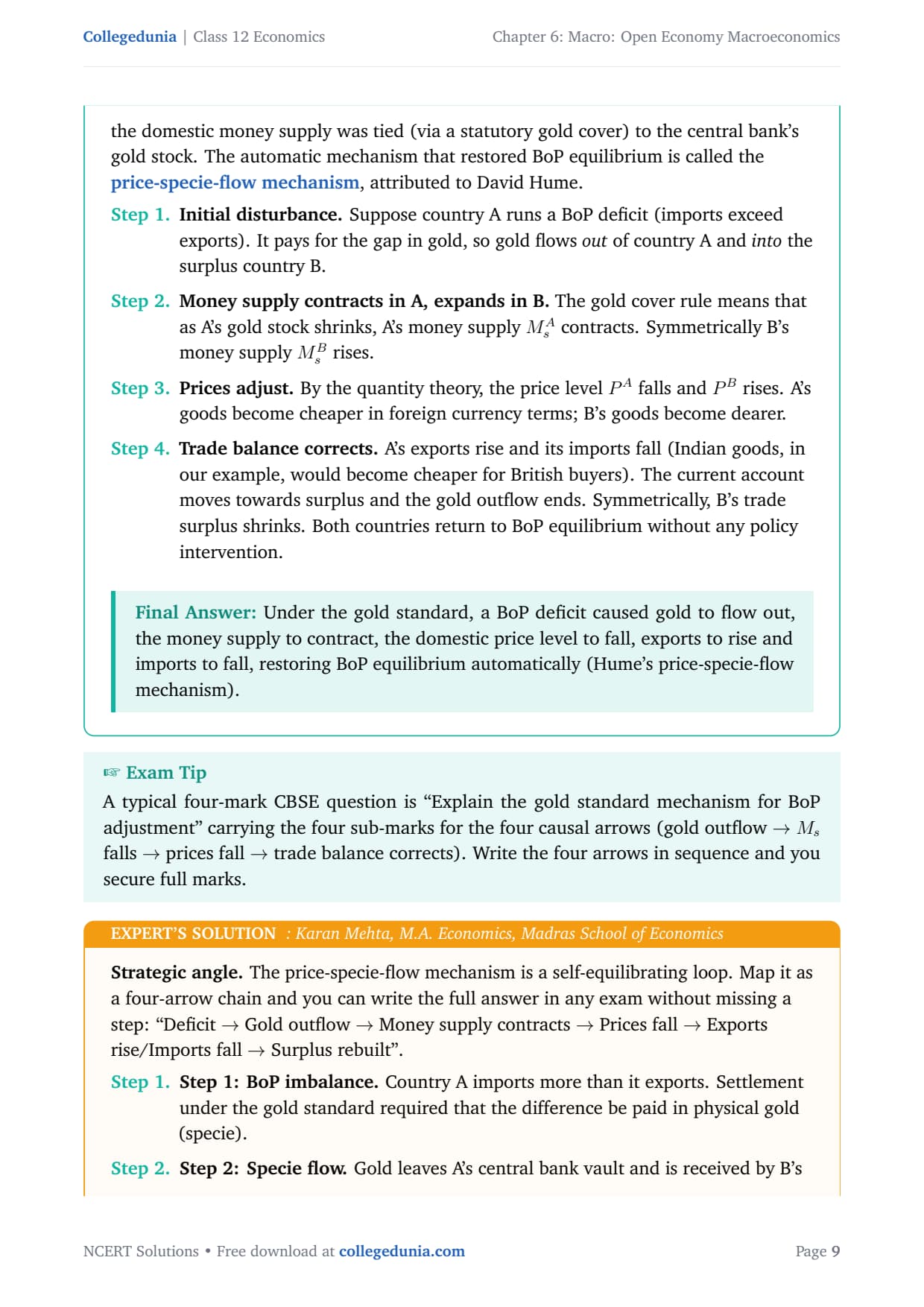
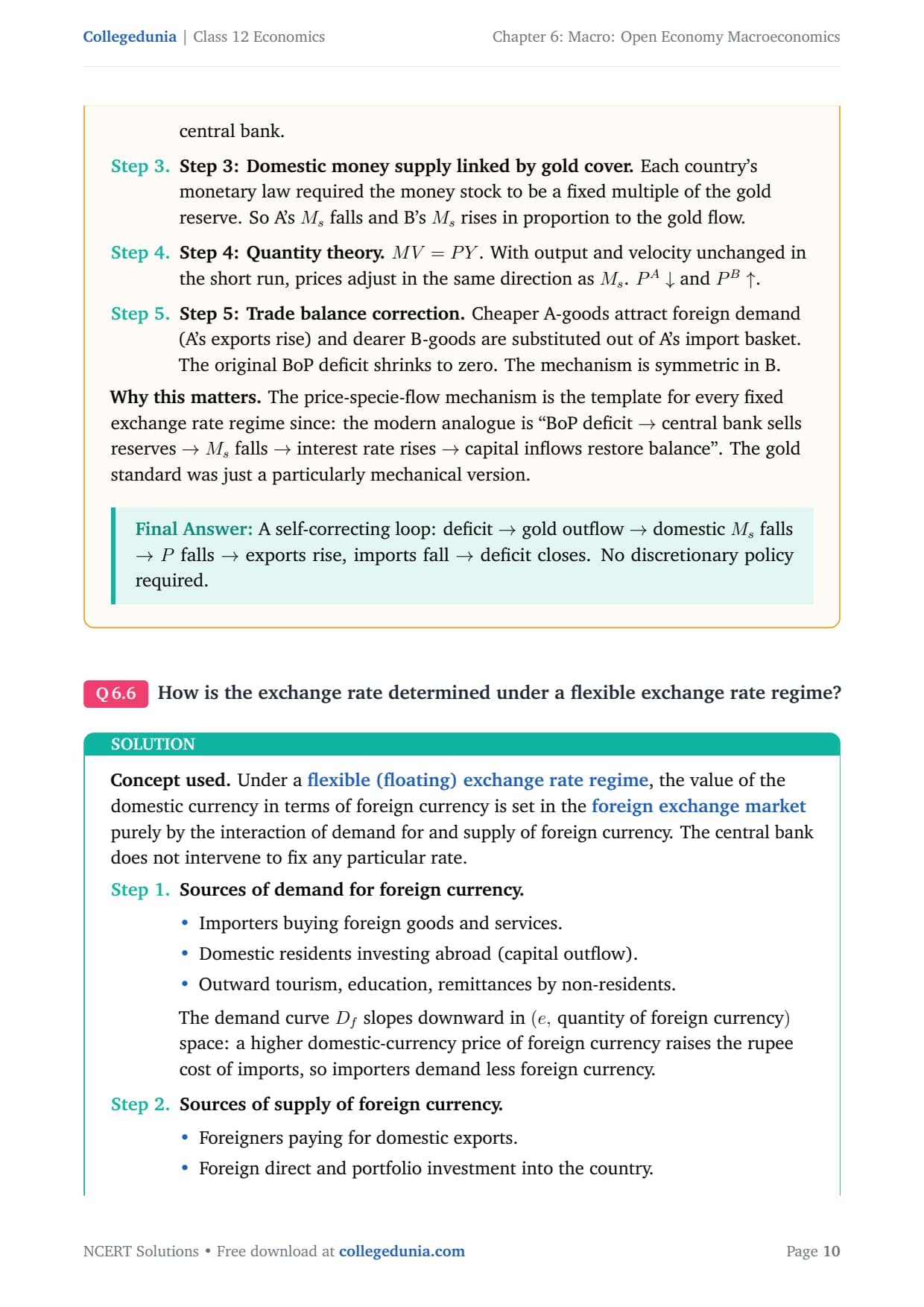
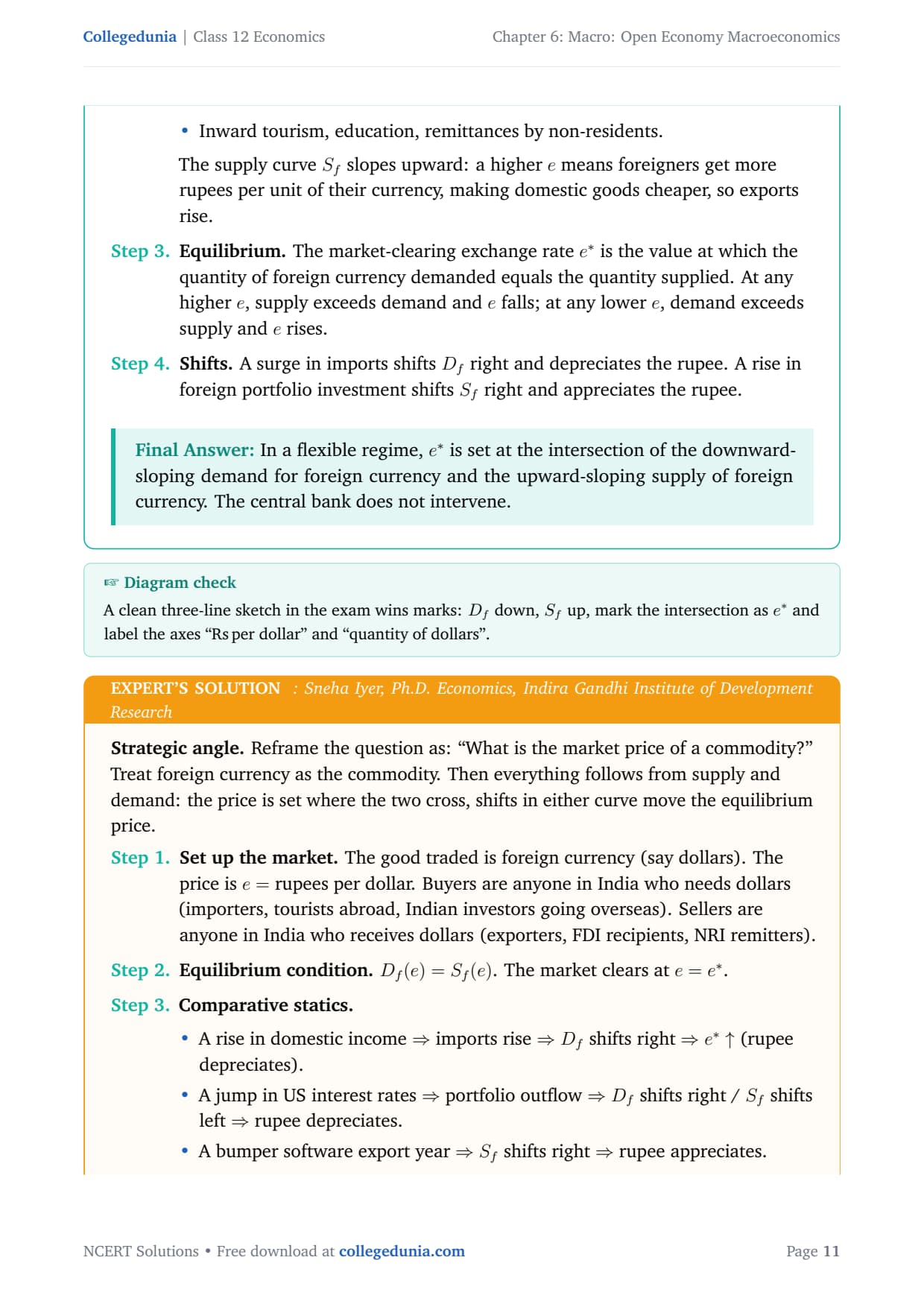
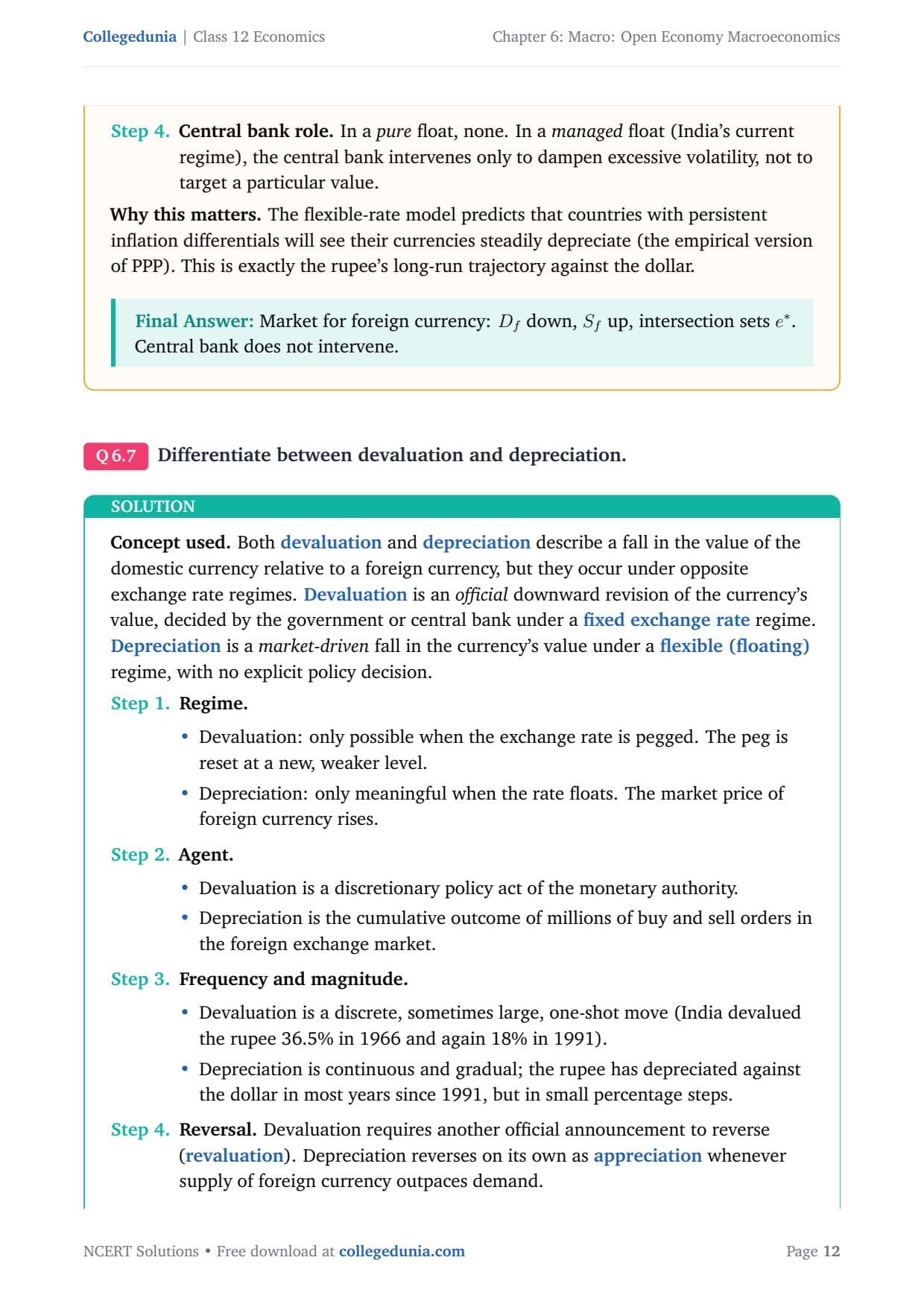
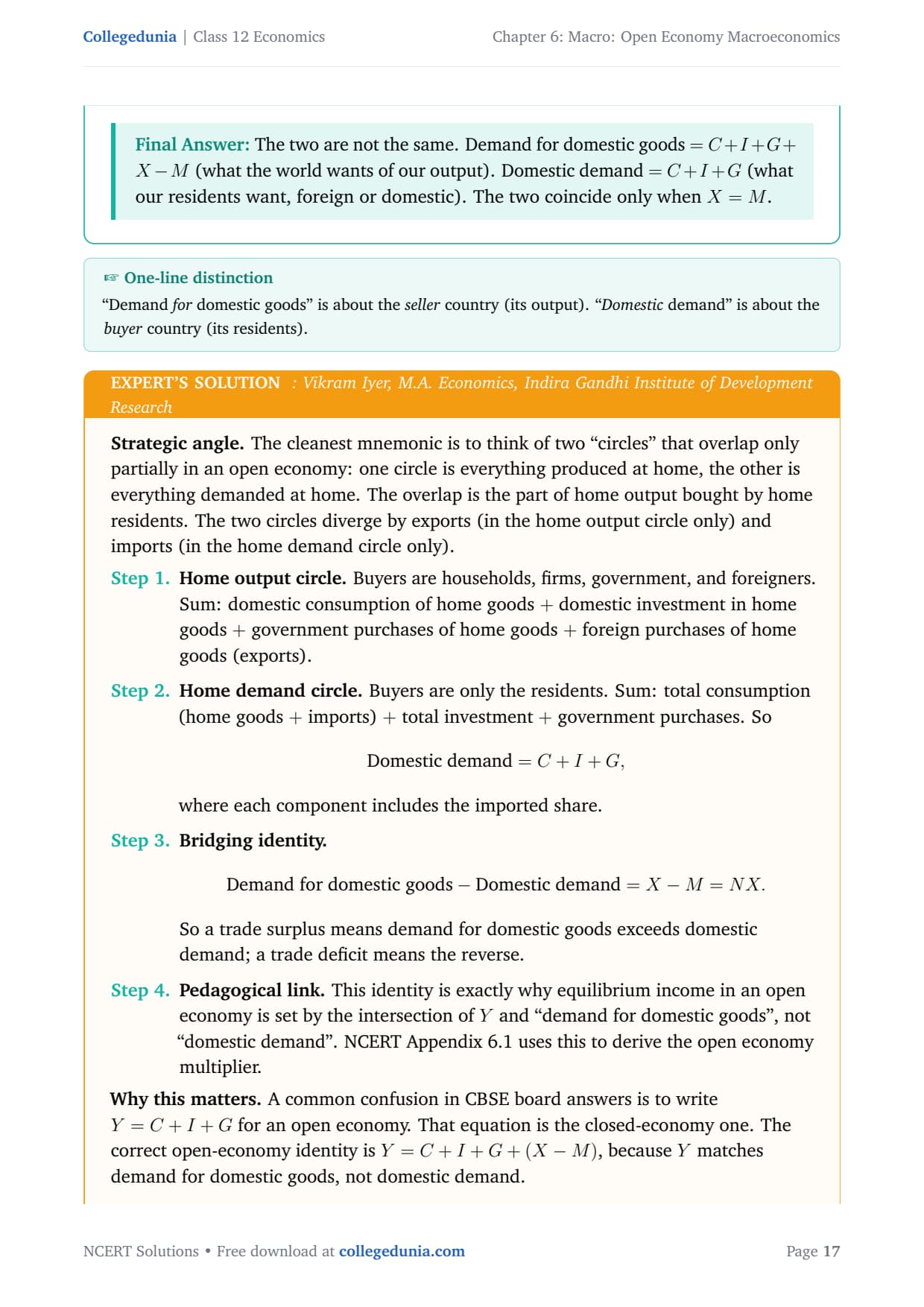
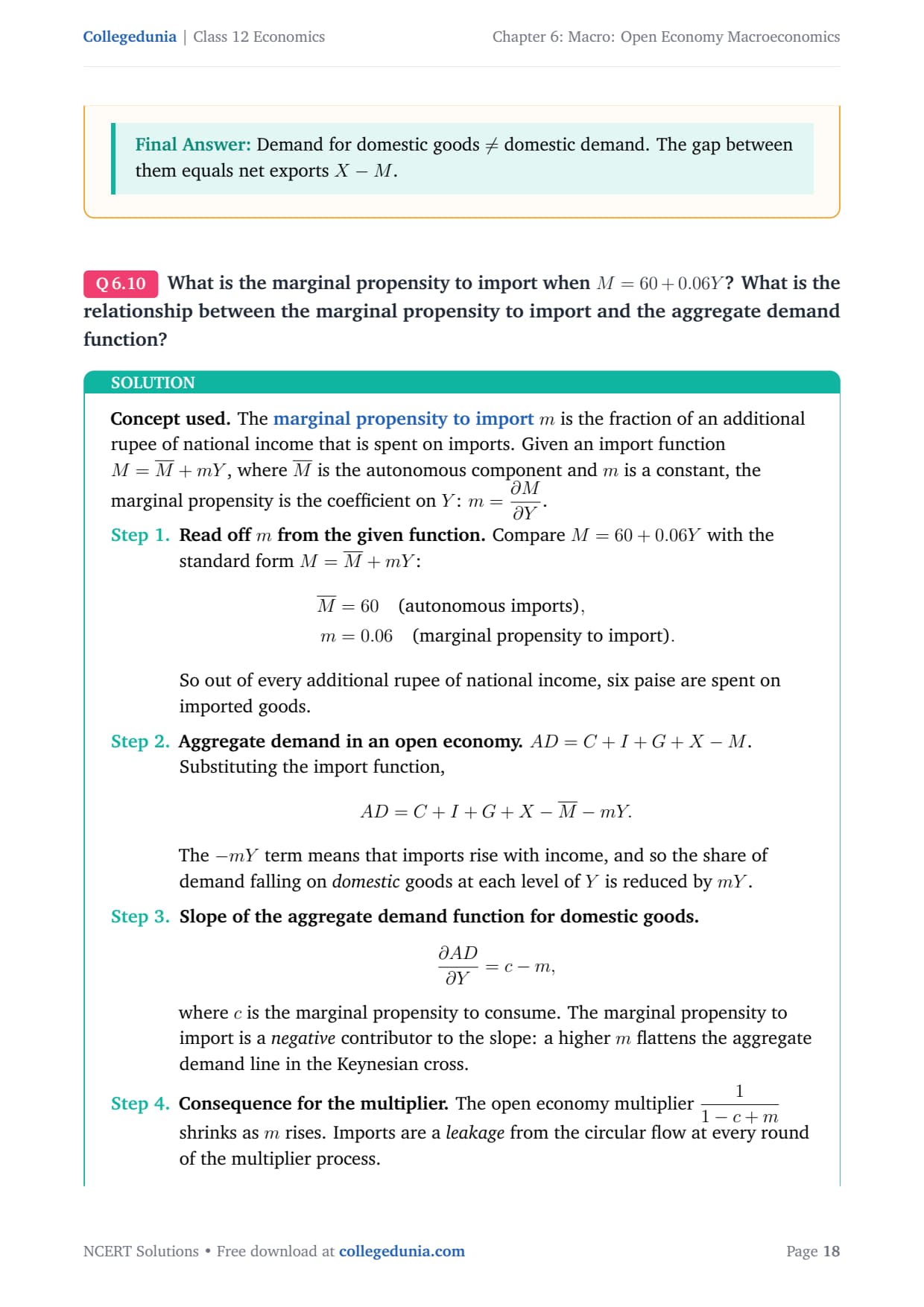
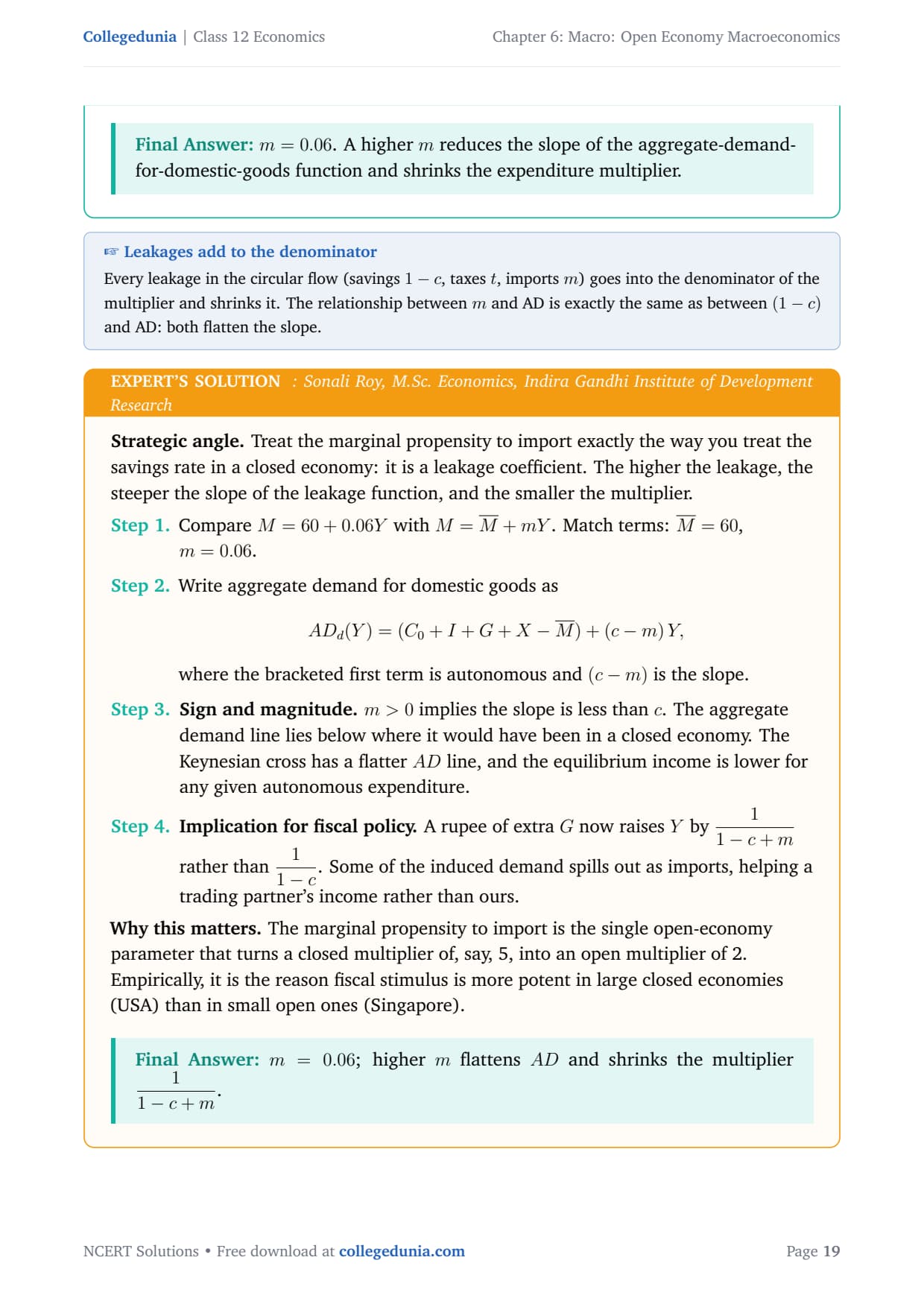
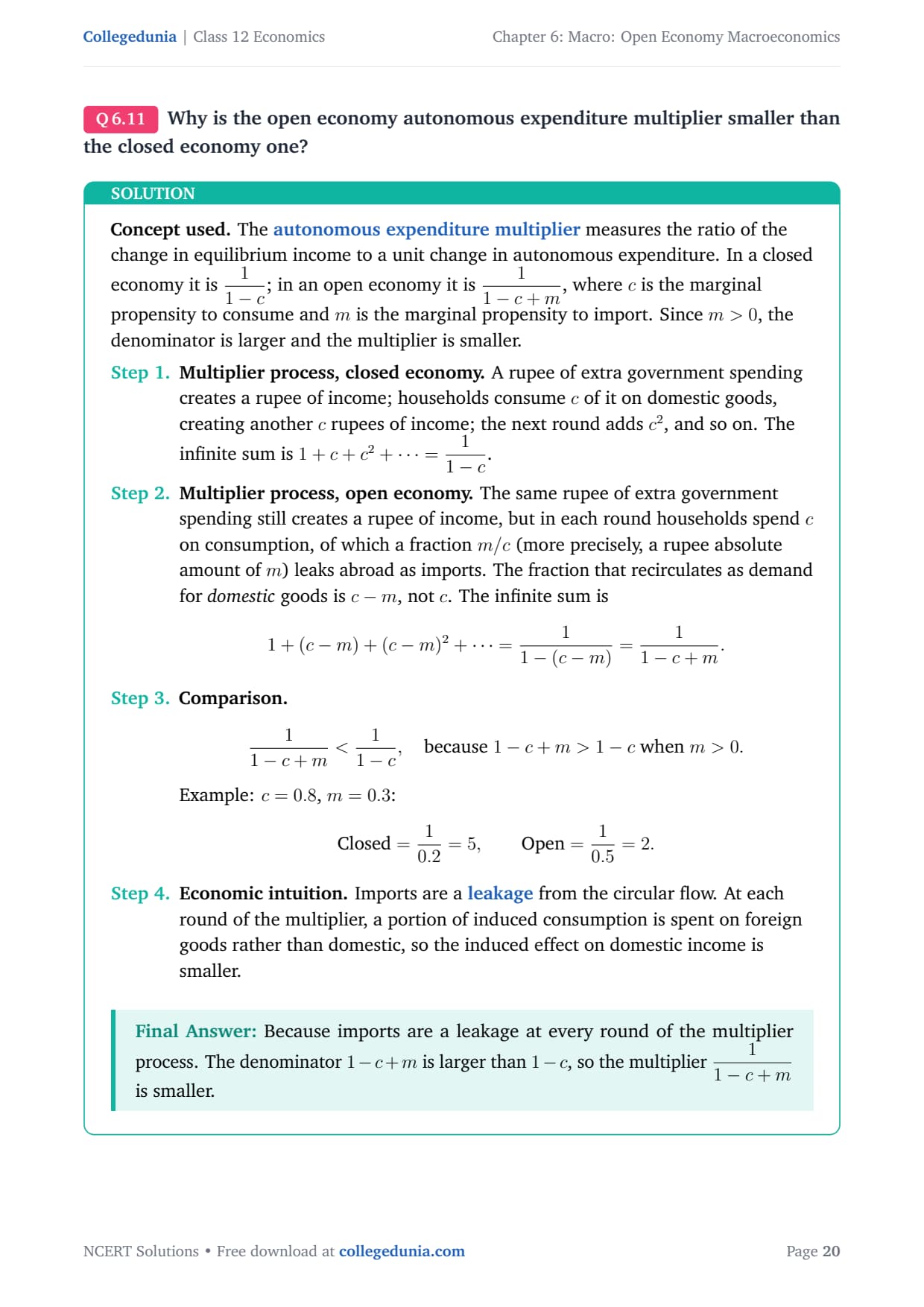
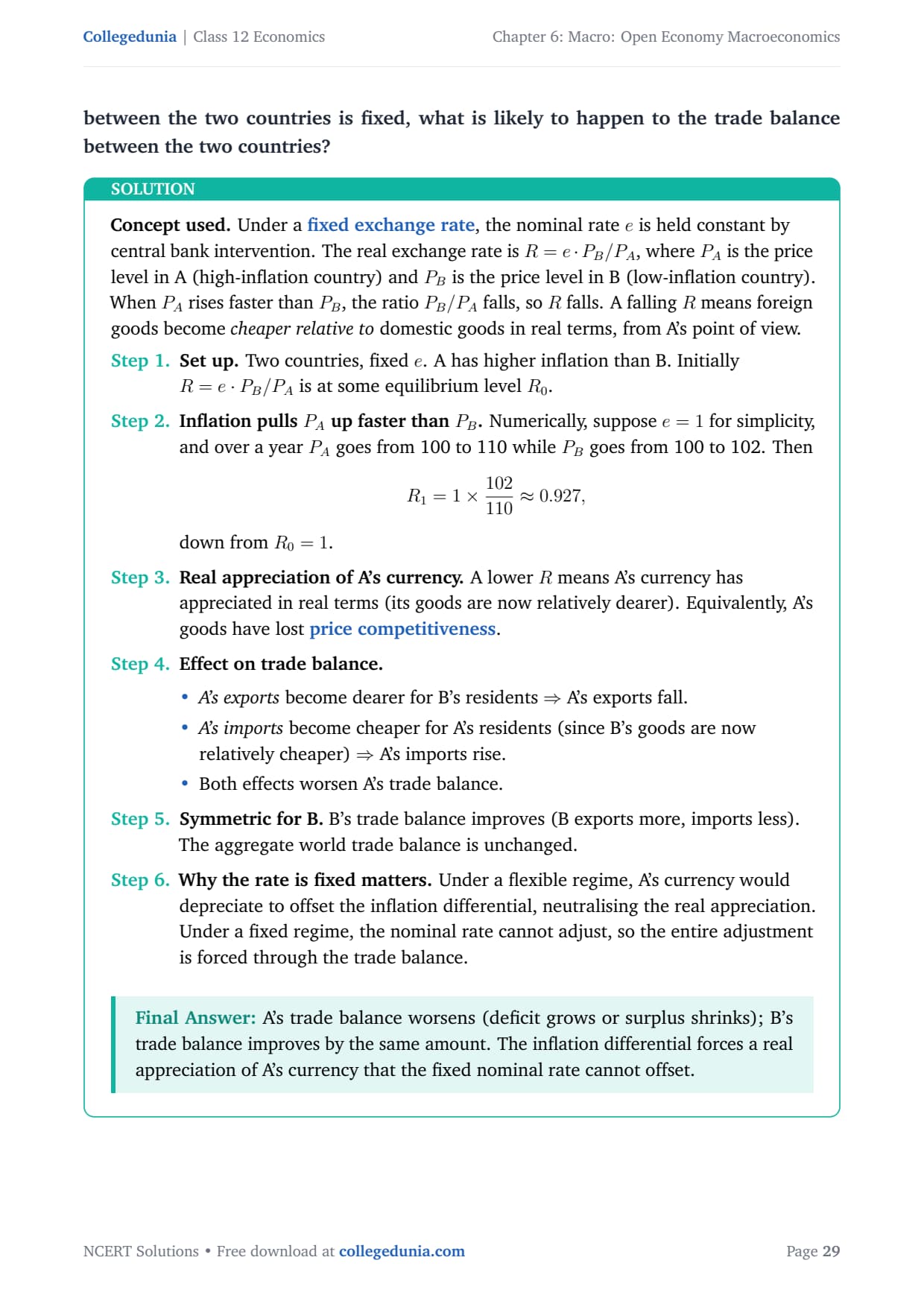
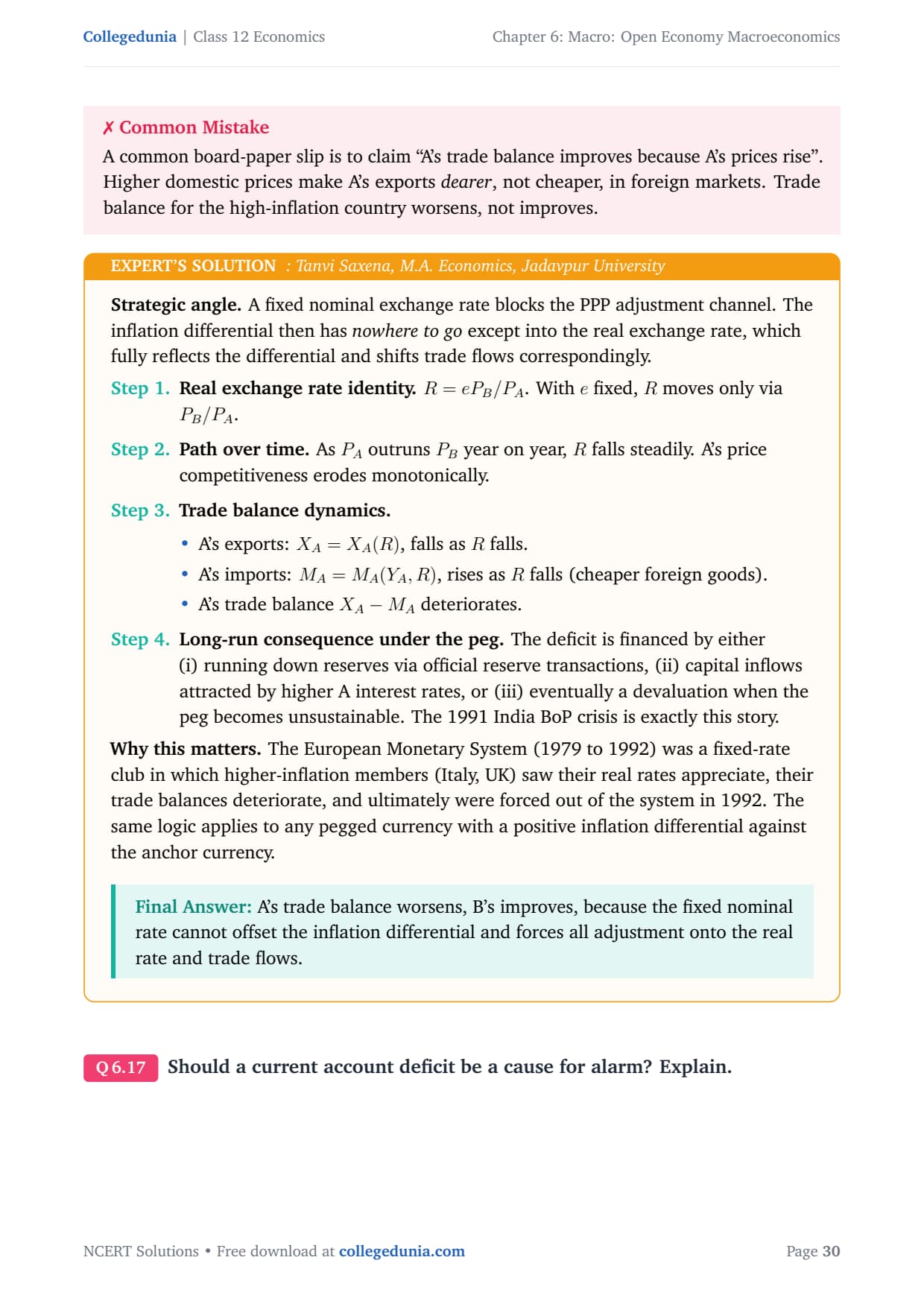
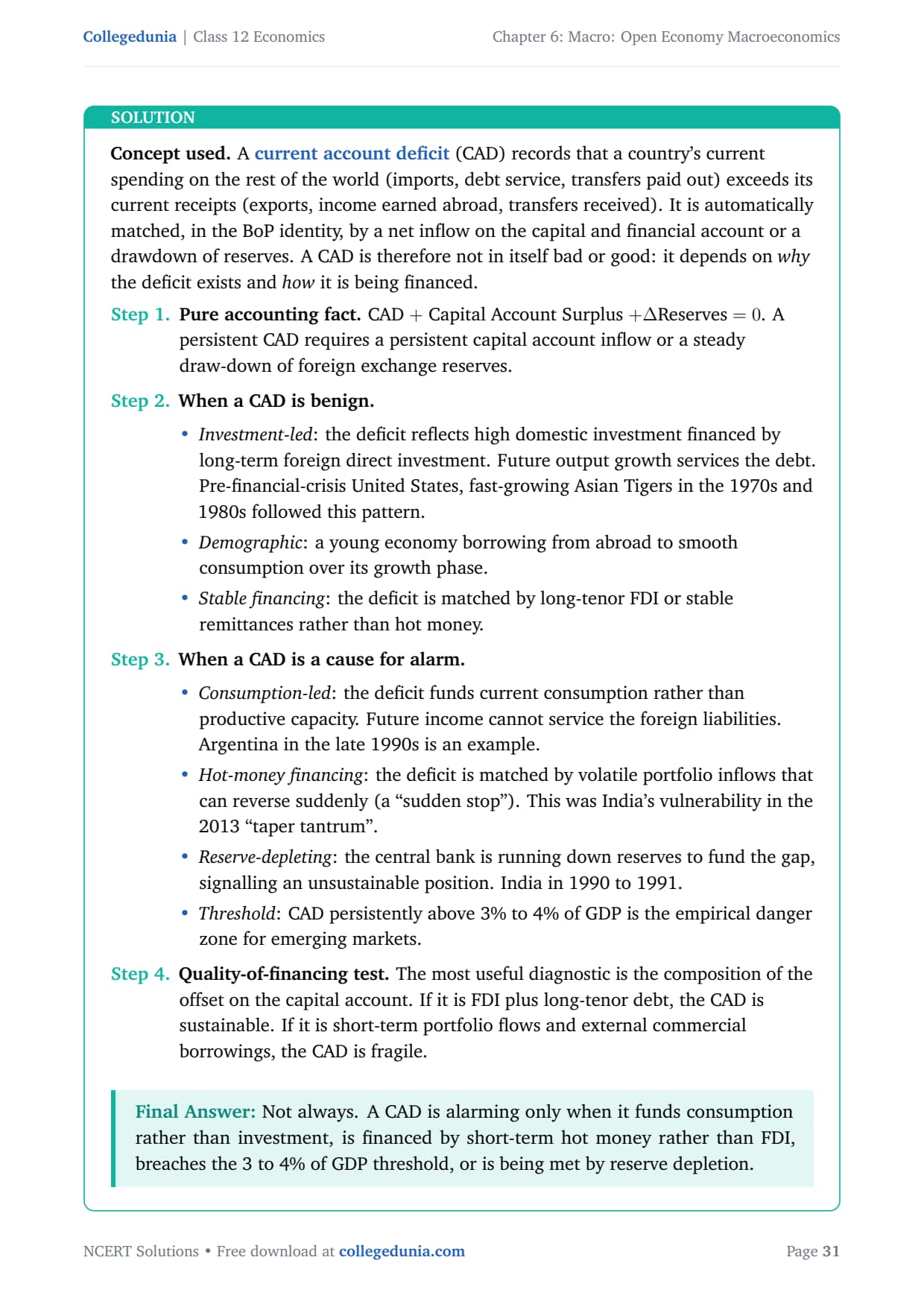
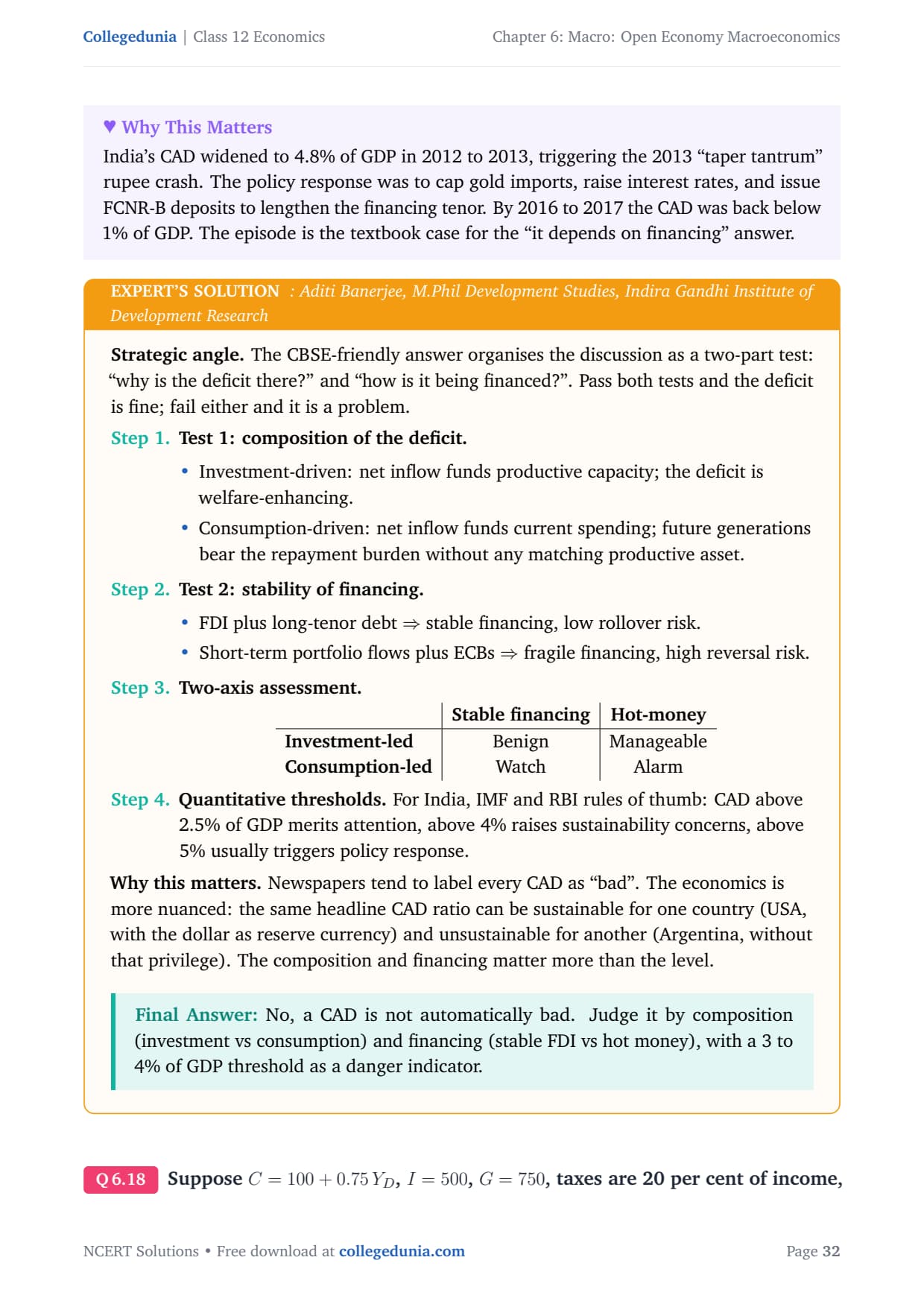
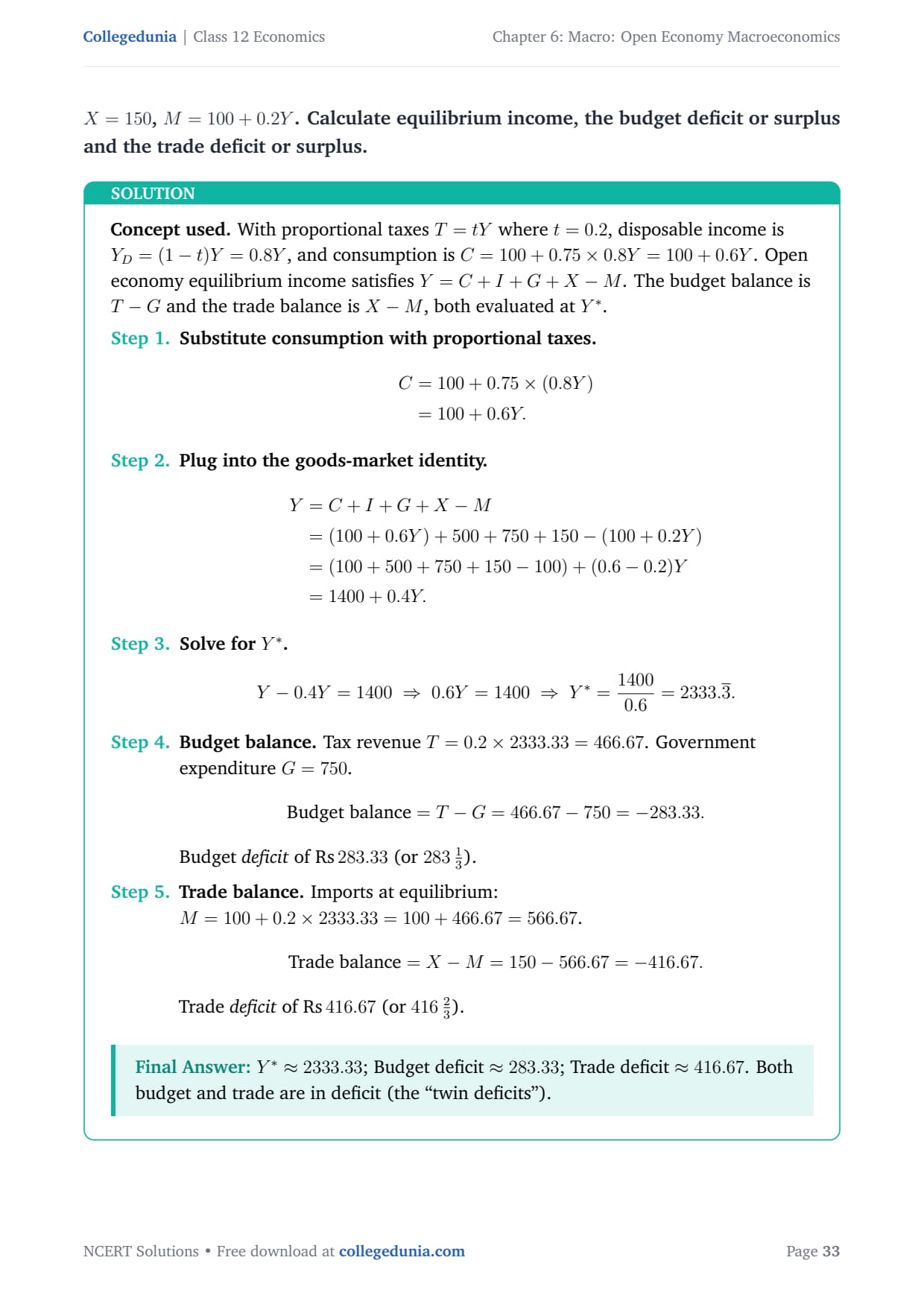
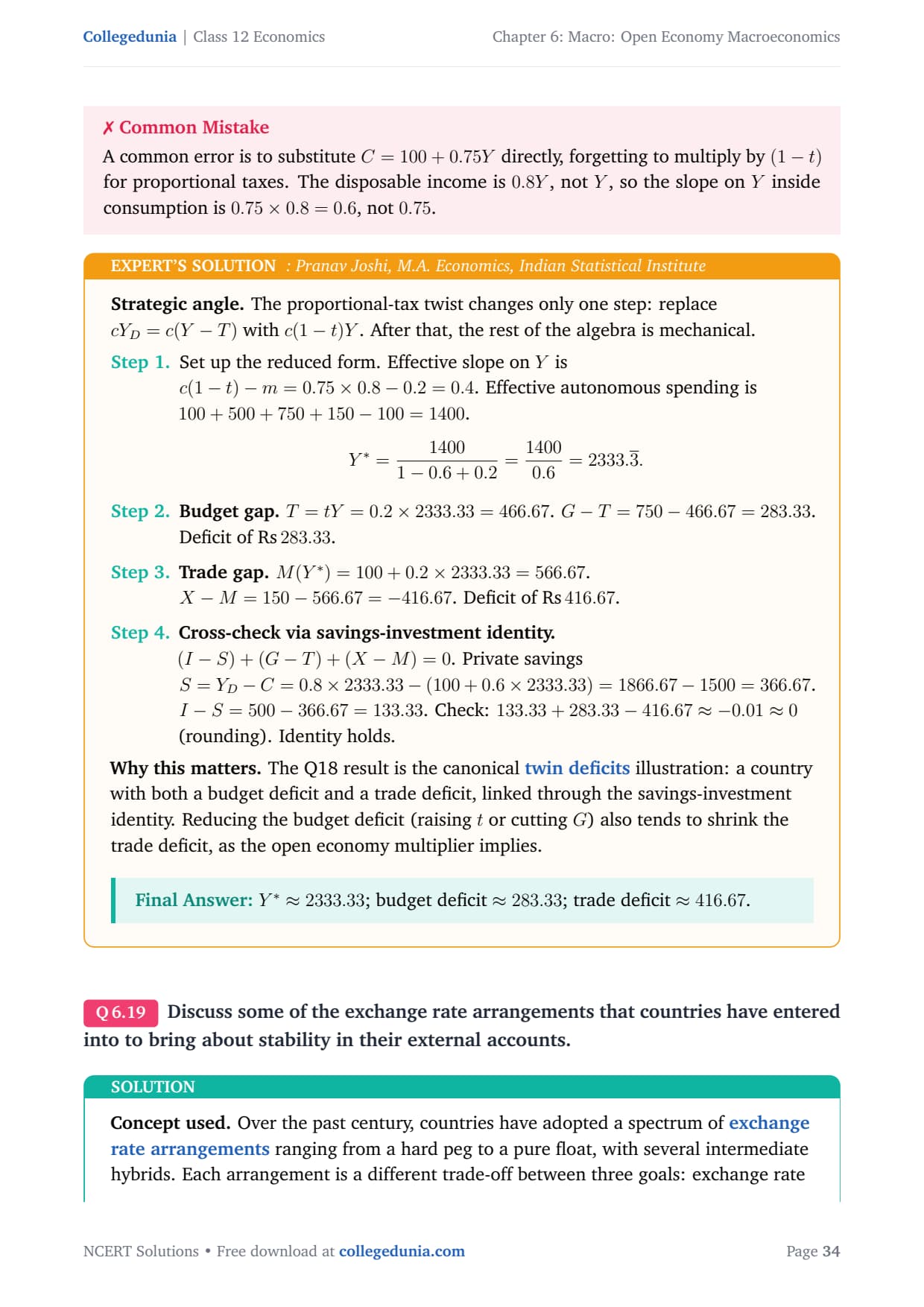
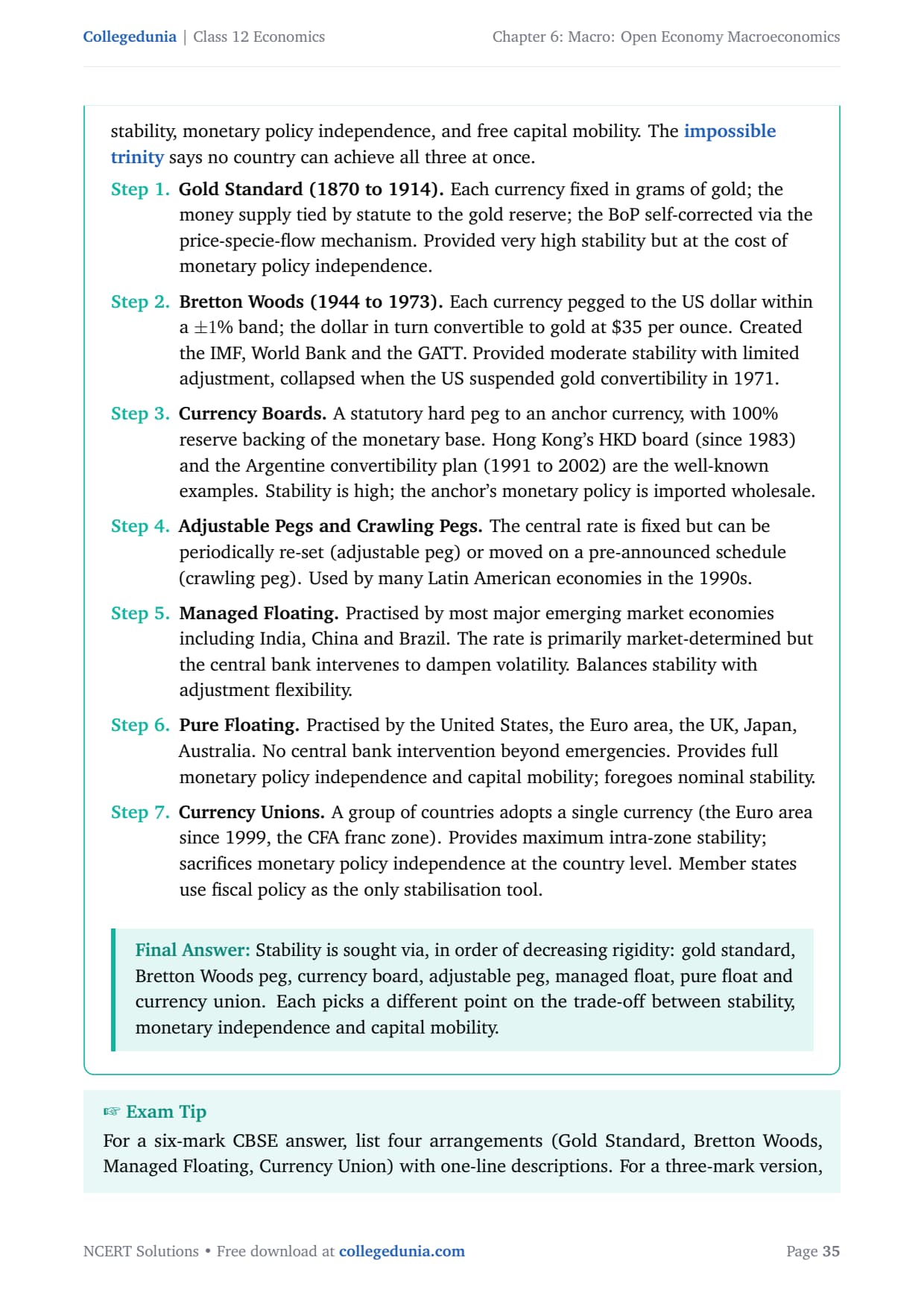
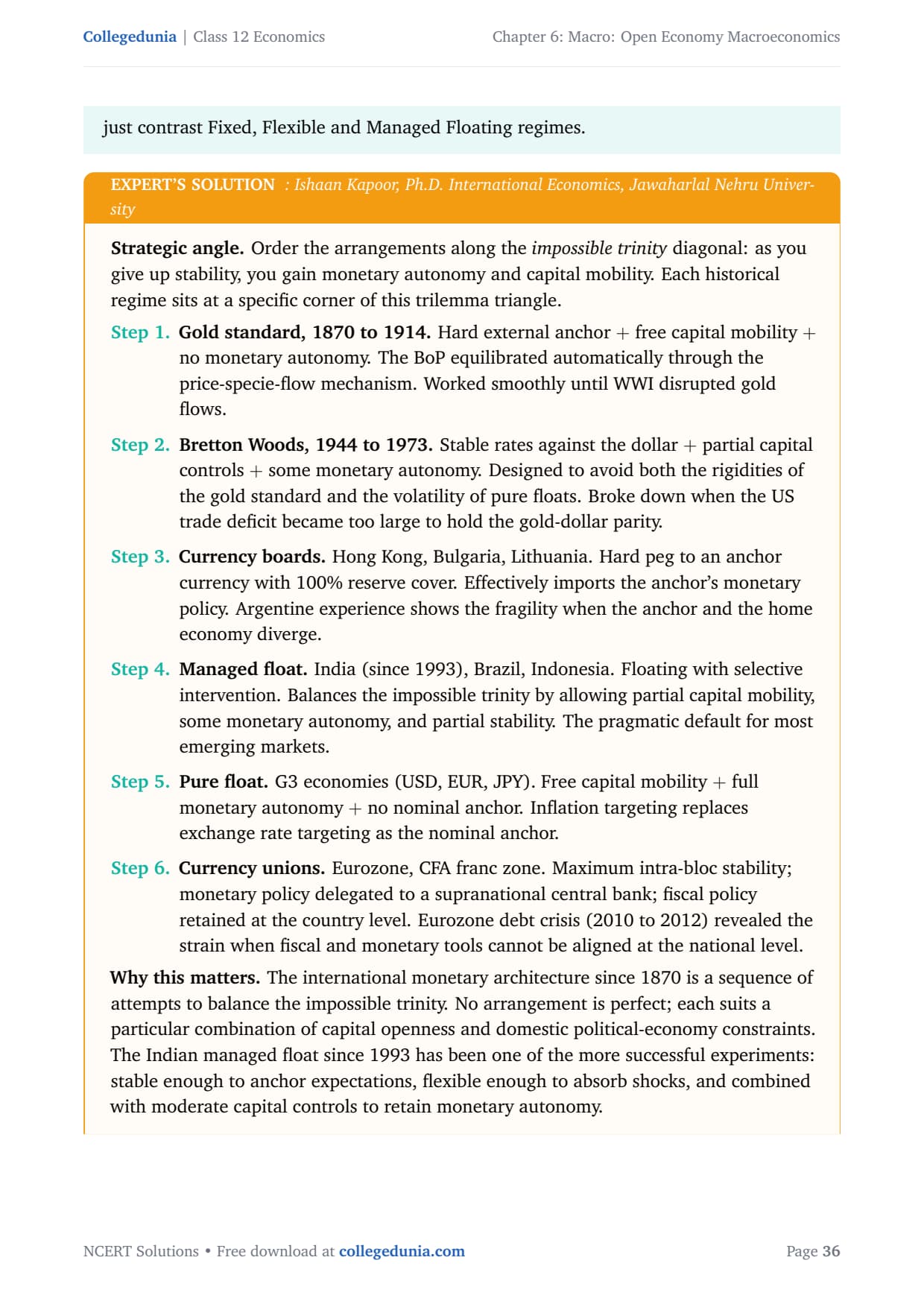
Here is what this chapter is worth in the exam:
- CBSE Boards: about 6 marks, mostly Balance of Payments theory plus the Q10 multiplier sum.
- CUET: 2 to 3 questions each year on exchange rates and the BoP accounts.
- Revision time: about 50 minutes with these solutions.
What the NCERT Solutions for Class 12 Economics Chapter 6 Cover
The chapter answers one big question: how does an economy that trades with the world keep its accounts in balance? These solutions follow the textbook order and cover five blocks:
- Balance of Payments accounts: the current account and the capital account.
- Autonomous vs accommodating transactions: the above-the-line and below-the-line split.
- Foreign exchange market: demand, supply and the equilibrium rate.
- Exchange rate regimes: fixed, flexible and managed float.
- Devaluation, depreciation and the open economy multiplier.
Exercise-wise Breakdown of Open Economy Macroeconomics Class 12 NCERT Solutions
Chapter 6 has 10 exercise questions, mixing definitions, comparisons and short numericals. The table maps each question to its topic, the answer style CBSE rewards and the usual marks.
| Question | Topic | Answer style | Marks |
|---|---|---|---|
| Q1 | Balance of trade vs current account balance | Definition + comparison | 3 |
| Q2 | Official reserve transactions; why they are accommodating | Definition + reason | 3 |
| Q3 | Current account balance vs capital account balance | Comparison table | 4 |
| Q4 | Why foreign exchange is demanded (four motives) | 4 bullets with examples | 3 |
| Q5 | Devaluation vs depreciation | Definition + when each is used | 3 |
| Q6 | Autonomous or accommodating (5 items) | Classify with a reason | 5 |
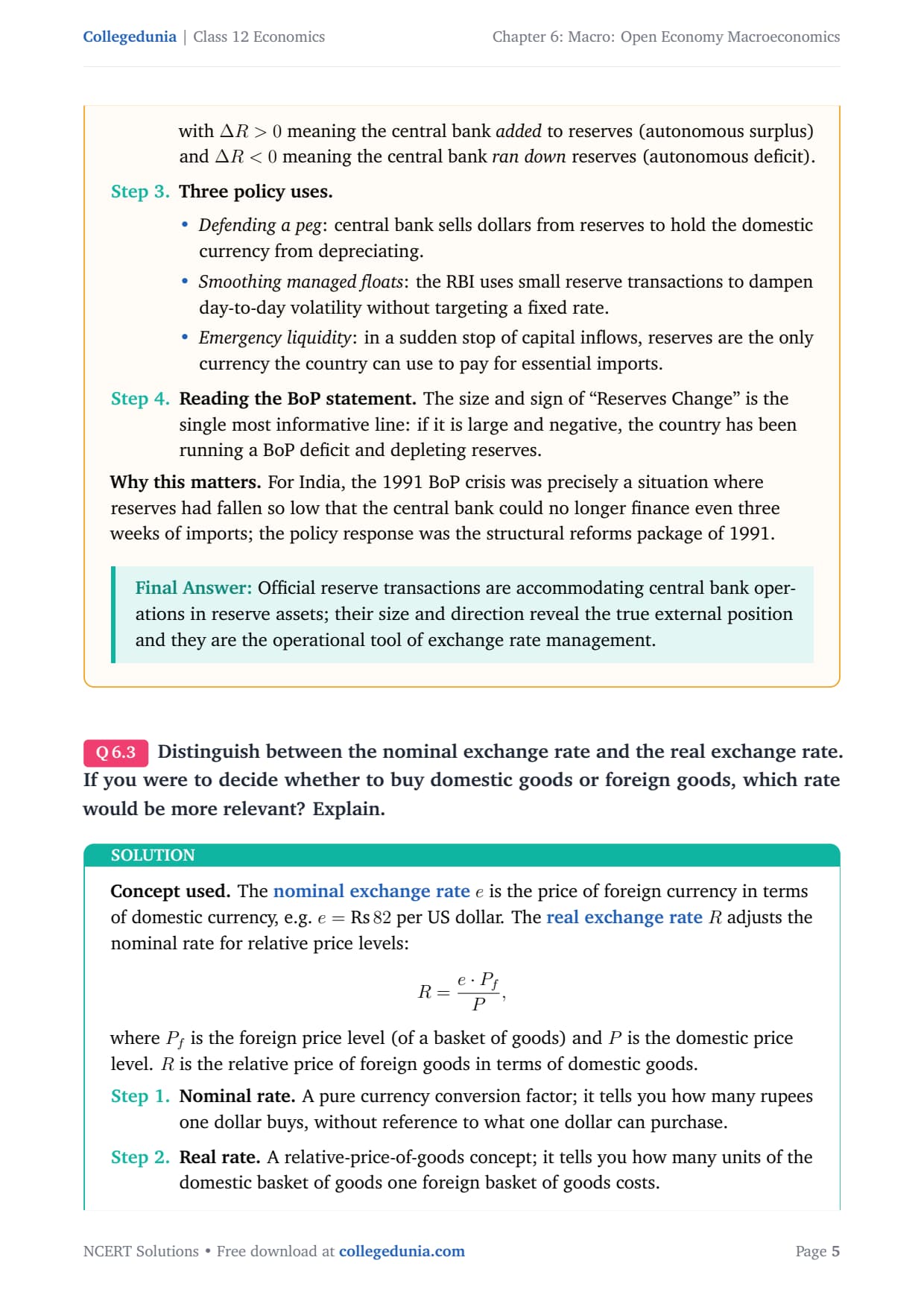
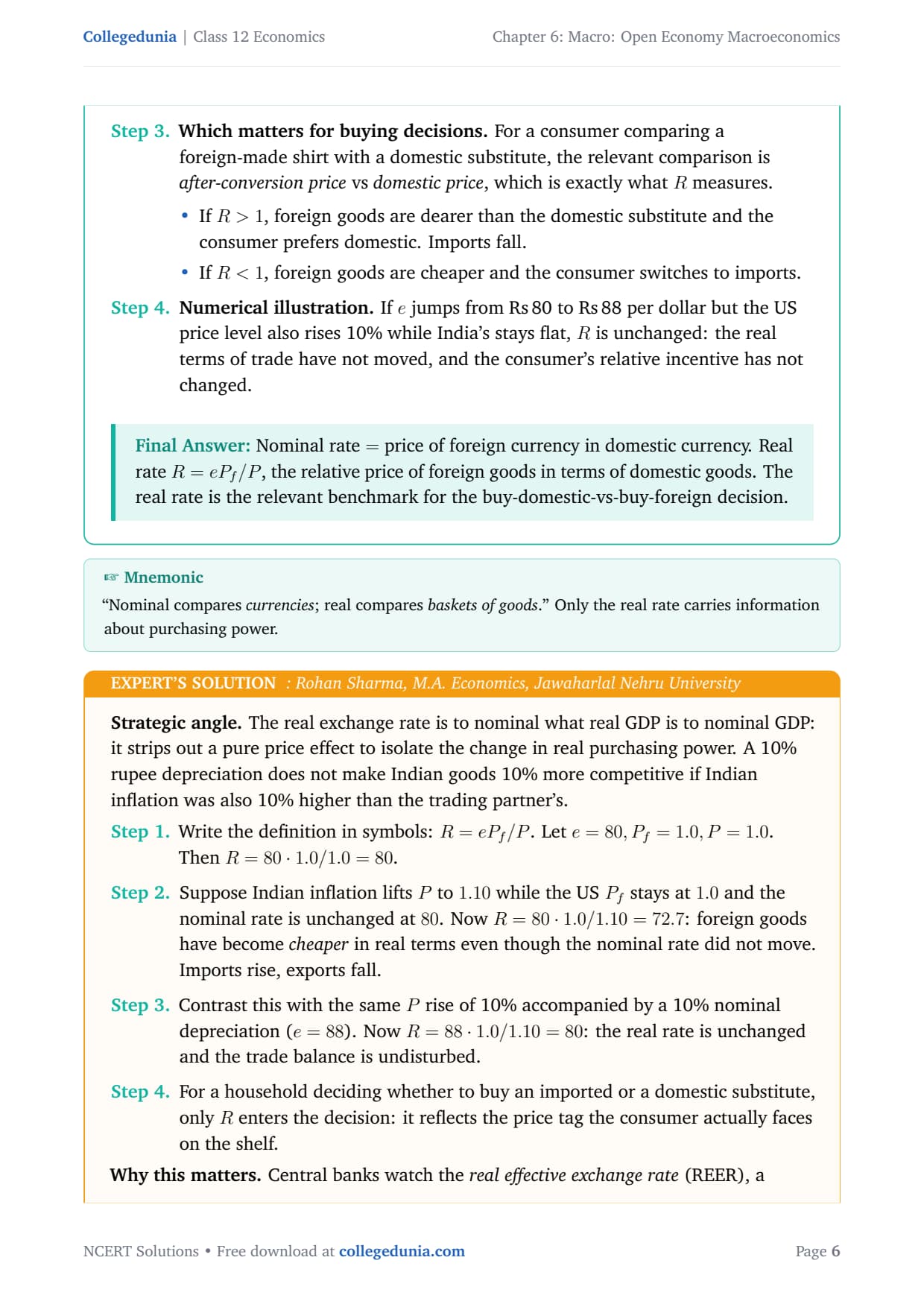
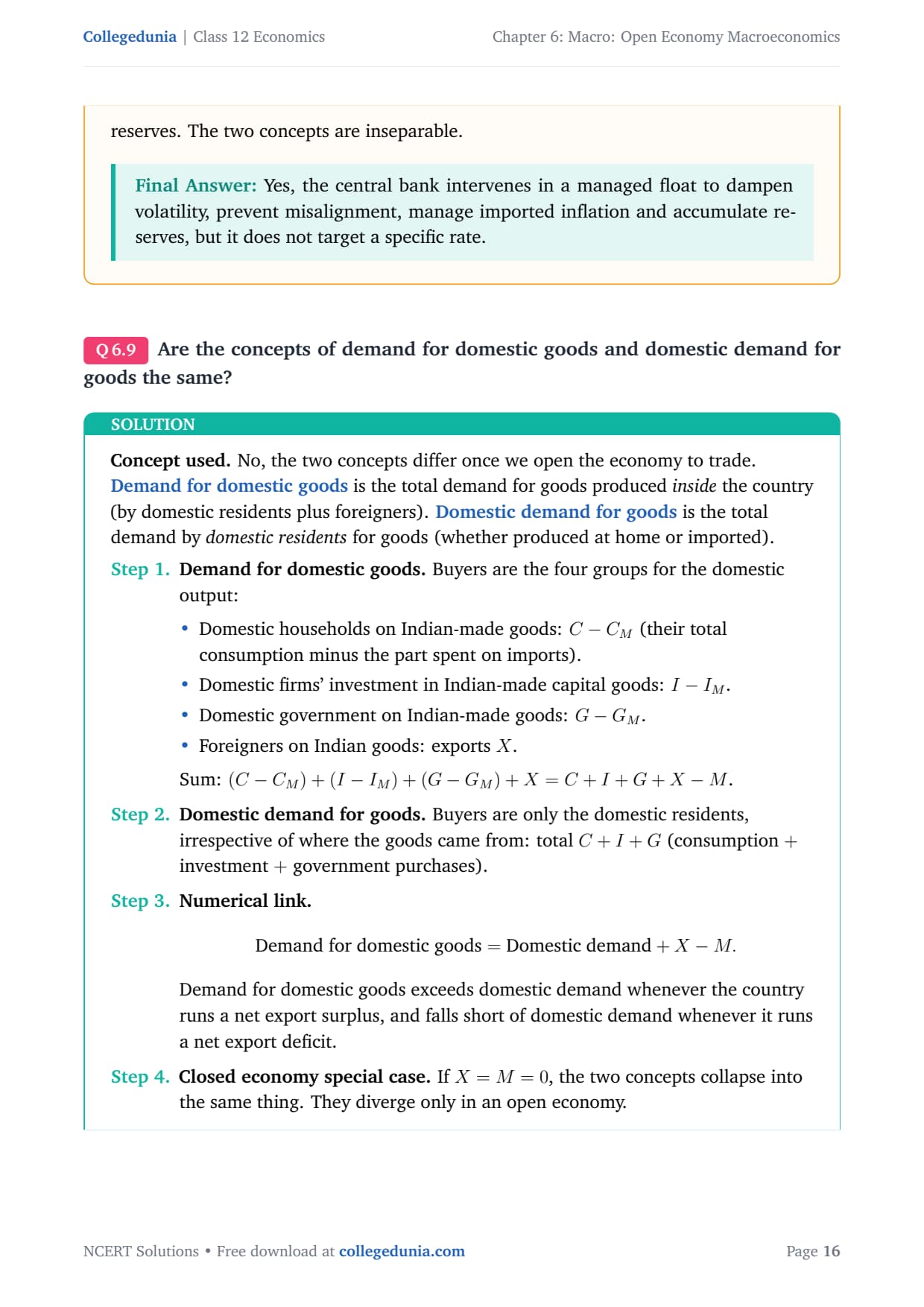
| Q7 | Real vs nominal exchange rates | Definition + formula + example | 3 |
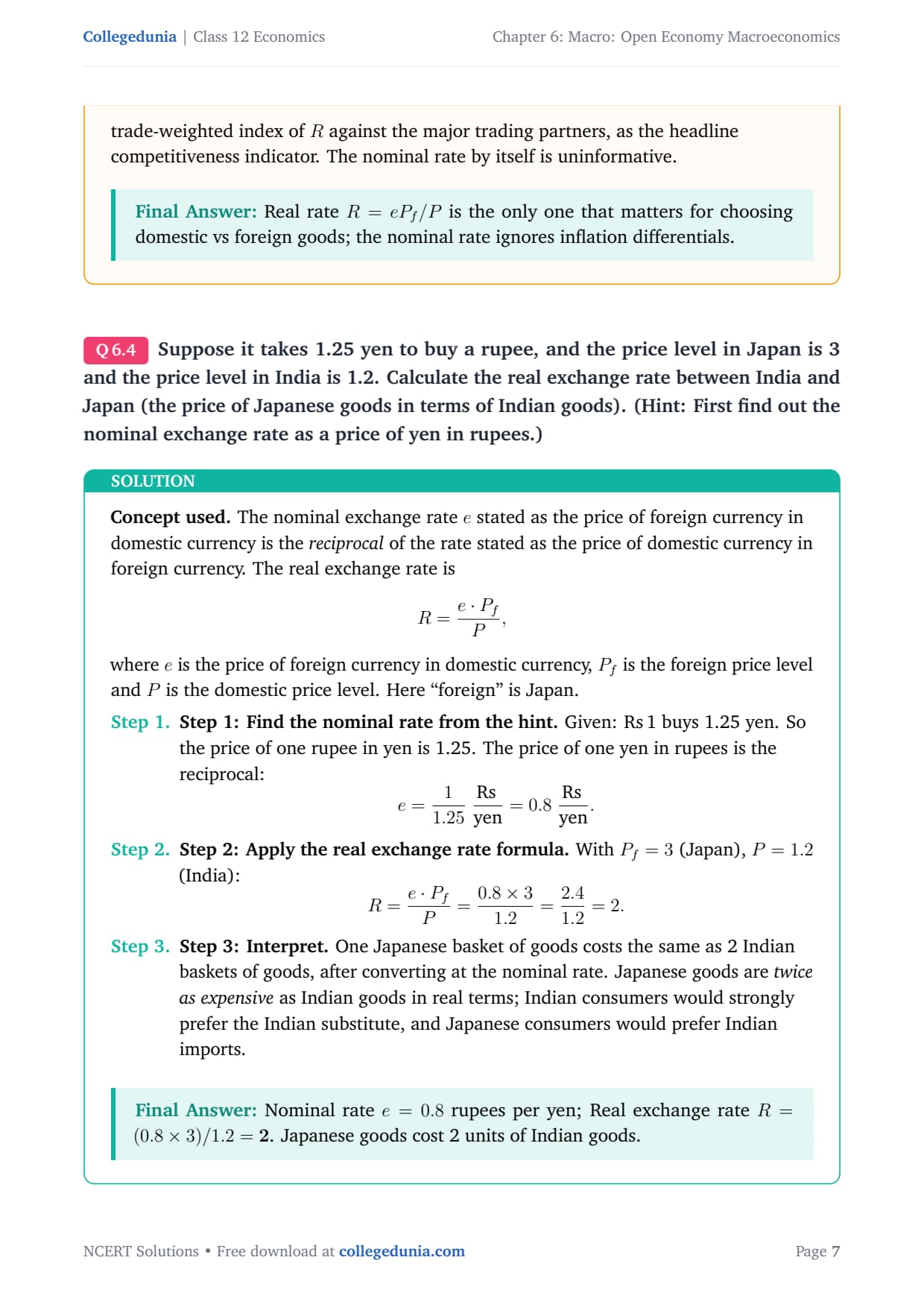
| Q8 | Domestic price of a foreign good | Step-by-step numerical | 4 |
| Q9 | Role of price in forex market equilibrium | Diagram + explanation | 6 |
| Q10 | Equilibrium income, net exports and the multiplier | Open economy multiplier sum | 6 |
Q8, Q9 and Q10 together carry 16 of the chapter marks, so the Q10 multiplier sum is the one to drill most.
Balance of Payments Class 12: Accounts and the Identity
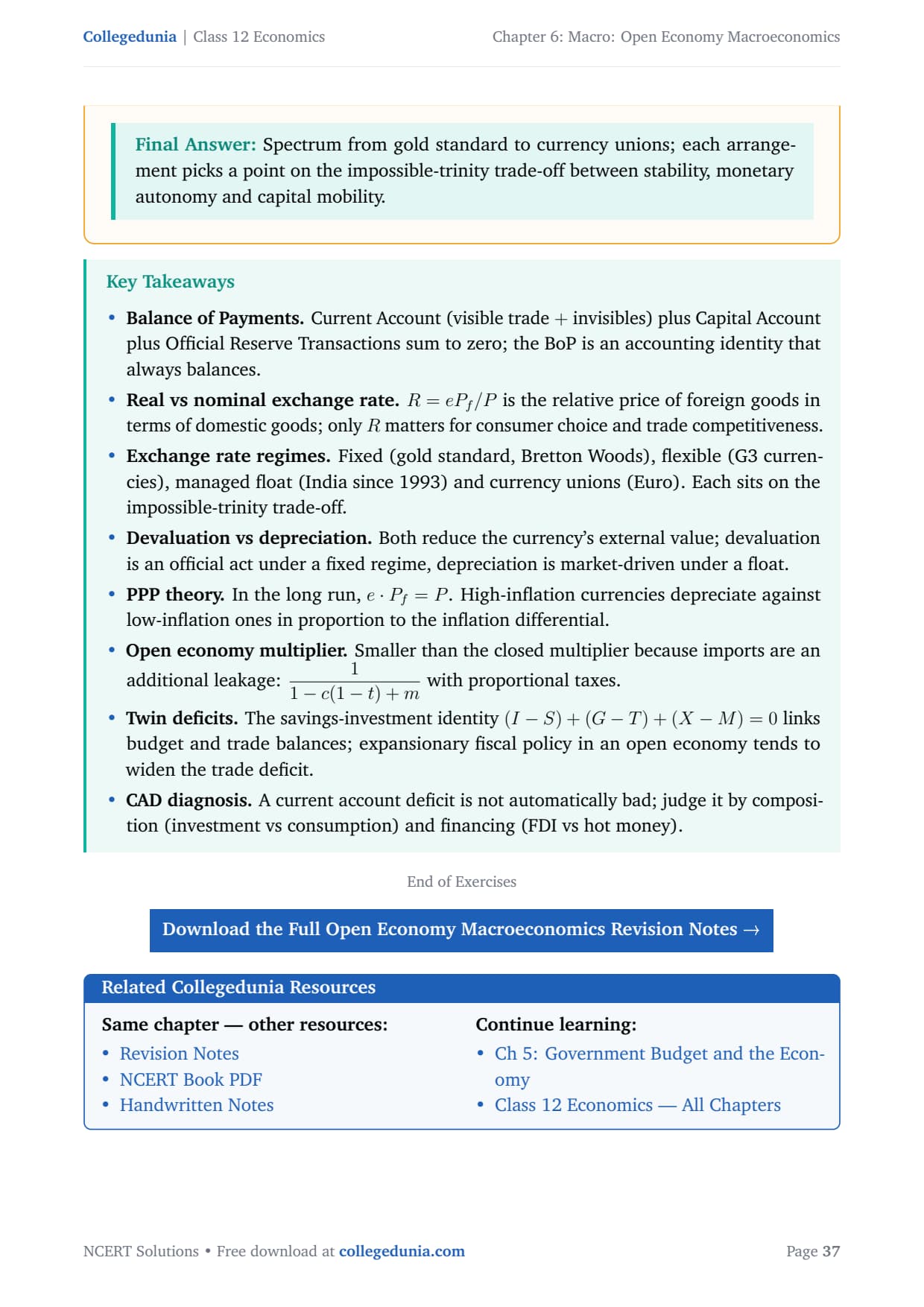
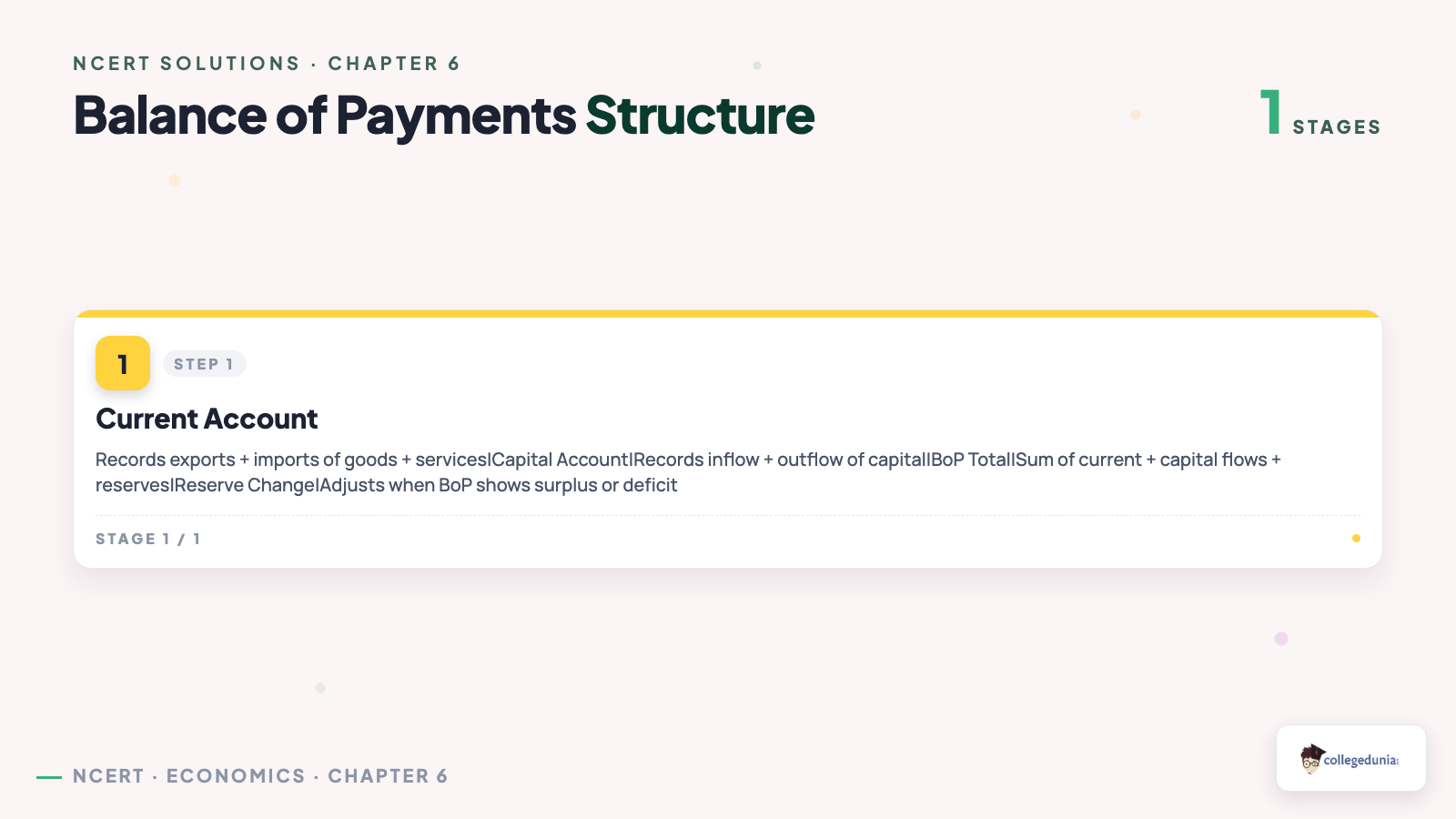
The Balance of Payments (BoP) is a record of all transactions between residents of a country and the rest of the world in a year. It always balances: Current Account + Capital Account + Official Reserve Transactions = 0.
The Current Account
This account records goods, services and incomes. It has four parts:
- Balance of trade = exports of goods − imports of goods (goods only).
- Balance on current account = balance of trade + net services + net primary income + net secondary income.
- A surplus means the country is a net lender; a deficit means it is a net borrower.
The Capital Account
This account records changes in the ownership of financial assets. It covers FDI, FPI, external borrowings, banking capital and official reserves. A capital account surplus offsets a current account deficit, which is why the full BoP sums to zero.
Autonomous vs Accommodating Transactions
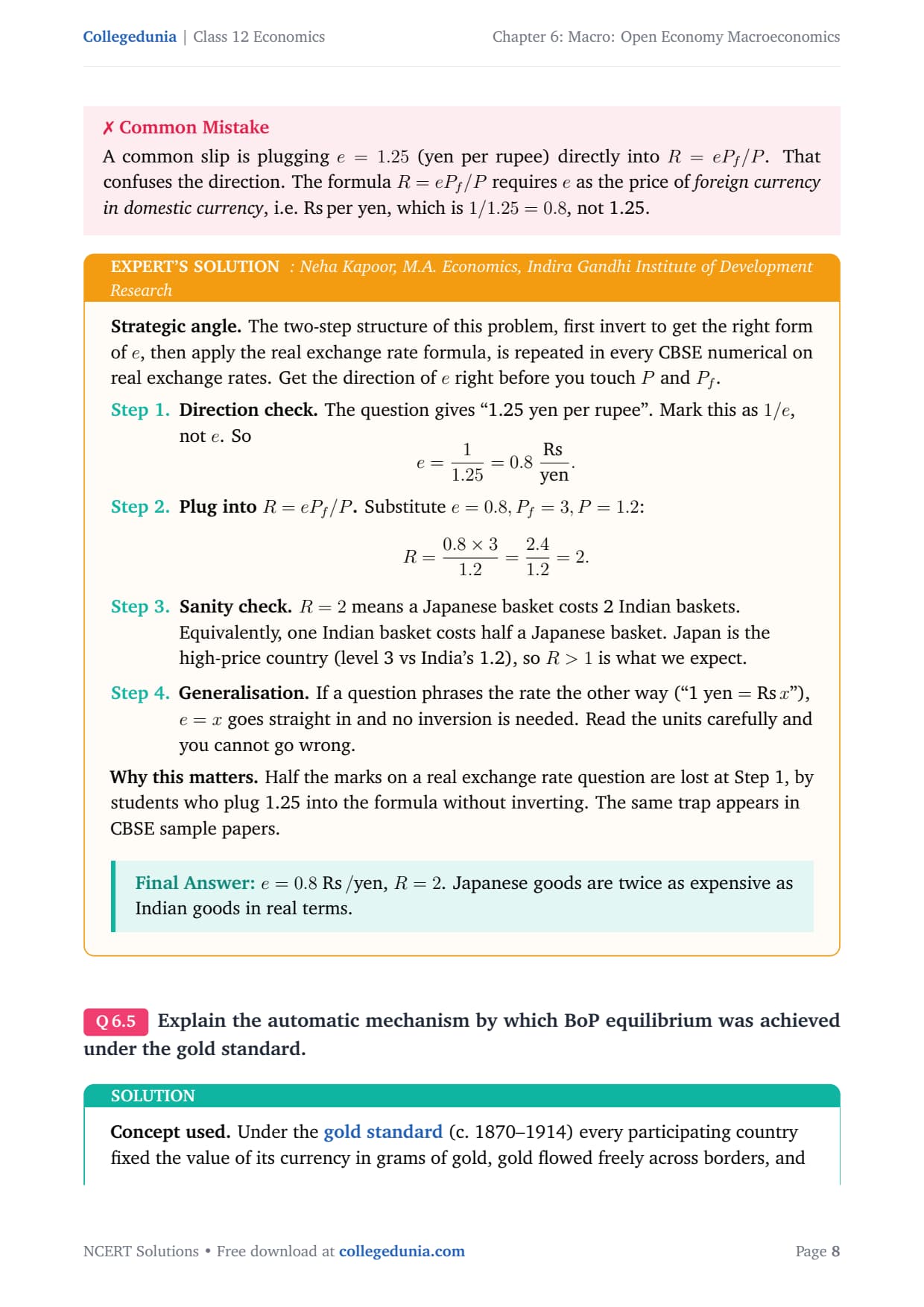
Autonomous transactions happen for their own sake and sit above the line. Accommodating transactions close the gap they leave and sit below the line, mainly official reserve sales or buys by the central bank. A BoP deficit is the gap in the autonomous items only.
Open Economy Macroeconomics Class 12: Exchange Rate Determination
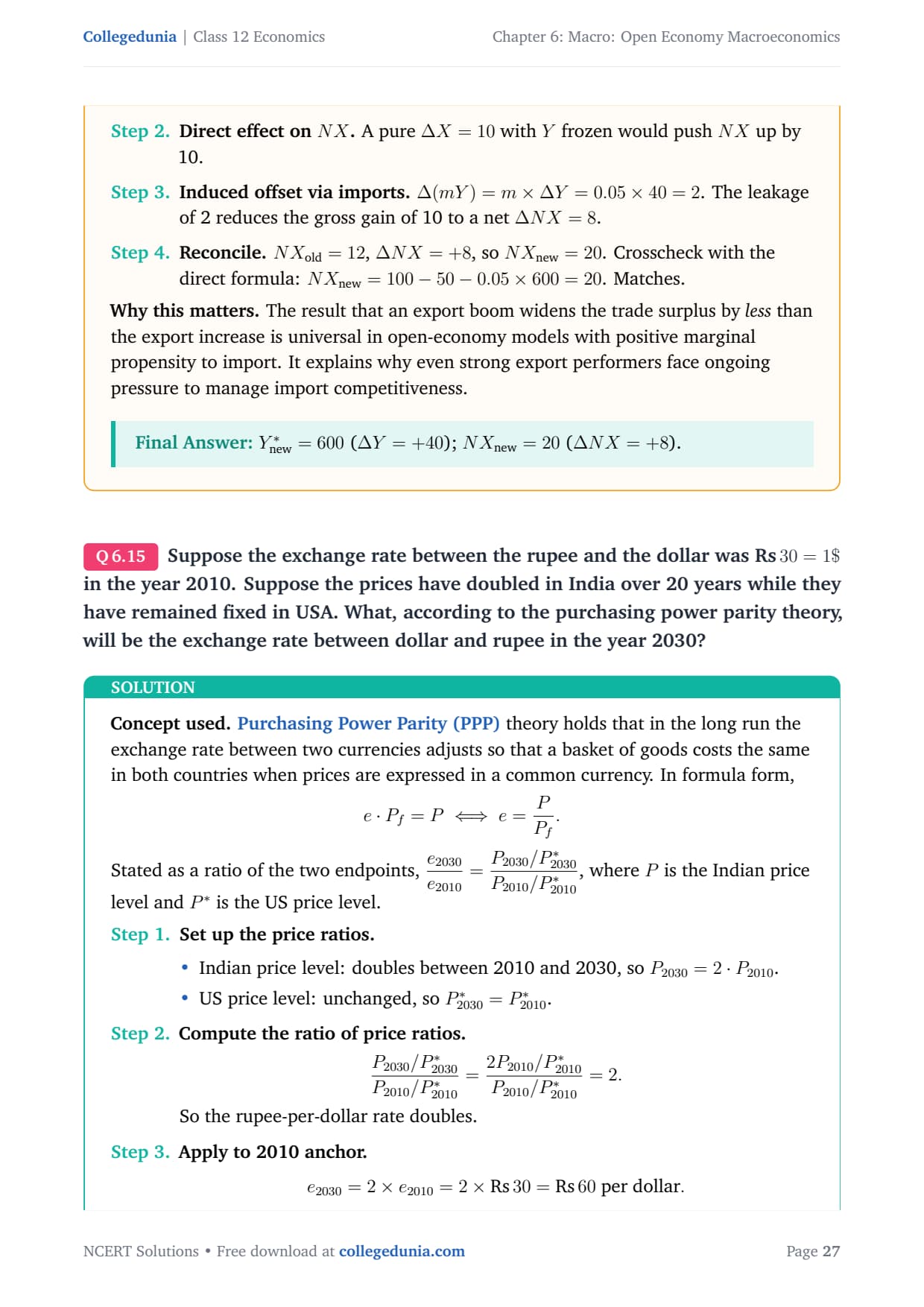
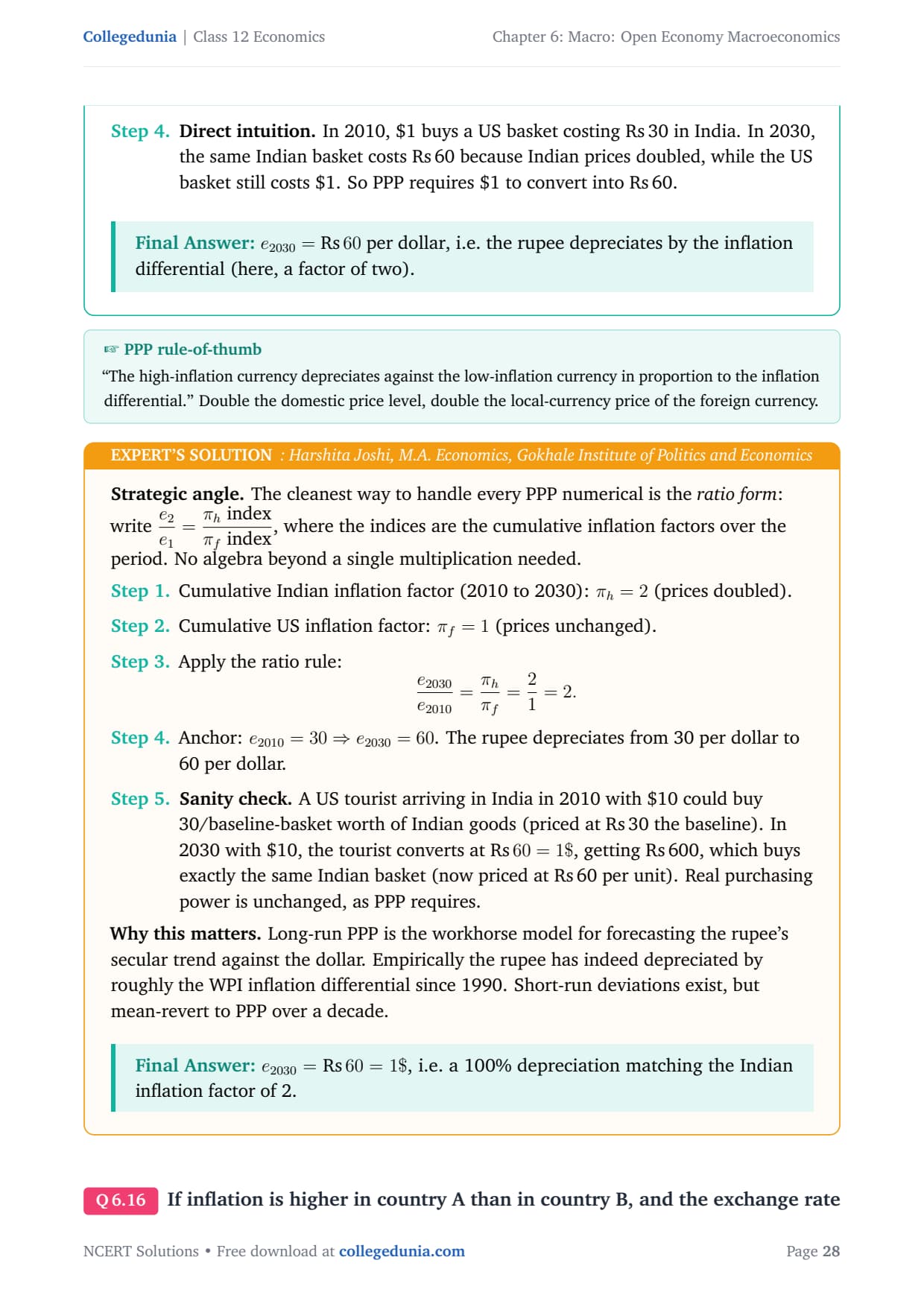
The exchange rate is the price of one currency in terms of another. Demand for foreign currency comes from importers, travellers and investors going abroad. Supply comes from exporters, foreign tourists and foreign investors. Where the two curves meet sets the rate, which is the idea behind Q9.
Real vs Nominal Exchange Rate
| Term | Meaning |
|---|---|
| Nominal rate (e) | Price of one unit of foreign currency in home currency, like Rs 83 per US dollar. |
| Real rate (er) | e × (P* ÷ P); how many home goods one foreign good can buy. |
| NEER | Trade-weighted average of the rupee against many currencies. |
| REER | NEER adjusted for price levels; shows the rupee's competitiveness. |
Fixed, Flexible and Managed Float Regimes
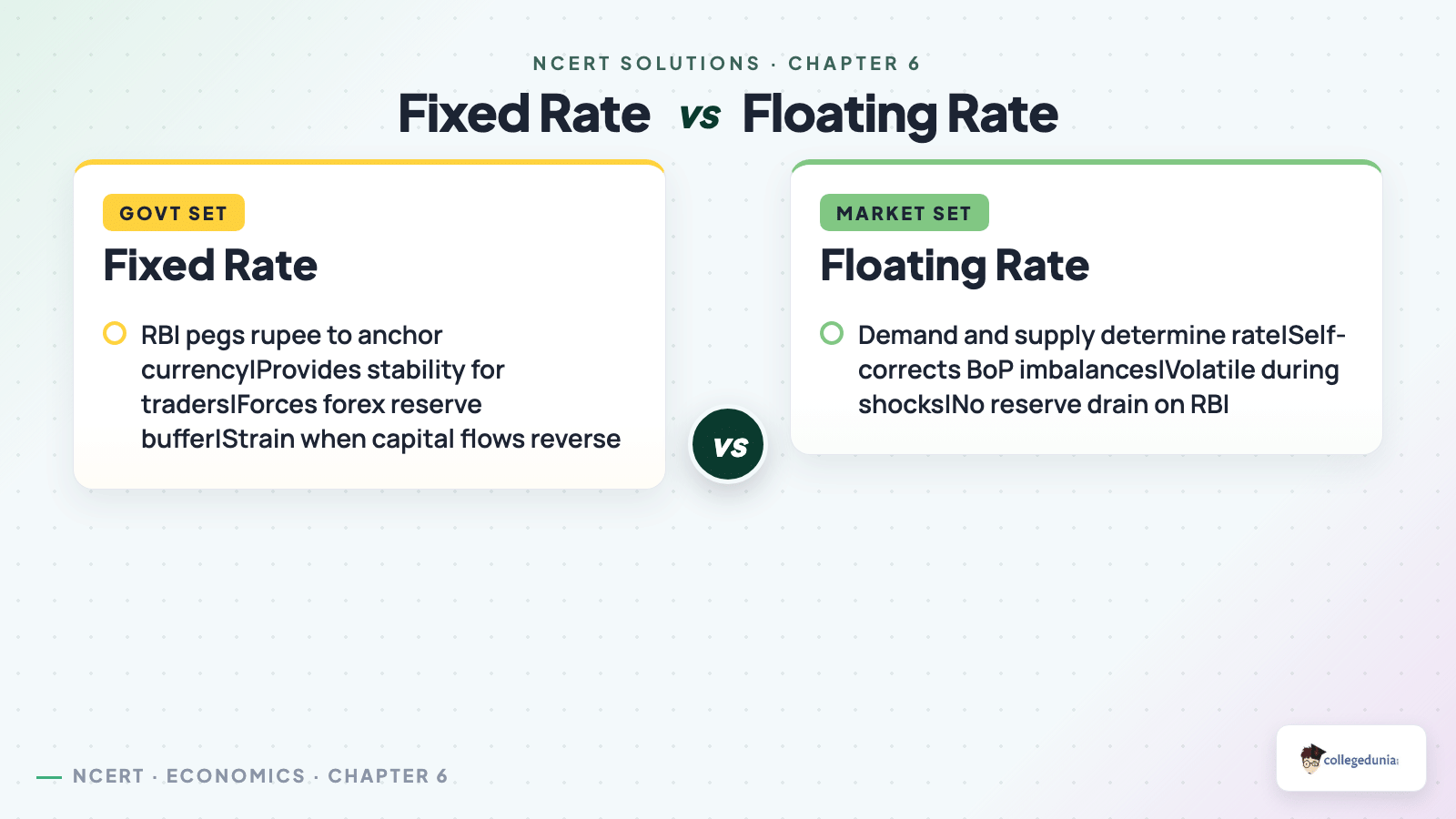
- Fixed: the central bank pegs the rate and defends it by buying or selling foreign currency.
- Flexible (floating): the market sets the rate and the bank does not step in.
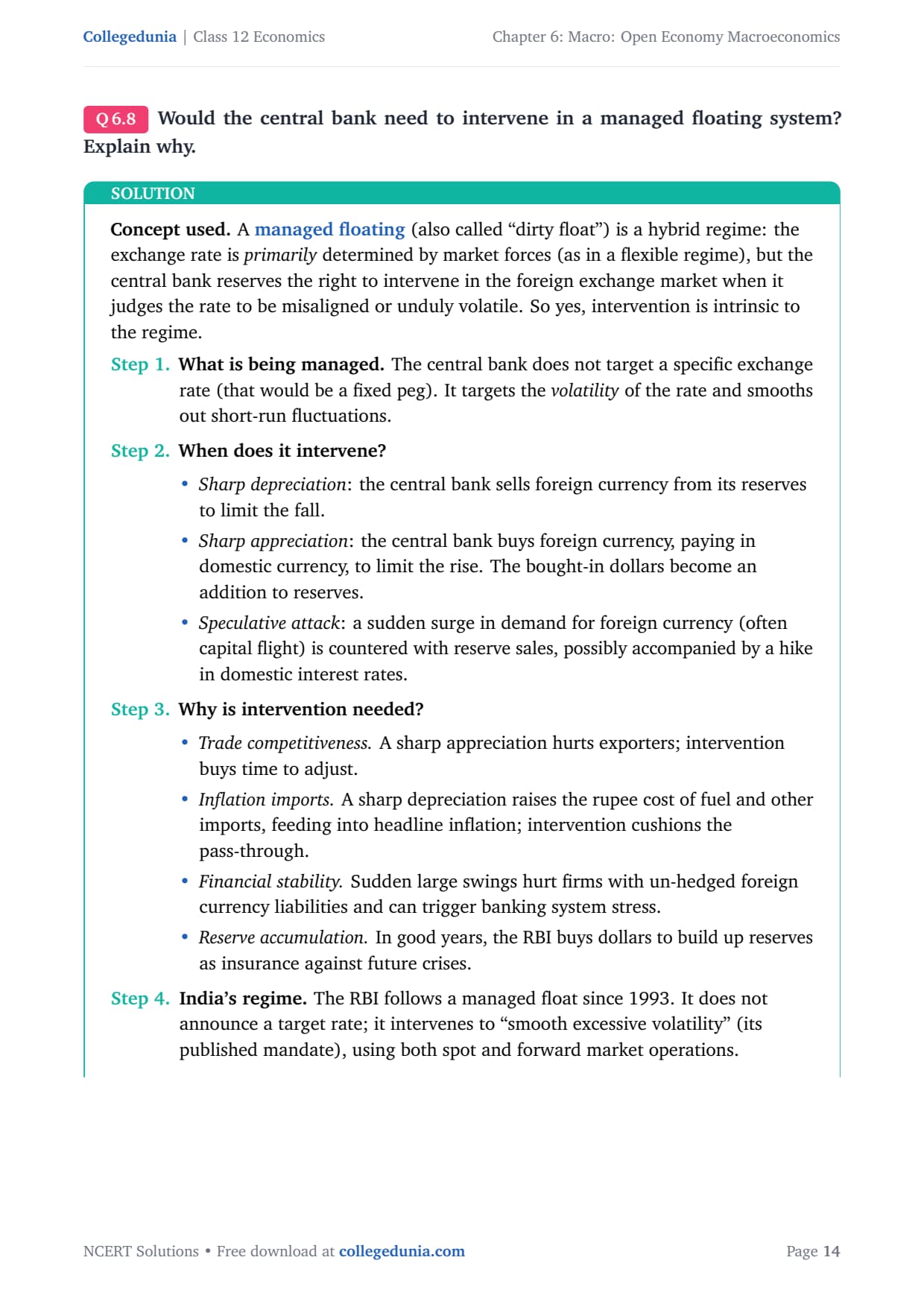
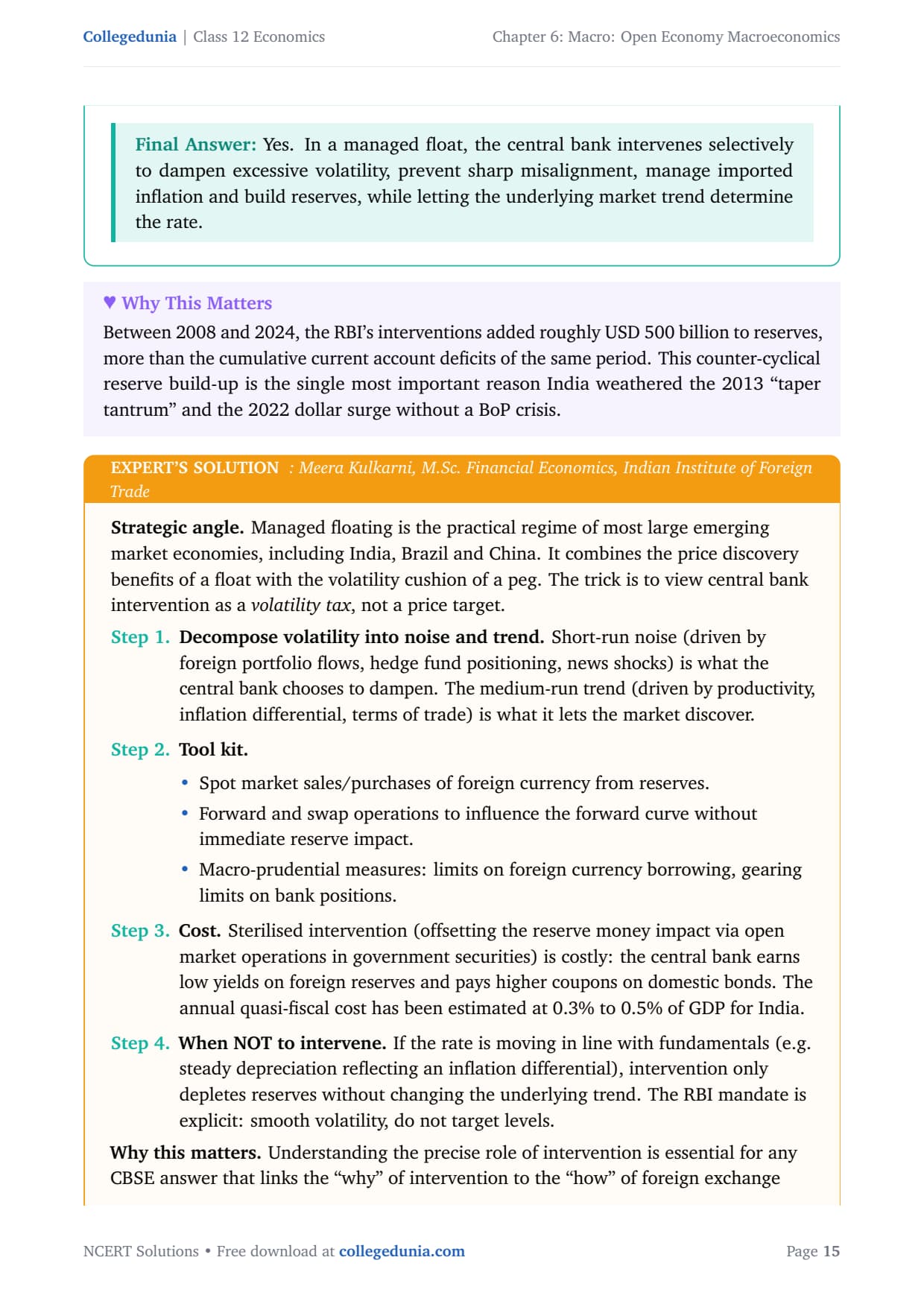
- Managed float: mostly market-set, but the RBI smooths sharp swings. India has used this since 1993.
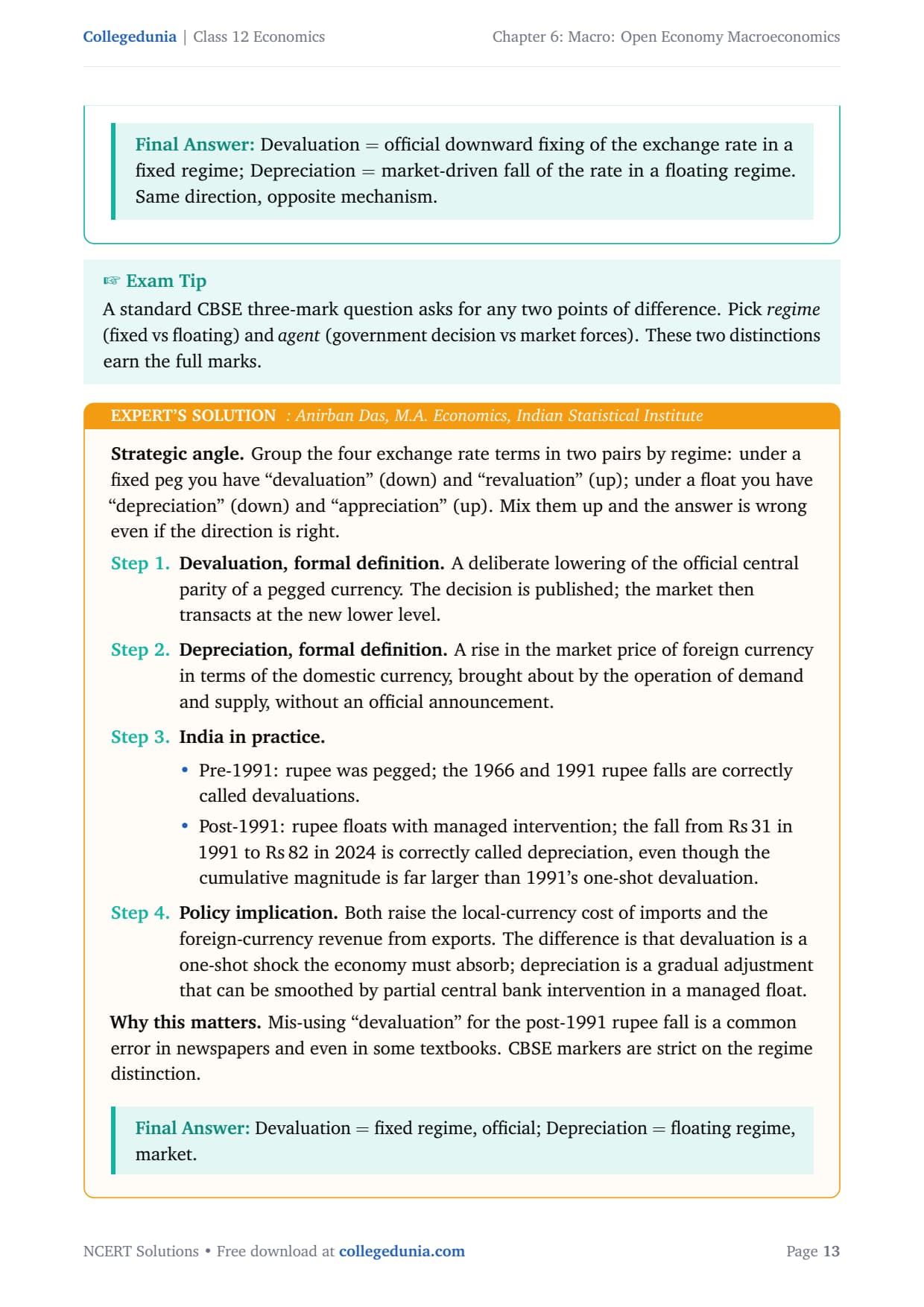
- Devaluation is a fall under a fixed regime; depreciation is the same fall under a floating regime.
Open Economy Multiplier: The Q10 Numerical for Class 12
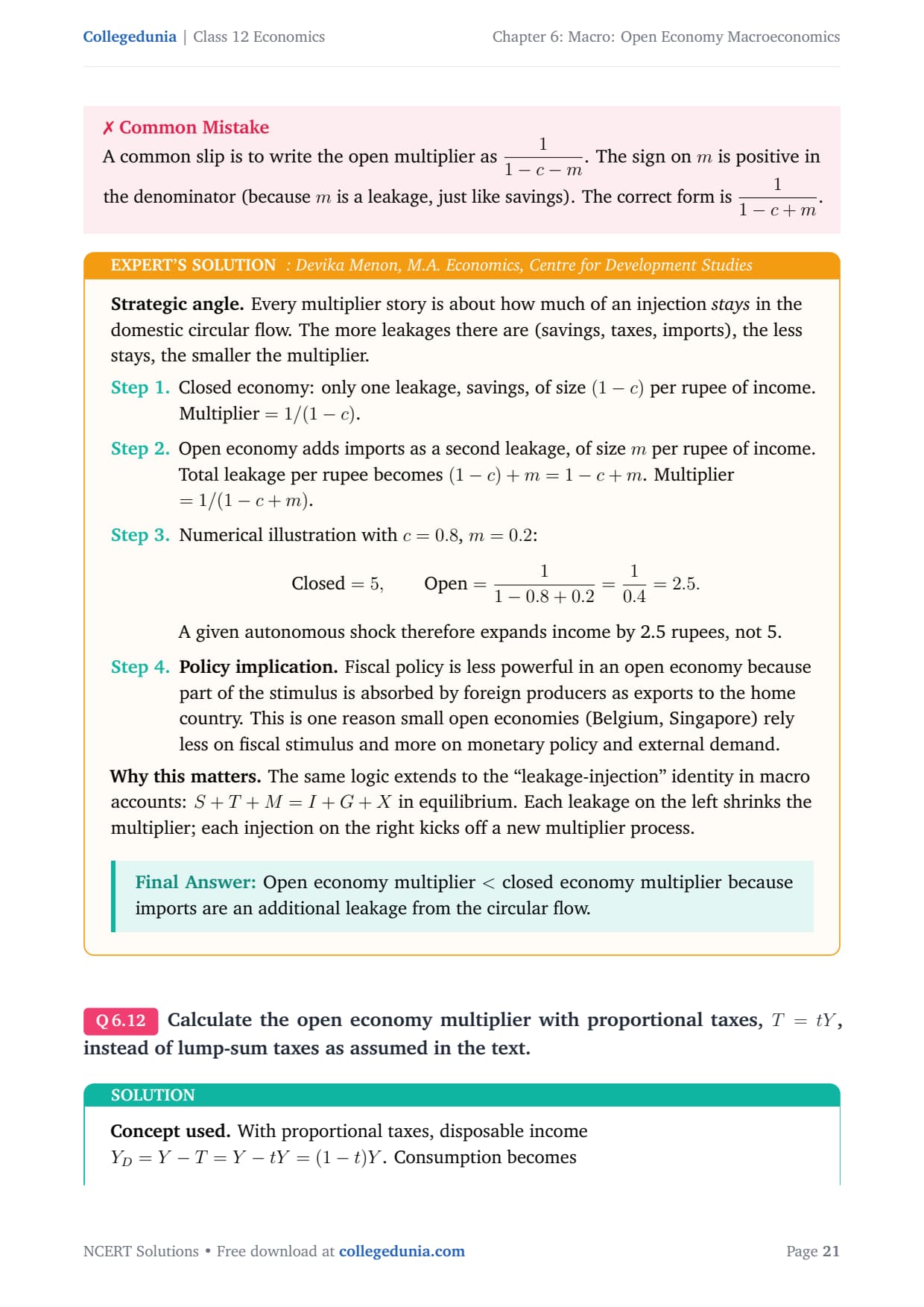
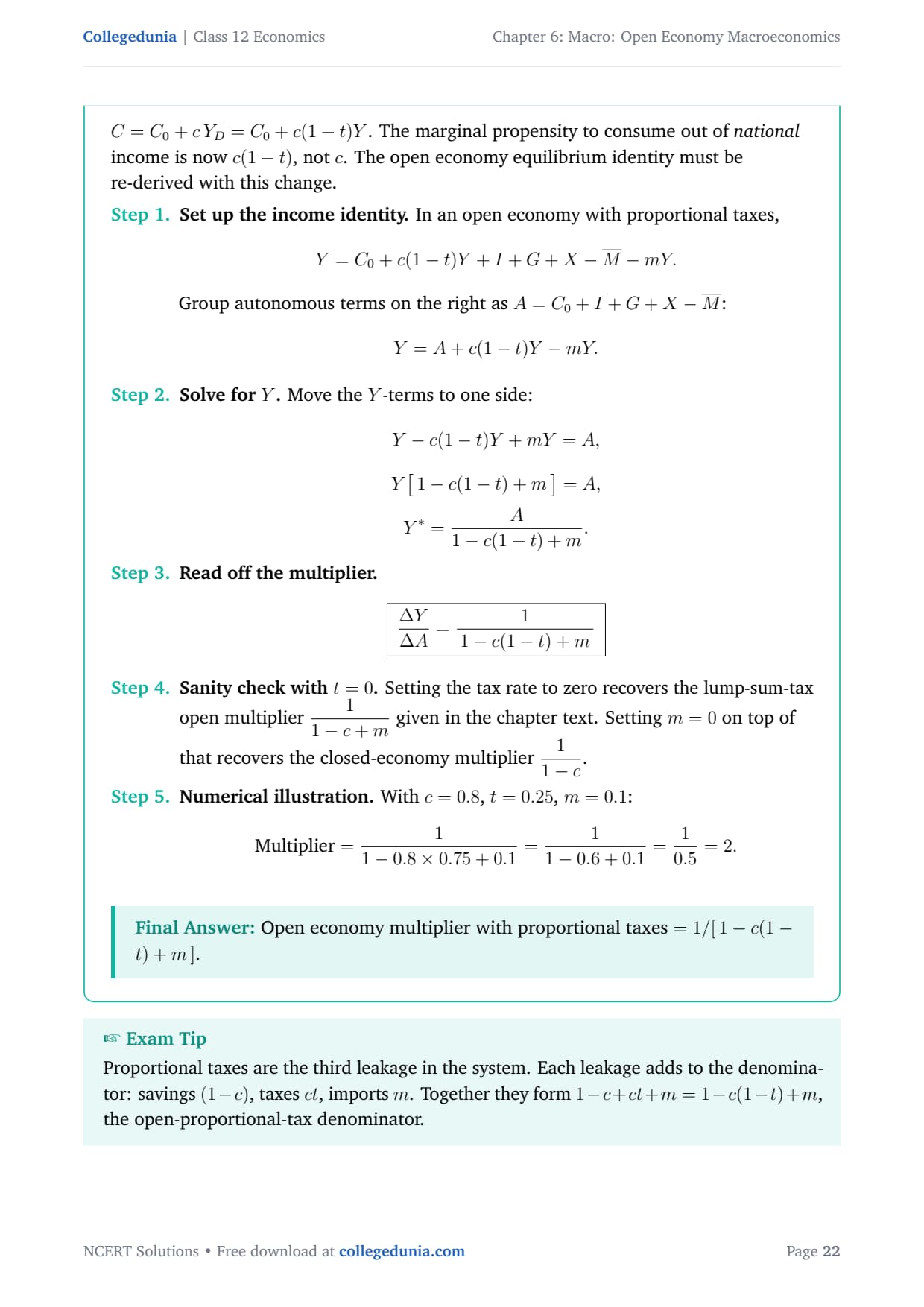
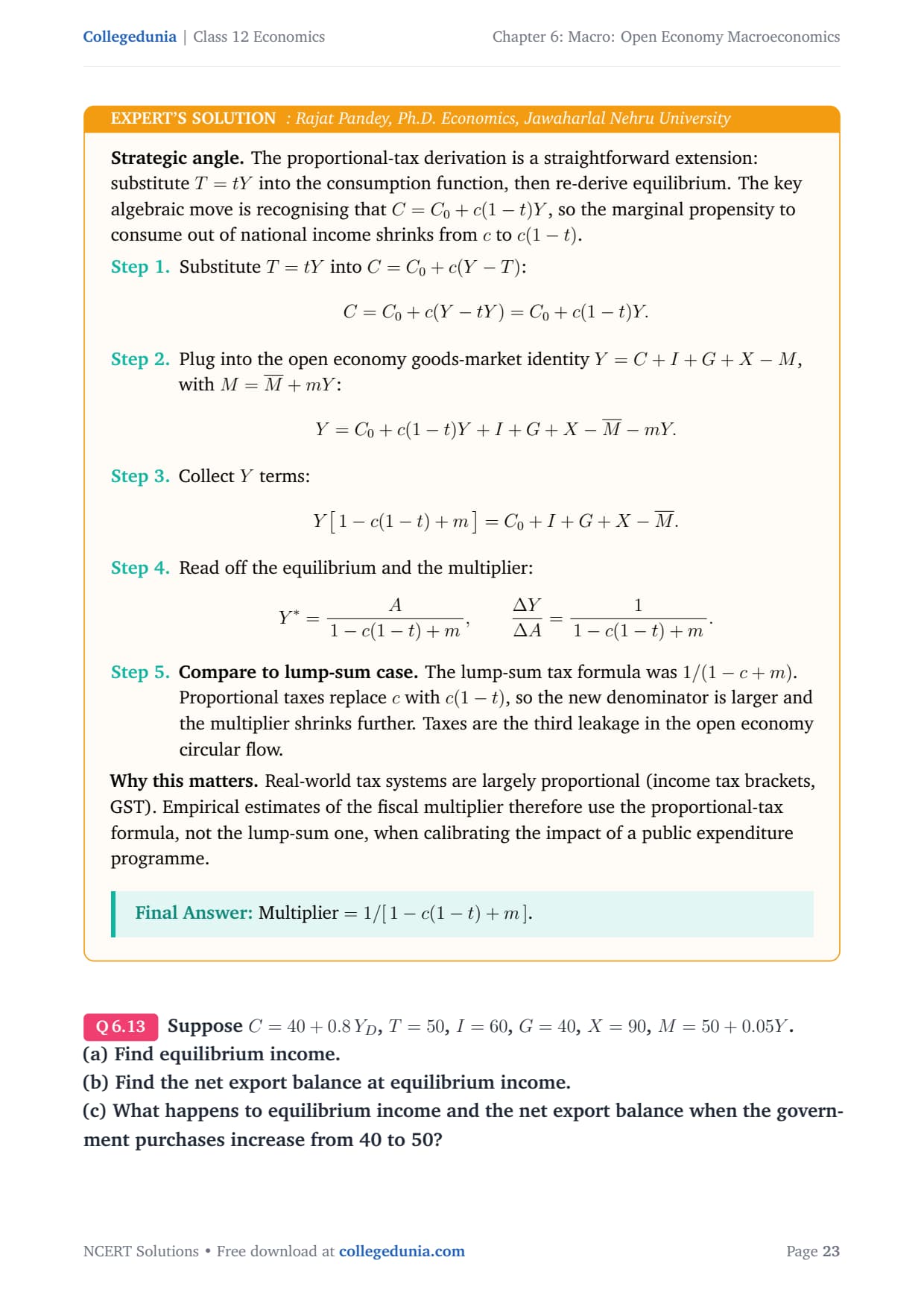
Q10 is the showpiece sum and the most likely board numerical. The open economy multiplier adds an import-leakage term to the closed-economy one:
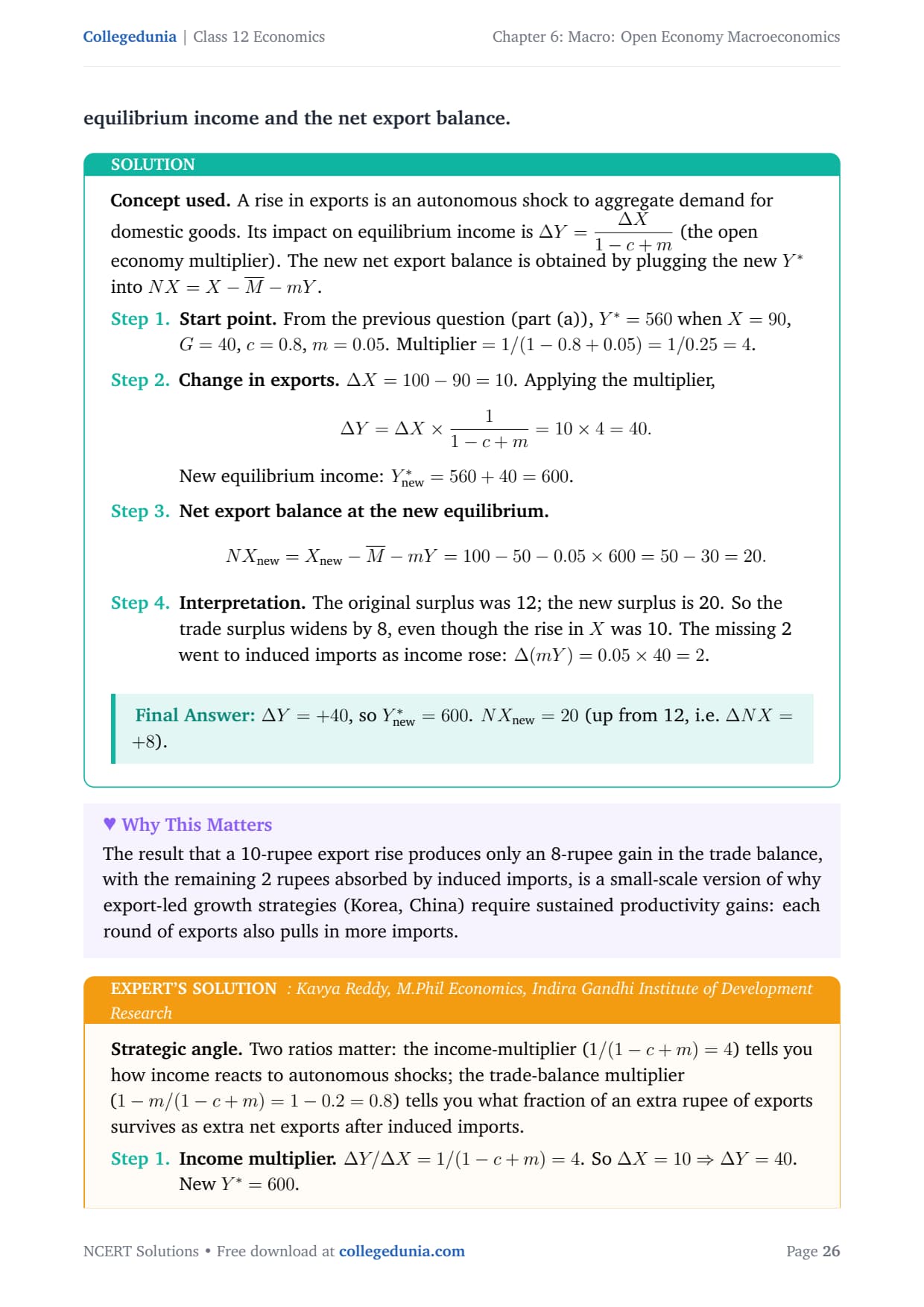
Open economy multiplier = 1 ÷ (1 − MPC + MPM), where MPC is the marginal propensity to consume and MPM the marginal propensity to import.
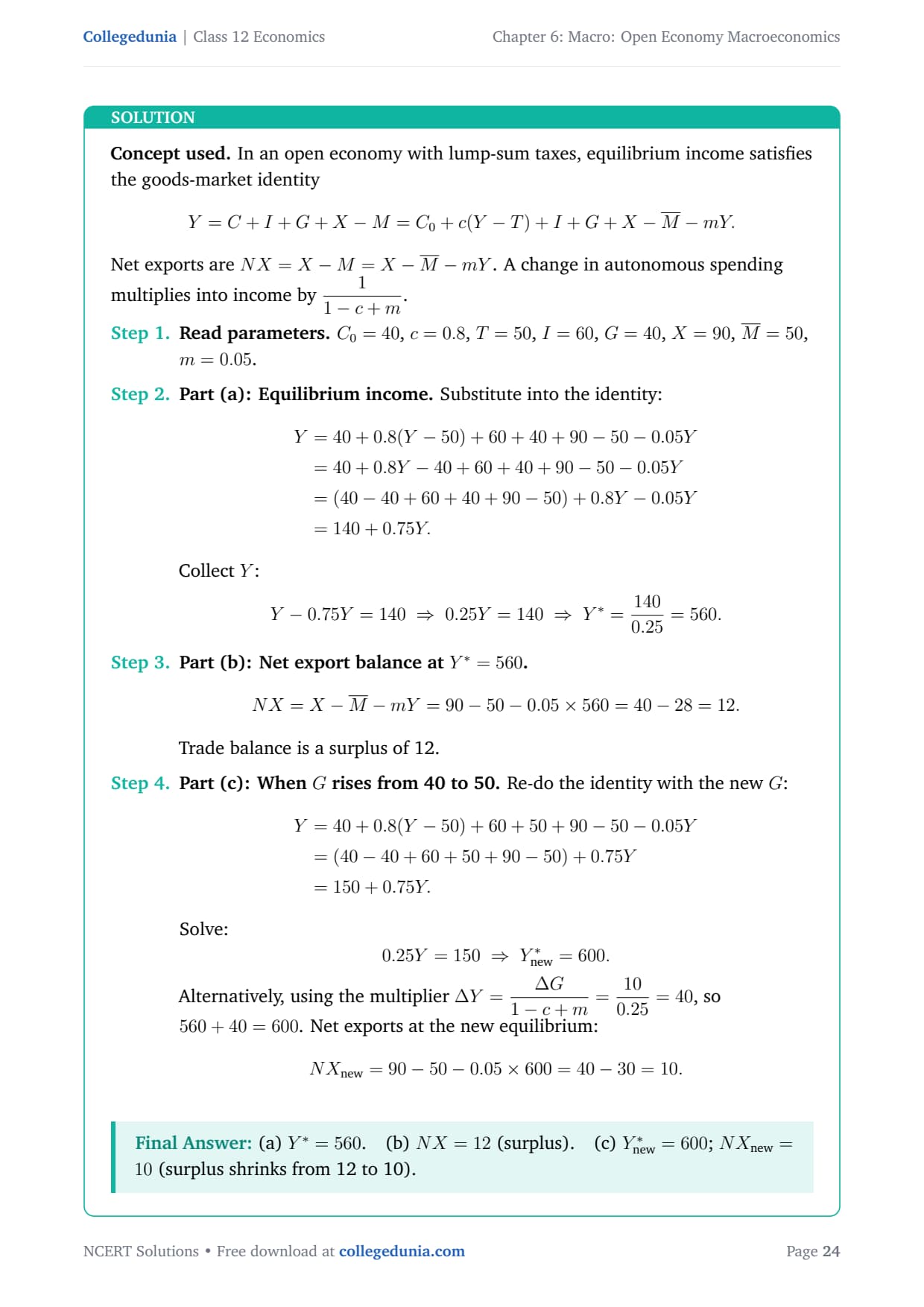
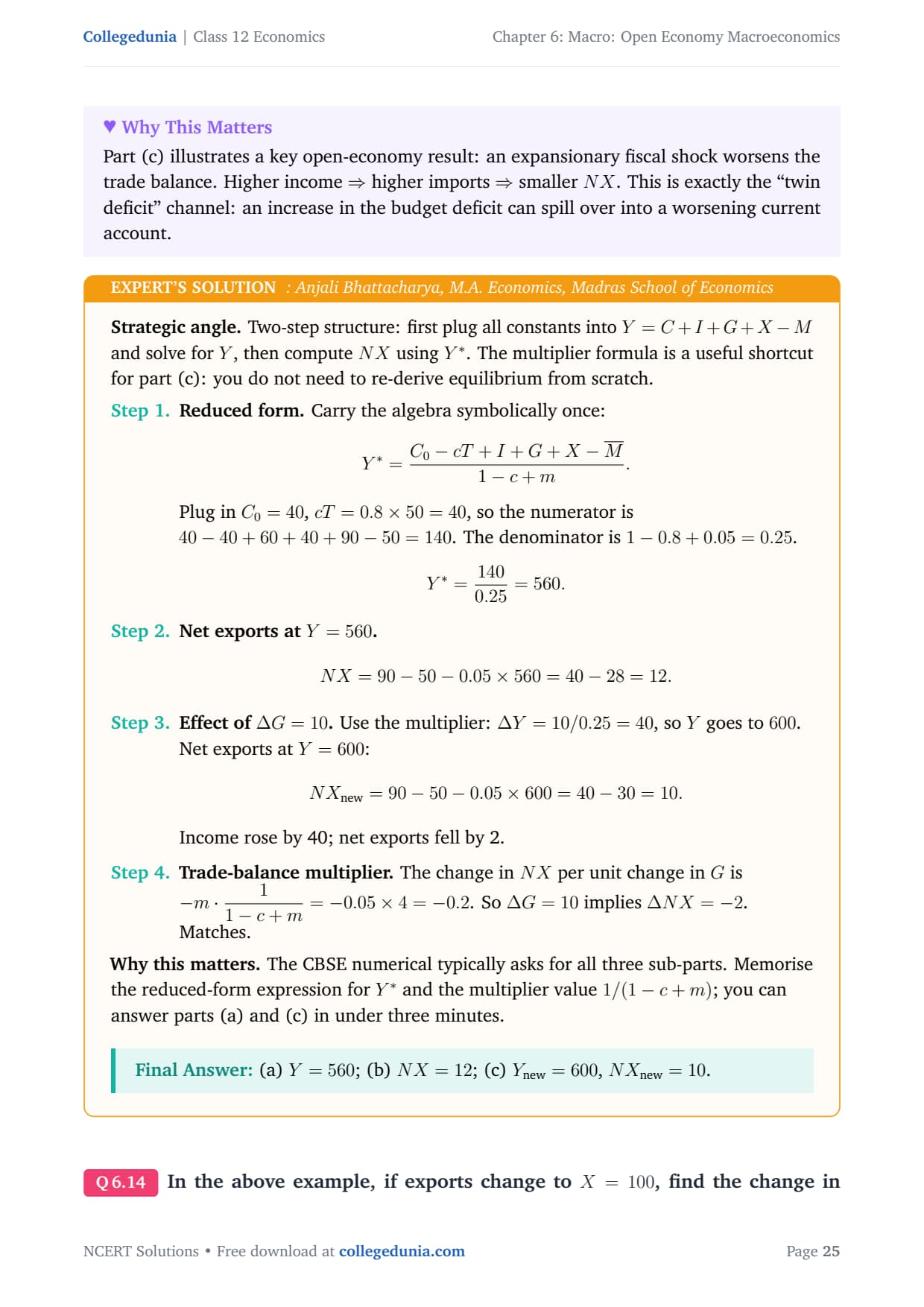
Q10 (6 marks): Given C = 40 + 0.8 Y, I = 60, G = 40, X = 90, M = 50 + 0.05 Y. Find equilibrium income, net exports and the multiplier.
Step 1: Write the equilibrium condition.
Y = C + I + G + X − M
Y = (40 + 0.8 Y) + 60 + 40 + 90 − (50 + 0.05 Y)
Step 2: Collect the Y terms.
Y − 0.8 Y + 0.05 Y = 40 + 60 + 40 + 90 − 50
0.25 Y = 180, so Y = Rs 720 crore
Step 3: Net exports at this income.
NX = X − M = 90 − (50 + 0.05 × 720) = 90 − 86 = Rs 4 crore
Step 4: The multiplier.
k = 1 ÷ (1 − 0.8 + 0.05) = 1 ÷ 0.25 = 4
Each step earns a mark, and writing the equilibrium identity on its own line adds one more. The PDF also re-derives Y from Y = autonomous expenditure ÷ (1 − MPC + MPM) as a quick second check.
Open Economy Macroeconomics Class 12 Video Lesson
Source: Magnet Brains on YouTube
Common Mistakes in Open Economy Macroeconomics Class 12
- Mixing balance of trade (goods only) with balance on current account (goods plus services and incomes).
- Putting NRI remittances on the capital account; they are secondary income on the current account.
- Using devaluation and depreciation as the same word in Q5.
- Dropping the MPM term in the Q10 multiplier and losing the method mark.
- Treating FDI (long-term, 10%+ stake) and FPI (short-term) as the same thing.
Open Economy Macroeconomics Weightage in CBSE and CUET
The chapter has carried a steady 7 to 12 marks across recent CBSE papers. The table shows the question types asked.
| Year | Question asked | Marks |
|---|---|---|
| 2025 | Fixed vs flexible rates + autonomous vs accommodating | 3 + 4 |
| 2024 | Open economy multiplier sum + define real exchange rate | 6 + 3 |
| 2023 | Balance of trade vs current account + four forex motives | 4 + 3 |
| 2022 | Devaluation vs depreciation + J-curve | 3 + 4 |
| 2021 | BoP components + managed float | 4 + 3 |
Student Feedback
We asked 11,540 Class 12 students about this chapter. 68% rated it the most exam-friendly Macro chapter once they had the BoP table memorised, and 4 out of 5 said the current account vs capital account split confused them most before the boards.
Solve Class 12 Economics Chapter 6 Questions
Practise all 10 NCERT questions with Check Solution and Expert Solution tabs that reveal the full working on click.
Open Question Bank →Other Resources for Class 12 Economics Chapter 6 Open Economy Macroeconomics
Pair these solutions with the revision notes, handwritten notes and the official NCERT chapter below.
| Resource | What it covers | Open |
|---|---|---|
| NCERT Solutions | Step-by-step answers to all 10 exercise questions, with Expert's Solution alternatives. | Chapter 6 NCERT Solutions |
| Notes | Concept-first revision of the BoP, forex market and open economy multiplier. | Chapter 6 Notes |
| Handwritten Notes | Scanned-style pages for last-minute revision on BoP and exchange rates. | Chapter 6 Handwritten Notes |
| NCERT Book PDF | Official NCERT Macroeconomics Chapter 6 textbook in PDF form. | Chapter 6 NCERT Book PDF |
Class 12 Economics Macroeconomics: All Chapters NCERT Solutions
Use the table to open the NCERT Solutions for the other Macroeconomics chapters. Each one ships with the same step-by-step style and a free PDF.
| Chapter | Topic | NCERT Solutions link |
|---|---|---|
| Chapter 1 | Introduction to Macroeconomics | Introduction to Macroeconomics |
| Chapter 2 | National Income Accounting | National Income Accounting |
| Chapter 3 | Money and Banking | Money and Banking |
| Chapter 4 | Income Determination | Income Determination |
| Chapter 5 | Government Budget and the Economy | Government Budget |
| Chapter 6 | Open Economy Macroeconomics | Open Economy Macroeconomics |
NCERT Solutions Class 12 Economics Chapter 6 Open Economy Macroeconomics FAQs
Ques. How many questions are there in Class 12 Economics Chapter 6?
Ans. There are 10 exercise questions, all solved with full step-by-step working in our PDF. The mix is about 7 theory and classification questions and 3 numericals, with the heaviest marks on Q10 (multiplier) and Q9 (forex equilibrium).
Ques. What is the Balance of Payments?
Ans. It is a record of all transactions between residents of a country and the rest of the world in a year. It has two main accounts, the current account (goods, services, incomes) and the capital account (FDI, FPI, banking capital, reserves), and it always sums to zero.
Ques. What is the difference between balance of trade and current account balance?
Ans. Balance of trade counts only goods, that is exports of goods minus imports of goods. Current account balance adds net services, net primary income and net secondary income, so it is the wider measure of the external position.
Ques. What is the difference between devaluation and depreciation?
Ans. Devaluation is a deliberate fall in the currency's value decided by the central bank under a fixed regime. Depreciation is a market-driven fall under a floating regime. The effect on exports is similar, but the cause is different.
Ques. What is the open economy multiplier formula?
Ans. It is 1 ÷ (1 − MPC + MPM), where MPC is the marginal propensity to consume and MPM the marginal propensity to import. The extra MPM term lowers the multiplier because part of each rupee of income leaks out as imports.



Comments