




Inside the Class 12 Computer Science Chapter 8 Database Concepts NCERT Book PDF, you will find the official text on the file system limitations, the DBMS, the relational data model, and every key a relation can hold. This page lets students download the original Chapter 8 text, tables and figures for the 2026-27 CBSE syllabus, so the definitions of degree, cardinality and NULL come straight from the source.
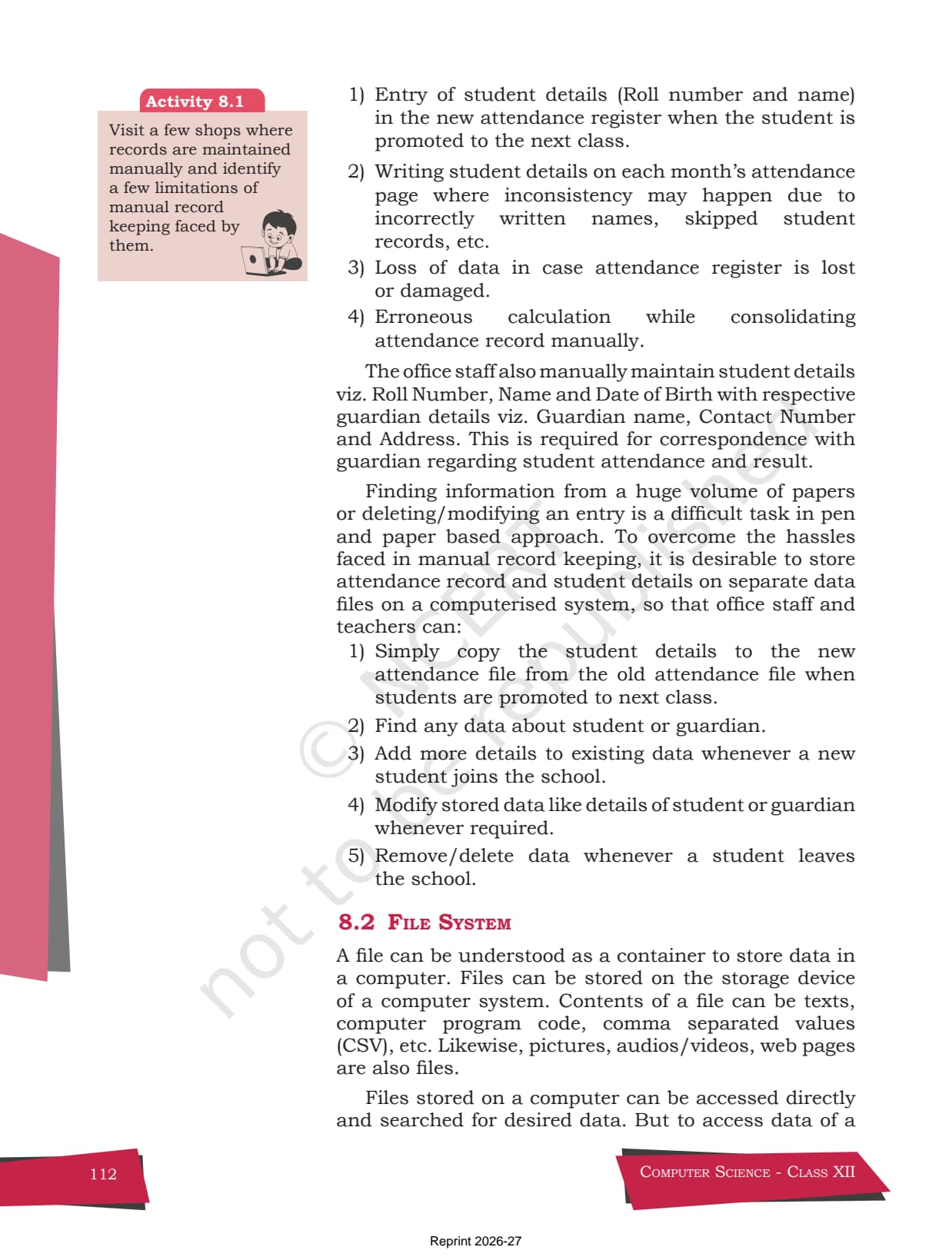
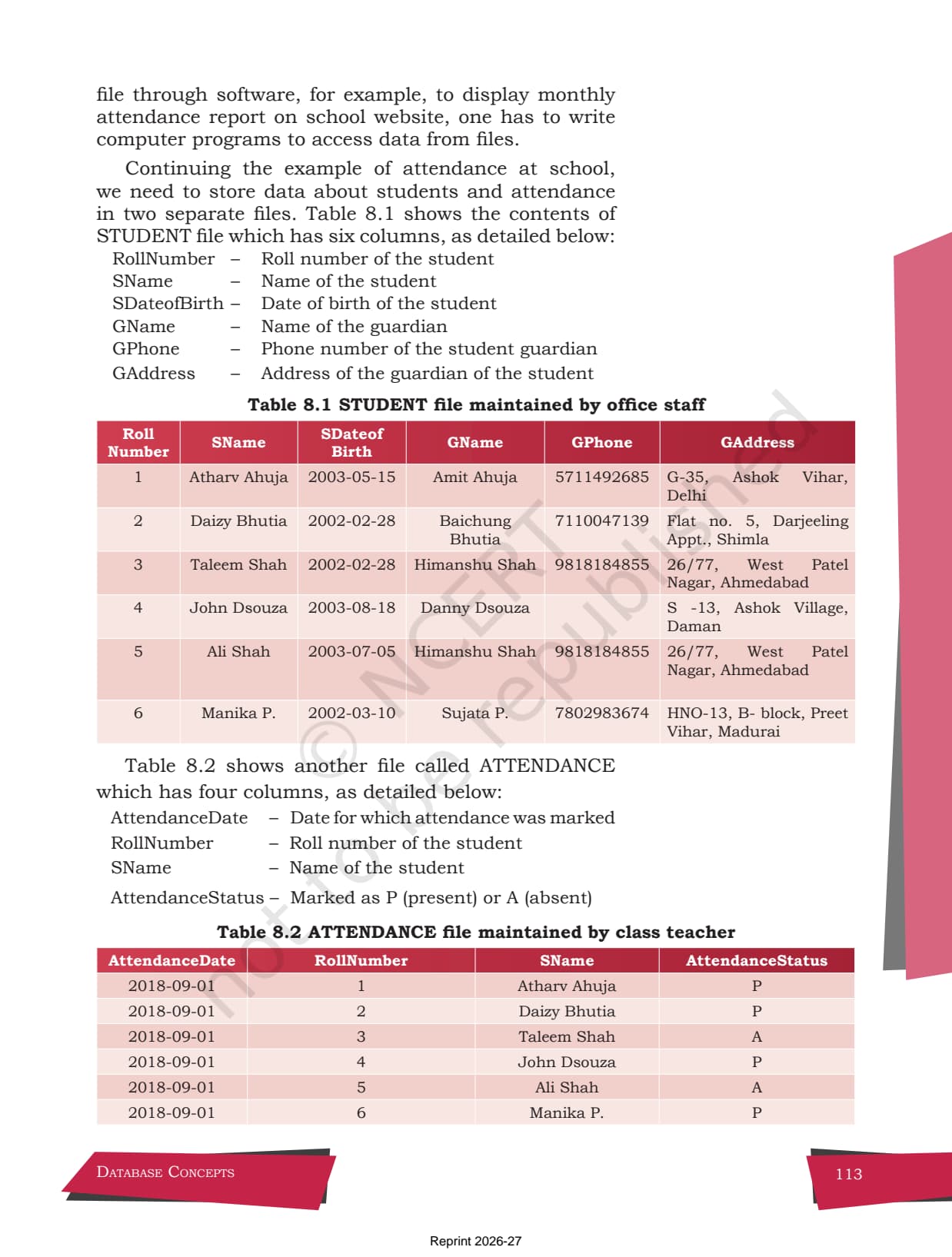
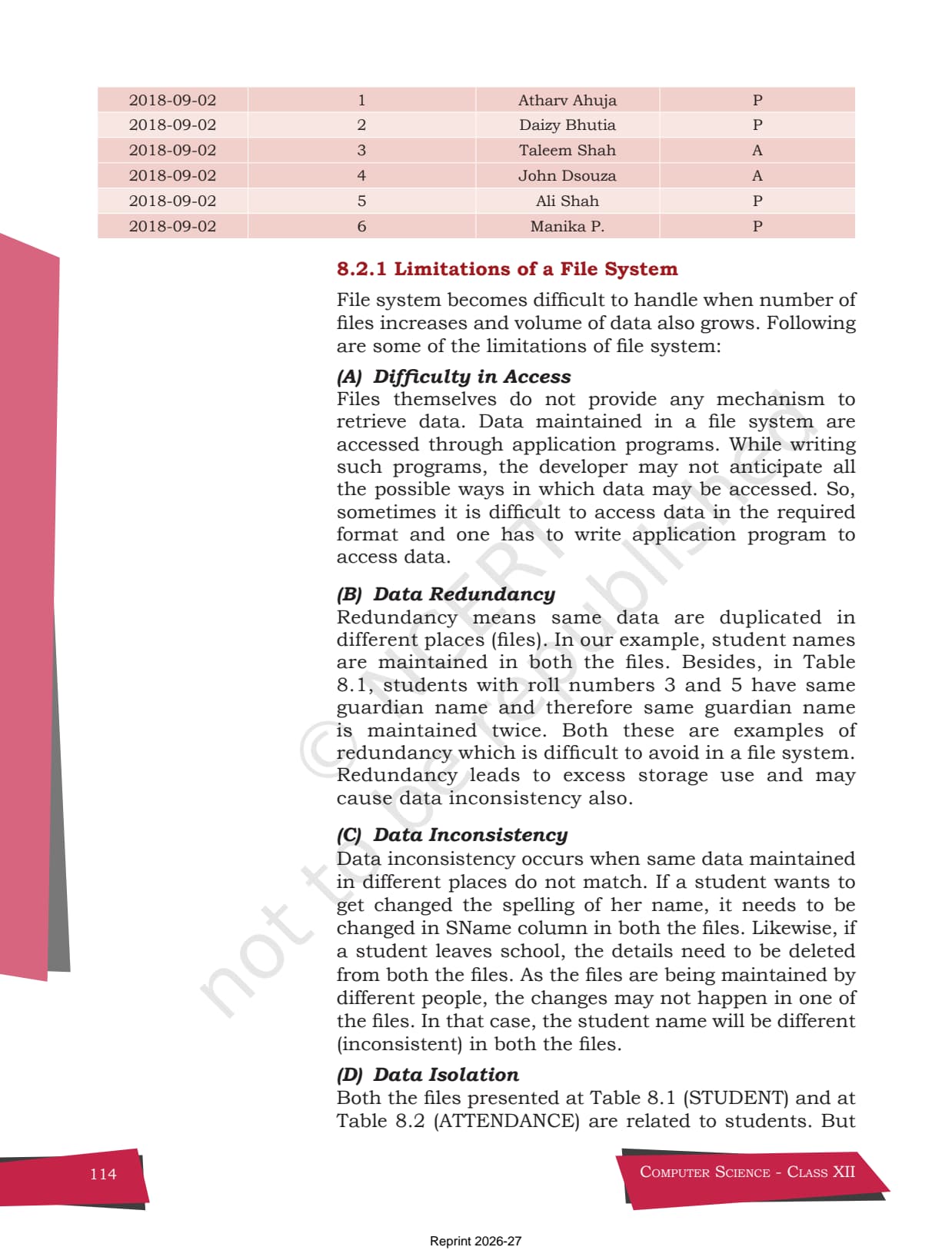
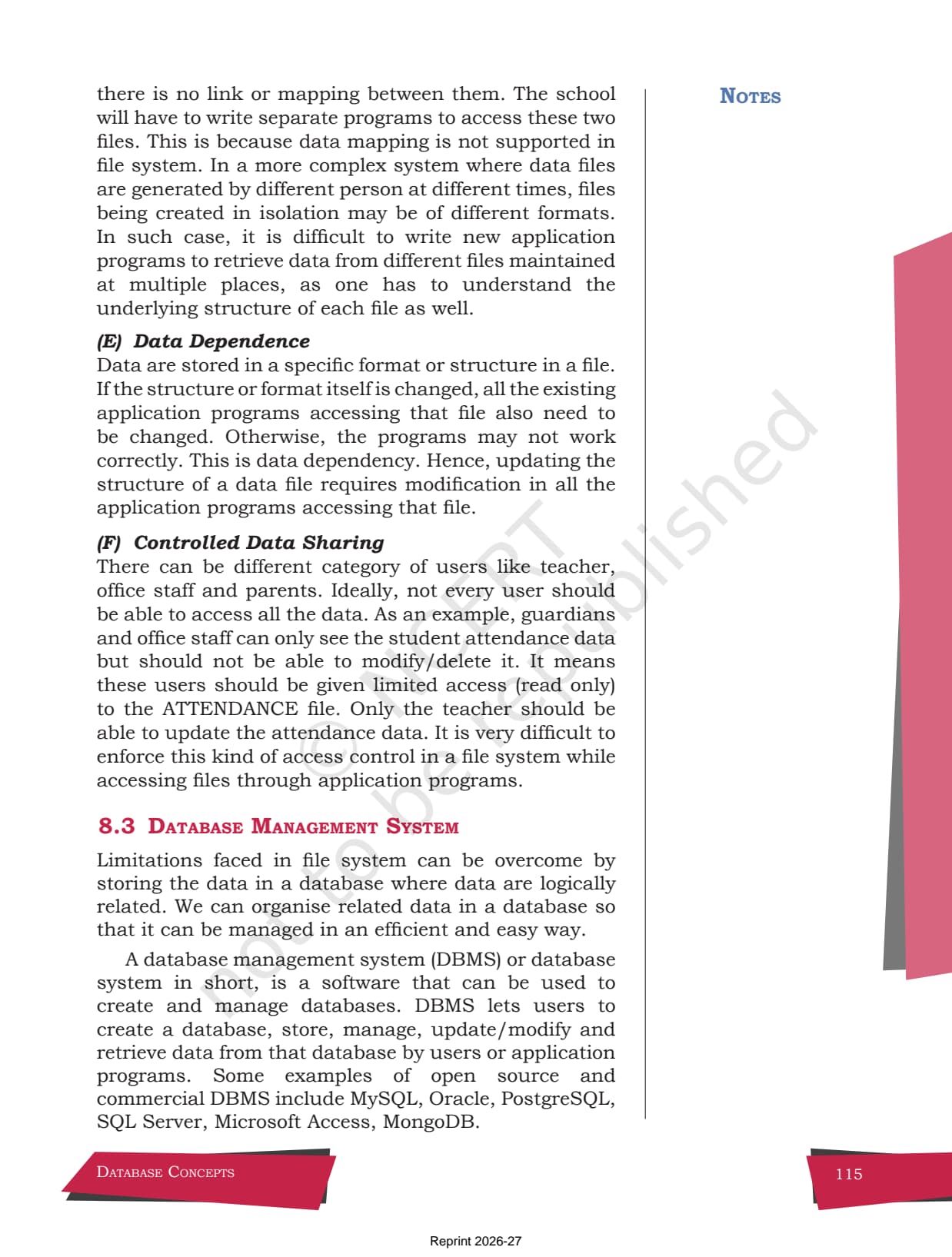
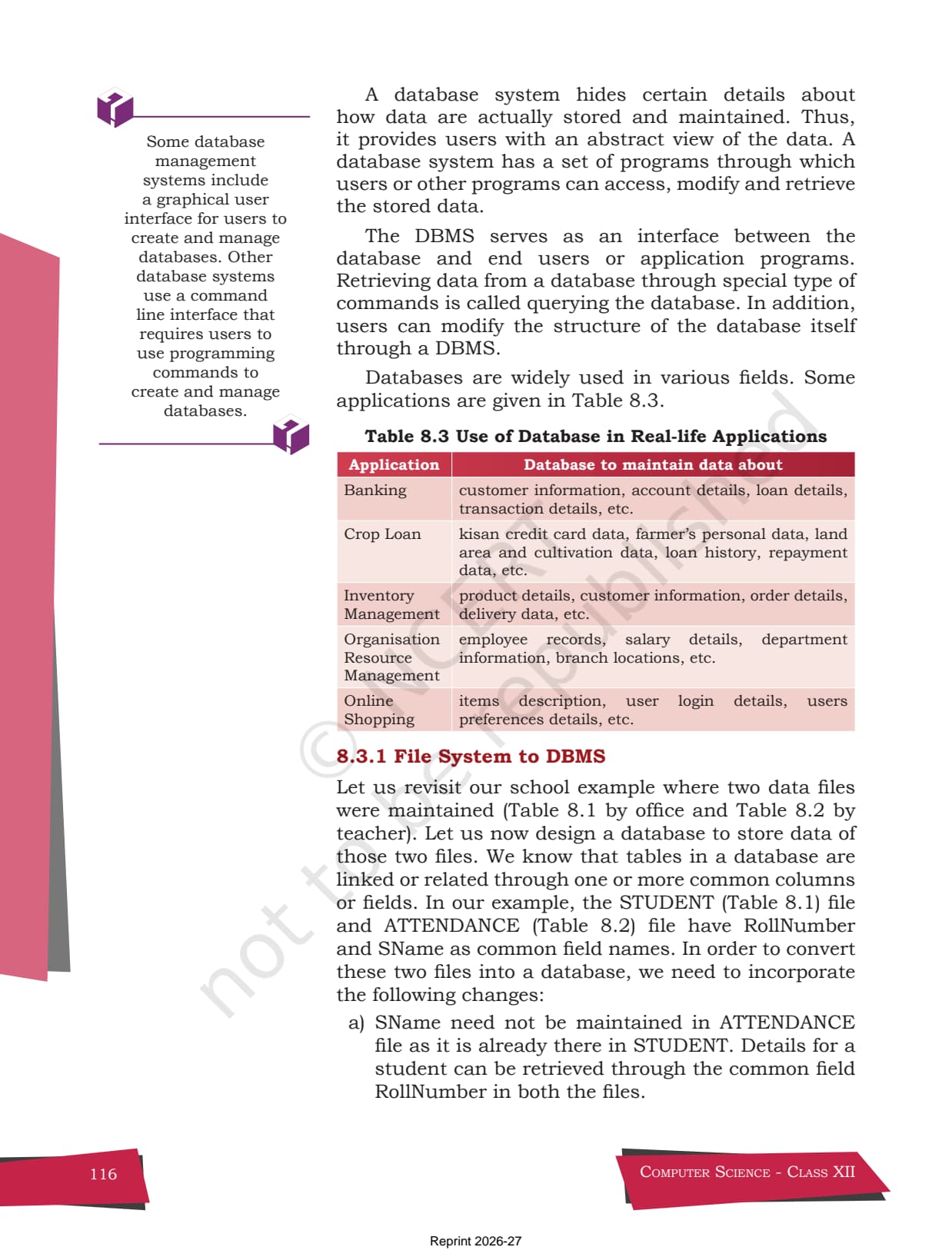
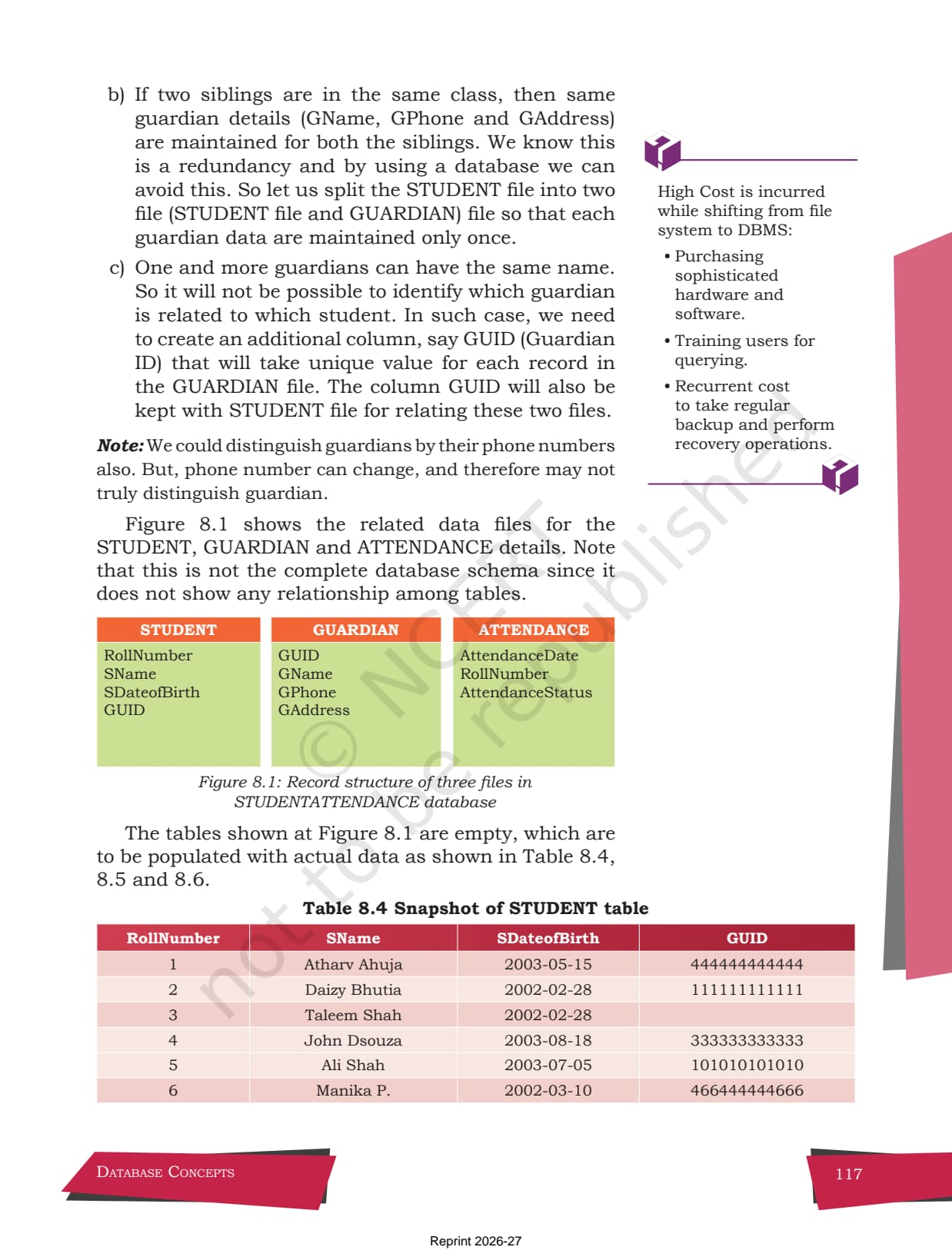
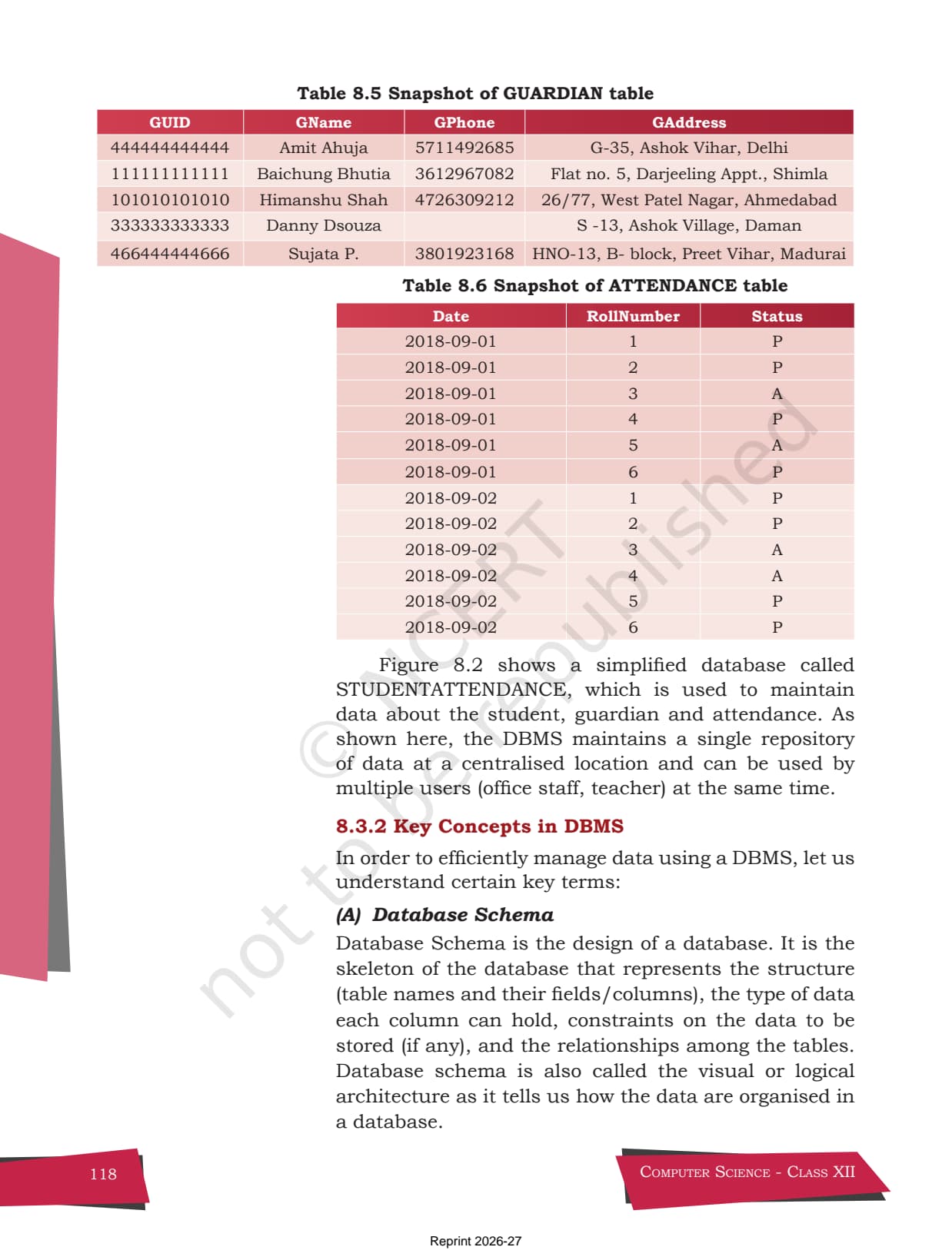
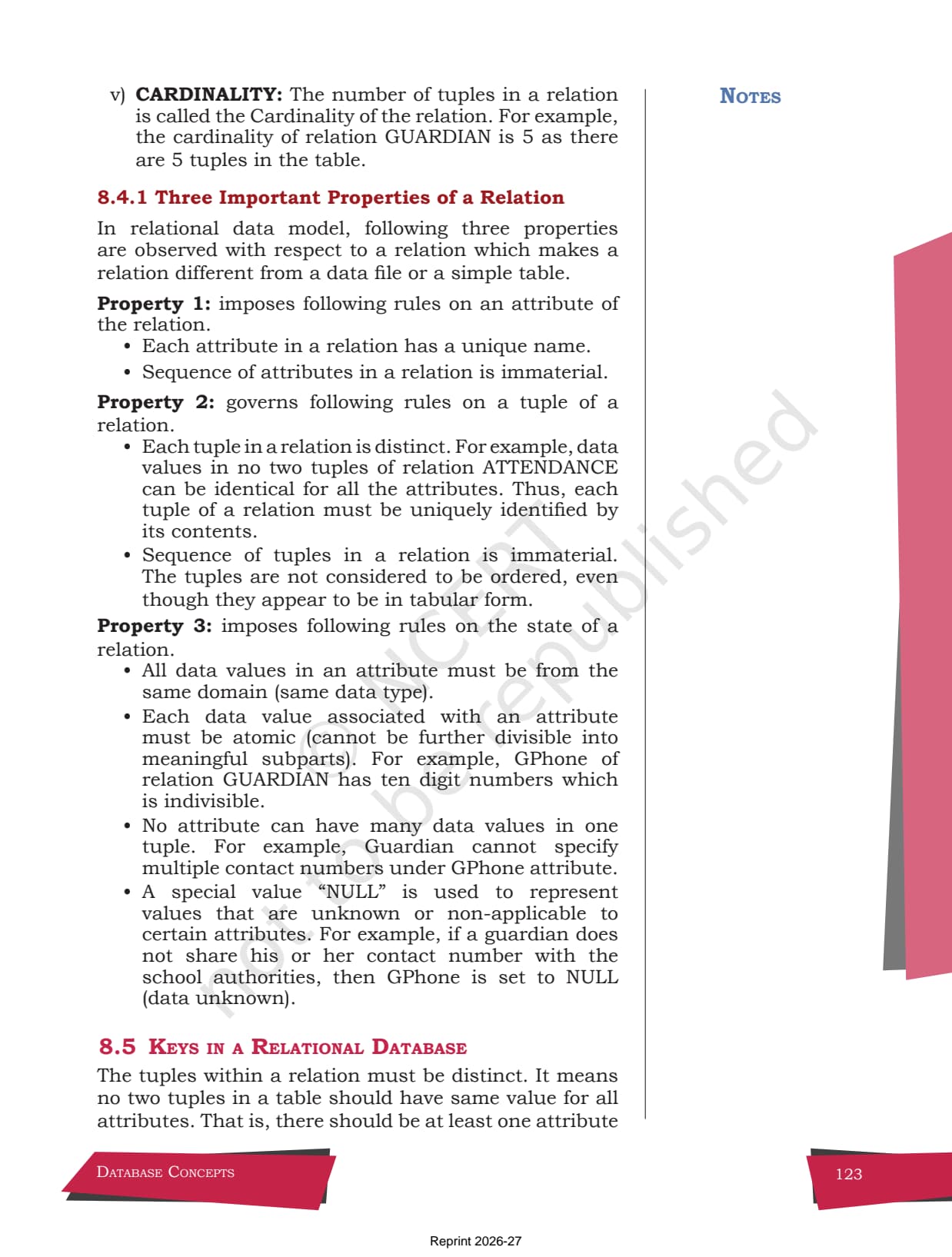
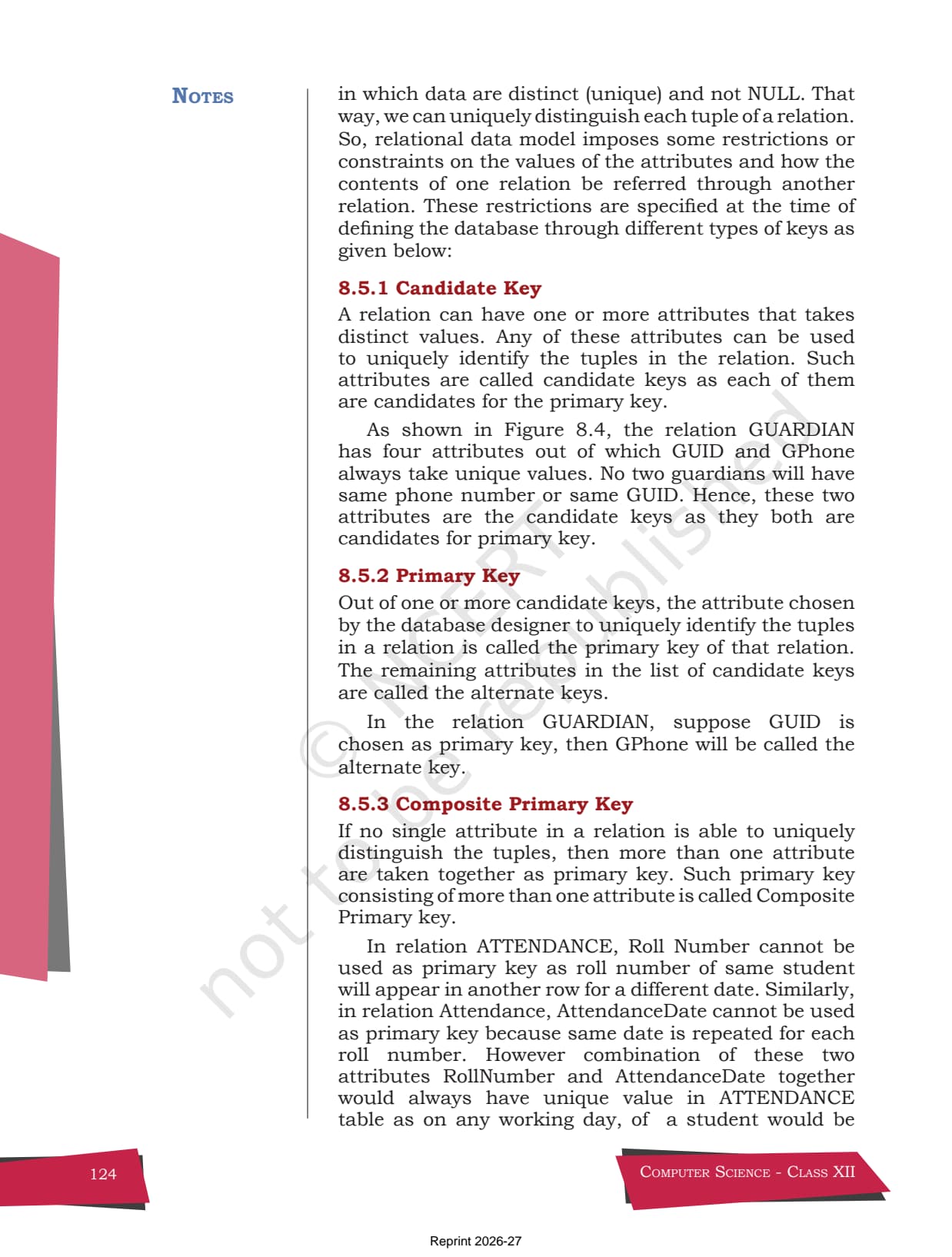
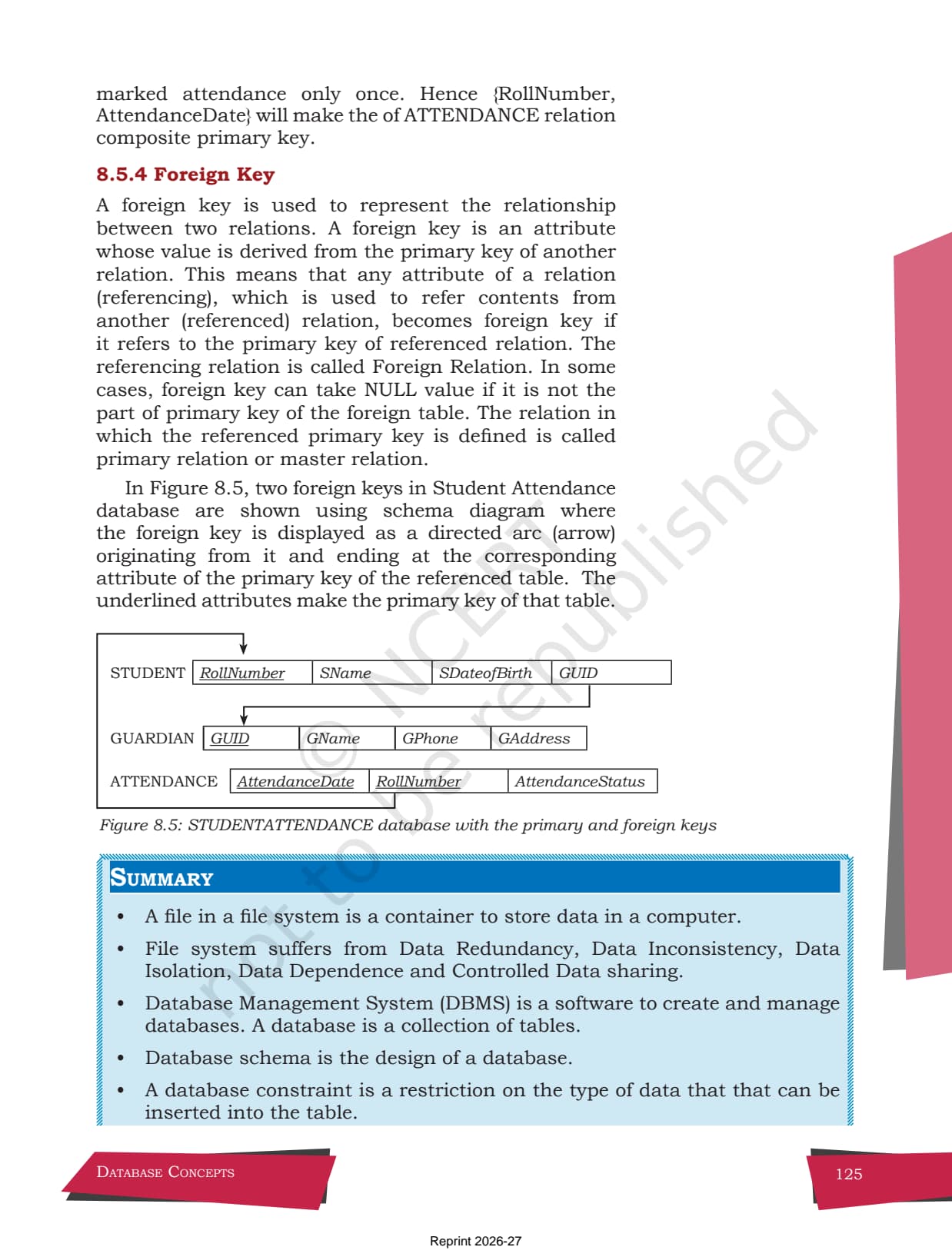
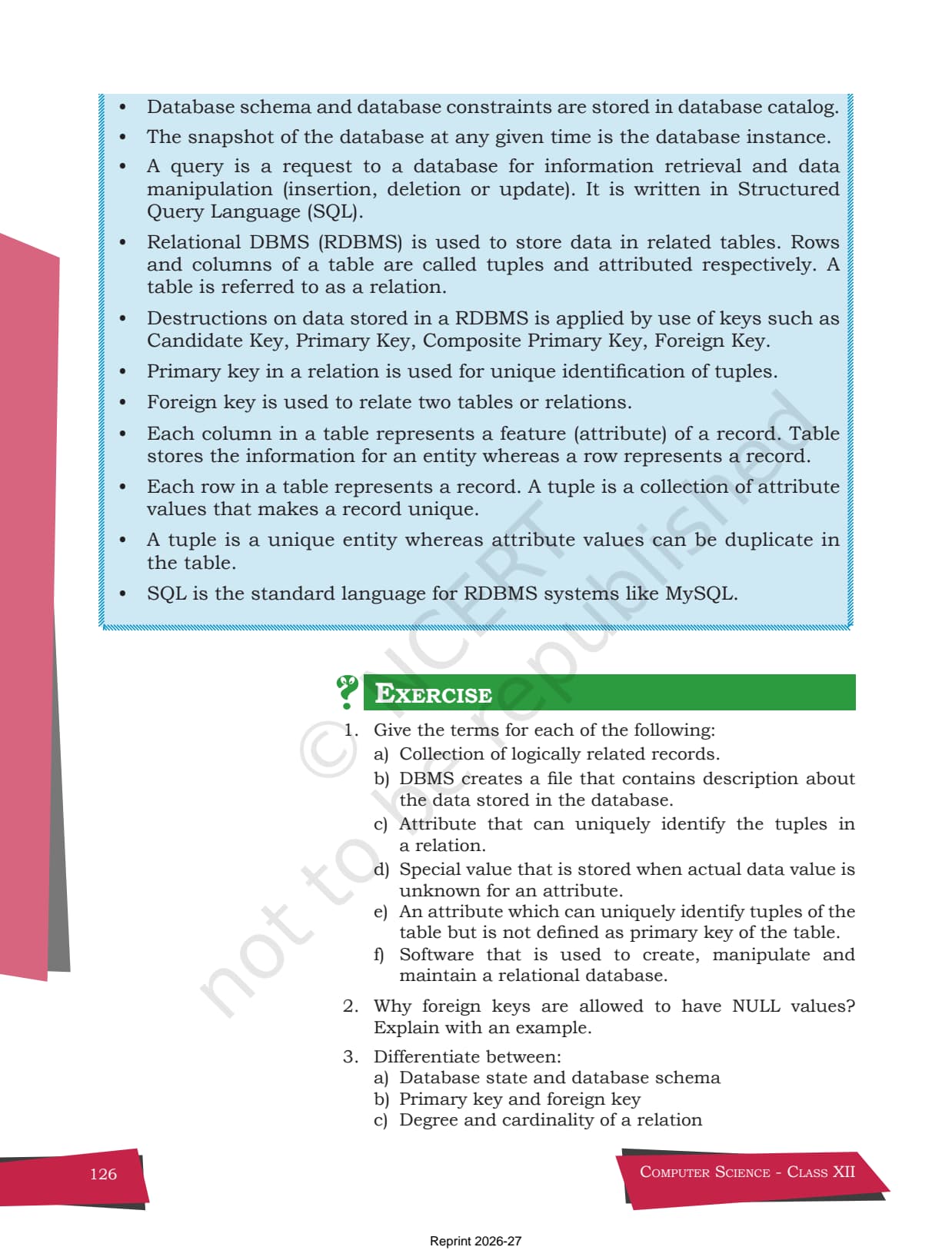
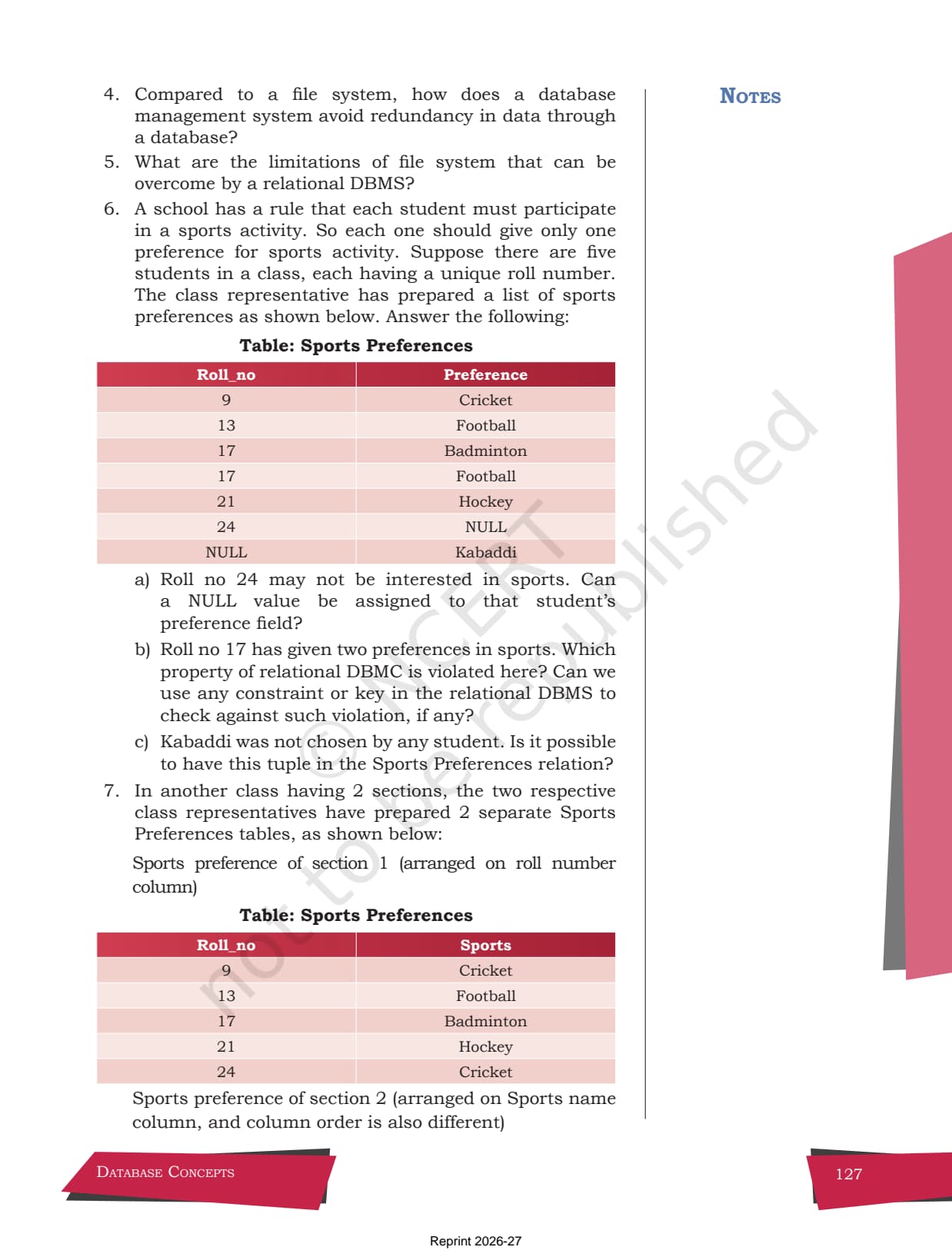
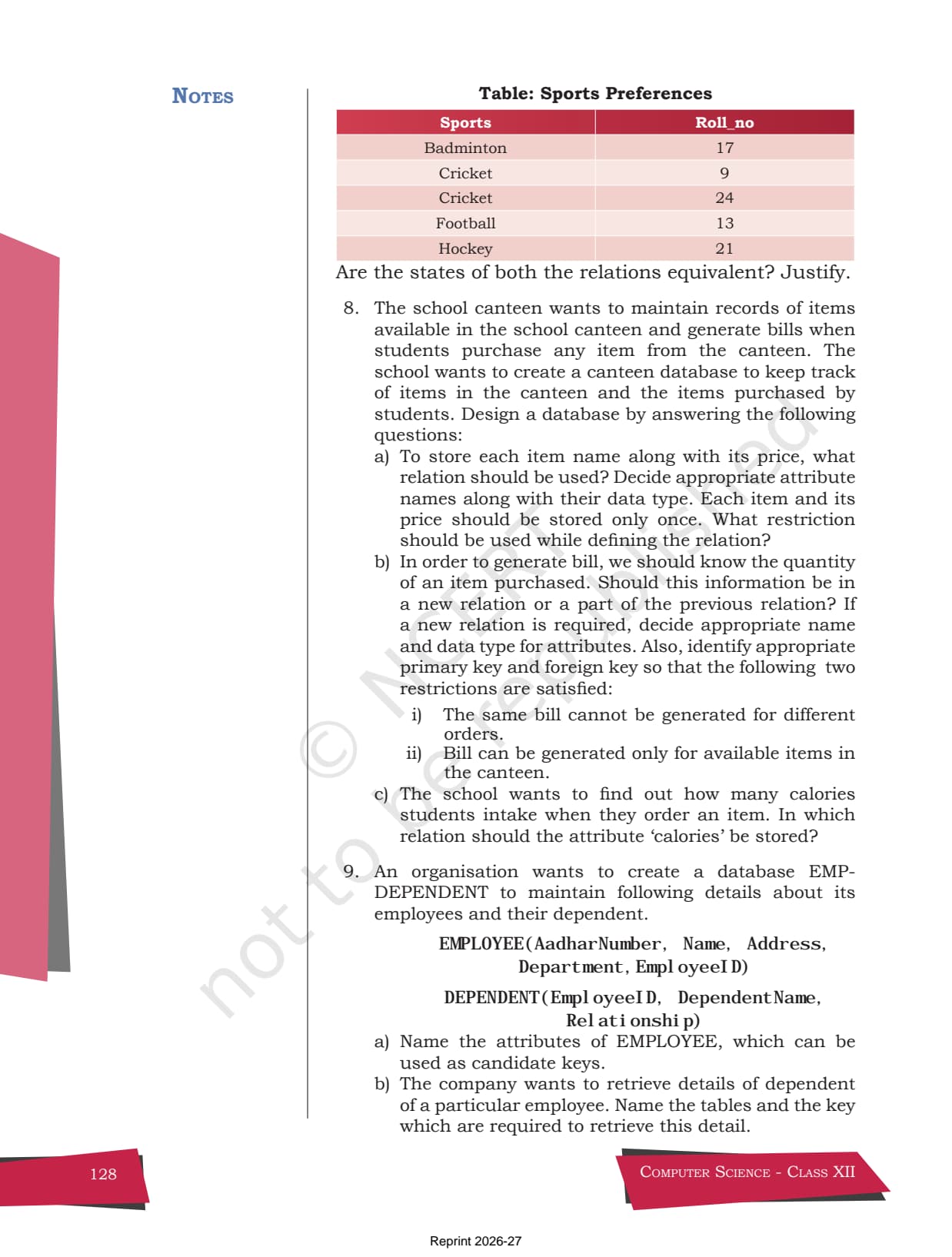
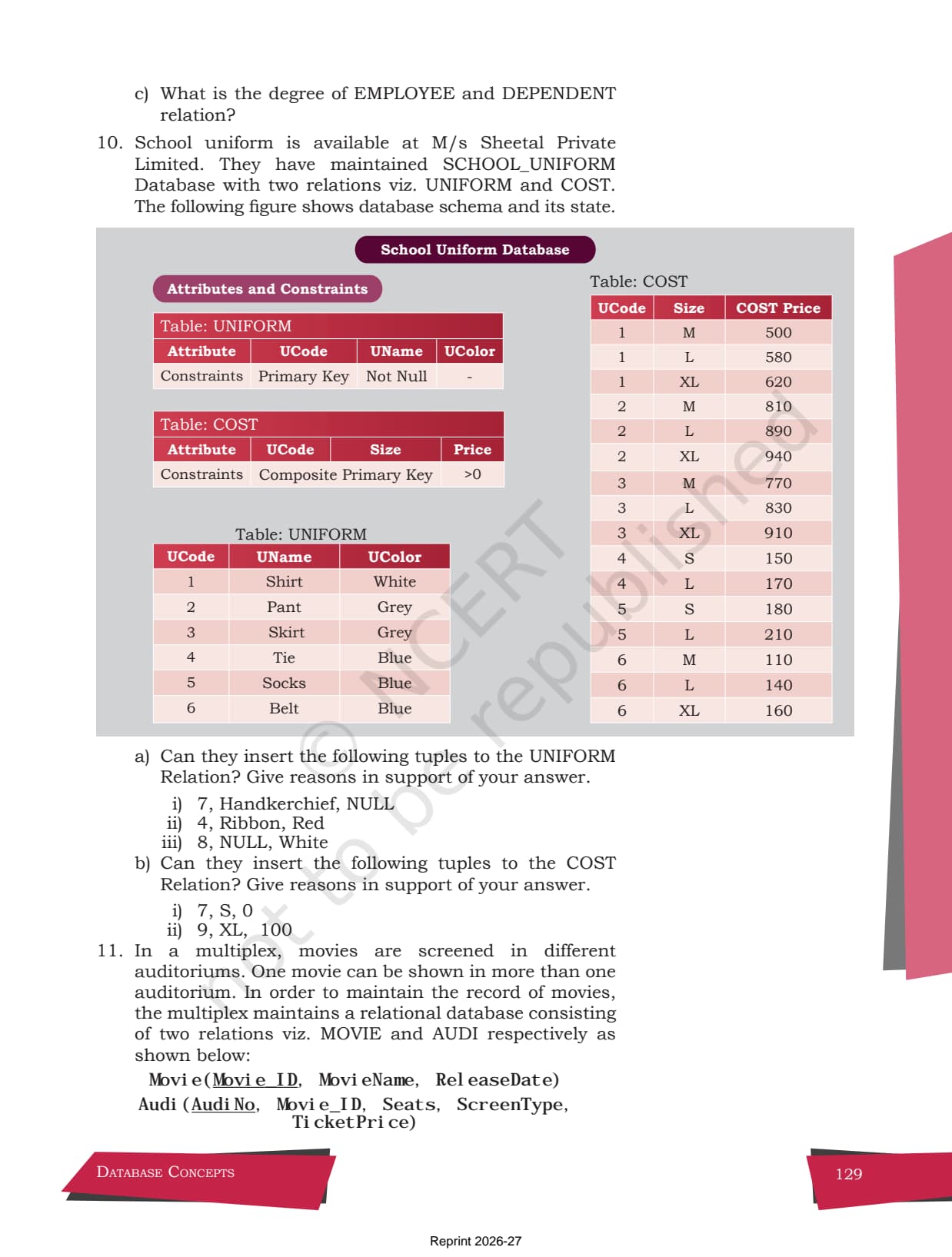
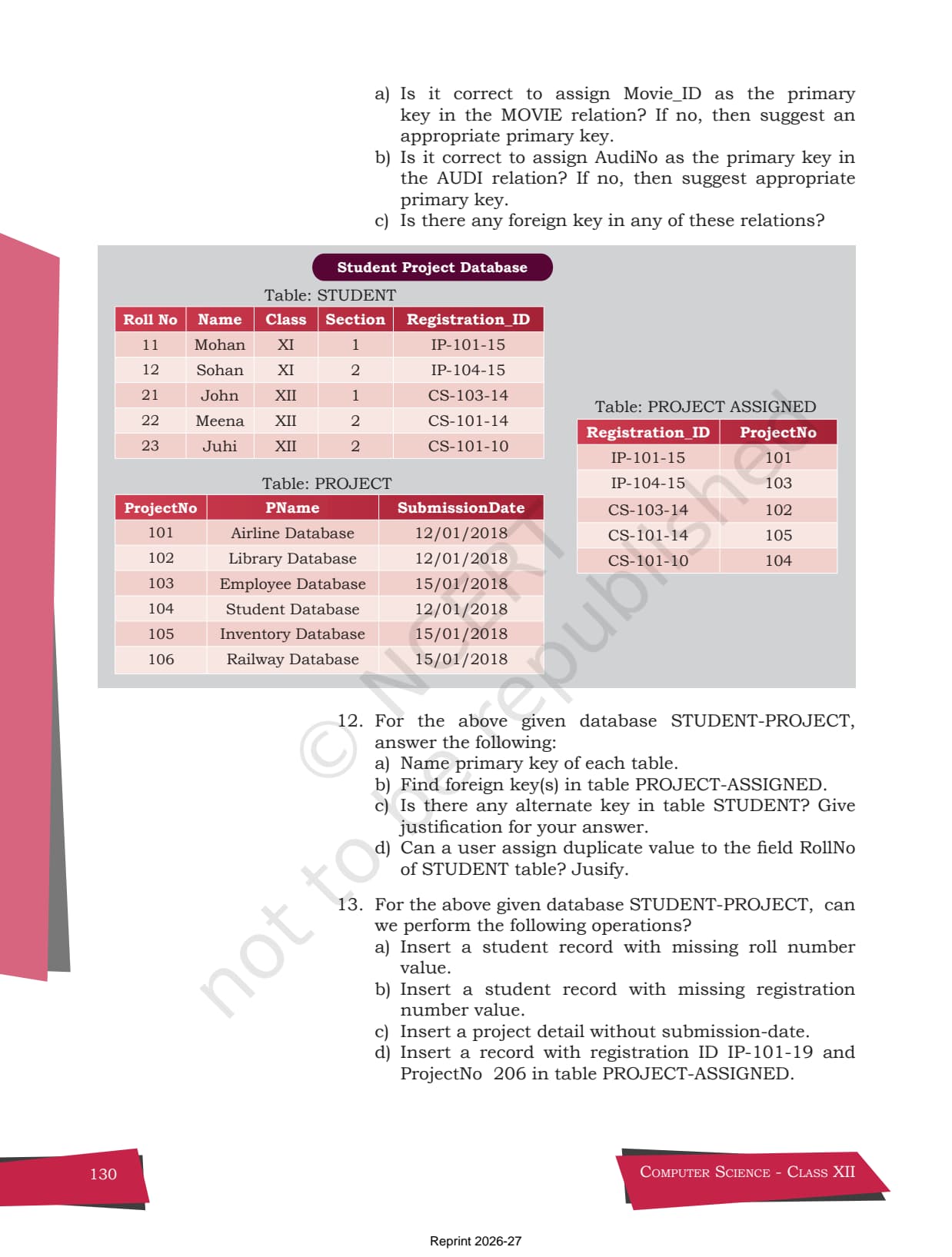
- Official NCERT chapter with the original schema diagrams, the relation tables, and every key definition.
- The Database Concepts chapter usually carries 6 to 8 marks in the Class 12 Computer Science board paper.
- Pairs with the Solutions, Notes and Handwritten Notes linked lower on this page.
This is the official NCERT Database Concepts chapter from the Class 12 Computer Science book, offered for free download in the 2026-27 edition with the original schema diagrams and relation tables.
Student Feedback: What 10,400 students told us about this chapter PDF
74% of Class 12 students said they kept the official NCERT Database Concepts chapter PDF open while solving the key-finding questions, because the relation tables and the exact definitions of primary key, foreign key and candidate key come straight from the chapter. 3 out of 5 students told us the degree and cardinality worked example was the part they re-read the most.
Toppers reported that quoting the NCERT wording for terms like database schema and database state helped them earn 1 to 2 extra marks on the 1-mark questions. The average student spent 2 to 3 hours on the chapter across the first read and the exercise practice.
Source: 2026-27 Class 12 Computer Science student poll. Sample of 10,400 students from CBSE schools across 12 states, conducted before the 2026 boards.
Source: Magnet Brains on YouTube
What the Class 12 Computer Science Chapter 8 Database Concepts NCERT Chapter Covers
Database Concepts is the eighth chapter of the Class 12 Computer Science book and the foundation for the SQL chapter that follows. It answers one question: how do you store and manage large data without the mess of a plain file system? The chapter builds the answer in clear blocks, starting from the limits of manual records and ending with the relational model and its keys.
The chapter is built around three threads, which the NCERT covers in order:
- The problem: the limitations of a file system, mainly data redundancy, data inconsistency and weak data security.
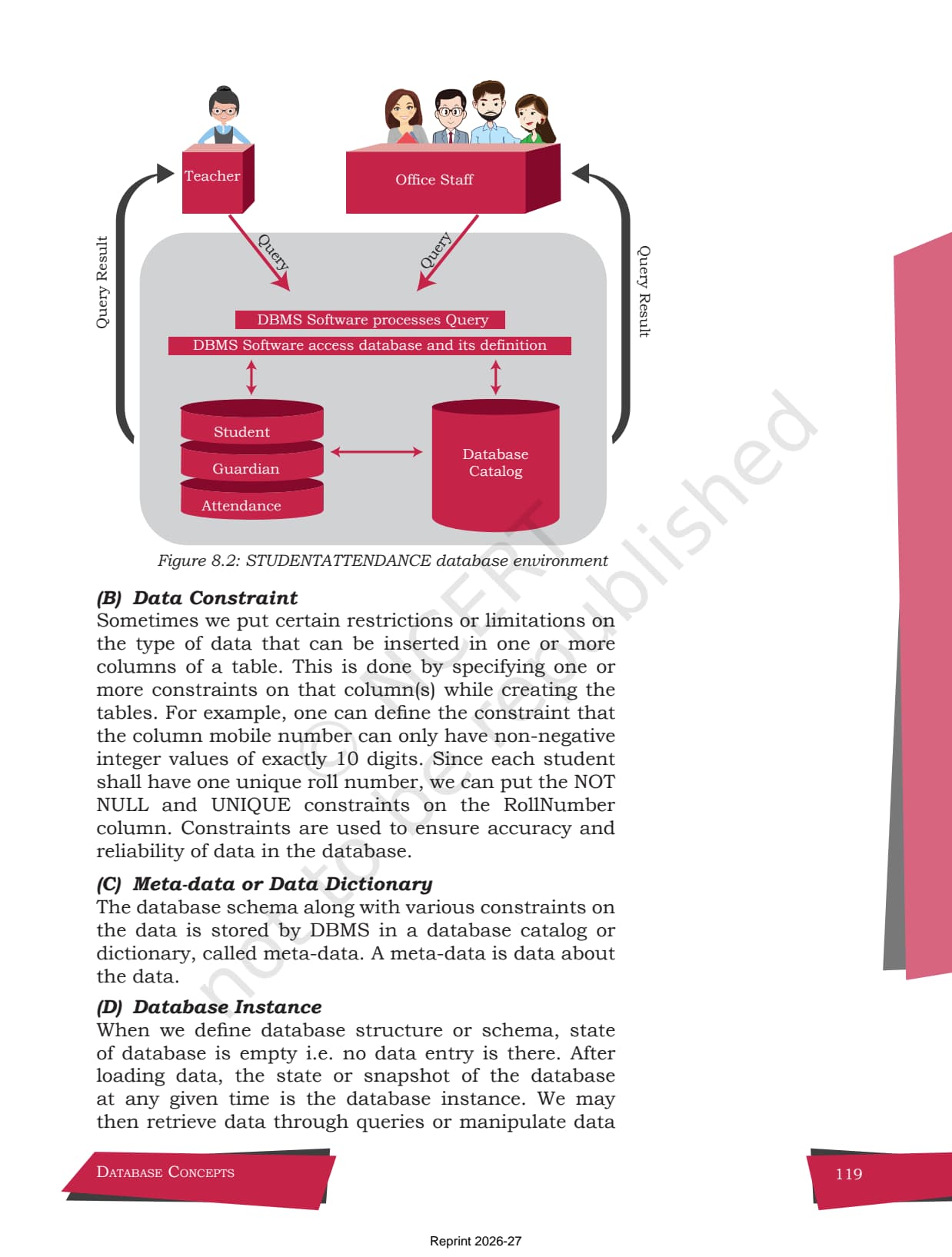
- The fix: a database management system (DBMS), with the difference between a database schema and a database state.
- The model: the relational data model, relations, tuples, attributes, degree, cardinality, and the four keys.
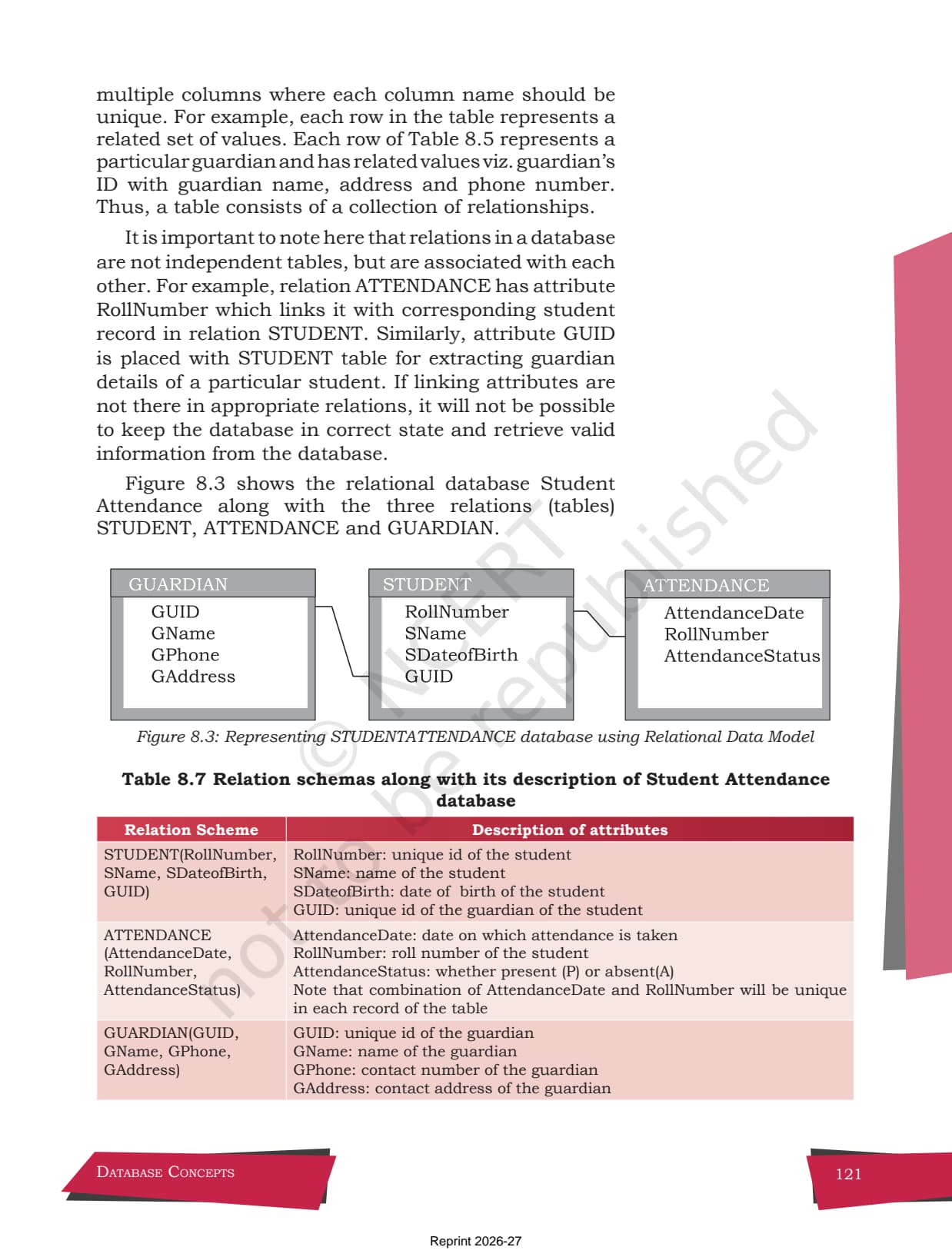
Reading the original NCERT text matters because the relation tables and the exact definitions in the class 12 computer science chapter 8 database concepts pdf are what CBSE refers to in the exam. A student who knows the chapter's own examples, such as the STUDENT and GUARDIAN relations, can answer the key-finding and term questions with confidence.
Chapter Highlights and Important Topics
The NCERT chapter is rich with relation tables, schema diagrams and worked terms that the exam often reuses. Knowing what each highlight covers helps students revise quickly from the source. The table below lists the highlights students should study in the original database concepts class 12 pdf.
| Highlight | Why it matters |
|---|---|
| File system limitations | The base of many 2-mark questions: redundancy, inconsistency and security. |
| DBMS and its advantages | How a DBMS removes redundancy and keeps a single, consistent repository. |
| Database schema vs database state | A common 1-mark trap: the design is fixed, the state changes with each row. |
| Degree and cardinality | Degree counts attributes; cardinality counts tuples. Tested almost every year. |
| The four keys | Primary, candidate, alternate and foreign key, the heart of the chapter. |
The chapter also makes one idea the spine of everything: a relation must keep its tuples unique and its links valid, which is exactly why keys exist. That single idea ties redundancy, the primary key and the foreign key together. Marking it while reading helps students see why each rule in the chapter 8 computer science class 12 ncert book is needed.
File System Limitations and How a DBMS Fixes Them in the Chapter
The first half of the chapter explains why a plain file system struggles as data grows. Reading the original NCERT text helps students copy the exact reasons CBSE rewards in a 2-mark or 3-mark answer. The list below shows the limitations the chapter names.
- Data redundancy: the same data is stored more than once across files, wasting space.
- Data inconsistency: when one copy is updated and another is not, the data no longer agrees.
- Weak data security: a file system cannot easily control who reads or edits which part of the data.
- Hard data sharing: sharing and searching data across many files becomes slow and error-prone.
The chapter then shows how a DBMS removes these problems by keeping a single repository and controlling access. The chapter also draws a sharp line between two terms students mix up: the schema is the design, and the state is the data inside it at one moment. The short note below mirrors the chapter's own contrast.
Database Schema (design, fixed):
  STUDENT(RollNumber, Name, Class)   -- structure only

Database State (a snapshot, changes with data):
  1, Aman, XII
  2, Priya, XII   -- two tuples at this moment
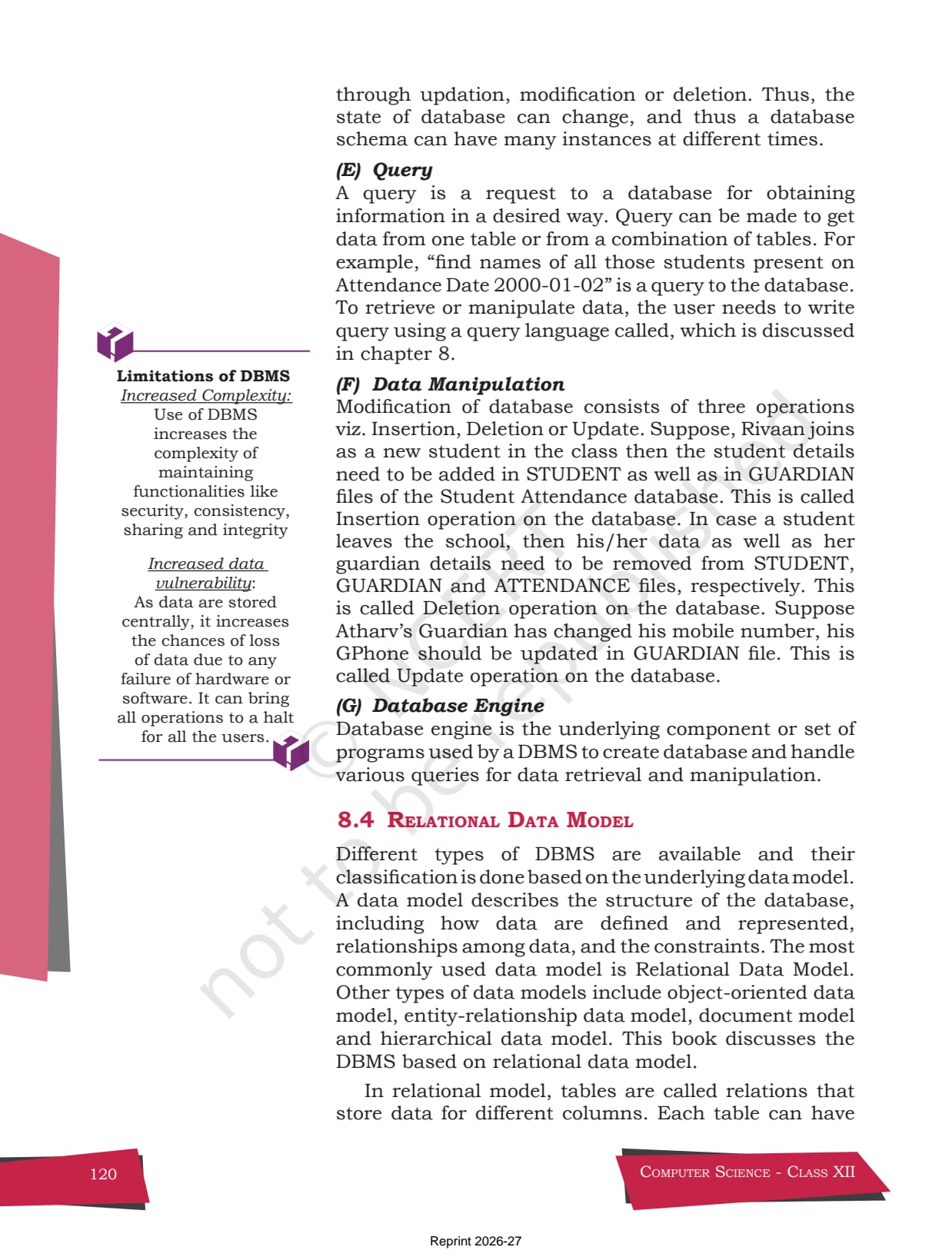
Because the design stays the same while rows come and go, one schema can have many states at different times. Reading this contrast in the database concepts class 12 ncert book is the most reliable way to learn the wording CBSE expects for the schema-versus-state question.
Relational Model and Keys in the Chapter
The closing sections of the chapter cover the relational data model and the keys, which is where most marks are won or lost. These pages define a relation as a table of tuples, and give the exact counts for degree and cardinality. Reading them in the source chapter helps students follow each term exactly.
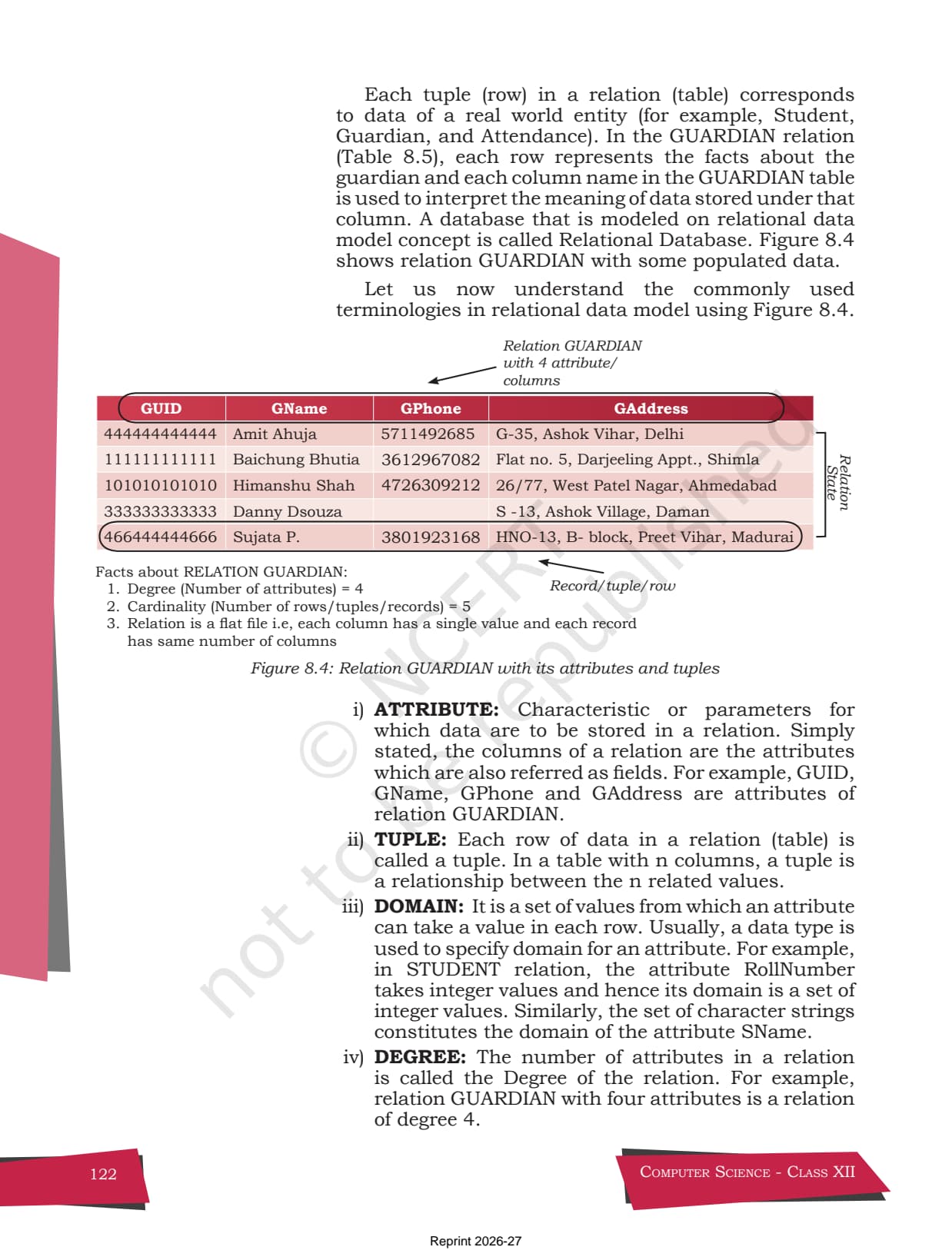
- Relation, tuple, attribute: a relation is a table, a tuple is a row, and an attribute is a column.
- Degree and cardinality: degree is the number of attributes; cardinality is the number of tuples.
- Primary and candidate key: a candidate key can identify a tuple uniquely; one is chosen as the primary key.
- Alternate and foreign key: a candidate key not picked as primary is an alternate key; a foreign key links to another relation.
The chapter is clear that a foreign key may hold a NULL value while a primary key may not, since the primary key has to identify every tuple. The short note below shows the link the chapter uses between two relations through a foreign key.
EMPLOYEE(EmployeeID, Name, Department)   -- EmployeeID is the primary key
DEPENDENT(EmployeeID, DependentName)     -- EmployeeID here is a foreign key
            |
            +-- points back to EMPLOYEE.EmployeeID (the link)
Because these definitions are drawn straight from the source chapter, the official PDF is the best place to learn the exact wording, including the rule that a primary key cannot be NULL and cannot repeat. That single rule explains most of the chapter's exercise answers on the database concepts class 12 pdf.
How to Download and Use the NCERT Chapter PDF
The chapter PDF is free and works on any device. Students can save it for offline reading and pair it with the solutions and notes. The steps below show how to get the most out of the Database Concepts chapter PDF during revision.
- Download: tap the download card above to save the official Chapter 8 PDF to your device.
- First read: read the chapter once end to end, marking the relation tables and the key definitions.
- Term practice: keep the PDF open while listing degree, cardinality and the four keys for each example table.
- Revision: use the chapter with the notes to fix the schema-versus-state pair and the foreign-key NULL rule.
Many students search for the class 12 computer science chapter 8 database concepts pdf the night before a test so they can revise offline. A saved copy means the relation tables and the definitions are always at hand. After reading the chapter, move to the solutions to check that your key choices match the model answers, then use the notes for a final quick recall before the exam.
How the Book PDF Pairs with the Solutions and Notes
The NCERT Book PDF is the source text. To prepare fully, students should use it with the other resources for the same chapter, all linked in the table below. Read the chapter, fix the ideas with the notes, then test yourself with the solutions.
| Resource | Best used for |
|---|---|
| Database Concepts NCERT Solutions | Step-by-step answers to all 13 exercise questions on keys and relations |
| Database Concepts Class 12 Notes | Quick chapter summary with file system limits, DBMS, and the four keys |
| Database Concepts Handwritten Notes | Last-minute, one-shot revision in a scanned notebook style |
Tip: read the chapter PDF first, then attempt the solutions on your own, and only then check the model answers. Reading the source text before the answers builds far stronger recall of the key definitions and the relational terms.
All Class 12 Computer Science NCERT Book PDFs by Chapter
The table links the NCERT chapter PDFs for every chapter in Class 12 Computer Science, so students can move across the course in one click. Database Concepts is highlighted.
| Chapter | NCERT Book PDF |
|---|---|
| Chapter 1 | Exception Handling in Python |
| Chapter 2 | File Handling in Python |
| Chapter 3 | Stack |
| Chapter 4 | Queue |
| Chapter 5 | Sorting |
| Chapter 6 | Searching |
| Chapter 7 | Understanding Data |
| Chapter 8 | Database Concepts (You are here) |
| Chapter 9 | Structured Query Language (SQL) |
| Chapter 10 | Computer Networks |
| Chapter 11 | Data Communication |
| Chapter 12 | Security Aspects |
FAQs on Class 12 Computer Science Chapter 8 Database Concepts NCERT Book PDF
Class 12 Computer Science Chapter 8 Database Concepts NCERT Book Common Questions
Ques. Where can I download the Class 12 Computer Science Chapter 8 Database Concepts NCERT Book PDF?
Ans. You can download the official Database Concepts chapter PDF directly from the download card on this page. It is free, follows the 2026-27 NCERT edition, and carries the original text, relation tables, schema diagrams and the key definitions of Chapter 8.
Ques. Which book is the Database Concepts chapter from?
Ans. It is the eighth chapter of the Class 12 Computer Science textbook and the foundation for the Structured Query Language (SQL) chapter that follows. The chapter introduces the file system limitations, the DBMS, the relational data model, and the four keys.
Ques. What does the Class 12 Computer Science Database Concepts chapter cover?
Ans. It covers the limitations of a file system (redundancy, inconsistency and security), the DBMS and its advantages, the difference between a database schema and a database state, the relational data model with degree and cardinality, and the four keys: primary, candidate, alternate and foreign key.
Ques. Why should I read the original NCERT Database Concepts chapter PDF?
Ans. Because CBSE draws questions straight from the chapter's own relation tables, examples and term definitions. Reading the official chapter 8 computer science class 12 PDF gives you the exact wording for degree, cardinality and the keys that score best in the board paper, especially for the key-finding and definition questions.
Ques. How should I use the Database Concepts chapter PDF with the other resources?
Ans. Read the chapter PDF first, fix the ideas with the notes, then test yourself with the solutions. Keeping the PDF open while listing the degree, cardinality and keys for each example table helps, since the relation tables and the definitions come directly from the source chapter.



Comments