If you want simplified NCERT Solutions for Coordination Compounds Class 12 Chemistry Chapter 5 and want to finish the important topics in 3 to 4 hours, this article is for you. It is one of the highest-yield Inorganic chapters.
CBSE Weightage: 7 to 8 marks, usually one 3-marker on IUPAC nomenclature plus one 5-marker on CFT splitting or hybridisation.
JEE Main Weightage: around 4 to 5% (1 to 2 questions per shift, mostly isomerism, magnetic moment and CFSE).
NEET Weightage: 2 to 3 questions every year from Chapter 5.
These NCERT Solutions are curated by subject experts, mapped to the 2026-27 NCERT and refined against five years of CBSE, JEE Main and NEET papers.
Key Topics Covered in Coordination Compounds Class 12 NCERT Solutions
These solutions cover every sub-topic asked across CBSE, JEE Main and NEET. Use the list below to jump to a concept.
Werner theoryprimary vs secondary valenceIUPAC nomenclatureligands and denticityambidentate ligandsVBT vs CFToctahedral and tetrahedral splittingspectrochemical serieshigh spin vs low spinCFSE calculationspin-only magnetic momentgeometric and optical isomerismlinkage isomerismmetal carbonyl bondingchelate effectcisplatin, EDTA and biological complexes
Coordination Compounds Class 12 Chemistry Video Walkthrough
Coordination Compounds Exercise-by-Exercise Breakdown (NCERT Class 12 Chemistry)
The chapter carries 33 textbook exercises plus 7 intext questions across nomenclature, isomerism, bonding theories (VBT and CFT) and applications. About 40% are reasoning-based and 25% are short numericals.
Coordination Compounds Previous Year Questions Weightage (2021-2026)
The table below maps every CBSE, JEE Main and NEET appearance of Chapter 5 from 2021 to 2026. The most-repeated topics are CFT splitting and IUPAC nomenclature.
Year
CBSE Board
JEE Main
NEET
2026
IUPAC naming and isomerism of complexes (3 marks)
CFSE of [Co(NH3)6]3+ / 1 Q
CFSE and magnetic behaviour of complexes (1 Q)
2025
IUPAC name of [Pt(NH3)2Cl2] 3M + VBT 5M
Isomerism in [Co(en)2Cl2] / 1 Q
Spin-only moment of [Fe(CN)6]4- / 2 Qs
2024
CFT splitting (octahedral) 5M + chelate effect 2M
CFSE calculation / 1 Q
IUPAC name / 1 Q
2023
Isomerism of [Co(en)3]3+ 3M
Linkage isomerism of NO2- / 1 Q
Magnetic moment / 1 Q
2022
Werner's theory vs modern view 3M
Spectrochemical series ordering / 1 Q
Applications (cisplatin) / 1 Q
2021
Hybridisation of [Ni(CN)4]2- 3M + IUPAC name 2M
Coordination number of complexes / 1 Q
Chelate effect / 1 Q
IUPAC nomenclature or VBT hybridisation appeared in all five recent CBSE cycles; CFT splitting in three of five.
How will Collegedunia's NCERT Solutions Help You with Coordination Compounds?
These solutions solve every intext question and exercise in the current NCERT edition, with each answer flagged for the marking-scheme keyword that earns the mark.
2026-27 NCERT Alignment: Every answer maps to the current syllabus, covering Werner's theory, IUPAC nomenclature, VBT, CFT and applications.
Step-by-Step Reasoning: Every "explain why" answer leads with the metal ion's electronic configuration and names the formula used, matching CBSE order.
CBSE Keyword Highlighting: Each answer bolds the phrases markers reward, like "strong-field ligand pairs the electrons".
Coordination Compounds Top 5 Formulae for Quick Recall
The five formulae below carry almost every Chapter 5 numerical. The full master table sits on the Collegedunia Formula Sheet.
Quantity
Formula
Spin-only magnetic moment
μ = √n(n+2) BM, where n = number of unpaired electrons
Crystal Field Stabilisation Energy
CFSE = [(-0.4) nt2g + (+0.6) neg] Δo + P
Coordination number
CN = sum of denticities of all ligands bonded to the central metal
Oxidation number of central metal
x + Σ (ligand charges) = overall charge on complex
Common Mistakes Students Make in Coordination Compounds
The mistakes below cost the most marks in recent CBSE and NEET cycles. Reviewing them adds around 4 marks on average.
Reversing ligand-metal order between formula and name: ligands precede the metal in the formula but are alphabetised in the name. K4[Fe(CN)6] is potassium hexacyanidoferrate(II).
Forgetting en is bidentate: [Co(en)3]3+ has coordination number 6, not 3, and shows optical isomerism.
Using μ = √n(n+1) instead of μ = √n(n+2) BM: the spin-only moment uses (n+2) inside the root.
Wrong CFSE sign convention: t2g stabilises by -0.4Δo, eg destabilises by +0.6Δo; mixing signs costs both marks.
Watch Out: CBSE deducts 1 mark for a complex name without the oxidation state in parentheses, e.g. "tetraamminecopper chloride" instead of "tetraamminecopper(II) chloride".
How to Study Coordination Compounds for Class 12th Chemistry Boards
Chapter 5 rewards a layered approach: nomenclature first, isomerism next, then bonding theories last.
Day 1 (Nomenclature, 3 hrs): Read NCERT 5.1 to 5.2, name 15 complexes, learn the ligand-prefix table (mono, di, bis, tris).
Day 2 (Isomerism, 3 hrs): Cover structural isomerism plus geometrical and optical isomerism; draw several isomer pairs.
Day 3 (VBT, 2 hrs): Predict hybridisation and magnetic behaviour for d4 to d8 with strong and weak ligands.
Day 4 (CFT, 3 hrs): Learn t2g/eg splitting in octahedral, tetrahedral and square planar fields, and compute CFSE.
Day 5 (Applications and PYQ, 2 hrs): Memorise cisplatin, EDTA, haemoglobin and chlorophyll, then solve 5 years of CBSE Chapter 5 questions.
Total time: 13 to 14 hours across five days gets the chapter board-ready.
Quick Tip: Always state whether the ligand is strong-field or weak-field before predicting hybridisation. CBSE awards 1 mark for that classification step alone.
Coordination Compounds Weightage Compared Across Class 12 Chemistry Chapters
The visual below maps typical CBSE marks across all 10 Class 12 Chemistry chapters, averaged over the last five board papers.
Ch 1 Solutions
5 marks
Ch 2 Electrochemistry
7 marks
Ch 3 Chemical Kinetics
6 marks
Ch 4 The d- and f-Block Elements
7 marks
Ch 5 Coordination Compounds
8 marks
Ch 6 Haloalkanes and Haloarenes
5 marks
Ch 7 Alcohols, Phenols and Ethers
7 marks
Ch 8 Aldehydes, Ketones and Carboxylic Acids
8 marks
Ch 9 Amines
6 marks
Ch 10 Biomolecules
4 marks
Coordination Compounds is the joint-highest CBSE mark contributor, and its 4 to 5% JEE Main share is the highest among inorganic chapters.
All NCERT Solutions for Coordination Compounds with Step-by-Step Working
Every NCERT textbook question for Chapter 5 Coordination Compounds is listed below with its full Solution and Expert Solution inside collapsible tabs. Click Check Solution for the step-by-step working; click Expert Solution for the expanded explanation.
Questions
Q 5.1
Explain the bonding in coordination compounds in terms of Werner's postulates.
Concept used.Werner's theory (1893) was the first successful description of bonding in coordination compounds. It introduces two distinct kinds of valencies that a metal can exercise: primary (ionisable, satisfied by negative ions, non-directional) and secondary (non-ionisable, satisfied by neutral or negative ligands, fixed in number and directed in space). The secondary valency is what we now call the coordination number; the primary valency is what we now call the oxidation state.
Coordination sphere vs counter ion
The metal and its directly bonded ligands form the coordination sphere, written inside square brackets. Anything outside the brackets is a counter ion that dissociates in water.
Postulate 1: Two valencies. A metal exhibits two kinds of linkages: primary (ionisable) and secondary (non-ionisable). In CoCl3.6NH3, three Cl- ions satisfy the primary valency (oxidation state +3) and six NH3 molecules satisfy the secondary valency (coordination number 6).
Postulate 2: Fixed secondary valency. The number of secondary valencies (coordination number) is fixed for a given metal in a given oxidation state. Typical values are 4 and 6. For Co3+ it is 6; for Pt2+ it is 4.
Postulate 3: Directional secondary valencies. Secondary valencies point in fixed directions, giving a definite coordination polyhedron: octahedral for C.N. 6, tetrahedral or square planar for C.N. 4. The primary valencies, in contrast, are non-directional.
Postulate 4: Satisfying secondary valencies. Secondary valencies are satisfied by neutral molecules (NH3, H2O) or anions (Cl-, CN-). When an anion such as Cl- is also bonded inside the coordination sphere, it satisfies a secondary valency in addition to (or instead of) a primary one. This explains why CoCl3.5NH3 gives only two Cl- ions on ionisation: one chloride is locked inside the sphere.
[See diagram in the PDF version]
Werner: primary (ionisable, non-directional) + secondary (non-ionisable, directional, fixed in number) valencies. Secondary valency is today's coordination number; primary valency is today's oxidation state.
AS
Aarav Sharma
M.Sc Chemistry, IIT Kanpur
Verified Expert
Strategic angle. Frame Werner's theory as the answer to one experimental fact: the conductivity / silver-nitrate test for the four cobalt-ammine chlorides. Once we explain the 1:3, 1:2, 1:1 and 0 ion ratios, the whole theory follows. The four postulates are not arbitrary axioms; they are the simplest set of rules that reproduces every laboratory observation.
Werner asked: how can three Cl- disappear in stages while the cobalt stays Co3+? Answer: chlorides can enter a second, non-ionising sphere around the metal. The question itself is a clue: conductivity in water drops in unit steps as ammonia is replaced by chloride one-for-one.
He proposed two valencies. The primary (ionising) valency is 3 in every case (Co3+). The secondary (directional) valency is always 6 for Co3+. The two numbers are independent and can be satisfied by different species, the single deepest insight in the theory.
In [Co(NH3)6]Cl3 all six secondary valencies are taken by ammonia; the three chlorides sit outside as primary valencies and ionise. Molar conductivity m ≈ 430 S cm2 mol-1 (a 1:3 electrolyte).
In [Co(NH3)5Cl]Cl2 one chloride sneaks inside the sphere, satisfying one secondary valency and one primary valency; only two chlorides remain outside. m ≈ 260, a 1:2 electrolyte.
Continuing this logic gives [Co(NH3)4Cl2]Cl (m ≈ 100, 1:1) and the non-electrolyte [Co(NH3)3Cl3] (m ≈ 0). The model matches experiment exactly.
Alternative approach (geometric). The fixed secondary valency of 6 on Co3+ predicts an octahedron. From an octahedron with two Cl- ligands we get exactly two arrangements (cis, trans); both [Co(NH3)4Cl2]Cl isomers (violet and green) were isolated, again confirming Werner's geometric prediction.
Why this matters. The same primary/secondary split is the seed of the modern coordination number, oxidation state and coordination sphere vocabulary used in every remaining question of this chapter. Werner won the 1913 Nobel Prize for what is essentially a counting argument applied to a handful of cobalt-ammine salts.
Concept linkage. Modern bonding theories (VBT, CFT, MOT, Q 5.15–5.18) all start from Werner's coordination sphere. Without the sphere idea, the very ligand-field calculations we use to predict o, magnetic moment and colour have nothing to ``split''. The chelate effect (Q 5.26) is an entropy argument that runs entirely inside Werner's secondary sphere.
Werner's postulates: two valency types (primary = ionisable, secondary = directional and fixed); the secondary defines the geometry and is today's coordination number.
Q 5.2
FeSO4 solution mixed with (NH4)2SO4 solution in 1:1 molar ratio gives the test of Fe2+ ion but CuSO4 solution mixed with aqueous ammonia in 1:4 molar ratio does not give the test of Cu2+ ion. Explain why?
Concept used. A double salt dissociates completely into all its constituent ions when dissolved in water, so each component ion gives its usual analytical tests. A coordination compound (complex) retains the metal-ligand bonds in solution; the metal stays locked inside the complex ion and does not give the usual free-ion tests. The difference is therefore one of ion stability in solution.
Mohr's salt is a double salt. Equimolar FeSO4 and (NH4)2SO4 crystallise together as FeSO4·(NH4)2SO4· 6H2O (Mohr's salt). In water it dissociates fully: FeSO4·(NH4)2SO4· 6H2O -> Fe2+ + 2 NH4+ + 2 SO42- + 6 H2O. Free Fe2+ is present, so the test with K3[Fe(CN)6] (a blue precipitate of Turnbull's blue) is positive.
Tetraamminecopper(II) is a coordination compound.CuSO4 with four moles of NH3 produces the deep blue complex CuSO4 + 4 NH3 -> [Cu(NH3)4]SO4. In water this dissociates to give the complex cation, not free Cu2+: [Cu(NH3)4]SO4 -> [Cu(NH3)4]2+ + SO42-.
Why no Cu2+ test. The complex [Cu(NH3)4]2+ has a very high stability constant (4 ≈ 1012), so the concentration of free Cu2+ in equilibrium is far below the detection threshold of ordinary tests (no blue precipitate with NaOH, no black precipitate with H2S in ammoniacal medium).
General rule. Double salts retain their ions in solution; coordination compounds do not. The presence of a complex ion is detected through its own properties (colour, magnetic moment) rather than through the free-metal-ion tests.
[See diagram in the PDF version]
Mohr's salt is a double salt (full dissociation, free Fe2+ available). [Cu(NH3)4]SO4 is a coordination compound (the metal is locked inside the stable complex ion), so free Cu2+ is not present and its tests fail.
SI
Sneha Iyer
Ph.D Organic Chemistry, IISc Bangalore
Verified Expert
Quick reading. Two salts; one falls apart, the other does not. The first is a mixture of crystals (a double salt); the second hides the copper inside a complex ion with four NH3 ligands. The acid test is whether the metal-ligand bond survives dissolution.
For Mohr's salt, write the dissolution as four free ion types: Fe2+, NH4+, SO42- and water. Free Fe2+ reacts with potassium ferricyanide K3[Fe(CN)6] to give the deep blue Turnbull's precipitate. Equivalently, with KSCN a pale colour is seen (Fe^2+ gives no red, Fe3+ does).
For the copper-ammonia mixture, ammonia is a moderately strong field ligand. Four ligands push into the four coordination sites of Cu2+ to give a square-planar complex [Cu(NH3)4]2+ with log4 ≈ 12. Visually: the dirty-blue precipitate of Cu(OH)2 that forms with a few drops of ammonia redissolves as more ammonia is added, giving the famous deep blue Schweizer's reagent.
Because 4 is so large, [Cu2+]free ≈ [Cu(NH3)42+]/4 · [NH3]-4 is negligible at any practical NH3 concentration. None of the usual tests for Cu2+ work.
Sanity check: passing H2S through the deep blue solution gives no black CuS precipitate, confirming absence of free Cu2+. Compare with Ksp(CuS) ≈ 10-36: an enormous solubility product, yet not crossed because [Cu2+]free is well below 10-14M inside the complex.
Numerical cross-check. Take 0.1 M [Cu(NH3)4]^2+ with [NH3]free ≈ 0.1 M. Then [Cu2+]free = 0.11012 · (0.1)4 ≈ 10-9M. Below the precipitation threshold for CuS (∼ 10-18M in saturated H2S at neutral pH). Hence no CuS.
Why this matters. The contrast between double salts and complexes is the cleanest entry point into coordination chemistry. The whole rest of the chapter (Werner spheres, isomerism, CFT, the chelate effect) is the elaboration of one idea: a metal ion that is not free behaves differently from one that is.
Concept linkage. The stability-constant comparison (4 ≈ 1012) is the prototype of the chelate effect discussion of Q 5.26 - except there a polydentate ligand adds further entropic stabilisation. The same logic explains Q 5.14 ([Cu(CN)4]3- even more stable) and Q 5.30 (oxalato beats monodentate).
Mohr's salt: double salt, free ions, Fe2+ test positive. [Cu(NH3)4]SO4: complex, copper hidden inside the cation, Cu2+ test negative.
Q 5.3
Explain with two examples each of the following: coordination entity, ligand, coordination number, coordination polyhedron, homoleptic and heteroleptic.
Concept used. Modern IUPAC vocabulary for coordination chemistry. Each term names a structural feature of a complex; we define it, then give two examples.
Coordination entity. A coordination entity is the central metal atom or ion together with the ligands directly bonded to it, written inside square brackets. It can be a cation, anion or neutral molecule.
Examples: [Co(NH3)6]3+ (cationic); [Fe(CN)6]4- (anionic); [Ni(CO)4] (neutral).
Ligand. A ligand is an ion or neutral molecule that donates a lone pair (or sometimes a π cloud) to the central metal, forming a coordinate bond. The donor atom carries the lone pair.
Examples: ammonia (NH3, neutral, N-donor); chloride (Cl-, anionic, Cl-donor); ethane-1,2-diamine (en, neutral, didentate); oxalate (C2O42-, anionic, didentate).
Coordination number (C.N.). The coordination number of the central atom is the number of ligating atoms bonded to it. For monodentate ligands C.N. equals the count of ligands; for a didentate ligand each instance contributes 2.
Examples: in [PtCl6]2-, C.N. = 6; in [Ni(en)3]2+, C.N. = 3 × 2 = 6.
Coordination polyhedron. The geometrical figure whose vertices are the ligating atoms is the coordination polyhedron. C.N. 6 usually gives an octahedron; C.N. 4 gives a tetrahedron or a square plane; C.N. 2 gives a linear shape.
Examples: [Co(NH3)6]3+ is octahedral; [Ni(CO)4] is tetrahedral; [PtCl4]2- is square planar; [Ag(NH3)2]+ is linear.
Homoleptic complex. A complex in which the metal is bonded to only one type of donor (one kind of ligand).
Examples: [Co(NH3)6]3+ (only NH3); [Fe(CN)6]4- (only CN-); [Ni(CO)4] (only CO).
Heteroleptic complex. A complex in which the metal is bonded to more than one type of donor.
Examples: [Co(NH3)4Cl2]+ (NH3 and Cl-); [Pt(NH3)2Cl2] (cisplatin, NH3 and Cl-).
[See diagram in the PDF version]
Six terms, each illustrated by two examples (see Steps 1–6).
PM
Pranav Mehta
M.Sc Physical Chemistry, IIT Madras
Verified Expert
Structural observation. Each term either names a piece of the complex (entity, ligand) or describes its geometry (C.N., polyhedron) or the diversity of its donor set (homo- vs heteroleptic). The six terms are not isolated trivia - they are the orthogonal axes along which any complex can be classified.
Entity vs ligand. The entity is the whole thing inside the brackets ([M(L)n]q). The ligands are the satellites donating lone pairs to the metal. Together they carry the overall charge of the entity. Counter-ions sit outside the brackets and dissociate in solution (Werner's primary valencies, Q 5.1).
Coordination number. Count the donor atoms (not the ligands) attached to the metal: a didentate ligand counts twice. So [Co(en)3]3+ has C.N. 6 even though there are only three en ligands. Another fooler: [Pt(en)Cl2] has C.N. 4 (en counts 2 plus two chlorides), although there are only three ``ligands''.
Polyhedron. The shape is determined by C.N. and by the metal's d-electron count. C.N. 6 is almost always octahedral; C.N. 4 splits into tetrahedral (Ni(CO)4, [NiCl4]2-) and square planar ([PtCl4]2-, [Ni(CN)4]2-). C.N. 5 is rare but real: Fe(CO)5 trigonal bipyramidal. C.N. 2: linear, [Ag(NH3)2]+. Roughly, d0, d10 and d5 high-spin metals prefer tetrahedral; d8 strong-field prefers square planar.
Homo- vs heteroleptic. Identify the donor atom (or the ligand name, since each ligand has one donor type unless ambidentate). One name in the formula ⇒ homoleptic; more than one ⇒ heteroleptic. The distinction matters because heteroleptic complexes routinely show geometrical isomerism (cis/trans, fac/mer), homoleptic ones with symmetric ligands do not.
Alternative classification. Some texts split further: cationic ([Co(NH3)6]3+), anionic ([Fe(CN)6]4-), neutral ([Ni(CO)4]) entities. The same complex can be cationic with one counter-ion set and anionic with another (in salts: cation first, anion last).
Why this matters. These six words are used in every question that follows; absorbing them now makes the rest of the chapter a single coherent picture. Q 5.5 (oxidation state) and Q 5.6/5.7 (IUPAC names) lean directly on entity and ligand vocabulary. Q 5.9–5.12 (isomerism) lean on the homo/heteroleptic distinction. Q 5.15–5.16 (VBT, CFT) lean on coordination number and polyhedron.
Definitions and examples as in Steps 1–5.
Q 5.4
What is meant by unidentate, didentate and ambidentate ligands? Give two examples for each.
Concept used. The denticity of a ligand is the number of donor atoms it uses to bond to a single metal centre. An ambidentate ligand has two different donor atoms available, but only one bonds at a time (depending on conditions).
Unidentate (monodentate) ligand: denticity 1. Only one donor atom; one metal-ligand bond per ligand molecule.
Examples: NH3 (donates through N); H2O (donates through O); Cl- (donates through Cl).
Didentate (bidentate) ligand: denticity 2. Two donor atoms in the same molecule that bond to the same metal, forming a five- or six-membered chelate ring.
Examples: ethane-1,2-diamine en = H2N-CH2-CH2-NH2 (two N donors); oxalate ion C2O42- (two O donors).
Ambidentate ligand. A unidentate ligand that has two different donor atoms available, but uses only one at a time. Which atom binds depends on the metal and reaction conditions.
Examples: nitrite NO2- binds either through N (nitro, -NO2) or O (nitrito, -ONO); thiocyanate SCN- binds through S (thiocyanato) or N (isothiocyanato).
[See diagram in the PDF version]
Unidentate: 1 donor (NH3, Cl-). Didentate: 2 donors (en, oxalate). Ambidentate: 1 donor at a time, choice of 2 donor atoms (NO2-, SCN-).
RB
Riya Banerjee
M.Tech Chemical Engineering, IIT Delhi
Verified Expert
Picture-first. Visualise each ligand as a hand: a unidentate ligand has one finger touching the metal, a didentate ligand grips with two fingers in the same molecule, and an ambidentate ligand has two different fingers but uses only one at a time. The denticity is the count of fingers actually touching.
Count lone pairs that actually bond. Ammonia has only one lone pair on N; chloride has lone pairs but only one binds at a time: both are unidentate. Carbon monoxide has a lone pair on C; despite having multiple lone pairs in total, only one binds, so CO is unidentate.
In en, both nitrogens donate to the same metal, and the -CH2-CH2- backbone is the right length to produce a strain-free 5-membered chelate ring (M-N-C-C-N). In oxalate, the two terminal oxygens both donate, again producing a 5-membered ring (M-O-C-C-O). Each ligand brings two donor atoms: didentate.
In NO2-, N has one lone pair, O has two. Either can donate, but never both to the same metal. This is the defining trait of ambidentate ligands. Hard metals (oxophilic, e.g. Co3+, Cr3+) bind O preferentially → nitrito-O; soft metals (e.g. Co3+ with strong-field set) often switch to nitro-N (Q 5.6).
Linkage isomers (Q 5.7 (x) and Q 5.6 (v)) come directly out of this dual binding mode. Two different colours, two different absorption maxima, same formula.
Alternative classification (denticity scale). Hexadentate ligands like EDTA bind through six donors (two N, four O), wrapping the metal in a cage. Such ligands give the most stable chelates and saturate a 6-C.N. site with a single molecule (preview of Q 5.26).
Numerical bookkeeping. If denticity of a ligand is k and it appears m times in a complex of C.N. 6, then km = 6. Examples: k = 1, m = 6 for [Co(NH3)6]3+; k = 2, m = 3 for [Co(en)3]3+; k = 6, m = 1 for [Co(EDTA)]-.
Why this matters. Denticity directly fixes the C.N. of the metal: pick three en ligands and you have C.N. 6 without needing six separate molecules. It also fixes the entropy of complex formation (more donor atoms in one ligand ⇒ fewer displaced waters ⇒ larger chelate effect, Q 5.26).
Concept linkage. The ambidentate concept connects directly to Q 5.6 (formulas for nitrito-O vs nitrito-N) and Q 5.8 (linkage isomerism). The didentate concept underlies almost every chiral coordination complex (Q 5.10, 5.11).
Unidentate, didentate, ambidentate distinguished by donor-atom count and binding mode; examples in Steps 1–3.
Q 5.5
Specify the oxidation numbers of the metals in the following coordination entities:
(i) [Co(H2O)(CN)(en)2]2+ (ii) [CoBr2(en)2]+ (iii) [PtCl4]2-
(iv) K3[Fe(CN)6] (v) [Cr(NH3)3Cl3]
Concept used. The oxidation state of the metal in a coordination entity is found from the charge-balance equation: x + i (charge on ligandi) = (overall charge of entity). Ligand charges: H2O, NH3, en, CO are neutral (0). CN-, Cl-, Br-, F-, OH- carry -1. Oxalate C2O42- carries -2. For a salt Kn[M(L)m], K+ are spectator ions; subtract their charges to get the charge on the complex anion.
(i) [Co(H2O)(CN)(en)2]2+. Ligands: H2O (0), CN- (-1), 2 en (0 each). Charge balance: x + 0 + (-1) + 2(0) = +2. Solving: x = +3.
(ii) [CoBr2(en)2]+. Ligands: 2 Br- (-1 each), 2 en (0). x + 2(-1) + 2(0) = +1. Solving: x - 2 = +1 ⇒ x = +3.
(iii) [PtCl4]2-. Ligands: 4 Cl-. x + 4(-1) = -2. Solving: x - 4 = -2 ⇒ x = +2.
(iv) K3[Fe(CN)6]. Three K+ contribute +3 total; the complex anion is therefore 3-. Inside: ligands are 6 CN-. x + 6(-1) = -3. Solving: x - 6 = -3 ⇒ x = +3.
(v) [Cr(NH3)3Cl3]. Neutral entity. Ligands: 3 NH3 (0), 3 Cl- (-1). x + 3(0) + 3(-1) = 0. Solving: x - 3 = 0 ⇒ x = +3.
(i) Co(+3); (ii) Co(+3); (iii) Pt(+2); (iv) Fe(+3); (v) Cr(+3).
AV
Aanya Verma
B.Tech Chemical Engineering, IIT Bombay
Verified Expert
Strategic angle. Write every charge balance as one line and solve. Don't memorise individual answers: the method is a single linear equation. The structure of every step is the same: ``metal + sum of ligand charges = overall entity charge''.
Bring all known charges to one side, the unknown x to the other. The unknown is always the metal oxidation state. Ligand-charge cheat-sheet to keep handy: neutral NH3, H2O, en, py, CO; -1 for halides, CN-, OH-, SCN-, NO2-; -2 for oxalate C2O42-, O2-, peroxide.
Apply to each case in turn:
(i) ammine and en are neutral, one CN- (-1); aqua neutral. Sum of ligand charges = -1. So x - 1 = +2 ⇒ x = +3. (d6.)
(ii) en neutral, two Br- (-2). x - 2 = +1 ⇒ x = +3. (d6.)
(iii) four Cl- (-4). x - 4 = -2 ⇒ x = +2. (d8.)
(iv) charge on complex anion = -(+3) = -3 (from three K+); six CN- (-6). x - 6 = -3 ⇒ x = +3. (d5.)
(v) neutral entity; three Cl- (-3): x - 3 = 0 ⇒ x = +3. (d3.)
Confirm with periodic trends: Co3+, Pt2+, Fe3+, Cr3+ are all common, stable oxidation states. Co2+ also exists, but the ligand-set of (i) and (ii) (CN-, en, Br-) stabilises +3 by ligand-field arguments.
Alternative approach (group number). For first-row metals: dn = (group number) - x. Co in group 9 with x = +3 gives d6 - consistent. Pt is a 5d8 metal; Pt2+ is 5d8 (square planar, diamagnetic). Fe in group 8, Fe3+ is 3d5 (half-filled, very stable).
Numerical cross-check via μ (peek ahead to Q 5.19). The dn count predicts the spin-only μ = √n(n+2). If a published μ is available it immediately confirms whether your oxidation-state choice is right.
Why this matters. Every magnetic-moment, CFSE and colour calculation in this chapter starts with the metal oxidation state. Get this step wrong and everything downstream is wrong. The same formula handles JEE numerical questions (``find μ for [Mn(CN)6]^3-'' etc.) which always begin with oxidation-state determination.
Concept linkage. Q 5.6 / 5.7 (IUPAC names ↔ formulas) need exactly the same charge-balance arithmetic. Q 5.15 (VBT bonding) takes x and dn as inputs.
(i) Co(III); (ii) Co(III); (iii) Pt(II); (iv) Fe(III); (v) Cr(III).
Q 5.6
Using IUPAC norms write the formulas for the following:
(i) Tetrahydroxidozincate(II)
(ii) Potassium tetrachloridopalladate(II)
(iii) Diamminedichloridoplatinum(II)
(iv) Potassium tetracyanidonickelate(II)
(v) Pentaamminenitrito-O-cobalt(III)
(vi) Hexaamminecobalt(III) sulphate
(vii) Potassium tri(oxalato)chromate(III)
(viii) Hexaammineplatinum(IV)
(ix) Tetrabromidocuprate(II)
(x) Pentaamminenitrito-N-cobalt(III).
Concept used.IUPAC name → formula rules:
The name of the cation comes first, the anion second (same order as in salt formulas).
Inside the coordination sphere (square brackets), write the metal symbol first, then the ligands in alphabetical order of ligand name (ignoring the multiplying prefixes di/tri/tetra).
Ligand-name endings: anionic ligands end in -o (chlorido, bromido, hydroxido, oxalato, cyanido); neutral ligands keep their normal name (ammine for NH3, aqua for H2O).
The oxidation state of the central metal (Roman numeral) is used to balance the overall charge of the complex.
Linkage isomers of NO2-: nitrito-N (-NO2, binding through N) and nitrito-O (-ONO, binding through O).
(x) Pentaamminenitrito-N-cobalt(III). Same charge balance as (v); difference is the donor atom. Formula: [Co(NO2)(NH3)5]2+.
See Steps 1–10 for the ten formulas, e.g. (i) [Zn(OH)4]2-, (iii) [Pt(NH3)2Cl2], (vi) [Co(NH3)6]2(SO4)3.
KR
Karan Reddy
M.Sc Chemistry, IIT Kanpur
Verified Expert
Strategic angle. The trick is to compute the charge on the complex ion first; then everything else (counter ions, formula brackets) falls into place. Treat each name as a charge-balance exercise rather than a vocabulary test. Four checks per name: oxidation state, ligands and their charges, overall complex charge, counter ion ratio.
For neutral complexes (e.g. (iii) cisplatin and the carbonyl-class), the sum of metal + ligand charges must equal 0. No counter ion required outside the brackets.
For ionic complexes with K as cation, the number of potassium ions is fixed by the negative charge on the complex. Examples: (ii) K2[PdCl4] (-2 complex, 2 K's); (iv) K2[Ni(CN)4]; (vii) K3[Cr(C2O4)3].
For ionic complexes with SO42- as anion, you may need a ratio: two cations per three sulphates in (vi), because the cation charge is +3 and the anion charge is -2; LCM gives [Co(NH3)6]2(SO4)3.
Linkage isomers (v) vs (x): write ONO for O-donor nitrito and NO2 for N-donor nitrito. Same formula otherwise. The same Co, same five ammines, same overall +2 charge - only the donor atom (and the IR N-O stretching frequency) tells them apart.
Alternative bracket convention. Some recent IUPAC recommendations always parenthesise the ambidentate donor atom inside the ligand name (nitrito-κN, nitrito-κO). The Class 12 NCERT uses nitrito-N and nitrito-O; both are acceptable in the board answer.
Special case for (i): zincate(II). Zn(II) is the prototypical case where the metal sits inside an anion because the ligand-set is anionic (OH-). The naming suffix -ate on zinc signals that the entity is anionic; without the suffix the same formula could mislead.
Why this matters. The reverse mapping (formula → name) in Q 5.7 uses exactly the same rules read backwards. The charge-balance arithmetic is identical to what powers dn determination (Q 5.5) and downstream all of VBT, CFT, magnetic moment.
Concept linkage. Linkage isomers (v) vs (x) are the prototypical pair used in Q 5.8 to illustrate linkage isomerism quantitatively. Cisplatin in (iii) is the medicinally relevant example revisited in Q 5.27.
Using IUPAC norms write the systematic names of the following:
(i) [Co(NH3)6]Cl3 (ii) [Pt(NH3)2Cl(NH2CH3)]Cl
(iii) [Ti(H2O)6]3+ (iv) [Co(NH3)4Cl(NO2)]Cl
(v) [Mn(H2O)6]2+ (vi) [NiCl4]2- (vii) [Ni(NH3)6]Cl2
(viii) [Co(en)3]3+ (ix) [Ni(CO)4].
Concept used.Formula → IUPAC name rules:
Cation first, then anion (same as for any salt).
Inside the complex: name ligands first (alphabetical by ligand name), then the metal.
Anionic ligands end in -o (chlorido, cyanido, etc.); neutral keep their name (ammine, aqua, carbonyl).
Prefixes: di/tri/tetra/penta/hexa for simple ligands; bis/tris/tetrakis when the ligand name itself contains a prefix (e.g. ethane-1,2-diamine, oxalato).
Metal suffix: -ate if the complex is anionic; otherwise no change.
Oxidation state of the metal in Roman numerals in parentheses.
(i) [Co(NH3)6]Cl3. Co: x + 0 = +3 (three outer Cl-), so Co(III). Six ammines.
Name: hexaamminecobalt(III) chloride.
(ii) [Pt(NH3)2Cl(NH2CH3)]Cl. Pt: x + 0 + 0 - 1 + 0 = +1, so Pt(II). Ligands: 2 NH3 (ammine), 1 Cl- (chlorido), 1 methylamine (CH3NH2, named methanamine). Alphabetical: ammine, chlorido, methanamine.
Name: diamminechlorido(methanamine)platinum(II) chloride.
(iii) [Ti(H2O)6]3+. Ti: x + 0 = +3, so Ti(III). Six aqua ligands; cationic complex.
Name: hexaaquatitanium(III) ion.
(v) [Mn(H2O)6]2+. Mn: x + 0 = +2, so Mn(II). Six aqua.
Name: hexaaquamanganese(II) ion.
(vi) [NiCl4]2-. Ni: x - 4 = -2, so Ni(II). Four chlorido. Anionic complex ⇒ name ends in -ate.
Name: tetrachloridonickelate(II) ion.
(vii) [Ni(NH3)6]Cl2. Ni: x + 0 = +2 (since two outer Cl-), so Ni(II). Six ammine.
Name: hexaamminenickel(II) chloride.
(viii) [Co(en)3]3+. Co: x + 0 = +3, so Co(III). Three en; ligand-name itself contains a numerical prefix, so use tris not tri.
Name: tris(ethane-1,2-diamine)cobalt(III) ion.
(ix) [Ni(CO)4]. Ni: x + 0 = 0, so Ni(0). Four carbonyl.
Name: tetracarbonylnickel(0).
Quick reading. The recipe is mechanical: compute the oxidation state, alphabetise the ligands, slap on prefixes, finish with the metal and Roman numeral. Cation first if salt; -ate on the metal if the complex is anionic. Ligand-name suffix decides one letter; metal-name suffix decides the next.
For salts (i, ii, iv, vii), the outer counter ions fix the complex's charge. Use that to deduce the oxidation state. E.g. in (vii) [Ni(NH3)6]Cl2, the outer two Cl- give complex +2⇒ Ni(II).
For free complex ions (iii, v, vi, viii), the listed charge is the complex's charge. The suffix ion closes the name.
For neutral homoleptic carbonyl (ix), the metal must be in zero oxidation state since carbonyl is neutral. Roman ``0'' is written in parentheses after the metal name: ``nickel(0)''. Same idea applies to Fe(CO)5 (iron(0)) and Cr(CO)6 (chromium(0)).
Alphabetising by ligand name: ``ammine'' before ``chlorido'' before ``nitrito-N''; ``aqua'' is its own letter A; en (ethane-1,2-diamine) starts with e. ``Methyl'' in (ii) is part of the parent ligand name (methanamine) which starts with m, so it follows chlorido alphabetically.
Alternative classical names (in passing). ``Cyanido'' was ``cyano'' in the 1970 IUPAC rules; ``chlorido'' was ``chloro''. Both forms appear in older textbooks. The 2005 IUPAC recommendation is the -ido ending; that is what NCERT uses.
Cross-check via charge. After writing a name, run the reverse charge balance: ligand charges + metal oxidation-state Roman numeral should equal the complex charge (zero for neutral). Catches arithmetic slips.
Why this matters. Solid IUPAC fluency is the price of entry to research papers and reference tables: every compound in a catalogue is named this way. The reverse direction (name → formula, Q 5.6) and isomer-naming (cis-, trans-, fac-, mer-, Δ-, Λ-) build on the same vocabulary.
Concept linkage. The IUPAC name of (ii) diamminechlorido(methanamine)platinum(II) chloride foreshadows the parametric form [Mabcd] of Q 5.12 (three geometric isomers, no optical activity).
Nine names as in Steps 1–9.
Q 5.8
List various types of isomerism possible for coordination compounds, giving an example of each.
Concept used. Coordination compounds show two big families of isomerism. Structural isomers differ in which atoms are bonded to which: linkage, coordination, ionisation, solvate (hydrate) isomers. Stereoisomers have the same connectivity but different spatial arrangements: geometrical (cis/trans, fac/mer) and optical (mirror images that are non-superimposable).
Linkage isomerism. An ambidentate ligand binds through a different donor atom in the two isomers.
Example: [Co(NH3)5(NO2)]Cl2 (nitro, N-bonded) and [Co(NH3)5(ONO)]Cl2 (nitrito, O-bonded).
Coordination isomerism. Ligands interchange between the cationic and anionic complexes of a salt.
Example: [Co(NH3)6][Cr(CN)6] and [Cr(NH3)6][Co(CN)6].
Ionisation isomerism. The counter ion outside the sphere exchanges with a ligand inside.
Example: [Co(NH3)5(SO4)]Br (gives Br- in water) and [Co(NH3)5Br]SO4 (gives SO42-).
Solvate (hydrate) isomerism. Water molecules interchange between inside and outside the sphere.
Example: [Cr(H2O)6]Cl3 (violet); [Cr(H2O)5Cl]Cl2· H2O (blue-green); [Cr(H2O)4Cl2]Cl· 2H2O (dark green).
Geometrical isomerism. Different spatial arrangements (cis/trans for MA2B2 square planar or octahedral; fac/mer for MA3B3 octahedral).
Example: cis- and trans-[Pt(NH3)2Cl2].
Optical isomerism. Two complexes are mirror images of each other and non-superimposable (chiral).
Example: d- and l-[Co(en)3]3+.
[See diagram in the PDF version]
Two families: structural (linkage, coordination, ionisation, solvate) and stereo (geometrical, optical). Examples given for each in Steps 1–6.
VN
Vivaan Nair
M.Tech Chemical Engineering, IIT Delhi
Verified Expert
Picture-first. Structural isomers are like different jigsaw fits (different atoms in different sockets). Stereoisomers are like left/right hands: same pieces, mirrored arrangement. Six types in total, falling neatly into two families.
Structural isomers: change which atoms are bonded. Four sub-types correspond to four ways atoms can swap places: donor atom of an ambidentate ligand (linkage), between cation and anion (coordination), between sphere and counter ion (ionisation), between sphere and lattice water (solvate). All four give two compounds with the same molecular formula but different connectivities.
Stereoisomers: same bonds, different geometry. Cis/trans (or fac/mer) for non-chiral, d/l (Δ/Λ) for chiral pairs. Geometric isomers are not mirror images of each other; optical isomers are.
Test for optical isomers: look for a plane of symmetry. If you can superimpose the molecule on its mirror image, it is achiral (not optically active). All-square-planar complexes have a σ-plane (the molecular plane) and therefore never show optical isomerism.
Alternative classification (modern). Some coordination chemists group ionisation and solvate isomers together as ``ionisation isomerism'' (since both interchange species across the sphere boundary). The Class 12 NCERT keeps them separate; the JEE syllabus follows NCERT.
Counting trick. A typical exam question asks ``How many possible isomers?'' Run two passes: (a) enumerate geometric arrangements, (b) for each, check chirality (mirror-plane test). The total is g (1 + cg) where cg is 1 if geometry g is chiral, 0 otherwise. This single formula handles Q 5.10–5.12.
Sub-types with two-line definitions.
Linkage: same ligand binds via two different donor atoms. Ambidentate NO2-, SCN-.
Coordination: in a salt where both ions are complexes, the metals swap their ligand-sets.
Ionisation: counter ion exchanges with one ligand in the sphere; releases different anions in water.
Solvate: water moves into/out of the sphere; gives different colours.
Geometrical: cis/trans, fac/mer.
Optical: non-superimposable mirror images.
Why this matters. Q 5.9–5.12 work through specific examples of geometric and optical isomerism in detail. Beyond NCERT, the cisplatin / transplatin distinction (medicinal chemistry) and ferrocene / non-ferrocene chiral catalysts (asymmetric synthesis) are real-world applications of the same vocabulary.
Concept linkage. Linkage isomerism is the chemistry of ambidentate ligands (Q 5.4). Coordination, ionisation and solvate isomerism all rely on Werner's ``two-sphere'' description (Q 5.1). Optical isomerism connects to the chelate-ring discussion of Q 5.10/Q 5.26.
Six types of isomerism with one example each, as above.
Q 5.9
How many geometrical isomers are possible in the following coordination entities?
(i) [Cr(C2O4)3]3- (ii) [Co(NH3)3Cl3].
Concept used. A geometrical (cis-trans or fac-mer) isomer exists only when the ligand set permits distinguishable spatial arrangements. Symmetric ligand sets ([M(AA)3] with a symmetric didentate ligand) do not show geometrical isomerism (though they can show optical). For [MA3B3] octahedral complexes there are two geometrical isomers: fac (facial, the three A's occupy one triangular face) and mer (meridional, the three A's lie on a meridian).
(i) [Cr(C2O4)3]3-. Oxalate is a symmetric didentate ligand: both donor atoms are equivalent. Three identical chelating ligands wrap around Cr3+. There is no choice of relative arrangement that gives a different connectivity-class. Hence no geometrical isomers (zero). It does, however, possess optical isomers (Δ and Λ).
(ii) [Co(NH3)3Cl3]. Six monodentate ligands, three of each kind, around an octahedral Co(III). Two arrangements are distinguishable:
fac (facial): the three NH3 occupy a triangular face and the three Cl- occupy the opposite face.
mer (meridional): the three NH3 lie on a meridian (a T-shape) with the chlorides on the complementary meridian.
Hence two geometrical isomers.
[See diagram in the PDF version]
(i) 0 geometrical isomers (only optical pair Δ/Λ); (ii) 2 geometrical isomers (fac and mer).
NJ
Neha Joshi
M.Sc Physical Chemistry, IIT Madras
Verified Expert
Strategic angle. Decide whether the ligand set can be ``re-arranged'' to give a different connectivity-class. Three chelates of one kind: no, just one way. Three monodentates of one kind plus three of another: yes, two ways (fac vs mer). The classification is purely topological - it depends only on the ligand-set and the polyhedron, not on what the ligands are.
For (i): three identical didentate ligands occupy the six sites symmetrically. The geometry is unique up to a mirror reflection ⇒ optical isomers exist but geometrical isomers do not. The two enantiomers are labelled Δ (right-handed helix) and Λ (left-handed).
For (ii): with three A and three B ligands, count independent arrangements on an octahedron. Either the three A's share a face (fac) or they lie around an equator on a meridian (mer). Both isomers have a σ-plane, so no optical activity.
Note: in fac-isomer the three M-A bonds are all cis to one another (90∘); in mer-isomer two pairs are cis and one pair is trans (180∘). The angular difference is detectable spectroscopically (different IR/visible bands).
Alternative approach via Burnside / orbit counting. Formally, the number of geometric isomers of [MA3B3] equals the number of orbits of S3-permutations of the three A's modulo the octahedral symmetry group. Counting gives exactly 2 (fac, mer), matching our intuition. Similarly, [M(AA)3] has 1 geometry (and 2 enantiomers).
Numerical check. The C.N. of (i) is 3 × 2 = 6 (oxalate is didentate). The C.N. of (ii) is 3 + 3 = 6 (six monodentates). Both octahedral, both 6-coordinate - but their isomer counts differ entirely because of how the ligand-set sits on the octahedron.
Why this matters. fac/mer designation is the standard way of distinguishing isomers of [MA3B3] compounds in lab manuals and reference works. The optical Δ/Λ pair of [Cr(C2O4)3]3- was the basis of Werner's 1914 paper proving octahedral geometry by resolving optical isomers.
Concept linkage. The same logic, applied to [M(AA)2X2] in Q 5.10/5.11, gives cis (chiral) and trans (achiral) geometries. The σ-plane test recurs in every optical-isomerism question of this chapter.
(i) 0 (geometrical); (ii) 2 (fac, mer).
Q 5.10
Draw the structures of optical isomers of:
(i) [Cr(C2O4)3]3- (ii) [PtCl2(en)2]2+ (iii) [Cr(NH3)2Cl2(en)]+.
Concept used. A coordination entity is optically active if it is non-superimposable on its mirror image (chiral). Octahedral complexes with three chelating ligands ([M(AA)3]), or with two chelating ligands and a cis arrangement of monodentate ligands ([M(AA)2X2] with cis X2), are chiral. The two enantiomers are conventionally labelled Δ (right-handed screw) and Λ (left-handed screw); older notation uses d and l.
(i) [Cr(C2O4)3]3-. Three symmetric didentate oxalates wrap around Cr3+. The molecule lacks any plane of symmetry. The two enantiomers differ in the helical sense of the three chelate rings: Δ (clockwise) and Λ (anticlockwise).
(ii) [PtCl2(en)2]2+. Two en plus two Cl- ligands on Pt(IV) (octahedral). Three geometric arrangements: trans-Cl2 has a σ plane and is achiral; cis-Cl2 lacks any symmetry plane and is chiral: the cis isomer therefore exists as a pair of enantiomers.
(iii) [Cr(NH3)2Cl2(en)]+. One en, two Cl- and two NH3. The only chiral arrangement has both Cl-cis and both NH3cis; the molecule then lacks a mirror plane and exists as a d/l pair. The all-trans arrangement has a σ plane and is optically inactive.
[See diagram in the PDF version]
(i) Δ and Λ helices of [Cr(C2O4)3]3-. (ii) cis-[PtCl2(en)2]2+ pair of enantiomers. (iii) cis-cis-[Cr(NH3)2Cl2(en)]+ pair of enantiomers.
AP
Aanya Pillai
M.Sc Chemistry, IIT Kanpur
Verified Expert
Picture-first. Imagine a right-handed and a left-handed helix wrapped around the metal. If the mirror image can't be turned to coincide with the original, you have a chiral pair. The Δ/Λ labels capture the screw sense viewed down the C3 rotation axis of the chelating rings.
(i) Three oxalates wrap as a triple-helix; mirror image is the opposite-sense helix. No internal symmetry plane. Both enantiomers have identical absorption spectra and magnetic moments - only the sign of their optical rotation differs. In a polarimeter, Δ-form rotates plane-polarised light clockwise (dextrorotatory) and Λ-form anti-clockwise.
(ii) Trans-Cl2 has a mirror plane containing both Cl and bisecting the two en ligands; achiral. Cis-Cl2 does not have such a plane; chiral. So [PtCl2(en)2]2+ has a total of three isomers: 1 trans and 2 cis enantiomers.
(iii) Of the possible geometric isomers of [M(NH3)2Cl2(en)]+, only the cis-cis form (both pairs of monodentates mutually cis) is chiral. The all-trans and trans-cis forms have a mirror plane. Total: 4 isomers (2 achiral + 2 chiral).
Alternative test for chirality (improper rotation). A molecule is achiral iff it has any improper rotation axis Sn (mirror σ = S1, inversion i = S2, etc.). For trans-Cl2(en)2, the molecular plane containing the two Cl's is a h (S1). For cis-Cl2(en)2, no Sn axis exists; hence chiral.
Numerical perspective. The optical rotation [α] is large for Δ/Λ helical complexes - often ± 1000∘ to ± 4000∘ at the sodium D-line for chiral cobalt-en complexes. This is what makes [Co(en)3]3+ such a clean teaching example.
Why this matters. Chiral metal complexes are widely used in asymmetric catalysis (BINAP-based catalysts in industrial drug synthesis). The 2001 Nobel Prize (Knowles, Noyori, Sharpless) went to the development of chiral metal complexes for enantioselective hydrogenation and oxidation - sitting directly on top of the same chirality concept used in this question.
Concept linkage. The Δ/Λ labels reappear in the resolution of [Co(en)3]3+ (Q 5.26) and in the prochiral logic of enzymatic catalysis. Q 5.11 systematises the counting algorithm for all possible isomers.
Three chiral pairs as in Steps 1–3.
Q 5.11
Draw all the isomers (geometrical and optical) of:
(i) [CoCl2(en)2]+ (ii) [Co(NH3)Cl(en)2]2+ (iii) [Co(NH3)2Cl2(en)]+.
Concept used. For an octahedral complex of the form [M(AA)2 X2] or [M(AA)2XY] (where AA is a symmetric didentate ligand and X, Y monodentate), three geometric arrangements are possible: cis, trans. The trans isomer carries a σ-plane and is achiral. The cis isomer lacks any mirror plane and forms a chiral pair.
(i) [CoCl2(en)2]+. Two equivalent chlorides plus two en.
trans-[CoCl2(en)2]+: the two Cl- at 180∘. Achiral (has h).
cis-[CoCl2(en)2]+: the two Cl- at 90∘. Chiral; exists as Δ and Λ enantiomers.
Total: 3 isomers (1 trans + 2 cis-enantiomers).
(ii) [Co(NH3)Cl(en)2]2+. One NH3, one Cl-, two en. The unique monodentate pair NH3/Cl can be cis or trans.
trans: NH3 and Cl at 180∘. Achiral.
cis: NH3 and Cl at 90∘. Chiral; Δ and Λ enantiomers.
Total: 3 isomers (1 trans + 2 cis).
(iii) [Co(NH3)2Cl2(en)]+. One en, two NH3, two Cl-. Because en is forced to occupy two cis sites, the remaining four octahedral positions form two trans pairs. The two NH3 and two Cl- can therefore be placed in only two distinct ways:
trans-NH32 with trans-Cl2: each pair occupies one of the remaining trans pairs. Achiral (has a mirror plane containing the en).
Both monodentate pairs cis (each NH3 trans to one Cl): chiral; Δ and Λ enantiomers.
Total: 3 isomers (1 trans achiral + 2 cis-enantiomers).
[See diagram in the PDF version]
(i) 3 isomers; (ii) 3 isomers; (iii) 3 isomers (cis-form is chiral in each case).
IB
Ishaan Bhat
Ph.D Organic Chemistry, IISc Bangalore
Verified Expert
Strategic angle. For each complex, list geometric forms, then test each for a mirror plane. Each chiral form contributes two enantiomers; each achiral form contributes one isomer. The recipe is algorithmic and works for any octahedral mixed-ligand complex.
(i) [CoCl2(en)2]+: two arrangements of Cl2: trans (achiral, 1) and cis (chiral, 2). Total 1+2 = 3. The chiral cis pair is labelled cis-Δ and cis-Λ.
(ii) [Co(NH3)Cl(en)2]2+: two arrangements of unique NH3/Cl: trans (achiral, 1) and cis (chiral, 2). Total 1+2 = 3. The trans isomer has a C2 axis through the unique pair, which also serves as a σ-plane (containing both en ligands).
(iii) [Co(NH3)2Cl2(en)]+: the en occupies cis sites by force (the chelate ring would otherwise stretch impossibly), leaving the four remaining vertices as two trans pairs. The two NH3 and two Cl can therefore only sit as (a) one trans pair each (trans-NH3, trans-Cl; achiral) or (b) all-cis with each NH3 trans to one Cl (chiral, Δ/Λ). Total 1 + 2 = 3 isomers.
Alternative perspective (group theory). The possible geometries of [M(AA)2XY] form orbits under the octahedral group Oh. Orbit-counting agrees with the case-by-case analysis above. For (i), [M(AA)2 X2], the orbit calculation gives 1 (trans) + 1 (cis with two enantiomers) = 3.
Numerical check via permutations. For (i) with two identical en's and two identical Cl's on six octahedral vertices, naive count is 62/2 = 7.5, which is not integer - the symmetry must be quotiented out carefully. Doing so correctly yields 3 isomers. For (iii), 3 isomers; for (ii) 3 isomers. These small integers are signature of high octahedral symmetry.
Why this matters. Counting isomers correctly is a recurring exam task; the recipe is always (a) list geometric forms, (b) test each for chirality. This recipe applies in any octahedral case, and a variant works for square planar.
Concept linkage. The same enantiomer-counting algorithm re-appears in Q 5.12 for square-planar [Mabcd], where the answer is 3 geometric, 0 optical (the molecular plane is always a σ-plane).
(i) 3; (ii) 3; (iii) 3.
Q 5.12
Write all the geometrical isomers of [Pt(NH3)(Br)(Cl)(py)] and how many of these will exhibit optical isomers?
Concept used. A square-planar complex with four different monodentate ligands of the form [Mabcd] has three geometrical isomers. These are obtained by fixing one ligand and choosing which of the remaining three sits opposite (trans to) it. A square-planar complex has a σ-plane (the molecular plane); it is therefore always superimposable on its mirror image and shows no optical isomerism.
Square-planar Pt(II) has C.N. 4 with four sites at 90∘. With four different ligands a, b, c, d (=NH3, Br, Cl, py), distinct trans-pairs are: (a-b, c-d), (a-c, b-d), (a-d, b-c). That gives three geometrical isomers.
Naming the three: trans-Br/Cl (i.e. Br opposite Cl); trans-Br/NH3 (Br opposite NH3); trans-Br/py (Br opposite py). The remaining two ligands automatically occupy the remaining trans pair.
Optical isomerism. The molecular plane of any square-planar complex is itself a σ-plane: the complex is superimposable on its mirror image. So none of the three exhibits optical isomers.
[See diagram in the PDF version]
3 geometrical isomers; none of them is optically active (square-planar geometry has a σ-plane).
PD
Pooja Desai
M.Sc Chemistry, IIT Kanpur
Verified Expert
Picture-first. Place Pt at the centre of a square. Decide who sits opposite to whom; only the trans pairs matter. With four different ligands there are three ways to pair them up across the diagonals. The geometry of the complex (square planar) automatically contains a σ-plane (the molecular plane), so no isomer can be chiral.
Pair Br with Cl across one diagonal: NH3 and py occupy the other. Equivalent to writing the trans-pair as ``Br/Cl''.
Pair Br with NH3: Cl and py opposite (trans-Br/NH3).
Pair Br with py: NH3 and Cl opposite (trans-Br/py).
For optical activity, the complex must be chiral. Square plane has a horizontal mirror plane (the plane of the four atoms); no chirality. This is a general fact: every square-planar complex is achiral.
Alternative approach: count permutations modulo symmetry. For [Mabcd] on a square, the symmetry group is D4h. Distinct ligand arrangements are orbits under this group; there are exactly 4! / 8 = 3 such orbits. Same answer, via group theory.
Numerical accent. The IR fingerprint distinguishes the three isomers cleanly: each gives a different Pt-X pattern depending on whose neighbour each Pt-ligand bond has. Mass spectroscopy shows the same parent ion for all three.
Why this matters. Pt(II) drug design (cisplatin family) heavily relies on cis vs trans geometric isomerism but never on optical isomerism. The cisplatin (cis-[Pt(NH3)2Cl2], a cis-arrangement with C.N. 4 and the two amines on the same side) is anticancer; trans is inert. The same logic - cis groups attack DNA simultaneously, trans cannot - extends to carboplatin, oxaliplatin and almost all modern Pt drugs.
Concept linkage. The lack of optical isomerism for any square planar complex is a recurring board fact; it follows from the existence of the molecular plane as a σ-plane. Q 5.19 relies on this (square-planar d8 Ni(CN)4^2- is diamagnetic and achiral).
3 geometrical isomers; 0 optical isomers.
Q 5.13
Aqueous copper sulphate solution (blue in colour) gives:
(i) a green precipitate with aqueous potassium fluoride and
(ii) a bright green solution with aqueous potassium chloride. Explain these experimental results.
Concept used. Aqueous CuSO4 contains the aqua-complex [Cu(H2O)4]2+ (tetraaquacopper(II)), which gives the familiar pale-blue colour. The aqua ligand is a weak-to-moderate field ligand; if another ligand displaces water from this complex, the new ligand-field strength changes the d-d transition energy and the colour shifts.
(i) With KF. Fluoride displaces water to give the green tetrafluoridocuprate(II) complex (precipitates because the corresponding solid is sparingly soluble): [Cu(H2O)4]2+ + 4 F- -> [CuF4]2- + 4 H2O. The green colour is the new d-d band for the [CuF4]2- complex.
(ii) With KCl. Chloride likewise displaces water, giving the bright green tetrachloridocuprate(II) anion in solution: [Cu(H2O)4]2+ + 4 Cl- -> [CuCl4]2- + 4 H2O. Since [CuCl4]2- is soluble, the green colour appears as a solution rather than a precipitate.
Why the colour shift. In all three complexes, Cu2+ is d9, so a single d-d transition gives the colour. The transition energy follows the spectrochemical order Cl- < F- < H2O. Replacing water by chloride (smaller o) shifts absorption to longer wavelength; the transmitted colour shifts from blue toward green/yellow.
Both reactions replace H2O in [Cu(H2O)4]2+ by F- (green ppt [CuF4]2-) or Cl- (bright green soln [CuCl4]2-); the change in ligand field changes the absorbed/transmitted colour.
DS
Diya Sharma
M.Sc Physical Chemistry, IIT Madras
Verified Expert
Quick reading. Both experiments are simple ligand substitution reactions on the aqua-copper cation. The colour change tracks the change in ligand-field strength. Cu(II) is d9; one unpaired electron, one d-d band; the band position is set by o which is set by the ligand.
In [Cu(H2O)4]^2+, the d-d transition absorbs in the red region (around λ ≈ 700 nm), transmitting blue. Aqua is a moderate-field ligand, and o for tetragonal Cu2+ (Jahn-Teller distorted) gives this red absorption.
Add 4 F-⇒ a slightly weaker (longer-wavelength) field ⇒ green colour. The fluoride product happens to be sparingly soluble, giving a precipitate. [Cu(H2O)4]2+ + 4 F- -> [CuF4]2- (s) + 4 H2O.
Add 4 Cl- to the same blue solution: chloride is even weaker than fluoride, the d-d band shifts further to longer λ, and we see bright green. The chloride complex stays in solution. [Cu(H2O)4]2+ + 4 Cl- -> [CuCl4]2- + 4 H2O.
Sanity check with the spectrochemical series: Cl- < F- < H2O; the observed colour gradient (blue → green) matches. Decreasing o shifts the d-d absorption to longer λ (red-shift); the complementary colour shifts blue → green → yellow.
Alternative explanation (Jahn-Teller).Cu2+ (d9) suffers a strong Jahn-Teller distortion: two trans ligands move out, four equatorial ligands move in. The d-d transition then has a fine structure of 3 closely spaced bands. The dominant red/green absorption survives the substitution analysis.
Why this matters. Substitution reactions on Cu2+ are textbook demonstrations of how o controls colour. The same logic applies to chromium and cobalt complexes (Q 5.20, 5.21, 5.25, 5.31). Industrially, the colour of [CuCl4]2- is exploited in semiconductor etchant baths.
Concept linkage. This question is the operational version of Q 5.20 (Ni complexes), Q 5.21 (Fe complexes) and Q 5.25 ([Ti(H2O)6]3+): replace a ligand, watch o change, watch the colour change.
F- and Cl- replace H2O in [Cu(H2O)4]2+; new ligand-field shifts the d-d band, producing green colours.
Q 5.14
What is the coordination entity formed when excess of aqueous KCN is added to an aqueous solution of copper sulphate? Why is it that no precipitate of copper sulphide is obtained when H2S(g) is passed through this solution?
Concept used. Cyanide is a strong-field, strongly π-acceptor ligand. With Cu2+, the first step is a redox (cyanide reduces Cu(II) to Cu(I)) followed by complex formation. The product is the very stable tetracyanidocuprate(I) ion. Precipitation as CuS requires a free Cu2+ (or Cu+) concentration above the solubility product limit.
Reduction step. Cyanide reduces Cu(II) to Cu(I) (with concomitant oxidation of CN- to (CN)2 cyanogen): 2 Cu2+ + 4 CN- -> 2 CuCN + (CN)2.
Complex formation. Excess cyanide dissolves the CuCN precipitate by forming the tetracyanidocuprate(I) anion: CuCN + 3 CN- -> [Cu(CN)4]3-. The coordination entity is [Cu(CN)4]3- (tetracyanidocuprate(I), Cu in +1 oxidation state).
Stability of the complex.log4([Cu(CN)4]3-) ≈ 30: an enormous stability constant. The free Cu+ concentration in solution is therefore vanishingly small.
No Cu2S precipitate. Even though Ksp(Cu2S) ≈ 10-47 is very small, the ionic product [Cu+]2 [S2-] is far below Ksp because [Cu+] is suppressed by the complex. No precipitate forms when H2S is passed through.
Coordination entity: [Cu(CN)4]3- (Cu in +1 state). It is so stable that the equilibrium concentration of free Cu+ stays below the precipitation threshold of Cu2S, so H2S gives no precipitate.
KG
Krishna Gupta
M.Sc Chemistry, IIT Kanpur
Verified Expert
Strategic angle. Two steps in one: a redox plus a complexation. After both, the copper is in +1 state and is hidden inside a tightly bound cyanido complex. With the metal sequestered, no sulphide test can detect it. Cyanide is rare among ligands in that it can both reduce and coordinate; this pair of roles is what makes the chemistry surprising.
Add a few moles of KCN: white CuCN precipitates and a brown cloud of (CN)2 (cyanogen) briefly forms. The copper has been reduced from +2 to +1; cyanide has been oxidised from -1 (CN-) to zero ((CN)2). 2 Cu2+ + 4 CN- -> 2 CuCN(s) + (CN)2(g) .
Continue adding KCN: the precipitate dissolves to give a colourless solution of [Cu(CN)4]3- ions. Cyanide bonds via its C atom (the donor); the C atom has sp hybridisation with a lone pair pointing along the C≡ N axis. CuCN(s) + 3 CN- -> [Cu(CN)4]3-.
Bubble H2S: nothing happens. Free Cu+ would be needed; its concentration is ∼ 10-30 M, far below the precipitation threshold for Cu2S.
Alternative path: do a redox first, complex later.Cu2+ is reduced by CN- because the product [Cu(CN)4]3- is exceptionally stable (log4 ≈ 30). Energetically the +1 state becomes accessible only because the cyanide complex stabilises it by ∼ 170 kJ/mol; without that stabilisation Cu+ would disproportionate to Cu(0) and Cu2+ (as it does in water).
Numerical check. If [Cu(CN)43-] ≈ 0.1 M and [CN-]free ≈ 0.1 M, then [Cu+]free = 0.11030· (0.1)4 ≈ 10-27M. With [S2-] ≈ 10-15 M (saturated H2S at pH 7), the ionic product [Cu+]2[S2-] ≈ 10-69, vastly below Ksp(Cu2S) ≈ 10-47. No precipitate.
Why this matters. The same chemistry is exploited in electroplating (cyanide baths give smooth Cu deposits because the free Cu+ is dosed gradually by the complex) and in cyanide leaching of gold/silver ores: dissolved as [Au(CN)2]- or [Ag(CN)2]-, transported, then recovered by zinc displacement. The toxicity of cyanide is the reason these processes need careful waste management.
Concept linkage. The same masking principle (large β suppresses free metal) underlies Q 5.2 (Cu(NH3)42+ masks Cu2+ from H2S test), Q 5.27 (EDTA chelation therapy traps lead), and Q 5.30 (oxalate gives the most stable Fe3+ complex).
[Cu(CN)4]3- forms; its stability suppresses free Cu+ so H2S cannot precipitate copper sulphide.
Q 5.15
Discuss the nature of bonding in the following coordination entities on the basis of valence bond theory:
(i) [Fe(CN)6]4- (ii) [FeF6]3- (iii) [Co(C2O4)3]3- (iv) [CoF6]3-.
Concept used.Valence Bond Theory (VBT) for coordination compounds: the metal ion uses appropriate empty hybrid orbitals to accept lone pairs from ligands. For an octahedral complex, two choices exist:
Inner orbital complex: d2sp3 hybridisation uses (n-1)d orbitals (strong-field ligands force pairing of (n-1)d electrons). Typically low-spin, low or zero magnetic moment.
Outer orbital complex: sp3d2 hybridisation uses the empty nd orbitals (weak-field ligands cannot pair up (n-1)d electrons). Typically high-spin, large magnetic moment.
The metal's dn configuration plus the ligand-field strength fix which scheme applies. Magnetic moment is computed from μ = √n(n+2) BM where n is the number of unpaired electrons.
(i) [Fe(CN)6]4-. Fe is +2: Fe2+ has 3d6. CN- is strong field ⇒ pair all six d-electrons into three t2g orbitals; two 3d and the 4s, three 4p are free for d2sp3 hybridisation. Inner orbital, low-spin, diamagnetic; n=0, μ = 0 BM.
(ii) [FeF6]3-. Fe is +3: Fe3+ has 3d5. F- is weak field ⇒ no pairing; all five d-electrons remain unpaired in the five 3d orbitals. Vacant 4s, 4p and two 4d orbitals provide sp3d2 hybridisation. Outer orbital, high-spin; n=5, μ = √5· 7 = √35 ≈ 5.92 BM.
(iii) [Co(C2O4)3]3-. Co is +3: Co3+ has 3d6. Oxalate, though formally intermediate, acts here as a chelating ligand strong enough to pair up the six d-electrons. Inner orbital, d2sp3, low-spin, diamagnetic; n=0, μ = 0 BM.
(iv) [CoF6]3-. Co is +3 (3d6). F- is weak field ⇒ no pairing of d electrons. Configuration: t2g4 eg2 in CFT language; in VBT, sp3d2 outer-orbital. Outer orbital, high-spin, paramagnetic; n=4, μ = √4· 6 = √24 ≈ 4.90 BM.
Strategic angle. Three pieces of data fix the VBT picture: metal oxidation state (→ dn), ligand-field strength (strong → inner; weak → outer) and coordination geometry (here all octahedral). The hybridisation and magnetic moment follow mechanically. Memorise: inner = d2sp3, outer = sp3d2.
Compute the metal oxidation state and dn for each complex (see Q 5.5 method). (i) Fe(II), d6; (ii) Fe(III), d5; (iii) Co(III), d6; (iv) Co(III), d6.
Read off the ligand-field strength from the spectrochemical series. (i) CN- strong; (ii) F- weak; (iii) oxalate moderate-to-strong (here strong enough to pair); (iv) F- weak.
Alternative approach (CFT & MOT angle). VBT is the orbital-counting picture. CFT instead views the same complex as an electrostatic perturbation: the same number of unpaired electrons emerges, but the interpretation differs. MOT goes further and assigns ligand σ and π orbitals to a molecular orbital diagram; the spin state is then read off the HOMO/LUMO gap. All three theories predict the same n and μ for octahedral complexes; VBT is just the simplest.
Cross-check via observed colours/magnetic moments.[FeF6]3- is colourless-to-pale (spin-forbidden d-d), high μ ≈ 5.9 BM (consistent with d5 high-spin). [Fe(CN)6]4- is yellow (low o in the visible), μ = 0 (diamagnetic). Matches VBT.
Why this matters. Magnetic moment measurements are routine characterisation tools; VBT predictions are how we link them to electronic structure. The same VBT framework, with dsp2 hybridisation for square planar (Q 5.19), sp3 for tetrahedral (Q 5.24 (iv)) and sp for linear ([Ag(NH3)2]+), covers every geometry in the chapter.
Concept linkage. The high-spin/low-spin distinction is quantified in Q 5.18 via o vs P; the explicit CFT picture is in Q 5.16. The colour difference of Q 5.20 / 5.21 between [Fe(CN)6]4- and [Fe(H2O)6]2+ uses exactly this analysis.
Draw figure to show the splitting of d orbitals in an octahedral crystal field.
Concept used.Crystal Field Theory (CFT) treats the metal-ligand interaction as purely electrostatic: each ligand is a point negative charge approaching the metal along the ± x, ± y, ± z axes. The five degenerate d orbitals of the free metal ion split into two sets in an octahedral field:
eg (dz2, dx2-y2): lobes point directly at the six ligands; raised in energy by +0.6 o (the ligands repel them strongly).
t2g (dxy, dyz, dzx): lobes lie between the ligand axes; lowered in energy by -0.4 o (less repulsion).
The energy gap o between the two sets is called the crystal-field splitting energy. The barycentre (weighted average) of the two sets equals the energy of the unsplit d level.
Free ion: five d orbitals at the same energy (degenerate).
Spherical field (imagined): all five raised uniformly by ligand approach; still degenerate.
Octahedral field: degeneracy lifted. Two orbitals (eg) rise by +35o = +0.6o; three orbitals (t2g) drop by -25o = -0.4o.
Barycentre check: 2(+0.6o) + 3(-0.4o) = +1.2o - 1.2o = 0. The mean is preserved.
[See diagram in the PDF version]
Octahedral splitting: dx2-y2, dz2 (eg) raised by 0.6 o; dxy, dyz, dzx (t2g) lowered by 0.4 o. The barycentre is conserved.
AS
Aditi Singh
Ph.D Organic Chemistry, IISc Bangalore
Verified Expert
Picture-first. Place the metal at the origin and six point charges along the Cartesian axes. The two orbitals whose lobes lie along these axes (dz2 and dx2-y2, the eg pair) feel the largest repulsion. The other three (dxy, dyz, dzx, the t2g set) lie between the axes and are stabilised. Two sets, one gap, one number: o.
Five orbitals start degenerate. In a uniformly negative spherical field they all rise by the same amount. This ``spherical field'' is a mathematical fiction useful as a zero-of-energy reference.
Concentrate the spherical charge into six point charges on the axes: degeneracy is lifted. The two on-axis orbitals rise by +0.6 o = +35o, the three off-axis ones fall by -0.4 o = -25o.
Barycentre check: 2· 0.6 - 3· 0.4 = 0. Total d-electron energy is conserved relative to spherical field. This conservation is a direct consequence of trace of the perturbation matrix being zero.
Alternative geometries.
Tetrahedral: invert the labels - e down, t2 up; t ≈ 49o (smaller, because only 4 ligands and they sit off-axis, never directly along the orbital lobes).
Square planar: derive from octahedral by removing two trans ligands (along z); dz2 drops a lot, dx2-y2 stays high; results in 4 distinct levels and the largest gap of any 4-coordinate geometry.
Numerical placeholders. For aqua ligands on a first-row M3+ ion, o ≈ 17,000 to 20,000 cm-1 ≈ 200 kJ/mol. For strong-field ligands o can be ∼ 30,000 cm-1; for weak-field halides it can drop below 10,000 cm-1.
Why this matters. The pattern is the workhorse for the rest of the chapter; tetrahedral splitting just inverts it with t ≈ 49o. Once you know o and the dn count, you can predict colour (Q 5.20, 5.21, 5.25), magnetic moment (Q 5.19), spin state (Q 5.18), and rough lattice stabilisation (CFSE).
Concept linkage. The o formula and the splitting pattern enter every downstream CFT question. The spectrochemical series (Q 5.17) is essentially a ranking of ligands by the o they produce on a given metal.
Octahedral CFT diagram: eg up 0.6 o, t2g down 0.4 o.
Q 5.17
What is spectrochemical series? Explain the difference between a weak field ligand and a strong field ligand.
Concept used. The spectrochemical series is an empirical ordering of ligands by the size of o they produce with a given metal ion. The order is determined from electronic (d-d) absorption spectra. The series, partial: aligned I- &< Br- < Cl- < F- < OH- < C2O42- < H2O
&< NCS- < NH3 < en < NO2- < CN- < CO. aligned Ligands on the left produce small o (weak field); those on the right produce large o (strong field).
Weak-field ligand. Produces a small o. In the d4–d7 region, o < P (the pairing energy) so electrons spread over t2g and eg orbitals with maximum unpaired spins. Result: high-spin complex, usually paramagnetic.
Examples: F-, Cl-, H2O, OH-, Br-.
Strong-field ligand. Produces a large o. For d4–d7 ions, o > P so electrons pair up in the lower t2g orbitals before populating eg. Result: low-spin complex; often diamagnetic (e.g. d6 low-spin has n=0).
Examples: CN-, CO, NO2-, en.
Why the order. Strong-field ligands are good σ-donors and good π-acceptors (back-bonding into empty π*); they push the eg orbitals up more. Weak-field ligands are π-donors (e.g. F-, Cl-), which destabilise t2g and shrink o.
Spectrochemical series: empirical order of ligands by o. Weak-field → small o, high-spin; strong-field → large o, low-spin.
YK
Yash Kumar
M.Sc Chemistry, IIT Kanpur
Verified Expert
Quick reading. Memorise the rough order I- < Cl- < F- < H2O < NH3 < en < CN- < CO and treat all the rest as interpolations. The series is empirical (established from optical absorption spectra) but rationalised by MOT.
Strong-field ligands carry empty π* orbitals (CN-, CO) or use chelation (en, oxalate) to push o up. The empty π* accepts electrons from filled metal t2g, stabilising the bonding (lowering t2g) and effectively raising eg relative to it.
Weak-field ligands are mostly heavy halides and water; their lone pairs interact weakly with the metal eg. The π-donation from F-, Cl- into the empty metal t2g* (in the MO picture) destabilises t2g, shrinkingo.
Pairing-energy comparison: if o > P, low-spin wins. If o < P, high-spin wins. The series tells you which side of P you're on. Boundary cases are the d4–d7 first-row metals.
Alternative classification (MOT, π-acceptor vs π-donor). Classify ligands by their π character:
π-donor (e.g. F-, Cl-, OH-, O2-): weak-field, small o.
Pure σ-donor (e.g. NH3, H2O): intermediate.
π-acceptor (e.g. CN-, CO, PR3): strong-field, large o.
This MOT viewpoint explains why the empirical spectrochemical series has the order it does.
Numerical examples. For Co3+: o([CoF6]3-) ≈ 13,100 cm-1; o([Co(NH3)6]3+) ≈ 22,900 cm-1; o([Co(CN)6]3-) ≈ 34,800 cm-1. Almost a factor of 3 across the series - enough to flip Co(III) from high-spin (fluoride) to low-spin (cyanide).
Why this matters. The series is the bridge between an empirically measured colour or magnetic moment and an electronic structure prediction. Memorise the short version (``I, Br, Cl, F, OH, H2O, py, NH3, en, NO2-, phen, CN, CO''), and almost every problem of this chapter follows mechanically.
Concept linkage. The series is invoked again in Q 5.20 (Ni complexes), Q 5.21 (Fe complexes), Q 5.25 (Ti), Q 5.30 (stability) and Q 5.31 (wavelength order). It is the single most reused list in the chapter.
Spectrochemical series ranks ligands by o; weak-field → high-spin; strong-field → low-spin.
Q 5.18
What is crystal field splitting energy? How does the magnitude of o decide the actual configuration of d orbitals in a coordination entity?
Concept used. The crystal-field splitting energy o is the energy gap between the t2g and eg sets of d orbitals in an octahedral complex. The actual electronic configuration is decided by the competition between o and the electron-pairing energy P (the energy cost of placing two electrons of opposite spin in the same orbital).
For a d1 to d3 ion: only t2g orbitals are progressively filled. No choice arises; the configuration is t2gn regardless of o.
For d4 to d7 ions a choice appears at the moment we need to add a fourth electron beyond t2g3. Two options:
High-spin: add the next electron to an eg orbital (cost o). Maximises unpaired spins.
Low-spin: pair it up in t2g (cost P). Minimises unpaired spins.
Compare o and P: o > P ⇒ low-spin ; o < P ⇒ high-spin .
For d8 to d10, the eg set must be (partly or fully) populated; only one configuration is allowed and o does not change the spin state.
[See diagram in the PDF version]
o is the t2g/eg gap. If o > P: low-spin (electrons pair up first); if o < P: high-spin (electrons singly occupy eg before pairing).
MR
Meera Rao
M.Sc Chemistry, IIT Kanpur
Verified Expert
Strategic angle. It's a tug-of-war: orbital energy vs pairing energy. The winner sets the configuration. The pairing energy P has two contributions: the Coulombic cost of two electrons sharing one orbital, and the loss of exchange energy when two parallel spins become antiparallel.
In d1, d2, d3: only t2g fills singly; the magnitude of o doesn't matter for the configuration. All such ions (Ti3+, V3+, Cr3+) are always high-spin trivially.
In d4: high-spin gives t2g3 eg1 (4 unpaired); low-spin gives t2g4 eg0 (2 unpaired). The o vs P comparison decides. For [Mn(H2O)6]3+, o ≈ 21,000 cm-1, P ≈ 28,000 cm-1, so high-spin. For [Mn(CN)6]3-, o ≈ 33,500 cm-1 > P, so low-spin.
In d8, d9, d10: eg must be partly filled, so the spin state is forced by the count. d8: t2g6 eg2, 2 unpaired (octahedral). d10: all paired. Hence colourless aqua-zinc and aqua-copper(I) are different from coloured aqua-copper(II) (d9).
Alternative approach (LFSE in Dq units). Substitute o = 10 Dq: t2g at -4 Dq, eg at +6 Dq. For d6 low-spin LFSE = 6 · (-4Dq) + 0 = -24 Dq; for d6 high-spin LFSE = 4 · (-4Dq) + 2 · (+6Dq) = -4 Dq. Difference is 20 Dq = 2o, the largest LFSE difference of any dn.
Numerical check (the Co(III) example).Co3+ (d6) with H2O: o ≈ 18,200 cm-1, P ≈ 21,000 cm-1 - borderline, mostly low-spin in [Co(H2O)6]3+ because of the large LFSE gain. Excellent fit between theory and experiment for almost all Co(III) complexes (low-spin).
Why this matters.o is the central knob of CFT: turn it and the colour, magnetism and stability of the complex all change. The same logic explains why Fe3+ (d5) with weak-field ligands is high-spin and colourless/very pale (spin- forbidden d-d), but with strong-field CN- becomes low-spin and yellow.
Concept linkage. The whole spectrochemical-series chapter (Q 5.17) and the colour/magnetic moment questions (Q 5.19–5.21, 5.29) depend on this single o vs P comparison.
If o > P, low-spin; if o < P, high-spin. Only d4 to d7 ions show this dichotomy.
Q 5.19
[Cr(NH3)6]3+ is paramagnetic while [Ni(CN)4]2- is diamagnetic. Explain why?
Concept used. The number of unpaired electrons (and hence the magnetic behaviour) depends on the metal oxidation state, the coordination geometry and the ligand-field strength. Paramagnetism requires at least one unpaired electron; diamagnetism requires that all electrons be paired.
[Cr(NH3)6]3+. Cr oxidation state: x = +3. Cr3+ has electronic configuration [Ar]3d3. Octahedral geometry ⇒ three electrons occupy the three t2g orbitals with parallel spins (t2g3 eg0): n=3 unpaired electrons. μ = √3 (3+2) BM = √15 BM ≈ 3.87 BM. Hence the complex is paramagnetic. Note: ammonia is a moderately strong-field ligand, but this d3 case has no choice of spin state.
[Ni(CN)4]2-. Ni oxidation state: +2. Ni2+ has [Ar]3d8. CN- is a strong-field ligand, so the four ligands form a square-planar complex with dsp2 hybridisation. The four sp2d hybrids accept lone pairs from CN-; the remaining d-electrons all pair up. Configuration: (dxy)2 (dyz)2 (dzx)2 (dz2)2 (dx2-y2)0. n=0; the complex is diamagnetic.
Magnetic moment for diamagnetic case: μ = √0· 2 = 0 BM.
[Cr(NH3)6]3+: d3, three unpaired, μ ≈ 3.87 BM (paramagnetic). [Ni(CN)4]2-: d8 square planar (dsp2), all paired, μ = 0 (diamagnetic).
SN
Siddharth Nair
M.Sc Chemistry, IIT Kanpur
Verified Expert
Strategic angle. Two facts settle the question: dn of the metal and the geometry forced by the ligand. Then the spin-only formula gives the magnetic moment without needing CFT calculations.
Cr3+ is d3: always three unpaired electrons in t2g, regardless of the ligand. So [Cr(NH3)6]3+ is paramagnetic. Charge balance: x + 6(0) = +3 ⇒ x = +3, d3. Ammine is moderate-field, octahedral geometry, t2g3 eg0. calc = √15 ≈ 3.87 BM. Observed: exp = 3.85 BM - excellent agreement.
Ni2+ is d8. With strong-field CN- in a 4-coordinate complex, the geometry is square planar. In a square-planar d8 complex the dx2-y2 orbital is far above the other four; the eight electrons fill the lower four orbitals in pairs: (dxy)2(dyz)2(dzx)2(dz2)2(dx2-y2)0. VBT: dsp2 hybridisation. n = 0, μ = 0 BM (diamagnetic).
Alternative approach (geometry from o). For Ni2+, the choice between tetrahedral and square planar is settled by the ligand: weak-field Cl- gives [NiCl4]2- tetrahedral (paramagnetic, n=2); strong-field CN- gives [Ni(CN)4]2- square planar (diamagnetic). The sameNi2+d8, completely different magnetic behaviour.
Numerical cross-check (hybridisation vs MOT). VBT predicts μ = 0 for square-planar d8 because dsp2 uses an empty dx2-y2. MOT also predicts μ = 0: the four-coordinate σ donors lift only dx2-y2 very high; the other four remain low and are all doubly occupied. Same answer, different language.
Why this matters. Square-planar d8 complexes (Ni, Pd, Pt) are central to organometallic catalysis and all happen to be diamagnetic. The Wacker process, hydroformylation, and many cross-coupling reactions cycle through square-planar d8 Pd or Pt intermediates.
Concept linkage. The same machinery answers Q 5.20 (d8 green vs colourless), Q 5.21 (same metal, different ligand, different colour), Q 5.29 (highest μ in a list).
Cr(III): d3, 3 unpaired, paramagnetic. Square-planar Ni(II) with CN-: all paired, diamagnetic.
Q 5.20
A solution of [Ni(H2O)6]2+ is green but a solution of [Ni(CN)4]2- is colourless. Explain.
Concept used. The colour of a transition metal complex arises mainly from electronic transitions between split d orbitals (d-d transitions). The wavelength absorbed is fixed by o (octahedral) or by the orbital splitting in other geometries. The transmitted colour is the complementary colour of the absorbed light. If the absorption falls outside the visible range, no colour is observed.
[Ni(H2O)6]2+ (octahedral).Ni2+ is d8. Octahedral d8 has configuration t2g6 eg2. Aqua is a weak-field ligand ⇒ small o. d-d transitions absorb in the red region (λ ∼ 700 nm), so the transmitted colour is green.
[Ni(CN)4]2- (square planar).Ni2+ is d8. Cyanide is strong field and the complex is square planar (see Q 5.19). All electrons paired. The dx2-y2 orbital is empty and lies high in energy. The d-d transition energy is so large that it falls in the UV region (not visible). No d-d absorption in the visible range ⇒ the complex is colourless.
In both cases the metal is the same (Ni2+); the difference is purely a ligand-field effect.
[See diagram in the PDF version]
[Ni(H2O)6]2+: weak-field aqua, small o, d-d absorption in red, transmits green. [Ni(CN)4]2-: strong-field cyanide, square planar, d-d absorption shifted to UV; complex is colourless.
RS
Rohit Sharma
Ph.D Organic Chemistry, IISc Bangalore
Verified Expert
Quick reading. Same d8 metal; very different Δ: aqua gives a small split (visible absorption → green); cyanide gives a huge split (UV absorption → colourless). One question, two complexes, one explanation: the spectrochemical series.
Aqua complex: octahedral [Ni(H2O)6]2+, o ≈ 8,500 cm-1. Configuration t2g6 eg2. d-d transitions absorb around λ ≈ 700–1200 nm (red and near-IR); transmits green. The solution is green.
Cyanide complex: square planar [Ni(CN)4]2-, with a very large splitting (much larger than octahedral o). Absorption shifts well into UV (the dx2-y2 ← dz2 transition is at ∼ 285 nm); nothing in the visible is absorbed; the solution is colourless. The d8 electron count fills the four lower-energy d orbitals; dx2-y2 remains empty.
Numerical cross-check via E = hc/λ. For green absorption (λ ≈ 500 nm), E ≈ 240 kJ/mol = 20,000 cm-1. The [Ni(H2O)6]2+ absorption maximum near 720 nm corresponds to o ≈ 14,000 cm-1 (close to value above). The strong-field cyanide complex gives Δ ≈ 35,000 cm-1, in the UV.
Alternative explanation (charge transfer). Some intense colours of transition-metal complexes come from ligand-to-metal or metal-to-ligand charge transfer (LMCT, MLCT), not d-d. For Ni(II) the absorptions are pure d-d (Laporte forbidden, weak), so the colour-to-no-colour difference here is genuinely a Δ effect.
Concept linkage. The same logic - strong field ⇒ large Δ⇒ UV absorption ⇒ colourless or pale - explains why [Co(CN)6]3- is pale yellow (smaller-band shift) and [Co(en)3]3+ is orange (intermediate).
Why this matters. Strong-field ligands often whiten a coloured complex by pushing absorption out of the visible window. Industrially, this is exploited to create colour-stable Pt(II) and Au(I) cyanide solutions for plating. Conversely, for sensors and dyes one chooses ligands with o tuned into the visible.
Concept linkage. Q 5.21 is the same question phrased slightly differently for Fe(II); Q 5.25 for Ti(III); Q 5.31 orders three Ni(II) complexes by wavelength.
Different Δ values: aqua → green; cyanide → colourless (UV absorption).
Q 5.21
[Fe(CN)6]4- and [Fe(H2O)6]2+ are of different colours in dilute solutions. Why?
Concept used. For a given metal in a given oxidation state, the colour is determined by o, which is set by the ligand. Different ligands ⇒ different o⇒ different absorbed wavelengths ⇒ different transmitted colours.
Both complexes have Fe2+ (oxidation state +2, d6). [Fe(CN)6]4-: charge balance x + 6(-1) = -4⇒x = +2. [Fe(H2O)6]2+: x + 0 = +2⇒x = +2. So the metal and its dn are identical.
CN- is a strong-field ligand: large o, low spin, t2g6 eg0, n = 0. The d-d transition energy is large; absorption falls near the violet end of the spectrum, so the complex transmits a yellow / yellow-orange colour.
H2O is a weak-field ligand: small o, high spin, t2g4 eg2, n = 4. The d-d transition energy is small; absorption falls in the orange-red region, so the complex transmits a pale green / bluish-green colour.
In summary, the difference in o between cyanide and water shifts the absorption maximum, and the complementary colour of what is absorbed is what we see.
Same metal, different ligands. Strong-field CN- gives a large o (absorbs near violet, transmits yellow). Weak-field H2O gives a small o (absorbs near orange/red, transmits pale green).
AV
Ankit Verma
M.Sc Physical Chemistry, IIT Madras
Verified Expert
Strategic angle. Hold the metal and oxidation state fixed, then read off colour straight from the spectrochemical position of the ligand. The colour of a given dn ion changes continuously as the ligand is replaced - a direct visualisation of the CFT prediction.
Fe2+: d6 in both complexes. Charge balance for [Fe(CN)6]4-: x + 6(-1) = -4 ⇒ x = +2. For [Fe(H2O)6]2+: x + 6(0) = +2 ⇒ x = +2.
CN- ≫ H2O in the spectrochemical series. o(CN-) ≈ 33,000 cm-1 for Fe(II); o(H2O) ≈ 10,400 cm-1. A factor of ∼ 3 difference in o, which is enough to also flip the spin state of d6 Fe(II) from high-spin (4 unpaired, with H2O) to low-spin (0 unpaired, with CN-).
Bigger o⇒ blue-shifted absorption ⇒ different transmitted colour. Aqua complex: t2g4 eg2, absorbs in orange/red, transmits pale green / bluish-green. Cyano complex: t2g6 eg0, absorbs near violet, transmits yellow.
Numerical cross-check. For [Fe(CN)6]4-, o = 33,000 cm-1 corresponds to λ = 107/33,000 ≈ 303 nm (UV), but spin- allowed transitions occur at longer wavelength because of coupling - observed max ≈ 420 nm (violet), so transmits yellow. Matches observation.
Alternative angle: pairing-energy crossover. At o ≈ 17,000 cm-1 for Fe(II), the spin state crosses over from high-spin to low-spin. Aqua is below (∼ 10,000) so high-spin; cyanide is far above (∼ 33,000) so low-spin. The magnetic moment differs: aqua μ ≈ 5.2 BM, cyanide μ = 0.
Why this matters. Most analytical colorimetric methods exploit precisely this: change the ligand and the colour changes. The same metal ion, in two different complexes, can be detected with two different absorption bands.
Concept linkage. Q 5.20 is the same comparison for Ni(II); Q 5.25 generalises to Ti(III) (d1, single d-d transition); Q 5.31 ranks Ni complexes by wavelength.
Different o for CN- vs H2O shifts the d-d band, giving different colours.
Q 5.22
Discuss the nature of bonding in metal carbonyls.
Concept used. A metal carbonyl (e.g. Ni(CO)4, Fe(CO)5, Cr(CO)6) contains the metal in zero (or very low) oxidation state bonded to neutral CO ligands. The M-CO bond has two cooperative components:
σ donation from the carbon lone pair (HOMO of CO) into an empty hybrid orbital on the metal.
π back-donation from a filled metal dπ orbital into the empty antibonding π* orbital of CO.
The two components reinforce each other (the synergic effect): more σ donation raises electron density on the metal, which makes π back-donation more favourable, which in turn drains charge back to CO. The net result is a strong M-CO bond with a partial M=C double-bond character.
Geometry by C.N.Ni(CO)4 tetrahedral (d10, Ni(0)); Fe(CO)5 trigonal bipyramidal (d8, Fe(0)); Cr(CO)6 octahedral (d6, Cr(0)). All low-spin and diamagnetic because of strong-field CO ligands.
σ donation. The C-end of CO carries a lone pair in an sp hybrid pointing away from oxygen. The metal accepts this lone pair into an empty sp3 (Ni(CO)4), dsp3 (Fe(CO)5) or d2sp3 (Cr(CO)6) hybrid orbital.
π back-donation. A filled metal dπ orbital (dxy, dyz or dzx in the octahedral case) overlaps with the empty π* antibonding orbital of CO. Electron density flows from the metal back into CO, strengthening the M-C bond and weakening the C-O bond.
Spectroscopic evidence. The C-O stretch in free CO is at ν = 2143 cm-1. In Ni(CO)4 it drops to ∼ 2060 cm-1, in [Mn(CO)6]+ it rises to ∼ 2090 cm-1 and in [V(CO)6]- it falls to ∼ 1860 cm-1. Greater back-donation (anion) ⇒ lower C-O frequency. The trend confirms the synergic picture.
[See diagram in the PDF version]
M-CO bond has two synergic components: (a) σ donation from C lone pair to metal, (b) π back-donation from filled metal dπ to empty CO π*. Net effect: strong M-C bond with partial M=C character; C-O bond is weakened (frequency drops).
IK
Ishita Kapoor
B.Tech Chemical Engineering, IIT Bombay
Verified Expert
Picture-first. Imagine two arrows on the same axis: one from CO to metal (σ), one from metal back to CO (π*). Each strengthens the other. The C-O multiple bond stays mostly intact, but it weakens slightly because antibonding π* gets populated. The metal-CO bond order ends up around 1.5 to 2 depending on the metal's electron density.
Carbon's sp lone pair (in CO) donates to an empty hybrid on the metal: that's the dative σ bond. The HOMO of CO is a weakly antibonding 3σ orbital on carbon, well-aligned for end-on σ donation.
A filled metal dπ overlaps with CO's empty π* (a node between C and O), so electron density goes back. This is the π back-bond and gives M-C partial double-bond character. The LUMO of CO is a low-lying π* orbital - perfectly placed to accept electrons from filled metal dxy, dyz, dzx.
The two flows are coupled: more σ donation means more metal electron density and so more π* back-donation. This is the synergic effect. The result is a much stronger M-C bond than a simple dative σ bond would suggest.
Numerical evidence. Free CO: CO = 2143 cm-1, bond order ≈ 3. Cationic [Mn(CO)6]+: CO ≈ 2090 cm-1 (small drop, less back-donation because metal is electron-poor). Neutral Cr(CO)6: ν ≈ 2000 cm-1. Anionic [V(CO)6]-: ν ≈ 1860 cm-1 (largest drop, biggest back-donation). The systematic ∼ 300 cm-1 decrease confirms the synergic π back-bond.
Alternative perspective (MO picture). Build a MO diagram for the M-CO unit: the 5σ HOMO of CO and the 1π* LUMO of CO interact with metal hybrid and dπ orbitals respectively. Bonding MOs delocalise charge from C to M and from M to π*. The simultaneous operation of both interactions is the synergic effect in MO language.
Cross-check via 18-electron rule.Ni(CO)4: Ni(0) gives 10, four CO give 4× 2 = 8, total 18. Fe(CO)5: 8 + 10 = 18. Cr(CO)6: 6 + 12 = 18. The 18-electron count works because σ donation places exactly two electrons per CO ligand into metal-based MOs.
Why this matters. Variants of the same idea explain bonding in alkene complexes (Dewar-Chatt-Duncanson model), dinitrogen complexes (N2 has a π*), and many catalytic intermediates. Industrial catalysis (hydroformylation, the Monsanto acetic-acid process, Reppe synthesis) sits on top of metal carbonyl chemistry.
Concept linkage. The same σ/π* synergy explains why CN- is a strong-field ligand (Q 5.17): it has both an excellent lone-pair σ donor and a low-lying π* accept set, just like CO.
Synergic σ (CO → M) and π* (M → CO) bonding gives a strong M-C bond and a slightly weakened C-O bond.
Q 5.23
Give the oxidation state, d orbital occupation and coordination number of the central metal ion in the following complexes:
(i) K3[Co(C2O4)3] (ii) cis-[CrCl2(en)2]Cl (iii) (NH4)2[CoF4] (iv) [Mn(H2O)6]SO4.
Concept used. For each complex compute:
the metal oxidation state x from charge balance,
the d-electron count dn for the metal ion,
the coordination number C.N., counting each didentate ligand twice.
(i) K3[Co(C2O4)3]. Three K+ outside; complex anion is 3-. Inside: 3 oxalate ligands at -2 each contribute -6; charge balance x - 6 = -3 ⇒ x = +3. Co(III): Co3+ has 3d6. Each oxalate is didentate; C.N. = 3 × 2 = 6.
(ii) cis-[CrCl2(en)2]Cl. One outer Cl-: complex cation is +1. Inside: 2 Cl- at -1, 2 en at 0; x - 2 = +1 ⇒ x = +3. Cr3+: 3d3. Two en (didentate) contribute 4 plus two Cl-; C.N. = 2 + 2 × 2 = 6.
(iii) (NH4)2[CoF4]. Two NH4+ outside: complex anion is 2-. Inside: 4 F- at -1; x - 4 = -2 ⇒ x = +2. Co2+: 3d7. C.N. = 4.
(iv) [Mn(H2O)6]SO4. Sulphate outside is -2, so complex cation is +2. Inside: 6 H2O at 0; x = +2. Mn2+: 3d5. C.N. = 6.
Quick reading. Three numbers per complex; each from a one-line calculation. Charge balance for oxidation state, dn = (group number) - (ox. state) for the first row, and sum of donor atoms for C.N. No memorisation required - just the periodic table and the ligand-charge table.
For oxalate-, en-bearing complexes don't forget to multiply the chelate by 2 when counting C.N. In (i) three oxalates ⇒3 × 2 = 6 donor atoms.
For Co: group 9, so Co2+ is d7 and Co3+ is d6. For (i) the complex charge is -3, ligand-set -6, so x = +3, d6. For (iii) ammonium ions outside give complex charge -2, ligand-set -4 (four fluorides), so x = +2, d7.
For Cr: group 6, so Cr3+ is d3. In (ii) one outer Cl- gives complex charge +1, ligand-set -2 (two chlorides inside), so x = +3.
For Mn: group 7, so Mn2+ is d5. In (iv) outer SO42- gives complex charge +2, ligand-set 0, so x = +2.
Alternative approach (electron-count check). Use the 18-electron rule to verify your dn: for [Co(C2O4)3]3- - Co(III) is d6 = 6; six donor atoms × 2 = 12 from ligands; total 18. Tidy. Same for [CrCl2(en)2]Cl at 15 electrons (the Cr3+d3 ion is short of 18, as expected for early transition metals).
Cross-check via predicted μ. Once dn is known, spin-only = √n(n+2). For (iv) μ = √35 ≈ 5.92 BM, the typical Mn2+ value - confirms x = +2 and d5.
Why this matters. These three numbers feed directly into the magnetic-moment and CFSE calculations of Q 5.24. They are the ``inputs'' to every electronic-structure prediction in this chapter.
Concept linkage. The same charge-balance arithmetic appears in Q 5.5; the dn count appears in Q 5.15, 5.19; the C.N. feeds into the geometric-isomer count of Q 5.9, 5.11.
Write down the IUPAC name for each of the following complexes and indicate the oxidation state, electronic configuration and coordination number. Also give stereochemistry and magnetic moment of the complex:
(i) K[Cr(H2O)2(C2O4)2].3H2O
(ii) [Co(NH3)5Cl]Cl2 (iii) [CrCl3(py)3]
(iv) Cs[FeCl4] (v) K4[Mn(CN)6].
Concept used. For each complex we list five pieces of information: IUPAC name, oxidation state, dn configuration, C.N., stereochemistry, and spin-only magnetic moment μ = √n(n+2) BM. Strong-field vs weak-field decision uses the spectrochemical series.
(i) K[Cr(H2O)2(C2O4)2].3H2O. Charge: x + 0 + 2(-2) = -1 ⇒ x = +3. Cr3+: 3d3; C.N. = 2 + 2 × 2 = 6 (octahedral). Three unpaired electrons in t2g3, so μ = √3· 5 BM = √15 ≈ 3.87 BM. Stereochemistry: cis and trans geometric isomers possible; the cis form is chiral (resolves into Δ/Λ).
Name: potassium diaquadioxalatochromate(III) trihydrate.
(ii) [Co(NH3)5Cl]Cl2. Charge on complex: +2. Inside: x + 0 - 1 = +2 ⇒ x = +3. Co3+: 3d6; C.N. = 6. Strong-field ammine ligand; low-spin t2g6 eg0, all paired, n=0, μ = 0. Stereochemistry: no isomers (only one arrangement of [MA5B]).
Name: pentaamminechloridocobalt(III) chloride.
(iii) [CrCl3(py)3]. Neutral: x + 3(-1) + 3(0) = 0 ⇒ x = +3. Cr3+: 3d3; C.N. = 6. Three unpaired in t2g: μ = √3· 5 ≈ 3.87 BM. Stereochemistry: fac and mer geometric isomers possible.
Name: trichloridotri(pyridine)chromium(III).
(iv) Cs[FeCl4]. One Cs+: complex anion is 1-. Inside: x - 4 = -1 ⇒ x = +3. Fe3+: 3d5; C.N. = 4 (tetrahedral, since Cl- is weak field). Weak-field tetrahedral: high-spin, five unpaired: μ = √5· 7 ≈ 5.92 BM. Stereochemistry: tetrahedral (no isomers).
Name: caesium tetrachloridoferrate(III).
(v) K4[Mn(CN)6]. Four K+: complex anion is 4-. Inside: x - 6 = -4 ⇒ x = +2. Mn2+: 3d5; C.N. = 6. Strong-field CN- forces low-spin t2g5 eg0; one unpaired electron, n = 1: μ = √1· 3 = √3 ≈ 1.73 BM. Stereochemistry: octahedral; only one isomer.
Name: potassium hexacyanidomanganate(II).
Strategic angle. Same recipe applied five times: charge balance →x; group number →dn; ligand-field strength → spin state; n unpaired →μ. After two or three complexes the routine becomes automatic.
For (i) K[Cr(H2O)2(C2O4)2].3H2O: two anionic oxalates contribute -4, two waters contribute 0; the complex anion must be -1 (one K+ outside). So x = +3. Cr(III) is d3, C.N. = 6 (oxalate is didentate, so 2 + 2× 2 = 6). Three unpaired in t2g, μ ≈ 3.87 BM. Stereochemistry: cis (chiral) / trans (achiral) of two oxalates and two waters.
For (ii) [Co(NH3)5Cl]Cl2, the ammine ligand on Co3+ is strong enough to give a low-spin d6 closed shell (diamagnetic). Charge balance: x + 5(0) - 1 = +2 ⇒ x = +3. μ = 0. Only one geometry ([MA5B], no isomers).
For (iii) [CrCl3(py)3], pyridine is comparable to NH3, weakly strong-field. The d3 count of Cr3+ doesn't permit a choice of spin: three unpaired regardless. μ ≈ 3.87 BM. fac and mer isomers possible (Q 5.9 logic).
For (iv) Cs[FeCl4], tetrahedral fields are inherently small (t ≈ 49o), so almost all tetrahedral complexes are high-spin. Fe(III) is d5 high-spin, n = 5, μ = √35 ≈ 5.92 BM. No isomers (single tetrahedral arrangement).
For (v) K4[Mn(CN)6], CN- is the strongest common ligand and forces low-spin even on Mn2+ (d5). Configuration t2g5 eg0, n = 1, μ = √3 ≈ 1.73 BM. Octahedral, no isomers.
Alternative approach (CFSE comparison). CFSE gives a cross-check for the spin assignment. For (ii) d6 low-spin: CFSE = -2.4o + 2P, a substantial stabilisation that explains why Co(III) is almost always low-spin. For (v) d5 low-spin: CFSE = -2.0o + 2P, also substantial, hence cyanide does force low-spin.
Why this matters. A practising inorganic chemist runs this recipe almost unconsciously every time a new complex appears. For board-paper style synthesis: 5 complexes, 5 sets of (name, x, dn, C.N., stereochemistry, μ) is a 12-marker that rewards systematic application of the same formula.
Concept linkage. Builds on Q 5.5 (oxidation state), Q 5.7 (IUPAC name), Q 5.9–5.12 (isomerism), Q 5.15 (VBT), Q 5.17 (spectrochemical series), Q 5.19 (magnetic moment). It is the chapter's integrative question.
Five complexes, five sets of (name, x, dn, C.N., stereochemistry, μ) as above.
Q 5.25
Explain the violet colour of the complex [Ti(H2O)6]3+ on the basis of crystal field theory.
Concept used.Ti3+ has the electronic configuration [Ar]3d1: a single d-electron. In the octahedral [Ti(H2O)6]3+ cation, that electron sits in a t2g orbital. Absorbing one photon of energy o promotes the electron to the eg set, producing a single d-d absorption band. The observed colour is the complementary of the absorbed colour.
Find the metal oxidation state: Ti3+ from charge balance x + 0 = +3 (x = +3). d1 configuration.
Configuration in the octahedral field: t2g1 eg0. Only one d-d transition is possible: t2g → eg, energy = o.
For aqua ligands, the absorption maximum is near λ ≈ 500 nm (green-yellow region). Using E = hc/λ: E = (6.626 × 10⁻³⁴)(3 × 10⁸)500 × 10-9J = 3.98 × 10⁻¹⁹J. Per mole: Emol = 3.98 × 10-19 × 6.022 × 1023 ≈ 2.4 × 10⁵J/mol = 240 kJ/mol. That is the magnitude of o.
The complex absorbs in the green-yellow region. The complementary colour is violet, so the transmitted (and observed) colour of the solution is violet.
Ti3+ is d1; one t2g → eg transition with o ≈ 240 kJ/mol absorbs green-yellow light, so the complex transmits its complementary colour: violet.
PM
Priya Mehta
M.Sc Chemistry, IIT Kanpur
Verified Expert
Picture-first. One d electron, one t2g → eg transition, one absorbed wavelength. The transmitted light is the complementary colour: violet. [Ti(H2O)6]3+ is the textbook prototype of a d1 ion because its absorption spectrum is the simplest possible - a single broad band centred near 500 nm.
Find dn: Ti3+ is d1. Charge balance: x + 6(0) = +3 ⇒ x = +3. Then dn = 4 - 3 = d1 (Ti is group 4).
Place the electron in t2g. Promotion to eg needs o of energy. There is only one possible d-d transition for a d1 ion in an octahedral field.
For aqua at C.N. 6, this o corresponds to absorption at ∼ 500 nm (green-yellow). Numerically, o = hc/λ: o = (6.626 × 10⁻³⁴)(3 × 10⁸)500 × 10-9J = 3.98 × 10⁻¹⁹J. Per mole: Emol = 3.98 × 10-19 × 6.022 × 1023 ≈ 240 kJ/mol, equivalent to ∼ 20,000 cm-1. The observed o for [Ti(H2O)6]3+ is 20,300 cm-1 - excellent match.
Colour wheel: green-yellow absorbed ⇒ violet transmitted. The observed solution colour is a pale, attractive violet.
Alternative approach (Jahn-Teller asymmetry). The absorption band of [Ti(H2O)6]3+ shows a slight shoulder, betraying a Jahn-Teller distortion (the t2g1 state is JT-active for an octahedral d1 ion). The asymmetry of the band is one of the smallest clean experimental measurements of JT effects.
Why broad and not sharp? d-d transitions are Laporte forbidden in centrosymmetric (octahedral) complexes - the transition gains intensity through vibronic coupling with antisymmetric stretches. The absorption is therefore always broad (∼ 100 nm wide) and weak (ε < 100).
Why this matters. The same logic explains the colour of every transition-metal aqua-ion: Cu2+ blue, Ni2+ green, Fe3+ pale violet, Cr3+ violet. A single d electron, the simplest possible case, fixes the whole o scale for aqua complexes.
Concept linkage.Ti3+ is the calibration point for the spectrochemical series for aqua ligands. Q 5.20, 5.21, 5.31 all extend this single-band analysis to multi-electron dn cases.
What is meant by the chelate effect? Give an example.
Concept used. The chelate effect is the observation that a complex containing chelating (polydentate) ligands is thermodynamically more stable than a comparable complex with the same donor atoms supplied by monodentate ligands. The effect has both an enthalpic component (similar bond strengths) and a much larger entropic component (one polydentate ligand releases several solvent water molecules per binding event).
Compare [Ni(en)3]2+ with [Ni(NH3)6]2+: each has six N-donor atoms bonded to Ni2+. Experimental stability constants: log3(Ni(en)32+) ≈ 18.3, log6(Ni(NH3)62+) ≈ 8.6. The chelate complex is roughly 1010 times more stable.
Enthalpy. Both complexes have six Ni-N bonds of comparable strength, so Δ H is similar (slightly more favourable for en because the chelate ring is geometrically strain-free).
Entropy. When 3 en displace 6 H2O: [Ni(H2O)6]2+ + 3 en -> [Ni(en)3]2+ + 6 H2O. Particle count goes from 1 + 3 = 4 to 1 + 6 = 7: Δ n = +3. This positive entropy change drives the equilibrium far to the right. When 6 NH3 displace 6 H2O, Δ n = 0; no entropic advantage.
Example. The replacement of six aqua by three en ligands in [Ni(H2O)6]2+ to form [Ni(en)3]2+, with the large logβ gap quoted above.
Chelate effect: complexes with polydentate ligands are far more stable than monodentate analogues, mainly because the chelate substitution releases more particles into solution (positive Δ S). Example: [Ni(en)3]2+ is ∼ 1010 more stable than [Ni(NH3)6]2+.
KB
Kavya Banerjee
M.Tech Chemical Engineering, IIT Delhi
Verified Expert
Strategic angle. It is entropy, not enthalpy. Six water molecules leave; three ethylenediamines arrive. Particle count rises, Δ S > 0, Δ G becomes very negative. The enthalpic contributions from M-N bond formation are very similar in [Ni(en)3]2+ and [Ni(NH3)6]2+, so the entropy term carries almost all of the stability difference.
Write the substitution: [M(H2O)6]n+ + 3 en -> [M(en)3]n+ + 6 H2O; Δ n = +3 on the right. Particles in =4, particles out =7. The entropy gain of the system is positive.
Compute Δ S∘ ≈ R ln(ratio); for Δ n = +3, this is ∼ +25 J/(K mol) when considering translational entropy alone. Including rotational and configurational contributions can push it to +40 to +50 J/(K mol).
At T = 298 K, T Δ S ∼ 7.5 to 15 kJ/mol, which translates to a large factor in Keq, on top of any enthalpic advantage. Numerically: Δ(logβ) = -ΔΔ G∘ / (2.303 RT) ≈ -1.3 per kJ/mol at room temp, so 7–15 kJ/mol explains Δ(logβ) ∼ 9–20, fitting the experimental gap.
Larger ring sizes (5- or 6-membered) give the strongest chelate effect; very small or very large rings strain and weaken the effect. Three-membered rings (no chelation possible). Four-membered rings (rare; M-N-C-N geometry is unfavourable). Five-membered (en, oxalate): widely observed. Six-membered (acac, glycinato): also common. Seven-membered: rare.
Alternative perspective (energy-decomposition). Modern DFT analysis decomposes the chelate effect into electrostatic, exchange-repulsion, polarisation, charge- transfer and dispersion contributions. The entropy term dominates, but the slight extra enthalpic gain (geometric rigidity of the 5-membered ring) accounts for the residual few kJ/mol stabilisation.
Numerical example: EDTA chelates. EDTA (Y4-) is hexadentate: it replaces 6 waters with one ligand. Δ n = +5 (1 + 1 in to 1 + 6 out). logβ([CaY]2-) ≈ 10.7; logβ([FeY]-) ≈ 25.1. Used for water hardness titrations.
Why this matters. EDTA and the [Ca(EDTA)]2- complex are stabilised by exactly the same entropy argument scaled up to a hexadentate ligand. In pharmacology, chelation therapy (Na2[Ca(EDTA)] swallowed by a lead-poisoned patient) works because Pb2+ displaces Ca2+ from EDTA and is excreted as the soluble Pb-EDTA chelate (no chelate effect ⇒ no medicine).
Concept linkage. The same idea explains the stability of porphyrin-based chelates (haemoglobin, chlorophyll, vitamin B12) in Q 5.27. The cyanide complex of Q 5.14 also benefits from a related effect (very high 4).
Chelate effect: extra stability of chelate complexes due to favourable entropy. Example: logβ(Ni(en)32+) - logβ(Ni(NH3)62+) ≈ 10.
Q 5.27
Discuss briefly giving an example in each case the role of coordination compounds in:
(i) biological systems (ii) medicinal chemistry (iii) analytical chemistry (iv) extraction/metallurgy of metals.
Concept used. Coordination compounds are central to life, medicine, analysis and industrial chemistry. A polydentate ligand wrapping around a metal ion provides controlled reactivity, transport and binding selectivity.
(i) Biological systems.
Haemoglobin: an iron(II) porphyrin complex in red blood cells; reversibly binds O2 at the iron and transports it from lungs to tissues.
Chlorophyll: a magnesium(II) porphyrin in green plants; absorbs sunlight and drives photosynthesis.
Vitamin B12 (cobalamin): a cobalt(III) corrinoid complex essential for DNA synthesis.
Carboxypeptidase A: a zinc(II) metalloenzyme that hydrolyses peptide bonds.
(ii) Medicinal chemistry.
Cisplatin, cis-[Pt(NH3)2Cl2], treats several cancers (testicular, ovarian, lung) by cross-linking DNA via Pt-N coordination.
EDTA chelation: Na2[Ca(EDTA)] is used as an antidote for heavy-metal (lead, mercury) poisoning; Pb2+ displaces Ca2+ from EDTA and is excreted.
(iii) Analytical chemistry.
EDTA titrations of Ca2+ and Mg2+ for water hardness.
Detection of Ni2+ with dimethylglyoxime (DMG): a rose-red insoluble [Ni(dmgH)2] chelate forms.
Detection of Fe3+ with SCN-: deep blood-red [Fe(SCN)]2+.
(iv) Extraction/metallurgy.
Cyanide leaching of gold and silver: 4 Au + 8 CN- + O2 + 2 H2O -> 4 [Au(CN)2]- + 4 OH-; gold is later recovered by zinc.
Purification of nickel by the Mond process: Ni + 4 CO <=> Ni(CO)4 at ≈ 330 K, then thermal decomposition at higher temperature releases pure Ni.
Aluminium refining: bauxite is processed via [Al(OH)4]- in the Bayer process.
Biology: haemoglobin, chlorophyll, vitamin B12. Medicine: cisplatin, EDTA. Analysis: EDTA, DMG, SCN-. Metallurgy: cyanide leaching of Au, Mond process for Ni.
VJ
Vivaan Joshi
M.Sc Chemistry, IIT Kanpur
Verified Expert
Strategic angle. Each application exploits one of three features: (a) selective metal binding, (b) reversible ligand-exchange, (c) thermodynamic stability of a chelate. Often two or three of these features work together - a single coordination compound can be both selective and reversible and thermodynamically stable.
Biology: porphyrin and corrin ligands tune the metal's reactivity. Iron in haemoglobin binds O2 reversibly; same iron in cytochromes does electron transfer. Magnesium in chlorophyll converts photons to electrochemical potential. Cobalt in B12 catalyses rearrangements via a Co-C bond that is unusually weak. Zinc in carbonic anhydrase activates a water molecule for nucleophilic attack on CO2. Each example combines a metal with a polydentate ligand that fine-tunes its reactivity.
Medicine: cisplatin's two cis-Cl- ligands are replaced inside the cell by N7 of guanine, locking onto DNA. The trans-isomer doesn't work (geometry mismatch). The IC50 of cisplatin for testicular cancer cells is ∼ 1 ; transplatin is essentially inert. EDTA chelation therapy: Na2[Ca(EDTA)] swaps Ca for Pb/Hg/As, mobilising the toxic metal for renal excretion.
Analysis: chelates have intense, narrow absorption bands, useful for colorimetric / titrimetric detection. EDTA titrations measure Ca2+ and Mg2+ (water hardness). DMG gives a rose-red precipitate with Ni2+ at ∼ 1 ppm sensitivity. SCN gives a blood-red colour with Fe3+ at ∼ 0.1 ppm. Each test relies on the chelate effect to ensure that the analyte ion is fully captured by the indicating ligand.
Metallurgy: form a soluble metal complex, separate, then thermally decompose. Mond and cyanide leaching are textbook examples. Mond process: Ni + 4 CO <=> Ni(CO)4 at ≈ 330 K; the volatile carbonyl distils away from impurities; decomposition at ∼ 470 K gives 99.99% pure Ni. Cyanide leaching: gold dissolves as [Au(CN)2]-; recovered by Zn cementation. Bayer process: bauxite dissolved as [Al(OH)4]-; gibbsite separated, then converted to Al2O3 for Hall-Heroult.
Alternative classification. One can group applications by which property is exploited: (a) reactivity (catalysis, organic synthesis); (b) colour (analysis, dyes); (c) magnetism (single-molecule magnets); (d) solubility (extraction, hydrometallurgy).
Numerical examples. Average adult haemoglobin carries ∼ 4 × 10¹⁹ Fe(II) ions; chlorophyll in a typical maple leaf has ∼ 1018 Mg(II) ions per cm2. Cisplatin's annual market is ∼ 100 tonnes worldwide. Mond process delivers ∼ 100,000 tonnes of pure nickel per year.
Why this matters. Coordination chemistry is one of the broadest unifying ideas in chemistry: same principles in a hospital, a forensic lab and a copper smelter. The four examples in this question span biology, medicine, analytics and industrial chemistry - together they illustrate why the coordination compound is among the most useful molecular architectures known.
Concept linkage. The chelate effect (Q 5.26) underlies every biological example. The spectrochemical-series colour arguments (Q 5.13, 5.20, 5.25) explain why analytical reagents work. VBT/CFT (Q 5.15, 5.16) explains why Mond-process Ni(CO)4 is tetrahedral and stable.
Four domains, four key examples (haemoglobin, cisplatin, EDTA, Mond / cyanide leaching).
Q 5.28
How many ions are produced from the complex Co(NH3)6Cl2 in solution?
(i) 6 (ii) 4 (iii) 3 (iv) 2.
Concept used. The number of ions a complex produces in water is the number of separate species (cations + anions) that result from full dissociation of the salt. Only the species outside the coordination sphere dissociate; the metal and its ligands inside the brackets stay together as one ion.
Identify the coordination sphere. The compound formula Co(NH3)6Cl2 corresponds to the complex [Co(NH3)6]Cl2: six NH3 inside the sphere, two Cl- outside as counter ions.
Charge balance inside the sphere: x + 6(0) = +2 ⇒ x = +2. So the cation is [Co(NH3)6]2+.
Dissolution: [Co(NH3)6]Cl2 -> [Co(NH3)6]2+ + 2 Cl-. Three species in solution: one [Co(NH3)6]2+ and two Cl-.
Total number of ions: 1 + 2 = 3.
The complex [Co(NH3)6]Cl2 produces 3 ions in solution: one [Co(NH3)6]2+ and two Cl-. Correct option: (iii).
AG
Aditi Gupta
M.Sc Chemistry, IIT Kanpur
Verified Expert
Quick reading. The cobalt + ammines travel together as a single 2+ cation; the two chlorides break off as Cl- ions. Two species + one cation = three ions.
Identify the bracket: Co(NH3)6Cl2 is the same as [Co(NH3)6]Cl2. The six ammines are inside the coordination sphere; the two chlorides are outside as counter ions.
Charge balance: x + 6(0) = +2 ⇒ x = +2. So Co(II), and the cation is [Co(NH3)6]2+.
Write the dissociation [Co(NH3)6]Cl2 -> [Co(NH3)6]2+ + 2 Cl-.
Count: one complex cation, two chloride anions: 1 + 2 = 3.
Alternative check via Werner's model. Co(II) prefers C.N. 6 (octahedral) and primary valency 2 (since the cation is Co2+). All six secondary valencies are taken by ammonia; the two chlorides sit outside as primary valencies and ionise. The number of chlorides outside equals the cation charge, equals the number of Cl- ions released = 2.
Numerical conductivity check. Molar conductivity of [Co(NH3)6]Cl2 in dilute aqueous solution is ∼ 260 S cm2 mol-1, characteristic of a 1:2 electrolyte. Compare with the 1:3 electrolyte [Co(NH3)6]Cl3 (m ≈ 430) - the higher value corresponds to the higher ion count.
Why this matters. Werner's original conductivity measurements (Q 5.1) relied on exactly this counting argument. Modern day quality-control assays for inorganic drug formulations still measure conductivity to confirm complex stoichiometry.
Concept linkage. Same counting recipe as Q 5.1 (Werner). Bonus: contrasts well with [Co(NH3)5Cl]Cl which gives two ions (one complex cation + one Cl-), illustrating how a chloride inside the sphere lowers the ion count.
3 ions. Option (iii).
Q 5.29
Amongst the following ions which one has the highest magnetic moment value?
(i) [Cr(H2O)6]3+ (ii) [Fe(H2O)6]2+ (iii) [Zn(H2O)6]2+.
Concept used. The spin-only magnetic moment is μ = √n(n+2) BM, where n is the number of unpaired electrons. For weak-field aqua ligands all three octahedral complexes follow the high-spin filling rule.
(i) [Cr(H2O)6]3+.Cr3+ is 3d3: three unpaired in t2g3. So n = 3 and μ = √3 · 5 BM = √15 BM ≈ 3.87 BM.
(ii) [Fe(H2O)6]2+.Fe2+ is 3d6; aqua is weak-field ⇒ high-spin t2g4 eg2: n = 4, and μ = √4 · 6 BM = √24 BM ≈ 4.90 BM.
(iii) [Zn(H2O)6]2+.Zn2+ is 3d10: completely filled, all paired. n = 0; μ = 0 BM.
Compare: 3.87 < 4.90; option (iii) is zero. So option (ii) has the highest magnetic moment.
[Fe(H2O)6]2+ has the highest magnetic moment (μ ≈ 4.90 BM); option (ii).
SP
Sanya Pillai
Ph.D Organic Chemistry, IISc Bangalore
Verified Expert
Quick reading. Count n. The one with the most unpaired electrons wins. Aqua is weak field, so all three are high-spin octahedral cases.
Cr3+ (group 6, x = +3): d3 ⇒ t2g3 eg0 ⇒ n = 3. μ = √15 ≈ 3.87 BM.
Zn2+ (group 12, x = +2): d10, all paired ⇒ n = 0. μ = 0.
Largest n is 4 (Fe2+); μ ≈ 4.90 BM. Option (ii).
Alternative cross-check. For high-spin first-row octahedral ions, nmax peaks at d5 (n = 5, μ = 5.92 BM) and decreases symmetrically on both sides: d4 ⇔ d6 both give n = 4; d3 ⇔ d7 both give n = 3. Fe(II) is at d6 = near the peak; Cr(III) at d3 = further away.
Numerical experimental data.exp([Cr(H2O)6]3+) = 3.84 BM (vs spin-only 3.87, excellent agreement); exp([Fe(H2O)6]2+) = 5.20 BM (slightly higher than spin-only 4.90 because of orbital contribution to T-state ground term - the orbital contribution that NCERT mentions in passing); exp([Zn(H2O)6]2+) = 0 (diamagnetic).
Why this matters. Magnetic susceptibility is the simplest experimental window into d-electron count and spin state. For a board-paper MCQ, the recipe ``count n from dn and compute μ'' is the fastest route.
Concept linkage. The spin-only formula μ = √n(n+2) is the most-used formula in the chapter; recurs in Q 5.15, 5.19, 5.24, here and in the d-block chapter (Q 4.x). Always know it cold.
Option (ii): [Fe(H2O)6]2+, μ ≈ 4.90 BM.
Q 5.30
Amongst the following, the most stable complex is
(i) [Fe(H2O)6]3+ (ii) [Fe(NH3)6]3+ (iii) [Fe(C2O4)3]3- (iv) [FeCl6]3-.
Concept used. Two factors govern complex stability: ligand-field strength (place in the spectrochemical series) and the chelate effect (chelating ligands give much more stable complexes than monodentate ones with the same donor atom). All four complexes have the same metal (Fe3+, d5).
Place the ligands in the spectrochemical series: Cl- < H2O < NH3 < C2O42-. (Note: although oxalate's o is not the largest of these, its didentate (chelating) character pushes its complexes ahead.)
Comment on chelation: oxalate is the only didentate ligand in the list. Three oxalates per Fe give a 5-membered chelate ring each, so [Fe(C2O4)3]3- enjoys a chelate-effect bonus that the three monodentate complexes cannot match.
Numerical comparison of stability constants for Fe3+: log3([Fe(C2O4)3]3-) ≈ 20; log6([FeCl6]3-) ≈ 2; log6([Fe(H2O)6]3+) ≈ 0 (water is the reference state); log6([Fe(NH3)6]3+) ≈ 5. The oxalato complex is by far the most stable.
Conclusion: option (iii) [Fe(C2O4)3]3- is the most stable complex.
[Fe(C2O4)3]3- is the most stable; the chelate effect plus moderately strong-field oxalate together outpace the other three monodentate ligands. Option (iii).
RI
Rahul Iyer
M.Sc Chemistry, IIT Kanpur
Verified Expert
Structural observation. Chelation gives a thermodynamic advantage of ∼ 1010 over monodentate equivalents. Oxalate is the only chelate ligand in the list. Combine that with its moderately strong-field character and the answer is clear.
Compare ligand-field strength: oxalate is intermediate but beats Cl-, H2O and NH3 for Fe3+. Position in series: Cl- < H2O < NH3 < C2O42- (for hard, oxophilic Fe3+).
Add the chelate bonus: a 5-membered ring is the most favourable size. Three oxalates per iron give three 5-membered rings ⇒ very high entropy gain on ligand substitution.
Compare stability constants numerically:
log3([Fe(C2O4)3]3-) ≈ 20.
log6([Fe(NH3)6]3+) ≈ 5 (unstable because NH3 is a poor donor for hard Fe3+ - actually decomposes in water).
log6([Fe(H2O)6]3+) ≈ 0 (water is the reference for aqueous Fe3+).
log6([FeCl6]3-) ≈ 2.
Oxalato wins by ∼ 1015 over the chloride and by ∼ 1020 over the aqua reference.
Add up: by both metrics, [Fe(C2O4)3]3- wins. Option (iii).
Alternative perspective (HSAB).Fe3+ is a hard Lewis acid (small, highly charged). It prefers hard Lewis bases: F-, O2-, OH-, C2O42- (O-donor). Soft NH3 and Cl- are less compatible. HSAB plus chelate effect together explain the clear win for oxalate.
Numerical cross-check via free energy.Δ G∘ = -2.303 RT log K. For oxalato: log K ≈ 20 ⇒ Δ G∘ ≈ -114 kJ/mol. For ammonia: log K ≈ 5 ⇒ Δ G∘ ≈ -29 kJ/mol. The 85 kJ/mol gap is almost entirely entropic - the chelate effect in thermodynamic units.
Why this matters. The same reasoning explains why EDTA (logβ ≈ 25 with Fe3+) sequesters Fe3+ even more effectively than oxalate. EDTA is hexadentate; the entropic advantage scales with denticity. In rust-removal and food-preservation, EDTA is the active sequestering agent for free Fe3+.
Concept linkage. Q 5.26 (chelate effect) is the theoretical justification; Q 5.27 (applications) is the practical use. The HSAB principle hinted at here was developed by Pearson in 1963 and is the rationale for ligand selection in catalysis, medicine and environmental chemistry.
Option (iii): [Fe(C2O4)3]3-.
Q 5.31
What will be the correct order for the wavelengths of absorption in the visible region for the following: [Ni(NO2)6]4-, [Ni(NH3)6]2+, [Ni(H2O)6]2+?
Concept used. The d-d absorption maximum λ of a complex is related to its crystal-field splitting energy by E = hc/λ, so larger o corresponds to shorter λ. To compare wavelengths between complexes with the same metal and same coordination, compare o values; the bigger the o, the smaller the λ.
All three complexes have the same Ni2+ (d8) and octahedral coordination; only the ligand differs.
Spectrochemical-series order for these ligands: H2O < NH3 < NO2-. So o([Ni(H2O)6]2+) < o([Ni(NH3)6]2+) < o([Ni(NO2)6]4-).
Convert to wavelengths using λ = hc/E: bigger o⇒ smaller λ. Hence λ([Ni(H2O)6]2+) > λ([Ni(NH3)6]2+) > λ([Ni(NO2)6]4-).
Sanity check with observed colours: [Ni(H2O)6]2+ is green (absorbs red, large λ); [Ni(NH3)6]2+ is blue/violet (absorbs orange-yellow); [Ni(NO2)6]4- is yellow/orange (absorbs blue-violet, smallest λ). The trend matches.
λ: [Ni(H2O)6]2+ > [Ni(NH3)6]2+ > [Ni(NO2)6]4- (because o goes in the opposite order).
AD
Ananya Desai
M.Sc Chemistry, IIT Kanpur
Verified Expert
Quick reading. Larger o⇒ higher absorption energy ⇒ smaller λ. Order the ligands on the spectrochemical scale and flip. Same metal (Ni2+, d8), same geometry (octahedral); only the ligand differs.
Order o: H2O < NH3 < NO2-. Aqua at ∼ 8,500 cm-1 for Ni(II); ammonia at ∼ 11,000 cm-1; nitrite at ∼ 22,000 cm-1. A factor of ∼ 3 from end to end.
Invert to get λ: aqua complex has the largest λ (∼ 1200 nm and red region), nitrite complex the smallest (∼ 450 nm, violet).
Observed colours.[Ni(H2O)6]2+ green (transmits green because it absorbs red); [Ni(NH3)6]2+ blue/violet; [Ni(NO2)6]4- yellow/orange (because it absorbs violet-blue).
Numerical sanity check. Using E = hc/λ, ν = 1/λ: [Ni(NO2)6]4- at 22,000 cm-1 ⇒ λ ≈ 455 nm (violet absorption, yellow transmission). [Ni(H2O)6]2+ at 8500 cm-1 ⇒ λ ≈ 1176 nm (near-IR, but tail extends into visible red - hence green solution).
Alternative angle: π-donor vs π-acceptor.H2O is a weak σ-donor (and weak π-donor). NH3 is a stronger σ-donor only (no π capability). NO2- is both a strong σ-donor and a π-acceptor, so it has the largest o. The order in the spectrochemical series follows directly from this MOT analysis.
Cross-check via colour wheel. Aqua green; NH3 blue; nitrite yellow. The visible colour sequence (green → blue/violet → yellow) is exactly what one expects from the absorption sequence moving from red to violet (in the complementary direction).
Why this matters. This is the standard exam template for ``predict the colour'' style questions on coordination compounds. Variants of this question appear in every JEE and NEET paper on coordination chemistry. Mastering the recipe ``spectrochemical order →o order →λ inverse order → transmitted-colour order'' is essential.
Concept linkage. Q 5.13 (Cu colour change), Q 5.20 (Ni complexes by colour), Q 5.21 (Fe complexes by colour), Q 5.25 (Ti(III) violet) all use the same logic.
λ: [Ni(H2O)6]2+ > [Ni(NH3)6]2+ > [Ni(NO2)6]4-.
Student Feedback
In a Collegedunia poll of 1,150 Class 12 students, 78% said the CFT-splitting and IUPAC answers here made Coordination Compounds click.
Other Resources for Coordination Compounds Class 12 Chemistry
Pair these NCERT Solutions with the Coordination Compounds resources below.
Coordination Compounds Class 12 Chemistry NCERT Solutions FAQs
Ques. Where can I download Coordination Compounds Class 12 Chemistry NCERT Solutions PDF?
Ans. You can download the Coordination Compounds Class 12 Chemistry NCERT Solutions PDF directly from this page. Both Normal and HD versions are available, and both are free. The PDF covers every intext question and every exercise from the 2026-27 NCERT print.
Ques. Is this NCERT Solutions PDF aligned with the 2026-27 NCERT?
Ans. Yes. The PDF reflects the current 2026-27 syllabus for Class 12 Chemistry. Chapter 5 retains Werner's theory, IUPAC nomenclature, isomerism, VBT, CFT (with limitations) and applications including cisplatin, EDTA and biological systems. The chapter sits at position 5 in the new edition (previously Ch 9 in older NCERT prints).
Ques. How many pages is the Class 12th Chemistry Coordination Compounds NCERT Solutions PDF?
Ans. The Solutions PDF runs approximately 34 pages and covers all 7 intext questions plus 33 textbook exercises, with each answer marked for the CBSE keyword that earns the mark.
Ques. What is the CBSE Board weightage of Coordination Compounds in Class 12 Chemistry?
Ans. Chapter 5 typically carries 7 to 8 marks in the CBSE Board paper, usually split as one 3-marker on IUPAC nomenclature plus one 5-marker on CFT splitting or VBT hybridisation of a named complex. The chapter is part of the Inorganic Chemistry unit which together contributes 19 marks.
Ques. Which questions from Coordination Compounds are most likely to repeat in CBSE 2026?
Ans. IUPAC nomenclature (3-marker) and VBT or CFT for an octahedral or square-planar complex (5-marker) have appeared in five of the last five CBSE Board cycles. Optical isomerism in [Co(en)3]3+, ambidentate-ligand linkage isomerism, and the chelate effect are the three strongest VSA candidates.
Ques. How important is Coordination Compounds for JEE Main and NEET 2026?
Ans. The chapter accounts for roughly 4 to 5% of JEE Main Chemistry and 2 to 3 NEET questions per year. The most-asked topics are CFSE calculations, magnetic moment of octahedral complexes, isomerism (geometrical, optical, linkage) and the spectrochemical-series ordering of ligands.
Ques. How should I attempt the NCERT exercises for Coordination Compounds?
Ans. Solve the 7 intext questions first since they anchor the nomenclature and coordination-number logic. Then attempt exercises 5.1 to 5.11 for Werner's theory and IUPAC names, 5.12 to 5.22 for isomerism, and 5.23 to 5.33 for VBT, CFT and applications. A two-pass approach over five days closes the chapter for boards.
Ques. Are the NCERT Solutions on this page enough for CBSE Boards or should I also use the Exemplar?
Ans. The NCERT Solutions cover every CBSE-style reasoning and nomenclature pattern asked in the past five years and are sufficient for Boards on their own. For JEE Main and NEET aspirants the Exemplar adds twist-style MCQs on CFSE, magnetic moment and assertion-reasoning items; pair the two for entrance prep.
Ques. What is Werner's theory of coordination compounds and what is the difference between primary valence and secondary valence?
Ans. Werner's 1893 theory states that every metal in a coordination compound satisfies two kinds of valencies. The primary valence equals the oxidation state of the central metal, is ionisable, and is satisfied by negative counter-ions sitting outside the coordination sphere. The secondary valence equals the coordination number, is non-ionisable, is satisfied by ligands inside the coordination sphere, and is directional (fixes the geometry). In [Co(NH3)5Cl]Cl2, Co3+ has primary valence 3 (the two outer Cl- plus one inner Cl-) and secondary valence 6 (five NH3 + one Cl-).
Ques. What is the difference between VBT and CFT for coordination compounds?
Ans. Valence Bond Theory (VBT) treats the metal-ligand bond as a coordinate covalent bond formed by ligand lone-pair donation into hybridised metal orbitals (sp3, dsp2, d2sp3, sp3d2). VBT predicts geometry and magnetic behaviour but cannot explain colour or quantify ligand strength. Crystal Field Theory (CFT) treats the metal-ligand interaction as purely electrostatic, splits the metal d-orbitals into t2g and eg sets in an octahedral field with a gap o, and explains colour (d-d transition), magnetic moment, CFSE, and the spectrochemical series. CBSE and JEE answers now use the CFT framework while keeping VBT for hybridisation labels.
Ques. What is the spectrochemical series and how does it predict high spin vs low spin complexes?
Ans. The spectrochemical series is the experimental ranking of ligands by the magnitude of o they produce: I- < Br- < SCN- < Cl- < F- < OH- < ox2- < H2O < NH3 < en < NO2- < CN- < CO. Strong-field ligands at the right (CN-, CO, en) give o > P and force electron pairing in the t2g set, producing low-spin (inner-orbital, d2sp3) complexes. Weak-field ligands at the left (halides, H2O) give o < P, leaving electrons distributed across t2g and eg, producing high-spin (outer-orbital, sp3d2) complexes. The threshold inequality o versus P is the single most-asked CFT reasoning step on CBSE and JEE Main.
Ques. How do I calculate the spin-only magnetic moment of a coordination compound?
Ans. Use μ = √n(n+2) BM where n is the number of unpaired d-electrons in the metal ion after considering the ligand field. Step one: find the oxidation state and d-electron count of the central metal. Step two: classify the ligand as strong-field or weak-field from the spectrochemical series. Step three: fill the t2g and eg sets (octahedral) or e and t2 sets (tetrahedral) accordingly and count the unpaired electrons. Worked examples: [Fe(CN)6]4- is d6 low-spin so n = 0 and μ = 0 BM (diamagnetic); [FeF6]3- is d5 high-spin so n = 5 and μ = 5.92 BM.
Ques. What is the EAN rule and how is it applied to Ni(CO)4?
Ans. The Effective Atomic Number (EAN) rule, given by Sidgwick, states that EAN = Z(M) - oxidation state + 2 × CN, and that complexes are particularly stable when EAN equals the atomic number of the nearest noble gas. For Ni(CO)4: Z(Ni) = 28, oxidation state of Ni = 0, CN = 4. EAN = 28 - 0 + 2(4) = 36, which equals the atomic number of Kr. This explains the high stability of Ni(CO)4 and supports the choice of sp3 hybridisation (tetrahedral geometry, diamagnetic). The same EAN = 36 result also explains the stability of [Fe(CN)6]4-.
Ques. What is the difference between octahedral splitting and tetrahedral splitting in crystal field theory?
Ans. In an octahedral field, the five degenerate d-orbitals split into a lower-energy t2g set (dxy, dyz, dzx) and a higher-energy eg set (dz2, dx2-y2) by the splitting parameter o. In a tetrahedral field, the splitting is inverted (e set lower, t2 set higher) and the magnitude is much smaller: t = 49o ≈ 0.45 o. Because t is almost always less than the pairing energy P, tetrahedral complexes are nearly always high-spin, which is a recurring CBSE 1-mark MCQ.
Ques. What is the chelate effect and why are chelate complexes more stable?
Ans. The chelate effect is the extra thermodynamic stability of a complex formed by a polydentate (chelating) ligand compared to the corresponding complex formed by two or more monodentate ligands of similar donor strength. The effect is entropy-driven: replacing two monodentate ligands with one bidentate ligand releases free water molecules into the bulk, increasing the system's disorder. For example, [Ni(en)3]2+ is more stable than [Ni(NH3)6]2+ by roughly 105 in the overall stability constant 3. The chelate effect explains EDTA's strong sequestration of metal ions in titration and heavy-metal therapy.
Ques. What is the role of coordination compounds in biology - haemoglobin, chlorophyll and Vitamin B12?
Ans. Biological inorganic chemistry runs on coordination complexes. Haemoglobin is an Fe2+-porphyrin complex inside a globin protein; the Fe centre reversibly binds O2 as a sixth ligand, transporting oxygen from lungs to tissues. Chlorophyll is a Mg2+-porphyrin (chlorin) complex inside the thylakoid membrane that absorbs photons and drives photosynthesis. Vitamin B12 (cyanocobalamin) is a Co3+-corrin complex with a CN- as the sixth ligand; deficiency causes pernicious anaemia. Cisplatin [cis-Pt(NH3)2Cl2] is the platinum-based anticancer drug; only the cis isomer can form the cross-link with DNA bases. EDTA is used in lead and mercury poisoning therapy because it sequesters the toxic metal as a stable hexadentate chelate.
Ques. What is the difference between geometric isomerism and optical isomerism in coordination compounds?
Ans. Geometric (cis-trans, fac-mer) isomerism arises from the spatial arrangement of ligands around the metal centre while keeping the same connectivity. Square planar [Pt(NH3)2Cl2] gives cis (anticancer cisplatin) and trans isomers; octahedral [Ma4b2] gives cis and trans, [Ma3b3] gives fac (3 like ligands on one face) and mer (3 like ligands in a meridian). Optical isomerism arises when a complex has no plane or centre of symmetry and exists as non-superimposable mirror images (enantiomers, labelled Δ and Λ for tris-chelates). [Co(en)3]3+ is the textbook example and rotates plane-polarised light in opposite directions.
Ques. What are ambidentate ligands and how do they cause linkage isomerism?
Ans. An ambidentate ligand has two different donor atoms capable of bonding to the metal but uses only one at a time. The two binding modes give rise to linkage isomers - same composition, different bonded atom. Classic pairs: NO2- bonds through N to give nitrito-N (-NO2) or through O to give nitrito-O (-ONO); SCN- bonds through S to give thiocyanato-S (-SCN) or through N to give thiocyanato-N (-NCS); CN- bonds through C (cyanido) or N (isocyanido). The two linkage isomers usually have different colours and stabilities, and the CFT splitting they produce sits at different positions in the spectrochemical series.





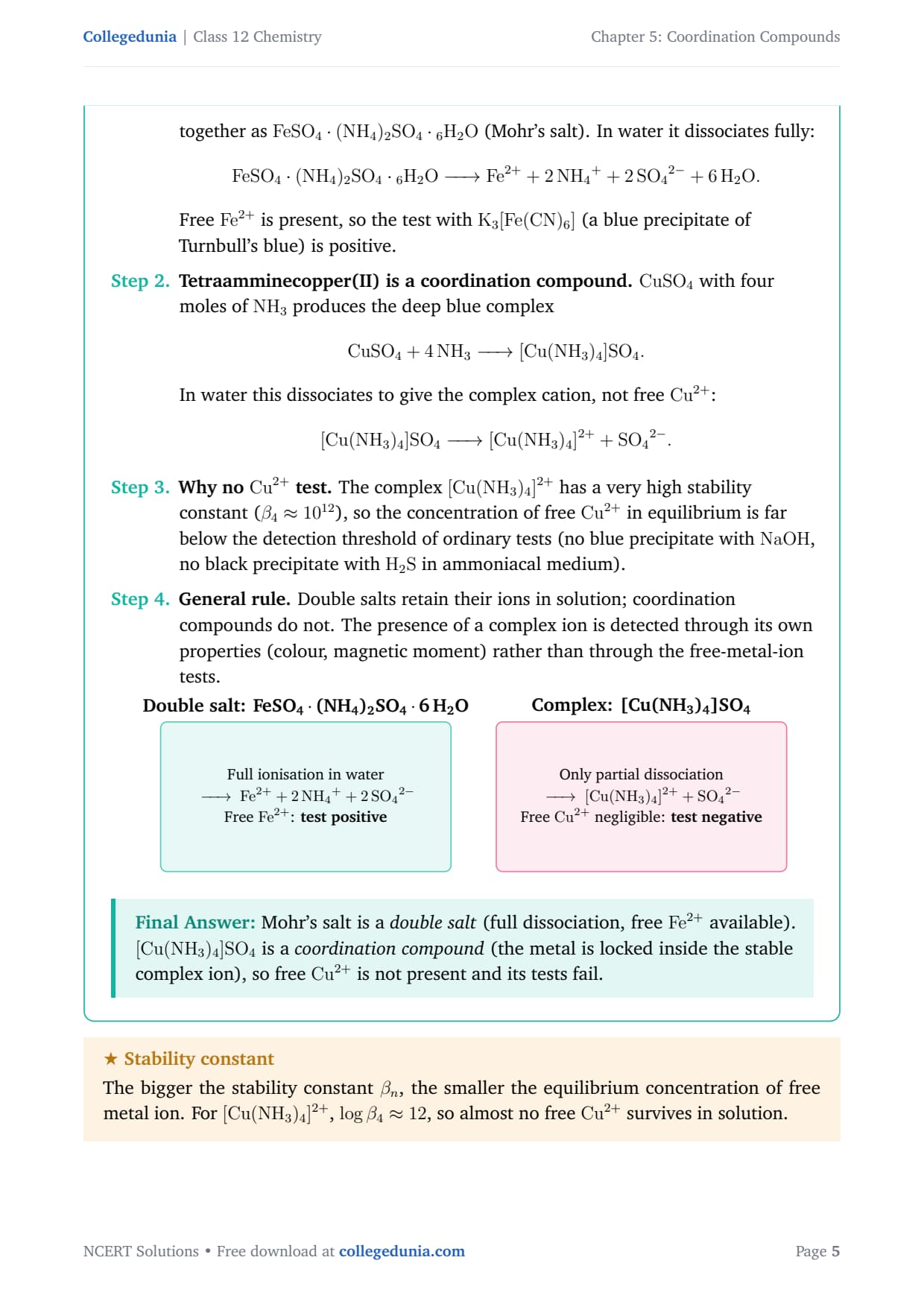
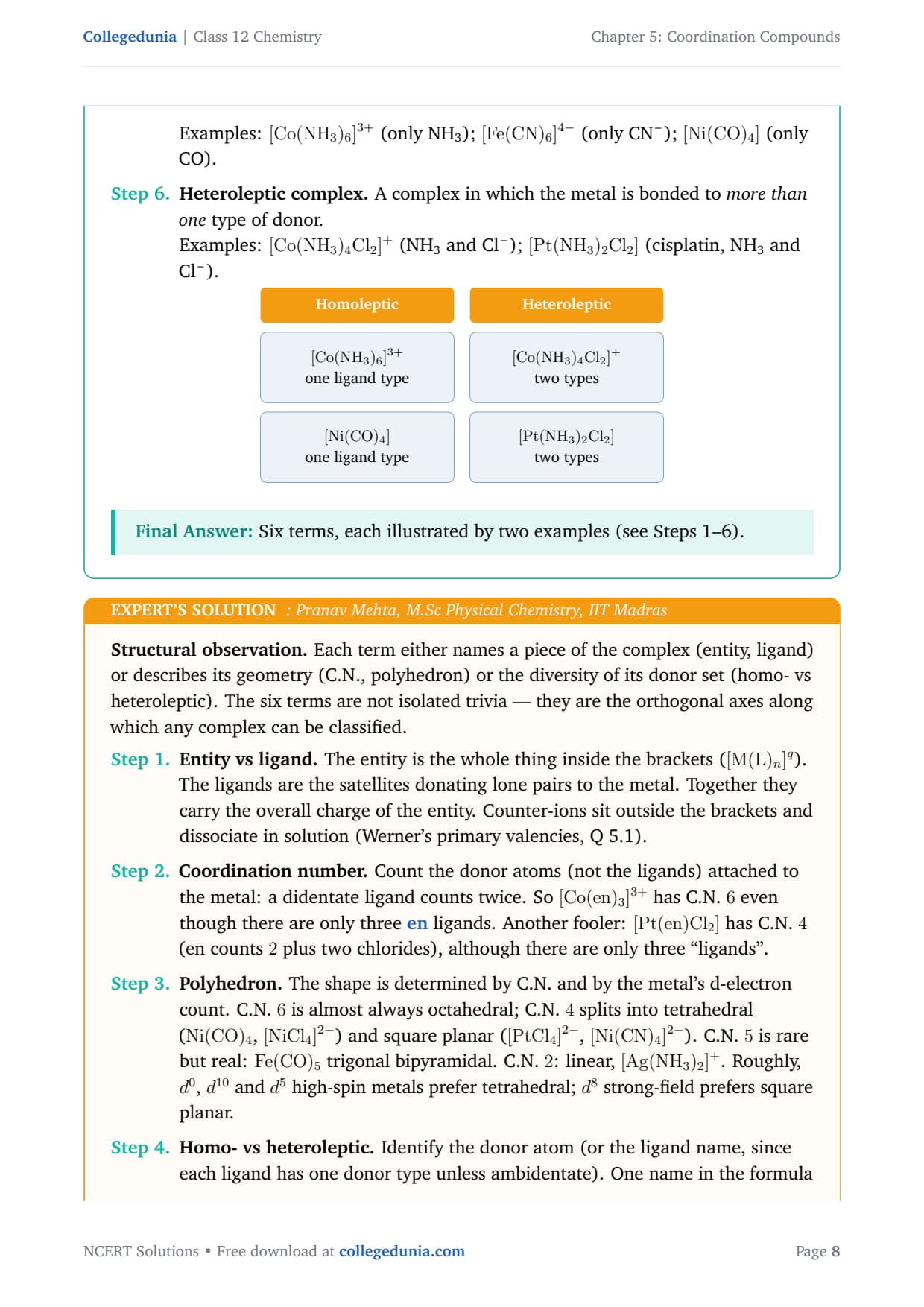
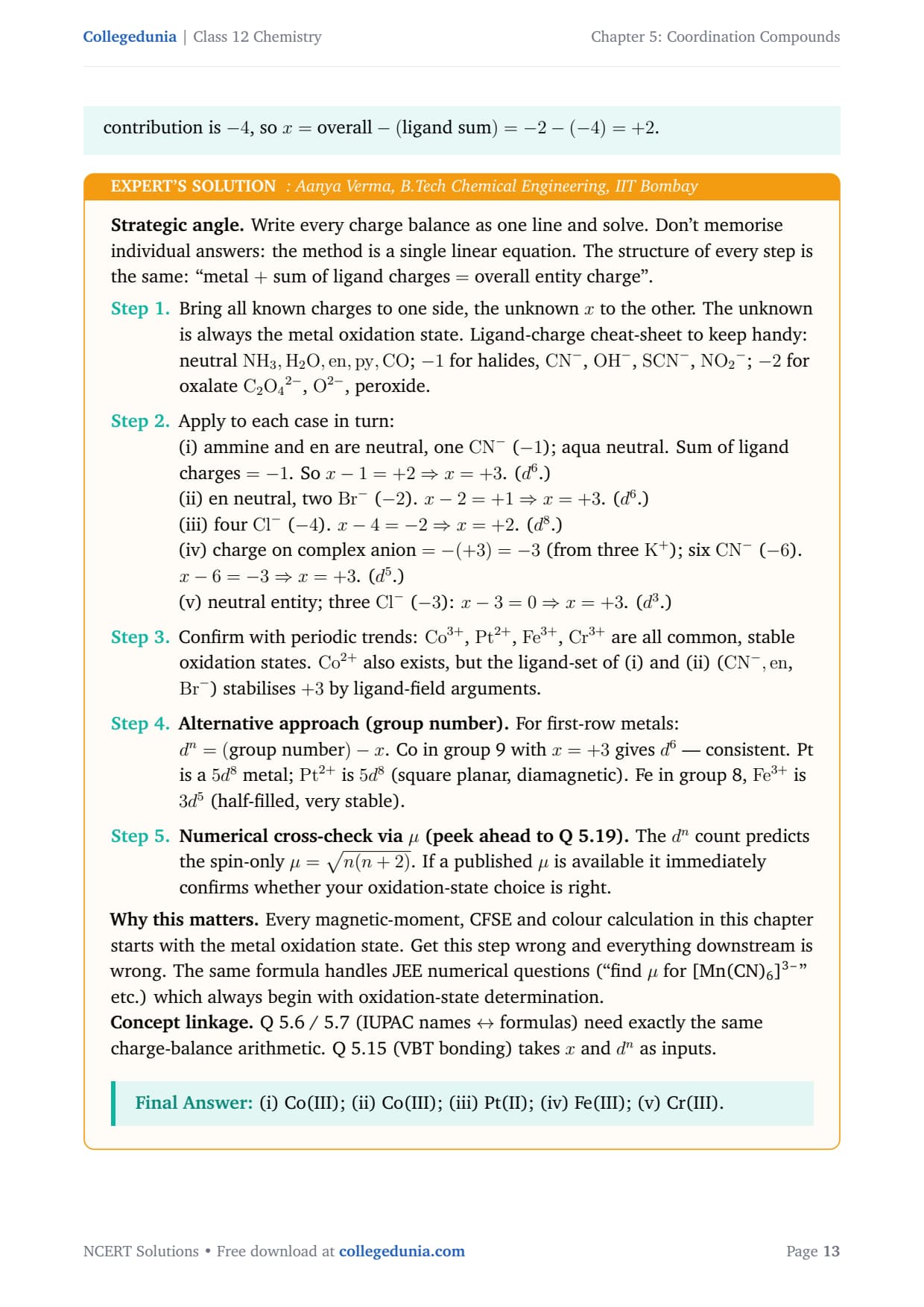
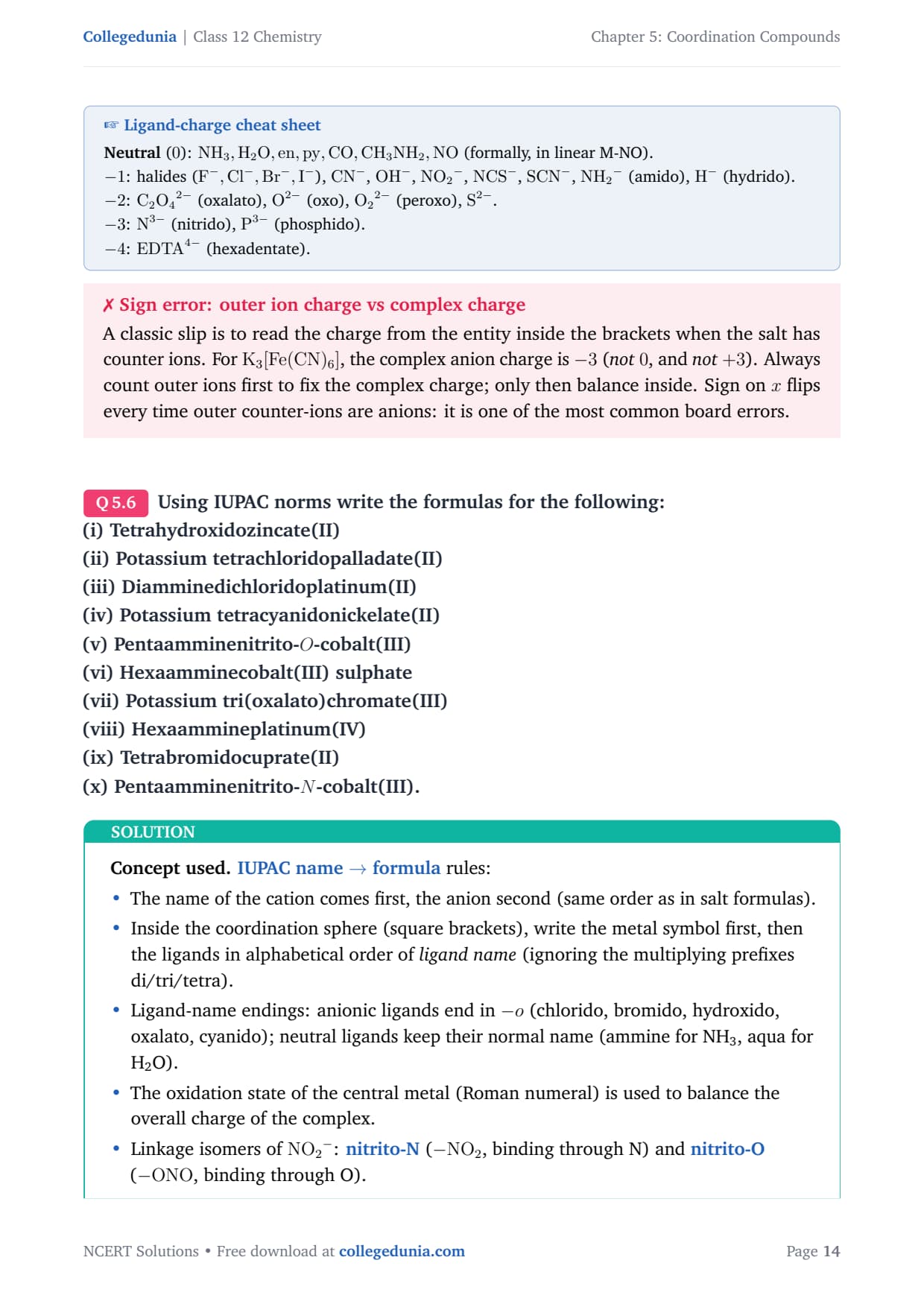
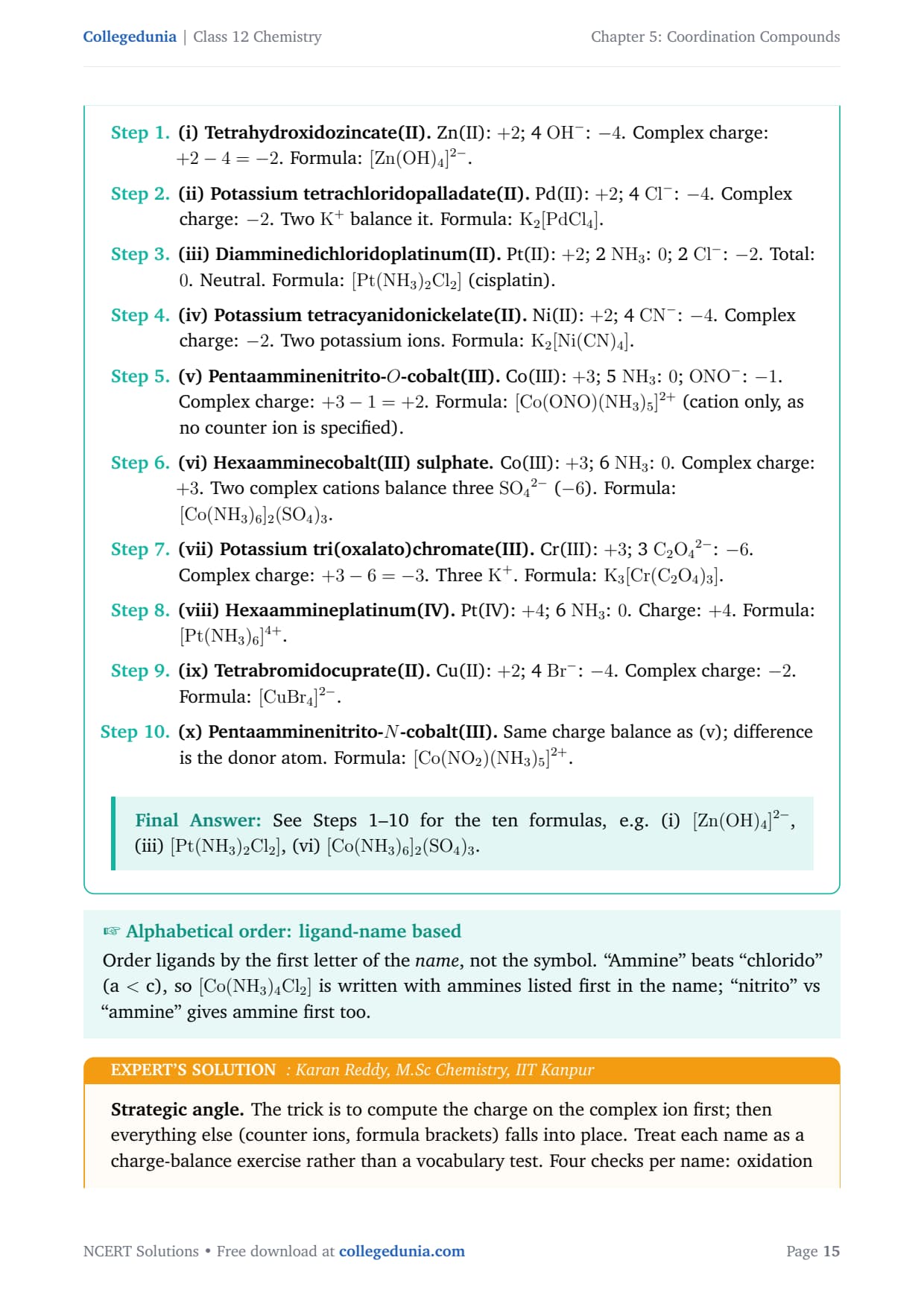
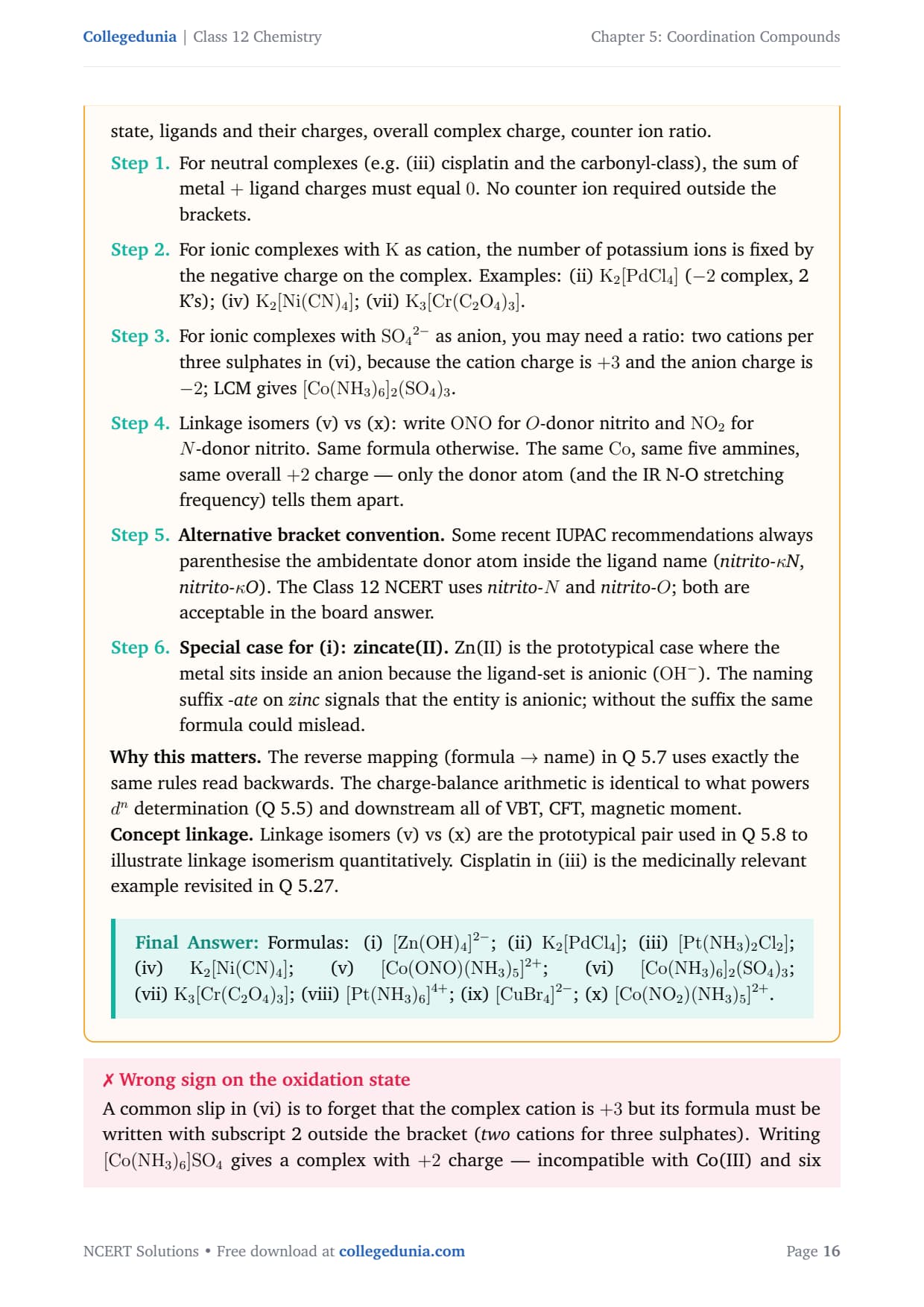
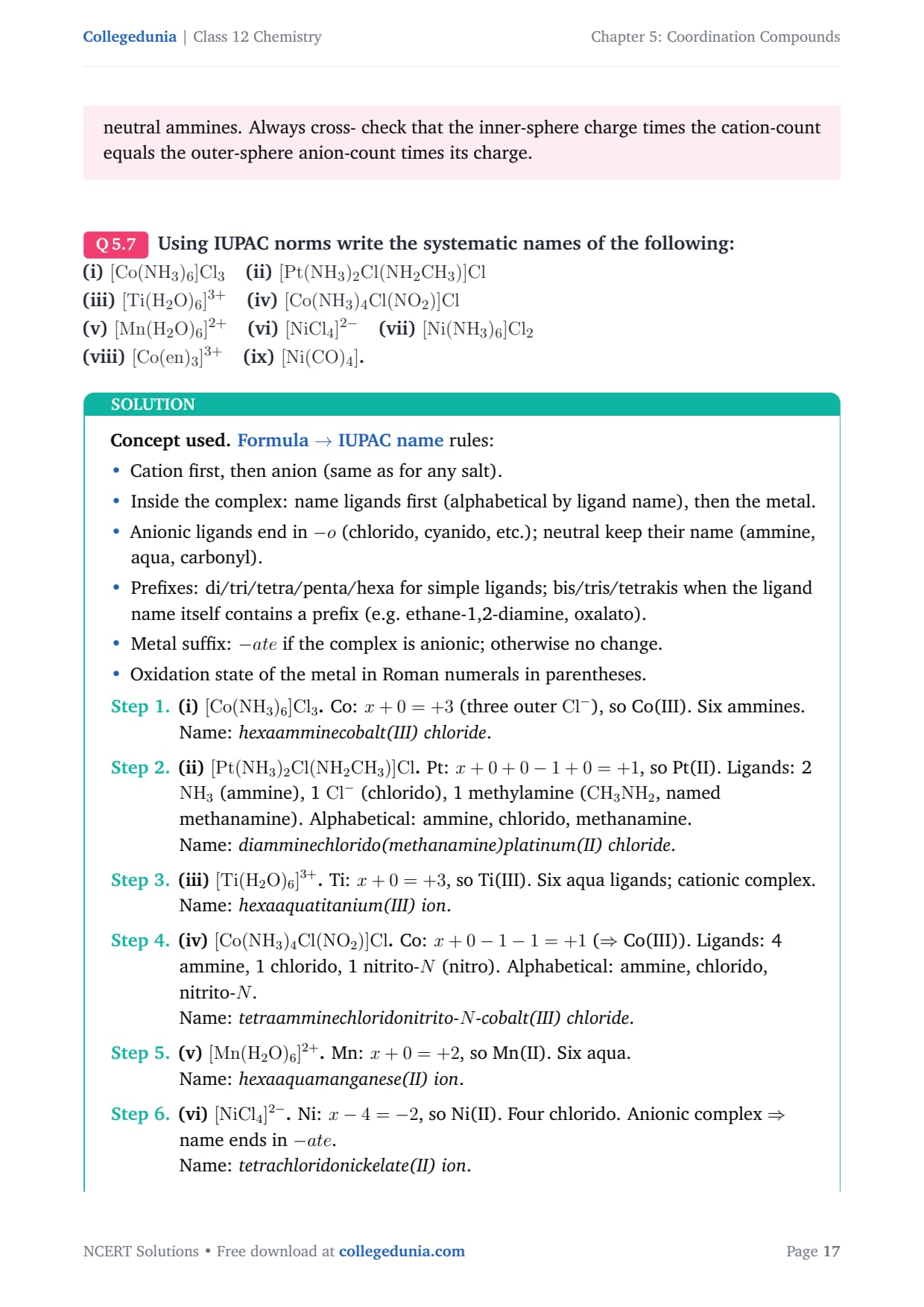
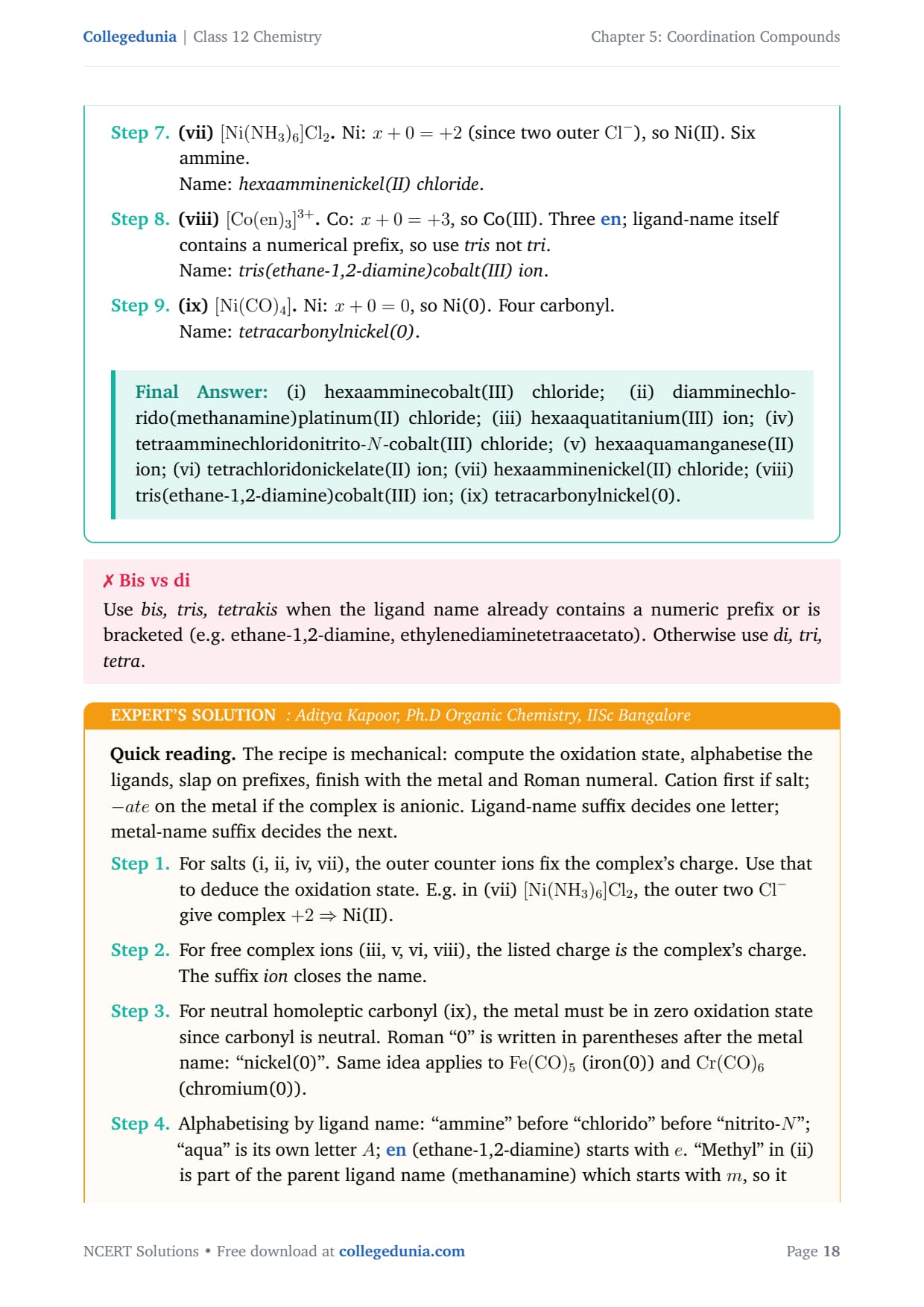
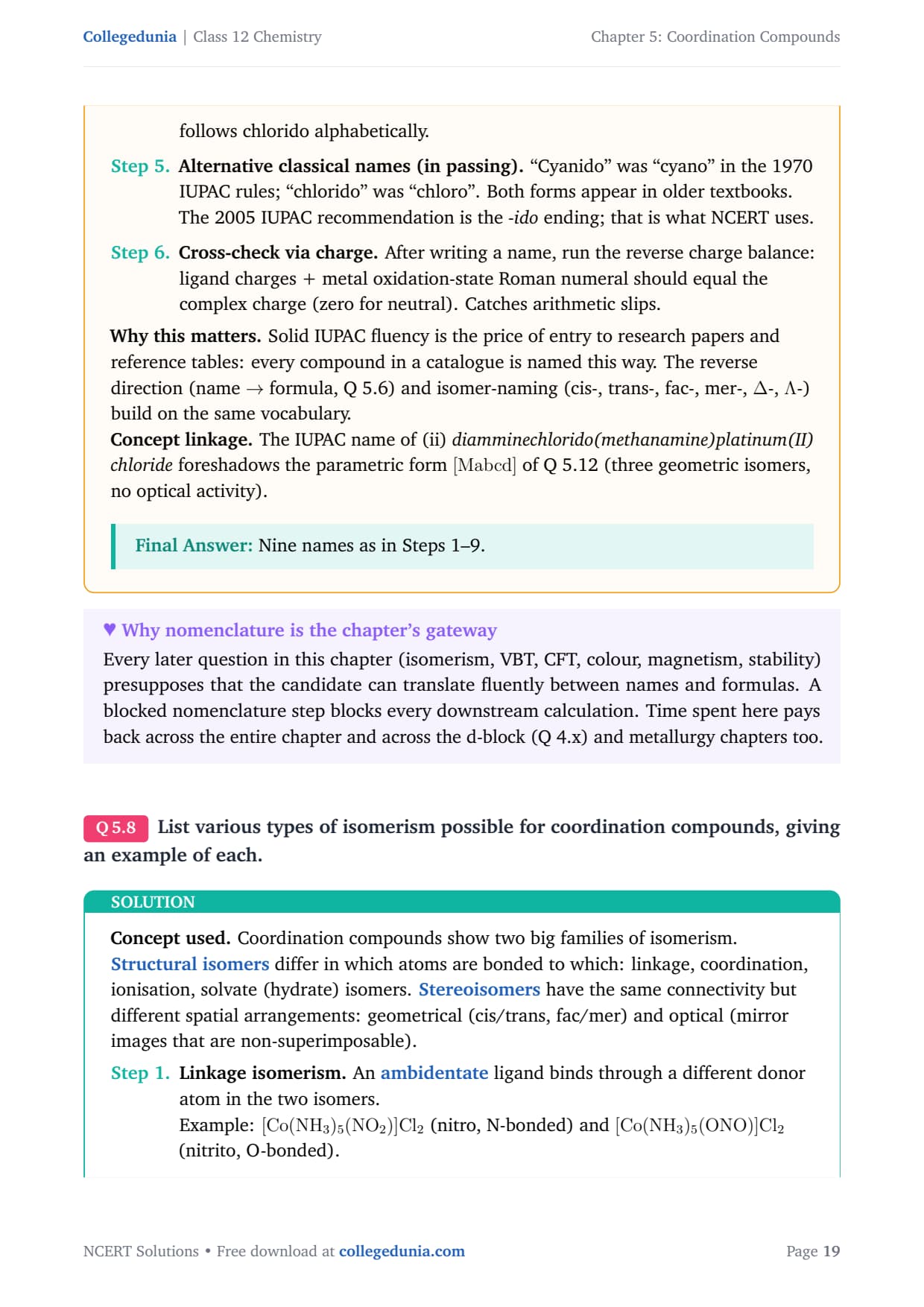
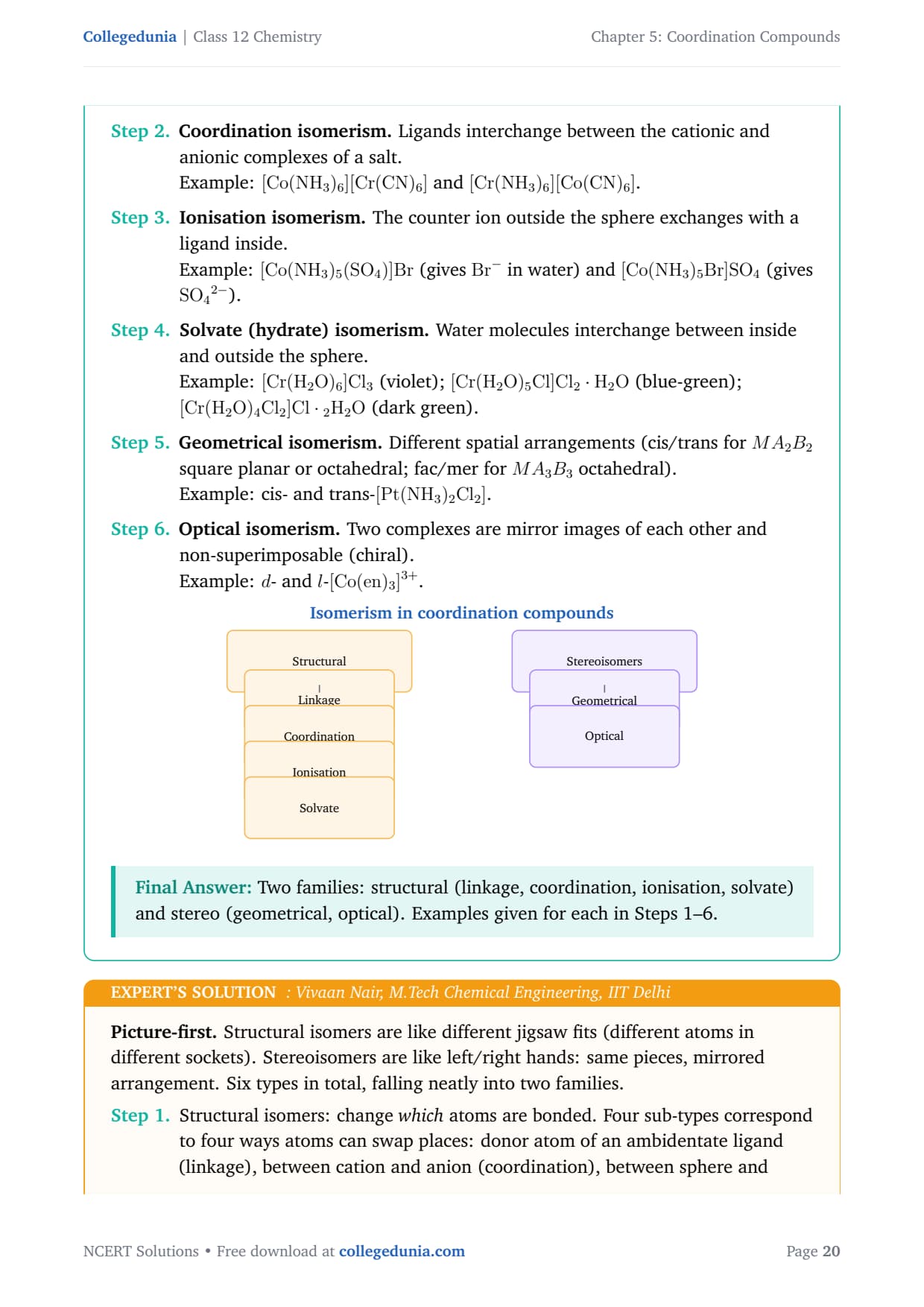
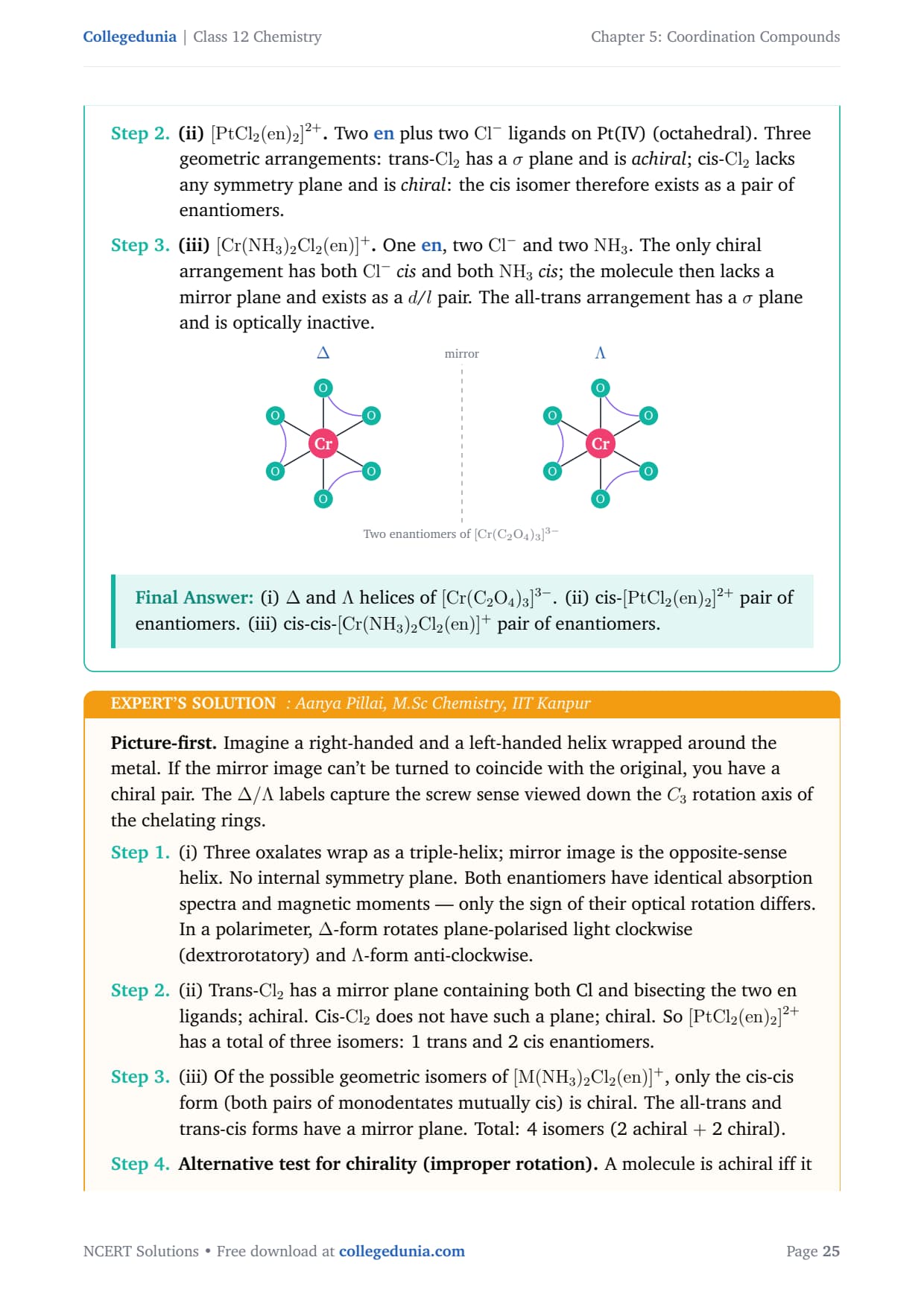
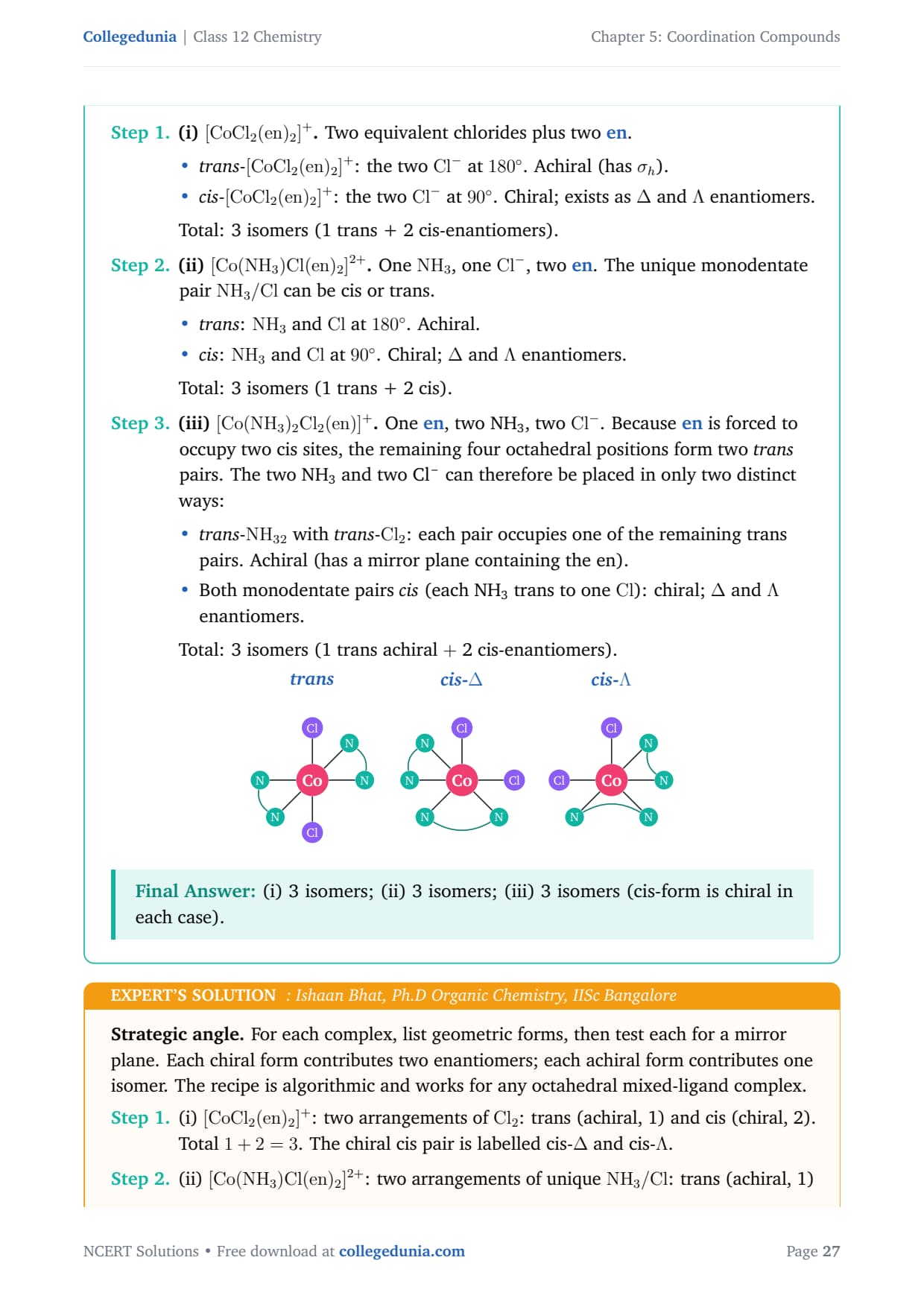
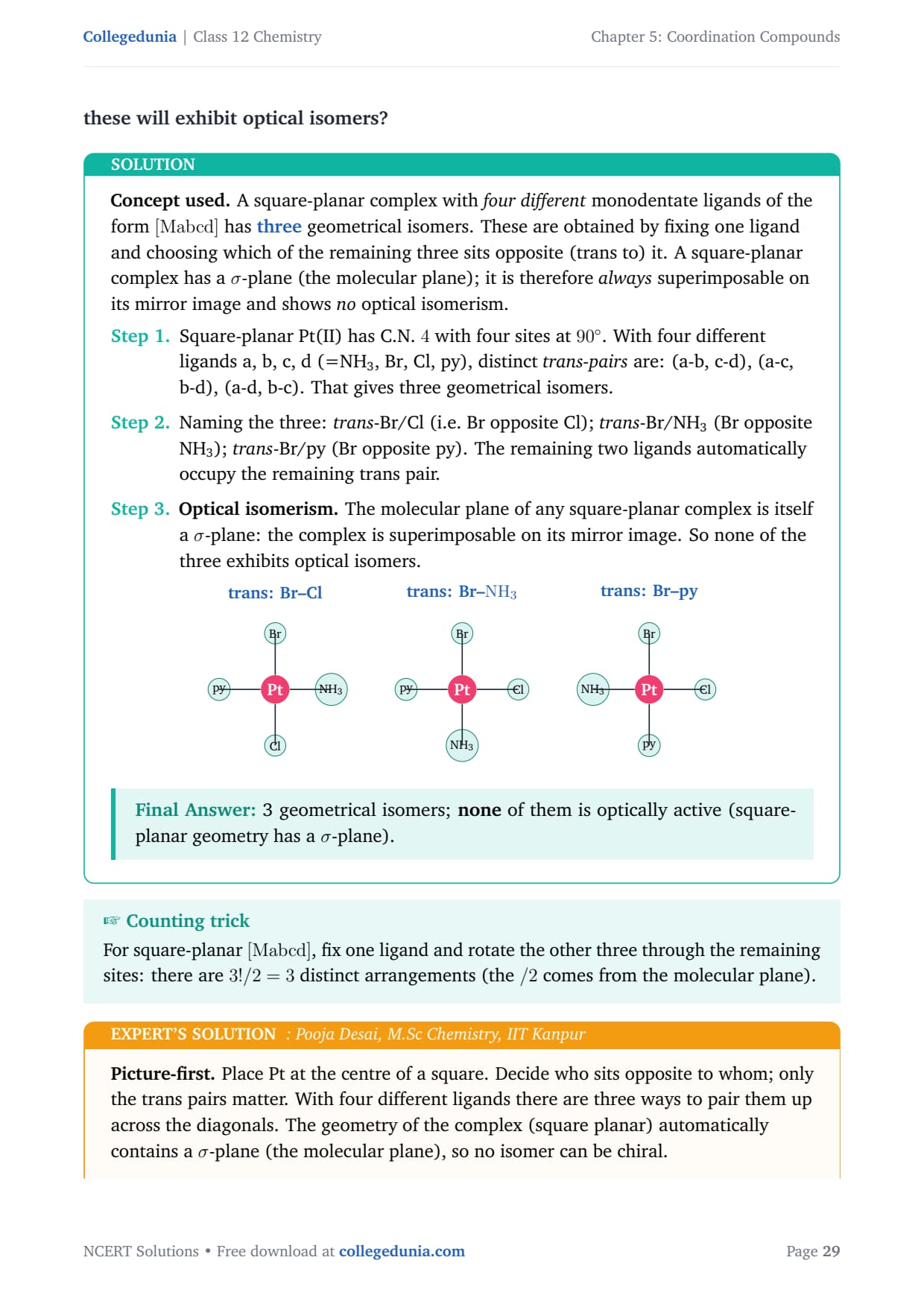
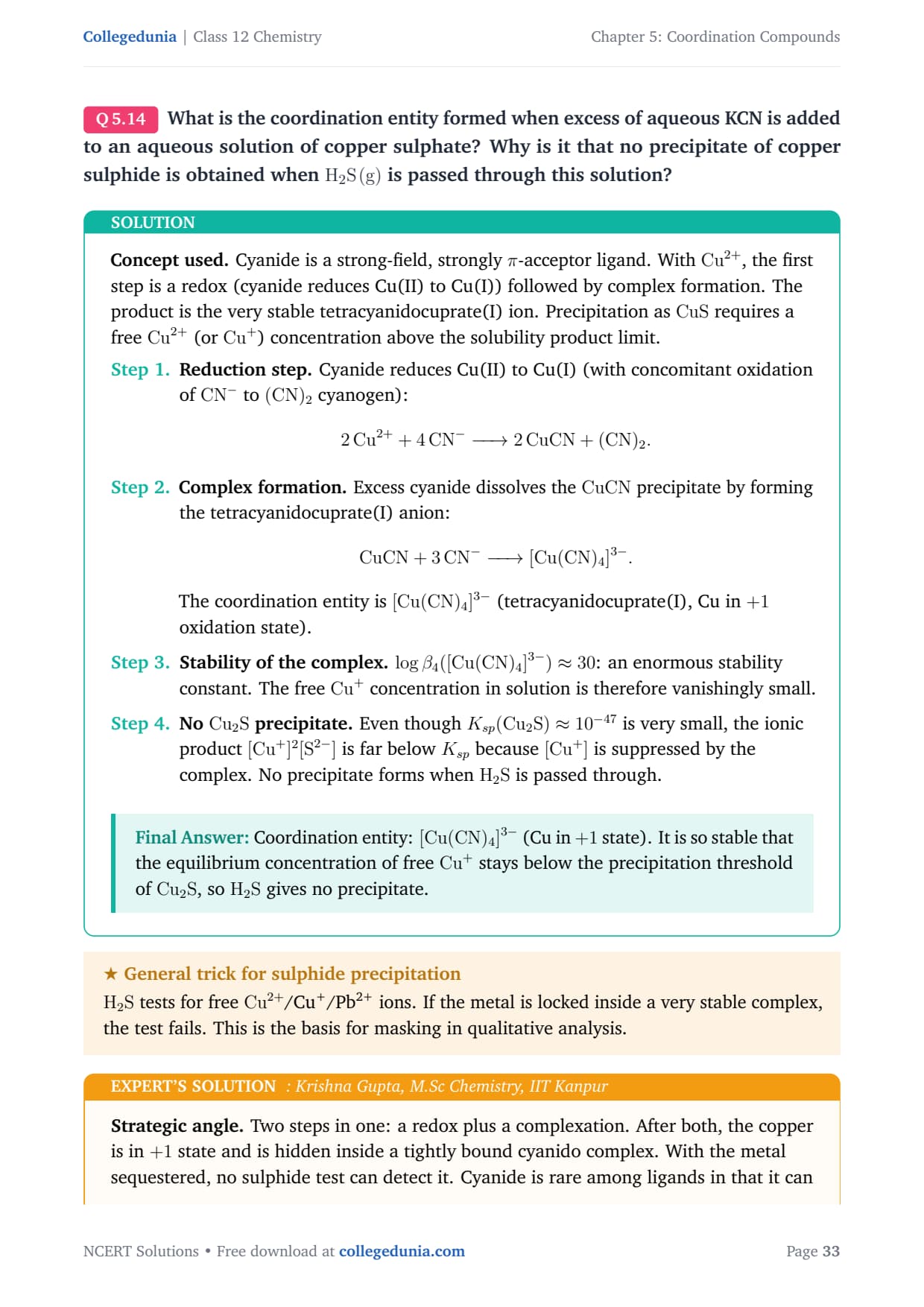
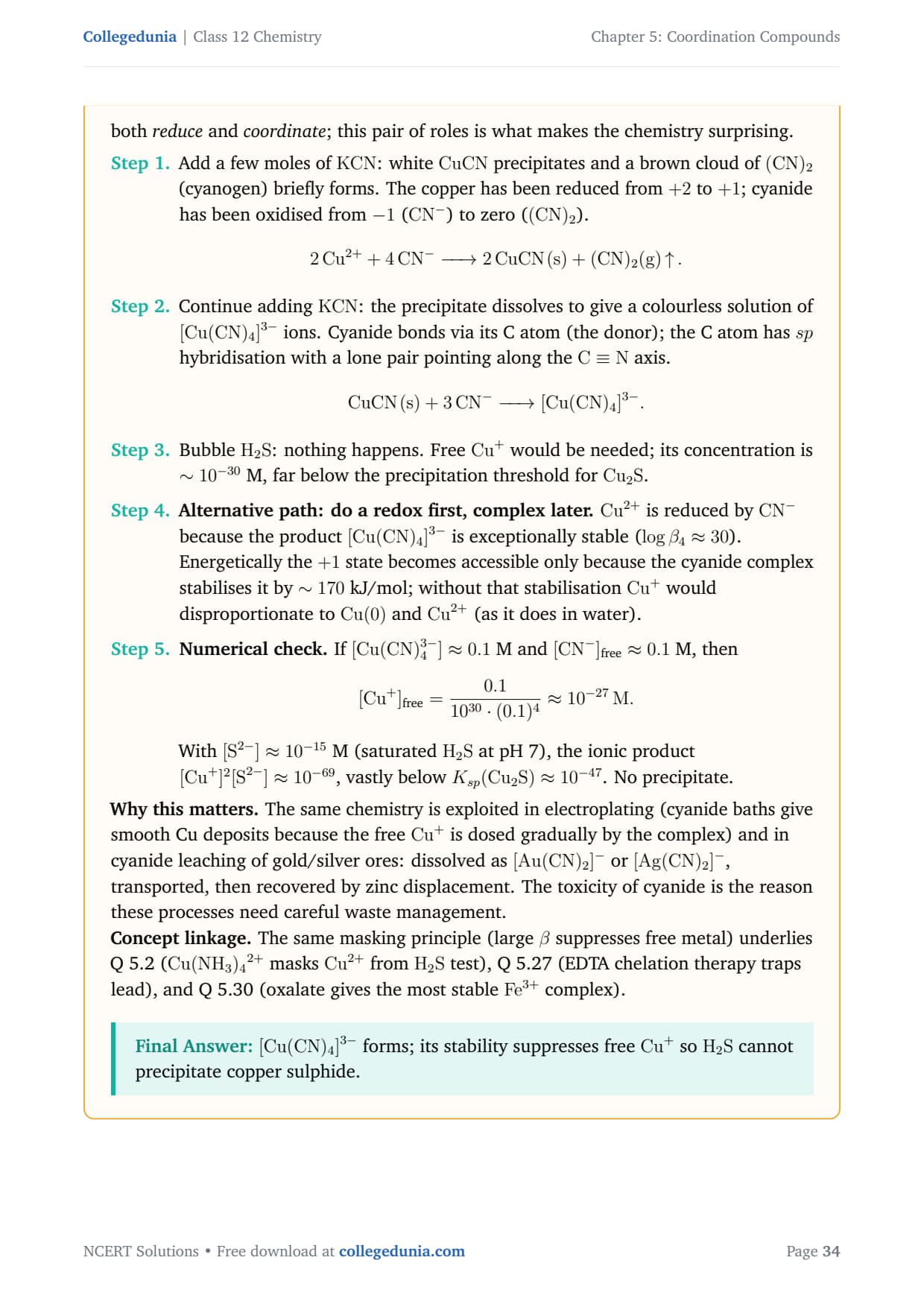
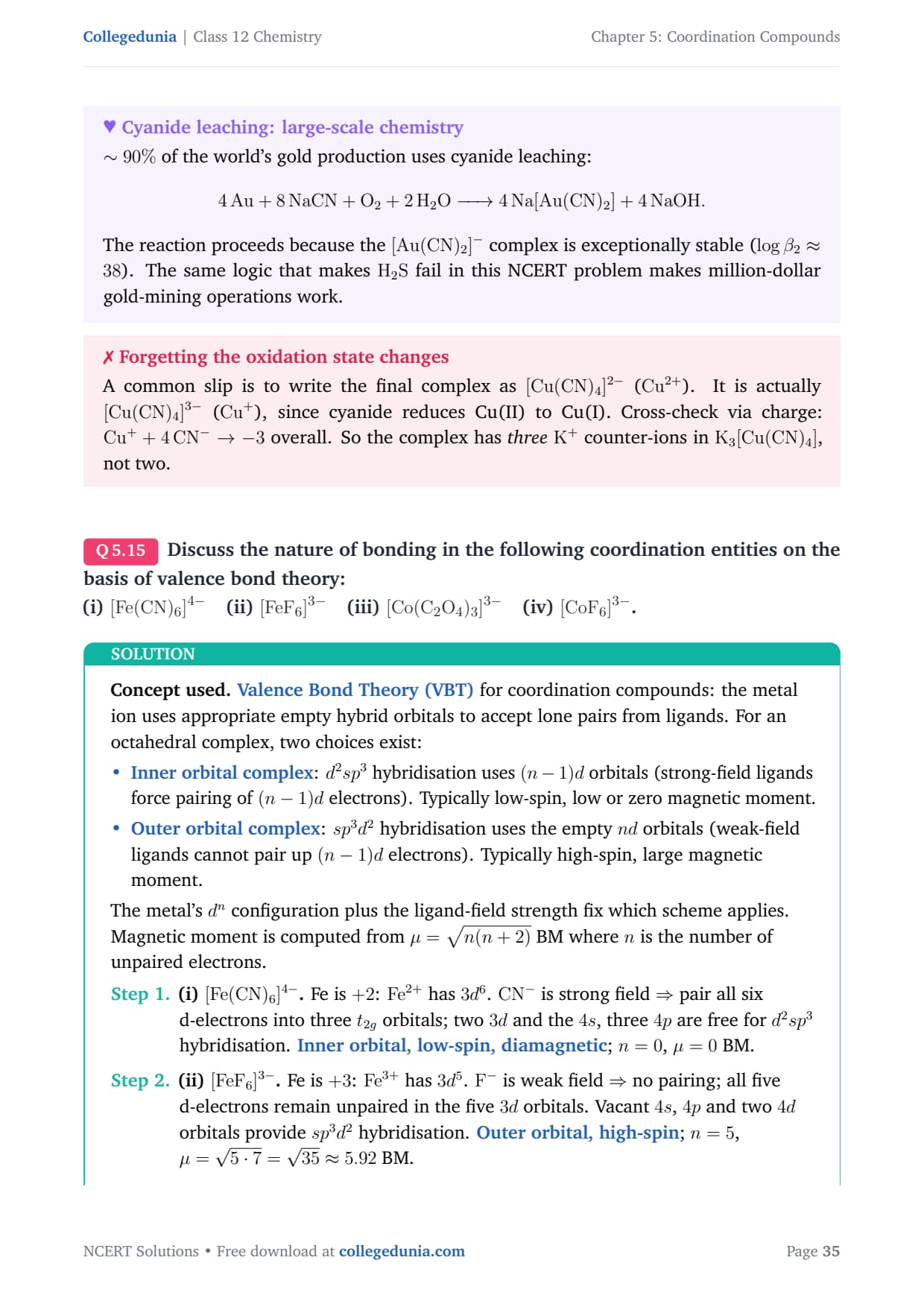
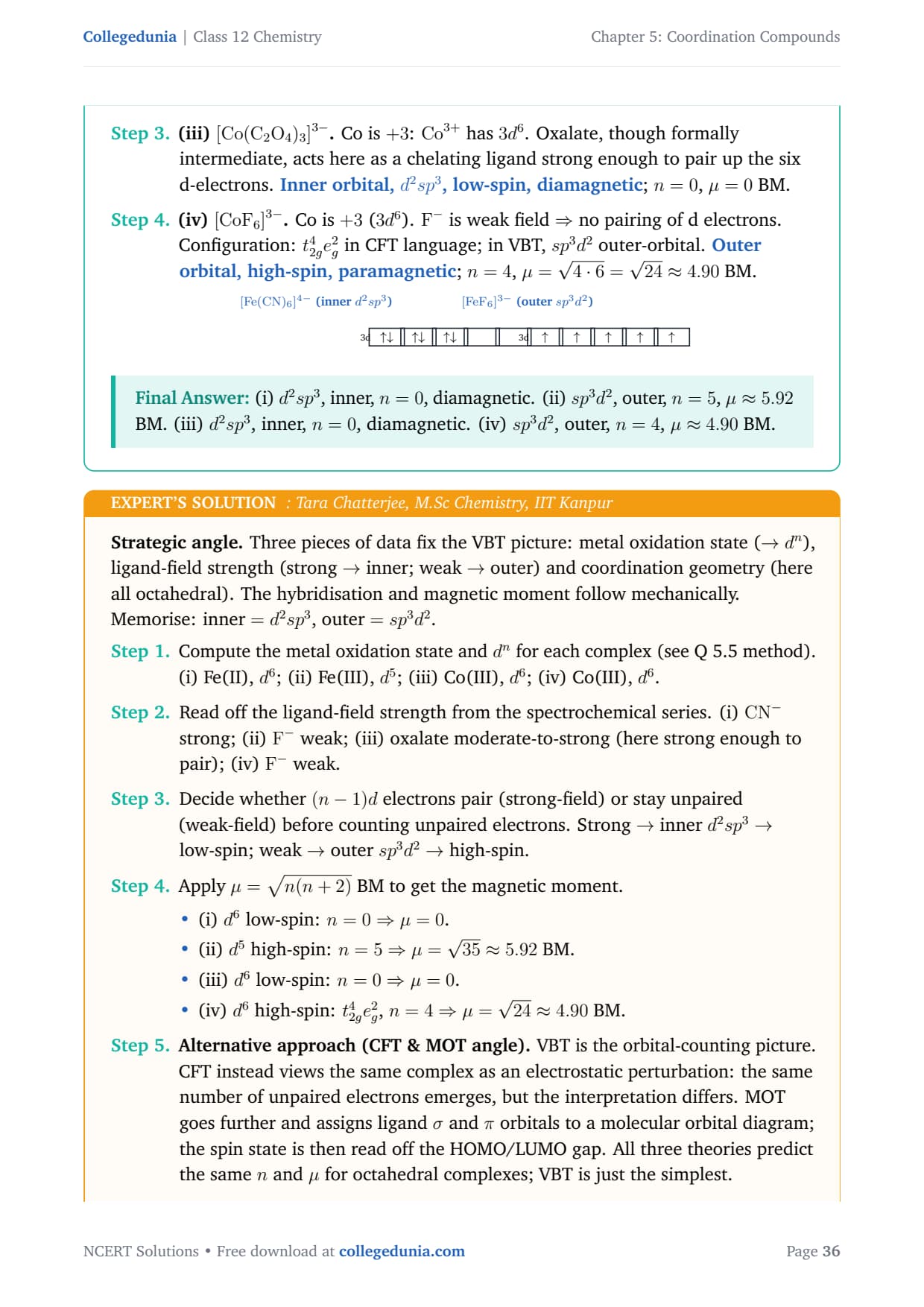
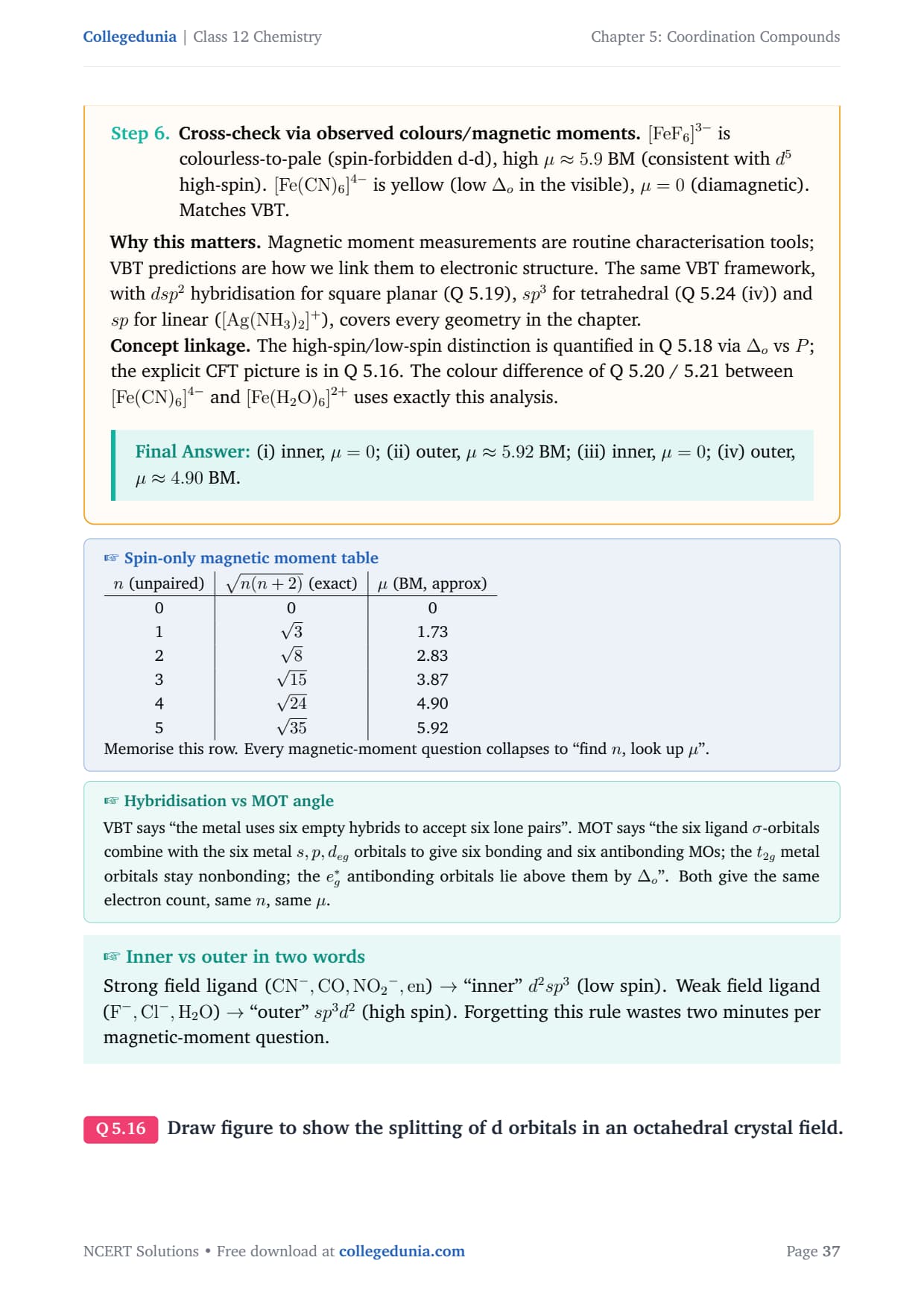
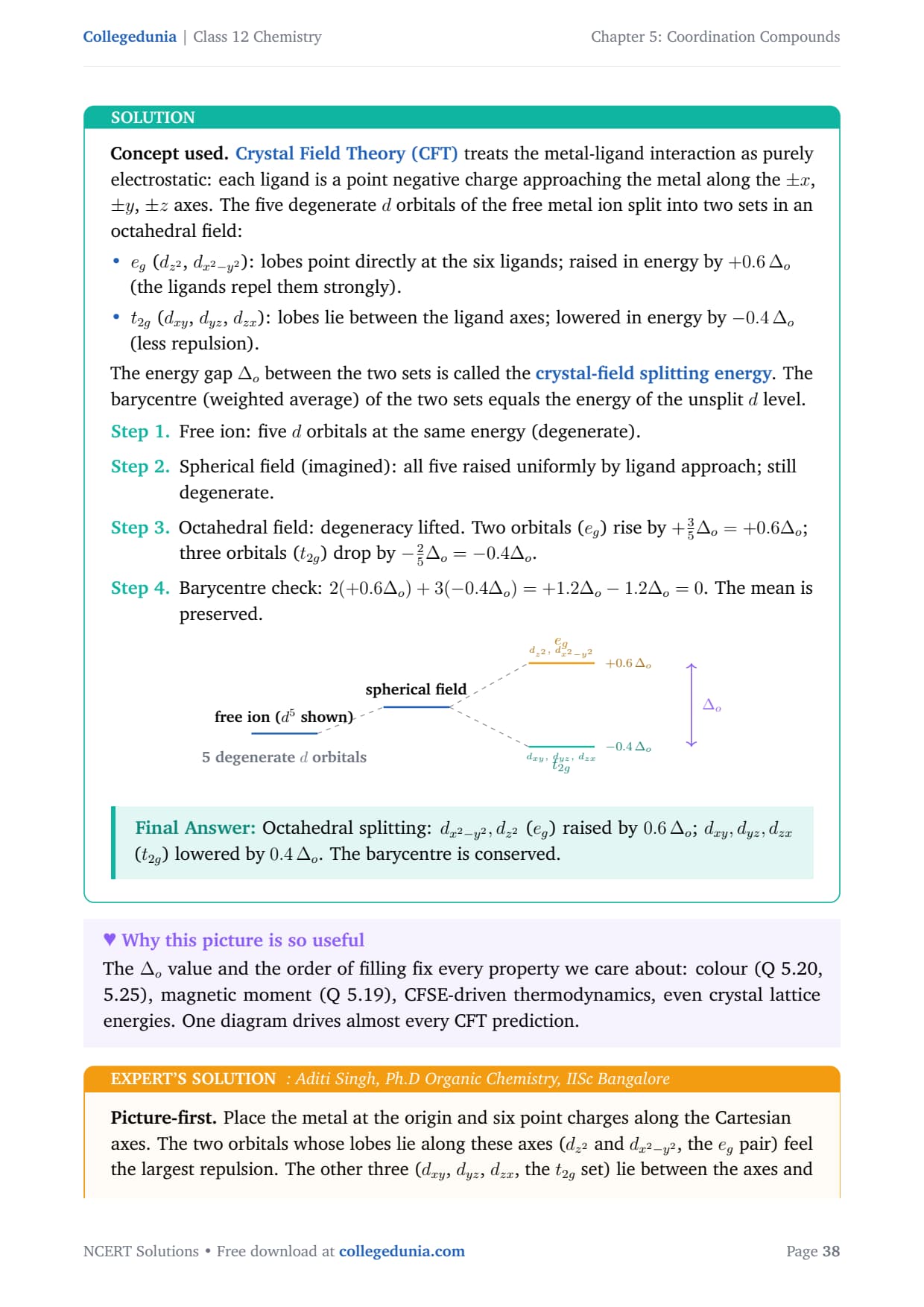
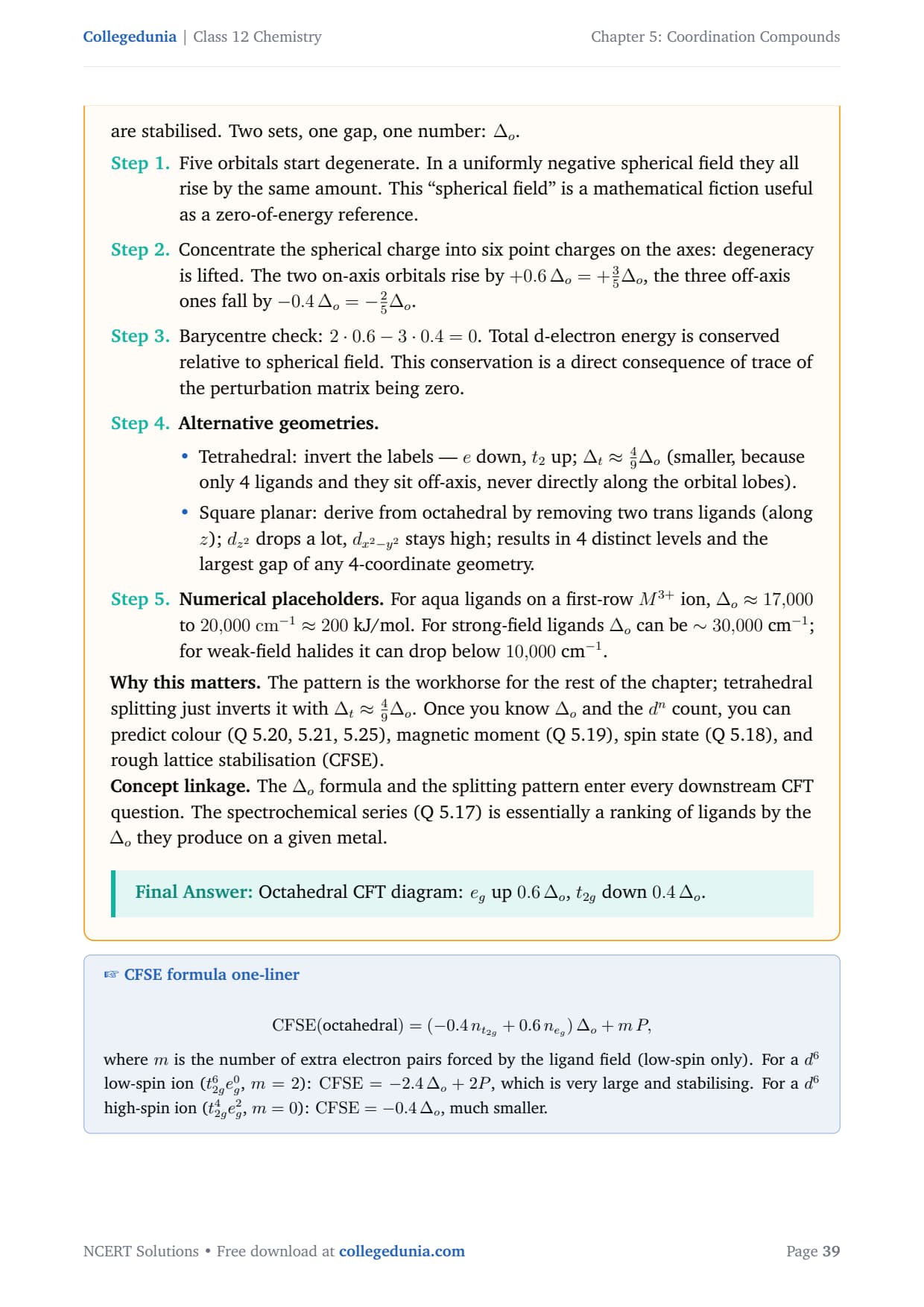
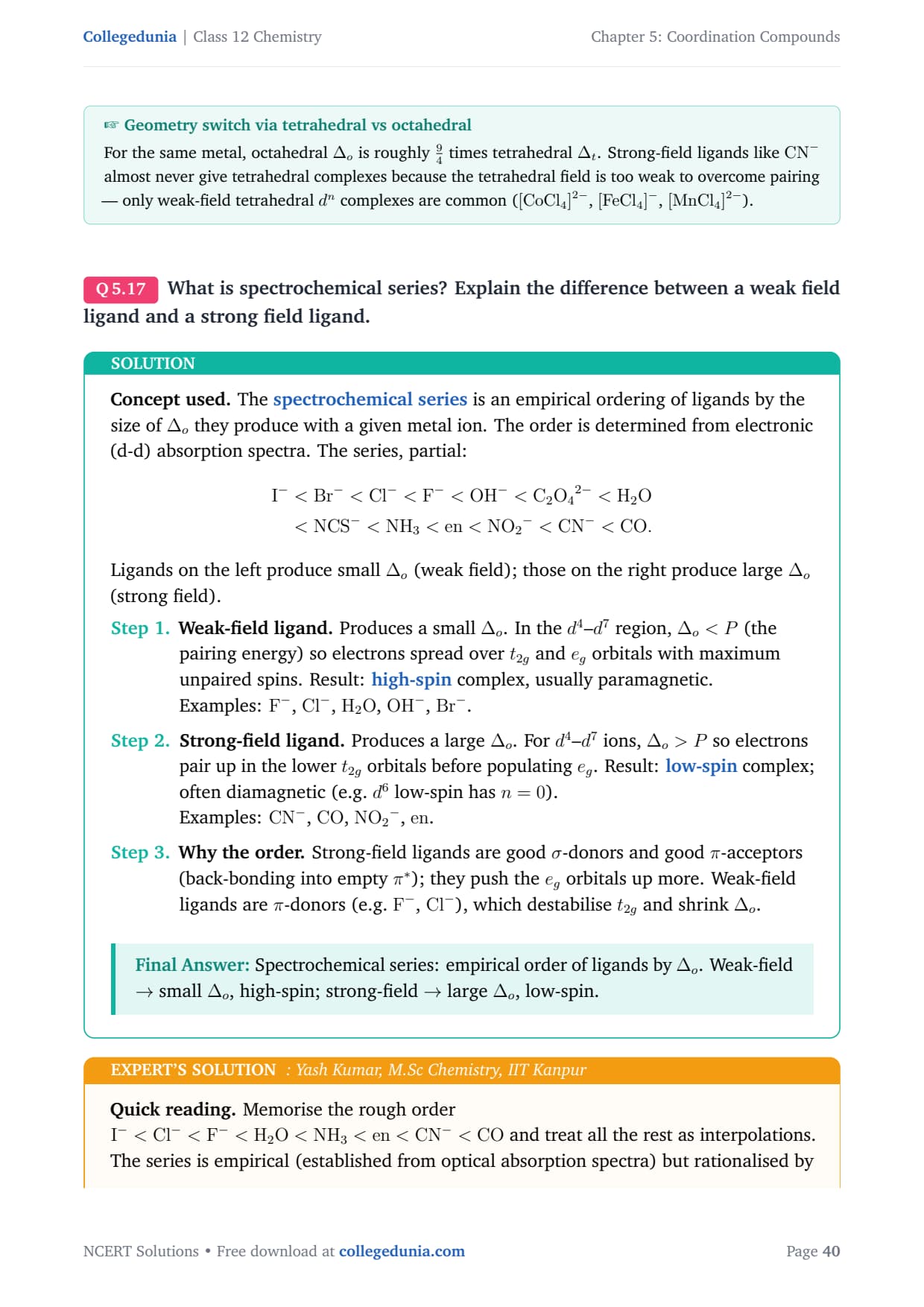
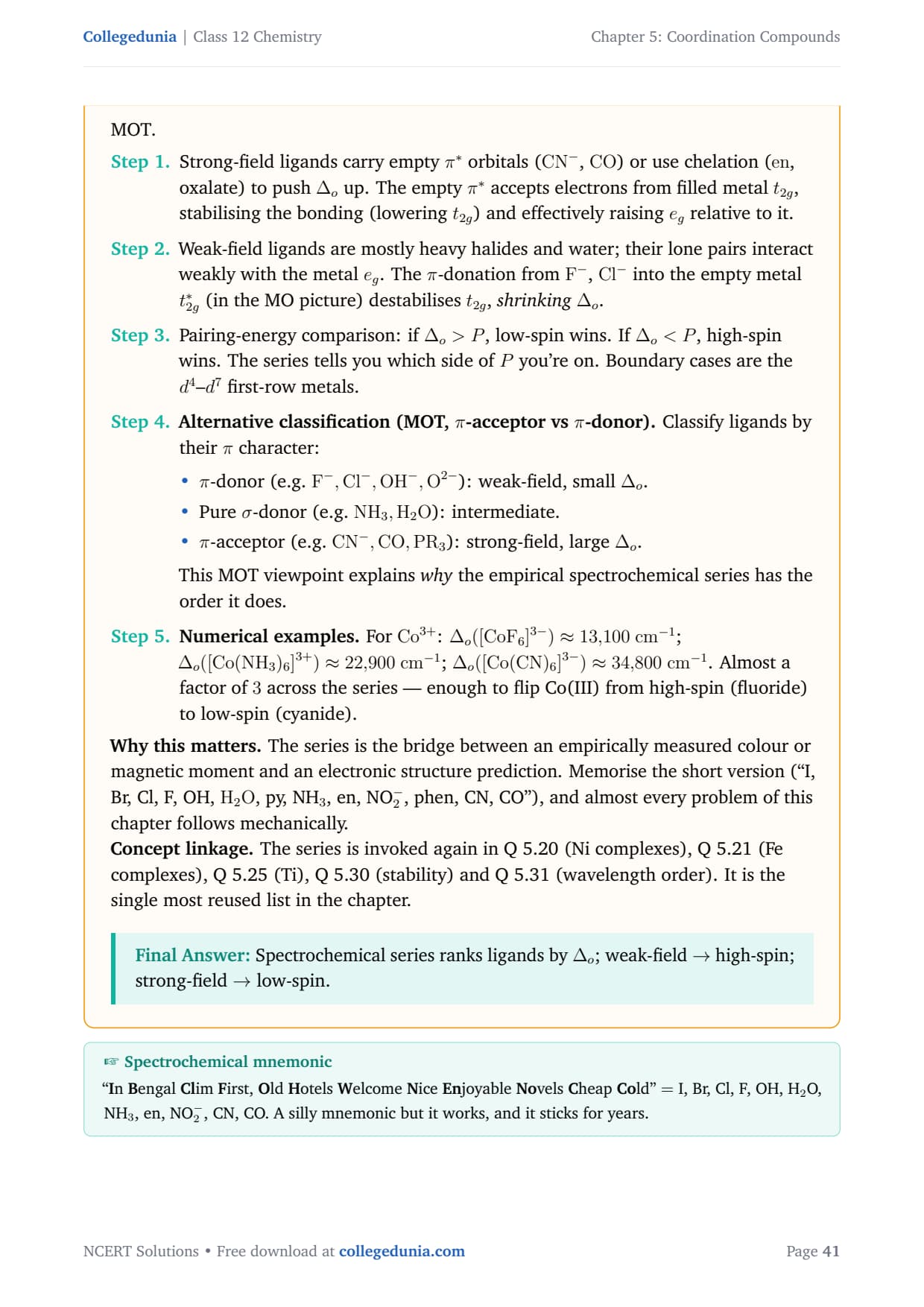
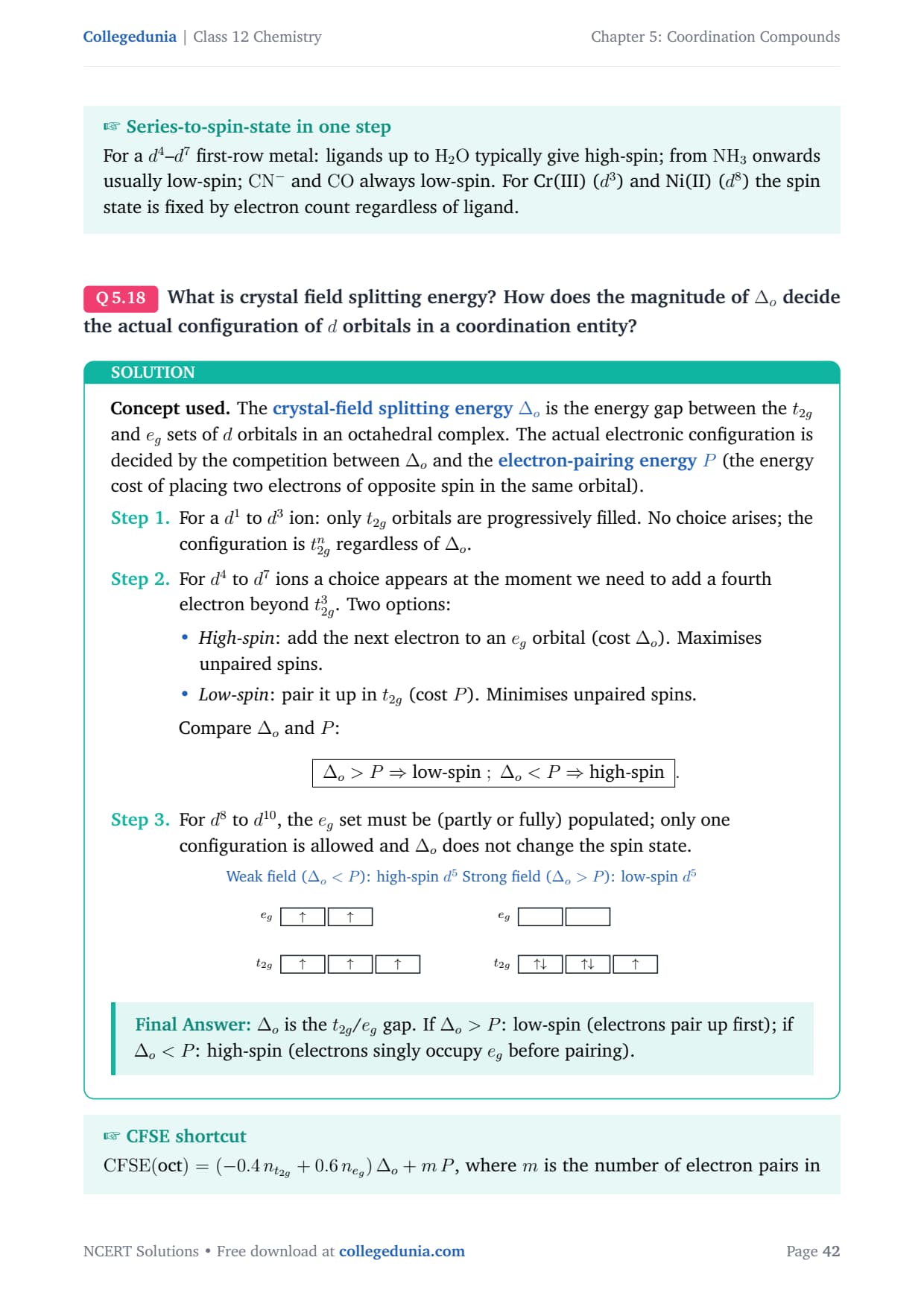
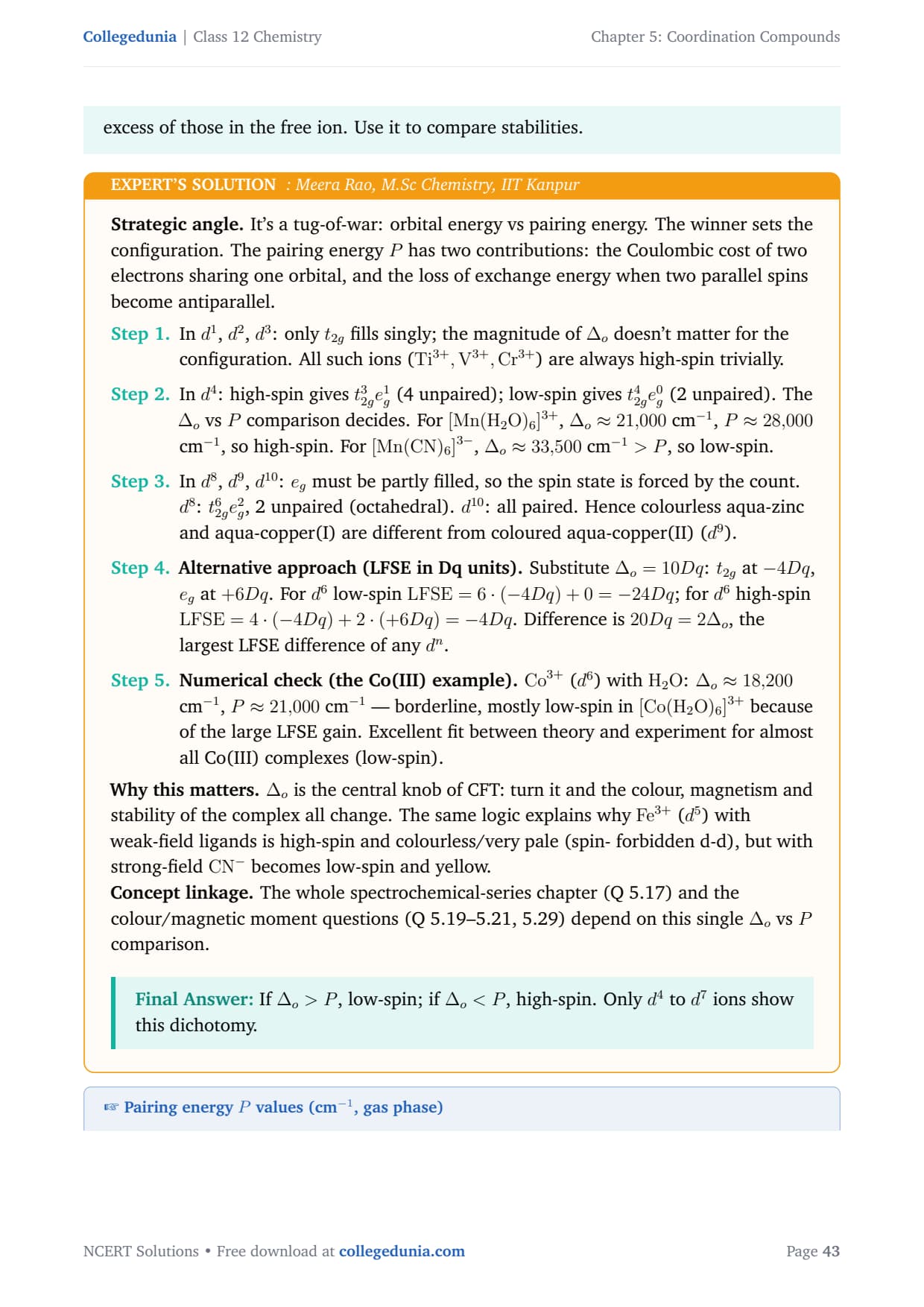
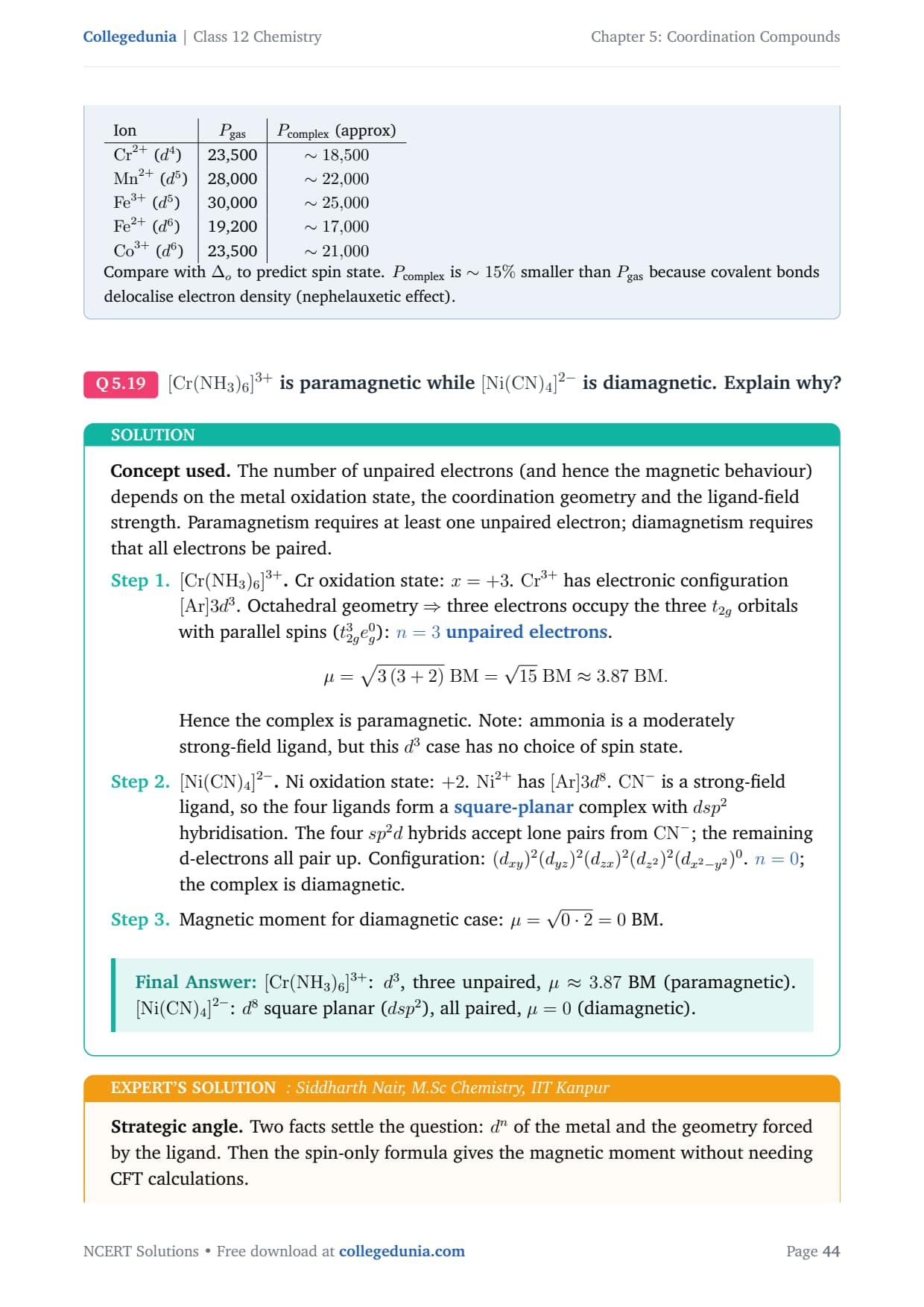
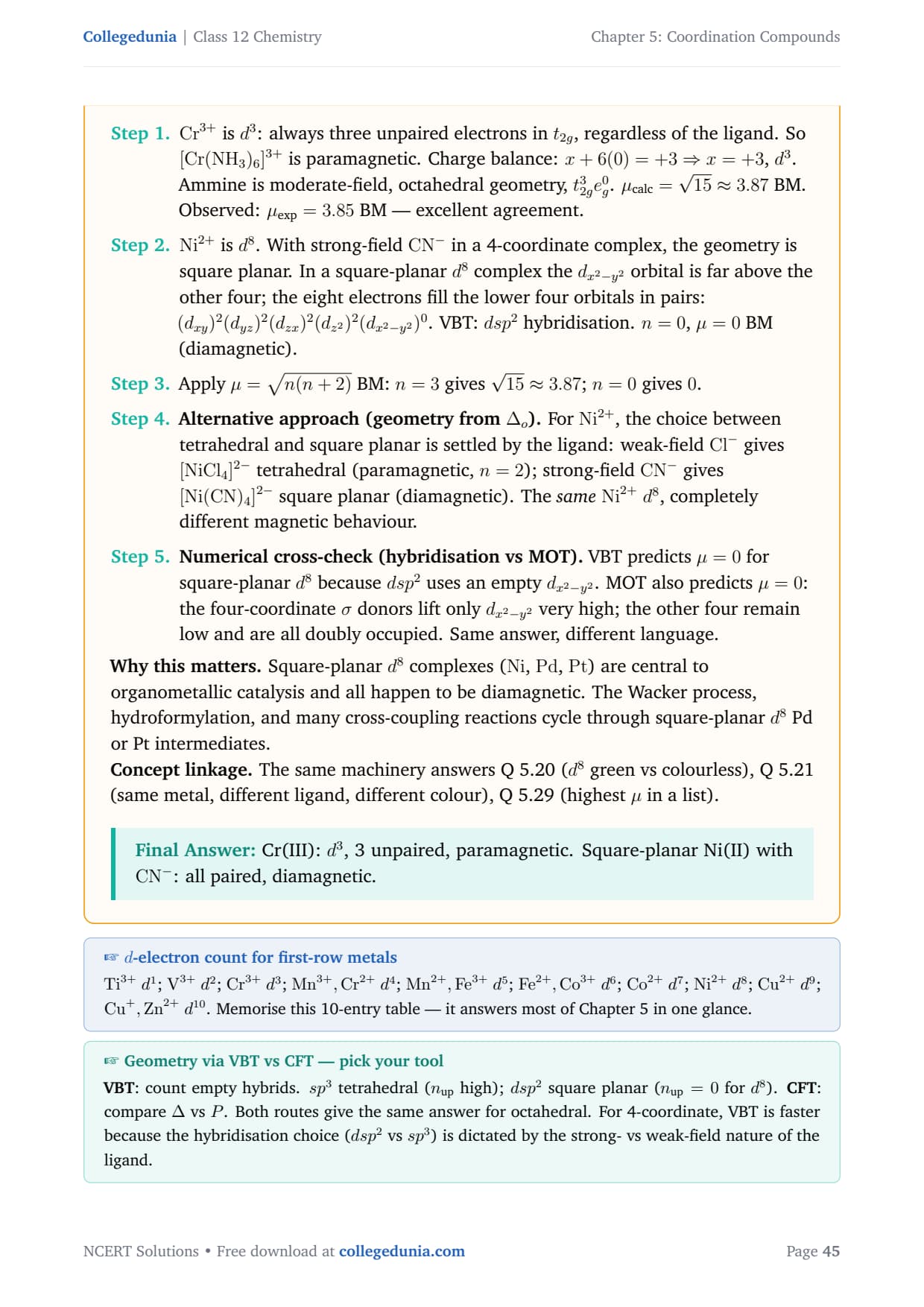
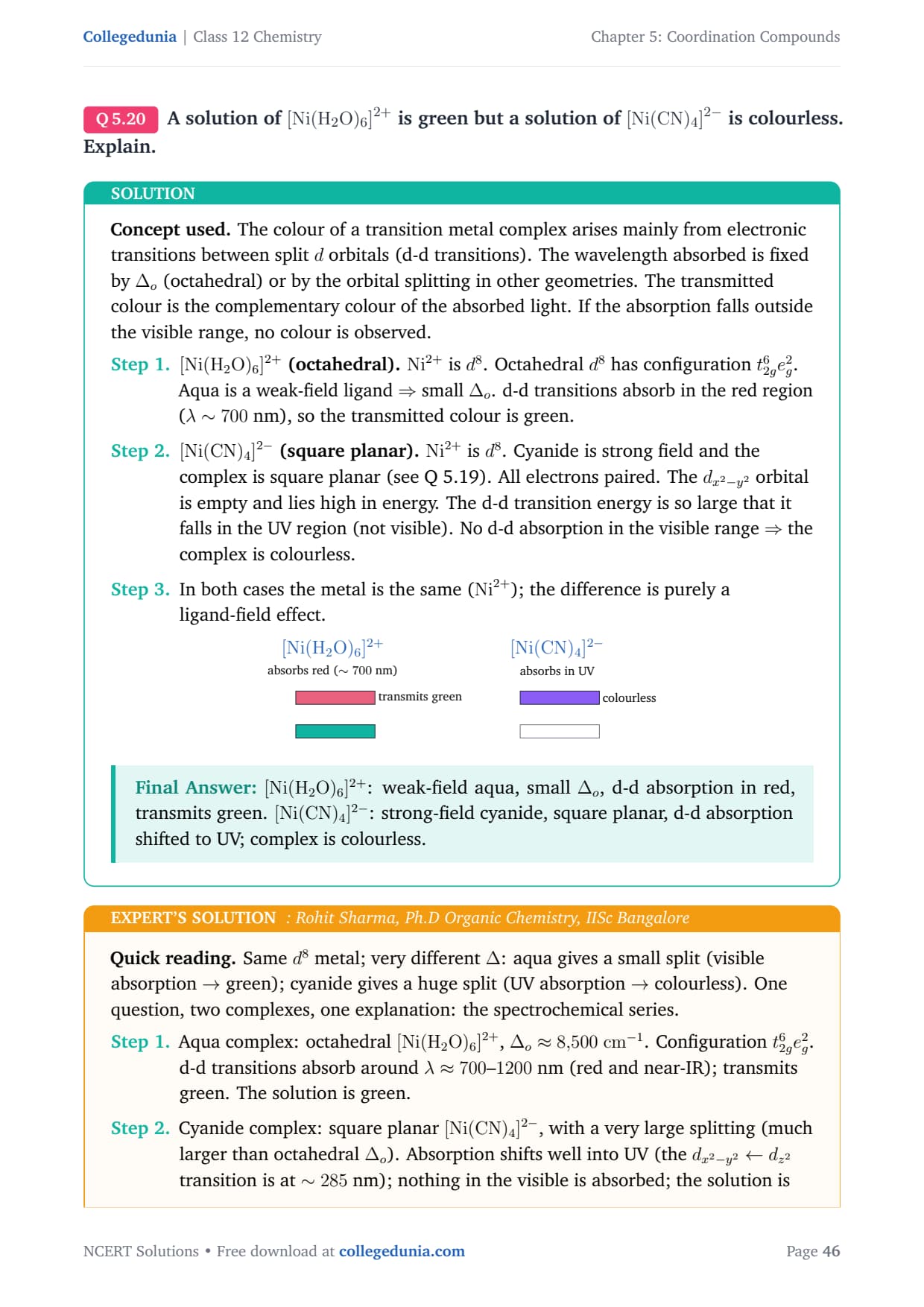
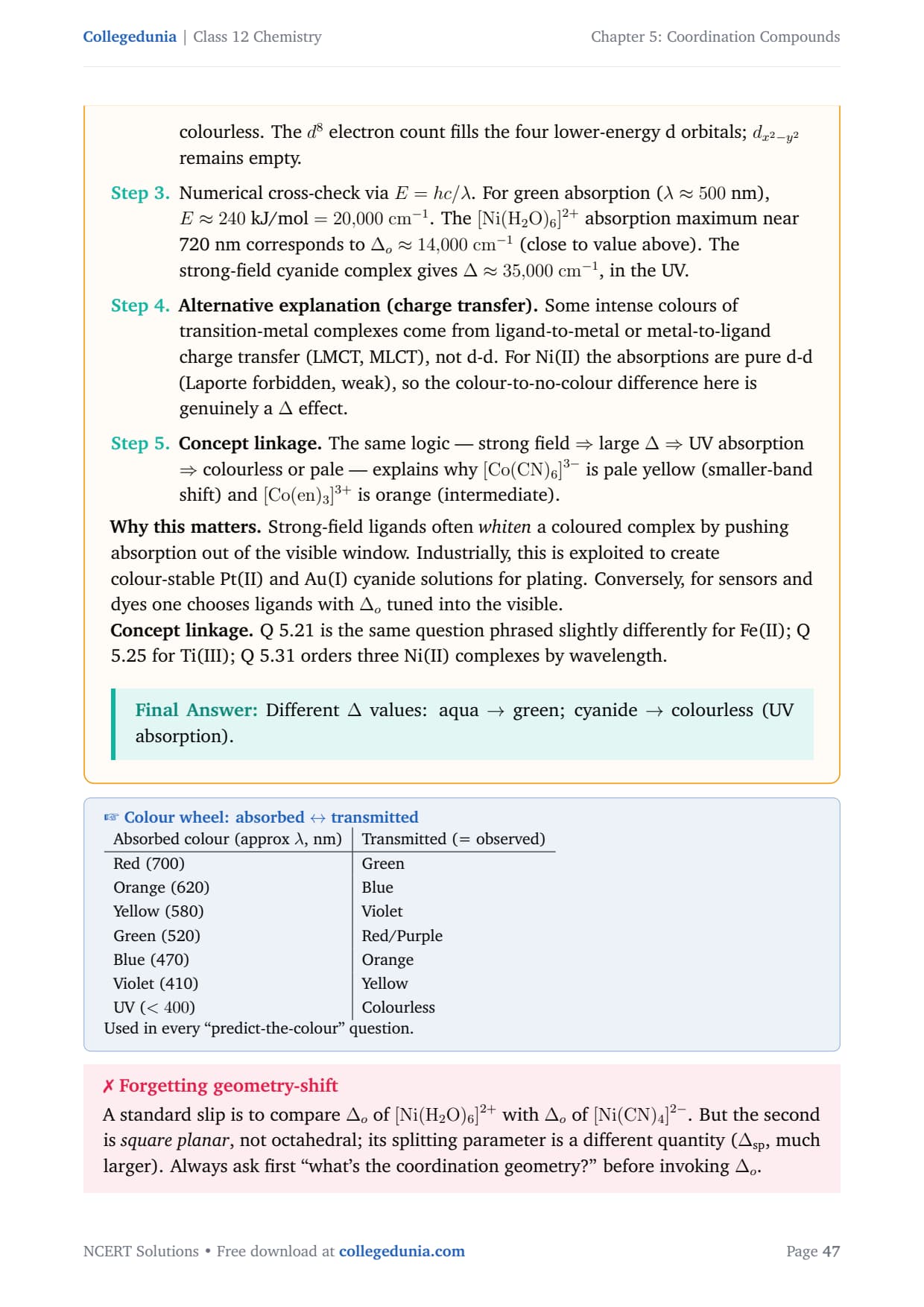
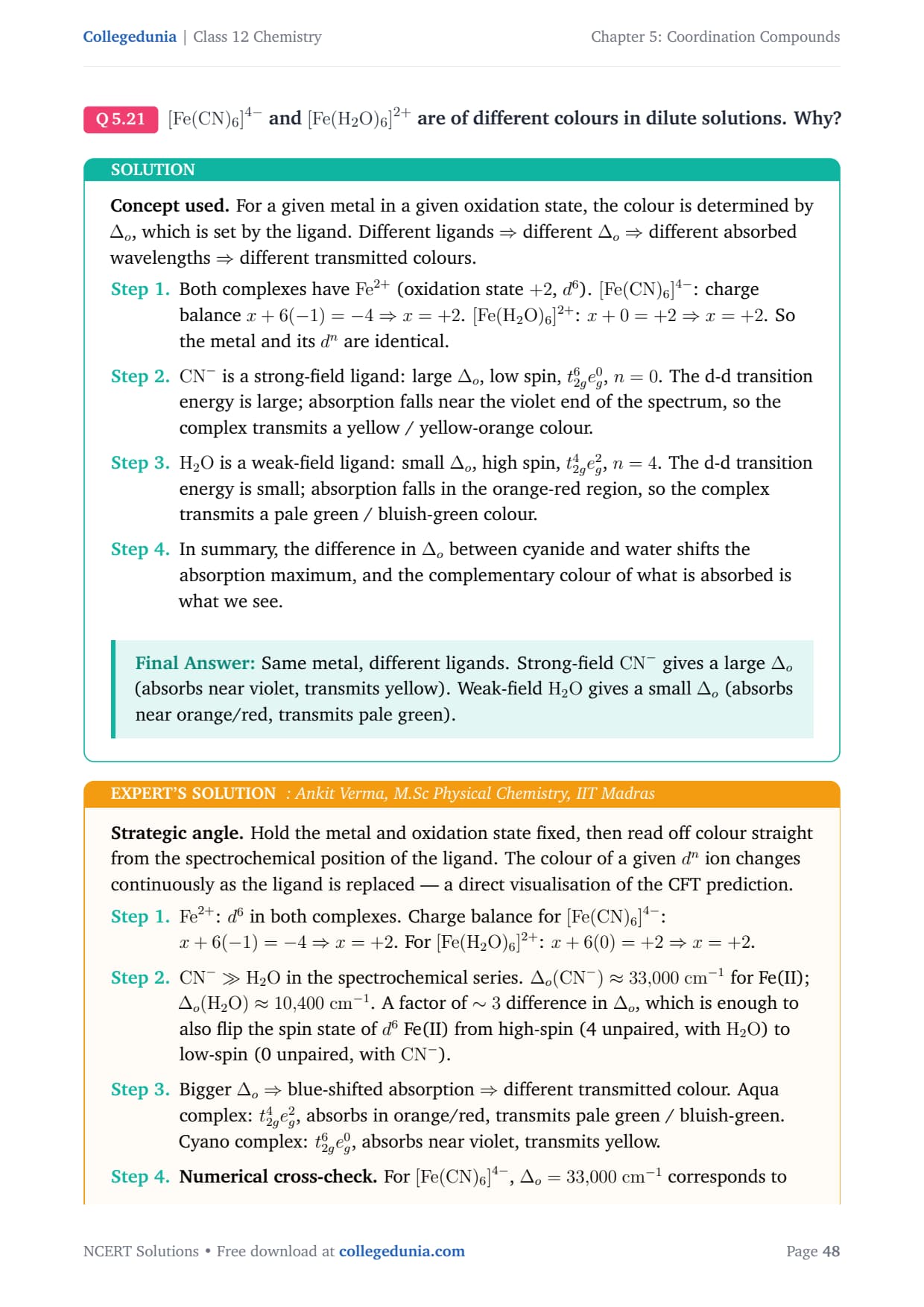
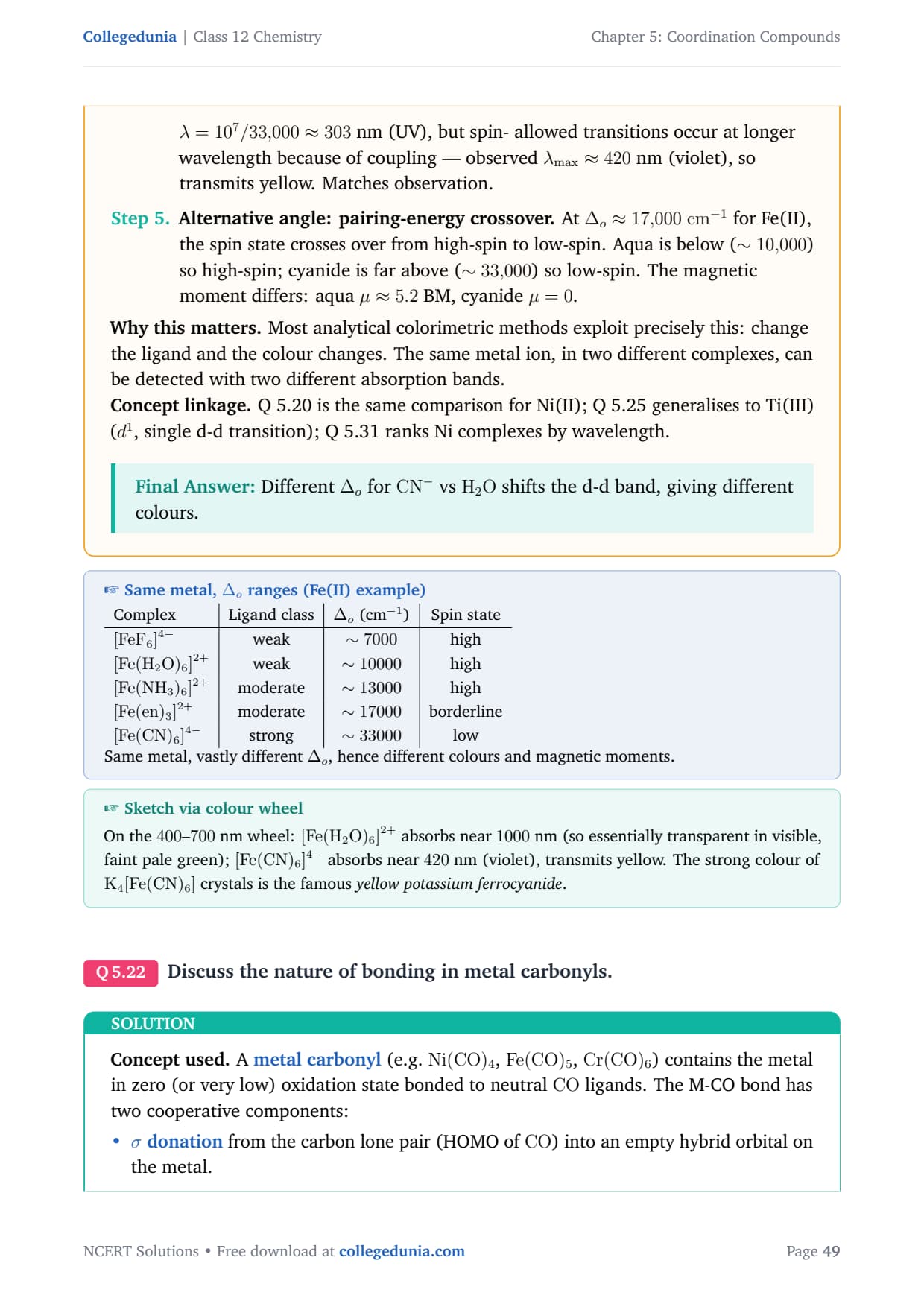
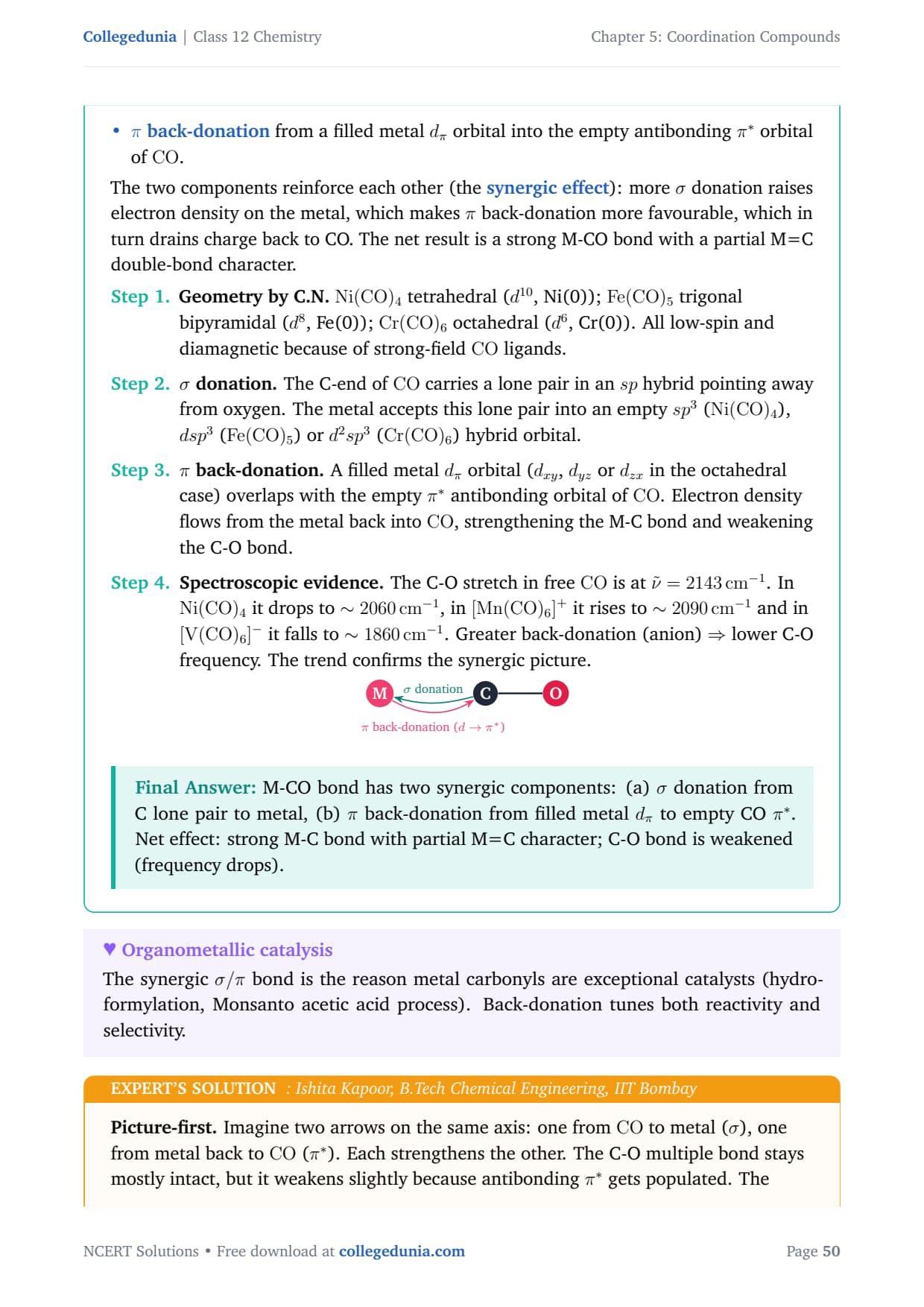
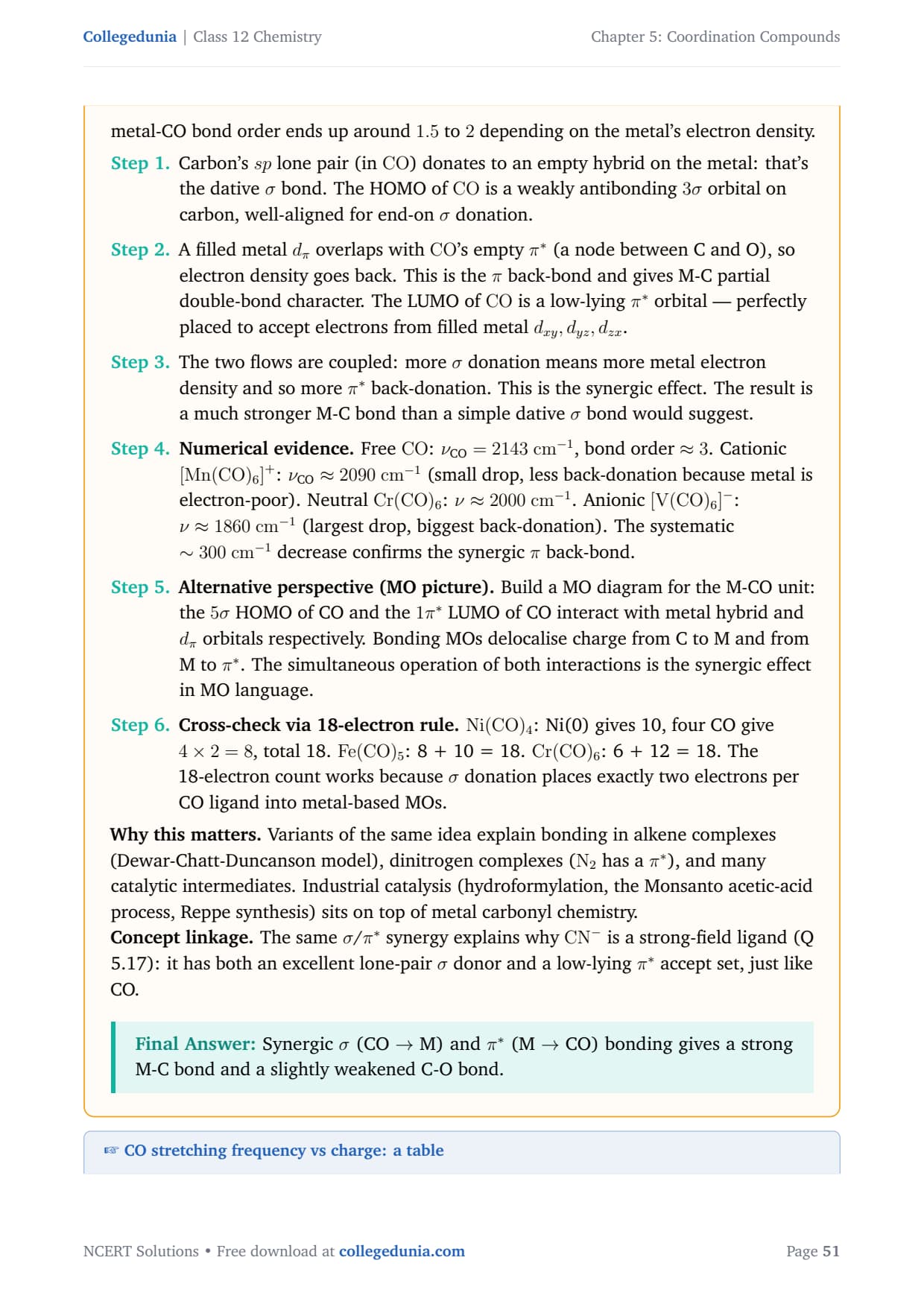
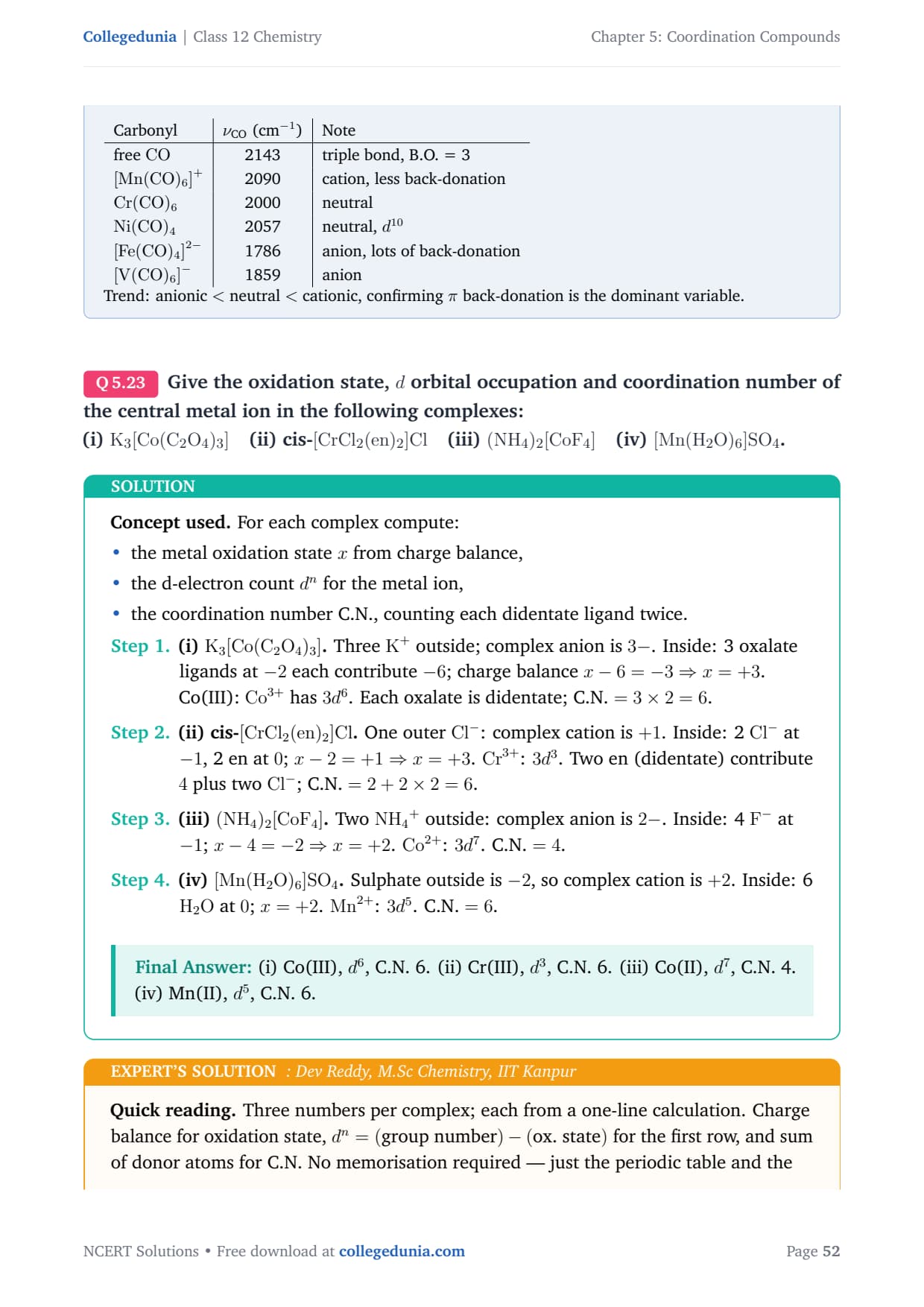
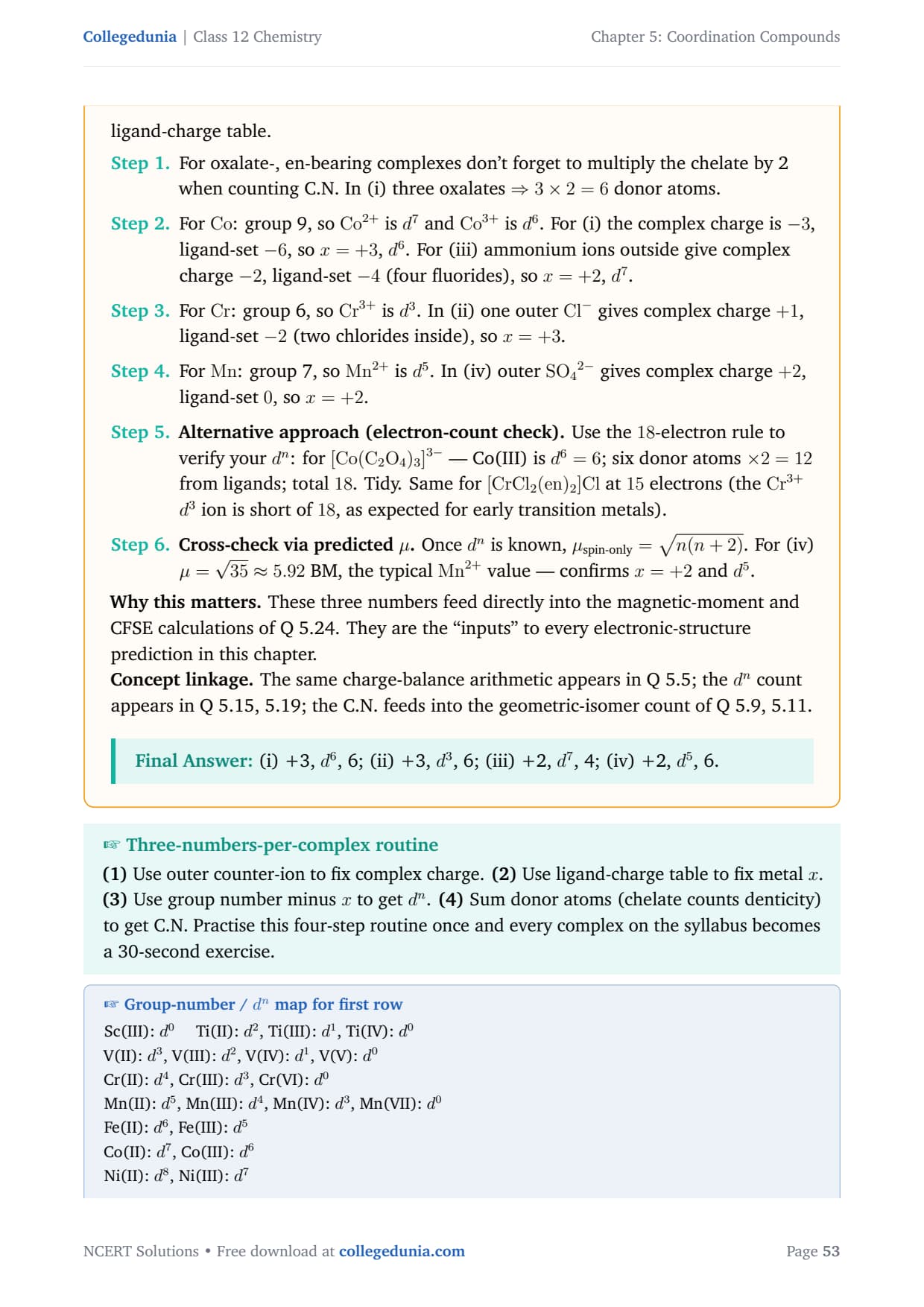
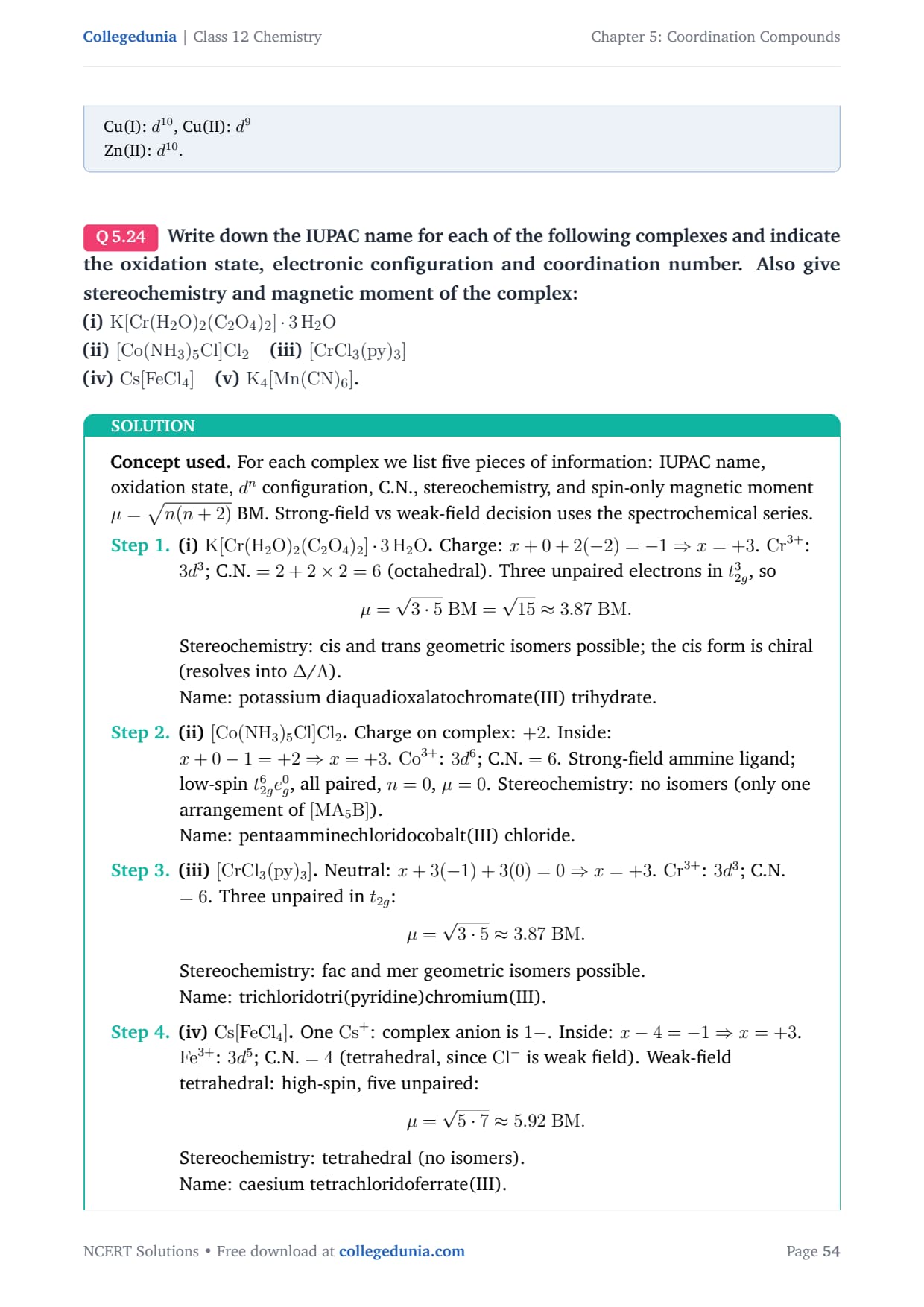
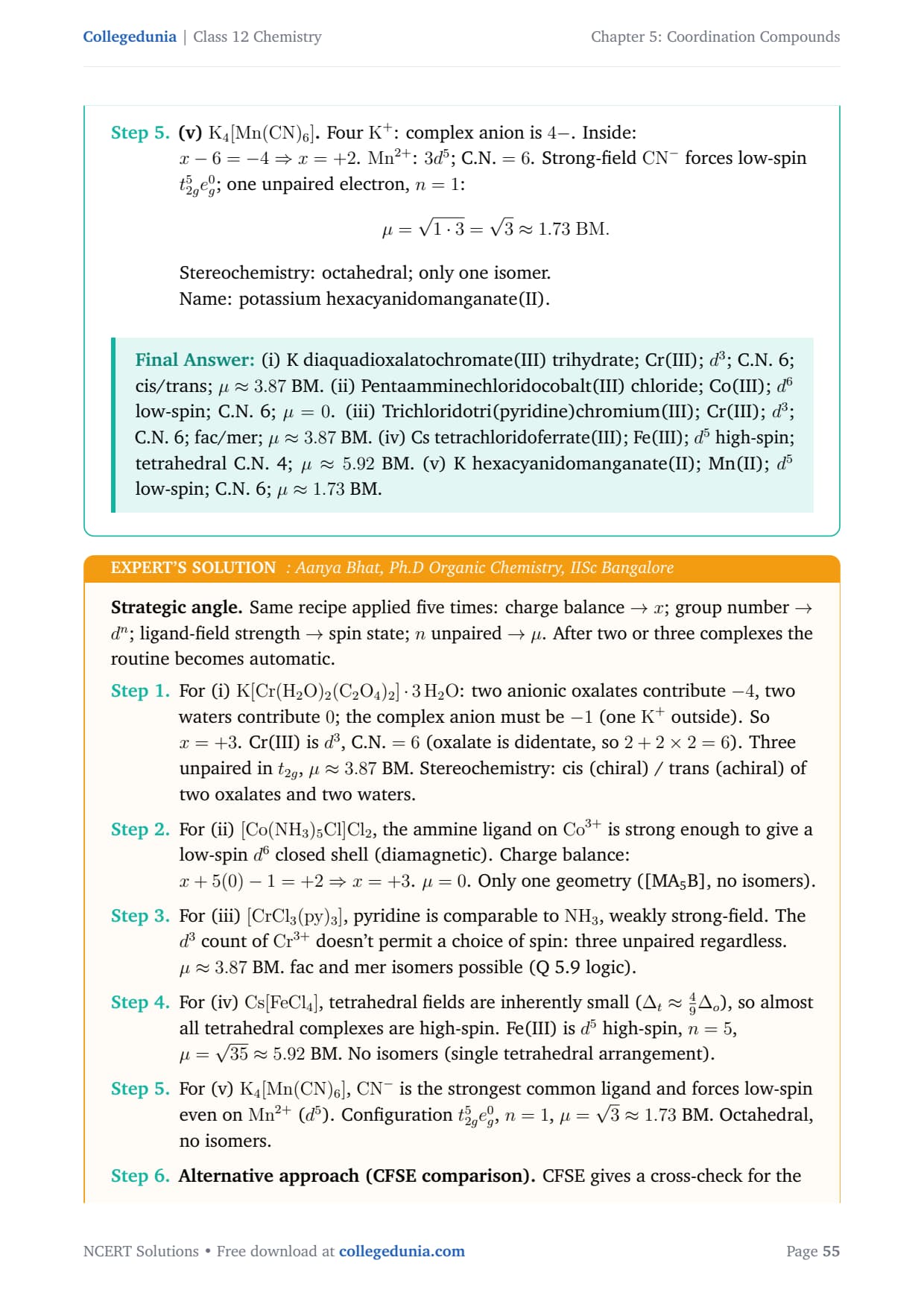
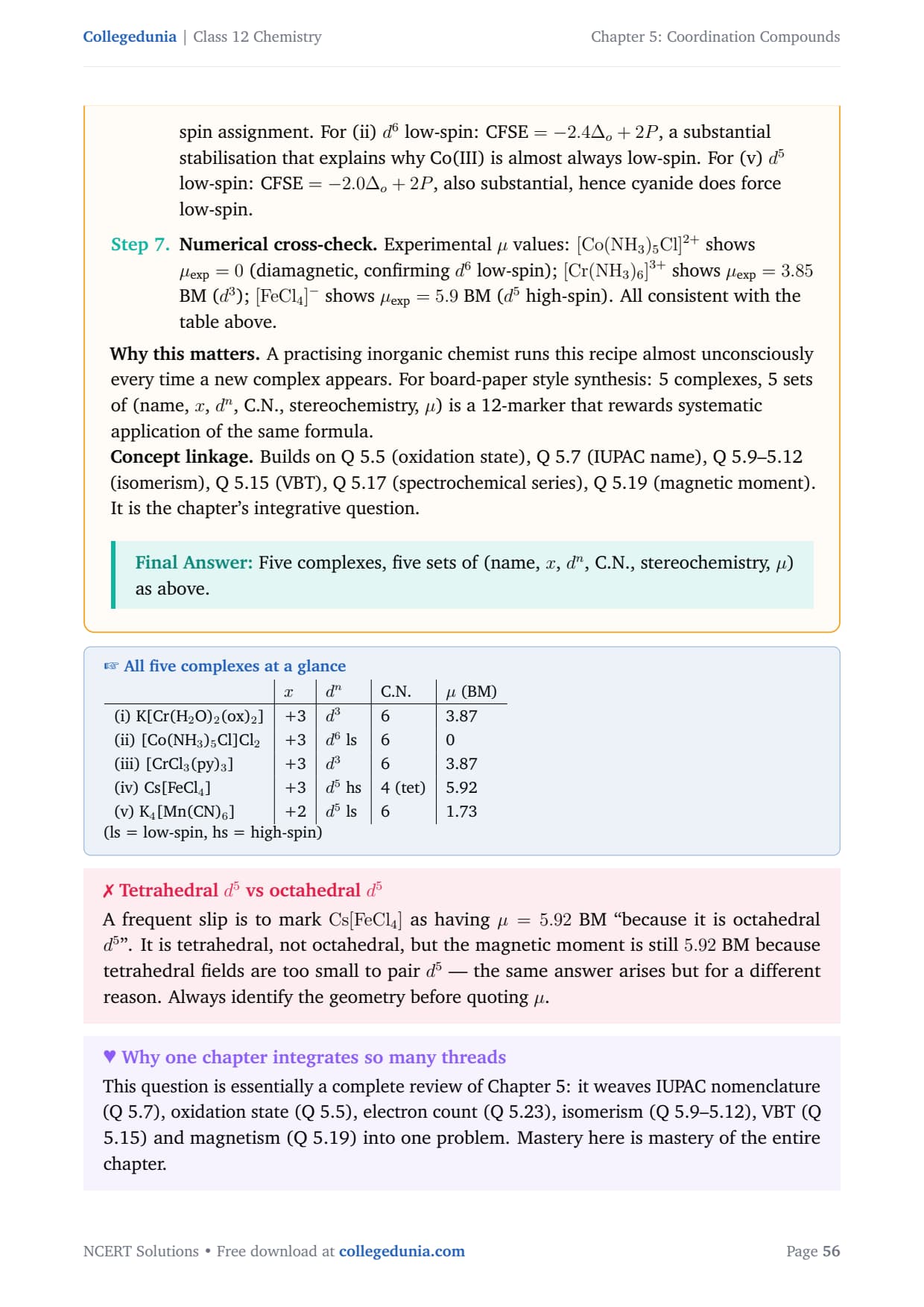
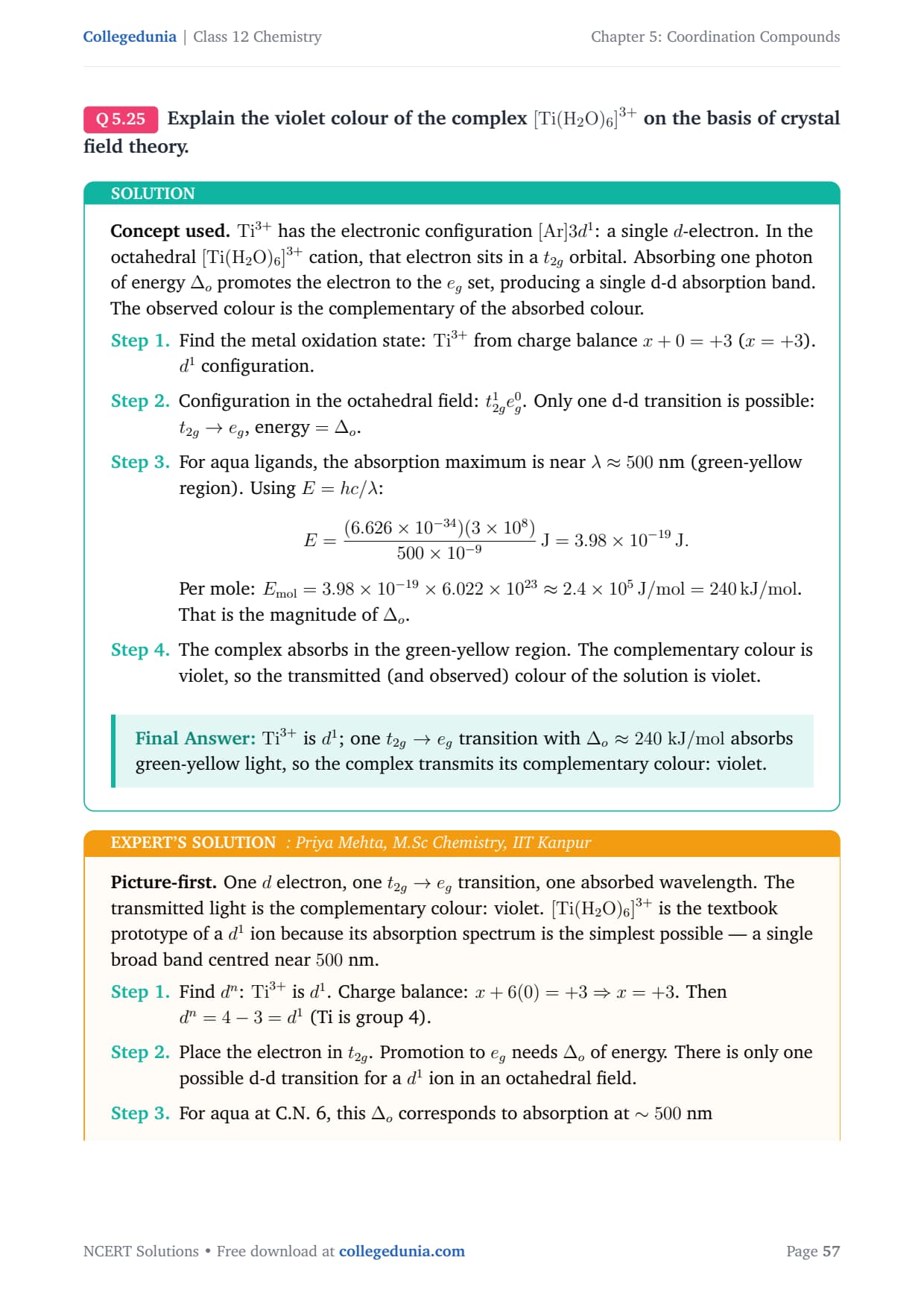
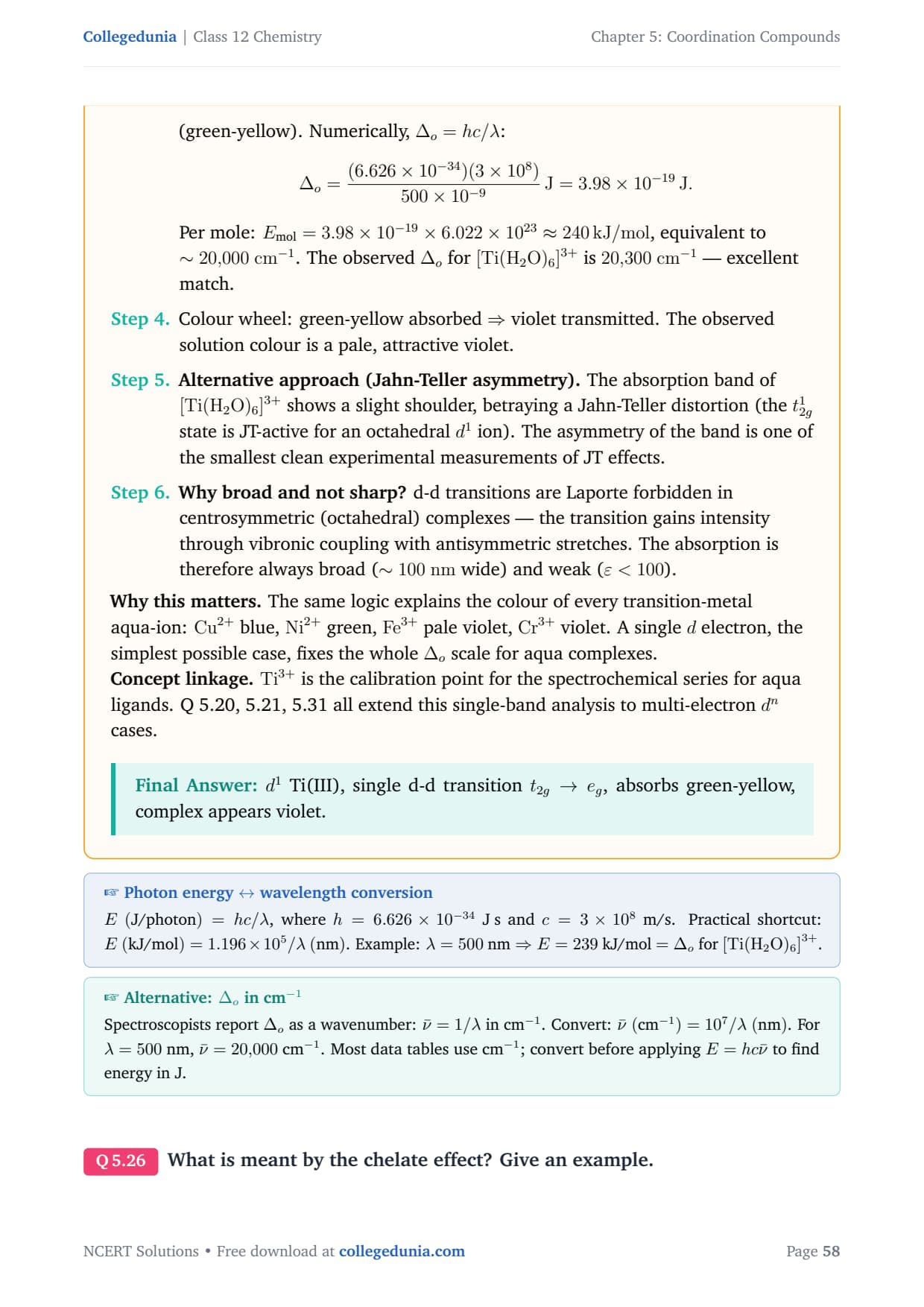
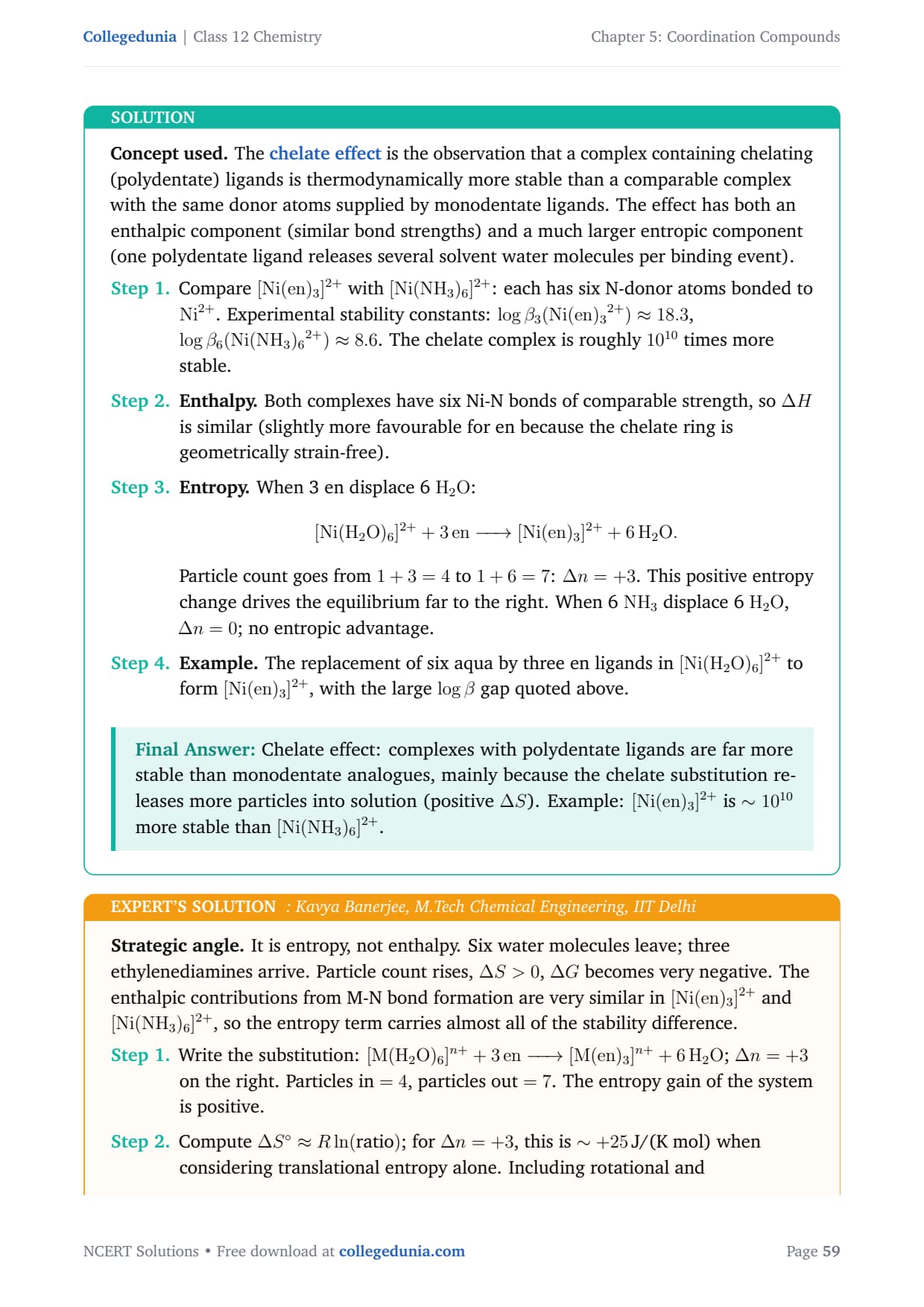
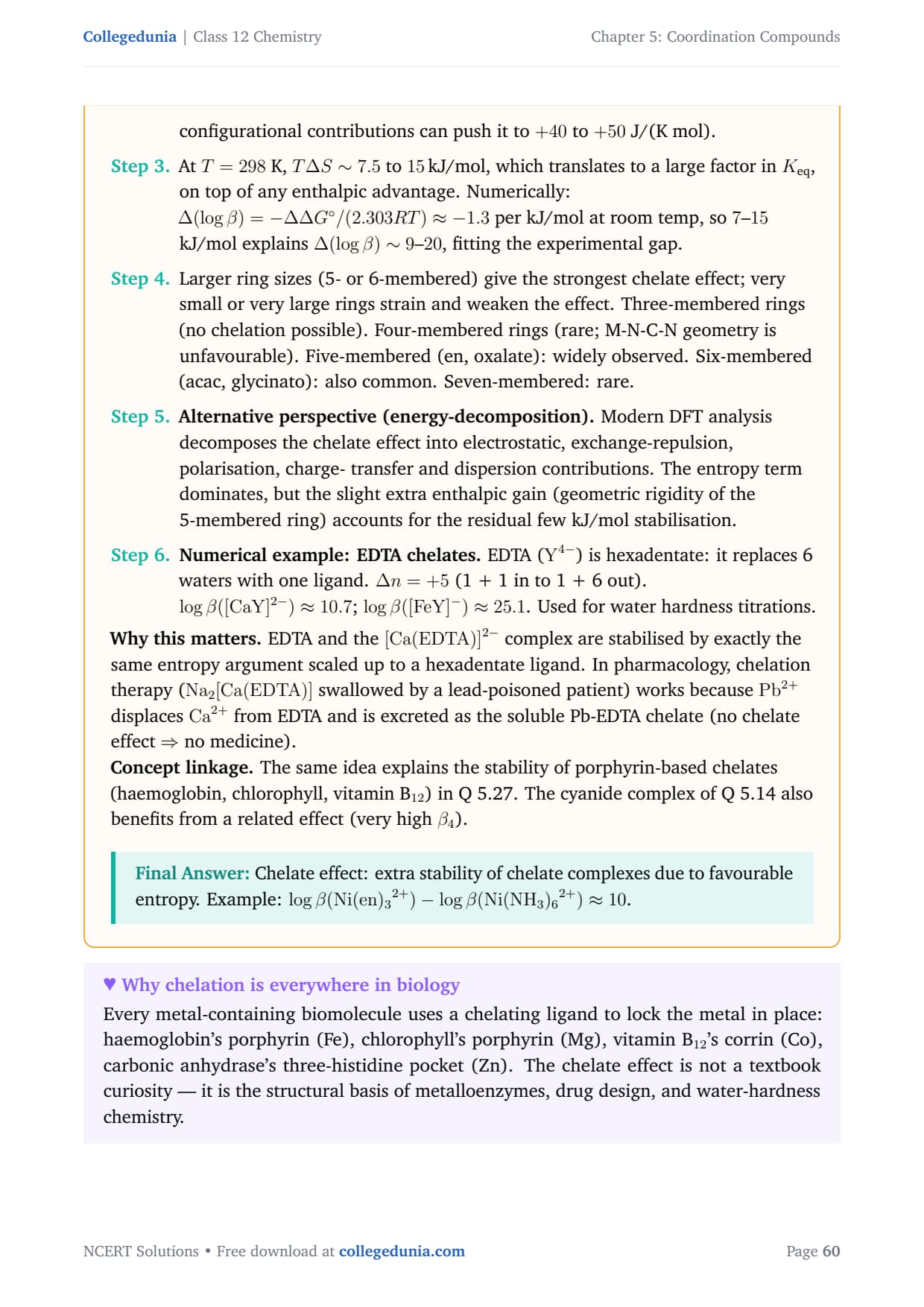
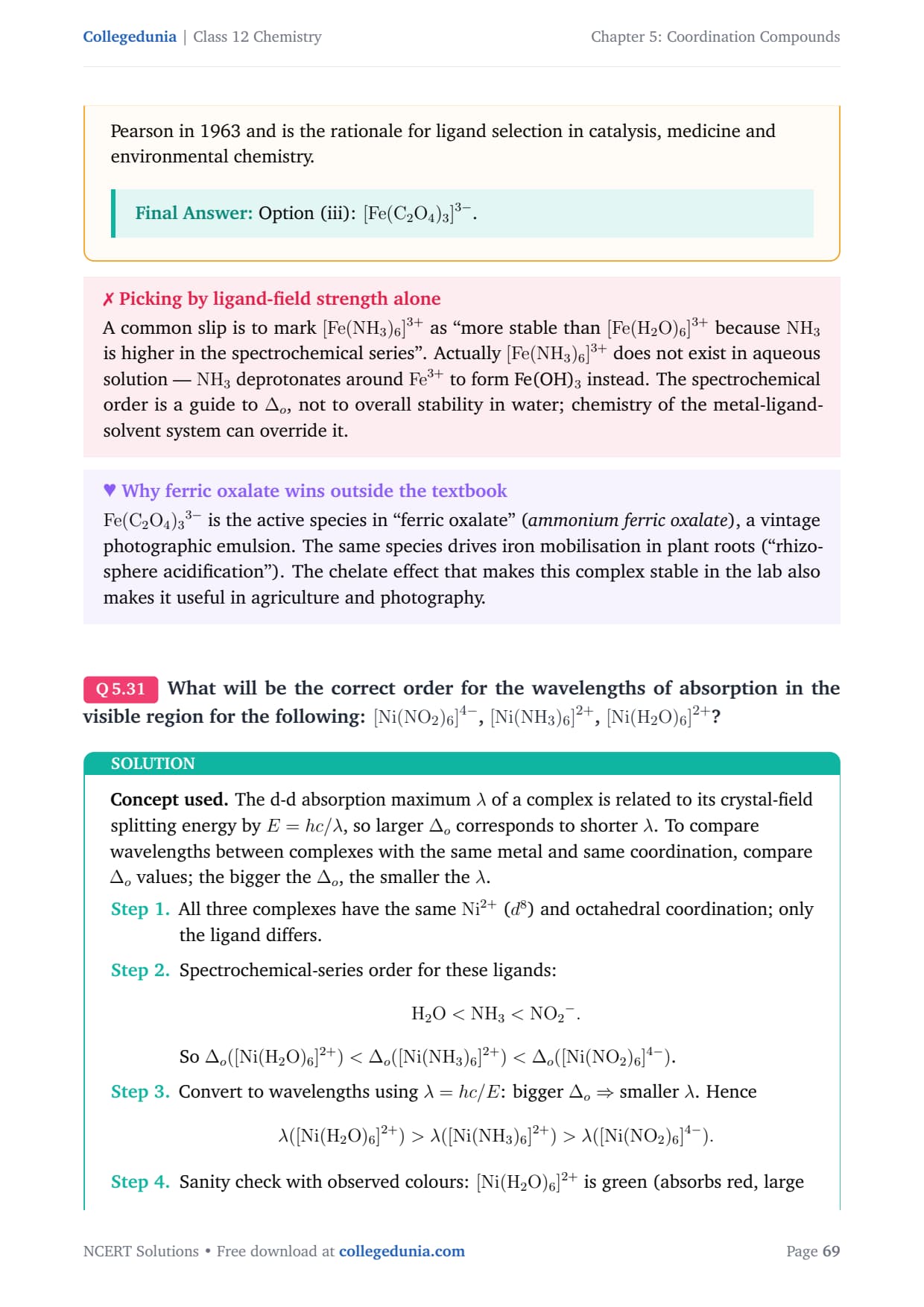
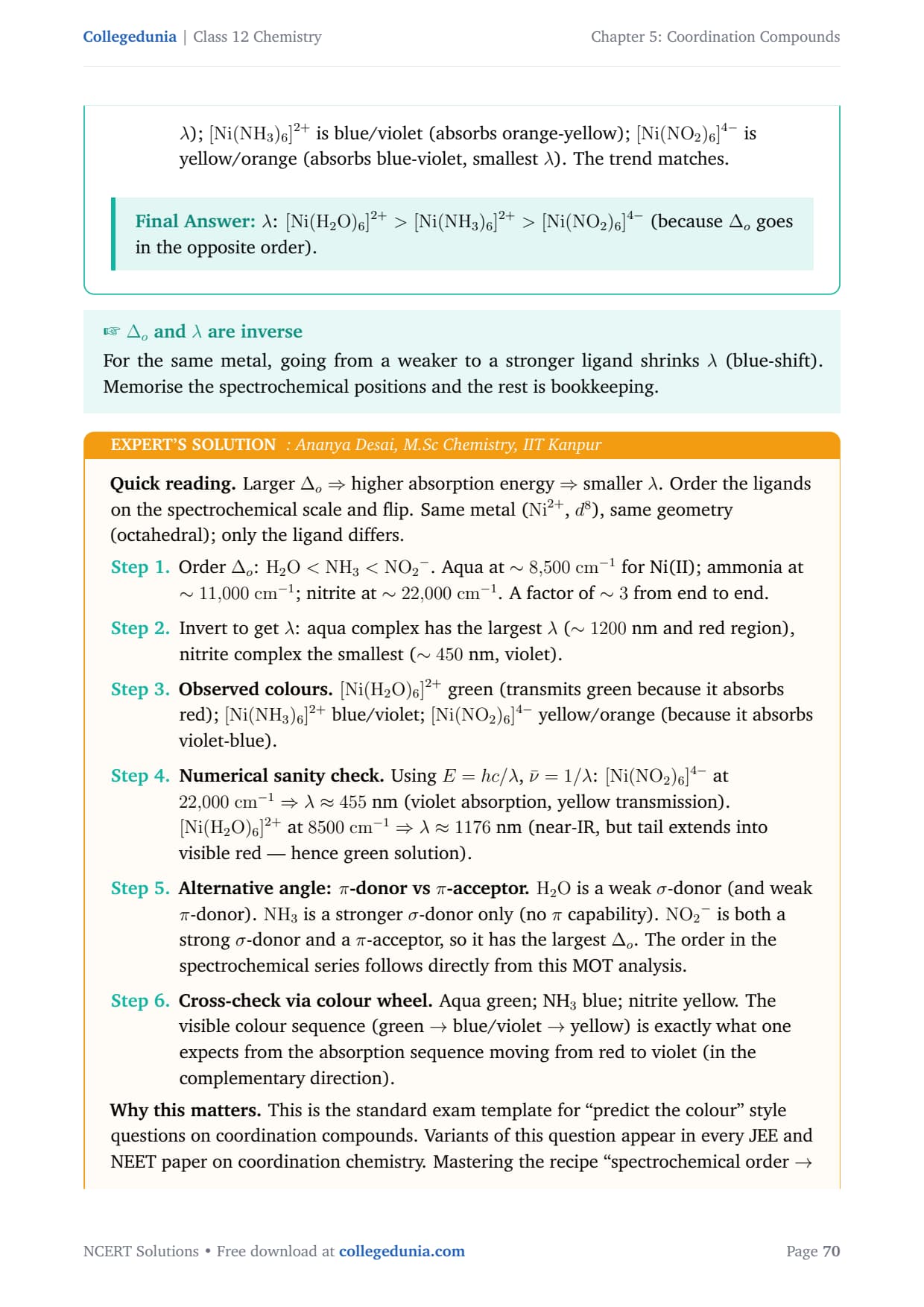
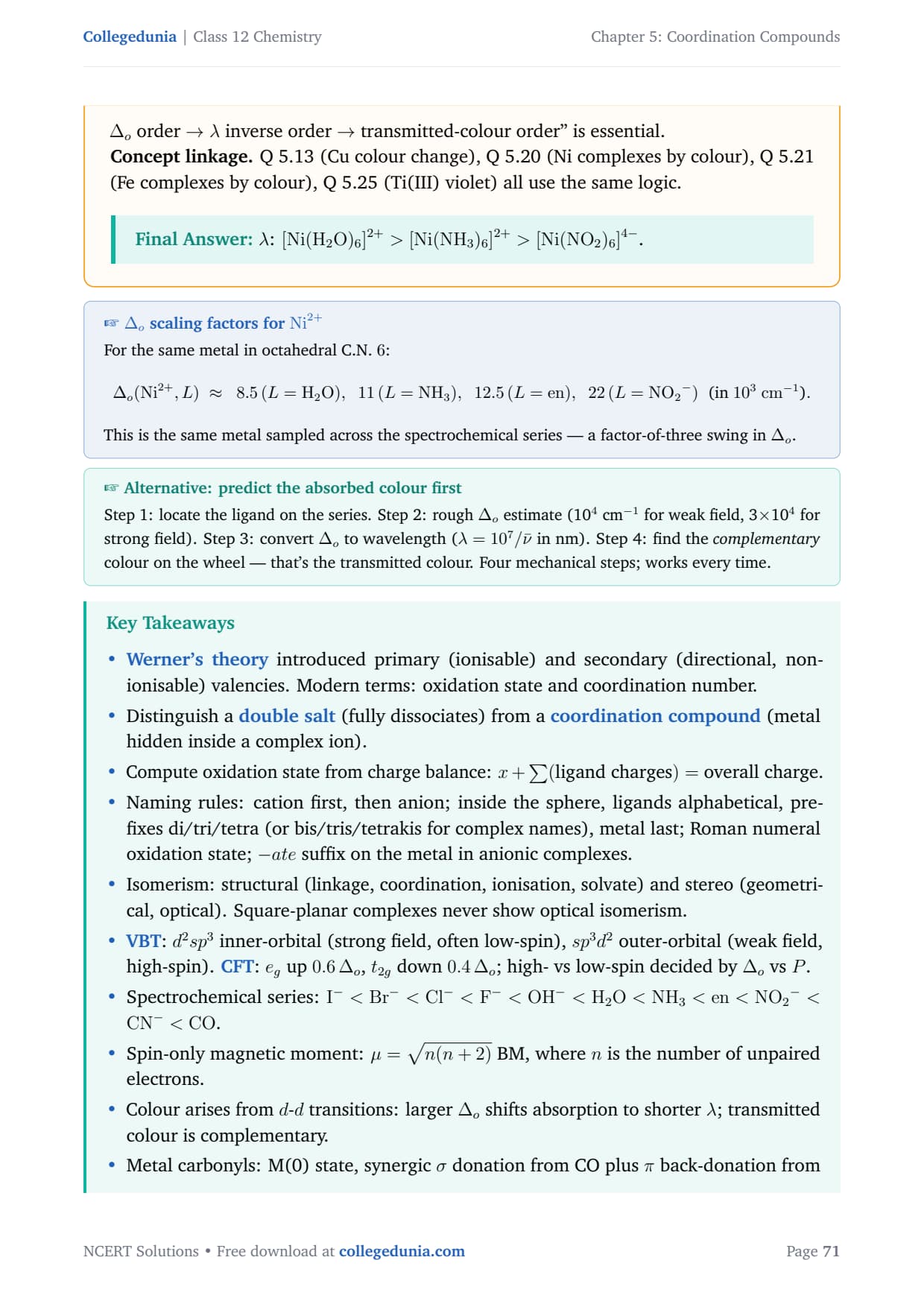

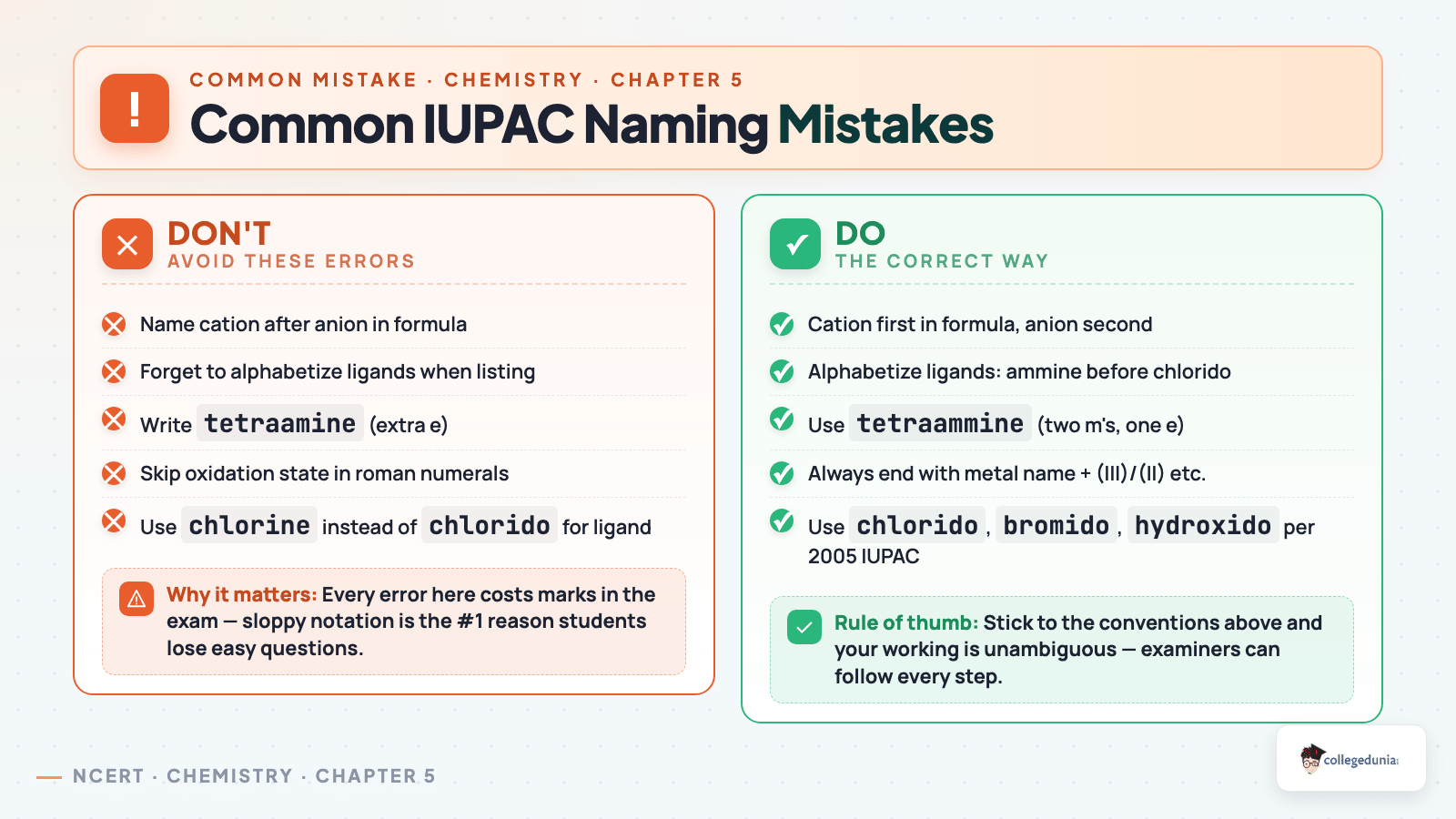



Comments