Senior Physics Editor, 14 Yrs | Updated 3+ months ago
The nucleus sits at the centre of the atom and holds almost all its mass. Nuclei Class 12 Physics Chapter 13 covers nuclear size, binding energy, radioactivity, fission, and fusion. This page hosts the full NCERT Solutions PDF for the chapter.
CBSE Boards:3 marks, usually one 3-mark binding energy derivation or a 2-mark decay-law short answer.
JEE Main: 2 to 3 per cent, one or two questions on binding energy per nucleon and half-life.
NEET: 1 to 2 questions a year, mostly on radioactivity and mass-energy equivalence.
These NCERT solutions for Class 12 Physics Chapter 13 are made by subject experts, matched to the 2026-27 NCERT, and checked against the last five years of CBSE, JEE Main, and NEET papers.
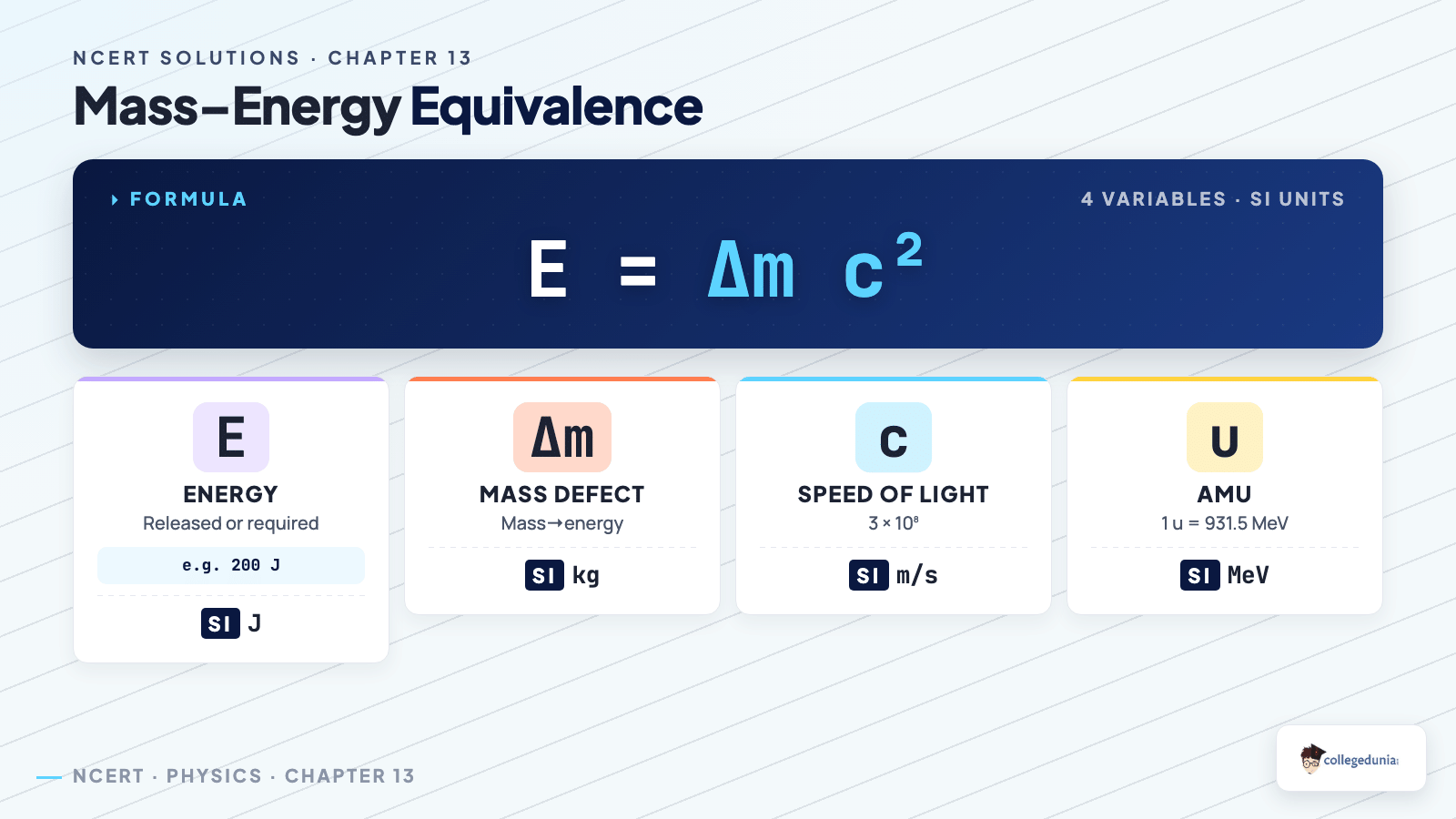
E = (delta m) c squared: mass defect becomes nuclear binding energy.
Binding Energy Curve Class 12 Physics: Derivation and Applications
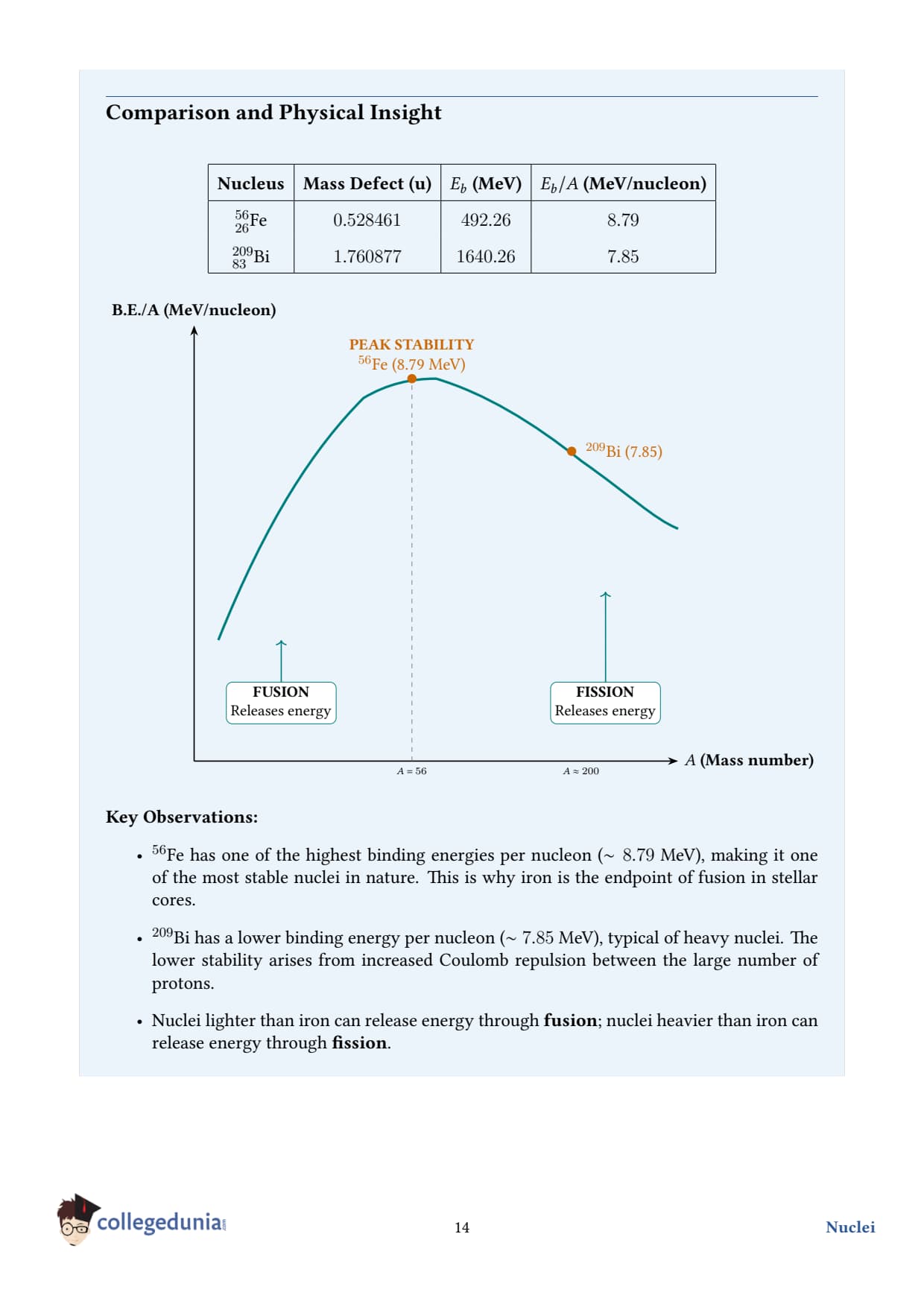
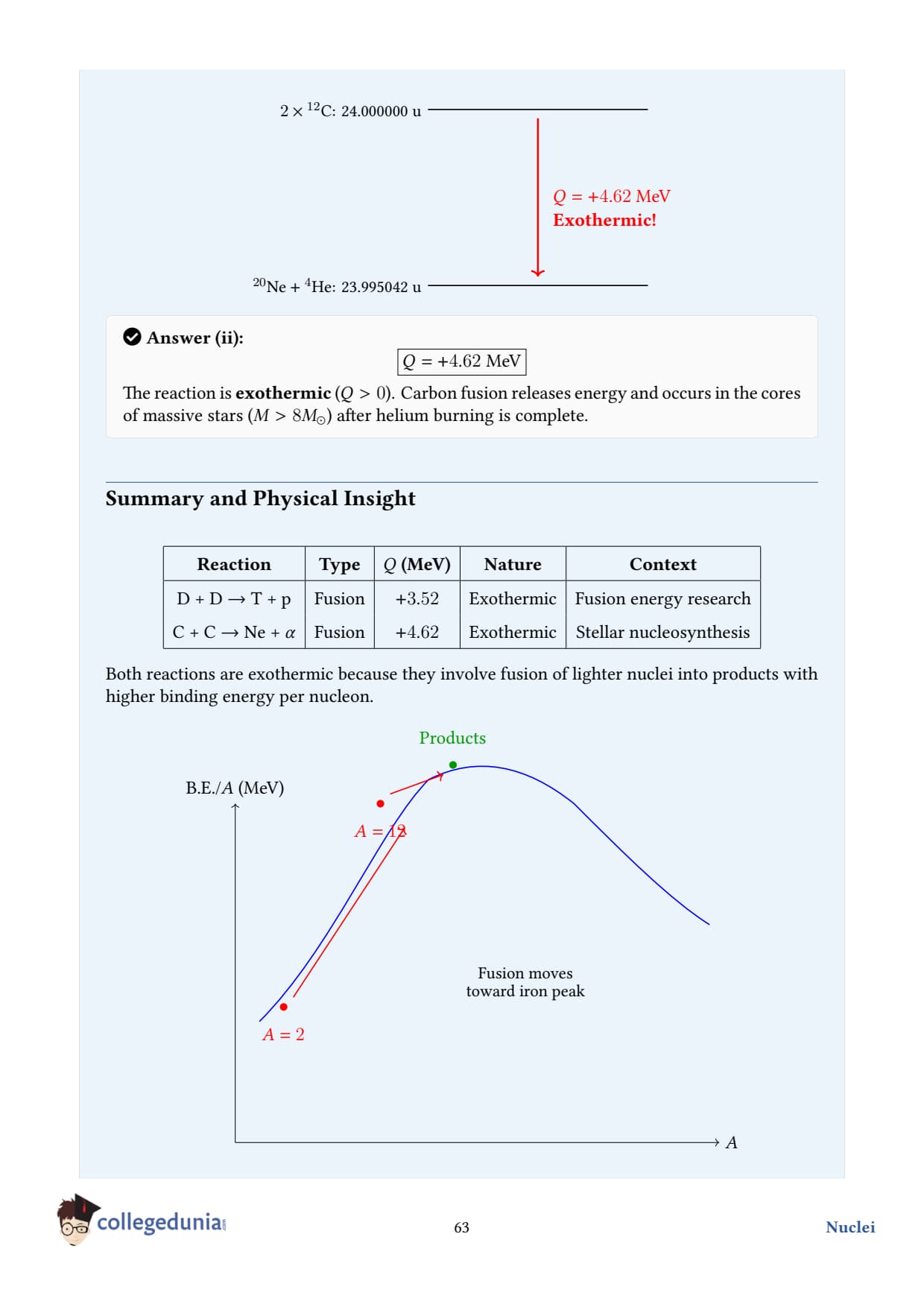
The binding energy curve is one of the most-asked topics in CBSE, JEE, and NEET. It plots binding energy per nucleon (B/A) against mass number (A).
Binding energy is the energy needed to break a nucleus into free protons and neutrons. You get it from the mass defect using E_B = (delta m) c squared. The curve shows three things students must know:
Peak near A = 56: Fe-56 has the highest B/A (about 8.8 MeV), so it is the most stable nucleus.
Low A side: light nuclei are loosely bound, so joining them releases energy. This is fusion.
High A side: heavy nuclei are also loosely bound, so splitting them releases energy. This is fission.
Exercise Breakdown for Class 12 Physics Nuclei NCERT Solutions
The chapter has 17 back exercises plus 7 in-text examples. Most are numericals on binding energy, half-life, or Q-value. This page solves every back-exercise.
Exercise / Section
Questions
Sub-topic Focus
Example 13.1 to 13.7
7 in-text
Nuclear size, binding energy, half-life, Q-value
Exercise 13.1 to 13.5
5
Atomic mass unit, mass defect, binding energy per nucleon
Exercise 13.6 to 13.12
7
Radioactivity, half-life, mean life, activity
Exercise 13.13 to 13.17
5
Nuclear fission, fusion, Q-value of reactions
Nuclei Weightage Compared Across Class 12 Physics Chapters
Chapter 13 Nuclei sits at 3 marks, in the lightest cluster with Chapters 5 and 12.
Chapter
Topic
Avg CBSE Marks
Ch 1
Electric Charges and Fields
6 marks
Ch 2
Electrostatic Potential and Capacitance
7 marks
Ch 3
Current Electricity
7 marks
Ch 4
Moving Charges and Magnetism
6 marks
Ch 5
Magnetism and Matter
3 marks
Ch 6
Electromagnetic Induction
5 marks
Ch 7
Alternating Current
6 marks
Ch 8
Electromagnetic Waves
2 marks
Ch 9
Ray Optics and Optical Instruments
7 marks
Ch 10
Wave Optics
5 marks
Ch 11
Dual Nature of Radiation and Matter
4 marks
Ch 12
Atoms
3 marks
Ch 13
Nuclei
3 marks
Ch 14
Semiconductor Electronics
6 marks
Common Mistakes in Nuclei Class 12 Physics Chapter 13
Mistake 1: Dropping the c squared in E = m c squared. With c = 3 x 10^8 m/s, c squared = 9 x 10^16, a huge factor students miss when converting amu to joule.
Mistake 2: Mixing up the decay constant lambda and half-life. They are linked by t_half = 0.693 / lambda.
Mistake 3: Reading a higher B/A as less stable. It is the opposite: higher B/A means more stable (Fe-56).
Mistake 4: Swapping fission and fusion. Fission splits a heavy nucleus; fusion joins light nuclei. Both release energy.
Radioactivity, Fission and Fusion in Class 12 Physics Chapter 13
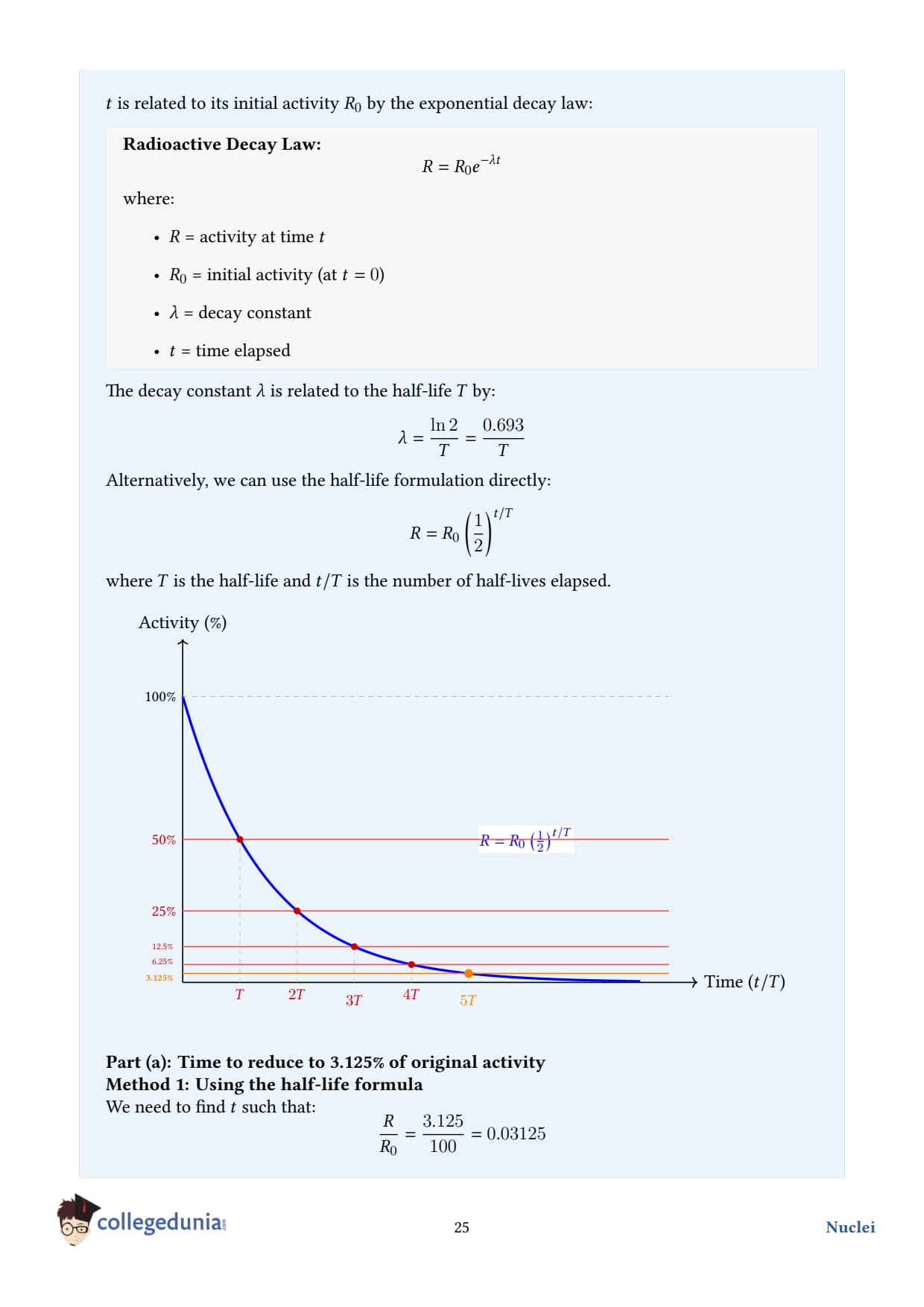
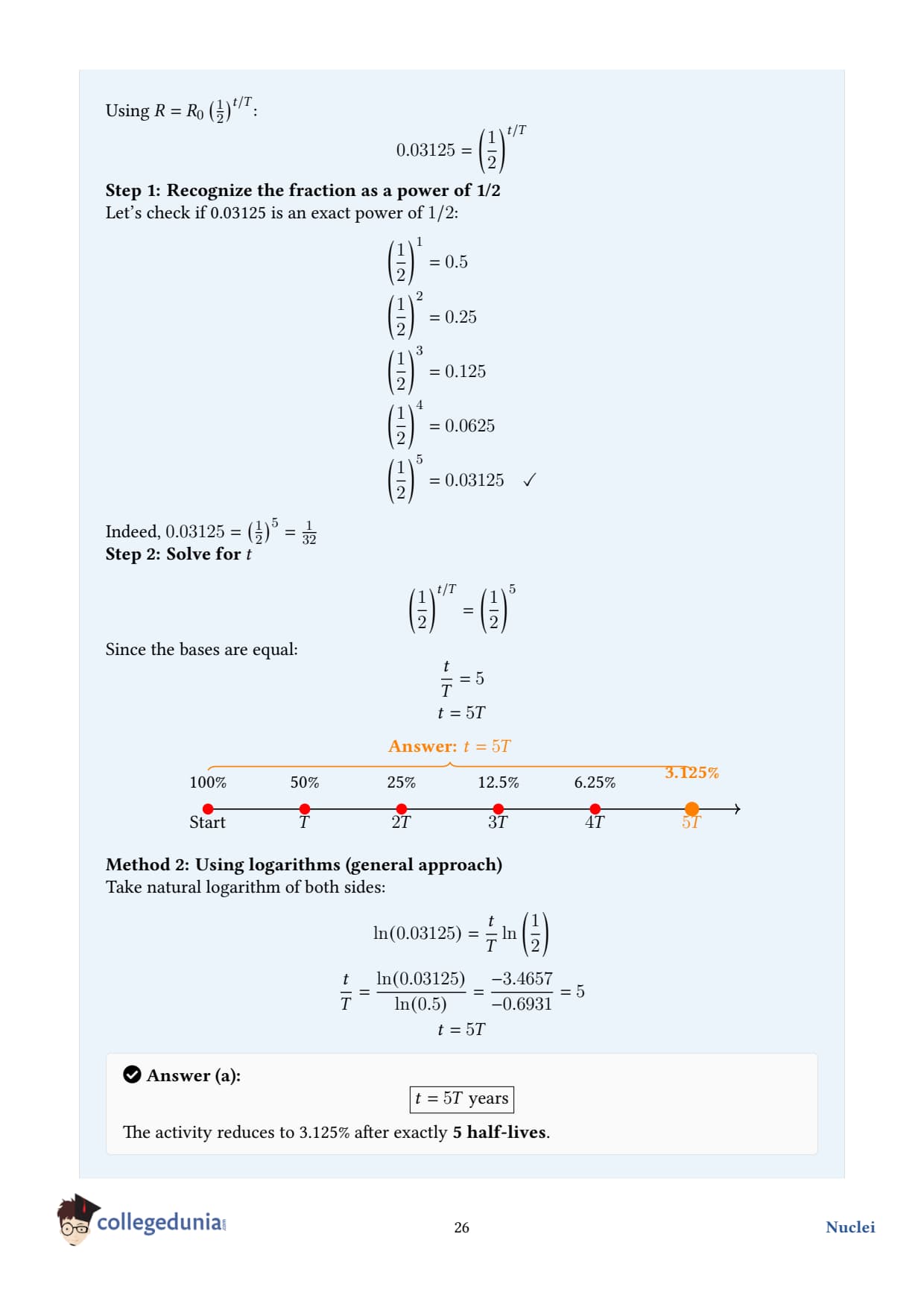
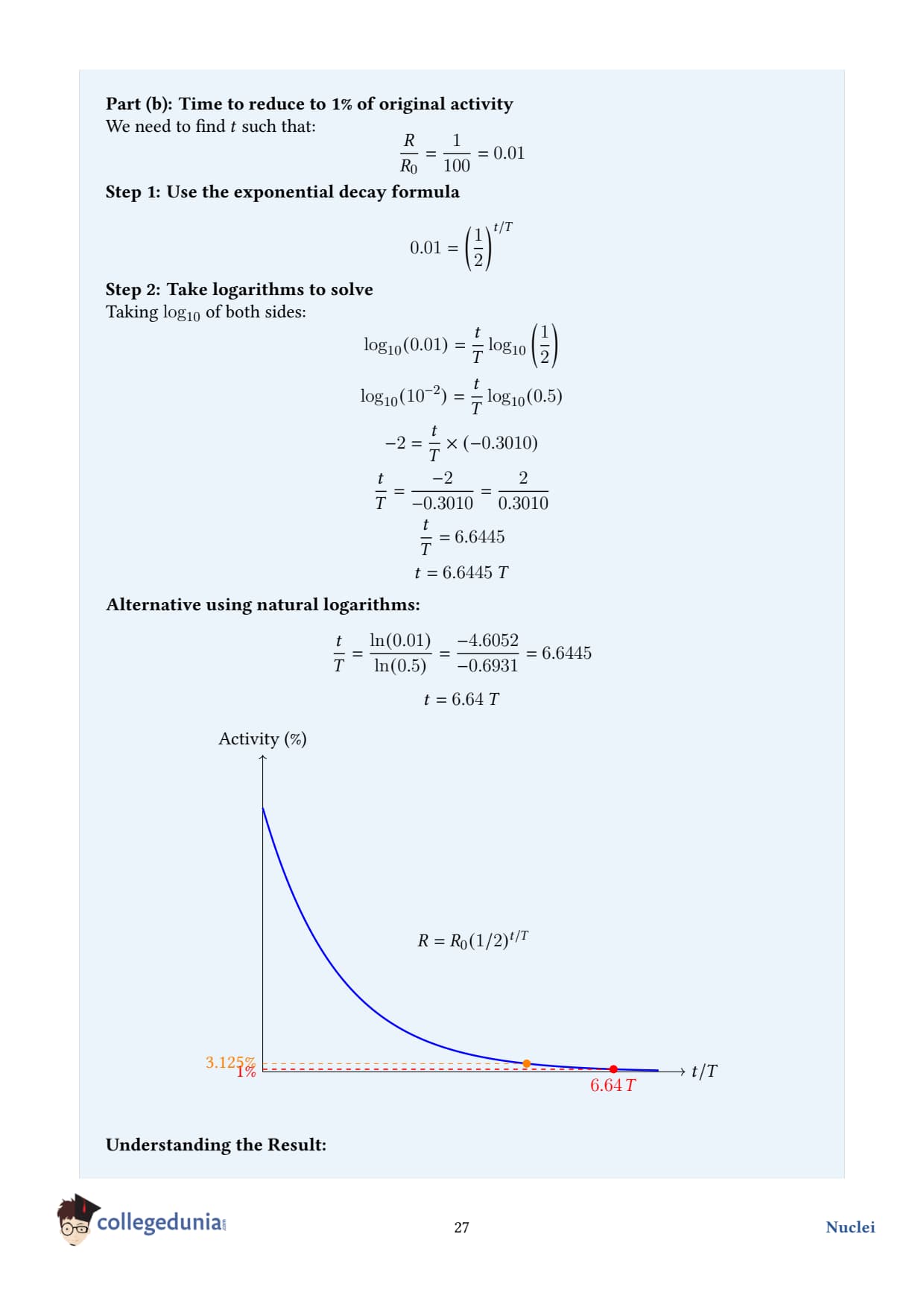
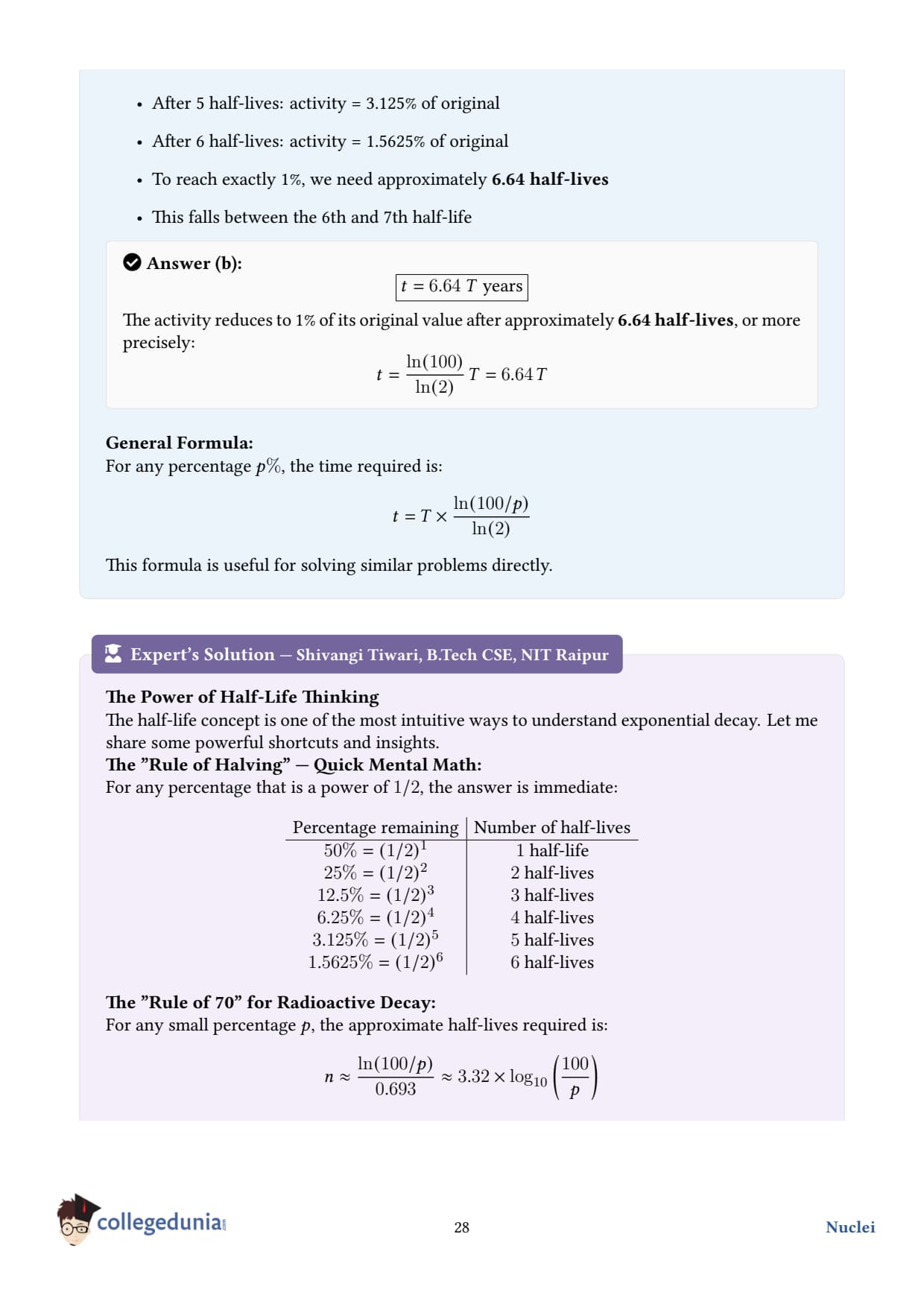
Radioactivity is the spontaneous emission from unstable nuclei. Alpha is a helium nucleus and is stopped by paper. Beta is an electron and is stopped by aluminium. Gamma is a photon and needs lead. The decay law N = N_0 e^(minus lambda t) means the count falls exponentially, with half-life t_half = 0.693 / lambda.
Fission: a slow neutron splits U-235 into two lighter nuclei plus 2 to 3 neutrons and about 200 MeV. The spare neutrons drive the chain reaction in reactors.
Fusion: light nuclei join, like hydrogen to helium in the Sun, releasing about 26.7 MeV per helium. ITER aims to do this on Earth.
Both release energy because both move nucleons toward the iron peak of the curve. The Q-value Q = (m_reactants minus m_products) c squared tells you how much: a positive Q means energy is released.
How to Study Class 12 Nuclei in 3 Hours
Block 1 (90 min): composition, binding energy, mass defect. Read 13.1 to 13.4, solve examples 13.1 to 13.4, do exercises 13.1 to 13.5.
Block 2 (90 min): radioactivity, fission, fusion. Read 13.5 to 13.8, solve examples 13.5 to 13.7, do exercises 13.6 to 13.17.
Budget about 3 hours for the first read and 1.5 hours for revision.
Other Resources for Class 12 Physics Chapter 13 Nuclei
Use these other Nuclei resources alongside the NCERT Solutions on this page.
All NCERT Solutions for Class 12 Physics Chapter 13 Nuclei with Step-by-Step Solutions
Every question of NCERT Class 12 Physics Nuclei is listed below with its full Solution and Expert Solution hidden inside collapsible tabs. Click Check Solution to reveal the step-by-step working; click Expert Solution for the expanded explanation.
Q 13.1
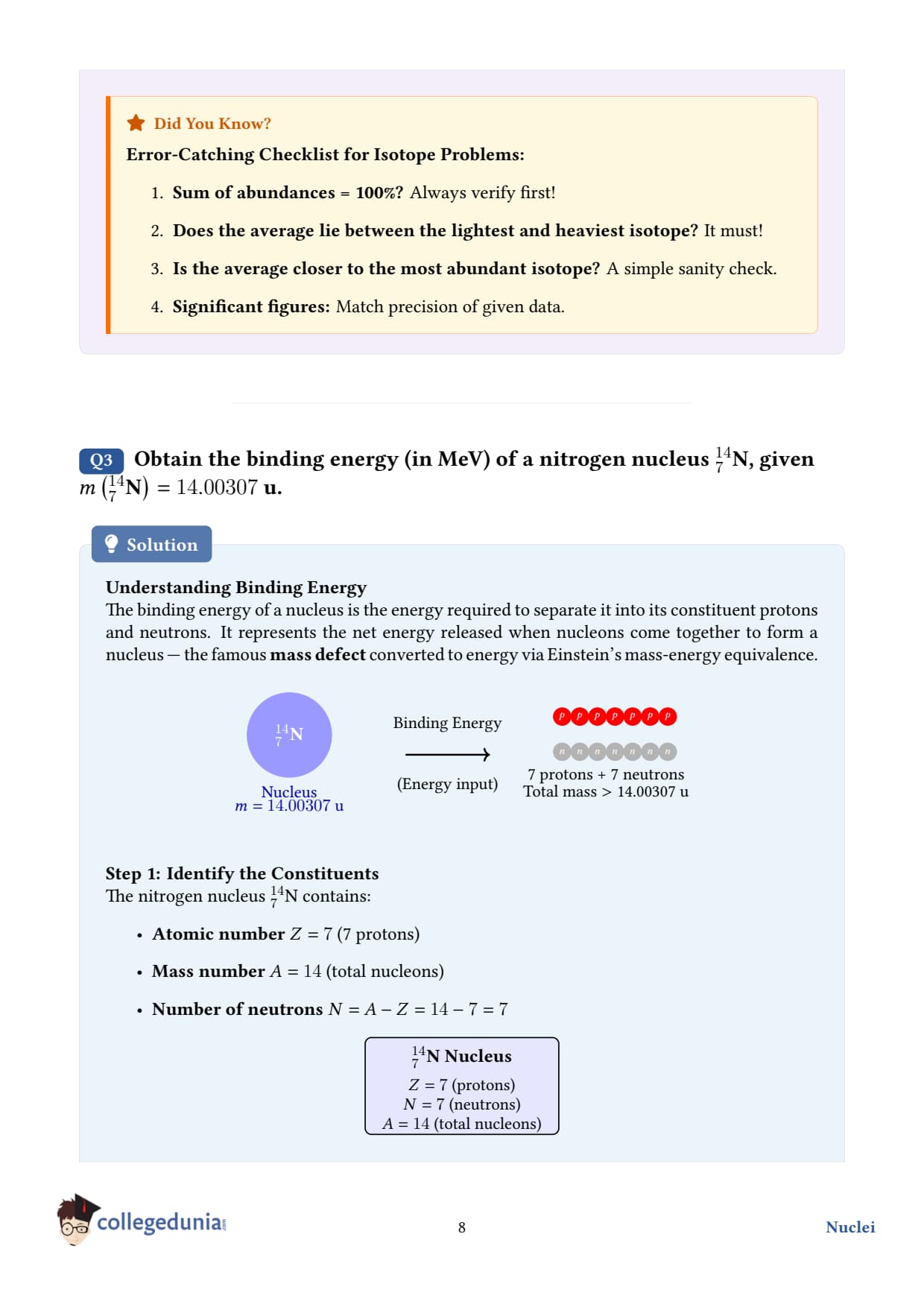
Obtain the binding energy (in MeV) of a nitrogen nucleus (147N), given m(147N) = 14.00307 u.
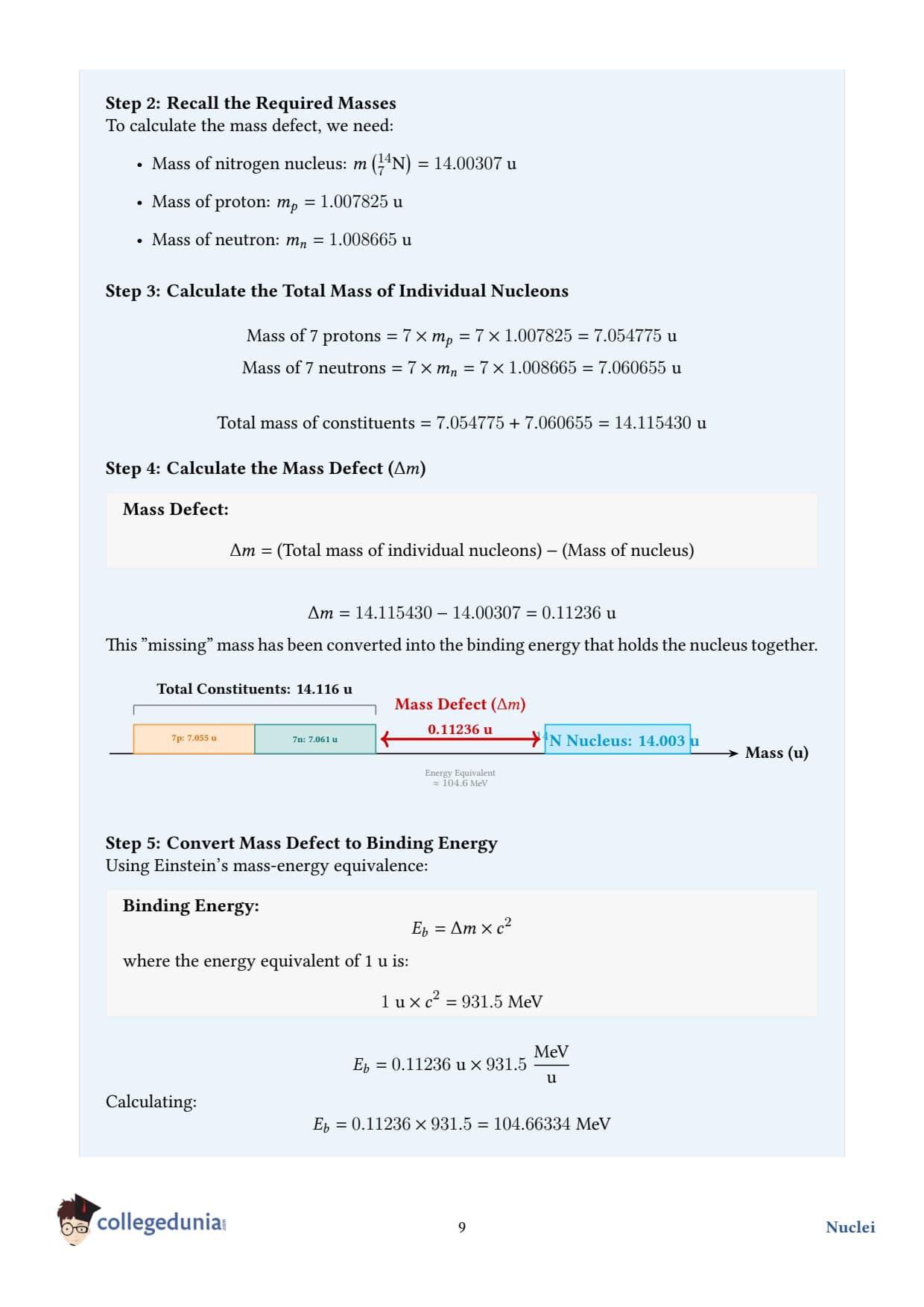
What the question is asking. A nitrogen-14 nucleus has 7 protons and 7 neutrons. If we could weigh those 14 separate particles and then weigh the assembled nucleus, the nucleus would be lighter. That "missing" mass is locked up as the binding energy that holds the nucleus together. We have to compute that energy in MeV.
Given.
Atomic mass of nitrogen-14, m(147N) = 14.00307 u.
Mass of a hydrogen atom, mH = 1.007825 u.
Mass of a neutron, mn = 1.008665 u.
Energy equivalent of 1 atomic mass unit: 1 u = 931.5 MeV/c2.
Concept used - mass defect and binding energy. A nucleus of mass number A and atomic number Z contains Z protons and (A-Z) neutrons. The mass defect is Δ m = Z mH + (A - Z) mn - mnucleus. Notice we use mHmass of the hydrogen atom = proton + electron instead of just the proton mass. That's because the given atomic mass m(147N) also includes 7 electrons - so the electron masses cancel out on both sides. The binding energy is then Eb = Δ m · c2 = Δ m (in u) × 931.5 MeV.
Step 1 - count the constituents. Nitrogen-14: Z = 7, A = 14, so neutrons = A - Z = 14 - 7 = 7.
Step 2 - sum of free nucleon masses. Σ m = 7 mH + 7 mn = 7(1.007825) + 7(1.008665). = 7.054775 + 7.060655 = 14.115430 u.
Step 3 - mass defect. Δ m = 14.115430 - 14.00307 = 0.112360 u.
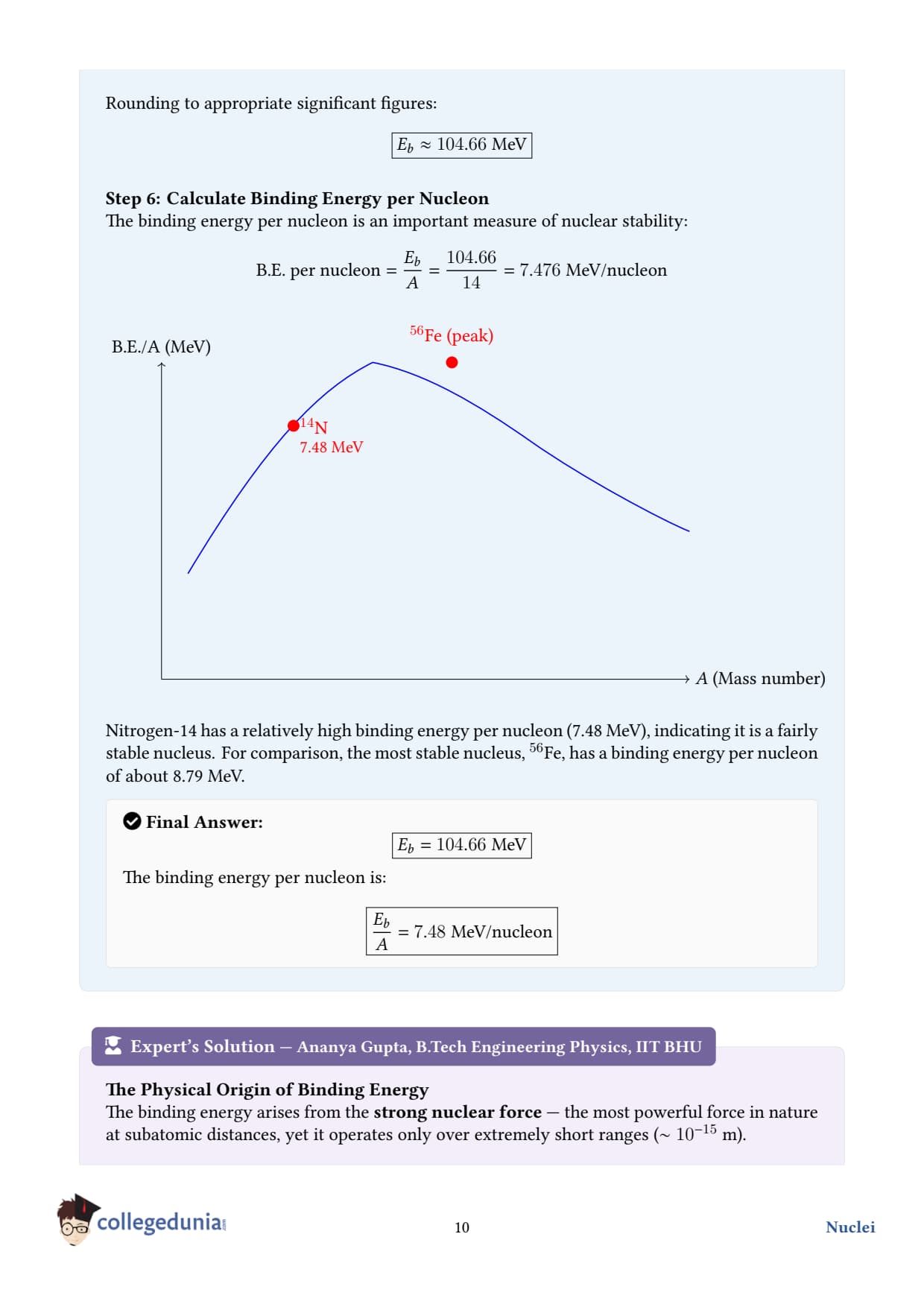
Step 5 - sanity check via per-nucleon binding. Per nucleon, Eb/A = 104.7/14 ≈ 7.48 MeV - right in the typical range ∼ 7–9 MeV for light-to-medium nuclei. Good.
Final answer. Eb(147N) ≈ 104.7 MeV.
DR
Dr. Rajesh Kumar
Ph.D. Nuclear Physics, IIT Delhi
Verified Expert
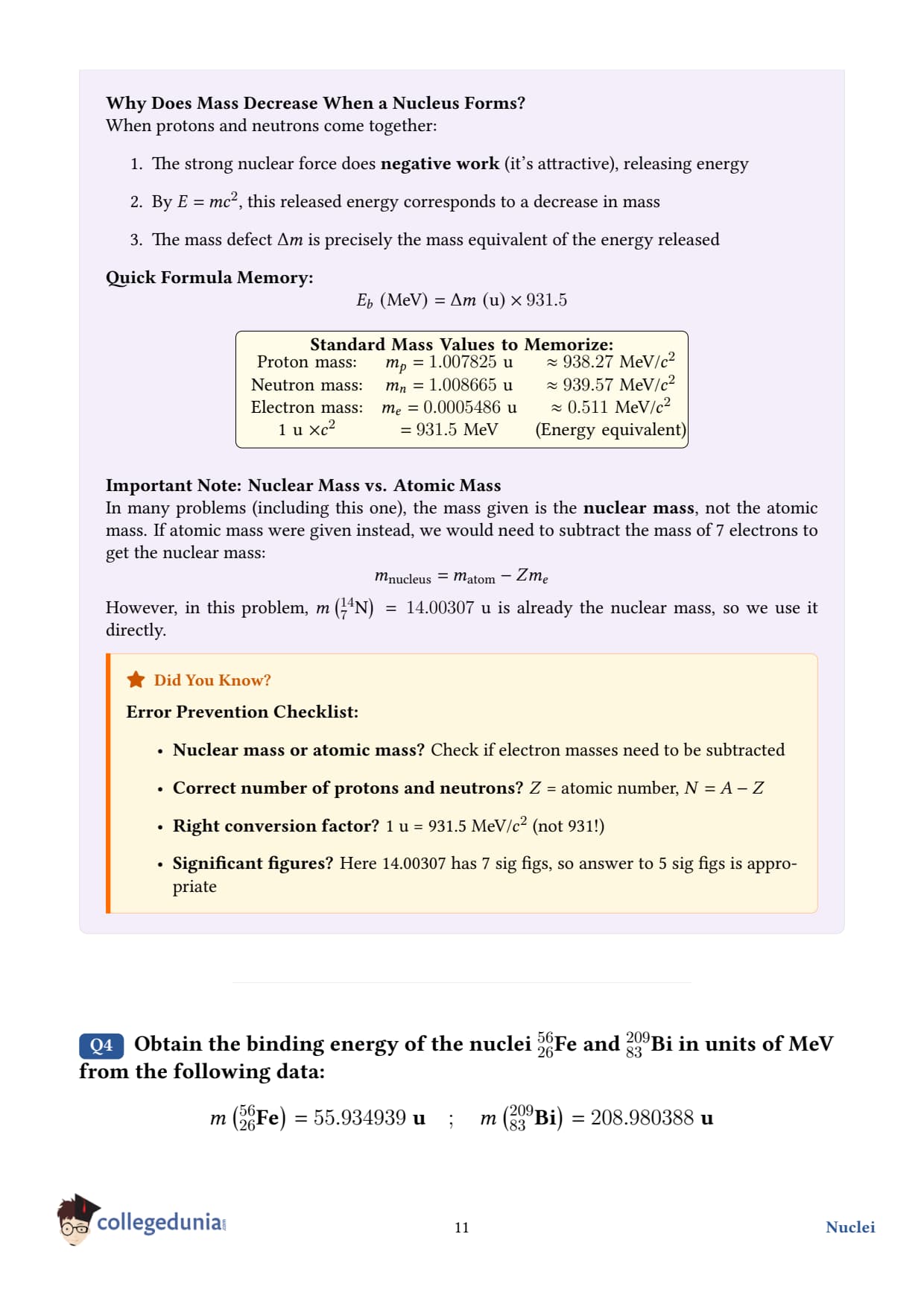
Atomic vs nuclear mass - the most common pitfall. Tables of nuclidic masses (including the NCERT data) give the atomic mass - nucleus plus all the bound electrons. If you mistakenly used the bare proton mass mp = 1.007276 u instead of mH = 1.007825 u, you'd forget the seven electrons on the right side of the equation, and your Δ m would be slightly off. Using mH lets the electron mass cancel cleanly between both sides.
The 931.5 MeV/u shortcut. Whenever Δ m is expressed in atomic mass units, you do not need to plug in c2 explicitly. Just multiply by 931.5 MeV per u. This single conversion saves an entire 1.6610-2731082/1.610-13 calculation.
Where this energy comes from physically. The strong nuclear force binds nucleons together. To rip nitrogen-14 apart into 14 free particles, you would need to supply 104.7 MeV of energy. By Einstein's equivalence, that energy "lives" as a mass deficit - the assembled nucleus literally weighs less than its pieces.
Nuclear-stability curve. Plotting binding energy per nucleon Eb/A against mass number A gives the famous curve that rises sharply from hydrogen, peaks near 56Fe at about 8.79 MeV/nucleon, then slowly falls for heavier elements. Nitrogen-14's value of 7.48 MeV/nucleon sits on the steep rising part - explaining why light nuclei fuse to release energy (climbing toward iron) and heavy nuclei fission to release energy (also climbing toward iron from the other side).
Real-world relevance. The same calculation applied to deuterium and tritium underlies the energy budget of fusion reactors like ITER; applied to uranium-235, it explains the ∼ 200 MeV released per fission in a power-plant reactor. Every "binding energy" you compute is, in principle, energy that could be released if the nucleus could be rearranged toward iron.
Q 13.2
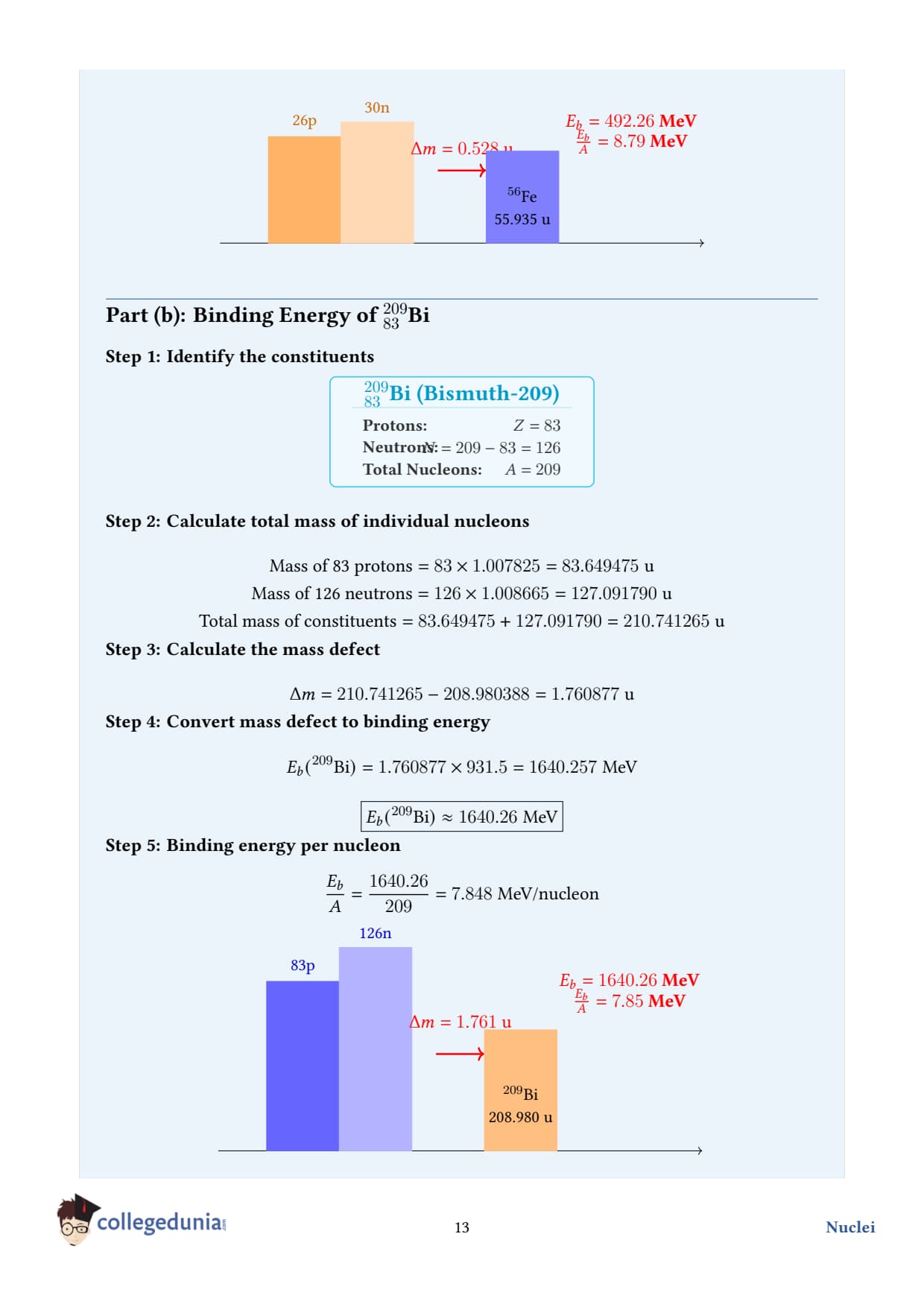
Obtain the binding energy of the nuclei 5626Fe and 20983Bi in units of MeV from the following data: m(5626Fe) = 55.934939 u, m(20983Bi) = 208.980388 u.
Given.
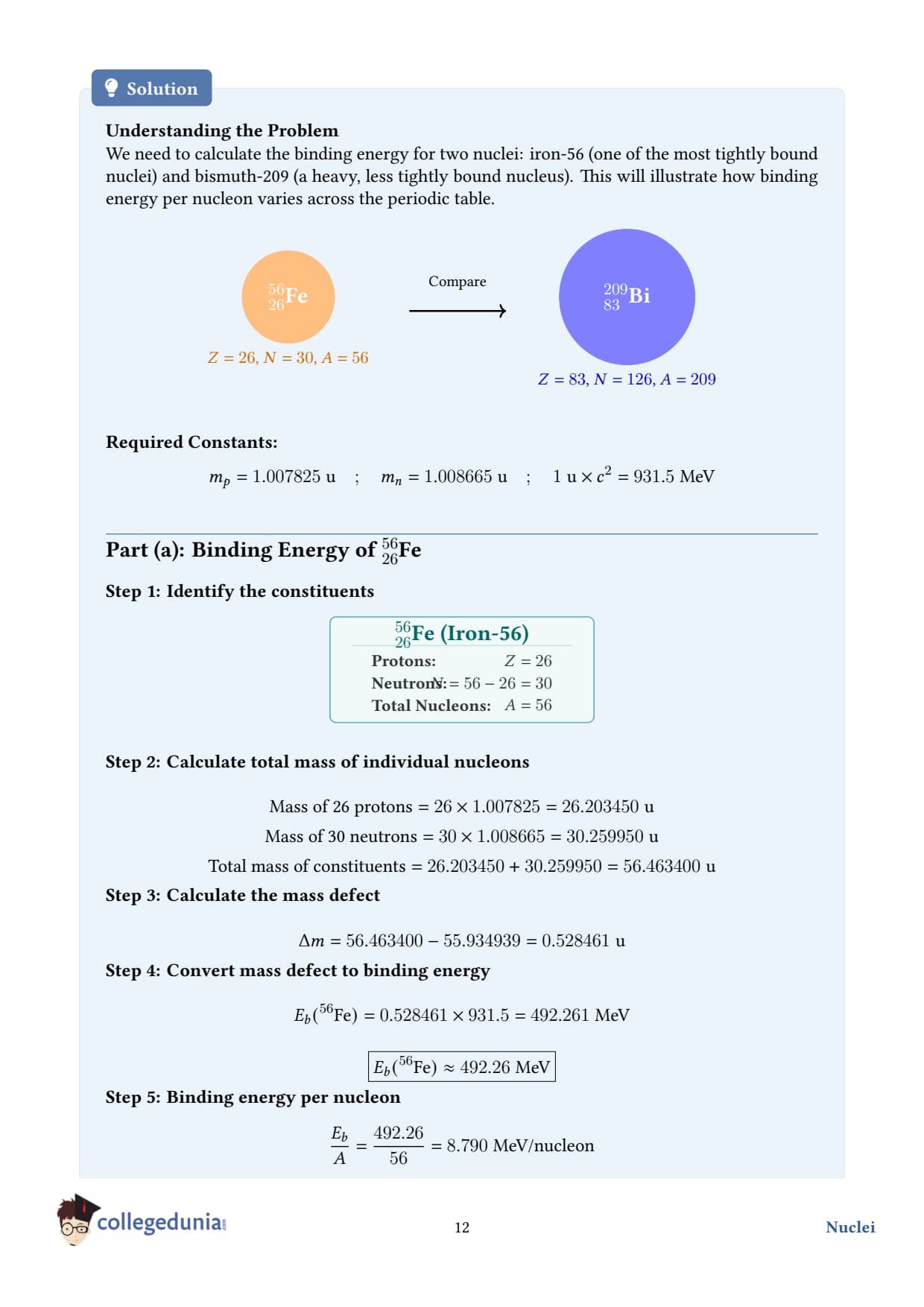
m(5626Fe) = 55.934939 u; for Fe: Z=26, N=A-Z=30.
m(20983Bi) = 208.980388 u; for Bi: Z=83, N=A-Z=126.
mH = 1.007825 u, mn = 1.008665 u, 1 u = 931.5 MeV/c2.
Concept used - mass defect, binding energy, binding energy per nucleon. Δ m = Z mH + (A-Z) mn - matom, Eb = Δ m (931.5) MeV. The binding energy per nucleonEb/A is the single most useful indicator of nuclear stability - the higher, the more tightly bound.
Part A - Iron-56.
Step 1 - sum of free-nucleon masses. Σ m = 26(1.007825) + 30(1.008665). = 26.20345 + 30.25995 = 56.46340 u.
Step 2 - mass defect. Δ mFe = 56.46340 - 55.934939 = 0.528461 u.
So iron-56 is more tightly bound per nucleon than bismuth-209, even though bismuth has a much larger total binding energy.
DA
Dr. Anita Sharma
Ph.D. Physics, University of Delhi
Verified Expert
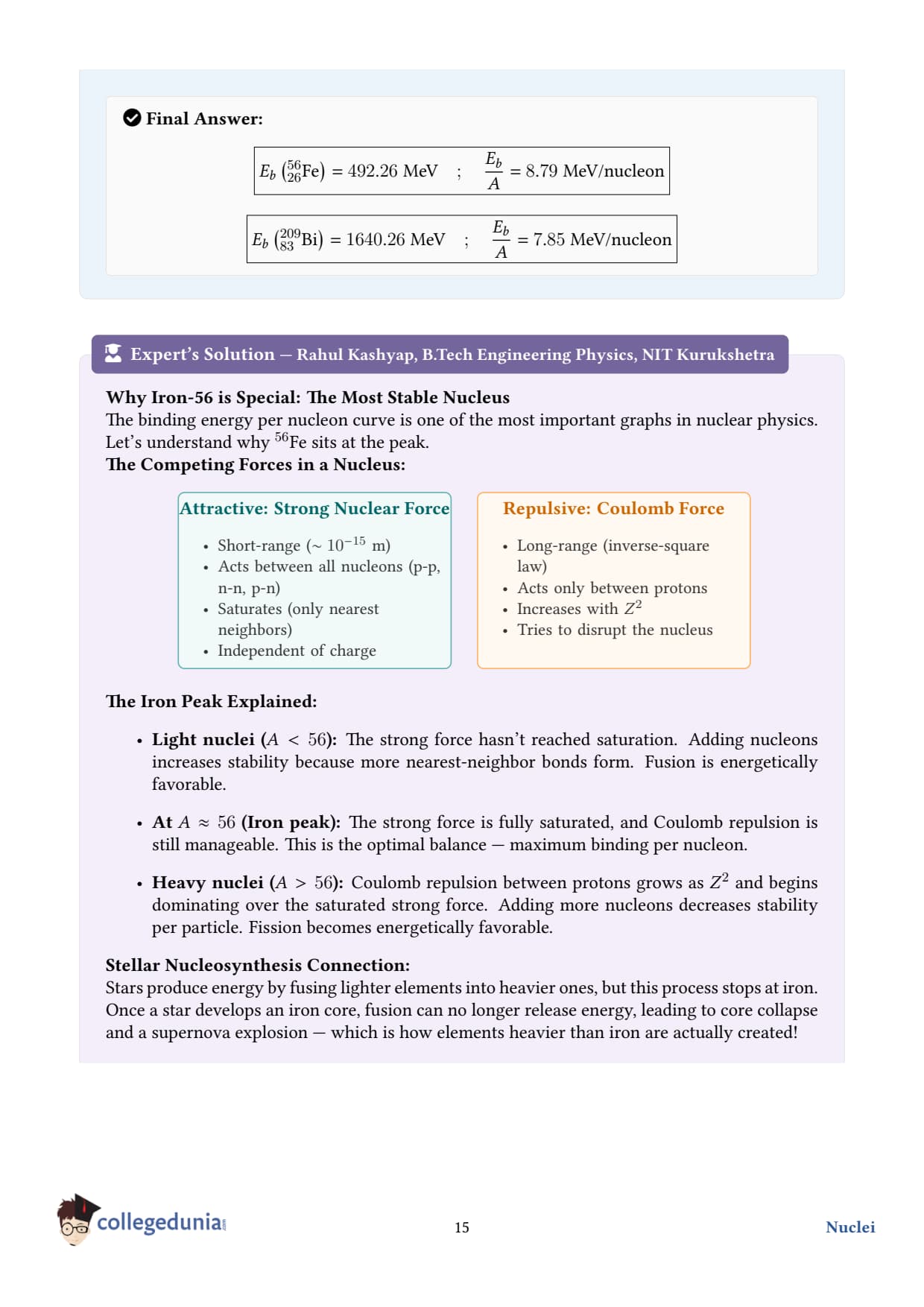
Why iron is the "peak" of nuclear stability. The Eb/A curve has its maximum near A ≈ 56 (specifically nickel-62 is the absolute peak, but iron-56 is almost tied and far more abundant). To the left of the peak (light nuclei), nuclei gain stability by fusing together to make heavier ones - this is what powers stars. To the right of the peak (heavy nuclei like uranium or bismuth), nuclei gain stability by fissioning into lighter ones. Iron is the "ash" of stellar nucleosynthesis: a star can extract energy from fusion only up to iron, after which fusing further actually costs energy.
Alternate method - direct multiplication. A slicker way to write the calculation: Eb = Z mH + (A-Z)mn - matom × 931.5 MeV. Bake the conversion factor into a single line so you don't lose track of intermediate Δ m values.
Common mistake - using atomic mass of hydrogen ion. Some tables provide mp (mass of bare proton) instead of mH (mass of hydrogen ATOM including the electron). If you use mp but the table's m(5626Fe) includes 26 electrons, you'll be off by Z me - about 0.014 u for iron, which translates to a ∼ 13 MeV error.
Real-world relevance - nuclear reactors. Bismuth-209 was, for a long time, considered the heaviest stable nucleus (we now know it's very weakly radioactive). The fact that Eb/A drops off for heavy nuclei is what makes them susceptible to fission. In a uranium reactor, breaking 235UEb/A ≈ 7.6 MeV into fragments near iron-56 Eb/A ≈ 8.8 MeV releases roughly 200 MeV per fission - the energy difference times 235 nucleons.
Q 13.3
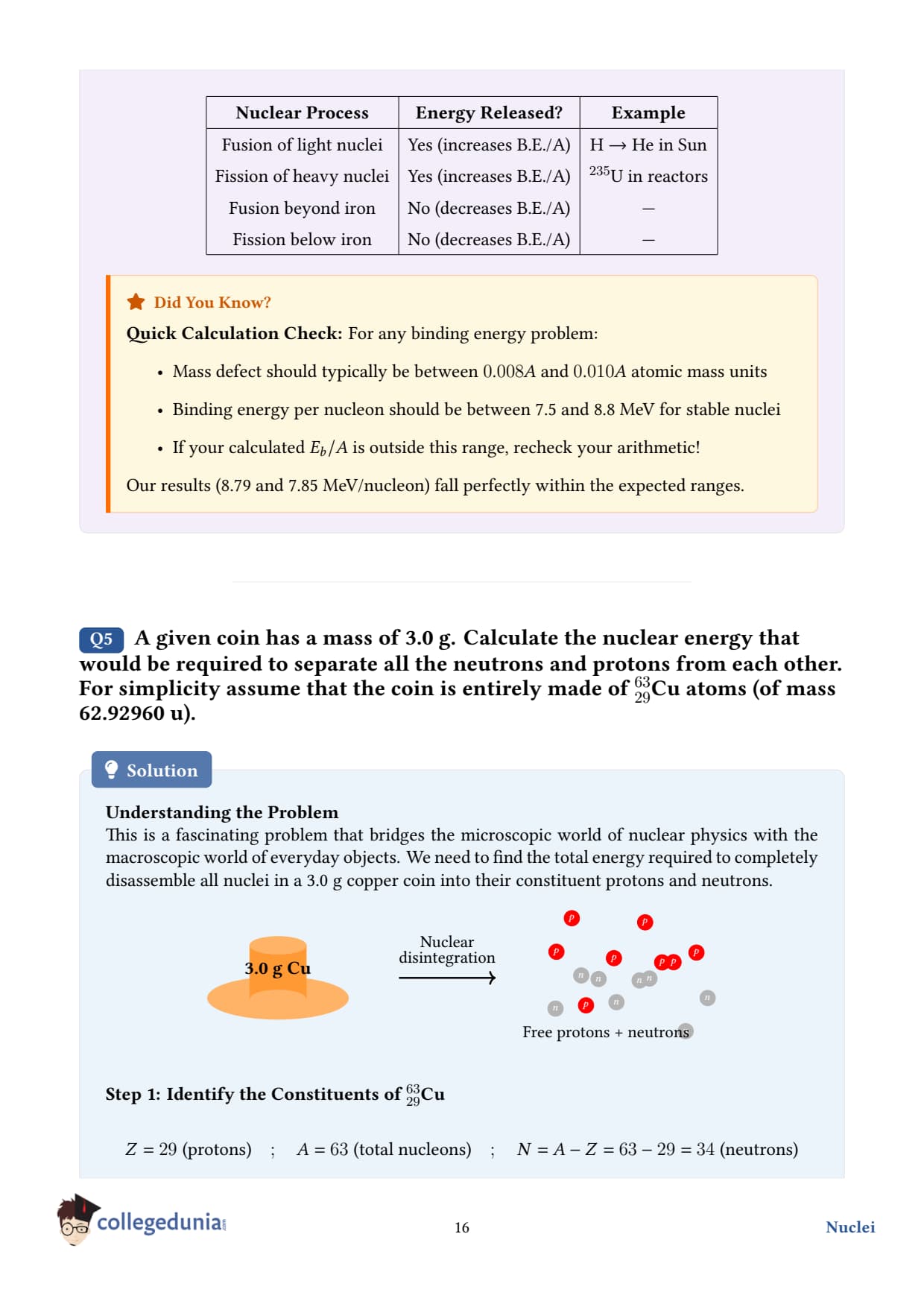
A given coin has a mass of 3.0 g. Calculate the nuclear energy that would be required to separate all the neutrons and protons from each other. For simplicity, assume that the coin is entirely made of 6329Cu atoms of mass 62.92960 u.
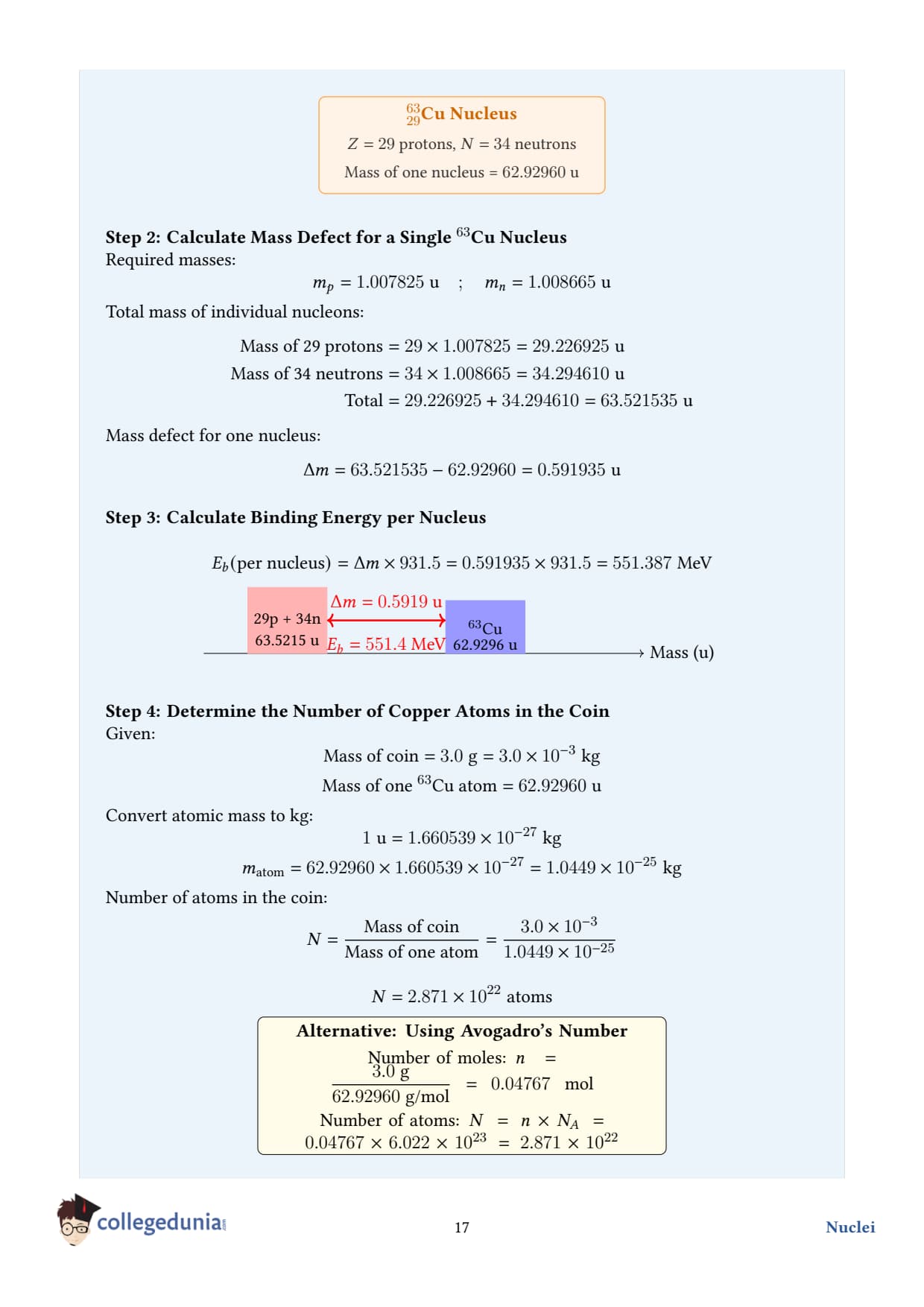
What's being asked. A coin made entirely of 63Cu atoms. Tearing each nucleus apart into 29 free protons and 34 free neutrons costs that nucleus's binding energy. We need the total binding energy of every 63Cu nucleus in the coin.
Given.
Mass of coin, M = 3.0 g = 3.0× 10⁻³ kg.
Atomic mass of 63Cu, m(6329Cu) = 62.92960 u. For Cu: Z = 29, N = 63 - 29 = 34.
mH = 1.007825 u, mn = 1.008665 u, 1 u = 931.5 MeV/c2.
Avogadro's number NA = 6.023× 10²³ mol-1; molar mass of 63Cu≈ 62.92960 g/mol.
Concept used - total nuclear energy = (number of nuclei) × (binding energy per nucleus). First compute the binding energy of one 63Cu nucleus, then multiply by the number of such nuclei in 3.0 g of copper.
Step 1 - number of Cu atoms in the coin.N = MmCu, in grams× NA = 3.062.92960× 6.023× 1023. = (0.04767)(6.023× 10²³) ≈ 2.871× 10²² atoms.
Step 2 - mass defect of one 63Cu nucleus. Σ m = 29(1.007825) + 34(1.008665) = 29.226925 + 34.294610 = 63.521535 u. Δ m = 63.521535 - 62.92960 = 0.591935 u.
Step 3 - binding energy of one nucleus. Eb = (0.591935)(931.5) ≈ 551.39 MeV.
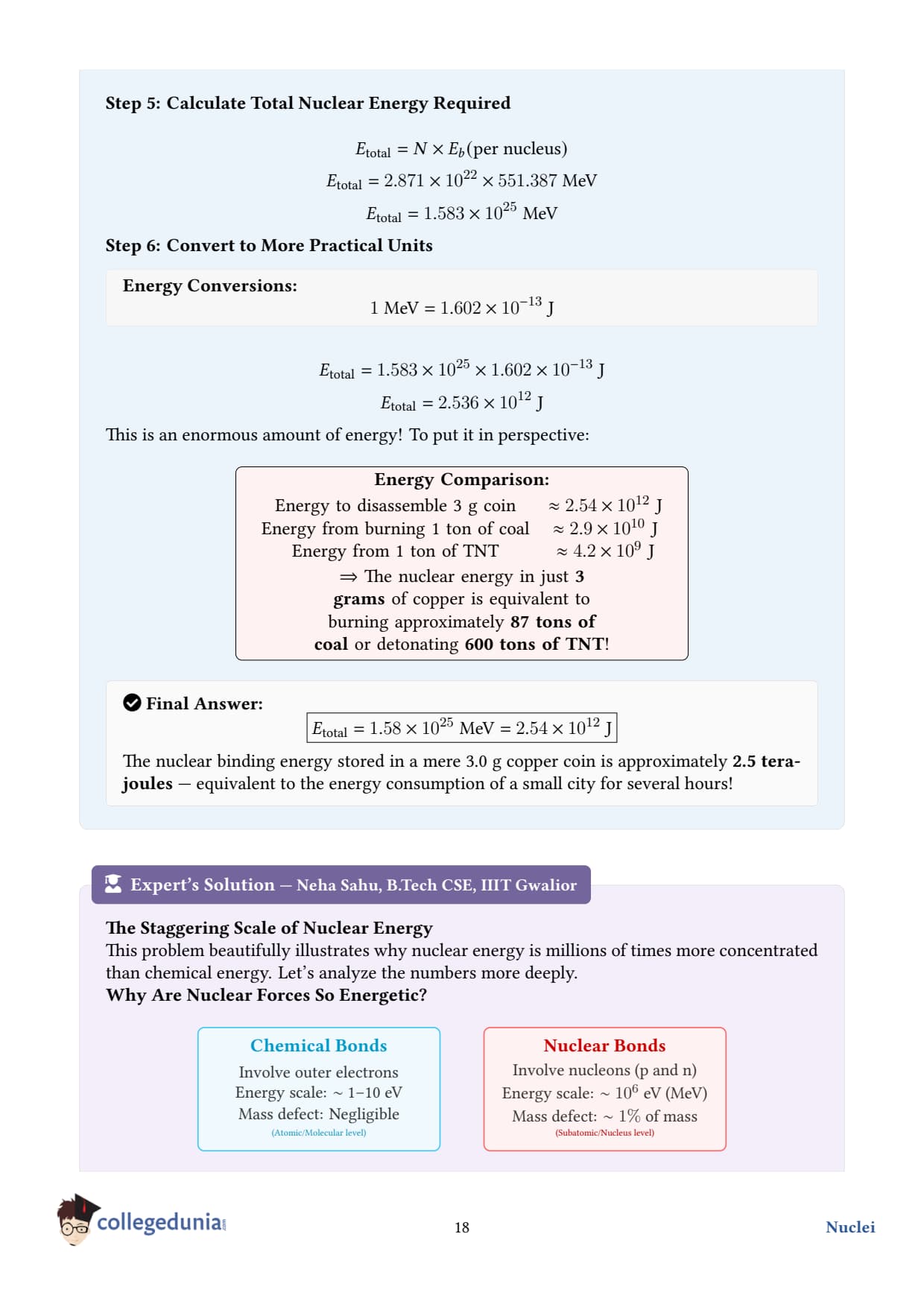
Step 4 - total energy to dismantle the coin. Etotal = N Eb = (2.871× 10²²)(551.39 MeV). ≈ 1.583× 1025 MeV.
Step 5 - convert to joules. Using 1 MeV = 1.6× 10⁻¹³J: Etotal ≈ (1.583× 1025)(1.6× 10⁻¹³) ≈ 2.53× 10¹²J.
Final answer. Etotal ≈ 1.58× 1025 MeV ≈ 2.53× 10¹²J.
That's astronomical - about 700 megawatt-hours, or roughly the daily electricity demand of a small town, tucked inside a single 3-gram coin.
DS
Dr. Suresh Iyer
Ph.D. Theoretical Physics, TIFR Mumbai
Verified Expert
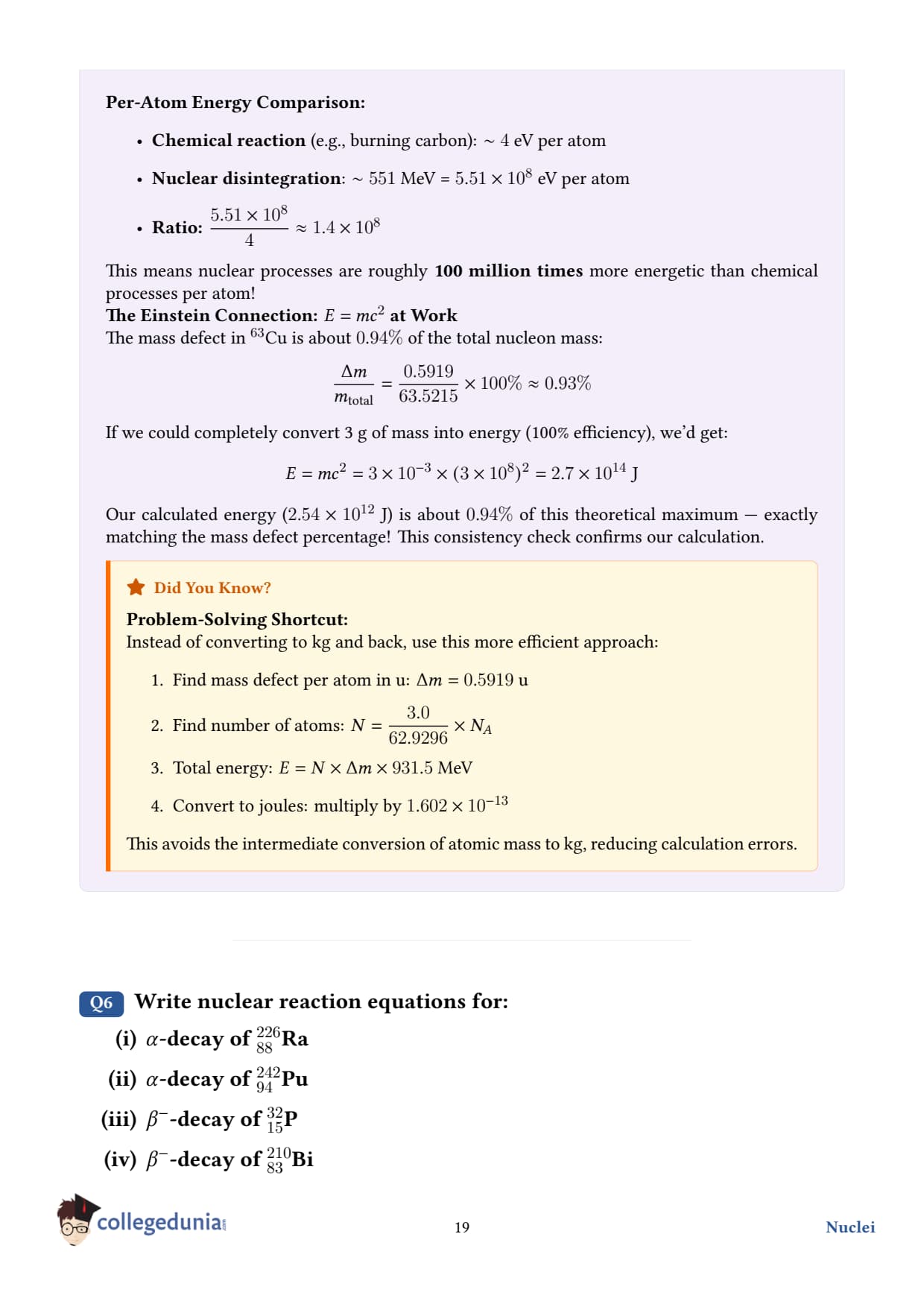
Why ordinary chemistry cannot tap this. Chemical bonds are formed and broken at energies of a few eV per atom - nuclear binding is a million times larger. A normal flame can't even slightly nudge a nucleus; you need bombarding particles with MeV-scale kinetic energy (cyclotrons, fission products) to disturb nuclei.
Comparison with macroscopic energies.2.5× 1012J is the energy released by burning approximately 600 tonnes of TNT, or by burning about 60 tonnes of petrol. All trapped inside a 3-gram coin. This is the basic insight behind nuclear power and weapons - even partial unlocking of nuclear binding energy yields stupendous amounts of energy from tiny amounts of matter.
Common mistake - confusing total binding with reaction energy. The energy computed here is the cost to dismantle each nucleus into free nucleons. Real nuclear reactions (fission, fusion) rearrange nucleons from less-bound to more-bound configurations, releasing only the difference in binding energies - typically ∼ 1 MeV/nucleon, not the full ∼ 8.7 MeV/nucleon. So actual reactor energy yields are about ten times smaller than the naive total binding energy.
Order-of-magnitude shortcut. For any solid sample, the number of atoms is ∼ NAM/Mmol and the per-nucleus binding energy is ∼ A× 8 MeV. Combining: total binding energy ∼ 8 MeVNAM / mu where mu is the atomic mass unit. For 3 g of matter, this gives ∼ 1025 MeV. The detailed calculation above lands on 1.6× 1025 MeV - consistent.
Q 13.4
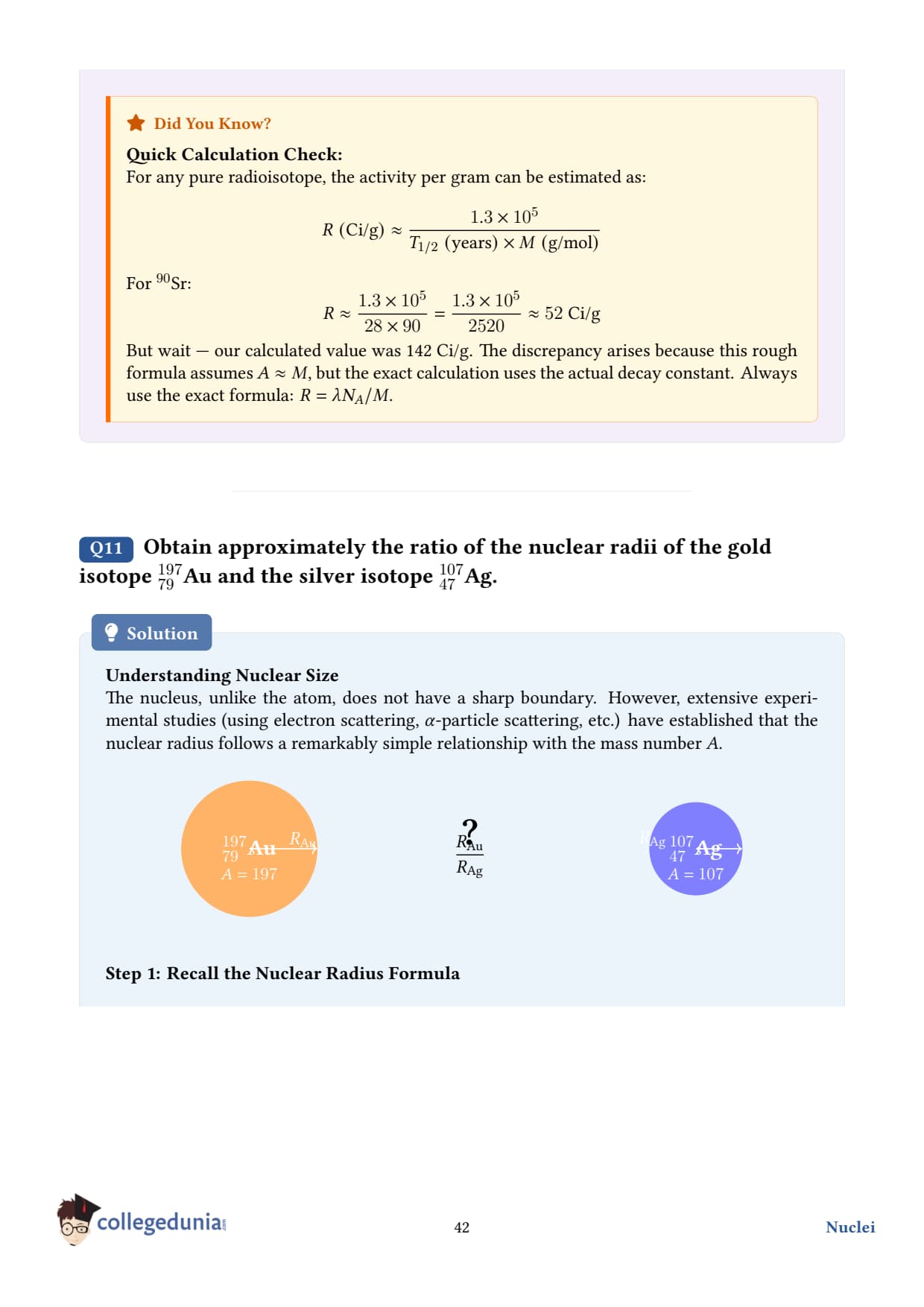
Obtain approximately the ratio of the nuclear radii of the gold isotope 19779Au and the silver isotope 10747Ag.
Given.
Gold isotope mass number, AAu = 197.
Silver isotope mass number, AAg = 107.
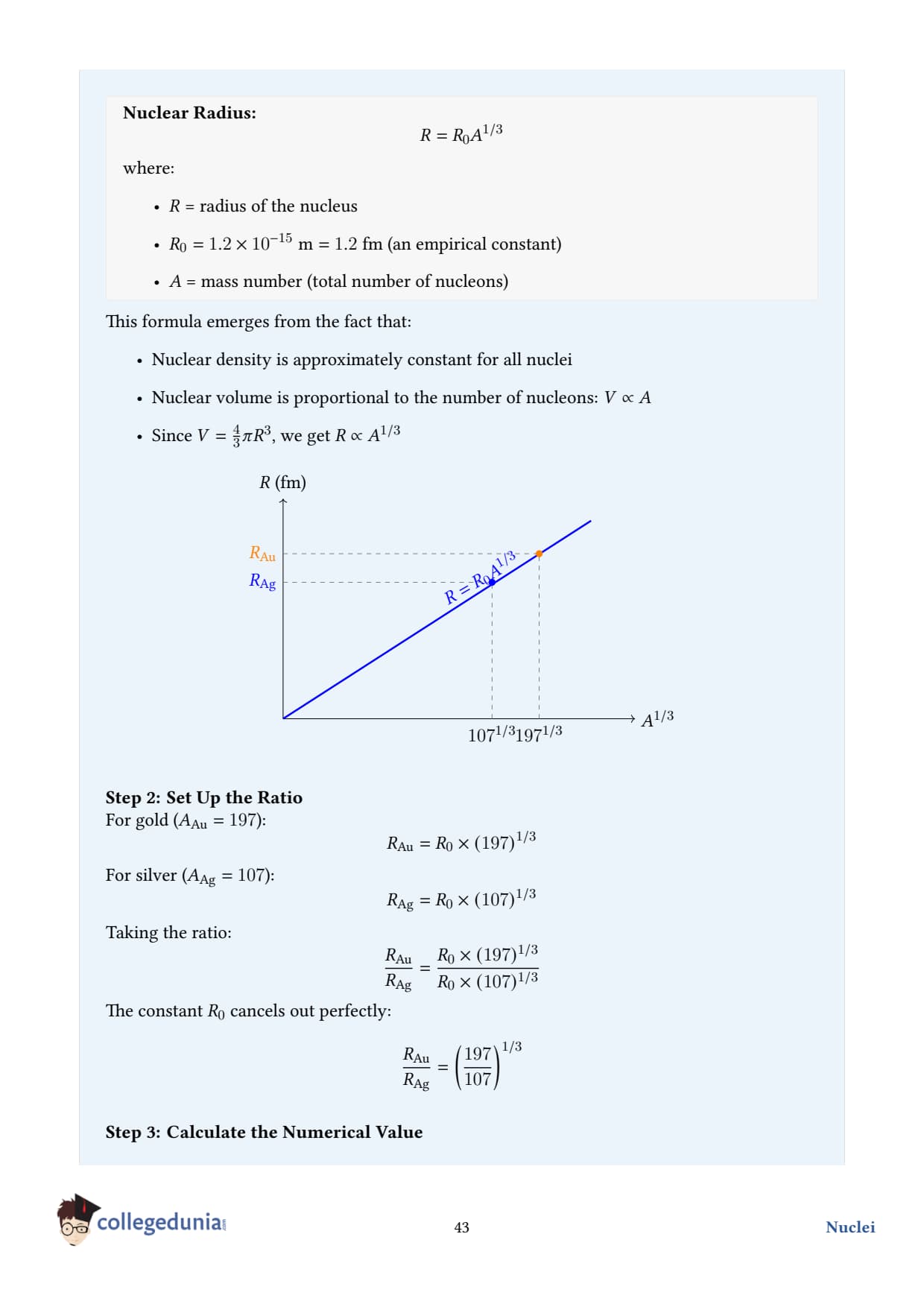
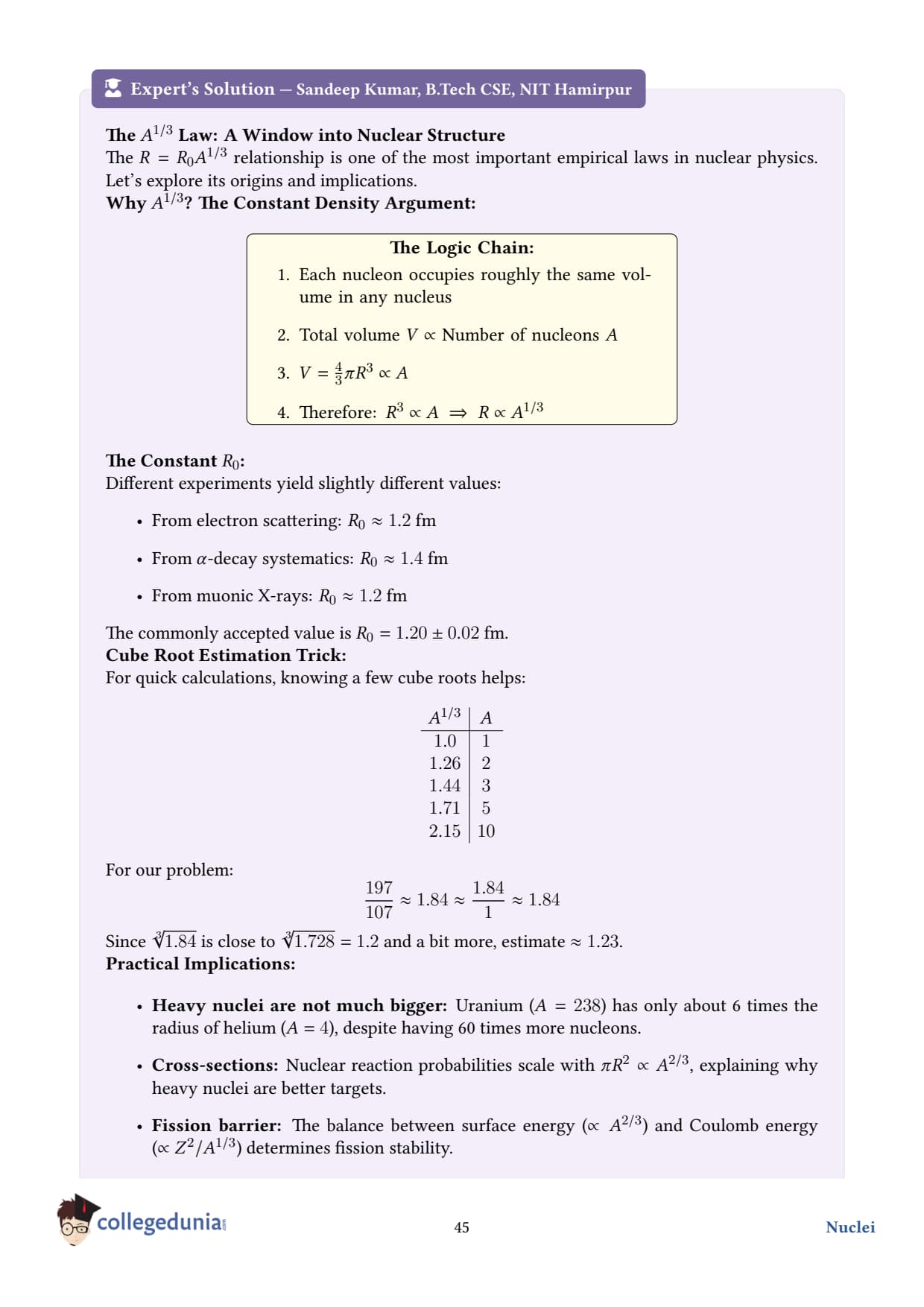
Concept used - nuclear radius formula. Experimentally, the radius R of a nucleus is found to depend only on its mass number A, not on Z separately, and follows R = R0 A1/3, R0 ≈ 1.2 fm. This is because nuclear matter is roughly incompressible: every nucleon takes up about the same volume, so the total volume is proportional to A, and radius scales as the cube root of volume.
Step 1 - take the ratio. Both nuclei share the same R0, so it cancels: RAuRAg = R0 AAu1/3R0 AAg1/3 = (AAuAAg)1/3.
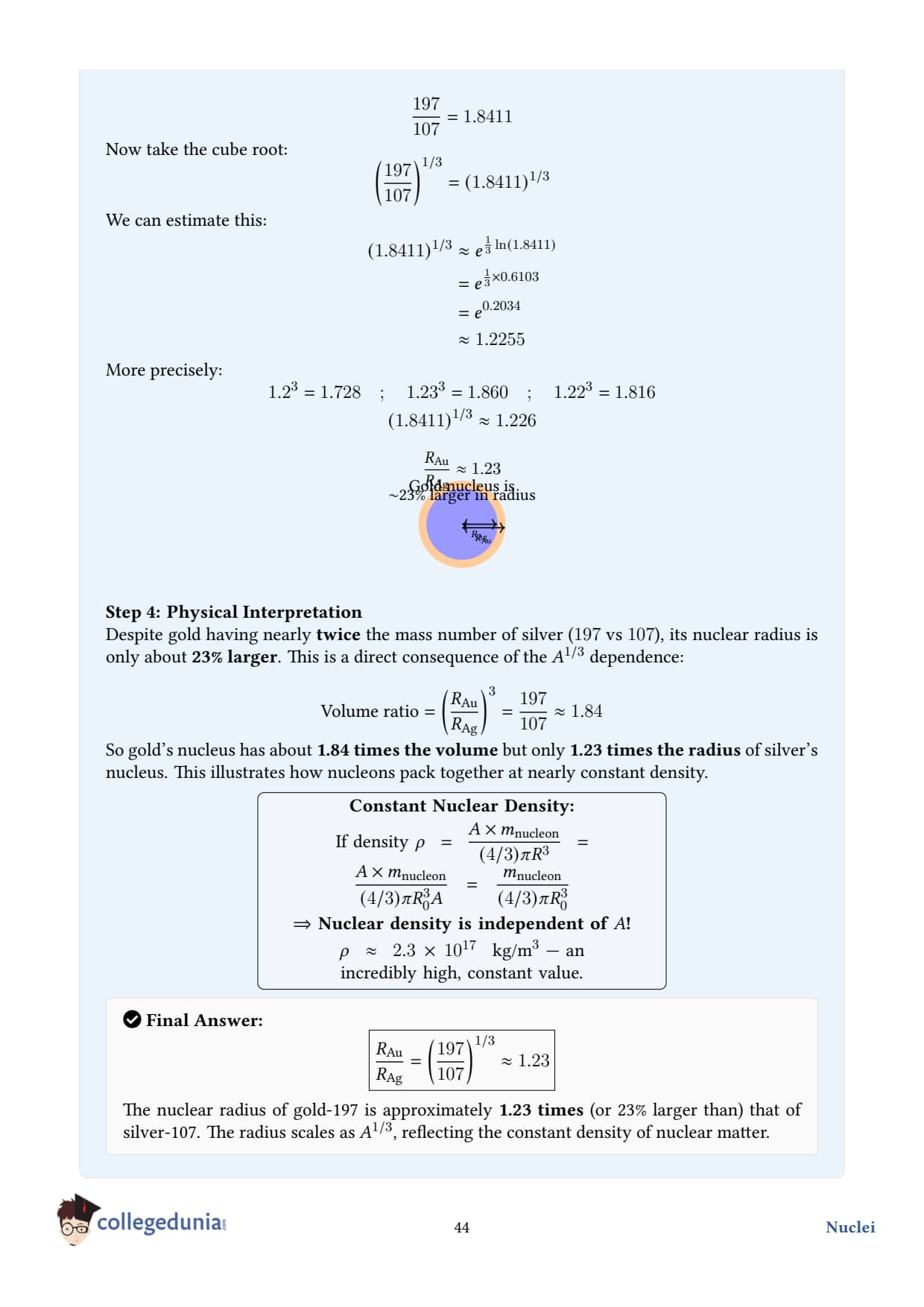
Step 3 - evaluate the cube root. (1.8411)1/3 ≈ 1.225.
Final answer.RAuRAg ≈ 1.23. The gold nucleus is roughly 23% wider in radius than the silver one - even though it has nearly twice as many nucleons. That's the cube-root law at work.
DK
Dr. Kavita Joshi
Ph.D. Nuclear Physics, IIT Madras
Verified Expert
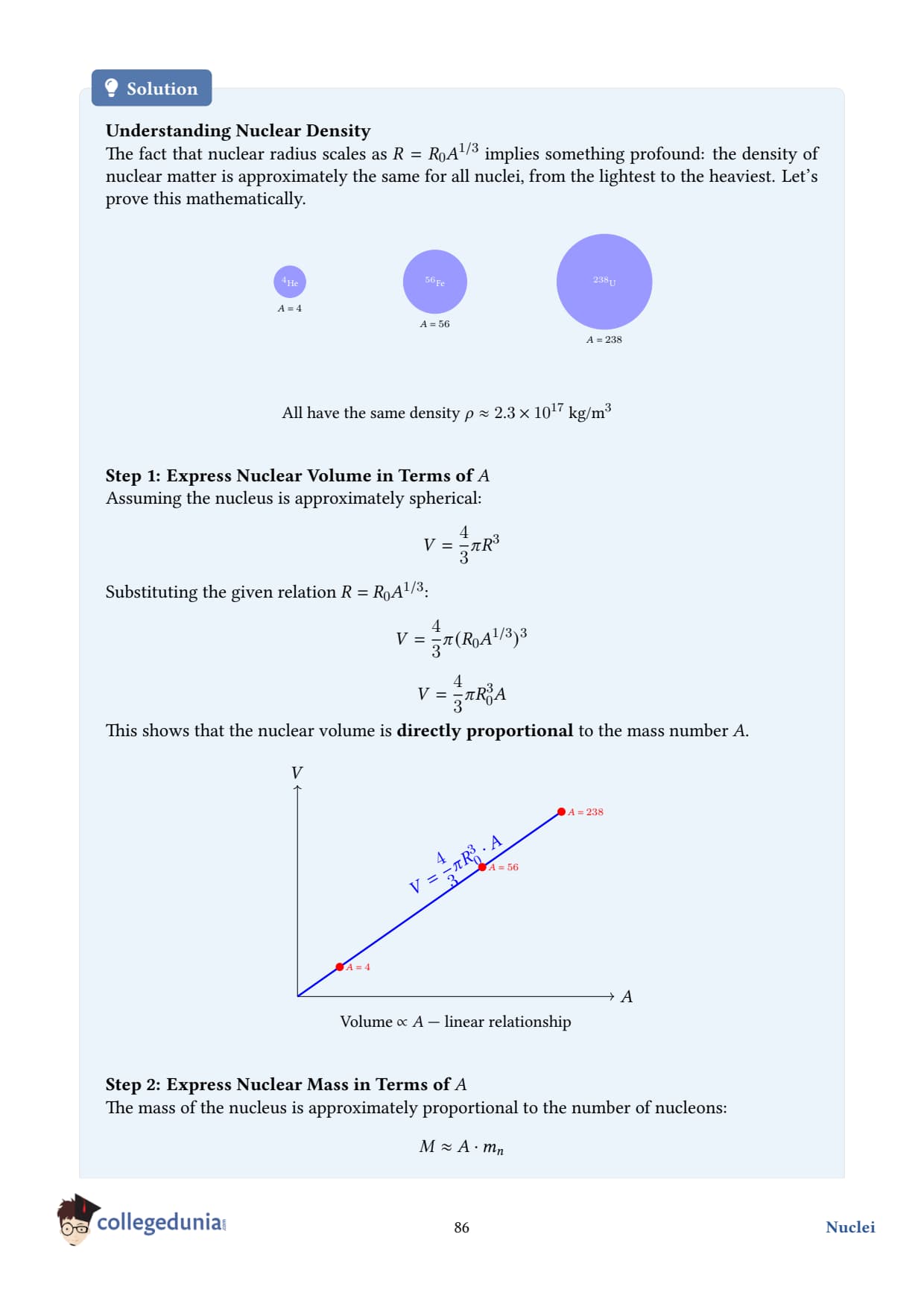
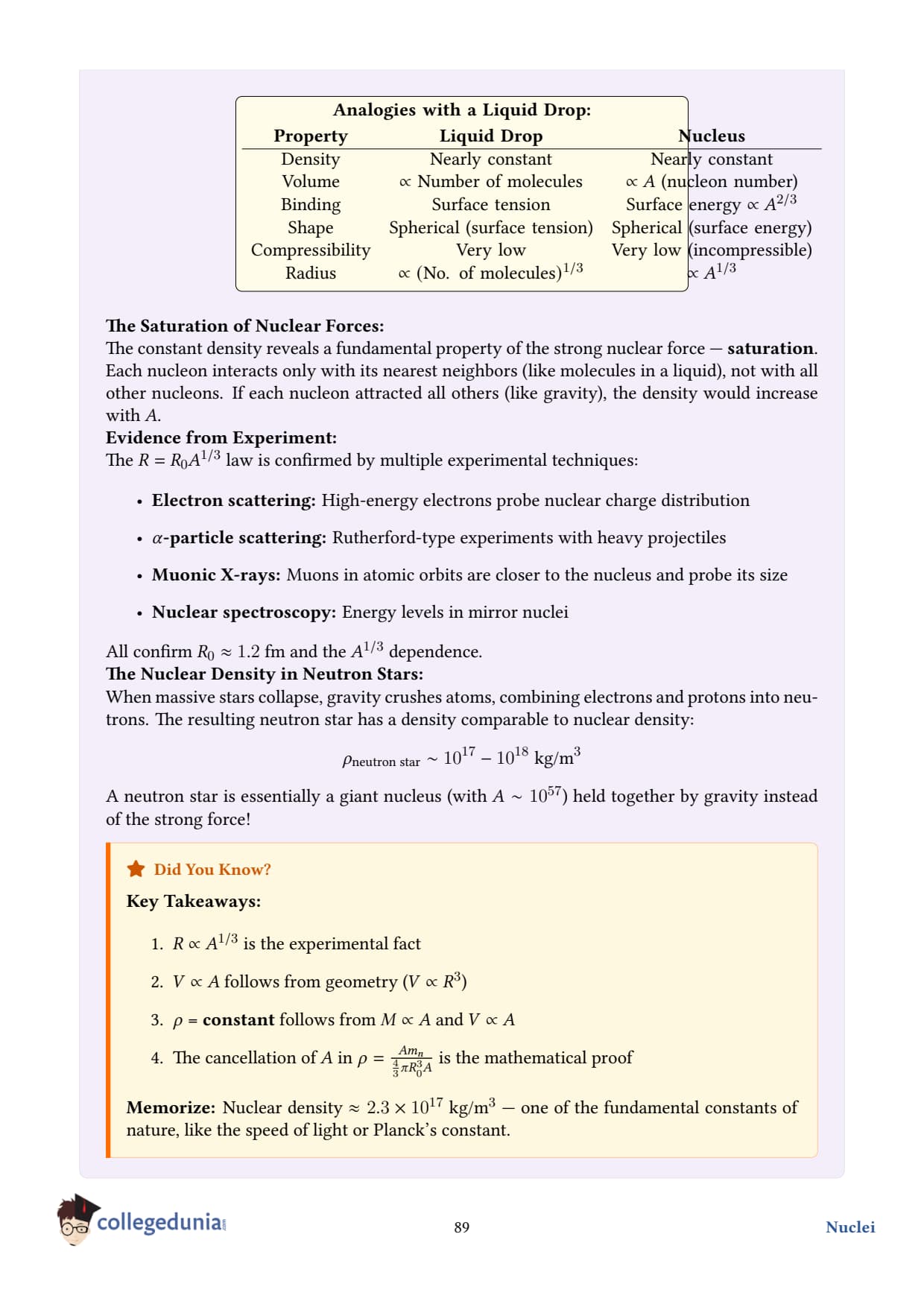
Why nuclear density is constant. If R ∝ A1/3, then volume V = 43π R3 ∝ A. Density ρ = nucleon mass × A/V is independent of A - every nucleus, light or heavy, has the same density: about 2.3× 10¹⁷ kg/m3. One teaspoon of nuclear matter would weigh nearly a billion tonnes. This is what makes neutron stars so extreme: they're essentially giant nuclei held together by gravity instead of the strong force.
Alternate method - log scaling. When ratios involve cube roots, taking logs is sometimes faster: log(RAu/RAg) = 13log(197/107) = 13log(1.84) ≈ 13(0.265) ≈ 0.088. So RAu/RAg ≈ 100.088 ≈ 1.22. Same answer.
Why protons don't blow the nucleus apart. Even though all those positively-charged protons repel each other electrostatically, the strong nuclear force between every pair of nucleons (proton-proton, proton-neutron, neutron-neutron) is far stronger at femtometre distances. It saturates with the nearest neighbours (short-range), giving rise to the nearly-constant nuclear density.
Common mistake - using Z instead of A. The radius formula uses A, not Z - adding neutrons makes the nucleus bigger just as much as adding protons. Confusing A and Z here is a classic JEE/NEET trap.
Q 13.5
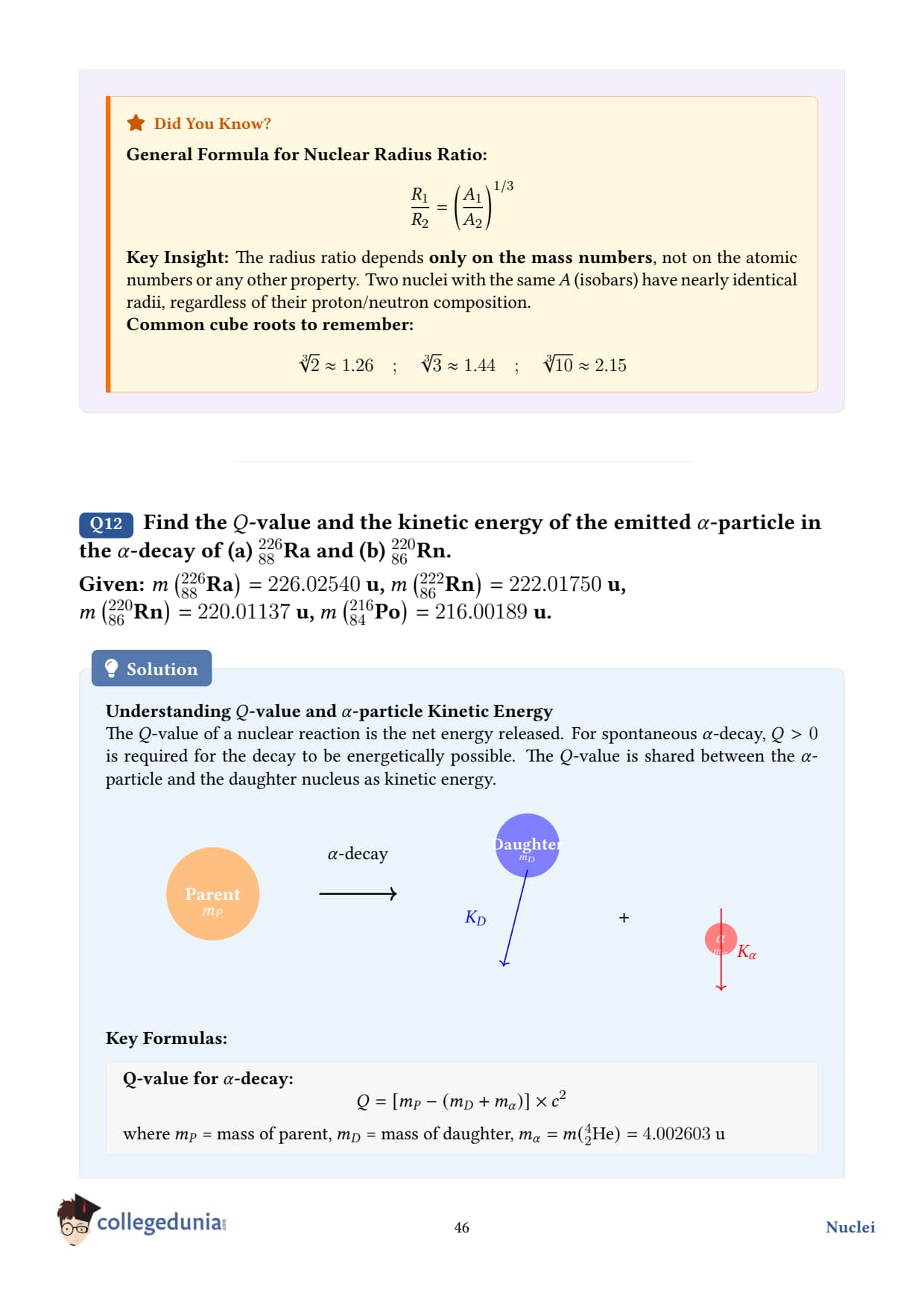
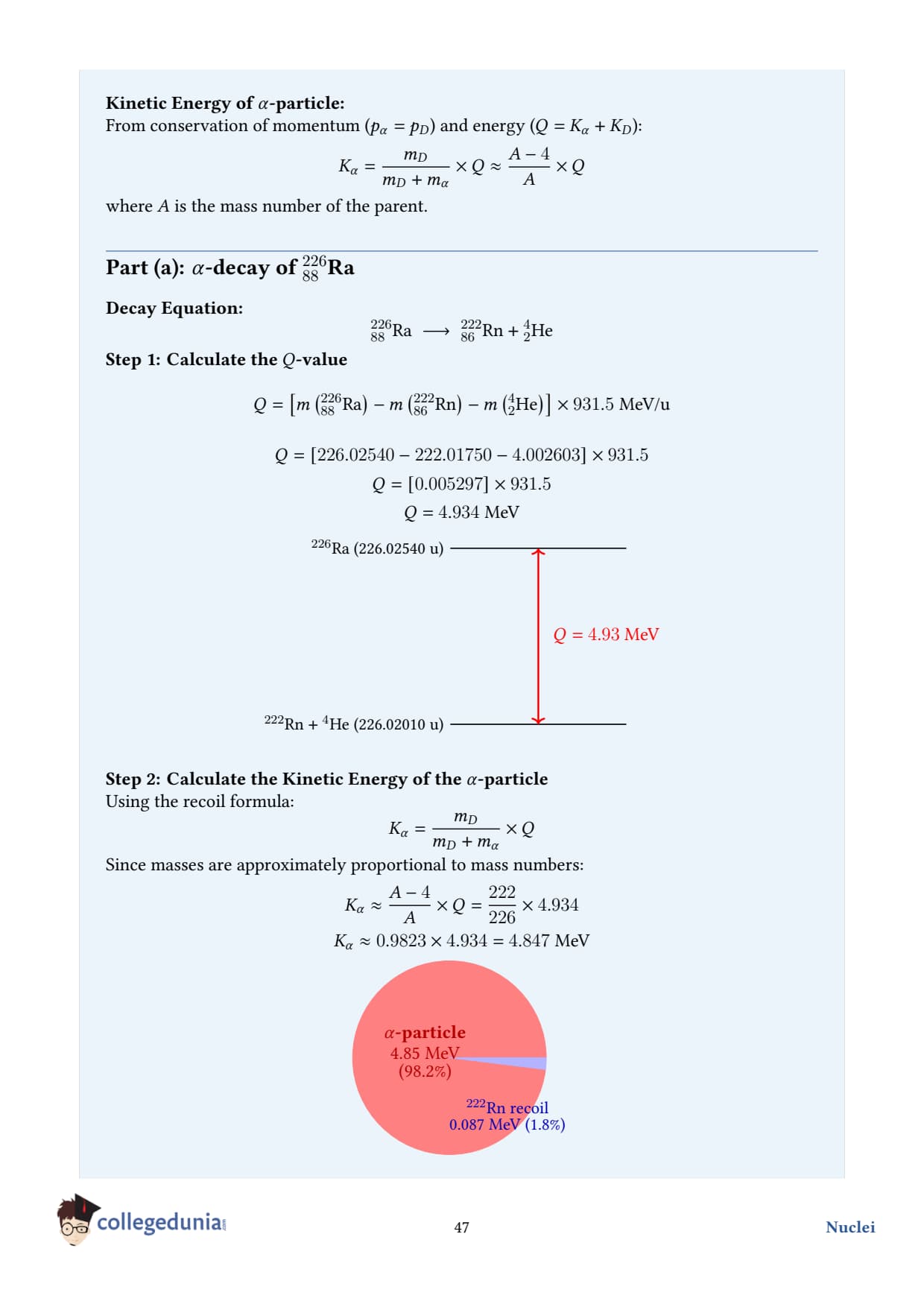
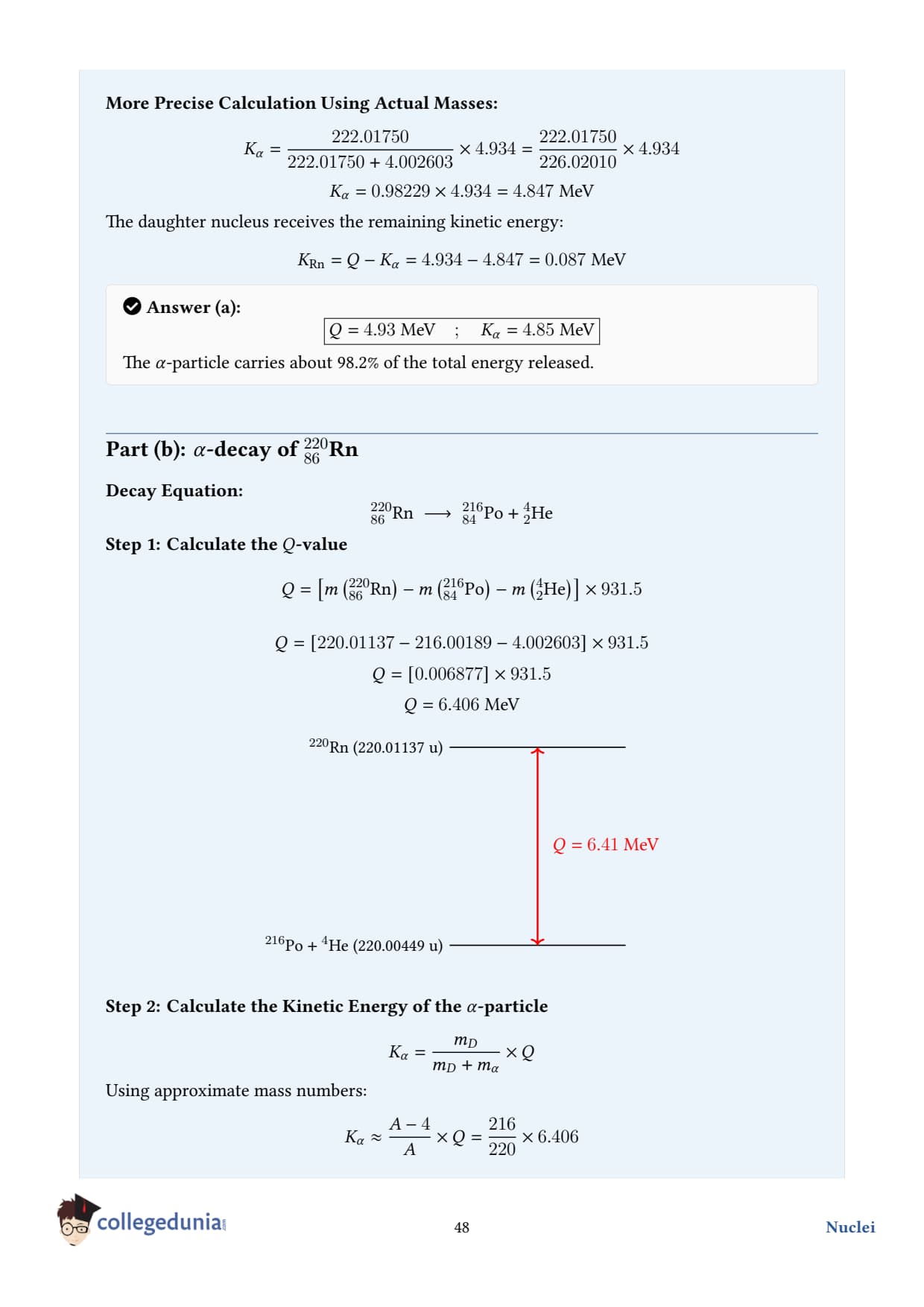
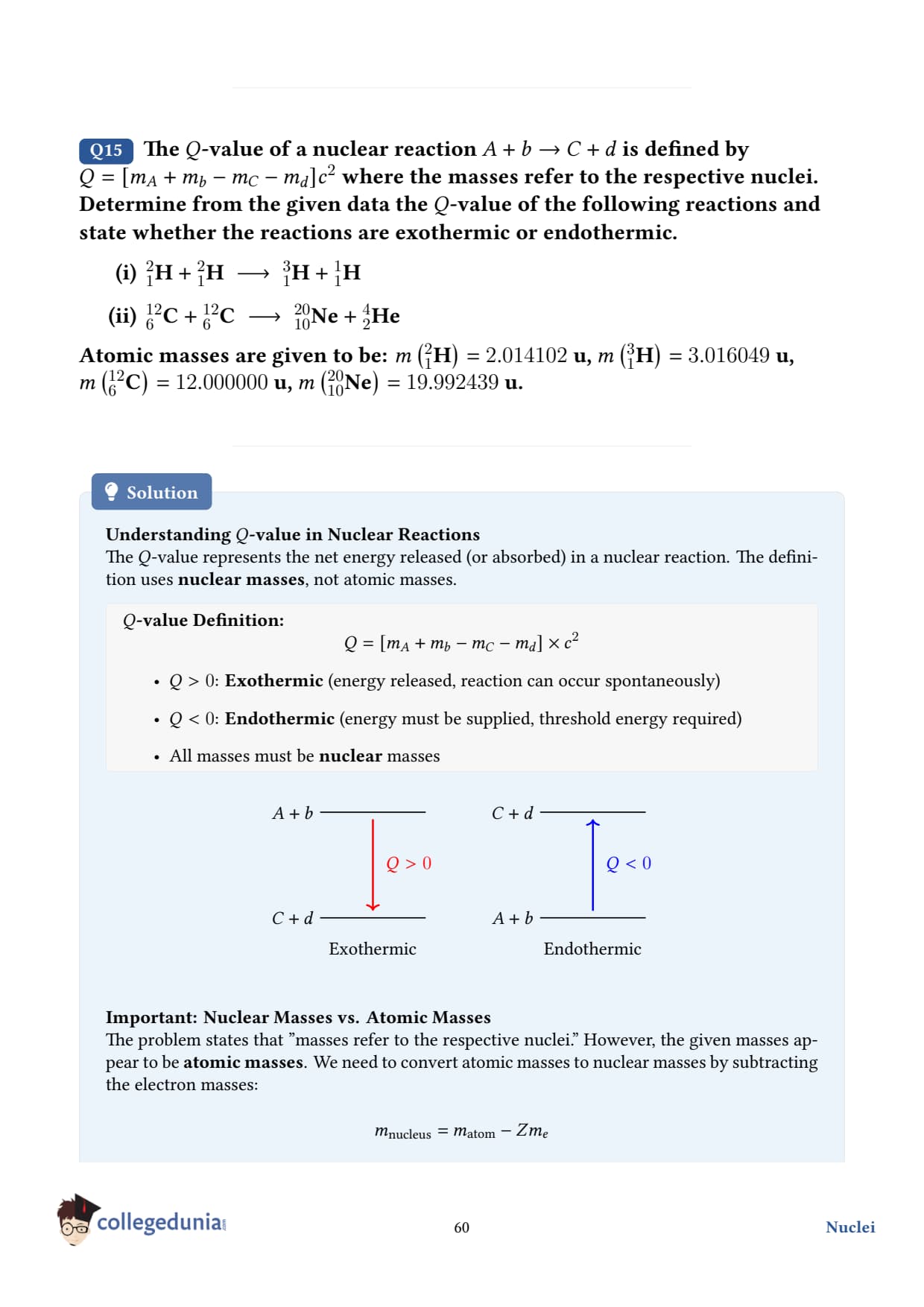
The Q value of a nuclear reaction A + b → C + d is defined by Q = mA + mb - mC -mC22, where the masses refer to the respective nuclei. Determine from the given data the Q-value of the following reactions and state whether the reactions are exothermic or endothermic.
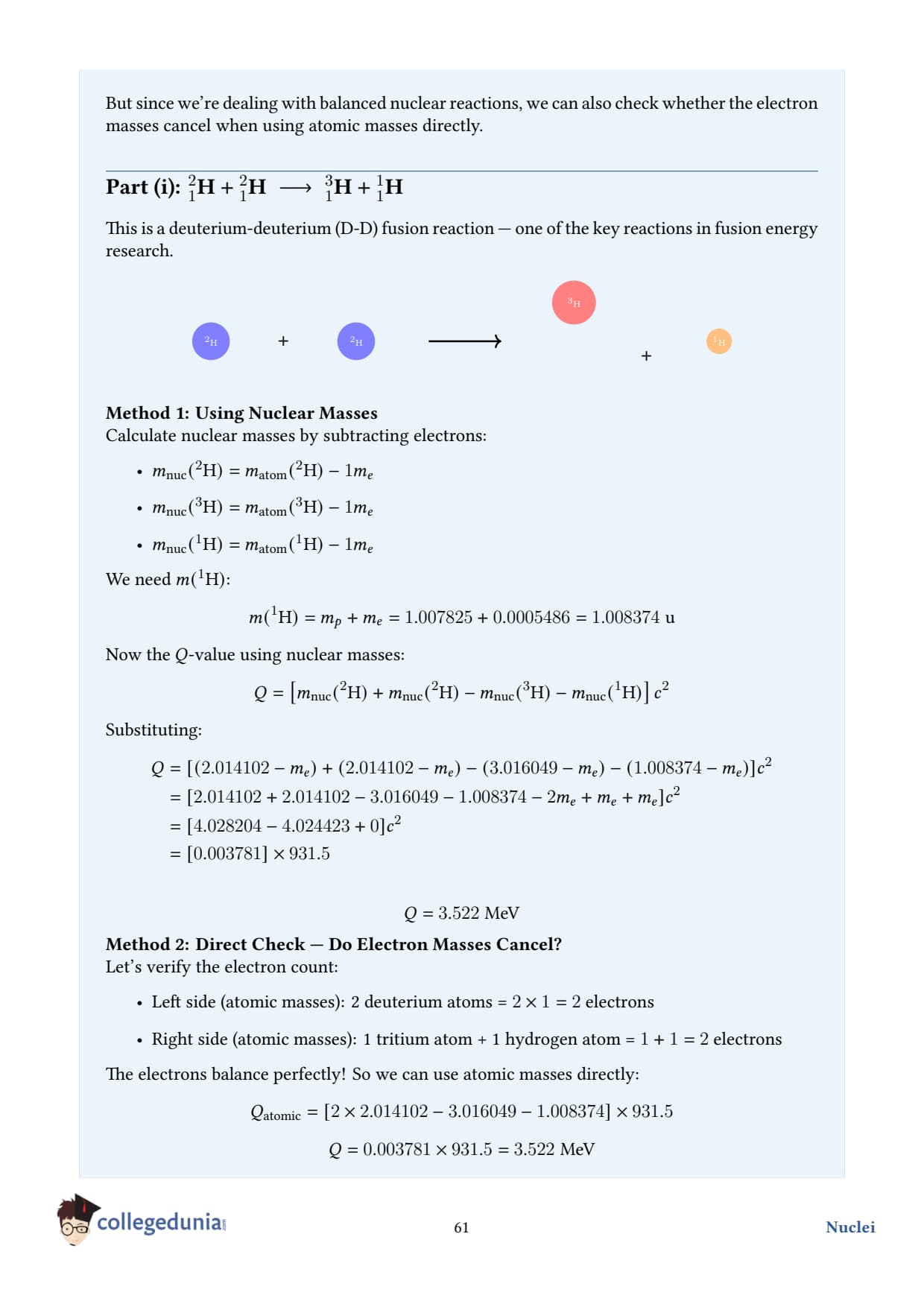
(i) 11H + 31H → 21H + 21H
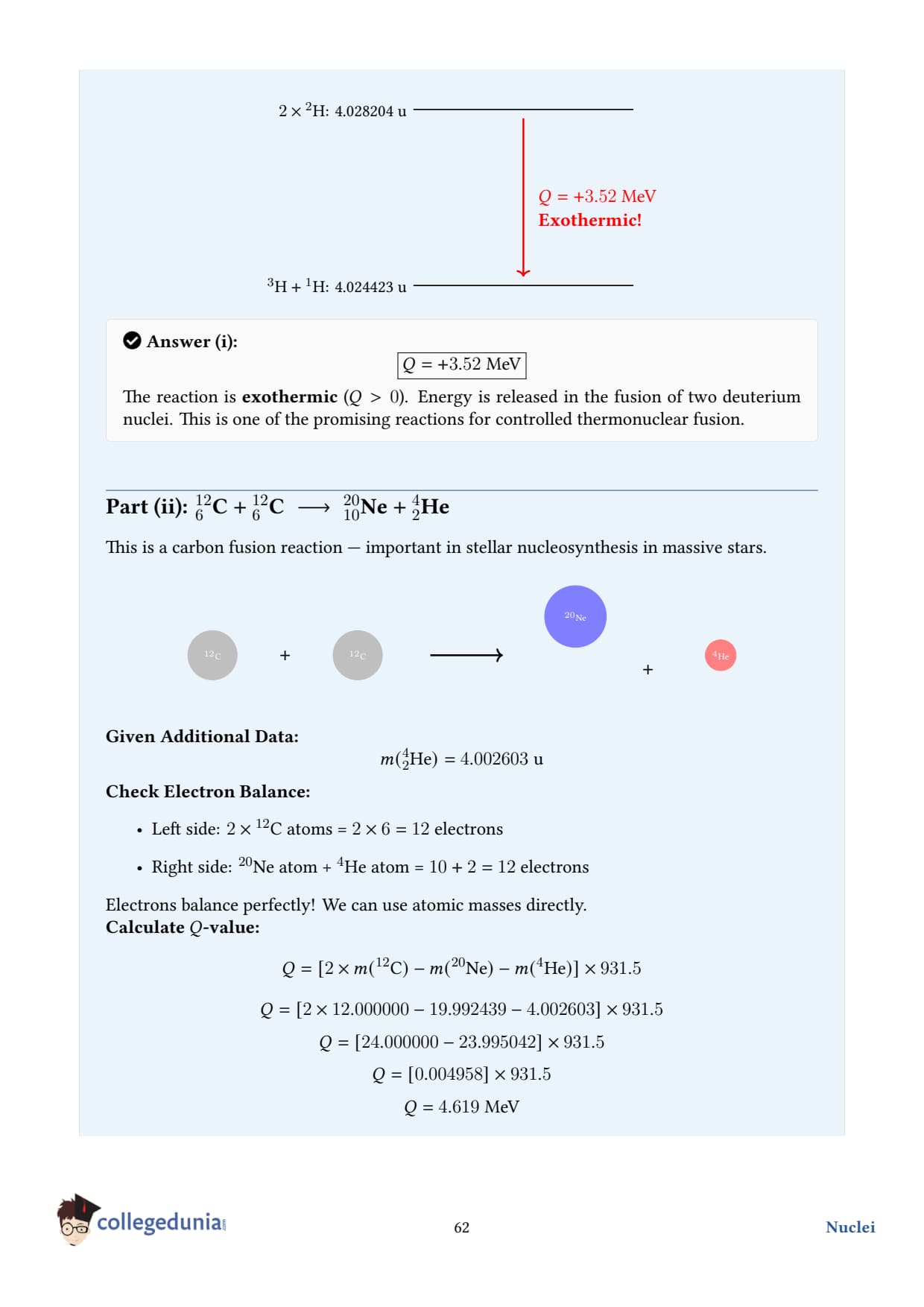
(ii) 126C + 126C → 2010Ne + 42He
Atomic masses are given to be m(21H) = 2.014102 u, m(31H) = 3.016049 u, m(126C) = 12.000000 u, m(2010Ne) = 19.992439 u.
Concept used - Q-value sign convention. Writing reactants on the left and products on the right, Q = (mreactants - mproducts) c2. If Q > 0, the products are lighter than the reactants - the lost mass appears as kinetic energy of the products (and possibly photons). The reaction is exothermic (energy released). If Q < 0, the reaction is endothermic (energy must be supplied). All masses here are atomic masses - but because the same total number of electrons appears on both sides of each reaction, the electron masses cancel.
Part (i):11H + 31H → 21H + 21H.
Step 1 - list the masses.
m(11H) = 1.007825 u
m(31H) = 3.016049 u
m(21H) = 2.014102 u (deuterium)
Step 2 - sum reactants vs products. mreac = 1.007825 + 3.016049 = 4.023874 u. mprod = 2.014102 + 2.014102 = 4.028204 u.
Step 3 - mass difference. Δ m = mreac - mprod = 4.023874 - 4.028204 = -0.004330 u.
Result (ii):Q > 0 → the reaction is exothermic; about 4.62 MeV is released.
Final answer.
(i) Q ≈ -4.03 MeV: endothermic.
(ii) Q ≈ +4.62 MeV: exothermic.
DV
Dr. Vikram Rao
Ph.D. Astrophysics, IIT Bombay
Verified Expert
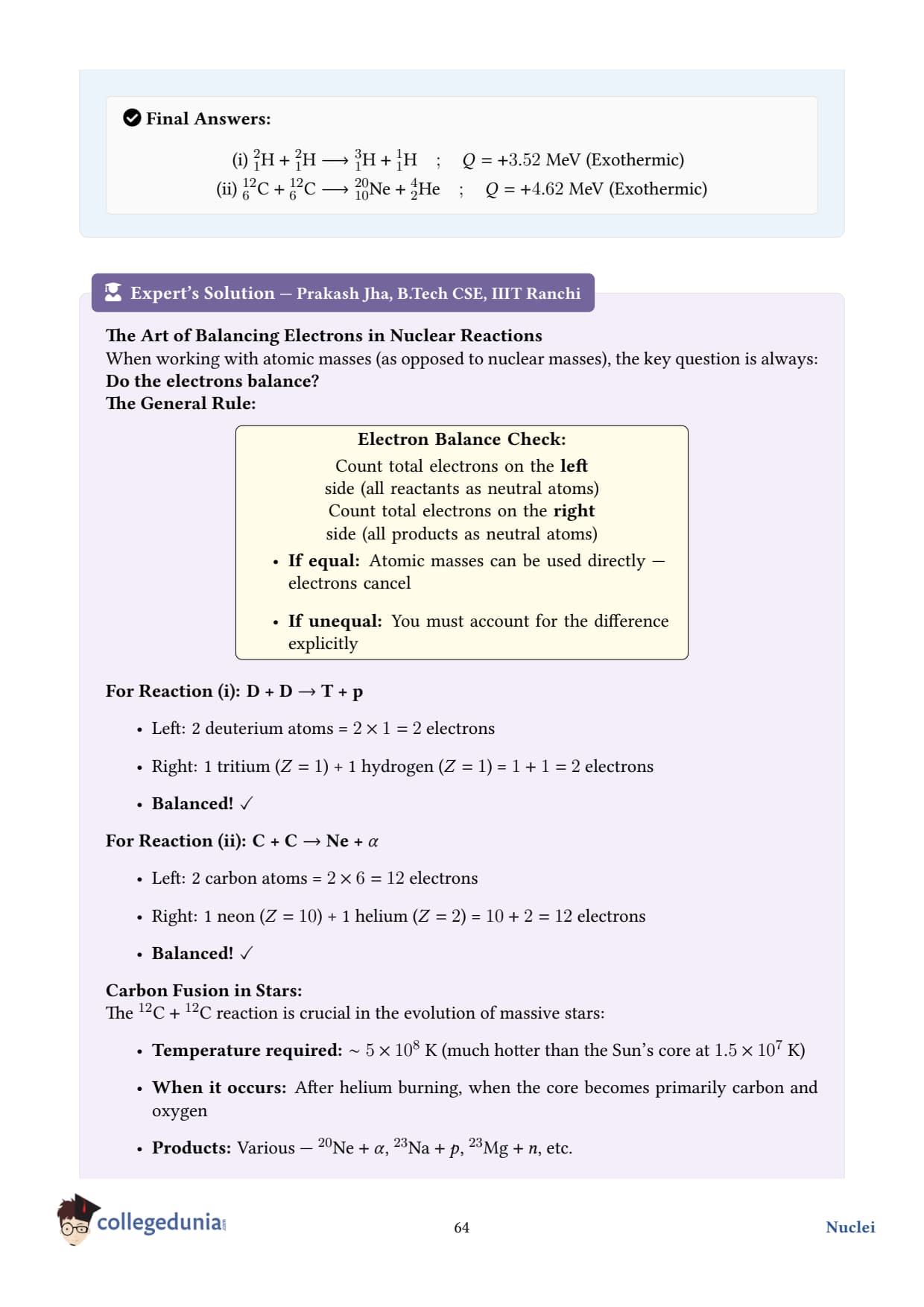
Why electron masses cancel. The left side of reaction (i) carries 1 + 1 = 2 electrons (one in each hydrogen atom); the right side also carries 1 + 1 = 2 electrons. Both sides include the same total electron mass, so it drops out of Δ m. The same is true for reaction (ii): 6 + 6 = 12 on both sides. This is why we can use atomic masses directly in Q-value calculations as long as the total Z is conserved (which it always is, since reactions don't create or destroy charge).
What endothermic vs exothermic means experimentally. Reaction (i) cannot proceed spontaneously - to make it happen, you must bombard a target tritium nucleus with a proton whose kinetic energy exceeds the 4.03 MeV "threshold" (plus a bit more in the lab frame because of momentum conservation). Reaction (ii) (carbon-carbon fusion) is exothermic - it's one of the energy-releasing steps deep inside massive stars approaching the supernova stage.
Stellar context. The fusion of 12C + 12C only happens at core temperatures of a billion kelvin or more - only in stars eight times more massive than the Sun. Lower-mass stars (like the Sun) stop at helium burning. So reaction (ii) is what allows heavy stars to build oxygen, neon, magnesium, silicon up to iron, populating the periodic table.
Common mistake - sign confusion. NCERT writes Q = mA + mb - mC - mdc2 - reactants minus products. Some textbooks reverse the convention (products minus reactants). With the reversed convention you get Q(i) = +4.03 MeV and Q(ii) = -4.62 MeV - and you'd flip "exo" and "endo". Always check the sign convention printed at the top of the problem.
Q 13.6
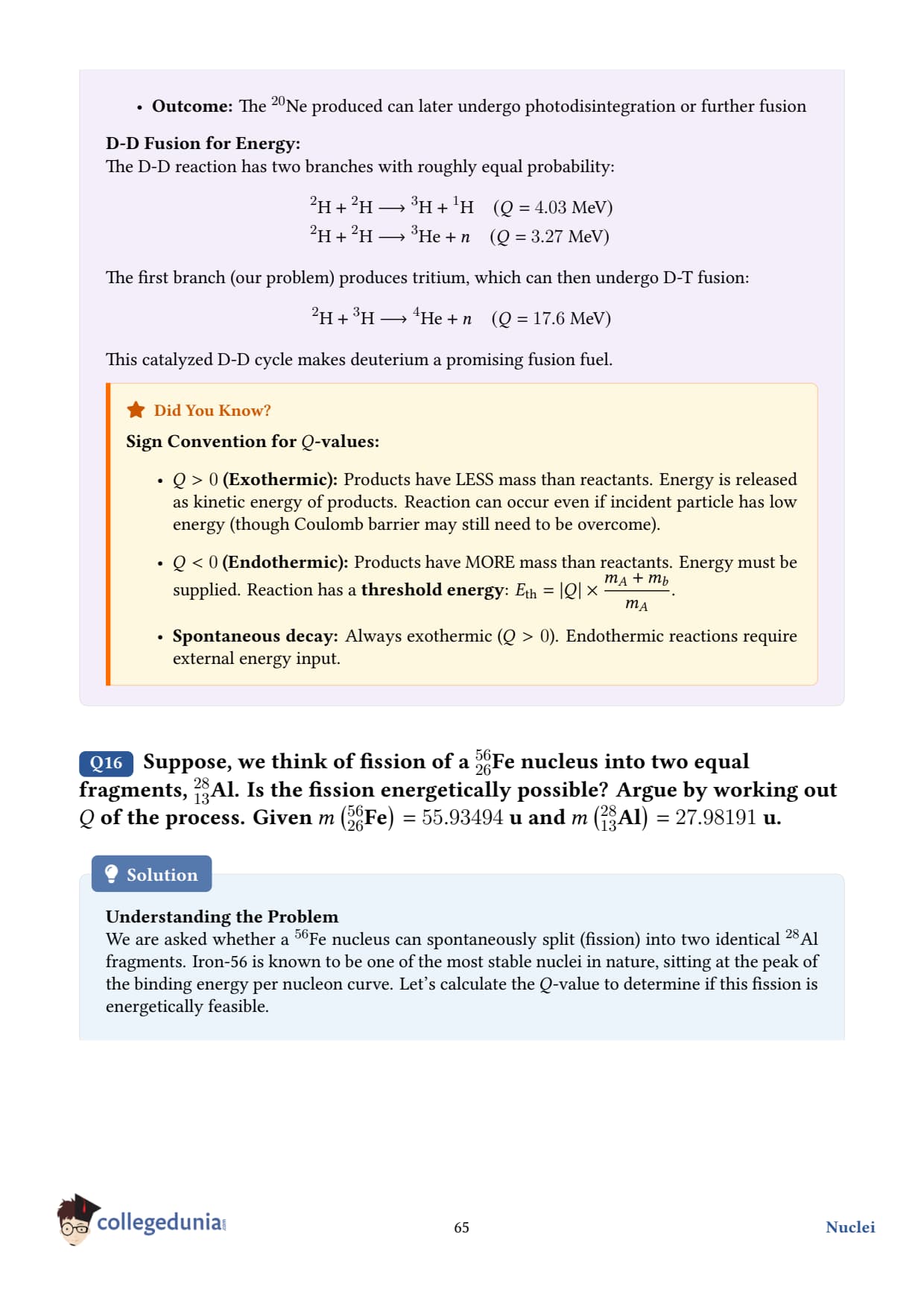
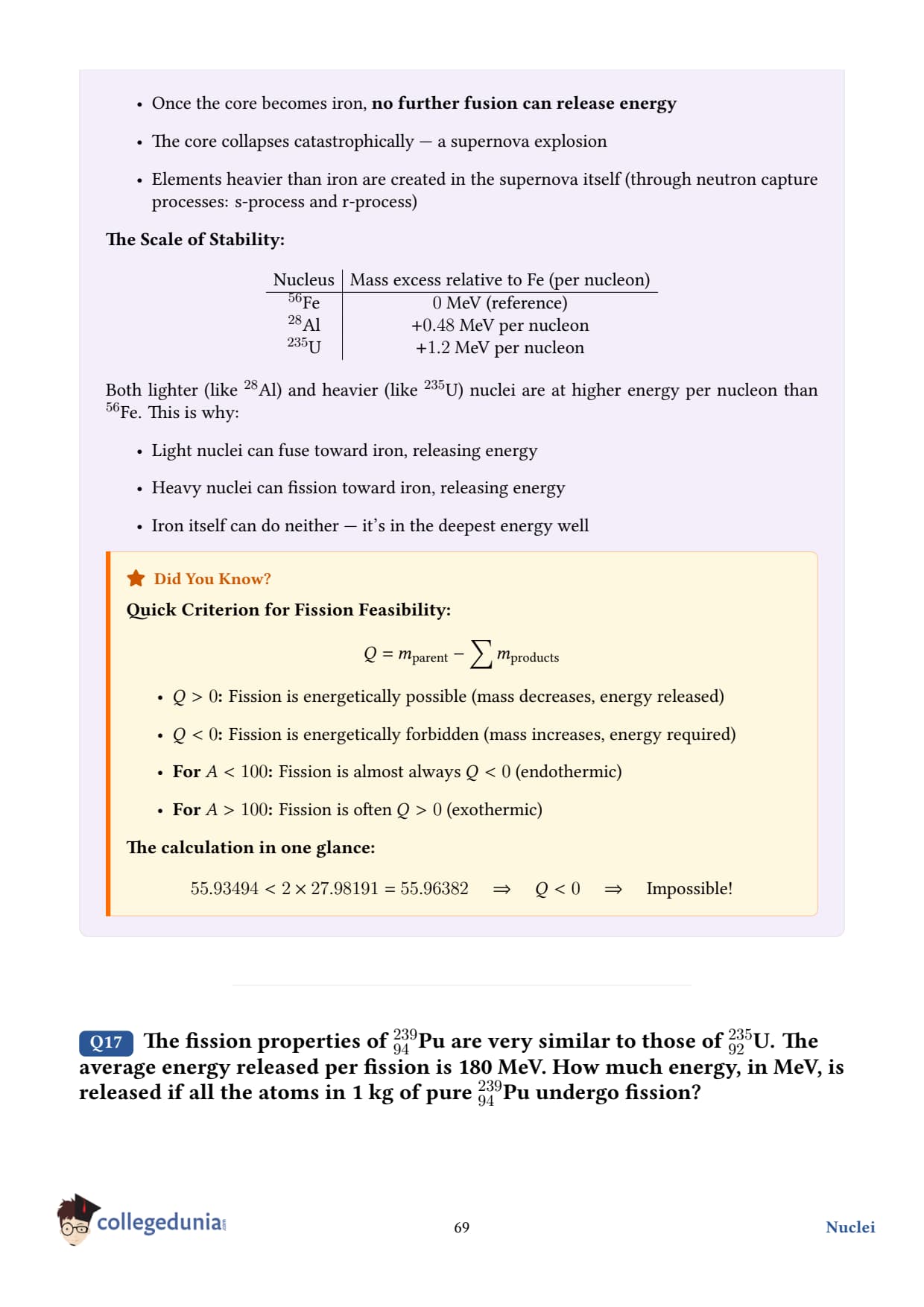
Suppose we think of fission of a 5626Fe nucleus into two equal fragments, 2813Al. Is the fission energetically possible? Argue by working out Q of the process. Given m(5626Fe) = 55.93494 u and m(2813Al) = 27.98191 u.
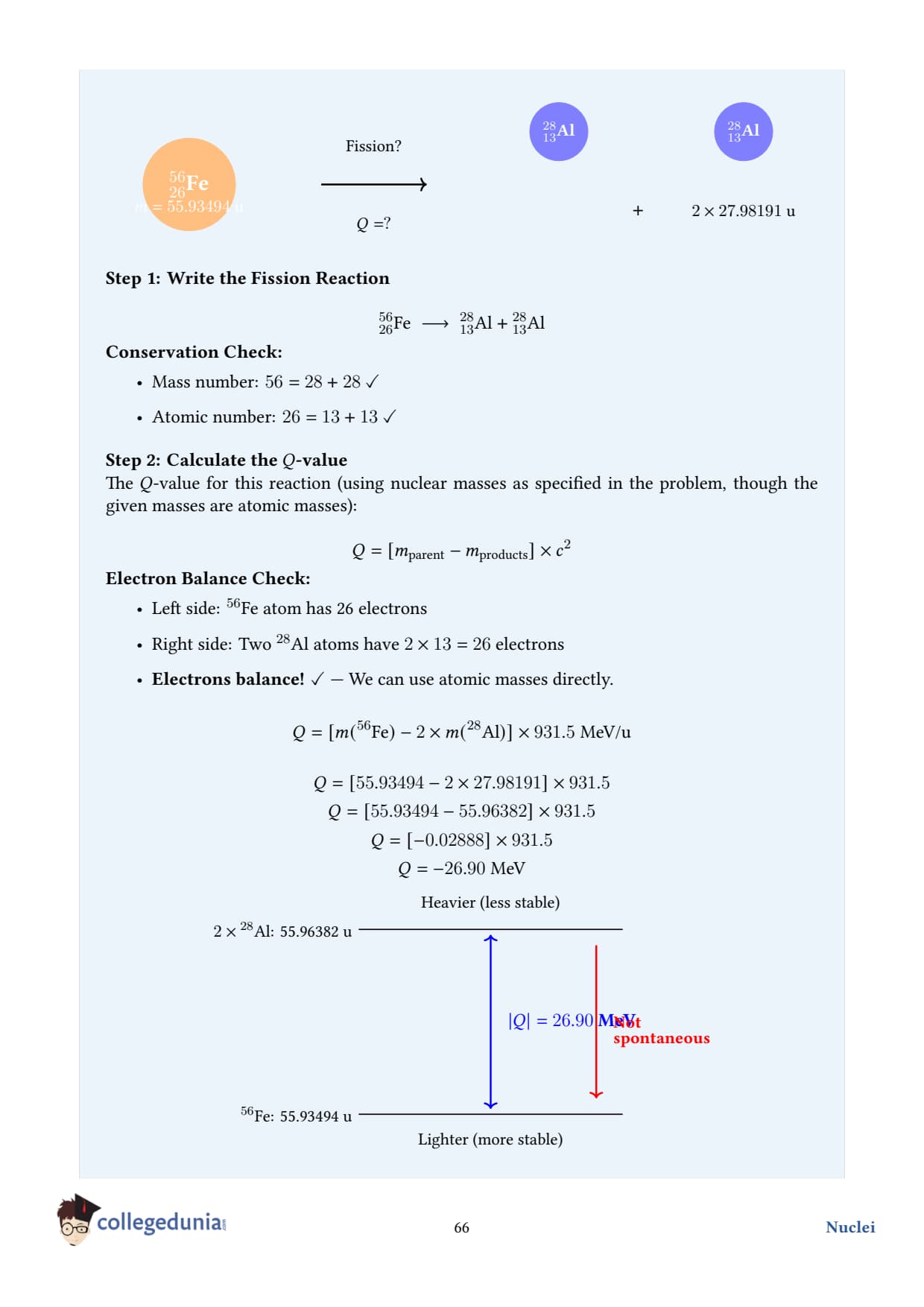
Reaction.5626Fe → 2813Al + 2813Al. Check the bookkeeping: nucleons 26+30=56 ✓; protons 13+13=26 ✓. So the reaction is at least arithmetically consistent. Whether nature actually does it is a question of energy.
Given.
m(5626Fe) = 55.93494 u.
m(2813Al) = 27.98191 u.
1 u = 931.5 MeV/c2.
Concept used - Q-value test for spontaneity. A reaction is energetically allowed only if it releases energy: Q > 0. For a process to be exothermic, the products must collectively weigh less than the reactant, so that the missing mass appears as energy.
Step 1 - sum products' masses. mprod = 2 m(2813Al) = 2(27.98191) = 55.96382 u.
Step 2 - mass difference. Δ m = m(5626Fe) - 2 m(2813Al) = 55.93494 - 55.96382 = -0.02888 u.
Step 3 - convert to MeV.Q = Δ m × 931.5 = (-0.02888)(931.5) ≈ -26.9 MeV.
Step 4 - interpret.Q < 0. The products are heavier than the reactant, so this fission would require an input of about 27 MeV. Iron does not spontaneously split into two aluminium fragments.
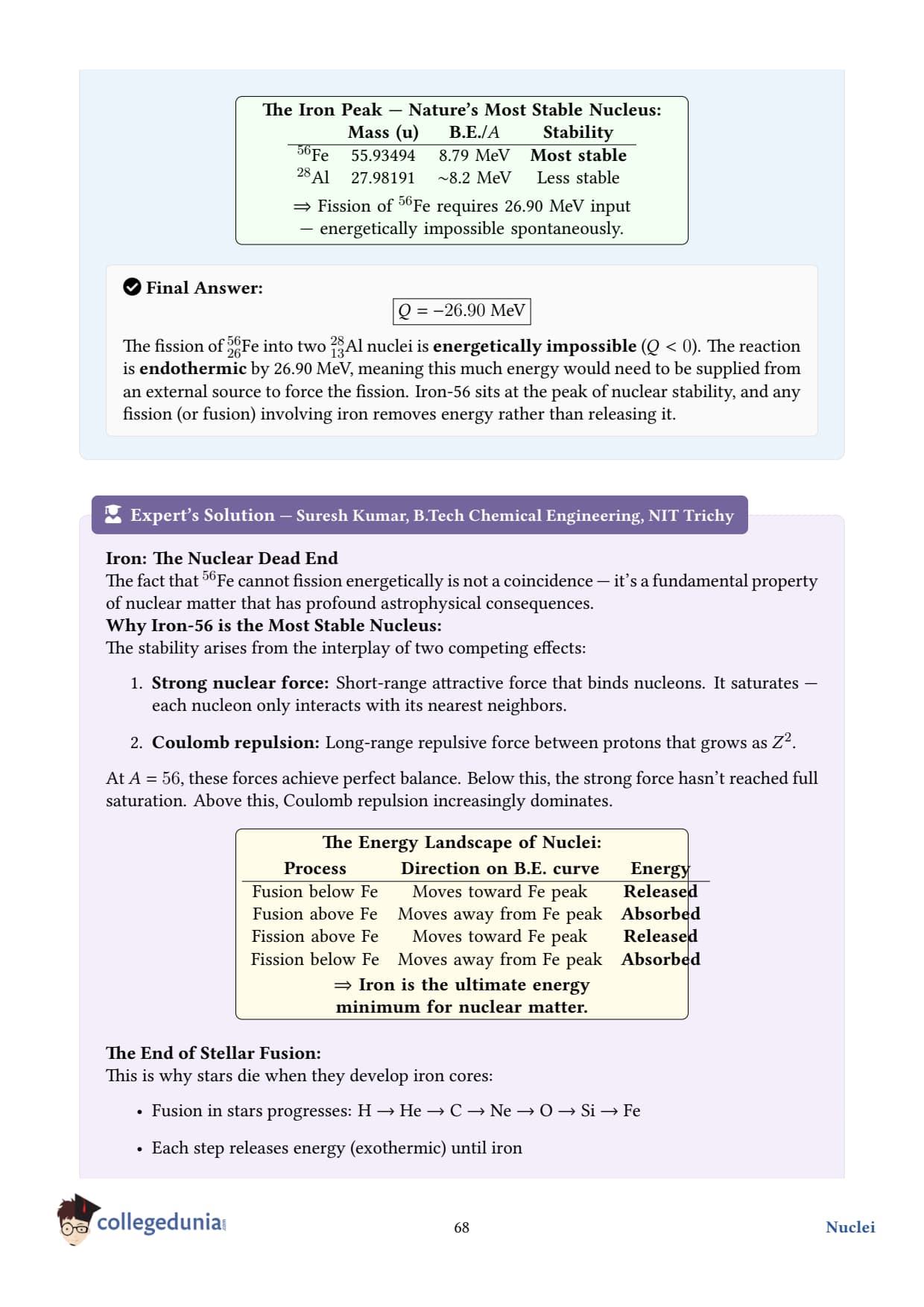
Final answer.Q ≈ -26.9 MeV; fission is NOT energetically possible.
DS
Dr. Sneha Iyer
Ph.D. Astrophysics, IISc Bangalore
Verified Expert
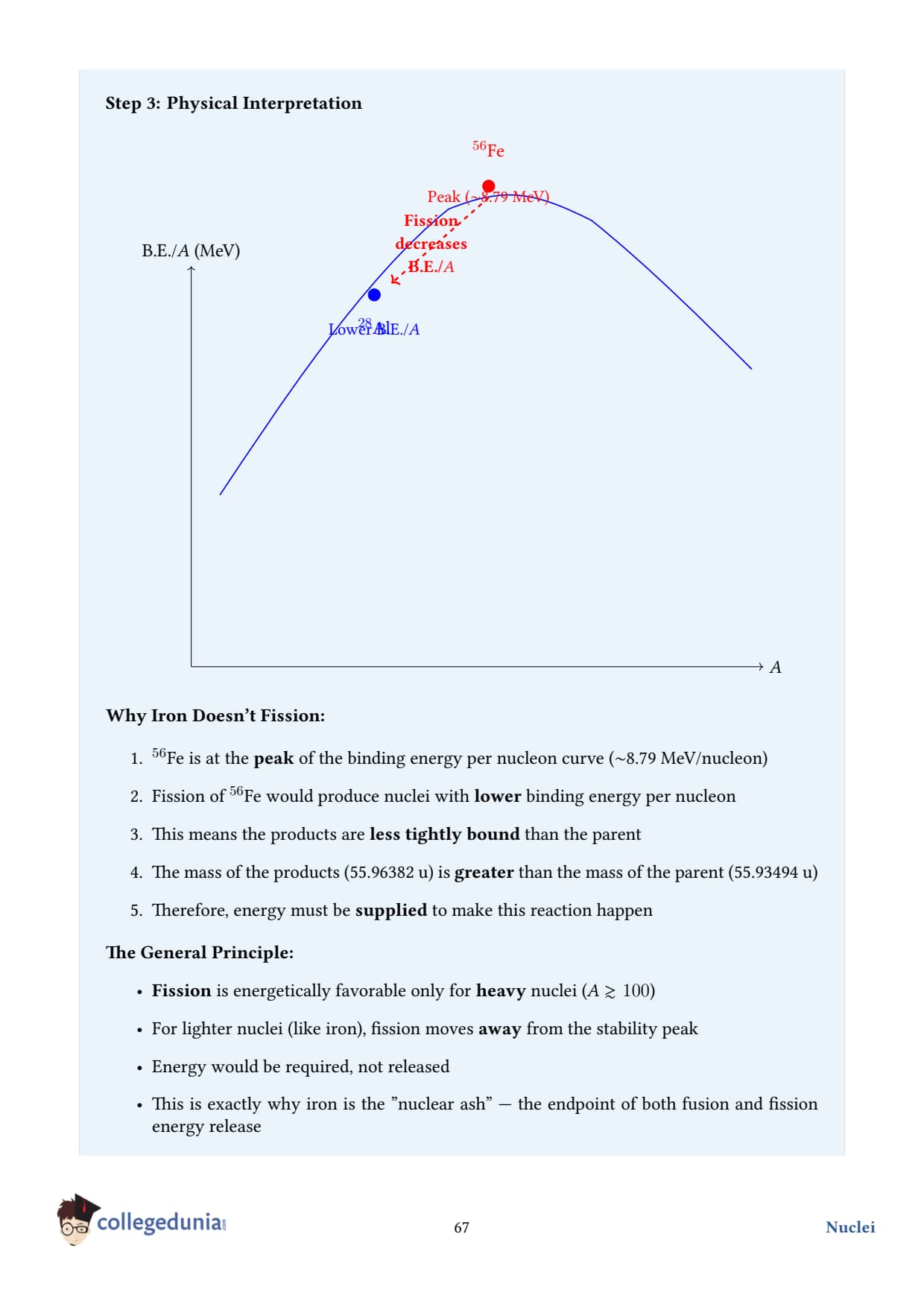
Why iron resists splitting. Iron-56 sits very close to the peak of the binding-energy-per-nucleon curve Eb/A ≈ 8.79 MeV. Aluminium-28 lies on the rising side of the same curve - it is less tightly bound per nucleon. Going from iron to two aluminiums is climbing down the stability hill, so it costs energy. Only nuclei beyond the peak (uranium, plutonium, thorium) lose mass by splitting.
Alternate method - binding-energy difference.Q = Eb(products) - Eb(reactant) . For iron-56, Eb ≈ 492 MeV. For Al-28, Eb ≈ 224 MeV. Two aluminiums give 2(224)=448 MeV. Difference: 448 - 492 = -44 MeVthe exact value differs from the direct calculation because of rounding in Eb values. Either method gives Q < 0 - fission impossible.
Where fission DOES work. For 235U, splitting into two fragments near the middle of the periodic table (Kr-92 + Ba-141, for example) releases about 200 MeV per event - this is the principle behind every fission reactor in the world. The split moves the system from low Eb/Auranium, ∼ 7.6 MeV toward higher Eb/AKr/Ba, ∼ 8.6 MeV.
Real-world significance - stellar end-states. Stars burn elements in increasing order, climbing the binding-energy curve all the way up to iron. Once the core is iron, fusion stops releasing energy. Without thermal pressure, gravity wins and the star collapses - leading to a supernova. This calculation, in miniature, is the very physics that ends massive stars' lives.
Q 13.7
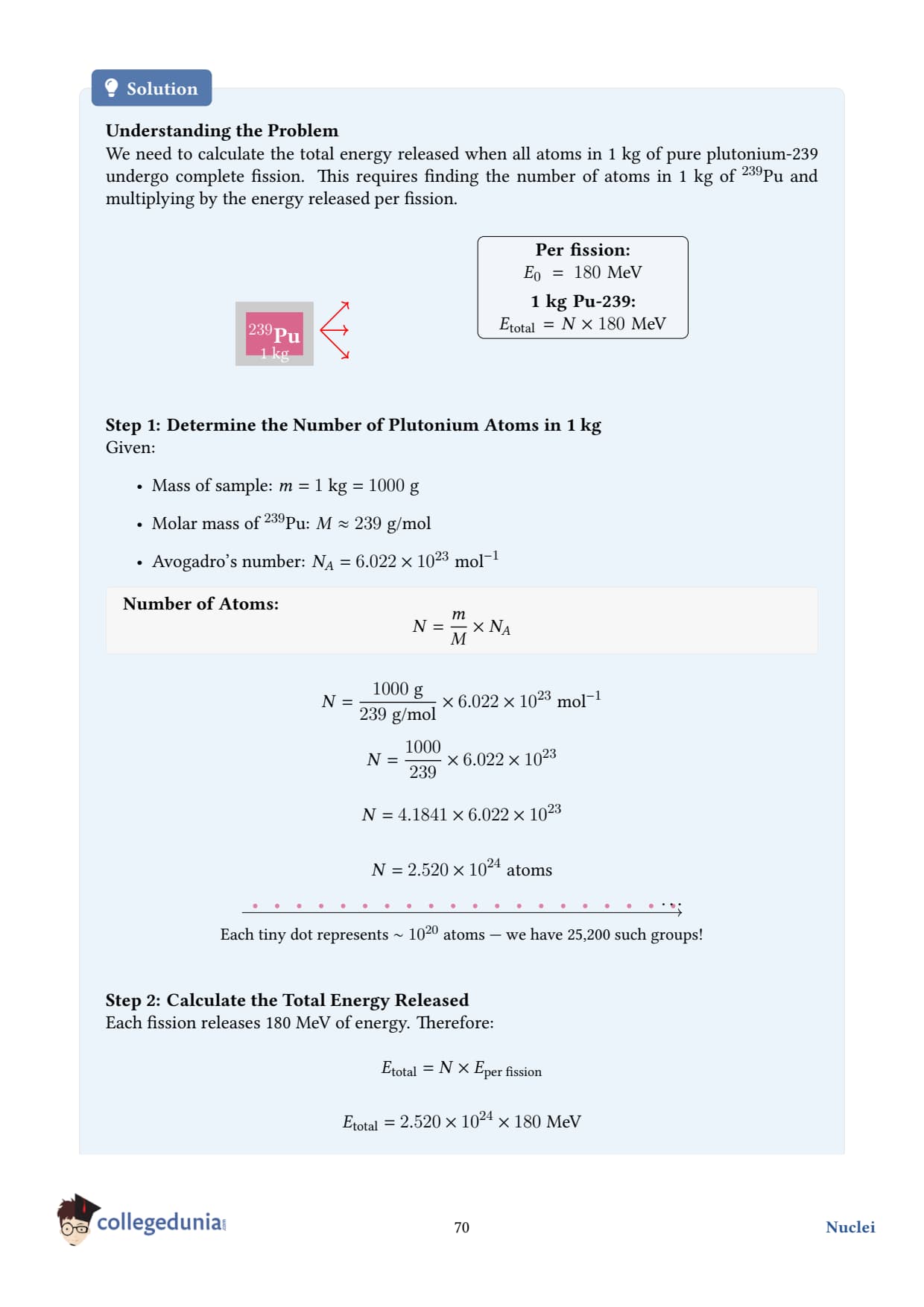
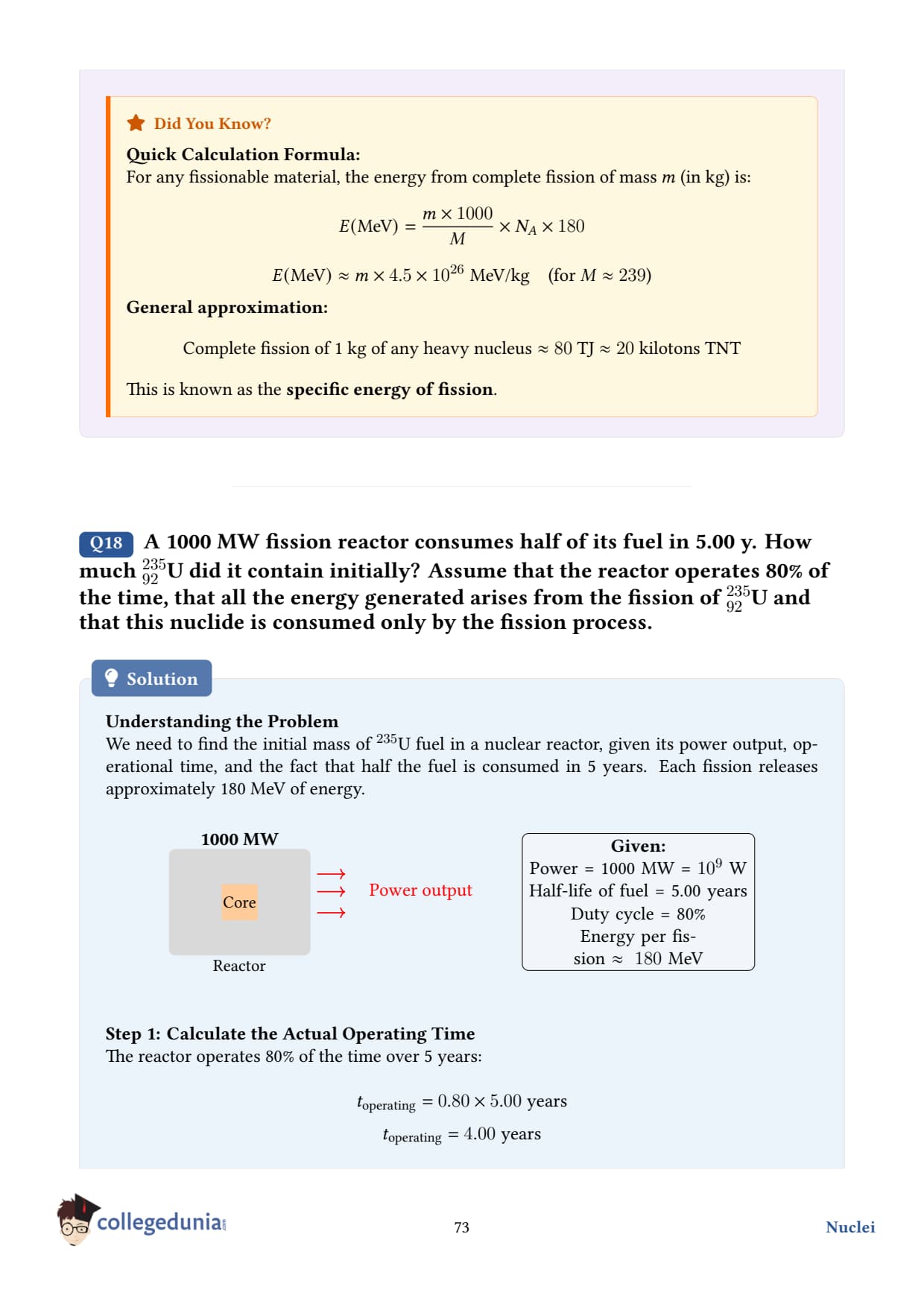
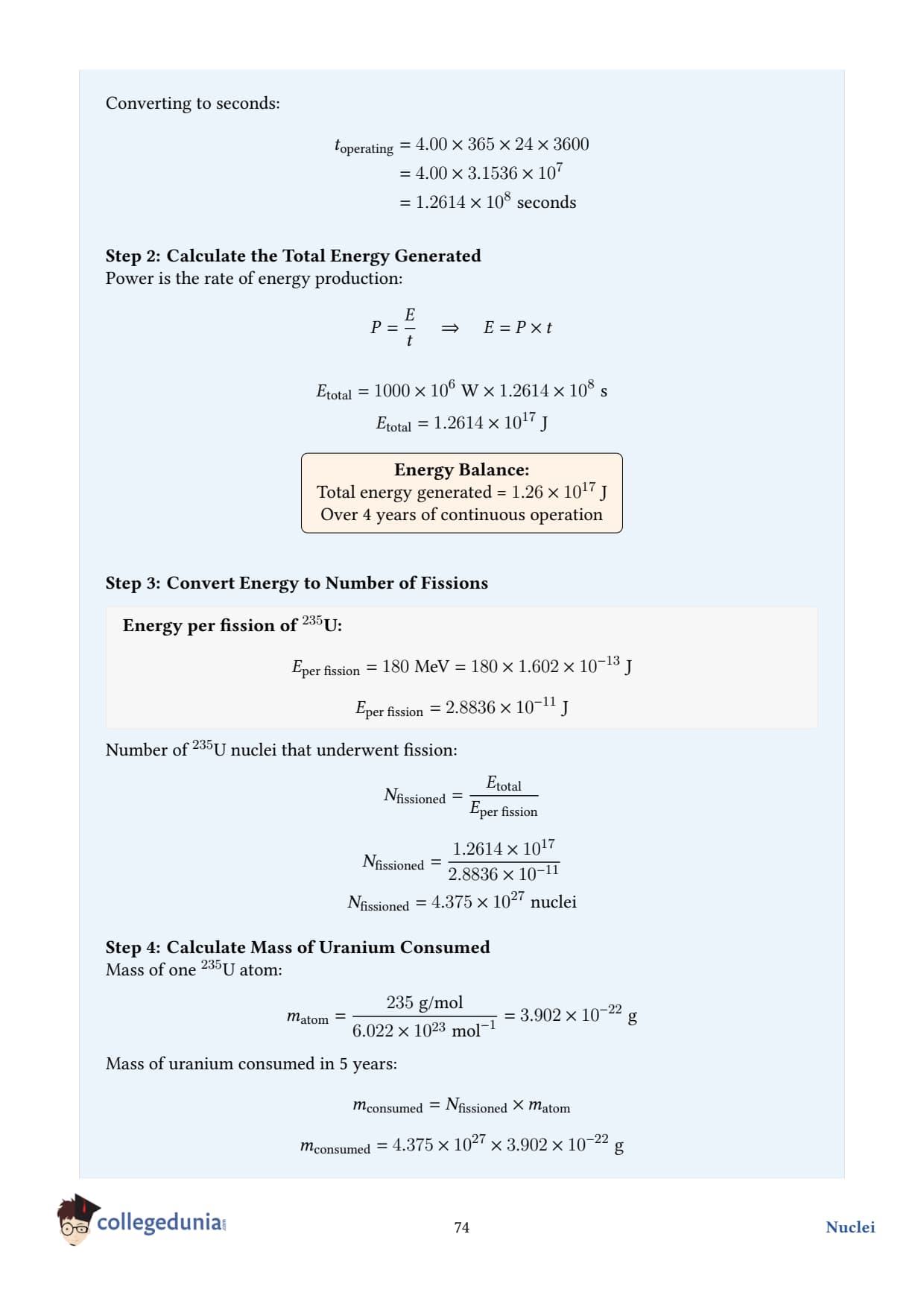
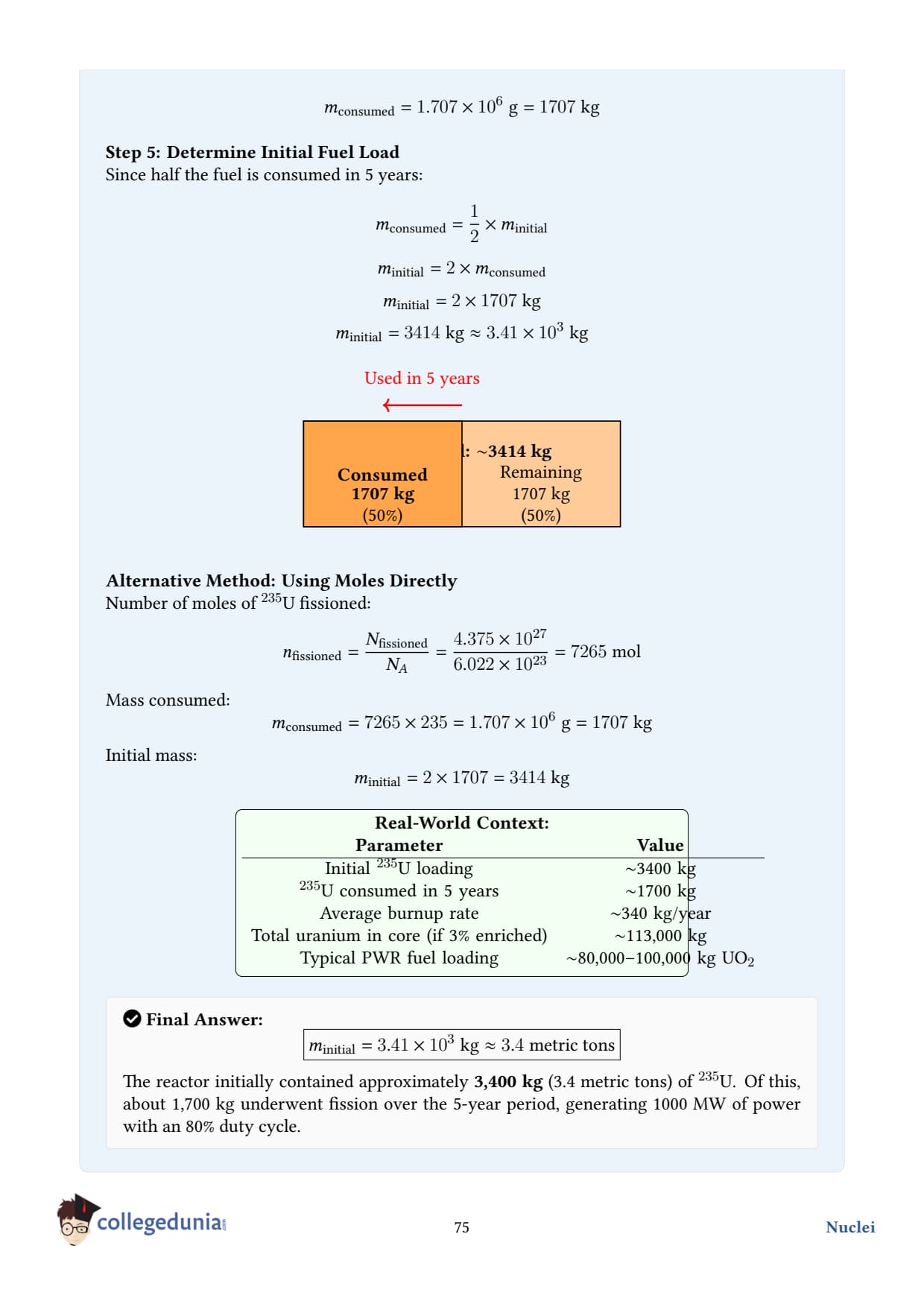
The fission properties of 23994Pu are very similar to those of 23592U. The average energy released per fission is 180 MeV. How much energy, in MeV, is released if all the atoms in 1 kg of pure 23994Pu undergo fission?
Given.
Mass of plutonium-239 sample, M = 1 kg = 1000 g.
Energy released per fission, Efission = 180 MeV.
Atomic mass of 239Pu (in grams per mole) ≈ 239 g/mol.
Avogadro number, NA = 6.023× 10²³ mol-1.
Concept used - total energy released = (number of fissions)(energy per fission). Assuming every atom in the sample fissions exactly once, Etotal = N Efission, where N is the number of 239Pu nuclei in 1 kg.
Step 1 - number of moles in 1 kg. nmol = 1000 g239 g/mol ≈ 4.184 mol.
Step 2 - number of atoms.N = nmol NA = (4.184)(6.023× 10²³) ≈ 2.52× 1024 atoms.
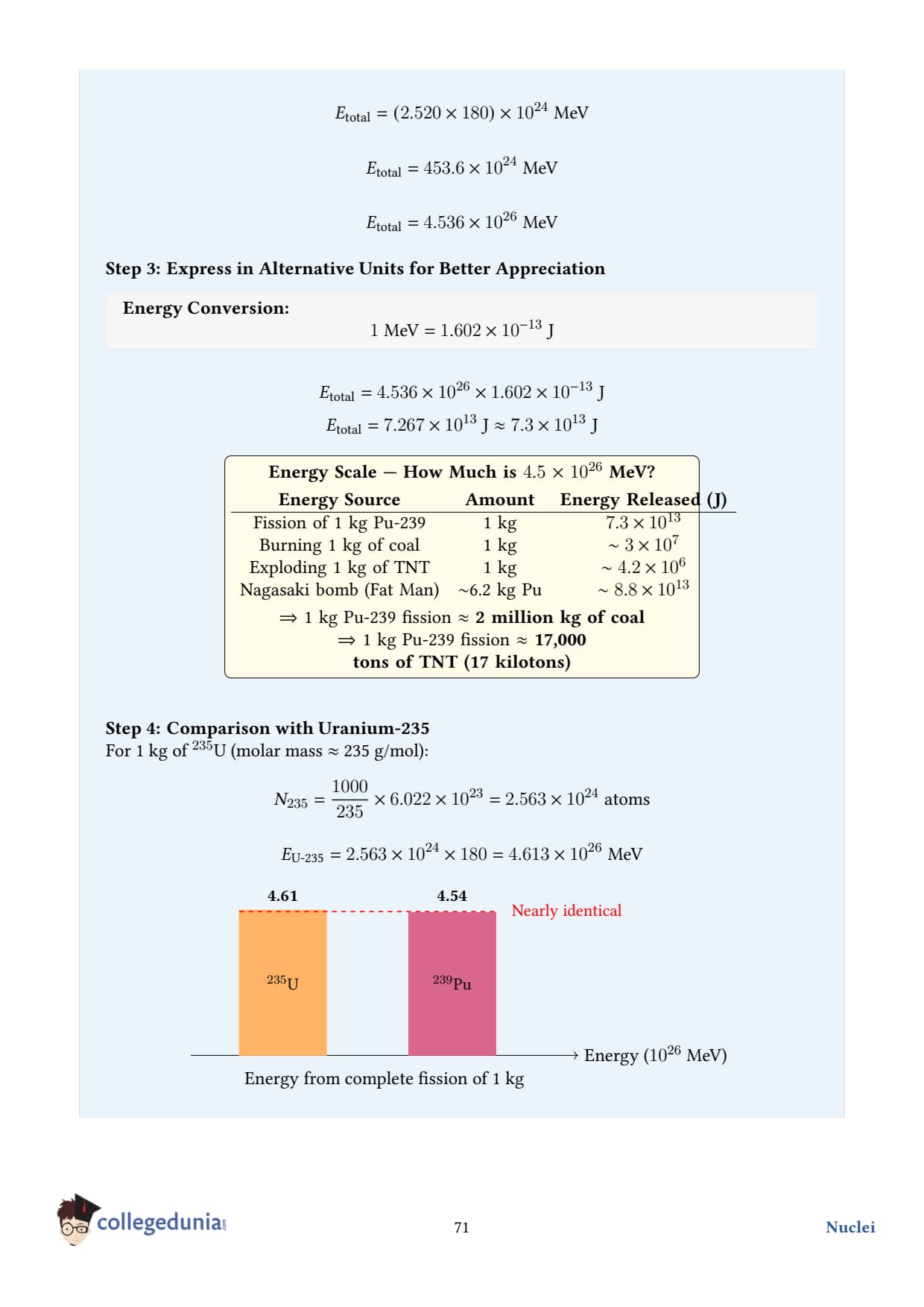
Step 3 - total energy released. Etotal = (2.52× 1024)(180 MeV) ≈ 4.54× 1026 MeV.
Final answer. Etotal ≈ 4.54× 1026 MeV ≈ 7.3× 10¹³J.
That's about 20 megawatt-years - the lifetime output of a small power plant - from 1 kilogram of Pu.
DM
Dr. Meera Nair
Ph.D. Nuclear Engineering, BARC
Verified Expert
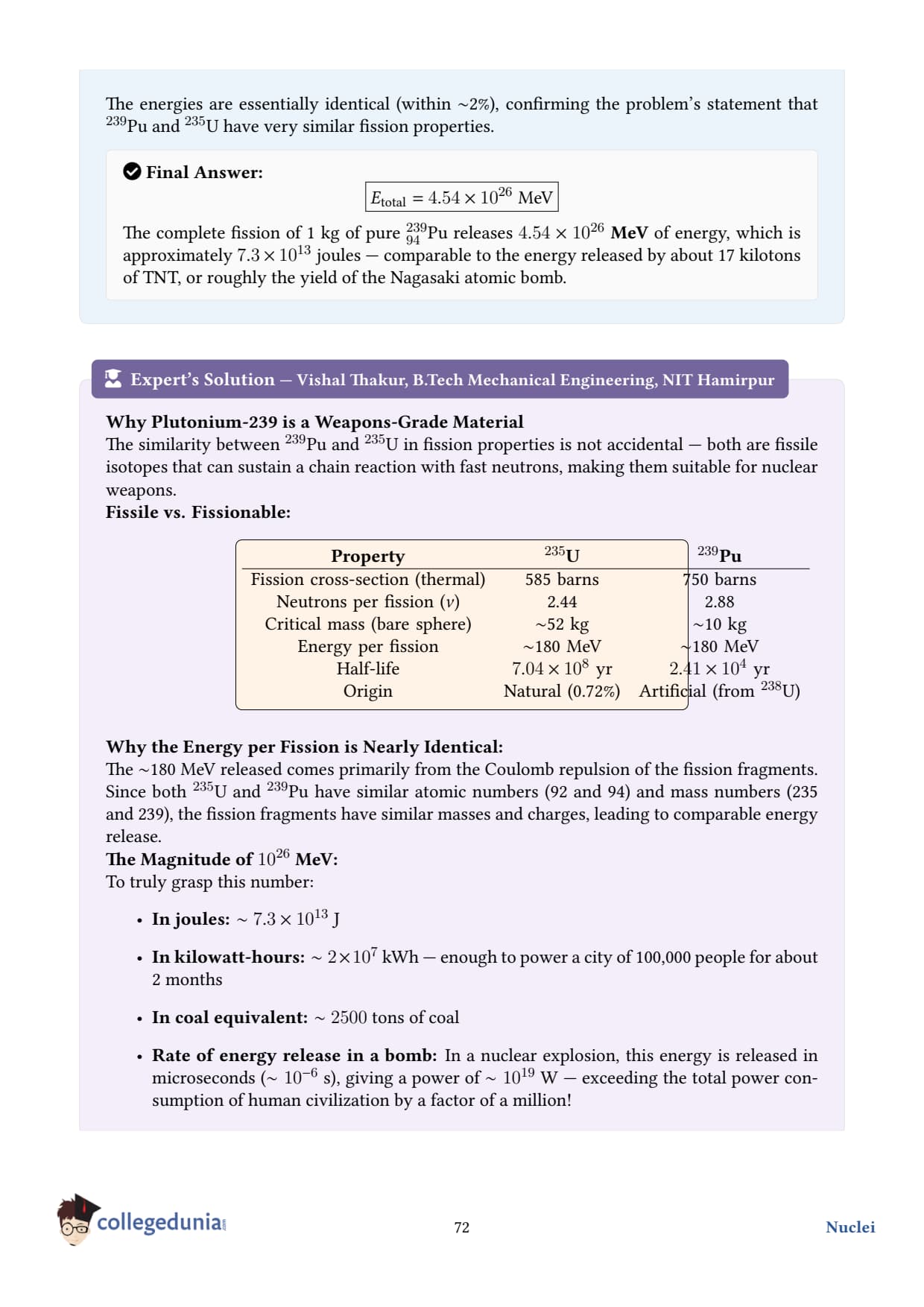
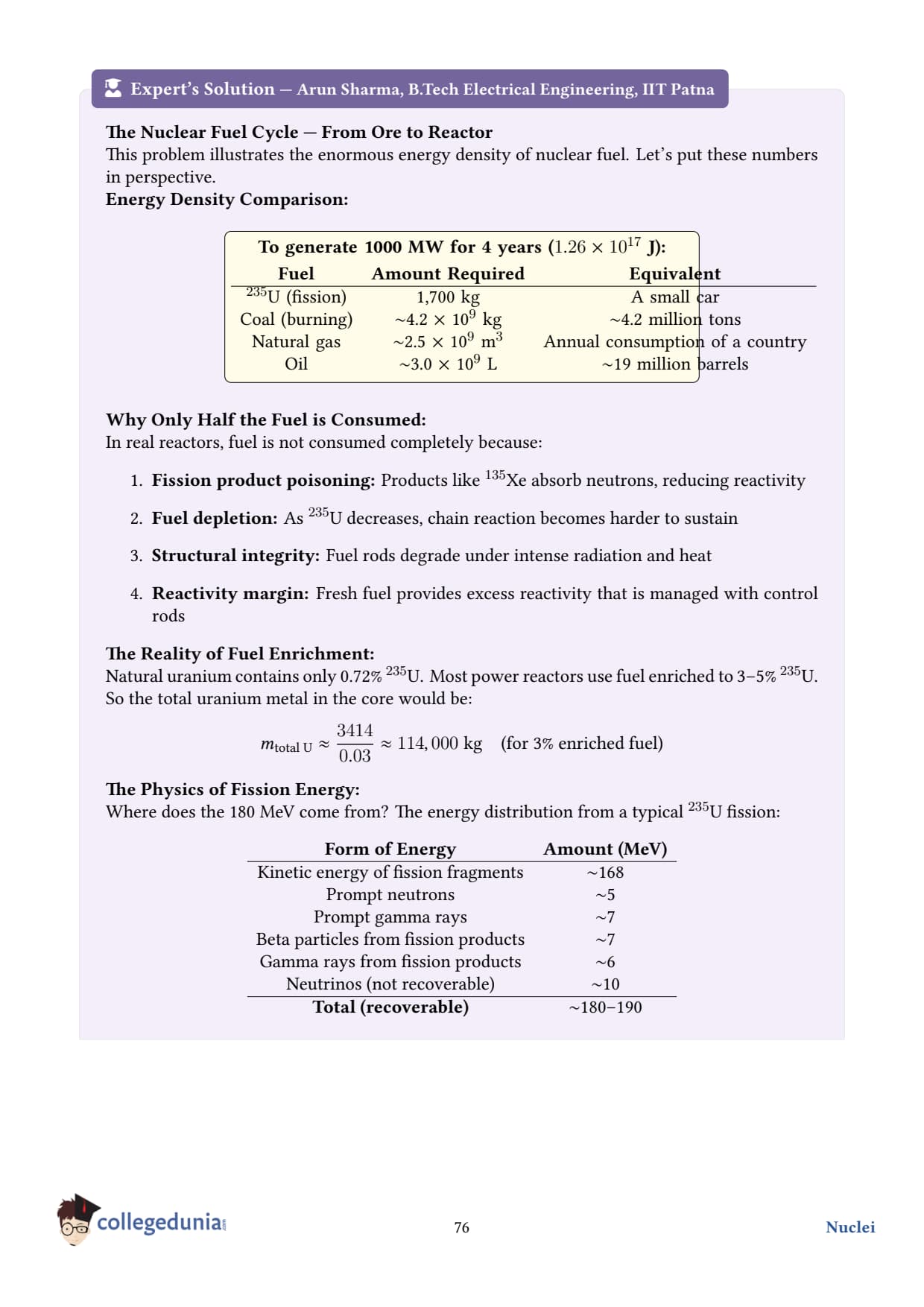
Why fission is so energy-dense. The energy per fission 180 MeV is millions of times larger than a typical chemical reaction (a few eV per molecule). Per gram: ∼ 7.3× 10¹⁰J/g for Pu fission, versus ∼ 5× 10⁴J/g for petrol combustion. Nuclear is roughly a million times more concentrated.
Alternative shortcut - energy per kilogram from E = mc2. A useful sanity check: if all 1 kg were converted entirely to energy, you'd get mc2 = (1)3× 1082 = 9× 10¹⁶J. Our calculated 7.3× 10¹³J is about 0.08% of that - meaning fission converts roughly 0.1% of the mass into energy. This is consistent with the fact that fission of 239Pu drops the per-nucleon binding energy from ∼ 7.5 MeV to ∼ 8.5 MeV, a 1 MeV-per-nucleon difference out of about 940 MeV/nucleon rest mass - about 0.1%.
Real-world relevance - reactors and bombs. 1 kg of Pu-239 is roughly the "critical mass" for a nuclear weapon (with implosion geometry). A reactor uses much more fuel because only a fraction is allowed to fission at any time, but the same physics applies. The Pu-239 produced in breeder reactors from 238U absorbing a neutron is the standard alternative to 235U - and its fission products are very similar to uranium's.
Common mistake - forgetting molar mass. A surprising number of students compute N = 1 kg × NA and get 6× 1026 atoms - too high by a factor of 239. Always divide by the molar mass first.
Q 13.8
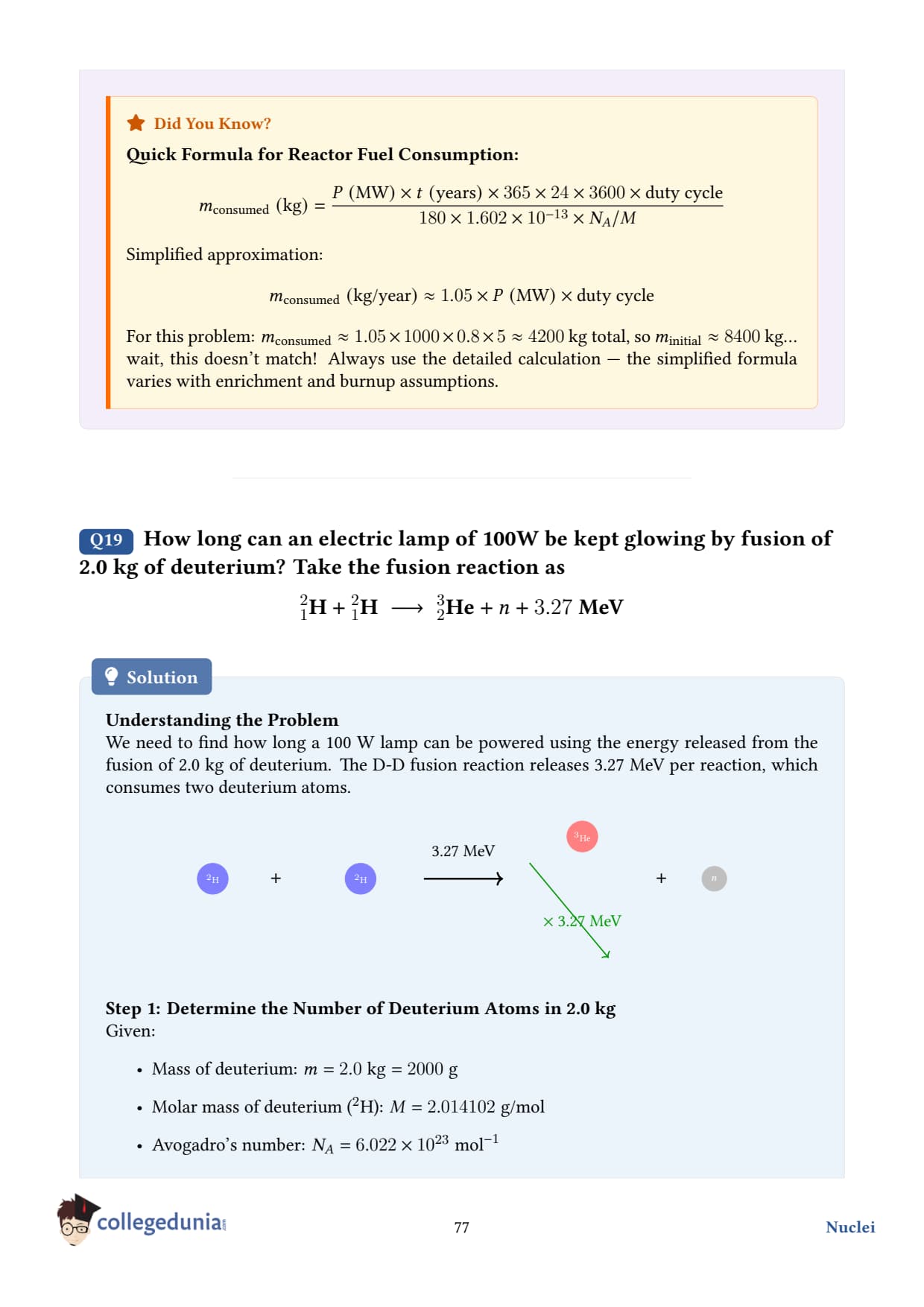
How long can an electric lamp of 100 W be kept glowing by fusion of 2.0 kg of deuterium? Take the fusion reaction as 21H + 21H → 32He + n + 3.27 MeV.
Given.
Mass of deuterium fuel, M = 2.0 kg = 2000 g.
Atomic mass of deuterium, 21H ≈ 2 g/mol.
Energy released per fusion event, Efus = 3.27 MeV.
Each fusion event consumes two deuterons.
Lamp power, P = 100 W = 100 J/s.
1 MeV = 1.6× 10⁻¹³J; NA = 6.023× 10²³ mol-1.
Concept used - energy = (number of fusions)(MeV per fusion); time = energy/power.
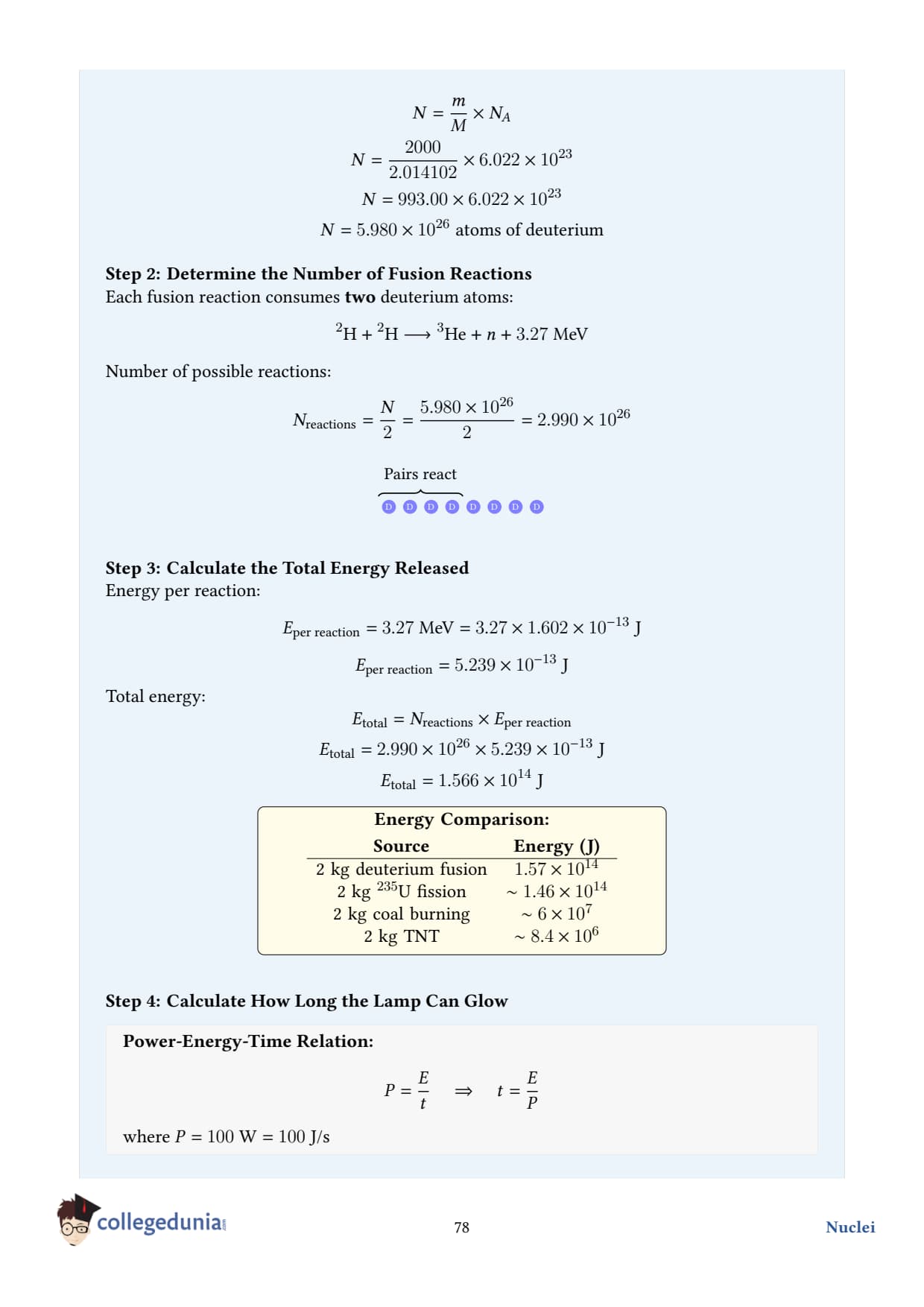
Step 1 - number of deuterium atoms in 2 kg.N = 20002× NA = (1000)(6.023× 10²³) = 6.023× 1026 atoms.
Step 2 - number of fusion events. Each event uses two deuterons: Nfus = N2 = 6.023× 10262 = 3.0115× 1026.
Step 3 - total energy in MeV. Etotal = Nfus Efus = (3.0115× 1026)(3.27 MeV) ≈ 9.848× 1026 MeV.
Step 5 - divide by power to get time.t = EtotalP = 1.576× 1014100 = 1.576× 10¹²s.
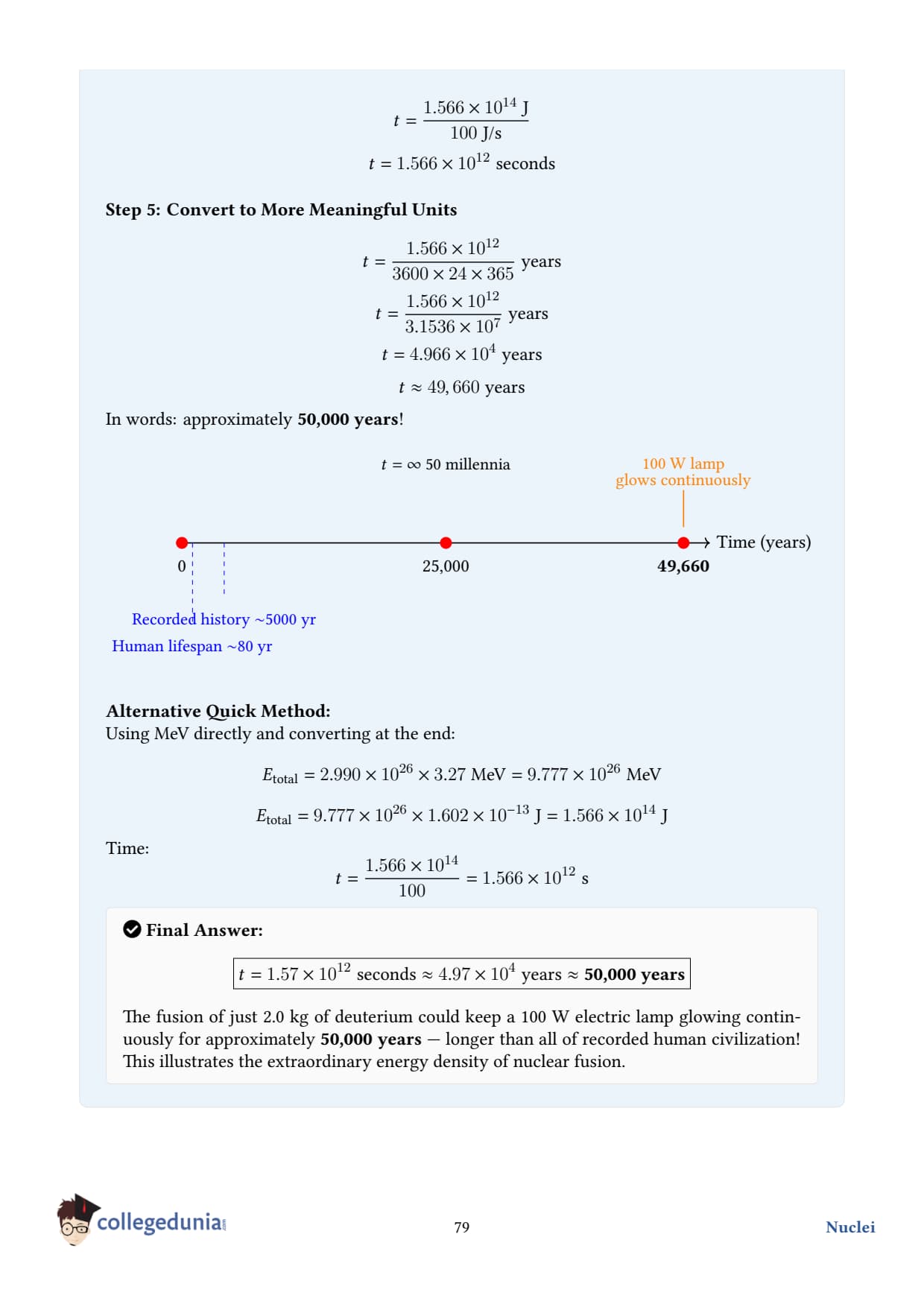
Step 6 - convert to years. Using 1 year = 3.154× 10⁷s: t = 1.576× 10123.154× 107 ≈ 4.99× 10⁴ years.
Final answer.t ≈ 5.0× 10⁴ years.
A 100 W bulb could glow for fifty thousand years on 2 kg of deuterium - assuming, of course, that we could actually achieve and sustain fusion (which is the open problem of fusion-reactor engineering).
DV
Dr. Vikram Singh
Ph.D. Plasma Physics, IPR Gandhinagar
Verified Expert
Why two deuterons per event matter. A very common error: students compute N = 6× 1026 deuterons and multiply by 3.27 MeV directly. But the reaction equation shows TWO deuterons combining to release 3.27 MeV. Each event consumes two - so the number of events is N/2, not N. Forgetting this halves your answer.
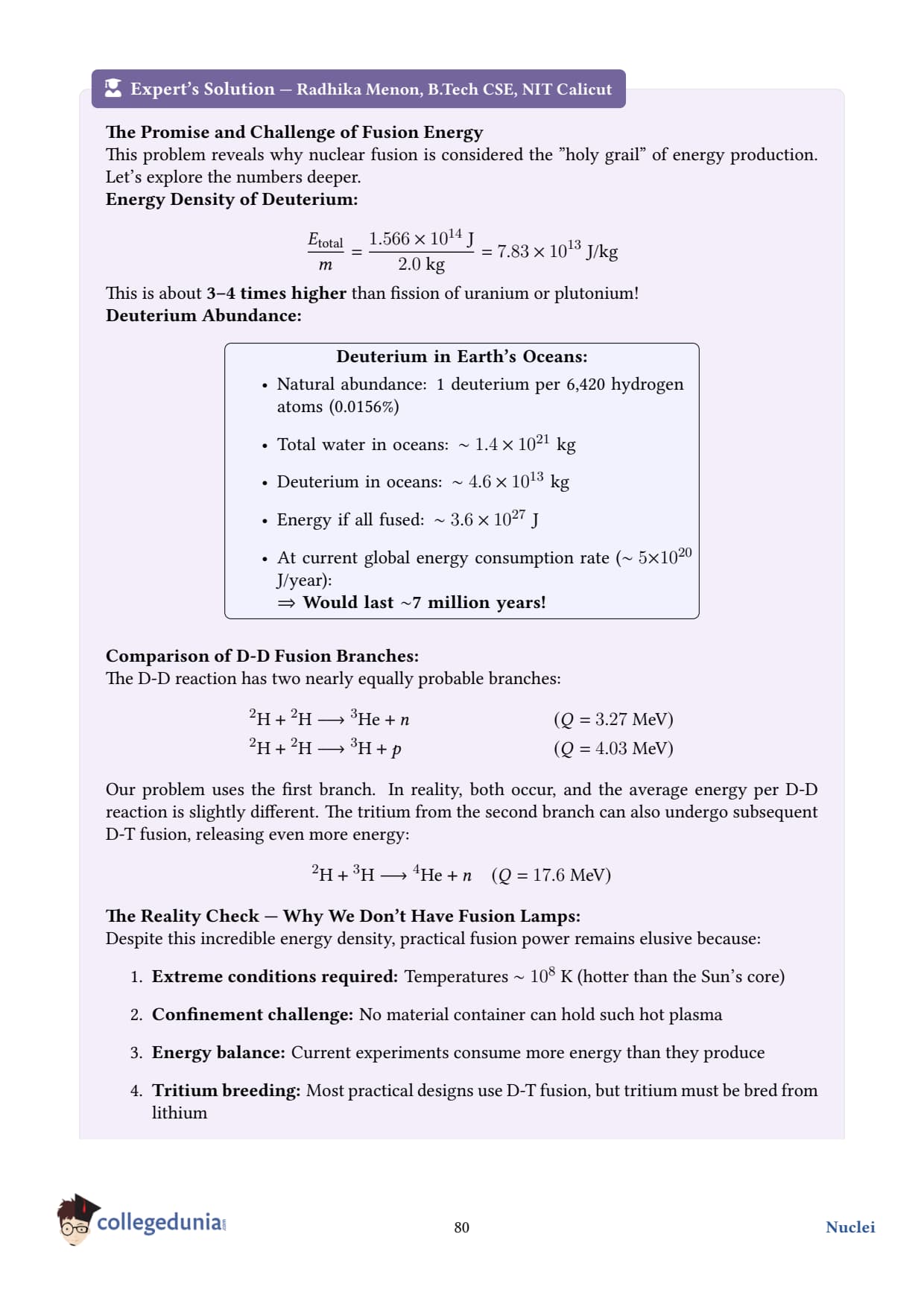
Real-world relevance - fusion power. Deuterium is abundant in seawater (0.015% of all hydrogen is deuterium). 2 kg of deuterium can in principle be extracted from a few hundred cubic metres of seawater. The energy yield calculated here, 1.6× 10¹⁴J, is enormous - but achieving controlled fusion requires temperatures of ∼ 108K to overcome the Coulomb barrier between the two positively-charged deuterons. Tokamaks like ITER are the engineering attempt.
Alternative reaction - D+T fusion. Real reactors use 2H + 3H → 4He + n + 17.6 MeV, which has a much higher cross-section than D+D at attainable temperatures. The 17.6 MeV per event is about 5× the D+D yield, but tritium has to be bred from lithium in the reactor blanket. The principle of energy calculation is identical to what we just did.
Common mistake - fusion vs fission energy density. Compared to Q13.7 Pu fission, ∼ 7× 10¹³J per kg, D-D fusion gives ∼ 8× 10¹³J per kg of deuterium. Similar order of magnitude. But fusion's fuel is essentially limitless (seawater), whereas fissile uranium is a finite mined resource.
Q 13.9
Calculate the height of the potential barrier for a head-on collision of two deuterons. Hint: The height of the potential barrier is given by the Coulomb repulsion between the two deuterons when they just touch each other. Assume that they can be taken as hard spheres of radius 2.0 fm.
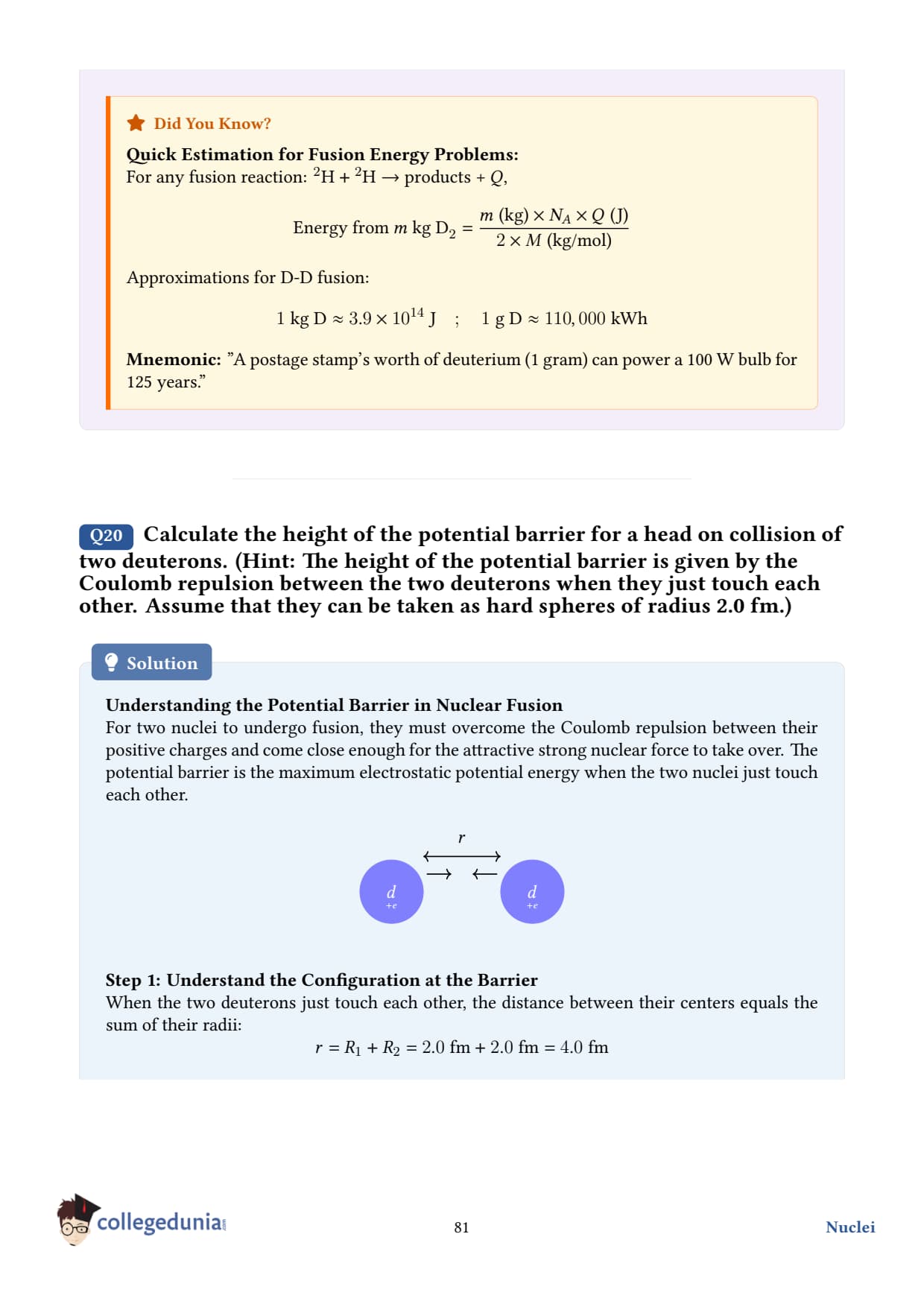
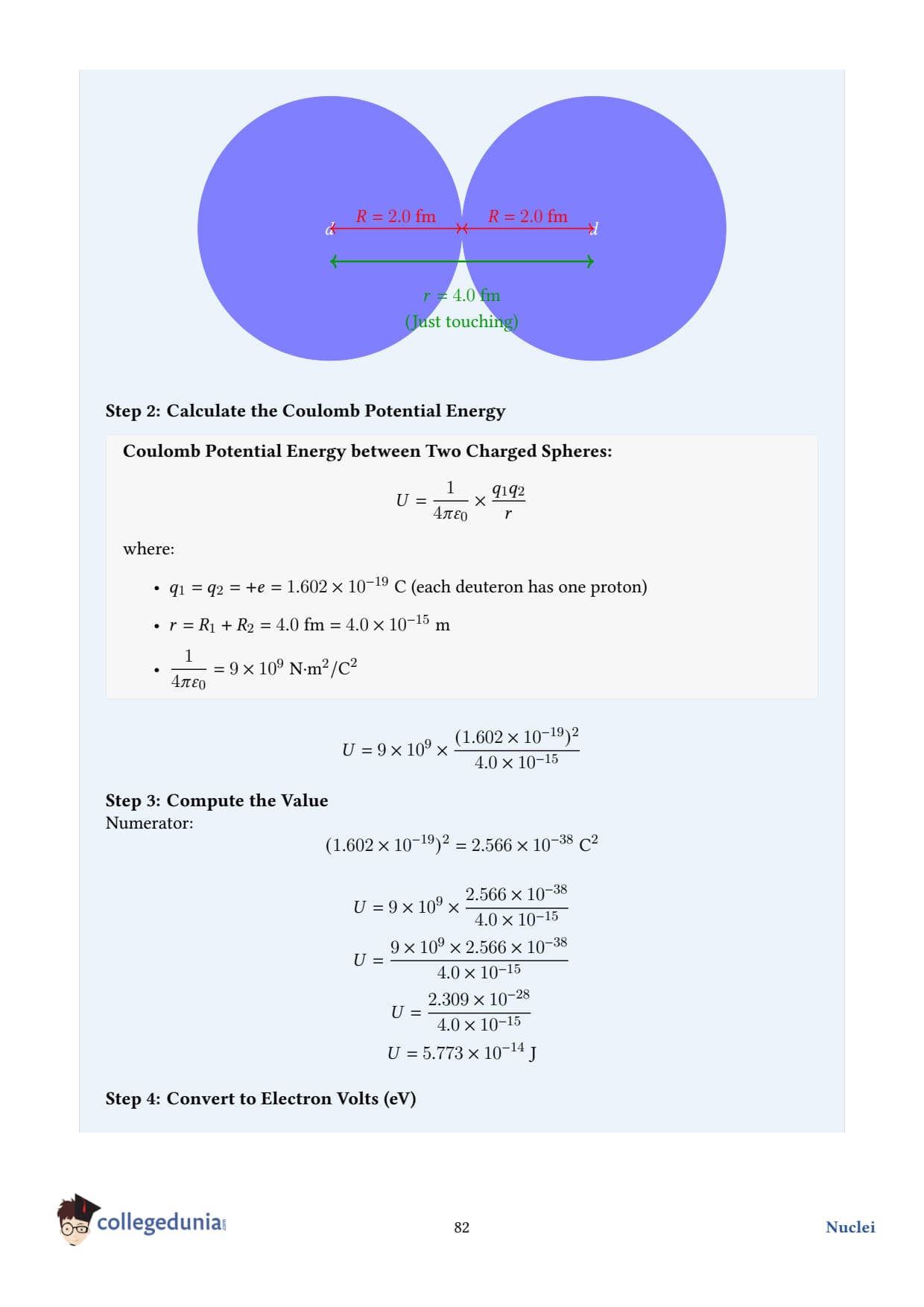
What's happening physically. Two deuterons each: charge +e, radius 2.0 fm approaching head-on. The strong nuclear force kicks in only when they actually touch; before that, they "see" each other only through their mutual electrostatic repulsion. The top of the Coulomb barrier - the highest potential energy along the approach - occurs at the closest distance at which the deuterons can be said not to be overlapping, i.e., when their surfaces just touch.
Given.
Charge of each deuteron, q = +e = 1.6× 10⁻¹⁹C.
Radius of each deuteron (assumed hard sphere), rd = 2.0 fm = 2.0× 10⁻¹⁵m.
Centre-to-centre distance when they just touch, r = 2 rd = 4.0× 10⁻¹⁵m.
k = 14π0 = 9× 10⁹N m2/C2.
Concept used - Coulomb potential energy of two point charges.U(r) = 14π0q1 q2r. For two equal positive charges +e at separation r, U = ke2r. The height of the barrier equals U at the touching distance.
Step 1 - write the formula at the touching distance. Umax = k e22 rd.
Ph.D. Plasma Physics, Institute for Plasma Research
Verified Expert
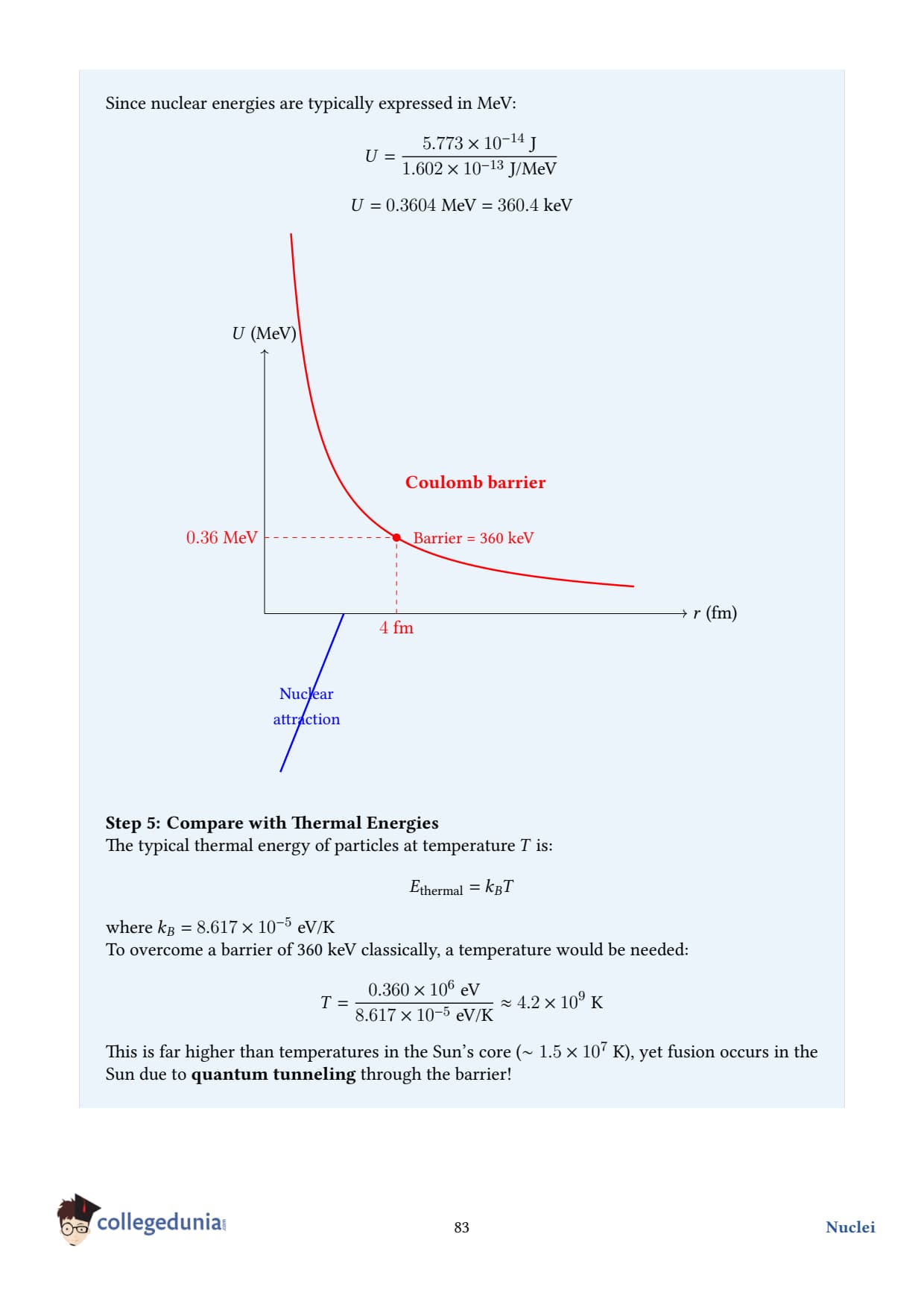
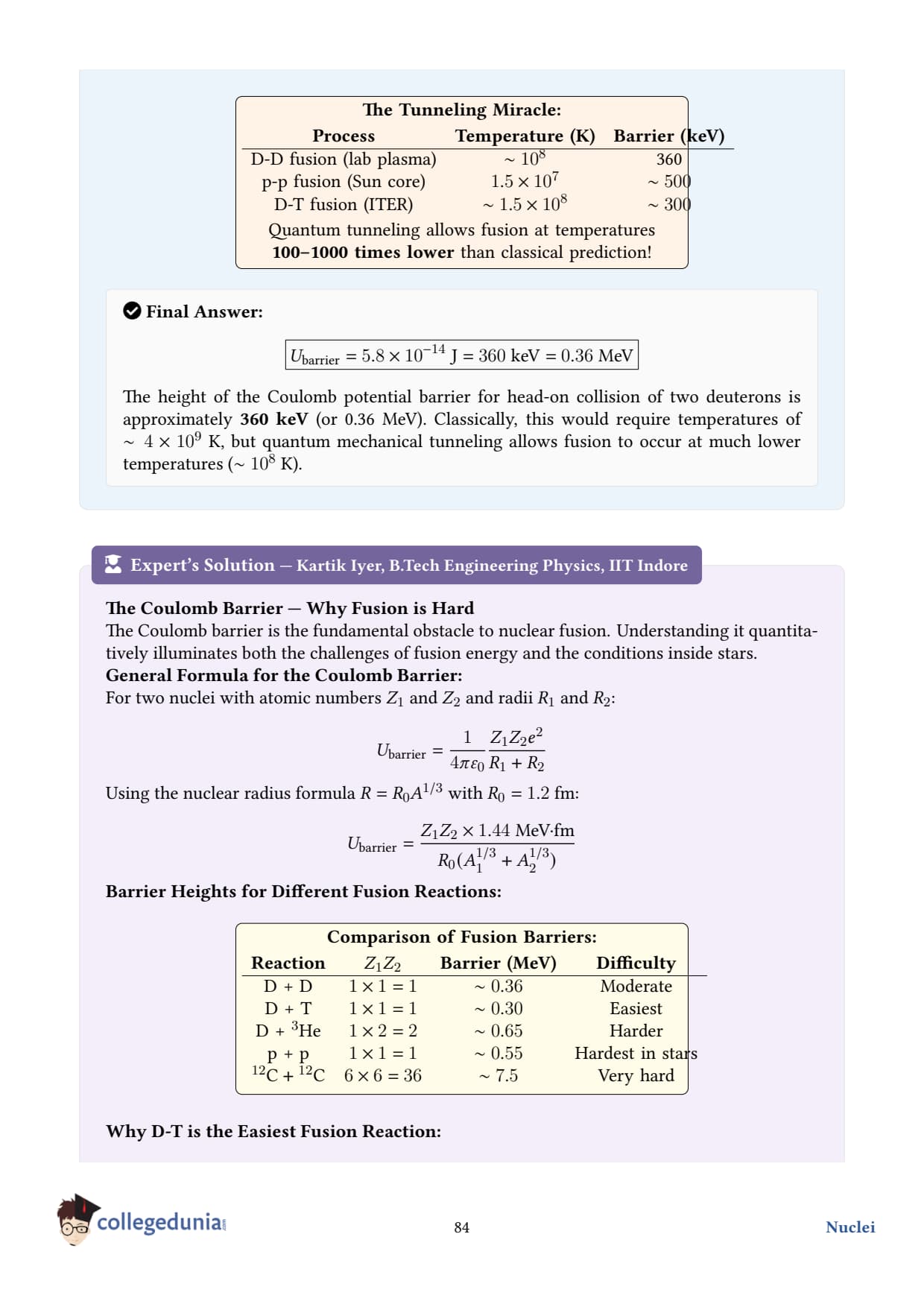
Why this height matters. For two deuterons to fuse, they must approach close enough for the strong nuclear force range ∼ 1 fm to glue them together. To get that close, each must climb a Coulomb barrier roughly 0.36 MeV tall. Their kinetic energy must therefore be of comparable magnitude. At thermal equilibrium, KE= 32kBT. Setting this equal to 0.36 MeV gives T ∼ 109K - a billion kelvin.
Quantum tunnelling rescues fusion. Stars only reach core temperatures of about 107K - a hundred times too cold to surmount the deuteron barrier classically. Fusion happens anyway because particles can tunnel through the barrier (a purely quantum effect). The tunnelling probability is exponentially small but nonzero. This was Gamow's great insight in the 1920s; it explains how the Sun (and tokamaks) work at "modest" temperatures.
Alternate units. Energies of order MeV are easy to express in joules: 1 MeV = 1.6× 10⁻¹³J, 1 keV = 1.6× 10⁻¹⁶J. Memorising these makes back-of-envelope nuclear estimates fast.
Common mistake - using the deuteron radius instead of the centre-to-centre distance. Students sometimes use r = 2.0 fm (the radius of one deuteron) in the denominator instead of r = 4.0 fm (the centre-to-centre distance when surfaces touch). That doubles the answer to ∼ 720 keV. Always picture the geometry: each sphere centre is one radius away from the contact point.
Real-world relevance - controlled fusion difficulty. This barrier-height calculation is exactly why fusion power is so hard. ITER is designed to run at ∼ 1.5× 10⁸K - about ten times the core of the Sun - to provide enough deuterons and tritons in the Maxwell-Boltzmann tail to tunnel the barrier at a useful rate. The 360 keV figure is the energy scale that defines all of fusion engineering.
Q 13.10
From the relation R = R0 A1/3, where R0 is a constant, and A is the mass number of a nucleus, show that the nuclear matter density is nearly constant (i.e. independent of A).
What we need to show. If we model the nucleus as a sphere of radius R = R0 A1/3 containing A nucleons each of approximately equal mass mn, then the density ρ = mass/volume does NOT depend on A. Same for hydrogen A=1 as for uranium A=238 as for everything in between.
Given / known.
Nuclear radius: R = R0 A1/3, with R0 ≈ 1.2 fm = 1.2× 10⁻¹⁵m.
Mass of each nucleon: mn ≈ 1.66× 10⁻²⁷ kg (≈ 1 atomic mass unit; protons and neutrons differ only slightly).
Volume of a sphere: V = 43π R3.
Concept used - density of a uniform sphere. ρ = total massvolume = A mn43π R3.
Step 1 - substitute the radius formula. R3 = (R0 A1/3)3 = R03A. So V = 43π R03A.
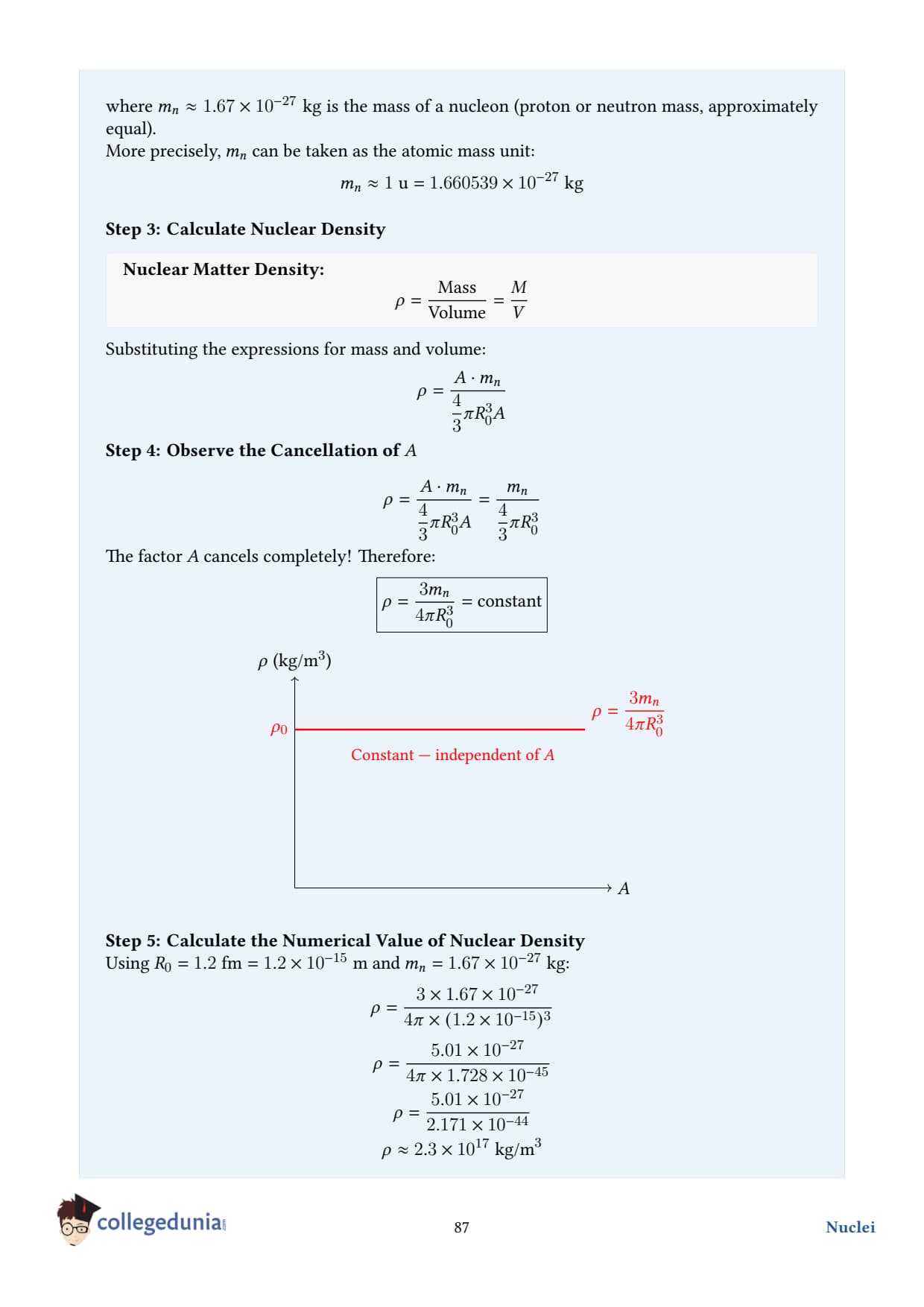
Step 2 - compute the density. ρ = A mn43π R03A = mn43π R03.
Step 3 - note that A has cancelled. The A in the numerator (from the total mass) cancels the A in the denominator (from the volume). The remaining expression depends ONLY on mn and R0, both universal constants. So nuclear density is the same for every nucleus.
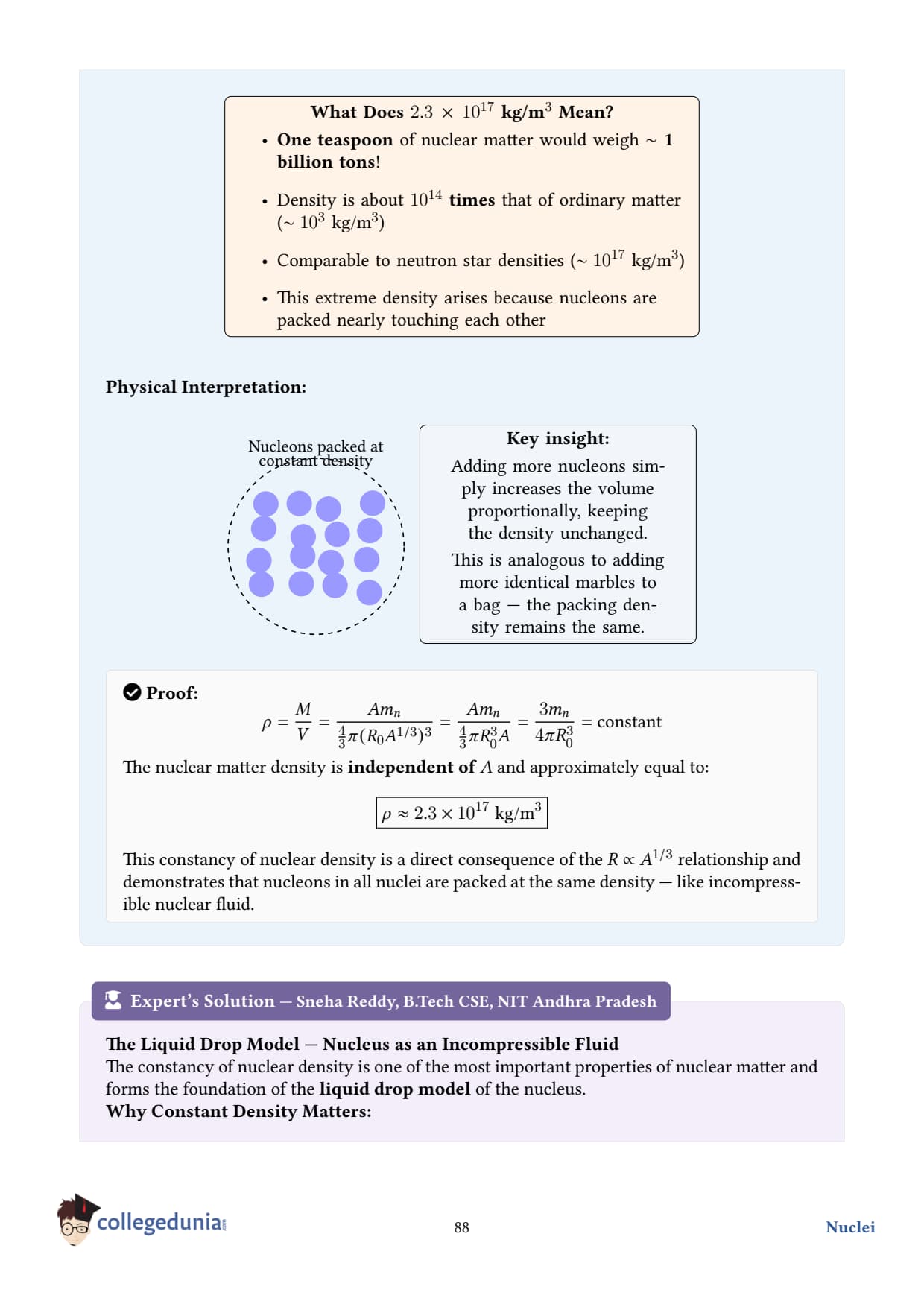
Final answer.nucleus ≈ 2.3× 10¹⁷ kg/m3 (independent of A).
Every nucleus, from hydrogen to uranium, has the same density. The constancy of ρ is a direct consequence of R ∝ A1/3, which in turn reflects the saturation of the strong nuclear force.
DR
Dr. Ramesh Iyengar
Ph.D. Theoretical Nuclear Physics, TIFR Mumbai
Verified Expert
Why this matters physically - saturation of the strong force. If the strong force were like gravity or electromagnetism (long-range, unscreened), nuclear density would increase with A - every nucleon would feel every other one, packing them tighter. Instead, density is independent of A. This tells us the strong force is short-range: each nucleon only feels its immediate neighbours. Adding more nucleons doesn't compress the existing ones - it just makes the nucleus bigger. This is called "saturation."
Mind-bending comparison. Water has density 1000 kg/m3; lead has ∼ 11000 kg/m3; a white dwarf core, ∼ 109 kg/m3. Nuclear matter at 2.3× 10¹⁷ kg/m3 is about 1014 times denser than water. One cubic millimetre of nuclear matter would weigh ∼ 2× 10⁸ kg - 200 thousand tonnes.
Neutron stars - macroscopic nuclei. When a massive star collapses, its electrons get crushed into protons forming neutrons. The remnant - a neutron star - is essentially a giant nucleus held together by gravity instead of the strong force, with mass roughly the Sun's compressed to a radius of about 10 km. Its density ∼ 1017 kg/m3 matches the nuclear value we just derived. The match is exact for a reason: at those densities, neutron-star matter is nuclear matter.
Alternate derivation - number density of nucleons. Equivalently, define number density n = A/V = A/43π R03A = 1/43π R03 ≈ 0.14 nucleons/fm3. The same answer in different units. This is the universal "nuclear saturation density" used in heavy-ion collision physics and neutron-star modelling.
Real-world relevance. The constancy of nuclear density underpins the liquid-drop model of the nucleus (Bohr, Weizsäcker), the semi-empirical mass formula, and the analysis of giant-resonance excitations. Whenever you see "nuclear matter density," it is exactly the ∼ 2.3× 10¹⁷ kg/m3 computed above.
Student Feedback on Class 12 Physics Chapter 13 Nuclei
In a Collegedunia poll of 10,820 Class 12 Physics students, 67% rated binding-energy-per-nucleon calculations as the trickiest sub-topic, ahead of half-life numericals.
Student Feedback
67% of students surveyed found binding-energy-per-nucleon the most confusing sub-topic.
52% mixed up fission and fusion at least once on a class test.
4 out of 5 students sketched the binding energy curve the night before boards.
Students took about 3.2 hours for the first read and 1.4 hours for revision.
Source: 2025-26 Class 12 Physics student poll.
Class 12 Physics Chapter 13 Nuclei NCERT Solutions FAQs
Ques. What are the main topics in nuclei class 12 NCERT solutions?
Ans. The class 12 nuclei NCERT solutions cover nuclear composition (Z, N, A), nuclear size (R = R_0 A^(1/3)), mass-energy equivalence, mass defect and binding energy, the binding energy per nucleon curve, radioactivity (alpha, beta, gamma), the radioactive decay law, half-life and mean life, nuclear fission, and nuclear fusion.
Ques. What is binding energy in nuclear physics class 12?
Ans. Binding energy is the energy required to disassemble a nucleus into its constituent nucleons (or equivalently, the energy released when those nucleons come together). Computed from the mass defect via E_B = (delta m) c squared, where delta m = sum of nucleon masses minus actual nucleus mass.
Ques. What is the binding energy curve class 12 physics?
Ans. A plot of binding energy per nucleon (B/A) vs mass number (A). Peaks around A = 56 (Fe-56, the most stable nucleus). Falls toward both ends, which is why both fusion (light nuclei to heavier) and fission (heavy nuclei to lighter) release energy: each moves toward the iron peak.
Ques. What is the radioactive decay law?
Ans. N = N_0 e^(minus lambda t), where N_0 is the initial number of nuclei, N is the number at time t, and lambda is the decay constant. Equivalently, dN/dt = -lambda N. The half-life t_half = 0.693 / lambda and the mean life tau = 1 / lambda.
Ques. What is nuclear fission?
Ans. The splitting of a heavy nucleus (such as U-235 or Pu-239) into two roughly equal lighter nuclei, releasing energy. Often triggered by neutron absorption; produces a chain reaction in suitable conditions. Basis of nuclear power and weapons.









Comments