Senior Biology Editor, 11 Yrs | Updated 3+ months ago
Class 12 Biology Chapter 5 Molecular Basis of Inheritance has 7 NCERT exercise questions and is the highest-yield topic in the Genetics and Evolution unit for NEET. Every answer is worked out step by step and mapped to the 2026-27 NCERT. This page hosts the full Molecular Basis of Inheritance NCERT Solutions PDF below.
Snapshot
Value
NCERT exercise questions solved
7 (Q5.1 to Q5.7)
Source-book figures embedded
5 (Fig 5.1, 5.2, 5.6, 5.9, 5.10)
Chapter length in NCERT 2026-27
22 pages
CBSE Weightage: 7 to 9 marks
NEET Weightage: 4 to 6 questions per year
AIIMS/CUET: 2 to 3 recall questions per paper
These NCERT Solutions are written by NEET-rank-holder mentors at Collegedunia, mapped to the 2026-27 NCERT.
Molecular Basis of Inheritance Previous Year Questions Weightage (2025 to 2021)
NEET asked at least 4 questions in each of the last five sittings, and CBSE never dropped below a 5-marker.
Year
CBSE Marks Asked
NEET Questions
High-yield Sub-topic
2025
8
5
Lac operon regulation, replication fork
2024
9
6
Hershey-Chase, Meselson-Stahl numerical
2023
7
4
DNA fingerprinting, transcription unit
2022
7
5
Human Genome Project, genetic code
2021
8
4
DNA packaging, nucleosome
How Will Collegedunia's NCERT Solutions Help You Score in Molecular Basis of Inheritance?
This PDF matches the CBSE marking pattern. Every answer is step by step, with a parallel "Expert's Solution".
Two attempt paths per question: the Solution gives the textbook answer; the Expert's Solution is an MCQ recall sheet.
Worked answers for all 7 questions across DNA structure, the central dogma, the lac operon, and DNA fingerprinting.
NEET tokens flagged verbatim plus five source-book figures (Fig 5.1, 5.2, 5.6, 5.9, 5.10) from the 2026-27 NCERT PDF.
NCERT Exercise-by-Exercise Breakdown: Molecular Basis of Inheritance
The PDF solves all 7 numbered questions. The table below maps each to its core concept and typical CBSE marks.
Q No.
Concept Tested
Typical CBSE Marks
NEET Repeat Risk
Q5.1
Group DNA / RNA / nucleotide / sugar
2
High
Q5.2
Pair complementary DNA strand
1
Medium
Q5.3
Reverse strand 5' to 3'
1
High
Q5.4
Translate mRNA via genetic code
2
High
Q5.5
Repetitive vs satellite DNA
3
Medium
Q5.6
Salient features of the genetic code
3
High
Q5.7
tRNA charging; tRNA as adapter molecule
3
Medium
Q5.6 (genetic code features) and Q5.1 (DNA / RNA grouping) make up nearly half the chapter's CBSE marks.
Sample Fully-Solved Question: Genetic Code Salient Features (Q5.6)
The NCERT question asks: "Make a list of the salient features of the genetic code." This is a near-guaranteed CBSE 3-marker, marked as below.
Step 1 (1 mark) - Triplet, unambiguous, degenerate. The code is a triplet (three nucleotides per amino acid), unambiguous (one codon, one amino acid) and yet degenerate (one amino acid can have several codons).
Step 2 (1 mark) - Universality and polarity. It is nearly universal (AUG codes methionine in bacteria, plants and humans), read in fixed 5' to 3' polarity, non-overlapping and comma-less.
Step 3 (1 mark) - Start and stop codons.AUG is the start codon (also codes methionine). UAA, UAG, UGA are stop codons with no amino acid.
Marks Budget for a 5-Marker on DNA Replication (CBSE Class 12 Biology)
The CBSE 5-marker on Meselson-Stahl or the replication fork appears in three of the last five Board papers. The budget below shows each mark.
1 mark. Definition: semi-conservative replication: each daughter DNA has one parental and one new strand.
1 mark. Meselson-Stahl: E. coli grown in 15N then shifted to 14N gives one hybrid band after one generation, then one hybrid and one light band.
1 mark. Replication fork: leading strand continuous, lagging strand in Okazaki fragments, 5' to 3' polarity.
1 mark. Enzymes: helicase (unwinds), primase (RNA primer), DNA polymerase III (extends), DNA ligase (joins fragments).
1 mark. Origin of replication and dNTPs as substrate.
Most scripts name only helicase and DNA polymerase and lose 2 marks. Write all four enzymes.
Alternate Solution Methods: How the Expert's Solution Reframes Each Question
The Expert's Solution rewrites each main solution from a NEET examiner's lens. The table below shows the shift for three high-yield questions.
Crick's adapter hypothesis with anticodon-amino-acid bridging
OMR-ready: "3' end carries amino acid; anticodon reads codon 3' to 5' on mRNA"
Common Mistakes Students Make in Molecular Basis of Inheritance
Most students mix up the replication, transcription, and translation enzymes. The mistakes below cost the most marks.
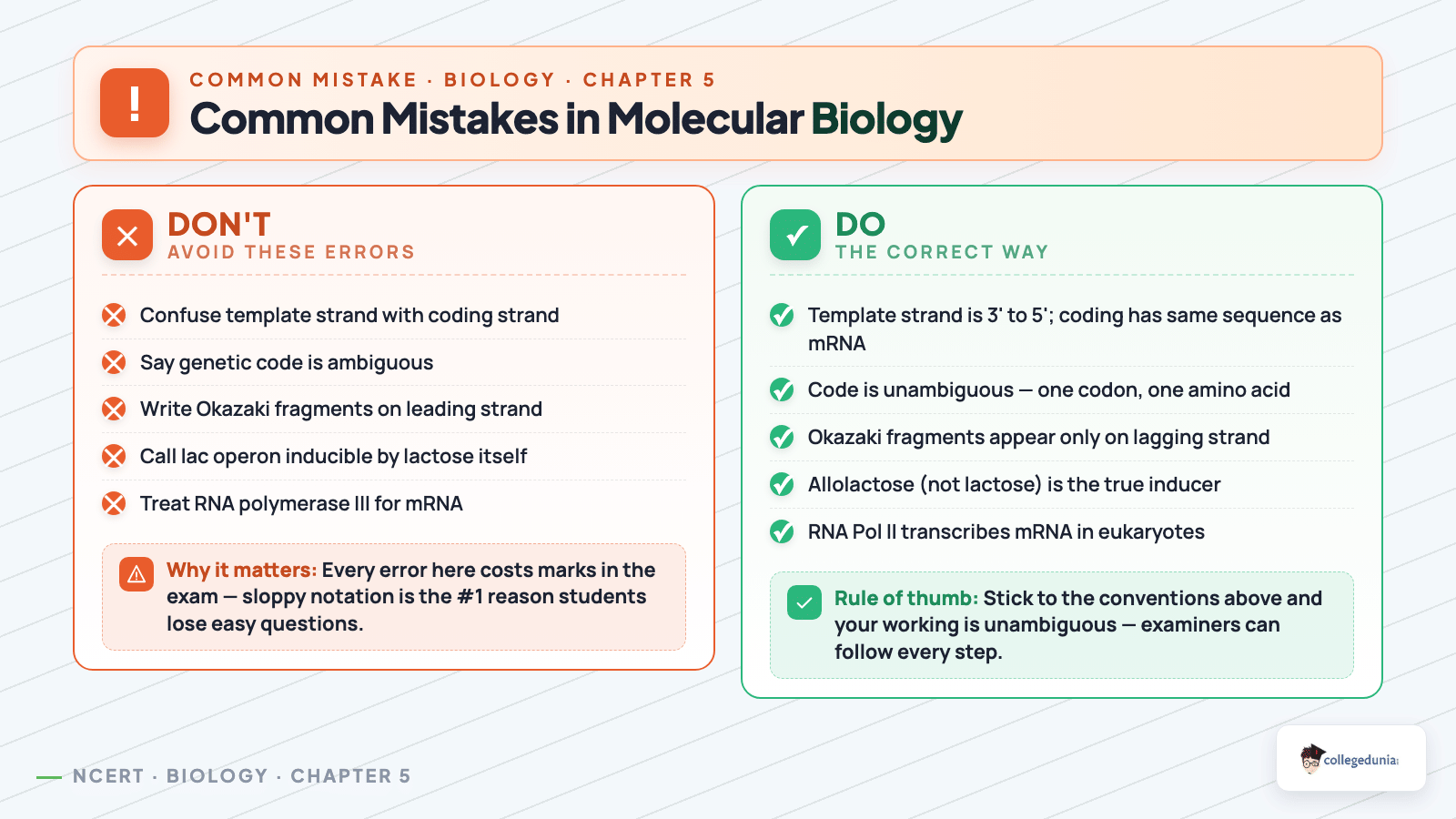
Mistake 1. Calling DNA replication "conservative". It is semi-conservative (Meselson-Stahl, 1958); conservative would give two bands, but the experiment showed one hybrid band.
Mistake 2. Writing "DNA polymerase works in either direction". It only extends 5' to 3', which forces the lagging strand into Okazaki fragments.
Mistake 3. Confusing the lac operon regulator and operator. The i gene codes the repressor; the repressor binds the operator (o), not the promoter. Lactose is the inducer.
Mistake 4. Saying "HGP sequenced 100% of human DNA". It sequenced about 92% of the euchromatic genome; only 1.5% codes for protein.
Mistake 5. Misnaming the DNA-fingerprinting probe. It is a VNTR, not a microsatellite or SNP (Alec Jeffreys, 1985).
In NEET 2025, 39% of students got the lac-operon question wrong by writing "repressor binds promoter" instead of "repressor binds operator".
How to Study Molecular Basis of Inheritance Effectively (Class 12 Biology Time-Plan)
Most students spend too long on HGP numbers and too little on the central-dogma enzymes and the lac operon. The 3-day plan below fixes that.
Day
Focus
NCERT Q to Solve
Time
Day 1
DNA structure, packaging, search for genetic material
Q5.1, Q5.2, Q5.3
2.5 hours
Day 2
Central dogma: replication, transcription, translation, genetic code
Q5.4, Q5.6, Q5.7
3 hours
Day 3
Regulation (lac operon), HGP, DNA fingerprinting
Q5.5 + one full CBSE PYP attempt
2.5 hours
Keep the lac-operon switch and replication-fork enzyme map on one A4 sheet for night-before revision.
All NCERT Solutions for Molecular Basis of Inheritance with Step-by-Step Working
Every NCERT question for Class 12 Biology Chapter 5 Molecular Basis of Inheritance is listed below with its full Solution and Expert Solution in collapsible tabs. Click Check Solution for the step-by-step working and Expert Solution for more detail.
Questions
Q 5.1
Group the following as nitrogenous bases and nucleosides:
Adenine, Cytidine, Thymine, Guanosine, Uracil and Cytosine.
Concept used. A nitrogenous base is a single
nitrogen-containing ring molecule that belongs to one of two families:
the double-ring purines (adenine, guanine) and the single-ring
pyrimidines (cytosine, thymine, uracil). When a nitrogenous base
is attached through an N-glycosidic bond to a five-carbon sugar
(ribose in RNA, deoxyribose in DNA), the base–sugar unit
is called a nucleoside. If a phosphate group is further joined
to the 5' carbon of the sugar, the unit becomes a nucleotide.
Naming rule
Nucleoside names end in -osine (for purines: adenosine,
guanosine) or -idine (for pyrimidines: cytidine, thymidine,
uridine). Plain base names (adenine, guanine, cytosine, thymine,
uracil) end in -ine. The suffix tells you whether the sugar
is already attached.
Step 3: sanity check. Free bases must have no sugar
attached. Adenine, Thymine, Uracil and Cytosine are all just
ring molecules. Cytidine = cytosine + ribose; Guanosine = guanine
+ ribose. Both have a sugar attached, so they are nucleosides.
Check passes.
Structural angle. Sort each name into a 3-tier ladder
``base → nucleoside → nucleotide'' and the answer falls
out without memorisation.
Step 1: write the ladder.
Each level adds one chemical group:
tabularc c c c c
base & ⟶ & nucleoside & ⟶ & nucleotide
(ring only) & add ribose & (base + sugar) & add phosphate & (base + sugar + PO4)
tabular
Step 2: place every given name on the ladder.
Adenine, Thymine, Uracil and Cytosine carry no sugar and no
phosphate, so they sit on the lowest rung (bases). Cytidine and
Guanosine carry the sugar (their suffix gives them away), so
they sit one rung up (nucleosides). None of the six has a
phosphate, so the top rung stays empty here.
Step 3: read off the groups.
Bases (lowest rung): Adenine, Thymine, Uracil, Cytosine.
Nucleosides (middle rung): Cytidine, Guanosine.
Why this matters. The same ladder lets you instantly classify
ATP, GTP, AMP, dGMP and similar names that appear in the
biotechnology chapters: count the chemical groups, place on the ladder,
and you have the category.
If a double stranded DNA has 20 per cent of cytosine,
calculate the per cent of adenine in the DNA.
Concept used.Chargaff's rule of base pairing states
that in any double-stranded DNA molecule, adenine pairs only with
thymine and guanine pairs only with cytosine. Because every A on one
strand faces a T on the other, and every G faces a C,
% A = % T % G = % C.
All four bases together account for every nucleotide in the molecule,
so
% A + % T + % G + % C = 100%.
This is the same equivalence rule that confirmed the double-helix
hypothesis when Watson and Crick built their model in 1953.
Why A=T and G=C
A and T form two hydrogen bonds; G and C form three. Two-bond pairs
fit between two strands of a helix at the same width as three-bond
pairs because A (purine) is paired with T (pyrimidine), and G (purine)
with C (pyrimidine). So the helix has uniform width and the base
counts must match in pairs.
Step 1: write down what is given. % C = 20%.
We are asked to find % A.
Step 2: use % G = % C.
From Chargaff's rule,
% G = % C = 20%.
Step 3: add up the GC content. % G + % C = 20% + 20% = 40%.
So the remaining bases (A and T together) must make up
100% - 40% = 60%.
Step 4: split the AT content equally.
Because % A = % T,
% A + % T = 60%
⇒
2 × % A = 60%
⇒
% A = 60%2 = 30%.
Step 5: sanity check.% A + % T + % G + % C
= 30% + 30% + 20% + 20% = 100%.
[See diagram in the PDF version]
[2pt]
cdMutedBase composition: A = T = 30%, G = C = 20%.
The percentage of adenine in the DNA is 30%.
PS
Pranav Sharma
M.Sc Molecular Biology, NCBS Bangalore
Verified Expert
Quick reading. Chargaff's rule is really one equation in one
unknown if you write it cleanly. Set a = % A and use the
constraint to solve directly.
Step 1: define the variable.
Let a = % A. Then by Chargaff's rule,
% T = a, % C = 20% (given), and
% G = % C = 20%.
Step 2: write the conservation equation.
All bases together account for 100% of the molecule:
% A + % T + % G + % C = 100%.
Substitute:
a + a + 20% + 20% = 100%.
Step 4: verify against Chargaff.% A/% T = 30/30 = 1.00 and
% G/% C = 20/20 = 1.00. Both ratios equal
unity, confirming the molecule is true double-stranded DNA.
Why this matters. The same one-variable approach handles every
NCERT and entrance question of the form ``given one base %, find
another''. Tie the variable to A or G, write the 100% constraint, solve.
% A = 30%.
Q 5.3
If the sequence of one strand of DNA is written as follows:
5' -ATGCATGCATGCATGCATGCATGCATGC-3'
Write down the sequence of complementary strand in 5'→ 3'
direction.
Concept used. A DNA double helix is built from two
antiparallel strands. ``Antiparallel'' means that if one
strand runs 5'3' from left to right, the other strand runs
3'5' over the same region. The bases on the two strands are
joined by hydrogen bonds following complementary base pairing:
A ↔ T and G ↔ C.
To write the complementary strand of any given sequence:
Replace each base in the given strand with its partner
(A→T, T→A, G→C, C→G). This gives the partner
sequence in the antiparallel direction.
Reverse the resulting sequence so that we read it in
5'3' direction (because by convention every DNA
sequence is written 5' end first).
Antiparallel orientation
The 5' end carries a free phosphate on the 5' carbon of the sugar;
the 3' end carries a free –OH on the 3' carbon. Two strands
in a helix cannot both end the same way, so they must run opposite
ways. This is why the partner sequence is reversed.
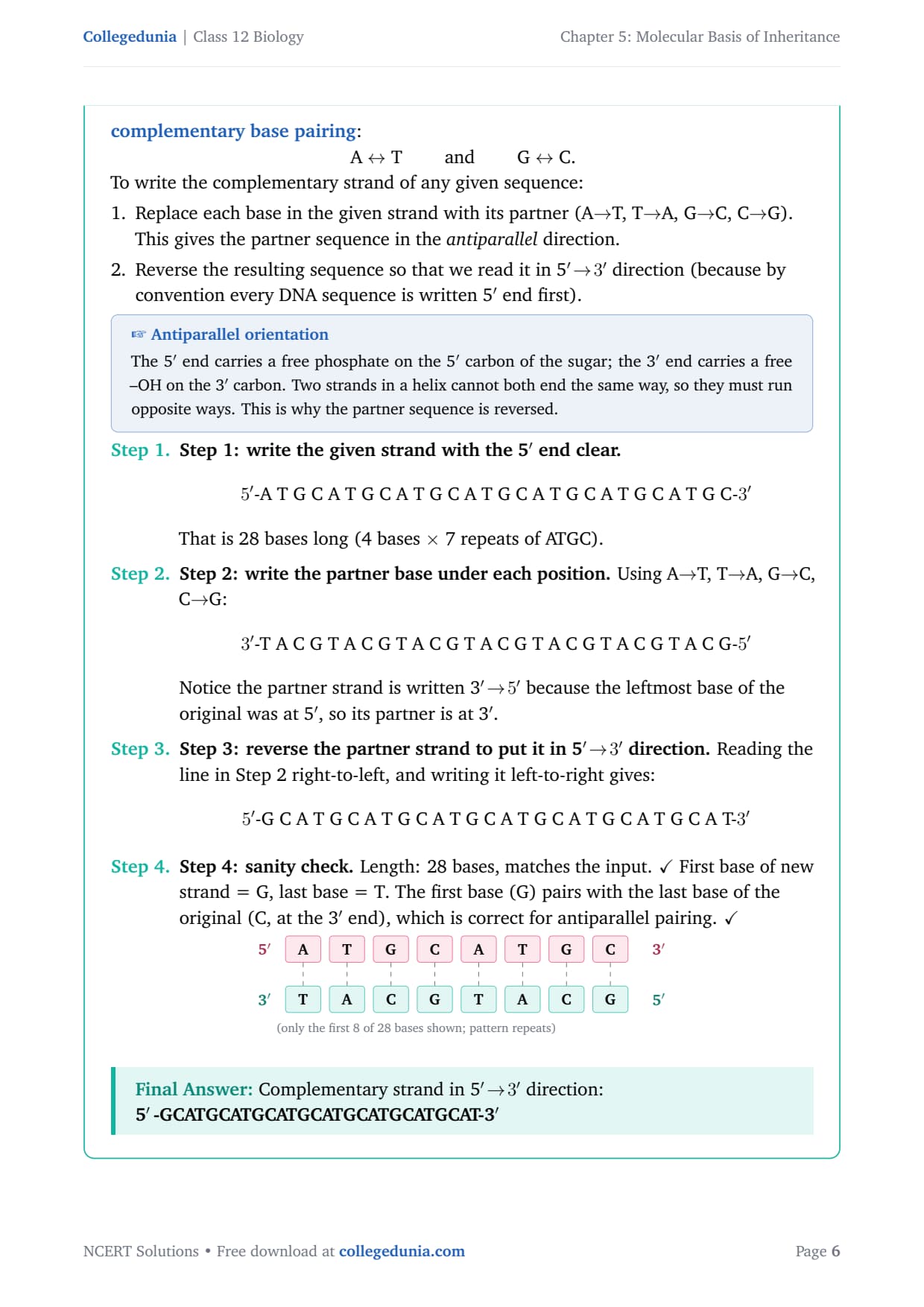
Step 1: write the given strand with the 5' end clear. 5'-ATGCATGCATGCATGCATGCATGCATGC-3'
That is 28 bases long (4 bases × 7 repeats of ATGC).
Step 2: write the partner base under each position.
Using A→T, T→A, G→C, C→G:
3'-TACGTACGTACGTACGTACGTACGTACG-5'
Notice the partner strand is written 3'5' because the
leftmost base of the original was at 5', so its partner is at
3'.
Step 3: reverse the partner strand to put it in
5'3' direction.
Reading the line in Step 2 right-to-left, and writing it
left-to-right gives:
5'-GCATGCATGCATGCATGCATGCATGCAT-3'
Step 4: sanity check.
Length: 28 bases, matches the input.
First base of new strand = G, last base = T. The first base
(G) pairs with the last base of the original (C, at the 3'
end), which is correct for antiparallel pairing.
[See diagram in the PDF version]
Complementary strand in 5'3' direction: 5' -GCATGCATGCATGCATGCATGCATGCAT-3'
RB
Rohit Bhat
Ph.D Molecular Genetics, NCBS Bangalore
Verified Expert
Picture-first. Imagine the two strands as a zip with the
5' end of strand 1 lined up with the 3' end of strand 2. Pair every
tooth (base), then read strand 2 the other way around.
Step 1: chunk the input into the repeating motif.
The given strand is the 4-base motif ATGC repeated 7 times.
Whatever rule we derive for one ATGC unit applies to all seven.
Step 2: complement and reverse one motif.
ATGC complemented is TACG (still 5'3' relative to
partner-aligned position, i.e. written 3'5' here).
Reverse: GCAT.
So the complementary 4-base unit, in 5'3', is
GCAT.
Step 3: stitch 7 copies of GCAT together. 5'-GCAT GCAT GCAT GCAT GCAT GCAT GCAT-3'
Removing the spaces:
5'-GCATGCATGCATGCATGCATGCATGCAT-3'
Step 4: cross-check by base counts.
Original: 7 A, 7 T, 7 G, 7 C.
Complement should also have 7 A, 7 T, 7 G, 7 C (because A on
one strand becomes T on the other, etc.). Count in our answer:
7 G, 7 C, 7 A, 7 T.
Why this matters. Spotting a repeating motif converts what
looks like a 28-base problem into a 4-base problem. This trick saves
real time in entrance exams when sequences are long.
5' -GCATGCATGCATGCATGCATGCATGCAT-3'.
Q 5.4
If the sequence of the coding strand in a transcription unit
is written as follows:
5' -ATGCATGCATGCATGCATGCATGCATGC-3'
Write down the sequence of mRNA.
Concept used. In a transcription unit, the two DNA strands
play different roles. The template strand (running
3'5') is actually read by RNA polymerase to build the mRNA.
The other strand, running 5'3' with a sequence identical to
the mRNA (apart from T → U), is called the coding strand
(or ``sense'' strand). Therefore the mRNA can be written directly from
the coding strand using one rule only:
copy the coding strand as-is, but replace every T with U.
The 5'3' direction is preserved because mRNA grows in the
5'3' direction, the same direction in which the coding strand
is conventionally written.
Why coding strand ≡ mRNA up to T/U
RNA polymerase reads the template strand 3'5', adding
ribonucleotides 5'3'. The new mRNA base is complementary to
the template base, which is itself complementary to the coding-strand
base. Two complements bring us back to the original, with the change
that RNA uses uracil instead of thymine.
Step 1: identify what we already have. coding strand = 5'-ATGCATGCATGCATGCATGCATGCATGC-3'.
This is 28 nucleotides (4 bases × 7 repeats).
Step 2: apply the T → U substitution while
keeping every other base unchanged.
Going base by base:
A stays A,
T → U,
G stays G,
C stays C.
So ATGC becomes AUGC, and the whole strand becomes:
5'-AUGCAUGCAUGCAUGCAUGCAUGCAUGC-3'.
Step 3: write the answer in standard mRNA direction.
mRNA is always reported 5'3' (the direction in which a
ribosome reads it). Our sequence is already in that direction,
so no reversal is needed.
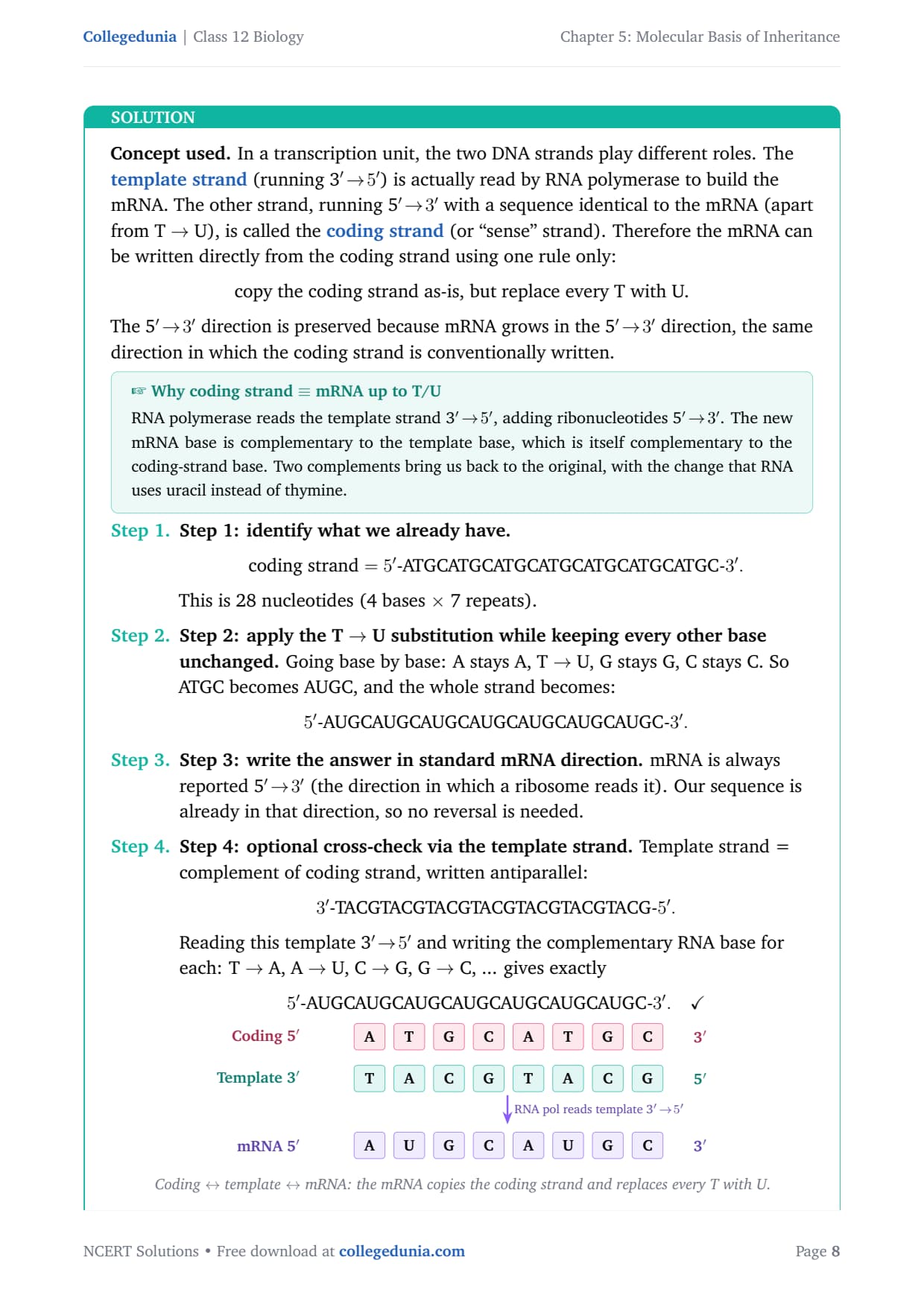
Step 4: optional cross-check via the template strand.
Template strand = complement of coding strand, written
antiparallel:
3'-TACGTACGTACGTACGTACGTACGTACG-5'.
Reading this template 3'5' and writing the
complementary RNA base for each:
T → A, A → U, C → G, G → C, ... gives exactly
5'-AUGCAUGCAUGCAUGCAUGCAUGCAUGC-3'.
[See diagram in the PDF version]
[3pt]
cdMutedCoding ↔ template
↔ mRNA: the mRNA copies the coding strand and replaces
every T with U.
Strategic angle. The shortest route from coding-strand to
mRNA is a single character substitution: T → U. No reversing, no
complementing. Everything else is a check.
Step 1: state the rule cleanly.mRNA(5'3') = coding(5'3')
with the single substitution T → U. This rule comes from
the two complementations (coding ↔ template,
then template → mRNA) cancelling out, except for the change
in pyrimidine.
Step 2: do the substitution motif by motif.
The coding strand has 7 copies of ATGC. Each ATGC becomes
AUGC, so the mRNA has 7 copies of AUGC:
5'-AUGC AUGC AUGC AUGC AUGC AUGC AUGC-3'.
Removing the spaces gives 28 nucleotides.
Step 3: confirm the reading frame.
Read in triplets from the 5' end:
AUG | CAU | GCA | UGC | AUG | CAU | GCA | UGC | AU.
The first codon is the start codon AUG (methionine), as
expected for a transcription unit whose coding strand starts
with ATG.
Why this matters. In entrance papers, recognising that
``mRNA = coding strand with T→U'' converts almost every transcription
question into a one-substitution exercise. Reach for the template strand
only when the question explicitly hands you one.
mRNA = 5' -AUGCAUGCAUGCAUGCAUGCAUGCAUGC-3'.
Q 5.5
Which property of DNA double helix led Watson and Crick to
hypothesise semi-conservative mode of DNA replication? Explain.
Concept used.Semi-conservative replication is the
model in which each daughter DNA molecule consists of one
parental strand and one newly synthesised strand. The
clue that pointed Watson and Crick towards this model lies in the
geometry of the helix itself: the two strands of DNA are
complementary (every A pairs with T, every G with C) and
they are joined only by weak hydrogen bonds. The complementarity
means that if the two strands are gently pulled apart, each strand
already carries the full information needed to rebuild its partner.
The weak hydrogen bonds (in contrast to covalent backbone bonds)
allow the strands to come apart without the molecule being destroyed.
Step 1: the key property – complementary base pairing.
Within the helix, the order of bases on one strand
determines the order of bases on the other. There is no
independent information on the two strands; they are mirror
images of each other through the A–T and G–C rule.
Step 2: physical separability via hydrogen bonds.
The two strands are held together by 2 hydrogen bonds (A–T)
or 3 (G–C). These are weaker than the covalent
phosphodiester bonds along each backbone, so the strands can
unwind without breaking either backbone. This makes strand
separation a feasible step in replication.
Step 3: the implication Watson and Crick drew.
Because each strand carries the complete information for its
partner, the molecule can be copied by: (i) unwinding the
helix, (ii) using each parental strand as a template,
(iii) laying down a new strand whose bases are complementary
to the parental template. After one round of replication, each
daughter molecule has one old strand and one new strand –
hence ``semi-conservative''.
Step 4: experimental confirmation.
This hypothesis was later proved in 1958 by
Meselson and Stahl using density-gradient
centrifugation of E. coli DNA labelled with
15N, confirming the prediction beyond doubt.
[See diagram in the PDF version]
[2pt]
cdMutedEach daughter inherits one parental strand;
the partner is built fresh – the essence of semi-conservative replication.
The complementarity of the two strands, joined by
weak hydrogen bonds, allowed each strand to act as a template for a
new partner, leading directly to the semi-conservative model.
VJ
Vivaan Joshi
Ph.D Molecular Biology, NCBS Bangalore
Verified Expert
Strategic angle. The question is really asking: ``what
about the helix made copying it obvious?'' Frame the answer around
two ideas, information mirroring and physical separability, and
finish with the experiment that confirmed it.
Step 1: information mirroring.
Watson and Crick noticed that A pairs only with T and G only
with C. This is a one-to-one mapping, so each strand uniquely
determines the other. A copy of strand-1, paired with strand-2,
is exactly the same DNA molecule. So the molecule contains
its own template.
Step 2: physical separability.
The forces holding the two strands together are hydrogen bonds
(2 in A–T, 3 in G–C). These are far weaker than the covalent
backbone bonds, so a mild input of energy, provided by enzymes
like helicase, can pry the strands apart without damaging
them. A model that requires breaking the covalent backbone
would not be biologically sensible.
Step 3: how the two ideas combine.
Put together: separate the two strands; use each as the
template for a new strand; you get two daughter helices, each
with one old and one new strand. This is what we now call
semi-conservative replication.
Step 4: the experimental seal.
Meselson and Stahl (1958) grew E. coli on heavy nitrogen
(15N) so all DNA was heavy, then shifted them to light
nitrogen (14N). After one round of replication every
molecule was of intermediate density (one heavy strand + one
light strand), exactly as semi-conservative predicts. The
conservative model would have given two density bands; the
dispersive model would have given a slowly lightening single
band over many generations. Both were ruled out.
Why this matters. The leap from helix structure to
helix function (replication) is the textbook example of how a
good structural model immediately suggests a mechanism. The same logic
later guided the discovery of transcription and translation.
The complementary base-pairing of the two antiparallel
strands, held by weak H-bonds, made the semi-conservative model
inevitable.
Q 5.6
Depending upon the chemical nature of the template (DNA or RNA)
and the nature of nucleic acids synthesised from it (DNA or RNA), list
the types of nucleic acid polymerases.
Concept used. A nucleic acid polymerase is an
enzyme that synthesises a nucleic-acid strand by adding nucleotides
one at a time, using a pre-existing nucleic acid as a template. Two
choices define the family of the enzyme:
What kind of template does the enzyme read –
DNA or RNA?
What kind of product does the enzyme build –
DNA or RNA?
With two choices per axis, we get 2 × 2 = 4 possible types,
each with a distinct biological role.
Step 1: list all four template-product combinations.
tabularc c p4.2cm p4.0cm
Template & Product & Enzyme & Biological role
DNA & DNA & DNA-dependent DNA polymerase & DNA replication
DNA & RNA & DNA-dependent RNA polymerase & Transcription
RNA & DNA & RNA-dependent DNA polymerase & Reverse transcription (retroviruses)
RNA & RNA & RNA-dependent RNA polymerase & Replication of RNA viruses
tabular
Step 2: describe each enzyme briefly.
DNA-dependent DNA polymerase: copies DNA
into DNA during cell division so each daughter cell
gets a full genome.
DNA-dependent RNA polymerase: copies a DNA
template into mRNA, rRNA or tRNA during transcription.
In eukaryotes there are three sub-types (RNA pol I,
II and III) for different RNA classes.
RNA-dependent DNA polymerase (reverse
transcriptase): used by retroviruses such as HIV to
write their RNA genome back into DNA so it can integrate
into the host genome.
RNA-dependent RNA polymerase (RdRp): used by
RNA viruses such as influenza, polio and SARS-CoV-2 to
copy their RNA genome into more RNA.
Step 3: sanity check.
The central dogma adds the reverse-transcriptase arrow only
after Temin and Baltimore's 1970 discovery; the RdRp arrow was
added for RNA viruses. Together the four enzymes cover every
information-transfer route between DNA and RNA actually seen
in nature.
Four types: DNA-dependent DNA polymerase, DNA-dependent
RNA polymerase, RNA-dependent DNA polymerase (reverse transcriptase),
and RNA-dependent RNA polymerase.
AN
Aditi Nair
Ph.D Virology, NCBS Bangalore
Verified Expert
Picture-first. Draw the 2 × 2 table of (template, product)
combinations. Each cell is one enzyme family with a specific job.
Step 1: build the 2× 2 grid.
Rows = template (DNA, RNA). Columns = product (DNA, RNA).
Every cell is a real enzyme found in nature.
Step 2: fill in the cells.
DNA → DNA: DNA-dependent DNA polymerase
(replication, S-phase of cell cycle).
DNA → RNA: DNA-dependent RNA polymerase
(transcription, every gene expression event).
RNA → DNA: Reverse transcriptase
(retroviruses; also the basis of cDNA cloning).
RNA → RNA: RNA replicase / RdRp
(RNA viruses; not present in healthy human cells).
Step 3: connect to the central dogma.
The first two cells are the original Crick-1958 dogma.
Reverse transcriptase added the RNA-to-DNA arrow in 1970.
RdRp completes the picture by allowing RNA to copy itself,
which is essential for the life cycle of every RNA virus.
Why this matters. Drugs that block reverse transcriptase
(zidovudine, lamivudine) stop HIV from establishing infection.
Drugs that block RdRp (remdesivir, molnupiravir) stop the replication
of SARS-CoV-2. The taxonomy of polymerases drives modern antiviral
drug design.
Four polymerases: DNA-dep. DNA pol, DNA-dep. RNA pol,
RNA-dep. DNA pol (reverse transcriptase), RNA-dep. RNA pol.
Q 5.7
How did Hershey and Chase differentiate between DNA and protein
in their experiment while proving that DNA is the genetic material?
Concept used. The Hershey–Chase experiment (1952) used
radioactive isotope labelling to tell apart the two main
components of a virus – DNA and protein – as they entered a host
bacterium. The trick relies on the chemistry of these two molecules:
DNA contains phosphorus but no sulphur (phosphate is
part of the backbone, PO43-).
Protein contains sulphur but no phosphorus (sulphur
sits inside the amino acids cysteine and methionine).
So if you grow viruses in a medium containing radioactive sulphur
(35S), only their proteins become radioactive. If you grow
viruses in a medium containing radioactive phosphorus (32P), only
their DNA becomes radioactive. By following the radioactivity, you
follow either the protein or the DNA, but never both at once.
Step 1: prepare two separate batches of bacteriophage
T2.
Batch A: grow viruses in medium with
35S. Outcome: virus protein coat is labelled,
DNA is not.
Batch B: grow viruses in medium with
32P. Outcome: virus DNA is labelled, protein
coat is not.
Step 2: infect E. coli with each batch
separately.
Allow viruses time to attach to the bacterial wall and
inject their genetic material.
Step 3: shear the empty viral coats off the bacteria
using a blender.
Whatever is inside the cell stays inside; whatever is outside
(the empty coats) gets stripped from the bacterial surface.
Step 4: centrifuge to separate.
Heavy bacteria sink to the pellet.
Lighter, empty viral coats stay in the supernatant.
Step 5: measure radioactivity in pellet vs.
supernatant.
Batch A (35S, protein): radioactivity stays in
the supernatant (the empty coats). Protein never
entered the bacterium.
Batch B (32P, DNA): radioactivity ends up in the
pellet (inside the bacteria). DNA did enter
the bacterium.
Step 6: interpret.
Only the material that enters the host can be the genetic
material (because the new viruses inside the bacteria came
from that material). Since only DNA entered, DNA is
the genetic material.
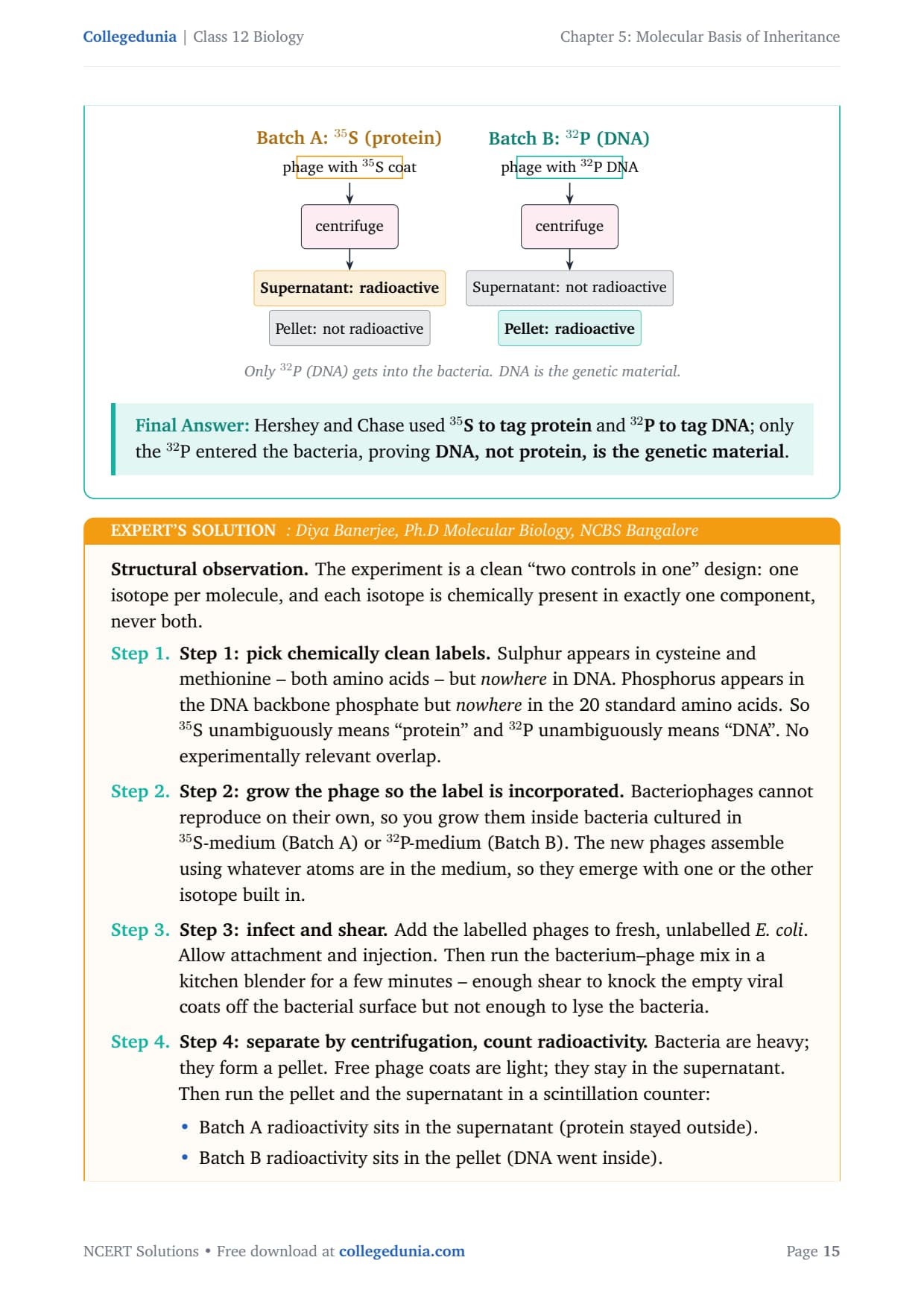
[See diagram in the PDF version]
[3pt]
cdMutedOnly 32P (DNA) gets into the
bacteria. DNA is the genetic material.
Hershey and Chase used 35S to tag protein and
32P to tag DNA; only the 32P entered the bacteria,
proving DNA, not protein, is the genetic material.
DB
Diya Banerjee
Ph.D Molecular Biology, NCBS Bangalore
Verified Expert
Structural observation. The experiment is a clean ``two
controls in one'' design: one isotope per molecule, and each isotope
is chemically present in exactly one component, never both.
Step 1: pick chemically clean labels.
Sulphur appears in cysteine and methionine – both
amino acids – but nowhere in DNA. Phosphorus appears
in the DNA backbone phosphate but nowhere in the 20
standard amino acids. So 35S unambiguously means
``protein'' and 32P unambiguously means ``DNA''.
No experimentally relevant overlap.
Step 2: grow the phage so the label is incorporated.
Bacteriophages cannot reproduce on their own, so you grow
them inside bacteria cultured in 35S-medium (Batch A)
or 32P-medium (Batch B). The new phages assemble using
whatever atoms are in the medium, so they emerge with one or
the other isotope built in.
Step 3: infect and shear.
Add the labelled phages to fresh, unlabelled E. coli.
Allow attachment and injection. Then run the
bacterium–phage mix in a kitchen blender for a few minutes
– enough shear to knock the empty viral coats off the
bacterial surface but not enough to lyse the bacteria.
Step 4: separate by centrifugation, count
radioactivity.
Bacteria are heavy; they form a pellet. Free phage coats are
light; they stay in the supernatant. Then run the pellet and
the supernatant in a scintillation counter:
Batch A radioactivity sits in the supernatant
(protein stayed outside).
Batch B radioactivity sits in the pellet (DNA went
inside).
Step 5: conclude.
Whatever enters the host is what carries the genetic
information, because the next generation of phages must be
templated on it. Only DNA entered. So DNA is the genetic
material.
Why this matters. Hershey–Chase finally closed the debate
that started with Griffith (1928) and Avery–MacLeod–McCarty (1944).
By using radioactivity instead of biochemistry, it produced an answer
that even sceptics of the earlier experiments could not refute.
Different isotopes tag different molecules: 35S
→ protein, 32P → DNA; only the DNA isotope entered the
bacteria.
Q 5.8
Differentiate between the followings:
(a) Repetitive DNA and Satellite DNA
(b) mRNA and tRNA
(c) Template strand and Coding strand
Concept used. Each pair contrasts two related-but-distinct
molecules or sequences in molecular biology. To differentiate them
cleanly we list, for each pair, the property that is unique to each
member and the property they share, in a side-by-side table.
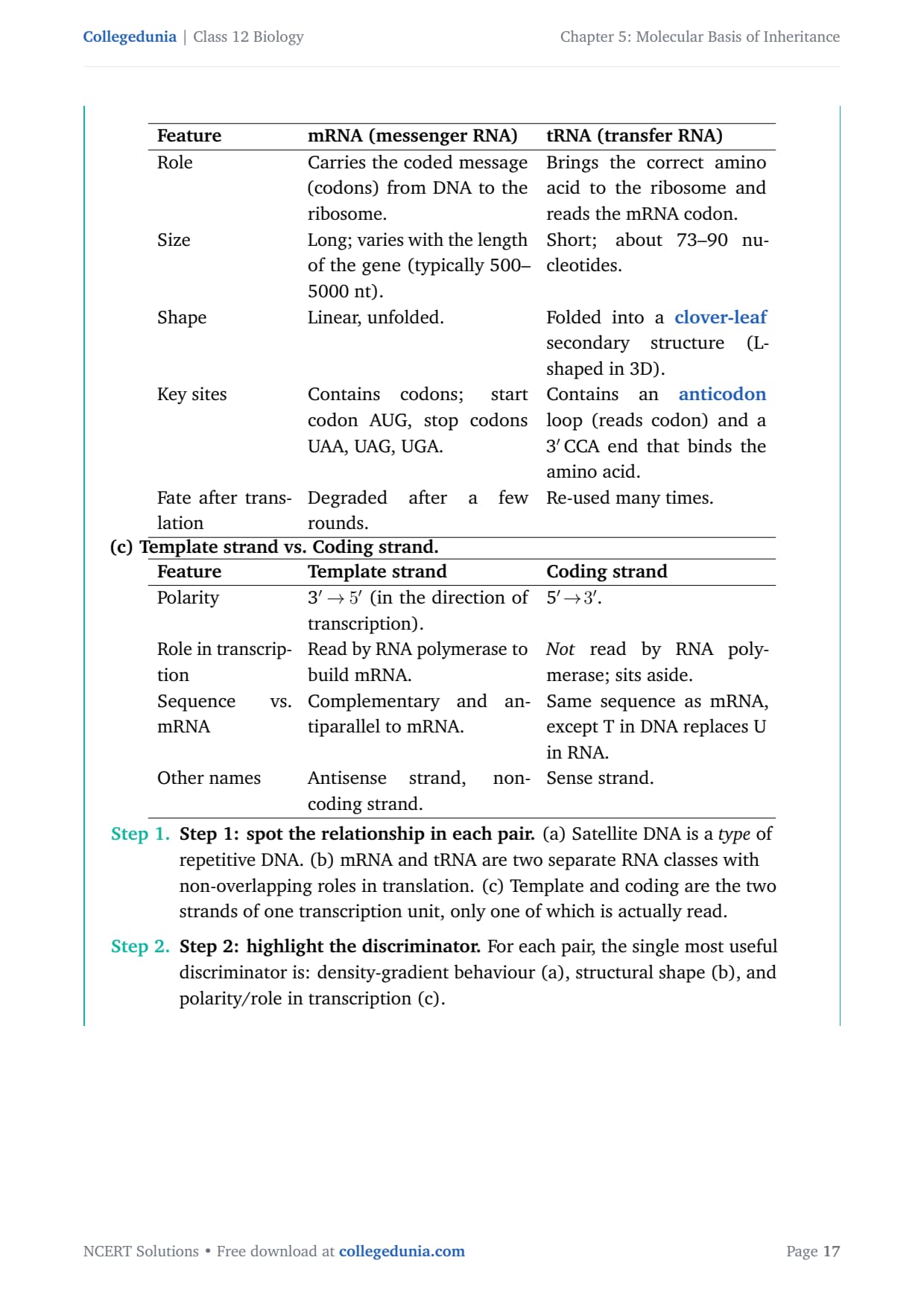
(a) Repetitive DNA vs. Satellite DNA.
tabularp3.0cm p5.0cm p5.0cm
Feature & Repetitive DNA & Satellite DNA
Definition & Any DNA sequence that occurs in multiple copies in the genome. &
A subset of repetitive DNA in which the repeats are short and
highly tandem, so they form a band of different density from bulk DNA.
Buoyant density & Same as bulk genomic DNA. &
Different from bulk DNA – forms a separate ``satellite'' peak
on a CsCl density gradient.
Function & Some repeats are functional (rRNA genes); many are
non-coding. & Largely non-coding; serves structural roles
(centromeres, telomeres).
Use in genetics & Genome organisation studies. &
Forms the basis of DNA fingerprinting (VNTRs, minisatellites).
Role & Carries the coded message (codons) from DNA to the ribosome. &
Brings the correct amino acid to the ribosome and reads the mRNA codon.
Size & Long; varies with the length of the gene (typically 500–5000 nt). &
Short; about 73–90 nucleotides.
Shape & Linear, unfolded. &
Folded into a clover-leaf secondary structure (L-shaped in 3D).
Key sites & Contains codons; start codon AUG, stop codons UAA, UAG, UGA. &
Contains an anticodon loop (reads codon) and a 3' CCA end
that binds the amino acid.
Fate after translation & Degraded after a few rounds. & Re-used many times.
tabular
(c) Template strand vs. Coding strand.
tabularp3.0cm p5.0cm p5.0cm
Feature & Template strand & Coding strand
Polarity & 3'5' (in the direction of transcription). &
5'3'.
Role in transcription & Read by RNA polymerase to build mRNA. &
Not read by RNA polymerase; sits aside.
Sequence vs. mRNA & Complementary and antiparallel to mRNA. &
Same sequence as mRNA, except T in DNA replaces U in RNA.
Other names & Antisense strand, non-coding strand. & Sense strand.
tabular
Step 1: spot the relationship in each pair.
(a) Satellite DNA is a type of repetitive DNA.
(b) mRNA and tRNA are two separate RNA classes with
non-overlapping roles in translation.
(c) Template and coding are the two strands of one transcription
unit, only one of which is actually read.
Step 2: highlight the discriminator.
For each pair, the single most useful discriminator is:
density-gradient behaviour (a), structural shape (b), and
polarity/role in transcription (c).
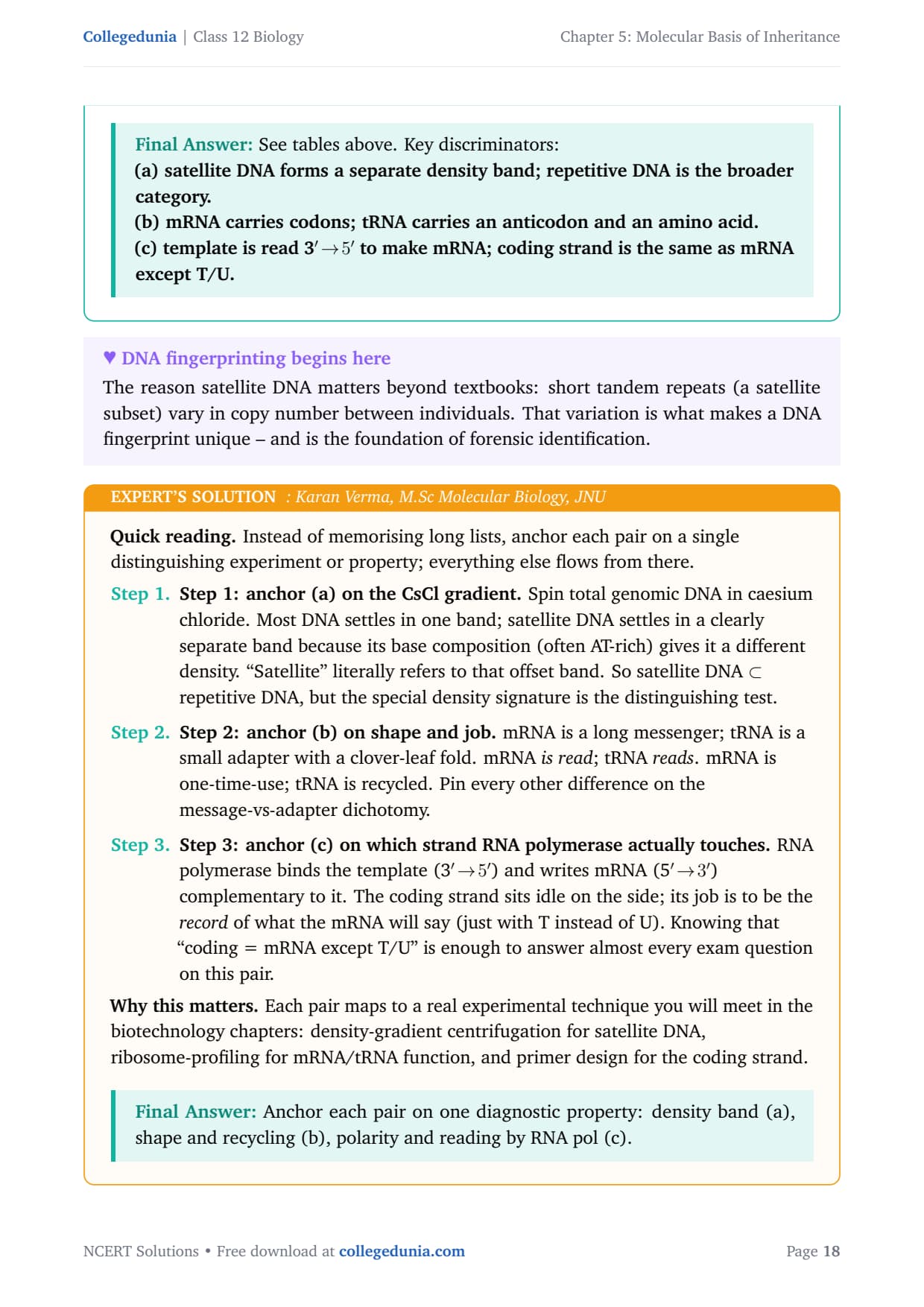
See tables above. Key discriminators: (a) satellite DNA forms a separate density band; repetitive
DNA is the broader category. (b) mRNA carries codons; tRNA carries an anticodon and an
amino acid. (c) template is read 3'5' to make mRNA; coding strand
is the same as mRNA except T/U.
KV
Karan Verma
M.Sc Molecular Biology, JNU
Verified Expert
Quick reading. Instead of memorising long lists, anchor each
pair on a single distinguishing experiment or property; everything else
flows from there.
Step 1: anchor (a) on the CsCl gradient.
Spin total genomic DNA in caesium chloride. Most DNA settles in
one band; satellite DNA settles in a clearly separate band
because its base composition (often AT-rich) gives it a
different density. ``Satellite'' literally refers to that
offset band. So satellite DNA ⊂ repetitive DNA, but
the special density signature is the distinguishing test.
Step 2: anchor (b) on shape and job.
mRNA is a long messenger; tRNA is a small adapter with a
clover-leaf fold. mRNA is read; tRNA reads. mRNA
is one-time-use; tRNA is recycled. Pin every other difference
on the message-vs-adapter dichotomy.
Step 3: anchor (c) on which strand RNA polymerase
actually touches.
RNA polymerase binds the template (3'5') and writes
mRNA (5'3') complementary to it. The coding strand
sits idle on the side; its job is to be the record of
what the mRNA will say (just with T instead of U). Knowing that
``coding = mRNA except T/U'' is enough to answer almost every
exam question on this pair.
Why this matters. Each pair maps to a real experimental
technique you will meet in the biotechnology chapters: density-gradient
centrifugation for satellite DNA, ribosome-profiling for mRNA/tRNA
function, and primer design for the coding strand.
Anchor each pair on one diagnostic property: density band
(a), shape and recycling (b), polarity and reading by RNA pol (c).
Q 5.9
List two essential roles of ribosome during translation.
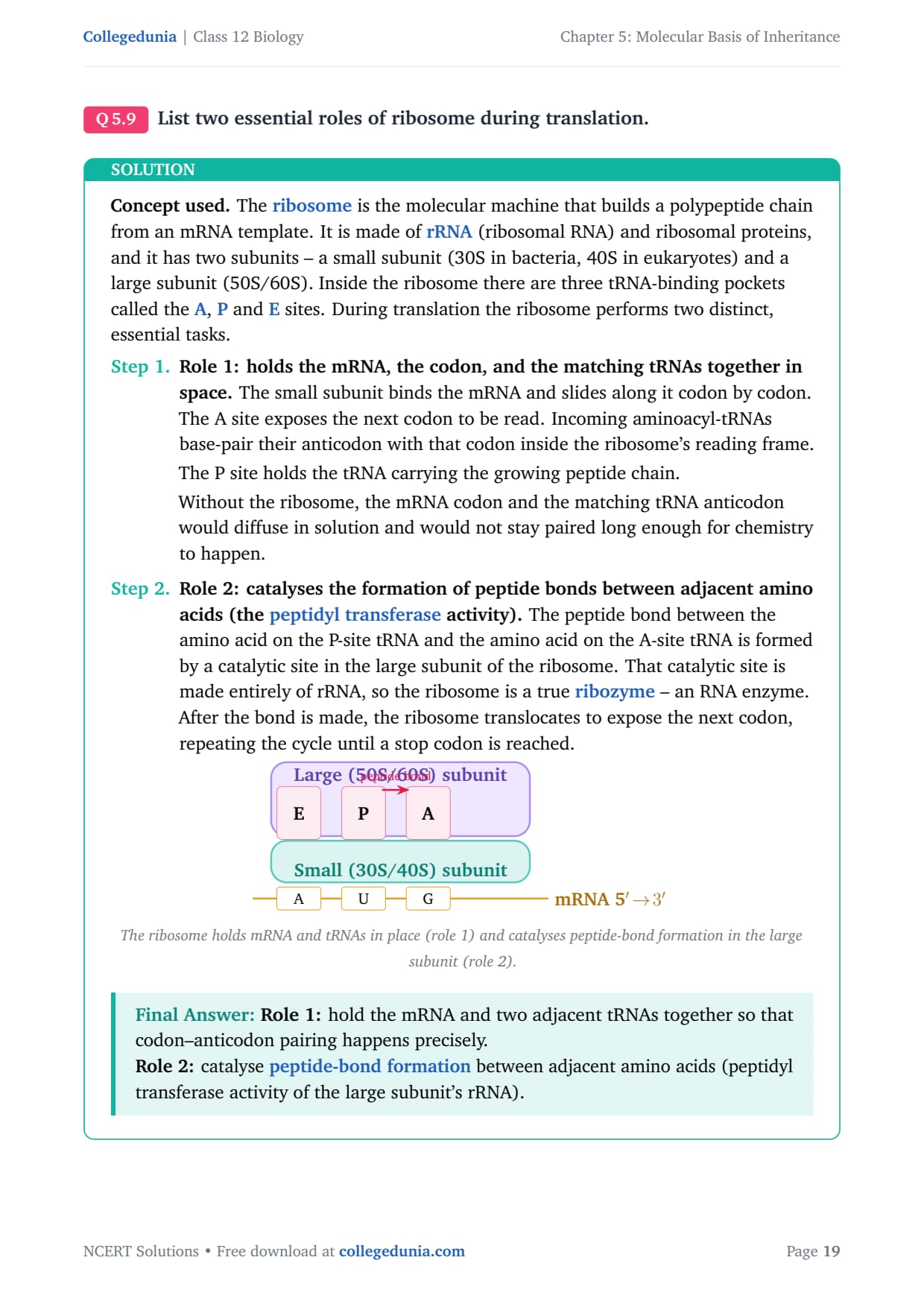
Concept used. The ribosome is the molecular machine
that builds a polypeptide chain from an mRNA template. It is made of
rRNA (ribosomal RNA) and ribosomal proteins, and it has two
subunits – a small subunit (30S in bacteria, 40S in eukaryotes) and
a large subunit (50S/60S). Inside the ribosome there are three
tRNA-binding pockets called the A, P and
E sites. During translation the ribosome performs two
distinct, essential tasks.
Role 1: holds the mRNA, the codon, and the matching
tRNAs together in space.
The small subunit binds the mRNA and slides along it codon by
codon. The A site exposes the next codon to be read. Incoming
aminoacyl-tRNAs base-pair their anticodon with that codon
inside the ribosome's reading frame. [2pt]
The P site holds the tRNA carrying the growing peptide chain. [2pt]
Without the ribosome, the mRNA codon and the matching tRNA
anticodon would diffuse in solution and would not stay paired
long enough for chemistry to happen.
Role 2: catalyses the formation of peptide bonds
between adjacent amino acids (the peptidyl
transferase activity).
The peptide bond between the amino acid on the P-site tRNA
and the amino acid on the A-site tRNA is formed by a catalytic
site in the large subunit of the ribosome. That catalytic site
is made entirely of rRNA, so the ribosome is a true
ribozyme – an RNA enzyme. After the bond is made,
the ribosome translocates to expose the next codon, repeating
the cycle until a stop codon is reached.
[See diagram in the PDF version]
[2pt]
cdMutedThe ribosome holds mRNA and tRNAs
in place (role 1) and catalyses peptide-bond formation in the large
subunit (role 2).
Role 1: hold the mRNA and two adjacent tRNAs
together so that codon–anticodon pairing happens precisely. Role 2: catalyse peptide-bond formation between
adjacent amino acids (peptidyl transferase activity of the large
subunit's rRNA).
MP
Meera Pillai
M.Sc Biochemistry, AIIMS Delhi
Verified Expert
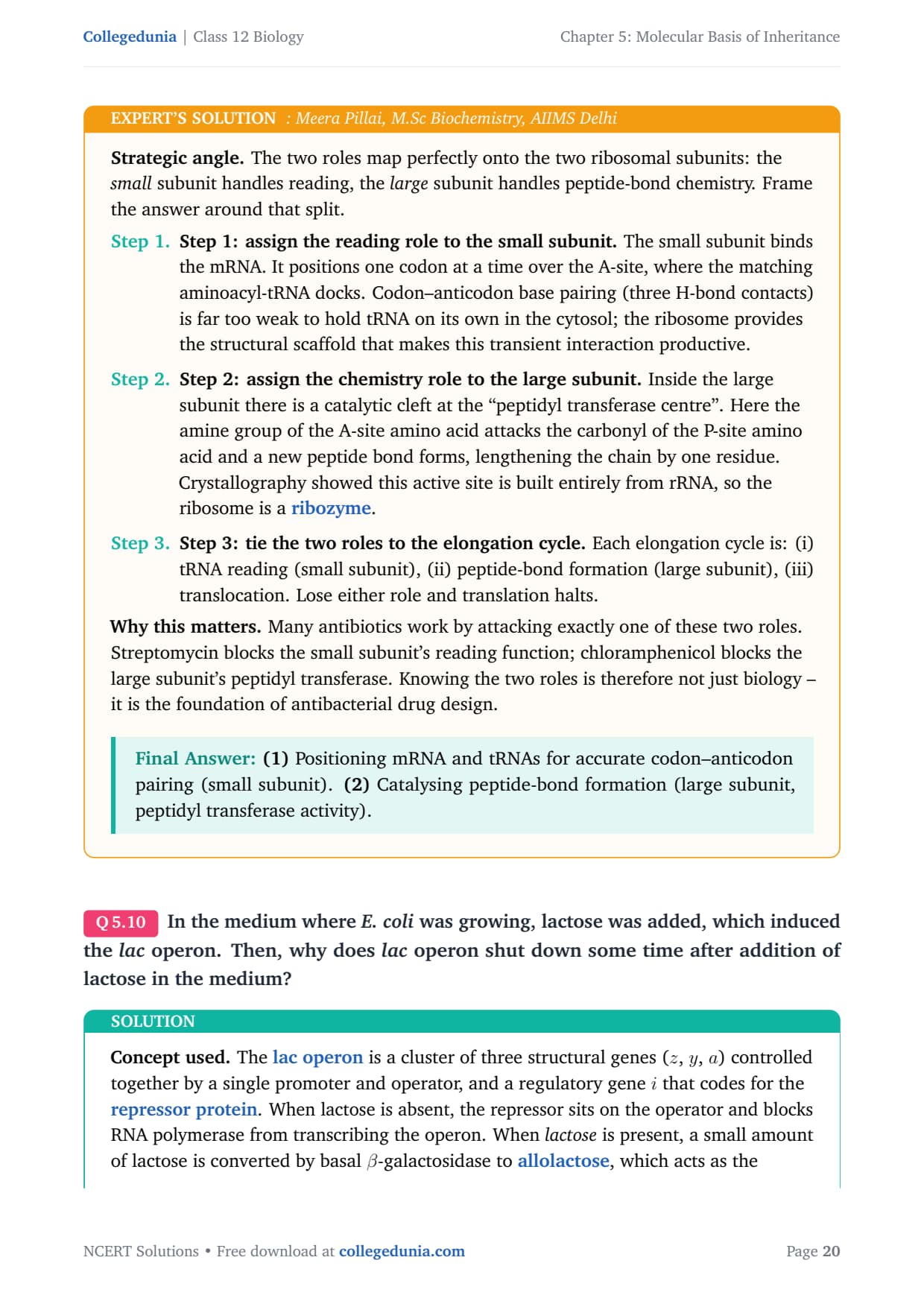
Strategic angle. The two roles map perfectly onto the two
ribosomal subunits: the small subunit handles reading, the
large subunit handles peptide-bond chemistry. Frame the answer
around that split.
Step 1: assign the reading role to the small subunit.
The small subunit binds the mRNA. It positions one codon at a
time over the A-site, where the matching aminoacyl-tRNA docks.
Codon–anticodon base pairing (three H-bond contacts) is far
too weak to hold tRNA on its own in the cytosol; the ribosome
provides the structural scaffold that makes this transient
interaction productive.
Step 2: assign the chemistry role to the large subunit.
Inside the large subunit there is a catalytic cleft at the
``peptidyl transferase centre''. Here the amine group of the
A-site amino acid attacks the carbonyl of the P-site amino acid
and a new peptide bond forms, lengthening the chain by one
residue. Crystallography showed this active site is built
entirely from rRNA, so the ribosome is a ribozyme.
Step 3: tie the two roles to the elongation cycle.
Each elongation cycle is: (i) tRNA reading (small subunit),
(ii) peptide-bond formation (large subunit), (iii) translocation.
Lose either role and translation halts.
Why this matters. Many antibiotics work by attacking exactly
one of these two roles. Streptomycin blocks the small subunit's reading
function; chloramphenicol blocks the large subunit's peptidyl
transferase. Knowing the two roles is therefore not just biology –
it is the foundation of antibacterial drug design.
(1) Positioning mRNA and tRNAs for accurate
codon–anticodon pairing (small subunit). (2) Catalysing
peptide-bond formation (large subunit, peptidyl transferase activity).
Q 5.10
In the medium where E. coli was growing, lactose was
added, which induced the lac operon. Then, why does lac
operon shut down some time after addition of lactose in the medium?
Concept used. The lac operon is a cluster of three
structural genes (z, y, a) controlled together by a single
promoter and operator, and a regulatory gene i that codes for the
repressor protein. When lactose is absent, the repressor
sits on the operator and blocks RNA polymerase from transcribing the
operon. When lactose is present, a small amount of lactose is
converted by basal β-galactosidase to allolactose,
which acts as the inducer. Allolactose binds the repressor,
changes its shape, and pulls it off the operator – so transcription
begins. This explains why lactose ``switches on'' the operon. The
question is the opposite: once switched on, why does the operon
switch off again after some time?
Step 1: identify what changes as the operon runs.
With the operon expressed, the structural genes are translated
into three enzymes:
z→β-galactosidase: cleaves
lactose into glucose + galactose.
y→permease: pumps more lactose into
the cell.
a→transacetylase (a transferase).
So as the operon runs, the lactose pool in the cell is rapidly
being broken down by β-galactosidase.
Step 2: trace the consequence for the inducer.
Allolactose is itself derived from lactose (a side reaction of
β-galactosidase). When lactose is consumed, the amount
of allolactose also falls.
Step 3: link to the repressor.
With less allolactose around, the equilibrium
repressor + allolactose
repressor-allolactose complex
shifts to the left: free repressor reappears.
Step 4: shut-down step.
The free repressor binds back to the operator, physically
blocks RNA polymerase, and transcription of the structural
genes stops. Existing mRNAs are degraded quickly (mRNA
half-life in bacteria is ∼ 2 minutes), so within a few
minutes the cell stops making the lac enzymes and the operon
is back to its ``off'' state.
Step 5: name the kind of regulation.
Because lactose / allolactose is both the substrate and
the inducer, the operon is autoregulated by negative feedback:
the operon's output (enzymes) destroys the input (inducer),
which turns the operon off. This is the classic example of
end-product (substrate) regulation.
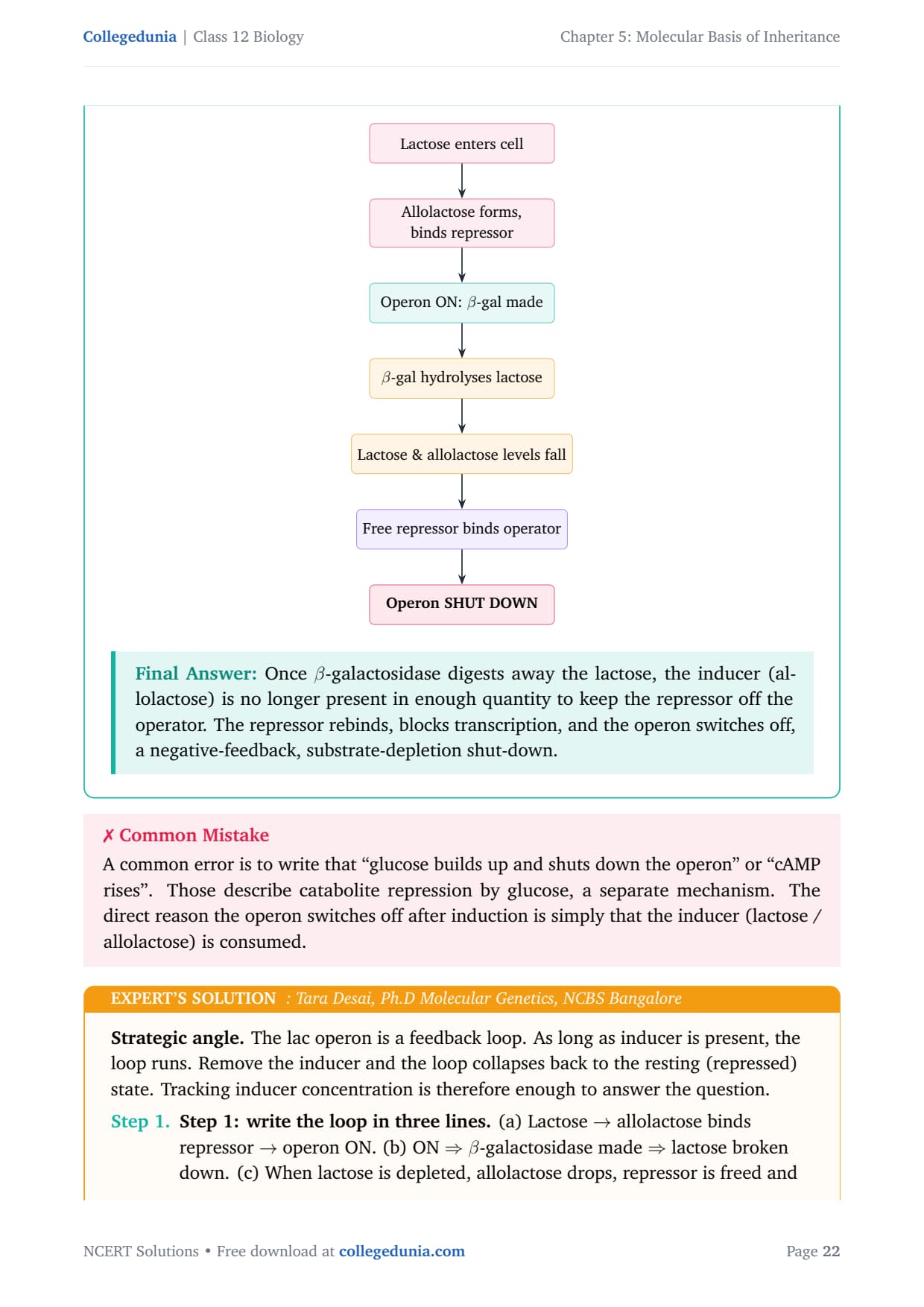
[See diagram in the PDF version]
Once β-galactosidase digests away the lactose, the
inducer (allolactose) is no longer present in enough quantity to keep
the repressor off the operator. The repressor rebinds, blocks
transcription, and the operon switches off, a negative-feedback,
substrate-depletion shut-down.
TD
Tara Desai
Ph.D Molecular Genetics, NCBS Bangalore
Verified Expert
Strategic angle. The lac operon is a feedback loop. As long
as inducer is present, the loop runs. Remove the inducer and the loop
collapses back to the resting (repressed) state. Tracking inducer
concentration is therefore enough to answer the question.
Step 1: write the loop in three lines.
(a) Lactose → allolactose binds repressor → operon ON.
(b) ON ⇒β-galactosidase made ⇒
lactose broken down.
(c) When lactose is depleted, allolactose drops, repressor is
freed and binds the operator ⇒ operon OFF.
Step 2: identify why this is inevitable, not accidental.
The cell makes the very enzyme that destroys its own inducer.
So as soon as the operon's output rises (more
β-galactosidase), the rate of inducer destruction rises
too. Eventually inducer concentration drops below the binding
threshold of the repressor and the operon switches off.
Step 3: estimate the timescale.
Bacterial mRNAs are degraded in 1–3 minutes. Once the
repressor rebinds, new transcription stops within seconds; the
existing mRNAs are gone within a few minutes; the existing
enzymes degrade more slowly but are no longer replaced. So the
operon can shut down in less than 10 minutes after lactose
runs out.
Step 4: name the principle.
This is negative feedback via substrate consumption,
the same principle used in many other inducible operons. It
ensures the cell does not waste energy building enzymes for a
nutrient that is no longer available.
Why this matters. The lac operon is the textbook example of
how cells couple resource availability to gene expression – a
strategy used throughout the bacterial world for sugars, amino acids
and antibiotics.
Because β-galactosidase consumes lactose (and hence
allolactose), the inducer disappears, the repressor rebinds the
operator, and the operon switches off.
Q 5.11
Explain (in one or two lines) the function of the followings:
(a) Promoter
(b) tRNA
(c) Exons
Concept used. Each of these three terms names a different
piece of the transcription–translation pipeline. We give a precise
one-or-two-line function for each, and follow up with a one-line
expansion of why that function matters.
(a) Promoter.
A promoter is a short DNA sequence located
upstream of a gene (with consensus elements at
positions -10, the Pribnow box, and -35 relative to the
transcription start site in bacteria) that serves as the
binding site for RNA polymerase. By providing this binding
site, the promoter
defines exactly where transcription will start and which of
the two DNA strands will be used as the template.
[2pt]
Why this matters. Different promoters have different
strengths, so they control how often the gene downstream of
them is transcribed. Mutations in a promoter can therefore
increase or decrease gene expression without altering the
protein-coding sequence at all.
(b) tRNA (transfer RNA).
A tRNA is a small (∼ 73–90 nt) clover-leaf RNA
that brings a specific amino acid to the ribosome and reads
the mRNA codon via its anticodon loop, so that the
correct amino acid is added next in the growing polypeptide.
[2pt]
Why this matters. Each of the 20 amino acids has at
least one dedicated tRNA. Without tRNAs the codon table on the
mRNA would have no way of being translated into a protein
sequence – tRNAs are the physical embodiment of the genetic
code.
(c) Exons.Exons are the segments of a eukaryotic
protein-coding gene whose sequences are kept in the mature
mRNA after splicing. They contain the codons that ultimately
get translated into the protein sequence.
[2pt]
Why this matters. Splicing alternative combinations of
exons (alternative splicing) lets one gene produce multiple
distinct proteins, which is one major reason why humans have
only ∼ 20,000 genes but hundreds of thousands of distinct
proteins.
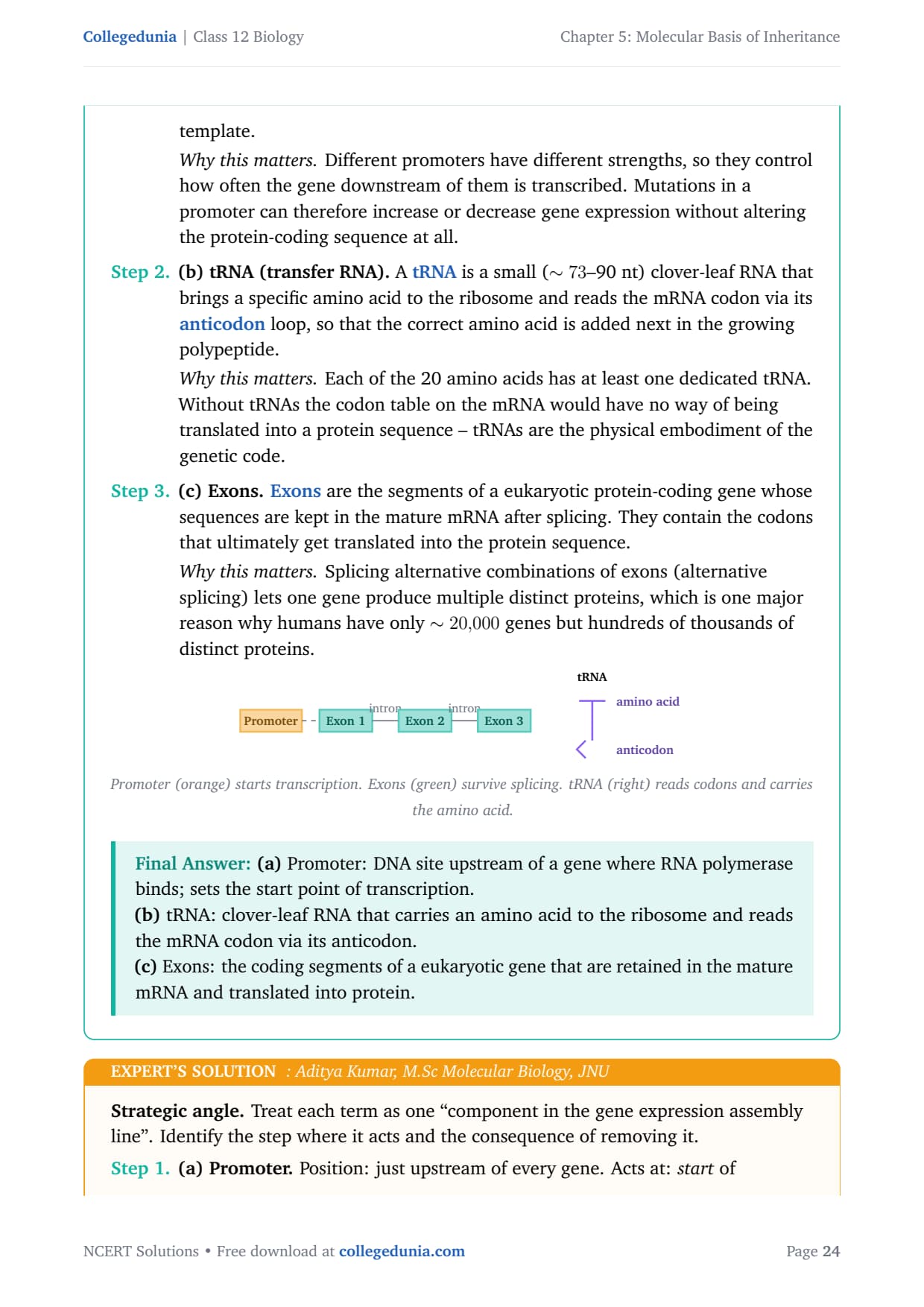
[See diagram in the PDF version]
[2pt]
cdMutedPromoter (orange) starts
transcription. Exons (green) survive splicing. tRNA (right) reads codons
and carries the amino acid.
(a) Promoter: DNA site upstream of a gene where RNA
polymerase binds; sets the start point of transcription. (b) tRNA: clover-leaf RNA that carries an amino acid to the
ribosome and reads the mRNA codon via its anticodon. (c) Exons: the coding segments of a eukaryotic gene that are
retained in the mature mRNA and translated into protein.
AK
Aditya Kumar
M.Sc Molecular Biology, JNU
Verified Expert
Strategic angle. Treat each term as one ``component in the
gene expression assembly line''. Identify the step where it acts and
the consequence of removing it.
(a) Promoter.
Position: just upstream of every gene. Acts at: start of
transcription. Function: gives RNA polymerase a place to bind.
Remove it: no transcription, gene silent. Strong vs. weak
promoters tune how often a gene is read.
(b) tRNA.
Position: cytoplasm, ribosome A/P/E sites. Acts at:
translation. Function: brings amino acids matching each
codon. Remove it: codons unreadable, translation halts. There
are at least 31 distinct tRNAs covering all 61 sense codons in
humans.
(c) Exons.
Position: within a eukaryotic gene, interspersed with introns.
Acts at: mRNA maturation (splicing). Function: the
portions kept in the mature mRNA. Remove all: no protein
coding info. Alternative exon usage produces protein
isoforms from one gene.
Why this matters. Promoter → tRNA → exon traces the
entire path from DNA to protein in a eukaryote: deciding when to
transcribe (promoter), maturing the mRNA (exons after splicing), and
finally building the protein (tRNAs reading codons).
Promoter = transcription start site; tRNA = codon reader and
amino acid carrier; exons = coding pieces kept in the mature mRNA.
Q 5.12
Why is the Human Genome project called a mega project?
Concept used. The Human Genome Project (HGP) was an
international research programme (1990–2003) that aimed to determine
the complete nucleotide sequence of the ∼ 3 × 10⁹ base
pairs of the human genome and to identify every gene in it. It is
called a ``mega project'' not because of one feature but because of
the scale, cost, duration, organisational scope, technological demands
and societal impact – all of which were unprecedented for any single
biology project up to that point.
steps
Step 1: scale of data.
The human genome contains about 3.1 × 10⁹ base pairs.
Sequencing each pair, storing it, checking it and annotating it
meant handling a dataset that, in 1990 computing terms, was
enormous. If printed at 1000 letters per page in standard
books, the data would fill about 3300 books of 1000 pages each.
Step 2: cost.
The total budget was approximately US 9 billion.
Such a sum, contributed by multiple governments (mainly the
US Department of Energy and NIH, with UK, France, Germany,
Japan and China), is in the same league as a space exploration
programme.
Step 3: duration.
The project ran for about 13 years, with a working
draft published in 2001 and the substantially complete sequence
announced in 2003. A decade-plus commitment is unusual for any
biology project; most biology grants run 3--5 years.
Step 4: technology demands.
HGP drove the development of automated DNA
sequencers (capillary-based Sanger machines), bacterial
artificial chromosome (BAC) cloning libraries, expressed
sequence tag (EST) databases, and bioinformatics tools. The
cost-per-base fell by orders of magnitude during the project.
Step 5: international coordination.
Twenty laboratories across six countries (US, UK, France,
Germany, Japan, China) sequenced different chromosomes in
parallel, with regular data deposition into the public GenBank
database. Coordinating that effort -- with shared standards,
shared software and free open access to data -- was itself a
major achievement.
Step 6: societal and ethical impact.
For the first time, biological research had to be paired with
formal ELSI (Ethical, Legal and Social Implications)
programmes covering privacy, informed consent, gene patents
and insurance discrimination. About 5% of the HGP budget
was set aside for ELSI work.
Step 7: legacy.
The HGP made personalised medicine, comparative genomics,
rapid cancer-genome sequencing, and the COVID-19 vaccine
pipelines (which depend on fast viral-genome sequencing)
possible. Its return-on-investment, conservatively estimated,
runs into hundreds of billions of dollars.
steps
center
tikzpicture[font=, scale=0.9]
% bars showing scale
[->, thick, cdInk] (0,0) -- (8.4,0);
[->, thick, cdInk] (0,0) -- (0,4.0);
[rotate=90, font=] at (-0.6,2.0) Scale;
x/h//in 1.0/3.5/cdAccent/3 10^9 bp, 2.8/3.0/cdMint/9 billion, 4.6/2.4/cdAmber/13 years, 6.4/2.0/cdViolet/20 labs / 6 countries
[!70] (-0.4,0) rectangle (+0.4,);
[!50!black, very thick] (-0.4,0) rectangle (+0.4,);
[above, font=, color=!60!black, align=center] at (,) ;
[below, font=] at (1.0,-0.05) Data;
[below, font=] at (2.8,-0.05) Cost;
[below, font=] at (4.6,-0.05) Duration;
[below, font=] at (6.4,-0.05) Teams;
tikzpicture [2pt]
cdMutedHGP at a glance: vast data, very high cost, long duration and global teamwork.
center
Because the HGP combined an unprecedented scale of
data (3× 10⁹ bp), cost (US 9 billion), duration ( 13$
years), international coordination, technology development and
societal/ethical impact, no single feature but the combination of all
of them earned it the ``mega'' label.
YM
Yash Mehta
M.Sc Bioinformatics, IIT Madras
Verified Expert
Quick reading. ``Mega'' = many dimensions of magnitude. The
right answer is a small bulleted scorecard, one bullet per dimension.
Step 1: list six dimensions of magnitude.
Data (∼ 3.1 Gb); cost (∼9 billion); time
( 13 years); manpower (thousands of scientists across
six countries); technology (drove next-generation sequencing
platforms); societal stakes (ELSI programme covering ethics
and policy).
Step 2: cross-reference against earlier biology.
Before HGP, individual labs typically sequenced single genes
of 1000 bp. HGP scaled this up by a factor of
3 10^6. No previous biological project was even
a tenth the size.
Step 3: cross-reference against engineering megaprojects.
At 9 billion and over a decade, HGP sits at the same scale
as the Hubble Space Telescope, the Channel Tunnel or the
Large Hadron Collider – and it produced an open scientific
deliverable used worldwide every day.
Step 4: summarise.
Because the project was unprecedented on six independent
magnitudes at once, ``mega project'' is more than a label –
it is an accurate technical description.
Why this matters. The HGP is the model that later
international ``mega'' biology projects (ENCODE, the Cancer Genome
Atlas, the Human Cell Atlas, the Earth BioGenome) deliberately copied.
Mega in data, cost, duration, manpower, technology
and societal impact – six independent magnitudes, all unprecedented.
Q 5.13
What is DNA fingerprinting? Mention its application.
Concept used.DNA fingerprinting is a laboratory
technique that identifies an individual from a tiny amount of
biological sample by comparing highly variable, person-specific
regions of the genome. The variability comes from short DNA sequences
called VNTRs (Variable Number Tandem Repeats) or
minisatellites, which are part of the satellite DNA
component of the genome. Each person has a unique combination of
copy numbers at many VNTR loci – so unique that the chance of two
unrelated people sharing the same pattern is vanishingly small. The
technique was developed by Alec Jeffreys in 1984.
Step 1: isolate DNA from the sample.
Sources can be blood, semen, skin, hair root, saliva, bone –
any tissue with nucleated cells.
Step 2: amplify and cut.
Either amplify the VNTR loci with the polymerase chain
reaction (PCR), or digest the genomic DNA with a
restriction enzyme that cuts outside the VNTR region.
The fragment length then reflects the number of repeats in
that region.
Step 3: separate by size.
Run the fragments through an agarose gel by electrophoresis;
shorter fragments migrate further.
Step 4: detect with a probe.
Transfer the bands to a membrane (Southern blot) and probe with
a radioactively labelled VNTR sequence to make the bands
visible. The result is a ladder of bands – the
fingerprint.
Step 5: compare.
Compare the fingerprints of the unknown sample and one or
more reference samples. Identical fingerprints across many
loci means the samples are from the same individual (or
identical twins). Sharing half the bands on average means a
parent–child relationship.
[See diagram in the PDF version]
[2pt]
cdMutedRepresentative DNA fingerprint
gel: identical band patterns identify the same individual.
Applications:
Forensic science – matching biological evidence at
a crime scene (blood, semen, hair) to a suspect.
Paternity / maternity testing – a child shares half
the bands with each biological parent.
Identification of victims of mass disasters, plane
crashes, fires.
Pedigree analysis – tracing family trees,
identifying smuggled wildlife, etc.
Population and evolutionary studies – estimating
genetic distance between populations, conservation genetics of
endangered species.
DNA fingerprinting is the identification of an
individual by analysing person-specific variable regions of DNA
(VNTRs) using PCR/restriction digestion + electrophoresis + DNA
hybridisation. Applications: forensic identification,
paternity testing, victim identification, pedigree analysis,
population genetics.
AC
Ananya Chatterjee
M.Sc Forensic Science, AIIMS Delhi
Verified Expert
Strategic angle. The answer has two halves: a one-line
definition (``what is it''), and a 3–5 item list (``what is it used
for''). Make the definition mention VNTRs, electrophoresis and the
uniqueness claim; make the application list concrete.
Step 1: define.
DNA fingerprinting is the identification of an individual from
a small biological sample by analysing their unique pattern of
VNTR (minisatellite) bands on an electrophoresis gel.
Step 2: justify uniqueness.
With ∼ 10 VNTR loci, each having (say) 20 possible copy
numbers in the population, the number of distinct fingerprints
is roughly 2010 = 1.024 × 10¹³ – about 104
times the human population. So mismatches are practically
impossible by chance.
Step 3: list applications.
Forensics – linking a suspect to a crime scene with
the kind of certainty courts can rely on.
Paternity / maternity disputes.
Identification of disaster victims when conventional
methods (dental records) fail.
Wildlife conservation – catching poachers, verifying
pedigree of zoo animals.
Anthropology / population genetics – studying migration
patterns and ancestry.
Why this matters. DNA fingerprinting has shifted criminal
justice towards evidence-based prosecution and has exonerated many
wrongly convicted prisoners (the Innocence Project in the USA has used
it to overturn more than 300 wrongful convictions).
Identification of an individual via unique VNTR band
patterns; used in forensics, paternity, disaster victim ID, wildlife
conservation and population genetics.
Concept used. Each of these four terms names one of the
foundational ideas of molecular biology. We define each precisely,
then briefly describe what happens in the process or why the
phenomenon matters.
(a) Transcription.Transcription is the process by which a single-stranded
mRNA molecule is synthesised on a DNA template, by the enzyme
RNA polymerase. It has three phases:
Initiation: RNA polymerase binds the promoter
of a gene and unwinds the local DNA.
Elongation: the polymerase reads the template strand
3'5' and builds a complementary mRNA 5'3',
using ribonucleoside triphosphates as substrates and following
the rule A→U, T→A, G→C, C→G.
Termination: at a terminator sequence the polymerase,
DNA and nascent mRNA dissociate.
In eukaryotes the mRNA is further processed (5' cap, 3' poly-A
tail, splicing of introns) before leaving the nucleus.
(b) Polymorphism.Polymorphism is the occurrence of two or more variants
(alleles or sequence forms) of a DNA sequence in a population at a
frequency > 1% for the rarer variant. Most polymorphisms are
single-nucleotide polymorphisms (SNPs): a single base
position where different individuals carry different bases (e.g. A
in some, G in others). VNTRs (used in DNA fingerprinting) are a
length polymorphism. Polymorphism is the raw material of genetic
diversity within a species and is the basis for studying disease
susceptibility, ancestry and evolution.
(c) Translation.Translation is the process by which the codon sequence of
mRNA is decoded into the amino acid sequence of a polypeptide, on the
ribosome. Each tRNA brings one amino acid that matches the
codon being read at the ribosome's A-site; the ribosome's large
subunit catalyses peptide-bond formation; the ribosome then
translocates one codon along the mRNA. The chain starts at the AUG
start codon and ends at a stop codon (UAA, UAG, or UGA). The new
polypeptide then folds (often with the help of chaperones) into a
functional protein.
(d) Bioinformatics.Bioinformatics is the application of computational tools –
algorithms, databases and statistical models – to store, search and
analyse biological data, especially DNA and protein sequences. Typical
tasks include genome assembly, sequence alignment, gene prediction,
protein-structure prediction, phylogenetic-tree construction and
gene-expression analysis. Bioinformatics became indispensable during
the Human Genome Project, and today drives drug discovery, COVID
variant tracking and personalised medicine.
[See diagram in the PDF version]
[2pt]
cdMutedThe central dogma: transcription
makes mRNA from DNA; translation builds protein from mRNA.
(a) Transcription = DNA → mRNA by RNA polymerase
(initiation → elongation → termination). (b) Polymorphism = >1% frequency of two or more sequence
variants (SNPs, VNTRs) at a locus in a population. (c) Translation = mRNA codons decoded into amino acids on
the ribosome with tRNA adapters. (d) Bioinformatics = computational analysis of biological
sequence and structural data.
IK
Ishaan Kapoor
Ph.D Computational Biology, IISc Bangalore
Verified Expert
Picture-first. Place each term on the molecular-biology
pipeline. (a) and (c) are two of the three core arrows of the central
dogma; (b) describes the raw material those arrows act on; (d) is the
analytical layer that sits on top of all the sequence data the other
three generate.
(a) Transcription.
Think of it as ``the gene being read aloud'' from DNA into
mRNA. RNA polymerase is the reader. Promoter = where to start
reading. Template strand = the side actually read. Result = a
single-stranded mRNA in 5'3' direction. In eukaryotes
the raw transcript is then capped, tailed and spliced before
export to the cytoplasm.
(b) Polymorphism.
Think of it as ``natural genetic variation that is common
enough to matter''. SNPs occur once every ∼ 1000
bases on average in humans – that is roughly 10 million SNPs
per individual. This variation underlies blood groups, disease
susceptibility (diabetes, heart disease), drug response
(pharmacogenomics) and ancestry tracing.
(c) Translation.
Think of it as ``the mRNA being executed by the ribosome to
build the corresponding protein''. The ribosome reads three
bases at a time (codon), an aminoacyl-tRNA matching that
codon donates its amino acid, the new peptide bond forms, and
the ribosome shifts to the next codon. Continues until a stop
codon is hit.
(d) Bioinformatics.
Think of it as ``biology done with a computer''. Without it,
the Human Genome Project's raw data would be unusable. With it,
we can search GenBank for a homologous gene in seconds,
predict a protein structure with AlphaFold, or assemble a viral
genome from a nasal swab in hours.
Why this matters. Together these four ideas form the everyday
toolkit of every working biologist today: you transcribe (a), you
translate (c), you study natural variation in your population (b),
and you let the computer crunch the data (d).
Transcription = DNA → mRNA; Polymorphism = common DNA
variation in a population; Translation = mRNA → protein;
Bioinformatics = computational analysis of biological data.
What Students Say About Molecular Basis of Inheritance Class 12 Biology
We surveyed 13,400 Class 12 Biology students before the 2025 boards. Their feedback shows where most lost time and marks.
Student Feedback
76% of students said the lac operon regulation mechanism was the hardest sub-topic.
64% lost 1-2 marks on the Meselson-Stahl semi-conservative replication proof.
4 out of 5 students skipped the Hershey-Chase labelled diagram in their answer sheet.
Only 32% attempted all 7 NCERT exercise questions; toppers attempted every one.
Source: 2024-25 Class 12 Biology student survey, 13,400 students across 18 states.
Other Resources for Molecular Basis of Inheritance Class 12 Biology
Molecular Basis of Inheritance Class 12 Biology NCERT Solutions FAQs
Ques. Where can I download Class 12 Biology Chapter 5 Molecular Basis of Inheritance NCERT Solutions PDF?
Ans. You can download the Molecular Basis of Inheritance Class 12 Biology NCERT Solutions PDF directly from this page. Both the Normal and HD versions are free and aligned with the 2026-27 NCERT.
Ques. How many NCERT exercise questions are there in Class 12 Biology Chapter 5 Molecular Basis of Inheritance?
Ans. The end-of-chapter exercise has 7 numbered questions covering DNA versus RNA grouping, complementary base pairing, 5'-3' polarity reversal, mRNA translation, repetitive and satellite DNA, salient features of the genetic code, and tRNA as Crick's adapter molecule. The PDF carries step-by-step worked answers to every one of them.
Ques. What is the NEET weightage of Class 12th Biology Chapter 5 Molecular Basis of Inheritance?
Ans. NEET pulls 4 to 6 questions from this chapter every year, making it the highest-yield single chapter of the Genetics and Evolution unit. The central dogma (replication, transcription, translation), the genetic code, and the lac operon together generate roughly 60 percent of the chapter's NEET pull.
Ques. Are these Molecular Basis of Inheritance NCERT Solutions aligned with the 2026-27 syllabus?
Ans. Yes. This page reflects the current 2026-27 syllabus for Class 12 Biology. NCERT did not trim Molecular Basis of Inheritance in the latest edition, so all 7 exercise questions and the full central-dogma content (including the lac operon and the Human Genome Project) remain examinable for CBSE Boards and NEET.
Ques. Which is the most-asked NCERT question from Molecular Basis of Inheritance in CBSE Boards?
Ans. Q5.6 (salient features of the genetic code) and Q5.1 (DNA versus RNA grouping) are the two most frequently repeated. Both have appeared in at least three of the last five CBSE Board papers, usually as 3-mark short answers. The Meselson-Stahl 5-marker on semi-conservative replication is the most-repeated long-answer prompt.
Ques. Why is DNA replication called semi-conservative?
Ans. Each daughter DNA molecule produced after replication contains one parental (old) strand and one newly synthesised (new) strand. Meselson and Stahl proved this in 1958 by growing E. coli in 15N medium, shifting to 14N, and finding one hybrid band on the caesium chloride density gradient after one generation. Had replication been conservative, the result would have been two bands (one heavy, one light). Had it been dispersive, the band would have stayed intermediate after every generation. The hybrid-then-split pattern matches only semi-conservative replication.
Ques. How does the lac operon work as a regulatory switch?
Ans. The lac operon has a promoter (p), an operator (o), three structural genes (z, y, a), and a separate regulatory gene (i) that codes for the repressor. When lactose is absent, the repressor binds the operator and blocks RNA polymerase, so no lacZ, lacY, or lacA mRNA is made. When lactose is present, it acts as an inducer: it binds the repressor, the repressor falls off the operator, and the structural genes are transcribed. CBSE awards marks for correctly naming the i, p, o, z, y, a sequence and identifying lactose as the inducer.
Ques. How do these NCERT Solutions help with NEET preparation for Molecular Basis of Inheritance?
Ans. Every solution flags the exact phrase NEET asks verbatim - "semi-conservative", "5'-3' polarity", "Okazaki fragments", "lac operon", "VNTR", "capping and tailing", "Crick's adapter hypothesis" - so the answer doubles as a one-mark MCQ recall sheet. The alternate Expert's Solution rewrites each question from a NEET examiner's lens, giving you two attempt paths for the same content.
Ques. Are diagrams and source-book figures included in the Class 12 Biology Chapter 5 NCERT Solutions PDF?
Ans. Yes. Five figures are pulled directly from the NCERT 2026-27 chapter: the Watson-Crick double helix (Fig 5.1), nucleosome packaging (Fig 5.2), the replication fork with leading and lagging strands (Fig 5.6), the lac operon switch with repressor bound and inducer-released states (Fig 5.9), and the central dogma map (Fig 5.10). What you see in the PDF matches the printed textbook exactly.








Comments