Commerce Mentor | B.Com (Hons) Student, SRCC | Updated on - May 25, 2026
A full Schedule III Balance Sheet appears in almost every CBSE Class 12 Accountancy paper and can carry up to 8 marks in Part B. The accountancy class 12 NCERT solutions chapter 7 Financial Statements of a Company here solve all 20 textbook questions in the exact Companies Act 2013 format examiners expect. The free 2026-27 PDF is prepared by Collegedunia's commerce desk.
CBSE Weightage
6 to 8 marks in Part B (Financial Statements of a Company)
Question Mix
20 NCERT questions: 5 Short Answer, 9 Long Answer, 6 Balance Sheet numericals
CUET (UG) Relevance
2 to 3 objective questions on Schedule III heads and disclosure
Part 2 Chapter 3 Financial Statements of a Company NCERT Solutions PDF
20 NCERT Questions | 6 Full Balance Sheets Solved | Schedule III Format · Class 12 Accountancy Part 2 Chapter 3, 2026-27 NCERT
Every numerical is solved as a vertical Schedule III Balance Sheet with Notes to Accounts attached, exactly as a CBSE answer script should look.
These solutions are reviewed by Chartered Accountants and senior CBSE Commerce educators, mapped to the 2026-27 NCERT Accountancy Part B textbook, and cross-checked against the last five years of board papers.
Financial Statements of a Company Weightage Across Class 12 Accountancy Chapters
The visual below maps the typical CBSE Part B marks distribution, averaged over the last five board papers. Part 2 Chapter 3 is the gateway to Part B because every ratio, cash flow and analysis question in later chapters reads off the Schedule III Balance Sheet you build here.
Part 2 Ch 1 Accounting for Share Capital
8 marks
Part 2 Ch 2 Issue and Redemption of Debentures
6 marks
Part 2 Ch 3 Financial Statements of a Company
8 marks
Part 2 Ch 4 Analysis of Financial Statements
6 marks
Part 2 Ch 5 Accounting Ratios
8 marks
Part 2 Ch 6 Cash Flow Statement
8 marks
Class 12 Accountancy Part 2 Chapter 3 Financial Statements Of A Company NCERT Solutions
How will Collegedunia's NCERT Solutions Help You with Financial Statements of a Company?
This chapter is less about computation and more about presentation, so the solutions train the format that earns the marks.
Schedule III Format Discipline: Every numerical is a vertical Balance Sheet with the prescribed main heads and sub-heads, so you internalise the order examiners reward.
Notes to Accounts Attached: Each Balance Sheet carries its supporting Notes to Accounts, because CBSE deducts marks when the note schedule is missing.
2026-27 NCERT Alignment: Solutions match the current 2026-27 Accountancy Part B textbook and the Companies Act 2013 Schedule III.
Theory Answers in Board Length: Short and Long Answer theory is written to the length a 3-mark or 4-mark CBSE answer expects, not compressed to one line.
NCERT Solutions Class 12 Accountancy Part 2 Chapter 3: Question-Type Distribution
The 20 NCERT questions split into a theory block and a numerical block. The theory questions are quick recall; the Balance Sheet numericals need full-format practice.
Question Type
Count
What It Tests
Typical Board Marks
Short Answer (theory)
5
Meaning, objectives, limitations, importance to users
1 to 3 marks
Long Answer (theory)
9
Nature and significance, formats explained, recorded-facts statement
4 to 6 marks
Balance Sheet numericals
6
Preparing the Balance Sheet under Schedule III with Notes to Accounts
3 to 8 marks
The numerical block is where most marks are won or lost. Six full Balance Sheet questions in the NCERT carry the weight of roughly three board questions.
Important Topics in Class 12 Accountancy Part 2 Chapter 3 Financial Statements of a Company
The chapter has a small, well-defined topic list. Cover all of it, because CBSE rotates the numerical between the same heads every year.
Nature and objectives: the recorded-facts, accounting-conventions and personal-judgement framing.
Statement of Profit and Loss format: revenue from operations, other income, expenses, profit before tax.
Balance Sheet under Schedule III: Equity and Liabilities then Assets, in the prescribed order.
Major heads and sub-heads: Shareholders' Funds, Non-Current and Current Liabilities, Non-Current and Current Assets.
Notes to Accounts: share capital, reserves and surplus, long-term borrowings, fixed assets.
Special items: preliminary expenses, discount on issue of debentures, contingent liabilities.
Quick Tip: Write the Schedule III five-line head skeleton on your rough sheet first, then slot each item from the question into it. This prevents the most common presentation error in the chapter.
Common Question Stems CBSE Uses for Financial Statements of a Company
CBSE phrases this chapter in a few recurring stems; the stem tells you whether the answer is theory or a full Balance Sheet.
Stem in the paper
What the examiner wants
"Under which major head and sub-head will the item be shown..."
One-line classification per item, no Balance Sheet
"Prepare the Balance Sheet of ... Ltd. as per Schedule III"
Full vertical Balance Sheet plus Notes to Accounts
"State any three limitations (or objectives) of financial statements"
Pointwise theory, one mark per valid point
"Financial statements reflect recorded facts, conventions and judgements. Explain."
Three-part explanation, one part per phrase
The classification stem and the full Balance Sheet stem together carry most of the chapter's board marks.
Financial Statements of a Company Previous Year Questions Weightage (2021 to 2026)
This chapter is a Part B fixture. The full-format Balance Sheet appears almost every year, usually with a shorter classification question. CUET (UG) tests the same heads in objective form.
Year
CBSE Board
CUET (UG)
2026
Pending (board exam in progress)
Pending (exam rescheduled)
2025
Balance Sheet under Schedule III (6 marks) + head/sub-head classification (3 marks)
2 objective questions on major heads
2024
Balance Sheet preparation with Notes to Accounts (6 marks)
3 objective questions on disclosure
2023
Classification of items under Schedule III (4 marks)
The pattern is stable: one full Balance Sheet plus one shorter theory or classification question. In four of the last five board papers, a full Schedule III Balance Sheet carried 6 marks.
Sample Solved Question: Balance Sheet of Black Swan Ltd. (NCERT Q21)
This is the full-format numerical that defines the chapter. The marks come from the correct heads, sub-heads and matching Notes to Accounts, not from arithmetic.
Question: Prepare the Balance Sheet of Black Swan Ltd. as at 31st March 2017 from balances such as Equity Share Capital, General Reserve, 10% Debentures, Trade Payables, Fixed Assets (Tangible), Inventories, Trade Receivables and Cash at Bank, as per Schedule III of the Companies Act 2013.
Step 1 - Skeleton. Write I. Equity and Liabilities (Shareholders' Funds, Non-Current, Current) then II. Assets (Non-Current, Current).
Step 2 - Place balances. Equity Share Capital and General Reserve under Shareholders' Funds; 10% Debentures as Long-Term Borrowings; Trade Payables under Current Liabilities.
Step 3 - Assets. Fixed Assets (Tangible) become Property, Plant and Equipment; Inventories, Trade Receivables and Cash at Bank are Current Assets.
Step 4 - Notes and verify. Attach numbered Notes to Accounts for each composite head, cross-reference them on the face, and confirm Equity and Liabilities equals Assets. A mismatch usually means a wrong head, not an arithmetic slip.
Quick Tip: Write the Note number on the face against the item and label the note with the same number. CBSE awards the note marks only when the cross-reference is visible.
The full working for every Balance Sheet numerical, including the complete Notes to Accounts, is in the PDF on this page.
Common Mistakes Students Make in Financial Statements of a Company
This chapter loses marks on presentation, not numbers. Avoid these errors to protect almost the entire weightage.
Watch Out: Writing the Balance Sheet in the old horizontal (T) format. Schedule III requires the vertical format only. A horizontal Balance Sheet can lose the entire presentation mark even when every figure is correct.
Skipping the Notes to Accounts: the Balance Sheet face alone is incomplete; each composite head needs its supporting note.
Wrong head for special items: preliminary expenses and discount on issue of debentures are not assets under the current treatment; classify them as the textbook directs.
Misclassifying current vs non-current: a bank loan repayable within twelve months is a current liability, not a long-term borrowing.
Listing contingent liabilities on the face: they are disclosed in the Notes, never added into the Balance Sheet total.
Wrong head order: Equity and Liabilities before Assets, and the prescribed sub-head sequence within each.
A single misclassified item can break the Balance Sheet total and cascade into lost marks on the linked Notes to Accounts.
How to Study Financial Statements of a Company for Class 12 Boards
This is a high-return chapter for a small time investment, because the format is fixed and repeats every year.
Day 1: learn the Schedule III skeleton: main heads and sub-heads for both halves. Write it from memory until it is automatic.
Day 2: solve all 6 NCERT Balance Sheet numericals with full Notes to Accounts before checking the solution.
Day 3: revise the theory questions and one classification drill.
Total time required is about 5 to 6 hours, low for a chapter that reliably returns 6 to 8 marks.
Remember: Master the Schedule III order with the mnemonic "Some Now Care, No Care" - Shareholders' Funds, Non-Current Liabilities, Current Liabilities, then Non-Current Assets, Current Assets.
All NCERT Solutions for Financial Statements of a Company with Step-by-Step Working
Every NCERT textbook question for Class 12 Accountancy Part 2 Chapter 3 Financial Statements of a Company is listed below with its full Solution and Expert Solution hidden inside collapsible tabs. Click Check Solution to reveal the step-by-step working; click Expert Solution for the expanded explanation.
Questions
Q 7.1
Question text in bold (handled automatically).
% Use
caption INSIDE the
% question text if the NCERT statement quotes a figure.
% Concept used.
%
%
...
...
>
%
% ....
% DIAGRAMS ARE REQUIRED whenever they aid understanding: see
% SKILL.md for the subject-specific list of must-draw cases.>
%
%
%
Step 1: prose + equation, every algebraic move shown.
%
Step 2: ...
%
Step 3: ...
%
%
% Final answer.
%
FS
Firstname Surname
Degree, Institution
Verified Expert
% Strategic angle. ...
%
%
%
...
%
...
%
%
% Why this matters. ...
%
% Same final answer, phrased crisply.
%
Q 7.2
State the meaning of financial statements.
Concept used.Financial statements are the end
products of the accounting process. They are the formal records that
summarise, in money terms, the financial performance and financial
position of a business for an accounting period. For a company, the
two main financial statements are the Statement of Profit
and Loss (it shows how much profit or loss the company earned during
the year) and the Balance Sheet (it shows what the company
owns and owes on the last day of the year). A Cash Flow Statement and
the Notes to Accounts go along with them.
Identify what the statements report. Financial statements
present two things: the operating results of the year
(profit or loss) and the financial position at the
year-end (assets, liabilities and capital).
State who prepares them and why. The management prepares them
at the close of the accounting year to communicate the
firm's results to owners, lenders, government and other
interested parties who cannot see the books directly.
Note the basis. They are prepared from the recorded
transactions, using accepted accounting concepts, conventions
and some personal judgement (for example, the estimate of
depreciation or doubtful debts).
Financial statements are the summarised statements of
recorded financial data, prepared at the end of an accounting period,
that show a company's profit or loss for the period and its financial
position (assets, liabilities and capital) on the closing date.
AI
Aditi Iyer
M.Sc Statistics, ISI Kolkata
Verified Expert
Quick reading. Think of financial statements as a company's
annual ``report card''. One sheet grades the year's performance
(profit or loss), the other photographs the company's wealth on the
closing date (the Balance Sheet). To define them precisely we must
pin down four things: what they report, who prepares
them, from what data they are built, and for whom.
What: operating results (profit/loss) and financial
position (assets, liabilities, capital).
Who: the company's management, at the close of every
accounting year.
From what: the recorded transactions, processed
through accepted accounting concepts and conventions.
For whom: owners and outsiders who cannot inspect the
books directly.
Fix the scope. Two questions every reader asks:
``Did the company make money this year?'' and ``How strong is
it right now?'' A financial statement is the document that
answers exactly these two questions in money terms, so the
definition must mention both performance and position.
Map each question to a statement. The Statement of
Profit and Loss answers the first by netting total revenue
against total expenses to give profit or loss. The Balance
Sheet answers the second by listing all assets on one side
and all claims (liabilities plus owners' funds) on the other,
the two totals always being equal.
State the basis. Both statements are built from
recorded data only, valued at historical cost, and shaped by
accounting concepts (going concern, accounting period) and
some personal estimates (depreciation, doubtful debts). So
the definition is incomplete unless it says ``summarised from
recorded financial data''.
Assemble the definition. Combining the scope, the
period, and the basis gives a single precise sentence (see
the boxed answer), which is exactly what an examiner expects
for a ``state the meaning'' question.
Why this matters. The definition fixes the scope: financial
statements are summaries of recorded data, not forecasts, so
they look backward, not forward. Every analysis technique in the next
two chapters takes these backward-looking summaries as its raw input.
Financial statements are period-end summaries of recorded
financial data that report a company's profitability (Statement of
Profit and Loss) and its financial position (Balance Sheet) on the
closing date.
Q 7.3
What are the limitations of financial statements?
Concept used. A limitation is a built-in weakness
that restricts how far we can rely on a financial statement. Because
financial statements mix recorded facts, accounting conventions and
personal judgement, they cannot give a perfect picture. The NCERT
text lists the following limitations.
Do not reflect current values. Statements are
prepared on the historical cost basis, so assets
are shown at their original cost, not at today's market
value. The figures can therefore be out of date.
Ignore qualitative elements. Only items that can be
expressed in money are recorded. The quality of management,
staff loyalty and customer satisfaction are valuable but do
not appear anywhere.
Affected by personal judgement. Choices such as the
depreciation method, valuation of inventory and the
provision for doubtful debts depend on the accountant's
judgement, so two firms can show different profits for the
same facts.
Based on accounting concepts and conventions. Use of
the going-concern and conservatism conventions can make the
statements depart from economic reality.
Show position at one point only. The Balance Sheet
is a snapshot on the closing date; it may not represent the
firm's position through the rest of the year.
Financial statements are limited because they use
historical cost (not current value), ignore non-money (qualitative)
items, are influenced by personal judgement, rest on accounting
conventions, and show the position at only a single date.
KM
Karan Mehta
M.Com, Delhi School of Economics
Verified Expert
Structural observation. Instead of memorising five separate
points, group the limitations by their root cause. Every limitation
in this chapter traces back to one of three roots: a
measurement-base problem, a judgement problem, or a
timing problem. Naming the root makes the answer both shorter
to recall and easier to defend in a follow-up question.
Measurement-base root: how figures are valued and what gets
measured at all.
Judgement root: where the accountant's estimate enters.
Timing root: the single date on which position is shown.
Measurement-base group. Historical cost records
assets at their original price, so it ignores price-level
(inflation) changes; this makes both the asset values and the
profit unrealistic. The same root also explains why only
money-measurable items are captured: managerial skill and
staff morale cannot be priced, so they are omitted. Thus
``does not show current value'' and ``ignores qualitative
factors'' are two faces of the one measurement-base
weakness.
Judgement group. Depreciation method, inventory
valuation and the provision for doubtful debts all rest on
the accountant's estimate. Change the depreciation method and
the reported profit changes although no transaction changed.
So reported profit is partly an opinion, not a pure fact.
Timing group. A Balance Sheet is a photograph taken
on the closing date only. A firm can repay loans just before
the date and borrow again just after (window dressing), so
the single-date position can mislead a reader who assumes it
held all year.
Combine. Listing one or two limitations from each
group gives a complete, well-organised answer that an
examiner can follow at a glance.
Why this matters. Knowing why a limitation exists
lets you adjust for it: revalue fixed assets to current cost before
comparing two firms, or read the depreciation policy note before
trusting a profit figure.
The limitations trace to three roots: a historical-cost
measurement base (no current value, no qualitative data), the heavy
reliance on personal judgement (subjective profit), and the
single-date nature of the Balance Sheet (window dressing).
Q 7.4
List any three objectives of financial statements.
Concept used. An objective of a financial
statement is the purpose it is meant to serve for the people who use
it. Financial statements are prepared to communicate useful financial
information to owners and outsiders.
To present a true and fair view of performance. The
Statement of Profit and Loss shows whether the company earned
a profit or suffered a loss during the year.
To present a true and fair view of financial
position. The Balance Sheet shows the assets the company
owns and the liabilities and capital that finance them on the
closing date.
To provide information for decision-making. Owners,
lenders, investors and government use the statements to judge
profitability, solvency and the safety of their funds.
Three objectives: (i) to show the true and fair operating
result (profit or loss), (ii) to show the true and fair financial
position, and (iii) to give useful information to users for economic
decisions.
RV
Rahul Verma
M.Com, Banaras Hindu University
Verified Expert
Quick reading. An ``objective'' question is really asking
``what reader need does this document satisfy?''. There are exactly
three reader needs, and each maps cleanly to one part of the
reporting package: ``How did we do?'' (performance), ``Where do we
stand?'' (position), ``What should I decide?'' (decision support).
Answer in that order and the three objectives write themselves.
Need 1 (performance) → Statement of Profit and Loss.
Need 2 (position) → Balance Sheet.
Need 3 (decision) → both statements plus the notes,
together.
Performance objective. The first purpose is to show
whether the year was profitable. This is met by the
Statement of Profit and Loss, which nets total revenue
against total expenses to give the profit or loss for the
year. Without this objective the owners cannot judge the
return on their capital.
Position objective. The second purpose is to show
what the firm owns and owes on the last day of the year. The
Balance Sheet meets it by setting all assets against all
claims (liabilities plus owners' funds), the two totals being
equal. This objective tells lenders whether the firm is
solvent.
Decision objective. The third purpose is to give
information that helps users take economic decisions. It is
met by reading both statements together with the Notes to
Accounts, so investors, government and creditors can judge
profitability, solvency and tax. This is the umbrella
objective the other two feed into.
Present cleanly. Stating one objective per reader
need, each tied to its statement, is the format that scores
full marks and answers any ``which statement?'' follow-up
instantly.
Why this matters. Each objective maps to a specific
statement, so an exam follow-up like ``which statement meets
objective X?'' becomes a one-word answer rather than a fresh effort.
Three objectives: show performance (Statement of Profit and
Loss), show financial position (Balance Sheet), and supply
decision-useful information to all interested parties (both
statements plus notes).
Q 7.5
State the importance of financial statements to:
(i) shareholders (ii) creditors
(iii) government (iv) investors
Concept used. Different users read financial
statements with different questions in mind. ``Importance to a user''
means the specific decision the statements help that user take.
(i) Shareholders (owners). They use the statements
to judge the safety of their investment and the return on it,
that is, the profitability and the dividend the company can
pay.
(ii) Creditors (lenders, suppliers). They use the
statements to check the company's solvency: whether
the firm has enough assets and cash to repay loans and pay
for goods supplied on credit.
(iii) Government. It uses the statements to assess
the correct tax payable, to frame industrial and economic
policy, and to compile national statistics.
(iv) Investors (prospective shareholders). They use
the statements to decide whether to buy the company's shares
by judging its earning capacity, growth and future
prospects.
Shareholders judge return and safety; creditors judge
solvency and repaying capacity; government assesses tax and frames
policy; investors judge earning capacity before investing.
SB
Sneha Banerjee
M.Com, University of Calcutta
Verified Expert
Structural observation. Pair each user with the single ratio
family they care about most: shareholders → profitability,
creditors → liquidity/solvency, government → compliance,
investors → growth.
Shareholders track earnings and dividend capacity (return on
their owned funds).
Creditors track short-term liquidity and long-term solvency
(will they be repaid on time?).
Government tracks taxable profit and statutory compliance.
Investors track trend in profits and prospects before
committing fresh money.
Why this matters. A single set of statements is
multi-purpose; the same numbers answer four different stakeholder
questions.
Each user reads the statements through a different lens:
return (shareholders), repayment safety (creditors), tax and policy
(government), and future prospects (investors).
Q 7.6
How will you disclose the following items in the Balance
Sheet of a company:
(i) Current assets, Inventory (ii) Contingent liabilities in
notes to accounts
(iii) Shareholders' Funds, Reserves and Surplus (iv) Fixed
Assets, Intangible Assets
(v) Proposed Dividend for the current year (vi) Non-Current
Liabilities
(vii) Arrears of Dividend on Cumulative Preference Shares
Concept used. Schedule III to the Companies Act, 2013
prescribes a fixed vertical Balance Sheet with two main
parts: I. Equity and Liabilities and II. Assets.
Every item must be shown under its correct major head, sub-head and
note. ``Disclosure'' means stating where the item appears (which head
or note).
(i) Inventory. Major head: Assets → Current
Assets; Sub-head: Inventories.
(ii) Contingent liabilities. A contingent liability
is a possible obligation that depends on a future uncertain
event. It is not shown on the face of the Balance
Sheet; it is disclosed only in the Notes to
Accounts (Contingent Liabilities and Commitments).
(iii) Reserves and Surplus. Major head: Equity and
Liabilities → Shareholders' Funds; Sub-head:
Reserves and Surplus.
(iv) Intangible Assets. Major head: Assets →
Non-Current Assets → Fixed Assets; Sub-head:
Intangible Assets (for example, goodwill, patents).
(v) Proposed Dividend for the current year. It is a
provision made out of profit. It is disclosed under Equity
and Liabilities → Current Liabilities →Short-term Provisions (and noted in Notes to
Accounts as a contingent item until declared, per AS-4
practice followed by NCERT).
(vi) Non-Current Liabilities. It is itself a major
head under Equity and Liabilities, with sub-heads Long-term
Borrowings, Deferred Tax Liabilities (net), Other Long-term
Liabilities and Long-term Provisions.
(vii) Arrears of dividend on cumulative preference
shares. These are unpaid past dividends on cumulative
preference shares. They are a contingent liability and are
disclosed only in the Notes to Accounts, not on the
face of the Balance Sheet.
(i) Current Assets: Inventories; (ii) Notes to Accounts
(Contingent Liabilities); (iii) Shareholders' Funds: Reserves and
Surplus; (iv) Non-Current Assets, Fixed Assets: Intangible Assets;
(v) Current Liabilities: Short-term Provisions; (vi) it is a major
head, Non-Current Liabilities; (vii) Notes to Accounts (Contingent
Liabilities).
AJ
Ankit Joshi
M.Com, Delhi School of Economics
Verified Expert
Picture-first. Sketch the two-part Schedule III skeleton
once, then drop each item into its slot. Items that are uncertain go
to the Notes drawer, not the face.
Non-Current Liabilities is a head, not an item, so it is
named as the head itself.
Note-only items: contingent liabilities and arrears of
cumulative preference dividend, because both are uncertain
future obligations.
Why this matters. The face-versus-notes split is the single
most tested idea in this chapter; mastering it makes the numerical
balance-sheet questions mechanical.
Real assets and obligations sit on the face under their
Schedule III head; uncertain items (contingent liabilities, cumulative
dividend arrears) are disclosed only in the Notes to Accounts.
Q 7.7
Explain the nature of the financial statements.
Concept used. The nature of financial statements
means the underlying character of the data they contain: where the
numbers come from and what kind of inputs shape them. The NCERT text
states that financial statements reflect a combination of three
things: recorded facts, accounting conventions
and personal judgements.
Recorded facts. The figures are based on facts
actually recorded in the books, taken at historical
cost. For example, fixed assets, cash and receivables appear
at the amounts originally recorded, not at current market
value. So facts that were never recorded (for example, the
skill of the workforce) do not appear.
Accounting conventions. Conventions such as
conservatism, consistency and materiality are applied while
preparing the statements. Because of conservatism, for
instance, stock is valued at cost or market price, whichever
is lower, which makes the statements deliberately cautious.
Postulates / concepts. Statements rest on accounting
assumptions such as going concern, money measurement and
accounting period. The going-concern assumption is the reason
assets are not shown at break-up value.
Personal judgements. Many figures depend on the
accountant's estimate: the method of depreciation, the rate
of provision for doubtful debts, the valuation of inventory.
Different judgements give different profit figures from the
same facts.
Financial statements are not pure fact: they are a blend of
recorded facts (at historical cost), accounting concepts and
conventions, and personal judgements/estimates made by the
accountant.
PD
Pranav Desai
M.Com, Banaras Hindu University
Verified Expert
Structural observation. Picture the nature of financial
statements as a spectrum running from a fully objective end to a
fully subjective end. Every ingredient the NCERT lists can be placed
somewhere on this line, and placing them is a cleaner way to
``explain the nature'' than listing four disconnected points. At the
objective end sit recorded facts and accounting concepts; the rule
layer of conventions sits in the middle; personal judgements pull
toward the subjective end.
Objective end: recorded facts, money-measurement and
going-concern assumptions.
Objective core. The bedrock is the recorded facts:
every figure comes from a documented transaction entered in
the books at historical cost, under the money-measurement and
going-concern assumptions. Because only recorded, measurable
events enter, unrecorded value (a skilled workforce) is
invisible. This is the part of the ``nature'' that is closest
to fact.
Rule layer. On top of the facts the accountant
applies conventions. Conservatism is the strongest: stock is
valued at cost or market price, whichever is lower, so the
statements are deliberately cautious. Consistency and
materiality decide how items are grouped and disclosed. The
same facts presented under different conventions look
different.
Subjective layer. Within the conventions the
accountant still estimates: the depreciation method and rate,
the provision for doubtful debts, the stock-valuation method.
Two honest accountants can report different profits from
identical facts purely because these judgements differ. This
is the end of the spectrum furthest from fact.
Combine into the answer. The ``nature'' is therefore
the blend of all three positions on the spectrum: a factual
base, filtered by conventions, fine-tuned by judgement. State
them in that order for a complete, structured answer.
Why this matters. The further a number sits toward the
judgement end, the more carefully an analyst must read its accounting
policy note before trusting it for inter-firm comparison.
Financial statements combine an objective recorded-fact core
(historical cost, going concern) with a rule layer of conventions
(conservatism, consistency) and a subjective layer of personal
estimates (depreciation, provisions); the three are inseparable in
the final figures.
Q 7.8
Explain in detail the significance of the financial
statements.
Concept used. The significance (importance) of
financial statements is the set of benefits different users derive
from them. Because many groups have a stake in a company but cannot
inspect its books, the statements act as the common channel of
financial communication.
To management. They help management measure
performance, control costs, and plan future operations
through comparison with past years and budgets.
To shareholders/owners. They show profitability and
the return earned on owners' funds, helping owners decide
whether to continue, expand or sell their holding.
To lenders and creditors. They reveal the firm's
solvency and liquidity, so banks and suppliers can judge
whether their loans and dues are safe.
To prospective investors. They show earning capacity
and growth, guiding the decision to buy the company's
securities.
To government and tax authorities. They provide the
basis for assessing tax, granting licences, and framing
economic and industrial policy.
To employees and the public. Employees judge job and
bonus security; the public judges the firm's contribution to
employment and the economy.
Financial statements are significant because they serve
management (control and planning), owners (return), creditors
(solvency), investors (prospects), government (tax and policy) and
employees/public (security and contribution), all from one common set
of figures.
IR
Ishita Rao
M.Com, University of Hyderabad
Verified Expert
Quick reading. ``Significance'' is just ``who benefits, and
for what decision''. The cleanest way to cover every beneficiary
without missing one is to first split all users into internal
(management) and external (everyone else), then split the
external group again into capital providers and
regulators/society. Three buckets, every stakeholder accounted for.
Internal: management.
External capital providers: owners, investors, lenders,
creditors.
Internal significance. Management is the only
internal user. It reads the statements to plan future
operations, control costs against budgets, and evaluate this
year's performance against past years. This is the
``stewardship'' use: those running the firm checking how well
they ran it.
Capital-provider significance. Owners and
prospective investors look at profitability and growth to
judge the return on, and safety of, their money. Lenders and
creditors look at solvency and liquidity to judge whether
loans and dues will be repaid. Both groups read the same
statements but weigh different parts.
Regulator and society significance. Government and
tax authorities use the statements to assess correct tax,
grant licences and frame economic policy. Employees judge job
and bonus security; the public judges the firm's contribution
to employment and the economy.
Tie it together. Stating the significance bucket by
bucket shows the examiner that one common set of figures
serves every interested party, which is exactly the point the
``significance'' question tests.
Why this matters. The internal-versus-external split mirrors
the next chapter, where the same statements are analysed by these
very groups for the same reasons.
One statement set, many beneficiaries: management plans and
controls with it, capital providers judge return and repayment
safety, and government/employees/public judge tax, security and
economic contribution.
Q 7.9
Explain the limitations of financial statements.
Concept used. A limitation is an inherent
shortcoming that restricts how far the statements can be relied upon
even when the books are accurate. The limitations arise directly from
the nature of the statements explained earlier.
Historical in nature. Statements record events at
historical cost; they ignore price-level (inflation)
changes, so asset values and profit can be unrealistic.
Ignore qualitative information. Only money-measurable
items are shown. Managerial efficiency, employee morale and
customer goodwill, though valuable, are excluded.
Influenced by personal judgement. Depreciation
method, stock valuation and provisions depend on the
accountant's estimate, so profit is partly subjective.
Show position at a single date. The Balance Sheet is
a snapshot on the closing date and may not reflect the
position during the rest of the year (window dressing is
possible).
Based on accounting concepts and conventions.
Going-concern and conservatism conventions can make the
statements depart from the firm's true economic worth.
Aggregate data. Statements present summarised totals;
product-wise or segment-wise detail needed for some decisions
is not visible.
Financial statements are limited by historical-cost
recording, exclusion of qualitative factors, dependence on personal
judgement, single-date presentation, the influence of conventions, and
the use of aggregated data.
DK
Dev Kapoor
M.Com, Symbiosis Pune
Verified Expert
Structural observation. A ``limitations'' answer is strongest
when it shows the examiner why each weakness exists, not just
that it exists. Bucket the six NCERT limitations into three causes
and explain each cause once: measurement (historical cost,
aggregation), omission (qualitative items), and
judgement (estimates, conventions, single date). Every
limitation then drops into exactly one bucket.
Measurement cause: how figures are valued and summarised.
Omission cause: what never enters the books at all.
Judgement cause: where opinion and timing distort the
picture.
Measurement cause. The cost basis records assets at
their original price, so it ignores inflation and shows
out-of-date values. The same cause explains aggregation:
statements present summarised totals, hiding the
product-wise or segment detail some decisions need. Both
``historical in nature'' and ``aggregate data'' flow from
how figures are measured and summarised.
Omission cause. Only money-measurable items are
recorded, so managerial efficiency, employee morale and
customer goodwill never appear, however valuable. This single
cause is the root of ``ignores qualitative information''.
Judgement cause. Depreciation method, stock
valuation and provisions rest on the accountant's estimate,
so profit is partly subjective. The going-concern and
conservatism conventions push the figures away from true
economic worth, and the single closing-date snapshot allows
window dressing. Estimates, conventions and timing together
form the judgement cause.
Present by cause. Explaining one or two limitations
under each cause produces a complete answer that an examiner
can follow as a logical argument rather than a memorised
list.
Why this matters. Naming the cause lets an analyst correct
for it: restate fixed assets to current value before inter-firm
comparison, or normalise profit for a changed depreciation policy.
Every limitation maps to one of three roots: a cost-based
measurement base (historical cost, aggregation), the omission of
non-money items, or the role of judgement and timing (estimates,
conventions, single date).
Q 7.10
Prepare the format of the Statement of Profit and Loss and
explain its items up to the ascertainment of profit before tax.
Concept used. The Statement of Profit and Loss is
prepared in the vertical form prescribed by Schedule III, Part II of
the Companies Act, 2013. It computes profit in stages: total revenue
minus total expenses gives profit before exceptional and
extraordinary items, and adjusting these gives profit before
tax.
Statement of Profit and Loss for the year ended
1.35
tabular@p1.0cmp8.8cmp1.4cmp3.0cm@
& Particulars & Note & Amount (Rs.)
I & Revenue from Operations & & xxx
II & Other Income & & xxx
III & Total Revenue (I + II) & & xxx
IV & Expenses: & &
& Cost of Materials Consumed & & xxx
& Purchases of Stock-in-Trade & & xxx
& Changes in Inventories & & xxx
& Employee Benefits Expense & & xxx
& Finance Costs & & xxx
& Depreciation & Amortisation & & xxx
& Other Expenses & & xxx
& Total Expenses & & xxx
V & Profit before Exceptional, Extra- & &
& ordinary items & Tax (III - IV) & & xxx
VI & Exceptional Items & & xxx
VII & Profit before Extraordinary items & &
& & Tax (V - VI) & & xxx
VIII & Extraordinary Items & & xxx
IX & Profit before Tax (VII - VIII) & & xxx
tabular
Revenue from Operations (I). Income from the main
business activity: sale of products and services (for a
finance company, interest and dividend earned).
Other Income (II). Income not from the main
operations, such as interest on investments, rent received
and profit on sale of assets.
Total Revenue (III). The simple sum, III = I +
II.
Expenses (IV). All operating expenses: cost of
materials consumed, purchases of stock-in-trade, change in
inventories, employee benefits, finance costs
(interest on borrowings), depreciation and other expenses.
Their total is Total Expenses.
Profit before exceptional, extraordinary items and
tax (V). Computed as V = III - IV.
Exceptional and extraordinary items (VI, VIII).
Unusual, non-recurring gains or losses; they are removed
stepwise to reach VII = V - VI and then IX = VII -
VIII.
Profit before Tax (IX). The final figure of this
part, before any income-tax provision is deducted.
Profit before tax is reached as: Total Revenue (I+II) -
Total Expenses = V; then - Exceptional items = VII; then -
Extraordinary items = Profit before Tax (IX).
YN
Yash Nair
M.Com, Christ University Bangalore
Verified Expert
Strategic angle. Do not memorise the Schedule III statement
as sixteen disconnected lines. Read it as a single subtraction chain
in three layers: start at total revenue, peel away the operating
expenses, then peel away the unusual items, and what remains is
profit before tax. Each Roman-numeral line is just one rung of that
chain.
Layer 1 builds the top: Total Revenue = I + II.
Layer 2 removes routine expenses: V = III - IV.
Layer 3 removes one-off items: IX = VII - VIII.
Layer 1: form the top line. Revenue from Operations
(I) is income from the main business: sale of products and
services. Other Income (II) is incidental income: interest on
investments, rent received, profit on sale of assets. Their
sum is Total Revenue, III = I + II. Keeping operating and
non-operating income separate here is what later lets an
analyst judge the quality of earnings.
Layer 2: subtract operating expenses. Total
Expenses (IV) gathers cost of materials consumed, purchases
of stock-in-trade, change in inventories, employee benefits,
finance costs (interest on borrowings), depreciation and
amortisation, and other expenses. Subtracting this from Total
Revenue gives the profit before exceptional and extraordinary
items: V = III - IV. Finance cost and depreciation are
expenses, not Other Income; misplacing them is the
single most common error.
Layer 3: strip the one-off items. Exceptional items
(VI) are unusual but operating; subtract them to get VII =
V - VI. Extraordinary items (VIII) are rare and outside
ordinary activity; subtract them to get IX = VII - VIII.
Removing them stepwise keeps the recurring profit visible
separately from the one-off effect.
Read off Profit before Tax. Line IX is the end of
this part: profit before any income-tax provision. Tax (X)
and the post-tax lines come after IX and are outside
what this question asks.
Why this matters. Seeing the statement as a top-down funnel
prevents the classic slip of dropping finance cost or depreciation
into ``Other Income'', which would overstate both revenue and profit.
Profit before Tax (IX) = (Revenue from Operations +
Other Income) - Total Expenses - Exceptional Items -
Extraordinary Items.
Q 7.11
Prepare the format of the Balance Sheet and explain the
various elements of the Balance Sheet.
Concept used. Schedule III, Part I prescribes a
vertical Balance Sheet with two main parts that must always
be equal: I. Equity and Liabilities and II. Assets.
Balance Sheet as at 31st March, 20
1.3
tabular@p10.8cmp1.4cmp2.6cm@
Particulars & Note & Amount (Rs.)
I. EQUITY AND LIABILITIES & &
1. Shareholders' Funds & &
(a) Share Capital & & xxx
(b) Reserves and Surplus & & xxx
(c) Money received against share warrants & & xxx
2. Share application money pending allotment & & xxx
3. Non-Current Liabilities & &
(a) Long-term Borrowings & & xxx
(b) Deferred Tax Liabilities (net) & & xxx
(c) Other Long-term Liabilities & & xxx
(d) Long-term Provisions & & xxx
4. Current Liabilities & &
(a) Short-term Borrowings & & xxx
(b) Trade Payables & & xxx
(c) Other Current Liabilities & & xxx
(d) Short-term Provisions & & xxx Total & & xxx II. ASSETS & &
1. Non-Current Assets & &
(a) Fixed Assets (Tangible/Intangible) & & xxx
(b) Non-current Investments & & xxx
(c) Deferred Tax Assets (net) & & xxx
(d) Long-term Loans and Advances & & xxx
(e) Other Non-current Assets & & xxx
2. Current Assets & &
(a) Current Investments & & xxx
(b) Inventories & & xxx
(c) Trade Receivables & & xxx
(d) Cash and Cash Equivalents & & xxx
(e) Short-term Loans and Advances & & xxx
(f) Other Current Assets & & xxx Total & & xxx
tabular
Shareholders' Funds. Owners' money in the company:
Share Capital, Reserves and Surplus, and money received
against share warrants.
Share application money pending allotment. Money
received on share applications for which shares are not yet
allotted.
Non-Current Liabilities. Obligations not due within
twelve months: long-term borrowings, deferred tax
liabilities, other long-term liabilities and long-term
provisions.
Current Liabilities. Obligations due within twelve
months: short-term borrowings, trade payables, other current
liabilities and short-term provisions.
Non-Current Assets. Assets held for long-term use:
fixed assets (tangible and intangible), non-current
investments, deferred tax assets, long-term loans and
advances, and other non-current assets.
Current Assets. Assets expected to be realised
within twelve months: current investments, inventories, trade
receivables, cash and cash equivalents, short-term loans and
advances, and other current assets.
The identity. Total Equity and Liabilities always
equals Total Assets, because every rupee of asset is financed
by either owners' funds or outside liabilities.
The Schedule III Balance Sheet has two equal parts: Equity
and Liabilities (Shareholders' Funds, Share application money,
Non-current and Current Liabilities) and Assets (Non-current and
Current Assets); Total of one always equals the Total of the other.
KP
Kavya Pillai
M.Com, Madras Christian College
Verified Expert
Picture-first. The Balance Sheet is a see-saw: claims on the
left arm, resources on the right arm, perfectly balanced.
!%
[See diagram in the PDF version]
%
Left arm: the sources. ``Equity and Liabilities''
answers who financed the firm. It has two families.
Owners' money is Shareholders' Funds: Share Capital, Reserves
and Surplus, and money received against share warrants;
Share application money pending allotment sits just below.
Outsiders' money splits by the twelve-month rule into
Non-current Liabilities (long-term borrowings, deferred tax
liabilities, other long-term liabilities, long-term
provisions) and Current Liabilities (short-term borrowings,
trade payables, other current liabilities, short-term
provisions).
Right arm: the uses. ``Assets'' answers where
the money went. Non-current Assets are long-life resources:
fixed assets (tangible and intangible), non-current
investments, deferred tax assets, long-term loans and
advances, other non-current assets. Current Assets are
short-life resources: current investments, inventories, trade
receivables, cash and cash equivalents, short-term loans and
advances, other current assets.
The pivot. The two arms are joined by the accounting
equation. Every rupee of asset must have come from either
owners or outsiders, so Total Equity and Liabilities is
always equal to Total Assets. The classification of
each item under current versus non-current uses the single
twelve-month test.
Use the picture to self-check. Draw the see-saw
before solving any numerical: if your two totals do not
balance, an item has been hung on the wrong arm or under the
wrong head, and the picture tells you to go looking for it.
Why this matters. If the two totals do not tally in a
numerical, an item has been placed on the wrong arm: the see-saw
image catches the error instantly instead of after a re-add.
Equity and Liabilities (sources: owners' funds plus
liabilities) on one side, Assets (uses: non-current plus current) on
the other, kept exactly equal by the accounting equation.
Q 7.12
Explain how financial statements are useful to the various
parties who are interested in the affairs of an undertaking.
Concept used. An interested party (stakeholder) is
anyone whose decisions are affected by the firm's results. Each party
uses the same statements for a different decision.
Owners/Shareholders. Judge profitability and the
return on their capital; decide whether to hold, buy more or
sell shares.
Management. Use the statements for planning,
controlling costs and measuring performance against past
years.
Lenders/Banks. Assess long-term solvency
before sanctioning or renewing loans.
Creditors/Suppliers. Assess short-term liquidity
before extending goods on credit.
Investors (prospective). Judge earning capacity and
growth prospects before buying securities.
Government and tax authorities. Determine taxable
profit, grant licences and frame economic policy.
Employees and trade unions. Judge job security,
bonus and wage-bargaining capacity.
Researchers and the public. Study the firm's
contribution to the economy and to employment.
Owners/investors judge return and prospects, management
plans and controls, lenders and creditors judge solvency and
liquidity, government assesses tax and policy, and
employees/public/researchers judge security and economic
contribution.
RS
Riya Sharma
M.Com, Loyola College Chennai
Verified Expert
Structural observation. A ``parties interested'' answer
loses marks when a party is forgotten. The fix is to split the eight
parties into three families and recite the families, not the loose
list: capital providers, regulators, and the
operations side. Each family shares one core concern, so the
usefulness writes itself once the family is named.
Capital providers: owners, investors, lenders, creditors.
Capital providers. Owners and prospective investors
read the statements to judge profitability and growth, that
is, the return on and prospects for their money. Lenders and
creditors read the same statements to judge solvency and
liquidity, that is, whether their loans and credit will be
repaid on time. One family, one core concern: safety of
funds against return.
Regulators. Government and tax authorities use the
statements to determine taxable profit, grant licences, and
frame economic and industrial policy. Their core concern is
compliance and the correct assessment of dues.
Operations side. Management uses the statements to
plan, control costs and measure performance against past
years. Employees and trade unions judge job security and
wage-bargaining capacity. Researchers and the public study
the firm's contribution to the economy and employment. The
shared concern is how the firm runs and what it contributes.
Recite by family. Naming three families and the one
concern of each guarantees no party is dropped and turns a
long list into a short, defensible structure.
Why this matters. A family grouping makes a long ``list''
answer easy to recall under exam pressure without missing a party,
and it directly previews the user-wise analysis of the next chapter.
Three families read the statements: capital providers
(return versus repayment safety), regulators (tax and policy), and
the operations side (planning, control, job security and economic
contribution).
Q 7.13
`Financial statements reflect a combination of recorded
facts, accounting conventions and personal judgements.' Discuss.
Concept used. This famous statement summarises the
nature of financial statements. To ``discuss'' it, we
explain each of the three ingredients and show how they combine in
the final figures.
Recorded facts. The statements use data actually
entered in the books from documented transactions, at
historical cost. Cash, sales, purchases and fixed
assets are recorded facts. Unrecorded items (the worth of a
skilled team) are excluded, which is why the statements show
only what was recorded.
Accounting conventions. Conventions such as
conservatism (provide for all losses, anticipate no
profit), consistency and materiality govern how those facts
are presented. Valuing closing stock at cost or market price,
whichever is lower, is conservatism in action.
Personal judgements. Within the conventions, the
accountant must still make estimates: the depreciation method
and rate, the provision for doubtful debts, the method of
stock valuation. These judgements directly change the
reported profit.
How they combine. A single profit figure therefore
contains all three: a factual base, shaped by conventions,
and fine-tuned by judgement. Two honest accountants can
report different profits for identical facts because the
conventions and judgements differ.
The statement is correct: every reported figure is a
recorded fact, presented through accounting conventions, and adjusted
by the accountant's personal judgement; the three are inseparable in
the final numbers.
AR
Aditya Reddy
M.Com, St. Joseph's Bangalore
Verified Expert
Strategic angle. Treat the sentence as an equation:
Statement = Facts × Conventions × Judgement. Discuss
each multiplier and the effect of changing it.
Facts term: the objective input.
Conventions term: the presentation filter.
Judgement term: the adjustable estimate.
Facts term. The recorded facts are drawn from
vouchers and ledgers at historical cost. They are the
objective input: cash, sales, purchases, fixed assets.
Nothing unrecorded (the worth of a skilled team) enters, so
this term sets the boundary of what the statements can ever
show. ``Discussing'' it means stressing that the facts are
real but incomplete.
Conventions term. Conservatism, consistency and
materiality act as a filter on those facts. Conservatism is
the most influential: provide for all losses, anticipate no
profit, value stock at the lower of cost or market. The
filter deliberately lowers reported profit and asset values,
so the same facts presented under it look more cautious than
reality.
Judgement term. Within the convention filter the
accountant still chooses: the depreciation method and rate,
the provision for doubtful debts, the stock-valuation method.
Change the depreciation method and the reported profit
changes although not a single transaction changed. This term
is the adjustable dial.
Discuss how they combine. A single profit figure
carries all three: a factual base, filtered by conventions,
fine-tuned by judgement. Because two of the three terms are
not purely factual, two honest accountants can report
different profits for identical facts, so the statement in
the question is correct.
Why this matters. Because two of the three terms are not
purely factual, reported profit must be read as a measured
opinion, not an exact truth. This single insight underlies every
caution in the analysis chapters.
The statement is correct: financial statements are jointly
produced by recorded facts, accounting conventions and personal
judgement, so reported profit is a considered estimate rather than an
absolute fact.
Q 7.14
Explain the process of preparing the income statement and
the balance sheet.
Concept used. Preparing company financial statements means
classifying every trial-balance item under the correct Schedule III
head. The income statement (Statement of Profit and Loss)
is prepared first to find profit; that profit then flows into
Reserves and Surplus on the Balance Sheet.
Start from the Trial Balance. List all ledger
balances. Separate them into revenue items (incomes and
expenses) and position items (assets, liabilities, capital).
Prepare the Statement of Profit and Loss. Put all
incomes under Revenue from Operations and Other Income to get
Total Revenue (I + II). Put all expenses under the prescribed
expense heads to get Total Expenses (IV).
Ascertain profit. Compute Profit before Tax as Total
Revenue minus Total Expenses (adjusted for exceptional and
extraordinary items). Deduct the tax provision to get
Profit/(Loss) for the period.
Carry profit to the Balance Sheet. The net profit
(after appropriations) is added to the Surplus balance under
Reserves and Surplus.
Classify the position items. Place every asset under
Non-current or Current Assets, and every liability under
Non-current or Current Liabilities, using the twelve-month
rule. Share capital and reserves go under Shareholders'
Funds.
Prepare Notes to Accounts. Break up composite heads
(Share Capital, Reserves and Surplus, Fixed Assets,
Borrowings) in numbered notes and cross-reference them on the
face.
Tally. Confirm Total Equity and Liabilities equals
Total Assets. If they differ, an item has been mis-classified.
First prepare the Statement of Profit and Loss to find
profit; transfer that profit to Reserves and Surplus; then classify
all assets and liabilities under Schedule III heads, prepare Notes to
Accounts, and ensure the two Balance Sheet totals are equal.
TB
Tara Bhat
M.Com, Fergusson College Pune
Verified Expert
Picture-first. The two statements are linked by a single
pipe: profit flows out of the income statement and into the Balance
Sheet's reserves.
!%
[See diagram in the PDF version]
%
Sort the trial balance. List every ledger balance
and label it as either a revenue item (incomes, expenses) or
a position item (assets, liabilities, capital). This sorting
is the whole battle: an item labelled wrongly here will be
mis-stated everywhere downstream.
Run the income statement. Feed the revenue items
into the Statement of Profit and Loss: incomes under Revenue
from Operations and Other Income (giving Total Revenue),
expenses under the prescribed expense heads (giving Total
Expenses). Net them, adjust exceptional and extraordinary
items, deduct the tax provision, and you have net profit for
the period.
Pipe profit into the Balance Sheet. The net profit
(after appropriations) is added to the Surplus balance under
Reserves and Surplus. This is the single link between the two
statements; the rest of the Balance Sheet is independent of
it.
Classify and tally. Place every asset under
Non-current or Current Assets and every liability under
Non-current or Current Liabilities using the twelve-month
rule, with share capital and reserves under Shareholders'
Funds. Prepare the Notes to Accounts for composite heads, and
confirm Total Equity and Liabilities equals Total Assets.
Why this matters. Remembering the profit ``pipe'' explains
why a wrong profit figure throws the Balance Sheet totals out of
balance: the error travels down the pipe into Reserves and Surplus.
Income statement first (find profit), pipe the profit into
Reserves and Surplus, classify all position items under Schedule III
using the twelve-month rule, prepare the notes, and tally the two
Balance Sheet totals.
Q 7.15
Show the following items in the Balance Sheet as per the
provisions of the Companies Act, 2013 in Schedule III:
Preliminary Expenses Rs. 2,40,000; Discount on issue of shares
Rs. 20,000; 10% Debentures Rs. 2,00,000; Stock in trade
Rs. 1,40,000; Cash at bank Rs. 1,35,000; Bills receivable
Rs. 1,20,000; Goodwill Rs. 30,000; Loose tools Rs. 12,000; Motor
vehicles Rs. 4,75,000; Provision for tax Rs. 16,000.
Concept used. Each item must be placed under its correct
Schedule III head. Preliminary expenses and discount
on issue of shares are not assets in the usual sense; they are
fictitious/deferred items shown under Other Non-current
Assets. Goodwill and loose tools are tangible/
intangible fixed assets; stock and loose tools form
Inventories; provision for tax is a
Short-term Provision.
Classify the liabilities side. 10% Debentures
Rs. 2,00,000 is a Long-term Borrowing (Non-current
Liabilities). Provision for tax Rs. 16,000 is a Short-term
Provision (Current Liabilities).
Cash and Cash Equivalents: Cash at bank
Rs. 1,35,000.
Total the liabilities side. 2,00,000 + 16,000 = 2,16,000.
Wait: this is only the borrowed and provision portion. The
balancing figure (Shareholders' Funds, not given) makes the
two sides equal. The Total of Assets is what we can
compute fully:
aligned
Total Assets &= 4,75,000 + 30,000 + 2,60,000
& + 1,52,000 + 1,20,000 + 1,35,000
&= Rs. 10,72,000.
aligned
Including only the items asked (the NCERT solution presents
the partial Balance Sheet), the assets shown total
Rs. 10,72,000; the equity-and-liabilities side carries the
balancing Shareholders' Funds plus 10% Debentures
Rs. 2,00,000 and Provision for tax Rs. 16,000.
Fictitious assets
Preliminary expenses and discount on issue of shares/debentures are
fictitious assets: they carry no resale value and are shown
under ``Other Non-current Assets'' only until written off against
profits.
Balance Sheet (extract) of the Company as per
Schedule III
Strategic angle. Ten loose items look intimidating until you
sort them into just three buckets before touching the Balance Sheet:
financed-by (liabilities), real assets, and
fictitious assets. Sorting first means each item is placed
once, correctly, with no second-guessing.
Liability bucket: how the firm is financed.
Real-asset bucket: things with genuine resale value.
Fictitious-asset bucket: expenses parked as assets until
written off.
Liability bucket. 10% Debentures Rs. 2,00,000 is a
Long-term Borrowing under Non-current Liabilities. Provision
for tax Rs. 16,000 is a Short-term Provision under Current
Liabilities. Both are placed at face value; nothing here is
netted.
Real-asset bucket. Motor vehicles Rs. 4,75,000 is a
tangible fixed asset; Goodwill Rs. 30,000 is an intangible
fixed asset. Stock in trade Rs. 1,40,000 + Loose tools
Rs. 12,000 = Rs. 1,52,000 form Inventories. Bills
receivable Rs. 1,20,000 are Trade Receivables and Cash at
bank Rs. 1,35,000 is Cash and Cash Equivalents. Real assets
total 4,75,000 + 30,000 + 1,52,000 + 1,20,000
+ 1,35,000 = Rs. 8,12,000.
Fictitious-asset bucket. Preliminary expenses
Rs. 2,40,000 + Discount on issue of shares Rs. 20,000 =
Rs. 2,60,000, shown under Other Non-current Assets until
written off against profits. These have no resale value;
treating them as ordinary assets is the single most common
slip.
Total and balance. Assets shown = 8,12,000 +
2,60,000 = Rs. 10,72,000. The equity-and-liabilities
side carries 10% Debentures Rs. 2,00,000, Provision for tax
Rs. 16,000, and the balancing Shareholders' Funds that makes
the two sides equal.
Cross-check by note totals. Re-derive the assets-shown
figure independently from the Notes to Accounts: Fixed Assets note
= 4,75,000 + 30,000 = Rs. 5,05,000; Other Non-current
Assets note = 2,40,000 + 20,000 = Rs. 2,60,000;
Inventories note = 1,40,000 + 12,000 = Rs. 1,52,000;
Trade Receivables = Rs. 1,20,000; Cash = Rs. 1,35,000.
Sum = 5,05,000 + 2,60,000 + 1,52,000 + 1,20,000 +
1,35,000 = Rs. 10,72,000, matching the face total. Two
independent routes giving the same figure is the best assurance the
classification is right.
Why this matters. Treating fictitious assets as ordinary
assets leaves the answer technically wrong even when every figure is
copied correctly, so the sorting step is not optional. The
note-level cross-check is exactly how an examiner verifies your
classification.
Real assets total Rs. 8,12,000; fictitious assets
Rs. 2,60,000; assets shown Rs. 10,72,000, balanced by 10% Debentures
Rs. 2,00,000, Provision for tax Rs. 16,000 and balancing
Shareholders' Funds.
Q 7.16
On April 1, 2017, Jumbo Ltd. issued 10,000; 12% debentures
of Rs. 100 each at a discount of 20%, redeemable after 5 years. The
company decided to write off discount on issue of such debentures on
March 31, 2018. Show the items in the Balance Sheet of the company
immediately after the issue of these debentures.
Concept used. When debentures are issued at a
discount, the company receives less than the face value but
must repay the full face value. Face value is the amount shown under
Long-term Borrowings. The total discount is a
fictitious asset (Discount/Loss on Issue of Debentures)
written off over the life of the debentures. The portion to be
written off within 12 months is a Current Asset; the rest is a
Non-current Asset.
Compute the face value of debentures. Face value = 10,000 × Rs. 100 = Rs. 10,00,000.
This full Rs. 10,00,000 is shown under Non-current
Liabilities → Long-term Borrowings, because the company
must redeem at par.
Compute the discount on issue. Discount = 20% of Rs. 10,00,000
= 20100 × 10,00,000 = Rs. 2,00,000.
Spread the discount over 5 years. The discount is
written off evenly:
Per year = 2,00,0005 = Rs. 40,000.
Split the unwritten discount on the date of issue.
Immediately after issue (before any write-off), the whole
Rs. 2,00,000 is unamortised. Of this:
the part to be written off within the next 12 months
= Rs. 40,000 ⇒Other Current
Assets;
the balance =2,00,000 - 40,000 =
Rs. 1,60,000⇒Other
Non-current Assets.
Balance Sheet of Jumbo Ltd. (extract) as at the
issue date
1.25
tabular@p8.6cmp1.2cmp3.0cm@
Particulars & Note & Amount (Rs.)
I. EQUITY AND LIABILITIES & &
Non-Current Liabilities & &
Long-term Borrowings (12% Deb.) & 1 & 10,00,000 II. ASSETS & &
Non-Current Assets & &
Other Non-current Assets & &
(Discount on issue of Deb.) & 2 & 1,60,000
Current Assets & &
Cash and Cash Equivalents & & 8,00,000
Other Current Assets & &
(Discount on issue of Deb.) & 3 & 40,000
tabular
Long-term Borrowings (12% Debentures) = Rs. 10,00,000;
Cash received = Rs. 8,00,000; Discount on issue Rs. 2,00,000 shown
as Other Non-current Assets Rs. 1,60,000 + Other Current Assets
Rs. 40,000.
SM
Siddharth Menon
M.Com, Loyola College Chennai
Verified Expert
Quick reading. Only three numbers drive this whole question:
the face value (the liability), the discount (a fictitious asset),
and the cash received (face minus discount). After that, the single
trick is slicing the discount into a one-year piece and a rest piece.
Compute the three numbers first; the Balance Sheet then fills itself
in.
Number 1: face value → Long-term Borrowing.
Number 2: discount → fictitious asset to be amortised.
Number 3: cash → Cash and Cash Equivalents.
Face value (the liability). 10,000 × Rs. 100 = Rs. 10,00,000.
The company must redeem at par, so the full Rs. 10,00,000
sits under Non-current Liabilities, untouched by the
discount.
Discount and cash. Discount = 20% × 10,00,000
= Rs. 2,00,000, Cash received = 10,00,000 - 2,00,000
= Rs. 8,00,000.
The cash goes to Cash and Cash Equivalents; the discount is a
fictitious asset, not a reduction of the liability.
Slice the discount. It is written off evenly over 5
years:
Per year = 2,00,0005 = Rs. 40,000.
Immediately after issue the whole Rs. 2,00,000 is
unamortised. The Rs. 40,000 due to be written off within 12
months is Other Current Assets; the balance
2,00,000 - 40,000 = Rs. 1,60,000 is Other
Non-current Assets.
Assemble. Long-term Borrowings Rs. 10,00,000; Cash
Rs. 8,00,000; discount split Rs. 1,60,000 non-current +
Rs. 40,000 current. The discount on both asset lines plus
cash reconcile to the face value financed.
Why this matters. The liability is always shown at
par; the discount never reduces it, it sits on the assets side
and is amortised. Confusing the two is the standard exam trap this
question is built to catch.
From the following information prepare the Balance Sheet of
Gitanjali Ltd.:
Inventories Rs. 14,00,000; Equity Share Capital Rs. 20,00,000; Plant
and Machinery Rs. 10,00,000; Preference Share Capital Rs. 12,00,000;
Debenture Redemption Reserve Rs. 6,00,000; Outstanding Expenses
Rs. 3,00,000; Proposed Dividend Rs. 5,00,000; Land and Building
Rs. 20,00,000; Current Investments Rs. 8,00,000; Cash Equivalent
Rs. 10,00,000; Short term loan from Zaveri Ltd. (a subsidiary of
Twilight Ltd.) Rs. 4,00,000; Public Deposits Rs. 12,00,000.
Concept used. Each balance is placed under its Schedule III
head. Equity and Preference Share Capital form
Share Capital; Debenture Redemption Reserve is part of
Reserves and Surplus; together they make Shareholders'
Funds. Public Deposits are Long-term Borrowings
(Non-current Liabilities). The short-term loan and
outstanding expenses and proposed dividend are
Current Liabilities.
Total Assets. 30,00,000 + 32,00,000 = Rs. 62,00,000.
Both totals equal Rs. 62,00,000, so the Balance Sheet
tallies.
Balance Sheet of Gitanjali Ltd.
1.2
tabular@p8.6cmp1.2cmp3.0cm@
Particulars & Note & Amount (Rs.)
I. EQUITY AND LIABILITIES & &
Shareholders' Funds & &
Share Capital & 1 & 32,00,000
Reserves & Surplus (DRR) & 2 & 6,00,000
Non-Current Liabilities & &
Long-term Borrowings (Public Dep.) & 3 & 12,00,000
Current Liabilities & &
Short-term Borrowings (Zaveri) & & 4,00,000
Other Current Liab. (O/s Exp.) & & 3,00,000
Short-term Provisions (Prop. Div.) & & 5,00,000 Total & & 62,00,000 II. ASSETS & &
Non-Current Assets & &
Fixed Assets (Land/Bldg + P&M) & 4 & 30,00,000
Current Assets & &
Current Investments & & 8,00,000
Inventories & & 14,00,000
Cash and Cash Equivalents & & 10,00,000 Total & & 62,00,000
tabular
Total of the Balance Sheet (Equity and Liabilities =
Assets) =Rs. 62,00,000.
AP
Ananya Pillai
M.Com, Christ University Bangalore
Verified Expert
Strategic angle. Build the liabilities side in three
deliberate layers (owners, long-term outsiders, short-term
outsiders), total it, then mirror with assets and confirm the tally.
Layer 1: owners' money.
Layer 2: long-term outside money.
Layer 3: short-term outside money.
Owners' layer. Equity Share Capital Rs. 20,00,000
+ Preference Share Capital Rs. 12,00,000 = Share Capital
Rs. 32,00,000. Add Debenture Redemption Reserve Rs. 6,00,000
(it is a reserve, part of Reserves and Surplus, never a
liability). Shareholders' Funds = 32,00,000 +
6,00,000 = Rs. 38,00,000.
Long-term outsiders. Public Deposits are borrowings
that mature after twelve months, so they are Long-term
Borrowings: Non-current Liabilities = Rs. 12,00,000.
Short-term outsiders. Short-term loan from Zaveri
Ltd. Rs. 4,00,000 (Short-term Borrowings) + Outstanding
Expenses Rs. 3,00,000 (Other Current Liabilities) +
Proposed Dividend Rs. 5,00,000 (Short-term Provisions) =
Rs. 12,00,000. The Zaveri loan is a routine borrowing despite
the subsidiary relationship.
Total and mirror with assets. Grand total =
38,00,000 + 12,00,000 + 12,00,000 =
Rs. 62,00,000. The assets side is Fixed Assets
(Land/Building Rs. 20,00,000 + Plant & Machinery
Rs. 10,00,000 = Rs. 30,00,000) + Current Assets (Current
Investments Rs. 8,00,000 + Inventories Rs. 14,00,000 +
Cash Rs. 10,00,000 = Rs. 32,00,000) = Rs. 62,00,000. The
tally confirms.
Trap audit. This question hides three classic traps; check
each before declaring done. (a) Debenture Redemption Reserve is a
reserve, not a borrowing: a Rs. 6,00,000 swing if mis-placed.
(b) Proposed Dividend is a Short-term Provision, not a reduction of
reserves. (c) The Zaveri loan, despite the subsidiary wording, is
just a Short-term Borrowing; the relationship is a distractor. Clear
all three and the Rs. 62,00,000 tally is guaranteed, not lucky.
Why this matters. Layering the liabilities side makes the
final tally a confirmation, not a surprise; if a layer is wrong the
mismatch points straight at the layer that broke.
Equity and Liabilities = Assets = Rs. 62,00,000.
Q 7.18
From the following information prepare the Balance Sheet of
Jam Ltd.:
Inventories Rs. 7,00,000; Equity Share Capital Rs. 16,00,000; Plant
and Machinery Rs. 8,00,000; 8% Preference Share Capital Rs. 6,00,000;
General Reserves Rs. 6,00,000; Bills payable Rs. 1,50,000; Provision
for taxation Rs. 2,50,000; Land and Building Rs. 16,00,000;
Non-current Investments Rs. 10,00,000; Cash at Bank Rs. 5,00,000;
Creditors Rs. 2,00,000; 12% Debentures Rs. 12,00,000.
Concept used.Equity and 8% Preference
Share Capital make Share Capital; General Reserve is
Reserves and Surplus; together they form Shareholders' Funds.
12% Debentures are Long-term Borrowings. Bills
payable and Creditors are Trade Payables; provision
for taxation is a Short-term Provision.
Total of the Balance Sheet (Equity and Liabilities =
Assets) =Rs. 46,00,000.
AC
Arjun Chatterjee
M.Com, Presidency University Kolkata
Verified Expert
Structural observation. Two items are composite and trip
students: Share Capital (equity + preference) and Trade Payables
(bills payable + creditors). Combine each correctly and the rest
slots in.
Composite head 1: Share Capital (equity + preference).
Composite head 2: Trade Payables (bills payable +
creditors).
Everything else: a direct one-to-one placement.
Resolve Share Capital. Equity Share Capital
Rs. 16,00,000 + 8% Preference Share Capital Rs. 6,00,000
= Rs. 22,00,000. Add General Reserve Rs. 6,00,000 (Reserves
and Surplus) to get Shareholders' Funds = 22,00,000 +
6,00,000 = Rs. 28,00,000.
Total the liabilities side. 28,00,000 + 12,00,000 + 3,50,000
+ 2,50,000= 6,00,000 = Rs. 46,00,000.
Mirror with assets. Non-current Assets = Fixed
Assets (Land/Building Rs. 16,00,000 + Plant & Machinery
Rs. 8,00,000 = Rs. 24,00,000) + Non-current Investments
Rs. 10,00,000 = Rs. 34,00,000. Current Assets =
Inventories Rs. 7,00,000 + Cash at Bank Rs. 5,00,000 =
Rs. 12,00,000. Total Assets = 34,00,000 + 12,00,000
= Rs. 46,00,000, equal to the liabilities side.
Independent re-add. Verify the Rs. 46,00,000 a second way,
by category rather than by side: owners' money = 22,00,000 +
6,00,000 = 28,00,000; borrowed money = 12,00,000
(debentures); spontaneous and provision dues = 3,50,000 +
2,50,000 = 6,00,000. Sum = 28 + 12 + 6 lakh =
Rs. 46,00,000. Matching the side-wise total confirms no item was
double counted across the two composite heads.
Why this matters. Spotting the two composite heads first
prevents double counting and keeps the totals tallying on the first
attempt rather than after a hunt; the independent re-add is the
final safeguard.
Equity and Liabilities = Assets = Rs. 46,00,000.
Q 7.19
Prepare the Balance Sheet of Jyoti Ltd. as at March 31,
2017 from the following information:
Building Rs. 10,00,000; Investments in the shares of Metro Tyres Ltd.
Rs. 3,00,000; Stores & Spares Rs. 1,00,000; Statement of Profit and
Loss (Dr.) Rs. 90,000; 5,00,000 Equity Shares of Rs. 20 each fully
paid-up; Capital Redemption Reserve Rs. 1,00,000; 10% Debentures
Rs. 3,00,000; Unpaid dividends Rs. 90,000; Share options outstanding
account Rs. 10,000.
Concept used.Statement of Profit and Loss (Dr.) is
a debit (negative) balance, shown as a negative figure under Reserves
and Surplus. Capital Redemption Reserve and Share
options outstanding account are Reserves and Surplus.
Unpaid/unclaimed dividend is an Other Current Liability.
Stores & Spares is part of Inventories.
NCERT data note
The NCERT prints ``5,00,000 Equity Shares of Rs. 20 each''. Taken
literally this is Rs. 1,00,00,000 and the sheet will not tally. The
NCERT solution (and standard guides) reads the share capital figure
as Rs. 10,00,000 so that the Balance Sheet balances. We
follow that convention here.
Current Liabilities. Unpaid dividends are an Other
Current Liability:
Current Liabilities = Rs. 90,000.
Total Equity and Liabilities. 10,20,000 + 3,00,000 + 90,000
= Rs. 14,10,000.
Non-Current Assets. Building Rs. 10,00,000 (Fixed
Asset) + Investments in Metro Tyres Rs. 3,00,000
(Non-current Investments) = Rs. 13,00,000.
Current Assets. Stores & Spares form Inventories
= Rs. 1,00,000.
Total Assets. 13,00,000 + 1,00,000 = Rs. 14,10,000.
Both totals equal Rs. 14,10,000.
Balance Sheet of Jyoti Ltd. as at March 31, 2017
1.2
tabular@p8.6cmp1.2cmp3.0cm@
Particulars & Note & Amount (Rs.)
I. EQUITY AND LIABILITIES & &
Share Capital & 1 & 10,00,000
Reserves & Surplus & 2 & 20,000
Long-term Borrowings (10% Deb.) & 3 & 3,00,000
Other Current Liab. (Unpaid Div.) & & 90,000 Total & & 14,10,000 II. ASSETS & &
Fixed Assets (Building) & 4 & 10,00,000
Non-current Investments (Metro) & & 3,00,000
Inventories (Stores & Spares) & & 1,00,000 Total & & 14,10,000
tabular
Total of the Balance Sheet (Equity and Liabilities =
Assets) =Rs. 14,10,000.
MK
Meera Kapoor
M.Com, Lady Shri Ram College Delhi
Verified Expert
Strategic angle. The only tricky figure is Reserves and
Surplus, where a debit P&L balance bites into the positive reserves.
Compute that net figure first, then the rest is routine.
Hard part: the net Reserves and Surplus figure.
Data note: read share capital as Rs. 10,00,000 (NCERT
misprint convention) so the sheet tallies.
Rest: direct placement under Schedule III heads.
Net Reserves and Surplus. Capital Redemption
Reserve Rs. 1,00,000 + Share options outstanding account
Rs. 10,000 = Rs. 1,10,000 positive. The Statement of Profit
and Loss (Dr.) Rs. 90,000 is a loss carried forward and is
subtracted:
1,10,000 - 90,000 = Rs. 20,000.
Shareholders' Funds. Share Capital Rs. 10,00,000
(per the NCERT-followed reading) + Reserves and Surplus
Rs. 20,000 = Rs. 10,20,000.
Add the outside claims. 10% Debentures Rs. 3,00,000
are Long-term Borrowings; Unpaid dividends Rs. 90,000 are an
Other Current Liability. Total Equity and Liabilities =
10,20,000 + 3,00,000 + 90,000 = Rs. 14,10,000.
Mirror with assets. Building Rs. 10,00,000 (Fixed
Asset) + Investments in Metro Tyres Rs. 3,00,000
(Non-current Investments) + Stores & Spares Rs. 1,00,000
(Inventories) = Rs. 14,10,000, equal to the
liabilities side, so the sheet tallies.
Why the data note is unavoidable. If share capital were
taken literally as 5,00,000 × Rs. 20 = Rs. 1,00,00,000,
the liabilities side would be about Rs. 1,03,90,000 while the assets
total only Rs. 14,10,000, an impossible gap of roughly Rs. 90 lakh.
Reading share capital as Rs. 10,00,000 closes the gap exactly, which
is why the NCERT solution and every standard guide adopt that
reading. Always reconcile both sides before trusting a printed
figure.
Why this matters. A debit P&L balance is a loss carried
forward; netting it inside Reserves and Surplus (not parking it as an
asset) is the Schedule III rule examiners test most in this question.
Equity and Liabilities = Assets = Rs. 14,10,000.
Q 7.20
Brinda Ltd. has furnished the following information:
(a) 25,000, 10% debentures of Rs. 100 each;
(b) Bank Loan of Rs. 10,00,000 repayable after 5 years;
(c) Interest on debentures is yet to be paid.
Show the above items in the Balance Sheet of the company as at
March 31, 2017.
Concept used. Both debentures and a bank
loan repayable after 5 years are Long-term Borrowings
(Non-current Liabilities). Interest accrued and due on
debentures is a separate Other Current Liability, because it
is payable within 12 months.
Compute the face value of debentures. 25,000 × Rs. 100 = Rs. 25,00,000.
Add the long-term bank loan. Long-term Borrowings = 25,00,000 + 10,00,000
= Rs. 35,00,000.
Compute interest outstanding on debentures. Interest
for the year at 10% on the face value:
Interest = 10% of 25,00,000
= 10100 × 25,00,000 = Rs. 2,50,000.
As it is yet to be paid, it is shown as Other Current
Liabilities (Interest accrued and due on borrowings).
Balance Sheet of Brinda Ltd. (extract) as at March
31, 2017
1.25
tabular@p8.6cmp1.2cmp3.0cm@
Particulars & Note & Amount (Rs.)
I. EQUITY AND LIABILITIES & &
Non-Current Liabilities & &
Long-term Borrowings & 1 & 35,00,000
Current Liabilities & &
Other Current Liabilities & &
(Interest accrued & due) & 2 & 2,50,000
tabular
Note 1: 25,000, 10% Debentures @ Rs.100 = Rs.25,00,000;
Bank Loan = Rs.10,00,000; Total = Rs.35,00,000.
Long-term Borrowings = Rs. 35,00,000 (Debentures
Rs. 25,00,000 + Bank Loan Rs. 10,00,000); Interest accrued and due
on debentures = Rs. 2,50,000 under Other Current Liabilities.
KJ
Krishna Joshi
M.Com, Fergusson College Pune
Verified Expert
Quick reading. Two long-term debts merge into one head;
one short-term interest sits separately. Three figures, done.
Two debts that merge into one Long-term Borrowings head.
One interest figure that stays separate as a current
liability.
A clean three-line computation, no balancing needed.
Value the debentures. 25,000 × Rs. 100 = Rs. 25,00,000.
This is the face value the company must redeem.
Merge the long-term debts. The bank loan
Rs. 10,00,000 is repayable after 5 years, so it is also
long-term. Long-term Borrowings = 25,00,000 +
10,00,000 = Rs. 35,00,000, shown as a single
Non-current Liabilities head with a note breaking up the two
components.
Compute the unpaid interest. Interest for the year
is 10% on the debentures' face value only:
10% × 25,00,000 = Rs. 2,50,000.
It is computed on the debentures, never on the bank loan.
Place the interest. Because it is yet to be paid, it
is an Other Current Liability (interest accrued and due on
borrowings). It is shown separately and never merged into the
Rs. 35,00,000 borrowings figure.
Why this matters. The interest is computed on the
debentures' face value only, never on the bank loan, and it never
merges into the borrowings head. Both rules are exactly what this
question tests.
Long-term Borrowings Rs. 35,00,000 (Debentures
Rs. 25,00,000 + Bank Loan Rs. 10,00,000); unpaid debenture interest
Rs. 2,50,000 as an Other Current Liability.
Q 7.21
Prepare a Balance Sheet of Black Swan Ltd. as at March 31,
2017 from the following information:
General Reserve Rs. 3,000; 10% Debentures Rs. 3,000; Balance in
Statement of Profit and Loss Rs. 1,200; Depreciation on fixed assets
Rs. 700; Gross Block Rs. 9,000; Current Liabilities Rs. 2,500;
Preliminary Expenses Rs. 300; 6% Preference Share Capital Rs. 5,000;
Cash & Cash Equivalents Rs. 6,100.
Concept used.Net fixed assets= Gross Block -
Depreciation. Preliminary Expenses is a fictitious asset
shown under Other Non-current Assets. General Reserve and
the credit balance of Statement of Profit and Loss are
Reserves and Surplus; 6% Preference Share Capital is Share
Capital.
Total of the Balance Sheet (Equity and Liabilities =
Assets) =Rs. 14,700.
IR
Ishaan Rao
M.Com, Symbiosis Pune
Verified Expert
Structural observation. Three computed numbers carry the
question: net reserves, net fixed block, and the two equal totals.
Everything else is a direct placement.
Computed number 1: net Reserves and Surplus.
Computed number 2: net fixed block (gross - depreciation).
Computed number 3: the two equal totals.
Net Reserves and Surplus. General Reserve Rs. 3,000
+ credit balance of Statement of Profit and Loss Rs. 1,200
= Rs. 4,200 (a credit P&L balance is a profit, so it is
added, not subtracted). With 6% Preference Share Capital
Rs. 5,000, Shareholders' Funds = 5,000 + 4,200 =
Rs. 9,200.
Net fixed block. Depreciation is netted against the
gross block on the assets side:
Net Block = 9,000 - 700 = Rs. 8,300.
Preliminary expenses Rs. 300 are a fictitious asset shown
under Other Non-current Assets.
Total the liabilities side. Shareholders' Funds
Rs. 9,200 + 10% Debentures Rs. 3,000 (Non-current
Liabilities) + Current Liabilities Rs. 2,500 =
Rs. 14,700.
Total the assets side and tally. Net Block
Rs. 8,300 + Preliminary expenses Rs. 300 + Cash & Cash
Equivalents Rs. 6,100 = Rs. 14,700. Both totals equal
Rs. 14,700, so the Balance Sheet tallies.
Why this matters. Depreciation is netted against the gross
block on the assets side; it is never shown as a liability. That
single rule, plus adding (not subtracting) a credit P&L balance,
keeps this small balance sheet correct.
Equity and Liabilities = Assets = Rs. 14,700.
More Financial Statements of a Company Accountancy Class 12 Resources
Financial Statements of a Company Class 12 Accountancy NCERT Solutions FAQs
Ques. Where can I download the accountancy Class 12 NCERT solutions Part 2 Chapter 3 Financial Statements of a Company PDF?
Ans. You can download the Financial Statements of a Company Class 12 Accountancy NCERT Solutions PDF directly from this page. Both the Normal and HD versions are available, and both are free.
Ques. How many questions are solved in NCERT Solutions Class 12 Accountancy Part 2 Chapter 3?
Ans. All 20 NCERT textbook questions are solved: 5 Short Answer theory, 9 Long Answer theory, and 6 full Balance Sheet numericals prepared under Schedule III with Notes to Accounts.
Ques. Are these solutions aligned with the 2026-27 NCERT?
Ans. Yes. The solutions reflect the current 2026-27 syllabus for Class 12 Accountancy Part B and follow the Schedule III format of the Companies Act 2013 as it stands in the new NCERT edition.
Ques. What is the Schedule III format asked in Class 12 Accountancy Part 2 Chapter 3?
Ans. Schedule III prescribes a vertical Balance Sheet with two parts: Equity and Liabilities (Shareholders' Funds, Non-Current Liabilities, Current Liabilities) followed by Assets (Non-Current Assets, Current Assets), with supporting Notes to Accounts.
Ques. How many pages is the Class 12th Accountancy Financial Statements of a Company NCERT Solutions PDF?
Ans. The solutions PDF runs approximately 30 to 36 pages and covers all 20 NCERT questions, with every Balance Sheet shown in full Schedule III format alongside its Notes to Accounts.
Ques. Is Financial Statements of a Company an important chapter for the CBSE Class 12 board exam?
Ans. Yes. It carries 6 to 8 marks in Part B and a full Schedule III Balance Sheet has appeared in four of the last five board papers, often paired with a shorter classification or theory question.
Ques. How is Part 2 Chapter 3 different from Part 2 Chapter 4 Analysis of Financial Statements?
Ans. Part 2 Chapter 3 teaches how to prepare the financial statements under Schedule III. Part 2 Chapter 4 uses those prepared statements for comparative and common-size analysis, so Part 2 Chapter 3 is the prerequisite for Part 2 Chapter 4.




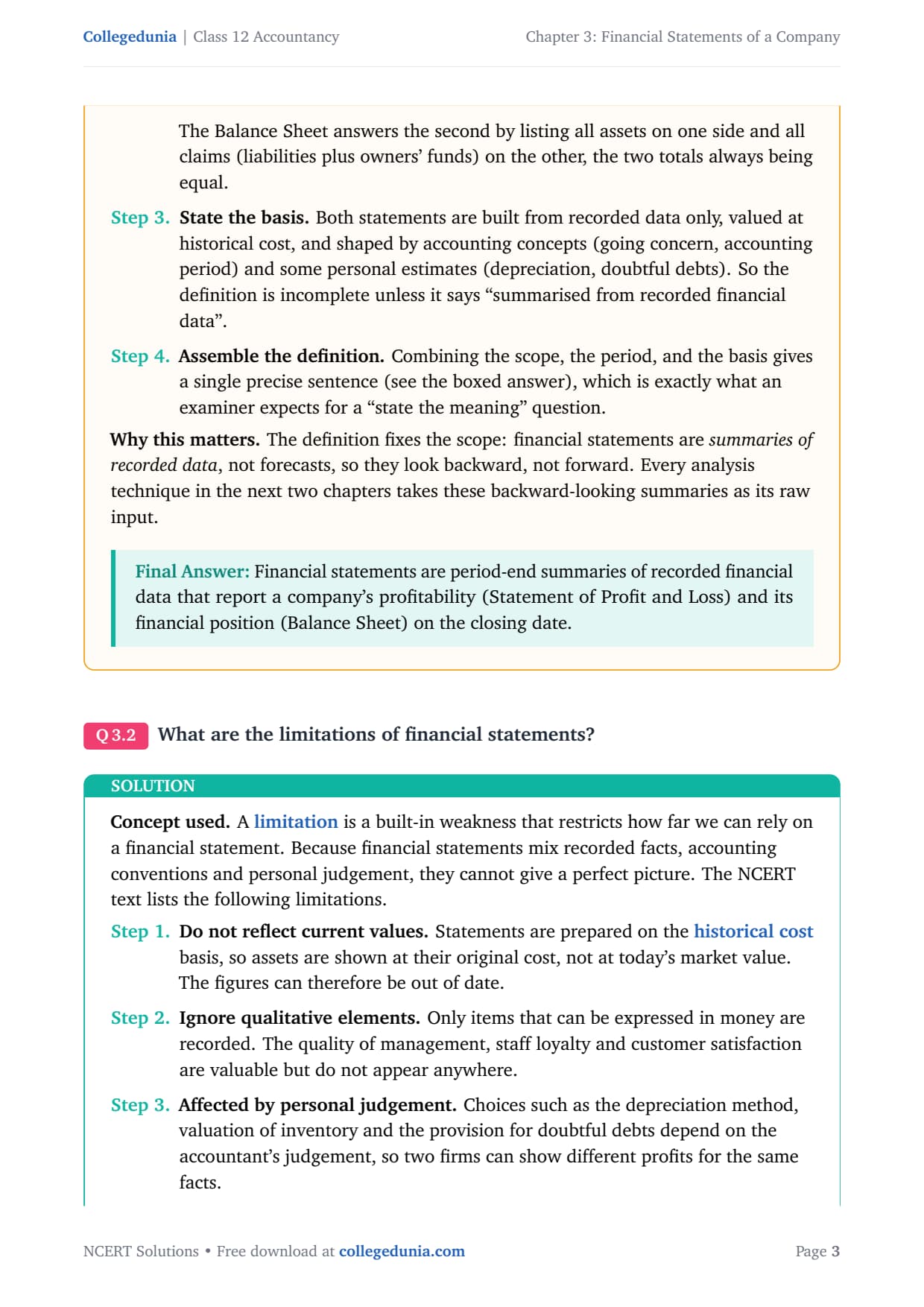

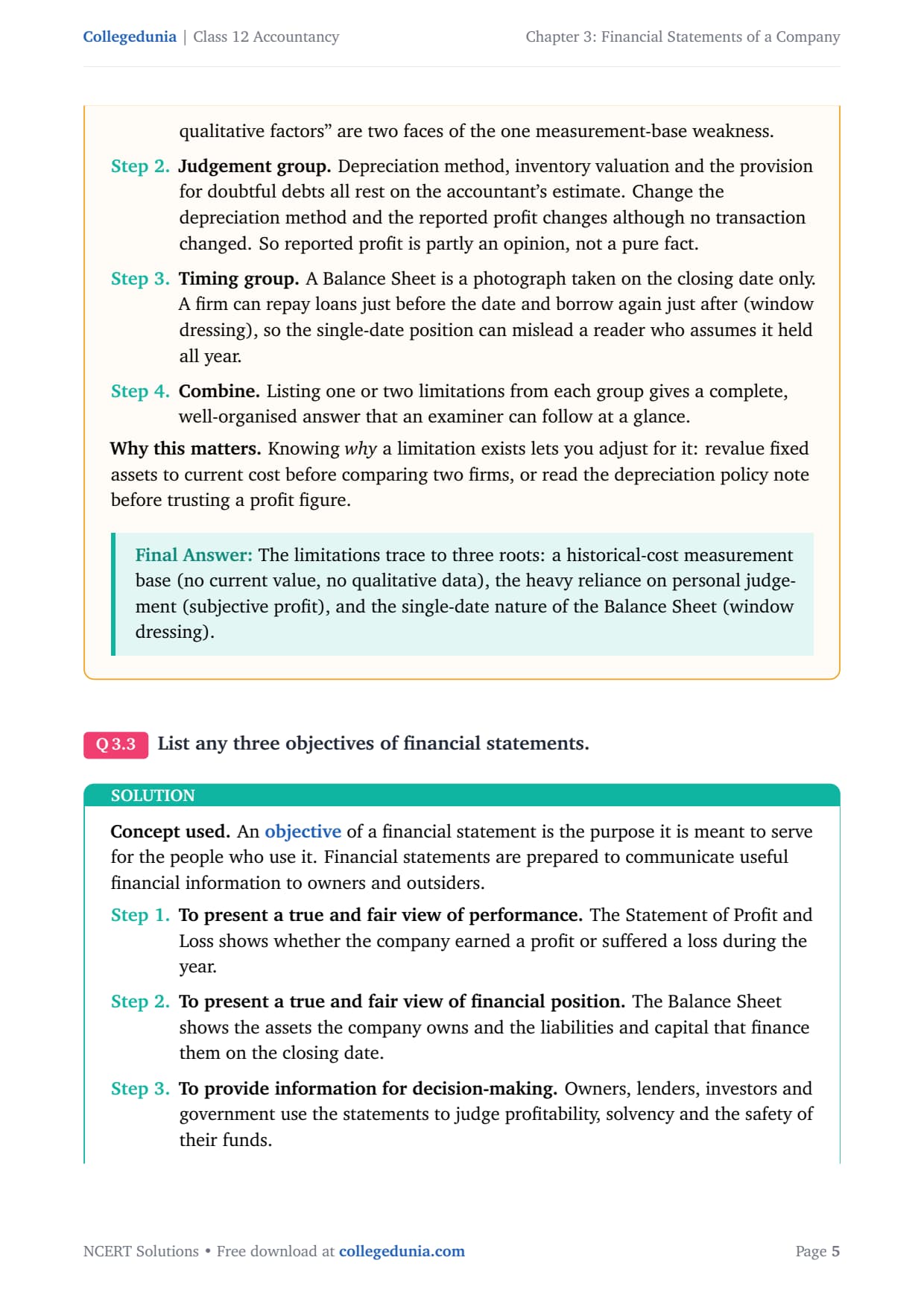
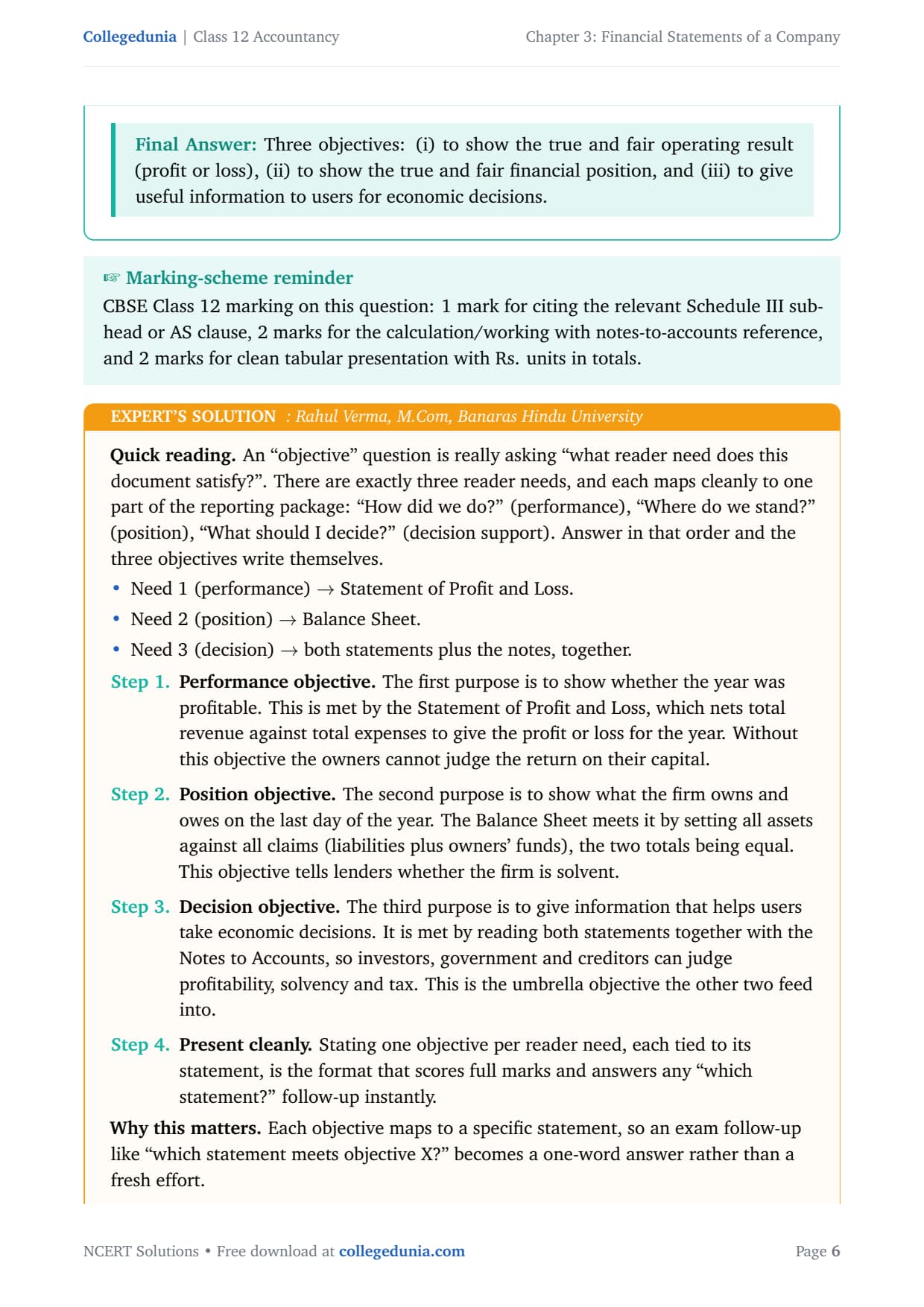
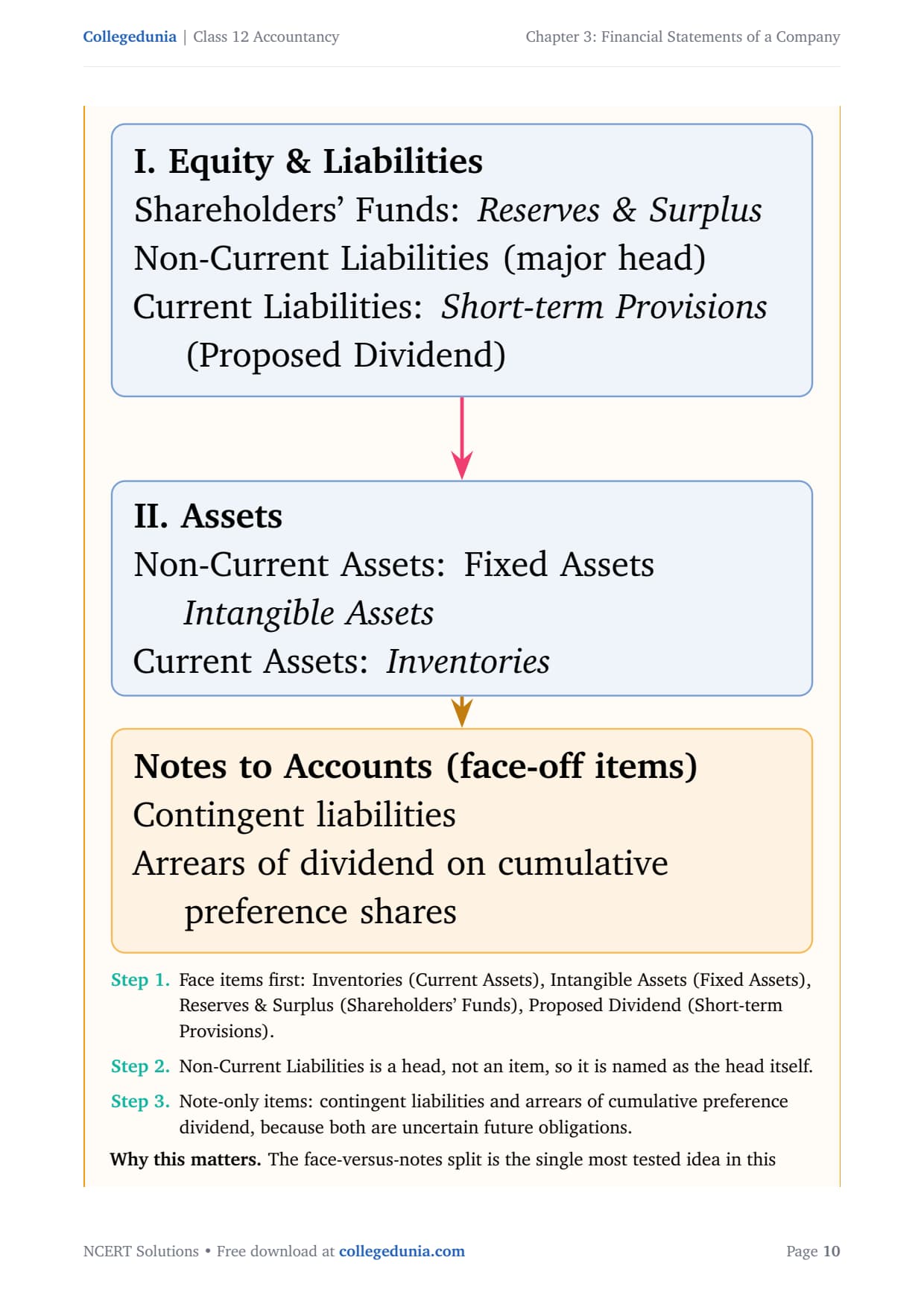
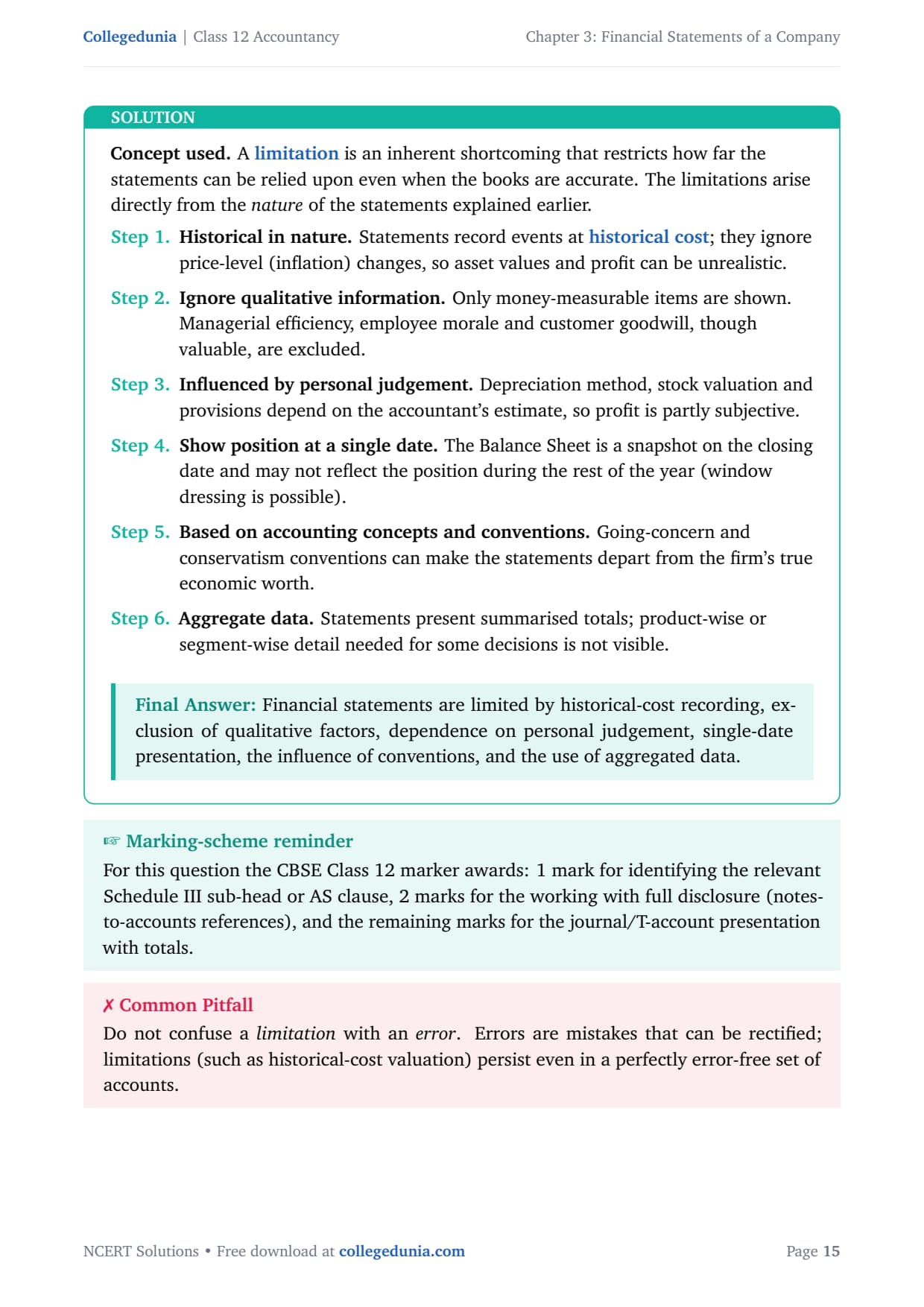
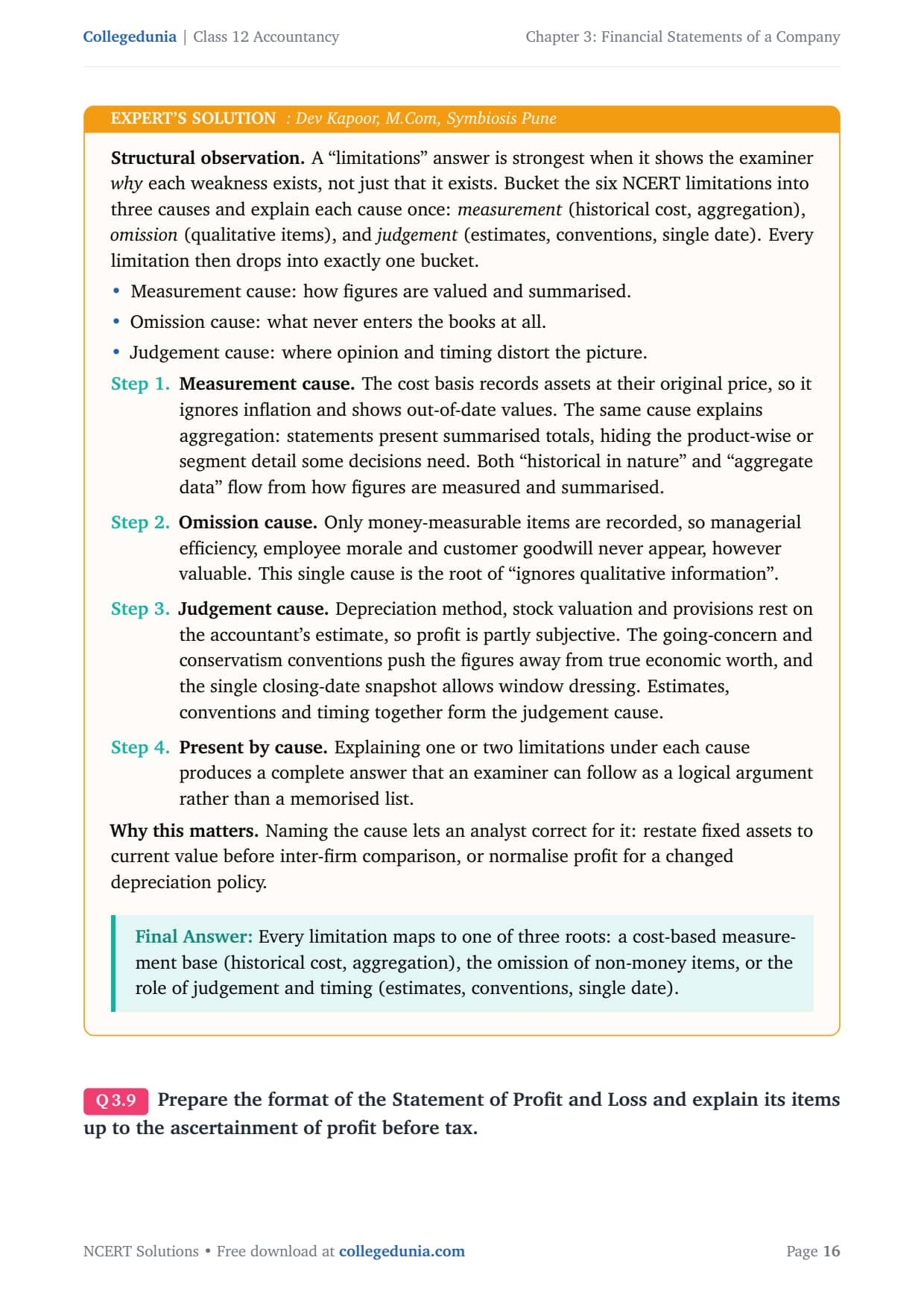
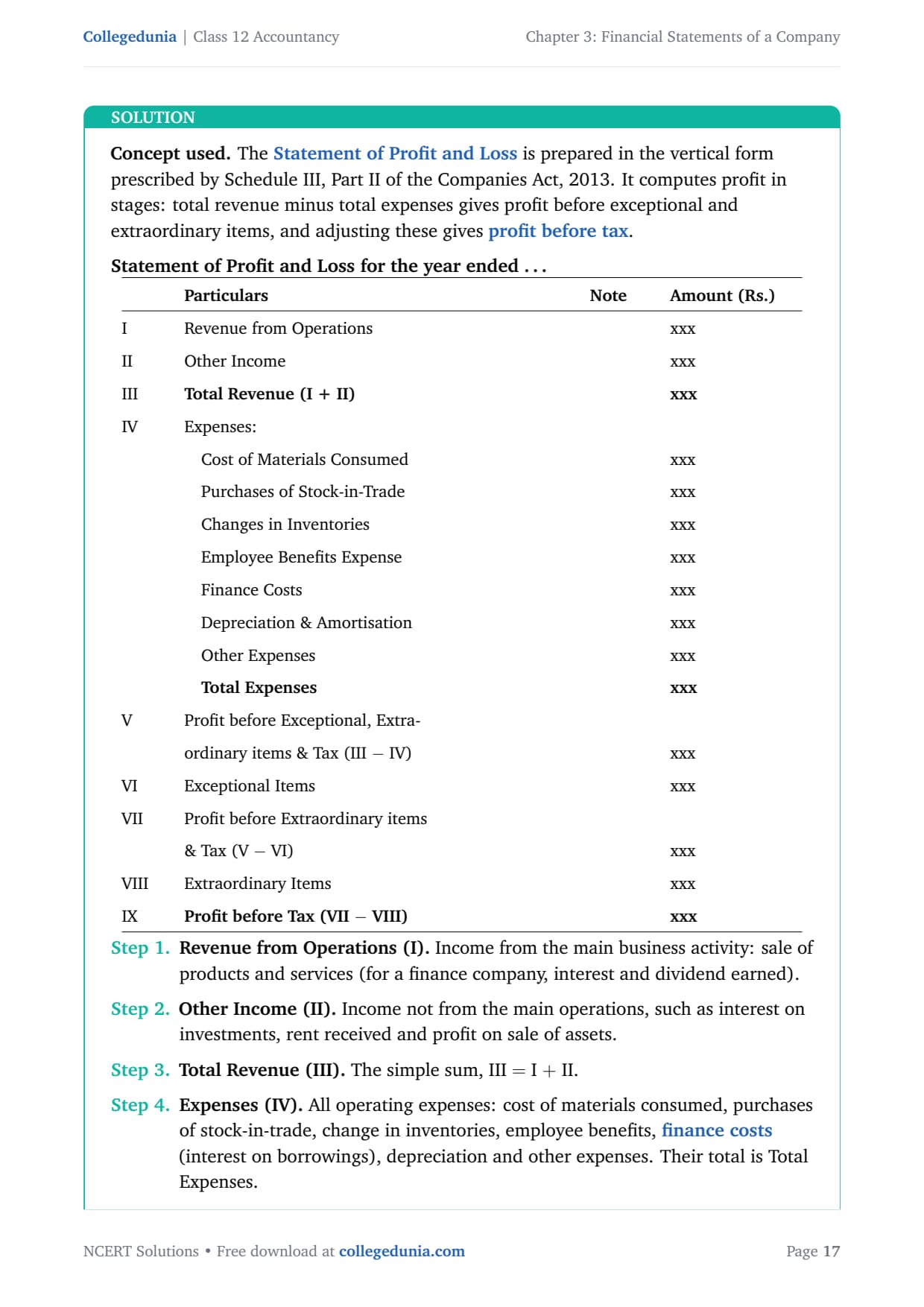
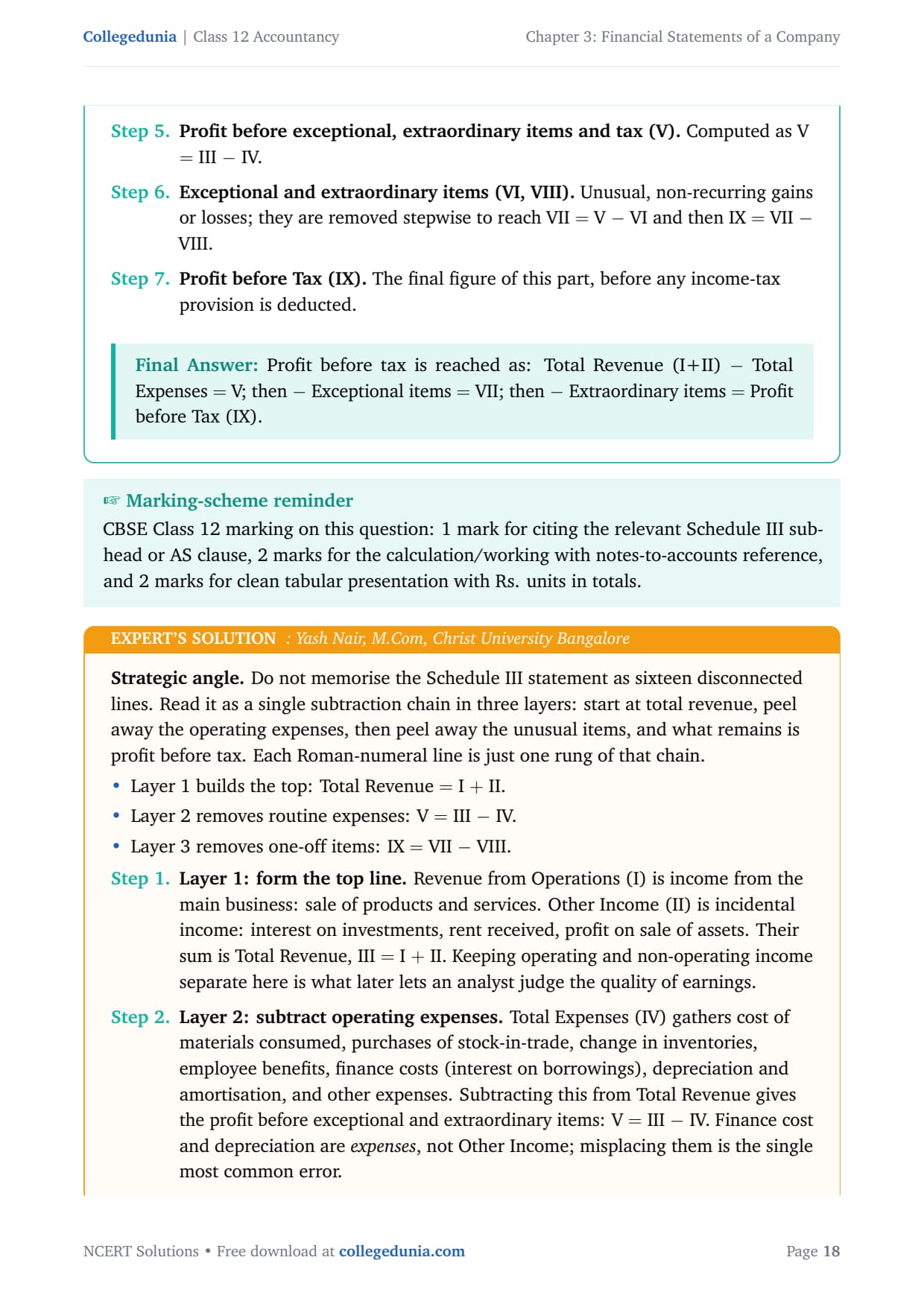
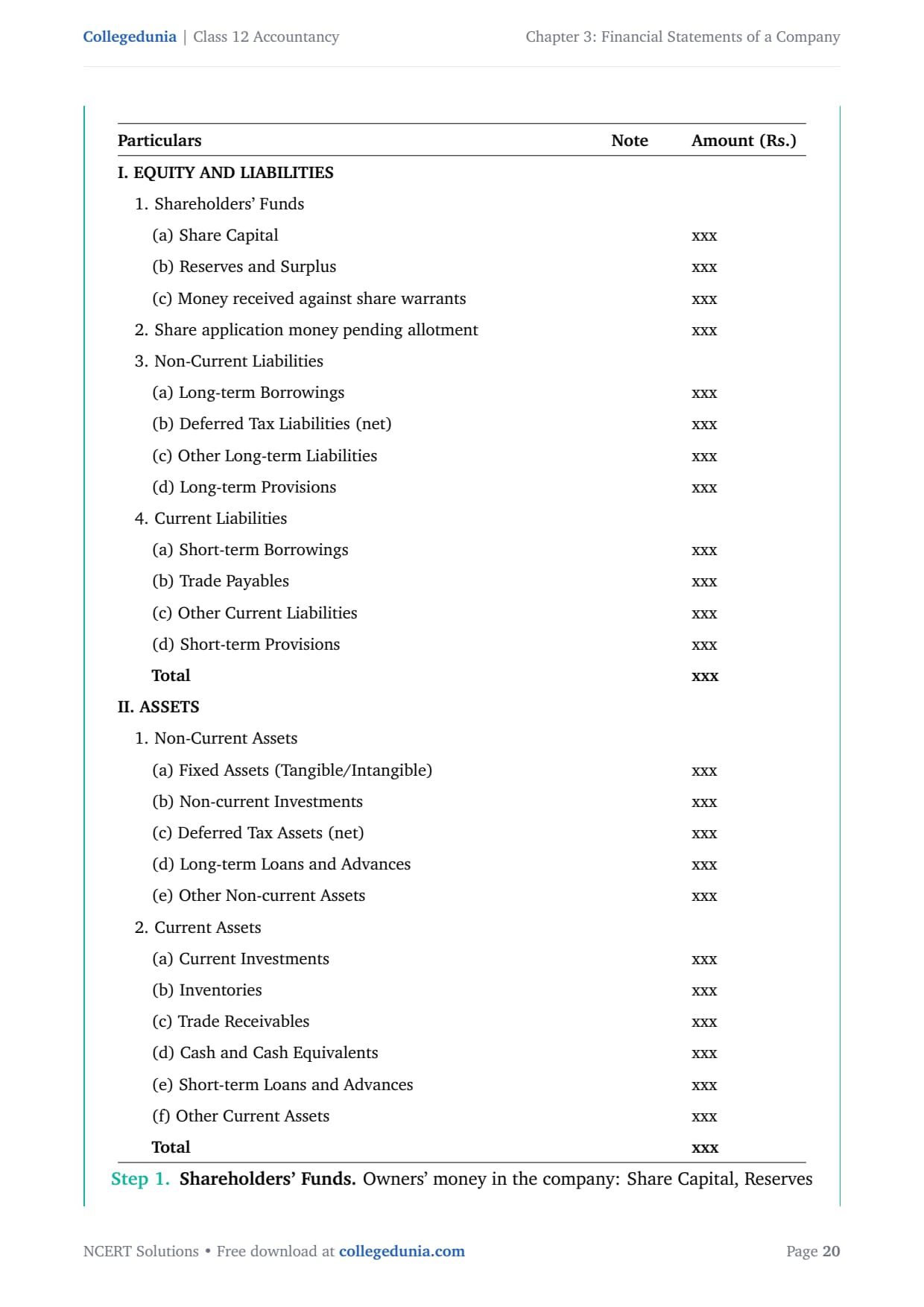
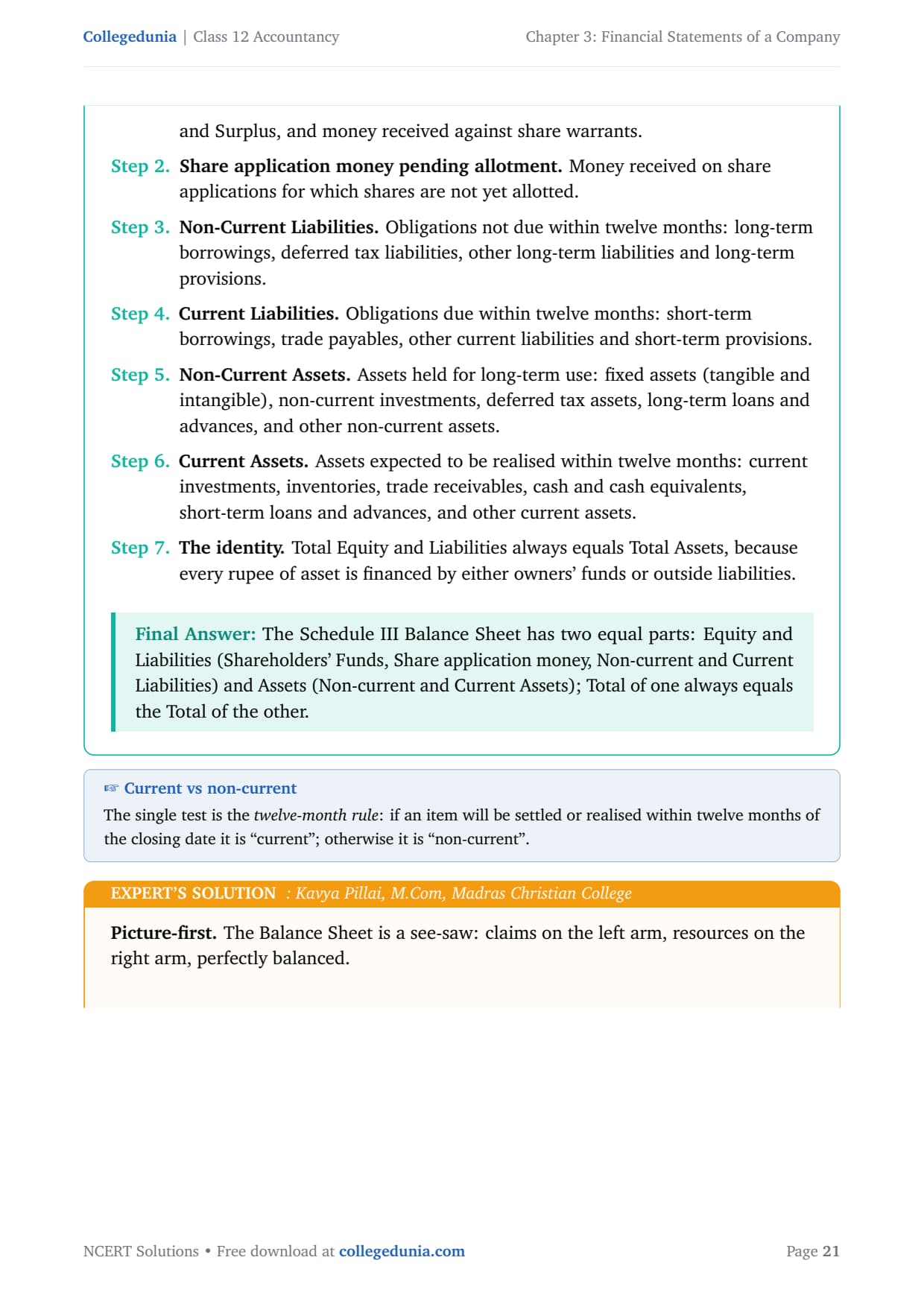
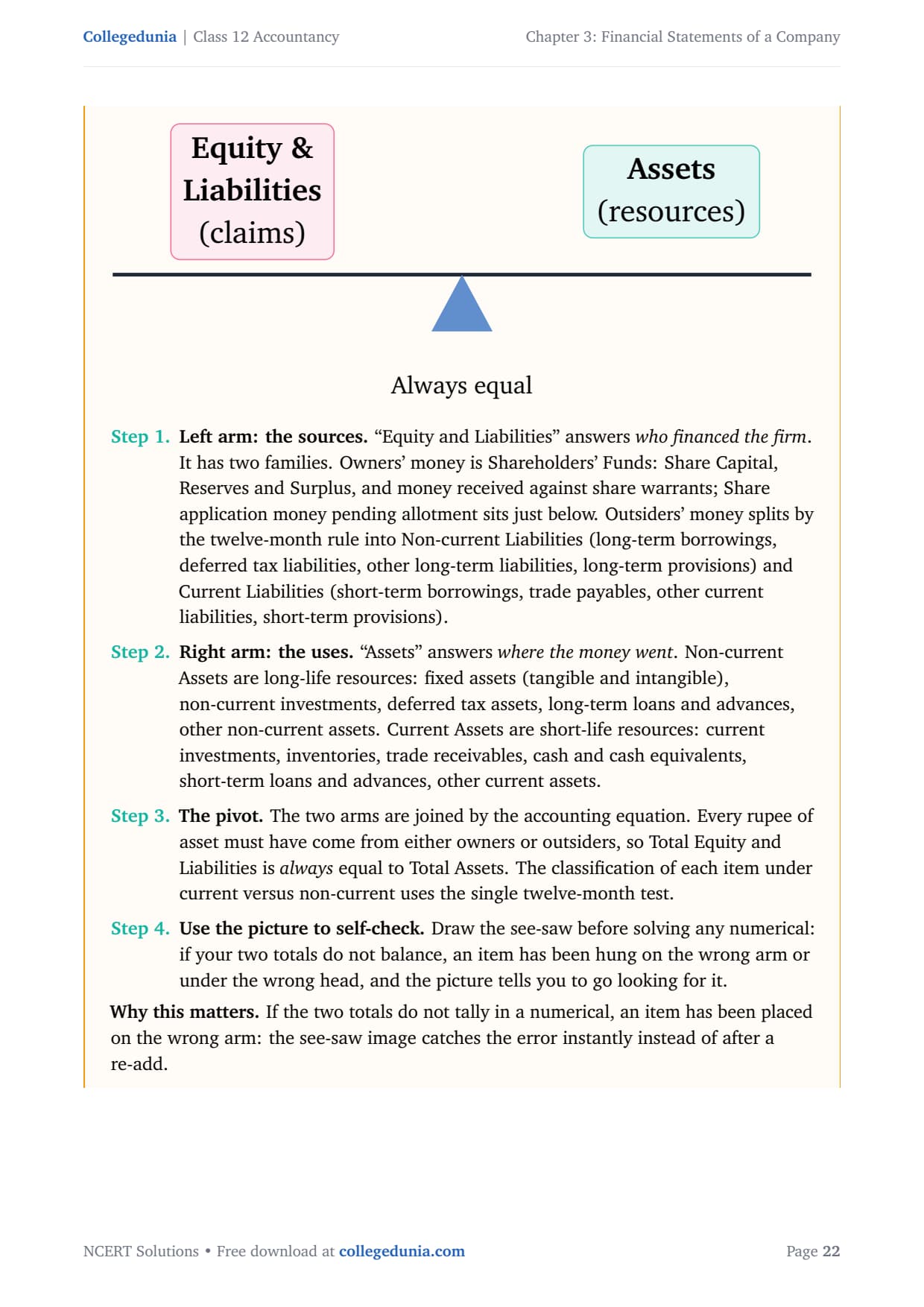
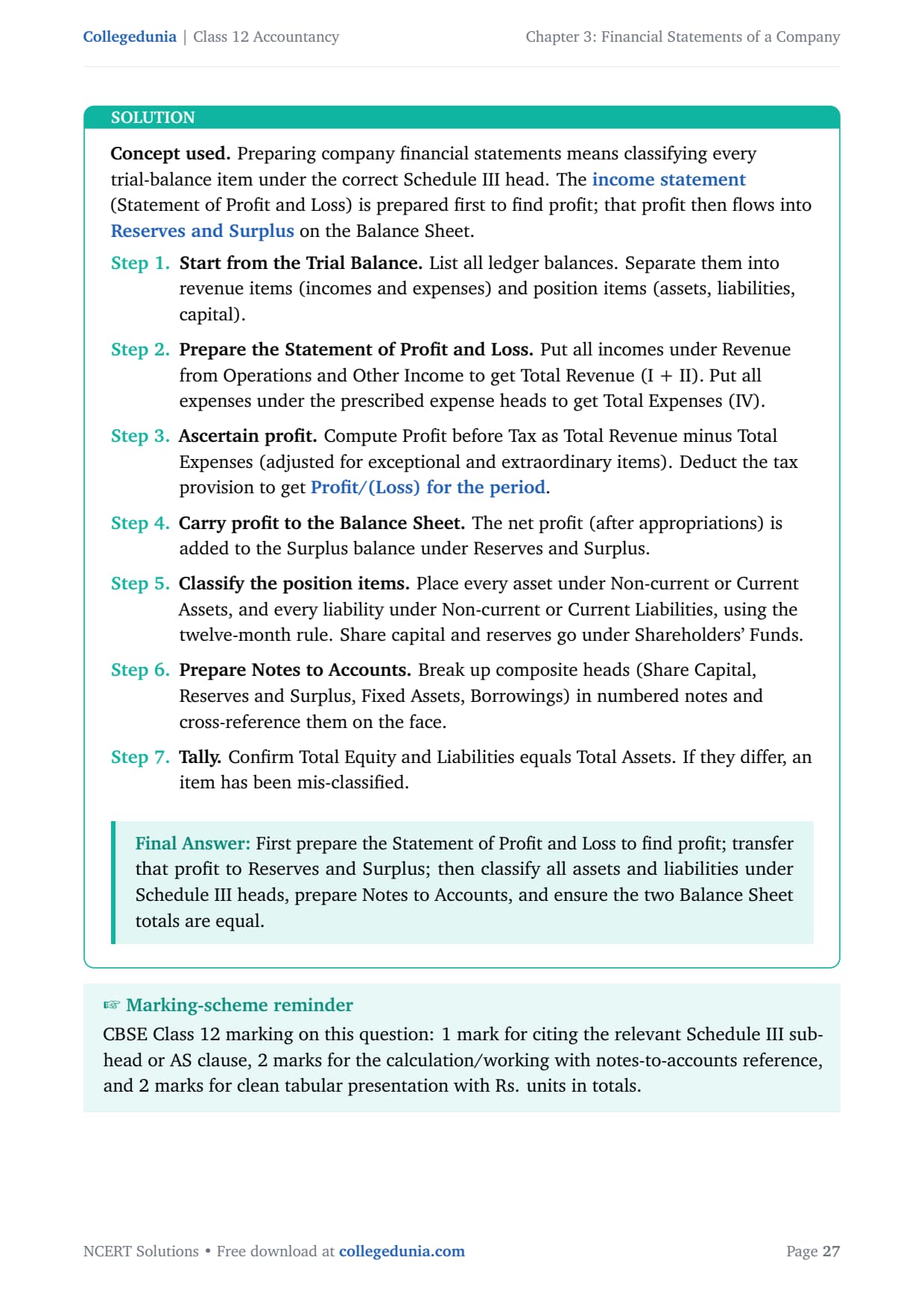
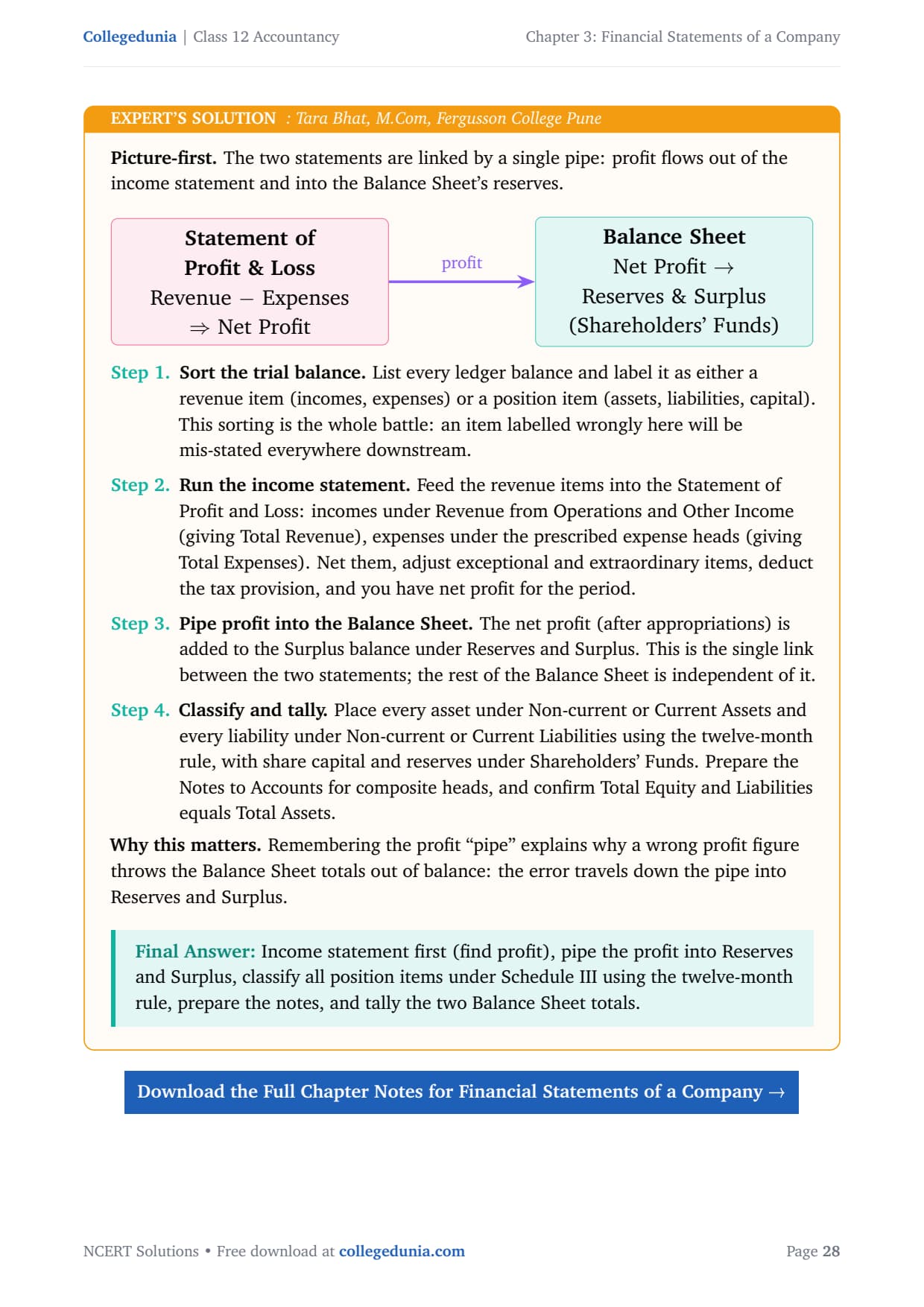
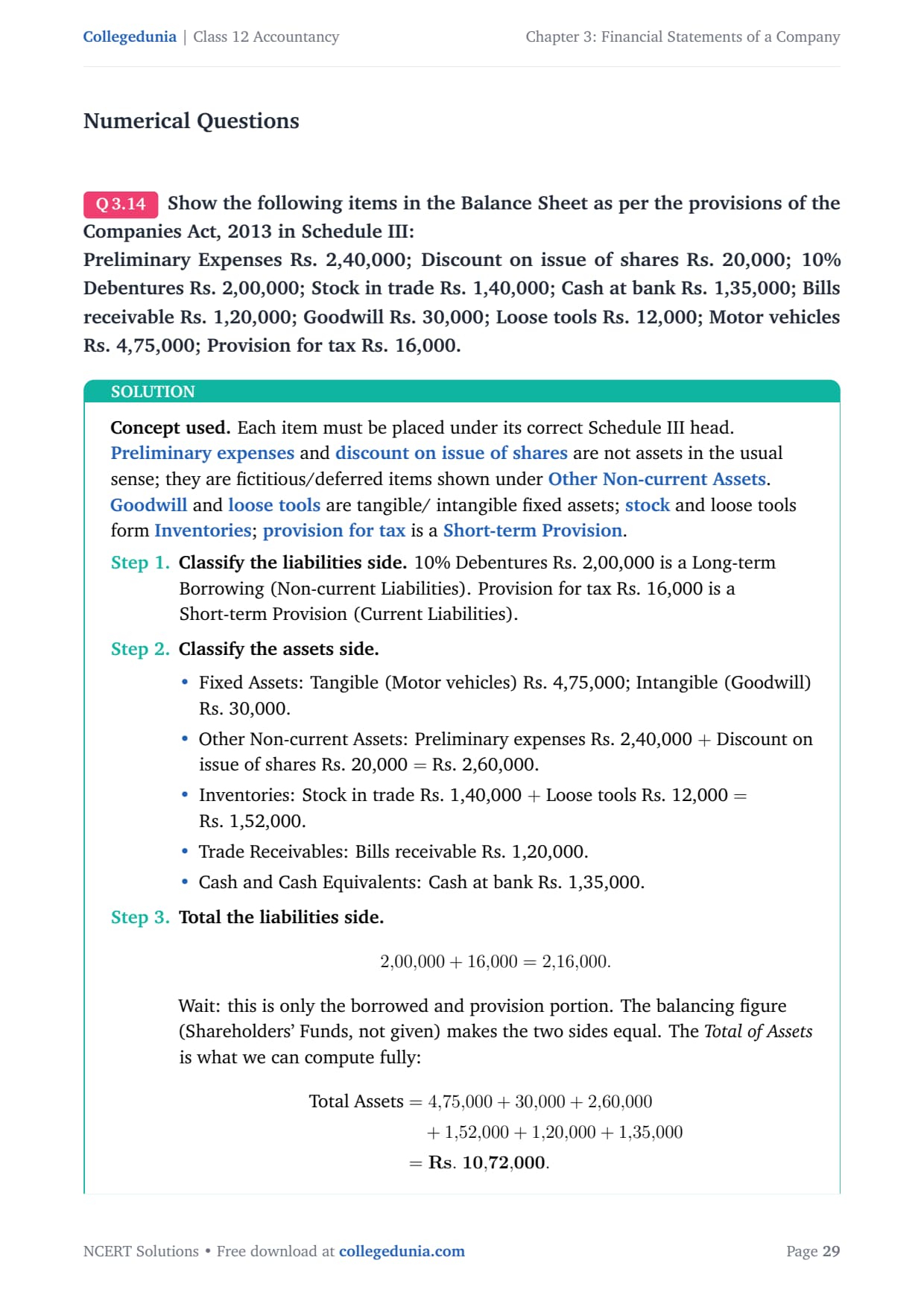
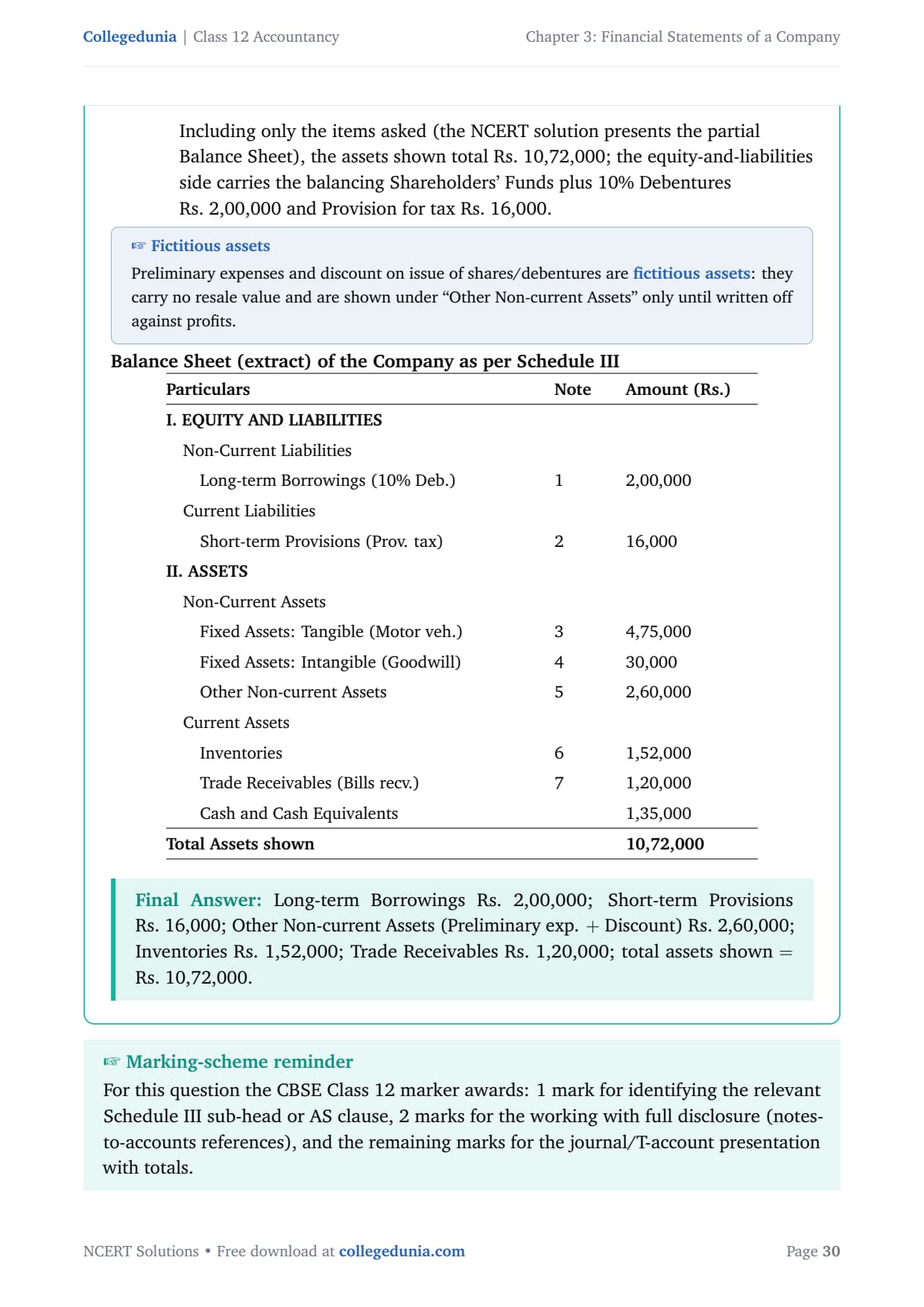
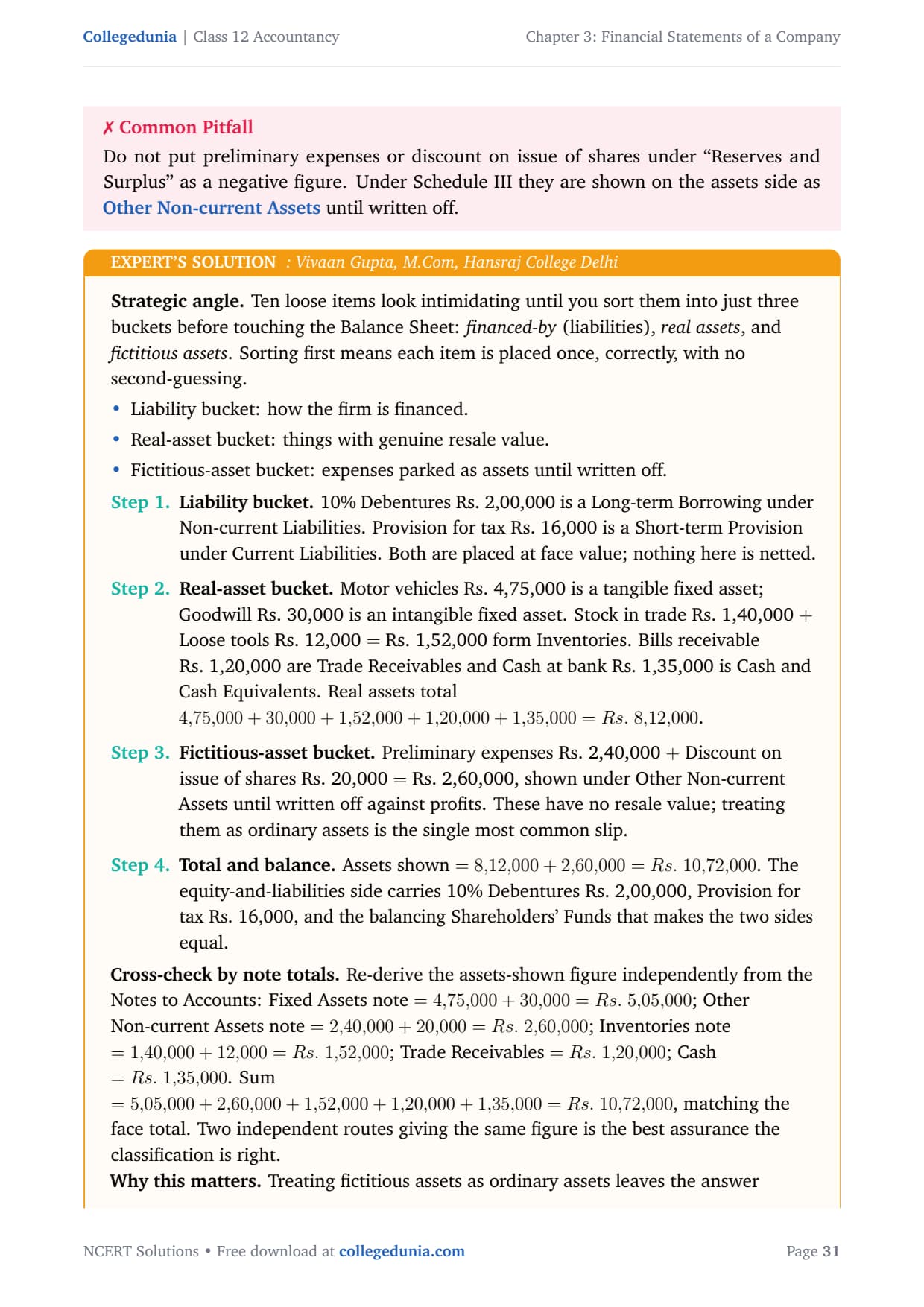
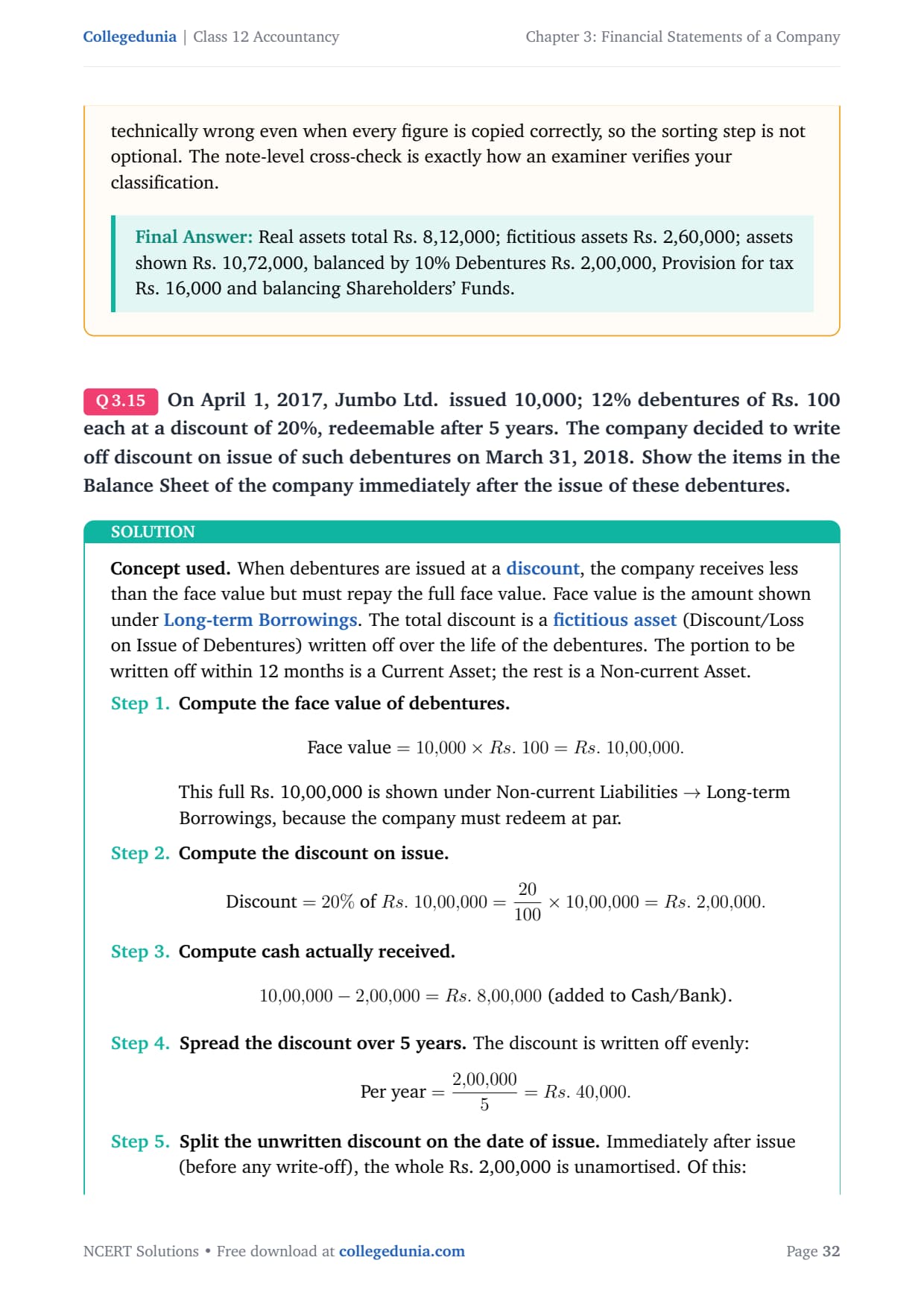

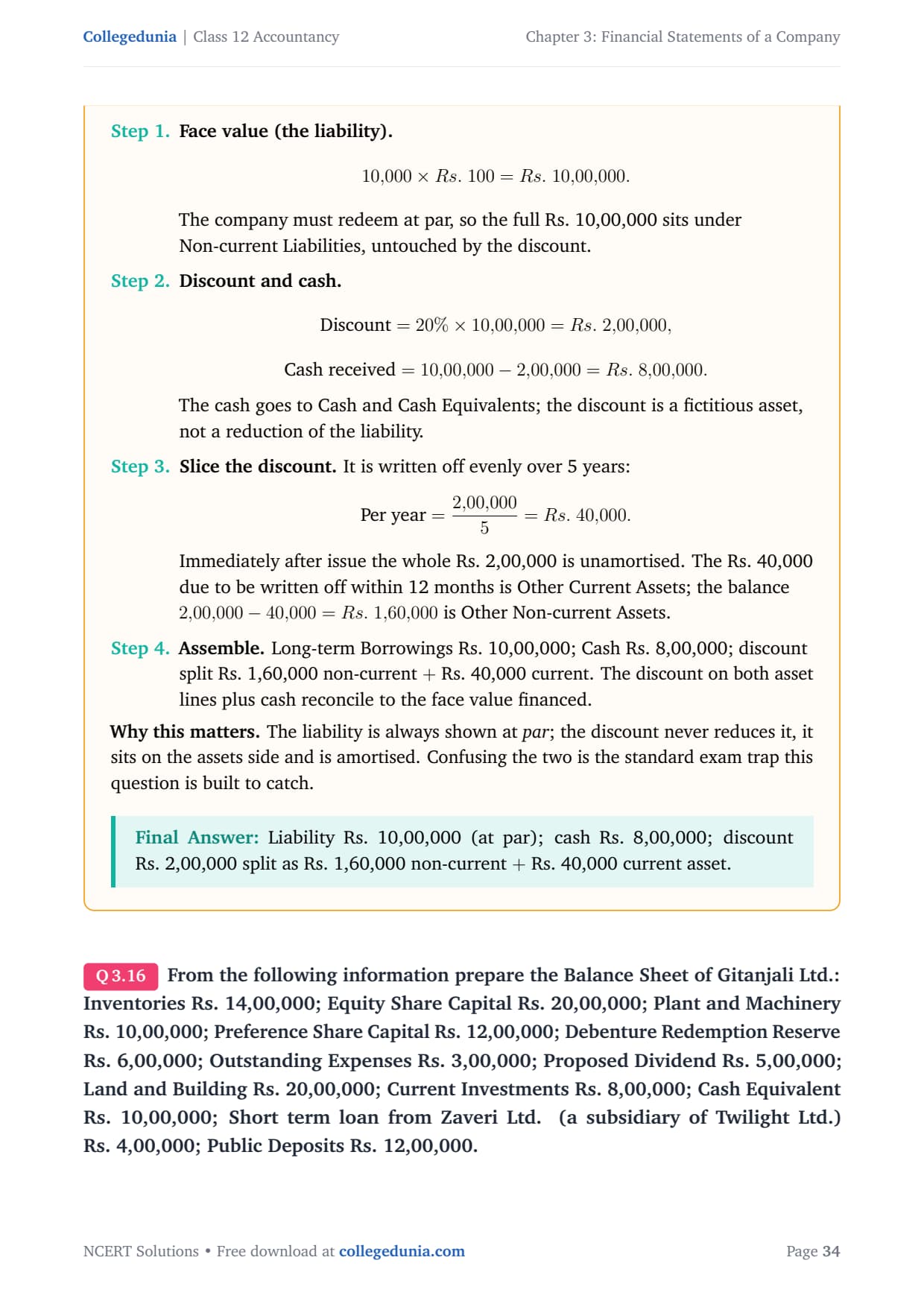
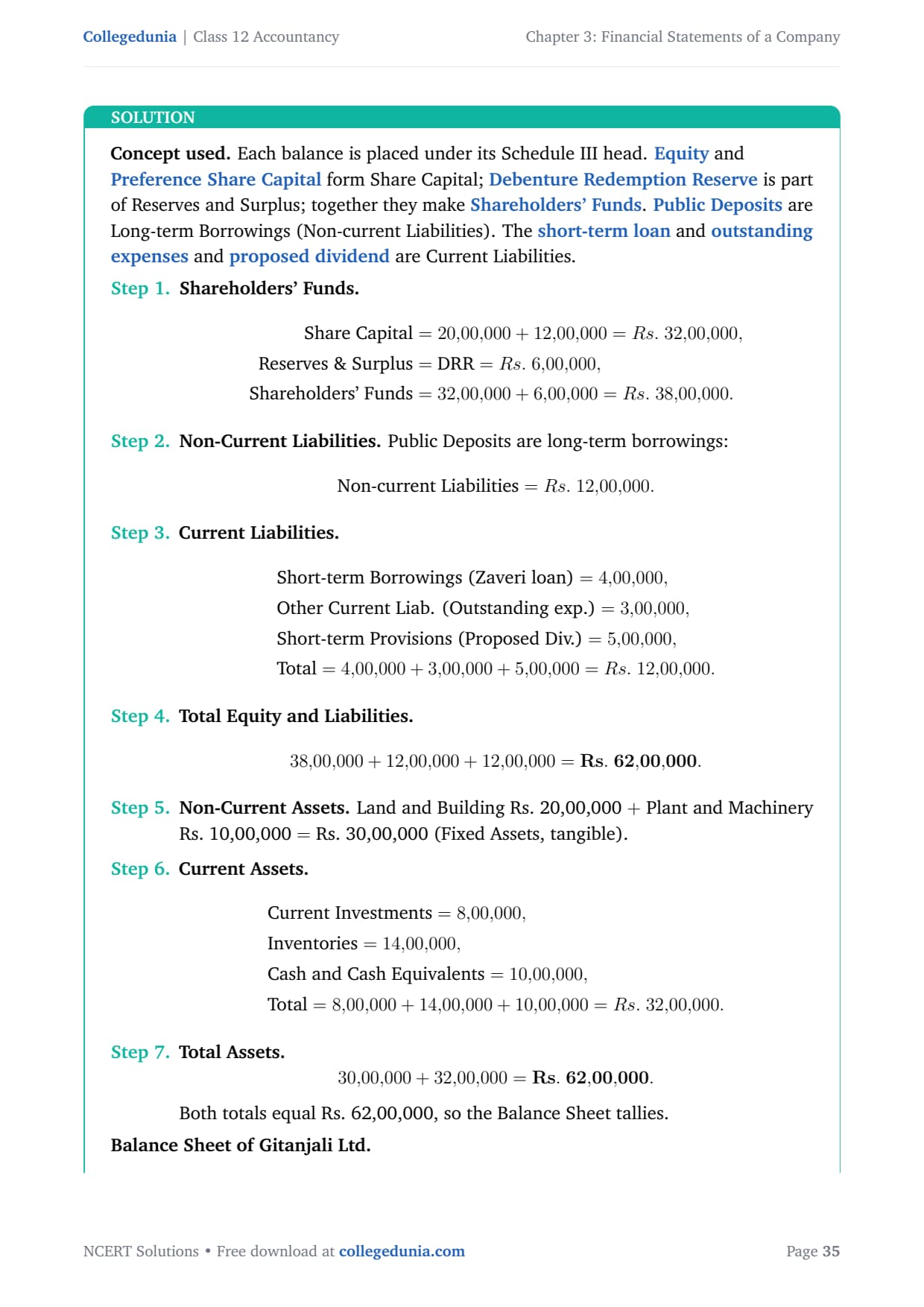
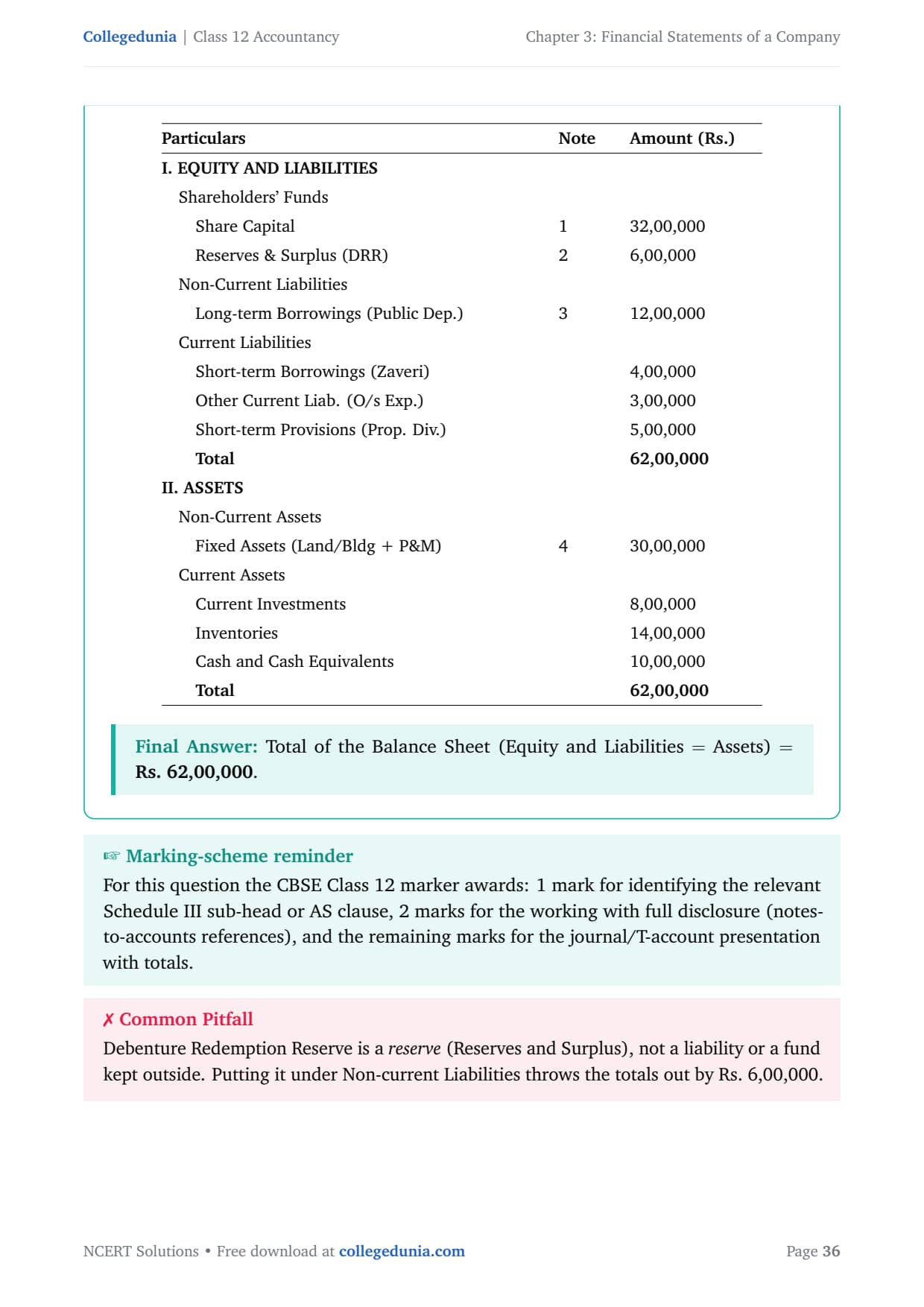
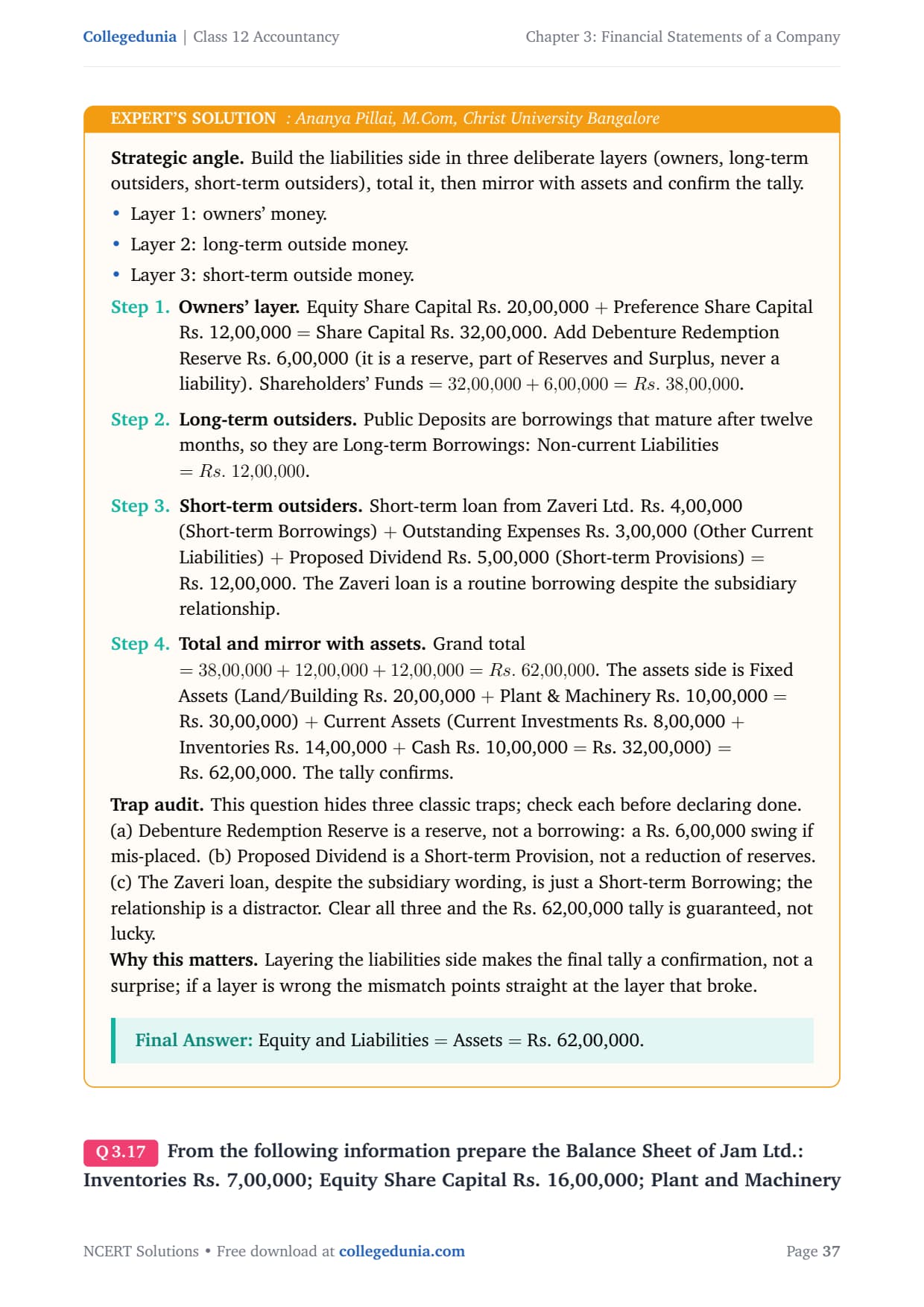
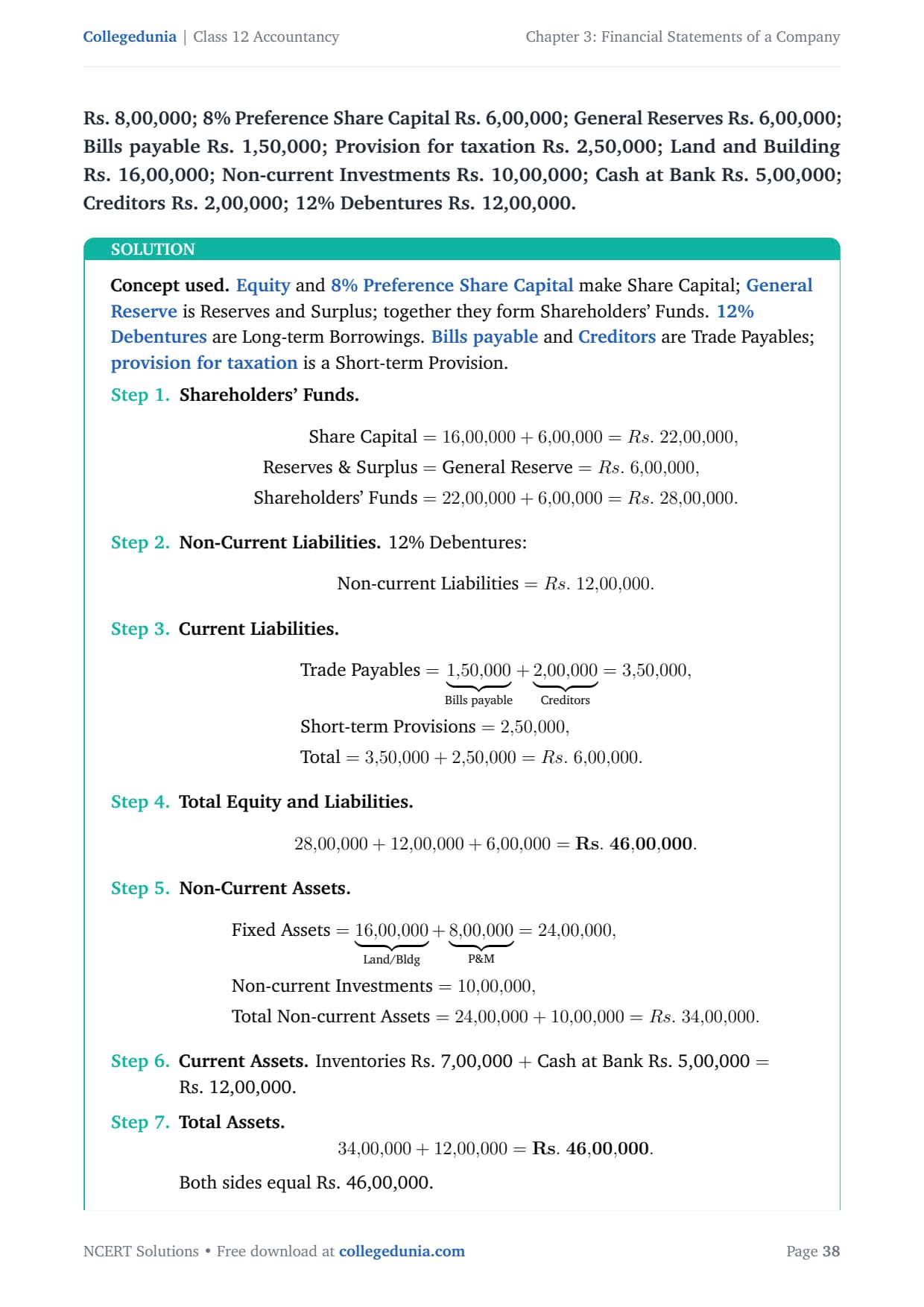
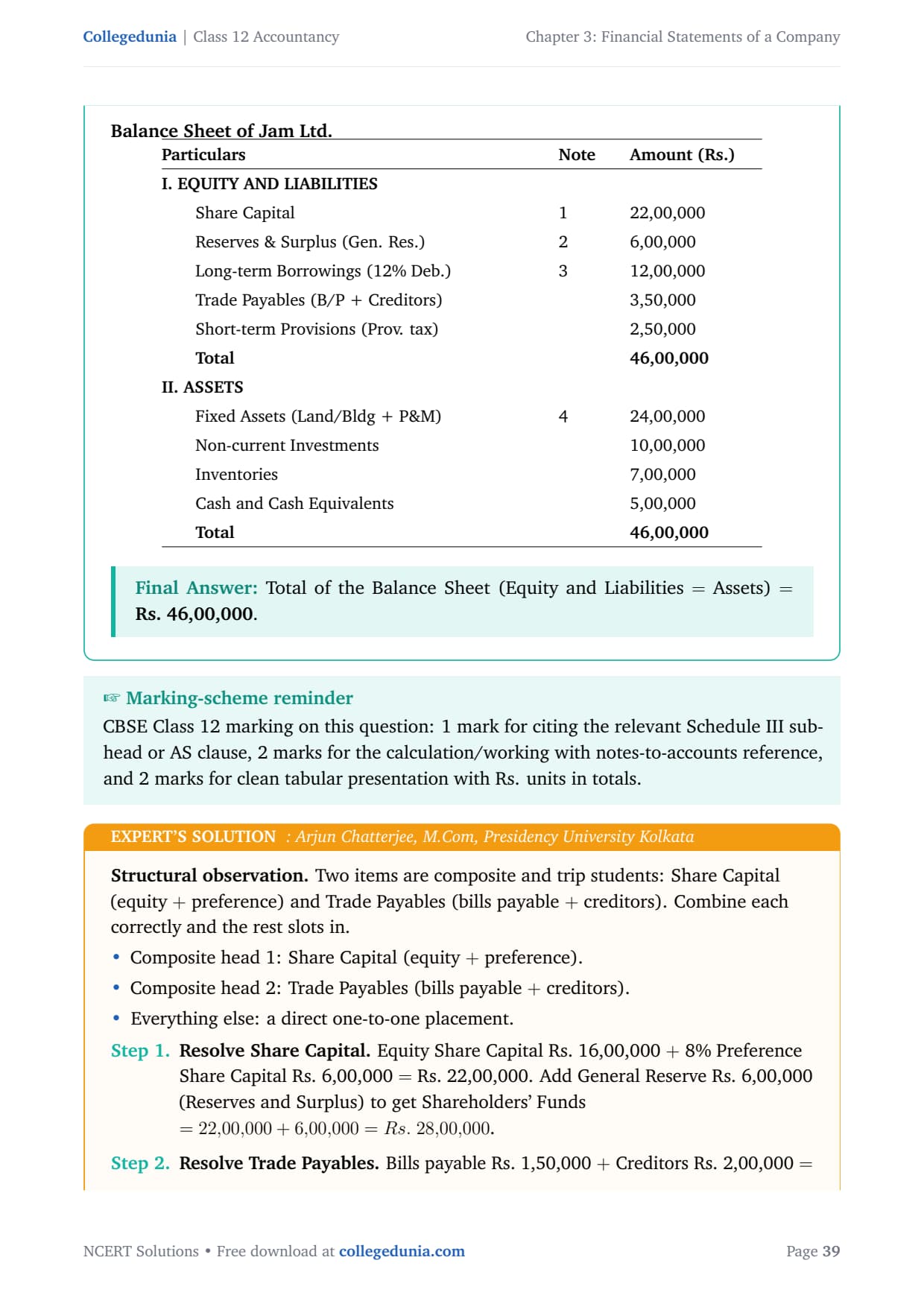
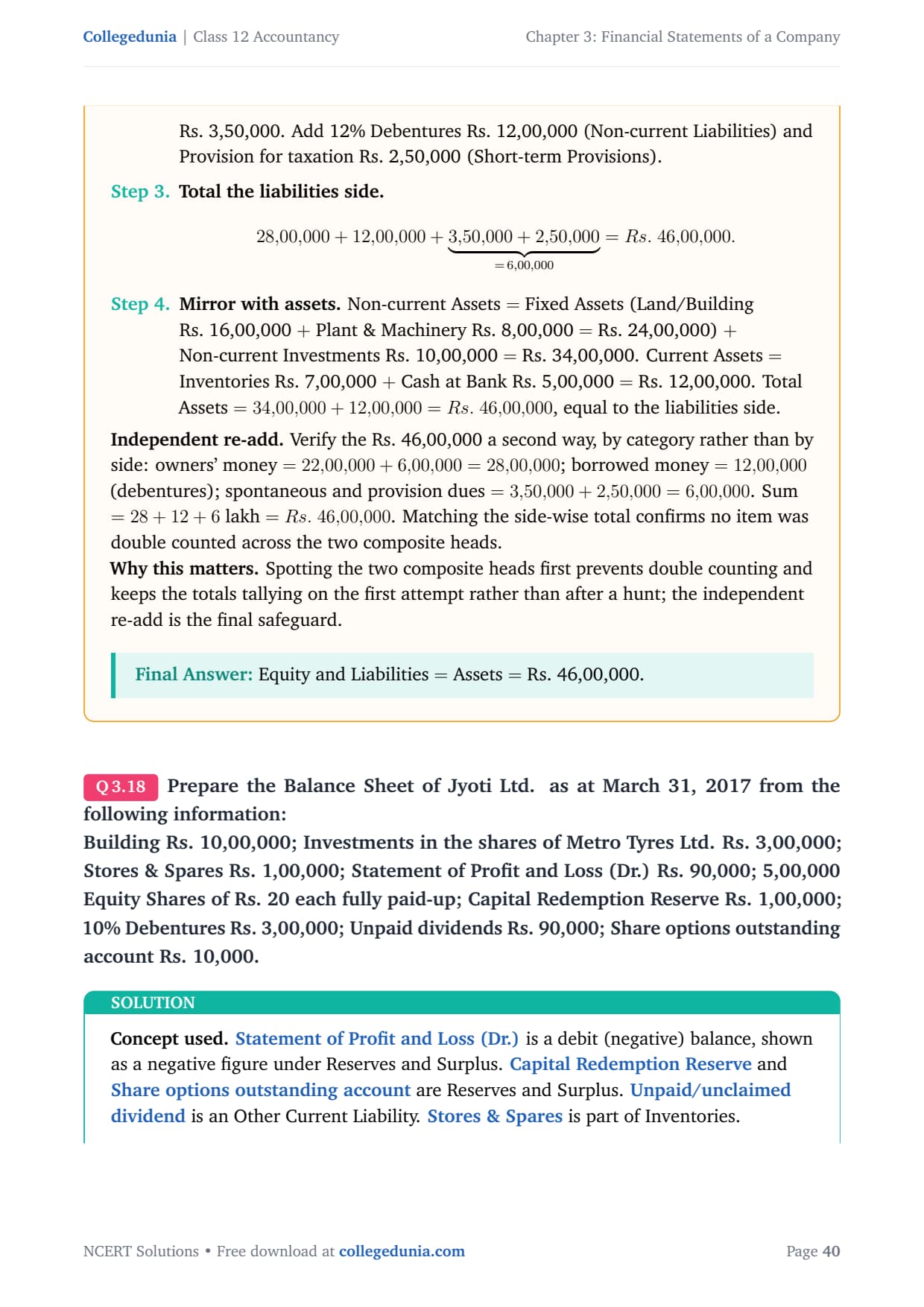
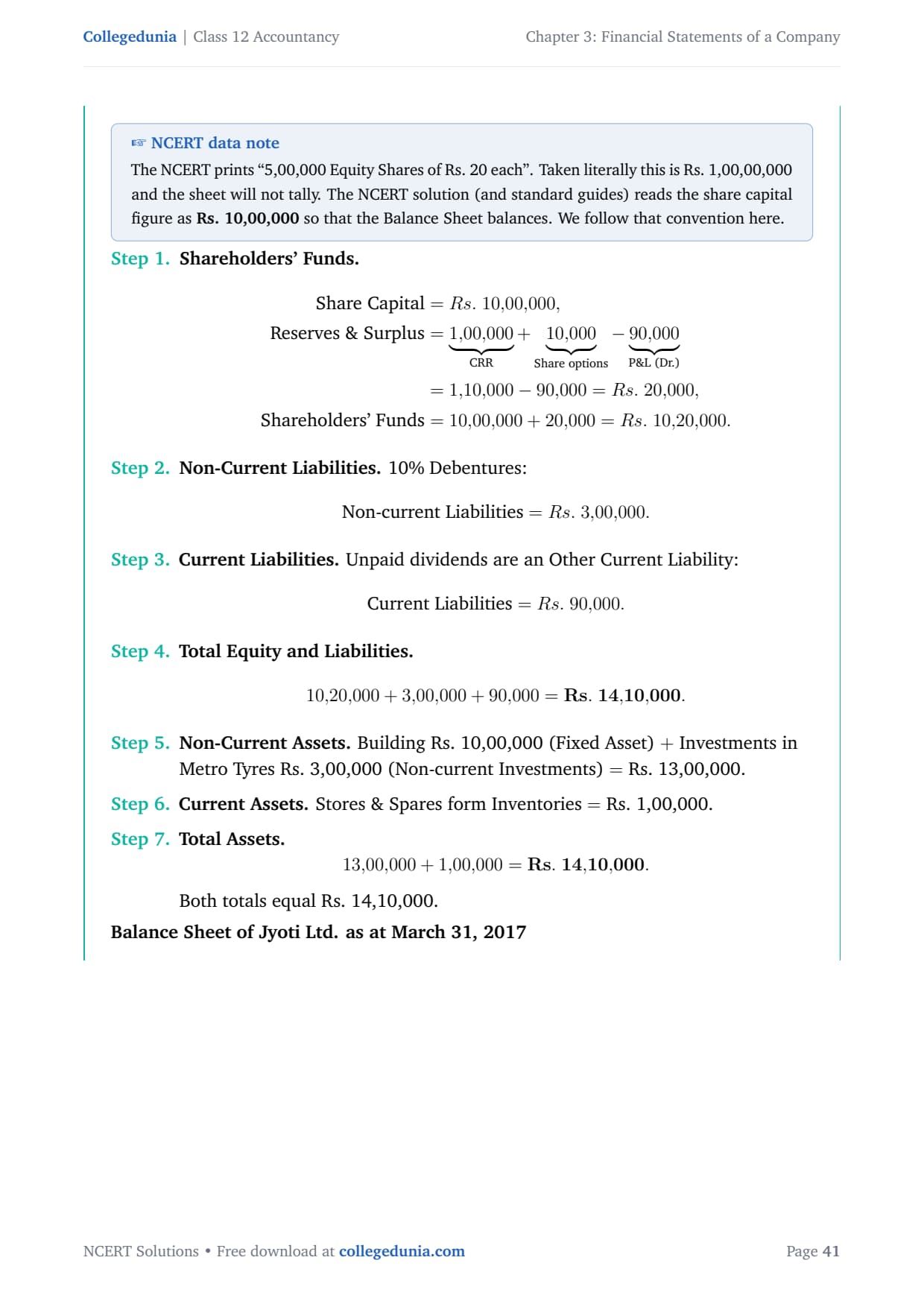
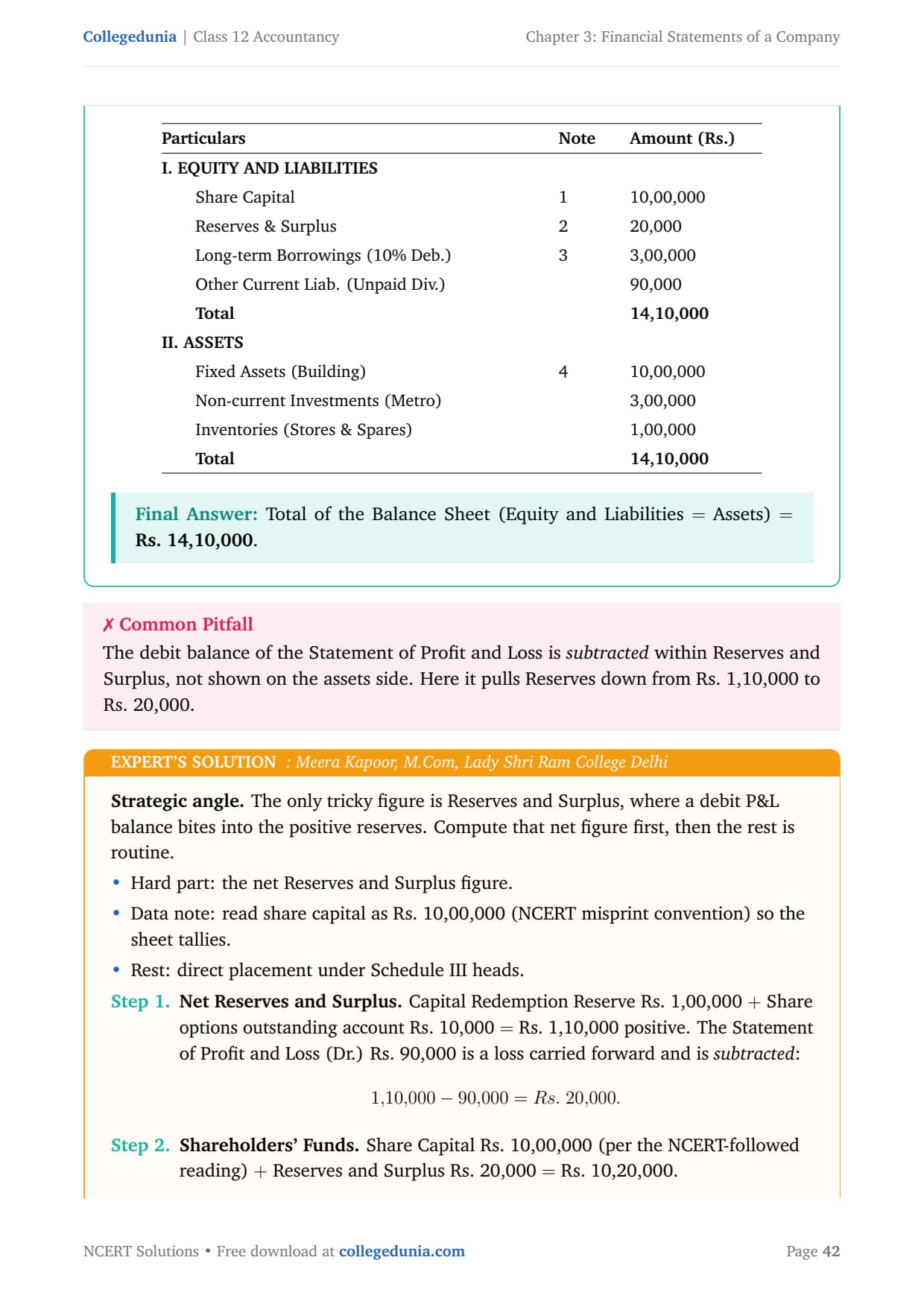
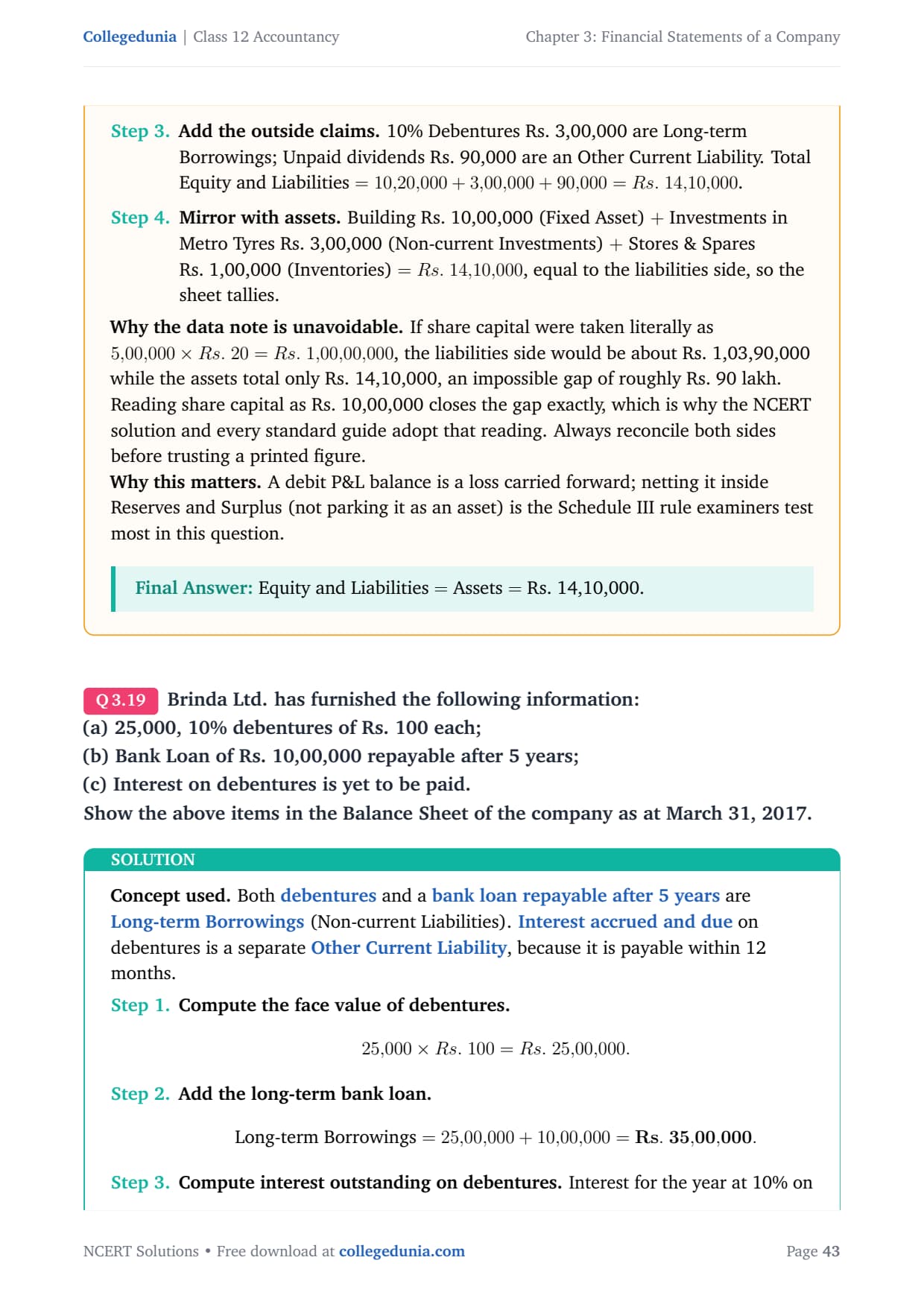
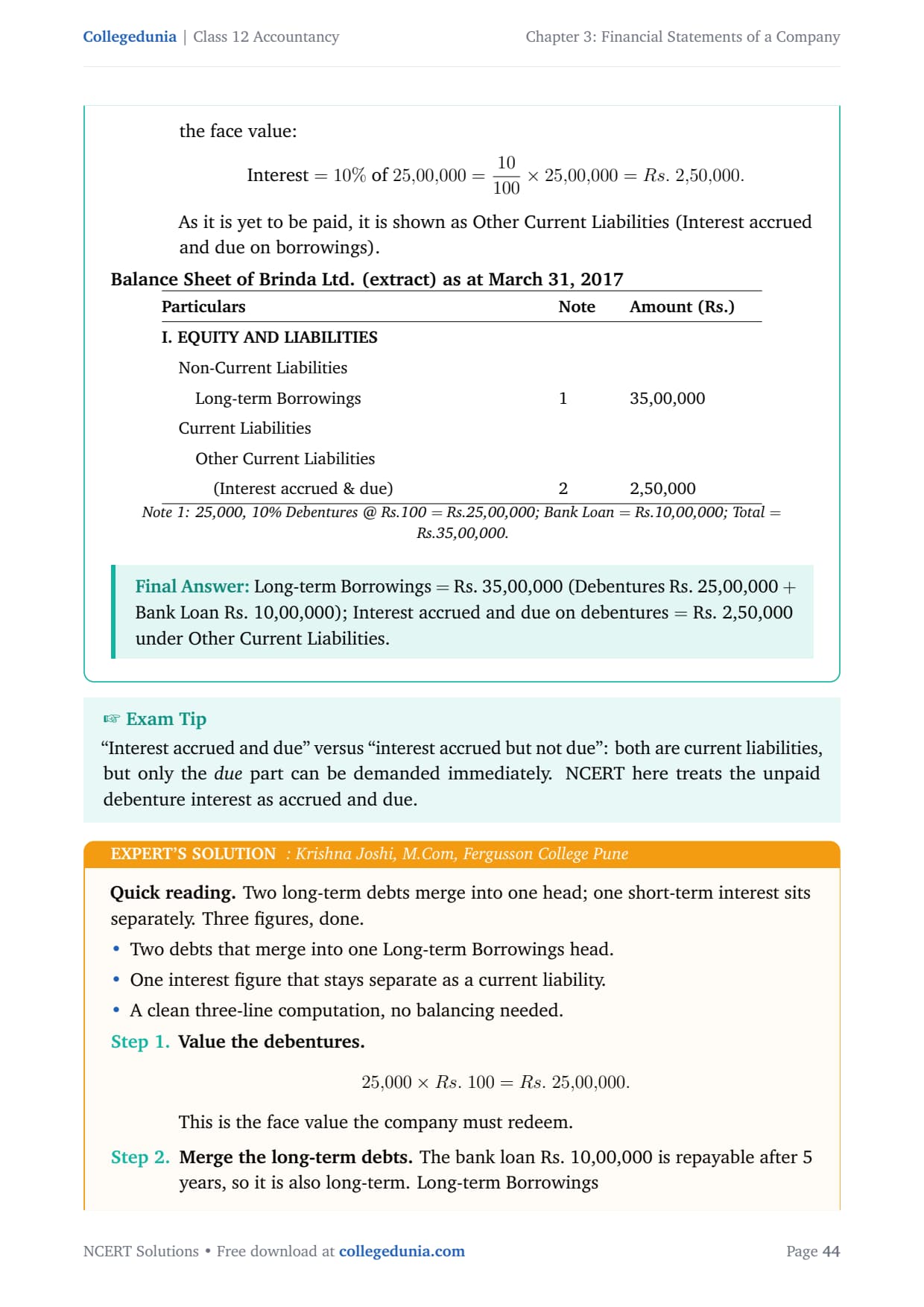
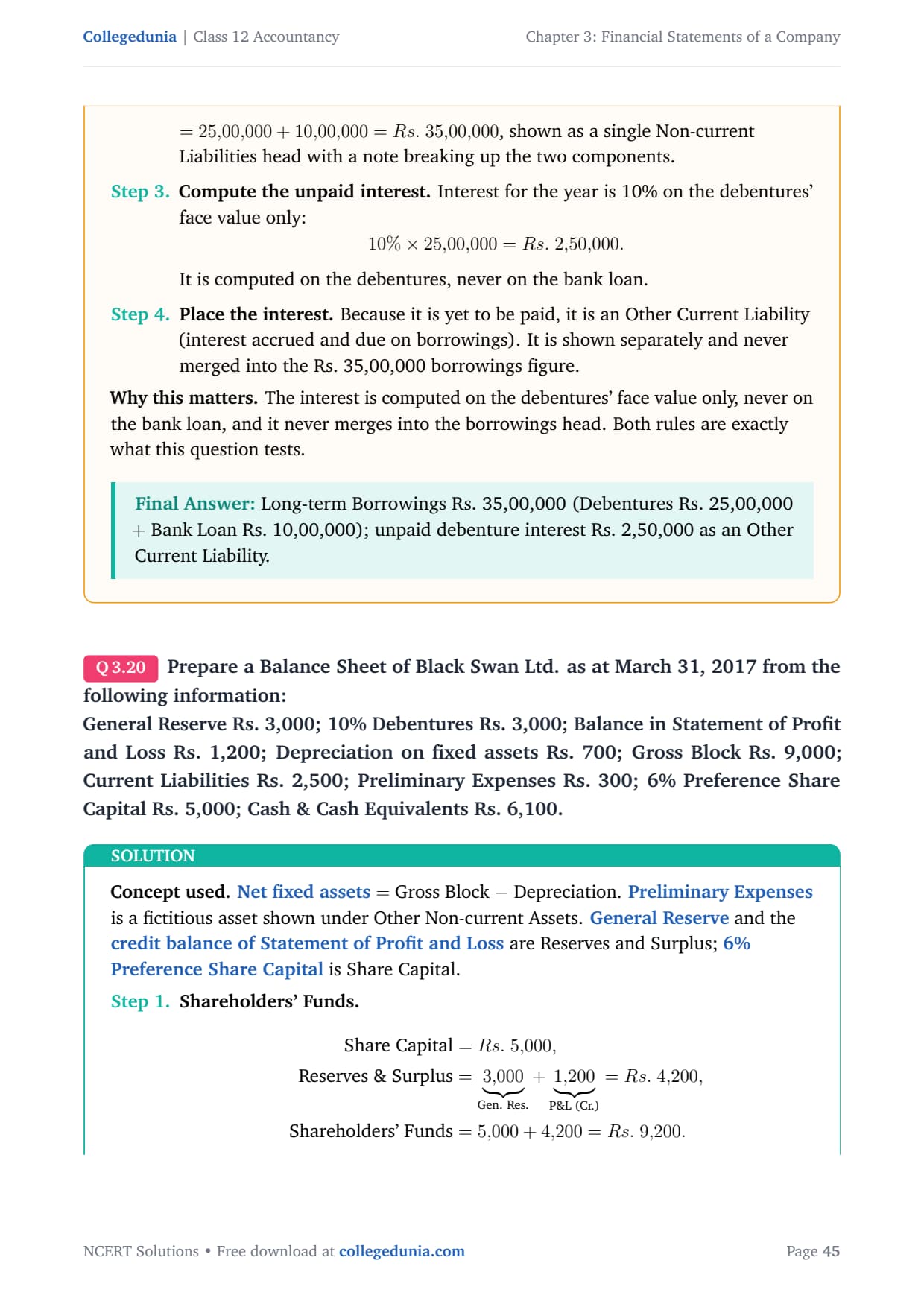
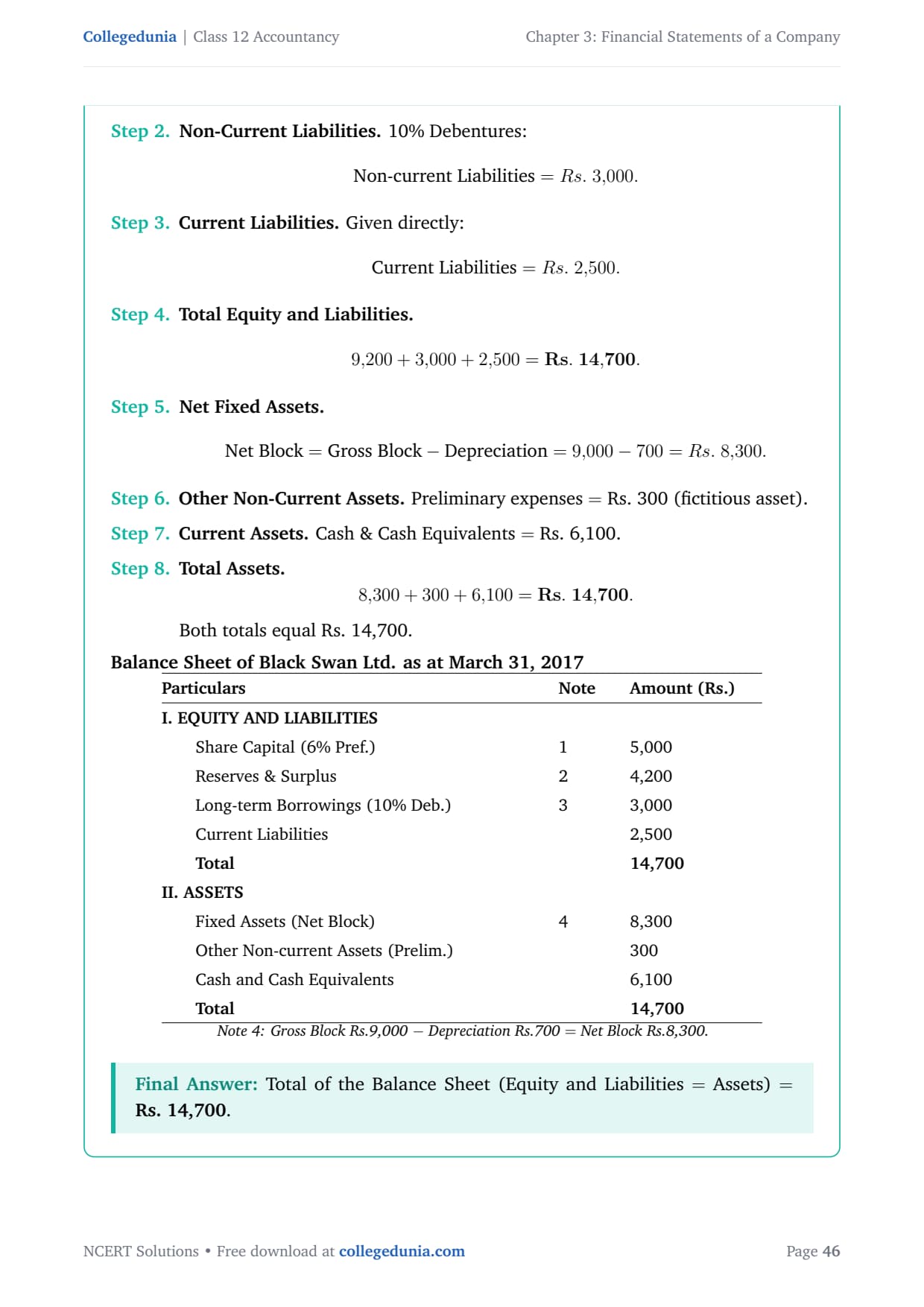
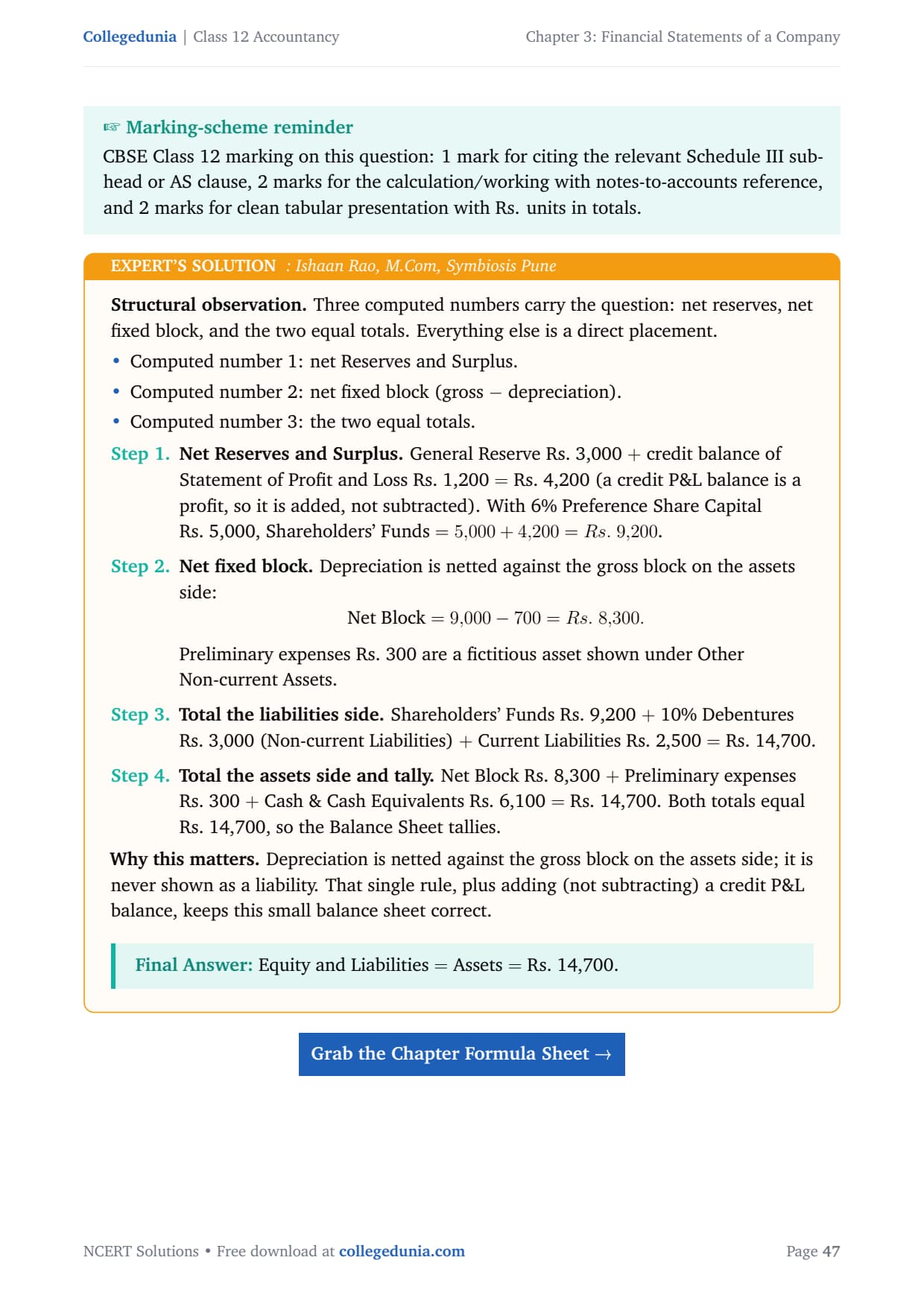
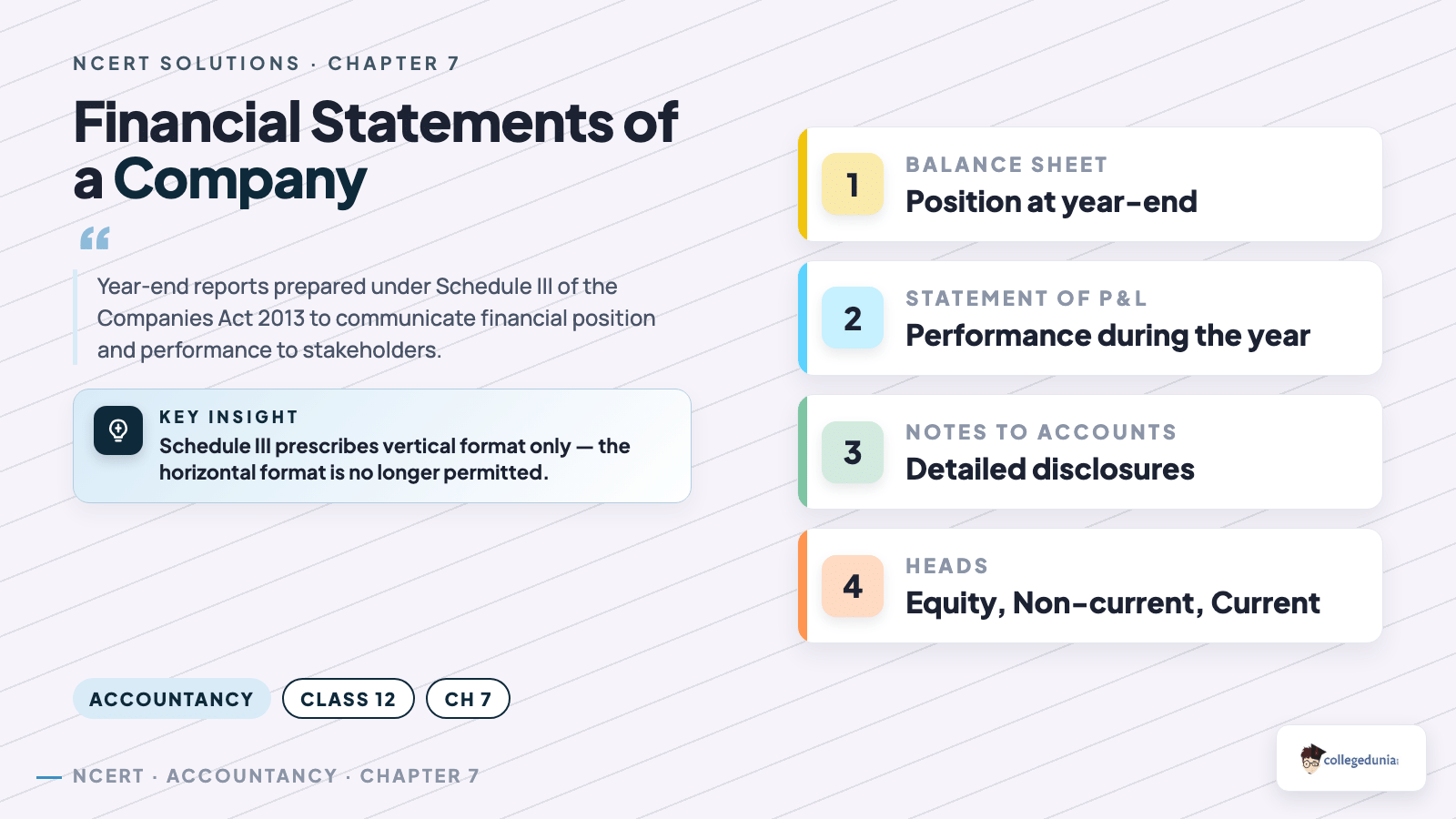




Comments