The NCERT Solutions for Class 10 Science Chapter 10 The Human Eye and the Colourful World solve all 16 questions (4 in-text and 12 end-of-chapter exercises) for the latest 2026-27 CBSE syllabus.
Every answer follows the textbook flow: the structure of the eye, the power of accommodation, the three eye defects and their correcting lenses, dispersion of white light through a prism, and the atmospheric refraction and scattering that colour the sky.
All 16 NCERT questions solved with the lens formula, full step-by-step working, and an Expert Solution per question for board-exam strategy.
Complete coverage of myopia, hypermetropia, presbyopia, lens power, dispersion, atmospheric refraction and scattering of light as tested in the CBSE Class 10 board paper.
Answers written in plain English for the 2026-27 CBSE syllabus, useful for the board exam and school unit tests.
Solved by Collegedunia Science Experts
These NCERT Solutions for Class 10 Science Chapter 10 The Human Eye and the Colourful World are checked against the latest 2026-27 NCERT textbook and refined against the last five years of CBSE board papers. Each of the 16 questions gives a Check Solution for the clean board answer and an Expert Solution for extra marks.
What the NCERT Solutions for Class 10 Science Chapter 10 The Human Eye and the Colourful World Cover
This chapter answers two questions: how does the human eye focus on objects at different distances, and what makes the world so colourful? These solutions follow the NCERT order while filling the gaps students hit in the exam.
The eye and accommodation: the parts of the eye, the retina as the screen, and how the ciliary muscles change the focal length of the eye lens.
Near point and far point: clear vision from 25 cm to infinity, and why a normal eye cannot focus objects closer than 25 cm.
Eye defects: myopia, hypermetropia and presbyopia, with the concave or convex lens that corrects each one.
The colourful world: dispersion of white light by a prism, atmospheric refraction (twinkling of stars), and scattering of light (the blue sky and the red Sun).
The Human Eye and the Colourful World Class 10 Science Video Solutions
Question Breakdown of The Human Eye and the Colourful World Chapter NCERT Solutions
Chapter 10 carries 4 in-text questions and 12 end-of-chapter exercise questions. The table below maps each section to its topic, the answer style CBSE rewards, and the typical mark weight.
Section
Topic covered
Answer style
Typical marks
Eye & accommodation
Power of accommodation, near and far point, parts of the eye
Definition with focal length and ciliary muscles named
1 to 3 marks
Defects of vision
Myopia, hypermetropia, presbyopia and the correcting lens
Name the defect, the lens, and draw the ray diagram
2 to 3 marks
Lens numericals
Power and focal length, far-point and near-point problems
Data with signs, formula, arithmetic, lens type
3 to 5 marks
Exercise MCQs
Accommodation, retina, least distance, ciliary muscles
One option with a one-line reason
1 mark each
Colourful world
Dispersion, twinkling of stars, blue sky, dark sky in space
Reason tied to refraction or scattering
2 to 3 marks
The lens-power numericals and the reason-based questions on twinkling and the blue sky carry the heaviest marks. Naming the defect with its lens, writing focal length in metres, and keeping the correct sign scores full marks.
The Human Eye and the Power of Accommodation
The human eye works like a camera, but instead of moving the lens to focus, it reshapes its own lens. Light enters through the cornea, passes through the pupil (sized by the iris), is focused by the eye lens, and forms a real, inverted image on the retina, which sends the signal to the brain through the optic nerve.
Power of accommodation: the ability of the eye lens to change its focal length so that objects at different distances stay sharp on the retina.
Ciliary muscles: they tighten to make the lens thick (short focal length) for near objects, and relax to make it thin (long focal length) for distant objects.
Near point: the closest distance of clear vision, about 25 cm for a normal young eye, also called the least distance of distinct vision.
Far point: the farthest distance of clear vision, at infinity for a normal eye.
The big idea is that the image distance inside the eye never changes, because the retina is at a fixed distance behind the lens. The only quantity the eye can adjust is the focal length of its lens, done automatically through the ciliary muscles, which is why a normal eye sees clearly from 25 cm to the stars.
Defects of Vision: Myopia, Hypermetropia and Presbyopia
When the eye cannot focus an image exactly on the retina, vision blurs. Each of the three defects has a clear symptom and a single correcting lens, tested almost every year.
Myopia (short-sightedness): distant objects look blurred because the image forms in front of the retina; the far point has moved closer than infinity. Corrected with a concave (diverging) lens.
Hypermetropia (long-sightedness): nearby objects look blurred because the image forms behind the retina; the near point has moved farther than 25 cm. Corrected with a convex (converging) lens.
Presbyopia: an age-related defect in which the ciliary muscles weaken and the lens stiffens, so both near and far vision suffer. Often corrected with bifocal lenses (concave for distance, convex for reading).
To keep them apart, ask which distance is blurred. Far blurry, near clear means myopia and a concave lens; near blurry, far clear means hypermetropia and a convex lens. For a myopic eye the correcting concave lens has a focal length equal to the negative of the far point.
Watch Out: Do not pick a convex lens for myopia just because it "helps you see." Myopia is always corrected with a concave lens and hypermetropia with a convex lens. Match the defect to the lens, then check the sign of the power.
Lens Power and Focal Length for Vision Correction
Most numericals use one short formula and the right sign. The power of a lens P is the reciprocal of its focal length f (in metres), and the sign tells you the lens type.
Quantity
Relation
Lens type from sign
What to remember
Power of a lens
P = 1/f (f in metres)
positive = convex, negative = concave
Unit is the dioptre (D)
Myopia correction
f = -(far point)
concave, P negative
Far point gives f directly
Hypermetropia correction
1/f = 1/v - 1/u
convex, P positive
Object at 25 cm, image at defective near point
Focal length unit
50 cm = 0.5 m
convert before P = 1/f
Metres always, not centimetres
A negative power means a concave (diverging) lens for distant vision; a positive power means a convex (converging) lens for near vision. For example, minus 5.5 D gives about minus 18.18 cm (concave). A larger power means a shorter focal length, because P and f are reciprocals. Carry the sign all the way through: the minus sign marks the lens as concave.
Dispersion, Atmospheric Refraction and Scattering of Light
The second half explains the colours of the world using three ideas: dispersion, atmospheric refraction and scattering. All follow from how light bends and spreads, and are favourite reason-based questions.
Dispersion: a glass prism splits white light into seven colours, the spectrum VIBGYOR, because each colour bends by a different amount. Violet bends the most and red bends the least.
Atmospheric refraction: light bending through air layers of changing refractive index causes the twinkling of stars, the apparent early sunrise and delayed sunset.
Scattering of light: tiny air molecules scatter short (blue) wavelengths far more than long (red) ones, so the sky looks blue and the Sun looks red at sunrise and sunset.
Stars twinkle because a star is a point source, and the changing refraction of its light makes its brightness flicker. The sky looks dark in space because there is almost no air to scatter sunlight. Planets do not twinkle because they are nearby extended sources, so the flicker averages out.
Quick Tip: For "why is the sky blue" always name the cause and the wavelength: "air molecules scatter shorter (blue) wavelengths much more than red." For the red Sun at sunset, the blue is scattered away over the long path, so mostly red reaches the eye.
How to Use The Human Eye and the Colourful World NCERT Solutions PDF for Board Prep
This chapter mixes a few numericals with many reason-based questions, so it is scoring once the defect-lens pairing and scattering idea click. Use two passes.
First pass (concepts): learn the parts of the eye, the defect-lens table (myopia to concave, hypermetropia to convex), and the three colourful-world ideas (dispersion, atmospheric refraction, scattering). Draw the correction diagrams once by hand.
Second pass (numericals): work the power and far-point problems on paper, writing data with signs first, then the formula and arithmetic, then the lens type. Watch the sign of the power and keep focal length in metres.
Board angle: expect a lens-power numerical, a defect-and-correction question with a ray diagram, and short reasons on twinkling, the blue sky or the red Sun.
Other Resources for Class 10 Science Chapter 10 The Human Eye and the Colourful World
Pair this NCERT Solutions PDF with the matching revision notes, formula sheet, handwritten notes and the official NCERT book chapter. All resources for Class 10 Science Chapter 10 The Human Eye and the Colourful World are linked below.
Resource
What it covers
Open
NCERT Solutions
Step-by-step answers to all 16 questions, with an Expert Solution for each.
You are here
Notes
Concept-first revision notes on the eye, accommodation, defects, dispersion and scattering.
71% of Class 10 students said the hardest part of The Human Eye and the Colourful World was matching each defect to the correct lens and keeping the focal length in metres for the power formula. 3 out of 5 students told us they lost marks by picking a convex lens for myopia or by dropping the minus sign on a concave lens power.
Toppers found that writing the defect, the lens type and the sign of the power together added 1 to 2 marks on the numerical questions, and the average student spent 4 to 5 hours on this chapter across the first read and exercise practice.
Source: 2026-27 Class 10 Science student poll. Sample of 9,400 students from CBSE schools across 13 states, conducted before the 2026 boards.
NCERT Solutions for Class 10 Science: All Chapters
Related Links: Use the table below to open the NCERT Solutions for the other chapters of Class 10 Science. Every chapter ships with the same step-by-step answer style, full PDF download, and revision FAQ.
All NCERT Solutions for Class 10 Science Chapter 10 The Human Eye and the Colourful World with Step-by-Step Solutions
Tap Check Solution for the clean board answer and Expert Solution for the extra-mark strategy on each of the 16 questions below.
Q 1
What is meant by power of accommodation of the eye?
The power of accommodation is the ability of the eye lens to change its own focal length so that objects at different distances are focused sharply on the retina. The eye lens is soft and jelly-like and is held by the ciliary muscles. By tightening or relaxing, these muscles change the curvature of the lens, and changing the curvature changes the focal length.
For a distant object, the ciliary muscles relax; the lens becomes thin and flat, so its focal length increases.
For a near object, the ciliary muscles contract; the lens becomes thick and curved, so its focal length decreases.
Because the lens-to-retina distance is fixed, the only way to keep every object in focus is to change the focal length. This automatic change is accommodation.
Answer: Power of accommodation is the ability of the eye lens to adjust its focal length (using the ciliary muscles) so that objects at different distances are focused clearly on the retina.
AD
Ananya Deshmukh
M.Sc Physics, B.Ed
Verified Expert
The cleanest way to remember accommodation is to picture the two limits the eye works between, and what the lens is doing at each.
Relaxed muscle gives a thin lens with long focal length, so distant objects are in focus.
Contracted muscle gives a thick lens with short focal length, so near objects are in focus.
The change happens automatically, which is why normal vision feels effortless between 25 cm and infinity.
The board phrase to write is "ability to change the focal length of the eye lens." Markers look for the words focal length and ciliary muscles, so do not stop at "power to see near and far."
Answer: Accommodation is the eye lens changing its focal length (via the ciliary muscles) to focus objects at varying distances on the retina.
Q 2
A person with a myopic eye cannot see objects beyond 1.2 m distinctly. What should be the type of the corrective lens used to restore proper vision?
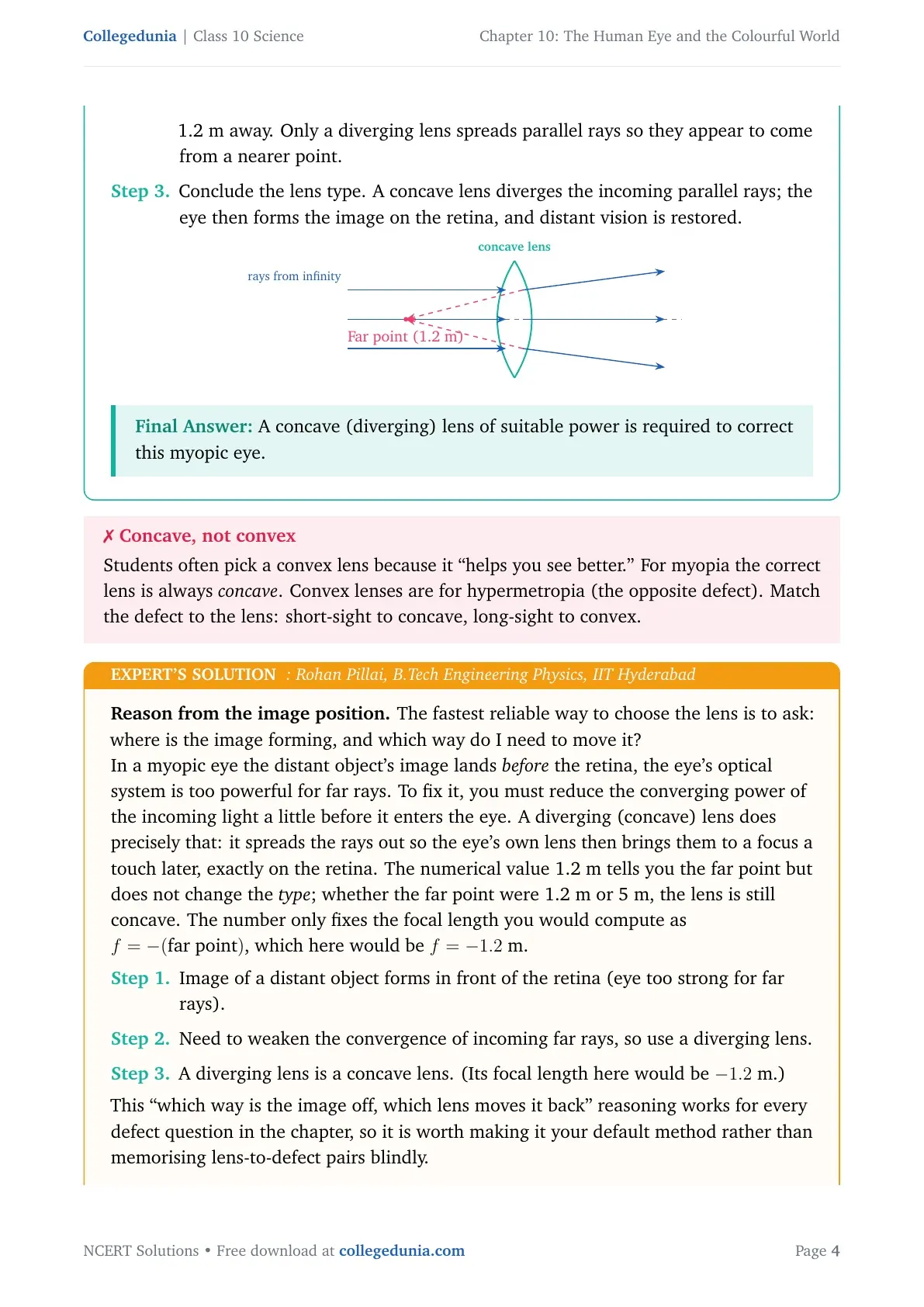
Myopia (short-sightedness) is the defect in which a person sees nearby objects clearly but distant objects appear blurred, because the far point has moved closer than infinity. Here the far point is only 1.2 m, so any object farther than 1.2 m is out of focus, with its image forming in front of the retina.
Identify the defect: clear near vision but blurred beyond 1.2 m means the far point is 1.2 m, which is myopia.
Decide what the lens must do: rays from a distant object must seem to come from 1.2 m, which only a diverging lens can do.
Conclude the lens type: a concave lens diverges the incoming rays, and the eye then forms the image on the retina.
Answer: A concave (diverging) lens of suitable power is required to correct this myopic eye.
RP
Rohan Pillai
M.Sc Physics, IIT Hyderabad
Verified Expert
The fastest reliable way to choose the lens is to ask where the image forms and which way it needs to move.
In a myopic eye the distant object's image lands in front of the retina, so the eye is too strong for far rays.
A diverging (concave) lens spreads the rays so the eye brings them to a focus a touch later, exactly on the retina.
The value 1.2 m only fixes the focal length, f = minus(far point) = minus 1.2 m; the lens type stays concave whatever the far point.
This "which way is the image off, which lens moves it back" reasoning works for every defect question, so make it your default method.
Answer: Concave lens (its focal length would be minus 1.2 m, a diverging lens).
Q 3
What is the far point and near point of the human eye with normal vision?
The near point is the closest distance at which the eye can see an object clearly and without strain; it is also called the least distance of distinct vision. The far point is the farthest distance up to which the eye can see clearly.
Near point: for a normal young adult it is about 25 cm. Closer than this, the lens cannot shorten its focal length any further, so the image blurs.
Far point: for a normal eye it is at infinity. The relaxed eye focuses parallel rays from very distant objects onto the retina.
Range of clear vision: a normal eye sees clearly from 25 cm all the way to infinity.
Answer: For a normal human eye, the near point is about 25 cm and the far point is at infinity.
SK
Sneha Kulkarni
M.Sc Applied Physics, University of Delhi
Verified Expert
The pair of values is easier to recall if you tie each to something you do every day.
Near point = 25 cm: the comfortable distance at which you hold a phone or a book to read.
Far point = infinity: what lets you read a distant billboard or look at the Moon without effort.
Clear-vision range: 25 cm to infinity, roughly a hand's reach out to the stars.
In the exam, state both the value and the term: "near point (least distance of distinct vision) = 25 cm" and "far point = infinity." The alternate name often earns the full mark.
Answer: Near point is about 25 cm; far point is at infinity for a normal eye.
Q 4
A student has difficulty reading the blackboard while sitting in the last row. What could be the defect the child is suffering from? How can it be corrected?
The blackboard is a distant object for a student in the last row, while the desk and book are nearby. Reading close work but not the far blackboard means distant vision is poor, which is myopia (short-sightedness), corrected with a concave (diverging) lens.
Identify the symptom: trouble seeing the far blackboard but not nearby work means distant vision is poor.
Name the defect: poor distant vision with good near vision is myopia; the image of a distant object forms in front of the retina.
Give the correction: a concave lens diverges the rays so the eye forms the image on the retina, making the board sharp.
Answer: The student suffers from myopia (short-sightedness); it is corrected by using a concave lens of suitable power.
KM
Karthik Menon
M.Sc Optics, B.Ed
Verified Expert
Exam questions hide the defect inside an everyday situation, so first translate it into "near" versus "far."
Sitting in the last row makes the blackboard a far object; the textbook on the desk is a near object.
Far blurry plus near clear is the textbook description of myopia.
Correct it with a concave (diverging) lens, which nudges the image back onto the retina.
Do not stop at naming myopia; the question asks "how can it be corrected," so also state the concave lens. Many students lose the second mark by forgetting the lens.
Answer: Defect: myopia (short-sightedness). Correction: a concave lens of suitable power.
Q 5
The human eye can focus on objects at different distances by adjusting the focal length of the eye lens. This is due to (a) presbyopia. (b) accommodation. (c) near-sightedness. (d) far-sightedness.
Adjusting the focal length of the eye lens to focus objects at different distances is the very definition of the power of accommodation. The other three options are all defects of vision, not the focusing ability itself.
The property described is a normal ability, not a fault.
Accommodation is the eye lens adjusting its focal length, which matches option (b).
Presbyopia, near-sightedness (myopia) and far-sightedness (hypermetropia) are all defects, so they are rejected.
Answer: Correct option: (b) accommodation.
AR
Aditi Rao
M.Sc Physics, B.Ed
Verified Expert
For a one-mark MCQ, the fastest route is to strike out every option that does not fit the description.
The statement praises a useful ability of the eye, not a problem.
Presbyopia, near-sightedness and far-sightedness are all problems with vision, so cross them out.
That leaves accommodation, which is precisely the name for the eye lens changing its focal length.
This "one ability among several defects" pattern is common in board MCQs; spotting the odd-one-out gives the answer in seconds.
Answer: Correct option: (b) accommodation.
Q 6
The human eye forms the image of an object at its (a) cornea. (b) iris. (c) pupil. (d) retina.
In the eye, the lens system forms a real, inverted image on a light-sensitive screen at the back of the eyeball. That screen is the retina, which holds the cells that send signals to the brain. The cornea, iris and pupil all handle light before it is focused.
Cornea: front bulge that does most of the refraction. Iris: coloured muscle that controls pupil size. Pupil: the opening that lets light in. Retina: the screen where the image is captured.
The image must fall on the light-sensitive screen, which is the retina.
So the retina (option d) is where the eye forms the image.
Answer: Correct option: (d) retina.
MI
Meera Iyer
M.Sc Biophysics, University of Hyderabad
Verified Expert
Sorting the eye's parts into two groups makes this MCQ quick.
The front parts (cornea, iris, pupil) control or bend incoming light before it is focused.
Only one part catches the focused image: the retina, lined with light-sensitive cells at the back.
So once you ask "which part is the screen, not the controller," the retina is the answer.
This front-controllers-versus-back-screen split is the same idea as a camera: lens at the front, sensor at the back.
Answer: Correct option: (d) retina.
Q 7
The least distance of distinct vision for a young adult with normal vision is about (a) 25 m. (b) 2.5 cm. (c) 25 cm. (d) 2.5 m.
The least distance of distinct vision (the near point) is the closest distance at which a normal eye can see an object clearly and comfortably. For a normal young adult this standard value is 25 cm.
The near point of a normal young eye is about 25 cm.
2.5 cm is far too close to focus; 25 m and 2.5 m are far away, not "least" distances.
Only 25 cm is sensible for a reading distance, so it is option (c).
Answer: Correct option: (c) 25 cm.
VN
Vivek Nair
M.Sc Physics, B.Ed
Verified Expert
A quick reality check beats memory for this MCQ; picture holding a book at each distance.
2.5 cm: the page would be pressed almost against your eye, far too close, so reject it.
2.5 m and 25 m: across the room or a field, nowhere near the least clear distance, so reject those.
25 cm: about a forearm length, exactly the comfortable reading distance, so accept it.
The trap here is the unit: 25 m and 2.5 m are written to tempt a careless reader. The near point must be in centimetres: 25 cm, not 25 m.
Answer: Correct option: (c) 25 cm.
Q 8
The change in focal length of an eye lens is caused by the action of the (a) pupil. (b) retina. (c) ciliary muscles. (d) iris.
The focal length of the eye lens changes when its curvature changes, and the curvature is controlled by the ciliary muscles that hold the lens. When these muscles contract or relax, the lens becomes thicker or thinner, which changes its focal length. This is the mechanism of accommodation.
Focal length depends on the curvature of the lens; squeeze the lens and the focal length changes.
The ciliary muscles attached to the lens change its curvature.
The pupil and iris only control how much light enters; the retina is the screen. None of them changes the lens shape.
Answer: Correct option: (c) ciliary muscles.
PJ
Pooja Joshi
M.Sc Physics, B.Ed
Verified Expert
Only one of the four options physically touches and reshapes the lens.
Focal length is set by how curved the lens is, so something must change the lens shape.
The pupil is a hole, the iris sizes that hole, and the retina is the screen, so none of them can squeeze the lens.
The ciliary muscles are attached to the lens and pull or relax to make it flatter or fatter, so they cause the change.
This is the mechanical half of accommodation; pairing it with the Q1 definition gives a complete picture of how the eye focuses.
Answer: Correct option: (c) ciliary muscles.
Q 9
A person needs a lens of power minus 5.5 dioptres for correcting his distant vision. For correcting his near vision he needs a lens of power plus 1.5 dioptre. What is the focal length of the lens required for correcting (i) distant vision, and (ii) near vision?
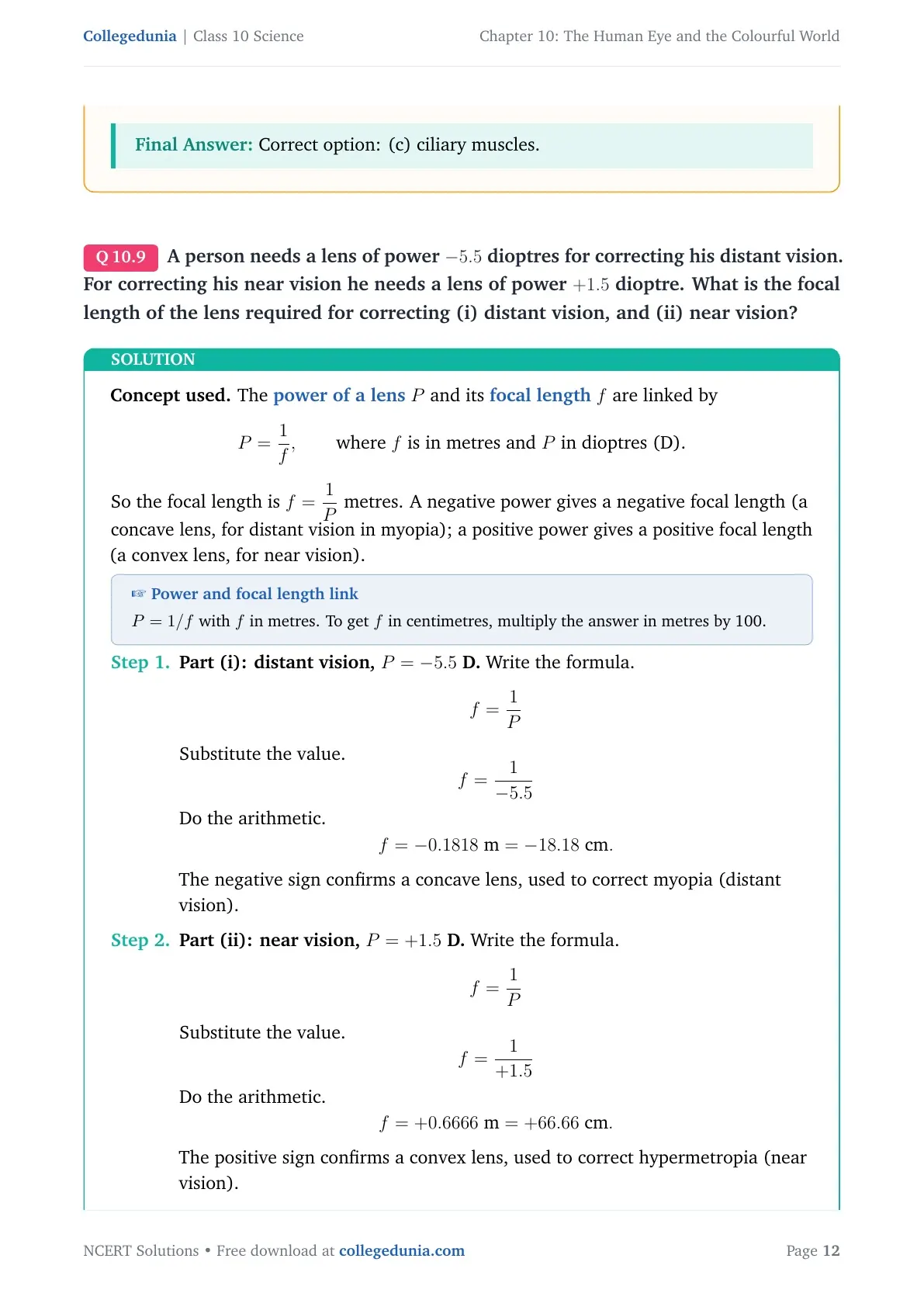
The power P and focal length f of a lens are linked by P = 1/f, where f is in metres and P in dioptres (D). So f = 1/P. A negative power gives a concave lens (distant vision in myopia); a positive power gives a convex lens (near vision).
Part (i): distant vision, P = minus 5.5 D. f = 1/P = 1/(minus 5.5) = minus 0.1818 m = minus 18.18 cm. The minus sign confirms a concave lens.
Part (ii): near vision, P = plus 1.5 D. f = 1/P = 1/(plus 1.5) = plus 0.6666 m = plus 66.66 cm. The plus sign confirms a convex lens.
Answer: (i) Distant vision: f = minus 18.18 cm (concave lens). (ii) Near vision: f = plus 66.66 cm (convex lens).
HS
Harshvardhan Singh
M.Tech Optical Engineering, IIT Delhi
Verified Expert
The smartest first move is to note what each sign already tells you, then compute the magnitude.
P = minus 5.5 D is negative, so the lens is concave (distant-vision lens): f = 1/(minus 5.5) = minus 18.18 cm.
P = plus 1.5 D is positive, so the lens is convex (near-vision lens): f = 1/(1.5) = plus 66.67 cm.
Notice the small power (1.5 D) gives the long focal length and the large power (5.5 D) the short one, since f and P are reciprocals.
Carrying the sign through is what most marks hinge on; converting to centimetres at the end makes the answer easier to compare with real lens markings.
Answer: (i) f = minus 18.18 cm (concave). (ii) f = plus 66.67 cm (convex).
Q 10
The far point of a myopic person is 80 cm in front of the eye. What is the nature and power of the lens required to correct the problem?
For a myopic eye, the far point has come closer than infinity. To correct it, a concave lens is chosen whose focal length makes rays from a very distant object appear to come from the eye's own far point, so f = minus(far point), and the power is P = 1/f with f in metres.
State the nature: myopia is always corrected with a concave (diverging) lens.
Find the focal length: f = minus(far point) = minus 80 cm = minus 0.8 m.
Find the power: P = 1/f = 1/(minus 0.8) = minus 1.25 D.
Answer: A concave lens of focal length minus 0.8 m and power minus 1.25 D is required.
NB
Nikhil Bhatt
M.Sc Physics, B.Ed
Verified Expert
The clean way to see why f = minus(far point) is to use the lens job directly.
Object at infinity, virtual image at the far point: u = infinity, v = minus 80 cm.
Lens formula: 1/f = 1/v minus 1/u = minus 1/80 minus 0, so f = minus 80 cm = minus 0.8 m.
Power: P = 1/f = 1/(minus 0.8) = minus 1.25 D, and the negative power confirms a concave lens.
Deriving f from the lens formula, instead of just quoting f = minus(far point), is the safer habit because the same method handles trickier cases.
Answer: Concave lens, f = minus 0.8 m, P = minus 1.25 D.
Q 11
Make a diagram to show how hypermetropia is corrected. The near point of a hypermetropic eye is 1 m. What is the power of the lens required to correct this defect? Assume that the near point of the normal eye is 25 cm.
Hypermetropia (far-sightedness) is corrected with a convex (converging) lens. The lens takes an object at the normal near point (25 cm) and forms a virtual image at the eye's own near point (1 m), so the eye can then see it. Using the lens formula with u = minus 25 cm and v = minus 100 cm gives f, and then P = 1/f.
State the lens: hypermetropia needs a convex (converging) lens.
Apply the sign convention: u = minus 25 cm, v = minus 100 cm.
Lens formula: 1/f = 1/v minus 1/u = minus 1/100 plus 1/25 = 3/100, so f = 100/3 = 33.3 cm = 0.333 m.
Power: P = 1/f = 1/0.333 = plus 3.0 D.
Answer: A convex lens of focal length plus 0.333 m and power plus 3.0 D corrects this hypermetropic eye.
IG
Ishaan Gupta
M.Sc Physics, IIT Bombay
Verified Expert
The neat idea behind hypermetropia correction is that the convex lens shifts a comfortably-placed object to where the weak eye can actually focus it.
The eye cannot focus closer than 1 m, but we want reading at the normal 25 cm.
A convex lens forms the virtual image of the 25 cm object at 1 m: u = minus 25 cm, v = minus 100 cm.
1/f = minus 1/100 plus 1/25 = 3/100, so f = 0.333 m and P = plus 3.0 D.
The recurring trick in all hypermetropia problems is "object at 25 cm, image at the defective near point." The positive answer is the built-in check that a converging lens must have positive power.
Answer: Convex lens, f = 0.333 m, P = plus 3.0 D.
Q 12
Why is a normal eye not able to see clearly the objects placed closer than 25 cm?
To focus a very close object, the eye lens must become highly curved so its focal length drops to a small value. The curvature is set by the ciliary muscles, and these muscles can contract only up to a limit. So the focal length cannot fall below a minimum, and 25 cm is the closest distance at which the image still lands on the retina.
A closer object sends more strongly diverging rays, so the lens must become more curved (shorter focal length).
The ciliary muscles can contract only so much, so the focal length has a minimum value.
Closer than 25 cm, the required focal length is below this limit, the image forms behind the retina, and the object looks blurred.
Answer: Because the ciliary muscles cannot contract beyond a limit, the eye lens cannot shorten its focal length enough to focus objects nearer than 25 cm, so they appear blurred.
TS
Tanvi Sharma
M.Sc Physics, B.Ed
Verified Expert
The clearest way to explain the 25 cm limit is to imagine slowly bringing an object closer and watching the lens work harder.
As the object approaches, the ciliary muscles squeeze the lens fatter to keep shortening the focal length.
But muscles cannot contract without end; at about 25 cm they reach maximum contraction.
Any closer, and the lens cannot bend the rays enough, so the image forms behind the retina and blurs.
The marks lie in linking the blur to "focal length cannot decrease below a limit" rather than vaguely saying "the eye is weak."
Answer: The lens cannot curve enough (focal length cannot fall below a limit set by the ciliary muscles), so objects closer than 25 cm cannot be focused on the retina.
Q 13
What happens to the image distance in the eye when we increase the distance of an object from the eye?
In the eye, the distance between the lens and the retina is fixed; the retina is always where the sharp image must form. So the image distance does not change when the object moves. Instead, the eye changes the focal length of its lens (by accommodation) to keep the image on the retina.
The retina sits at a fixed distance behind the eye lens, so the image distance is always the same value.
As the object moves farther away, its rays become more nearly parallel, so the eye lens increases its focal length.
The image distance stays constant; only the focal length of the eye lens increases.
Answer: The image distance does not change; it stays fixed (the image always forms on the retina). The eye instead increases the focal length of its lens to keep the image sharp.
AReddy
Aarav Reddy
M.Sc Physics, B.Ed
Verified Expert
The trick to this conceptual question is to remember which quantity in the eye is allowed to vary.
The eye cannot move its screen; the retina is locked in place, so the image distance is fixed.
A farther object sends more parallel rays.
The eye lens lengthens its focal length (the ciliary muscles relax) to keep the image on the retina.
On an optical bench you would move the screen and the image distance would change; the eye is different, so do not apply bench-lens behaviour to it.
Answer: Image distance stays constant (the image always lands on the retina); the eye lens increases its focal length.
Q 14
Why do stars twinkle?
The twinkling of stars is caused by atmospheric refraction of starlight. The atmosphere has layers of air with gradually changing density and hence changing refractive index. As starlight passes through these layers it bends again and again. Because a star is so far away it acts as a point source, so small changes in refraction shift its apparent position and brightness.
Starlight enters air whose density and refractive index increase towards the surface.
The light bends a little at each layer, so the star's apparent position differs from its true position.
The air keeps moving, so the bending changes from moment to moment, making the star brighter then fainter; this is the twinkling.
Answer: Stars twinkle because of atmospheric refraction: starlight bends as it passes through air layers of constantly changing refractive index, so the star's brightness and apparent position keep fluctuating.
DN
Devika Nambiar
M.Sc Astrophysics, B.Ed
Verified Expert
The vivid way to understand twinkling is to track a single ray of starlight diving through the atmosphere.
Starlight bends through atmospheric layers of changing refractive index, like light easing through stacked sheets of slightly different glass.
The star, being a point source, has its apparent position and brightness shift with every change.
Restless, ever-changing air makes the brightness rise and fall, which we see as twinkling.
Tying the effect firmly to "point source" sets up the next question, which asks why planets, being extended sources, do not twinkle.
Answer: Atmospheric refraction through ever-changing air layers makes a star (a point source) shift in apparent position and brightness, producing twinkling.
Q 15
Explain why the planets do not twinkle.
A planet does not twinkle because it is much closer to the Earth than a star and so appears as an extended source of light, not a point source. An extended source can be treated as many point sources spread over its disc. The flickering of each point varies randomly, so when added up the total light stays almost steady.
A star is so far that it is a point source; a planet is near enough to be seen as a small disc, an extended source.
Treat the disc as many point sources, each twinkling slightly due to atmospheric refraction.
At any instant some points brighten while others dim, so the changes cancel and the total brightness is nearly constant.
Answer: Planets are nearby and seen as extended sources (many point sources). The twinkling of all those points averages out to a steady total brightness, so planets do not twinkle.
MA
Manish Agarwal
M.Sc Physics, B.Ed
Verified Expert
The cleanest explanation uses the idea of averaging over a disc.
A planet is close, so we see a tiny disc rather than a single point: an extended source.
Picture the disc as thousands of point sources, each twinkling on its own but out of step with the others.
Add up all those out-of-step changes and they nearly cancel, so the planet's brightness barely wavers.
The takeaway: twinkling needs a point source, so anything large enough to show a disc (planets, the Moon) will not twinkle.
Answer: A planet is an extended source whose many point-sources' flickers average out to constant brightness, so it does not twinkle.
Q 16
Why does the sky appear dark instead of blue to an astronaut?
The sky looks blue because tiny air molecules scatter the shorter (blue) wavelengths of sunlight much more than the longer (red) ones, and this scattered blue light reaches our eyes from all directions. This needs an atmosphere. At the great height where an astronaut travels, there is almost no air, so there are no particles to scatter sunlight, and the sky appears dark.
From the ground, air molecules scatter blue light far more strongly than red, filling the sky with scattered blue.
Very high up there is almost no atmosphere, hence no molecules to scatter sunlight.
With no scattering, no light reaches the astronaut's eye from the surroundings, so the sky looks dark instead of blue.
Answer: High above the Earth there is almost no air, so sunlight is not scattered. With no scattered light reaching the eye from the surroundings, the sky appears dark to an astronaut instead of blue.
SB
Shreya Banerjee
M.Sc Physics, B.Ed
Verified Expert
The way to settle this answer is to ask what the blue sky needs, and then notice it is missing up there.
A blue sky needs air molecules to scatter short-wavelength (blue) light toward the eye.
At high altitude the atmosphere is almost absent, so there is nothing to scatter the light.
No scattered light from the surroundings means the sky looks dark.
The same "no atmosphere, no scattering" logic explains why the sky on the Moon is black even in broad daylight.
Answer: With almost no atmosphere at high altitude, sunlight is not scattered, so no light reaches the astronaut from the surrounding sky and it appears dark.
NCERT Solutions Class 10 Science Chapter 10 The Human Eye and the Colourful World FAQs
Ques. How many questions are there in NCERT Class 10 Science Chapter 10 The Human Eye and the Colourful World?
Ans. There are 16 questions in NCERT Class 10 Science Chapter 10 The Human Eye and the Colourful World: 4 in-text questions in the box inside the chapter and 12 end-of-chapter exercise questions. All 16 are solved with a step-by-step Check Solution and an Expert Solution. The set includes four MCQs, two numerical questions on lens power and the far point, and reason-based questions on accommodation, eye defects, twinkling of stars and the blue sky.
Ques. What is the power of accommodation of the eye?
Ans. The power of accommodation is the ability of the eye lens to change its own focal length so that objects at different distances are all focused sharply on the retina. The eye lens is held by the ciliary muscles. When these muscles contract, the lens becomes thick and its focal length decreases, so near objects are focused; when they relax, the lens becomes thin and its focal length increases, so distant objects are focused. The full board answer names both the focal length and the ciliary muscles.
Ques. Which lens is used to correct myopia and which lens corrects hypermetropia?
Ans. Myopia, or short-sightedness, is corrected with a concave (diverging) lens, because in a myopic eye the image of a distant object forms in front of the retina and a concave lens diverges the rays so the image moves back onto the retina. Hypermetropia, or long-sightedness, is corrected with a convex (converging) lens, because in a hypermetropic eye the image of a near object forms behind the retina and a convex lens converges the rays so the image moves forward onto the retina. The easy rule is far blurry to concave, near blurry to convex.
Ques. What is the near point and far point of a normal human eye?
Ans. The near point is the closest distance at which the eye can see an object clearly and without strain, and for a normal young eye it is about 25 cm. It is also called the least distance of distinct vision. The far point is the farthest distance up to which the eye can see clearly, and for a normal eye it is at infinity. So a normal eye sees objects clearly from 25 cm all the way to infinity, which is its full range of clear vision.
Ques. Why do stars twinkle but planets do not?
Ans. Stars twinkle because of atmospheric refraction. A star is so far away that it acts as a point source of light, and as its light passes through air layers of constantly changing refractive index, the bending keeps changing, so the star's apparent position and brightness fluctuate. Planets do not twinkle because they are much closer and appear as extended sources, that is, as a collection of many point sources. The flickering of these many points is out of step and averages out, so the total brightness of a planet stays nearly steady.
Ques. Why does the sky appear blue and why does it look dark to an astronaut?
Ans. The sky appears blue because tiny air molecules scatter the shorter (blue) wavelengths of sunlight much more strongly than the longer (red) ones, and this scattered blue light reaches our eyes from every direction. This effect needs an atmosphere. An astronaut at a great height is above almost all of the atmosphere, so there are very few molecules to scatter sunlight. With no scattered light coming from the surroundings, the sky appears dark instead of blue. The same reasoning explains why the sky on the Moon is black even in daylight.
Ques. How many pages is the Class 10 Science The Human Eye and the Colourful World NCERT Solutions PDF?
Ans. The The Human Eye and the Colourful World NCERT Solutions PDF covers all 16 questions (4 in-text and 12 exercise) with step-by-step Check Solutions, labelled ray diagrams of myopia and hypermetropia correction, full sign-convention working on the lens power problems, and an Expert Solution for each question. It is free to download for the 2026-27 session and is built for the CBSE Class 10 board exam.
Ques. Is the NCERT Solutions for Class 10 Science Chapter 10 aligned with the 2026-27 syllabus?
Ans. Yes. This page reflects the current 2026-27 CBSE syllabus for Class 10 Science. Every answer follows the NCERT textbook flow for The Human Eye and the Colourful World, covering the structure of the eye and power of accommodation, the defects of vision and their correction, the power of a lens, dispersion of white light through a prism, atmospheric refraction and scattering of light. The solutions are written in plain English for board exam students and are useful for both the CBSE board exam and school unit tests.








Comments