Physics Strategist, JEE/NEET | Updated on - Jul 23, 2026
Chapter 10 The Human Eye and the Colourful World is one of the most scoring physics chapters of Class 10 Science for 2026-27, blending the optics of the eye with the colours of the sky. The Class 10 Science Chapter 10 The Human Eye and the Colourful World NCERT Exemplar Solutions on this page solve every Exemplar problem step by step, in plain language a board student can follow.
CBSE Board weightage: this chapter sits in the Light unit, and eye defects, dispersion and scattering are repeat favourites in the Board paper.
What you get: all MCQ, Short Answer and Long Answer problems solved, with labelled ray diagrams and a free downloadable PDF.
Student Feedback: In a Collegedunia survey of 1,310 Class 10 students, 79% said eye defects and the scattering of light were the two topics they lost most marks on in Chapter 10, the exact gaps these Exemplar Solutions target.
Solved by Collegedunia: Every problem below is solved by subject experts, mapped to the 2026-27 NCERT Exemplar, and checked against the CBSE Board marking scheme.
Why the NCERT Exemplar Matters for Class 10 Board Preparation
The Human Eye and the Colourful World is a chapter where students slip on reasoning, not memory. The NCERT Exemplar turns the basics into exam-style questions: read-the-symptom defect MCQs, lens-power numericals, ray diagrams for myopia and hypermetropia, and reasoning on why the sky is blue and the sunset is red.
A large share of board questions on this chapter mirror an Exemplar problem in shape, not the plain textbook example.
Quick Tip: Solve the NCERT textbook exercises first, then the Exemplar. The Exemplar assumes you already know the lens formula and lens power from Chapter 9.
The Human Eye and the Colourful World Class 10 Video Solutions
How Collegedunia's NCERT Exemplar Solutions Help You with the Human Eye
Each problem is solved the way a CBSE Board examiner expects: defect named, lens chosen, sign of the power shown, ray diagram drawn step by step.
Every question type solved: all MCQ, Short Answer and Long Answer Exemplar problems are worked out.
2026-27 Exemplar alignment: problem numbers and answers match the current edition.
Step-by-step reasoning: each numerical builds the lens-power formula one line at a time, and each defect question shows where the image lands relative to the retina.
Best Way to Use the Human Eye Exemplar for Board Revision
Treat the Exemplar as a practice paper. The plan below fits the optics revision window before your pre-boards.
Phase
Exemplar Use
Time
First read
All MCQs on defects, dispersion and scattering
1 hour
Concept practice
Lens-power numericals and ray diagrams for myopia and hypermetropia
1.5 hours
Answer writing
All Long Answers on accommodation, prism and atmospheric refraction
2 hours
Pre-board revision
Re-solve the wrong ones
1 hour
Spend the most time on eye defects and the scattering of light, which carry the bulk of the marks.
Human Eye Exemplar Question Types with One Solved Sample Each
The Exemplar mixes several question formats. The table below previews the shape of each; the full solved set sits further down this page.
Type
Sample Question
Answer Shape
MCQ
A person cannot see beyond 2 m. Which lens power corrects it?
Single option, with reason
MCQ (reasoning)
At noon the Sun appears white because...
Pick the cause and justify
Short Answer
Draw ray diagrams for a myopic and a hypermetropic eye
Two labelled ray diagrams
Numerical
Find the power of the correcting lens from the far point
Formula, substitution, answer in dioptre
Long Answer
Explain why the sky is blue and the sunset is red
Several linked points using scattering
Every one is solved in full in the question bank below, with Check Solution and Expert Solution tabs.
Eye Defects and Their Correction Made Simple
Most Exemplar problems test whether you can name a defect from its symptom and pick the right lens. A myopic eye sees near objects clearly but not far ones; a hypermetropic eye is the opposite.
Myopia (short-sight): far point comes closer, distant objects blur. Corrected by a concave lens with negative power; its focal length equals the far-point distance, made negative.
Hypermetropia (long-sight): near point recedes, nearby objects blur. Corrected by a convex lens with positive power.
Presbyopia: the near point recedes with age as the ciliary muscles weaken, often needing a bifocal lens.
For a defective eye, decide the sign of the power first, then use P = 1/f with f in metres. Remember: image short of the retina is myopia, image past the retina is hypermetropia.
Dispersion, Scattering and the Colours of the Sky
The second half of the chapter is built on two ideas: dispersion by a prism and the scattering of light by air. The table below ties each everyday colour effect to the phenomenon behind it.
What you see
Phenomenon
Why
Seven colours from a prism
Dispersion
Violet bends most, red least
Blue sky
Scattering
Short blue wavelengths scatter most
Red sunrise and sunset
Scattering over a long path
Blue is scattered away, red survives
White noon Sun
Least scattering
Short overhead path keeps all colours
Twinkling stars
Atmospheric refraction
Air layers of varying refractive index
Rainbow
Refraction, dispersion, internal reflection
Each raindrop acts like a tiny prism
Scattering follows Rayleigh's rule, intensity ∝ 1/λ4, so the colour with the shortest wavelength scatters the most. For a prism, the angle of deviation is D = (i + e) − A, smallest for red and largest for violet.
Topics Covered in Class 10 Science Chapter 10 Human Eye Exemplar
The Exemplar spans: MCQs on the power of accommodation, the near and far point, myopia and hypermetropia; Short Answers on ray diagrams for defective eyes and dispersion through a prism; and Long Answers on the scattering of light, the blue sky, the red sunset, the white noon Sun, twinkling stars and the Tyndall effect.
Human Eye Exemplar Common Mistakes That Cost Marks
The Exemplar twists trigger the same wrong reflexes every year.
Swapping the two defects. Myopia means near is clear and far is blurred; hypermetropia is the opposite.
Forgetting the negative sign. A concave lens for myopia has negative focal length and power. Dropping the minus sign loses the mark.
Saying the sky is blue because blue is absorbed. Blue is scattered, not absorbed.
Writing total internal reflection for a rainbow. The back-surface bounce is an ordinary internal reflection, not necessarily total.
Watch Out: In a ray-diagram question, the examiner's key checkpoint is where the rays meet relative to the retina. Place that focus dot correctly and label the retina before anything else.
Power, Focal Length and Lens Sign Quick Reference
Many Exemplar numericals ask you to read off the lens power from a defect. Keep this table in your head before you start.
Defect
Lens needed
Sign of power
Focal length rule
Myopia
Concave (diverging)
Negative
f = minus far-point distance
Hypermetropia
Convex (converging)
Positive
f set to bring near point to 25 cm
Normal eye
None
NA
Near point 25 cm, far point infinity
Power is the reciprocal of focal length in metres, P = 1/f, in dioptre. A handy phrase: minus is myopia, plus is hypermetropia.
Most Repeated Board Topics from the Human Eye Chapter
The topics that show up most often in CBSE Board and sample papers for this chapter.
Topic
How it is asked
Eye defects
Name the defect and the corrective lens, with a ray diagram
Lens power
Find the power in dioptre from the far or near point
Power of accommodation
Explain how the ciliary muscles change focal length
Scattering of light
Explain the blue sky, red sunset and white noon Sun
Dispersion and prism
State the colour order and the angle of deviation
Atmospheric refraction
Explain twinkling stars and the apparent flattening of the Sun
All NCERT Exemplar Questions for the Human Eye with Step-by-Step Solutions
Every question of the NCERT Exemplar set for Class 10 Science Chapter 10 The Human Eye and the Colourful World is listed below with its full Solution and Expert Solution inside collapsible tabs. Click Check Solution to reveal the step-by-step working; click Expert Solution for the expanded explanation.
I. Multiple Choice Questions
Q 10.1
A person cannot see distinctly objects kept beyond 2 m. This defect can be corrected by using a lens of power
(a) + 0.5 D
(b) - 0.5 D
(c) + 0.2 D
(d) - 0.2 D
Correct option: (b)- 0.5 D.
Concept used. A person who cannot see objects beyond a fixed
distance is myopic (near-sighted). The far point of a normal
eye is infinity, but here it has shrunk to 2 m. To correct myopia we
place a concave (diverging) lens that throws the image of a
very distant object exactly at the eye's own far point. So the
corrective lens must have a focal length equal to the far point
distance, taken negative for a concave lens:
f = - (far point) .
Lens power is the reciprocal of focal length in metres,
P = 1f, measured in dioptre (D).
Identify the far point as the new focal length needed:
f = - 2 m.
It is negative because a concave lens diverges light.
Substitute into the power formula:
P = 1f = 1-2 m.
Do the arithmetic:
P = - 0.5 D.
The minus sign confirms a concave lens, matching myopia.
Sign of the lens tells the defect
A negative power means a concave lens, which corrects
myopia. A positive power means a convex lens, which
corrects hypermetropia.
Option (b): a concave lens of power - 0.5 D.
RM
Rohan Mehta
M.Sc Physics, IIT Bombay
Verified Expert
Strategic angle (read the sign first). In an MCQ on defect
correction, decide the sign before you touch the number. The
clue word is ``cannot see beyond'', which is myopia, which always
needs a concave lens, which always has negative power. That alone
kills options (a) and (c). Now only the magnitude is left.
Concept used. For a myopic eye the corrective concave lens
must form the image of an object at infinity at the eye's far point.
Its focal length therefore equals the far-point distance, signed
negative. Power follows from P = 1/f with f in metres.
Fix the focal length. Far point =2 m, so
f = -2 m. Working in metres is essential because dioptre is
defined per metre.
Compute the power.P = 1f = 1-2 = - 0.5 D.
Cross-check magnitude. A far point of 2 m is only a
mild defect, so a small power like 0.5 D is reasonable;
0.2 D would suit a 5 m far point, which is not the case.
Why this matters. Spectacle prescriptions are written in
dioptre. Reading -0.5 D on a slip instantly tells students the
wearer is mildly short-sighted, before any eye chart is seen.
P = 1/(-2) = - 0.5 D, a concave lens. Option (b).
Q 10.2
A student sitting on the last bench can read the letters written on the blackboard but is not able to read the letters written in his text book. Which of the following statements is correct?
(a) The near point of his eyes has receded away
(b) The near point of his eyes has come closer to him
(c) The far point of his eyes has come closer to him
(d) The far point of his eyes has receded away
Correct option: (a) The near point of his eyes has receded
away.
Concept used. The near point is the closest point
the eye can focus clearly; for a normal young eye it is about
25 cm. The far point is the farthest point seen clearly,
normally infinity. Reading a textbook is a near task; reading
the distant blackboard is a far task. So the symptom tells us
which point has shifted.
Note that the distant blackboard is seen clearly, so the far
point is still fine (still at infinity). This rules out
options (c) and (d).
Note that the nearby textbook is blurred, so the closest
clear-focus distance has moved outward, beyond the
normal 25 cm. The near point has receded.
Recognise the defect: a near point pushed away is
hypermetropia (long-sightedness), corrected by a
convex lens. This matches option (a).
Match the blurred distance to the point
Blurred near object ⇒ problem with the near point.
Blurred distant object ⇒ problem with the far
point. The clear object tells you what is still healthy.
Option (a): the near point has receded (moved
away), so near objects blur, that is hypermetropia.
AI
Ananya Iyer
M.Sc Physics, IISER Pune
Verified Expert
Strategic angle (sort by which object blurs). Two facts are
handed to you: distant = clear, near = blurred. Pair each fact with a
point. Distant clear locks the far point as normal; near blurred moves
the near point. Only one option says exactly that.
Concept used. Hypermetropia means the near point has moved
farther than the standard 25 cm, so light from a close object would
focus behind the retina. Distance vision stays sharp because the far
point is unaffected.
Eliminate by the healthy direction. Clear blackboard
⇒ far point unchanged ⇒ drop (c) and
(d).
Decide the direction of the bad shift. A near object
now needs to be held farther to be seen, so the near point has
receded, not come closer. Drop (b).
Name it. Receded near point = hypermetropia, fixed
with a converging (convex) lens.
Why this matters. This is exactly why many adults hold a book
at arm's length before getting reading glasses, a daily sign of the
near point creeping outward.
Near point receded ⇒ option (a), the
hypermetropia symptom.
Q 10.3
A prism ABC (with BC as base) is placed in different orientations. A narrow beam of white light is incident on the prism as shown in Fig. 11.1. In which of the following cases, after dispersion, the third colour from the top corresponds to the colour of the sky?
(a) (i)
(b) (ii)
(c) (iii)
(d) (iv)
Fig. 11.1 The same prism ABC shown in four orientations (i)–(iv); a narrow white beam strikes one refracting face in each case.
Correct option: (b) orientation (ii).
Concept used. When white light passes through a prism it
splits into seven colours, an effect called dispersion. The
angle of deviation is largest for violet and smallest for
red, because violet bends most. So inside the spread spectrum, violet
always lies nearest the base of the prism and red nearest the apex.
The colour of a clear daytime sky is blue, the third colour
counting from the red end (red, orange, then yellow no, the
order from the apex/red side is red, orange, yellow, green, blue,
indigo, violet). Reading the seven colours from the top of the patch
downward, the third colour from the top must come out blue.
Recall the spectrum order by bending: red bends least, violet
bends most. So the colours fan out from red (least deviated,
toward the apex) to violet (most deviated, toward the base).
For the patch on the screen, decide which end is ``top''. We
need the colour that is third from the top to be blue, the
colour of the sky.
Test orientation (ii): the prism is inverted, apex A pointing
down and base CB on top, with light entering the upper-left
face. Geometry of this orientation places the dispersed band
so that counting from the top gives violet, indigo, then
blue as the third colour, which is the sky colour.
The other orientations (i), (iii), (iv) put a different colour
in the third-from-top slot, so they fail the condition. Hence
(ii) is correct.
VIBGYOR vs the bending order
Listed by wavelength, violet to red is VIBGYOR. Listed by how
much a prism bends them, violet deviates most and red least, so
on the screen violet ends up nearest the base.
Option (b): in orientation (ii) the third colour
from the top is blue, the colour of the sky.
VN
Vikram Nair
M.Sc Physics, University of Delhi
Verified Expert
Strategic angle (fix the sky colour, then count). Do not try
to trace all seven rays. Anchor on one fact: sky colour is blue, and
blue sits between green and violet in the deviation order. The
question wants blue to land third from the top, so I only check where
``third from top'' equals blue in each picture.
Concept used. A prism deviates violet most and red least
(dispersion). On the emerging fan, red is on the low-deviation side
and violet on the high-deviation side; blue lies two colours in from
the violet end. ``Top'' is defined by the printed orientation of each
prism.
Place the extremes. For each orientation mark which
screen edge is red (least bent) and which is violet (most
bent).
Count three from the top. From the violet/top side
the sequence is violet, indigo, blue. So the third-from-top
colour is blue only when the violet end is the top edge
of the patch.
Match the geometry. The inverted prism in (ii)
sends the violet end to the top of the patch, making blue the
third colour down. Orientations (i), (iii) and (iv) put a
different colour in the third-from-top slot, so they fail.
Why this matters. The same ``count the colour'' reasoning
explains why the inner edge of a primary rainbow is violet and the
outer edge red, a direct payoff of knowing the deviation order. Once
you can place the colours in a prism, you can place them in a raindrop
too, which is just a tiny prism.
Blue is third from the top only in orientation (ii), so the
answer is option (b).
Q 10.4
At noon the Sun appears white as
(a) light is least scattered
(b) all the colours of the white light are scattered away
(c) blue colour is scattered the most
(d) red colour is scattered the most
Correct option: (a) light is least scattered.
Concept used.Scattering of light by air molecules
follows Rayleigh's rule: the amount scattered is inversely proportional
to the fourth power of wavelength,
scattering ∝ 1λ4. The depth of
atmosphere the sunlight crosses decides how much scattering happens.
At noon the Sun is overhead, so its light travels the
shortest path through the atmosphere.
Compare path lengths: at noon the Sun is nearly overhead, so
light passes through the least thickness of air. At sunrise or
sunset it skims through a much thicker slab.
Apply the scattering idea: a short path means very little of
any colour is scattered away, so nearly all seven colours
reach the eye together.
Combine the colours: red + orange + + violet
recombine into white. Therefore the noon Sun looks white.
Path length is the hidden variable
The Sun's colour question is really a ``how much air?'' question.
Short path (noon) → white; long path (sunrise/sunset) → red.
Option (a): at noon the short atmospheric path
scatters light the least, so all colours arrive and the Sun looks
white.
PD
Priya Deshmukh
M.Sc Physics, IIT Madras
Verified Expert
Strategic angle (white means all colours survive). White is
the sum of every colour. So the correct option must be the one where
nothing is removed. Only ``least scattered'' keeps all colours
intact; the others remove some colour and could not give white.
Concept used. Rayleigh scattering removes short wavelengths
most. Over a short overhead path the loss is tiny for every colour, so
the beam stays close to the original white of sunlight.
Logic check on the options. If colours were
``scattered away'' (b) the Sun would dim, not stay white. If
blue (c) or red (d) alone were lost, the Sun would look
tinted, not white. Only (a) preserves white.
Physical reason. Overhead Sun = minimum air column
= minimum scattering for all λ.
Why this matters. The same path-length logic, run in reverse,
is the entire explanation for red sunsets, so getting it right here
sets up several later questions in this chapter.
Least scattering keeps all colours, giving white: option (a).
Q 10.5
Which of the following phenomena of light are involved in the formation of a rainbow?
(a) Reflection, refraction and dispersion
(b) Refraction, dispersion and total internal reflection
(c) Refraction, dispersion and internal reflection
(d) Dispersion, scattering and total internal reflection
Correct option: (c) Refraction, dispersion and internal
reflection.
Concept used. A rainbow forms when sunlight meets tiny
water droplets in the air after rain. Each droplet acts like
a small prism and does three things in turn: it refracts
(bends) the light entering it, disperses the white light into
colours, and then reflects the light once off the back inside surface
of the drop before refracting it out again.
Entry: sunlight refracts as it enters the droplet, bending and
beginning to split by colour.
Inside: the light hits the far inner wall of the drop and
undergoes internal reflection, turning back toward
the observer.
Exit: the light refracts again as it leaves, completing the
dispersion so the colours spread into the familiar arc.
Identify the trio: refraction, dispersion and internal
reflection. The textbook does not require the reflection to be
total, so option (c), not (b), is correct.
``Total'' internal reflection is the trap
Options (b) and (d) say total internal reflection. In a
raindrop the back-surface reflection is an ordinary internal
reflection, not necessarily total, so they are wrong. Choose plain
``internal reflection''.
Option (c): refraction, dispersion and internal
reflection together form a rainbow.
KR
Karthik Reddy
M.Sc Physics, IIT Kharagpur
Verified Expert
Strategic angle (spot the word ``total''). Three of the four
options look similar; the deciding word is ``total''. Recall that the
back-reflection in a raindrop is a normal internal reflection, then
the only matching option is the one without ``total''.
Concept used. Refraction bends and splits the entering ray
(that split is dispersion), an internal reflection at the rear wall
sends it back, and a second refraction on exit fans out the spectrum.
List the must-haves. Bending in and out (refraction),
colour split (dispersion), and a bounce inside (internal
reflection). Every correct option must contain all three.
Cut the impostors. (a) omits the internal bounce;
(b) and (d) over-claim ``total'' reflection. (c) names all
three correctly.
Why this matters. Knowing it is one internal reflection
explains why the primary rainbow is the brightest; a second, fainter
bow comes from two internal reflections with the colours
reversed.
Twinkling of stars is due to atmospheric
(a) dispersion of light by water droplets
(b) refraction of light by different layers of varying refractive indices
(c) scattering of light by dust particles
(d) internal reflection of light by clouds
Correct option: (b) refraction of light by different layers
of varying refractive indices.
Concept used.Atmospheric refraction is the bending
of light as it passes through air whose density, and therefore
refractive index, keeps changing with height and
temperature. Because the air is not still, these layers shift, so the
apparent position and brightness of a star keep changing slightly.
Starlight enters the atmosphere and crosses many layers of
gradually changing refractive index.
Each layer bends the ray a little, and since the layers are
constantly moving, the amount of bending fluctuates.
The star's apparent position and the amount of light reaching
the eye therefore wobble, which we see as
twinkling.
Stars wink, planets do not
Stars are point sources, so the fluctuation shows up sharply. Planets
are nearer and look like tiny discs, so the wobbles average out and
they shine steadily.
Option (b): twinkling is caused by atmospheric
refraction through layers of varying refractive index.
SK
Sneha Kulkarni
M.Sc Physics, IISER Kolkata
Verified Expert
Strategic angle (twinkle = bending, not scattering). Twinkle
is a change in direction and brightness, which is a refraction
signature. Scattering would dim or colour the light, not make it
flicker. So the refraction option wins immediately.
Concept used. The atmosphere is a stack of layers with
slowly varying refractive index. Continuous, fluctuating refraction
through these moving layers steers starlight slightly off and on the
line of sight.
Reject droplet and dust options. (a) needs rain
droplets, (c) needs heavy dust, (d) needs clouds; none is
required on a clear starry night, when twinkling is most
obvious.
Confirm refraction. Only varying refractive index
layers explain the flicker on a clear sky.
Why this matters. This is why telescopes are placed on high
mountains or in space, to climb above the turbulent refracting layers
and stop the twinkle that blurs star images.
Atmospheric refraction through varying-index layers: option
(b).
Q 10.7
The clear sky appears blue because
(a) blue light gets absorbed in the atmosphere
(b) ultraviolet radiations are absorbed in the atmosphere
(c) violet and blue lights get scattered more than lights of all other colours by the atmosphere
(d) light of all other colours is scattered more than the violet and blue colour lights by the atmosphere
Correct option: (c) violet and blue lights get scattered more
than lights of all other colours by the atmosphere.
Concept used.Scattering of light by air molecules
obeys scattering ∝ 1λ4. Shorter
wavelengths (violet, blue) are scattered far more strongly than longer
ones (red). The scattered blue light reaches us from every direction
of the sky, so the sky looks blue.
Compare wavelengths: blue and violet have short wavelengths;
red and orange have long wavelengths.
Apply the 1/λ4 rule: short wavelengths scatter much
more, so blue light is spread all across the sky.
Conclude: this scattered blue light reaching the eye from all
directions makes the clear sky appear blue. (The sky looks
blue rather than violet because our eyes are more sensitive to
blue and the Sun emits less violet.)
Why not absorption
Options (a) and (b) talk about absorption. The sky is blue
because blue is scattered, not absorbed; if blue were absorbed
the sky would look reddish instead.
Option (c): shorter blue/violet wavelengths scatter
the most (∝ 1/λ4), so the sky looks blue.
AB
Aditya Bose
M.Sc Physics, IIT Roorkee
Verified Expert
Strategic angle (scattered, not absorbed). First throw out
any option that says ``absorbed'': the sky is bright, so light is
being redirected, not soaked up. That removes (a) and (b). Between the
last two, recall that short wavelengths scatter most.
Concept used. Rayleigh scattering intensity rises sharply as
wavelength falls (∝ 1/λ4), so blue and violet are
scattered far more than red, painting the whole sky blue.
Eliminate absorption. A blue sky is luminous, so
scattering, not absorption, is at work. Drop (a), (b).
Pick the right wavelength. (d) claims long
wavelengths scatter more, which is the opposite of
1/λ4. (c) correctly says short blue/violet scatter
most.
Why this matters. The very same rule, applied to a long
sunset path where blue has already been scattered out, leaves red
behind and explains red sunsets, tying two ``colour of the sky''
questions together.
Short wavelengths scatter most, so option (c).
Q 10.8
Which of the following statements is correct regarding the propagation of light of different colours of white light in air?
(a) Red light moves fastest
(b) Blue light moves faster than green light
(c) All the colours of the white light move with the same speed
(d) Yellow light moves with the mean speed as that of the red and the violet light
Correct option: (c) All the colours of the white light move
with the same speed.
Concept used. In vacuum or air, all colours of
light travel at the same speed, c ≈ 3 × 10⁸ m/s. Speed
depends on colour (wavelength) only inside a denser medium such as
glass or water; that difference in speed is what causes
dispersion in a prism. In air the difference is negligible,
so we treat them as equal.
State the rule for air/vacuum: the speed of light is the same
for every colour, regardless of wavelength.
Note where colours do differ: inside glass, violet
slows more than red, which is why a prism separates them. But
the question asks about air.
Conclude that in air all colours share one speed, so option
(c) is correct and (a), (b), (d) are wrong.
Don't carry the prism result into air
A prism bends violet more than red because their speeds differ
in glass. Students wrongly extend this to air. In air there is no
such difference, all colours travel together.
Option (c): in air all colours travel at the same
speed, c ≈ 3 × 10⁸ m/s.
MJ
Meera Joshi
M.Sc Physics, University of Hyderabad
Verified Expert
Strategic angle (medium decides the rule). The single fact to
recall is: speed-by-colour differences live inside dense media, not in
air. With that, three options that rank colours by speed in air must
all be false, leaving the ``all equal'' option.
Concept used. In air (effectively vacuum) every wavelength
travels at c. Refractive index in air is almost 1 for all colours,
so no colour leads or lags.
Reject the ranking options. Options (a), (b) and (d)
each claim one colour is faster or slower than another in air,
which contradicts the equal-speed rule for light in air.
Keep the equal-speed option. Only (c) matches the
physics of light in air, where every colour travels at c.
Sanity check with the prism. Colours differ in speed
only inside glass; that is why a prism disperses them.
The question asks about air, not glass, so no such difference
applies here.
Why this matters. It clarifies a very common confusion:
dispersion is a glass effect, not an air effect. A student who
keeps this straight never mistakenly expects colours to fan out while
travelling through open air, and reasons correctly about both prisms
and the open atmosphere.
All colours travel at the same speed in air, so option (c).
Q 10.9
The danger signals installed at the top of tall buildings are red in colour. These can be easily seen from a distance because among all other colours, the red light
(a) is scattered the most by smoke or fog
(b) is scattered the least by smoke or fog
(c) is absorbed the most by smoke or fog
(d) moves fastest in air
Correct option: (b) is scattered the least by smoke or fog.
Concept used. By the scattering rule
scattering ∝ 1λ4, the colour with the
longest wavelength is scattered the least. Red has the
longest wavelength in the visible spectrum, so red light is scattered
the least by fog, smoke and dust. It therefore travels farthest
without being deflected and stays visible from a distance.
Identify red as the longest-wavelength visible colour.
Apply 1/λ4: the longest wavelength is scattered the
least, so red penetrates smoke and fog best.
Conclude that a red signal stays bright and visible over long
distances, which is exactly why danger lamps are red. So
option (b) is correct.
Longest wavelength travels farthest
This is the same physics that makes traffic ``STOP'' lights red, the
colour that the eye can still pick up clearly through haze.
Option (b): red, the longest wavelength, is
scattered the least, so it carries farthest through smoke or fog.
NV
Nikhil Verma
M.Sc Physics, IIT Guwahati
Verified Expert
Strategic angle (long λ wins distance). The signal
must survive haze, so we want the colour least removed by scattering.
By 1/λ4 that is the longest wavelength, which is red. The
answer is the ``scattered least'' option.
Concept used. Scattering by fog/smoke particles still favours
short wavelengths, so red (long λ) is scattered least and is
deflected the least, keeping the beam aimed at the distant observer.
Reject the loss options. ``Scattered the most'' (a)
or ``absorbed the most'' (c) would make red harder to
see, contradicting its use as a long-range signal.
Reject the speed option. (d) is irrelevant; all
colours move at the same speed in air.
Confirm. Least-scattered red travels straight and
far, so (b).
Why this matters. The same reasoning explains why brake
lights, railway signals and aircraft-warning beacons are red, a safety
choice rooted directly in the scattering law.
Red scatters least (long λ): option (b).
Q 10.10
Which of the following phenomena contributes significantly to the reddish appearance of the Sun at sunrise or sunset?
(a) Dispersion of light
(b) Scattering of light
(c) Total internal reflection of light
(d) Reflection of light from the earth
Correct option: (b) Scattering of light.
Concept used. At sunrise and sunset the Sun is near the
horizon, so its light passes through the greatest thickness
of atmosphere. Over this long path, scattering
(∝ 1/λ4) removes most of the short-wavelength blue
light. The light that survives to reach the eye is dominated by long
wavelengths, so the Sun looks red.
Note the long path: near the horizon, sunlight travels through
a much thicker slab of air than at noon.
Apply scattering: blue and violet are scattered away strongly
over this long path, while red passes through.
Conclude: the remaining red-dominated light makes the rising
or setting Sun appear reddish, so scattering is the key, option
(b).
Same law, opposite outcome
The 1/λ4 scattering law makes the daytime sky blue (blue
scattered toward us) and the sunset Sun red (blue scattered
away from the direct beam).
Option (b): scattering removes blue over the long
horizon path, leaving the Sun looking red.
PS
Pooja Saxena
M.Sc Physics, IIT Delhi
Verified Expert
Strategic angle (red survivor = scattering). Reddening means
blue has been taken out of the beam. The process that selectively
removes blue is scattering, so the answer is the scattering option,
not dispersion or reflection.
Concept used. A long horizon path scatters short wavelengths
out of the direct beam; the surviving long-wavelength (red) light
reaches the observer, colouring the low Sun red.
Reject dispersion. (a) splits colours but does not
remove blue from a beam, so it cannot redden the Sun.
Reject reflections. (c) and (d) are not the cause of
the colour change at the horizon.
Confirm scattering. Long path +1/λ4= blue removed, red left, so (b).
Why this matters. It explains why sunsets look redder on
dusty or polluted days, more particles mean more scattering of blue,
so the leftover light is even redder.
Scattering over the long path reddens the Sun: option (b).
Q 10.11
The bluish colour of water in deep sea is due to
(a) the presence of algae and other plants found in water
(b) reflection of sky in water
(c) scattering of light
(d) absorption of light by the sea
Correct option: (c) scattering of light.
Concept used. The same scattering of light that
makes the sky blue happens in deep water. Water molecules scatter the
shorter blue wavelengths much more than the longer red ones
(∝ 1/λ4). The scattered blue light reaching our eyes
gives deep sea water its bluish colour.
Recall the scattering rule: short (blue) wavelengths scatter
much more than long (red) wavelengths.
Apply it to water: in a deep body of water, blue light is
scattered back toward the observer while red is largely
absorbed with depth.
Conclude: the dominant scattered blue light makes deep sea
water look blue, so option (c) is correct.
Sea blue and sky blue share one cause
Both are scattering of short wavelengths. The reflected-sky idea
(option b) cannot be the main reason, because the sea still looks blue
even when you look straight down, away from the sky's reflection.
Option (c): scattering of the shorter blue
wavelengths gives deep sea water its blue colour.
IM
Ishaan Malhotra
M.Sc Physics, IISc Bangalore
Verified Expert
Strategic angle (transfer the sky argument). You already know
the sky is blue because of scattering. The deep sea is the same
problem in a different medium, so reach for scattering first and check
the distractors against it.
Concept used. In bulk water, scattering favours short
wavelengths, sending blue light back to the eye, while red is absorbed
more strongly the deeper it goes.
Reject the weak causes. Algae (a) tint some shallow
water green, not deep-sea blue; pure reflection of sky (b)
fails when you look straight down; plain absorption (d) would
darken, not colour, the water.
Confirm scattering. Short-wavelength scattering is the
common, dominant cause, so (c).
Why this matters. It shows scattering is a general property of
any clear medium full of small particles or molecules, not a
sky-only effect, which helps students reason about water, fog and
smoke alike.
Scattering of blue light colours the deep sea: option (c).
Q 10.12
When light rays enter the eye, most of the refraction occurs at the
(a) crystalline lens
(b) outer surface of the cornea
(c) iris
(d) pupil
Correct option: (b) outer surface of the cornea.
Concept used. The cornea is the transparent front
bulge of the eye. Light first passes from air into the cornea, and
because the change in refractive index from air to cornea is large,
most of the bending (refraction) of incoming light happens
right here at the cornea's outer surface. The eye lens only provides
the fine adjustment (accommodation), not the bulk of the focusing.
Trace the light's entry: air → cornea is the first and
biggest jump in refractive index, so the largest bend occurs
at the cornea.
Note the lens's job: the crystalline lens fine-tunes the focus
by changing shape; it does the smaller, adjustable part of the
bending.
Rule out the others: the iris controls the size of the pupil
and the pupil is just the opening that lets light in, neither
causes the main refraction. So option (b) is correct.
Cornea = coarse, lens = fine
The cornea does most of the fixed refraction; the eye lens does the
variable part. That split is why a thin extra spectacle lens is enough
to correct most vision defects.
Option (b): the outer surface of the cornea, where
the air-to-cornea index change is largest, does most of the
refraction.
TR
Tanvi Rao
MBBS, AIIMS New Delhi
Verified Expert
Strategic angle (biggest index jump = biggest bend).
Refraction is strongest where the refractive index changes most. The
air-to-cornea boundary is the only place light crosses from air into
the eye, so it must do the most bending. That points straight at the
cornea.
Concept used. Bending at a surface grows with the difference
in refractive index across it. Air (≈ 1.0) to cornea
(≈ 1.38) is a far bigger jump than the small index steps inside
the eye, so the cornea dominates.
Eliminate non-refracting parts. The iris (c) is a
muscle; the pupil (d) is a hole. Neither refracts light.
Compare cornea and lens. The lens (a) sits in fluid
on both sides, so its index step is small; the cornea faces
air, so its step, and its bending, is largest.
Why this matters. This is exactly why corneal surgery (such
as LASIK) can correct vision, reshaping the surface that does most of
the focusing has a powerful effect.
Most refraction is at the cornea's outer surface: option (b).
Q 10.13
The focal length of the eye lens increases when eye muscles
(a) are relaxed and lens becomes thinner
(b) contract and lens becomes thicker
(c) are relaxed and lens becomes thicker
(d) contract and lens becomes thinner
Correct option: (a) are relaxed and lens becomes thinner.
Concept used. The ciliary muscles change the
thickness of the eye lens, which changes its focal length, the
power of accommodation. A thinner lens is less
curved, so it bends light less, giving a longer (larger)
focal length. A thicker lens bends light more, giving a shorter focal
length.
Link shape to focal length: a flatter, thinner lens has a
larger focal length; a fatter, thicker lens has a smaller
focal length.
Link muscle state to shape: when the ciliary muscles
relax, the lens becomes thinner (flatter);
when they contract, the lens becomes thicker.
Combine: to increase focal length we need a thinner
lens, which needs relaxed muscles. That is exactly what the
eye does to view distant objects. So option (a) is correct.
Relax for far, strain for near
Distant object: muscles relaxed, lens thin, focal length long.
Near object: muscles contracted, lens thick, focal length short. This
is accommodation in one line.
Option (a): relaxed muscles make the lens thinner,
increasing its focal length.
DG
Devansh Gupta
M.Sc Physics, IIT Kanpur
Verified Expert
Strategic angle (thinner means longer f). Tie two simple
chains together: relaxed muscle → thin lens, and thin lens →
long focal length. The option that has both ``relaxed'' and
``thinner'' must be the answer.
Concept used. Focal length increases as a lens flattens
(curvature drops). The ciliary muscles flatten the lens when they
relax, so relaxed + thinner gives the longest focal length.
Pair muscle and shape. Relax ⇒ thinner;
contract ⇒ thicker. This drops (b)/(d) mismatches.
Pair shape and f. Thinner ⇒ larger f.
Among the relax options, (a) says ``thinner'', (c) wrongly
says ``thicker''. So (a).
Why this matters. It explains why your eyes feel restful
gazing at the horizon, the focusing muscles are relaxed, while close
reading for long stretches tires them, since they must stay
contracted.
Relaxed, thinner lens ⇒ larger f: option (a).
Q 10.14
Which of the following statement is correct?
(a) A person with myopia can see distant objects clearly
(b) A person with hypermetropia can see nearby objects clearly
(c) A person with myopia can see nearby objects clearly
(d) A person with hypermetropia cannot see distant objects clearly
Correct option: (c) A person with myopia can see nearby
objects clearly.
Concept used. In myopia (short-sightedness) the far
point has moved closer, so distant objects blur but nearby
objects are seen clearly. In hypermetropia
(long-sightedness) the near point has moved away, so nearby objects
blur but distant objects are seen clearly.
Recall myopia: distant blurred, near clear. So a myopic person
can see nearby objects clearly, which is option (c).
This also makes option (a) wrong (a myopic person cannot see
distant objects clearly).
Recall hypermetropia: near blurred, distant clear. So option
(b) is wrong (nearby objects are not clear), and option
(d) is wrong (distant objects are clear).
Conclude that only option (c) states the situation correctly.
Swapping the two defects
Many students flip the rules. Anchor it once: myopia = ``my''
near work is fine (near clear, far blurred). Hypermetropia is the
opposite.
Option (c): a myopic person sees nearby objects
clearly (distant ones blur).
RA
Ritu Agarwal
M.Sc Physics, IIT Bombay
Verified Expert
Strategic angle (test each line against one rule). Hold one
fact in mind, myopia = near clear/far blur; hypermetropia = far
clear/near blur, and check the four statements one by one. Only one
survives.
Concept used. Myopia: shortened far point, near vision
intact. Hypermetropia: lengthened near point, far vision intact.
Scan myopia options. (a) ``distant clearly'' is false
for myopia; (c) ``nearby clearly'' is true. Keep (c).
Scan hypermetropia options. (b) ``nearby clearly'' is
false; (d) ``cannot see distant'' is false (they can). Drop
both.
Why this matters. Correctly tying each defect to which objects
stay sharp is the foundation for choosing the right corrective lens, a
concave lens for myopia, a convex lens for hypermetropia.
Only ``myopia → near objects clear'' holds: option (c).
II. Short Answer Questions
Q 10.15
Draw ray diagrams each showing (i) myopic eye and (ii) hypermetropic eye.
Concept used. A defect of vision shows up as the image
forming in the wrong place relative to the retina. In a
myopic eye the image of a distant object forms
in front of the retina. In a hypermetropic eye the
image of a nearby object forms behind the retina. The ray
diagram simply shows where the cone of rays meets.
0.9!%
[See diagram in the PDF version]
Myopic eye (i): rays from a distant object are too strongly
converged (eyeball too long or lens too powerful), so they
meet before reaching the retina. The retina sees a
blurred patch.
Hypermetropic eye (ii): rays from a near object are not
converged enough (eyeball too short or lens too weak), so they
would meet behind the retina. Again the retina sees a
blur.
Mark the focus dot relative to the retina
The whole diagram is graded on one thing: where the rays meet. In
front of the retina means myopia; behind it means hypermetropia. Place
that dot correctly and label the retina.
Myopia: image forms in front of the retina. Hypermetropia:
image forms behind the retina.
HV
Harsh Vardhan
M.Sc Physics, IIT Madras
Verified Expert
Strategic angle (one word per diagram). Reduce each diagram
to a single word about where the image lands: myopia ``front'',
hypermetropia ``behind''. Draw the eyeball, drop the rays, and put the
focus dot on the correct side of the retina. If those two dots are in
the right places, the diagram earns full marks, everything else is
labelling.
Concept used. The retina is the fixed screen at the back of
the eye. A defect of vision is nothing more than the image missing this
screen, landing short of it (myopia) or beyond it (hypermetropia). For
these two diagrams we draw the un-aided defective eye, so no
correcting lens appears; we show only the eye's own (wrong)
convergence. In myopia the eye over-converges light from a distant
object; in hypermetropia it under-converges light from a near object.
Myopia. Use distant, parallel incoming rays. Show
them meeting at a point clearly inside the eyeball, in front of
the retina, then diverging again, so the retina catches a
blurred patch rather than a sharp point.
Hypermetropia. Use diverging rays from a near object.
Show the converging cone aiming to a point past the retina,
marked with a dashed extension behind the eyeball, so again the
retina catches a blur.
Label clearly. Mark the retina, the eye lens, and the
focus point in each case; the position of the focus dot
relative to the retina is the examiner's key checkpoint.
Why this matters. Getting the focus position right is the
whole point, because the correcting lens (concave for myopia, convex
for hypermetropia) is chosen precisely to nudge that focus point back
onto the retina. A student who draws the dot on the wrong side will
then pick the wrong lens in the next question, so these two simple
sketches set up everything that follows.
Two labelled eyeball diagrams: the myopic image forms in
front of the retina, the hypermetropic image forms behind it.
Q 10.16
A student sitting at the back of the classroom cannot read clearly the letters written on the blackboard. What advice will a doctor give to her? Draw ray diagram for the correction of this defect.
Concept used. A student who cannot read the distant
blackboard but presumably reads her book fine is suffering from
myopia (near-sightedness). In myopia the image of a distant
object forms in front of the retina. The cure is a
concave (diverging) lens, which spreads the rays a little
before they enter the eye so the final image lands exactly on the
retina.
0.78!%
[See diagram in the PDF version]
Diagnose: distant objects (blackboard) are blurred while near
objects are clear, so the defect is myopia.
Prescribe: the doctor advises spectacles with a concave lens
of suitable (negative) power.
Explain the diagram: parallel rays from the distant blackboard
first pass through the concave lens, which diverges them a
little. The eye then converges these adjusted rays exactly on
the retina, forming a sharp image.
Why concave, in one line
Myopia over-converges light, so we put a diverging (concave) lens in
front to cancel the excess convergence.
The doctor advises a concave (diverging) lens of appropriate
power to correct the student's myopia.
KM
Kavya Menon
MBBS, AIIMS New Delhi
Verified Expert
Strategic angle (symptom to lens). ``Cannot read the distant
board'' is a textbook myopia line. Map it instantly: myopia →
concave lens. The diagram then just shows the concave lens taming the
incoming parallel rays before they reach the eye. Do not over-think the
medical side; the physics question is really ``which lens shifts the
focus backward onto the retina?''
Concept used. A concave (diverging) lens placed before a
myopic eye spreads parallel rays from a distant object slightly apart
before they enter the eye. The eye's own cornea and lens then converge
these adjusted rays, and because they started a little divergent, the
final focus point moves back from in front of the retina to exactly on
the retina, giving a sharp image. The required lens power is decided by
how far the eye's far point has shrunk.
Name the defect. Distant blur with near vision clear
is myopia (short-sightedness).
Choose the lens. A concave lens of negative power,
strong enough to shift the focus from in front of the retina
onto it. The doctor prescribes spectacles with this lens.
Sketch the correction. Distant parallel rays →
concave lens (slight divergence) → eye → sharp point on
the retina. Label the lens, the eye and the focus on the
retina.
Why this matters. This is the single most common school-age
vision problem, and recognising it early lets a child get glasses and
keep up with classroom work, exactly the situation described in the
question. Spotting the symptom (back-bench student squinting at the
board) is a real-life diagnostic skill, not just an exam pattern.
Advice: wear concave-lens spectacles of suitable power; the
ray diagram shows the concave lens bringing the distant image back onto
the retina.
Q 10.17
How are we able to see nearby and also the distant objects clearly?
Concept used. The eye can focus objects at different
distances because of the power of accommodation, the ability
of the eye lens to change its focal length by changing its
shape. The ciliary muscles do this adjustment.
For a distant object: the ciliary muscles relax, the eye lens
becomes thin and flat, its focal length increases, and the
distant object is focused on the retina.
For a nearby object: the ciliary muscles contract, the eye
lens becomes thick and curved, its focal length decreases, and
the nearby object is focused on the retina.
In both cases the image lands sharply on the retina, so we see
clearly whether the object is near or far.
The lens, not the eyeball, changes
Accommodation works by reshaping the soft eye lens; the eyeball length
stays fixed. The retina is at a fixed distance, so the lens must adjust
its focal length to match.
By the power of accommodation: the ciliary muscles change the
eye lens's thickness, and hence its focal length, so both near and far
objects focus on the retina.
AS
Aarav Sharma
M.Sc Physics, IISER Pune
Verified Expert
Strategic angle (one variable does the job). The retina
distance is fixed, so only the lens can adapt. Frame the whole answer
around one changing quantity, the lens's focal length, controlled by
the ciliary muscles.
Concept used. Accommodation: the ciliary muscles change lens
curvature, changing focal length, so that for any object distance the
image still lands on the fixed-distance retina.
Far object. Muscles relax → thin lens → long
f→ parallel rays focus on the retina.
Near object. Muscles contract → thick lens →
short f→ diverging near rays still focus on the retina.
Why this matters. There is a limit: the lens cannot get
infinitely thick, which is why a normal near point is about 25 cm,
you cannot focus on something held right against your nose.
The ciliary muscles adjust the eye lens's focal length
(accommodation) so near and far objects both focus on the retina.
Q 10.18
A person needs a lens of power -4.5 D for correction of her vision.
(a) What kind of defect in vision is she suffering from?
(b) What is the focal length of the corrective lens?
(c) What is the nature of the corrective lens?
Concept used. Lens power and focal length are linked by
P = 1f, where f is in metres and P in dioptre. The
sign of the power tells the type of lens and hence the
defect: a negative power means a concave lens, used to
correct myopia.
Part (a): the power is negative (-4.5 D), so the corrective
lens is concave, which corrects myopia
(near-sightedness).
Part (b): rearrange the power formula for focal length:
P = 1f ⇒ f = 1P.
Substitute P = -4.5 D:
f = 1-4.5m.
Do the arithmetic:
f = -0.222 m ≈ -22.2 cm.
Part (c): the negative focal length confirms the lens is
concave (diverging).
Read the sign before computing
Before any arithmetic, the minus sign already tells you: concave lens,
myopia. The number then only fixes the focal length.
(a) Myopia. (b) f = 1/(-4.5) = -0.222 m ≈
-22.2 cm. (c) Concave (diverging) lens.
AP
Arjun Pillai
M.Sc Physics, IIT Hyderabad
Verified Expert
Strategic angle (sign then reciprocal). A numerical with a
signed power is two free marks: the sign answers parts (a) and (c)
(negative = concave = myopia), and one reciprocal answers part (b).
Concept used.P = 1/f with f in metres. Inverting gives
f = 1/P. A negative P gives a negative f, the signature of a
diverging (concave) lens that corrects myopia.
Defect and nature from the sign.P<0 ⇒
concave lens ⇒ myopia.
Focal length by reciprocal.f = 1P = 1-4.5 = -0.222 m.
Units check. Power was in D (per metre), so f comes
out in metres; convert to -22.2 cm if asked.
Why this matters. A power of -4.5 D is a fairly strong
prescription, so this student is quite short-sighted, exactly the kind
of detail an optometrist reads straight off the value.
Myopia; f = -0.222 m ≈ -22.2 cm; concave lens.
Q 10.19
How will you use two identical prisms so that a narrow beam of white light incident on one prism emerges out of the second prism as white light? Draw the diagram.
Concept used. A single prism disperses white light
into its colours because each colour is deviated by a different amount.
If a second, identical prism is placed inverted with respect
to the first, it deviates each colour by an equal and opposite amount,
recombining the colours back into white light.
0.7!%
[See diagram in the PDF version]
Place the first prism normally (say apex up). White light
entering it disperses into the spectrum of colours.
Place the second, identical prism inverted (apex
down) right after it, so its refracting effect is opposite.
The second prism bends each colour back by the same amount the
first one spread it, so all the colours merge again and emerge
as a single beam of white light.
Newton's two-prism experiment
This is Newton's classic demonstration: dispersion is reversible, so an
inverted twin prism undoes the splitting and restores white light.
Put the second identical prism inverted with respect to the
first; it recombines the dispersed colours, and white light emerges.
SK
Sai Krishnan
M.Sc Physics, NIT Trichy
Verified Expert
Strategic angle (undo, don't add). The trick is to realise
dispersion is reversible. Whatever the first prism does to spread the
colours, an identical prism turned upside down does in reverse,
cancelling the spread exactly. So the answer is not a clever new lens
but simply a mirror-image twin of the first prism placed right after
it.
Concept used. Each colour's deviation through a prism is fixed
by its wavelength and the prism angle. When a second, identical prism
is set inverted (apex pointing the opposite way), it applies the
negative of that deviation to every colour. Red, which the first
prism bent least, is bent back least by the second; violet, bent most
by the first, is bent back most by the second. The net effect on each
colour cancels, so the colours leave the second prism travelling
parallel again and overlap to form white light.
First prism. A narrow white beam enters and splits
into a coloured fan (the spectrum) on the far side.
Second prism, inverted. Place it apex-down, touching
or close to the first. It applies equal and opposite deviation
to each colour, folding the fan back together.
Result. A single white beam exits the second prism,
shifted sideways a little from the original but no longer
dispersed, white light in, white light out.
Why this matters. This experiment proves dispersion is not the
prism ``creating'' colours but merely separating colours already
present in white light, the key insight Newton used to settle a
centuries-old debate about the nature of colour. If a prism made
colours, a second prism could not erase them.
Place the second identical prism inverted relative to the
first; it recombines the colours and white light emerges.
Q 10.20
Draw a ray diagram showing the dispersion through a prism when a narrow beam of white light is incident on one of its refracting surfaces. Also indicate the order of the colours of the spectrum obtained.
Concept used. When white light passes through a prism it
splits into seven colours, an effect called dispersion,
because each colour bends (deviates) by a different amount. Red bends
the least and violet bends the most, so the colours emerge in a fixed
order.
0.72!%
[See diagram in the PDF version]
White light enters one refracting face of the prism and bends
toward the base.
Inside the prism each colour travels at a slightly different
speed, so each bends by a different amount, spreading them out.
On leaving the second face the colours emerge in order. From
the apex side to the base side the order is:
red, orange, yellow, green, blue, indigo, violet
(VIBGYOR read in reverse). Red is deviated least (nearest the
apex direction) and violet most (nearest the base direction).
Remember the order with VIBGYOR
The seven colours are Violet, Indigo, Blue, Green, Yellow, Orange,
Red. In the dispersed band violet bends most and red least.
The prism gives the spectrum in the order red, orange,
yellow, green, blue, indigo, violet, with red deviated least and violet
most.
NB
Neha Bhatt
M.Sc Physics, IIT Indore
Verified Expert
Strategic angle (anchor the two ends). Do not try to memorise
all seven positions at once. Just fix the two extremes, red bends
least, violet bends most, and the middle five colours fall into place
automatically as VIBGYOR (read in reverse). With the ends anchored, the
diagram and the order both become foolproof.
Concept used. Dispersion separates white light because the
refractive index of glass depends on wavelength. Violet light (short
λ) sees the largest index and so is deviated the most, while
red light (long λ) sees the smallest index and is deviated the
least. The five remaining colours, orange, yellow, green, blue and
indigo, lie in between in wavelength, and therefore in deviation, so
the emerging band always runs red → violet from the least-deviated
edge to the most-deviated edge.
Draw the prism and one white incident ray striking a
refracting face, bending toward the base as it enters.
Fan out the exit rays from the second face, placing
red on the least-deviated edge and violet on the most-deviated
edge.
Label the full order red, orange, yellow, green, blue,
indigo, violet across the band, and name the band the spectrum.
Why this matters. This ordered band is the ``pure spectrum''
that explains rainbows and the colours of the sky, so getting the
red-to-violet order right underpins almost every later question in the
chapter. The same order appears, top to bottom, in a real rainbow.
Spectrum order is red (least bent) to violet (most bent); a
labelled prism ray diagram shows the seven-colour fan.
Q 10.21
Is the position of a star as seen by us its true position? Justify your answer.
Concept used. Light from a star passes through the Earth's
atmosphere, which is made of layers of varying refractive
index (denser near the ground). The starlight is bent
(atmospheric refraction) as it travels through these layers,
so the star appears slightly displaced from where it actually is.
Starlight enters the atmosphere from space (rarer medium) and
travels into denser and denser air toward the ground.
Bending toward the normal at each layer makes the ray follow a
slightly curved path, so the star appears higher than
its true position.
Therefore the position we see is the apparent
position, not the true position. The answer is: No.
Apparent vs true
The same atmospheric refraction is why the Sun is visible a few
minutes before actual sunrise and after actual sunset, we see its
apparent, raised position.
No. Due to atmospheric refraction through layers of changing
refractive index, a star appears slightly raised from its true
position; we see its apparent position.
RC
Rahul Chauhan
M.Sc Physics, IIT BHU Varanasi
Verified Expert
Strategic angle (bent light = shifted image). If light bends
on the way to us, the brain projects the source back along the
final straight direction, so the image is displaced. That one
idea answers ``no'' with a reason.
Concept used. Atmospheric refraction in a medium of gradually
increasing refractive index curves starlight, so the apparent
direction differs from the true direction.
Set the gradient. Air gets denser toward the ground,
so refractive index rises downward.
Trace the bend. The ray curves, and the eye traces it
back straight, placing the star above its real spot.
Answer. The seen position is apparent, not true.
Why this matters. Astronomers must correct for this
``atmospheric refraction shift'' when pointing telescopes precisely,
especially for objects low on the horizon where the bend is largest.
No, atmospheric refraction makes the star appear above its
true position.
Q 10.22
Why do we see a rainbow in the sky only after rainfall?
Concept used. A rainbow is formed by sunlight interacting with
tiny water droplets suspended in the air. Each droplet acts
like a small prism, refracting, dispersing and
internally reflecting the sunlight to produce the coloured
arc. These droplets are present in large numbers only after rain.
After rainfall the air is full of tiny water droplets, the raw
material a rainbow needs.
Sunlight entering each droplet is refracted and dispersed into
colours, internally reflected off the back of the droplet, and
refracted again on the way out.
Millions of droplets together send these colours to the
observer, forming the arc. Without the droplets (on a dry day)
there is nothing to disperse the light, so no rainbow appears.
Sun behind, rain in front
A rainbow appears in the part of the sky opposite the Sun. That is why
you see it with the Sun behind you and the rain shower ahead.
Because a rainbow needs water droplets to act as tiny
prisms; these are present in the air only after rainfall.
SN
Shreya Nanda
M.Sc Physics, IISER Bhopal
Verified Expert
Strategic angle (no droplets, no bow). The whole answer hangs
on one requirement: suspended water droplets. State why rain supplies
them and the rest follows.
Concept used. Droplets refract, disperse and internally
reflect sunlight to make the arc. Rain provides the dense field of
droplets that this process needs.
Supply the droplets. Rainfall leaves countless tiny
water drops suspended in the air.
Run the prism action. Each drop refracts and
disperses sunlight, then internally reflects it toward the
observer.
Combine. The combined output of many drops forms the
coloured arc; no rain means no drops means no rainbow.
Why this matters. The same droplet physics explains man-made
rainbows in a garden sprinkler or a waterfall's spray, any source of
suspended droplets with sunlight behind you works.
Rainbows need suspended water droplets acting as prisms;
these exist only after rainfall.
Q 10.23
Why is the colour of the clear sky blue?
Concept used. The blue colour of the sky is due to the
scattering of light by air molecules. Scattering follows
scattering ∝ 1λ4, so the
shorter wavelengths (blue and violet) are scattered far more
than the longer ones (red).
Sunlight entering the atmosphere meets countless tiny air
molecules.
Because scattering goes as 1/λ4, blue light (short
wavelength) is scattered much more strongly than red.
This scattered blue light reaches our eyes from all directions
of the sky, so the clear sky appears blue. (It is blue rather
than violet because sunlight has less violet and our eyes are
more sensitive to blue.)
Sky is not blue because air is blue
Air is colourless. The sky looks blue only because blue is
scattered most, not because the atmosphere is dyed blue.
The sky is blue because air molecules scatter the shorter
blue wavelengths the most (∝ 1/λ4), and this scattered
blue light fills the sky.
MT
Manish Tiwari
M.Sc Physics, IIT Patna
Verified Expert
Strategic angle (one law, stated cleanly). The marks are for
naming scattering and the 1/λ4 dependence, then concluding
blue dominates. Keep it tight and quantitative.
Concept used. Rayleigh scattering: intensity scattered rises
as 1/λ4, so the short-wavelength blue end of sunlight is
scattered across the whole sky.
State the law. Scattering ∝ 1/λ4.
Apply to colours. Blue (∼ 450 nm) scatters far
more than red (∼ 700 nm).
Conclude. Sky-wide scattered blue light makes the
clear sky look blue.
Why this matters. On the Moon, with no atmosphere to scatter
light, the sky is black even in daytime, direct proof that the blue
colour comes from scattering by air.
Air molecules scatter short blue wavelengths most
(1/λ4), so the clear sky appears blue.
Q 10.24
What is the difference in colours of the Sun observed during sunrise/sunset and noon? Give explanation for each.
Concept used. The Sun's colour depends on how much
atmosphere its light crosses, because scattering
(∝ 1/λ4) removes more blue over a longer path. At
sunrise/sunset the Sun is at the horizon (long path); at noon it is
overhead (short path).
At noon: the Sun is overhead, so light passes through the
least atmosphere. Very little of any colour is
scattered away, so all colours reach us and the Sun looks
white.
At sunrise/sunset: the Sun is near the horizon, so light
passes through the maximum thickness of atmosphere.
Most of the blue is scattered away over this long path.
The light that survives is mostly long-wavelength red and
orange, so the Sun looks reddish at sunrise and
sunset.
Path length sets the colour
Short path (noon) keeps all colours, giving white; long path
(sunrise/sunset) strips out blue, leaving red. One variable, two
outcomes.
At noon the Sun looks white (short path, little scattering);
at sunrise/sunset it looks reddish (long path scatters blue away,
leaving red).
DR
Divya Ramesh
M.Sc Physics, IIT Tirupati
Verified Expert
Strategic angle (contrast by path length). Frame both cases
with the same lever, atmospheric path length, and the colour
difference falls out: short path keeps white, long path turns red.
Concept used. Scattering removes short wavelengths in
proportion to path length; a long horizon path strips blue, a short
overhead path strips almost nothing.
Noon. Minimum air column → negligible scattering
→ all colours arrive → white Sun.
Sunrise/sunset. Maximum air column → blue
scattered out → red/orange survive → reddish Sun.
Why this matters. It connects two everyday sights, the white
midday Sun and the red setting Sun, to a single rule, so a student can
predict the Sun's colour just from its height in the sky.
Noon: white (short path). Sunrise/sunset: reddish (long path
scatters blue away).
III. Long Answer Questions
Q 10.25
Explain the structure and functioning of the human eye. How are we able to see nearby as well as distant objects?
Concept used. The human eye is a natural optical instrument
that forms a real, inverted image of an object on a light-sensitive
screen, the retina. Its main parts are the cornea,
iris, pupil, eye lens, ciliary
muscles and retina. Clear vision at all distances is
possible because of the power of accommodation.
0.62!%
[See diagram in the PDF version]
Cornea: the transparent front part where most of the
refraction of incoming light takes place.
Iris and pupil: the iris is the coloured ring that
controls the size of the pupil (the central opening), adjusting
how much light enters.
Eye lens and ciliary muscles: the eye lens fine-tunes
the focus; the ciliary muscles change its thickness, and so its
focal length.
Retina: the screen at the back where a real, inverted
image forms; light-sensitive cells send signals to the brain
through the optic nerve.
Seeing near and far (accommodation): for a distant
object the ciliary muscles relax, the lens thins, focal length
increases, and the image lands on the retina. For a nearby
object the muscles contract, the lens thickens, focal length
decreases, and again the image lands on the retina.
Two organs, two jobs
The cornea does the bulk, fixed focusing; the lens does the small,
adjustable focusing. Together they keep the image on the retina at any
distance.
The eye focuses light through the cornea and lens onto the
retina; the ciliary muscles vary the lens's focal length (power of
accommodation) so both near and far objects form sharp images on the
retina.
AS
Anjali Shetty
MBBS, JIPMER Puducherry
Verified Expert
Strategic angle (part, then job, then accommodation).
Structure a long answer as a quick tour of the parts, each named with
its single function, and then finish with the one mechanism,
accommodation, that ties near and far vision together. Examiners reward
this clear ordering far more than a vague paragraph, because it shows
you know what each part actually does, not just its name.
Concept used. The eye behaves like a fixed-screen camera. The
cornea and eye lens together converge incoming light onto the retina,
the iris-controlled pupil regulates how much light enters (the
exposure), and the variable-focus eye lens handles the changing object
distance through accommodation. Because the retina sits at a fixed
distance behind the lens, the lens must change its focal length to keep
forming a sharp image whether the object is near or far. The image
formed on the retina is real and inverted; the brain learns to
interpret it as upright.
Trace the light path. Cornea (does most of the
refraction) → aqueous humour → pupil (controls
intensity) → eye lens (provides the fine, adjustable focus)
→ retina (the screen where the image forms).
Describe the image. A real, inverted, diminished image
forms on the retina; light-sensitive cells convert it to nerve
signals carried by the optic nerve to the brain.
Explain accommodation. For far objects the ciliary
muscles relax, the lens becomes thin, and its focal length is
long; for near objects the muscles contract, the lens thickens,
and its focal length shortens. In both cases the image lands on
the fixed-distance retina.
Why this matters. Understanding which part does what is the
direct basis for understanding eye defects and their correction: each
defect, such as myopia or hypermetropia, is simply one part of this
system performing slightly out of its normal range, and the correcting
lens is chosen to compensate for exactly that.
The cornea and lens focus light onto the retina; the power of
accommodation (ciliary muscles changing the lens's focal length) lets
the eye see both near and far objects clearly.
Q 10.26
When do we consider a person to be myopic or hypermetropic? Explain using diagrams how the defects associated with myopic and hypermetropic eye can be corrected.
Concept used.Myopia (near-sightedness) is when a
person can see near objects clearly but not distant ones, because the
image of a distant object forms in front of the retina.
Hypermetropia (far-sightedness) is when a person can see
distant objects clearly but not nearby ones, because the image of a
near object forms behind the retina. Each is corrected by a suitable
lens that moves the image back onto the retina.
0.92!%
[See diagram in the PDF version]
Myopia, when: the far point has moved nearer than
infinity, so distant objects blur. Correction: a
concave (diverging) lens diverges incoming parallel
rays a little, so the eye now focuses them on the retina
instead of in front of it.
Hypermetropia, when: the near point has moved farther
than 25 cm, so nearby objects blur.
Correction: a convex (converging) lens
converges the rays from a near object more, so the eye now
focuses them on the retina instead of behind it.
Don't swap the lenses
Myopia → concave (diverging) lens. Hypermetropia → convex
(converging) lens. Mixing these up is the most common exam slip in
this chapter.
Myopic: distant objects blur (image before retina), corrected
by a concave lens. Hypermetropic: near objects blur (image behind
retina), corrected by a convex lens.
FQ
Farhan Qureshi
MBBS, AIIMS Jodhpur
Verified Expert
Strategic angle (define, locate, correct). For each defect run
the same three beats: first define it by which objects blur, then
locate exactly where the image falls relative to the retina, and
finally pick the lens that shifts that image back onto the retina.
Running both defects through this identical template keeps the answer
tidy and makes it almost impossible to mix up the two lenses.
Concept used. Myopia is an over-convergence problem:
the eye bends light too strongly (eyeball too long or lens too
powerful), so the image of a distant object forms short of the retina.
A diverging (concave) lens cancels the excess convergence.
Hypermetropia is the opposite, an under-convergence problem: the
eye bends light too weakly (eyeball too short or lens too weak), so the
image of a near object would form beyond the retina. A converging
(convex) lens supplies the missing convergence.
Myopia. Distant objects blur → image forms in
front of the retina → a concave lens diverges the incoming
rays → the image shifts back onto the retina. The person is
myopic when the far point lies nearer than infinity.
Hypermetropia. Near objects blur → image forms
behind the retina → a convex lens converges the rays more
→ the image shifts forward onto the retina. The person is
hypermetropic when the near point lies farther than 25 cm.
Diagrams. Show each correcting lens placed before the
eye, with the rays now meeting exactly on the retina, and label
the lens type in each case.
Why this matters. The same ``shift the image back onto the
retina'' logic, extended to a single bifocal lens, corrects presbyopia,
where both near and far vision weaken with age. So mastering these two
defects prepares you for the third one too.
Myopia is corrected by a concave lens; hypermetropia by a
convex lens. Each lens moves the image back onto the retina, as the
labelled diagrams show.
Q 10.27
Explain the refraction of light through a triangular glass prism using a labelled ray diagram. Hence define the angle of deviation.
Concept used. When a ray of light passes through a
triangular glass prism it bends twice, once entering and once
leaving, both times toward the base of the prism. The total
bending from the original direction is called the angle of
deviation, D.
0.62!%
[See diagram in the PDF version]
The ray strikes the first refracting face (AB) and bends
toward the normal as it enters the denser glass, turning
toward the base.
It travels through the prism and strikes the second face (AC),
where it bends away from the normal as it leaves into
air, again turning toward the base.
Because of these two refractions the emergent ray is no longer
parallel to the incident ray. The angle between the direction
of the incident ray (produced forward) and the emergent ray is
the angle of deviationD.
Definition to remember
Angle of deviation: the angle between the incident ray
(produced) and the emergent ray when light passes through a prism. For
a prism, D = (i + e) - A, where i, e are the angles of incidence
and emergence and A is the prism angle.
Light bends toward the base at both faces of a prism; the
angle between the incident ray (produced) and the emergent ray is the
angle of deviation D.
LV
Lakshmi Venkat
M.Sc Physics, University of Calcutta
Verified Expert
Strategic angle (two bends, one definition). Tell the story in
exactly two refractions, both toward the base of the prism, and then
define the angle of deviation D as the angle between the original and
the final ray directions. The dashed extensions in the diagram, the
incident ray produced forward and the emergent ray produced backward,
make D visually obvious and easy to mark.
Concept used. A prism has two refracting faces and a base.
When light enters the denser glass at the first face it bends
toward the normal; when it leaves into air at the second face it
bends away from the normal. Crucially, both bends turn the ray
toward the base, so the emergent ray is no longer parallel to the
incident ray. The total turning is the angle of deviation, related to
the angles of incidence i, emergence e and the prism angle A by
D = (i + e) - A.
First face. The incident ray refracts toward the
normal as it enters the glass, turning toward the base.
Second face. The ray refracts away from the normal as
it exits into air, again turning toward the base.
Deviation. Produce the incident ray forward and the
emergent ray backward until they cross; the angle between them
is the angle of deviation D.
Why this matters. The angle of deviation is least at one
special setting called the angle of minimum deviation, which is exactly
the configuration used to measure a glass prism's refractive index in
the school laboratory. So this definition is the direct gateway to that
classic experiment.
D is the angle between the incident ray (produced) and the
emergent ray; for a prism D = (i+e) - A.
Q 10.28
How can we explain the reddish appearance of the Sun at sunrise or sunset? Why does it not appear red at noon?
Concept used. The colour of the Sun is decided by the
scattering of light (∝ 1/λ4) and the
thickness of atmosphere its light crosses. Short wavelengths
(blue) scatter much more than long wavelengths (red), and a longer path
scatters away more blue.
0.66!%
[See diagram in the PDF version]
At sunrise/sunset the Sun is near the horizon, so its light
travels through the maximum thickness of atmosphere
before reaching us.
Over this long path, most of the blue and violet light is
scattered away, leaving mainly the long-wavelength
red and orange light to reach the eye, so the Sun
looks reddish.
At noon the Sun is overhead, so its light travels through the
least atmosphere. Hardly any colour is scattered
away, all colours arrive together, and the Sun appears white,
not red.
Same scattering, set by path length
Sunset red and noon white come from one rule. Long path strips blue
(red Sun); short path keeps everything (white Sun).
At sunrise/sunset the long atmospheric path scatters blue
away, leaving red, so the Sun looks reddish; at noon the short path
scatters little, so all colours arrive and the Sun looks white.
GS
Gaurav Sinha
M.Sc Physics, IIT Dhanbad
Verified Expert
Strategic angle (compare the two paths). Answer both halves of
the question with the same single lever, the length of the atmospheric
path the sunlight crosses, and the colours follow automatically: a long
path gives red, a short path gives white. Framing the whole answer
around this one comparison keeps it crisp and makes the contrast
between noon and sunset obvious.
Concept used. Scattering of light by air molecules removes the
short (blue, violet) wavelengths far more than the long (red, orange)
ones, following scattering ∝ 1/λ4, and the
amount removed grows with the path length. A horizon Sun sends its
light slanting through a thick slab of atmosphere, so most of the blue
is stripped out; an overhead Sun sends its light almost straight down
through a thin slab, so very little of any colour is lost.
Sunrise/sunset. Long atmospheric path → blue and
violet scattered away → only long-wavelength red and orange
survive to reach the eye → the Sun looks reddish.
Noon. Short atmospheric path → negligible
scattering of any colour → all seven colours arrive
together and recombine → the Sun looks white.
Why this matters. The reddening grows even stronger on hazy or
polluted evenings, because the extra dust and smoke particles scatter
still more blue light, deepening the red. So a particularly red sunset
is a visible cue to the amount of particles in the air.
The long horizon path scatters blue away, leaving red at
sunrise/sunset; the short overhead path keeps all colours, so the noon
Sun is white.
Q 10.29
Explain the phenomenon of dispersion of white light through a glass prism, using a suitable ray diagram.
Concept used.Dispersion is the splitting of white
light into its seven constituent colours when it passes through a
prism. It happens because the refractive index of glass is
slightly different for each colour, so each colour is deviated by a
different amount, violet most and red least.
0.72!%
[See diagram in the PDF version]
A narrow beam of white light strikes one refracting face of the
prism and enters the glass.
Inside the glass each colour slows by a slightly different
amount (different refractive index), so each bends by a
different angle, beginning to separate.
On leaving the prism the colours spread out fully into a band
called the spectrum, in the order red, orange,
yellow, green, blue, indigo, violet, with red bent least and
violet bent most.
Cause in one sentence
Dispersion happens because the prism's refractive index depends on
colour (wavelength); different bending for each colour spreads white
light into a spectrum.
A prism splits white light into red, orange, yellow, green,
blue, indigo, violet because each colour has a different refractive
index and is deviated by a different amount.
SP
Swati Pawar
M.Sc Physics, Savitribai Phule Pune University
Verified Expert
Strategic angle (cause then picture). State the single cause,
the wavelength-dependent refractive index of glass, in one clean line,
then let the labelled red-to-violet fan carry the rest of the marks.
Examiners want to see both the reason for the split and a correctly
ordered spectrum, so give equal care to the sentence and the sketch.
Concept used. The refractive index n of glass is not a
single number; it is slightly larger for short wavelengths and smaller
for long wavelengths. Since the deviation a prism produces grows with
n, violet (largest n) is bent the most and red (smallest n) the
least. White light, being a mixture of all seven colours, therefore
spreads into a band, the spectrum, on passing through the prism. The
colours were always present in white light; the prism only separates
them by giving each a different deviation.
Single cause, stated precisely.nviolet >
nred in glass, so deviation Dviolet >
Dred. One inequality drives the whole effect.
Build the order. Place red on the least-deviated edge
and violet on the most-deviated edge; fill the rest of VIBGYOR
(orange, yellow, green, blue, indigo) in between.
Draw the diagram. One narrow white ray strikes a
refracting face; a labelled seven-colour fan emerges from the
second face, spreading toward the base.
Name the band. The ordered set of colours obtained is
called the spectrum of white light.
Why this matters. This single prism's spectrum is the building
block for understanding rainbows, where raindrops play the part of
prisms, and even for how astronomers read the spectra of distant stars
to discover what those stars are made of. Mastering one prism here
unlocks both ideas.
White light splits into the VIBGYOR spectrum because the
prism's refractive index, and hence the deviation, depends on colour,
with violet bent most and red least.
Q 10.30
How does refraction take place in the atmosphere? Why do stars twinkle but not the planets?
Concept used. The atmosphere is made of layers of air whose
density and refractive index vary with height and
temperature. Light passing through these layers is continually bent,
which is atmospheric refraction. Because the layers are
unsteady, the bending fluctuates, causing twinkling for point sources
but not for extended ones.
Atmospheric refraction: as light travels through the
atmosphere it passes from rarer (higher, cooler) air into
denser (lower) air. At each layer it bends a little, following
a slightly curved path.
Why stars twinkle: a star is so far away it acts as a
point source. The constantly changing refraction
through moving air layers makes the star's apparent position
and brightness fluctuate rapidly, which we see as
twinkling.
Why planets do not twinkle: a planet is much closer
and appears as a small extended source, a collection
of many point sources. The fluctuations from these many points
average out, so the total light stays steady and the planet
does not twinkle.
Point vs extended source
A single point's flicker is visible; many points flickering
independently average to a steady glow. That is the whole reason stars
twinkle and planets do not.
Atmospheric refraction is the bending of light through air
layers of varying refractive index. Stars (point sources) twinkle
because this bending fluctuates; planets (extended sources) do not,
because their many points average out.
VK
Varun Kapoor
M.Sc Physics, IIT Mandi
Verified Expert
Strategic angle (one cause, two outcomes). Name the single
cause, the constantly fluctuating atmospheric refraction, once, and
then split the answer by source size: a point source flickers, an
extended source averages out. The whole question is really one physical
effect producing two different results, depending only on how big the
source looks to us.
Concept used. The atmosphere is a stack of air layers whose
density, and therefore refractive index, falls steadily with height.
Light from a celestial object curves as it crosses these layers, and
because the air is turbulent and always moving, the amount of bending
keeps changing from instant to instant. What we then see depends on
whether the object is a point of light (a star) or a small disc (a
nearby planet).
Atmospheric refraction. Density, and so refractive
index, decreases with height; starlight follows a slightly
curved path as it crosses the layers, and the curvature
fluctuates as the air moves.
Stars. A star is a point source, so the fluctuating
refraction makes its apparent position and brightness wobble
sharply, which we see as twinkling.
Planets. A planet is much closer and looks like a tiny
disc, a collection of many points; the independent wobbles of
all those points cancel out, so the planet's light stays steady
and it does not twinkle.
Why this matters. The ``twinkle test'' is a quick night-sky
trick: a bright, steady ``star'' that refuses to twinkle is very likely
a planet such as Jupiter or Venus, while the true stars around it
flicker.
Atmospheric refraction bends light through varying-index air
layers; stars (point sources) twinkle from the fluctuation, while
planets (extended discs) do not, because their many points average
out.
More Class 10 Science Resources for the Human Eye Chapter
Pair these Exemplar Solutions with the other Chapter 10 resources in the Collegedunia library for full coverage of the chapter.
NCERT Exemplar Solutions for Class 10 Science: All Chapters
Use the table below to jump to any other chapter's NCERT Exemplar Solutions in the Collegedunia library, covering all 13 chapters of the 2026-27 Class 10 Science syllabus.
The Human Eye and the Colourful World Class 10 Science Exemplar Solutions FAQs
Ques. Where can I download the Class 10 Science Chapter 10 NCERT Exemplar Solutions PDF?
Ans. You can download The Human Eye and the Colourful World Class 10 Science NCERT Exemplar Solutions PDF from the top of this page. It solves every Exemplar problem step by step with ray diagrams and is free to download for 2026-27.
Ques. Are these Exemplar Solutions aligned with the 2026-27 NCERT?
Ans. Yes. This page follows the current 2026-27 Class 10 Science syllabus. Every Multiple Choice, Short Answer and Long Answer problem is solved to match the latest edition of the NCERT Exemplar.
Ques. How is myopia corrected in Class 10 Science Chapter 10?
Ans. Myopia, or short-sightedness, is corrected with a concave (diverging) lens. The lens has a negative power, and its focal length equals the eye's far-point distance taken as negative, so it shifts the image back onto the retina.
Ques. Why does the sky appear blue?
Ans. The sky looks blue because air molecules scatter the shorter blue and violet wavelengths far more than red. Scattering follows the rule intensity is proportional to 1 over wavelength to the fourth power, so blue light reaches our eyes from every direction.
Ques. Why does the Sun appear red at sunrise and sunset?
Ans. Near the horizon, sunlight travels through the greatest thickness of atmosphere. Over this long path most of the blue light is scattered away, so mainly the long-wavelength red light reaches the eye and the Sun looks reddish.
Ques. What is the power of accommodation of the eye?
Ans. The power of accommodation is the ability of the eye lens to change its focal length so that both near and far objects are focused on the retina. The ciliary muscles change the thickness of the lens to do this.
Ques. Which three phenomena form a rainbow?
Ans. A rainbow forms by three steps inside tiny water droplets, refraction of sunlight as it enters, dispersion into seven colours, and an internal reflection at the back of the drop, followed by a second refraction as the light leaves.
Ques. Why do stars twinkle but planets do not?
Ans. Stars twinkle because of atmospheric refraction through air layers of changing refractive index, which makes their light wobble. A star is a point source, so the change is sharp. Planets are nearer and look like tiny discs, so the wobbles average out and they shine steadily.
Ques. Where does most of the refraction of light happen in the human eye?
Ans. Most of the bending of light happens at the outer surface of the cornea, because the change in refractive index from air to cornea is the largest. The eye lens only fine-tunes the focus through accommodation.
Ques. What is dispersion of white light?
Ans. Dispersion is the splitting of white light into its seven colours when it passes through a prism. Violet bends the most and red the least, so the colours fan out in the order red, orange, yellow, green, blue, indigo and violet.
Ques. How many questions are solved in the Class 10 Science Chapter 10 Exemplar?
Ans. Chapter 10 of the NCERT Exemplar has Multiple Choice, Short Answer and Long Answer questions. Every one of the 30 problems is solved on this page with a step-by-step Solution and an Expert Solution.





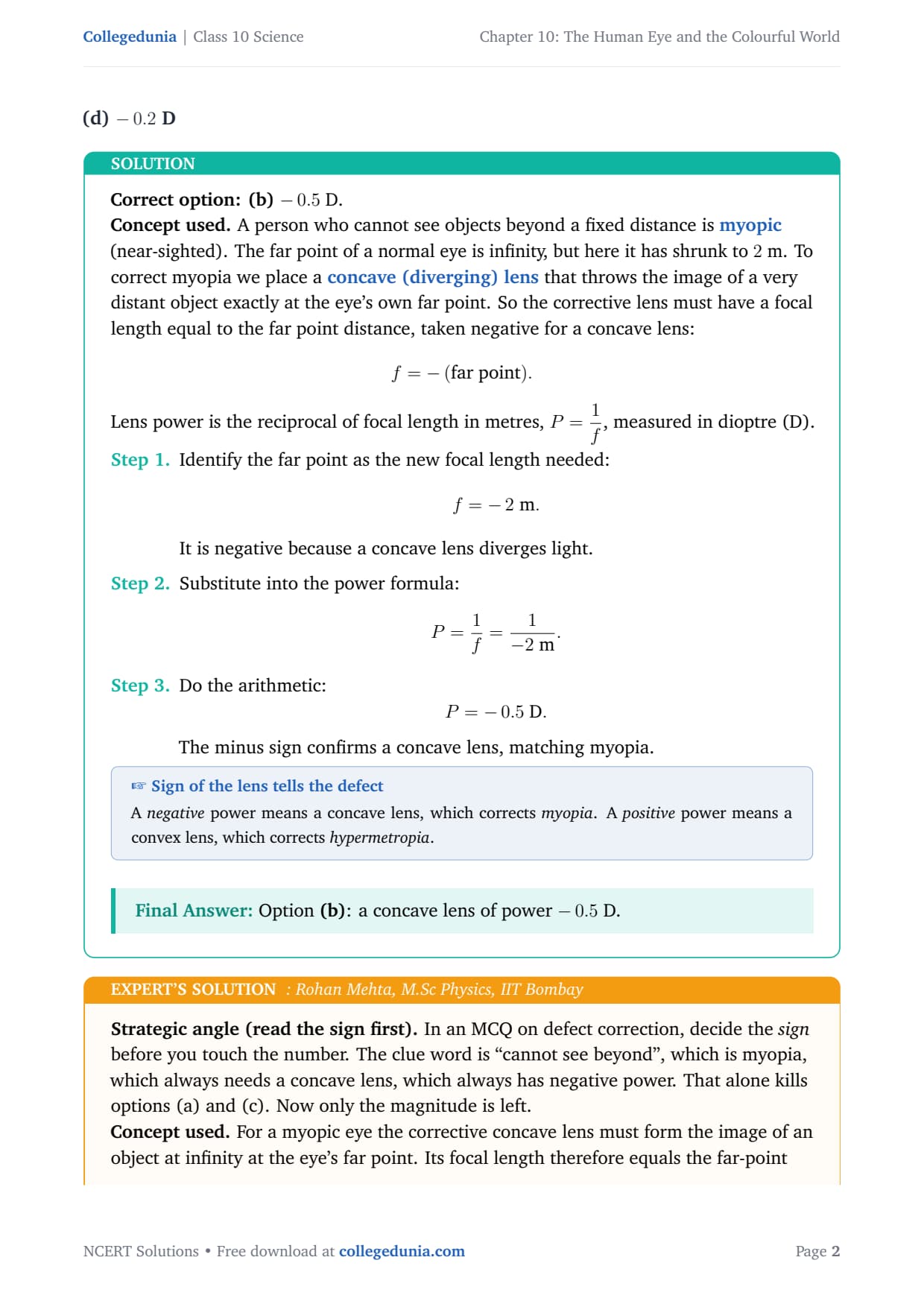
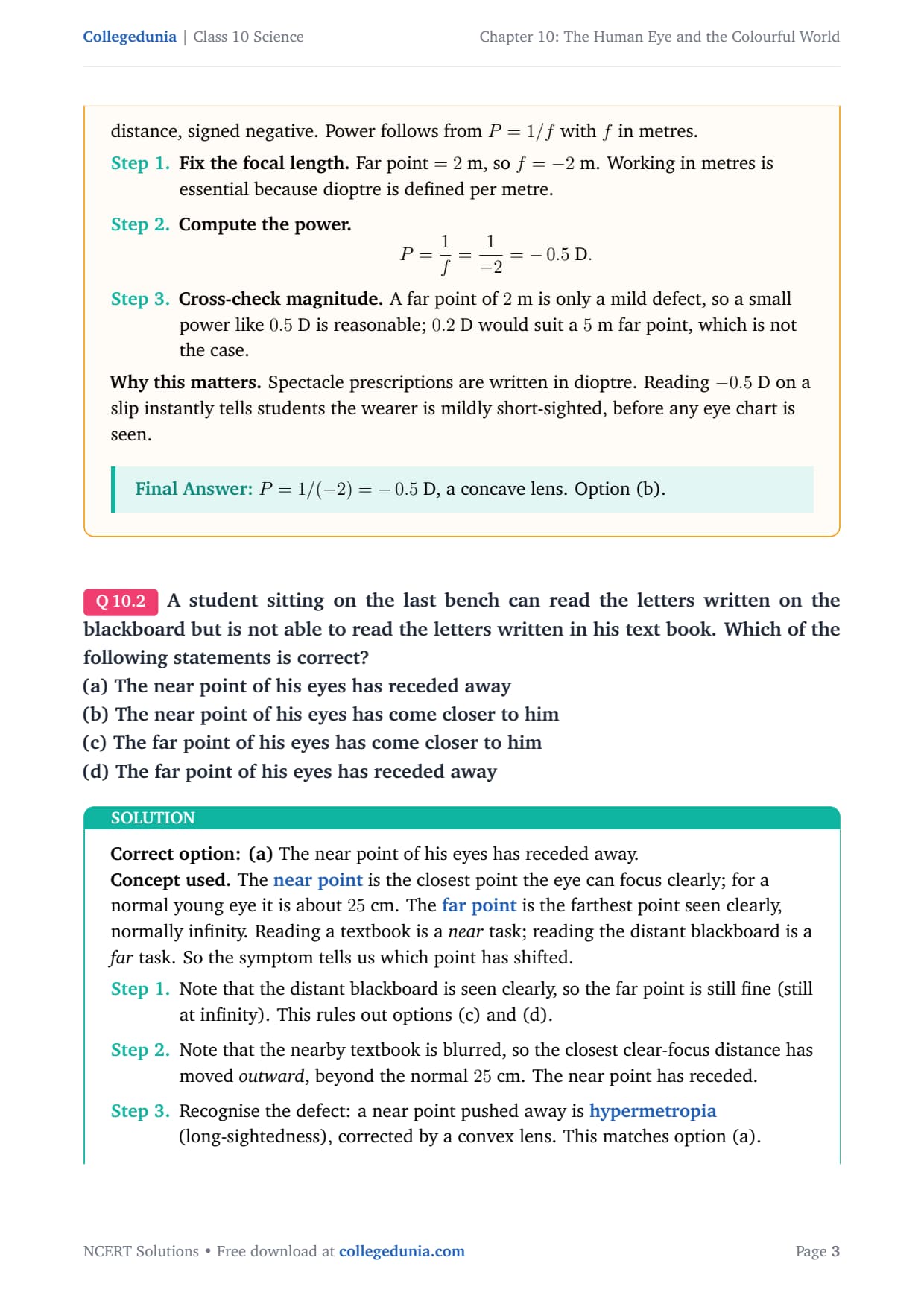
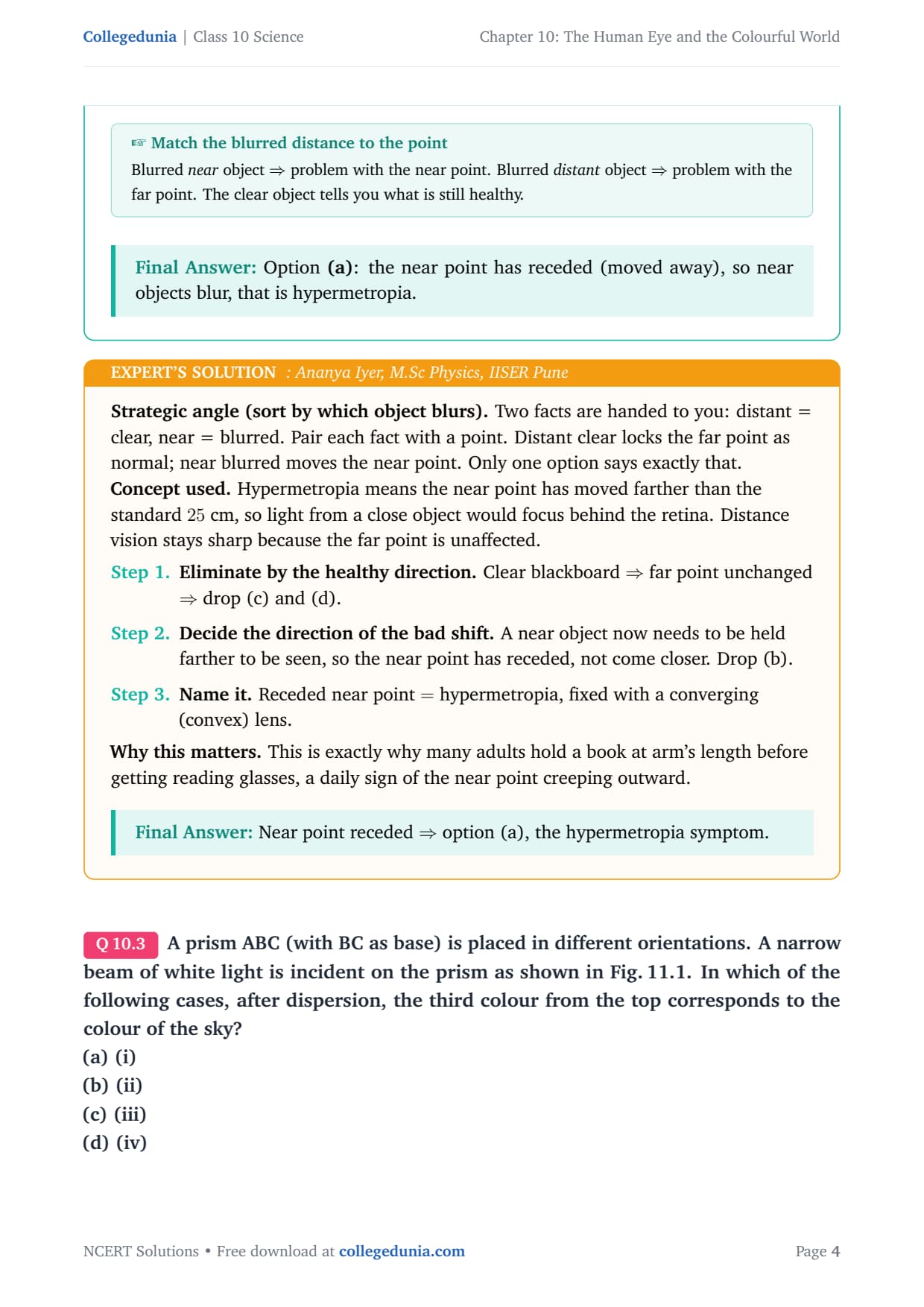
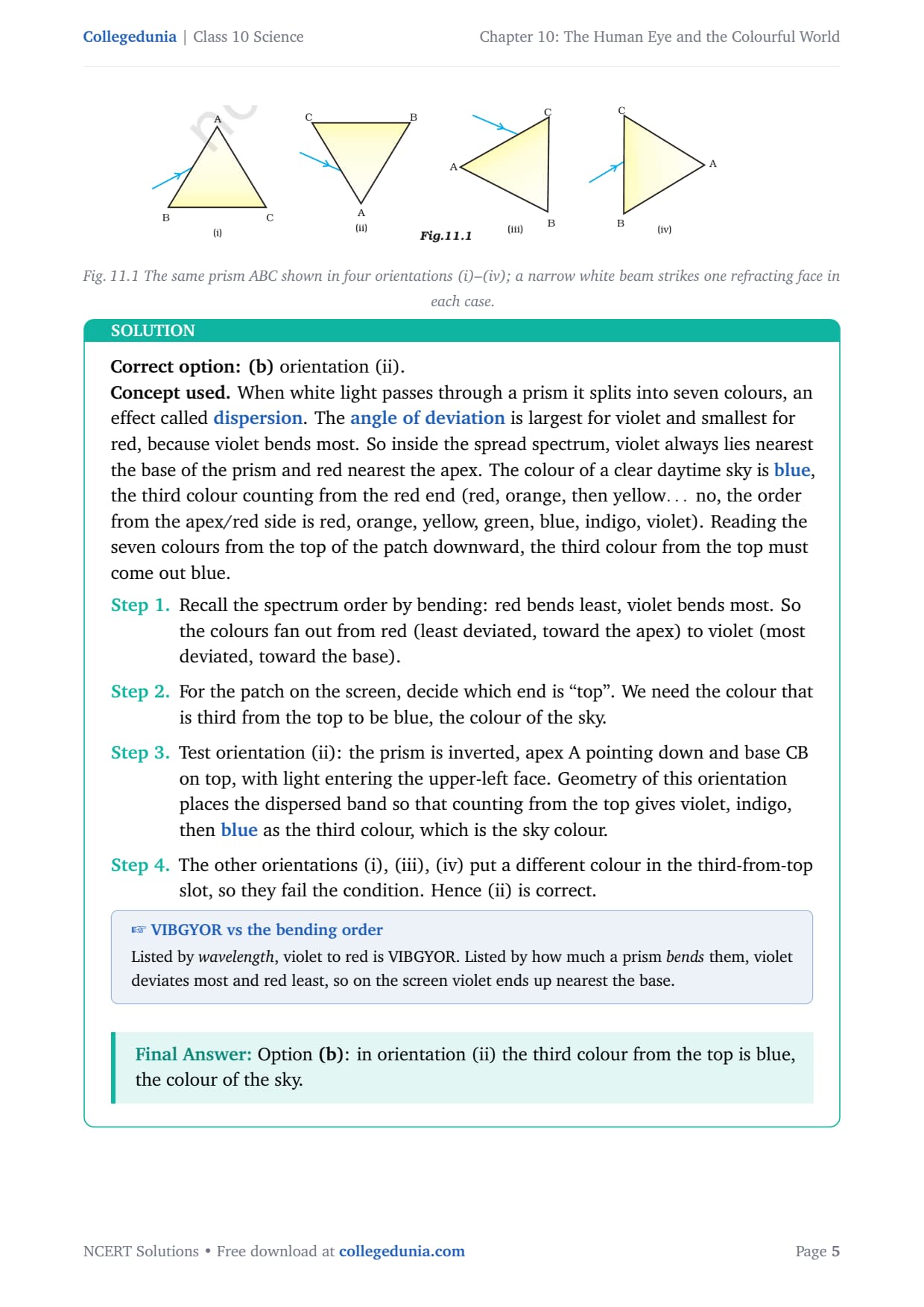
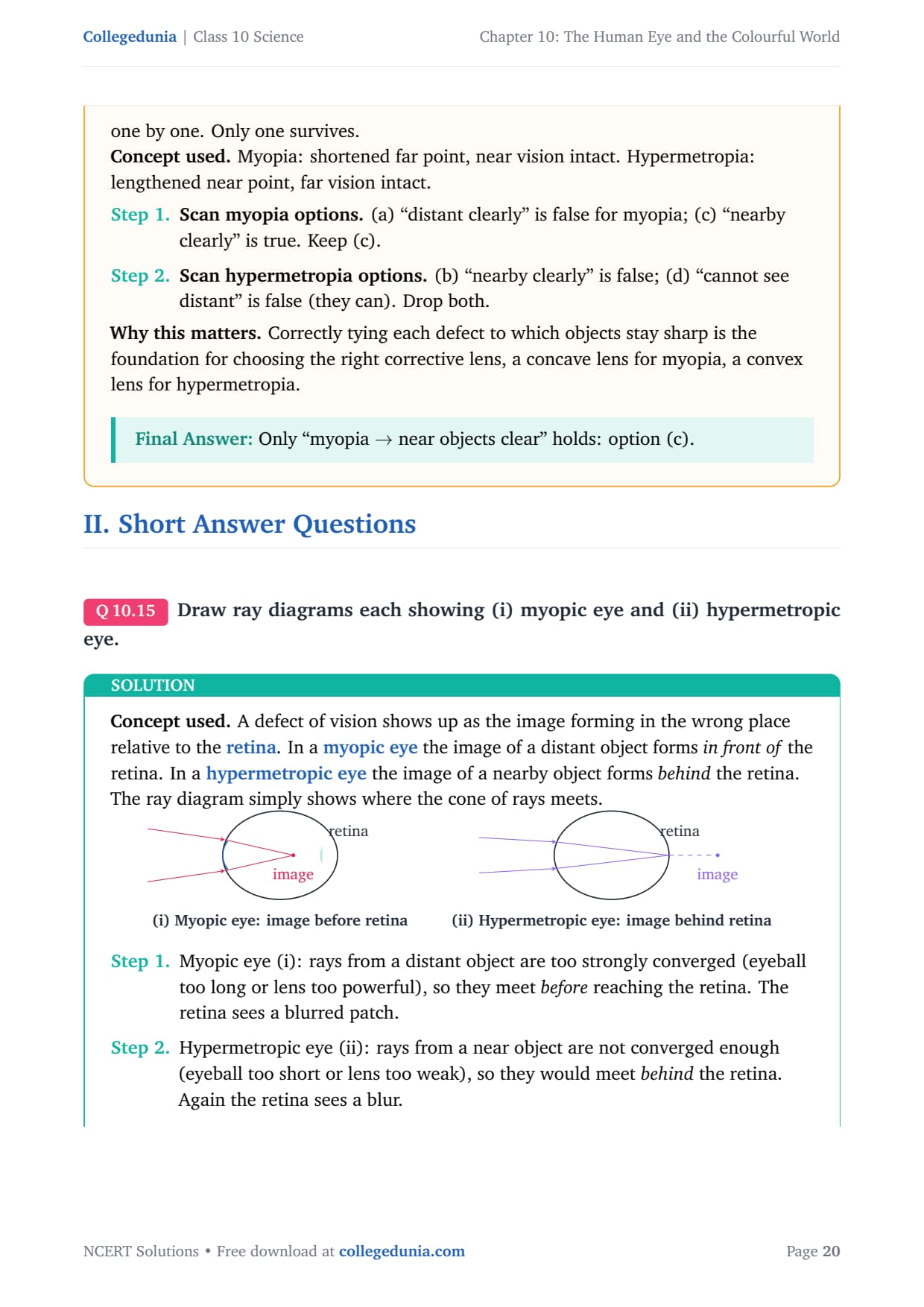
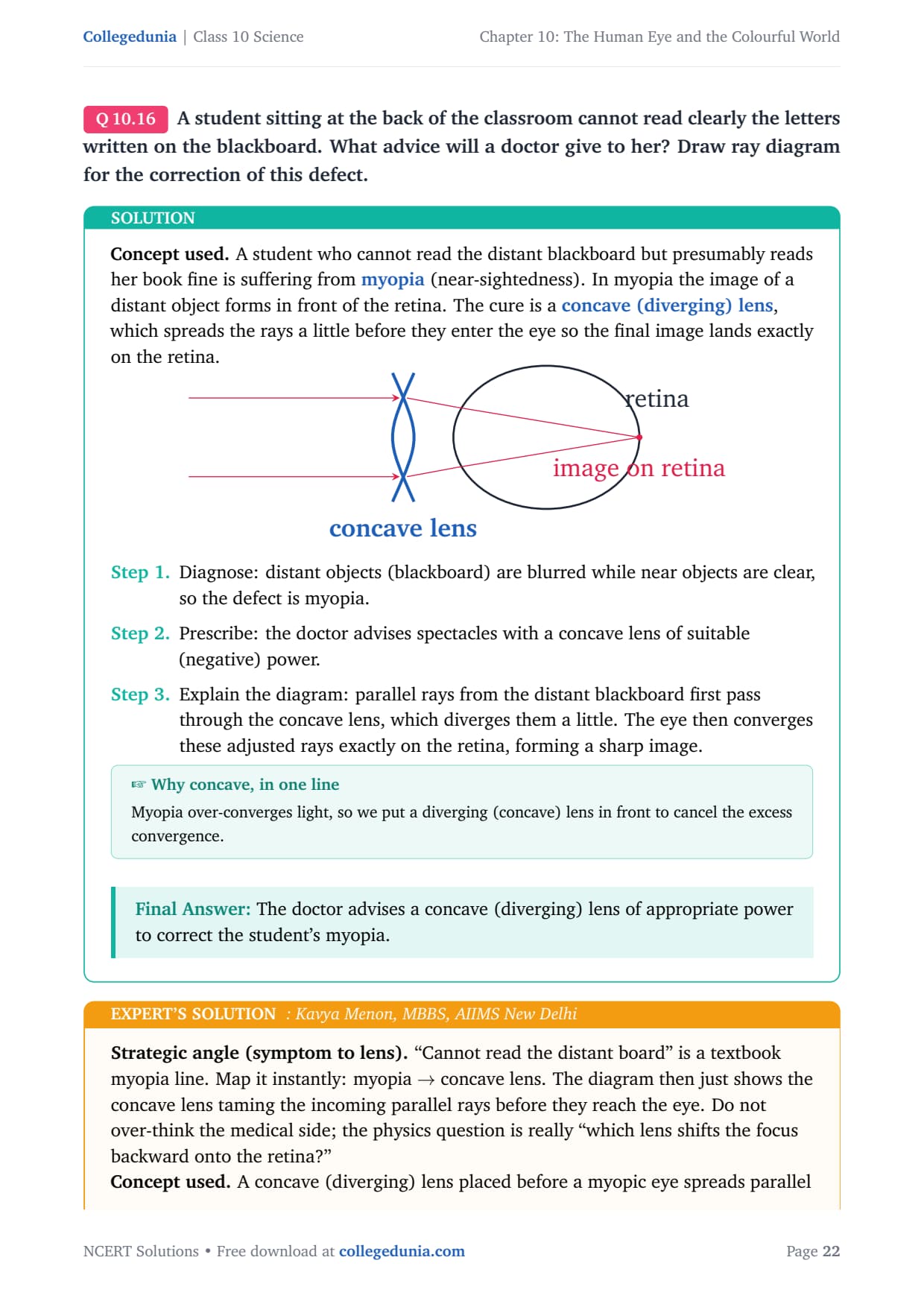
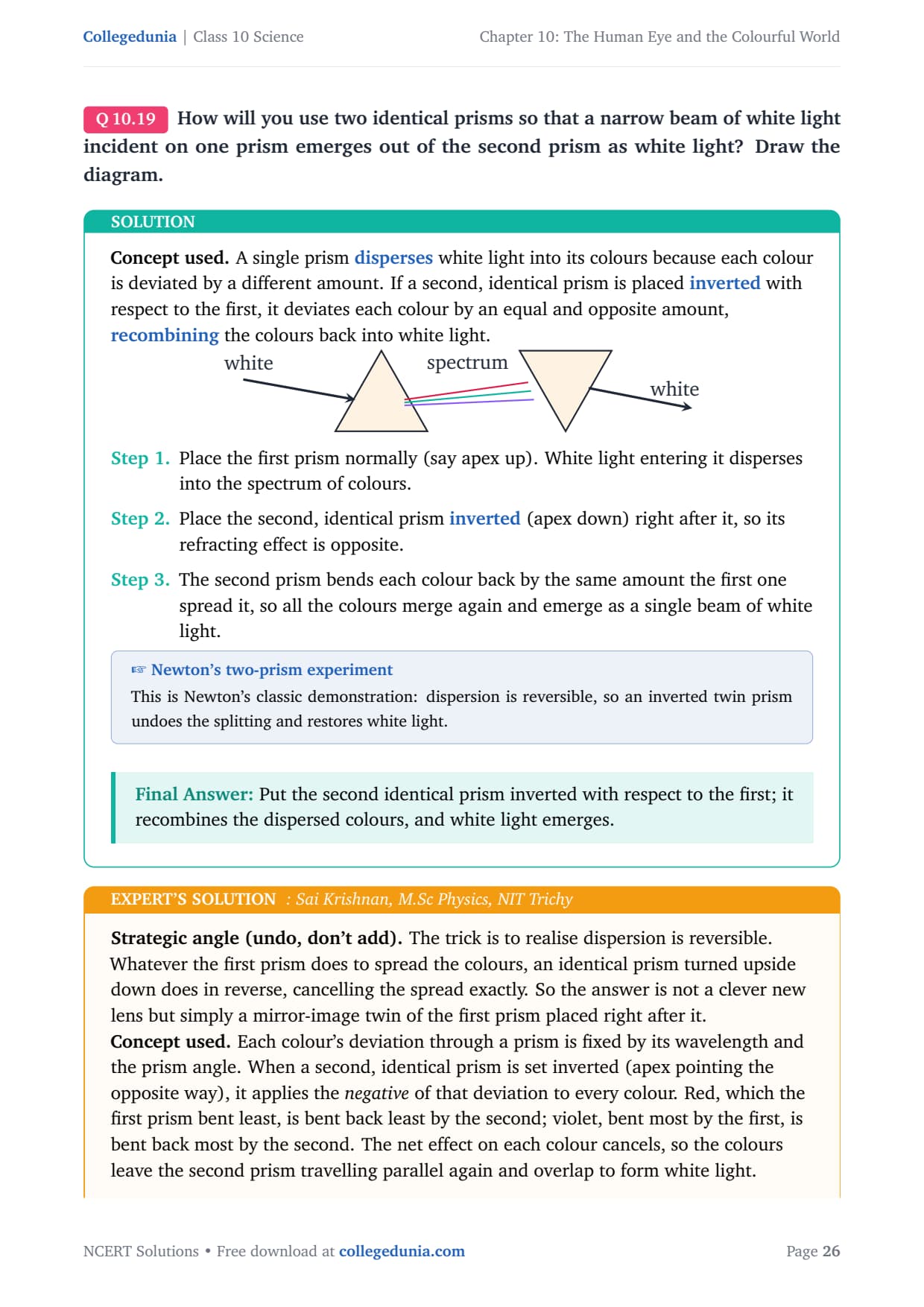
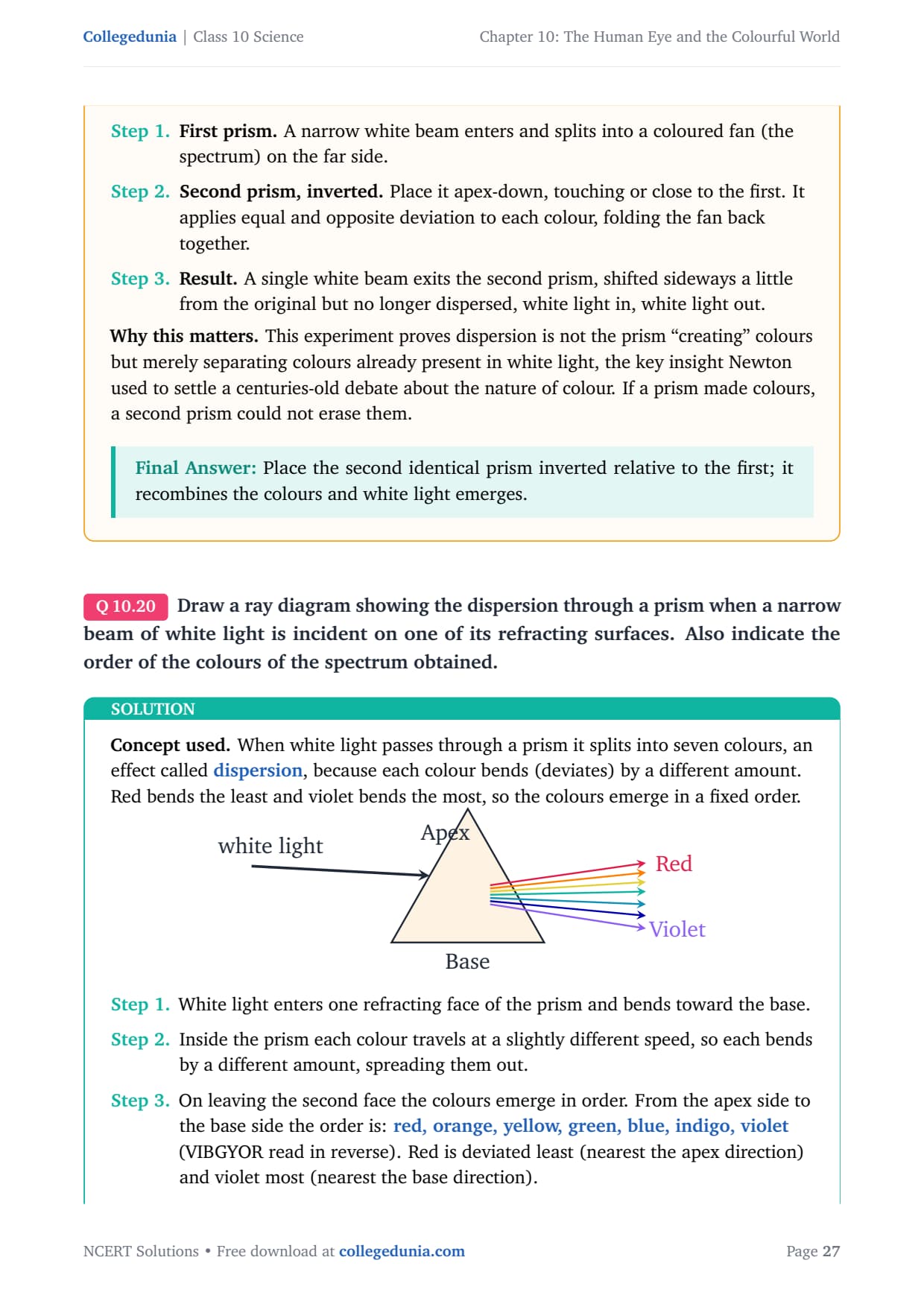
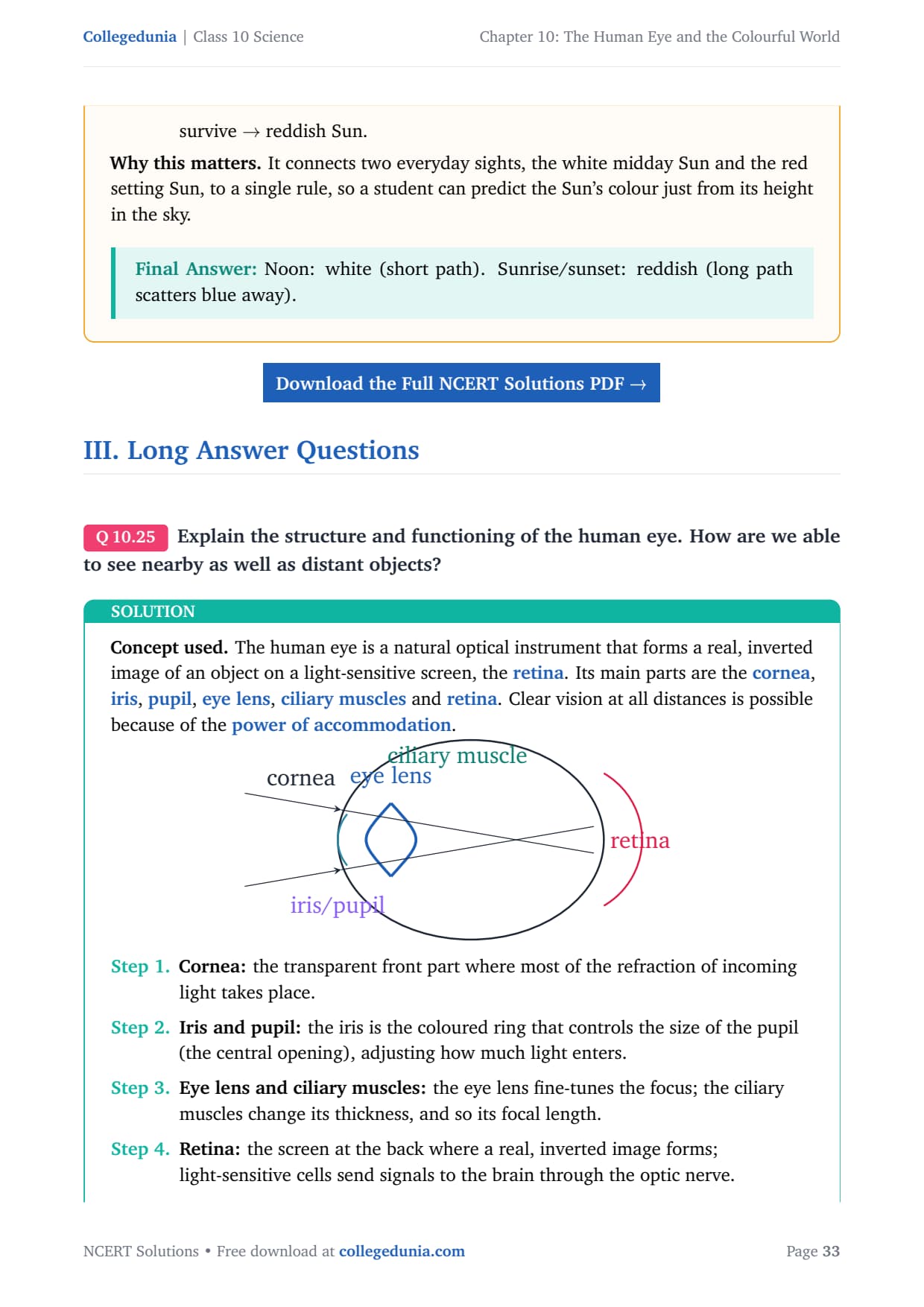
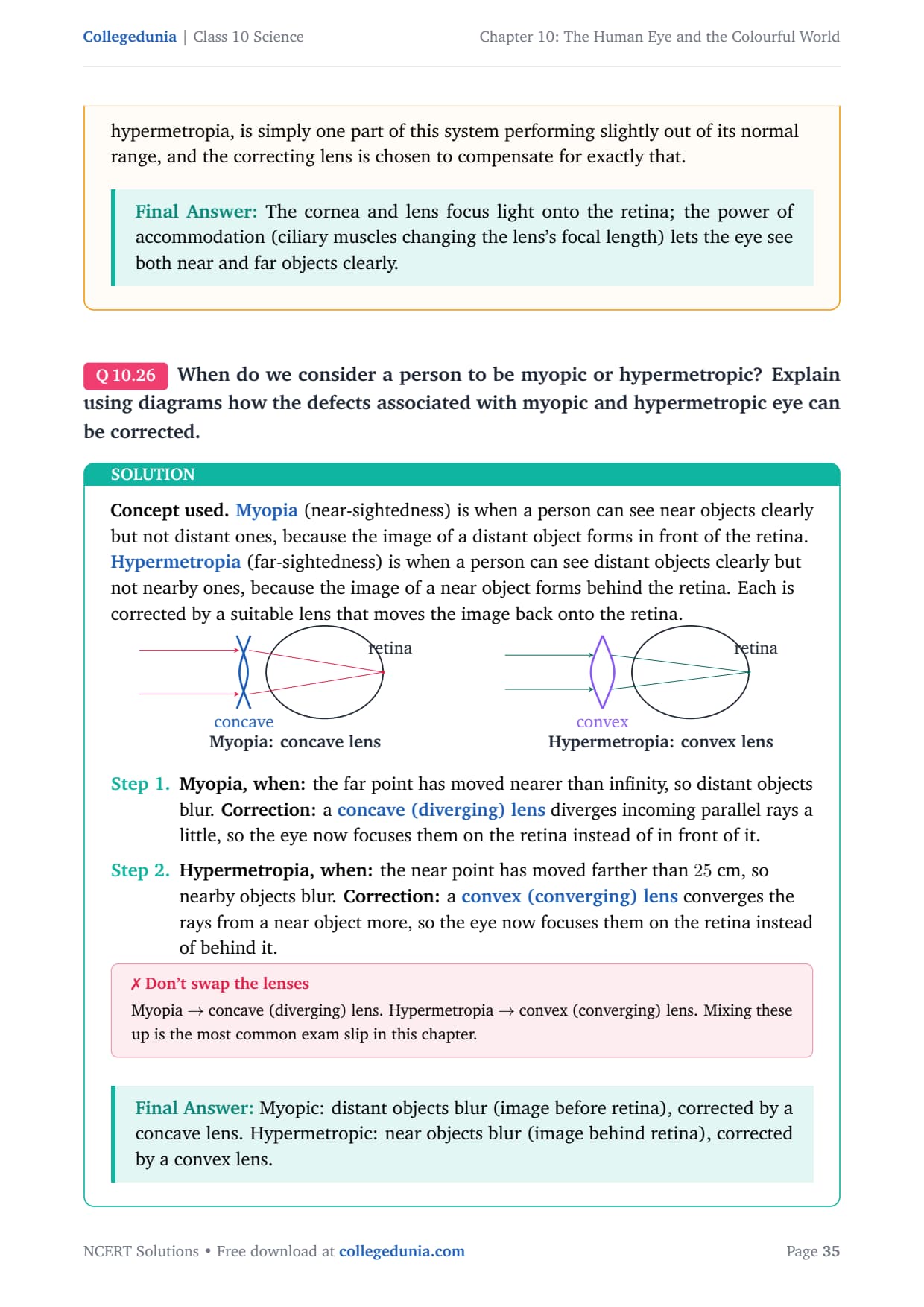
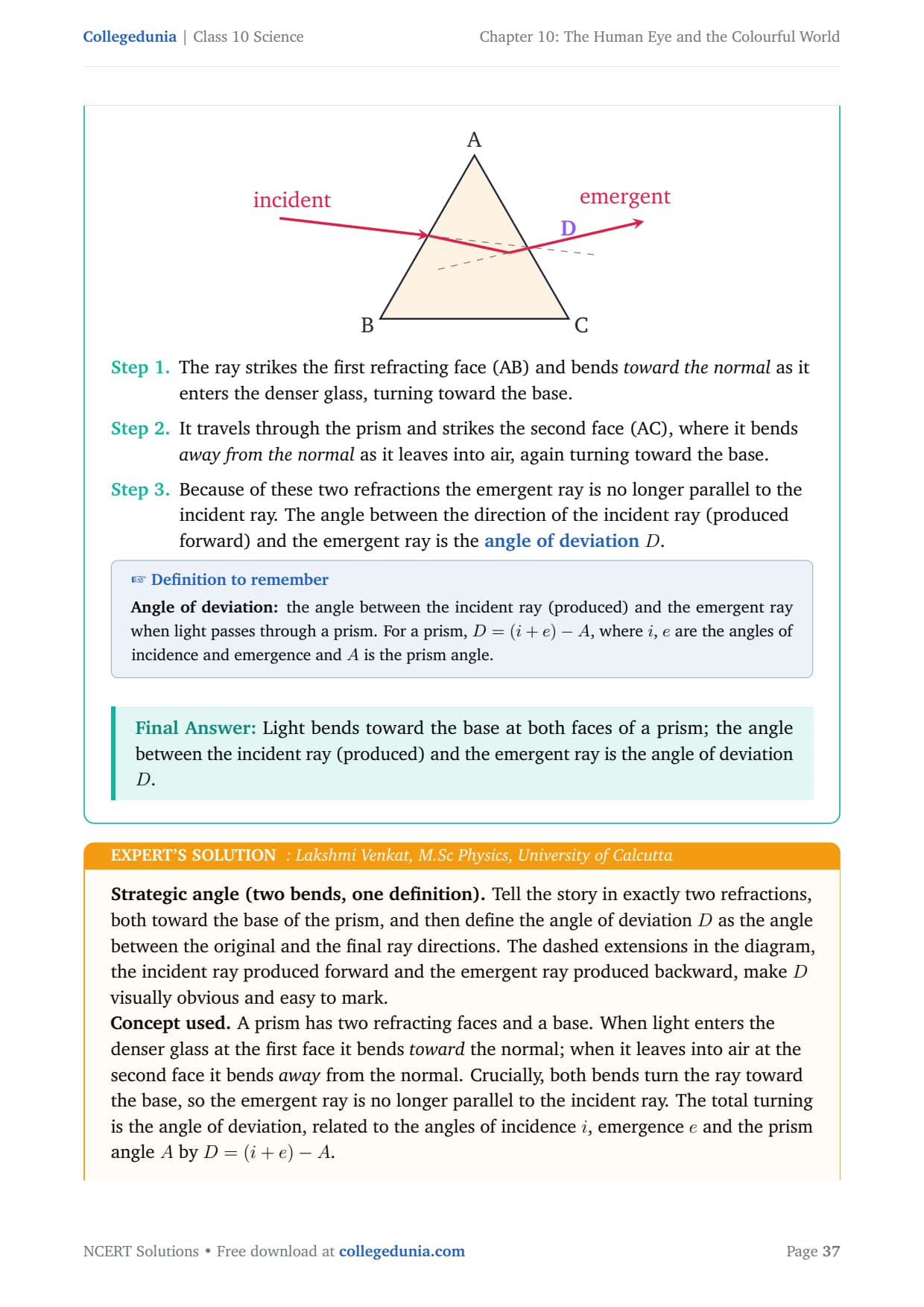
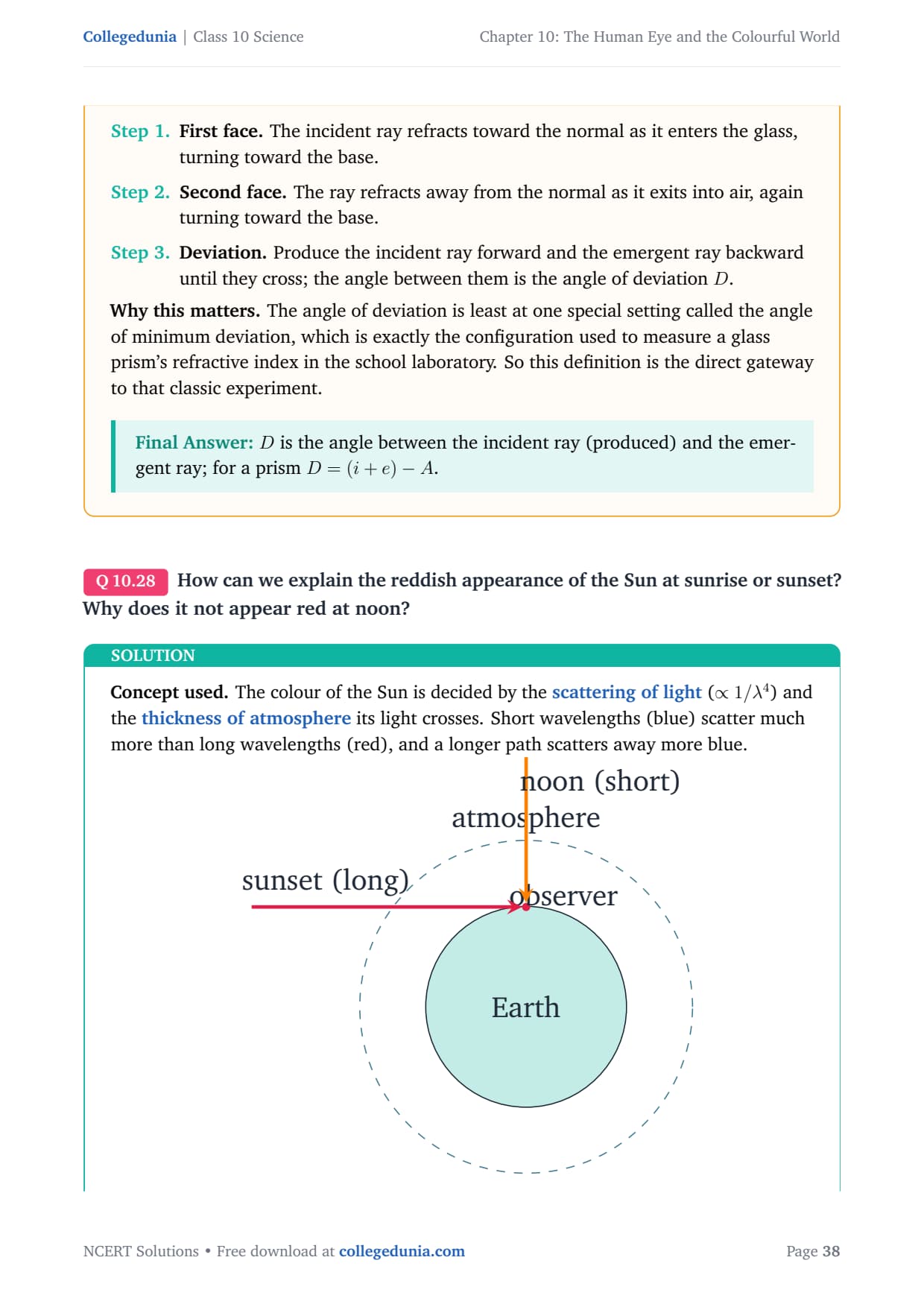
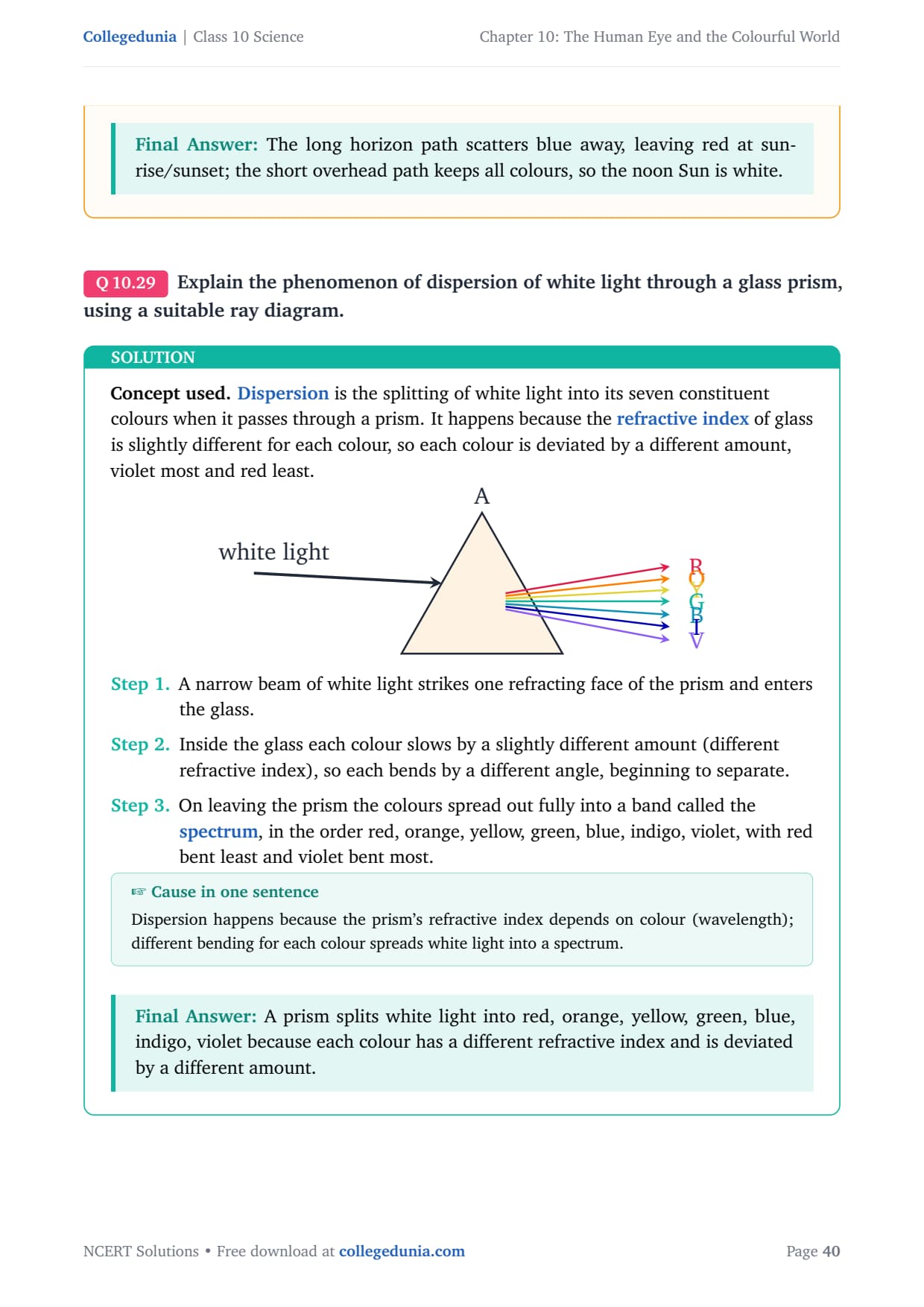
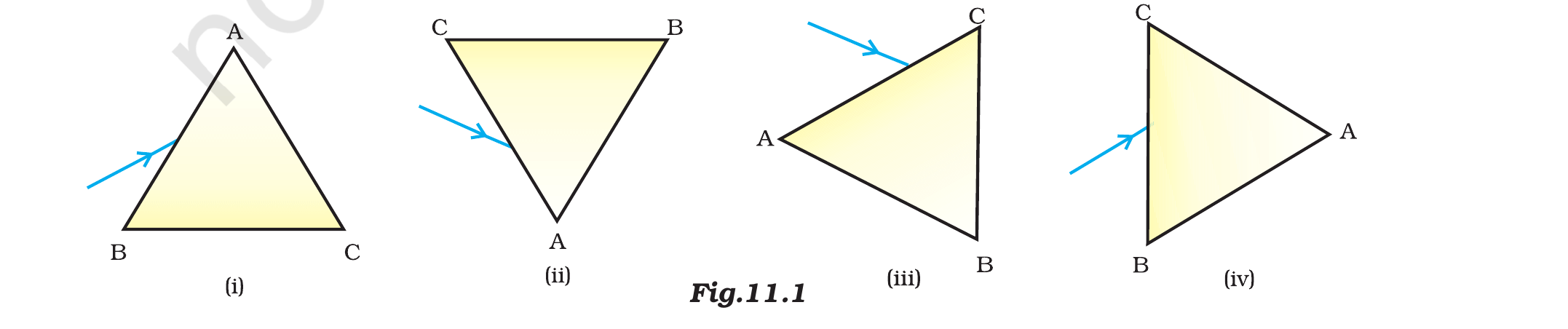



Comments