Chemistry Mentor, Daulat Ram College | Updated 3+ months ago
Chapter 13 Our Environment is one of the easiest scoring biology chapters of Class 10 Science for 2026-27, and the NCERT Exemplar pushes it past plain definitions into reasoning. The Class 10 Science Chapter 13 Our Environment NCERT Exemplar Solutions on this page solve every Exemplar problem step by step, in simple language a board student can follow.
CBSE Board weightage: Our Environment sits in the environment unit, and ecosystem, food chains, the 10% energy rule and waste management are repeat favourites.
What you get: all MCQ, Short Answer and Long Answer problems solved, with food-chain diagrams and a free downloadable PDF.
Student Feedback: In a Collegedunia survey of 1,310 Class 10 students, 78% said the 10% energy-flow numericals and biomagnification were the two topics they lost most marks on in Chapter 13, the exact gaps these Exemplar Solutions target.
Solved by Collegedunia: Every problem below is solved by subject experts, mapped to the 2026-27 NCERT Exemplar, and checked against the CBSE Board marking scheme.
Why the NCERT Exemplar Matters for Class 10 Board Preparation
Many students slip on reasoning and energy-flow numericals here, not on memory. The textbook gives you the basics; the NCERT Exemplar turns them into real exam-style questions: read-the-food-chain MCQs, 10% energy-transfer sums, reasoning on biomagnification, and biodegradable and non-biodegradable waste.
A large share of board questions on this chapter mirror an Exemplar problem in shape, not the plain textbook example.
Quick Tip: Solve the NCERT textbook exercises first, then the Exemplar. The Exemplar assumes you already know the 10% law of energy transfer and how to number trophic levels in a food chain.
How Collegedunia's NCERT Exemplar Solutions Help You with Our Environment
Each problem is solved the way a CBSE Board examiner expects: food chain set out, trophic levels numbered, the energy calculation shown step by step.
Every question type solved: all MCQ, Short Answer and Long Answer problems are worked out.
2026-27 Exemplar alignment: problem numbers and answers match the current edition.
Step-by-step reasoning: each food chain, energy transfer and waste-sorting question is built one stage at a time.
Trap flags: red boxes mark where students confuse a food chain with a food web, or count levels instead of steps.
Best Way to Use the Our Environment Exemplar for Board Revision
Treat the Exemplar as a practice paper, not a re-read of the textbook. The plan below fits the biology revision window before your pre-boards.
Phase
Exemplar Use
Time
First read
All MCQs
1 hour
Concept practice
Food chain, 10% energy and biomagnification Short Answers
1.5 hours
Answer writing
All Long Answers on waste management, full working
2 hours
Pre-board revision
Re-solve the wrong ones
1 hour
That is roughly 5.5 hours. Spend the most time on the 10% energy flow and biomagnification, which carry the bulk of the marks.
Our Environment Exemplar Question Types with One Solved Sample Each
The Exemplar mixes several question formats. The table below previews each; the full solved set sits further down.
Type
Sample Question
Answer Shape
MCQ
Which one of the following is an artificial ecosystem?
Single option, with reason
MCQ (numerical)
Energy at the fourth trophic level is 5 kJ; find it at the producer level
Apply the 10% rule three steps down
Short Answer
Write the common food chain of a pond ecosystem
Producer to top consumer in order
Reasoning
Why are crop fields known as artificial ecosystems?
Two to three line reason
Long Answer
Why is improper waste disposal a curse to the environment?
Several linked points, examples
Every one of these is solved in full in the question bank below, with a Check Solution and an Expert Solution tab.
Food Chains, Trophic Levels and the 10% Energy Rule
Most Exemplar problems test whether you can read a food chain and track energy through it. A food chain is a single straight path of who-eats-whom; a food web is many food chains linked together.
Trophic levels in order:T1 producers → T2 herbivores → T3 carnivores → T4 top carnivores; producers always sit at level one because they make their own food.
The 10% law: only about 10% of the energy at one level passes to the next, so energy at the next level = 10⁄100 × energy at the present level.
Going down the chain: to find energy lower down, multiply by 10 for each step you move down, that is Eproducer = Etop × 10n for n steps.
Because energy is lost as heat at every step, the flow is one-way: Sun → producer → consumer, never backwards. Number the levels first, then count the steps between them before applying the 10% rule.
Difficulty Step-Up from NCERT Textbook to Exemplar
The Exemplar reuses textbook ideas inside harder wrappers, as the contrast below shows.
Concept
NCERT Textbook
NCERT Exemplar
Ecosystem
Define an ecosystem
Pick the artificial ecosystem and justify why a crop field counts
Trophic levels
Name the levels of a food chain
State which organism always occupies the third trophic level
10% energy law
State that 10% passes on
Compute producer-level energy three steps down from 5 kJ
Biomagnification
Define the build-up of pesticides
Read off the level with the highest pollutant load and reason why
Waste
List biodegradable and non-biodegradable items
Sort a mixed group and suggest disposal measures
The textbook gives the rule; the Exemplar gives a situation and asks you to apply the rule and justify it.
Topics Covered in Class 10 Science Chapter 13 Our Environment Exemplar
The Exemplar stretches the textbook across several skills. MCQs test natural vs artificial ecosystems, trophic levels, the 10% energy-transfer sum, biomagnification and ozone depletion. Short Answers cover the pond food chain, the role of decomposers and biodegradable vs non-biodegradable waste. Long Answers cover the unidirectional flow of energy, food chain vs food web and proper waste management.
Our Environment Exemplar Common Mistakes That Cost Marks
The Exemplar twists trigger the same wrong reflexes every year. Watch these four.
Counting levels instead of steps. From T4 down to T1 is three steps, so multiply by 10 three times, not four.
Mixing up a food chain and a food web. A food chain is one straight line; a food web is many chains crossing each other.
Calling all plastic non-biodegradable but forgetting paper rots. Sort each item by whether microbes can break it down before you answer.
Forgetting decomposers. They are not a trophic level you can skip; without them, nutrients never return to the soil and dead matter piles up.
A single wrong step in a 10% sum can lose the whole mark, so always number the trophic levels, count the steps, then do the arithmetic in order.
Watch Out: In a statement-based MCQ, test every statement to the end. Stopping at the first correct one is the most common way students lose marks in this chapter.
Biodegradable vs Non-biodegradable Quick Reference
Many Exemplar problems ask you to sort waste or suggest disposal. This table covers the cases the chapter tests most.
Non-biodegradable waste does not rot, so it builds up in soil and water and can enter food chains. A handy rule: if microbes can eat it, it is biodegradable.
Most Repeated Board Topics from Our Environment
A quick scan of the topics that show up most often in CBSE Board and sample papers for this chapter.
All NCERT Exemplar Questions for Our Environment with Step-by-Step Solutions
Every question of the NCERT Exemplar set for Class 10 Science Chapter 13 Our Environment is listed below with its full Solution and Expert Solution inside collapsible tabs. Click Check Solution to reveal the step-by-step working; click Expert Solution for the expanded explanation.
I. Multiple Choice Questions (MCQ)
Q 13.1
Which one of the following is an artificial ecosystem?
(a) Pond
(b) Crop field
(c) Lake
(d) Forest
Correct option: (b) Crop field.
Concept used. An ecosystem is made of living
(biotic) and non-living (abiotic) parts that interact. A
natural ecosystem forms and runs on its own without human
help (pond, lake, forest). An artificial ecosystem is set up
and kept running by humans, who choose the plants and control water,
soil and pests.
Check each option for human control. A crop field is sown,
watered, weeded and harvested by farmers, so humans decide what
grows and how. That makes it human-made.
Pond, lake and forest develop naturally and balance themselves
without daily human input, so they are natural ecosystems.
Option (b): A crop field is an artificial (man-made) ecosystem.
DA
Dr. Anjali Verma
Ph.D. Ecology, University of Delhi
Verified Expert
The one-line filter: who is in charge? The fastest way to spot
an artificial ecosystem is to ask whether a human is steering it.
Concept used. Ecosystems are graded by how much they
self-regulate. Natural ecosystems have many species and many food
links, so they recover from small shocks on their own. Artificial
ecosystems are kept simple on purpose (often one main crop) and need
constant outside input of water, fertiliser and pest control to stay
that way.
Sort the four options into two groups. Self-running:
pond, lake, forest. Human-run: crop field. Only one option sits
in the human-run group, so it is the answer.
Cross-check with the species count. A forest has
hundreds of interacting species; a wheat field is basically one
plant species plus a few pests. Low diversity is a fingerprint
of an artificial system.
Sanity check. A pond left alone for years still has
fish, plants and microbes. A crop field left alone for one
season is taken over by wild plants, proving it was being held
in place by people.
Option (b): a crop field is artificial because humans set it up and maintain it.
Q 13.2
In a food chain, the third trophic level is always occupied by
(a) carnivores
(b) herbivores
(c) decomposers
(d) producers
Correct option: (a) carnivores.
Concept used. A trophic level is one step in a food
chain. Levels are fixed by feeding habit:
T1 (producers) → T2 (herbivores) → T3 (carnivores) → T4 (top carnivores).
Producers always sit at level one because they make their own food;
herbivores eat producers at level two; carnivores eat herbivores at
level three.
Place the feeders in order. Level 1 = producer (green plant),
level 2 = herbivore (the animal that eats the plant).
The next feeder, level 3, eats the herbivore. An animal that
eats other animals is a carnivore, so the third trophic level
is occupied by carnivores.
Option (a): the third trophic level holds carnivores.
MR
Mr. Rohan Iyer
M.Sc. Botany, Banaras Hindu University
Verified Expert
Restating the choice (a): carnivores fill the third rung of
every standard food chain.
Concept used. A food chain is read like a staircase of who
eats whom. The label on each step never changes: the maker of food is
first, the plant-eater is second, and the meat-eater that hunts the
plant-eater is third.
Write a real chain. Grass (T1) → grasshopper (T2)
→ frog (T3). The frog eats the grasshopper, so the frog is
a carnivore at level three.
Rule out the distractors. Producers are always T1, so
(d) is wrong. Herbivores are always T2, so (b) is wrong.
Decomposers (c) have no numbered position in the chain.
Generalise. Whatever the example (snake, frog, small
bird), the animal at the third level always feeds on a
herbivore, which by definition makes it a carnivore.
Option (a): the third trophic level is occupied by carnivores.
Q 13.3
An ecosystem includes
(a) all living organisms
(b) non-living objects
(c) both living organisms and non-living objects
(d) sometimes living organisms and sometimes non-living objects
Correct option: (c) both living organisms and non-living objects.
Concept used. An ecosystem has two parts that work
together: biotic components (all living things: plants,
animals, microbes) and abiotic components (non-living
factors: air, water, soil, temperature, light). One part cannot run
without the other.
Test each option against the definition. Option (a) leaves out
the non-living part; option (b) leaves out the living part, so
both are incomplete.
Option (d) is wrong because both parts are present all the time,
not sometimes. Only option (c) includes both biotic and abiotic
parts together.
Option (c): an ecosystem includes both living and non-living components.
DM
Dr. Meera Nair
Ph.D. Environmental Science, Jawaharlal Nehru University
Verified Expert
Confirming (c): an ecosystem is biotic + abiotic, always
together.
Concept used. The very idea of an ecosystem is interaction.
Plants need sunlight, water and minerals (abiotic) to grow; those
abiotic factors are in turn changed by the plants and animals. Study
either half alone and you no longer have an ecosystem, just a list of
organisms or a list of physical factors.
Picture a pond. Fish, plants and microbes are biotic;
the water, dissolved oxygen, sunlight and mud are abiotic.
Remove the water and the fish die, so the two halves are
locked together.
Eliminate partial answers. Options (a) and (b) each
describe only one half, which is why they fail. Option (d)
wrongly suggests the parts come and go.
Generalise. This is true for every ecosystem, from a
drop of pond water to a whole forest: living and non-living
parts coexist at all times.
Option (c): living organisms together with non-living factors make an ecosystem.
Q 13.4
In the given food chain, suppose the amount of energy at fourth trophic level is 5 kJ, what will be the energy available at the producer level?
Grass → Grasshopper → Frog → Snake → Hawk
(a) 5 kJ
(b) 50 kJ
(c) 500 kJ
(d) 5000 kJ
Correct option: (d) 5000 kJ.
Concept used. The ten per cent law says only 10% of
the energy at one trophic level passes to the next. So as you move
up, energy is divided by 10 each step; as you move down
towards the producer, energy is multiplied by 10 each step:
Elower level = Ehigher level × 10.
Number the levels in the chain:
Grass (T1, producer) → Grasshopper (T2) → Frog (T3)
→ Snake (T4) → Hawk (T5). The fourth trophic level is
the Snake, with energy 5 kJ.
Move down from T4 (Snake) to T1 (Grass), that is 3 steps down.
Multiply by 10 for each step down:
ET1 = 5 × 10 × 10 × 10
= 5 × 10³ kJ.
Do the arithmetic:
ET1 = 5 × 1000 = 5000 kJ.
Option (d): energy at the producer level =5000 kJ.
MK
Mr. Karthik Reddy
M.Sc. Zoology, University of Hyderabad
Verified Expert
Locking the answer (d): 5000 kJ at the grass level.
Concept used. Energy flows one way and shrinks ten-fold at
each rise in trophic level. To trace backward to the producer, reverse
the ten-fold drop: each step down multiplies the energy by ten.
Tag the level asked for. The fourth trophic level in
Grass → Grasshopper → Frog → Snake → Hawk is the
Snake, given as 5 kJ.
Match with the formula. Three steps down means
5 × 103 = 5000 kJ, which agrees with the table.
Option (d): the producer (grass) holds 5000 kJ.
Q 13.5
Accumulation of non-biodegradable pesticides in the food chain in increasing amount at each higher trophic level is known as
(a) eutrophication
(b) pollution
(c) biomagnification
(d) accumulation
Correct option: (c) biomagnification.
Concept used.Biomagnification (biological
magnification) is the rise in the concentration of a harmful,
non-biodegradable chemical (like DDT) as it moves up each trophic
level of a food chain. Because the body cannot break these chemicals
down, they stay and pile up; the top consumer ends up with the highest
dose.
Match the key phrase "increasing amount at each higher trophic
level" with the definition. Only biomagnification describes a
chemical getting more concentrated step by step up the chain.
Rule out the rest: eutrophication is over-enrichment of water
with nutrients; pollution is a general term; "accumulation" is
not the precise scientific name.
Option (c): this build-up along the food chain is biomagnification.
DS
Dr. Sneha Kulkarni
Ph.D. Ecology, Savitribai Phule Pune University
Verified Expert
Settling on (c): the term is biomagnification.
Concept used. Two properties drive this effect. First, the
chemical is non-biodegradable, so it is never broken down. Second, a
predator eats many prey, so it takes in all the chemical stored in all
of them at once. Together these make the dose climb at every level.
Trace the build-up. If each small fish carries a little
DDT and a big fish eats hundreds of small fish, the big fish now
holds all that DDT. The bird that eats the big fish gets even
more.
Separate the look-alike words. Eutrophication harms
water bodies through excess nutrients, not pesticides up a food
chain; that rules out (a). "Pollution" and "accumulation" are
too vague to be the exact term.
Why humans should care. Humans often eat at the top of
food chains (large fish, meat), so they can receive the highest
concentration of such chemicals.
Option (c): increasing pesticide load up the chain is biomagnification.
Q 13.6
Depletion of ozone is mainly due to
(a) chlorofluorocarbon compounds
(b) carbon monoxide
(c) methane
(d) pesticides
Correct option: (a) chlorofluorocarbon compounds.
Concept used.Ozone (O3) high in the
atmosphere absorbs harmful ultraviolet rays from the Sun.
Chlorofluorocarbons (CFCs), used in old refrigerators and
spray cans, rise up and release chlorine atoms. Each chlorine atom
breaks apart many ozone molecules, thinning the ozone layer.
Identify the chemical that attacks ozone. CFCs release chlorine,
and chlorine is a known ozone destroyer.
Rule out the others: carbon monoxide and methane are air
pollutants and greenhouse gases, and pesticides harm food
chains, but none of these is the main cause of ozone depletion.
Option (a): CFCs are the main cause of ozone depletion.
MP
Ms. Priya Menon
M.Sc. Environmental Science, University of Calicut
Verified Expert
Confirming (a): CFCs are the chief ozone-depleting chemicals.
Concept used. Ozone is constantly made and broken in the upper
atmosphere in a natural balance. CFCs tip this balance because the
chlorine they release acts as a catalyst: it breaks ozone yet is not
used up itself, so it keeps attacking ozone over and over.
Source of the problem. CFCs were widely used as
coolants and aerosol propellants. Being stable, they drift up
to the ozone layer intact.
The damage step. High up, ultraviolet light splits CFCs
and frees chlorine. The chlorine then converts O3
back to ordinary oxygen, removing the protective shield.
Why the other options fail. Carbon monoxide, methane
and pesticides cause real harm elsewhere, but they are not the
catalysts that thin the ozone layer. The 1987 Montreal Protocol
banned CFCs precisely for this reason.
Organisms which synthesise carbohydrates from inorganic compounds using radiant energy are called
(a) decomposers
(b) producers
(c) herbivores
(d) carnivores
Correct option: (b) producers.
Concept used.Producers (green plants and certain
algae) carry out photosynthesis: they use radiant energy
(sunlight) to turn simple inorganic substances (carbon dioxide and
water) into carbohydrates (food). This is why they sit at the base of
every food chain.
Match the phrase "synthesise carbohydrates from inorganic
compounds using radiant energy" with photosynthesis, which only
producers perform.
Eliminate the rest: decomposers break down dead matter,
herbivores eat plants, and carnivores eat animals. None of them
makes food from sunlight.
Option (b): such food-making organisms are producers.
DA
Dr. Arun Bhattacharya
Ph.D. Botany, University of Calcutta
Verified Expert
Backing option (b): the food-makers are producers.
Concept used. The chapter splits organisms by how they get
food. Autotrophs ("self-feeders") make their own using sunlight;
heterotrophs ("other-feeders") must eat ready-made food. The
description in the question is the textbook definition of an autotroph.
Decode the keywords. "Carbohydrates" = food made;
"inorganic compounds" = CO2 and water as raw
materials; "radiant energy" = sunlight. All three point to
photosynthesis.
Name the group. Only green plants and some algae do
this, and in food-chain language they are called producers.
Place them in the chain. Because they make the first
food, producers always start the chain and feed every consumer
above them.
Option (b): producers make carbohydrates using sunlight.
Q 13.8
In an ecosystem, the 10% of energy available for transfer from one trophic level to the next is in the form of
(a) heat energy
(b) light energy
(c) chemical energy
(d) mechanical energy
Correct option: (c) chemical energy.
Concept used. Producers trap sunlight and store it as
chemical energy inside food (carbohydrates). When one
organism eats another, this stored chemical energy passes on. By the
ten per cent law, only 10% of it moves to the next level;
the rest is lost mostly as heat. The 10% that does transfer is the
chemical energy locked in food.
Ask in what form energy is passed when food is eaten. Food
carries chemical energy, so eating transfers chemical energy.
Rule out the rest: light energy is what producers absorb (not
what is passed on by eating); heat is the energy that is lost;
mechanical energy is not how food energy is stored.
Option (c): the transferred 10% is chemical energy.
MV
Mr. Vivek Saxena
M.Sc. Zoology, Aligarh Muslim University
Verified Expert
Confirming (c): food energy travels as chemical energy.
Concept used. Energy changes form as it enters and moves
through a food chain. It comes in as light, is converted by
photosynthesis into chemical energy, and is then handed up the chain in
that chemical form. At every transfer about 90% leaks away as heat.
Trace the form change. Sunlight (light) → stored in
glucose (chemical) → eaten by herbivore (chemical) →
eaten by carnivore (chemical).
Spot what 10% refers to. The 10% rule is about the
food energy that one level can pass to the next, which is the
chemical energy in the body of the prey.
Reject heat (a). Heat is the lost 90%, not the
transferred 10%, so it cannot be the answer.
Option (c): chemical energy is what passes between trophic levels.
Q 13.9
Organisms of a higher trophic level which feed on several types of organisms belonging to a lower trophic level constitute the
(a) food web
(b) ecological pyramid
(c) ecosystem
(d) food chain
Correct option: (a) food web.
Concept used. A food chain is a single straight line
of who eats whom. A food web is a network of many food chains
linked together, where an organism feeds on, or is eaten by, several
different kinds of organisms. The key phrase here is "several types of
organisms", which means many feeding links, that is a web.
Read the clue "feed on several types of organisms". Feeding on
many different foods means many crossing links, not a single
line.
Many interconnected food chains form a food web. A food chain
(d) is only one path, so it does not fit "several types".
Option (a): many feeding links make a food web.
DL
Dr. Lakshmi Rao
Ph.D. Ecology, Osmania University
Verified Expert
Choosing (a): multiple feeding links make a food web.
Concept used. In nature, very few animals eat only one kind of
food. A frog may eat insects and worms; a hawk may eat snakes, mice and
small birds. These overlapping diets join separate chains into one big
network, the food web.
Anchor on the keyword. "Several types of organisms at a
lower level" means the consumer has many food options, which is
the defining feature of a web.
Eliminate near-misses. An ecological pyramid (b) shows
numbers or energy as bars, not feeding links. An ecosystem (c)
is the whole biotic + abiotic unit, too broad. A food chain (d)
is a single line, too narrow.
Why webs matter. Because many links exist, a food web
is more stable: if one prey disappears, predators can switch to
another, keeping the system going.
Option (a): feeding on several organisms forms a food web.
Q 13.10
Flow of energy in an ecosystem is always
(a) unidirectional
(b) bidirectional
(c) multi directional
(d) no specific direction
Correct option: (a) unidirectional.
Concept used. Energy in an ecosystem flows in one direction
only:
Sun → producer → herbivore → carnivore.
It never flows back, because at each step about 90% is lost as heat
and cannot be recaptured. So the flow is unidirectional
(one-way).
State the path. Energy enters from the Sun, is captured by
producers, and moves up the chain to consumers.
Note why it cannot reverse. The lost heat escapes into the
surroundings and is not usable again, so energy cannot return
to a lower level. The flow is therefore one-way.
Option (a): energy flow is unidirectional.
MN
Ms. Neha Gupta
M.Sc. Environmental Science, Banasthali Vidyapith
Verified Expert
Settling on (a): energy flow is strictly one-way.
Concept used. The one-way nature follows from the laws of
energy. Each transfer wastes most of the energy as heat, and heat
spreads out into the environment where no organism can gather it back
to feed a lower level. So energy can only go forward, never back.
Direction of travel. Sun to producer to consumer is the
only path; there is no route from carnivore back to producer.
Reason it cannot loop. The big heat loss at every step
leaves too little usable energy, and that heat cannot be
re-collected, so a return flow is impossible.
Reject the other options. Bidirectional and
multidirectional flow would need energy to climb back down,
which the heat loss forbids.
Option (a): the flow of energy is unidirectional.
Q 13.11
Excessive exposure of humans to U V-rays results in
(i) damage to immune system
(ii) damage to lungs
(iii) skin cancer
(iv) peptic ulcers
(a) (i) and (ii)
(b) (ii) and (iv)
(c) (i) and (iii)
(d) (iii) and (iv)
Correct option: (c) (i) and (iii).
Concept used.Ultraviolet (UV) rays from the Sun are
high-energy and damage living cells. In humans, too much UV mainly
harms the skin and the immune system, causing skin cancer and
weakening the body's defences. UV does not directly cause lung damage
or peptic ulcers.
Match each statement to known UV effects. Statement (i) damage
to immune system, and statement (iii) skin cancer, are both
well-established harms of UV exposure.
Reject (ii) lung damage (caused by air pollutants, not UV) and
(iv) peptic ulcers (caused by infection/acid, not UV). So the
correct pair is (i) and (iii).
Confirming (c): the harmful pair is (i) and (iii).
Concept used. UV rays act mainly on tissues that face the Sun
or that control body defence. The skin takes the direct hit, and the
immune cells in the skin are weakened, so both skin cancer and immune
suppression follow naturally.
Keep the true effects. Skin cancer (iii) comes from UV
damaging the DNA of skin cells; immune-system damage (i) comes
from UV harming defence cells. Both are listed UV hazards.
Drop the wrong effects. Lungs (ii) are harmed by
breathing pollutants, not by UV light, which does not reach
deep internal organs. Peptic ulcers (iv) are a digestive
problem unrelated to sunlight.
Pick the matching option. Only option (c) pairs the two
true effects, (i) and (iii).
Option (c): excessive UV causes immune damage and skin cancer.
Q 13.12
In the following groups of materials, which group(s) contains only non-biodegradable items?
(i) Wood, paper, leather
(ii) Polythene, detergent, PVC
(iii) Plastic, detergent, grass
(iv) Plastic, bakelite, DDT
(a) (iii)
(b) (iv)
(c) (i) and (iii)
(d) (ii) and (iv)
Correct option: (d) (ii) and (iv).
Concept used.Non-biodegradable substances cannot be
broken down by microbes or natural processes (plastic, polythene, PVC,
bakelite, DDT, detergents). Biodegradable substances can be
(wood, paper, leather, grass). A group counts only if every
item in it is non-biodegradable.
Test each group. Group (i) wood, paper, leather are all
biodegradable, so it fails. Group (iii) contains grass, which is
biodegradable, so it fails too.
Group (ii) polythene, detergent, PVC are all non-biodegradable.
Group (iv) plastic, bakelite, DDT are all non-biodegradable.
So the only fully non-biodegradable groups are (ii) and (iv).
Option (d): groups (ii) and (iv) are fully non-biodegradable.
MA
Mr. Aditya Pillai
M.Sc. Zoology, University of Kerala
Verified Expert
Confirming (d): only groups (ii) and (iv) qualify.
Concept used. The deciding test is whether microbes can digest
each item. Natural, once-living materials (wood, paper, leather, grass)
rot away; man-made polymers and stable synthetics (plastic, PVC,
bakelite, DDT, detergents) do not.
Mark each item. Wood, paper, leather, grass = rots
(biodegradable). Polythene, PVC, plastic, bakelite, DDT,
detergent = does not rot (non-biodegradable).
Apply the "only" rule group by group. (i) all
biodegradable, reject; (iii) has grass, reject; (ii) all
non-biodegradable, keep; (iv) all non-biodegradable, keep.
Select the option. Both surviving groups are (ii) and
(iv), which is option (d).
Option (d): (ii) and (iv) contain only non-biodegradable items.
Q 13.13
Which of the following limits the number of trophic levels in a food chain?
(a) Decrease in energy at higher trophic levels
(b) Sufficient food supply
(c) Polluted air
(d) Water
Correct option: (a) Decrease in energy at higher trophic levels.
Concept used. By the ten per cent law, only 10% of
energy passes to each higher level. After a few levels, so little
energy is left that it cannot support another level of organisms. This
energy loss is what limits the length of a food chain (usually to 3 or
4 levels).
Track the energy. Each step keeps only one-tenth of the energy,
so the amount drops sharply: 1000, 100, 10, 1 and so on.
Once the energy left is too small to feed a new group of
animals, no further trophic level can exist. So the falling
energy is the limiting factor.
Option (a): shrinking energy at higher levels limits the chain.
DR
Dr. Ritu Chauhan
Ph.D. Environmental Science, Panjab University
Verified Expert
Locking in (a): energy loss caps the chain length.
Concept used. Every organism needs a minimum amount of energy
to live and reproduce. Because energy falls ten-fold per level, there
comes a point where the remaining energy is below this minimum, and no
new level can form.
Show the drop with numbers. Start with 1000 units:
level 2 gets 100, level 3 gets 10, level 4 gets 1. By level 5
there is almost nothing left.
Connect to chain length. Since each higher level has
far less energy, only a few levels (3 to 4) can be supported.
Dismiss other options. Food supply (b), polluted air
(c) and water (d) may affect populations, but the universal
reason chains are short is the rapid loss of energy.
Option (a): the decrease in energy at higher trophic levels limits the number of levels.
Q 13.14
Which of the statement is incorrect?
(a) All green plants and blue green algae are producers
(b) Green plants get their food from organic compounds
(c) Producers prepare their own food from inorganic compounds
(d) Plants convert solar energy into chemical energy
Correct option: (b) Green plants get their food from organic compounds.
Concept used. The question asks for the wrong statement.
Producers (green plants, blue-green algae) make food by
photosynthesis from inorganic raw materials (carbon dioxide
and water), using solar energy. So they do not get food from organic
compounds; they build organic food from inorganic inputs.
Check each statement against the facts. (a), (c) and (d) are all
true: plants and blue-green algae are producers, they use
inorganic raw materials, and they convert solar energy into
chemical energy.
Statement (b) says plants get food from organic compounds, which
is false, because plants make food from inorganic compounds. So
(b) is the incorrect statement.
Option (b): it is false; plants make food from inorganic, not organic, compounds.
MK
Ms. Kavya Krishnan
M.Sc. Botany, Madurai Kamaraj University
Verified Expert
Confirming (b) as the incorrect one: plants do not feed on
organic compounds.
Concept used. Producers are autotrophs: they take simple
inorganic inputs and assemble them into complex organic food. Saying
they "get food from organic compounds" reverses this; that would make
them consumers, not producers.
Verify the true statements. (a) producers include green
plants and blue-green algae, correct. (c) producers use
inorganic raw materials, correct. (d) photosynthesis turns
light into chemical energy, correct.
Expose the false one. (b) claims plants take food from
organic compounds. In reality they create organic food from
inorganic carbon dioxide and water.
Confirm the choice. Since the three others are correct,
the single incorrect statement is (b).
Option (b): the incorrect statement is that green plants get food from organic compounds.
Q 13.15
Which group of organisms are not constituents of a food chain?
(i) Grass, lion, rabbit, wolf
(ii) Plankton, man, fish, grasshopper
(iii) Wolf, grass, snake, tiger
(iv) Frog, snake, eagle, grass, grasshopper
(a) (i) and (iii)
(b) (iii) and (iv)
(c) (ii) and (iii)
(d) (i) and (iv)
Correct option: (c) (ii) and (iii).
Concept used. A valid food chain must start with a
producer (green plant) and then link feeders in the right order
(producer → herbivore → carnivore). A group is not a
proper food chain if it has no producer, or if its members cannot be
linked into a sensible eating order.
Test group (ii) Plankton, man, fish, grasshopper: a grasshopper
is a land insect that does not belong in this aquatic chain, so
these cannot form one valid chain.
Test group (iii) Wolf, grass, snake, tiger: these animals do not
connect into a working chain in any order (a tiger and wolf are
both top carnivores; snakes do not eat grass), so it is invalid.
Groups (i) and (iv) can be arranged into valid chains, for
example Grass → rabbit → wolf, and Grass →
grasshopper → frog → snake → eagle. So the
non-constituents are (ii) and (iii).
Option (c): groups (ii) and (iii) cannot form proper food chains.
DM
Dr. Manish Tiwari
Ph.D. Ecology, University of Allahabad
Verified Expert
Confirming (c): groups (ii) and (iii) fail the food-chain test.
Concept used. A food chain needs a producer base and a logical
predator-prey order. Mixing organisms from different habitats, or
listing two top predators with no link between them, breaks the chain.
Check group (ii). Plankton and fish are aquatic, but a
grasshopper is a terrestrial insect; the members do not share
one chain, so it is invalid.
Check group (iii). Wolf, snake and tiger are all
flesh-eaters and grass is a producer, but they cannot be lined
up as eater-and-eaten (no herbivore links grass to these
carnivores), so it is invalid.
Confirm the valid ones. Group (i): Grass → rabbit
→ wolf (lion fits as a separate predator). Group (iv): Grass
→ grasshopper → frog → snake → eagle. Both work,
so the answer is (ii) and (iii).
Option (c): (ii) and (iii) are not constituents of a food chain.
Q 13.16
The percentage of solar radiation absorbed by all the green plants for the process of photosynthesis is about
(a) 1%
(b) 5%
(c) 8%
(d) 10%
Correct option: (a) 1%.
Concept used. Of all the sunlight that falls on green plants,
only a very small fraction, about 1%, is actually captured
and used in photosynthesis. The rest is reflected, passes
through, or is lost as heat. This 1% becomes the starting energy for
the whole ecosystem.
Recall the textbook figure: green plants fix only around 1% of
the incident solar energy as chemical energy in food.
Compare with the options. 5%, 8% and 10% are all too high;
the correct value is about 1%.
Option (a): green plants capture about 1% of solar radiation.
MS
Mr. Suresh Yadav
M.Sc. Environmental Science, Jamia Millia Islamia
Verified Expert
Backing option (a): about 1% of sunlight is used in
photosynthesis.
Concept used. Photosynthesis can only use certain colours of
visible light, and even those are not fully absorbed. Most sunlight
either bounces off leaves or turns into heat, leaving roughly 1% for
food-making.
Account for the losses. A large share of sunlight is
reflected or is of a wavelength the plant cannot use; much of
the rest warms the leaf. Only a thin slice drives
photosynthesis.
Fix the value. The standard NCERT figure for this
captured slice is about 1%.
Reject the larger options. 5%, 8% and 10% overstate
the plant's efficiency, so they are wrong.
Option (a): roughly 1% of solar radiation is absorbed for photosynthesis.
Q 13.17
In the given Figure 15.1 the various trophic levels are shown in a pyramid. At which trophic level is maximum energy available?
(a) T4
(b) T2
(c) T1
(d) T3
Fig. 15.1: energy pyramid showing four trophic levels T1 (base) to T4 (top). NCERT Exemplar Class 10 Science, Chapter 13 (Unit 15).
Correct option: (c) T1.
Concept used. In an energy pyramid, the bottom level
(producers) holds the most energy and each level above holds less,
because only 10% passes up each step. So the widest base, T1, has the
maximum energy.
Read the pyramid. T1 is the broad base (producers); T2, T3 and
T4 sit above it, getting narrower.
Apply the 10% law going up: energy falls at every level. The
largest energy is therefore at the base, T1.
Option (c): maximum energy is at the base level T1.
DP
Dr. Pooja Sharma
Ph.D. Zoology, University of Rajasthan
Verified Expert
Confirming (c): the base level T1 has the most energy.
Concept used. An energy pyramid is drawn upright and never
inverted, because energy strictly decreases upward. The producers at
the base trap the original solar energy, and every level above keeps
only one-tenth of what is below.
Identify the base. T1 is the lowest, widest band; in
the figure it is the producer level.
Apply the rule. Going up: T1 to T2 keeps 10%, T2 to T3
keeps 10% again, and so on. Each rise loses energy, so the
highest amount is at T1.
Reject the top levels. T2, T3 and T4 each hold less
than the level below, so none of them can have the maximum.
Option (c): T1 (the producer base) has the maximum energy.
Q 13.18
What will happen if deer is missing in the food chain given below?
Grass → Deer → Tiger
(a) The population of tiger increases
(b) The population of grass decreases
(c) Tiger will start eating grass
(d) The population of tiger decreases and the population of grass increases
Correct option: (d) The population of tiger decreases and the population of grass increases.
Concept used. In a food chain each level depends on the one
below. The deer is the herbivore that eats grass and is eaten by the
tiger. Remove the deer and you cut both links: the tiger loses its food
and the grass loses its eater.
Effect on the tiger. With no deer to eat, the tiger has no food
in this chain, so its population falls.
Effect on the grass. With no deer to graze it, the grass is no
longer eaten, so its population grows. So the result is option
(d).
Option (d): tiger population drops; grass population rises.
MA
Ms. Ananya Das
M.Sc. Ecology, Utkal University
Verified Expert
Confirming (d): fewer tigers, more grass.
Concept used. A food chain is a chain of dependence. Each
species both eats the one below and feeds the one above. Pull out the
middle link (deer) and the effects spread up and down at once.
Look upward. The tiger ate only the deer here. No deer
means no food, so tiger numbers decline.
Look downward. The deer kept the grass in check by
grazing. Without the deer, nothing grazes the grass, so it
spreads and increases.
Reject impossible options. A tiger cannot suddenly eat
grass (c) because it is a carnivore, and its numbers cannot rise
(a) when its food is gone.
Option (d): removing the deer lowers tiger numbers and raises grass.
Q 13.19
The decomposers in an ecosystem
(a) convert inorganic material to simpler forms
(b) convert organic material to inorganic forms
(c) convert inorganic materials into organic compounds
(d) do not breakdown organic compounds
Correct option: (b) convert organic material to inorganic forms.
Concept used.Decomposers (bacteria and fungi) feed
on dead plants and animals. They break down complex organic
matter into simple inorganic substances, which return to the
soil and air for producers to reuse. This is the basis of nutrient
recycling.
State what decomposers act on. They break down dead organic
matter, not living organisms.
State the product. The organic matter is converted into simple
inorganic substances. So decomposers convert organic material
into inorganic forms, option (b).
Option (b): decomposers turn organic matter into inorganic forms.
DR
Dr. Rakesh Joshi
Ph.D. Botany, Kumaun University
Verified Expert
Backing option (b): decomposers break organic into inorganic.
Concept used. The direction of change is the key. Producers
build inorganic into organic; decomposers do the reverse, breaking
organic back into inorganic. The two together keep nutrients cycling
endlessly.
Set the direction. Decomposition means breaking down,
so complex organic matter becomes simple inorganic substances.
Spot the reversed options. Option (c) describes
producers (inorganic to organic), the opposite of decomposers.
Option (d) wrongly says they do not break down organic matter.
Confirm (b). Only (b) states the correct organic to
inorganic conversion.
Option (b): decomposers convert organic material to inorganic forms.
Q 13.20
If a grasshopper is eaten by a frog, then the energy transfer will be from
(a) producer to decomposer
(b) producer to primary consumer
(c) primary consumer to secondary consumer
(d) secondary consumer to primary consumer
Correct option: (c) primary consumer to secondary consumer.
Concept used. A primary consumer (herbivore) eats
producers; a secondary consumer eats the primary consumer.
The grasshopper eats grass, so it is a primary consumer; the frog eats
the grasshopper, so it is a secondary consumer. Energy flows from the
one eaten to the one eating.
Label the two animals. Grasshopper = primary consumer (eats
plants); frog = secondary consumer (eats the grasshopper).
State the direction of energy flow: it passes from the
grasshopper (primary consumer) to the frog (secondary consumer).
So option (c) is correct.
Option (c): energy passes from primary to secondary consumer.
MD
Mr. Deepak Pandey
M.Sc. Environmental Science, University of Lucknow
Verified Expert
Confirming (c): primary consumer to secondary consumer.
Concept used. The consumer ranks are set by what each animal
eats. Eat a plant and you are a primary consumer; eat a primary
consumer and you are a secondary consumer. Energy moves up this rank,
from prey to predator.
Rank the grasshopper. It feeds on grass (a producer),
so it is a primary consumer.
Rank the frog. It feeds on the grasshopper (a primary
consumer), so it is a secondary consumer.
Set the flow. Eating transfers energy from the eaten to
the eater, so from primary consumer (grasshopper) to secondary
consumer (frog), which is option (c).
Option (c): the transfer is from primary consumer to secondary consumer.
Q 13.21
Disposable plastic plates should not be used because
(a) they are made of materials with light weight
(b) they are made of toxic materials
(c) they are made of biodegradable materials
(d) they are made of non-biodegradable materials
Correct option: (d) they are made of non-biodegradable materials.
Concept used.Plastic is
non-biodegradable: microbes cannot break it down, so it stays
in the environment for hundreds of years, piling up as waste and
harming soil, water and animals. That is the main reason to avoid
disposable plastic plates.
Identify the property of plastic. It does not decompose
naturally, so it accumulates as long-lasting waste.
Compare with the options. Light weight (a) is not a harm; being
toxic (b) is not the main reason; biodegradable (c) is false for
plastic. The correct reason is non-biodegradability, option (d).
Option (d): plastic plates are harmful because they are non-biodegradable.
DS
Dr. Shalini Mishra
Ph.D. Ecology, Banaras Hindu University
Verified Expert
Confirming (d): plastic plates are non-biodegradable.
Concept used. Waste is judged mainly by whether nature can
recycle it. Biodegradable waste rots and returns to the soil;
non-biodegradable waste does not, so it builds up and pollutes for
generations. Plastic falls firmly in the second group.
Classify plastic. It is a synthetic polymer that
microbes cannot digest, so it is non-biodegradable.
Trace the harm. Discarded plates litter land and water,
block drains, and can choke or poison animals that swallow
pieces.
Reject weaker reasons. Light weight (a) is not a
drawback. While some plastics can be toxic (b), the central
problem named in the chapter is that they do not break down (d).
Option (d): avoid plastic plates because they are non-biodegradable.
II. Short Answer Questions (SA)
Q 13.22
Why is improper disposal of waste a curse to environment?
Concept used. Waste is of two kinds: biodegradable
(rots naturally) and non-biodegradable (does not). If waste
is just dumped instead of being sorted and treated, it pollutes the air,
soil and water, and harms living things. That is why poor disposal is
called a curse.
State the direct harm. Heaps of mixed waste pollute the soil and
water near them, give off foul gases, and spread disease through
flies and rats.
State the lasting harm. Non-biodegradable waste like plastic
stays for hundreds of years, blocks drains, and chokes or
poisons animals. Toxic chemicals can also enter food chains and
build up (biomagnification).
Improper waste disposal pollutes air, soil and water, spreads disease, and lets harmful non-biodegradable substances build up, damaging all living organisms.
MI
Ms. Ishita Roy
M.Sc. Zoology, Jadavpur University
Verified Expert
The bigger picture. Poor disposal does not just look bad; it
quietly damages every part of the environment.
Concept used. Nature can recycle waste only if biodegradable
matter is exposed to decomposers and non-biodegradable matter is kept
out of soil and water. Improper disposal defeats both, so pollution
spreads and lingers.
Air. Rotting waste releases foul, sometimes toxic
gases, and burning waste adds smoke and harmful fumes.
Water and soil. Liquids seeping from dumps
(leachate) poison groundwater and make soil unfit for crops.
Living things. Disease-carrying pests breed in waste,
and plastics injure animals; chemicals can move up food chains
to reach humans.
Carelessly dumped waste pollutes air, water and soil, breeds disease, harms wildlife, and persists for years, which is why it is a curse to the environment.
Q 13.23
Write the common food chain of a pond ecosystem.
Concept used. A food chain starts with a producer and
links each feeder to the next. In a pond, the producers are tiny
floating plants (phytoplankton). They are eaten by small animals, which
are eaten by fish, which are eaten by birds.
Identify the producer. In a pond, phytoplankton and aquatic
plants make food by photosynthesis, so they form the base.
Link the feeders in order. The common pond food chain is:
Phytoplankton → small aquatic animals (zooplankton, larvae) → fish → bird.
Phytoplankton → small aquatic animals (zooplankton/larvae) → fish → bird.
DV
Dr. Venkat Subramanian
Ph.D. Botany, University of Madras
Verified Expert
Reading the pond chain. Each arrow means "is eaten by", so
energy flows from left to right.
Concept used. A pond is a self-contained aquatic ecosystem.
Its producers are floating microscopic plants, and the consumers above
them get larger at each step while their numbers get smaller.
Base level. Phytoplankton (and aquatic plants) trap
sunlight and make food, so they are the producers.
Rising levels. Small animals such as zooplankton and
insect larvae graze the phytoplankton; fish then eat these small
animals.
Top level. Fish-eating birds, such as kingfishers, feed
on the fish, completing the chain.
A typical pond food chain is phytoplankton → zooplankton/larvae → fish → bird.
Q 13.24
What are the advantages of cloth bags over plastic bags during shopping?
Concept used. Cloth is biodegradable and can be used
again, while plastic is non-biodegradable and usually used
once. So a cloth bag is far friendlier to the environment.
List the practical gains. A cloth bag is strong, so it can carry
more and heavier goods, and it can be washed and reused many
times.
List the environmental gains. Cloth is made of natural fibre
that decomposes, so it does not pile up as waste or pollute the
soil and water the way plastic bags do.
Cloth bags carry more, can be reused, are made of biodegradable material, and do not pollute the environment, unlike one-use plastic bags.
MH
Mr. Harish Kumar
M.Sc. Environmental Science, Kurukshetra University
Verified Expert
Why the swap helps. Choosing cloth over plastic removes a
long-lasting pollutant from daily shopping.
Concept used. The harm from plastic comes from its
single-use, non-biodegradable nature. A reusable, biodegradable
alternative breaks that cycle of waste.
Durability. Cloth bags are tough and hold more weight
without tearing, so fewer bags are needed.
Reusability. They can be washed and used over and over
for years, so very little waste is produced.
Eco-friendliness. Being made of natural fibre, they rot
down naturally at end of life and do not choke drains, soils or
animals.
Cloth bags are stronger, reusable, biodegradable and non-polluting, making them clearly better than plastic bags.
Q 13.25
Why are crop fields known as artificial ecosystems?
Concept used. An artificial ecosystem is one that is
created and controlled by humans, not formed by nature. In a crop field,
humans choose the plants and manage the soil, water and pests, so it is
man-made.
State who controls it. Humans decide which crop to sow, then
plough, irrigate, add fertiliser, and remove weeds and pests.
Conclude. Because both the living part (the chosen crop) and the
non-living part (soil, water inputs) are managed by people, the
crop field is an artificial ecosystem.
Crop fields are artificial ecosystems because humans create and maintain them, choosing the crop and controlling the soil, water and pests.
DN
Dr. Nandini Iyengar
Ph.D. Ecology, Bangalore University
Verified Expert
The human hand. A crop field exists only because people make
it and keep it going.
Concept used. Ecosystems are called natural when they
self-organise and artificial when human action sets and maintains their
biotic and abiotic parts. A crop field is shaped at every stage by
farmers.
Biotic control. Farmers select a single main crop and
remove other plants (weeds), so the living community is
human-chosen.
Abiotic control. Irrigation supplies water and
fertilisers supply nutrients, so even the physical conditions
are managed.
Conclusion. Since people steer both halves of the
ecosystem, the crop field is artificial, unlike a self-running
forest or pond.
A crop field is artificial because its plants and physical conditions are deliberately set up and maintained by humans.
Q 13.26
Differentiate between biodegradable and non-biodegradable substances. Cite examples.
Concept used. Substances are sorted by whether living
processes (microbes) can break them down. Biodegradable
substances can be broken down into simpler ones by biological
processes; non-biodegradable substances cannot.
Define biodegradable and give examples. These are broken down by
microbes into simple substances; examples are wood, paper, food
scraps and cow dung.
Define non-biodegradable and give examples. These are not broken
down by microbes and stay in the environment for a long time;
examples are plastic, DDT, polythene and glass.
Biodegradable: broken down by microbes (wood, paper). Non-biodegradable: not broken down by microbes and long-lasting (plastic, DDT).
MT
Ms. Tara Bhandari
M.Sc. Botany, Himachal Pradesh University
Verified Expert
One test, two groups. The single dividing question is: can
microbes digest it?
Concept used. Decomposers can attack natural, once-living
materials but cannot break stable man-made polymers. This splits all
waste into two clear groups with very different fates.
Biodegradable group. Once-living or natural matter such
as wood, paper, leftover food and cow dung is digested by
microbes and returns to the soil.
Non-biodegradable group. Synthetic or very stable
materials such as plastic, DDT, polythene and glass resist
microbes and persist for decades or longer.
Why it matters. Knowing the group decides the disposal
method: compost the first, recycle or carefully manage the
second.
Biodegradable substances (wood, paper) decompose via microbes; non-biodegradable substances (plastic, DDT) do not and persist as pollution.
Q 13.27
Suggest one word for each of the following statements/definitions:
(a) The physical and biological world where we live in
(b) Each level of food chain where transfer of energy takes place
(c) The physical factors like temperature, rainfall, wind and soil of an ecosystem
(d) Organisms which depend on the producers either directly or indirectly for food
Concept used. Each definition matches one technical term from
this chapter. We pick the single word that fits each.
Answer (a) and (b). The physical and biological world where we
live is the environment (biosphere). Each step of a
food chain where energy is transferred is a trophic
level.
Answer (c) and (d). The physical factors like temperature,
rainfall, wind and soil are the abiotic factors.
Organisms that depend on producers for food are the
consumers (heterotrophs).
Matching word to meaning. Each clue contains a giveaway that
points to one exact term.
Concept used. The chapter's core vocabulary covers the whole
unit (environment), its energy steps (trophic levels), its non-living
factors (abiotic), and its food-dependent organisms (consumers).
(a) Whole surroundings. "Physical and biological world
where we live" is the environment or biosphere.
(b) Energy step. "Each level where energy is
transferred" is a trophic level.
(c) and (d). Pure physical factors are abiotic factors;
food-dependent organisms are consumers (heterotrophs).
Explain the role of decomposers in the environment.
Concept used.Decomposers (bacteria and fungi) break
down the dead bodies of plants and animals and other organic waste.
They release the trapped nutrients back into the soil, so producers can
use them again. This makes decomposers the recyclers of the ecosystem.
State what they do. Decomposers feed on dead and decaying
organic matter and break it into simple inorganic substances.
State why it matters. These simple nutrients return to the soil
and air, where plants absorb them to make new food. So
decomposers keep nutrients cycling and clean up dead matter.
Decomposers break down dead organic matter into simple nutrients that return to the soil for reuse, recycling materials and keeping the environment clean.
MG
Mr. Gaurav Malhotra
M.Sc. Environmental Science, Guru Nanak Dev University
Verified Expert
The clean-up crew. Decomposers do the unglamorous but vital
job of breaking down what dies.
Concept used. Nutrients are limited. If they stayed locked in
dead bodies, the soil would soon run out. Decomposers unlock those
nutrients so the cycle can repeat.
Break down. Bacteria and fungi digest dead leaves,
bodies and droppings, turning complex organic matter into simple
inorganic substances.
Return nutrients. Substances like nitrates and
phosphates go back into the soil and air.
Support producers. Plants reabsorb these nutrients to
grow, so decomposers indirectly feed the entire food chain.
Decomposers recycle nutrients by breaking down dead matter and returning simple substances to the soil, sustaining plant growth and a clean environment.
Q 13.29
Select the mis-matched pair in the following and correct it.
(a) Biomagnification: Accumulation of chemicals at the successive trophic levels of a food chain
(b) Ecosystem: Biotic components of environment
(c) Aquarium: A man-made ecosystem
(d) Parasites: Organisms which obtain food from other living organisms
Concept used. We check each pair against its correct
definition. The mismatched pair is the one whose description is wrong or
incomplete, and we then write the corrected version.
Check the pairs. (a), (c) and (d) are correctly matched:
biomagnification is the build-up of chemicals up a food chain,
an aquarium is a man-made ecosystem, and parasites take food
from living hosts.
Find the wrong one. Pair (b) is wrong: an ecosystem
is not only the biotic (living) components; it includes both
biotic and abiotic (non-living) components together.
Mismatched pair: (b). Correction: An ecosystem includes both the biotic and the abiotic components of the environment, not the biotic components alone.
DS
Dr. Swati Agarwal
Ph.D. Botany, University of Allahabad
Verified Expert
Spotting the odd pair. Three pairs are textbook-correct; one
gives only part of the truth.
Concept used. An ecosystem is by definition biotic plus
abiotic. Any definition that mentions only living components misses the
soil, water and climate that are equally part of it.
Confirm the correct pairs. (a) biomagnification rising
up a chain, (c) aquarium as a man-made ecosystem, and (d)
parasites feeding on living hosts are all accurate.
Identify the error. (b) defines an ecosystem as only
the biotic components, which is incomplete.
Write the correction. An ecosystem = biotic components
+ abiotic components of the environment, interacting together.
(b) is mismatched; corrected: an ecosystem consists of both biotic and abiotic components of the environment.
Q 13.30
We do not clean ponds or lakes, but an aquarium needs to be cleaned. Why?
Concept used. A pond or lake is a natural,
self-sustaining ecosystem with decomposers and a full set of
organisms, so it cleans itself. An aquarium is an artificial,
incomplete ecosystem that lacks enough decomposers, so its waste is not
broken down and we must clean it by hand.
Explain the pond/lake. It has producers, consumers and
decomposers in balance. Decomposers break down all the waste and
dead matter, so the system stays clean on its own.
Explain the aquarium. It is small and incomplete, with few or no
decomposers, so leftover food and animal waste collect and make
the water dirty. Hence it must be cleaned regularly.
Ponds and lakes are complete, self-sustaining natural ecosystems where decomposers recycle waste, while an aquarium is an incomplete artificial ecosystem lacking decomposers, so it must be cleaned by hand.
MR
Ms. Reshma Thomas
M.Sc. Ecology, Mahatma Gandhi University
Verified Expert
Complete versus incomplete. The difference comes down to
whether the system can recycle its own waste.
Concept used. A self-sustaining ecosystem has every functional
group: producers, consumers and decomposers, in working balance. An
aquarium copies only part of this, so it cannot fully recycle waste.
Natural water body. A pond or lake holds a large,
balanced community including many decomposers that continuously
break down dead matter and waste.
Aquarium. It is a tiny, controlled tank with limited
organisms and few decomposers, so uneaten food and droppings
accumulate.
Result. Because the aquarium cannot clean itself, we
must change its water and remove waste; the pond manages this on
its own.
Ponds and lakes self-clean because they are complete natural ecosystems with decomposers; an aquarium is incomplete and lacks them, so it needs manual cleaning.
III. Long Answer Questions (LA)
Q 13.31
Indicate the flow of energy in an ecosystem. Why is it unidirectional? Justify.
Concept used. Energy enters an ecosystem from the Sun and flows
through living things along a fixed path. By the ten per cent
law, only 10% passes to each next level; the other 90% is lost as
heat. Because this lost heat cannot be recovered, the flow is
unidirectional (one-way).
State the path of energy flow:
Sun → producers → herbivores → carnivores.
Producers trap solar energy as food; consumers get it by eating.
Show the energy loss. At each step, roughly 90% of the energy is
used in life processes and lost as heat to the surroundings, and
only about 10% is stored and passed on.
Justify "one-way". The heat lost at every step escapes and
cannot be captured back by any organism, so energy can never
flow from a higher level back to a lower one. The available
energy also keeps falling, making a reverse flow impossible.
Energy flows Sun → producer → herbivore → carnivore. It is unidirectional because about 90% is lost as heat at each step and cannot be recaptured, so it never flows back.
DP
Dr. Prakash Patil
Ph.D. Environmental Science, Shivaji University
Verified Expert
Why the arrow never turns back. The one-way nature of energy
flow is a direct result of constant heat loss.
Concept used. Energy obeys strict physical rules: it changes
form (light to chemical to heat) but at each living step most of it
becomes heat that spreads into the environment, where it is useless to
organisms.
Entry and capture. Sunlight is the only major input;
producers fix it as chemical energy, setting the base at, say,
100% of the captured amount.
Stepwise loss. Herbivores receive only about 10% of
the producers' energy; carnivores receive about 10% of that,
so only about 1% remains two steps up.
No return path. The 90% lost at each step leaves as
scattered heat that cannot be gathered again, so energy cannot
climb back down. This loss also limits chains to a few levels.
Energy flows one way from Sun to producers to consumers; the heavy heat loss at each transfer cannot be reversed or recaptured, making the flow unidirectional.
Q 13.32
What are decomposers? What will be the consequence of their absence in an ecosystem?
Concept used.Decomposers are microbes (bacteria and
fungi) that break down complex organic matter in dead bodies and waste
into simple inorganic substances. They return these nutrients to the
soil so producers can reuse them. If they are absent, nutrient recycling
stops.
Define decomposers. They feed on dead and decaying plants,
animals and waste, breaking the complex organic matter into
simple inorganic substances that go back into the soil.
Give the consequence of their absence. Dead bodies and garbage
would pile up and not decay, and the nutrients locked inside
would never return to the soil.
Trace the knock-on effect. With nutrients trapped in dead
matter, plants would not get the minerals they need, so plant
growth would fall and the whole food chain that depends on
plants would collapse.
Decomposers break dead organic matter into simple inorganic nutrients and return them to the soil. Without them, dead matter would accumulate, nutrient recycling would stop, and producers (and hence all life) would suffer.
MN
Mr. Nikhil Verma
M.Sc. Zoology, University of Delhi
Verified Expert
Imagine a world without them. Removing decomposers would break
the nutrient cycle that every ecosystem depends on.
Concept used. Nutrients are finite and must be reused.
Decomposers are the only group that unlocks nutrients from dead matter,
so without them the supply to producers dries up.
Their normal job. Bacteria and fungi convert dead
leaves, bodies and droppings into simple substances such as
nitrates and minerals.
Immediate effect of absence. Dead organisms and waste
would not rot; they would accumulate everywhere, fouling the
environment.
Long-term effect. The nutrients stuck in undecayed
matter would not return to the soil, so plants would starve of
minerals, growth would crash, and consumers depending on plants
would die out.
Decomposers recycle nutrients by breaking down dead matter; their absence would cause waste to pile up, halt nutrient recycling, and lead to the breakdown of the whole ecosystem.
Q 13.33
Suggest any four activities in daily life which are eco-friendly.
Concept used.Eco-friendly activities reduce waste,
pollution and the use of harmful non-biodegradable materials. We list
four simple daily habits that help the environment.
First two activities. (1) Separate biodegradable and
non-biodegradable waste at home so each can be treated properly.
(2) Use cloth, jute or paper bags instead of plastic bags.
Next two activities. (3) Make compost or vermicompost from
kitchen and garden waste instead of using chemical fertilisers.
(4) Harvest rainwater to save water, and switch off lights and
fans when not needed to save energy.
Four eco-friendly habits: (1) segregate waste, (2) use cloth/paper bags instead of plastic, (3) compost kitchen and garden waste, (4) harvest rainwater and save electricity.
DB
Dr. Bhavana Shetty
Ph.D. Botany, Mangalore University
Verified Expert
Everyday choices that add up. Small, repeated actions are the
most effective form of environmental care.
Concept used. The core ideas are reduce, reuse and recycle,
plus conserving natural resources. Each suggested habit applies one of
these.
Sort and compost. Separating waste lets biodegradable
matter be composted and the rest be recycled, cutting landfill.
Cut plastic. Choosing cloth, jute or paper bags reduces
non-biodegradable waste at the source.
Save resources. Harvesting rainwater conserves water,
and switching off unused lights and fans (or using CFL/LED)
saves electricity and reduces pollution from power generation.
Eco-friendly habits include segregating and composting waste, replacing plastic bags with cloth/paper, harvesting rainwater, and saving electricity.
Q 13.34
Give two differences between food chain and food web.
Concept used. A food chain is a single straight-line
sequence of who eats whom. A food web is a network of many
food chains that are linked because organisms eat more than one kind of
food. We list two clear differences.
First difference (structure). A food chain is a single series of
organisms feeding one after another. A food web is made of many
interlinked food chains.
Second difference (feeding options). In a food chain, a member
of a higher level feeds on only one type of organism from the
level below. In a food web, a higher-level member can feed on
organisms from the lower levels of several different chains.
(1) A food chain is a single line of feeding; a food web is many interlinked chains. (2) In a chain each consumer eats one type of food; in a web a consumer can eat many types from different chains.
MA
Ms. Aarti Singh
M.Sc. Environmental Science, Babasaheb Bhimrao Ambedkar University
Verified Expert
Line versus network. The cleanest way to remember the
difference is single thread (chain) against woven net (web).
Concept used. Real ecosystems are webs because almost no animal
eats only one food. A food chain is a simplified slice we pull out of
the web to study one path.
Structure. A chain is one line: A → B → C. A web
joins many such lines wherever organisms share food, forming a
net.
Feeding choice. In a chain a predator has a single
food; in a web it has several, so it can switch if one runs
short.
Stability. This choice makes webs more stable: the loss
of one prey species rarely collapses the whole web, whereas it
can break a single chain.
A food chain is a single feeding line with one food per consumer; a food web is many interlinked chains where consumers have several food options, making it more stable.
Q 13.35
Name the wastes which are generated in your house daily. What measures would you take for their disposal?
Concept used. Household waste is a mix of biodegradable
(kitchen scraps, peels, paper) and non-biodegradable (plastic
bags, packaging) items. Proper disposal means sorting them and treating
each kind correctly.
Name the daily wastes. Kitchen waste and leftover food,
vegetable and fruit peels, waste paper (newspapers, envelopes,
bags), and plastic bags and packaging.
Measures for biodegradable waste. Separate it and put kitchen
scraps and peels into a compost pit; the compost then enriches
the soil for plants.
Measures for non-biodegradable waste. Keep plastic separate,
reuse it where possible, and send plastic and paper for
recycling rather than dumping or burning them.
Daily wastes: kitchen scraps, peels, paper, plastic bags. Disposal: segregate wet and dry waste, compost the biodegradable part, and reuse or recycle the non-biodegradable part instead of dumping or burning.
DR
Dr. Ramesh Chandran
Ph.D. Ecology, Bharathiar University
Verified Expert
A simple home plan. Sort first, then treat each type the right
way.
Concept used. The reduce-reuse-recycle approach works best when
waste is separated at source, because mixed waste is hard to compost or
recycle.
Identify the waste. Wet waste: kitchen scraps,
vegetable and fruit peels. Dry waste: newspaper, envelopes,
bags, plastic packaging.
Treat the wet waste. Compost or vermicompost it in a
pit; peels placed near plants also decompose and enrich the
soil.
Treat the dry waste. Reuse what you can, then hand
paper and plastic to recyclers; never burn plastic, as it
releases toxic fumes.
Generate kitchen scraps, peels, paper and plastic daily; segregate them, compost the biodegradable part, and reuse or recycle the non-biodegradable part.
Q 13.36
Suggest suitable mechanism(s) for waste management in fertiliser industries.
Concept used. Fertiliser industries release harmful gases into
the air and harmful liquids (effluents) into water. Good waste
management means cleaning both before they leave the factory, so they do
not pollute the environment.
Control air pollution. Fit scrubbers and filters in chimneys to
trap harmful gases (like SO2 and oxides of nitrogen)
before the smoke is released into the air.
Treat the liquid effluent. Pass the waste water through a
treatment plant to remove harmful chemicals, and only then
discharge it. Treated water can sometimes be reused.
Manage fertiliser-industry waste by trapping harmful gases with scrubbers/filters to control air pollution, and by treating liquid effluent in a treatment plant before discharging it.
MS
Mr. Sandeep Naik
M.Sc. Zoology, Goa University
Verified Expert
Clean it before it leaves. The guiding rule is to treat all
waste at the factory, not to let it pollute and clean up later.
Concept used. Pollution from a fertiliser plant comes through
two routes, the chimney and the drain, so the control measures must
target both.
Air route. Install scrubbers, filters and
electrostatic precipitators in chimneys to remove harmful gases
and dust before emission.
Water route. Send liquid effluent to an effluent
treatment plant that neutralises and removes harmful chemicals
before the water is released.
Reduce and reuse. Recover useful chemicals from the
waste where possible and reuse treated water within the plant to
cut total discharge.
Treat gaseous waste with scrubbers/filters and treat liquid effluent in a treatment plant before discharge, and recover or reuse waste where possible.
Q 13.37
What are the by-products of fertiliser industries? How do they affect the environment?
Concept used. Fertiliser factories give off harmful gases as
by-products, mainly sulphur dioxide (SO2) and
oxides of nitrogen (such as NO). These gases pollute the air
and combine with rainwater to form acid rain.
Name the by-products. The main harmful by-products are sulphur
dioxide (SO2) and nitric oxide / oxides of nitrogen
(NO).
State their effect on air. They cause heavy air pollution,
making the air harmful to breathe and damaging human and plant
health.
State their effect through rain. These gases dissolve in
rainwater to form acids, producing acid rain that damages crops,
soil, buildings and water bodies.
The by-products are mainly sulphur dioxide (SO2) and oxides of nitrogen (NO). They cause severe air pollution and lead to acid rain, harming plants, soil, water and structures.
From chimney to acid rain. The harmful gases released here
travel far and return to the ground as acid rain.
Concept used. Both sulphur dioxide and nitrogen oxides are
acidic gases. In the atmosphere they react with water vapour to form
sulphuric and nitric acids, which fall as acid rain.
Identify the by-products. Manufacturing fertilisers
releases SO2 and oxides of nitrogen as the main
gaseous by-products.
Air pollution. These gases directly pollute the air,
irritating lungs and harming plants near the factory.
Acid rain damage. On dissolving in rain they form
acids that lower soil and water pH, damage leaves and crops, and
corrode buildings and statues.
Fertiliser industries release SO2 and oxides of nitrogen, which pollute the air and form acid rain that harms plants, soil, water bodies and buildings.
Q 13.38
Explain some harmful effects of agricultural practices on the environment.
Concept used. Modern farming uses chemical fertilisers,
pesticides and heavy irrigation. While these raise yields, overusing
them harms the soil, water, useful organisms and natural habitats.
Effects of fertilisers and pesticides. Excess chemical
fertilisers change the soil's chemistry and kill useful soil
microbes. Non-biodegradable pesticides build up along food
chains (biomagnification) and poison animals and humans.
Effects on soil and water. Growing the same crop again and again
and over-cropping cause loss of soil fertility. Using too much
groundwater for irrigation lowers the water table.
Effect on habitats. Clearing land and intensive farming damage
natural ecosystems and destroy the homes of many wild species.
Harmful effects of agriculture: excess fertilisers alter soil chemistry and kill useful microbes; pesticides cause biomagnification; over-cropping lowers soil fertility; heavy irrigation depletes groundwater; and land clearing damages natural habitats.
MF
Ms. Farah Sheikh
M.Sc. Botany, Maulana Azad National Urdu University
Verified Expert
The cost of intensive farming. The same practices that boost
crop output can quietly degrade the environment if pushed too far.
Concept used. Soil, water and biodiversity are limited
resources. Overusing chemicals and water, and clearing land, draws down
these resources faster than they can recover.
Chemical harm. Excess fertilisers change soil pH and
kill helpful microbes; persistent pesticides accumulate up food
chains and reach humans.
Resource loss. Repeated cropping strips soil of
nutrients and lowers fertility, while heavy irrigation lowers the
groundwater table.
Habitat loss. Expanding farmland clears forests and
grasslands, destroying natural habitats and reducing wildlife.
Intensive agriculture harms the environment by altering soil chemistry, killing soil microbes, causing pesticide biomagnification, reducing soil fertility, depleting groundwater, and destroying natural habitats.
More Class 10 Science Resources for Our Environment
Pair these Exemplar Solutions with the other Chapter 13 resources in the Collegedunia library for full coverage of the chapter.
NCERT Exemplar Solutions for Class 10 Science: All Chapters
Use the table below to jump to any other chapter's NCERT Exemplar Solutions in the Collegedunia library, covering all 13 chapters of the 2026-27 Class 10 Science syllabus.
Our Environment Class 10 Science Exemplar Solutions FAQs
Ques. Where can I download the Class 10 Science Chapter 13 NCERT Exemplar Solutions PDF?
Ans. You can download the Our Environment Class 10 Science NCERT Exemplar Solutions PDF from the top of this page. It solves every Exemplar problem step by step with food-chain diagrams and is free to download.
Ques. Are these Exemplar Solutions aligned with the 2026-27 NCERT?
Ans. Yes. This page follows the current 2026-27 Class 10 Science syllabus. The Exemplar Unit 15 questions map to textbook Chapter 13 Our Environment, and every answer matches the latest edition.
Ques. How many questions are in the Class 10 Science Chapter 13 Exemplar?
Ans. Chapter 13 of the NCERT Exemplar has Multiple Choice Questions, Short Answer Type and Long Answer Type questions. Every one of them is solved on this page with a Solution and an Expert Solution.
Ques. What is the 10% law of energy transfer in Class 10 Science Chapter 13?
Ans. The 10% law says only about 10 per cent of the energy at one trophic level passes to the next level. The remaining 90 per cent is lost mostly as heat during life processes, which is why a food chain can have only a few trophic levels.
Ques. What is biomagnification?
Ans. Biomagnification is the build-up of non-biodegradable chemicals such as pesticides in living things, with the amount increasing at each higher trophic level. Because humans often feed at the top of the food chain, the highest pollutant load reaches them.
Ques. What is the difference between a food chain and a food web?
Ans. A food chain is a single straight path showing who eats whom, from a producer to the top consumer. A food web is many food chains linked together, so one organism can feed at more than one level and have several food sources.
Ques. Why is the flow of energy in an ecosystem unidirectional?
Ans. Energy enters as sunlight, is fixed by producers, and passes to consumers one level at a time. At each step most of it is lost as heat and cannot be reused, so energy flows only one way, from Sun to producer to consumer, and never returns.
Ques. What is the difference between biodegradable and non-biodegradable substances?
Ans. Biodegradable substances are broken down by decomposers like bacteria and fungi, for example vegetable peels, paper and cotton. Non-biodegradable substances are not broken down and persist for years, for example plastic, glass and aluminium foil.
Ques. Why are crop fields called artificial ecosystems?
Ans. A crop field is set up and run by humans, who sow the seeds, water, weed and harvest it and decide which plant grows. Because it cannot maintain itself without this constant human input, it is called an artificial or man-made ecosystem.
Ques. What is the role of decomposers in an ecosystem?
Ans. Decomposers such as bacteria and fungi break down dead plants, animals and waste into simple substances. This returns nutrients to the soil for producers to reuse. Without decomposers, dead matter would pile up and the nutrient cycle would stop.
Ques. What causes the depletion of the ozone layer?
Ans. Ozone depletion is mainly caused by man-made chemicals called chlorofluorocarbons (CFCs), once used in refrigerators and sprays. A thinner ozone layer lets more harmful ultraviolet rays reach the Earth, which can cause skin cancer and damage crops.





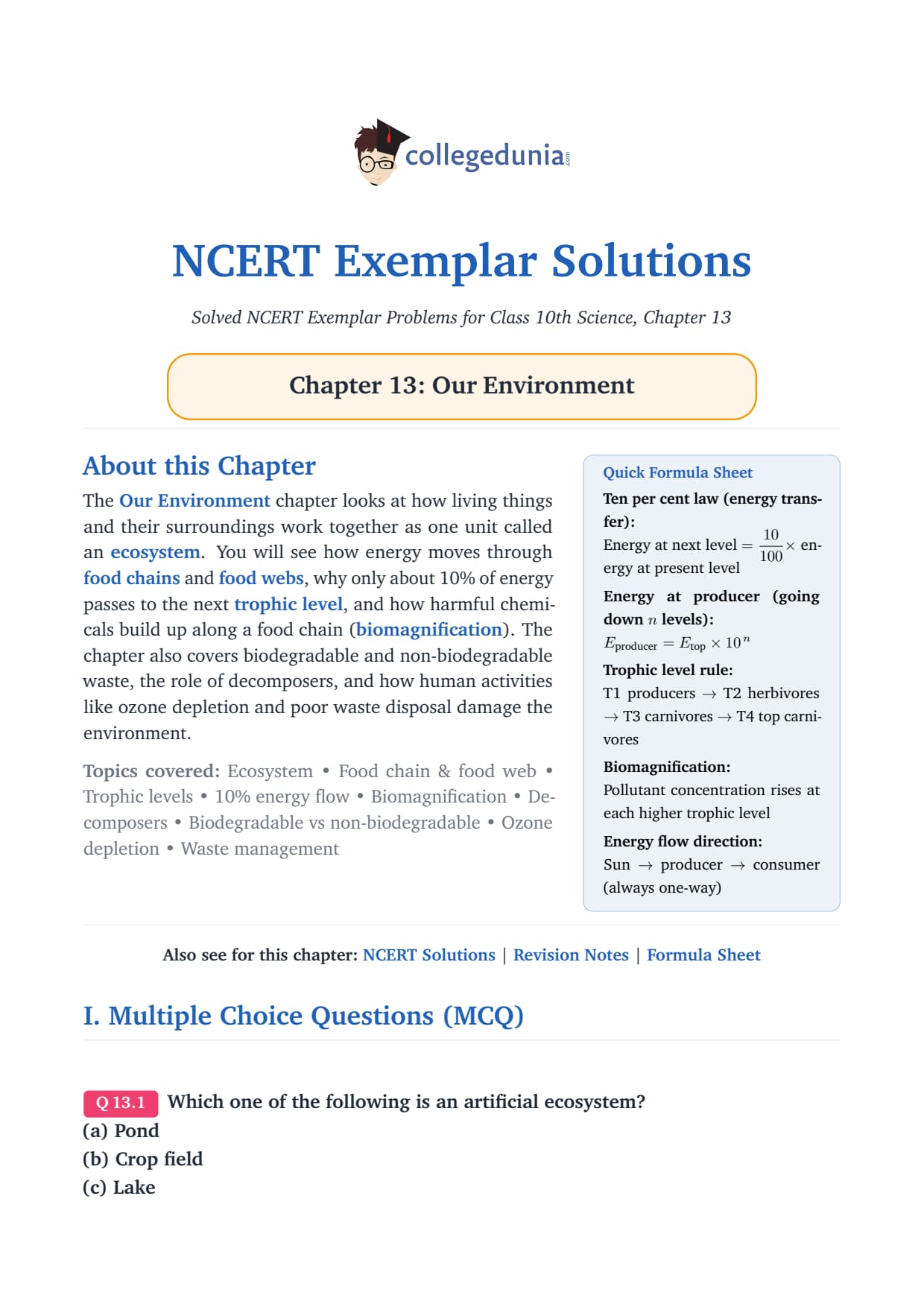
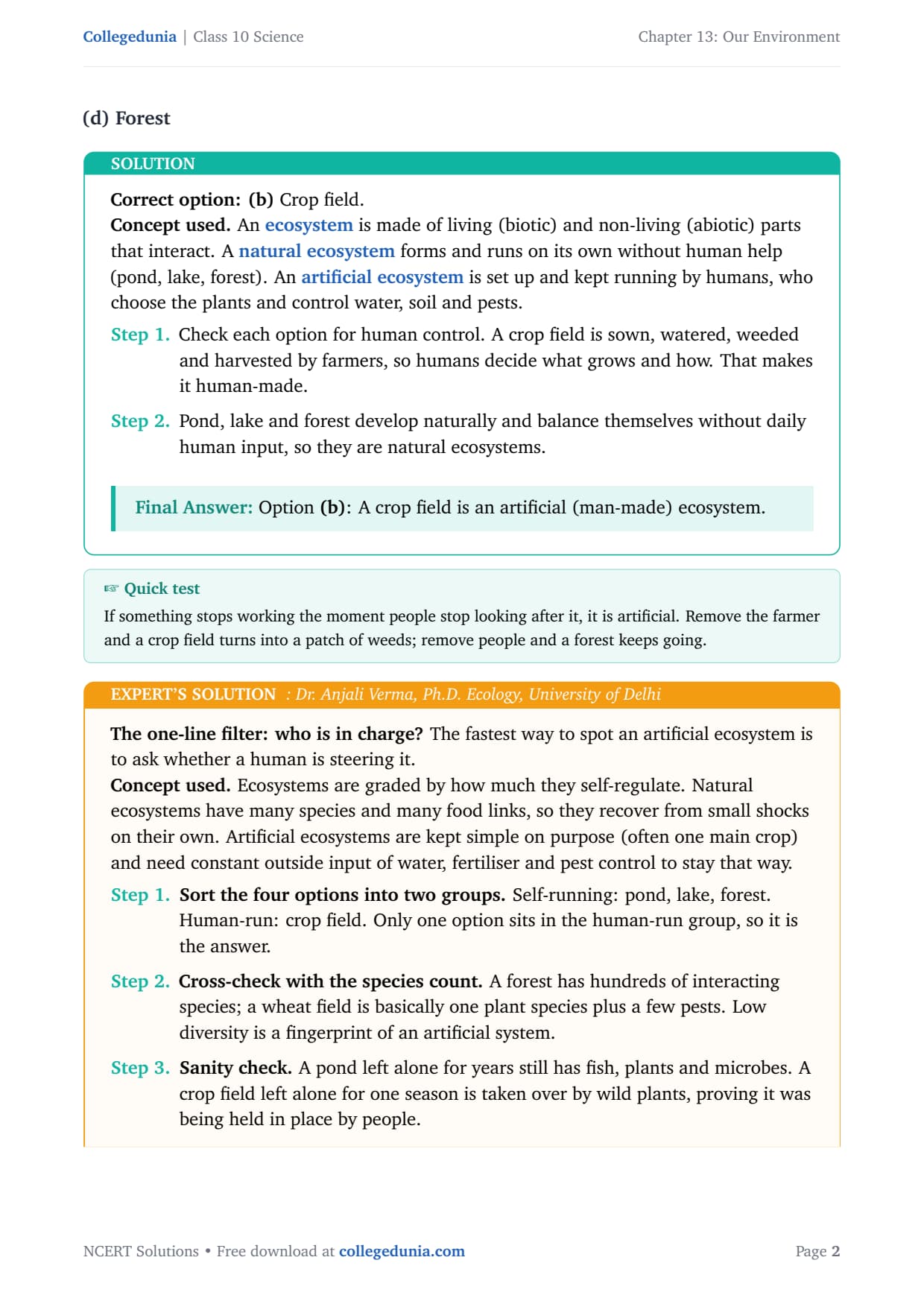
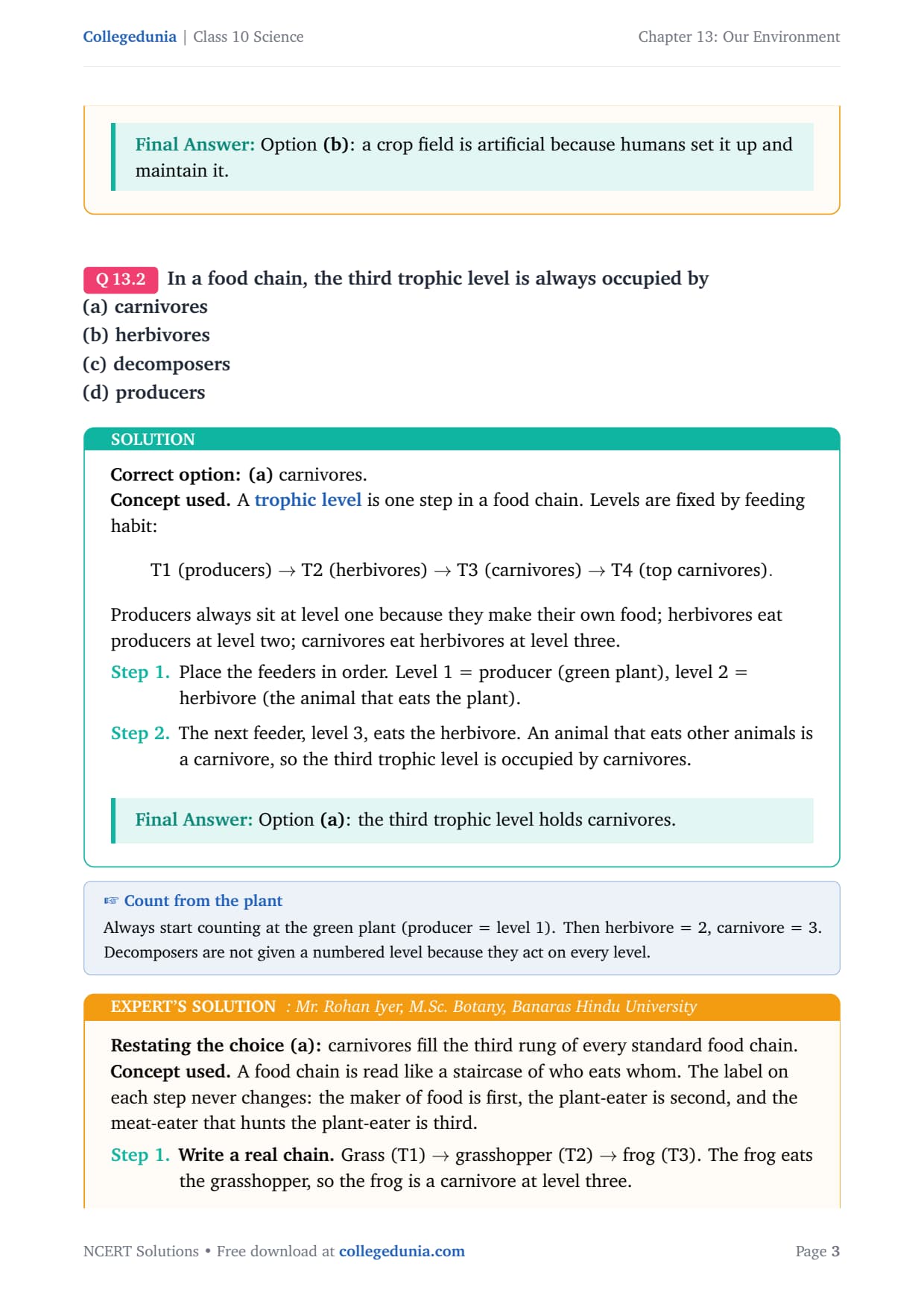
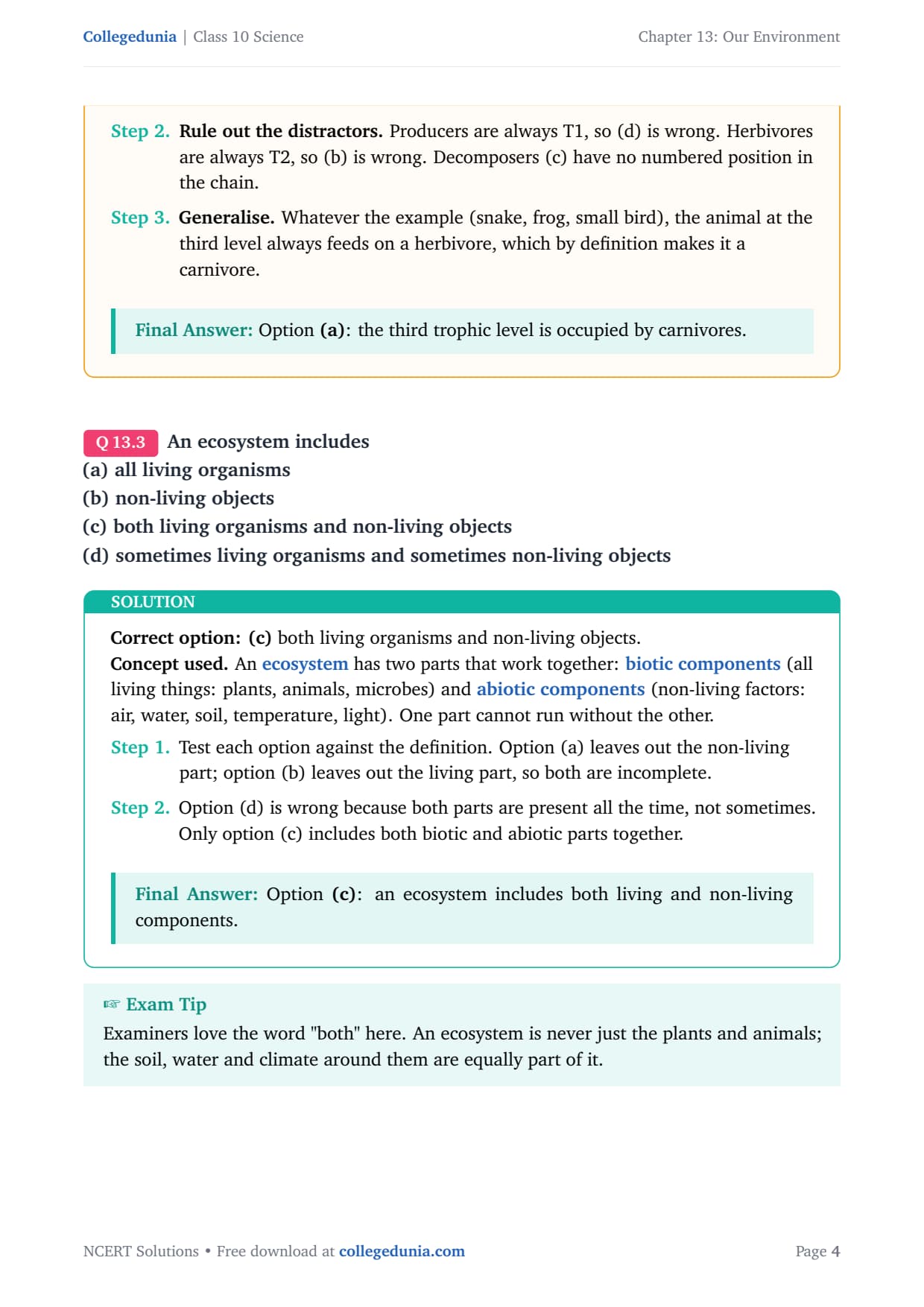
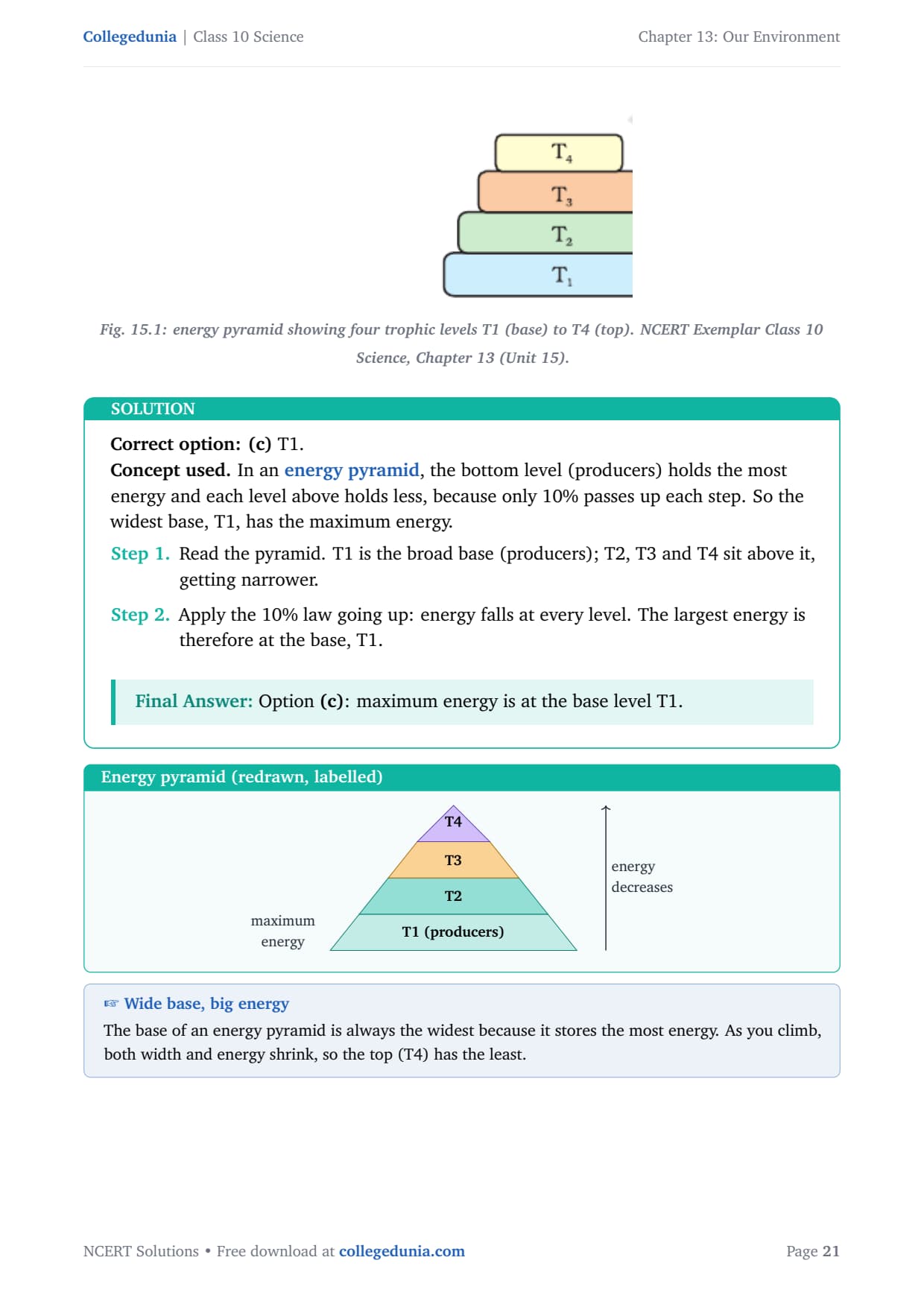
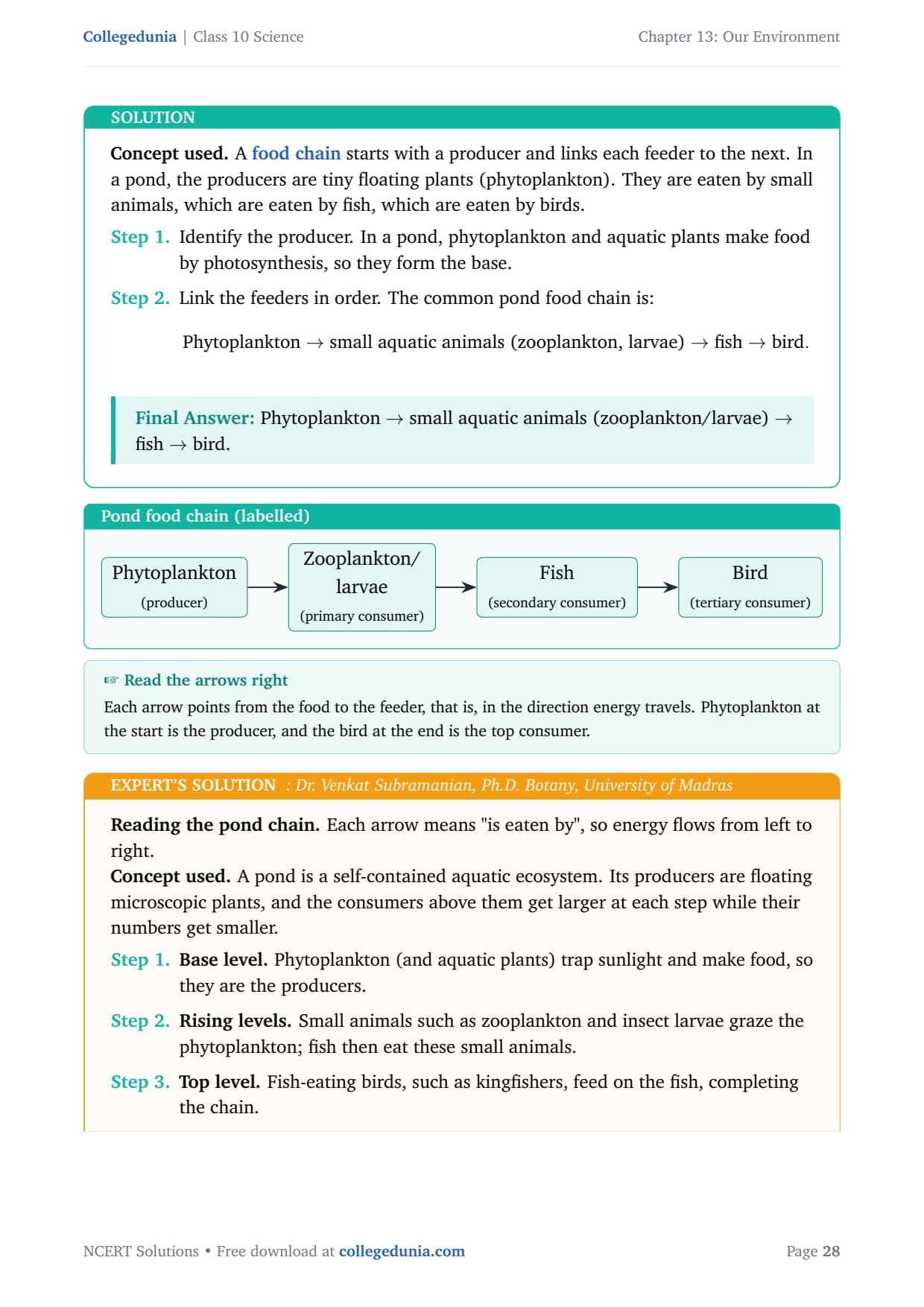
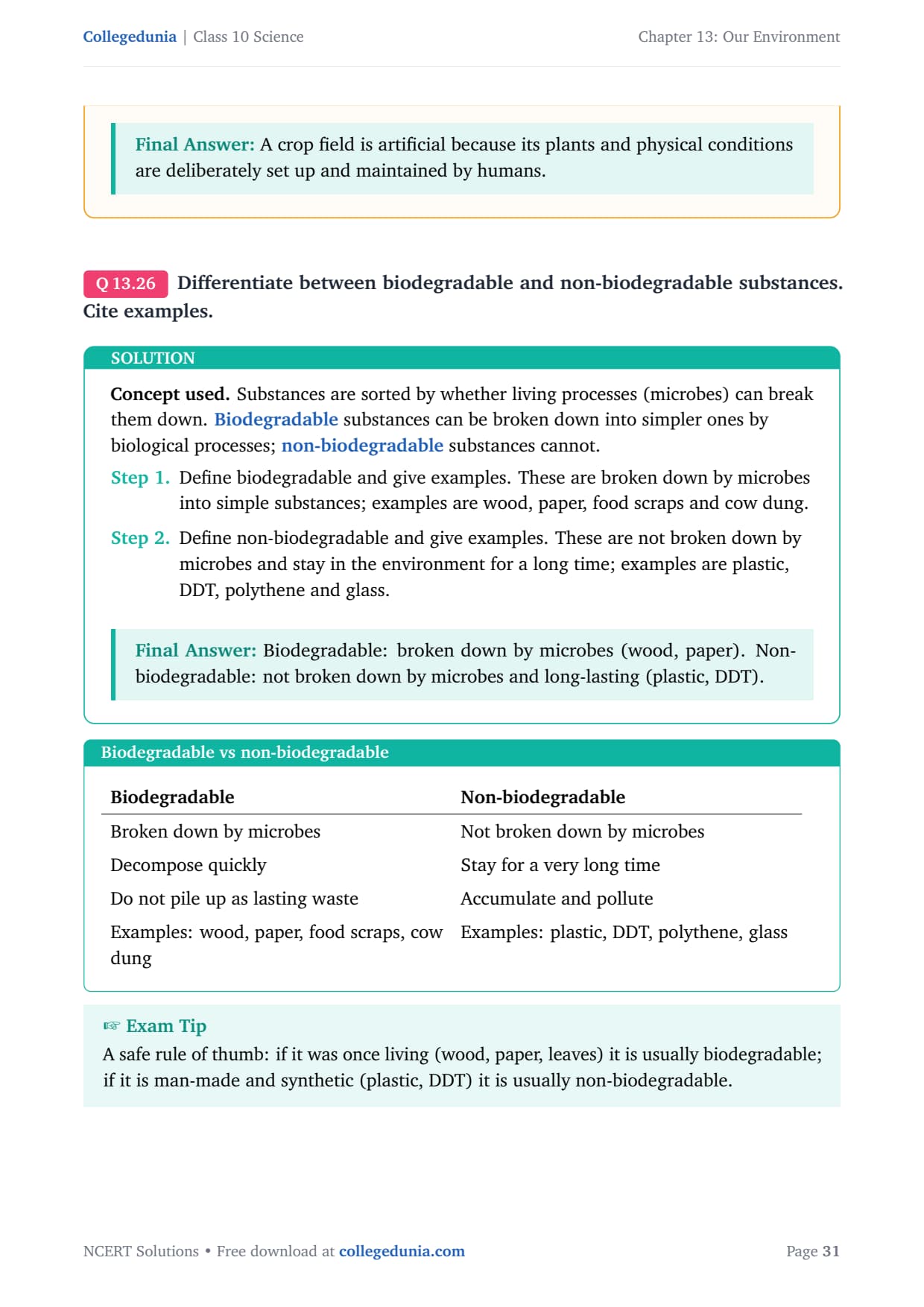
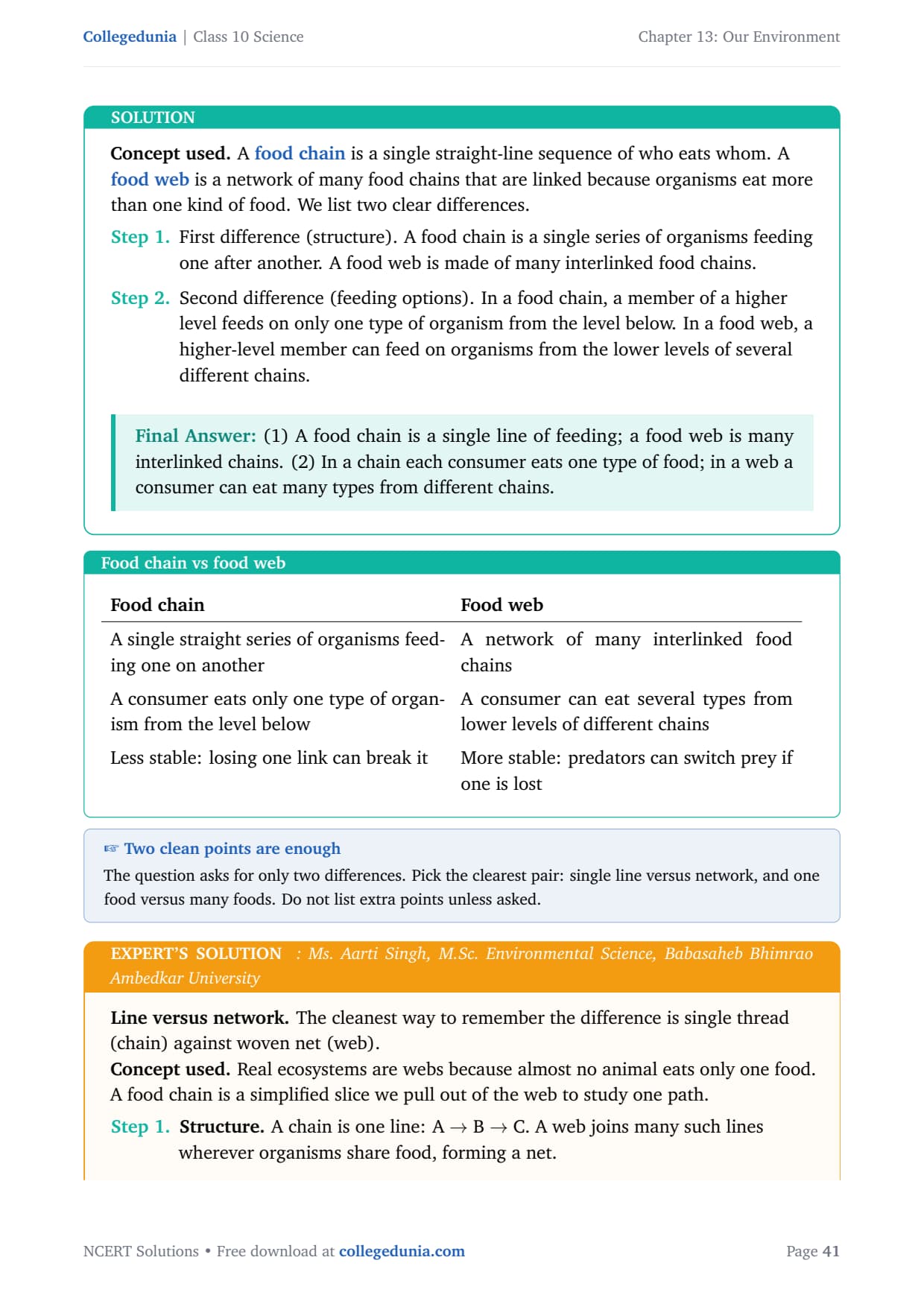
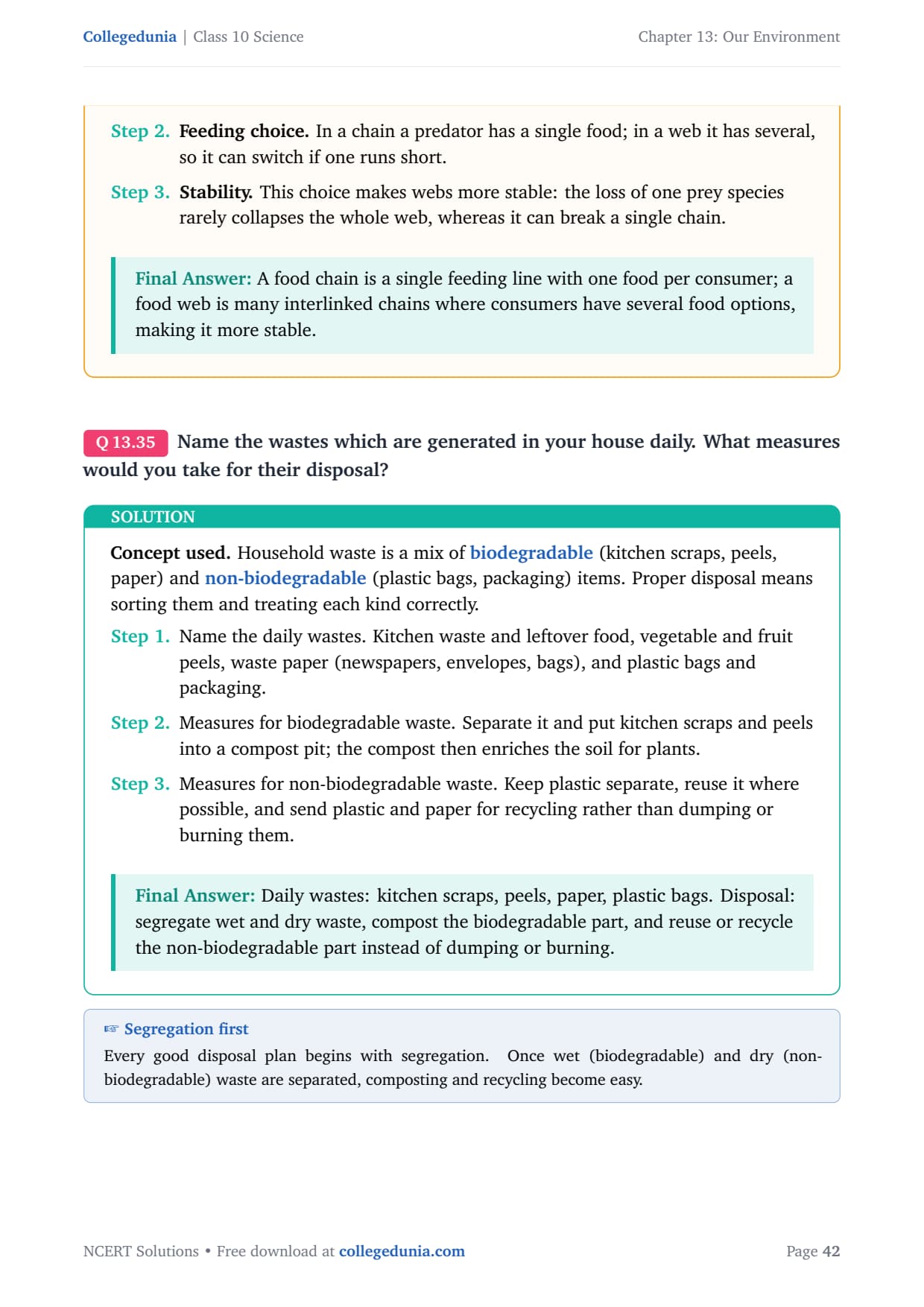
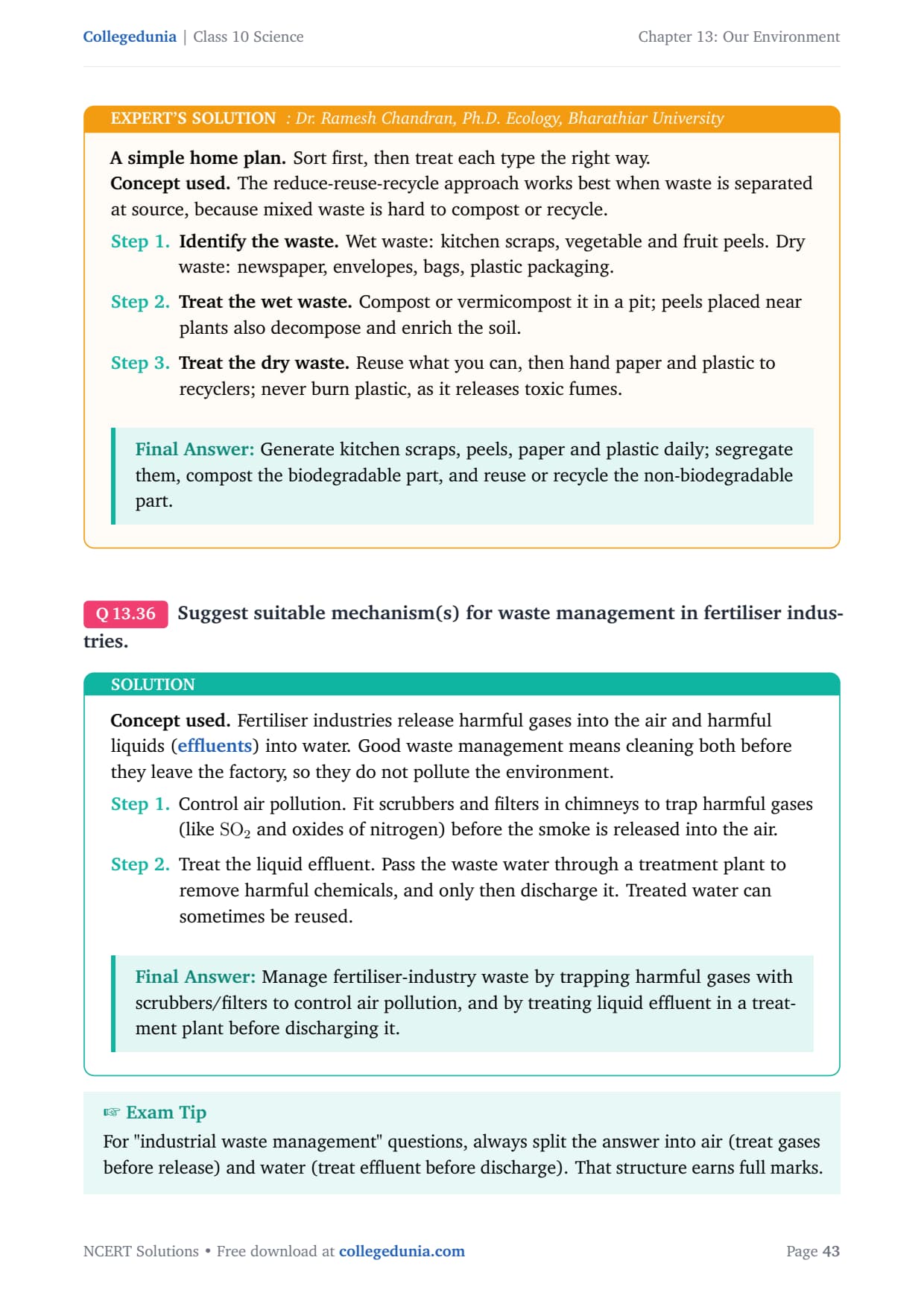
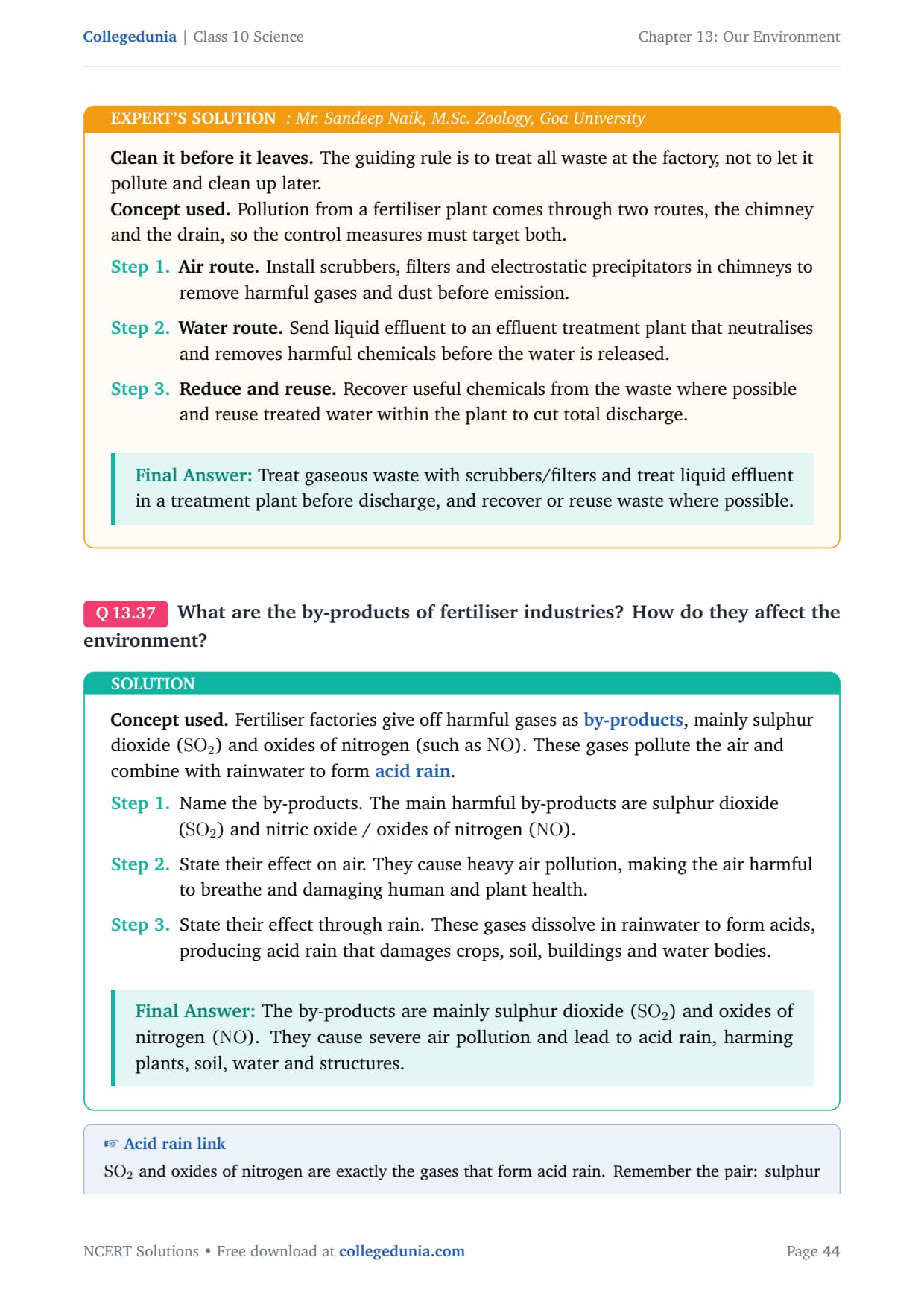
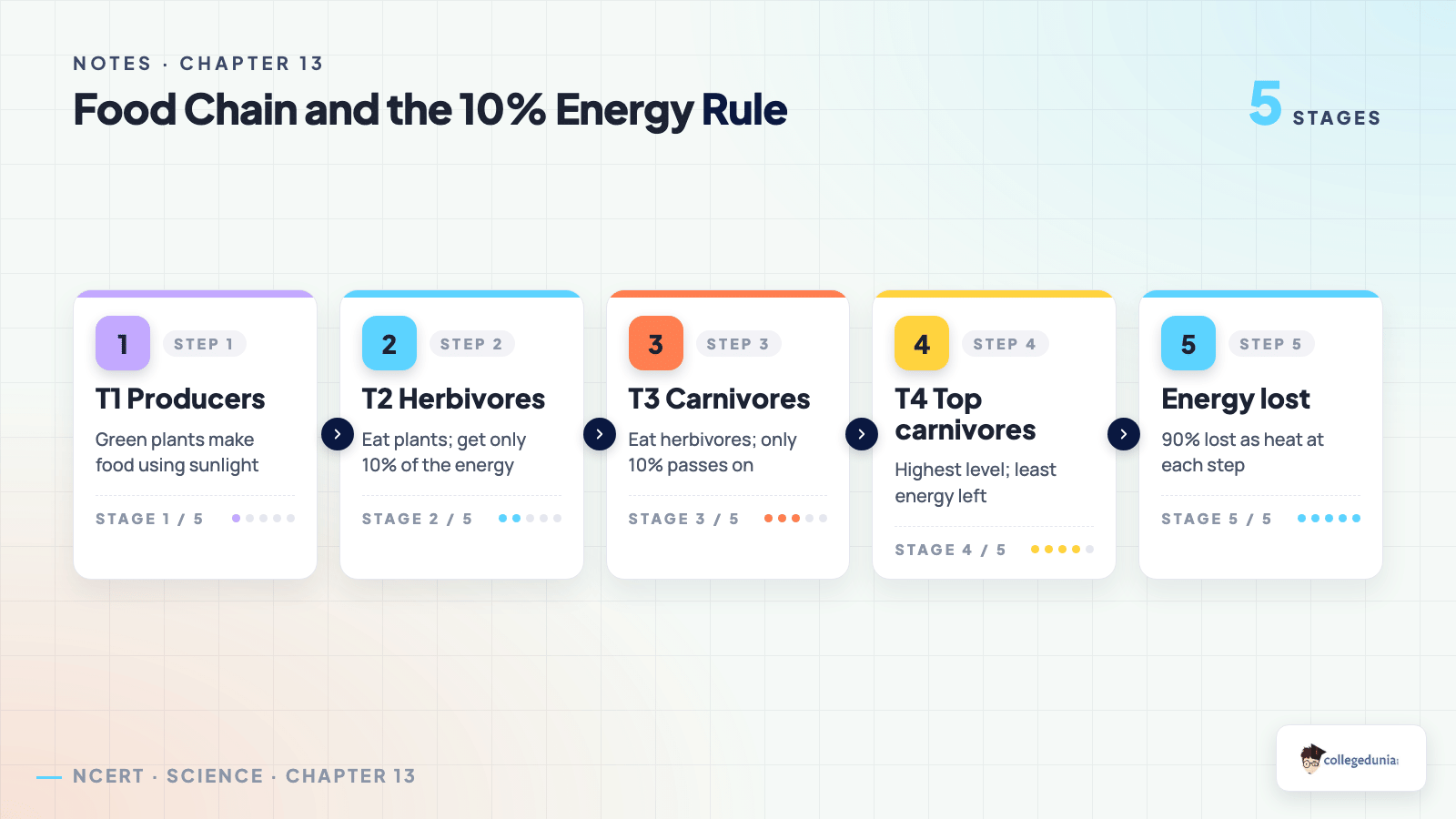
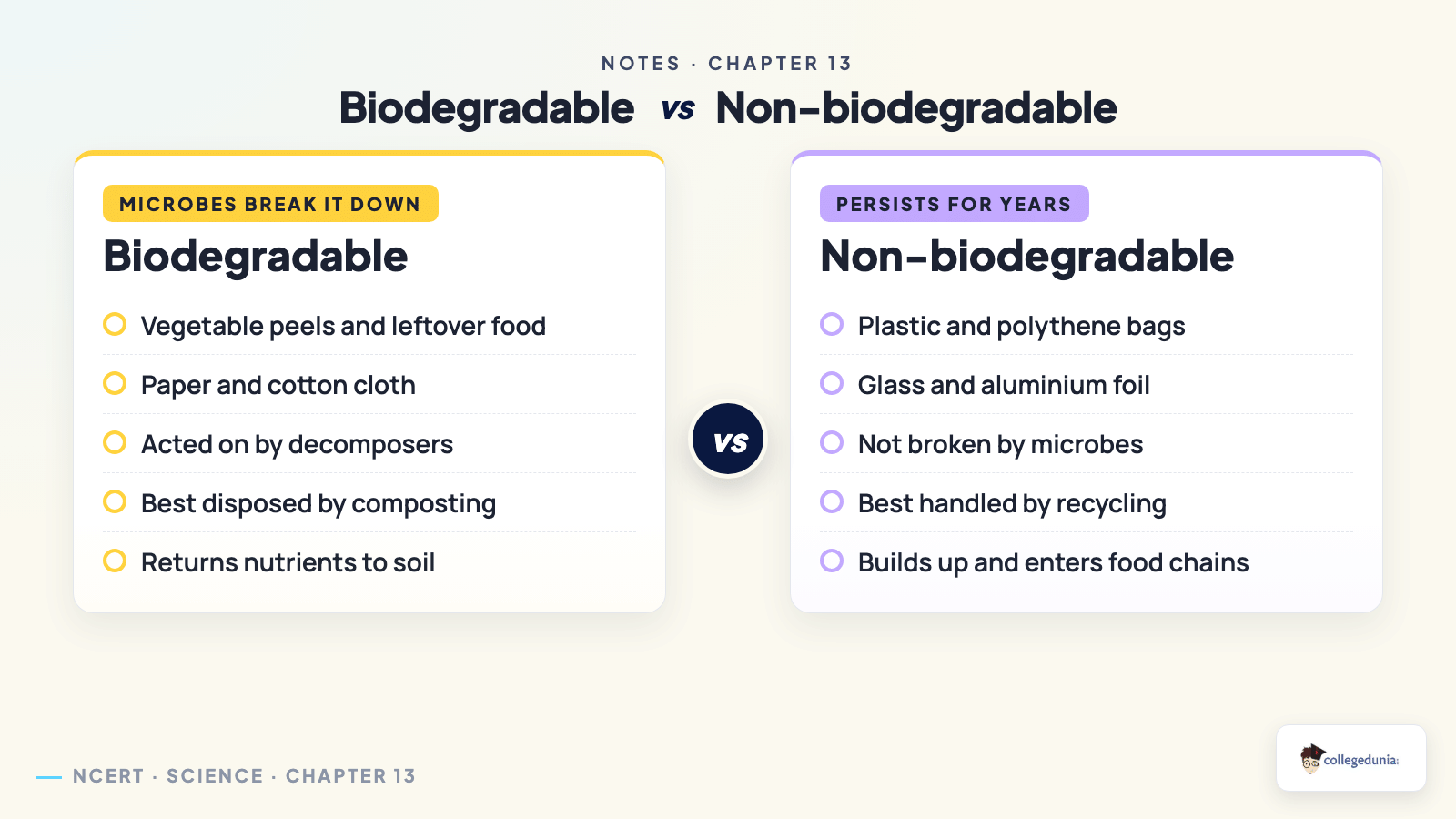
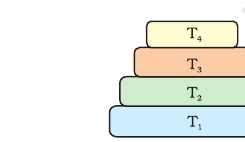



Comments