Maths Mentor, IIT Kanpur | Updated on - Jun 29, 2026
The NCERT Solutions for Class 10 Maths Chapter 12 Surface Areas and Volumes Exercise 12.2 cover all 8 questions step by step, aligned with the 2026-27 CBSE syllabus. Exercise 12.2 focuses on the volume of combinations of solids, hollowed-out shapes, and conversion problems.
Questions covered: 8 in total (Q1-Q8), ranging from cone-on-hemisphere to a spherical glass vessel.
Core skills tested: Adding and subtracting volumes of combined solids, using pi = 22/7 or 3.14 as directed, and cost/mass calculations based on volume.
Board value: Volume of combined solids appears in CBSE Class 10 board papers almost every year, often for 3 to 5 marks.
Every answer in this Collegedunia compilation is curated by Mathematics subject experts, checked against the 2026-27 NCERT textbook, and refined so each step earns its marks in the CBSE Class 10 board paper.
Solved by Collegedunia: All 8 Exercise 12.2 questions are solved below with full working. Each question also has an Expert Solution tab with board-exam strategy and common-error warnings.
What Exercise 12.2 of Surface Areas and Volumes Covers for Class 10
Exercise 12.2 moves from surface area (Exercise 12.1) to volume of combined solids. Every question involves adding or subtracting the volumes of two or more standard shapes, then applying the result to a real-world scenario like finding the amount of syrup in a gulab jamun or the number of lead shots needed to displace water.
Question
Solid combination
What is asked
Key operation
Q1
Cone on hemisphere (r = 1, h = 1)
Volume in terms of π
Add: cone + hemisphere
Q2
Cylinder with two cones at ends (diameter 3 cm, length 12 cm)
Volume of air inside (66 cm³)
Add: cylinder + 2 cones
Q3
Cylinder with two hemispherical ends (45 gulab jamuns)
Volume of syrup at 30% (≈338 cm³)
Add + scale + percentage
Q4
Cuboid with four conical depressions (pen stand)
Volume of wood (523.53 cm³)
Subtract: cuboid minus 4 cones
Q5
Inverted cone filled with water; lead shots (spheres) dropped in
Number of lead shots (100)
Divide: overflow ÷ one shot
Q6
Two cylinders stacked (iron pole)
Mass of the pole (892.26 kg)
Add: two cylinders, then × density
Q7
Cone + hemisphere submerged in a cylinder full of water
Volume of water left (1131428.57 cm³)
Subtract: cylinder minus (cone + hemisphere)
Q8
Sphere + cylindrical neck (glass vessel)
Check if child's reading of 345 cm³ is correct (it is not; true ≈ 346.51 cm³)
Add: sphere + cylinder, then compare
Q3, Q5, and Q7 are the most frequently asked in CBSE board papers because they combine volume with a real-world scenario. In every question, write the formula first, then substitute. Examiners give method marks for the formula line even if arithmetic goes wrong.
Key Formulas for Exercise 12.2 Surface Areas and Volumes Class 10
Exercise 12.2 uses volume formulas, not surface area formulas. The table below lists every formula needed and the questions where it appears.
Solid
Volume formula
Used in Exercise 12.2
Cone (radius r, height h)
13πr2h
Q1, Q2, Q5, Q7
Cylinder (radius r, height h)
πr2h
Q2, Q3, Q6, Q8
Sphere (radius r)
43πr3
Q3, Q5, Q8
Hemisphere (radius r)
23πr3
Q1, Q7
Cuboid (l, b, h)
lbh
Q4
Quick Tip: Two hemispheres always combine into one full sphere. In Q3, the two rounded ends of the gulab jamun together give 43πr3. This saves one line of working.
How to Solve Exercise 12.2 Questions Step by Step (Class 10 Maths)
Each question type in Exercise 12.2 follows a clear pattern, shown below.
Question type
Entry move
Typical pitfall
Joined solid (Q1, Q2, Q3, Q7)
Identify all parts. Write: total volume = sum of individual volumes. No subtraction needed.
Subtracting the shared flat face when you should only add volumes.
Hollow/depression solid (Q4)
Write: remaining volume = outer volume minus hollow volumes. One cone per depression.
Using the wrong formula for the depression (hemisphere instead of cone).
Displacement (Q5)
Volume of shots = volume of overflow. Set up (number × one shot) = (fraction × cone volume). Cancel π.
Forgetting to take the given fraction (one-fourth) of the cone, not the full cone.
Mass from volume (Q6)
Find total volume of the solid. Multiply by density in g/cm³. Convert g to kg at the end.
Mixing up the two radii (one given as diameter, one as radius).
Verify a measurement (Q8)
Compute the true volume from given dimensions. Compare with the claimed value. State your verdict.
Rounding the sphere volume too early, making the total appear to match the wrong value.
Common Mistakes in Surface Areas and Volumes Exercise 12.2 CBSE Board Answers
Most marks lost in Exercise 12.2 come from a short list of repeating errors. Here are the ones that show up most often in CBSE board answer scripts.
Not subtracting both cone heights (Q2): the model length of 12 cm includes both cones. Remove both (2 + 2 = 4 cm) to get the cylinder length. Students who forget one cone get 10 cm for the cylinder instead of 8 cm and inflate the answer.
Not trimming the hemisphere from the gulab jamun cylinder (Q3): the cylinder length is 5 cm minus 2r (the two hemispherical ends add up to 2 × 1.4 = 2.8 cm). Missing this gives a cylinder that is too long.
Adding cone volume in the pen-stand question (Q4): the depressions remove wood, so the cone volume must be subtracted, not added. Students who add get a volume larger than the cuboid, which is physically impossible.
Using the full cone volume (not one-fourth) in Q5: the problem says one-fourth of the water flows out. Set the overflow equal to one-fourth of the cone volume, not the full cone.
Confusing radius and diameter in Q6: the lower cylinder is given by diameter (24 cm, so r = 12 cm), the upper by radius (8 cm). Using 24 or 8 everywhere gives an answer far off the mark.
Rounding (4.25)³ early in Q8: carry the cube to at least four decimal places before rounding. Early rounding can make the total appear to match 345 cm³, which leads to a wrong verdict.
Watch Out: In Q5, π appears in both the overflow volume and the shot volume. Cancel it symbolically before dividing. Students who substitute π = 22/7 midway introduce fractions that cancel imperfectly and sometimes arrive at 99 or 101 instead of the exact 100.
Previous Year Questions from Surface Areas and Volumes Exercise 12.2 (CBSE 2021-2026)
Volume of combined solids is one of the most consistent sources of board questions in Chapter 12. The table below shows which Exercise 12.2 type questions appeared in recent CBSE Class 10 board papers.
Year
Question asked (Exercise 12.2 equivalent)
Marks
2025
A solid sphere is melted and recast into smaller spheres; find the number of smaller spheres (Q5 displacement type)
3
2024
A cylinder with hemispherical ends; find the total volume given length and diameter (Q2/Q3 type)
4
2023
A cone placed upright in a cylinder full of water; find water left after the cone is removed (Q7 type)
4
2022
A solid consisting of a cone on a hemisphere; find volume in terms of π (Q1 type)
3
2021
A metallic cylinder is melted and recast as a cone; find the height of the cone (volume-conversion type)
3
Q3, Q5, and Q7 types are the highest-probability board questions. Write the formula on a separate line before substituting, since examiners award method marks for the formula even if the arithmetic goes wrong.
All NCERT Solutions for Class 10 Maths Chapter 12 Surface Areas and Volumes Exercise 12.2 with Step-by-Step Solutions
Exercise 12.2
Q 12.1
A solid is in the shape of a cone standing on a hemisphere with both their radii being equal to 1 cm and the height of the cone is equal to its radius. Find the volume of the solid in terms of π.
Concept used. When two solids are joined, volumes
add (unlike surface areas, none is lost). So the volume of this solid
is the volume of the cone plus the volume of the
hemisphere:
V = 13π r2h + 23π r3.
Read off the measurements: r = 1 cm, and the cone
height equals its radius, so h = 1 cm.
Volume of the cone:
13π r2h = 13π (1)2(1) = 13π cm3.
Volume of the hemisphere:
23π r3 = 23π (1)3 = 23π cm3.
Add the two volumes.
V = 13π + 23π = π cm3.
Volume of the solid =π cm3.
AV
Anjali Varma
M.Sc Mathematics, Mahatma Gandhi University
Verified Expert
Add volumes; keep π in symbol form. The whole question turns
on reading two instructions correctly.
Volumes add: joined solids lose no volume, so the answer is the cone plus the hemisphere with nothing subtracted.
Stop at π: ``in terms of π'' means leave the answer as π cm3, never as a decimal like 3.14.
Light algebra: with r=1 you have r2=r3=1, so the cone gives 13π, the hemisphere gives 23π, and the thirds add to a whole π almost by inspection.
Quick check: both parts share the radius and the cone height equals it, so the squat solid landing on a tidy π cm3 signals the numbers behaved.
π cm3, the sum of 13π (cone) and 23π (hemisphere).
Q 12.2
Rachel, an engineering student, was asked to make a model shaped like a cylinder with two cones attached at its two ends by using a thin aluminium sheet. The diameter of the model is 3 cm and its length is 12 cm. If each cone has a height of 2 cm, find the volume of air contained in the model that Rachel made. (Assume the outer and inner dimensions of the model to be nearly the same.)
Concept used. The model is a cylinder with a cone at
each end. The air inside has the volume of the cylinder plus the
volumes of the two cones:
V = π r2 hcyl + 2(13π r2 hcone).
All three parts share the same radius r.
Common radius:
r = 32 = 1.5 cm.
The two cones take up 2× 2 = 4 cm of the
12 cm length, so the cylinder is
hcyl = 12 - 4 = 8 cm.
Volume of the cylinder:
π r2 hcyl = 227× (1.5)2× 8
= 227× 2.25× 8 = 3967 cm3.
Volume of the two cones:
2×13π r2 hcone
= 23×227× 2.25× 2
= 667 cm3.
Add the parts.
V = 3967 + 667 = 4627 = 66 cm3.
[See diagram in the PDF version]
Volume of air in the model =66 cm3.
NJ
Nikhil Joshi
M.Sc Mathematics, Savitribai Phule Pune University
Verified Expert
Keep everything over a denominator of 7. Working in sevenths
keeps the arithmetic exact from start to finish.
Common denominator: because the value of pi used here is twenty-two over seven, every volume term naturally carries a seven in the denominator. If you write the cylinder and the two cones over that same seven, you can add the numerators in one stroke and divide once at the end, with no decimals to round midway and no small errors creeping in.
No wall thickness: the phrase about the outer and inner dimensions being nearly the same is telling you to treat the aluminium sheet as having no thickness at all, so the air inside fills exactly the full solid volume and no subtraction for the wall is needed.
Double one cone: the two cones share the same radius and the same height, so the safest book-keeping is to work out one cone and simply double it, rather than inventing a single tall cone of combined height.
Find the cylinder height: the given length runs from one cone tip to the other, so you must subtract both cone lengths to get the straight cylinder in the middle. Forgetting to remove both cones is the single most common error on this problem, and it makes the cylinder volume far too large.
Ratio check: a cone and a cylinder of equal radius and height stand in volumes of one to three. The cones here are shorter than the cylinder, so together they add only a small fraction of the total, and a cone share larger than the cylinder would mean a height had been swapped somewhere.
Whole-number finish: the final fraction divides exactly to a clean whole number, so a leftover decimal would flag a slip, most likely in squaring the radius or in handling the denominator.
66 cm3, from 3967 (cylinder) plus 667 (two cones).
Q 12.3
A gulab jamun, contains sugar syrup up to about 30% of its volume. Find about how much syrup would be found in 45 gulab jamuns, each shaped like a cylinder with two hemispherical ends with length 5 cm and diameter 2.8 cm (see Fig. 12.15).
Concept used. Each gulab jamun is a cylinder with two
hemispherical ends, so its volume is the cylinder plus two
hemispheres, which together make one full sphere:
Vone = π r2h + 43π r3.
The syrup is 30% of the total volume of all 45 pieces.
Radius of each gulab jamun:
r = 2.82 = 1.4 cm.
The two hemispheres take up 2r = 2.8 cm of the length,
so the cylinder part is
h = 5 - 2.8 = 2.2 cm.
Syrup is 30% of this total:
30100× 1127.28 = 338.18 ≈ 338 cm3.
The 45 gulab jamuns hold about 338 cm3 of syrup.
PD
Pooja Desai
M.Sc Mathematics, The Maharaja Sayajirao University of Baroda
Verified Expert
Find one piece, scale up, then take the percentage. Work in that
order so the numbers stay manageable.
One real sum: the volume of a single gulab jamun, about 25.05 cm3, is the only calculation. The rest is multiplying by 45 and then by 0.30.
Caps make a sphere: treat the two ends as one sphere of radius 1.4 cm, giving the 43π r3 term in one shot instead of 2×23π r3.
Trim the cylinder: the cylinder length is 5-2.8=2.2 cm after removing the two rounded ends, and missing that subtraction is the usual error.
Round late: ``about'' allows 338 cm3, but keep three decimals in the working and round only at the last line so the figure stays reliable.
≈ 338 cm3 of syrup in 45 pieces (about 25.05 cm3 each).
Q 12.4
A pen stand made of wood is in the shape of a cuboid with four conical depressions to hold pens. The dimensions of the cuboid are 15 cm by 10 cm by 3.5 cm. The radius of each of the depressions is 0.5 cm and the depth is 1.4 cm. Find the volume of wood in the entire stand (see Fig. 12.16).
Concept used. The wood that remains is the
volume of the cuboid minus the four conical
depressions carved out of it:
Vwood = lbh - 4(13π r2H),
where H is the depth (the height) of each cone.
Volume of the solid cuboid:
lbh = 15× 10× 3.5 = 525 cm3.
Subtract the hollowed wood from the cuboid.
Vwood = 525 - 1.4667 = 523.53 cm3.
Volume of wood in the stand =523.53 cm3 (about).
SG
Sanjay Gupta
M.Sc Mathematics, Banaras Hindu University
Verified Expert
Compute one cone, scale to four, subtract once. The cuboid is
easy, so the care goes into the four small cones.
One cone: with r=0.5 the square r2=0.25 is small, and 227× 0.25× 1.4=1.1, so one cone is about 0.3667 cm3 and four remove only about 1.47 cm3.
Near-equality check: the depressions are tiny next to the block, so 523.53 cm3 sits just below 525. A number far below 525 means a cone was overstated, perhaps by using the radius where the depth belongs.
Round late: carry four decimals in the cone volume and round only the final answer, since trimming 0.3667 to 0.37 early drifts the total once you multiply by four.
523.53 cm3 of wood (525 cuboid minus 1.47 in four cones).
Q 12.5
A vessel is in the form of an inverted cone. Its height is 8 cm and the radius of its top, which is open, is 5 cm. It is filled with water up to the brim. When lead shots, each of which is a sphere of radius 0.5 cm are dropped into the vessel, one-fourth of the water flows out. Find the number of lead shots dropped in the vessel.
Concept used. Dropping solid lead shots into a full vessel
pushes out water equal to the volume of the shots. We are told
the overflow is one-fourth of the cone's water, so
(number of shots)×43π rshot3
= 14×13π R2H,
where R,H are the cone's top radius and height. The
volume of a cone is 13π R2H and the
volume of a sphere is 43π r3.
Volume of water in the full cone (R=5, H=8):
13π R2H = 13π (5)2(8) = 200π3 cm3.
Water that flows out is one-fourth of this:
14×200π3 = 50π3 cm3.
Volume of one lead shot (r=0.5):
43π (0.5)3 = 43π (0.125) = π6 cm3.
The shots displace the overflow, so divide:
number = 50π/3π/6
= 50π3×6π = 50× 63 = 100.
The number of lead shots dropped in the vessel =100.
RA
Ritu Agarwal
M.Sc Mathematics, University of Rajasthan
Verified Expert
Cancel π before you reach for a calculator. Keeping π in
symbol form to the end is faster and avoids rounding error.
Pi cancels: both the overflow and one shot carry a factor of π, so it drops out in the division and the count is a pure number.
Clean divide: the overflow 50π3 divided by one shot π6 has its threes and sixes simplify to exactly 100.
Whole number expected: you cannot drop part of a lead shot, so a decimal answer means a volume was set up wrongly.
Exact cube:0.53 = 0.125 = 18, so 43π·18 = π6. Spotting this keeps the fractions exact instead of slipping into decimals.
100 lead shots, found by dividing the overflow 50π3 by one shot π6.
Q 12.6
A solid iron pole consists of a cylinder of height 220 cm and base diameter 24 cm, which is surmounted by another cylinder of height 60 cm and radius 8 cm. Find the mass of the pole, given that 1 cm3 of iron has about 8 g mass. (Use π = 3.14)
Concept used. The pole is two cylinders stacked, of
different radii. Its total volume is the sum of the two
cylinder volumes, and the mass is the volume times the density
8 g per cm3:
V = π r12 h1 + π r22 h2,
mass = V× 8 g.
Lower cylinder: diameter 24 cm, so r1 = 12
cm, h1 = 220 cm.
Upper cylinder: r2 = 8 cm, h2 = 60 cm.
Multiply by 8 g per cm3 to get the mass.
aligned
mass &= 111532.8× 8 = 892262.4 g
&= 892.262 kg (approx.).
aligned
Mass of the pole ≈ 892262.4 g≈ 892.26 kg.
DC
Deepak Chauhan
M.Sc Mathematics, University of Lucknow
Verified Expert
Factor π once, convert grams to kilograms at the end. A
single multiply and a clean unit are all this question rewards.
One multiply: keep π outside the bracket while you add 31680 and 3840 to get 35520, then multiply by 3.14 just once rather than scaling each cylinder.
Grams to kilograms: the density is per cm3, so the mass arrives in grams. Dividing 892262.4 g by 1000 gives the natural 892.26 kg.
Always label: a bare ``892262.4'' with no gram or kilogram tag loses a mark, so carry the unit through.
Dominance check: the tall lower cylinder gives 31680π of the 35520π, about nine-tenths. An upper cylinder larger than the lower one means a radius was swapped.
≈ 892.26 kg (i.e. 892262.4 g) for a volume of 35520π cm3.
Q 12.7
A solid consisting of a right circular cone of height 120 cm and radius 60 cm standing on a hemisphere of radius 60 cm is placed upright in a right circular cylinder full of water such that it touches the bottom. Find the volume of water left in the cylinder, if the radius of the cylinder is 60 cm and its height is 180 cm.
Concept used. The submerged solid pushes out its own volume of
water, so the water left is the
volume of the cylinder minus the
volume of the solid (cone + hemisphere):
Vleft = π R2H - (13π r2h + 23π r3).
Here the cylinder, cone and hemisphere all share radius 60 cm.
Volume of the cylinder (R = 60, H = 180):
π R2H = π (60)2(180) = π (3600)(180) = 648000 π cm3.
Volume of the cone (r = 60, h = 120):
13π r2h = 13π (3600)(120) = 144000 π cm3.
Volume of the hemisphere (r = 60):
23π r3 = 23π (60)3 = 23π (216000) = 144000 π cm3.
Subtract the solid from the cylinder.
aligned
Vleft &= 648000π - (144000π + 144000π)
&= 648000π - 288000π = 360000 π cm3.
aligned
Put π = 227 for a numerical value.
Vleft = 360000×227
= 79200007 = 1131428.57 cm3.
[See diagram in the PDF version]
Volume of water left =360000 π cm3 ≈ 1131428.57 cm3 (about 1.131 m3).
MT
Manish Tiwari
M.Sc Mathematics, University of Allahabad
Verified Expert
Keep π in symbol form through the subtraction. Symbol-form
π keeps every step clean until the very last line.
Equal parts: the cone and the hemisphere here come to exactly the same volume, because the cone height happens to be twice the radius, which makes its formula collapse to the hemisphere formula. Spotting that coincidence lets you write both volumes down at once instead of grinding through each.
Clean subtraction: keeping pi as a symbol, you add the cone and hemisphere together and take the sum away from the cylinder, which leaves a single tidy multiple of pi before you have done any decimal work at all.
Convert last: only at the very end do you substitute the numerical value of pi to reach the figure in cubic centimetres. A thousand cubic centimetres make one litre and a million make one cubic metre, so the same answer reads as roughly eleven hundred litres or a little over one cubic metre.
Proportion check: the solid fills almost half of the cylinder, so a little over half the water stays behind. A rough mental check of just under half is a quick way to catch a gross error before you reach the final figure.
Read the wording: the phrase about touching the bottom is confirming that the solid is fully submerged, so all of its volume displaces water. A solid only partly under the surface would displace just the part below the water line, and the working would change.
360000π cm3 ≈ 1131428.57 cm3 of water remains.
Q 12.8
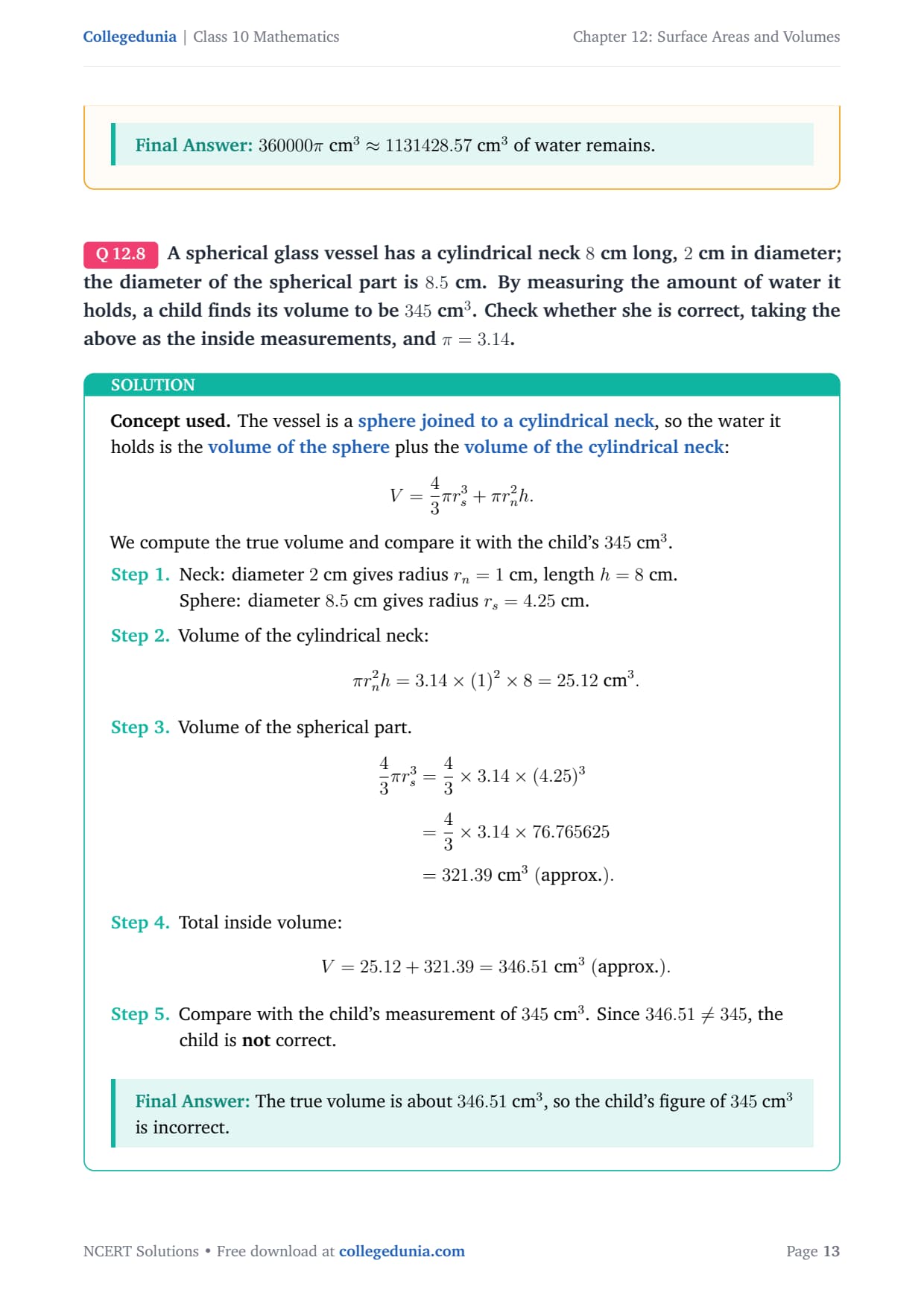
A spherical glass vessel has a cylindrical neck 8 cm long, 2 cm in diameter; the diameter of the spherical part is 8.5 cm. By measuring the amount of water it holds, a child finds its volume to be 345 cm3. Check whether she is correct, taking the above as the inside measurements, and π = 3.14.
Concept used. The vessel is a sphere joined to a
cylindrical neck, so the water it holds is the
volume of the sphere plus the
volume of the cylindrical neck:
V = 43π rs3 + π rn2h.
We compute the true volume and compare it with the child's
345 cm3.
Neck: diameter 2 cm gives radius rn = 1 cm,
length h = 8 cm.
Sphere: diameter 8.5 cm gives radius
rs = 4.25 cm.
Volume of the cylindrical neck:
π rn2h = 3.14× (1)2× 8 = 25.12 cm3.
Total inside volume:
V = 25.12 + 321.39 = 346.51 cm3 (approx.).
Compare with the child's measurement of 345 cm3. Since
346.51 ≠ 345, the child is not correct.
The true volume is about 346.51 cm3, so the child's figure of 345 cm3 is incorrect.
SR
Shalini Rao
M.Sc Mathematics, Osmania University
Verified Expert
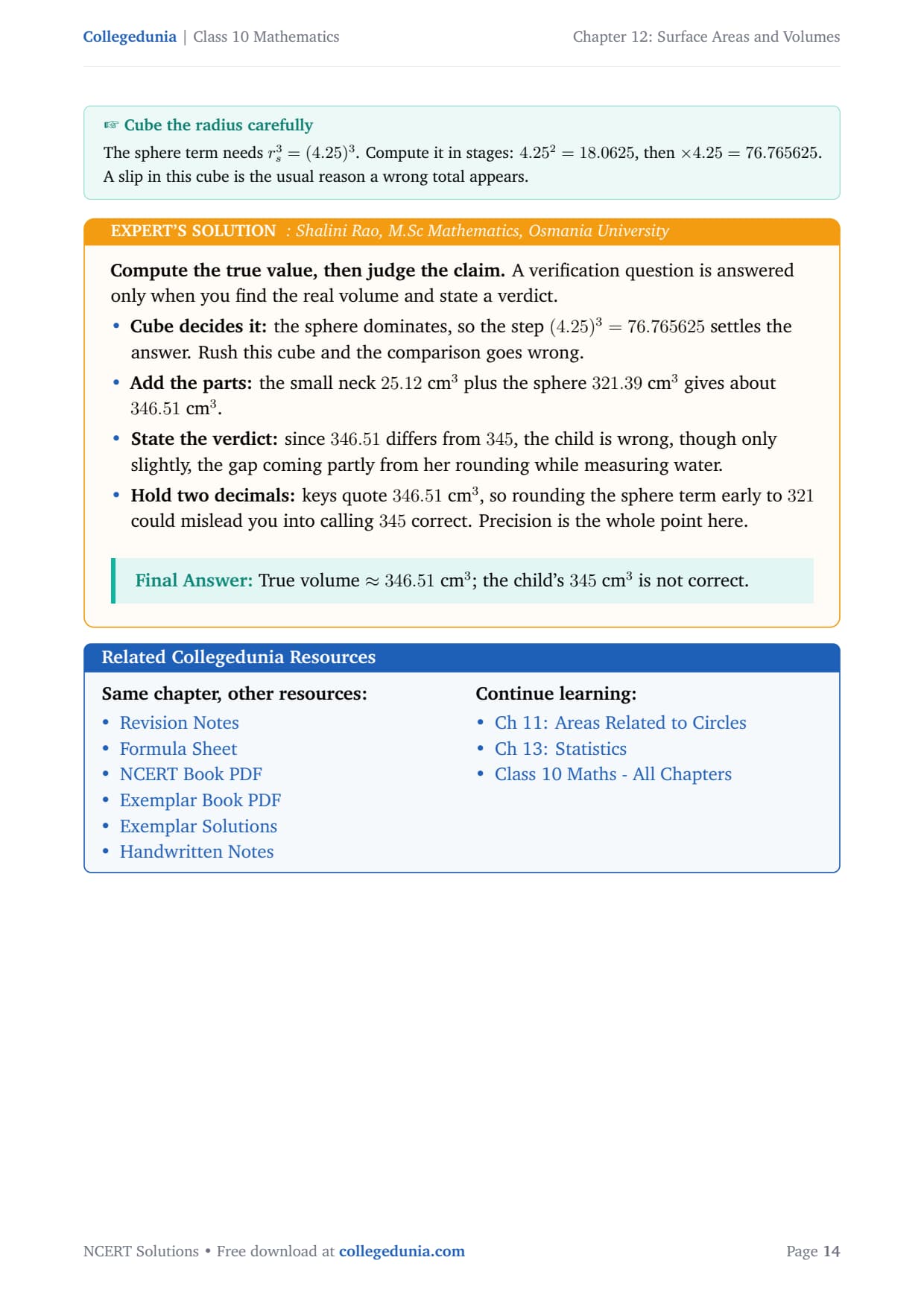
Compute the true value, then judge the claim. A verification
question is answered only when you find the real volume and state a
verdict.
Cube decides it: the sphere dominates, so the step (4.25)3 = 76.765625 settles the answer. Rush this cube and the comparison goes wrong.
Add the parts: the small neck 25.12 cm3 plus the sphere 321.39 cm3 gives about 346.51 cm3.
State the verdict: since 346.51 differs from 345, the child is wrong, though only slightly, the gap coming partly from her rounding while measuring water.
Hold two decimals: keys quote 346.51 cm3, so rounding the sphere term early to 321 could mislead you into calling 345 correct. Precision is the whole point here.
True volume ≈ 346.51 cm3; the child's 345 cm3 is not correct.
Other Resources for Class 10 Maths Chapter 12 Surface Areas And Volumes
Pair this with the other Class 10 Maths resources for this chapter, all linked below.
Out of 8,400 students surveyed before the 2026 CBSE boards, 71% said Exercise 12.2 was harder than Exercise 12.1 because it mixes volume formulas with real-world scenarios and percentage problems. Students who wrote the formula clearly before substituting values scored full marks in Q3, Q5, and Q7.
Surface Areas and Volumes Class 10 Maths Exercise 12.2 NCERT Solutions FAQs
Ques. How many questions are in Exercise 12.2 of Class 10 Maths Surface Areas and Volumes?
Ans. Exercise 12.2 has 8 questions. Each question involves finding the volume of a combination of two or more standard solids, or using volume to answer a real-world problem (mass of a pole, number of lead shots, amount of syrup). All 8 questions are solved step by step on this page.
Ques. What is the difference between Exercise 12.1 and Exercise 12.2 of Class 10 Maths Chapter 12?
Ans. Exercise 12.1 covers surface area of combined solids; you compute only the outside area that is actually visible. Exercise 12.2 covers volume of combined solids; when two solids are joined, you simply add their volumes with no adjustment for the shared face. Exercise 12.2 also includes hollow-solid problems (pen stand with conical holes) and displacement problems (lead shots in water).
Ques. Which questions of Exercise 12.2 are most important for the CBSE Class 10 board exam?
Ans. Q3 (gulab jamun syrup volume), Q5 (lead shots and water displacement), and Q7 (water left in a cylinder after placing a cone-hemisphere solid) are the most frequently tested in CBSE board papers. They combine volume formulas with percentages, fractions, or subtraction from a container. Write the formula clearly on its own line before substituting to earn the method mark.
Ques. What value of pi should be used in Exercise 12.2 questions?
Ans. Use the value of pi stated in each question. Q1 asks for the answer "in terms of pi" so do not substitute any value. Q2, Q3, Q4, and Q7 use pi = 22/7. Q6 and Q8 specify pi = 3.14. If no value is given (as in Q5), keep pi as a symbol so it cancels in the division.
Ques. Are the Exercise 12.2 solutions on this page aligned with the 2026-27 NCERT syllabus?
Ans. Yes. All 8 solutions on this page follow the current 2026-27 CBSE Class 10 Mathematics syllabus. The question numbering, formulas, and approach match the latest edition of the NCERT Class 10 Maths textbook. No deleted topics have been included.







Comments