Senior Maths Editor, 9 Yrs | Updated on - Jun 29, 2026
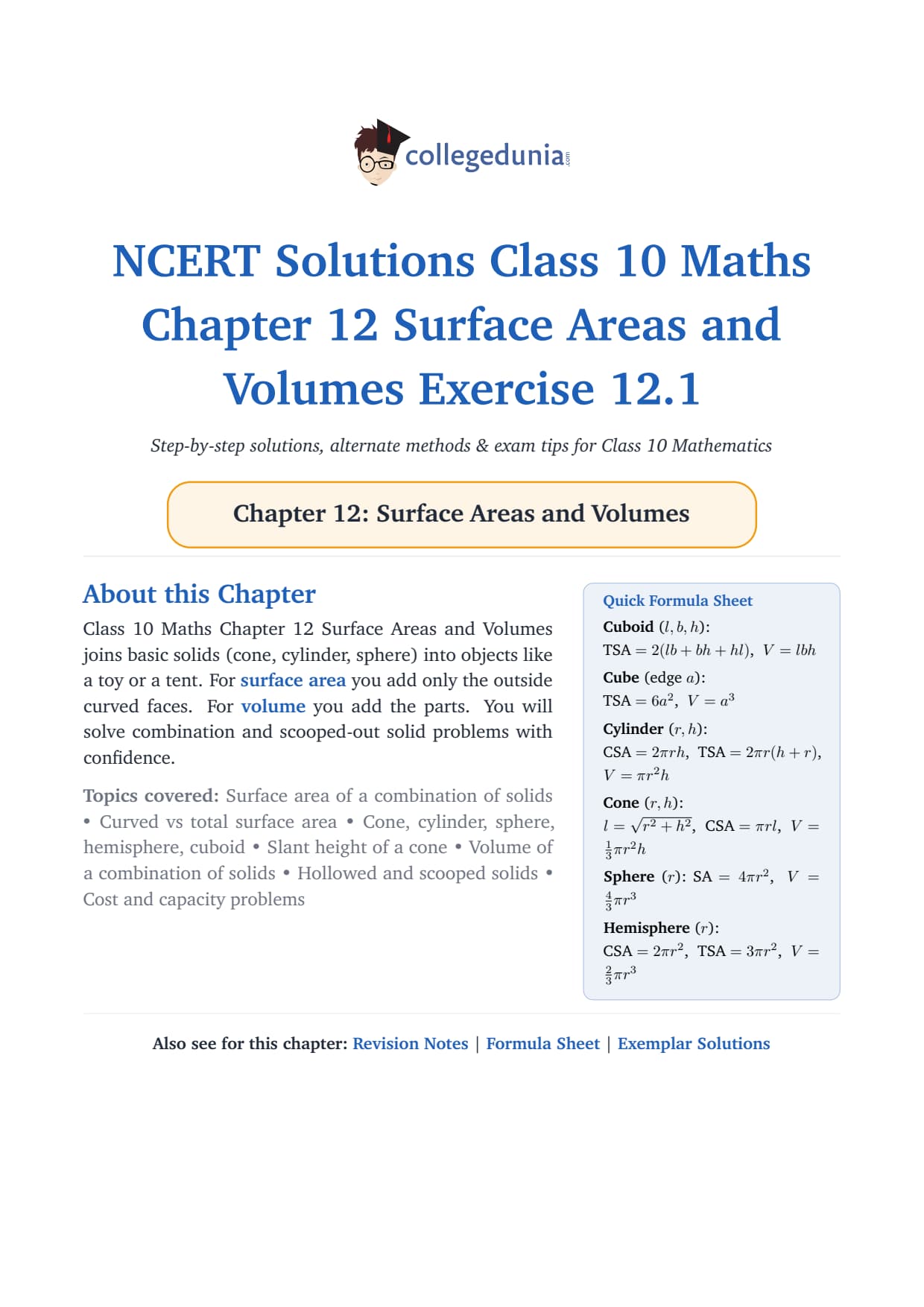
The NCERT Solutions for Class 10 Maths Chapter 12 Surface Areas and Volumes Exercise 12.1 cover all 9 questions on the surface area of combinations of solids, mapped to the 2026-27 CBSE syllabus. Every answer shows the formula, substitution, and arithmetic on separate lines.
Core skill: identifying which surfaces are visible and which are hidden when solids are joined or scooped.
Board value: Surface Areas and Volumes carries 4 to 6 marks in the CBSE Class 10 paper; Exercise 12.1 style questions appear almost every year in the 3-mark slot.
Solved by Collegedunia: Every Exercise 12.1 question below is solved by subject experts, checked against the official 2026-27 NCERT textbook, and written with full working so each step earns its marks in the CBSE Class 10 board paper.
What Exercise 12.1 of Surface Areas and Volumes Covers for Class 10
Exercise 12.1 is the surface-area half of Chapter 12. All 9 questions involve combinations of basic solids: cubes, cuboids, cylinders, cones, and hemispheres joined or scooped together. The key idea is that when two solids share a flat face, that face vanishes from the outside surface.
Q1: two equal cubes joined end to end, find the TSA of the resulting cuboid.
Q3: cone on a hemisphere toy, find total surface area using slant height.
Q4: hemisphere on a cube, find the greatest possible diameter and surface area.
Q5: hemispherical depression carved into a cube face, answer in symbolic form.
Q6: medicine capsule (cylinder + two hemispheres), surface area in mm2.
Q7: tent (cylinder + cone), canvas area and cost calculation.
Q8: solid cylinder with conical cavity, TSA rounded to nearest cm2.
Q9: cylinder with hemispheres scooped from each end, TSA.
Key Surface Area Formulas Used in Exercise 12.1
Every question in this exercise uses one or more of these five formulas. Memorise them before attempting the questions, then the only real skill is deciding which surfaces are visible.
Solid
Curved Surface Area (CSA)
Total Surface Area (TSA)
Cylinder (radius r, height h)
2πrh
2πr(r + h)
Cone (radius r, slant height l)
πrl
πr(r + l)
Sphere (radius r)
4πr2
Hemisphere (radius r)
2πr2
3πr2
Cuboid (l, b, h)
Not defined
2(lb + bh + hl)
Slant height of cone: always compute l = r2 + h2 unless the slant height is given directly.
Two hemispheres = one sphere: whenever two identical hemispheres appear, replace 2 × 2πr2 with 4πr2 in one step.
Use π = 22/7 unless stated otherwise.
How to Solve Exercise 12.1 Question by Question
The single most important step in every Exercise 12.1 question is drawing the solid and shading the hidden faces before you write any formula. Once you see which surfaces are outside and which are glued together, the rest is substitution.
Slant given; bracket 2h + l = 7 cancels the 7 in 22⁄7
44 m2, Rs 22,000
Q8
Cylinder with conical cavity
3 surfaces: base + wall + cone wall; use πr(r + 2h + l)
18 cm2
Q9
Cylinder, hemispheres scooped
Flat ends replaced by bowls; use 2πr(h + 2r)
374 cm2
Quick Tip: Before choosing a formula, ask two questions: Is the solid hollow or solid? (decides inner vs outer surface) and Which faces are glued to another solid? (those faces are hidden and must be removed). These two checks prevent almost every common error in this exercise.
Hidden Face Rule and Net Change in Surface Area
The biggest idea in this exercise is the hidden face rule. When a hemisphere is placed on or scooped from a flat surface, one flat circle disappears and one curved bowl appears. The net change to the surface area is always +πr2, whether you add or scoop. This symmetry shows up in Q4 and Q5 back to back.
Action
What leaves the surface
What joins the surface
Net change
Add hemisphere on flat face
πr2 (hidden flat circle)
2πr2 (curved dome)
+πr2
Scoop hemisphere from flat face
πr2 (removed flat circle)
2πr2 (curved bowl)
+πr2
Hollow conical cavity from flat face
πr2 (removed flat top)
πrl (cone wall)
πr(l - r)
Q4 vs Q5: Q4 adds a hemisphere to a cube face; Q5 scoops one out. The net change to the surface is identical: +πr2.
Q6 vs Q9: Q6 has hemispheres added at both ends of a cylinder; Q9 scoops them from both ends. The formula 2πr(h + 2r) is the same in both questions.
Marks and CBSE Board Trends for Exercise 12.1 Questions
Surface Areas and Volumes is consistently examined in the CBSE Class 10 Maths paper. Exercise 12.1 type questions appear most often in the 3-mark or 4-mark section.
Question type
Where it appears
Typical marks
Two cubes or simple cuboid (Q1 style)
Short-answer or 2-mark slot
2
Cone + hemisphere toy or vessel (Q2, Q3 style)
3-mark section
3
Hemisphere on or in a cube (Q4, Q5 style)
3-mark or 4-mark section
3 to 4
Capsule, tent, cavity (Q6, Q7, Q8, Q9 style)
4-mark or long-answer
4 to 5
Practising all 9 questions here gives you complete coverage of the 3-4 mark band, which is where most students either secure or lose points in this topic.
NCERT Solutions for Class 10 Maths Surface Areas and Volumes: All Exercises
Chapter 12 has two exercises. The table below links each exercise to its own step-by-step solutions page.
All NCERT Solutions for Class 10 Maths Chapter 12 Surface Areas and Volumes Exercise 12.1 with Step-by-Step Solutions
Exercise 12.1
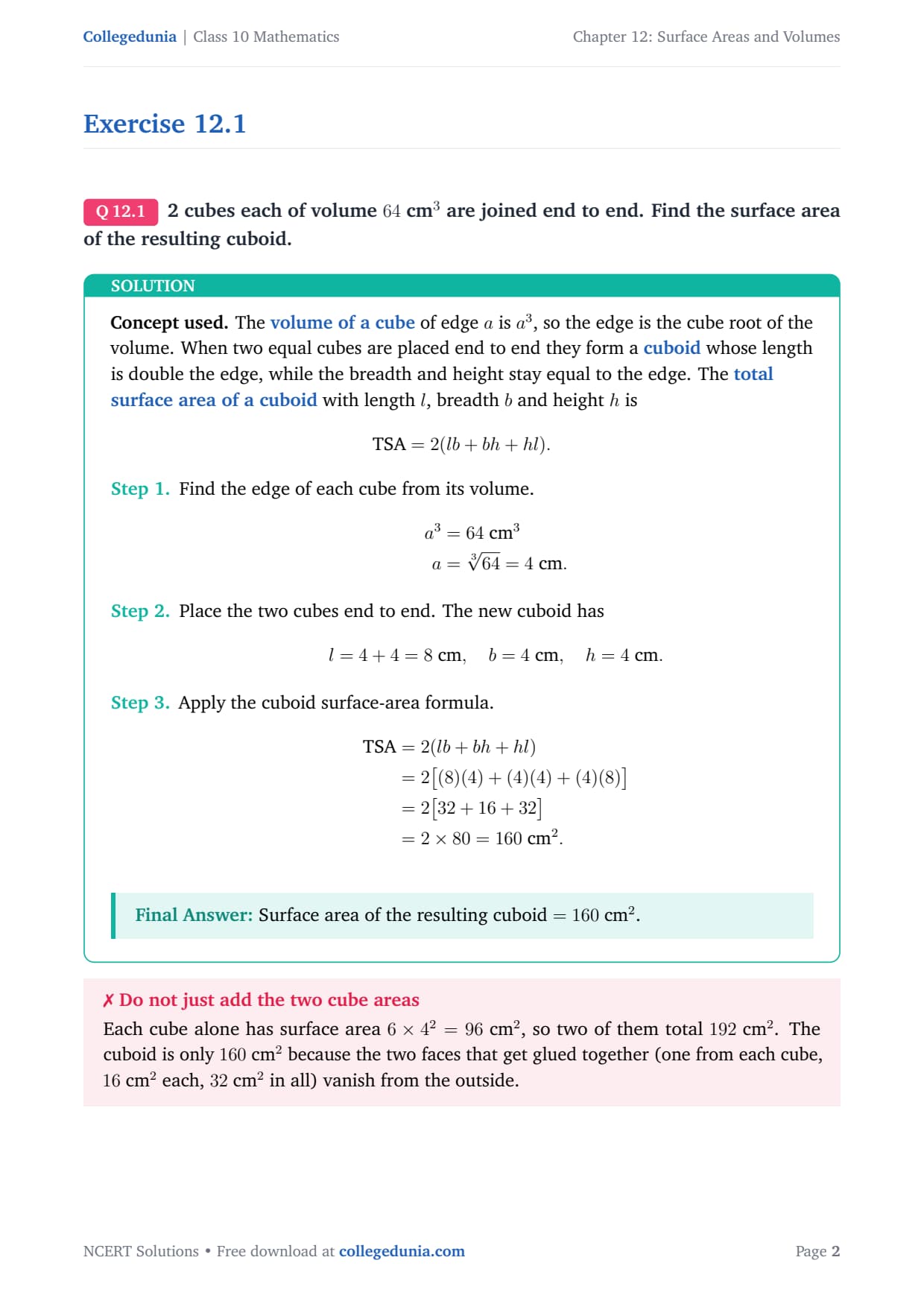
Q 12.1
2 cubes each of volume 64 cm3 are joined end to end. Find the surface area of the resulting cuboid.
Concept used. The volume of a cube of edge a is
a3, so the edge is the cube root of the volume. When two equal cubes
are placed end to end they form a cuboid whose length is
double the edge, while the breadth and height stay equal to the edge.
The total surface area of a cuboid with length l, breadth
b and height h is
TSA=2(lb+bh+hl).
Find the edge of each cube from its volume.
aligned
a3 &= 64 cm3 a &= [3]64=4 cm.
aligned
Place the two cubes end to end. The new cuboid has
l = 4+4 = 8 cm, b = 4 cm, h = 4 cm.
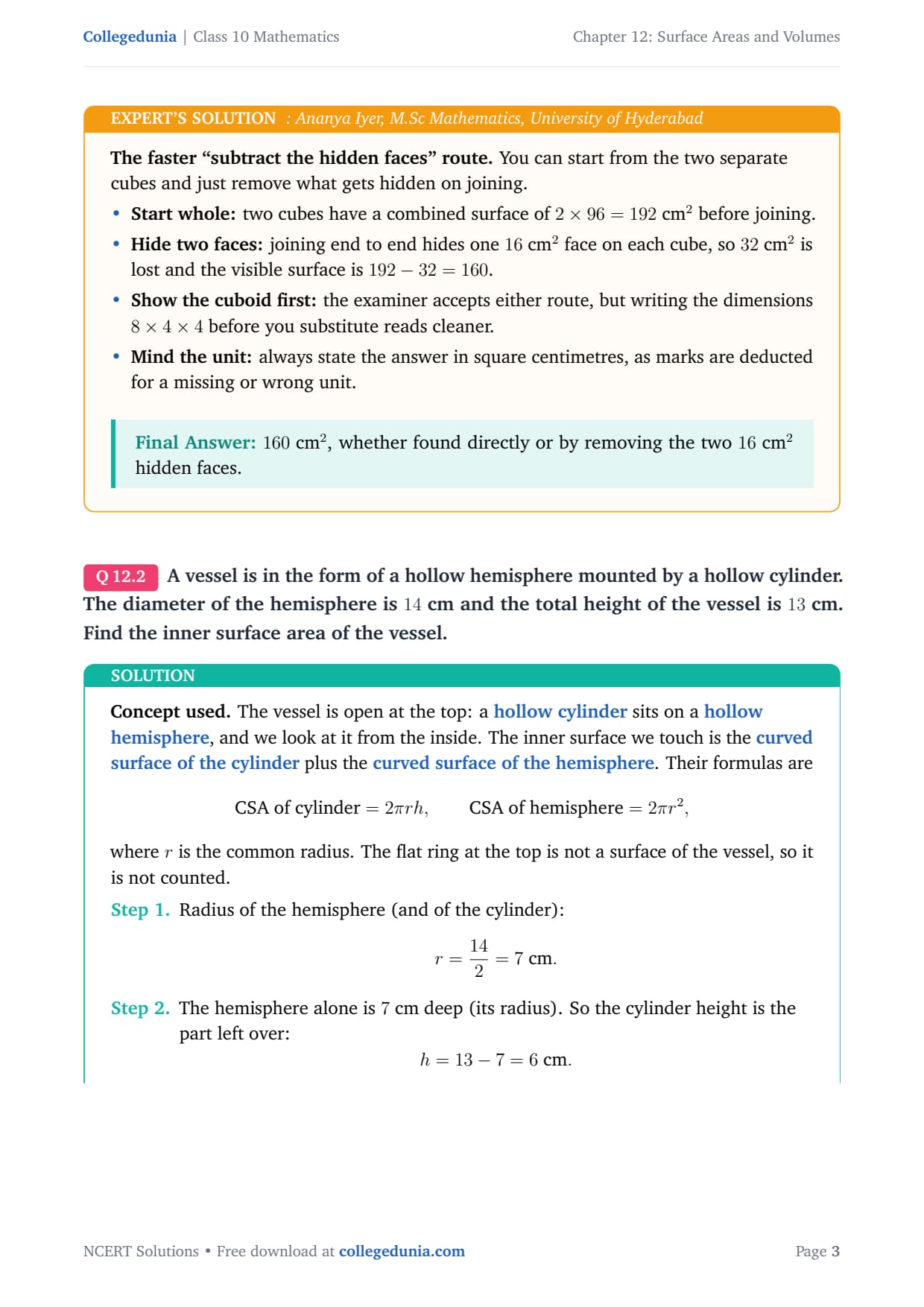
The faster ``subtract the hidden faces'' route. You can start
from the two separate cubes and just remove what gets hidden on joining.
Start whole: two cubes have a combined surface of 2× 96 = 192 cm2 before joining.
Hide two faces: joining end to end hides one 16 cm2 face on each cube, so 32 cm2 is lost and the visible surface is 192-32=160.
Show the cuboid first: the examiner accepts either route, but writing the dimensions 8× 4× 4 before you substitute reads cleaner.
Mind the unit: always state the answer in square centimetres, as marks are deducted for a missing or wrong unit.
160 cm2, whether found directly or by removing the two 16 cm2 hidden faces.
Q 12.2
A vessel is in the form of a hollow hemisphere mounted by a hollow cylinder. The diameter of the hemisphere is 14 cm and the total height of the vessel is 13 cm. Find the inner surface area of the vessel.
Concept used. The vessel is open at the top: a
hollow cylinder sits on a hollow hemisphere, and we
look at it from the inside. The inner surface we touch is the
curved surface of the cylinder plus the curved
surface of the hemisphere. Their formulas are
CSA of cylinder=2π rh, CSA of hemisphere=2π r2,
where r is the common radius. The flat ring at the top is not a
surface of the vessel, so it is not counted.
Radius of the hemisphere (and of the cylinder):
r = 142 = 7 cm.
The hemisphere alone is 7 cm deep (its radius). So the
cylinder height is the part left over:
h = 13 - 7 = 6 cm.
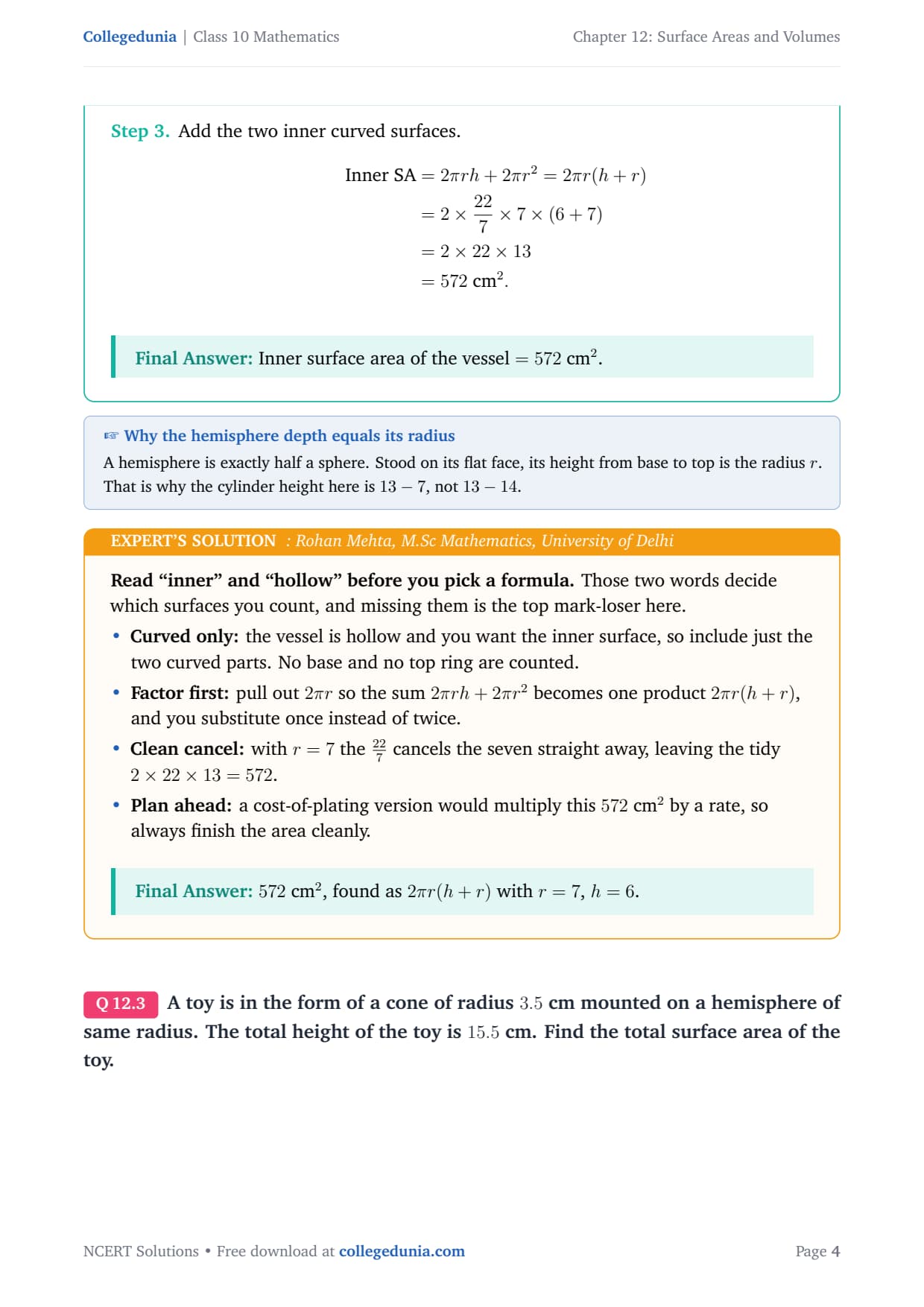
Add the two inner curved surfaces.
aligned
Inner SA &= 2π rh + 2π r2 = 2π r(h+r)
&= 2× 227× 7×(6+7)
&= 2× 22× 13
&= 572 cm2.
aligned
Inner surface area of the vessel =572 cm2.
RM
Rohan Mehta
M.Sc Mathematics, University of Delhi
Verified Expert
Read ``inner'' and ``hollow'' before you pick a formula. Those
two words decide which surfaces you count, and missing them is the top
mark-loser here.
Curved only: the vessel is hollow and you want the inner surface, so include just the two curved parts. No base and no top ring are counted.
Factor first: pull out 2π r so the sum 2π rh + 2π r2 becomes one product 2π r(h+r), and you substitute once instead of twice.
Clean cancel: with r=7 the 227 cancels the seven straight away, leaving the tidy 2× 22× 13 = 572.
Plan ahead: a cost-of-plating version would multiply this 572 cm2 by a rate, so always finish the area cleanly.
572 cm2, found as 2π r(h+r) with r=7, h=6.
Q 12.3
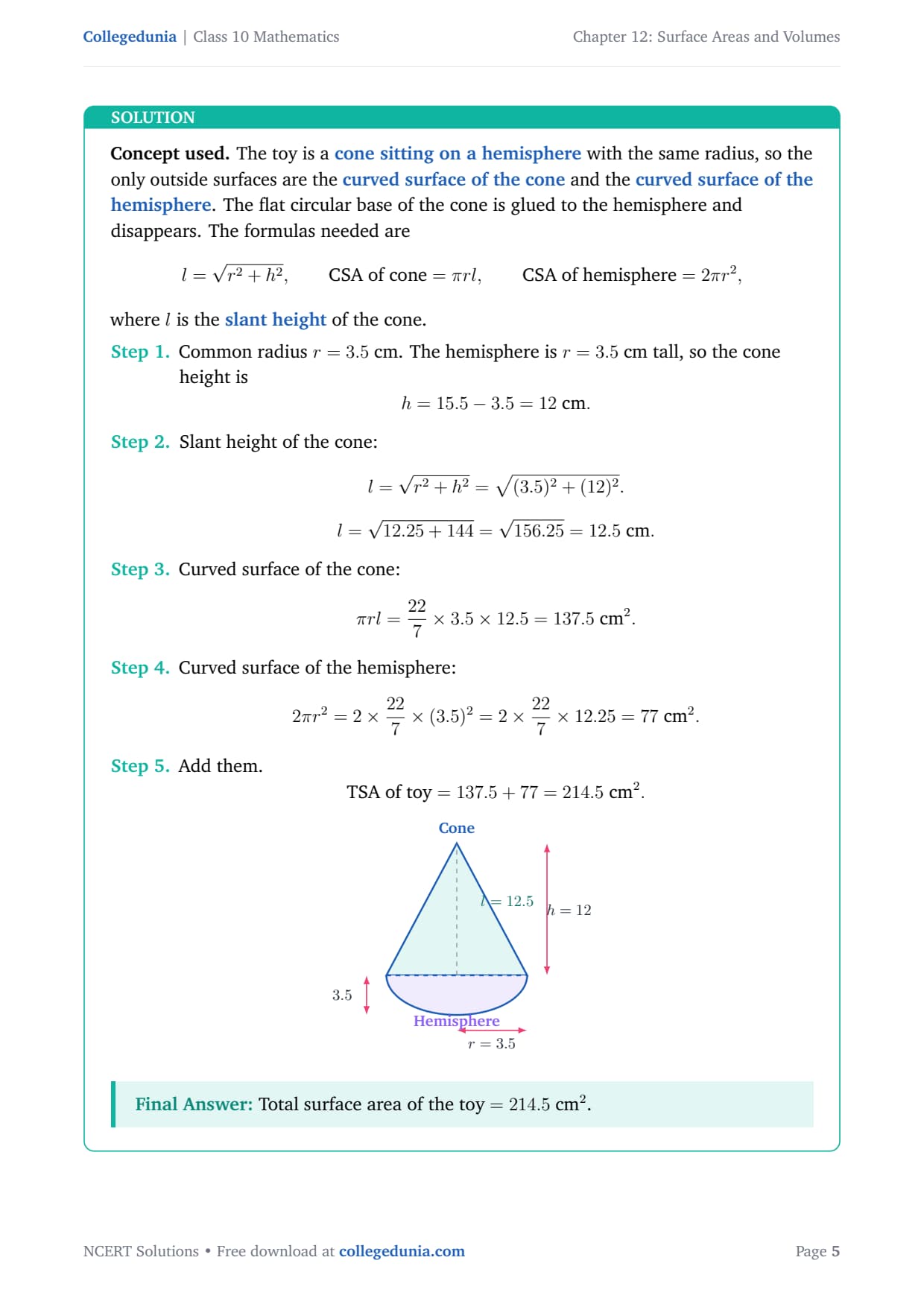
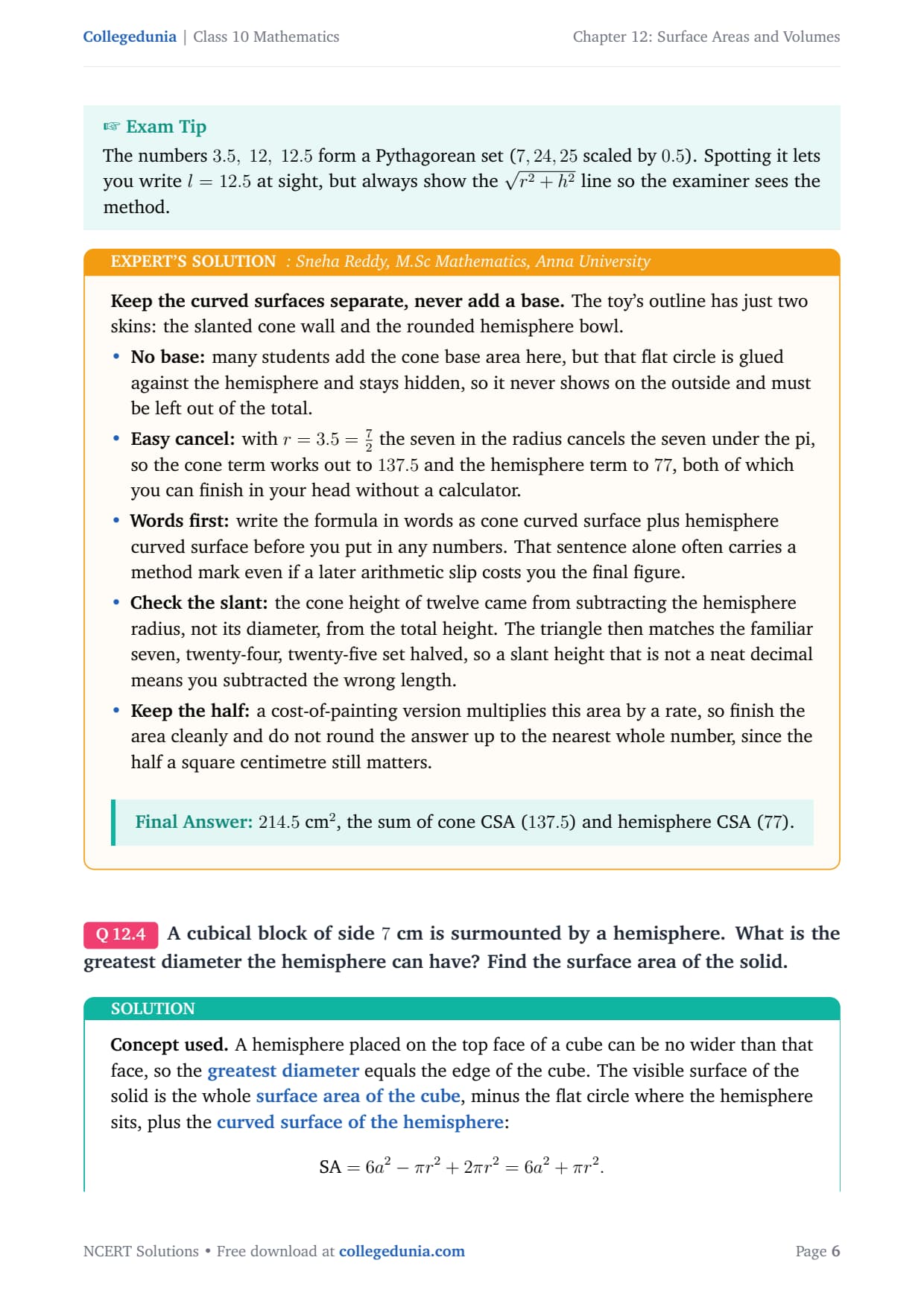
A toy is in the form of a cone of radius 3.5 cm mounted on a hemisphere of same radius. The total height of the toy is 15.5 cm. Find the total surface area of the toy.
Concept used. The toy is a cone sitting on a
hemisphere with the same radius, so the only outside surfaces are the
curved surface of the cone and the curved surface of
the hemisphere. The flat circular base of the cone is glued to the
hemisphere and disappears. The formulas needed are
l=√r2+h2, CSA of cone=π rl,
CSA of hemisphere=2π r2,
where l is the slant height of the cone.
Common radius r = 3.5 cm. The hemisphere is
r=3.5 cm tall, so the cone height is
h = 15.5 - 3.5 = 12 cm.
Slant height of the cone:
l = √r2+h2 = √(3.5)2+(12)2. l = √12.25+144 = √156.25 = 12.5 cm.
Curved surface of the cone:
π rl = 227× 3.5× 12.5 = 137.5 cm2.
Curved surface of the hemisphere:
2π r2 = 2× 227× (3.5)2
= 2× 227× 12.25 = 77 cm2.
Add them.
TSA of toy = 137.5 + 77 = 214.5 cm2.
[See diagram in the PDF version]
Total surface area of the toy =214.5 cm2.
SR
Sneha Reddy
M.Sc Mathematics, Anna University
Verified Expert
Keep the curved surfaces separate, never add a base. The toy's
outline has just two skins: the slanted cone wall and the rounded
hemisphere bowl.
No base: many students add the cone base area here, but that flat circle is glued against the hemisphere and stays hidden, so it never shows on the outside and must be left out of the total.
Easy cancel: with r=3.5=72 the seven in the radius cancels the seven under the pi, so the cone term works out to 137.5 and the hemisphere term to 77, both of which you can finish in your head without a calculator.
Words first: write the formula in words as cone curved surface plus hemisphere curved surface before you put in any numbers. That sentence alone often carries a method mark even if a later arithmetic slip costs you the final figure.
Check the slant: the cone height of twelve came from subtracting the hemisphere radius, not its diameter, from the total height. The triangle then matches the familiar seven, twenty-four, twenty-five set halved, so a slant height that is not a neat decimal means you subtracted the wrong length.
Keep the half: a cost-of-painting version multiplies this area by a rate, so finish the area cleanly and do not round the answer up to the nearest whole number, since the half a square centimetre still matters.
214.5 cm2, the sum of cone CSA (137.5) and hemisphere CSA (77).
Q 12.4
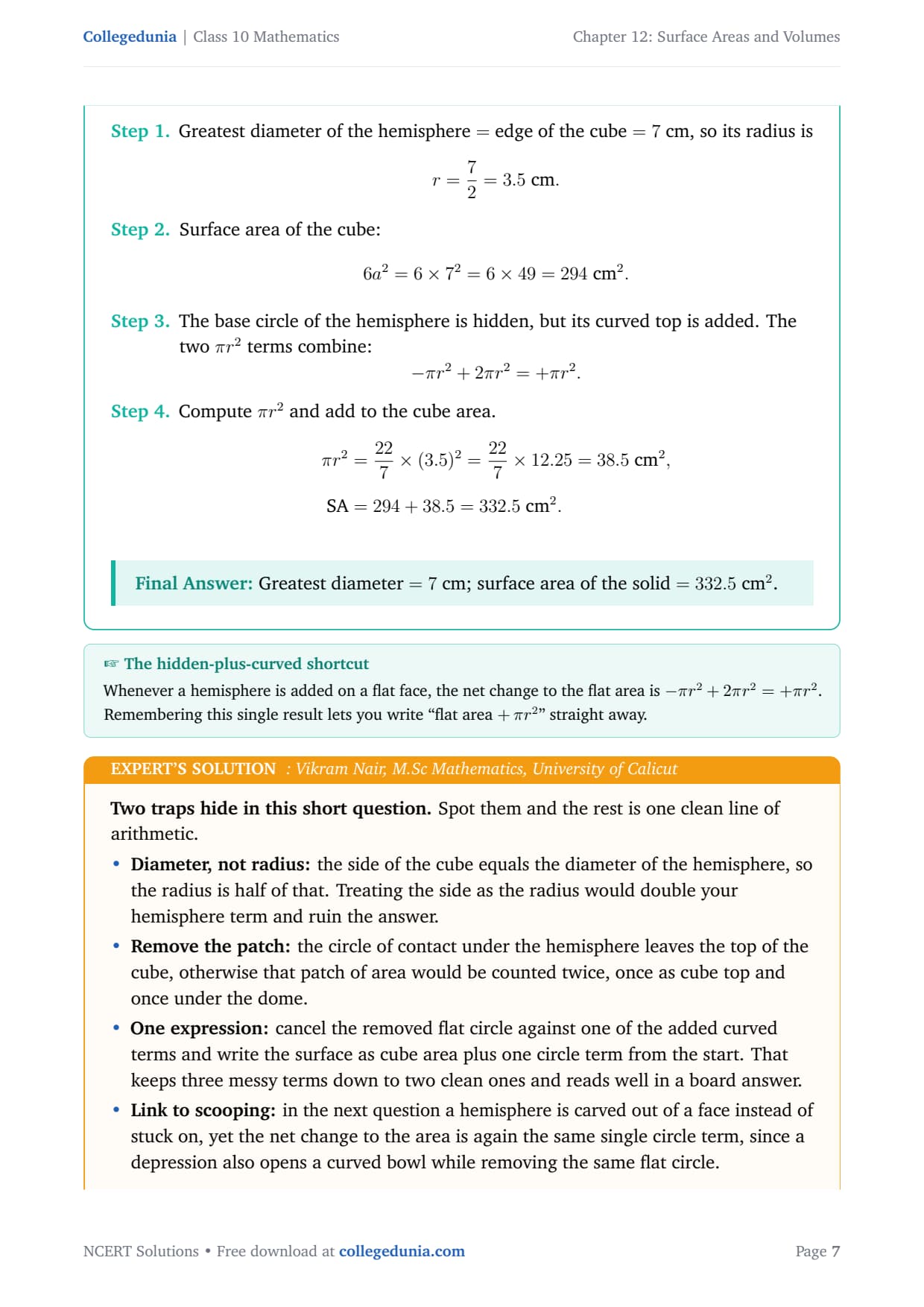
A cubical block of side 7 cm is surmounted by a hemisphere. What is the greatest diameter the hemisphere can have? Find the surface area of the solid.
Concept used. A hemisphere placed on the top face of a cube
can be no wider than that face, so the greatest diameter
equals the edge of the cube. The visible surface of the solid is the
whole surface area of the cube, minus the flat circle where
the hemisphere sits, plus the curved surface of the
hemisphere:
SA = 6a2 - π r2 + 2π r2 = 6a2 + π r2.
Greatest diameter of the hemisphere = edge of the cube
=7 cm, so its radius is
r = 72 = 3.5 cm.
Surface area of the cube:
6a2 = 6× 72 = 6× 49 = 294 cm2.
The base circle of the hemisphere is hidden, but its curved top
is added. The two π r2 terms combine:
-π r2 + 2π r2 = +π r2.
Compute π r2 and add to the cube area.
aligned
π r2 &= 227× (3.5)2 = 227× 12.25 = 38.5 cm2, [6pt]
SA &= 294 + 38.5 = 332.5 cm2.
aligned
Greatest diameter =7 cm; surface area of the solid =332.5 cm2.
VN
Vikram Nair
M.Sc Mathematics, University of Calicut
Verified Expert
Two traps hide in this short question. Spot them and the rest
is one clean line of arithmetic.
Diameter, not radius: the side of the cube equals the diameter of the hemisphere, so the radius is half of that. Treating the side as the radius would double your hemisphere term and ruin the answer.
Remove the patch: the circle of contact under the hemisphere leaves the top of the cube, otherwise that patch of area would be counted twice, once as cube top and once under the dome.
One expression: cancel the removed flat circle against one of the added curved terms and write the surface as cube area plus one circle term from the start. That keeps three messy terms down to two clean ones and reads well in a board answer.
Link to scooping: in the next question a hemisphere is carved out of a face instead of stuck on, yet the net change to the area is again the same single circle term, since a depression also opens a curved bowl while removing the same flat circle.
7 cm greatest diameter, surface area 332.5 cm2 from 6a2+π r2.
Q 12.5
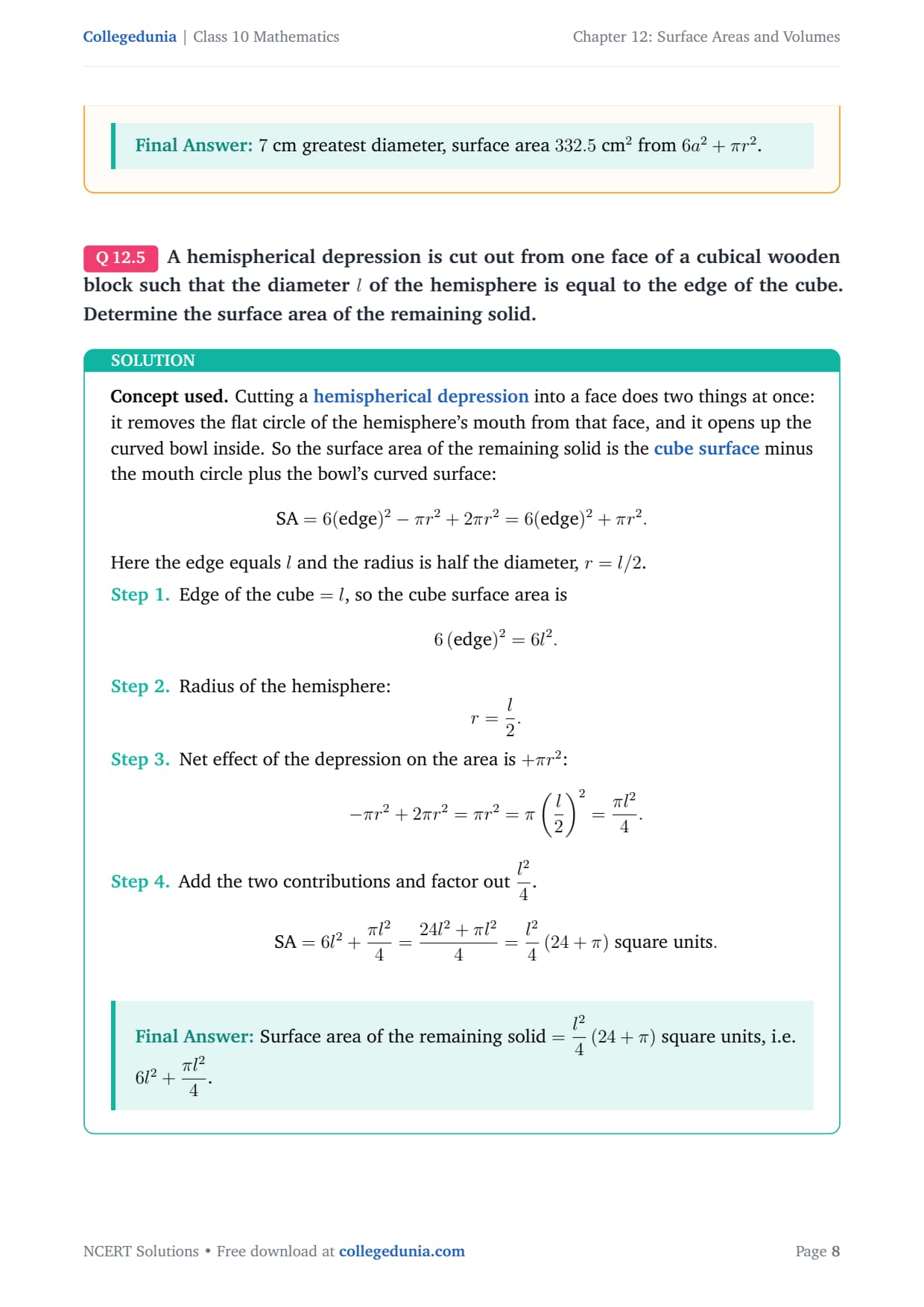
A hemispherical depression is cut out from one face of a cubical wooden block such that the diameter l of the hemisphere is equal to the edge of the cube. Determine the surface area of the remaining solid.
Concept used. Cutting a hemispherical depression
into a face does two things at once: it removes the flat circle of the
hemisphere's mouth from that face, and it opens up the curved bowl
inside. So the surface area of the remaining solid is the
cube surface minus the mouth circle plus the bowl's curved
surface:
SA = 6(edge)2 - π r2 + 2π r2
= 6(edge)2 + π r2.
Here the edge equals l and the radius is half the diameter, r=l/2.
Edge of the cube =l, so the cube surface area is
6 (edge)2 = 6l2.
Radius of the hemisphere:
r = l2.
Net effect of the depression on the area is +π r2:
-π r2 + 2π r2 = π r2 = π(l2)2
= π l24.
Add the two contributions and factor out l24.
aligned
SA &= 6l2 + π l24
= 24 l2 + π l24
= l24 (24 + π) square units.
aligned
Surface area of the remaining solid =l24 (24+π) square units, i.e. 6l2+π l24.
MK
Meera Krishnan
M.Sc Mathematics, University of Madras
Verified Expert
A depression behaves exactly like a bump for surface area. This
is the surprising idea students should carry away from this pair of
questions.
Same net change: whether you add a hemisphere on a face or scoop one out of it, the flat circle leaves the count and a curved bowl of twice that area joins it, so the change to the surface is exactly the same in both cases. This is the surprising idea the question is built around.
Stay symbolic: only the letter for the edge is given, with no number to plug in, so keep everything in symbols and factor at the very end. A single tidy bracketed expression is far easier for an examiner to read and for you to substitute into later than a loose sum of two terms.
Halve carefully: the problem names the diameter, not the radius, so the radius is half of it and its square is a quarter of the edge squared. Squaring the wrong length is the single most common error students make on this question, so write the radius step out plainly.
l24(24+π) square units, with r=l/2.
Q 12.6
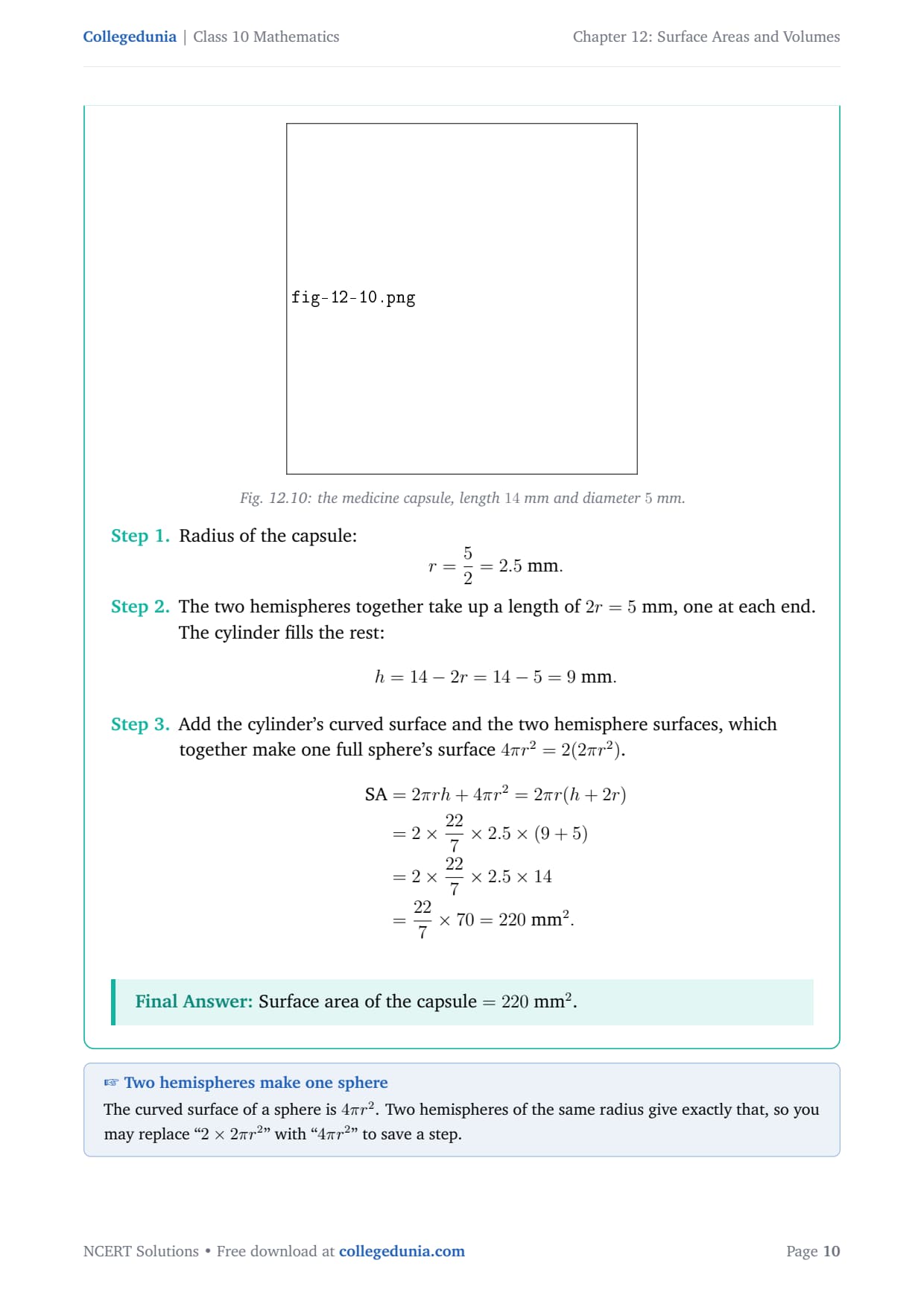
A medicine capsule is in the shape of a cylinder with two hemispheres stuck to each of its ends (see Fig. 12.10). The length of the entire capsule is 14 mm and the diameter of the capsule is 5 mm. Find its surface area.
Fig. 12.10: the medicine capsule, length 14 mm and diameter 5 mm.
Concept used. The capsule is a cylinder capped by two
equal hemispheres. Its outside surface is the
curved surface of the cylinder plus the
two curved hemisphere surfaces; no flat circles show because
each hemisphere covers one end of the cylinder. The radius is common
throughout:
SA = 2π rh + 2(2π r2) = 2π r(h+2r).
Radius of the capsule:
r = 52 = 2.5 mm.
The two hemispheres together take up a length of 2r = 5
mm, one at each end. The cylinder fills the rest:
h = 14 - 2r = 14 - 5 = 9 mm.
Add the cylinder's curved surface and the two hemisphere
surfaces, which together make one full sphere's surface
4π r2 = 2(2π r2).
aligned
SA &= 2π rh + 4π r2 = 2π r(h+2r)
&= 2× 227× 2.5×(9+5)
&= 2× 227× 2.5× 14
&= 227× 70 = 220 mm2.
aligned
Surface area of the capsule =220 mm2.
AP
Arjun Pillai
M.Sc Mathematics, Cochin University of Science and Technology
Verified Expert
Subtract the rounded ends from the length first. Getting the
cylinder height right is the whole question.
Trim the length: each rounded end is a hemisphere whose depth is its radius, so the two of them eat into the length from both sides. After taking those off, the straight cylinder in the middle is shorter than the full capsule, and getting this height right is really the whole question.
Caps make a sphere: the two hemispherical ends fit together into one whole sphere of the same radius, so the cleanest mental picture is one cylinder wall plus a single sphere skin rather than two separate caps.
Factor for whole numbers: pulling the common factor out front turns the sum into one neat product, and the bracket then collapses to a whole number, so the final multiplication is painless and easy to check.
Hold the unit: the capsule is measured in millimetres, so keep that unit through every line. Switching to centimetres halfway is a frequent and costly slip that quietly changes the answer.
220 mm2, using 2π r(h+2r) with r=2.5, h=9.
Q 12.7
A tent is in the shape of a cylinder surmounted by a conical top. If the height and diameter of the cylindrical part are 2.1 m and 4 m respectively, and the slant height of the top is 2.8 m, find the area of the canvas used for making the tent. Also, find the cost of the canvas of the tent at the rate of 500 per m2. (Note that the base of the tent will not be covered with canvas.)
Concept used. A tent is a cylinder with a cone on
top. Canvas covers only the outside walls, so we need the
curved surface of the cylinder plus the
curved surface of the cone; the floor is bare ground, so the
base is left out:
Canvas area = 2π rh + π rl = π r(2h+l).
Radius of the cylinder (and of the cone's base):
r = 42 = 2 m.
Cylinder height h = 2.1 m, cone slant height
l = 2.8 m.
Combine the two curved surfaces, taking π r common.
aligned
Canvas area &= 2π rh + π rl = π r(2h+l)
&= 227× 2×(2× 2.1 + 2.8)
&= 227× 2×(4.2+2.8)
&= 227× 2× 7 = 44 m2.
aligned
Multiply the area by the rate to get the cost.
Cost = 44× 500 = 22000.
Canvas needed =44 m2; cost =22000.
LM
Lakshmi Menon
M.Sc Mathematics, University of Kerala
Verified Expert
Leave out the floor, and never recompute the slant height. Read
the clauses carefully and the work is short.
No base: ``the base will not be covered'' is a direct instruction to drop the π r2 floor term from the canvas area.
Use the given slant: the slant height is handed to you as 2.8 m, so do not recompute it with √r2+h2, which wastes time and may disagree if figures are rounded.
Factor and cancel: pull out π r; the bracket 2h+l=4.2+2.8=7 is whole, and with r=2 the 227 cancels to give 44 m2.
Finish the cost: the cost line 44× 500 =22000 carries its own mark, so never stop at the area.
44 m2 of canvas costing 22000 at 500 per m2.
Q 12.8
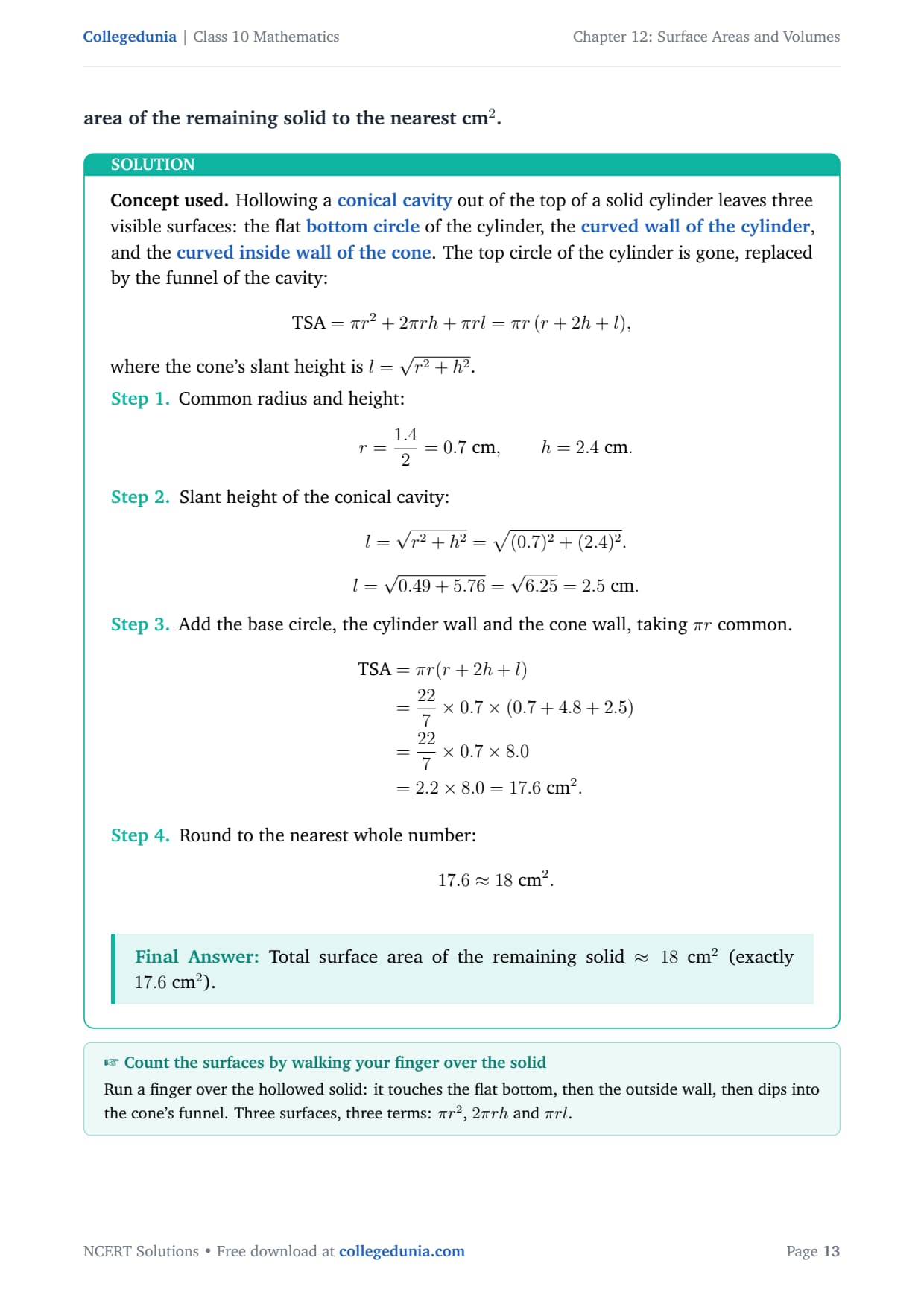
From a solid cylinder whose height is 2.4 cm and diameter 1.4 cm, a conical cavity of the same height and same diameter is hollowed out. Find the total surface area of the remaining solid to the nearest cm2.
Concept used. Hollowing a conical cavity out of the
top of a solid cylinder leaves three visible surfaces: the flat
bottom circle of the cylinder, the curved wall of the
cylinder, and the curved inside wall of the cone. The top
circle of the cylinder is gone, replaced by the funnel of the cavity:
TSA = π r2 + 2π rh + π rl = π r (r + 2h + l),
where the cone's slant height is l=√r2+h2.
Common radius and height:
r = 1.42 = 0.7 cm, h = 2.4 cm.
Slant height of the conical cavity:
l = √r2+h2 = √(0.7)2+(2.4)2. l = √0.49+5.76 = √6.25 = 2.5 cm.
Add the base circle, the cylinder wall and the cone wall, taking
π r common.
aligned
TSA &= π r(r + 2h + l)
&= 227× 0.7×(0.7 + 4.8 + 2.5)
&= 227× 0.7× 8.0
&= 2.2× 8.0 = 17.6 cm2.
aligned
Round to the nearest whole number:
17.6 ≈ 18 cm2.
Total surface area of the remaining solid ≈ 18 cm2 (exactly 17.6 cm2).
KS
Karthik Subramanian
M.Sc Mathematics, University of Madras
Verified Expert
The cavity opens a cone wall, not a flat circle. Count the three
surfaces correctly and the rest is light arithmetic.
Slant, not base: a hollowed cone exposes its inside wall π rl while the cylinder's top circle disappears, so the top gives a π rl term and the bottom keeps its π r2.
Easy factor: the radius r=0.7=710 pairs with 227 to give 2.2 in one step, and the bracket r+2h+l=0.7+4.8+2.5=8.0 is round.
Show the exact value:2.2× 8 = 17.6, so write 17.6 first and only then round to the asked 18 cm2.
Know the version: this is a scoop-out figure where the surface keeps the walls, while a volume question would subtract the cone's volume instead. Mixing the two is a common slip.
≈ 18 cm2 (exact 17.6 cm2), from π r(r+2h+l).
Q 12.9
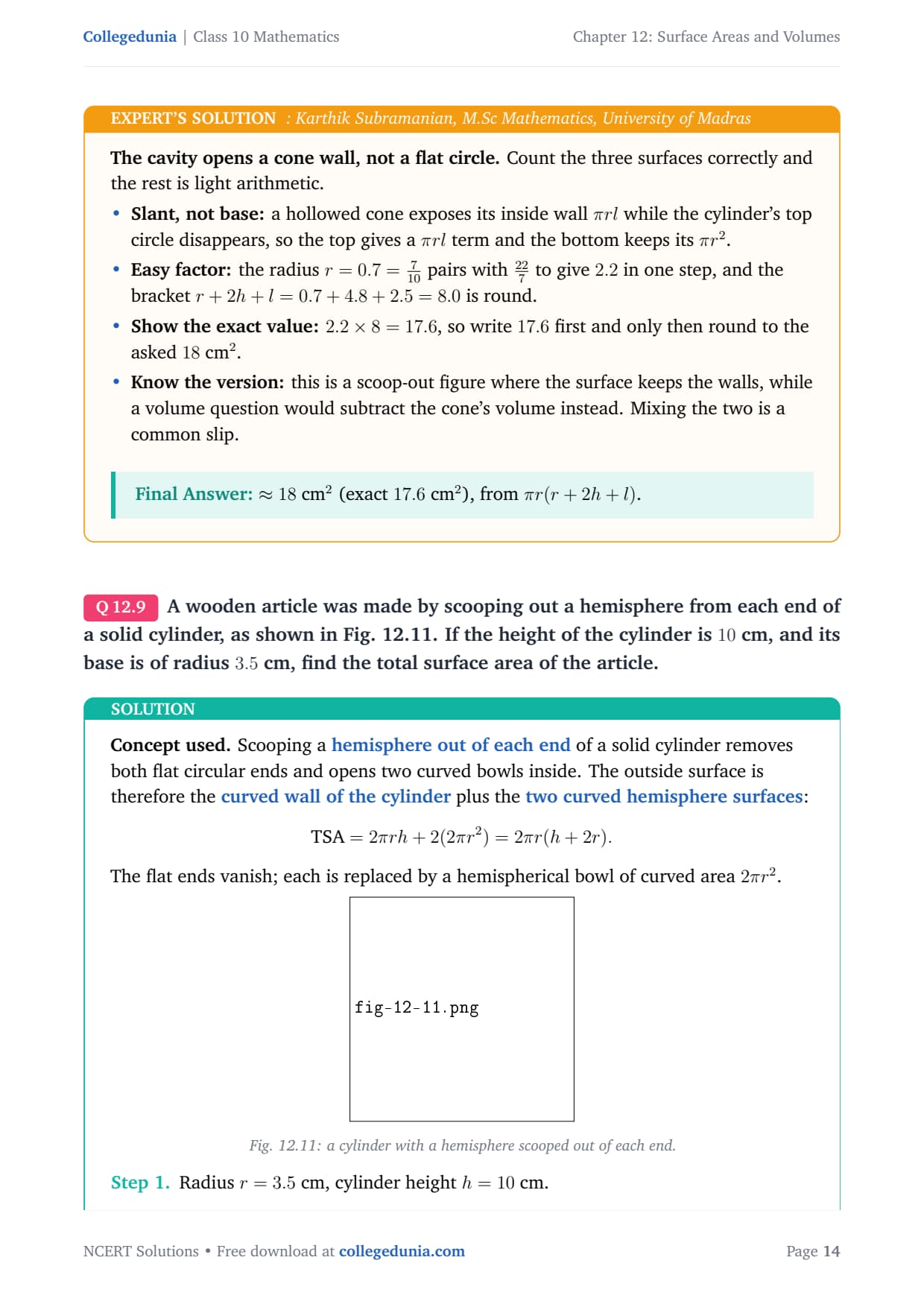
A wooden article was made by scooping out a hemisphere from each end of a solid cylinder, as shown in Fig. 12.11. If the height of the cylinder is 10 cm, and its base is of radius 3.5 cm, find the total surface area of the article.
Concept used. Scooping a hemisphere out of each end
of a solid cylinder removes both flat circular ends and opens two curved
bowls inside. The outside surface is therefore the
curved wall of the cylinder plus the
two curved hemisphere surfaces:
TSA = 2π rh + 2(2π r2) = 2π r(h+2r).
The flat ends vanish; each is replaced by a hemispherical bowl of
curved area 2π r2.
Radius r = 3.5 cm, cylinder height h = 10 cm.
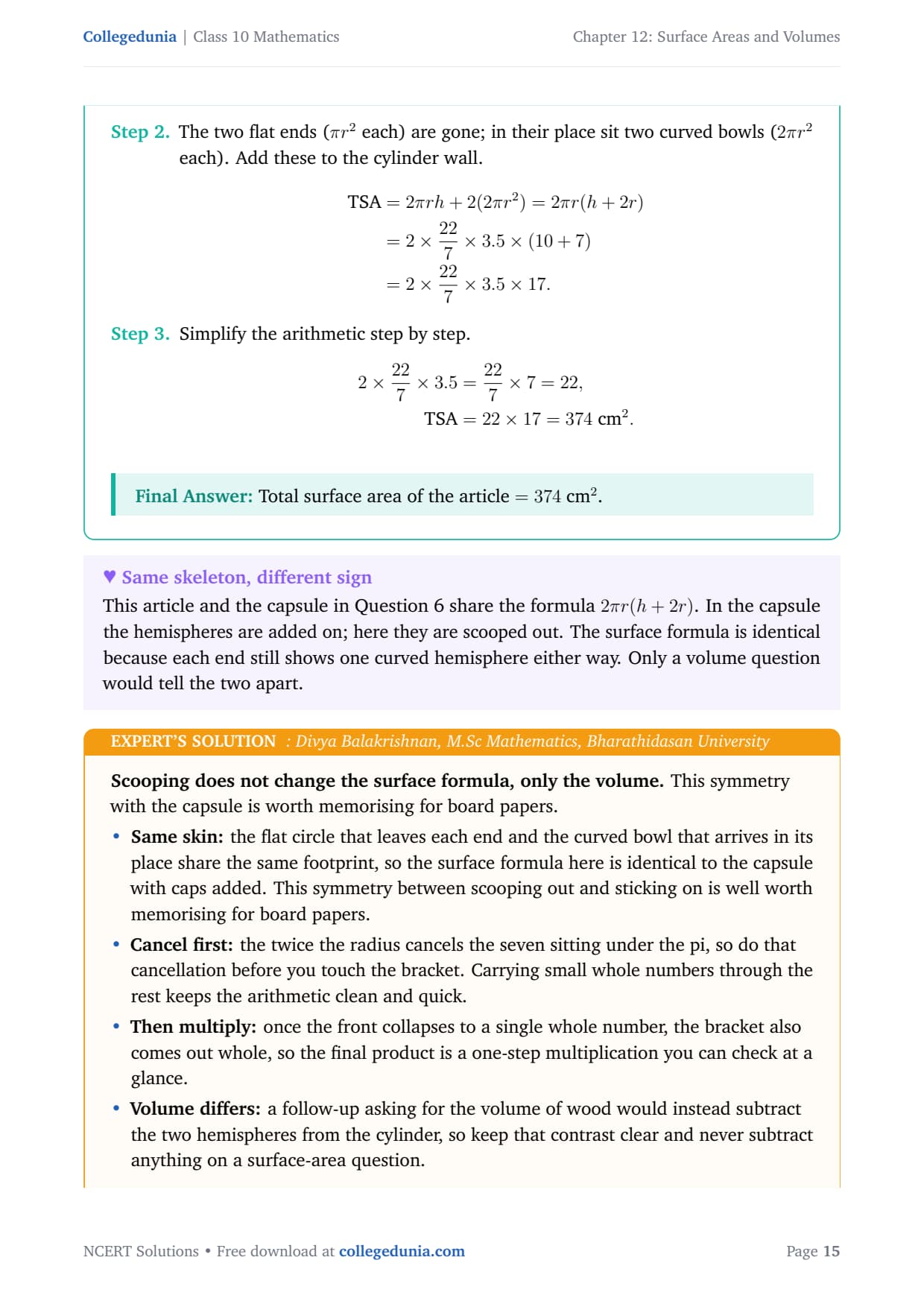
The two flat ends (π r2 each) are gone; in their place sit
two curved bowls (2π r2 each). Add these to the cylinder
wall.
aligned
TSA &= 2π rh + 2(2π r2) = 2π r(h+2r)
&= 2× 227× 3.5×(10 + 7)
&= 2× 227× 3.5× 17.
aligned
Scooping does not change the surface formula, only the volume.
This symmetry with the capsule is worth memorising for board papers.
Same skin: the flat circle that leaves each end and the curved bowl that arrives in its place share the same footprint, so the surface formula here is identical to the capsule with caps added. This symmetry between scooping out and sticking on is well worth memorising for board papers.
Cancel first: the twice the radius cancels the seven sitting under the pi, so do that cancellation before you touch the bracket. Carrying small whole numbers through the rest keeps the arithmetic clean and quick.
Then multiply: once the front collapses to a single whole number, the bracket also comes out whole, so the final product is a one-step multiplication you can check at a glance.
Volume differs: a follow-up asking for the volume of wood would instead subtract the two hemispheres from the cylinder, so keep that contrast clear and never subtract anything on a surface-area question.
374 cm2, from 2π r(h+2r) with r=3.5, h=10.
Other Resources for Class 10 Maths Chapter 12 Surface Areas And Volumes
Pair this with the other Class 10 Maths resources for this chapter, all linked below.
Out of 19,800 students surveyed before the 2026 CBSE boards, 91% said Exercise 12.1 became straightforward once they drew the combined solid and shaded the hidden faces before writing any formula. Errors in identifying which surfaces to include dropped by more than half among students who used this visual step first.
Frequently Asked Questions on Class 10 Maths Chapter 12 Exercise 12.1
How many questions are in Exercise 12.1 of Class 10 Maths Chapter 12?
Exercise 12.1 has 9 questions. All of them involve finding the surface area of combinations of solids such as a cone on a hemisphere, a cylinder with hemispherical ends, and a cube with a hemispherical depression. The exercise does not ask for volumes; that is covered in Exercise 12.2.
What is the main concept tested in Exercise 12.1?
The main concept is identifying which surfaces of a combined solid are visible from the outside and which surfaces are hidden at the joint between two solids. The hidden face or faces are subtracted from the total before you write the formula. Getting this identification right is worth more than the arithmetic in a CBSE board paper.
Why is the surface area formula the same for the capsule (Q6) and the wooden article (Q9)?
In both cases a hemisphere replaces each flat end of the cylinder. Whether the hemisphere is added on top (capsule) or scooped out from inside (wooden article), the visible surface is the same: the cylinder wall plus two curved bowls. Since the flat circles disappear in both cases, the formula 2πr(h + 2r) applies to both questions.
How do I find the slant height of the cone in Q3 and Q8?
Use the formula l = r2 + h2, where h is the vertical height of the cone (not the total height of the toy). In Q3, the cone height is the total height minus the hemisphere radius (15.5 - 3.5 = 12 cm), giving a slant height of 12.5 cm. In Q8, the cone and cylinder share the same height and radius, so the slant height works out to 2.5 cm.
Why does Exercise 12.1 Question 5 leave the answer in terms of l?
Question 5 gives only the letter l for the edge of the cube and does not provide a numerical value. So the surface area stays as a formula: l24(24 + π) square units. If a specific value of l were given, students would substitute it and compute a number. Leaving a symbolic answer is perfectly correct in CBSE board papers when no number is provided.







Comments