



Money and Credit explains how money replaced barter and how loans can either lift a household out of poverty or push it into debt.
Chapter3MoneyandCreditSolutions.pdf?page=1&dpi=150)
Chapter3MoneyandCreditSolutions.pdf?page=2&dpi=150)
Chapter3MoneyandCreditSolutions.pdf?page=3&dpi=150)
Chapter3MoneyandCreditSolutions.pdf?page=4&dpi=150)
Chapter3MoneyandCreditSolutions.pdf?page=5&dpi=150)
Chapter3MoneyandCreditSolutions.pdf?page=6&dpi=150)
Chapter3MoneyandCreditSolutions.pdf?page=7&dpi=150)
Chapter3MoneyandCreditSolutions.pdf?page=8&dpi=150)
Chapter3MoneyandCreditSolutions.pdf?page=9&dpi=150)
Chapter3MoneyandCreditSolutions.pdf?page=10&dpi=150)
Chapter3MoneyandCreditSolutions.pdf?page=11&dpi=150)
Chapter3MoneyandCreditSolutions.pdf?page=12&dpi=150)
Chapter3MoneyandCreditSolutions.pdf?page=13&dpi=150)
Chapter3MoneyandCreditSolutions.pdf?page=14&dpi=150)
Chapter3MoneyandCreditSolutions.pdf?page=15&dpi=150)
Chapter3MoneyandCreditSolutions.pdf?page=16&dpi=150)
Chapter3MoneyandCreditSolutions.pdf?page=17&dpi=150)
Chapter3MoneyandCreditSolutions.pdf?page=18&dpi=150)
Chapter3MoneyandCreditSolutions.pdf?page=19&dpi=150)
Chapter3MoneyandCreditSolutions.pdf?page=20&dpi=150)
Chapter3MoneyandCreditSolutions.pdf?page=21&dpi=150)
Chapter3MoneyandCreditSolutions.pdf?page=22&dpi=150)
Chapter3MoneyandCreditSolutions.pdf?page=23&dpi=150)
Chapter3MoneyandCreditSolutions.pdf?page=24&dpi=150)
The NCERT Solutions for Class 10 Economics Chapter 3 Money and Credit answer all 13 textbook questions for the 2026-27 session, covering money as a medium of exchange, modern forms of money, the loan activities of banks, the terms of credit, formal versus informal sources, and Self-Help Groups.
- 13 NCERT questions solved in the point-then-explanation format the board rewards.
- A steady source of 3 and 5 mark questions on credit and the RBI.
- Free PDF download in Normal and HD, plus a Hindi-medium read.
Every answer here is written by Collegedunia subject experts and checked against the 2026-27 NCERT textbook.
What This Class 10 Economics Chapter Covers for the Boards
This chapter explains how a modern economy runs on money and credit. Money removes the need for a double coincidence of wants, while credit on fair terms decides whether a borrower prospers or falls into a debt trap. The solutions here keep every definition and example you need.
- Money as a medium of exchange: it removes the need for a double coincidence of wants by splitting one barter deal into two trades.
- Modern forms of money: currency issued by the RBI, plus demand deposits held with banks.
- Loan activities of banks: banks keep a small cash reserve, lend the rest, and earn the interest gap.
- Terms of credit: interest rate, collateral, documentation and the mode of repayment.
- Formal vs informal sources: RBI-supervised banks and cooperatives versus unsupervised moneylenders, traders and employers.
- Self-Help Groups: the collateral-free, member-run route to cheap credit and bank loans.
Money and Credit Class 10 Explained in Simple Language
Source: Magnet Brains on YouTube
Money and Credit Class 10 Question Answer: Exercise Section
The exercise questions in class 10 economics chapter 3 money and credit mix fill-in-the-blanks and MCQs with explain and analyse questions. The board often picks the terms of credit, the formal versus informal split, and the Graph readings. Below is what each key answer should carry.
| Question | What a full-mark answer must include |
|---|---|
| Fill in the blanks (Q12) | (i) poor; (ii) High; (iii) Reserve Bank of India; (iv) deposits; (v) Collateral. |
| Choose the appropriate answer (Q13) | (i) (b) Members run the SHG; (ii) (c) Employers are not a formal source. |
| Double coincidence of wants (Q2) | Money is universally accepted, so it splits one two-way barter match into two one-way trades. |
| Expanding formal credit (Q5) | Formal credit is RBI-supervised, cheaper and fairer; Graph 1 shows the informal sector still meets a large share of rural credit. |
| Small farmers and credit (Q11) | No collateral, informal sources, unfavourable terms, and cheap-credit routes read off Graph 2. |
Tip: learn one definition per blank. That single line of detail is usually worth one mark each.
Money and Credit Class 10 Important Questions: Long Answer Section
The long-answer questions carry the heavier marks. Each item in the money and credit class 10 important questions set asks you to define, compare or analyse a case. Aim for a clear concept line, point-wise reasons and a one-line conclusion.
- High-risk credit: how a failed activity turns a loan into a debt trap (the Swapna example).
- Banks as intermediaries: deposits in, small cash reserve kept, loans out, income from the spread.
- Terms of credit: define interest, collateral, documents and repayment, then judge fairness.
- Role of credit for development: Salim (credit helps) versus Swapna (credit traps).
- RBI supervision: cash balance, fair loan distribution, and periodic reports.
Memorise that credit on harsh terms or in a high-risk situation can cause a debt trap, not help. Many questions turn on this distinction.
Money as a Medium of Exchange Explained for Class 10
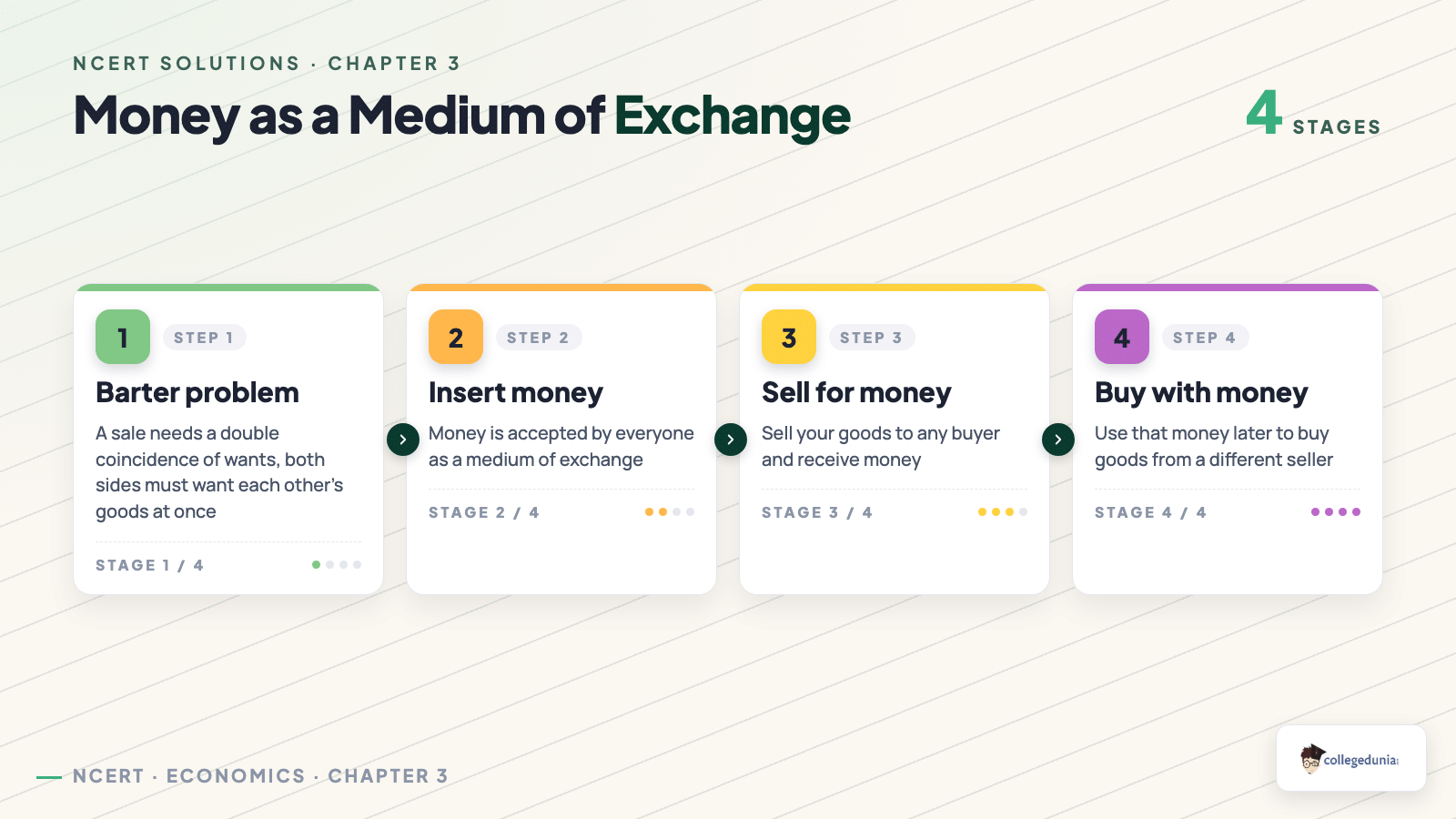
Money as a medium of exchange is the spine of this chapter. Under barter, a sale happens only if both sides want each other's goods at once, a double coincidence of wants. Money is accepted by everyone, so a person can sell goods for money to one party and later buy from another.
| System | What it needs | Why it is hard or easy |
|---|---|---|
| Barter | A double coincidence of wants, both sides want each other's goods at once. | Hard, two conditions at the same moment. |
| Money economy | Only that the buyer wants my good, then that I want the seller's good. | Easy, each step is a single one-way match. |
Name the barter difficulty, insert money as the medium of exchange, and add an example.
Formal and Informal Sources of Credit and SHGs in Class 10 Economics
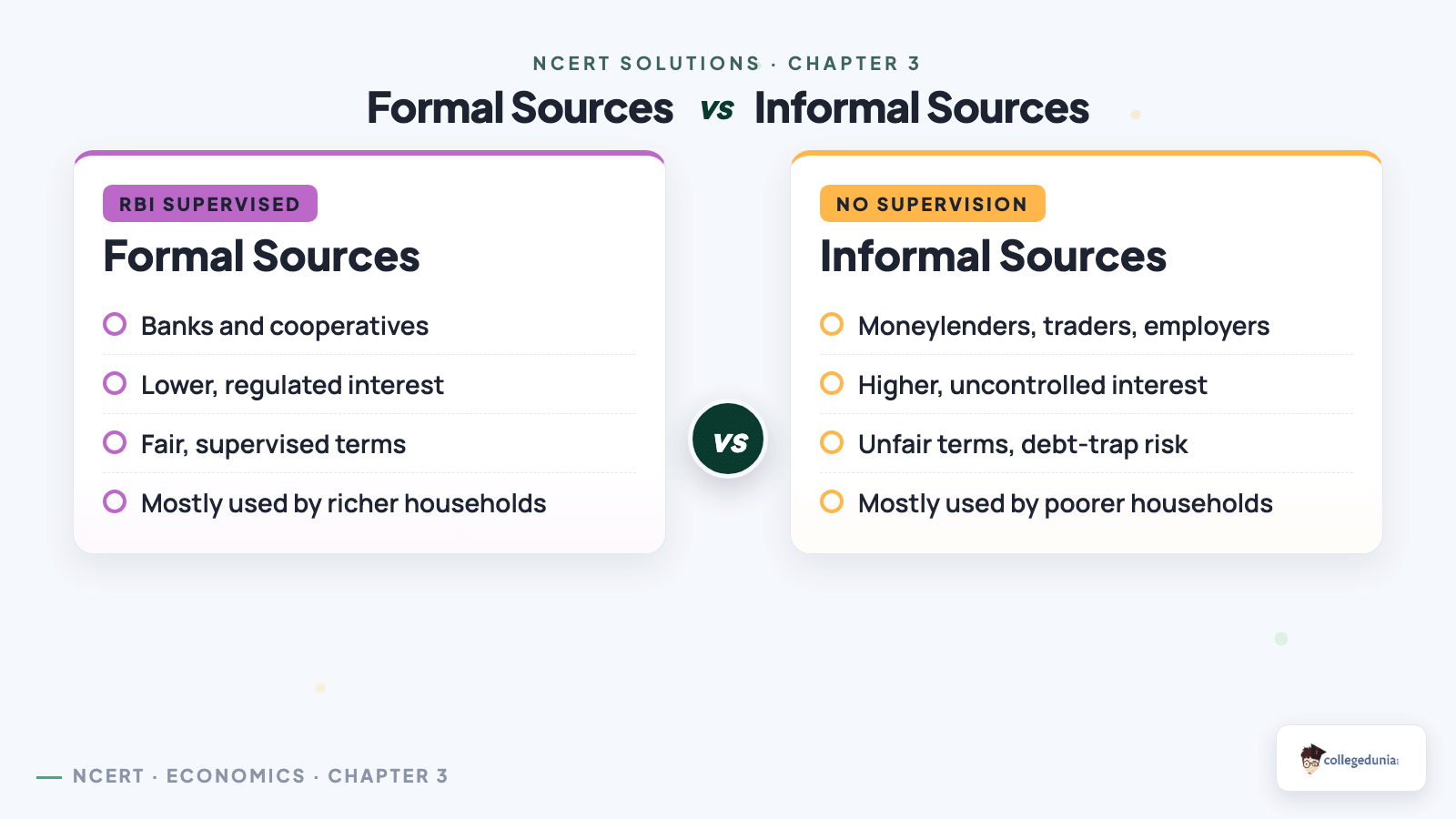
This is the part students mix up most. Formal sources are RBI-supervised lenders, mainly banks and cooperatives, so their interest is lower and fairer. Informal sources, the moneylenders, traders and employers, have no supervising authority, so they charge whatever they like. The poor depend most on costly informal credit, which is why Self-Help Groups matter: they pool small savings and give the collateral-less poor cheap, member-run loans.
| Basis | Formal sources | Informal sources |
|---|---|---|
| Supervision | Supervised by the Reserve Bank of India | No supervising authority |
| Interest rate | Lower and regulated | Higher and uncontrolled |
| Examples | Banks and cooperatives | Moneylenders, traders, employers, relatives |
| Who borrows most | Mostly richer households | Mostly poorer households |
Say clearly that informal credit is costlier and hurts the poor most. That is why the chapter argues for expanding formal credit and for SHGs.
Common Mistakes Students Make in this Class 10 Economics Chapter
A few slips lose easy marks every year. Fix these before the exam.
- Saying a double coincidence is just two people wanting to trade. Each person must want exactly what the other offers, both at once.
- Confusing collateral with interest. Collateral is the asset pledged as a guarantee; interest is the price of the loan.
- Calling an employer a formal source. Formal credit is RBI-supervised, so only banks and cooperatives qualify.
- Thinking credit is always bad. Risk, not credit itself, decides the outcome: Salim prospers while Swapna is trapped.
How to Use the NCERT Solutions Class 10 Economics Chapter 3 Page
Use this page in three short blocks so revision stays focused.
- Read and list: note the terms of credit, the formal versus informal split, and SHGs.
- Attempt first: answer all 13 questions on your own before opening the solutions.
- Compare and flag: match your answer with the solution and mark the missing fact-lines.
For long-answer practice, write the high-risk credit answer and the role of credit answer in full at least once. Each solution mirrors the board's 5-mark pattern and doubles as a model answer for revision.
All NCERT Solutions for this Class 10 Economics Chapter with Step-by-Step Solutions
Open the question bank below to attempt all 13 solved questions with collapsible Solution and Expert Solution tabs. Every answer is mapped to the NCERT text, the way a board examiner expects.
All Solved Questions for this Class 10 Economics Chapter
Practise every textbook question with step-by-step solutions and an expert version.
What Students Say About this Class 10 Economics Chapter
Student Feedback
What 11,800 students told us about studying this chapter before the 2026 boards:
- 69% of students found telling apart formal and informal sources of credit the hardest part.
- 62% of students struggled to explain how money solves the double coincidence of wants.
- Reading the credit-share graphs in Q5 and Q11 was left for last by about 31% of students.
Source: 2026-27 Class 10 Economics student poll, 11,800 students from CBSE schools across 15 states.
Class 10 Economics Other Resources for this Chapter
Pair these solutions with the other Class 10 Economics resources for this chapter, all linked below.
| Resource | Best used for | Link |
|---|---|---|
| NCERT Solutions | You are reading this page | Money and Credit Class 10 NCERT Solutions |
| NCERT Notes | Quick concept recap before the exam | Money and Credit Class 10 Notes |
| Handwritten Notes | Last-minute scanned revision | Money and Credit Class 10 Handwritten Notes |
| NCERT Book PDF | Reading the original chapter text | Money and Credit Class 10 Book PDF |
All Chapters NCERT Solutions for Class 10 Economics (Understanding Economic Development)
Browse the full set of ncert solutions for class 10 economics chapter by chapter.
| Chapter | NCERT Solutions |
|---|---|
| Chapter 1: Development | Development Class 10 NCERT Solutions |
| Chapter 2: Sectors of the Indian Economy | Sectors of the Indian Economy Class 10 NCERT Solutions |
| Chapter 3: Money and Credit | Money and Credit Class 10 NCERT Solutions |
| Chapter 4: Globalisation and the Indian Economy | Globalisation and the Indian Economy Class 10 NCERT Solutions |
| Chapter 5: Consumer Rights | Consumer Rights Class 10 NCERT Solutions |
Money and Credit Class 10 Economics NCERT Solutions FAQs
Ques. Where can I download the NCERT Solutions Class 10 Economics Chapter 3 Money and Credit PDF?
Ans. You can download the money and credit class 10 ncert solutions PDF directly from this page. Both the Normal and HD versions are free, and a Hindi-medium read is available too.
Ques. How many questions are solved in class 10 economics chapter 3 money and credit?
Ans. All 13 NCERT questions are solved, each with a step-by-step solution and an expert version for the long-answer marks, so you can revise the full exercise from one place.
Ques. Is this NCERT Solutions page aligned with the 2026-27 syllabus?
Ans. Yes. This page reflects the current 2026-27 syllabus for Class 10 Economics, and every answer is checked against the latest NCERT edition of Understanding Economic Development.
Ques. How does money solve the problem of double coincidence of wants?
Ans. Money is accepted by everyone as a medium of exchange, so a person can sell goods for money to one party and later buy goods with that money from another party. This splits one hard two-way barter match into two easy one-way trades, so the wants of the two sides no longer have to coincide. The ncert solutions class 10 economics chapter 3 Money and Credit set explains this with examples.
Ques. What are the terms of credit in class 10 economics?
Ans. The terms of credit are the interest rate, the collateral and documents the lender demands, and the mode of repayment. Together they decide whether a loan is affordable and fair or whether it can push a borrower into a debt trap. Collateral is an asset the borrower pledges as a guarantee until the loan is repaid.
Ques. What is the difference between formal and informal sources of credit?
Ans. Formal sources are supervised by the Reserve Bank of India and include banks and cooperatives, so their interest is lower and fairer. Informal sources, such as moneylenders, traders and employers, have no supervising authority, so they charge higher, uncontrolled interest. The poor depend most on costly informal credit.
Ques. What is the basic idea behind a Self-Help Group in class 10 economics?
Ans. A Self-Help Group is about 15 to 20 people, usually women, who pool their small savings into a common fund and lend from it at low interest without collateral or paperwork. Members take all the decisions themselves, and a regular saving and repayment record earns the whole group a cheap bank loan.
Ques. Why do we need to expand formal sources of credit in India?
Ans. Formal credit is RBI-supervised, cheaper and fairer, and it reaches small borrowers. Graph 1 shows the informal sector still meets a large share of rural credit at very high cost, especially for the poor, so widening formal credit means cheaper loans, higher incomes and faster development.



Comments