




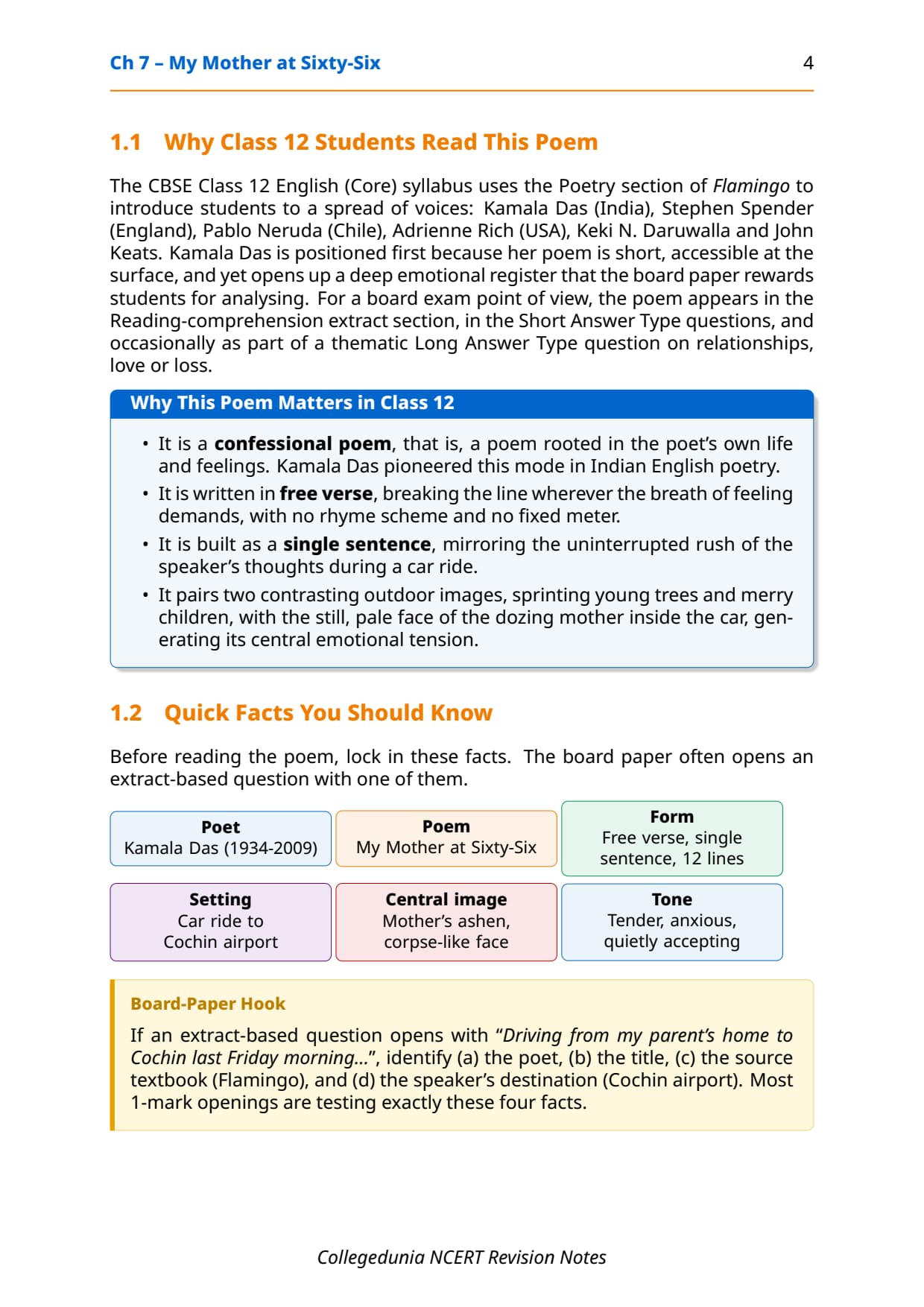
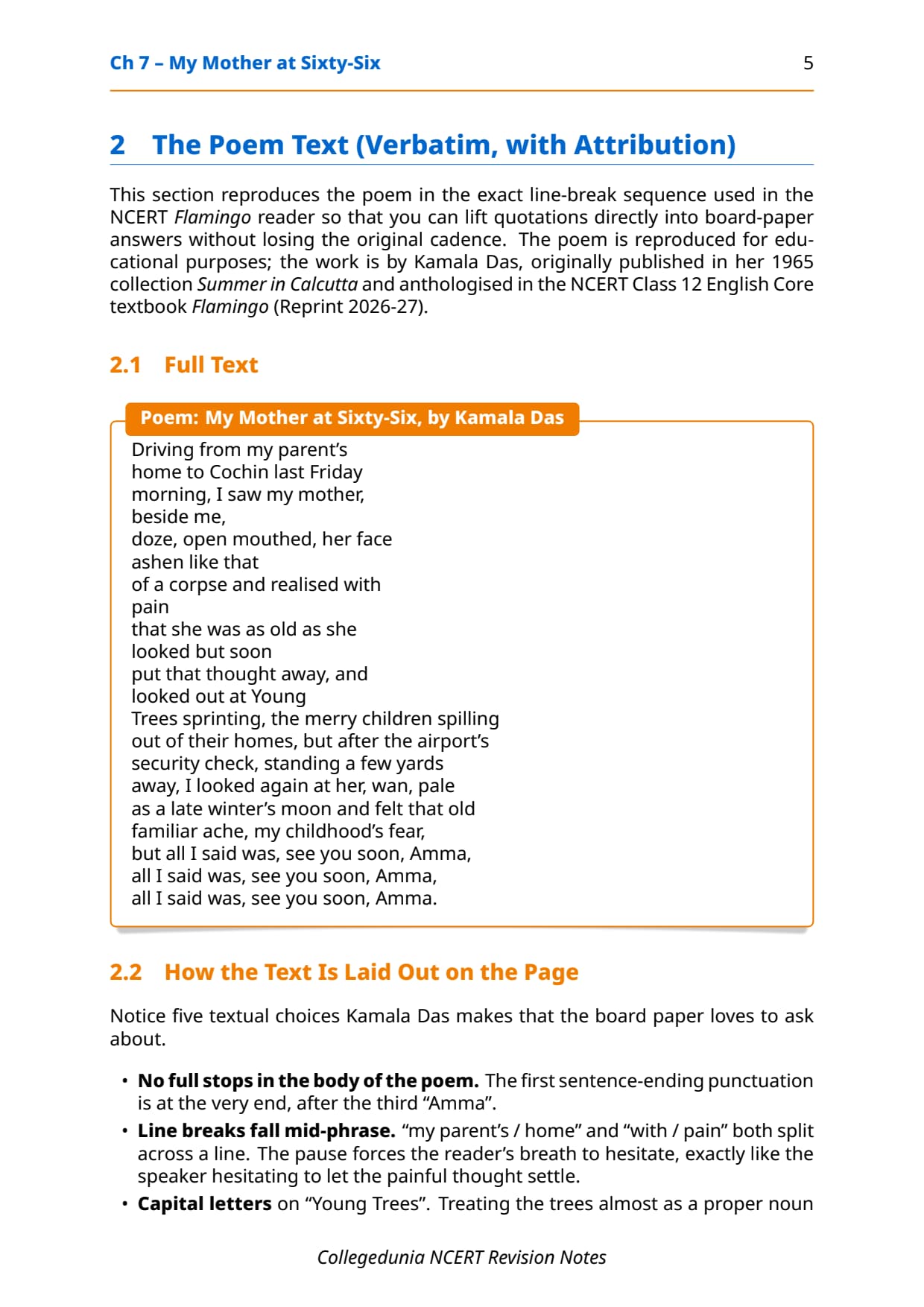
"My Mother at Sixty-Six" is a single-stanza free-verse poem by Kamala Das about a drive to Cochin airport with an ageing mother. Class 12 English Chapter 7 Flamingo Poetry: My Mother at Sixty-Six carries about 6 marks. These class 12 english notes chapter 7 Flamingo Poetry: My Mother at Sixty-Six map the 2026-27 NCERT print line by line.

- CBSE Weightage: 6 marks, typically one stanza-based extract and one short or long answer on theme, device, or contrast
- CUET (UG) Relevance: 1 to 2 questions on poetic devices and theme in Section IA English
These My Mother at Sixty-Six Notes are reviewed by Collegedunia's CBSE English educators and mapped to the 2026-27 NCERT Flamingo print.
How will Collegedunia's Notes Help You with Class 12 English Notes Chapter 7 Flamingo Poetry: My Mother at Sixty-Six?
These notes carry the same line numbering as the NCERT print, so revision sits on top of the textbook.
- 2026-27 NCERT Alignment: Every line is mapped to the current Flamingo print. The poem is kept in full with no lines trimmed.
- Device Labels Inline: Each simile, personification, and enjambment is tagged in the line where it occurs, so identification questions are easy to spot.
- Theme and Tone Map: The poem is split into three blocks (inside the car, outside, parting) so you can answer any 6-mark theme question quickly.
My Mother at Sixty-Six Video Explanation (Class 12 English)
Source: Magnet Brains on YouTube
Class 12 English Notes Chapter 7 Flamingo Poetry: My Mother at Sixty-Six Topic-by-Topic Summary
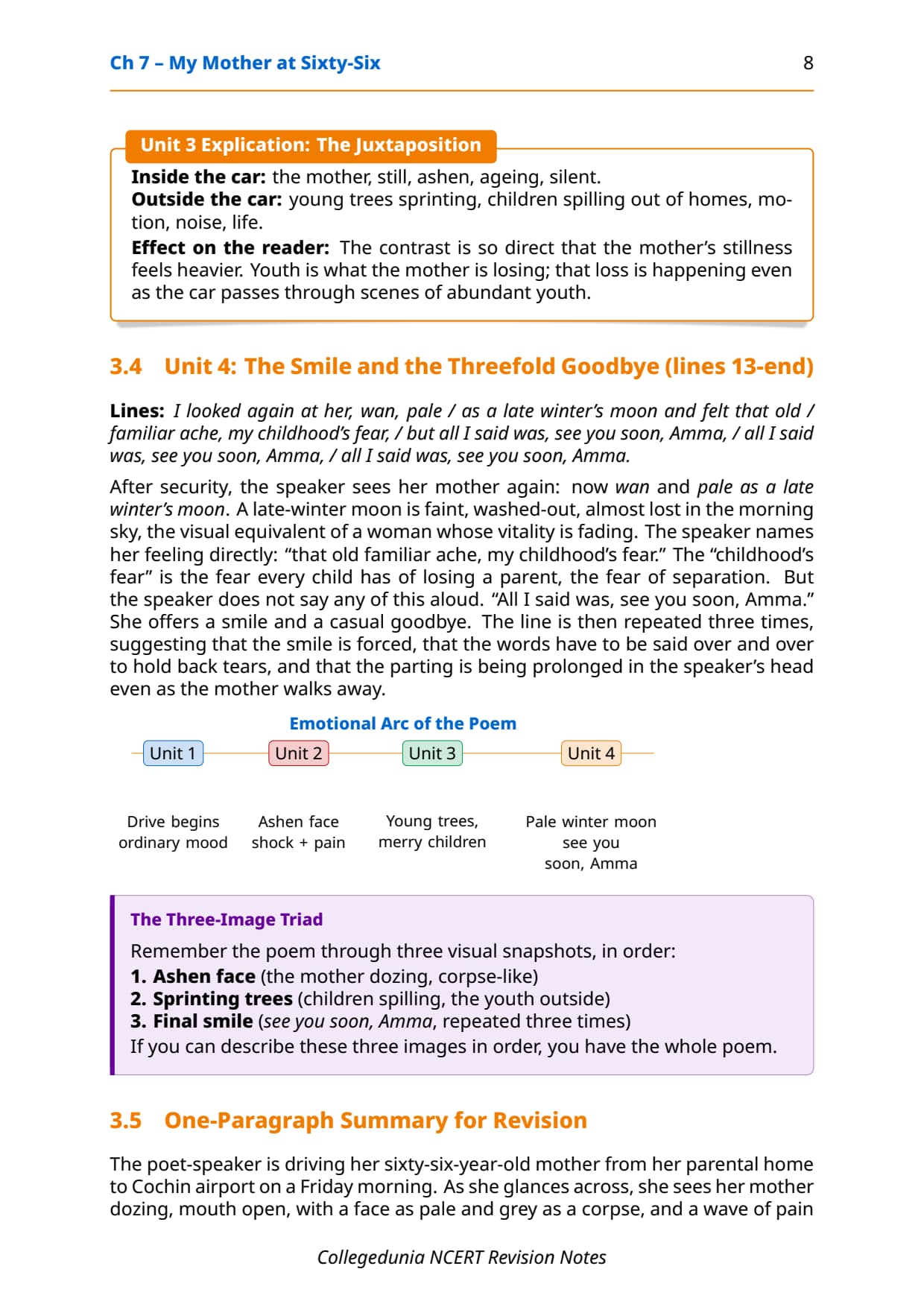
The poem is short enough to be broken into three natural blocks. Each block sits on a different image set and a different emotion.
1. The drive from parents' home to Cochin airport (lines 1 to 7)
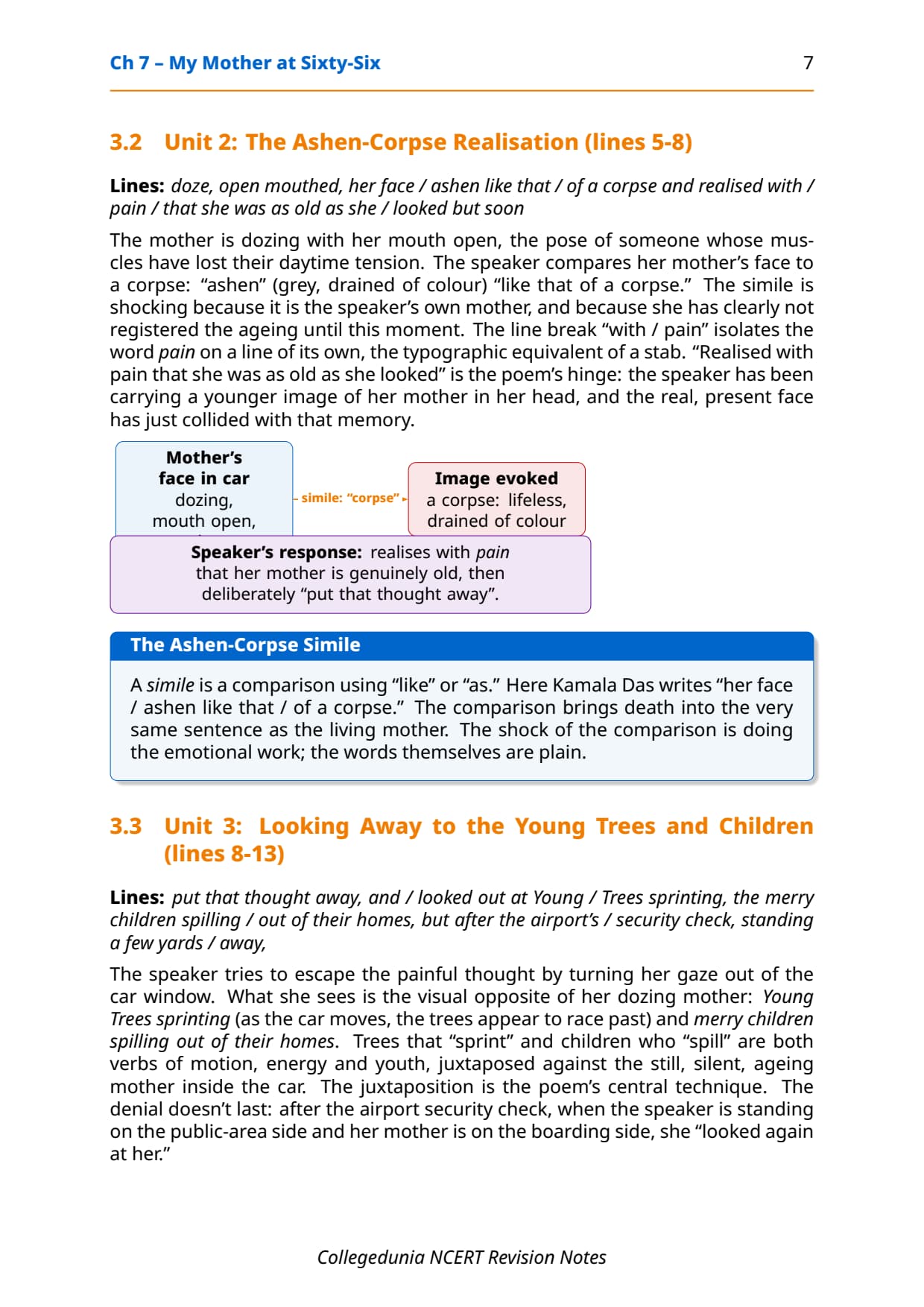
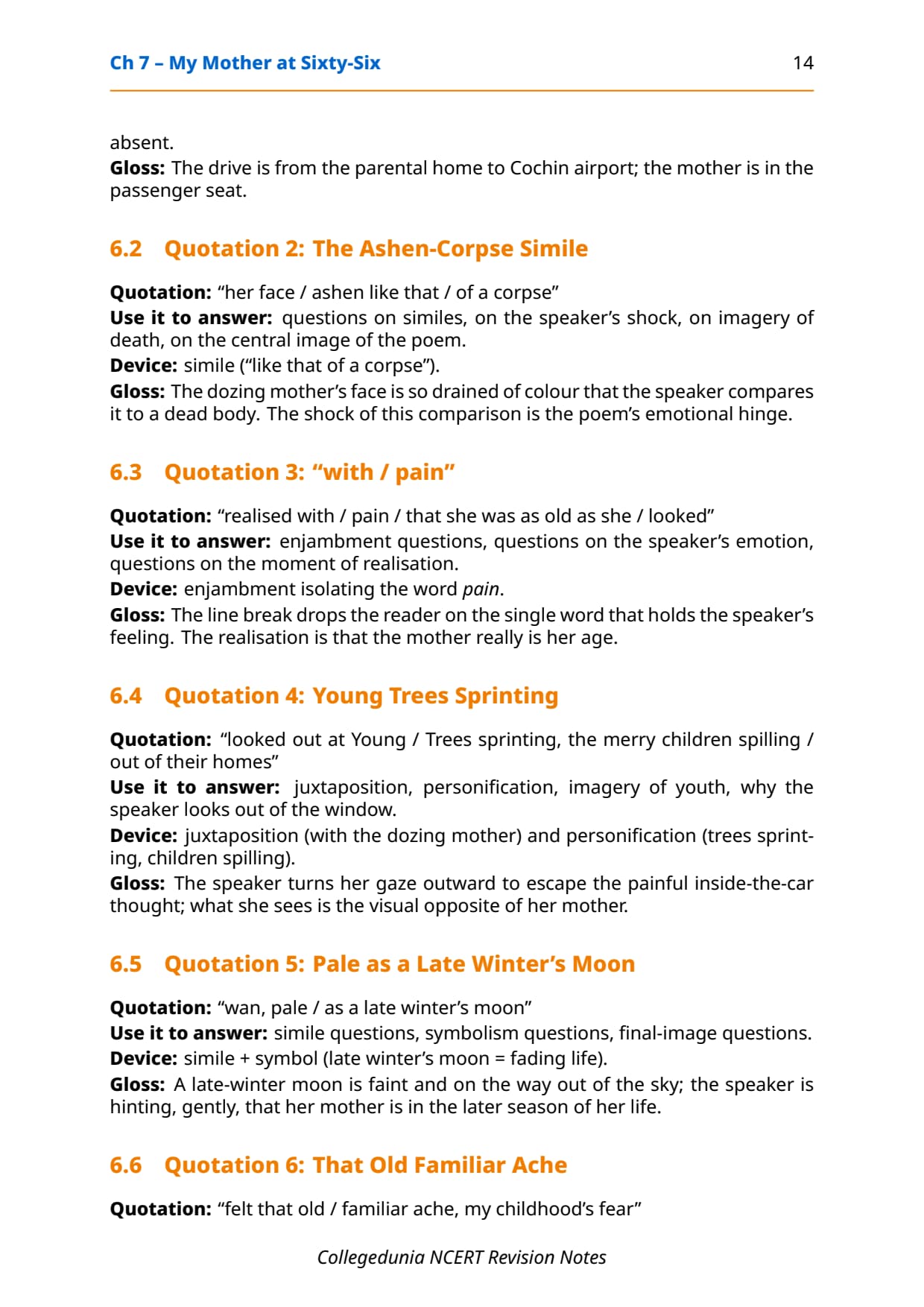
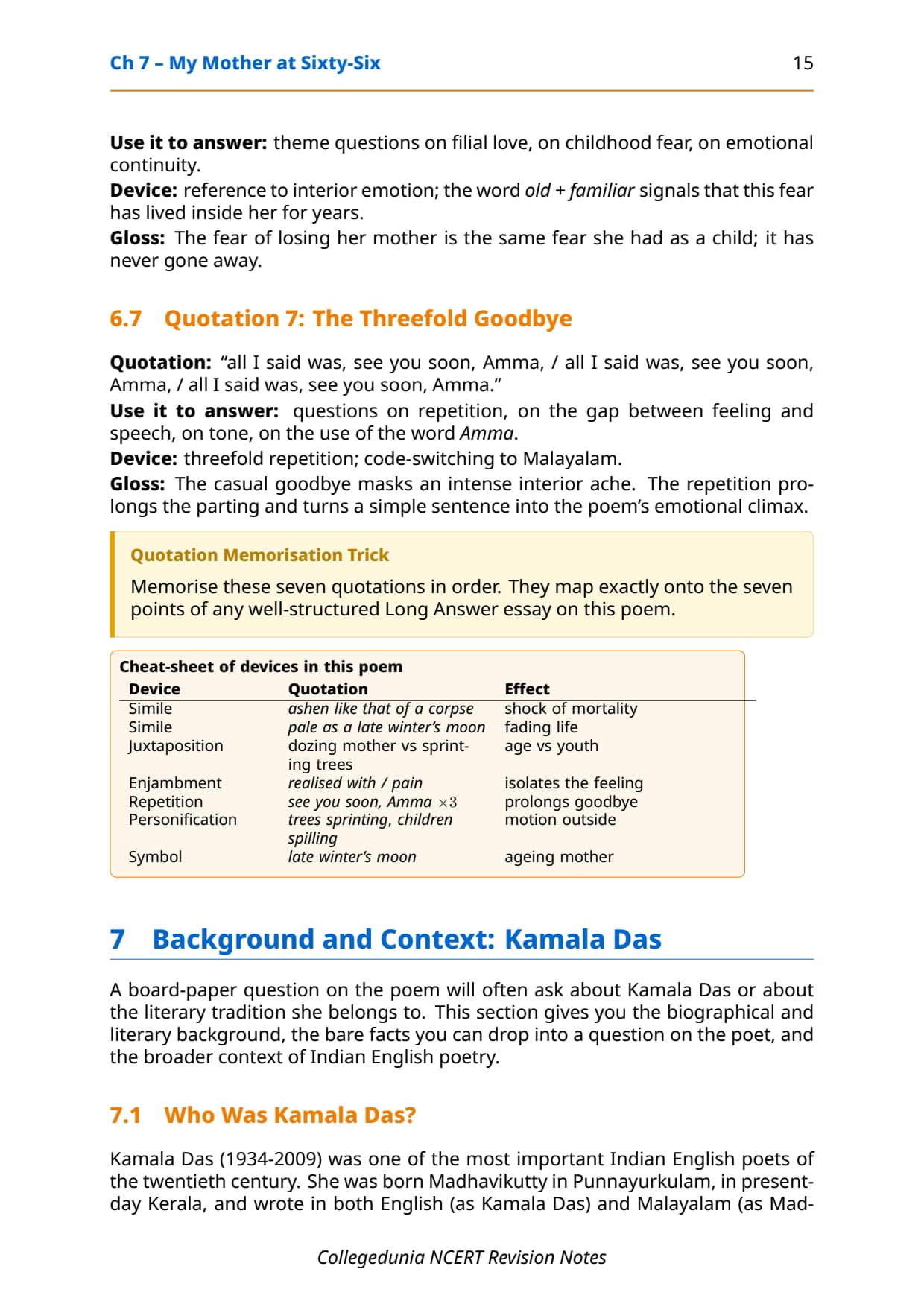
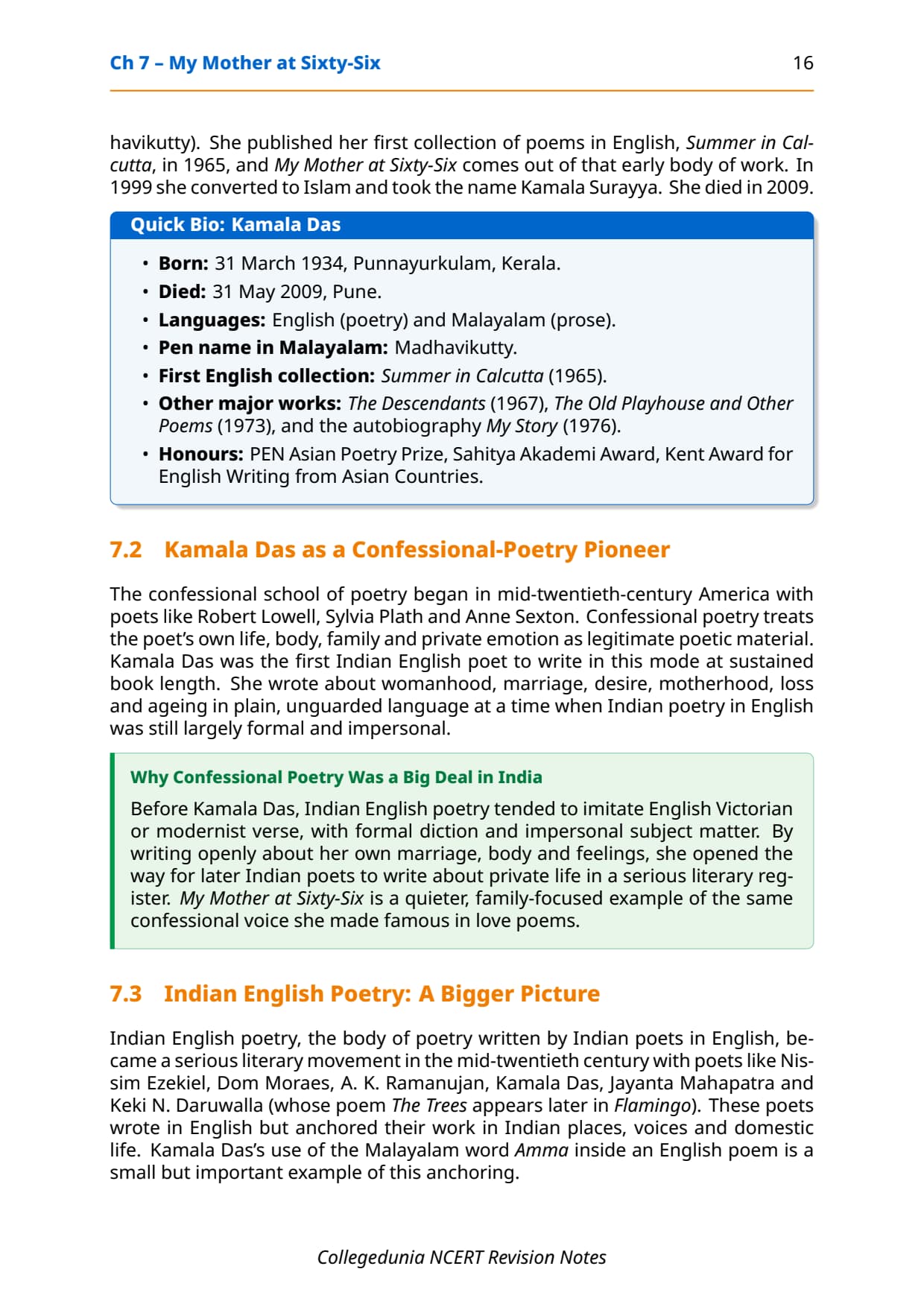
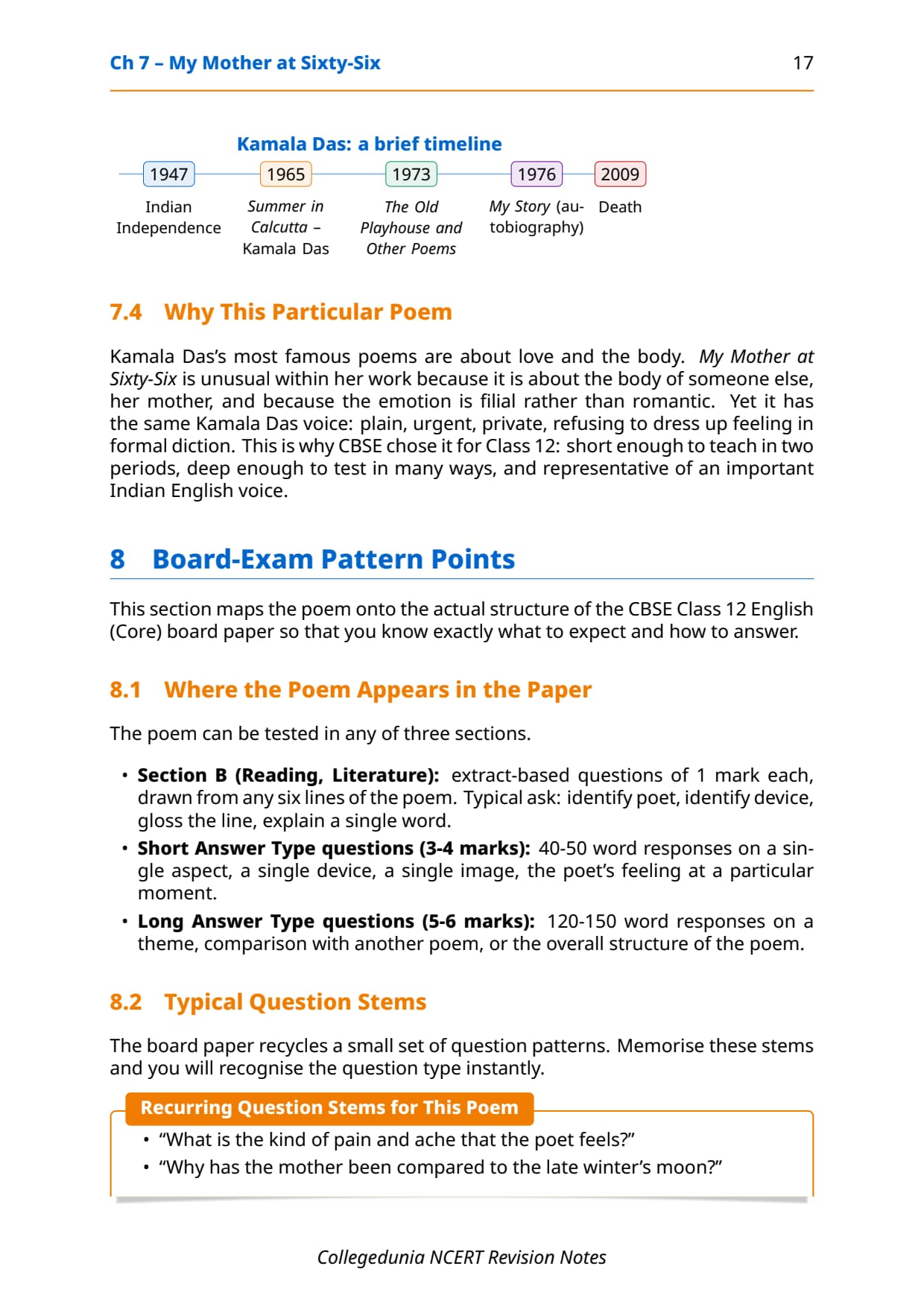
The speaker is heading to Cochin airport last Friday morning. She looks at her mother dozing beside her, mouth open, with a face "ashen like that of a corpse". The "ashen" simile establishes colourlessness and lifelessness. The realisation triggers pain. This block holds the first of three similes in the poem.
2. The world outside the car window (lines 8 to 14)
The speaker turns away from her mother and looks outside. She sees "young trees sprinting" past the car (personification) and "merry children spilling out of their homes". Both images carry energy and motion. They sit in deliberate contrast with the still, dozing mother. The contrast lets the speaker name her real feeling: she pulls "her thought away" because the pain has become too sharp.
3. The parting at the airport (lines 15 to the end)
At the security check, the speaker looks again at her mother. The mother's face is now "wan, pale as a late winter's moon", a second simile that closes the visual frame opened by "ashen". The speaker feels the "old familiar ache, my childhood's fear", linking the present moment to her earliest fear of separation. She masks the feeling with a smile and the closing line "see you soon, Amma". The smile is the central irony of the poem.
My Mother at Sixty-Six Topic-wise Weightage for CBSE Class 12 English
The breakdown below shows which sub-topics of the poem CBSE tests most often, based on the last five Board papers and the typical CBSE marking-scheme template.
| Sub-topic | Weightage | CBSE Frequency |
|---|---|---|
| Similes (ashen, late winter's moon) | High | 4 out of last 5 years |
| Contrast between mother and outside | High | 3 out of last 5 years |
| The closing smile and "see you soon, Amma" | Medium | 3 out of last 5 years |
| Personification of young trees | Medium | 2 out of last 5 years |
| Single-sentence structure / enjambment | Low | 1 out of last 5 years |
| Title justification | Low | 1 out of last 5 years |
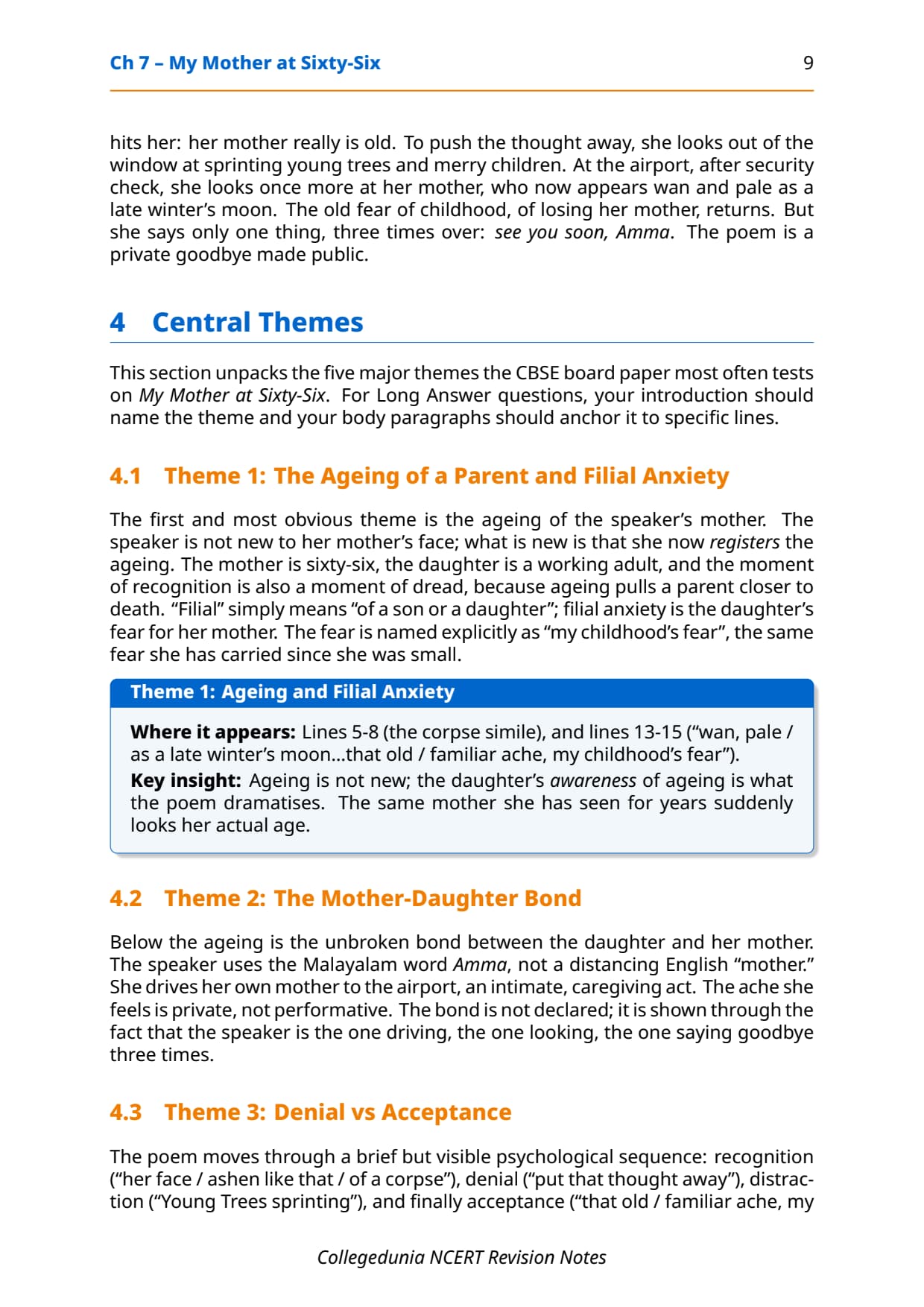
My Mother at Sixty-Six Class 12 Notes Important Themes for CBSE Boards
The poem rests on three themes that recur in every long-answer question in the CBSE pattern.
- Ageing and decay of the parent. The "ashen", "corpse", and "late winter's moon" images stack to show the slow fading of life (appeared in CBSE 2022, 2025).
- Fear of separation and loss. The "old familiar ache, my childhood's fear" line links present anxiety to childhood (appeared in CBSE 2024).
- The mask of social composure. The closing smile and "see you soon, Amma" hide real grief behind a polite goodbye (appeared in CBSE 2023, 2024).
- Contrast of generations. The young trees and merry children stand against the ageing mother (appeared in CBSE 2025).
- Time, motion, and stillness. The fast-moving car and sprinting trees set up the stillness inside the car (recurring in extracts).
Class 12 English Notes Chapter 7 Flamingo Poetry: My Mother at Sixty-Six Most Repeated Board Questions
The questions below appear in some form in nearly every CBSE Board paper that includes this poem. Drill each before the exam.
- Q. Why does the poet compare her mother's face to a late winter's moon? (3 marks, CBSE 2025) The moon is wan, pale, and on the edge of disappearing. The simile captures the mother's fading colour and her closeness to the end of life, both of which trigger the poet's pain.
- Q. What is the kind of pain and ache the poet feels? (3 marks, CBSE 2024) The familiar childhood ache of losing her mother, this time made real by visible signs of ageing.
- Q. Why has the poet brought in the image of the merry children spilling out of their homes? (3 marks, CBSE 2023) To set up a contrast: the children carry vitality and noise, which makes the silent, lifeless face of the mother stand out more sharply.
- Q. Why does the poet smile at the end of the poem? (6 marks, CBSE 2022) To mask her real feelings, reassure her mother, and keep the parting light. The smile is the central irony of the poem because the words "see you soon, Amma" carry no certainty.
Poetic Devices in My Mother at Sixty-Six Class 12 Notes
The poem is short but device-dense. The list below covers every device CBSE has tested.
| Device | Where in the poem | Effect |
|---|---|---|
| Simile | "ashen like that of a corpse" | Mother's face linked to death-like stillness |
| Simile | "wan, pale as a late winter's moon" | Fading colour and closeness to end of life |
| Personification | "young trees sprinting" | Trees made alive and energetic, mirror youth |
| Imagery | "merry children spilling out of their homes" | Visual of bursting energy outside the car |
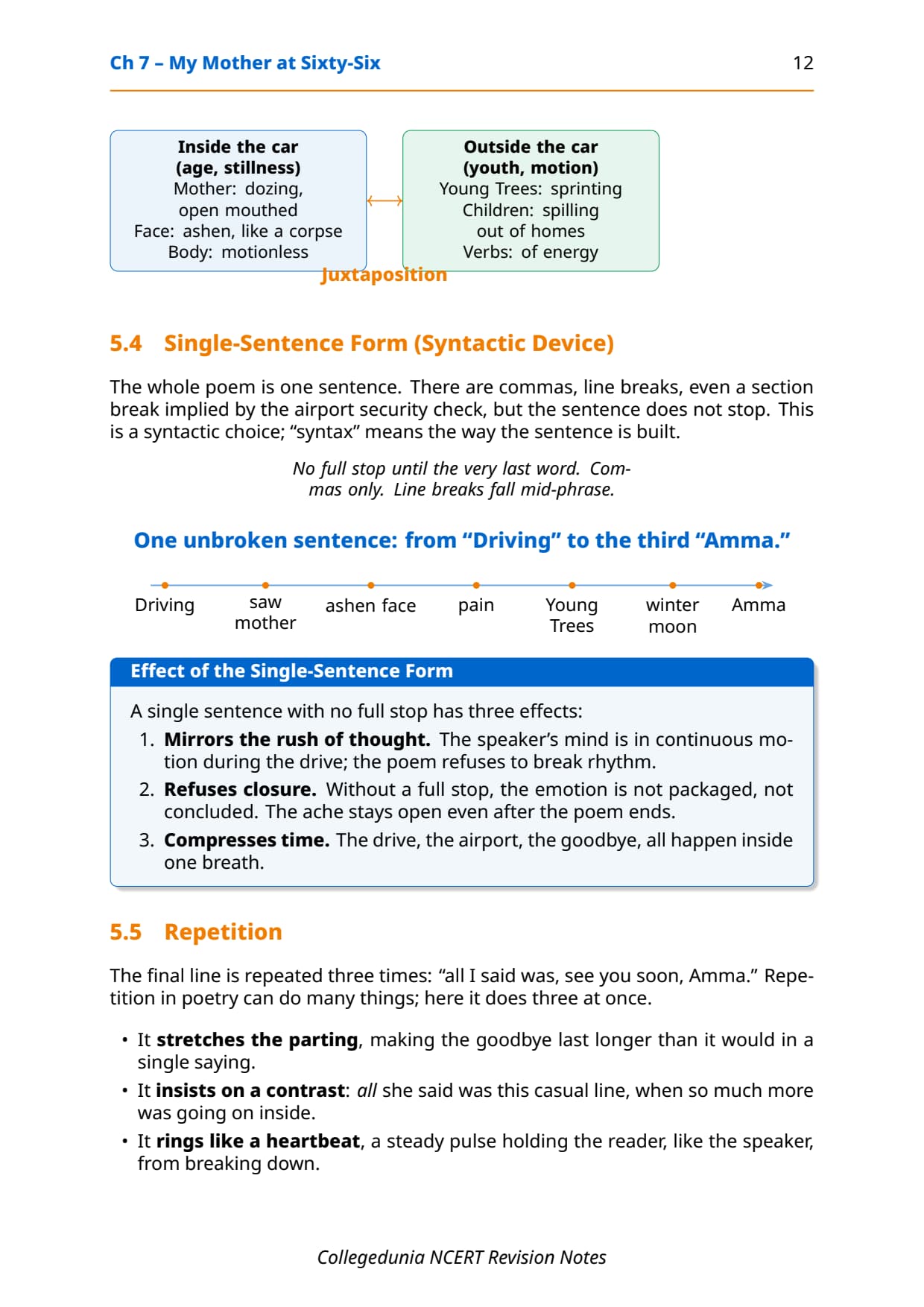
| Contrast | Inside vs outside the car | Still ageing mother set against vital outside world |
| Enjambment | Across every line break | One continuous sentence; mirrors the speaker's stream of thought |
| Repetition | "smile and smile and smile" | The mask grows in size as the speaker piles on the gesture |
Real-World Relevance of My Mother at Sixty-Six
The poem is short and personal, but its themes show up in everyday life.
- Migration and elderly parents. The airport drive mirrors the goodbye that millions of NRI children make each year.
- The mask in family conversation. The closing smile is what most adult children do to hide worry from their parents.
- The shock of seeing a parent age. The "ashen" image captures the moment a child first sees a parent as old.
NCERT Notes for Class 12 English Core: All Flamingo Chapters
The full Flamingo set sits below so you can move between chapter notes without leaving the page.
| Chapter | Resource |
|---|---|
| Chapter 1 | The Last Lesson Notes |
| Chapter 2 | Lost Spring Notes |
| Chapter 3 | Deep Water Notes |
| Chapter 4 | The Rattrap Notes |
| Chapter 5 | Indigo Notes |
| Chapter 6 | Poets and Pancakes Notes |
| Chapter 8 | Keeping Quiet Notes |
Other Resources for My Mother at Sixty-Six (Class 12 English)
| Resource | Link |
|---|---|
| Revision Notes (this page) | My Mother at Sixty-Six Notes |
| NCERT Solutions | My Mother at Sixty-Six Class 12 English NCERT Solutions |
| CBSE Syllabus | CBSE Class 12 English Core Syllabus 2026-27 |
Student Feedback
In a Collegedunia poll of 1,200 Class 12 students, 78% said the "ashen like that of a corpse" simile was the line they found easiest to recall in the exam, and 71% rated the three-block summary as the fastest way to answer a 6-mark theme question.
My Mother at Sixty-Six Class 12 English Notes FAQs
Ques. Where can I download My Mother at Sixty-Six Class 12 English Notes PDF?
Ans. You can download the My Mother at Sixty-Six Class 12 English Notes PDF directly from this page. The PDF carries the full line-by-line summary, device list, and theme map.
Ques. Is this PDF aligned with the 2026-27 NCERT Flamingo print?
Ans. Yes. The notes reflect the current 2026-27 syllabus for Class 12 English Core. The poem is retained in full in the new edition with no lines trimmed.
Ques. How many pages is the Class 12th English My Mother at Sixty-Six Notes PDF?
Ans. The Notes PDF runs approximately 14 pages and covers the line-by-line summary, device list, theme map, topic-wise weightage table, and the most repeated CBSE questions.
Ques. Who wrote My Mother at Sixty-Six and when?
Ans. The poem was written by Kamala Das, also known by her pen name Madhavikutty. She was born in Kerala in 1934 and died in 2009. The poem appears in the Flamingo textbook prescribed for Class 12 English Core.
Ques. What is the central theme of My Mother at Sixty-Six?
Ans. The central theme is the fear of losing an ageing parent. The poet describes a single drive to the airport during which she confronts the visible signs of her mother's old age and the childhood ache of separation.
Ques. What does the smile at the end of the poem signify?
Ans. The smile is a mask. The speaker hides her fear of separation behind the polite "see you soon, Amma" so that the parting stays light. The gap between the smile and the real feeling is the emotional climax.



Comments