


Aunt Jennifer's Tigers is Adrienne Rich's tightly metred three-stanza meditation on patriarchal marriage, art and freedom - an elderly aunt stitches fearless, prancing tigers onto a wool panel while her own hand is weighed down by "the massive weight of Uncle's wedding band". These Aunt Jennifer's Tigers Class 12 notes compress the closing Flamingo poem into a board-ready revision guide: stanza-by-stanza explication, three core themes, six poetic devices, and the year-wise CBSE question map.
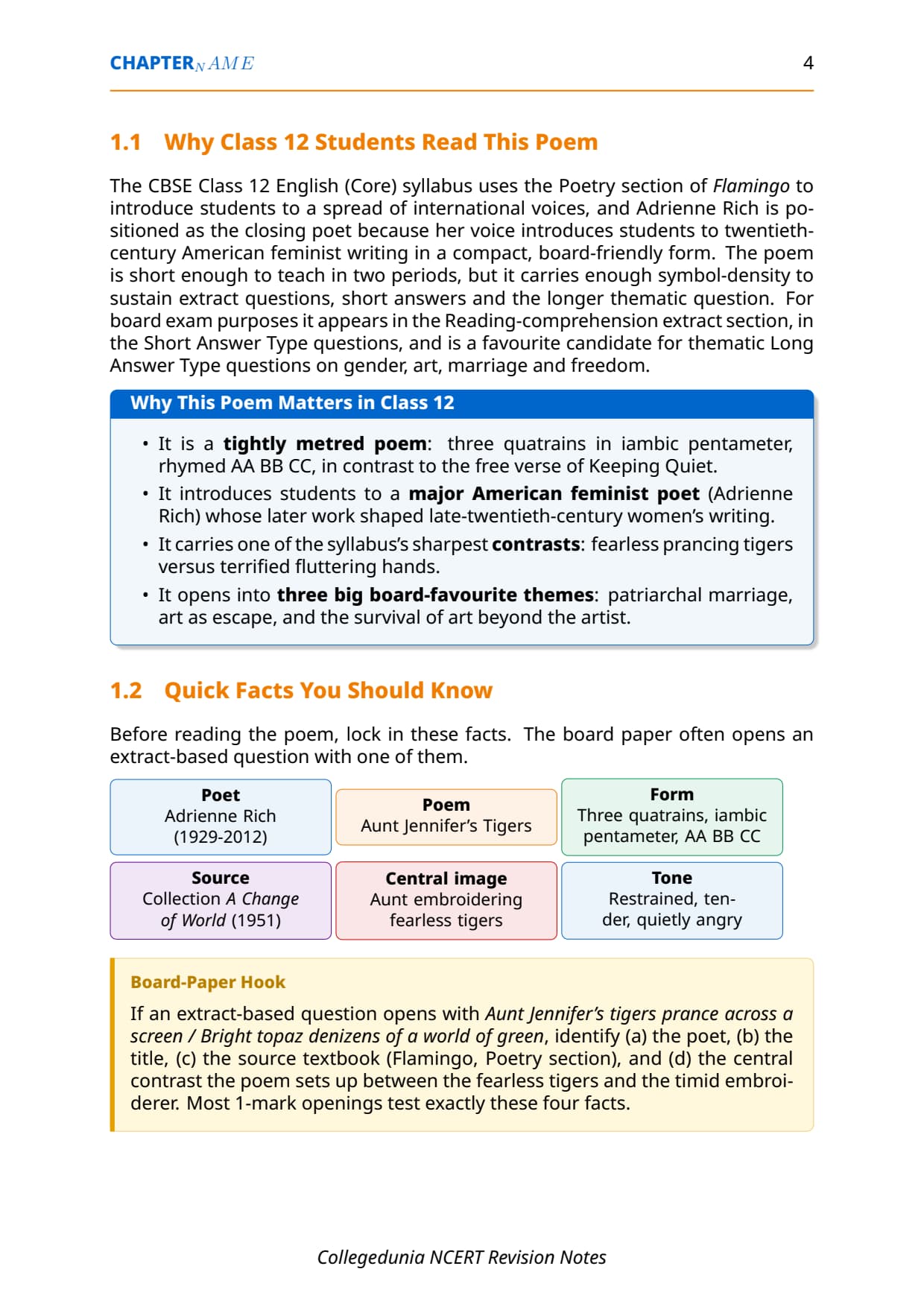
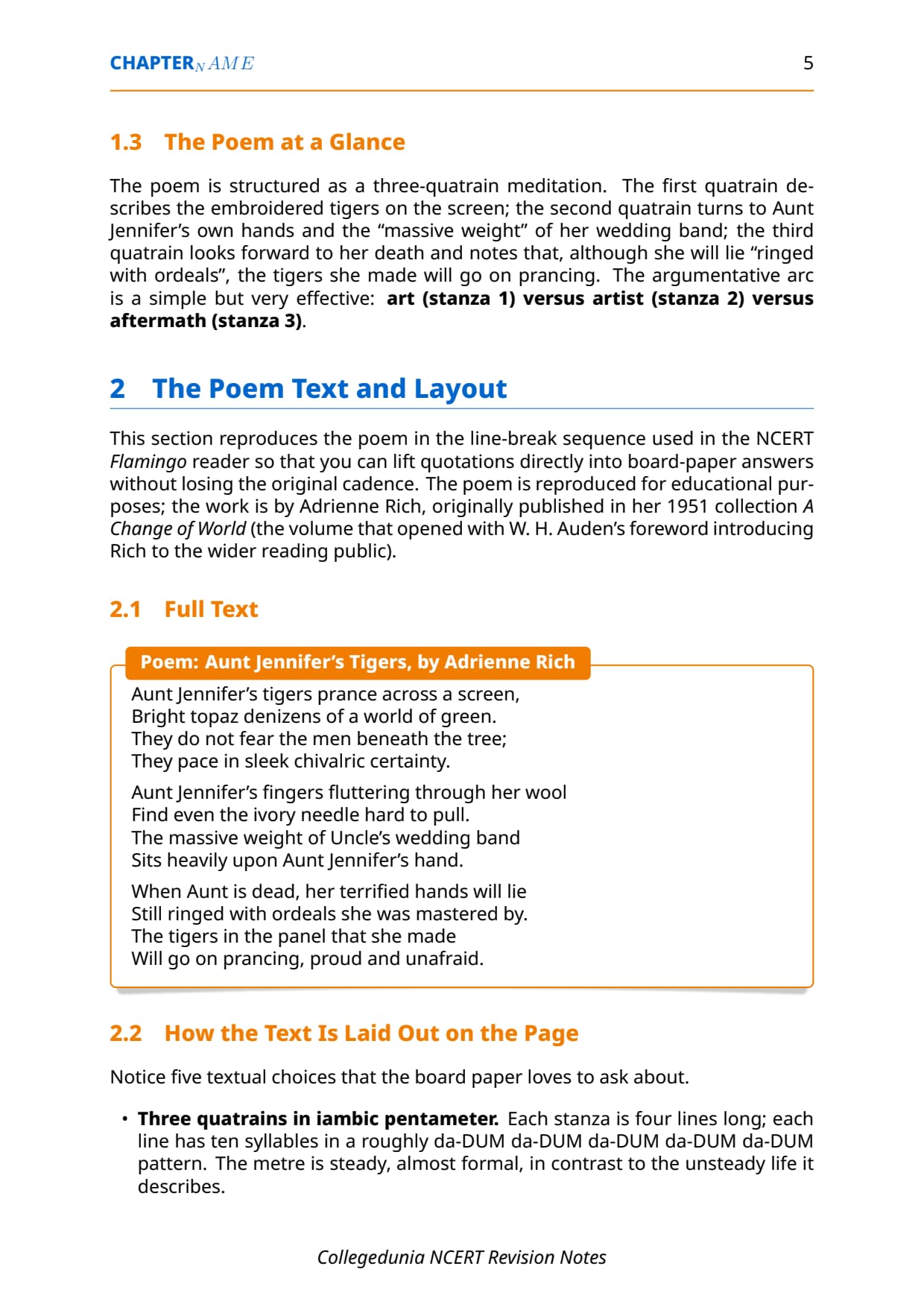
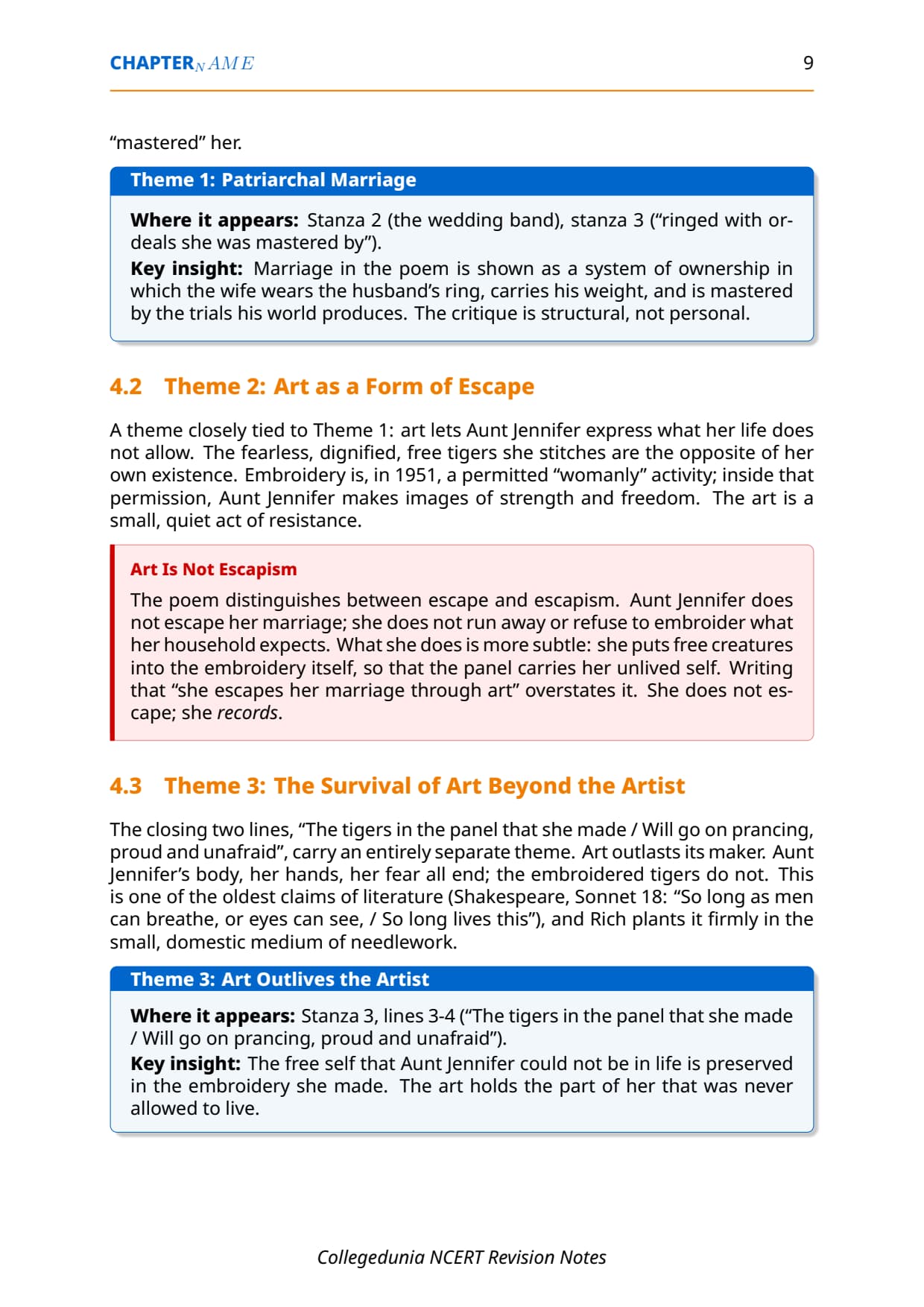
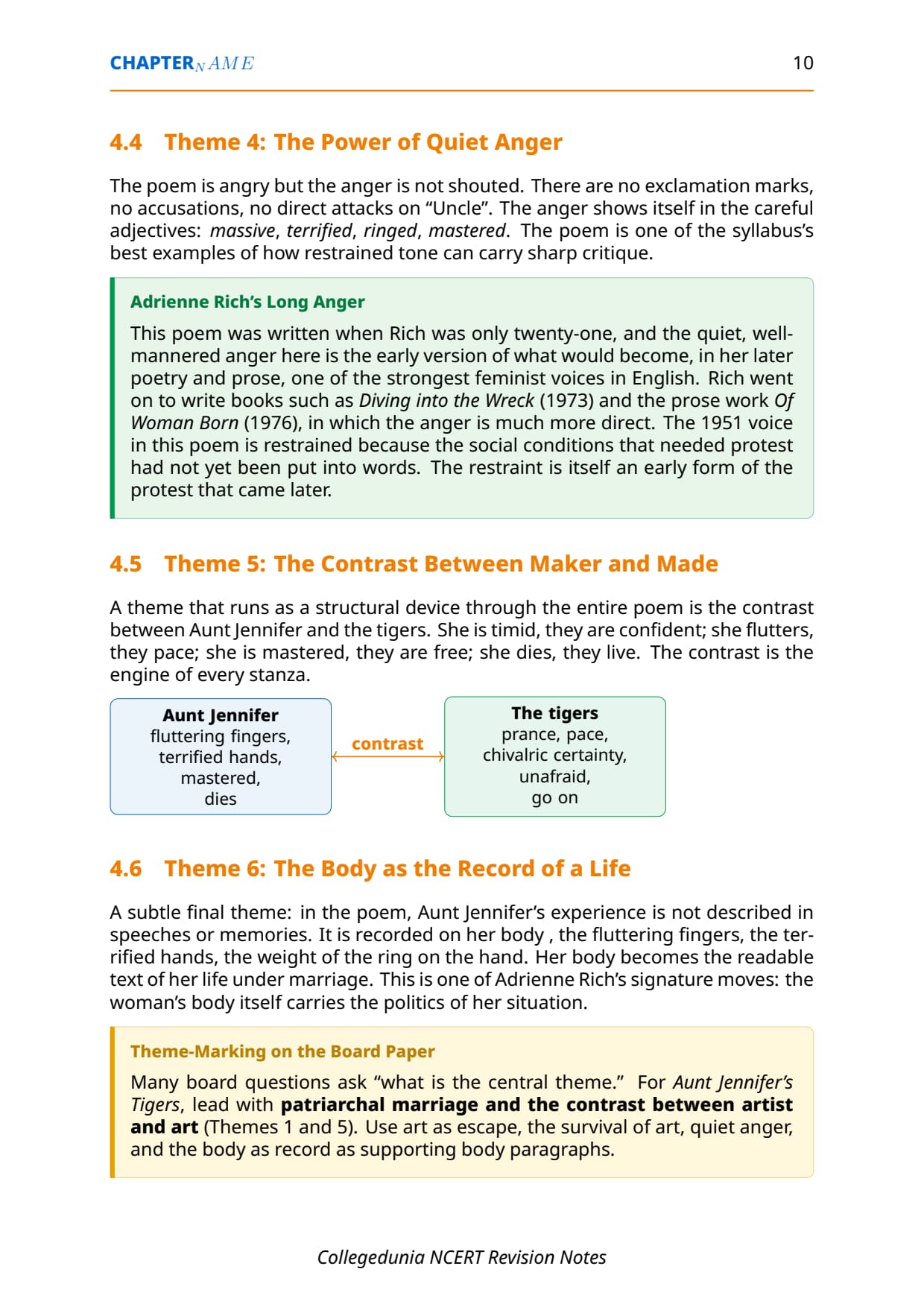
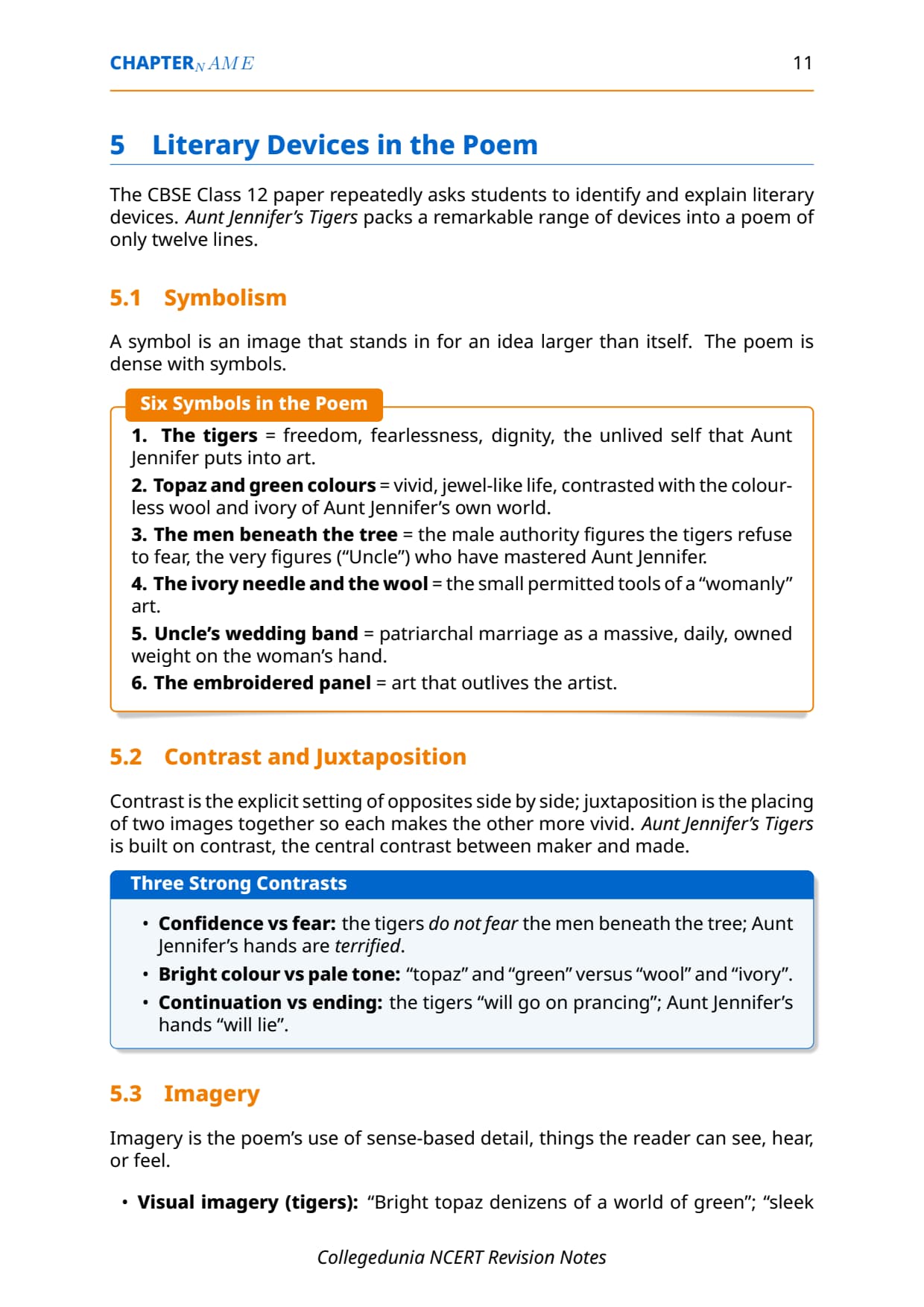
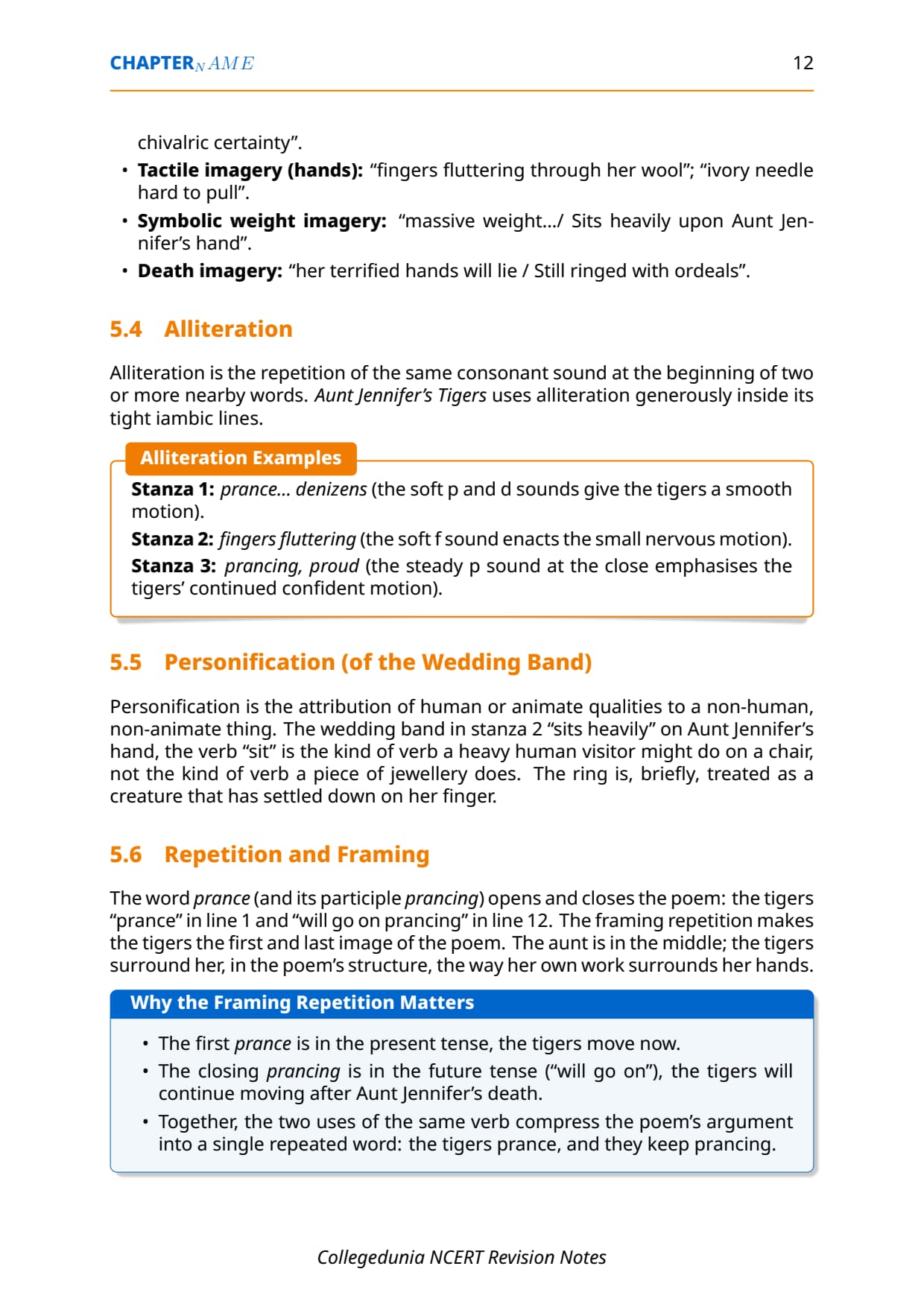
Iambic pentameter, AA BB CC
Adrienne Rich, 1951, debut book
NCERT Flamingo print aligned
- CBSE Weightage: 6 to 10 marks across the Flamingo poetry section, typically one Reference-to-Context extract (4-6 marks) plus a short or long answer on the wedding-band symbol or the maker-versus-made contrast
- CUET (UG) Relevance: 2 to 3 questions in the English domain paper on the poet, the three meanings of "ringed", and identification of poetic devices
These Class 12 English Chapter 11 notes are written by senior CBSE English educators, mapped to the 2026-27 NCERT print of Flamingo, and cross-checked against the last five years of CBSE Board and CUET English papers.
Aunt Jennifer's Tigers is the closing poem of the Flamingo poetry section, placed after A Roadside Stand. Adrienne Rich wrote it for her 1951 debut collection A Change of World, which was selected for the Yale Series of Younger Poets by W. H. Auden. The poem is short - twelve lines, three quatrains - but its symbolism is dense, so these revision notes treat each stanza and each major symbol as a separate study unit.
Also Check:
Aunt Jennifer's Tigers Important Topics for Class 12 English Boards
Six high-yield topics account for almost every Aunt Jennifer's Tigers question CBSE has set in the last decade. Memorise the topic and the one-line trigger.
| Topic | Why It Matters | Quotable Line |
|---|---|---|
| The tigers as symbol | Symbols of the unlived self, fearless and free | "They pace in sleek chivalric certainty" |
| Uncle's wedding band | Top long-answer trigger - CBSE has set the marriage theme three times since 2018 | "The massive weight of Uncle's wedding band / Sits heavily upon Aunt Jennifer's hand" |
| The three meanings of "ringed" | Highest-band wordplay question | "Still ringed with ordeals she was mastered by" |
| Maker versus made (contrast) | The central structural device of the poem | "Aunt Jennifer's fingers fluttering through her wool" vs the tigers' "chivalric certainty" |
| The survival of art | Strongest evidence that the poem is not only an elegy | "The tigers in the panel that she made / Will go on prancing, proud and unafraid" |
| The speaker's attitude | Tested as "do you sympathise with Aunt Jennifer?" | Compassion + admiration + critique of the institution, not the woman |
Flamingo Poetry Aunt Jennifer S Tigers Video Walkthrough
Source: Magnet Brains on YouTube
About the Poet: Adrienne Rich
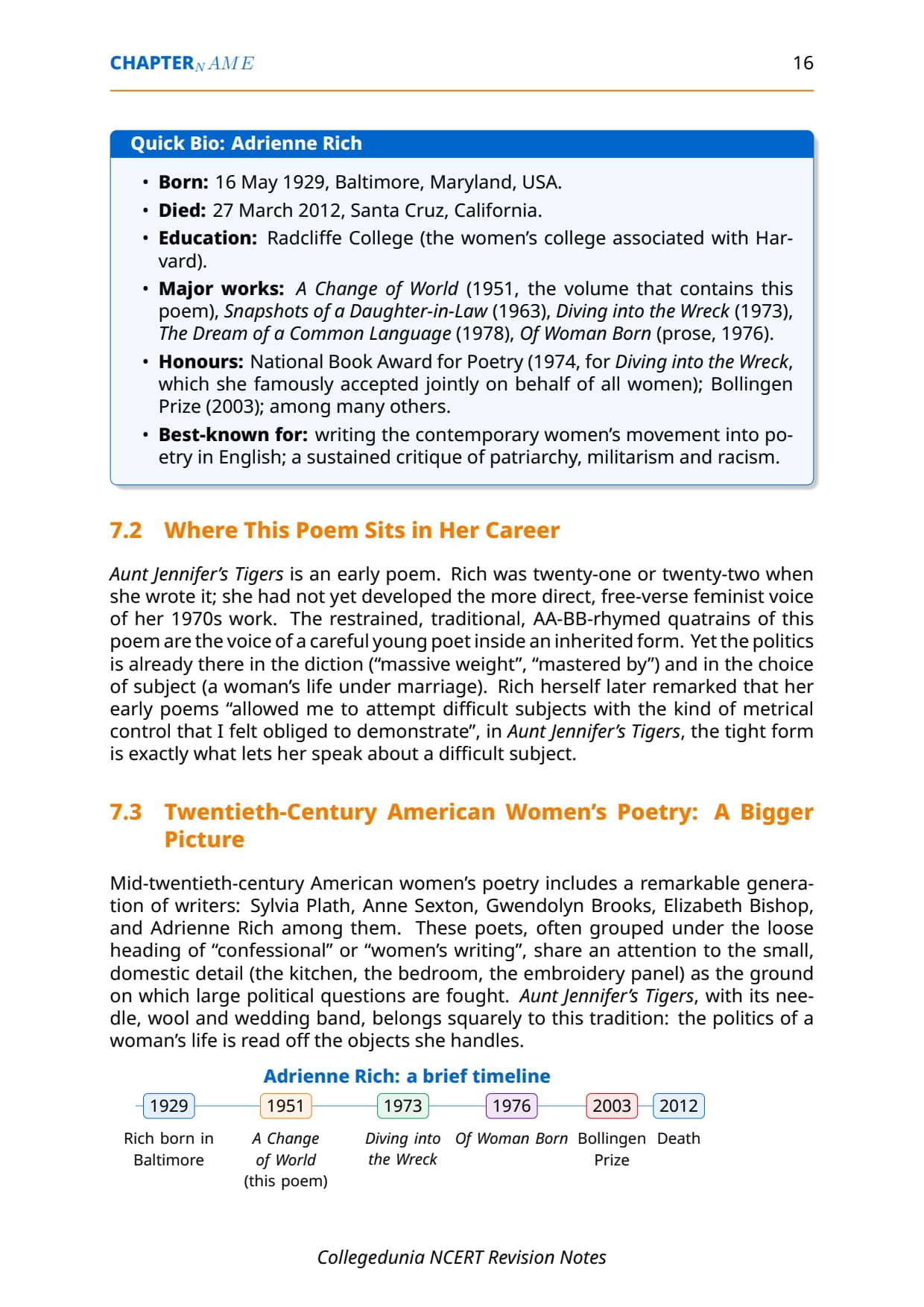
Adrienne Rich (1929-2012) was an American poet and one of the most influential feminist writers of the twentieth century. She was born in Baltimore, Maryland, and educated at Radcliffe College, the women's college associated with Harvard. Her 1951 debut A Change of World, in which Aunt Jennifer's Tigers appears, was selected by W. H. Auden for the Yale Series of Younger Poets when Rich was only twenty-one. She went on to publish more than twenty volumes of poetry and prose, winning the National Book Award for Poetry in 1974 for Diving into the Wreck. Her later work - books like The Dream of a Common Language (1978) and the prose Of Woman Born (1976) - shaped the second-wave women's movement in the United States.
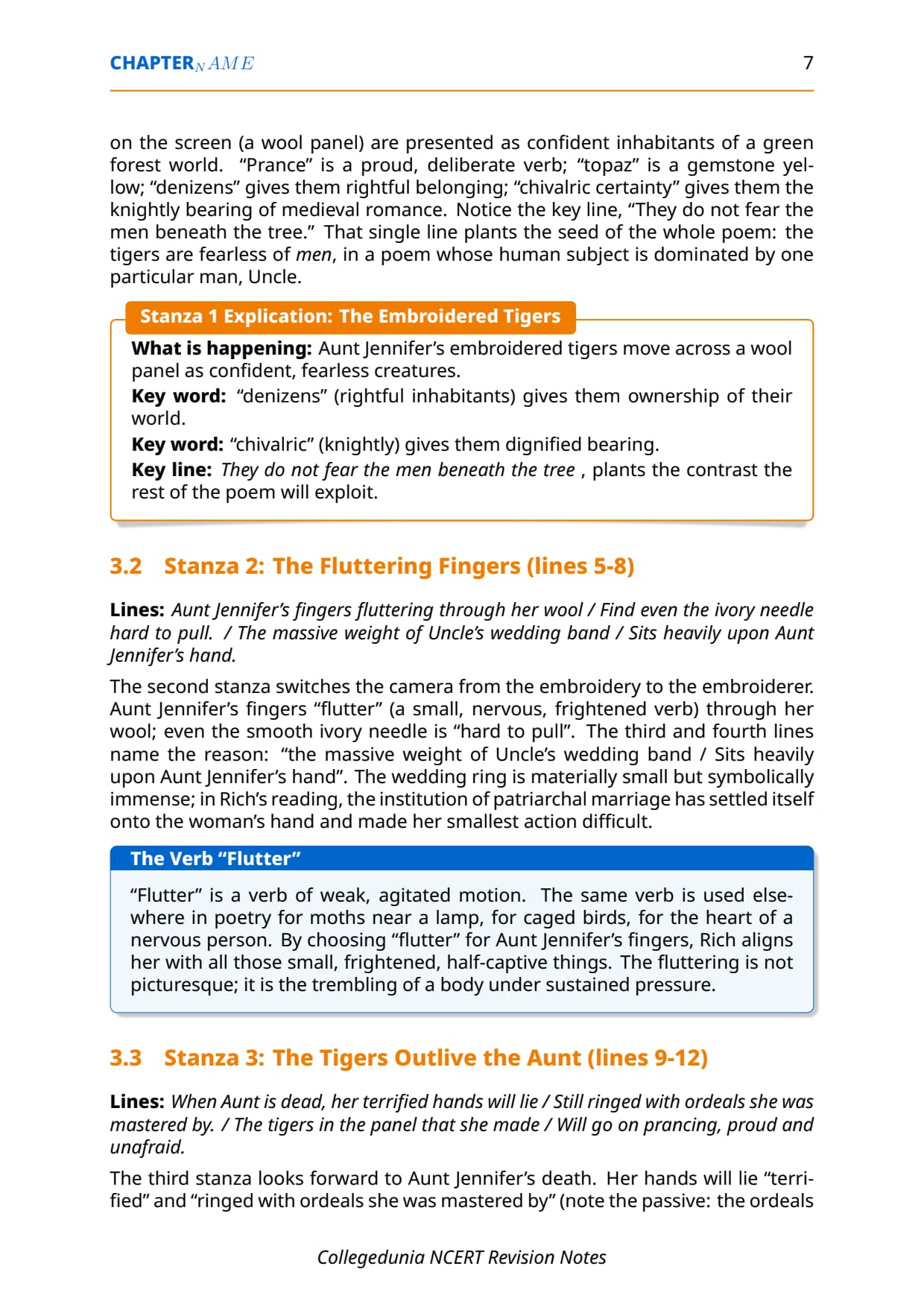
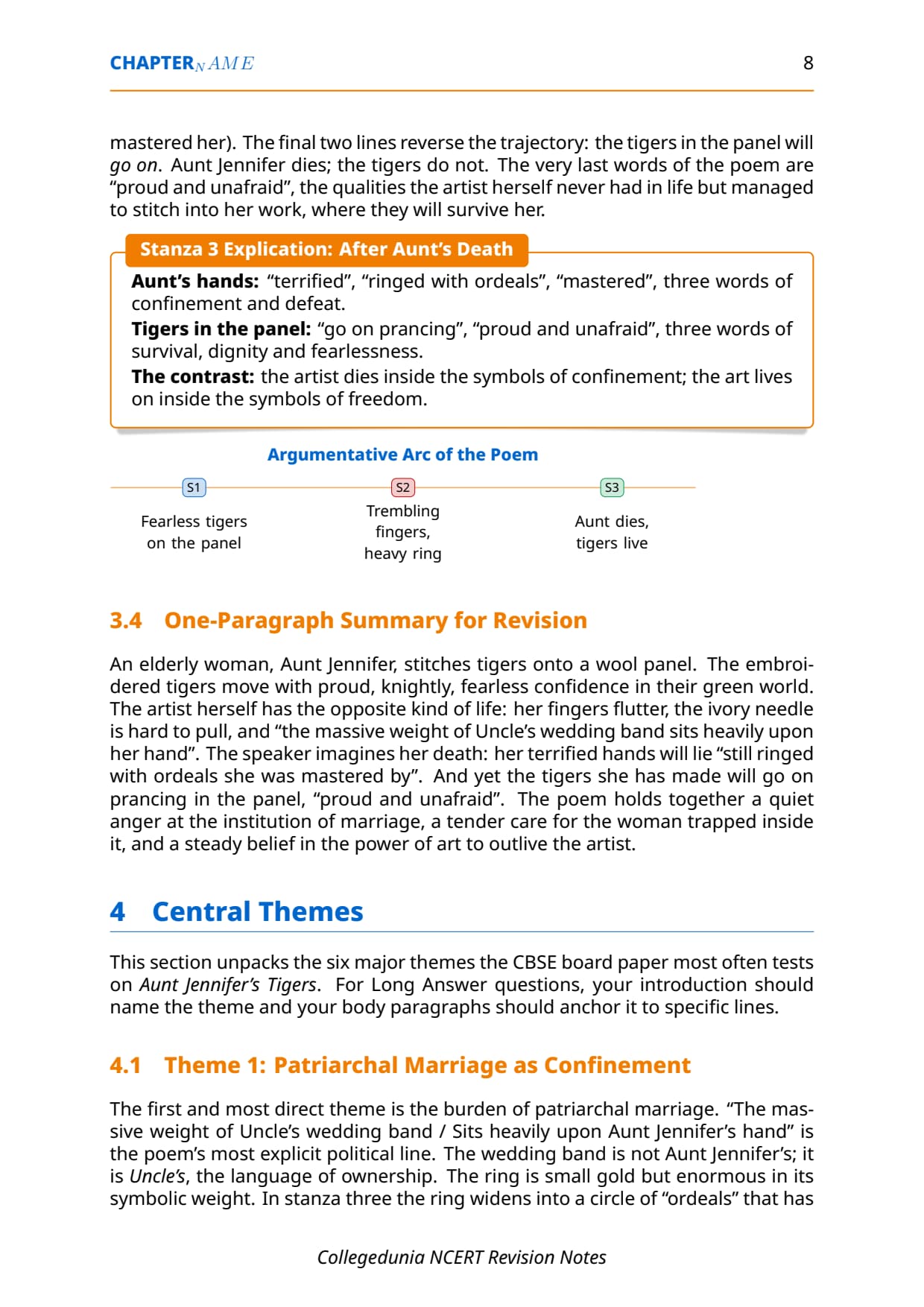
Aunt Jennifer's Tigers Stanza-by-Stanza Summary
Three short movements compress all twelve lines of the poem. Read this table once, then read the poem with the table beside you - the structure will lock in.
| Lines | Movement | What Happens |
|---|---|---|
| 1-4 | The Embroidered Tigers | Tigers prance across a wool panel as bright topaz denizens of a green world; they do not fear the men beneath the tree; they pace in sleek chivalric certainty |
| 5-8 | The Embroiderer's Hands | Aunt Jennifer's fingers flutter through her wool; the ivory needle is hard to pull; the "massive weight of Uncle's wedding band" sits heavily on her hand |
| 9-12 | The Aftermath | When Aunt is dead, her terrified hands will lie still ringed with ordeals she was mastered by; the tigers in the panel will go on prancing, proud and unafraid |
Themes in Aunt Jennifer's Tigers
Three themes recur across CBSE marking schemes. Each gets a fuller treatment in the PDF; here are the named arguments and their evidence.
Poetic Devices in Aunt Jennifer's Tigers
Six devices cover almost every line of the poem. CBSE asks for one or two of these almost every year.
| Device | Definition | Example from the Poem |
|---|---|---|
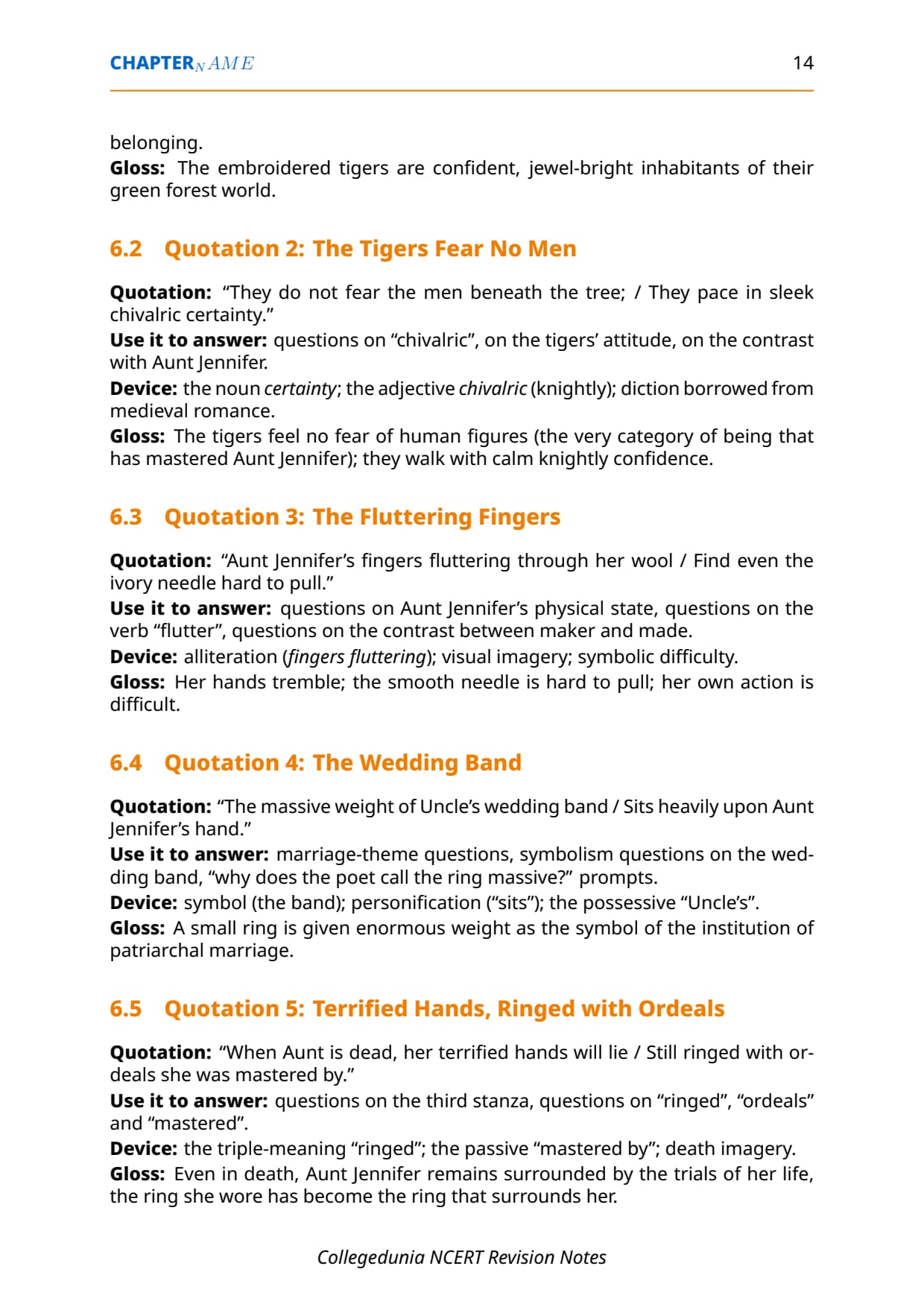
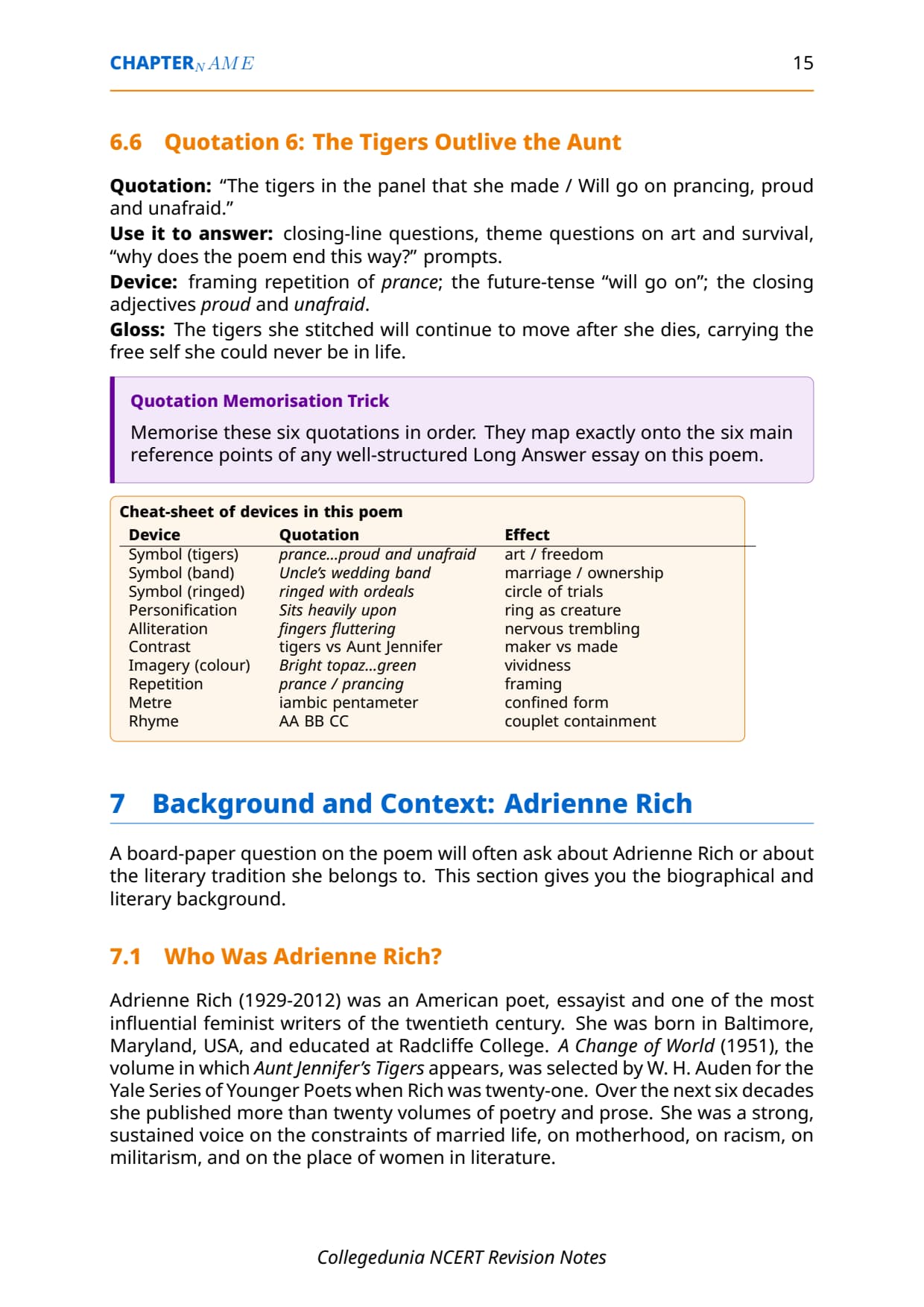
| Symbolism | An object or image standing for a larger idea | Tigers = freedom; wedding band = patriarchal marriage; embroidered panel = surviving art |
| Contrast | Setting opposites side by side | Tigers "prance\dots chivalric" vs hands "fluttering\dots terrified" |
| Personification | Giving human action to a non-human thing | The wedding band "Sits heavily upon Aunt Jennifer's hand" |
| Alliteration | Repetition of consonant sounds at the start of nearby words | "fingers fluttering" (soft f); "prancing, proud" (steady p) |
| Imagery (colour) | Sensory language that creates a vivid picture | "Bright topaz denizens of a world of green" - jewel-bright colours of the embroidery |
| Framing repetition | Same word at the start and end of the poem | "prance" (line 1) returns as "prancing" (line 12) to frame the poem on the tigers |
Aunt Jennifer's Tigers: Form and Structure
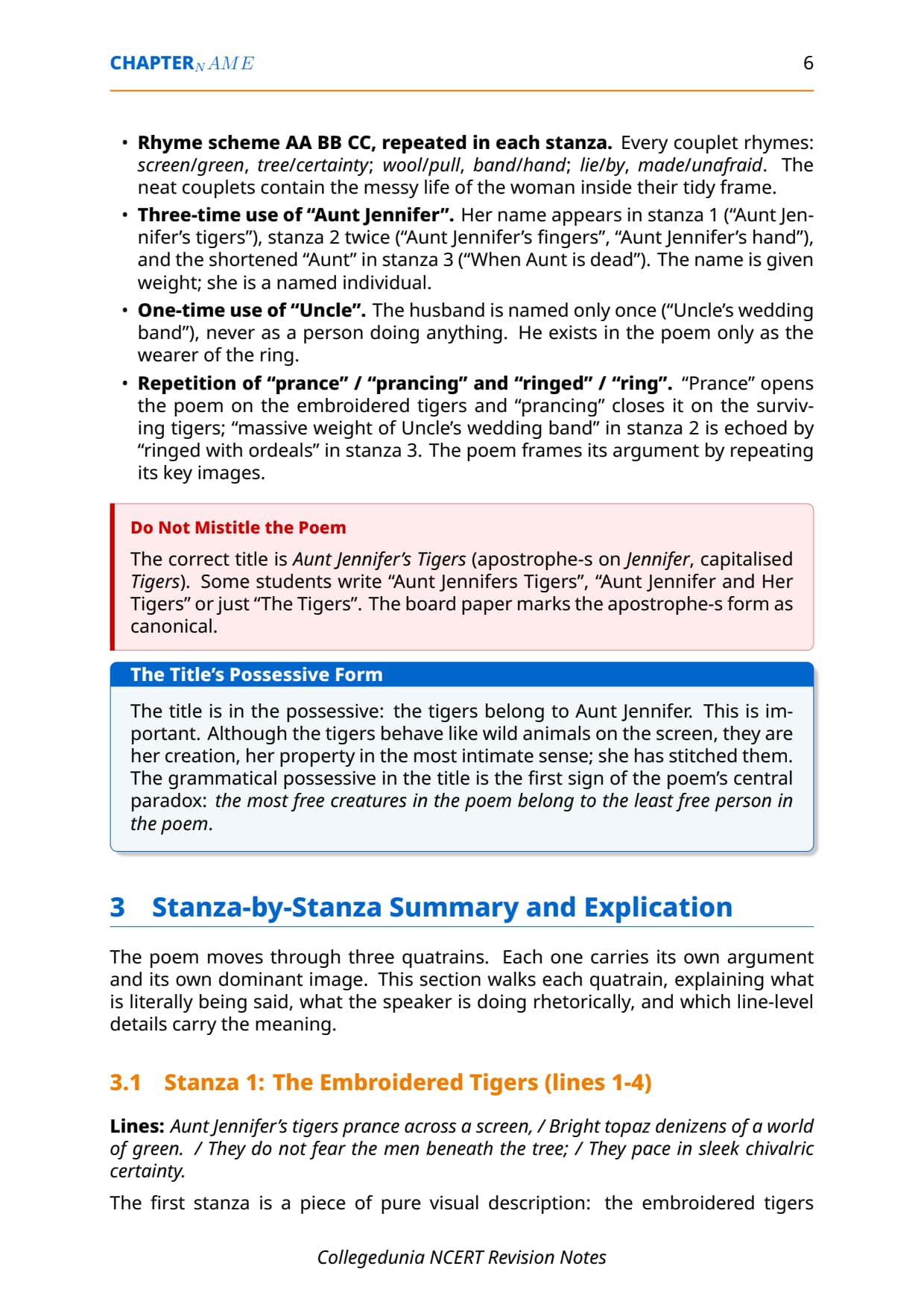
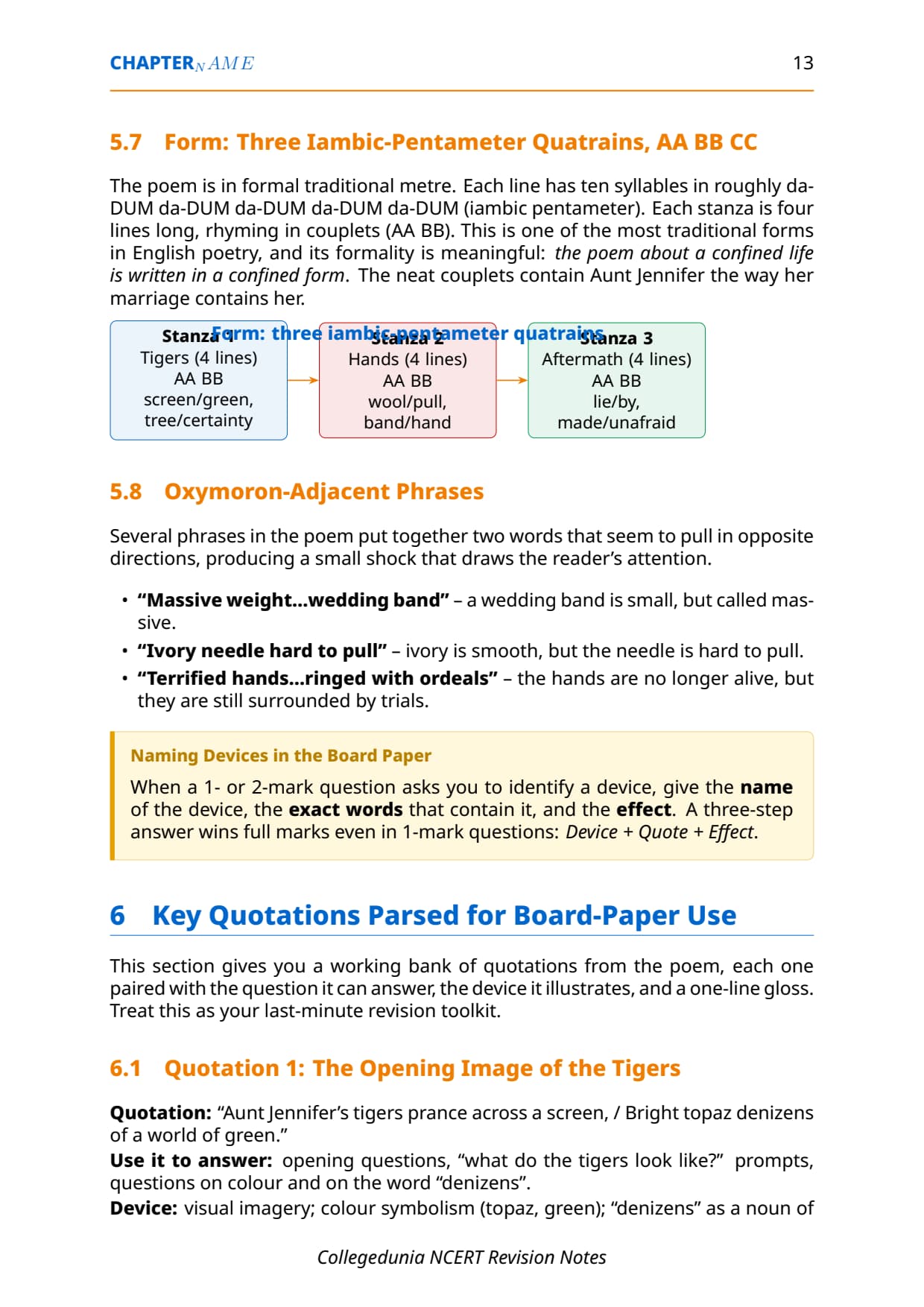
The form is itself part of the poem's argument. The poem about a confined life is written in a tightly confined form - the neat couplets contain the woman the way her marriage contains her.
- Three quatrains: Twelve lines in total, divided into three four-line stanzas. Each stanza carries one movement of the argument.
- Iambic pentameter: Each line has ten syllables in a roughly da-DUM da-DUM da-DUM da-DUM da-DUM rhythm. The metre is steady, almost formal, in contrast to the unsteady life it describes.
- Rhyme scheme AA BB CC: Every couplet rhymes - screen/green, tree/certainty; wool/pull, band/hand; lie/by, made/unafraid. The closed couplets contain the messy life of the woman inside a tidy frame.
- Possessive title: "Aunt Jennifer's Tigers" - the most free creatures in the poem belong to the least free person in the poem. The grammatical possessive is the first sign of the central paradox.
Common Mistakes in Aunt Jennifer's Tigers Answers
Most lost marks come from misreading the poem's central symbols, not from poor language. Watch for these.
- Reading the wedding band literally. A small gold ring weighs grams, not "massive weight". The weight is symbolic - of marriage as ownership.
- Inventing details about Uncle. He is a category, not a person; the poem says nothing about him beyond his ring.
- Treating the poem as only sad. The last two lines turn it upwards - the tigers will go on prancing.
- Forgetting to mention iambic pentameter and AA BB CC when form is asked.
- Stopping at one meaning of "ringed". The word has three meanings together - literal, metaphorical and structural.
Aunt Jennifer's Tigers Previous Year Question Analysis (CBSE Class 12 English)
The poem has appeared regularly in CBSE Class 12 English papers since 2013. The table maps every appearance in the last six years.
| Year | Question Type | Marks | Sub-Topic |
|---|---|---|---|
| 2026 | - | - | - |
| 2025 | RTC | 4 | Opening stanza: the embroidered tigers |
| 2024 | Short Answer | 3 | Meaning of "massive weight of Uncle's wedding band" |
| 2023 | Long Answer | 6 | Contrast between the tigers and Aunt Jennifer |
| 2022 | RTC | 4 | Stanza on terrified hands ringed with ordeals |
| 2021 | Short Answer | 3 | Symbolism of the wedding band |
| 2020 | Long Answer | 6 | Why does Aunt Jennifer create animals so different from her own character? |
How to Revise Aunt Jennifer's Tigers in Two Days
This is a short, dense poem. Two focused sessions are usually enough to lock it in.
- Day 1 (2 hours): Read the poem aloud twice; mark the rhyme couplets in pencil; write a one-line summary of each stanza in the margin; memorise the six quotable lines listed in the Important Topics table above.
- Day 2 (1.5 hours): Answer all eight Think it Out questions in your own words, then attempt one RTC extract under timed conditions. Cross-check against the Solutions PDF.
Solved Sample RTC Extract
"The massive weight of Uncle's wedding band / Sits heavily upon Aunt Jennifer's hand."
Question: Who is the speaker referring to? What is suggested by "massive weight"? Identify the literary device used in "Sits heavily upon".
Answer: The speaker is Adrienne Rich, observing the elderly Aunt Jennifer as she embroiders. The "massive weight" is symbolic, not literal - a wedding ring weighs only a few grams, but Rich gives it enormous psychological and social weight because it stands for the institution of patriarchal marriage. Note that the band is called "Uncle's" wedding band, not Aunt Jennifer's; the possessive shows the ring belongs to the husband, and the wife wears his ring rather than owning her own. The device in "Sits heavily upon" is personification: the wedding band is given the human action of "sitting heavily", as if it were a heavy guest resting on her hand. The verb makes the band feel like furniture rather than jewellery, deepening the sense of unwanted, daily burden.
Related Links:
More Aunt Jennifer's Tigers Class 12 English Resources
NCERT Notes for Class 12 English (Core) Flamingo: All Chapters
Use the table to move to any other Flamingo chapter's notes while you revise the prose and poetry sections together.
| Chapter | Resource |
|---|---|
| Chapter 1 | The Last Lesson Notes |
| Chapter 2 | Lost Spring Notes |
| Chapter 3 | Deep Water Notes |
| Chapter 4 | The Rattrap Notes |
| Chapter 5 | Indigo Notes |
| Chapter 6 | Poets and Pancakes Notes |
| Chapter 7 | My Mother at Sixty-Six Notes |
| Chapter 8 | Keeping Quiet Notes |
| Chapter 9 | A Thing of Beauty Notes |
| Chapter 10 | A Roadside Stand Notes |
Aunt Jennifer's Tigers Class 12 English Notes FAQs
Ques. Where can I download Aunt Jennifer's Tigers Class 12 English Notes PDF?
Ans. You can download the Aunt Jennifer's Tigers Class 12 English Notes PDF directly from this page. Both the Normal and HD versions are free and follow the 2026-27 NCERT Flamingo print.
Ques. Who is the poet of Aunt Jennifer's Tigers and what collection does it come from?
Ans. The poet is Adrienne Rich (1929-2012), the American feminist poet. Aunt Jennifer's Tigers appears in her 1951 debut collection A Change of World, selected by W. H. Auden for the Yale Series of Younger Poets.
Ques. What is the central theme of Aunt Jennifer's Tigers?
Ans. The central theme is the contrast between patriarchal marriage and artistic freedom. Aunt Jennifer's life is weighed down by "the massive weight of Uncle's wedding band", but the fearless tigers she embroiders "will go on prancing, proud and unafraid" after her death. Art outlives the artist.
Ques. What does the wedding band symbolise in Aunt Jennifer's Tigers?
Ans. A wedding band weighs only a few grams, so the "massive weight" is symbolic. The ring stands for the institution of patriarchal marriage and male ownership; note that the band is "Uncle's", not the aunt's. The whole burden of married life under that system is compressed into the small object she wears on her hand.
Ques. How is the form of Aunt Jennifer's Tigers relevant to its meaning?
Ans. The poem is in three iambic-pentameter quatrains rhymed AA BB CC. The tight, traditional form is meaningful: a poem about a confined life is written in a confined form. The neat couplets contain the woman the way her marriage contains her.
Ques. What does "ringed with ordeals she was mastered by" mean?
Ans. The word "ringed" carries three meanings together: literally Aunt Jennifer still wears Uncle's wedding band on her finger even in death; metaphorically her life's ordeals form a closed circle around her with no exit; and structurally the word echoes the wedding band of stanza 2 so the small ring on her finger has grown into the whole circumference of her trapped life. The passive "mastered by" shows the ordeals defeated her, not she them.
Ques. How many marks does Aunt Jennifer's Tigers usually carry in the CBSE Class 12 English paper?
Ans. The poem usually contributes 6 to 10 marks, typically one Reference-to-Context extract (4-6 marks) and one short or long answer on the wedding-band symbol, the contrast between maker and made, or the speaker's attitude. It is regularly tested as the closing poem of the Flamingo poetry section.



Comments