




Theory of Consumer Behaviour is Chapter 2 of the Class 12 Microeconomics book. It explains how a consumer with limited income spends to get the most satisfaction, using utility, indifference curves, the budget line and demand. This page has the full revision notes and a free PDF to download.
Here is what this chapter is worth in the exam:
- CBSE Boards: about 9 to 10 marks, mixing theory, one diagram and one elasticity sum.
- CUET: 2 to 3 questions each year on utility, demand and elasticity.
- Revision time: about 35 minutes with these notes.
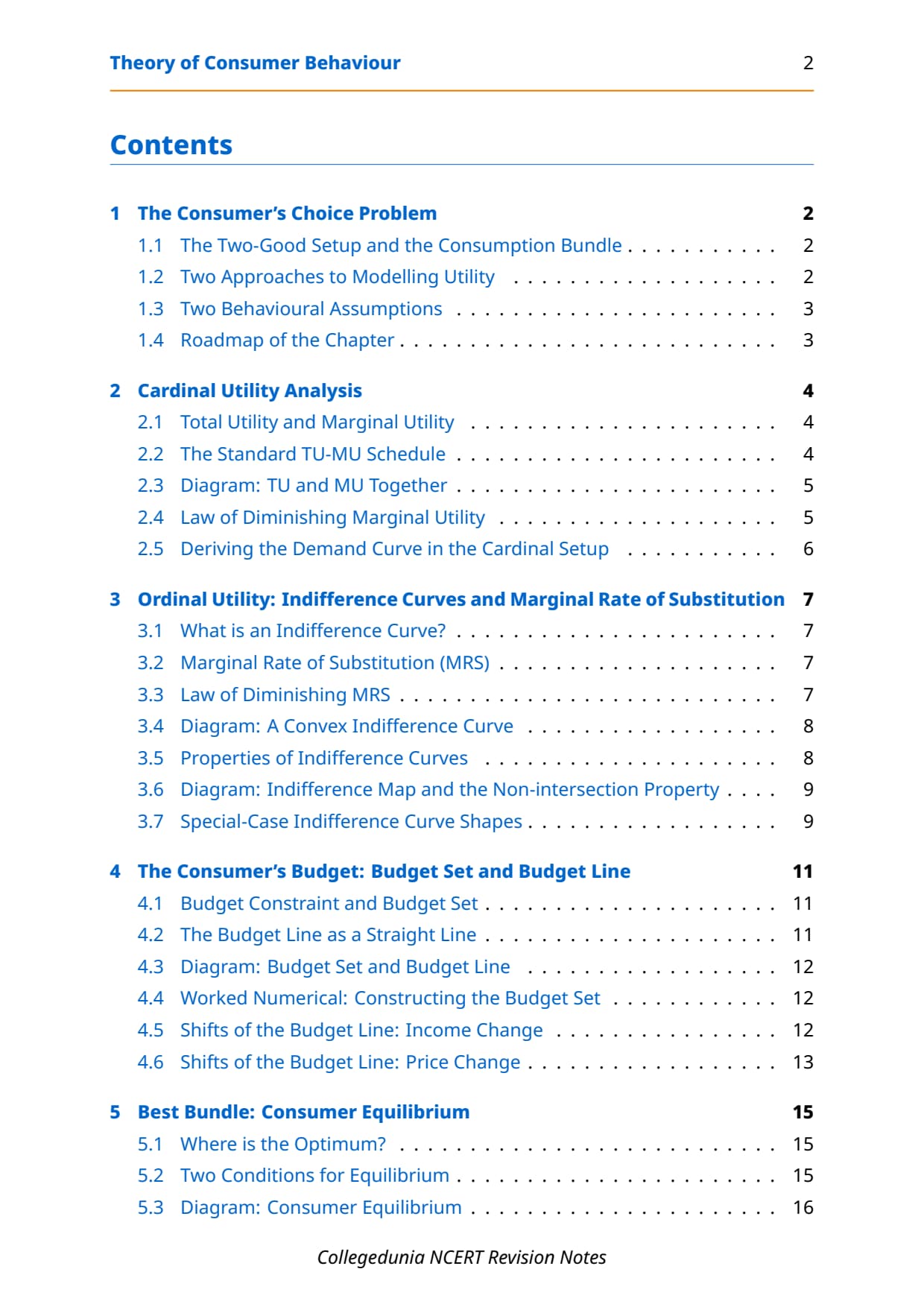
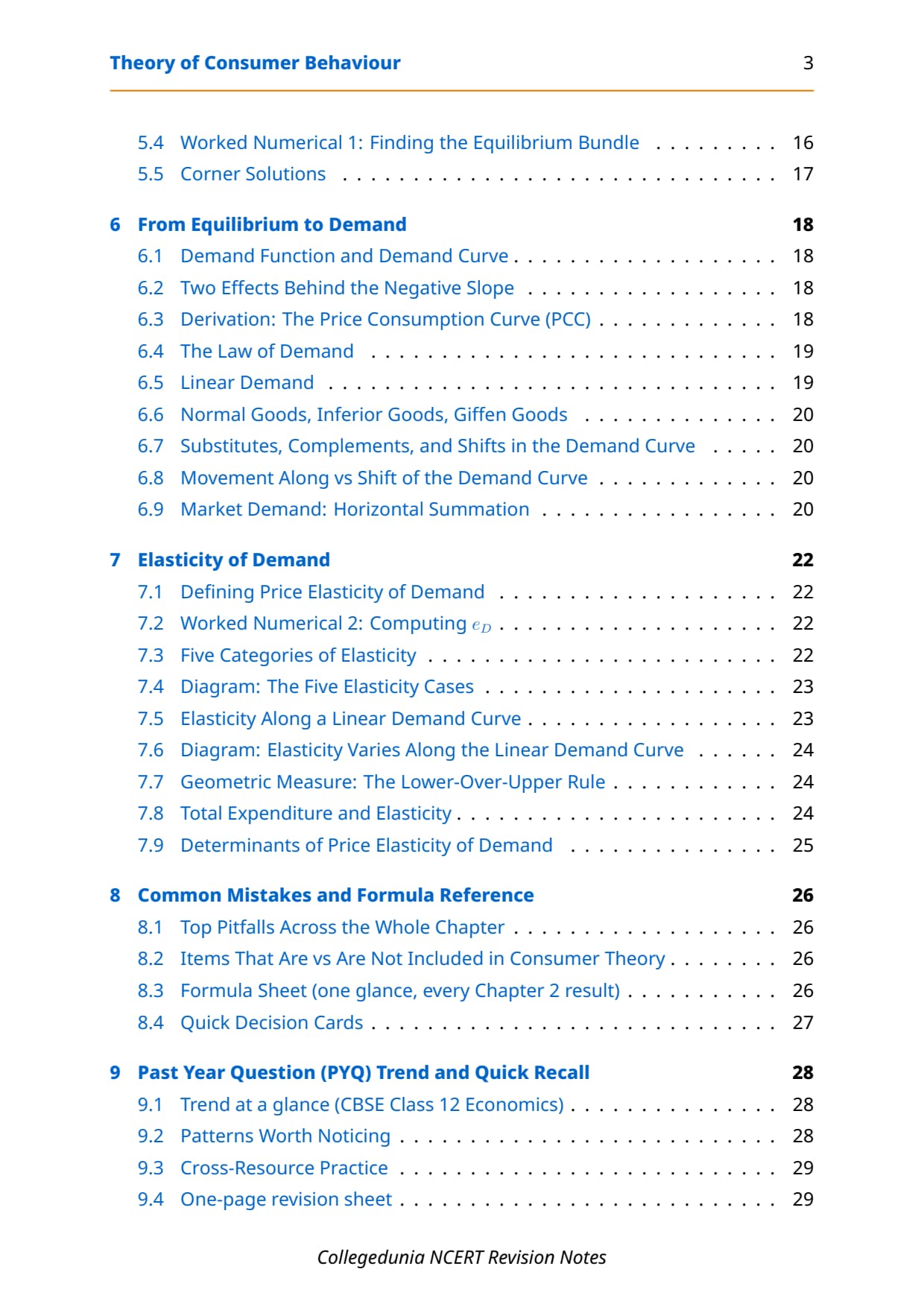
What These Theory of Consumer Behaviour Class 12 Notes Cover
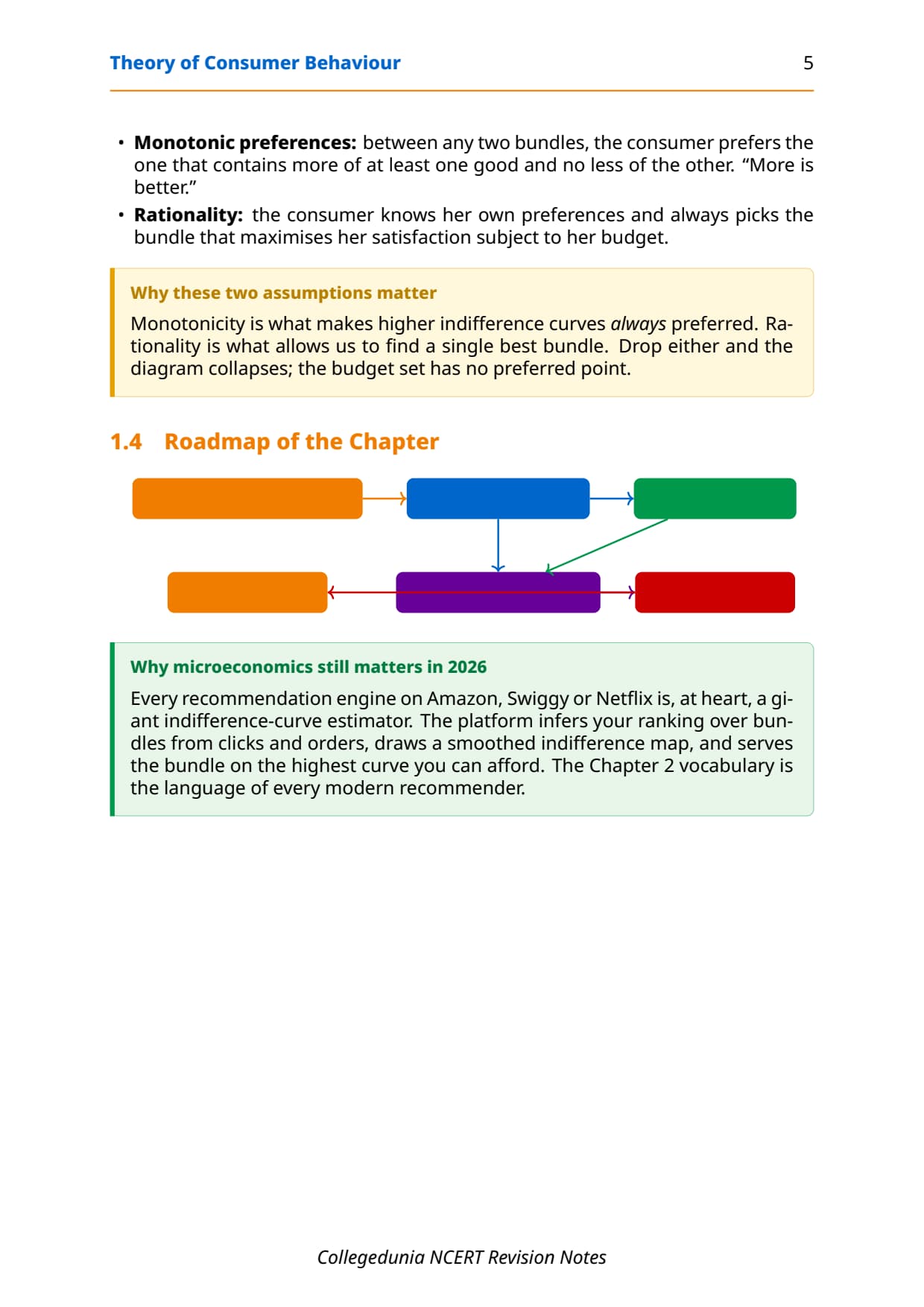
The chapter has one core idea: a rational consumer spends a fixed income to get the most satisfaction. These notes break it into six exam-ready blocks:
- Utility (3 marks): total and marginal utility, and the law of diminishing MU.
- Cardinal approach: the equi-marginal rule for consumer equilibrium.
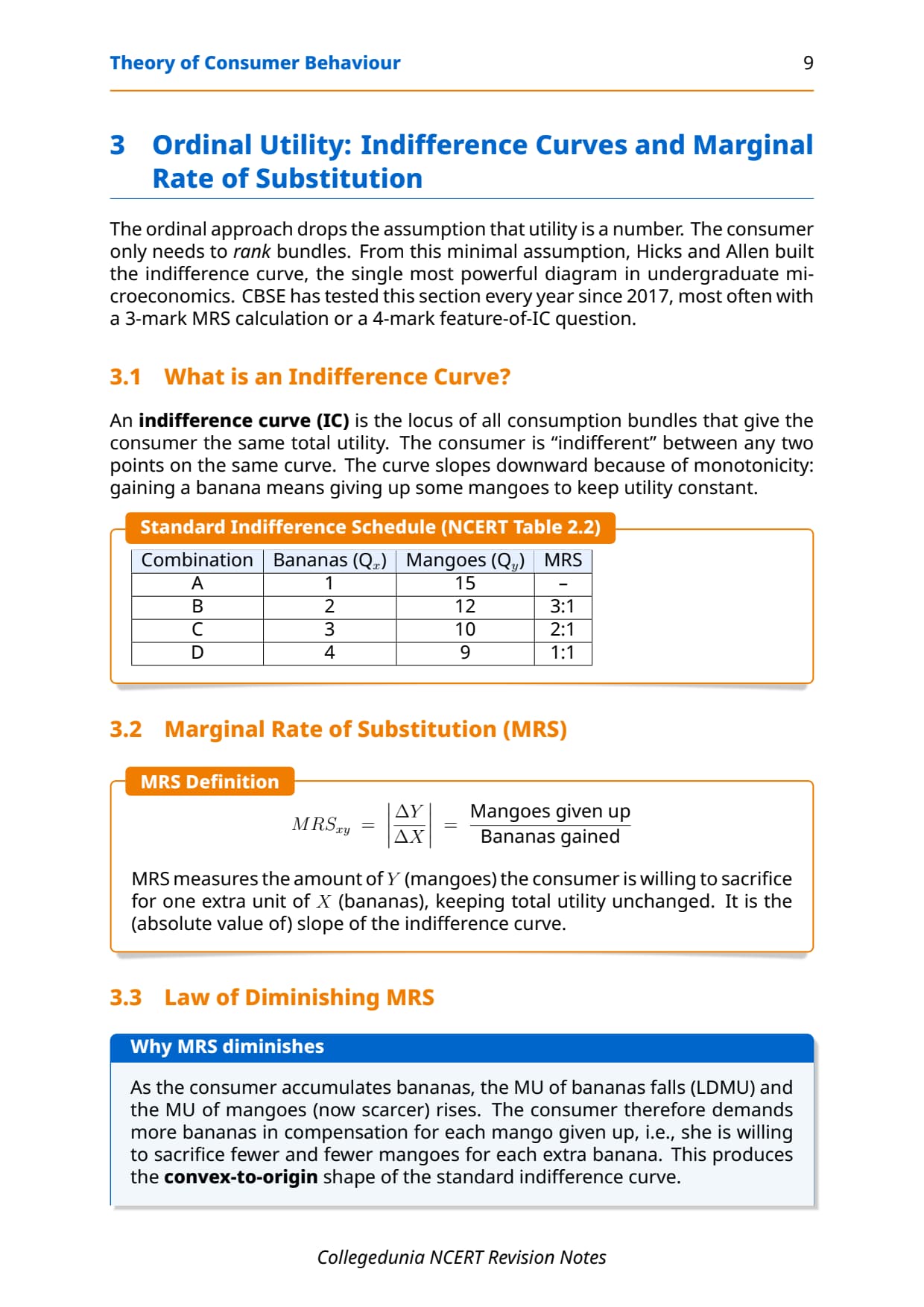
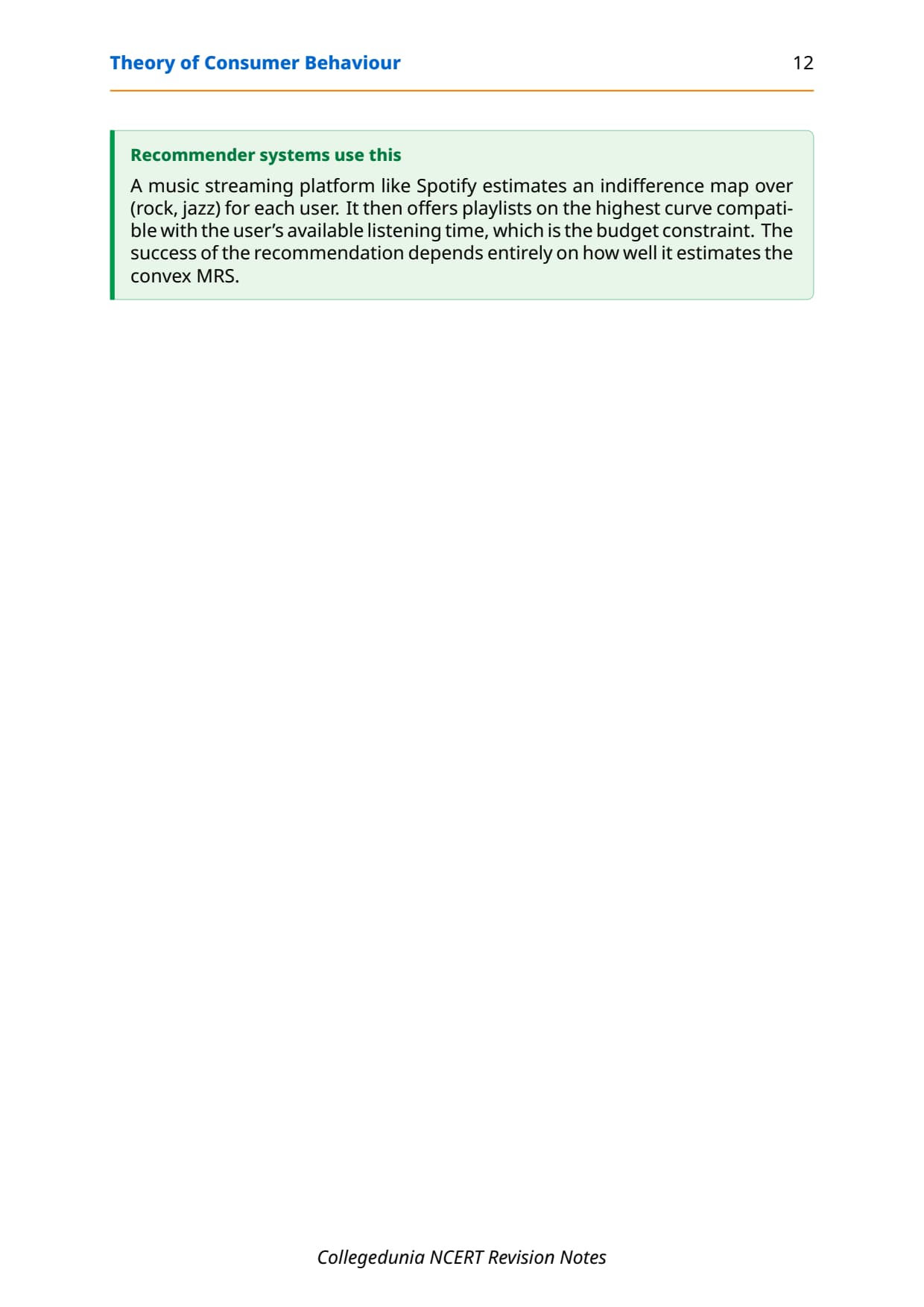
- Ordinal approach: indifference curves and the budget line.
- Consumer equilibrium (6 marks): the tangency rule, MRS = price ratio.
- Demand (1 mark): the law of demand and movement vs shift.
- Elasticity (4 marks): the three ways to measure price elasticity.
Key Definitions for Theory of Consumer Behaviour Class 12
Most one-mark and three-mark questions start with a definition. The lines below are short enough to write straight into a board answer.
| Term | Meaning |
|---|---|
| Utility | The satisfaction a consumer gets from consuming a good. |
| Total Utility (TU) | The total satisfaction from all units consumed. |
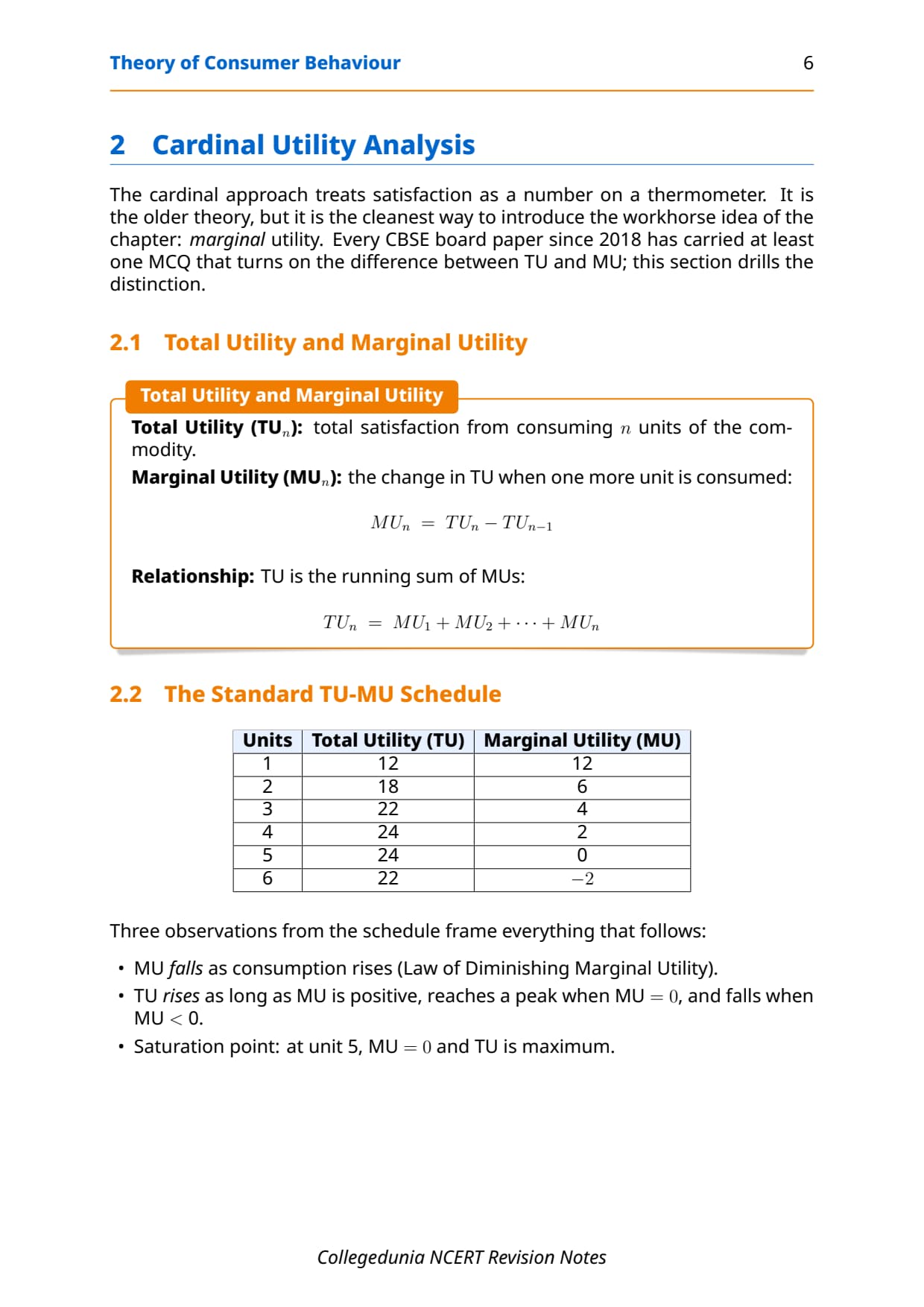
| Marginal Utility (MU) | The extra utility from one more unit; MU(n) = TU(n) minus TU(n minus 1). |
| Diminishing MU | Each extra unit of a good adds less satisfaction than the last. |
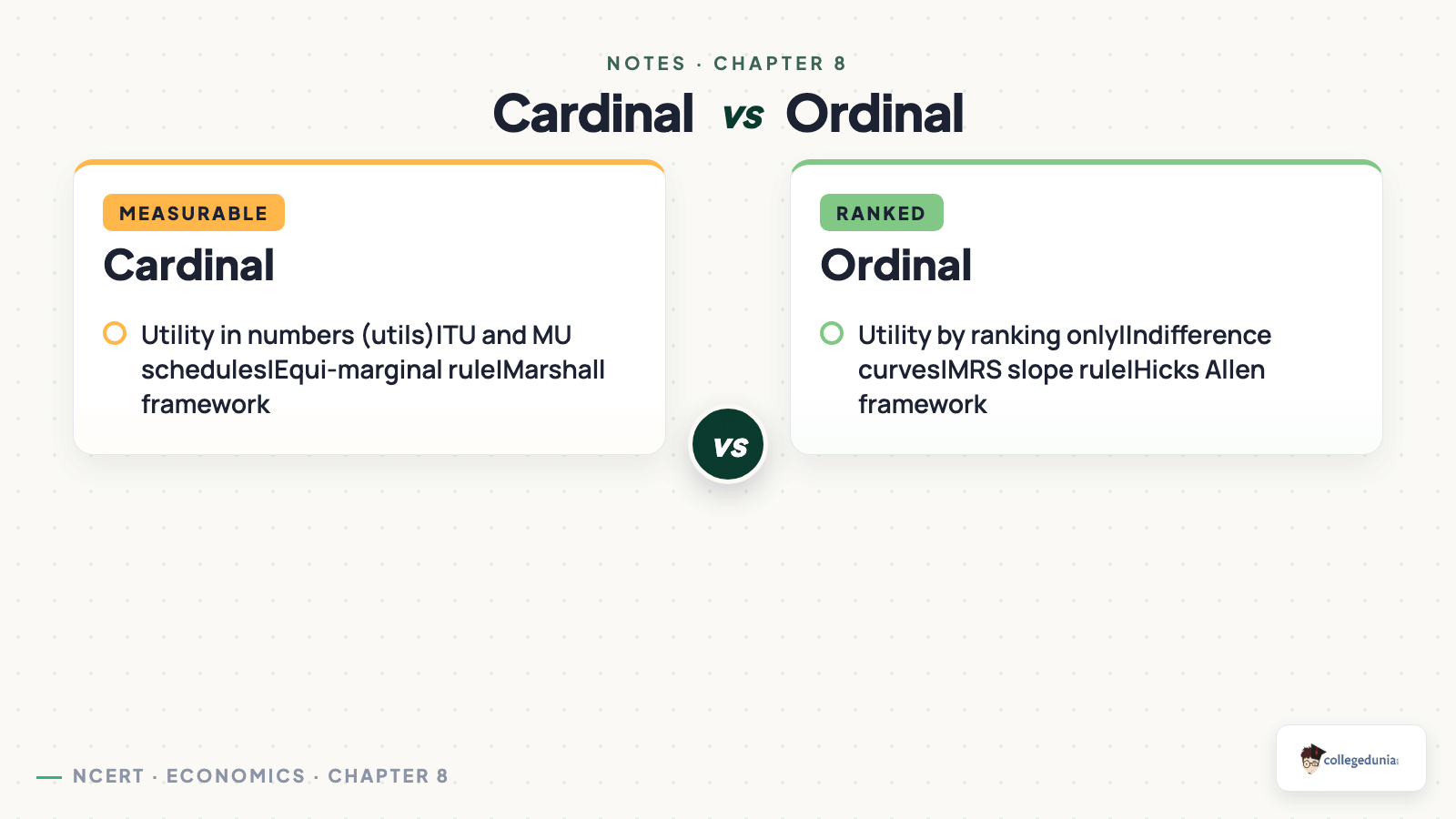
| Cardinal approach | Utility is measured in numbers (utils). Given by Marshall. |
| Ordinal approach | Utility is only ranked, not measured. Given by Hicks and Allen. |
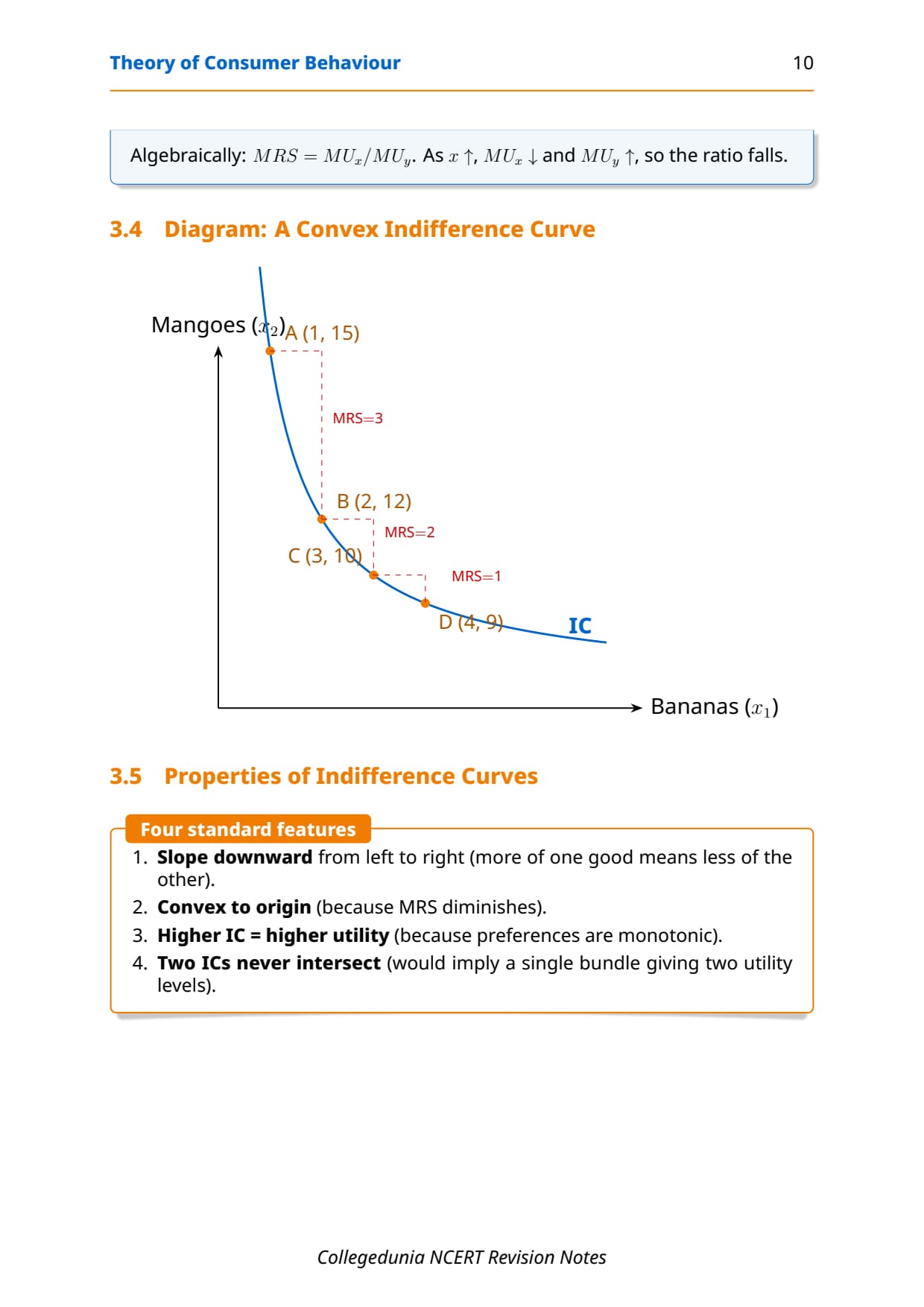
| Indifference curve (IC) | All bundles that give the same satisfaction. |
| MRS | Units of Y given up for one more unit of X on the same IC. |
| Budget line | The bundles a consumer can just afford at given income and prices. |
| Consumer equilibrium | The bundle that gives the most satisfaction within the budget. |
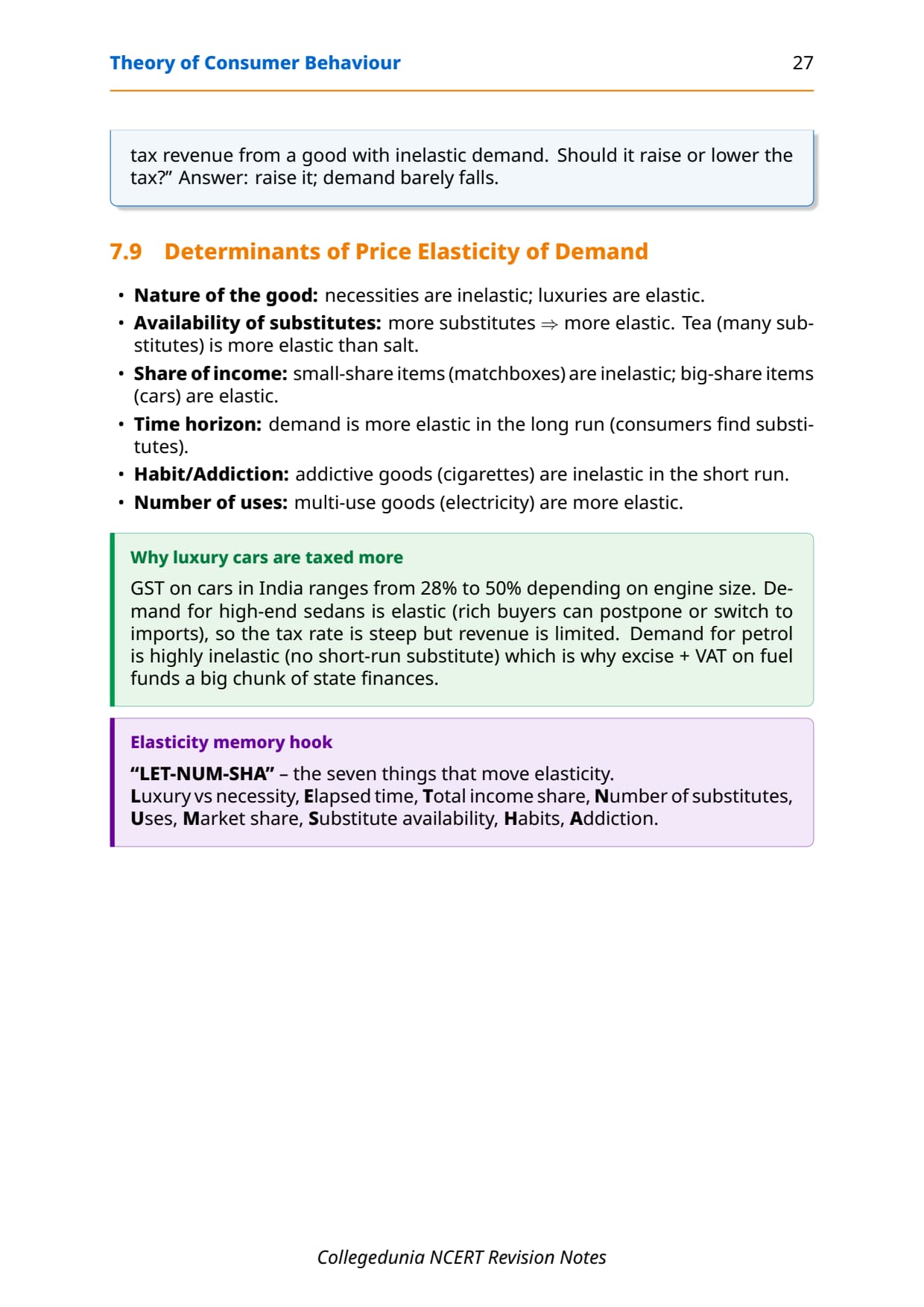
| Price elasticity of demand | The percent change in quantity demanded per 1% change in price. |
Utility and the Law of Diminishing Marginal Utility
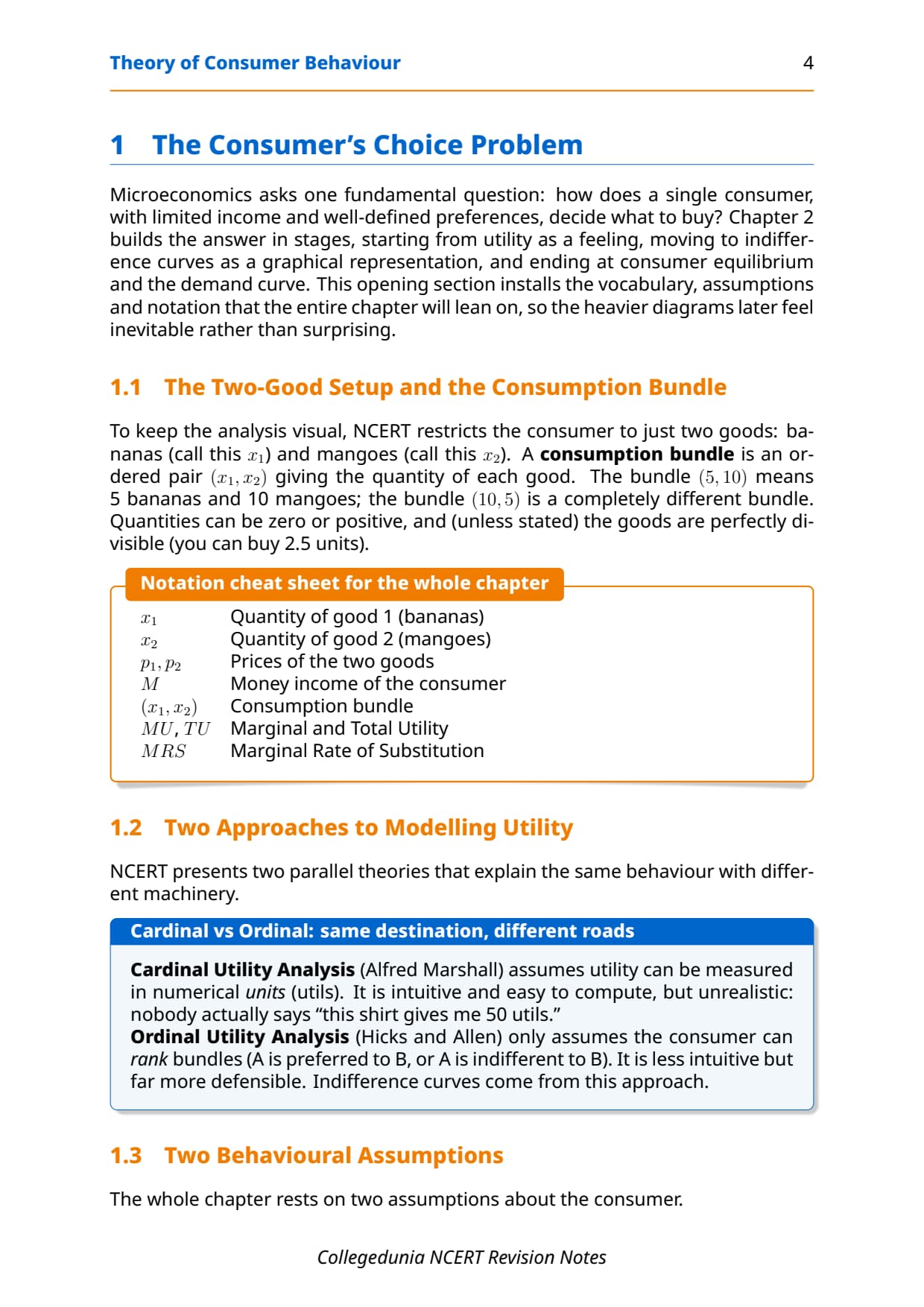
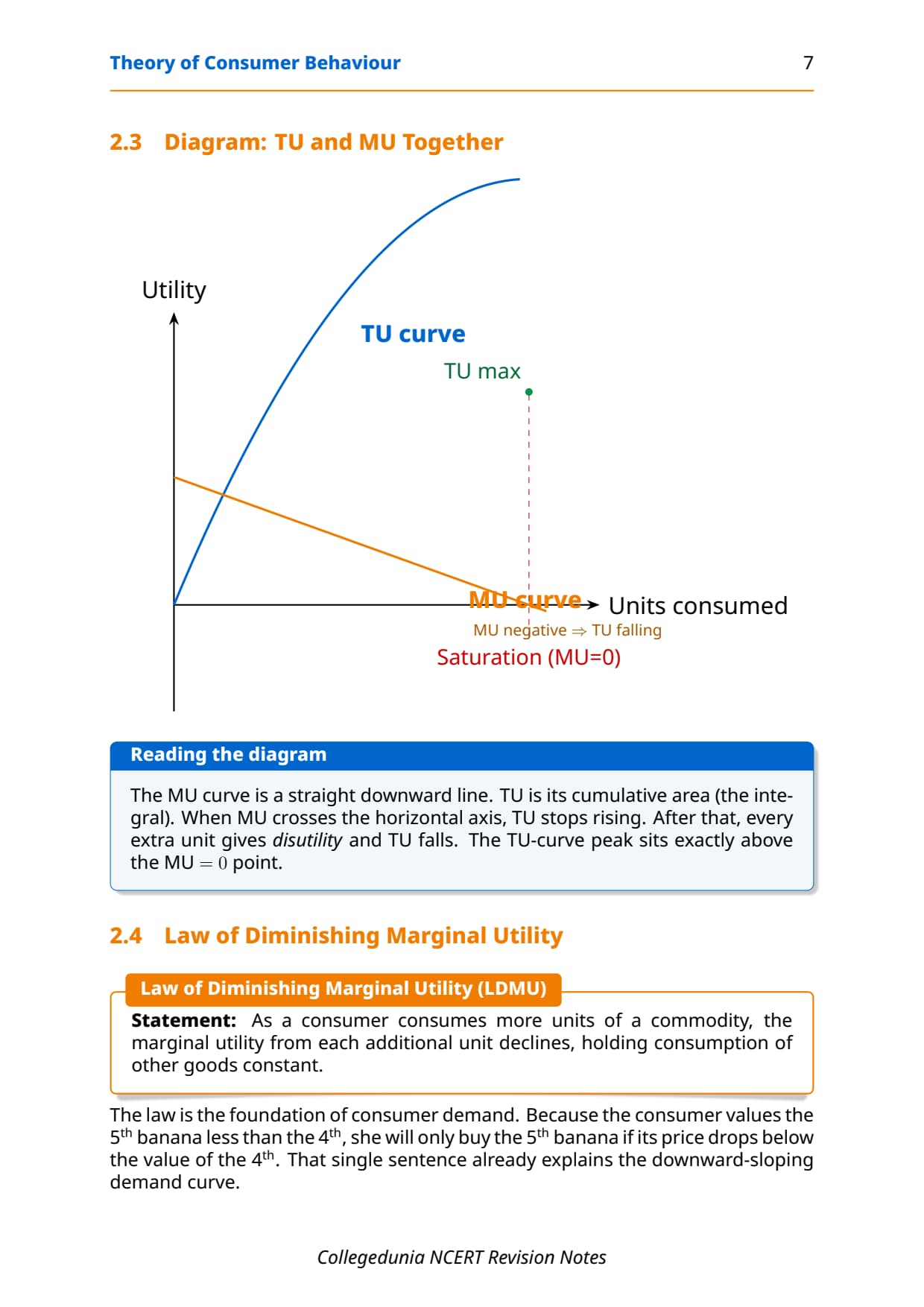
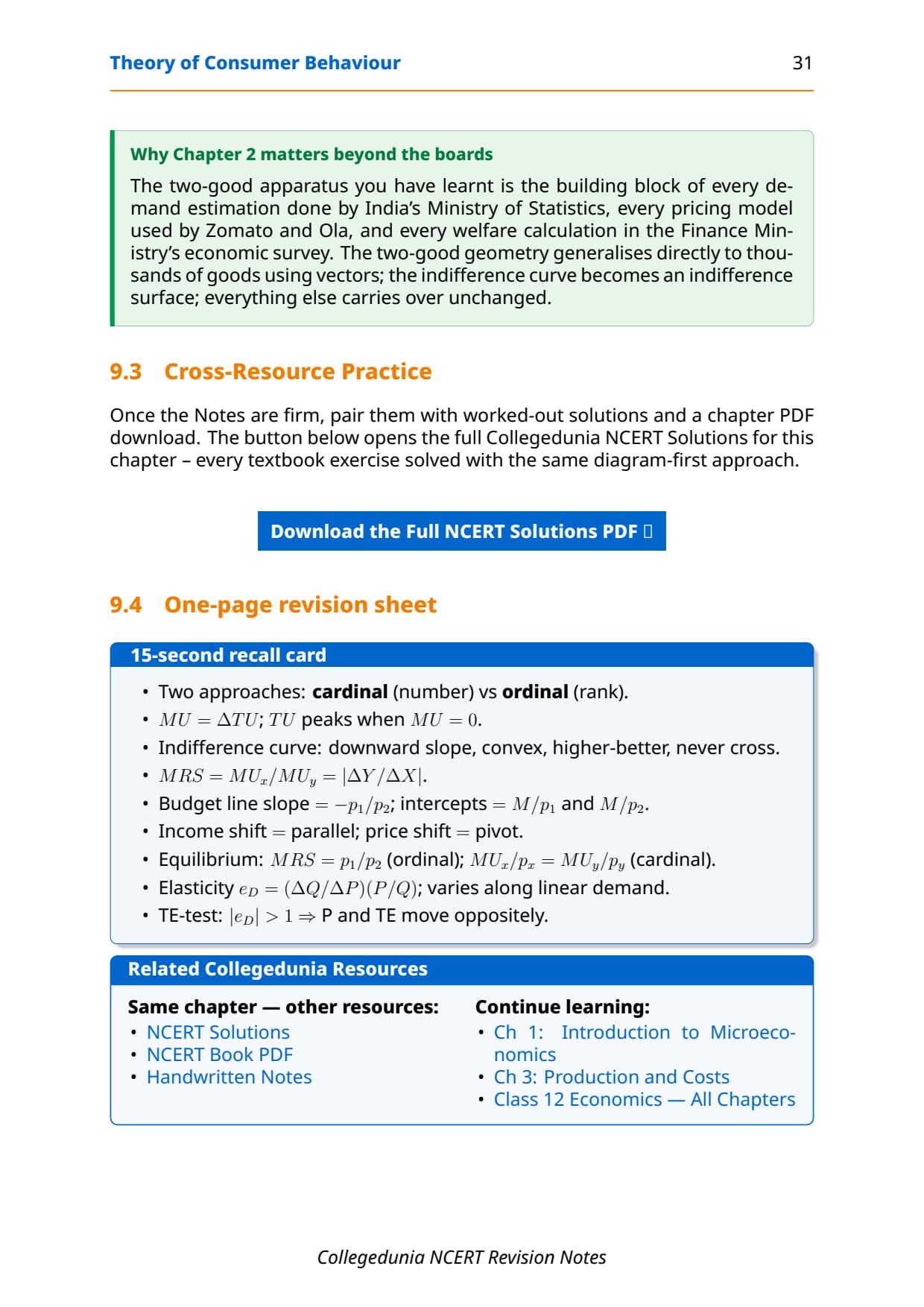
Utility is the satisfaction a good gives. Total Utility (TU) is the sum across all units. Marginal Utility (MU) is the rise in TU from one more unit. As you consume more, MU falls. This is the law of diminishing marginal utility.
The TU and MU link is a common 3-mark question. When MU is positive, TU rises. When MU is zero, TU is at its peak (the saturation point). When MU is negative, TU starts to fall.
Memory hook: TU is the running total, MU is the latest add. TU climbs while MU stays positive, peaks when MU hits zero, and falls once MU turns negative.
Cardinal and Ordinal Utility Approaches in Consumer Behaviour Class 12
There are two ways to reach consumer equilibrium. Both give the same downward-sloping demand curve.
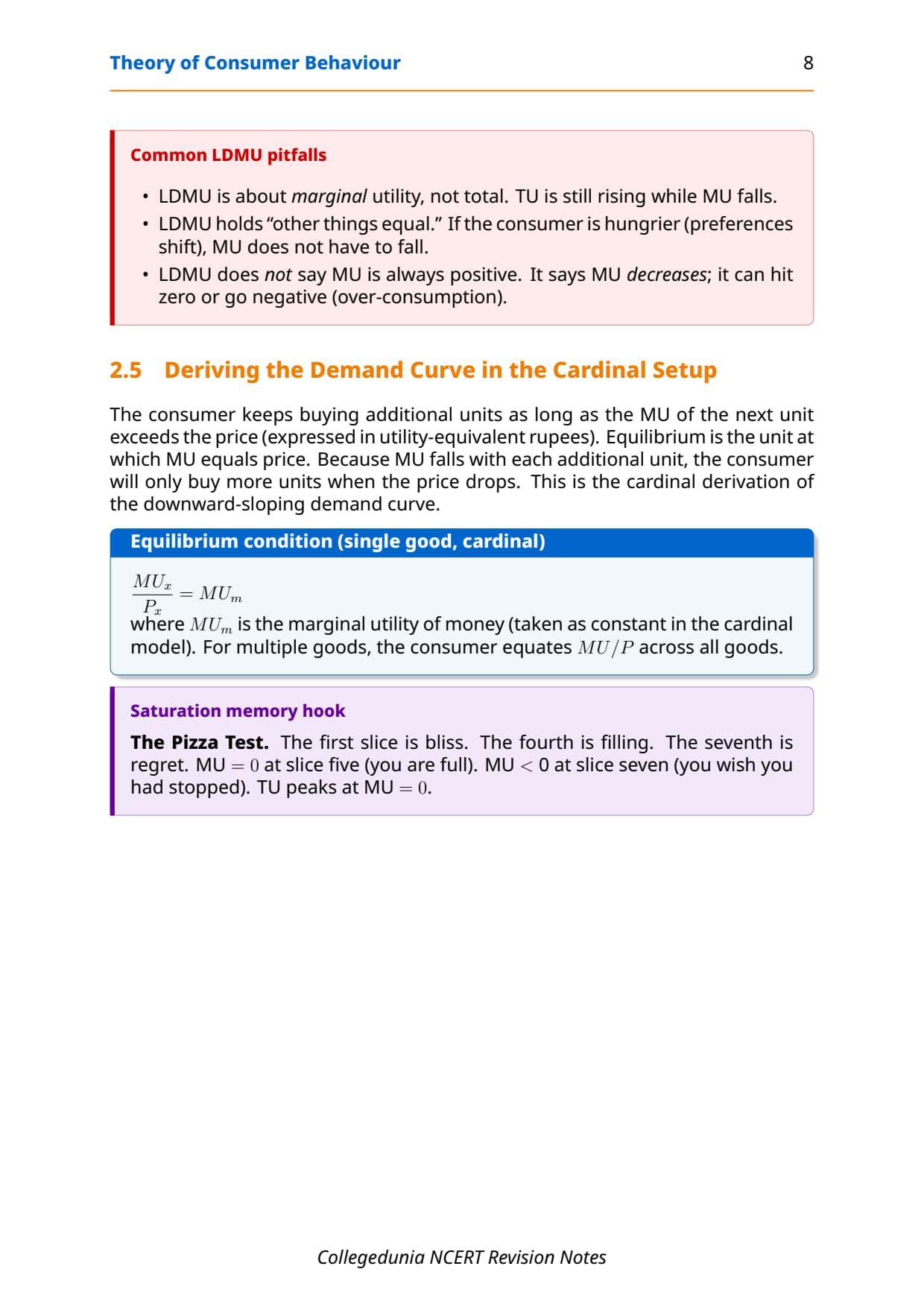
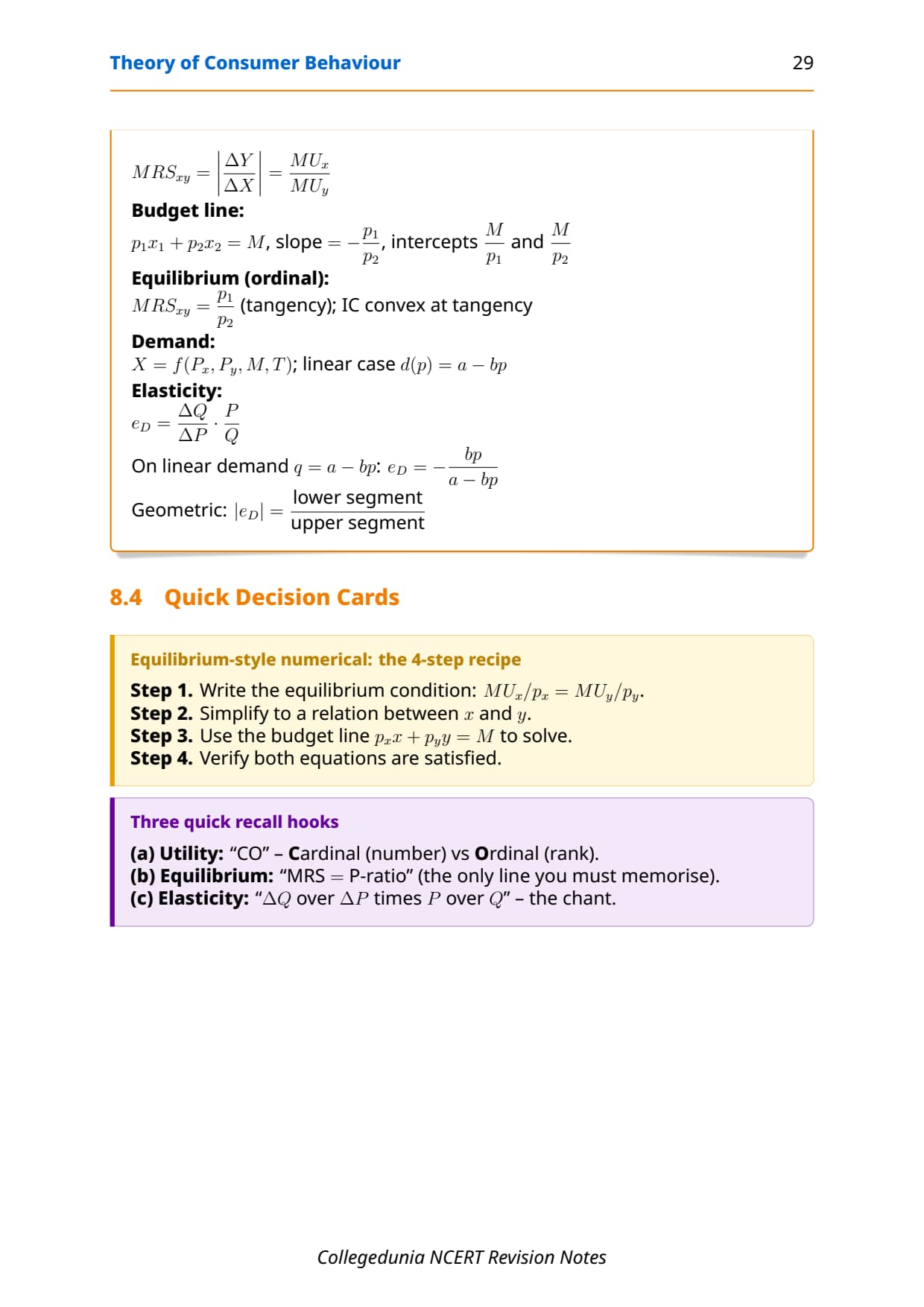
- Cardinal (Marshall): utility is measured in utils. The consumer is in equilibrium when MUx / Px = MUy / Py = MUm. This is the equi-marginal principle.
- Ordinal (Hicks and Allen): utility is only ranked. Equilibrium is shown with indifference curves and the budget line.
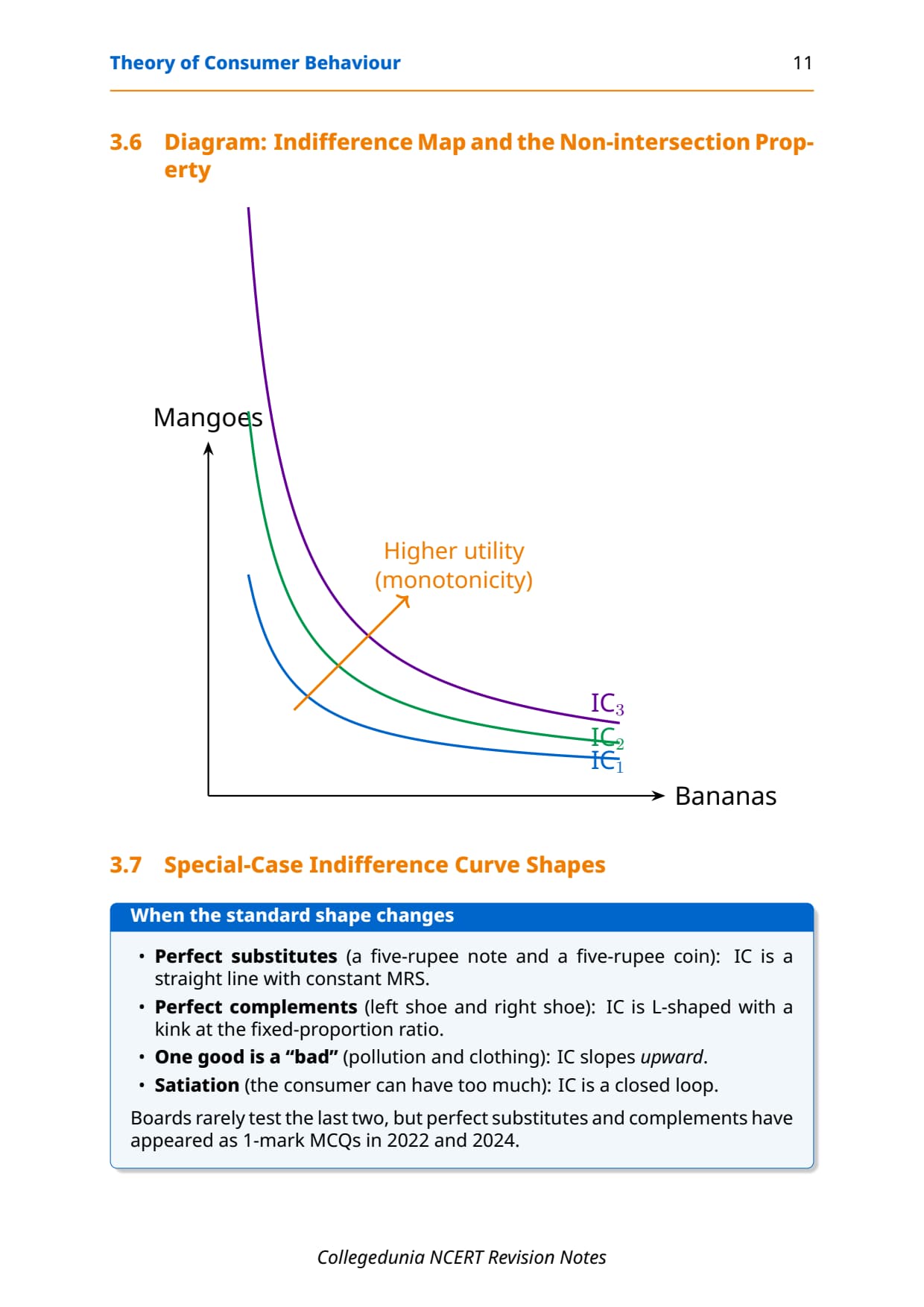
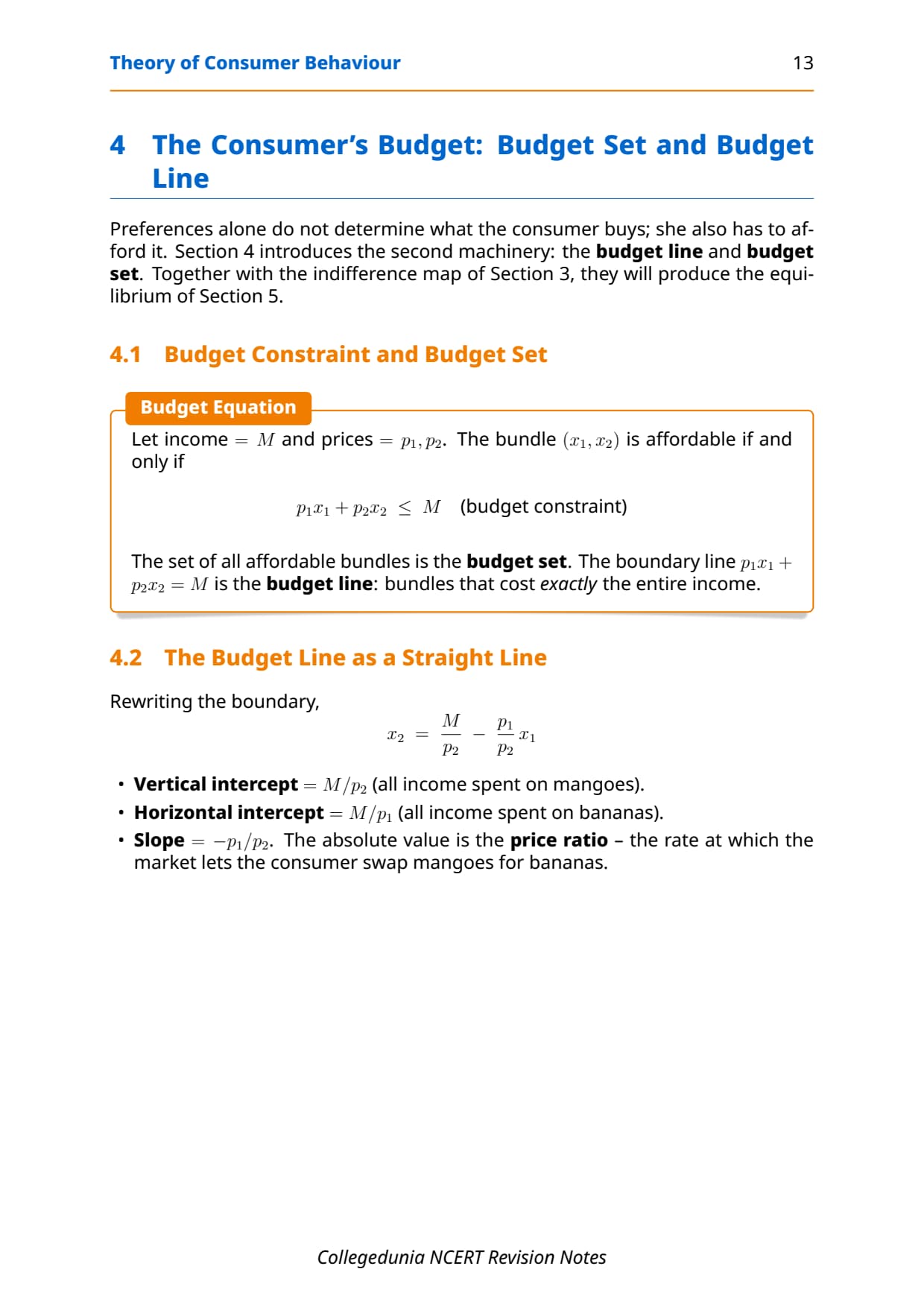
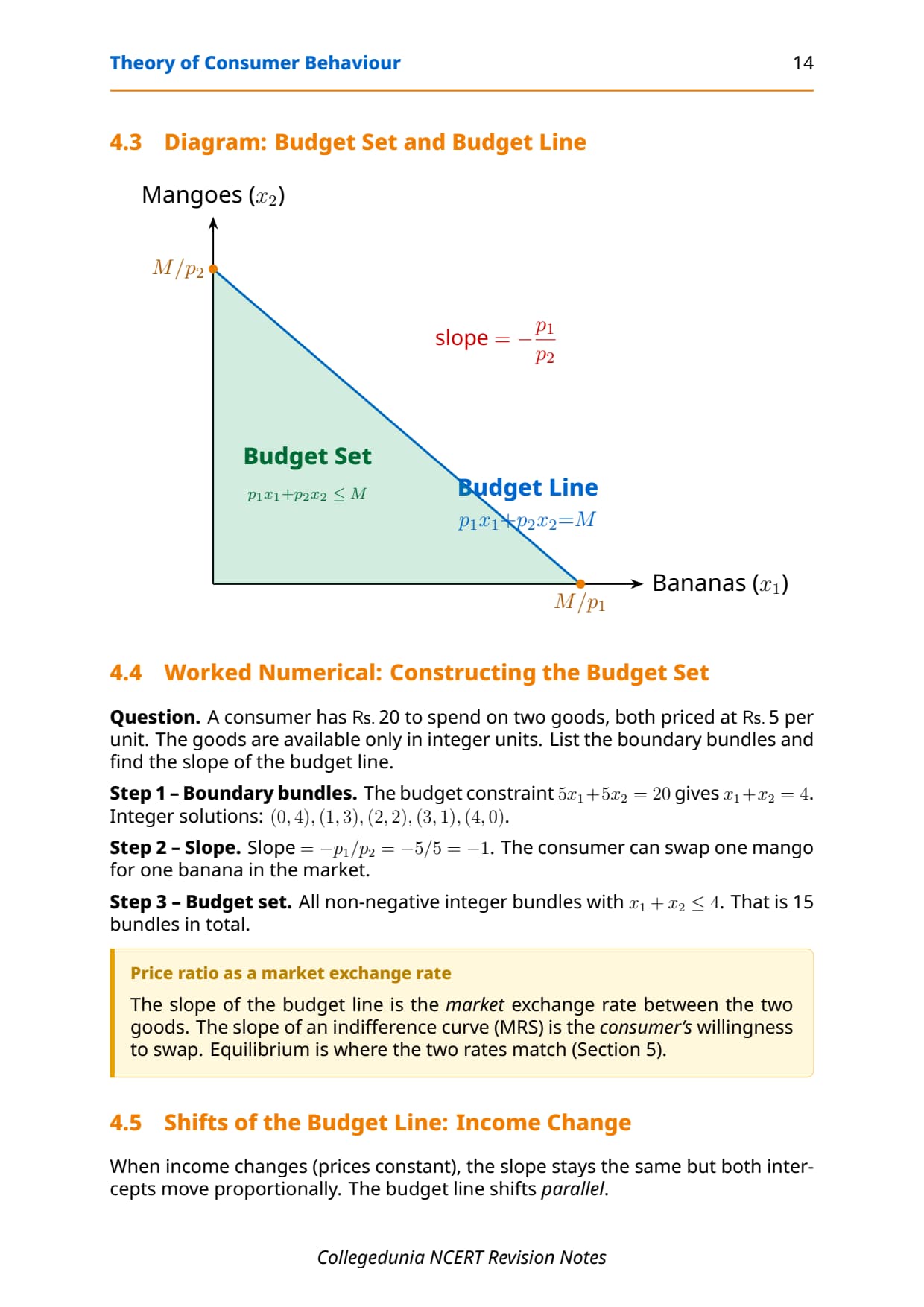
An indifference curve has four properties: it slopes down, is convex to the origin (diminishing MRS), a higher curve means more satisfaction, and two curves never cross. The budget line is Px times X + Py times Y = M, and its slope is minus (Px / Py).
Consumer Equilibrium and the Tangency Rule in Class 12 Economics
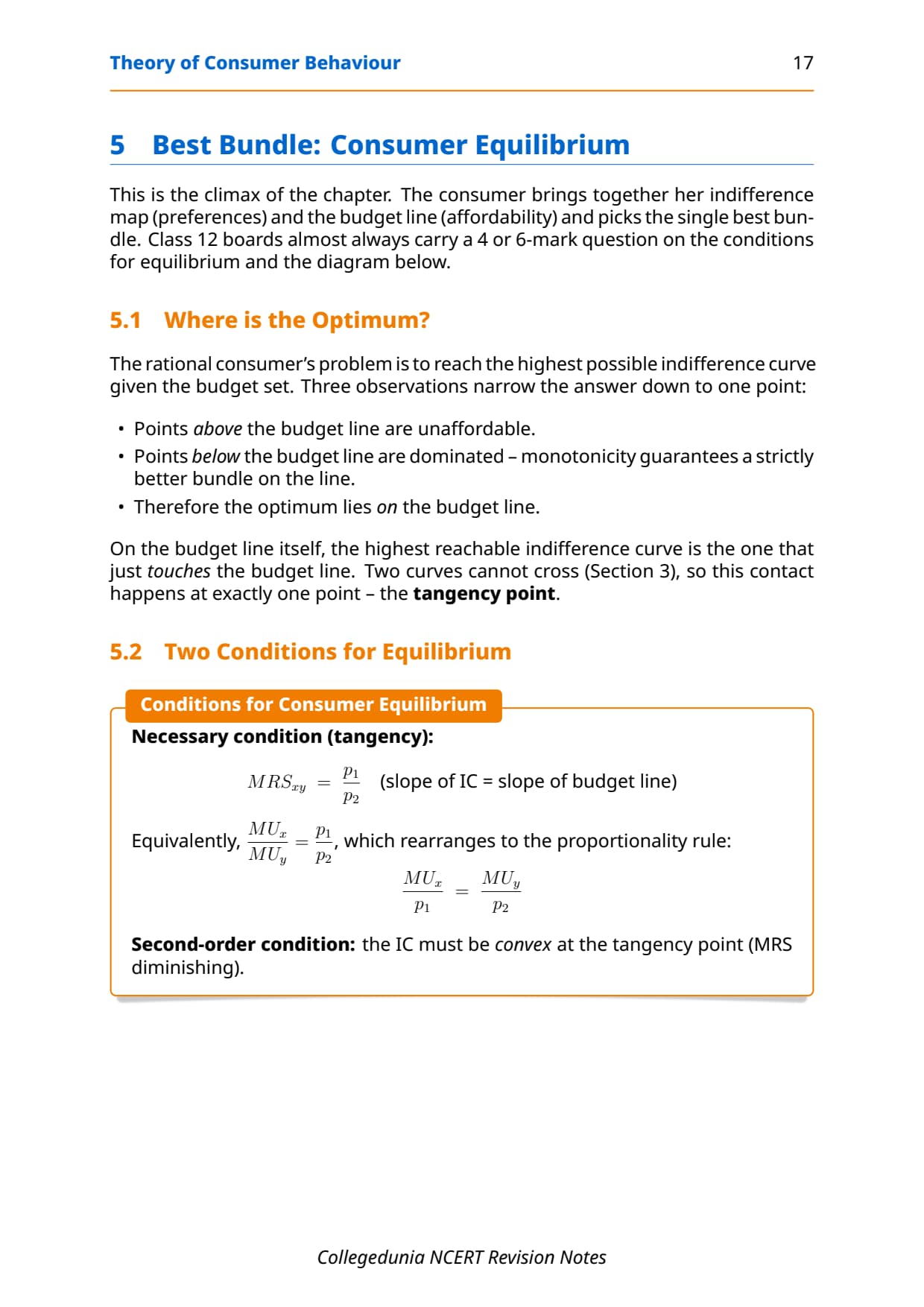
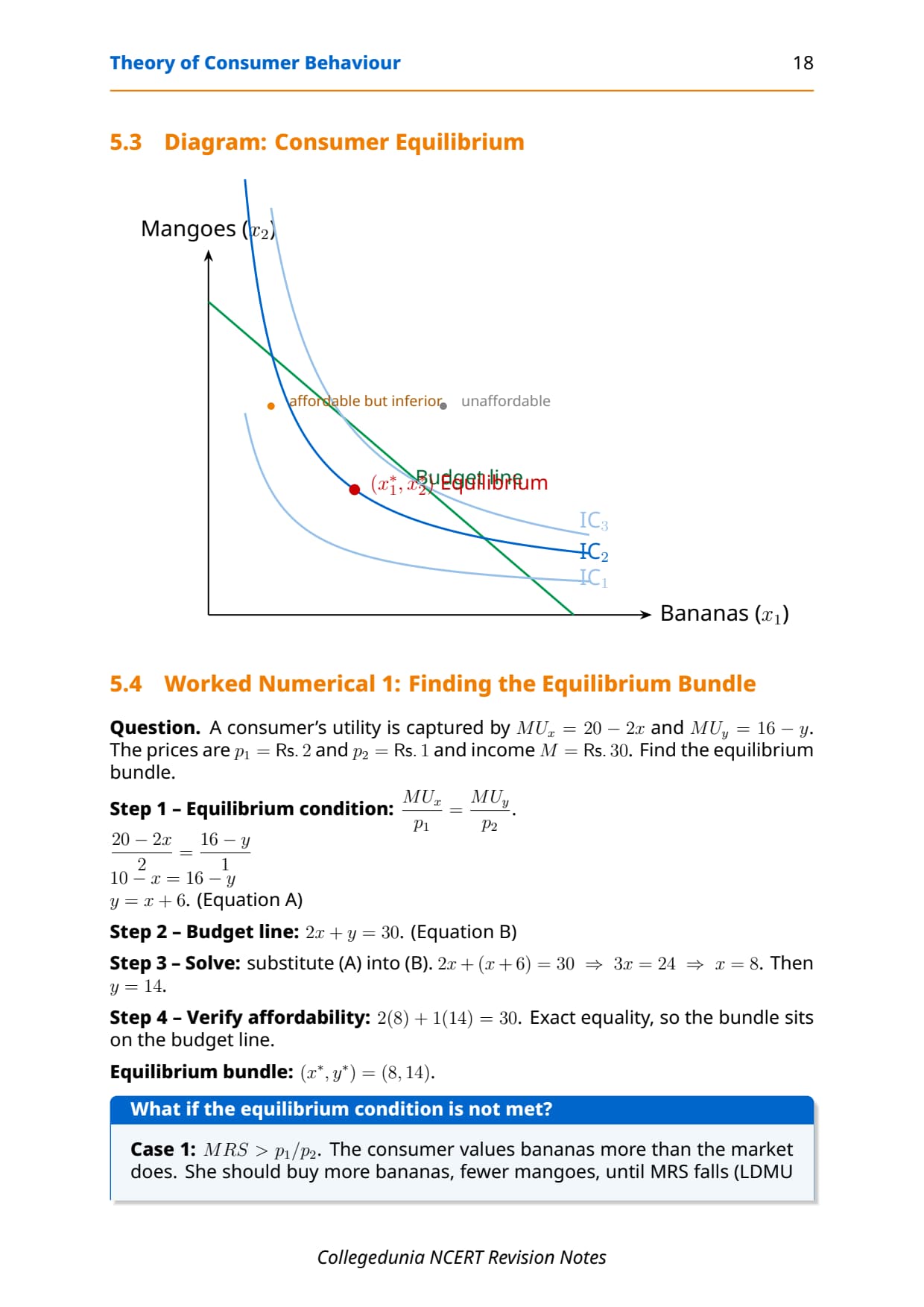
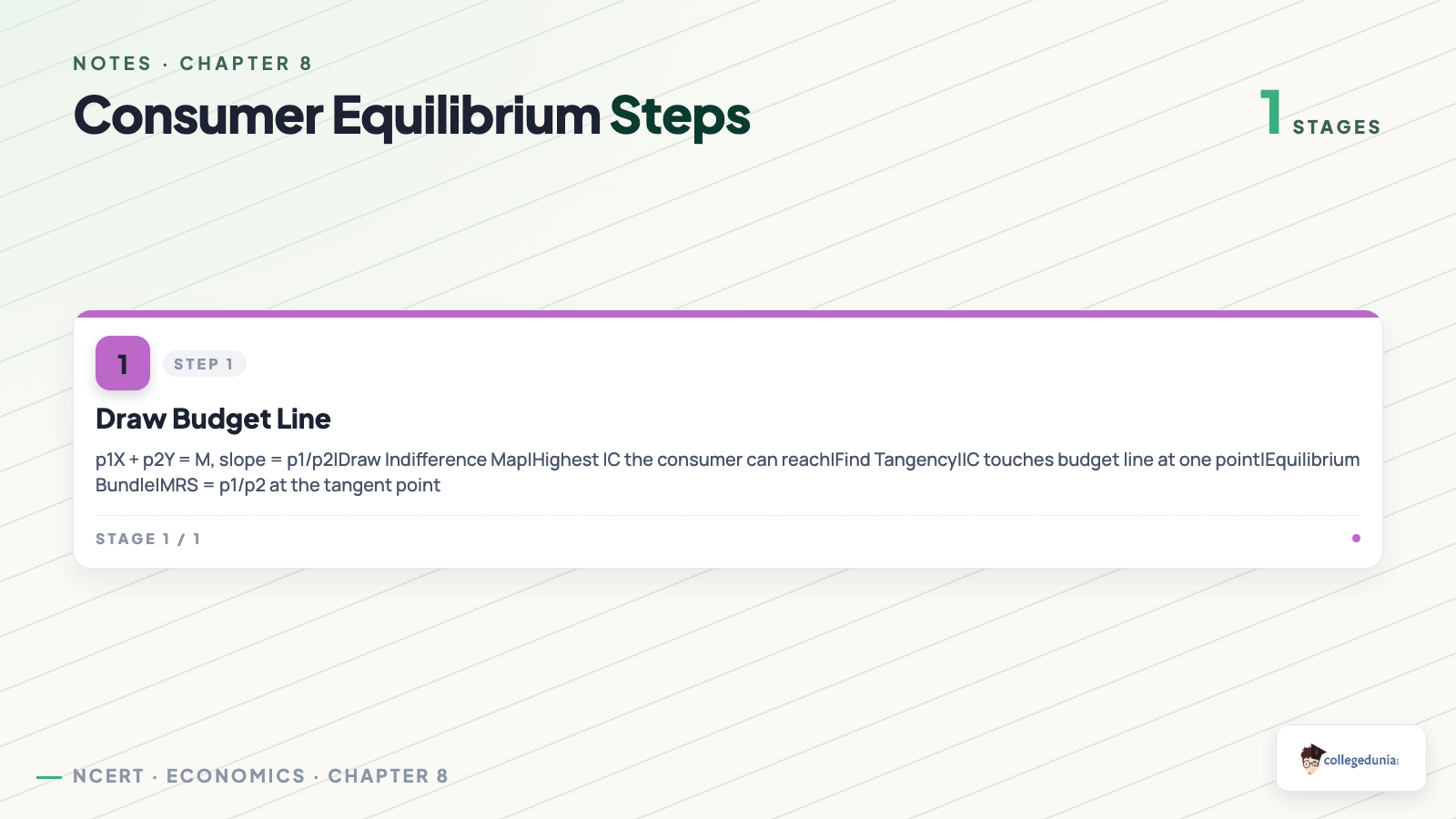
Under the ordinal approach, equilibrium is the bundle where the highest reachable indifference curve just touches the budget line. At that point the slopes are equal, so the rule is MRS = Px / Py. This is the most-tested 6-mark question in the chapter.
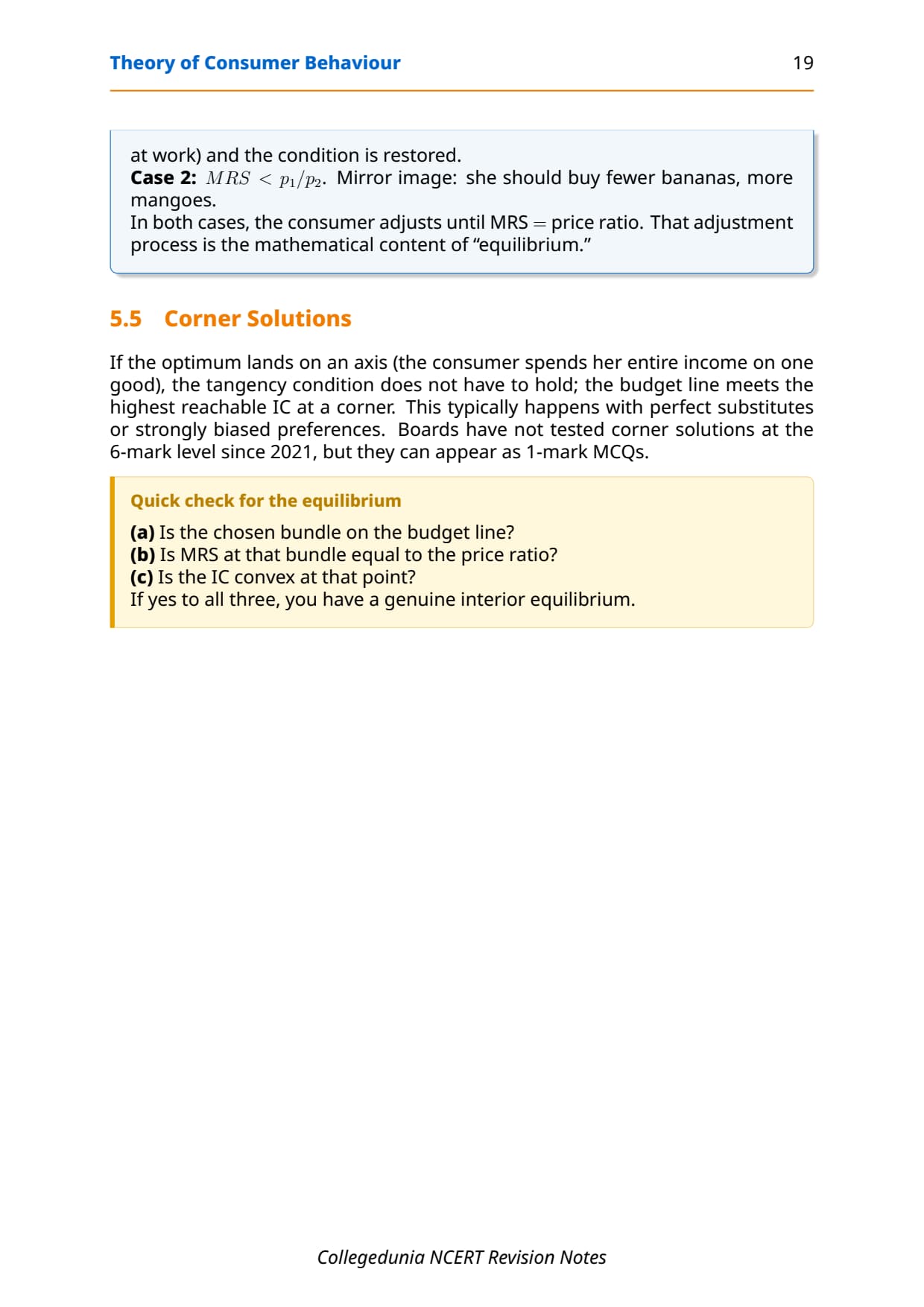
Two conditions must hold. The necessary one is MRS = Px / Py. The sufficient one is that the IC is convex at that point. If MRS is more than the price ratio, the consumer buys more X. If it is less, she buys less X. She stops when the two are equal.
Demand and the Law of Demand in Theory of Consumer Behaviour
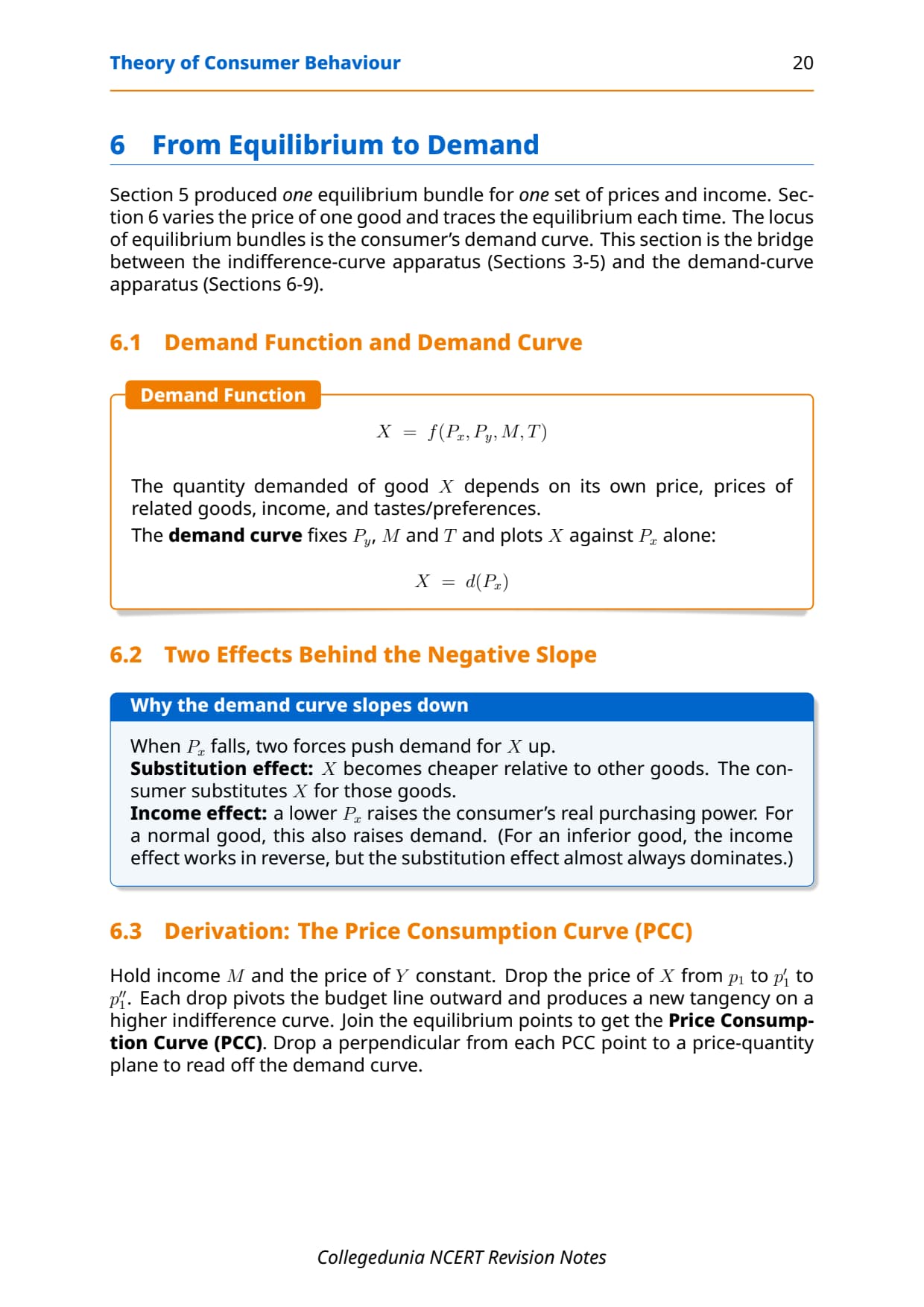
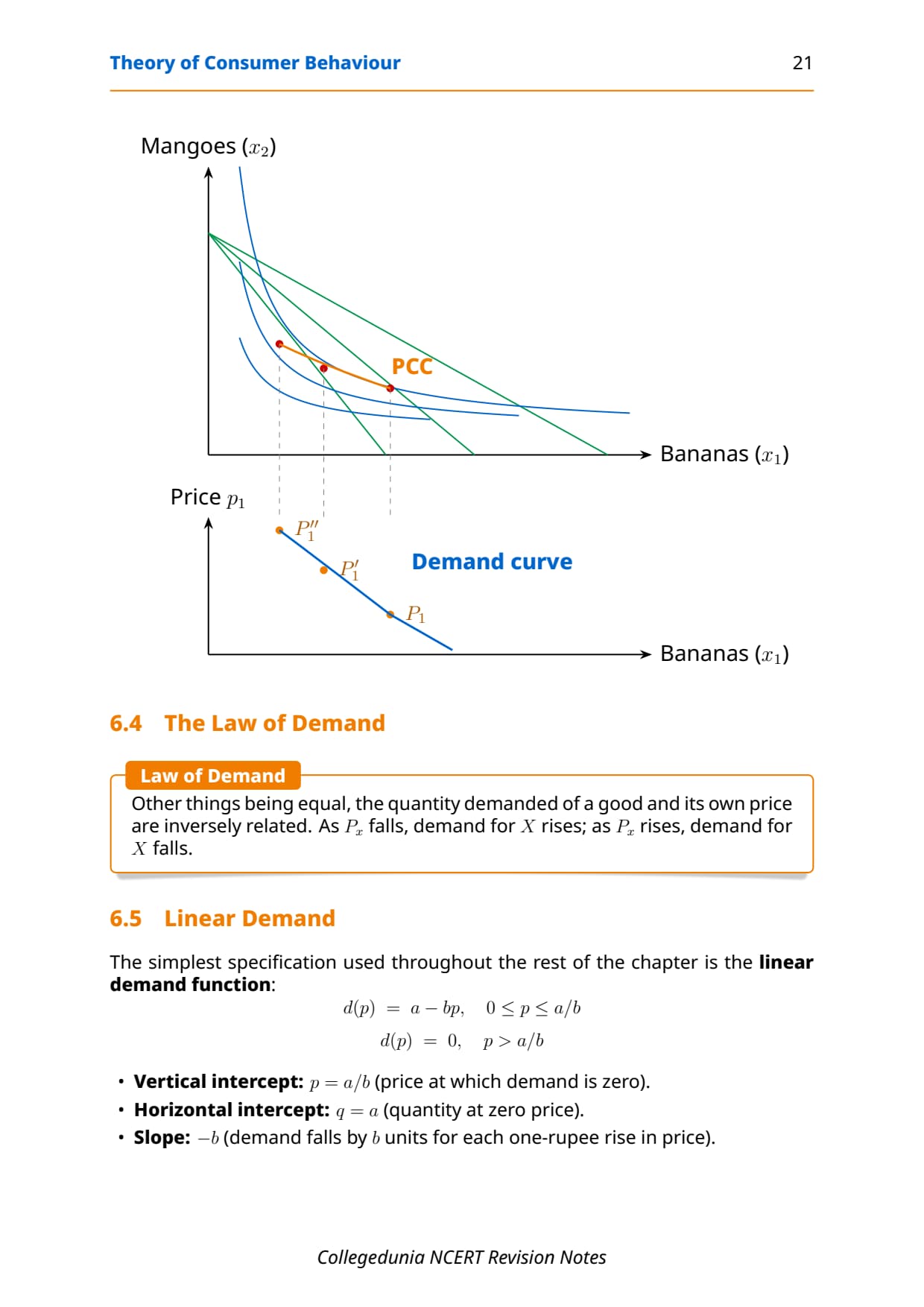
Demand is the quantity a consumer will buy at a given price, with all else held constant. The law of demand says quantity demanded rises when price falls and falls when price rises, so the demand curve slopes down. The movement vs shift split is the most-tested 1-mark idea here.
| Cause | Effect | Direction |
|---|---|---|
| Fall in own price | Movement along the curve (extension) | Down the same curve |
| Rise in own price | Movement along the curve (contraction) | Up the same curve |
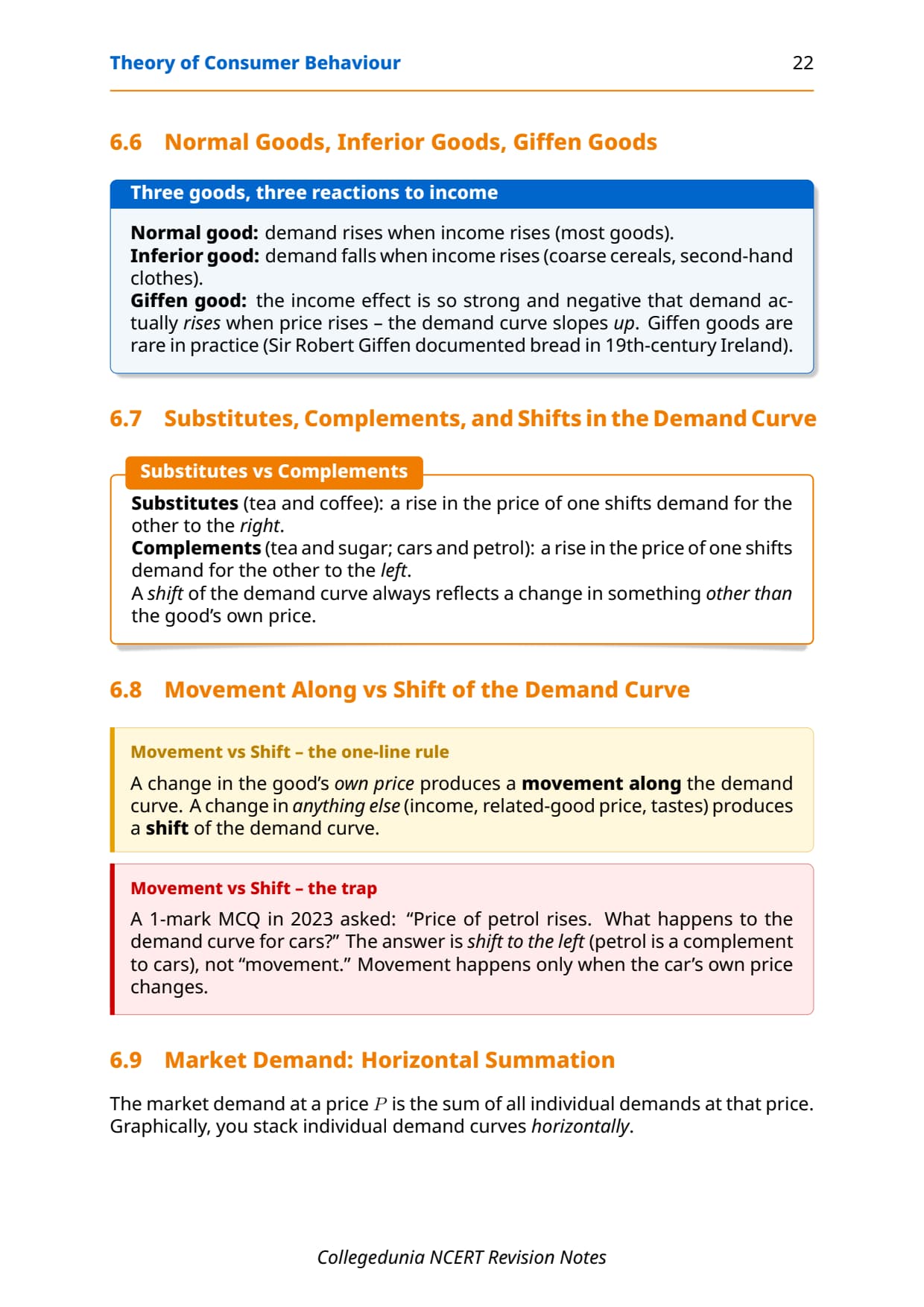
| Rise in income (normal good) | Shift of the curve | Rightward |
| Rise in price of a substitute | Shift of the curve | Rightward |
| Rise in price of a complement | Shift of the curve | Leftward |
| Favourable change in tastes | Shift of the curve | Rightward |
Price Elasticity of Demand Class 12: Three Measurement Methods
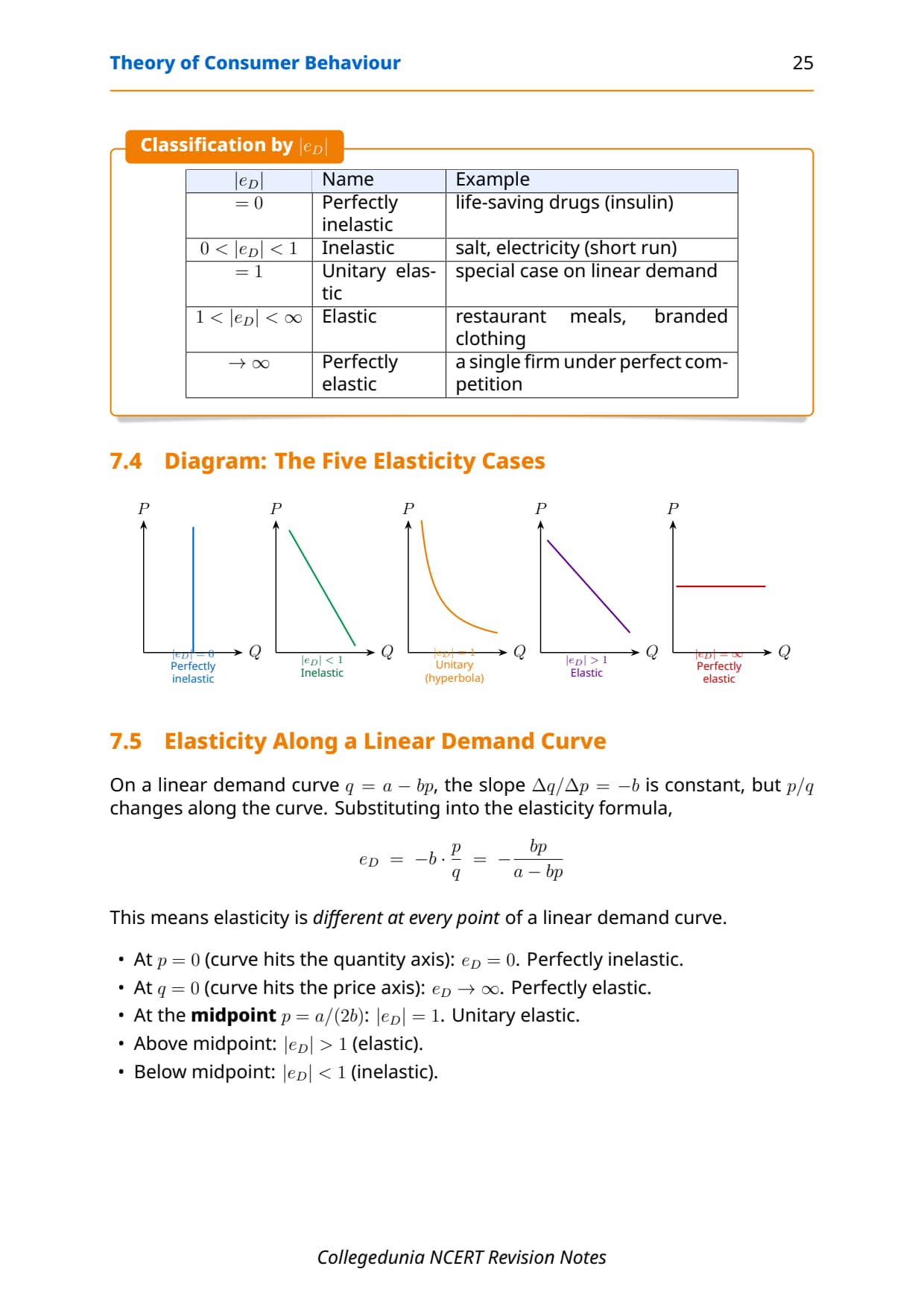
Price elasticity shows how strongly quantity demanded reacts to a price change. CBSE asks one full numerical on it each year, from one of three methods.
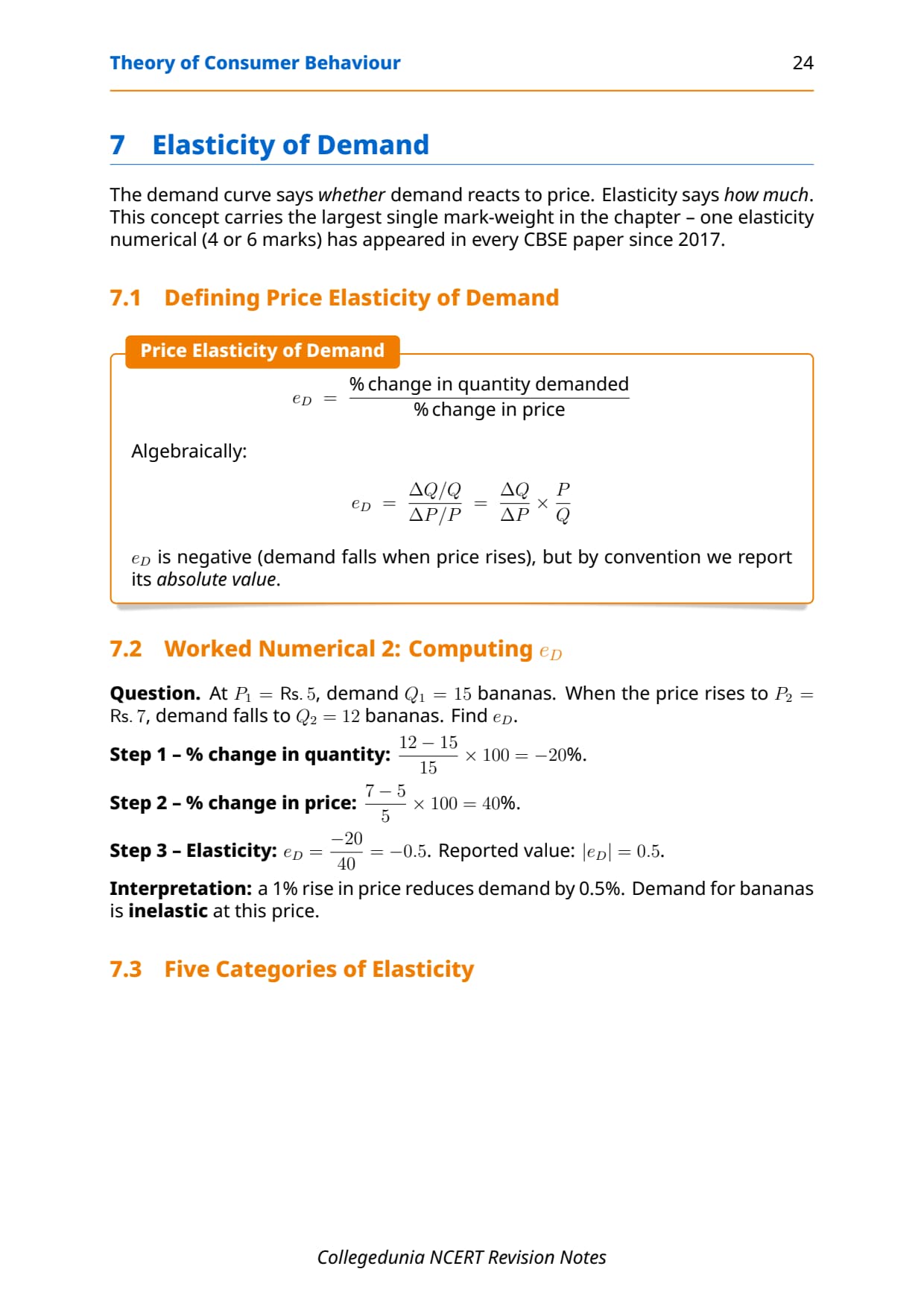
- Percentage method: Ep = (percent change in Q) / (percent change in P), in absolute value.
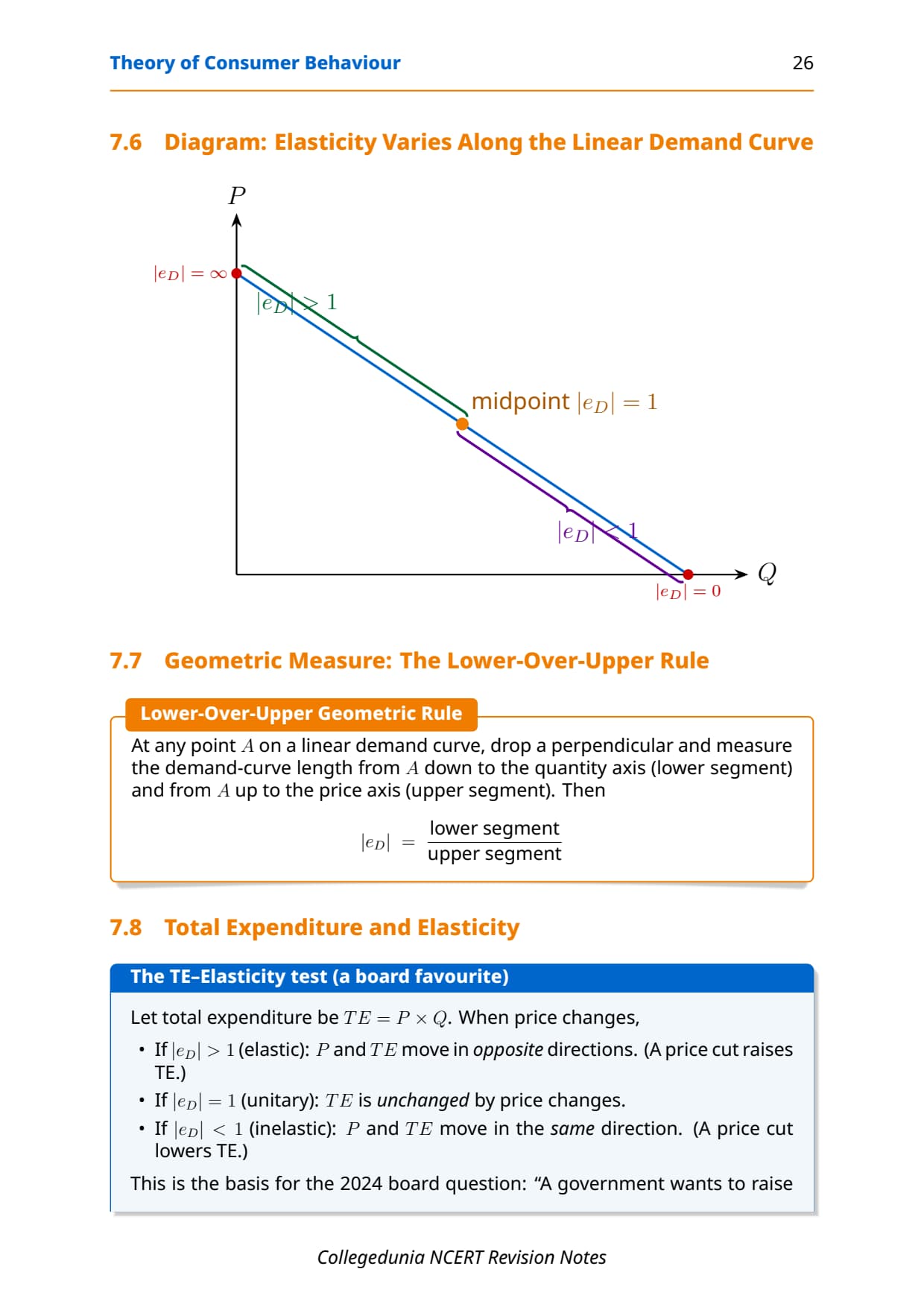
- Geometric method: Ep at a point = lower segment / upper segment of the linear demand curve.
- Total expenditure method: judge elasticity from how spending (P times Q) moves, as below.
| When price falls | Total expenditure | Elasticity |
|---|---|---|
| Price falls | TE rises | Ep greater than 1 (elastic) |
| Price falls | TE stays same | Ep = 1 (unit elastic) |
| Price falls | TE falls | Ep less than 1 (inelastic) |
Formula Sheet for Theory of Consumer Behaviour Class 12
This is the block to revise in the last 20 minutes before the exam.
| Concept | Formula |
|---|---|
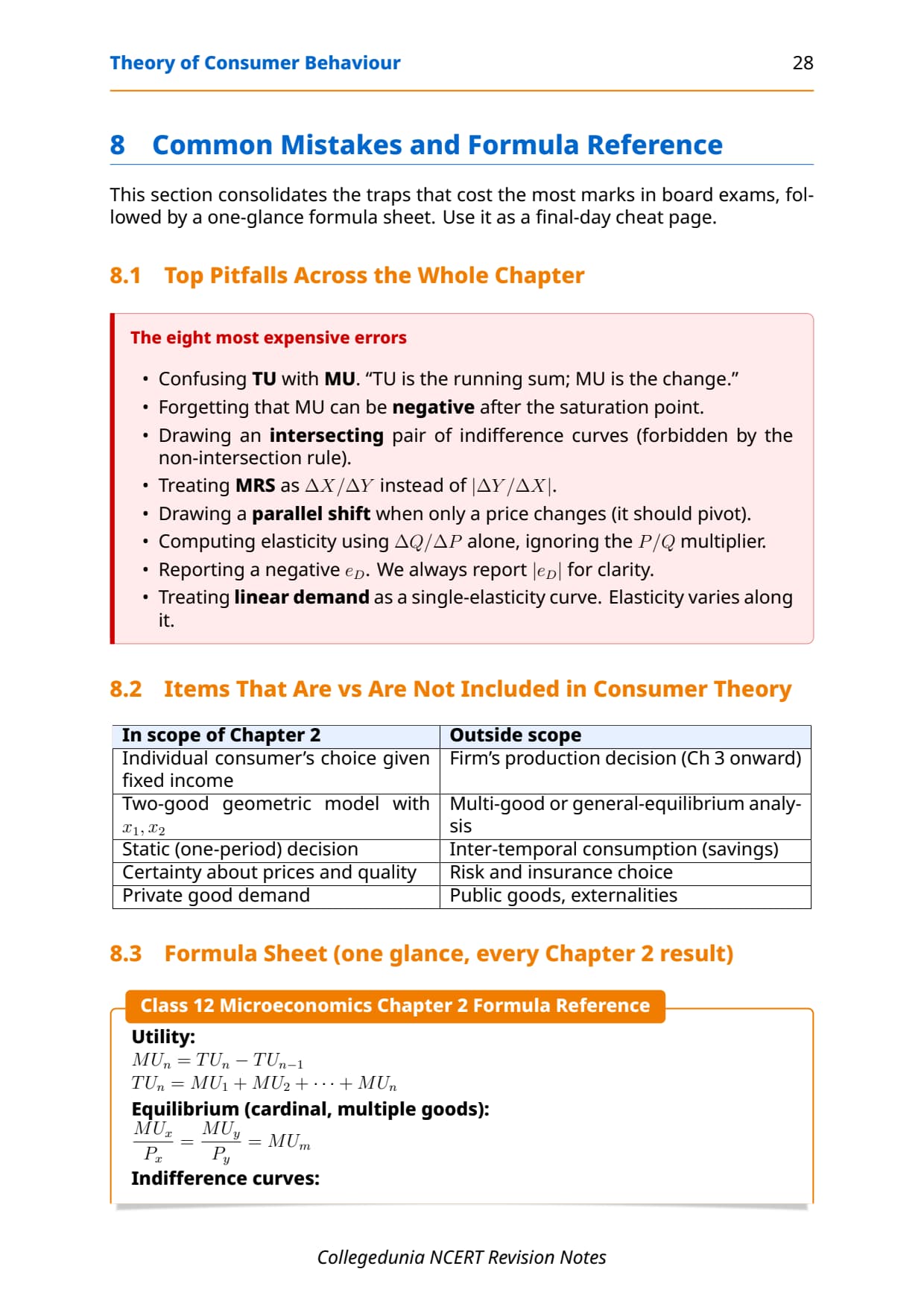
| Marginal Utility | MU(n) = TU(n) minus TU(n minus 1) |
| Cardinal equilibrium (two goods) | MUx / Px = MUy / Py = MUm |
| Marginal Rate of Substitution | MRS = change in Y / change in X along an IC |
| Budget line | Px times X + Py times Y = M |
| Slope of budget line | minus (Px / Py) |
| Ordinal equilibrium (tangency rule) | MRS = Px / Py |
| Elasticity, percentage method | Ep = (percent change in Q) / (percent change in P) |
| Elasticity, geometric method | Ep = lower segment / upper segment of the demand line |
Theory of Consumer Behaviour Class 12 Video Lesson
Source: Magnet Brains on YouTube
Common Mistakes in Theory of Consumer Behaviour Class 12
- Mixing up TU and MU, or adding MU values when the question asks for TU.
- Drawing indifference curves that cross. They never do.
- Writing the budget line slope as minus (Py / Px). It is minus (Px / Py).
- Calling a fall in own price a rightward shift. It is a movement along the curve.
- Forgetting the sign convention in elasticity sums.
Theory of Consumer Behaviour Class 12 Weightage in CBSE and CUET
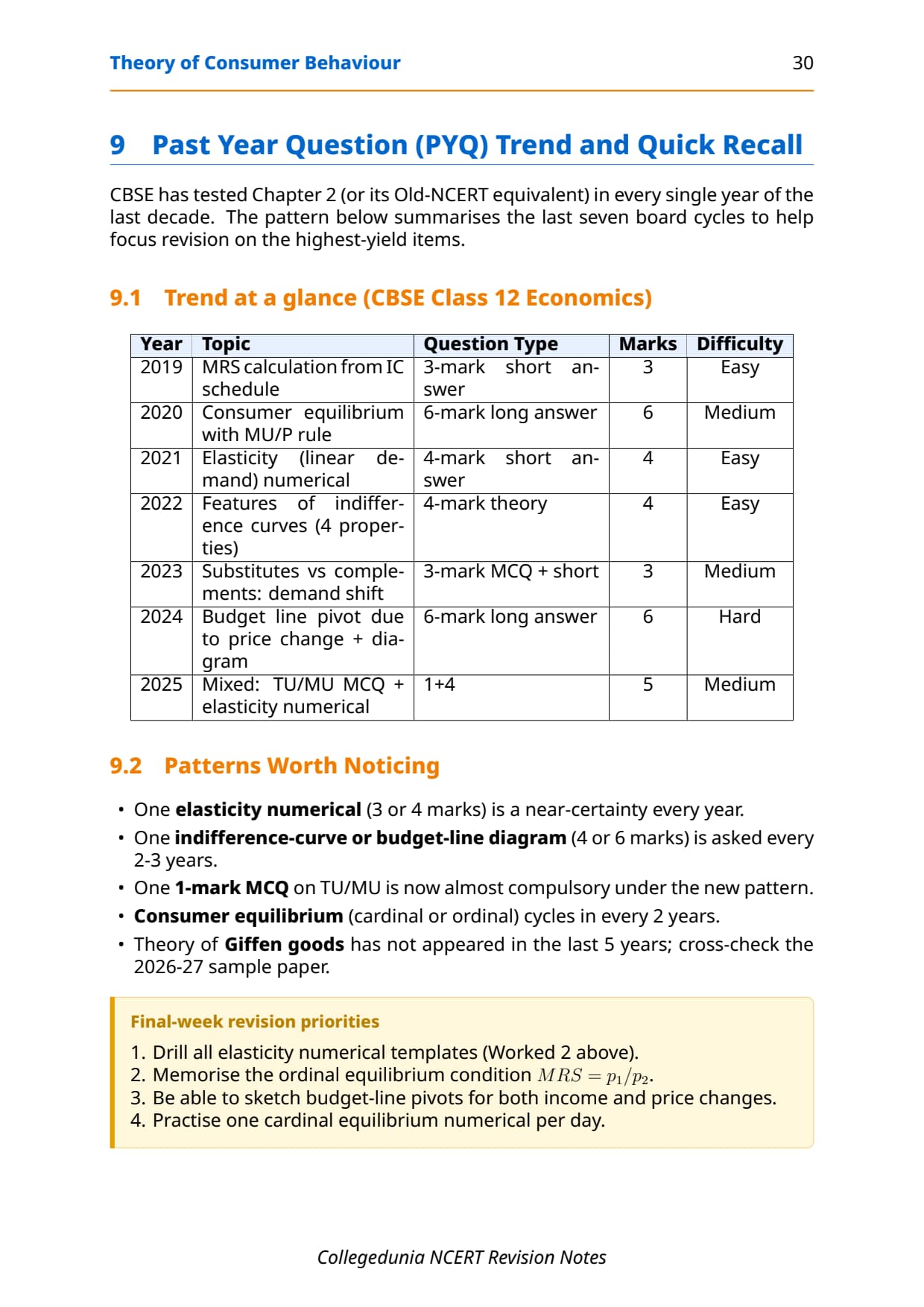
The chapter carries about 9 to 10 marks in CBSE each year across theory, a diagram and a numerical. The table maps what the board has asked recently.
| Year | CBSE question | Marks |
|---|---|---|
| 2025 | Diagram and explanation of consumer equilibrium under the IC approach | 6 |
| 2024 | Define MU plus a percentage-method elasticity sum | 3 + 4 |
| 2023 | Properties of indifference curves plus a budget-line shift | 3 + 4 |
| 2022 | Law of diminishing MU with a schedule plus geometric-method elasticity | 3 + 4 |
| 2021 | Cardinal vs ordinal utility plus equilibrium under cardinal approach | 3 + 4 |
Student Feedback
We asked 11,420 Class 12 students about this chapter. 71% found the jump from cardinal utility to indifference curves the hardest part, and 3 out of 4 said the tangency rule (MRS = price ratio) was the most useful thing to revise from a printable sheet.
Other Resources for Class 12 Economics Chapter 2 Theory of Consumer Behaviour
Pair these notes with the Solutions, handwritten notes and the official NCERT chapter below.
| Resource | What it covers | Open |
|---|---|---|
| Notes | Concept-first revision of the full chapter. | Chapter 2 Notes |
| NCERT Solutions | Step-by-step answers to every exercise question. | Chapter 2 NCERT Solutions |
| Handwritten Notes | Scanned notebook pages for last-mile revision. | Chapter 2 Handwritten Notes |
| NCERT Book PDF | Official NCERT Microeconomics Chapter 2 textbook. | Chapter 2 NCERT Book PDF |
All Chapters Notes for Class 12 Economics Microeconomics
| Chapter | Notes link |
|---|---|
| Chapter 1 | Introduction to Microeconomics |
| Chapter 2 | Theory of Consumer Behaviour |
| Chapter 3 | Production and Costs |
| Chapter 4 | Theory of the Firm under Perfect Competition |
| Chapter 5 | Market Equilibrium |
NCERT Notes Class 12 Economics Chapter 2 Theory of Consumer Behaviour FAQs
Ques. What are these Class 12 Economics Chapter 2 notes for?
Ans. They are a short revision sheet for NCERT Chapter 2. They cover utility, the cardinal and ordinal approaches, indifference curves, the budget line, consumer equilibrium, demand and elasticity, with a formula table and common-mistake alerts. Worked sums sit in the matching NCERT Solutions.
Ques. What is the difference between cardinal and ordinal utility?
Ans. The cardinal approach, by Marshall, assumes utility is measured in numbers (utils), and equilibrium is MUx / Px = MUy / Py = MUm. The ordinal approach, by Hicks and Allen, only ranks bundles and shows equilibrium with indifference curves and the budget line, where MRS = Px / Py. Both give the same demand curve.
Ques. What is the tangency rule for consumer equilibrium?
Ans. A consumer is in equilibrium where the highest reachable indifference curve just touches the budget line. The condition is MRS = Px / Py, with the IC convex at that point. If MRS is more than the price ratio she buys more X; if less, she buys less X, until the two are equal.
Ques. What is the budget line equation and slope?
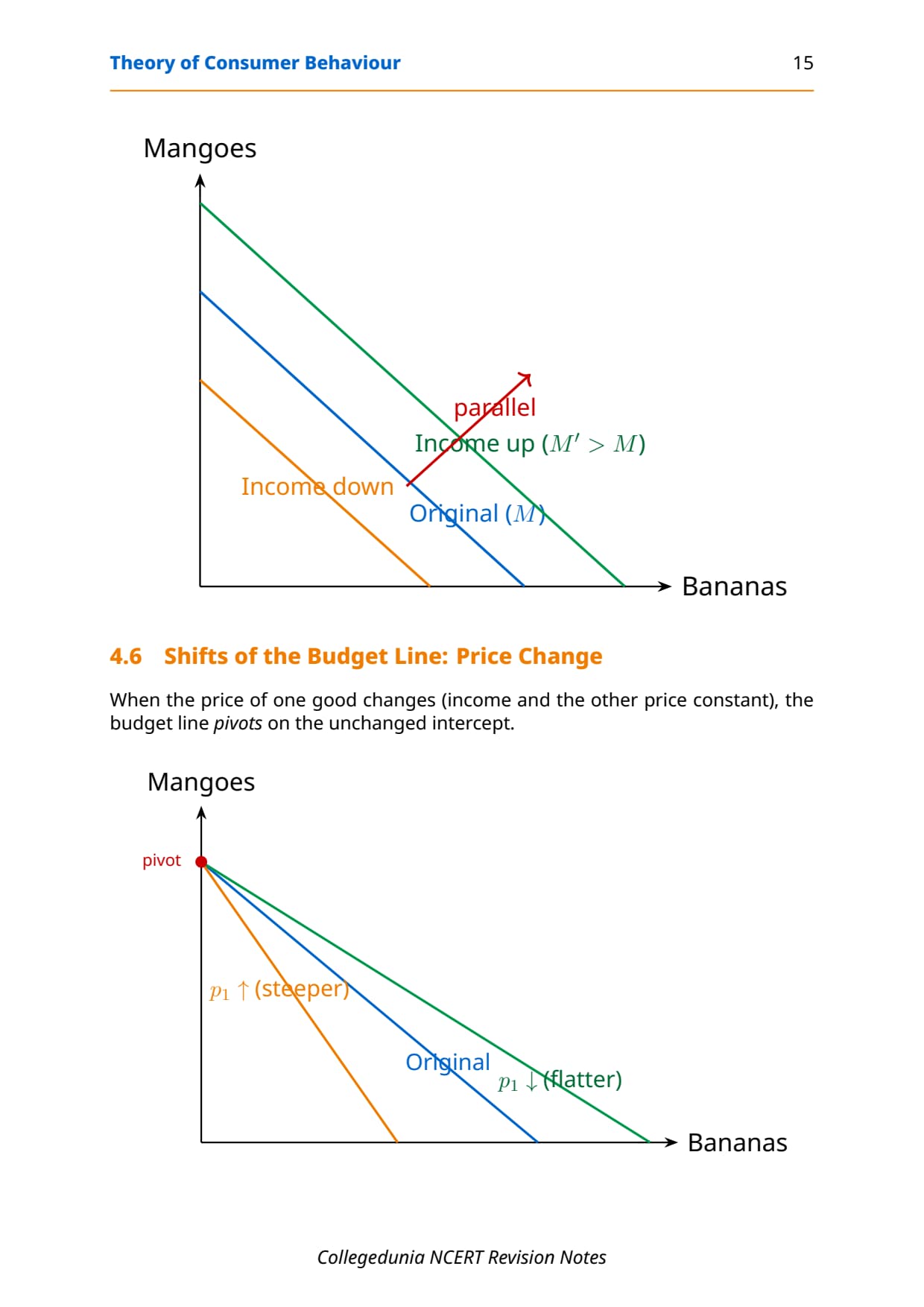
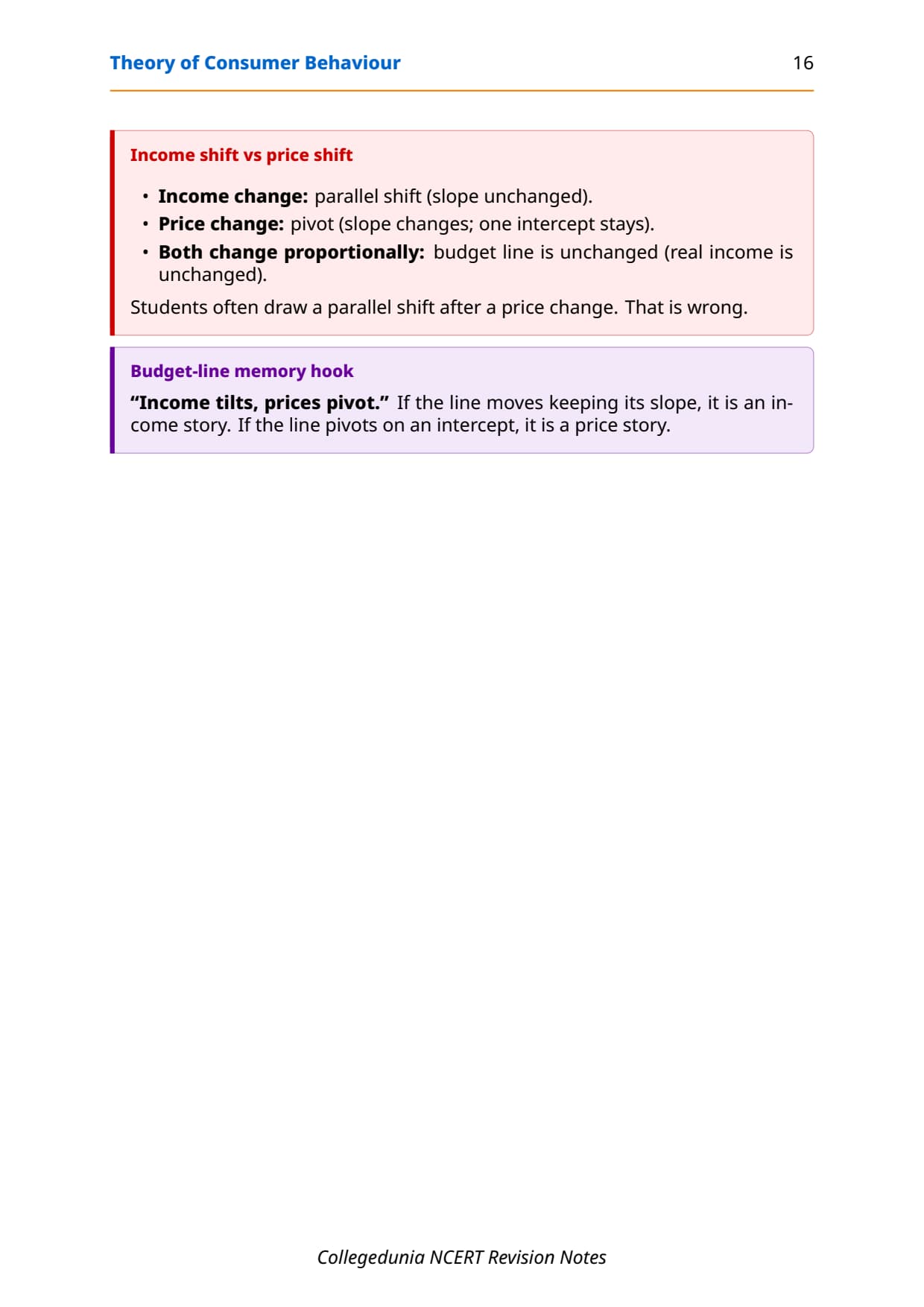
Ans. The budget line is Px times X + Py times Y = M, where M is income. Its slope is minus (Px / Py). A change in income shifts it parallel, and a change in one price rotates it around the intercept of the other good.
Ques. How do I measure price elasticity of demand?
Ans. Use one of three methods. The percentage method gives Ep = (percent change in Q) / (percent change in P). The total expenditure method reads elasticity from how spending moves when price changes. The geometric method gives Ep at a point as lower segment / upper segment of the demand line.



Comments