


These nature and significance of management class 12 notes cover the complete CBSE 2026-27 syllabus in a single concise revision guide: Harold Koontz's definition of management as "the art of getting things done through and with people in formally organised groups", the seven NCERT characteristics, three objectives, importance, dual nature as art and science, profession status, three levels, the five POSDC functions formalised by James A.F. Stoner, and Mary Parker Follett's coordination as the essence of management. The Collegedunia PDF is free, mapped to the latest NCERT reprint, and refined for last-mile revision in the final week before the board exam.
- CBSE Weightage: 6 to 10 marks (Unit 1, Principles and Functions of Management)
- Sections Covered: 8 concept blocks + a 7-point Key Takeaways summary

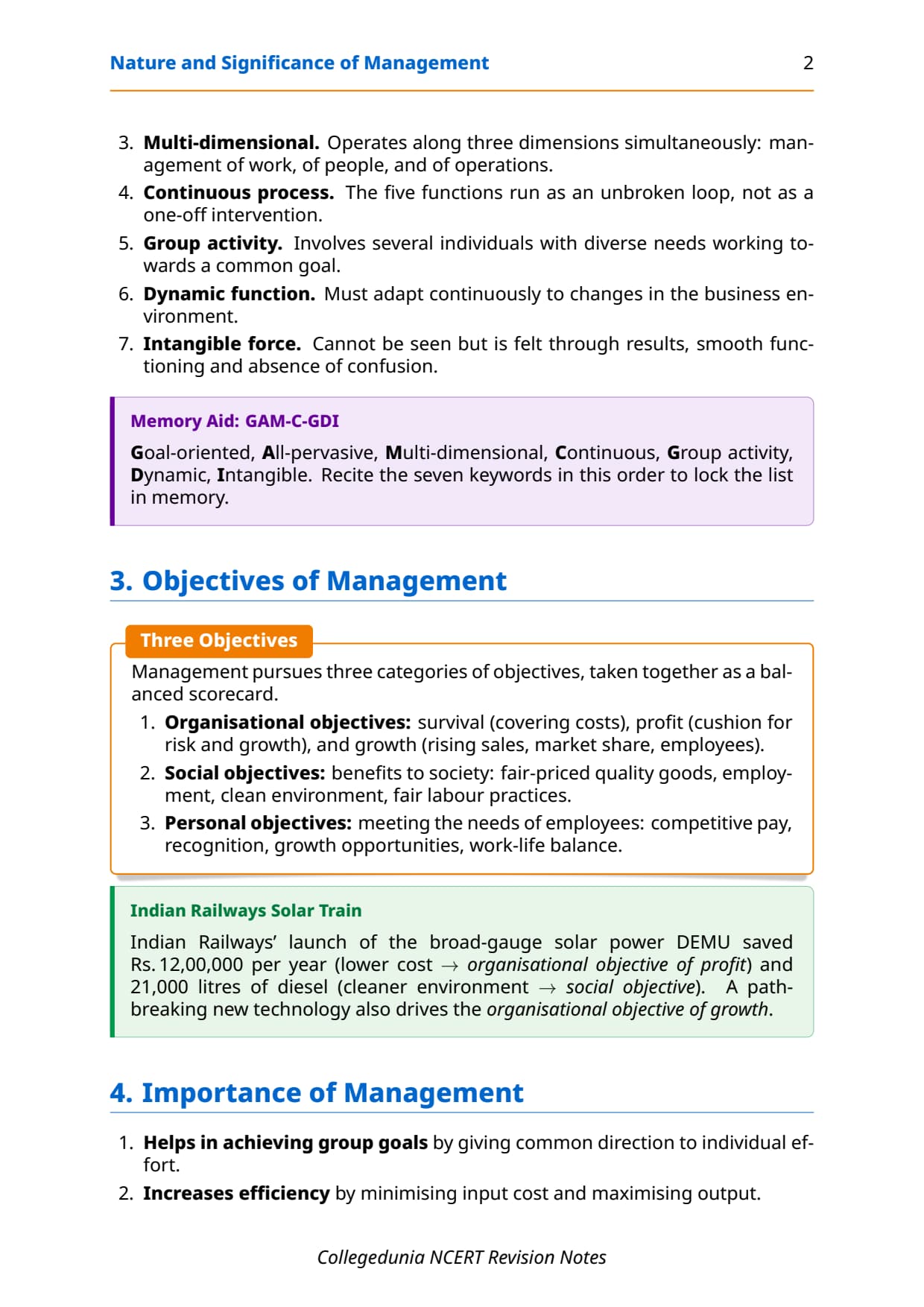


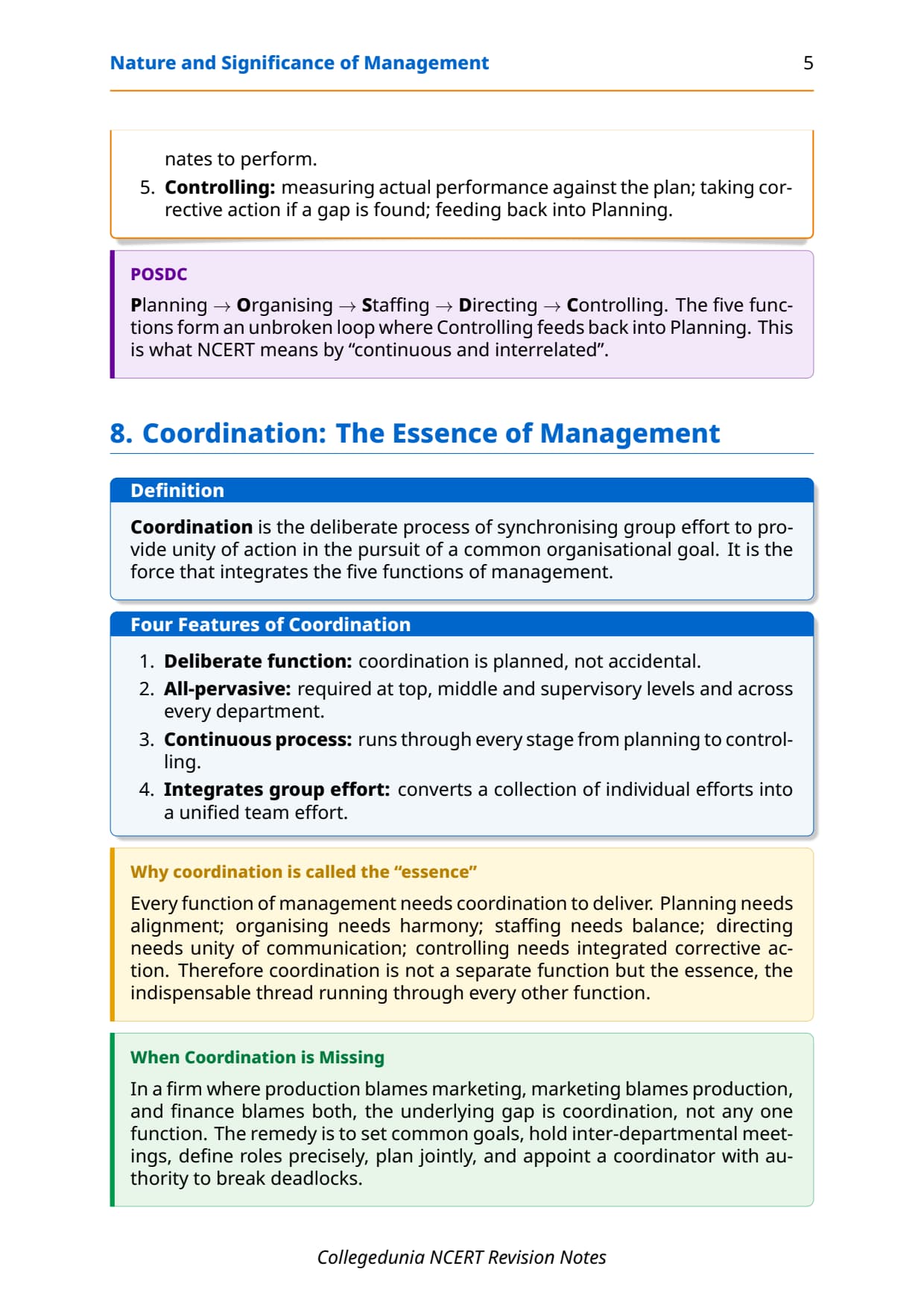

The notes are designed for two readers: a Class 12 student covering the chapter for the first time, and a board-exam candidate revising in the last week before the paper. Every concept is presented as a concept-card with a definition, supporting features, and a one-line takeaway. Mnemonics, quick tips, common-mistake call-outs and real-world boxes are placed at the precise points where students typically slip.
Also Check:
- Nature and Significance of Management Class 12 NCERT Solutions
- Principles of Management Class 12 Notes
- Class 12 Business Studies Chapter 1 NCERT Book PDF
Nature and Significance of Management Class 12 Notes: Topic Map
| Section | What is Covered | Why It Matters in the Exam |
|---|---|---|
| 1. Meaning and Definition | The NCERT process definition, effectiveness vs efficiency | 1 to 3-mark questions; the verbatim definition closes every conceptual answer |
| 2. Seven Characteristics | Goal-oriented, all-pervasive, multi-dimensional, continuous, group activity, dynamic, intangible | 3 to 4-mark "list any two/three" questions; mnemonic GAM-C-GDI |
| 3. Three Objectives | Organisational (survival, profit, growth), social, personal | 3 to 6-mark case-based identification (Indian Railways solar train pattern) |
| 4. Importance of Management | Five-point list anchored in NCERT | 3 to 4-mark question; one-liner per point |
| 5. Art, Science, Profession | Three features of art (all met), three of science (partial), five of profession (mixed) | The most repeated 6-mark long answer; cumulative verdict matters |
| 6. Three Levels | Top, Middle, Supervisory: roles and titles | Case-study cue map for "manager of [division]" questions |
| 7. Five Functions (POSDC) | Planning, Organising, Staffing, Directing, Controlling as a loop | Foundation for Chapters 4 to 8; loop diagram is the easiest mark |
| 8. Coordination | Four features; why it is the essence of management | Case-based remedy questions when "plans not adhered to" or departments blame each other |
Nature and Significance of Management Video Walkthrough
Source: Magnet Brains on YouTube
What the Class 12 Business Studies Chapter 1 Notes PDF Contains
- Definition cards for each named concept (effectiveness, efficiency, coordination, multi-dimensional, profession features) with a one-line definition followed by the textbook gloss.
- Mnemonics for the seven characteristics (GAM-C-GDI) and the five functions (POSDC) so the lists stick in memory.
- Quick tips for board-style cue mapping: which case-study phrasing leads to which level, which case fingerprint maps to coordination, which to lack of effectiveness.
- Real-world boxes tying NCERT theory to a recognisable example (Indian Railways' solar power DEMU mapping to organisational and social objectives).
- Common-mistake call-outs after each major topic, naming the slip and the correct response.
- Key Takeaways ending block with a 7-point summary suitable for last-night-before-exam revision.

Definitions of Management to Memorise from Class 12 Chapter 1
The CBSE Chapter 1 answer pattern rewards a named-author definition in the opening line. Lock these four into your last-week revision.
| Author | Definition | Why It Matters |
|---|---|---|
| Harold Koontz | "Management is the art of getting things done through and with people in formally organised groups." | Names the human element; quotable in any 1-mark or opening-line answer |
| Mary Parker Follett | "Management is the art of getting things done through others." | Foundation for the coordination-as-essence question |
| James A.F. Stoner | Management is the process of planning, organising, leading and controlling to achieve organisational goals. | Anchors the POSDC functions long answer |
| Henri Fayol (Father of Modern Management) | "To manage is to forecast and plan, to organise, to command, to coordinate and to control." | Foundation for Chapter 2 (14 principles of management) |
Effectiveness vs Efficiency: The One Definition That Closes Every Answer
Class 12 examiners check two boxes on every Chapter 1 answer: was the concept named correctly, and was the NCERT definition quoted in full? The single most rewarding sentence to memorise is the management definition:
Definition (memorise verbatim): Management is the process of planning, organising, staffing, directing and controlling the enterprise resources to achieve organisational goals effectively and efficiently.
Effectiveness: doing the right task and achieving the goal (output yardstick).
Efficiency: doing the task with minimum cost of resources (input yardstick).
Why both: a factory that hits the target but overspends is effective but inefficient (profit falls). A factory that underspends but misses the target is efficient but ineffective (revenue falls). A successful enterprise is both.
Coordination: The Essence of Management (Mary Parker Follett)
The single most quoted line from Chapter 1 is "coordination is the essence of management". The phrase traces back to Mary Parker Follett, who first described management as "the art of getting things done through others" and treated coordination as the deliberate synchronisation that converts individual effort into group effort. This means coordination is not a separate function but the indispensable thread running through every other function. Memorise the four features:
- Deliberate function: coordination is planned, not accidental.
- All-pervasive: required at top, middle and supervisory levels and across every department.
- Continuous process: runs through every stage from planning to controlling.
- Integrates group effort: converts a collection of individual efforts into a unified team effort.
Important Topics in Chapter 1 (with Marks Distribution)
| Topic | Typical Marks | Question Type |
|---|---|---|
| Definition of management | 1-3 | VSA or SA |
| Characteristics of management | 3-4 | SA (any two/three) |
| Objectives of management | 3-6 | SA or LA (case-based) |
| Management as art and science | 5-6 | LA (most repeated) |
| Management as profession | 5-6 | LA (five-feature checklist) |
| Three levels of management | 3-6 | SA or LA (case-based) |
| Five functions (POSDC) | 3-6 | LA (continuous and interrelated) |
| Coordination as essence | 3-6 | SA or LA (case-based remedy) |
Previous Year Pattern: Class 12 Business Studies Chapter 1
- Art and science long answer: 2020, 2022, 2024 papers. Three features of art (all met) + three features of science (partially met) + verdict.
- Coordination case study: 2019, 2021, 2023 papers. "Department A blames department B" or "plans not adhered to" maps to coordination remedy.
- Efficiency vs effectiveness numeric case: 2020, 2022, 2024 papers. Compute cost per unit and output percentage, then label each worker on a 2x2 grid.
- Levels of management identification: 2021, 2023, 2024 papers. Divisional/regional manager = middle level; foreman = supervisory; MD/Board = top.
- Three objectives identification: 2022, 2024 papers. Number cue = organisational; environmental cue = social; employee cue = personal.
Common Mistakes to Avoid in Chapter 1
- Writing one yardstick only. Always write effectiveness AND efficiency. Either alone forfeits half the mark.
- Labelling Ritu (divisional manager) as top. Divisional, regional and departmental managers are middle level.
- Calling management a full-fledged profession. The verdict is "to a large extent", not full-fledged.
- Advising better planning for a coordination case. When the case says planning is sound but execution fails, the answer is coordination, not better planning.
- Listing personal objectives where the case shows none. Only list named objectives the case supports.
Related Resources for Class 12 Business Studies Chapter 1
- Nature and Significance of Management Class 12 NCERT Solutions
- Nature and Significance of Management Handwritten Notes
- Class 12 Business Studies Chapter 1 NCERT Book PDF
Notes for Class 12 Business Studies: All Chapters
| Chapter | Notes Link |
|---|---|
| Chapter 2 | Principles of Management Notes |
| Chapter 3 | Business Environment Notes |
| Chapter 4 | Planning Notes |
| Chapter 5 | Organising Notes |
| Chapter 6 | Staffing Notes |
| Chapter 7 | Directing Notes |
| Chapter 8 | Controlling Notes |
| Chapter 9 | Financial Management Notes |
| Chapter 10 | Financial Markets Notes |
| Chapter 11 | Marketing Notes |
| Chapter 12 | Consumer Protection Notes |
FAQs on Nature and Significance of Management Class 12 Notes
FAQs on Nature and Significance of Management Class 12 Notes
What is the most repeated long answer question from Chapter 1?
"Management is considered to be both an art and a science. Explain." appears in 2020, 2022 and 2024 boards. The marker checks for three features of art (theoretical knowledge, personalised application, practice and creativity), three of science (systematic body of knowledge, principles based on experimentation, universal validity), and a synthesis verdict.
How do I remember the seven characteristics of management?
Use the mnemonic GAM-C-GDI: Goal-oriented, All-pervasive, Multi-dimensional, Continuous, Group activity, Dynamic, Intangible. Lock these seven keywords first, then add one supporting line each.
Why is coordination called the essence of management?
Mary Parker Follett described management as "the art of getting things done through others" and treated coordination as the deliberate synchronisation of group effort. NCERT calls it the essence of management because every other function (planning, organising, staffing, directing, controlling) depends on it. It integrates group effort, ensures unity of action, runs continuously, is all-pervasive, is deliberate, and is the responsibility of every manager.
What is POSDC in Business Studies Class 12?
POSDC is the mnemonic for the five functions of management formalised by James A.F. Stoner and rooted in Henri Fayol's classical framework: Planning, Organising, Staffing, Directing, Controlling. They form a continuous loop where Controlling feeds back into Planning, which is what NCERT means by "continuous and interrelated functions".
Is management a profession according to NCERT?
NCERT concludes that management is a profession "to a large extent" but not a full-fledged one. It has a body of knowledge and a service motive, but lacks restricted entry (no legal bar without an MBA), a compulsory professional association (All India Management Association membership is voluntary) and a legally enforced code of conduct.
What is the difference between effectiveness and efficiency?
Effectiveness is doing the right task and achieving the goal (output yardstick). Efficiency is doing the task at the minimum possible cost (input yardstick). A successful enterprise must score on both; either alone is not enough.
Who is called the Father of Modern Management?
Henri Fayol, the French mining engineer and industrialist, is called the Father of Modern Management. His five-element classification (forecast and plan, organise, command, coordinate, control) is the direct ancestor of the POSDC framework studied in Class 12 Business Studies Chapter 1 and the 14 principles taught in Chapter 2.



Comments