




The 2026-27 NCERT keeps Microbes in Human Welfare as Chapter 8 of Class 12 Biology, renumbered from Chapter 10 and kept in full. It stays one of the most NEET-quotable units, since every species from Lactobacillus to Bacillus thuringiensis is a one-line MCQ. This page hosts the Notes PDF with master species tables.
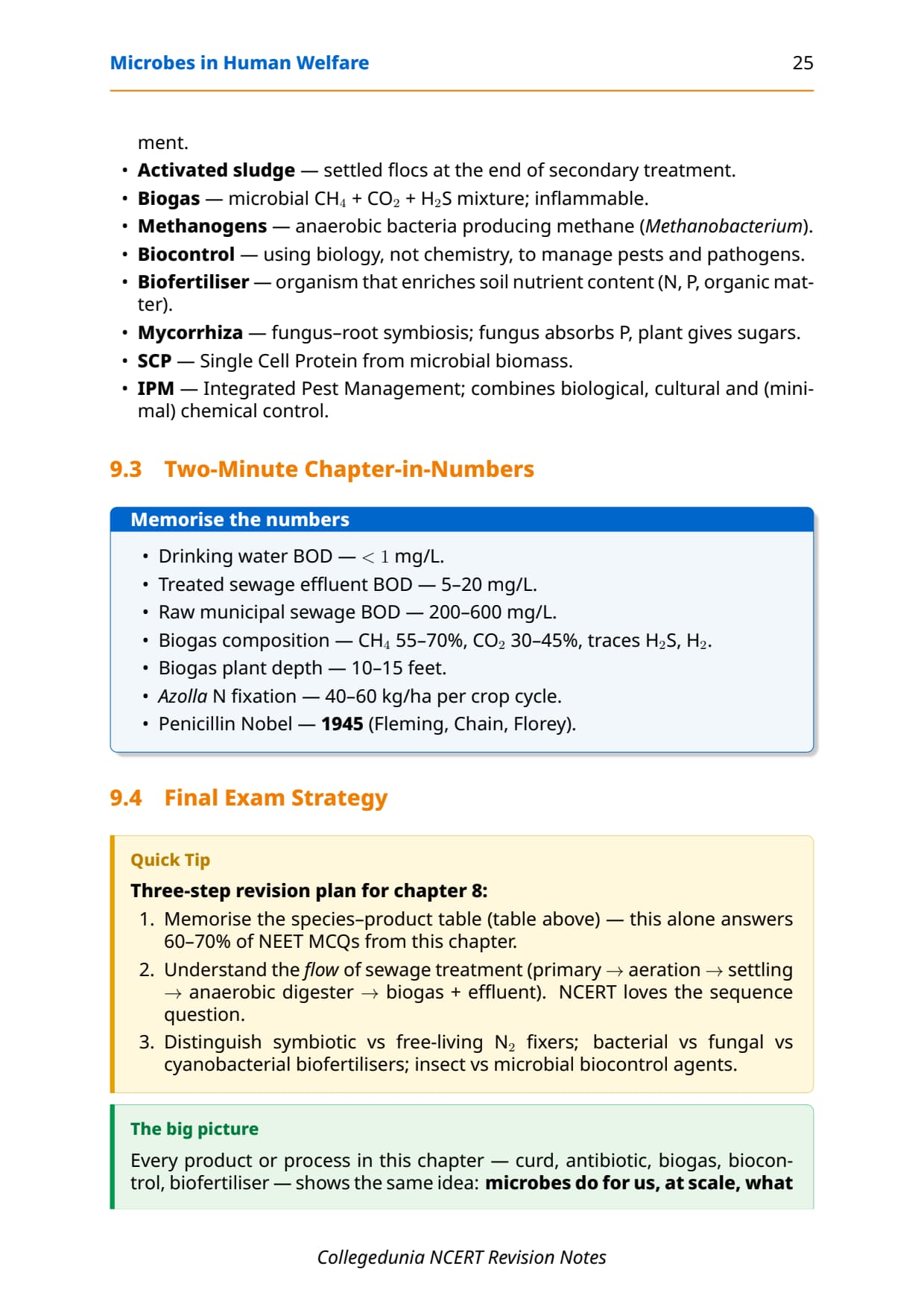
- CBSE Weightage: 4 to 5 marks
- NEET Weightage: 2 to 4 questions per year
- AIIMS / CUET-style entrance: 1 question per paper
These notes pull the full NCERT chapter into one revision PDF, with the NEET-favourite microbe-product-application table and biofertiliser recall sheet. Curated by Collegedunia subject experts, mapped to the 2026-27 NCERT and checked against the last five years of CBSE Board and NEET papers. Links to every other Chapter 8 resource sit in the Other Resources table below.
Microbes in Human Welfare Video Lecture for Class 12 Biology
Source: Magnet Brains on YouTube
Microbes in Human Welfare Topic-by-Topic Notes for Class 12 Biology
The concept-by-concept summary below covers every NCERT section and works as a first revision pass.
Microbes in Household Products
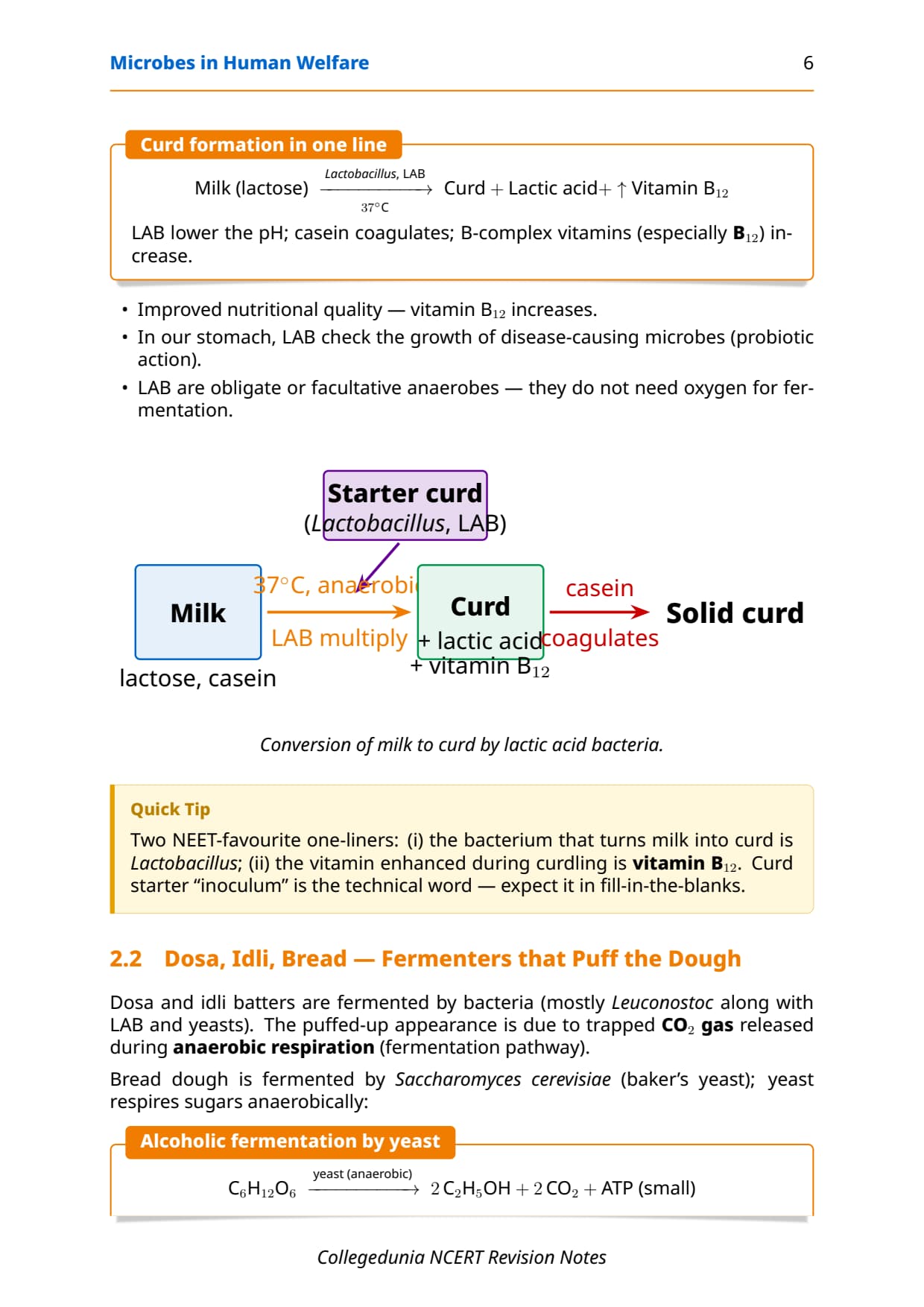
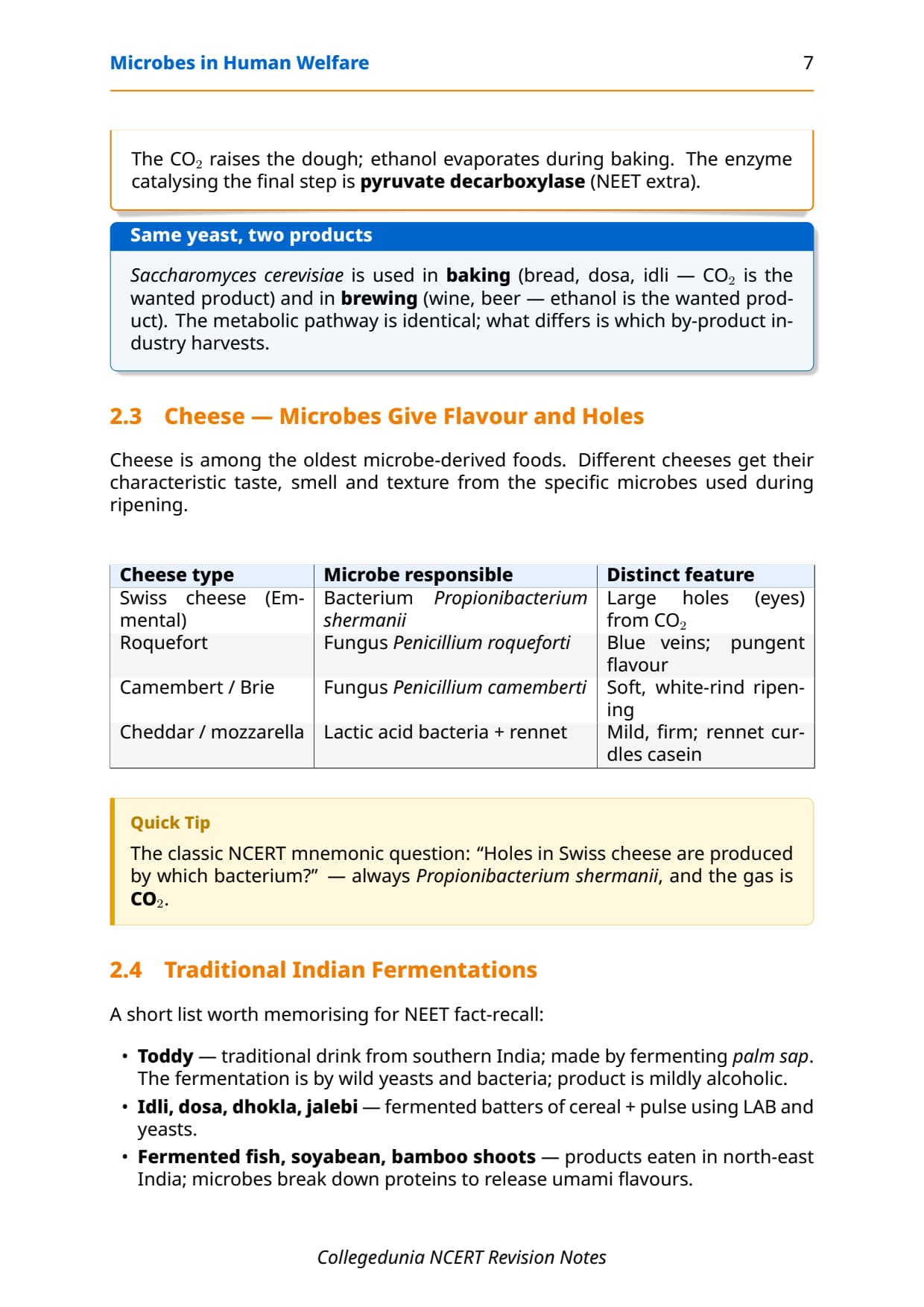
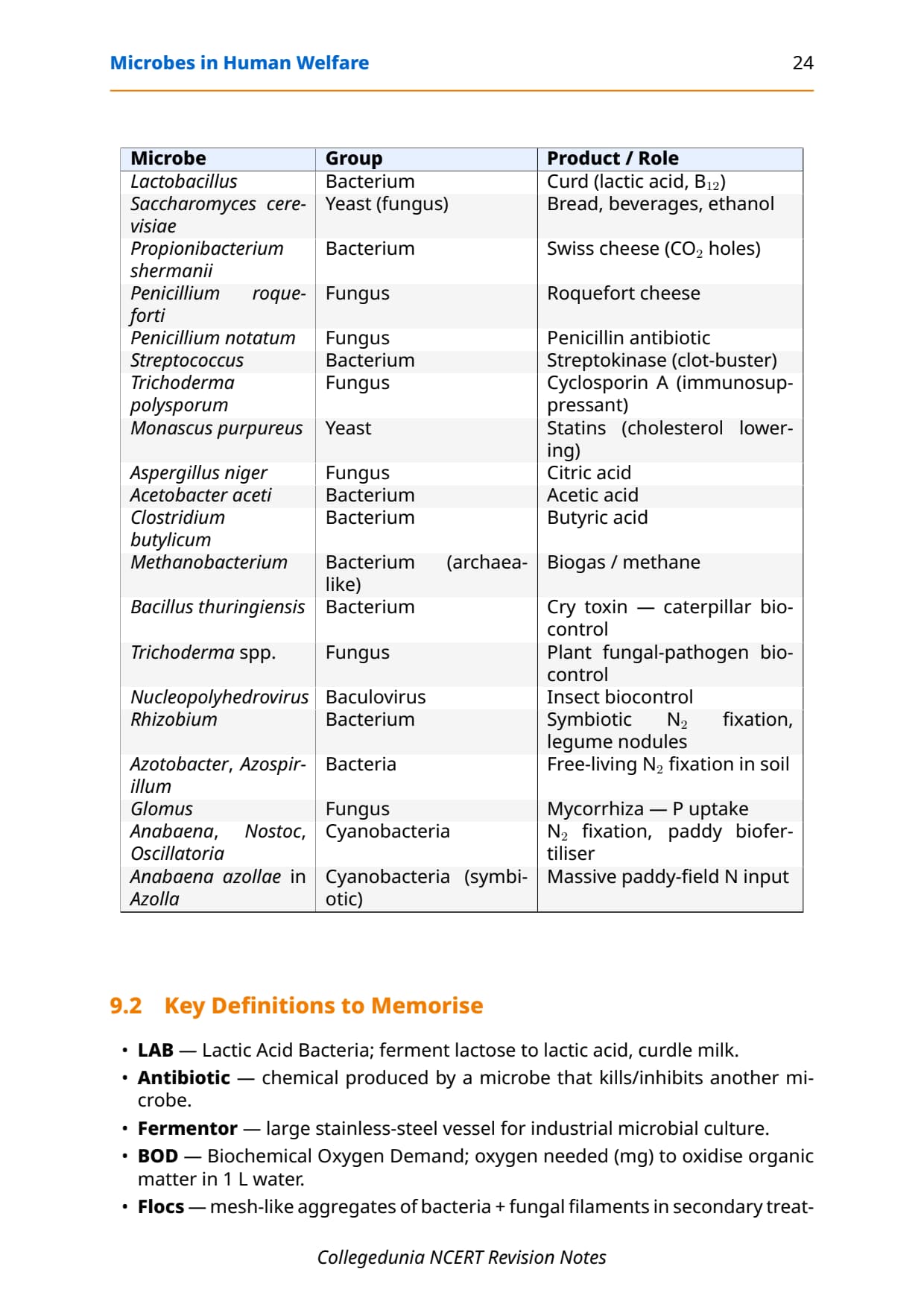
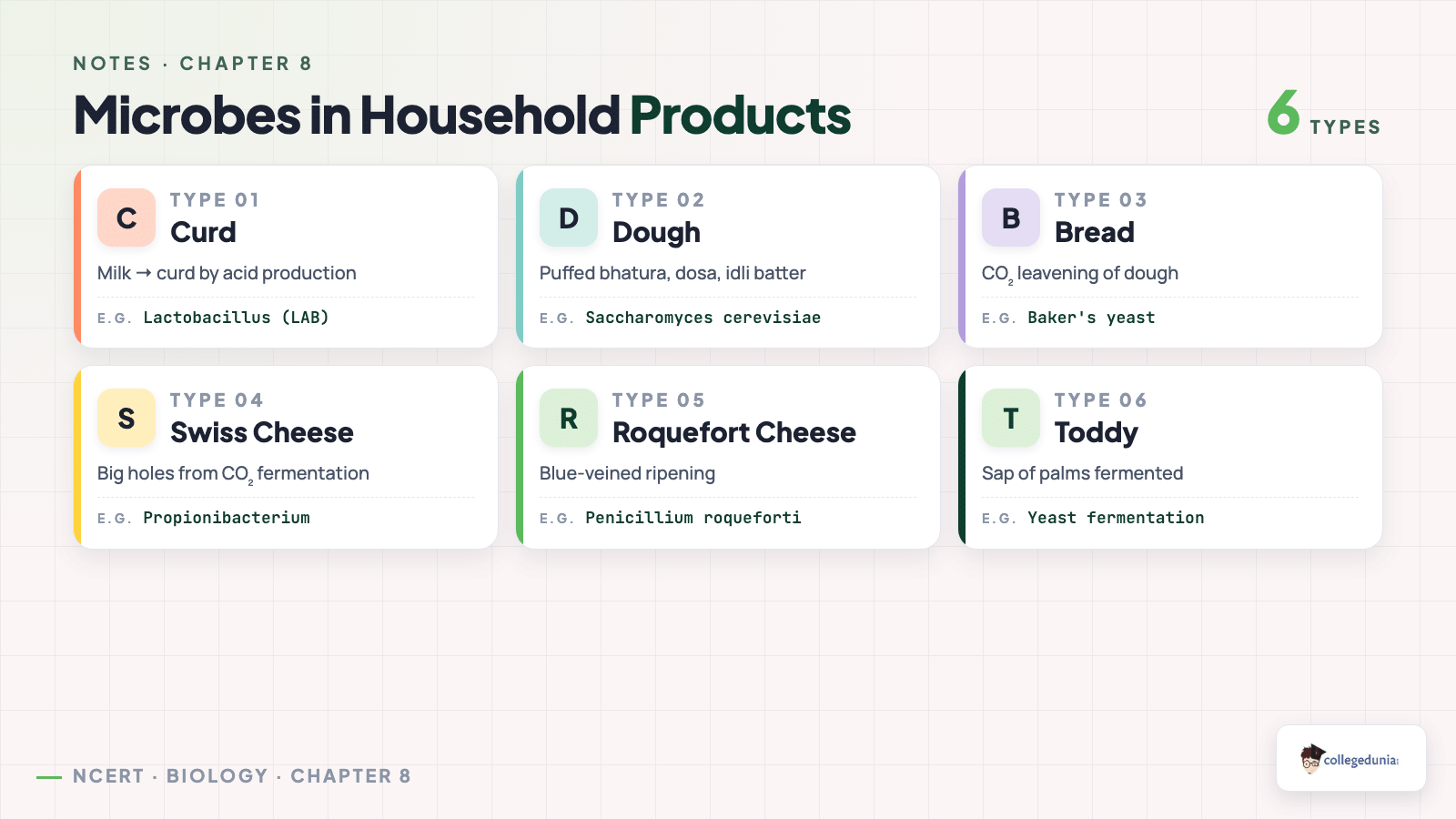
Curd: Lactobacillus (LAB) turns milk lactose into lactic acid and adds vitamin B12. Idli, dosa and bread dough rise because yeast Saccharomyces cerevisiae and LAB release CO2. In cheese, Propionibacterium shermanii makes the holes in Swiss cheese and Penicillium roqueforti ripens Roquefort.
Microbes in Industrial Products
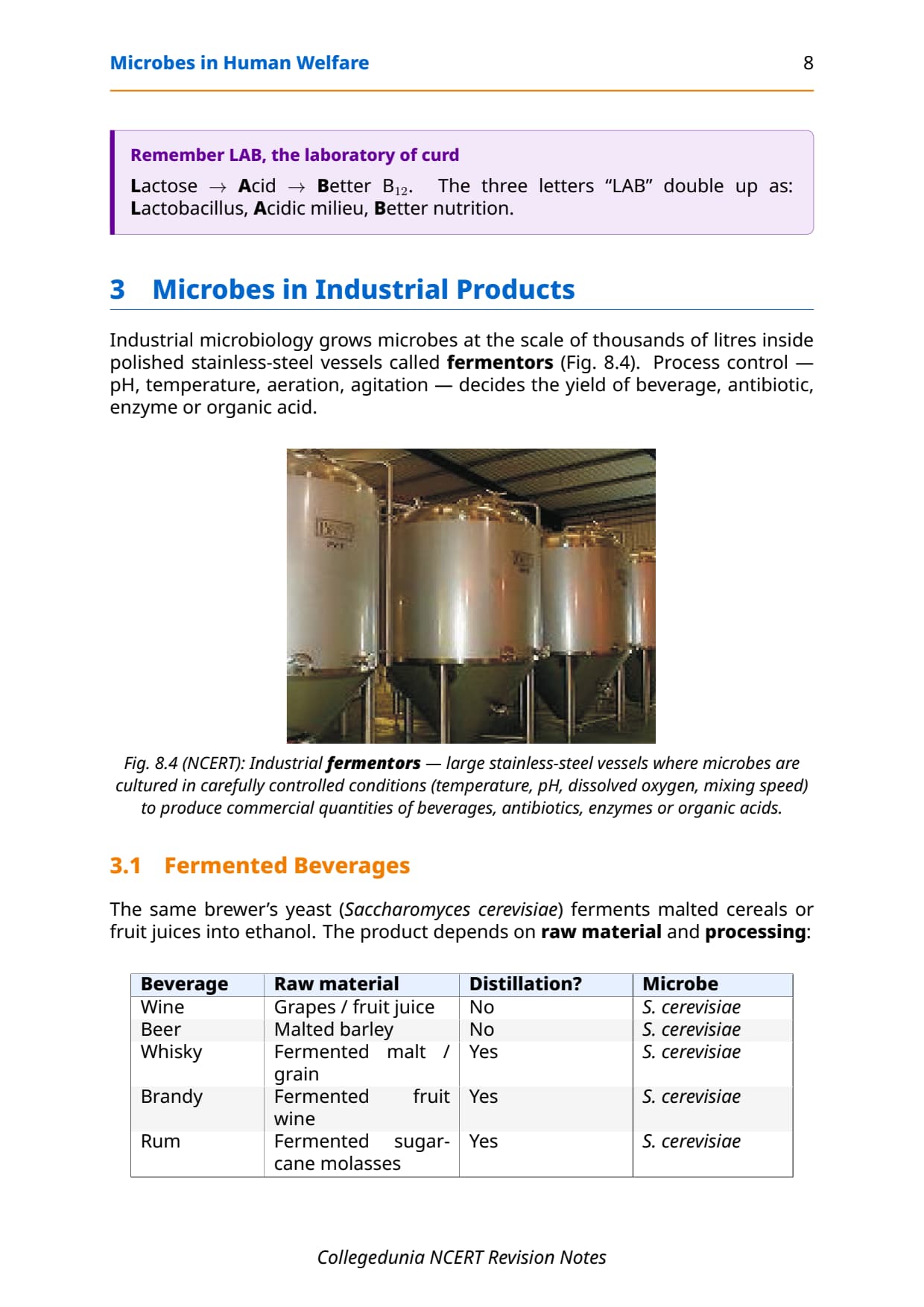
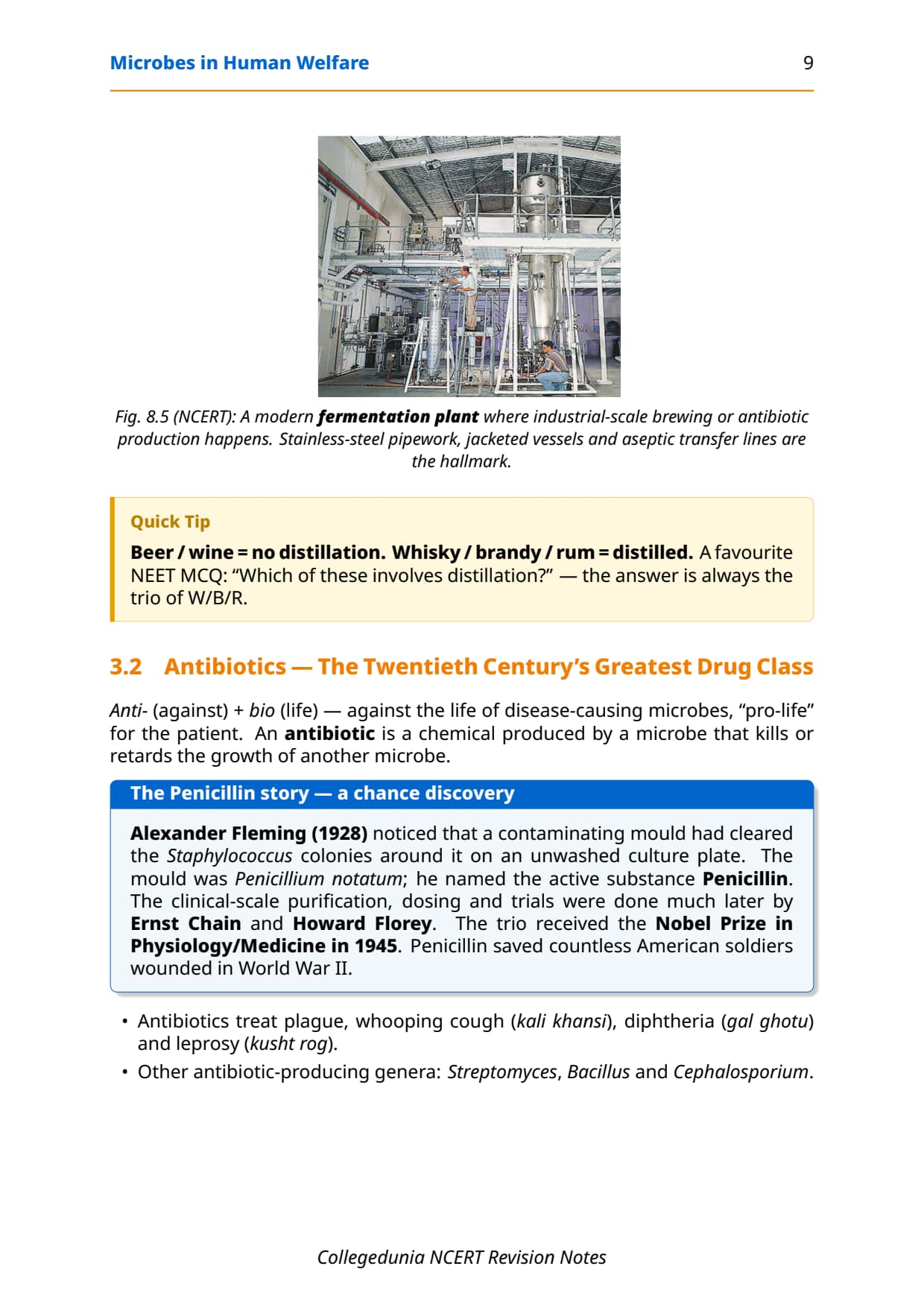
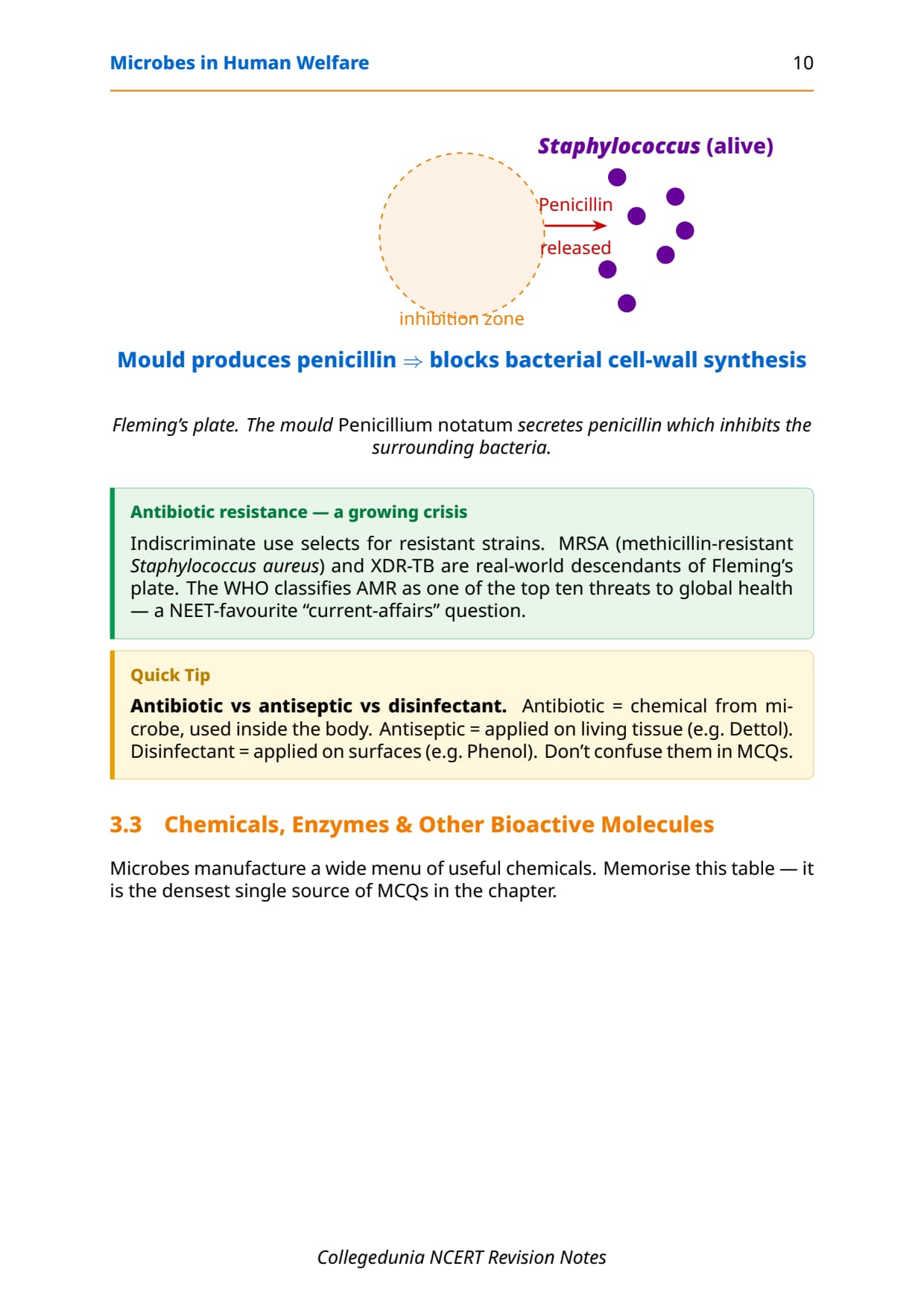
Beverages: brewer's yeast Saccharomyces cerevisiae ferments cereals and juices. Wine and beer are not distilled; whisky, brandy and rum are. Antibiotics: Fleming found penicillin in Penicillium notatum in 1928.
Chemicals, Enzymes and Bioactive Molecules
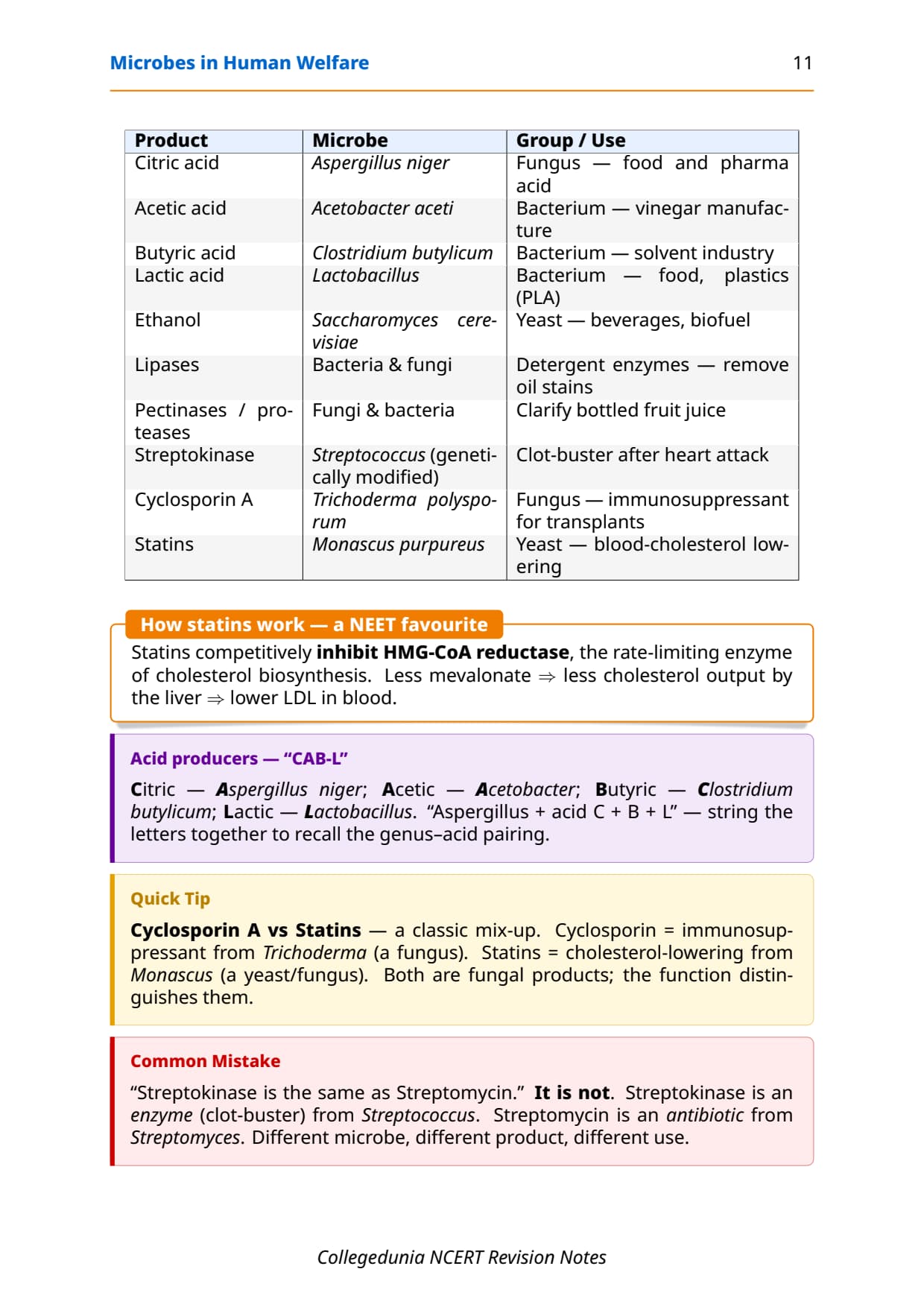
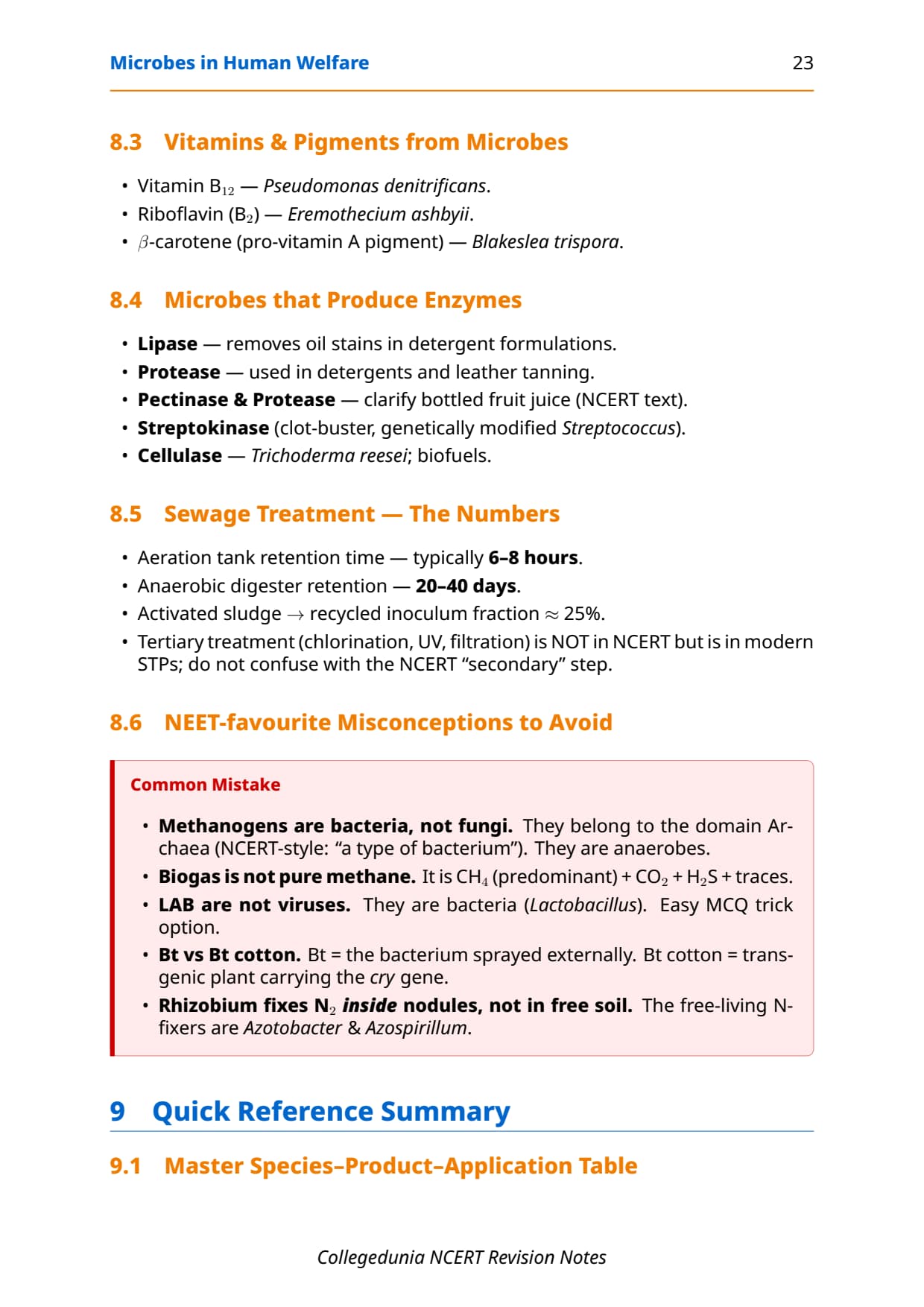
Organic acids: Aspergillus niger → citric acid; Acetobacter aceti → acetic acid. Bioactive molecules: lipases in detergents, streptokinase dissolves clots, cyclosporin A (from Trichoderma polysporum) suppresses transplant rejection, and statins (from Monascus purpureus) lower cholesterol.
Sewage Treatment
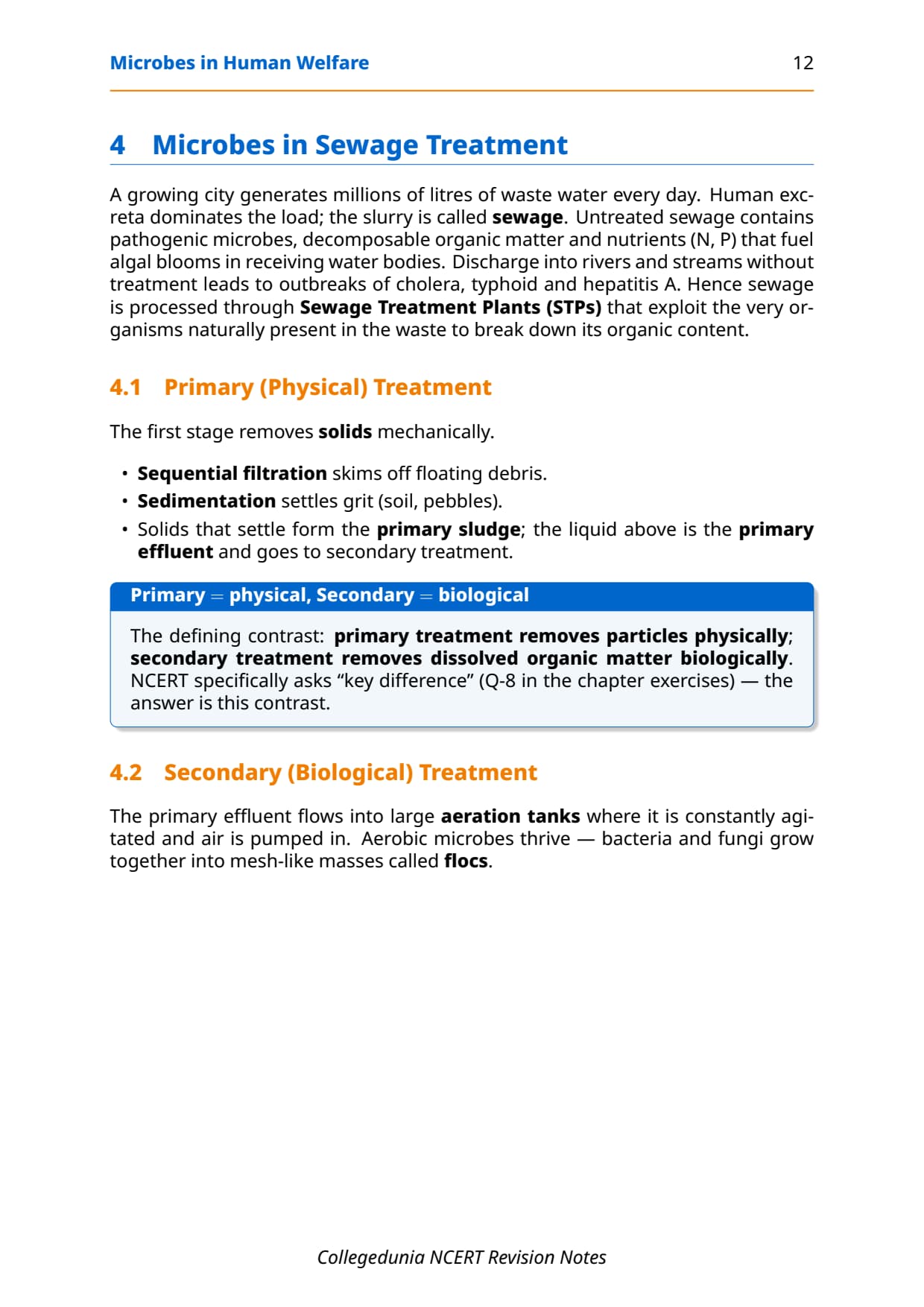
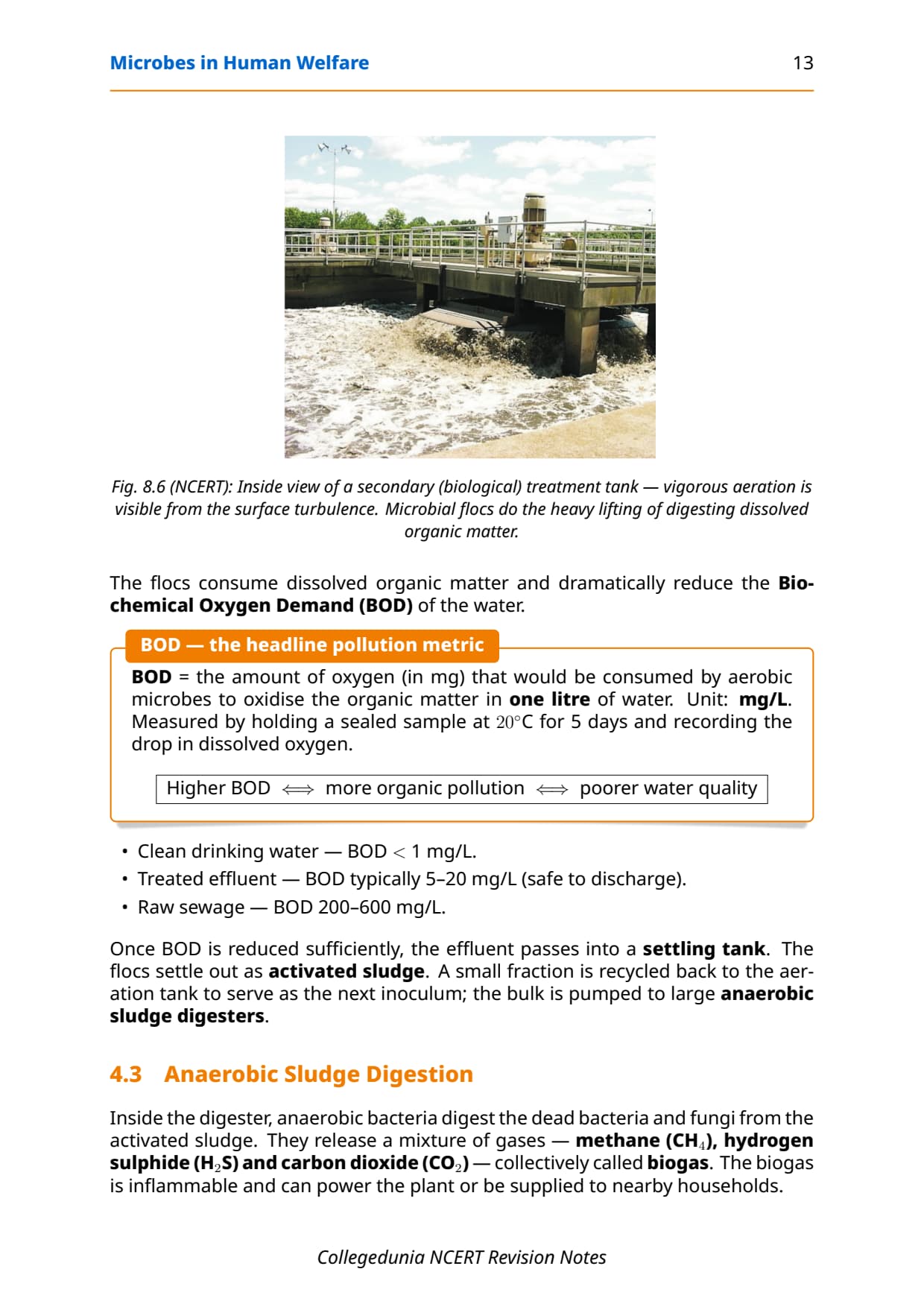
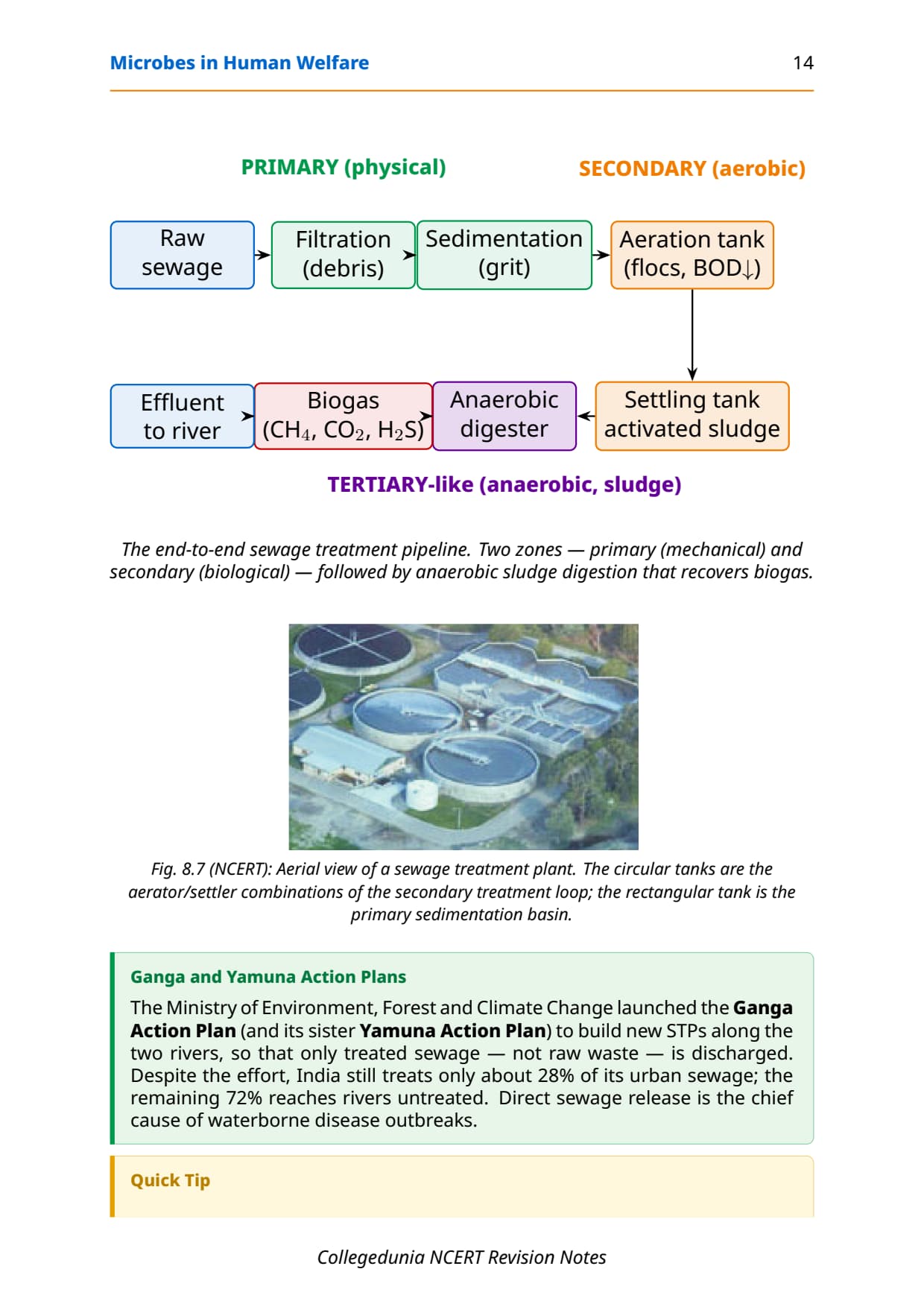
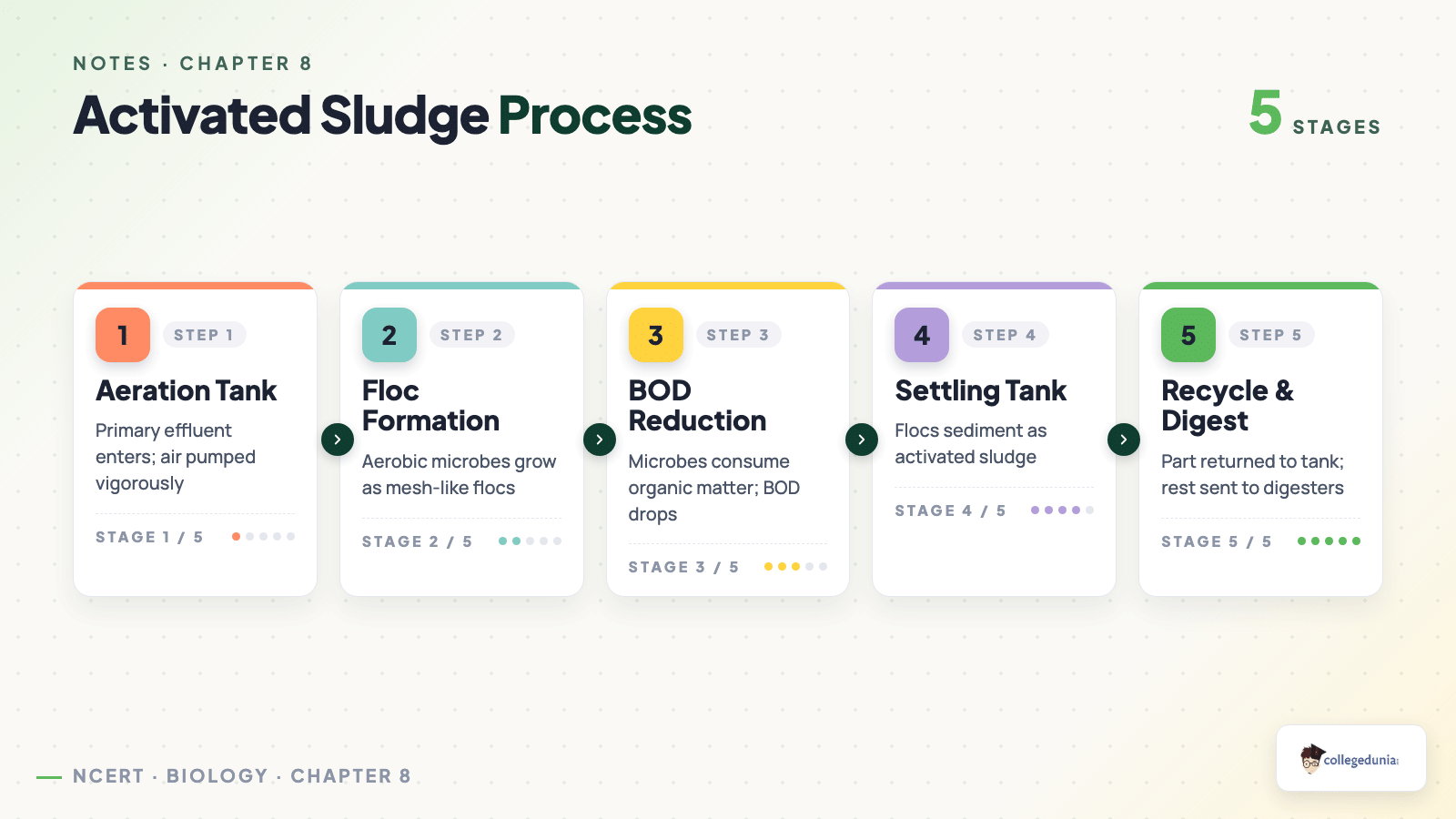
An STP has two stages. Primary treatment removes grit and debris by sedimentation. In secondary treatment, aerobic microbes form flocs that eat organic matter and cut BOD (biochemical oxygen demand). Flocs settle as activated sludge; the rest enters anaerobic digesters where methanogens release biogas.
Biogas, Biocontrol and Biofertilisers
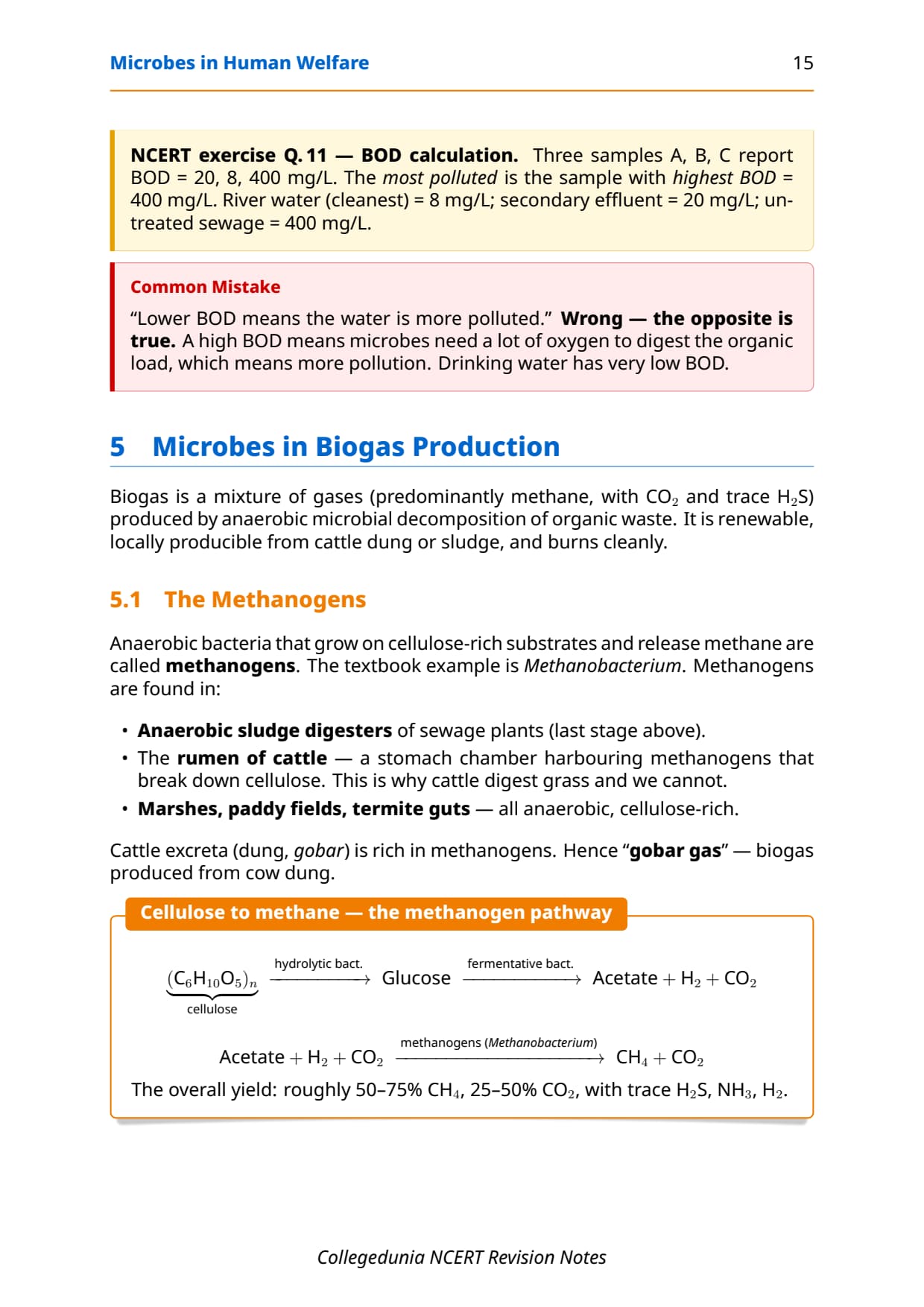
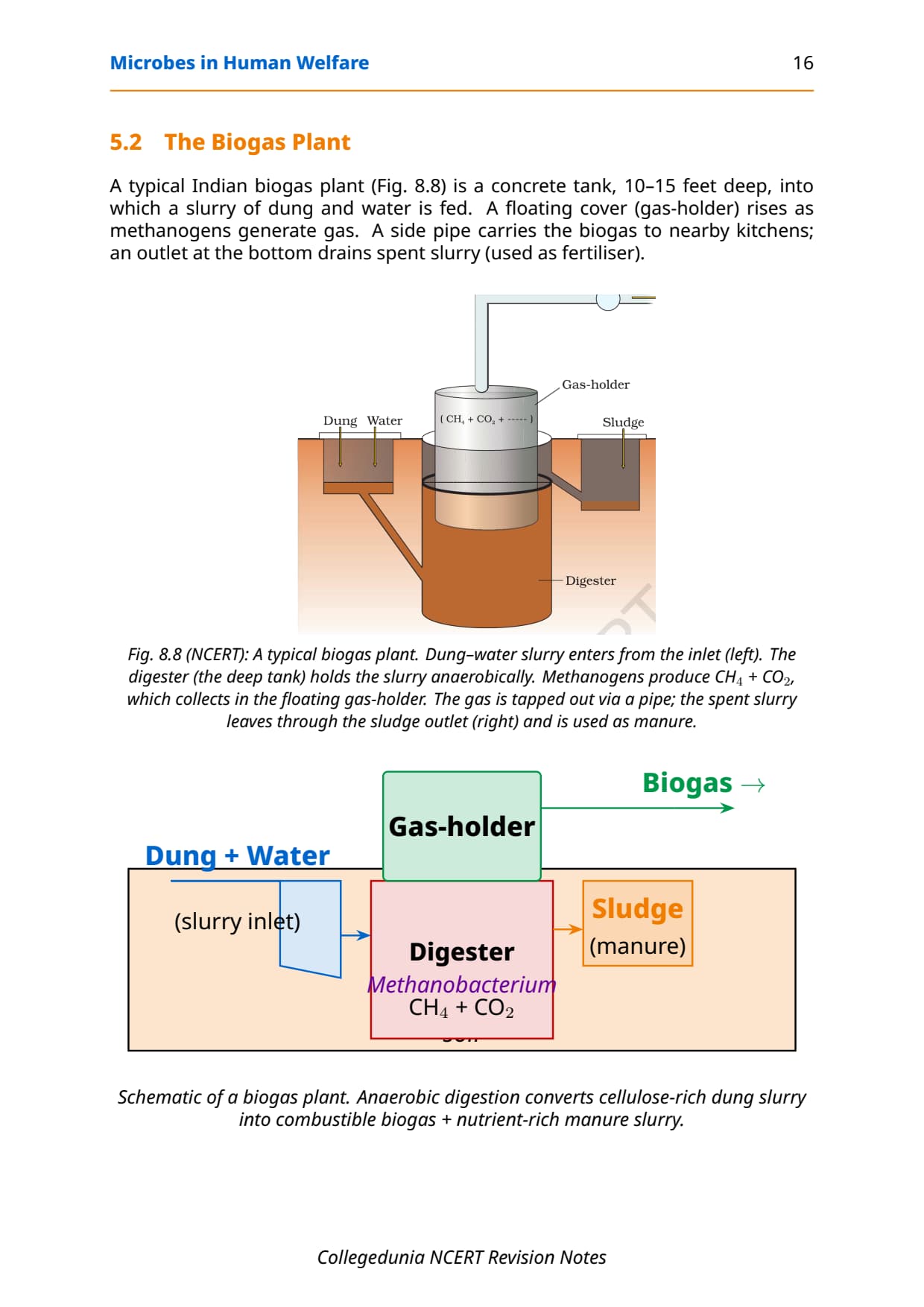
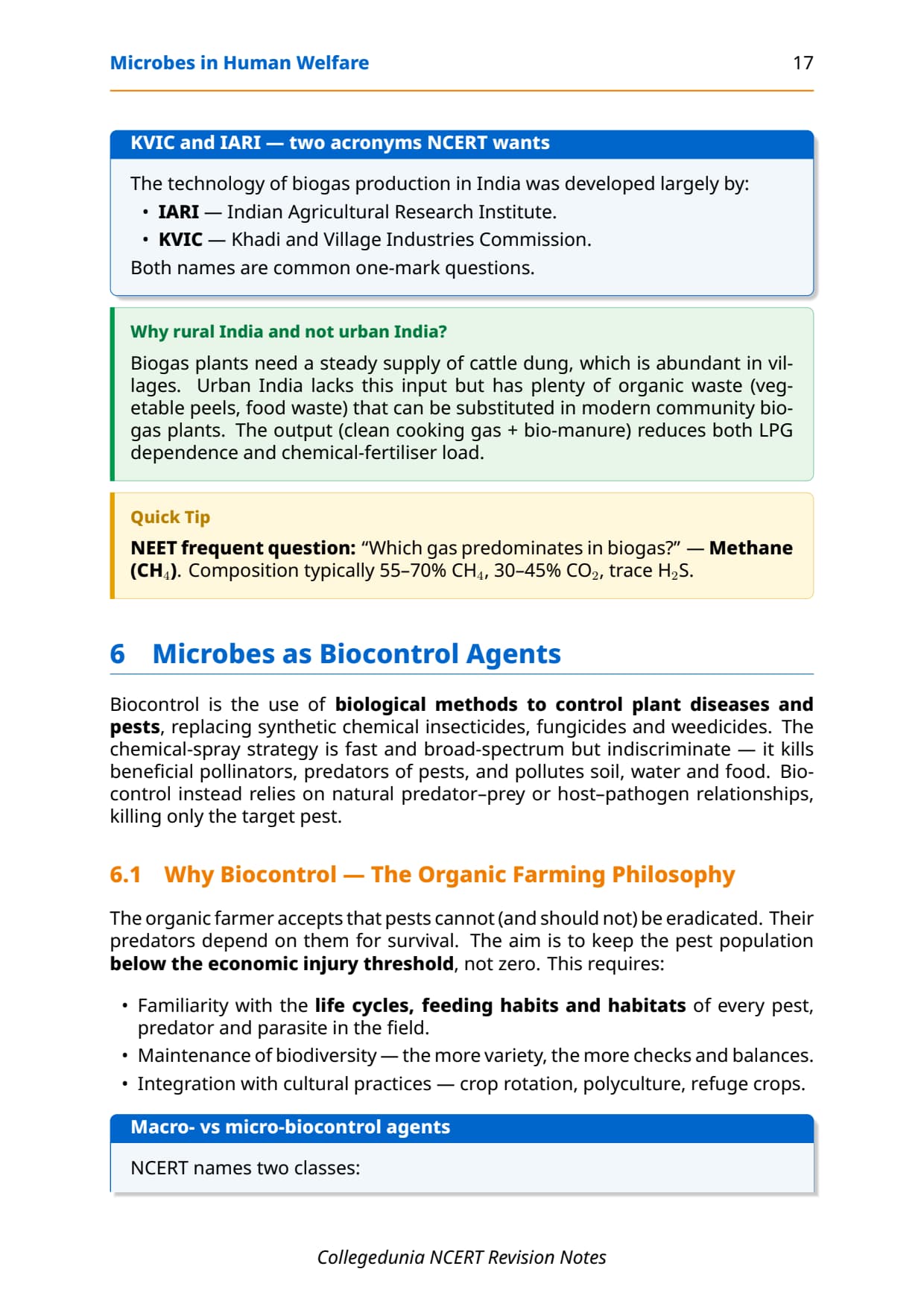
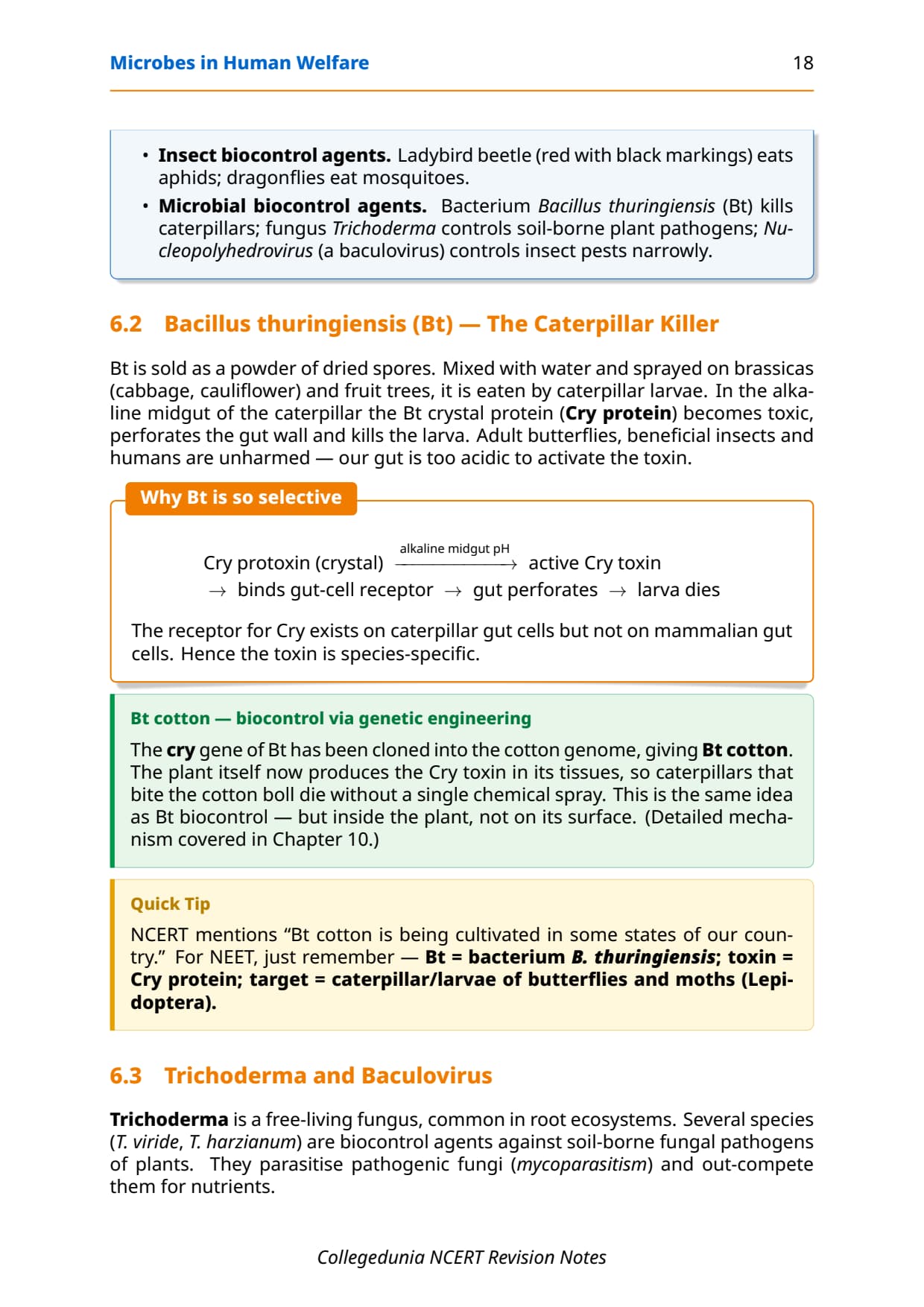
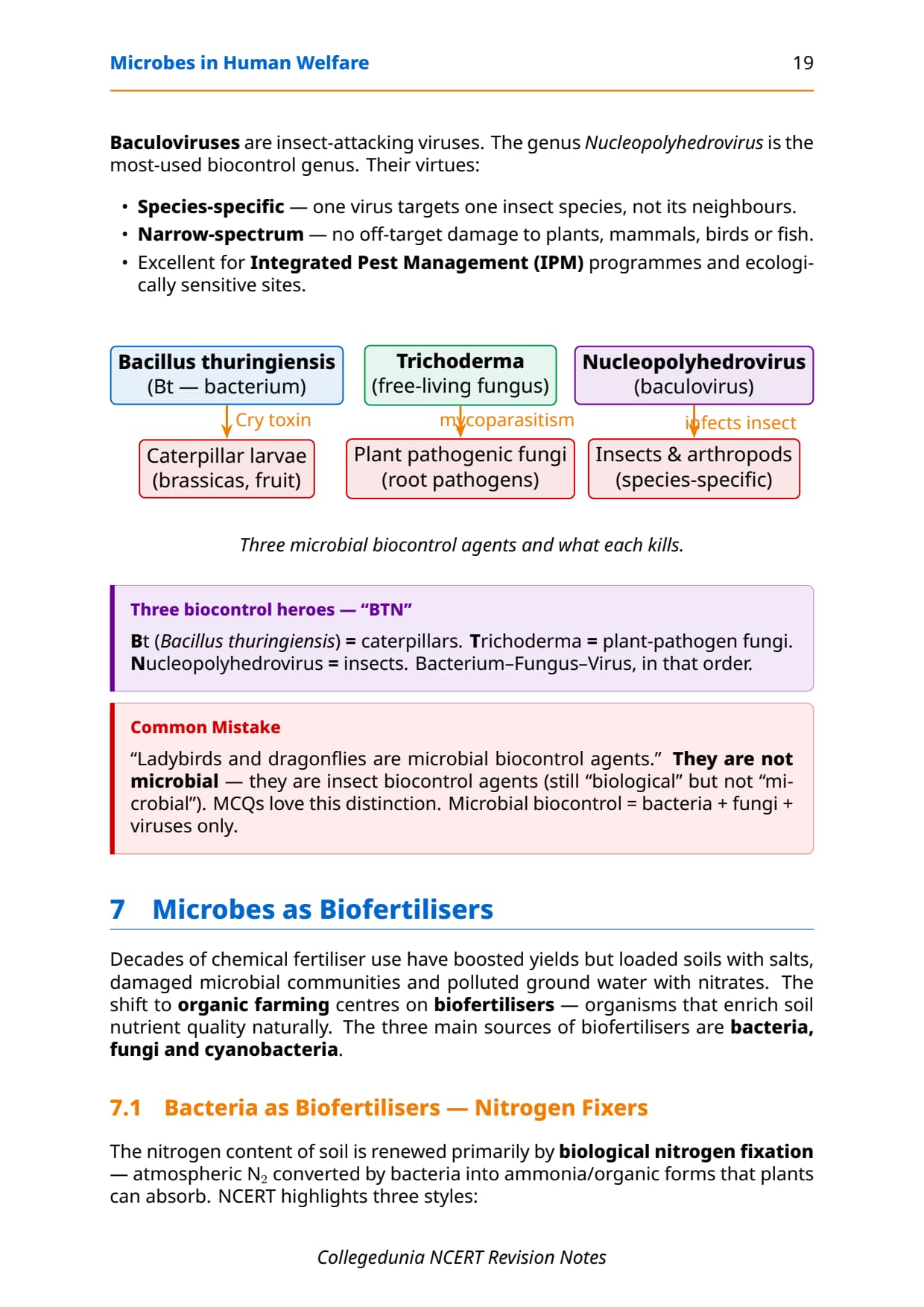
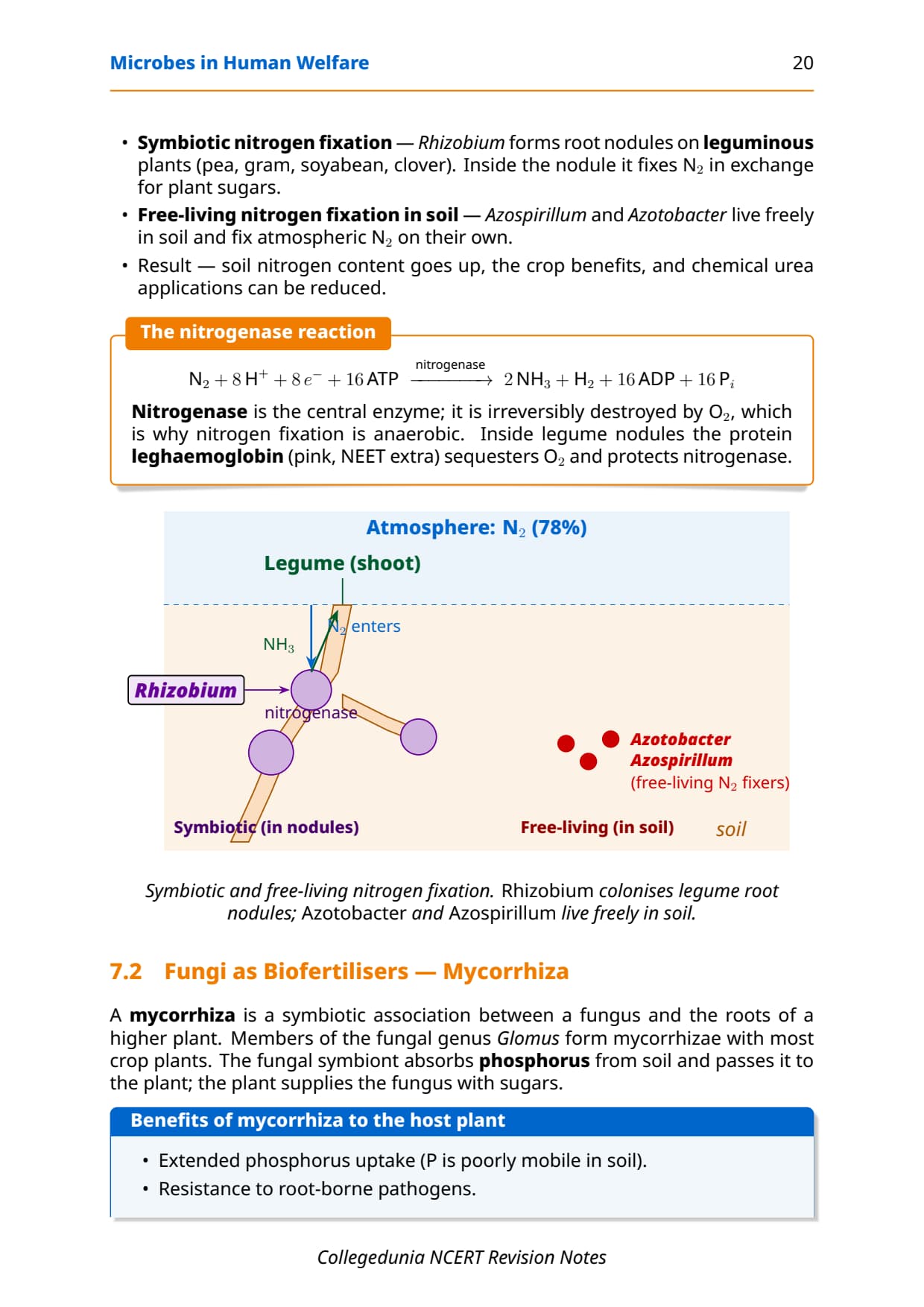
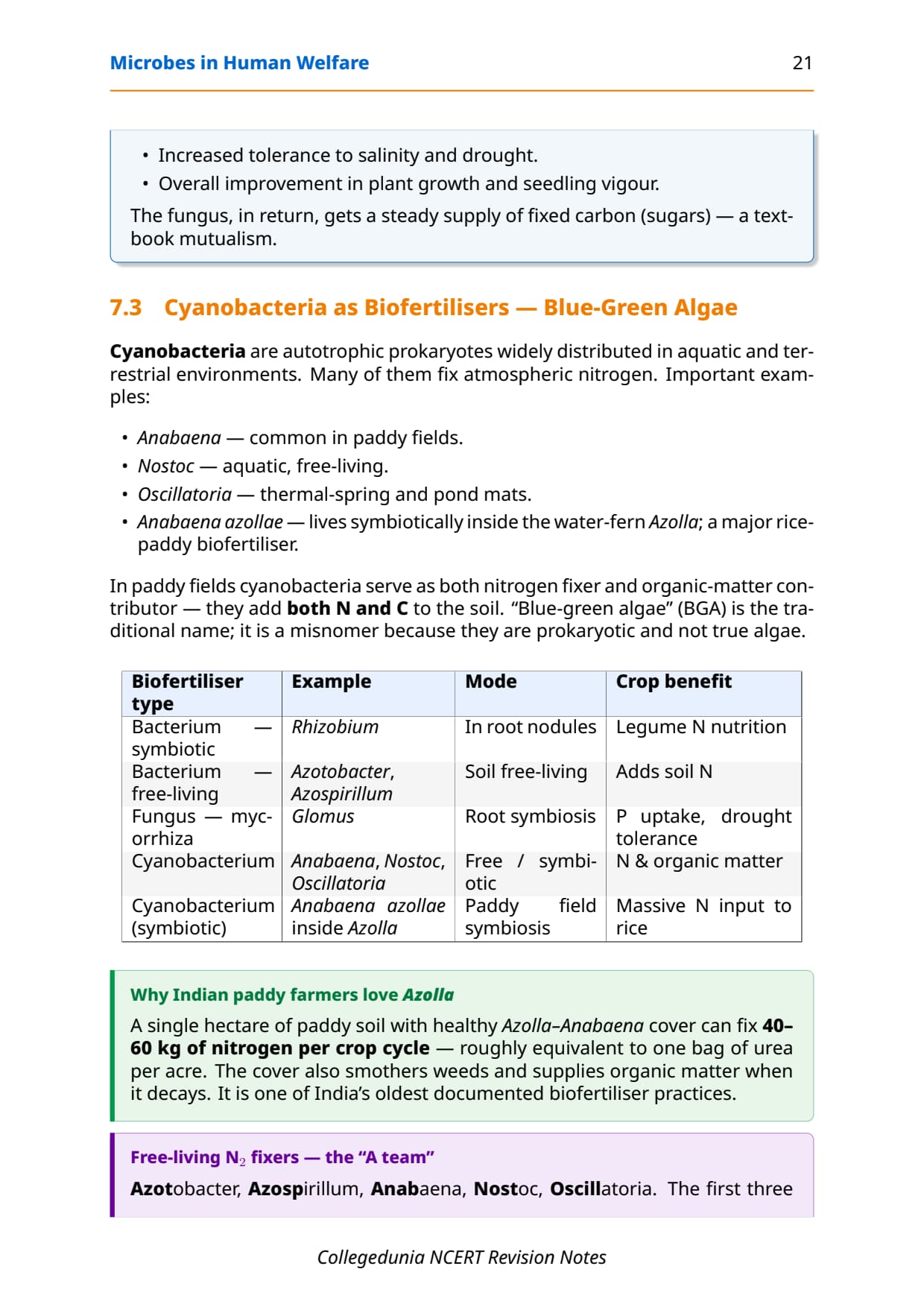
Biogas: methanogens like Methanobacterium are strict anaerobes that make methane from gobar slurry. Biocontrol: Bacillus thuringiensis (Bt) makes Cry proteins that kill caterpillars in their alkaline gut; baculoviruses are species-specific viral biopesticides. Biofertilisers: Rhizobium fixes nitrogen in legume nodules; mycorrhiza (Glomus) boosts phosphorus uptake; and cyanobacteria like Anabaena enrich paddy fields.
Microbes in Human Welfare Topic-wise Weightage for CBSE Class 12 Biology
The species-product-application list is the most repeated theme, then sewage treatment and biocontrol. The table maps each sub-topic to its CBSE frequency.
| Sub-topic | Weightage | CBSE Frequency |
|---|---|---|
| Household Products (curd, cheese, dough) | High | Almost every year |
| Industrial Products (antibiotics, enzymes) | High | 4 out of 5 years |
| Sewage Treatment - BOD, aeration | High | 4 out of 5 years |
| Biocontrol - Bt, baculovirus | Medium | 3 out of 5 years |
| Biofertilisers - Rhizobium, mycorrhiza | Medium | 3 out of 5 years |
| Biogas - methanogens, gobar plant | Medium | 2 out of 5 years |
| Fermented Beverages | Low | 1 out of 5 years |
Three themes carry over 65% of CBSE marks: household products, sewage treatment and industrial bioactive molecules.
Top 5 Microbes and Facts in Microbes in Human Welfare for Quick Recall
The five facts below recur most in NEET and CBSE.
| Microbe / Fact | Product or Role |
|---|---|
| Lactobacillus (LAB) | Curd from milk; vitamin B12 enrichment |
| Saccharomyces cerevisiae | Bread, beer, wine (brewer's yeast) |
| Penicillium notatum | Penicillin antibiotic (Fleming, 1928) |
| Bacillus thuringiensis | Bt toxin biopesticide for caterpillars |
| Rhizobium | Symbiotic nitrogen fixation in legume root nodules |
Full master sheet: Microbes in Human Welfare Class 12 Biology Formula Sheet
Common Misconceptions in Microbes in Human Welfare
Each wrong belief below has appeared as a NEET distractor in the last five years.
- Higher BOD means cleaner water. Wrong - high BOD means high organic load and dirtier water; clean water has low BOD.
- Wine and beer are distilled. Wrong - both are not distilled. Whisky, brandy and rum are.
- Penicillin was discovered by Florey. Wrong - Fleming discovered it in 1928; Chain and Florey made it clinically usable.
- Bt toxin kills all insects. Wrong - Bt is selective; the Cry protein activates only in the alkaline gut of specific larvae.
- Mycorrhiza is parasitic. Wrong - it is a symbiosis: the fungus gains carbon, the plant gains phosphate.
Microbes in Human Welfare Glossary for Class 12 Biology
Eight high-frequency terms, each asked in CBSE or NEET in the last five years.
| Term | Definition |
|---|---|
| LAB | Lactobacillus group; converts lactose to lactic acid. |
| BOD | Biochemical oxygen demand; oxygen microbes use to digest organic matter. |
| Methanogen | Anaerobic archaebacterium that produces methane (e.g. Methanobacterium). |
| Bt toxin | Cry protein from Bacillus thuringiensis, lethal to caterpillar guts. |
| Mycorrhiza | Fungus-root symbiosis enhancing phosphate uptake. |
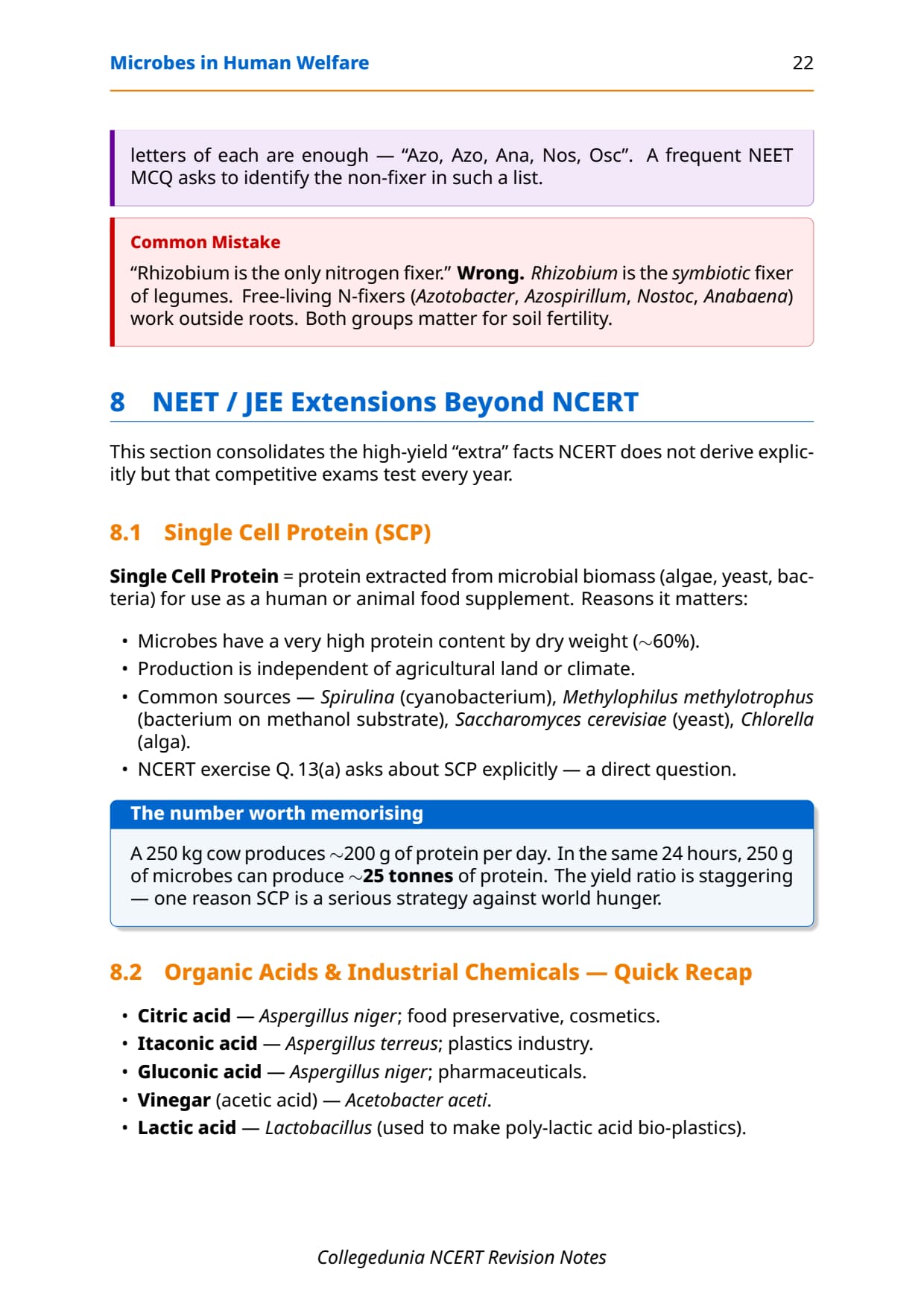
| SCP | Single Cell Protein; edible microbe biomass (e.g. Spirulina). |
Microbes in Human Welfare NEET Extensions Beyond NCERT
NEET tests four extensions that NCERT mentions only briefly:
- Single Cell Protein (SCP): Spirulina and Methylophilus methylotrophus are leading producers of edible microbial protein.
- Statins: from Monascus purpureus; competitive inhibitors of HMG-CoA reductase, the rate-limiting enzyme of cholesterol synthesis.
- Cyclosporin A: from Trichoderma polysporum; immunosuppressant for organ transplants.
- Streptokinase: from Streptococcus; a post-MI clot-buster.
NEET 2024 and 2025 each had an MCQ on statins or cyclosporin A as the bioactive molecule.
Microbes in Human Welfare Previous Year Questions Snapshot (2025 to 2021)
Species-product matching appears in every recent CBSE paper, sewage treatment in four out of five. The full year-wise map is on the NCERT Solutions page.
| Year | CBSE Topic Asked | NEET Topic Asked |
|---|---|---|
| 2025 | Sewage treatment - BOD (3 marks); Biofertilisers (5 marks) | Bt toxin gut mechanism; Statin source |
| 2024 | Microbe-product matching (2 marks); Biogas plant (3 marks) | Cyclosporin A source; Rhizobium |
| 2023 | Bt biocontrol (3 marks); Distilled vs non-distilled drinks (3 marks) | Bt cotton Cry; Penicillin discoverer |
| 2022 | Biofertiliser groups (3 marks); Mycorrhiza (2 marks) | Anabaena in paddy; LAB function |
| 2021 | Sewage treatment role (2 marks) | LAB function; Penicillin discoverer |
Full year-wise PYQ map: Microbes in Human Welfare Class 12 Biology NCERT Solutions
Microbes in Human Welfare Weightage Across Class 12 Biology Chapters
Chapter 8 sits in the mid band of the Class 12 Biology mark spread but punches above its weight in NEET, where every species is a one-line MCQ. The table compares CBSE marks for the microbiology-linked chapters.
| Chapter | CBSE Marks | Band |
|---|---|---|
| Chapter 7 Human Health and Disease | 7 marks | High |
| Chapter 8 Microbes in Human Welfare | 4 marks | Medium |
| Chapter 9 Biotechnology - Principles and Processes | 6 marks | Medium |
| Chapter 10 Biotechnology and Its Applications | 4 marks | Medium |
Chapter 8 ties with Biotechnology and Its Applications at 4 marks. Pair these notes with the Chapter 7 Human Health and Disease set for full microbiology revision.
Student Feedback
In a 2025-26 survey of 11,500 Class 12 Biology students, the biogas plant flowchart was rated the hardest sub-topic, even though it carries the highest single-question marks in CBSE and NEET papers.
- 71% of students found the biogas plant flowchart the toughest figure.
- 60% lost 1-2 marks matching fermentation products to yeast, LAB and Penicillium.
- 4 out of 5 students skipped the sewage-treatment flowchart in their answer sheet.
- Students spent about 4.7 hours on the first read and 2 hours on a revision pass.
Source: 2025-26 Class 12 Biology survey, 11,500 students across 18 states.
Other Resources for Microbes in Human Welfare Class 12 Biology
Pair these notes with the other Microbes in Human Welfare resources below.
| Resource | Link |
|---|---|
| Notes (this page) | Microbes in Human Welfare Notes |
| NCERT Solutions | Microbes in Human Welfare NCERT Solutions |
| Formula Sheet | Microbes in Human Welfare Formula Sheet |
| Handwritten Notes | Microbes in Human Welfare Handwritten Notes |
| NCERT Book PDF | Microbes in Human Welfare NCERT Book PDF |
| Exemplar Solutions | Microbes in Human Welfare Exemplar Solutions |
| Exemplar Book PDF | Microbes in Human Welfare Exemplar Book PDF |
NCERT Notes for Class 12 Biology: All Chapters
Pair this Chapter 8 set with any other chapter's Notes PDF below.
| Chapter | Notes |
|---|---|
| Chapter 1 | Sexual Reproduction in Flowering Plants |
| Chapter 2 | Human Reproduction |
| Chapter 3 | Reproductive Health |
| Chapter 4 | Principles of Inheritance and Variation |
| Chapter 5 | Molecular Basis of Inheritance |
| Chapter 6 | Evolution |
| Chapter 7 | Human Health and Disease |
| Chapter 8 | Microbes in Human Welfare (this page) |
| Chapter 9 | Biotechnology - Principles and Processes |
| Chapter 10 | Biotechnology and Its Applications |
| Chapter 11 | Organisms and Populations |
| Chapter 12 | Ecosystem |
| Chapter 13 | Biodiversity and Conservation |
Microbes in Human Welfare Class 12 Biology Notes FAQs
Ques. Where can I download Microbes in Human Welfare Class 12 Biology Notes PDF?
Ans. You can download the Microbes in Human Welfare Class 12 Biology Notes PDF directly from this page. Both the Normal and HD versions are free, and the file is mapped to the 2026-27 NCERT.
Ques. Is this Microbes in Human Welfare Notes PDF aligned with the 2026-27 NCERT?
Ans. Yes. This page reflects the current 2026-27 syllabus for Class 12 Biology Chapter 8. All six core sections - household products, industrial products, sewage treatment, biogas, biocontrol and biofertilisers - are retained in the new NCERT edition without removal.
Ques. How many pages is the Class 12th Biology Microbes in Human Welfare Notes PDF?
Ans. The Notes PDF runs approximately 26 pages and covers all eight chapter sections plus a NEET extensions block with Single Cell Protein, statins, cyclosporin A and a master species-product-application table.
Ques. What are the most important topics in Microbes in Human Welfare Class 12 for NEET?
Ans. The microbe-product-application list (LAB curd, yeast bread, penicillin), sewage treatment with BOD, Bacillus thuringiensis Bt toxin mechanism, biofertilisers (Rhizobium, mycorrhiza, Anabaena) and the NEET-only bioactive molecules (statins, cyclosporin A, streptokinase) carry the highest NEET frequency.
Ques. What is BOD and why does it matter in sewage treatment?
Ans. BOD (Biochemical Oxygen Demand) is the oxygen that microbes consume to digest organic matter in a water sample. A high BOD signals high organic pollution and dirty water; a sharp drop in BOD during the aeration tank stage is the key signal that secondary treatment has worked.
Ques. Which microbe is used to produce penicillin and who discovered it?
Ans. Penicillin is produced by the fungus Penicillium notatum. Alexander Fleming discovered it in 1928; Ernst Chain and Howard Florey later converted it into a clinically usable drug. The three shared the 1945 Nobel Prize in Physiology or Medicine.
Ques. How does Bacillus thuringiensis act as a biocontrol agent?
Ans. Bacillus thuringiensis produces crystal proteins (Cry proteins, Bt toxin) in its spores. When a caterpillar larva eats the spore, the alkaline midgut activates the toxin; the activated toxin forms pores in the gut wall, killing the larva. The same gene is engineered into Bt cotton for bollworm control.
Ques. Are these Microbes in Human Welfare notes useful for NEET 2027?
Ans. Yes. NEET draws 2 to 4 questions from this chapter every year, often as direct species-product MCQs. The notes flag NEET-only depth such as the statin enzyme target (HMG-CoA reductase), the baculovirus genus name and the Single Cell Protein data so you do not need a separate NEET book for this chapter.



Comments