


The 2026-27 NCERT places Organisms and Populations as Chapter 11 of Class 12 Biology, renumbered from old Chapter 13 and retained in full as the gateway to Unit 10 Ecology. It stays one of the most NEET-quotable units because every interaction, from commensalism to amensalism, is a sign-pair MCQ. This page hosts the Notes PDF with logistic growth derivations and master interaction tables.
- CBSE Weightage: 5 to 7 marks
- NEET Weightage: 3 to 5 questions per year
- JEE / AIIMS-style entrance: 1 question per paper
Student Pulse: Chapter 11 Organisms and Populations Difficulty Read from a Recent Class 12 Biology Survey
In a recent independent survey of 11,300 Class 12 Biology students conducted before the 2026 boards, 70% rated the logistic-growth equation derivation as the hardest sub-topic in the chapter, even though it routinely carries the highest single-question marks in CBSE and NEET papers.
The same survey gave us the breakdown below, which a Class 12 student should look at before deciding how to allocate revision time across organisms and populations class 12 biology notes topics.
What 11,300 students told us about the Chapter 11 Organisms and Populations Notes journey:
- 70% of students surveyed marked the logistic-growth equation derivation as the hardest sub-topic.
- 59% reported losing 1-2 marks on classifying mutualism, commensalism, predation, and parasitism examples, even when the rest of their answer was correct.
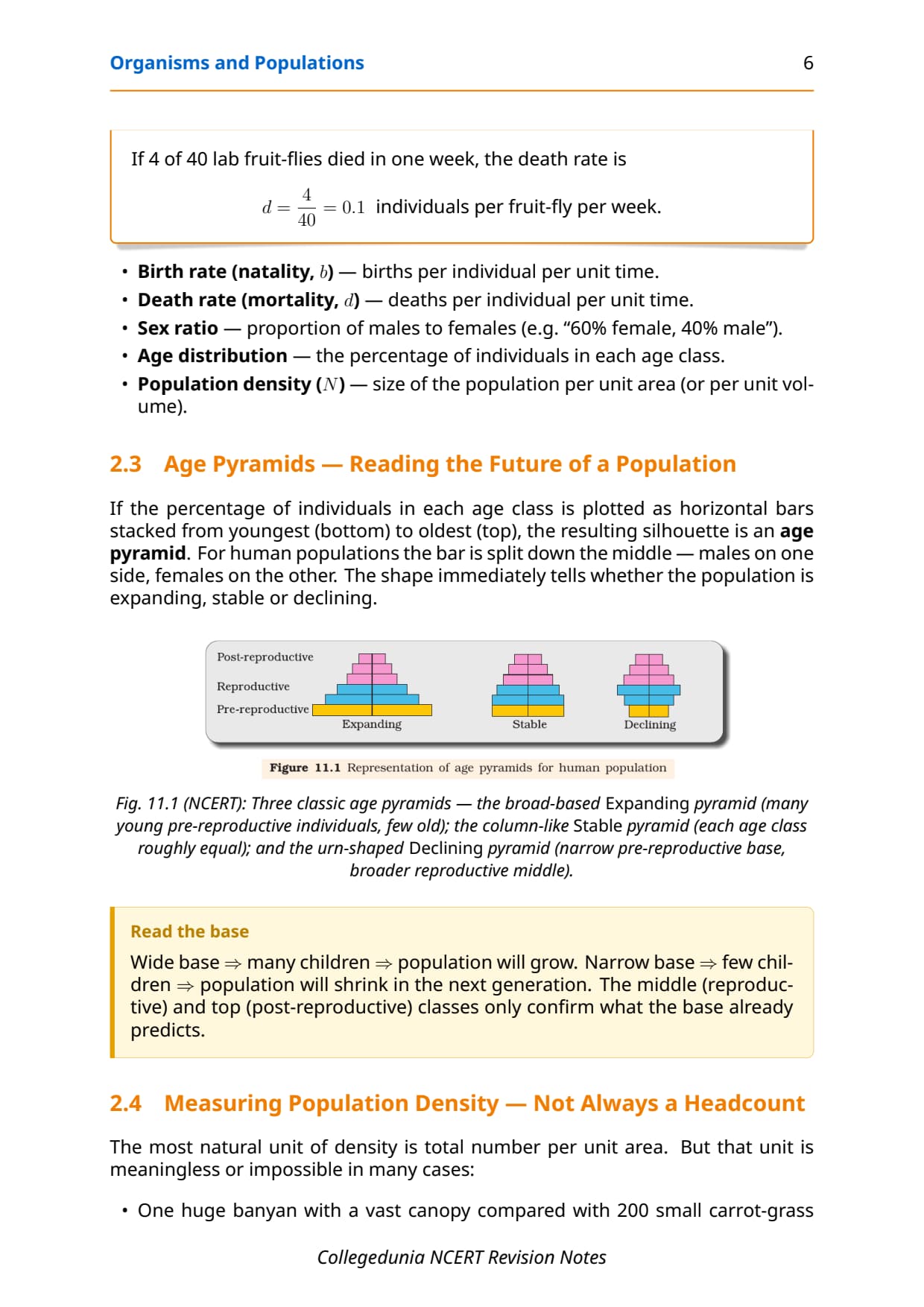
- 4 out of 5 students said the age-pyramid (expanding / stable / declining) figure was the most-skipped figure in their answer sheet.
- Average student took 5.2 hours for the first read of the chapter, and 2.1 hours for a focused revision pass before the board exam.
- Of the 11,300 students surveyed, only 39% attempted all 16 NCERT exercise questions; the rest stopped earlier. Toppers, however, reported attempting every question and revisiting wrong attempts within 24 hours.
Source: 2025-26 Class 12 Biology student survey. Sample of 11,300 students from CBSE-affiliated schools across 18 states.
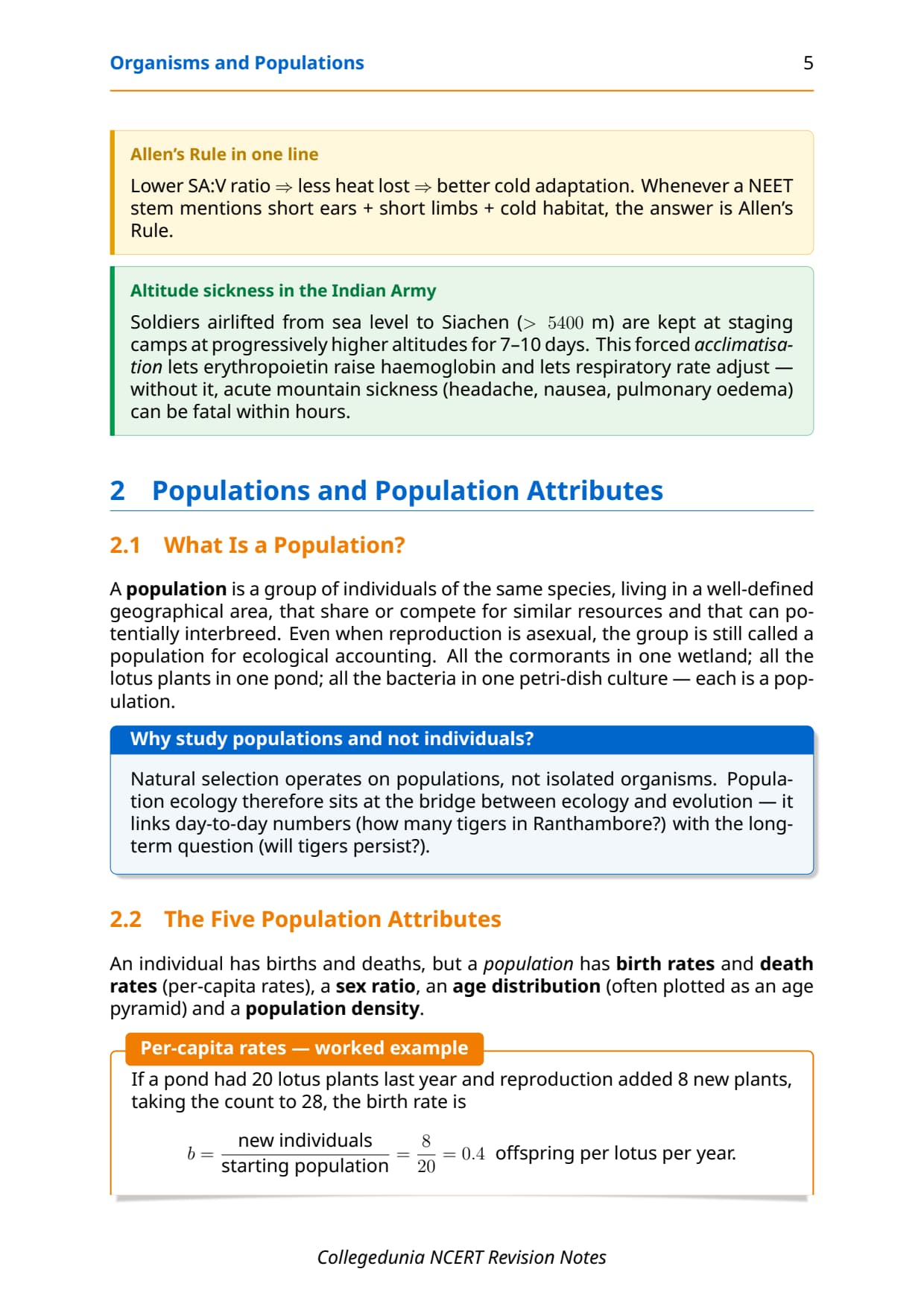
These notes consolidate the full NCERT text and add the NEET-favourite interaction matrix, growth-curve panel and adaptation cheat-strip into one revision PDF.
These Class 12 Biology Chapter 11 notes are curated by Collegedunia subject experts, mapped to the 2026-27 NCERT, and verified against the last five years of CBSE Board and NEET papers.
Also Check:
- Organisms and Populations Class 12 Biology Handwritten Notes
- Organisms and Populations Class 12 Biology Formula Sheet
- Organisms and Populations Class 12 Biology NCERT Book PDF
Organisms and Populations Video Walkthrough
Source: Magnet Brains on YouTube
Organisms and Populations Topic-by-Topic Notes for Class 12 Biology
The chapter walks from the levels of biological organisation through abiotic factors, organismic responses, population attributes, growth models and finishes with the six interspecific interactions. The concept-by-concept summary below works as a primary revision pass.
Levels of Ecological Organisation
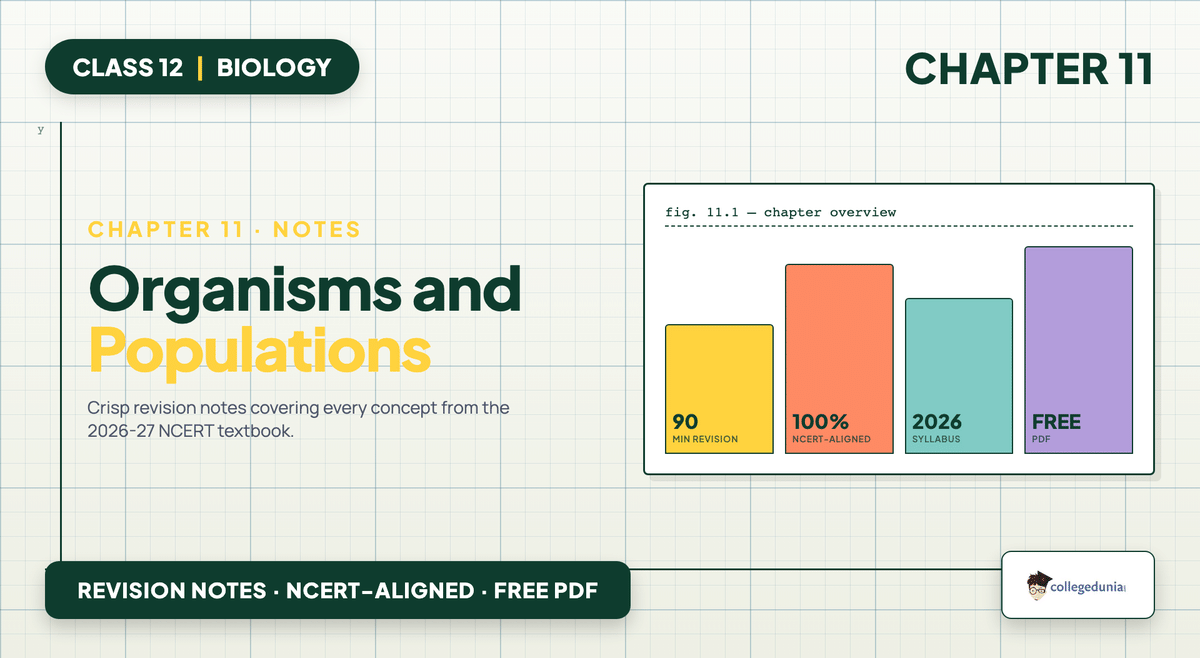
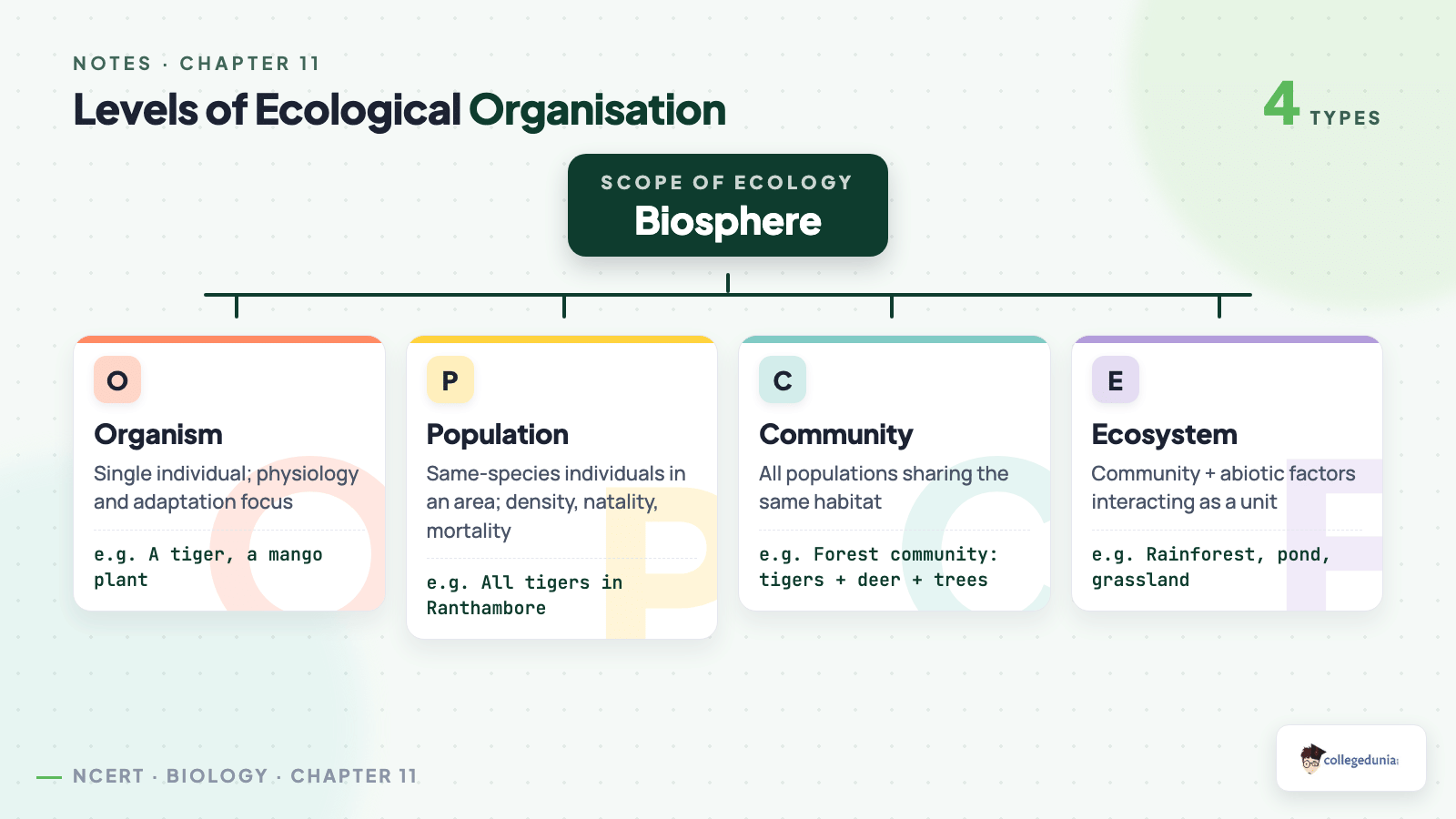
Ecology operates at four levels: organism → population → community → biome. This chapter covers the first two. A population is a group of individuals of one species sharing a habitat at one time; a community is multiple interacting populations. Krakatau after 1883 is the classic case of community re-assembly.
Major Abiotic Factors
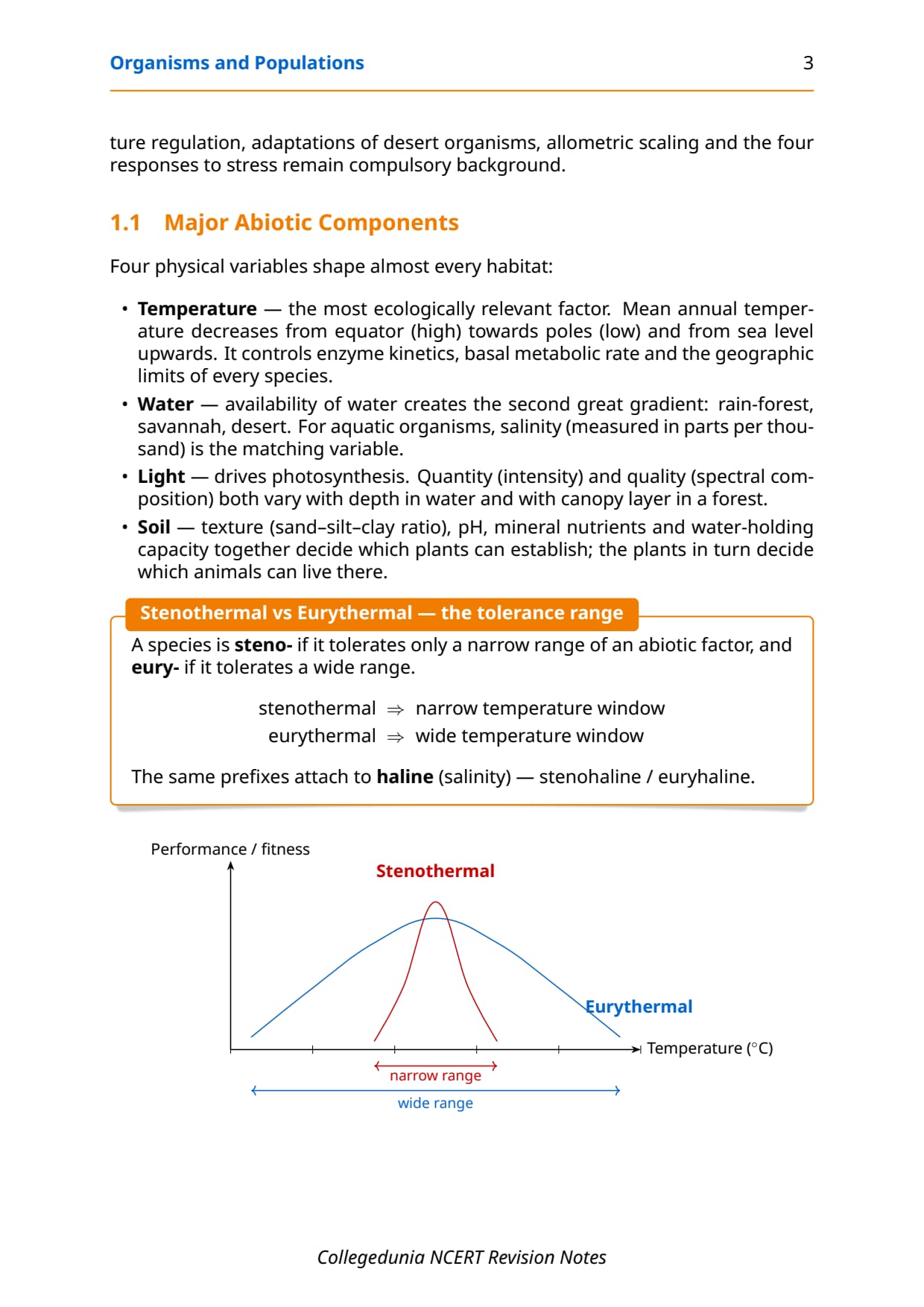
Four primary abiotic drivers shape distribution: temperature, water, light and soil. Temperature sets enzyme kinetics and metabolic rate. Water availability splits hydric, mesic and xeric habitats. Light drives photosynthesis and photoperiod responses. Soil (pH, texture, mineral content, water-holding capacity) governs rooting and microbial activity. NEET 2024 tested the photoperiod term verbatim with marigold as the example.
Responses to Abiotic Factors
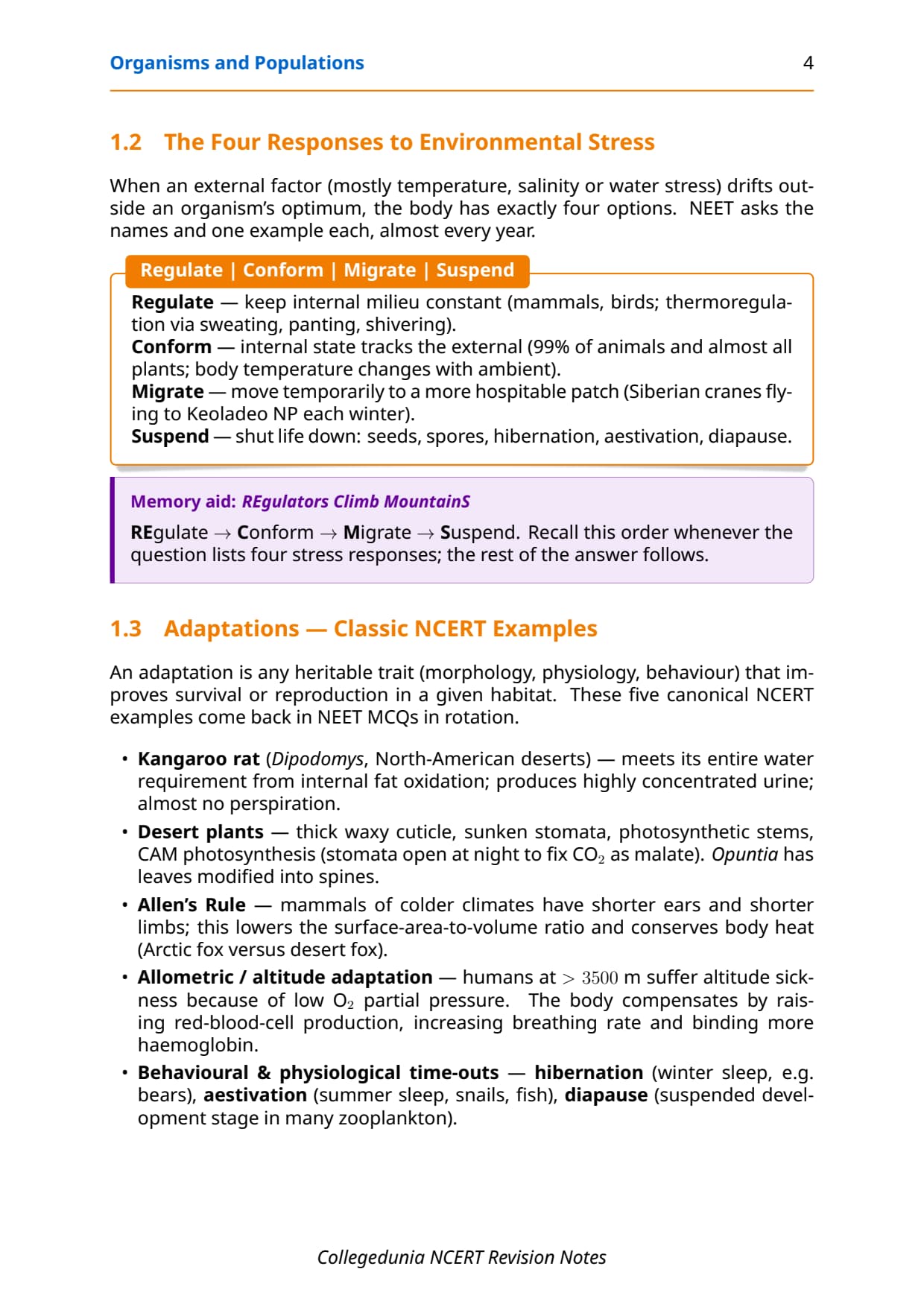
Organisms respond by one of five strategies: regulate, conform, migrate, suspend or tolerate. Regulators hold body temperature and osmotic concentration constant (mammals, birds). Conformers let internal conditions track the environment (most invertebrates, 99 percent of animals). Migration moves the organism: flamingos to Rann of Kachchh. Suspension is dormancy: bear hibernation in winter, snail aestivation in summer, zooplankton diapause, bacterial endospores. Adaptation is the long-evolved trait set.
Adaptations: Examples to Quote
Desert plants (xerophytes): thick cuticle, sunken stomata, CAM photosynthesis (Opuntia with leaves reduced to spines and stems as photosynthetic organs). Desert animals: kangaroo rat (oxidative water from fat), thick scales in reptiles. High-altitude humans: RBC count rises, breathing rate increases, haemoglobin binding affinity for O2 shifts. Aquatic organisms in salt water: osmoregulation via gills and kidneys.
Population Attributes
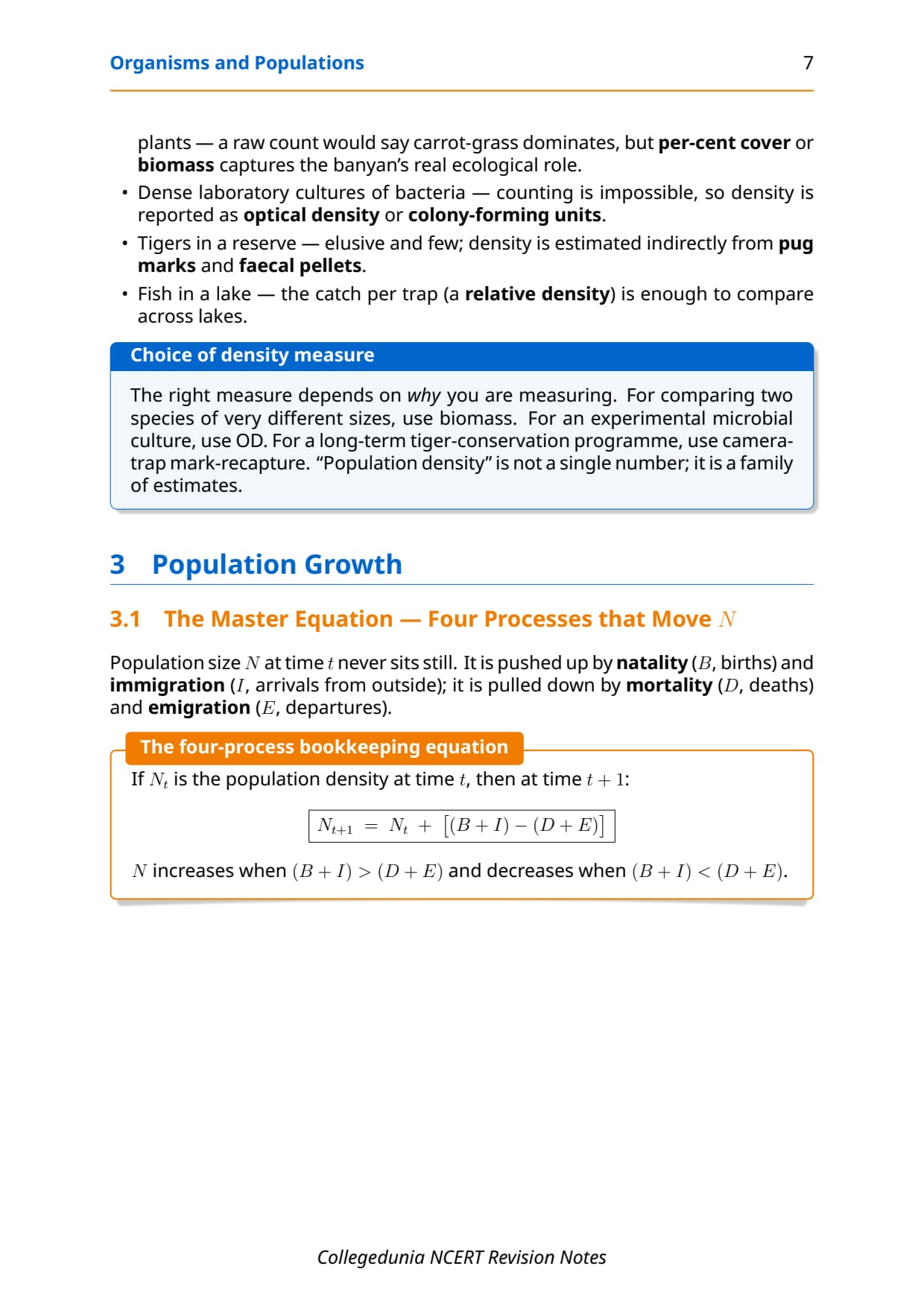
A population has four measurable attributes: density (N), natality (B), mortality (D), age distribution. Density = number per unit area or volume; can be absolute (count), relative (pugmark, fish catch per net) or biomass. Sex ratio and age pyramid (expanding-triangle, stable-bell, declining-urn) round out the structure. The change rule: Nt+1 = Nt + (B + I) - (D + E) , where I = immigration and E = emigration.
Population Growth Models
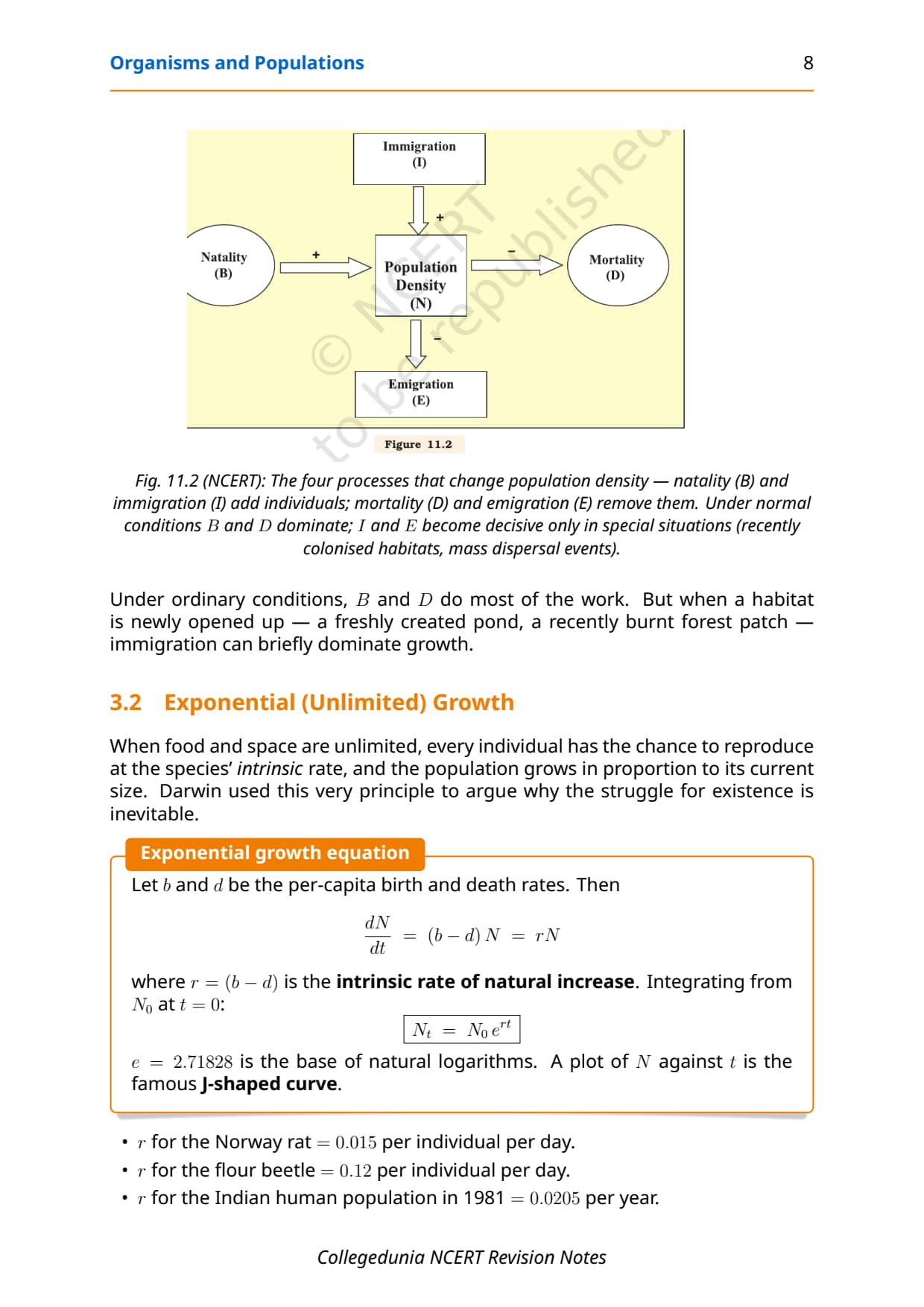
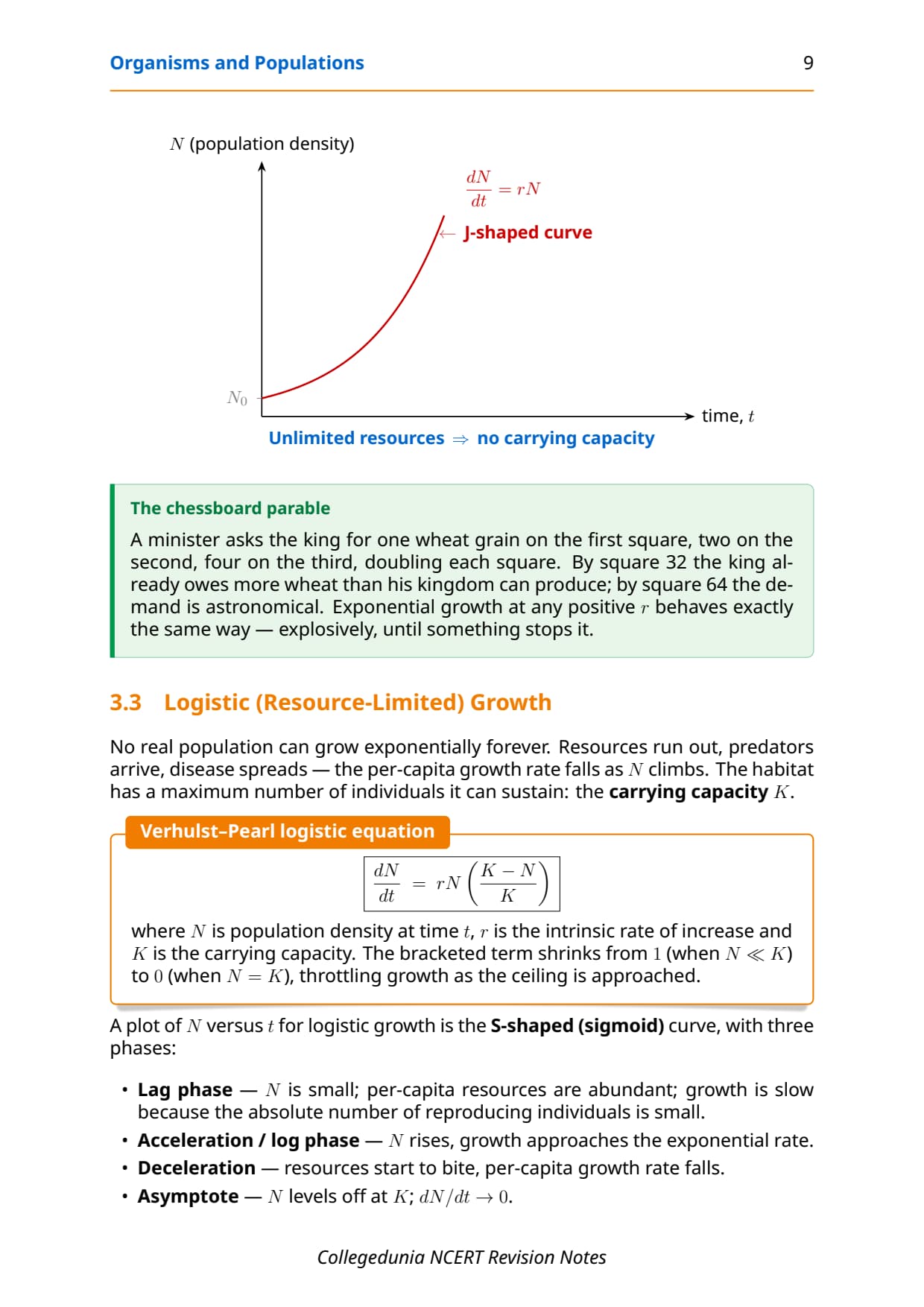
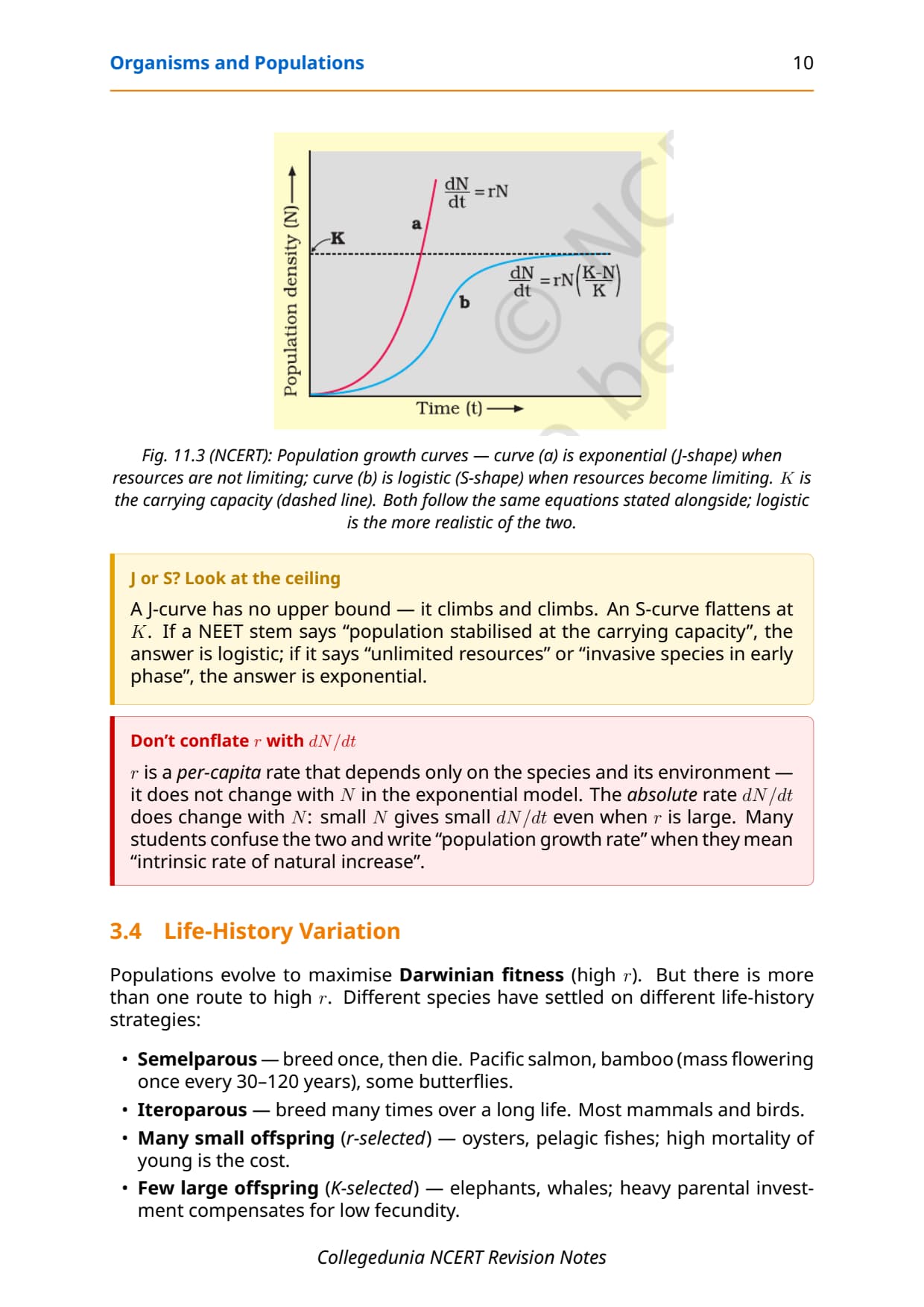
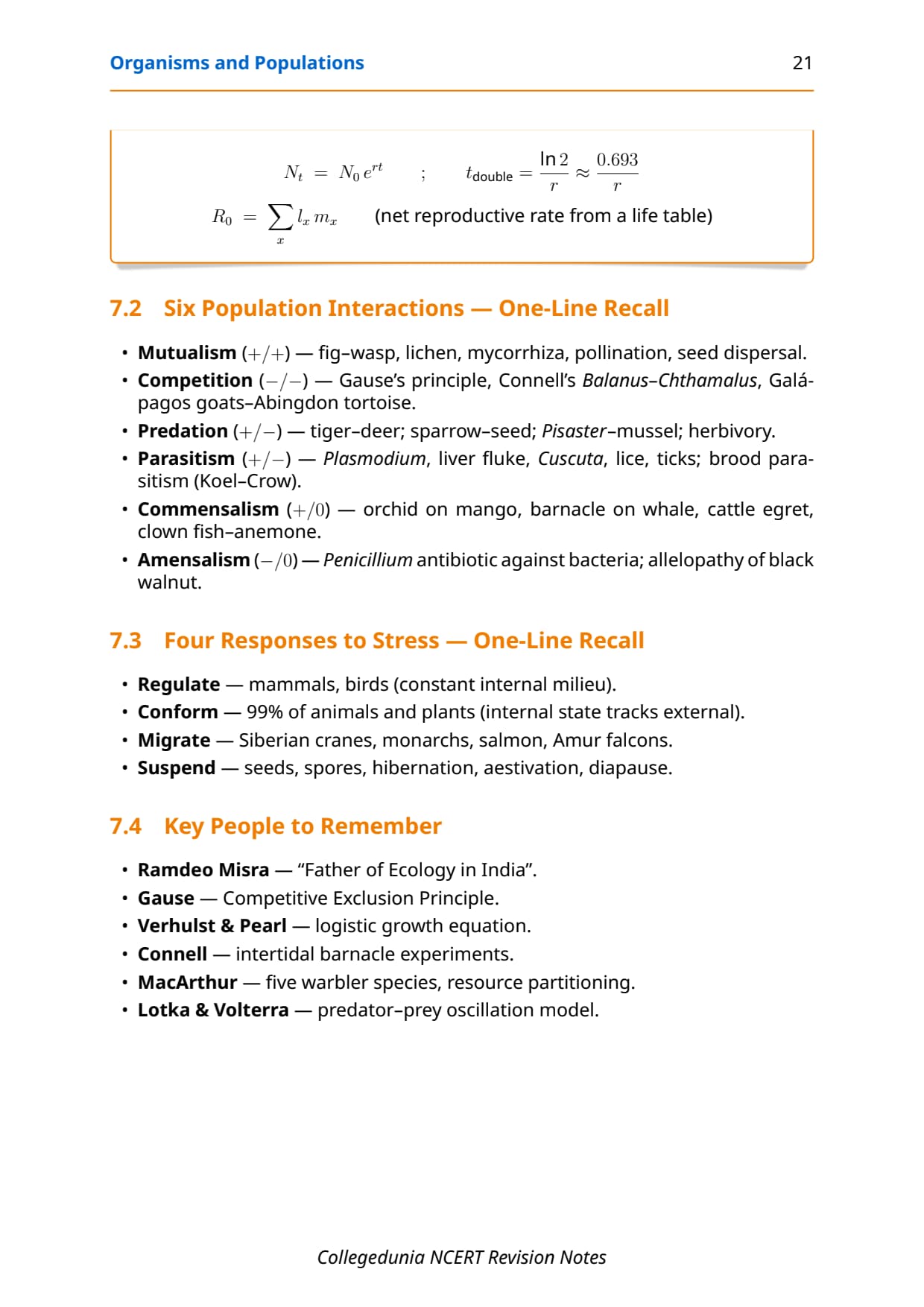
Exponential (geometric): $$\dfrac{dN}{dt} = rN \Rightarrow N_t = N_0 e^{rt}$$ J-shaped curve; assumes unlimited resources. Logistic (Verhulst-Pearl): $$\dfrac{dN}{dt} = rN\left(\dfrac{K-N}{K}\right)$$ S-shaped sigmoid with asymptote at carrying capacity K. r is the intrinsic rate of natural increase; values: human r in India circa 1981 = 0.0205 per capita per year.
Life History Variation
Natural selection favours the reproductive schedule that maximises Darwinian fitness. r-strategists (most invertebrates, weeds) reproduce many times but produce many small offspring with low survival. K-strategists (large mammals, oaks) reproduce few times with few large offspring and high parental investment. Pacific salmon breeds once and dies (semelparity); humans breed many times (iteroparity).
Population Interactions
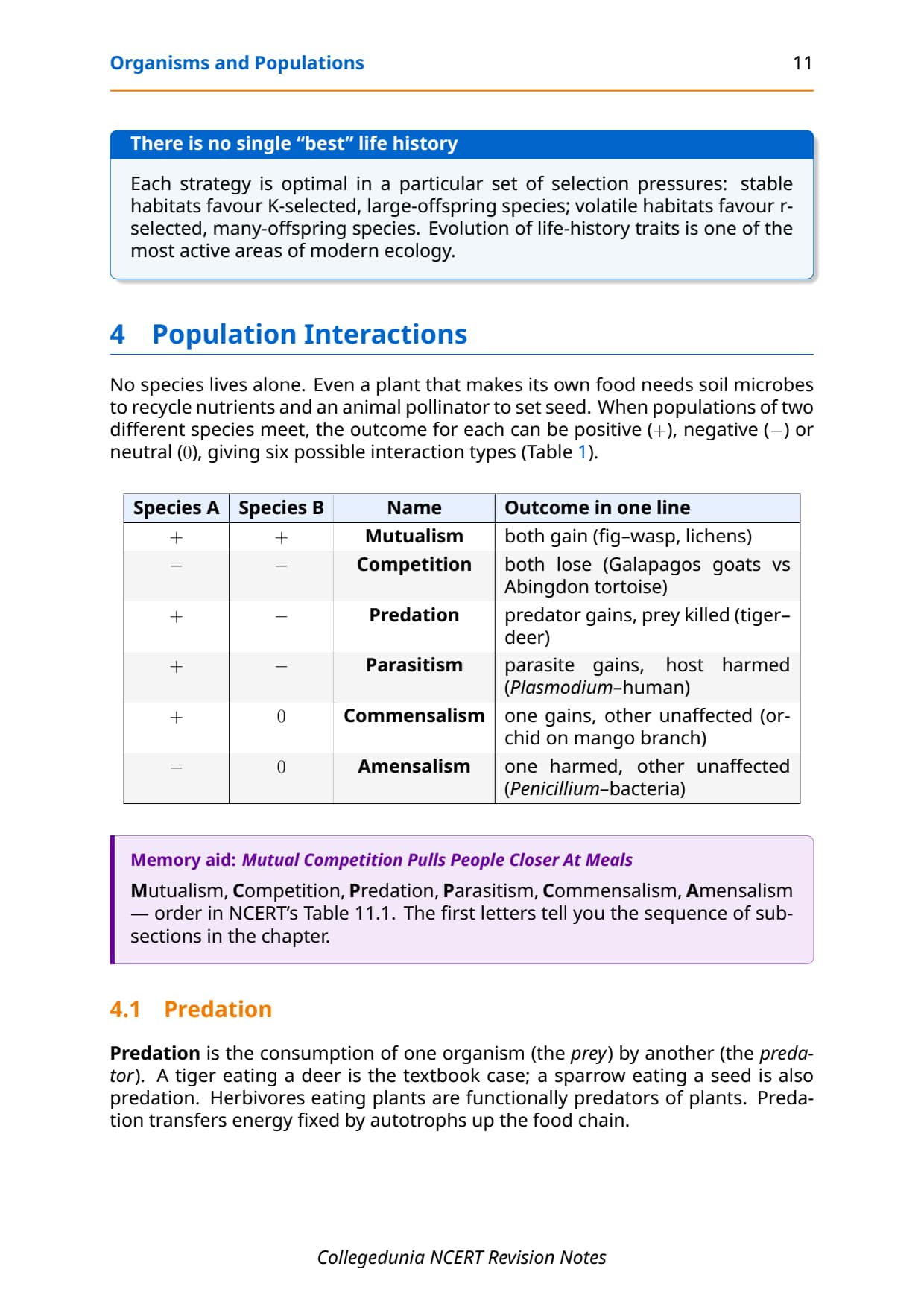
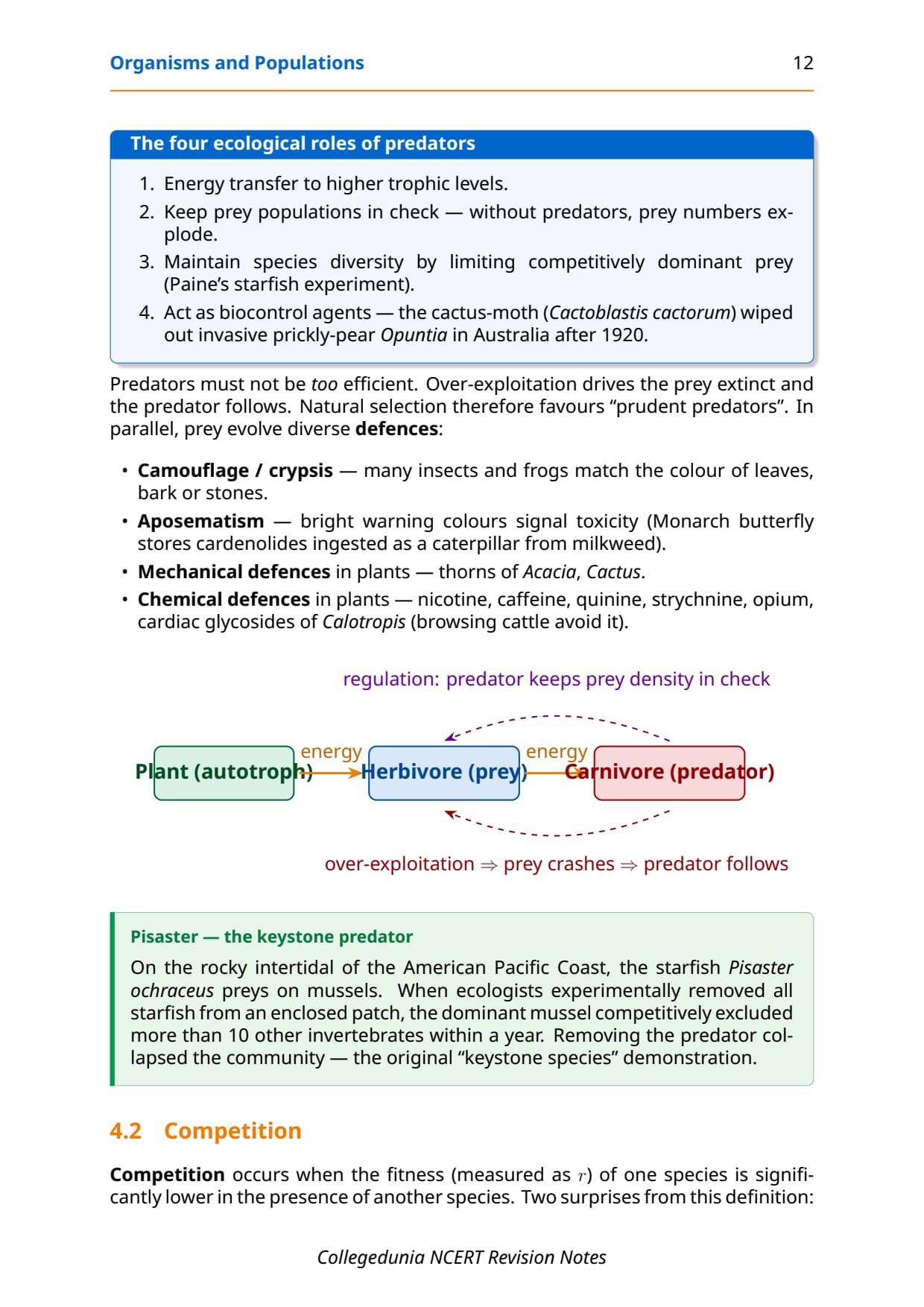
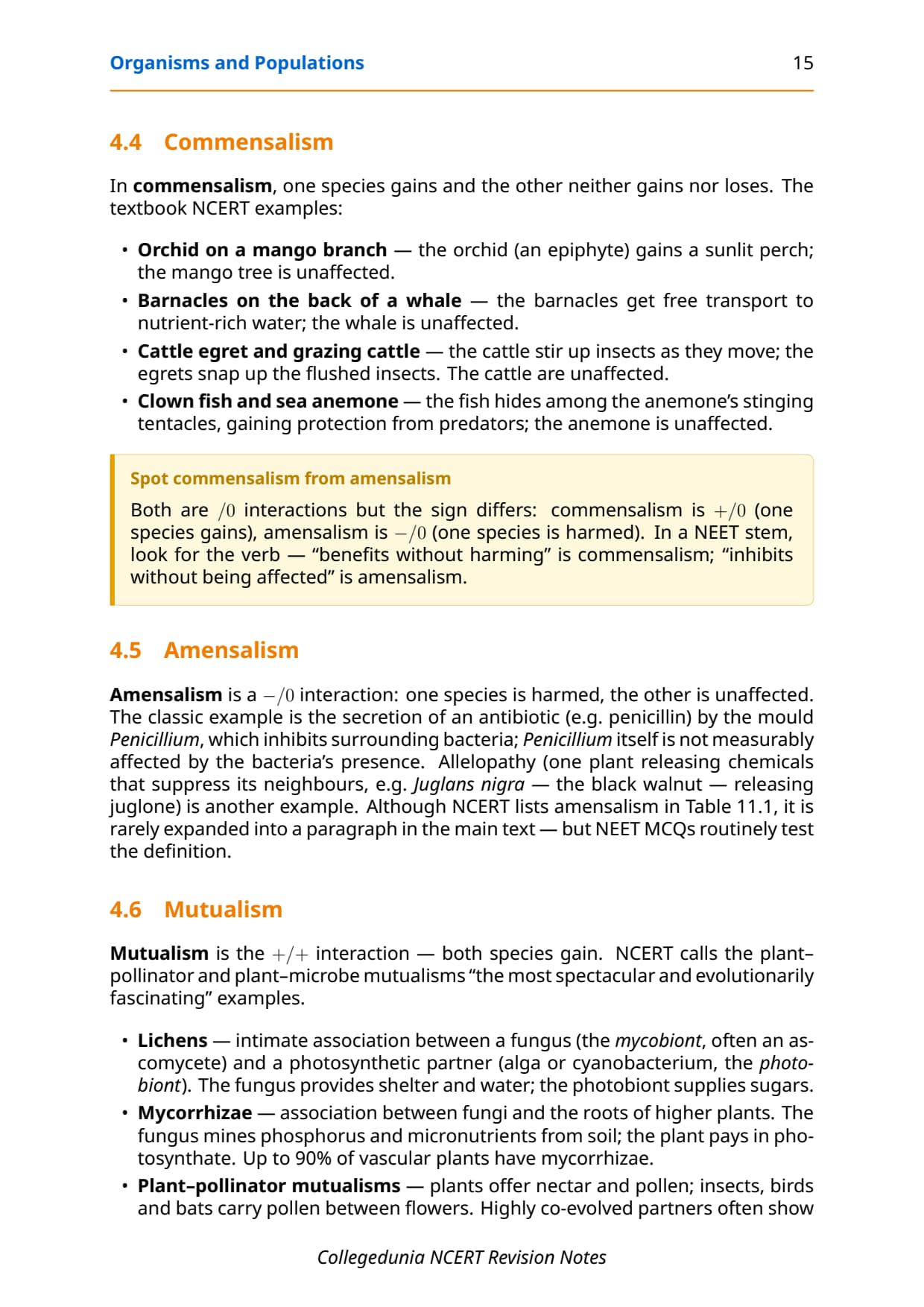
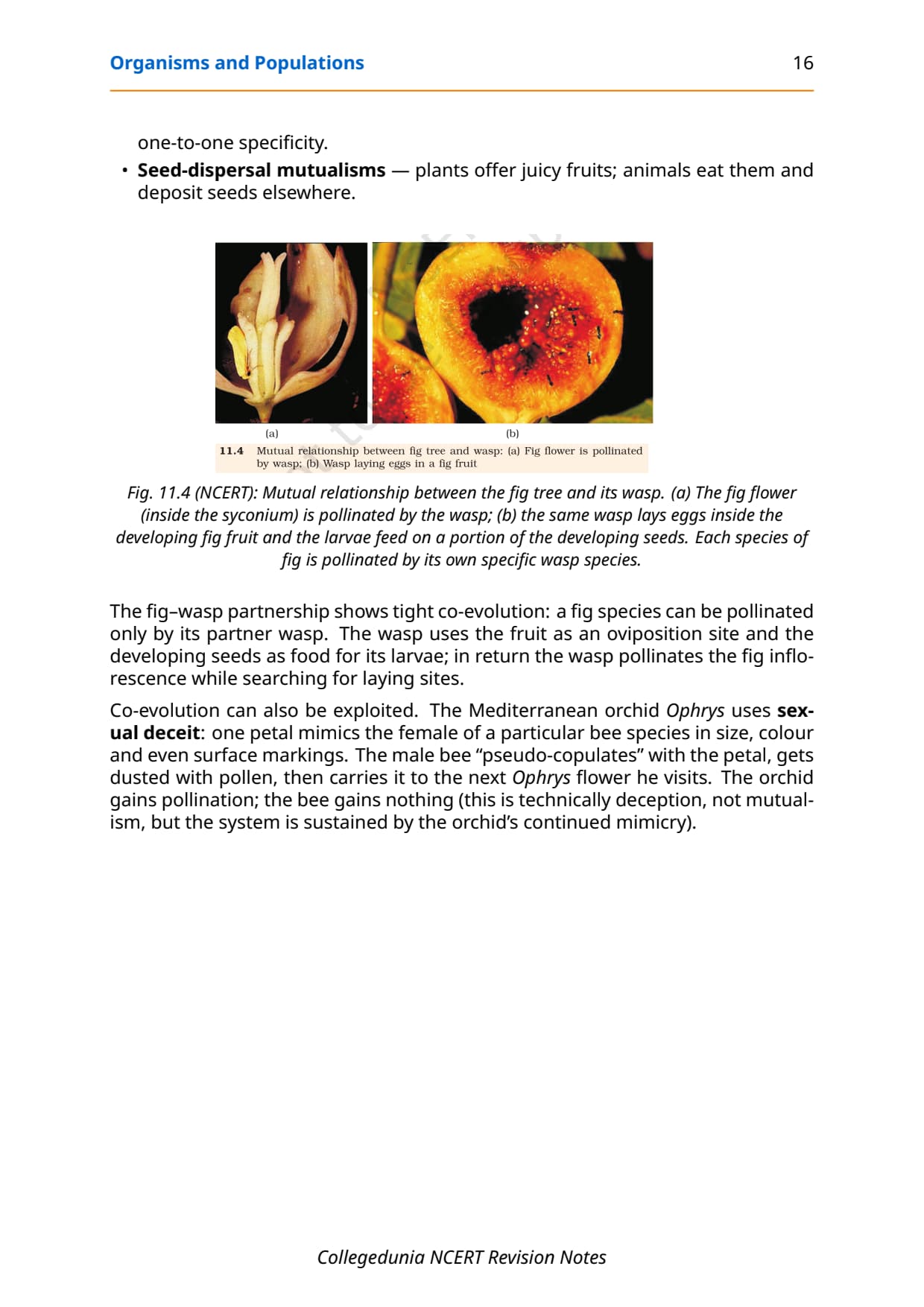
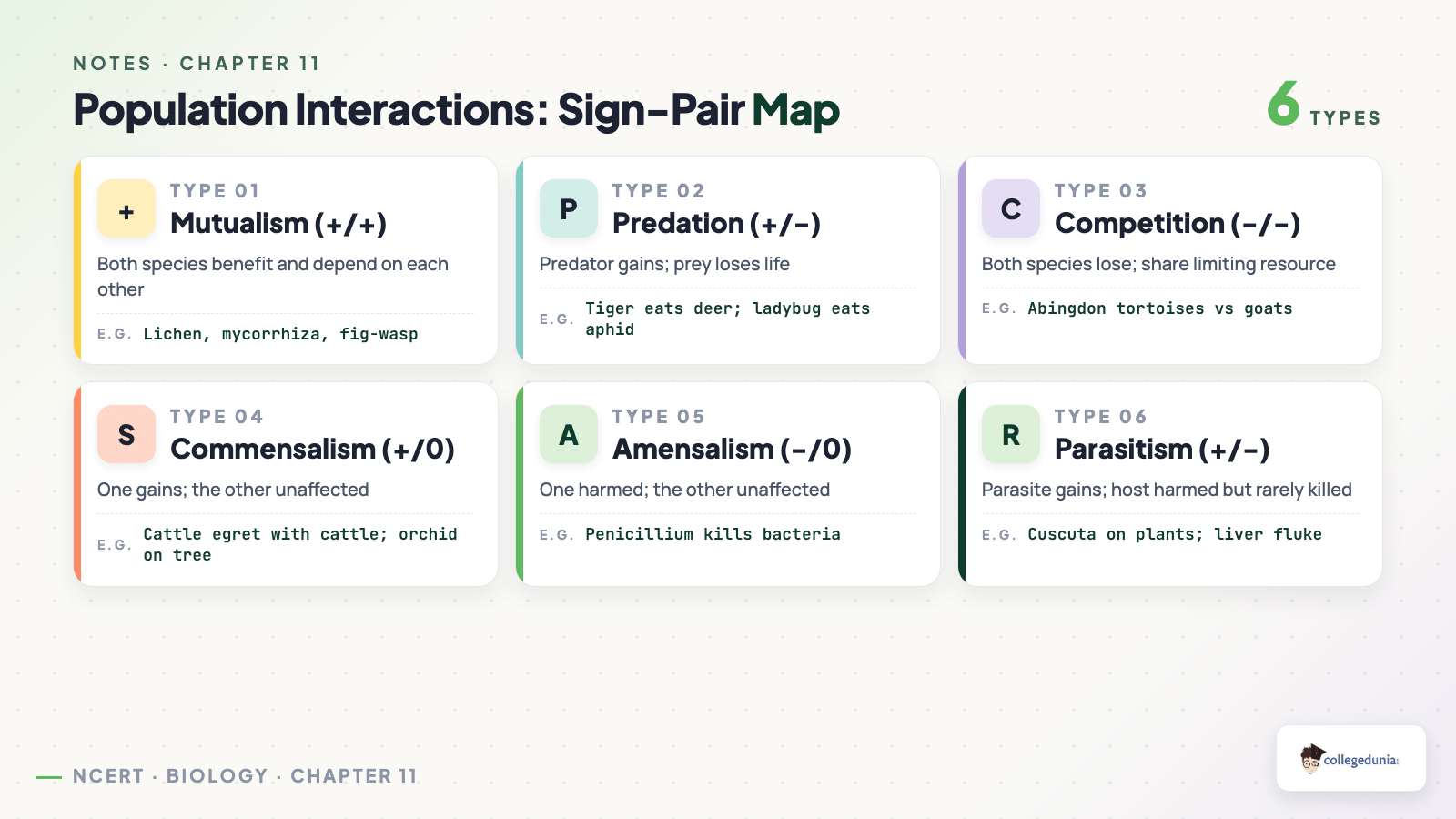
Six interactions classified by sign-pair: mutualism (+/+), competition (-/-), predation (+/-), parasitism (+/-), commensalism (+/0), amensalism (-/0). Pisaster sea-star removal from Pacific shores wiped out 10 of the 15 invertebrate species (Paine's classic keystone species experiment). Calotropis avoids herbivory by producing toxic glycosides. The Ophrys orchid pseudocopulation with bee is sexual deceit pollination.
How Will Collegedunia's NCERT Notes Help You with Organisms and Populations?
The Collegedunia Organisms and Populations notes blend the entire NCERT chapter with NEET-specific depth, structured for the way Class 12 students revise: skim, recall, drill.
- 2026-27 NCERT Alignment: Every section from 11.1 to 11.2 mirrors the latest NCERT print, with NEET-only add-ons (Lotka-Volterra, Paine's experiment, semelparity vs iteroparity) flagged.
- Master Interaction Matrix: One quotable table holds the six interactions with sign-pairs, NCERT examples and recent NEET-key occurrences.
- Diagram-First Layout: Sigmoid logistic curve, age pyramids, three survivorship curves and the interaction matrix appear as labelled diagrams beside the prose.
- Quick Tip and Common Mistake Boxes: Each sub-topic ends with one NEET trap (BOD-style sign inversions, exponential vs logistic mix-up).
Organisms and Populations Topic-wise Weightage for CBSE Class 12 Biology
Population growth and interactions are the highest-frequency theme, followed by adaptations to abiotic stress. The table below maps each sub-topic to its CBSE frequency over the last five years.
| Sub-topic | Weightage | CBSE Frequency |
|---|---|---|
| Population Growth (logistic / exponential) | High | Almost every year |
| Population Interactions (6 sign-pairs) | High | 4 out of 5 years |
| Adaptations - desert, altitude, aquatic | High | 4 out of 5 years |
| Population Attributes - density, age pyramid | Medium | 3 out of 5 years |
| Abiotic Factors - temperature, water, light, soil | Medium | 3 out of 5 years |
| Responses - regulate, conform, suspend, migrate | Medium | 2 out of 5 years |
| Levels of Organisation / Ecology Intro | Low | 1 out of 5 years |
Three themes carry over 70% of CBSE marks: population growth, interspecific interactions and abiotic adaptations. Start every revision pass here.
Organisms and Populations Important Diagrams and Curves for Class 12 Boards
The six diagrams below have appeared most often in the last five board papers and NEET shifts.
- Sigmoid Logistic Curve (Fig 11.7): lag → log → deceleration → asymptote at K. Inflexion at N = K/2 (CBSE 2025, 2023; NEET 2024).
- Exponential J-curve (Fig 11.6): unlimited resources; Nt = N0 ert (CBSE 2024; NEET 2023).
- Age Pyramids (Fig 11.5): expanding triangle, stable bell, declining urn (CBSE 2024).
- Survivorship Curves (Type I, II, III) (Fig 11.4): Drosophila vs hydra vs oyster (NEET 2025, 2022).
- Six-Cell Interaction Matrix: mutualism, competition, predation, parasitism, commensalism, amensalism (CBSE 2025, 2024; NEET 2025, 2024, 2023).
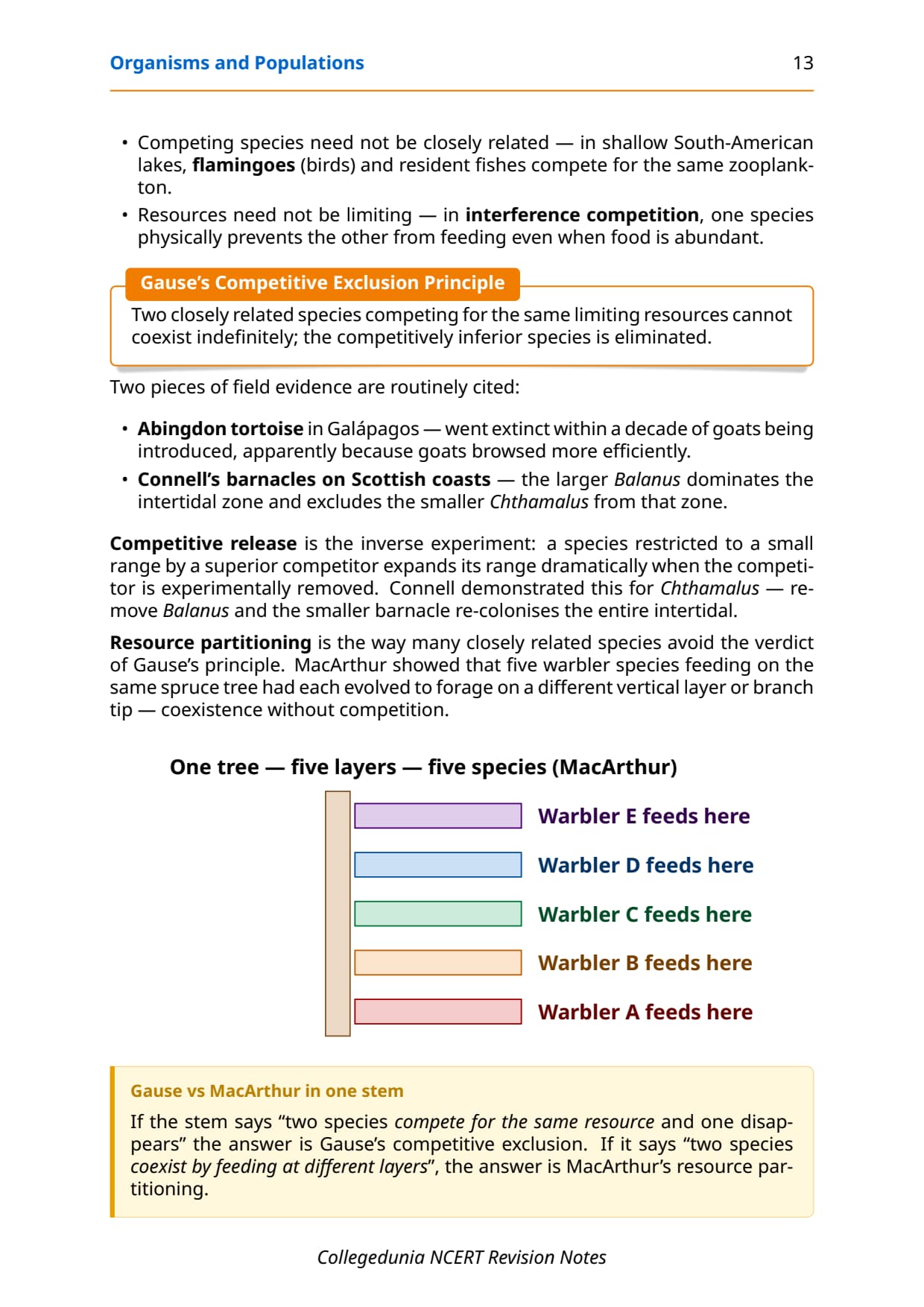
- Gause's Competitive Exclusion (Fig 11.8): two Paramecium species in shared culture (NEET 2024).
Most Repeated Biology Board Questions in Organisms and Populations
Across the last five CBSE Biology papers, the stems below have recurred most often. Use them as a final-revision checklist.
- Q (3 marks). Derive the logistic growth equation and sketch the sigmoid curve marking carrying capacity. (CBSE 2025, 2023)
- Q (2 marks). Distinguish mutualism from commensalism with one NCERT example of each. (CBSE 2024, 2022)
- Q (3 marks). Explain three desert-plant adaptations citing Opuntia. (CBSE 2024)
- Q (2 marks). Draw the three types of age pyramids and label one example each. (CBSE 2023)
- Q (5 marks). State Gause's competitive exclusion principle with an experimental example. Compare exponential and logistic growth. (CBSE 2025, 2022)
- Q (3 marks). Define BOD-style attribute: natality, mortality, immigration, emigration; write the population balance equation. (CBSE 2023)
Organisms and Populations Top 5 Recall Facts
The five facts below recur most often in NEET and CBSE. The full master sheet is on the Formula Sheet.
| Concept / Fact | Why it matters |
|---|---|
| Logistic dN/dt = rN(K-N)/K | Verhulst-Pearl; sigmoid curve; asymptote at K |
| Six interaction sign-pairs | Direct NEET MCQ recall; CBSE 3-marker |
| Allen's Rule | Cold-climate mammals have shorter ears / limbs |
| Gause's Principle | Two species cannot coexist on the same niche |
| Pisaster keystone experiment | Removal ⇒ loss of 10/15 invertebrate species (Paine 1966) |
Full master sheet: Organisms and Populations Class 12 Biology Formula Sheet
Common Misconceptions in Organisms and Populations
Each of these wrong-beliefs has appeared as a NEET distractor in the last five years.
- dN/dt = rN is logistic growth. Wrong - that is exponential. Logistic carries the (K-N)/K bracket.
- Commensalism is mutualism. Wrong - commensalism is +/0, mutualism is +/+. The sign-pair is what CBSE awards.
- Predator always kills the prey; parasite does too. Wrong - predation kills; parasitism harms but typically keeps the host alive.
- Carrying capacity K can be exceeded indefinitely. Wrong - K is the asymptote; populations may briefly overshoot but crash back.
- All animals are regulators. Wrong - around 99% are conformers; only birds, mammals and a few lower vertebrates regulate.
- Hibernation and aestivation are the same. Wrong - hibernation is winter sleep (bears); aestivation is summer dormancy (snails, lungfish).
Organisms and Populations Glossary for Class 12th Biology
Eight high-frequency terms with one-line definitions. Each has appeared in CBSE or NEET in the last five years.
| Term | Definition |
|---|---|
| Population | Group of individuals of one species in one habitat at one time. |
| Carrying capacity (K) | Maximum population a habitat can sustain indefinitely. |
| Intrinsic rate r | Per-capita rate of natural increase under unlimited resources. |
| Commensalism | +/0 interaction; one benefits, the other unaffected (cattle egret + cattle). |
| Amensalism | -/0 interaction; one is harmed, the other unaffected (Penicillium on bacteria). |
| Keystone species | Species whose removal disproportionately reshapes the community. |
| Hibernation | Winter dormancy in homeotherms (e.g., bears) to escape cold stress. |
| Aestivation | Summer dormancy (e.g., snails, lungfish) to escape heat and desiccation. |
Organisms and Populations NEET Extensions Beyond NCERT
NEET routinely tests four extensions that NCERT mentions only briefly:
- Lotka-Volterra equations: coupled predator-prey ODEs that predict cyclic oscillations of population sizes.
- r and K selection theory: r-selected species (insects, weeds) maximise growth rate; K-selected species (whales, oaks) maximise competitive ability near K.
- Semelparity vs iteroparity: Pacific salmon breeds once and dies (semelparous); humans breed multiple times (iteroparous).
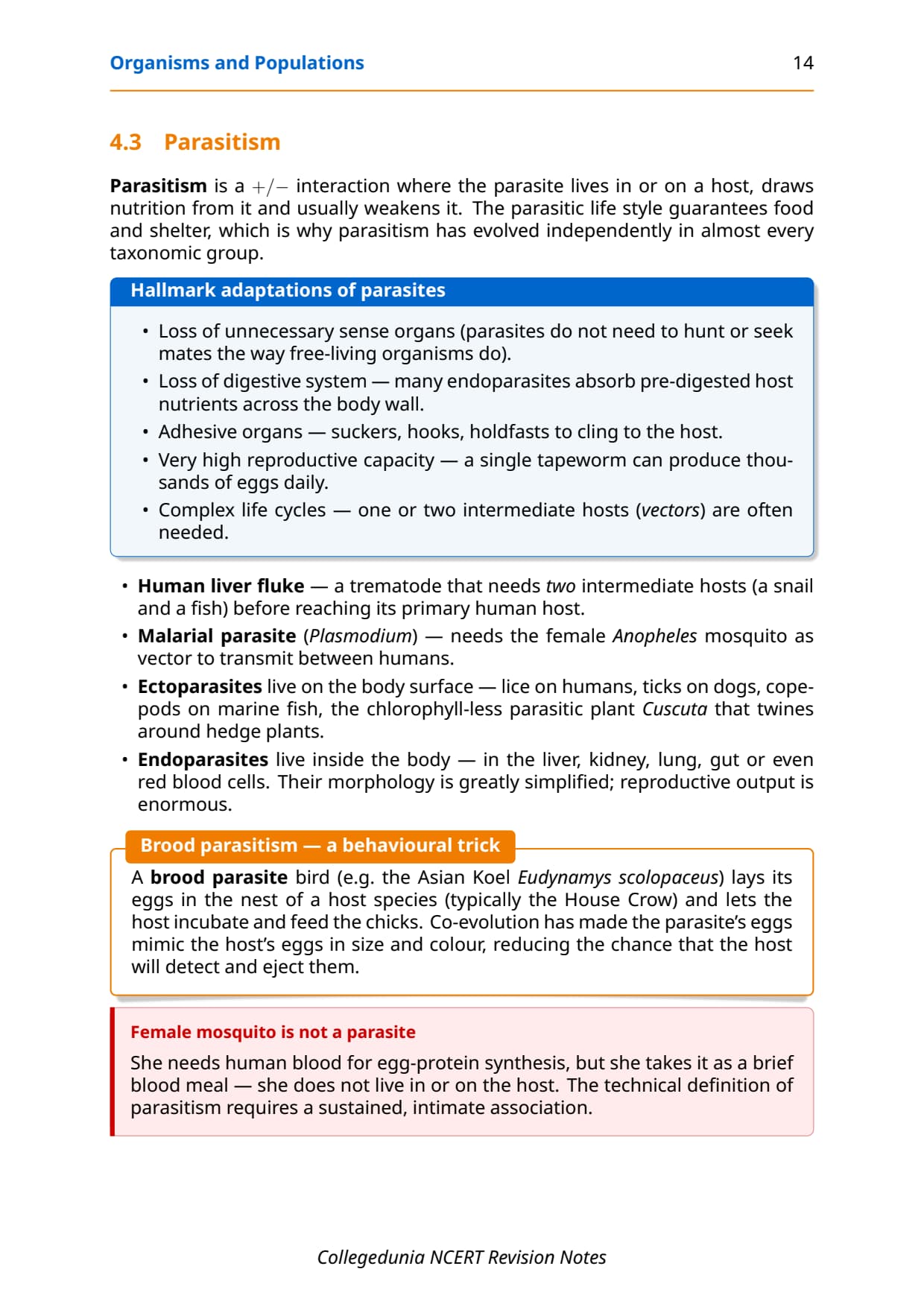
- Brood parasitism: the cuckoo lays eggs in crow's nest; egg mimicry evolves to escape host detection.
NEET 2024 and 2025 each had at least one MCQ on Lotka-Volterra or r/K-selection as the discriminating concept.
Organisms and Populations Previous Year Questions Snapshot (2026 to 2021)
Population growth has appeared in every CBSE paper and population interactions in four out of five. The mini-table below highlights recurring topics; the full year-wise map is on the Collegedunia NCERT Solutions page.
| Year | CBSE Topic Asked | NEET Topic Asked |
|---|---|---|
| 2026 | - | Pending (exam rescheduled) |
| 2025 | Logistic growth (3 marks); Population interactions (3 marks) | Commensalism vs mutualism; Gause's principle |
| 2024 | Adaptations - Opuntia (5 marks); Age pyramids (2 marks) | Allen's rule; Mutualism (lichen) |
| 2023 | Carrying capacity (3 marks); Amensalism example (2 marks) | Logistic asymptote; Pisaster keystone |
| 2022 | Survivorship curves (3 marks); Gause's exclusion (2 marks) | r vs K selection; Parasitism |
| 2021 | Population density methods (3 marks) | Brood parasitism (cuckoo) |
Full year-wise PYQ map: Organisms and Populations Class 12 Biology NCERT Solutions
Organisms and Populations Weightage Across Class 12 Biology Chapters
Chapter 11 sits in the mid-upper band of the Class 12 Biology mark distribution and punches above its weight in NEET because every interaction is a sign-pair MCQ. The visual below maps CBSE marks across the chapters of the 2026-27 NCERT.
Chapter 11 ties with Biotechnology - Principles and Processes at 6 marks. Pair these notes with the Ch 12 Ecosystem set for complete ecology revision.
More Organisms and Populations Biology Class 12 Resources
NCERT Notes for Class 12 Biology: All Chapters
Pair this Chapter 11 set with any other chapter's Notes PDF below.
| Chapter | Notes |
|---|---|
| Chapter 1 | Sexual Reproduction in Flowering Plants |
| Chapter 2 | Human Reproduction |
| Chapter 3 | Reproductive Health |
| Chapter 4 | Principles of Inheritance and Variation |
| Chapter 5 | Molecular Basis of Inheritance |
| Chapter 6 | Evolution |
| Chapter 7 | Human Health and Disease |
| Chapter 8 | Microbes in Human Welfare |
| Chapter 9 | Biotechnology - Principles and Processes |
| Chapter 10 | Biotechnology and Its Applications |
Organisms and Populations Class 12 Biology Notes FAQs
Ques. Where can I download Organisms and Populations Class 12 Biology Notes PDF?
Ans. You can download the Organisms and Populations Class 12 Biology Notes PDF directly from this page. Both the Normal and HD versions are free, and the file is mapped to the 2026-27 NCERT.
Ques. Is this Organisms and Populations Notes PDF aligned with the 2026-27 NCERT?
Ans. Yes. This page reflects the current 2026-27 syllabus for Class 12 Biology Chapter 11. All seven core sections - levels of ecology, abiotic factors, responses, adaptations, population attributes, growth models and interspecific interactions - are retained in the new NCERT edition.
Ques. How many pages is the Class 12th Biology Organisms and Populations Notes PDF?
Ans. The Notes PDF runs approximately 28 pages and covers all seven chapter sections plus a NEET extensions block with Lotka-Volterra equations, r/K selection theory, semelparity vs iteroparity and brood parasitism.
Ques. What are the most important topics in Organisms and Populations Class 12 for NEET?
Ans. The logistic growth equation (Verhulst-Pearl), the six interspecific interactions with sign-pairs (mutualism, competition, predation, parasitism, commensalism, amensalism), Gause's competitive exclusion principle, Allen's rule for cold-climate mammals, and adaptations of Opuntia and the kangaroo rat carry the highest NEET frequency.
Ques. What is the difference between population and community?
Ans. A population is a group of individuals of a single species sharing one habitat at one time. A community is multiple interacting populations of different species in the same habitat. The chapter covers populations; Chapter 12 (Ecosystem) covers communities and beyond.
Ques. What is Allen's rule in Class 12 Biology Chapter 11?
Ans. Allen's rule states that mammals from colder climates have shorter ears, limbs and appendages than mammals from warmer climates. The shorter appendages reduce surface area, which lowers heat loss and conserves body temperature. Arctic foxes (short ears) vs fennec foxes (long ears) is the textbook contrast.
Ques. What is Gause's competitive exclusion principle?
Ans. Gause's principle states that two species competing for exactly the same limited resource cannot coexist indefinitely; the more efficient competitor will eliminate the other. The classic demonstration used two Paramecium species (P. aurelia and P. caudatum) in shared culture - only P. aurelia survived.
Ques. Are these Organisms and Populations notes useful for NEET 2026?
Ans. Yes. NEET draws 3 to 5 questions from this chapter every year, often as sign-pair MCQs on interactions or numericals on the logistic equation. The notes flag NEET-only depth such as Lotka-Volterra coupled equations, r/K selection theory and Paine's keystone-species experiment so you do not need a separate NEET book for this chapter.



Comments